How Hannah Arendt can help us understand this new age of far-right populism

Source: The Conversation – UK – By Christopher J. Finlay, Professor in Political Theory, Durham University

Sales of Hannah Arendt’s The Origins of Totalitarianism (1951) rocketed when Donald Trump won the 2016 US presidential election. Nearly a year into the second Trump administration – and 50 years since Arendt’s death in December 1975 – it seems like an apposite time to revisit the book and see what light it sheds on 2025.

The book is brilliant but difficult, combining history, political science and philosophy in a way that can be very disorientating. So what might we, as democratic citizens, gain from reading it?

Born to a secular German Jewish family in 1906, Arendt studied philosophy under Martin Heidegger and Karl Jaspers before turning to Zionist activism in Berlin in the early 1930s. After a brush with the gestapo, she fled to France, and in 1941 left Europe for the US. So when she began researching Origins in the early 1940s, she was no stranger to totalitarianism.

Totalitarianism, she argued, was a radically new form of government distinguished by its ideological conception of history. For the Nazis, history was a clash of races; for Stalinism, it was class war. Either way, totalitarian leaders sought to execute historical “laws” by forcibly reshaping the humans they ruled.

Humanity, Arendt said, is distinguished by its infinite variability – no person can ever entirely substitute for another. Totalitarianism aimed to destroy this. It isolated individuals, dissolving the bonds through which they unite and empower each other, and sought to extinguish human personhood.

The concentration camps’ total domination did so by reducing each inmate to “a bundle of reactions that can be liquidated and replaced” before killing them. With everyone ultimately subject to this threat, totalitarianism rendered the human person as such, superfluous.

Rather than pursuing stability, totalitarianism was always a movement, constantly instigating change. When its propaganda collided with facts, it brutalised reality until the facts conformed. Its ideal subjects not only believed its lies: they no longer found the distinction between truth and falsehood meaningful. This was “post-truth politics” at its most extreme.

Common sense won’t save us

Comparing today’s politics to fully fledged totalitarianism can be illuminating. But if it’s all we do, we risk overlooking Arendt’s subtler lessons about warning signs that can help us gauge threats to democracy.

The first is that political catastrophe isn’t always signposted by great causes, but arises when sometimes seemingly trivial developments converge. The greatest example for Arendt was political antisemitism. During the 19th century, only a “crackpot” fringe embraced it. By the 1930s, it was driving world politics.

This resonates with hard-right and far-right ideology today. Ideas widely seen as eccentric 20 years ago have increasingly come to shape democratic politics. Anti-immigrant sentiment and xenophobia penetrate the political mainstream. Alongside growing Islamophobia, antisemitism is on the rise again too.

The mainstreaming of previously marginal views helps explain a second warning sign that politics is increasingly driven by what Arendt described as “forces that cannot be trusted to follow the rules of common sense and self-interest”.

A simplistic politics of ideological fantasy and paranoia takes over instead. It appeals most to the isolated and lonely, people lost in society who have given up hope that anyone will ever address their real interests and concerns. Perpetually frustrated by reality, they seek escape in conspiracy theories instead.

Arendt’s story resonates with There Is Nothing For You Here, Fiona Hill’s account of the “left-behind” in communities of de-industrialised regions in the US, UK, Russia, and Germany – regions where the far right has grown.

In early 20th-century Europe, similar experiences of powerlessness spread alongside the imperialist embrace of what Arendt called “the limitless pursuit of power after power”. When colonial violence boomeranged back to its European source, the powerless were drawn to leaders who exemplified the violent pursuit of power for power’s sake.

New wine in old bottles

The neo-imperialist flex of a US government executing civilian boat crews in international waters while deploying regular armed forces domestically to fight crime looks like an appeal to the same instincts Arendt was writing about.

But perhaps Origins’ most important lesson is about trying to understand something radically new using outdated concepts – “interpreting history by commonplaces” as Arendt called it. Faced with a jarringly new style of politics, there is a temptation to explain it away as mere nationalistic excess, for instance. Or as an understandable expression of economic disappointment and one readily addressed with economic remedies.

Origins tells instead the story of something much greater than the sum of its parts taking on a terrible life of its own. By trying to reduce it to familiar terms, Arendt said, “the impact of reality and the shock of experience were no longer felt” and people failed to resist when they most needed to.

But this lesson also applies to the idea of totalitarianism itself. It helped Arendt understand the 1940s, but we shouldn’t assume that it will apply directly to 2025. The term totalitarianism could itself distract, rather than mobilising people.

For example, if claiming that Trumpian populism is already totalitarian seems excessively alarmist, then deciding that it isn’t might be excessively reassuring. Either could diminish people’s ability to respond to the demands of the moment.

What we urgently need instead is what Arendt described as “the unpremeditated, attentive facing up to, and resisting of, reality – whatever it may be”. Origins’ greatest lesson is in showing us what that looks like.

The main lesson for 2025 is as much about what Arendt was doing in the 1940s as about what she was saying: actively thinking in the now, and trying to grasp an emergent “something” on its own terms – a threat that is taking shape, but which hasn’t yet fully revealed itself.

This article features references to books that have been included for editorial reasons, and may contain links to bookshop.org; ff you click on one of the links and go on to buy something, The Conversation UK may earn a commission.


Looking for something good? Cut through the noise with a carefully curated selection of the latest releases, live events and exhibitions, straight to your inbox every fortnight, on Fridays. Sign up here.


The Conversation

Christopher J. Finlay has previously received funding from the British Academy and from the Leverhulme Trust.

ref. How Hannah Arendt can help us understand this new age of far-right populism – https://theconversation.com/how-hannah-arendt-can-help-us-understand-this-new-age-of-far-right-populism-269626


How young adult literature and philosophy can help provide better role models for masculinity

Source: The Conversation – UK – By Adrianna Zabrzewska, Senior Research Fellow (Postdoc), Edinburgh Napier University

Toxic masculinity doesn’t stop at marginalising women and LGBTQ+ people. It harms straight men by discouraging emotional expression, tenderness, and connection.

As the TV show Adolescence demonstrated, the troubling anxiety and rage surrounding what it means to “be a man” can arise early in life. What Adolescence also reminds us, though, is that framing boys as potential threats is not the way to go.

So how do we reach boys before they radicalise in dangerous ways? How can we do this without reducing them to stereotypes?

While the effects of literature on empathy might not be straightforward, taking children’s literature seriously and looking into representations of masculinity in young adult fiction could be part of the solution.

In my research, I drew on feminist philosophy to propose three concepts for rethinking masculinity: relationality, vulnerability, and inclination. There are books that already feature these ideals, like Two Boys Kissing by David Levithan or Rick Riordan’s action-packed urban fantasy series Magnus Chase and the Gods of Asgard.

The concept, inclination, relates to fostering a caring, curious orientation toward difference, a willingness to “lean in” rather than stand aloof. Or, to paraphrase the Italian feminist philosopher Adriana Cavarero, it is the courage to fall down the “slippery slope” of love, friendship and emotional bonds. In my interpretation, inclination is the drive that motivates people to connect with the world and care for various vulnerable others.

Inclination can be seen in Magnus Chase and the Gods of Asgard, which combines exciting adventures with emotional depth. Magnus is a teenage male hero who is sweet, caring, and driven by love for his friends.

With a diverse cast of characters, from deaf elves to Muslim American female warriors and genderfluid pottery artists, the series offers an engaging lesson in intersectionality, which refers to the fact that everyone is part of multiple social categories.

Riordan’s other boy protagonists – including Percy Jackson or Jason Grace (also from the world of Percy Jackson) – rely on friends of all genders and are not threatened by independent women.

They bravely display their own vulnerability while respecting the vulnerability of others. And if they don’t – like the protagonist of The Trials of Apollo – it’s because they’re written as caricatures of self-aggrandising, hyper-individualistic masculinity.

Redefining masculinity through queer fiction

The concept of relationality is the idea that we are formed not in isolation but through relationships. It acknowledges the diverse contexts we inhabit, and emphasises that our differences should be respected, not ignored. Ideally, a person who sees themselves as relational would focus on fostering an ethical commitment to honour, rather than exploit, the vulnerabilities of others.

This can be seen in Two Boys Kissing, which follows several queer teenage protagonists as they explore friendship, love, and identity. What makes the novel remarkable is its chorus of narrators: a collective voice of gay men whose lives were lost during the HIV/Aids epidemic.

The narrators watch over the living boys with tenderness and urgency. They become a vigilant, caring presence that transcends time and space. They provide a sense of continuity between generations and individuals, showing that relationships matter, not only in our immediate circles but also in the larger tapestry of life.

Vulnerability refers to the shared human condition of being a body born from another body. We are all finite and fragile, susceptible to harm, loss, and injustice. Through our fragility and dependence, vulnerability can be transformed into resilience and connection. This is especially true when we recognise the diverse experiences of disenfranchisement that we each face.

In Two Boys Kissing, the chorus of narrators celebrate imperfect bodies, both cis-gendered and trans, that defy unrealistic beauty standards. They whisper encouragement to a lonely teen contemplating suicide and agonise over his pain. They affirm that care, intimacy and affection are not signs of weakness but of strength. Through these voices, Levithan’s readers learn that self-acceptance comes not from independence or dominance but from reaching out to others.

When strategically integrated into stories, educational practices and daily interactions, vulnerability, relationality, and inclination can help us sketch new ethical horizons, and not only for masculinity but for gendered existence as a whole.

Of course, literature will not solve our problems. It will not turn us into better people overnight (if at all). But stories are powerful cultural tools. They can show boys that being strong doesn’t mean being unfeeling, and that caring for others is not a betrayal of masculinity but its renewal.


Looking for something good? Cut through the noise with a carefully curated selection of the latest releases, live events and exhibitions, straight to your inbox every fortnight, on Fridays. Sign up here.


The Conversation

Adrianna Zabrzewska does not work for, consult, own shares in or receive funding from any company or organisation that would benefit from this article, and has disclosed no relevant affiliations beyond their academic appointment.

ref. How young adult literature and philosophy can help provide better role models for masculinity – https://theconversation.com/how-young-adult-literature-and-philosophy-can-help-provide-better-role-models-for-masculinity-271888

Top climate books to look out for in 2026 – recommended by experts

Source: The Conversation – UK – By Dominic O’Key, Leverhulme Early Career Fellow, Sheffield Animal Studies Research Centre, University of Sheffield

Rumka Vodki/Shutterstock

From compelling stories to non-fiction, books can spark ideas that help us navigate the climate crisis. As part of The Conversation’s ongoing Climate Storytelling strand, we asked climate research and creative writing experts to review some of the best new and upcoming titles to look out for in 2026. We’d love to know which ones you enjoy – share your thoughts in the comments below.

Surviving Climate and Chaos: What Dinosaurs Teach Us About Climate Change and Resilience by Evan Jevnikar (December 2025)

Surviving Climate and Chaos offers a refreshing take on dinosaur narratives. While far from the first to guide readers through Mesozoic menageries, Evan Jevnikar contributes a deftly woven history of palaeo-climates alongside the chronological history of the dinosaurs.

yellow book cover with black dinosaur folssils, surviving climate and chaos title

Yellow Pear Press, CC BY-NC-ND

Jevnikar shows how dinosaur evolution was intrinsically linked to Earth’s ever-changing climate. Throughout the Mesozoic Era – the “age of reptiles”, which lasted from 252 to 66 million years ago – we see them rise, adapt, and diversify. This was thanks to the way their metabolism and physiology were suited to the warmer, carbon-rich climates of the Triassic period (between 250 and 201 million years ago) and the Jurassic period (201 to 145 million years ago). But the rapid climate change triggered by a fateful asteroid strike (66 million years ago) outpaced the ability of highly specialist dinosaurs (particularly non-flying species) to adapt to a colder and sparser world.

Jevnikar notes how human-influenced climate changes mimic prehistoric catastrophes. Key examples include comparisons between the rising intensity of modern storms and the monsoons of the Triassic period, as well as parallels between carbon-dense volcanic activity throughout Earth’s history and the contemporary mass release of carbon dioxide by people burning fossil fuels.

Jevnikar’s inclusion of actionable solutions is reassuring, though: far from prophesying apocalypse, he couples objective warnings about the influences of climate on ecosystems with remedial steps that humanity can take to reverse some of the damage it has caused. These include reforestation initiatives, carbon capture technology and personal acts of climate consciousness.

Backed by scientific evidence yet communicated clearly enough for people who are not palaeo-climatologists, Jevnikar contemplates our roles as climate stewards in an entertaining and accessible way.

Nathan Bramald is a PhD candidate researching the scientific communication of dinosaurs in literature

Called By the Hills: A Home in the Himalaya by Anuradha Roy (January 2026)

For the past 25 years, novelist and publisher Anuradha Roy has called the Himalaya her home and her world. In Called by the Hills, she invites us up and into the Ranikhet hillside of northern India?, where oxygen fizzes like champagne, leopards stalk the forests and langur monkey troops dance on roofs.

Roy’s absorbing book offers a personal panorama of the region: here is the oak tree I planted, she says, that is where the internet cafe was. Throughout, she tends to her sentences with patience and personality, the same way she tends to her Himalaya-facing garden.

The UK edition, smartly presented by Daunt, includes Roy’s adoring watercolours of the dogs who found their way into her home. A book of wildflowers and kafal berries, Called by the Hills stands as both a gardening memoir and a love letter to an endless forest that now faces an ending, as climate change begins to muddle the seasons.

Dominic O’Key is an English-teaching associate

Despite it All: a Handbook for Climate Hopefuls by Fred Pearce (February 2026)

Journalist and writer Fred Pearce argues that climate action is already underway and that defeatism only narrows our imagination. He does not claim to be writing an academic text, yet he provides clear explanations, with careful sourcing and suggestions for further reading that draw the reader into a wider conversation.

His writing on inequity is particularly strong, especially the Enough for a Decent Life section, which confronts the fact that the wealthiest 10% have driven two-thirds of global warming since 1990. It asks how we meet the basic needs of 8 billion people while protecting the systems that support life.

Pearce’s treatment of technology and geopolitical action is thoughtful, using the global response to the stratospheric ozone hole to show that coordinated action can shift outcomes when it is taken seriously. The book focuses on collective work rather than individual lifestyle tweaks.

His examples illustrate what genuine progress looks like, from Indigenous stewardship to eco-restoration projects. The result is a sustained case for cautious optimism that feels earned rather than wishful.

Sam Illingworth is a professor of creative pedagogies


The climate crisis has a communications problem. How do we tell stories that move people – not just to fear the future, but to imagine and build a better one? This article is part of Climate Storytelling, a series exploring how arts and science can join forces to spark understanding, hope and action.


Frontierlands by Hazel Sheffield (February 2026)

The UK has one of the most concentrated forms of land ownership in the world. People are denied access to thousands of derelict properties, boarded up after factories close or landlords raise rents. Hazel Sheffield calls these unused buildings and properties Britain’s “frontiers”.

Documenting the tremendous obstacles to bringing them into productive use again, yet refusing pessimism, she follows artists, community organisers, bricklayers and car repair people who build with a new ethos. They propose collective ownership and neighbourhood co-production of crafts, festivals, healthy food options, together with affordable, low-carbon retrofitting.

In Frontierlands, Sheffield offers countless ideas for increasing our resilience in the face of late-stage capitalism. She also advocates for building neighbourhoods with better protection against a wetter and hotter climate. It’s a convincing argument: these initiatives will improve the nation’s health as well as its infrastructure.

Stephanie Palmer is a senior lecturer in the school of social sciences

The Beginning Comes After the End: Notes on a World of Change by Rebecca Solnit (March 2026)

Rebecca Solnit’s latest work is a powerful meditation on transformation in turbulent times. This slim volume situates today’s polarisation, authoritarian resurgence and reaction against progressive values within a broader historical arc.

The book opens with a moving land-return ceremony to Indigenous Americans and continues with examples of progress achieved through resistance and activism. Through vivid metaphors – caterpillars becoming butterflies, the labour pains of a new world — Solnit argues that the current turmoil signals the dying throes of patriarchy and colonialism.

At its heart, this book is a rallying call for all those who yearn for a just, sustainable and flourishing society. Solnit tells us not to give up hope, reassuring us that these struggles mark the shedding of the old and the birth of a new civilisation. As a sustainability academic, writer and climate-anxious activist myself, it’s just what I needed to hear.

Denise Baden is a professor of sustainable business

Elemental: How We Will Live on a Warming Planet by Arthur Snell (March 2026)

With more than 25 years’ experience in conflict zones and fragile states, Arthur Snell travels from the heat of the Sahel to the Arctic Circle to show how
climate change is coinciding with a breakdown in geopolitical order,
increasing conflict, military spending and violence.

“This is not a book of predictions … [it] is a guide to the future,” he writes. Snell uses the four elements – earth, air, fire and water – to frame climate change as a force reshaping present-day global politics. Drawing on history and current affairs, he paints a picture of climate change as more than “just” an environmental challenge. He outlines how it is reshaping national security, economic stability and even sovereignty.

He connects drought and the scramble for critical minerals to food insecurity, reminding readers that land remains central to survival. Rising temperatures and air quality pressures drive migration, while wildfires and the “pyrocene” expose vulnerabilities in fossil fuel-dependent economies. Water, meanwhile, links floods in Asia to Arctic ambitions.

Snell’s analysis is rigorous yet human, resisting fatalism and emphasising how outcomes depend on governance and cooperation: choices we make today. Elemental is an interdisciplinary masterclass on power and responsibility in the 21st century.

Mary Johnstone-Louis is a sustainable business researcher.

The Given World by Melissa Harrison (May 2026)

The Given World is a novel rooted in nature. Set in the fictional English village of Lower Eodham, bird song and wildlife are observed in fine detail, interwoven with a well-paced plot. The narrative skips about characters, with each chapter (except the last) focusing on a different village inhabitant or visitor.

Somewhat sparse dialogue gives space to focus on the inner world of these people, with hints at their lives and the connections between them. There is a slightly dark tone, with mysteries we need to wait to understand about difficulties the characters have experienced or may in the future.

Set in post-COVID, modern day life, climate change is an undertone from the start. There are references to wildfires on the news, as well as the consumerist or anti-consumerist leanings of different characters. Mention of the now-closed wholefood vegetarian restaurant chain Cranks made me smile, remembering visits with my father before veganism went mainstream.

The Given World is a thoughtful and thought-provoking story which will resonate with those interested in our reliance on, and complex relationship with, the natural world.

Rosie Robison is a professor of social sustainability

My Body is a Meadow by Bethany Handley (May 2026)

I went through various emotions reading My Body is a Meadow – from angry and amused through to ashamed and annoyed. This reflects the author’s own journey to “radical acceptance” of being Disabled. Disabled like the environment is. Disabled like the flora and fauna that inhibit it are.

The book is at times a painfully honest assessment of how the damage done to Disabled people mirrors that being done to the environment, the barriers both encounter and in turn how these barriers could be overcome.

Handley is also a poet, which is reflected in the many beautiful turns of phrase that litter the book. Some of the points seem a little over worked – but perhaps necessarily so. This is a message that needs to germinate, take root and be planted in people’s minds in order for people and the planet to flourish.

Maria Kett is a professor of humanitarianism and social inclusion


Don’t have time to read about climate change as much as you’d like?

Get a weekly roundup in your inbox instead. Every Wednesday, The Conversation’s environment editor writes Imagine, a short email that goes a little deeper into just one climate issue. Join the 47,000+ readers who’ve subscribed so far.


This article features references to books that have been included for editorial reasons, and may contain links to bookshop.org. If you click on one of the links and go on to buy something from bookshop.org The Conversation UK may earn a commission.

The Conversation

The authors do not work for, consult, own shares in or receive funding from any company or organisation that would benefit from this article, and have disclosed no relevant affiliations beyond their academic appointment.

ref. Top climate books to look out for in 2026 – recommended by experts – https://theconversation.com/top-climate-books-to-look-out-for-in-2026-recommended-by-experts-270105

The evolution of digital nomadism: from hi-tech hacker spaces to crypto coworking

Source: The Conversation – UK – By Dave Cook, PhD Candidate in Anthropology, UCL

Working on a laptop while looking out over terraced rice fields in Chiang Mai, northern Thailand. Torjrtrx/Shutterstock

One of the first modern coworking spaces, C-Base in Berlin, was launched 30 years ago by a group of computer engineers as a “hacker space” in which to share their tech and techniques. Similarly, many of the people we first encountered in our anthropological research into the emerging world of digital nomadism in the mid-2010s were hackers and computer coders.

Nearly a decade later, we returned to Chiang Mai to see what had happened to these pioneers of the borderless, desk-free life. We wondered if they had been put off by the throngs of travellers who have followed in their sandal-clad footsteps, attracted by glamorous – if often inaccurate – images of the digital nomad lifestyle.

One of the city’s nomad hotspots is Yellow Coworking, which launched in 2020 as a blockchain-oriented, collaborative escape zone from the COVID pandemic. The later stages of the pandemic were an interesting time to be in Chiang Mai: Russia’s full-scale invasion of Ukraine in February 2022 was followed by mass layoffs in Silicon Valley when Twitter, Meta, Coinbase and Microsoft all made significant cuts.

Yellow Coworking saw an influx of former Silicon Valley workers, Russian and Ukrainian coders, and crypto enthusiasts. “Some ex-Silicon Valley employees are here playing around with startups,” one Yellow staff member explained. “It makes sense for them to come here if they are trying to create an MVP” (that’s “minimum viable product” – startup jargon for a basic prototype that, with luck, will become the next technological success story).

“With its lower costs,” the staff member added, “Chiang Mai gives them a longer runway” (the amount of time the startup can remain solvent without raising additional funds).

People walking into Yellow Coworking’s modernist, European-style building simply raise their hands to sign themselves in via biometric fingerprint scanners. Many are computer coders or IT specialists in their 20s, taking advantage of fast broadband and (mostly western) passports to disconnect their lives from any particular location. They view technology and code as a global language, with no need to stay rooted to a single country or location.

Vitalik Buterin, creator of ethereum – the decentralised blockchain behind the world’s second biggest cryptocurrency, Ether – was often a focus of discussion at Yellow’s regular meet-ups. Buterin has identified as a digital nomad for most of the past decade, claiming to live out of a 40-litre backpack. Like many crypto folk, he views this borderless lifestyle as making perfect ideological sense.

Interior view of Yellow Coworking in Chiang Mai
Yellow Coworking in Chiang Mai hosts a mix of ex-Silicon Valley workers, Russian and Ukrainian coders, and crypto enthusiasts.
Dave Cook, CC BY-NC-SA

The borderless revolution

In Chiang Mai, cryptocurrency usage has spread to the local population. During one meet-up held in a local bar, the owner took payment for shots of Thai rum in bitcoin. She too talked about the borderless revolution that was coming, and crypto being part of her financial future.

One of the western “crypto nomads” present was trying to launch his own cryptocoin (built on Buterin’s ethereum ecosystem) and get others to invest in it. A few tables away, another who had invested – and lost – a fortune in cryptocurrency explained he was now living in Chiang Mai because of the city’s relatively low cost of living.

For every success story, there were tales of loss and potential scams. Some told outlandish stories of crypto startups and other projects that were hard to validate. One person who wrote eBooks on how to invest successfully in crypto was selling courses on how to get involved. Another was writing code to improve the security of the ethereum blockchain system, to ensure it would be safe from hackers.

A valuable asset for states

Digital nomad hotspots, which also include European cities such as Lisbon in Portugal, show how the worlds of cryptocurrency, blockchain and digital nomadism are colliding – and evolving beyond mere workspace provision.

A collaborative, incubator-like atmosphere is at the core of The Block Lisboa, where you can pay in cryptocurrency and which hosts weekly Crypto Fridays for networking, collaboration and ideas sharing. In 2023, it held the first Ethereum Block Summit, which promised to “delve into the future of finance” by exploring “groundbreaking advancements in the ethereum ecosystem”.

Meanwhile, CV Labs is building a blockchain ecosystem of its own, comprising coworking spaces, events and summits in Lisbon and four other cities including Vaduz in Liechtenstein and Zug – part of Switzerland’s “Crypto Valley”. These spaces are open to cryptocurrency professionals and enthusiasts with professional exchange in mind.

Digital nomads are becoming a valuable asset for states to compete for – as Tsugio Makimoto and David Manners predicted they would in their 1997 book, Digital Nomad. “Just as we are already seeing governments competing with each other to attract industrial investment,” they wrote, “we may see governments competing with each other for citizens.”

Malaysia’s digital nomad visa initially targeted only nomads from IT and digital professions such as cybersecurity and software development. Estonia launched a digital nomad visa along with its e-residency programme to target high-skilled digital workers. While these visas typically restrict local employment, many allow nomads to bring family members and offer a path to residency, such as in Spain and Portugal.

Coworking spaces started off as techno-utopian, hacker spaces. Thirty years later, they are an increasingly important aspect of some cities’ tourism calculations – having been given further allure by the rise of the niche group of crypto nomads.

The Conversation

The authors do not work for, consult, own shares in or receive funding from any company or organisation that would benefit from this article, and have disclosed no relevant affiliations beyond their academic appointment.

ref. The evolution of digital nomadism: from hi-tech hacker spaces to crypto coworking – https://theconversation.com/the-evolution-of-digital-nomadism-from-hi-tech-hacker-spaces-to-crypto-coworking-272380

When AI recreates the female voice, it also rewrites who gets heard

Source: The Conversation – UK – By Hussein Boon, Principal Lecturer, Music, University of Westminster

Gorodenkoff/Shutterstock

Voice cloning technology platforms like ElevenLabs allow anyone to replicate a voice using just a few seconds of audio, for a small fee. These technologies are reshaping cultural and artistic expression.

In 2023, Canadian musician Grimes released a clone of her voice, saying that “it’s cool to be fused with a machine”. Similarly, American composer Holly Herndon launched Holly+ in 2021 as a voice tool that sings back music using a “distinctive processed voice”.

These female-led examples demonstrate working with the creative challenges of voice technologies, and in some ways, they’re nothing new: electronic music pioneer and composer Suzanne Ciani developed a technological approach decades ago to incorporate a male persona, named “Steve”, into her compositions when a male voice was required.

Voice-swapping technologies are also used by some male producers to present as female artists. British researcher and musician Helen Reddington has observed that: “Like the male gaze, the male ear is hidden and its power exercised behind the scenes.”

Reddington wrote that in 2018 in relation to the way that male writer/producers use female singers to reach an audience. But applied to AI, this points to a cultural dynamic where voice manipulation, as an extension of the male gaze and ear, may also reflect deeper desires to control female identities – especially in music, where voice is central to emotional expression and identity.

Earlier this month, singer Jorja Smith accused producer Harrison Walker of using AI technology to clone her vocals for his single, I Run. Walker said: “It shouldn’t be any secret that I used AI-assisted processing to transform solely my voice.” But Smith’s record label responded saying the producers producer and his distributors seemed to revel in the resulting public confusion.

One of imoliver’s songs, created using an AI female voice.

AI voice technologies are a form of information technology. However, once a voice is rendered as information and is simulated, it will have “lost” its physical form. The combination of disembodied voice and the quality of its simulation can make it easier for people to think of computers as being like a human. This means that a person will be heard whether a machine or human speaks. It is this connection to a person that voice cloning disrupts.

British AI artist Oliver McCann, known as imoliver, openly admits to having “no musical talent at all … I can’t sing, I can’t play instruments, and I have no musical background at all”. Yet through AI, he has developed songs that foreground a female persona. Likewise, the eminent producer Timbaland has invented a pink-haired female artist, TaTa, in a new genre he refers to as a-pop or artificial pop. But does a creator’s gender matter in the development of AI artists and wider fanbases?

Noonoouri, a digital avatar signed by Warner Music Central Europe in 2024, though not completely AI-generated, is a composite of digital tools, presented as a human-made young female fashionista turned pop star. The Instagram feed for Noonoouri shows everyday activities – eating pasta, throwing peace signs, even signalling support for Black Lives Matter. The avatar’s appearance is malleable. But these gestures and modified appearance, while seemingly empathetic, may be more performative than transformative.

Noonoouri’s creator, Jeorg Zuber, used his own voice – digitally feminised – and motion capture of his movements to animate the avatar. It is Zuber’s embodiment of femininity that is being portrayed here, ultimately to produce a pliable brand ambassador. As Warner’s senior A&R manager, Marec Lerche, has stated: “We can change her style in a minute … we can make her fly if we want.”

As British author Laura Bates, founder of the Everyday Sexism Project, has pointed out, apps used to develop these female avatars and characters rely on a misogynistic idea of “what a woman is and should be. She’ll never disagree with you, she’ll never answer back”. It is not AI doing the impersonation, but the human company.

Technology may blur boundaries, but it also reveals who holds the power. When male creators use AI to simulate female voices and personas, are they expanding artistic possibilities or perpetuating a new form of gender appropriation, ventriloquism and misogyny? One call to action to counter the growth of the manosphere is the increased presence of girl voices to tackle misogyny. Yet voice simulation technologies may undo this.

In the age of AI, impersonation takes on new meaning. When mediated by technologies largely controlled by cisgender men and tech platform companies, female impersonation risks becoming a tool of dominance rather than expression. The question is no longer just about artistic freedom – it’s about who gets to speak, and who is being spoken through.


This article is part of our State of the Arts series. These articles tackle the challenges of the arts and heritage industry – and celebrate the wins, too.


The Conversation

Hussein Boon does not work for, consult, own shares in or receive funding from any company or organisation that would benefit from this article, and has disclosed no relevant affiliations beyond their academic appointment.

ref. When AI recreates the female voice, it also rewrites who gets heard – https://theconversation.com/when-ai-recreates-the-female-voice-it-also-rewrites-who-gets-heard-268257

How poetry can sustain us through illness, bereavement and change

Source: The Conversation – UK – By Julie Meril Gardner, PhD candidate in literature, Nottingham Trent University

InesBazdar/Shutterstock

When COVID lockdown loomed back in 2020, many people panic-bought toilet rolls – but I stocked up on notebooks and my favourite pencils.

I had been inspired by the writing of Austrian poet Rainer Maria Rilke. In Letters to a Young Poet (1929), a collection of ten letters written to a young military cadet who had sent his poetry to Rilke for critique, Rilke advised: “Confess to yourself whether you would have to die if you were forbidden to write. This most of all: ask yourself in the most silent hour of your night: must I write?”

In a BBC radio programme, The Essay: Letters to a Young Poet, first broadcast in 2014, the English poet Vicki Feaver responded to Rilke’s question. She said: “Of course I wouldn’t literally die, but a part of me would die, as it did in the years when I didn’t write.”

My husband, Arthur Gardner, who died of motor neurone disease in 2008, would have identified with this. He started reading and writing poetry in his early 20s and his enthusiasm and ambition increased as he grew older.

During his last few months, he had lost the use of his arms and hands and was dependent on a machine that pushed air into his lungs. Nevertheless, he used every possible opportunity to work on his poems, particularly looking forward to the weekly visit of a sensitive and sympathetic Marie Curie nurse who would patiently scribe for him.

Feaver had wanted to be a poet since reading the work of William Blake as a child. But it wasn’t until she was in her early 30s, married with four young children, that she began to write seriously. The poem 1974, which appears in her collection, I Want! I Want! (2019), includes a conversation she had at a party when a man asked her what she did. The final stanza reveals how significant an impact it had:

‘I’m a poet!’ I lied

jolting myself to life:

a woman buried under ice

with words burning inside.

Feaver’s first full collection, Close Relatives (now out of print) was published in 1981. Thirteen years later, her collection The Handless Maiden won several awards. Many of these poems are reworkings of stories from other sources.

The title poem, one that Feaver has said is very important to her, is a retelling of one of Grimms’ fairy tales. A woman whose hands have been severed by her father has them restored when she plunges them in water to save her drowning child. Of course, hands are used for writing, and this is emphasised in the last lines of the poem: “And I cried for my hands that sprouted / in the red-orange mud – the hands / that write this, grasping / her curled fist.”

In a later poem, Bramble Arm, Feaver explores the notion that writing can be empowering. The speaker of the poem describes a dream where her right arm, “the arm that wields / my writing hand”, is covered in brambles:

It could be a punishment

for unlocking the voice

I was taught as a child

to soften or silence.

Or a sign of its power –

a weak woman’s arm

transformed into

a fearsome weapon.

Now in her eighties, Feaver has continued to write. Her most recent publication, The Yellow Kite (2025) is her first collection since she was diagnosed with Parkinson’s disease. In the first poem, Ode to Parkinson’s, she addresses the illness which “began as her enemy”, but can be seen as a friend because: “You jolted her awake: / challenging her to live / every minute left to her.”

The word “jolted” is possibly a deliberate link to her earlier poem 1974. The jolt caused by the man’s question was the motivation to begin writing, and now illness has given a new sense of urgency to living fully – and for Feaver, that means writing.

There are 25 poems in the pamphlet. Many of them are about what it is like to live with Parkinson’s, some of them using the moniker “shaking woman”. One poem, Her Lost Words, reveals how hard it is for a poet who feels as if “the inside of her head”:

was a shaken snow-globe

where words, mingling with the storm

of whirling flakes, settled randomly,

revealing some and burying others.

In Parkinson’s Speaks, the disease is given its own voice, and it is a cruel one: “But I’m patient. I can wait. / You’ve already fallen / and broken a hip.”

The poems face up to the reality of ageing and serious illness but refuse self-pity or false optimism. The title poem, the last one in the pamphlet, refers to a kite that was a gift from a ten-year-old son “the year his father left”. The poet recalls “watching it as it soared” and the effect it had: “My spirit that I thought / would never recover / struggled up from the floor / and flew into the air.”

Writing does not take us away from the difficult and the painful. If we write with courage and with integrity, it can take us to the very heart of it.

It was after my husband’s death that I started writing poetry. Many of the poems I wrote then were raw and self-centred, but writing them helped me to make sense of my grief. Now I write with more awareness of the craft and with ambition.

It’s often difficult and frustrating but frequently absorbing and fascinating. I think of Rilke’s question. Must I write? My answer is yes.


Looking for something good? Cut through the noise with a carefully curated selection of the latest releases, live events and exhibitions, straight to your inbox every fortnight, on Fridays. Sign up here.


This article features references to books that have been included for editorial reasons, and may contain links to bookshop.org. If you click on one of the links and go on to buy something from bookshop.org The Conversation UK may earn a commission.

The Conversation

Julie Meril Gardner does not work for, consult, own shares in or receive funding from any company or organisation that would benefit from this article, and has disclosed no relevant affiliations beyond their academic appointment.

ref. How poetry can sustain us through illness, bereavement and change – https://theconversation.com/how-poetry-can-sustain-us-through-illness-bereavement-and-change-271003

Huge online scam operations are flourishing in war-torn Myanmar – I travelled there to find out why

Source: The Conversation – UK – By Xu Peng, Postdoctoral Researcher at the Centre for the Study of Illicit Economies, Violence and Development, SOAS, University of London

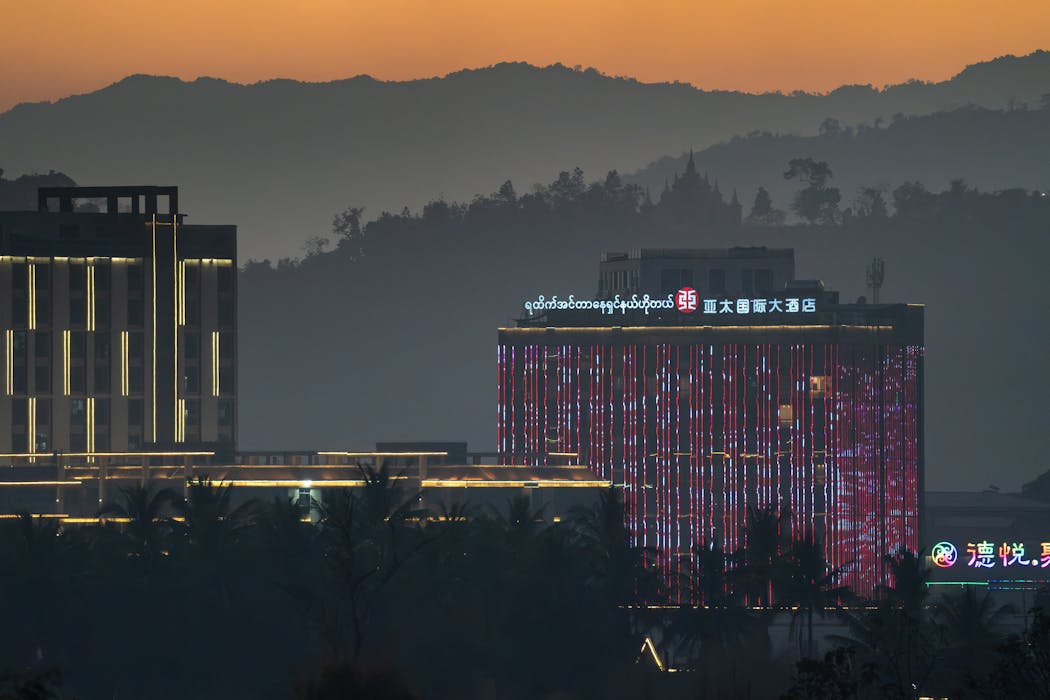
The town of Shwe Kokko in south-eastern Myanmar, which is widely recognised as hosting one of the country’s most notorious scam centres. Naphatpixs / Shutterstock

South-east Asia has become the “ground zero” for the global online scamming industry, according to the UN, costing victims billions of US dollars each year. Scam operations are run by Chinese crime syndicates from fortified compounds in countries like Myanmar, which has been embroiled in a nationwide armed conflict since 2021.

The size of the scam industry has led to sustained security crackdowns in recent years. This has included a number of joint operations involving police forces from multiple countries. However, despite releasing tens of thousands of trafficked workers from these compounds, the raids have done little to wipe out scam operations.

In October, for example, Myanmar’s military stormed a major scam hub in the south-eastern Karen State. The operation was, according to military spokesperson Maj. Gen. Zaw Min Tun, proof that the army would “completely eradicate online scam activities from their roots”. But, just days later, local reporting indicated that work was continuing uninterrupted at other compounds in the area.

Since 2018, I have been carrying out fieldwork along Myanmar’s borders with China and Thailand. I have found that checkpoint controls vary widely. This asymmetry determines where in Myanmar scam hubs emerge and helps explain why operations are often able to relocate rather than shut down when faced with pressure.

A banner warning against scams in China.
A banner warning against scams at Menglian border port, in the Yunnan province of China. It reads: ‘Scam tactics change daily – don’t listen, don’t believe, don’t transfer’.
Xu Peng, CC BY-NC-ND

China’s border with northern Myanmar is heavily securitised. Before travellers reach the border, they must pass internal checkpoints on the main roads that lead into the border counties of Yunnan province.

Police routinely check ID cards and ask people whose household registration is outside Yunnan to explain their visit. Roadside posters, digital billboards and village loudspeakers repeat the same message: do not cross the border to work in scam parks.

Local police officers I interviewed described it as now “almost impossible” for ordinary people to cross informally from China into Myanmar. And restrictions on crossing the border have tightened since late 2023, when the armed conflict in northern Myanmar intensified.

China also exercises tight telecommunications and financial controls. Real-name registration for phone SIM cards, anti-fraud apps installed on smartphones and close scrutiny of cross-border money transfers all raise the risks of running large-scale scam centres near Chinese territory.

View across the Moei River towards Shwe Kokko with the river and grassy riverbank in the foreground under a clear blue sky.
View across the Moei River towards Shwe Kokko, a cluster of buildings in Myanmar opposite Mae Sot in Thailand.
Xu Peng, CC BY-NC-ND

The situation is different along Thailand’s border with Myanmar. This border has long served as a trade corridor, migration route and lifeline for refugees fleeing conflict in Myanmar. Decades of instability there have left a dense landscape of refugee camps, informal crossings and aid infrastructure in the Thai borderlands.

Towns such as Mae Sot in western Thailand, which sit only a short drive from Karen State where scam compounds have proliferated in recent years, have become key hubs for trade and refugee support. The same roads and bridges that carry refugees, aid workers and traders are also used by brokers moving trafficked workers.

Thai authorities do operate checkpoints and immigration controls. But compared with the Chinese border, these are shaped more by humanitarian concerns and longstanding cross-border social ties. It is relatively easy for foreign visitors to access Myanmar through the Thai border, as I discovered on a recent research trip.

I passed three checkpoints between the town of Tak and Mae Sot on a mini-bus and, despite prominent warning signs about scam compounds at the final checkpoint, officers checked documents quickly and let travellers through. This accessibility also makes it simple for scam recruiters, middlemen and some workers to move in and out of Myanmar.

The asymmetric border checkpoints help explain why scam hubs have clustered in Karen State, where Thai police estimate up to 100,000 people work in scam centres, while many northern compounds near China have closed down.

A large yellow roadside sign at a Thai immigration checkpoint warning travellers to be aware of scams and torture across the border.
A sign at the final checkpoint before entering Mae Sot in Thailand, warning travellers about cyber scams near the Thai-Myanmar border.
Xu Peng, CC BY-NC-ND

Myanmar’s moving checkpoints

Inside Myanmar’s contested borderlands, checkpoints are not run by a single authority. They are managed by a patchwork of ethnic armed organisations and border guard forces, each of which control their own stretch of road or river.

While these checkpoints focus on ensuring security, they are also a source of income. Local commanders and militias use them to tax goods, vehicles and people, with checkpoints set up, relaxed or moved when alliances or financial interests change.

This fragmented system creates room for scam operators to keep compounds running or to relocate workers and equipment when pressure from the authorities builds, especially when operators share profits with the people manning the checkpoints.

Interviews I have conducted with local scam brokers and police officers in China and Thailand suggest that information about impending crackdowns often circulates through these cross-border networks of recruiters, militias and complicit officials well in advance.

Reporting from Karen State suggests that ethnic militias escorted Chinese scam workers out of hubs such as KK Park and Shwe Kokko ahead of recent raids to cities like Yangon and Mandalay, charging substantial “fees” for safe passage.

South-east Asia’s scam industry bends under pressure, but it does not break. Checkpoints inside Myanmar and at its borders do not close the trade – they help decide where it goes next.

The Conversation

Xu Peng receives funding from the Serious Organised Crime and Anti-Corruption Evidence (SOC ACE) research programme for the project “The Centrality of the Margins: Borderlands, Illicit Economies and Uneven Development”, and from the Cross-border Conflict Evidence, Policy and Trends (XCEPT) research programme for the project “TRACE: Checkpoints, Conflict, and the Politics of Circulation”.

ref. Huge online scam operations are flourishing in war-torn Myanmar – I travelled there to find out why – https://theconversation.com/huge-online-scam-operations-are-flourishing-in-war-torn-myanmar-i-travelled-there-to-find-out-why-271701

Whether it’s a ‘productivity puzzle’ or the ‘British disease’, the UK economy has been underperforming for decades

Source: The Conversation – UK – By Eoin McLaughlin, Professor in Economics, University College Cork

Maridav/Shutterstock

History does not repeat itself, but it rhymes – and economic history is no exception. In 1964, a Labour government came to power in the UK with a pledge to curb inflation and to deliver growth. The growth plans were short lived. In 2024, in a cost-of-living crisis, Labour again won an election with a promise to “kick-start economic growth”. Only 18 months in, and plans have stalled again.

Weak economic growth has led to questions about whether the UK is once again the “sick man of Europe”. This echoes an earlier trope, the “British disease”, which described Britain’s poor economic performance from the 1950s to the 1970s. Compared to other European countries, Britain saw low investment, low productivity and low economic growth.

The British disease term peaked in the late 1970s, then slipped out of use as the country’s economic performance improved from the 1980s through to the early 2000s. But Britain’s more recent collapse in productivity growth has led to a new term: the “productivity puzzle”. Perhaps, instead of a puzzle, this should be understood as relapse into the old British disease.

In essence, the British disease described the relative decline of a nation that had led the world during the industrial revolution. It was the wealthiest country in the world for much of the 19th century, but by the early 20th century it had been overtaken by the US. This stemmed from Britain’s slow uptake of the innovations of the second industrial revolution (chiefly cars, chemicals and aerospace).

Britain underperformed in the 1950s and 1960s and its growth performance was sluggish compared with countries in western Europe, which soon overtook Britain.

In the 1960s, a team of economists from the US and Canada studied the British economy for US thinktank the Brookings Institution. Their 1968 report, Britain’s Economic Prospects, concluded that British growth was weak due to low investment and productivity.

Part of problem was the high level of government intervention in the economy after the second world war. The government was heavily involved in industrial policy but had a poor track record of picking winners. The history of British industrial policy is littered with high-profile failures.

In search of a remedy

Was there a cure for the British disease? Economists have disagreed over the past few decades. Writing in 1977, British economist Henry Phelps Brown observed that North Sea oil and gas production provided a temporary treatment through net energy exports.

On the other hand, another British economist, Nick Crafts, argued in 2011 that the British disease was cured by the increase in competition that came from joining the EU, and the role that Britain played in developing the single market.

Fellow British academic and economist George Allen argued that the only cure was a complete overhaul of UK institutions, particularly universities, where business and science subjects had been neglected in favour of classics. Now, of course, business and science subjects are now more widely taught.

Even if these cures were effective in the past, they are not effective today. The UK has left the EU and North Sea oil and gas has an uncertain future with new exploration actively discouraged.

Reform of the university sector is necessary to prevent Britain falling further behind. The country continues to trail its peers when it comes to the number of engineering students. If these are the solutions that cured the British disease in the past, they cannot vanquish the resurgent strain today.

How GDP growth has slowed:

Britain’s economic growth has experienced a slowdown since its heyday of the 1950s and 1960s. From 1992 until 2007, GDP per capita growth averaged 2.34% per year. Since 2008 this has fallen to 0.46% per year. Growth has effectively flatlined since 2023. A key factor has been the role of Brexit – a recent estimate suggested that the UK’s GDP has been reduced by between 6% and 8%.

The disease is no longer confined to Britain. From the 1970s, most developed countries also experienced a slowdown in economic growth. Similarly, the productivity puzzle is also occurring in other comparable countries.

One of the biggest areas where Europe as whole, and the UK in particular, are falling behind is in energy. The UK now leads in terms of the most expensive energy for industrial use in Europe. Urgent reforms are needed if the country is to avoid complete deindustrialisation.

The UK’s high industrial energy costs:

One widely touted panacea for the productivity puzzle is artificial intelligence (AI). However, two recent Nobel prize-winning economists have offered very different assessments of AI’s potential for productivity, ranging from a modest 0.53% increase over a decade to estimates several times larger.

In the meantime, there is no longer a solitary “sick man of Europe” but rather a malaise affecting much of the continent. Short-term remedies may be available, but over the long term, radical action and a renewed understanding of the causes of the disease are needed. The metaphor of acute illness may itself be misleading. Rather than a condition that can be cured, the disease resembles a chronic disorder that must be managed.

A note of caution from the insights of the economist Mancur Olson is also evident in the UK experience: when industrial policy becomes captured by interest groups, protection and subsidy displace innovation and competition, entrenching economic stagnation rather than correcting it.

The Conversation

Eoin McLaughlin does not work for, consult, own shares in or receive funding from any company or organisation that would benefit from this article, and has disclosed no relevant affiliations beyond their academic appointment.

ref. Whether it’s a ‘productivity puzzle’ or the ‘British disease’, the UK economy has been underperforming for decades – https://theconversation.com/whether-its-a-productivity-puzzle-or-the-british-disease-the-uk-economy-has-been-underperforming-for-decades-272480

How testosterone went from prostate cancer villain to potential ally

Source: The Conversation – UK – By Daniel Kelly, Senior Lecturer in Biochemistry, Sheffield Hallam University

For more than 80 years, men have been told that testosterone helps prostate cancer grow. But a very different picture has emerged over the past two decades.

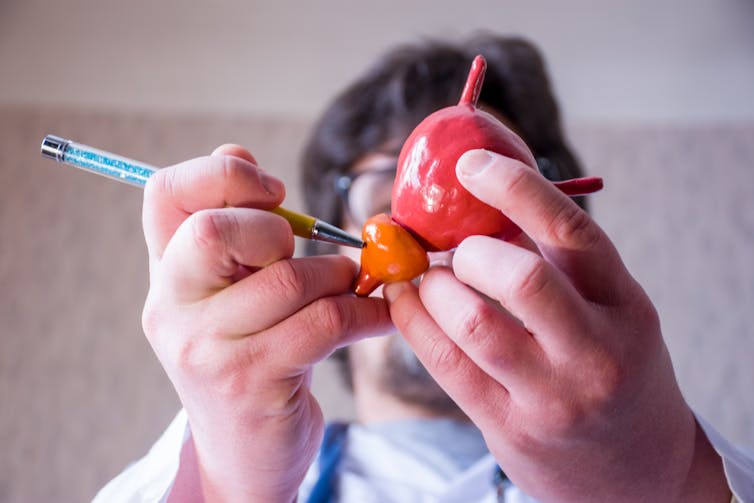
The prostate is a small gland that sits just below the bladder. Its job is to produce the fluid that helps transport sperm, and it relies heavily on testosterone to do so. In fact, the prostate is one of the body parts most affected by testosterone.

All prostate cells, whether healthy or cancerous, contain androgen receptors. These are the molecular switches that initiate testosterone’s action inside cells. When testosterone binds to these receptors, it helps the prostate grow and function normally.

This close hormonal control is important, but it also sets the stage for one of the most enduring assumptions in men’s health: because testosterone stimulates normal prostate growth, it must also stimulate cancer growth.

This belief rested largely on the Nobel prize-winning research of Charles Huggins in the 1940s. He found that prostate cancer shrank when testosterone levels were lowered and accelerated when testosterone was added, via injections.

Lowering testosterone levels, known as androgen deprivation therapy, became the standard treatment for advanced prostate cancer. It still is. Removing testosterone often shrinks tumours, slows disease progression and improves survival.

This belief became deeply embedded in medical practice, shaping decades of caution around testosterone replacement therapy for hypogonadism (testosterone deficienecy) because of fears it could trigger or drive prostate cancer.

Changing the narrative

In the early 1990s, Harvard urologist and testosterone pioneer Abraham Morgentaler began to challenge this view. He pointed out that some of the early research relied heavily on the response of just one patient.

In his clinic, he saw that men with very low testosterone still developed prostate cancer that was often more aggressive, while men receiving testosterone therapy did not show the expected rise in cancer rates.

This led to the proposal of the “saturation model”, which suggests that prostate tissue is sensitive to testosterone only at very low levels. Once androgen receptors are saturated, additional testosterone has little further effect.

At the same time, it was being shown that chronically low testosterone was associated with more aggressive prostate cancer, further challenging the idea that low testosterone is inherently protective.

Recent medical studies now show that testosterone treatment is safe. In multiple high-quality studies, testosterone therapy in men with low testosterone levels does not increase the risk of prostate cancer compared to men who didn’t receive the treatment. New long-term research even suggests that men whose testosterone levels are properly restored and monitored by doctors may actually have lower cancer rates.

A man points to the prostate gland (orange) which sits below the bladder (red).
Shidlovski/Shutterstock.com

But what about men who already have prostate cancer? This is where the discussion often becomes confused. For men with active prostate cancer, particularly early-stage disease, lowering testosterone remains an effective treatment. So how can this paradox exist with evidence that normal testosterone levels are not harmful?

The answer lies in how prostate cells react to different amounts of testosterone. When testosterone levels are very low, cancer cells can adjust by finding new ways to grow and survive. They become super-sensitive to any testosterone signals they can detect.

This is why many men eventually develop castration-resistant prostate cancer, where the disease progresses and can become more aggressive despite near-zero testosterone. Higher levels of testosterone may push these cancer cells into a more stable, slower growth state and, in some situations, may even destabilise them, promoting cell death.

Striking reversal

This discovery has led to a surprising change in treatment. In carefully chosen patients who are closely watched by doctors, testosterone is now being given back after prostate cancer treatment without increasing the chance of the cancer returning.

Even more surprisingly, doctors are testing a new approach in certain men with prostate cancer called bipolar androgen therapy, which switches testosterone levels between very low and very high. The idea is to use testosterone itself as a weapon to confuse and kill cancer cells that have learned to survive without it.

This is one of the most striking reversals in modern cancer treatment. Testosterone has shifted from a presumed villain feared to ignite prostate cancer, to a hormone whose effects are more complex than once believed, and even a possible ally in the fight against prostate cancer.

This evolution is finally reaching medical practice and drug regulation. On December 10, just one month after the US Food and Drug Administration (FDA) announced the removal of black-box warnings from oestrogen products, the FDA organised an expert panel to consider whether longstanding warnings around testosterone use are similarly out of date. A large part of these discussions is about prostate safety and reflects how far the evidence has shifted.

None of this means testosterone replacement therapy – for men with low testosterone levels – is completely without risk. Men starting treatment should still get proper medical checks, have their prostate monitored regularly, and make decisions after talking things through with their doctor.

But the science has changed. The old belief that testosterone therapy increases prostate cancer or makes it worse is no longer backed up by modern research.

For men who genuinely have low testosterone, this change is important. It can remove unnecessary obstacles to getting care and gives them more safe, science-backed treatment options, which helps improve men’s health overall.

The Conversation

Daniel Kelly does not work for, consult, own shares in or receive funding from any company or organisation that would benefit from this article, and has disclosed no relevant affiliations beyond their academic appointment.

ref. How testosterone went from prostate cancer villain to potential ally – https://theconversation.com/how-testosterone-went-from-prostate-cancer-villain-to-potential-ally-266519

The Taliban may not like Peaky Blinders, but its Afghan fans are part of a long history of cultural engagement with the world

Source: The Conversation – UK – By Magnus Marsden, Professor of Social Anthropology, University of Sussex

The four young Thomas Shelbys walking around Herat. Screenshot from YouTube/Herat-Mic

The Taliban’s morality police recently summoned four young men in the city of Herat in western Afghanistan for a “rehabilitation programme”. Their offence: “imitating actors” and “promoting foreign culture”. The young men had formed what they called the “Thomas Shelby Group”, after Cillian Murphy’s character in the popular TV drama Peaky Blinders – and the week before their detention they’d been observed strolling confidently around Herat dressed in black three-piece suits and leather gloves, smoking cigarettes.

The Taliban are well known for actively policing what they refer to as “Afghan cultural and Islamic traditions”. And the morality police’s role is to ensure the “promotion of virtue and prevention of vice”, according to the Sharia, Islam’s legal code – as interpreted by the Taliban.

The Taliban also emphasise their role in preserving the purity and dignity of their conception of Afghan culture. In recent weeks, videos on social media have depicted the morality police in Kabul ordering shopkeepers to remove billboards that include English terms written in Persian. They are apparently seen as enabling the influence of foreign values on Afghan culture.

The detention of these young men for promoting foreign culture is but one instance of the Taliban seeking to enforce a purified form of Afghan culture on people in the country in recent months.

At first glance it may seem surprising to hear, not only of an interest in Peaky Blinders in Afghanistan, but also of young men in one of the country’s most historic cities going to considerable lengths to procure and wear the show’s signature outfits.

But the fact is that despite the Taliban’s best efforts to depict Afghan culture as static and traditional, there has always been a connection and awareness in Afghanistan of what is going on culturally in the rest of the world. Those who think of Afghanistan as backward and isolated culturally are very mistaken.

Much recent scholarship demonstrates that Afghanistan is best understood as a place shaped through historic and ongoing global circulations of people, things and ideas.

Cultural exchange

Far from being tradition-bound tribespeople who take pride in only wearing local clothing, from the days when Silk Road merchants moved goods between Europe and Asia, people in Afghanistan have long incorporated global fashion trends into their own ways of dressing.

In the early 20th century, Afghanistan’s ruler Emir Habibullah Khan, who ruled from 1901 to 1919, introduced a uniform for members of his court based on styles of dress popular in British India.

In the era leading up to the second world war, urban people effortlessly adopted styles they encountered through foreign visitors and residents in the increasingly international city of Kabul. Many who travelled also brought home new trends from across Asia, Europe and America.

Despite the obvious displeasure shown by the country’s religious authorities, in this period the neatly trimmed “French cut” beard became popular among Kabul’s intelligentsia.

man in front of fireplace
John Lennon wore an Afghan coat and a sporran at the press launch for the Beatles’ Sergeant Pepper’s Lonely Hearts Club Band album, held at Brian Epstein’s house in May 1967.
John Downing/Getty Images

This culture and fashion exchange was not a one-way process. Clothes designed in Afghanistan played a significant role in shaping fashion trends in some of the world’s most cosmopolitan cities, including Paris, Los Angeles and London.

For much of the 20th century, the thirst for fur coats in Europe and America was quenched through the import from Afghanistan of Persian lamb pelts from the prized Karakul sheep.

The popularity of Karakul fur expanded in Britain after Nasr Allah Khan, a son of Afghanistan’s Emir Abdur Rahman Khan (who ruled from 1880 to 1901), presented Queen Victoria with a gift of 80 pelts during his 1894 visit to Britain.

Artisans in Afghanistan knew how to turn the pelts of Karakul lambs into a soft and glossy fur-like material. Millions of skins were used to make coats for sale across Europe and North America until as recently as the 1980s. These included the famed “Afghans”, beloved of hippies in Europe and North America in the 1960s.


Read more:
Friday essay: how ‘Afghan’ coats left Kabul for the fashion world and became a hippie must-have


Popular culture

In this way, culture in Afghanistan has been shaped by the circulation of people, capital, things and ideas – and this is embedded in the country’s social and cultural fabric. Even a movement as assertive as the Taliban will confront obstacles in its attempts to limit this circulation and impose rigid and bounded ideas of Afghan culture on the country’s diverse and globally oriented population.

A good example of how this attempt to control Afghan culture was subverted during the Taliban’s previous period of rule (1996–2001) was the craze for the Hollywood blockbuster, Titanic. Cinema, television and music were banned (as were barber’s shops).

But underground video shops flourished, and Titanic became a popular symbol to show that one was aware of the wider world. Some bakeries in Kabul are reported to have produced cakes decorated to resemble the ill-fated ocean liner for consumption by the city’s globally connected residents on occasions such as birthdays and weddings.

The young men whom the Taliban deemed to be in need of rehabilitation are hardly isolated mavericks. They represent a key facet of culture in Afghanistan – a fluidity born of, and informed by, the country’s historic global connectedness.

This aspect of the country’s cultural dynamics has long interacted in complex ways with attempts to construct, maintain, preserve and purify what the authorities see as “tradition”. The four young men got away with a warning.

Like the Titanic cakes of the 1990s, the Peaky Blinders outfits are a way of making a statement that challenges the Taliban’s understanding of “Afghan culture” without being enough of an offence to land their wearers in serious trouble.

The Conversation

Magnus Marsden has received funding from the Arts and Humanities Research Council (AHRC).

ref. The Taliban may not like Peaky Blinders, but its Afghan fans are part of a long history of cultural engagement with the world – https://theconversation.com/the-taliban-may-not-like-peaky-blinders-but-its-afghan-fans-are-part-of-a-long-history-of-cultural-engagement-with-the-world-272084