As a cultural historian who has worked with and lectured on the drinks industry for many years I was asked to write a book about post-war Britain and the drinks that made it. I immediately knew I had to include Babycham – a post-austerity tipple that had made Britain smile.
Britain in the early 1950s was gradually emerging from the shadow of war and was dealing with bankruptcy and post-war shortages. By the time of Queen Elizabeth II’s coronation in 1953, British manufacturing was getting back on its feet.
In that year, a little-known Somerset brewery, Showerings, hit upon a novel idea: offer cash-strapped Britons sick of the grey years of austerity a festive, sparkling alcoholic tipple that was cheap but fun. Thus was born Babycham, the celebratory drink that looked like champagne, but wasn’t.
I have distinct memories of my mum drinking the sparkling beverage in the 1960s, sometimes with brandy as a cheap, working-class alternative to the classic champagne cocktail. And who can forget those wonderful, deer-themed champagne coupes which Babycham distributed, and which are now collectors’ items.
As I write in my book Another Round, it was originally named “Champagne de la Poire” by its creators, Francis and Herbert Showering of Shepton Mallet in Somerset. Babycham was a new alcoholic perry – a cider made from pears. It had the modest strength of 6% alcohol-by-volume and came in both full-sized bottles and fashionable, handbag-sized four- and two-ounce versions.
At sixpence a bottle, Babycham’s bubbles come at a fraction of the price of genuine French bubbly – a luxury that very few could afford. Babycham came to epitomise the brave new world of mid-1950s Britain – British ingenuity still seemed to lead the world, and anything seemed possible.
Marketing with fizz
Babycham’s innovative brand design, marketing methods and advertising techniques brought flashy and flamboyant American techniques to the staid world of British beverages as its makers exploited not just the expanding potential of magazines and radio but, crucially, the revolutionary medium of television advertising. Perhaps most importantly, it was also the first British alcoholic drink to be aimed squarely at women.
Showerings and their advertising guru Jack Wynne-Williams made Babycham into the first British consumable to be introduced through advertising and marketing, rather than marketing an existing product. Their eye-catching new baby deer logo featured in the ad campaign of autumn 1953 and has been with us ever since. And it was equally prominent when their groundbreaking debut TV ad in 1956 made Babycham the first alcoholic brand to be advertised on British television.
In order to convey the idea that Babycham provided a champagne lifestyle at a beer price, Showerings advised their (largely female) customers that it was best served in an attractive and undeniably feminine French champagne coupe. Coupes were soon being customised by Showerings, who plastered them with the brand’s distinctive new deer logo and thereby created an instant kitsch collectable. In this way, Babycham offered the aspirational female Briton of the 50s and 60s a fleeting illusion of glamour and sophistication at the price of an average pub tipple.
All of this Americanised marketing paid handsome dividends. Babycham’s sales tripled between 1962 and 1971. These bumper sales enabled the Showerings to be acquired by drinks leviathan Allied Breweries in 1968, and after the merger Francis Showering was appointed as a director of the new company.
It was only in the early 1980s that Babycham’s sales began first to fall, and then to plummet. During this decade the drinks market was becoming more sophisticated and diverse. Women were turning more to wine and cocktails than to retro tipples made from sparkling pear juice.
However, after a period in the doldrums, the Babycham brand is back. In 2016, a younger generation of Showerings bought back the family’s original cider mill in Shepton Mallet and sought to revive their famous sparkling perry, relaunching Babycham in 2021.
If it is remembered at all, it’s now associated with celebrations such as birthdays or Christmas. No longer seen as a regular indulgence. The Babycham brand and its winsome fawn logo do seem rather old-fashioned today but in an age of nostalgia for the Britain of the past it could be ripe for a renaissance.
Looking for something good? Cut through the noise with a carefully curated selection of the latest releases, live events and exhibitions, straight to your inbox every fortnight, on Fridays. Sign up here.
Steve Parissien does not work for, consult, own shares in or receive funding from any company or organisation that would benefit from this article, and has disclosed no relevant affiliations beyond their academic appointment.
Ancient Egyptians and Etruscans pioneered orthodontics, using delicate gold wires and catgut to straighten teeth. It’s a tale that has appeared in dentistry textbooks for decades, portraying our ancestors as surprisingly modern in their pursuit of the perfect smile. But when archaeologists and dental historians finally scrutinised the evidence, they discovered that most of it is myth.
Take the El-Quatta dental bridge from Egypt, dating to around 2500BC. The gold wire found with ancient remains wasn’t doing what we thought at all. Rather than pulling teeth into alignment, these wires were stabilising loose teeth or holding replacement ones in place. In other words, they were functioning as prostheses, not braces.
The gold bands discovered in Etruscan tombs tell a similar story. They were probably dental splints designed to support teeth loosened by gum disease or injury, not devices for moving teeth into new positions.
There are some rather compelling practical reasons why these ancient devices couldn’t have worked as braces anyway. Tests on Etruscan appliances revealed the gold used was 97% pure, and pure gold is remarkably soft.
It bends and stretches easily without breaking, which makes it useless for orthodontics. Braces work by applying continuous pressure over long periods, requiring metal that’s strong and springy. Pure gold simply can’t manage that. Try to tighten it enough to straighten a tooth and it will deform or snap.
Then there’s the curious matter of who was wearing these gold bands. Many were found with the skeletons of women, suggesting they might have been status symbols or decorative jewellery rather than medical devices. Tellingly, none were discovered in the mouths of children or teenagers – exactly where you’d expect to find them if they were genuine orthodontic appliances.
But perhaps the most fascinating revelation is this: ancient people didn’t have the same dental problems we face today.
Malocclusion – the crowding and misalignment of teeth that’s so common now – was extremely rare in the past. Studies of Stone Age skulls show almost no crowding. The difference is down to diet.
Our ancestors ate tough, fibrous foods that required serious chewing. All that jaw work developed strong, large jaws perfectly capable of accommodating all their teeth.
Modern diets, by contrast, are soft and processed, giving our jaws little exercise. The result? Our jaws are often smaller than those of our ancestors, while our teeth remain the same size, leading to the crowding we see today.
Since crooked teeth were virtually non-existent in antiquity, there was hardly any reason to develop methods for straightening them.
That said, ancient people did occasionally attempt simple interventions for dental irregularities. The Romans provide one of the earliest reliable references to actual orthodontic treatment.
Aulus Cornelius Celsus, a Roman medical writer in the first century AD, noted that if a child’s tooth came in crooked, they should gently push it into place with a finger every day until it shifted to the correct position. Although basic, this method is built on the same principle we use today – gentle, continuous pressure can move a tooth.
After the Roman era, little progress occurred for centuries. By the 18th century, however, interest in straightening teeth had revived, albeit through some rather agonising methods.
Those without access to modern dental tools resorted to wooden “swelling wedges” to create space between overcrowded teeth. A small wedge of wood was inserted between teeth. As saliva was absorbed, the wood expanded, forcing the teeth apart. Crude and excruciating, perhaps, but it represented a step towards understanding that teeth could be repositioned through pressure.
Scientific orthodontics
Real scientific orthodontics began with French dentist Pierre Fauchard’s work in 1728. Often called the father of modern dentistry, Fauchard published a landmark two-volume book, The Surgeon Dentist, containing the first detailed description of treating malocclusions.
He developed the “bandeau” – a curved metal strip wrapped around teeth to widen the dental arch. This was the first tool specifically designed to move teeth using controlled force.
Fauchard also described using threads to support teeth after repositioning. His work marked the crucial shift from ancient myths and painful experiments to a scientific approach that eventually led to modern braces and clear aligners.
With advances in dentistry during the 19th and 20th centuries, orthodontics became a specialist field. Metal brackets, archwires, elastics and eventually stainless steel made treatment more predictable.
Later innovations – ceramic brackets, lingual braces and clear aligners – made the process more discreet. Today, orthodontics employs digital scans, computer models, and 3D printing for remarkably precise treatment planning.
The image of ancient people sporting gold and catgut braces is certainly appealing and dramatic, but it doesn’t match the evidence.
Ancient civilisations were aware of dental problems and occasionally attempted simple solutions. Yet they had neither the necessity nor the technology to move teeth as we do now.
The real story of orthodontics doesn’t begin in the ancient world but with the scientific breakthroughs of the 18th century and beyond – a history that’s fascinating enough without the myths.
Saroash Shahid does not work for, consult, own shares in or receive funding from any company or organisation that would benefit from this article, and has disclosed no relevant affiliations beyond their academic appointment.
“Brainrot” is what many people call the chaotic, fast-moving memes, sounds and catchphrases that spread across TikTok, Roblox and online gaming and into playgrounds. An example is the endlessly repeated chant of “six-seven”, which still echoes through houses and schools across the country – to the bewilderment (or annoyance) of many teachers and parents.
But if you’ve ever said “I’ll be back” in a mock-Arnie voice or asked “you talkin’ to me?”, you’ve already engaged in a form of brainrot. The instinct to repeat and remix lines from the culture around us is nothing new.
What has changed is the source material. For young people growing up in a digital world, quotable moments don’t come from films or TV but from TikTok edits, Roblox streams, speedrun memes, Minecraft mods (modifications) and the fast-paced humour of online gaming.
Hearing a child burst into the looping “Skibidi dop dop dop yes yes” audio from the Skibidi Toilet trend, or repeat a surreal line from a Roblox NPC (non-player character), might sound like nonsense to adults. For the younger generation these fragments slot neatly into a fast-paced, highly referential style of humour. Today’s equivalents are faster, more layered and often more chaotic, with that chaos very much part of the appeal.
Although brainrot is often used knowingly and with a touch of irony to describe these phrases, remixing and repeating fragments of media has always been part of how people connect. It creates a shared cultural code, a second language made of references, rhythms and sounds that bind groups together and turn everyday moments into opportunities for humour and social connection. In many ways, this style of communication offers lightness and playfulness in a world that can often feel slow and muted by comparison.
Changing play
Brainrot is changing how children play online. Many adults grew up with video games that were built around structure. In Pokémon, Zelda or Half-Life, you cleared goals, quests and puzzles to reach endings. Even when games were open-world, giving you nearly total freedom to choose what challenges you take on and when, there was an underlying design logic you were meant to follow.
Those experiences shaped how we thought about play, and later how we approached designing games and interactive tools in research. Structure, narrative and pacing felt fundamental.
Watching children engage with today’s digital culture, and particularly with what gets called brainrot, challenges these assumptions. Their experiences aren’t always built around long-form story arcs or carefully crafted mechanics and challenges. Instead, it’s fluid, fragmentary and relentlessly social.
They jump between Roblox games, short TikTok edits, chaotic Minecraft mods and meme-based jokes without losing the thread. What sometimes looks like disjointed overstimulation to adults is entirely coherent to them. They’re fluent in a form of digital literacy that involves stitching together references, humour, audio, images and interactions at high speed.
Brainrot and research
From a research perspective, this has been a timely reminder that how children engage online changes. Young people aren’t abandoning meaningful play, they’re interacting with an online environment that is dramatically different from the one their parents grew up with.
There is research that raises questions about whether switching between short, chaotic bursts of content might affect attention or wellbeing for some users. For example, a recent study found associations between heavy use of short-form video apps and poorer sleep in adolescents, but also noted that higher social anxiety partly explained this pattern.
A broader analysis of a number of research studies reported similar correlations between heavier use and lower scores on attention tasks, as well as higher stress and anxiety. But these findings do not show causation. It remains unclear whether short-form content affects attention, or whether young people with particular cognitive styles simply gravitate towards media that already fits how they process information.
This shift has changed how we design games for learning. Instead of assuming attention must be sustained in a single direction, we think more about how curiosity works in shorter bursts, how play can be modular, and how meaning can emerge from participation rather than instruction.
Brainrot may not be something we’d replicate directly in an educational game, but some of its qualities, its pace, its playfulness, its remixing of ideas, can offer valuable prompts for thinking differently about how young people engage.
The way we learn is constantly evolving and it doesn’t always fit our older frameworks. Rather than resisting that, there’s value in trying to understand it, and in meeting them where they already are.
If we want to understand why brainrot resonates so strongly with children, it helps to see it not as meaningless noise, but as a form of social communication. These references work as inside jokes, but ones that can be remixed endlessly.
This is part of the appeal: brainrot is malleable, collaborative and playful. If you understand it, then you can riff on it, combine it, subvert it, and use it to signal belonging. There’s a enticing level of creativity stitched into the chaos.
There is also an element of self-awareness in much of brainrot culture. Its absurdity isn’t accidental, it’s part of the joke. In that sense it has echoes of earlier artistic or cultural movements that embraced nonsense or playful subversion. One of the key things is that this isn’t something imposed on children by companies or algorithms. Brainrot is something young people choose to build together, adapting and evolving references within their own circles.
Brainrot isn’t evidence that young people are disengaged or unimaginative. It’s a reflection of how they make sense of a digital world that is fast, fragmented and overflowing with ideas.
The authors do not work for, consult, own shares in or receive funding from any company or organisation that would benefit from this article, and have disclosed no relevant affiliations beyond their academic appointment.
Secondhand fashion is booming, yet most brides – even those who care about sustainability – still choose to walk down the aisle in a new wedding dress.
It’s a striking contradiction. Wedding gowns are expensive and resource-intensive to produce. They require large amounts of fabric and water for a garment worn only once. And while many couples are thinking more carefully about the environmental cost of their celebrations, secondhand bridalwear remains the exception rather than the norm.
Our research with UK brides uncovers why so many continue to resist the broader shift toward pre-loved fashion, when it comes to their big day. What we found is that wedding dresses carry cultural and emotional power far beyond their physical form.
For many brides, choosing the dress is a symbolic milestone in the transition from partner to wife. TV shows like Say Yes to the Dress have cemented the idea of a magical, transformative moment. It’s a moment that often involves loved ones, tears and the collective recognition of “the one”. Within this cultural script, the wedding dress is meant to signal the start of a new identity.
We interviewed 18 brides for our study. Many felt that secondhand options disrupt this narrative. Brides revealed to us that wearing a pre-loved dress would feel like stepping into someone else’s story, making it harder for them to imagine their own.
Most brides in our study cared about the environment and liked the idea of greener choices, but sustainability rarely shaped the final decision. Brides often found themselves weighing their personal values against a deeply ingrained emotional script from their childhood about how the wedding should feel and who they aspire to be on the day.
The dress played a central role in this identity transition. Brides used it to express the version of themselves they wanted to present as they became a wife, relying on fit, tailoring and style to craft that image. This made control especially important.
Many felt that secondhand options limited their ability to shape the dress around their identity. They worried about alterations, condition and whether a pre-owned dress could truly carry the personal meaning they envisioned.
Shopping for the dress was also part of this transition. Many brides pictured a boutique appointment with family or friends, where they could try on different versions of themselves and choose “the one”. This moment helped them confirm the role they were stepping into.
Secondhand shopping rarely supports this experience. Charity shops may feel informal or lack privacy, and online platforms remove the chance to feel the fabric or judge the fit. Without a space that carries the emotional weight of the choice, the brides we spoke to felt the transition was disrupted.
Practical issues added further pressure. Secondhand dresses are one-offs, which limits control over size and style, and their condition can be difficult to assess. These barriers weakened brides’ sense of control over how they would look and feel on the day.
Misconceptions reinforced this reluctance. Many brides simply did not know what secondhand options existed or how to navigate them. Some assumed the dresses would be dated, damaged or unhygienic. Without clear guidance or visibility, most brides never explored secondhand seriously, even if they liked the idea in principle.
What secondhand needs to offer
For brides to consider secondhand, the shopping experience must help them feel in control and emotionally connected to the dress. Brides in our study wanted curated boutiques offering fittings, expert guidance and reassurance about cleaning and alterations, all within a calm space where they could imagine themselves on their wedding day.
They also wanted secondhand options to be easier to find and navigate. Presenting pre-loved dresses as unique and meaningful, rather than as compromises, may help them feel like a credible part of the journey into married life.
Brides are not only choosing a dress. They are managing an identity shift. The wedding dress is one of the main items they use to shape who they will be on their wedding day. Sustainability matters, but it rarely outweighs the powerful symbolic and emotional role the wedding dress plays.
Secondhand bridalwear will only thrive if it supports this emotional transition. Greater visibility, stronger emotional resonance and an experience that helps brides feel the dress is truly theirs, may encourage others to choose secondhand without sacrificing the meaning they attach to becoming a wife.
The authors do not work for, consult, own shares in or receive funding from any company or organisation that would benefit from this article, and have disclosed no relevant affiliations beyond their academic appointment.
Source: The Conversation – UK – By Chee Meng Tan, Assistant Professor of Business Economics, University of Nottingham
As China heads into the new year it will start rolling out its 15th five‑year plan, this one is for 2026-2030.
Beijing is doubling down on greening its economy, and aims to hit two major climate goals: “carbon peaking”, where carbon dioxide emissions have reached a ceiling by 2030, and “carbon neutrality”, where net carbon dioxide emissions have been driven down to zero by 2060.
Yet, China’s green push sits uneasily with its energy realities: coal still provides about 51% of its electricity as of mid‑2025, underpinning China’s difficulty in greening its energy system swiftly. Here are five major challenges that will shape China’s green transition as it moves into 2026.
1. Energy transmission and wastage
Imagine standing in western China (for instance in Tibet, Xinjiang and Qinghai), which produces a lot of solar and wind energy. On bright and windy days, these installations generate vast amounts of clean electricity. Yet much of that power goes to waste.
China’s grid can only handle a limited load, and when renewable generation peaks, it risk overloading the power network. So grid operators respond by telling energy producers to dial down output, which is a process called “curtailement”. The result is that electricity from the west often fails to reach eastern economic hubs, such as Beijing, Tianjin, Shandong, Jiangsu, Shanghai, Zhejiang, Fujian and Guangdong, where demand is greatest.
China needs to invest heavily in the ways to transport and store excess energy. The State Grid Corporation of China claims that it will be spending 650 billion yuan (£69 billion) in 2025 to upgrade the power network, and perhaps much more in subsequent years.
The challenge here is sustaining these capital-intensive projects while the broader economy still grapples with the lasting effects of the 2021 property crisis.
China is building massive solar farms, but also coal-fired power stations.
2. Cutting coal without blackouts
Even as China vows to go green and be a world leader in environmental energy, it continues to expand its coal capacity, and has added enough new coal-fired power stations in 2024 to power the UK twice over per annum. This apparent contradiction stems from concerns over energy security.
Beijing is determined to avoid a repeat of the blackouts and power shortages of 2020–2022. Coal provides dependable, round‑the‑clock power that renewables cannot yet fully replace. Yet the steady expansion of coal capacity undercuts China’s climate pledges and highlights ongoing tensions between China’s president, Xi Jinping’s, dual carbon goals and the country’s pressing energy demands, which raises questions about how far political ambition can stretch against economic reality.
3. Taming overcapacity without hurting growth
China’s vast manufacturing strength, which was once an asset, is now posing a problem. The rapid expansion of solar, wind, and electric vehicle industries has created overcapacity across the clean‑tech sector. Factories are producing more panels, turbines, and batteries than the domestic market can absorb. This has created a cut-throat price war, where companies sell at below cost price, which erodes company profits.
Beijing must find a balance between restraining overproduction without choking growth in green industries. This balancing act is politically sensitive, as local governments depend on these industries to create jobs (7.4 million in 2023), and generate substantial revenue. It was estimated that in 2024 green industries contributed 13.6 trillion yuan to China’s economy or 10% of the country’s GDP.
4. Trade tensions from overcapacity
China’s surplus of clean tech such as cheap solar panels, electric vehicles (EVs), and batteries, have triggered trade tensions abroad. In 2023 and 2024, the European Union investigated allegations of Chinese subsidies being poured into EVs, wind turbines and solar panels. Tariffs of up to 35.3% were placed on Chinese EVs. However, tariffs on Chinese solar panels and wind turbines have not been imposed so far.
But, on January 1 2026 the EU’s Carbon Border Adjustment Mechanism (CBAM) comes into effect. The CBAM is a carbon tax that Europeans will pay if imported goods are made using high carbon emissions. While the tax does not explicitly target EVs and solar panels, it will cover carbon-intensive materials used in their production, such as steel and aluminium, which are made using coal-fired plants.
What this means is Chinese clean tech might lose its competitive edge in the European market as customers are driven away from its products. Industrial players might rely on exports to stay afloat given the highly competitive nature of China’s domestic green market, but the CBAM is likely to undermine China’s green industry.
5. Fulfilling green targets locally
Chinese local governments are formally responsible for putting Beijing’s climate policies into practice, but many are expected to implement these policies largely on their own. While provincial authorities typically have more fiscal resources and technical expertise, city-level governments within each province often don’t have the funds to do so, which makes it difficult to deliver on green initiatives in practice.
At the same time, even when local authority leaders are told to achieve climate‑related targets, their career advancement remains closely linked to conventional economic performance indicators such as GDP growth and investment.
All of this helps explain the continued enthusiasm for new coal‑fired power projects. They are framed not only as a fail‑safe in case renewables and grids cannot meet rising demand, but also as avenues for local employment, fixed‑asset investment and fiscal revenue.
China’s continued greening in 2026 will be challenged by all of these issues.
Chee Meng Tan does not work for, consult, own shares in or receive funding from any company or organisation that would benefit from this article, and has disclosed no relevant affiliations beyond their academic appointment.
Plan de la station des Portes du Soleil entre France et Suisse, dessiné par Pierre Novat.Pierre Novat
Objets familiers des skieurs, les plans des pistes ne sont pas seulement des outils pratiques : ils sont la promesse d’un paradis bleu et blanc, où la neige est partout et où il fait toujours beau. Mais à mesure que le climat se réchauffe, ces images idéalisées s’éloignent de plus en plus du réel. Elles sont devenues un miroir déformant qui interroge notre rapport aux sports d’hiver.
Maxime Petre, géographe et collectionneur de plans de pistes de ski, a co-écrit cet article et la parution scientifique sur lequel s’appuie celui-ci. Son travail de numérisation des plans de pistes actuels et passés a permis d’illustrer cet article.
Pour le skieur, le plan des pistes est à la fois un outil pratique et une promesse. On va l’étudier depuis la maison – ou l’appartement de location – pour prévoir sa journée à la neige, le déplier sur les pistes avec difficultés à cause des gants. Choisir entre une piste bleue ou rouge, un télésiège ou un téléphérique, autant de choix guidés par ce petit document.
Au-delà de cette fonction repère, le plan des pistes construit aussi un imaginaire : celui d’un hiver immuable, presque utopique, où les flancs des montagnes sont toujours enneigés et le ciel toujours bleu. Pour les plus aisés qui peuvent s’offrir ces loisirs de neige, ces plans perpétuent la magie d’un hiver éternel : toujours le même, d’une blancheur immuable, depuis des décennies.
Ils montrent des images d’une météo idéale, désormais rare dans un contexte de changement climatique et de baisse de l’enneigement, comme nous l’avons récemment exposé dans un article de recherche.
Du plan neige à l’émergence d’un style pictural standardisé
On trouve des plans des pistes dès la création des premières remontées mécaniques. Les premiers plans sont sommaires : il s’agit surtout de photographies annotées avec le tracé des pistes.
Plan de la station d’Auron (Alpes-Maritimes) à la fin des années 1930, après l’inauguration du troisième téléphérique de France. Numérisation : Maxime Petre, éditions Héliogravure Sadag, Bellegarde, Fourni par l’auteur
En témoigne par exemple le plan de la station d’Auron dans les Alpes-Maritimes, où le ski maralpin a pris naissance avec l’inauguration le 30 janvier 1937 du troisième téléphérique de France après Megève et Chamonix.
Mais c’est avec le Plan Neige de 1964 que la montagne française s’oriente massivement vers le tout-ski. Ses effets sont rapidement sensibles : de cinquante stations en 1960, on passera à deux cents en 1975. Pour ces destinations, les plans des pistes deviennent alors des icônes touristiques.
Comme il était alors la règle implicite pour les stations de dimension internationale, Val d’Isère (Savoie) sollicite dans les années 1950 l’Autrichien Heinrich Berannn qui a déjà œuvré du côté des plus grandes destinations de ski comme Gstaad (Suisse), Cortina d’Ampezzo (Italie) ou Sankt Anton Am Arlberg (Autriche). Ceci dénote une sorte de mimétisme alpin pour ces grandes contrées des sports d’hiver.
D’un rebord de falaise, le skieur plonge littéralement sur le centre bourg de Val d’Isère (Savoie), encore clairsemé, en suivant des pistes rouges imaginaires. Numérisation : Maxime Petre, Berann, années 1950-1960, Fourni par l’auteur
Formé aux Beaux-Arts à Lyon, Pierre Novat répond à l’appel de Val d’Isère en 1962 et va dessiner, à sa manière, une série de plans qui fera sa célébrité. Une exposition et un livre lui ont récemment été consacrés.
Pierre Novat, photographié par son fils Arthur Novat. Arthur Novat, CC BY
Les pinceaux de Pierre Novat entrent en action en 1962. Le plan de Heinrich Berann n’est plus à jour : Pierre Novat, Avalin (nom donné aux natifs de Val d’Isère) d’adoption, se charge du nouveau dessin.
La vision de Val d’Isère que développe Pierre Novat diffère de celle de son prédécesseur Heinrich Berann. Numérisation : Maxime Petre, Pierre Novat, années 1960, Fourni par l’auteur
Petits arrangements avec la géographie… et la météo
Mais comment représenter en deux dimensions des pentes aux expositions variées, des sommets emblématiques mais dont la visibilité et la proximité sont diverses ? La filouterie est de mise : chaque plan est, en réalité, une projection arrangée.
« Le crayonné a pour but de se mettre d’accord avec les gens de la station, voir si ça correspond à l’image qu’ils veulent donner de leur station et aux angles de prises de vues, aux ombres portées. Le plus, enfin le principe le plus important, ce qui m’a permis de me rendre utile aux stations, c’est que l’on triche, on triche pas mal. »
Autrement dit, les courbes sont adoucies et les reliefs moins acérés. Tout l’enjeu est d’inviter à la glisse, tout schuss. Ces paysages dessinés sont devenus les images d’Épinal pour représenter les stations de sports d’hiver.
Les plans déforment ainsi la topographie pour tout montrer de la station et de ses points forts, tout en présentant ses pentes comme accessibles. Mais ils enjolivent également la météo. Ils véhiculent une image normalisée d’un temps froid et ensoleillé (ce qu’on voit sur le plan), effaçant les conditions permettant les chutes de neige qui précèdent (et qui ne sont jamais représentées).
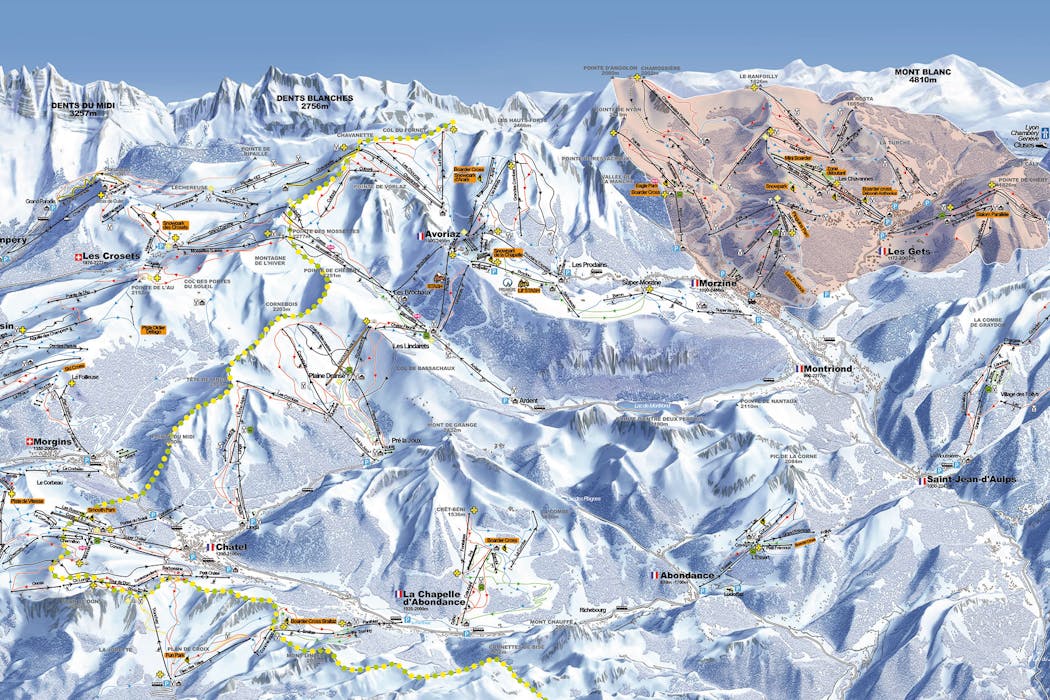
Sur les plans, la neige est omniprésente : très blanche ou légèrement bleutée, elle recouvre uniformément les reliefs, parfois jusqu’aux rives du lac Léman, à 500 m d’altitude, jusqu’aux cimes des Dents du Midi à plus de 3000 m – et au Mont-Blanc, évidemment.
Sur le plan ci-dessus du Suisse Winfried Kettler, réalisé pour le compte du domaine international des Portes du soleil (Suisse et France) dans les années 1980, la neige est partout présente, des rives du Léman au sommet du mont Blanc. Vingt ans après, l’objectif reste, ni plus ni moins, d’afficher encore de la neige à toutes les altitudes, comme le montre la carte contemporaine du domaine skiable en 2024.
Une vitrine de plus en plus éloignée du réel
Une telle blancheur continue n’a rien de réaliste : elle suppose la même quantité de neige à toute altitude, sur tous les versants, quelle que soit leur orientation. En réalité, la qualité et l’épaisseur du manteau neigeux varient selon la pente, l’exposition, le vent. Il est bien rare de trouver de la neige au sol à Évian même, comme le représente pourtant l’une des cartes ci-dessus, par exemple !
Sur cette carte des pistes, réalisée par Pierre Novat pour la promotion touristique du Queyras (Hautes-Alpes), le Viso, pourtant italien, s’érige au centre avec un aplomb souverain, focalisant l’attention. Comme toujours, la neige est tombée sur ce territoire de 626 km² de manière complètement uniforme. Numérisation : Maxime Petre, Novat 1981, Fourni par l’auteur
Quant au ciel, il est quasi systématiquement bleu, effaçant les nuages pourtant nécessaires aux chutes de neige. Ce choix n’est pas anodin : il permet à la neige d’étinceler et de révéler un panorama que la météo réelle masquerait. Le plan traduit des choix météorologiques forts réalisés à dessein.
Comment expliquer que l’image des pistes soit un tel miroir déformant ? C’est parce que le plan est aussi un produit d’appel, un objet marketing pour les touristes. Or la neige est l’élément phare pour attirer les skieurs. Et le ciel bleu, promesse de journées radieuses, est un atout supplémentaire qui permet de repartir bronzé. Pierre Novat assumait pleinement cette mise en scène météorologique, à même de séduire à la fois les élus locaux, les gestionnaires de stations et les skieurs.
Aujourd’hui, le plan s’éloigne de plus en plus du réel. Avec le réchauffement climatique, l’enneigement varie fortement selon les massifs, l’altitude ou l’exposition. Pourtant, les plans continuent d’afficher la même blancheur uniforme. Les plans des pistes ont beau afficher encore de la neige, les stations ferment peu à peu faute d’enneigement.
Plan des pistes de la station de Céüze (Hautes-Alpes) au début des années 2000. Numérisation : Maxime Petre, auteur inconnu, années 2000, Fourni par l’auteur
Après huit années d’inactivité, la station de ski de Céüze, dans les Hautes-Alpes, est en cours de démantèlement à l’automne 2025. Le plan des pistes prend alors le statut de relique, souvenir de jours heureux sur cette montagne emblématique du Gapençais.
Ces cartes traduisent-elles une forme de déni climatique ? Il s’agit plutôt d’un rêve, d’une utopie : l’idée que le ski reste possible, toujours, partout, et durant la « saison » de ski. Ces images révèlent une mémoire d’hivers idéalisés et engendrent une forme de solastalgie – ce sentiment de perte face à un paysage qui nous est proche et qui s’efface peu à peu
Sur ce plan de Villard-de-Lans (Isère) dans années 1980, les pistes bénéficiant de neige artificielle sont signalées par un pictogramme. Numérisation : Maxime Petre, Pierre Novat, Fourni par l’auteur
L’enneigement artificiel, déployé à partir des années 1970, vise à garantir la glisse sur le plan technique face aux aléas climatiques.
Le manque de neige dès la fin des années 1980, avec l’« hiver sans neige » 1988-1989, a amené les stations à rendre visibles les canons à neige pour informer leurs visiteurs d’une « garantie neige ».
Sur ce plan de Villard-de-Lans (Isère) dans années 1990, les pistes bénéficiant de neige artificielle sont signalées par la couleur jaune et un pictogramme. Numérisation : Maxime Petre, Pierre Novat, Fourni par l’auteur
Résultat : les pistes pourvues de canons à neige se matérialisent sur les cartes des pistes. De l’icône du flocon de neige aux pistes jaunies, les plans insistent alors sur les potentialités de la neige artificielle. Ces représentations disparaîtront largement plus tard.
Car, dans les années 2020, les contestations se font plus vives. Certaines stations choisissent de ne plus recourir à la neige artificielle, d’autres de la masquer sur leurs plans. Et bien malin celui qui pourrait ainsi déceler dans ce type de plan un lac dédié à la neige de culture : la transparence de ces aménagements s’efface au profit de l’image idéale et policée.
Ces plans peuvent-ils, doivent-ils évoluer, et si oui comment ? Faut-il produire des images plus « authentiques » reflétant le manque de neige ? Mais des images reflétant des pistes brunies par la terre à l’arrivée en station, des chalets enveloppés dans le brouillard et une tempête de neige en altitude seraient-elles aussi attractives au plan touristique ?
Plan des pistes de Cortina d’Ampezzo (Italie). Numérisation : Maxime Petre, Berann 2025, Fourni par l’auteur
Heinrich Berann a longtemps été le panoramiste des olympiades. Malgré son décès en 1999, Cortina, ville hôte des Jeux olympiques d’hiver de 2026, qui vont débuter en février, lui est restée fidèle. Il y a fort à parier que les plans des Jeux olympiques d’hiver 2030, prévus dans les Alpes françaises, ne s’éloigneront guère de ce modèle immuable et vendeur.
Les auteurs ne travaillent pas, ne conseillent pas, ne possèdent pas de parts, ne reçoivent pas de fonds d’une organisation qui pourrait tirer profit de cet article, et n’ont déclaré aucune autre affiliation que leur organisme de recherche.
Source: The Conversation – (in Spanish) – By Josep Peñuelas, Investigador, Consejo Superior de Investigaciones Científicas (CSIC); CREAF – Centro de Investigación Ecológica y Aplicaciones Forestales; Autonomous University of Barcelona
La severidad inicial de un fuego condiciona más la recuperación de un bosque que las variaciones climáticas posteriores que sufra después. Es la conclusión a la que ha llegado nuestro equipo de investigación del Centro de Investigación Ecológica y Aplicaciones Forestales (CREAF) tras analizar casi 3 300 incendios de gran escala que afectaron a bosques de todo el mundo entre el 2001 y 2021.
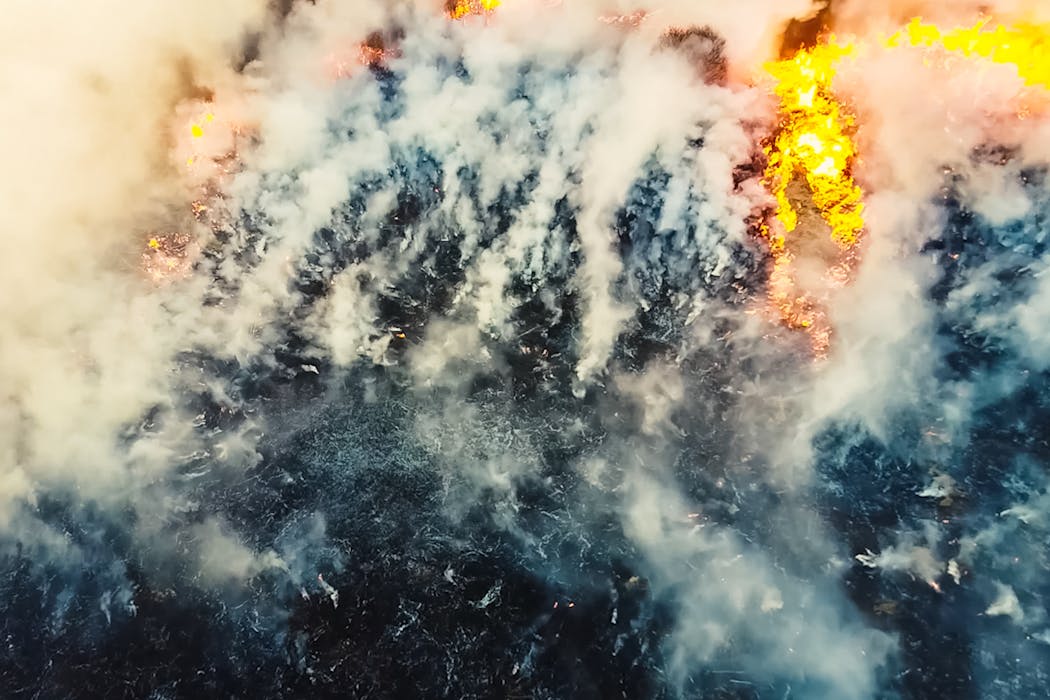
La alta frecuencia e intensidad de estos eventos extremos –superan los 10 km², son de rápida propagación y tienen un comportamiento explosivo– alteran profundamente la estructura y funcionamiento de los ecosistemas. Ello conlleva una reducción de su capacidad de secuestro de carbono, un retraso significativo de su regeneración natural y un aumento de la vulnerabilidad residual del área afectada. Es decir, el bosque queda en un estado de fragilidad extrema que le impide defenderse frente a nuevas amenazas como sequías posteriores, plagas o erosión del suelo.
Estos incendios tienen una relación directa con el cambio climático, modifican el contexto meteorológico local y plantean desafíos sin precedentes a los sistemas de extinción. Y nuestros análisis indican que a partir de 2010 se ha producido un incremento de ellos, especialmente en regiones áridas y boreales. Este período marca un punto de inflexión en la aceleración de los efectos del cambio climático, caracterizado por temperaturas elevadas persistentes, sequías prolongadas y eventos meteorológicos extremos, principales impulsores de los mega incendios.
Como resultado, el restablecimiento forestal se ralentiza considerablemente e incluso puede estancarse, lo cual puede conducir al declive de los árboles y alteraciones permanentes en la estructura y función de los ecosistemas.
Esta dinámica provoca que los incendios, además de contribuir a las emisiones de carbono, incrementen la probabilidad de futuros episodios destructivos, ya que se excede la capacidad de resiliencia intrínseca del bosque. Un claro ejemplo se observa en el oeste de Estados Unidos, donde las sequías tras los incendios han impedido la recuperación del equilibrio hídrico forestal, agravando la falta de regeneración.
Bajo estas condiciones, la recuperación de los bosques se ralentiza e incluso puede estancarse, provocando el declive forestal con cambios duraderos en su estructura y función.
En este contexto, la capacidad de regeneración natural de los ecosistemas se ve severamente comprometida. La destrucción no se limita a la biomasa aérea, aquella a la vista, sino que afecta también al banco de semillas, a los brotes y a una parte significativa del suelo orgánico, elementos cruciales para la sucesión ecológica.
Las zonas más afectadas globalmente incluyen el norte de Siberia, el oeste de Norteamérica, el norte de Sudamérica, el sureste de Australia y el sur de Asia. Observamos que, por ejemplo, menos de un tercio de los bosques boreales (predominantemente coníferas) logra recuperarse en un plazo de 7 años, mientras que los bosques tropicales ––con mayor disponibilidad de humedad–– muestran una recuperación más rápida.
La escasez de humedad en los suelos y las altas temperaturas después de un fuego son particularmente perjudiciales para las plántulas y limitan que se establezca una nueva generación arbórea.
Para cuantificar la recuperación forestal post incendio a lo largo de dos décadas y a partir de los casi 3 300 eventos analizados,empleamos técnicas de teledetección centradas en tres indicadores clave: la densidad de vegetación, el dosel forestal (la capa superior de un bosque formada por las copas de los árboles) y la productividad primaria bruta (PPB), siendo esta última variblee la que mide la cantidad de dióxido de carbono que la vegetación es capaz de absorber mediante la fotosíntesis para transformarlo en biomasa.
Estos indicadores son fundamentales para evaluar el ciclo global del carbono y optimizar la gestión de los incendios. Aunque la recuperación global promedio de la densidad de vegetación en los bosques quemados se estima en aproximadamente 4 años, nuestro estudio ha identificado que, tras un gran incendio, las regiones analizadas requieren de promedio entre 4 y 5 meses adicionales para alcanzar los niveles anteriores. La sequía y las altas temperaturas tras un incendio juegan un papel decisivo en la extensión de este período.
Respecto al dosel forestal, según nuestros datos, la reconstrucción de la capa superior del bosque demandó entre 3 y 4 meses adicionales para su restablecimiento. Una demora que fue más pronunciada en zonas con escasez hídrica. Por otro lado, la recuperación de la PBB tardó casi un año más en recuperar niveles anteriores al fuego, por lo cual redujo la capacidad del bosque como sumidero de carbono
Las proyecciones globales advierten de un incremento en riesgo de incendios de gran escala, con estimaciones de aumento del 50 % para finales de siglo en el oeste de Norteamérica, África ecuatorial, el Sudeste Asiático y Australia, del 100 % en el Mediterráneo, África meridional, el este de Norteamérica y la Amazonia y todavía mayores (hasta 7 veces) en algunas partes de la Amazonia.
Ante este escenario, la ciencia propone enfáticamente medidas de restauración ecológica y reforestación, que otorguen prioridad a preservar la función de los bosques en la mitigación
del cambio climático. También es fundamental apoyar la investigación sobre cómo la diversidad de especies arbóreas puede mejorar la resistencia forestal a la sequía.
Frente a estos desafíos, la comunidad científica debe asumir un compromiso y responsabilidad ineludibles de proveer datos rigurosos y aplicables. Cada acción de protección y restauración forestal contribuye directamente a mantener su función vital frente a la crisis climática global que enfrentamos.
Josep Peñuelas no recibe salario, ni ejerce labores de consultoría, ni posee acciones, ni recibe financiación de ninguna compañía u organización que pueda obtener beneficio de este artículo, y ha declarado carecer de vínculos relevantes más allá del cargo académico citado.
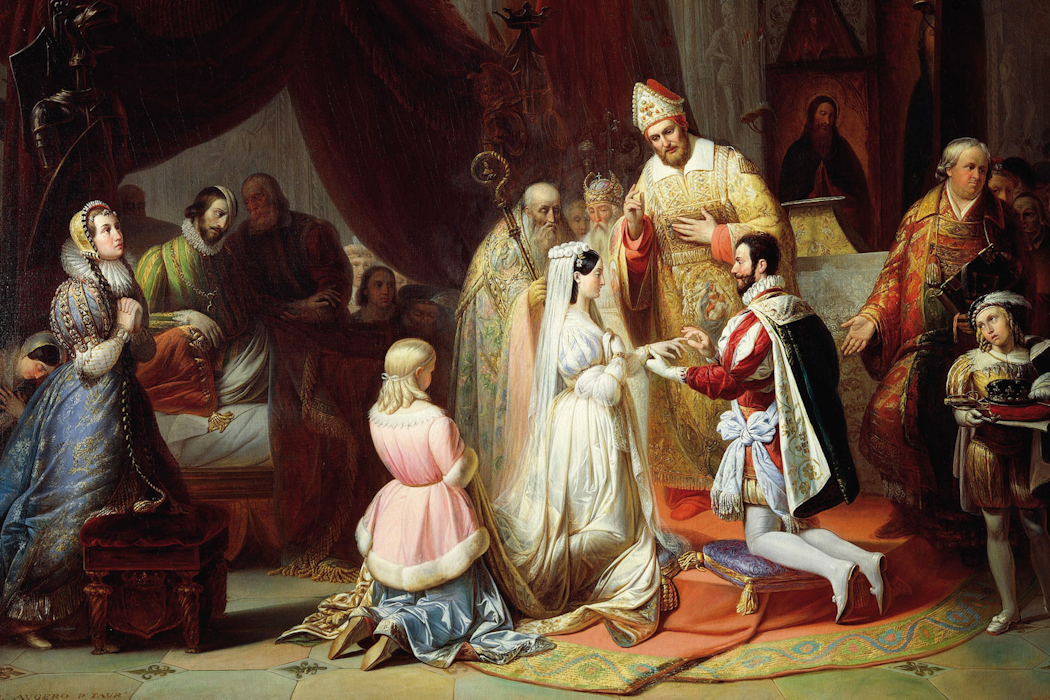
Boda de Manuel Filiberto de Saboya y Margarita de Francia, pintada en el siglo XIX por Francesco Gonin.Wikimedia Commons
Desde Renata de Ferrara hasta Catalina de Médici, el siglo XVI vio nacer a mujeres que supieron entrelazar política y poder en una Europa marcada por las guerras religiosas. Entre esos nombres, sin embargo, Margarita de Francia (1523-1574) ha quedado casi borrada de los grandes relatos.
¿Cómo explicar que una figura que promovió uno de los primeros edictos de tolerancia de Europa, garantizando a los valdenses de Piamonte la práctica de su fe, permanezca en la penumbra?
Su trayectoria recuerda que, incluso en un tiempo de tensiones irreconciliables y violencia religiosa, existieron márgenes para la negociación y la acogida.
Del reino de Francia al ducado de Saboya
Margarita de Francia era hija de Francisco I y hermana del rey Enrique II, dos de los monarcas Valois más influyentes de la Francia del Renacimiento. Exquisitamente formada en lenguas y humanidades y reconocida por su gran cultura, recibió el título de duquesa de Berry en 1550.
Retrato de Margarita de Francia por el estudio de François Clouet. Wikimedia Commons
Nueve años después, su matrimonio con Manuel Filiberto de Saboya (1528-1580) selló el fin de las hostilidades entre el reino de Francia y la Monarquía Hispánica. Así, la paz de Cateau-Cambrésis (1559) la situó en el centro de la política europea. La recuperación del ducado de Saboya, ocupado durante años por tropas francesas, le daba al territorio un peso estratégico decisivo en el nuevo tablero político.
Su posición geográfica, en lo que hoy sería la frontera entre Francia e Italia, lo convertía en un territorio permanentemente disputado. Por un lado, el rey Felipe II lo consideraba clave para asegurar el “camino español” hacia Flandes, mientras que, por el otro, la monarquía francesa mantenía ambiciones en el norte de Italia. A ello se sumaba la complejidad religiosa de la región, marcada por la influencia de la Reforma protestante y la proximidad de las comunidades helvéticas.
El duque Manuel Filiberto impulsó la reconstrucción política y militar del ducado con una estrategia de neutralidad armada. En ese marco, la duquesa Margarita no fue una mera consorte: aportó legitimidad dinástica, redes culturales y capacidad diplomática en un espacio fronterizo sometido a constantes presiones.
La paz de Cavour: un edicto pionero
El 5 de junio de 1561, apenas dos años después de su matrimonio y de la restitución de los territorios saboyanos, Margarita de Francia y el duque Manuel Filiberto afrontaron uno de los dilemas más tensos de su gobierno: la convivencia entre católicos y comunidades valdenses en los Alpes piamonteses.
Epígrafe sobre la Casaforte de los Acaja-Racconigi en Cavour, donde se reconoce que ahí se firmó el edicto. Carlok/Wikimedia Commons, CC BY-SA
La solución fue el Edicto de Cavour, un acuerdo que garantizaba a los valdenses la libertad de culto en sus valles. Las fuentes coinciden en señalar que Margarita desempeñó un papel decisivo en la gestación de este texto. Fue ella quien, con la mediación de Filippo de Saboya, conde de Racconigi y consejero influyente de la corte, convenció al duque de la necesidad de optar por la vía de la tolerancia.
El Edicto de Cavour es considerado uno de los primeros decretos de libertad religiosa en la Europa moderna. Su impacto trascendió las fronteras del ducado: mientras Felipe II consolidaba en la Monarquía Hispánica una política de estricta ortodoxia y los Estados italianos reforzaban el espíritu tridentino, Saboya ensayaba fórmulas de negociación en un territorio marcado por su condición fronteriza.
La corte de Turín, bajo el patronazgo de Margarita, se convirtió además en refugio para perseguidos religiosos, incluidos exiliados franceses y descendientes de sefardíes. La cuestión judía en el ducado de Saboya alimentó el descontento de Felipe II, que veía en ello una connivencia de la duquesa con la heterodoxia. Esta situación hizo que Margarita se hallara bajo sospecha de herejía tanto en Madrid como en Roma, aunque ningún legado papal ni agente del rey español consiguió jamás pruebas en su contra.
Mujeres entre la mediación y la sospecha
La figura de Margarita de Francia puede compararse con varias mujeres de su tiempo y su propia órbita familiar. Renata de Ferrara, su tía materna, mantuvo estrechos lazos con los círculos reformados de Francia, Suiza e Italia, convirtiéndose en protectora de disidentes y foco de tensiones religiosas. Catalina de Médici, su cuñada tras haberse casado con Enrique II, promovió edictos de pacificación que, con mayor o menor eficacia, buscaban contener la violencia confesional que desgarraba el reino de Francia.
Como ellas, Margarita defendió vías de negociación en medio del enfrentamiento entre católicos y reformados. Pero ella lo hizo desde un espacio particularmente frágil: un ducado fronterizo constantemente expuesto a presiones externas al hallarse rodeado por las principales potencias del momento.
En Saboya, su autoridad se vio condicionada por las divisiones internas entre facciones filofrancesas y filoespañolas, y por la cuestión valdense y protestante que marcaba el territorio. La corte de Turín, bajo su patronazgo, acogió a disidentes hugonotes –protestantes calvinistas franceses– y a exiliados de la sangrienta noche de San Bartolomé. Esto acrecentó su prestigio como figura de tolerancia y mediación, pero también las suspicacias en su entorno. Estas resistencias muestran hasta qué punto su apuesta por la convivencia encontró límites, aunque así mismo revelan la singularidad de su posición en la Europa del siglo XVI.
¿Quiere recibir más artículos como este?Suscríbase a Suplemento Cultural y reciba la actualidad cultural y una selección de los mejores artículos de historia, literatura, cine, arte o música, seleccionados por nuestra editora de Cultura Claudia Lorenzo.
La trayectoria de Margarita de Francia invita a mirar de nuevo la historia europea desde la periferia y desde voces habitualmente relegadas. En un siglo atravesado por guerras de religión y persecuciones, su decisión de abrir espacios de negociación en un ducado pequeño y vulnerable muestra que la tolerancia no fue solo un ideal teórico, sino una práctica efectiva y posible.
Su silenciamiento posterior en la historiografía responde tanto a su condición femenina como, posiblemente, a la incomodidad que generan las figuras que no encajan en los relatos nacionales o confesionales dominantes. Recordar hoy su experiencia no es solo un ejercicio de memoria, sino también una invitación a repensar la vigencia de la mediación política de las mujeres, la acogida y la pluralidad en sociedades que, aún hoy, siguen debatiéndose entre la convivencia o la exclusión.
Aitana Goicoechea Beltran no recibe salario, ni ejerce labores de consultoría, ni posee acciones, ni recibe financiación de ninguna compañía u organización que pueda obtener beneficio de este artículo, y ha declarado carecer de vínculos relevantes más allá del cargo académico citado.
An Aliança Catalana rally in Fossar de les Moreres square, Barcelona, on September 10, 2025.Aniol/Wikimedia Commons
La política catalana parece estar ahora muy lejos del infame y no autorizado referéndum de independencia de 2017. Este fue reprimido violentamente por las fuerzas policiales nacionales, provocó disturbios generalizados, desencadenó una crisis constitucional en España y llevó a líderes como Carles Puigdemont a huir del país.
Las elecciones regionales de 2024 supusieron un marcado contraste. Durante más de una década, Cataluña había estado gobernada por partidos independentistas –ya fuera el derechista Junts de Puigdemont o ERC, de izquierda–, pero fue el PSC (la rama catalana del Partido Socialista de Pedro Sánchez) el que emergió como la fuerza más votada. Consiguieron formar un gobierno en minoría con el apoyo de ERC y los Comuns, también de izquierdas.
Pero en medio de este gran cambio, un nuevo partido, Aliança Catalana (AC), entró por primera vez en el Parlamento catalán. A pesar de haber obtenido solo dos de los 135 escaños de la región en 2024, esta nueva fuerza ejerce ahora una enorme influencia en el panorama político de Cataluña y, por extensión, de España.
La política tras el procés
Aliança Catalana es un partido de extrema derecha, independentista y explícitamente antiinmigración. Está liderado por Sílvia Orriols, alcaldesa de Ripoll, una localidad de poco más de 10 000 habitantes.
Con solo un 1,5 % de representación parlamentaria, AC podría parecer marginal, pero no lo es. Su aparición señala una reconfiguración de la política catalana tras el procés y está transformando la derecha nacionalista, un espacio político tradicionalmente dominado por Junts.
Durante años, la política parlamentaria catalana se centró prácticamente en un único tema. La independencia eclipsó casi todo lo demás, incluida la distinción entre izquierda y derecha, lo que significó que partidos como Junts y ERC compitieran principalmente por el liderazgo dentro del mismo bloque independentista.
A medida que el procés ha perdido impulso, sin que se haya conseguido ni la independencia unilateral ni un referéndum negociado, han surgido nuevos temas en la agenda. La inmigración, la seguridad y la identidad dictan ahora la política catalana, al igual que en España y otras partes de Europa.
Las últimas encuestas muestran lo popular que ha sido el mensaje de AC. La última encuesta del Centro de Estudios de Opinión de Cataluña sitúa a AC empatada con Junts en escaños. Independientemente de si estas cifras se materializan o no en las próximas elecciones, el mensaje es claro: AC ya no es un actor marginal.
Todos los partidos políticos compiten por los votos dentro de un espacio ideológico, que suele definirse como una posición en el eje izquierda-derecha. Su fuerza electoral depende principalmente de su reputación y credibilidad entre los votantes de su espacio, y no de propuestas políticas específicas.
Cuando un nuevo partido ofrece un mensaje más claro o convincente, puede desplazar a un partido establecido de su espacio. Esto es lo que le está sucediendo a Junts y a otros muchos partidos políticos mayoritarios.
Tras más de una década gobernando Cataluña y liderando el procés, Junts se encuentra ahora en la oposición en Barcelona y Madrid. En muchos sentidos ha fracasado: no se logró la independencia y en 2023 apoyó la reelección de Pedro Sánchez como presidente del Gobierno a cambio de la amnistía política.
AC saca partido directamente de la frustración posterior al procés. Se presenta como una nueva fuerza que se opone a los partidos nacionalistas tradicionales como ERC y Junts, pero que tampoco está dispuesta a negociar con Madrid.
La reciente estrategia de Junts sugiere que está sintiendo la presión. En octubre de 2025, “rompió” relaciones con el PSOE de Pedro Sánchez, pero su apoyo llevaba tiempo vacilando. Por lo tanto, parece que la medida de Junts no fue un cambio repentino de política, sino un intento de frenar el avance de AC mostrándose más duro, más conflictivo y más escéptico con respecto a la negociación con Madrid.
Sin embargo, al desplazarse hacia la derecha, especialmente en materia de inmigración, Junts podría legitimar la agenda del partido que amenaza con sustituirlo.
El auge de AC encaja en la tendencia internacional más amplia de consolidación de las fuerzas autoritarias y radicales de derecha. Algo similar está ocurriendo en la política nacional española, donde el partido de extrema derecha Vox ha reconfigurado la competencia y sigue empujando al Partido Popular hacia la derecha. En Cataluña, AC está desempeñando un papel similar al de Vox: está desafiando la hegemonía de un partido tradicional y consolidado de derecha.
AC no es idéntico a Vox. Es menos conservador en algunas cuestiones y tiene sus raíces en una tradición nacionalista distinta, pero ideológicamente pertenece a la derecha radical: excluyente, nativista y hostil al pluralismo.
La inmigración desempeña un papel central en este cambio: a medida que cobra mayor relevancia, los partidos de derecha se sienten cada vez más cómodos marcando los términos del debate, mientras que la izquierda lucha por responder sin tensiones internas. Cataluña no es una excepción.
El problema de Junts es el problema del Gobierno español
El actual Gobierno español se sustenta en un frágil equilibrio parlamentario. El PSOE gobierna con Sumar, una fuerza de izquierdas que, a pesar de su éxito electoral en 2023 (3 millones de votos y 31 escaños), es estructuralmente débil. Se trata de una coalición electoral formada apresuradamente por más de una docena de partidos, con raíces territoriales limitadas y que obtuvo malos resultados en las elecciones regionales y europeas de 2024.
El propio PSOE también se encuentra bajo presión, enfrentándose a múltiples escándalos que afectan al presidente y a su círculo más cercano.
Sin un nuevo presupuesto aprobado desde 2022, el Gobierno sobrevive en gran medida porque no hay una alternativa parlamentaria viable. Además, cuenta con el apoyo de partidos regionalistas e independentistas, entre ellos Junts, que se verían perjudicados por la alternativa más probable: una coalición entre el PP y Vox que consolidaría el poder en Madrid.
El apoyo de Junts al Gobierno de Sánchez lo convierte en un partido decisivo, ya que tendría que aprobar cualquier moción de censura o voto de no confianza.
La presión de AC reaviva el dilema de Junts de 2023. Apoyar a un gobierno del PSOE y Sumar refuerza su imagen de colaborador con Madrid, pero alinearse con el PP y Vox sería igual o peor. En ambos casos, AC se beneficia de presentarse como la única opción nacionalista coherente de la derecha.
Una nueva fase
A medida que se desvanece el apoyo al procés, el ámbito de competencia política de Junts está cambiando. Ya no compite por liderar el movimiento independentista, sino por representar a la derecha nacionalista catalana. Esto explica su giro hacia una retórica más dura en materia de inmigración e identidad, que corre el riesgo de normalizar la extrema derecha y remodelar la política catalana para siempre.
Por ahora, las instituciones se mantienen estables. La izquierda tiene una estrecha mayoría en el Parlamento catalán, y es importante recordar que las encuestas de opinión no son resultados electorales. Pero el terreno está cambiando.
El debut parlamentario de AC señala el posible inicio de una nueva fase. Si bien el procés definió a Cataluña durante una década, sus secuelas pueden estar marcadas por un desafío completamente diferente: el auge de una extrema derecha nacionalista, que podría trastocar la política española.
Asbel Bohigues no recibe salario, ni ejerce labores de consultoría, ni posee acciones, ni recibe financiación de ninguna compañía u organización que pueda obtener beneficio de este artículo, y ha declarado carecer de vínculos relevantes más allá del cargo académico citado.
La irrupción de la inteligencia artificial (IA) generativa está cambiando cómo nos relacionamos con la tecnología. Un sistema con IA puede devolvernos un resultado inadecuado sin estar rota o sin que la estemos empleando de manera inadecuada. Simplemente puede “equivocarse” y, como haríamos con un humano, tenemos la opción de corregirle.
Esta posibilidad hace que la confianza que depositamos en la inteligencia artificial y la forma de emplearla cambien sustancialmente respecto de cómo utilizamos otras herramientas tecnológicas donde suele estar mucho más claro si se ha producido algún error. Los sistemas con IA nos obligan a plantearnos si están funcionando mal y verificar los resultados que nos van ofreciendo.
Esta diferencia afecta muy directamente al sector educativo, tanto a profesores como a alumnos. En este ámbito, las posibilidades de la IA van desde usarla para aprender mejor hasta un uso contraproducente para el aprendizaje. Y la confianza que depositamos en ella está estrechamente relacionada con cada una de estas dos opciones.
Tecnología y confianza: una relación modificada
La confianza es un factor esencial en el uso de la tecnología. Mientras que el exceso de confianza puede generar dependencia y quedar expuesto cuando esa tecnología falla (o se “equivoca”), la falta de confianza puede llevar a un uso ineficiente o incluso a rechazar frontalmente su utilización. En el contexto educativo es menos problemático lo segundo que lo primero: la desconfianza impulsaría al alumno a comprobar que la información obtenida es correcta, lo que debería resultar positivo para su aprendizaje.
Para comprobar si esto es así, he investigado en qué medida los estudiantes universitarios confían en la información proporcionada por la inteligencia artificial y cómo la comprueban.
Los resultados del estudio muestran que casi el 80 % de los 132 estudiantes participantes la usan frecuente o muy frecuentemente. Ni uno solo de ellos afirmó no haber utilizado nunca esta herramienta con fines académicos.
Autopercepción frente a realidad
Más del 75 % de los estudiantes utilizan métodos considerados poco fiables para comprobar los resultados ofrecidos. En torno al 40 % ni siquiera realiza acciones básicas como solicitar las fuentes en las que se basa la respuesta. Algo particularmente preocupante teniendo en cuenta que más del 75 % admite que las herramientas de inteligencia artificial proporcionan respuestas inadecuadas algunas veces o muy frecuentemente.
Pero lo más interesante es que la inmensa mayoría (más del 90 % de los encuestados) se considera capaz de identificar respuestas inadecuadas al menos ocasionalmente, y ninguno informó ser incapaz de hacerlo. En cambio, perciben que los profesores no son capaces de detectar tales errores.
Subjetividad irracional
La mayor parte de las universidades están impulsando el uso de la IA con formaciones específicas tanto para docentes como para los estudiantes. Por ejemplo, la Universidad Camilo José Cela, donde enseño e investigo, está haciendo un notable esfuerzo que va desde formación continua hasta la organización de grandes eventos como el Global Education Forum o la financiación de investigaciones como la que nos ocupa.
Pero un elevado número de alumnos desconfía de las herramientas de inteligencia artificial de pago proporcionadas por la universidad porque les preocupa ver comprometida su privacidad. Creen que la universidad puede tener acceso a sus consultas y saber si han empleado la IA de manera inadecuada.
Nuestro estudio evidencia un grado de subjetividad irracional por parte de los alumnos, que nos indica que el uso que se hace de esta herramienta no es el adecuado. Esto es así en cuanto a la verificación de la información, pero también respecto de cuáles son las herramientas más adecuadas para el uso académico y cómo emplearlas. Muchos docentes observamos en el día a día cómo los alumnos ni siquiera son conscientes de estar empleándola mal en su proceso de aprendizaje.
A más confianza, peor aprendizaje
La inteligencia artificial es útil para completar las tareas académicas, pero esto no implica necesariamente que lo sean para aprender. Cuando los alumnos confían en las respuestas proporcionadas por la IA y no comprueban sus indicaciones, el aprendizaje no puede ser el mismo.
Este exceso de confianza en la IA dificulta su uso como herramienta de aprendizaje, pues no actúa el pensamiento crítico ni la metacognición: los procesos mentales en funcionamiento cuando necesitamos resolver un problema. Paradójicamente, gran parte del tiempo que los estudiantes se “ahorran” en estas tareas lo dedican a eliminar posibilidades de ser detectados en su uso de la IA.
Aunque la utilización de la IA pueda ser clave para su desempeño laboral, los estudiantes necesitan aprender a usarla como herramienta de aprendizaje, algo distinto de su hipotético uso en el ámbito profesional. Queda por tanto un largo camino para conseguir que la IA se integre de forma eficiente en el contexto educativo, y los estudios de este tipo son necesarios para ir tomando el pulso e ir adoptando las medidas necesarias.
David Martín Moncunill no recibe salario, ni ejerce labores de consultoría, ni posee acciones, ni recibe financiación de ninguna compañía u organización que pueda obtener beneficio de este artículo, y ha declarado carecer de vínculos relevantes más allá del cargo académico citado.