Manifestación masiva frente al Reichstag berlinés en protesta contra la aprobación del Tratado de Versalles (15 de mayo de 1919).Wikimedia Commons, CC BY
Acabada la Primera Guerra Mundial, también conocida como la Gran Guerra, la Conferencia de París reunió en enero de 1919 a las potencias aliadas –Estados Unidos, Francia, Reino Unido e Italia– para acordar las condiciones de paz con los países derrotados: Alemania, el Imperio otomano, Bulgaria y, en representación del extinto Imperio austrohúngaro, Austria y Hungría.
Con la firma del Tratado de Versalles se establecieron las nuevas fronteras de Alemania y las compensaciones económicas a las que debía hacer frente: el artículo 231 del Tratado declaró a este país y a sus aliados como únicos responsables de la guerra.
Pagos de deuda
Alemania fue condenada a pagar reparaciones de guerra, principalmente a Francia y Reino Unido, por valor de 226 000 millones de marcos. Mientras, entre 1924 y 1929, la República de Weimar se mantuvo casi exclusivamente con los préstamos estadounidenses –más de un billón de dólares–, destinados, en parte, a pagar dichas indemnizaciones.
Con el desplome bursátil de 1929, la situación del país se hizo insostenible y fue necesaria una renegociación de la deuda. Las políticas deflacionistas y de austeridad, destinadas a reducir el gasto público y contraer la oferta monetaria, resultaron un rotundo fracaso. En 1930, se aprobó el Plan Young, que redujo la deuda a la mitad (112 000 millones de marcos).
Dada la catastrófica situación de la economía mundial, entre 1931 y 1932 EE. UU. condonó las deudas de guerra a Francia y Reino Unido. Al mismo tiempo, estos países renunciaron a buena parte de la deuda alemana. De hecho, hacia 1932, Alemania consiguió una reducción neta de más del 98 % de las deudas reflejadas en el Tratado de Versalles.
Debate entre expertos
Según la comisión del Plan Dawes para la reestructuración de la deuda alemana impulsado por Estados Unidos, las reparaciones que debían pagar las autoridades del país debían hacer frente a dos problemas:
El problema presupuestario, relativo a si Alemania podía reunir la cantidad de dinero reclamada.
El problema de la transferencia, relativo a si era factible hacer llegar los pagos de deuda a los países vencedores de la guerra. Este originó un debate entre el economista sueco Bertil Ohlin, Premio Nobel de Economía 1977, y el británico John Maynard Keynes, figura clave del pensamiento económico del siglo XX.
Según Keynes, cumplir las deudas de guerra exigía a Alemania una fuerte deflación,
lo que llevaría aparejadas graves consecuencias políticas y sociales: más desempleo, desigualdad y pobreza, y, por tanto, más descontento social e inestabilidad política.
En cambio, Ohlin sostenía que no eran necesarias las políticas deflacionistas para asegurar las transferencias. La propia reducción de la capacidad económica de la población y el Estado alemán por los pagos de las reparaciones debía ser suficiente para sostener el flujo de dinero de Alemania a los países acreedores.
Las indemnizaciones y reparaciones de guerra exigían una gran cantidad de marcos alemanes que debían ser transferidos en moneda extranjera; por ejemplo, libras esterlinas o francos franceses. La cuestión es que, si el mercado de divisas se inundaba de marcos alemanes, estos se devaluaban y se necesitarían más marcos equivalentes a las libras o los francos. Este es el problema de transferencia al cual se refería Keynes. Según Ohlin, dicho problema no existía gracias a los préstamos estadounidenses. Hasta 1930, Alemania estuvo pagando las reparaciones de guerra con dinero prestado.
Los préstamos estadounidenses a Alemania tienen su origen, principalmente, en el oro de la propia Alemania, que había sido vendido, hipotecado y perdido durante el periodo de hiperinflación (1921-1923) y que acabó en manos de EE. UU., que lo enviaba de nuevo a Alemania a través del Plan Dawes.
Alemania remitía este dinero a Francia y a Gran Bretaña que, a su vez, lo enviaban a EE. UU. en pago por los préstamos recibidos durante la Primera Guerra Mundial. El ciclo se cerraba cuando Estados Unidos enviaba de nuevo a Berlín el oro alemán, ahora en forma de préstamos, añadiendo así una nueva carga de intereses a la deuda del país.
Recapitulando
En esta coyuntura, Hitler prometió estabilizar los precios y acabar con el desempleo, lo que convenció a un amplio porcentaje de la población. En la segunda vuelta de las elecciones presidenciales de abril de 1932, el militar y político Paul von Hindenburg obtuvo el 53 % de los votos, Hitler casi el 37 % y el comunista Ernst Thälmann poco más del 10 %.
En enero de 1933, el presidente Hindenburg nombró canciller a Hitler. En marzo, el partido nazi ganó las elecciones parlamentarias con prácticamente el 44 % de los votos. La muerte de Hindenburg, el 2 de agosto de 1934, posibilitó que Hitler asumiese la presidencia y la cancillería. Con esto, desaparecía la República de Weimar. En 1939, tras la invasión a Polonia y el comienzo de la Segunda Guerra Mundial, Hitler suspendió unilateralmente todos los pagos.
Fernando Ramos-Palencia no recibe salario, ni ejerce labores de consultoría, ni posee acciones, ni recibe financiación de ninguna compañía u organización que pueda obtener beneficio de este artículo, y ha declarado carecer de vínculos relevantes más allá del cargo académico citado.
En présence de leur parents, la perception du risque des adolescents se modifie.Sonia Remizua/Unsplash, FAL
En France, chaque année, les plus jeunes payent un lourd tribut à la noyade : celle-ci est la principale cause de mortalité par accident de la vie courante. Comment les adolescents appréhendent-ils ce risque ? Quel rôle leurs parents ont-ils à jouer ? Une nouvelle étude esquisse des pistes de réponses.
Les épisodes de canicule qui se succèdent mettent nos organismes à rude épreuve. Pour espérer en atténuer (un peu) les effets, la baignade apparaît comme une solution naturelle.
Pour tous ceux qui n’ont pas la possibilité de profiter d’une piscine (publique ou privée), la France regorge de plages, de rivières et de lacs susceptibles de répondre à cet impérieux besoin de fraîcheur.
Mais se baigner dans le milieu naturel n’est pas sans danger. Or, les adolescents semblent particulièrement exposés à ces risques, comme le révèle notre nouvelle enquête.
La vulnérabilité des adolescents face à la noyade
En France, la noyade est la première cause de mortalité par accident de la vie courante chez les moins de 25 ans : en 2016, elle comptait pour près d’un quart de ces décès (23 %, soit 135 décès sur 591 cette année-là. Pour les 13-25 ans, ces noyades ont principalement lieu en milieu naturel, autrement dit à la mer, dans des cours d’eau ou plans d’eau.
Plusieurs facteurs de risques sont généralement invoqués pour expliquer ce triste constat : des aléas mal connus par les adolescents (tels que les courants de baïne à l’océan), une appétence pour le risque, un excès de confiance en soi ou l’influence des pairs, particulièrement chez les garçons. Ce phénomène n’est pas propre à la France. On l’observe également en Australie, en Nouvelle-Zélande ou aux États-Unis.
Depuis plusieurs années, les adolescents sont ainsi devenus une priorité des politiques de prévention et de sensibilisation.
Or, si cette période de la vie s’accompagne effectivement d’une volonté de mise à distance des parents, il serait assez rapide de conclure à une totale autonomie des adolescents vis-à-vis de ces derniers. Face aux risques de baignade, les parents ont un rôle à jouer, à tous âges.
Une enquête auprès de collégiens
Pour tenter d’apprécier l’influence des parents dans la prévention des risques de baignade chez les adolescents, nous avons réalisé une enquête auprès d’un échantillon de collégiens, âgés de 11 à 15 ans, dans un établissement scolaire de la région bordelaise. Le collège en question et les zones d’habitation environnantes se situent à une heure de route environ des plages les plus proches de l’océan (soulignons qu’en l’état, les résultats peuvent difficilement être généralisés à une population plus large).
Nous avons demandé à 416 élèves de répondre à un questionnaire destiné à mieux connaître la nature de leurs activités à l’océan, ainsi que leur connaissance des règles de sécurité et des dangers. Ils ont également dû se projeter dans un scénario hypothétique décrivant une situation sur une plage non surveillée, en présence de camarades de leur âge, avec ou sans leurs parents présents sur place. Ils devaient indiquer, sur une échelle à cinq niveaux, la probabilité qu’ils se baignent, ainsi que le degré de risque perçu.
Une originalité du questionnaire est d’avoir été co-conçu avec un panel d’élèves du collège inscrits à l’option « sauvetage aquatique », afin d’améliorer sa compréhension par les autres enfants (ces élèves n’ont pas participé à l’enquête par la suite).
Une forte exposition au danger
En dépit de leur relatif éloignement géographique vis-à-vis de l’océan, plus de 9 adolescents sur 10 (92 %) ont déclaré s’y être rendus au moins une fois durant les douze derniers mois. Sur place, presque tous déclarent se baigner (98 %). Près des deux tiers (68 %) ont également indiqué s’être baignés au moins une fois hors des zones surveillées.
À peine plus de la moitié (52 %) des jeunes gens interrogés a été capable d’expliquer correctement la façon dont les zones de bain surveillées sont matérialisées (à l’aide de drapeaux rectangulaires jaunes et rouges).
Parmi les dangers de l’océan, les courants de baïne ont été cités par 64 % des collégiens interrogés, devant les vagues (36 %) et la marée (17 %). Sur les plages océanes du Sud-Ouest, cette dernière ne constitue pourtant généralement pas en elle-même un aléa. En effet, à l’exception du voisinage des embouchures, elle ne génère pas de courant important. Elle module en revanche l’activité des aléas : en moyenne, les courants de baïne sont plus intenses entre la marée basse et la mi-marée, et les vagues de bord sont plus violentes à marée haute.
Face à ces courants potentiellement dangereux, 34 % des jeunes ont répondu qu’il fallait faire la planche, tandis que 23 % seraient prêts à demander de l’aide aux surfeurs s’il y en a à proximité, et 20 % appelleraient à l’aide. Si chacune de ces réponses est pertinente, on peut toutefois regretter qu’elles ne soient pas citées par un plus grand nombre d’élèves…
L’avis des parents compte
Pour les jeunes adolescents interrogés, les parents demeurent un repère. Durant notre enquête, ils constituaient la principale source d’information vis-à-vis des dangers à l’océan, citée par 57 % des répondants, devant la télévision ou la radio (citées par 20 % des enquêtés), à égale position avec Internet et les réseaux sociaux (20 % de citations). L’école arrivait ensuite (avec 17 %). Les amis n’ont été mentionnés que par 8 % des répondants.
L’influence des parents se fait également sentir au travers des scénarios hypothétiques auxquels les collégiens ont été soumis. Ainsi, la probabilité de se baigner (hors d’une zone surveillée, rappelons-le) s’est révélée plus élevée – et le danger perçu, plus faible – lorsque nous indiquions que les parents étaient présents à la plage, par rapport à la situation où ils ne l’auraient pas été.
Cette influence des parents diminue au fur et à mesure que l’âge des répondants augmente. On constate par ailleurs que la propension à entrer dans l’eau est plus élevée chez les garçons.
Ces relations sont significatives sur un plan statistique, même si les raisons d’un tel résultat sont naturellement sujettes à discussions. Pour les adolescents, la présence des parents a pu être interprétée comme une autorisation de fait (« si les parents sont là, alors j’ai le droit d’y aller »).
Dans notre échantillon, une très large proportion de collégiens (66 %) ont déclaré avoir pris des cours de natation en dehors de l’école. Si l’acquisition de telles compétences est hautement recommandable, elle ne doit pas être perçue comme une assurance.
Une étude menée aux États-Unis a en effet mis en évidence que la vigilance des parents avait tendance à baisser dès lors qu’ils estimaient que leurs enfants savaient nager. Or, il faut bien comprendre que, dans le milieu naturel, la natation n’a plus vraiment de point commun avec ce qu’on l’on apprend en piscine. Le vent, les courants, les vagues ou l’absence de repères changent radicalement la donne.
En outre, si la confiance que les enfants ont en leurs parents est parfaitement légitime, d’autres travaux menés en Australie ont montré qu’au moins un quart des adultes présents sur la plage avaient leur attention monopolisée par autre chose que la surveillance des enfants.
Autre point essentiel : sauver quelqu’un de la noyade ne s’improvise pas. Chaque année, de nombreuses personnes décèdent en tentant d’en secourir une autre.
Pour cette raison, il reste impératif de se baigner dans des zones surveillées par des professionnels du sauvetage, y compris lorsque l’on est à la plage avec ses parents. La mise en place de ces zones en des lieux où la fréquentation est avérée est une mesure de santé publique, car interdire de se baigner est souvent vain.
Enfin, notre étude montre également que la sensibilisation aux risques de baignade ne doit pas se cantonner aux espaces côtiers : elle doit se déployer sur l’ensemble du territoire national. Il est important que la communication touche toute la sphère familiale, y compris les adultes.
L’environnement aquatique est une source immense de bien-être et de bienfaits pour tous, y compris les plus jeunes. Il est primordial de fournir aux adolescents d’aujourd’hui les meilleures clefs de compréhension pour en profiter en toute sécurité, afin que demain, ils se comportent en adultes responsables.
Les auteurs remercient Jean-François Téchené, enseignant et nageur-sauveteur, pour son soutien lors de la mise en place et la diffusion de l’enquête.
Jeoffrey Dehez est membre du groupe de recherche sur la sécurité de la baignade de l’Université de Nouvelles Galles du Sud, en Australie (University of New South Wales Beach Safety Research Group). Il a reçu des financements de la région Nouvelle Aquitaine.
Bruno Castelle et Sandrine Lyser ne travaillent pas, ne conseillent pas, ne possèdent pas de parts, ne reçoivent pas de fonds d’une organisation qui pourrait tirer profit de cet article, et n’ont déclaré aucune autre affiliation que leur poste universitaire.
Dans les rayons de cosmétiques, les promesses se multiplient : « naturel », « sans sulfate », « sans paraben », « 0 % silicone », « 95 % d’origine naturelle ». Ces mentions aujourd’hui omniprésentes sont devenues pour beaucoup de consommateurs des repères simples et rassurants face à des formulations souvent difficiles à décrypter. Mais que signifient-elles réellement ? Et comment une notion aussi floue que la « clean beauty » est-elle devenue en quelques années un argument majeur de l’industrie cosmétique ?
La question de l’exposition aux substances chimiques présentes dans les produits du quotidien fait régulièrement l’objet de travaux scientifiques. Une récente étude de l’Inserm a ainsi montré qu’une réduction temporaire de l’utilisation de certains produits cosmétiques et d’hygiène courants (shampooings, déodorants, dentifrices ou maquillage) pouvait entraîner une baisse mesurable de plusieurs polluants chimiques et perturbateurs endocriniens comme le bisphénol A.
Plus largement, les travaux consacrés aux perturbateurs endocriniens contribuent à alimenter les interrogations de la population sur les substances présentes dans les cosmétiques utilisés chaque jour. Les controverses régulièrement relayées dans les médias autour de certaines substances chimiques, ainsi que plusieurs procédures judiciaires récentes impliquant de grands groupes du secteur, entretiennent également ces débats dans l’espace public. Dans ce contexte, il n’est pas surprenant que la composition des produits soit devenue un critère de choix pour une part croissante des consommateurs.
Cela témoigne d’un changement plus profond du rapport des consommateurs aux articles de soin et d’hygiène : au-delà de l’efficacité attendue, ils cherchent davantage à comprendre ce qu’ils utilisent au quotidien. Le succès de la clean beauty traduit ainsi un besoin croissant de réassurance. Face à des formulations complexes, beaucoup recherchent des repères plus simples pour guider leurs choix.
Une notion floue dans un secteur pourtant très réglementé
Mais derrière ce succès se cache un paradoxe. Contrairement aux labels ou certifications, la clean beauty ne repose sur aucune définition réglementaire harmonisée. Aucun texte européen ne définit ce qu’est une cosmétique « clean ». Chaque marque peut ainsi proposer sa propre interprétation : exclusion de certaines substances, limitation du nombre d’ingrédients, priorité donnée aux ingrédients d’origine naturelle ou encore mise en avant de procédés de fabrication particuliers.
Cette absence de définition contraste avec le niveau élevé de réglementation du secteur cosmétique européen. Les produits commercialisés en Europe font l’objet d’une évaluation de sécurité avant leur mise sur le marché. Plus de 1 300 substances y sont interdites et de nombreuses autres soumises à restriction.
On pourrait donc penser que ce cadre réglementaire répond déjà aux attentes d’un grand nombre de consommateurs. Malgré cela, les interrogations persistent. Les débats autour des perturbateurs endocriniens, des PFAS [13] ou de certaines substances classées CMR (cancérogènes, mutagènes ou toxiques pour la reproduction)) continuent d’alimenter les préoccupations de la population. Cette tension entre réglementation, perception du risque et attentes des utilisateurs apparaît également dans les débats récents autour du projet européen dit « Omnibus VI ». Présenté comme une simplification réglementaire, ce texte a suscité des inquiétudes chez plusieurs associations de consommateurs et organisations environnementales qui craignent un allongement des délais d’interdiction de certaines substances classées.
Quand la transparence ne suffit plus
On pourrait alors imaginer que la solution réside dans davantage d’informations. Après tout, la réglementation impose déjà une transparence importante. Tous les produits doivent afficher la liste complète de leurs ingrédients selon la nomenclature internationale INCI (International Nomenclature of Cosmetic Ingredients). La Direction générale de la concurrence, de la consommation et de la répression des fraudes (DGCCRF) rappelle régulièrement l’importance de lire l’étiquetage complet des cosmétiques et souligne que les allégations doivent être vérifiables.
Cependant, transparence ne signifie pas nécessairement compréhension. Paradoxalement, les utilisateurs n’ont probablement jamais eu autant d’informations à leur disposition. Toutefois, entre les listes INCI, les allégations marketing, les labels et les différentes définitions de la naturalité, il reste souvent difficile de s’y retrouver.
Pour répondre à cette difficulté, certaines marques complètent désormais la liste INCI par des explications simplifiées indiquant l’origine ou la fonction des ingrédients (« agent nettoyant », « conservateur », « issu d’huiles végétales », etc.). Malgré cette abondance d’informations, de nombreux consommateurs peinent encore à interpréter des termes comme « clean », « naturel » ou « sans… », faute de définition harmonisée.
De plus, la liste INCI renseigne sur l’identité des ingrédients mais rarement sur leur origine ou leur mode d’obtention. Ainsi, certains composés parfumants, comme la vanilline, peuvent être obtenus par extraction végétale, biotechnologie ou synthèse chimique, sans que cette origine apparaisse dans leur nom. La notion de naturalité elle-même peut prêter à confusion : certains tensioactifs utilisés dans les shampooings et gels douche, comme les glucosides, sont fabriqués à partir de sucres et d’huiles végétales mais nécessitent plusieurs étapes de transformation chimique avant d’être incorporés dans une formule. Autrement dit, « naturel » ne signifie pas nécessairement « non transformé ».
Face à cette complexité, les applications, les labels et les mentions « sans… » jouent un rôle de simplification. Certaines bases de données et associations de consommateurs recensent désormais plusieurs milliers de cosmétiques contenant des ingrédients considérés comme indésirables ou controversés, contribuant à renforcer la vigilance du public vis-à-vis de la composition de ce qu’ils utilisent. Le « clean » devient alors autant un signal de confiance et de lisibilité qu’une caractéristique objective du produit lui-même.
Une promesse de simplicité face à la réalité des formulations
Reste une question essentielle : cette recherche de simplicité se traduit-elle réellement par des formulations plus simples ? Le shampooing illustre bien cette évolution, où les mentions « sans sulfates » ou « sans silicone » se sont largement diffusées ces dernières années. Or, concevoir un shampooing suppose de concilier nettoyage, stabilité, conservation, texture, mousse et sensorialité. La suppression d’un ingrédient nécessite de rééquilibrer l’ensemble de la formule et parfois de reprendre une partie du développement. La longueur d’une liste d’ingrédients ne constitue donc pas, à elle seule, un indicateur pertinent de qualité.
Au fond, les consommateurs ne recherchent pas uniquement des produits jugés plus naturels ou plus sûrs. Ils cherchent aussi à mieux comprendre ce qu’ils utilisent. C’est sans doute ce qui explique le succès de la clean beauty auprès d’un public confronté à des formulations de plus en plus complexes à décrypter.
Pourtant, derrière une liste d’ingrédients raccourcie ou une promesse de naturalité se cache souvent la même réalité : un cosmétique doit continuer à remplir les fonctions attendues par l’utilisateur. La clean beauty apparaît ainsi moins comme une catégorie scientifique clairement définie que comme une réponse à une demande de lisibilité, de transparence et de réassurance.
Véronique Sadtler ne travaille pas, ne conseille pas, ne possède pas de parts, ne reçoit pas de fonds d’une organisation qui pourrait tirer profit de cet article, et n’a déclaré aucune autre affiliation que son organisme de recherche.
Le ministre de la justice Gérald Darmanin a refusé de démissionner après le meurtre de la jeune Lyhanna, malgré les dysfonctionnements graves relevés au niveau des magistrats du parquet. Le choix du garde des Sceaux s’inscrit dans la logique de la Vᵉ République, qui n’a eu de cesse de marginaliser la responsabilité des ministres, pourtant chefs de service de leur administration.
Rapidement après l’annonce du décès de la jeune Lyhanna dans des conditions terribles, les médias ont évoqué de nombreux dysfonctionnements de la chaîne pénale, policière comme judiciaire, qui ont incité les ministres de la justice, de l’intérieur et de l’éducation nationale à lancer une enquête administrative dont une première publication est intervenue le mardi 22 juin.
Ce « pré-rapport d’inspection de fonctionnement » conclut à un traitement défaillant de la part du parquet d’Auch et de la compagnie de gendarmerie de Condom. Les ministres de l’intérieur et de la justice ont pris des mesures conservatoires avant même la mise en œuvre d’une procédure contradictoire susceptible de mener à la révocation des fonctionnaires.
Le premier ministre Sébastien Lecornu a affirmé que la « puissance publique ne se défaussera pas » en faisant référence à la possibilité d’adopter des sanctions disciplinaires ainsi que plusieurs mesures législatives afin de mieux prévenir ces drames.
La position du Gouvernement repose donc sur un équilibre précaire : condamner individuellement des fonctionnaires négligents, tout en rejetant la responsabilité politique sur les ministres. Interrogé sur son avenir politique à la chancellerie, Gérald Darmanin a présenté des excuses en tant que garde des Sceaux, mais a refusé de démissionner, estimant que sa responsabilité politique n’était pas engagée.
Sans entrer dans l’opportunité politique d’un tel refus, une analyse constitutionnelle permet de comprendre le contexte de ce choix qui s’inscrit dans la logique du régime de la Vᵉ République, qui n’a eu de cesse de marginaliser la responsabilité politique individuelle des ministres. Nous pourrons alors mieux comprendre l’enjeu, ainsi que la difficulté soulevée par ces refus de démissionner.
Le contexte : un cadre constitutionnel lacunaire sur la responsabilité individuelle des ministres
La Constitution ne prévoit pas explicitement la démission individuelle des ministres. L’article 8 prévoit formellement que la cessation des fonctions d’un ministre n’intervient que lorsque le président de la République, sur proposition du premier ministre, l’a décidée.
Bien sûr, ce cadre juridique n’a pas empêché les ministres qui le souhaitaient de démissionner. Même si, en l’absence d’un cadre juridique clair, les motifs de départ sont très variés, il est possible de distinguer deux catégories principales de démissions individuelles depuis le début de la Vᵉ République.
Cependant, comme le rappelle l’affaire Lyhanna, il existe un motif de démission politique que les ministres tendent à exclure. Il concerne le refus d’un ministre d’assumer la responsabilité d’un dysfonctionnement grave au sein de son administration.
Le refus de démissionner du ministre en tant que chef de service
En effet, le garde des Sceaux Gérald Darmanin a écarté l’hypothèse d’une démission pour ce motif. Le ministre ne s’estime pas tenu pour responsable des défaillances administratives, dès lors que ses services auraient agi en contradiction avec les circulaires et les instructions qu’il avait données. En outre, Gérald Darmanin affirme que « le ministre de la justice ne peut rien faire », en raison de l’indépendance des magistrats, notamment du siège. On remarquera toutefois que, s’agissant de l’affaire Lyhanna, ce sont les magistrats du parquet, agissant sous l’autorité du ministre de la justice, qui sont principalement concernés. Gérald Darmanin évoque à cet égard l’impossibilité de donner des instructions individuelles, en vertu d’une loi de 2013 dite « loi Taubira ».
Le garde des Sceaux n’est pas le premier à s’être appuyé sur l’indépendance de son administration pour justifier une irresponsabilité politique. Le ministre de l’économie Bruno Le Maire a affirmé que certains services de Bercy (Direction générale du Trésor) étaient indépendants pour établir les prévisions de recettes fiscales qui déterminent l’équilibre budgétaire, et que, par conséquent, une erreur de leur part ne devait pas lui être imputable. Cette argumentation visant à écarter l’engagement d’une responsabilité politique est ancienne, car elle avait été énoncée par le premier ministre Lionel Jospin en 1999 à l’occasion de l’affaire des paillotes corses.
On peine à trouver un exemple de démission de ministres sous la Vᵉ République endossant les fautes de leurs services, à l’exception de celle, souvent citée, de Charles Hernu, ministre de l’intérieur en 1985, lors de l’affaire du Rainbow Warrior, qui a démissionné parce que des responsables de son ministère lui « [avaient] caché la vérité » (Le Monde, du 23 septembre 1985).
Ces refus successifs d’assumer une responsabilité ministérielle, en présence d’un grave dysfonctionnement des services, reposent sur une confusion entre responsabilité personnelle et responsabilité politique. En vertu de celle-ci, le ministre est responsable de l’action gouvernementale dans le champ de son ministère puisqu’il est le chef de service de son administration. Il peut donc être conduit à répondre des erreurs ou des dysfonctionnements de son administration, même lorsqu’il n’en est pas personnellement à l’origine, dès lors qu’il est l’autorité politique chargée d’exercer, dans ce domaine, le pouvoir de l’État. Encore plus, dans un régime parlementaire où, selon la formule de Georges Vedel, « le ministre fait écran entre le Parlement et les fonctionnaires » : il lui revient donc d’assumer politiquement les défaillances de son administration.
Ne pas confondre responsabilité politique et responsabilité pénale
Depuis longtemps maintenant, une large partie de la doctrine constitutionnelle s’alarme d’un défaut de responsabilité politique des ministres, car cette lacune semble avoir été compensée par ce qu’Olivier Beaud a qualifié de « criminalisation de la responsabilité des gouvernants », faisant référence au processus par lequel, à défaut de procédure de responsabilité politique, la voie pénale est mobilisée pour contester en creux des choix politiques.
De nombreux juristes ont dénoncé un risque de confusion entre les responsabilités politiques et pénales, et distingué des « erreurs politiques [qui] ne sauraient être assimilées à des fautes pénales ». Une faute pénale est, en principe, personnelle et intentionnelle, tandis qu’une erreur politique peut être générale et collective.
Depuis l’affaire du sang contaminé (O. Beaud, Le Sang contaminé. Essai critique sur la criminalisation de la responsabilité des gouvernants, 1999), on constate une augmentation de certaines plaintes déposées à l’encontre de ministres pour dénoncer l’adoption ou l’absence de décisions politiques sur le fondement d’une infraction pénale, par exemple, la mise en danger de la vie d’autrui (article 223-1 du Code pénal), ce qui peut poser une question brutale : « mal gouverner est-il un crime ? ». Les plaintes déposées contre plusieurs ministres de la santé pendant la crise du Covid en constituent une illustration significative.
Dans l’affaire Lyhanna, l’avocat de la partie civile a annoncé le dépôt de plusieurs plaintes sur ce fondement, non seulement contre le ministre de la justice devant la Cour de justice de la République, mais aussi contre les différents acteurs de la chaîne pénale, à savoir les enquêteurs et les magistrats devant une juridiction de droit commun.
La mise en cause personnelle des agents publics, ici des magistrats et des gendarmes, nous semble pouvoir être présentée comme une conséquence de la lente érosion de la responsabilité politique. Cette érosion tend à transférer la critique d’un dysfonctionnement institutionnel sur des responsabilités individuelles, en suggérant parfois une forme de partialité politique ou une défaillance personnelle des fonctionnaires concernés. Or, ces derniers agissent au nom de l’État et dans l’intérêt général, dans le cadre de fonctions qui dépassent leur seule personne.
Les décisions prises par ces fonctionnaires le sont en tant que magistrats ou gendarmes, et non en tant que personnes. Ce sont des administrateurs qui commettent d’abord des fautes de service, des actes impersonnels, et non des individus avec leurs « faiblesses, leurs passions, leurs imprudences » (Laferrière), même si, bien sûr, des fautes personnelles peuvent intervenir. Les magistrats et les gendarmes ont-ils eu l’intention de protéger Jérôme B. ? Doivent-ils être mis en cause pour des manquements professionnels ou personnels ?
En plaçant les projecteurs sur des défaillances personnelles, le refus d’un ministre d’engager sa responsabilité politique en présence d’un dysfonctionnement grave de son administration est susceptible de mettre en cause, au fond, l’équilibre même des institutions de l’État. Les répercussions de l’affaire Lyhanna replacent ainsi au cœur du débat public une question essentielle : celle de la responsabilité des gouvernants chargés de garantir le bon fonctionnement des services publics et la continuité des institutions de l’État.
Jeremy Martinez ne travaille pas, ne conseille pas, ne possède pas de parts, ne reçoit pas de fonds d’une organisation qui pourrait tirer profit de cet article, et n’a déclaré aucune autre affiliation que son organisme de recherche.
Hugh Jackman incarne le hors-la-loi dans le nouveau film « On l’appelait Robin des Bois ». Aidan Monaghan/A24
Bien avant Hollywood, les légendes anglaises mettaient en scène des hors-la-loi capables des exploits les plus héroïques… et des violences les plus extrêmes. Pourquoi Robin des Bois est-il le seul à être entré dans la mémoire collective ?
Deux événements liés à Robin des Bois ont récemment remis le célèbre hors-la-loi médiéval sous les projecteurs : la sortie le 1er juillet de On l’appelait Robin des Bois (The Death of Robin Hood en VO), avec Hugh Jackman dans le rôle-titre, et l’annonce de la disparition du « Major Oak », le chêne emblématique de la forêt de Sherwood que la légende présente comme l’une des cachettes du célèbre bandit.
Mais pourquoi Robin des Bois est-il connu dans le monde entier, alors que les noms des autres hors-la-loi du Moyen Âge sont, pour la plupart, tombés dans l’oubli ?
La première mort littéraire de Robin des Bois survient de manière assez expéditive dans A Gest of Robyn Hode, un récit de la fin du XVe siècle, lorsque la prieure de Kirklees le tue à la suite d’une tentative de saignée qui tourne mal. Cette fin a en partie inspiré la vision plus sombre du héros proposée par le réalisateur Michael Sarnoski dans On l’appelait Robin des Bois.
Si les premiers récits consacrés à Robin des Bois n’associent pas explicitement le hors-la-loi au « Major Oak » de la forêt de Sherwood, ils montrent en revanche Robin et ses compagnons se retrouvant régulièrement sous un « trystle », c’est-à-dire un arbre servant de lieu de rendez-vous. Il est facile d’imaginer comment ces légendes ont fini par se cristalliser autour d’un arbre aussi remarquable que le chêne de Sherwood.
La bande annonce de « On l’appelait Robin des bois »
Si Robin des Bois a traversé les siècles, c’est en partie parce que chacun pouvait voir en lui le héros qu’il souhaitait., séduisant des publics très variés au sein de la société médiévale. Sa légende a toujours été malléable, y compris dans ses premières versions, et le héros a été réinventé à chaque nouvelle adaptation.
Le Robin des Bois des premiers récits qui nous sont parvenus diffère sensiblement de celui des adaptations modernes. On n’y trouve notamment aucune histoire d’amour avec Marianne. Le hors-la-loi est au contraire profondément dévoué à la Vierge Marie. Par amour pour elle, il refusait de faire du mal aux femmes.
Robin récompense l’honnêteté et combat la corruption, mais sans s’inscrire dans une opposition de classes aussi nette qu’on pourrait l’imaginer. Bien qu’il soit dit qu’il faisait « beaucoup de bien aux pauvres », il ne distribue pas d’aumônes aux paysans. Il prête plutôt de l’argent à un chevalier honnête mais ruiné par le mauvais sort.
Robin des Bois est aussi capable d’une violence surprenante. Si les scènes de violence des premiers récits sont souvent traitées sur un mode comique, certaines histoires révèlent une facette bien plus sombre du personnage. Après avoir affronté Guy de Gisborne, par exemple, Robin le décapite, plante sa tête au bout de son bâton d’arc et mutile son visage afin que personne ne puisse l’identifier. C’est cette version plus brutale et tourmentée de Robin des Bois que le personnage incarné par Hugh Jackman entend faire revivre.
Les hors-la-loi médiévaux tombés dans l’oubli
Il est difficile de faire l’éloge des véritables hors-la-loi de l’Angleterre médiévale, tant leur existence fut marquée par une violence qui heurte les sensibilités contemporaines. Les véritables bandes de hors-la-loi, comme les Coterels et les Folvilles du début du XIVᵉ siècle, se rendaient coupables de nombreux vols, meurtres et enlèvements, tout en pratiquant le racket et l’extorsion. La réputation des Folvilles était telle que leur forme expéditive de justice est devenue connue en Angleterre sous le nom de « loi des Folville ».
Pourtant, d’autres récits mettant en scène des hors-la-loi légendaires circulaient dans l’Angleterre médiévale. L’un d’eux, Adam Bell, Clim of the Clough and William Cloudesley, raconte les aventures de trois hors-la-loi de la forêt d’Inglewood, dans le nord-ouest de l’Angleterre. Les trois héros sont mis hors la loi pour avoir braconné, un crime qui suscitait probablement la sympathie d’une grande partie des classes populaires.
Après avoir été déclaré hors-la-loi, William Cloudesley se faufile dans la ville de Carlisle pour retrouver sa femme et leurs trois jeunes enfants. Trahi puis assiégé, il est défendu par Alice, sa « fidèle épouse légitime », qui saisit une hache pour protéger la porte d’entrée pendant que William décoche ses flèches sur les hommes du shérif venus l’arrêter. Le shérif finit par incendier leur maison, mais William parvient à retenir ses assaillants suffisamment longtemps pour permettre à sa famille de s’enfuir par une fenêtre.
Lorsque la corde de son arc est détruite par les flammes, William est finalement capturé et condamné à la pendaison, tandis que la ville de Carlisle est placée sous haute surveillance. C’est alors qu’intervient le porcher de la ville, un jeune garçon qui parvient à s’échapper pour prévenir les deux autres hors-la-loi, Adam et Clim, de la capture de William. Ceux-ci organisent un spectaculaire sauvetage au pied de la potence, digne d’une scène de Robin des Bois, prince des voleurs. Au cours de leur fuite, ils tuent ensuite 300 représentants de l’autorité.
En quête d’une grâce royale, William démontre alors son incroyable talent d’archer en décochant une flèche qui atteint une pomme posée sur la tête de son fils de sept ans, dans un final qui rappelle la légende de Guillaume Tell.
C’est donc en William Cloudesley que s’exprime le plus pleinement la fierté des archers du « Nord de l’Angleterre ». C’est à travers Alice que se dévoile le destin difficile de l’épouse d’un hors-la-loi. C’est dans le personnage du jeune porcher que s’incarnent les liens de solidarité propres au banditisme social. Et c’est enfin dans la relation entre les trois compagnons que se manifeste l’idéal d’une camaraderie héroïque, lorsque, encerclé de toutes parts par les hommes du shérif de Carlisle, William lance à ses frères d’armes : « En ce jour, vivons et mourons ensemble. »
Ces scènes sont depuis longtemps devenues indissociables de la légende de Robin des Bois. Pourtant, beaucoup d’entre elles n’y trouvent pas leur origine. Elles sont apparues pour la première fois dans les aventures de trois hors-la-loi aujourd’hui largement oubliés de la forêt d’Inglewood.
Il est peut-être temps de les sortir de l’immense ombre de Robin des Bois et, ce faisant, de redécouvrir la richesse et la diversité des récits consacrés aux hors-la-loi de l’Angleterre médiévale.
Alex Brown a reçu des financements du Leverhulme Trust dans le cadre du projet de recherche « Modelling the Black Death and Social Connectivity in Medieval England » (« Modéliser la peste noire et les réseaux sociaux dans l’Angleterre médiévale »).
Source: The Conversation – in French – By Flint Dibble, Marie-Sklowdowska Curie Research Fellow, School of History, Archaeology and Religion, Cardiff University
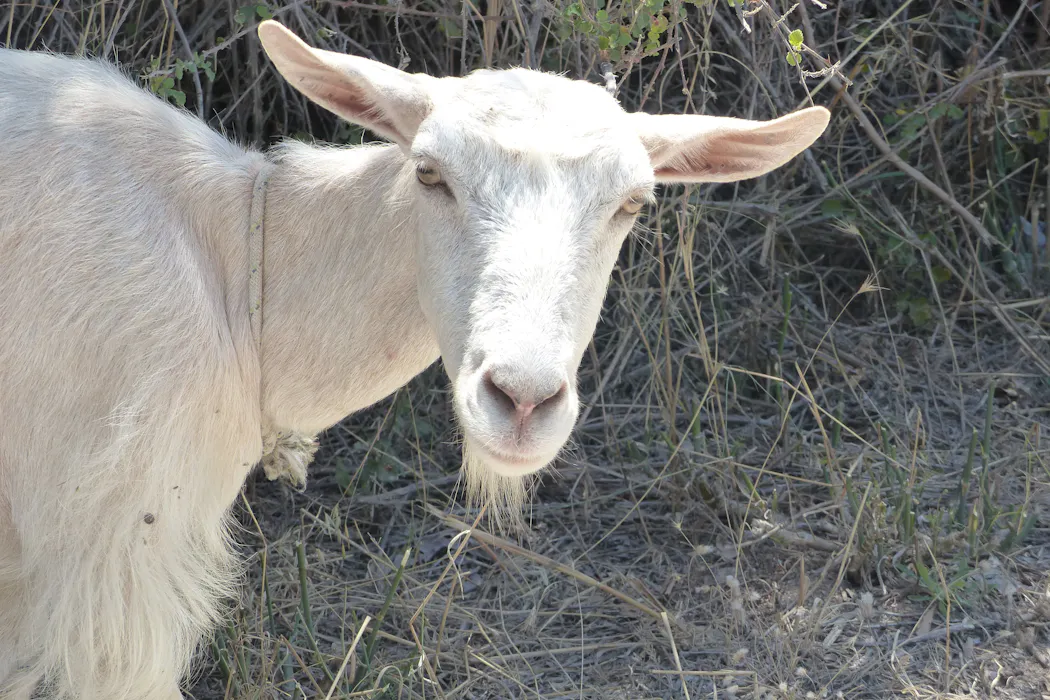
Les chèvres constituaient le principal animal consommé à Azoria, aussi bien lors des repas quotidiens que des grands festins communautaires.Tsaag Valren, CC BY
En analysant les restes de 50 moutons et chèvres découverts en Crète, des archéologues montrent que l’élevage de la Grèce antique était bien plus complexe qu’on ne le pensait. Une découverte qui éclaire le fonctionnement économique et politique des premières cités grecques.
**
L’agriculture était le moteur de la prospérité de la Grèce antique. La nourriture occupait une place centrale dans la vie sociale, qu’il s’agisse des symposiums où quelques convives partageaient du vin ou des immenses festins sacrificiels réunissant toute une communauté. Dans L’Odyssée, le poème épique de la Grèce antique, le fils d’Ulysse participe à l’un de ces banquets hors normes : un gigantesque barbecue collectif où une centaine de bovins sont sacrifiés.
Les chercheurs savent depuis longtemps que l’alimentation jouait un rôle central dans l’économie, la politique et la vie sociale de la Grèce antique. Mais une question fondamentale restait sans réponse : comment les animaux étaient-ils réellement élevés pour nourrir cette société ?
Depuis près d’un siècle, les chercheurs sont engagés dans un débat sur l’organisation de l’élevage dans la Grèce antique. Deux modèles s’opposent. Selon le premier, de grands troupeaux semi-nomades parcouraient le territoire au gré des saisons à la recherche de pâturages. Selon le second, les animaux étaient élevés en petits troupeaux intégrés aux exploitations agricoles, où ils se nourrissaient des ressources locales et des résidus des cultures. En d’autres termes, l’élevage reposait-il sur un système pastoral mobile ou sur des fermes associant étroitement cultures et bétail ?
Avec une équipe pluridisciplinaire réunissant archéologues et scientifiques, j’ai analysé l’un des plus importants ensembles de restes animaux jamais mis au jour dans le monde grec antique, sur le site d’Azoria, en Crète, afin d’apporter de nouveaux éléments à ce débat. Nous avons publié nos résultats dans un article récent.
Lorsque les premiers historiens se sont penchés sur la manière dont les animaux étaient élevés et les cultures pratiquées dans la Grèce antique, le paysage grec était encore marqué par la présence de grands troupeaux de moutons et de chèvres conduits par des groupes semi-nomades. Ces troupeaux migraient des pâturages d’altitude en été vers les plaines en hiver, à la recherche de ressources saisonnières.
Dans son ouvrage The Geography of the Mediterranean Region: Its Relation to Ancient History (« La géographie de la région méditerranéenne : ses liens avec l’histoire antique », non traduit), la géographe américaine Ellen Churchill Semple fut la première à avancer que ce mode d’élevage saisonnier existait déjà dans la Grèce antique.
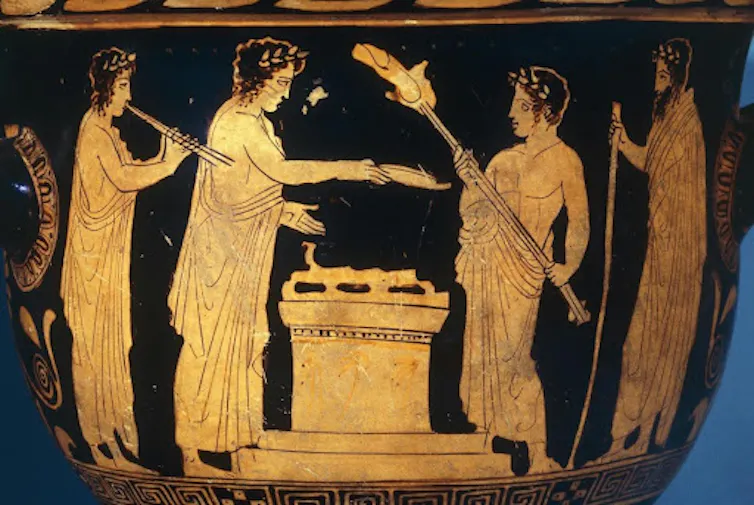
Céramique grecque représentant un sacrifice rituel sur un autel. British Museum 1839,0214.68, CC BY
Une autre école de pensée défend toutefois un modèle très différent de l’économie agricole. S’appuyant sur des entretiens menés auprès de bergers et d’agriculteurs âgés, l’archéologue Paul Halstead soutient, dans plusieurs articles ainsi que dans son livre de 2014, Two Oxen Ahead. Pre-Mechanized Farming in the Mediterranean (« Deux bœufs en tête : l’agriculture méditerranéenne avant la mécanisation », non traduit), que les animaux étaient principalement élevés en petits troupeaux rattachés aux exploitations agricoles. Ils paissaient surtout sur les jachères ou les pâturages voisins, ou étaient nourris avec des cultures fourragères spécialement produites à leur intention. Dans ce modèle, cultures et élevage formaient un système étroitement intégré.
Au fil des décennies, les chercheurs se sont rangés dans l’un ou l’autre camp de ce débat. Mais jusqu’à récemment, il était impossible de mesurer directement le régime alimentaire et la mobilité des animaux de la Grèce antique, et donc de trancher la question.
Quand la science éclaire l’histoire
Le recours à l’analyse des isotopes stables – une technique qui mesure différentes formes d’un même élément chimique, appelées isotopes, dont la masse varie légèrement – offre pour la première fois aux chercheurs la possibilité de départager ces deux hypothèses à partir des restes d’animaux découverts sur des sites de la Grèce antique.
En analysant le mélange d’isotopes conservé dans les os et les dents anciens, les scientifiques peuvent reconstituer le régime alimentaire d’un animal ou d’un être humain, mais aussi obtenir des indices sur les lieux où il a vécu. En effet, les aliments et l’eau laissent des signatures chimiques qui s’enregistrent progressivement dans les tissus de l’organisme.
Les atomes d’un même élément peuvent exister sous plusieurs isotopes, qui se distinguent par leur masse en raison d’un nombre différent de neutrons. En analysant les proportions de ces différents isotopes dans les vestiges archéologiques, l’analyse des isotopes stables permet d’identifier les sources – alimentation, eau ou air – qui ont contribué à la composition chimique d’un animal (ou d’un être humain).
Dent de chèvre provenant du site d’Azoria, prélevée pour l’analyse des isotopes du carbone et de l’oxygène. Fourni par l’auteur, CC BY-SA
Les rapports entre les isotopes du carbone et de l’azote renseignent sur le type d’alimentation des animaux de l’antiquité. Ceux des isotopes stables de l’oxygène révèlent, quant à eux, les variations saisonnières enregistrées lors de la formation de l’émail des dents. En combinant ces différentes analyses isotopiques, les chercheurs peuvent s’attaquer directement au débat sur l’agropastoralisme et reconstituer le régime alimentaire saisonnier des animaux.
Les premières applications de ces techniques aux animaux de la Grèce antique n’ont toutefois fait que compliquer le tableau. En raison du coût des analyses et du nombre limité d’échantillons disponibles, seuls quelques animaux ont pu être étudiés sur des sites tels que Cnossos, en Crète, ou Argilos, dans le nord de la Grèce. Les résultats n’ont pas confirmé un modèle unique, mais mis en évidence une diversité de pratiques d’élevage. La faible taille des échantillons ne permettait cependant pas de tirer des conclusions solides, si ce n’est que les animaux de la Grèce antique étaient élevés selon une combinaison de différentes méthodes agricoles. Restait à comprendre comment cette diversité s’inscrivait dans le fonctionnement global de l’économie antique.
Notre étude, menée sur le site d’Azoria, en Crète, est la première à avoir été conçue spécifiquement pour départager ces deux hypothèses concurrentes, grâce à l’analyse isotopique des restes de 50 moutons et chèvres. ([azoria.unc.edu][1])
Mettre les hypothèses à l’épreuve
À bien des égards, Azoria constitue le site idéal pour étudier l’économie qui a accompagné les débuts des cités-États grecques. La ville a été brusquement abandonnée au tout début du Ve siècle av. J.-C., juste avant l’entrée dans la période classique (510-323 av. J.-C.). Cet abandon soudain a figé un instantané de la vie quotidienne : les habitants ont laissé derrière eux leurs déchets – notamment d’abondants restes animaux et végétaux – ainsi que leur vaisselle en céramique, trop encombrante pour être emportée. Ces ensembles de céramiques, exceptionnellement bien conservés, nous ont permis de déterminer la fonction des différents bâtiments et des pièces qui les composaient.
Au sommet de la colline se trouvent plusieurs bâtiments publics, dont un édifice destiné aux repas communautaires. C’est là que les citoyens se réunissaient régulièrement pour festoyer et débattre des affaires de la cité. Plus bas, sur les terrasses, s’élevaient les demeures des élites.
Grâce à mon analyse de plus de 200 000 restes animaux provenant de ces différents espaces, il est possible de comparer, avec un niveau de détail inédit, les repas pris dans les maisons et les grands banquets publics. J’ai constaté que les mêmes espèces d’animaux, abattues au même âge, étaient consommées aussi bien dans les habitations que dans le bâtiment des repas communautaires : principalement des chèvres, puis des moutons, des porcs et des bovins.
Plus intéressant encore, la préparation de la viande différait selon qu’il s’agissait d’un banquet public ou d’un repas domestique. Lors des festins, des bouchers professionnels – probablement des prêtres chargés des sacrifices – découpaient les carcasses à l’aide de couperets. À la maison, en revanche, la viande était simplement tranchée au couteau.
On pourrait en conclure que les mêmes animaux étaient servis dans les deux contextes. Pourtant, les analyses isotopiques racontent une autre histoire. Les valeurs des isotopes du carbone relevées sur les animaux consommés dans les foyers correspondent aux variations des isotopes de l’oxygène mesurées à différents endroits d’une même dent, lesquelles reflètent les changements de saison. Cela indique que ces animaux étaient principalement élevés à proximité des exploitations agricoles locales et se nourrissaient de plantes dont la composition variait au fil des saisons.
En revanche, les animaux consommés lors des banquets publics présentent un profil très différent. Leurs valeurs isotopiques du carbone ne suivent plus les variations des isotopes de l’oxygène, mais évoluent en sens inverse. Ce schéma est caractéristique d’une transhumance entre les pâturages d’altitude en été et les plaines en hiver. D’autres animaux affichent, au contraire, des valeurs de carbone remarquablement stables tout au long de l’année, signe probable qu’ils étaient nourris avec des cultures fourragères produites spécialement à leur intention.
Ces résultats montrent que l’économie alimentaire de la Grèce antique était bien plus complexe que ne le supposaient les chercheurs. Les deux modèles d’élevage coexistaient : certains animaux étaient intégrés aux exploitations agricoles, tandis que d’autres appartenaient à des troupeaux gérés de manière plus spécialisée et mobile. Il semble même que la cohésion politique des cités-États ait reposé, en partie, sur ces grands sacrifices publics qui fournissaient de la viande à l’ensemble des citoyens, rendus possibles par la gestion collective et spécialisée de vastes troupeaux.
Ces conclusions offrent un regard nouveau sur les communautés qui ont donné naissance aux cités-États de la Grèce antique. Elles montrent que leurs membres coopéraient pour produire leur nourriture, se nourrir mutuellement et créer les conditions matérielles des banquets comme de la vie politique. Après tout, nous sommes définis non seulement par ce que nous mangeons, mais aussi par les personnes avec qui nous partageons nos repas… et, bien sûr, par ce que notre nourriture a elle-même mangé.
Flint Dibble a reçu un financement pour les analyses isotopiques dans le cadre d’une bourse individuelle des actions Marie Skłodowska-Curie de la Commission européenne (convention de subvention n° 101026314), au titre du projet de recherche ZOOCRETE.
En 2025, de nombreux cas de dermatose nodulaire contagieuse, ou DNC, bovine ont déferlé sur les élevages français. Pour y faire face, les autorités ont alors misé sur la vaccination d’urgence et l’abattage total des cheptels touchés. Aurait-on pu gérer différemment cette épizootie, par exemple en n’abattant que les animaux malades ? Les modèles épidémiologiques permettent de répondre à cette question.
Les premiers cas de DNC en France ont été été décelés en juin 2025 dans des élevages de bovins localisés en Savoie, puis dans la région Auvergne-Rhône-Alpes. Dès octobre 2025, les cas ont gagné d’autres régions (Bourgogne-Franche-Comté et Occitanie), faisant craindre une épizootie de grande ampleur.
Cette maladie, qui a provoqué une grave crise sanitaire dans sept pays des Balkans entre 2015 et 2017, n’avait alors encore jamais été détectée en France. Elle fait partie des cinq maladies bovines les plus graves classées catégorie A par l’Union européenne (UE) – c’est-à-dire, maladie habituellement absente de l’UE contre laquelle des mesures d’éradication immédiate doivent être prises.
La DNC est causée par un virus transmis entre bovins par l’intermédiaire d’une mouche piqueuse présente en grand nombre dans les étables, Stomoxys calcitrans. Du fait de l’interruption de leur repas sanguin par les bovins gênés par les piqûres, ces mouches peuvent piquer plusieurs bovins successivement et transmettre le virus d’un animal à l’autre. La propagation du virus au sein d’un élevage est donc très rapide et difficilement maîtrisable.
Face à cette situation, le gouvernement a mis en œuvre une stratégie de gestion combinant abattage total des troupeaux infectés (dépeuplement) et vaccination d’urgence autour des foyers. Bien qu’efficace pour maîtriser l’épizootie en quelques mois, cette approche a suscité une forte contestation du monde agricole.
Une des alternatives proposées par cette contestation consistait à réaliser un dépistage régulier de l’ensemble des bovins d’un élevage infecté, suivi de l’euthanasie des seuls animaux identifiés comme infectés.
Mais cette alternative, appelée « dépeuplement sélectif », est-elle vraiment réaliste ? Permet-elle de maîtriser efficacement la propagation du virus au sein d’un élevage ainsi qu’aux élevages voisins ? Nous avons mené des travaux de modélisation épidémiologique qui permettent de répondre à cette question.
Modéliser la transmission dans un élevage
Nous avons tout d’abord élaboré un modèle dit « mécaniste » de transmission du virus dans un troupeau de 100 bovins. Un modèle mécaniste est un modèle mathématique qui reproduit les mécanismes de transmission en les décomposant en processus élémentaires, qui sont ensuite transcrits sous forme mathématique afin de simuler la transmission de la maladie dans différentes situations.
Principaux mécanismes de transmission de la DNC pris en compte dans le modèle. Fourni par l’auteur
Grâce à différents échanges avec des spécialistes de la maladie, nous avons pu mettre au point un modèle mathématique de la propagation de la DNC. Nous avons ainsi retenu les éléments suivants :
la transmission ne peut se faire que par l’intermédiaire des mouches piqueuses ;
une mouche qui pique un bovin infecté a 22 % de chances de se contaminer si le bovin est symptomatique et 0,6 % s’il est asymptomatique ;
l’infection d’un bovin survient pour environ 5 % des piqûres par des mouches contaminées ;
environ la moitié des bovins infectés finissent par développer des signes cliniques ;
La plupart de ces hypothèses sont tirées de données issues d’expériences de laboratoire reproduisant les conditions de transmission de manière contrôlée.
Les simulations réalisées à partir de ce modèle ont montré qu’une vache infectée en infectera en moyenne 19 autres, par l’intermédiaire des piqûres de mouches qui se sont nourries sur elle. Cela correspond à un « nombre de reproduction de base » (R0) de 19, soit une transmission initiale très rapide. Pour comparaison, le R0 de la Covid-19 était estimé entre 1,4 et 6,5 selon les souches.
Sans intervention, un troupeau de 100 bovins a donc 91 % de probabilité de se retrouver entièrement infecté sous environ 51 jours. Ces estimations sont cohérentes avec les quelques observations de terrain rapportées dans la littérature scientifique.
Aurait-il fallu privilégier le dépeuplement sélectif ?
Que dit ce modèle de l’efficacité des stratégies de lutte contre le virus mises en place dans les élevages ? Celles-ci ont été au cœur de la controverse : des rumeurs selon lesquelles l’abattage partiel aurait été préférable à l’abattage total mis en œuvre par les autorités se sont rapidement diffusées. Est-ce vraiment le cas ?
Afin de pouvoir conclure, nous avons ajouté à notre modèle de transmission de la DNC une stratégie de dépeuplement sélectif des animaux infectés. L’enjeu : comprendre si elle permet ou non de réduire la transmission au sein du troupeau.
Nous avons considéré que ce dépeuplement était mis en place à partir du moment où le premier animal infecté symptomatique apparaissait, ce qui, d’après les simulations du modèle, prend en moyenne 13 jours, avec une grande variabilité selon que le premier infecté du troupeau finisse par présenter des signes cliniques ou non.
Résumé des résultats du modèle. Sur les 19 vaches qu’une vache atteinte par la DNC va infecter, en moyenne, une va mourir, huit et demi vont exprimer les signes cliniques de la DNC puis se rétablir, et enfin huit et demi vont se rétablir sans jamais avoir exprimé de signes cliniques. Fourni par l’auteur
Au moment de l’apparition du premier cas symptomatique, le modèle prédit qu’entre une (au minimum) et sept (au maximum) vaches sont déjà infectées et qu’entre 0 et 74 mouches sont déjà contaminées.
Le modèle a ensuite permis de simuler la mise en œuvre d’un dépistage de l’ensemble du troupeau tous les deux jours. On considère que, lors de ce dépistage, les animaux testés positifs sont immédiatement euthanasiés et retirés du troupeau. Les tests diagnostiques étant imparfaits, le modèle suppose par ailleurs qu’un animal infecté mais asymptomatique n’a qu’une probabilité de 30 % d’être détecté positif lors d’un test.
Outre les contraintes logistiques et budgétaires qu’une telle stratégie engendrerait, nos simulations suggèrent que le troupeau finirait par être intégralement infecté malgré tout. Ceci tient au délai séparant l’introduction du virus de la détection du premier cas, à la présence d’animaux asymptomatiques non détectés qui continuent à contaminer des mouches et d’un très grand nombre de mouches qui restent contaminées malgré l’abattage des bovins testés positifs.
Ces résultats ne s’appliquent toutefois qu’aux troupeaux non vaccinés contre le virus de la DNC. Dans un contexte vaccinal, la transmission du virus est réduite si les animaux ont eu le temps de développer leur immunité. Le dépeuplement sélectif pourrait-il être pertinent dans ce nouveau contexte vaccinal ?
Des travaux de modélisation sont en cours pour déterminer dans quels scénarios le dépeuplement sélectif, conjugué à la vaccination, sera suffisamment efficace pour contenir la propagation du virus. En effet, le modèle doit être complexifié pour prendre en compte de nouveaux paramètres : combien d’animaux ont été vaccinés dans le troupeau (couverture vaccinale), quelle proportion est réellement protégée (efficacité vaccinale) et combien de temps il faut pour qu’un animal vacciné soit effectivement protégé.
De l’intérêt des modèles pour l’aide à la prise de décision en santé animale
Cette démonstration rappelle l’intérêt des modèles épidémiologiques pour évaluer l’efficacité attendue de différentes stratégies de gestion envisagées par les autorités, dans un contexte où il n’est pas possible de tester expérimentalement chacune d’elles.
À ce titre, ils constituent un outil d’aide à la décision précieux, qui permet de simuler les conséquences probables des différentes options. Il faut toutefois garder en tête qu’ils ne proposent que des approximations de ce qui se passera en réalité, et qu’ils ne sont utiles que dans la mesure où les hypothèses qui les ont construits sont fiables.
Il est donc crucial de s’appuyer sur une collaboration entre acteurs de terrain (vétérinaires, éleveurs, administrations locales), chercheurs et laboratoires pour intégrer les principaux mécanismes de transmission du virus et reproduire le plus finement possible dans les simulations les dynamiques observées sur le terrain. C’est cette démarche qui permet d’évaluer l’impact de scénarios alternatifs de gestion de l’épizootie.
Il n’existe toutefois pas de stratégie optimale de façon universelle : le choix des mesures à mettre en œuvre dépendra à la fois des objectifs poursuivis et du contexte dans lequel l’épizootie survient.
Les objectifs peuvent consister à retrouver le plus rapidement possible le statut de pays indemne afin de rétablir les exportations, à limiter les pertes économiques ou encore à réduire le nombre d’animaux abattus. L’efficacité et la pertinence des mesures dépendront également des caractéristiques locales, telles que le type d’élevage, l’organisation de la filière ou encore les conditions environnementales, qui influencent la transmission de la maladie et les possibilités de mise en œuvre des mesures de contrôle.
À la suite des mesures mises en place, aucun nouveau cas de dermatose nodulaire contagieuse n’a été détecté en France depuis le 2 janvier 2026. En cas de réémergence, il faudra désormais tenir compte d’un nouveau contexte, marqué par une population bovine partiellement vaccinée.
Source: The Conversation – France in French (3) – By Zhao Alexandre Huang, Maître de conférences HDR en Sciences de l’Information et de la Communication, Laboratoire DICEN, Université Gustave Eiffel
Photo postée sur le compte X du « Quotidien du Peuple », principal journal chinois, le 13 février 2026, accompagnée de cette légende : « Trente bébés pandas géants ont récemment été réunis au Centre chinois de conservation et de recherche sur le panda géant et à la Base de recherche de Chengdu pour l’élevage du panda géant à l’occasion de la Fête du Printemps. Au total, 45 bébés pandas sont nés dans ces deux centres d’élevage en 2025. » En bas à droite, le logo de l’agence de presse nationale Xinhua. Compte X du Quotidien du Peuple
Animal tardivement découvert par l’Occident, le panda géant est devenu au fil des décennies un symbole savamment construit par Pékin, bien plus politique que culturel. La séquence diplomatique de fin 2025 — marquée par le départ des pandas de Beauval et la visite présidentielle en Chine — a rappelé au grand public l’importance de cette mascotte. Sur les réseaux sociaux, la Chine utilise la puissance émotionnelle du panda pour tisser des liens affectifs avec l’audience mondiale. Une opération de charme numérique dont l’efficacité tient à un ressort psychologique universel, celui de l’attendrissement face aux traits juvéniles.
À la fin de l’année 2025, des pandas se sont imposés, contre toute attente, comme l’un des sujets visibles de la vie médiatique et diplomatique française. Cette attention est d’abord liée au départ du couple de Huan Huan et Yuan Zi, les deux pandas géants qui avaient vécu treize ans au ZooParc de Beauval avant de regagner la Chine le 25 novembre 2025. Motivé notamment par l’état de santé de Huan Huan, leur retour à Chengdu a suscité une forte émotion : cérémonies d’adieu, reportages nostalgiques, vidéos de fans et messages affectueux sur les réseaux sociaux ont rappelé que ces animaux étaient devenus de vraies célébrités en France et des symboles de la relation franco-chinoise.
Quelques jours plus tard, la visite d’État d’Emmanuel Macron en Chine, du 3 au 5 décembre, a replacé les pandas au centre du récit diplomatique. À Chengdu, Brigitte Macron a retrouvé Yuan Meng, premier panda né en France en 2019, et dont elle est la marraine. Parallèlement, la Chine annonçait un nouveau cycle de coopération avec la France autour du panda géant, avec l’arrivée prévue d’un nouveau couple à Beauval en 2027.
Derrière cette séquence apparemment attendrissante se pose pourtant une question centrale de communication internationale : comment un animal simplement perçu comme mignon, inoffensif et universellement aimable peut-il devenir une ressource stratégique de diplomatie publique et d’influence, notamment numérique ?
Un symbole politique réinventé par l’histoire
Contrairement à une idée largement répandue aujourd’hui, le panda géant n’a pas toujours occupé une place centrale dans l’imaginaire politique chinois. Les références à cet animal demeurent relativement rares dans les registres historiques et littéraires chinois, et sa découverte par le monde occidental ne remonte qu’à 1869, lorsque le missionnaire français Armand David en propose la première description scientifique.
Ce n’est qu’au XXe siècle que le panda acquiert une visibilité internationale croissante, avant d’être progressivement investi d’une fonction politique et diplomatique. Les premières utilisations diplomatiques du panda remontent à la République de Chine durant la Seconde Guerre mondiale. Un épisode fondateur se produit en 1941, lorsque le régime nationaliste dirigé par le Kuomintang souhaite remercier le gouvernement américain pour son soutien à la Chine dans la guerre de résistance contre l’invasion japonaise. Madame Chiang Kai-shek organise alors l’envoi aux États-Unis de deux pandas géants, Pan Dee et Pan Dah. Le choix de ces animaux comme présents diplomatiques s’explique notamment par la popularité qu’ils avaient déjà acquise auprès du public américain à la suite de leur introduction en Occident par Harkness et Tangier-Smith dans les années 1930 et 1940.
La République populaire de Chine, instaurée en 1949, reprendra cet héritage en l’inscrivant dans un projet idéologique plus large.
Dans les années 1950, les recherches zoologiques et paléontologiques consacrées au panda furent mobilisées pour illustrer les principes du « matérialisme dialectique », promouvoir une conception socialiste de la science et contribuer à la construction de symboles nationaux enracinés dans le territoire chinois. Le panda apparaît ainsi moins comme un symbole culturel immémorial que comme une construction politique relativement récente, associée à la légitimation scientifique, nationale et diplomatique du régime.
Depuis les années 1950, la diplomatie du panda — qui s’inscrit dans la stratégie maoïste de la diplomatie du peuple — est petit à petit mise en pratique par Pékin. Originalement, cette diplomatie animalière chinoise vise à offrir ou louer des pandas géants à des pays partenaires pour symboliser l’amitié et la coopération. La diplomatie du panda est devenue populaire après la visite du président Richard Nixon en Chine en 1972 : le gouvernement de Mao Zedong envoya alors un couple de pandas comme cadeaux d’État aux États-Unis pour symboliser le dégel des relations sino-américaines.
First Lady Pat Nixon welcomes pandas to the National Zoo, 20 avril 1972, US National Archives.
Les pandas géants sont très rapidement devenus des stars médiatiques du fait de leur apparence attendrissante de peluches et de leur comportement maladroit. Dès lors, la diplomatie du panda s’est progressivement transformée en une pratique représentative de la diplomatie publique à la chinoise.
À partir des années 2010, les autorités chinoises ont mis en place une politique invitant les entreprises à « sortir du territoire (zou chu qu, 走出去) », c’est-à-dire à chercher à s’étendre dans des pays étrangers. Dans ce cadre, les médias chinois ont reçu des subventions conséquentes pour internationaliser leurs pratiques journalistiques et communicationnelles.
La mise en pratique de cette politique a été largement facilitée par l’essor précoce de la numérisation de la diplomatie publique en Chine. Celle-ci a rapidement fait du panda un animal médiatique emblématique. Symbole de bienveillance par excellence, le panda incarne l’image apaisée et amicale que Pékin entend projeter sur la scène internationale, en particulier à travers les réseaux sociaux.
La néoténie, ressort biologique d’une stratégie d’influence
La réussite du panda comme star de la diplomatie publique chinoise n’est pas seulement due à sa rareté en tant que trésor national de la Chine ; elle émane surtout de son image. En effet, les caractéristiques physiques du panda correspondent à ce que l’on décrit des traits considérés comme mignons. Selon l’éthologiste Konrad Lorenz, ces traits mignons correspondent à une néotonie (kindchenschema), terme qui désigne un ensemble de caractéristiques physiques juvéniles qui déclenchent chez l’humain une réaction émotionnelle positive face à ce qui est perçu comme mignon ou attendrissant.
Ce schéma de néotonie se manifeste par des caractéristiques physiques telles qu’un front haut et bombé, une tête disproportionnellement grande, un visage arrondi, de grands yeux, des joues pleines, ainsi que des membres courts ou épais. Quand ces éléments sont mobilisés, ces déclencheurs qualifiés de supra-naturels pourraient activer, entretenir et renforcer un sentiment d’attendrissement et de tendresse chez l’humain.
Enfin, cette néotonie favoriserait aussi le déclenchement de mécanismes innés, comme ceux consistant à exprimer ses émotions et, chez les adultes, à protéger les êtres jugés faibles et juvéniles. Dans ce cadre, bien que potentiellement dangereux, le panda incarne une figure hautement attachante : son visage rond, les cercles noirs entourant ses yeux, son allure pataude et ses mouvements maladroits contribuent à façonner une image attendrissante et inoffensive.
Le panda, visage bienveillant de la Chine
Dans ce contexte, une série d’enquêtes sur la diplomatie numérique du panda est menée depuis 2019 (voir ici, ici, ici ou encore ici. L’objectif est d’étudier la façon dont les autorités de Pékin utilisent les comptes Twitter (actuellement X) de leurs médias nationaux, dont l’agence de presse Xinhua, le journal Le Quotidien du Peuple ou encore la chaîne de télévision CGTN pour mettre en scène la diplomatie du panda.
Cette série d’enquêtes empiriques conduit à une conclusion éclairante. Loin d’être anodin et innocent, le contenu publié par Pékin sur Twitter sur le thème du panda revêt une dimension profondément politisée dans le cadre de la diplomatie numérique chinoise. À partir d’une analyse fine du discours et du contenu visuel de tous les tweets collectés, nous avons mis en évidence un double objectif stratégique de ces contenus sur le panda, d’apparence purement ludique et anodine.
Tout d’abord, ils se mettent au service de la diffusion du discours officiel chinois sur la scène internationale de manière subtile. Chaque fois qu’un événement diplomatique impliquant un panda se produit — par exemple la naissance d’un bébé panda dans un zoo étranger ou la célébration de l’anniversaire d’un panda loué à l’étranger, etc. —, les médias chinois en profitent pour rappeler les messages politiques de Pékin. Il s’agit soit de l’amitié sino-étrangère et de la coopération gagnant-gagnant, soit du rôle de la Chine comme puissance bienveillante et défendant la paix. Un tweet typique de ce type de message politisé est d’associer une photo attendrissante de panda à un commentaire qui souligne les bonnes relations entre la Chine et tel pays, ou à une déclaration d’un dirigeant chinois sur la coopération internationale.
Ensuite, ces tweets au sujet de pandas visent à accumuler du capital sympathie pour la Chine. Grâce à son attrait universel, le panda est devenu un vecteur d’émotion positive particulièrement efficace. Les médias chinois exploitent à fond ce filon en publiant massivement sur Twitter des photos attendrissantes, des vidéos amusantes, ou encore des images mouvantes (gifs) animées de pandas joueurs. Ces contenus visuels permettent d’accroître l’attractivité de la Chine par un placement stratégique d’images accompagnées d’un récit présentant le pays de façon positive (par exemple, « Les pandas géants enchantent les visiteurs du monde entier dans la base de Chengdu »). Autrement dit, grâce à cette mascotte vivante, la Chine cherche à mettre en œuvre une stratégie de nation branding ludique.
Comme nous l’avons formulé ailleurs, « l’image universelle du panda aide Pékin à surmonter les énormes difficultés de langue, de politique et de culture » dans [sa communication internationale]. Même sans comprendre le chinois ni avoir d’affinités particulières avec la Chine, les internautes peuvent être touchés par une vidéo ou une image attendrissante de panda et, inconsciemment, associer ce sentiment positif à l’image de la Chine elle-même. C’est une manière douce et « apolitique » d’influencer les perceptions.
Ce travail a été réalisé dans le cadre du projet PubDiplo, cofinancé par l’Agence nationale de la recherche (ANR) et le Research Grants Council (RGC) de Hongkong (Références : ANR-25-CE41-4061/RGC-A-HKBU203/25).
Ce travail a été réalisé dans le cadre du projet PubDiplo, cofinancé par l’Agence nationale de la recherche (ANR) et le Research Grants Council (RGC) de Hong Kong (références : ANR-25-CE41-4061 / RGC-A-HKBU203/25).
Source: The Conversation – in French – By Hervé Cottin, Astrochimiste, Professeur au Laboratoire Interuniversitaire des Systèmes Atmosphériques (LISA), Université Paris-Est Créteil Val de Marne (UPEC)
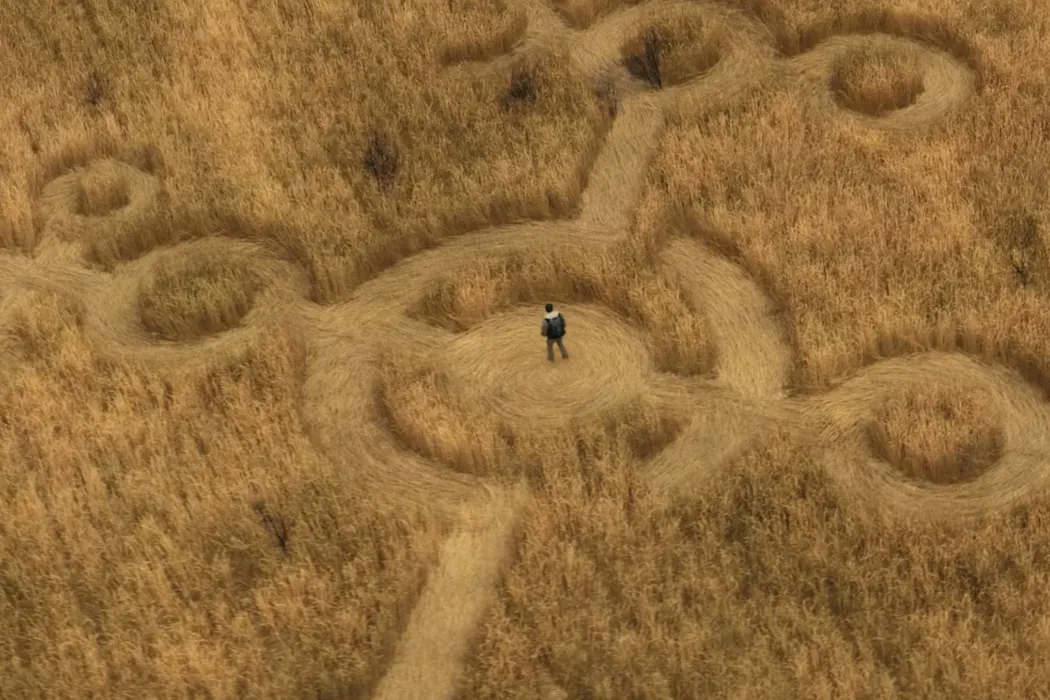
Dans *Disclosure Day* (2026), Steven Spielberg utilise les symboles classiques de l’ufologie, comme les « Crop Circles », traditionnellement associés aux visites d’ovnis. Cette scène suggère l’existence d’extraterrestres dotés de pouvoirs paranormaux, qui communiquent de façon mystérieuse tout en restant insaisissables.Bande annonce du film, diffusée par Allociné
À moins qu’une soucoupe volante se pose devant la Maison-Blanche ou au pied de la tour Eiffel, il n’y aura pas de « jour de la révélation » hollywoodien proclamant la découverte d’une vie extraterrestre… Ce n’est pas ainsi que marche la science, et c’est tant mieux.
Dans son dernier film Disclosure Day, le réalisateur Steven Spielberg renoue avec une thématique qui lui est chère : la découverte de la vie extraterrestre. En règle générale, la vie extraterrestre décrite par Steven Spielberg est plutôt pacifique et curieuse à l’égard des humains. Rencontres du troisième type (1977) évoque la longue préparation à ce premier contact et l’invention d’un langage commun pour communiquer. Dans E.T. l’extraterrestre (1982), Spielberg inverse la dynamique de la menace avec un alien botaniste traqué par les humains – à rebours de l’archétype de l’envahisseur prédateur, présent par exemple dans la saga Alien inaugurée en 1979 par Ridley Scott.
Disclosure Day traite du « grand jour de la révélation, celui où nous apprenons que nous ne sommes pas seuls dans l’Univers ». Si, dans le film, l’existence d’extraterrestres est présentée comme un potentiel salut pour une humanité qui s’autodétruit, cette fiction est en phase avec une actualité bien réelle aux États-Unis, où le Congrès multiplie depuis 2022 les auditions officielles sur les phénomènes aérospatiaux non identifiés (PAN, le nouvel acronyme remplaçant celui d’ovni), tandis que le Pentagone alimente un site consacré aux photos, vidéos et témoignages d’observations de PAN. Ces documents, qui me semblent peu convaincants et ne constituent pas de preuve formelle, semblent avoir transformé la perception de Steven Spielberg, qui affirme croire aux témoignages sur la vie extraterrestre.
Avec ce film, la formidable machinerie hollywoodienne ranime un vieux fantasme collectif : celui de la révélation soudaine, globale et définitive de l’existence d’une vie extraterrestre.
Affiches de Disclosure Day, le film de Steven Spielberg sorti en juin 2026. AVCesar
Pour quiconque pratique l’exobiologie, un domaine interdisciplinaire qui cherche à comprendre comment la vie est apparue sur Terre afin de mieux orienter notre stratégie pour la rechercher ailleurs, ce scénario d’une révélation soudaine et absolue relève de la pure commodité narrative. Il ne s’agit évidemment pas ici de faire une critique du film, que j’ai beaucoup apprécié à titre personnel, mais de rappeler que, dans la réalité scientifique, il n’y aura probablement pas de « Disclosure Day » : pas de consensus immédiat, pas de conférence de presse pour mettre un point final à l’angoisse de la solitude cosmique.
La quête du vivant ailleurs dans l’Univers est un chemin de patience extrême, qui est pavé de mesures d’anomalies et de controverses acharnées, et le restera.
Le mirage des « grands soirs » : de la météorite ALH 84001 à la phosphine vénusienne
L’histoire récente regorge déjà d’annonces où la communication institutionnelle a tenté de brûler les étapes.
Souvenons-nous de l’été 1996, lorsque le président des États-Unis Bill Clinton prit la parole pour annoncer que la météorite martienne ALH 84001 recelait de possibles traces de vie fossile. Le message était évidemment prudemment ciselé, ponctué d’appels à la prudence, mais l’impact médiatique fut planétaire. Puis, loin des caméras et des médias, au gré de contre-expertises et de publications contradictoires, les structures géochimiques observées furent expliquées par des processus ne nécessitant aucune activité biologique. L’annonce ne fut pas réfutée en un jour : elle s’est lentement dissoute dans le temps long d’un travail scientifique de longue haleine.
Un scénario relativement proche s’est reproduit en septembre 2020 avec l’affaire de la phosphine, une petite molécule de formule chimique PH₃, prétendument détectée dans l’atmosphère de Vénus. Une équipe annonçait, avec l’appui d’une publication scientifique, avoir mesuré la présence de ce gaz dans les nuages vénusiens à un niveau d’abondance inexplicable par les mécanismes géochimiques ou photochimiques connus, suggérant une possible activité biologique. Accompagnée d’un communiqué de presse titré « Indices de vie sur Vénus » et saluée par un tweet enthousiaste de l’administrateur de la Nasa de l’époque évoquant « la plus grande découverte » liée à la vie extraterrestre, la nouvelle a enflammé les médias. Dans la foulée, des financements privés ont même été annoncés pour lancer l’étude d’une mission spatiale spécifique.
Quelques années plus tard, que reste-t-il de cette annonce fracassante ? Des bases singulièrement fragiles : deuxétudes indépendantes démontraient rapidement que la bande spectrale utilisée dans le domaine des ondes radio pour la détection n’était pas significative statistiquement, tandis que des observations complémentaires dans une autre gamme de longueur d’onde (infrarouge) ne confirmaient aucunement la présence de la molécule et abaissaient la limite supérieure de détection à un niveau 100 fois inférieur à ce qui avait été avancé. Le grand public, lui, est resté sur l’émerveillement du premier jour, ignorant que la controverse avait balayé l’hypothèse fantasmée d’une preuve de vie vénusienne.
Il n’est pas question ici de reprocher à une équipe scientifique de publier un résultat qu’elle estimait, en toute bonne foi, probablement pertinent. C’est d’ailleurs le principe de toute progression scientifique : un résultat nouveau, si surprenant soit-il, à partir du moment où il est étayé, reproductible, ou si les mêmes données peuvent être expertisées indépendamment (ce qui était le cas pour cet épisode vénusien), a vocation à être présenté à la communauté scientifique pour qu’il puisse être passé au crible des avis d’autres experts indépendants. Le communiqué de presse qui a été à l’origine de l’emballement médiatique était, par contre, probablement de trop…
L’« exobiowashing » et la tentation du « bling-bling » scientifique
Plus récemment encore, c’est l’exoplanète K2-18b qui a suscité beaucoup de bruit médiatique. En 2023, puis en 2026, une équipe scientifique, interprétant des mesures de composition atmosphérique de cette exoplanète par les télescopes spatiaux Hubble et James-Webb, a évoqué la présence de diméthylsulfure (DMS), une molécule qui, sur Terre, est fortement associée au vivant.
Les deuxpublications scientifiques sont à chaque fois légitimes, publiées dans des revues à comité de lecture, et soumises au débat contradictoire légitime quant à la validité ou non de la détection elle-même. À nouveau, la détection du DMS ne semble pas tenir la distance face à des contre-expertises indépendantes. De plus, quand bien même la molécule serait bel et bien détectée, d’autres processus que le vivant pourraient très bien en être à l’origine.
Cependant, à chaque fois, le mécanisme est identique : ces publications sont accompagnées d’un communiqué de presse, parfois de vidéos autopromotionnelles pour le moins étonnantes. On assiste aujourd’hui à l’émergence de ce que l’on pourrait appeler l’« exobiowashing », un pendant spatial exobiologique du greenwashing. De même que l’écoblanchiment environnemental sert à valoriser l’image de marque d’une entité et à détourner l’attention de ses pratiques polluantes, l’exobiowashing utilise le vernis de la vie extraterrestre pour doper artificiellement l’attractivité d’une recherche.
L’idée derrière ce terme est que, dans un contexte académique hautement compétitif, ajouter une phrase ou deux suggérant que telle ou telle détection moléculaire fait progresser la quête de la vie extraterrestre est une assurance presque absolue de voir un projet de communiqué de presse accepté. Cela garantit une grande visibilité personnelle et institutionnelle, génère des titres accrocheurs et des clics sur les écrans de nos smartphones.
Cette stratégie pose un dilemme déontologique. La fin justifie-t-elle les moyens ? La science ne devrait-elle pas demeurer fermement ancrée dans les faits avérés, plutôt que dans la spéculation marketing ?
Le choc des temporalités : la science avance par le doute, et non par le sensationnel
Le véritable danger de cette accumulation d’annonces sensationnalistes réside dans le décalage abyssal entre la temporalité des médias et celle de la recherche.
Le public (dont je fais moi-même partie pour tout ce qui concerne les sujets extérieurs à mes domaines de recherche) consomme souvent l’actualité en scrollant rapidement, l’esprit traduisant rapidement le terme « habitable » par « habité ». On peut aussi confondre si facilement « matière organique » et « organisme vivant », tout comme on glisse sur une flaque d’eau liquide hypothétique à la surface d’une exoplanète lointaine pour l’associer à la promesse d’une forme de vie extraterrestre.
Le « Disclosure Day » aurait-il déjà eu lieu, infusé lentement à travers une succession de microfeux d’artifice médiatiques où rêves, fiction et science s’entremêlent dans une chasse au clic effrénée ? Si, dans l’esprit d’un grand nombre, la question de la vie extraterrestre est déjà réglée du fait de cette profusion d’annonces exagérées, comment pourrons-nous convaincre ce même public de la légitimité des dépenses futures indispensables pour construire les télescopes de nouvelle génération – ceux-là mêmes qui devront caractériser de manière rigoureuse la composition atmosphérique d’une exoplanète – ? Ou financer un retour d’échantillons martiens sur Terre (qui sera probablement indispensable pour savoir si la vie a un jour émergé sur notre voisine) ?
Pourtant, la communauté scientifique sait aussi faire preuve de retenue
Début 2022, la mesure par le rover de la Nasa Curiosity d’un déséquilibre isotopique intriguant du carbone 13 par rapport au carbone 12 dans le sol martien n’a donné lieu à aucune conférence de presse grandiloquente, alors que sur Terre des mesures équivalentes sont classiquement associées à la photosynthèse (c’est-à-dire la vie). Les doutes et les incertitudes de la recherche ont été partagés en bonne intelligence avec les médias. C’est cette rigueur qui s’était déjà imposée après les espoirs déçus des missions Viking dans les années 1970, dont les promesses de détection immédiate avaient fini par mettre en sommeil les programmes martiens pendant près de vingt ans.
L’exobiologie avancera, mais à son rythme. Elle s’appuie sur un postulat communément accepté mais non démontré : la vie pourrait surgir là où l’eau liquide, la matière organique et l’énergie coexistent. Démontrer, nuancer ou infirmer ce socle exige de croiser les expertises de géochimistes, géologues, chimistes, microbiologistes et d’astronomes… Une preuve de vie en dehors de la Terre ne prendra probablement jamais la forme d’un flash spécial d’information avec un signal indubitable. Elle se présentera sous la forme d’un faisceau d’indices ténus, d’une raie d’absorption contestée sur un spectre, d’une anomalie chimique que des analyses contradictoires mettront peut-être des décennies à valider ou à balayer.
À moins qu’une soucoupe volante se pose devant la Maison-Blanche, la tour Eiffel, la Cité interdite ou la pyramide de Gizeh, il n’y aura pas de « Disclosure Day » hollywoodien pour une annonce de découverte de vie extraterrestre, et c’est tant mieux. Le dialogue scientifique, avec ses disputes fécondes, ses doutes et ses réfutations, est infiniment plus passionnant que n’importe quel secret d’État éventé.
Sans renoncer à l’émerveillement des histoires extraordinaires sur grand écran, nous devons aussi apprendre à savourer le goût de la nuance scientifique plutôt que les illusions de la communication. C’est à ce prix que la science préservera sa crédibilité et que l’exploration de notre place dans l’univers restera une authentique aventure scientifique.
Pour en savoir plus sur l’exobiologie, Hervé Cottin a dirigé avec Muriel Gargaud la publication duGrand Livre de l’exobiologie, édité chez Belin Éducation (2025), et contribué à un site web pédagogique sur le sujet, avec d’autres spécialistes : AstrobioEducation.
Hervé Cottin est membre de la Société Française d’Exobiologie et préside la commission d’exobiologie de l’Union Astronomique Internationale. Ses recherches sont financées par le Centre national d’études spatiales (CNES), le CNRS, l’Agence nationale de la recherche (ANR), la région Île-de-France, la BPI ainsi que l’UPEC.
Source: The Conversation – France (in French) – By Marie Janot Caminade, Docteure en science politique, chercheuse à l’Institut des sciences sociales du politique (ISP), Université Paris Nanterre
Accéder à un poste de titulaire dans l’enseignement supérieur et la recherche, c’est un parcours d’obstacles. Pour les femmes qui deviennent mères avant d’y parvenir, la route se complique encore plus. Certaines tentent de devenir des chercheuses totales, cumulant tous les rôles, mais à quel prix et pour combien de temps ?
Comment encourager les femmes à se tourner vers des carrières scientifiques ? Ces dernières années, un certain nombre d’initiatives de mentorat ou d’information ont été mises en place pour inciter lycéennes et étudiantes à étudier les maths, la physique ou encore les sciences de l’ingénieur, alors qu’elles restent sous-représentées dans ces filières. L’une des dernières actions de grande ampleur est le plan Filles et maths, lancé en 2025, incluant notamment un travail sur les biais de genre, la mise en place de « rôles modèles » ou des classes à horaires aménagés.
Ce plan suscite néanmoins des critiques : si les femmes restent sous-représentées dans certaines disciplines, elles demeurent aussi minoritaires aux postes les plus élevés de l’ensemble du monde académique, des mathématiques aux sciences sociales.
Les inégalités de genre ne se limitent donc pas à l’accès aux études scientifiques : elles traversent l’ensemble des carrières universitaires et conduisent de nombreuses femmes à quitter l’enseignement supérieur et la recherche (ESR) avant leur titularisation. Cette fuite s’explique par plusieurs facteurs parmi lesquels la maternité occupe une place importante. Une enquête menée au Danemark montre ainsi qu’une femme sur trois abandonne sa carrière scientifique après la naissance de son premier enfant, contrairement aux hommes.
L’enquête que je mène auprès de doctorantes et de docteures en sciences sociales met en lumière les difficultés rencontrées par les femmes devenues mères avant leur titularisation. Depuis les années 1980, les exigences de recrutement se renforcent : il faut rédiger une bonne thèse, publier régulièrement, participer à des événements scientifiques et s’investir dans la vie des laboratoires. Une grande partie de ce travail relève du hope labour, c’est-à-dire d’un travail non rémunéré effectué dans l’espoir d’une embauche future.
Dans ce contexte, se dessine ce que l’on pourrait appeler le mythe de la « chercheuse totale ». Celui-ci repose sur une double injonction : être une scientifique productive (sans forcément percevoir de rémunération) tout en incarnant l’idéal de « la femme », à la fois professionnelle efficace, compagne dévouée et mère investie.
Or, cet idéal de la « chercheuse totale » se heurte aux conditions concrètes du travail scientifique et à celles de la maternité.
Tout concilier mais à quel prix ?
Pour devenir des chercheuses totales, les mères non titulaires réorganisent leur vie. Certaines cumulent plusieurs journées de travail en une : emploi alimentaire, enseignements en vacation, travail scientifique gratuit et charges parentales. Ce rythme contraint souvent les femmes à travailler dans l’urgence, parfois au détriment de la quantité et de la qualité de leurs travaux scientifiques.
D’autres femmes choisissent le chômage ou le congé parental et lient ainsi leur carrière à celle de leur conjoint quand il dispose de revenus suffisants. Si cette stratégie de linked career est favorable à la production scientifique quand on a un enfant, elle crée aussi une dépendance matérielle susceptible d’aboutir à des violences sexistes et sexuelles au sein du couple. Jeanne, docteure et mère d’une petite fille, témoigne ainsi :
« Je me sens parfois obligée [d’avoir des rapports sexuels]. Je me dis “Je le lui dois bien” et lui me le fait entendre aussi. »
Dans un contexte professionnel, où chaque moment doit être rentabilisé, les congés maternité, parentaux ou pour enfant malade deviennent eux-mêmes des temps de travail scientifique.
Rebecca raconte, par exemple, avoir continué la rédaction de sa thèse pendant l’hospitalisation de son fils en urgence. Cette situation nourrit un sentiment de double culpabilité : les enquêtées estiment n’être jamais à la hauteur, ni comme mères ni comme chercheuses. Joana explique :
« J’ai pris un congé parental pour bosser, mais je m’en veux de travailler quand je vois mon fils à côté de moi. »
À l’inverse, certains pères non titulaires bénéficient d’un bonus académique de paternité. La répartition genrée des tâches domestiques et parentales ainsi que l’usage des congés paternité leur permettent parfois de consacrer davantage de temps à leurs recherches. Marion rapporte à cet égard les propos de son conjoint, docteur en histoire : « J’ai bouclé près de deux articles en un mois de congé paternité ! »
Le discours du « rite initiatique »
Même lorsqu’elles réorganisent leur vie pour assurer leur activité scientifique, les mères non titulaires se heurtent à des mécanismes de disqualification de la part de leurs pairs.
Certaines remarques formulées sous couvert de bienveillance les renvoient à leur maternité : « Tu devrais passer plus de temps avec tes enfants », « Tu dois leur manquer » ou encore « Il est où ton enfant ? »
D’autres collègues, souvent des femmes titulaires, normalisent les difficultés que les mères non titulaires rencontrent pour concilier maternité et travail scientifique, en les présentant comme des épreuves inévitables. Comme le rapporte Louise, une collègue lui a expliqué :
« Ce que tu vis est normal, c’est le parcours du combattant. On est toutes passées par là. »
À travers ces discours qui se veulent réconfortants, les contraintes liées à la maternité apparaissent comme un rite initiatique obligatoire pour devenir une chercheuse totale.
Des contraintes maternelles transformées en défauts
Du fait de la concurrence croissante dans l’ESR, la maternité de certaines devient le prétexte de leur mise à l’écart par d’autres. Certaines enquêtées racontent avoir été écartées d’événements scientifiques au prétexte qu’elles avaient désormais « mieux à faire » avec leurs enfants.
Quand elles prennent la parole au cours de réunion entre précaires, leurs difficultés à concilier travail scientifique et maternité sont disqualifiées au motif qu’elles « savaient » ce qu’impliquait le fait d’avoir un enfant avant la titularisation.
Les contraintes liées à la maternité sont enfin invisibilisées derrière des critiques portant sur un prétendu manque de productivité scientifique. Celles-ci apparaissent dès la grossesse, à travers des remarques sur l’apparence physique des femmes non titulaires et sur leur supposée mauvaise gestion du stress lors d’échéances importantes pour leur carrière.
Anouk raconte qu’après une audition pour un poste de maîtresse de conférences, qu’elle a passée alors qu’elle était enceinte, une membre du jury qui disait vouloir l’aider, lui a « rappelé » que les comités recherchaient des gens « sympas avec qui discuter à la machine à café », avant de lui prodiguer le conseil suivant :
« Vous êtes enceinte ? Vous étiez pâle. Il faudrait mettre du rouge aux joues la prochaine fois pour ne pas faire mauvaise impression. »
Les reproches portent également sur les trajectoires académiques : l’absence à certains congrès organisés pendant les vacances scolaires des enfants, l’exercice d’emplois alimentaires ou le fait de ne pas développer d’autres objets de recherche que celui de la thèse sont fréquemment associés à un manque d’engagement scientifique, occultant alors les contraintes économiques et familiales auxquelles ces femmes sont confrontées.
Condamnées comme Sisyphe ?
Face à l’impossibilité d’atteindre l’idéal de la chercheuse totale, de nombreuses enquêtées finissent par intérioriser leurs difficultés comme des échecs individuels et abandonnent progressivement le milieu universitaire.
Cet éloignement résulte en réalité de contraintes structurelles qui rendent difficile la conciliation entre maternité et carrière académique. Élodie exprime à cet égard un sentiment d’épuisement :
« Je suis comme Sisyphe ! Je suis condamnée à faire un travail qui ne sera jamais reconnu, qui ne débouchera jamais sur rien parce que j’ai eu un enfant à la fin de la thèse. »
Dans ce contexte, dans l’enseignement supérieur et la recherche, ce ne sont pas des plans comme le plan Filles et maths qui suffiront à réduire les inégalités. C’est, plus largement, l’ensemble des critères de titularisation qu’il faudrait repenser.
Les exigences actuelles favorisent celles et ceux qui disposent de ressources matérielles et d’un temps suffisants, au détriment des personnes confrontées à des contraintes familiales, sociales ou économiques. Cette mise à l’écart n’est pas seulement inégalitaire : elle est néfaste pour la recherche elle-même. En se privant de certains talents, on se prive aussi de certains savoirs.
Marie Janot Caminade ne travaille pas, ne conseille pas, ne possède pas de parts, ne reçoit pas de fonds d’une organisation qui pourrait tirer profit de cet article, et n’a déclaré aucune autre affiliation que son organisme de recherche.