Degrowth and fashion: how upcycling innovators show us how to rethink and reuse waste

Source: The Conversation – (in Spanish) – By Handan Vicdan, Associate professor of marketing, EM Lyon Business School

Every year, some 100 billion garments are produced worldwide, and 92 million tonnes of clothing waste end up in landfills. Given this enormous amount of waste, it is logical to think that the only way forward is to degrow fashion. But can fashion and degrowth co-exist?

Degrowth is defined as the planned reduction of production and consumption in a way that ensures equitable living. Degrowth principles, such as sufficiency, cooperation and care, clash with growth principles of maximization, commodification and efficiency. For the fashion industry, which is responsible for immense resource extraction and waste creation, reducing resource throughput and ensuring equitable value creation pose enduring challenges.

While some governments and corporations encourage consumers to shop responsibly and reduce waste, collective responsibility is needed to facilitate a degrowth transition, which urges a fundamental shift in the way designers, manufacturers and brands approach fashion waste. Will circular practices help create a just and equitable industry? Is it possible to produce clothing locally and differently than “fast fashion” retailers?

Upcycling as a radical rethinking of our relationship with waste

In a recent study, we explored how the circular fashion practice of upcycling – creative and caring transformation of discarded or waste clothes into something of higher value – pushes industry actors to rethink their relationship to fashion waste and give it value as a resource compatible with degrowth values. We examined how upcycling is practiced across institutions – brands, manufacturers, designers and NGOs – in Turkey, one of Europe’s largest textile producers.

It is important to note that while conversations about recycling – the practice of breaking down textile waste into raw material through mechanical or chemical processes – are prevalent in the fashion world, the painful fact is that only 1% of clothes are recycled into new garments, meaning the majority of fashion waste is doomed to remain as waste. Through upcycling, on the other hand, waste is treated as a resource. Rather than viewing clothes as disposable, upcycling enables us to understand and care about our clothes’ journey and the people and ecosystems behind them. Converting discarded food into natural dyes for colouring fabric, or using sailcloth to make handbags, creates value through the creativity, materials, skill sharing, and caring involved.

As part of green-growth efforts, some circular fashion actors treat waste as a commodity and try to maximize growth through efficient waste reduction. However, this is incompatible with degrowth. We need to reduce production of textiles and make use of existing textile waste, not just discard textile waste efficiently.


À lire aussi :
Green growth or degrowth: what is the right way to tackle climate change?


Relational ways of working with waste, technology, nature and people

Our research highlights the importance of the socio-ecological value of waste in industry upcycling practices. Such value is generated through social and solidarity networks of relations around waste, including between designers, manufacturers and upcycling brands, and involving nature and technology.

We emphasise the growing interest in the story of waste material, which is reinforcing strong connections to waste and its origins. Upcycling designers highlight local and material heritage in the production of upcycled clothes, which is necessary to foster the ecological and material consciousness required for a degrowth transition. Designers we interviewed evoked the idea that “nature doesn’t waste anything”, and mentioned being inspired by and mimicking nature’s cycles in the design process.

We also reflect on the kind of technology needed to support more relational, localised systems. The practices of upcycling designers and small brands highlight the value of the creation of waste-sharing platforms among industry actors. These platforms serve as waste libraries and provide opportunities to purchase different kinds of textile waste for upcycling.

A weekly e-mail in English featuring expertise from scholars and researchers. It provides an introduction to the diversity of research coming out of the continent and considers some of the key issues facing European countries. Get the newsletter!


Making waste valuable

Industry actors we interviewed said they are not simply trend chasers focused on profit, but seeking to build alternative ways of working with each other, nature, waste and technology. For example, designers partnered with local women in rural areas in Erzurum, Mugla and Kilis provinces to upcycle discarded fabrics into handwoven garments, preserving cultural heritage. A brand collected food waste to create natural textile dyes, collaborating with local cafés and friends in Istanbul. During the Covid-19 crisis, solidarity networks emerged between hospitals, textile manufacturers and designers to make upcycled uniforms for doctors and nurses. We have observed that manufacturers also repurpose waste to give gifts to employees, children and others. These practices aim to reduce waste and reconnect people to waste material, and enable the sharing of local knowledge and skills.

Our data also demonstrates a concern over lack of circular literacy among industry actors. Currently, access to upcycling knowledge and skills, as well as waste material, happens through knowledge hubs and waste-sharing platforms. For example, working with sectoral representatives and local governments, one knowledge hub created a circular economy guide to raise industry awareness about ways to revalue and reduce textile waste.

Upcycling is still a niche circular practice, and access to waste resources for initiatives, as well as lack of public funding and policy support for projects, remain important concerns. Nonetheless, when it is grounded in local communities, new narratives about materials, and care, upcycling can foster degrowth values in fashion.

The Conversation

Handan Vicdan ne travaille pas, ne conseille pas, ne possède pas de parts, ne reçoit pas de fonds d’une organisation qui pourrait tirer profit de cet article, et n’a déclaré aucune autre affiliation que son organisme de recherche.

ref. Degrowth and fashion: how upcycling innovators show us how to rethink and reuse waste – https://theconversation.com/degrowth-and-fashion-how-upcycling-innovators-show-us-how-to-rethink-and-reuse-waste-258869


How high-latitude peat and forest fires could shape the future of Earth’s climate

Source: The Conversation – (in Spanish) – By Apostolos Voulgarakis, AXA Chair in Wildfires and Climate Director, Laboratory of Atmospheric Environment & Climate Change, Technical University of Crete

Understanding how wildfires influence our planet’s climate is a daunting challenge. Although fire occurs nearly everywhere on Earth and has always been present, it is still one of the least understood components of the Earth system. Recently, unprecedented fire activity has been observed in boreal (northern) and Arctic regions, which has drawn the scientific community’s attention to areas whose role in the future of our planet remains a mystery. Climate change likely has a major role in this alarming trend. However, high-latitude wildfires are not just a symptom of climate change; they are an accelerating force that could shape the future of our climate in ways that we are currently incapable of predicting.


A weekly e-mail in English featuring expertise from scholars and researchers. It provides an introduction to the diversity of research coming out of the continent and considers some of the key issues facing European countries. Get the newsletter!


The rising threat of northern fires

As global temperatures rise, wildfires are advancing further north and reaching into the Arctic. Canada, Alaska, Siberia, Scandinavia and even Greenland, all in northern high-latitude regions, have recently experienced some of the most intense and prolonged wildfire seasons on record. With climate change occurring more rapidly in these areas, the future of northern fires appears even grimmer.

Apart from typical forest fires that consume surface vegetation, many high-latitude fires burn through peat, the dense, carbon-rich layers of partially decayed organic material. Despite covering only 3% of the terrestrial surface, peatlands are one of the world’s most important carbon storage environments, containing around 25% of the carbon existing in the Earth’s soils.

Climate warming, which is even faster at high northern latitudes due to polar amplification – the phenomenon of greater climate change near the poles compared to the rest of the hemisphere or globe – is increasing the vulnerability of these ecosystems to fire, with potentially severe implications for the global climate. When peatlands ignite, they release massive amounts of “fossil carbon” that have been locked away for centuries or even millennia. The largest and most persistent fires on Earth, peat fires can smoulder for extended periods, are difficult to extinguish and can continue burning underground throughout the winter, only to reignite on the surface in spring. They have recently been described as “zombie” fires.

Warmer and drier conditions driven by climate change, apart from making boreal forests more flammable, are expected to intensify and increase the frequency of peat fires, potentially transforming peatlands from carbon sinks into net sources of greenhouse gas emissions. Such a shift could trigger a feedback loop, meaning that a warming climate will cause more carbon emissions, which in turn will accelerate climate change.

Air pollution and weather patterns

Wildfires release large quantities of smoke particles (aerosols) into the atmosphere, contributing significantly to both local and widespread air quality degradation. These particles are harmful to human health and can cause serious respiratory and cardiovascular problems, while prolonged exposure may lead to smoke-induced stress, hospitalizations and increased mortality. Wildfires can also cause mental health strains associated with evacuations, loss of homes, livelihoods and lives.


À lire aussi :
Wildfire smoke can harm your brain, not just your lungs


Beyond their long-term effects on climate, wildfire emissions can also influence weather patterns in more short-term ways via their impacts on atmospheric pollution levels. Smoke particles interact with sunlight and cloud formation processes, subsequently affecting temperatures, wind patterns and rainfall.

For example, our recent study on the large-scale atmospheric impacts of the 2023 Canadian wildfires, which we presented at the European Geosciences Union general assembly this spring, demonstrated that wildfire aerosols led to a surface air temperature decrease that expanded to the entire northern hemisphere. The cooling was particularly pronounced over Canada (up to -5.5°C in August), where the emissions were located, but was also significant over remote areas such as Eastern Europe and even Siberia (up to around -2.5°C in July). The average hemispheric temperature anomaly we calculated (close to -1°C) highlights the potential for large regional emissions from wildfires to perturb weather conditions for weeks across a whole hemisphere, with profound implications for forecasting. Unreliable weather forecasts can disrupt daily activities and pose risks to public safety, especially during extreme events such as heatwaves or storms. They also have serious consequences for industries such as farming, fishing and transport, where planning depends heavily on accurate, timely predictions.

Peat fires and the climate puzzle

While incorporating peatland fire feedbacks into Earth System Models (ESMs) is essential for accurate climate projections, most existing models lack a representation of peat fires. Understanding the smouldering behaviour of organic soils when they burn, their ignition probability, and how these processes can be represented at a global scale is of utmost importance. Recent research efforts are focusing on bridging this knowledge gap. For example, at the Technical University of Crete, we are collaborating with the Hazelab research group at Imperial College London and the Leverhulme Centre for Wildfires, Environment and Society to perform field research and cutting-edge experiments) on peat smouldering, with the aim of shedding light on the complex mechanisms of peat fires.

Integrating these lab results into ESMs will enable game-changing fire emission modelling, which holds potential for groundbreaking outcomes when it comes to our skill level for predicting the future of the Earth’s climate. By quantifying how the present-day atmosphere is influenced by fire emissions from boreal forests and peatlands, we can enhance the quality of projections of global temperature rise. This integration will also sharpen forecasts of regional climate impacts driven by fire-related aerosols, such as changes in rainfall patterns or accelerated Arctic ice melt.

Tackling the challenge of northern fires

Undoubtedly, we have entered an era of more frequent megafires – wildfires of extreme size, intensity, duration or impacts – with catastrophic consequences. Recent megafire events at boreal and Arctic regions unveil the dramatic change in wildfire patterns in northern high latitudes, which is a matter that demands urgent attention and action.

As the planet continues to warm, high-latitude fires are expected to help shape the future of our planet. Massive wildfire events, such as those in Canada in 2023, not only burned millions of hectares but also forced hundreds of thousands of people to evacuate their homes. Unprecedented amounts of smoke blanketed parts of North America in hazardous air, prompting school closures and health warnings, and obliging citizens to remain indoors for days. Events like this reflect a growing trend. They underscore why advancing research to better understand and predict the dynamics of northern peat and forest fires, and to mitigate their climate impacts, is not only a scientific imperative but also a moral responsibility.


Created in 2007 to help accelerate and share scientific knowledge on key societal issues, the Axa Research Fund has supported nearly 700 projects around the world conducted by researchers in 38 countries. To learn more, visit the website of the Axa Research Fund or follow @AXAResearchFund on X.

The Conversation

Dimitra Tarasi has received funding from the AXA Chair in Wildfires and Climate, the Leverhulme Centre for Wildfires, Environment and Society and the A.G. Leventis Foundation Educational Grants.

Apostolos Voulgarakis ne travaille pas, ne conseille pas, ne possède pas de parts, ne reçoit pas de fonds d’une organisation qui pourrait tirer profit de cet article, et n’a déclaré aucune autre affiliation que son organisme de recherche.

ref. How high-latitude peat and forest fires could shape the future of Earth’s climate – https://theconversation.com/how-high-latitude-peat-and-forest-fires-could-shape-the-future-of-earths-climate-258721

How Bordeaux wine estates price their bottles

Source: The Conversation – (in Spanish) – By Jean-Marc Figuet, Professeur d’économie, Université de Bordeaux

On wine-rating platforms, amateur ratings better explain the price differences of bottles than professional scores. JuanGarciaHinojosa/Shutterstock

Research in economics has unravelled the workings of the complex market for Bordeaux wines, in which perceived quality, historical reputation and critical reviews are intertwined. The question of how bottles are priced is all the more relevant amid a crisis for the Bordeaux industry, which is facing the threat of higher US tariffs on EU exports.

Reputation, ranking, vintage and climate

A document pertaining to the ranking of Bordeaux wines in the 19th century.
Wikimediacommons

To assess the relationship between the quality and price of Bordeaux wines, Jean-Marie Cardebat and I applied the “hedonic” method. The analysis links price to the observable characteristics of a wine: its ranking, vintage, designation of origin, alcohol content, flavour, etc.

The results are striking: the reputation of the wine estate and its official ranking, in particular that of 1855, are more powerful factors in explaining price than taste and sensory characteristics. In other words, a ranked wine, because of the prestige of its label, sells for significantly more than an unranked wine of equivalent taste and sensory appeal.


À lire aussi :
Our perception of wine has more to do with its commercial history than we think


The economist Orley Ashenfelter has shown that the weather conditions of a vintage – temperature, sunshine, rainfall – are predictors of its quality and therefore its price. A simple model, based solely on climatic data.

Robert Parker and the golden age of experts

For more than 30 years, the critic Robert Parker stirred up the Bordeaux wine market. His famous scores out of 100, published in The Wine Advocate, made and broke the value of wines. The economist Robert H. Ashton measured the scores’ impact: an extra point could boost a price by 10-20%.

Parker was the originator of a tribe of “gurus”, whose scores structured the entire early season for wines. The estates adjusted prices according to their assessments, and wine buyers followed suit, convinced of the accuracy of the scores.

A weekly e-mail in English featuring expertise from scholars and researchers. It provides an introduction to the diversity of research coming out of the continent and considers some of the key issues facing European countries. Get the newsletter!

Fragmented influence

The Bordeaux wine landscape has changed since Parker’s retirement in 2019. The critics are still around but their influence has fragmented. No one has taken over Parker’s leadership. Consensus is now less clear and rating discrepancies are more frequent.

An even deeper turning point is evident when we compare the impact of expert and consumer ratings – notably from the Vivino platform – on the price of French red wines.

The result is clear: in the majority of cases, the scores of amateurs surpass those of professionals when it comes to explaining price differences. The market has therefore moved from a “guru” logic to a “geek” logic, in which the collective intelligence of connected consumers now carries as much weight, if not more, than expert opinions.


À lire aussi :
Appearance, aroma and mouthfeel: all you need to know to give wine tasting a go


‘Bordeaux bashing’

During the “primeurs” or early harvest campaign, the most prestigious Bordeaux wines are offered 18 months before bottling, often at a price that is supposed to be lower than the future market price. It’s a great opportunity for a bargain. Philippe Masset’s research shows that most wine estates overestimate the price of early harvest wines.

For example, for the 2021 vintage, over 80% of the wines analysed were priced above their “fair value” as estimated by an econometric model. The more a wine is overpriced on its release, the worse it performs on the secondary market. This discrepancy between asking price and perceived value feeds what is known as “Bordeaux bashing”. There is disaffection with these wines that are considered too expensive, too complex, too austere and totally out of step with today’s expectations – young people’s in particular.

A changing market

While the price of Bordeaux wine is still based on its quality, origin, weather and ranking, it also depends on criticism not just by experts, but by consumers. This shift is redefining the balance of power in the world of wine.

Reputation still pays, but prestige is no longer enough. Nonelite wine consumers are gradually taking over, gaining a new form of power over prices. If the Bordeaux market wants to emerge from crisis and reclaim its place, it will undoubtedly have to rethink the way its prices are set and perceived.

The Conversation

Jean-Marc Figuet has received public funding for his research.

ref. How Bordeaux wine estates price their bottles – https://theconversation.com/how-bordeaux-wine-estates-price-their-bottles-259830

Poland, divided between Trump and the EU

Source: The Conversation – (in Spanish) – By Jacques Rupnik, Directeur de recherche émérite, Centre de recherches internationales (CERI), Sciences Po

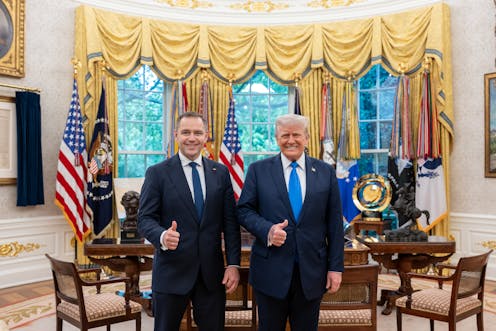
Karol Nawrocki in the Oval Office with Donald Trump on May 25th 2025, ten days before the first round of the Polish presidential election. It is very rare for a sitting US president to receive a candidate in a foreign election.
White House X account

Nawrocki’s narrow victory (50.89%) over Trzaskowski, the mayor of Warsaw and candidate of the government coalition, illustrates and reinforces the political polarisation of Poland and the rise of the populist “Trumpist” right in Central and Eastern Europe. Since the start of the war in Ukraine, there has been much speculation about whether Europe’s geopolitical centre of gravity is shifting eastwards. The Polish election seems to confirm that the political centre of gravity is shifting to the right.

A narrow victory

We are witnessing a relative erosion of the duopoly of the two major parties, Civic Platform (PO) and Law and Justice (PiS), whose leaders – the current Prime Minister, Donald Tusk, and Jarosław Kaczyński respectively – have dominated the political landscape for over twenty years.

Kaczyński’s skill lay in propelling a candidate with no responsibilities in his party, who was little known to the general public a few months ago, and, above all, who is from a different generation, to the presidency (a position held since 2015 by a PiS man, Andrzej Duda). Nawrocki, a historian by training and director of the Polish Institute of National Remembrance, has helped shape PiS’s memory policy. He won the second round, despite his troubled past as a hooligan, by appealing to voters on the right.

In the first round, he won 29.5% of the vote, compared to Trzaskowski’s 31.36%, but the two far-right candidates, Sławomir Mentzen (an ultra-nationalist and economic libertarian) and Grzegorz Braun (a monarchist, avowed reactionary, and anti-Semite), won a total of 21% of the vote. They attracted a young electorate (60% of 18–29-year-olds), who overwhelmingly transferred their votes to Nawrocki in the second round.


A weekly email in English featuring expertise from scholars and researchers. It provides an introduction to the diversity of research coming out of the continent and considers some of the key issues facing European countries. Get the newsletter!


Despite a high turnout of 71% and favourable votes from the Polish diaspora (63%), Trzaskowski was unable to secure enough votes from the first-round candidates linked to the governing coalition, including those on the left (who won 10% between them) and the centre-right (Szymon Hołownia’s Third Way movement, which won 5% in the first round).

A Tusk government struggling to implement its programme

There are two Polands facing each other: the big cities, where incomes and levels of education are higher, and the more rural small towns, which are more conservative on social issues and more closely linked to the Catholic Church.
The themes of nationhood – Nawrocki’s campaign slogan was “Poland first, Poles first” – family, and traditional values continue to resonate strongly with an electorate that has been loyal to PiS for more than twenty years. The electoral map, which shows a clear north-west/south-east divide, is similar to those of previous presidential elections and even echoes the partition of Poland at the end of the eighteenth century. The PiS vote is strongest in the part of the country that was under Russian rule until 1918. A more traditional Catholicism in these less developed regions, coupled with a strong sense of national identity, partly explains these historical factors.

The economic explanation for the vote is unconvincing. Over the past 25 years, Poland has undergone tremendous transformation, driven by steady economic growth. GDP per capita has risen from 25% to 80% of the EU average, although this growth has been unevenly distributed. Nevertheless, a relatively generous welfare state has been preserved.

Clearly, however, this growth, driven by investment from Western Europe (primarily Germany) and European structural funds (3% of GDP), does not provide a sufficient electoral base for a liberal, centrist, pro-European government.

It is precisely the government’s performance that may hold the key to Trzaskowski’s failure. Having come to power at the end of 2023 with a reformist agenda, Donald Tusk’s government has only been able to implement part of its programme, and it is difficult to be the candidate of an unpopular government. Conversely, the governing coalition has been weakened by the failure of its candidate.

The main reason for the stalling of reforms is the presidential deadlock. Although the president has limited powers, he countersigns laws and overriding his veto requires a three fifth majority in parliament, which the governing coalition lacks.

The president also plays a role in foreign policy by representing the country, and above all by appointing judges, particularly to the Supreme Court. This has hindered the judicial reforms expected after eight years of PiS rule. It is mainly in this area that Duda has obstructed progress. The election of Nawrocki, who is known for his combative nature, suggests that the period of cohabitation will be turbulent.

What are the main international implications of Nawrocki’s election?

Donald Tusk is now more popular in Europe than in Poland; in this respect, we can speak of a “Gorbachev syndrome”. In Central Europe, the Visegrad Group (comprising Hungary, Poland, the Czech Republic, and Slovakia) is deeply divided by the war in Ukraine, but it could find common ground around a populist sovereignty led by Hungary’s Viktor Orbán. Orbán was the first to congratulate Nawrocki on his victory, followed by his Slovak neighbour Robert Fico. The Czech Republic could also see a leader from this movement come to power if Andrej Babiš wins the parliamentary elections this autumn. Nawrocki would fit right into this picture.

Since Donald Tusk returned to power, particularly during Poland’s EU presidency, which ends on 30 June, the focus has been on Poland’s “return” to the heart of the European process. Against the backdrop of the war in Ukraine and Poland’s pivotal role in coordinating a European response, the Weimar Group (comprising Paris, Berlin, and Warsaw) has emerged as a key player. Three converging factors have made this possible: the French president’s firm stance toward Russia; the new German chancellor, Friedrich Merz, breaking a few taboos on defence and budgetary discipline; and Donald Tusk, the former president of the European Council, regaining a place at the heart of the EU that his predecessors had abandoned. A framework for a strategic Europe was taking shape.

However, President Nawrocki, and the PiS more generally, are taking a different approach to the EU: they are positioning themselves as Eurosceptic opponents defending sovereignty. They are playing on anti-German sentiment by demanding reparations 80 years after the end of the Second World War and asserting Poland’s sovereignty in the face of a “Germany-dominated Europe”. The Weimar Triangle, recently strengthened by the bilateral treaty between France and Poland signed on 9 May 2025, could be weakened on the Polish–German flank.

As a historian and former director of the Second World War Museum in Gdansk and the Institute of National Remembrance, Nawrocki is well placed to exploit this historical resentment. He has formulated a nationalist memory policy centred on a discourse of victimhood, portraying Poland as perpetually under attack from its historic enemies, Russia and Germany.

While there is a broad consensus in Poland regarding the Russian threat, opinions differ regarding the government’s desire to separate the traumas of the past, particularly those of the last war, from the challenges of European integration today.

Memory issues also play a prominent role in relations with Ukraine. There is total consensus on the need to provide military support to Ukraine, under attack: this is obvious in Poland, given its history and geography – defending Ukraine is inseparable from Polish security. However, both Nawrocki and Trzaskowski have touched upon the idea that Ukraine should apologise for the crimes committed by Ukrainian nationalists during the last war, starting with the massacre of more than 100,000 Poles in Volyn (Volhynia), north-western Ukraine) by Stepan Bandera’s troops.

Alongside memory policy, Nawrocki and the PiS are calling for the abolition of the 800 zloty (190 euros) monthly allowance paid to Ukrainian refugees. Poland had more than one million Ukrainian workers prior to the war, and more than two million additional workers have arrived since it started, although around one million have since relocated to other countries, primarily Germany and the Czech Republic.

Prior to the second round of the presidential election, Nawrocki readily signed the eight demands of the far-right candidate Sławomir Mentzen, which included ruling out Ukraine’s future NATO membership. Playing on anti-Ukrainian (and anti-German) sentiment, alongside Euroscepticism and sovereignty, is one of the essential elements of the new president’s nationalist discourse.

A Central and Eastern European Trumpism?

Certain themes of the Polish election converge with a trend present throughout Central and Eastern Europe. We saw this at work in the Romanian presidential election, where the unsuccessful far-right nationalist candidate, George Simion, came to Warsaw to support Nawrocki, just as the winner, the pro-European centrist Nicușor Dan, lent his support to Trzaskowski. Nawrocki’s success reinforces an emerging “Trumpist” movement in Eastern Europe, with Viktor Orbán in Budapest seeing himself as its self-proclaimed leader. A year ago, Orbán coined the slogan “Over there (in the United States), it’s MAGA; here, it will be MEGA: Make Europe Great Again”. The “Patriots for Europe” group, launched by Orbán last year, is intended to unify this movement within the European Parliament.

American conservative networks, through the Conservative Political Action Conference (CPAC), a gathering of international hard-right figures, and the Trump administration are directly involved in this process. Shortly before the presidential election, Nawrocki travelled to Washington to arrange a photo opportunity with Trump in the Oval Office.

Most notably, two days before the election, Kristi Noem, the US Secretary of Homeland Security, was dispatched on a mission to Poland. Speaking at the CPAC conference in Rzeszów, she explicitly linked a vote for Nawrocki to US security guarantees for Poland:

“If you (elect) a leader that will work with President Donald J. Trump, the Polish people will have a strong ally that will ensure that you will be able to fight off enemies that do not share your values. […] You will have strong borders and protect your communities and keep them safe, and ensure that your citizens are respected every single day. […] You will continue to have a U.S. presence here, a military presence. And you will have equipment that is American-made, that is high quality.”

“Fort Trump”, that is how the outgoing President Andrzej Duda named the US military base financed by Poland after a bilateral agreement was signed with Donald Trump during his first term in office, in 2018. Similarly, the US House Committee on Foreign Affairs sent a letter to the President of the European Commission accusing her of applying “double standards”, pointing out that EU funds had been blocked when the PiS was in power, and claiming that European money had been used to influence the outcome of the Polish presidential election in favour of Trzaskowski. The letter was posted online on the State Department website. Prioritising the transatlantic link at the expense of strengthening Europe was one of the issues at stake in the Warsaw presidential election.

CPAC is playing a significant role in building a Trumpist national-populist network based on rejecting the “liberal hegemony” established in the post-1989 era, regaining sovereignty from the EU, and defending conservative values against a “decadent” Europe. Beyond the Polish presidential election, the goal seems clear: to divide Europeans and weaken them at a time when the transatlantic relationship is being redefined.

The Conversation

Jacques Rupnik ne travaille pas, ne conseille pas, ne possède pas de parts, ne reçoit pas de fonds d’une organisation qui pourrait tirer profit de cet article, et n’a déclaré aucune autre affiliation que son organisme de recherche.

ref. Poland, divided between Trump and the EU – https://theconversation.com/poland-divided-between-trump-and-the-eu-260007

How industrial diversity affects local employment growth in France

Source: The Conversation – (in Spanish) – By Nadine Levratto, Directrice de Recherche au CNRS, Université Paris Nanterre – Université Paris Lumières

In an interconnected global economy, regions face recurring economic shocks and intense competition. For policymakers and researchers, understanding the drivers of local employment growth has become critical. Recent theoretical advances highlight the importance of different relational proximities that influence the benefits of the geographic clustering of economic activities.

Our research focusing on France’s labour market areas – “geographical areas within which most of the labour force lives and works” – from 2004 to 2015 offers new insights into how industrial diversity affects local employment. The study finds that having a variety of industries – especially those related to one another – can be a significant driver of employment growth. This finding has crucial implications for regional development strategies.

A weekly e-mail in English featuring expertise from scholars and researchers. It provides an introduction to the diversity of research coming out of the continent and considers some of the key issues facing European countries. Get the newsletter!

Related vs. unrelated diversity

Economic geography literature distinguishes between two types of diversity: related variety and unrelated variety. Here, variety refers to industrial diversity or, more precisely, the different kinds of industrial sectors or technologies. The prevailing argument is that knowledge spillovers within a region, which are known to boost employment, occur primarily among related industries and to a limited extent between unrelated industries.

Related variety describes a situation in which industries share common elements, as do pharmaceuticals and biotechnology. Such elements allow for synergies, collaboration and innovation by the leveraging of similarities in knowledge bases, technologies and skills. By contrast, unrelated variety describes a situation in which industries have little in common, as do agriculture and software development. Unrelated industries operate in entirely different domains, leading to weaker direct synergies, but potentially fostering innovation through difference.

Impacts on employment

While unrelated variety offers protection against industry-specific downturns, it does not have the same direct impact on employment growth as related variety. Our research approach distinguishes between these two varieties at the local level (i.e. within a labour market area) and at the neighbourhood one (i.e. between adjacent labour market areas).

Our analysis finds that regions with industries with high related variety experienced higher employment growth from 2004 to 2015, especially during periods of economic expansion. This effect was particularly pronounced in sectors like machinery, chemicals and IT, which demonstrated strong positive impacts on local employment. We found that when industries share similarities in knowledge bases, technologies or supply chains, they create conditions for interactive learning and innovation. This process fosters intersectoral knowledge flows, enhancing regions’ capacity to adapt and grow. It can help provide balance between regional specialization, which risks stagnation due to industries’ excessive cognitive proximity – a condition economists call “lock-in” – and regional diversity, which may face challenges from too much cognitive distance.

Unrelated variety showed a more complex relationship with employment. While local unrelated variety cushioned regions from economic shocks (since sectors are less vulnerable to industry-specific downturns), it did not directly drive employment growth as related variety did. We also found that unrelated variety in neighbouring regions exerted a negative influence on local employment dynamics.

Employment and the 2008 financial crisis

During the 2008 global financial crisis, knowledge spillovers from neighbouring regions helped mitigate the impact of the economic shock. The neighbourhood effects of related industries acted as a buffer, stabilizing local employment and protecting regions from greater losses.

Drivers of local employment growth in France from 2004 to 2015

A table with figures representing employment growth in France between 2004 and 2015.
Source: INSEE, CLAP 2004-2015. Authors’ calculation. NS: not significant.
Fourni par l’auteur

Urban-rural dynamics

The difference between rural and urban areas is another important dimension. Our research found that related variety of diversity had a more pronounced positive effect in urban areas, where high concentrations of industries enable faster innovation and employment growth. Rural areas benefitted less from these knowledge spillovers, likely due to a less dense industrial ecosystem. This urban-rural divide highlights the need for tailored economic policies to support diverse regional needs.

Policy implications

For policymakers, fostering sectoral diversity, particularly the related variety, should be a priority. They could encourage collaboration between related sectors within regions to enhance resilience and growth. This would consist of supporting the development of innovation clusters where businesses in related sectors are geographically concentrated, or platforms for cross-sector collaboration where businesses, universities, research institutions and government agencies can share knowledge and explore partnerships. Promoting interregional cooperation could also help spread the benefits of related variety across neighbouring regions, especially during periods of economic crisis.

Policymakers should also consider the role of the unrelated variety of diversity. While unrelated sectors may not directly contribute to employment growth, they provide stability when economic uncertainty dominates by diversifying the regional economy. Encouraging a balance between related and unrelated sectors could offer the best of both worlds – innovation-driven growth and economic resilience.

Sectoral diversity – especially when it comes to related industries – is a key driver of local employment growth in France. However, for regions to thrive, policymakers must not only support the growth of local industries but also foster cross-regional cooperation. The lessons from France’s labour market areas provide insights for regions worldwide seeking to navigate the complexities of economic development.

The Conversation

Les auteurs ne travaillent pas, ne conseillent pas, ne possèdent pas de parts, ne reçoivent pas de fonds d’une organisation qui pourrait tirer profit de cet article, et n’ont déclaré aucune autre affiliation que leur organisme de recherche.

ref. How industrial diversity affects local employment growth in France – https://theconversation.com/how-industrial-diversity-affects-local-employment-growth-in-france-251729

¿Qué ha cambiado en España veinte años después del matrimonio igualitario?

Source: The Conversation – France – By Antonia Durán Ayago, Catedrática de Derecho Internacional Privado, Universidad de Salamanca

Veinte años no son nada, pero significan toda una vida para las más de 75 000 parejas que desde el 3 de julio de 2005 han podido formalizar su matrimonio tras la entrada en vigor de la Ley 13/2005, de 1 de julio, por la que se modifica el Código Civil en materia de derecho a contraer matrimonio y la sentencia del Tribunal Constitucional de 6 de noviembre de 2012 que declaró su plena constitucionalidad.

A las leyes que sirven para hacer felices a las personas debe rendírseles homenaje siempre. Por supuesto, también a quienes las hicieron posibles durante el gobierno del presidente José Luis Rodríguez Zapatero. Porque esta ley supuso un salto cualitativo en el reconocimiento de los derechos de las personas LGTBIQ en España y no ha traído consigo ninguna amenaza, como algunos agoreros anunciaban, para nadie ni para nada.

Quienes quieren contraer matrimonio pueden hacerlo y elegir libremente con quién, y las personas que no escojan esa opción pueden vivir su relación de pareja como lo deseen. El matrimonio, como una forma más para constituir una familia, sigue permaneciendo inalterado; nada ha cambiado al respecto.

Bebés de dos madres

No es el único avance legislativo que ha hecho posible que estas personas vivan una vida familiar plena. Parte de las carencias que tenía la Ley 13/2005 se corrigieron a través de la Ley 3/2007, que modificó la Ley sobre técnicas de reproducción humana asistida de 2006, permitiendo que la cónyuge de la mujer que se sometía a las técnicas de reproducción asistida pudiera consentir, a través del correspondiente trámite ante el Registro Civil, que cuando el niño naciera quedara inscrito como hijo de ambas.

Y aunque al menos formalmente esto suponía la consagración en nuestro ordenamiento jurídico de un nuevo tipo de filiación, la intencional, se ha seguido hablando de que únicamente caben dos formas de determinar la filiación en España: la filiación natural y la filiación adoptiva.

Se puso de manifiesto también, desde el principio, que esto suponía una discriminación para los hijos que nacían en el seno de estas parejas sin estar casadas, dado que en las parejas heterosexuales no se exige matrimonio para poder acreditar la filiación de los hijos comunes.

Por otro lado, los matrimonios de varones reclamaban para sí la posibilidad de ser padres biológicos, lo que únicamente podían conseguir a través de la gestación por sustitución, técnica no permitida en España (artículo 10 de la citada Ley sobre técnicas de reproducción humana asistida).

¿Qué hay de la gestación por sustitución?

Al hilo de estas reivindicaciones, la Ley 4/2023, de 28 de febrero, para la igualdad real y efectiva de las personas trans y para la garantía de los derechos de las personas LGTBI eliminó algunas de las discriminaciones que todavía existían respecto de estas familias, aunque aún no se ha avanzado en la consideración de la gestación por sustitución.

Recientemente, la Instrucción de 28 de abril de 2025, de la Dirección General de Seguridad Jurídica y Fe Pública, sobre actualización del régimen registral de la filiación de los nacimientos mediante gestación por sustitución ha dado un nuevo giro de guion optando por el peor camino.

En estos veinte años se han ido incorporando cada vez más Estados en la regulación de este tipo de uniones. Sin embargo, todavía existen graves obstáculos a la movilidad de estas familias a otros países que no reconocen el matrimonio igualitario, puesto que estos niegan la posibilidad de que estas familias tengan los mismos derechos en su territorio. Hay formulas para lograrlo. Pero se avanza poco a poco. Recientemente, en mi libro Derechos humanos y método de reconocimiento de situaciones jurídicas: Hacia la libre circulación de personas y familias (perspectiva internacional y europea) (Aranzadi, 2024), analizo estas cuestiones.

Hace unos días, la abogado General del Tribunal de Justicia de la Unión Europea, Tamara Cápeta, en el asunto C-769/22 de la Comisión europea contra Hungría, por primera vez puso en valor la importancia de respetar el artículo 2 del Tratado de la Unión Europea, que habla de la dignidad de las personas, del pluralismo y del libre desarrollo como base del espacio democrático que es la Unión Europea. También subrayó que no pueden tener cabida actitudes claramente homófobas y discriminatorias en el seno de la Unión. Sin duda, es un motivo para la esperanza.

El largo camino hacia la igualdad real continúa, pero no hay que dar nada por hecho. Los derechos, para que se mantengan, hay que defenderlos todos los días.

The Conversation

Antonia Durán Ayago no recibe salario, ni ejerce labores de consultoría, ni posee acciones, ni recibe financiación de ninguna compañía u organización que pueda obtener beneficio de este artículo, y ha declarado carecer de vínculos relevantes más allá del cargo académico citado.

ref. ¿Qué ha cambiado en España veinte años después del matrimonio igualitario? – https://theconversation.com/que-ha-cambiado-en-espana-veinte-anos-despues-del-matrimonio-igualitario-259956

Qué hacer frente a la homofobia en las escuelas rurales

Source: The Conversation – France – By José Pablo Rodríguez Gobiet, Investigación en Psicología, Educación y Desarrollo, Universidad de Granada

José llegó el martes a clase con la cabeza agachada. Venía del patio del recreo y la luz que desprendía su cara a primera hora de la mañana se había apagado por completo. Decía que “ya no podía más”.

Nuestro alumno, al igual que nosotros, es “de pueblo”. Nacimos en una zona rural de Andalucía. A pesar de los años que tenemos de diferencia, tanto él como nosotros hemos tenido que vivir actitudes y episodios de homofobia en la escuela.

José es un estudiante de 4º de Educación Secundaria Obligatoria cuya orientación sexual no cumple una serie de patrones que en ese contexto educativo se consideran una norma. Al no encajar en ese puzle, muchos adolescentes condenan sus comportamientos y aprovechan cualquier ocasión para discriminarlo al grito de “¡Maricón!”.

Aumento de discriminación

La homofobia sigue siendo un desafío importante en muchas sociedades, y el ámbito educativo no es ajeno a este fenómeno. A pesar de los avances legislativos, un 42,5 % de la población LGTBI+ ha sufrido algún tipo de violencia en este último año, según datos del Informe Estado del Odio: Estado LGTBI+ 2025.

En particular, en las aulas rurales la homofobia puede presentarse de formas sutiles o explícitas, afectando tanto a estudiantes como a docentes.

Raíces de la homofobia rural

En el aula, el comportamiento de los adolescentes se enmarca en un determinado contexto sociocultural, el que les ha “tocado” vivir. En este contexto confluyen una serie de variables: la educación y los valores recibidos en casa y en el instituto, pero también el contexto social y las redes sociales que frecuenta en la actualidad.


Leer más:
Jean Piaget y las fases del desarrollo cognitivo infantil


El adolescente es todavía un niño o niña en construcción, según la teoría de Piaget. Aunque el accceso a internet y redes sociales han cambiado los referentes, y ya no son únicamente los más cercanos, el contexto rural no ofrece la misma diversidad social y prevalece el modelo heteropatriarcal basado en tradiciones y costumbres poco permeables.

Es un modelo en el que a menudo se transmiten prejuicios e ideas preconcebidas. Quienes se salen del modelo suelen ser enseguida señalados; en el caso de la orientación sexual, los prejuicios y la desinformación llevan a la homofobia.

Intervención en vídeo del autor de este artículo en el Congreso Psicodocencia 2025 titulada Desinformación y Homofobia en Aulas Rurales Andaluzas de Secundaria.

Acoso escolar y sexilio

Nuestro alumno José es una víctima de su propio contexto, ya que los estudiantes que se identifican con la comunidad LGTBI+ a menudo sienten la presión de ocultar su orientación sexual, por miedo al rechazo o la violencia.

En Andalucía, por ejemplo, algunos adolescentes que se atreven a expresar su identidad sexual se enfrentan a burlas, insultos o exclusión e incluso agresiones físicas. Muchos se ven empujados a mudarse a una ciudad, lo que algunos expertos llaman “sexilio”.

Este autoexilio provoca, a su vez, que el colectivo LGTBI+ se mantenga casi inexistente en el medio rural, perpetuando la falta de normalización, los prejuicios y la discriminación.

Tipos de homofobia en contexto rural

El uso de términos como “maricón o bollera” van más allá de la violencia verbal: perpetúan la discriminación. La decisión de insultar o golpear a una persona homosexual pasa previamente por el uso de este tipo de palabras despectivas, ya que el agresor perpetúa un sistema en el que cree.

Los chistes, los comentarios jocosos constituyen un tipo de violencia de baja intensidad, cotidiana, que puede considerarse inofensiva pero cuyo efecto siguen siendo la exclusión y discriminación del diferente.

¿Cómo frenar la homofobia en contextos rurales?

Que la homofobia tenga una presencia elevada en las aulas rurales supone un déficit de educación inclusiva y respetuosa con la diversidad. En este sentido, el papel de los docentes es fundamental. A través de una formación adecuada en materia de derechos humanos y diversidad sexual, los educadores pueden ofrecer una enseñanza que no solo se centre en la transmisión de conocimientos académicos, sino también en valores como el respeto, la empatía y la igualdad.


Leer más:
#Yosoydiverso: una estrategia de comunicación transmedia que muestra la diversidad


Un ejemplo positivo es el programa desarrollado por nuestro grupo de investigación: Spoilea tus prejuicios: el armario que lucha contra la homofobia. Ha sido implementado en diversas aulas rurales de Jaén y Córdoba y en la Semana de la Ciencia de la Universidad de Granada.

La bandera LGTB+ junto a un armario abierto de color rosa invita a abandonar prejuicios.
Cartel para la noche europea de los investigadores.
Elaboración propia.

Este programa incluye talleres donde padres, docentes y alumnos participan en actividades que fomentan la divulgación de nuestros estudios para frenar la homofobia a través de la comprensión de la diversidad sexual, avalado por un proyecto de investigación educativa de la Junta de Andalucía. De esta manera, se ofrecen espacios colaborativos entre la investigación y la docencia.

Avanzar con ciencia y educación

Ciencia y educación son los ingredientes perfectos para avanzar, para desarrollar proyectos psicoeducativos que hagan a nuestro alumnado crecer como personas en libertad e igualdad. Combatir la homofobia no solo beneficia a los jóvenes LGTBI+, sino que contribuye a la creación de pueblos más justos, igualitarios y respetuosos con la diversidad.


Leer más:
Relatos de vida de profesorado LGTBIQ+ en la formación docente


Nosotros, al igual que muchas, muchos y muches de vosotres, fuimos también ese José, ese “maricón de pueblo” que nunca entendió por qué parte de su clase le apartaba. Desde la investigación y su aplicación práctica, queremos ayudar a José y a todes a lograr una sociedad rural más justa.

The Conversation

Los autores de este artículo han recibido la financiación y el aval de la Consejería de Desarrollo Educativo y Formación Profesional de la Junta de Andalucía a través del Proyecto de Investigación Educativa PIV-088/23 “Variables sobre la homofobia en las aulas rurales andaluzas de Secundaria” concedido a los investigadores y cuya resolución figura en BOJA (Julio 2023) Boletín Oficial de la Junta de Andalucía Nº 138 Resolución de 13 de julio de 2023, de la Dirección General de Tecnologías Avanzadas y Transformación Educativa, por la que se aprueban proyectos de investigación e innovación educativa y de elaboración de materiales curriculares para el año 2023.

https://www.juntadeandalucia.es/boja/2023/138/21

Los autores de este artículo han recibido la financiación y el aval de la Consejería de Desarrollo Educativo y Formación Profesional de la Junta de Andalucía a través del Proyecto de Investigación Educativa PIV-088/23 “Variables sobre la homofobia en las aulas rurales andaluzas de Secundaria” concedido a los investigadores y cuya resolución figura en BOJA (Julio 2023) Boletín Oficial de la Junta de Andalucía Nº 138 Resolución de 13 de julio de 2023, de la Dirección General de Tecnologías Avanzadas y Transformación Educativa, por la que se aprueban proyectos de investigación e innovación educativa y de elaboración de materiales curriculares para el año 2023. https://www.juntadeandalucia.es/boja/2023/138/21

ref. Qué hacer frente a la homofobia en las escuelas rurales – https://theconversation.com/que-hacer-frente-a-la-homofobia-en-las-escuelas-rurales-258611

¿Puede la digitalización acelerar la transición hacia una economía circular?

Source: The Conversation – France – By Mercedes Gil-Lamata, Assistant Professor of Business and Management, Universidad de La Rioja

FAMILY STOCK/Shutterstock

Cada vez consumimos y agotamos más rápidamente los recursos del planeta. Con el fin de abordar este problema, a lo largo de los últimos años se ha planteado la necesidad de abandonar el tradicional modelo lineal basado en producir, usar y tirar, y sustituirlo por un nuevo modelo productivo, la economía circular, basada en la reducción de la cantidad de recursos empleados y en la reutilización de los mismos. Pero ¿qué papel juega la digitalización en este cambio de paradigma?

Una investigación reciente analiza cómo las tecnologías digitales pueden ayudar a los países europeos a avanzar hacia un modelo más sostenible. Los resultados son reveladores: los países con mayor desarrollo digital tienden a mejorar su desempeño circular. Es decir, digitalización y circularidad van de la mano.


Leer más:
La transición a la economía circular será más fácil con empresas orientadas hacia la sostenibilidad y la innovación


El reto: usar los recursos sin agotarlos

El problema de la sobreproducción requiere de una solución urgente. La demanda global de recursos naturales crece sin freno, y buena parte de ellos no se regeneran. Para 2030, se espera que más de 9 000 millones de personas compartan un planeta con límites físicos muy claros.

En este contexto, la economía circular propone un modelo económico que reduzca los residuos, prolongue la vida útil de los productos y reincorpore materiales al ciclo productivo. Frente al despilfarro del modelo tradicional, se apuesta por la eficiencia, la sostenibilidad y la regeneración.

En consecuencia, iniciativas como el Pacto Verde Europeo o el Plan de Acción para la Economía Circular de la UE han cobrado protagonismo. Pero, más allá de las políticas, es necesario entender qué factores facilitan –o dificultan– la transición hacia este nuevo modelo.

¿Puede ayudarnos la tecnología?

Aunque podría parecer que la sostenibilidad y la tecnología son conceptos antagónicos, la realidad es bien distinta. La digitalización –entendida como la integración de las tecnologías digitales en los procesos sociales y económicos– puede ser una poderosa aliada de la economía circular. Desde sensores que permiten rastrear materiales hasta plataformas de reutilización, pasando por sistemas de inteligencia artificial que optimizan procesos de producción o consumo, las aplicaciones digitales abren nuevas vías para cerrar los ciclos productivos y reducir residuos.

Pero ¿cómo se refleja esta relación en la práctica? ¿De verdad los países más digitalizados están más cerca de alcanzar una economía circular?


Leer más:
La digitalización, la economía circular y la incertidumbre económica perfilan nuevos hábitos de consumo


Cuatro tipos de países, cuatro niveles de circularidad

Para responder a estas preguntas, el estudio analizó los 27 países de la Unión Europea, agrupándolos en función de su comportamiento en las siguientes áreas clave para la economía circular: producción y consumo, gestión de residuos, uso de materias primas secundarias e innovación. A partir de esta clasificación, se identificaron cuatro grupos de países:

  • Generadores: se trata de economías con bajo nivel de circularidad y escasa inversión en reciclaje o innovación. En este grupo se integran gran parte de los países del sur y este de Europa (como Grecia, Rumanía o Bulgaria).

  • Recicladores: presentan buenos niveles de reciclaje y algo más de innovación. Aquí se sitúan países como España, Austria o los países nórdicos.

  • Realizadores: destacan especialmente por su uso de materias primas recicladas. Es el caso de Bélgica y los Países Bajos.

  • Innovadores: lideran en todas las áreas, especialmente en innovación. Francia, Alemania e Italia forman este grupo.


Leer más:
Hacia una economía circular en Europa: dónde estamos y cuánto nos falta


¿Qué papel juega la digitalización?

A continuación, los investigadores analizaron el grado de digitalización de cada país, usando indicadores como el capital humano digital, la integración de tecnología en las empresas, los servicios públicos digitales y la conectividad. Los resultados muestran que hay una clara relación entre economía circular y digitalización. En concreto, tres factores digitales marcaron la diferencia:

  • Capital humano: los países con más personas formadas en competencias digitales tienen más capacidad para aplicar estrategias circulares.

  • Integración tecnológica: las empresas que usan tecnologías como el big data o el comercio electrónico tienden a operar de manera más eficiente y circular.

  • Servicios públicos digitales: la digitalización de los gobiernos facilita procesos como la gestión de residuos o la trazabilidad de los materiales.

Curiosamente, la conectividad –como tener acceso a internet– no marcó diferencias significativas. Esto se explica seguramente porque, dentro de la UE, dicho acceso está bastante generalizado y no es ya un factor diferenciador.


Leer más:
Europa, sin rumbo claro frente a la digitalización americana y china


No hay economía circular sin digitalización

Aunque no se establece una relación causal directa, los datos muestran una sólida asociación: los países con mayores niveles de digitalización tienden a presentar un mejor desempeño en economía circular. La digitalización ofrece herramientas, habilidades y plataformas que permiten a gobiernos, empresas y la sociedad avanzar hacia modelos más sostenibles. De hecho, avanzar en economía circular sin apostar por la digitalización puede dejar a muchos países atrás.


Leer más:
¿Podrán las nuevas regulaciones europeas garantizar la sostenibilidad de las empresas?


¿Y ahora qué?

Para acelerar la transición hacia una economía circular, las políticas públicas deberían tener en cuenta esta conexión. Fomentar la formación digital, apoyar la innovación tecnológica en las empresas y digitalizar los servicios públicos no solo mejora la competitividad: también es una inversión en sostenibilidad.

Además, las empresas que integran principios circulares en su estrategia –apoyadas en herramientas digitales– pueden reducir costes, atraer talento y diferenciarse en un mercado cada vez más consciente de su trascendencia.

En resumen, la digitalización no es solo un complemento de la economía circular: es una de sus condiciones fundamentales. Avanzar hacia un futuro sostenible exige entender que la digitalización no es opcional, sino parte esencial del cambio.

The Conversation

Mercedes Gil-Lamata recibe fondos del Gobierno de Aragón y Fondo Social Europeo (convocatoria de grupos de investigación (S64_23R) y del Ministerio de Ciencia e Innovación (AEI/10.13039/501100011033, ECO2020-113265GB-C22). Ambas convocatorias lo son para la realización de investigación básica y no suponen condicionante de ningún tipo acerca del tipo de investigación a realizar.

Lucio Fuentelsaz recibe fondos del Gobierno de Aragón y Fondo Social Europeo (convocatoria de grupos de investigación (S64_23R) y del Ministerio de Ciencia e Innovación (AEI/10.13039/501100011033, ECO2020-113265GB-C22). Ambas convocatorias lo son para la realización de investigación básica y no suponen condicionante de ningún tipo acerca del tipo de investigación a realizar.

Mª Pilar Latorre Martínez recibe fondos del Gobierno de Aragón y Fondo Social Europeo (convocatoria de grupos de investigación (S64_23R) y del Ministerio de Ciencia e Innovación (CPP2021-008997). Ambas convocatorias lo son para la realización de investigación básica y no suponen condicionante de ningún tipo acerca del tipo de investigación a realizar.

ref. ¿Puede la digitalización acelerar la transición hacia una economía circular? – https://theconversation.com/puede-la-digitalizacion-acelerar-la-transicion-hacia-una-economia-circular-258023

¿Puede la inteligencia artificial salvar a los menores del acoso sexual en las redes?

Source: The Conversation – France – By Marc Salat Paisal, Profesor Agregado Serra Húnter de Derecho Penal, Universitat de Lleida

Entre un 10 y un 20 % de los menores de edad en España ha sufrido ‘grooming’. SB Arts Media/Shutterstock

Cada año, más de 300 millones de niños, niñas y adolescentes –aproximadamente uno de cada doce menores de todo el planeta– sufren explotación o abuso sexual en internet. En el caso español los datos no son mejores. De hecho, las investigaciones científicas apuntan que este es un problema que afecta a entre un 10 y un 20 % de los menores de edad en España. El número de casos es alto y la policía no tiene herramientas suficientes para poder investigarlos todos.

La legislación actual permite a los investigadores rastrear las fuentes digitales abiertas, incluidas las redes sociales, para identificar indicios de delito relevantes. También admite incorporar en la investigación las pruebas obtenidas por particulares, como puede ser el registro de chats que posibles víctimas de grooming (acoso sexual a menores a través de las redes) puedan aportar.

La inteligencia artificial (IA) permite a la policía analizar grandes cantidades de datos en segundos, detectar patrones sospechosos y localizar posibles delincuentes con mayor rapidez. También facilita la revisión de miles de archivos en investigaciones complejas. Sin la IA, este trabajo sería casi imposible. No obstante, su uso plantea un dilema: ¿hasta qué punto estas herramientas pueden intervenir sin vulnerar derechos fundamentales como la privacidad?

El uso de la IA en España, de hecho, no es nuevo. La policía la utiliza, por ejemplo, para analizar el riesgo de reincidencia en casos de violencia de género.

Cuando la IA revisa conversaciones y busca imágenes

En algunos países, aunque no en España, se utilizan herramientas con IA para perseguir delitos sexuales contra menores en internet. Algunas revisan conversaciones y priorizan denuncias, y otras buscan imágenes ilegales en la web. En todos los casos, su objetivo es facilitar el trabajo de la policía.

La clave del debate es determinar si el uso de la IA en la investigación policial de delitos, especialmente en casos de grooming, se ajusta a la legalidad. Hasta hace poco, la normativa era fragmentaria y ofrecía pocas garantías sobre el uso de estas tecnologías.

En 2016 se aprobó una Directiva europea que prohibía basar las decisiones legales solo en el análisis automático de datos. Posteriormente, en 2021, el Parlamento Europeo permitió el uso de la IA, aunque con limitaciones. Entre ellas, que los algoritmos debían ser transparentes, comprensibles y verificables. Y, sobre todo, que las decisiones finales debían ser tomadas por personas, no por máquinas.

Recientemente, se ha aprobado el Reglamento Europeo sobre IA de 2024, que permite el uso de estas herramientas en la justicia penal. Sin embargo, el reglamento califica su uso de alto riesgo. Ello implica que, entre otras exigencias, estas herramientas deben ser seguras, transparentes y supervisadas por humanos. Por su parte, en España no existen normas específicas sobre el uso de la IA en la justicia penal, por lo que el marco normativo de referencia es el europeo.

Ante este panorama, el Estado español debe aprovechar el marco legal para desarrollar herramientas que faciliten la investigación de delitos sexuales contra menores en la red. Por ejemplo, para filtrar y priorizar el gran volumen de casos que llega a manos de la policía española. Más difícil sería admitir el uso de chatbots que se hiciesen pasar por menores de edad, a modo de potenciales víctimas, para “cazar” a agresores sexuales. Ello está expresamente prohibido por la legislación española.

Con todo, los expertos han alertado de los problemas que plantea el uso de la IA en el ámbito penal. Aunque esta es capaz de detectar patrones, no es infalible. Un algoritmo mal diseñado podría generar falsos positivos, señalando como sospechosos a usuarios que no han cometido ningún delito.

Análisis previo del fenómeno

Para evitar estos y otros problemas propios de las herramientas basadas en algoritmos o en IA, es muy importante realizar un análisis previo del fenómeno de la delincuencia sexual online. Además, los sistemas deben alimentarse con datos completos para garantizar que sus resultados superen los de un análisis humano.

Si se tiene en cuenta lo anterior, la implementación de IA puede ofrecer una oportunidad para identificar y corregir estos sesgos. De hecho, los prejuicios atribuidos a la IA provienen de los datos con que son alimentados por parte de los humanos.

Por eso, el Estado español debe acompañar la implementación de estas herramientas con un marco legal sólido que proteja los derechos fundamentales. También es clave entender que la IA debe complementar el trabajo humano, aportando análisis y datos para una toma de decisiones más informada y precisa.

En resumen, la IA puede transformar significativamente la gestión de los casos policiales de delitos de grooming. No obstante, debe usarse de manera complementaria, con una comprensión clara de sus limitaciones y riesgos para reforzar el papel de los agentes del sistema de justicia.

The Conversation

Marc Salat Paisal recibe fondos de del Ministerio de Ciencia, Innovacción y Universidades a través de los proyectos de investigación Derecho penal y comportamiento humano (MICINN-RTI2018-097838-B-100) y Ciberacoso sexual a menores: perfiles linguísticos para el desarrollo de herramientas digitales forenses para prevención, detección y priorización en España (PID2020-117964RB-I00).

ref. ¿Puede la inteligencia artificial salvar a los menores del acoso sexual en las redes? – https://theconversation.com/puede-la-inteligencia-artificial-salvar-a-los-menores-del-acoso-sexual-en-las-redes-252474

La luz que no podemos ver

Source: The Conversation – France – By Pedro Francisco Almaida Pagán, Investigador Ramón y Cajal, IMIB, CIBERFES, Universidad de Murcia

Sergey Nivens/Shutterstock

Seguro que algunos lectores habrán captado al vuelo la similitud del título de este artículo con el de la serie de Netflix La luz que no puedes ver, basada en la novela homónima de Anthony Doerr, premio Pulitzer 2015 de ficción. La historia transcurre durante la Segunda Guerra Mundial, y en ella se alude a todas aquellas formas de luz que existen más allá de lo visible o de lo evidente.

Una de las protagonistas de la historia es Marie-Laure Leblanc, una chica francesa ciega que se refugia con su padre en Saint-Malo. A pesar de la ceguera, Marie-Laure percibe el mundo con una aguda sensibilidad. A través de su experiencia, la historia explora cómo la verdadera percepción no depende exclusivamente de la vista, y cómo existen formas de conocimiento y comprensión que trascienden lo visible. Ella misma es una encarnación de esa “luz” que no se ve, pero se siente, se intuye o se comprende por otros caminos.

Invidentes que perciben luz (pero no la “ven”)

No hemos venido aquí a hablar de series de televisión, pero no podíamos dejar pasar esta hermosa analogía a la hora de introducir el tema de la vía circadiana de la luz, cuya existencia, si bien había sido propuesta desde hacía décadas, no fue demostrada hasta hace unos veinte años. Fue entonces cuando unos investigadores de la Universidad de Brown, en Providence (Estados Unidos), descubrieron en la retina de mamíferos la existencia de un tipo de células ganglionares con fotosensibilidad propia. Sus axones conformaban un canal directo de información que conectaba la retina con una región del hipotálamo muy especializada: los núcleos supraquiasmáticos, el reloj central que pone en hora nuestros ritmos biológicos.

Aquello confirmaba que la sincronización de nuestros relojes internos no dependía únicamente de conos y bastones, es decir, de las células de la retina responsables de la vía visual de la luz. De hecho, ya en los noventa se había detectado que algunas personas que han perdido totalmente la visión (ceguera bilateral completa) pueden conservar la capacidad de sincronizar los ritmos con la luz. Existe, por tanto, un tipo de percepción de la luz que trasciende lo visible.

Estudiar a personas ciegas para entender el ritmo sueño/vigilia

Esto permite que, en personas ciegas, la producción de melatonina, la hormona del sueño, se inhiba durante la noche. Cuando el ritmo de melatonina de las personas ciegas no se sincroniza con el de sueño/vigilia, sufren alteraciones del sueño y desajustes que impactan muy negativamente su calidad de vida. Es por esto que esta población resulta especialmente interesante para los cronobiólogos: su estudio nos permite conocer mejor cómo funciona nuestro reloj biológico y, además, podemos contribuir de forma significativa a mejorar la calidad de vida y el sueño de una parte vulnerable de la sociedad.

Las estadísticas más recientes (2024) hablan de 71 444 personas con ceguera legal en España –esto es, con una agudeza visual igual o inferior a 0,1 en el mejor ojo con la mejor corrección óptica posible y/o un campo visual reducido a 10 grados o menos–, de las cuales 9 288 son ciegas totales. La cifra podría ir en aumento en los próximos años como consecuencia del envejecimiento de la población y por el aumento de la prevalencia de enfermedades como la diabetes.

La mayoría de estas personas presentan alteraciones de los ritmos circadianos, particularmente del sueño/vigilia. La Clasificación Internacional de Alteraciones del Sueño (ICSD-3) de la Academia Americana de Medicina del Sueño dice que un 50-80 % de las personas ciegas presentan dificultades para dormir, despertares nocturnos y somnolencia diurna, entre otras alteraciones.

En un proyecto recientemente concedido a nuestro laboratorio por la prestigiosa fundación VELUX Stiftung, que llevaremos a cabo durante los próximos cuatro años en colaboración con la Organización Nacional de Ciegos Españoles (ONCE), nos hemos propuesto desarrollar un método ambulatorio y no invasivo basado en la utilización de dispositivos vestibles de monitorización circadiana desarrollados por nuestro grupo de investigación. Con ellos pretendemos medir la exposición y sensibilidad de las personas ciegas a la luz ambiental y el grado de conservación de la vía circadiana de la luz, así como el funcionamiento del sistema circadiano para establecer la propensión de cada sujeto a sufrir alteraciones de sus ritmos circadianos, incluido el sueño.

Conociendo esta información, será posible diseñar de forma personalizada estrategias para fortalecer los ritmos circadianos de las personas ciegas y, de ese modo, minimizar los efectos adversos de la ceguera en esta población.

The Conversation

Pedro Francisco Almaida Pagán recibe fondos del Ministerio de Ciencia e Innoación a través de los programas “Ramón y Cajal” (RYC2020-028642-I) y Proyectos de Generación de Conocimiento (projecto LIGHTyEAr, PID2022-136577OB-I00), el Ministerio de Economía y Competitividad y el Instituto de Salud Carlos III a través de CIBERFES (CB16/10/00239), la Universidad de Murcia a través del programa “Excelence-UM” (modalidad “Attract-RyC” 2021), la Fundación Robles Chillida y La VELUX STIFTUNG (proyecto LIGHTSPAN, nº2428), todos co-financiados con fondos FEDER de la Unión Europea. .

Jesús Vicente Martínez recibe fondos de la Agencia de Ciencia y Tecnología de la Región de Murcia (Fundación Séneca), gracias a una ayuda “21610/FPI/21. Fundación Séneca. Región de Murcia (Spain)”.

María de los Ángeles Rol de Lama recibe fondos del Ministerio de Ciencia Innovación y Universidades y la Agencia Estatal de Investigación (PID2022-136577OB-I00), financiado por MCIN/AEI/10.13039/501100011033, FEDER, UEy por “ERDF A way of making Europe”, por European Union NextGenerationEU/PRTR”, y del Ministerio de Economía y Competitividad, mediante el Instituto de Salud Carlos III (CIBERFES, CB16/10/00239), todos ellos cofinanciados con Fondos FEDER, así como de la VELUX STIFTUNG (proyecto LightSpan). Es socia fundadora de Kronohealth SL (2017), empresa de base tecnológica participada por la Universidad de Murcia (spin-off) .

Pedro González Romero recibe fondos del Ministerio de Ciencia, Innovación y Universidades a través de la convocatoria Generación de Conocimiento (proyecto PID2022-136577OB-I00, MCIN /AEI /10.13039/501100011033 / FEDER, UE) y su contrato predoctoral (FPU22/03854). Su investigación está también financiada por el Ministerio de Economía y Competitividad y el Instituto de Salud Carlos III a tráves de CIBERFES (CB16/10/00239), todos ellos cofinanciados por FEDER.

ref. La luz que no podemos ver – https://theconversation.com/la-luz-que-no-podemos-ver-258938