Peace has long been elusive in rural Colombia – Black women’s community groups try to bring it closer each day

Source: The Conversation – USA (3) – By Tania Lizarazo, Associate Professor of Latin American Studies and Global Studies, University of Maryland, Baltimore County
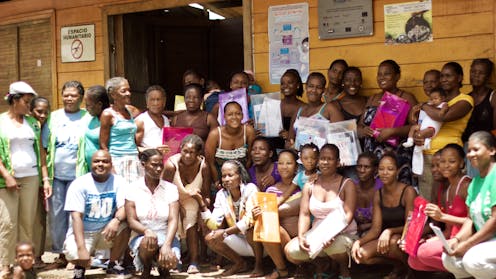
Local activists known as ‘comisionadas’ pose with women from Tanguí, Chocó, Colombia, at the end of a workshop in 2013. Tania Lizarazo

It’s been almost nine years since Colombia celebrated a landmark peace agreement between one guerrilla group and the government, and three years since President Gustavo Petro vowed “total peace.” But in reality, the country’s decades-long internal conflict continues – making it one of the oldest in the world.

Violence surged in early 2025, the most intense uptick in years. Fighting between two armed guerrilla groups in the northeastern Catatumbo region killed dozens of people and displaced tens of thousands more. Since the largest armed group – the Revolutionary Armed Forces of Colombia, known as FARC – signed the 2016 peace accord, more than 400 signatories have been killed. Meanwhile, more than 1,200 social leaders and human rights defenders have been assassinated.

We often define peace as the absence of war. The problem with thinking about peace and war as an all-or-nothing binary, however, is that it obscures the violence that takes place in “peaceful times.” For Colombians, that paradox is nothing new. In many communities most affected by the violence, thinking about a “post-conflict era” feels utopian.

As a Colombian researcher who has collaborated with Afro-Colombian leaders for over a decade, I have noticed that emphasizing peace talks and accords erases the historical violence that is still present, especially for racial minorities. Colombia has the largest Black population in Spanish-speaking Latin America. In Chocó – a region on the Pacific coast where I conducted my research – Afro-Colombians form a majority.

Communities there are contending not only with the contemporary conflict, but also ongoing challenges from the legacies of slavery, colonialism and extractive industries. Many residents, particularly women, work together every day to try to bring peace and justice within reach.

Two colorful signs, one of which has an image of a tree, hang on a white wall with a dark-colored door.
Signs in the office of COCOMACIA say ‘option for life’ and ‘peace, we all build it.’
Tania Lizarazo

Rights vs. reality

Colombia has been mired in war for over six decades, as legal and illegal armed groups across the political spectrum fight for territories and resources. The conflict is estimated to have killed around 450,000 people and displaced around 7 million.

Black and Indigenous communities have disproportionately suffered the brunt of the war – especially in rural areas, where their lives and territories have been threatened by armed groups and companies alike. In Chocó Department, the site of my research, the region’s remoteness and biodiversity have attracted illegal groups and practices like drug trafficking, as well as mining and other types of resource extraction that threaten traditional livelihoods. Mercury from industrial mining poses an additional danger to people’s health and the environment.

Four women walk down a path as a tall man in a white shirt walks in the middle.
Andres Magallan carries an urn with the remains of Ivan Mejia, who was murdered by right-wing paramilitary guerrillas years before, in Santa Maria, Chocó, Colombia, in 2010.
Raul Arboleda/AFP via Getty Images

Black rural communities in the Pacific lowlands, where most of Chocó is located, have a legal right to collective ownership of their territories and to be consulted about development plans. In reality, land grabs and targeted killings over illegal crops, mining and other extractive practices have become the norm here, as is true throughout rural Colombia.

The conflict has intensified racism and gender hierarchies, with Black women, particularly activists, especially vulnerable. Vice President Francia Márquez Mina, for example – who has won awards for her activism against illegal mining – survived an attack near her home in the nearby department of Cauca in 2019. She and her family have received other threats on their lives since then.

Building solidarity

Even in “postconflict” times, peace is a challenging task. It requires social change that does not happen overnight. Rather, it is the accumulation of tiny sparks in people’s daily commitments.

In my book “Postconflict Utopias: Everyday Survival in Chocó, Colombia,” I write about how Black women’s organizations care for their territories and communities. The “comisionadas,” for example, belong to one of the largest associations of community councils in rural Colombia, called COCOMACIA. These women travel the Atrato River and its tributaries to lead workshops about the organization, as well as territorial rights and women’s rights.

A group of women smile and chat as they sit on green plastic chairs inside a small room with a large poster on one wall.
Comisionadas next to a poster with information about a landmark law against domestic violence, on July 7, 2012. María del Socorro Mosquera Pérez sits on the left.
Tania Lizarazo

Everyone in the community is welcome to participate in dialogues about issues such as women’s political participation, land ownership and related legislation. Comisionada María del Socorro Mosquera Pérez, for example, wrote a song to share the importance of Law 1257, a landmark 2008 law against violence and discrimination against women.

In her story for the research project that I discuss in my book, “Mujeres Pacíficas,” comisionada Rubiela Cuesta Córdoba says it best: “The best legacy that one leaves to family and friends is resistance.”

One focus of these women’s groups’ work is the Atrato River itself. Since 2016, the same year of the peace accords, Colombian courts have recognized the river as a legal person, with rights to protection, conservation, maintenance and restoration.

About half a dozen girls, seen from behind, paint a brightly colored mural on the wall of a blue building.
Students paint a mural in Quibdó, Chocó, Colombia, which says ‘Somos Atrato’: We are the Atrato River.
Jan Sochor/Getty Images

The river is a source of food and transportation between many basin communities where potable water, electricity and other amenities are scarce. But it is also intertwined with politics and spirituality. Pilgrimages like “Atratiando,” a trip along the river and its tributaries that has taken place multiple times since 1999, highlight that there is no life without the river. Participants travel through areas where paramilitaries and guerrillas are active, showing solidarity with vulnerable communities.

COCOMACIA’s comisionadas are part of many other organizations – highlighting how survival is not only intertwined with lands and rivers, but other regions and countries. The struggle for women’s rights has led the comisionadas to collaborate with other organizations, creating wider networks of care. These include La Red Departamental de Mujeres Chocoanas, a feminist coalition of women’s organizations in Chocó; La Ruta Pacífica de las Mujeres, a feminist movement of 300 organizations from across Colombia; and Women in Black, an anti-militarism network with members in over 150 countries.

Their solidarity is a reminder that peace and justice are a collaborative, everyday effort. As Justa Germania Mena Córdoba, leader of the comisionadas at the time, told me in 2012: “One cannot change the world by herself.”

This article has been updated to correct the description of COCOMACIA.

The Conversation

Tania Lizarazo does not work for, consult, own shares in or receive funding from any company or organization that would benefit from this article, and has disclosed no relevant affiliations beyond their academic appointment.

ref. Peace has long been elusive in rural Colombia – Black women’s community groups try to bring it closer each day – https://theconversation.com/peace-has-long-been-elusive-in-rural-colombia-black-womens-community-groups-try-to-bring-it-closer-each-day-219550


‘Loyal to the oil’ – how religion and striking it rich shape Canada’s hockey fandom

Source: The Conversation – USA (3) – By Cody Musselman, Preceptor, College Writing Program, Harvard University

Some Edmonton Oilers fans are pinning their Stanley Cup hopes on captain Connor McDavid. AP Photo/Rebecca Blackwell

Déjà vu is a common occurrence in the world of sports, and the Edmonton Oilers are no strangers to repeat matchups. The Canadian team faced off against the New York Islanders in both 1983 and ’84 for hockey’s biggest prize, the Stanley Cup. In this year’s National Hockey League finals, the Oilers will try to avenge their Game 7 loss to the Florida Panthers in 2024.

Edmontonians who have been “loyal to the oil,” as fans say, have been waiting for redemption ever since. The Trump administration’s threats toward its northern neighbor has fueled a wave of nationalism, making even more fans eager for a Canadian team to win the Stanley Cup – which has not happened since 1993. With hopes pinned to Edmonton, the finals also brings renewed attention to some of Canada’s biggest exports: hockey and oil.

Novelist Leslie McFarlane once observed that for Canadians, “hockey is more than a game; it is almost a religion.” Prayers and superstitions abound, from wearing special clothing to fans averting their eyes during penalty shots.

The Oilers also evoke another aspect of Canadian society that, for some, has almost religious importance: resource extraction. In American and Canadian culture, oil has long been entangled with religion. It’s a national blessing from God, in some people’s eyes, and a means to the “good life” for those who persevere to find it. For many people in communities whose economies center around resource extraction, the possibility of success is valued above its environmental risks.

We are scholars of religion who study sports and how oil shapes society, or petro-cultures. The Edmonton Oilers showcase a worldview in which triumph, luck and rugged work pay off – beliefs at home on the ice or in the oil field. The Stanley Cup Final offers a glimpse into how the oil industry has helped shaped the religious fervor around Canada’s favorite sport.

A close-up photo of a cowboy boot painted orange and blue, with pictures of men's faces.
Edmonton Oilers fan Dale Steil’s boots before the team’s playoff game against the Los Angeles Kings on April 26, 2024.
AP Photo/Tony Gutierrez

Boomtown

Edmonton is the capital of Alberta, a province known for its massive oil, gas and oil sands reserves. With five refineries producing an average of 3.8 million barrels a day, oil and gas is Alberta’s biggest industry – and a way of life.

This is especially true in Edmonton, known as the “Oil Capital of Canada.” Here, oil not only structures the local economy, but it also shapes identities, architecture and everyday experiences.

Visit the West Edmonton Mall, for example, and you’ll see a statue of three oil workers drilling, reminding shoppers that petroleum is the bedrock of their commerce. Visit the Canadian Energy Museum to learn how oil and gas have remade the region since the late 1940s, and glimpse items such as engraved hard hats and the “Oil Patch Kid,” a spin on the iconic “Cabbage Patch Kids” toys. Tour the Greater Edmonton area and see how pump jacks dot the horizon. Oil is everywhere, shaping futures, fortunes and possibility.

Two huge machines that look like hammers stand in a field under a blue sky with clouds.
Pump jacks near Acme, Alberta – a regular sight.
Michael Interisano/Design Pics Editorial/Universal Images Group via Getty Images

Set against this backdrop, the Oilers’ name is unsurprising. It is not uncommon, after all, to name teams after local industries. Football’s Pittsburgh Steelers pay homage to the steel mills that once employed much of the team’s fan base. The Tennessee Oilers were originally the Houston Oilers, prompting other Texas teams such as the XFL’s Roughnecks to follow suit. Further north, the name of basketball’s Detroit Pistons references car manufacturing.

Teams with industry-inspired names play double duty, venerating both a place and a trade. Some fans are not only cheering for the home team, but also cheering for themselves – affirming that their industry and their labor matter.

A man in hockey gear skates underneath a metal scaffold meant to look like oil machinery.
Ales Hemsky of the Edmonton Oilers skates out from under the oil derrick for a game at Rexall Place in 2008 in Edmonton, Alberta.
Andy Devlin/NHLI via Getty Images

In a TikTok video from last year’s Stanley Cups playoffs, a man overcome with joy at the Oilers’ victory over the Dallas Stars claps his hands and hops around his living room. The caption reads, “My first-generation immigrant oil rig working Filipino father who has never played a second of hockey in his life … happily cheering for the Oilers advancing in the playoffs. Better Bring that cup home for him oily boys.” He appears to be cheering for the Oilers not because they are a hockey team, but because they are an oil team.

And indeed, the Oilers are an oily team. The Oilers’ Oilfield Network, for example, describes itself as “exclusively promot[ing] companies in the Oil and Gas industry,” allowing leaders to connect “through the power of Oilers hockey.”

The Oilers’ connection with industry is further underscored by their logos. The current one features a simple drop of oil, but past designs featured machinery gears and an oil worker pulling a lever shaped like a hockey stick.

Simply put, “Edmonton is all oil,” Oilers goaltender Stuart Skinner shared after defeating the Dallas Stars to win the 2025 Western Conference Final.

Liquid gold

There is a long tradition of pairing hockey with oil – and with Canada itself.

After the British North America Act founded Canada in 1867, the new nation searched for a distinctive identity through sport and other cultural forms.

Enter hockey. The winter game evolved in Canada from the Gaelic game of “shinty” and the First Nations’ game of lacrosse and soon became part of the glue holding the nation together.

Ever since, media, politicians, sports groups and major industries have helped fuel fan fervor and promoted hockey as integral to Canada’s rugged frontiersman character.

A black-and-white photo of two rows of men in matching sweaters, posing formally with hockey sticks.
The Montreal Amateur Athletic Association posing with the first Stanley Cup in 1893.
Bruce Bennett Studios via Getty Images Studios/Getty Images

In 1936, Imperial Oil, one of Canada’s largest petroleum companies, began sponsoring Hockey Night in Canada, a national radio show that reached millions each week. Several years later, Imperial Oil played a major role in bringing the show to television, where the Imperial Oil Choir sang the theme song. Imperial Oil and its gas stations, Esso, also sponsored youth hockey programs across the nation. In 2019, Imperial inked a deal to be the NHL’s “official retail fuel” in Canada.

Striking it rich

Connections between hockey and industry in Alberta’s oil country aren’t just about sponsorships. Central to both cultures is the idea of luck – historically, one of the many things it takes to extract fossil fuels. “Striking it rich” in the oil fields has become entangled with the idea of divine providence, especially among the many Christian laborers.

Philosopher Terra Schwerin Rowe has written about North America’s “petro-theology,” explaining how many perceive oil as a free-flowing gift from God meant to be taken from the Earth – if you can find it.

A black-and-white photo of a man in a cowboy hat kissing a small child held by a blonde woman.
A Canadian oil worker kisses his wife and daughter goodbye as he sets off to work in northern Alberta in the 1950s.
John Chillingworth/Getty Images

Oil represents fortune, and who wouldn’t want to borrow a bit of that for their team? Sports are thrilling because sometimes talent, team chemistry and the home-field advantage still lose to a stroke of good luck. Oil culture pairs the idea of divine favor with an insistence on rough-and-tumble endurance, similar to hockey.

Sometimes if you don’t strike it rich the first time, you have to keep on drilling. The next well may be the one to bring wealth. Oil prospectors know this, but so do sports fans who maintain hope season to season.

Soon fans from around the world will join Edmonton locals in rooting for the Oilers. They’ll throw their hands up in despair if captain Connor McDavid enters the “sin bin” – the penalty box – or dance in celebration to the Oilers’ theme, “La Bamba.” Some of them will be cheering, too, for oil.

This is an updated version of an article originally published on June 19, 2024.

The Conversation

Cody Musselman’s project was made possible through the support of grant #63243 ​from the John Templeton Foundation. The opinions expressed in this publication ​do not necessarily reflect the views of the John ​Templeton Foundation.

Judith Ellen Brunton does not work for, consult, own shares in or receive funding from any company or organization that would benefit from this article, and has disclosed no relevant affiliations beyond their academic appointment.

ref. ‘Loyal to the oil’ – how religion and striking it rich shape Canada’s hockey fandom – https://theconversation.com/loyal-to-the-oil-how-religion-and-striking-it-rich-shape-canadas-hockey-fandom-258024

What a sunny van Gogh painting of ‘The Sower’ tells us about Pope Leo’s message of hope

Source: The Conversation – USA (3) – By Virginia Raguin, Distinguished Professor of Humanities Emerita, College of the Holy Cross

Vincent van Gogh’s ‘Sower at Sunset’ painting. Vincent van Gogh/ Kröller-Müller Museum via Wikimedia Commons, CC BY-NC-SA

In his first general audience in Rome, Pope Leo XIV referred to Vincent van Gogh’s painting “Sower at Sunset” and called it a symbol of hope. A brilliant setting sun illuminates a field as a farmer walks toward the right, sowing seeds.

Leo referred to Christ’s Parable of the Sower, a story in the Gospel that speaks to the need to do good works. “Every word of the Gospel is like a seed sown in the soil of our lives,” he said, and highlighted that the soil is not only our heart, “but also the world, the community, the church.”

He noted that “behind the sower, van Gogh painted the grain already ripe,” and Leo called it an image of hope which shows that somehow the seed has borne fruit.

Van Gogh painted “Sower at Sunset” in 1888, when he was living in Arles in southern France. At the time, he was creating art alongside his friend Paul Gauguin and feeling very happy about the future. The painting reflects his optimism.

Van Gogh’s inspiration

In November 1888, van Gogh wrote to his brother Theo, in whom he frequently confided, about “Sower at Sunset.” He described its beautiful colors: “Immense lemon-yellow disc for the sun. Green-yellow sky with pink clouds. The field is violet, the sower and the tree Prussian Blue.”

A painting depicting a man walking in a field against a dark, cloudy background.
‘The Sower,’ by Jean-François Millet.
Museum of Fine Arts, Boston via Wikimedia Commons

Van Gogh’s painting was inspired by French artist Jean-Francois Millet’s 1860 painting, “The Sower.” But he transformed Millet’s composition, in which a dark, isolated figure dominates, and deliberately set the sower in the midst of a landscape transformed by the sun.

Other artists, including the Norwegian Emanuel Vigeland, explicitly depicted the Parable of the Sower. Vigeland’s series of stained-glass windows in an Oslo church explains each passage’s meaning. As the sower works, some seeds fall by the wayside and the birds immediately eat them, indicating those who hear the word of God but do not listen.

A stained glass window depicting an image of a man seated on the ground and cradling a child in his lap.
Norwegian artist Emanuel Vigeland’s ‘Parable of the Sower,’ 1917-19, Lutheran church of Borgestad, near Oslo, Norway.
Virginia Raguin

Some seeds fall on stony ground and cannot take root, a symbol of those with little tenacity. Others fall among thorns and are choked. Vigeland juxtaposed a dramatic image of a miser counting piles of money, indicating how the man’s life has become choked by desire for material gain.

The final passage of the parable states that some seeds fell on good ground and yielded a hundredfold. Vigeland’s depiction shows an image of an abundant harvest of grain next to a man seated on the ground and cradling a child in his lap.

What it says about Leo

Van Gogh’s painting corresponds to many of the ideas the new pope expressed in the first days of his papacy. Leo observed: “In the center of the painting is the sun, not the sower, [which reminds us that] it is God who moves history, even if he sometimes seems absent or distant. It is the sun that warms the clods of the earth and ripens the seed.”

The theme of the dignity of labor is also inherent in the image of the sower being deeply engrossed in physical labor, which relates to the pope’s choice of his name. The pope stated that he took on the name Leo XIV “mainly because Pope Leo XIII in his historic encyclical Rerum Novarum addressed the social question in the context of the first great industrial revolution.” Leo XIII was referring to the social question of economic injustice in the meager rewards for workers even as owners made great profits from the Industrial Revolution.

The pope saw Van Gogh’s image of the sower, like Vigeland’s, as a message of hope. That message, to him, fits with the theme of hope of The Jubilee Year proclaimed by Leo’s predecessor, Francis. Leo also expressed hope that humans listening to God would embrace service to others.

The Conversation

Virginia Raguin does not work for, consult, own shares in or receive funding from any company or organization that would benefit from this article, and has disclosed no relevant affiliations beyond their academic appointment.

ref. What a sunny van Gogh painting of ‘The Sower’ tells us about Pope Leo’s message of hope – https://theconversation.com/what-a-sunny-van-gogh-painting-of-the-sower-tells-us-about-pope-leos-message-of-hope-258040

100 years ago, the Supreme Court made a landmark ruling on parents’ rights in education – today, another case raises new questions

Source: The Conversation – USA (3) – By Charles J. Russo, Joseph Panzer Chair in Education and Research Professor of Law, University of Dayton

A selection of books that are part of the Supreme Court case Mahmoud v. Taylor are pictured on April, 15, 2025, in Washington. AP Photo/Pablo Martinez Monsivais

A century ago, the Supreme Court handed down one of its most important cases about education. On June 1, 1925, the court struck down an Oregon statute requiring all students to attend public school – a law critics argued was meant to limit faith-based schools, at a time when anti-Catholic bias was still common in parts of the United States.

The majority opinion in Pierce v. Society of Sisters of the Holy Name of Jesus and Mary included a now-famous dictum about parents’ rights to shape their children’s upbringing. According to the court, “the child is not the mere creature of the state; those who nurture him and direct his destiny have the right, coupled with the high duty, to recognize and prepare him for additional obligations.”

Soon, the Supreme Court is expected to release another decision around parental beliefs and education: Mahmoud v. Taylor. The plaintiffs are parents who want to excuse their children from public school lessons involving storybooks with LGBTQ+ characters – lessons they assert contradict their religious beliefs.

As someone who teaches education law, I believe this is perhaps the court’s most significant case on parental rights since Pierce. Mahmoud raises questions not only about religious freedom, but also about educators’ ability to determine curricula, and public education in a pluralistic society.

Picture-book debate

Controversy arose during the 2022-23 school year in Montgomery County, Maryland’s largest school district, when officials approved various storybooks with LGBTQ+-inclusive themes to be incorporated into the English language-arts curriculum for preschool and elementary students.

Some parents challenged the materials, including “Pride Puppy!”, a picture book the board later removed from use. Originally approved for preschool and pre-K, the story portrays a family whose puppy gets lost at a LGBTQ+ Pride parade, devoting a page to each letter of the alphabet. At the end of the book, a long “search and find” list of words for children to go back and look for in the pictures of the parade includes “[drag] queen” and “king,” “leather” and “lip ring.”

Other materials for older children included stories about same-sex marriage, a transgender child and nonbinary bathroom signs.

Parents who objected to the use of these materials on religious grounds sought to excuse their children from lessons using them. The parents basically argued that requiring their children to participate compelled or coerced them to go against their families’ religious beliefs.

A large crowd protesting outside and holding black-and-white signs with slogans like 'Parental rights matter.'
A group of parents protest in Rockville, Md., on June 27, 2023, in an effort to opt out of books that feature LGBTQ+ characters in Montgomery County schools.
Sarah L. Voisin/The Washington Post via Getty Images

Initially, officials agreed to allow opt-outs for elementary schoolers whose parents objected to the materials. However, a day later they changed their minds. Since then, school officials cited concerns about absenteeism, the feasibility of accommodating opt-out requests, and a desire to avoid stigmatizing LGBTQ+ students or families as reasons for their policy.

A group of Muslim, Orthodox Christian and Catholic families challenged the board’s refusal to excuse their children from lessons using the disputed materials.

The federal trial court, however, rejected the parents’ claim that having no opt-outs violated their right to due process.

Parents appealed, and the 4th Circuit affirmed in favor of the school board 2-1. The court added that officials had not violated the parents’ First Amendment rights to freely exercise their faith. “There’s no evidence at present that the Board’s decision not to permit opt-outs compels the Parents or their children to change their religious beliefs or conduct, either at school or elsewhere,” the panel concluded.

The dissenting judge stridently countered. Officials violated the parents’ free exercise rights by forcing them “to make a choice,” he wrote, between “either adher[ing] to their faith, or receiv[ing] a free public education for their children.” He also noted that the board’s opt-out policy was not neutral toward religion, because under Maryland regulations, children may be excused from sex-ed lessons.

In January 2025, the Supreme Court agreed to hear the parents’ appeal, addressing whether the schools are burdening parents’ free-exercise rights.

Court record

In their brief to the Supreme Court and oral arguments, the parents cited Wisconsin v. Yoder, a Supreme Court ruling from 1972. The court found that Amish parents did not have to send their children to school after the eighth grade, which the families argued would violate their religious beliefs. Amish communities descend from Anabaptist Christians who fled persecution in Europe and emphasize living simply, eschewing many modern technologies.

In Yoder, the justices agreed with the parents that their children received all the education they needed in their home communities. Under the First Amendment, parents have the right “to guide the religious future and education of their children,” the majority wrote, a matter “established beyond debate.”

During oral arguments for Mahmoud in April 2025, some justices briefly discussed another precedent: the Supreme Court’s 1943 judgment in West Virginia State Board of Education v. Barnette, resolved at the height of U.S. involvement in World War II. Here, three parents who were Jehovah’s Witnesses refused to have their children participate in public schools’ flag salute and Pledge of Allegiance because they viewed it as a form of idolatry contrary to their religious beliefs. Others objected
to the salute as “being too much like Hitler’s.”

The court reasoned that educators could not compel students to participate, because forcing children – or anyone – to engage in activities inconsistent with their beliefs is contrary to their First Amendment rights to the free exercise of religion and freedom of speech.

Viewed together, these cases highlight how the court has granted parents significant leeway to exempt their children from educational activities inconsistent with their religious beliefs.

Questions at court

During oral arguments, a majority of justices appeared to support the parents’ request to excuse children from lessons involving the books about LGBTQ+ characters.

The board’s attorney argued that students did not have to agree with the books’ messages, simply to participate in the lesson. Being exposed to an idea “does not burden free exercise,” he said.

Several people, some of them wearing bright blue shirts with rainbows, hold signs outside a large stone building.
Protesters in support of LGBTQ+ rights and against book bans outside the U.S. Supreme Court building on April 22, 2025, the day the court heard arguments in Mahmoud v. Taylor.
Anna Moneymaker/Getty Images

Chief Justice John Roberts, however, queried whether it is realistic for 5-year-olds to understand that distinction. He asked, “Do you want to say you don’t have to follow the teacher’s instructions, you don’t have to agree with the teacher? I mean, that may be a more dangerous message than some of the other things.”

Other conservative justices also appeared skeptical of the idea that the lessons were merely exposing young children to ideas, but not instilling moral lessons. The storybooks do not simply explain that some people believe something and others do not, Justice Amy Coney Barrett suggested; they inform students that “this is the right view of the world.” Similarly, Justice Neil Gorsuch remarked that telling students that “some people think X, and X is wrong and hurtful and negative” is “more than exposure.”

“What is the big deal about allowing them to opt out of this?” Justice Samuel Alito asked.

Conversely, Justice Elena Kagan acknowledged that parents’ concerns were “serious,” but wondered how to draw limits on opt-out policies. Did the parents’ argument suggest that anytime “a religious person confronts anything in a classroom that conflicts with her religious beliefs or her parents’ that – that the parent can then demand an opt-out?”

Justice Sonia Sotomayor pressed the plaintiffs’ attorney on whether “the mere exposure to things that you object to” really counts as coercion. And Justice Ketanji Brown Jackson questioned why, even if opt-outs are not allowed, public schools teaching “something that the parent disagrees with” is coercive, given that homeschooling and private schools are legal.

Mahmoud raises challenging questions about curricular content, parental control and free exercise of religion – questions the court will hopefully resolve. A ruling is expected in June or early July 2025.

The Conversation

Charles J. Russo does not work for, consult, own shares in or receive funding from any company or organization that would benefit from this article, and has disclosed no relevant affiliations beyond their academic appointment.

ref. 100 years ago, the Supreme Court made a landmark ruling on parents’ rights in education – today, another case raises new questions – https://theconversation.com/100-years-ago-the-supreme-court-made-a-landmark-ruling-on-parents-rights-in-education-today-another-case-raises-new-questions-257876

Colorado’s fentanyl criminalization bill won’t solve the opioid epidemic, say the people most affected

Source: The Conversation – USA (3) – By Katherine LeMasters, Assistant Professor of Medicine, University of Colorado Boulder

The people most impacted by Colorado’s fentanyl criminalization bill have divergent views on the role of the legal system in curbing the opioid epidemic. Erik McGregor/GettyImages

Colorado passed the Fentanyl Accountability and Prevention Bill in May 2022. The legislation made the possession of small amounts of fentanyl a felony, rather than a misdemeanor.

Felonies are more likely than misdemeanors to result in a prison sentence.

Time in prison is associated with an increased risk of fatal overdose in the year after release. People with felonies on their record often struggle to find a job or rent an apartment.

In 2023, lawmakers in 46 states passed legislation similar to Colorado’s. They introduced more than 600 bills related to fentanyl criminalization and enacted over 100 other laws to attempt to curb the opioid epidemic.

Possession of small amounts of ketamine, GHB and other criminalized drugs is also a felony in Colorado.

I’m an assistant professor of medicine, social epidemiologist and community researcher who studies mass incarceration as a public health threat. I am a member of the Right Response Coalition, which advocates for community rather than criminal-legal responses to behavioral health needs in Colorado. Recently, my work has focused on how increasing criminal penalties for fentanyl possession in Colorado affects the individuals and communities most impacted by such laws.

Our team conducted 31 interviews with Colorado policymakers, peer support specialists, law enforcement, community behavioral health providers and people providing behavioral health in prisons and jails to explore a variety of perspectives on Colorado’s Fentanyl Accountability and Prevention Bill and the role of the criminal-legal system in addressing substance use and overdose.

Most of our interviewees agreed that criminalization alone wouldn’t solve the opioid epidemic.

“You can’t incarcerate yourself to sobriety,” said a rural law enforcement officer. “You can’t incarcerate yourself out of the drug problem in America.”

Criminalization of drug use

Incarceration and substance use are deeply intertwined. The U.S. houses one-quarter of the world’s incarcerated population – largely due to policies created during the “war on Drugs” of the 1980s. The war on drugs included mandatory minimum sentencing for drug-related charges and “three strikes” laws that lengthened sentences after multiple charges.

Today, one-fifth of the U.S. incarcerated population has a drug-related charge.

People walk down a busy street on a sunny day holding a large sign that says:
People recently released from incarceration are more likely to overdose than the general public because their tolerance is greatly reduced following forced abstinence and there are not enough community-based treatment options.
Erik McGregor/GettyImages

Incarceration is often seen as a deterrent, but research shows it is not actually associated with reduced drug use. Instead, people recently released from incarceration are more likely to die of a fatal overdose and face a high likelihood of reincarceration.

Perspectives of front-line workers

All 31 of the participants in our study supported policies to prevent fentanyl overdoses. However, most thought that use of police and incarceration as avenues to do so was misguided.

We spoke to some individuals who felt the bill was appropriate, but most felt that increased criminalization perpetuates stigma against people who use drugs. They also saw the law as ignoring the root causes of the opioid epidemic, which include a lack of voluntary community-based treatment options. They also said the law creates stressful law enforcement encounters that can perpetuate drug use as a coping mechanism.

“It just seems like there’s no getting away from [the police], they’re everywhere,” said an urban peer support specialist. “I got arrested by the same cops, I don’t know how many times. And then it makes you want to try to be avoidant or run because they’re not going to help you.”

Participants worried that the policy has an inadvertent chilling effect, deterring individuals from calling 911 when an overdose occurs.

“Most people with substance abuse are not trying to report anything or get help for fear of going to jail,” one rural provider said. “It’s so stigmatized that everyone’s just scared to do that.”

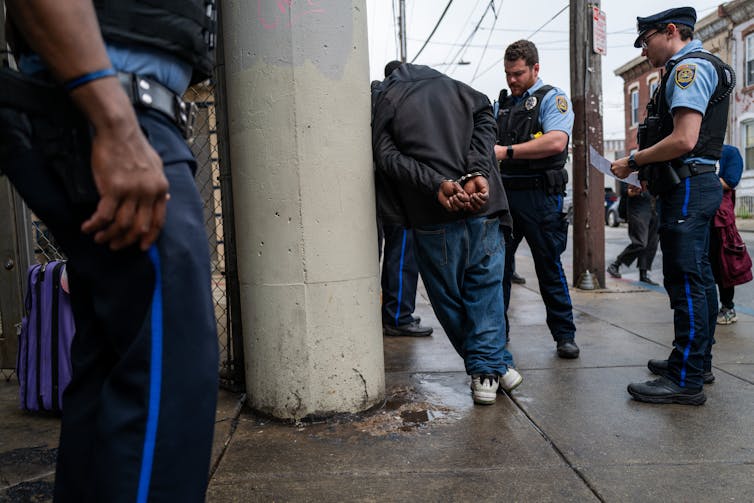
A man in handcuffs facing away from the camera is being arrested by two police officers.
Study participants worried that the Colorado fentanyl criminalization bill will deter people from reporting an overdose for fear of being arrested.
Spencer Platt/GettyImages

Participants largely thought that counties were using incarceration as a default treatment setting and that it wasn’t an ideal solution.

“[I] don’t want to see [people] incarcerated, but I don’t want ‘em to die either,” said an urban peer support specialist.

The people we interviewed pointed to a lack of community-based care options that could come before people are incarcerated. Those options include substance use treatment centers, mental health services and community health centers.

Substance use treatment

Colorado’s fentanyl bill did more than just increase penalties. It also provided additional funding for a state naloxone program and required that all jails provide medications for opioid use disorder.

A white bottle of naloxone in a package sits in front of a blue bin.
Along with increasing penalties, Colorado’s bill increased access to naloxone, an opioid-reversal drug.
Hyoung Chang/GettyImages

These medications include methadone, buprenorphine and extended-release naltrexone. All are part of an established public health strategy shown to reduce overdose deaths and opioid use. They’re also shown to increase engagement with non-jail-based treatment and reduce reincarceration.

However, jail capacity and the lack of treatment options based in one’s community play a large role in which medications are offered and to whom. For example, only 11 out of Colorado’s 46 counties with a county jail have an opioid treatment program in the community that can dispense methadone. Therefore, some facilities do not offer all medications, or only offer medications to individuals with an active prescription or to certain populations such as pregnant people.

Investing in community solutions

Based on our study’s findings, my study co-authors and I believe increased criminal penalties should not be the solution for linking individuals to treatment. Instead, there should be more investment in long-term community solutions.

One such solution is Denver’s Substance Use Navigation Program. The program sends behavioral health specialists to emergency calls to prevent legal involvement when someone is experiencing distress related to mental health, poverty, homelessness or substance use. In many cases, those individuals are then routed to services rather than jails.

Our findings also lead us to believe there is a need for more participatory policymaking processes when it comes to fentanyl legislation, and that policymakers should more closely work with the people who will be most impacted by new legislation. Most of our participants agree.

“[I] don’t think that [the] state realized how difficult it is,” said a rural provider about giving medication-assisted treatment in jail, an increasing need as more people are arrested for fentanyl possession. “They probably should come here and visit us.”

The Conversation

Katherine LeMasters received funding from the Colorado Department of Human Services, Behavioral Health Administration. Katherine LeMasters is part of the Right Response Coalition.

ref. Colorado’s fentanyl criminalization bill won’t solve the opioid epidemic, say the people most affected – https://theconversation.com/colorados-fentanyl-criminalization-bill-wont-solve-the-opioid-epidemic-say-the-people-most-affected-256661

We asked over 8,700 people in 6 countries to think about future generations in decision-making, and this is what we found

Source: The Conversation – USA (3) – By Stylianos Syropoulos, Assistant Professor of Psychology, Arizona State University

Shifting the public’s perspective toward greater concern for future generations could result in more support for climate change policies, among others. Artur Debat/Moment via Getty Images

People often prioritize the well-being of family, friends and neighbors, as they feel a closeness emotionally and share the same temporal context. But they overlook how people born decades or centuries from now may suffer as a result of today’s failures to address major global risks such as climate change, future pandemics and unregulated artificial intelligence.

Our new research, published in the British Journal of Social Psychology, shows that brief, low-cost psychological interventions can help individuals adopt a more expansive moral perspective to include future generations.

We conducted three online studies with over 8,700 participants to examine whether prompting people to consider the long-term consequences of their actions could shift moral priorities beyond the present.

In one of two interventions, participants imagined themselves serving on a government committee responsible for protecting future generations. Their task was to ensure that new legislation accounted not only for immediate needs but also for long-term impacts; they were asked to write a speech communicating these goals to the American public. This exercise highlighted institutional responsibility and the role of collective action across time.

In the second intervention, participants engaged with a more personal thought experiment adapted from philosopher William MacAskill’s book “What We Owe the Future,” which explores our moral responsibility toward humanity’s long-term future.

The impact of actions over time.

Here, they read a scenario about a hiker who comes across broken glass on a remote trail – glass that may one day injure an unknown child. Should the hiker clean it up, even though no one is watching and the child may not appear for decades? After reflecting on this story, participants were asked to write about what they themselves could do to help make the future better for others.

Moral concern for both intervention and control participants was assessed using the Moral Expansiveness Scale. We asked participants to rate how much moral concern they felt for a wide range of issues. These included concern for future generations, alongside family and friends, strangers, marginalized groups such as LGBTQ+ people, animals and the natural environment.

Why it matters

Although these exercises differed, one emphasizing collective responsibility and the other individual, both led to the same outcome: Participants randomly assigned to an intervention condition expressed significantly greater moral concern for future generations than those assigned to a control condition who completed neither exercise.

This effect held across cultural contexts and across six diverse countries – the U.S., Argentina, South Africa, the Philippines, the U.K. and Australia – and persisted even when participants were required to make trade-offs in a zero-sum version of the Moral Expansiveness Scale. In this version of the task, they distributed a fixed number of “moral concern points” across competing groups, compelling them to weigh the moral importance of future generations against that of present-day entities like family members, strangers, nature and others.

What’s especially intriguing, however, is that the elevated concern for future generations among intervention participants did not come at the expense of concern for other socially distant entities or those viewed as marginalized.

What changed was how participants prioritized their moral concern: They placed slightly less emphasis on family and friends – groups that people typically prioritize most, even when they may be least in need of moral protection.

In contrast, concern increased for distant others, both living today and in the future.

What’s next

This perspective, encouraged by the interventions, could perhaps help lay the groundwork for more durable public support for addressing long-term challenges.

In future work, we hope to explore whether these interventions can inspire real-world action. This could include increased support for climate policies, voting for leaders who prioritize long-term investments like sustainable infrastructure and pandemic preparedness, or donating to causes that benefit future generations.

But how might these interventions be integrated into everyday life? One promising approach is to embed them into settings where such reflections already occur, such as schools, civic education programs or public awareness campaigns.

To assess their real-world potential, we plan to examine the durability of these effects. We want to see whether deploying them in such contexts can meaningfully inspire long-term shifts in attitudes and – importantly – behavior.

For example, brief storytelling exercises or classroom role-plays, like imagining oneself as a future-focused policymaker, could be incorporated into high school or college curricula to shape students’ values, goals and even career trajectories. Similarly, community workshops, online media or social campaigns could adapt these scenarios to foster long-term thinking in broader populations.

When people reflect on how their actions today shape the future, they may be more likely to back solutions to present-day issues like poverty and inequality, knowing these problems can have ripple effects for generations to come. They may also become more motivated to confront emerging risks, such as unregulated artificial intelligence or future pandemics, before those risks escalate.

The Research Brief is a short take on interesting academic work.

The Conversation

The research relevant to this article was funded by the John Templeton Foundation and APA Division 48.

The research relevant to this article was funded by the John Templeton Foundation and APA Division 48.

ref. We asked over 8,700 people in 6 countries to think about future generations in decision-making, and this is what we found – https://theconversation.com/we-asked-over-8-700-people-in-6-countries-to-think-about-future-generations-in-decision-making-and-this-is-what-we-found-256767

Fertilité masculine : comment le parasite de la toxoplasmose décapite les spermatozoïdes

Source: The Conversation – France in French (3) – By Bill Sullivan, Professor of Microbiology and Immunology, Indiana University

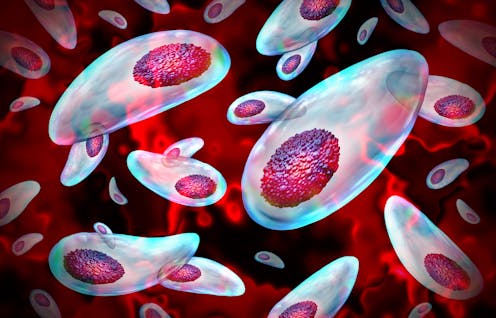
_Toxoplasma gondii_ peut s’infiltrer dans l’appareil reproducteur masculin (vue d’artiste). wildpixel/iStock via Getty Images Plus

Une fois infecté par Toxoplasma gondii, le microbe responsable de la toxoplasmose, plus question de s’en débarasser. Il persiste à vie dans notre organisme, ce qui peut s’avérer problématique. De nouveaux travaux ont notamment mis en évidence que parasite est capable de s’attaquer aux spermatozoïdes, ce qui pourrait avoir des implications en matière de fertilité masculine.


Les taux de fertilité masculine ont considérablement chuté au cours du dernier demi-siècle. Des travaux publiés en 1992 avaient déjà mis en évidence une baisse constante du nombre et de la qualité des spermatozoïdes depuis les années 1940. Plus récemment, une étude a révélé que les taux d’infertilité masculine ont augmenté de près de 80 % entre 1990 et 2019. Bien que les raisons de cette tendance demeurent mystérieuses, certains suspects sont fréquemment évoqués : l’obésité, une alimentation déséquilibrée ou les polluants environnementaux, notamment.

D’autres facteurs moins connus peuvent également avoir des effets délétères sur la fertilité masculine. C’est par exemple le cas de certaines maladies infectieuses, telles que la gonorrhée ou la chlamydia. Un faisceau d’indices de plus en plus conséquent suggère également que Toxoplasma gondii, le parasite unicellulaire responsable de la toxoplasmose pourrait lui aussi contribuer à ce phénomène. Une étude publiée en avril 2025 a montré pour la première fois que lorsqu’ils sont en contact direct avec T. Gondii, « les spermatozoïdes humains perdent leur tête ».

Je suis microbiologiste et mon laboratoire étudie Toxoplasma. Cette nouvelle étude va dans le même sens que d’autres travaux, et plaide en faveur de la prévention de cette infection parasitaire très répandue.

Les nombreuses façons de contracter la toxoplasmose

Les félins sont les hôtes finaux de Toxoplasma gondii : c’est chez eux qu’il se reproduit, après être passé par d’autres organismes (hôtes intermédiaires) au cours des étapes précédentes de son cycle parasitaire.

Les chats infectés expulsent des œufs (oocystes) de Toxoplasma dans la litière, le jardin ou tout autre endroit de l’environnement où ils peuvent être ingérés par l’être humain ou par d’autres animaux. L’eau, les crustacés et les fruits et légumes non lavés peuvent également héberger des œufs infectieux.

La contamination peut aussi résulter de la consommation de viande d’animaux à sang chaud insuffisamment cuite, Toxoplasma pouvant former des kystes dans différents tissus (cerveau, cœur, muscles).

Après l’infection, le parasite persiste durant toute l’existence de l’animal infecté sous forme de kystes dormants. Si la plupart des hôtes parviennent à contrôler l’infection initiale sans ou avec peu de symptômes, il arrive que ces kystes tissulaires se réactivent et provoquent de nouveaux épisodes sévères de la maladie, qui dans certains cas endommagent des organes vitaux.

Ce dernier point est préoccupant, car on considère qu’en raison des nombreux modes de transmission de ce parasite, 30 % à 50 % de la population mondiale est infectée de manière permanente par Toxoplasma.

Toxoplasma peut cibler les organes reproducteurs masculins

Lors de l’infection, Toxoplasma se propage non seulement aux muscles squelettiques, mais aussi à pratiquement tous les organes. C’est au plus fort de la pandémie de sida, dans les années 1980, qu’ont été collectés les premiers indices indiquant que Toxoplasma était capable de cibler les organes reproducteurs masculins. Le parasite avait en effet été retrouvé dans les testicules de certains patients dont le système immunitaire avait été compromis par le VIH, le virus responsable du sida.

Bien que les patients immunodéprimés soient les plus à risque de présenter une toxoplasmose testiculaire, cette dernière peut aussi survenir chez des individus sains. Des études d’imagerie effectuées sur des souris infectées ont confirmé que les parasites Toxoplasma atteignent rapidement les testicules, en plus du cerveau et des yeux, et ce, quelques jours seulement après l’infection.

Image en microscopie de kystes de Toxoplasma
Kystes de Toxoplasma flottant dans les excréments de chat.
DPDx Image Library/CDC

En 2017, mes collègues et moi-même avons découvert que Toxoplasma peut également former des kystes dans la prostate des souris. Des chercheurs ont aussi observé ces parasites dans l’éjaculat de nombreux animaux, y compris dans le sperme humain, évoquant la possibilité d’une transmission sexuelle.

Le fait que Toxoplasma s’avère capable de résider dans les organes reproducteurs masculins a fait émerger de nouveaux questionnements quant aux conséquences sur la fertilité des hommes infectés. Diverses équipes de recherche ont essayé de faire la lumière sur cette interrogation.

En 2002, une étude chinoise publiée a établi que la probabilité de détecter une infection par Toxoplasma au sein d’un couple infertile était beaucoup plus élevée qu’au sein d’un couple fertile (34,83 % contre 12,11 %). En 2005, d’autres travaux menés en Chine ont révélé que les hommes stériles sont plus susceptibles d’être testés positifs pour Toxoplasma que les hommes fertiles. Plus récemment, une étude réalisée à Prague en 2021, portant sur 163 hommes infectés par Toxoplasma, a révélé que plus de 86 % présentaient des anomalies spermatiques.

Le fait d’avoir contracté la toxoplasmose ne signifie pas que la qualité du sperme soit toujours affectée. Une étude roumaine pilote menée en 2015 sur des volontaires masculins sans immunodépression a révélé que 25 % d’entre eux avaient eu la toxoplasmose. Cependant, aucune différence de qualité entre leur sperme et celui des autres participants n’avait pu être mise en évidence. Les auteurs concluaient toutefois que la petite taille de l’échantillon ne permettait pas de tirer de conclusion quant à l’absence systématique de conséquence de l’infection par Toxoplasma sur la qualité du sperme.

Toxoplasma peut endommager directement les spermatozoïdes humains

La toxoplasmose chez les animaux est le reflet de l’infection chez l’humain, ce qui permet aux chercheurs d’obtenir des réponses à des questions difficiles à étudier directement dans notre espèce.

Chez les souris, les rats et les béliers infectés par Toxoplasma, la fonction testiculaire et la production de spermatozoïdes sont fortement réduites. Les souris infectées présentent un nombre de spermatozoïdes nettement inférieur à la normale, ainsi qu’une proportion plus élevée de spermatozoïdes de forme anormale.

Les travaux publiés en avril 2025 ont été menés par des équipes d’Allemagne, d’Uruguay et du Chili. Les scientifiques ont constaté que, chez la souris, Toxoplasma peut atteindre les testicules et l’épididyme (le canal où les spermatozoïdes mûrissent et sont stockés) deux jours après l’infection. Cette observation les a poussés à examiner les conséquences d’un contact direct entre le parasite et des spermatozoïdes humains, in vitro.

Résultat : après seulement cinq minutes d’exposition au parasite, 22,4 % des spermatozoïdes ont été « décapités ». En outre, le nombre de spermatozoïdes abîmés augmentait à mesure que leurs interactions avec les parasites se prolongeaient. Par ailleurs, les spermatozoïdes ayant conservé leur tête étaient souvent tordus et déformés. Des trous ont été constatés dans les « têtes » de certains d’entre eux, suggérant que les parasites tentent de les envahir comme ils le font pour tout autre type de cellule dans les organes qu’ils colonisent.

Le contact direct n’est pas la seule façon par laquelle Toxoplasma peut endommager les spermatozoïdes. On sait en effet que l’infection favorise la mise en place d’une inflammation chronique. Or, les états inflammatoires des voies reproductrices masculines nuisent à la production et au bon fonctionnement des spermatozoïdes.

Selon les auteurs, les effets délétères que pourrait exercer Toxoplasma sur les spermatozoïdes participeraient aux problèmes globaux de fertilité masculine.

Série d’images microscopiques de spermatozoïdes légèrement déformés, présentant des trous dans leur tête
Spermatozoïdes exposés à Toxoplasma. Les flèches indiquent les trous et autres dommages subis par les spermatozoïdes ; les astérisques montrent les zones où le parasite s’est introduit. En bas, les spermatozoïdes des deux témoins non exposés sont normaux.
Rojas-Barón et al/The FEBS Journal, CC BY-SA

Comment prévenir la toxoplasmose

Chez les modèles animaux, les preuves démontrant que Toxoplasma peut infiltrer les organes reproducteurs mâles sont convaincantes. Reste à savoir si cette situation peut engendrer des problèmes de santé chez l’être humain. Si l’existence d’une forme de toxoplasmose testiculaire confirme que les parasites peuvent envahir les testicules des hommes, la maladie symptomatique est très rare. Les études menées jusqu’à présent, qui révèlent des anomalies spermatiques chez les hommes infectés, sont trop limitées pour que l’on puisse, à ce stade, tirer des conclusions définitives.

Par ailleurs, certains travaux indiquent que, dans les pays à revenu élevé, les taux de toxoplasmose n’ont pas augmenté au cours des dernières décennies, alors que l’infertilité masculine s’accroissait. Ce constat suggère que les potentiels effets délétères liés à l’infection par T. gondii ne constituent de toute façon qu’une partie du problème.

Quoi qu’il en soit, mieux vaut éviter d’être infecté par T. gondii. Si la première contamination survient au cours de la grossesse, elle peut entraîner une fausse couche ou provoquer des malformations congénitales. Par ailleurs, l’infection peut être mortelle pour les personnes immunodéprimées.

Pour se protéger, il est important de suivre quelques bonnes pratiques, en particulier lorsque l’on s’occupe de son chat  : nettoyer régulièrement la litière (avec une eau à plus de 70 °C, ndlr) et se laver ensuite soigneusement les mains. L’hygiène des mains est également importante avant la préparation des repas, ainsi qu’après avoir manipulé de la viande crue ou des légumes souillés par de la terre (pensez également à bien nettoyer les surfaces et les ustensiles de cuisine, ndlr). Fruits, légumes ou plantes aromatiques doivent être lavés à l’eau claire, et la viande doit être cuite à une température adéquate avant consommation (cuisson à cœur, à plus de 68 °C, ndlr). Enfin, mieux vaut éviter de manger des coquillages non cuits, et de boire de l’eau non traitée ou du lait cru.

The Conversation

Bill Sullivan a reçu des financements des National Institutes of Health.

ref. Fertilité masculine : comment le parasite de la toxoplasmose décapite les spermatozoïdes – https://theconversation.com/fertilite-masculine-comment-le-parasite-de-la-toxoplasmose-decapite-les-spermatozo-des-258106

Aux États-Unis, 19 millions d’enfants vivraient avec des parents toxicomanes

Source: The Conversation – France in French (3) – By Ty Schepis, Professor of Psychology, Texas State University

Aux États-Unis, l’alcool est la substance psychoactive le plus souvent à l’origine de troubles liés à l’usage de substances. Igorr1/iStock/Getty Images Plus

Les enfants dont les parents présentent un trouble lié à l’usage de substances psychoactives sont plus susceptibles que les autres d’avoir des problèmes de santé mentale. À terme, ils présentent aussi un risque plus élevé de développer eux-mêmes des addictions.


Aux États-Unis, près de 19 millions d’enfants (soit environ un enfant sur quatre) a au moins un parent souffrant d’un trouble lié à l’usage de substances psychoactives, qu’il s’agisse d’alcool, de cannabis, d’opioïdes délivrés sur ordonnance ou de drogues illicites.

Cette nouvelle estimation, effectuée par notre équipe et publiée dans la revue JAMA Pediatrics, s’appuie sur les données de la National Survey on Drug Use and Health menée en 2023 (l’année la plus récente pour laquelle les données sont disponibles). Près de 57 000 personnes âgées de 12 ans et plus avaient répondu au questionnaire de l’enquête.

En tant que chercheur, j’étudie l’usage de substances chez les adolescents et les jeunes adultes. Je sais que les enfants qui se retrouvent dans une telle situation courent un risque considérable de développer eux aussi un trouble lié à l’usage de substances, ainsi que d’autres problèmes de santé mentale tels que des troubles du comportement, des symptômes d’anxiété ou une dépression.

Qu’appelle-t-on trouble lié à l’usage de substances ?

Le « trouble lié à l’usage de substances » est une pathologie psychiatrique caractérisée par une consommation fréquente et excessive de substances. Il se manifeste par de multiples symptômes, notamment des comportements à risque (conduite sous l’emprise de substances psychoactives, par exemple) ou conflictuels (avec leur famille ou leurs amis, à propos de leur consommation).

Ce trouble altère également la capacité des parents à être des aidants attentifs et bienveillants. Leurs enfants sont dès lors plus susceptibles d’être exposés à la violence, de vivre leur scolarité dans de moins bonnes conditions et de commencer à consommer eux-mêmes des substances à un âge plus précoce que les autres. Ils sont aussi plus fréquemment pris en charge par le système de protection de l’enfance. Ils présentent par ailleurs un risque accru de développer des problèmes de santé mentale, non seulement durant leurs jeunes années, mais aussi à l’âge adulte. Enfin, la probabilité qu’ils soient atteints d’un trouble lié à la consommation de substances à l’âge adulte est nettement plus élevée que chez les autres personnes.

Parmi ces 19 millions d’enfants, notre étude révèle qu’environ 3,5 millions vivent avec un parent présentant non pas un, mais plusieurs troubles liés à la consommation de substances.

L’alcool demeure de loin la substance la plus répandue parmi les substances consommées, puisque les troubles liés à son usage concernent les parents de 12,5 millions d’enfants. Par ailleurs, plus de 6 millions d’enfants ont un parent souffrant à la fois d’un trouble lié à la consommation de substances et de symptômes marqués de dépression ou d’anxiété, ou des deux.

Notre estimation de 19 millions est nettement supérieure à celle dérivée d’une étude antérieure qui s’appuyait sur des données plus anciennes. Cette dernière, qui portait sur la période 2009-2014, faisait état de 8,7 millions d’enfants états-uniens – soit environ un enfant sur huit – vivant avec un parent ou des parents souffrant d’un trouble lié à la consommation de substances. L’écart avec notre propre estimation est d’environ 10 millions d’enfants.

Cette évolution s’explique principalement par le fait que les critères définissant le trouble lié à l’usage de substances ont été élargis et assouplis entre 2014 et 2023, ce qui a contribué à en modifier le diagnostic. Ce changement a entraîné une augmentation de plus de 80 % du nombre estimé d’enfants affectés par le trouble lié à l’usage de substances de leurs parents.

Toutefois, au-delà de cette augmentation « mécanique », on constate, depuis 2020, un accroissement du nombre de parents touchés par un trouble de l’usage de substances, ce qui signifie que 2 millions d’enfants supplémentaires se sont retrouvés concernés par cette problématique au cours des dernières années.

Perspectives

Il est impératif d’améliorer le dépistage des parents souffrant d’un trouble lié à l’usage de substances. D’après mon expérience, si de nombreux pédiatres dépistent la consommation de substances chez les enfants, plus rares sont ceux qui s’intéressent également aux parents qui les accompagnent en consultation. Il apparaît essentiel de rendre les dépistages systématiques, tant pour les enfants que pour leurs aidants.

Malheureusement, aux États-Unis, l’US Preventive Services Task Force, un comité d’experts chargé de formuler des recommandations sur les bonnes pratiques de dépistage et de prévention, ne recommande pas encore un tel dépistage. Celui-ci permettrait pourtant d’orienter les personnes concernées vers les traitements les plus adaptés et de prévenir les problèmes les plus graves.

Des mesures supplémentaires, accompagnées de financements adéquats, sont donc requises au niveau fédéral, étatique et local. Cela peut sembler utopique, à l’heure où chaque ligne budgétaire est scrutée. Mais y déroger se traduira par une inflation considérable de la facture qui nous sera présentée dans les années à venir. Les millions d’adultes qui auront été exposés à ce trouble dès leur plus jeune âge seront contraints, des décennies plus tard, de composer avec leurs propres problèmes de consommation de substances et de santé mentale.

The Conversation

Ty Schepis reçoit des fonds des National Institutes of Health (NIH)/National Institute on Drug Abuse (NIDA), de la Food and Drug Administration (FDA) et de la Substance Abuse and Mental Health Services Administration (SAMHSA). Les opinions exprimées sont celles du Dr Schepis et ne représentent pas nécessairement les opinions officielles du NIH/NIDA, de la FDA ou de la SAMHSA. Ces bailleurs de fonds n’ont joué aucun rôle dans les articles publiés, et il n’y a eu aucune orientation éditoriale ni censure de la part des bailleurs de fonds.

ref. Aux États-Unis, 19 millions d’enfants vivraient avec des parents toxicomanes – https://theconversation.com/aux-etats-unis-19-millions-denfants-vivraient-avec-des-parents-toxicomanes-258521

Extrême droite et antiféminisme : pourquoi cette alliance séduit tant de jeunes hommes

Source: The Conversation – France in French (3) – By Maite Aurrekoetxea Casaus, Profesora Doctora en Sociología en la Facultad de Ciencias Sociales y Humanas, Universidad de Deusto

L’antiféminisme est l’un des principaux axes de mobilisation politique de l’extrême droite et il séduit de nombreux jeunes hommes. Il s’exprime notamment sur les réseaux sociaux, à travers des discours masculinistes qui promettent de rétablir un ordre supposé naturel entre hommes et femmes.


La montée de l’extrême droite en Europe n’est plus une anomalie politique ou une simple tendance électorale. C’est le reflet d’une crise structurelle qui traverse nos sociétés. Dans leur expansion, ces mouvements ont trouvé un allié efficace et stratégique : l’antiféminisme.

Cette réaction n’est pas seulement symbolique. C’est devenu l’un des principaux axes de mobilisation politique et émotionnelle, en particulier chez les jeunes hommes. L’antiféminisme fonctionne comme un canal d’expression du mal-être social et comme une porte d’entrée vers des discours encore plus radicaux.

Dans une enquête, j’ai analysé comment le discours néolibéral avait pénétré l’imaginaire féministe de nombreuses jeunes femmes. Une idée d’émancipation individuelle a été construite qui a dépolitisé les luttes collectives. La liberté, l’estime de soi ou la responsabilité personnelle sont devenues des mantras qui ont dilué la dimension transformatrice du féminisme.

Un privilège, selon l’extrême droite

Aujourd’hui, cette logique a été absorbée par la droite radicale. Ils présentent le féminisme comme une idéologie inutile, voire nuisible, en particulier pour ceux dont la frustration est liée à un déclassement social. À partir de là, l’extrême droite construit son récit : le féminisme serait un privilège plutôt qu’un outil de justice sociale.

Ce discours imprègne des secteurs de la jeunesse qui vivent dans la précarité, l’incertitude et l’insécurité. En Europe, les partis radicaux ont gagné du terrain chez les électeurs de moins de 30 ans, un groupe historiquement lié au progressisme. En Espagne, Vox est devenu l’un des partis préférés des moins de 25 ans : une personne sur quatre voterait pour cette formation entre 18 et 25 ans.

Cette tendance est identique dans d’autres pays. En France, Marine Le Pen a obtenu 39 % des voix chez les 18-24 ans en 2022 et 49 % chez les 25-34 ans. En Italie, Giorgia Meloni est en tête du vote des jeunes avec 29 %. En Allemagne, l’Afd a été le premier choix des moins de 30 ans dans des régions comme la Thuringe.

L’extrême droite n’est plus l’héritage des personnes âgées désabusées. Il séduit également une jeunesse qui perçoit son avenir comme bouché et qui cherche des explications immédiates et des solutions simples.

Le genre apparaît comme une variable clé. En Espagne, le Baromètre de la jeunesse et du genre 2023 a montré que 51 % des garçons âgés de 15 à 29 ans pensent que « le féminisme est allé trop loin ». En Catalogne, le pourcentage atteint 54 % chez les hommes âgés de 16 à 24 ans.

Ce changement idéologique répond à de multiples facteurs. L’European Policy Centre identifie les causes structurelles : la précarité de l’emploi, la désindustrialisation, la rupture des liens communautaires et l’idéal néolibéral de la réussite individuelle. Ce contexte a érodé la figure de l’homme comme « soutien de famille », laissant de nombreux jeunes en manque de référence claire concernant leur identité et leur appartenance.

Dans ce vide symbolique, les discours masculinistes offrent une réponse. Ils promettent de rétablir un ordre supposé naturel, où les hommes retrouvent autorité et visibilité. Ils ne font pas appel à la justice, mais à la nostalgie et au ressentiment.

Les médias sociaux ont amplifié ce récit. Des référents tels que l’extrémiste Andrew Tate ou des espaces comme la manosphère diffusent des messages misogynes dissimulés derrière des conseils d’entraide, de masculinité « forte » et de réussite économique. À travers des mèmes, des vidéos virales et des slogans agressifs, l’extrême droite ne se contente pas de communiquer des idées, elle construit aussi des identités.

Cet antiféminisme n’est pas un phénomène marginal. Il s’agit d’une stratégie articulée qui permet de canaliser un mal être sans remettre en question les structures économiques ou politiques. Blâmer le féminisme devient un alibi émotionnel qui transfère la responsabilité à un ennemi facile.

Loin de nier la frustration des jeunes, l’extrême droite l’instrumentalise. Elle offre des explications claires, une appartenance symbolique et une promesse de restauration. Son message séduit parce qu’il simplifie : face à un monde incertain, elle propose un retour à une hiérarchie connue, où les hommes dominent et où les femmes s’adaptent.

Un langage émotionnel puissant

Ce processus a de profondes implications socioculturelles. Il montre une jeunesse fracturée. Une partie de cette jeunesse est alignée sur des valeurs égalitaires ; une autre partie se retrouve dans des propositions réactionnaires. Pour elle, l’extrême droite a mis au point un langage émotionnel puissant. Son message ne se limite pas aux meetings politiques : il circule sur les réseaux, sur les chaînes YouTube, avec une esthétique virale.

Il ne s’agit pas de blâmer les jeunes hommes, mais de comprendre quels sont les besoins, les manques et les frustrations qui sous-tendent leur adhésion à ces idéologies. Beaucoup d’entre eux ne trouvent pas d’espaces où ils peuvent se sentir écoutés.

La solution réside dans la reconstruction de discours qui revalorisent l’égalité en tant que bien collectif, qui désactivent l’identification haineuse et qui proposent des modèles de masculinité ouverts, diversifiés et démocratiques.

Les jeunes ne sont pas devenus spontanément plus machistes ou xénophobes. En revanche, l’extrême droite a été capable d’interpréter et de canaliser leur désorientation émotionnelle.

Il est essentiel de comprendre cela pour relever le défi posé. Ce qui est en jeu, ce n’est pas seulement le vote des jeunes, mais la possibilité d’un futur en commun. Et avec lui, la possibilité même d’une démocratie plurielle et inclusive.

The Conversation

Maite Aurrekoetxea Casaus ne travaille pas, ne conseille pas, ne possède pas de parts, ne reçoit pas de fonds d’une organisation qui pourrait tirer profit de cet article, et n’a déclaré aucune autre affiliation que son organisme de recherche.

ref. Extrême droite et antiféminisme : pourquoi cette alliance séduit tant de jeunes hommes – https://theconversation.com/extreme-droite-et-antifeminisme-pourquoi-cette-alliance-seduit-tant-de-jeunes-hommes-258164

Faut-il supprimer les zones à faibles émissions au nom de la justice sociale ?

Source: The Conversation – France in French (3) – By Alexis Poulhès, Enseignant-chercheur, Laboratoire Ville Mobilité Transport, École Nationale des Ponts et Chaussées (ENPC)

Les zones à faibles émission (ZFE), déjà en place à Paris, Grenoble, Lyon ou Strasbourg, excluent progressivement les automobiles les plus polluantes des centres urbains. Pourtant, mardi 17 juin, une majorité de députés (essentiellement MoDem, LR et RN) a adopté un projet de loi mettant fin à l’extension des ZFE. Les députés LFI avaient déjà voté pour leur suppression en mai au nom de la justice sociale. Mais les ZFE sont-elles vraiment injustes socialement ? Plusieurs études en région parisienne évaluent leur impact sur les différentes catégories de populations – avec des résultats inattendus.


Malgré une amélioration constante de la qualité de l’air en France depuis plusieurs décennies, les seuils de dangerosité pour la santé de concentration des polluants réglementaires ne sont toujours pas respectés. Politiques territoriales très diffusées en Europe, les zones à faibles émissions (ZFE) devaient être la clé de voute d’une politique française de lutte contre la pollution atmosphérique dans les grandes villes. En janvier 2025, la loi Climat et Résilience impose de déployer les ZFE dans de nouvelles agglomérations et de renforcer celles de Paris et Lyon, villes toujours trop polluées. Un certain nombre de partis politiques se sont alors érigés en défenseur des travailleurs et artisans qui seraient contraints dans leur déplacement par les ZFE. Ainsi, le 28 mai 2025, l’Assemblée nationale a voté pour la suppression des ZFE en France avec comme principale critique qu’elles n’étaient pas juste socialement. Mais est-ce vraiment justifié ?

Des gains sur la qualité de l’air et sur la santé des plus précaires

Les études scientifiques montrent unanimement que, quelles que soient les restrictions et le périmètre, les bénéfices sur la qualité de l’air sont là. Les concentrations de particules fines et de dioxyde d’azote, les 2 polluants atmosphériques visés par les ZFE, diminuent de quelques pour cent indépendamment du renouvellement naturel du parc automobile. Les retards dans les restrictions et l’absence de contrôle limitent leur efficacité. Le nombre de maladies cardiovasculaires et de cas d’asthmes seraient aussi moins nombreux grâce aux ZFE. Les populations défavorisées sont plus vulnérables aux problèmes environnementaux comme la pollution de l’air. Elles sont en effet fragilisées par leurs contraintes sur leur mode de vie comme leur emploi plus physique ou leur alimentation moins diversifiée et ainsi à la multiplication des expositions environnementales néfastes pour leur santé. En France, une seule étude montre sur la région parisienne que les bénéfices de santé publique des ZFE seraient également répartis socialement, résultat qu’il faudra consolider avec d’autres études.

Peut-on parler pour autant d’une mesure inégalitaire ?

Les politiques ont tendance à attendre que le renouvellement naturel du parc automobile limite la part des voitures polluantes avant de mettre en place les ZFE. Des premières études montrent que ce sont alors les plus défavorisés qui sont impactés dans leurs déplacements. Les autres ménages ont pu acheter une voiture plus récente ou adapter leur déplacement. Finalement ces retards dans le calendrier n’ont que peu d’impacts sur la nécessité d’accompagner les ménages défavorisés contraints mais limitent les bénéfices sur les concentrations de polluants. Le sentiment d’injustice est renforcé par les très nombreux SUV récents et chers qui sont toujours autorisés à circuler. S’ils peuvent émettre moins de polluants que des véhicules anciens, ils n’en sont pas moins des nuisances environnementales et urbaines.

Certains partis politiques se veulent clairement les défenseurs des habitants d’une « France périphérique » qui n’auraient plus accès aux centres des métropoles et seraient alors rejetés.

Pourtant, une exploitation de l’Enquête Global Transport de la région datant de 2020 sur les pratiques de mobilité des résidents montre que la ZFE ne concernait que 2 % des déplacements quotidiens en Île-de-France. De plus, dans une étude récente, nous avons montré que les déplacements des 20 % les plus pauvres ne contribuent qu’à hauteur de 9 % de la pollution automobile. Si l’on considère les conducteurs du périurbain qui se déplacent dans le centre, les proportions sont quasiment identiques : 20 % des plus pauvres ne contribuent qu’à hauteur de 7 % de la pollution automobile. On peut expliquer ces résultats par le fait que les populations défavorisées sont moins nombreuses à utiliser leurs voitures quotidiennement dans le centre ou la périphérie.

Ce résultat montre que les ZFE ne concernent qu’une très faible part des pollutions émises par les véhicules particuliers dans les centres. La plus grande part n’est pas produite par les populations précaires. Ce résultat confirme que l’étalement des emplois peu qualifiés en périphérie et la réalité des prix immobiliers rendent les centres inaccessibles à certaines populations défavorisées. La faible part des déplacements des plus pauvres vers le centre soulèvent donc plutôt des enjeux d’aménagement du territoire et de conditions de logement dans les centres.

Qu’est-il possible de faire maintenant ?

La non-régulation de l’étalement urbain et les politiques de logement successives favorisant la maison individuelle ont participé au développement des territoires périurbains dépendants de la voiture.

N’oublions pas que la périurbanisation et l’obligation dans de très nombreux territoires d’utiliser la voiture est le fruit de politiques. Le détricotage actuel de la politique de zéro artificialisation nette (ZAN) par les mêmes partis politiques critiquant la ZFE participe de cette fuite en avant vers toujours plus de dépendance à la voiture et donc de vulnérabilités).

En ciblant les véhicules les plus anciens, les ZFE sont effectivement inégalitaires, pour autant, elles servent de cadre et d’argument pour construire des politiques volontaristes et faire face à cette vulnérabilité. Pour créer des alternatives efficaces à la voiture dans les grandes métropoles, les politiques de développement de nouvelles offres comme les réseaux cyclables et de tramway doivent être accompagnés de mesures restrictives de la circulation routière comme les zones à trafics limités (ZTL), la végétalisation des chaussées ou l’agrandissement des trottoirs. Ce type de mesures qui restreint tous les véhicules est non inégalitaire socialement et protège la santé et la sécurité des urbains.

Pour rappel, en France en 2023, 660 piétons et cyclistes ont été tués, la plupart en ville, et par des véhicules motorisés. Les communes ou les départements qui gèrent le réseau de voirie manquent de coordinations politiques pour proposer des politiques cohérentes et ambitieuses. L’intérêt des ZFE est aussi d’être à l’échelle des métropoles, un échelon territorial souvent plus pertinent pour prendre des décisions sur la mobilité. Elles pourraient ainsi être la première étape vers une redéfinition des compétences.

Les ZFE mettent en exergue ces inégalités et ces contraintes territoriales fortes qui dessinent des trajectoires de mobilité opposées entre centres, qui restreignent la voiture, et périphéries qui la défendent. Enterrer encore une fois les questions d’inégalités plutôt que d’améliorer le système de mobilité autour des ZFE ne fera que renforcer le ressentiment des Français. Ce débat autour de la restriction de la circulation des populations précaires n’est pas le signe d’un abandon total de la remise en cause des autres inégalités ?

La voiture serait le dernier lien avant le déclassement total. Reconstruire les autres liens et prendre à bras le corps les nombreuses autres inégalités réduiraient la tension autour de ce symbole qui, comme l’avion pour les plus riches, devra par anticipation ou par contrainte naturelle, être réduit aux usages les plus essentiels.

The Conversation

Alexis Poulhès ne travaille pas, ne conseille pas, ne possède pas de parts, ne reçoit pas de fonds d’une organisation qui pourrait tirer profit de cet article, et n’a déclaré aucune autre affiliation que son organisme de recherche.

ref. Faut-il supprimer les zones à faibles émissions au nom de la justice sociale ? – https://theconversation.com/faut-il-supprimer-les-zones-a-faibles-emissions-au-nom-de-la-justice-sociale-259516