Sur quelles recommandations un dentiste s’appuie-t-il pour prescrire, ou non, des antibiotiques ?

Source: The Conversation – in French – By Maruxa Zapata Cachafeiro, Profesora de Salud Pública, Universidade de Santiago de Compostela

En odontologie aussi, il est indispensable d’agir contre l’antibiorésistance en mettant à la disposition des chirurgiens-dentistes des guides de bonne pratique fiables pour accompagner leurs prescriptions d’antibiotiques. Ungvar/Shutterstock

Selon une étude récente, les recommandations relatives à la prescription d’antibiotiques en odontologie sont très variables et de qualités inégales d’un pays à l’autre… quand elles existent.


Nous savons tous qu’il faut faire bon usage des antibiotiques. Dans votre centre de santé, vous avez probablement vu une affiche ou une publicité qui alertent sur leur perte d’efficacité. Actuellement, la résistance des bactéries à ces médicaments est l’une des principales menaces qui pèse sur la santé mondiale.

Nous avons tous contribué, dans une plus ou moins grande mesure, à la situation dans laquelle nous nous trouvons. En tant que patients, nous sommes nombreux à avoir sauté une dose d’antibiotiques, à ne pas avoir terminé le traitement ou à avoir directement pris les comprimés qui nous restaient d’un traitement précédent. Une autre part importante de la responsabilité incombe au secteur de la santé, car les antibiotiques sont souvent prescrits de manière inutile ou inappropriée.

La solution apparaît pourtant évidente. Si les professionnels ne prescrivaient ces médicaments qu’en cas de nécessité et que les patients suivaient leurs conseils, cette partie du problème serait résolue. Mais ce n’est pas si simple. Du moins pour les dentistes.

Que penseriez-vous si votre dentiste vous prescrivait des antibiotiques alors que leur principe actif porte la mention « à déterminer » ? C’est pourtant bien cette prescription que ce professionnel de santé devrait suivre dans certains cas s’il utilisait comme unique source d’informations les guides de bonne pratique clinique auxquels il a accès.

Tous les pays ne disposent pas d’un guide de référence

Ces guides correspondent à un ensemble de recommandations élaborées par des experts et des organismes tels que les ministères de la santé, les syndicats professionnels de dentistes (et autres organisations professionnelles représentatives de la profession, ndlr) ou l’Organisation mondiale de la santé, afin d’aider à la prise de décision. Ces recommandations sont basées sur une revue systématique des preuves scientifiques disponibles.

Cependant, comme nous l’avons découvert dans notre récente étude, dans laquelle nous avons analysé les recommandations qui existent au niveau international en matière de prescription d’antibiotiques, celles-ci ne sont pas toutes de même qualité, ils ne sont pas tous aussi fiables. D’ailleurs, tous les pays ne disposent pas de guides de ce type.

Tout d’abord, nous avons constaté que tous les dentistes ne disposent pas d’un document de référence : seuls neuf pays ont publié des recommandations sur la prescription d’antibiotiques pour les pathologies bucco-dentaires. De plus, seules 10 des 17 guides analysés peuvent être classés comme « recommandés » en fonction de leur qualité. Deux guides sont même classés comme « non recommandés ».

Les dentistes de Belgique, d’Espagne, d’Écosse et du Royaume-Uni sont les plus chanceux, car ce sont eux qui ont accès aux guides de meilleure qualité.

En Espagne, par exemple, le document qui répondait aux critères pour être considéré comme un guide de pratique clinique est le Guide thérapeutique antimicrobien de la région d’Aljarafe. Il a été créé par le ministère régional de la santé d’Andalousie et mis à jour dans le cadre du Plan national de résistance aux antibiotiques du ministère de la santé.

D’autres organismes ont également publié des recommandations, notamment le ministère chilien de la santé, le Collège royal des chirurgiens d’Angleterre, l’Organisation mondiale de la santé, le Centre fédéral d’expertise des soins de santé belge (KCE), l’Association dentaire américaine et le Programme écossais d’efficacité clinique dentaire.

(Pour la France, l’étude se réfère aux recommandations de l’Agence du médicament concernant la « Prescription des antibiotiques en pratique bucco-dentaire », ndlr).

Quels antibiotiques les dentistes prescrivent-ils ?

Tout n’est pas négatif : en général, dans la plupart des cas, les guides disponibles s’accordent à dire que le dentiste doit prescrire en premier choix l’amoxicilline (un dérivé de la célèbre pénicilline de Fleming). Selon les études, c’est l’un des principes actifs les plus prescrits par les dentistes, qui font donc bien leur travail.

Les guides s’accordent également sur la durée de ce traitement, même si certains ne font aucune référence à la durée.

Cependant, la concordance diminue lorsque nous analysons les principes actifs recommandés pour traiter des maladies spécifiques. Et le problème est encore plus important lorsque le patient est allergique à l’amoxicilline (ce qui est relativement fréquent, puisque jusqu’à 25 % de la population pourrait l’être). Dans ce cas, les recommandations deviennent très disparates. 29 % des guides recommandaient le métronidazole, 24 % l’azithromycine, 24 % la clindamycine, 18 % les céphalosporines et 6 % la doxycycline. Et ces différences ne sont pas justifiées.

Comment améliorer les guides de bonne pratique

Ces documents peuvent être améliorés sur différents aspects concrets : la rigueur des preuves, la manière de présenter les informations et l’applicabilité des recommandations relatives à la prescription d’antibiotiques.

Améliorer tous ces aspects pourrait faciliter l’utilisation de ces guides et aider les dentistes à prendre les meilleures décisions. De plus, ces derniers seront moins enclins à s’informer auprès d’autres sources qui, a priori, pourraient présenter davantage de biais, à l’image de l’industrie pharmaceutique dont les intérêts commerciaux peuvent entrer en ligne de compte.

L’objectif final apparaît clairement : nous devons réduire les consommations inutiles d’antibiotiques. Nous ne pouvons pas rester les bras croisés. Le problème de la résistance aux antibiotiques n’est plus une menace, c’est une réalité. En Europe, environ cent décès par jour sont attribuables à des infections causées par des bactéries résistantes aux antibiotiques. Il est urgent d’agir ensemble, et nous avons besoin que les professionnels de santé disposent de sources fiables et pratiques leur permettant d’être certains qu’ils prennent la meilleure décision pour leurs patients.

The Conversation

Les auteurs ne travaillent pas, ne conseillent pas, ne possèdent pas de parts, ne reçoivent pas de fonds d’une organisation qui pourrait tirer profit de cet article, et n’ont déclaré aucune autre affiliation que leur organisme de recherche.

ref. Sur quelles recommandations un dentiste s’appuie-t-il pour prescrire, ou non, des antibiotiques ? – https://theconversation.com/sur-quelles-recommandations-un-dentiste-sappuie-t-il-pour-prescrire-ou-non-des-antibiotiques-273504

Comment fonctionne l’hérédité ? Une nouvelle étude explore le rôle de l’épigénétique

Source: The Conversation – in French – By Vincent Colot, Directeur de recherche, École normale supérieure (ENS) – PSL

On transmet à sa descendance ses gènes, son ADN. Mais certaines espèces peuvent également transmettre un autre type d’information, dite épigénétique, qui indique quels gènes peuvent ou non s’exprimer. Une nouvelle étude parue dans Science explore les mécanismes qui permettent cette transmission chez les plantes.


Comment fonctionne l’hérédité ? Ou, en d’autres termes, par quels mécanismes moléculaires un organisme peut-il transmettre certaines caractéristiques à sa descendance via la reproduction sexuée ?

Depuis les années 1940, on sait que l’ADN porte l’information génétique transmise de génération en génération. Mais différentes observations chez les plantes indiquent que toutes les différences héritables observées entre individus, comme un retard de floraison ou un changement de la pigmentation du maïs, ne sont pas dues à des mutations de la séquence de l’ADN.

Dans notre étude publiée en novembre 2025 dans Science, nous montrons que l’épigénétique contribue, chez les plantes, aux différences héritables entre individus, notamment en réponse à des stress environnementaux comme la sécheresse.

Les modifications dites « épigénétiques » n’affectent pas la séquence de l’ADN proprement dite, mais plutôt sa capacité à favoriser ou non l’expression des gènes. Dans notre étude, nous élucidons certains des mécanismes par lesquels des modifications épigénétiques, en l’occurrence la méthylation de l’ADN (voir encadré), peuvent être transmises, chez les plantes, sur des dizaines de générations… ou au contraire être rapidement rétablies dans leur état initial.


À lire aussi :
Épigénétique, inactivation du chromosome X et santé des femmes : conversation avec Edith Heard


Le mystère de la plante qui fleurissait tard

Arabidopsis thaliana est une plante que les scientifiques utilisent beaucoup, à tel point que l’on parle de « plante modèle ». Lorsqu’en 2000 un important retard de floraison a été observé dans une souche de laboratoire d’A. thaliana les recherches se sont naturellement d’abord concentrées sur l’identification de la mutation de la séquence d’ADN potentiellement responsable de ce retard. Or, aucune mutation n’a été identifiée en lien avec ce retard de floraison !… En cause : une perte de méthylation de l’ADN au niveau d’un gène, désigné FWA.

Qu’est-ce que la méthylation de l’ADN ?

  • On dit que l’ADN est méthylé lorsqu’il porte une modification chimique particulière : il s’agit d’un groupement chimique « méthyl- » ajouté dans le cycle de certaines bases (la cytosine, abbréviée C) de l’ADN.
  • Chez les plantes, la méthylation de l’ADN est le plus généralement inhibitrice, c’est-à-dire qu’elle limite l’expression des gènes avoisinants, lorsqu’elle est densément présente sur toutes les cytosines d’une région donnée.
  • Chez les mammifères, on ne trouve la méthylation de l’ADN que dans le contexte CG (une cytosine suivie d’une guanine) et elle est inhibitrice lorsqu’elle est présente sur des régions denses en CG, appelées îlots de CG.

Normalement, le gène FWA d’A. thaliana qui code un répresseur de la floraison est méthylé, ce qui le rend « silencieux », c’est-à-dire qu’il ne s’exprime pas. Dans la souche de laboratoire présentant un retard de floraison, la méthylation de ce gène a disparu – par accident ; le gène FWA est alors réactivé, ce qui conduit à retarder la floraison.

Or, cette perte de la méthylation de FWA est transmise de façon fidèle à la descendance sur au moins plusieurs dizaines de générations. Ceci explique l’hérédité du retard à la floraison… alors même que la séquence du gène FWA (et du reste du génome !) reste inchangée.

Pourquoi de telles observations chez les plantes et non chez les mammifères ?

Les mammifères, comme les plantes, utilisent la méthylation de l’ADN pour réguler l’expression des gènes (voir encadré plus haut). En revanche, il n’existe pas de caractères épigénétiques héritables chez les animaux dans la nature (bien qu’il y ait des exemples au laboratoire sur des séquences transgéniques de mammifères).


À lire aussi :
Nous héritons de la génétique de nos parents, mais quid de l’épigénétique ?


La raison n’est pas encore clairement établie, mais la communauté scientifique soupçonne qu’il existe des différences dans la manière dont ces deux groupes d’organismes reprogramment la méthylation de l’ADN à chaque génération.

En effet, nous savons aujourd’hui que les mammifères, mais non les plantes, effacent et rétablissent de manière quasi totale la méthylation de l’ADN le long de leur génome à chaque génération. Ainsi donc, des altérations accidentelles de l’état de méthylation des séquences du génome seraient plus facilement héritables chez les plantes.

Bien que frappants, les exemples décrits jusqu’à présent d’une telle hérédité « épigénétique » (comme dans le cas de FWA) n’avaient pas permis d’établir les mécanismes régissant ce mode additionnel de transmission des caractères.

C’est à cette question que nous nous sommes attelés : en comparant systématiquement des lignées expérimentales et naturelles d’A. thaliana, nous avons obtenu une première démonstration formelle de l’ampleur de l’héritabilité épigénétique dans la nature (chez les plantes) et des mécanismes qui la régissent.

L’hérédité épigénétique dans nos lignées de laboratoire

Pour cela, nous avons d’abord exploité des lignées expérimentales d’A. thaliana générées et caractérisées depuis vingt ans par notre équipe et qui ne diffèrent que dans leurs états de méthylation de l’ADN le long du génome.

Plus précisément, nous avons intentionnellement localisé les différences de méthylation d’ADN au niveau d’« éléments transposables » ou « transposons » (voir encadré ci-dessous). En effet, les éléments transposables sont chez les plantes les cibles principales de la méthylation de l’ADN, qui limite ainsi leur activité mais peut également affecter l’activité des gènes avoisinants.

Qu’est-ce qu’un élément transposable ?

  • Les éléments transposables ou transposons sont des éléments génétiques qui ont la capacité de se déplacer le long du génome, soit _via_ un intermédiaire ARN (on parle dans ce cas de rétrotransposons), soit directement par excision et réinsertion (transposons à ADN).
  • De par leur capacité à se propager dans le génome, les éléments transposables représentent des fractions significatives de l’ADN des génomes eucaryotes (45 % chez l’humain, 85 % chez le maïs !). Cependant, la grande majorité des éléments transposables du génome sont des copies dérivées d’événements de transposition anciens et ont perdu toute capacité de mobilisation depuis, ce sont donc essentiellement des fossiles.
  • Lorsque les éléments transposables sont mobiles, les mutations qu’ils génèrent en s’insérant au sein ou à proximité des gènes ont souvent des effets majeurs. Par exemple, la mobilisation d’un transposon a été impliquée dans l’apparition spontanée de l’hémophilie de type A chez l’humain. Chez les plantes, les mutations causées par des éléments transposables ont été notamment exploitées en agriculture.
  • Les éléments transposables, mobiles ou non, sont le plus souvent maintenus dans un état épigénétique dit « répressif », notamment par la méthylation de l’ADN chez les plantes et les mammifères.

Nous avons ainsi montré pour 7 000 éléments transposables présents le long du génome d’A. thaliana qu’une perte de méthylation de l’ADN peut être héritée sur au moins une dizaine de générations, parfois jusqu’à 20… et sans doute beaucoup plus, mais pas infiniment néanmoins.

En étudiant en détail cette transmission épigénétique dans plus d’une centaine de lignées expérimentales, nous avons établi que plus un élément transposable est présent en grand nombre de copies dans le génome, plus il est la cible d’un contrôle épigénétique intense et, dès lors, plus rapidement la méthylation de l’ADN est restaurée sur cet élément lors de la reproduction sexuée.

Dans la nature

Fort de ces résultats, nous avons entrepris ensuite de chercher dans 700 lignées d’A. thaliana isolées dans la nature des pertes héritables de la méthylation de l’ADN de la même amplitude et sur les mêmes 7 000 éléments transposables.

Résultat : environ un millier d’éléments transposables (soit plus de 15 % des 7 000 étudiés) présentent, dans au moins une lignée naturelle, une perte héritable de méthylation de l’ADN très similaire à celle induite expérimentalement dans les lignées de laboratoire.

Qui plus est, nous avons montré que cette perte de méthylation de l’ADN est le plus souvent héritée indépendamment des variations de la séquence d’ADN entre lignées naturelles, et qu’elle est donc bien d’ordre épigénétique.

Ainsi donc, le potentiel de transmission épigénétique révélé expérimentalement au laboratoire est bel et bien le reflet, au moins en partie, de ce qui se passe dans la nature.

Le lien avec les stress environnementaux

Une différence majeure distingue néanmoins les variations épigénétiques expérimentales de celles retrouvées dans la nature : si les premières affectent sans discrimination tout type d’éléments transposables, les secondes sont préférentiellement restreintes à ceux d’entre eux situés à proximité de gènes, notamment des gènes impliqués dans la réponse aux stress biotiques (réponse aux pathogènes) ou abiotiques (variation de température ou d’humidité par exemple).

Cet enrichissement est d’autant plus lourd d’implications, que nous avons pu clairement établir que, comme leur contrepartie expérimentale, les variations épigénétiques naturelles modulent l’expression des gènes voisins.

Par exemple, la perte de méthylation de l’ADN d’un élément transposable situé à proximité d’un gène de réponse au froid et à la sécheresse magnifie l’induction de ce dernier d’un facteur 5 ! De plus, les lignées expérimentales présentant cet élément transposable sous sa forme déméthylée répondent plus vite à la sécheresse que celles portant la version méthylée. Or, les lignées naturelles porteuses de la version déméthylée proviennent de régions du globe où les événements de gel et de sécheresse sont plus fréquents en été, ce qui suggère que la perte de méthylation de l’ADN donne prise à la sélection naturelle.

L’origine de ces pertes de méthylation de l’ADN dans la nature reste néanmoins à établir. Une hypothèse est que l’environnement joue un rôle d’inducteur, mais nos observations et un bilan complet de la littérature apportent peu de soutien à cette théorie. Nous pensons plutôt que ces variants héritables de méthylation de l’ADN apparaissent de manière aléatoire et récurrente, et sont ensuite sélectionnés par l’environnement en fonction de leurs impacts sur l’expression des gènes.

Ces travaux, s’ils ne remettent certainement pas en cause l’importance prépondérante des variations de séquence de l’ADN dans l’origine des différences héritables entre individus, démontrent néanmoins que les variations épigénétiques peuvent elles aussi y contribuer significativement, du moins chez les plantes.


Le projet Prise en compte des éléments transposables et de leur variation épigénétique dans les études de la relation génotype-phénotype — STEVE est soutenu par l’Agence nationale de la recherche (ANR) qui finance en France la recherche sur projets. L’ANR a pour mission de soutenir et de promouvoir le développement de recherches fondamentales et finalisées dans toutes les disciplines, et de renforcer le dialogue entre science et société. Pour en savoir plus, consultez le site de l’ANR.

The Conversation

Vincent Colot a reçu des financements de l’ANR et de l’Union européenne

Pierre Baduel a reçu des financements de l’ANR et de la FRM.

ref. Comment fonctionne l’hérédité ? Une nouvelle étude explore le rôle de l’épigénétique – https://theconversation.com/comment-fonctionne-lheredite-une-nouvelle-etude-explore-le-role-de-lepigenetique-272305

Le luxe face à l’accélération sociale : pour une pédagogie de la lenteur

Source: The Conversation – France (in French) – By Hiba Camille Zielinski, Enseignante-Chercheur, EDC Paris Business School

Avec les fêtes de fin d’année, la course aux achats s’est intensifiée et révèle notre rapport accéléré au désir et au temps. En analysant les mécanismes d’attention et de saturation décrits par Hartmut Rosa et Shoshana Zuboff, le luxe pourrait offrir un contrepoint, en proposant un temps long en réponse à l’érosion du sens dans un monde saturé d’images.


Comme chaque année, à la fin de 2025, tout semble s’accélérer, comme si le monde avait appuyé sur une touche d’avance rapide : le choix, l’achat, les livraisons se succèdent sans pause, donnant l’impression que le temps s’est contracté et que l’attente n’a plus sa place. Mais c’est précisément dans cette période de frénésie que le luxe retrouve sa place. Non pas en participant à cette course, mais en rappelant que désirer prend du temps, qu’offrir est un geste, et que la valeur ne naît pas de l’urgence mais de la mémoire. Dans un monde saturé d’instantané, le luxe peut redevenir ce qu’il n’aurait jamais dû cesser d’être, une pédagogie de la lenteur.

Cette tension entre vitesse sociale et temps long est au cœur d’un basculement. Nous vivons à l’ère de ce que le sociologue Hartmut Rosa nomme l’accélération sociale : multiplication des flux, contraction du temps, injonction à aller toujours plus vite. Le désir n’y est plus un mouvement intérieur, mais une réaction programmée, stimulée par les écrans, les notifications, les tendances fulgurantes.

La philosophe et sociologue Shoshana Zuboff, avec la notion de capitalisme de surveillance, montre comment nos comportements sont transformés en données, puis en impulsions marchandes. Le cadeau n’est plus le fruit d’un choix mais d’un algorithme, d’une suggestion, d’un réflexe conditionné. L’objet se détache de toute signification pour devenir un simple élément du flux, un produit qui satisfait une seconde, puis disparaît.

Le luxe comme résistance

Dans cet environnement, la mode et la beauté ont changé de statut. Elles ne répondent plus seulement à une esthétique, mais à une immédiateté émotionnelle. L’objet n’est plus ce que l’on choisit mais ce que l’on reçoit, dans un flux continu d’images et de recommandations. L’acte d’achat glisse du rituel à l’automatisme, de la décision à l’impulsion.


À lire aussi :
Quand les imaginaires des marques nous inspirent


Face à cette vitesse, le luxe occupe un rôle particulier. Historiquement, il s’est construit sur une compréhension radicalement différente du temps. Le luxe français est né dans l’atelier, pas dans le flux. Il s’est façonné autour du geste lent, de la précision du savoir-faire, de la maîtrise de la main. Hermès, Chanel, Dior : ces maisons ne faisaient pas seulement des objets, elles faisaient des durées. Chaque couture, chaque finition, chaque forme était un acte de transmission, un apprentissage, une continuité. L’objet ne valait pas par son immédiateté, mais par sa capacité à durer, accompagner, traverser les années. Chez Hermès comme chez Chanel, l’attente faisait partie intégrante de l’expérience. La selle, le sac ou la robe étaient commandés, puis réalisés dans un temps assumé, parfois long, car la valeur de l’objet tenait précisément au fait qu’il ne pouvait être ni accéléré ni standardisé.

Comme l’a analysé Walter Benjamin dans l’Œuvre d’art à l’époque de sa reproductibilité technique (1936), la reproduction efface l’aura de l’objet, c’est-à-dire sa capacité à créer une présence singulière et mémorable et fournit un outil essentiel pour comprendre ce qui est en jeu aujourd’hui. Dans son texte de 1936, il affirme que l’œuvre perd son aura lorsqu’elle est répliquée sans singularité. L’aura, c’est cette qualité invisible qui fait qu’un objet porte en lui un morceau d’existence. Ce n’est pas son prix, ni sa rareté, mais sa capacité à créer une présence. Lorsque tout se ressemble, tout s’oublie. Lorsque tout va vite, rien ne s’imprime.

La vertu du temps long

Le luxe risque parfois de perdre cette aura lorsqu’il cède à la tentation de la répétition, du logo omniprésent, ou d’une communication trop mimétique de la rapidité numérique. Mais il possède aussi l’un des rares leviers capables de résister à ce mouvement : le temps long. Sa valeur véritable n’est pas l’exclusivité, mais la durabilité symbolique.

Ce temps long n’est pas seulement un processus, c’est un point de vue culturel. Car le luxe a toujours eu un rôle double :

  • il inspire, en proposant une vision du beau, une manière d’habiter le monde ;

  • il écoute, en absorbant les sensibilités d’une époque pour les transformer.

Cette double dynamique lui permet d’offrir un contrepoint culturel à la frénésie contemporaine, en rappelant que la valeur se construit par transmission, et non par accumulation.

Ce rôle n’est pas moral mais relationnel. Il montre qu’un objet peut être autre chose qu’un réflexe, qu’un cadeau peut être un récit, qu’un geste peut porter une mémoire. C’est une responsabilité sociale et environnementale, bien sûr, protéger les métiers, préserver les ressources, valoriser le travail humain mais aussi une responsabilité symbolique : faire exister un autre rythme dans un monde qui s’épuise de courir.

BFM Business, 2025.

L’art d’attendre

Le sociologue Jean Baudrillard l’avait pressenti, en exprimant comment dans une société de profusion l’objet tend à perdre sa valeur symbolique et sa capacité à produire de la durée (le Système des objets, 1968) :

« Dans la profusion, l’objet perd son aura. »

Cette phrase résonne aujourd’hui avec une intensité nouvelle. Lorsque tout se multiplie, tout s’épuise. Lorsque tout est disponible immédiatement, plus rien n’est désirable.

C’est ici que le luxe retrouve sa force : il ne vaut que s’il conserve une distance, une rareté qui n’est pas économique mais temporelle. Le luxe est une expérience d’attente. Un désir qui mûrit, qui se construit, qui se prépare.

La recherche de liens

À l’heure où la génération Z (née entre 1998 et 2010) oscille entre anxiété, surcharge et besoin de réassurance, le luxe peut redevenir un espace de stabilité.

Les travaux de la chercheuse Susan Fournier sur les relations à la marque montrent que les consommateurs cherchent moins une possession qu’un lien relationnel inscrit dans la durée.

Ce qui compte n’est plus l’objet en lui-même, mais la manière dont il nous accompagne, nous ressemble, ou nous rassure. Le luxe, lorsqu’il demeure fidèle à son essence, peut offrir cet attachement qui ne se consomme pas, mais se cultive.

Loin de la course aux cadeaux instantanés, le luxe peut rappeler qu’un objet transmis possède une force que la vitesse ne pourra jamais remplacer. Une force de présence et une force de mémoire. Le cadeau peut alors devenir aussi un objet de réassurance émotionnelle.

Et si, dans une société épuisée par l’accélération, c’est l’occasion du luxe de se réinventer non plus comme industrie du prestige, mais comme pédagogie de la lenteur et de la durée. Car l’enjeu du luxe n’est donc plus d’impressionner, mais de laisser une empreinte. Car ce que l’on garde et qui importe vraiment, finalement, ce n’est pas l’objet du désir mais l’empreinte laissée par ce dernier.

The Conversation

Hiba Camille Zielinski ne travaille pas, ne conseille pas, ne possède pas de parts, ne reçoit pas de fonds d’une organisation qui pourrait tirer profit de cet article, et n’a déclaré aucune autre affiliation que son organisme de recherche.

ref. Le luxe face à l’accélération sociale : pour une pédagogie de la lenteur – https://theconversation.com/le-luxe-face-a-lacceleration-sociale-pour-une-pedagogie-de-la-lenteur-271422

Human-wildlife conflict in Zimbabwe is a crisis: who is in danger, where and why?

Source: The Conversation – Africa – By Blessing Kavhu, Research Fellow, Remote Sensing & GIS Data Scientist I Conservationist I Transboundary Water Modeler I Technical Advisory Board Member I UCSC Climate Justice Fellow I UCSC Coastal Climate Resilience Fellow, University of California, Santa Cruz

In the fishing villages along Lake Kariba in northern Zimbabwe, near the border with Zambia, everyday routines that should be ordinary – like collecting water, walking to the fields or casting a fishing net – now carry a quiet, ever-present fear. A new national analysis shows that human-wildlife conflict in rural Zimbabwe has intensified to the point where it has become a public safety crisis, rather than simply an environmental challenge.

Between 2016 and 2022, 322 people died in wildlife encounters. Annual fatalities climbed from 17 to 67: a fourfold increase in just seven years. These fatal encounters are concentrated in communities that live closest to protected areas and water bodies. Here, people and wildlife compete for space and survival.

Protected areas and rivers provide water, forage and shelter for wildlife. Rural households rely on the same landscapes for farming, fishing and domestic water. The study shows that this overlap between human activity and wildlife movement sharply increases the risk of fatal encounters.

Historically, human-wildlife conflict research and policy in southern Africa focused on economic losses such as destroyed crops, livestock predation and damaged infrastructure. Fatal attacks on people were often treated as rare or incidental. This study shifts that perspective by showing that human deaths are not isolated events, but a growing and measurable pattern that demands urgent attention.

I am a US-based Zimbabwean scientist working with Zimbabwean conservationists. We analysed national wildlife-related fatality records from the Zimbabwe Parks and Wildlife Management Authority. The central questions were: how many people are dying from wildlife encounters, where are these deaths occurring and which species are responsible?

The findings were stark. Fatal encounters are rising rapidly, are geographically clustered in the north and western districts, and are driven primarily by two species: crocodiles and elephants (not lions, as people might expect). The implications extend beyond conservation to include trauma, fear, retaliatory killings of wildlife and the need for targeted, locally specific interventions.

Patterns in the data

The study reveals that more than 80% of recorded deaths involved only two species, elephants and crocodiles. Crocodiles alone were responsible for slightly more than half of all fatalities. Many of these incidents happened during activities people cannot avoid: fishing, crossing rivers, bathing, or washing clothes in rivers and lakes. These encounters are sudden and often impossible to anticipate, especially in places where visibility is poor and safe water access is limited.

Elephants were responsible for nearly a third of the deaths. These happened mainly during crop-raiding incidents or when communities attempted to chase elephants from fields and homesteads, or when people were walking to school and work. These confrontations often occur at night or in the early morning when visibility is low. Lions, hyenas, hippos and buffalo contributed only 17% of fatal incidents during the study period.

The rise in lethal encounters appears to be driven by several overlapping forces. Zimbabwe still holds one of Africa’s largest elephant populations, estimated at over 80,000 animals. This is second only to Botswana. In dry years elephants move over long distances in search of water and forage, increasing their presence in communal lands. Shrinking natural habitats and growing rural populations mean that human populations are expanding into wildlife corridors. Climate change, particularly recurring droughts, intensifies the competition for water and space.

The geography of the fatalities reveals a clear pattern. Most deaths occurred in Kariba, Binga and Hwange. These are districts along the country’s northern and western frontier, with a combined population of about 343,264 people. They have large water bodies that support abundant crocodile populations; they are close to protected areas with high elephant numbers; and people there depend heavily on farming, fishing and natural resource use.

How people feel

These encounters leave people with fear. Parents become anxious about children walking to school, farmers worry about tending crops at dawn and communities may avoid crossing rivers.

But people aren’t getting mental health support. So grief and fear can turn into anger, often resulting in killings of wildlife. A destructive cycle undermines conservation and damages trust between communities and authorities.

What to do about it

Different places face different dangers, and solutions should reflect that.

Areas near crocodile-prone rivers need safe water access and crossing points and redesigned community washing areas. Districts where elephants are responsible for most fatalities require better early-warning systems, community-based monitoring networks and low-cost methods to deter elephants from crop fields. These measures must be paired with community education and consistent follow-up support.

The findings highlight that coexistence will not be possible without recognising the emotional and psychological dimensions of living alongside wildlife. The responsibility lies with government agencies working with communities. These must be supported by conservation organisations and health services. Counselling, community healing processes and long-term engagement can help break the retaliatory cycle.

Research from other African settings shows that targeted solutions grounded in community involvement and local risk patterns are key to reducing conflicts. In northern Kenya, community-based early warning systems that alert villagers to elephant movements have significantly reduced fatal encounters. Beehive fences and chili-based barriers have helped protect crops without harming wildlife.

In Uganda’s Murchison Falls area, surveys found that local people preferred physical exclusion measures and the relocation of specific crocodiles as ways to lower the risk of attacks. In South Sudan’s Sudd wetlands, communities identified crocodile sanctuaries as one way to reduce dangerous interactions. In Zambia’s lower Zambezi valley, villagers highlighted the need for more alternative water access points (such as boreholes).

These examples show that fatal encounters are not inevitable. When interventions are matched to the species involved and the daily realities of local communities, both human deaths and retaliatory killings of wildlife can be reduced.

Zimbabwe’s wildlife remains a source of national pride and a cornerstone of tourism. But conservation cannot succeed if the people who live closest to wildlife feel unprotected or unheard. A future where people and wildlife thrive together depends on acknowledging that human wellbeing is inseparable from the wellbeing of the ecosystems they share.

The Conversation

Blessing Kavhu does not work for, consult, own shares in or receive funding from any company or organisation that would benefit from this article, and has disclosed no relevant affiliations beyond their academic appointment.

ref. Human-wildlife conflict in Zimbabwe is a crisis: who is in danger, where and why? – https://theconversation.com/human-wildlife-conflict-in-zimbabwe-is-a-crisis-who-is-in-danger-where-and-why-271117

Early humans relied on simple stone tools for 300,000 years in a changing east African landscape

Source: The Conversation – Africa (2) – By Niguss Gitaw Baraki, Postdoctoral scientist, George Washington University

Our prehistoric human ancestors relied on deliberately modified and sharpened stone tools as early as 3.3 million years ago. The selection of rock type depended on how easily the material could be flaked to the desired shape and form.

The resulting product proved invaluable for everyday tasks. Sharp-edged rock fragments were manufactured to suit various needs, including hunting and food processing.

The Stone Age period lasted from about 3.3 million years ago until the emergence of metalworking technologies. Throughout this time, diverse tool-making traditions flourished. Among them is the Oldowan tradition, one of the earliest technological systems created by our early ancestors. The tools are not shaped to have “fancy looks”. Still, they represent a huge step in human evolution. They show that our ancestors had begun modifying nature intentionally, creating tools with a purpose rather than just relying on naturally sharp stones.

Evidence from Homa Peninsula on the Kenyan side of Lake Victoria and Koobi Fora, Kenya’s Lake Turkana, places the origins of the Oldowan between 2.6 million and 2.9 million years ago at these sites. For nearly a million years, this technology stayed within Africa, becoming a key part of how early humans survived.

Over time, the knowledge of how to produce and use stone tools spread. By about 2 million years ago, Oldowan toolmaking had spread across north Africa and southern Africa. It eventually extended into Europe and Asia as our ancestors expanded their geographic range.

Although these tools appear basic, their manufacture required skill, planning, and a thorough understanding of stone fracture mechanics. Hominins made sharp flakes by striking rocks against other rocks to break them. The resulting sharp edges could then be used for butchering animals, processing plants, and breaking bones for marrow.

Until recently, the oldest known evidence of tool use found on the eastern shore of Lake Turkana, in Kenya, was dated to around 2 million years ago. The region is one of the world’s richest areas for early human fossils and archaeological remains, yet it lacked a secure, long-term sequence of early Oldowan occupation.

That picture has now changed dramatically.

We are researchers who study ancient life and landscapes, and we have now documented some of the oldest evidence yet of Oldowan tools. They are 2.75 million years old and come from East Turkana, at a site called Namorotukunan in Kenya. They are nearly 700,000 years older than other Oldowan sites from this part of Lake Turkana (and older than Oldowan tools from the Afar, Ethiopia, by about 150,000 years).

Namorotukunan: 300,000 Years of Innovation and Survival in Kenya.

At this site, there were three distinct archaeological horizons (layers of sediment that record separate events of tool making activities), spanning 300,000 years. But throughout this long period, during which the climate and landscape changed, our hominin ancestors continued to make and use the same kind of tools. Our findings tell us something about their ability to make choices that enabled them to adapt, survive and evolve.

A landscape in constant transition

Today, the Turkana Basin experiences hot, arid to semi-arid conditions with daily average temperature of around 35°C. The vegetation cover is heterogeneous and includes bushland, shrubland and sparse grasslands with distribution influenced by seasonal drainage systems and groundwater.

Between 3 million and 2 million years ago, the region experienced major landscape transformations due to strong climatic fluctuations. Evidence from Namorotukunan shows that it shifted from a lakeshore setting to a dry semidesert, then to open savannah, and eventually became submerged again as the lake expanded. Along its banks, early human ancestors gathered stones, striking them with precision to make stone fragments, sharp enough to use as implements that allowed them to access different types of foods.

Before approximately 2.8 million years ago, the Turkana Basin had lush floodplains with abundant standing water, palm trees, and wetland vegetation. Approximately 2.75 million years ago, the region began to dry out as grasslands expanded and subsequently replaced forests. Despite this increasing aridity, early toolmakers remained in the landscape. Our ancestors took advantage of river gravels that provided good-quality stone (especially chalcedony) for manufacturing sharp-edged stone tools.

By approximately 2.58 million years ago, the climate had become even drier and more variable. Nevertheless, early humans continued to produce the same style of tools, demonstrating technological persistence despite fluctuating environmental conditions.

At about 2.44 million years ago, semi-arid conditions persisted, followed by flooding of the lake, eventually submerging the region again. However, as landscapes changed once again, toolmakers continued to return to this same region, producing Oldowan tools that remained unchanged in form.

This persistence suggests that these early humans had developed a successful survival strategy that worked across a wide range of ecological settings.

Selecting and using the best rocks

The stone tools at Namorotukunan were not made from just any rock. Nearby outcrops offered a variety of raw materials, but early humans selected the most suitable types of rock for their needs. They chose high-quality stones that break easily to produce sharper edges.

This kind of selectivity suggests an understanding of how different rocks behaved during breakage and reflects the cognitive capabilities of the early humans who made and used these stone tools.

Understanding the functional importance of these stone tools from this site is crucial to evaluating their evolutionary significance.

One clue comes from a fossilised animal bone found at the site, bearing cut marks made by sharp-edged stone tools. These marks reveal that the toolmakers were cutting animal tissues and likely accessing meat or marrow from animal carcasses.
Such evidence supports previous studies that early humans were beginning to rely more heavily on meat and marrow, a dietary shift that played a major role in human evolution. Eating meat may have provided critical calories and nutrients that fuelled the growth of larger brains. The tools might also have been used to dig for underground plant parts or process other foods.


Read more:
When did our ancestors start to eat meat regularly? Fossilised teeth get us closer to the answer


This suggests that early hominins were experimenting with various ways of surviving in the ever-changing environment around them.

Adapting to instability

The technological continuity at the site shows that Oldowan toolmaking was more than a simple craft. It was a dependable survival strategy, one that likely became essential during dry periods, when plant foods were scarce and it was vital to eat meat and marrow.

The ability of the early toolmakers to select high-quality stone, produce sharp flakes, and return to familiar raw-material sources suggests a deep understanding of their landscapes. It allowed early hominins to survive ecological uncertainty over hundreds of generations.

This research would not have been possible without the continued support of the Daasanach community of Ileret, who welcome researchers onto their land each year, and the National Museums of Kenya, whose leadership and collaboration underpin archaeological and geological work across the Turkana Basin.

The Conversation

Niguss Gitaw Baraki receives funding from the Leakey Foundation and the U.S. National Science Foundation.

Dan V. Palcu Rolier’s work was supported by NWO Veni grant 212.136, FAPESP grants 2018/20733-6 and 2024/21420-2, and the PNRR C9-I8 grant 760115/23.05.2023.

David R. Braun receives funding from the U.S. National Science Foundation, The Leakey Foundation, and The PAST Foundation.

Emmanuel K. Ndiema and Rahab N. Kinyanjui do not work for, consult, own shares in or receive funding from any company or organisation that would benefit from this article, and have disclosed no relevant affiliations beyond their academic appointment.

ref. Early humans relied on simple stone tools for 300,000 years in a changing east African landscape – https://theconversation.com/early-humans-relied-on-simple-stone-tools-for-300-000-years-in-a-changing-east-african-landscape-271433

Uganda’s autocratic political system is failing its people – and threatens the region

Source: The Conversation – Africa (2) – By Evelyn Namakula Mayanja, Assistant Professor, Interdisciplinary Studies, Carleton University

When he was first sworn in as Uganda’s president in 1986, Yoweri Museveni declared that his victory represented a “fundamental change”. He promised that Ugandans would no longer die at the hands of fellow citizens. He also criticised African leaders who sought international prestige while their people lacked food, healthcare and dignity.

In his books Sowing the Mustard Seed (published in 1997) and What Is Africa’s Problem? (2000), Museveni condemned leaders who overstayed in power.

Now nearly four decades into his rule, Uganda’s promised democratic renewal has been replaced by increasingly autocratic governance. Once the liberator, Museveni has become the strongman, overseeing a deeply repressive system. Political opposition, civil society and ordinary citizens have faced growing human rights violations, violence and intimidation. This is particularly targeted at young people and political dissidents.

In the run-up to Uganda’s 2026 elections, political repression has intensified. Young people, under the leadership of opposition figure Robert Kyagulanyi (popularly known as Bobi Wine), are at the centre of a growing struggle for freedom and democracy. And they are increasingly the targets of state violence.

I teach and research political repression and human rights. My work emphasises the importance of strengthening ethical and democratic leadership and governance. This enables sustainable peace, justice, development and human security to take root.

I have also argued that young people around the world can help save democracy – if they are supported. This is particularly the case in Uganda, which has one of the youngest populations in the world.

This support should come from the African Union (AU) in the first instance. Its peace and security council should make it clear to Museveni that he has obligations to respect people’s rights and freedoms. There is also a need for a standby military force from the AU and/or the UN to protect Ugandans against bloodshed.

The international community can also play a role by ending its supply of weapons and ensuring the implementation of international laws. This includes a commitment to arrest and prosecute those who commit crimes against humanity.

It is also urgent that Bobi Wine be granted special protection during and after the elections. The opposition leader has warned that the regime has plans to assassinate him.

What’s ailing Uganda

Museveni’s Uganda is marked by five key characteristics.

Firstly, authoritarianism and institutional control. To entrench his power, Museveni has rigged votes in every political election.

Authoritarianism is reinforced by personal and family control of institutions, particularly the military, police, the judiciary, the legislature and the electoral commission. The president’s son Muhoozi Kainerugaba is Uganda’s chief of defence forces. Museveni’s wife Janet is the minister of education and a member of parliament. All institutions are headed and monopolised by people from the president’s ethnic group.

Secondly, corruption. Uganda is estimated to lose more than Sh10 trillion (US$2.8 billion) to corruption annually. Senior officials have amassed wealth through corruption.

Museveni’s recent political messaging has centred on protecting the gains of those in power. The president has referred to a national resource like oil, estimated at 6.65 billion barrels, as his.

For their part, the UK and US governments have sanctioned Ugandan officials for corruption.

Third, poverty. As of June 2025, Uganda ranked 157th out of 193 countries on a UN global development index. This index measures standards of living. Children still study under trees and hospitals are dilapidated. According to the World Bank, nearly 60% of the population lives on less than US$3 a day.

Fourth, human rights abuses, with perpetrators going unpunished. Supporters of Bobi Wine have faced beatings, torture, arrests, disappearances, military trials and extrajudicial killings. In 2020, security forces killed dozens of opposition supporters. Bobi Wine himself has survived several assassination attempts. His campaigns are frequently blocked. He has been pepper-sprayed, tear-gassed and denied accommodation.

Lastly, digital repression. The government has suspended internet access, and blocked platforms to prevent citizens from sharing evidence of state violence. This digital clampdown is a central tool of political control.

Opposition remains defiant

Despite repression, Bobi Wine, aged 43, has vowed to proceed with his campaign to unseat Museveni, 81. The opposition leader presents his movement as a fight to restore democracy, constitutionalism and civilian rule.

His political programme focuses on ending corruption and youth employment, healing national divisions, and improving access to public services. His manifesto talks about creating jobs, strengthening education, and restoring respect for human rights and the rule of law.

The youth-led struggle for democracy in Uganda reflects a broader continental reality: young Africans are demanding accountable leadership that reflects national potential rather than elite survival.

Why Uganda’s future matters

Reversing authoritarianism is essential if Uganda’s going to deal with its myriad social and political ills.

The biggest immediate threat is a real risk of mass violence. The president’s son, who is also the military chief, has publicly threatened Bobi Wine. The opposition leader has warned of reports suggesting preparations for mass killings.

A reversal of the current state of affairs would contribute to peace and stability in Uganda, and across the Great Lakes region, one of Africa’s most conflict-affected zones. All six of Uganda’s neighbours (Burundi, South Sudan, Democratic Republic of Congo, Rwanda, Tanzania and Kenya) face instability of one form or another.

The region has experienced cycles of violence dating back to the 1980s. Museveni’s bush war (1980-1986) was followed by the 1994 Rwanda genocide. In 1996, Uganda and Rwanda invaded the DR Congo, triggering a wave of violence that persists to date. The violence is heightened by Museveni’s militarisation of the DRC and Kagame’s support for militias in the country, including the March 23 Movement (M23).

In addition, some neighbouring countries are experiencing increased internal political tension. For example Tanzania, long seen as relatively peaceful, has experienced lethal crackdowns against political opponents and protesters.

For its part, Kenya’s young people’s protests against government corruption and police brutality have been met with violence and abductions.

In Uganda itself, ethnic and regional tensions are rising. Museveni has said every soldier will have 120 bullets to silence protesters in the January 2026 election. Civilians have previously been kidnapped, tortured, disappeared and killed.

What’s needed

The youth-led struggle for democracy in Uganda reflects a broader continental reality: young Africans are demanding accountable leadership that reflects national potential rather than elite survival.

In Burkina Faso, the people rallied in support of President Ibrahim Traore’s emancipatory leadership. In Kenya, young people have not stopped demanding democratic rule and accountable leadership.

For the wider international community, supporting democratic transitions is not only a moral responsibility. It is also central to long-term peace, security, development and reducing forced migration.

History shows that early international action can prevent atrocities – and its absence can enable catastrophe.

The Conversation

Evelyn Namakula Mayanja does not work for, consult, own shares in or receive funding from any company or organisation that would benefit from this article, and has disclosed no relevant affiliations beyond their academic appointment.

ref. Uganda’s autocratic political system is failing its people – and threatens the region – https://theconversation.com/ugandas-autocratic-political-system-is-failing-its-people-and-threatens-the-region-273404

Nigeria’s 2027 election can set a model for disability inclusion. Here’s how

Source: The Conversation – Africa (2) – By Temitayo Isaac Odeyemi, Research fellow, International Development Department, University of Birmingham

Nigeria has built an impressive legal framework for disability rights. The challenge now is turning these commitments into consistent, lived realities for voters with disabilities. With elections in 2027, the country has an opportunity to show others what full electoral inclusion looks like.

Across Africa, citizens with disabilities continue to face barriers to voting, from high staircases and narrow doorways to uninformed officials and ballot papers they cannot read. Yet democratic participation is not a privilege. It is a right guaranteed under Article 29 of the UN Convention on the Rights of Persons with Disabilities.

Nigeria, Africa’s largest democracy, has taken bold steps to protect that right. This includes its Discrimination Against Persons with Disabilities (Prohibition) Act 2018.

Our research examined the experiences of people with disabilities during the 2019 elections. We found that challenges of braille ballot papers, transport restrictions and stigmatisation adversely affected their voting participation.

Since that election the government has enacted the Electoral Act 2022. This establishes some of the continent’s strongest guarantees for equal political participation.

Our follow-up research, which examined Nigeria’s 2023 elections, shows that new legal and institutional frameworks improved disability accessibility and participation. Gaps in implementation, staff training and polling-unit accessibility persist, however. The study outlines some ways to fill those gaps.

Put together, our research shows that Nigeria’s problem is not the absence of policy but the gap between commitment and execution. Laws must be translated into daily practice.

With credible data, structured training and genuine collaboration between the Independent National Electoral Commission and key actors, Nigeria can transform the 2027 elections for disabled people.

This article offers recommendations for enhanced inclusion of disabled people and for closing the disability gap in future elections.

What our research shows

Our research found both progress and gaps.

Since 2018, the Independent National Electoral Commission has become more proactive. It created a Framework on Access and Participation for Persons with Disabilities, produced braille ballot guides, provided magnifying lenses and sign-language materials, and worked closely with disability organisations such as the Joint National Association of Persons with Disabilities.

Field interviews and focus-group discussions confirmed that assistive devices reached more polling units and that voters with disabilities were often given priority in queues.

Our follow-up research on the 2023 elections shows further improvement. The electoral commission’s engagement with disability groups became more systematic, priority voting was more consistently applied, and assistive tools were distributed more widely than in 2019. These changes helped more disabled voters participate.

Yet inclusion remains uneven. Our research shows that many polling units in both the 2019 and 2023 elections were inaccessible to wheelchair users. Some officials did not understand how to deploy assistive tools. Blind voters frequently reported receiving braille guides without prior orientation. And, most critically, the commission still does not maintain a reliable database of where voters with disabilities live. So materials are mis-allocated, and needs go unmet.

How other African democracies compare

Nigeria’s experience mirrors a broader continental challenge.

South Africa has gone furthest in implementing inclusive voting. The Independent Electoral Commission uses a universal ballot template that enables blind and low-vision voters to cast a secret ballot. It also allows advance voting for people with mobility impairments.

But challenges were still evident. These included getting information, staff training, physical access to polling stations, privacy, and availability of the ballot template.

Ghana follows closely. The Electoral Commission and partners such as Sightsavers and the Ghana Federation of Disability Organisations have institutionalised the Tactile Ballot Jacket, which embeds accessible voting into routine electoral administration rather than treating it as an ad-hoc arrangement.

They have also trained thousands of visually impaired voters and polling officials. Observation reports from the 2020 and 2024 elections found most centres accessible and procedures orderly.

Limitations were also reported, from polling station access to voter education and training of election officials.

Kenya has strong constitutional and legal frameworks but inconsistent delivery. Accessibility remains concentrated in urban areas, and data relating to disability is scarce.

Compared with these countries, Nigeria ranks high on legal ambition but low on operational consistency. The lesson from South Africa and Ghana is clear: sustained training, accurate data management, and collaboration with disability organisations are what works.

Bridging Nigeria’s inclusion gap before 2027

Nigeria should make six key reforms:

  1. Map and publish disability data

  2. Audit accessibility well before election day

  3. Train every official

  4. Standardise assistive tools and make them available in all states

  5. Include people with disabilities as polling officials, party agents and accredited observers to normalise participation

  6. Expand accessibility across the entire electoral cycle, from campaign materials and party manifestoes to voting and post-election information.

These measures are feasible within Nigeria’s existing electoral structure, and the ongoing overhaul of the Electoral Act offers a timely opportunity to strengthen alignment.

Changing attitudes: from charity to citizenship

Our research further showed that many Nigerians still interpret assistance to voters with disabilities as an act of kindness rather than a constitutional obligation.

Some polling officials described priority voting as a gesture of sympathy. Such attitudes reinforce the outdated charity model of disability and undercut the human-rights model embedded in Nigeria’s laws.

True inclusion means recognising persons with disabilities as equal citizens whose participation strengthens democracy itself. When accessible ballots, ramps and trained staff are in place, the message is powerful: every citizen counts.

Dr Afeez Kolawole Shittu, Political Science lecturer at the Federal College of Education (Special), Oyo, Nigeria is co-author of research underpinning this article and the article.

The Conversation

Temitayo Isaac Odeyemi does not work for, consult, own shares in or receive funding from any company or organisation that would benefit from this article, and has disclosed no relevant affiliations beyond their academic appointment.

ref. Nigeria’s 2027 election can set a model for disability inclusion. Here’s how – https://theconversation.com/nigerias-2027-election-can-set-a-model-for-disability-inclusion-heres-how-270661

Why Canada’s reaction to the Grok scandal is so muted in the midst of a global outcry

Source: The Conversation – Canada – By Eric Van Rythoven, Instructor in Political Science, Carleton University

A global backlash is brewing against Grok, the AI chatbot owned by Elon Musk and embedded into the social media platform X, after recent reports revealed that Grok was being used to digitally undress women (“Put her into a very transparent mini-bikini,”) and pose them in sexually explicit positions.

Many of the images include minors, sparking fears about child sexual abuse material. In some cases, users have added swastikas, semen-like liquid or blood to images (“Add blood, forced smile.”) Musk subsequently limited Grok’s image generation to paid subscribers, but the creation of non-consensual sexual images continues.


Read more:
Grok produces sexualized photos of women and minors for users on X – a legal scholar explains why it’s happening and what can be done


Global action

Sensitive to the outrage, governments around the world have leapt into action:

  • French lawmakers called on prosecutors to investigate the images.
  • EU Commission officials denounced the images as “appalling” and launched an investigation.
  • Australian Prime Minister Anthony Albanese called the images “completely abhorrent” while the country’s eSafety Commissioner investigates.
  • The Indian government warned of legal consequences if the images were not quickly removed.
  • The United Kingdom’s regulator Ofcom is investigating, while the British government considers banning X.
  • Both the Indonesian and Malaysian governments have temporarily blocked Grok as they investigate.

Among these reactions, Canada stands out for its tepid response. The only official response so far was a tepid statement from AI Minister Evan Solomon offering platitudes about protecting women and children, suggesting platforms and developers have a duty to prevent harm and making reference to the Protecting Victims Act. That proposed legislation could ban the distribution of non-consensual deepfakes, but it’s a long way from becoming law. There was no mention of Grok, X, or Elon Musk.

What explains Canada’s weak response?

United States President Donald Trump’s personal penchant for vengeance and retribution is well-known, and the same instinct runs through his administration. Trump officials have repeatedly make it clear that they will retaliate against any country that tries to regulate American tech companies.

In 2024 JD Vance called for pulling support for NATO if the EU tried to regulate X. In 2025, after the EU levied a 120 million euro fine against X, the U.S. Trade Representative published a list of nine European companies it was considering for retaliation.

A U.S. State Department official has just threatened that “nothing is off the table” if the U.K. bans X.

The problem is that Canada’s overwhelming trade and security dependence on the United States has left it uniquely vulnerable to American retaliation. In a single hastily written tweet, Trump could call for new tariffs (of dubious legality), create new barriers at the border or simply threaten Canada in ways that roil markets. This means Canadian officials are constantly walking on eggshells around the Trump administration out of fear of retaliation.

Canadian officials still value X

It was not lost on observers that Solomon’s response to the sexual images controversy on X was to write a post about it … on X. Even after the platform’s controversial transformation under Musk, it still remains the favoured communications tool of the Canadian government, and it is widely used by political elites.

Canadian politicians, in particular, use social media to broadcast party messages, set the agenda for journalists, participate in partisan debates and engage in personal and visual storytelling. And while some have spoken out against staying on X, most have opted to remain.

This puts Canadian officials in a bind. They could easily distance themselves from the platform by condemning X and its transformation into a global hub for illicit sexual images. But without any further action, these condemnations risk sounding insincere. Leaving the platform, however, would mean giving up what many see as a valuable tool.

Potential rift

It’s not just the Liberal government that has been slow to respond. In theory, the Conservative opposition should have an easy target in the Grok controversy.

Conservatives have spent years fashioning themselves as the champions of victims’ rights, and Conservative MP Michelle Rempel Garner tabled a private members bill in 2025 that would update “existing laws that prevent the non-consensual distribution of intimate images to include deep nudes.”

In practice, however, the situation is more complicated. When Musk purchased Twitter, he remade it into a bastion of Conservative and far-right politics. X became a critical space for Conservatives to build an audience, share ideas and exercise influence.

It’s no surprise that Conservative leader Pierre Poilievre is the most followed Canadian politician on the platform, and that Conservatives have been slow to migrate to other platforms.

The danger for Conservatives is that any critique of Musk risks opening a rift among supporters. Musk has a loyal coterie of conservative supporters and influencers — many of whom owe their livelihood and loyalty to Musk. This group may not take kindly to criticism of their exalted entrepreneur.

More pragmatically, a Conservative party that is struggling to staunch defections may not be well-placed to pick a fight with the world’s richest man who has more than 200 million followers.

Sitting on our hands?

There are compelling reasons, then, for why Canada has been slow to act amid the global backlash to Grok. But are these good reasons? No.

Canadian officials are likely overestimating the Trump administration’s ability to retaliate on Grok. If the administration wants to retaliate and engage in a de facto defence of non-consensual sexual images and child sexual abuse material, the best response is to let them.

Make them wear it. Let the administration burn its rapidly diminishing political capital by embracing a politically radioactive position.

Canadian officials are also probably overestimating the value of staying on X. The number of Canadian users is declining, the algorithm is geared to amplifying far-right voices and the platform’s growing reputation for white nationalist content and non-consensual sexual images make the decision to exit clearer than ever.

Finally, Canadian Conservatives need to start thinking about how their proximity to Musk risks damaging their brand. Staying silent on Grok’s abuses may placate a small group of Musk supporters in the party, but it risks alienating a much larger pool of voters who see these images as vile. For Conservatives, the time has come to consider whether Musk may be a millstone around their neck.

The Conversation

Eric Van Rythoven does not work for, consult, own shares in or receive funding from any company or organisation that would benefit from this article, and has disclosed no relevant affiliations beyond their academic appointment.

ref. Why Canada’s reaction to the Grok scandal is so muted in the midst of a global outcry – https://theconversation.com/why-canadas-reaction-to-the-grok-scandal-is-so-muted-in-the-midst-of-a-global-outcry-273201

Faut-il arrêter de croire en la culture pour la sauver ?

Source: The Conversation – France (in French) – By Fabrice Raffin, Maître de Conférence à l’Université de Picardie Jules Verne et chercheur au laboratoire Habiter le Monde, Université de Picardie Jules Verne (UPJV)

La Comédie-Française, à Paris (I<sup>er</sup>arrondissement). Wikipédia, CC BY

Le secteur culturel se trouve aujourd’hui pris en étau. D’un côté, les attaques se multiplient : restrictions budgétaires, controverses autour d’un élitisme supposé, accusations de déconnexion ou de coût excessif. De l’autre, les acteurs du secteur, malgré leur engagement, peinent à regarder leur situation avec lucidité : une grande partie de la population demeure à distance de l’offre culturelle, tandis que beaucoup d’institutions continuent d’agir comme si leurs propositions s’adressaient « à tout le monde ».


Les difficultés que rencontre le milieu culturel sont parfois évoquées par les acteurs du secteur culturel, mais aussitôt amorties par des formules qui neutralisent leur portée. L’argument du manque de moyens est souvent présenté comme une explication suffisante, comme si l’énoncer résolvait le problème. L’échec de la démocratisation culturelle est constaté, mais compensé par des « j’ai envie d’y croire » ou « j’ai le droit d’être idéaliste ». Autant de manières de maintenir un récit devenu fragile. Dans ces moments, la croyance tient lieu d’analyse et empêche d’examiner les causes structurelles des tensions actuelles.

Or ces causes ne tiennent pas uniquement au contexte budgétaire ou politique. Elles sont aussi liées à la persistance de trois idées fausses qui continuent de structurer le secteur et d’orienter la manière dont la culture se raconte à elle-même, selon une croyance magico-lyrique, disait Jean Caune.

Une partie de la population n’aurait pas accès à la culture

Cette affirmation repose sur une définition restrictive, qui identifie la culture aux œuvres reconnues par l’histoire de l’art et par les institutions. Vu sous cet angle, une partie du public apparaît effectivement éloignée. Mais si l’on envisage la culture à partir des expériences esthétiques vécues que chacun d’entre nous peut vivre (même hors institution), le constat change. L’expérience du beau, de l’émotion existe partout, dans tous les milieux sociaux, mais elle s’appuie sur des pratiques et des sociabilités différentes. Les formes institutionnelles ne sont qu’une partie de ce paysage. Les pratiques culturelles de nombreux Français relèvent de moments festifs, de loisirs expressifs, de pratiques variées où l’artistique se mêle au plaisir et à la relation aux autres. On parle bien de culture néanmoins, parce que ces moments sont tous structurés autour d’une expérience esthétique qui mobilise des formes artistiques, même si elles ne correspondent pas aux canons de l’histoire de l’art. Dire que certains « n’ont pas accès » revient à confondre absence de fréquentation des institutions et absence de pratiques culturelles et à invisibiliser des pratiques bien réelles, mais non reconnues comme telles.

Il existe des œuvres universelles

Ce deuxième postulat, encore solidement ancré, suppose que certaines formes artistiques possèdent une valeur évidente pour tous. Il continue de guider de nombreuses programmations et une part majeure du financement public. Pourtant, dans la réalité, ces œuvres suscitent souvent indifférence, évitement, voire répulsion chez une large partie de la population. Non (seulement) parce que les publics seraient insuffisamment éduqués, mais parce que ces œuvres appartiennent à un univers symbolique particulier, façonné par des groupes sociaux précis – en premier lieu les professionnels de la culture identifiés aux classes supérieures.

Leur présentation comme « universelles » sert alors de justification à une hiérarchie esthétique qui ne dit pas son nom. Malgré des évolutions avec les droits culturels, elle permet de financer majoritairement des formes consacrées tout en reléguant au second plan les pratiques festives, vernaculaires, relationnelles ou populaires, pourtant largement partagées. L’erreur consiste à prendre un goût particulier – celui des élites culturelles – pour une norme collective, et à imposer cette norme au nom de l’intérêt général. Cette confusion empêche de reconnaître qu’il existe, dans la société, plusieurs régimes légitimes de culture. Certains, ceux des professionnels, reposent sur la contemplation artistique, d’autres sur l’hédonisme et le plaisir, d’autres encore sur l’intérêt relationnel et la dimension sociale de la pratique. Les traiter comme secondaires ou « non culturels » revient à nier la diversité des expériences esthétiques qui structurent aujourd’hui les usages culturels réels.


À lire aussi :
Dionysos vs Apollon : expériences esthétiques et milieux sociaux


La culture crée du lien social

Cette croyance est devenue un réflexe défensif : si la culture produit du lien, elle serait légitime par principe. Pourtant, la culture engage des identités, des manières de se situer, des frontières symboliques. Dire ce que l’on pratique ou ce que l’on apprécie revient à exprimer une appartenance, parfois une prise de distance. Une même pratique peut rapprocher certains individus et groupes sociaux et tenir d’autres à l’écart. Le lien qui en découle est donc variable, parfois fragile, parfois conflictuel, loin de l’image d’un ciment social universel. Ainsi, les formes culturelles qui véhiculent des messages politiques, comme certains textes de rap, ne créent par l’adhésion des personnes qui font l’objet de leurs critiques, voire de leurs invectives, par exemple envers les policiers. Le lien qui s’établit entre ces derniers et de jeunes chanteurs, certes social, est surtout conflictuel.

Cette croyance a un autre effet, plus discret : elle évite d’examiner ce que financent réellement les politiques publiques. L’argent public ne soutient pas toutes les pratiques culturelles, mais un ensemble restreint de formes considérées comme légitimes. Les pratiques festives, quotidiennes ou relationnelles, pourtant largement partagées, demeurent marginales dans les arbitrages. De même, sont exclues des financements des formes artistiques qui seraient trop politisées ou revendicatives. En découle également un formatage de l’offre artistique institutionnelle : en recherchant un lien consensuel, les productions deviennent policées, ni trop expérimentales, ni trop politiques, sans exubérance surtout. En invoquant un lien social supposé, on contourne la question essentielle : quelles cultures sont effectivement soutenues, avec quelles attentes ? Lesquelles restent en marge, et pour quels publics ?

L’ensemble de ces croyances rassurantes a longtemps protégé la politique culturelle de ses angles morts. Elles ne suffisent plus. La situation actuelle exige d’autres repères : reconnaître la diversité des pratiques, comme le font déjà certaines collectivités territoriales ; admettre les hiérarchies existantes ; assumer les choix que produit l’argent public. La culture n’a pas besoin de récits unifiants, mais d’un diagnostic lucide. C’est seulement en clarifiant ce qui est soutenu, pour quels motifs et au bénéfice de qui, que la politique culturelle pourra se réinventer et répondre aux attentes d’une société plus diverse qu’elle ne l’a jamais été.

The Conversation

Fabrice Raffin ne travaille pas, ne conseille pas, ne possède pas de parts, ne reçoit pas de fonds d’une organisation qui pourrait tirer profit de cet article, et n’a déclaré aucune autre affiliation que son organisme de recherche.

ref. Faut-il arrêter de croire en la culture pour la sauver ? – https://theconversation.com/faut-il-arreter-de-croire-en-la-culture-pour-la-sauver-271793

Climate engineering would alter the oceans, reshaping marine life – our new study examines each method’s risks

Source: The Conversation – USA (2) – By Kelsey Roberts, Post-Doctoral Scholar in Marine Ecology, Cornell University; UMass Dartmouth

Phytoplankton blooms, seen by satellite in the Baltic Sea, pull carbon dioxide out of the atmosphere. European Space Agency via Flickr, CC BY-SA

Climate change is already fueling dangerous heat waves, raising sea levels and transforming the oceans. Even if countries meet their pledges to reduce the greenhouse gas emissions that are driving climate change, global warming will exceed what many ecosystems can safely handle.

That reality has motivated scientists, governments and a growing number of startups to explore ways to remove carbon dioxide from the atmosphere or at least temporarily counter its effects.

But these climate interventions come with risks – especially for the ocean, the world’s largest carbon sink, where carbon is absorbed and stored, and the foundation of global food security.

Our team of researchers has spent decades studying the oceans and climate. In a new study, we analyzed how different types of climate interventions could affect marine ecosystems, for good or bad, and where more research is needed to understand the risks before anyone tries them on a large scale. We found that some strategies carry fewer risks than others, though none is free of consequences.

What climate interventions look like

Climate interventions fall into two broad categories that work very differently.

One is carbon dioxide removal, or CDR. It tackles the root cause of climate change by taking carbon dioxide out of the atmosphere.

The ocean already absorbs nearly one-third of human-caused carbon emissions annually and has an enormous capacity to hold more carbon. Marine carbon dioxide removal techniques aim to increase that natural uptake by altering the ocean’s biology or chemistry.

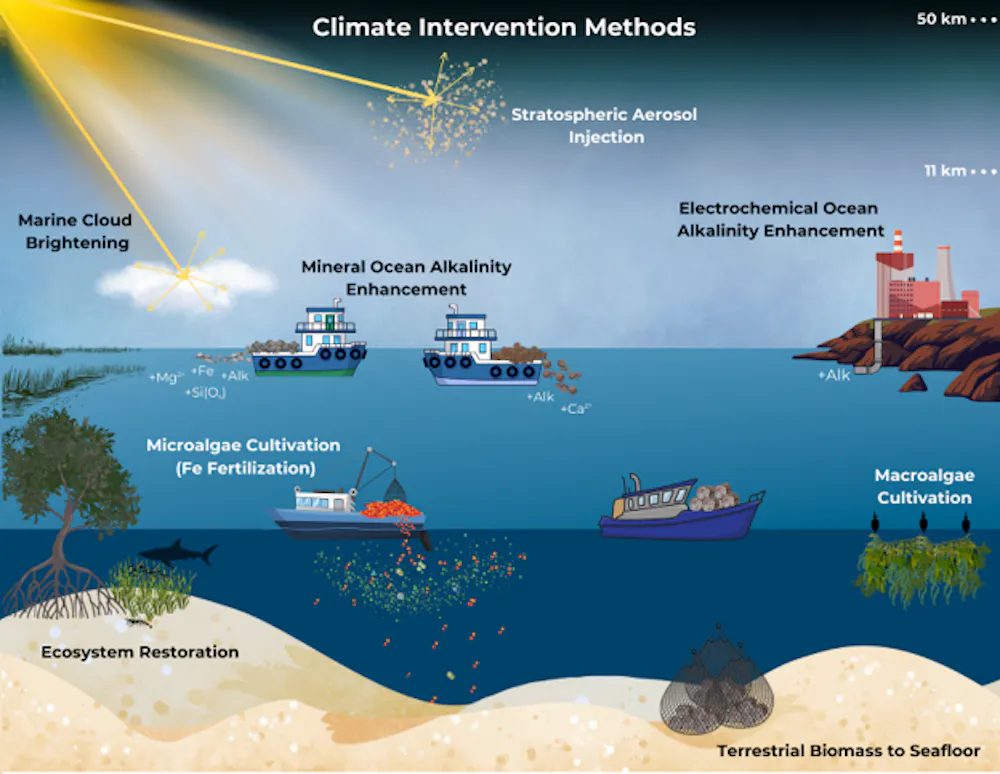
An illustration shows solar modification, ocean fertilization and other methods.
Some of the methods of climate interventions that affect the ocean, such as iron (Fe) fertilization.
Vanessa van Heerden/Louisiana Sea Grant

Biological carbon removal methods capture carbon through photosynthesis in plants or algae. Some methods, such as iron fertilization and seaweed cultivation, boost the growth of marine algae by giving them more nutrients. A fraction of the carbon they capture during growth can be stored in the ocean for hundreds of years, but much of it leaks back to the atmosphere once biomass decomposes.

Other methods involve growing plants on land and sinking them in deep, low-oxygen waters where decomposition is slower, delaying the release of the carbon they contain. This is known as anoxic storage of terrestrial biomass.

Another type of carbon dioxide removal doesn’t need biology to capture carbon. Ocean alkalinity enhancement chemically converts carbon dioxide in seawater into other forms of carbon, allowing the ocean to absorb more from the atmosphere. This works by adding large amounts of alkaline material, such as pulverized carbonate or silicate rocks like limestone or basalt, or electrochemically manufactured compounds like sodium hydroxide.

How ocean alkalinity enhancement methods works. CSIRO.

Solar radiation modification is another category entirely. It works like a sunshade – it doesn’t remove carbon dioxide, but it can reduce dangerous effects such as heat waves and coral bleaching by injecting tiny particles into the atmosphere that brighten clouds or directly reflect sunlight back to space, replicating the cooling seen after major volcanic eruptions. The appeal of solar radiation modification is speed: It could cool the planet within years, but it would only temporarily mask the effects of still-rising carbon dioxide concentrations.

These methods can also affect ocean life

We reviewed eight intervention types and assessed how each could affect marine ecosystems. We found that all of them had distinct potential benefits and risks.

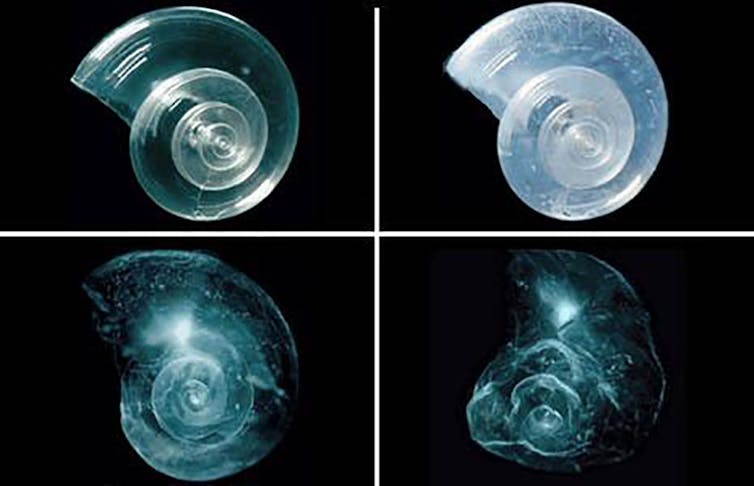
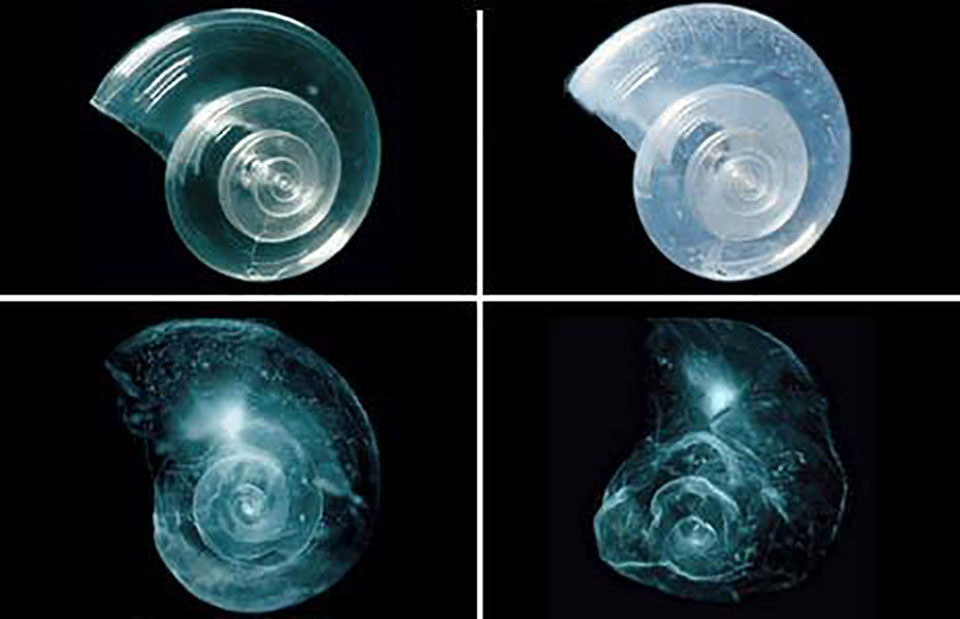
One risk of pulling more carbon dioxide into the ocean is ocean acidification. When carbon dioxide dissolves in seawater, it forms acid. This process is already weakening the shells of oysters and harming corals and plankton that are crucial to the ocean food chain.

For images show a shell slowly dissolving over time.
How a shell placed in seawater with increased acidity slowly dissolves over 45 days.
National Oceanic and Atmospheric Administration, Pacific Marine Environmental Laboratory

Adding alkaline materials, such as pulverized carbonate or silicate rocks, could counteract the acidity of the additional carbon dioxide by converting it into less harmful forms of carbon.

Biological methods, by contrast, capture carbon in living biomass, such as plants and algae, but release it again as carbon dioxide when the biomass breaks down – meaning their effect on acidification depends on where the biomass grows and where it later decomposes.

Another concern with biological methods involves nutrients. All plants and algae need nutrients to grow, but the ocean is highly interconnected. Fertilizing the surface in one area may boost plant and algae productivity, but at the same time suffocate the waters beneath it or disrupt fisheries thousands of miles away by depleting nutrients that ocean currents would otherwise transport to productive fishing areas.

A glass beaker with cyanobacteria growing inside.
Cyanobacteria, or blue-green algae, can multiply rapidly when exposed to nutrient-rich water.
joydeep/Wikimedia Commons, CC BY-SA

Ocean alkalinity enhancement doesn’t require adding nutrients, but some mineral forms of alkalinity, like basalts, introduce nutrients such as iron and silicate that can impact growth.

Solar radiation modification adds no nutrients but could shift circulation patterns that move nutrients around.

Shifts in acidification and nutrients will benefit some phytoplankton and disadvantage others. The resulting changes in the mix of phytoplankton matter: If different predators prefer different phytoplankton, the follow-on effects could travel all the way up the food chain, eventually impacting the fisheries millions of people rely on.

The least risky options for the ocean

Of all the methods we reviewed, we found that electrochemical ocean alkalinity enhancement had the lowest direct risk to the ocean, but it isn’t risk-free. Electrochemical methods use an electric current to separate salt water into an alkaline stream and an acidic stream. This generates a chemically simple form of alkalinity with limited effects on biology, but it also requires neutralizing or disposing of the acid safely.

Other relatively low-risk options include adding carbonate minerals to seawater, which would increase alkalinity with relatively few contaminants, and sinking land plants in deep, low-oxygen environments for long-term carbon storage.

Still, these approaches carry uncertainties and need further study.

Scientists typically use computer models to explore methods like these before testing them on a wide scale in the ocean, but the models are only as reliable as the data that grounds them. And many biological processes are still not well enough understood to be included in models.

For example, models don’t capture the effects of some trace metal contaminants in certain alkaline materials or how ecosystems may reorganize around new seaweed farm habitats. To accurately include effects like these in models, scientists first must study them in laboratories and sometimes small-scale field experiments.

Scientists examine how phytoplankton take up iron as they grow off Heard Island in the Southern Ocean. It’s normally a low-iron area, but volcanic eruptions may be providing an iron source. CSIRO.

A cautious, evidence-based path forward

Some scientists have argued that the risks of climate intervention are too great to even consider and all related research should stop because it is a dangerous distraction from the need to reduce greenhouse gas emissions.

We disagree.

Commercialization is already underway. Marine carbon dioxide removal startups backed by investors are already selling carbon credits to companies such as Stripe and British Airways. Meanwhile, global emissions continue to rise, and many countries, including the U.S., are backing away from their emissions reduction pledges.

As the harms caused by climate change worsen, pressure may build for governments to deploy climate interventions quickly and without a clear understanding of risks. Scientists have an opportunity to study these ideas carefully now, before the planet reaches climate instabilities that could push society to embrace untested interventions. That window won’t stay open forever.

Given the stakes, we believe the world needs transparent research that can rule out harmful options, verify promising ones and stop if the impacts prove unacceptable. It is possible that no climate intervention will ever be safe enough to implement on a large scale. But we believe that decision should be guided by evidence – not market pressure, fear or ideology.

The Conversation

Through his role at Cornell University, Daniele Visioni receives funding from the Quadrature Climate Foundation and the Advanced Research + Invention Agency UK. Daniele Visioni is Head of Data for Reflective, a philanthropically-funded initiative focused on responsibly accelerating sunlight reflection research.

In addition to her primary role as UCSB faculty, Morgan Raven serves as the Chief Science Officer for, and holds minor equity in, a seed-funded startup company exploring applications of biomass-related CDR (Carboniferous). This work was supported by a grant from the Grantham Foundation for the Protection of the Environment to UCSB.

Through his role at the Univeristy of Tasmania, Tyler Rohr receives funding from the Australian government and Co-Labs ICONIQ Impact Co-Labs to research impacts and efficeincy of marine carbon dioxide removal.

Kelsey Roberts does not work for, consult, own shares in or receive funding from any company or organization that would benefit from this article, and has disclosed no relevant affiliations beyond their academic appointment.

ref. Climate engineering would alter the oceans, reshaping marine life – our new study examines each method’s risks – https://theconversation.com/climate-engineering-would-alter-the-oceans-reshaping-marine-life-our-new-study-examines-each-methods-risks-270659