Gratitude statements like “Thanks! You are so kind!” and “Thank you! What you did was really helpful,” are common when someone receives assistance from another person. Such expressions of gratitude and appreciation have long been thought to encourage the helper to do kind things again in the future. But do they?
Our research was conducted using a new approach called a Registered Report. It required that the design of our experiment, along with our hypotheses and analytic plans, were vetted by experts before we started. This new best practice in science increases rigour and transparency.
Expressions of gratitude
We conducted two large pre-registered experiments and found mixed results. In the first experiment, more than 600 university students recorded a short video to welcome a new student (played by a member of our research team) to campus.
In response to this kind act, we sent participants one of three randomly assigned pre-recorded videos. Some participants received a video in which the new student expressed gratitude for the participant’s kind act: “Thank you! What you did was very kind.”
Other participants received a video in which the new student expressed gratitude for the participant’s kind character: “Thank you! You are very kind.”
Finally, some participants in a control condition received a video of the new student acknowledging that they had received the recording, but with no expression of gratitude at all.
Afterwards, all participants were invited to write up to five brief notes to welcome other new students to university, which we treated as a measure of future helping behaviour.
Reception and kindness
By sending participants one of the three video replies, we were able to test two important questions about gratitude. Does receiving an expression of gratitude, regardless of whether it mentions your kind act or kind character, lead to more helping in the future compared to not receiving gratitude? Also, does the content of the gratitude matter — in other words, do some gratitude notes lead to more helping in the future than others?
To find out, we compared how many welcome notes participants wrote across the three video conditions provided. We found no differences across conditions, which suggests that receiving a gratitude expression and its contents may not impact future helping.
Welcoming new students is one way to be kind, but there are many other ways to help. So, we conducted another experiment to test the same key questions. Does receiving a gratitude expression increase future helping behaviour? And does the content of the gratitude message matter?
This time, however, we used written thank-you messages instead of videos and measured helping in the form of donations.
Over 800 adults recruited online completed an innocuous survey that provided an opportunity to complete an initial kind act of donating to charity. Two days later, participants were invited back to complete a second survey that began with what we told participants was a thank-you letter from the charity they supported — participants received one of three letters we had created for the purposes of our study.
As in the first study, some participants were thanked for their kind act: “Thank you! Your generous donation was very kind.” Other participants were thanked for their kind character: “Thank you! You are very kind and generous.”
Once again, some participants did not receive a message of thanks, but were informed that their donation had been received. Participants completed a few other questions and were then given the opportunity to help again by deciding how much, if any, of an additional one-dollar bonus they would like to donate to a new charity.
We compared donations across the three conditions and found that people who received a thank-you note gave more money than people who received a simple message that their donation was received. Donation levels did not differ between the two types of gratitude expressions. People thanked for their kind act gave roughly as much (42 cents) as people who were thanked for their kind character (42 cents), which was higher than the 34 cents given by people in the control condition.
While we did not see significant differences in help provided by people who were thanked for their kind action or character, this does not mean that people should stop saying thanks. Expressing gratitude can make the person expressing appreciation feel good and strengthen social relationships.
There may be less reason to stress over how exactly you express your appreciation to others. Past research has shown that many people are uncertain about how to properly and eloquently relay their gratitude.
Exactly what is said when expressing thanks may be less important than communicating appreciation.
Kelton Travis, an honours undergraduate student in psychology at Simon Fraser University, co-authored this article.
Lara B Aknin receives funding from the Social Sciences and Humanities Research Council of Canada.
Anurada Amarasekera, Kristina Castaneto, and Tiara A Cash do not work for, consult, own shares in or receive funding from any company or organisation that would benefit from this article, and have disclosed no relevant affiliations beyond their academic appointment.
Tanzania has long enjoyed a reputation as a peaceful country. In contrast to most of its neighbours, this east African nation of 67 million people has largely avoided large-scale violence within its borders.
That didn’t seem likely in the early years after independence from Britain in December 1961. A little over two years into independence – in January 1964 – the founding president, Julius Nyerere, faced two political crises. The first started on 12 January 1964 in the form of the Zanzibar Revolution. Weeks of violence and destruction by Afro-Shirazi Party members followed. As many as 16,000 Zanzibaris were killed or forced into exile.
Then the country’s military, the Tanganyika Rifles, mutinied. Its soldiers were incensed over inadequate pay, loss of privileges, and poor prospects for upward mobility. A rattled Nyerere needed British military support to quell the mutiny. He ordered the arrests of its leaders, and effectively dismantled the entire force.
Nyerere then faced the dilemma of leading a new nation-state with no army and few resources to build one. His socialist agenda (Ujamaa, in Kiswahili) had prioritised other aspects of nation-building, especially education and public health. Nonetheless, with assistance from the Organisation of African Unity (OAU) and the willingness of some of its member states to provide troops, the Tanzania People’s Defence Force was established in September 1964.
In his new book, Ujamaa’s Army: The Creation and Evolution of the Tanzania People’s Defence Force, 1964-1979, Charles G. Thomas, a scholar of post-colonial African military history, skilfully narrates this complex and absorbing history. The book covers the formation and transformations of the defence force through the new nation’s first 15 years as it shed its connections to the colonial past and charted a new path.
Unlike other writing on African armies – particularly the body of work on colonial armies – this one does not centre rank-and-file troops. Instead, Thomas’s analysis is based on rich interviews with high-ranking officers who led and moulded the force in its first two decades. This has enabled him to offer a top-down view of the construction of the army.
A rocky start
Nyerere undertook the work of unifying Tanganyika and Zanzibar in the first few months of 1964 with an eye to the region’s security. The Zanzibar revolution and the Afro-Shirazi Party’s Marxism had called attention to the island as a potential Marxist outpost. Violence against the island’s ruling party and those perceived as wealthy elites seemed to bolster this perception. In the context of the cold war, this fuelled western fears of Zanzibar becoming the “Cuba of east Africa”. An influx of Soviet and Chinese military advisers to Zanzibar made western powers nervous.
Nyerere and foreign minister Oscar Kambona worked with Afro-Shirazi Party leader Abeid Karume to unify Tanganyika and Zanzibar to reassure westerners.
The rollout of the defence force in September 1964 thus included members of the Zanzibari People’s Liberation Army. This signalled that the initial 1,000-man army would serve the larger interests of socialist Tanzania.
A regional role
Throughout the 1960s, Tanzania became, alongside Zambia, Botswana, Lesotho, Angola and Mozambique, a supporter of southern African liberation struggles. The OAU formally recognised this group of nations as the “frontline states” in 1975.
Nyerere convinced the OAU Liberation Committee to set up its headquarters in Dar es Salaam in 1963 because Tanganyika was already hosting many southern African exiles. Also, conflicts in neighbouring states, such as Mozambique, were spilling over into Tanganyika. It became the nerve centre for coordinating African liberation efforts.
Liberation organisations from across southern Africa also established offices in Dar es Salaam. These included the African National Congress and the Pan-Africanist Congress from South Africa; the People’s Movement for the Liberation of Angola (MPLA); Zimbabwe African People’s Union (Zapu) and Zimbabwe African National Union (Zanu); South West Africa People’s Organisation (Swapo) from Namibia; and Mozambique Liberation Front (Frelimo).
The Tanzanian defence force took on a key role in frontline liberation struggles. In 1964 it established the Special Duties Unit, which provided a logistics pipeline to serve liberation armies.
The defence force also established training camps for liberation armies within Tanzania. And it took on a protective and support function in southern Tanzania, where Frelimo’s operations against the Portuguese embroiled communities.
Tanzania’s involvement in struggles against the white settler states of southern Africa intensified in the late 1960s and early 1970s. After Portugal retreated from its colonies, Nyerere sent the defence force to help stabilise the new Frelimo government in Mozambique against the South African- and Rhodesian-backed guerrilla force Renamo.
At the same time, the book explains, Tanzania was contending with the disruptive politics and threatening military actions of its northern neighbour, Uganda.
Uganda gained independence from Britain in 1962. In 1971 Idi Amin seized power in a military coup that ousted Uganda’s first president, Milton Obote.
Amin and Nyerere antagonised each other personally, politically and militarily for the next eight years.
In 1972, Amin bombed Tanzanian border cities in retaliation for Nyerere’s support of the invasion of Uganda by Obote supporters in 1972. In 1978, Uganda annexed the Kagera Salient across its south-western border with Tanzania. In 1979, Tanzania invaded Uganda and ousted Amin from power.
The Tanzanian defence force remained in Uganda for nearly two years, providing security as the new government attempted to re-establish services and governance for post-Amin Uganda.
Catalyst for new inquiries
Thomas’s sustained research is based in large measure on hard-won connections with defence force officers. He also used alternative sources rather than relying heavily on Tanzanian, British and US archives. Canadian military archives, for example, showed how Tanzania’s forces benefited from Canadian training and resources.
OAU archival materials helped with understanding the Tanzania People’s Defence Force as part of African solidarity efforts against apartheid and colonialism.
The book also paints a clear picture of Nyerere’s role in Africa’s postcolonial politics. It shows him as a shrewd negotiator and a “pragmatic pluralist” in a fraught cold war world, where there were many competitors for military aid, but few sources to provide it to a country seeking a non-aligned position. His decision to form the Tanzania People’s Defence Force, and his encouragement of its role in supporting liberation struggles, helped Tanzania stand apart from its neighbours.
Michelle Moyd does not work for, consult, own shares in or receive funding from any company or organisation that would benefit from this article, and has disclosed no relevant affiliations beyond their academic appointment.
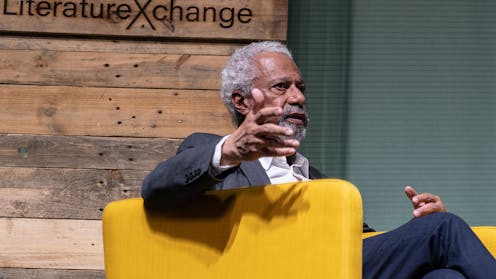
Nobel Prize-winning author Abdulrazak Gurnah in Denmark in 2025.Hreinn Gudlaugsson/Wikimedia Commons
Zanzibar has long been an island of arrivals for traders, sailors, slaves and, more recently, waves of tourists. I arrived as a wedding guest and a reader of the Zanzibar born novelist Abdulrazak Gurnah, in search of the literary and emotional landscapes that shape his fiction. For a week, I was part of the tourist economy of this east African island, passively complicit in its curated pleasures.
For all its beautiful images on social media, Zanzibar is a site of difficult memory. It was once a central node in the Indian Ocean slave trade, so its past is carved into the coral-stone buildings that reflect a complex fusion of Swahili, Indian, Arab and European influences in architecture and town planning.
Zanzibar’s tourist attraction Stone Town from the air. Wegmann/Wikimedia Commons, CC BY-SA
A visit to the Old Slave Market was sobering. You cannot look away once you’ve seen it. And yet, Zanzibar is now overlaid with carefully packaged experiences: boutique hotels with infinity pools, beach picnics with imported champagne, stalls of “African” art mass-produced for western eyes. The art has become so generic that it hurts. All the curio markets on the island look the same.
Even the language has been commodified. Everyone is selling something. Everyone is searching. “Jambo,” (Hello) say mostly young men offering one service or another. “Hakuna matata.” (No worries.) “Pole pole.” (No rush.) These cheerful Kiswahili phrases made famous by the likes of the Lion King movie are repeated like slogans and feel soulless.
Most of the cars on the roads operate as taxis with stickers that say: Private Hire. The tuk tuks, three-wheeled tricycles, weave in and out of traffic because movement is an act of constant negotiation, part of a tourist infrastructure that operates as a regulated service.
The tourist markets of Stone Town. Rod Waddington/Flickr/Wikimedia Commons, CC BY-SA
Amid the hum of engines and the ceaseless choreography of traffic, I kept searching not just for respite from the heat or wifi or good coffee, but for something literary. I was looking for the celebrated writer Abdulrazak Gurnah. Not the man (he hasn’t lived in Zanzibar for decades), but the essence of his writing, informed by this place: the ache of exile, the weight of history, the restless question of belonging he grapples with.
Gurnah is not just a writer I’ve read; he examined my doctoral dissertation at the University of Kent, where he taught for many years until his retirement. He is an important part of my intellectual development.
As a scholar of African literature, I engage deeply with the traditions, debates and histories that Gurnah’s novels illuminate, so my attempt to map his legacy in Zanzibar carried both personal and professional significance.
Absence of literary memory
Gurnah was born here, on this island of contradictions. He left following the Zanzibar Revolution of 1964, a violent outbreak of anti-Arab violence in postcolonial Africa. He was a teenager when he moved to England as a refugee, and has lived there ever since.
I expected, perhaps foolishly, to see a plaque with his name. A mural. Something. But there was nothing, even in Stone Town, where the past feels pressed into every narrow alley. This historical capital is an indecipherable tangle of markets, bathhouses, former colonial offices and palaces. I asked about bookshops at every turn. Locals looked puzzled, amused. “Why?” one asked. “You want to read on holiday?” That is because I can’t imagine a beach without a book.
Eventually, I found Gurnah’s famous novels in a souvenir shop that mostly sold skin-care products. They sat beside cookbooks and Swahili language guides. The only other meaningful literary encounter came via the mainland: a newly published Tanzanian literary journal, Semi za Picha, sent by ferry.
That little package was the most precious thing I took away from Zanzibar. It’s described as “a film journal” and edited by Jesse Gerard Mpango and Dismas Sekibaha, who are members of an audio-visual collective, Ajabu Ajabu, based in Dar es Salaam.
It’s not that Zanzibar lacks intellectual life. There is a State University. A global centre for Swahili Studies. Museums and Unesco heritage sites.
But there are no visible monuments to literature. There is no street named after Abdulrazak Gurnah. And yet, his imagination haunts the island. Reading his fiction made me more aware of the surfaces I was treading on, all the stories hiding under sand and souvenirs here, or submerged in the waters of the Indian Ocean.
Gurnah’s novels are known for their moral precision and speak to the legacies of colonialism and displacement along the Swahili coast. His characters often inhabit spaces between languages, continents and allegiances. In many ways, the disjuncture Gurnah explores, especially the fraught layering of history, is what unfolded before us.
We criss-crossed Zanzibar by car, drove through villages with crumbling schools and no paved roads in search of the perfect beach. Then the ocean would appear, in its glimmering glory, and there were always many people taking pictures, as if the world was just a beautiful pose. But there’s something repugnant about turning people’s homes into backgrounds for entertainment. In our swimsuits, we were trespassing through communities, not just beautiful landscapes.
Zanzibar is not local anymore. It is a mesh of immigrants and itinerants: its service industry jobs are all occupied by people from many places. Local Tanzanian hotel staff, Kenyan chefs, French and South African restaurateurs, Belgian and German landlords. Whether you’re walking, or sitting at the beach, you can hear a babel of languages: Arabic, Chinese, Dutch, French, Hebrew, Italian, Shona, Swahili, Zulu.
African masks at the island’s many tourist shops. Djordje Markovic/Wikimedia Commons, CC BY-SA
Maybe my search for Gurnah and for literature was a search for an ethical place to stand. In Zanzibar, billboards of Tanzanian president Samia Suluhu Hassan are prominently displayed, projecting an image of calm authority. Once welcomed as a reformer, Hassan now faces growing criticism over alleged human rights abuses. But beneath the façade lies a more contested reality.
Zanzibar is a semi-autonomous archipelago with its own president and parliament, yet remains politically tethered to the mainland of Tanzania. This union has long been marked by tension over power, identity and representation as many Zanzibaris continue to assert a distinct cultural and political identity.
At the wedding, we didn’t speak of any of this. There was music, speech-making and laughter. This island, beautiful and bruised, is the backdrop of the absurdity of overtourism. And I still can’t get over the fact that in Zanzibar I could find no bookshops.
Tinashe Mushakavanhu does not work for, consult, own shares in or receive funding from any company or organisation that would benefit from this article, and has disclosed no relevant affiliations beyond their academic appointment.
In Lagos, Nigeria’s commercial and creative capital, food is doing something unusual. It’s keeping alive the spirit of a musician.
Fela Anikulapo-Kuti, one of Africa’s most influential artists, was the architect of Afrobeat (not to be confused with today’s Afrobeats, which was born from it).
Fela pioneered his politically charged, musically expansive sound in the early 1970s by blending jazz, highlife, funk and Yoruba rhythms. He paired these with lyrics that took aim at corruption, oppression and postcolonial disillusionment. His songs were as much rallying cries as they were works of art.
Today, dishes named after Fela’s protest anthems – and restaurant soundscapes steeped in Afrobeats – are making dining in Lagos a journey through African music history.
As a musicologist involved in African Studies, I research the legacy of Fela Kuti and how it manifests in new forms today, in music, political life and even food. I first raised Fela’s legacy in food in a 2022 article for the book that accompanied a major exhibition in France called Fela Anikulapo-Kuti: Rébellion Afrobeat.
For me the new Lagos trend raises a question: do these culinary tributes preserve the radical edge of Fela’s art – or do they dilute it by commercialising it?
The world’s first restaurant dedicated to celebrating Africa’s vibrant music genre.
The Afrobeat offers not just meals but a fully curated cultural experience. Yet it was not the first to blend food and Fela.
That distinction belongs to Kuti’s Bistro, launched in 2019 by the family of Seun Kuti, Fela’s youngest son. It’s currently closed for diners but still delivers meals.
Positioned as a pan-African eatery, the bistro’s dining area was steeped in Afrobeat imagery and sound, with walls adorned in Fela-inspired art. Its dishes draw on regional African culinary traditions, from Nigerian staples to cross-continental flavours.
Like so many restaurants in Lagos today, its playlist was dominated by Afrobeats, the electronically driven pop music now dominant across west Africa and its diasporas. Afrobeats owes much to Fela’s pioneering spirit.
The pairing of food and music creates a layered cultural experience. The textures and spices of the food evoke place and tradition; the music anchors the experience in a living, evolving sound. Diners are invited to consume Fela’s legacy with all their senses: sight, sound, smell, taste, and even memory.
In this way, these restaurants function as more than dining spaces. They are cultural archives. They stage a performance of history and identity every time a plate leaves the kitchen.
Preserving or packaging the radical?
Still, the shift from protest anthem to menu item raises questions.
Can a song like Expensive Shit, originally a razor-sharp satire on state harassment, retain its political bite when it is served as a dessert on a polished ceramic plate? Does turning Roforofo Fight into a main course preserve its cultural meaning? Or does it risk reducing it to a quirky marketing hook? This tension is not unique to Fela’s legacy.
Around the world, radical art often undergoes a process of “heritagisation” and commodification. It becomes a celebrated cultural product, sometimes losing the confrontational edge that defined it.
Yet this transformation does not necessarily strip away its significance. It can create new pathways for engagement. For younger diners, who may know Fela only as a name in music history or a face on a T-shirt, a menu item can become a spark of curiosity. It might prompt a search for the original song, leading to a deeper encounter with his music and the politics behind it.
A legacy that adapts
Fela’s artistic and political vision was always about creating spaces where African identity could be expressed on its own terms.
In the 1970s and 80s, that space was his nightclub, the Afrika Shrine, where music, conversation and resistance flowed freely. In 2025, it might be a restaurant table in Lagos, where I No Be Gentleman arrives as a sizzling platter of suya-spiced beef.
Today’s blending of food and music illustrates how cultural memory works in Africa. Artistic legacies can be preserved not just through direct performance, but through symbolic transformation into other mediums; mediums that engage the senses, draw on tradition, and thrive in the global marketplace.
The Afrobeat-themed restaurants of Lagos are not just curiosities for tourists or novelties for locals. They are living experiments in how to honour a cultural icon while making him relevant to the present.
Whether these spaces ultimately radicalise or simply entertain, they ensure that Fela Anikulapo-Kuti remains part of the city’s sensory landscape; not only heard, but tasted. And in a rapidly changing Lagos, that may be one of the most enduring tributes possible.
Garhe Osiebe does not work for, consult, own shares in or receive funding from any company or organisation that would benefit from this article, and has disclosed no relevant affiliations beyond their academic appointment.
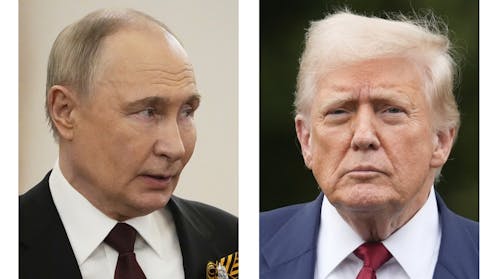
Like many such confabs before it, the Aug. 15, 2025, Alaska red carpet rollout for Russian President Vladimir Putin is classic Donald Trump: A show of diplomacy as pageantry that seemingly came out of nowhere, replete with vague goals and hardened expectations about the outcome from Trump supporters and opponents alike before the event has even taken place.
Trump is seemingly trying to dial down expectations, billing the summit as a “feel-out meeting” with the Russian leader to try to reach a diplomatic solution to the more than 3-year-old Russian war in Ukraine.
The event follows a recent period where Trump had become more critical of Putin’s role in continuing the war, giving the Russian leader a 50-day deadline to end the war or else face new U.S. sanctions. Trump subsequently reversed course on military support for Ukraine and stepped up weapons shipments. However, he has always made it clear that his priority is to restore a good relationship with Russia, rather than save Ukraine from defeat.
Trump’s track record of admiration for Putin, and the summit format that excludes both Ukraine and its European allies, has provided ample fodder for critics of U.S. policy under Trump.
Military scholar Lawrence Freedman expressed a common critical refrain in expressing fears that Trump will concede Putin’s core demands in Ukraine in return for a ceasefire. Likewise, CNN’s international security editor, correspondent Nick Paton Walsh, said “it is hard to see how a deal emerges from the bilateral that does not eviscerate Ukraine.” Indeed, few mainstream establishment commentators in the U.S. or European capitals are supporting Trump’s initiative, though Anatole Lieven, at the anti-interventionist Quincy Institute, was one of the few giving at least a lukewarm endorsement.
Meanwhile, in Moscow, despite Trump’s vague talk of a “land swap” that implies Ukraine could regain some lost territory, the uniformly pro-government Russian press is already hailing the upcoming summit as a victory for Putin and a “a catastrophe for Kyiv”,“ as the MK newspaper declared.
Still, as a long-time observer of Russian politics, I believe it would be premature to write off the summit as an exercise doomed to fail. Respected Russian émigré journalist Tatyana Stanovaya, for one, has argued that the meeting offers the “first more or less real attempt to stop the war.” And there are several important developments that mainstream commentary has overlooked in arguing against prospects for the Alaska summit.
What has changed?
Despite Trump’s repeated pledge to end the war in Ukraine, there has been no progress to that end thus far. Trump’s earlier efforts to broker a ceasefire, in February and April, were both rebuffed by Putin.
But since then, a number of factors have shifted that could allow Trump some leverage in talks this time around.
Seven months into his second term, Trump appears flush with confidence and has shown more willingness to project power to advance American interests.
In June, he joined Israel’s airstrikes against Iran, Russia’s biggest ally in the Middle East. On Aug. 8, he hosted the presidents of Armenia and Azerbaijan at the White House to sign a historic peace deal – a huge diplomatic defeat for Russia, which historically has dominated the politics of the south Caucasus region.
Trump’s ongoing global trade war is also alarming for Russia. On Aug. 7, Trump slapped punitive new tariffs on 90 countries that failed to make deals before his deadline. Trump has shown himself willing to use American power to bully trade partners who cannot effectively retaliate — such as Brazil, Canada, Switzerland and now India.
Indeed, Trump noticed that India bought US$80 billion of Russian oil last year — more than China. On Aug. 6, the same day that Trump announced the Alaska meeting, he imposed 50% tariffs on India, which will not come into effect for 21 days unless India cuts back on imports of Russian crude.
That creates real leverage for Trump against Putin should he want to use it in Alaska. With the Russian economy under strain and with global oil prices falling, Russia risks losing critical revenue from selling oil to India. That could conceivably be the tipping point for Putin, persuading him to halt the war.
Why it still may not be enough
As significant as those shifts could be, there are still several grounds for skepticism.
First, India may ignore Trump’s oil sanction. Key Indian exports to the U.S., such as iPhones and pharmaceuticals, are exempt from the 50% tariff, and they account for about $20 billion of India’s $80 billion annual exports to the U.S.
Second, the global oil market is highly adaptable. Russian oil not bought by India could easily be picked up by China, Turkey, Italy, Malaysia and others. Even if Russia lost $10 billion to 20 billion as a result of the India sanctions, with overall government revenue of $415 billion a year, that would not derail Moscow’s ability to wage war on Ukraine.
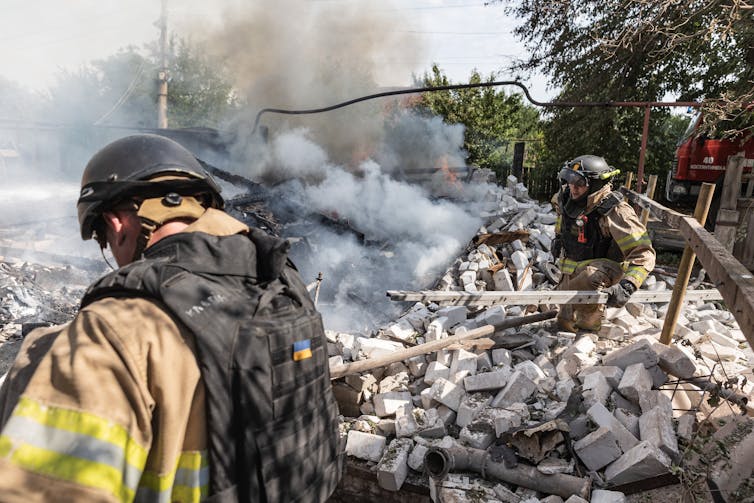
Ukrainian firefighters work to put out fires stemming from Russian artillery shelling of the city of Kostiantynivka, a sign of the nearly constant toil of the conflict. Photo by Diego Herrera Carcedo/Anadolu via Getty Images
The devil in the details
It remains unclear what Trump actually wants to achieve in Alaska. The details of the deal he is trying to persuade Putin to accept are unclear. For the Trump administration, the basic idea for ending the conflict appears to be land for peace: an end to military action by both sides and de facto recognition of the Ukrainian territory currently occupied by Russian forces.
One glaring problem with this formulation is that Russia does not control all the territory of the four Ukrainian provinces that it claims. They occupy nearly all of Luhansk, but not all of Donetsk, and only 60% of Zaporizhzhia and Kherson. If Russia insists on taking all of Donetsk province, for example, Ukraine would have to hand over about 2,500 square miles (6,500 square kilometers), with 200,000 people, mainly in the cities of Kramatorsk and Slovyansk.
It is hard to imagine President Volodymyr Zelenskyy agreeing to such a concession.
Yet it is equally hard to see Putin giving up his claim to all four provinces, which were formally incorporated into the Russian Federation in October 2022. In a June 2024 speech to the Russian foreign ministry, Putin laid out his most thorough analysis of the “root causes” and course of the conflict. He stated that the legal status of the four provinces as part of Russia “is closed forever and is no longer a matter for discussion.”
Clearly, the territorial question is the biggest hurdle facing any would-be peacemaker, including Trump.
Other issues, such as Ukraine’s request for security guarantees, or Russia’s demands for the “denazification” and “demilitarization” of Ukraine, could be dealt with later through negotiation and third-party mediation.
There are other factors that play into the chances of peace now.
Both Ukrainian and Russian societies are tired of a conflict that neither of them wanted. But at the same time, in neither country does most of the public want peace at any price.
If Trump can persuade Putin to agree to give up his claims to the entire territory of the four provinces in Ukraine’s east, that would be a substantial concession – and one that Zelenskyy may be well-advised to pocket. Putin would also expect something in return — such as the lifting of international sanctions and restoration of full diplomatic relations with the U.S. Then Putin could fly back to Moscow and tell the Russian people that Russia has won the war.
If such a deal transpires in Alaska, Trump would then face the challenge of persuading Ukraine and Europeans to accept it.
However, given Putin’s apparent confidence that Russia is winning the war, it remains unlikely that he will be persuaded by anything that Trump has to offer in Anchorage.
Peter Rutland does not work for, consult, own shares in or receive funding from any company or organization that would benefit from this article, and has disclosed no relevant affiliations beyond their academic appointment.
The pathway from climate change to violent conflict is not simple. There are the obvious immediate effects of global warming like water scarcity and crop failure. But beyond these, climate stress can pave the road to violence through indirect channels – a gradual rise in food insecurity and growing social tensions that set the stage for more armed violence.
We are a team of researchers who investigate the links between climate change, food systems and conflict. We set out to explore the relationship between climate variability, child malnutrition and violent conflict.
Our study focused on Nigeria. The country has faced rising temperatures, recurrent droughts, and one of the highest burdens of food insecurity and conflict in Africa. Its northern and north-eastern regions in particular have fragile agrifood systems, limited public services, and ongoing insecurity. This makes them especially vulnerable to the impacts of climate shocks.
For our research, we used household data from the Nigeria demographic and health surveys and combined this with information on climate and conflict. We applied a system of equations to separate the role child malnutrition plays in climate-related conflict from other factors that aren’t easily observed but which contribute to shape the climate-conflict link.
From this, we found that rising temperatures don’t immediately trigger violence. Instead, they set off a chain reaction: heat stress on the planet over time stresses food systems. As crops fail and household incomes fall, the youngest and most vulnerable are often the first to show signs of distress and become malnourished.
Climate change contributes to higher rates of acute child malnutrition, or wasting. This is where children have very low weight for their height, usually because of sudden food shortages or illness. Wasting is one of the clearest signs that a child is not getting enough to eat.
In Nigeria, formal safety nets are limited. This means that the social strain of malnourished communities can become a powerful driver – or justification – for engaging in violence, mostly as a desperate alternative source of income or safety. People who aren’t getting the food they need may be increasingly inclined to support or be recruited by armed groups to ensure food security, shelter and physical protection.
One of the study’s key contributions is its use of child malnutrition indicators to trace the indirect effects of climate stress on conflict. Our research shows that acute malnutrition – especially wasting – is an early warning signal of social breakdown in fragile settings.
We recommend that systems that give early warnings of conflict should analyse nutrition in climate change-affected areas and use the levels of malnutrition as a way to predict potential conflict. Taking nutrition into account is a practical way to anticipate and prevent violence before it erupts.
Malnutrition as a hunger signal
Think of climate-driven conflict like a tangled web. We’ve managed to trace one clear thread – malnutrition – and show how it is linked to violence. But even after accounting for that thread, the web still holds tight. That’s because other forces, like economic shocks, migration, or institutional breakdown, are still tugging at the system.
We carefully mapped the indirect role of malnutrition through a method that helps identify how one factor (climate stress) affects another (conflict) through an intermediate pathway (malnutrition), while also taking other factors into account. This enabled us to calculate the contribution of malnutrition to climate related conflict.
We examined how shifts in climate affect child malnutrition in Nigeria – specifically wasting, stunting and underweight – and how these, in turn, relate to violent outbreaks. Among the various indicators, wasting stood out.
Severe wasting is responsible for one in five deaths among children under the age of five globally, making it one of the leading threats to child survival. Because wasting reflects short-term nutritional stress, it can act as an early warning sign that communities are struggling to cope with climate shocks.
This finding is particularly relevant in farming communities where people depend on predictable weather to grow food and earn a living.
This offers a new way to think about climate, peace, and security. It’s about how weather changes unfold through daily meals, children’s diets and household decisions, sometimes quietly but no less dangerously.
Turning data into defence
Our study will improve the accuracy of current estimates of indirect impacts of climate change on conflict, because it looks at how these impacts are mediated by food and nutrition security outcomes.
Integrating malnutrition data into early warning systems, investing in nutrition-sensitive climate adaptation, and targeting support to the most vulnerable regions can reduce both human suffering and the risk of conflict.
Today, headlines focus on armed groups and battlefield dynamics, which is understandable. But we risk overlooking the quieter patterns beneath the surface.
The next crisis may not start with a bullet but with starvation.
We gratefully acknowledge the collaboration and support of Anna Belli, a junior professional officer at the Office of the Chief Economist at the Food and Agriculture Organisation and lead author of this research, Antonio Scognamillo, economist in the Agrifood Economics and Policy Division, and Ada Ignaciuk, chief editor of the State of Food Security and Nutrition at the Food and Agriculture Organisation.
Marina Mastrorillo works for The Alliance of Bioversity and CIAT of CGIAR. She receives funding from the CGIAR Trust Fund (https://www.cgiar.org/funders/) through the CGIAR Climate Action and Food Frontiers and Security Science Programmes.
This research was supported by the CGIAR Climate Action and Food Frontiers and Security Programmes, with funding from the CGIAR Trust Fund.
Chun Song works for The Alliance of Bioversity and CIAT of CGIAR. She receives funding from the CGIAR Trust Fund (https://www.cgiar.org/funders/) through the CGIAR Policy Innovation Program.
Grazia Pacillo works for The Alliance of Bioversity and CIAT of CGIAR. She receives funding from the CGIAR Trust Fund (https://www.cgiar.org/funders/) through the CGIAR Climate Action and Food Frontiers and Security Science Programmes. This research was supported by the CGIAR Climate Action and Food Frontiers and Security Science Programmes, with funding from the CGIAR Trust Fund.
Victor Villa works for the Alliance of Bioversity International and CIAT, which is part of CGIAR. He receives funding from the CGIAR Trust Fund (https://www.cgiar.org/funders/) through the CGIAR Science Programmes on Climate Action and Food Frontiers and Security.
On August 15 2021, Afghanistan’s democratic republic collapsed.
As the last US and NATO troops departed the country, the Taliban swept back into power and the Afghan people braced for an uncertain future.
Despite promises of moderation and inclusion, four years later, the Taliban has established a repressive, exclusionary regime – one that has dismantled institutions of law, justice and civil rights with ruthless efficiency.
As the Taliban regime has tightened its grip, international attention has waned. Crises in Ukraine, Gaza and elsewhere have dominated the global agenda, pushing Afghanistan out of the spotlight.
With the Taliban seeking to end its isolation and gain legitimacy, can the international community find the will now to exert real pressure?
The Taliban’s emirate of repression
After coming back into power, the Taliban discarded the country’s 2004 constitution, allowing the regime to operate without a transparent rule of law. Instead, Mullah Hibatullah Akhundzada, the reclusive Taliban leader, rules by decree from his base in Kandahar.
The Taliban’s repression of women and girls has been so severe, human rights groups now call it “gender apartheid” and argue it should be a new international crime.
Edicts have erased women from public life, banning them from education beyond primary school (with the exception of religious education), employment and public spaces. Women also cannot move freely in public without a mahram, or male guardian.
The Taliban also dismantled the Ministry of Women’s Affairs, replacing it with the Ministry for the Propagation of Virtue and Prevention of Vice. As a central instrument of repression, the ministry reinforces institutionalised gender discrimination through regular raids and arrests, surveillance and monitoring of public spaces.
Taliban rule has also led to the exclusion and persecution of minority ethnic and religious groups such as Hazaras, Shias, Sikhs and Christians.
In the province of Panjshir, the focal point of resistance to the Taliban, human rights groups have documented the Taliban’s severe crackdowns on the local population, including mass arrests and detentions, torture and extrajudicial killings.
More broadly, the Taliban has decimated the civic space in the country. Journalists and activists have been silenced through fear, violence and arbitrary arrests. This has led to widespread self-censorship and an information blackout that allows abuses to continue with impunity.
Despite the immense risks, activists, journalists and ordinary citizens continue to resist the Taliban. Women have staged peaceful protests in the face of harsh crackdowns, while others run secret schools for girls and document abuses in the hope of future accountability.
Humanitarian aid dwindling
Although most countries do not recognise the Taliban as the formal and legitimate government of the country, some regional states have called for an easing of its international isolation.
Last month, Russia became the first country to recognise the Taliban. China is also deepening its economic and diplomatic ties with the group. India’s foreign minister recently met with his Taliban counterpart, after which the Taliban called New Delhi a “significant regional partner”.
International aid continues to flow into Afghanistan, but a report from a US watchdog this week documented how the Taliban uses force and other means to divert it.
The United States had still accounted for more than 40% of all humanitarian support to Afghanistan after the Taliban’s return. But US President Donald Trump’s decision to decimate the US Agency for International Development means this funding has all but disappeared.
For years, the United Nations has tried to facilitate talks between the Taliban and international community in Qatar with the aim of improving conditions in the country. However, it has faced repeated setbacks.
The Taliban only decided to attend the talks in mid-2024 after the UN conceded to excluding women and civil society groups and restricting the agenda. The meeting resulted in no breakthroughs or concessions.
Another round of talks is anticipated, but the central dilemma remains: how to engage the Taliban without legitimising its repressive rule.
Courts making some progress
The Taliban’s systematic human rights abuses have global repercussions. Experts warn of a rising trend of similarly styled repression, dubbed “Talibanisation”, taking root in other countries.
In Yemen, for example, Houthi leaders have imposed restrictions eerily similar to Taliban edicts, banning women from walking in public without a male guardian and restricting their work.
While individual states have failed to agree on a coordinated response to the Taliban, international institutions have taken steps in the right direction.
In July, the International Criminal Court issued arrest warrants for Akhundzada and the Taliban chief justice, accusing them of crimes against humanity for gender-based persecution.
Separately, four countries – Australia, Germany, the Netherlands and Canada – have begun the process of bringing a case against the Taliban to the International Court of Justice for gender discrimination. This would be a first for the court.
To complement these efforts, the UN member states must establish an independent international investigative mechanism to systematically document and investigate crimes committed by the Taliban. Such a mechanism would help preserve evidence and lay the groundwork for future prosecutions.
Without concerted international pressure, the suffering of the Afghan people will only worsen and the Taliban’s brand of repression will continue impact women’s rights far beyond Afghanistan’s borders.
The authors are holding a day-long conference with other academics on Afghanistan, four years after the Taliban takeover, at the Monash University Law Chambers in Melbourne on August 15. More information can be found here.
Nothing to disclose.
Arif Saba and Niamatullah Ibrahimi do not work for, consult, own shares in or receive funding from any company or organisation that would benefit from this article, and have disclosed no relevant affiliations beyond their academic appointment.
Source: The Conversation – in French – By Spector Céline, Professeure des Universités, UFR de Philosophie, Sorbonne Université, Sorbonne Université
Notre démocratie est en crise, comment la réinventer ? Que nous enseignent ceux qui, au cours des âges, furent ses concepteurs ? Cinquième volet de notre série consacrée aux philosophes et à la démocratie avec Montesquieu (1728-1755). Précurseur de l’approche constitutionnelle moderne, ce dernier définit des conditions de la liberté politique par la tripartition des pouvoirs de l’État – législatif, exécutif et judiciaire.
Comment Montesquieu peut-il nous aider à cerner l’esprit de la démocratie moderne ? Dans De l’esprit des lois (1748), paru de manière anonyme à Genève, le philosophe distingue la démocratie antique, dont le lieu d’origine est Athènes et Rome, et la république moderne, qui se dissimule encore sous la forme monarchique. Cette république nouvelle ne recourt plus au tirage au sort pour permettre aux citoyens de choisir leurs édiles ; elle privilégie le système représentatif en conférant au peuple – ou du moins à une partie du peuple – le droit d’élire ses députés à la Chambre.
Montesquieu inspiré par la Glorious Revolution anglaise
C’est dans l’Angleterre postérieure à la Glorious Revolution (1689) que Montesquieu va chercher les principes de la liberté politique. Si cette nation est dotée d’un statut singulier, c’est qu’au terme de sanglantes guerres civiles, le prince y a été apprivoisé. Magistrat et juriste de formation, le philosophe de la Brède a observé la vie politique anglaise lors de son séjour sur l’île pendant plus de 18 mois (novembre 1729-avril 1731). Au livre XI de L’Esprit des lois, il brosse un tableau inédit des conditions de la liberté politique, en partant de la tripartition des pouvoirs de l’État : la puissance législative, la puissance exécutive ou exécutrice, la puissance judiciaire. C’est seulement si par la « disposition des choses », « le pouvoir arrête le pouvoir » que la Constitution pourra protéger la liberté, redéfinie de manière originale comme opinion que chacun a de sa sûreté, à l’abri de l’arbitraire et de l’abus de pouvoir. Montesquieu fournit ainsi à la postérité une interprétation subtile et profonde des institutions de la liberté.
La question de l’attribution des pouvoirs est d’abord essentielle : afin de faire fonctionner l’État, le pouvoir exécutif doit certes être confié à un seul homme – le monarque – en raison de la rapidité nécessaire des décisions à prendre. Mais la liberté politique suppose d’autres exigences : afin d’éviter la formation d’une caste de juges potentiellement tyrannique, l’autorité judiciaire doit être attribuée pour l’essentiel à des jurys populaires tirés au sort. Quant au pouvoir législatif, il doit être confié, dans un grand État, aux représentants du peuple. Toutefois, il ne faut pas se faire d’illusions : les députés ne sont pas toujours mandataires de l’intérêt général. Telle est la raison pour laquelle le Parlement doit être constitué par deux Chambres – House of Commons et House of Lords. Si le bicaméralisme s’avère nécessaire, c’est que l’élite tente toujours d’opprimer le peuple et le peuple, de nuire à l’élite. Comme Machiavel, Montesquieu considère que les gens « distingués par la naissance, les richesses ou les honneurs » ne doivent pas être confondus avec ceux qui en sont dénués, sans quoi « la liberté commune serait leur esclavage et ils n’auraient aucun intérêt à la défendre ». L’État n’est pas une personne morale constituée en amont de la société et transcendant ses clivages : chaque groupe social dispose au sein du pouvoir législatif d’un organe partiel pour défendre ses intérêts, et se trouve par là même « constitué » avec ses droits et, le cas échéant, avec ses privilèges.
Néanmoins, l’exécutif lui-même n’est pas laissé sans secours face aux risques d’atteinte à sa prérogative : dans le sillage de certains publicistes anglais comme le Vicomte Bolingbroke, Montesquieu reconnaît le droit de véto du roi dans une monarchie limitée. Grâce à cette opposition de forces et de contre-forces, la constitution est un système dynamique qui se conserve par une forme d’autorégulation. Cet équilibre, sans doute, reste précaire : l’Angleterre perdra sa liberté au moment où le pouvoir législatif deviendra plus corrompu que l’exécutif. Mais contrairement aux théoriciens absolutistes de la souveraineté, l’auteur de L’Esprit des lois ne craint pas la paralysie des pouvoirs divisés, pas plus qu’il ne redoute l’impuissance associée à la nécessité d’un compromis politique et social. Tant que l’équilibre est maintenu, la préservation des droits résulte de la négociation et de la tension entre intérêts divergents. Dans le mouvement nécessaire des choses, les pouvoirs antagonistes finissent par « aller de concert ».
Séparer ou distribuer les pouvoirs ?
Comment interpréter la Constitution libre ? Dans un article classique, le juriste Charles Eisenmann a réfuté l’interprétation selon laquelle Montesquieu défendrait une véritable « séparation des pouvoirs ». L’interprétation séparatiste soutenue par la plupart des juristes consiste à affirmer que le pouvoir de légiférer, le pouvoir d’exécuter et le pouvoir de juger doivent être distribués à trois organes absolument distincts, pleinement indépendants, et même parfaitement isolés les uns des autres. Elle exclut pour chaque organe le droit de donner des instructions aux autres, et même tout droit de contrôle sur leur action.
Or cette conception stricte de la séparation des pouvoirs est intenable : en réalité, le philosophe-jurisconsulte ne remet pas le pouvoir législatif au Parlement seul, mais au Parlement et au monarque. Le Parlement élabore et vote les lois dont ses membres ont pris l’initiative ; mais ces lois n’entrent en vigueur que si le monarque y consent. Le monarque prend part à la législation par son droit de veto ; la puissance exécutrice, de ce point de vue, « fait partie de la législative ». En second lieu, si Montesquieu condamne le cumul intégral du pouvoir législatif et du pouvoir de juger, il n’exclut pas que la Chambre des Lords puisse juger les nobles. Enfin, il ne préconise pas davantage l’indépendance de chaque organe dans l’exercice de sa fonction ; il assigne au Parlement, dans un État libre, le droit et même le devoir de contrôler l’action exécutive du gouvernement.
De ce point de vue, la séparation des pouvoirs relève d’un « mythe ». Montesquieu l’affirme de façon explicite : « Dans les monarchies que nous connaissons, les trois pouvoirs ne sont point distribués et fondus sur le modèle de la Constitution dont nous avons parlé », à savoir la Constitution d’Angleterre : les pouvoirs de l’État sont distribués sans doute, mais d’une façon qui, loin de les séparer, les fond. L’État libre est un système dynamique où les parties en mouvement contribuent à l’équilibre du tout ; la distinction et l’opposition des pouvoirs est le préalable à leur coordination : « Voici donc la constitution fondamentale du gouvernement dont nous parlons : le corps législatif y étant composé de deux parties, l’une enchaînera l’autre par sa faculté mutuelle d’empêcher. Toutes les deux seront liées par la puissance exécutrice, qui le sera elle-même par la législative ». Le mécanisme constitutionnel est ici agencé de telle sorte que ses divers rouages soient en mesure de se faire opposition les uns aux autres. Or c’est précisément parce que les pouvoirs sont en mesure de s’opposer qu’ils ne peuvent être radicalement séparés. Ce point est essentiel : contre les risques de dérive despotique, le contrôle parlementaire du gouvernement permet à l’État de rester libre.
D’où l’interprétation politique et non juridique de la distribution des pouvoirs : afin d’éviter les abus de pouvoir, il ne faut pas que deux des trois pouvoirs étatiques, et à plus forte raison les trois, soient remis à un seul et homme ou à un seul corps de l’État (pas même le Parlement !). Un seul pouvoir doit être réellement séparé des deux autres, à savoir le pouvoir judiciaire. Selon le président à mortier du Parlement de Bordeaux, le juge doit se contenter d’appliquer la loi, d’être la « bouche de la loi ». Pour que le citoyen n’éprouve pas la crainte des magistrats qui caractérise les États despotiques, il faut neutraliser la puissance de juger, « si terrible parmi les hommes » : elle doit devenir, pour ainsi dire, « invisible et nulle ». En particulier, l’exécutif ne doit en aucun cas influencer ou contrôler le pouvoir judiciaire. Il faut éviter à tout prix qu’il puisse opprimer par sa « volonté générale » et mettre en péril chaque citoyen par ses volontés particulières – ce qui risque d’arriver là où la puissance est « une ». La concentration et la confusion des pouvoirs font du prince un monstre omnipotent qui légifère, exécute, et juge, quitte à éliminer ses opposants politiques et à opprimer la dissidence.
À l’origine du constitutionnalisme moderne
Cette théorie doit bien sûr être contextualisée : en luttant contre le despotisme en France, Montesquieu n’a pas inventé telle quelle la conception fonctionnelle de la séparation des pouvoirs qui s’appliquera par la suite, aux États-Unis notamment ; il n’a pas imaginé un Sénat conçu comme Chambre des États, susceptible de remplacer la Chambre des Pairs ; il n’a pas conçu de président élu se substituant au monarque. Il reste que sa vision puissante est à l’origine du constitutionnalisme moderne. Elle inspire notre conception de l’État de droit, qui associe liberté des élections et des médias, distribution des pouvoirs et indépendance du judiciaire. En influençant la formation des constitutions républicaines, elle fournit la boussole dont nous avons encore besoin, au moment où le président américain remet en cause les pouvoirs du Congrès, menace d’abolir l’indépendance de l’autorité judiciaire, torpille celle des agences gouvernementales et envoie chaque jour des salves d’executive orders en défendant une théorie de l’exécutif « unitaire », fort et immune. Que le Congrès l’accepte et que la Cour suprême avalise l’impunité présidentielle est un signe, parmi d’autres, du danger mortel qui pèse sur nos démocraties.
Céline Spector est membre du Conseil scientifique de l’UEF France. Elle a reçu des financements pour des projets de recherche à Sorbonne Université au titre de l’Initiative Europe.
Source: The Conversation – in French – By Ola Anabtawi, Assistant Professor – Department of Nutrition and Food Technology, An-Najah National University
Deux spécialistes de la nutrition décrivent, sur le plan physiologique, les différentes étapes de dégradation du corps humain lorsqu’il est soumis à des famines comme celles qui sévissent à Gaza et au Soudan. Contraint de puiser dans ses réserves, l’organisme est alors de plus en plus vulnérable aux infections telles que la pneumonie ou d’autres complications.
La faim existe sous différentes formes.
Au départ, il est question d’insécurité alimentaire quand les populations sont contraintes de s’adapter à des repas en nombres insuffisants. À mesure que la nourriture se raréfie, l’organisme puise dans ses réserves. Le passage de la faim à la famine commence par une baisse du niveau d’énergie, puis le corps puise dans ses réserves de graisse, ensuite dans ses muscles. Finalement, les organes vitaux commencent à défaillir.
De la sous-alimentation à la malnutrition aiguë puis à la famine, le processus atteint un stade où l’organisme n’est plus en mesure de survivre. À Gaza aujourd’hui, des milliers d’enfants de moins de cinq ans et des femmes enceintes ou allaitantes souffrent de malnutrition aiguë. Au Soudan, les conflits et les restrictions d’accès à l’aide humanitaire ont poussé des millions de personnes au bord de la famine, et les alertes à la famine se font de plus en plus pressantes chaque jour.
Nous avons demandé aux nutritionnistes Ola Anabtawi et Berta Valente d’expliquer les mécanismes physiologiques à l’œuvre dans les situations de famine et ce qui arrive au corps humain quand il est privé de nourriture.
Quel est l’apport alimentaire minimal dont le corps a besoin pour survivre ?
Pour leur survie, les humains ne peuvent se contenter d’eau potable et de sécurité. L’accès à une alimentation qui couvre leurs besoins quotidiens en énergie, en macronutriments et en micronutriments est essentiel pour rester en bonne santé, favoriser la guérison et prévenir la malnutrition.
Selon l’Organisation mondiale de la santé (OMS), les adultes ont besoin de quantités d’énergie différentes en fonction de leur âge, de leur sexe et de leur niveau d’activité physique.
Une kilocalorie (kcal, soit 1 000 calories) est une unité de mesure de l’énergie. En nutrition, elle indique la quantité d’énergie qu’une personne tire de son alimentation ou la quantité d’énergie dont le corps a besoin pour fonctionner. Techniquement, une kilocalorie correspond à la quantité d’énergie nécessaire pour élever la température d’un kilogramme d’eau d’un degré Celsius. Le corps utilise cette énergie pour respirer, digérer les aliments, maintenir sa température corporelle et, en particulier chez les enfants, pour grandir.
Les besoins énergétiques totaux proviennent de trois sources :
la dépense énergétique au repos : elle correspond à l’énergie utilisée par le corps au repos pour maintenir ses fonctions vitales, comme la respiration et la circulation sanguine ;
l’activité physique : elle peut varier pendant les situations d’urgence en fonction de facteurs tels que les déplacements, les soins prodigués ou les tâches indispensables à la survie ;
la thermogenèse : on nomme ainsi l’énergie utilisée pour digérer et transformer les aliments.
La dépense énergétique au repos représente généralement la plus grande partie des besoins énergétiques, en particulier lorsque l’activité physique est limitée. D’autres facteurs, notamment l’âge, le sexe, la taille, l’état de santé, la grossesse ou les environnements froids, influencent également la quantité d’énergie dont une personne a besoin.
Les besoins énergétiques varient tout au long de la vie. Les nourrissons ont besoin d’environ 95 kcal à 108 kcal par kilogramme de poids corporel par jour pendant les six premiers mois et de 84 kcal à 98 kcal par kilogramme de six à douze mois. Pour les enfants de moins de dix ans, les besoins énergétiques sont basés sur des modèles dans une situation de croissance normale, sans distinction entre les garçons et les filles.
Par exemple, un enfant de deux ans a généralement besoin d’environ 1 000 à 1 200 kcal par jour. Un enfant de cinq ans a besoin d’environ 1 300 à 1 500 kcal et un enfant de dix ans a généralement besoin de 1 800 à 2 000 kcal par jour.
À partir de dix ans, les besoins énergétiques commencent à être différents entre garçons et filles en raison des variations de croissance et d’activité, et les apports sont ajustés en fonction du poids corporel, de l’activité physique et du taux de croissance.
Pour les adultes ayant une activité physique légère à modérée, les besoins énergétiques quotidiens moyens sont d’environ 2 900 kcal pour les hommes âgés de 19 à 50 ans, tandis que les femmes du même groupe d’âge ont besoin d’environ 2 200 kcal par jour. Ces valeurs comprennent une fourchette de plus ou moins 20 % afin de tenir compte des différences individuelles en matière de métabolisme et d’activité physique. Pour les adultes de plus de 50 ans, les besoins énergétiques diminuent légèrement, les hommes ayant besoin d’environ 2 300 kcal et les femmes d’environ 1 900 kcal par jour.
Dans les situations d’urgence humanitaire, l’aide alimentaire doit garantir l’apport énergétique minimal qui est largement recommandé pour maintenir une personne en bonne santé et assurer ses fonctions vitales de base, cet apport ayant été fixé à 2 100 kcal par personne et par jour. Ce niveau minimum vise à satisfaire les besoins physiologiques fondamentaux et à prévenir la malnutrition lorsque l’approvisionnement en aliments est limité.
Cette énergie doit provenir d’un équilibre entre les macronutriments, les glucides représentant 50 à 60 % de l’apport (sous forme de riz ou de pain), les protéines 10 à 35 % (haricots, viande maigre…) et les lipides 20 à 35 % (l’huile de cuisson ou les noix, par exemple).
Les besoins en graisses sont plus élevés chez les jeunes enfants (30 % à 40 %), ainsi que chez les femmes enceintes et allaitantes (au moins 20 %).
En plus de l’énergie, le corps a besoin de vitamines et de minéraux, comme le fer, la vitamine A, l’iode et le zinc, qui sont essentiels au fonctionnement du système immunitaire, à la croissance et au développement du cerveau. Le fer se trouve dans des aliments tels que la viande rouge, les haricots et les céréales enrichies. La vitamine A provient des carottes, des patates douces et des légumes verts à feuilles foncées. L’iode est généralement obtenu par le sel iodé et par les fruits de mer. Le zinc est présent dans la viande, les noix et les céréales complètes.
Lorsque les systèmes alimentaires s’effondrent, cet équilibre est rompu.
Que se passe-t-il physiquement lorsque votre corps est affamé ?
Sur le plan physiologique, les effets de la famine sur le corps humain se déroulent en trois phases qui se chevauchent. Chacune reflète les efforts du corps pour survivre sans nourriture. Mais ces adaptations ont un coût physiologique élevé.
Au cours de la première phase qui dure jusqu’à 48 heures après l’arrêt de l’alimentation, l’organisme puise dans les réserves de glycogène stockées dans le foie afin de maintenir un taux de sucre dans le sang stable.
(Le glycogène est un glucide complexe que l’on pourrait définir comme une réserve de glucose – donc de sucre – facilement mobilisable, ndlr).
Ce processus, appelé glycogénolyse, est une solution à court terme. Lorsque le glycogène est épuisé, la deuxième phase commence.
Le corps passe alors à la gluconéogenèse, qui correspond à une production de glucose à partir de sources non glucidiques telles que les acides aminés (provenant des muscles), le glycérol (provenant des graisses) et le lactate. Ce processus alimente les organes vitaux, mais entraîne une dégradation musculaire et une augmentation de la perte d’azote, en particulier au niveau des muscles squelettiques.
Le troisième jour, la cétogenèse devient le processus dominant. Le foie commence à convertir les acides gras en corps cétoniques. Ce sont des molécules dérivées des graisses qui servent de source d’énergie alternative lorsque le glucose vient à manquer. Ces cétones sont utilisées par le cerveau et d’autres organes pour produire de l’énergie. Ce changement permet de préserver les tissus musculaires, mais il est également le signe d’une crise métabolique plus profonde.
Les changements hormonaux, notamment la diminution de l’insuline, de l’hormone thyroïdienne (T3) et de l’activité du système nerveux, ralentissent le métabolisme afin d’économiser l’énergie. Au fil du temps, les graisses deviennent la principale source d’énergie. Mais une fois les réserves de graisses épuisées, le corps est contraint de dégrader ses propres protéines pour produire de l’énergie. Cela accélère la fonte musculaire, affaiblit le système immunitaire et augmente le risque d’infections mortelles.
Le décès, souvent dû à une pneumonie ou à d’autres complications, survient généralement après 60 jours à 70 jours sans nourriture chez un adulte qui était, au départ, en bonne santé.
Lorsque l’organisme entre dans une phase de privation prolongée de nutriments, les signes visibles et invisibles de la famine s’intensifient.
Sur le plan physique, les individus perdent beaucoup de poids et souffrent d’une fonte musculaire, de fatigue, d’un ralentissement du rythme cardiaque, d’une sécheresse cutanée, d’une perte de cheveux et d’une altération des processus de cicatrisation. Les défenses immunitaires s’affaiblissent, ce qui augmente la vulnérabilité aux infections, en particulier à la pneumonie, une cause fréquente de décès en cas de famine.
Sur le plan psychologique, la famine provoque une profonde détresse. Les personnes touchées font état d’apathie, d’irritabilité, d’anxiété et d’une préoccupation constante pour la nourriture. Les capacités cognitives déclinent et la régulation des émotions se détériore, ce qui conduit parfois à la dépression ou au repli sur soi.
Chez les enfants, les effets à long terme comprennent un retard de croissance et des troubles du développement cérébral. Ces deux effets peuvent devenir irréversibles.
Pendant la famine, l’organisme s’adapte progressivement pour survivre. Au début, il utilise les réserves de glycogène pour produire de l’énergie. À mesure que la famine se prolonge, il commence à dégrader les graisses puis les tissus musculaires. Cette transition progressive explique à la fois la faiblesse physique et les changements psychologiques tels que l’irritabilité ou la dépression.
Mais les effets de la famine ne sont pas seulement d’ordre individuel. La famine brise aussi les familles et les communautés. À mesure que leurs forces déclinent, les gens sont incapables de prendre soin des autres ou d’eux-mêmes. Dans les crises humanitaires, comme celles de Gaza et du Soudan, la famine aggrave les traumatismes causés par la violence et les déplacements, en entraînant un effondrement total de la résilience sociale et biologique.
Comment briser ce cercle vicieux ?
Après une période de famine, le corps humain se trouve dans un état de fragilité métabolique. La réintroduction soudaine d’aliments, en particulier de glucides, provoque une hausse brutale du taux d’insuline et un transfert rapide d’électrolytes tels que le phosphate, le potassium et le magnésium vers les cellules. Cela peut submerger l’organisme et entraîner un syndrome lié à la réalimentation, appelé en anglais refeeding syndrome (en français, l’expression « renutrition inappropriée » est employée quelquefois dans la littérature médicale, ndlr).
Ce syndrome peut entraîner des complications graves, telles qu’une insuffisance cardiaque, une détresse respiratoire, ou encore la mort en l’absence d’une prise en charge adéquate.
Les protocoles standard débutent par des laits thérapeutiques appelés F-75, spécialement conçus pour stabiliser les patients pendant la phase initiale du traitement de la malnutrition aiguë sévère, suivis d’aliments thérapeutiques prêts à l’emploi, d’une pâte ou de biscuits à base de beurre d’arachide (spécialement formulés pour permettre à un enfant souffrant de malnutrition de passer de l’état de mort imminente à un rétablissement nutritionnel complet en seulement quatre à huit semaines), de sels de réhydratation orale et de poudres de micronutriments.
Ces produits alimentaires doivent être livrés en toute sécurité. Un accès humanitaire constant est essentiel.
Les largages par voies aériennes ne font pas partie de la sécurité alimentaire. La survie nécessite des efforts soutenus et coordonnés pour restaurer les systèmes alimentaires, protéger les civils et faire respecter le droit humanitaire. Sans cela, les cycles de famine et de souffrances risquent de se répéter.
Quand l’aide alimentaire est insuffisante en termes de qualité ou de quantité, ou quand l’eau potable n’est pas disponible, la malnutrition s’aggrave rapidement.
Les auteurs ne travaillent pas, ne conseillent pas, ne possèdent pas de parts, ne reçoivent pas de fonds d’une organisation qui pourrait tirer profit de cet article, et n’ont déclaré aucune autre affiliation que leur organisme de recherche.
Source: The Conversation – in French – By Marie Bassi, Enseignante-chercheure. Maîtresse de conférences en science politique, Université Côte d’Azur
Depuis plus de deux ans, le Soudan est en proie à une guerre opposant l’armée régulière à un groupe paramilitaire. Ce conflit a plongé le pays dans la plus grave crise humanitaire au monde et provoqué le déplacement de près de 13 millions de personnes depuis avril 2023, selon les Nations unies.
Quel bilan peut-on dresser aujourd’hui de ces deux années de guerre ? Éléments de réponse avec Marie Bassi, maîtresse de conférences à l’Université Côte d’Azur et coordinatrice du Centre d’études et de documentation économiques, juridiques et sociales au Soudan, basé à Khartoum mais actuellement délocalisé au Caire.
The Conversation : Pourriez-vous revenir brièvement sur les origines du conflit actuel au Soudan ?
Marie Bassi : La guerre a éclaté le 15 avril 2023 en plein cœur de Khartoum, la capitale soudanaise. Elle oppose deux acteurs ; les forces armées soudanaises (FAS), dirigées par le général Abdel Fattah al-Burhan, et un puissant groupe paramilitaire appelé les Forces de soutien rapide (FSR), représenté par Mohamed Hamdan Daglo (alias « Hemetti »). Les premiers, l’armée régulière, gouvernent le Soudan de manière presque ininterrompue depuis l’indépendance du pays, en 1956. Les deuxièmes, les FSR, sont dirigées par des chefs issus de tribus arabes de l’ouest du Soudan, au Darfour.
Ce conflit a la particularité d’avoir débuté dans la capitale, une première pour le pays. Bien que l’histoire du Soudan ait été marquée par des décennies de tensions entre le Nord et le Sud et par des conflits entre le centre et les périphéries, ceux-ci ne s’étaient jamais exportés dans la capitale. Cette fois-ci, Khartoum a été directement affectée, avec des pillages, la destruction des infrastructures (centrales électriques, conduites d’eau, hôpitaux, écoles, patrimoine culturel, archives nationales…), et des attaques de zones administratives et militaires, mais aussi de très nombreuses habitations.
C’est aussi probablement la première fois qu’autant de puissances étrangères sont directement impliquées dans le conflit. L’économie de guerre est alimentée par un réseau complexe d’alliances internationales. Les Émirats arabes unis apportent leur soutien aux FSR, ce qu’ils démentent en dépit de plusieurs enquêtes qui le prouvent. D’un autre côté, l’Égypte est un allié majeur de l’armée. La Libye, l’Ouganda, le Tchad, le Soudan du Sud, la Russie, l’Iran et bien d’autres sont également impliqués, plus ou moins directement.
Ce conflit se caractérise aussi par son extrême violence. On compte plus de 150 000 morts, des viols, des tortures, des exécutons sommaires. Les viols de masse font partie du recours généralisé aux violences sexuelles comme arme de guerre.
On assiste à une prolifération des armes et à une multiplication des groupes armés qui éloignent l’espoir d’une paix proche. La guerre se poursuit et les deux camps continuent de commettre des exécutions sommaires visant des civils, accusés de soutenir le camp adverse ou appartenant à des groupes ethniques perçus comme proches soit des FSR, soit de l’armée. On a également pu observer des campagnes de nettoyage ethnique menées par les FSR ou par l’armée, notamment au Darfour et dans la région de la Gezira.
Arte, 14 octobre 2024.
Quelle est actuellement la situation au Darfour ?
M. B. : Le Darfour est une région de l’ouest du Soudan, presque aussi grande que la France. Depuis 2003, le Darfour est le théâtre d’un conflit armé ayant pour origine un accès inégal aux ressources, des années de marginalisation politique, des conditions économiques difficiles et l’implication de grandes puissances qui en convoitent les richesses.
Aujourd’hui, les FSR en contrôlent la quasi-totalité. Seule la ville d’Al Fasher, capitale du Darfour du Nord, leur échappe, mais elle est actuellement en état de siège. Une famine dramatique touche la ville. Le Darfour était déjà très pauvre en infrastructures de base avant la guerre ; maintenant, l’ensemble de la région est dans une situation humanitaire catastrophique.
Il y a quelques mois, les FSR avaient annoncé leur intention de former un gouvernement parallèle à celui établi à Port-Soudan sous le contrôle de l’armée. Ce 26 juillet, les FSR ont nommé un premier ministre. Elles vont peut-être réussir à contrôler l’entièreté du Darfour et une partie du Kordofan du Sud, et on évoque un risque de partition du pays.
On dit souvent que la guerre au Soudan souffre d’une sous-médiatisation. Cela engendre-t-il une mauvaise compréhension du conflit et de ses conséquences ?
M. B. : Il est vrai que cette réalité dramatique contraste avec un silence politique et médiatique assourdissant. Les rares moments où les médias européens parlent du Soudan se comptent sur les doigts de la main. D’autre part, je pense que la mise en récit de la guerre par les belligérants, par la plupart des médias et par certains acteurs politiques repose sur des interprétations assez simplificatrices et essentialistes.
Il y a effectivement une guerre de pouvoir entre les deux groupes pour s’emparer du contrôle d’un pays très riche, en or, en uranium, en terres arables, en bétail, en gaz naturel et en pétrole, et d’un territoire 800 km qui donne également accès à la mer Rouge. Cependant, il faut mentionner que cette guerre oppose des personnes issues du régime précédent et alliées de longue date.
En effet, depuis l’indépendance, le gouvernement soudanais a suivi une stratégie d’externalisation de la violence en faisant systématiquement appel à différentes milices pour se prémunir des coups d’État et pour vaincre les mouvements armés dans certaines régions, notamment au Darfour ou dans les monts Nuba (dans l’État du Kordofan, Soudan du Sud) qui luttaient pour le partage équitable des ressources du pays.
Les FSR ne portaient pas le même nom il y a quelques années. Ils sont en partie des héritiers des janjawids, des milices issues des tribus arabes du Darfour, qui étaient impliquées dans les massacres, du début des années 2000 au Darfour, qualifiés de génocide par la Cour pénale internationale.
Elles ont pris du poids au fil des années et, en 2013, l’ancien dictateur Omar al-Bachir les convertit en FSR avant de les institutionnaliser en 2017. Avec leur participation comme supplétifs dans le conflit au Yémen, leur rôle pour renforcer le contrôle aux frontières à la demande de l’Union européenne, leur implantation dans les secteurs très rentables de l’or et de l’immobilier, les FSR se sont considérablement enrichies et ont été en position de rivaliser avec l’armée. Les milices qui sévissent aujourd’hui ont donc en réalité été construites par l’armée.
Ensuite, pour comprendre cette guerre, il faut revenir au soulèvement révolutionnaire soudanais de 2019. En avril, le dictateur Omar al-Bachir est destitué du pouvoir après trente ans de règne. Débutait alors une période de transition démocratique qui devait déboucher sur un gouvernement civil.
L’ancien inspecteur de l’armée soudanaise, Abdel Fattah al-Burhan, qui avait succédé à Bachir, s’allie avec Mohamed Hamdan Daglo qui est à la tête des FSR. Ils orchestrent un coup d’État en octobre 2021 qui renverse le gouvernement de transition, évince les forces civiles et marque la reprise du pouvoir par l’armée et leurs alliés, les FSR.
Abdel Fattah al-Burhan dirige le nouveau gouvernement de transition militaire. Cependant, l’alliance entre l’armée et les FSR est fragile et leurs rivalités pour le partage du pouvoir s’exacerbent jusqu’à donner lieu au conflit d’avril 2023.
Fin mai, l’armée soudanaise a annoncé avoir libéré l’État de Khartoum des forces paramilitaires. Quel impact cette annonce a-t-elle eu auprès des diasporas soudanaises ? A-t-on pu observer des retours massifs vers la capitale ?
M. B. : Tout d’abord, il faut rappeler le nombre colossal de Soudanais contraints au déplacement forcé : on estime qu’au moins 13 millions de personnes ont quitté leur foyer, dont 4 millions dans les pays voisins. Les principaux pays d’accueil sont l’Égypte, avec plus d’un million et demi de Soudanais, le Soudan du Sud où ils sont plus d’un million, puis le Tchad (1,2 million), la Libye (plus de 210 000) et enfin l’Ouganda (plus de 70 000). Ce sont des chiffres colossaux et ils expliquent en partie pourquoi cette guerre est considérée comme la plus importante crise humanitaire au monde.
Ensuite, on observe en effet beaucoup de retours au Soudan, ces dernières semaines, bien que les chiffres annoncés restent approximatifs et soient à prendre avec précaution. La reprise de la capitale a marqué un tournant, c’était une victoire à la fois symbolique et tactique.
À l’intérieur du Soudan, le Haut-Commissariat des Nations unies pour les réfugiés (HCR) estime que près d’un million de personnes sont revenues dans leurs foyers d’origine, principalement à Khartoum et dans la région de la Gezira dont l’armée a également repris le contrôle début 2025. Près de 320 000 Soudanais seraient aussi revenus d’Égypte et du Soudan du Sud.
En Égypte, le gouvernement a mis en place une ligne de train pour faciliter le retour, et des bus entiers partent quotidiennement du Caire vers la frontière. Les gens ont envie de revenir dans leur maison, de voir s’il en reste quelque chose. Les personnes âgées ne veulent pas mourir en dehors de leur pays.
Les personnes les plus précaires, celles qui ne sont pas parvenues à scolariser leurs enfants ou à trouver des moyens de subsistance, reviennent. Par ailleurs, les autorités militaires cherchent à encourager le retour des Soudanais, en multipliant les annonces officielles. Celles-ci, toutefois, apparaissent souvent déconnectées de la situation réelle, comme lorsqu’elles affirment pouvoir reconstruire Khartoum en six mois pour retrouver son état d’avant-guerre.
Tout ceci a néanmoins un goût amer, puisque certains Soudanais se retrouvent contraints de célébrer leurs anciens ennemis, le camp de l’armée, celle-là même contre laquelle ils s’étaient mobilisés lors de la révolution de 2019, une révolution portée par l’espoir d’un gouvernement civil.
Et il faut aussi garder en tête que la guerre et les horreurs continuent dans plusieurs régions, notamment au Darfour et au Kordofan.
France 24, 4 avril 2025.
Dans vos travaux, vous abordez les formes d’engagement des diasporas soudanaises, notamment en Égypte. Quels sont les réseaux de solidarité qui existent aujourd’hui et quels sont les liens que les diasporas entretiennent avec leurs proches restés au Soudan ?
M. B. : Les transferts de fonds des membres de la diaspora vers le Soudan sont essentiels pour assurer la survie des Soudanais. C’est le cas pour les membres de la diaspora qui vivent et travaillent en Europe, au Canada, aux États-Unis ou dans les pays du Golfe.
En Égypte, pays sur lequel je travaille plus particulièrement, les familles sont en contact permanent avec leurs proches restés au Soudan. Malheureusement, les opportunités professionnelles sont réduites et les Soudanais n’ont que très peu de moyens de subsistance, ce qui réduit les possibilités d’aider leurs proches. Ceux qui possédaient des ressources financières importantes avant la guerre ou dont des membres de la famille travaillent à l’étranger réussissent généralement à mieux s’en sortir.
Par ailleurs, il faut savoir trois choses. La première, c’est que toutes les initiatives d’aide et de solidarité diasporiques sont totalement invisibilisées. Pourtant, c’est ce qui permet la survie des Soudanais au Soudan. On parle de l’aide humanitaire internationale mais, en réalité, sans les centaines de milliers de Soudanais qui envoient de l’argent à leur famille restée au pays, la situation du Soudan serait bien plus catastrophique. Ceux qui retournent au pays aujourd’hui y amènent ce qu’ils peuvent – de la nourriture, des médicaments et parfois même des panneaux solaires.
La deuxième, c’est que le système bancaire soudanais est quasiment à l’arrêt et que peu de cash circule dans le pays. Les soutiens financiers fonctionnent donc essentiellement par une digitalisation de l’aide. Les Soudanais n’ont pas accès aux liquidités bancaires ; toutes les transactions passent par des applications bancaires. Grâce à celles-ci, il est possible d’acheter un peu de nourriture et des biens de première nécessité.
La troisième, c’est qu’il existe des modalités de solidarité locale très puissantes au Soudan, en particulier les salles d’intervention d’urgence, les Emergency Rooms ou les cantines solidaires, que les réfugiés soudanais soutiennent à distance. En dépit de la répression que ces groupes subissent, ils ont continué à œuvrer tout au long de la guerre et ont été, et sont toujours, des soutiens essentiels à la survie de milliers de Soudanais.
Propos recueillis par Coralie Dreumont et Sabri Messadi.
Marie Bassi ne travaille pas, ne conseille pas, ne possède pas de parts, ne reçoit pas de fonds d’une organisation qui pourrait tirer profit de cet article, et n’a déclaré aucune autre affiliation que son organisme de recherche.