La technologie, carburant du sourtourisme… et possible frein ?

Source: The Conversation – France (in French) – By Adrian Palmer, Professor of Marketing, University of Reading

C’est un facteur qu’on oublie souvent pour expliquer le développement du tourisme de masse. Plutôt que de pointer des groupes sociaux, il peut être intéressant d’analyser l’influence du progrès technologique sur le développement du voyage pour tous – ou presque. Quel impact la technologie pourrait-elle avoir dans les années à venir~ ?


Le touriste n’est plus toujours le bienvenu parmi les habitants des lieux que beaucoup d’entre nous rêvent de visiter. Si un nombre important de visiteur peut apporter des avantages économiques, il peut aussi avoir un coût pour les locaux et causer des dommages environnementaux.

Airbnb est visé du doigt par certains. D’autres accusent les opérateurs de navires de croisière, les « baby-boomers » désormais à la retraite ou les classes moyennes en pleine croissance à travers le monde, avec leurs revenus disponibles et leur appétit insatiable pour les selfies. Reste un élément souvent négligé : le rôle de la technologie.

Déjà à Bournemouth ou Blackpool

En effet, historiquement, les nouveaux modes de transport ont été un moteur important de l’industrie du tourisme. Au Royaume-Uni, par exemple, l’expansion des chemins de fer au XIXe siècle a produit le tourisme de masse dans les villes côtières, notamment dans les villes de Bournemouth et de Blackpool. Dans les années 1960, les voyages aériens moins chers ont fait de même pour les destinations à l’étranger. Des endroits comme Majorque et la Costa del Sol espagnole sont alors devenus accessibles à des masses de nouveaux visiteurs.


À lire aussi :
Un tourisme durable est-il possible ?


Mais les nouveaux modes de transport ne sont plus le principal facteur pour expliquer la croissance actuelle et future du tourisme de masse. À court terme, de nouvelles façons de voyager par terre, air ou mer qui alimenteraient la croissance comme le firent le train ou l’avion, ne sont pas anticipées.

Un impact plus subtil

Aujourd’hui, les effets de la technologie sont plus subtils : le monde en ligne transforme la façon dont nous voyageons dans le monde réel. Ainsi, Internet a rendu plus floue la distinction entre résidents et touristes. L’essor du télétravail, rendu possible par Internet, permet à certaines personnes de vivre là où elles aiment passer leur temps libre, plutôt que de privilégier la proximité de leur lieu de travail ou des transports en commun.

À cette catégorie s’ajoutent les « nomades numériques » qui poussent plus loin le concept de télétravail : dès lors qu’ils ont une connexion Internet décente, ils peuvent vivre (et travailler) n’importe où dans le monde.

Quand TikTok nuit à la tranquillité d’un lieu

L’essor des réseaux sociaux a également eu un impact considérable sur le tourisme, en diffusant des récits et des images sur des attractions jusqu’alors peu connues. Quelques vidéos virales peuvent rapidement transformer des coins perdus en destinations touristiques très prisées. Il suffit de demander aux habitants de la station de ski italienne de Roccaraso, autrefois tranquille. Depuis janvier 2025, ils ont été submergés par un afflux de visiteurs, à la suite de vidéos TikTok de l’influenceuse italienne Rita De Crescenzo.

Le monde en ligne a également comblé un fossé qui existait auparavant entre les destinations touristiques et leurs clients éloignés. Avant l’avènement d’Internet, l’industrie mondiale du tourisme dépendait des agences de voyage et de la presse écrite. Aujourd’hui, tous les hôtels et complexes touristiques sont accessibles en quelques clics, avec des plates-formes comme Airbnb (qui a accueilli 5 millions de locations en 2024) transformant en profondeur le secteur.

Des vacances virtuelles ?

Les effets de l’intelligence artificielle sur le tourisme sont moins certains pour le moment. Mais elle pourrait peut-être faire partie de la solution. L’IA pourrait être utilisée pour aider à créer des expériences touristiques personnalisées dans des endroits qui ont vraiment besoin de touristes, réduisant ainsi les dommages causés aux sites surpeuplés ou aux écosystèmes fragiles.

L’industrie du voyage pourrait également l’utiliser pour faire des prédictions plus précises sur les habitudes de voyage, aidant ainsi des villes comme Barcelone et Venise à gérer leur nombre de visiteurs.

La réalité virtuelle améliorée par l’IA a également le potentiel de permettre aux gens de vivre des expériences de destinations touristiques à distance. Des études suggérent que les « vacances virtuelles » pourraient bouleverser le secteur du tourisme.

France 24 – 2025.

Après tout, nous sommes nombreux à avoir troqué d’autres expériences réelles, comme le shopping ou les réunions de travail, contre des activités que nous pratiquons désormais sur un écran. Il y a même des preuves d’une préférence émergente pour la pratique de sports en ligne par rapport aux versions réelles.

Quelle attractivité pour le tourisme virtuel ?

Mais le tourisme virtuel pourrait-il devenir assez attrayant pour réduire sensiblement le tourisme réel ? Les touristes du futur se contenteront-ils vraiment d’une version virtuelle d’un chef d’œuvre ou d’un lieu exceptionnel, au lieu de faire la queue pendant des heures pour une expérience au sein d’une foule ?

La question a été posée dans des termes assez similaires lorsque la télévision couleur s’est développée dans les années 1960. Par exemple, certains estimaient que la représentation vivante de la faune sauvage dans les réserves africaines réduirait la nécessité pour les touristes de s’y rendre. Qui se donnerait la peine de dépenser de l’argent pour aller au Kenya ou au Botswana, alors qu’il est possible de voir ces animaux de près, en restant confortablement assis dans son canapé ?

Le résultat a toutefois été exactement le contraire. Il est prouvé que les programmes consacrés à la faune sauvage ont en fait stimulé la demande pour voir les animaux « en vrai ». De même, les films et les séries télévisions populaires tournés dans des lieux magnifiques donnent envie aux gens de les visiter. L’anticipation et l’attente de la « vraie » visite ajoutent même de la valeur à l’expérience touristique finale.

Ainsi, bien que nous puissions être à peu près sûrs que l’IA affectera le tourisme – comme elle le fera pour toutes les industries – nous ne savons pas encore si son impact global sera de réduire la pression sur les lieux les plus populaires du monde ou de stimuler davantage la demande. Et ce n’est peut-être pas la technologie qui aura le dernier mot. Les préoccupations concernant le changement climatique et les pressions économiques pourraient influencer les habitudes de voyage mondiales avant tout. Mais une chose est sûre : la fin du surtourisme n’est pas pour demain.

The Conversation

Adrian Palmer a reçu un financement de la British Academy pour une étude sur le rôle des médias sociaux dans les visites touristiques. Il est membre non rémunéré du Collège d’experts du ministère britannique de la Culture, des Médias et des Sports, un organisme de recherche consultatif non politique.

ref. La technologie, carburant du sourtourisme… et possible frein ? – https://theconversation.com/la-technologie-carburant-du-sourtourisme-et-possible-frein-263212

Alaska summit: no deal agreed at Trump-Putin meeting but land swap for ceasefire still on the table

Source: The Conversation – Global Perspectives – By Olena Borodyna, Senior Geopolitical Risks Advisor, ODI Global

Hours before meeting Russia’s leader Vladimir Putin in Alaska, Donald Trump said he wanted to see a ceasefire in Ukraine and was “not going to be happy” if it wasn’t agreed today. The US president appears to have left Alaska with no such agreement in place.

“We didn’t get there”, Trump told reporters, before later vaguely asserting that he and Putin had “made great progress”. Trump is likely to return to the idea of engaging Putin in the coming weeks and months, with the Russian leader jokingly suggesting their next meeting could be held in Moscow.

A land-for-ceasefire arrangement, an idea Trump has repeatedly raised as an almost inevitable part of a peace settlement between Russia and Ukraine, could still reemerge as a possible outcome. In fact, in an interview with Fox News after the summit where Trump was asked how the war in Ukraine might end and if there will be a land swap, Trump said: “those are points that we largely agreed on”.

Securing territorial concessions from Ukraine has long been one of Moscow’s preconditions for any negotiations on a peace deal. Putin is likely betting that insisting on these concessions, while keeping Ukraine under sustained military pressure, plays to his advantage.

Public fatigue over the war is growing in Ukraine, and Putin will be hoping that a weary population may eventually see such a deal as acceptable and even attractive. Russia launched a barrage of fresh attacks against Ukrainian cities overnight, involving more than 300 drones and 30 missiles.

Ukrainian president Volodymyr Zelensky, who was excluded from the Alaska summit, has maintained that Kyiv will not agree to territorial concessions. Such a move would be illegal under Ukraine’s constitution, which requires a nationwide referendum to approve changes to the country’s territorial borders.

The assumption behind a land-for-ceasefire deal is that it would enhance Ukrainian and European security. Trump sees it as the first step in bringing Putin to the negotiation table for a broader peace deal, as well as unlocking opportunities for reconstruction. In reality, such a deal would do little to diminish the longer-term Russian threat.

Moscow’s efforts to shore up and modernise its defence capabilities and neo-imperial ambitions would remain intact. Its hybrid attacks on Europe would also continue, and Ukraine’s capacity to secure meaningful reconstruction would be weakened.

A map showing control of terrain in Ukraine
Russia currently occupies almost one-fifth of Ukraine’s land.
Institute for the Study of War

Whether or not Russia ever opts for a direct military strike on a European Nato member state, it has no need to do so to weaken the continent. Its hybrid operations, which extend well beyond the battlefield, are more than sufficient to erode European resilience over time.

Russia’s disinformation campaigns and sabotage of infrastructure, including railways in Poland and Germany and undersea cables in the Gulf of Finland and Baltic Sea, are well documented. Its strategic objectives have focused on deterring action on Ukraine and sowing disagreement between its allies, as well as attempting to undermine democratic values in the west.

Europe is under pressure on multiple fronts: meeting new defence spending targets of 5% of GDP while economic growth is slowing, reducing the dependence of its supply chains on China and managing demographic challenges.

These vulnerabilities make it susceptible to disinformation and have deepened divisions along political and socioeconomic fault lines – all of which Moscow has repeatedly exploited. A land-for-ceasefire deal would not address these threats.

For Ukraine, the danger of such a deal is clear. Russia might pause large-scale physical warfare in Ukraine under a deal, but it would almost certainly continue destabilising the country from within.

Having never been punished for violating past agreements to respect Ukraine’s territorial integrity, such as when it annexed Crimea in 2014, Moscow would have little incentive to honour new ones. The government in Kyiv, and Ukrainian society more broadly, would see any accompanying security guarantees as fragile at best and temporary at worst.

The result would probably be a deepening of Ukraine’s vulnerabilities. Some Ukrainians might support doubling down on militarisation and investment in defence technologies. Others, losing faith in national security and reconstruction, could disengage or leave the country. Either way, in the absence of national unity, reconstruction would become far more difficult.

Making reconstruction harder

Ukraine’s reconstruction will be costly, to the tune of US$524 billion (£387 billion) according to the World Bank. It will also require managing a web of interconnected security, financial, social and political risks.

These include displacement and economic challenges brought on by the war, as well as the need to secure capital flows across different regions. It will also need to continue addressing governance and corruption challenges.

A permanent territorial concession would make addressing these risks even more difficult. Such a deal is likely to split public opinion in Ukraine, with those heavily involved in the war effort asking: “What exactly have we been fighting for?”

Recriminations would almost certainly follow during the next presidential and parliamentary elections, deepening divisions and undermining Ukraine’s ability to pursue the systemic approach needed for reconstruction.

Ongoing security concerns in border regions, particularly near Russia, would be likely to prompt further population flight. And how many of the over 5 million Ukrainians currently living abroad would return to help reconstruct the country under these conditions is far from certain.

Financing reconstruction would also be more challenging. Public funds from donors and international institutions have helped sustain emergency energy and transport infrastructure repairs in the short term and will continue to play a role. But private investment will be critical moving forward.

Investors will be looking not only at Ukraine’s geopolitical risk profile, but also its political stability and social cohesion. Few investors would be willing to commit capital in a country that cannot guarantee a stable security and political environment. Taken together, these factors would make large-scale reconstruction in Ukraine nearly impossible.

Beyond fundamental issues of accountability and just peace, a land-for-ceasefire deal would be simply a bad bargain. It will almost certainly sow deeper, more intractable problems for Ukraine, Europe and the west.

It would undermine security, stall reconstruction and hand Moscow both time and a strategic advantage to come back stronger against a Ukraine that may be ill-prepared to respond. Trump would do well to avoid committing Ukraine to such an arrangement in further talks with Putin over the coming months.

The Conversation

Olena Borodyna does not work for, consult, own shares in or receive funding from any company or organisation that would benefit from this article, and has disclosed no relevant affiliations beyond their academic appointment.

ref. Alaska summit: no deal agreed at Trump-Putin meeting but land swap for ceasefire still on the table – https://theconversation.com/alaska-summit-no-deal-agreed-at-trump-putin-meeting-but-land-swap-for-ceasefire-still-on-the-table-263208

Air Canada flight attendants have issued a strike notice: Here’s what you need to know

Source: The Conversation – Canada – By John Gradek, Faculty Lecturer and Academic Program Co-ordinator, Supply Network and Aviation Management, McGill University

The union representing Air Canada flight attendants issued a 72-hour strike notice to the company, setting the stage for a potential work stoppage on Aug. 16.

In response, the airline issued a 72-hour lock-out notice to Air Canada flight attendants, stating it had begun preparations to suspend flights in anticipation of the strike.

Taken together, these actions have effectively set the stage for the first complete shutdown of Air Canada due to labour strife since Air Canada pilots held an 11-day strike in 1998.

A shutdown would have a significant impact on Air Canada’s passenger travel plans during the height of the summer travel season.

Impact on passengers during peak travel

Air Canada and Air Canada Rouge carry approximately 130,00 passengers a day, and about 25,000 of these travellers include those returning to Canada from abroad.

All of these passengers are covered by Canada’s Air Passenger Protection Rights, which airlines are obligated to implement in the event of flight cancellations. These regulations are intended to ensure passengers are treated fairly and have recourse when things go wrong.

The concern during this peak travel season is the availability of seats on other carriers that Air Canada is obligated to secure for passengers on its cancelled flights.

The resulting shortage of capacity will undoubtedly result in cancelled vacations or family gatherings, with Air Canada offering refunds to those passengers for whom it will be unable to find acceptable travel arrangements.

Negotiations at an impasse

The airline and the Canadian Union of Public Employees (CUPE) have been negotiating a new collective agreement since March. Air Canada said recently negotiations have reached an “impasse” over issues like wages and labour conditions.

The wages issue has been highlighted as a major negotiation item by CUPE, with examples of junior flight-attendant salaries that are substantially below the Canadian minimum wage.

Based on my analysis of collective agreement wage rates for Air Canada CUPE flight attendants, I estimate current wages would need to rise by about 32 to 34 per cent to match the 2025 purchasing power of what flight attendants earned in 2014, after adjusting for inflation.

According to CUPE, Air Canada only pays flight attendants when the aircraft’s brakes are released at departure until the brakes are applied on arrival, meaning any work they do before boarding and after deplaning isn’t compensated.

The union says flight attendants in Canada perform about 35 hours of unpaid duties every month.

Efforts to address unpaid work

Several attempts have been made by labour groups over the years to address the practice of unpaid duties for flight attendants. This culminated with the introduction of private member’s Bill C-415 in October 2024 by NDP MP Bonita Zarrillo.

The bill proposed amending the Canada Labour Code to require employers to pay flight attendants for all time spent on pre-flight and post-flight duties, as well as for mandatory training programs at their full rate of pay.

Bill C-415 received First Reading in Parliament, but did not progress beyond, expiring at the end of the parliamentary session in January 2025.

But support for such legislation remains strong, as demonstrated by a letter sent by the Leader of the Opposition to the Minister of Labour on Aug. 5.

A February 2025 article in The Conversation Canada noted the efforts of organized labour in obtaining ground pay for flight attendants and concluded:

“With contract negotiations underway, CUPE’s airline division has an opportunity to push for better working conditions and pay structures that reflect all hours worked. Canadian airlines must address the issue of unpaid labour and, ultimately, implement more equitable workplace standards for flight attendants.”

A number of airlines have implemented flight attendant pay that goes beyond the traditional “flight pay.” Delta Airlines was the first carrier to introduce the practice in 2022, followed by American Airlines in 2024.

United Airlines has included a similar provision in a proposed contract now awaiting ratification. In Canada, both Porter Airlines and Pascan Aviation offer flight attendants pay for work performed during the boarding process.

High stakes for both sides

It is worth noting the collective agreement negotiation strategies of both CUPE and Air Canada. CUPE has been quite transparent in its goals for its Air Canada members, citing wage increases needed to return to a living wage — for junior flight attendants, in particular — and the need to obtain pay for currently uncompensated work.

These goals have remained steadfast through the eight months of dialogue with Air Canada, and have been supported by a 99.7 per cent vote in favour of a strike if negotiations fail.

Air Canada’s negotiation strategy mirrors its 2024 negotiations with pilots, when it relied on government intervention to pressure them to reach an agreement, but ultimately yielded late in the process to most of the pilots’ demands.


Read more:
Potential Air Canada pilot strike: Key FAQs and why the anger at pilots is misplaced


This may yet be Air Canada’s plan this time as well, with a strike deadline looming in the early hours of Saturday, Aug. 16.

Is is worth noting that previous collective agreement negotiations with Air Canada and its flight attendants have been characterized by significant political intrigue, which many in the industry had believed to be a thing of the past. It remains interesting reading.

If a strike does proceed, Air Canada could face financial losses in the range of $50 to $60 million a day — a sum that will undoubtedly have Air Canada back at the negotiation table within the week.

The Conversation

John Gradek does not work for, consult, own shares in or receive funding from any company or organisation that would benefit from this article, and has disclosed no relevant affiliations beyond their academic appointment.

ref. Air Canada flight attendants have issued a strike notice: Here’s what you need to know – https://theconversation.com/air-canada-flight-attendants-have-issued-a-strike-notice-heres-what-you-need-to-know-263171

Ultra-processed foods might not be the real villain in our diets – here’s what our research found

Source: The Conversation – UK – By Graham Finlayson, Professor of Psychobiology, University of Leeds

JeniFoto/Shutterstock

Ultra-processed foods (UPFs) have become public enemy number one in nutrition debates. From dementia to obesity and an epidemic of “food addiction”, these factory-made products, including crisps, ready meals, fizzy drinks and packaged snacks, are blamed for a wide range of modern health problems. Some experts argue that they’re “specifically formulated and aggressively marketed to maximise consumption and corporate profits”, hijacking our brain’s reward systems to make us eat beyond our needs.

Policymakers have proposed bold interventions: warning labels, marketing restrictions, taxes, even outright bans near schools. But how much of this urgency is based on solid evidence?

My colleagues and I wanted to step back and ask: what actually makes people like a food? And what drives them to overeat – not just enjoy it, but keep eating after hunger has passed? We studied more than 3,000 UK adults and their responses to over 400 everyday foods. What we found challenges the simplistic UPF narrative and offers a more nuanced way forward.

Two ideas often get blurred in nutrition discourse: liking a food and hedonic overeating (eating for pleasure rather than hunger). Liking is about taste. Hedonic overeating is about continuing to eat because the food feels good. They’re related, but not identical. Many people like porridge but rarely binge on it. Chocolate, biscuits and ice cream, on the other hand, top both lists.

We conducted three large online studies where participants rated photos of unbranded food portions for how much they liked them and how likely they were to overeat them. The foods were recognisable items from a typical UK shopping basket: jacket potatoes, apples, noodles, cottage pie, custard creams – more than 400 in total.

We then compared these responses with three things: the foods’ nutritional content (fat, sugar, fibre, energy density), their classification as ultra-processed by the widely used Nova systema food classification method that groups foods by the extent and purpose of their processing – and how people perceived them (sweet, fatty, processed, healthy and so on).

Perception power

Some findings were expected: people liked foods they ate often, and calorie-dense foods were more likely to lead to overeating.

But the more surprising insight came from the role of beliefs and perceptions. Nutrient content mattered – people rated high-fat, high-carb foods as more enjoyable, and low-fibre, high-calorie foods as more “bingeable”. But what people believed about the food also mattered, a lot.

Perceiving a food as sweet, fatty or highly processed increased the likelihood of overeating, regardless of its actual nutritional content. Foods believed to be bitter or high in fibre had the opposite effect.

In one survey, we could predict 78% of the variation in people’s likelihood of overeating by combining nutrient data (41%) with beliefs about the food and its sensory qualities (another 38%).

In short: how we think about food affects how we eat it, just as much as what’s actually in it.

This brings us to ultra-processed foods. Despite the intense scrutiny, classifying a food as “ultra-processed” added very little to our predictive models.

Once we accounted for nutrient content and food perceptions, the Nova classification explained less than 2% of the variation in liking and just 4% in overeating.

That’s not to say all UPFs are harmless. Many are high in calories, low in fibre and easy to overconsume. But the UPF label is a blunt instrument. It lumps together sugary soft drinks with fortified cereals, protein bars with vegan meat alternatives.

Some of these products may be less healthy, but others can be helpful – especially for older adults with low appetites, people on restricted diets or those seeking convenient nutrition.

The message that all UPFs are bad oversimplifies the issue. People don’t eat based on food labels alone. They eat based on how a food tastes, how it makes them feel and how it fits with their health, social or emotional goals.

Relying on UPF labels to shape policy could backfire. Warning labels might steer people away from foods that are actually beneficial, like wholegrain cereals, or create confusion about what’s genuinely unhealthy.

Instead, we recommend a more informed, personalised approach:

• Boost food literacy: help people understand what makes food satisfying, what drives cravings, and how to recognise their personal cues for overeating.

• Reformulate with intention: design food products that are enjoyable and filling, rather than relying on bland “diet” options or ultra-palatable snacks.

• Address eating motivations: people eat for many reasons beyond hunger – for comfort, connection and pleasure. Supporting alternative habits while maximising enjoyment could reduce dependence on low-quality foods.

It’s not just about processing

Some UPFs do deserve concern. They’re calorie dense, aggressively marketed and often sold in oversized portions. But they’re not a smoking gun.

Labelling entire categories of food as bad based purely on their processing misses the complexity of eating behaviour. What drives us to eat and overeat is complicated but not beyond understanding. We now have the data and models to unpack those motivations and support people in building healthier, more satisfying diets.

Ultimately, the nutritional and sensory characteristics of food – and how we perceive them – matter more than whether something came out of a packet. If we want to encourage better eating habits, it’s time to stop demonising food groups and start focusing on the psychology behind our choices.

The Conversation

Graham Finlayson has received funding from Horizon Europe, UKRI and Slimming World, UK.

James Stubbs consults to Slimming World UK. He receives funding from UKRI.

ref. Ultra-processed foods might not be the real villain in our diets – here’s what our research found – https://theconversation.com/ultra-processed-foods-might-not-be-the-real-villain-in-our-diets-heres-what-our-research-found-261867

Iran’s nature is under threat – here’s how better environmental stewardship can save it

Source: The Conversation – UK – By Shooka Bidarian, Media and Journalism Fellow, Sustainability and Climate at United Nations University Institute of Water Health and Environment, United Nations University

From arid deserts and alpine meadows to dense wetlands and temperate forests, Iran’s natural landscapes give rise to rich native wildlife. This country is home to over 8,000 species of plants, nearly 500 bird species and 194 mammals. The UN has listed 13 special ecological areas, including salt lakes and marshlands, that support huge numbers of migratory birds.

But this rich natural heritage is under growing threat. The Asiatic cheetah, once widespread across west Asia, is now confined to desert reserves in central Iran, with fewer than 50 remaining.

The Persian onager, a wild ass native to Iran’s deserts, struggles on with just 600–700 animals remaining, displaced by both water scarcity and livestock. And the Siberian crane, once a seasonal visitor, has vanished from the Iranian landscape entirely. The last known individual, a male named Omid, was last spotted over three years ago.

Iran’s accelerating biodiversity crisis is a warning sign, but it does not exist in isolation. The country’s ecosystems are under siege not only from species loss, but also from deeper, systemic environmental pressures.

Chief among these is a worsening water crisis. This is now widely recognised by researchers as a case of “water bankruptcy”, where unsustainable demand has long outstripped the country’s renewable water resources.

Due to the Iran-Iraq war, international isolation and sanctions since the 1980s, the government has driven policies to make the country’s food system more self-sufficient. They have promoted growing crops such as wheat and rice, which are water-intensive and ill-suited to Iran’s arid climate.

Today, more than 90% of Iran’s water is allocated to agriculture, primarily to grow these water-hungry crops in some of the driest parts of the country. The consequences have been stark: land degradation, the erosion of rural livelihoods and a deepening cycle of poverty and environmental decline.

Poor water governance and inappropriate farming have driven the depletion of aquifers (underground layers of porous rock saturated with groundwater) and the drying out of rivers and wetlands. This has placed mounting stress on communities and local economies.

These challenges are compounded by entrenched interests and fragmented institutions’ oversight, and bureaucracies that are competing for control of the limited water supplies. In such a landscape, meaningful reform and equitable distribution become difficult, if not impossible.

Poverty, migration and dysfunctional institutions are causing widespread food insecurity. Without coherent, transparent governance and a long-term vision for environmental stewardship, Iran’s water crisis threatens to undermine both public welfare and national economic stability.

Environmental advocacy in Iran faces formidable legal and political barriers. Civil society organisations have confidentially told us they often struggle to formally register due to restrictive state permitting systems. This limits their ability to operate independently or engage in effective community mobilisation. Meanwhile, independent conservation efforts have come under increasing scrutiny by the Iranian government.

In 2018, several conservationists from the Persian Wildlife Heritage Foundation, a not-for-profit organisation, were arrested on national security charges, despite no credible evidence. This move was widely condemned by international human rights organisations.

These arrests were central to the documentary Tears of Extinction (written and presented by one of us, Shooka Bidarian) that highlighted how, without these conservation efforts, the Asiatic cheetahs would face extinction within a few years.

From challenge to reform

The prosecutions and prolonged detentions have contributed to a chilling effect, discouraging other scientists and conservation organisations from engaging in environmental work due to fears of surveillance and reprisal. This concern was publicly echoed by Issa Kalantari, then vice-president and head of Iran’s Department of Environment, who stated that “if we knew they were spies, we would have treated them differently” and admitted the arrests caused environmental activities across the country to freeze.

Despite the severity of Iran’s environmental challenges, experts from the United Nations University and colleagues have outlined actionable reforms. These range from modernising irrigation systems and adjusting water pricing to enhancing data transparency and embracing participatory, decentralised governance.

Long-term resilience also requires adaptive planning that integrates climate variability and social vulnerability into national water strategies. These aren’t radical ideas. These approaches have been proven to work well in other water-stressed regions such as Australia.

To protect Iran’s ecosystems and ensure their survival for future generations, the country needs new approaches to environment governance. This needs to include sustained, science-led conservation, supported by international collaboration and local participation.


Don’t have time to read about climate change as much as you’d like?

Get a weekly roundup in your inbox instead. Every Wednesday, The Conversation’s environment editor writes Imagine, a short email that goes a little deeper into just one climate issue. Join the 45,000+ readers who’ve subscribed so far.


The Conversation

Shooka Bidarian is affiliated with United Nations University and The Climate Reality Project

Mark Maslin is Pro-Vice Provost of the UCL Climate Crisis Grand Challenge and Founding Director of the UCL Centre for Sustainable Aviation. He was co-director of the London NERC Doctoral Training Partnership and is a member of the Climate Crisis Advisory Group. He is an advisor to Sheep Included Ltd, Lansons, NetZeroNow and has advised the UK Parliament. He has received grant funding from the NERC, EPSRC, ESRC, DFG, Royal Society, DIFD, BEIS, DECC, FCO, Innovate UK, Carbon Trust, UK Space Agency, European Space Agency, Research England, Wellcome Trust, Leverhulme Trust, CIFF, Sprint2020, and British Council. He has received funding from the BBC, Lancet, Laithwaites, Seventh Generation, Channel 4, JLT Re, WWF, Hermes, CAFOD, HP and Royal Institute of Chartered Surveyors.

ref. Iran’s nature is under threat – here’s how better environmental stewardship can save it – https://theconversation.com/irans-nature-is-under-threat-heres-how-better-environmental-stewardship-can-save-it-260458

Alzheimer’s disease: lithium may help slow cognitive decline – new research in mice

Source: The Conversation – UK – By Rahul Sidhu, PhD Candidate, Neuroscience, University of Sheffield

Previous research has shown that as people move from mild cognitive impairment to Alzheimer’s disease, their lithium levels drop. photo_gonzo/ Shutterstock

Alzheimer’s disease steals memories and devastates lives. Yet despite an abundance of research, the earliest brain changes that trigger this disease still remain unclear, making it challenging to find effective treatments.

But could lithium – a metal most of us know better for its use in batteries or as a treatment for mood disorders – play a role in cognitive health? New research shows that this mineral may play a key role in protecting against Alzheimer’s disease.

Alzheimer’s is linked to the buildup of two harmful proteins: amyloid-beta and tau. Amyloid-beta clumps outside brain cells (neurons), forming sticky plaques that block communication. Tau twists into tangles inside cells, disrupting their structure and function. Together, they damage the delicate network of neurons that supports memory and thinking.

But for nearly a decade now, scientists from Harvard University have also been uncovering lithium’s unexpected importance in the brain.

Lithium is naturally present in small amounts in the brain. This lithium comes from our diet, where it’s transported through the bloodstream to the brain’s cells. But researchers have found that as people move from mild cognitive impairment – a stage often seen as a warning sign for Alzheimer’s – to full Alzheimer’s disease, their lithium levels drop. This loss of lithium appears to set off the cascade of changes that lead to memory loss and confusion.

This recent study now helps to explain why a loss of lithium is linked with Alzheimer’s disease. The study showed that lithium acts as a natural defender – helping to keep amyloid and tau in check. When lithium levels fall, the brain becomes more vulnerable to these toxic proteins.

Researchers uncovered this connection by conducting postmortem examinations of brain tissue taken from people who had been in different stages of cognitive health. Those with mild cognitive impairment had noticeably less lithium in their brains compared to those who had been in good cognitive health. Levels were even lower in Alzheimer’s patients.

Interestingly, they found that the lithium doesn’t just disappear. Much of it becomes trapped within amyloid plaques, which lock it away from the brain cells where it’s needed most. This means even if total lithium levels don’t drop drastically, brain cells may still be starved of its protective effects.

So to explore what happens when lithium is missing completely, the scientists then studied mice – both healthy mice and mice that had been genetically engineered to develop Alzheimer’s symptoms. They cut the mice’s dietary lithium by 50% and observed the results.

The effects were striking. Mice with reduced lithium showed faster amyloid and tau buildup, more brain inflammation and lost connections between neurons – all crucial for learning and memory. The genetically engineered mice also performed worse in memory tests.

A depiction of amyloid plaques forming between the brain's neurons.
Amyloid plaques built up more quickly when the mice had no lithium.
nobeastsofierce/ Shutterstock

At the core of this process is an enzyme called GSK3β. Lithium normally keeps this enzyme under control. But when lithium is low, GSK3β becomes overactive, encouraging tau to behave abnormally and form tangles that damage neurons. This enzyme acts like a switch, tipping brain cells toward disease if unchecked.

The good news is the study didn’t stop at identifying the problem. Researchers treated mice with lithium orotate, a form of the mineral that’s less likely to get trapped by amyloid plaques. This treatment prevented the harmful buildup of amyloid-beta and tau, reduce inflammation, preserved neuron connections and improved memory.

Lithium’s importance

This research recasts lithium as more than a forgotten trace mineral. It appears to be a vital guardian of brain health, protecting neurons and maintaining cognitive function throughout life. Disrupting lithium balance might be one of the earliest steps toward Alzheimer’s – even before symptoms show.

Lithium’s protective role isn’t entirely new. It’s been used in psychiatry for decades, particularly to manage bipolar disorder where it stabilises mood. But medicinal doses are much higher than the tiny amounts naturally present in the brain. This study is the first to reveal that even these small, natural levels have a crucial protective function.

Beyond Alzheimer’s, lithium supports brain growth, shields nerve cells, and calms inflammation, all important for healthy ageing. Keeping lithium levels stable could have wider benefits in preventing dementia and supporting brain resilience.

One reason lithium hasn’t featured prominently in Alzheimer’s research before is its simplicity. It doesn’t target one molecule but acts like a conductor, balancing multiple brain processes. This makes it harder to study but no less important.

The discovery that lithium deficiency worsens Alzheimer’s damage opens new possibilities. Unlike current treatments focusing on removing amyloid plaques or tau tangles, lithium replacement could boost the brain’s defences.


Read more:
Alzheimer’s drug approved in the UK, but it won’t be available on the NHS – here’s why


Lithium orotate is especially promising because it doesn’t get trapped by amyloid and delivers lithium where neurons most need it. Lithium salts have long been used safely in medicine, so this approach could be easy and accessible for older adults.

Still, it’s unclear why lithium levels fall in some people. Is it due to diet, genetics or another cause? Could differences in the natural levels of lithium in drinking water worldwide influence Alzheimer’s risk? These puzzles invite future research.

It’s also important to note that much of this work was done in mice. While animal models offer valuable insights, human brains are more complex. Clinical trials will be needed to see if lithium orotate can safely prevent or slow Alzheimer’s in people.

We also don’t yet know how supplements or diet might affect brain lithium levels over time, or if this would be practical as treatment.

Still, the idea that a simple mineral could delay or prevent one of the world’s most devastating diseases is both exciting and hopeful.

The Conversation

Rahul Sidhu does not work for, consult, own shares in or receive funding from any company or organisation that would benefit from this article, and has disclosed no relevant affiliations beyond their academic appointment.

ref. Alzheimer’s disease: lithium may help slow cognitive decline – new research in mice – https://theconversation.com/alzheimers-disease-lithium-may-help-slow-cognitive-decline-new-research-in-mice-262880

Quentin Blake and Me at the Lowry: the magic touch of Britain’s best-loved children’s illustrator

Source: The Conversation – UK – By Maria Stuart, Course leader, Illustration & Children’s Book Illustration, School of Arts and Media, University of Lancashire

I’m greeted at the Lowry by Roald Dahl’s grinning Enormous Crocodile, who looks a bit too happy to see me and the toddler in a pushchair watching his father snapping his arms open and shut while making crocodile noises. We are both delighted by this, and eager, it seems, to see this new Quentin Blake and Me exhibition, a collection of original illustrations by Britain’s best-known children’s book illustrator.

Now aged 92, Quentin Blake has been illustrating and writing books for more than 70 years and has hundreds of titles under his belt.

So many of us have grown up with Blake’s work, an important part of our formative years. His many books have seen him working with some of the greatest children’s authors including Dahl, Joan Aiken, John Yeoman, Elizabeth Bowen and Michael Rosen. He has also written books himself and animated versions of his work, bringing his storytelling to new generations.

The Lowry exhibition extends an invitation to consider what Blake and his work means to each of us. This makes perfect sense as every visitor is a child or has been at some stage, and each feels connected to their own special memories of these wonderful books.

This is an important point to understand about the practice of illustrating picture books. As a lecturer working with children’s book illustration students, I encourage them to channel and engage with their four-year-old self.

By revisiting this part of ourselves we can understand not only how to capture the right tone, but recognise what makes children laugh, or what intrigues them, the discoveries and places they would enjoy, and who and what they might be scared by. This is evident in all of Blake’s work, about which he once said: “It’s not about knowing about children, but [that] you be them.”

As Blake demonstrates, the picture book illustrator is not just making pictures of the text – an illustrator can bring everything vividly to life using their skills and imagination. I overheard a parent as she pondered Mr Magnolia and his one boot, saying: “He makes it look so easy”. And indeed Blake does.

There is a fluidity and immediacy to his illustrations that make them appear effortless; a rough draft is placed on a light box and Blake draws his final image using this as a guide. This process allows him to work with pen and ink as if drawing the picture for the first time, capturing the expressiveness of an initial idea.

He conjures scenarios on the page that are compelling – nothing is contrived, so it all feels authentic. Readers young and old will go on any journey that Blake wishes to take them because of his genuine warmth and humour, his delightful imagination captured in drawing and painting that is full of energy and charm. This is the magic of illustration.

The exhibition is just as joyful and playful as the work on display. Original illustrations from a range of Blake’s books that span his career are framed and exhibited low enough for children to be able to view them easily. Adults have to stoop a little, ensuring they are on the same level.

Early on in the exhibition some of the Mr Magnolia illustrations are squished into a little V-shaped corner, which made me think of reading a picture book as a child, sitting on the floor wedged between the wall and the side of my bed.

Blake’s books are so cleverly illustrated ensuring that even if you can’t read yet, you can still understand not only the narrative but all the little visual jokes and special surprises that he regularly delivers. Never talking down to children or over explaining things, these are books that help to cultivate a sophisticated and discerning young reader.

The characters of each of the books featured escape from the pages and charge around the walls of the exhibition, taking up every available space. Here the BFG (Big Friendly Giant) towers over children having their photograph taken, and there the fine feathered creatures from Up With Birds swing around the gallery ceiling along with their glorious balloons.

It is fascinating to see Blake’s development work in notebooks, early roughs of book spreads as well as thumbnail plans – all evidence of the hard work that goes in to creating his books.

There are opportunities for children to dress up with The Boy In The Dress, and peep-holes in a wall reveal Blake’s studio set-up. There are also activity sheets and prompts for children to write and draw their own stories. Materials are set up in front of the “Monsters” wall so that visitors can join in creating illustrations. I can’t resist and add my own.

This is a wonderful exhibition that reveals the power of imagination, inspiring creativity, activity and reading in little ones. And those who are no longer children can tap into a delightful sense of nostalgia and revisit distant days of carefree reading and the flamboyant adventures of Blakes’s beautifully drawn characters.

Quentin Blake And Me is on at The Lowry, Manchester until January 4 2026. Admission is free.


Looking for something good? Cut through the noise with a carefully curated selection of the latest releases, live events and exhibitions, straight to your inbox every fortnight, on Fridays. Sign up here.


The Conversation

Maria Stuart does not work for, consult, own shares in or receive funding from any company or organisation that would benefit from this article, and has disclosed no relevant affiliations beyond their academic appointment.

ref. Quentin Blake and Me at the Lowry: the magic touch of Britain’s best-loved children’s illustrator – https://theconversation.com/quentin-blake-and-me-at-the-lowry-the-magic-touch-of-britains-best-loved-childrens-illustrator-262744

The ten best songs under one minute long

Source: The Conversation – UK – By Glenn Fosbraey, Associate Dean of Humanities and Social Sciences, University of Winchester

(L-R) Masters of brevity Kate Bush, Tierra Whack and Billie Joe Armstrong. Wiki Commons/Canva, CC BY-SA

Life is busy these days, so when you manage to get some well-earned free time, it’s important to use it wisely. You could, for example, invest a spare ten minutes listening to King Gizzard & The Lizard Wizard’s song Crumbling Castle (2017) or Taylor Swift’s All Too Well (Taylor’s Version) (2021).

Alternatively, you could listen to these ten songs, each less than a minute long, and each a masterpiece in brevity.

1. Meant for You by the Beach Boys (1968)

Brian Wilson may have taken more of a back seat on Beach Boys albums following the abandonment of his magnum opus Smile, but he was still capable of coming up with extraordinarily beautiful music.

At just 39 seconds, Meant for You is over in a flash, but it’s a flash of Wilson’s genius.

2. Black Nails by Tierra Whack (2018)

Seemingly in defiance of its running time, Tierra Whack takes her time on Black Nails with the slow, relaxed keyboard solo taking up almost a third of the song before the vocals come in.

I could have chosen any of the tracks from Whack’s 2018 album Whack Life, but this is perhaps the one where she makes the best use of the super-short format.

Meant for You by the Beach Boys.

3. My Mummy’s Dead by John Lennon (1970)

John Lennon fans in 1970 were a confused bunch. The year began with their idol still a Beatle (he had, in fact, quit in September 1969, but it was kept quiet), and still sporting the long hair and beard from the Abbey Road album cover.

By its end, The Beatles were officially no more, Lennon had shaved his head, and had released the soul-baring album John Lennon/Plastic Ono Band complete with f-bombs (Working Class Hero), denouncement of his former band (God) and literal screams of anguish at his childhood trauma (Mother).

The final body-blow comes via final track My Mummy’s Dead, which, through its 51 seconds of simplistic, stripped-back, devastating music, signalled that Beatlemania was officially over.

4. Song of The Century by Green Day (2009)

The opening track of Green Day’s epic album 21st Century Breakdown, Song of the Century’s primary function is to set the scene (and tone) for what’s to come.

But it’s a fine song in its own right, with the lo-fi production making Billie-Joe sound like he is singing to us through a transistor radio we’re desperately trying to keep tuned in.

Black Nails by Tierra Whack.

5. Boa Constrictor by The Magnetic Fields (1999)

Just before the start of the century that so troubled Green Day, American indie band The Magnetic Fields released the spectacularly ambitious album 69 Love Songs which contained, yes, you’ve guessed it, a whopping 69 tracks spread over a near three-hour running time.

Among the many tracks are a few delightfully understated vignettes, including this one, with Shirley Simms taking lead vocals.

6. Abide With Me by the Thelonius Monk Septet (1957)

I almost excluded this track – the first on 1957 album Monk’s Music – for it being an instrumental, but in the end decided it was simply too good to leave out.

With only the horn section of the septet playing, Thelonius Monk himself doesn’t appear, but John Coltrane does, which means at least one jazz legend is present and accounted for. Now forever associated with the FA Cup final (having been played before every one since 1927), this version knocks spots off any other I’ve heard and is a fittingly brilliant interpretation of one of music’s truly beautiful melodies.

Abide With Me by the Thelonius Monk Septet.

7. Trouble by Eminem (2024)

You could be forgiven for thinking Trouble was just another of Eminem’s skits. But it’s actually a bonafide song, and one which tackles the dynamic between Eminem and his alteregos Marshall Mathers and Slim Shady head-on.

Although the track does begin with the spoken-word set-up so familiar from his skits, it soon moves into rap. The Slim Shady alter ego launches one of his most offensive tirades yet to deliberately get himself, Marshall and Eminem “cancelled”. This one’s not for the faint of heart.

Trouble by Eminem.

8. The News (A Wholly Owned Subsidiary of Microsoft) by Deltron 3030 (2000)

At the dawn of the new millennium, while other hip-hop artists rapped about money, women, and violence, Deltron 3030 (comprised of Del the Funky Homosapien, Dan the Automator, and Kid Koala A) had their eyes on something altogether different: a dystopian hip-hop space opera set over a thousand years in the future.

This vignette comes midway through the narrative and sees Icelandic singer Hafdís Huld delivering a spoken word piece in her native tongue over a drum and harp backing track. It’s as spectacular as it sounds.

9. Night Scented Stock by Kate Bush (1980)

Appearing toward the end of third studio album Never for Ever, Night Scented Stock is Kate Bush at her ethereal best.

With her wordless layered vocals seeming to joust with one another as they soar and fall, this is the perfect palate cleanser before the final two tracks.

Night Scented Stock by Kate Bush.

10. 50% by Grandaddy (2006)

Almost the polar opposite of Night Scented Stock, 50% is a distorted, in-your-face, assault on the senses, where singer-songwriter Jason Lytle challenges himself to write a song with “Fifty per cent less words”.

Less than what, exactly, remains unclear as the song comes to an abrupt end, but it scarcely matters. And yes – the song’s running time is technically 1m 02s, but who’s really counting?


Looking for something good? Cut through the noise with a carefully curated selection of the latest releases, live events and exhibitions, straight to your inbox every fortnight, on Fridays. Sign up here.


The Conversation

Glenn Fosbraey does not work for, consult, own shares in or receive funding from any company or organisation that would benefit from this article, and has disclosed no relevant affiliations beyond their academic appointment.

ref. The ten best songs under one minute long – https://theconversation.com/the-ten-best-songs-under-one-minute-long-262817

Is mineral water ‘natural’ if it’s filtered? The debate gripping France today has raged since the 18th-century

Source: The Conversation – UK – By Daniel Gettings, Sessional Tutor, Department of History, University of Warwick

A year ago, French newspaper Le Monde and Radio France broke a scandal in big water – Perrier was filtering its product. The filtering began due to worries about water contamination linked to climate change and pollution of spring sources.

It was also revealed that executives at parent company Nestle and French government ministers tried to keep it all quiet. They allegedly covered up reports of contamination and changed the rules to allow micro-filtration.

Under EU law, for a brand to market their products as “natural mineral water” it has to remain unaltered. French mineral water companies are now awaiting a ruling on what level of filtration is considered illegal “treatment”. The result could mean that, after 160 years, Perrier will no longer be able to be call its product “natural mineral water”.

Strikingly, the same issue was debated extensively by scientists during the 18th-century European spring water boom. These men considered the effects of human intervention on the product and what was lost in the process.

A spa boom

In the 17th and 18th centuries, medical interest, in addition to factors like travel for leisure, resulted in the proliferation of new spa towns across Europe.

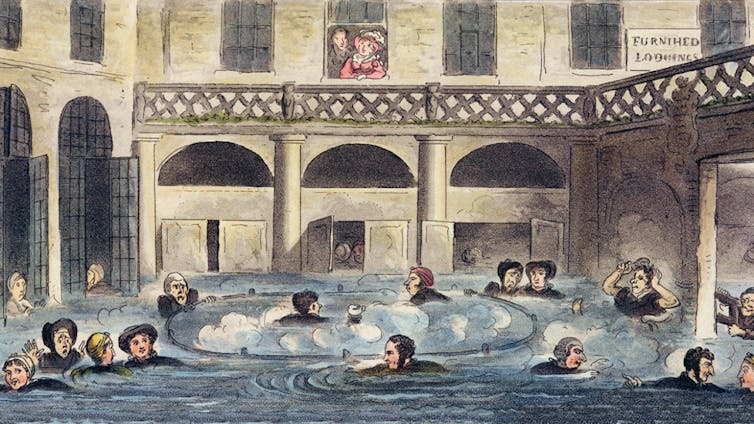
In England, Buxton and Tunbridge Wells developed in the 1620s and 1660s respectively, while Harrogate, Cheltenham and Leamington came in the 1710s, 1750s and 1790s. Historical survey’s place the number of spas and wells offering healing mineral waters at around 350 in the 18th-century heyday.

Spas like Bath, Buxton and the Bristol Hotwell were thermal, offering hot bathing. However, other spa sources in England were not heated. This meant that those who wished to bathe had to do so in the cold, which was both undesirable, and at that time, considered dangerous. This was due to fears that the English cold climate, when combined with bodily exposure to cold water, could disrupt bodily rhythms an cause illness.

People bathing at bath spa
Public Bathing at Bath, or Stewing Alive, by Isaac Cruikshank, 1825.
Wikimedia

As a result, many of the cold spas focused on offering health benefits through drinking their waters. When hailing the qualities of the newly discovered waters at Scarborough in 1660, Yorkshire doctor Robert Wittie declared they had “gained such credit” that people: “Come above an hundred miles to drink of it, preferring it to all other medicinal waters they had formerly frequented.”

He later described the health benefits he gained from drinking them:

I had lost two pound and a half of my weight… I found after it better agility of body, and alacrity of spirit then before.

In 1654, the doctor Edmund Deane had similarly described the effects of the waters of Knaresborough: “Those waters at the Spaw doe presently heal, and (as it were) miraculously cure diseases, which are without all hope of recovery.”

Testing the waters

As the number of spas grew, so did the options for consumers. As a result, the 18th century saw increasing attention and experimentation on mineral waters by scientists. Rather than questioning the health benefits, they instead compared waters to one another, experimenting on them to determine processes that produced and changed healing properties.

For example, British doctor George Turner, who translated and expanded upon a German work about the spa of Bad Pyrmont, in 1733. His work discussed experiments on the waters of the spa and the minerals that could be determined within. It noted that if left standing, the carbonated water lost its potency: “Whence it is, that so spiritous a liquid does so easily turn to a flat insipid water.”

He also suggested that boiling caused mineral waters to lose some invisible element important to its proper function. “Why so many globules of air arise out of mineral waters when it is warmed?” he asked, only to conclude that when “spirits fly out of any liquid” they go “incognito without any tumult”. As they “flew”, so too did whatever gave these waters healing properties, making chemical recreation in a lab impossible.

An early mineral water bottle.
An example of glass bottle that would have held English mineral water between 1801 to 1900.
The Board of Trustees of the Science Museum, CC BY-NC-ND

Historians of science have suggested that works like this foregrounded the concept of “gas”, which came more conclusively later in the century.

During experiments on the Scarborough waters, doctor Peter Shaw and natural scientist Stephen Hales each sought to determine the nature of the “subtle sulphurous spirit” in which they felt the “principal virtue of the Chalybeate (flavoured with iron) Waters resided”.

Similar experiments also involved extensive filtering, with physician John Nott in 1793 adding solutions to the waters of Italy’s Pisa and France’s Verdun before filtering them and performing further tests on “what remains in the filter”.

Scottish physician, Thomas Short, had concluded previously that filtering waters was both an important natural process. He described “the several strange alterations that water undergoes, by being strained through different strata of minerals”. But also that the body inherently filtered “raw” mineral waters through its skin when bathing, allowing only those smaller minerals in to provide the health effect, he claimed.

These scientists used their burgeoning chemical understanding to conclude that processes performed on waters fundamentally changed them, going from “spiritous” cures to “flat insipid water”. Even lacking the full knowledge or vocabulary to express why, they felt their processes and tools were incapable of recreating the waters of nature.

Legacies of these ideas can be seen in our changing attitudes to food and drink. Modern branding and consumer value is placed on a lack of processing. We are increasingly concerned with capturing and consuming the natural as it is, before human intervention has muddied it.

In so doing, we continue the ideas of those concerned with mineral waters all that time ago. By filtering their waters, no matter how little Perrier claim it affected them, we feel as though some spirit of the natural has perhaps been lost.


Looking for something good? Cut through the noise with a carefully curated selection of the latest releases, live events and exhibitions, straight to your inbox every fortnight, on Fridays. Sign up here.


The Conversation

Daniel Gettings does not work for, consult, own shares in or receive funding from any company or organisation that would benefit from this article, and has disclosed no relevant affiliations beyond their academic appointment.

ref. Is mineral water ‘natural’ if it’s filtered? The debate gripping France today has raged since the 18th-century – https://theconversation.com/is-mineral-water-natural-if-its-filtered-the-debate-gripping-france-today-has-raged-since-the-18th-century-263149

Young Europeans are losing faith in democracy – here’s how to earn it back

Source: The Conversation – UK – By Patricia Justino, Professor and Deputy Director, World Institute for Development Economics Research (UNU-WIDER), United Nations University

A recent Europe-wide survey has revealed an alarming picture: fewer than six in ten young Europeans believe that democracy is the best form of government. One in five say they would support authoritarian rule under certain circumstances. And only 6% believe their political system functions well.

This suggests something more than disillusionment: the foundational trust democracy relies on is eroding. Why are young people losing faith in democracy? And what will it take to restore it?

Trust in democracy begins with trust in its institutions: governments, courts and public services. When these institutions are seen as unresponsive, unaccountable or unfair, confidence in democracy falters.

The UN World Social Report 2025, which I co-authored, shows that institutional trust is declining globally. This shift is most pronounced among the young: according to latest available barometer data, over a quarter of those born in the 1990s report having no trust at all in their governments. This figure is around 17% for those over 65 years old. This is not a temporary dip. This is a generational shift in how citizens relate to power.

For many years, Europe seemed to defy this trend compared to other regions. Younger generations were more trusting of institutions than their elders. But that pattern has reversed. Today, they are more sceptical, more disillusioned – and more open to alternatives.

Why democracy feels broken

At the heart of this crisis lies inequality, insecurity and eroding trust.

First, persistent inequality widens social distances between social groups, fueling resentment and a belief that the system is rigged. While income inequality in Europe has not risen as sharply as elsewhere, this masks growing generational gaps. According to the IMF, incomes for working-age Europeans have stagnated since the 2007-08 financial crisis. Young people now have the lowest median incomes of any age group, even as pensioners’ incomes have grown.

Economic insecurity compounds the sense that wealth and opportunity are unequally distributed. Many young Europeans feel stuck, unable to afford housing, build stable careers or plan their futures. In the Young Europe 2025 survey, more than one-third say that ensuring affordable living costs should be a top political priority. Yet, the institutions meant to provide security and opportunity are often seen as ineffective and out of touch.

My research confirms that perceived inequality and insecurity are among the strongest predictors of distrust. When institutions fail to protect people from risk or deliver on promises, the social contract that underpins democracy unravels.

The generational bargain of progress is breaking down. Many young Europeans no longer believe democracy guarantees upward mobility or protects their dignity. This disillusionment has been compounded by the crises that have defined their coming of age: from the migrant crisis, the pandemic and climate anxiety to the war in Ukraine, these shocks have shaken faith in institutions’ ability to respond to uncertainty.

How to rebuild trust in democracy

Trust will not be restored by rhetoric alone. Democracy must prove it can deliver tangible results.

This means meeting the basic expectations of younger generations: affordable housing, decent work, a habitable planet and meaningful participation in political processes.

One of the most effective ways to rebuild trust is through universal, inclusive social protection. Where public services are seen as fair, accessible and reliable, trust in institutions tends to be stronger. Social protection is not just a safety net. It is a visible signal that the state works for everyone, not just the privileged few. Governments serious about restoring legitimacy should start here.

But protection must also be inclusive across generations. Across Europe, pension spending remains high while the programmes young people rely on – unemployment insurance, housing support, childcare – are often underfunded across European countries.

A young man looks dejectedly at a bill
Young people’s wages have stagnated, and many are struggling to afford housing or make ends meet.
fizkes/Shutterstock

Europe’s rapidly-aging population means younger generations will be outnumbered at the ballot box for the foreseeable future. Policies must consciously account for this disparity and ensure that the needs of young people are not sidelined.

Young Europeans are not rejecting democracy because they prefer authoritarianism. They are rejecting a version that feels unaccountable, unresponsive and unfair.

We have seen what happens when democratic decay goes unchecked: divisions deepen, civic space shrinks and authoritarianism takes root. Trust can be rebuilt. But it requires political courage, inclusive institutions and social protection systems that reflect young people’s realities. Democracy cannot run on nostalgia. It must prove that it works for everyone. Young people are asking to be taken seriously, to be heard, respected and given a stake in the future. We would do well to listen.

The Conversation

Patricia Justino does not work for, consult, own shares in or receive funding from any company or organisation that would benefit from this article, and has disclosed no relevant affiliations beyond their academic appointment.

ref. Young Europeans are losing faith in democracy – here’s how to earn it back – https://theconversation.com/young-europeans-are-losing-faith-in-democracy-heres-how-to-earn-it-back-261193