Cultivating for color: The hidden trade-offs between garden aesthetics and pollinator preferences

Source: The Conversation – USA (2) – By Claire Therese Hemingway, Assistant Professor of Ecology & Evolutionary Biology, University of Tennessee

Colorful gardens can be pollinator-friendly with native flowering plants. Borchee/E+ via Getty Images

People often prioritize aesthetics when choosing plants for their gardens. They may pick flowers based on colors that create visually appealing combinations and varieties that have bigger and brighter displays or more fragrant and pleasant-smelling flowers. Some may also choose species that bloom at different times in order to maintain a colorful display throughout the growing season.

Many gardeners also strive for ecological harmony, seeking to maintain pollinator-friendly gardens that support bees, butterflies, hummingbirds and other pollinators. But there are some notable ways in which the preferences of humans and pollinators have the potential to diverge, with negative consequences for pollinators.

As a cognitive ecologist who studies animal decision-making, I find that understanding how pollinators learn about and choose between flowers can add a helpful perspective to garden aesthetics.

Pollinator preferences and rewards

Over millions of years, plants have evolved suites of floral traits to attract specific types of pollinators.

A hummingbird with its beak inside a small, bright red flower with a narrow tube-like shape
Hummingbirds are attracted to and pollinate red, tubular flowers.
AGAMI stock/iStock via Getty Images Plus

Pollinators can be attracted to flowers based on color, pattern, scent and texture. For instance, hummingbirds typically visit bright red and orange flowers with narrow openings and a tubular shape. The striking red cardinal flower is one that is primarily pollinated by hummingbirds, for example.

Bees are often attracted to blue, yellow and white flowers that can be either narrow and tubular or open. Lavender, sage and sunflower plants all bear flowers that attract bee pollinators.

A bee perching on a lavender sprig with many small, purple flowers
Bees pollinate blue, purple, white and yellow flowers, such as the lavender flowers here.
Leila Coker/iStock via Getty Images Plus

Flowers offer rewards to visiting pollinators. Nectar is a sugar-rich solution that flowers produce to attract pollinators, which use it to meet their energy needs.

Flowers have an ulterior motive for providing this energy source. While drinking the nectar, pollen can get stuck on the pollinator and transferred to the next flower it visits. This process is essential for the plant’s reproductive success. Pollen contains the plants’ male gametes, which, when deposited onto another flower in the right place, can fertilize the female gametes and produce seeds that grow into new plants. Pollen is also nutrient-rich, containing proteins, lipids and amino acids. Many species, such as bees, collect pollen to feed their developing young.

A battle for resources

Pollinators visit flowers in search of floral rewards. But modifying the features of flowers for aesthetics can be a hindrance to pollinators trying to get these rewards. For example, popular garden plants such as roses and peonies are often bred to have more petals and larger flower heads, making them more visually striking and appealing to humans. But these extra petals may block a pollinator’s access to the center of the flower, where floral rewards are located.

Further, plants have limited resources. Spending them on building aesthetically pleasing but energetically expensive features can mean there’s less left to invest in signals and rewards essential for attracting pollinators. In extreme cases, breeding for aesthetics has led to plants with what scientists and gardeners call “double flowers.” In these varieties, extra petals replace reproductive parts entirely. These plants are often altogether unrewarding for pollinators, since the flowers no longer produce nectar or pollen. Double flowers occur from mutations that convert the pollen-producing stamens and other reproductive organs into petals. They can occur naturally but are rare in wild populations.

Since these double flowers cannot spread pollen or produce seeds effectively, they are unable to reproduce in the wild and pass these mutations on. To cultivate them as garden varieties, people propagate these plants through cuttings – small sections cut from the stem that can be rooted to grow clones of the parent plant. Many common garden plants have popular double-flowered varieties, including roses, peonies, camellias, marigolds, tulips, dahlias and chrysanthemums.

Roses, for example, have become synonymous with having many densely-packed petals. But these popular garden varieties are usually double-flowered or have many extra petals blocking access to the center of the rose and provide no rewards to pollinators.

Consider making your gardens friendlier to pollinators by avoiding these double-flowered plants, and ask your local garden center for recommended varieties if you need help.

Two pink flowers side by side, the left one has five petals, visible and accessible stamens in the center. The right one has many more petals packed densely, and no stamens visible
The five-petaled wild rose, left, is much better for pollinators than garden roses with double flowers and many more petals but no reproductive parts.
(L) Clara Nila/iStock and (R) Alex Manders/iStock via Getty Images Plus

Sometimes gardeners intentionally prevent plants from flowering, which limits or eliminates their value to pollinators.

For example, herbs such as thyme, oregano, mint and basil are generally most flavorful and tender before the plant begins to flower. Once it flowers, the plant diverts energy to reproductive structures, and leaves become tougher and lose flavor. As a result, gardeners often pinch off flower buds and harvest leaves frequently to promote continued growth and delay flowering. Letting some of your herbs flower occasionally can help pollinators without affecting your kitchen supplies too much.

Stems of a flowering basil plant with green leaves and tiny white flowers
Letting garden herbs such as basil flower can be beneficial to pollinators.
Rafael Goes/iStock via Getty Images Plus

Finding the right flowers

Flowers with unusual colors and stronger fragrances can be difficult for pollinators to detect and recognize.

People might favor bright and unusual flower colors in their gardens over naturally occurring shades. But this preference might not align with what the pollinators have evolved to favor in nature. For example, planting human-preferred colors, such as white or pink morphs of hummingbird-pollinated flowers that are typically red, can reduce a flower’s visibility and attractiveness. Even when cultivated varieties have a similar enough color to natural ones to attract pollinators, they may lack other important visual components, such as ultraviolet floral patterns that can guide pollinators to nectar sources.

Breeding plant varieties to accentuate particular aesthetic traits may have unintended consequences for other traits. Changes in flower color through selective breeding can also affect leaf color, as genes involved in pigment production can affect multiple plant tissues. Besides changing the overall appearance of the plant, changing leaf color may alter background contrast between flowers and the leaves, which can make flowers less conspicuous to pollinators.

Many pollinators use a combination of color and scent to detect and discriminate between flowers. But breeding for traits such as color and brightness can alter floral scents due to unintended genetic changes or energetic trade-offs.

Scent helps pollinators locate flowers from farther distances, so unfamiliar or reduced fragrance may make flowers harder to find in the first place. Disruption in either color or scent can make flowers less noticeable to pollinators expecting a familiar pairing and can hinder a pollinator’s ability to learn which flowers are suitable for them in the first place.

A balanced approach for healthy gardens

When flowers are harder to find, pollinators are less likely to visit them. When they offer poor or no rewards, pollinators quickly abandon them for better options. This disruption in plant-pollinator interactions has implications not only for pollinator health but also for garden vitality. Many plants rely on animal pollinators to reproduce and make mature seeds. These are either collected by gardeners or allowed to drop to the ground and sprout on their own to grow new flowering plants the following year.

A close-up of a bee covered in pollen on top of a yellow flower
Pollinators not only transfer pollen from flower to flower, they also gather pollen to feed their young.
John Kimbler/500px via Getty Images

When selecting plants for a garden, gardeners who want to support pollinators might consider choosing native varieties that have evolved alongside local pollinators.

In most areas of the country, there are native plants with colorful and interesting flowers that bloom at different times, from early spring to late fall. These plants tend to produce reliable floral signals and offer the nectar and pollen needed to support pollinator nutrition and development.

Sterile varieties and double flowers offer little or no rewards for pollinators, and gardens with them may not attract as many pollinators. Letting herbs flower after some harvesting is another simple way to support beneficial insects.

With choices informed by not just your aesthetic preferences but also those of pollinators, you can create colorful gardens that support wildlife and stay in bloom across various seasons.

The Conversation

Claire Therese Hemingway does not work for, consult, own shares in or receive funding from any company or organization that would benefit from this article, and has disclosed no relevant affiliations beyond their academic appointment.

ref. Cultivating for color: The hidden trade-offs between garden aesthetics and pollinator preferences – https://theconversation.com/cultivating-for-color-the-hidden-trade-offs-between-garden-aesthetics-and-pollinator-preferences-261631

Has extreme poverty really plunged since the 1980s? New analysis suggests not

Source: The Conversation – UK – By Jason Hickel, Professor at the Institute for Environmental Science and Technology, Autonomous University of Barcelona

oceanfishing/Shutterstock

Data from the World Bank suggests that extreme poverty has declined dramatically over the past four decades, from 47% of the world’s population in 1981 to around 10% today.

This narrative is based on the World Bank’s method of calculating the share of people who live on less than US$3 per day in 2021 prices. This is adjusted for general price differences between countries (what’s known as purchasing power parity, or PPP).

But a growing body of literature argues that the World Bank’s PPP-based method has a major empirical limitation. The problem is that it does not account for the cost of meeting basic needs in any given context. Having more than US$3 PPP does not guarantee that a person can afford the specific goods and services that are necessary for survival in a particular location.

In recent years, scholars have developed what they argue is a more accurate method for measuring extreme poverty. This is done by comparing people’s incomes to the prices of essential goods (specifically food, shelter, clothing and fuel) in each country.

This approach is known as the “basic needs poverty line” (BNPL), and it more closely reflects what the original concept of extreme poverty was intended to measure. There is robust data from household consumption surveys and consumer prices covering the period from 1980-2011.

The BNPL data indicates that the story of global poverty over the past few decades is more complex – and troubling – than the World Bank narrative suggests.

This data indicates that between 1980 and 2011, the global extreme poverty rate declined by only six percentage points, from 23% to 17%. During the same period, the number of people in extreme poverty actually increased, from 1.01 billion to 1.20 billion.

What’s more, the alleviation of poverty has not been steady. In the 1980s and 1990s, an additional one billion people were thrown into extreme poverty. This occurred during the period when market reforms were implemented across most of the global south (developing countries in Africa, Asia and Latin America), often under pressure from western-controlled financial institutions. There was improvement throughout the 2000s, but progress has ultimately been slow and shallow.

Rising food insecurity

Robust BNPL data does not exist after 2011. However, data from the UN Food and Agricultural Organization’s (FAO) surveys on food insecurity shows that the proportion of the world population without reliable access to food increased steadily during the past decade or so, going from 21% in 2014 to 30% in 2022.

This includes cases of severe food insecurity, which is associated with prolonged periods of hunger. The share of the world population suffering in this way has increased from 7.7% to 11.3%.

Given that secure access to food is central to the BNPL method, we may assume that post-2011 poverty trends have probably not improved much, if at all.

This has important implications for the United Nations’ millennium development goals. The first of these set out to halve the proportion of the world’s population living in extreme poverty between 1990 and 2015. But the data on basic-needs poverty and food insecurity indicates that this goal was probably not achieved.

Extreme poverty is not a natural condition, but a sign of severe dislocation. Data on real wages since the 15th century indicates that, under normal conditions, across different societies and eras, people are generally able to meet their subsistence needs except during periods of severe social displacement.

This includes crises like famine and war, and the institutionalised denial of resources to marginalised people, particularly under European colonialism.

What’s more, the BNPL data shows that many countries have achieved very low levels of extreme poverty, even where GDP per capita is not high. They have done this by using strategies such as public provisioning and price controls for basic essentials.

This is consistent with previous research that found that these strategies can enable better social outcomes at any level of income.

In fact, research shows that the world economy already has enough productive capacity to eliminate global poverty many times over. Indeed it is possible not only to eliminate extreme poverty, but also to eliminate deprivation at much higher thresholds.

With these levels of production, we could ensure universal access to healthcare, education, modern housing, sanitation systems, electricity, clean cooking stoves, refrigeration, mobile phones, internet, computers, transport, household appliances and other necessities for decent living standards, for more than eight billion people.

The fact that poverty persists at such high levels today indicates that severe dislocation is institutionalised in the world economy – and that markets have failed to meet the basic needs of much of humanity.

Ending extreme poverty is the first objective of the UN’s sustainable development goals. The world economy has the resources and productive capacity to realise this goal – and more. But achieving it will require organising production to guarantee universal access to the specific goods and services that people need to live decent lives.

The Conversation

Jason Hickel receives funding from European Research Council (ERC-2022-SYG reference number 101071647).

Dylan Sullivan receives funding from European Research Council (ERC-2022-SYG reference number 101071647).

Michail Moatsos receives funding from UKRI.

ref. Has extreme poverty really plunged since the 1980s? New analysis suggests not – https://theconversation.com/has-extreme-poverty-really-plunged-since-the-1980s-new-analysis-suggests-not-261144

Canada and the U.K.’s conditional recognition of Palestine reveals the uneven rules of statehood

Source: The Conversation – Canada – By Catherine Frost, Professor of Political Science, McMaster University

Canada and the United Kingdom have said they will recognize Palestinian statehood during the United Nations General Assembly in September, provided certain conditions are met.

Canada’s position is premised on seeing political and military reform from the Palestinian Authority, the governing body responsible for the autonomous Palestinian territories.

The U.K., responding to a severe food crisis in Gaza, said it would extend recognition unless the Israeli government agrees to a ceasefire, takes steps to “end the appalling situation in Gaza” and commits to a “long-term, sustainable peace.”


Read more:
Why UK recognition of a Palestinian state should not be conditional on Israel’s actions


These cautious, conditional endorsements reflect the workings of a dated international system that governs the birth of states. France, by contrast, has opted to recognize Palestine without conditions. What explains these different approaches?

Officially, state recognition is governed by international law. In practice, it is subject to a complex mix of national, global and moral considerations.

This process grants existing states significant discretion in recognizing new ones, with the expectation that such decisions serve international peace. But this can result in an uneven statehood process for aspiring nations.

How states are born

The 1933 Montevideo Convention outlines the core criteria for statehood recognition: a permanent population, control over a defined territory, a functioning government and the capacity to open relations with other states.

When recognition is given on this basis, it is essentially acknowledging that these qualities are already in place. Yet these requirements are not iron clad, and some experts have argued that recognition can also be extended on humanitarian or moral grounds, such as in response to human rights violations.

In such cases, recognition becomes more of a statement that a state should have the opportunity to exist, rather than a confirmation that it already does. The classic case would be a group facing colonial domination. The American colonies appealed to this principle in the 1776 Declaration of Independence, for example.

Because individual states decide when such exceptions apply, these measures provide uncertain relief for aspiring nations.

As a final step, new states can apply for membership in the UN. This application is first considered by the UN Security Council. If nine states agree, and none of the council’s permanent members object, the application continues to the UN General Assembly for approval.

But a single veto from any of the five permanent members — China, France, Russia, the U.K. and the United States — can paralyze statehood at the start. In 2024, for example, the U.S. vetoed Palestine’s request for full UN membership.

Statehood in waiting

To date, 147 of 193 states in the United Nations recognize Palestinian statehood. Palestine has also had special observer status at the UN since 2012, and before that it had limited standing before international courts typically reserved for states.

But Palestine is not the only instance where the international system has struggled to address atypical or contested statehood.

After a wave of recognitions in post-colonial Africa and post-Second World War Europe, the recognition of new states slowed to a crawl toward the end of the 20th century. This trend suggests there is a conservative quality to the recognition system.

Wary of rewarding violent separatism, international bodies have traditionally favoured negotiated solutions for state birth, including upholding a parent-state veto over any independence efforts.

This principle was most clearly articulated by the Canadian Supreme Court in a 1998 advisory opinion. It warned that an independent Québec, without first agreeing on terms of exit with the rest of Canada, was unlikely to gain international recognition.

There is wisdom to this approach, but such rules cannot prevent political breakdown in every case. A growing number of unrecognized states have left millions stranded in political limbo.

This includes Somaliland, which split from Somalia in 1991 and has been operating as a de facto state ever since without receiving formal recognition from any other country.

Palestine is not an instance of state breakup, but rather an unresolved case of colonization and occupation. Decades of negotiations with Israel, the occupying power, have failed. Yet formal statehood has still proven elusive. A cumbersome recognition system may be helping to keep the problem alive.

Cracks in the system

Even when recognition occurs, the results can be disappointing.

South Sudan, the UN’s newest member, was universally recognized in 2011 under close UN supervision and with the consent of its parent state, Sudan. Yet it quickly descended into civil war — a conflict it has yet to fully emerged from.

Kosovo was recognized by states like the U.S. and Canada when it declared independence in 2008 following the breakup of Yugoslavia, but it still has fewer recognitions than Palestine.

A handful of states like Togo and Sierra Leone even began de-recognizing it under pressure from Kosovo’s one-time parent state, Serbia, although there is a broadly accepted principle that once a state is recognized, barring any complete disaster, it should remain recognized.

Meanwhile, rising sea levels threaten to leave some island states like Tuvalu without the territorial requirements for normal statehood. The International Court of Justice has signalled the statehood of such nations should survive, but has not said how.


Read more:
The Australia-Tuvalu deal shows why we need a global framework for climate relocations


These examples suggest the current state recognition system is ill equipped to face today’s changing world.

Allowing established states to set the rules for who qualifies is unlikely to solve these current problems. While setting special terms for new entrants may have value in the short term, the longer term need is for a more fair and transparent system.

Experts are working on ways to make the system more inclusive for aspiring states and unrepresented peoples, including by opening up access to diplomatic venues. If successful, these measures could change the way future states are born.

The Conversation

Catherine Frost receives funding from the Social Sciences and Humanities Research Council of Canada.

ref. Canada and the U.K.’s conditional recognition of Palestine reveals the uneven rules of statehood – https://theconversation.com/canada-and-the-u-k-s-conditional-recognition-of-palestine-reveals-the-uneven-rules-of-statehood-262418

Trump extiende la alfombra roja a los pies de Putin: ¿en qué situación deja esto a Ucrania?

Source: The Conversation – (in Spanish) – By Matthew Sussex, Associate Professor (Adj), Griffith Asia Institute; and Fellow, Strategic and Defence Studies Centre, Australian National University

La extraña cumbre entre Donald Trump y Vladimir Putin en Alaska debería convencer a todos, salvo a los más crédulos, de que la Casa Blanca está más interesada en mantener relaciones amistosas con el dictador ruso que en lograr una paz duradera en Ucrania.

Los dos líderes, que concluyeron la reunión antes de lo previsto, se prodigaron elogios mutuos en una rueda de prensa en la que no hubo preguntas de los medios de comunicación.

Es inquietante que Trump siga tan poco preocupado por conceder victorias simbólicas a Putin y tan poco dispuesto a ejercer una presión real sobre el líder ruso.

“Victorias” simbólicas para Putin

El lugar elegido era revelador. Rusia lleva mucho tiempo quejándose de que Alaska, que vendió a Estados Unidos en la década de 1860, sigue siendo legítimamente su territorio. Antes de la reunión, los portavoces del Kremlin hicieron hincapié en que el equipo de Putin había tomado un “vuelo nacional” a Anchorage, recordando las vallas publicitarias que se colocaron en Rusia en 2022 proclamando “¡Alaska es nuestra!”. Su mensaje se reforzó con una metedura de pata de Trump previa a la reunión, cuando dijo que “volvería a Estados Unidos” si no le gustaba lo que oía.

Cuando aterrizó el avión de Putin, el personal militar estadounidense se arrodilló para colocar una alfombra roja por la que caminó el presidente ruso, tratándole como un líder respetado en lugar de como un criminal de guerra acusado. A continuación, Putin fue invitado a acompañar a Trump en su limusina.

Más allá de la imagen sobre la alfombra roja, Trump concedió a Putin otras victorias que muestran al mundo que las relaciones entre Estados Unidos y Rusia se han normalizado.

Para empezar, una cumbre suele ofrecerse como un favor, una muestra de un deseo sincero de mejorar las relaciones. Al invitarlo a Alaska, Trump le dio a Putin un escenario para reunirse con el presidente estadounidense en pie de igualdad.

No hubo críticas a los atroces abusos contra los derechos humanos cometidos por Rusia, a sus intentos cada vez más violentos de fragmentar la alianza transatlántica. Muy al contario, Trump volvió a presentar a Putin y a sí mismo como víctimas. Se quejó de que ambos se habían visto obligados a “aguantar el engaño de ‘Rusia, Rusia, Rusia’”, según el cual Moscú habría interferido en las elecciones presidenciales estadounidenses de 2016.

Finalmente, el presidente estadounidense volvió a poner la responsabilidad de aceptar las condiciones rusas para poner fin a la guerra en Ucrania en manos del Gobierno ucraniano y de Europa, asegurando que “en última instancia, depende de ellos”.

Putin consiguió exactamente lo que esperaba, enmarcando cualquier solución al conflicto en torno a las “causas profundas”. Es decir, del encuentro entre Putin y Trump se deduce que la culpa es de la OTAN.

Para colmo, las perspectivas de sanciones estadounidenses se diluyeron, y Trump volvió a su estribillo habitual de necesitar “dos semanas” para volver a pensar en ellas. Finalmente, tras haberse embolsado una bonanza tanto simbólica como diplomática, Putin se saltó rápidamente el almuerzo y voló a casa, presumiblemente acompañado también por el adorno de águila americana calva que Trump le había regalado.

¿Qué significa esto de cara al futuro?

Tras la posterior llamada de Trump a los líderes europeos para informarles sobre la cumbre, comenzaron a filtrarse detalles sobre una propuesta de paz.

Según se informa, Putin está dispuesto a fijar las líneas del frente tal y como están en las regiones de Jersón y Zaporizhia, en Ucrania, siempre que Kiev acepte ceder todo Lugansk y Donetsk, incluidos los territorios que Rusia no controla actualmente. No habría un alto el fuego inmediato (que es lo que prefieren Europa y Ucrania), sino un avance hacia una paz permanente, lo que se ajusta a los intereses del Kremlin.

No nos equivoquemos: se trata de una trampa apenas disimulada. No es más que un intento de Putin y Trump de lanzar un hueso a Ucrania y Europa, para luego culparles de rezagados y belicistas cuando se opongan.

Por un lado, Ucrania sigue controlando una parte considerable de Donetsk. Renunciar a Donetsk y Lugansk no solo supondría ceder a Moscú las reservas de carbón y minerales, sino también abandonar posiciones defensivas vitales que las fuerzas rusas llevan años sin poder romper. También situaría a Rusia en una posición favorable para lanzar posibles incursiones futuras, abriendo el camino hacia Dnipro, al oeste, y Járkov, al norte.

El aparente respaldo de Trump a las demandas de Rusia de que Ucrania ceda territorio a cambio de la paz –que los miembros europeos de la OTAN rechazan– significa que Putin está logrando fracturar aún más la alianza transatlántica.

Tampoco se ha mencionado quién garantizaría la paz, ni cómo se puede asegurar a Ucrania que Putin no aprovechará el respiro para rearmarse e intentarlo de nuevo.

Dado que el Kremlin se ha opuesto a la adhesión de Ucrania a la OTAN, ¿aceptaría realmente que las fuerzas europeas garantizaran la nueva línea de control? ¿O las estadounidenses? ¿Se permitiría a Ucrania rearmarse y en qué medida?

Incluso en el caso de que Estados Unidos adoptara una postura más firme en una futura era post-Trump, Putin habría conseguido una apropiación de territorio imposible de revertir. Esto, a su vez, refuerza el mensaje de que la conquista “sale rentable”.

Un detalle aparentemente más positivo para Ucrania es el indicio de que Estados Unidos está dispuesto a ofrecerle una garantía de seguridad “no OTAN”. Pero esto también debe considerarse con cautela. La Administración Trump ya ha expresado públicamente su ambivalencia sobre los compromisos de Estados Unidos de defender a Europa a través del artículo 5 de la OTAN, lo que ha puesto en duda su credibilidad como aliado. ¿Lucharía realmente Estados Unidos por Ucrania si se produjera una futura invasión rusa?

Hay que reconocer que los líderes europeos han respondido con firmeza a las negociaciones de Trump con Putin. Han acogido con satisfacción el intento de resolver el conflicto, pero han comunicado al presidente ucraniano Volodymyr Zelensky que seguirán apoyándolo si el acuerdo es inaceptable. Zelensky, que se reunirá con Trump en Washington el lunes, ya ha rechazado la idea de ceder la región de Donbás (Donetsk y Lugansk) a Rusia.

Europa tendrá que afrontar que no solo debe involucrarse más, sino que también le corresponde ejercer un liderazgo sostenido en cuestiones de seguridad, en lugar de limitarse a reaccionar ante las repetidas crisis.

Las motivaciones más profundas de Trump

En última instancia, la cumbre de Alaska demuestra que la paz en Ucrania es solo una parte del panorama general de la Administración Trump, que se ha propuesto lograr unas relaciones más cordiales con Moscú, si no una alineación total con ella.

En ese sentido, a Trump le importa poco cómo se logre la paz en Ucrania o cuánto tiempo dure. Lo importante es que se le reconozca el mérito, si no el Premio Nobel de la Paz que tanto ansía.

Y aunque la visión de Trump de separar a Rusia de China es una fantasía, no deja de ser una fantasía que ha decidido alimentar. Eso, a su vez, obliga a los socios europeos de Estados Unidos a responder en consecuencia.

Por otro lado, ya hay muchas pruebas de que, tras haber fracasado en la guerra comercial con China, la Administración Trump ha decidido ahora cebarse con los aliados de Estados Unidos. Lo vemos en su obsesión por los aranceles, en su deseo de castigar a la India y Japón, y en el deterioro del poder blando de Estados Unidos.

The Conversation

Matthew Sussex ha recibido financiación del Consejo Australiano de Investigación, el Consejo Atlántico, la Fundación Fulbright, la Fundación Carnegie, el Instituto Lowy y diversos departamentos y organismos gubernamentales australianos.

ref. Trump extiende la alfombra roja a los pies de Putin: ¿en qué situación deja esto a Ucrania? – https://theconversation.com/trump-extiende-la-alfombra-roja-a-los-pies-de-putin-en-que-situacion-deja-esto-a-ucrania-263345

Loi Duplomb, transition énergétique… et si les citoyens reprenaient la main ? Leçons du succès de la campagne « Décarbonons la France »

Source: The Conversation – in French – By Sophie Renault, Professeur des Universités en Sciences de Gestion et du Management, Université d’Orléans

La campagne « Décarbonons la France » a été lancée à l’initiative du Shift Project. ©Jérémy Garcia–Zubialde, Fourni par l’auteur

En résonance avec la récente mobilisation citoyenne contre la loi Duplomb, la campagne de financement participatif « Décarbonons la France » révèle une autre forme d’engagement, tournée vers l’élaboration de solutions et la mise en œuvre d’un projet collectif. Elle témoigne des mutations à l’œuvre dans les modalités de participation citoyenne et du rôle croissant des plateformes numériques. Décryptage du succès record de cette campagne.


Lancée le 13 mai 2025, la campagne « Décarbonons la France » portée par le think tank The Shift Project a suscité une mobilisation exceptionnelle sur la plateforme Ulule. En l’espace de quelques semaines ont été récoltés 4 634 968 euros (sur un objectif de 300 000 euros) de la part de 36 552 contributeurs. Il s’agit de la campagne de financement participatif de don avec contreparties (reward-based crowdfunding) la plus soutenue de l’histoire européenne. Ce record était précédemment détenu par le youtubeur Tev – Ici Japon avec le projet Odyssée ayant pour ambition d’ouvrir le plus grand musée du jeu vidéo.

L’objectif de la campagne « Décarbonons la France » est clair : formuler des propositions concrètes pour organiser la transition énergétique et peser sur l’agenda politique en vue de l’élection présidentielle de 2027. Il s’agit plus précisément de répondre à l’urgence climatique « en planifiant une sortie progressive, mais déterminée des énergies fossiles ».


À lire aussi :
Crowdfunding : 10 ans plus tard, vous aussi, financez votre salade de pommes de terre !


Cette campagne interroge les clés de réussite et les enjeux du financement participatif. Loin de se limiter à un simple mode de levée de fonds, elle témoigne d’une évolution vers un crowdfunding citoyen, orienté vers l’activation d’un engagement collectif.

Soutien citoyen à un projet de transition

Alors que le financement participatif est régulièrement associé aux projets créatifs, culturels ou entrepreneuriaux, son évolution vers des finalités civiques est de plus en plus manifeste. Le cas « Décarbonons la France » en est la parfaite illustration. Il s’agit ici de contribuer à la diffusion d’un projet de société et d’alimenter la réflexion individuelle et collective sur la transition énergétique.

Les sources de motivation des contributeurs vont, dès lors, bien au-delà de l’intérêt personnel ou symbolique. Il ne s’agit pas simplement de recevoir une contrepartie, parmi lesquelles un exemplaire du livre présentant le programme d’action du Shift Project pour 2027 ou l’invitation à un webinaire en présence de Jean-Marc Jancovici ou bien encore de bénéficier du dispositif de défiscalisation.

L’analyse qualitative des commentaires collectés sur la plateforme Ulule témoigne de la volonté des contributeurs de s’associer à un projet perçu comme nécessaire, lucide et porteur de sens collectif. Comme le formule l’un des contributeurs :

« On sort enfin des débats idéologiques et dogmatiques pour aborder les problèmes liés au changement climatique de manière plus factuelle et scientifique. »

Ce soutien financier s’accompagne ainsi d’une adhésion à une démarche qu’ils considèrent comme rigoureuse, pédagogique et émancipatrice. Un autre contributeur exprime en ces termes les raisons de son implication :

« Pour un réel projet instruit, construit et initié par des citoyens conscients. »

L’acte de contribuer devient une manière de prendre part à un effort de clarification du débat public autour de la transition écologique.

Un levier d’organisation collective

La réussite de cette campagne repose également sur la cohérence entre le fond du projet et ses modalités de déploiement. Les contributeurs ne sont pas seulement des financeurs. Ils sont sollicités comme relais, médiateurs, participants à une dynamique collective.

Cette dimension collective est renforcée par les supports mis à disposition de chacun au sein d’un kit de communication. La pluralité des contreparties permettant d’accéder aux statuts de citoyen « solidaire » (20 euros), « enchanté » (50 euros), « investi » (100 euros), « mobilisé » (300 euros), « déterminé » (1 000 euros) ou bien encore « conquis » (2 000 euros) témoigne d’une volonté d’engager les contributeurs dans une logique d’essaimage.

La campagne s’ouvre également aux entreprises, dont la participation contribue à élargir l’impact de cette mobilisation collective. La plateforme Ulule devient alors un dispositif de coordination horizontale, où l’adhésion passe par l’appropriation du message et sa transmission au sein des cercles respectifs des contributeurs, particuliers ou entreprises.

The Shift Project 2025.

À travers ces différentes formes, le financement participatif tend à devenir un outil de mobilisation de la foule, susceptible de contourner certains blocages institutionnels ou économiques en donnant aux citoyens la possibilité de financer directement des projets jugés socialement ou politiquement nécessaires.

Ce mode d’engagement n’est ni un substitut aux institutions représentatives ni une simple alternative aux canaux classiques de financement. Le succès de la campagne « Décarbonons la France » ne repose pas seulement sur une stratégie de communication efficace. Il révèle une disposition sociale croissante à soutenir des projets à forte valeur collective, dès lors qu’ils sont porteurs de sens et offrent une lisibilité sur leurs objectifs et une transparence sur l’usage des ressources.

Alors que la pétition contre la loi Duplomb cristallise une prise de conscience face aux reculs environnementaux, la campagne « Décarbonons la France » montre que les citoyens peuvent aussi investir les plateformes pour proposer, pour structurer et pour financer une trajectoire écologique alternative.

Plus qu’un levier technique, le crowdfunding citoyen apparaît comme une forme renouvelée de participation démocratique, ancrée dans le soutien éclairé à des projets porteurs de transformations sociales. En cela, il offre un espace pour articuler don, engagement et diffusion d’une vision collective.

The Conversation

Sophie Renault ne travaille pas, ne conseille pas, ne possède pas de parts, ne reçoit pas de fonds d’une organisation qui pourrait tirer profit de cet article, et n’a déclaré aucune autre affiliation que son organisme de recherche.

ref. Loi Duplomb, transition énergétique… et si les citoyens reprenaient la main ? Leçons du succès de la campagne « Décarbonons la France » – https://theconversation.com/loi-duplomb-transition-energetique-et-si-les-citoyens-reprenaient-la-main-lecons-du-succes-de-la-campagne-decarbonons-la-france-260020

Comment la Chine remodèle le paysage médiatique en Afrique

Source: The Conversation – in French – By Daouda Cissé, chercheur, Université Gaston Berger

Au-delà de sa présence dans le financement et la construction d’infrastructures, ainsi que dans le secteur des mines, la Chine est en train de remodeler discrètement le paysage de l’information, des médias, et des TIC en Afrique. Pékin utilise ses médias d’État, ses entreprises de télécommunications et son infrastructure numérique pour promouvoir ses récits, exporter ses normes et pratiques autoritaires, et renforcer le contrôle sur les flux d’information à travers le continent. Cette influence croissante soulève des questions urgentes sur la censure, la surveillance et l’avenir de la gouvernance démocratique en Afrique.

En injectant de l’argent et de la main-d’œuvre dans les secteurs des médias et du numérique en Afrique, la Chine ne se contente pas d’exporter des technologies ou de former des partenariats. Elle exporte également une façon de voir le monde, qui s’aligne étroitement sur la vision politique de Pékin.

Des collaborations avec les médias d’État au déploiement des technologies chinoises de télécommunications et de surveillance, la Chine est ainsi en train de remodeler la manière dont l’information est produite, partagée et contrôlée sur le continent. Le monde doit s’intéresser de plus près à la manière dont cela se produit, car c’est vraiment important.

Mes recherches explorent, entre autres, l’économie politique sino-africaine, englobant commerce, investissements et stratégie des entreprises.
Dans un récent article, j’explique la stratégie d’influence de la Chine dans le secteur des médias en Afrique, afin de diffuser un récit conforme à sa vision politique et exercer un contrôle sur les flux d’information sur le continent. J’explore également les risques encourus par les pays africains.

L’influence des médias aux caractéristiques chinoises

Les médias d’État chinois tels que la télévision CGTN, l’agence Xinhua et le quotidien China Daily sont désormais monnaie courante dans les espaces médiatiques africains. Ils font désormais partie du paysage médiatique africain. Ils ne se contentent pas de diffuser des informations sur la Chine vues par le prisme chinois en Afrique. Ils les adaptent aux publics locaux, parfois dans les langues locales, et souvent par le biais de partenariats avec des médias africains.

Mais il ne s’agit pas seulement d’échanges culturels. Ces partenariats contribuent à promouvoir les récits préférés de la Chine et à décourager toute couverture médiatique critique. Dans certains cas, des représentants ou des mandataires du parti communiste chinois supervisent eux-mêmes les décisions éditoriales. Ils encouragent les journalistes, tant chinois qu’africains, à s’autocensurer et à s’aligner sur les messages de Pékin.

En Afrique du Sud par exemple, un journaliste qui travaillait avec Independent Media (le deuxième plus grand groupe médiatique sud-africain partiellement contrôlé par des investisseurs chinois) a été limogé parce qu’il avait dénoncé et condamné, dans une de ses chroniques, la persécution des populations musulmanes Ouïghours en Chine.

Il existe également des accords de partage de contenus qui inondent les plateformes médiatiques africaines d’articles chinois, présentant souvent la Chine comme un partenaire bienveillant et un sauveur économique. Et lorsque des journalistes africains publient des articles critiquant la conduite de la Chine, que ce soit dans le domaine de l’exploitation minière, de la gouvernance ou de la dette, les médias et les diplomates de Pékin ne tardent pas à répliquer.

Nous assistons ainsi à l’émergence d’un écosystème médiatique façonné par un modèle de communication descendant, où le contrôle de l’État et la diffusion de messages stratégiques remplacent la liberté de la presse et l’esprit critique.

Une route de la soie numérique à vocation autoritaire

La « Route de la soie numérique » lancée par la Chine joue un rôle important dans cette histoire. Cette initiative, qui découle de l’initiative « la Ceinture et la Route » (Belt and Road Initiative, BRI), vise à mettre en place des infrastructures numériques dans les pays du Sud, qu’il s’agisse de câbles à large bande, de centres de données, de technologies pour les villes intelligentes ou de plateformes de commerce électronique.

Or, si la technologie est brillante et utile, elle est souvent assortie de conditions.

Les géants chinois des télécommunications, tels que Huawei et ZTE, ont construit d’importants réseaux de TIC dans toute l’Afrique. Dans de nombreux pays, ils contribuent également à la mise en place de systèmes de surveillance et de projets de « villes sûres » (Konza Technology City au Kenya, Diamniadio Smart City au Sénégal, Kigali Innovation City au Rwanda, entre autres) qui peuvent être utilisés pour surveiller les citoyens, étouffer la dissidence ou même couper l’accès à l’internet pendant les périodes d’élections et les manifestations.

En Ouganda par exemple la Chine à travers ses compagnies de télécommunications a offert son assistance technique au gouvernement pour surveiller et contrôler les réseaux sociaux. Ce qui soulève des inquiétudes quant à la liberté d’expression. Durant les élections de 2021 une coupure totale d’internet a eu lieu.

Ce modèle de gouvernance numérique, parfois appelé « autoritarisme numérique », a été adopté avec enthousiasme par certains gouvernements africains, en particulier ceux qui ont des tendances autoritaires. Il offre des outils permettant de contrôler le discours public, d’annihiler l’opposition et de collecter des données avec un minimum de surveillance.

Et comme de nombreux pays africains ne disposent pas encore de lois strictes sur la protection des données, les entreprises chinoises (et leurs clients gouvernementaux locaux) rencontrent peu de résistance lorsqu’elles collectent et utilisent ces informations personnelles.

Le gouvernement central chinois n’est pas le seul à exercer cette influence. Les gouvernements provinciaux, les villes et même les entreprises privées chinoises, soutenues par les autorités régionales, participent à ce mouvement. De nombreuses villes africaines ont signé des accords de « jumelage » avec des municipalités chinoises.

À première vue, ces accords portent sur les échanges culturels et la coopération économique. Cependant, ils constituent également un vecteur d’influence, permettant à la Chine de façonner les récits locaux, d’introduire des outils de surveillance et de normaliser son modèle politique au niveau des villes à travers le continent.

Certaines provinces chinoises ont aidé des entreprises privées à s’aventurer sur les marchés africains en leur offrant des subventions et un soutien politique. Ces entreprises s’alignent souvent sur les objectifs de Pékin, renforçant l’image de la Chine en tant que partenaire fiable et promouvant des technologies qui dupliquent les systèmes de contrôle nationaux de la Chine.

Pourquoi c’est important

Au cœur de tout cela se trouve ce que les responsables politiques chinois appellent le « pouvoir discursif » ou une influence internationale accrue, c’est-à-dire la capacité à influencer la façon dont les gens pensent et parlent de la Chine. En Afrique, Pékin veut être perçu comme un ami et non comme une menace. La Chine veut que son modèle de gouvernance apparaisse comme moderne et efficace, et non comme autoritaire et coercitif.

Pour y parvenir, elle utilise les médias et les TIC non seulement comme infrastructures, mais aussi comme outils de domination narrative. Pékin amplifie les histoires positives, minimise les critiques et encourage les gouvernements africains à adopter ses outils et ses normes de gouvernance politique et digitale.

Cette approche est à la fois stratégique et systématique. Elle implique des acteurs étatiques et non étatiques, des ministères du gouvernement central, et des gouvernements provinciaux, des journalistes et des ingénieurs. Et elle est déjà en train de changer la façon dont l’information circule – et qui la contrôle – dans une grande partie de l’Afrique.

La ligne de fond

L’influence de la Chine en Afrique ne se limite plus au financement et à la construction d’infrastructures. C’est aussi une question d’information. En investissant massivement dans des partenariats médiatiques et des infrastructures numériques, Pékin contribue ainsi à remodeler le paysage des médias et de la gouvernance en Afrique.

Pour les gouvernements et les sociétés civiles d’Afrique, cela soulève des questions dont il faut se saisir urgemment.

Comment peuvent-ils bénéficier des investissements chinois sans compromettre la liberté de la presse, la confidentialité des données ou les valeurs démocratiques dans leurs pays ? Comment protéger leur espace d’information d’une réécriture discrète par des puissances étrangères ? Ces questions méritent un débat public plus large. La technologie ne suffit pas pour y répondre.

The Conversation

Daouda Cissé does not work for, consult, own shares in or receive funding from any company or organisation that would benefit from this article, and has disclosed no relevant affiliations beyond their academic appointment.

ref. Comment la Chine remodèle le paysage médiatique en Afrique – https://theconversation.com/comment-la-chine-remodele-le-paysage-mediatique-en-afrique-262960

La dynastie Wendel : onze générations d’acier, de 1704 à aujourd’hui

Source: The Conversation – in French – By Hervé Joly, Directeur de recherche histoire contemporaine, CNRS, Laboratoire Triangle, Université Lumière Lyon 2

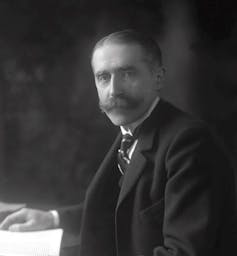
Buste de Charles de Wendel de 1873 par Anatole de Vasselot (1840-1904), devant la mairie de Stiring-Wendel, près de Forbach, en Moselle. Wikimediacommons

Durant trois siècles, les Wendel ont été les plus puissants barons de l’acier en France. Cette famille incarne, au-delà de la prétendue loi des trois générations – « la première crée, la deuxième développe, la troisième la ruine » –, la quintessence de la réussite du capitalisme familial. Quelle continuité peut-on leur accorder depuis 1704 ? Une chose est certaine, les 1 300 descendants se partagent 1,5 milliard d’euros en 2025.


L’entreprise Wendel fait remonter son histoire à 1704, avec l’acquisition par Jean-Martin Wendel (1665-1737) des forges d’Hayange – et de la seigneurie associée qui a permis son anoblissement. Elle est ainsi, après Saint-Gobain, l’une des plus anciennes grandes firmes françaises.

Encore plus rare, la firme est toujours contrôlée par la famille fondatrice, qui détient, à travers sa société de portefeuille Wendel-Participations SE, 39,6 % du capital. Avec 1,5 milliard d’euros, elle est la 89ᵉ fortune professionnelle française.

Si elle n’est plus présente à la direction opérationnelle de Wendel, la famille détient toujours, aux côtés de deux représentants des salariés et de quatre administrateurs indépendants, la moitié des sièges au conseil de surveillance. Ce dernier est présidé par un représentant de la dixième génération des descendants de Jean-Martin, Nicolas ver Hulst ; l’un des membres s’appelle même Humbert de Wendel.

Dans « La survivance d’une dynastie familiale sans la sidérurgie : les Wendel (1977-2017) » (in l’Industrie entre Méditerranée et Europe, édité par Mauve Carbonell, Presses universitaires de Provence, 2019, pp.65-77), j’ai retracé l’histoire singulière des dernières générations, en la complétant par le travail de l’historien Jacques Marseille, Les Wendel, 1704-2004 (éditions Perrin, 2004), sur les premières.

Famille d’acier

Le groupe Wendel est sorti en 1978 de son activité traditionnelle, la sidérurgie lorraine. L’État a pris le contrôle, à travers des banques publiques, de son principal actif, Sacilor, la nationalisation formelle n’intervenant qu’après l’arrivée de la gauche au pouvoir, en 1982.

La diversification, que la société fait remonter à 1977, est en fait bien plus ancienne.

Le 8 mai 1704, Jean-Martin Wendel, ancien officier de Louis XIV, achète pour une faible somme une forge en mauvais état, la Rodolphe, à Hayange, en Lorraine, qu’il a bien relancé avec d’autres acquisitions. Le fils Charles (1708-1784) développe l’affaire, encore modeste, héritée de son père avec cinq forges en Lorraine et double les actifs industriels. Le petit-fils François-Ignace (1741-1795) constitue un groupe considérable, qui intégrait par fusion la fonderie du Creusot (Saône-et-Loire) et celle d’Indret (Loire-Atlantique), des mines de fer et même la cristallerie royale de Sèvres (aujourd’hui dans les Hauts-de-Seine).

Une page s’ouvre avec Marguerite de Wendel, surnommée « la dame du fer », de 1718 à 1802, qui traverse les crises grâce à un caractère aussi trempé que l’acier.

Guerres franco-allemandes

La famille Wendel symbolise les guerres franco-prusiennes puis allemandes de 1870, de 1914-1918 et de 1939-1945.

En 1834, elle est la 9e entreprise française par sa production. En 1870, elle est devenue la première. La défaite militaire la divise entre Lorraine française et allemande, mais la famille Wendel conserve le contrôle, avec des sociétés distinctes, dans les deux parties. L’essentiel de la famille reste français, mais Henri (1844-1906), demeuré à Hayange annexée, devient député de Thionville au Reichstag. Les activités sont beaucoup développées en Lorraine française, du côté de Jœuf, mais la famille emploie, à la veille de la Grande Guerre, 20 000 personnes en Lorraine allemande, ce qui nourrit des accusations de trahison nationale.

François de Wendel (1874-1949).
Wikimediacommons

Un autre François de Wendel (1874-1949), devenu chef de la famille et élu député de Meurthe-et-Moselle en 1914, rétablit l’équilibre. Il devient président du puissant Comité des forges en 1918 et assure la reconstitution de l’ensemble après le retour de la Moselle à la France. En 1929, la Maison de Wendel emploie 40 000 personnes. Elle est au premier rang des entreprises françaises par capitaux propres en 1932. La Seconde Guerre mondiale constitue une nouvelle épreuve, mais, privée par les Allemands du contrôle de ses affaires lorraines, la famille échappe aux accusations de collaboration.

Investissements et participations

Les Wendel détiennent des participations dans des sociétés métallurgiques en aval de la production d’acier. Les entreprises : J. J. Carnaud et Forges de Basse-Indre, fabricants de boîtes de conserve dans la région nantaise, Creusot-Loire, Bourgogne, les Forges de Gueugnon, fabricants de tôles inoxydables, et, en Dauphiné, les Forges d’Allevard, producteurs d’aciers spéciaux pour ressorts ou aimants.

La huitième génération rassemble toutes ces participations dans la Compagnie générale d’industrie et de participations (CGIP) restée à l’écart de la nationalisation. Elles ont toutes entre-temps été cédées, la dernière avec Allevard en 2005. La CGIP, redevenue Wendel en 2002, n’est plus présente ensuite dans la métallurgie. Comme toute société d’investissements, même si elle se veut un « investisseur pour le long terme », il s’agit de participations minoritaires non consolidées. Elle n’apparaît pas dans les classements des grandes entreprises françaises, mais elle pèse économiquement.

Pas de synergie industrielle

La famille Wendel s’est engagée dans de grandes firmes de services informatiques avec Cap Gemini (1982-2003), d’équipement automobile avec Valeo (1986-2005), de la pharmacie avec BioMérieux (1989-2004), de la construction électrique avec Legrand (2002-2013), de l’édition avec Éditis (2004-2008) ou des matériaux avec Saint-Gobain (2007-2019). Elle a connu quelques mauvaises affaires comme la compagnie aérienne AOM-Air Liberté (2000-2001) qui a déposé le bilan.

Il n’existe aucune logique de spécialisation ou de synergie industrielle. Aujourd’hui, à côté de « gestion d’actifs privés pour compte de tiers », sont citées en « gestion pour compte propre » huit participations minoritaires ou majoritaires dans des entreprises plus pointues : Bureau Veritas, « leader mondial de l’inspection et de la certification », depuis 1995, Stahl, « leader mondial des revêtements de spécialité et traitements de surface » depuis 2006, Tarkett, « leader mondial des revêtements de sol et surfaces sportives » depuis 2021, ou encore Globeducate, « un des principaux groupes d’écoles bilingues de la maternelle au secondaire » depuis 2024.

Ernest-Antoine Seillière de Laborde

Ernest-Antoine Seillière est, de 1998 à 2005, président de la principale organisation patronale française, le Conseil national du patronat français (CNPF), devenu sous sa présidence le Mouvement des entreprises de France (Medef).
Wikimediacommons

Les actionnaires de la famille Wendel sont des cousins au cinquième ou sixième degré. Liés par un intérêt économique et mémoriel, ils font le choix de préserver l’unité, sous l’impulsion de l’un d’entre eux, Ernest-Antoine Seillière de Laborde. Cet énarque quitte l’administration du Quai d’Orsay en 1978 pour rejoindre la CGIP.

Il en devient le PDG en 1987 et la rebaptise Wendel en 2002. Entre-temps, il prend la présidence du Conseil national du patronat français (CNPF) qu’il transforme en Mouvement des entreprises de France (Medef). Resté président non opérationnel de Wendel jusqu’en 2013, il est confronté à une crise au sein de la famille. Des plaintes successives pour abus de biens sociaux et fraude fiscale sont déposées par une cousine, contre un montage qui lui a permis, avec d’autres cadres dirigeants, de recevoir des montants considérables d’actions gratuites. Si la première plainte est classée sans suite, la seconde débouche en 2022 sur sa condamnation, contre laquelle il n’a pas fait appel, à trois ans de prison avec sursis.

Gotha français

La famille n’a pas pour autant perdu son unité. La dissidente est restée isolée et les autres héritiers ont considéré que le tout continuait, malgré les déboires boursiers, de valoir plus que la somme des parties.

Si l’on ne compte plus, par le jeu des descendances féminines, qu’une seule branche, les deux fils de Henri (1913-1982) et leurs enfants, à porter le nom de Wendel, la famille Wendel est devenue, par le jeu des multiples alliances au fil des générations, un extraordinaire Gotha. On y croise de nombreuses autres grandes familles de l’aristocratie comme les Rohan-Chabot, Cossé-Brissac ou Bourbon-Busset, ou de la bourgeoisie d’affaires comme les Schneider ou les Peugeot.

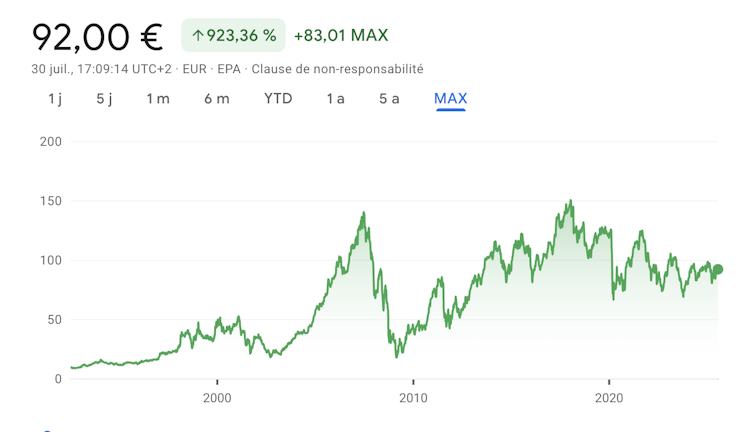
Ces dernières années, l’action Wendel n’a pas été qu’une bonne affaire pour ses actionnaires. Après une chute, comme toutes les autres valeurs, consécutive à la crise de 2008, le titre s’était redressé pour atteindre un maximum de 151 euros en 2018. Depuis, il est beaucoup retombé pour stagner autour de 90 euros. Cette baisse a été compensée par une hausse du dividende annuel, que la société a toujours versé, porté en 2025 à 4,7 euros, ce qui maintient une bonne rentabilité autour de 5 %. Les actionnaires familiaux, qui ont hérité de leurs titres, ont pu toucher ces dividendes.

Cours de l’action Wendel depuis le 20 novembre 1992.
Google finance

Qui sont ces descendants aujourd’hui ? À la 10e ou 11e génération, ils seraient 1 300 à se partager cet actif de 1,5 milliard. Cela représente 1,2 million d’euros par descendant en moyenne qui peut, selon la démographie des différentes branches, cacher d’importants écarts.

The Conversation

Hervé Joly ne travaille pas, ne conseille pas, ne possède pas de parts, ne reçoit pas de fonds d’une organisation qui pourrait tirer profit de cet article, et n’a déclaré aucune autre affiliation que son organisme de recherche.

ref. La dynastie Wendel : onze générations d’acier, de 1704 à aujourd’hui – https://theconversation.com/la-dynastie-wendel-onze-generations-dacier-de-1704-a-aujourdhui-262054

Can a game stop vaccine misinformation? This one just might

Source: The Conversation – UK – By Sander van der Linden, Professor of Social Psychology in Society, University of Cambridge

Christopher Penler/Shutterstock.com

Modern vaccines have saved over 150 million lives. Yet misinformation about them can still have deadly consequences. A gunman recently opened fire at the US Centers for Disease Control and Prevention headquarters, wrongly believing that the coronavirus vaccine had caused his depression.

Public health is increasingly being threatened by the spread of dangerous misinformation. In fact, there have been several recent cases of healthy unvaccinated children who died after contracting the highly contagious measles virus – including in July in Liverpool. Childhood vaccination rates in the UK are now at their lowest point in over a decade, well below the World Health Organization recommended threshold of 95% for herd immunity.

A key question for scientists and public health practitioners alike is how to design interventions that help reduce people’s susceptibility to health misinformation. To help accomplish this, we designed a free browser game, Bad Vaxx, that simulates social media and lets players step into the shoes of online grifters who peddle vaccine misinformation, using four common manipulation tactics.

In three experimental trials, we found that the game helps people discern significantly better between credible and misleading information about vaccinations, boosts players’ confidence in their judgments, and reduces their willingness to share vaccine-related misinformation with others.

Much research shows that once exposed, people often continue to rely on falsehoods despite having seen a debunk or fact-check. Fact-checks matter, but it’s difficult to get people to engage with science and to spread corrective information across an increasingly fractured media landscape.

Inoculating minds

Our new game draws inspiration from a more preemptive approach known as “prebunking”. Prebunking aims to prevent people from encoding misinformation into their brains in the first place.

The most common way to prebunk misinformation is through psychological inoculation – an approach that befittingly parallels the immunisation analogy. Just as the body gains immunity to infection through exposure to severely weakened doses of a viral pathogen (that is, the vaccine), so too can the mind acquire cognitive resistance to misinformation. This happens through exposure to weakened doses of the tricks used to manipulate people online, along with clear examples of how to identify and neutralise them.

One way to build immunity is to immerse people in a social media simulation. This is exactly what happens in our game, Bad Vaxx.

In a controlled setting, people are exposed to weakened doses of the main techniques used to deceive people on vaccination through humorous and entertaining scenarios where people interact with four shady characters. They include Ann McDoctal, who loves to float scary anecdotes about vaccines, Dr Forge, who fakes his expertise and gets traction by pumping out pseudoscience, Ali Natural, who promotes the naturalistic fallacy (“if it’s natural, it must be good”), and the conspiracy theorist Mystic Mac, who doubts all official narratives.

The player can choose between two competing perspectives: one, take on the role of an online manipulator to see how the sausage is made, or two, try to defeat the characters by reducing their influence.

Cognitive inoculation is thought to work, in part, by introducing a sense of threat to elicit motivation to resist propaganda, which both perspectives aim to achieve, albeit through different means. People were randomly assigned to either the “good” or “evil” version of our 15-minute game or a placebo group (who played Tetris).

We “pre-registered” our study, meaning we wrote down our hypothesis and analysis plan before collecting any data, so we couldn’t move the goalposts.

We measured effectiveness by asking people how manipulative they found vaccine misinformation embedded in social media posts, how confident they are in their judgments, and whether they intend to share the post with their networks.

We based the test on real-world misinformation that corresponded to each of the techniques featured in the game or a non-manipulative (neutral) counterpart. This was done to see if the game improves people’s ability to discern between misleading and credible content. For example, a conspiratorial post read: “Vaccine database wiped by government to hide uptick in vaccine injuries.”

In all our tests, we found that both versions of the game helped people get much better at spotting fake vaccine information. Players also became more confident in their ability to tell real from fake, and they made better decisions about what to share online. The version where you play as the “good guy” worked slightly better than the version where you play as the “bad guy”.

Boosting discernment without breeding cynicism

We also found that people became significantly better at spotting false and manipulative content without becoming sceptical of credible content that doesn’t use manipulation. In other words, players became more discerning.

Of course, the immunisation analogy should not be over-interpreted as effects of psychological interventions are generally modest and do wear off but epidemiological simulations show that when applied across millions of people, prebunking can help contain the spread of misinformation.

Although vaccination decisions are complex, much research has shown a robust link between exposure to misinformation and reduced vaccination coverage. Needless to say, misinformation about vaccines is not new. In the 1800s, anti-vaxxers falsely claimed that taking the cowpox vaccine against smallpox would turn you into a human-cow hybrid.

What’s different today is that the most influential misinformation is coming from the top, including prominent politicians and influencers, who spread thoroughly debunked claims, such as the myth that the MMR vaccine causes autism.

Empowering the public to identify pseudoscience, misdirection, and manipulation in matters of life and death is therefore crucially important. We hope that our easy-to-play, short prebunking game can be integrated into educational curriculums, used by public health officials, doctors and patients in medical settings, and feature as part of international public health campaigns on social media and beyond. After all, viruses need a susceptible host. If enough people are immunised, misinformation will no longer have a chance to spread.

The Conversation

Sander van der Linden has received funding from the UK Cabinet Office, Google, the American Psychological Association, the US Centers for Disease Control, EU Horizon 2020, the Templeton World Charity Foundation, and the Alfred Landecker Foundation. He has lectured and/or consulted for the WHO, UN, Meta, Google, the Global Engagement Center (US State Dept), and UK Defense and national intelligence.

Jon Roozenbeek has received funding from the UK Cabinet Office, the US State Department, the ESRC, Google, the American Psychological Association, the US Centers for Disease Control, EU Horizon 2020, the Templeton World Charity Foundation, and the Alfred Landecker Foundation.

During her time at Stanford University, Ruth Elisabeth Appel has been supported by an SAP Stanford Graduate Fellowship in Science and Engineering, a Stanford Center on Philanthropy and Civil Society PhD Research Fellowship, a Stanford Impact Labs Summer Collaborative Research Fellowship, and a Stanford Impact Labs Postdoctoral Fellowship. She has interned at Google in 2020 and attended an event where food was paid for by Meta. After completing her research at Stanford University, which forms the basis for this article, she joined Anthropic to research the economic and societal impacts of AI.

ref. Can a game stop vaccine misinformation? This one just might – https://theconversation.com/can-a-game-stop-vaccine-misinformation-this-one-just-might-262468

How scientists can contribute to social movements and climate action

Source: The Conversation – UK – By Aaron Thierry, PhD Candidate, Social Science, Cardiff University

Despite decades of scientists’ warnings about climate and ecological breakdown, record-breaking heat and escalating environmental disasters have become commonplace. Science has been attacked, dismissed and politicised, and the world is accelerating in a terrifying direction.

To scientists this can feel particularly overwhelming. So what can we do?

Scientific knowledge alone hasn’t generated the urgent societal action many scientists expected. Therefore, to protect ourselves, future generations and countless other species, some scientists have started to reflect on their tactics. Not prepared to be neutral in the face of such an all encompassing threat, scientists like us have been asking what our role should be in an era when our planet’s life support systems are crumbling so rapidly, while governments and officials pour fuel on the flames.

Answering this question has led some of us to join social movements and take part in peaceful protests. Three years ago, a group of scientists were arrested in the course of protesting the UK government’s decisions to licence new oil fields. We were among the lab-coat wearing protesters who took the science to the government that day, pasting huge posters explaining the dangers of new fossil fuels onto the windows of the department that was committing us to them for decades to come.

It was a surreal experience, recently documented in the short film Plan Z: From Lab Coats to Handcuffs (2024) and a book called Scientists on Survival: Personal Stories of Climate Action (2025).

While taking a visible, public stand against harmful decisions can be a provocative and effective route for scientists to push for change, it isn’t the only way we can be effective advocates. Recent surveys reveal that there is a great appetite from scientists to be more involved in social movements, but many face barriers to participation and often don’t know where to start or how best to contribute.

In our recent article published in the journal npj Climate Action in collaboration with our colleague and science communicator Abi Perrin, we explore how scientists across all disciplines, backgrounds and career stages can get involved in activism in a range of practical ways. Whatever your strengths and limitations (depending on your status and which country you live), there are many positive ways to engage.

From silos to society

Currently scientific disciplines can be quite isolated from one another, and scientists generally aren’t very prominent in the public domain. We might feel restricted to speaking to our own very specific expertise but a scientist’s job involves understanding complex information, converting and communicating it into simpler, more useful forms.

Scientists can communicate about climate and nature, even without writing a PhD thesis on it. And we can be very powerful when we do: scientists are still widely trusted.

Politicians need to listen to scientists, not just the lobbyists. This is why engaging directly with MPs (or equivalents) is a route more scientists like us are taking. For instance, scientists in the UK have been important and prominent champions of the Climate and Nature Bill currently being debated in the House of Commons.

Social movements need scientists too. We can use our research and communication skills to inform and improve campaigns, bringing them to a wider audience. This support adds credibility to campaigns. We can also analyse what works to investigate, for example, the effectiveness of different activism strategies and targets in a range of contexts.

Academics have also supported activist campaigns against destructive infrastructure development by speaking at public hearings, as well as providing expert witness testimonies for activists in court for acts of protest.

Scientists can also push for cultural and policy change within our own institutions, including research institutions, science academies and professional bodies. This might include cutting ties to the fossil fuel industry, reorienting research and teaching to focus on sustainable development or accelerating the decarbonisation of campus activities.

We can support colleagues and students who engage in protests and encourage peers and leaders to do the same. It is easier to take action when you know you are not acting alone.

It’s more important than ever that our professional bodies and institutions are emboldened by their membership to advocate for the public good that science brings, and the need to defend academic freedom, recognising that often means speaking truth to power.

Collective action is crucial. We can all seek out allies, organise among peers and build powerful coalitions, rather than hoping science will passively translate into change. Time is of the essence.


Don’t have time to read about climate change as much as you’d like?

Get a weekly roundup in your inbox instead. Every Wednesday, The Conversation’s environment editor writes Imagine, a short email that goes a little deeper into just one climate issue. Join the 45,000+ readers who’ve subscribed so far.


This article features references to books that have been included for editorial reasons, and may contain links to bookshop.org. If you click on one of the links and go on to buy something from bookshop.org The Conversation UK may earn a commission.

The Conversation

Aaron Thierry receives funding from ESRC. He is affiliated with Scientists for Extinction Rebellion.

Tristram Wyatt is affiliated with Scientists for Extinction Rebellion.

ref. How scientists can contribute to social movements and climate action – https://theconversation.com/how-scientists-can-contribute-to-social-movements-and-climate-action-261959

How inflammatory bowel disease may accelerate the progression of dementia

Source: The Conversation – UK – By Iris Mikulic, Research Assistant, Department of Neurobiology, Care Sciences and Society, Karolinska Institutet

Orawan Pattarawimonchai/Shutterstock

You have probably heard the phrase “follow your gut” – often used to mean trusting your instinct and intuition. But in the context of the gut-brain axis, the phrase takes on a more literal meaning. Scientific research increasingly shows that the brain and gut are in constant, two-way communication. Once overlooked, this connection is now at the forefront of growing interest in neuroscience, nutrition and mental health.

The gut–brain axis is a highly complex system of interconnected pathways that relay information through diverse signals. Previous research has suggested that gut inflammation may contribute to the development of dementia. This may occur through to the triggering of systemic inflammation and the disruption of the pathways between the gut and the brain.

While interest in the gut-brain axis has grown rapidly, there is still limited understanding of whether intestinal inflammation might accelerate cognitive decline in people who already have dementia.

IBD and dementia connection

Our study explored this under-researched question, aiming to expand understanding in this area and improve the care of those affected. We focused on people who had already been diagnosed with both dementia and inflammatory bowel disease (IBD).

Dementia refers to a group of neurological disorders with different underlying causes, all characterised by progressive cognitive decline and increasing loss of independent function.

It is a growing global health concern, with the number of diagnoses rising steadily around the world. Older age remains the most significant risk factor for developing the condition.

In 2024, the FDA approved donanemab, a second novel drug aimed at slowing the progression of early-stage Alzheimer’s disease – the most common form of dementia. However, there is still no cure, and current treatments are primarily focused on managing symptoms.

Inflammatory bowel disease (IBD) is a complex, chronic inflammatory condition affecting the gastrointestinal tract. It includes Crohn’s disease, ulcerative colitis, and IBD-unclassified (also called indeterminate IBD), which refers to cases where symptoms and clinical findings do not clearly fit the criteria for either Crohn’s disease or ulcerative colitis.

IBD is typically characterised by symptoms such as abdominal pain, diarrhoea and changes in bowel habits. However, because it can have systemic (extra-intestinal) effects, the condition can also affect other parts of the body, including the skin, eyes, joints and liver but can also cause general fatigue.

IBD should not be confused with irritable bowel syndrome (IBS), which is a common functional condition of the gastrointestinal tract. IBS can cause similar symptoms – such as abdominal pain and changes in bowel habits – however, unlike IBD, there are no changes in gut tissue.

While there is currently no cure for IBD, except in ulcerative colitis, where, in some select cases, surgery may be curative, IBD can often be managed with (anti-inflammatory) medications and lifestyle changes.

IBD is a global health problem. Worldwide, between 1990 and 2021, new cases increased across all age groups, with the biggest jump seen in people aged 50 to 54. The smallest increase occurred in children under five. Importantly, IBD can be diagnosed from early childhood to later life, but in older adults, among others, symptoms can be mistaken for other conditions – potentially delaying diagnosis and treatment.

For our study, we used data from the Swedish Registry for Cognitive/Dementia Disorders (SveDem) – a comprehensive national quality registry that holds detailed medical information on people with various forms of dementia across Sweden. From this database, we identified people who were diagnosed with IBD after their dementia diagnosis. We then compared 111 people who had both dementia and newly diagnosed IBD with a control group of 1,110 people who had dementia but no IBD diagnosis. The two groups were closely matched for age, gender, type of dementia, other health conditions and medication use.

Measuring cognitive decline

To measure changes in cognitive function, we used the Mini-Mental State Examination (MMSE) score. The MMSE is a standardised test made up of 11 tasks, with a maximum score of 30 points. It is widely used by healthcare professionals to assess memory, attention, language and other aspects of cognitive performance, particularly when dementia is suspected. People without dementia typically score between 25 and 30, while those with dementia often score below 24.

In our study, we compared MMSE scores between the two groups. We also looked at changes in MMSE scores before and after the IBD diagnosis in people who had both dementia and IBD. Our results showed that those with both conditions experienced a significantly faster decline in cognitive function. This decline became more noticeable after the IBD diagnosis. On average, people with both diagnoses lost nearly one additional MMSE point per year compared to those with dementia alone. This level of decline is comparable to the difference seen between people with dementia who take the new Alzheimer’s drug donanemab and those who do not.

Our findings suggest that IBD – and the systemic inflammation it causes – may contribute to a faster worsening of cognitive function. This highlights the need for closer monitoring of people with both conditions. Managing IBD effectively through anti-inflammatory medications, nutritional support and in some cases surgery, might potentially help reduce neuroinflammation, thereby slowing the progression of dementia.

While our results indicate that cognitive decline was significantly faster in people with both dementia and newly diagnosed IBD, it is important to note that this was an observational study, so we cannot establish direct causality. The study also had some limitations. For instance, we lacked data on IBD severity and the specific treatments patients were receiving. We also did not explore differences by gender, dementia subtype, or IBD subtype.

Additionally, since dementia is typically diagnosed in older age, the elderly onset IBD cases may have been underdiagnosed. Finally, while SveDem is a valuable national registry, it does not yet include all newly diagnosed dementia cases in Sweden.

Understanding how IBD influences the brain could open the door to new strategies for protecting cognitive health in older adults. Furthermore, identifying whether specific IBD treatments can slow cognitive decline may benefit people living with both conditions and could help with the refinement of care for this vulnerable patient population.

The Conversation

Hong Xu receives funding from the Swedish Research Council (Starting grant#2022-01428) and the Center for Innovative Medicine Foundation (CIMED, FoUI-1002840).

Jonas F. Ludvigsson has coordinated an unrelated study on behalf of the Swedish IBD quality register (SWIBREG). That study received funding from Janssen corporation. Dr Ludvigsson has also received financial support from Merck/MSD for an unrelated study on IBD; and for developing a paper reviewing national healthcare registers in China. Dr Ludvigsson has also an ongoing research collaboration on celiac disease with Takeda.

Iris Mikulic does not work for, consult, own shares in or receive funding from any company or organisation that would benefit from this article, and has disclosed no relevant affiliations beyond their academic appointment.

ref. How inflammatory bowel disease may accelerate the progression of dementia – https://theconversation.com/how-inflammatory-bowel-disease-may-accelerate-the-progression-of-dementia-260904