Until Haiti tackles systemic corruption and bad governance, its people will remain impoverished

Source: The Conversation – Canada – By Ruolz Ariste, Adjunct Professor, School of Public Policy and Administration, Carleton University

Haiti’s Patriotic Congress for National Rescue, launched by the academic community and civil society organizations, recently held a nearly month-long period of consultations across Haiti and its diaspora over the worsening crisis in the Caribbean nation.

It concluded on June 27 with 25 proposals on three points: 19 on the security crisis and six on reforms to public governance and endless transitions.

While these three points are key for a national rescue and are interconnected, they don’t carry the same weight. Based on the number of proposals, the security crisis takes priority over governance reforms and endless power transitions.

As a public policy and administration expert, I believe governance reforms are crucial because Haiti’s insecurity, lawlessness and constant political transitions are rooted in poor governance and corruption.

Corruption at the core

Excessive corruption is the cancer that eats away at Haiti. It hinders private investment, slows the production of goods and services, and triggers social unrest, criminal activity and poverty. It’s the root cause of the Haitian crisis, not the symptom.

In his book The Great Escape: Health, Wealth, and the Origins of Inequality, British-American economist and Nobel laureate Angus Deaton argues that a well-functioning national government is what allows people to escape misery.

His views echo a study by researchers from the International Monetary Fund and the World Bank that found an increase in corruption significantly reduces the income growth of impoverished people.

This research clearly illustrates that it’s not poverty that breeds corruption, but rather the reverse. In other words, to truly tackle poverty, we must go to the source of the problem and tackle corruption.

I’ve made the same argument in my self-published book Contemporary Events Related to Equity and Inclusion: A focus on Blacks, the Haitian diaspora, and locals.

It’s clear, therefore, that most of the recommendations from the Patriotic Congress should focus on bad governance and corruption.

Up close and personal with Haitian corruption

Corruption is the norm in Haiti, not the exception. It is rooted in the country’s institutions and remains systemic. The US$2 billion Petro Caribe scandal is a major case in point.

Well-intended investors trying to do business in Haiti often face myriad corrupt officials. I have personal experience with this phenomenon.

I launched a company in Haiti, Biogaz pour une Solution Intégrée, with some well-meaning classmates and colleagues who specialize in the science of soil management and crop production.

When founding and presiding over the business, we’d hoped for political stability due to the election of President Jovenel Moïse in 2017.

Instead, we faced unscrupulous offers, even from a former university classmate who had become a high-ranking member of the government. Blatant corruption in the form of elected individuals or civil servants requesting substantial kickbacks was ubiquitous. The company did not survive this hostile environment.

The point I want to make here is that some people in Haiti exhibit corrupt behaviours without any discomfort or maybe even without realizing it.

Moïse, meantime, was assassinated four years later. Several suspects have been indicted in his murder, including his widow Martine, former acting prime minister Claude Joseph and former police chief Léon Charles.

Haiti’s painful descent

Three specific conditions are required to attract private investments in any country: political stability, good governance and anti-corruption measures. With bad governance and systemic corruption, political stability becomes elusive. This again emphasizes the importance of focusing on improved governance to vanquish systemic corruption and lift Haiti out of its current and longstanding misery.

As the first Black independent nation and one that once supported many other Caribbean and Latin American countries in their own quests for independence, it’s troubling that Haiti is experiencing such a dire situation.

The country is the poorest in the Western Hemisphere, with its GDP per capita declining by two per cent a year from 2014 to 2024.


Read more:
Haiti on the brink: Gangs fill power vacuum as current solutions fail a nation in crisis


The situation calls for urgent action. But it will not be easy.

National entities need to face facts about systemic corruption and stop playing the blame game. They must reform their institutions, accept accountability for managing public funds and eradicate corruption. International allies and organizations need to set up, not with boots on the ground, but with institutional reforms, mostly in the judiciary system.

Specifically, the mandate of the International Criminal Court should be extended to make substantial money theft and embezzlement a prosecutable international financial crime, one with the same rank as genocide.

Educating citizens about corruption

This will happen only with the mobilization of civil society to force changes in both national and international institutions. A massive educational campaign is also required among the Haitian population, from elementary schools all the way to university level, to educate and train citizens about what constitutes corruption and what are its disastrous impacts.

Taking steps to eradicate systemic corruption will also address the Haitian insecurity crisis and the endless power transitions because they’re so closely connected.

Haiti needs to build on its glorious history of resilience and resistance to tackle this challenging task, turn the tide and offer its citizens prosperous and peaceful lives and a much brighter future.

The Conversation

Ruolz Ariste does not work for, consult, own shares in or receive funding from any company or organisation that would benefit from this article, and has disclosed no relevant affiliations beyond their academic appointment.

ref. Until Haiti tackles systemic corruption and bad governance, its people will remain impoverished – https://theconversation.com/until-haiti-tackles-systemic-corruption-and-bad-governance-its-people-will-remain-impoverished-262264

How businesses deflect responsibilities for addressing modern slavery in their supply chains

Source: The Conversation – Canada – By Kam Phung, Assistant Professor of Business & Society, Beedie School of Business, Simon Fraser University

Despite growing awareness and legislation aimed at eradicating modern slavery — including forced labour, bonded labour and other extreme forms of human exploitation — efforts to combat the issue remain largely ineffective.

The United Kingdom, the first to enact a modern slavery act in 2015, is a case in point. The latest government figures show 5,690 potential victims in the U.K. were referred to the Home Office between April and June. This is the highest quarterly figure since the national referral mechanism began in 2009.

This could be attributed to a multitude of reasons, including an actual rise in exploitation, growing awareness of the issue and more training being provided for frontline services. But the effectiveness of transparency and disclosure laws in achieving substantive change in businesses’ behaviours has long been questioned.


Read more:
Ten years after the Modern Slavery Act, why has this ‘world-leading’ legislation had so little impact?


Canada also has a modern slavery act, Fighting Against Forced Labour and Child Labour in Supply Chains Act, which came into effect in 2024. It requires certain private-sector and government entities to report on efforts to prevent and reduce the risk the issues.


Read more:
Canada’s Modern Slavery Act is the start — not the end — of efforts to address the issue in supply chains


It’s still too early to tell if Canada’s approach has amounted to any real change. However, since its onset, experts have cautioned that such a transparency and disclosure law “falls short of what is required to make large corporations exercise due diligence to prevent labour abuse from occurring within their supply chains.”

Deflecting responsibilities

When confronted with modern slavery risks, some companies justify their inaction or adopt ineffective measures that do little to address the problem.

In a recent book chapter published in the The Routledge Companion to Responsible Business, my co-researchers and I explore three rationalizations used by businesses and professionals to deflect responsibility for addressing modern slavery and other pressing societal issues, even as pressure to do so increases.

Our insights emerged from interviews we conducted with a range of businesses operating in Canada with global supply chains leading up to Canada’s enactment of modern slavery legislation. They represent some, but not all, of the ways businesses deflect responsibilities for addressing modern slavery.

Deflection involves redirecting attention, blame or responsibility away from oneself to avoid taking accountability or confronting uncomfortable truths and negative feelings. Rather than addressing an issue, focus is shifted elsewhere, enabling an organization to get away with inaction or sub-par action that can enable modern slavery.

In everyday organizational life, these deflections can be hard to spot. They manifest in subtle ways, and may sound reasonable on the surface but ultimately serve to sidestep meaningful responsibility.

Perceptual rationalizations

“Perceptual rationalization” occurs when businesses resist addressing modern slavery because they fear negative perceptions and consequences.

In our interviews, some businesses worried that acknowledging the issue might be seen as an admission of guilt, making their company vulnerable to media criticism and public backlash.

To some companies, modern slavery is considered so toxic and stigmatized that they prefer to avoid the topic altogether. In the face of media coverage on linkages to modern slavery, some businesses fear that bringing attention to the issue will become a public relations nightmare.

This is despite evidence that broader society may, in fact, praise businesses for detecting and publicly disclosing such information.

Ironically, this suggests the media’s role as “watchdogs” of corporate behaviour may actually deter some businesses from taking action rather than deter socially irresponsible behaviours.


Read more:
Modern slavery is endemic in global supply chains. Companies should be praised – not shamed – for detecting it


Structural rationalizations

“Structural rationalizations” happen when businesses claim that industry factors like regulations or systemic factors absolve them of responsibility.

For example, company representatives in highly regulated industries like transportation argued their supply chains are already monitored and therefore have a “low risk” of modern slavery — despite using high-risk materials like rare minerals, including conflict minerals, in their parts.

Meanwhile, others claimed that modern slavery is a “system issue” that requires government intervention and changes in consumer behaviours, not corporate action.

While acknowledging the systemic nature of the problem is important, we found some companies use this perspective to shift responsibility to external entities like governments, consumers and other businesses instead of taking proactive steps.

In this way, the systemic nature of issues such as modern slavery, and other issues like climate change, may actually be leveraged by some as a way to avoid doing their part to address them. System issues are all-hands-on-deck issues. Everyone needs to be doing their part.

Territorial rationalizations

“Territorial rationalization” was one of the most common rationalizations in our interviews. It occurs when individuals or organizations argue modern slavery falls outside their scope of responsibility, leaving it for others to address.

At the individual level, someone might say their performance indicators don’t include addressing the issue, so it’s outside the scope of their work. At the organizational level, companies may claim the issue is simply irrelevant to them. However, such dismissals are often based on false assumptions or misunderstandings.

Some companies, for example, believe that because their products are high quality goods, they are shielded from the issue despite legitimate risks.

Yet, modern slavery is not confined to low-quality goods. In 2024, for instance, the Democratic Republic of Congo accused Apple subsidiaries in France and Belgium of using conflict minerals. Similarly, Italy’s competition authority is investigating claims of worker exploitation linked to Armani and Dior.

Taking ownership means shifting from “that’s not my job” to “how can I help solve this?” while still maintaining reasonable boundaries.

Transforming inaction into accountability

The fight against modern slavery in supply chains reveals a troubling paradox: the very factors that should drive corporate action, like moral urgency and the systemic nature of the issue, often become excuses for inaction and deflection.


Read more:
Here’s what businesses and consumers can do to tackle modern slavery in supply chains


Progress requires business leaders to embrace accountability within their sphere of influence. The path forward demands three critical shifts:

  1. Business education must evolve to prepare professionals, managers and executives with moral frameworks and practical tools to address systemic challenges. They must be taught to view social issues as an opportunity rather than a challenge or threat.

  2. Companies must resist the temptation to hide behind the systemic nature of problems and instead focus on what they can control and influence.

  3. Stakeholders like leadership teams and regulators must design incentive structures that encourage engagement, not avoidance.

Successful managers and businesses recognize that social responsibility is not about shouldering blame for every systemic issue, but contributing to solutions within their operational reach.

An important first step is being able to spot deflections on the ground, whether it involves you, a colleague or any other stakeholder, and understand how it can perpetuate any given issue.

The Conversation

Kam Phung receives funding from the Social Sciences and Humanities Research Council of Canada (SSHRC), Humanity United Action, and the Ford Foundation.

ref. How businesses deflect responsibilities for addressing modern slavery in their supply chains – https://theconversation.com/how-businesses-deflect-responsibilities-for-addressing-modern-slavery-in-their-supply-chains-262859

250,000 Ethiopians migrate every year: what drives them and what needs to change

Source: The Conversation – Africa – By Girmachew Adugna, Advisory Board Member, Research Center for Forced Displacement and Migration Studies, Addis Ababa University

Migration is increasingly replacing the traditional, education-focused life paths that shaped previous generations in Ethiopia. In the past, becoming a civil servant after completing secondary and tertiary education was seen as both socially respected and economically rewarding.

Although access to education at all levels has expanded in recent decades, its value has diminished as many graduates struggle to find employment and decent livelihood opportunities. In Ethiopia, individuals under the age of 30 comprise approximately 70% of the total population, and the urban youth unemployment rate stood at around 25.3% as of 2022.

The consequences are often tragic.

Irregular migration involving overcrowded and unseaworthy boats is responsible for a rising number of deaths at sea. In the first six months of 2025 alone, more than 350 migrants lost their lives while attempting the crossing over the Gulf of Aden and Red Sea from the Horn of Africa. A tragic incident on 3 August claimed the lives of around 102 migrants, most of whom were Ethiopian.

I have been studying Ethiopian migration for more than a decade. In this article, I explore why many people choose irregular migration over legal pathways. I also consider what the Ethiopian government should be doing to manage the increasing number of young people choosing to leave the country for work.

Ethiopia serves as a country of origin, transit and destination for migrants. About 250,000 Ethiopians migrate annually.

Given the human toll of irregular migration, more must be done to tackle its root causes.

Based on my research findings, creating decent job opportunities in the country is crucial, so that young people can see a future without the need to leave. At the same time, for those who do wish to migrate, legal pathways must be made more accessible, safer and more efficient.

Equally important is expanding these migration pathways beyond domestic work to include skilled and semi-skilled workers and sectors that typically employ male migrants in destination countries. Those sectors include construction, agriculture and driving.

The drivers

In the early and mid-2000s, young men could migrate legally to Gulf countries. Saudi Arabia was the preferred destination for jobs such as driving and security work. Ethiopia imposed a temporary ban on labour migration to the Gulf countries from late 2013 to early 2018 over reported abuses and deaths. During this period, many individuals migrated through irregular channels, and those patterns became entrenched over time.

The number of women migrants is increasing, however, now accounting for a third of migrants on these routes.

The driving causes of migration from Ethiopia have always been complex. Factors include limited job and livelihood opportunities, conflict and instability, high unemployment, pressure from family and peers, hopes for a better life abroad, and a sense of hopelessness about a decent future at home.

In some parts of the country, a culture of migration has taken root, with migration perceived as a quick and effective way to earn income and generate broader benefits for both migrants and their families. Within these communities, having a family member abroad is increasingly regarded as a symbol of social status.

Lack of opportunities is central. It is evidenced by high youth unemployment and scarcity of quality jobs. Rural poverty, slow industrial development, and obstacles to starting businesses intensify the push factors.


Read more:
Half a million Ethiopian migrants have been deported from Saudi Arabia in 5 years – what they go through


Secondly, the ongoing conflict in the Amhara region and parts of Oromia, and escalating tensions in Tigray have created insecurity and disrupted livelihoods. This makes public services inaccessible and prompts many young people to migrate in search of safety and stability. Young people in conflict-affected regions face a stark reality: either join armed conflicts that seem never-ending or struggle to make a living.

Thirdly, rules set by government that allow Ethiopians to migrate legally have tightened. Standard requirements for applicants involve numerous documents and pre-departure training. The documents include ID cards, passports, educational qualifications, health certificates and a certification of competence. Some of these are not readily accessible for many aspiring migrants. The cost of a passport, for instance, is prohibitive for most. So instead, people are driven to irregular and often perilous migration options.

Legal migration offers limited opportunities. Existing bilateral agreements with Middle Eastern countries primarily cover domestic work, which largely absorbs women.

The routes

The route that has become common over the past decade involves crossing the Red Sea to reach Saudi Arabia through war-torn Yemen. Known as the eastern route, this path is one of the most dangerous, claiming the lives of many young men and women.

Since 2014, the International Organisation for Migration has recorded 76,524 migrant deaths worldwide. Of these, over 1,098 occurred by drowning at sea off Yemen along the eastern route. In 2021, the Ethiopian Central Statistics Service reported that over 51,000 Ethiopian migrants had gone missing after leaving the country in the previous five years.

Ethiopian migration from southern regions to South Africa – known as the southern route – is the second largest irregular migration corridor. The last is the northern route, towards Europe via Sudan, Libya and the Mediterranean Sea.

The answers

Now more than ever, Ethiopia needs to create greater economic opportunities at home. This can be done by expanding opportunities in the agriculture, industrial and service sectors. The government should also support skills training and entrepreneurship together with access to basic services in the countryside.

Secondly, legal pathways must be expanded. This can be done by establishing more bilateral labour agreements. Currently, Ethiopia has agreements with Saudi Arabia, UAE, Jordan, Lebanon and Kuwait. It is close to finalising one with Oman. But these agreements mostly cover domestic work.


Read more:
Young middle-class Nigerians are desperate to leave the country: insights into why


In contrast, the Philippines has signed labour agreements with over 30 countries. These include several European countries and cover a broader range of opportunities.

Third, these agreements must expand the job opportunities that young people can apply for, for example, skilled and semi-skilled jobs in construction, retail and agriculture. This would offer young Ethiopians more diverse employment opportunities abroad.

Legal migration pathways should be streamlined, time-efficient, and accessible to the majority of aspiring migrants. Equally important is the need for targeted, tailored, and comprehensive awareness-raising initiatives at the household, school, and community levels to ensure informed decision-making around migration.

The Conversation

Girmachew Adugna does not work for, consult, own shares in or receive funding from any company or organisation that would benefit from this article, and has disclosed no relevant affiliations beyond their academic appointment.

ref. 250,000 Ethiopians migrate every year: what drives them and what needs to change – https://theconversation.com/250-000-ethiopians-migrate-every-year-what-drives-them-and-what-needs-to-change-263465

The Gambia’s new constitution has stalled again – 5 reasons why and what that means for democracy

Source: The Conversation – Africa (2) – By Satang Nabaneh, Director of Programs, Human Rights Center; Research Professor of Law, University of Dayton School of Law, University of Dayton

The Gambia’s post-dictatorship democratic transition recently suffered a setback. The Constitution of the Republic of The Gambia (Promulgation) Bill, 2024 failed to pass its second reading in the national assembly.

Passing the bill required the support of at least 75% of The Gambia’s 58-member parliament, including the speaker. Now, there’s uncertainty over the country’s democratic reforms.

This leaves The Gambia governed by the 1997 constitution drafted under Yahya Jammeh’s military junta. The 1997 constitution was widely seen as a tool for executive overreach. It didn’t have term limits, stalled key democratic reforms and lacked sufficient protection for human rights and democratic principles.

Failure to pass the new constitution is a setback to the “New Gambia” agenda, a campaign promise of the 2016 ruling coalition, which included the drafting of a new constitution and ensuring accountability for past human rights violations, and could lead to renewed political tension.

Proponents hailed the proposed new constitution as a step towards institutionalising checks and balances and strengthening civil liberties. Critics pointed to a lack of transparency, the absence of broad stakeholder consultation, and specific controversial clauses.

Those clauses included the removal of a retroactive presidential term limit, the weakening of checks and balances by reducing parliamentary oversight on appointments, and the potential erosion of judicial independence.

I am a Gambian legal scholar, researcher and human rights practitioner and I have been tracking The Gambia’s journey to solidify its democracy since the dictatorship of Jammeh. In this article, I present five of the most important things to know about this constitutional reform effort and why it failed to advance.

New constitution triggers and why it failed

1. Unfulfilled search for a new foundation:

A truly democratic constitution has been a central promise since the ousting of former president Jammeh in 2017.

An initial 2020 draft, the product of extensive nationwide consultations, also failed to pass. There were disagreements over provisions like retroactive presidential term limits. But the 2024 bill continues to face political and social hurdles.

The 1997 constitution presents a paradoxical approach to democratic governance, particularly in its mechanisms for political transition and constitutional amendment. For example, it has stringent requirements for constitutional change: a three-quarters majority vote from all national assembly members across two readings.

It also requires a national referendum, with 50% voter participation and 75% approval.

A high bar for constitution amendments can protect against impulsive alterations. But it also puts disproportionate power in the hands of a parliamentary super majority. This politicises constitutional reform, making it contingent on party allegiance and strategic manoeuvring rather than a broad national consensus.

An arrangement like the one in The Gambia could hinder the natural evolution of democratic governance and limit the nation’s capacity to adapt its basic law to the changing will of the people.

2. Unresolved concerns over presidential powers:

A key reason the 2024 draft faced such strong opposition related to presidential powers. The 2020 draft sought a two-term limit with a retroactive clause (meaning President Adama Barrow would not be able to run in the 2026 election). But the 2024 draft removed this retroactive counting.

This remained a point of contention, fuelling fears of potential term limit manipulation. More broadly, the bill proposed removing parliamentary oversight for all appointments, including ministers, the Independent Electoral Commission and independent institutions.

It also sought to grant the president more power over national assembly members. These proposals were viewed as undue centralisation of authority and a regression from the 1997 constitution.

3. Unaddressed threats to judicial independence:

The bill’s stated goal of judicial independence was undermined by certain provisions. The 2024 draft removed the requirement that the national assembly confirm the appointment of the chief justice and Supreme Court judges.

It also removed the citizenship requirement for the chief justice. Given The Gambia’s recent history where foreign judges on politically appointed, renewable contracts served as a tool of repression and eroded public trust, these changes therefore raised alarm about judicial impartiality and the erosion of oversight.

The bill left out Chapter V on “Leadership and Integrity” which was in the 2020 draft. This chapter, which outlined a framework for public officer conduct and aimed at combating corruption, was seen as vital for accountability.

4. Contentious provisions on human rights and civil liberties:

While the 2024 draft generally aimed to modernise fundamental rights and introduce additional socio-economic protections, it also contained specific restrictions that human rights advocates criticised. These included an increase in police detention periods from 48 to 72 hours, and perceived limitations on the rights to education, to petition public officials, and to freedom of assembly.

Provisions affecting citizenship by marriage (doubling the waiting period for foreign spouses to gain citizenship) and limiting media ownership and operation to Gambian citizens sparked debates over inclusivity and media freedoms.

These clauses likely contributed to the insufficient votes for the bill to pass.

5. Public fatigue amid the bill’s failure:

The failure of the 2024 constitution draft bill to pass second reading reflects a complex and polarised public discourse. While the government championed the bill as essential for stability and a modern republic, the main opposition, the United Democratic Party, opposed it.

Numerous civil society organisations expressed concerns about the diluted democratic safeguards and expanded presidential powers. In the end, a perceived lack of genuine public participation prevented its advancement.

The way forward

This outcome shows a division among the public. Some are tired of the drawn-out constitutional reform process. They want stability now. Others want to keep pursuing a genuinely transformative constitution.

This division is made worse by widespread disillusionment due to economic hardships and slow progress with various reforms since the post-dictatorship transition began.

The failure of the 2024 bill leaves The Gambia in a state of uncertainty about its foundational legal framework.

As I have noted elsewhere, it’s time for all to commit to an inclusive reform process.

The Conversation

Satang Nabaneh does not work for, consult, own shares in or receive funding from any company or organisation that would benefit from this article, and has disclosed no relevant affiliations beyond their academic appointment.

ref. The Gambia’s new constitution has stalled again – 5 reasons why and what that means for democracy – https://theconversation.com/the-gambias-new-constitution-has-stalled-again-5-reasons-why-and-what-that-means-for-democracy-261809

Data that is stored and not used has a carbon footprint. How companies can manage dark data better

Source: The Conversation – Africa (2) – By Hanlie Smuts, Professor and Head of Department, University of Pretoria

In today’s world, huge amounts of data are being created all the time, yet more than half of it is never used. It stays in silos, or isn’t managed, or can’t be accessed because systems change, or isn’t needed because business priorities change. This “dark data” accumulates in servers and storage devices, consuming electricity and inflating the digital carbon footprint.

It may appear harmless, but this growing mass of digital waste has consequences for the environment. Storing unused or obsolete digital data requires constant power for servers and cooling systems. This drives up electricity consumption and greenhouse gas emissions. Dark data alone is estimated to generate over 5.8 million tonnes of CO₂ annually. This is the equivalent of emissions from 1.2 million cars per annum.

Dark data also accelerates e-waste from hardware replacement and depletes resources through manufacturing, such as using recycled raw materials, and water-intensive cooling.

Organisations collect vast volumes of information during routine operations. But it might never be analysed or repurposed. System log files that track user activity, errors and transactions remain untouched after initial storage. We’re talking about every email, photo, video, or unused spreadsheet saved on a server. Think of it like forgotten boxes stored in a warehouse, except this warehouse uses energy all the time. Managing dark data is not only a matter of working efficiently; it is a pressing sustainability issue.

The solution lies partly in effective knowledge management practices.

This means making an effort to reduce the environmental impact of digital systems, particularly those related to data storage and usage. Organisations should collect, manage and retain data with energy consumption and carbon emissions in mind.

My research aimed to find ways to do this. I collected 539 quantitative and qualitative questionnaire responses representing North America at 31.9% (172), followed by Europe at 21.5% (116) and Asia at 19.9% (107). Africa (10.8%) and Australia (9.8%) were represented too, while South America (5.8%) and Antarctica (0.4%) had the smallest shares.

The findings highlighted the need for data governance, data security and continuous learning within organisations. It showed the value of energy efficient information technology practices, centralised knowledge repositories and working across disciplines to address dark data risks.

My research also provided organisations with guidelines to make digital decarbonisation part of the way they operate and make decisions. This would improve organisational efficiency, reduce carbon footprints and promote the reuse of valuable data insights.

The digital dilemma: more data, more emissions

As digital technologies become more embedded in everyday operations, the demand for data storage and processing power surges. Globally, data centres already account for about 2% of greenhouse gas emissions, equal to the environmental impact of the aviation industry. The figure is expected to double by 2030 as digital adoption accelerates.

But dark data isn’t getting much attention. This is because it is mostly unstructured, hidden in legacy systems or backup servers. Information technology and sustainability teams tend to overlook it. It’s expensive to manage and easy to ignore. But it consumes costly storage space and drives up energy bills for powering and cooling servers. It also requires ongoing backup, security and compliance measures despite delivering no business value.

Knowledge management to tidy up dark data

Knowledge management strategies can address the dark data problem. Knowledge management acts like a smart organiser for all the information that organisations hold. It makes it possible to find hidden or forgotten files buried in systems, understand whether the data is useful or outdated, and decide on the best course of action. That can be by turning valuable data into insights or securely deleting what’s no longer needed.

This reduces wasted storage, cuts costs, lowers the environmental impact and ensures that the information kept actually supports better decision-making.

We recommend two things organisations can do: classification and streamlining.

1. Classification: organise, tag, and unlock value

Classification is the first step in bringing order to data chaos. It involves discovering, tagging, categorising and assessing data to determine its relevance and value. Artificial intelligence (AI) and machine learning can help with this.

This approach not only reduces waste, but also unlocks hidden opportunities. For example, previously unused customer feedback data can be analysed for product innovation, or old project documentation can inform new initiatives.

2. Streamlining: stop hoarding, start reducing

Streamlining is about developing leaner, cleaner data environments. It calls for robust data governance, including clear retention policies, regular audits and employee education on digital hygiene. Using AI tools, organisations can identify duplicated, outdated, or irrelevant files and automate their safe deletion.

It’s not just a technical process. It involves cultivating a culture that values purposeful data usage and discourages unnecessary hoarding. When employees understand the environmental cost of unmanaged data, they become more responsible stewards of digital information. The outcome is a more agile, cost-effective and sustainable data ecosystem.

One example of an organisation doing this is the car brand, BMW Group. It’s made digital decarbonisation part of its production processes.

Google has invested in sustainable IT practices, including energy-efficient data storage and processing. The data centres of the company have been carbon-neutral since 2007, and it is working towards running its operations on 100% renewable energy.

Let data work smarter, not harder

Digital sustainability does not demand that organisations do less; it encourages them to do better. Rethinking dark data management is a step towards reducing digital emissions and conserving resources.

Through knowledge management strategies like classification and streamlining, organisations can turn an overlooked liability into a strategic asset.

Data should serve us, not burden us.

The Conversation

Hanlie Smuts does not work for, consult, own shares in or receive funding from any company or organisation that would benefit from this article, and has disclosed no relevant affiliations beyond their academic appointment.

ref. Data that is stored and not used has a carbon footprint. How companies can manage dark data better – https://theconversation.com/data-that-is-stored-and-not-used-has-a-carbon-footprint-how-companies-can-manage-dark-data-better-262966

Fin de l’accroissement naturel en France : doit-on s’inquiéter ?

Source: The Conversation – France in French (3) – By Sébastien Oliveau, Directeur de la MSH Paris-Saclay, Géographe-démographe, Université Paris-Saclay

Un nombre de naissances plus faible que prévu en France pourrait faire de 2025 la première année avec un solde naturel négatif depuis la Seconde Guerre mondiale. Shutterstock

Pour la première fois depuis longtemps, les décès sont supérieurs aux naissances en France. Est-ce vraiment une surprise, ou a-t-on tout simplement oublié de regarder les tendances ? Ce moment prévu est en réalité une conséquence de la fin de la transition démographique, engagée à la fin du XVIIIᵉ siècle.


Sans attendre le bilan annuel que l’Insee publie chaque année en janvier, l’économiste François Geerolf vient d’annoncer que le solde naturel de la France était d’ores et déjà négatif sur 12 mois (entre mai 2024 et mai 2025). Qu’est-ce à dire ? Le solde naturel, c’est la différence entre le nombre de naissances et le nombre de décès. Durant les 12 derniers mois, il y a donc eu plus de décès que de naissances en France.

Une surprise ? Pas vraiment, d’autant que quelques démographes comme Sandra Brée et Didier Breton avaient déjà interpelé sur cette éventualité. Une mise en perspective historique et internationale nous aidera à comprendre ce à quoi nous assistons aujourd’hui.

Un résultat attendu de la transition démographique

La mortalité correspond au nombre de décès comptés sur une année, que l’on exprime généralement sous la forme d’un taux brut en le ramenant à la population moyenne de l’année. La natalité est son équivalent pour les naissances. Leur différence donne l’accroissement naturel. En France, le taux brut annuel de mortalité au XVIIIe siècle était d’environ 35 décès pour 1000 habitants, contre 10 pour 1000 aujourd’hui. Le taux de natalité était à cette époque lui aussi à peu près égal à 35 pour 1000 : le taux d’accroissement naturel était donc faible.


Du lundi au vendredi + le dimanche, recevez gratuitement les analyses et décryptages de nos experts pour un autre regard sur l’actualité. Abonnez-vous dès aujourd’hui !


Le passage de taux élevés de mortalité et de natalité (conduisant à un accroissement naturel faible) à des taux faibles (et donc à un accroissement lui aussi modeste, voire négatif) est désigné sous le terme de transition démographique. L’ouvrage de Jean-Claude Chesnais reste la référence pour comprendre ce phénomène, et rappelle bien les spécificités françaises. Ce moment démographique est cependant universel : il s’est amorcé en France et en Angleterre à la fin du XVIIIe siècle avant de se produire partout ailleurs, avec plus ou moins de décalage dans le temps.

C’est habituellement le développement économique et le changement social qui sont évoqués pour expliquer cette transition. La diminution de la mortalité, en particulier celle de la mortalité infantile, se manifeste par une meilleure survie qui rend moins nécessaire d’avoir beaucoup d’enfants pour espérer garder une descendance. Dans la configuration habituelle de la transition démographique, le taux de mortalité diminue d’abord, tandis que le taux de natalité reste élevé : cette situation engendre un fort taux d’accroissement naturel. Ensuite, le taux de natalité baisse à son tour jusqu’à rejoindre le taux de mortalité, ce qui fait ralentir l’accroissement naturel. Ce dernier oscille finalement autour de 0, et peut même devenir négatif.

Si la France fut pionnière dans la transition démographique, le mouvement de sa natalité fut singulier : elle commença très tôt à baisser, entraînant une hausse très modérée de son accroissement naturel. Cela lui valut notamment de voir la population de l’Angleterre la surpasser.

À la fin du XIXe siècle, on mesure en France des taux d’accroissement naturels négatifs qui pourraient faire penser que la transition démographique est en voie d’achèvement : les taux bruts de mortalité et de natalité sont alors aux alentours de 20 pour 1000. Cela doit nous rappeler que la France a déjà connu des taux d’accroissement naturel négatifs.

Cependant, dès le début du XXe siècle, et à l’exception des périodes de guerre, l’accroissement naturel a repris en France, porté par une fécondité supérieure à 2 enfants par femme. La fécondité mesure le nombre moyen d’enfants qu’ont les femmes, et ne doit pas être confondue avec la natalité, c’est-à-dire le nombre de naissances dans une société donnée : celle-ci dépend en effet aussi du nombre de femmes en âge d’avoir des enfants dans la population.

Les longues conséquences du baby-boom

Au sortir de la Seconde Guerre mondiale, partout en Europe, la fécondité repart à la hausse, entraînant une augmentation de la natalité. On appelle baby-boom cette période durant laquelle la France connaît le plus fort accroissement naturel de son histoire.

En 1973, lorsque le baby-boom s’arrête, la fécondité descend rapidement pour atteindre un minima de 1,66 enfant par femme en 1993 et 1994. Elle remonte cependant jusqu’à 2,02 en 2010, avant de reprendre sa chute jusqu’à aujourd’hui. Les naissances étaient plus de 800 000 par an en 2014, et chutent brutalement depuis : on en dénombre encore 663 000 en 2024, un chiffre relativement élevé qui s’explique par le nombre important de femmes en âge de faire des enfants dans la population. Grâce notamment à la baisse régulière de la mortalité à tous les âges, l’accroissement naturel n’avait jusqu’alors pas trop faibli. Néanmoins, on note depuis 2005 une hausse du nombre de décès, due à l’arrivée en fin de vie des générations nées avant la 2ee guerre mondiale. Ce mouvement s’intensifie avec le vieillissement des baby-boomers, nés à partir de 1946.

Les autres pays européens ont connu des dynamiques bien différentes : Italie, Espagne, Portugal, Grèce expérimentent depuis les années 1990 un accroissement naturel négatif, dû à des fécondités très faibles – depuis plusieurs décennies en dessous de 1,5 enfant par femme pour beaucoup de pays. En Allemagne, cette situation dure depuis le milieu des années 1970.

Dans ce contexte, la France a donc longtemps fait figure d’exception. Si la natalité ne remonte pas dans les mois qui viennent, 2025 sera ainsi la première année où ce pays connaîtra un accroissement naturel négatif depuis plus d’un siècle, hors périodes de guerre.

Quelles conséquences pour la croissance de la population française ?

La population française doit, depuis longtemps – on pourrait presque dire depuis toujours – sa croissance démographique générale à sa croissance naturelle. L’accroissement de la population lié aux migrations, bien que toujours positif, était jusqu’ici bien moindre que la croissance naturelle.

Aujourd’hui, le solde naturel devenant négatif, c’est le solde migratoire (c’est-à-dire la différence entre le nombre d’arrivées et de départs du territoire) qui va assurer la continuité de la croissance démographique française. Celle-ci ne va donc pas cesser, même si elle va ralentir : elle reposera par ailleurs davantage sur l’immigration que sur sa dynamique naturelle. Il n’en demeure pas moins que le nombre de naissances reste supérieur à 600 000 par an, alors que les arrivées de migrants sur le territoire n’atteignent que 250 000. Cela correspond, une fois déduits les départs, à un solde migratoire de 100 000 à 150 000 personnes par an.

Il naît ainsi largement plus d’enfants sur le territoire français qu’il n’y arrive de nouveaux résidents. La fécondité de ces derniers se calque par ailleurs rapidement sur la fécondité des pays d’accueil. Non seulement le risque d’un « grand remplacement » n’est pas réel, mais des études relativement récentes études soulignent également que le modèle d’intégration français fonctionne encore très bien.

Le vieillissement de la population va maintenir mécaniquement la mortalité à un niveau plus élevé pendant plusieurs décennies. La natalité ne pourra, quant à elle, remonter que si la fécondité augmente. Or, il est difficile d’y voir clair sur les conditions qui pourraient permettre une telle hausse de la fécondité : si celle-ci est d’abord liée aux envies individuelles des couples, les facteurs qui influencent ces envies sont difficiles à modéliser.

Vers la fin d’une exception française

La fécondité et la natalité françaises sont longtemps restées des exceptions en Europe, et, hormis quelques démographes, peu ont vu venir le décrochage des naissances à compter de 2015. Avec 10 ans de recul, on comprend désormais que les tendances ont changé. Si le basculement vers des soldes naturels négatifs n’induit pas à proprement parler de rupture, il s’agit tout de même d’un moment symbolique, qui remet sur le devant de la scène la question de l’évolution de la population française et des conséquences possibles de cette évolution pour la société.

Ces conséquences sont variées et affecteront assurément l’économie – à commencer par le financement des retraites. Des questions culturelles et géographiques se poseront sans doute également, puisque cette situation viendra interroger la place des jeunes dans une société où ils seront de moins en moins nombreux, tout en accentuant les inégalités entre les territoires en fonction du nombre de seniors y résidant.

Ce n’est cependant pas non plus tout à fait un saut dans l’inconnu : la société allemande est confrontée à cette situation depuis 50 ans, la plupart des autres pays européens depuis au moins une trentaine d’années. La société française devrait, elle aussi, pouvoir s’y adapter.

The Conversation

Sébastien Oliveau ne travaille pas, ne conseille pas, ne possède pas de parts, ne reçoit pas de fonds d’une organisation qui pourrait tirer profit de cet article, et n’a déclaré aucune autre affiliation que son organisme de recherche.

ref. Fin de l’accroissement naturel en France : doit-on s’inquiéter ? – https://theconversation.com/fin-de-laccroissement-naturel-en-france-doit-on-sinquieter-262295

Netanyahu remains unmoved by Israel’s lurch toward pariah status − but at home and abroad, Israelis are suffering the consequences

Source: The Conversation – Global Perspectives – By Asher Kaufman, Professor of History and Peace Studies, University of Notre Dame

Israel’s conduct in Gaza increasingly risks turning the state into a pariah.

Whereas world leaders initially rallied around Israel after the Oct. 7, 2023, massacre by Hamas militants, the resulting destruction inside the Palestinian enclave has seen the country ever more isolated on the international stage.

In recent weeks, even long-standing allies such as Germany, the U.K. and Australia have distanced themselves from the Israeli government, notably by pushing for recognition of Palestinian statehood.

As an Israeli scholar of the Middle East working in the U.S., I have seen how these international currents are affecting Israel’s standing in the world. And while the government of Prime Minister Benjamin Netanyahu has stood defiant and unmoved by the hardening stance against it, the blowback against its citizens is certainly being felt.

Images of starvation

The change in attitude toward Israel has been unfolding since soon after the start of the war. It has been driven by Israeli actions that are increasingly seen as disproportionate and indefensible. But it has reached new heights – or lows – in recent months given the increasingly desperate plight of Palestinians being broadcast around the globe.

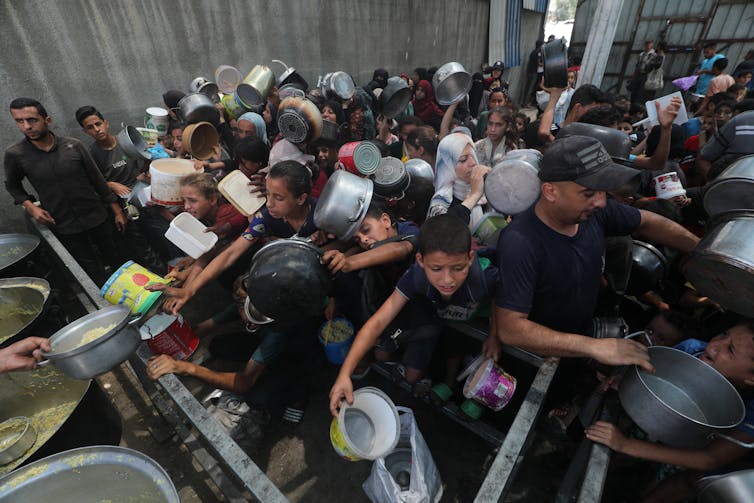
Horrifying images of starving children and thousands of people skirmishing for scraps of food in what a U.N.-backed body has called famine are now regularly reported in media outlets around the world and in the U.S. Even conservative platforms such as Fox News that until recently were sympathetic to Israel’s response to Oct. 7 have dedicated airtime to reporting on the hunger crisis and questioning its motives.

Children hold pots and pans.
Palestinian children struggle to acquire food in the Gaza Strip.
Moiz Salhi/Anadolu via Getty Images

Increasingly, Israel’s onslaught on Gaza – which to date has killed at least 62,000 people, around half of whom are women and children, and left 70% of the strip in ruins – is being viewed through a critical lens.

Nearly two years after the attack that sparked the Israeli operation, the war aims of Israel are understood more and more as politically motivated, with the purpose being the political survival of Netanyahu and his government.

There is increasing international condemnation and sanctioning of some of the government’s more prominent members who are accused of using genocidal language against the Palestinians in Gaza and elsewhere.

Australia recently barred the entrance of one far-right Israeli parliamentarian, citing his violent and inflammatory language against Palestinians. The U.K. has sanctioned two members of Netanyahu’s government, Itamar Ben-Gvir and Bezalel Smotrich, for similar reasons.

Moreover, international organizations and scholars are increasingly framing the actions of the Israeli government as a whole in Gaza as genocide – and recently two Israeli human rights organizations have joined them.

Israeli public opinion

But to what extent are Israeli citizens being conflated with the Netanyahu government in international criticism?

Israeli public opinion polls tell a complex story of views on the war in Gaza. On one hand, Netanyahu’s government remains deeply unpopular among 70% of Israeli citizens, and a growing number of Israelis now fully believe that the prime minister is prolonging the war for his own political interests.

Such sentiment has seen an uptick in protests over the war. On Aug. 17, the country practically shut down during a widespread strike and demonstration against the government. Hundreds of thousands of people gathered in Tel Aviv in an unprecedented mass rally, calling for the end of the war and a ceasefire deal that would bring all hostages back.

Yet polls also show that a majority of Israelis remain either indifferent to the suffering of Palestinians in Gaza or are in support of it, as dehumanization of Palestinians is widespread among large swaths of Israeli society.

It seems that only recently cracks in this wall of indifference have emerged.

Bans, booing and ostracism

The labeling of Israel as a pariah state internationally does not seem to bother the government.

Netanyahu insists that all the reporting about the humanitarian catastrophe in Gaza is fake news, orchestrated by Hamas and antisemitic forces around the world. Netanyahu has also responded to the moves by Western governments to recognize the Palestinian state by labeling their decisions as antisemitic.

But there are signs that international condemnation of the war in Gaza is affecting Israelis themselves – both at home and abroad.

Israelis and Israeli organizations from all walks of life are facing increased instances of anti-Israeli actions and sentiments.

The movement to boycott, divest and sanction Israel, known as BDS, has been in existence since 2005, but until the war in Gaza it had only limited success in generating wide support for its campaign. Now, 20 years after its establishment, the floodgates have seemingly been lifted and resulted in a deluge of boycotts and other actions that are slowly affecting almost every sector in Israel. To give one example, the British grocery chain Co-op earlier this year announced that it would stop sourcing Israeli produce at its 2,300 stores.

Israeli tourists in Greece have been targeted by pro-Palestinian demonstrations. And there are multiple reports of Israeli tourists being questioned or harassed elsewhere for their possible involvement in the war in Gaza.

There is pressure on FIFA to force Israel out of the global soccer organization, and matches involving Israeli teams in European capitals have been marred by violence by fans on both sides.

Meanwhile, a growing number of academics around the world are refusing to collaborate with their Israel peers. The EU is considering a move to block Israel from accessing its prestigious Horizon Europe research and innovation program. And Israeli artists are now regularly ostracized and disinvited from artistic events around the world, from music festivals to architecture exhibitions.

International cultural events that are scheduled to take place in Israel are now routinely modified or canceled, as just happened with the International Harp Competition, which had been scheduled for December 2025. Meanwhile, the popular Eurovision Song Contest has now been a site of anti-Israeli demonstrations for the second year in a row. This is despite Israeli fans of the event, hugely popular among the LGBTQ community, belonging predominantly to the progressive left-leaning camp in Israel – the very people most likely to be in opposition to the current government.

A person holds aloft a red, black, white and green flag
A protestor whistles and waves the Palestinian flag as Yuval Raphael, representing Israel, performs during the rehearsal of the 69th Eurovision Song Contest opening ceremony on May 15, 2025, in Basel, Switzerland.
Harold Cunningham/Getty Images

Israelis have responded to this challenge in multiple ways. Even prior to the mass demonstration on Aug. 17, tens of thousands of Israelis have protested the government for months on end, accusing Netanyahu and his far-right government for turning Israel into a pariah state. Artists and academics have issued petitions, acknowledging Israeli’s responsibility for the humanitarian catastrophe in Gaza and calling for the end of the war.

Abroad, Israelis, who are known for being avid international tourists, are now traveling more to sites that are deemed less hostile to Israel. Many prefer not to disclose their Israeli identify. Reservists and discharged soldiers are fearful of being arrested abroad after posting on social media about their military service in Gaza.

Claims of antisemitism

Yet Netanyahu, who is subject to an outstanding arrest warrant by the International Criminal Court, along with his far-right Cabinet, seem to be unmoved. The global isolation may even serve their narrow interests by putting Israel in this precarious situation and helping them mobilize their base around the argument that all anti-Israeli actions are motivated by antisemitism.

And while antisemitism is real and widespread, and some of it drives anti-Israeli actions, it is a far cry to argue that antisemitism – and not Israeli government policy – is the main reason for current global sentiments and actions against the country.

The government is particularly indifferent to areas that are considered “elitist” and that have been mainly affected by the global protest movement against Israel.

Members of the government and its supporters see Israeli academia or Israeli arts as fields filled with liberal leftists whose power should be curbed. It is telling that when the Weitzman Institute, one of Israel’s most distinguished academic centers, was hit by an Iranian missile during the 12-day war in June, a popular far-right radio and TV anchor and supporter of the government tweeted: “God 1; Weitzman Institute 0.” The suggestion was that God punished this globally renowned academic institution for its lack of support for the government.

The tweet was condemned by journalists and some members of the opposition but was endorsed and repeated on Channel 14, widely known as Netanyahu’s “house TV channel.” Government officials remained silent.

When this is the sentiment among the government and its supporters, why would they be bothered with the consequences to Israeli academia and indeed its citizens by Israel being increasingly seen as a pariah state?

The Conversation

Asher Kaufman does not work for, consult, own shares in or receive funding from any company or organization that would benefit from this article, and has disclosed no relevant affiliations beyond their academic appointment.

ref. Netanyahu remains unmoved by Israel’s lurch toward pariah status − but at home and abroad, Israelis are suffering the consequences – https://theconversation.com/netanyahu-remains-unmoved-by-israels-lurch-toward-pariah-status-but-at-home-and-abroad-israelis-are-suffering-the-consequences-263154

L’IA peut-elle nous dispenser de l’effort d’apprendre ?

Source: The Conversation – in French – By Margarida Romero, Professeure des Universités à l’Université Côte d’Azur et professeure associée à l’Universitat Internacional de Catalunya, Université Côte d’Azur

Que signifie apprendre dans un monde où l’intelligence artificielle peut rédiger un texte, résoudre un problème ou générer une image en quelques secondes ? L’irruption de nouveaux outils invite à se pencher sur la place de l’effort dans l’apprentissage et à discerner différents niveaux de recours à l’IA.


L’intelligence artificielle (IA) suscite autant d’espoirs que d’inquiétudes dans le domaine de l’éducation. D’un côté, elle offre des outils puissants pour accompagner l’apprentissage, par exemple, en ajustant des exercices aux performances de chaque élève en maths, comme le font DreamBox ou Adaptiv’Math, ou en adaptant l’apprentissage des langues à l’âge de l’apprenant, comme Duolingo.

Mais elle peut aussi favoriser la paresse intellectuelle : les IA actuelles ne se contentent plus de fournir des pistes ou des chiffres comme les moteurs de recherche ou les calculatrices, mais produisent directement des contenus complets – résumés, essais, emails, codes informatiques – à la place de l’élève. Cette délégation excessive des tâches cognitives ouvre la possibilité d’une réduction de l’engagement dans la formulation des idées, la réflexion et la régulation du processus de production intellectuelle.


À lire aussi :
Pourquoi continuer d’apprendre à écrire à la main dans un monde d’IA


Cette tension concerne à la fois les élèves, les enseignants et les institutions, et soulève des questions essentielles : quel est le rôle de l’effort dans l’apprentissage ? Que signifie apprendre dans un monde où l’IA peut rédiger un texte, résoudre un problème ou générer une image en quelques secondes ?

Ni miracle technologique ni menace apocalyptique

Il existe toute une gamme d’usages possibles de l’IA en éducation, depuis des formes très passives et peu critiques, par exemple, lorsqu’un élève demande à une IA de résumer une lecture obligatoire sans lire ou analyser le contenu par lui-même, jusqu’à des intégrations créatives où les élèves collaborent avec une IA pour écrire des histoires, coder un jeu ou simuler une conversation avec un personnage historique, tout en exerçant leur jugement et leur pensée critique.

Il s’agit donc de dépasser les visions polarisées présentant l’IA soit comme une solution miracle, soit comme une menace pour les capacités cognitives humaines. Ces deux positions contiennent chacune une part de vérité, mais elles occultent une dimension essentielle : l’éducation vise avant tout le développement de la personne et de son autonomie.

Historiquement, l’IA a été pensée comme un moyen de simuler l’intelligence humaine. Lors de l’atelier fondateur de Dartmouth en 1956, où le terme « intelligence artificielle » a été proposé pour la première fois par John McCarthy, les chercheurs affirmaient que « chaque aspect de l’apprentissage ou toute autre forme d’intelligence peut être décrit de manière suffisamment précise pour qu’une machine puisse le simuler ».

Aujourd’hui, avec l’essor des modèles génératifs, cette promesse de simulation a laissé place à une dynamique de disruption : l’IA ne se contente plus d’imiter, elle remodèle nos manières d’apprendre. Les modèles génératifs comme ChatGPT ou Gemini produisent des contenus inédits (textes, images, vidéos), modifiant ainsi l’accès, la production, mais aussi la qualité de l’information.

Une école à la traîne face à l’essor de l’IA

Le développement rapide de ces outils dépasse largement la capacité des systèmes éducatifs à les intégrer de manière réfléchie. On observe un décalage entre le potentiel technologique et la capacité pédagogique d’aider les apprenants à en faire un usage approprié selon le contexte et leurs besoins d’apprentissage. L’enjeu n’est pas tant d’interdire ou de généraliser l’IA, mais de garantir que son utilisation soutienne réellement les apprentissages, en préservant l’effort intellectuel et les objectifs pédagogiques.

Les IA dites « génératives » (ou genIA), comme ChatGPT, permettent désormais de résumer, d’expliquer des textes de résoudre des problèmes ou encore de créer des images, des sons ou des vidéos. Leur usage peut être utile dans un cadre éducatif, notamment pour aider les enseignants à répondre aux défis révélés pendant la pandémie de Covid-19 : différenciation pédagogique, soutien à l’apprentissage autonome, accessibilité accrue.

Ainsi, une IA peut générer des explications d’un même concept à différents niveaux de complexité (on peut lui demander par exemple « Explique-moi ce concept comme si j’avais 5 ans »), ce qui permet à chacun d’avancer à son rythme dans une même classe. L’élève qui a des difficultés de compréhension pourra disposer ainsi d’éléments de connaissances préalables tandis qu’un élève avec une bonne progression pourrait obtenir des pistes d’approfondissement.

Mais, comme d’autres technologies auparavant présentées comme révolutionnaires (télévision éducative, tablettes, etc.), leur impact dépendra de l’intention pédagogique et de l’engagement des enseignants, des élèves et de leurs familles.

Bannir ou tout autoriser ? Une fausse alternative

Interdire totalement l’IA ou en autoriser un usage sans limites sont deux stratégies simplistes. Elles négligent la complexité des contextes éducatifs, des profils d’élèves et des attentes pédagogiques. La clé réside dans une approche qui respecte l’agentivité des enseignants et des apprenants, c’est-à-dire leur capacité à agir, à choisir, à créer et à réfléchir sur leur propre apprentissage.

Pour cela, il est crucial de penser des usages créatifs, critiques et participatifs de l’IA, qui valorisent le rôle actif des élèves et des enseignants dans les processus d’apprentissage.

Pour aider à clarifier ces usages variés, j’ai développé le modèle #ppai6, qui identifie six niveaux d’engagement avec l’IA à l’école :

  • Consommation passive : l’élève reçoit du contenu généré par l’IA sans interaction ni compréhension du fonctionnement de l’outil. Exemple : lire un résumé généré automatiquement sans vérifier ou reformuler ;

  • Consommation interactive : l’élève interagit avec l’IA, qui adapte ses réponses, mais sans véritable appropriation. Exemple : poser des questions à un chatbot, mais en recopier les réponses sans analyse ;

  • Création individuelle : l’élève utilise l’IA pour produire un contenu personnel. Exemple : écrire un poème ou créer une image avec DALL·E à partir de ses propres idées ;

  • Création collaborative : des groupes d’élèves utilisent l’IA pour produire ensemble du contenu. Exemple : créer une pièce de théâtre en groupe sur un événement historique à partir de conversations avec des outils IA qui simulent des personnages historiques ;

  • Co-création participative : l’IA devient un outil au service d’un travail collectif complexe impliquant divers acteurs éducatifs. Exemple : mener une enquête interdisciplinaire avec IA entre élèves, enseignants et partenaires.

  • Apprentissage expansif avec IA : l’IA soutient des transformations profondes dans les manières de penser et d’apprendre, en aidant, par exemple, à modéliser des systèmes ou à résoudre des contradictions dans des situations complexes. Exemple : utiliser l’IA pour simuler le système écologique de la cour d’école afin, ensuite, de proposer des idées pour l’améliorer.

Considérer la variété des interactions possibles avec l’IA

Le modèle #ppai6 permet d’adopter une vision plus nuancée de l’intégration de l’IA en contexte scolaire. En distinguant six niveaux d’usage, il aide à qualifier concrètement les pratiques et à comprendre que « faire usage de l’IA » peut recouvrir des formes très contrastées, tant sur le plan cognitif que pédagogique.

Il s’agit donc d’un outil de réflexion pour les enseignants, les chercheurs et les décideurs, qui invite à ne pas considérer l’IA comme un bloc homogène, mais comme un ensemble d’interactions possibles, plus ou moins riches sur le plan cognitif et éducatif.

Par ailleurs, ce modèle ouvre la voie à une progression pédagogique adaptée à l’âge et au niveau des élèves. Certains niveaux, comme la consommation passive, peuvent être utilisés ponctuellement, par exemple pour découvrir un outil ou pour amorcer une séquence. Mais ils ne doivent jamais devenir la norme ni remplacer l’effort de réflexion, de collaboration ou de créativité.


À lire aussi :
ChatGPT à l’université : pourquoi encadrer vaut mieux qu’interdire ou laisser-faire


À mesure que les élèves avancent dans leur parcours, il est souhaitable de les guider vers des usages plus actifs, comme la cocréation ou l’apprentissage expansif, adaptés à leur maturité cognitive. Plutôt que de bannir certains niveaux, il s’agit d’en comprendre les limites, d’en discuter les risques, et de les dépasser progressivement vers des formes d’apprentissage où l’IA devient un levier d’émancipation plutôt qu’un substitut cognitif.

L’IA peut être un formidable allié dans l’apprentissage, mais elle ne doit jamais se substituer à l’effort humain ni au désir d’apprendre ou d’enseigner. Dans un contexte où il est possible de déléguer le raisonnement à des machines, la volonté de comprendre, de progresser, de créer ou de transmettre devient encore plus essentielle.

C’est cette volonté qui distingue les enseignants et les élèves qui mobilisent l’IA pour enrichir leur activité de ceux qui s’en servent simplement pour éviter l’effort. L’IA n’est qu’un outil. L’éducation, elle, reste une affaire profondément humaine.

The Conversation

Margarida Romero a reçu des financements pour son activité de recherche de la Commission européenne pour le projet Horizon augMENTOR “Augmented Intelligence for Pedagogically Sustained Training and Education” (https://augmentor-project.eu/).

ref. L’IA peut-elle nous dispenser de l’effort d’apprendre ? – https://theconversation.com/lia-peut-elle-nous-dispenser-de-leffort-dapprendre-261889

#MeToo in the movies – what to watch, see and play this week

Source: The Conversation – UK – By Anna Walker, Senior Arts + Culture Editor, The Conversation

It’s been almost a decade since the #MeToo movement promised to bring abusers in Hollywood to account. I’ve watched with interest as films have interrogated the moment in the years since. In 2020, there was Promising Young Woman, in which Carey Mulligan played a woman hellbent on punishing those who get away with abuse. And in 2023, Women Talking focused on a group of American Mennonite women who meet to discuss their future after discovering a history of rape in the colony.

Sorry Baby, which won awards at this year’s Sundance Film Festival, joins this decade of conversation. The film follows Agnes (played by the film’s writer-director Eva Victor), an English professor at a small American college, in the aftermath of a sexual assault.

The story, based on Victor’s own experiences, is structured in non-linear chapters that encompass the time after, before and during the abuse. This makes for an unflinching yet nuanced depiction of trauma’s aftermath. As our reviewer argues: “Victor portrays her female characters in a broad light, not allowing them to be solely defined by trauma, and in doing so allows something truly authentic to emerge.”

Sorry Baby is in select cinemas now

Another film experimenting with non-linear storytelling this week is The Life of Chuck. It’s an adaptation of a novella by Stephen King. When I told our resident King expert, international affairs editor Jonathan Este, about the film, he was puzzled – surely, he asked, the structure of that story is unfilmable? But somehow, director Mike Flanagan makes it work.

Starring Tom Hiddleston, The Life of Chuck explores the formative moments of Charles “Chuck” Krantz, chronicled in reverse chronological order. But this is no Benjamin Button story. It’s a joyful adaptation that honours the King novella while bringing in nice touches of its own.

As Hiddleston – who gets to show off his dancing skills in the film – told the audience at a recent screening: “I think the most important word in the title of the film is the word ‘life’. This is a film about life.”

The Life of Chuck is in cinemas now

Now open at the Bowhouse in Fife, Making Waves; Breaking Ground brings together the work of 11 artists to explore the natural environments of our modern world. Spanning painting, photography and film, these artists share a commitment to pursuing a more compassionate way of looking and being in a place.

And the works are stunning. Photographs of flowers frozen in time in extreme close-up by Kathrin Linkersdorff. A painting by Susan Derges that at first appears to be the Moon surrounded by clouds, but soon morphs before your eyes to be its shimmering reflection in a scummy river, and then something stranger – the perspective of a creature below the surface. A trout’s-eye view of the night sky.

As our reviewer, art historian Alistair Rider explains, these artists “don’t see themselves as separate from the worlds they depict. Our seeing eyes, they suggest, are made of the same physical substances as the things they see.”

Making Waves; Breaking Ground is a free exhibition running until August 31 at the Bowhouse, St Monans, Fife

It’s a truth universally acknowledged that every arts and culture editor has a secret taste for terrible TV. Mine? Love is Blind. I’ve binged the American show – all eight seasons of it – but my real soft spot is for Love is Blind UK. The couples are a little older, a little less media-savvy and all the more entertaining for it.

What I love about this show is the central premise – testing the idea that two people can fall in love without seeing each other in the flesh. Or, as the show cloyingly puts it, fall in love “sight unseen”. With the second season streaming now, we asked a psychologist to tell us what the research says – is love truly blind?

Love is Blind UK is streaming on Netflix now

While I’m in a confessional mood, here’s another guilty pleasure of mine. In moments of overwhelm, I have been known to turn off my phone, curl up under a blanket and fire up my laptop for a marathon game of The Sims. In that life simulation game, I create mini avatars who decorate their houses, fall in love, make friends and steadily work their way up the career ladder.

Turns out I’m not alone. More and more gamers are spending their time playing virtual jobs over fantasy adventures. The latest offering is Tiny Bookshop, where players spend hours organising shelves, recommending novels and chatting with customers.

Is it a little dystopian to finish work and log straight in for a virtual shift in your favourite video game? Perhaps. But as creative industries expert Owen Brierley argues: “The next time someone questions why you’re wasting time managing a virtual bookshop, remind them you’re not escaping work. You’re experiencing what work could be. Voluntary. Meaningful. Genuinely productive.”


Looking for something good? Cut through the noise with a carefully curated selection of the latest releases, live events and exhibitions, straight to your inbox every fortnight, on Fridays. Sign up here.


The Conversation

ref. #MeToo in the movies – what to watch, see and play this week – https://theconversation.com/metoo-in-the-movies-what-to-watch-see-and-play-this-week-263659

Crise anglophone du Cameroun : la logique des armes l’emporte sur celle du dialogue

Source: The Conversation – in French – By Jacqui Cho, PhD Fellow, swisspeace Mediation Program, University of Basel

En Afrique centrale, un conflit violent sévit depuis près de huit ans. Tout a commencé en 2016 par des manifestations pacifiques d’avocats et d’enseignants. Ils dénonçaient la « francophonisation » croissante des systèmes juridique et éducatif dans les régions anglophones du Cameroun. Très rapidement, ces protestations ont dégénéré en conflit armé opposant des groupes séparatistes aux forces gouvernementales.

Le coût humain est dévastateur. Les deux camps de cette guerre civile utilisent l’éducation comme arme. Depuis 2017, plus de 700 000 enfants ont été contraints de quitter l’école. En octobre 2024, le conflit avait fait plus de 6 500 morts et déplacé plus de 584 000 personnes à l’intérieur du pays. Plus de 73 000 personnes ont été contraintes de se réfugier au Nigeria voisin.

Bien qu’il soit un acteur central d’un conflit toujours loin d’être réglé, Yaoundé affirme que la situation est sous contrôle. En réalité, les autorités combinent une stratégie de répression militaire et un faux semblant de dialogue. Dans les coulisses, elles freinent ou sabotent discrètement toute véritable initiative de paix.

Pourquoi le Cameroun a-t-il pu éviter un accord de paix sans subir de fortes pressions internationales ? J’ai cherché des réponses dans le cadre de ma thèse de doctorat sur la médiation, axée sur le conflit au Cameroun.

Dans un contexte de résurgence des rivalités entre grandes puissances, le Cameroun a su composer avec les intérêts d’acteurs mondiaux concurrents et les mettre à profit. Les gouvernements occidentaux, désireux de maintenir le Cameroun dans leur sphère d’influence et craignant l’engagement croissant de la Russie et de la Chine, n’ont pas exercé de pression en faveur de la paix. Insister pour que des négociations aient lieu risquerait de compromettre les relations avec Yaoundé, ce que les capitales occidentales souhaitent éviter à tout prix.

Le cas du Cameroun révèle une tendance plus large. Partout en Afrique et au-delà, la norme post-guerre froide consistant à résoudre les conflits politiques par la négociation perd du terrain. Les approches militarisées deviennent plus fréquentes, tolérées, voire encouragées par les grandes puissances. Cela vaut surtout quand les régimes en place protègent leurs intérêts stratégiques. Cette évolution redessine discrètement les règles de la résolution des conflits et fait peser de lourdes menaces sur la paix et la démocratie.


Read more:
Règlement de la crise anglophone au Cameroun : pourquoi l’État refuse l’aide étrangère


Un refus calculé du dialogue

Entre 2019 et 2022, la Suisse a tenté de faciliter les pourparlers de paix entre l’État camerounais et divers groupes séparatistes. Ce processus a échoué, en grande partie à cause de la froideur et du manque d’engagement du gouvernement camerounais. Lorsque l’initiative suisse a été discrètement abandonnée, il n’y a eu que peu de réactions au niveau international.

La capacité du Cameroun à se retirer des efforts de facilitation tout en intensifiant ses opérations militaires est le résultat de ses manœuvres diplomatiques dans le cadre de la rivalité franco-russe. En signant un accord militaire avec la Russie en avril 2022, le Cameroun a signalé à la France et à d’autres pays qu’il disposait d’options diplomatiques. Cette décision aurait incité la France à adopter une position plus souple, autorisant Yaoundé à agir à sa guise tant qu’elle restait dans la sphère d’influence française. La visite du président français au Cameroun quelques mois plus tard a renforcé l’idée que les relations stratégiques primeraient sur la résolution du conflit ou les normes démocratiques.

Le Cameroun s’appuie aussi depuis longtemps sur un cercle de soutiens discrets. Ses relations solides avec les États-Unis, la Chine, Israël ou encore le Japon lui assurent un appui tacite. Ces partenaires l’ont protégé sur le plan diplomatique et ont permis au régime de durcir sa ligne militaire sans véritable sanction internationale.

Dérive mondiale vers la logique de la force

La crise anglophone au Cameroun illustre une évolution préoccupante. Après la guerre froide, la norme dominante pour résoudre les conflits reposait sur la négociation. Aujourd’hui, ce modèle est fragilisé.

Plusieurs facteurs expliquent cette remise en cause. D’un côté, les États occidentaux dits « libéraux » ont modifié leurs priorités depuis la « guerre internationale contre le terrorisme ». La sécurité est devenue centrale, parfois au détriment des principes démocratiques. Cela a conduit à une plus grande tolérance envers les régimes autoritaires et à une acceptation implicite du recours à la force.

D’autre part, des puissances émergentes comme la Russie et la Chine promeuvent des modèles alternatifs de gestion des conflits. Elles privilégient des approches qui permettent aux États forts de maintenir la paix, y compris par le recours à la force. La Russie considère par exemple ses interventions militaires en Syrie comme une forme de « pacification », où l’ordre prime sur la justice. La Chine adopte une vision semblable : la paix repose avant tout sur un État central fort.

Les États africains sont loin d’être des observateurs passifs dans ce paysage en mutation. S’appuyant sur les expériences acquises à l’époque des empires et de la guerre froide, ils cherchent à promouvoir leurs propres intérêts tant au niveau national qu’international.

L’Afrique n’est donc pas seulement objet des jeux de puissances. Les acteurs africains s’adonnent stratégiquement à ce jeu parce qu’ils y trouvent leur intérêt.

Les élections et les enjeux pour la démocratie et la gouvernance

À l’approche de l’élection présidentielle d’octobre 2025, les enjeux pour la démocratie, la gouvernance et la paix au Cameroun sont évidents. À 92 ans, le président Paul Biya a officiellement annoncé sa candidature pour un huitième mandat.

L’opposition dénonce un système déjà verrouillé contre elle, avec des cas signalés de harcèlement et d’intimidation. Le conflit qui sévit actuellement dans les zones anglophones devrait rendre le vote plus difficile, voire impossible. Cette situation jouera en faveur de Biya.

La capacité du régime à ignorer les appels au dialogue s’explique par le soutien géopolitique dont il bénéficie et par une opposition divisée. Mais cela entretient le risque que le statu quo militarisé soit perçu comme une forme de stabilité.

La violence quotidienne, les enlèvements et les meurtres, en particulier dans les zones rurales, sont devenus monnaie courante, sans que cela ne suscite beaucoup de réactions au niveau international. Le régime poursuit ainsi sa politique répressive sans considération pour les répercussions internationales.

Un précédent dangereux

Le cas de la crise anglophone au Cameroun est emblématique d’une opposition, à l’échelle mondiale, entre deux logiques: un modèle axé sur la négociation et une approche militarisée pour mettre fin aux conflits politiques violents.

L’affaiblissement du modèle basé sur la négociation, associée à la capacité accrue des États africains à résister aux pressions extérieures, complique davantage les efforts pour amener les parties au conflit à s’asseoir à la table des négociations.

Le Cameroun montre comment le silence international et l’usage stratégique du contexte géopolitique peuvent légitimer la résolution des conflits par la force brute. Sans un engagement renouvelé à un dialogue inclusif et à des solutions politiques, le précédent qui se crée aujourd’hui risque d’influencer la manière de gérer les conflits demain, en Afrique et au-delà.

The Conversation

Les recherches de Jacqui Cho ont été financées par le Fonds national suisse de la recherche scientifique sous le numéro 100017_197543 et par la bourse pour jeunes chercheurs d’excellence de l’Université de Bâle.

ref. Crise anglophone du Cameroun : la logique des armes l’emporte sur celle du dialogue – https://theconversation.com/crise-anglophone-du-cameroun-la-logique-des-armes-lemporte-sur-celle-du-dialogue-263546