Comment Airbnb a changé le secteur du tourisme

Source: The Conversation – France (in French) – By Mustafeed Zaman, Professeur Associé en Marketing Digital, EM Normandie

Airbnb n’a même pas vingt ans. Et pourtant, le site est devenu un acteur majeur du tourisme. Sa création n’a pas seulement conduit à un transfert des hébergements, il a contribué à des changements profonds du secteur, répondant à de nouveaux besoins, mais créant aussi de nouveaux problèmes. Panorama des mutations induites par une entreprise née en 2007 du côté de San Francisco.


Avec 43 milliards d’euros générés par les locations de courte durée en 2023, la plateforme d’Airbnb est désormais le deuxième site d’e-tourisme le plus populaire en France (derrière Booking.com). Au cours de ces deux décennies, Airbnb a changé des habitudes et préférences de voyage, a redessiné la géographie du voyage et l’a rendu plus accessible.

Malgré les retombées économiques positives et la diversification des offres, les critiques se sont multipliées et les expériences locales des voyageurs se sont transformées en préoccupations pour les habitants locaux.

Changement d’habitudes

Airbnb et d’autres plateformes de la location de courte durée ont changé les habitudes de voyage. En 2023, plus d’un Français sur trois aurait réservé un hébergement de courte durée. Grâce à Airbnb (et aux autres plateformes de location de courte durée), les hôtes partagent leur vie privée sans hésitation et les voyageurs se sentent à l’aise chez des personnes qu’ils n’ont jamais rencontrées auparavant. C’est déjà un changement de comportement : les voyageurs sont à la recherche de l’authenticité des hébergements proposés par des locaux, de l’interaction avec des hôtes ou des « locaux » (expérience immersive), du confort de la maison (équipements proposés par l’hôte).


À lire aussi :
Le « Travel Retail » à l’aéroport, ou quand le luxe s’invite dans nos bagages à main


Depuis le Covid-19, avec la démocratisation du télétravail, un nouveau segment est né – les nomades digitaux. Airbnb a contribué au développement de ce nouveau marché et la durée des séjours dépassant un mois est considérablement augmentée. Les espaces de travail adaptés aux ordinateurs portables et la qualité de la connexion wifi sont devenus les nouveaux critères de sélection sur la plateforme. D’ailleurs, certaines destinations (par exemple : le Portugal, l’Italie, Dubaï) proposent désormais un « visa nomade digital » afin d’attirer ces nomades du monde entier.

Des comportements inédits

Airbnb a également facilité le blended travel où les voyageurs prolongent leurs voyages d’affaires pour le loisir. Aux États-Unis, 68 % des millennials (nés entre 1980 et la fin des années 1990) et de la génération Z (née entre la fin des années 1990 et le début des années 2010) pratiquent cette nouvelle forme de voyages. Ce phénomène est alimenté par les plateformes de la location de courte durée qui sont beaucoup plus accessibles.

Par ailleurs, si les hôtels traditionnels acceptent les animaux de compagnie, les services proposés ne sont pas toujours adaptés à ces nouveaux voyageurs. Airbnb est perçu comme une solution, mieux adaptée pour les animaux de compagnie. Près d’une annonce sur trois sur Airbnb est « Pet Friendly » et, en 2023, Airbnb a constaté une hausse de près de 50 % du nombre de nuits réservées avec des animaux de compagnie dans les hébergements majoritairement situés dans les zones rurales.

Rendre le tourisme plus accessible

Le coût d’un séjour dans un Airbnb étant moins élevé que dans les hôtels traditionnels, cela permet aux voyageurs de rester plus longtemps. Par exemple, en janvier 2025, le prix moyen d’une nuit à l’hôtel à Paris était de 316 euros tandis qu’un studio ou un appartement d’une chambre en location sur Airbnb était de 148 euros (certains logements pouvaient héberger jusqu’à quatre personnes).

Les voyageurs qui séjournent dans des hôtels restent en moyenne 2,8 jours avec une dépense moyenne à 153 euros par jour (soit environ 428 euros par séjour). Tandis que dans des hébergements de courte durée, les voyageurs restent plus longtemps avec une durée moyenne de séjour de 5 jours. La dépense moyenne atteint 88 euros par jour.

Une nouvelle géographie touristique

Airbnb modifie la géographie touristique mondiale. En 2024, les voyageurs sur Airbnb ont visité un nombre record de 110 000 destinations à travers le monde, contribuant à une distribution plus équilibrée du tourisme et à un timide début de réduction du surtourisme. Aux seuls États-Unis, plus de 2 100 villes sans infrastructure hôtelière ont accueilli leurs premiers touristes venus par l’intermédiaire de la plateforme. Cela a généré 10,5 milliards de dollars de revenus pour les hôtes de ces zones en 2022. Dans les dix villes les plus visitées de l’Union européenne, en 2024, plus de 260 000 voyageurs sur Airbnb ont séjourné dans un quartier où l’offre hôtelière est inexistante. La moitié des voyageurs sur Airbnb au sein de l’Union européenne déclarent qu’ils n’auraient pas visité le quartier dans lequel ils ont finalement séjourné.

Véritable casse-tête

Malgré ces impacts positifs et l’initiative de répartir le tourisme hors des centres urbains surchargés, Airbnb est devenu un véritable casse-tête pour les grandes villes touristiques. À Paris (où Airbnb représente 76 % des annonces), 90 % des annonces concernent des logements entiers.

Selon l’étude publiée par la Ville de Paris, ce nombre est beaucoup plus élevé que, dans d’autres grandes villes, comme New York (où 54 % des annonces comprennent des logements entiers), Barcelone (60 %) ou Amsterdam (81 %), l’interaction avec les hôtes ou l’expérience immersive est pratiquement inexistante. Ces appartements sont souvent gérés par des agences de location, et les voyageurs récupèrent et rendent les clés grâce aux boîtes à clés.

Airbnb a contribué à la pénurie de logements et à l’augmentation des loyers dans le monde entier. À Barcelone, le prix du loyer a été multiplié par deux en une décennie. Actuellement, le loyer moyen atteint le salaire moyen (c’est-à-dire, 1 500 euros). Un peu partout, pour dissuader la location de courte durée, les autorités ont multiplié les mesures.

Interdiction des boîtes à clés

En France, la loi « visant à renforcer les outils de régulation des meublés de tourisme à l’échelle locale », dite « loi Anti-Airbnb », adoptée en 2024, a mis en place plusieurs mesures telles que la réduction de l’avantage fiscal, la possibilité de limiter la location d’une résidence principale à quatre-vingt-dix jours par an, la mise en place des quotas de meublés touristiques dans des zones tenues, l’obligation de diagnostic de performance énergétique (DPE), etc.

Certaines villes ont pris des mesures supplémentaires. Par exemple, depuis le 24 janvier 2025, la Ville de Paris a interdit les boîtes à clés sur l’espace public.

Les problèmes ne se limitent pas uniquement au coût de loyer. Pour certains critiques, Airbnb est tenu responsable de la destruction massive de vie du quartier (avec des allées et venues constantes, du bruit à des heures inappropriées, des dégradations). Les résidents locaux ont aussi commencé à riposter. À Malaga (Andalousie), les résidents ont apposé des autocollants devant les immeubles où des logements unifamiliaux ont été convertis en Airbnb. Les messages tels que « Rentrez chez vous », « Une famille vivait ici » ou « Attaque contre les citoyens de la ville » ne sont pas favorables aux touristes.

France 24, 2025.

Mésaventures en série

Les hôtes n’ont pas été épargnés. Airbnb a souffert des problèmes très médiatisés tels que l’impossibilité de déloger les squatteurs, la fausse facturation en montrant des images de dégradation générées par l’IA, le saccage des maisons louées sur Airbnb, des caméras de sécurité. Moins fréquents mais très médiatisés, ces problèmes ont détérioré l’image d’Airbnb.

Transformation de l’offre : de la plateforme de location au hub d’expérience touristique

En moins de deux décennies, Airbnb a transformé le marché de la location de courte durée et devenu le leader du marché. En 2024, la plateforme a représenté 44 % du chiffre d’affaires (CA) mondial de la location de courte durée, suivi par Booking.com (18 %) et Vrbo (9 %).

Bien que leader du marché, Airbnb est concurrencé par des plateformes qui, comme Booking.com, proposent également des logements entiers, des attractions sur place, ou HomeExchange, une plateforme d’échange de maisons et d’appartements.

Face à ces plateformes, Airbnb a diversifié ses offres proposant aussi désormais des expériences originales (de luxe) et des services.

LeHuffPost, 2023.

Aujourd’hui, il est possible d’y réserver un coiffeur, un masseur, une femme de ménage ou un traiteur. De l’usage occasionnel (uniquement pour les voyages), la plateforme d’Airbnb se positionne comme une plateforme à l’usage quotidien (pour les activités et expériences quotidiennes).

Même si ces activités ne représentent qu’une petite partie du chiffre d’affaires, elles vont générer plus de trafic sur la plateforme. Ces nouvelles offres vont certainement impacter l’industrie du tourisme. Pour les voyageurs, la plateforme pourrait devenir un hub d’expériences avec un vrai service de conciergerie.

En revanche, pour les professionnels du tourisme (notamment pour les guides locaux, les prestataires locaux, les services de conciergerie, etc.), cette nouvelle plateforme d’Airbnb serait à la fois une concurrente et une opportunité (comme un moyen d’être visible auprès des millions d’utilisateurs et une plateforme de commercialisation). Face à ces enjeux, ce changement de stratégie d’Airbnb continuerait-il à attirer autant les voyageurs ?

The Conversation

Mustafeed Zaman ne travaille pas, ne conseille pas, ne possède pas de parts, ne reçoit pas de fonds d’une organisation qui pourrait tirer profit de cet article, et n’a déclaré aucune autre affiliation que son organisme de recherche.

ref. Comment Airbnb a changé le secteur du tourisme – https://theconversation.com/comment-airbnb-a-change-le-secteur-du-tourisme-263583

What makes Lake Iro in Chad so special? It’s not just a viral sunglint photo

Source: The Conversation – Africa (2) – By Pierre Rochette, Emeritus professor in geophysics, Aix-Marseille Université (AMU)

Lake Iro in Chad was in the news in early August 2025 after a picture taken by a NASA astronaut was published showing it looking like a large, circular silver mirror as sunlight reflected off its surface and into space. The phenomenon is known as a sunglint and can happen to any water surface under the right conditions. The startling picture led The Conversation Africa to find out more about the lake. Pierre Rochette is an emeritus professor in geophysics from Aix-Marseille University in France. He has studied the lake, and navigated it too for a geophysical study. He answers questions about its properties as an impact crater from an ancient meteor.


What’s there to know about Lake Iro?

The lake is in south-eastern Chad, about 120 km from the border with the Central African Republic.

Lake Iro lies in the middle of an “inland delta”, which was formed by river waters diverging from the Bahr Salamat, a river which flows in the wet season, with very limited flow in the dry season.

It has a semi-circular shape and is about 12 km in diameter. A number of rivers meander around it.

Iro Lake is a vital resource for people living in the area. It provides permanent water and fodder for the large herds of cattle migrating from the Sahelian zone when it’s too dry to keep the animals up north.

People there also produce dried smoked fish, which is exported.

What’s unique about the lake?

Iro may be the largest extraterrestrial impact crater lake in Africa. Volcanic or karstic (where rock has dissolved) crater lakes are much more abundant on Earth.

When an asteroid or comet strikes the Earth’s surface at a speed of about 10km per second, it excavates a crater about ten times larger than itself. So the extraterrestrial body must have been 1km wide in the case of Iro Lake.

My research shows several examples of such impact craters in Chad. Their age is unknown, but likely older than ten million years.

The crater that is home to Lake Iro is a bit larger than the better known Bosumtwi Lake in Ghana. Bosumtwi crater was also excavated by an asteroid strike, but more recently, about one million years ago.

Africa has only 20 proven impact craters (among which seven have a diameter larger than 10km). That corresponds to one tenth of the total proven craters on Earth.

Since 2014, no new crater has been discovered in Africa. A large number (around 49, according to some studies) and a few other potential impact structures have been proposed in Africa, mostly based on satellite imagery and topography.

But solid proof for impact in these proposed structures, including Iro lake, is lacking due to limited or non-existent field studies.

As a group of scientists we have been heavily involved in tracking down impact craters on the continent. Our most recent work involves an ongoing study of the 40km diameter Velingara structure in Senegal.

Studying large impact craters is important to better evaluate the future threat of asteroid impacts. They also provide potential resources (like water, petrol and metals) and a record of ancient climates in the sediments accumulated in the crater lake.

How do you know it started off as a meteor crater?

Proving the impact nature of a circular structure requires traces of either extraterrestrial matter or of very high pressures endured by the target material.

Due to the likely old age and thus strong erosion of Iro’s circular depression, hardly any rock can be found on the surface. Only drilling for several hundred metres can reach the impacted rocks and thus provide definitive proof. This is a very hard task in such a remote area.

Nevertheless, the known geological features of the area provide no other explanation for the presence of this circular depression, apart from an impact.

That’s why we consider Iro Lake as a potential impact structure. It’s still unproven, but likely.

What are its distinctive geological features?

The area around Iro is extremely flat, as demonstrated by the slope of the Bahr Salamat river, south of the lake, of the order of 0.2 metres per kilometre. This explains the meandering nature of the river, highlighted by the published sunglint image.

Bahr Salamat’s altitude south of Iro is 396 metres, higher by only 40 metres from its altitude 160km to the west-south-west. In fact the Bahr (“river” in the local language) seems to go around the Iro lake depression (the average altitude of the lake is 387 metres).

This is odd as the river should have been attracted towards the depression, but can be explained by the fact that the impact generated a regional uplift that resulted in the Bahr changing its course to the south, to avoid the uplifted region.

What is a sunglint?

Depending on the angle of view, any body of water can behave as a mirror for a light source, such as the sun.

Completely still water just reproduces the object emitting the light, like a perfectly still mountain lake reproduces the rocky landscape above it.

But if the water surface is disturbed by wavelets, the perfect reflection vanishes, and is replaced by blurred light – in this case from the sun. This is the sunglint.

Anybody can experience it in clear weather from an aeroplane or from the top of a mountain, looking at a landscape containing water surfaces riddled by a breeze, in the direction of the sun.

Spectacular examples of sunglints, especially when the sun is not at its highest point (at noon), are reported from satellite imagery, as can be seen here.

The visual phenomenon is not limited to satellite imagery. The term sunglint has been in use since the 1960s. Earlier mentions of the phenomenon used the term “sun glitter”.

The Conversation

Pierre Rochette receives funding from Agence Nationale de la Recherche (French ministry of Science), ET-Megafire grant ANR-21-CE49-0014-03. His mission to Iro lake was supported by the University of N’Djamena in Chad, as well as the Institut de Recherche et Développement (IRD)

ref. What makes Lake Iro in Chad so special? It’s not just a viral sunglint photo – https://theconversation.com/what-makes-lake-iro-in-chad-so-special-its-not-just-a-viral-sunglint-photo-263228

Christians and the British empire: how a church NGO got entangled in colonial violence in Kenya

Source: The Conversation – Africa (2) – By Poppy Cullen, Lecturer in International History, Loughborough University

In the 1950s, Kenyans fought against colonial control in what came to be known as the Mau Mau rebellion. In response, the British government announced a state of emergency in 1952 and engaged in a brutal counter-insurgency campaign to secure control of colonial Kenya.

During the emergency, tens of thousands of Kikuyu, Embu and Meru – tribal groups predominantly from central Kenya – were detained without trial in camps. These detention camps relied on torture sanctioned by government to get detainees to renounce their nationalistic ambitions.

More than one million other Kenyans were forcibly relocated into new and controlled villages. These were frequently sites of forced labour, coercion and violence.

This was supported by the colonial policy of “rehabilitation”. The objective was to get Mau Mau adherents to “confess” their Mau Mau activities, give up their ties to the movement and receive education to become valuable colonial subjects.

But rehabilitation became a cover for excessive violence perpetrated against those in camps and villages.

It was not just the colonial state which engaged in rehabilitation. NGOs also employed people and spent money to help enact rehabilitation policies. These organisations included Save the Children and the Red Cross.


Read more:
Academic sleuthing uncovered British torture of Mau Mau fighters


My recent research looks at another organisation that became actively involved: the Christian Council of Kenya. I am a historian of the relationship between Kenya and Britain before and after independence, and interested in the intersection between humanitarianism and decolonisation.

The Christian Council of Kenya was established in 1943 as an ecumenical group of missions and churches based in Kenya. It involved all the major Anglican churches, but few African Independent Churches. It was mostly made up of white European Church leaders and missionaries.

It was not a very powerful organisation until the 1950s. This all changed with the Mau Mau emergency. The council viewed its involvement in Mau Mau rehabilitation as an opportunity to evangelise and win converts to Christianity.

The council’s involvement reveals the variety of ways that NGOs became involved – and sometimes implicated – in policies of colonial violence.

The emergency provided the Christian Council of Kenya the opportunity to grow through a process of “NGO-isation”. This involved the transformation of missionary organisations into NGOs during the period of decolonisation.

As secular NGOs emerged, and policies of development increased, missions expanded their activities. This included employing new staff, fundraising, organising ambitious development projects, and working with governments and other NGOs. These were all things the council first did during the emergency.

In the process, the council became part of the colonial system of violence and mass incarceration. While sometimes directly criticising the government, it came to support the government and sanction its violence.

This was especially clear in later years when violence and torture increased but the council spoke out less against them. Through its place on a rehabilitation advisory committee and its direct connection to the governor, the council positioned itself as an ally of government rather than a critic.

The council’s involvement

In 1954, the Kenya colonial government invited the Christian Council of Kenya to help with the project of rehabilitation. This involved employing staff who could work in detention camps and new villages.

The council worked with Christian Aid in Britain, which raised funds for its activities. Christian Aid was at the time expanding from its roots in Europe. Working with the council in Kenya was Christian Aid’s first major project in Africa. The council also received colonial government grants.

The Christian Council of Kenya appointed a general-secretary, Stanley Morrison, a British national who led council efforts in the rehabilitation programme. Morrison believed that detainees would feel a spiritual lack after renouncing Mau Mau and that Christianity could fill the gap.

He saw working with Christian Aid and the government as a chance for growth and actively set about pursuing these opportunities. A key part of this involved sending priests into prisons and detention camps. This was a vast and literally captive audience for evangelism.

The council also designed a “cleansing ceremony” for detainees. This was intended to follow an extensive programme of Christian instruction, in which detainees would renounce their adherence to Mau Mau and embrace Christianity.

But the Christian revival it hoped for did not take place. The council’s activities and influence were limited, mainly due to the fact that there were hundreds of thousands in detention and over a million people in new villages. The council did not have the funds to employ enough people to meet this need. This meant that interventions like the cleansing ceremony weren’t widespread.

The complexities

The Christian Council of Kenya’s relationship with the colonial government was complicated.

On the one hand, it shared common aims with the government. On the other, the council was also concerned about the violence and abuses that occurred in the emergency.

This raised a challenge frequently faced by NGOs working in sites of violence: whether and how to voice criticism while ensuring access to their intended recipients.

Council members had different views. The group criticised the government publicly several times, but more often preferred to raise concerns privately. In this way, it ensured its friendly relationship with the colonial government.

The biggest clash was between Anglican bishop Leonard Beecher and David Steel, the moderator of the Church of Scotland. Steel favoured a direct approach against the violence, preaching a sermon that was broadcast on radio to raise awareness of abuses. Beecher criticised this as likely to damage the Christian Council of Kenya’s relationship with the government.

The government invited the council to join the Rehabilitation Advisory Committee in October 1954. This gave it the chance to mitigate excesses, but also meant it was implicated in government policy.

The council’s criticisms decreased further over the final years of the emergency. For example, when told of the “dilution technique”, which involved beating detainees who refused to confess their Mau Mau oaths, the council shrugged it off with the view that those men were probably psychiatric cases.

As the fighting wound down from 1957, the council no longer focused on rehabilitation, but on long-term development activities, such as training church leaders, running youth training programmes and working with industry.

By the official end of the emergency in 1960 when the colonial government lifted restrictions, the Christian Council of Kenya was well established as a development-focused NGO, with an active portfolio of activities, supported by Christian Aid in the UK, and with close relations to the Kenya government.

The opportunity that the council expected from the emergency – more converts – did not arise. But there was an opportunity for it in its own expansion.

The consequences

My findings highlight the need to pay more attention to missions and churches as major actors at the end of empire. They are often overlooked in favour of political actors, but could have played significant roles behind the scenes.

The council, with Christian Aid’s ongoing support, continued working in Kenya past independence, and still exists. It was renamed the National Council of Churches of Kenya. In 1963, the year of Kenya’s independence, the council appointed its first African general-secretary. Its role in the emergency helped set up its later success.

The Conversation

Poppy Cullen does not work for, consult, own shares in or receive funding from any company or organisation that would benefit from this article, and has disclosed no relevant affiliations beyond their academic appointment.

ref. Christians and the British empire: how a church NGO got entangled in colonial violence in Kenya – https://theconversation.com/christians-and-the-british-empire-how-a-church-ngo-got-entangled-in-colonial-violence-in-kenya-262566

Près des autoroutes et des déchetteries : les gens du voyage face aux injustices environnementales

Source: The Conversation – France (in French) – By Léa Tardieu, Chargée de recherche en économie de l’environnement, Inrae

Aire d’accueil des gens du voyage de Beynost (Ain) en avril 2023 Benoît Prieur, CC BY

Une étude inédite démontre l’injustice environnementale dont sont victimes les communautés des gens du voyage. Les aires d’accueil où elles peuvent séjourner sont de fait très souvent placées dans des zones polluées ou présentant des nuisances environnementales.


Essayez de vous rappeler la dernière fois que vous avez vu une pancarte désignant « aire d’accueil des gens du voyage ». Vers où pointait-elle ? Dans la France urbaine et périurbaine, il y a de fortes chances qu’elle dirige vers une zone polluée ou sujette à d’autres nuisances environnementales. C’est ce que nous avons pu démontrer à travers une étude statistique inédite. Les gens du voyage, un terme administratif désignant un mode de vie non sédentaire qui englobe une multitude de communautés roms, gitanes, manouches, sintés, yénish, etc., sont de ce fait discriminés.

De précédentes recherches avaient déjà mis en évidence la discrimination environnementale systémique que subissent ces communautés en France. On peut citer par exemple l’ouvrage Où sont les « gens du voyage » ? Inventaire critique des aires d’accueil, du juriste William Acker, et les travaux en anthropologie de Lise Foisneau, notamment sur l’aire du Petit-Quevilly (Seine-Maritime) à la suite de l’accident industriel de Lubrizol, ou encore ceux de Gaëlla Loiseau.

Ils replacent ces discriminations dans un contexte historique, sociologique, juridique et politique, et soulignent le rôle prépondérant de la mise à distance des gens du voyage dans l’espace public et soulignent leur invisibilisation dans le débat public.

Pour compléter les études existantes et enrichir le débat sur les injustices environnementales en France, nous avons souhaité vérifier si ces injustices pouvaient s’observer au plan statistique. Dans une étude récemment publiée dans Nature Cities, nous comparons l’exposition aux nuisances environnementales dans les aires d’accueil et dans d’autres zones d’habitation comparables.

Où placer les aires d’accueil ?

La localisation des aires d’accueil des gens du voyage représente un domaine, relativement unique, dans lequel la puissance publique impose les lieux où une catégorie de la population a le droit de s’installer.

Ceci en fait un contexte particulièrement intéressant à étudier dans le cadre de la justice environnementale. En effet, la littérature sur la justice environnementale se concentre presque exclusivement sur les phénomènes de ségrégation spatiale, involontaires et systémiques. En revanche, le cas des aires de gens du voyage met en lumière une injustice produite directement par des décisions publiques répétées, et non par des dynamiques résidentielles spontanées.

En France, depuis la loi du 5 juillet 2000, dite loi Besson, la participation à l’accueil des gens du voyage est obligatoire pour les communes de plus de 5 000 habitants. Mais cette nécessité est, dans les faits, peu respectée. Les derniers chiffres officiels de la DIHAL font état des éléments suivants : seuls 12 départements sur 95 respectent les prescriptions prévues par leur schéma.

Pour décider du lieu d’installation d’une aire, les élus locaux peuvent soit l’établir sur leur territoire, soit participer à son financement sur une commune voisine, communauté de communes ou communauté d’agglomération dans le cadre d’un établissement public de coopération intercommunale (EPCI).

Actuellement, cependant, moins d’un établissement public de coopération intercommunale sur deux est en conformité. Malgré ces manques de conformité, la loi Besson a eu pour conséquence principale de faire construire les aires d’accueil majoritairement dans des aires urbaines.

Cartes des aires d’accueil de gens du voyage en France, en regard des aires urbaines
Les aires d’accueil de gens du voyage sont majoritairement situées dans les aires urbaines.
Léa Tardieu/Inrae, Fourni par l’auteur

Les schémas départementaux d’accueil et d’habitat des gens du voyage, approuvés par l’État par un arrêté signé du préfet du département, évaluent la situation au niveau du département et déterminent les objectifs et obligations pour une durée de six ans. Le schéma spécifie, entre autres, le nombre d’aires d’accueil et les communes ayant l’obligation d’en avoir.

Des aires concentrées dans les communes les plus exposées aux nuisances environnementales…

Nous avons dans un premier temps analysé les caractéristiques des communes accueillant les aires. La situation des communes de plus de 5 000 habitants au sein d’un EPCI s’avère déterminante.

Lorsqu’une seule commune de l’EPCI a plus de 5 000 habitants, celle-ci a, toutes choses égales par ailleurs, huit fois plus de chances d’accueillir une aire que les communes de moins de 5 000 habitants. En revanche, lorsque plusieurs communes de l’EPCI ont plus de 5 000 habitants, cette probabilité n’est que quatre fois plus élevée. Cette statistique indique qu’il existe bien, dans certains cas, une négociation entre les communes. Cette négociation peut avoir pour objectif de limiter le nombre d’aires d’accueil à installer sur leur territoire, et d’éviter d’en installer une dans la commune.

Nos résultats révèlent en outre que les communes de plus de 5 000 habitants qui ont une aire d’accueil contiennent, en moyenne, plus de nuisances environnementales que celles qui n’en accueillent pas. Cela est vrai pour tous les types de nuisances, à l’exception du risque d’inondation.

L’écart est particulièrement important pour certains types de nuisances. Par exemple, 55 % des communes accueillant une aire abritent une usine très polluante, contre 34 % des communes qui n’en accueillent pas. Concernant les déchetteries, ces proportions s’élèvent à 64 % et 47 %, respectivement.

Par ailleurs, les communes dans lesquelles la valeur locative des logements (qui reflète le prix du marché) est plus élevée sont moins susceptibles d’accueillir une aire.

Ces analyses ont été réalisées en prenant en compte certaines caractéristiques des communes (population, superficie, etc.) pour mesurer les différences entre communes comparables.

… et, au sein des communes, dans les zones les plus polluées

À l’intérieur même des communes, les aires sont placées dans des zones déjà défavorisées : revenus plus faibles, plus de logements sociaux et des foyers plus nombreux.

Mais les aires d’accueil sont surtout localisées à proximité des sources de pollution. Les zones autour d’une aire ont trois fois plus de probabilité d’être à proximité d’une déchetterie (moins de 300 mètres) et plus de deux fois plus de probabilité d’être à proximité d’une station d’épuration ou d’une autoroute (moins de 100 mètres). Elles ont aussi 30 % de risque supplémentaire d’être proches d’un site pollué et 40 % d’être à proximité d’une usine classée Seveso (présentant un risque industriel).

Autrement dit, les aires sont non seulement placées dans des zones les plus modestes au plan économique, mais parmi les zones modestes, elles sont aussi situées dans les zones les plus exposées aux nuisances environnementales.

Logique de moindre coût ou racisme environnemental ?

Nous envisageons deux mécanismes schématiques – qui ne s’excluent pas mutuellement en pratique – permettant d’expliquer cette discrimination environnementale. Les choix de localisation des aires d’accueil peuvent en effet découler d’un processus de minimisation des coûts ou encore résulter d’une discrimination intentionnelle de la part des pouvoirs publics.

Dans le premier cas, on notera que les terrains proches d’infrastructures bruyantes ou polluantes sont souvent moins chers, moins convoités, et donc plus faciles à mobiliser. Les maires et collectivités, soumis à des contraintes financières, peuvent donc être tentés d’installer les aires là où cela coûte le moins.

Nos données le confirment : les aires sont souvent implantées là où les loyers sont bas et l’accès aux services publics limité. Ceci a également été montré par les travaux de Lise Foisneau.

Mais une seconde explication ne peut être écartée : celle du racisme environnemental. L’antitziganisme est fortement ancré dans la société française, comme en témoignent de nombreux discours médiatiques ou politiques. Il est alors possible que certains élus cherchent à placer les aires loin des quartiers résidentiels pour éviter les réactions hostiles.

Une autre hypothèse pourrait être que certains élus locaux rendent les aires peu attractives afin d’en limiter la fréquentation. Nous constatons en effet que les aires ont tendance à être situées en bordure de communes et nos données montrent également qu’elles sont globalement éloignées des services publics, comme les écoles ou les centre de santé.

Au final, il est plus que probable que les discriminations environnementales que nous documentons résultent d’une combinaison de stratégies d’exclusion délibérées et d’objectifs de réduction des coûts.

L’absence de co-construction avec les principaux concernés et le nombre très limité de consultations menées aux niveaux local et national laissent à penser que l’injustice distributive qui touche les gens du voyage peut être une conséquence directe d’une injustice procédurale (c’est-à-dire qu’ils ne sont pas impliqués dans les processus de décisions qui les concernent). Celle-ci a été fréquemment documentée, notamment par des associations comme l’ANGVC et la FNASAT.

The Conversation

Philippe Delacote a reçu des financements de la Chaire Economie du Climat.

Antoine Leblois, Léa Tardieu et Nicolas Mondolfo ne travaillent pas, ne conseillent pas, ne possèdent pas de parts, ne reçoivent pas de fonds d’une organisation qui pourrait tirer profit de cet article, et n’ont déclaré aucune autre affiliation que leur poste universitaire.

ref. Près des autoroutes et des déchetteries : les gens du voyage face aux injustices environnementales – https://theconversation.com/pres-des-autoroutes-et-des-dechetteries-les-gens-du-voyage-face-aux-injustices-environnementales-258636

Supernovae: a first-of-its-kind star explosion raises new questions about these momentous events

Source: The Conversation – UK – By Cosimo Inserra, Reader in Astrophysics – Associate Dean of EDI, Cardiff University

Keck Observatory/Adam Makarenko

Stars often end their lives with a dazzling explosion, creating and releasing material into the universe. This will then seed new life, leading to a cosmic cycle of birth, death and rebirth.

Astronomers around the world have been studying these explosions, called supernovae (derived from the Latin “an extremely bright new star”), and have discovered tens of different types.

In 2021, astronomers observed a bright supernova, dubbed SN2021yfj, two billion light years away. In a recent paper, published in Nature, astronomers observed it for more than a month and discovered that it exhibits the visible signatures of heavier elements – such as argon, silicon and sulphur – since the onset of the explosion. This was previously unobserved in any stellar explosion.

Supernovas violently eject stellar material into the cosmos, roughly keeping the same onion structure the star had before its death. This means that lighter materials – such as hydrogen and helium – will be in the outer layers and heavier ones – such as iron, silicon and sulphur – in the inner layers.

However, massive stars can lose part of their layers during their evolution via winds (like the Sun), great eruptions (like the star Eta Carinae), or a gravitational and energetic “tug of war” with a companion star in a binary system. When this happens, circumstellar material will form around the star and will eventually be hit by the ejected material in the explosion.

In a galaxy, there are an enormous number of stars. If you think that there are at least two trillion observed galaxies, you can picture what a vast playground of discoveries scientists play with every day. Although not all stars end with an explosion, the proportion is large enough to allow scientists to confirm and study their shell structure and chemical composition.

The luminosity (brightness) of the new discovery in terms of timeframe and behaviour was similar to other known and well-studied stellar explosions. The chemical signatures discovered in their electromagnetic spectra (colours) and their appearance over time pointed to a thick inner stellar layer expelled by the star.

Eta Carinae
Eta Carinae may become a supernova similar to the most recent explosion.

This was then struck by material left in the star and expelled during the explosion. However, some traces of light elements were also present, in direct clash with the heavy elements as they should be found in stellar layers far apart from each other.

The astronomers measured the layer velocity to be around 1,000 km/s, consistent with that of massive stars called Wolf-Rayet, previously identified as progenitor stars of similar stellar explosions. They modelled both the luminosity behaviour and electromagnetic spectra composition and found the thick layer, rich in silicon and sulphur, to be more massive than that of our Sun but still less than the material ejected in the final explosion.

Heavy elements

The new discovery, the first of its kind, revealed the formation site of the heavy elements and confirmed with direct observations the complete sequence of concentric shells in massive stars. Some stars develop internal “onion-like” layers of heavier elements produced by nuclear fusion, which are called shells. The latest findings have left the astronomy community with new questions: what process can strip stars down to their inner shells? Why do we see lighter elements if the star has been stripped to the inner shells?

This new supernova type is clearly another curveball thrown by the Universe to the scientists. The energy and the layers composition cannot be explained with the current massive star evolution theory. In the framework of mass loss driven by wind (a continuous stream of particles from the star), a star stripped down to the region where heavy elements form is difficult to explain.

A possible explanation would require invoking an unusual scenario where SN2021yfi actually consists of two stars – a binary system. In this case, the stripping down of the principal star would be carried out by a strong stellar wind produced by the companion star.

An even more exotic explanation is that SN2021yfi is an extremely massive star, up to 140 times that our Sun. Instabilities in the star would release very massive shells at different stages of its evolution. These shells would eventually collide with each other while the star collapsed into a black hole, leading to no further material released into the cosmos during the explosion.

To improve our understanding of stellar evolution, we would need to observe more such objects. But our comprehension could be limited by their intrinsic rarity – because the possibility of finding another explosion like SN2021yfi is less than 0.00001%.

The Conversation

Cosimo Inserra receives funding from Foundation MERAC (Mobilising European Research in Astrophysics and Cosmology) and the Engineering and Physical Sciences Research Council (EPSRC).

ref. Supernovae: a first-of-its-kind star explosion raises new questions about these momentous events – https://theconversation.com/supernovae-a-first-of-its-kind-star-explosion-raises-new-questions-about-these-momentous-events-263554

Millionaires may not be fleeing the UK in droves – but there are reasons these stories persist

Source: The Conversation – UK – By Rowland Atkinson, Professor and Research Chair in Inclusive Societies, University of Sheffield

Balate.Dorin/Shutterstock

News stories in recent months have claimed that more than 16,500 millionaires are expected to leave the UK in 2025 due to the country’s increasing tax burden. Notably, the abolition of “non-dom” tax rules has been touted as one of the reasons for this “millionaire flight”. It might seem that efforts to tax very wealthy residents is foolish – killing the goose that lays the golden egg.

It is hard to overstate how important the topic of taxation is. Most people’s daily lives are heavily underwritten by everything that income from taxes can buy – public services like healthcare and education, defence, roads and infrastructure, to name just a few.

Claims of fleeing millionaires centre on the UK as a high-tax economy. The state chooses, so the thinking goes, to stifle talent or encourage it to move to lower-tax countries. But these observations don’t always stand up to scrutiny when we look more broadly at the statistics and get into the methods underpinning them.

The idea of a wealth exodus is a powerful metaphor – a kind of inverse of the suggestion that rich countries are deluged by migrants. After all, who wants to see any exodus from the UK – especially of the richest among us? But we also want those with the most to pay into a system to improve the fortunes of the people with the least.

So let’s turn back to the question of tax. Non-doms (rich long-term UK residents who claim to be “domiciled” elsewhere and who will in future have to pay tax on all income they earn, whether overseas or in the UK) and thousands of other people are apparently leaving for lower-tax regimes. But where have these claims come from?

Consultancy firm Henley & Partners, the company behind the projected 16,500 fleeing millionaires figure, says it advises people on obtaining citizenship through investment. The company has been tracking the locations of the rich using data from research firm New World Wealth and their findings have been used widely across the UK media.

But New World Wealth’s database tends to focus on entrepreneurs and company founders (around 50% of the 150,000 on its database). This group is often more mobile, with wealthier millionaires being more easily tracked than millionaires with fewer assets. Such figures do not include property millionaires.

Second, Henley & Partners says that migration figures are based, among several other measures, on evidence of whether the millionaires in the database spend more than six months in another country. This means that someone who, for example, lived overseas for seven months of the year but retained a UK passport, home and business could be counted as an out-migrant.

Another problem is that one way migration data is verified is by using sites like LinkedIn to notionally identify where millionaires are working. But this may not be where they actually live.

Henley & Partners says both it and New World Wealth have been tracking “millionaires on the move” for more than a decade. New World Wealth says it uses multiple sources to map millionaire migration, including data from investment migration schemes and enquiries about these schemes, property registers, company registers, data from high-end removal firms, as well as information about new family offices being set up. And Henley & Partners says it has never funded any lobby group or political party.

(Swiss bank UBS/Credit Suisse has also forecast a large number of millionaires leaving the UK – from 3.06 million “total millionaires” (someone who is a millionaire based on all their assets), it projects a fall to 2.54 million by 2028.)

More millionaires

But even working with these estimates (around 9,000 for 2024 and the 16,500 figure for 2025) gives a number of rich people leaving or expected to leave the UK that hovers between close to zero and 1% of the UK population of millionaires.

Bear in mind that the number of homes worth more than a million pounds in Britain is now around 702,000, and that the number of people with a million pounds or more in personal wealth is more than 3 million.

All of this suggests the estimates of out-migration constitute a tiny fraction of the UK’s millionaire population. These could be the UK’s wealthiest millionaires and biggest taxpayers – but without better data it’s impossible to say for certain.

There’s other evidence to challenge the idea that high taxes are pushing the UK’s wealthy population out. A survey by pressure group Patriotic Millionaires found that most people who are wealthy are concerned about the state of the UK and are willing to pay more. It is also important to note that wealth taxes are very popular among the general population.

In our work on London’s super-rich we saw that millionaires are attached to the city, seeing it as an unrivalled location globally. There is a lot of money around and a lot of property wealth – but also many who are willing to pay more in taxes.

But there are those who lobby to create a more advantageous tax environment for the wealthy. The income of these sectors is driven by high-value sales – whether of a business, shares and assets or luxury goods, for example.

black mercedes car parked outside an expensive terraced home
Other professions rely on the high-value purchases of the super-rich for their income.
Viiviien/Shutterstock

Some newspapers, writers, influencers and those in the finance, luxury and property sectors may have good reason to perpetuate a sense of a wealth exodus. For them it may be a good story, but we feel it needs to be challenged.

Ongoing reports of wealth migration have had significant consequences. It has already been suggested that Chancellor Rachel Reeves is considering reversing the decision to abolish non-dom status, for example. This had been expected to bring to the exchequer of £12.7 billion over five years. But, so far, the non-dom exodus does not appear to be happening.

The Conversation

The authors do not work for, consult, own shares in or receive funding from any company or organisation that would benefit from this article, and have disclosed no relevant affiliations beyond their academic appointment.

ref. Millionaires may not be fleeing the UK in droves – but there are reasons these stories persist – https://theconversation.com/millionaires-may-not-be-fleeing-the-uk-in-droves-but-there-are-reasons-these-stories-persist-259591

Canada’s class divide at the ballot box is growing

Source: The Conversation – Canada – By Matt Polacko, Postdoctoral Research Fellow, Political Science, University of Toronto

Canada’s recent federal election reversed a trend of declining voter turnout, increasing by more than six percentage points over 2021. Elections Canada reported a turnout of almost 70 per cent, the highest level in 32 years.

The predominant consensus as to why turnout surged this year is the increased stakes at play amid United States President Donald Trump’s repeated threats to Canadian sovereignty and his imposition of heavy tariffs on Canadian goods.

While this is certainly true, this explanation somewhat obscures the fact that the election was also heavily focused on the state of the Canadian economy. Ongoing tensions with the U.S. were front and centre, to be sure, but voters were also concerned about the rapidly rising cost of living as well as housing affordability and job precarity.

These economic anxieties were simply magnified by the U.S.-Canada trade war and its perceived pocketbook threats to jobs and inflation.

Turnout by social status

Can Canada expect voter turnout to increase further in the future?

Probably not, given that both support for democracy and satisfaction with democracy have been on the decline, with roughly half of Canadians not feeling represented by their government. These indicators are particularly acute among Canadians of lower class, income and education levels.

To better understand these trends, I investigated turnout by social status since the 1960s in new research published in the Canadian Journal of Political Science.

I found that people at lower socio-economic levels are significantly less likely to vote than the rest of the population. This was not always the case.

Since the 1980s, these individuals have become much less likely to vote than their higher socio-economic counterparts. This has opened up a large turnout gap for each demographic group.

The voter turnout gap between the bottom and top third of income earners has increased roughly 12 percentage points since 1980 and between non-degree and degree holders by roughly seven percentage points.

Electoral participation

These large turnout gaps are being driven by the demobilization of lower status individuals, as middle-income earners and the middle class have tended to vote at rates much closer to the upper class and top third of earners.

When we compare these class turnout gaps to other advanced democracies, Canada’s are quite large. This finding shows that like the U.S., social class has a modest effect on which party that voters support in Canada, but a particularly strong influence on electoral participation.

What could be driving the class turnout gap and demobilization of lower socio-economic individuals?

Prevailing evidence points to the resource model of political participation, whereby individuals with jobs, a higher income and education are more likely to have access to a wider range of resources (particularly money, networks, time and skills), which better facilitates their participation in politics.

But people must also be motivated to participate by interest groups and political candidates and parties.

Failure to prioritize the economy

A crucial way political parties attempt to mobilize voters is through their platforms. Using data form Comparative Manifesto Project, an international research program, I show that over time, parties in Canada have devoted increasing attention to socio-cultural issues compared to economic issues, especially since the 1980s.

This reduced focus on economic issues has tended to align with both a decline in overall turnout as well as the decrease in voter turnout of lower status individuals. Could there be a connection?

When I examine economic preferences by socio-economic status in Canada, it is revealing that lower status individuals care a lot about economic issues; they’re significantly more likely to favour economic redistribution than the rest of the population.

a graph shows support for economic redistribution by class
Support for redistribution by class, education, and income, with 95 per cent confidence intervals, from 1988 to 2021.
(Canadian Journal of Political Science), CC BY-NC

Therefore, it’s not surprising that I found lower voters are more likely to cast ballots when political parties devote greater attention to economic issues.

This research suggests that Canada’s party system has failed to adequately prioritize economic issues to keep lower socio-economic people engaged in voting. It’s not surprising these groups check out of politics, especially when there is mounting evidence across the country that legislators favour higher status voters.

Political disengagement of large social groups is a fundamental problem that deeply undermines democracy and representative government.

A growing class gap in electoral participation means that the elevated position in society of the privileged few can magnify political and social inequalities in a never-ending loop. Socio-economic inequality fosters political inequality, which then fosters socio-economic inequality, and so on in a pervasive self-reinforcing cycle.

Politicians should take note

The 2025 federal election was the first in many years where the economy and pocketbook issues were in the spotlight, which very likely played a role in the uptick in turnout to buck recent trends. In the coming months, once the data is available, I will test this assumption through further research.

However, parties should take note if they want to increase the electoral participation of lower status groups, especially with rising inequality and a cost-of-living crisis showing little signs of abating.

The Conversation

Matt Polacko receives funding from Social Sciences and Humanities Research Council of Canada (SSHRC), and Fonds de recherche du Québec – Société et culture (FRQSC).

ref. Canada’s class divide at the ballot box is growing – https://theconversation.com/canadas-class-divide-at-the-ballot-box-is-growing-263504

Drug dealers are plundering people’s homes into ‘trap houses,’ driving up homelessness and violence in Thunder Bay

Source: The Conversation – Canada – By Marta-Marika Urbanik, Associate Professor, Department of Sociology, University of Alberta

Public concerns about fentanyl’s proliferation across Canada have focused on overdose deaths and drug-related disorders. However, in addition to these pressing concerns, our recent research in Thunder Bay, Ont., unmasks additional impacts of Canada’s street-based drug economy.

Our work with 81 unhoused and street-involved community members reveals how big-city drug traffickers moving into smaller Canadian communities can wreak havoc. These out-of-town dealers often forcefully take over people’s homes so they can use them as a base to sell and produce drugs.

These groups and their home takeovers are a significant contributor to homelessness. Home takeovers force people out of housing and into homelessness, deepening cycles of poverty, housing instability and trauma.

Drug traffickers move in

In recent years, drug trafficking groups have distributed and manufactured fentanyl within
and beyond Canada. Canada’s major urban centres, like Toronto and Edmonton, are now saturated with various criminal groups competing for a share of profits from the illicit drug trade.

Consequently, some groups have figured out that expanding or exporting their operations into smaller Canadian communities like Thunder Bay can be immensely profitable. Smaller cities often bring less competition, significantly drive up drug prices and provide these newly arrived dealers with greater anonymity from law enforcement.

Drug traffickers’ movements into smaller cities have raised serious public safety concerns, increasing local residents’ exposure to gun and drug-related violence.

Organized drug trafficking networks have significant resources but even so, moving into a new community to set up shop within the criminal underworld is no easy task.

One reason is that smaller communities often have some established players in the informal drug economy who may not be willing to step aside or share their client base with the newly arrived urban dealers.

That means entrepreneurial groups have adapted the long-standing practice of deploying home takeovers within drug economies. This works for their market expansion efforts..

‘Trap houses’

In a home takeover, out-of-town drug traffickers prey on low-income residents in social housing units and those who are otherwise marginalized. They forcefully take over their residence, and convert them into “trap houses.”

In other words, people’s residences become the base from which these groups produce and sell drugs and operate their business. These trap houses shield the drug traffickers from police and other authorities by reducing their need to sell drugs in public spaces.

Residents often have no choice but to accept these groups into their residence. Our research participants reported that out-of-town drug traffickers use a range of violent, coercive and manipulative tactics to gain initial access to their homes, including providing free drugs, forcing drug repayments, violence and extortion.

As one of our participants said, resisting a home takeover is almost impossible because drug traffickers can always find a way into their homes and will retaliate if they can’t get in:

“…they find their way in. There’s always a way in, and there’s always a weak point.”

Drug traffickers often prey on seniors or newly housed individuals, often within days or weeks of them moving in:

“When a homeless person gets pulled off the street, and they get given [a housing unit]… [the drug traffickers] reach out anywhere between six and eight weeks, and then it becomes a trap [house].”

Homelessness and housing insecurity

Residents whose homes have been taken over are left with little to no recourse.

Reporting takeovers to police or housing authorities is rarely an option. Many residents fear eviction, criminal charges or that dealers will retaliate with violence toward them or their family and friends. As one participant put it:

“If you call the cops, you’re probably dead.”

Given these fears, they see abandoning their home as the only way to escape this dire situation.

By not reporting to their housing authority or police, their homelessness and need for new housing remain undocumented. Critically, many former residents are often precluded from joining other housing support waiting lists.

Even after moving and somehow managing to get a new residence, several of our participants became homeless once again after their new place was also taken over.

Risk for homelessness

Home takeovers should be treated as a serious risk factor for homelessness.

Social housing providers can help by creating pathways for residents to report these takeovers safely, protecting them from legal consequences, and by moving people quickly into a new residence if needed, without penalizing them.

Police also play a critical role. They must treat residents experiencing home takeovers as victims, not as suspects, and build trust with the victimized individuals assuring them that they can be protected from retaliation if they speak up.

Addressing home takeovers is not only about limiting drug trafficking — it is also about protecting people’s homes, reducing homelessness and strengthening community safety.

The Conversation

Marta-Marika Urbanik receives funding from Killam Trusts and the Social Sciences and Humanities Research Council of Canada.

Carolyn Greene receives funding from the Social Sciences and Humanities Research Council of Canada.

Katharina Maier receives funding from the Social Sciences and Humanities Research Council of Canada.

Matthew Valasik does not work for, consult, own shares in or receive funding from any company or organisation that would benefit from this article, and has disclosed no relevant affiliations beyond their academic appointment.

ref. Drug dealers are plundering people’s homes into ‘trap houses,’ driving up homelessness and violence in Thunder Bay – https://theconversation.com/drug-dealers-are-plundering-peoples-homes-into-trap-houses-driving-up-homelessness-and-violence-in-thunder-bay-260061

Swimming in the Seine in Paris: an old pastime resurfaces in the age of global warming

Source: The Conversation – France – By Julia Moutiez, Doctorante en Architecture et Enseignante à l’École d’architecture de Paris Val-de-Seine, Université Paris Nanterre – Université Paris Lumières

Bathing on a hot day in Paris, 1932. Agence Rol / Gallica / BNF

As the 2024 Olympic Games drew near, the promise of being able to swim in the Seine turned into a media countdown: first as part of the official sporting events and then for the general public. As bids for the Olympic and Paralympic Games have become less and less popular due to the staggering costs involved and the difficulty of justifying them in terms of benefits for local communities, allowing Parisians to swim in the river flowing through Paris was heavily promoted ahead of last summer’s Games.

This kind of media framing, however, has overlooked current and historical realities. River bathing was widely practised over the last few centuries, and in the Seine, it has survived to the present day despite bans on swimming. Additionally, the practice does not only include recreational or sporting dimensions – it is also climate-related, at a time when rising temperatures suggest that compliance with the Paris Agreement will be a difficult, if not impossible task.

A centuries-old bathing tradition

While bathing in the Seine in 2024 was sometimes presented as a novel project, it is key to remember that swimming in Paris is a centuries-old practice. Traces of bathing facilities have been found in the capital dating back to the 13th century. However, the practice is difficult to document in detail as such traces are few, except in cases of major pieces of infrastructure. Over the centuries, swimming continued for hygiene, refreshment and leisure purposes, gradually spreading beyond the city limits.

It was not until the 17th century that the first documented boom in bathing practices in the Seine took place, as evidenced by the introduction of the first prohibitions on bathing and the emergence of the first facilities specifically designed for river bathers. Whether for washing, relaxing or socialising, these facilities were primarily set up to keep bathers safe from the current, and to conceal their nudity on the riverbanks. From the end of the 18th century onwards, these facilities became more complex: additional services were added to improve the comfort of swimmers and the first swimming schools appeared on the Seine.

At the end of the 19th century, floating baths became increasingly popular on the Seine and the Marne outside Paris, while the first-heated swimming pools were built in the capital.

A long-standing practice despite bans

Bans on swimming in the Seine have been numerous over the centuries, though they never completely eradicated the practice.

Historians Isabelle Duhau and Laurence Lestel trace the first restrictions back to the 17th century, when the provosts of merchants and aldermen expressed concern about public nudity on the banks of the river. Until the end of the 19th century, restrictions on swimming in the capital were always based on concerns about nudity. A second reason, that of hindering navigation, appeared in an ordinance of 1840. This was regularly amended until the prefectural decree of 1923, which is still in force today and prohibits bathing in rivers and canals throughout the former département (administrative unit) of the Seine.

However, these bans did not put an end to swimming. After 1923, bathing establishments continued to operate. They even experienced a boom in the interwar period, especially in the suburbs. Photos show that swimming was quite popular during heatwaves.

It was not until the second half of the 20th century that swimming in the Seine became less common, mainly due to the spread of public swimming pools, which offered a more artificial and controlled environment for this form of leisure.

And it was not until 1970, with the ban on swimming in the Marne, that the issue of water quality was raised, even though water quality was already being measured and questioned before then.

Indefatigable bathers

Even today, however, there are still occasional, activist, or even regular swimmers taking to Paris’s waterways. Sporting competitions have brought athletes to the Seine, for example in 2012 for the Paris triathlon, and in a more gradual way in recent years.

In amateur sports, cold-water swimmers also began training in the canals a few years ago, despite the ban. To deal with the risks posed by water temperatures, and possibly police surveillance, these swimmers set their own safety rules: they watch out for each other from the bank and wear life jackets and caps so they are always clearly visible. To date, none of these swimmers has ever been fined by the police.

In recent years, others have also taken a dip for more political reasons. In 2005, members of the Green Party (including its future leader Cécile Duflot) swam in the Seine on World Water Day to raise awareness about how polluted it was.

Diving in the Seine to raise awareness about river pollution also isn’t a new idea. It’s actually the trademark of the NGO European River Network, founded in 1994 and known for its Big Jump events, annual group swims calling for better water quality. Around the same period in the Paris region, the Marne Vive union was created to make the river swimmable again and protect its flora and fauna. In association with local elected officials, it has also been organising Big Jumps since the early 2000s.

In recent times, members of the Bassines Non Merci collective also took dips in Paris to protest against the appropriation of water resources, ahead of planned demonstrations against schemes for large agricultural water reservoirs in the Poitou region.

Other activists have also taken action to make Parisian waterways more suitable for swimming again. The Laboratoire des baignades urbaines expérimentales (Laboratory for Experimental Urban Swimming) organized collective “pirate” swims and shared them on social media and in the press to get local authorities to take up the issue.

Finally, despite the general ban on swimming throughout Paris, it should be noted that swimming is, once again, permitted under certain conditions in the Bassin de la Villette and the Canal Saint-Martin in the summer. For several years, the city has been organising its own collective swimming events, which are supervised and limited in terms of space and time. This is one of the paradoxes of urban swimming in Paris: on the one hand, public authorities are making efforts to improve water quality, in particular by opening sites where people can swim; on the other, they are reinforcing the general ban on swimming in the Seine, for example through more prominent signposting.

The many European versions of urban bathing

Looking at urban swimming practices in Europe, there are many cities where residents already bathe within city limits. These include Basel, Zurich, Bern, Copenhagen, Vienna, Amsterdam, Bruges, Munich and others. That said, putting together a comprehensive list remains tricky because of differences in how urban regulations are applied across Europe, where swimming might be allowed, tolerated, banned, or just accepted.


A weekly e-mail in English featuring expertise from scholars and researchers. It provides an introduction to the diversity of research coming out of the continent and considers some of the key issues facing European countries. Get the newsletter!


In these different cities, the widespread practice of swimming may have been a goal, or it may be a byproduct of water sanitation policies. Copenhagen, for example, isn’t crossed by a river but by an inlet. In the 1990s, the city renovated its aging sanitation system and restored the port, in particular to prevent overflowing. It is also building on national policies, implemented since the 1970s, aimed at preserving water quality and aquatic biodiversity.

These developments, carried out by separate departments and for sometimes different purposes, gradually improved the water quality in the Danish capital, which then sought to highlight the new environmental standards it had achieved. The initial focus was on developing water-based leisure activities. Ideas included areas for fishing and wildlife observation, and plans for an aquarium and the development of canoeing. Ultimately, the focus shifted to a swimming area inaugurated in the early 2000s called Harbour Bath. The site was initially intended as temporary but was made permanent due to its success. Some 20 years later, urban swimming has become an asset that Copenhagen is keen to promote, for example by distributing maps of swimming areas to tourists.

The links between open water swimming and improved water quality are varied. The practice may be used to raise awareness of the need to improve water quality, or to gain support from the general public and elected officials for sanitation projects.

In Europe, numerous directives aimed at preserving biodiversity and water quality have prompted municipalities to clean up the waterways running through areas under their jurisdiction. In this context, then Paris Mayor Jacques Chirac pledged in 1988 to swim in the Seine following reports of the return of numerous fish species, indicating an improvement in the river’s condition. In this video, however, Chirac was not claiming to make the Seine swimmable again for all Parisians. Rather, he was just trying to demonstrate that its water quality had improved.

River bathing in the age of global warming

Another motivation is becoming increasingly important in the creation of urban waterways: providing people with access to cool places in the face of increasingly frequent heatwaves.

Another motivation for allowing swimming in urban waterways is becoming increasingly important: providing people with access to cool places during frequent heatwaves. Paris is particularly vulnerable to climate change due to its dense landscape. A recent scientific study ranks it as one of Europe’s most dangerous cities in the event of a heatwave.

The urban heat-island effect is particularly strong in Paris, and the city’s housing is not well suited to cope with heatwaves. Waterways are seen as a potential solution to the problem of cooling off outside the home. But riverbanks are often very exposed to the sun, which means that only direct contact with water can effectively cool the body – at least to a certain extent. Paris has therefore set up temporary swimming areas, initially in the form of removable pools, before allowing direct access to canals. The Bassin de la Villette, for example, is part of the city council’s Parcours Fraîcheur (Cooling Route) plan, and is also included in its heatwave plan.

Swimming in the Seine was also mentioned in 2015 in the city’s adaptation strategy, in the context of a general overhaul of municipal water policies that was initiated with the decision to take over Eau de Paris, the company responsible for the city’s water supply and wastewater collection.

A decade later, and after the success of the Paris Olympics where swimmers competed in the Seine, the future of swimming in Paris is still uncertain. But one thing is clear: rarely has the subject of urban bathing generated so much discussion, interest, and media coverage.

The Conversation

Julia Moutiez ne travaille pas, ne conseille pas, ne possède pas de parts, ne reçoit pas de fonds d’une organisation qui pourrait tirer profit de cet article, et n’a déclaré aucune autre affiliation que son organisme de recherche.

ref. Swimming in the Seine in Paris: an old pastime resurfaces in the age of global warming – https://theconversation.com/swimming-in-the-seine-in-paris-an-old-pastime-resurfaces-in-the-age-of-global-warming-263386

Squash has been played in Philly for 125 years − a sports psychologist explains why it’s one of the city’s best-kept secrets

Source: The Conversation – USA (2) – By Eric Zillmer, Professor of Neuropsychology, Drexel University

Olivia Weaver, in foreground, is an American professional squash player from Philadelphia who is ranked No. 4 in the world. Courtesy US Squash

What sport combines the intensity of a high-wire circus act with the strategic thinking of a grand master chess match?

I’d say the sport of squash, for the first time an Olympic sport at the 2028 Los Angeles Games. Squash has its U.S. epicenter in Philadelphia, which is also considered the birthplace of squash in America. The sport was introduced to the U.S. at the Racquet Club of Philadelphia in 1900, where the first squash doubles court was later established.

James Zug, the preeminent historian of the game, writes about how, in the winter of 1901, 32 men competed at the club in the first squash tournament on American soil. Many other Philadelphia clubs followed, leading to a local squash culture that spread to high schools and colleges.

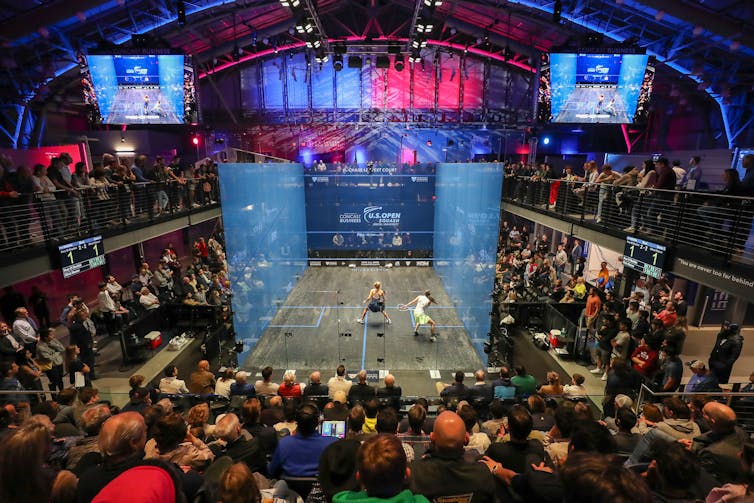
The United States Squash Racquets Association, now US Squash, was founded in Philadelphia in 1904, later moved to New York City, and in 2021 relocated its offices back to Philly.

I’m a sports psychologist who works with elite professional squash athletes and also writes about the game. As the former athletic director at Drexel University, I helped introduce varsity squash to the school and also assisted in starting a nonprofit community program called SquashSmarts for Philly public school students.

I believe squash is one of Philly’s best-kept secrets, as many Philadelphians do not know our city is host to an Olympic training high-performance center, the U.S. Squash Hall of Fame and youth development programs known as urban squash.

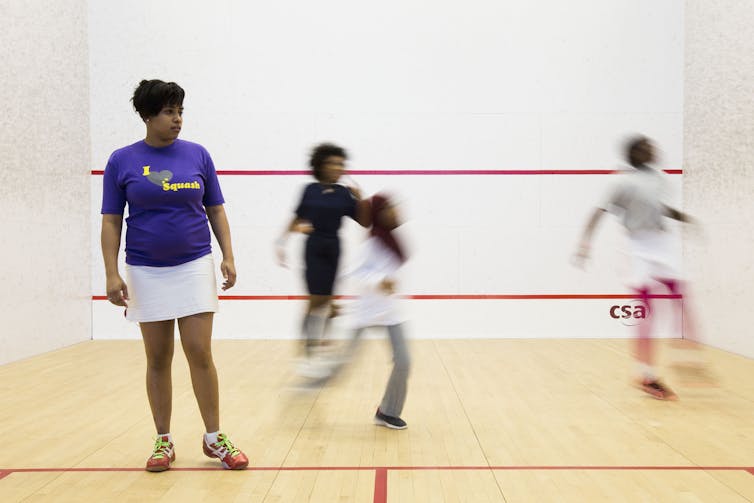
Woman in purple T-shirt and short white skirt stands on squash court as kids play
In this Feb. 11, 2014, photo, squash coach Sakora Miller directs kids at SquashSmarts, a nonprofit dedicated to teaching the sport to Philly kids.
AP Photo/Matt Rourke

A feast for the brain

Squash originated from the older game of racquets, which was played in London’s prisons during the 19th century.

The vulcanization of rubber by Charles Goodyear in 1839 enabled the creation of a squeezable rubber ball that maintained its original shape after being “squashed” against the wall. The British Commonwealth, through its worldwide military, social and political influence, promoted and grew the game internationally and set standardized rules and courts.

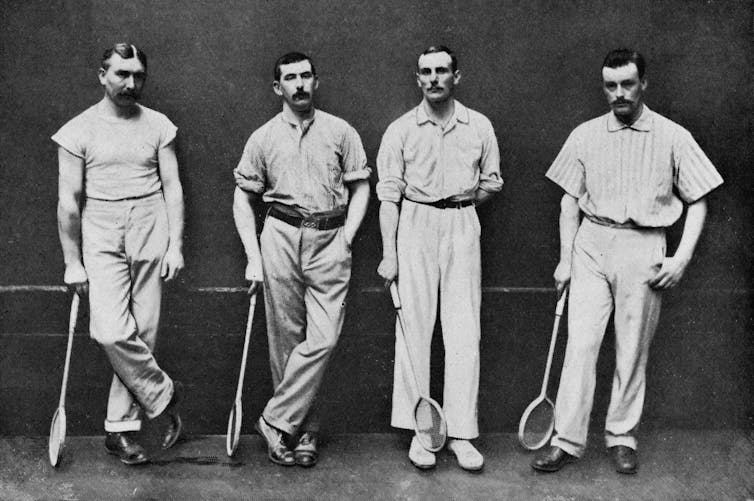
Black and white photo of four men in shirts, slacks and shoes holding squash rackets
Racquets doubles players in Philadelphia in January 1900. Squash was introduced to Philadelphia the same year.
The Print Collector/Hulton Archive via Getty Images

Watching professional squash today feels like being in gym class and science class at the same time: The sport showcases incredible athleticism and celebrates the laws of mathematics.

Squash is best understood in terms of its form and its essence.

The form of squash includes the ancient proportions of the cella of the Parthenon, which held the sacred statue of Athena holding Nike, the goddess of victory. An international squash court is 32 feet by 21 feet, and this ratio of approximately 1 to 1.5 establishes a sense of geometric order. With all walls and angles in play, and emphasizing elements such as time, velocity and space, squash allows for an amazing spectacle of creativity, elegance and speed. It is a feast for the brain.

Mental aspects of the game

But the essence of squash is mental, and the three aspects I find especially intriguing are mindfulness, playfulness and fairness.

Mindfulness: Mindfulness involves not dwelling on the past or worrying about the future. This is easier said than done, especially when a player is exhausted and struggling. The competitive squash player must focus on the moment and anticipate the next. This requires processing information in real time and practicing mindfulness to avoid distractions.

Playfulness: When I was a young athlete, I gave a B effort in practice and an A effort during competition. I had it all wrong.

I now understand that intense, disciplined practices are the foundation for tomorrow’s world-class athlete. There are no shortcuts. Psychologist Angela Duckworth advocates that excellence is 66% grit – which she decribes as a combination of passion, effort and perseverance – with the other 34% being innate talent.

For high-performance athletes, it is beneficial to be a neurotic perfectionist in practice, but not during competition, when they need to be situationally aware. Performance coach Brian Levenson writes about the pro athlete being the opposite of a perfectionist when competing, shifting to being playful, intuitive, confident and adaptable instead.

In other words, practice like a pro, play like a kid.

Two men, one in athletic uniform and one in suit, pose together for photograph
The author, right, with Simon Rösner, Germany’s highest-ever-ranked player at No. 3, in a postmatch cooldown at the U.S. Open Squash Championships in Philadelphia.
Courtesy Eric Zillmer

Fairness: One intriguing aspect of squash is the two competitors share the same space. This requires respect for your opponent as well as the game.

At its best, squash resembles a dance between two foes, with the winner graciously allowing their opponent to leave the court first.

US Squash has made sportsmanship and character a key initiative as the sport grows in popularity at all levels of play. While the art of deception, such as head fakes or varying your swing timing, is a valued tactical skill, blocking the opponent, whether subtle or overt, is not.

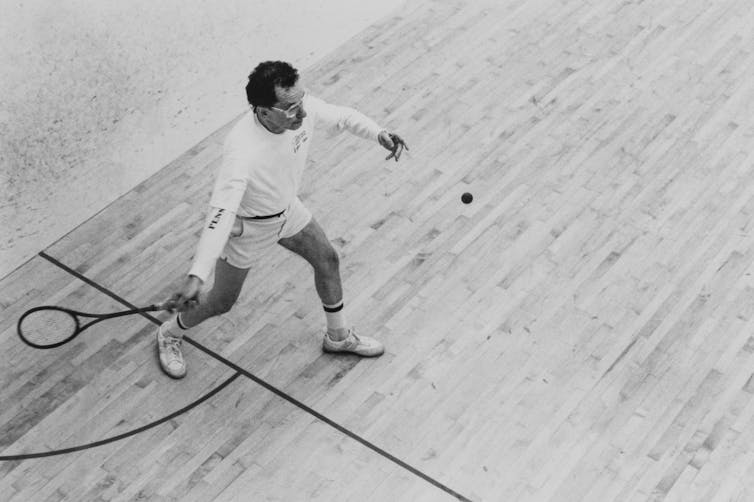
Black and white photo of man on court hitting ball with a racket
U.S. Sen. Arlen Specter of Pennsylvania playing squash in 1985.
Laura Patterson/CQ Roll Call via Getty Images

Philly’s Olympic center

One of Philadelphia’s most passionate amateur players was the longtime U.S. Sen. Arlen Specter. In 2021, the Arlen Specter US Squash Center, located on the campus of Drexel University, opened and was named in his honor.

The Specter Center is a state-of-the-art training facility and home to Team USA, the administrative center for US Squash, the home for the U.S. Open, and a hub for the U.S. junior and senior national teams, as well as urban squash.

The inclusion of squash in the 2028 Olympics is a milestone for the increasingly international sport. Currently, eight nationalities are represented among the top 10 male and female pro players, although in recent years Egypt has dominated both the men’s and women’s game.

Two U.S. women who are ranked in the world Top 10 are Team USA’s best chances to win gold: Amanda Sobhy, who went undefeated at Harvard, and Philly’s own Olivia Weaver.

If you want to catch them in action before the 2028 games, both will compete at the U.S. Open Squash Championship at the Arlen Specter US Squash Center from Oct. 19 to Oct. 25, 2025.

Two women athletes compete on squash court with four transparent walls surrounded by onlookers
US Squash has a major national facility in Philadelphia, the Arlen Specter US Squash Center.
Courtesy US Squash

Read more of our stories about Philadelphia.

The Conversation

Eric Zillmer serves as an unpaid advisor to the following non-profit boards. 2010-present Advisory Board, Philadelphia SquashSmarts; 2019-present PHL Sports Congress, Vice Chair Advisory Board; 2020-present Philadelphia Convention & Visitors Bureau (PHLCVB) Board of Directors; and 2025-present US Squash Board of Directors.

ref. Squash has been played in Philly for 125 years − a sports psychologist explains why it’s one of the city’s best-kept secrets – https://theconversation.com/squash-has-been-played-in-philly-for-125-years-a-sports-psychologist-explains-why-its-one-of-the-citys-best-kept-secrets-260898