Heart attack patients: do you still need beta blockers? A cardiologist explains

Source: The Conversation – UK – By Tomas Jernberg, Professor, Clinical Sciences, Karolinska Institutet

Lee Charlie/Shutterstock.com

As a cardiologist, I frequently meet patients who have stopped taking medicines that could keep them alive. Often it’s because they’ve seen a dramatic headline or a worrying TV report about a drug they rely on. But sometimes, patients are right to pay attention: new studies really can overturn decades of medical practice.

Few drugs illustrate this tension better than beta blockers. Long prescribed after heart attacks, these medicines can be life-saving for some people, helpful for others and useless – or even harmful – for the rest.

Beta blockers have been used for more than 40 years in almost all patients with heart attacks. But this practice was based on studies done before modern treatments were available, and before we could detect very small heart attacks that do not affect the overall function of the heart.

Recently, two studies on beta blockers in patients with heart attacks were reported in the news. The Spanish-Italian study received the most attention. Media reports suggested that most heart attack patients did not benefit from beta blockers, and that in women the drug might even increase the risk of hospitalisation and death.

Reports like this can make people stop taking their medication.

At the same symposium in Madrid, the second study – which got less attention – showed almost the opposite. Patients with heart attacks did benefit from beta blockers. And if there were differences between the sexes, women might actually have had more benefit than men.

The heart of the matter: ejection fraction

A key to understanding the different results is something called the left ventricular ejection fraction. This is the percentage of blood in the left chamber of the heart – its main pumping chamber – that is pushed out into the body with each heartbeat. Normally, ejection fraction should be at least 50%.

If we look at all the studies together, including one I led and presented last year, the picture becomes clearer. Patients with an ejection fraction of 50% or higher after a heart attack do not benefit from beta blockers. But patients with an ejection fraction below 50% do benefit. And this is true for both men and women.

The European guidelines from 2023, as well as the recently published American guidelines, still recommend beta blockers after most heart attacks. Many doctors are therefore reluctant to change a therapy tradition that has been in place for 40 years.

Ejection fraction explained.

My colleagues and I are now planning to pool data from the recent large studies on patients with heart attacks and an ejection fraction of 50% or more. The results, expected later this year, will probably give definite answers about beta blockers in this population and change future guidelines.

But many patients clearly benefit from beta blockers, including those with heart failure and reduced ejection fraction (with or without a prior heart attack), angina pectoris (chest pain caused by reduced blood flow to the heart), or various heart rhythm disturbances.

Beta blockers can also be prescribed for other reasons, such as high blood pressure, migraine prevention, tremors, as well as off-label use for stress and anxiety. For patients, it’s not easy to know all the reasons why beta blockers are prescribed, and in some cases, they may not be suitable at all. So I’ll end with a good, if not very novel, piece of advice: always consult your doctor before making any changes to your medication.

The Conversation

Tomas Jernberg’s employer (Karolinska Institutet) has received a grant from MSD for a research project performed by Dr. Jernberg but not related to this article.

ref. Heart attack patients: do you still need beta blockers? A cardiologist explains – https://theconversation.com/heart-attack-patients-do-you-still-need-beta-blockers-a-cardiologist-explains-264409

Que sait-on de la série de séismes en Afghanistan ?

Source: The Conversation – France in French (2) – By Manon Dalaison, Maître de Conférences, Institut de physique du globe de Paris (IPGP)

Un séisme meurtrier a frappé l’Afghanistan le 31 août, suivi par d’autres tremblements de terre. Une géophysicienne très familière de la région nous explique ce que l’on sait.


Le 31 août, un séisme a frappé l’Afghanistan dans les environs de la ville de Kunar et fait plus de 2000 victimes à ce jour. En 2022, un autre séisme meurtrier avait frappé le pays et fait environ 1000 victimes, tandis qu’en 2023, ce sont plus de 4000 personnes qui avaient trouvé la mort.

La région, difficilement accessible par la route, peut sembler isolée, mais ces zones rurales sont plutôt peuplées avec de nombreux villages parsemés le long des cours d’eau. Le village de Kunar est situé à quelques kilomètres de l’épicentre, mais certains hameaux sont encore plus près. L’ampleur des dégâts est aussi liée à la vulnérabilité des constructions en terre et pierres et au fait que la catastrophe ait eu lieu vers minuit heure locale, lorsque les gens sont chez eux.

Magnitude et profondeur, deux facteurs physiques importants pour les dommages en surface

Ce nouveau séisme a une magnitude Mw 6. Ceci correspond à un séisme de taille modérée sur l’échelle des séismes destructeurs, mais l’énergie libérée lors du séisme est tout de même équivalente à celle de la bombe atomique d’Hiroshima.

L’origine du séisme est particulièrement peu profonde, à 10 kilomètres environ. À cause de cette faible profondeur, les secousses qui atteignent la surface n’ont pas le temps d’être atténuées et sont plus susceptibles de faire des dégâts.

Cette magnitude modérée et cette faible profondeur sont deux caractéristiques que le séisme de Kunar partage avec le séisme de Khost du 22 juin 2022, qui avait eu lieu 220 kilomètres au sud-ouest.

Un séisme en accord avec son contexte

D’un point de vue scientifique, nous sommes dans le « ruban » de déformation tectonique active entre les plaques indiennes et eurasiennes où on trouve une zone de transition entre un mouvement décrochant et un mouvement de compression. Ces mouvements sont à l’origine de fréquents séismes.

Contexte tectonique et géographie du séisme du 31 août 2025 par rapport à ceux du 22 juin 2022 et du 7 octobre 2023, localisés par des étoiles. Les failles sont en rouge et les frontières nationales en pointillé.
Manon Dalaison, Fourni par l’auteur

En 2022, les scientifiques avaient été assez surpris par le séisme de Khost : celui-ci montrait un mouvement décrochant (coulissant), alors que la région est en compression.

Aujourd’hui, à Kunar, on a un tremblement de terre en compression, qui est conforme à ce que l’on attend dans la région.

Comme souvent, le séisme important du 31 août est suivi d’autres séismes plus petits dont la taille et la fréquence décroissent à mesure que le temps passe. Cette évolution n’est pas une règle, et les exceptions sont nombreuses, mais plutôt une évolution moyenne qui se vérifie sur les centaines de tremblements de terre enregistrés tous les ans.

Les indices d’une histoire ancienne

La région de Kunar se situe dans l’Hindu Kush, région montagneuse du nord-est de l’Afghanistan. Ces montagnes et leur géologie sont le résultat de dizaines de millions d’années de déformation tectonique du fait de la collision des plaques indienne et eurasienne. Les séismes sont les témoins à court terme de la longue histoire géologique.

Ici, les failles actives qui peuvent rompre lors de séismes sont nombreuses, plutôt courtes, et réparties sur des centaines de kilomètres. Elles sont visibles dans le paysage, dévient les cours d’eau, longent les vallées et bordent les montagnes.

Peut-on envisager que ces failles puissent générer à l’avenir des séismes plus grands, et malheureusement plus destructeurs, que ce nouveau séisme de Kunar ?

D’après l’historique des séismes, limité dans le temps par les archives humaines, on sait qu’un plus gros séisme de magnitude équivalente à 7,4 (c’est-à-dire 125 fois plus énergétique qu’un séisme de magnitude 6) a touché la vallée de Kunar en 1842. Ceci étant, il est difficile de savoir si un séisme de magnitude encore plus importante est possible dans la région de Kunar.

Le séisme de Kunar du 31 août 2025, et les répliques qui l’ont suivi, sont des exemples supplémentaires de l’activité tectonique compressive de la région, mal connue du fait des difficultés d’accès et son éloignement des sismomètres, les instruments qui permettent de mesurer les ondes sismiques. L’étude de ces séismes permettra de mieux connaître le tracé des failles actives et d’explorer les conditions physiques qui auraient pu favoriser un tel événement destructeur.

Quoiqu’il en soit, on est clairement dans une zone à risque sismique, où des séismes vont se produire à nouveau. Mais, comme toujours avec le risque sismique, on ne sait pas quand ils vont arriver.

The Conversation

Manon Dalaison a reçu des financements du Programme National de Télédétection Spatiale (PNTS).

ref. Que sait-on de la série de séismes en Afghanistan ? – https://theconversation.com/que-sait-on-de-la-serie-de-seismes-en-afghanistan-264612

Trump’s deployment of the National Guard to fight crime blurs the legal distinction between the police and the military

Source: The Conversation – USA – By Luke William Hunt, Associate Professor of Philosophy, University of Alabama

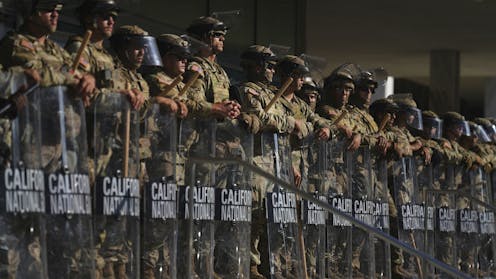
California National Guard troops stand in front of a federal building in Los Angeles on June 10, 2025. AP Photo/Eric Thayer

A federal judge ruled on Sept. 2, 2025, that the Trump administration broke federal law by sending National Guard troops to Los Angeles in June in response to protests over immigration raids.

In his ruling, U.S. District Judge Charles Breyer said that National Guard troops in Los Angeles had received improper training on the legal scope of their authority under federal law. He ruled that the president’s order for the troops to engage in “domestic military law enforcement” violated the Posse Comitatus Act, which – with limited exceptions – bars the use of the military in civilian law enforcement.

While he did not require the remaining soldiers to leave Los Angeles, Breyer called on the administration to refrain from using them “to execute laws.”

The Los Angeles case, President Donald Trump’s deployment of National Guard troops to fight crime in Washington, D.C., and his recent vow to send the Guard to Chicago and Baltimore to fight crime blur practical and philosophical lines erected in both law and longtime custom between the military and the police.

As a policing scholar and former FBI special agent, I believe the plan to continue using National Guard troops to reduce crime in cities such as Chicago and Baltimore violates the legal prohibition against domestic military law enforcement.

Limited law enforcement function

State and local police training focus on law enforcement and maintaining order. Community policing, which is a collaboration between police and
the community to solve problems, and the use-of-force continuum – the escalating series of appropriate actions an officer may take to resolve a situation – also form part of training.

In contrast, the goal of National Guard basic combat training is to “learn the skills it takes to become a Soldier.”

The initial 10-week training program for National Guard recruits includes learning skills such as the use of M16 military assault rifles and grenade launchers. It also includes learning guerrilla warfare tactics, as well as tactics for neutralizing improvised explosive devices while engaging in military operations. While valuable in a military setting, such activities aren’t part of domestic policing and law enforcement.

While the National Guard has, by law, a limited law enforcement function in times of domestic emergencies, it’s a unique part of the U.S. military that typically responds – at the request of a state’s governor – to natural disasters and extreme violence.

Although rare, presidents can also call up the Guard, with or without the assent of a state governor. In 1992, for example, President George H.W. Bush sent Guard troops to Los Angeles – with the California governor’s approval – to quell widespread riots following the acquittal of white police officers who had been charged with assaulting Rodney King, a Black man.

But sending soldiers who are not well versed in policing increases the likelihood of mistakes. One of the most well-known examples is the Kent State shootings on May 4, 1970, when National Guardsmen sent to the university by Ohio’s governor opened fire and killed four unarmed students during an anti-war protest on campus.

Soldiers holding machine guns and grenade launchers stand on a street in Los Angeles.
National Guard soldiers hold a line in South Central Los Angeles after several days of rioting in April 1992.
Ted Soqui/Corbis via Getty Images

The erosion of restraint

U.S. presidents have historically exercised restraint in deploying military personnel to suppress domestic unrest. Presidents typically work with state governors who request federal assistance during times of crisis.

Thousands of National Guard troops were sent to multiple states at the request of state governors following Hurricane Sandy in 2012. Among other tasks, President Barack Obama’s administration directed the Department of Defense to support FEMA’s efforts to restore power to thousands of homes.

The last time a president bypassed a state’s governor in sending the National Guard to quell civil unrest was in Selma, Alabama, in 1965. President Lyndon B. Johnson deployed the National Guard to protect civil rights protesters without the cooperation of Alabama Gov. George Wallace, a prominent segregationist.

Trump is changing this precedent by sending National Guard troops to Los Angeles, despite the fact that Gov. Gavin Newsom neither refused to follow federal law nor requested military support. In June 2025, Trump overrode Newsom and sent Guard troops to shield federal agents with Immigration and Customs Enforcement from political protests.

The decision to send federal troops to a political protest in Los Angeles has raised core legal questions. The First Amendment’s protection of the right to political protest is a pillar of U.S. jurisprudence.

‘Federalizing’ the Guard

The governed have a right to hold the government accountable and ensure that the government’s power reflects the consent of the governed.

The right to protest, of course, does not extend to criminal behavior. But the use of military personnel raises a pressing question: Is the president justified in sending military personnel to address pockets of criminality, instead of relying on state or local police?

One of a president’s legal avenues is to use a federal statute to do what’s called “federalizing” the National Guard. This means troops are temporarily transitioned from state to federal military control.

What is unique about the deployment in California is that Newsom objected to Trump’s decision to federalize troops. California in June 2025 sued the Trump administration, arguing the president unlawfully bypassed the governor when he federalized the National Guard.

On Sept. 4, 2025, Washington, D.C., sued the Trump administration on similar grounds. The lawsuit follows Trump’s decision in August to deploy hundreds of National Guard troops to police the capital.

Four soldiers walk along a pool.
Members of the South Carolina National Guard patrol the National Mall in Washington on Aug. 31, 2025.
AP Photo/Jose Luis Magana

For the president to legally take control of and deploy the California National Guard under federal statutes, it was necessary for the criminality in Los Angeles to rise to a “rebellion” against the U.S.

More generally, the president is prohibited from using military force – including the Marines – against civilians in pursuit of normal law-enforcement goals. This bedrock principle is based on the Posse Comitatus Act of 1878 and permits only rare exceptions, as stipulated by the Insurrection Act of 1807. This act empowers the president to deploy the U.S. military to states in circumstances relating to the suppression of an insurrection.

The Sept. 2 ruling by the federal judge in California determined that the administration deviated from these principles because the use of troops in Los Angeles did not meet the criteria established by federal law. Although the political protests in Los Angeles included some violence, the judge reasoned that the violence did not rise to a rebellion and did not prevent a traditional police response.

Federalism and the limits of executive power

In addition to the practical differences between the military and the police, there are philosophical differences derived from core principles of federalism, which refers to the division of power between the national and state governments.

In the United States, police power is derived from the 10th Amendment, which gives states the rights and powers “not delegated to the United States.” It is the states that have the power to establish and enforce laws protecting the welfare, safety and health of the public.

The use of military personnel in domestic affairs is limited by deeply entrenched policy and legal frameworks.

The deployment of National Guard troops for routine crime fighting in cities such as Los Angeles and Washington, and the proposed deployment of those troops to Chicago and Baltimore, highlights the erosion of both practical and philosophical constraints on the president and the vast federal power the president wields.

The Conversation

Luke William Hunt does not work for, consult, own shares in or receive funding from any company or organization that would benefit from this article, and has disclosed no relevant affiliations beyond their academic appointment.

ref. Trump’s deployment of the National Guard to fight crime blurs the legal distinction between the police and the military – https://theconversation.com/trumps-deployment-of-the-national-guard-to-fight-crime-blurs-the-legal-distinction-between-the-police-and-the-military-264548

What will Angela Rayner’s resignation mean for Keir Starmer’s government? Expert Q&A

Source: The Conversation – UK – By Thomas Caygill, Senior Lecturer in Politics, Nottingham Trent University

Angela Rayner has resigned as the UK’s deputy prime minister after a report found she had breached the ministerial code by not paying enough stamp duty on her second home.

In her resignation letter she said she deeply regretted what she maintained was an error, and the report from the prime minister’s ethics adviser said she had “acted with integrity” despite the breach. However, it was still enough to force Rayner, who was also housing secretary, to step down, prompting a cabinet reshuffle.

We asked Thomas Caygill, senior lecturer in politics at Nottingham Trent University, to explain what was likely to happen next and what the affair could mean for the government.

Why did Angela Rayner have to resign?

At the 2024 general election, Prime Minister Keir Starmer promised the British public that any government he led would work to clean up politics after years of Tory sleaze. When in opposition, both he and Rayner took a very firm line in response to scandals among Conservative ministers, including Boris Johnson and Rishi Sunak.

So the Labour pair have, in a way, made a rod for their own backs. Rayner had no choice but to resign after the findings of the report prepared by the prime minister’s independent ethics adviser (Sir Laurie Magnus) concluded that she did not meet the “highest possible standards of proper conduct”. If you set high ethical standards, you have to meet them without exception.

What happens now?

Rayner’s resignation leaves a gap around the cabinet table. She served as both secretary of state for housing, communities and local government and deputy prime minister. The first post will need filling and has triggered a wider cabinet reshuffle.

Starmer does not necessarily need to appoint a new deputy prime minister as the role is technically a mere honorific, given to a member of the cabinet to signify seniority. The office was vacant between 2015 and 2021, for instance. However, Starmer may feel the need to shore up his position after recent rebellions amongst his own MPs.

Rayner has also resigned as deputy leader of the Labour party, a position she was directly elected to by party members and which is unconnected with the position of deputy prime minister. She did not have to resign this post as a result of the Magnus report – since it related to her conduct in ministerial office – but she presumably did so to avoid being a further distraction for the government and party.

The cabinet does have the power to appoint a temporary deputy leader or leave the position vacant until the party conference (starting on the September 28). There are some rumours that justice secretary Shabana Mahmood could be appointed as temporary deputy leader.

However there will need to be a new election with a timeline set by Labour’s National Executive Committee. There is no set time so it could be over in weeks or it could take months. It is unlikely that the NEC will meet before early next week to make that decision.

We can expect Labour’s conference (September 28 to October 1) to become a showcase of potential candidates for deputy leader. Nominees must be a Labour MP.

They will also need the support of 20% of Labour MPs and either 5% of local Labour parties (CLPs) or at least three affiliates (at least two trade unions) amounting to 5% of affiliated supporters. There will then be a vote of all party members and affiliated supporters.

Who might replace Rayner in either role?

We can probably expect the winner of the deputy party leader contest to be a big challenger to Starmer’s authority – most likely from the left of the party. Names currently being touted are Emily Thornberry (current chair of the House of Commons Foreign Affairs Committee) and Rosena Allin-Khan. Both MPs served as shadow ministers while Labour were in opposition but were not invited to join the government last July after Labour’s election victory.

A challenger to Starmer is most likely given the mood of the parliamentary and wider party following poor poll ratings and recent rebellions over welfare reform. Anneliese Dodds is another potential contender. She resigned from government last year over cuts to international development.

Why is this situation so damaging for Keir Starmer?

Starmer is now in a more perilous position without Rayner. She was popular with the left of the party and seen as a key bridge between him and the wider party. Monday saw the launch of the phase two of Starmer’s government which has now been overshadowed by Rayner’s tax affairs and subsequent resignation.

Rayner was a rival to Starmer and no longer having her in government bound by collective ministerial responsibility will mean she is able to criticise the government and Starmer more vocally. She has also been key to the development and introduction of the employment rights bill, although this is now in its final stages and expected to become law in the coming months. It is undoubtedly one of her achievements in office.

She is also a northern working-class woman and her departure is symbolic in this regard, especially as Lucy Powell has also now left government as part of the wider reshuffle.

The only upside for Starmer is that he can now reshuffle his cabinet to cement phase two of his government. However, reshuffling as a result of a scandal could project government instability – something Labour promised to stop ahead of the 2024 general election. Reshuffles can be a chance to turn a moment of weakness into a moment of strength but that will be far harder in this case.

What should we expect for Rayner now?

We can expect Rayner to take a step back for now. However she remains an MP and is a vocal member of the party. In time she will likely become an active backbencher and a potentially vocal critic of the government (now that she is not bound by collective ministerial responsibility).

With just under four years left of Labour’s term, if she avoids being a critic, she could re-enter government in the future. What happens will depend on how she sees her own future.

How damaging is this for Labour?

This is damaging for the party, it has already seen a rapid decline in its poll ratings over the course of the past year. It harms the party’s reputation further, after promising change and promising to bring an end to scandal, they have been tinged by it again.

This plays into Reform UK’s hands who are trying to argue that the two main parties are cut from the same cloth. Nigel Farage will be filled with glee that this has all exploded during the Reform UK conference, where he is seeking to cement himself and his party as the real opposition to Labour.

This of course doesn’t mean Labour will lose the 2029 general election, however it is feeding a narrative that Labour will find hard to break unless it can prove to the British people that it is delivering on its promises. Starmer said on Monday that the government was moving into its delivery phase, and it’s not a moment to soon.

The Conversation

Thomas Caygill is currently in receipt of a British Academy/Leverhulme Small Research Grant for research on post-legislative scrutiny in the Scottish Parliament and has previously received funding from the Economic and Social Research Council.

ref. What will Angela Rayner’s resignation mean for Keir Starmer’s government? Expert Q&A – https://theconversation.com/what-will-angela-rayners-resignation-mean-for-keir-starmers-government-expert-qanda-264714

How Angela Rayner managed to underpay stamp duty – family trusts and tax avoidance explained

Source: The Conversation – UK – By Ben Mayfield, Lecturer in Law, Lancaster University

The debate over former deputy prime minister Angela Rayner’s tax arrangements demonstrated that there are few topics more complex than the law of trusts. It was politically awkward, to say the least, when a deputy PM and housing secretary had to admit getting it wrong, and underpaying £40,000 in stamp duty.

Rayner has resigned after being found to have breached the ministerial code in the wake of the stamp duty row. That erupted after she was said to have put her share of her constituency home in Greater Manchester in trust for her son, and to have bought another home in Hove, East Sussex, paying a lower rate of stamp duty than should be owed by a second homeowner.

In Rayner’s case, a probable oversight and a trust created with legitimate intentions got caught up in legislation designed to discourage tax avoidance and ownership of a second home. Of course, it also left her open to accusations of hypocrisy, as a member of a government that championed higher taxes for second homeowners.

Earlier in the week, Rayner had said she took legal advice on the purchase. But her conveyancers then claimed not to have advised her on any additional tax liabilities that might have arisen due to the existence of a trust for her child.

So what is a trust – and why are they controversial for tax purposes?

Trusts have a long history – it’s claimed that they were established to protect the property of knights who left England to join the Crusades. But despite these medieval origins, the modern trust still has a range of uses. For most people this will be as a mechanism for the ownership of land. All land has a legal title (the paperwork held by the Land Registry proving who owns the property in law).

But in addition to the legal title there will be what’s called an equitable interest in the land – this is, the right to the financial value of it. When two or more people buy a house together they create a trust. Both names appear on the legal title and both will be entitled to a share of the equity too. Because there is a trust, one party cannot sell the house without the agreement of the other.

newspaper front pages covering the story of angela rayner's stamp duty controversy
The Rayner row dominated the UK’s front pages.
Steve Travelguide/Shutterstock

The case of Rayner’s constituency home is an example of how trusts are commonly used – for the protection of family assets. Children below the age of 18 are unable to own land, so if parents want to gift them land they need to use a trust. The legal title is held by a trustee such as a parent, lawyer or friend and the child is entitled to the value of the property as it is held for their benefit.

Rayner and her ex-husband are said to have created a trust which bought her share of the constituency home for the benefit of their disabled son. This followed a payout for damages in the son’s medical negligence claim.

She retained no legal ownership of the house by the time she bought the Hove flat. A parent who creates a trust like this puts the financial value beyond their own reach and would be unable to sell the land to benefit from it personally.

Where Rayner came unstuck

But the Rayner case throws up an important question. Why, in the eyes of the law, is a parent who has given their only house away to a child in trust still considered a homeowner for stamp duty purposes? This introduces another use of the trust – the legal avoidance of tax. Trusts have been used to protect family assets from taxes such as inheritance tax – and so the government has tried to close loopholes and limit these opportunities.

This is what makes this situation so damaging for Rayner. As well as raising funds for the government, property taxes have also been used to nudge behaviour. For example an additional 5% rate of stamp duty is meant to discourage homeowners from tying up a second home. House price inflation has of course made this an increasing source of revenue for the government.


Read more:
Housebuyers hate stamp duty. Why hasn’t it been reformed before now?


The law taxes the buyers of second homes more heavily than those who own only one house. This is aimed at avoiding problems such as housing shortages in holiday destinations, and the kind of social disruption seen in places affected by the ownership of second or holiday homes in areas such as Wales and the Lake District.

In his time as chancellor of the exchequer, Gordon Brown made many such trusts subject to inheritance tax. If a homeowner was able to avoid the higher rate of stamp duty by putting their property into trust for their children, this could open a new loophole similar to that of inheritance tax, but for stamp duty.

Before her resignation, Rayner’s political opponents also noted that, as deputy prime minister, she already enjoyed the use of Admiralty House. This is a grace-and-favour apartment in Whitehall which she did not, of course, own herself.

But perhaps the biggest question the controversy has raised is this. If a housing secretary, deputy prime minister and a team of experienced land lawyers are unable to accurately divine the correct rate of stamp duty, what hope is there for the rest of us?

The Conversation

Ben Mayfield does not work for, consult, own shares in or receive funding from any company or organisation that would benefit from this article, and has disclosed no relevant affiliations beyond their academic appointment.

ref. How Angela Rayner managed to underpay stamp duty – family trusts and tax avoidance explained – https://theconversation.com/how-angela-rayner-managed-to-underpay-stamp-duty-family-trusts-and-tax-avoidance-explained-264706

On ne naît pas blanc, on le devient : explorer « La pensée blanche » avec Lilian Thuram

Source: The Conversation – in French – By Christophe Premat, Professor, Canadian and Cultural Studies, Stockholm University

Dans son essai La pensée blanche, publié en 2020, l’essayiste guadeloupéen Lilian Thuram met en lumière un impensé majeur de nos sociétés contemporaines : la blancheur comme norme invisible, érigée au fil de l’histoire en standard universel.

Cet article fait partie de notre série Les livres qui comptent, où des experts de différents domaines décortiquent les livres de vulgarisation scientifique les plus discutés.


On ne naît pas blanc, on le devient : cette formule résume bien l’enjeu de l’ouvrage de Thuram, qui a connu une carrière de footballeur de haut niveau en Europe dans les années 90 et 2000, et est aujourd’hui à la tête d’une fondation contre le racisme. Il rejoint les réflexions de l’essayiste et psychiatre français, lui aussi d’origine antillaise, Frantz Fanon, dont on fête le centenaire de sa naissance, sur l’intériorisation des hiérarchies raciales.

Son essai s’apparente aussi à celui du chercheur déné-canadien en études autochtones, professeur à l’Université de la Colombie-Britannique, Glen Sean Coulthard dans Red Skin, White Masks (Peaux rouges, masques blancs), publié en 2014. Il y montre la persistance de la logique coloniale dans les relations avec les peuples autochtones.

« La pensée blanche », de Lilian Thuram, a été publié chez Mémoire d’encrier.
(éditions Mémoire d’encrier), CC BY-NC-ND

En tant que spécialiste des théories postcoloniales, j’explore la manière dont les héritages coloniaux marquent encore nos institutions et nos imaginaires. Je m’intéresse aussi à la façon dont écrivains et penseurs francophones réinterprètent ces catégories pour en révéler les contradictions et proposer d’autres façons de raconter nos sociétés.

Aux origines de la pensée blanche : une construction historique

Explorer la pensée blanche, c’est donc interroger les catégories héritées d’un passé colonial et comprendre comment elles continuent à structurer nos vies, souvent à notre insu.

La blancheur dont parle Lilian Thuram n’est pas une teinte épidermique mais une construction idéologique qui a fonctionné comme au départ pour classer, hiérarchiser et opposer. Elle désigne un ensemble de privilèges, de représentations et de places sociales, plutôt qu’une caractéristique biologique. Penser la blancheur, c’est donc montrer qu’elle relève moins de la pigmentation que d’un régime de visibilité : ce qui paraît neutre ou universel est en réalité situé, hérité d’une histoire coloniale.

La blancheur n’a pas toujours existé comme catégorie. Elle s’est construite progressivement à partir de l’expansion coloniale, de l’esclavage et des théories pseudo-scientifiques du XIXe siècle. La pensée blanche, telle que la décrit Thuram, consiste précisément en cette logique qui naturalise des hiérarchies raciales en érigeant la « blancheur » comme point de référence neutre.

Cette perspective met en lumière la manière dont les récits historiques et religieux ont contribué à hiérarchiser les couleurs. Dès le Moyen Âge, la théologie chrétienne associait la blancheur à la lumière divine, à la pureté et au salut, tandis que l’obscurité et le noir renvoyaient au péché, au danger et à la mort. Ces associations symboliques ont progressivement nourri un imaginaire où la blancheur était valorisée comme signe de supériorité morale.


Déjà des milliers d’abonnés à l’infolettre de La Conversation. Et vous ? Abonnez-vous gratuitement à notre infolettre pour mieux comprendre les grands enjeux contemporains.


À l’époque moderne, cette symbolique s’est articulée à l’expansion coloniale : elle a fourni un cadre culturel qui permettait de justifier l’asservissement et l’infériorisation des populations perçues comme « non blanches ». La pensée blanche ne s’est donc pas construite uniquement par la violence matérielle, mais aussi par une longue tradition symbolique qui a présenté la blancheur comme le signe d’un ordre naturel et universel. La « norme blanche » ne s’est pas imposée seulement par la force, mais aussi par le langage, la culture et la science.

Être blanc sans le voir : les privilèges invisibles

L’un des apports majeurs de la réflexion de Thuram est de montrer que la blancheur agit comme une norme invisible. Ceux qui en bénéficient ne s’en aperçoivent pas, précisément parce qu’elle se confond avec l’universel.

Peggy McIntosh l’a décrit comme un « sac à dos invisible » de privilèges, conférant aux personnes blanches des avantages implicites : être majoritairement représentées dans les médias, ne pas être systématiquement suspectées dans l’espace public, voir son identité considérée comme neutre.

Ces privilèges ne sont pas individuels, mais structurels. Ils s’expriment dans l’accès différencié au logement, à l’emploi, ou dans les interactions quotidiennes avec l’institution policière. La pensée blanche, en tant que grille implicite, conditionne nos perceptions et nos jugements, rendant d’autant plus difficile sa remise en cause.

La blancheur n’existe qu’en relation à la « noirceur » inventée

Frantz Fanon, dans Peau noire, masques blancs, publié en 1952, montrait déjà comment l’intériorisation du regard blanc pouvait enfermer les personnes racisées dans des assignations identitaires, au prix d’un profond malaise existentiel. Thuram reprend ce fil en rappelant que la blancheur n’existe qu’en relation à la « noirceur » qu’elle a elle-même inventée.

En écho, Glen Sean Coulthard actualise ce diagnostic dans Red Skin, White Masks. En prolongeant Fanon dans le contexte des luttes autochtones nord-américaines, il démontre comment la reconnaissance offerte par l’État reste conditionnée par une logique coloniale où la blancheur définit les termes mêmes de l’égalité. La critique de la pensée blanche ne concerne donc pas seulement l’histoire européenne : elle traverse les luttes actuelles contre les formes renouvelées de domination.

Déconstruire les évidences : le rôle de l’éducation

Thuram insiste sur la nécessité d’un travail éducatif pour dénaturaliser ces représentations. Déconstruire la pensée blanche ne consiste pas à accuser individuellement, mais à rendre visible ce qui a été naturalisé. La Fondation Lilian Thuram mène à cet égard des actions pédagogiques visant à développer une conscience critique des catégories raciales et de leur histoire.

L’éducation ne se limite pas à l’école : les médias, la culture, la mémoire collective jouent un rôle crucial. L’enjeu est d’apprendre à reconnaître les privilèges invisibles et à les interroger, afin de créer les conditions d’une égalité réelle.

Déconstruire la pensée blanche suppose de passer de la prise de conscience individuelle à une responsabilité collective. Les institutions politiques, éducatives et culturelles doivent être interrogées dans leur rôle de reproduction des inégalités. L’analyse de Thuram rejoint ici les luttes pour la justice raciale et pour la décolonisation des savoirs.

Il ne s’agit pas de culpabiliser, mais de reconnaître la dimension systémique du problème. C’est seulement en déplaçant le regard — en cessant de considérer la blancheur comme universelle — qu’il devient possible de bâtir une société où les différences cessent d’être hiérarchisées.

La pensée blanche de Lilian Thuram agit ainsi comme une invitation à voir ce qui reste invisible : la norme blanche qui structure nos imaginaires, nos institutions et nos pratiques quotidiennes. En dialogue avec Fanon, l’ouvrage rappelle que l’égalité ne peut advenir qu’au prix d’un travail de déconstruction historique et critique. On ne naît pas blanc, on le devient : c’est donc à nous collectivement de défaire ce devenir, pour ouvrir la voie à des formes nouvelles de coexistence, dégagées des hiérarchies héritées du passé colonial.

La Conversation Canada

Christophe Premat est Professeur en études culturelles francophones à l’Université de Stockholm et directeur du Centre d’études canadiennes. Il coopère avec la fondation Lilian Thuram depuis 2012. Il déclare avoir été impliqué dans la préparation du dossier qui a permis à Lilian Thuram d’être élu doctor honoris causa de l’Université de Stockholm. Christophe Premat est actuellement membre de la CISE (Confédération Internationale Solidaire Écologiste), une association des Français de l’étranger créée en 2018.

ref. On ne naît pas blanc, on le devient : explorer « La pensée blanche » avec Lilian Thuram – https://theconversation.com/on-ne-nait-pas-blanc-on-le-devient-explorer-la-pensee-blanche-avec-lilian-thuram-263862

Reprendre contact avec de vieux amis : un geste difficile, mais gratifiant

Source: The Conversation – in French – By Kristina K. Castaneto, Ph.D. Candidate in Social Psychology, Simon Fraser University

Imaginez : un matin, en buvant votre café, vous pensez à un vieil ami. Vous n’avez pas parlé à cette personne depuis longtemps, mais vous y pensez avec affection et vous vous demandez comment elle va. Vous commencez à taper « bonjour ! », puis effacez le message avant de l’envoyer. Vous est-il déjà arrivé quelque chose de similaire ? Si oui, vous n’êtes pas seul.

Des recherches menées dans notre laboratoire ont montré que jusqu’à 90 % des personnes interrogées déclarent avoir un « vieil ami », c’est-à-dire un ami qui leur est cher, mais avec lequel elles ont perdu contact. Si la plupart aimeraient renouer, seulement 30 % le font réellement, même lorsque la relation s’est bien terminée et que les coordonnées sont disponibles.

Cette réticence à reprendre contact avec d’anciens amis est surprenante, car de nombreuses recherches démontrent que les relations sociales sont un facteur prédictif important de la santé et du bonheur. En effet, le fait d’avoir un réseau social plus vaste et plus diversifié est associé à un plus grand bien-être.

Écrire des messages

Alors, qu’est-ce qui incite une personne à reprendre contact avec un vieil ami ?

Dans notre nouvelle étude, nous avons analysé le contenu des messages de prise de contact envoyés à un vieil ami, pour voir si certains types de messages influencent la probabilité qu’ils soient envoyés. Par exemple, les gens sont-ils plus susceptibles d’envoyer une note axée sur le passé, le présent ou l’avenir ?

Pour le savoir, nous avons analysé plus de 850 messages recueillis lors d’études précédentes. Chaque participant a rédigé un message destiné à un ancien ami spécifique et pouvait choisir de l’envoyer ou non. Cela nous a permis de comparer le contenu des messages envoyés à celui de ceux qui n’ont pas été transmis.

Chaque message a été analysé selon plus de 20 critères, comme la longueur, les émotions exprimées ou la présence de souvenirs personnels. Douze de ces critères ont été étudiés à l’aide d’un logiciel informatique, Linguistic Inquiry Word Count (LIWC), qui mesure automatiquement des éléments comme le nombre de mots, l’orientation temporelle (passé, présent ou futur) et l’intensité des émotions positives et négatives.

En complément, une équipe de codeurs humains a évalué chaque message sur 13 aspects plus subjectifs et complexes, difficiles à détecter pour un logiciel. Ils ont notamment vérifié si l’auteur partageait des souvenirs précis avec son vieil ami ou reconnaissait sa part de responsabilité dans la relation qui s’était distendue.

un homme regarde son téléphone intélligent
Prendre contact avec un vieil ami peut contribuer à renforcer son réseau social.
(Sarah Brown/Unsplash), CC BY

Révéler des informations

Malgré tout ce codage, nous ne pouvions toujours pas prédire quels messages seraient envoyés. En revanche, notre analyse a révélé des tendances intéressantes : les messages destinés à de vieux amis étaient souvent positifs et centrés sur le présent.

Nous avons utilisé des régressions statistiques pour relier les caractéristiques des messages au comportement de prise de contact : seules six variables se sont révélées significatives, mais leurs effets étaient faibles et incohérents entre nos deux échantillons.

Cela suggère que le contenu d’un message ne permet pas de prédire qui choisira d’envoyer son message et qui ne le fera pas.

Qui prend contact ?

Comme le contenu des messages de prise de contact ne nous a pas apporté beaucoup d’informations, nous avons réorienté notre attention vers la question suivante : qui est le plus susceptible de prendre contact avec un vieil ami ?

Pour explorer cette question, nous avons recruté 312 participants sur le campus et dans des espaces publics de la ville afin de leur faire remplir un questionnaire. Le questionnaire commençait par demander aux participants d’identifier un vieil ami. Ce vieil ami était une personne à laquelle les participants tenaient, mais à laquelle ils n’avaient pas parlé depuis longtemps, qui, selon eux, aimerait avoir de leurs nouvelles et dont ils avaient les coordonnées.

Les participants ont ensuite répondu à une série de questions les concernant, notamment sur leur bonheur, leur solitude, leur personnalité, leur satisfaction en matière d’amitié et leurs convictions en la matière.

Vers la fin du sondage, nous avons demandé aux participants s’ils étaient prêts à contacter leur vieil ami, puis nous leur avons donné deux minutes pour rédiger un petit mot à l’intention de l’ami qu’ils avaient identifié précédemment. Une fois les deux minutes écoulées, nous avons demandé aux participants s’ils avaient envoyé le message à leur vieil ami.


Déjà des milliers d’abonnés à l’infolettre de La Conversation. Et vous ? Abonnez-vous gratuitement à notre infolettre pour mieux comprendre les grands enjeux contemporains.


Comme dans les recherches précédentes, 34,2 % des participants ont choisi de contacter leur vieil ami. Et si certaines dimensions de la personnalité et d’autres variables permettent de savoir qui sera le plus susceptible de répondre, une seule variable, la « résilience de l’amitié », permettait de prédire si les participants avaient envoyé leur message à leur vieil ami.

Le concept de résilience de l’amitié fait référence à la conviction que les amitiés peuvent perdurer même après de longues périodes de faible interaction. C’est un sujet que nous étudions actuellement dans notre laboratoire.

deux hommes âgés s’étreignent
La résilience de l’amitié est la conviction que les amitiés peuvent perdurer, même après de longues périodes de faible interaction.
(Erika Giraud/Unsplash), CC BY

Faites le grand saut

Si l’idée de reprendre contact avec un vieil ami vous traverse à nouveau l’esprit, ne cherchez pas le message parfait, lancez-vous !

Par exemple, vous pouvez écrire lorsque vous entendez une chanson que vous aimiez tous les deux, tombez sur un mème qui vous rappelle cette personne, ou simplement pour dire : « Salut, ça fait longtemps ! Comment vas-tu ? »

Nos conclusions montrent que la réticence à contacter d’anciens amis n’est pas le fait d’un seul type de personne, et que les messages envoyés ne suivent pas un modèle unique.

L’hésitation à contacter un ancien ami est courante, mais la plupart des gens en sont capables s’ils décident de se lancer. Prendre conscience de cela peut encourager à renouer le contact.

La Conversation Canada

Les auteurs ne travaillent pas, ne conseillent pas, ne possèdent pas de parts, ne reçoivent pas de fonds d’une organisation qui pourrait tirer profit de cet article, et n’ont déclaré aucune autre affiliation que leur organisme de recherche.

ref. Reprendre contact avec de vieux amis : un geste difficile, mais gratifiant – https://theconversation.com/reprendre-contact-avec-de-vieux-amis-un-geste-difficile-mais-gratifiant-264552

Astrology’s appeal in uncertain times

Source: The Conversation – USA (2) – By Shiri Noy, Associate Professor of Sociology, Denison University

Women, younger adults and LGBTQ+ people are most likely to look to the stars for guidance. We Are/DigitalVision via Getty Images

Scroll through TikTok, browse dating profiles or sit at a cafe, and you’ll often hear people reference their astrological sign. Someone might proudly claim their Leo energy; others joke that they would never date a Scorpio.

Even in modern societies shaped by science, technology and universities — what sociologists sometimes call “disenchantment” — many people are still looking to astrology for meaning.

Its widespread popularity sits alongside skepticism, with surveys suggesting that astrology can be popular even among those who don’t fully “believe” in it and use it “for fun.”

In a new study published in the sociology journal Social Currents, we examined who consults astrology, how they use it and why they’re drawn to it.

Drawing on nationally representative surveys, interviews with Americans and conversations with professional astrologers, we found that astrology is less about predicting the future and more about making sense of the self in an uncertain world.

Astrology’s deep roots

Astrology – the idea that the positions and movements of the Sun, Moon, planets and stars influence events on Earth – has a long history.

For centuries, it was closely linked with astronomy. Early astronomers were also astrologers, charting the stars to measure time and interpret their influence on human life. The familiar 12-sign zodiac dates back to the fifth century B.C.E., and astrology was taught in medieval universities.

Graphic of Sun surrounded by four moons of various shades, which are encircled by 12 drawings that include a crab, bull and scorpion.
In 1660, Dutch-German cartographer Andreas Cellarius created a star atlas featuring the 12 signs of the zodiac.
Buyenlarge/Getty Images

Astronomy and astrology began to diverge in the 17th century. As astronomy embraced mathematics and observation during the Scientific Revolution, astrology increasingly lost its scholarly legitimacy and was pushed to the margins.

By the 19th century, science itself became professionalized. Universities and academies formalized disciplines, research careers and standards of evidence. With astronomy firmly established as a science, astrology was relegated to the realm of the occult or pseudoscience.

Astrology entered mainstream culture in the 1930s with daily newspaper horoscopes and spread widely, before experiencing renewed popularity in the 1960s and 1970s thanks to the New Age movement.

Astrology’s current digital resurgence echoes these earlier waves, showing how it has repeatedly adapted to cultural shifts. Among Gen Zers, downloads of astrology apps have spiked in recent years, and industry reports project the global astrology market will top US$22 billion by 2031.

Who’s turning to astrology

Astrology today is far from fringe.

Roughly one-quarter of Americans say they believe in astrology, according to a June 2025 Gallup survey. A May 2025 Pew Research poll found that close to one-third of Americans say they’ve consulted horoscopes or similar tools.

In our analysis, just under half of Americans reported ever having consulted a horoscope. We also found that women, younger adults and LGBTQ+ people were especially likely to look to the stars for guidance.

More than half of women said they had read a horoscope, compared with slightly more than one-third of men. About 60% of sexual minorities reported doing so, compared with just under half of heterosexuals. Younger adults were consistently more likely than older adults to read or consult astrology.

Its popularity reflects broader cultural shifts: Younger generations are less tied to organized religion but continue to seek out spirituality or find meaning in other places.

In our study, we draw on data from interviews with 31 Americans, who shared that they saw astrology as a form of entertainment or as a window into someone’s personality.

Many respondents could name their zodiac sign or sun sign, and some described how it seemed to “fit” their personality. Few saw astrology as literally predictive. Instead, they used it as one more way to understand the self, comparable to tools such as the Myers-Briggs personality test or the enneagram.

Our co-author, independent researcher Avantaea Siefke, interviewed professional astrologers and their clients, who framed astrology differently. For them, it was less about labels and more about spirituality and decision-making. They described astrology as a way to time major choices, gain confidence or reflect on relationships. One astrologer likened it to therapy: not deterministic, but a source of guidance and assurance.

Astrology in uncertain times

Why does astrology resonate now?

Some analysts have described the current moment as an “age of polycrisis,” with overlapping economic, political and environmental challenges. At the same time, identity categories have become more fluid, and traditional sources of authority — religion, education, government — are more likely to be contested or distrusted.

Astrology may offer people tools for navigating these uncertainties.

It provides a language for identity, giving people shorthand to describe themselves and others. It offers a measure of control by giving people frameworks for thinking about choices and timing. And it creates community, particularly for LGBTQ+ people. Scholars have noted that astrology is a way for queer communities to cope with everyday struggles and imagine alternatives to mainstream forms of care and healing.

Critics often dismiss astrology as irrational or pseudoscientific, and it’s true that astrology is not a science. But rather than asking whether astrology is “real,” it may be more useful to ask what its popularity says about contemporary life.

From a sociological perspective, astrology is fascinating precisely because it straddles categories. Rather than a set of cosmic beliefs, many people treat astrology as a tool — part spirituality, part cultural practice, part entertainment and part language for understanding themselves and others.

It is probably no coincidence that astrology often surges during unsettled times.

Just as earlier generations might have turned to prayer or ritual, many people today turn to the stars. And while astrology may not predict the future, its popularity says a great deal about how Americans are navigating the present.

Independent researcher Avantaea Siefke is a contributing author of this article.

The Conversation

Shiri Noy has received funding from the National Science Foundation and from sub-grants funded by the Templeton Religion Trust and the Issachar Fund.

Christopher P. Scheitle receives funding from the National Science Foundation and the John Templeton Foundation. The research discussed in this article was supported by a grant from the Science and Religion: Identity and Belief Formation grant initiative spearheaded by the Religion and Public Life Program at Rice University and the University of California-San Diego and provided by the Templeton Religion Trust via The Issachar Fund.

Katie E. Corcoran receives funding from the National Science Foundation, the John Templeton Foundation, and the Patient-Centered Outcomes Research Institute. The research discussed in this article was supported by a grant from the Science and Religion: Identity and Belief Formation grant initiative spearheaded by the Religion and Public Life Program at Rice University and the University of California-San Diego and provided by the Templeton Religion Trust via The Issachar Fund.

ref. Astrology’s appeal in uncertain times – https://theconversation.com/astrologys-appeal-in-uncertain-times-264174

Infant mortality rises in states with restrictive abortion laws – new research

Source: The Conversation – USA (3) – By Brad Greenwood, Professor of Business, George Mason University

Three years after Roe v. Wade was overturned, abortion-limiting laws are leading to unintended outcomes. Maki Nakamura/DigitalVision via Getty Images

Infant mortality has risen in states that enacted tighter abortion restrictions in the wake of the June 2022 Dobbs v. Jackson Women’s Health decision. This occurs for newborns – those less than a day old – as well as older infants – those 1 month to 1 year old.

In addition, states with new restrictions that include health exceptions, which permit an abortion to be performed to save the life of the mother or in the case of life-limiting fetal abnormality, experience a similar increase in infant deaths. These are the key takeaways of our team’s August 2025 study published in the American Journal of Public Health.

For our research, we drew data from the Centers for Disease Control and Prevention to determine how many infants died in each state between 2018 and 2023.

We then looked at changes in the number of infant deaths before a state introduced a new abortion restriction versus after, contrasting those changes with states that had not implemented new restrictions. In economic parlance, we estimated the “difference in differences.”

On average, states with abortion restrictions enacted after Dobbs saw a 7.2% increase in infant deaths – an increase of roughly 30 deaths per year in children up to age 1. These deaths did not exclusively occur among newborns in their first day of life. Instead, much of the disparity was concentrated among infants between 1 month and 1 year old, who suffered a 9.3% increase in excess deaths.

We observed no significant change in the number of infant deaths when state legislatures included health exceptions for the mother or the fetus. In other words, our data showed that despite such exceptions, infant deaths increased at the same rate as states without the exceptions.

An examination room in an abortion clinic shows an exam table and ultrasound machine.
An exam room in a Jacksonville, Fla., abortion clinic. Florida is one of the states with the most restrictive abortion laws.
Joe Raedle via Getty Images

Why it matters

Three years after Roe was overturned, the abortion rights landscape in the U.S. is still contested terrain.

In effect, the Dobbs decision returned control of abortion regulation to the states. Since that time, legislators in more than 20 states have instituted abortion restrictions that would not have been permissible under the previous Roe v. Wade standard.

Still, other states have taken steps to protect access to the procedure, including Arizona, Colorado, Maryland, Missouri, Montana and New York.

Within this fragmented legal environment, we and others are working to rigorously examine public health outcomes so policymakers, legislators and voters can make informed decisions.

This examination did not start with us. For example, prior researchers found that infant deaths in Texas rose nearly 13% after the passage of Texas Senate Bill 8 in 2021. Our paper suggests that, unfortunately, the Texas study was not a fluke. The same pattern holds nationally in states that enacted abortion restrictions in the wake of Roe being overturned.

The lack of significant difference in the number of infant deaths in states where abortion restrictions have health exceptions also suggests that medical professionals may be unsure when they can lean on such exceptions when treating patients. And if health exceptions are going to have the desired effect, state legislatures will need to define what constitutes “serious risk” and “irreversible impairment,” as well as other broad terms that are included in such statutory language.

What still isn’t known

Although our study makes it clear that infant mortality has risen in abortion-restricting states, future research is needed to explain precisely how the restrictions contributed to these deaths.

Indeed, our paper finds that the rise in mortality was not solely due to perinatal or congenital issues and the time of birth. Increases also occurred in the catch-all category of “other causes” that may affect infants up to the second year of life. This murkiness deepens the mystery around how, exactly, abortion restrictions are putting infants at risk.

Further, due to data availability, we have little insight into how the patchwork of abortion laws is affecting people from different groups, such as race and socioeconomic class.

It is likely that economic, as well as public-health approaches, will be needed to address a problem that is reaching tragic proportions.

The Research Brief is a short take on interesting academic work.

The Conversation

The authors do not work for, consult, own shares in or receive funding from any company or organization that would benefit from this article, and have disclosed no relevant affiliations beyond their academic appointment.

ref. Infant mortality rises in states with restrictive abortion laws – new research – https://theconversation.com/infant-mortality-rises-in-states-with-restrictive-abortion-laws-new-research-263707

Colorado has one of the nation’s highest suicide rates − an ER doctor explains how to bring it down

Source: The Conversation – USA (3) – By Emmy Betz, Professor of Emergency Medicine, University of Colorado Anschutz Medical Campus

Safe gun storage helps prevent suicide and accidental shooting deaths of children. UCG via Getty Images

Colorado has one of the highest suicide rates in the nation, at 20.9 per 100,000 in 2023. Of the state’s 940 gun deaths that year, nearly 72% were by suicide.

Nationally, firearms are the leading cause of death for American youth ages 1 to 17. More than 1 in 4 youth firearm deaths nationwide are due to suicide, with a parent’s firearm most often the weapon used.

Firearm-related injuries and suicide both are highly sensitive and stigmatized topics that many people are reluctant to talk about, yet both are major public health concerns with solutions for prevention.

Lifesaving conversations

As an emergency room physician in Denver, I’ve learned how to talk to my patients about firearms and suicides. On every single shift, I care for adults with suicide risk. I always talk with them and their families about reducing access to firearms at home, such as giving control of the locking device to a family member or temporarily storing guns away from homes.

Research shows that these conversations may reduce suicide risk and that patients are open to them.

Working in the emergency room has shown me that everyone goes through tough times. Unfortunately, even though there’s no shame in asking for help, people may be reluctant to share what they’re going through or to seek mental health or medical care.

A recent article about adults who died by suicide found that those who used a firearm were less likely to have used mental health care services in the year before death. Based on research like this, and my two decades in the ER, I firmly believe that we can’t leave firearm suicide prevention to clinicians alone. Rather, firearm suicide prevention efforts need to happen in nonclinical spaces with “trusted messengers” from the firearms or local community. This might be particularly useful for men, who traditionally have been less likely to seek mental health help.

The community’s role in firearm suicide prevention

In addition to seeing patients, I’m also a suicide prevention researcher and the founding director of the Firearm Injury Prevention Initiative at the University of Colorado, where we use research, education and collaboration to bring evidence-based solutions to communities.

Firearm suicide deaths are preventable, and the National Shooting Sports Foundation and American Foundation for Suicide Prevention emphasize that anyone can learn to “have a brave conversation” about firearms and suicide. To be clear: This approach isn’t advocating for firearm confiscation. And it’s not about implying that firearms cause suicide, or that people with suicide risk don’t need access to effective help for mental illness, substance use or social stressors. But there’s no harm caused by asking a person if they’re struggling, and it might help.

A TedX talk by the author about guns and suicide prevention.

Simple actions can help someone get through a time of high risk of suicide and get the support they need. No one – young, old, urban, rural, gun owner or not, with any political affiliation – wants to lose a loved one to suicide. That’s something agreed on by the firearm industry, health care and public health organizations and academia.

Firearm suicide is preventable

Suicide, particularly by firearm, is often preventable for a few reasons.

First, while many suicide attempts occur within the context of mental illness, short-term crises usually precipitate the attempt – things such as the breakup of a romantic relationship, job loss, financial stressors or bullying.

Second, studies show that the time from deciding to attempt suicide to actually taking action can be as little as minutes to hours – and also that, among people who survive an attempt, the majority do not go on to die by suicide.

This mix of impulsivity and ambivalence highlights why a safe environment – without access to firearms or other lethal methods – can be the difference between life and death for someone in crisis. Firearms are a particular concern because they are so deadly – up to 90% of suicide attempts involving firearms end in death.

If a firearm isn’t available, even if a person substitutes a different method – and most don’t – they’re more likely to survive than if they’d used the firearm. And while a prior suicide attempt is a risk factor for future suicide, only about 10% of those who survive an attempt later die by suicide.

Simple steps for firearm suicide prevention

What does this mean for clinicians, families, friends or community leaders?

It’s simple: Reduce firearm access for people with suicide risk. This can mean secure, locked firearm storage, which limits unauthorized or unsupervised firearm access. When the firearm owner is the one with suicide risk, they can hand over the key or PIN to the locking device to a family member or friend.

Many types of firearm locking devices are available, so there’s something for every home situation. Firearms can also be temporarily and voluntarily stored away from home at local gun shops during a time of risk, or for other reasons, such as home renovation, military deployment or travel.

A hand gun with a lock is in a safe box.
There are many ways to safely store guns, including in safes and lockboxes.
iStock/Getty Images Plus

In Colorado, there are multiple suicide awareness walks taking place in the fall of 2025. At the CU medical campus, our team provides workshops to train leaders from varied fields and from across the state how to build firearm suicide prevention programs that work for their communities.

I often say, “We all have a role in preventing firearm injury.” Mine is working in clinical, research and community settings on evidence-based firearm suicide prevention programs.
What’s yours?

For a person who’s struggling with their mental health – or for anyone worried about them – the national 988 hotline provides 24/7 free guidance by phone, text or web chat.

Read more of our stories about Colorado.

The Conversation

Emmy Betz receives research funding from the National Institutes of Health and the Department of Defense.

ref. Colorado has one of the nation’s highest suicide rates − an ER doctor explains how to bring it down – https://theconversation.com/colorado-has-one-of-the-nations-highest-suicide-rates-an-er-doctor-explains-how-to-bring-it-down-263408