When ‘sustainable’ fashion backfires on the environment

Source: The Conversation – UK – By Erez Yerushalmi, Professor of Economics, Birmingham City University

triocean/Shutterstock

The circular economy – the idea of “reduce, reuse and recycle” – has long been promoted as one solution to the environmental crisis. Instead of the old “take, make, use, throw away” model, it aims to keep materials in play for as long as possible.

In fashion, this means going well beyond traditional repair habits and shopping secondhand. It entails innovations such as clothing rental platforms, fibre-to-fibre recycling, and AI tools that cut waste in supply chains and sort textiles for recycling.

This sounds like a win-win: less waste, fewer raw materials used, and a lighter footprint on the planet. But in fact, these innovations could end up making things worse.

In our recent study, we found that innovations in the circular economy – especially in the textiles and clothing industry – can trigger what’s called a “backfire rebound effect”. This is where the production and consumption of clothing rises, potentially wiping out any environmental gains. It happens when efficiency improvements lower costs and make products seem more sustainable, tempting consumers to buy more.

The rebound effect is an index measuring how innovation affects production – ranging from below zero (“super conservation”: the best outcome for the environment) to above one (“backfire”: the worst), with a range of outcomes in between.

It’s not a new concept. In 1865, British economist William Stanley Jevons observed that improvements in coal efficiency actually led to more coal being burned. Today, the same dynamics can occur in fashion.

Recycled clothing, marketed as eco-friendly, may tempt people to buy more. And if fashion brands then scale up – at home or abroad – the negative environmental impact is amplified, wiping out many of the gains from recycling.

Until now, no studies had quantified the rebound effect for the global textile industry. Clothing and textiles are widely held to be the world’s second-most polluting sector after energy, consuming around 20% of the world’s water every year, emitting 1.7 billion tonnes of CO₂ annually (about 10% of global emissions), and generating 92 million tonnes of waste each year. Less than 1% of this waste is recycled into new garments.

a large pile of used clothing for recycling
Less than 1% of waste textiles are recycled into new garments.
RymanStudio/Shutterstock

With annual global production of new textiles projected to climb to 160 million tonnes by 2030 (from 124 million tonnes in 2023), the speed of this growth means there is a clear need for more recycling and reuse. Yet our research suggests that environmental innovations could actually lead to increased levels of global textile consumption.

Specifically, we found a global average backfire effect of 1.6 – a strikingly high figure. This means that for every 1% gain in environmental textile innovation, there will be an increase in new textile production of 0.6%.

We can think of it in terms of cars that become more fuel-efficient: instead of saving petrol, people may drive more. In the same way, rather than easing pressure on the planet, innovation in textiles is fuelling more production and harm. What we really need is a rebound effect below 1 (a “partial rebound”) – or better still, below zero (super conservation).

What causes this special rebound in textiles?

When an efficient recycling innovation is introduced, production costs drop, similar to the example of the fuel-efficient cars. Consumers, drawn by lower prices and the moral appeal of “sustainable” products, increase their purchases. Businesses see opportunities to expand into new markets. Soon, the gains from the innovation are overwhelmed by rising demand, leaving the planet worse off.

This doesn’t mean circular economy strategies for fashion should be abandoned – but they need guardrails. In our simulations, a Pigouvian tax (a tax on damaging behaviour) was effective in reducing the rebound effect.

The greater the efficiency gains from circular innovations, the higher the tax required to prevent unsustainable consumption. For textiles, we found that a 10% efficiency gain from circular innovation – such as fibre-to-fibre recycling or AI sorting – requires a minimum uniform tax of 1.25% on production to prevent backfire (full rebound). A 2.5% tax could reduce the rebound to manageable levels (partial rebound).

Use of taxes to reduce rebound effect of environmental textile innovations

Other traditional policy tools could achieve similar results, including production caps on new clothes, incentives for longer lifespans for products, and measures to encourage genuinely sustainable consumption.

And because the rebound effect is not uniform across the world, such policies require both international coordination and measures that are specific to individual regions.

For example, in Bangladesh, where textiles account for more than 80% of exports and employ millions of people, blunt curbs on fast fashion could devastate livelihoods. Yet it is demand from wealthy countries for cheap clothing that fuels this dependence. Policies must therefore balance global environmental goals with local economic realities.

But the challenge goes deeper – right to the tension between a growth-driven economic system and the planet’s limits. Degrowth theory (the controversial but increasingly discussed idea that populations could voluntarily curb production and consumption) asks whether true sustainability is possible if economies remain dependent on increasing consumption.

Behavioural change is crucial – this means embracing minimalism, reusing more, and buying only what truly adds value. In the fashion world, this could mean campaigns that promote repairing clothes and cutting back on consumption, backed by policies that guide consumers towards these more sustainable habits.

Real-life examples already exist. France has a repair fund that refunds part of the cost of mending clothes. The Waste and Resources Action Programme works in the UK, Europe and Australia as a public–private partnership to cut waste across the fashion sector. And schemes like the Better Cotton Initiative, Cascale and Fashion Pact aim to shift production towards more sustainable practices.

Our study is the first to quantify the rebound effect of circular economy innovation in textiles at both global and regional scales. Its findings suggest a nuanced reality: circularity can help, yet without additional changes it risks accelerating the problems it was meant to solve.

We believe that measuring this rebound effect is key if policies are to deliver in practice. The fashion industry needs to back its sustainability promises with evidence, not just good intentions.

The Conversation

The authors do not work for, consult, own shares in or receive funding from any company or organisation that would benefit from this article, and have disclosed no relevant affiliations beyond their academic appointment.

ref. When ‘sustainable’ fashion backfires on the environment – https://theconversation.com/when-sustainable-fashion-backfires-on-the-environment-264309

Alien: Earth – how realistic are the extraterrestrials? Three experts rank them

Source: The Conversation – UK – By Thomas Haworth, Reader in Astrophysics, Queen Mary University of London

The TV series Alien:Earth has introduced a number of new creatures to the much loved, albeit terrifying, Alien franchise.

But how realistic are the new aliens? That’s a question that we – a trio of scientists who are also great fans of the franchise and show – have tried to tackle with a ranking. To be clear, we are not trying to find flaws in the show. Like many fans we are simply having fun using science to analyse the creatures.

All species in the series draw inspiration from real living organisms and processes seen on Earth, but crank it up to the extreme. We therefore won’t explore all those parallels, but instead focus on how plausible the organisms are in terms of underlying processes such as physics, chemistry, metabolism and evolution.

1. The tick

Our most plausible creature is the large blood-sucking tick. On Earth, the deer tick Ixodes do swell to the size of a walnut when feeding, which is not too different from the Alien:Earth tick. In the show, we see it attack the jugular and quickly take on a couple of pints of blood.

The perhaps surprisingly quick death of the unfortunate prey most likely results from hemorrhagic shock due to how quickly the blood is lost. It is possible that some sort of chemical agent (perhaps an anticoagulant, as has repeatedly evolved in blood predators on Earth) is also injected. We do see a defence mechanism in episode five where the ticks release an airborne toxin to prevent them being removed from their host. Chemical defences like poisons and venom are common in animals and plants on Earth to deter predators.

In later episodes, we see it break containment (with the help of another alien) but we’ll assume it is simply seeking a body of water to lay its tadpoles in, rather than exhibiting intelligence. Horrifically, we see nothing that completely prohibits a life form like this.

2. D. plumbicare (the plant pod)

This creature, which as discovered and named in the show by the crew of the USCSS Maginot, benefits from not having been seen much (at the stage of writing, we have viewed the first six episodes). As the series progresses, it could move down our list. Initially, the character Kirsh questions whether it is flora or fauna. The science officer’s analysis ultimately shows they classify it as a carnivorous plant. Its green colour could indicate it also uses chlorophyll the way photosynthetic organisms like plants do on Earth.

Not an ideal shape for photosynthesis.
Youtube, CC BY-SA

However, a near spherical body is in fact the worst structure for photosynthesis. It lacks any of the surface area enhancing adaptations you’d expect from a photosynthetic organism, such as leaves. This would be particularly important given it appears to hang underneath covering structures like cave roofs. Perhaps this is why it needs to capture prey: rather than evolving more efficient light capturing mechanisms, it instead alternates between photosynthesis and predation, depending on the resources available.

This is known as mixotrophy in science, but is a feature only of single-cell organisms on Earth. “Carnivorous” plants are not mixotrophs as they merely source compounds like nitrates, potassium and phosphorus from captured insects, rather than carbohydrates. Animals are heterotrophic, meaning they get energy by consuming other organisms.

Some organisms, such as corals, have bacterial symbiotes – “friendly” parasites – that can photosynthesise energy for them from the sun, which could be the case here.

3. Trypanohyncha ocellus

T. ocellus is the lovable little eyeball octopus parasite. It attacks its host, removing an eyeball and then takes over entirely via connections to the brain.

T Ocellus captured in the lab.
youtube, CC BY-SA

This may seem like pure science fiction, but there are parasites on Earth that replace body parts and even control their host’s behaviour. However, the latter are usually relatively simple organisms, like the Ophiocordyceps fungus where taking over the brain of another animal is a necessary part of their life cycle. The behavioural changes these parasites induce are simple, such as moving the host towards light, water or the scent of a predator.

Toxoplasma gondii, for example, is a parasite that alters the behaviour of mice, making them less avoidant of the smell of cat urine. The infected mice are therefore more likely to be eaten by cats, which then spread long-lasting parasite spores in their faeces.

T. ocellus, in contrast, is very mobile, highly intelligent and strong, showing behaviour like monitoring situations and distracting humans. This behaviour is plausible with distributed ganglia (clusters of nerve cells) in the tentacles, similar to octopuses.

The length of these tentacles, however, exceeds that of similar structures on Earth, such as chameleon tongues, and is therefore somewhat implausible (but nevertheless incredibly cool). Our main issue here is why it needs to be parasitic at all – this is ultimately a formidable life form without requiring that.

4. The fly

First seen in episode 6, the fly appears to consume metal and metal ores and it pre-digests its food by spitting an enzyme, similar to flies on earth. Our main issue with it is that it’s unclear whether this is a supplement (such as iron and other trace elements in our diet) or a main energy source.

There is a process on Earth known as chemolithotrophy (literally “rock eating”) in which energy and biomass production can be harnessed by oxidation (removal of electrons from) of geochemicals – including iron, manganese and other metals.

On Earth, this is exclusive to single celled archea such as Ferroplasma and bacteria such as Acidithiobacillus, organisms generally associated with very slow growth. Multicellularity is energetically demanding, not to mention flying, meaning metal oxidation is not a very plausible energy source for the fly.

Of course, the metal could simply be a supplement, albeit a very large one, needed to create a metallic shell. Biomineralisation of iron compounds into the teeth of marine molluscs like chitons and limpets, who need hard teeth graze on rocky surfaces, is well documented.
A similar mechanism could explain the hard metals in the Xenomorph’s exoskeleton (which it needs to be able to scratch through the metal in a ship’s hull).

5. The Xenomorph

The Xenomorph might come in at the bottom of this plausibility ranking, but it takes the top spot in our hearts/chests. The main problem with it is its impossibly fast growth rate, transitioning from a relatively small chest-burster to a fully grown adult in a very short period of time.

The Xenomorph.
The Xenomorph.
Youtube, CC BY-SA

Very crudely, if we assume it has a similar metabolic efficiency to humans, and that it weighs roughly 100 kg, then it would need to consume and convert millions of calories of food (over a tonne of pork-like meat) in what seems to be a few days at most. Of course, it could have a much higher metabolic efficiency than humans, though it would always be bound by the conservation of mass and energy. You can’t acquire more biomass than you consume. And we never see it eat, not even its initial host.

Circumventing this would require an ultradense (entirely hypothetical) energy source that it carries with it from the egg (Ovomorph). But energy has to enter the system at some point, implying the Queen would have to eat or capture huge amounts of energy somehow.

Another issue for the Xenomorph is that, if it did need to eat the huge amount of creatures it kills, it would rapidly deplete any prey resource and there would probably be no stable ecosystem that could support it. However, in the expanded universe, it seems that the Xenomorphs are artificial beings, created from a bio-weapon intended to obliterate an ecosystem, leaving a clean slate. In which case, they seem very effective.

The Conversation

Thomas Haworth receives funding from The Royal Society and UKRI.

Jen Bright receives funding from BBSRC

Chris Duffy does not work for, consult, own shares in or receive funding from any company or organisation that would benefit from this article, and has disclosed no relevant affiliations beyond their academic appointment.

ref. Alien: Earth – how realistic are the extraterrestrials? Three experts rank them – https://theconversation.com/alien-earth-how-realistic-are-the-extraterrestrials-three-experts-rank-them-263553

Why Moldova’s election is important for the whole of Europe

Source: The Conversation – UK – By Amy Eaglestone, PhD Candidate, University of Birmingham and Lecturer, Leiden University

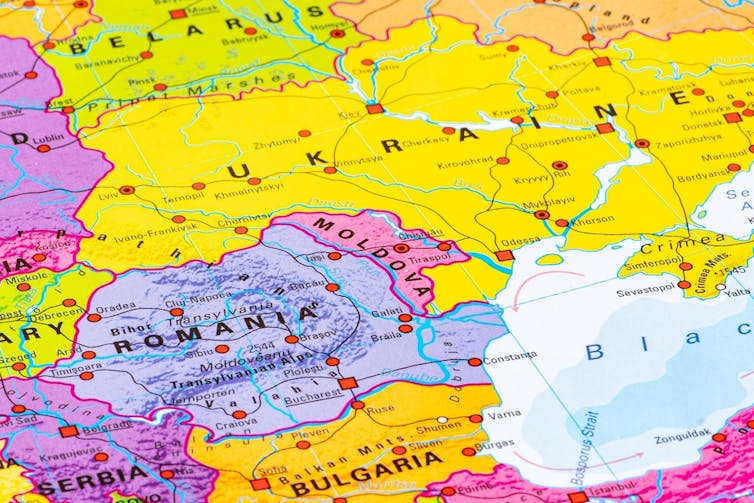
Parliamentary elections will be held in Moldova on September 28. While this may seem like a minor event for the rest of Europe, implications for the rest of the continent’s security and stability could be profound.

Moldova plays a vital role in supporting Ukraine. Even though it is among Europe’s poorest countries, it absorbed over 1.5 million Ukrainian refugees at one point during the war and is now home to more than 100,000.

It also helps to ship grain to and from Ukraine through its Danube ports, offering an alternative route and alleviating pressure on Ukraine’s Black Sea routes which are often cut off by Russian blockades.

Should Moldova pivot towards Moscow, Ukraine’s support structure will be weakened, undermining the EU’s eastern resilience. This would increase the risk of military attacks around the EU’s borders, with Romania looking particularly threatened, but increased attacks on Poland and the Baltic states not out of the question.

European leaders signalled awareness of just what could be at risk, with the French president, Emmanuel Macron, along with the chancellor of Germany, Friedrich Merz, and the Polish prime minister, Donald Tusk, travelling to Moldova to talk about unity and commitment to the country at the end of August.

Russia’s president, Vladimir Putin, has previously suggested he planned to occupy the whole of Ukraine, bringing his forces even closer to the rest of Europe. Footage released by Russia’s defence ministry on August 30 suggests a plan to seize Odesa and Kharkiv oblasts, areas along the Black Sea. Meanwhile, a pro-Russian Moldovan government could offer an eastern base for attacks – or even to open a new front. Another factor is that Russia already has around 1,500 troops stationed in Transnistria, a pro-Russian breakaway region of Moldova on the Ukraine border, which demanded independence in 2006, after a ballot that was not recognised by Moldova or the international community.


Read more:
Russia has provided fresh evidence of its territorial ambitions in Ukraine


This raises the stakes for the majority of nearby states, many of which are Nato members. Nato members have collective defence commitments under Nato’s article 5, which means they should come to the aid of a fellow Nato member if it were to be attacked.

Moldova’s current state

Moldova’s pro-EU president Maia Sandu currently holds 63 seats in the 101-seat parliament as part of the Party of Action and Solidarity (PAS). Since the party came to office in 2021 it has moved closer to the EU, applying for membership in 2021 after the full-scale invasion of Ukraine. Moldova was awarded candidacy status in June 2022.

A map of Moldova.

Shutterstock

In June 2024, accession negotiations were formally opened and, in July 2025, the first EU-Moldova summit was held. The population still broadly supports EU membership, but PAS is projected to vote share, although it is still leading in the polls. This dip in support from an initial 52.8% in the previous parliamentary elections in July 2021 to 25.8% in August 2025 stems from domestic dissatisfaction with [the party] and lack of progress on its policy platform.

In its election campaign PAS promised to fight corruption, make the public sector more efficient, and improve the economy, but they have not made significant progress on any of these plans.


Read more:
Why experts expect Russian interference in upcoming election on Ukraine’s borders


PAS has presented its progress on EU accession as a key achievement. But without seeing concrete benefits, the electorate has become increasingly alienated from the process.

The PAS government has been in crisis mode for much of its time in power, dealing with a variety of threats created by Russia such as an ongoing energy crisis, raising gas prices and eventually cutting off supplies and a significant loss of exports to Russia and Ukraine has also contributed to a stagnant economy.

So what’s likely to happen?

The most likely election result is that PAS will be forced into a coalition with one or more of the pro-Russian opposition parties, groups that advocate distancing Moldova from Europe. PAS has dominated the pro-EU political space, but the recently established pro-European Alternative Bloc (8.1%) is projected to gain enough votes to overcome the 5% threshold to enter parliament.

While PAS might still gain the most votes, the Patriotic Bloc of Communists, a pro-Russia group led by former president Igor Dodon, is currently expected to be the second-biggest political grouping. This brings together a number of parties including the Party of Socialists, Party of Communists, the Heart of Moldova and Future of Moldova parties. Dodon is currently facing charges of using corrupt practices to control decision making during his presidential term, and allowing state resources to be embezzled on a large scale. The US Treasury also claimed that he was involved in systemic corruption in conjunction with Russia. Court proceedings are ongoing. Dodon denies all charges, and has complained to the European Court of Human Rights that he is facing an unfair trial.

Advancing Russian influence?

Moldova has become a testing ground for Russian cyberattacks and large-scale disinformation campaigns.

It has been a target of Russian political interference. This was evident in the presidential elections and EU referendum in 2024, where attempts at manipulation and foreign influence were widely documented.


Read more:
Maia Sandu’s victory in second round of Moldovan election show’s limits to Moscow’s meddling


Similar, if not more, interference from Russia is expected in the upcoming election by the current Moldovan government and the EU.

These 2025 elections come at a decisive moment, not only for Moldova’s future but for the rest of Europe. Other countries need to pay attention to what is happening, and any interference in how the election is carried out.

The Conversation

Amy Eaglestone does not work for, consult, own shares in or receive funding from any company or organisation that would benefit from this article, and has disclosed no relevant affiliations beyond their academic appointment.

ref. Why Moldova’s election is important for the whole of Europe – https://theconversation.com/why-moldovas-election-is-important-for-the-whole-of-europe-264078

Introducing War on Climate, a new series that explores how conflict interacts with environmental issues around the globe

Source: The Conversation – UK – By Sam Phelps, Commissioning Editor, International Affairs, The Conversation

Wars are incredibly environmentally destructive. Gorodenkoff / Shutterstock

The world is the most violent it has been in decades. A report by the Peace Research Institute Oslo recorded 61 conflicts across 36 countries last year – the highest level since 1946. Given the number of conflicts currently active worldwide, this figure could well be taken to new heights again this year.

Wars carry an obvious human cost. Almost 65,000 Palestinians have been killed in Gaza since Israel began its assault on the territory in October 2023, while the lives of up to 250,000 Russian troops are thought to have been lost in Ukraine.

We’re all familiar with these figures. This is because they’re the ones that tend to dominate news headlines. But wars are also incredibly environmentally destructive – and the damage often goes unnoticed until it’s too late to remedy.


This roundup of The Conversation’s climate coverage comes from our award-winning weekly climate action newsletter. Every Wednesday, The Conversation’s environment editor writes Imagine, a short email that goes a little deeper into just one climate issue. Join the 45,000+ readers who’ve subscribed.


There are three reasons why the climate crisis must reshape how we think about war, says Duncan Depledge of Loughborough University. His first point is that war degrades the environment. The fighting itself causes considerable damage to land, while hostilities can fragment international cooperation on climate change.

The emissions associated with military operations worldwide – such as those generated by military aircraft – also probably rival some of the highest-polluting countries.

Depledge, a senior lecturer in geopolitics and security, acknowledges that it’s not easy to calculate the footprint of military activities. China and Russia’s military emissions, for instance, have proved almost impossible to assess due to the lack of data they report.

“But the crucial point is that recognition of the climate costs of war increasingly raises moral and practical questions about the need for more strategic restraint and whether the business of war can ever be rendered less environmentally destructive.”

His second point is that the effects of climate change may well intensify the risk of violence in certain parts of the world. “Some conflicts in the Middle East and Sahel have already been labelled ‘climate wars’, implying they may not have happened if it were not for the stresses of climate change.”

And third, he suggests that military forces could soon be rendered less effective due to more extreme and unpredictable climate conditions. Depledge says that these factors are together leaving researchers “with the uncomfortable prospect of having to rethink how military force can – and ought to be – wielded” in a changing world.


Read more:
Three reasons why the climate crisis must reshape how we think about war


Has climate change always led to violence? This was the question I put to Jay Silverstein, an expert on the archaeology of warfare at Nottingham Trent University. “There is a wide consensus that climatic stress contributes to regional escalations of violence when it has an impact on food production”, he told me in response. “Yet historical evidence reveals a more complex reality.”

Silverstein explains that looming crises have often spurred human ingenuity. This has enabled some civilisations to survive and others to thrive. “Water-lifting technologies – from the Egyptian shaduf to Chinese water wheels and Persian windmills – expanded arable land and intensified production”, he notes as an example.

However, climate stress has also triggered violence that has helped wipe entire civilisations from the map. “As humanity confronts an escalating environmental crisis driven by global warming, the reflexive response to climate stress – political instability and conflict – should be challenged by a renewed commitment to adaptation, cooperation and innovation.”


Read more:
Environmental pressures need not always spark conflict – lessons from history show how crisis can be avoided


Mayan ruins.
Environmental change contributed to the collapse of the Mayan civilisation in Mesoamerica.
milosk50 / Shutterstock

War’s lasting legacy

While travelling down the coast of Vietnam a few years ago, I stopped off in the small rural province of Quảng Trị. The area was a major battleground during the Vietnam war and was pretty much bombed flat by American forces. The province remains littered with unexploded ordnance today.

Unexploded bombs continue to kill and injure people throughout Vietnam, as well as in many other places around the world. They also cause considerable damage to the environment. Sarah Njeri and Christina Greene of SOAS, University of London and the University of Arizona respectively explain that this manifests in different ways.

Unexploded bombs and landmines “can leak heavy metals and toxic waste into the soil, polluting land and water”. And even the methods for clearing unexploded ordnance can contribute to land degradation, they say, drawing on evidence of the release of hazardous metals into the soil in northeastern Iraq following demining activities.

Climate change is making matters worse. Floods and heavy rainfall can unearth or displace landmines, while extreme heat can cause abandoned or unexploded munitions to explode.

Evidence of this came just weeks ago. Wildfires on the North Yorkshire moors in the UK – where we’ve just endured our hottest summer on record – caused 18 bombs to explode that had been lodged in the soil since the second world war.

“Explosive remnants of war have a lasting impact”, say Njeri and Greene. “Climate change is only making the threat more unpredictable and challenging to address.”


Read more:
How unexploded bombs cause environmental damage – and why climate change exacerbates the problem


Another lasting effect of war is that it displaces people from their homes. These people, writes Kerrie Holloway of the ODI Global thinktank, are particularly vulnerable to the effects of climate change.

According to Holloway, a research fellow in the Humanitarian Policy Group, displaced people “are likely to have used up whatever money and other assets they had prior to their displacement, leaving them unable to make the same adaptations as those who have not been displaced.”

They also often find themselves settling on land that is only available because existing residents do not want it. Holloway points to the Iraqi city of Mosul – where Yusuf, a refugee I got to know some years ago, was forced to flee from – as an example.

“Stagnated reconstruction following the liberation of the city from the Islamic State militant group in 2017 has resulted in a scarcity of adequate housing. This has left many displaced people residing in unfinished or makeshift shelters on unpaved roads that are prone to flooding during heavy rains.”

And finally, displaced people are often overlooked in disaster management plans. This, Holloway writes, “can result in them not heeding early warnings when they are given”.


Read more:
Why people displaced by conflict are particularly vulnerable to climate risks


The Conversation

ref. Introducing War on Climate, a new series that explores how conflict interacts with environmental issues around the globe – https://theconversation.com/introducing-war-on-climate-a-new-series-that-explores-how-conflict-interacts-with-environmental-issues-around-the-globe-264815

The digital movement that is enabling Indigenous people to show for themselves how the Amazon region is changing

Source: The Conversation – UK – By Carolina Machado Oliveira, Filmmaker, Senior Lecturer in Factual, Bournemouth University

Deep in the Amazon, sound designer Eric Terena has been capturing the sounds of the rainforest while sitting silently beneath the dense, towering treetops with his recording equipment. He has noticed some huge changes.

“What the environment once spoke, what biodiversity once sang, has shifted to sounds from industrial projects that have arrived in our territories,” said Terena, co-founder of Mídia Indígena, a Brazilian media and communications network which promotes and preserves Indigenous cultures.

His words describe more than a change in sound – they show how nature is gradually being replaced by machines. Ancestral songs have been drowned out by industrial noise. Terena shares these changes using digital tools to bring local stories to global audiences, turning lived experience into climate knowledge.

In our research with Indigenous communities in the Brazilian Amazon, we examine how film and other media technologies, from smartphones to social platforms, are being used to document environmental change, defend land rights and influence climate debates. Together with Indigenous leaders and the Intercultural Faculty in Mato Grosso, Brazil, we explore how “educommunication” – which combines media education with active community participation – can build the technical skills and political capacity that young communicators need to tell their stories to different audiences, from local villagers to global leaders.

As Cop30, the UN climate summit, comes to Brazil this November, our research shows how these digital tools are enabling Indigenous voices to help reshape global understanding of the climate crisis – ensuring their perspectives are present not only in cultural storytelling, but in international environmental decision-making.

A pivotal shift

This shift didn’t happen overnight. It began with a few voices that grew into a movement. Terena co-founded Mídia Indígena in 2017 at the Free Land Camp, a yearly Indigenous rights gathering in Brasília. Alongside him, a group of young Guajajara leaders (Indigenous peoples from Maranhão, Brazil) launched the platform, training 128 young Indigenous people how to report, record and share their stories. Mídia Indígena has grown quickly – its videos now receive more than 10 million views each year.

Erisvan Guajajara shares his experience of creating and growing the Mídia Indígena network.

At the heart of this work is a powerful idea: “Nothing about us, without us.” Indigenous people can now tell their own stories without relying on outsiders to speak for them. They decide what to film, how to tell a story, and who sees it.

The impact of this shift became clear during the Yanomami humanitarian crisis in early 2023. The Yanomami, one of the largest Indigenous groups in the Amazon, live across northern Brazil and southern Venezuela in territories deeply affected by illegal gold mining. That year, reports emerged of severe malnutrition, child deaths and mercury poisoning caused by mining operations contaminating rivers and destroying forest ecosystems.

Because Mídia Indígena’s reporters were already present in the territory, they were the first to document and publish evidence of the crisis. Their coverage not only exposed the immediate health emergency but also linked it to broader issues of environmental destruction and climate change. National and international outlets eventually followed with their own reports – but only after Indigenous journalists had already broken the story.

This was more than journalism; it was lived truth, rooted in a deep knowledge of the land. Mídia Indígena’s reporting had an authenticity that no outsider could match.

And they are not alone. Young communicators from Xingu+, a network from the Xingu River basin and surrounding Indigenous territories in Brazil, created a powerful video called Fire is burning the eyes of Xingu, showing illegal fires destroying parts of the Amazon. Their video caught the attention of the US Agency for International Development and the EU, emphasising how local stories can prompt global awareness.

Films by the Ijã Mytyli Manoki and Myki Cinema Collective, founded in 2020 by two neighbouring Indigenous peoples of Mato Grosso, show how traditional knowledge and rituals are being praised in Europe, even if they’re less known in Brazil. As filmmaker Renan Kisedjê said in the short film Our Grandparents Hunted Here, “we are digital warriors”. Where once bows and arrows defended the land, today cameras and smartphones continue the fight for land, rights and justice.

The short film Our Grandparents Hunted Here (www.peoplesplanetproject.org).

Challenging outdated ideas

Collectives such as Mídia Guarani are another part of this digital resistance. Their videos challenge outdated ideas about Indigenous life and show how deeply these communities are connected to both nature and technology.

But this storytelling is not only about identity – it’s about survival. These creators shine a light on urgent threat such as Brazil’s “devastation bill”, which seeks to weaken environmental safeguards by expanding environmental self-licensing and eroding protections for traditional territories. Such measures open the door to unchecked pollution and land grabs.

By reporting on dangers like this, Indigenous communicators seek to hold governments and corporations to account. Their stories do more than inform – they generate public pressure and demand change.

This shift matters internationally too. The UK has pledged £11.6 billion in climate finance between 2021 and 2026, including £3 billion for nature restoration and £1.5 billion for forests. Yet the Independent Commission for Aid Impact, an organisation that scrutinises UK aid spending, warns that changes in accounting may have “moved the goalposts”, inflating apparent spending without ensuring impact on the ground.

Much of this funding has traditionally flowed through large international charities and foundations, such as the Rainforest Foundation UK and the International Institute for Environment and Development, which work with Indigenous communities on mapping, monitoring, advocacy and sustainable policy.

Increasingly, however, Indigenous communities are speaking directly to funding donors and shaping allocations. This shift matters because they collectively manage vast areas of land critical to conservation. While many governments invest in expensive climate technologies, these communities have long protected ecosystems through practices proven over generations.

For the first time in the history of UN climate summits, large numbers of South American Indigenous people will attend Cop30 in November – both in person and online. For a long time, they’ve been building networks to fill the gap left by mainstream media. Now, these once silenced voices are loud, clear and deeply informed.

In late August, a hundred Indigenous reporters gathered in Belém for the 1st National Meeting of Indigenous Communication. Under the motto “Indigenous communication is resistance, territory and future”, they strengthened their networks and prepared collectively for COP30.

As the world’s most experienced environmental defenders gain more power in climate talks, their stories, and the way they tell them, will help shape the decisions that affect us all.


Don’t have time to read about climate change as much as you’d like?

Get a weekly roundup in your inbox instead. Every Wednesday, The Conversation’s environment editor writes Imagine, a short email that goes a little deeper into just one climate issue. Join the 45,000+ readers who’ve subscribed so far.


The Conversation

The authors do not work for, consult, own shares in or receive funding from any company or organisation that would benefit from this article, and have disclosed no relevant affiliations beyond their academic appointment.

ref. The digital movement that is enabling Indigenous people to show for themselves how the Amazon region is changing – https://theconversation.com/the-digital-movement-that-is-enabling-indigenous-people-to-show-for-themselves-how-the-amazon-region-is-changing-261616

Petra Kelly, l’activiste qui a fait de la défense de l’environnement une lutte pour la paix

Source: The Conversation – France (in French) – By Anne-Claude Ambroise-Rendu, Professeur d’histoire contemporaine, Université de Versailles Saint-Quentin-en-Yvelines (UVSQ) – Université Paris-Saclay

Pacifisme, écologisme et féminisme : Petra Kelly a marqué le mouvement environnementaliste allemand de son engagement. D’abord impliquée dans les mouvements antinucléaires, elle s’est mobilisée en faveur d’une écojustice qui mettrait fin aux inégalités entre pays du Nord et du Sud. Co-fondatrice des Verts outre-Rhin dans les années 1980, celle qui fut aussi députée au Bundestag pendant sept ans s’est distinguée par un militantisme de terrain au sein des mouvements sociaux.


Entrée dans la vie publique en protestant contre l’installation de missiles nucléaires de l’Organisation du traité de l’Atlantique Nord (Otan) en Allemagne de l’Ouest, en 1979, Petra Kelly (1947-1992) a été l’une des premières figures politiques à associer la défense de l’environnement et le refus du nucléaire, le pacifisme intransigeant et le féminisme radical. Fondatrice et figure de proue du parti des Verts allemands (Die Grünen), elle a incarné l’un des plus vastes mouvements contestataires de l’Allemagne des années 1970 et 1980. Pourtant, c’est aujourd’hui une figure en partie oubliée.

Née en 1947 en Bavière puis émigrée aux États-Unis, c’est au cours de ses études de sciences politiques à Washington, que Petra Kelly découvre sur les campus la contestation de la guerre du Vietnam, le féminisme et la non-violence du mouvement pour les droits civiques. En 1968, elle s’engage dans la campagne présidentielle de Robert Kennedy. À cette occasion, elle forge les principes moraux qui vont la guider toute sa vie : un engagement féministe et une conviction pacifiste très profonde qui vont nourrir ses combats ultérieurs.

Le début d’un engagement dans les mouvements antinucléaires

En février 1970, la mort de sa sœur à l’âge de 10 ans, victime d’un cancer, est décisive dans son approche de l’usage civil et militaire des radiations. C’est donc par la question du nucléaire que Petra Kelly entre dans les mouvements écologistes au début des années 1970. Elle perçoit tout le potentiel qu’offre l’activisme antinucléaire, qui propose une critique de fond du système économique et politique occidental, pour promouvoir une politique européenne alternative et réellement sociale. Après un passage par l’Université d’Amsterdam, elle travaille dix ans, de 1972 à 1982, à la Commission européenne à Bruxelles, où elle comprend que le changement social ne se fera pas sans associer davantage les citoyens aux décisions politiques.

Rentrée en République fédérale d’Allemagne (RFA) en 1979, elle s’éloigne rapidement du SPD (parti social-démocrate) auquel elle avait adhéré, en raison de la politique nucléaire et militaire du gouvernement d’Helmut Schmidt. Elle se présente sans succès aux élections européennes de 1979 dans le camp des Verts, le parti écologiste allemand à la création duquel elle a œuvré avec son compagnon Gert Bastian, ancien général de la force de défense fédérale allemande.

En 1983, elle figure parmi les 28 premiers élus du parti des Verts qui fait ainsi, avec 5,6 % des voix, son entrée au Bundestag avec le soutien de l’écrivain Heinrich Böll, prix Nobel de littérature. Rare femme à siéger dans cette institution où elle restera députée jusqu’en 1990, Petra Kelly travaille inlassablement à faire reconnaître les droits des femmes en politique et raille le sexisme qui règne au Parlement allemand, la chambre basse allemande :

« Peu importe le succès qu’une femme peut avoir, il y a toujours un homme qui surveille ses faits et gestes et qui laisse son empreinte sur tout ce qu’elle fait. »

« La paix, c’est la protection de l’environnement »

Fustigeant l’organisation et la pensée sclérosées des partis politiques, elle ambitionne d’insuffler l’énergie qui l’a séduite dans le mouvement antinucléaire à la vie politique allemande. Elle participe à toutes les manifestations, sit-in et débats télévisés et devient ainsi la figure de l’écologisme et du pacifisme allemand, sa célébrité dépassant alors de très loin les frontières nationales et même européennes.

Son activisme est délibérément spectaculaire. En 1980, lors de la crise des euromissiles provoquée par le déploiement d’un arsenal d’armes conventionnelles et atomiques, elle signe, comme bientôt deux millions de personnes, l’appel de Krefeld contre les décisions de l’Otan. Comprenant que l’appel est partisan et ne vise que l’Otan mais pas les pays du bloc de l’Est, elle prend bientôt ses distances avec les signataires. Reçue à la fin de l’année 1983, avec d’autres représentants des Verts, par Erich Honecker, président du Conseil de la République démocratique allemande (RDA), qui espérait trouver en eux des alliés contre le militarisme de l’Ouest, elle ne transige pas : vêtue d’un tee-shirt orné du slogan du mouvement pour la paix est-allemand, elle demande la libération des opposants politiques incarcérés en RDA et remet à Honecker un traité de paix symbolique.

Pour protester contre la course aux armements, elle organise la crémation d’un énorme missile de papier fabriqué avec de vieilles affiches de la CDU (Union chrétienne-démocrate) et du SPD devant le quartier général de ce dernier. Dans une lettre ouverte à Willy Brandt, président du SDP, publiée dans le Frankfurter Rundschau en 1982, elle affirme :

« La paix, c’est la protection de l’environnement, c’est empêcher la déforestation pour y installer des bases de missiles, c’est lutter contre l’implantation de centrales nucléaires. »

Un militantisme international

Rare députée allemande à parler couramment l’anglais, elle parcourt le monde tout au long des années 1970 et 1980, sans cesser de déplorer l’étroitesse de vue de la vie politique de l’Allemagne de l’Ouest, renfermée au sein des frontières du pays. Elle se partage entre les capitales occidentales et les mobilisations antinucléaires, tout en s’associant aux combats des minorités autochtones, qu’elles soient aborigènes en Australie ou lakotas aux États-Unis.

En 1982, elle reçoit, en hommage à son engagement indéfectible et international en faveur de l’environnement et de la justice sociale, le Right Livelihood Award, Nobel de la paix alternatif. En 1987, elle soumet au Bundestag une résolution sur le Tibet. Au sein du Parlement, comme devant la Maison Blanche à Washington, sur l’Alexanderplatz à Berlin-Est ou à l’ambassade ouest-allemande à Pretoria (Afrique du Sud), il s’agit pour elle de créer des réseaux transnationaux favorisant la circulation des informations et des pratiques de contestation.

Dès 1990, elle promeut la notion d’écojustice dans un texte resté fameux qui plaide pour une refonte totale du modèle économique occidental et la fin de la logique productiviste et consommatrice, qui génère de plus en plus d’inégalités nord-sud. Elle souligne la responsabilité des pays riches à l’égard des autres pays du monde, autant en matière de commerce que d’environnement. Elle y dénonce la déforestation du Costa Rica et l’expropriation des populations locales pour le profit des chaînes de fast- food qu’elle appelle à boycotter, ainsi que l’envoi de déchets industriels toxiques dans les pays pauvres. Elle insiste sur le lien qui existe entre la pauvreté profonde des deux tiers de l’humanité, les dégradations environnementales et la militarisation du monde.

Appel à une réponse non violente, le texte n’est pas qu’un réquisitoire. Il invite à refonder les mentalités des pays industriels en mesurant le bien-être à l’aune de critères nouveaux : la santé, l’air pur, l’eau claire, une nourriture saine et le partage de l’environnement avec les plantes et les animaux. L’écojustice n’est rien d’autre, écrit-elle que « prendre au sérieux la destinée de l’humanité et de la planète sur laquelle nous vivons. S’il y a un futur, il sera vert ».

Concilier activisme et fonction politique

Mais être une activiste populaire et intransigeante, célèbre dans le monde entier et siéger au Parlement s’avère parfois délicat, surtout quand on est devenue le visage des Verts. Les médias la présentent comme la Jeanne d’Arc de l’âge nucléaire, qualificatif qu’elle déteste. Or, si certains verts saluent son activisme infatigable, d’autres jugent qu’il est incompatible avec le sérieux attendu d’une députée et y voient un risque de discrédit du parti. Elle est donc progressivement marginalisée au sein d’un parti qui gagne en influence et dont les idées se banalisent. En 1990, elle tente sans succès de figurer sur la liste des Verts pour les élections au Bundestag et son parti divisé, échoue à siéger au Parlement faute d’avoir obtenu les 5 % nécessaires.

En 1992, à 45 ans, elle est assassinée dans son sommeil par son compagnon, lui aussi ancien député des Grünen, Gert Bastian qui se donne ensuite la mort. Les raisons de ce crime restent inconnues.

L’année suivante, le 22 avril, jour de la Terre, on inaugurait à Barcelone (Espagne) le jardin Petra Kelly, situé sur la colline de Montjuïc. Cette figure charismatique n’est pas oubliée de tous et continue d’être une inspiratrice : lauréate à titre posthume du prix Lumière de la vérité en 2002, décerné par le dalaï-lama, qu’elle avait rencontré, elle est classée 45e dans la liste des personnalités ayant œuvré pour sauver la planète par l’Agence de l’environnement du Royaume-Uni en 2006. De la même façon, la Fondation Heinrich-Böll a créé le prix Petra-Kelly, récompensant une personnalité ayant contribué à faire progresser les droits humains universels et la paix dans le monde.

The Conversation

Anne-Claude Ambroise-Rendu ne travaille pas, ne conseille pas, ne possède pas de parts, ne reçoit pas de fonds d’une organisation qui pourrait tirer profit de cet article, et n’a déclaré aucune autre affiliation que son organisme de recherche.

ref. Petra Kelly, l’activiste qui a fait de la défense de l’environnement une lutte pour la paix – https://theconversation.com/petra-kelly-lactiviste-qui-a-fait-de-la-defense-de-lenvironnement-une-lutte-pour-la-paix-264050

Mars : les nouveaux résultats de la NASA démontrent-ils des signes de vie passée ?

Source: The Conversation – France in French (2) – By Sean McMahon, Reader in Astrobiology, University of Edinburgh

La roche surnommée Cheyava Falls présente des taches qui auraient pu être formées par une forme de vie microbienne. Nasa JPL-Caltech, CC BY

Les analyses d’une roche trouvée sur Mars par le rover Perseverance ont été publiées hier dans la revue Nature. Si ces taches auraient pu être créées par une activité microbienne, ces observations ne sont en fait que le début d’une longue enquête… qui nécessite de ramener la roche sur Terre.


Il y a un peu plus d’un an, la NASA a fait une grande annonce : le rover Perseverance, qui explore la surface de Mars, avait trouvé des signes potentiels d’une vie ancienne sur Mars. Les détails de cette découverte ont maintenant été évalués par les pairs et publiés dans la revue Nature. Un article qui, malgré sa formulation plutôt modeste, pourrait finalement s’avérer être l’un des plus importants de l’histoire des sciences.

Pour faire court : ces traces pourraient être des signes de vie passée, mais il faudrait ramener les échantillons sur Terre pour en être sûrs. Le rover Perseverance a collecté et analysé un fragment de la roche en question… il ne reste plus qu’à aller le chercher.

Et une mission visant à se rendre sur Mars, à récupérer les échantillons de roche collectés par Perseverance et à les ramener sur Terre a été élaborée par la NASA et l’Agence spatiale européenne — ceci inclut l’échantillon de roche qui fait l’objet de l’étude publiée dans Nature. Mais cette mission, Mars Sample Return, rencontre des difficultés en raison de l’augmentation des coûts de la mission ([ndlr : et le budget proposé en mars 2025 par le président Trump n’inclut pas cette mission]).

Au milieu de l’année 2024, le rover Perseverance a découvert un bloc de mudstone ancien, une roche sédimentaire composée à l’origine d’argile ou de boue, surnommée Cheyava Falls, qui se distingue par sa teinte rouge brique. Cette roche a été déposée par l’eau il y a environ quatre milliards d’années.

Alors que la plupart des roches martiennes sont rouges à cause d’une couche de poussière d’oxyde de fer, Cheyava Falls est rouge jusqu’à son cœur : l’oxyde de fer se trouve dans la roche elle-même.

Plus intriguant encore, Cheyava Falls est parsemée de douzaines de minuscules taches pâles, de tailles généralement inférieures à un millimètre. Ces taches sont bordées d’un minéral sombre, riche en phosphore, qui apparaît également sous forme de minuscules points dispersés entre les autres taches et que l’on appelle « graines de pavot ». Ce minéral plus sombre est associé à des traces d’anciens composés organiques : des composés qui contiennent du carbone et qui sont essentiels à la vie sur Terre… mais qui existent également en l’absence de vie et d’activité biologique.

Quel est le rapport avec la vie ?

Tous les organismes vivants sur Terre collectent l’énergie grâce à des réactions d’oxydoréduction (réactions redox) qui transfèrent des électrons entre des substances chimiques appelées réducteurs (qui cèdent des électrons) et d’autres, appelées oxydants (qui les acceptent).

Sur Terre par exemple, dans les cellules animales, des structures appelées « mitochondries » transfèrent des électrons du glucose (un réducteur) à l’oxygène (un oxydant). Certaines bactéries vivant dans les roches utilisent d’autres types de composés organiques à la place du glucose et, à la place de l’oxygène, de l’oxyde ferrique (un type d’oxyde de fer aux quel il manque trois électrons par rapport au métal fer).

Serpentine Rapids
Une autre roche martienne, baptisée Serpentine Rapids, présente également des caractéristiques rappelant les taches d’oxydoréduction.
NASA JPL-Caltech

Lorsque l’oxyde ferrique est réduit en un autre oxyde de fer appelé oxyde ferreux (il ne manque plus que deux électrons par rapport au métal fer), il devient soluble dans l’eau. Il peut ensuite être dispersé ou réagir pour former de nouveaux minéraux, de couleur plus claire.

Il en résulte que de nombreuses roches et sédiments rouges sur Terre contiennent de petites taches blanchies, appelées « taches de réduction », qui ressemblent de manière frappante à celles trouvées à Cheyava Falls.

Sur Mars, Perseverance a également repéré des caractéristiques blanchies encore plus évocatrices de taches de réduction sur un site appelé Serpentine Rapids. Malheureusement, le rover n’y a passé que trop peu de temps pour les analyser et n’a prélevé aucun échantillon.

Le nouvel article développe des résultats présentés lors de la Lunar and Planetary Science Conference de Houston (États-Unis) en mars 2025, avec plus de détails. Pour être publiés dans Nature, les résultats ont été évalués par des pairs (d’autres chercheurs spécialistes du domaine), ce qui ajoute du crédit à l’annonce de la NASA. Ainsi, la nouvelle publication confirme que les taches pâles sont associées à des matières organiques et qu’elles contiennent du fer ferreux et du soufre, plus précisément un minéral de sulfure de fer.

L’interprétation la plus plausible est que des réactions d’oxydoréduction se sont produites à l’intérieur de la roche après sa formation. Elles ont transféré des électrons des matières organiques vers l’oxyde ferrique et le sulfate, ce qui a produit les zones décolorées, où l’oxyde ferrique est réduit en oxyde ferreux.

Perseverance
Perseverance avec la roche de Cheyava Falls.
NASA JPL-Caltech

Le point crucial est que ces réactions, en particulier la réduction des sulfates, ne se produisent normalement pas aux températures relativement basses auxquelles la roche de Chevaya Falls a été soumise au cours de son histoire… à moins que des microbes ne soient intervenus pour aider la réaction à se produire. L’oxydation microbienne de la matière organique peut également produire des minéraux phosphatés, comme ceux trouvés à Cheyava Falls.

Si nous ne ramenons pas les échantillons dans des laboratoires sur Terre, nous ne pourrons pas savoir ce qui s’est réellement passé à Cheyava Falls il y a quatre milliards d’années.

Mais malgré cela, pour l’instant, nous n’avons pas identifié d’explication « non-biologique » (qui n’implique pas d’organisme vivant) qui soit entièrement satisfaisante et rende compte de l’ensemble des observations faites par Perseverance. Le nouvel article détaille ces potentielles explications, en examinant les possibilités une par une.

Mais quoi qu’il en soit, en astrobiologie, l’absence d’explication non biologique ne marque pas la fin de la recherche de vie, mais plutôt… son commencement. L’histoire nous enseigne que lorsque nous ne trouvons pas d’explication non biologique à un phénomène, ce n’est généralement pas parce qu’il n’y en a pas… c’est simplement parce que nous n’y avons pas encore pensé.


À lire aussi :
Comment cherche-t-on des traces de vie sur Mars ?


Que va-t-il se passer maintenant ?

Tout d’abord, les astrobiologistes du monde entier doivent étudier quelles réactions d’oxydoréduction impliquant le fer, le soufre, les composés organiques et le phosphate auraient pu se produire, avec ou sans organismes vivants, dans des conditions similaires à celles de Cheyava Falls.

Ensuite, la NASA et d’autres agences spatiales devront faire preuve d’un leadership audacieux dans le cadre de la mission Mars Sample Return. Oui, cela coûtera cher, peut-être des dizaines de milliards de dollars, mais le résultat pourrait être la découverte scientifique la plus importante jamais réalisée.


À lire aussi :
La politique spatiale de la Chine déjoue-t-elle le narratif imposé par les Etats-Unis ? Une conversation avec Isabelle Sourbès-Verger


The Conversation

Sean McMahon a reçu des financements de la NASA par le passé.

ref. Mars : les nouveaux résultats de la NASA démontrent-ils des signes de vie passée ? – https://theconversation.com/mars-les-nouveaux-resultats-de-la-nasa-demontrent-ils-des-signes-de-vie-passee-265084

Retraites par capitalisation ou par répartition : quel système est le plus rentable ?

Source: The Conversation – France (in French) – By Anne Lavigne, Professeure de Sciences économiques, Université d’Orléans

Le nouveau premier ministre Sébastien Lecornu a indiqué vouloir rouvrir le dossier des retraites. Lors du conclave, la retraite par capitalisation avait été rapidement évoquée. De quoi parle-t-on quand on évoque ce système de financement ? Est-il vraiment opposé à la retraite par répartition ? Quels sont ses réels atouts économiques et financiers ? Les risques qui lui sont associés le discréditent-ils, comme le disent ces critiques ?


Plus connue sous l’appellation « conclave », la délégation paritaire permanente installée le 27 février dernier s’est soldée par un échec, malgré une redéfinition par les partenaires sociaux eux-mêmes du périmètre des thématiques à aborder. Le financement des retraites par capitalisation a notamment été évoqué, avec prudence par les organismes syndicaux et plus d’enthousiasme par les représentants du patronat.

Parallèlement, le 11 juillet dernier, le comité de suivi des retraites a rendu son 12ᵉ avis. Il relève :

« Le recours accru à la capitalisation ne peut pas constituer à court terme une réponse au déséquilibre de notre système par répartition, et peut même avoir pour effet de détourner des ressources du financement des régimes »,

et souligne que :

« Recherche de rendement, préservation de la volatilité, financement de l’économie nationale, investissements souverains constituent autant d’objectifs qui ne sont pas forcément conciliables avec un seul outil dont l’objectif principal reste de verser des retraites aux anciens actifs. »

Comment ça marche ?

Dans un système de retraite par répartition, les cotisations des travailleurs actifs ont vocation à financer les pensions des retraités. S’y ajoutent, dans la plupart des pays, des prélèvements fiscaux. Si les cotisants d’une année donnée financent les pensions des retraités la même année, et non leur propre retraite, ils acquièrent un droit à pension financé par les générations ultérieures et garanti par la nation.


À lire aussi :
Retraites : l’allongement de la durée du travail, la moins mauvaise des solutions ?


Dans un système de retraite par capitalisation, les cotisations versées une année donnée sont placées dans des actifs financiers ou immobiliers, dont les rendements se cumulent au fil du temps. Les revenus des placements sont réinvestis année après année jusqu’à la retraite, et le capital accumulé pendant la vie active est versé à la liquidation des droits à la retraite, selon des modalités propres à chaque régime de capitalisation, en une rente viagère, en versements programmés ou en un versement unique.

Un outil de fidélisation

Historiquement, les régimes de retraite professionnels en capitalisation se sont développés lorsque les pays se sont industrialisés. L’objectif des employeurs était de fidéliser une main-d’œuvre par la promesse d’un salaire direct, mais également d’un salaire conditionnel (versement d’une pension d’invalidité en cas d’accident) ou différé (versement d’une pension de retraite lorsque la vieillesse rendait le travailleur inapte au travail).

Dans cette évolution historique, la France a emprunté une voie singulière : si des dispositifs de retraite par capitalisation ont été effectivement instaurés à la fin du XIXe et au début du XXe siècle, ils n’ont pas résisté aux turbulences économiques et financières de l’entre-deux-guerres. À la Libération, la nation a fait le choix d’un système public obligatoire en répartition pour l’ensemble des salariés, avec des caisses de retraite complémentaires professionnelles également financées en répartition.

Ce choix collectif pour la répartition est singulier. Dans tous les autres pays, la retraite de base est en répartition mais les retraites professionnelles sont en capitalisation. Dans le débat qui se rouvre aujourd’hui en France, la question posée est : jusqu’où et comment déplacer le curseur vers la capitalisation ?

Une question de dosage ?

Pour certains, la question ne se pose même pas. Par principe, la répartition doit rester l’unique mode de financement des retraites. En effet, développer la capitalisation reviendrait à renforcer le pouvoir actionnarial au détriment du travail, à démanteler la protection sociale solidaire, à accentuer les inégalités à la retraite (les épargnants plus fortunés ont une meilleure capacité à obtenir des rendements financiers plus élevés).

Au-delà de ce principe, qui a sa légitimité, quels arguments peut-on faire valoir pour introduire une dose de capitalisation dans notre système de retraite ? La capitalisation est-elle plus efficace, en termes de rendement et de risque, que la répartition dans sa capacité à procurer un revenu de remplacement pendant la retraite ?

Des systèmes complexes à comparer

Comparer le rendement de la retraite en répartition ou en capitalisation revient à se demander : pour chaque euro cotisé pendant ma vie active, combien d’euros obtiendrai-je sous forme de pension une fois à la retraite ?

Évaluer le rendement de la capitalisation est en théorie simple, plus délicat en pratique. En théorie, pour un cotisant, le rendement de la capitalisation est le rendement obtenu sur les placements effectués tout au long de sa carrière à partir des cotisations versées. Bien sûr, ces cotisations sont périodiques : celles de début de carrière seront capitalisées sur un temps très long, celles effectuées en fin de carrière sur un temps plus court. Et personne ne connaît avec certitude le nombre des années passées à la retraite, de sorte que le rendement de l’épargne retraite dépend de la durée probable de survie au départ à la retraite.

En définissant le taux de rendement interne (TRI) comme le taux qui égalise la somme (actuelle probable) des cotisations versées et des pensions reçues, le rendement de la capitalisation correspond au taux de rendement des placements dans lesquels ont été investies les cotisations, sous l’hypothèse que les pensions reçues sont actualisées à ce taux.

Un raisonnement fallacieux

En pratique, on présente souvent le rendement de la capitalisation comme le rendement moyen observé sur des placements financiers. Pour cela, on calcule le rendement moyen, par exemple sur une durée de quarante ans, d’un indice boursier, par exemple le CAC 40 et on affirme « Si on avait introduit la capitalisation en 1982, les retraités toucheraient 300 euros de plus que la pension offerte par l’actuel système en ayant cotisé deux fois moins ».

Cette expérience de pensée est en réalité fallacieuse. Aucun fonds de pension (a fortiori un épargnant individuel) ne place la totalité de ses actifs dans des actions. D’une part, pour diversifier les risques financiers ; d’autre part, parce qu’au départ à la retraite, il faut convertir le capital de cotisations accumulées en flux de pension. Et cette phase de décumulation nécessite d’avoir des actifs suffisamment liquides et dont la valeur de revente n’est pas (trop) volatile.

Évaluer le « rendement » de la répartition est aussi discutable, puisque la répartition n’est pas une opération financière intertemporelle. Sur un plan individuel, calculer un taux de rendement interne n’a pas grand sens, puisque précisément, on ne cotise pas pour soi-même. On peut néanmoins s’intéresser au rendement collectif d’un régime par répartition.

Le rôle des taux de croissance

La capacité d’un système de retraite par répartition à assurer un bon niveau de pension aux retraités dépend de manière cruciale du nombre de travailleurs effectivement employés et de leur productivité. Si le taux d’emploi augmente, cela fait plus de cotisants et si la productivité des travailleurs augmente, cela se traduit généralement par des rémunérations plus élevées, et donc une assiette de cotisations plus importante.

Schématiquement, la croissance démographique et le progrès technique jouent le même rôle dans le rendement implicite de la répartition. Pour x euros cotisés en répartition quand ils sont actifs, les salariés « récupèrent » lorsqu’ils partent à la retraite les x euros revalorisés de la somme du taux de croissance de la population (supposée employée pendant toute sa vie active) et du taux de croissance de la productivité.

Avantage en trompe-l’œil pour la capitalisation

On comprend donc que la capitalisation est plus rentable que la répartition si le taux de rendement du capital est supérieur au taux de croissance cumulé de la population et de la productivité, qu’on peut assimiler au taux de croissance économique en première approximation. Qu’en est-il dans les faits ?

Même si la crise financière de 2007 a ébranlé quelques certitudes, il ressort des études historiques sur longue période que le rendement réel des placements financiers est supérieur au taux de croissance économique dans les principaux pays industrialisés.

Arte 2025.

Dans une vaste fresque historique, Jordá et al. ont calculé que l’écart entre le taux de rendement de la richesse et le taux de croissance économique s’élevait à 2,68 % en moyenne pour un ensemble de 16 pays sur la période 1950-2015. En très longue période (1870-2015), leur étude montre que le rendement réel de la richesse est supérieur au taux de croissance réel dans tous les pays, sauf pendant les sous périodes de guerre.

Cette étude confirme, par ailleurs, un résultat observé par de nombreuses contributions antérieures : en moyenne, le rendement réel des actions est supérieur au rendement réel des actifs sans risque (obligations et actifs monétaires). La prime de risque, qui mesure l’écart entre rendement des actions et des actifs sans risque, s’élevait à environ 4 % en moyenne avant la Première Guerre mondiale, pour devenir légèrement négative lors de la grande dépression, puis s’envoler jusqu’à 14 % au début des années 1950 et revenir à son niveau séculaire autour de 4 % depuis 2000. Cette évolution tendancielle se retrouve dans tous les pays, à des niveaux de taux de rendement différents d’un pays à l’autre. Entre 1980 et 2015, la prime de risque en France se situe légèrement en dessous de la moyenne globale, à 2,14 %.

Rentabilité et risque

Pour autant, pour les individus, ce n’est pas le rendement moyen du système en longue période qui importe, mais le montant de la rente viagère qu’ils pourront obtenir chaque mois lorsqu’ils seront à la retraite. Observer qu’en moyenne, chaque année, sur une très longue période, le rendement du capital est supérieur à la croissance économique n’implique pas qu’il faille choisir la capitalisation pour couvrir le risque vieillesse, pour au moins trois raisons.

LCI 2025.
  • La première raison, c’est que, pour un individu donné, ce n’est pas le rendement moyen du système en longue période qui importe, mais le montant de la rente viagère qu’il pourra obtenir chaque mois lorsqu’il sera à la retraite. Et c’est là qu’intervient la notion de risque d’un placement financier. Chacun peut constater que le cours d’une action cotée varie jour après jour. Cette variation peut être mesurée par des indicateurs statistiques, tels que la variance ou l’écart-type ; grosso modo, ces indicateurs mesurent « de combien s’écarte le cours d’une action par rapport à sa tendance sur une période donnée ? ». Ce qu’on peut montrer théoriquement, et ce qu’on observe dans les faits, c’est que plus une action est détenue pendant une période de temps longue, plus la variation de son rendement autour de la tendance moyenne se réduit.

Pour autant, cela ne signifie pas que détenir des actions pendant une longue période, par exemple jusqu’à la retraite, ne soit pas risqué. En effet, pour quelqu’un qui souhaite financer sa retraite par un placement financier, ce qui importe, ce n’est pas le rendement annuel moyen de son placement sur trente ans, mais bien le rendement total qu’il obtiendra au bout de trente ans quand il partira à la retraite. Et il est possible que le rendement annuel moyen sur vingt-neuf ans soit favorable, mais qu’il soit anéanti par un krach boursier l’année suivante.

  • La deuxième raison, c’est que les rendements des actions tels qu’ils peuvent être calculés à partir des cotes officielles sont bruts de frais. En pratique, si on souhaite financer sa retraite par capitalisation, on doit utiliser les services d’un intermédiaire (fonds de pension, gestionnaire d’actifs, banque, entreprise d’assurance) et ces services sont facturés. Pour un individu donné, le rendement des actions doit s’apprécier « net de frais ». Or, ces frais peuvent s’avérer élevés lorsque la concurrence entre les intermédiaires est faible.

La troisième raison, c’est qu’à la base, financer sa retraite, c’est se couvrir contre les risques liés à la vieillesse (être dans l’incapacité physique ou mentale de travailler à âge élevé et ignorer combien de temps on passera à la retraite). Dans cette optique, il serait paradoxal de couvrir un risque (le risque vieillesse) en en prenant un autre (le risque financier).

Ce dernier argument ne suffit pas, toutefois, à disqualifier la capitalisation, d’autant que la répartition comporte aussi des risques.


Éditions La Découverte, Fourni par l’auteur

The Conversation

Anne Lavigne est membre du Conseil d’administration de l’Etablissement de retraite additionnelle de la fonction publique, en qualité de personnalité qualifiée. Cette fonction est assurée à titre bénévole.

ref. Retraites par capitalisation ou par répartition : quel système est le plus rentable ? – https://theconversation.com/retraites-par-capitalisation-ou-par-repartition-quel-systeme-est-le-plus-rentable-261477

Charlie Kirk’s assassination is the latest act of political violence in a febrile United States

Source: The Conversation – Global Perspectives – By Jared Mondschein, Director of Research, US Studies Centre, University of Sydney

In yet another shocking act of political violence in the United States, Charlie Kirk, who came to prominence as a conservative influencer and supporter of Donald Trump, was assassinated while debating with students at a university in Utah.

The 31-year-old, who came to fame by doing just that – debating whoever wanted to engage with him – was undeniably the most influential figure in young conversative politics.

News of his killing sent social media into an all-too familiar frenzy, with opposing political camps blaming each other for the increasingly febrile environment in contemporary America. It has also raised fears it may provoke even more violence.

Who was Charlie Kirk?

The meagre tent in which Kirk would set up shop on university campuses around America to engage in debate with university students should not be mistaken for meagre support.

Kirk’s political organisation, Turning Point USA (TPUSA), had a revenue of US$78,000 (A$118,000) when he founded it in 2012. As of last year, its annual revenue had grown to US$85 million (A$129 million).

His podcast, The Charlie Kirk Show, boasted between 500,000 and 750,000 downloads for each episode, ranking it as one of the top 25 most listened to podcasts in the world. Even Kirk’s 7 million X account followers is greater than MSNBC’s 5 million.

Outside the online world, TPUSA today has a presence in more than 3,500 high school and college campuses, with more than 250,000 student members, and more than 450 full- and part-time staff. But perhaps the most important metric is the fact that a TikTok survey of users under 30 found that, among those who voted for Trump, they trusted Kirk more than any other individual.

As much as Kirk’s many detractors abhorred his views and his conduct – particularly his views of Black people, Jews, trans people and immigrants, as well as his efforts to denounce professors engaging in “leftist propaganda” – there was no denying he was willing to debate practically anyone.

Whether it was in storied lecture halls at Oxford University or a progressive university campus in the US, Kirk engaged in political debate with anyone willing to come to the open microphone at his events, encouraging students to “prove me wrong”. The dissemination of clips of these interactions – typically an unwitting progressive student asking Kirk a question only to have Kirk counter-argue – garnered hundreds of millions of views across a variety of social media channels.

Support for Trump

Kirk first came to prominence championing more conventional Republican politicians, including Texas Senator Ted Cruz and former Wisconsin governor Scott Walker. But he eventually came around to supporting Trump in 2016, and never looked back.

Indeed, when many – particularly within the Republican party – sought to distance themselves from Trump after incidents such as the infamous Access Hollywood tape in 2016 or the violence at the US Capitol on January 6 2021, Kirk stayed the course.

The combination of his unceasing loyalty to Trump and his increasing popularity among young voters saw him increase his power within conservative circles. This power saw his organisation contribute millions of dollars to various Trump-aligned campaigns. TPUSA also bolstered support for embattled cabinet nominee, and now defence secretary, Pete Hegseth, and initiate efforts to oust former chair Ronna McDaniel from the Republican National Committee.

But perhaps Kirk’s most notable political win was harnessing a record number of young people to vote for Trump in 2024, despite the fact he was the oldest ever person to lead the Republican presidential ticket.

US political violence

Some may look at yet another instance of deadly US political violence and wonder whether it would have any sort of lasting impact. After all, the creation of the US followed an act of political violence known to Americans as the Revolutionary War. And this founding preceded more political violence, including the Civil War, Reconstruction and Civil Rights movement, among others.

Yet, as much as the entirety of US history is filled with such incidents, there is no denying that for the past generation in particular, it has also grown worse.

Numerous studies have found that the number of attacks and plots against elected officials, political candidates, political party officials, and political workers is exponentially higher now than in recent history. In examining 30 years of data, the Center for Strategic and International Studies (CSIS) found the number of attacks and plots in the past five years is nearly triple that of the preceding 25 years combined.

But beyond the numbers, US politicians themselves increasingly cite the spectre of violence as a reason why they have either retired from politics or – perhaps more worryingly – changed their votes.

Ultimately, there’s little question as to whether the US will continue to suffer from political violence. The greater question is to what extent and at what cost.

Kirk’s death will affect far more than just his friends and his family – including his widow and two young children. Today marked the loss of a unique leader in the US conservative movement.

The Conversation

Jared Mondschein does not work for, consult, own shares in or receive funding from any company or organisation that would benefit from this article, and has disclosed no relevant affiliations beyond their academic appointment.

ref. Charlie Kirk’s assassination is the latest act of political violence in a febrile United States – https://theconversation.com/charlie-kirks-assassination-is-the-latest-act-of-political-violence-in-a-febrile-united-states-265063

Cancer du sein : une nouvelle étude révèle un risque génétique chez les femmes africaines

Source: The Conversation – in French – By Mahtaab Hayat, Lecturer, University of the Witwatersrand

Le cancer du sein est le cancer le plus fréquent chez les femmes dans le monde. En Afrique subsaharienne, il est aussi la principale cause de décès liés au cancer.

Les facteurs de risque connus incluent le fait d’être une femme, l’âge, le surpoids, la consommation d’alcool et les prédispositions génétiques.

Dans ce domaine, les études dites « d’association à l’échelle du génome » ou études d’association pangénomique constituent un outil puissant. Elles permettent d’identifier les variantes génétiques courantes, ou mutations, qui peuvent influencer la probabilité de développer une maladie. Ces études analysent l’ensemble du génome (l’ADN complet d’une personne) afin de trouver les différences génétiques présentes chez les personnes atteintes d’une maladie.

Depuis 2005, ces études ont fourni des informations utiles pour le diagnostic, le dépistage et la prédiction de certaines maladies, notamment le cancer du sein. Les découvertes récentes ont été utilisées pour développer des outils de prédiction qui aident à identifier les personnes présentant un risque élevé de développer des maladies. Les scores de risque génétique (également appelés scores de risque polygénique) estiment la prédisposition à une maladie en fonction de l’effet cumulatif de multiples variantes ou mutations génétiques.

Mais la plupart des recherches ont été menées sur des populations d’ascendance européenne. Cela pose un problème, car la diversité génétique et la variabilité environnementale diffèrent à travers le monde. En Afrique, la diversité génétique est la plus importante observée mondialement.

Pour combler cette lacune, nous, chercheurs de l’université de Wits, du Sydney Brenner Institute for Molecular Bioscience et nos collaborateurs du Registre National du Cancer d’Afrique du Sud (South African National Cancer Registry), avons mené la première étude d’association pangénomique sur le cancer du sein dans une population d’Afrique subsaharienne.

Nous avons comparé les variations génétiques entre les femmes atteintes d’un cancer du sein et celles qui n’en sont pas atteintes, à la recherche de variantes qui ont une différence de fréquence entre les Malades atteints de cancer et les individus sans cancer.

Nous avons identifié deux variantes génomiques proches des gènes RAB27A et USP22 qui contribuent au risque de cancer du sein chez les femmes noires sud-africaines. Ces variantes génétiques n’avaient jamais été associées au cancer du sein dans les populations non africaines auparavant.

Nos résultats soulignent l’importance d’identifier les variantes génétiques spécifiques à une population, en particulier dans les populations peu étudiées. Différentes populations peuvent être porteuses de variantes uniques qui contribuent différemment au risque de cancer du sein. Les variantes à risque trouvées dans d’autres populations peuvent ne pas être présentes dans les populations africaines. Cela renforce l’idée que les efforts de recherche et les scores de risque doivent être réalisés dans différentes populations, y compris les populations africaines.

Comparaison de l’ADN des femmes

Les chercheurs ont comparé l’ADN de 2 485 femmes atteintes d’un cancer du sein à celui de 1 101 femmes non touchées par la maladie. Toutes ces femmes résidaient à Soweto, en Afrique du Sud. Les cas de cancer du sein ont été recrutés dans le cadre de l’étude du Johannesburg Cancer Study sur une période de 20 ans et les témoins provenaient de l’étude Africa Wits-INDEPTH Partnership for Genomic Research.

L’analyse a utilisé une technologie (appelée puce ADN) spécialement conçue par le consortium H3Africa pour étudier la diversité génétique des populations africaines.

En comparant les variations génétiques chez les femmes atteintes d’un cancer du sein et celles qui n’en sont pas atteintes, nous avons identifié deux variantes génétiques qui contribuent au risque de cancer du sein chez les femmes noires sud-africaines. Elles sont situées à proximité de gènes impliqués dans la croissance des cellules cancéreuses, leur capacité à se propager (métastases) et le développement de tumeurs dans différents cancers.

Nous avons également appliqué des scores de risque polygéniques à notre ensemble de données africaines. Il s’agit d’une méthode qui estime le risque de cancer du sein pour un individu en fonction de la présence de variantes à risque. Ces variantes sont dérivées des résultats d’études d’association pangénomique. Le score de risque que nous avons utilisé était basé sur les variantes à risque d’une population européenne. Nous l’avons utilisé pour évaluer sa capacité à prédire le cancer du sein dans notre population africaine.

Les résultats ont montré que le score de risque était moins efficace pour prédire le cancer du sein dans notre population d’Afrique subsaharienne que dans une population européenne.

La prochaine étape

Il s’agit ici de la première analyse d’association pangénomique à grande échelle en Afrique subsaharienne visant à identifier les facteurs génétiques qui influencent le risque d’une personne de développer un cancer du sein.

Notre étude a porté sur moins de 4 000 échantillons. Des études génétiques plus importantes sur le cancer du sein ont porté sur plus de 200 000 cas et témoins, mais sans représentation des populations d’Afrique subsaharienne. Cela souligne le besoin urgent d’intensifier les efforts de recherche et d’accroître la participation du continent.

Les résultats de cette étude et des études futures aideront les médecins à dépister les patientes et à identifier celles qui présentent un risque élevé. Une fois que nous savons qui présente un risque élevé, nous pouvons leur proposer des examens plus fréquents et des mesures préventives. Cela nous permet de détecter le cancer du sein à un stade précoce, voire de le prévenir, avant qu’il n’ait eu le temps de se développer ou de se propager.

Des recherches supplémentaires seront nécessaires pour comprendre comment ces gènes augmentent le risque de développer un cancer du sein et améliorer la prédiction du cancer du sein. Il est à noter que l’application des scores de risque polygéniques dérivés de l’Europe n’a pas permis de prédire avec précision le cancer du sein dans l’ensemble des populations africaines. Ces résultats sont cohérents avec les conclusions précédemment rapportées pour d’autres maladies.

Enfin, les chercheurs participent aussi à une étude mondiale sur la génétique du cancer du sein, appelée Confluence, qui prend en compte de nombreuses populations, y compris africaines.

Le professeur Christopher Mathew et Beth Amato ont contribué à la rédaction de cet article.

The Conversation

ean-Tristan Brandenburg receives funding from the German Federal Ministry of Education and Research (BMBF) under grant 01KA2220B to the RHISSA Programme for the NORA Consortium. Additionally, he is supported by the Science for Africa Foundation through Programme Del-22-008, with funding from the Wellcome Trust and the UK Foreign, Commonwealth & Development Office. He is also a participant in the EDCPT2 programme, which is supported by the European Union.

Mahtaab Hayat does not work for, consult, own shares in or receive funding from any company or organisation that would benefit from this article, and has disclosed no relevant affiliations beyond their academic appointment.

ref. Cancer du sein : une nouvelle étude révèle un risque génétique chez les femmes africaines – https://theconversation.com/cancer-du-sein-une-nouvelle-etude-revele-un-risque-genetique-chez-les-femmes-africaines-264509