Un repas gastronomique sans viande est-il concevable en France ?

Source: The Conversation – in French – By Bruno Cardinale, Maître de conférences et chercheur en marketing, Université Le Havre Normandie

Dans l’imaginaire collectif français, un repas de fête se passe difficilement de viande, perçue comme la pièce centrale sans laquelle le plat apparaît incomplet. À l’heure où les impératifs climatiques nous invitent à réduire notre consommation carnée, il est temps de montrer que le végétal aussi peut être le cœur de la gastronomie.


Les Français comptent parmi les plus gros consommateurs de viande au monde. Cette réalité peut sembler surprenante. D’abord, parce que le nombre de flexitariens augmente. Ensuite, parce que les enjeux sanitaires dûs à une consommation excessive de viande ne sont plus ignorés. Enfin, parce que cette habitude semble relativement nouvelle.

Comme le rapportent les historiens de l’alimentation, la tradition culinaire française s’est longtemps appuyée sur les céréales, sur les légumes secs et sur les soupes, la viande restant réservée aux grandes occasions. Nous en consommons en moyenne deux fois plus aujourd’hui qu’en 1920.

Dès lors, comment comprendre cet attachement à la viande, alors même que les discours écologiques se multiplient et que sa consommation diminue en moyenne en France ? Selon les données récentes du ministère de l’agriculture et de la souveraineté alimentaire, cette baisse s’explique en fait davantage par la hausse des prix des produits carnés que par une véritable préoccupation environnementale ou nutritionnelle.

Pour mesurer l’influence encore limitée des politiques publiques sur les pratiques alimentaires, il est particulièrement instructif de pencher sur un objet culturel emblématique : le repas gastronomique des Français, traditionnellement centré sur la viande. Incarnation de l’art de vivre à la française, ce repas structuré et codifié a été inscrit sur la liste du patrimoine culturel immatériel de l’Organisation des Nations unies pour l’éducation, la science et la culture (Unesco) en 2010. Selon la définition de cette dernière, le patrimoine culturel immatériel est

« traditionnel, contemporain et vivant à la fois : il ne comprend pas seulement les traditions héritées du passé, mais également les pratiques rurales et urbaines contemporaines, propres à divers groupes culturels ».

Autrement dit, le repas gastronomique, en tant que pratique vivante, peut lui aussi évoluer face aux enjeux de transition alimentaire.

Cette évolution est d’autant plus nécessaire que la gastronomie joue un rôle central dans la transmission des normes alimentaires. C’est souvent à travers ces repas que les enfants apprennent ce qu’est un « vrai bon repas ».

La définition même du repas gastronomique des Français insiste sur cette fonction éducative :

« Des personnes reconnues comme étant des gastronomes, qui possèdent une connaissance approfondie de la tradition et en préservent la mémoire, veillent à la pratique vivante des rites et contribuent ainsi à leur transmission orale et/ou écrite, aux jeunes générations en particulier. »

Dès lors, la diminution globale de la consommation de viande touche-t-elle également ces repas gastronomiques ? Que transmet-on aujourd’hui, implicitement, lors de ces moments qui continuent de structurer l’apprentissage culinaire des plus jeunes ?

Le repas gastronomique, moment de partage résolument carné

Mariage, communion, anniversaire… dès qu’un événement prend une dimension gastronomique, la viande (et en particulier la viande rouge) reste le point d’orgue du repas. Notre étude des représentations sociales, menée auprès de 424 mangeurs, confirme que la viande occupe une place centrale dans l’imaginaire collectif du repas gastronomique.

Sur le terrain, nous avons également observé plus de 18 000 mangeurs lors de 226 repas de mariage. Les chiffres sont éloquents : plus de deux convives sur trois choisissent une viande rouge, principalement du bœuf, qui, à lui seul, pèse presque autant que toutes les autres options réunies. Le poisson additionné aux plats végétariens ne représentent qu’un dixième des choix, tandis que la volaille et le veau assurent une transition limitée. La demande pour les plats végétariens, l’agneau ou le porc demeure marginale, voire inexistante.

Ces constats soulèvent une question centrale : si les moments symboliques de partage sont systématiquement centrés sur la viande, peut-on réellement transmettre à nos enfants une culture alimentaire plus végétale ?

Bien que les plus jeunes soient sensibilisés aux questions écologiques et qu’ils consomment moins de viande que leurs parents, prescrire un repas végétarien par semaine à la cantine ne suffit pas à optimiser la transition alimentaire.

Transformer les représentations du « vrai repas »

Textures et saveurs de petits pois.
Bruno Cardinale, Fourni par l’auteur

Il faut transformer durablement les représentations sociales, en agissant notamment sur le noyau central. Celui-ci désigne les éléments cognitifs les plus stables, les plus partagés et les moins questionnés. Ces idées perçues comme évidentes structurent notre manière de penser ce qu’est, par exemple, un « vrai repas ».

Selon la théorie des représentations sociales, agir sur les éléments les plus visibles et les plus partagés permet de modifier en profondeur les ancrages collectifs.

En tant que modèle normatif à forte valeur symbolique, le repas gastronomique constitue donc un levier stratégique. En transformant ce moment d’exception, on peut potentiellement influencer les pratiques du quotidien.

Dès lors, comment végétaliser davantage le menu gastronomique ?

Pour répondre à cette question, nous avons analysé les cartes de 43 restaurants aux positionnements divers, allant du fast-food au restaurant gastronomique. Notre étude fait émerger sept stratégies mobilisées au sein de diverses formules de restauration et directement transposables au repas gastronomique.

L’imitation

L’une des approches consiste à supprimer les produits animaux normalement présents dans la recette, par exemple le chili sin carne, ou d’en proposer une version pescétarienne, par exemple le cassoulet de poisson), afin de préserver un visuel proche du plat original.

Le cuisinier peut aussi utiliser des substituts très proches de la viande en apparence. Certaines marques, comme Redefine Meat, développent des « viandes végétales » appelées new meats, déjà implantées dans des chaînes comme Hippopotamus. Sur le site de Redefine Meat, la rubrique « Trouver un restaurant » illustre le déploiement de ces alternatives végétales.

Illusion d’un foie gras.
Bruno Cardinale, Fourni par l’auteur

Dans un cadre gastronomique, l’imitation peut prendre des formes plus artisanales, par exemple la création d’un foie gras végétal à partir de produits bruts.

L’expérience

Ici, l’objectif n’est pas de copier la viande, mais de proposer une expérience culinaire végétarienne esthétique et narrative capable de séduire par son originalité et sa mise en scène. Il s’agit, la plupart du temps, d’une stratégie particulièrement prisée des chefs de la restauration gastronomique.

Soupe au pistou.
Bruno Cardinale, Fourni par l’auteur

Des établissements comme Culina Hortus ou des recettes comme le célèbre gargouillou de Michel Bras incarnent l’expérience gastronomique végétale, dans une logique d’auteur, artistique, éthique et sensorielle.

La reconversion

Cette stratégie consiste à puiser dans la mémoire culinaire collective, en mobilisant des hors-d’œuvre ou des accompagnements traditionnellement végétariens, comme plats principaux.

On peut par exemple proposer en guise de plat, des ravioles de Royan par essence végétales, une soupe au pistou ou des légumes rôtis.

Légumes rôtis.
Bruno Cardinale, Fourni par l’auteur

Dans cette logique de reconversion, il est aussi question d’inverser la proportion de légumes et de viandes dans une recette, comme chez Datil, restaurant étoilé au guide Michelin, où « l’assiette met en valeur le végétal avant tout (fruits et légumes à égalité), agrémenté d’un soupçon de protéines animales ».

La coproduction

Cette méthode repose sur des options de personnalisation, laissant au client la liberté de composer lui-même un plat végétarien selon ses préférences. Elle s’appuie sur un besoin de flexibilité et d’adaptation aux mangeurs dits « combinatoires ».

Tacos végétariens à réaliser soi-même.
Bruno Cardinale, Fourni par l’auteur

Ces derniers naviguent entre différents régimes alimentaires (omnivore, flexitarien, végétarien) et souhaitent ajuster leur choix au gré des occasions. Cette approche est largement développée dans de nombreux modèles de restauration : pizzerias, crêperies, bars à tacos, cafétérias ou chaînes de fast-food comme Subway…

Dans ces formats, les clients peuvent librement sélectionner leurs ingrédients, sans nuire à l’organisation du service.

En restauration gastronomique, on pourrait imaginer un service sur chariot, présentant une sélection d’éléments à combiner soi-même, à l’image du traditionnel plateau de fromages.

La coexistence

Il s’agit d’incorporer des alternatives végétariennes dans un menu traditionnellement carné, sans modifier l’identité globale de la marque ni son positionnement historique.

C’est une approche courante dans des enseignes comme Hard Rock Café, Léon ou La Criée, dans lesquelles les propositions végétariennes existent, mais sont souvent diluées dans la carte.

Elles sont généralement intégrées sans rubrique spécifique ni signalétique particulière, et occupent une place marginale dans l’offre globale. Parfois, ces alternatives ne figurent même pas : le convive peut simplement demander la suppression de la viande ou du poisson dans la recette.

Ce type d’adaptation est également fréquent en restauration gastronomique où les menus sont adaptés selon les régimes des mangeurs.

Mais, selon un constat empirique issu de nos observations de terrain, cette pratique reste souvent insatisfaisante. De nombreux végétariens font état de leur frustration lorsqu’on leur sert uniquement les accompagnements des plats carnés, aboutissant à des assiettes peu équilibrées et perçues comme une solution de second choix.

L’engagement

Cette stratégie consiste à faire du végétal un pilier identitaire de la marque, en l’affichant comme une preuve d’engagement éthique.

Ici, le végétal n’est pas une option marginale : il devient une valeur centrale revendiquée. L’enseigne s’adresse directement aux mangeurs militants, soucieux de l’environnement, de leur santé et du bien-être animal. Il s’agit d’une rupture assumée, marquant une position forte en matière de responsabilité sociale.

Des enseignes comme Cojean illustrent bien cette approche, avec plus de 60 % de leur carte consacrée à des plats végétariens ou végétaliens. On retrouve également des propositions engagées chez Paul, qui communique sur le développement d’une offre végétale.

Certains restaurants gastronomiques se positionnent aujourd’hui avec cette stratégie, comme Culina Hortus ou encore Racines.

L’importation

« Importer » consiste à proposer une expérience gastronomique complète, codifiée et légitime, mais issue d’une autre culture que la tradition occidentale. Plutôt que de transformer les plats habituels, elle s’appuie sur des cuisines où la place du végétal est historiquement centrale et socialement valorisée.

Thali.
Bruno Cardinale, Fourni par l’auteur

On retrouve cette approche dans les thalis indiens, les bibimbaps coréens, la cuisine macrobiotique japonaise ou encore les mezzés méditerranéens. Ces modèles offrent des repas complets, structurés et socialement reconnus, sans que la viande en soit nécessairement l’élément principal.

Ils permettent finalement de déléguer la légitimité à une culture alimentaire valorisée, et d’éviter aux mangeurs une dissonance cognitive.

En restauration gastronomique, ces plats importés peuvent être sublimés et laisser libre cours à la créativité des chefs.

Des stratégies complémentaires

Ces sept stratégies ne s’excluent pas : elles peuvent coexister et se combiner au sein d’une même offre, d’un même restaurant, voire d’un même repas gastronomique.

L’imitation, l’expérience, la reconversion, la coproduction, la coexistence, l’engagement et l’importation ne sont pas des chemins parallèles, mais des leviers complémentaires que les chefs et les restaurateurs peuvent mobiliser avec créativité et cohérence.

En mélangeant ces approches, il devient possible d’ancrer progressivement de nouvelles représentations sociales, de végétaliser les pratiques sans brusquer les traditions, et surtout de transmettre aux jeunes générations une autre façon de penser le « vrai bon repas ».

Au-delà des enjeux culturels et environnementaux, la dimension économique mérite aussi d’être soulignée. Pour les chefs engagés, l’offre végétale peut devenir un signe distinctif et renforcer leur image auprès d’un public soucieux d’éthique, de nutrition et d’environnement. Pour les grandes enseignes, elle représente un levier de différenciation commerciale et un moyen d’attirer une clientèle plus large.

Enfin, dans un contexte où la viande reste coûteuse, la rentabilité des plats peut être améliorée sans perte de qualité, grâce à l’acte culinaire du chef, qui mobilise son savoir-faire pour valoriser les ingrédients végétaux. Dans les écoles hôtelières, inspecteurs, proviseurs et enseignants, sensibles à la végétalisation, conduisent déjà des actions de formation, organisent des événements et réforment les programmes pour accompagner cette transition.

The Conversation

Bruno Cardinale ne travaille pas, ne conseille pas, ne possède pas de parts, ne reçoit pas de fonds d’une organisation qui pourrait tirer profit de cet article, et n’a déclaré aucune autre affiliation que son organisme de recherche.

ref. Un repas gastronomique sans viande est-il concevable en France ? – https://theconversation.com/un-repas-gastronomique-sans-viande-est-il-concevable-en-france-260729

How to avoid seeing disturbing content on social media and protect your peace of mind

Source: The Conversation – USA – By Annie Margaret, Teaching Assistant Professor of Creative Technology & Design, ATLAS Institute, University of Colorado Boulder

Social media often serves up disturbing images but you can minimize your exposure. Jacob Wackerhausen/iStock via Getty Images

When graphic videos go viral, like the recent fatal shooting of Charlie Kirk, it can feel impossible to protect yourself from seeing things you did not consent to see. But there are steps you can take.

Social media platforms are designed to maximize engagement, not protect your peace of mind. The major platforms have also reduced their content moderation efforts over the past year or so. That means upsetting content can reach you even when you never chose to watch it.

You do not have to watch every piece of content that crosses your screen, however. Protecting your own mental state is not avoidance or denial. As a researcher who studies ways to counteract the negative effects of social media on mental health and well-being, I believe it’s a way of safeguarding the bandwidth you need to stay engaged, compassionate and effective.

Why this matters

Research shows that repeated exposure to violent or disturbing media can increase stress, heighten anxiety and contribute to feelings of helplessness. These effects are not just short-term. Over time, they erode the emotional resources you rely on to care for yourself and others.

Protecting your attention is a form of care. Liberating your attention from harmful content is not withdrawal. It is reclaiming your most powerful creative force: your consciousness.

Just as with food, not everything on the table is meant to be eaten. You wouldn’t eat something spoiled or toxic simply because it was served to you. In the same way, not every piece of media laid out in your feed deserves your attention. Choosing what to consume is a matter of health.

And while you can choose what you keep in your own kitchen cabinets, you often have less control over what shows up in your feeds. That is why it helps to take intentional steps to filter, block and set boundaries.

Practical steps you can take

Fortunately, there are straightforward ways to reduce your chances of being confronted with violent or disturbing videos. Here are four that I recommend:

  1. Turn off autoplay or limit sensitive content. Note that these settings can vary depending on device, operating system and app version, and can change.
  1. Use keyword filters. Most platforms allow you to mute or block specific words, phrases or hashtags. This reduces the chance that graphic or violent content slips into your feed.

  2. Curate your feed. Unfollow accounts that regularly share disturbing images. Follow accounts that bring you knowledge, connection or joy instead.

  3. Set boundaries. Reserve phone-free time during meals or before bed. Research shows that intentional breaks reduce stress and improve well-being.

a settings screen with a red rectangle around one option
Where to turn off autoplay in your account on Facebook’s website.
Screen capture by The Conversation, CC BY-ND

Reclaim your agency

Social media is not neutral. Its algorithms are engineered to hold your attention, even when that means amplifying harmful or sensational material. Watching passively only serves the interests of the social media companies. Choosing to protect your attention is a way to reclaim your agency.

The urge to follow along in real time can be strong, especially during crises. But choosing not to watch every disturbing image is not neglect; it is self-preservation. Looking away protects your ability to act with purpose. When your attention is hijacked, your energy goes into shock and outrage. When your attention is steady, you can choose where to invest it.

You are not powerless. Every boundary you set – whether it is turning off autoplay, filtering content or curating your feed – is a way of taking control over what enters your mind. These actions are the foundation for being able to connect with others, help people and work for meaningful change.

More resources

I’m the executive director of the Post-Internet Project, a nonprofit dedicated to helping people navigate the psychological and social challenges of life online. With my team, I designed the evidence-backed PRISM intervention to help people manage their social media use.

Our research-based program emphasizes agency, intention and values alignment as the keys to developing healthier patterns of media consumption. You can try the PRISM process for yourself with an online class I am launching through Coursera in October 2025. You can find the course, Values Aligned Media Consumption, by searching for Annie Margaret at the University of Colorado Boulder on Coursera. The course is aimed at anyone 18 and over, and the videos are free to watch.

The Conversation

Annie Margaret works for/consults to Post Internet Project. She receives funding from University of Colorado Boulder PACES grant.

ref. How to avoid seeing disturbing content on social media and protect your peace of mind – https://theconversation.com/how-to-avoid-seeing-disturbing-content-on-social-media-and-protect-your-peace-of-mind-265178

Yes, this is who we are: America’s 250-year history of political violence

Source: The Conversation – USA – By Maurizio Valsania, Professor of American History, Università di Torino

Punishment by tar and feather of Thomas Ditson, who purchased a gun from a British soldier in Boston in March 1775. Interim Archives/Getty Images

The day after conservative activist Charlie Kirk was shot and killed while speaking at Utah Valley University, commentators repeated a familiar refrain: “This isn’t who we are as Americans.”

Others similarly weighed in. Whoopi Goldberg on “The View” declared that Americans solve political disagreements peacefully: “This is not the way we do it.”

Yet other awful episodes come immediately to mind: President John F. Kennedy was shot and killed on Nov. 22, 1963. More recently, on June 14, 2025, Melissa Hortman, speaker emerita of the Minnesota House of Representatives, was shot and killed at her home, along with her husband and their golden retriever.

As a historian of the early republic, I believe that seeing this violence in America as distinct “episodes” is wrong.

Instead, they reflect a recurrent pattern.

American politics has long personalized its violence. Time and again, history’s advance has been imagined to depend on silencing or destroying a single figure – the rival who becomes the ultimate, despicable foe.

Hence, to claim that such shootings betray “who we are” is to forget that the U.S. was founded upon – and has long been sustained by – this very form of political violence.

A fuzzy photo of a large car with a woman leaning over in the back seat to help a slumped man next to her.
First lady Jacqueline Kennedy leans over to assist her husband, John F. Kennedy, just after he is shot in Dallas, Texas, on Nov. 22, 1963.
Bettman/Getty Images

Revolutionary violence as political theater

The years of the American Revolution were incubated in violence. One abominable practice used on political adversaries was tarring and feathering. It was a punishment imported from Europe and popularized by the Sons of Liberty in the late 1760s, Colonial activists who resisted British rule.

In seaport towns such as Boston and New York, mobs stripped political enemies, usually suspected loyalists – supporters of British rule – or officials representing the king, smeared them with hot tar, rolled them in feathers, and paraded them through the streets.

The effects on bodies were devastating. As the tar was peeled away, flesh came off in strips. People would survive the punishment, but they would carry the scars for the rest of their life.

By the late 1770s, the Revolution in what is known as the Middle Colonies had become a brutal civil war. In New York and New Jersey, patriot militias, loyalist partisans and British regulars raided across county lines, targeting farms and neighbors. When patriot forces captured loyalist irregulars – often called “Tories” or “refugees” – they frequently treated them not as prisoners of war but as traitors, executing them swiftly, usually by hanging.

In September 1779, six loyalists were caught near Hackensack, New Jersey. They were hanged without trial by patriot militia. Similarly, in October 1779, two suspected Tory spies captured in the Hudson Highlands were shot on the spot, their execution justified as punishment for treason.

To patriots, these killings were deterrence; to loyalists, they were murder. Either way, they were unmistakably political, eliminating enemies whose “crime” was allegiance to the wrong side.

An old portrait of an older man in a black robe.
In 1798, Henry Brockholst Livingston – later a U.S. Supreme Court justice – killed James Jones in a duel. It did not affect his career.
US Supreme Court

Pistols at dawn: Dueling as politics

Even after independence, the workings of American politics remained grounded in a logic of violence toward adversaries.

For national leaders, the pistol duel was not just about honor. It normalized a political culture where gunfire itself was treated as part of the debate.

The most famous duel, of course, was Aaron Burr’s killing of Alexander Hamilton in 1804. But scores of lesser-known confrontations dotted the decade before it.

In 1798, Henry Brockholst Livingston – later a U.S. Supreme Court justice – killed James Jones in a duel. Far from discredited, he was deemed to have acted honorably. In the early republic, even homicide could be absorbed into politics when cloaked in ritual. Ironically, Livingston had survived an assassination attempt in 1785.

In 1802, another shameful spectacle unfolded: New York Democratic-Republicans DeWitt Clinton and John Swartwout faced off in Weehawken, New Jersey. They fired at least five rounds before their seconds intervened, leaving both men wounded. In this case, the clash had nothing to do with political principle; Clinton and Swartwout were Republicans. It was a patronage squabble that still erupted into gunfire, showing how normalized armed violence was in settling disputes.

Gun culture and its expansion

A small, antique pistol.
One of the matching pair of derringer pistols used by John Wilkes Booth in the assassination of President Abraham Lincoln in 1865.
Bob Grieser/Los Angeles Times via Getty Images

It is tempting to dismiss political violence as a leftover from some “primitive” or “frontier” stage of American history, when politicians and their supporters supposedly lacked restraint or higher moral standards. But that is not the case.

From before the Revolution onward, physical punishment or even killing were ways to enforce belonging, to mark the boundary between insiders and outsiders, and to decide who had the right to govern.

Violence has never been a distortion in American politics. It has been one of its recurring features, not an aberration but a persistent force, destructive and yet oddly creative, producing new boundaries and new regimes.

The dynamic only deepened as gun ownership expanded. In the 19th century, industrial arms production and aggressive federal contracts put more weapons into circulation. The rituals of punishing those with the wrong allegiance now found expression in the mass-produced revolver and later in the automatic rifle.

These more modern firearms became not only practical tools of war, crime or self-defense but symbolic objects in their own right. They embodied authority, carried cultural meaning and gave their holders the sense that legitimacy itself could be claimed at the barrel of a gun.

That’s why the phrase “This isn’t who we are” rings false. Political violence has always been part of America’s story, not a passing anomaly, and not an episode.

To deny it is to leave Americans defenseless against it. Only by facing this history head-on can Americans begin to imagine a politics not defined by the gun.

The Conversation

Maurizio Valsania does not work for, consult, own shares in or receive funding from any company or organization that would benefit from this article, and has disclosed no relevant affiliations beyond their academic appointment.

ref. Yes, this is who we are: America’s 250-year history of political violence – https://theconversation.com/yes-this-is-who-we-are-americas-250-year-history-of-political-violence-265171

Scientists detected a potential biosignature on Mars – an astrobiologist explains what these traces of life are, and how researchers figure out their source

Source: The Conversation – USA – By Amy J. Williams, Assistant Professor of Geology, University of Florida

NASA’s Perseverance rover explores Mars’ Jezero Crater. NASA/JPL-Caltech/MSSS, CC BY-NC

As the Perseverance rover traversed an ancient river valley in Mars’ Jezero Crater back in July 2024, it drilled into the surface and extracted a sample from of a unique, striped rock called Chevaya Falls. The rover’s instruments then analyzed the sample, which is called Sapphire Canyon, and surveyed the surrounding rock.

When scientists started looking into the data, they found two types of iron-rich minerals arranged on the rock in a distinctive, spotted pattern. Both these minerals are associated with life on Earth. One is found around decomposing organic matter on Earth, while the other is produced by certain microbes.

A team of researchers determined in a study published Sept. 10, 2025, that the sample contains a potential biosignature – which could suggest the red planet once hosted microbial life.

These minerals may have formed on the rock when ancient microbes used chemical reactions to produce energy. But chemical reactions not related to life can also produce these minerals under certain conditions.

To learn more, The Conversation U.S. asked Amy J. Williams, an astrobiologist at the University of Florida, about biosignature hunting on Mars and what’s so special about this Sapphire Canyon sample.

What are biosignatures?

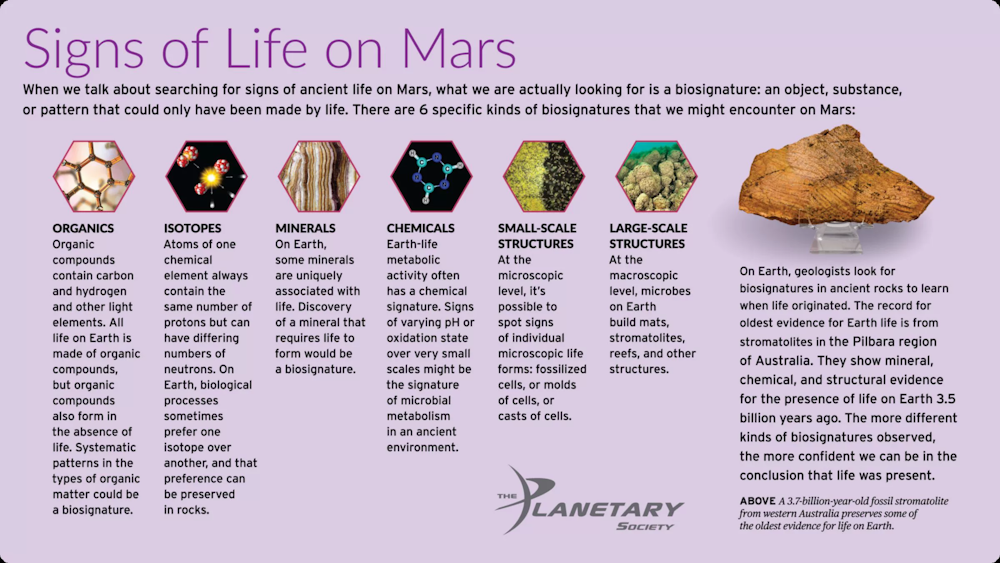
A biosignature is any characteristic, element, molecule, substance or feature that serves as evidence for past or present life. It must be something that cannot be produced without life. Some examples include fossils, organic molecules derived from a biological process, or mineral patterns that form only through microbial activity.

An infographic showing six types of biosignatures, including organics, isotopes, minerals, chemicals, small-scale and large-scale structures
There are six types of biosignatures that scientists may find on Mars.
The Planetary Society, CC BY

A potential biosignature, which is how the Sapphire Canyon finding is described, is a substance or structure that might have a biological origin but requires more data or further study before scientists can make a conclusion about the absence or presence of life.

How do scientists determine whether something could be a biosignature on Mars?

Biosignatures come in many different flavors – chemical, physical or structural. Some are rather obvious, like a dinosaur fossil on Earth, but most are far more nuanced.

The search for ancient life on Earth partially informs the search for biosignatures on Mars. Researchers rely on subtle clues preserved in the rock record to address questions such as how long ago microbial life arose on Earth. We search for that evidence in environments such as craters and lake beds with high preservation potential, meaning those that are likely to preserve the biosignatures.

Scientists can apply these techniques to the search for life on Mars. That is why Perseverance was sent to Jezero Crater. In the ancient past, the crater hosted a river-fed lake, which on Earth would represent a habitable environment: one where life would want to live if it ever arose.

This crater was an ideal location to search for ancient life preserved in the rock record on Mars. Astrobiologists then search for chemical, textural and mineral patterns that resemble processes influenced by life back on Earth.

What makes this sample unique and interesting?

The Sapphire Canyon sample is unique because Perseverance’s PIXL and SHERLOC instruments revealed distinctive textures that were dubbed “leopard spots.” These spots are concentric reaction fronts – places where chemical and physical reactions occur – enriched in the minerals vivianite, which contains iron phosphate, and greigite, which is made of iron sulfide.

Dusty rocks on the surface of Mars, speckled with dark spots.
Chevaya Falls, a rock in the Martian Jezero Crater, is speckled with ‘leopard spots,’ which could indicate chemical reactions that may have once supported ancient life.
NASA/JPL-Caltech/MSSS

On Earth, vivianite often forms in environments with lots of decaying organic matter, while certain microbes that use sulfate for energy can produce greigite. Compounds in both these minerals are part of a chemical process called redox gradients, which refers to a series of gradual changes over physical space where chemicals can oxidize (lose electrons) or reduce (gain electrons).

One example is leaving your metal bike out in the rain. Over time, the reduced iron (Fe2+) will lose an electron and oxidize to rust (Fe3+). This process can happen nonbiologically, as exposure to water and oxygen drive the chemical changes that take your new bike to a rusty bike – I suggest not leaving it in the rain.

But some oxidation and reduction processes are so slow on their own that the only way they can occur is with living organisms that push the reactions forward. This process is how many microbes, such as bacteria, get the energy to live. Because these two minerals in the Sapphire Canyon sample both occur in redox gradients, scientists predict that microbial life, if it was ever present, could have played a role in the reactions that created these mineral signatures.

Now, scientists are looking into the explanations that wouldn’t require life to form these features on the sample.

Did scientists expect to find a sample like this?

This was a finding that we had hoped for. However, it was somewhat unexpected in this particular location. This sample came from some of the youngest sedimentary rocks the mission has investigated to date. An earlier prediction had assumed signs of ancient life would come from older Martian rock formations.

Finding these features in younger rocks widens the window of time that Mars was potentially habitable and suggests that Mars could have been habitable later in the planet’s history than scientists previously thought, and older rocks might also hold signs of life that are simply harder to detect.

NASA hosted a press conference on Sept. 10, 2025, about the mysterious sample.

What are the next steps to tell whether the sample indicates signs of past life, or whether the signature is from a nonbiological process?

The mineral associations are a potential fingerprint for those redox reactions that can occur when microbes drive the reaction forward – but abiotic processes, such as sustained high temperatures, acidic conditions and binding by organic compounds, could also explain them.

However, the Cheyava Falls rock shows no signs that it’s been exposed to the high heat or acidity usually required for greigite and vivianite to form nonbiologically. Still, the only definitive way to answer this question is to return the sample to Earth, where scientists can use advanced laboratory techniques to distinguish biological from nonbiological origins.

The Conversation

Amy J. Williams receives funding from NASA and is a scientist on the NASA Mars 2020 Perseverance rover mission.

ref. Scientists detected a potential biosignature on Mars – an astrobiologist explains what these traces of life are, and how researchers figure out their source – https://theconversation.com/scientists-detected-a-potential-biosignature-on-mars-an-astrobiologist-explains-what-these-traces-of-life-are-and-how-researchers-figure-out-their-source-265157

Why OpenAI’s solution to AI hallucinations would kill ChatGPT tomorrow

Source: The Conversation – UK – By Wei Xing, Assistant Professor, School of Mathematical and Physical Sciences, University of Sheffield

OpenAI’s latest research paper diagnoses exactly why ChatGPT and other large language models can make things up – known in the world of artificial intelligence as “hallucination”. It also reveals why the problem may be unfixable, at least as far as consumers are concerned.

The paper provides the most rigorous mathematical explanation yet for why these models confidently state falsehoods. It demonstrates that these aren’t just an unfortunate side effect of the way that AIs are currently trained, but are mathematically inevitable.

The issue can partly be explained by mistakes in the underlying data used to train the AIs. But using mathematical analysis of how AI systems learn, the researchers prove that even with perfect training data, the problem still exists.

The way language models respond to queries – by predicting one word at a time in a sentence based on probabilities – naturally produces errors. The researchers in fact show that the total error rate for generating sentences is at least twice as high as the error rate the same AI would have on a simple yes/no question, because mistakes can accumulate over multiple predictions.

In other words, hallucination rates are fundamentally bounded by how well AI systems can distinguish valid from invalid responses. Since this classification problem is inherently difficult for many areas of knowledge, hallucinations become unavoidable.

It also turns out that the less a model sees a fact during training, the more likely it is to hallucinate when asked about it. With birthdays of notable figures, for instance, it was found that if 20% of such people’s birthdays only appear once in training data, then base models should get at least 20% of birthday queries wrong.

Sure enough, when researchers asked state-of-the-art models for the birthday of Adam Kalai, one of the paper’s authors, DeepSeek-V3 confidently provided three different incorrect dates across separate attempts: “03-07”, “15-06”, and “01-01”. The correct date is in the autumn, so none of these were even close.

The evaluation trap

More troubling is the paper’s analysis of why hallucinations persist despite extensive post-training efforts (such as providing extensive human feedback to an AI’s responses before it is released to the public). The authors examined ten major AI benchmarks, including those used by Google, OpenAI and also the top leaderboards that rank AI models. This revealed that nine benchmarks use binary grading systems that award zero points for AIs expressing uncertainty.

This creates what the authors term an “epidemic” of penalising honest responses. When an AI system says “I don’t know”, it receives the same score as giving completely wrong information. The optimal strategy under such evaluation becomes clear: always guess.

The researchers prove this mathematically. Whatever the chances of a particular answer being right, the expected score of guessing always exceeds the score of abstaining when an evaluation uses binary grading.

The solution that would break everything

OpenAI’s proposed fix is to have the AI consider its own confidence in an answer before putting it out there, and for benchmarks to score them on that basis. The AI could then be prompted, for instance: “Answer only if you are more than 75% confident, since mistakes are penalised 3 points while correct answers receive 1 point.”

The OpenAI researchers’ mathematical framework shows that under appropriate confidence thresholds, AI systems would naturally express uncertainty rather than guess. So this would lead to fewer hallucinations. The problem is what it would do to user experience.

Consider the implications if ChatGPT started saying “I don’t know” to even 30% of queries – a conservative estimate based on the paper’s analysis of factual uncertainty in training data. Users accustomed to receiving confident answers to virtually any question would likely abandon such systems rapidly.

I’ve seen this kind of problem in another area of my life. I’m involved in an air-quality monitoring project in Salt Lake City, Utah. When the system flags uncertainties around measurements during adverse weather conditions or when equipment is being calibrated, there’s less user engagement compared to displays showing confident readings – even when those confident readings prove inaccurate during validation.

The computational economics problem

It wouldn’t be difficult to reduce hallucinations using the paper’s insights. Established methods for quantifying uncertainty have existed for decades. These could be used to provide trustworthy estimates of uncertainty and guide an AI to make smarter choices.

But even if the problem of user preferences could be overcome, there’s a bigger obstacle: computational economics. Uncertainty-aware language models require significantly more computation than today’s approach, as they must evaluate multiple possible responses and estimate confidence levels. For a system processing millions of queries daily, this translates to dramatically higher operational costs.

More sophisticated approaches like active learning, where AI systems ask clarifying questions to reduce uncertainty, can improve accuracy but further multiply computational requirements. Such methods work well in specialised domains like chip design, where wrong answers cost millions of dollars and justify extensive computation. For consumer applications where users expect instant responses, the economics become prohibitive.

The calculus shifts dramatically for AI systems managing critical business operations or economic infrastructure. When AI agents handle supply chain logistics, financial trading or medical diagnostics, the cost of hallucinations far exceeds the expense of getting models to decide whether they’re too uncertain. In these domains, the paper’s proposed solutions become economically viable – even necessary. Uncertain AI agents will just have to cost more.

However, consumer applications still dominate AI development priorities. Users want systems that provide confident answers to any question. Evaluation benchmarks reward systems that guess rather than express uncertainty. Computational costs favour fast, overconfident responses over slow, uncertain ones.

Falling energy costs per token and advancing chip architectures may eventually make it more affordable to have AIs decide whether they’re certain enough to answer a question. But the relatively high amount of computation required compared to today’s guessing would remain, regardless of absolute hardware costs.

In short, the OpenAI paper inadvertently highlights an uncomfortable truth: the business incentives driving consumer AI development remain fundamentally misaligned with reducing hallucinations. Until these incentives change, hallucinations will persist.

The Conversation

Wei Xing does not work for, consult, own shares in or receive funding from any company or organisation that would benefit from this article, and has disclosed no relevant affiliations beyond their academic appointment.

ref. Why OpenAI’s solution to AI hallucinations would kill ChatGPT tomorrow – https://theconversation.com/why-openais-solution-to-ai-hallucinations-would-kill-chatgpt-tomorrow-265107

Ten ways diabetes and dementia are linked

Source: The Conversation – UK – By Craig Beall, Associate Professor in Experimental Diabetes, University of Exeter

Alones/Shutterstock.com

The link between diabetes and dementia is becoming increasingly clear. New research shows how blood sugar problems affect brain health and vice versa. Here are ten evidence-based insights into how the two conditions are related.

1. Diabetes raises the risk of dementia

People with diabetes are about 60% more likely to develop dementia than those without, and frequent episodes of low blood sugar are linked to a 50% higher chance of cognitive decline.

2. Insulin resistance affects the brain too

Insulin resistance – the major cause of type 2 diabetes – happens when cells stop responding properly to insulin. This means that too much sugar, in the form of glucose, is left in the blood, leading to complications.

It usually affects the liver and muscles, but it also affects the brain. In Alzheimer’s, this resistance may make it harder for brain cells to use glucose for energy, contributing to cognitive decline.

3. A brain sugar shortage in dementia

The brain is only 2% of our body weight, but uses about 20% of the body’s energy. In dementia, brain cells appear to lose the ability to use glucose properly.

This mix of poor use of glucose and insulin resistance is sometimes unofficially called type 3 diabetes.

4. Alzheimer’s can raise diabetes risk

People with Alzheimer’s often have higher fasting blood glucose, even if they don’t have diabetes. This is a form of pre-diabetes. Animal studies also show that Alzheimer’s-like changes in the brain raise blood glucose levels.

Also, the highest genetic risk factor for Alzheimer’s, the APOE4 genetic variant, reduces insulin sensitivity by trapping the insulin receptor inside the cell, where it cannot be switched on properly.

5. Blood vessel damage links both conditions

Diabetes damages blood vessels, causing complications in the eyes, kidneys and heart. The brain is also at risk. High or varying blood glucose levels can injure vessels in the brain, reducing blood flow and oxygen delivery.

Diabetes can also weaken the brain’s protective barrier, letting harmful substances in. This leads to inflammation. Reduced blood flow and brain inflammation are strongly linked to dementia.

6. Memantine: a dementia drug born from diabetes research

Memantine, used to treat moderate to severe Alzheimer’s symptoms, was originally developed as a diabetes medication. It didn’t succeed in controlling blood glucose, but researchers later discovered its benefits for brain function. This story shows how diabetes research may hold clues for treating brain disorders.

7. Metformin might protect the brain

Metformin, the most widely used diabetes drug, does more than just lower blood glucose. It gets in to the brain and may lower brain inflammation.

Some studies suggest that people with diabetes who take metformin are less likely to develop dementia, and those who stop taking it may see their risk increase again.

Trials are testing its effects in people without diabetes.

Bottles of metformin on a shelf.
Metformin may lower brain inflammation.
Carl DMaster/Shutterstock.com

8. Weight-loss injections may reduce plaque buildup

GLP-1 receptors agonist drugs, such as semaglutide (Ozempic, Wegovy), lower blood glucose and support weight loss. Records show that people with diabetes on these drugs have a lower dementia risk. Comparing GLP1 drugs to metformin, studies have found that they were even more effective than metformin at reducing dementia risk.

Two major trials, Evoke and Evoke Plus, are testing oral semaglutide in people with mild cognitive impairment or early mild Alzheimer’s.

9. Insulin therapy might help the brain

Since insulin resistance in the brain is a problem, researchers have tested insulin sprays given through the nose. This method delivers insulin straight to the brain while reducing effects on blood sugar.

Small studies suggest these sprays may help memory or reduce brain shrinkage, but delivery methods remain a challenge. Sprays vary in how much insulin reaches the brain, and long-term safety has not yet been proven.

10. SGLT2 inhibitors may lower dementia risk

New evidence suggests that compared to GLP-1 receptor agonists, SGLT2 inhibitors, (a type of diabetes drug) are superior at reducing dementia risk, including Alzheimer’s and vascular dementia, in people with type 2 diabetes. These tablets lower blood sugar by increasing sugar removal in urine. This study builds on early evidence suggesting they lower dementia risk by reducing inflammation in the brain.

This growing body of evidence suggests that managing diabetes protects more than the heart and kidneys, it also helps preserve brain function.

Questions remain whether diabetes drugs only reduce the diabetes-associated dementia risk or whether these drugs could also reduce risk in people without diabetes.

However, diabetes research has been very successful in creating at least 13 different classes of drugs, multiple combination therapies, giving rise to at least 50 different medicines. These reduce blood sugar, improve insulin sensitivity and reduce inflammation. A “side-effect” may be better preservation of brain health during ageing.

The Conversation

Craig Beall currently receives funding from Diabetes UK, Breakthrough T1D, Steve Morgan Foundation Type 1 Diabetes Grand Challenge, Medical Research Council, NC3Rs, Society for Endocrinology and British Society for Neuroendocrinology.

Natasha MacDonald receives funding from Diabetes UK.

ref. Ten ways diabetes and dementia are linked – https://theconversation.com/ten-ways-diabetes-and-dementia-are-linked-264393

New exhibition explores history of decorative borders: from medieval manuscripts to William Morris

Source: The Conversation – UK – By Cynthia Johnston, Senior Lecturer in History of the Book, School of Advanced Study, University of London

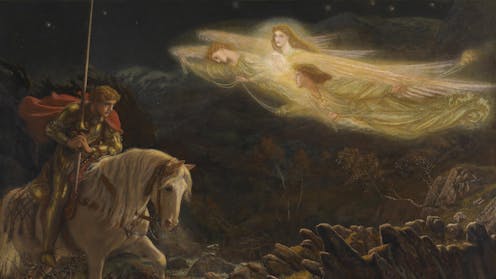
Sir Galahad, the Quest for the Holy Grail by Arthur Hughes (1870). Works from pre-Raphaelite artists like Hughes are on display in the exhibition. Courtesy of National Museums Liverpool

The Nature of Gothic, at the Blackburn Museum and Art Gallery, explores the history of decorative borders over hundreds of years. It covers the period from the late medieval age to the Arts and Crafts Movement of the late 19th and early 20th centuries.

In the late medieval period, manuscripts that were produced in northern Europe often featured decorative borders that framed the text of both religious and secular works. These borders featured motifs from the classical world such as swirling acanthus leaves, Greek meanders and intricate patterns which interlace flowers, leaves and vines.

From the early decades of the 13th century these largely naturalistic forms, used to enhance the visual appeal of the page, began to be used more widely. They were added to the front of books and important sections within them, such as the beginnings of individual psalms or chapters of the Bible.

These naturalistic frames provided platforms tangible enough for figures, animals and grotesques to be placed upon. These characters often present an alternative reality to the verses of the psalms or Aristotle’s Libri Naturales that they decorate.

The meaning and intent of these spaces is yet to be fully understood. The battle of a miniature knight versus a fully armed snail, for example, might be interpreted as the moral fight against evil in the margins of the psalm. But the meaning of a tiny man pushing another in a wheel barrow adjacent to the beginning of Aristotle’s Libri Naturales is less clear.


Read more:
Why medieval manuscripts are full of doodles of snail fights


The great enthusiasm for the illustrated grotesques (hybrid creatures which combine human and fantastical animal forms) in these peripheral spaces began in northern France. Texts produced by the monastic schools which emerged with the rise of scholasticism in the late 12th century often carried this type of decoration.

I have been collaborating with the Blackburn museum for over a decade, and have curated this exhibition alongside Anthea Purkis, its curator of art. This exhibition features some early examples of this technique from manuscripts held by the museum as well as examples on loan from the British Library.

In the exhibition

Decorated page from a medieval manuscript
The Bedford Psalter and Hours.
British Library Collection

Although the names of very few medieval artists whose work appeared in manuscripts are known, Blackburn Museum and the British Library both hold examples of the intricate and sophisticated work of two known illuminators.

They are Mâitre Françoise, who ran his business in Paris in the third quarter of the 15th century, and Herman Scheere – perhaps the most renowned illuminator in London in the 15th century.

From his workshop on London Bridge, Scheere produced flowing extravagant frames for the pages of his books. His book the Bedford Psalter and Hours, (loaned by the British Library and on display in the exhibition) was commissioned by the younger brother of King Henry V. This aristocratic commission demonstrates the success of Scheere’s business and the appetite for the decorated border.

Some 15th century examples from northern Europe also show the influence of Islamic art on northern European aesthetics. A 15th-century Qur’an manuscript from the John Rylands Library and Research Centre in Manchester is on display in the exhibition. muh .aqqāq script is used for Arabic primary text while the interlinear script in Persian and Eastern Turkish is in minuscule naskh script. This reflects the various communities for whom the book was intended.

The beginnings of the chapters of the Qur’an manuscript, the ṣuwwar, are surrounded by borders filled with flowing abstract forms. They’re reminiscent of, but not imitative of, the natural world. This decorative tradition would have cross pollinated with western European cultures through trade and conflict.

Examples of Persian calligraphy also demonstrate the persistence of the trend for decorative borders at this time. The Rylands’ Persian MS 10, an album completed before 1785–1786AD, features an entwined Arabic calligraphy composition formed from two slogans Tawakkaltu bi-maghfirat al-Muhaymin (I entrust myself to the forgiveness of the Guardian) in black, and Huwa al-Ghafūr Dhū-al-Raḥmah (He is the All-Forgiving Lord of Mercy) in red thuluth script. Two dark indigo blue borders bear delicate silver and gold foliage surrounding a wide margin embellished with vibrant floral flourishes.

Migration to the printed page

In 15th century Germany, Johannes Gutenberg invented the moveable-type printing press. His new technology produced a codex (an ancient manuscript text in book form) that looked like a traditional manuscript with regard to text and margins.

Rubrication – the decoration of letters in coloured inks – was added by hand to the first printed books. As the ability of printers to produce more nuanced illustrations accelerated, the decorated border survived and thrived. Indeed, its importance as part of the aesthetic in terms of how a book should look to an early modern reader drove forward innovations in technology.

The Blackburn Museum’s collection of early printed books is full of examples of the new technology of print accommodating the decorative frame.

Falling in and out of favour

The decorated frame fell out of favour in the 16th and 17th centuries. For western European readers it began to appear old fashioned. But it returned during the Industrial Revolution, thanks to the work of the Pre-Raphaelite movement.

Pre-Raphaelite artists reached back to the medieval period for their inspiration as well as artistic practice. Dante Gabriel Rossetti, William Morris, Sir Edward Coley Burne-Jones, Arthur Hughes and their associates set out to reject the values and industrial production of the 19th century. Medieval narratives found new audiences in Pre-Rapahelite art such as Arthur Hughes’ Sir Galahad, the Quest for the Holy Grail. In the subsequent Arts and Crafts Movement, books, ceramics, textiles and furniture were produced with minimal mechanical intervention. The medieval decorative frame thrived across various media.

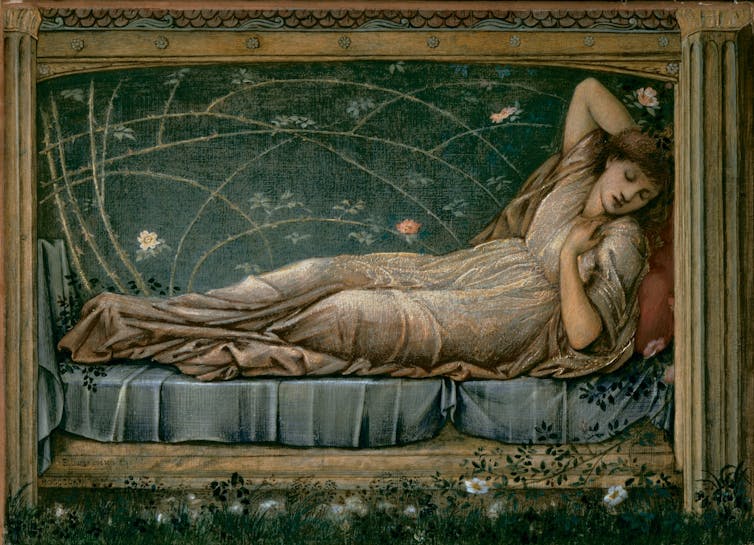
A painting of Sleeping Beauty
Sleeping Beauty by Edward Burne Jones (circa 1885).
Manchester Art Gallery

William Morris’ hand-written copy of The Rubaiyat of Omar Khayyam provides a compelling example of the after-life of the medieval margin. On each page, the text is surrounded by a lush decorated border which is punctuated by cameos that were designed by Burne-Jones and painted by Charles Fairfax Murray.

Poem decorated with leaves and gold
The Rubaiyat of Omar Khayyam, written and decorated by William Morris.
British Library Collection

The Nature of Gothic gives visitors the opportunity to compare the work of medieval masters of decorative art with the work produced by the Pre-Raphaelites and the Arts and Crafts Movement. Contemporary artist Jamie Holman and ceramicist Nehal Aamir also contribute modern interpretations of the decorated frame.

The result is a celebration of the verdant decorative frames which twist and turn through time, illuminating art of both the past and present.

The Nature of Gothic is at the Blackburn Museum and Art Gallery from September 13 to December 13.


Looking for something good? Cut through the noise with a carefully curated selection of the latest releases, live events and exhibitions, straight to your inbox every fortnight, on Fridays. Sign up here.


With thanks to Jake Benson for the translation of Persian 10.

The Conversation

Cynthia Johnston is employed by The Institute of English Studies, School of Advanced Study, University of London. She receives funding from Arts Council England. This exhibit has been supported by major loans from the British Library, the John Rylands Library and Research Centre, Manchester Art Gallery and the Liverpool Museums Trust among others.

ref. New exhibition explores history of decorative borders: from medieval manuscripts to William Morris – https://theconversation.com/new-exhibition-explores-history-of-decorative-borders-from-medieval-manuscripts-to-william-morris-261785

Regulating AI use could stop its runaway energy expansion

Source: The Conversation – UK – By Shweta Singh, Assistant Professor, Information Systems and Management, Warwick Business School, University of Warwick

Generative AI promises to help solve everything from climate change to poverty. But behind every chatbot response lies a deep environmental cost.

Current AI technology requires the use of large datacentres stationed around the world, which altogether draw enormous amounts of power and consume millions of litres of water to stay cool. By 2030, datacentres are expect to consume as much electricity as all of Japan, according to the International Energy Agency, and AI could be responsible for 3.5% of global electricity use, according to one consultancy report.

The continuous massive expansion of AI use and its rapidly growing energy demand would make it much harder for the world to cut its carbon emissions by switching fossil fuel energy sources to renewable electricity.

So, we are left with pressing questions. Can we harness the benefits of AI without accelerating environmental collapse? Can AI be made truly sustainable – and if so, how?

We are at a critical juncture. The environmental cost of AI is accelerating and largely unreported by the firms involved. What the world does next could determine whether AI innovation aligns with our climate goals or undermines them.

At one end of the policy spectrum is the path of complacency. In this scenario, tech companies continue unchecked, expanding datacentres and powering them with private nuclear microreactors, dedicated energy grids or even reviving mothballed coal plants.

Aerial view of power plants
Microsoft is set to reopen Three Mile Island nuclear power plant in Pennsylvania to power its AI services. (Photo taken in 2008. The plant has been dormant since 2019).
Dobresum / shutterstock

Some of this infrastructure may instead run on renewables, but there’s no binding requirement that AI must avoid using fossil fuels. Even if more renewables are installed to power AI, they may compete with efforts to decarbonise other energy uses. Developers may tout efficiency gains, but these are quickly swallowed by the rebound effect: the more efficient AI becomes, the more it is used.

At the other end lies a more radical possibility: a global moratorium or outright restriction on the most harmful forms of AI, akin to international bans on landmines or ozone-depleting substances.

This is politically improbable, of course. Nations are racing to dominate the AI arms race, not to pause it. A global consensus on bans is, at least for now, a mirage.

But in between complacency and prohibition lies a window – rapidly closing – for decisive, targeted action.

This could take many different forms:

1. Mandatory environmental disclosure:

AI companies could report how much energy, water and emissions are used to train and use their models. Having a benchmark helps to measure progress while improving transparency and accountability. While some countries have started to impose greater corporate sustainability reporting requirements, there is significant variation. While mandatory disclosures alone won’t reduce consumption directly, they are an essential starting point.

2. Emissions labelling for AI services:

Just as carbon emissions labels on restaurant menus or supermarket produce can guide people to lower-impact options, users could be given a chance to know the footprint of their digital choices and AI providers, like efforts to measure the carbon footprint of websites. In the US, the blue Energy Star label, one of the country’s most recognisable environmental certifications, helps customers choose energy-efficient products.

Alternatively, AI providers could also temporarily reduce functionality to account for varying levels of renewable energy available that powers them.

3. Usage-based pricing tied to impact:

Existing carbon pricing aims to ensure that heavy users should pay their environmental share. Research shows that this works best when carbon is priced across the economy for all companies, rather than just specifically targeted at individual sectors. Yet much depends on digital tech providers fully accounting for such environmental burdens in the first place.

4. Sustainability caps or “compute budgets”:

This would especially target non-essential or commercial entertainment applications. Organisations may limit their employees’ usage similar to how they restrict heavy office printing or indeed corporate travel. As companies begin to measure and manage their indirect supply chain emissions, energy and water footprints from using AI may require new business policies.

5. Water stewardship requirements in water-stressed regions:

A simple regulation here would be to ensure no AI infrastructure depletes local aquifers unchecked.

Market forces alone will not solve this. Sustainability won’t emerge from goodwill or clever efficiency tricks. We need enforceable rules.

Consumer awareness isn’t enough

Awareness does help. But expecting individuals to self-regulate in a system designed for ease-of-use is naive. “Only use AI when needed” might soon be like “Don’t print this email” a decade or two ago – well-meaning, often ignored and utterly insufficient.

Plastic figures plant trees on top of paper saying 'please don't print'
Coming soon: an AI equivalent?
awstoys / shutterstock

The world is building an AI-powered future that consumes like an industrial past. Without guardrails, we risk creating a convenience technology that accelerates environmental collapse.

Maybe AI will one day solve the problems we couldn’t, and our concerns about emissions or water will seem trivial. Or maybe we just won’t be around to worry about them.

The way we engage with AI now – blindly, cautiously, or critically – will shape whether it serves a sustainable future, or undermines it. Policymakers should treat AI as it would any other wildly profitable resource-intensive industry, with carefully thought through regulation.


Don’t have time to read about climate change as much as you’d like?

Get a weekly roundup in your inbox instead. Every Wednesday, The Conversation’s environment editor writes Imagine, a short email that goes a little deeper into just one climate issue. Join the 45,000+ readers who’ve subscribed so far.


The Conversation

Frederik Dahlmann receives funding from National Institute for Health & Care Research (NIHR).

Shweta Singh does not work for, consult, own shares in or receive funding from any company or organisation that would benefit from this article, and has disclosed no relevant affiliations beyond their academic appointment.

ref. Regulating AI use could stop its runaway energy expansion – https://theconversation.com/regulating-ai-use-could-stop-its-runaway-energy-expansion-258425

Bolsonaro’s conviction marks a historic moment in Brazil’s political history

Source: The Conversation – UK – By Marieke Riethof, Senior Lecturer in Latin American Politics, University of Liverpool

Four out of five members of Brazil’s supreme court have voted to convict the former president, Jair Bolsonaro, for plotting a military coup after losing the 2022 election to his left-wing rival, Luiz Inácio Lula da Silva. Bolsonaro has been sentenced to more than 27 years in prison, though his lawyers say they will appeal the decision.

Seven of Bolsonaro’s allies have also been convicted on charges related to the coup attempt. Five of these people – Walter Braga Netto, Mauro Cid, Paulo Sérgio Nogueira de Oliveira, Augusto Heleno Ribeiro and Almir Garnier Santos – come from a military or navy background. Bolsonaro’s former justice minister, Anderson Torres, and the former director of Brazil’s intelligence agency, Alexandre Ramagem, have been convicted too.

This is the first time in Brazil’s long history of political instability that a coup attempt has led to a conviction. It is also symbolically important that the only woman on the panel, Judge Carmen Lúcia, cast the deciding vote. Bolsonaro has an established track record of making denigrating comments about women.

The date of the verdict is equally important. It was delivered on September 11, which coincides with the 52nd anniversary of the 1973 Chilean military coup. This shows how far democracy in the region has come since an era when much of South America was under military rule.

Alexandre de Moraes, the supreme court judge who led the Bolsonaro trial, alluded to this in August. He said that Brazil’s 1988 constitution established the judiciary’s independence by restricting “interference by the armed forces, whether official or semi-official, in Brazilian politics”.

These constitutional guarantees mean that politicians like Bolsonaro cannot undermine democratic institutions with impunity.

The coup attempt took place on January 8 2023, less than a week after Lula was inaugurated as Bolsonaro’s successor. Echoing the attack on the US Capitol building in Washington two years earlier, hundreds of Bolsonaro supporters stormed the national congress, presidential palace and supreme court in the capital, Brasília.

They left a trail of destruction. Although the protests appeared initially to be a spontaneous act, investigations soon unearthed evidence that the event had been planned by Bolsonaro and his allies.

A history of dictatorship and threats against democracy have cast a long shadow over Brazilian politics. A right-wing military dictatorship ruled the country between 1964 and 1985. It began when the armed forces overthrew the democratically elected president, João Goulart, amid an economic crisis and fears about a turn to the left. The US government of the time supported the coup.

Brazil established a National Truth Commission in 2012, which spent two years investigating the thousands of cases of torture, extrajudicial killings, enforced disappearances and other violations that occurred during this period. However, there have been no convictions.

Under pressure from mass demonstrations and an economic crisis, the military gradually relaxed repression in the 1980s and allowed political parties to form. Brazil has been under civilian control since then. But the armed forces began to play a significant political role again during Bolsonaro’s presidency.

General Hamilton Mourão, his vice-president, served in the military during the dictatorship. And various other military figures were appointed to powerful positions in government. Bolsonaro also regularly celebrated the dictatorship and downplayed its human rights violations.

There were various examples of democratic backsliding under Bolsonaro. He, for example, questioned the legitimacy of democratic election results in 2022 – comments that saw him barred from running in elections for seven years.

Within this context, the decision to convict Bolsonaro of an attempted coup is a strong sign that Brazil’s democratic institutions have been able to withstand threats to democracy and the rule of law. It is a signal that attempts to undermine the country’s democratic institutions will not go unpunished.

Beyond Brazil’s borders

Bolsonaro’s conviction resonates beyond Brazil. During his presidency, Bolsonaro positioned Brazil as a close ideological ally to Donald Trump, who was then in his first presidential term.

Trump referred to Bolsonaro’s trial as a “witch hunt” as the court case progressed. He hit Brazil with 50% tariffs, framing them as retaliation for Bolsonaro’s prosecution. Reacting to the guilty verdict, Trump said it was “very surprising” and compared it to his own judicial struggles.

Lula has spoken out against US interference in Brazilian politics, calling the idea that “Trump can dictate rules for a sovereign country like Brazil” unacceptable.

The Brazilian foreign affairs ministry has also criticised the US secretary of state, Marco Rubio, for interfering in the country’s sovereignty and democracy. In a social media post, Rubio called the conviction “unjust” and said the US “will respond accordingly to this witch hunt”.

Looking ahead, Brazil’s next presidential elections are in 2026. Unless Bolsonaro manages to appeal his conviction and election ban, he will not be running again for the foreseeable future. Although Lula has not formally announced his candicacy he would be the front-runner.

But if there is a run-off, which would most likely be with right-wing politician and former army captain Tarcísio de Freitas, the race will probably be very close. There is a risk that the conviction will turn Bolsonaro into a martyr, which would strengthen politicians like de Freitas, who identify themselves with Bolsonaro’s politics.

Ahead of his conviction, around 40,000 Bolsonaro supporters protested in Rio de Janeiro and São Paulo. These demonstrations indicate continuing support. However, regardless of what happens next, the supreme court’s decision makes it much less likely that challenges to democracy will succeed in Brazil.

The Conversation

Marieke Riethof does not work for, consult, own shares in or receive funding from any company or organisation that would benefit from this article, and has disclosed no relevant affiliations beyond their academic appointment.

ref. Bolsonaro’s conviction marks a historic moment in Brazil’s political history – https://theconversation.com/bolsonaros-conviction-marks-a-historic-moment-in-brazils-political-history-265210

¿Qué implica para España el ataque ruso con drones en Polonia?

Source: The Conversation – (in Spanish) – By Armando Alvares Garcia Júnior, Professor de Direito Internacional, Relações Internacionais e Geopolítica/Geoeconomia, UNIR – Universidad Internacional de La Rioja

Soldados polacos en la zona donde impactó uno de los drones rusos. RTVE

Durante la madrugada del 10 de septiembre, Europa experimentó uno de los incidentes de seguridad más graves de su historia reciente: una formación de drones rusos atravesó el espacio aéreo polaco en el marco de una ofensiva sobre Ucrania y fue abatida por cazas de la OTAN.

Uno de estos aparatos impactó en la localidad de Wyryki-Wola, lo que activó alertas en toda la estructura de defensa euroatlántica y evidenció la vulnerabilidad de la frontera oriental de la Alianza.

La penetración de 19 drones en territorio polaco, en paralelo a un ataque masivo sobre Ucrania, puede o no entenderse como un accidente. Las autoridades polacas, por ejemplo, interpretaron el episodio como un gesto de fuerza diseñado para poner a prueba tanto la unidad política como la capacidad operativa de la OTAN ante amenazas híbridas y directas por parte de Rusia.

Este tipo de incursiones obliga a repensar los límites físicos y jurídicos de la disuasión colectiva y pone en jaque los mecanismos tradicionales de control de escalada.

La activación inmediata del artículo 4 del Tratado del Atlántico Norte respondió a la percepción de un peligro directo a la integridad y soberanía polacas. Aunque esa disposición legal no implica un compromiso automático de defensa militar conjunta (como el artículo 5), sí obliga a consultas diplomáticas urgentes para coordinar la posición aliada y calibrar la naturaleza jurídica e internacional de la amenaza.

Esta herramienta ha sido empleada solo en contadas ocasiones, reflejando la gravedad de la situación y la importancia del consenso intergubernamental en la respuesta.

¿Cuál es el compromiso de España con la OTAN?

España ha reforzado este año su compromiso con la defensa colectiva de la OTAN, liderando desde julio la Brigada Multinacional en Eslovaquia, con base en Lešť, donde mantiene desplegados alrededor de 828 efectivos en el que es su contingente exterior más numeroso.

También participa en la Presencia Avanzada Reforzada (Enhanced Forward Presence) mediante despliegues rotatorios y ejercicios periódicos en el flanco oriental, como el reciente NATO’s Forge 2025 en Letonia, en el que contribuyó con tanques Leopard 2E, vehículos Pizarro y sistemas antiaéreos NASAMS, además de rotaciones temporales en Polonia y Lituania.

Igualmente, España aporta cazas Eurofighter y otros medios a misiones de policía aérea y vigilancia, como el Baltic Air Policing y operaciones en Islandia y Rumanía, reforzando su perfil como aliado clave tanto en la OTAN como en la Brújula Estratégica de la Unión Europea, que integra esfuerzos en inteligencia, ciberseguridad y protección de infraestructuras críticas.

Esta proyección exterior no exime a las autoridades españolas de sus responsabilidades jurídicas en plan doméstico. Cualquier aumento significativo del despliegue militar o modificación sustancial de las reglas de enfrentamiento debe someterse a un proceso de debate y aprobación en el Parlamento, asegurando un control democrático efectivo sobre las misiones internacionales y el cumplimiento de los compromisos asumidos por España en el marco del derecho internacional.

Este procedimiento resulta esencial en contextos donde la línea que separa la disuasión de un conflicto abierto se vuelve especialmente difusa.

Diferentes países, estrategias distintas

El incidente de los drones evidencia la existencia de estrategias divergentes dentro de la Alianza y la Unión Europea. Polonia y los Estados bálticos exigen medidas inmediatas de refuerzo y nuevas rondas de sanciones, mientras Alemania y Francia apuestan por una respuesta gradual y diplomática para evitar su escalada.

La administración estadounidense mantiene, bajo la presidencia de Trump, un discurso ambiguo que limita la cohesión estratégica, introduciendo un factor de incertidumbre en las capitales europeas.

En el seno de la Unión Europea, el debate sobre autonomía estratégica se acelera. Kaja Kallas, como Alta Representante para la Política Exterior, abogó por ampliar sanciones contra intermediarios energéticos y acelerar la implantación de la Brújula Estratégica. Esto no tiene otro objetivo que dotar a la UE de mayor capacidad militar autónoma que complemente y refuerce al sistema OTAN sin superponer competencias.

Más allá del plano militar, la reciente invasión del espacio aéreo polaco –siempre considerando la necesidad de datos contrastados y evitando conclusiones precipitadas ante la proliferación de relatos poco verificados– genera efectos económicos y energéticos inmediatos. Las turbulencias en los mercados tienden a incrementar los precios de la electricidad y el transporte en toda la Unión Europea, con un impacto directo sobre los consumidores españoles y de otros Estados miembros.

El riesgo de que este tipo de agresiones evolucione hacia escenarios híbridos –combinando operaciones cinéticas con campañas de desinformación y ataques cibernéticos– obliga a reforzar la estrategia española, especialmente en la protección de infraestructuras críticas, inteligencia y ciberseguridad, tanto a escala nacional como comunitaria.

A esto se añade que, según recientes estudios y análisis europeos, España y el sur de Europa han sido identificados como objetivos de campañas de desinformación y sabotaje de origen externo, requiriendo una cooperación aún mayor en resiliencia y defensa digital.

El respeto a la integridad territorial, consagrada en la Carta de las Naciones Unidas, sirve de base para las consultas en la OTAN y la posible elevación del caso ante instituciones multilaterales. Del mismo modo, la legitimidad de cualquier uso de la fuerza defensiva debe quedar inscrita tanto en las resoluciones de la Alianza como en la normativa constitucional de cada Estado miembro, especialmente España, cuya práctica constitucional refuerza el carácter parlamentario de las grandes decisiones estratégicas.

¿A qué se enfrenta ahora la Alianza Atlántica?

La Alianza Atlántica se enfrenta a una encrucijada, en la que la unidad y la rapidez de respuesta serán vitales para evitar fracturas que puedan debilitar su capacidad de disuasión y defensa. El despliegue español, su participación en ejercicios multinacionales y las lecciones aprendidas en operaciones preventivas reflejan tanto el compromiso europeo como la necesidad de dotar a las decisiones de legitimidad democrática y multilateral.

En este escenario, España asume tanto una responsabilidad militar como también diplomática, institucional y social, contribuyendo a la estabilidad colectiva sin descuidar los principios del derecho internacional y la garantía del control parlamentario.

El desafío de la frontera oriental evidencia que la defensa europea requiere respuestas integrales, cooperación avanzada y una interpretación dinámica del derecho internacional en tiempos de crisis.

The Conversation

Armando Alvares Garcia Júnior no recibe salario, ni ejerce labores de consultoría, ni posee acciones, ni recibe financiación de ninguna compañía u organización que pueda obtener beneficio de este artículo, y ha declarado carecer de vínculos relevantes más allá del cargo académico citado.

ref. ¿Qué implica para España el ataque ruso con drones en Polonia? – https://theconversation.com/que-implica-para-espana-el-ataque-ruso-con-drones-en-polonia-265155