After Charlie Kirk’s murder, the US might seem hopelessly divided – is there any way forward?

Source: The Conversation – USA (2) – By Lee Bebout, Professor of English, Arizona State University

Many people think the U.S. is at an inflection point. StudioM1/iStock via Getty Images

Shortly following the fatal shooting of conservative activist Charlie Kirk, many politicians and pundits were quick to highlight the importance of civil discourse.

Utah Gov. Spencer Cox called for an “off-ramp” to political hostilities, while California Gov. Gavin Newsom released a statement condemning political violence. He lauded Kirk’s “commitment to debate,” adding, “The best way to honor Charlie’s memory is to continue his work: engage with each other, across ideology, through spirited discourse.” Political commentator Ezra Klein wrote, “You can dislike much of what Kirk believed and the following statement is still true: Kirk was practicing politics in exactly the right way.”

With so many Americans consuming political content via siloed social media feeds and awash in algorithms that stoke outrage, these ideals may seem quaint, if not impossible.

Clearly, murder is a no-go. But what does it mean to practice politics “the right way?” How can people engage “across ideology” in a “spirited” way?

Well, one way to not practice politics the right way is to limit the other side from having a voice of authority. Since 2016, the organization Kirk co-founded, Turning Point USA, has hosted the Professor Watchlist. The online database generated harassment campaigns against professors, leading to calls for firings, hate mail and death threats. To be sure, the left has not been without its own excesses of harassment in recent years.

Kirk was also known for going to college campuses and speaking to students: entering the lion’s den and affably challenging audiences to “change my mind.”

To me, the impulse to shut down the other side, combined with the “change my mind approach” to debate, has only exacerbated political polarization and entrenchment. Instead, I propose a few different ways of thinking about conversations with people whose views differ from your own.

The fantasy of swiftly changing minds

In my forthcoming book, “Rules for Reactionaries: How to Maintain Inequality and Stop Social Justice,” I explore the language strategies used to advance white supremacy and anti-feminism across U.S. politics and culture.

Deliberative democracy is the idea that decision-making and governance are arrived at through thoughtful, reasoned and respectful dialogue. This may take the shape of debates in Congress or robust questioning in town halls. But deliberative democracy also shapes the way all neighbors or citizens treat each other, whether on the street or at the dinner table.

I contend that a big stumbling block that prevents the U.S. from tackling its biggest problems is how Americans conceptualize deliberative democracy: There’s a fantasy that people’s minds can be easily changed, if only they’re given certain information or hear certain arguments.

In the 1990s, this was epitomized through former President Bill Clinton’s Initiative on Race, a program that he framed as a vehicle for social and political transformation. Clinton believed that an advisory board of experts could foster a meaningful national dialogue and produce necessary healing.

In response, conservative political figures objected both to the need for a conversation in the first place and to the makeup of the committee leading it.

By the time Clinton’s second term ended, the initiative quietly disappeared, only to be mentioned in passing in Clinton’s memoir. Yet with each subsequent racial flash point, from the arrest of Henry Louis Gates in 2009 to the murder of George Floyd, calls resurfaced for the national conversation. But race remains a politically and culturally salient issue.

Similarly, many Americans view friends, relatives and colleagues as targets for conversion. Because of the nature of my research, I often get a version of this question from my students: “How do you change someone’s mind if they say they’re a socialist?” Or they may frame it as, “I’ve got Thanksgiving with my family coming up, and my Uncle Johnny is so transphobic. How do I convince him to support trans rights?”

Cultural theorist Lauren Berlant would describe these encounters as moments of cruel optimism. There’s the belief that what you’re about to do is good and worthy. But time and again, you’re met with feelings of futility and frustration.

When debating politics, many people crave a chance to engage with someone they disagree with. There’s the hope of changing hearts and minds. But few minds – if any – change that quickly, and approaching these conversations as small windows of opportunity ends up being their downfall.

Opening minds instead of changing them

There are more fruitful approaches to conversation than merely trying to best someone in an argument by deploying buzzwords or “gotcha!” moments.

Rather than trying to immediately change someone’s mind, what if you entered a conversation with the goal of simply planting seeds? This approach transforms the dialogue from an attempted conversion into a legitimate conversation, wherein you’re merely offering your partner something to consider after the fact.

Another strategy involves remembering that conversations often have multiple audiences.

Consider the Thanksgiving dinner with Uncle Johnny. What if, instead of focusing on trying to convert him, the speaker recognized that there were other listeners at the table? Perhaps they could rethink their encounter not as converting an opponent, but as modeling to relatives how to have a conversation about one’s values with a loved one whom they vehemently disagree with. Or perhaps the speaker could recognize that a cousin at the table may be closeted, and take it upon themselves to model how to push back against transphobia.

In both cases, the conversion of Uncle Johnny ceases to be the objective. Civic dialogue and persuasion remain.

Change is slow but never futile

If the U.S. is going to heal its civic life through dialogue, I think it will require Americans to not just speak with those they disagree with, but to listen to them as well.

Krista Ratcliffe, a scholar of rhetoric at Arizona State University, has written about her concept of “rhetorical listening.” Listeners, she argues, must not simply be attuned to the words a speakers says, but also to the life experiences and ideologies that shape those words.

Rhetorical listening means avoiding the urge to one-up the opponent or convert the unwashed masses. Instead, you’re entering into dialogue from a position of curiosity, with a willingness to learn and grow.

Many people believe that the U.S. is at an inflection point. Will families and friendships continue to be torn apart? Will greater political polarization lead to more violence? Often it feels hopeless.

Like Sisyphus, many Americans probably feel like they continue to push a boulder up a hill, only for it to roll down the other side. The error would be for Americans to be surprised when the boulder rolls back down – shocked that there was no progress and that everyone has to start over again.

While the Sisyphean task of deliberative democracy requires that citizens push the boulder day in and day out, they should also recognize that as they push, the weight of the boulder as it’s collectively pushed will gradually and imperceptibly alter the terrain.

Moreover, as the French philosopher Albert Camus once wrote, it’s important to “imagine Sisyphus happy” – to continue to seize what joy can be had as this hard work plods along.

The Conversation

Lee Bebout does not work for, consult, own shares in or receive funding from any company or organization that would benefit from this article, and has disclosed no relevant affiliations beyond their academic appointment.

ref. After Charlie Kirk’s murder, the US might seem hopelessly divided – is there any way forward? – https://theconversation.com/after-charlie-kirks-murder-the-us-might-seem-hopelessly-divided-is-there-any-way-forward-265248


Starmer’s Downing Street reshuffle: why he’s brought in Darren Jones for ‘phase two’ of his government

Source: The Conversation – UK – By Bradley Ward, Teaching Fellow, Department of Politics and International Relations, University of Southampton

Flickr/Number 10 , CC BY-NC-ND

Prime Minister Keir Starmer was forced to make changes to his top team by Angela Rayner’s resignation amid a stamp duty scandal, but has ended up using the opportunity to implement a major reshuffle at No 10 too. Key roles have been handed out to ministers on Labour’s right flank, who have been tasked with implementing phase two of the Labour government’s “plan for change”: “delivery, delivery, delivery”.

According to No 10, phase one – fixing the foundations – is complete. It can now move beyond repairing the wreckage left by the Conservatives and onto delivering core policy goals. In shifting focus, Starmer’s hope is that the government can convincingly demonstrate “real change” to the electorate in time for the next election. But he is also aiming to consolidate his team’s grip over the government machine.

A low-profile but highly significant decision has been taken to move Darren Jones from his role in the Treasury to become the chief secretary to the prime minister. In the first cabinet meeting since the reshuffle, Jones sat two seats down from Starmer.

In this newly created role, Jones has been handed “operational oversight” of the government’s programme and will lead a new No.10 delivery unit. The unit replaces the short-lived Mission Delivery Unit, which was created when Labour first entered office. Other notable appointments to Starmer’s top office reflect his push for a more assertive approach to economic policy and a sharper communications strategy.

The reshuffle is a response to a longstanding problem facing British prime ministers: having power over decision-making with limited capacity to deliver policy. From Boris Johnson’s attack on the courts to Liz Truss’s rows with the Office for Budget Responsibility, prime ministers have long lamented the weakness of the levers available to them to execute their agenda.

In line with this, Starmer is reported to have become frustrated at how slowly decisions are implemented. He has moved forward with plans to transform the “overcautious and flabby state” by recouping powers transferred to quangos.

The latest No 10 reshuffle is largely consistent with this trajectory. The UK’s system of governance and democracy is widely regarded as one of the most centralised in the western world. And yet, in managing a wider political system characterised by incoherence, prime ministers have generally responded by hoarding power through mechanisms of internal centralisation.

Starmer’s government, for example, is planning to give the justice secretary the power to veto decisions made by the sentencing council. Similarly, new housing secretary Steve Reed promises to “build, baby, build” – seeing through on Conservative efforts to weaken challenges to the government through the courts by diluting planning regulations.

And as former policymaker Sam Freedman illustrates in his recent book Failed State, cabinet and personnel changes have become increasingly centred around loyalty to the prime minister’s agenda.

Have the foundations been fixed?

Some of Labour’s proposals to fix the foundations seek to address this problem of power without capacity. Transferring hundreds of digital services onto a single platform should make it easier for citizens to navigate public services, for example.

The creation of a delivery unit should give the centre stronger strategic infrastructure. And abolishing some quangos, such as NHS England, will reduce unnecessary administrative duplication and simplify the centre’s capacity to direct policy.

Ministers around the cabinet table.
The prime minister hosts a cabinet meeting with Darren Jones two seats to his right.
Number 10/Flickr, CC BY-NC-ND

Jones’s move to No 10, as well as the hiring of several economic advisers, appears to be a welcome attempt to reassert the prime minister’s authority over the Treasury, which is widely regarded as having become too powerful.

However, despite Starmer’s claim to have successfully completed phase one, the hyper-centralised yet highly fragmented system behind the quandary of power without capacity remains firmly in tact. Central government continues to hold a monopoly over executive and legislative power, while frontline provision remains gutted by cuts to public services, a toxic dependency on outsourcing and weak local government.

In the absence of more foundational reforms to the UK’s system of governance, executive centralisation only serves to burden central government with more responsibilities which it lacks the resources to handle.

What can be done?

Many options are available to improve the capacity of the government to “deliver, deliver, deliver”. For example, Treasury monopoly power over fiscal policy might be broken up via a department for growth responsible for macroeconomic policy.

A new department for the civil service, overseen by a revamped civil service board, would bolster accountability for implementation across central government.

Policy delivery could also be boosted by strengthening local government. The 2022 Brown report, commissioned by the Labour party in opposition but ignored since entering government, provides many useful proposals along these lines. These include replacing the House of Lords with an elected chamber of nations and regions, and a transfer of greater fiscal powers to local governments to allow them to be more responsive to local needs.

In lieu of a more urgent and transformational programme to rebuild state capacity at both the central and local levels, however, the prospects for delivery during the Starmer government’s second phase look bleak.


Want more politics coverage from academic experts? Every week, we bring you informed analysis of developments in government and fact check the claims being made.

Sign up for our weekly politics newsletter, delivered every Friday.


The Conversation

Bradley Ward receives funding from Leverhulme Trust.

Joseph Ward has received funding from the ESRC.

ref. Starmer’s Downing Street reshuffle: why he’s brought in Darren Jones for ‘phase two’ of his government – https://theconversation.com/starmers-downing-street-reshuffle-why-hes-brought-in-darren-jones-for-phase-two-of-his-government-264550

Thailand’s politically influential Shinawatra family is fading from centre stage – for now

Source: The Conversation – UK – By Petra Alderman, Manager of the Saw Swee Hock Southeast Asia Centre, London School of Economics and Political Science

In the space of just three weeks, the Shinawatra family has suffered a succession of blows that threaten to undo its more than two decades at the top of Thai politics. The first blow came in late August when the constitutional court removed Paetongtarn Shinawatra from premiership for ethical misconduct.

The Pheu Thai party, whose de facto leader is Paetongtarn’s father and former Thai prime minister, Thaksin Shinawatra, lost its bid to lead the next government one week later. Then, on September 9, the supreme court sentenced Thaksin to one year in prison for past convictions of corruption and abuse of power.

All of this comes just two years after Pheu Thai struck a deal with the country’s conservative royalist-military establishment that paved the way for Thaksin to return to Thailand after more than 15 years in exile. The reformist Move Forward party had won the 2023 general election that year, but was blocked from taking office and dissolved by the constitutional court.

The deal allowed Thaksin, who had been ousted from power by a military coup in 2006 and subsequently fled the country, to return on preferential terms. It also enabled Pheu Thai’s prime ministerial nominee, Srettha Thavisin, to lead a coalition government.

For a family that has survived two military – and countless judicial – coups, the speed and scale of the recent blows are remarkable. Could this be the end of the Shinawatra family’s influence over Thai politics?


Read more:
Thailand has another new prime minister and an opening for progress. But will anything change?


The Shinawatra family’s position at the top of Thai politics has always been precarious. While parties aligned with Thaksin continued to win elections after the 2006 coup, their terms were always cut short by judicial interventions.

Thaksin’s sister, Yingluck, was ousted from power by another military coup in 2014. And after winning the 2019 election, Pheu Thai’s then-leader Sudarat Keyuraphan was prevented from taking power as the military sought to retain control after five years of rule.

The 2023 deal did not improve the Shinawatras’ political fortunes for long. The constitutional court removed Srettha Thavisin from his post in August 2024 in an ethics case for appointing a cabinet minister who was once jailed.

Paetongtarn subsequently took office. But less than a year later, a flare-up in a historical border conflict with Cambodia escalated into a full-blown political crisis on the Thai side.


Read more:
Thailand and Cambodia’s escalating conflict has roots in century-old border dispute


A private phone call with former Cambodian prime minister Hun Sen, in which Paetongtarn criticised the Thai military general overseeing the border region, was leaked. At a time of heightened nationalism and the military’s increased popularity, Paetongtarn was painted as unpatriotic and weak.

While Paetongtarn weathered the initial fallout, legal challenges began to mount and on July 1 she was suspended from premiership pending an ethical misconduct investigation. Paetongtarn’s duties were handed over to the deputy prime minister, Phumtham Wechayachai, in a caretaker capacity.


Read more:
A border conflict may cost the Thai prime minister her job


The timing of Paetongtarn’s suspension could not have come at a worse time for the Shinawatras. A historical legal case against Thaksin over accusations that he insulted the monarchy was scheduled to resume after a year-long adjournment. And the supreme court’s investigation into Thaksin’s hospital stay that helped him avoid serving time in prison upon his return to Thailand in August 2023 was also ongoing.

Loss of power

Paetongtarn’s removal from office was widely anticipated, but Pheu Thai’s subsequent loss of government was not. The Pheu Thai prime ministerial candidate, Chaikasem Nitisiri, was by no means an ideal nominee due to his low public profile and fragile health. But many political observers still saw him as a plausible replacement for Paetongtarn in the weeks leading to her dismissal.

However, the momentum shifted away from Pheu Thai and the Shinawatras following the constitutional court’s ruling in early September. The conservative Bhumjaithai party swiftly proposed an alternative governing coalition and struck an agreement with the progressive People’s party – the direct successor of Move Forward – to form a government.

Pheu Thai’s loss of power is more than a short-term setback. It indicates a shift in conservative support away from Thaksin and the Shinawatras.

Thaksin’s 2023 deal rested on two premises: his continuous ability to win elections and revive Thailand’s economy. Pheu Thai has failed to deliver on both. Given the party’s declining popularity, the country’s conservative establishment may no longer see it as a useful ally in its fight against the rising progressive challenge.

In the aftermath of the 2014 coup, younger generations of Thais became more politically engaged. Disillusioned with the “old” pattern of politics that pitted the Shinawatras against the establishment, they supported newly created reformist parties. This support has continued to grow, culminating in protests between 2020 and 2022 that challenged the previously sacrosanct monarchy.

The supreme court’s decision to send Thaksin to prison presents another clear blow to the Shinawatras. However, it does not represent a complete political annihilation. There are ways in which Thaksin’s time in jail could be cut short, including by applying for a royal pardon.

Days before the supreme court ruling, Thaksin abruptly left Thailand. He was thought to be attending a medical check-up in Singapore but instead landed in Dubai, his long-term home in exile. This raised suspicions that he was fleeing Thailand ahead of an unfavourable verdict.

But, to the surprise of many, he returned in time for the ruling and displayed an uncharacteristic degree of deference. He accepted the ruling without defiance or vindictiveness and promised to devote the rest of his life to serving the monarchy, the nation and the Thai people.

Thaksin’s return suggests that, despite all the challenges, he calculates that there is still some space for him and his family in Thai politics. As a seasoned political operator, he will do anything to stage a comeback.

Yet if Bhumjaithai, now leading a minority government, proves itself a more reliable partner for the conservative establishment, the Shinawatras could find themselves permanently sidelined.

With or without them, Thailand’s prospects for true democracy remain limited. The Bhumjaithai-led government does not represent a change in political direction, but more of a conservative elite pivot.

The Conversation

Petra Alderman does not work for, consult, own shares in or receive funding from any company or organisation that would benefit from this article, and has disclosed no relevant affiliations beyond their academic appointment.

ref. Thailand’s politically influential Shinawatra family is fading from centre stage – for now – https://theconversation.com/thailands-politically-influential-shinawatra-family-is-fading-from-centre-stage-for-now-265217

Weight loss drug semaglutide shown to be safe and potentialy more effective at higher dose – new findings

Source: The Conversation – UK – By Martin Whyte, Associate Professor of Metabolic Medicine, University of Surrey

These were the first trials to examine the effects of a 7.2mg dose of semaglutide on body weight. Caroline Ruda/ Shutterstock

A higher dose of the weight loss drug semaglutide (better known by its brand name Wegovy) may help people lose up to 25% of their body weight – without the risk of severe side-effects. These findings are based on the results of two recently published clinical trials.

Semaglutide has proven to be effective in helping people lose weight. But weight loss tends to plateau after about one year of use – even when taking the highest approved dose of the drug. This means patients may not reach their weight loss goals.

So researchers set out to understand whether a higher dose can be effective without the risk of severe side-effects.

In the first trial, researchers studied the effect of a 7.2mg dose of semaglutide in adults with obesity. This is three times the currently approved 2.4mg dose found in Wegovy. Participants were randomly assigned to either receive the higher dose, the standard dose or a placebo drug once a week for a period of 72 weeks.


Read more:
Semaglutide: beware of buying the weight-loss drug online


Participants were also told to reduce their daily calorie intake by around 500 calories per day and increase the amount of physical activity they did each week (aiming for around 150 minutes).

The participants who received the 7.2mg dose lost an average of nearly 21% of their body weight – compared with 17.5% for those on the standard dose. Participants who took the placebo only lost 2.4% of their body weight. These figures are based on those who fully adhered to the treatment regimen.

Around 33% of the participants on the higher dose also experienced very high levels of weight loss – losing 25% or more of their total body weight. This is roughly double the proportion seen in the standard-dose group, where just under 17% achieved this degree of weight loss.

The participants who used semaglutide also saw greater improvements in their cardiometabolic health compared to those who only received the placebo.

As might be anticipated, side-effects were more common in people taking the higher dose of semaglutide than those taking the lower dose. The most common side-effects were gastrointestinal issues, such as nausea or diarrhoea. Around 3% of participants using the higher dose and 2% of participants using the standard dose stopped using the drug because of these gastrointestinal issues.

A second trial then investigated what effect a higher dose of semaglutide would have in people with type 2 diabetes.

It’s well established that people with type 2 diabetes tend to lose less weight on semaglutide compared to those without diabetes. It’s not currently known why this is. So the second trial sought to understand whether a higher dose of semaglutide would also have a significant effect on weight loss in people with type 2 diabetes.

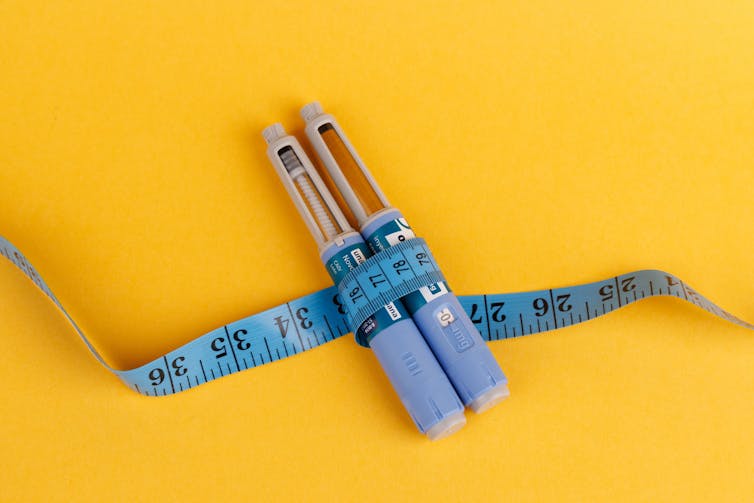
Two vials of semaglutide, with a blue measuring tape wrapped around them.
The higher dose of semaglutide also helped people with type 2 diabetes lose more weight.
Edugrafo/ Shutterstock

This time they recruited 512 participants with obesity who also had type 2 diabetes. They used the exact same study design as they did in the previous study.

Those treated with 7.2mg of semaglutide lost just over 13% of their body weight. The standard dose group lost around 10% of their body weight, while the placebo group lost just under 4% of their total body weight.

Beyond weight loss, the 7.2mg dose of semaglutide brought measurable improvements in metabolic health. On average, waist circumference decreased by 6.5cm compared to the placebo group. Blood glucose levels (HbA1c, a measure of diabetes control) also fell by nearly 2% in those taking the higher dose.

Gastroinstestinal problems were again the most commonly experienced side-effects in those taking semaglutide – with around 6% of the study’s participants stopping the trial because of these side-effects.

Patient benefit

Semaglutide promotes weight loss by mimicking the body’s natural GLP-1 hormone, which helps regulate blood sugar and appetite. These drugs act on brain pathways that control energy balance and food intake, leading to reduced hunger and an earlier sense of fullness (satiety) after eating. This can help people to eat less, leading to weight loss.


Read more:
Eight conditions weight-loss jabs might be beneficial for


Higher doses of semaglutide lead to greater weight loss by more strongly activating the brain regions that control appetite, resulting in reduced hunger and increased feelings of fullness. They also slow stomach emptying more effectively, helping to decrease overall food intake.

The results from these two trials show that a higher dose of semaglutide is both safe to use and very effective. Being able to use a higher dose of semaglutide offers more options for patients when it comes to managing their weight and controlling their blood sugar. It also gives an option to people who may not respond to the standard 2.4mg dose or whose weight loss may plateau.

These findings also show that semaglutide can compete against other weight loss drugs, such as tirzepatide (Mounjaro). In an earlier head-to-head trial, a 10gm-15mg dose of tirzepatide resulted in a 20% loss of body weight in participants – while a standard dose of semaglutide only resulted in an approximately 14% loss in body weight. But these recent studies now show that a higher dose of semaglutide can lead to comparable levels of weight loss.

These results may also raise questions about whether dose escalation may become a future standard of care in obesity treatment.

The Conversation

Martin Whyte does not work for, consult, own shares in or receive funding from any company or organisation that would benefit from this article, and has disclosed no relevant affiliations beyond their academic appointment.

ref. Weight loss drug semaglutide shown to be safe and potentialy more effective at higher dose – new findings – https://theconversation.com/weight-loss-drug-semaglutide-shown-to-be-safe-and-potentialy-more-effective-at-higher-dose-new-findings-265312

Three ways your mental and physical health will benefit from being kinder to yourself

Source: The Conversation – UK – By Jennifer Donnelly, Doctoral Researcher, Meditation-based Interventions in Clinical Settings, Centre of Positive Health Sciences, RCSI University of Medicine and Health Sciences

Self-compassion is viewing yourself with kindness instead of judgment. feodarina/ Shutterstock

“Be kind to yourself” is a piece of advice that’s often given to people during difficult times or moments of stress. But for someone who is driven, a perfectionist or facing pressure, the idea of self-compassion can feel uncomfortable. To them, kindness might feel like letting themselves off the hook.

But research actually shows that consistently feeling shame and self-judgment can activate the body’s stress response just as strongly as physical danger. This increases cortisol and inflammation, both of which are linked to long-term health problems.

On the contrary, research suggests that being kind to yourself – known in psychology as “self-compassion” – can actually support motivation, accountability and resilience without the cost of burnout.

Self-compassion can be defined as the ability to view yourself with kindness and a mindful or balanced perspective on what’s happening to you – as opposed to viewing yourself with judgment, focusing on your mistakes or feeling like you’re alone in your experience.

The key components of self-compassion include mindful awareness (noticing your pain or struggle without denial or exaggeration), self-kindness (offering support rather than criticism) and shared humanity (remembering that everyone struggles sometimes and that imperfection is part of being human).

Self-compassion doesn’t mean letting yourself off the hook. It means staying connected to yourself in a way that supports real, healthy change.

But practising self-compassion is often easier said than done. If you’re someone who finds it difficult to be kind to yourself, here are three ways having more self-compassion can be beneficial for you – and how to increase self-compassion in your everyday life.

1. Reduces your body’s stress response

Stress is a natural part of life that our bodies are well-adapted to cope with. It allows us to perform daily tasks and be more engaged. However, consistent exposure to stress without relief may result in chronic stress. This can lead to both mental and physical health problems including cardiovascular disorders, decreased immunity and mental health challenges such as depression.

To reduce exposure to chronic stress, we need to be able to engage our brain’s parasympathetic system – the part of the nervous system that helps the body relax and also controls functions such as digestion and breathing. The parasympathetic system is often stimulated by relaxation and feelings of safety, security and comfort.

Self-compassion may be a powerful tool in helping create the feeling of security and comfort within ourselves that’s needed to stimulate this internal system. Research suggests self-compassionate thoughts can result in physiological changes such as improved heart rate variability – a marker of emotional regulation and resilience.

2. Helps you respond and adapt to feedback

Many people fear that too much self-compassion could mean they become self-centred or avoid responsibility. But when we practise self-compassion, we often become more available to others.

We model healthier coping strategies, respond better to feedback and recover faster from setbacks.

The reason this happens is because self-compassion teaches us to respond to ourselves with the same care we would offer others. Instead of saying: “I’m not good enough,” a self-compassionate person might say: “This was hard, what can I learn for next time?”

A young woman wearing glasses hugs herself.
Self-compassion can make us more empathetic towards others.
Krakenimages.com/ Shutterstock

Better yet, as we begin to show empathy towards our own imperfections and mistakes, we are better able to extend that empathy towards others.

3. Makes you more likely to succeed

Another common fear is that self-compassion will make us lazy or unambitious. But studies show the opposite to be true.

People who practise self-compassion are more likely to take responsibility for their actions, try again after failure and stay engaged with long-term goals. They procrastinate less and take more conscientious, less impulsive decisions.

By contrast, shame and negative self-esteem may drive short-term performance, but we’re less likely to maintain this motivation over time.

How to practise self-compassion

If you’d like to give self-compassion a go, the next time you catch yourself in a loop of harsh self-talk, pause and ask: if someone I loved were in this situation, what would I say to them? Then try offering yourself the same words.

And use neutral, non-judgmental language. Instead of “I shouldn’t feel this way” or “I’ve failed again,” try to make your thinking less personal. You could tell yourself instead: “This is hard” or “I’m not the only one who feels this way.” You could even try to be more forward thinking, asking yourself: “This is my situation right now, what can I do next?” These small shifts reduce emotional reactivity and help support clearer thinking under pressure.

Finally, look at the bigger picture. It’s easy to feel alone in our struggles. But everyone, regardless of culture, background or personality, experiences doubt, regret or imperfection. Remind yourself that no one is perfect and everyone has hard days. You’re not alone.

Practices such as loving-kindness meditation can also help with developing self-compassion. During this form of meditation, the focus is on sending good wishes or kind thoughts to yourself and others.

Whether you’re navigating illness, chronic stress or the pressures of daily life, being kind to yourself isn’t indulgence – it’s a skill that protects your health, your mind and your future self.

The Conversation

Jennifer Donnelly does not work for, consult, own shares in or receive funding from any company or organisation that would benefit from this article, and has disclosed no relevant affiliations beyond their academic appointment.

ref. Three ways your mental and physical health will benefit from being kinder to yourself – https://theconversation.com/three-ways-your-mental-and-physical-health-will-benefit-from-being-kinder-to-yourself-263569

When insulation goes wrong – the science behind why botched retrofits can be so damaging

Source: The Conversation – UK – By Sarah Price, Research Fellow at the Leeds Sustainability Institute, Leeds Beckett University

Chizhevskaya Ekaterina/Shutterstock

Insulation is designed to make heating our homes more efficient, but if it isn’t installed properly it can sometimes lead to condensation, damp and mould. Recently UK government ministers revealed the scale of the issue and reported that thousands of homes may have had botched insulation fitted since 2022 under a government scheme called the Energy Company Obligation.

Many people have also told journalists they were hoping the insulation would make their homes warmer in cold weather, and were confused and alarmed to find sub-standard installation made mould and damp worse.

To understand why, we first need to think about where moisture in our homes comes from.

There’s rain and ground water, of course, but we often forget about moisture in the air. Air is great at holding moisture. Every time we breathe, we give off carbon dioxide and water vapour. Bathing, cooking, washing-up and drying clothes indoors add even more moisture to the air.

Normally, ventilation – the flow of fresh air in and stale air out – helps carry some of this moisture away. Some people open their windows regularly and some homes are naturally “leaky”, with gaps in walls, roofs and floors that let air in and out.

Now imagine a home that was once well ventilated because it’s leaky, which then has
insulation fitted to the walls. It’s going to get more sealed up, and this can upset the balance of moisture in the air inside the home, making it more humid.

And if the occupant isn’t good at opening windows enough, particularly in the colder months, (which most of us aren’t!), this can lead to condensation, damp and mould, especially in colder corners of rooms where insulation is often missing. It takes more skill and can cost more to install insulation in corners.

Moisture is more likely to condense when there are cold surfaces inside – like a pint of beer in a pub, or a pair of glasses steaming up when you come in from outside. These cold spots, where insulation is missing, are called thermal bridges, and they stay cold while the rest of the wall warms up.

This is unfortunately a common theme in retrofitting insulation to homes. Insulation is installed, gaps in the material are left, and ventilation is forgotten about. This is why housing experts now say “no insulation without ventilation”.

Walls and moisture

There are other ways in which insulation can lead to damp and mould. These usually relate to moisture being trapped inside the building fabric. For example, if external wall insulation is not properly sealed at the top, rainwater can be absorbed into the bricks behind the external wall insulation.

The wall has a hard time releasing moisture because the external wall insulation slows down drying to the outside. The wall tries to release moisture to the inside instead, which means that the ventilation system needs to work extra hard and may get overloaded – if there even is one installed.

This is what led to the mushrooms growing in people’s homes in the 2013 Preston external wall insulation debacle. It involved a botched external wall insulation retrofit of properties with many vulnerable residents.

Moisture can also get trapped behind internal wall insulation on solid masonry walls. It makes the existing solid brick wall colder because it’s being insulated from the inside warmth of your home. Tiny gaps in the insulation system can allow warm moist air from inside the house to get to the back of the internal wall insulation and to reach the colder external brick wall. If that happens, condensation, and therefore mould, could form inside the wall.

The solution is to make sure there are no gaps in the insulation, and to use the right kind of insulation. Some types of insulation such as wood fibre or calcium silicate board are better at managing moisture. It’s also important to make sure the wall is in good condition to start with, with no cracks and to install an internal air barrier to stop any of the warm moist air getting in behind the internal insulation in the first place.

This all might sound a bit alarming, but the good news is that we’ve learned a lot about moisture in retrofit.

If you’re thinking about retrofitting your home with insulation, ask the contractor if they’ve considered the things listed in the infographic below:

List of things to consider in regards to insulation.

Sarah Price, CC BY-NC-SA

A ventilation system can be easily retrofitted to any home. It can be done before, during or after installation of the insulation. It should include extraction fans in kitchens and bathrooms to extract moisture at source, combined with supply vents or trickle vents in all the other rooms.

Research from the Leeds Sustainability Institute has shown that taking a whole-house approach to installing insulation can reduce the risk of condensation. The whole-house approach is something experts have been talking about for a while and just means thinking of the house as a system including ventilation and cold spots, and not just focusing on the bit being insulated.

The Conversation

Sarah Price works for Leeds Beckett University

ref. When insulation goes wrong – the science behind why botched retrofits can be so damaging – https://theconversation.com/when-insulation-goes-wrong-the-science-behind-why-botched-retrofits-can-be-so-damaging-264916

Impôts sur l’héritage : une réforme nécessaire ?

Source: The Conversation – in French – By Nicolas Frémeaux, Professeur des universités et maître de conférence, Université de Rouen Normandie

D’ici à 2040, plus de 9 000 milliards d’euros de patrimoine devraient être transmis. Sylv1rob1/Shutterstock

La moitié des Français n’hérite de rien ou presque, alors que 10 % des héritiers les plus riches concentrent plus de 50 % des héritages. Alors pourquoi l’impôt sur l’héritage est-il aussi impopulaire ?


L’héritage est de retour en France, et ce retour est massif. On peut chiffrer ce phénomène de plusieurs manières. Commençons par les flux successoraux, c’est-à-dire ce qui est transmis tous les ans sous forme d’héritages et de donations. Ce flux se situe actuellement entre 350 milliards et 400 milliards d’euros et, d’ici à 2040, plus de 9 000 milliards d’euros de patrimoine devraient être transmis.

Une autre manière de se représenter le retour de l’héritage consiste à décomposer l’ensemble du patrimoine privé détenu par les Français (qu’il soit immobilier, financier ou professionnel) entre ce qui vient de l’épargne et ce qui vient de l’héritage. Comme l’ont montré les économistes Facundo Alvaredo, Bertrand Garbinti et Thomas Piketty, l’héritage est aujourd’hui largement supérieur à l’épargne. Il représente près des deux tiers du patrimoine des ménages contre un tiers pour l’épargne. C’était l’inverse dans les années 1970, moment où l’héritage a connu son plus bas niveau historique.

La moitié des Français n’hérite de rien

Le niveau actuel reste inférieur à celui observé à la veille de la Première Guerre mondiale où l’héritage constituait plus de 80 % du patrimoine. Même si les sociétés actuelles diffèrent de celle du XIXe siècle sur de nombreux aspects, elles sont finalement assez proches sur le plan patrimonial, que ce soit du point de vue des niveaux de richesses détenues ou de l’importance prise par les transmissions patrimoniales.

Ce panorama serait incomplet si on se limitait à ce constat macroéconomique. L’héritage est bien plus concentré que les revenus. La moitié des Français n’hérite de rien ou presque quand, dans le même temps, 10 % des héritiers les plus riches concentrent plus de 50 % des héritages. Au sommet de la distribution, on estime que les 0,1 % des héritiers les plus riches reçoivent plus de 13 millions d’euros de patrimoine au cours de leur vie.

C’est la nature même des inégalités qui change. La figure du rentier, qu’on pouvait penser disparue, est de retour. Pour une part limitée, mais croissante de la population, la principale source de richesse sera l’héritage et non les revenus du travail.

Substitution aux revenus du travail

Le retour de l’héritage a une conséquence inattendue : créer un (quasi) consensus chez les économistes en faveur d’une réforme de l’impôt successoral. Il n’est pas tant lié aux enjeux de justice sociale, qui dépassent le seul cadre de la science économique, qu’aux effets de l’héritage du point de vue de l’efficacité économique.

L’héritage peut être la source d’inefficacités puisque recevoir un capital peut réduire l’offre de travail, dans le sens où le capital hérité peut se substituer aux revenus du travail. Cet « effet Carnegie » a été vérifié dans plusieurs pays.

Aux États-Unis, les économistes Douglas Holtz-Eakin, David Joulfaian et Harvey Rosen ont mis en évidence une réduction de l’offre de travail parmi les récipiendaires d’héritages importants. En Allemagne, Fabian Kindermann, Lukas Mayr et Dominik Sachs estiment que, pour chaque euro récolté par l’imposition des successions, neuf centimes additionnels sont obtenus via l’imposition des revenus des suites de la hausse de l’offre de travail. De ce point de vue, imposer les héritages pourrait accroître l’activité économique.

Réduction de l’épargne

Les réponses comportementales négatives à l’impôt successoral sont quant à elles limitées, ce qui en fait un « bon impôt » à l’aune du même critère d’efficacité.

Une de ces réponses passe par l’épargne. Si le patrimoine potentiellement transmis par les donataires est réduit par l’impôt successoral, alors ceux-ci pourraient décider de réduire leur épargne. Cette intuition a été confirmée par les rares études sur la question qui concluent bien à un effet négatif – l’imposition réduit l’incitation à épargner –, mais de faible ampleur. Le fait que l’épargne dépende de nombreux facteurs économiques et de motifs autres que l’altruisme familial, comme l’aversion au risque et la prévoyance, explique que l’impôt successoral à lui seul a des effets limités.

Exil fiscal

Une réponse plus radicale pourrait être l’exil fiscal. Une trop forte imposition pourrait inciter les individus à émigrer vers des cieux (fiscaux) plus cléments. Là encore, identifier le seul effet de l’imposition sur la décision d’émigration est complexe. Comme pour l’épargne, ce type de décision dépend de nombreux déterminants économiques et personnels : potentielle rupture avec l’environnement professionnel et familial, mauvaise perception par l’opinion publique ou démarches administratives complexes.


À lire aussi :
Impôt sur la fortune : si souvent enterré, et pourtant toujours en vie


Les économistes Karen Smith Conway et Jonathan C. Rork, aux États-Unis, et Marius Brülhart et Raphaël Parchet, en Suisse, montrent que les migrations internes des ménages âgés (susceptibles de transmettre leur patrimoine dans un futur proche) ne s’expliquent que marginalement par les différences fiscales entre États ou cantons. Ainsi, les retraités aisés sont relativement insensibles aux variations d’impôt successoral.

Argument moral

Si l’héritage pose un problème de justice sociale et d’efficacité économique, pourquoi le sujet n’est-il pas plus central dans le débat public ? Surtout, pourquoi observe-t-on un affaiblissement de l’impôt successoral ?

Depuis les années 1980, de nombreux pays, comme les États-Unis, la Suède, le Canada ou encore l’Australie, ont supprimé ou réduit leur impôt successoral, en mobilisant le plus souvent des arguments moraux. La France semble échapper à ce phénomène, mais, malgré une stabilité des principaux paramètres fiscaux que sont les taux et les abattements, la multiplication des niches fiscales a bien réduit la progressivité de l’impôt.

Ce qui peut sembler être un paradoxe n’en est en fait pas un. La critique actuelle de l’impôt successoral repose avant tout sur des arguments moraux selon lesquels taxer l’héritage revient à taxer la mort et à sanctionner l’altruisme familial. De manière générale, il contreviendrait à la liberté de transmettre librement son patrimoine.

D’après un sondage Odoxa, réalisé en avril 2024, 77 % des personnes interrogées considèrent l’impôt successoral injustifié et 84 % souhaitent qu’il soit diminué « pour permettre aux parents de transmettre le plus possible à leurs enfants ».

Informer sur les inégalités

Il y a plusieurs précautions à prendre quand on évoque l’argument de l’impopularité de l’impôt. La méconnaissance de la réalité de l’héritage et la surestimation de l’impôt successoral invitent à la prudence dans l’interprétation des réponses. On peut concevoir une forte opposition à un impôt qu’on pense confiscatoire. Plusieurs travaux soulignent que le fait d’informer les répondants sur le niveau des inégalités augmente sensiblement le soutien à l’impôt successoral.

Le dialogue de sourds entre les pro et les anti pourrait empêcher tout débat relatif à l’héritage. Un débat qui pourrait être remis à l’ordre du jour pour d’autres raisons.

Au début du XXe siècle, des causes extérieures, comme les guerres et les crises, ont joué un rôle majeur dans la mise en place d’impôt progressif sur les revenus et sur les successions dans de nombreux pays. Il n’est pas dit que les crises actuelles, qu’elles soient climatiques, sociales ou géopolitiques, n’aient pas des effets similaires dans les années à venir.

The Conversation

Nicolas Frémeaux a reçu des financements de l’Agence Nationale de la Recherche.

ref. Impôts sur l’héritage : une réforme nécessaire ? – https://theconversation.com/impots-sur-lheritage-une-reforme-necessaire-260878

Quels risques le frelon « asiatique » à pattes jaunes fait-il courir à la santé humaine et aux abeilles ? Comment s’en protéger ?

Source: The Conversation – in French – By Sandra Sinno-Tellier, Médecin de santé publique, spécialisée en épidémiologie et en toxicologie, Agence nationale de sécurité sanitaire de l’alimentation, de l’environnement et du travail (Anses)

Le frelon à pattes jaunes originaire d’Asie est désormais bien implanté en France hexagonale. C’est en été et à l’automne que ses colonies se développent. En analysant les données 2014-2023, l’Agence nationale de sécurité sanitaire et Santé publique France ont fait le point sur les risques pour l’humain.


Le frelon à pattes jaunes Vespa velutina nigrithorax, plus communément appelé « frelon asiatique », fait désormais partie de notre environnement. Sa présence en France a été observée pour la première fois dans le Lot-et-Garonne, en 2004. Des poteries pour bonsaïs ont été importées de Chine par un horticulteur avec, dans l’une d’entre elles, une reine fécondée qui hivernait.

Des études ont montré grâce à des analyses génétiques que la lignée de l’insecte importé provenait d’une région près de Shanghai.

Un frelon invasif présent sur tout le territoire hexagonal

Le frelon à pattes jaunes s’est très facilement adapté à notre environnement. En vingt ans, il a colonisé l’ensemble de l’Hexagone ainsi que les pays voisins : Espagne, Portugal, Belgique, Pays-Bas, Suisse, Italie, Allemagne et sud de l’Angleterre.

Il a aussi été détecté pour la première fois en Corse en août 2024. Si le nid a été détruit, un nouveau nid a cependant été détecté en juillet 2025 à Ajaccio.

Le reconnaître et le différencier des autres hyménoptères

Le frelon à pattes jaunes est un insecte du même ordre que le frelon européen, la guêpe, l’abeille ou le bourdon. Tous font partie de l’ordre des hyménoptères. Le frelon à pattes jaunes est reconnaissable à son abdomen brun bordé d’une bande jaune orangé ainsi qu’à ses pattes jaunes. Le frelon européen, plus grand, a un abdomen jaune clair rayé de noir et des pattes marron.

Les nids de ces frelons sont également différents. La colonie de frelons à pattes jaunes, qui peut comporter jusqu’à 3 000 individus, se développe en été et à l’automne dans de grands nids sphériques ou en forme de goutte perchée à plus de dix mètres en haut des arbres. L’ouverture du nid se situe sur le côté.

Généralement, le frelon européen construit son nid, plus petit, dans des cavités (arbre creux, cheminée, grenier…). Le frelon à pattes jaunes n’est par ailleurs actif que le jour, alors que le frelon européen sort jour et nuit.

Que faire en cas de découverte d’un nid de frelons, de guêpes ou d’abeilles dans votre maison ou dans votre jardin ?

  • Informez les membres de la maison et les voisins pour éviter qu’ils ne s’approchent du nid.
  • Respectez une distance de sécurité de 5 mètres du nid et éviter tout geste brusque, car les hyménoptères piquent lorsqu’ils se sentent menacés.
  • Ne tentez pas de détruire le nid vous-même. Cela nécessite l’intervention de professionnels spécialisés dans le domaine (matériels et techniques spécifiques).
  • N’installez pas de pièges (bouteille en plastique avec du sirop, par exemple), car ils tuent les autres insectes indispensables à la biodiversité et n’auront quasiment aucun impact sur le nid visé.
  • S’il s’agit de frelons à pattes jaunes, signalez le nid à votre mairie ou directement à l’organisme animant la lutte contre cette espèce dans votre département.

Hors allergie, une réaction dont l’intensité augmente avec le nombre de piqûres

Les piqûres de frelons à pattes jaunes présentent la même dangerosité pour l’humain que celles des autres hyménoptères. Le venin entraîne une réaction toxique, caractérisée par une douleur, une rougeur, un gonflement local et des signes généraux (vomissements, diarrhées, maux de tête, chute de la tension artérielle…) d’autant plus intenses que le nombre de piqûres est élevé.

En effet, contrairement à l’abeille, mais comme la guêpe et le frelon européen, le frelon à pattes jaunes ne perd pas son dard lorsqu’il pique et peut donc piquer et injecter du venin à plusieurs reprises. Son dard, qui mesure jusqu’à 6 mm, est cependant plus long que celui des guêpes et entraîne une piqûre plus profonde, capable de traverser certains vêtements et gants de jardinage.

La piqûre du frelon à pattes jaunes peut aussi être responsable d’une réaction allergique, non liée à la dose de venin injectée, une seule piqûre suffisant à la déclencher. Dans ce cas, un œdème de la gorge, empêchant la respiration, ou un effondrement de la tension artérielle peut entraîner un état de choc anaphylactique avec perte de connaissance et arrêt cardio-respiratoire conduisant au décès.

Le traitement du choc anaphylactique consiste en l’injection immédiate d’adrénaline par stylo auto-injecteur ou par voie intraveineuse une fois les secours arrivés. Du fait d’allergies croisées, c’est le plus souvent après une piqûre de guêpe que les patients deviennent allergiques au venin des frelons.

Que faire en cas de piqûre de frelon, de guêpe ou d’abeille ?

  • En cas de réaction telle qu’urticaire, œdème de la langue, gêne respiratoire, malaise, douleur thoracique… appelez en urgence le 15 ou le 112.
  • Les piqûres dans la bouche, dans la gorge, ou les piqûres multiples requièrent également une prise en charge médicale en urgence.
  • Pour les personnes allergiques connues, l’utilisation d’un stylo auto-injectable d’adrénaline peut sauver la vie, en attendant les secours.
  • Pour les autres signes d’intoxication, contactez un centre antipoison au (+33) 1 45 42 59 59 ou consultez un médecin.

Entre 2014 et 2023, pas de tendance à l’augmentation ni à la diminution du nombre d’envenimations par des hyménoptères

Le dernier bilan sanitaire des piqûres d’hyménoptères datant de plus de dix ans, l’Agence nationale de sécurité sanitaire (Anses) et Santé publique France ont analysé dix nouvelles années de données de santé (appels aux centres antipoison, passages aux urgences, hospitalisations et mortalité par piqûre d’hyménoptères) pour faire le point sur les risques liés aux piqûres de guêpes, frelons et abeilles.

Au total, 6 022 appels aux centres antipoison, 179 141 passages aux urgences, 18 213 hospitalisations, dont 13 % en réanimation ou en soins intensifs, et 256 certificats de décès pour piqûre d’hyménoptères ont été comptabilisés entre 2014 et 2023 inclus.

Comment contacter son centre antipoison ?

  • Il existe un numéro téléphonique national des centres antipoison : (+33) 1 45 42 59 59.

Malgré la poursuite de la prolifération du frelon à pattes jaunes sur le territoire hexagonal ces dix dernières années, les différentes données de santé étudiées apportent des conclusions convergentes et ne montrent pas d’augmentation du nombre d’envenimations par des hyménoptères, année après année.

Le nombre de piqûres varie d’une année à l’autre, sans tendance globale à la hausse ni à la baisse, avec des pics saisonniers aux mois de juillet et août.

Entre 2014 et 2023, ce sont les guêpes qui sont le plus souvent en cause dans ces envenimations (37 % des appels aux centres antipoison), suivies des frelons toutes espèces confondues (25 %) et des abeilles (19 %). Les piqûres de frelons représentaient de 20 % à 30 % des piqûres d’hyménoptères chaque année, avec une légère augmentation en 2023 (près de 40 %) (Figure ci-dessus).

Les envenimations par des frelons à pattes jaunes représentaient un peu plus de la moitié (55 %) des envenimations par des frelons, lorsque l’espèce de frelon était identifiée, et restaient stables au cours du temps.

Près de 1,5 % des piqûres, tous hyménoptères confondus, menacent le pronostic vital

Parmi les envenimations par des hyménoptères enregistrées par les centres antipoison, 1,5 % étaient graves au point de menacer le pronostic vital, voire de conduire au décès. Ces envenimations étaient dues à une réaction allergique, seule ou associée à des signes toxiques, pour la grande majorité d’entre elles (89 %). Les frelons étaient les premiers responsables des envenimations graves (38 %), devant les abeilles (24 %) et les guêpes (22 %) (hyménoptères non précisés pour les 16 % restants).

Les envenimations graves avaient été provoquées par une seule piqûre pour près de la moitié d’entre elles (48 %), un peu plus souvent en cas de piqûre de frelons (53 % de piqûre unique). Les autres étaient dues à des piqûres multiples, dans la bouche ou sur d’autres muqueuses.

Les risques liés au frelon à pattes jaunes portent surtout sur les abeilles domestiques

En l’absence de prédateur, le frelon à pattes jaunes se développe en se nourrissant d’autres insectes, chaque colonie pouvant en consommer jusqu’à 11 kg par an ! Il a tendance à proliférer près des ruches, et c’est son appétit immodéré pour nos abeilles domestiques qui pose le plus problème aujourd’hui. En plus de les capturer et de les dépecer, leurs vols continus près des ruches empêchent les abeilles de sortir pour butiner, ce qui affaiblit la production de miel qui leur sert de réserve de nourriture l’hiver.

En Asie, les abeilles ont appris à se défendre en formant une boule compacte autour du frelon qui les attaque. En faisant vibrer leurs ailes en nombre, elles augmentent la température de la boule et le frelon meurt littéralement cuit ! Nos abeilles domestiques sont plus dociles et n’ont pas développé ces techniques de défense.

Comment protéger les ruchers ?

Différentes techniques (pièges, harpes électriques, muselières emboîtées à l’entrée des ruches…) existent pour éloigner les frelons à pattes jaunes des ruches. La plus commune est le piégeage avec un appât sucré, qui consiste à attirer les frelons vers un liquide dans lequel ils se noient. Des pièges sélectifs, en nasses successives, ont été développés, pour permettre aux insectes plus petits que les frelons, capturés par erreur, de ressortir avant de tomber dans le liquide.

En revanche, les pièges non sélectifs, constitués d’une simple bouteille contenant un liquide sucré, sont à proscrire pour préserver la biodiversité.

Les pièges sont à utiliser autour des ruchers menacés et sont à contrôler régulièrement. Deux périodes de piégeage sont recommandées : de février à mai (piégeage de printemps) afin de capturer les reines fondatrices, et de mi-août à novembre, lors de la reproduction, pour piéger les futures fondatrices avant leur hivernation.

Une loi pour limiter la prolifération du frelon à pattes jaunes et préserver la filière apicole

Une loi visant à endiguer la prolifération du frelon à pattes jaunes et à préserver la filière apicole est entrée en vigueur le 15 mars 2025. Elle prévoit la création d’un plan de lutte national, l’encadrement du piégeage des frelons et l’indemnisation des apiculteurs. À ce jour, les décrets d’application ne sont pas encore parus.

Le frelon à pattes jaunes fait désormais partie de notre environnement. Si on ne peut pas l’éradiquer, on peut apprendre à s’en protéger : d’une part, pour éviter des piqûres qui peuvent être graves chez l’humain, au même titre que celles occasionnées par les autres frelons, guêpes ou abeilles, et, d’autre part, pour préserver les insectes pollinisateurs, dont les abeilles des ruches, maillon indispensable de la biodiversité.


Merci à Quentin Rome, responsable « Frelon asiatique et hyménoptères » dans l’unité PatriNat (Muséum national d’histoire naturelle/Office français de la biodiversité), pour sa relecture de cet article.

The Conversation

Les auteurs ne travaillent pas, ne conseillent pas, ne possèdent pas de parts, ne reçoivent pas de fonds d’une organisation qui pourrait tirer profit de cet article, et n’ont déclaré aucune autre affiliation que leur organisme de recherche.

ref. Quels risques le frelon « asiatique » à pattes jaunes fait-il courir à la santé humaine et aux abeilles ? Comment s’en protéger ? – https://theconversation.com/quels-risques-le-frelon-asiatique-a-pattes-jaunes-fait-il-courir-a-la-sante-humaine-et-aux-abeilles-comment-sen-proteger-264949

Siete virus que pueden causar cáncer

Source: The Conversation – (in Spanish) – By Raúl Rivas González, Catedrático de Microbiología. Miembro de la Sociedad Española de Microbiología., Universidad de Salamanca

Ilustración 3D de células cancerosas Aunt Spray/Shutterstock

Uno de cada cinco cánceres malignos en humanos están directamente vinculados a infecciones microbianas provocadas por bacterias, parásitos y virus. ¿Por qué?, se preguntará. ¿Qué tienen que ver los microbios con el desarrollo de cáncer?

Para empezar, algunas bacterias pueden producir toxinas, enzimas y otras moléculas que alteran las funciones celulares normales, interfieren en el control del ciclo celular y alteran la respuesta inmunitaria del huésped, lo que contribuye a la aparición y progresión del cáncer. Por ejemplo, el 89 % de todos los cánceres gástricos se atribuyen a la infección por la bacteria Helicobacter pylori, y es sabido que la erradicación de esta infección reduce la incidencia del tumor.

En cuanto a los virus, son capaces de insertar su material genético en las células huésped, lo que puede provocar un crecimiento celular descontrolado y causar inflamación crónica que daña el ADN y promueve el desarrollo del cáncer. Es el caso de virus oncogénicos como el del herpes humano 8 (VHH-8), el poliomavirus de células de Merkel (MCPyV), el virus linfotrópico de células T humanas tipo 1 (HTLV-1), el virus de Epstein-Barr (VEB), los virus de la hepatitis B (VHB) y C (VHC) y el virus del papiloma Humano (VPH).

Sarcoma de Kaposi y herpes

El herpes humano 8 (VHH-8) es el principal responsable del sarcoma de Kaposi, que afecta a la piel, los ganglios linfáticos, el revestimiento de la boca, la nariz y la garganta y otros tejidos del cuerpo. La transmisión del HHV-8 a través de la saliva y secreciones genitales parecen ser la ruta principal de infección.

Las personas con un sistema inmunitario comprometido tienen un mayor riesgo de desarrollar enfermedades asociadas al VHH-8. Realizar sexo sin protección aumenta las posibilidades de contraer el virus.

Cuando el cambio en la forma o color de un lunar es mala señal

En cuanto al poliomavirus de células de Merkel (MCPyV), se ha relacionado con el carcinoma de células de Merkel, un cáncer de piel poco común y agresivo.

En los últimos años, la incidencia de esta afección ha aumentado significativamente. Las zonas más frecuentes de aparición del tumor primario de carcinoma de células de Merkel son el rostro, la cabeza y el cuello, seguidas de los miembros superiores y los hombros.

Una de las medidas profilácticas más eficaces para prevenir la aparición del carcinoma de células de Merkel consiste en reducir la exposición al sol, evitar las horas de mayor radiación ultravioleta y utilizar protector solar.

La detección temprana es clave para un tratamiento exitoso, por lo que es aconsejable consultar a un médico si se manifiesta algún cambio en el tamaño, forma o color de un lunar o protuberancia.

Un virus que causa leucemias

El virus linfotrópico de células T humanas tipo 1 (HTLV-1) es el primer retrovirus humano descrito y el agente etiológico de la leucemia de células T adultas, una forma muy grave de cáncer. El linfoma/leucemia linfoblástico de células T, que puede ser considerado como un linfoma o un tipo de leucemia linfoblástica aguda, representa el 1 % de todos los linfomas y suele ser más común en adolescentes o adultos jóvenes.

Las personas diagnosticadas con infección por HTLV-1 deben saber que dura toda la vida y que no deben donar sangre, semen ni otros tejidos. La detección obligatoria de anticuerpos contra HTLV-1 para todas las donaciones de sangre ha sido implementada en 23 países.

Cáncer después de la mononucleosis

El virus de Epstein-Barr (VEB) causa mononucleosis infecciosa y está relacionado con varios tipos de cáncer, como el linfoma de Burkitt, el linfoma de Hodgkin y el carcinoma nasofaríngeo, entre otros. A pesar de que la mayoría de la población está infectada por el virus de Epstein-Barr (VEB), solo una pequeña fracción desarrolla tumores relacionados con él. Esto sugiere que se requieren factores adicionales para el desarrollo del cáncer.

Investigaciones recientes indican que la exposición a agentes como el tabaco, los contaminantes, los químicos en alimentos y los pesticidas, podrían estar involucrados en estos cánceres asociados al VEB.

De hepatitis a cáncer de hígado

Los virus de las hepatitis B (VHB) y C (VHC) causan hepatitis crónica, una inflamación del hígado que puede derivar en cirrosis y, eventualmente, en cáncer de hígado (carcinoma hepatocelular).

La infección por el virus de la hepatitis B (VHB) es el factor de riesgo más destacado para desarrollar carcinoma hepatocelular: origina el 50 % de los casos. La vacunación contra el VHB y el tratamiento de la hepatitis C son cruciales para prevenir este tipo de cáncer.

Los cálculos estiman que la vacuna contra la hepatitis B prevendrá 38 millones de muertes a lo largo de la vida de personas nacidas entre los años 2000 y 2030 en 98 países de ingresos bajos y medianos.

Si tiene hepatitis B, es crucial llevar un estilo de vida saludable para evitar que la enfermedad empeore. Esto incluye evitar el alcohol y las drogas, descansar lo suficiente, comer una dieta equilibrada rica en frutas y verduras, y hacer ejercicio regularmente.

Además, es importante someterse a chequeos médicos periódicos para vigilar el virus y la salud del hígado, seguir las indicaciones de los especialistas y consultar al médico antes de tomar cualquier medicamento de venta libre.

El virus del papiloma humano provoca el 5 % de los cánceres

El virus del papiloma humano (VPH) está asociado a casi todos los casos de cáncer de cuello uterino. También es responsable de la mayoría de los cánceres de ano, pene, vulva, vagina y una gran proporción de los cánceres de boca y garganta. Según la Organización Mundial de la Salud (OMS), alrededor del 5 % de los cánceres están provocados por infecciones del virus del papiloma humano.

La vacunación contra el VPH es una de las estrategias de prevención más importantes y efectivas para reducir la incidencia de varios tipos de cánceres y verrugas genitales. Por ejemplo, numerosos estudios han demostrado que esta inmunización tiene una eficacia de hasta el 95 % en la prevención de lesiones precancerosas del cuello uterino relacionadas con diversos tipos de VPH. La pauta de vacunación a partir de los 12 años es de 2 dosis con una separación de al menos 5-6 meses.

Por suerte, investigadores de Mass General Brigham (EE. UU.) han desarrollado HPV-DeepSeek, un análisis de sangre innovador y experimental que utiliza inteligencia artificial y secuenciación del genoma completo del VPH para detectar el cáncer de cabeza y cuello asociado al VPH hasta diez años antes de que aparezcan los síntomas. Esta prueba, aún en fase experimental, promete mejorar el pronóstico de los pacientes al permitir un tratamiento más temprano y menos intrusivo.

Comprender el papel, la forma de transmisión y el modo de acción de los virus cancerígenos es fundamental para establecer medidas de prevención que disminuyan el impacto social, económico y sanitario que causan estos agentes patógenos.

The Conversation

Raúl Rivas González no recibe salario, ni ejerce labores de consultoría, ni posee acciones, ni recibe financiación de ninguna compañía u organización que pueda obtener beneficio de este artículo, y ha declarado carecer de vínculos relevantes más allá del cargo académico citado.

ref. Siete virus que pueden causar cáncer – https://theconversation.com/siete-virus-que-pueden-causar-cancer-265207

Arrivée de Luca de Meo à la tête de Kering : le luxe devient-il un secteur comme les autres ?

Source: The Conversation – in French – By Ben Voyer, Cartier Chaired Professor of Behavioural Sciences, Full Professor, Department of Entrepreneurship, ESCP Business School

Qu’y a-t-il en commun entre le secteur du luxe et celui de l’automobile ? Il y a encore peu poser la question serait apparu incongru tant les points communs entre les promoteurs du « toyotisme » et ceux de la dépense somptuaire semblaient improbables. L’arrivée de Luca de Meo (ex-Renault) à la tête de Kering signale un changement pour le groupe fondé par François-Henri Pinault, mais aussi pour le secteur dans son entier. La fin de la récréation est-elle définitivement sifflée ?


Cette semaine à l’occasion de l’assemblée générale de Kering, Luca de Meo a officiellement pris sa place à la tête du deuxième plus grand groupe de luxe français. Le choix de l’ancien dirigeant de Renault comme nouveau PDG interroge. À biens et services d’exception, stratégie d’exception : Le luxe peut-il survivre à une logique d’optimisation financière comme on en trouve dans l’industrie et les FMCG ?

Le luxe en pleine mutation

Depuis les années 90, l’essor de conglomérats comme LVMH et Kering a fondamentalement changé l’industrie du luxe, en créant une logique industrielle plus qu’une logique de marque. Les conglomérats ont su ainsi profiter des marges bénéficiaires élevées dans le luxe et ont utilisé un effet de levier financier pour se développer rapidement et acquérir des marques. En profitant d’économies d’échelles allant du parc immobilier, des budgets de marketing permettant de négocier avec les principaux médias, ou encore la négociation des coûts de production avec les sous-traitants.

Cette stratégie est aujourd’hui remise en question. Les marques de luxe luttent contre la saturation, la dégradation de la qualité perçue et une perte d’exclusivité alors qu’elles poursuivent leur stratégie de croissance à travers le volume. Il existe un décalage croissant entre la perception des consommateurs des prix du luxe et la qualité des produits. De nombreuses marques sont perçues, à tort ou à raison, comme ayant rogné sur l’artisanat et les matériaux tout en augmentant considérablement les prix, s’appuyant principalement sur le marketing pour justifier les coûts. L’industrie se situe à un tournant, avec de nombreuses marques affirmant qu’elles se concentreront sur “la valeur plutôt que le volume” à l’avenir. Cependant, il reste à voir si elles peuvent vraiment revenir aux fondamentaux du luxe, à savoir l’artisanat et une rareté authentique et non orchestrée.

Le nouveau rôle de PDG dans le luxe

Traditionnellement, les marques de luxe étaient des entreprises familiales, avec un leadership transmis de génération en génération. Cela permettait de préserver l’héritage de la marque et la dimension artisanale. Les décisions étaient prises avec une vision de long terme, en opposition avec les diktats de la bourse et la logique financière, qui imposent des communications financières régulières. Ce modèle est d’ailleurs toujours suivi par Hermès, dont le PDG, Axel Dumas, appartient à la sixième génération de la famille Hermès-Dumas.

Un deuxième modèle a par la suite émergé, consistant à recruter des PDG de l’industrie du luxe, qui étaient en phase avec les aspects uniques de la gestion des marques de luxe. Cette vision a dominé durant l’expansion rapide et massive des marques de luxe, qui sont passées de champions régionaux de l’excellence et du savoir-faire européen à des leaders mondiaux des biens haut de gamme à forte valeur ajoutée. C’est notamment aujourd’hui le cas de Nicolas Bos, nouveau PDG de Richemont – le conglomérat suisse du luxe – qui était anciennement à la tête de Van Cleef & Arpels.

Plus récemment, un nouveau modèle semble émerger, où les marques de luxe commencent à recruter des PDG d’autres industries, en particulier des entreprises de biens de première consommation (FMCG). Cela a été le cas notamment de Leena Nair chez Chanel, débauchée de chez Unilever, et de Luca de Meo chez Kering. Cela apporte de nouvelles approches de gestion mais crée également des tensions avec les valeurs traditionnelles du secteur.

Une production industrielle

En effet, l’approche FMCG a introduit une gestion financière plus rigoureuse, une optimisation de la segmentation et du ciblage marketing, une stratégie de croissance basée sur les extensions de marques, et une production à l’échelle industrielle dans le luxe. Cependant, cela met aussi à mal l’accent mis sur la créativité, l’artisanat et l’exclusivité, dans le luxe.


À lire aussi :
Après Renault, Luca de Meo pourra-t-il mettre le turbo chez Kering ?


Ces nominations peuvent certes proposer un regard neuf sur l’industrie : la nomination de Leena Nair, à la tête de Chanel, apporte une expertise en ressources humaines, dans un secteur où les talents sont rares. Des questions demeurent cependant, par exemple, quant à l’intégration de l’excellence dans le service et l’expérience, où les pratiques du secteur du luxe sont sans commune mesure avec les pratiques du secteur de la grande consommation.

La spécificité Kering

Pour Kering et son nouveau CEO, les défis sont nombreux. On peut noter une chute de 25 % des ventes chez Gucci – la marque phare du groupe – et d’autres marques sous-performantes dans son portefeuille. Le nouveau PDG devra s’attaquer à ces problèmes.

L’entreprise s’est développée rapidement en utilisant un effet de levier financier, mais cette stratégie a peut-être atteint ses limites compte tenu de l’endettement actuel de Kering. De nombreuses préoccupations demeurent quant à la dilution des marques du groupe, et la perte d’exclusivité. L’approche traditionnelle des groupes de luxe, qui consiste à prendre des marques à la mode ou en perte de vitesse, et de les relancer en appliquant des stratégies de marketing – augmenter la désirabilité et la perception de valeur – et de vente au détail, à travers l’expérience client, peut ne plus être aussi efficace sur le marché actuel.

Le choix du nouveau PDG – un ancien de chez Renault qui a l’habitude d’opérer dans une industrie à maturité, ou la création de plates-formes est importante, ainsi que la préservation des marges – témoigne de l’arrivée à maturité de l’industrie. Cette stratégie consiste à concentrer les efforts marketing sur les produits phares à forte valeur ajoutée – la maroquinerie, la beauté, et les accessoires (e.g., lunettes de soleil). Pour ce type de produits, une logique de plate-forme peut être mise en place, où les synergies entre marques permettent de produire et distribuer à moindre coût, quitte à sacrifier l’individualité des marques.

Plateformisation du luxe

Le nouveau PDG devra équilibrer la performance financière avec la préservation du capital de la marque et de l’exclusivité. Cela peut nécessiter des décisions difficiles concernant la réduction de certaines opérations ou la cession de marques sous-performantes. Une stratégie de retour à l’exclusivité, en diminuant le nombre de boutiques et en se focalisant sur les pièces à forte valeur ajoutée, a été utilisée avec succès par Chanel dans les années 1980.

Le nouveau patron de Gucci, Balenciaga ou Bottega Veneta aura fort à faire pour montrer qu’un PDG venant de l’extérieur de l’industrie du luxe peut s’atteler avec succès à ces défis et restaurer la trajectoire de croissance de Kering tout en maintenant son positionnement de luxe.

France 24 – 2023.

Ces difficultés reflètent les difficultés plus larges d’un modèle qui a adopté des tactiques de marché de masse, traitant des produits émotionnels et créatifs comme des marchandises. Cette approche de « FMCG des riches » présente un risque réel d’éroder ce qu’est l’essence même du luxe.

Des pressions contradictoires

Les marques de luxe font face à des pressions contradictoires – maintenir l’exclusivité et l’artisanat tout en livrant la croissance et les bénéfices attendus par les marchés financiers et les propriétaires de conglomérats. L’industrie a peut-être atteint les limites de sa stratégie d’expansion. En témoigne l’ouverture de magasins dans des villes de deuxième ou troisième niveau à l’échelle mondiale et le lancement constant de nouvelles catégories de produits diluent l’équité de la marque.

Par ailleurs, il existe une tension grandissante entre le leadership créatif/artistique et la gestion financière/opérationnelle dans les maisons de luxe. Le traditionnel « duo magique » du directeur créatif et du leader commercial est perturbé. L’aura d’une marque du luxe se construit avant tout autour d’une figure charismatique, à la fois créative, visionnaire, mais aussi attachée à une marque sur la durée.

Enfin, Il y a de plus en plus de préoccupations concernant la durabilité à long terme des modèles commerciaux de luxe actuel, en particulier leur dépendance au marketing plutôt qu’à la qualité et à l’exclusivité authentiques pour justifier des prix élevés.

The Conversation

Ben Voyer a reçu des financements de la Chaire de Recherche Turning Points ESCP HEC Paris Cartier.

Perrine Desmichel ne travaille pas, ne conseille pas, ne possède pas de parts, ne reçoit pas de fonds d’une organisation qui pourrait tirer profit de cet article, et n’a déclaré aucune autre affiliation que son organisme de recherche.

ref. Arrivée de Luca de Meo à la tête de Kering : le luxe devient-il un secteur comme les autres ? – https://theconversation.com/arrivee-de-luca-de-meo-a-la-tete-de-kering-le-luxe-devient-il-un-secteur-comme-les-autres-265325