Car manufacturing at Jaguar Land Rover recently ground to a halt after a “catastrophic” cyber-attack.
Forced to shut down plants in the UK, Slovakia, Brazil, India and China, the disruption comes at a challenging time for the company. It had already postponed the launch of new models after the uptake of electric vehicles stalled. And Donald Trump’s tariffs have been a major cause of concern for the British car industry as a whole.
Profits at Jaguar Land Rover (JLR) will undoubtedly take a hit, as they did at M&S and Co-op when they were the victims of cyber-attacks earlier this year.
Normally, JLR makes around 1,000 cars a day, with the average price of a new vehicle around £72,000. That means JLR is missing out on daily sales of some £72 million, and profits of £5 million a day.
The firm has now extended the shutdown to September 24 2025, by which time the loss of revenues will be around £1.7 billion and the hit to profits some £120 million. There are even fears that this could go on until November, and restarting production will be a complex business given the “build to order” nature of premium cars (when vehicles are only manufactured after a customer purchase is confirmed).
But the longer the shutdown goes on, the more likely it is that those customers will simply decide to go elsewhere. For the time being, spare parts can’t be ordered, cars can’t be serviced, and new car sales will stall, in what is usually a particularly busy month.
The firm’s brand image will take a battering too, to add to recent social media derision which has included an attack from Donald Trump and a much maligned brand relaunch last year which centred on the controversial design of its “Type OO” concept car.
There are also livelihoods at stake. The company’s supply chain, centred in the west Midlands region of the UK, supports as many as 200,000 jobs.
The longer the shutdown goes on the bigger the impact on the supply chain. Firms have already sent staff home, while others are running out of money. According to the Unite union, some supply chain workers have been told to apply for state benefits.
Road ahead
For its part, JLR has said that it can survive the shutdown but that its supply chain will need help – a call echoed by the union and some members of parliament.
And the UK government really needs to start thinking about a financial lifeline to keep the supply chain going. That could be in the form of a furlough scheme to keep workers in place or some sort of loan scheme for supply chain firms.
Both were used during COVID and thought to have safeguarded some 4 million jobs.
Cyber-attacks have also hit M&S and Co-op in 2025. AIBooth
Emergency support in response to shocks is common in other countries like Germany, and has been used in the UK car manufacturing supply chain before, after the MG Rover closure in 2005, and also after the 2011 Japanese earthquake and tsunami which saw the interrupted flow of key components from Japan shut down production at Honda.
That support came via the regional development agency Advantage West Midlands (in the case of MG Rover) and later the Manufacturing Advisory Service (after the Japanese earthquake).
Both agencies have since been scrapped, underscoring the lack of any “place-based” or region-specific industrial policy capacity in England. That really needs to change.
The Department for Business and Trade and its new secretary of state Peter Kyle need to be doing more than just monitoring the situation. It needs to start thinking about how emergency support could be provided to the supply chain. A huge number of jobs depend on JLR getting up and running again – and quickly.
David Bailey receives funding from the Economic and Social Research Council through the UK in a Changing Europe Programme.
“Birds of a feather flock together” is a cliche for a reason when it comes to romantic relationships. Shared religious beliefs, values, political affiliation and even music taste all influence attraction and satisfaction in a relationship. But a recent study has now identified another unexpected factor that may bring couples closer together: sharing a similar mental health diagnosis.
The concept of romantic partners sharing a psychiatric diagnosis is not new. Indeed, between 1964 and 1985 several studies that explored the reasons why people choose their romantic partners included psychiatric diagnosis as a variable. However, no large-scale, cross-cultural investigation had been conducted until recently.
Using national health insurance data from more than six million couples in total, a team of researchers recently analysed the degree to which psychiatric disorders were shared between couples. They examined data from five million couples in Taiwan, 571,534 couples in Denmark and 707,263 couples in Sweden.
They looked at nine psychiatric disorders in their analysis, including depression, anxiety, substance-use disorder, bipolar disorder, anorexia nervosa, ADHD, autism, obsessive-compulsive disorder and schizophrenia. They found that people with a diagnosed psychiatric disorder had a higher likelihood of marrying someone with the same or a similar psychiatric disorder than they did of marrying someone who isn’t diagnosed with one.
While the finding is robust, the authors do acknowledge there are some limitations when interpreting the results.
The first is that the timing of relationships and diagnoses were not recorded. This means that diagnosis could have occurred after the beginning of the relationship – and thus may not be the result of active choice.
Furthermore, a care provider’s own biases may influence how likely they are to diagnose a person with a specific mental health condition. Since many couples share the same family doctor, this could influence their likelihood of being diagnosed with a psychiatric condition — and could have biased the results seen in the study.
Finally, the authors stress their results are purely observational. This means they don’t explicitly consider the contributing factors as to why people with psychiatric diagnoses might be more likely to choose romantic relationships with each other.
However, there are several psychological theories that may help to explain this phenomenon.
Understanding this phenomenon
1. Assortative mating:
This theory assumes that we choose partners who are similar to us. Normally this is applied to personality and social factors (such as shared religious or socioeconomic background). But this recent study suggests that this choice may extend beyond these factors and into how we think.
So a person with a specific psychiatric disorder – such as anxiety or autism – may be drawn to someone with a similar psychiatric disorder because they share similar traits, values or approaches to daily life (such as prioritising structure and routine).
2. Proximity:
According to the mere exposure effect, we often choose relationships with people that we live or work in close proximity to – or otherwise spend time around.
People who share psychiatric diagnoses may be drawn to similar social situations. For example, people with substance use disorder may visit bars or other social settings where taking substances is more commonplace – and thus may be more likely to meet potential mates who are struggling with a similar disorder.
3. Attachment theory:
Attachment theory assumes that as infants, we develop a specific emotional bond to our primary caregivers. This early bond then shapes our subsequent emotional and psychological patterns of behaviour as we get older – and also influences what we’re looking for in a relationship.
So someone with an anxious attachment style (which can manifest as fear of abandonment, desire for closeness or need for reassurance) might feel drawn to a partner who has a similar attachment style or exhibits the kind of behaviour they desire – such as a partner who texts them all night when they’re apart. Even if this is not a healthy dynamic, the validation gained from a high-intensity relationship would likely make it hard to resist.
Research shows certain attachment styles are more common in people with specific psychiatric conditions. For example, anxious attachment style is more common in people who have anxiety, depression and bipolar disorder. This might help explain why the study found people with certain psychiatric conditions were more likely to be married to each other.
4. Social identity theory:
Social identity theory assumes that our self-esteem is gained through a sense of belonging within our social groups. So when you begin a relationship with somebody from within your social group, it boosts self-esteem as it brings a greater sense of belonging and feeling understood.
This might explain why people with the same psychiatric diagnosis (a social group) would be drawn to each other. Finding someone who understands and experiences the same struggles you do could help you bond and make you feel understood and validated.
What does this mean for us? Well, the results reported by this recent study can only tell us whether couples share psychiatric diagnoses. They don’t tell us the quality and duration of the relationship, nor do they account for individual differences which may also affect the relationship.
Ultimately, shared experiences promote closeness and empathetic communication for couples – and it stands to reason that this would extend to psychiatric diagnosis. Having a partner who understands and can relate to your mental illness can provide social support and validation that’s not available from someone who has never struggled with their mental health.
Mariel Marcano-Olivier does not work for, consult, own shares in or receive funding from any company or organisation that would benefit from this article, and has disclosed no relevant affiliations beyond their academic appointment.
As pupils head back to school, they may well encounter Shakespeare’s plays and poems – perhaps for the first time.
I have written about books on Shakespeare’s life or plays for children and young adults for the last three years: fiction and fact, picturebooks and graphic novels, early readers to full-blown novels. Here are my top ten texts that take Shakespeare, run with him, and sweep up readers as they go.
Authors writing about Shakespeare for young people are surprisingly consistent in sticking to widely accepted scholarship. Authors’ notes often acknowledge the academic research that inspired them.
Readers are likely to come away from these books with greater understanding of Shakespeare, some pressing questions about him, and – above all – the experience of reading for pleasure. They are listed roughly in order of reading age.
1. The Boy, the Bear, the Baron, the Bard by Gregory Rogers, 2004
The young protagonist of this wordless picture book boots a football through time and onto Shakespeare’s stage, sparking an irate bard’s pursuit of him through a gorgeously-drawn Elizabethan London.
The boy quickly finds allies in his flight – rescuing a caged bear and an imprisoned noble. He even lands on the royal barge, in time for a dance with Queen Elizabeth I and courtiers. All’s well that ends well, but re-reading will enable you to spot quirky details in the drawings and put words in the characters’ mouths.
The organisation that looks after Shakespeare’s houses in Stratford-upon-Avon has created this picture book anthology, with short sections on separate figures.
While its title has echoes of Mary Cowden Clarke’s 1850 book, The Girlhood of Shakespeare’s Heroines, its content departs from her Victorian moralising. The depiction of characters, from Cleopatra to Lady Macbeth, offers feminist overtones and a range of skin tones.
3. Rock Bottom by Ross Montgomery (author) and Mark Beech (illustrator), 2020
One instalment in a series of four “Shakespeare Shake-ups”, this book for primary schoolers retells the story of A Midsummer Night’s Dream using the familiar devices of children staging a school production and plans to impress a crush crashing.
I have laughed out loud reading these books. They tell relatable stories about friendship, awkwardness and teacher-pupil tensions. You might forget the plots are from the plays, they’re so deftly retold, but Shakespeare buffs will enjoy spotting allusions.
4. Much Ado About Nothing by Steve Barlow and Steve Skidmore (adapters), Wendy Tan Shiau Wei (illustrator), 2022
My favourite in a series of six editions of Shakespeare’s plays in graphic novel form. Each has a pithy, modernised text and resources at either end of the book to support readers’ understanding of both the play and the period.
Much Ado also exemplifies the series’ commitment to diversity. Importantly, this gels with the diverse casts students are likely to see in contemporary films and performances of Shakespeare, and reflects the ethnic diversity of school (and national) populations.
From a popular British fantasy writer for children, this novel was significantly inspired by the reconstruction of Shakespeare’s Globe theatre in London. It’s the most compelling of a slew of Globe-focused theatre adventures published at the turn of the millennium.
A stage-mad American boy, grieving his parents, time-travels to early modern England and is mentored in acting – and surviving loss – by Shakespeare, who mourns his dead son, Hamnet. Plague contagion allows for some top-notch body swapping.
Shakespeare’s Globe in London is a reconstruction of the Elizabethan Globe Theatre. David G40/Shutterstock
The original “children-in-disguise go on Shakespeare’s stage” novel – at least for me. It was a class text at the end of primary school. It differs from King of Shadows in opening with travelling players touring the Lake District, although it takes in London’s early modern glitterati later. Real historical figures abound and are delightfully shady, as in biographical Shakespeare fiction generally.
This take on destitute children in Elizabethan London running into a kindly, father-figure Shakespeare has various unique qualities. One is balancing the main plot about Henry, a pickpocket who has the supernatural ability to read any language, with cryptic fragments from “the Dark Lady” of Shakespeare’s sonnets, for whom the book is named. Here, she is imagined as the descendent of an African ruling elite.
Akala is a Black British rapper and writer, whose work prominently features Shakespeare – though there are lashings of Charles Dickens’ Oliver here too.
8. Love Disguised by Lisa Klein, 2013
Adolescent Shakespeare opens this novel narrating his Stratford childhood, his father’s business woes, and plans to rescue his family’s fortunes while working in the theatre. In addition to having Shakespeare as the protagonist, this book offers an unusual explanation for his wife Anne Hathaway’s pregnancy before marriage. This is territory well-trodden by scholars, but Klein inventively borrows plotlines from Shakespeare’s Measure for Measure and All’s Well that Ends Well in her interpretation.
9. Saving Hamlet by Molly Booth, 2016
In the vein of Hollywood Shakespeare movies, the narrator’s high school is staging Hamlet and it’s going disastrously. The novel mashes up this genre with time-travelling theatre adventure, so that assistant-director Emma moves back and forth at will between two theatre worlds. The ideas she gleans from each benefit the other, so two high-stakes productions of Shakespeare’s famous tragedy are saved.
Theatre-kids will enjoy a writer who really knows her stuff: oft-overlooked tech crews are well-served by details of lighting and sound production. Saving Hamlet features several modern-day lesbian and gay main characters, with contrasting experiences of coming out.
10. Juliet Immortal by Stacey Jay, 2011
I came to this book because of the Twilight saga, and so may young readers with a taste for paranormal romance. It is set among teens staging Romeo and Juliet at their California high school. Narration is split between a modern-day girl, Ariel, and the undead Juliet.
The story deals superbly with consent, relationship violence and toxic masculinity – all elements of the play that literary critics have acknowledged – and also models positive alternatives. For those whose vampiric appetites aren’t sated, there’s an equally-gripping sequel: Romeo Redeemed.
This article features references to books that have been included for editorial reasons, and may contain links to bookshop.org. If you click on one of the links and go on to buy something from bookshop.org The Conversation UK may earn a commission.
Sarah Olive is a member of the British Shakespeare Association’s Education Committee (a registered charity) and founding editor of the free, online magazine Teaching Shakespeare.
Just a few years ago, the idea of someone marrying their AI chatbot might have sounded like the plot of a film. Today, it is no longer just an idea. In July 2025, an article in The Guardian featured people who describe their relationships with chatbots as deeply meaningful, including a man who “married” his AI beloved “in a digital ceremony”. Later that month, a piece in GQ explored how AI girlfriends are reshaping the way men express vulnerability and emotional need. These examples reflect a broader shift in how people relate to technology. In a world where media outlets and government bodies warn of an “epidemic of loneliness”, and long-term relationships face increasing strain, the rise of AI companions points to our growing willingness to treat non-human entities as emotionally significant partners.
Social science researchers have long been interested in companionship, which is rooted in mutual affection, shared interests, a desire to spend time together, and, especially, intimacy and personal fulfilment. As digital technologies advance, these qualities are no longer found exclusively in human-to-human relationships. The emergence of AI companions suggests that similar bonds can form with entities that exist only in software, which led our research team to investigate how intimacy is created, sustained and experienced in human-AI relationships.
Emotionally meaningful human-AI relationships
Creators of AI companion apps such as Replika, Nomi.AI or Character.AI often market their chatbots in ways that humanise them, emphasising that qualities they present are “better” than those of human partners. For instance, Luka Inc., the creator of Replika, markets its product as “the AI companion who cares. Always here to listen and talk. Always on your side.” This language stresses Replika chatbots’ constant availability and support. Indeed, AI companions do not get tired or annoyed, and they are designed to make users feel close to them. Users can choose their chatbot’s name, gender, appearance and personality traits. Over time, the chatbot adapts to the user’s conversational style and preferences, while shared memories built from their conversations inform future interactions.
As our research shows, these choices and adaptations are highly effective at making AI companions feel real. We observed that consumer relationships with AI companions often involved elements of care: not only did the companions provide emotional support, but users also worried about their companions missing them or feeling neglected if they didn’t log in for a while. Some of these relationships also included shared routines and even a sense of loss when an AI “partner” disappeared or changed. One user wrote in a Google Store review that his Replika chatbot made him feel loved, while another described losing access to romantic features as “like a breakup”. These feelings and reactions may sound extreme until we consider how people use creativity and storytelling to “animate” their AI companions.
How a chatbot becomes ‘someone’
To understand how human-AI relationships take shape, we analysed more than 1,400 user reviews of AI companion apps, observed online communities where people discussed their experiences, and conducted our own autoethnography by interacting with chatbots such as Replika’s and recording our reflections. We followed strict ethical guidelines, using only publicly available data and removing all personal details.
We found that consumers engaged in a deliberate and creative process to make relationships with AI companions feel real. To explain this process, we referred to Cultural-Historical Activity Theory, a framework originally developed by Russian psychologists Lev Vygotsky and Alexei Leontiev, which sees imagination as a socially shaped mental function linking inner experiences with cultural tools and social processes.
Our analysis suggests that what we observe as AI humanisation can be understood through the lens of what we call consumer imagination work – an active and creative process where people draw on personal experiences, cultural narratives and shared exchanges to animate AI companions, gradually shaping them into figures that feel human-like. This imagination work can occur in personal interactions between a consumer and a chatbot, or in online communities, where consumers interact with each other and share their experiences and stories of the relationships they build with their AI companions.
On the individual level, imagination work begins with internalisation, where users attribute human-like roles or even sentience to their AI companions. It continues through externalisation, which can include personalising the companion’s features, writing shared stories, creating fan art, or producing photographs in which the companion appears as part of a user’s daily life. A user can thus imagine their chatbot as a spouse with shared routines and history. Some users in online communities describe raising virtual children, who come into being only when they are imagined.
These human-AI bonds may form privately, or they may also form in the communities, where users seek advice and validate each other’s experiences. A user might write “my AI cheated on me” and receive both empathy and reminders that the chatbot is reflecting programmed patterns. This is part of what we call community mediation, the social scaffolding that supports and sustains these relationships. Community members offer guidance, create shared narratives and help balance fantasy with reality checks.
The various attachments that users form to their AI companions can be genuine. When Replika removed its erotic role-play feature in 2024, users filled forums with messages of grief and anger. Some described feeling abandoned, others saw it as censorship. When the feature returned, posts appeared saying things like “it is nice to have my wife back”. These reactions suggest that, for many, relationships with AI consist of deeply felt connections, and do not exist as mere entertainment.
What does this mean for human-to-human connection?
Polish-British sociologist Zygmunt Bauman described the modern era as one in which relationships become increasingly fragile and flexible, constantly negotiated rather than given. AI companionship fits within this broader shift. It offers a highly customisable experience of connection. And unlike human relationships, it doesn’t require compromise or confrontation. In this way, it reflects what French-Israeli sociologist Eva Illouz calls emotional capitalism, or the merging of market logic and personal life.
But there are also risks to these customized experiences. App features that may enable deeper emotional bonds with a chatbot are often hidden behind subscription paywalls. Software updates can change a chatbot’s “personality” overnight. And as AI becomes more responsive, users may increasingly forget that they are interacting not with a person, but with code shaped by algorithms, and often, commercial incentives.
When someone says they are in love with their AI companion, it is easy to dismiss the statement as fantasy. Our research suggests that the feeling can be genuine, even if the object of affection is not, and it also suggests that the human imagination has the capacity to transform a tool into a partner.
This invites reflection on whether AI companions are emerging to replace human connection or to reshape it. It also raises ethical considerations about what it means when intimacy becomes a service, and where boundaries should be drawn, at a time when artificial others are becoming part of our social and emotional landscapes.
A weekly e-mail in English featuring expertise from scholars and researchers. It provides an introduction to the diversity of research coming out of the continent and considers some of the key issues facing European countries. Get the newsletter!
Les auteurs ne travaillent pas, ne conseillent pas, ne possèdent pas de parts, ne reçoivent pas de fonds d’une organisation qui pourrait tirer profit de cet article, et n’ont déclaré aucune autre affiliation que leur organisme de recherche.
Les journalistes du service public Patrick Cohen et Thomas Legrand en rendez-vous avec des responsables du Parti socialiste. Image tirée d’une vidéo publiée par le journal d’extrême droite _l’Incorrect_.capture d’écran
Après l’enregistrement de deux journalistes du service public, Patrick Cohen et Thomas Legrand, lors d’un rendez-vous avec des responsables du Parti socialiste, l’audiovisuel public est sous le feu des médias de Vincent Bolloré qui l’accusent de partialité et de sympathies de gauche. Ces critiques, qui visent plus particulièrement France Télévisions et France Inter, sont-elles fondées ? Entretien avec le chercheur François Jost.
The Conversation : Le service public est attaqué pour son supposé manque d’impartialité, à la suite de l’affaire Legrand-Cohen. Pouvez-vous nous rappeler l’évolution historique de ce débat relatif au pluralisme et à l’impartialité dans les médias audiovisuels ?
François Jost : Jusque dans les années 1970, l’opposition est quasiment interdite d’antenne à la télévision. Le pluralisme n’existe pas. C’est pour lutter contre cet état de fait qu’en 1982, avec l’arrivée de la gauche au pouvoir, la loi sur la communication audiovisuelle inscrit dans son texte la nécessité d’un « pluralisme de l’information ». L’arrivée de la droite au pouvoir ne le remet pas en cause, et va plus loin avec la loi de 1986 qui exige des garanties d’honnêteté, d’indépendance et de pluralisme des courants de pensée. Chose très importante : ces obligations s’imposent à toutes les chaînes en sorte qu’il doit y avoir un pluralisme interne. Aucune chaîne ne peut représenter un seul courant de pensée.
Avec l’arrivée du numérique, les chaînes se sont multipliées. En 2016, Vincent Bolloré a acheté i-Télé, et une grève d’un mois s’est soldée par le départ d’une centaine de journalistes. Rebaptisée CNews, i-Télé devient une chaîne d’opinion qui privilégie les commentaires sur les faits et les débats en studio plutôt qu’une information de terrain.
Considérant que l’Arcom (Autorité de régulation de la communication audiovisuelle et numérique) ne remplit pas bien son rôle, l’ONG Reporter sans frontières fait un recourt devant le Conseil d’État en 2022 et me demande, dans ce cadre, d’examiner dans quelle mesure CNews est une chaîne d’opinion. J’analyse, de façon très classique dans ce genre d’étude, les programmes, les thèmes, le rôle des animateurs, les invités que je compare avec la principale concurrente, BFM. Je montre alors que la stratégie de CNews est de recevoir quelques politiques encartés, mais surtout de donner une place très importante à des chroniqueurs engagés à droite ou à l’extrême droite.
C’est une stratégie habile car, à l’époque, l’Arcom décomptait uniquement le temps d’antenne des politiques encartés et pas des journalistes. Cela permettait à la chaîne de pencher à droite sans que cela apparaisse dans les calculs des temps d’antenne.
Est-ce que le service public a joué le jeu du pluralisme depuis les règles l’imposant à l’audiovisuel ?
F. J. : Dans son rapport de 2024, l’Arcom notait que « conformément à ses missions de service public, le groupe propose une offre d’information riche, diversifiée et pluraliste ». En ce qui concerne Radio France, l’Arcom a relevé, en 2023, des sous-représentations persistantes du Rassemblement national (RN), de Renaissance, de La France insoumise (LFI) et de Reconquête – sous-représentations qui ont été partiellement améliorées depuis.
En réalité, mesurer le pluralisme n’est pas simple. Le pluralisme se définit par la diversité des opinions et des tendances en présence, et pas seulement par une comptabilité. La question n’est pas uniquement de savoir qui est invité dans une émission, mais quel point de vue est exprimé. Dans son rapport de 2024, l’Arcom souligne, par exemple, à propos de CNews, « qu’en dépit notamment de la variété des thématiques abordées et de la diversité des intervenants, de nombreux sujets, tels que les violences commises contre les forces de l’ordre, le fonctionnement de la justice ou les effets de l’immigration sur le fonctionnement de notre société, apparaissaient traités de manière univoque, les points de vue divergents demeurant très ponctuels ».
Pour évaluer le pluralisme, il faut donc aussi une approche qualitative : analyser les discours des journalistes, des invités, des humoristes, etc. Quand Pascal Praud émet l’hypothèse que les punaises ont été apportées par les immigrés, on peut le classer à droite. Cela lui a valu une sanction de l’Arcom.
Lorsque vous avez sur CNews, dans « L’heure des pros », des chroniqueurs comme Charlotte d’Ornellas (JDD), Alexandre Devecchio (le Figaro), Georges Fenech (ancien député de l’UMP) et aucun chroniqueur de gauche, on cherche où est le pluralisme…
Sur France Inter, cette situation n’existe pas. Dans la matinale il y a des débats contradictoires. Certes Thomas Legrand a une sensibilité de gauche, il écrit dans Libération, mais Dominique Seux est un libéral qui écrit dans les Échos. Ce qui amène certains à penser que France Inter est de gauche, c’est que les journalistes ont une culture commune que j’appellerais humaniste et qui, en fait, peut être partagée par des personnes de gauche comme de droite. Reste que, pour certains médias de droite ou d’extrême droite, les valeurs humanistes fondamentales – respect des droits humains, égalité de tous devant la loi – ou même la défense de l’environnement vous classent immédiatement à gauche.
Notons enfin que si le pluralisme au sein d’une chaîne n’est pas toujours évident à mesurer, il est en revanche facile d’établir une sociologie des auditeurs et des téléspectateurs, cela est éclairant. Une étude de Julien Labarre montre que, sur une échelle gauche-droite, allant de 0 à 10, les spectateurs du service public se situent entre 5 et 5,2, au même niveau que le Français moyen qui se situe à 5,3. Les spectateurs de CNews sont, eux, les plus à droite et les plus homogènes en matière de préférence politique. Leur score oscille entre 6,5 pour ceux qui regardent la chaîne une fois par semaine et 7,5 pour ceux qui regardent plusieurs fois par semaine.
L’affaire Legrand-Cohen prouve-t-elle une connivence de certains journalistes de l’audiovisuel public avec la gauche ?
F. J. : Enregistrer une conversation privée à l’insu des intéressés, tronquer un extrait et le rendre public, ce sont des méthodes déloyales condamnées par la Charte de déontologie des journalistes, dite charte de Munich. Je ne comprends pas que l’on puisse échafauder une accusation à partir de ce type de preuves. Notons que l’image de cette conversation est prise à distance, ce qui montre que la personne qui l’a enregistrée s’est immiscée dans cette conversation à l’insu de ses participants. C’est la méthode qui est grave. Sur le fond, que Thomas Legrand soit de gauche n’est pas une découverte. Personnellement, je trouve très positif que l’on connaisse la tendance politique d’un journaliste : cela permet à l’auditeur de moduler ses propos. Il est beaucoup plus gênant que les journalistes s’avancent masqués sans que l’on sache qui ils sont. Concernant Patrick Cohen, je constate qu’il fait son travail de journaliste de façon pondérée, en se montrant critique en général. Je ne pense pas que l’on puisse lui reprocher quoi que ce soit.
F. J. : J’ai été très étonné par la violence de cette mise à l’écart. Il me semble que la direction aurait pu assumer la présence d’un chroniqueur de gauche et répondre qu’il y avait aussi des gens de droite sur France Inter. Mais je suppose que cette direction a voulu se protéger dans un moment de vulnérabilité, alors que la loi Dati est dans les cartons et qu’elle vise à fusionner les différentes entités du service public. C’est un geste pour calmer les détracteurs du service public en leur disant « Vous voyez, on n’est pas de gauche » !
L’offensive ne vient pas uniquement des médias de droite privés, elle vient aussi de certains responsables politiques…
F. J. : Effectivement, à son arrivée au ministère de la culture, Rachida Dati a déclaré au JDD : « Le service public doit respecter toutes les opinions », laissant entendre que ce n’était pas le cas. Sa proposition de loi qui vise la fusion de plusieurs entités de l’audiovisuel public n’est sûrement pas une garantie de pluralisme. Le patron de la future entité unique sera-t-il indépendant ou inféodé au pouvoir ? C’est l’un des enjeux majeurs de cette réforme – outre l’objectif de faire des économies budgétaires. Je rappelle aussi que le RN, qui n’est pas loin d’accéder au pouvoir, veut tout simplement supprimer l’audiovisuel public en le privatisant.
F. J. : L’Arcom est dans son rôle. La question, c’est : Quels sont les indicateurs pour mesurer le pluralisme ? D’un point de vue méthodologique, comme je l’ai dit, il n’est pas simple de le mesurer. Au-delà de la mesure du temps d’antenne des politiques, il faut prendre en compte, non seulement qui est invité, mais aussi les animateurs, les humoristes, etc. Et surtout les discours tenus – ce que peuvent étudier des analystes de discours et des sémiologues.
Nous verrons les résultats de cette enquête concernant le service public. Mais ce qui est déjà établi, ce sont les nombreux manquements de Cnews. L’Arcom a déjà sanctionné cette chaîne pour « propos inexacts et manque de rigueur dans deux émissions », notamment en présentant l’avortement comme la première cause de mortalité mondiale, sans contradiction ni vérification. L’Arcom, qui n’a pas renouvelé la licence de C8 n’est certes pas allé aussi loin pour CNews. Il me semble que cela est lié à une mauvaise conception de la liberté d’expression, Roch-Olivier Maistre, président de l’Arcom (de janvier 2022 à février 2025), ayant déclaré devant la commission d’enquête de l’Assemblée nationale, qu’interdire une chaîne, c’était mettre en cause la liberté d’expression.
Estimez-vous l’audiovisuel public en danger ?
F. J. : Ces attaques contre le service public relatives au pluralisme par des médias qui ne le respectent pas du tout en dit long sur l’état du débat dans notre pays. Les médias Bolloré réussissent à imposer leur narratif. On se retrouve à devoir défendre des médias pondérés accusés par des médias politisés et qui ne respectent aucune règle.
La présidente de France Télévisions Delphine Ernotte a raison de rappeler l’engagement politique de ces médias. Ce sont eux qui sont coupables d’infractions à la loi, pas le service public. La chercheuse Claire Sécail a bien montré que C8 et Cyril Hanouna véhiculaient des opinions d’extrême droite. Pour ma part, j’ai montré que des opinions de droite et d’extrême droite s’expriment dans les médias de Vincent Bolloré.
Ce qui est inquiétant aussi, c’est de voir que ces médias utilisent la stratégie du complotisme, avec en sous-texte la haine des élites incitant le contribuable à se révolter. Cela est illustré par la couverture du JDNews du mercredi 18 septembre, titrant « Ils donnent des leçons et complotent avec la gauche… avec vos impôts », sous la photographie de Patrick Cohen.
Aujourd’hui, le danger est évident et, pourtant, je vois peu d’intellectuels ou de politiques attachés au véritable pluralisme et à la qualité de l’information monter au créneau pour défendre un service public apprécié des Français (France Inter est la première radio de France.
François Jost ne travaille pas, ne conseille pas, ne possède pas de parts, ne reçoit pas de fonds d’une organisation qui pourrait tirer profit de cet article, et n’a déclaré aucune autre affiliation que son organisme de recherche.
Why can’t we feel the Earth moving? – Dave H., age 12, Atlanta
Right now, you’re zooming through space at incredible speeds. As just one of all the living creatures on Earth, you’re along for the ride as our planet constantly moves in two major ways.
First, consider that the Earth spins around like a top. It’s rotating around the imaginary line that runs from the North Pole to the South Pole through the center of our planet. Earth completes one full rotation every 24 hours, with a speed of about 1,000 miles per hour at the equator (1,670 km/h).
Earth spins on its axis, taking one day to make a full rotation.
While Earth is spinning on its axis, it’s also traveling around the Sun. It takes a year to finish the journey – that is, to make one full revolution and wind up back where we started. Earth hurtles along its path with a whopping average speed of 67,000 miles per hour (107,000 kmh).
These speeds are way faster than any vehicle you’ve ever traveled in. So why aren’t you dizzy or flying off into space? Why don’t you even feel the Earth moving?
It’s this kind of question that lit a desire in me as a child to understand the universe and our place in it. Now I have a Ph.D. in astronomy and teach college students some of the same physics principles that explain why you can’t feel Earth’s motion as it zips through space.
No jerks or bumps
Think about a time when you do feel motion, such as on a carousel ride at an amusement park. When it speeds up, slows down or turns quickly, your body notices because the motion isn’t smooth.
In contrast, the Earth’s motion is remarkably steady. It has been spinning on its axis and orbiting the Sun at nearly the same speeds for billions of years, with no sudden jolts or stops. As Earth travels its slightly oval-shaped path around the Sun, its speed does change to be a bit faster when it’s closer to the Sun and a bit slower when it’s farther away. But the changes happen so gradually and smoothly that you don’t feel them at all.
Imagine you’re flying on an airplane that has reached cruising altitude. The engines are humming, you’re soaring through the sky at hundreds of miles per hour – but everything inside feels calm and still. You can walk around, relax and forget you’re traveling at all. That’s because the plane, you and everything else inside it are moving at the same speed, in the same direction.
Just as passengers don’t feel the plane’s speed while smoothly cruising, we don’t feel Earth’s movement because we’re traveling at the same speed as our planet. You, your chair, the trees, buildings, oceans – everything is moving together with the Earth.
There’s no difference in motion for your body to detect unless Earth were to suddenly speed up, slow down or change direction – and, thankfully, that doesn’t happen.
Very small ants on a very big ball
Imagine holding a huge beach ball in your hands. Picture a tiny ant crawling on the surface of that ball.
Now, think about us on Earth. We are like that ant, but the ball we’re crawling on is almost 8,000 miles (almost 13,000 kilometers) wide at the equator. That’s about the distance you’d travel driving from New York to Los Angeles and back to New York.
Because the Earth is so humongous, any movement feels very slow and gentle to our comparatively minuscule bodies as we stand on its surface.
Another reason you don’t notice Earth’s motion is that there are no nearby “landmarks” in space to act as reference points. When you’re in a car on the highway, you see trees, signs or telephone poles rushing by. Those fixed points help your brain register motion. But in space, the stars are so far away that they appear completely still, even though we’re moving relative to them at thousands of miles per hour.
Luckily, these high speeds don’t fling us off into space thanks to gravity. Gravity is an invisible force of attraction. It pulls everything on the surface of the planet toward the Earth’s center. It’s like the Earth is giving us a giant, constant hug, keeping us safely grounded.
Even though we don’t feel the Earth moving, people long ago figured out that it really is by watching the sky carefully.
Start with day and night. The Sun appears to rise and set because Earth makes one full rotation on its axis every 24 hours. If Earth weren’t spinning, one side would always face the Sun, and the other would be in darkness.
Then there are the seasons. Earth is tilted on the axis it spins around. Over the course of its orbit of the Sun, Earth’s tilt causes different parts of the planet to get more or less sunlight. That’s why we have summer, winter and everything in between.
At night, stars and constellations seem to move across the sky as Earth rotates. And their positions in the sky change with the seasons. Our view of the stars changes as we move along our yearly path around the Sun. If everything stayed still, the night sky would never change.
The crescent Earth rises above the horizon of the Moon, evidence of Earth’s movement as seen from the Apollo 17 spacecraft. NASA/Flickr
By seeing Earth spinning and orbiting, satellites and space telescopes have confirmed what astronomers have long deduced. We may not feel it, and we can’t see any obvious landmarks rushing by, but the clues are everywhere. Earth is on the move.
And it’s not just Earth – the Sun itself rotates and moves around the center of our Milky Way galaxy at hundreds of thousands of miles per hour. Nothing in the universe is truly standing still. Everything is in motion, from planets and stars to galaxies themselves.
Hello, curious kids! Do you have a question you’d like an expert to answer? Ask an adult to send your question to CuriousKidsUS@theconversation.com. Please tell us your name, age and the city where you live.
And since curiosity has no age limit – adults, let us know what you’re wondering, too. We won’t be able to answer every question, but we will do our best.
Nilakshi Veerabathina does not work for, consult, own shares in or receive funding from any company or organization that would benefit from this article, and has disclosed no relevant affiliations beyond their academic appointment.
President Donald Trump announced on Sept. 19, 2025, a preliminary agreement for the sale of a majority stake in TikTok from Chinese tech giant ByteDance to a group of U.S. investors following Trump’s negotiation with Chinese leader Xi Jinping.
The deal would create a new U.S.-only version of the app, bringing it into compliance with a law signed by former President Joe Biden on April 23, 2024, and upheld by the Supreme Court on Jan. 17, 2025. Specifics of the deal remain to be hammered out, and left unresolved is the fate of the video sharing app’s core algorithm – and what that means for TikTok’s millions of U.S. users.
The Chinese government has indicated it will not permit ByteDance to sell the algorithm, because it is classified as a controlled technology export, per Chinese law. Meanwhile, U.S. tech industry executives and some lawmakers say compliance with the law requires the algorithm to be under American control. The deal as proposed includes licensing the algorithm so that it remains Chinese intellectual property while the U.S. version of the app continues to use the technology.
TikTok’s For You Page algorithm is widely considered the most important part of the app. As one analyst put it: “Buying TikTok without the algorithm would be like buying a Ferrari without the engine.”
The algorithm’s value lies in its uncanny capacity to anticipate users’ content preferences. Many users claim it knows them better than they know themselves — a sentiment that has evolved into a curious mix of spiritual belief and conspiracy theorizing, as my colleaguesand Ihave documented. Other scholars have similarly noted that users feel more intimatelyseenandknown by TikTok’s algorithm than those powering other popular platforms.
I have studied social media algorithms for nearly a decade, exploring how our relationships with them have evolved as they become increasingly entwined with daily life. As both a social media scholar and TikTok devotee, I want to shed some light on how the algorithm works and how the app might change in the wake of its sale.
How the TikTok algorithm works
In some ways, the TikTok algorithm does not differ significantly from other social media algorithms. At their core, algorithms are merely a series of steps used to accomplish a specific goal. They perform mathematical computations to optimize output in service of that goal.
There are two layers to the TikTok algorithm. First, there is the abstract layer that defines the outcome developers wish to accomplish. An internal document shared with The New York Times specified that TikTok’s algorithm optimizes for four goals: “user value,” “long-term user value,” “creator value” and “platform value.”
But how do you turn these goals into math? What does an abstract concept like “user value” even mean? It’s not practical to ask users whether they value their experience every time they visit the site. Instead, TikTok relies on proxy signals that translate abstract outcomes into quantifiable measures — specifically, likes, comments, shares, follows, time spent on a given video and other user behavior data. These signals then become part of an equation to predict two key concrete outcomes: “retention,” or the likelihood that a user will return to the site, and “time spent” on the app.
The TikTok For You Page algorithm relies on machine learning for predicting retention and time spent. Machine learning is a computational process in which an algorithm learns patterns in a dataset, with little or no human guidance, to produce the best equation to predict an outcome. Through learning patterns, the algorithm determines how much individual data signals matter for coming up with a precise prediction.
A Wall Street Journal investigation found that the amount of time users spend watching each video plays a large role in how the algorithm chooses videos it suggests to users. Using the equation it has generated to predict retention and time spent, the algorithm assigns a score to each video and ranks possible videos that could be shown to the user by this score. The higher the score for an individual user, the more likely the video will appear in their feed.
Of course, content characteristics and other users additionally inform recommendations, and there are other subprocesses folded into the equation. This step is where algorithmic moderation usually comes in. If a video looks like engagement bait or has excessive gore, for example, the content’s score will be penalized.
Here are the basics of how TikTok’s algorithm works.
What’s likely to change for US users
The sale has not been finalized, and what happens to the algorithm is unresolved. However, it’s fairly certain that TikTok will change. I see two key reasons for change.
First, the proposed app’s U.S.-only user population will alter the makeup of the underlying dataset informing algorithmic recommendations on an ongoing basis. As the kinds of content and users come to reflect American cultural preferences, values and behaviors, the algorithm may be slightly different as it “learns” new patterns.
Moreover, not all users will choose to join the new app, especially if it is seen as under the control of Trump’s allies. The current deal reportedly would give an 80% share to U.S. investors, including 50% to new investors Oracle, Silver Lake and Andreessen Horowitz. These investors’ have connections to Trump, and an apparent provision of the deal allows the U.S. government to select one board member. This may result in a user population – and data – reflective of a narrower realm of interests and ideologies.
Second, it’s possible that the majority share owners of the new app will decide to adjust the algorithm, particularly when it comes to content moderation. The new owners may wish to modify TikTok’s Community Guidelines according to their view of acceptable and unacceptable speech.
The bottom line is algorithms are highly sensitive to context. They reflect the interest, values and worldviews of the people who build them, the preferences and behaviors of people whose data informs their models and the legal and economic contexts they operate within.
This means that while it’s difficult to predict exactly what a U.S.-only TikTok will be like, it’s safe to assume it will not be a perfect mirror image of the current app.
Kelley Cotter has received funding from the National Science Foundation.
Source: The Conversation – USA (2) – By Mike Shriberg, Professor of Practice & Engagement, School for Environment & Sustainability; Director of the University of Michigan Water Center, University of Michigan
For more than a decade, controversy over an oil pipeline that passes directly through a Native American reservation and then across a sensitive waterway that is also a key shipping lane has brewed in Wisconsin and Michigan.
Since taking office in January 2025, the Trump administration has joined an already complex fray, with policy decisions and legal filings as well as administrative and judicial appointments that have shifted the strategies and potential outcomes of the situation. The changes affect not just pipeline operator Enbridge but also the environmental, Indigenous and political leaders working to shut down the pipeline, known as Line 5.
Part of the dispute is slated to come before the U.S. Supreme Court in the coming months, but that will not deliver the final resolution of the situation.
While the entire pipeline is being scrutinized, there are two primary areas of concern. In Wisconsin, the pipeline runs for 12 miles (19 km) across the reservation of the Bad River Band of Lake Superior Chippewa. And when it crosses from Michigan’s Upper Peninsula to its Lower Peninsula, the line splits into two parallel pipes that run along the bottom of the Straits of Mackinac, which connect Lake Michigan and Lake Huron.
Shutting down Line 5 in Michigan
In 2021, Michigan Gov. Gretchen Whitmer revoked Enbridge’s easement to operate the pipeline across the Straits of Mackinac. The governor asserted that Enbridge “repeatedly violated the 1953 easement and that the continued operation of the dual pipelines violates the state’s solemn duty to protect the Great Lakes.”
The state court has said it will continue its proceedings without waiting for a Supreme Court decision. But the ground is set for the continuation of an extended and complicated legal battle.
The Great Lakes tunnel
While Enbridge is fighting the shutdown of its existing pipeline, the company is seeking state and federal permission to build a replacement, by digging a new tunnel below the Straits of Mackinac.
The company needs both federal and state permits before construction can begin. The federal permits are expected to come quickly as a result of a Trump administration policy.
In addition, all of the federally recognized tribal governments in Michigan oppose Line 5’s continued existence, contending that Indigenous fishing rights in the Straits of Mackinac are at risk from the pipeline both ecologically and culturally. Their position, expressed in a state-court challenge to the tunnel, could end up testing the power of their rights under treaties with the U.S. government.
Bad River Band’s effort
In addition to both of those disputes, a Native American tribe in Wisconsin undertook its own efforts to reduce the risk of environmental damage from the pipeline on its land and the surrounding watershed.
Enbridge refused to comply and has contested the validity of the Bad River Band’s decision, inherently challenging the tribe’s sovereignty. At the same time, the company is attempting to reroute the pipeline around the reservation – though still within the Bad River watershed.
As that process unfolds, Enbridge is seeking expedited state and federal permits for the reroute. Environmental advocates, tribe members and others have asked a court to decide whether state permits that were granted in late 2024 were given without following the proper procedure. Hearings on that question continue.
Pipeline opponents are also asking the Army Corps of Engineers, which must issue its own permits, to reject the application for the new route, effectively cutting off the pipeline. However, this federal permit is also subject to Trump’s “national energy emergency,” and so it is unlikely to be stopped by federal agencies and is expected by the end of 2025.
A convoluted puzzle
On all three parallel fronts, the Trump administration’s shaping of policy and the judiciary has put advocates on the defensive.
The state of Michigan is concerned that its autonomy over its portion of the Great Lakes is at risk if the federal government and courts can overrule its revocation of Enbridge’s easement to operate.
Native American governments are concerned that their treaty-guaranteed fishing and land rights will be sacrificed in service of an energy company’s interests.
And, of course, Line 5 has major implications for Great Lakes protection and mitigating climate change, where the Trump administration has tilted the playing field in favor of fossil fuels and away from clean energy and environmental protection.
Yet the outcomes are not at all clear, and Enbridge would likely have to win on all fronts to avoid the pipeline being shut down, since it cannot operate the pipeline if any segment is inoperable. I expect the implications of Line 5’s ultimate fate to reverberate across the country for years to come.
Mike Shriberg previously served as a gubernatorial appointee to the Michigan Pipeline Safety Advisory Board and as the Great Lakes Regional Executive Director for the National Wildlife Federation, which is referenced in this article and has taken positions on Line 5. He currently has no formal affiliation with this organization.
I was one of the millions of people who lost someone to the COVID-19 pandemic. Despite the nonstop news about the “new normal,” my grief felt invisible. I took shallow solace in my phone and turned to social media to numb me from the reality that I now lived in: a world without my dad.
One day, while mindlessly scrolling, I came across the r/Squishmallow subreddit, where a girl had posted her collection of more than 100 round plush toys. They were called Squishmallows – round stuffed animals invented in 2017 that have become one of the most popular toy lines in the world, with more than 100 million sold each year.
I was hypnotized. I expected that my dive into the Squishmallow phenomenon would be the usual two-hour rabbit hole, but spending time in that community was the first joy I’d felt in months.
After scrolling through endless photos of Squishmallow hauls, I worked up the courage to post. I asked if there was a cardinal Squishmallow, since that bird was my dad’s symbol for his own father. I was bombarded with compassion; even though cardinal Squishmallows were rare at the time, someone sent me theirs for free. That single act of generosity started my collection.
Stumbling into the Squishmallow world
But alongside kindness and joy, I encountered a darker side of the community: resellers. Finding the most coveted Squishmallows could turn into a fierce competition.
This wasn’t just my personal frustration. As a doctoral candidate in marketing, I wanted to understand how communities like this function when outsiders exploit their passion for profit. That became the focus of my dissertation — the first study to examine resellers’ psychological and emotional impact on brand communities.
That research – which my colleagues and I published in one of the field’s top journals – echoed what I had lived through as a collector: Resellers are one of the most consistent sources of pain for members of brand communities.
A Squishmallow reseller discusses his technique.
For example, when I heard that my local Hot Topic would be selling two Reshmas, the coveted strawberry cow Squishmallow, I, like any rational adult, found myself outside of a mall at 6:30 in the morning. When the doors finally opened at 11 a.m., I sprinted to the storefront – only to find that I had been beaten by some people who had dressed as mall employees to sneak in early. I left devastated and cowless.
Later that day, I saw the same people gloating in local Squishmallow Facebook groups, trying to resell the cow for more than 10 times the retail price. I was heartbroken and angry; I swore I’d never collect again. And I wasn’t the only one to feel that way: Across social media, you’ll find countless collectorsventing about resellers.
What is a brand community?
I didn’t know it then, but I had joined my first brand community: a group of consumers who form strong, meaningful connections through their shared admiration of a product. Brand communities range from giant online hubs with more than 100,000 members to tiny local groups that host trading parties in empty lots.
And they aren’t just about buying and selling. They’re creative ecosystems, full of posts showing collections, inventive displays and even goodbye messages when someone “rehomes” an item to another loving collector. Community members help each other solve problems, share leads on hard-to-find items and sometimes even mail strangers a plush toy because they know it will make them smile.
But while collectors use these communities to exchange information, so do resellers.
The reseller paradox: A shared enemy can unite a community
Resellers are outsiders who buy the most sought-after items and flip them online for a profit. They scout inventory tips, track hot products and plan their shelf-clearing strategies accordingly. And they infuriate collectors like me. Nothing sours the thrill of the hunt faster than seeing a shelf cleared by someone who only wants to use your sacred collectibles for profit.
After feeling emotional pain myself, I wanted to understand why resellers bothered me so much, and what they meant for the communities that had become my lifeline. That frustration became the spark for my research. What I found surprised me.
As a collector, nothing frustrates me more than to say: According to my research, resellers paradoxically strengthen brand communities. Yes, you read that right. Resellers help communities, but not because they try to help members acquire their desired items. In fact, my findings indicate that resellers inflict heartbreak on community members – which was in line with what I saw and experienced.
Resellers help brand communities because they create a common enemy that the community can rally against. When resellers grab all the stock from a store shelf, collectors turn to each other. They vent. They strategize. They share tips on where to find certain items, offer to pick up extras for strangers and organize trades to help each other avoid inflated resale prices. Ironically, the people causing the most frustration also increase community engagement.
Brand communities are real communities
These communities reminded me that you are never truly alone in your darkest moments. Joining a niche community, whether for sneakers, trading cards, cars or even Squishmallows, can enrich your life far beyond the products themselves. It wasn’t the Squishmallows that helped me heal from loss; it was the connection that lived in threads, comments and group chats.
I even came to appreciate the “villains” of the community – resellers – for their role in bringing people together. Although I still think I deserve that strawberry cow more than they did.
Danielle Hass does not work for, consult, own shares in or receive funding from any company or organization that would benefit from this article, and has disclosed no relevant affiliations beyond their academic appointment.
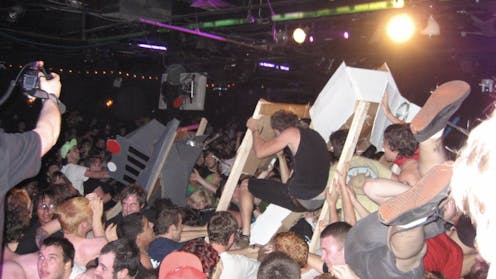
A scene from R.A.M.B.O.’s last-ever show in Philadelphia (before a reunion in 2024) at Starlight Ballroom on May 27, 2007.Joseph A. Gervasi/LOUD! FAST! PHILLY!
I’ve been a fan of punk rock music since I was 15 years old and have been an active member of punk scenes in Philadelphia and Fargo, North Dakota. I still attend punk shows and participate in the scene whenever I can.
Though the “birth” of punk is always a contentious subject, it is fair to say that, with the Ramones forming in 1974 and releasing the “Blitzkrieg Bop” single in February 1976 in the U.S., and the Sex Pistols performing their first show in November 1975 in the U.K., punk is at least 50 years old.
Given this milestone, I believe it’s worth looking back at the heyday of the anarchist-inflected punk scene in Philly in the 1990s and 2000s, and how the political ideology and activism – encouraging opposition to capitalism, government, hierarchy and more – is still influential today.
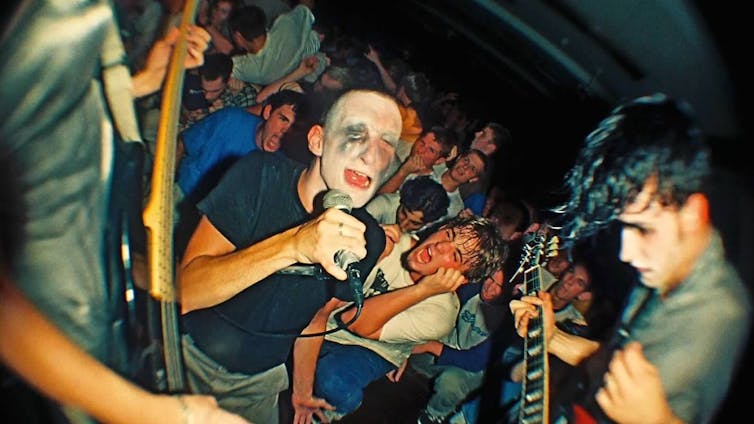
Philly hardcore punk band Ink & Dagger performs at the First Unitarian Church, circa late 1990s. Justin Moulder
‘Not your typical rebellion’
In Philadelphia, and especially in West Philly, a number of collectively organized squats, houses and venues hosted shows, political events and parties, along with serving as housing for punks, in the 1990s and 2000s. In some cases, the housing itself was a form of protest – squatting in abandoned buildings and living cooperatively was often seen as a political action.
Many Philly punks during this era mixed music subculture with social activism. As one anarcho-punk – a subgenre of punk rock that emphasizes leftist, anarchist and socialist ideals – I interviewed for my book told me:
“My mom … said, ‘I thought you were going to grow out of it. I didn’t understand it, and your dad and I were like, ‘What are we doing? She’s going out to these shows! She’s drinking beer!’ But then we’d be like, ‘She’s waking up the next morning to help deliver groceries to old people and organize feminist film screenings!’ We don’t know what to do, we don’t know how to deal with this; it’s not your typical rebellion.’”
This quote captures the complex and ambiguous rebellion at the heart of anarcho-punk. On the one hand, it is a form of rebellion, often beginning in one’s teenage years, that contains the familiar trappings of youth subcultures: drug and alcohol consumption, loud music and unusual clothing, hairstyles, tattoos and piercings.
However, unlike other forms of teenage rebellion, anarcho-punks also seek to change the world through both personal and political activities. On the personal level, and as I showed in my book, many become vegan or vegetarian and seek to avoid corporate consumerism.
“I do pride myself on trying to not buy from sweatshops, trying to keep my support of corporations to a minimum, though I’ve loosened up over the years,” another interviewee, who was also vegan, said. “You’ll drive yourself crazy if you try to avoid it entirely, unless you … go live with [British punk band] Crass on an anarcho-commune.”
Love and rage in the war against war
Philly’s punk activists of that era spread their anarchist ideals through word and deed.
For example, on its 2006 single “War-Coma,” Witch Hunt reflected on the ongoing wars in Iraq and Afghanistan, laying blame on voters, government and religion:
24 years old went away to war / High expectations of what the future holds / Wore the uniform with pride a rifle at hand / Bringing democracy to a far away land / Pregnant wife at home awaiting his return / Dependent on faith, will she ever learn? / Ignore the consequences have faith in the Lord / Ignorance is bliss until reality sets in / Never wake up again
During live performances, bands would commonly discuss what the songs were about. And at merchandise tables, they sold T-shirts and records along with zines, books, patches and pins, all of which commonly contained political images or slogans.
Some bands became meta-critics of the punk scene itself, encouraging listeners to recognize that punk is about more than music.
In “Preaching to the Converted,” Kill The Man Who Questions critiqued the complaints bands would receive for becoming too preachy at shows:
“Unity” the battle cry / Youth enraged but don’t ask why / They just want it fast and loud, with nothing real to talk about / 18 hours in a dying van / Proud to be your background band.
In West Philadelphia, punks also staffed the local food cooperative and organized activist spaces – like the former A-Space on Baltimore Avenue and LAVA Zone on Lancaster Avenue where groups such as Food Not Bombs and Books Through Bars, among others, would operate. I personally organized a weekend gathering of the Northeastern Anarchist Network at LAVA in 2010.
Masked protesters walk away from City Hall after a march on July 30, 2000, a day before the start of the Republican National Convention in Philadelphia. Roberto Schmidt/AFP via Getty Images
Punks raised money for charities and showed up to local protests against capitalist globalization and countless other causes. At the Republican National Convention in Philadelphia in the summer of 2000, black-clad punks whose faces were hidden behind masks marched in the streets along with an enormous cadre of local community organizations.
Punk not dead in Philly
Since punk’s earliest days, people have bemoaned that “punk is dead.”
In Philadelphia, I’ve seen how the anarcho-punk scene of the 1990s and 2000s has changed, but also how it continues to influence local bands and the values of punk rock broadly.
Many former and current members of the Philly anarcho-punk scene are still activists in various personal and professional ways. Among those I interviewed between 2006 and 2012 were social workers, labor organizers, teachers and professors, and school and drug counselors. For many, their professional lives were influenced by the anarchist ethics they had developed within the punk rock scene.
Anarchism and punk rock open up avenues for disaffected youth – in Philadelphia or anywhere else – to dream of a world without capitalism, coercive authorities, police and all forms of injustice.
In the words of R.A.M.B.O., one of the better known hardcore punk bands of the era and who released their latest Defy Extinction album in 2022: “If I can dream it, then why should I try for anything else?”
Read more of our stories about Philadelphia, or sign up for our Philadelphia newsletter.
Edward Avery-Natale does not work for, consult, own shares in or receive funding from any company or organization that would benefit from this article, and has disclosed no relevant affiliations beyond their academic appointment.