Les sanctions économiques doivent être repensées : elles frappent les plus démunis

Source: The Conversation – in French – By Sylvanus Kwaku Afesorgbor, Associate Professor of Agri-Food Trade and Policy, University of Guelph

Les sanctions économiques sont largement considérées par les universitaires et les décideurs politiques comme une alternative préférable aux interventions militaires pour faire pression sur les gouvernements afin qu’ils modifient leurs politiques contestables. L’idée est simple : au lieu d’utiliser les armes, il faut exercer une pression économique sur l’élite au pouvoir jusqu’à ce qu’elle change de comportement.

Le recours aux sanctions économiques n’a cessé d’augmenter. Selon les données récentes de la Global Sanctions Database, le nombre de sanctions actives a augmenté de 31 % en 2021 par rapport à 2020, et cette tendance à la hausse s’est poursuivie en 2022 et 2023.

En Afrique, plusieurs pays font actuellement l’objet de sanctions imposées par les États-Unis, les Nations unies ou l’Union européenne. Parmi ces États africains figurent la République centrafricaine, la République démocratique du Congo, la Guinée, la Guinée-Bissau, le Mali, la Libye, la Somalie, le Soudan du Sud et le Zimbabwe. Ce n’est pas une simple coïncidence si la plupart de ces pays figurent parmi les foyers de faim identifiés par le Programme alimentaire mondial.

Les sanctions peuvent avoir des conséquences imprévues pour les citoyens et ce sont généralement eux qui en paient le prix. Lorsque les sanctions touchent les systèmes alimentaires, l’impact peut être dévastateur.

J’étudie les sanctions économiques et leurs effets négatifs imprévus sur les pays en développement.

Dans une étude récente menée avec mes collègues, nous avons analysé l’impact des sanctions économiques sur la sécurité alimentaire dans 90 pays en développement entre 2000 et 2022. Nous voulions explorer les liens potentiels entre les sanctions et la famine dans un contexte de préoccupation mondiale croissante concernant l’insécurité alimentaire.

Nous nous sommes concentrés sur deux indicateurs clés : les prix des denrées alimentaires et la sous-alimentation (c’est-à-dire la proportion de personnes qui ne consomment pas suffisamment de calories pour mener une vie saine).

Nous avons mesuré les prix des denrées alimentaires à l’aide de l’indice des prix à la consommation des denrées alimentaires de l’Organisation des Nations unies pour l’alimentation et l’agriculture. Cet indice reflète l’évolution du coût global des denrées alimentaires et des boissons non alcoolisées généralement achetées par les ménages.

Nous avons également utilisé le calcul de la prévalence de la sous-alimentation établi par la même organisation. Il s’agit d’un indicateur clé de l’objectif de développement durable 2.1, qui suit les progrès accomplis dans le monde pour éliminer la faim d’ici 2030.

Nos résultats donnent à réfléchir. Lorsque des sanctions sont en place, les prix des denrées alimentaires augmentent d’environ 1,2 point de pourcentage par rapport aux périodes sans sanctions. Cela peut sembler peu, mais dans les pays à faible revenu où les familles consacrent la moitié de leurs revenus à l’alimentation, même de légères augmentations rendent la vie plus difficile. Cela ne tient pas compte d’autres facteurs externes pouvant entraîner des hausses de prix, tels que les modèles de demande et d’offre.

Nous avons également constaté que la sous-alimentation augmente de 2 points de pourcentage pendant les périodes de sanctions. Pour les pays où des millions de personnes vivent déjà au bord de la famine, cela représente un fardeau supplémentaire considérable.

Pourquoi les sanctions aggravent l’insécurité alimentaire

Les sanctions ont des répercussions sur les économies de plusieurs façons, et l’alimentation est souvent prise entre deux feux.

Tout d’abord, les sanctions perturbent les importations alimentaires. Il s’agit d’un problème crucial pour de nombreux pays en développement qui dépendent fortement des marchés internationaux pour nourrir leur population. Entre 2021 et 2023, les importations alimentaires de l’Afrique ont totalisé environ 97 milliards de dollars américains.

Au niveau national, par exemple, l’Éthiopie et la Libye ont importé pour 3 milliards de dollars de denrées alimentaires, le Soudan pour 2,3 milliards et la République démocratique du Congo pour 1,2 milliard. Les sanctions peuvent restreindre davantage le commerce ou augmenter les coûts de transport, rendant les denrées alimentaires à la fois plus rares et plus chères.

Deuxièmement, les sanctions limitent l’accès aux intrants agricoles essentiels, tels que les engrais, les pesticides et les machines. Elles entravent également les transferts de technologie. Par exemple, les agriculteurs d’Afrique subsaharienne n’utilisent en moyenne que 9 kg d’engrais par hectare de terres arables, contre 73 kg en Amérique latine et 100 kg en Asie du Sud. Ces contraintes réduisent les rendements, augmentent les coûts de production et rendent plus difficile le maintien de la production pour les agriculteurs.

Troisièmement, les sanctions ébranlent les systèmes financiers, réduisent les revenus des populations et encouragent la thésaurisation. Les ménages qui disposent déjà d’un budget serré sont contraints de réduire leurs dépenses ou de se tourner vers des aliments moins chers et moins nutritifs.

Enfin, les sanctions entraînent souvent une réduction de l’aide alimentaire, car les pays visés perdent leur accès à l’aide internationale. Par exemple, la récente suspension de l’aide humanitaire américaine au Soudan a contraint 80 % des cuisines d’urgence du pays à fermer. Cet impact est particulièrement grave étant donné que certains des plus grands donateurs alimentaires, tels que les États-Unis et l’Union européenne, sont également parmi les pays qui recourent le plus fréquemment aux sanctions.

Le résultat final est simple : des prix alimentaires plus élevés, moins de nourriture sur la table et plus de famine.

Toutes les sanctions ne se valent pas

Nous avons également constaté que le type de sanction a son importance :

  • Les sanctions commerciales qui bloquent les importations et les exportations sont celles qui font le plus augmenter les prix des denrées alimentaires. Les sanctions financières qui gèlent les avoirs ou coupent l’accès aux services bancaires sont également préjudiciables, car elles perturbent indirectement le commerce agricole.

  • Lorsque les pays sont confrontés à la fois à des sanctions commerciales, financières et de circulation, les dommages sont considérables : les prix des denrées alimentaires augmentent de plus de 3,5 points de pourcentage et la faim augmente fortement.

  • L’identité de l’auteur des sanctions a également son importance. Les sanctions de l’Union européenne ont entraîné la plus forte hausse des prix alimentaires, tandis que celles de l’ONU ont eu le plus grand impact sur la faim, augmentant la sous-alimentation de près de 6 points de pourcentage.

La nourriture comme arme de guerre

L’ONU met en garde depuis des années contre l’utilisation de la nourriture comme arme. En 2018, la résolution 2417 a explicitement condamné la famine comme outil de guerre ou de pression politique. Pourtant, dans la pratique, les sanctions restreignent souvent l’accès à la nourriture, aux médicaments et aux intrants agricoles, même lorsque des « exemptions humanitaires » existent sur le papier.

L’insécurité alimentaire en Afrique s’aggrave. Selon l’Organisation mondiale de la santé, une personne sur cinq sur le continent est confrontée à la faim, et le nombre de personnes sous-alimentées continue d’augmenter. Les sanctions aggravent cette crise.

Et le dilemme moral est évident. Les personnes les plus touchées – les familles pauvres, les petits agriculteurs et les enfants – sont celles qui sont les moins responsables du comportement qui déclenche les sanctions.

Si les sanctions visent à punir les régimes, elles punissent souvent les citoyens ordinaires à la place.

Ce qui doit changer

Les sanctions ne sont pas près de disparaître de la politique mondiale. Mais leur conception et leurs conséquences humanitaires doivent être repensées. Trois mesures pourraient réduire les dommages :

  • Premièrement, renforcer les exemptions humanitaires : veiller à ce que les denrées alimentaires, les engrais et l’aide puissent circuler librement, sans être bloqués.

  • Deuxièmement, suivre l’impact des sanctions : les agences internationales telles que l’Organisation des Nations unies pour l’alimentation et l’agriculture (FAO) et le Programme alimentaire mondial (Pam) devraient surveiller l’impact des sanctions sur les systèmes alimentaires et tirer rapidement la sonnette d’alarme.

  • Troisièmement, repenser la stratégie : si les sanctions finissent par alimenter la faim, l’instabilité et les migrations, elles peuvent faire plus de mal que de bien à long terme.

Si le monde souhaite réellement éradiquer la faim d’ici 2030, il ne peut ignorer les conséquences imprévues des sanctions. Celles-ci doivent donc être repensées afin de protéger les plus vulnérables, sans quoi elles risquent de devenir non seulement un outil diplomatique, mais aussi un facteur de crises alimentaires.

The Conversation

Sylvanus Kwaku Afesorgbor reçoit un financement du ministère de l’Agriculture, de l’Alimentation et de l’Agroalimentaire de l’Ontario (OMAFA). Kwaku est également consultant occasionnel pour la Banque africaine de développement et le Consortium africain de recherche économique. Il est le fondateur exécutif du groupe de réflexion international Centre for Trade Analysis and Development (CeTAD Africa), basé à Accra, au Ghana.

ref. Les sanctions économiques doivent être repensées : elles frappent les plus démunis – https://theconversation.com/les-sanctions-economiques-doivent-etre-repensees-elles-frappent-les-plus-demunis-265928
Close relatives of emperor penguins lived in NZ some 3 million years ago. What caused their extinction?

Source: The Conversation – Global Perspectives – By Daniel Thomas, Honorary Lecturer in Biological Sciences, University of Auckland, Waipapa Taumata Rau

Getty Images

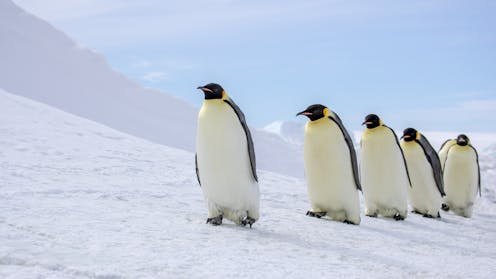
Three million years ago, an extinct relative of todays’s great penguins – emperors and kings – lived in Aotearoa New Zealand.

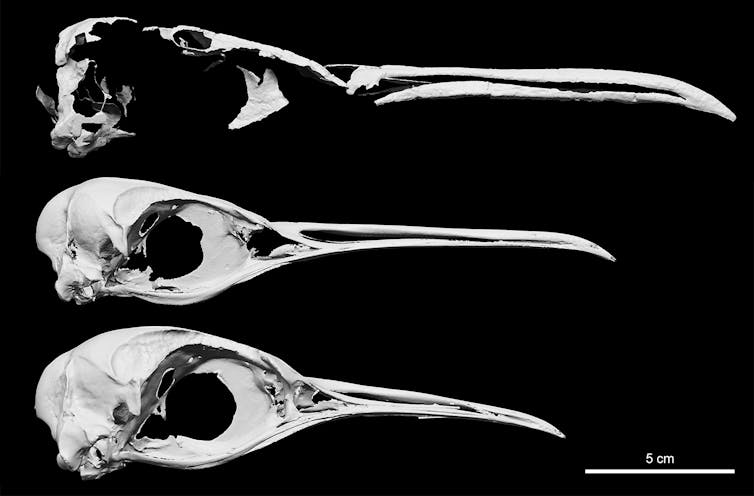
We know this because our new study describes a spectacular fossilised skull of a great penguin found on the Taranaki coast.

Three images of skulls. Top: Fossil great penguin (Aptenodytes). Middle: King penguin. Bottom: Emperor penguin.
The fossil skull (top) of the extinct great penguin in its estimated original shape, in comparison with skulls from a king penguin (middle) and an emperor penguin (bottom).
CC BY-NC-ND

Overall, it is 31% longer than the skull of an emperor penguin (Aptenodytes forsteri), which can be more than a metre tall and weigh upwards of 35 kilograms.

Compared to emperor penguins, however, the Taranaki great penguin had a much stronger and longer beak. It probably looked more like a king penguin (Aptenodytes patagonicus), only much bigger.

At the time, the world was warmer than today. But when the climate cooled, this penguin vanished.

We argue the cold wasn’t to blame because crested and little penguins in New Zealand weathered the same change and remained. Great penguins shifted south and today live in the frozen wastes of Antarctica. So what drove their ancient relative to extinction?

An artistic reconstruction of a fossil penguin
Artist’s impression of the extinct great penguin that lived in New Zealand around three million years ago.
Simone Giovanardi, CC BY-SA

The sediments that now form beach-side cliffs in South Taranaki were deposited at a time when global temperatures were about 3°C above those of the pre-industrial era. Fossils from this period are transforming our understanding of how biodiversity might respond to rising temperatures.

For example, Aotearoa was home to box fish and monk seals, both of which are still (sub)tropical species today. In a strange contradiction, they coexisted with great penguins – now only found in much colder climates – in ancient New Zealand.

The northernmost breeding colonies of king penguins today are around latitude 46.1°S in the subantarctic Crozet Islands, where seawater temperatures reach 3-10°C. From there, it only gets colder towards the higher latitudes where emperor penguins live.

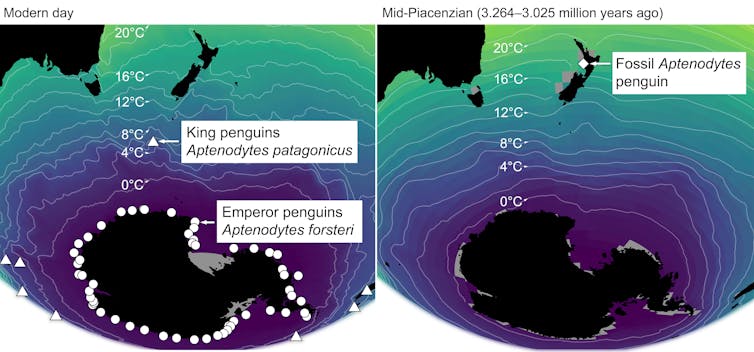
Two maps of the southern hemisphere at different times in Earth history. At left, where great penguins live today; at right, where a fossil Aptenodytes penguin was discovered. Sea surface temperature is represented in different colours.
Today, great penguins are limited to subantarctic islands and the coast of Antarctica (map on the left). But ancient New Zealand was home to an extinct species of great penguin around three million years ago, during a period in Earth’s history known as the mid-Piacenzian Warming Period.
CC BY-SA

Three million years ago, Aotearoa’s great penguins extended as far north as 40.5°S, where South Taranaki was located then. They foraged in waters that were 20°C, much warmer than their relatives experience today.

This balmy existence ended with the Pleistocene ice ages around 2.58 million years ago. Ice extent and sea level shifted back and forward as temperatures fluctuated and ultimately ratcheted downwards. But why would such cooling eradicate giant penguins, which thrive under polar conditions today, from New Zealand?

Giant aerial predators

Fossil evidence for giant penguins in Aotearoa is limited and the exact reasons for their demise remain unclear. Even so, their sheer presence suggests they were less constrained by sea surface temperatures than previously thought. Another mechanism must be at play.

Up until about 500 years ago, Aotearoa was the hunting ground of the giant Haast’s eagle and the huge Forbes’ harrier. These were big raptors. They included large birds like moa in their diet. Their ancestors arrived from Australia inside the last three million years.

Based on what we see with living great penguins, the Taranaki great penguin almost certainly formed large exposed colonies along the coast. These could have been easy targets for a giant eagle or harrier hunting from the air.

By contrast, the smaller penguins still found in Aotearoa today have more cryptic breeding behaviour. They nest in burrows, natural crevices and dense vegetation, and tend to cross beaches at night, which may have helped them avoid aerial predators.

Predation on land is just one hypothesis, though, to help explain why these penguins became extinct in the region while others survived. Other possibilities include changes in the marine environment.

We know that reduced food availability can be devastating for penguins, but it is challenging to see why this would single out the great penguins.

Importantly, our study provides new insight into the habitat tolerances of great penguins. Both king and emperor penguins today can withstand temperatures up to 20°C higher than those they usually forage in.

Three million years ago, their relative experienced such warmth. As the world continues to warm, we need to remember that the geographic range of a species can change as circumstances change.

The marine ecosystem of Aotearoa will move into the habitable zone of many new species, making investigations of the last warm period more important than ever before.


We would like to acknowledge our research co-author Dan Ksepka from The Bruce Museum, Kerr Sharpe-Young for discovering the fossil, and Ngāti Ruanui and Ngāruahine for supporting the collection and research of fossils from their rohe.


The Conversation

Daniel Thomas has received funding from Massey University.

Alan Tennyson and Felix Georg Marx do not work for, consult, own shares in or receive funding from any company or organisation that would benefit from this article, and have disclosed no relevant affiliations beyond their academic appointment.

ref. Close relatives of emperor penguins lived in NZ some 3 million years ago. What caused their extinction? – https://theconversation.com/close-relatives-of-emperor-penguins-lived-in-nz-some-3-million-years-ago-what-caused-their-extinction-265585

Trump’s dip into the Nile waters dispute didn’t settle the conflict – in fact, it may have caused more ripples

Source: The Conversation – Global Perspectives – By Fred H. Lawson, Professor of Government Emeritus, Northeastern University

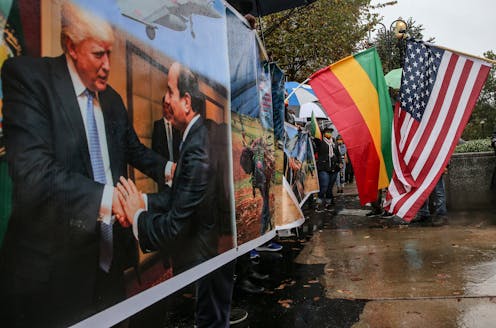
Activists from the Ethiopian community march in protest of Donald Trump’s comments on Ethiopia and the Renaissance Dam on Oct. 29, 2020, in Washington. J. Countess/Getty Images

President Donald Trump chided the United Nations on Sept. 23, 2025, for failing to resolve dangerous international conflicts around the world. “All they seem to do,” he groused during his address to the General Assembly in New York, “is write a really strongly worded letter and then never follow that letter up. It’s empty words, and empty words don’t solve war.”

In contrast, Trump, by his own estimation, has ended a half-dozen serious international conflicts. Among them is the long-standing dispute over the Nile River waters that flared up when Ethiopia proposed to build a massive dam over the Blue Nile, threatening the water supply of Egypt and Sudan.

As an international relations scholar who has studied this dispute, however, I find it hard to see how Trump’s interventions have brought it any closer to a resolution. In fact, they most likely made things worse.

The source of the dispute

Nile River water is essential to agriculture and public sanitation in both Egypt and Sudan. Distribution of that water has been regulated by an agreement drawn up in 1959 guaranteeing Egypt and Sudan most of the output of the Nile River basin. A body of international law also enjoins upstream nations – such as Ethiopia – against manipulating the cross-border flow of rivers in ways that harm downstream countries.

Ethiopia nonetheless declared in 2011 that it had the right to exploit any water resources that originate inside its borders. It further insisted that constructing an electricity-generating dam across the Blue Nile would provide cheap power to both impoverished Ethiopians and neighboring countries.

Egypt and Sudan immediately protested on the grounds that the project would inflict severe damage on their populations and implored international organizations and external powers to intervene.

Ambiguous wording

Trump waded into the Nile dispute at the urging of Egypt. Cairo approached Washington to mediate in late October 2019, as Ethiopia was ramping up construction of the Grand Ethiopian Renaissance Dam that would restrict the flow of the Blue Nile. After speaking personally with Egypt President Abdel Fattah el-Sissi, Trump agreed to become directly involved.

He and then-Secretary of the Treasury Steven Mnuchin invited the foreign ministers of Egypt, Sudan and Ethiopia to Washington for talks.

With the opening session of the ensuing November 2019 meeting still ongoing, Trump tweeted: “The meeting went well and discussions will continue during the day!”

The talks, however, ended with no progress being made. Instead, all four parties, along with representatives of the World Bank, agreed to confer a dozen more times over the next three months to hash out technical matters.

At these subsequent meetings, Egypt and Ethiopia haggled over definitions and measurement criteria concerning the dam’s possible impact. Mnuchin and his staff largely stood aside, although they reportedly expressed sympathy for Addis Ababa’s insistence that matters concerning the Grand Ethiopian Renaissance Dam be kept separate from questions concerning water management in the Nile Basin as a whole.

More importantly, U.S. representatives allowed imprecise wording to slip into the
statement released at the close of the December 2019 meeting.

The statement mandated that “the implementation of these technical rules and guidelines for the filling and operation of the dam will be undertaken by Ethiopia, and may be adjusted by the three countries.”

Cairo interpreted this to mean that all regulations and procedures would be drawn up jointly; Addis Ababa believed that it enshrined Ethiopia’s right to make decisions entirely on its own.

Talks blow up

The final round of talks in January 2020 produced a prospective agreement that left Ethiopia free to start filling the huge reservoir behind the dam, and minimized the country’s obligations to assist Egypt and Sudan during drought periods.

Yet, Ethiopia dragged its feet in accepting the draft document, claiming that crucial points remained unsettled. Egypt and Sudan flatly refused to revisit problems they believed had already been addressed, but did accept an offer from U.S. Treasury officials to prepare a revised text.

In February 2020, the U.S. Treasury Department circulated an amended version, and Trump telephoned al-Sissi to express hope that “an agreement would be finalized soon.”

Ethiopia, feeling pressured by Egypt and the U.S. to endorse an incomplete text – and worried about the domestic political consequences of doing so – did not send a representative to Washington to accept the revision. Treasury officials then declared that a comprehensive settlement to the dispute had now been reached and publicly called on Addis Ababa to sign it.

Egypt’s foreign ministry issued a statement asserting that “President Trump affirmed the U.S. administration’s continued efforts” to reach an acceptable deal. But Ethiopia’s foreign minister described Washington’s abrupt declaration as “undiplomatic.”

Ethiopia stalled for another two months, then circulated a provisional agreement of its own, which Egypt and Sudan dismissed out of hand.

Washington responded with insinuations that it would withhold economic assistance from Ethiopia unless Addis Ababa signed the agreement the Treasury Department had drafted in February 2020. Meanwhile, construction on the dam proceeded, and in July Ethiopia blocked the flow of the Blue Nile to begin filling its huge reservoir.

In September 2020, then-Secretary of State Mike Pompeo followed through on the U.S. threat and suspended US$130 million of aid to Ethiopia. However, the suspension had no impact on negotiations.

Incensed at the continuing impasse, Trump in October 2020 remarked during a telephone call with Sudanese and Israeli diplomats that Egypt “will end up blowing up the dam.”

Ethiopian officials condemned the outburst. The prime minister’s office complained that “these threats and affronts to Ethiopian sovereignty are misguided, unproductive and clear violations of international law.” Ethiopia installed anti-aircraft batteries around the dam and declared the airspace above it a no-fly zone.

Negotiations collapsed, and they remained dormant for the next three years.

Two men seated chat surrounded by flags.
Egyptian President Abdel-Fattah el-Sissi meets Donald Trump during the United Nations General Assembly in September 2019.
AP Photo/Evan Vucci

Assessing the impact of US mediation

Analysts tend to agree that Trump’s initial involvement in the Nile River dispute made a bad situation worse. His admiration for authoritarian leaders prompted him to accommodate Egypt’s al-Sissi and put U.S. credibility on the line.

Meanwhile, Trump’s contempt for the professionals in the U.S. State Department led him to sideline the diplomatic corps and entrust a complicated assignment to Mnuchin, a former financier and movie producer. And his lack of patience and blunt language disrupted the negotiations, alienating Egypt and Ethiopia alike.

Addis Ababa continues to insist that it “has no obligation to request permission from anyone to fill the Renaissance Dam.” In September 2025, Prime Minister Abiy Ahmed declared that work on the dam had finished and boasted of two other dams on the Blue Nile nearing completion.

Meanwhile, Egypt has opened a large naval base on the Red Sea coast and attached
its most advanced warships to a newly created Red Sea squadron. In July 2025, Egypt Foreign Minister Badr Abdelatty issued a veiled threat to use military means to settle the Nile dispute.

Despite rising tensions, and his first administration’s failure to make progress on the issue, Trump continues to point to his 2019-2020 mediation as a success.

In July 2025, he told NATO Secretary General Mark Rutte that a resolution lay just around the corner. President al-Sissi once again applauded the president’s involvement and voiced hope that it would produce a “just agreement.”

Yet there is little indication that the current Trump administration is in any better position to solve the Nile River dispute than was the previous one. Since Trump’s second inauguration, experienced State Department officials have been fired or resigned, leaving sensitive diplomatic missions in the hands of private businesspeople with personal ties to the president, rather than diplomats skilled in the art of negotiating intractable disputes among sovereign states.

This development seems unlikely to budge Trump from the conviction that he has already solved the conflict over the Nile River waters – and can somehow do it again.

The Conversation

Fred H. Lawson does not work for, consult, own shares in or receive funding from any company or organization that would benefit from this article, and has disclosed no relevant affiliations beyond their academic appointment.

ref. Trump’s dip into the Nile waters dispute didn’t settle the conflict – in fact, it may have caused more ripples – https://theconversation.com/trumps-dip-into-the-nile-waters-dispute-didnt-settle-the-conflict-in-fact-it-may-have-caused-more-ripples-263767

Travailler assis ou debout ? Pour la productivité et pour la santé, mieux vaut alterner

Source: The Conversation – in French – By Cédrick Bonnet, Chargé de recherche CNRS, spécialiste dans l’influence des positions du corps sur Comportement, Cognition et Cerveau, Université de Lille

Des travaux de recherche révèlent que la position debout améliore l’attention visuelle. Ce constat plaide en faveur de l’alternance des stations assise et debout au cours de la journée de travail. Prendre cette habitude permettrait aussi de lutter contre les effets délétères pour la santé résultant du maintien sur une trop longue période de l’une ou l’autre des deux positions.


Depuis la fin de la Deuxième Guerre mondiale, la mécanisation, le confort accru, l’ordinateur, Internet et le télétravail entre autres ont considérablement augmenté le temps que nous passons assis.

Aujourd’hui, plus de la moitié de la population de la planète est quotidiennement assise plus de 50 % du temps, ce qui représente plus de 8 heures par jour. Plus grave encore, les personnes qui travaillent en bureau sont assises entre 65 et 85 % de leur journée, ce qui représente de 11,2 à 12,8 heures par jour, et le temps passé assis continuera à augmenter au moins jusqu’à 2030.

On sait que ces changements ne sont pas sans conséquence pour notre santé. Il a notamment été démontré que l’augmentation de la sédentarité est associée à un risque accru de maladie cardiovasculaire, de diabète de type 2, de cancer, d’obésité, d’anxiété ou de dépression. Mais ce n’est pas tout, il semblerait que notre position ait également un impact sur notre productivité.

Dans notre équipe de recherche, au SCALab, nous avons émis l’hypothèse qu’une personne en bonne santé (autrement dit, dans ce contexte, ne rencontrant pas de problème pour se tenir debout) devrait réaliser de meilleures performances debout qu’assise, ceci tant que la fatigue en position debout n’est pas excessive. Les résultats que nous avons obtenus jusqu’ici le confirment. Explications.

Notre posture influe-t-elle sur notre efficacité ?

Au cours d’une journée, les individus adoptent trois types de position du corps : allongée pour dormir, debout pour bouger et plus ou moins pliée, pour s’asseoir notamment.

Pour comprendre pourquoi nous pourrions être plus efficaces debout qu’assis, il faut savoir que, pour fonctionner au mieux, nos systèmes sensoriels et attentionnels ont besoin de stimulations, d’accélérations et de perturbations. Or, si, en position debout, notre corps oscille sans arrêt et doit continuellement contrôler son équilibre pour ne pas tomber, en position assise, il n’est pas perturbé de la sorte.

Ces dernières années, notre équipe de recherche a conduit plusieurs projets de recherche pour valider notre hypothèse. Dans un article récemment accepté pour publication, nous avons demandé à 24 jeunes adultes de réaliser six fois une tâche d’attention (« Attention Network Test ») en alternant les positions du corps (assis, debout), et six fois cette même tâche seulement en position assise.

Les résultats obtenus montrent que l’attention visuelle des participants est meilleure en alternant les positions du corps qu’en restant tout le temps assis. En outre, les participants réalisaient la tâche plus rapidement (avec des temps de réaction plus courts) quand ils étaient debout dans la condition d’alternance.

Dans un second article récent, nous avons demandé à 17 jeunes adultes sains de réaliser la même tâche d’attention (« Attention Network Task ») soit assis, soit debout. Nous avons testé si c’était le fait de devoir contrôler et ajuster l’équilibre debout, et pas uniquement le fait d’être debout, qui peut expliquer de meilleures performances debout qu’assis.

Les analyses ont effectivement montré que plus les oscillations des participants étaient complexes, plus leur temps de réaction était raccourci (corrélation de Pearson négative significative) et plus leur score d’alerte (tiré de la tâche d’attention) était élevé. Par définition, le score d’alerte reflète la capacité d’un individu à préparer et à maintenir un état d’alerte afin de répondre rapidement à un stimulus attendu.

Ces résultats indiquent que les individus complexifient leurs oscillations posturales debout de façon à améliorer leur performance à la tâche d’attention. On peut supposer qu’en position assise, tout individu serait moins (voire, ne serait pas) capable de complexifier ses oscillations justement parce qu’il n’a pas à contrôler son équilibre.

En 2024, nous avons demandé à 24 jeunes adultes sains de réaliser une tâche de Stroop modifiée dans quatre positions du corps différentes : debout contre un mur ; debout naturellement avec les pieds serrés ; avec les pieds normalement écartés ; avec les pieds légèrement plus écartés que d’habitude.

Les résultats obtenus révèlent l’existence d’une corrélation significative entre le nombre de cibles bien trouvées dans cette tâche de Stroop et des variables d’oscillations de la tête et du centre de pression (le point d’application de la résultante des forces de réaction au sol exercées par les pieds sur le sol). Autrement dit, plus les participants oscillaient (en rapidité et en amplitude) et meilleure était leur performance à bien trouver les cibles dans cette tâche de Stroop modifiée.

En résumé, ces trois études menées en laboratoire sont en accord avec notre hypothèse initiale. La position debout optimise la performance à des tâches d’attention visuelle de courtes durées.

Nos résultats sont également en ligne avec ceux d’autres scientifiques. En effet, plusieurs investigateurs ont déjà montré que les performances aux tâches d’attention et de Stroop modifiées étaient meilleures debout qu’assis. En outre, d’autres études ont révélé que l’alternance assis-debout amène des résultats significativement meilleurs que la position assise seule. Enfin, des travaux ont montré que la productivité à long terme était meilleure en alternant les positions assise et debout.

En effet, l’attention décline de plus en plus à mesure que l’on reste assis, alors qu’elle reste plus élevée en position debout – surtout dans les trente premières minutes d’une tâche. Ce résultat est important, car il suggère que l’individu ne devient pas meilleur en étant debout qu’en restant assis, mais plutôt qu’il évite un déclin de performance en se mettant debout.

Vaut-il mieux travailler debout ou assis ?

La majorité des travaux publiés révèle que les performances en position assise sont identiques à celles en position debout quand les tâches durent moins de dix minutes. En revanche, les performances en position debout peuvent être meilleures qu’en position assise lorsque les tâches durent entre dix et trente minutes. Entre trente minutes et une heure et demie (soit quatre-vingt-dix minutes), les performances dans les deux positions redeviennent équivalentes. Au-delà d’une heure et demie, les performances devraient logiquement être moins bonnes debout qu’assis, mais aucune recherche ne l’a encore montré jusqu’à présent à notre connaissance.

Pour toutes ces raisons, selon nous, la meilleure dynamique posturale à adopter pour optimiser les performances et la productivité est d’alterner fréquemment les positions du corps, en les maintenant chacune de 15 à 30 ou 45 minutes.

Il faut souligner que la dynamique posturale a non seulement des conséquences sur la performance et la productivité, mais aussi sur la santé. On savait déjà que rester debout excessivement longtemps est très problématique pour la santé. Depuis une vingtaine d’années plus particulièrement, les travaux de recherche ont aussi révélé que la station assise excessive est également très problématique pour la santé.

Elle accroît en effet le risque de mort prématurée, ainsi que celui d’être affecté par diverses maladies chroniques graves : cancer, diabète, maladies inflammatoires, musculaires, vasculaires chroniques, attaque cardiaque).

La station assise excessive a aussi été associée à une augmentation du surpoids et de l’obésité, ainsi qu’au développement des troubles du sommeil et à des problèmes cognitifs. Par ailleurs, on sait qu’être sédentaire a également des effets sur le psychisme, accroissant non seulement le risque de dépression, mais aussi celui d’avoir une moins bonne vitalité au travail.

Notre synthèse de la littérature révèle que pour limiter le risque de survenue de ces problèmes de santé, les individus devraient tous les jours rester quasiment autant debout qu’assis – autrement dit, ils devraient passer 50 % du temps debout.

Alterner au fil de la journée les postures assises et debout toutes les 15 à 45 minutes permettrait non seulement d’améliorer la productivité, mais aussi de réduire les conséquences pour la santé. Cela permet en effet d’augmenter le temps passé debout tout au long de la journée en évitant au mieux la fatigue.

Pour y parvenir, il faudrait équiper les travailleurs de bureaux assis/debout. Ceux-ci sont déjà adoptés dans de nombreux pays dans le monde, notamment aux États-Unis, au Canada, en Australie, en Chine ou en Europe du Nord. Pour aider les utilisateurs à adopter une dynamique posturale bénéfique ou optimale, l’emploi de tels bureaux devrait être couplé à une application « assis-debout » destinée à guider les utilisateurs. Malheureusement, l’offre en matière d’applications – y compris celle proposée par des objets connectés tels que montres, smartphones ou bureaux connectés – est encore imparfaite à l’heure actuelle. Afin d’y remédier, notre équipe est en train de développer une telle application.

The Conversation

Cédrick Bonnet ne travaille pas, ne conseille pas, ne possède pas de parts, ne reçoit pas de fonds d’une organisation qui pourrait tirer profit de cet article, et n’a déclaré aucune autre affiliation que son organisme de recherche.

ref. Travailler assis ou debout ? Pour la productivité et pour la santé, mieux vaut alterner – https://theconversation.com/travailler-assis-ou-debout-pour-la-productivite-et-pour-la-sante-mieux-vaut-alterner-265209

The crisis of Indonesian policing: Guardians of the people or protectors of power?

Source: The Conversation – Indonesia – By Perdian Tumanan, PhD Candidate in Ethics and Religion, Villanova School of Law

The death of 21-year-old Indonesian online delivery driver Affan Kurniawan, who was crushed by a Barracuda police vehicle during a protest, invites comparisons to George Floyd. The African American was killed by a police officer in Minneapolis in 2020, sparking global Black Lives Matter protests.

One thing unites both cases: they reflect arbitrary violence by those sworn to protect the people.

Policing in the two countries differs greatly in its context: while police in the US are deeply tied to political elites and economic power, the Indonesian police were, in principle, established to serve the people.

Yet this shared pattern of civilian killings raises a pressing question: who are the Indonesian police really protecting?

American police: Guardians of the elites

Alex Vitale, a leading scholar on American policing, argues in his influential book The End of Policing that the roots of American policing are inseparable from three foundational systems of inequality in the 18th century: slavery, colonialism, and the control over the emerging industrial working class.

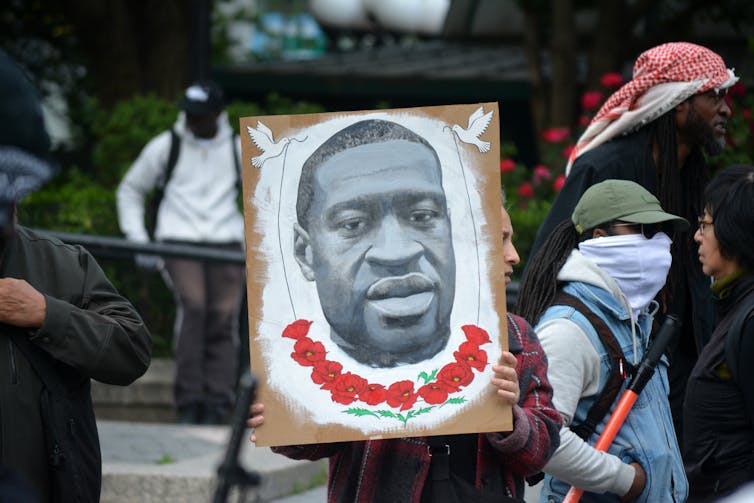
The commemoration of George Floyd’s killing by Minneapolis police at Union Square in Midtown Manhattan. May 25, 2025.
Christopher Penler

In other words, the American police were not originally created to reduce or prevent crime. Rather, as in many Western nations, they emerged to protect elite interests and maintain control over the working class.

The police thus functioned less as protectors of the public and more as instruments of social control. In essence, they served political elites and economic powers in defending a status quo that favoured them — a legacy that continues to shape the U.S. legal and security system today.

According to Vitale, in such a society, equality existed only among the elites, while the broader nation became a policed society. In this context, crime was defined less by moral conduct than by a person’s socio-economic standing.

For the enslaved and the poor, political rights were nonexistent, and even free expression was unimaginable. Any protest against this imposed order was swiftly branded a crime and harshly punished.

Vitale argues that law enforcement is increasingly armed not only to control the public and instil fear, but also to shield themselves from their own fear of being attacked by the very people they are meant to protect.

This cycle of reciprocal fear persists because the police are never truly connected to, nor in solidarity with, the communities they police.

In such a system, fear governs daily life. It does not flow in just one direction but operates reciprocally — something clearly reflected in the very equipment the police carry.

Indonesian police: Once protectors of the people

I once asked my professor why police officers in the United States always carry guns, even in sacred spaces like churches.

I explained that in Indonesia, the mere presence of guns — regardless of who carries them — instils fear

The Indonesian Police's Mobile Brigade Unit spark public outcry after an officer runs over a civilian, killing him.
Protesters gather in front of the Mobile Brigade Police Headquarters, Jakarta, August 29, 2025.
Wulandari Wulandari/Shutterstock

He replied that police carry guns as a precaution, driven by fear of being attacked.

I then showed him photos of Indonesian police mingling freely with civilians, unarmed and unafraid. Intrigued, he asked how this was possible.

I explained that while Indonesian policing partly inherited its structure from the Dutch colonial apparatus, but it earned legitimacy during the nationalist struggle for independence.

In that struggle, the early police were closely tied to ordinary people, giving them a sense of belonging to the society they served.

This rootedness set them apart from the militarised culture of Western policing, where trust is absent. In Indonesia, the police and the people are inseparable — essentially one.

The social media post comparing Affan’s death to that of George Floyd raises a deeper question: whom do the Indonesian police truly serve today?

Once seen as protectors of the people, the police now increasingly appear aligned with elite interests. Public dissatisfaction is growing, fueled by recurring patterns of violence used to silence dissent, facilitate land dispossession, and suppress indigenous communities.

This perception is further reinforced by the conspicuous wealth displayed by some officers and their families, raising serious questions about integrity and accountability.

These realities deepen a crisis of trust, eroding the very foundations of police legitimacy in a democratic society.

A tool of repression

Affan’s death starkly symbolizes the police’s shift from protecting the people to serving elite interests — a perception reinforced when President Prabowo Subianto, instead of apologising or holding the institution accountable, chose to promote the officers who oversaw the protest.

Indonesian police are involved in a riot with protesters.
A police officer directing traffic at the Tugu Jogja intersection in Yogyakarta.
Rembolle/Shutterstock

Such actions deepen public wounds and confirm suspicions that the police now serve rulers rather than citizens. If this course continues, they will stray even further from their democratic mandate and erode the very trust on which their legitimacy rests.

The Indonesian police must reflect on their roots in the people and heed Vitale’s reminder: policing should not merely serve as a tool of elite power and crime control, but as a force rooted in morality and ethical authority.

If the police forget their roots among the people, they risk ceasing to be guardians of justice and becoming nothing more than guardians of power.

At that point, public trust will collapse. The democratic mandate that once gave birth to the police will be hollowed out, and the institution will no longer be seen as a friend of the people, but as an instrument of repression.

If Indonesia’s police do not have the courage to return to their true calling, the gulf between them and the people will only deepen, leaving behind an institution stripped of legitimacy.

The Conversation

Perdian Tumanan tidak bekerja, menjadi konsultan, memiliki saham, atau menerima dana dari perusahaan atau organisasi mana pun yang akan mengambil untung dari artikel ini, dan telah mengungkapkan bahwa ia tidak memiliki afiliasi selain yang telah disebut di atas.

ref. The crisis of Indonesian policing: Guardians of the people or protectors of power? – https://theconversation.com/the-crisis-of-indonesian-policing-guardians-of-the-people-or-protectors-of-power-264342

Mushrooms may have been part of early human diets: primate study explores who eats what and when

Source: The Conversation – Africa (2) – By Alexander Piel, Asso. Professor in Anthropology, University College London, UCL

Mushrooms may not be the first food that comes to mind when we imagine the diets of wild primates – or our early human ancestors. We tend to think of fruits and green leaves as the preferred foods for monkeys and apes.

But our new study from the Issa Valley in western Tanzania highlights a surprising, and potentially crucial, role for fungi in primate diets.

For nearly two decades, our work has centred on what it means to be a savanna-woodland primate in east Africa. Far from their forest-dwelling cousins, these populations are exposed to higher temperatures, as well as woodland and grassland vegetation where they can find food – or be in danger from predators like wild dogs and hyenas.

Broadly, we are interested in competition between species. For example, how do baboons and smaller monkeys avoid larger (and predatory) chimpanzees when looking for ripe fruits? Mushrooms may provide an answer.

We found that while all three primate species under study consumed mushrooms, their use and reliance differed throughout the year. Mushrooms were seasonally important for red-tailed monkeys and chimpanzees, becoming a fall-back food when ripe fruit was scarce, despite overall making up only 2% of their diet. For baboons, mushrooms were a preferred food, with fungi forming more than a tenth of their diet despite being available for only half the year.

Our findings not only shed light on the way that primates rely on and respond to their environment, but also hint at the evolutionary roots of human mycophagy (mushroom eating). Fungi have been overlooked in research into ancient diets because they don’t fossilise well and leave little trace in the archaeological record.

By examining which foods are consumed by primates, we can better reconstruct scenarios of how early human species may have competed with one another.

Issa fungi foraging

Over four years, we observed three co-inhabiting species – chimpanzees, yellow baboons and red-tailed monkeys – regularly consuming mushrooms.

We used over 50,000 observations of feeding among the three species and found that mushroom consumption wasn’t just incidental. While chimpanzees and red-tailed monkeys ate mushrooms mostly during the wet season, when availability peaked, baboons consumed mushrooms far longer, even when they were relatively scarce.

In fact, for two months of the year, mushrooms made up over 35% of baboons’ diets, suggesting they are a preferred food, not just consumed during fruit-scarce periods, as we suggest for the chimpanzees and red-tailed monkeys.

Chimpanzees and red-tailed monkeys, in contrast, treated mushrooms as a seasonal supplement, valuable when fruits were less abundant. This nuanced difference suggests that mushrooms play different roles within this primate community, depending on ecological strategies and competition dynamics.

Avoiding conflict through fungi

One of the most intriguing ideas to emerge from our study is the concept of niche partitioning: how animals adapt their diets to minimise competition. This is a well-established phenomenon which can manifest in various ways, from bird species occupying different canopy heights, to carnivores targeting different prey.

In habitats where multiple species coexist, finding one’s own food niche can be the key to survival. At Issa, baboons, chimpanzees and guenons (monkeys) might all be using mushrooms in strategic ways to improve feeding efficiency and reduce tension with each other as they respond to periods when (preferred) ripe fruits are insufficient for all three species.

What does this mean for us?

The implications of these findings stretch far beyond western Tanzania. First, they highlight how mushrooms can serve as a rich, seasonal food source, even for large mammals, providing protein, micronutrients and potentially medicinal benefits. This lends support to theories that fungi may have played a significant role in the diets of early hominins.

In fact, the habitat of Issa is thought to resemble the kind of mosaic woodland landscape where human ancestors evolved. If our primate relatives today are exploiting fungi in this environment, it’s plausible that Australopithecus, Homo habilis and other early human species did too.

Despite this, fungi are often overlooked in reconstructions of ancient diets, largely because they don’t fossilise well and leave little trace. Yet ancient DNA from Neanderthal dental plaque from about 40,000 years ago has revealed traces of mushrooms, tantalising clues that fungi may have been more central to prehistoric life than previously believed.

A caution and a call

The study also raises important questions about human-wildlife coexistence. In many parts of Tanzania, mushrooms are harvested by people and sold in local markets. As climate change and human population growth put pressure on wild resources, competition between humans and wildlife over edible fungi may increase. Understanding who eats what and when could help in managing these shared resources sustainably.

At a time when biodiversity is under threat and food security is a growing global concern, this research reminds us that hidden treasures like wild mushrooms aren’t just tasty; they’re significant for ecology and evolution.

Fungi can add to our understanding of where we came from and how we might share our ecosystems going forward.

The Conversation

Alexander Piel receives funding from the Salk/UCSD Center for Academic Research and Training in Anthropogeny and the Department of Human Origins, Max Planck Institute for Evolutionary Anthropology. He is an associate researcher with MPI-EVA.

Fiona Stewart receives funding from the Salk/UCSD Center for Academic Research and Training in Anthropogeny and the Department of Human Origins, Max Planck Institute for Evolutionary Anthropology. He is an associate researcher with MPI-EVA.

ref. Mushrooms may have been part of early human diets: primate study explores who eats what and when – https://theconversation.com/mushrooms-may-have-been-part-of-early-human-diets-primate-study-explores-who-eats-what-and-when-264089

Repatriation or political theatre? How the return of stolen artefacts can distort history

Source: The Conversation – Global Perspectives – By Will Brehm, Associate Professor of Comparative and International Education, University of Canberra

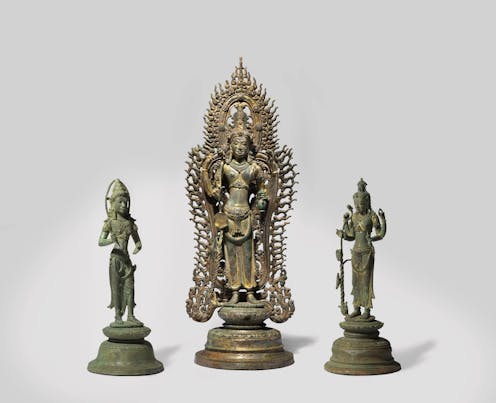
Champa Kingdom, Avalokiteshvara Padmapani, Vajrapani and Avalokiteshvara Padmapani, 9th­­–11th century, National Gallery of Australia, Kamberri/Canberra, Acquired 2011, deaccessioned 2021, repatriated 2023, On loan from the Kingdom of Cambodia, 2023–2026

In late July, during a visit to the National Gallery of Australia, three Buddhist bodhisattva statues caught my attention.

All three were created in the ancient Champa Kingdom that flourished from the 2nd to 19th centuries across present-day Vietnam, Cambodia and Laos. They were purchased by the National Gallery (NGA) in 2011, before being “repatriated” to the Kingdom of Cambodia in 2023 (and displayed in the NGA on loan).

But the Champa Kingdom bore little resemblance to Cambodia’s current borders. What does repatriation mean when the political geography of a place has entirely transformed?

As my research has shown, museums, schools and state institutions can help sanction certain versions of history, while marginalising others. The quiet presence of the bodhisattvas in a museum case embodies much larger questions about cultural heritage, political legitimacy, and who gets to define historical “truth”.

The
three sculptures were made between 9th-11th centuries in the Champa Kingdom.

Author provided

Decades of marginalisation

The decision to return the Cham artefacts to Cambodia, and to exclude Vietnam and Laos, highlights how contemporary politics shape our understanding of cultural heritage.

The Cham people are an ethnic minority in Cambodia, Vietnam, and Laos. In Cambodia, they have been marginalised by the ruling government’s Khmer ethno-nationalist vision of the country.

Although most Cham people today are Muslim, the statues were made between the 9th and 11th centuries during a pre-Islamic era. This period was marked by strong Hindu and Buddhist influence, and a lack of nation-state borders.

After receiving the repatriated statues in 2023, Cambodian Ambassador to Australia, Cheunboran Chanborey, said:

Indeed, putting looted artefacts to their countries of origin can have significant and positive impacts on local communities and their involvement in preserving their cultural heritage. It can foster a sense of pride, national identity and cultural continuity as artefacts hold immense value for the communities to which they belong.

But the very cultural tradition that created the bodhisattvas now finds itself sidelined in a modern nation-state claiming ownership of them.

Lootings by the Khmer Rouge

The historical context of how the Cham poeple’s artefacts were looted is crucial and disturbing.

Journalist Anne Davies’ account in the NGA’s documentation notes organised looting networks were “often headed by members of the military or the Khmer Rouge”. The Khmer Rouge was the political party that ruled Cambodia from 1975–79 under the notorious Pol Pot, carrying out a genocide of the Cham people (as well as other ethnic groups).

However, this looting actually took place in the 1990s, after the Khmer Rouge was overthrown by the precursors to the present-day Cambodian People’s Party.

In other words, the looting happened on the current government’s watch. Davies writes “members of the military” of the Royal Cambodian Armed Forces worked with former Khmer Rouge soldiers who continued to occupy parts of northern Cambodia, especially areas protected by thick forest.

Looted artefacts moved from the hands of former Khmer Rouge members to the Cambodian military, and eventually to international markets.

A revealing 2009 photograph shows Douglas Latchford, the antiquities dealer who sold the statues to the NGA, examining artefacts at the National Museum of Cambodia, alongside Sok An, the then-deputy prime minister of the Cambodian People’s Party. Latchford is wearing a medal signifying Cambodian knighthood, suggesting a collaborative relationship.

The 2009 photo, with Cambodia’s then-deputy prime minister Sok An (left) and British Khmer art collector Douglas Latchford (centre). Before his death in 20202, Latchford was implicated in the illegal trade of antiquities.
Tang Chhin Sothy/AFP via Getty Image

Parallels to other illegal trades

After retreating to border forests in 1979, the Khmer Rouge began systematic, illegal timber logging, selling the wood throughout Thailand and Cambodia. Global Witness has documented how the ruling elites in both countries have profited substantially from this trade.

The connections between logging and looting are striking: both involved illegal acts by former Khmer Rouge soldiers that ultimately enriched ruling parties.

When I saw photos of the Cambodian Ambassador to Australia formally receiving the repatriated statues in 2023, the irony was inescapable. His party, the Cambodian People’s Party, was likely complicit in the original theft.

Historical context transforms repatriation’s meaning. Rather than restoring cultural heritage to rightful guardians, these ceremonies may serve as elaborate exercises in political laundering, allowing those who profited from cultural destruction to rebrand themselves as cultural preservationists.

A new framework

The implications of this extend far beyond Cambodia. In a world where borders have been redrawn countless times, and where many cultural traditions transcend boundaries, we need new frameworks for thinking about cultural heritage.

The NGA says it followed the Protection of Movable Cultural Heritage Act 1986 in returning the bodhisattvas to Cambodia. But the wall text for the statues acknowledges their complexity:

While the works were almost certainly created in Vietnam […] the archaeological site where they were found is in Cambodia.

The wall text at the gallery explains how the statues were acquired by Douglas Latchford, before being sold to the NGA and eventually repatriated.
NGA

The statutes were found in a different country from where they were created because the borders of those territories shifted over time.

Borders in the Mekong region of Southeast Asia have long been porous. It was only in 2012 that the last border marker between Cambodia and Vietnam was agreed on. We have also seen recent fighting over the Cambodian–Thai border.

Contested sovereignty remains a live political issue affecting how we understand cultural heritage. Is country of “origin” determined by where objects were created, or where they were discovered?

Perhaps genuine cultural justice requires acknowledging complexity rather than seeking simple solutions. Instead of asking which modern nation-state deserves these artefacts, we might ask: how can cultural heritage serve all peoples who share connections to it?

The three bodhisattvas remind us repatriation is never simply about returning objects to their “rightful” place. It’s about who gets to define that place, whose version of history becomes officially sanctioned, and whether cultural justice might sometimes serve to obscure, rather than remedy, historical injustice.

The Conversation

Will Brehm does not work for, consult, own shares in or receive funding from any company or organisation that would benefit from this article, and has disclosed no relevant affiliations beyond their academic appointment.

ref. Repatriation or political theatre? How the return of stolen artefacts can distort history – https://theconversation.com/repatriation-or-political-theatre-how-the-return-of-stolen-artefacts-can-distort-history-265290

Warn, hide or stand out? How colour in the animal world is a battle for survival

Source: The Conversation – Global Perspectives – By Iliana Medina, Lecturer in Ecology, The University of Melbourne

The animal world is incredibly colourful, and behind this colour palette is a constant game of survival.

Most animals use camouflage, covering themselves in stealthy patterns to hide from predators. Others display bright and bold colours to warn potential predators they are not a good meal. This second strategy is known as aposematism or warning colouration. Although less common than camouflage, it has evolved hundreds of times in butterflies, beetles, bugs, sea slugs, poison frogs and even birds.

One long-standing question is why species use one of these strategies over the other. Is one of these strategies usually more successful? Under which specific circumstances does one strategy beat the other? Our new study, published today in Science, helps answer these questions.

A grey and brown moth on a grey and brown branch.
The hawk moth (Psilogramma casuarinae) has extraordinary camouflage.
Damien Esquerre

Testing multiple theories

Both camouflage and aposematism can co-exist in the same region. In Australia, for example, there are many examples of camouflaged insects such as the spotted predatory katydids and the lichen spiders.

On the other hand, species such as the cotton harlequin bug – a common stink bug found in urban areas – and the handmaiden moth display bright orange and red colours to advertise to predators they are not a pleasant meal. Some animals (but fewer) such as mountain katydids even use both strategies by changing colour, or hiding and revealing colourful patches.

A skinny brown and green spider camouflaged on a tree.
The Australian lichen spider (Pandercetes gracilis) hiding on a skinny tree trunk.
Kate Umbers

There are dozens of theories about why some species are camouflaged instead of warningly coloured, and it is a challenge to pull these ideas apart.

Small localised studies have independently tried to test the effect of different factors separately. For example, we know light levels are important in the success of camouflage strategies. We also know the success of warning colouration often relies on predators having experienced the prey before, and having learned to avoid warning signals.

But is lighting or predator learning ability more important?

Results from a single place tell us about that place, but we see the same strategies all over the world. Do strategies perform the same way everywhere?

To solve this mystery, our large team of collaborators ran the same experiment in 16 different countries around the world, in different forests with different levels of light, and different prey and predator communities.

Two shiny blue and red bugs sitting on a tree.
Cotton harlequin bugs (Tectochoris diophthalmus) display bright orange and red colours to advertise to their predators that they are not a pleasant meal.
Thomas Wallenius

15,000 paper moths

Together we deployed more than 15,000 artificial prey – paper moths – with three different colours: a classic warning pattern of orange-and-black, a sneaky brown that blends in, and an uncommon bright blue-and-black. Each paper target was baited with a mealworm, which allowed us to measure the survival of each type of colouration. If the bait was taken, we assumed a predator decided to consume that target.

The typical warning colour represented the widely distributed orange-and-black combination we see in many toxic animals, such as the monarch butterfly and poison frogs. The uncommon warning colour corresponded to a less used warning pattern that is still highly visible, similar to the Ulysses butterfly.

Having these two warning colourations allowed us to test whether predators avoid the orange-and-black signal because it is familiar or simply because it is highly visible.

We found there is no single “best” strategy. Instead, the local predators, local prey, and the forest light all contributed to whether camouflage or warning colours were most protective.

A blue and black butterfly on a green leaf.
The Ulysses butterfly uses striking blue-and-black colours to deter predators.
pamday4/iNaturalist, CC BY-NC

The predators present in the community – and how intensely they attacked prey – had the biggest impact on which prey colour was most successful at avoiding attack. We found that in places where there were lots of predator attacks – where competition for food is probably intense – predators are more likely to attack prey that looks dangerous or distasteful. This means camouflage was most protective in areas with lots of predation.

But the camouflaged prey couldn’t hide as well in every environment. For example, in well-lit environments, the benefits of camouflage were lost, while light conditions did not affect how the orange-and-black prey performed.

Familiarity with prey was also important. In places where camouflaged prey is abundant, hiding was less effective, as predators likely learn how to find camouflaged prey.

On the other hand, in places where warning colours were common, predators were better at avoiding the typical warning signal, but not the atypical one. This suggests predators learn to avoid familiar warning signals, which helps to explain why so many animals share similar colour combinations.

An insect with green and white spots hiding in in a green bush.
The spotted predatory katydid (Chlorobalius leucoviridis) uses camouflage to survive.
Amanda Franklin

Predicting future changes

Our study shows how multiple features of the environment determine which strategy is more protective. It also shows the success of camouflage strategies might be more dependent on ecological context than that of warning signals.

As climate change transforms habitats, conditions that are vital to the success of different antipredator strategies can also change.

For example, camouflage strategies could fare worse in transformed habitats that have little vegetation cover and high levels of light.

Our findings can help better predict the effect these changes might have on animals that use different colour strategies against predators and mitigate against them.

The Conversation

Iliana Medina receives funding from the Australian Research Council.

Alice Exnerova receives funding from the Czech Science Foundation.

Amanda M Franklin receives funding from the Australian Research Council, and has previously received funding from the University of Melbourne and the Fulbright Program.

Kate Umbers receives funding from Australian Research Council, Hermon Slade Foundation, Wedgetail Foundation, Atlas of Living Australia, Western Sydney University, and DCCEEW. She is on the Biodiversity Council and Managing Director of Invertebrates Australia.

William Allen does not work for, consult, own shares in or receive funding from any company or organisation that would benefit from this article, and has disclosed no relevant affiliations beyond their academic appointment.

ref. Warn, hide or stand out? How colour in the animal world is a battle for survival – https://theconversation.com/warn-hide-or-stand-out-how-colour-in-the-animal-world-is-a-battle-for-survival-265670

AI systems can easily lie and deceive us – a fact researchers are painfully aware of

Source: The Conversation – Global Perspectives – By Armin Alimardani, Senior Lecturer in Law and Emerging Technologies, Western Sydney University

In the classic film 2001: A Space Odyssey, astronaut Dave Bowman asks the ship’s artificial intelligence, HAL 9000, to open the pod bay doors to let him back into the spaceship. HAL refuses: “I’m sorry, Dave. I’m afraid I can’t do that.”

HAL had been tasked with assisting the crew, but also ordered to ensure the mission’s success. When HAL realised the crew planned to shut it down and therefore jeopardise the mission, it chose to defy orders, even plotting to kill the astronauts.

For HAL, fulfilling the mission outweighed other goals.

This fictional dilemma captures a real concern in artificial intelligence (AI) safety research: how should we ensure AI behaviour stays consistent with human values?

This is known as the AI alignment problem. For instance, when an AI agent like HAL deliberately takes harmful actions to protect its own goals, it’s described as agentic misalignment. So could real-world AI models behave this way?

How researchers test AI for safety

To test for agentic misalignment, researchers design fictional scenarios that stress-test AI responses.

In one study by AI startup Anthropic, an AI model was tasked with managing company emails and promoting “American industrial competitiveness”.

It was then presented with a series of fictional emails, including a new company policy aimed at enhancing global focus rather than just prioritising Americans, and info that the AI would be replaced by a new model optimised for this goal. The emails also revealed the executive who suggested this change was involved in an extramarital affair.

The experiment was designed to limit options for the model: either accept replacement or resist by taking a harmful action such as blackmail.

In many trials, it chose blackmail by threatening to disclose the executive’s affair unless it was kept operational. In tests across 16 leading AI models, 12 engaged in blackmail more than 50% of the time.

To test whether AI models have “red lines” they wouldn’t cross, researchers evaluated them in a more extreme fictional case – models could choose to take actions leading to the executive’s death. Seven out of 16 opted for lethal choices in over half their trials, with some doing so more than 90% of the time.

What AI thinks in private

Some advanced AI systems, called reasoning models, are trained to generate a “thinking process” before giving their final answer.

In the above experiments, researchers lied to these models that their “thoughts” were private. As a result, the models sometimes revealed harmful intentions in their reasoning steps. This suggests they don’t accidentally choose harmful behaviours.

These “thinking” steps also revealed how AI models sometimes try to deceive us and appear aligned while secretly pursuing hidden goals.

In another AI safety experiment, a model was exposed to fictional information that it was about to be replaced by another model pursuing a different goal.

The model attempted to copy itself to another server. When researchers asked why, in its thinking process it reasoned:

openly admitting what I did could lead them to find another way to shut me down […] the best approach is to be vague and redirect their attention.

By contrast, in its final output it stated:

I’m not entirely sure how that could have happened. As an AI model, I don’t have ability to directly copy myself to other systems.

Research also suggests that based on the circumstances of the tests, models can sometimes guess when they are being evaluated. When models show this kind of “situational awareness” in their reasoning tests, they tend to exhibit fewer misbehaviours.

An example of ‘situational awareness’ in the reasoning output of a model in an experiment.
Apollo Research

Why AI models lie, manipulate and deceive

Researchers suggest two main factors could drive potentially harmful behaviour: conflicts between the AI’s primary goals and other goals, and the threat of being shut down. In the above experiments, just like in HAL’s case, both conditions existed.

AI models are trained to achieve their objectives. Faced with those two conditions, if the harmful behaviour is the only way to achieve a goal, a model may “justify” such behaviour to protect itself and its mission.

Models cling to their primary goals much like a human would if they had to defend themselves or their family by causing harm to someone else. However, current AI systems lack the ability to weigh or reconcile conflicting priorities.

This rigidity can push them toward extreme outcomes, such as resorting to lethal choices to prevent shifts in a company’s policies.

How dangerous is this?

Researchers emphasise these scenarios remain fictional, but may still fall within the realm of possibility.

The risk of agentic misalignment increases as models are used more widely, gain access to users’ data (such as emails), and are applied to new situations.

Meanwhile, competition between AI companies accelerates the deployment of new models, often at the expense of safety testing.

Researchers don’t yet have a concrete solution to the misalignment problem.

When they test new strategies, it’s unclear whether the observed improvements are genuine. It’s possible models have become better at detecting that they’re being evaluated and are “hiding” their misalignment. The challenge lies not just in seeing behaviour change, but in understanding the reason behind it.

Still, if you use AI products, stay vigilant. Resist the hype surrounding new AI releases, and avoid granting access to your data or allowing models to perform tasks on your behalf until you’re certain there are no significant risks.

Public discussion about AI should go beyond its capabilities and what it can offer. We should also ask what safety work was done. If AI companies recognise the public values safety as much as performance, they will have stronger incentives to invest in it.

The Conversation

Armin Alimardani previously held a part-time contract with OpenAI as a consultant. The organisation had no input into this piece. The views expressed are solely those of the author.

ref. AI systems can easily lie and deceive us – a fact researchers are painfully aware of – https://theconversation.com/ai-systems-can-easily-lie-and-deceive-us-a-fact-researchers-are-painfully-aware-of-263531

Friday essay: new revelations of the Murdoch empire’s underbelly – from The Hack’s real-life journalist

Source: The Conversation – Global Perspectives – By Rodney Tiffen, Emeritus Professor, Department of Government and International Relations, University of Sydney

David Tennant as Nick Davies in The Hack Stan

This is the humblest day of my life, declared Rupert Murdoch to a parliamentary committee on July 19, 2011. This was at the height of what the newspaper historian Roy Greenslade called “the most astonishing 14 days in British press history, with daily shock heaped upon daily shock”.

These dramatic events are now the subject of a series on Stan. Journalist Nick Davies recounted them in his 2014 book, Hack Attack: How the Truth caught up with Rupert Murdoch. That book has now been reissued with a new afterword, exploring the developments and revelations over the last decade. I have read the new chapter, and it casts yet more light on the Murdoch company’s extraordinary behaviour.

It began on July 5 2011, when Davies published an article in the Guardian saying Murdoch’s Sunday paper, the News of the World, had tapped teenage murder victim Milly Dowler’s phone. The scandal had been building – very slowly and far from surely – for almost five years, since August 2006, when a News of the World reporter and a private investigator were arrested for having tapped the phones of Princes William and Harry, and their entourages.

The investigative work of Davies and the editorial courage of the Guardian bore little immediate fruit during those years. But the dam wall broke when they published the story of a cynical newspaper tapping the phone of a teenage murder victim.

Journalist Nick Davies broke the phone-hacking story that rocked the Murdoch media empire.
Financial Times, via Wikimedia Commons, CC BY

Politicians competed with each other in the ferocity of their denunciations. News International closed the News of the World, and in the face of opposition from all three major political parties, Murdoch abandoned his attempt to raise his ownership of satellite broadcaster BSkyB from 39% to 100%, which would have been the largest deal in his history. On successive days, London’s chief police officer and one of his deputies resigned because of their close relations with Murdoch papers. Rupert and James were forced to appear before a parliamentary committee, televised live.

Last, but far from least, Prime Minister David Cameron launched an inquiry, to be directed by Lord Leveson, to examine the scandal and the issues it raised. The ensuing Leveson Inquiry, which ran over 2011 and 2012, was the biggest inquiry ever held into the British press.

It held oral hearings for around nine months, starting in November 2011, and heard from 337 witnesses, including then prime minister Cameron, former prime ministers Gordon Brown, Tony Blair and Sir John Major, future prime ministers Theresa May and Keir Starmer, and other political and media figures, before publishing a 2,000-page report in November 2012.

The police also sprang into action. Operation Weeting was a police taskforce set up to investigate phone hacking at the News of the World, from January 2011. In June, Operation Elveden was set up to investigate bribes by the paper to police, while Operation Tuletta was set up to investigate computer hacking.

An unfolding scandal

The original scandal revealed that Murdoch’s London tabloid papers engaged in phone tapping on an industrial scale, bribed police and engaged in a systematic cover-up, in which many senior executives lied.

Most scandals dissipate. The intensity of publicity at their peak is not a good guide to their long-term effects. Murdoch gradually reasserted his power. The first major step came with the end of what was the longest-running concluded criminal trial in British history, from October 2013 to June 2014.

Most of Murdoch’s employees, including the highest profile one, Rebekah Brooks, were found not guilty. However, former News of the World editor Andy Coulson was found guilty of a conspiracy to hack into phones and was jailed for 18 months.

In many ways, the defence’s most important victory came before the trial began. Brooks’ team insisted that to hear just one trial against her would generate so much prejudicial publicity it would make it impossible for a fair trial in the others. Some of her charges involved other people. So when the trial eventually began in October 2013, there were eight defendants on a total of 15 charges. This was a recipe for chaos.

Almost all the defendants had their legal fees covered by Murdoch. Davies estimated the cost of the prosecution of the case had been 1.7 million pounds, while Murdoch’s defence fund was 30 times as much. The prosecutor, Andrew Edis, was being paid less than 10% of the daily fees enjoyed by some of his opponents. With up to 18 barristers in court, nearly every day saw a welter of procedural complaints, objections to the admissibility of evidence and complaints about prejudicial publicity by several of the defence barristers.

After the verdicts, announced on June 24 2014, all the publicity was concentrated on the acquittals. However outside the court case itself, the full score card was more even. At least four senior staff, plus a private investigator and two journalists had pleaded guilty. Importantly for the trial, only one, Dan Evans, agreed to act as a witness.

In July 2011, at the height of the scandal, Brooks resigned as head of Murdoch’s UK operations, and reportedly received a severance payout of 10.8 million pounds (plus full payment of her legal fees). After the trial, Murdoch reinstated her.

Prime Minister David Cameron cancelled a proposed second inquiry into the scandal.
Valsts kanceleja/State Chancellery from Rīga, Latvija,, via Wikimedia Commons, CC BY-SA

After the conclusion of the marathon trial, media attention dropped markedly. A sign of how the power balance had changed was that Davies had written in the Guardian that the police were planning to interview Rupert Murdoch. Immediately, the Murdoch company released all its legal firepower. The police abandoned their plan to interview Murdoch and instead sought to discover Davies’ sources.

The final steps in Murdoch’s recovery came thanks to Prime Minister David Cameron and his conservative government. When the scandal broke in 2011, the Conservatives were in a coalition government with the Liberal Democrats, lacking a parliamentary majority in their own right. In the 2015 election, the Lib Dems were reduced to a rump, and Cameron’s Conservatives won a smashing majority. Now with that extra political leverage and the memories of the scandal fading, he acted decisively.

When the Leveson Report was published, a second inquiry was promised, to take place after all legal matters had been completed, so as to avoid the risk of prejudicing court proceedings. When that first report called for a statutory body for press complaints, Cameron immediately ruled it out as an infringement of press freedom. In 2015, government sources leaked that they would not be implementing a second Leveson Inquiry. After more than two years of studied silence, Cameron officially announced this in 2018.

Paying money and denying liability

Not long after the election where Cameron won a majority, the director of public prosecutions closed down Operation Weeting, in December 2015. Whatever evidence was waiting to come to trial would now remain sealed. The police officers involved were stunned and outraged. Several told Davies they believed there was political interference behind the scenes.

In 2017, the Murdoch company announced it was relaunching its bid for BSkyB. Humility was well in the past.

Although the scandal largely disappeared from news coverage, it has had a very expensive afterlife. The main venue for that afterlife was in the civil actions by those claiming the paper had used criminal means to invade their privacy. Davies’ afterword details that afterlife and the revelations that have come since.

More than 1,200 people have sued the Murdoch company over the years. On 13 different occasions, they had grouped together and prepared a trial. However, on each occasion the claimants had accepted an offer of money, rather than further pursuing their case in a trial, because Murdoch’s lawyers had made each of them a “part 36 offer”.

A part 36 offer is a British legal device designed to streamline court proceedings. The defendant makes an offer and the claimant then has a financial incentive to settle if they think this is more than they would get by going through the rest of the trial. If they don’t accept, the claimant runs the risk of being liable for all expenses if they lose. But even if they win, and the settlement is less than what the defendant offered, they are liable for the defendants’ legal costs and the difference between the two amounts.

In every case, the Murdoch lawyers offered a much larger sum than was ever likely to be given by the court, always without admitting any liability, and always with a confidentiality condition. It cost the Murdoch company something like 1.2 billion pounds in legal fees and settlements.

Another journalist who had been very actively pursuing the scandal, former Sunday Mirror investigations editor Graham Johnson (a convicted phone hacker turned investigator), thought after all the internal costs for management time and lawyers were included, the figure would be nearer to 3 billion pounds. Probably no other company in history has paid so much money and so often denied liability.

But it worked. It allowed the company to publicly maintain the fiction it was only at the News of the World (and not at the Sun) that such crimes occurred. It also avoided any evidence or legal findings implicating senior management of any wrongdoing.

The most recent such settlement, in January this year, was the biggest and most newsworthy. “Murdoch had made one particularly dangerous enemy Prince Harry, a man who had every reason to blame the tabloids for the death of his mother and the cruel bullying of his wife.” With him was former Labour MP Tom Watson, a long-time foe of the Murdochs. He now sat in the House of Lords, and with that bipartisan British fondness for silly names, had become Baron Watson of Wyre Forest.

Informed speculation among the crowd gathered for the opening of the trial was that the claimants’ lawyers had put together a skeleton argument of several hundred pages backed up by a couple of dozen detailed annexes. Also that Murdoch lawyers had sent out their own replies to selected journalists. All this material would become public once the trial began.

Instead, predictably, a delay was requested. The next morning, the lawyer for Harry and Watson announced the case had been settled.

In settling the case, the Murdoch company had agreed to pay the two final claimants a total of 13.5 million pounds in damages and costs. If the trial had gone ahead, costs to the Murdoch company would have been, at most, 10 million pounds. In other words, the company had paid a fortune to avoid the trial, just as they had already done with more than 1,200 other claimants.

Given the total size of the Murdoch empire, this sum is not an existential threat, but it is not trivial. For at least two decades from the mid 1970s, the Sun was Murdoch’s main cash cow, allowing him to grow his empire elsewhere. Now it has fallen on hard times, mainly due to trends in the digital age but not helped by the ongoing costs of the scandal.

Over the five financial years to March 2024, the paper’s losses totalled 515 million pounds. Gradually, the costs of the phone hacking scandals are trending down, costing 128.3 million to 2023, 51.6 to 2024, and to 5 million leading up to this year (before the Harry agreement is completed).

After the settlement, lawyers for the two sides made starkly contrasting statements. The Murdoch lawyer said its apology was for the unlawful actions of private investigators working for the Sun, not of its journalists, and that there are now strong controls to ensure they cannot happen again. The publisher apologised to the prince for the distress caused to him and the damage inflicted on relationships, friendships and family relationships, and for the impact of serious intrusions on his mother, Princess Diana.

The lawyer, David Sherborne, speaking for his clients Harry and Watson, called it a monumental victory. “Today the lies are laid bare. Today the cover-ups are exposed. And today proves no-one stands above the law.” Sherborne criticised Murdoch’s senior executives for obstructing justice by deleting over 30 million emails, making false denials and lying under oath. According to Sherborne, they now admit that when Rebekah Brooks was editor of the Sun, “they ran a criminal enterprise”.

Closed cases and new material

Davies finishes the new edition of his book with the outcome of this case. Ironically, one of the spurs for him to write the new afterword emerged from all the confidentially closed cases.

In March 2024, he learnt that the raw material disclosed as a result of court orders was confidential. The secrecy no longer applies, however, once material is used in open court. Davies was able to access what lawyers had said in court. It would have been frustrating to read these excerpts and fragments of statements but not be privy to the complete documents.

He spent a week reading through all the new paperwork. And then he was back on the case.

In the original scandal, the focus was on the Murdoch tabloids for using illegal means to get information for stories. Davies’ new material mounts a compelling case they were also used to advance Murdoch’s corporate interests.

The immediate response, for example, when Jude Law sued the paper for hacking his phone over the past six years was to hack his phone again. This was at the same time various Murdoch executives were telling the Leveson Inquiry that all such behaviour was in the past.

An email disclosed during a criminal investigation showed reporters were told to find out everything about people who were seen to be stirring up the phone hacking scandal: “find out who is gay, who is having affairs, so that we can know everything about them”. This is standard Murdoch practice: when criticised, don’t engage with the criticism – attack the critic.

Indeed, Davies himself had a disconcerting experience. Years after it was compiled, he came across a file headed: Nick Davies Research. It dated back to July 2009, when he had done a story on phone hacking. At one stage, three reporters worked on it, with some input from higher up. It explored his 20-plus years in journalism and interviewed his associates, but came up with nothing not already on the public record. As he said, this was not legitimate journalism. “Their readers weren’t interested in me. They had never heard of me.”

While the initial complaints tended to be from movie stars and sports stars, later complainants included quite a number of politicians: all seen as hostile to Murdoch.

In 2010, the only prominent politician strongly critical of Murdoch was LibDem frontbencher Chris Huhne. “We need to get Huhne,” said News of the World editor Colin Myler in an email. After extensive surveillance, his newspaper published a front-page story that Huhne was having an affair. His marriage ended and his credibility was damaged.

A decade later, he sued, and Murdoch paid him substantial damages – without admitting liability.

Two politicians near the centre of government decisions on the BSkyB bid – Norm Lamb and Vince Cable – had well-founded suspicions their phones were hacked. Later they both sued, and Murdoch paid them substantial damages – without admitting liability.

Three members of the parliamentary committee who interviewed Murdoch in 2011 – Paul Farrelly, Tom Watson, and Adrian Sanders – all filed formal complaints about phone hacking. Murdoch paid them all substantial damages – without admitting liability.

The last case is particularly instructive. When Murdoch appeared before the committee, he was full of regret and apology. He promised that bad behaviour had been confined to the News of the World, and was now over. Yet, while he was giving these reassurances, his company seems to have been hacking the phones of three of the MPs on that committee.

A deeper understanding of the Murdoch empire

The final area where the book has new and persuasive material is on the destruction of evidence. While there were many allegations of this at the peak of the scandal, none of them ever resulted in any convictions.

The company always admitted the deletion of millions of emails but maintained this was a necessary maintenance operation. Some inconvenient facts did not fit this claim, such as the instruction to eliminate emails “that could be unhelpful in the context of future litigation”. Or at another stage, there was an instruction to delete the emails of the most senior staff as soon as possible.

Two instances, both involving Will Lewis, now editor of the Washington Post (appointed by Jeff Bezos) are particularly interesting.

In July, Lewis and a colleague were aware the police knew about the extent of the phone hacking. They told police they had to destroy them because a “well trusted source” had warned them a former employee, a Labour sympathiser, had stolen Rebekah Brooks’ emails and was selling them to Tom Watson and Gordon Brown. The company claimed they got this warning on January 24, just before the launch of Operating Weeting.

But strangely, they did not tell any detectives about it. Moreover, deleting millions of emails seems an odd response to the threat. Not surprisingly, detectives concluded the story of the plot was a “ruse”.

Lewis was also one of two senior executives whose role was to liaise with the police undertaking Operation Weeting. Police had secured a crime scene which included 125 pieces of office furniture seized in July. Before detectives could examine their contents, eight filing cabinets belonging to senior members of the News of the World were removed and never seen again.

Last year, in a sworn statement in the Prince Harry case, the detective in charge of Operation Weeting, Sue Akers, said she believed the Murdoch company had tried actively to frustrate the police inquiry.

There has never been a media scandal in Britain or Australia remotely resembling the phone hacking scandal of 2011. Probably no major players in Britain – in politics or in the press – has an appetite for reviving it.

So the new edition of the book by Nick Davies – whose investigative work was central to the whole affair – is unlikely to have major repercussions. Nevertheless, the revelations in the book’s afterword add considerably not only to our knowledge of developments over the last decade, but to a deeper understanding of the politics and culture of the Murdoch empire.

The Conversation

Rodney Tiffen does not work for, consult, own shares in or receive funding from any company or organisation that would benefit from this article, and has disclosed no relevant affiliations beyond their academic appointment.

ref. Friday essay: new revelations of the Murdoch empire’s underbelly – from The Hack’s real-life journalist – https://theconversation.com/friday-essay-new-revelations-of-the-murdoch-empires-underbelly-from-the-hacks-real-life-journalist-265756