Les secrets de la domination de l’Université Harvard au classement de Shanghai

Source: The Conversation – in French – By Michel Ferrary, Professeur de Management à l’Université de Genève, Chercheur-affilié, SKEMA Business School

Sur les cinq dernières années, Harvard a déposé 204 560 publications, dont 16 873 dans des revues à comité de lecture. JannisTobiasWerner/Shutterstock

L’élection de Donald Trump met à mal le « business model » de l’Université d’Harvard. Cette université domine le classement de Shanghai grâce à son excellence scientifique, une fondation gérant 53,2 milliards de dollars et un réseau de 420 000 diplômés. À partir de la « théorie des capitaux » de Bourdieu, une étude cherche à comprendre comment la plus prestigieuse université domine son champ scientifique.


Le classement de Shanghai mesure l’excellence scientifique des universités dans le monde. Sur les dix premières, huit sont états-uniennes ; l’université d’Harvard trône à son sommet depuis 2003. Comment expliquer la domination de cette organisation privée à but non lucratif dans un champ universitaire réputé très concurrentiel ?

Avec Rachel Bocquet et Gaëlle Cotterlaz-Rannard, à partir de la « théorie des capitaux » de Pierre Bourdieu, nous décodons le modèle économique, ou business model, des universités de recherche états-uniennes. L’enjeu est de comprendre comment la plus prestigieuse et la plus puissante d’entre elles domine son champ scientifique.

L’excellence scientifique d’Harvard, symboliquement reconnue par le classement de Shanghai, résulte de l’accumulation et de la conversion de capital économique, social, culturel et symbolique. La dimension systémique qui fonde la robustesse du business model le rend difficilement reproductible. Il est lié à cette capacité d’accumuler simultanément les quatre formes de capitaux et de les interconvertir.

Près de 204 560 publications au cours des cinq dernières années

La théorie de Bourdieu articule quatre formes de capitaux : le capital économique, le capital culturel, le capital social et le capital symbolique. Le dernier étant la reconnaissance sociétale de la possession des trois autres. Chaque forme de capital contribue à l’accumulation des autres formes de capital par un processus d’inter-conversion ; le capital culturel est converti en capital économique, social ou symbolique et inversement.

Harvard est une université de recherche. Ses 2 445 professeurs et 3 048 chercheurs affiliés ont pour mission première de produire des connaissances scientifiques – capital culturel. Sur les cinq dernières années, la plateforme Web of Science recense pour Harvard 204 560 publications, dont 16 873 dans des revues à comité de lecture, ce qui en fait l’université qui produit le plus de connaissances scientifiques. Ses chercheurs sont les plus cités par la communauté scientifique.

Ce capital culturel est converti en capital économique par l’obtention de financement : 6,5 milliards de dollars en 2024. La faculté de médecine est l’une des universités états-uniennes qui obtient le plus de financement de l’État fédéral (National Institut of Health).

Fondation de 53,2 milliards de dollars

Ce capital culturel fait l’objet d’une reconnaissance sociétale par l’attribution à ses chercheurs de récompenses prestigieuses : prix Nobel, médaille Fields, prix Turing, prix Pulitzer, etc. Cette reconnaissance correspond à une conversion du capital culturel en capital symbolique, ce qui renforce le prestige de l’institution.

Accumulation des capitaux symboliques, sociaux, économiques et culturels liés à l’Université d’Harvard.
Fourni par l’auteur

Ce capital symbolique contribue par sa conversion à l’accumulation des autres formes de capitaux, notamment en capital économique en favorisant les donations à la fondation de l’université par des individus ou des entreprises.

En 2024, l’endownment (capital économique) issu de donations représente 53,2 milliards de dollars, soit le plus important fond de dotation au monde pour une université. En 2024, la rentabilité des investissements de la fondation est de 9,6 %. Ces revenus permettent de verser 2,4 milliards de dollars à l’université, soit 40 % de son budget, pour financer des projets de recherche.

Sélection des meilleurs étudiants

Le capital symbolique est également converti en capital économique en justifiant des frais d’inscription importants. En 2025, une inscription au bachelor d’Harvard coûte 61 670 dollars par an, soit une des institutions les plus chères des États-Unis. Les frais d’inscription au programme MBA sont de 81 500 de dollars par an et ceux de la Harvard Law School sont de 82 560 dollars. Certaines grandes fortunes peuvent faire des donations à Harvard pour faciliter l’admission de leur progéniture.


À lire aussi :
Harvard face à l’administration Trump : une lecture éthique d’un combat pour la liberté académique


Le prestige académique attire d’excellents étudiants et contribue à l’accumulation de capital social. Pour être admis dans son bachelor, Harvard exige le plus haut score SAT des universités états-uniennes (1500-1580). Son taux d’admission des candidats de 3 % est le plus faible du pays.

Lorsqu’ils sont diplômés, ces étudiants irriguent la société dans ses sphères scientifique – Roy Glauber, George Minot –, politique – huit présidents des États-Unis sont diplômés d’Harvard –, économique pour créer ou diriger de grandes entreprises – Microsoft, JP Morgan, IBM, Morgan Stanley, Amazon, Fidelity Investments, Boeing, etc. –, littéraire – William S. Burroughs, T. S. Eliot – et artistique – Robert Altman, Natalie Portman.

Harvard Alumni Association

Tous ces diplômés, notamment en adhérant à la Harvard Alumni Association, correspondent à une accumulation de capital social qui représente un réseau de 420 000 personnes. L’université mobilise ce réseau pour des levées de fonds, des participations à ses instances de gouvernance ou des évènements.

L’homme d’affaires Kenneth Griffin illustre ce mécanisme. En 1989, Il est diplômé d’Harvard en économie. Il fonde Citadel LLC, un des hedge funds les plus réputés des États-Unis et, accessoirement, devient la 34e fortune mondiale. Il a donné 450 millionsde dollars à son alma mater (université) : 300 millions à la faculté des arts et des sciences et 150 millions à Harvard College. Son objectif est de financer la recherche et de subventionner des étudiants issus de milieux défavorisés. La célébrité de Kenneth Griffin dans les milieux financiers incite des étudiants à venir à Harvard et, à terme, entretenir le processus d’accumulation et de conversion lorsqu’ils travailleront dans la finance.

L’université instaure une compétition symbolique entre ses diplômés sur les montants donnés à la fondation. Les plus importants donateurs sont reconnus par le prestige de voir leur nom attribué à un bâtiment du campus, voir à une faculté. En 2015, John Paulson, diplômé de la Harvard Business School et fondateur d’un des hedge funds les plus importants des États-Unis, a donné 400 millions de dollars à la faculté d’ingénierie et des sciences appliquées qui est devenu la Harvard John A. Paulson School of Engineering and Applied Sciences.

Face à Trump, la vulnérabilité du « business model »

L’élection du président Trump ouvre une période d’hostilité avec Harvard en menaçant son modèle économique.

La première raison est fiscale. Les donations à la fondation de l’université offrent des avantages fiscaux importants aux donateurs en matière de déductions. La fondation est exonérée sur les bénéfices réalisés par nombre de ses investissements. Une révocation de ces deux avantages par l’administration des États-Unis réduirait les montants disponibles pour financer la recherche et la production de capital culturel.

La seconde est liée aux financements fédéraux de la recherche. En 2024, Harvard a reçu 686 millions de dollars de l’État fédéral. Leur suppression limiterait la capacité de l’université à développer des connaissances scientifiques.

La troisième résulte des poursuites pour discrimination menées par l’administration Trump, qui peut nuire à la réputation de l’université et détourner d’Harvard certains donateurs, chercheurs ou étudiants. Kenneth Griffin et Leonard Blavatnik, deux importants donateurs, ont décidé de suspendre leurs dons en raison des accusations d’antisémitisme portées contre Harvard. En 2024, les dons ont diminué de 193 millions dollars, notamment en raison de ces accusations.

La suppression pour Harvard de la possibilité d’attribuer des certificats d’éligibilité, ou DS 2019, aux étudiants étrangers, notamment aux doctorants et post-doctorants, limiterait le nombre d’individus contribuant à la recherche. En 2025, l’Université d’Harvard compte 10 158 étrangers, dont 250 professeurs et 6 793 étudiants, soit 27,2 % de l’ensemble des étudiants.


À lire aussi :
Moins d’étudiants étrangers aux États-Unis : une baisse qui coûte cher aux universités


The Conversation

Michel Ferrary ne travaille pas, ne conseille pas, ne possède pas de parts, ne reçoit pas de fonds d’une organisation qui pourrait tirer profit de cet article, et n’a déclaré aucune autre affiliation que son organisme de recherche.

ref. Les secrets de la domination de l’Université Harvard au classement de Shanghai – https://theconversation.com/les-secrets-de-la-domination-de-luniversite-harvard-au-classement-de-shanghai-264516


Derrière la promesse d’autonomie du travail hybride, de vrais risques de surcharge cognitive

Source: The Conversation – in French – By Caroline Diard, Professeur associé – Département Droit des Affaires et Ressources Humaines, TBS Education

La multiplication des outils numériques peut produire de nouvelles formes de stress au travail, quand ils sont utilisés dans le cadre du travail hybride. Quelles en sont les raisons ? Comment y remédier ?


L’hybridation s’est pérennisée et apparaît comme une forme durable d’organisation du travail. Près de 75 % des cadres adaptent désormais leurs jours de télétravail à leurs missions. Ce mode d’organisation est désormais incontournable, car de nombreux salariés et notamment les cadres : 67 % d’entre eux déclarent qu’ils seraient mécontents d’une réduction du télétravail et 82 % d’une suppression. Du côté des employeurs, 70 % des entreprises privées de plus de 250 salariés, révèlent que ne pas proposer le télétravail constitue un frein pour le recrutement d’après l’étude APEC de mars 2025 Il s’agit d’un élément fort de la marque employeur.

L’hybridation recouvre plusieurs réalités : le nomadisme, le travail à domicile, le coworking. Il offre une forme de flexibilité dans l’organisation et une meilleure articulation des temps de vie. Pourtant, derrière cette apparente flexibilité se cache cependant une hyperconnectivité. L’hyperconnectivité correspond à un usage important des outils numériques notamment en dehors de toute obligation contractuelle et durant une amplitude horaire excédant les dispositions acceptables et décrites dans le Code du travail.


À lire aussi :
Le télétravail est-il devenu le bouc émissaire des entreprises en difficulté ?


L’usage des outils numériques accroît la porosité entre les sphères privée et professionnelle particulièrement en situation hybride, pouvant ouvrir la voie à des troubles psychosociaux, comme le stress chronique, l’isolement ou l’épuisement. De nouvelles formes de harcèlement peuvent également se révéler à distance, associées au technostress.

Le multitâche : juste une illusion, à peine une sensation

C’est une forme de « servitude volontaire » qui contribue à cette hyperconnectivité et augmente l’amplitude des journées de travail – parfois sans même que les télétravailleurs en aient conscience. L’hyperconnectivité correspond à un usage important des outils numériques notamment en dehors de toute obligation contractuelle et durant une amplitude horaire excédant les dispositions acceptables et décrites dans le Code du travail.

Face à l’accélération de ces sollicitations numériques constantes, certains s’imposent un autocontrôle constant pour être capables de répondre à tout, à tout moment, dans un souci de performance ou de reconnaissance, soumis à des injonctions de disponibilité et de réactivité. Les sollicitations en visio et demandes de reporting augmentent (observatoire du télétravail).

Certains souffrent d’une forme de syndrome du bon élève ! Ceci pourrait soulever des problèmes de santé au travail.

Les limites du cerveau humain

Pour faire face aux exigences de ces environnements hyperconnectés, notre cerveau sollicite intensément ses réseaux attentionnels, notamment ceux de la vigilance. Cela entraîne des situations de « multitâche » auxquelles il est en réalité très mal adapté. Contrairement aux idées reçues, notre cerveau n’est pas multitâche, il ne traite pas les informations en parallèle, mais en série, c’est-à-dire l’une après l’autre, en basculant rapidement entre elles. S’il est extrêmement rapide et puissant, capable de passer d’une tâche à l’autre en quelques dizaines de millisecondes, cela n’est pas sans coût.

Chaque changement demande une réinitialisation coûteuse en énergie mentale. Plus les interruptions s’enchaînent, surtout lorsqu’elles échappent à notre contrôle, plus ce « carburant attentionnel » s’épuise vite. Comme une voiture qui consomme davantage en ville qu’à vitesse constante, notre cerveau brûle son énergie à force de passer d’un mail à une réunion, d’une notification à un rapport. La conséquence de ce phénomène ? Nous nous épuisons plus vite et commettons davantage d’erreurs. Il est donc plus que temps, d’une part, de prendre conscience des contraintes neurobiologiques de notre cerveau afin d’améliorer les méthodes de travail en mode hybride, et d’autre part, de développer les compétences nécessaires pour mieux collaborer.

D’ailleurs, une étude menée auprès de plus de 1500 étudiants montre que 63 % pensent pouvoir gérer plusieurs tâches simultanément. Pourtant, lorsque des étudiants bénéficient d’un apprentissage explicite et d’une mise en situation concrète, ils ne sont plus que 22 % à maintenir cette croyance.

Xerfi Canal 2022.

Former à l’attention : une urgence dans un monde fragmenté

Des programmes existent pour renforcer certaines compétences mentales clés :

  • la flexibilité cognitive : capacité à passer d’un objectif à un autre rapidement ou encore à envisager un sujet sous différents angles ;

  • le monitoring attentionnel : capacité à suivre, modifier et améliorer ses stratégies attentionnelles ;

  • la réactivité : capacité à réagir rapidement face à des situations ou sollicitations inattendues et à ajuster ses priorités en fonction ;

  • la planification : capacité à hiérarchiser des tâches et à les effectuer dans le temps imparti tout en respectant les délais.

Ces compétences permettent de mieux s’adapter à l’environnement numérique, de limiter la surcharge et de préserver l’énergie mentale.

Un cadre à rappeler collectivement

Les risques posés par le travail numérique ont été pris au sérieux par les pouvoirs publics. Dès 2015, le rapport Mettling s’est intéressé à la transformation numérique et préconisait de « compléter le droit à la déconnexion par un devoir de déconnexion du salarié ». Le droit à la déconnexion a ensuite été inscrit dans la loi du 8 août 2016 (article L. 2242-17 du Code du travail). Il garantit aux salariés la possibilité de ne pas être sollicités en dehors des horaires de travail. Ce droit est une protection contre les dérives de l’hyperconnexion.

L’employeur encourt d’ailleurs des sanctions pénales (emprisonnement et amende) s’il n’a pas respecté son obligation de négocier sur la qualité de vie au travail incluant le droit à la déconnexion (art. L.2243-2). Il s’agit d’organiser la déconnexion par accord, charte, notes de service en formalisant une utilisation responsable des outils de travail à distance, en permettant le respect des horaires légaux et des temps de pause (déconnexion automatique avec envoi différé des mails par exemple).

La culture du résultat doit ainsi prendre le pas sur celle du présentéisme. Les managers doivent veiller à :

  • évaluer la charge réelle de travail,

  • organiser les conditions d’exercice à distance,

  • repérer les éventuelles inégalités entre collaborateurs,

  • mesurer et prévenir aux risques psychosociaux.

Au-delà de la liberté promise, une nouvelle forme d’aliénation numérique se développe en mode hybride. Malgré des perspectives encourageantes en matière d’organisation des temps de vie, il impose en contrepartie une vigilance accrue quant à ses impacts sur la santé mentale et cognitive des travailleurs.

Former à l’attention, reconnaître les risques de surcharge, garantir un droit effectif à la déconnexion : autant de conditions indispensables pour que flexibilité ne rime pas avec épuisement.

Sans accompagnement, sans régulation, sans pédagogie, l’épuisement cognitif présente un risque pour la santé mentale des télétravailleurs.

Travailler en mode hybride, oui mais à condition de veiller à notre santé mentale !


Cet article a été rédigé avec Dr Nawal Abboub, cofondatrice et directrice scientifique de Rising Up et cocréatrice du Core Skills Scan.

The Conversation

Caroline Diard ne travaille pas, ne conseille pas, ne possède pas de parts, ne reçoit pas de fonds d’une organisation qui pourrait tirer profit de cet article, et n’a déclaré aucune autre affiliation que son organisme de recherche.

ref. Derrière la promesse d’autonomie du travail hybride, de vrais risques de surcharge cognitive – https://theconversation.com/derriere-la-promesse-dautonomie-du-travail-hybride-de-vrais-risques-de-surcharge-cognitive-262741

Paroles de salariés Asperger : sept clés pour comprendre leur quotidien

Source: The Conversation – in French – By Alexandre Richet, Doctorant en science de gestion, Université de Caen Normandie

Les salariés concernés par le syndrome Asperger aiment les règles écrites, pas les sous-entendus. « Tout le monde pense que c’est intuitif, mais pour moi ça ne l’est pas », témoigne une personne interviewée. Veja/Shutterstock

Sept différences avec des salariés dans la norme, ou neurotypiques, suffisent pour mieux comprendre la place dans l’entreprise des salariés Asperger. Elles dessinent un besoin de stabilité émotionnelle. Et si on donnait la parole aux premiers concernés ?


Dans l’ombre des grands discours savants sur la « neurodiversité », il y a des vies très simples : des vies de travail, des vies de salariés Asperger. Ce syndrome concerne environ 1 personne sur 132 dans le monde.

Classé dans les troubles du spectre de l’autisme, il se traduit par une autre manière de communiquer et de percevoir les interactions sociales. Concrètement, les personnes concernées parlent souvent de façon très directe, comprennent mal l’implicite ou le second degré, mais développent une rigueur et une passion remarquables dans leurs centres d’intérêt.

Treize participants ont accepté de partager leur expérience professionnelle au cours de plus de sept heures d’entretiens réalisés dans le cadre d’un travail doctoral. Résultat : une fresque à la fois complexe et simple, teintée d’une logique imparable mais essentielle. Sept différences suffisent pour mieux comprendre leur place dans l’entreprise. Les voici :

1. Le travail n’est pas juste un salaire

Pour beaucoup, travailler c’est vivre. Pas seulement gagner de l’argent.

« Le travail, pour moi, c’est vraiment une passion. »

Certains deviennent « fan » de leur travail, au point d’oublier de manger ou de se reposer.

« Je suis complètement accro au travail. Chez nous, ça ouvre à 7 heures donc, à 6 h 50, je suis devant la grille. »

On dirait presque une histoire d’amour : l’entreprise devient une maison, un refuge, parfois même une famille.

2. Le détail comme signature

Les personnes concernées par l’autisme Asperger aiment quand les choses sont bien faites. Ici, le détail n’est pas une obsession maladive, mais une véritable marque de fabrique.

« Je suis tellement perfectionniste que du coup, même mon chef, j’arrive à l’agacer. »

Cette exigence est précieuse pour l’entreprise, même si elle déroute parfois les collègues. Car derrière la remarque piquante, il n’y a qu’une envie : aider, jamais accuser.

3. Un contrat clair, rien de plus

Les salariés Asperger aiment les règles écrites, pas les sous-entendus.

« Tout le monde pense que c’est intuitif, mais pour moi, ça ne l’est pas. »_

Une pause-café ? Si ce n’est pas dans le contrat, ce n’est pas obligatoire. Et comme le dit une enquêtée avec humour :

« Si c’est une exigence pour la boîte que je sois coiffée et maquillée tous les matins, qu’ils me payent l’heure et demie que je vais y passer. »

Ici, le contrat de travail, c’est le contrat papier. Le reste ? de la confusion inutile.

4. Le manager comme capitaine bienveillant

Un bon manager n’est pas un chef autoritaire, mais un facilitateur.

« Un bon manager, c’est quelqu’un qui peut interrompre la réunion et dire : tiens, Pierre, qu’est-ce que tu en penses ? »

Parfois même, il est vu comme un repère affectif :

« Vaut mieux dire “bienveillant”, mais c’est même plus loin encore, c’est vraiment attentif, un peu parental, j’allais presque dire : un peu nounou, nourrice, psychologue, qui connaît les difficultés. »

Pas de paternalisme ici, mais une vraie relation de confiance, qui rend le travail plus simple et plus humain.

5. Les aménagements : simples et efficaces

Les ajustements demandés ne sont pas des privilèges, mais des outils de production.

« J’ai installé un tapis de gym dans mon bureau, donc parfois les téléconférences, je les fais allonger. »

Un casque antibruit, un bureau plus calme, un horaire flexible… Ce sont de petites choses, à faible coût, qui changent tout pour le salarié – porteur ou non d’un handicap – et, par ricochet, pour l’entreprise.


À lire aussi :
Efficacité, constance, faible absentéisme… tout ce que les autistes Asperger apportent à l’entreprise


6. Le piège du « toujours plus »

Dire non ? Très difficile. Refuser une mission ? Presque impossible.

« Même si je suis fatigué, si j’y passe trois ou quatre nuits blanches, il fallait que je le fasse. »

Cette énergie impressionne, mais elle épuise. L’épuisement professionnel n’est pas rare, et porte même le nom de burn out autistique. Le rôle du manager est essentiel : poser des limites, protéger, rappeler qu’un bon salarié est aussi un salarié qui dure.

7. Le collectif comme horizon

Ce qui compte le plus, ce n’est pas la carrière individuelle. C’est le groupe :

« C’est encore au-dessus parce que, en fait, on va acquérir la connaissance de l’autre que l’on n’a pas et, en même temps, on va apporter à l’autre ce que l’autre n’a pas non plus. »

Travailler, c’est construire ensemble, sans écraser les autres. La solidarité n’est pas une option, mais une règle d’or.

Stabilité émotionnelle

Ces sept différences dessinent un tableau simple : un besoin de stabilité émotionnelle. Les salariés Asperger ne demandent pas des privilèges, seulement des règles claires, compréhensibles, un management attentif et quelques aménagements concrets. En retour, les entreprises gagnent des collaborateurs loyaux, précis, constants. Pas des machines froides, mais des personnes engagées, parfois fragiles, mais donnant toujours le meilleur d’elles-mêmes.

Après tout, qui se lève le matin en se disant : « Aujourd’hui, je vais mal faire mon travail » ? Personne. Les salariés concernés par le syndrome Asperger non plus. Et c’est peut-être ça, la vraie ressemblance qui nous unit : avoir envie de bien faire.

Alors oui, les personnes Asperger osent le dire, osent être vraies, intègres, gêner et se dresser face à l’injustice sociale. Leur franchise ne doit pas être vue comme un obstacle, mais comme une force qui éclaire ce que beaucoup taisent.

Au fond, n’est-ce pas ce que nous recherchons tous ? Bien faire, offrir le meilleur de nous-mêmes et ressentir cette fierté intime devant l’œuvre accomplie – qu’il s’agisse d’un métier, d’un geste ou d’un ouvrage. Derrière chaque action juste, chaque travail soigné, se cache le désir universel d’humanité et de dignité.

The Conversation

Alexandre Richet ne travaille pas, ne conseille pas, ne possède pas de parts, ne reçoit pas de fonds d’une organisation qui pourrait tirer profit de cet article, et n’a déclaré aucune autre affiliation que son organisme de recherche.

ref. Paroles de salariés Asperger : sept clés pour comprendre leur quotidien – https://theconversation.com/paroles-de-salaries-asperger-sept-cles-pour-comprendre-leur-quotidien-265606

Why industry-standard labels for AI in music could change how we listen

Source: The Conversation – Canada – By Gordon A. Gow, Director, Media & Technology Studies, University of Alberta

Earlier this year, a band called The Velvet Sundown racked up hundreds of thousands of streams on Spotify with retro-pop tracks, generating a million monthly listeners on Spotify.

But the band wasn’t real. Every song, image, and even its back story, had been generated by someone using generative AI.

For some, it was a clever experiment. For others, it revealed a troubling lack of transparency in music creation, even though the band’s Spotify descriptor was later updated to acknowledge it is composed with AI.

In September 2025, Spotify announced it is “helping develop and will support the new industry standard for AI disclosures in music credits developed through DDEX.” DDEX is a not-for-profit membership organization focused on the creation of digital music value chain standards.

The company also says it’s focusing work on improved enforcement of impersonation violations and a new spam-filtering system, and that updates are “the latest in a series of changes we’re making to support a more trustworthy music ecosystem for artists, for rights-holders and for listeners.”

As AI becomes more embedded in music creation, the challenge is balancing its legitimate creative use with the ethical and economic pressures it introduces. Disclosure is essential not just for accountability, but to give listeners transparent and user-friendly choices in the artists they support.

A patchwork of policies

The music industry’s response to AI has so far been a mix of ad hoc enforcement as platforms grapple with how to manage emerging uses and expectations of AI in music.

Apple Music took aim at impersonation when it pulled the viral track “Heart on My Sleeve” featuring AI-cloned vocals of Drake and The Weeknd. The removal was prompted by a copyright complaint reflecting concerns over misuse of artists’ likeness and voice.

CBC News covers AI-generated band The Velvet Sundown.

The indie-facing song promotion platform SubmitHub has introduced measures to combate AI-generated spam. Artists must declare if AI played “a major role” in a track. The platform also has an “AI Song Checker” so playlist curators can scan files to detect AI use.

Spotify’s announcement adds another dimension to these efforts. By focusing on disclosure, it recognizes that artists use AI in many different ways across music creation and production. Rather than banning these practices, it opens the door to an AI labelling system that makes them more transparent.

Labelling creative content

Content labelling has long been used to help audiences make informed choices about their media consumption. Movies, TV and music come with parental advisories, for example.

Digital music files also include embedded information tags called metadata, which include details like genre, tempo and contributing artists that platforms use to categorize songs, calculate royalty payments and to suggest new songs to listeners.

Canada has relied on labelling for decades to strengthen its domestic music industry. The MAPL system requires radio stations to play a minimum percentage of Canadian music, using a set of criteria to determine whether a song qualifies as Canadian content based on music, artist, production and lyrics.


Read more:
How do we define Canadian content? Debates will shape how creatives make a living


As more algorithmically generated AI music appears on streaming platforms, an AI disclosure label would give listeners a way to discover music that matches their preferences, whether they’re curious about AI collaboration or drawn to more traditional human-crafted approaches.

What could AI music labels address?

A disclosure standard will make AI music labelling possible. The next step is cultural: deciding how much information should be shared with listeners, and in what form.

According to Spotify, artists and rights-holders will be asked to specify where and how AI contributed to a track. For example, whether it was used for vocals, instrumentation or post-production work such as mixing or mastering.

For artists, these details better reflect how AI tools fit into a long tradition of creative use of new technologies. After all, the synthesizer, drum machines and samplers — even the electric guitar — were all once controversial.

But AI disclosure shouldn’t give streaming platforms a free pass to flood catalogues with algorithmically generated content. The point should also be to provide information to listeners to help them make more informed choices about what kind of music they want to support.

Information about AI use should be easy to see and quickly find. But on Spotify’s Velvet Sundown profile, for example, this is dubious: listeners have to dig down to actually read the band’s descriptor.


Read more:
The triumph of vinyl: Vintage is back as LP sales continue to skyrocket


AI and creative tensions in music

AI in music raises pressing issues, including around labour and compensation, industry power dynamics, as well as licensing and rights.

One study commissioned by the International Confederation of Societies of Authors and Composers has said that Gen AI outputs could put 24 per cent of music creators’ revenues at risk by 2028, at a time when many musician careers are already vulnerable to high costs of living and an unpredictable and unstable streaming music economy.

The most popular AI music platforms are controlled by major tech companies. Will AI further concentrate creative power, or are there tools that might cut production costs and become widely used by independent artists? Will artists be compensated if their labels are involved in deals for artists’ music to train AI platforms?

The cultural perception around musicians having their music train AI platforms or in using AI tools in music production is also a site of creative tension.


Read more:
AI can make up songs now, but who owns the copyright? The answer is complicated


Enabling listener choice

Turning a disclosure standard into something visible — such as an intuitive label or icon that allows users to go deeper to show how AI was used — would let listeners see at a glance how human and algorithmic contributions combine in a track.

Embedded in the digital song file, it could also help fans and arts organizations discover and support music based on the kind of creativity behind it.

Ultimately, it’s about giving listeners a choice. A clear, well-designed labelling system could help audiences understand the many ways AI now shapes music, from subtle production tools to fully synthetic vocals.

Need for transparency

As influence of AI in music creation continues to expand, listeners deserve to know how the sounds they love are made — and artists deserve the chance to explain it.

Easy-to-understand AI music labels would turn disclosure into something beyond compliance: it might also invite listeners to think more deeply about the creative process behind the music they love.

The Conversation

Gordon A. Gow receives funding from the Social Sciences and Humanities Research Council (SSHRC).

Brian Fauteux does not work for, consult, own shares in or receive funding from any company or organisation that would benefit from this article, and has disclosed no relevant affiliations beyond their academic appointment.

ref. Why industry-standard labels for AI in music could change how we listen – https://theconversation.com/why-industry-standard-labels-for-ai-in-music-could-change-how-we-listen-262840

In Guillermo Del Toro’s ‘Frankenstein,’ what makes us monstrous is refusing to care

Source: The Conversation – Canada – By Billie Anderson, Lecturer, Disability Studies, King’s University College, Western University

In Guillermo del Toro’s Frankenstein, the true horror lies in scientist Victor Frankenstein’s hubris and refusal to care for The Creature he creates.

Mary Shelley’s 1818 novel Frankenstein gave The Creature an eloquent voice — but cinema has often silenced him, rendering him mute, groaning and monstrous in both appearance and behaviour.

Del Toro’s Frankenstein, which arrives in select theatres and on Netflix this fall, presents a Creature who thinks, feels, suffers and demands recognition.

The film, which I saw recently at its Toronto International Film Festival screening, restores to The Creature not only speech, but also, as some reviewers have noted, subjectivity.

Del Toro’s Frankenstein offers audiences a chance to reconsider how we regard “the monster,” not just in horror cinema, but in stories that reflect attitudes about difference — especially difference in embodiment.

Depictions of bodily difference

The tendency for film to punish difference has long persisted. From the silent era onward, films have used bodily difference as shorthand for inner corruption: the scarred face, the twisted body, the corrupt mind.

Disability studies scholar Angela Smith argues that the horror genre’s visual and narrative conventions were shaped by eugenic beliefs about bodily wholeness.

Another disability studies scholar, Rosemarie Garland-Thomson has noted that disabled figures are often trapped as spectacles: seen but not heard, as well as pitied or feared.

By giving The Creature an interior life, del Toro insists on humanity where cinema once imposed monstrosity.

Shift is more than aesthetic

The shift matters for how popular culture links monstrosity and disability. For nearly a century, films like the 1931 Frankenstein, directed by James Whale, encoded the monster as “deformed,” “broken,” or pathologically violent.

A colour film poster says 'Frankenstein,' and 'the man who made a monster' and shows a creature with green skin, two men in discussion and a woman in a long white dress.
Poster for the 1931 ‘Frankenstein’ directed by James Whale.
(Universal Pictures/Wikipedia)

Whale’s Frankenstein is a landmark of horror cinema, but it also cemented some of the most troubling tropes about disability on screen.

The Creature (played by Boris Karloff) was made grotesque through design choices: a flat head, sunken eyes, heavy gait. These features mark him as visibly other, a body built for the audience to recoil from.

The film doubles down with plot devices: instead of receiving a “normal” brain, the monster is mistakenly given a “criminal brain.” Violence, the story suggests, is not the result of isolation or trauma but the natural consequence of defective biology. The message is clear: difference equals danger.

Difference as innate fault

From a disability studies perspective, this is called pathologization — the act of treating difference as if it were a medical defect that explains everything about a person. Whale’s Creature’s strangeness is presented as something built into his body. His scars, his staggered walk, his inability to communicate in words — all of these are framed as signs of an innate fault.

This is what theorists mean when they talk about “otherness.” Otherness refers to the way societies define who counts as normal, human or acceptable by pushing certain groups outside those boundaries. The Creature’s stitched, scarred body signals that he is not simply different but a threatening body to fear and control.

Over time, these representations cemented a cultural shorthand: to be visibly different, to bear scars, to move awkwardly or speak strangely, was to embody danger. The monster on screen taught viewers to associate disability with deviance and fear.

Rotten Tomatoes Classic Trailer for the 1931 ‘Frankenstein.’

Looking ‘wrong’ and being ‘dangerous’

The story tells us if someone looks or moves “wrong,” then violence or danger must be lurking inside them.

That way of thinking didn’t come out of nowhere. It echoes early 20th-century ideas of eugenics, which tried to link disability and criminality. When you watch Whale’s Frankenstein through this lens, The Creature is a cautionary tale about why difference itself must be feared, controlled or even eliminated.

Mary Shelley’s original 1818 novel tells a much more complicated story. Her Creature is eloquent, self-aware and painfully conscious of how he is rejected by every human being he meets.

As noted by literary critic Harold Bloom, Shelley’s narrative insists humans “can live only through communion with others; solitude, for her, represents death.” Shelley shows us the social roots of monstrosity: rejection and isolation, not biological fate.


Read more:
Mary Shelley’s ‘Frankenstein’ legacy lives through women’s prison poetry project


But the 1931 film stripped that complexity away. Over time, audiences learned to read disability-coded traits — a limp, a scarred face, halting speech — as cinematic signs of danger.

Trailer for Guillermo del Toro’s ‘Frankenstein.’

A Creature with soul

Del Toro’s narrative follows Shelley more closely than the 1931 film. The Creature learns to speak, contemplates justice and articulates the pain of being abandoned. His violence, when it occurs, is not framed as the inevitable product of a defective brain but as the consequence of rejection, loneliness and abuse.

Del Toro’s version feels like a correction. Rather than leaning into horror, the film prioritizes tenderness, existentialism, love and understanding.

The design of The Creature reflects a shift in perspective. While his stitched body is unmistakably scarred, the makeup emphasizes vulnerability as much as grotesquerie. The Creature is unsettling because he is both human and not — beautiful, wounded and deeply present. The stitching and scars become traces of experience, history and survival.

From monstrosity to humanity

Movingly, the question becomes not “what is wrong with him?” but “why does society fail him?” This reorientation:

  • Rejects the idea of defect as destiny. The Creature’s tragedy comes from rejection, not innate flaw.

  • Restores voice and agency. In del Toro’s hands, The Creature is eloquent, thoughtful and capable of moral reasoning. That matters for audiences used to seeing disability-coded figures as voiceless.

  • Shifts monstrosity onto society. The true horror is Victor Frankenstein’s hubris and refusal to care for what he made. The violence arises from abandonment, not deformity.

This is a disability-affirming move. Rather than imagining disability as pathology, or the monster as metaphor for disability, the film asks audiences to look at the structures of exclusion. Representations shape perception. If difference is always framed as frightening or tragic, those ideas seep into how we treat real people.

The Creature becomes legible as disabled because he shows us what it is like to live in a body that others cannot accept. His tragedy mirrors the lived reality of many disabled people: not inherent brokenness, but the pain of exclusion.

Monsters, disability and empathy

Frankenstein stories endure because they dramatize the question: What do we owe each other?

Whale’s 1931 version presented the monster as proof that boundaries must be enforced because the abnormal body is a threat.

Del Toro answers differently. His Creature reveals that what makes us monstrous is not our difference but our refusal to accept others as fully human. We are asked to fear the consequences of our own failure to care.

The Conversation

Billie Anderson does not work for, consult, own shares in or receive funding from any company or organisation that would benefit from this article, and has disclosed no relevant affiliations beyond their academic appointment.

ref. In Guillermo Del Toro’s ‘Frankenstein,’ what makes us monstrous is refusing to care – https://theconversation.com/in-guillermo-del-toros-frankenstein-what-makes-us-monstrous-is-refusing-to-care-265829

Why Russia’s provocations in Europe actually signal a weakened strategic position

Source: The Conversation – Canada – By James Horncastle, Assistant Professor and Edward and Emily McWhinney Professor in International Relations, Simon Fraser University

There’s recently been a significant uptick in Russian incursions into Europe. They started in mid-September with Russian drones violating Polish airspace, resulting in Poland being forced to deploy its air force to protect its sovereignty.

Subsequently, a Russian drone violated Romanian airspace. Perhaps most disconcerting, three Russian MiG-31s deliberately violated Estonian airspace in a clearly provocative act.

But these known Russian incursions are being overtaken by a troubling phenomenon. Airports in Europe, including but not limited to Copenhagen and Munich, have seen their operations disrupted by unknown drones.

Analysts increasingly believe these mysterious drones are operated by Russian agents to sow fear and tension in Europe. Whether that’s true remains to be seen.

Russian offensive weakening

While these incidents may appear designed to escalate the conflict by threatening to draw the European Union and NATO into the conflict, they instead reflect Russian strategic weakness as winter approaches.

Throughout 2025, Russia had several advantages over Ukraine. Russian superiority in arms production and mobilization, supplemented by direct and indirect aid from states like North Korea and China put it in a favourable strategic position compared to Ukraine.


Read more:
Amid the West’s wavering aid to Ukraine, North Korea backs Russia in a mutually beneficial move


Russia has hit Ukraine on multiple fronts.

While Russian frontline forces advance against Ukrainian positions, Russia increased the tempo and volume of its drone and missile strikes against Ukrainian cities. Nonetheless, even though Russian drones and missiles have inflicted considerable destruction and casualties on Ukraine in 2025, Ukrainians have yet to lose their will to resist.

Russian forces took advantage of this strategic imbalance against Ukraine to seize Ukrainian territory. Critically, however, while Russian forces have made gains, they have not achieved a decisive breakthrough against Ukraine. Russia’s minimal gains in September, furthermore, indicate that its offensive is stalling.

The fall weather and resulting cold and rain will further stall Russian offensive operations in Ukraine. The year 2025, initially looking like it would favour Russia, has resulted in Putin having little to show for it.

What’s more, Ukraine has not been passive during this period.

Exploiting Russian vulnerabilities

From a numbers and material standpoint, Ukraine is at a considerable disadvantage against Russia. But Putin’s government has two interrelated points that Ukraine seeks to undermine: domestic support for Putin and the Russian economy.

The extent of domestic support for Putin is a subject of debate among scholars and analysts. But Putin’s actions suggest he’s nervous enough about it that he’s seeking to insulate his support base against the effects of the war. To do so, he’s maintaining the illusion of a strong Russian economy.

But Elvira Nabiullina, Russia’s central bank governor, has warned the Russian economy is in trouble. Putin has ignored her warnings and has instead offered pithy retorts to criticisms of the Russian economy.

Despite Putin’s nonchalant reaction to the weakness of the Russian economy, Ukraine recognizes the fragility of his stance. In fact, Ukraine is now repeatedly striking the resource at the heart of Russia’s precarious prosperity: oil.

Oil and natural gas account for at least 30 per cent of the federal Russian budget. Ukrainian innovations in drone and missile technology has allowed Ukraine to repeatedly strike Russian oil and natural gas refining and logistical facilities.

This has resulted in Russia declaring a full moratorium on gasoline exports for the rest of the year. Furthermore, Russia was recently forced to partially extend an export ban to diesel as well.

Fuel shortages will only become more pronounced as energy demands increase over the cold Russian winter. Putin’s base, in short, could finally be forced to confront the consequences of his policies.

Escalate to de-escalate

Russian strategic failures in 2025, along with increased Ukrainian pressure, help explain Russia’s subversive efforts in Europe.

A misunderstood element of Russian strategic doctrine is the concept of escalating to de-escalate. Although this tactic is most commonly applied to nuclear strategy, it applies to all aspects of Russia’s strategic doctrine.

Russian politicians and generals are calculating that Europe is simultaneously unprepared and unwilling to wage war against Russia. Furthermore, Russian leaders are relying on the belief that European leaders, despite their rhetoric, will do whatever possible to eliminate the root cause of Russia’s recent incursions into European airspace: the Russia-Ukraine war.

Putin, after seemingly pushing Europeans to the brink of war, will likely pivot to a policy that encourages a diplomatic solution to Ukraine. Putin has followed a similar strategy of appearing to be more diplomatically inclined in the winters of 2024 and early 2025. World leaders, desperate for the war to end, have treated such proposals more seriously than warranted.


Read more:
Trump-Putin ceasefire conversation shows no initial signs of bringing peace to Ukraine


Russian drones and missiles may have proven devastating for Ukraine, but they haven’t altered the strategic balance.

Ukraine’s strikes, on the other hand, appear to be bearing strategic fruit at a critical moment of Russian vulnerability, forcing Putin to use unconventional means to try to secure victory against Ukraine.

The Conversation

James Horncastle does not work for, consult, own shares in or receive funding from any company or organisation that would benefit from this article, and has disclosed no relevant affiliations beyond their academic appointment.

ref. Why Russia’s provocations in Europe actually signal a weakened strategic position – https://theconversation.com/why-russias-provocations-in-europe-actually-signal-a-weakened-strategic-position-266883

The disasters we talk about shape our priorities and determine our preparedness

Source: The Conversation – Canada – By Fatma Ozdogan, PhD Candidate & Researcher, Université de Montréal

In December 1989, the United Nations declared Oct. 13 International Day for Disaster Risk Reduction. At the time, the aim was to make disaster-risk reduction part of everyday thinking worldwide.

Today, this mission is more urgent than ever as disasters strike more often and with greater force.

And although substantial progress has been made, there is still much to achieve in reducing disaster risks and their impacts.

One of the main culprits for overlooking certain disasters is the way we talk about them. We tend to focus more on the narratives surrounding rapid-onset events — wildfires, earthquakes, hurricanes — versus long-term crises like climate change.

Punishment from the gods

Historically, people saw disasters as unpredictable forces beyond human control.

Earthquakes, floods and famines were often explained as punishment from the gods. Communities believed these events reflected moral failings or divine judgment, rooted in cultural and religious traditions.

For instance, the Epic of Gilgamesh tells of a great flood sent to cleanse humanity of its sins. Early Islamic traditions interpreted disasters as tests of faith or signs of divine displeasure, with references in the Qur’an. Other major religions such as Buddhism and Hinduism have similar divine-based interpretations.

The Lisbon earthquake of 1755, however, marked a turning point, prompting a shift towards human-centred explanations of disasters.

Enlightenment thinkers such as Voltaire, Rousseau and Kant challenged purely religious interpretations, advocating rational and scientific reasoning and a better understanding of nature, ushering in a new view of disasters as acts of nature.

Disasters as human-induced

This intellectual shift marked the beginning of a more secular and scientific understanding of disasters. It suggested that disasters could be studied, anticipated and potentially prevented through human action.

Building on this foundation, the Industrial Revolution in the 19th century introduced new risks associated directly with human activities, such as factory accidents and railway crashes. By statistically analyzing these incidents, experts identified predictable patterns, prompting the creation of specialized institutions to manage and mitigate these emerging hazards.

As the understanding of human influence on disasters evolved further in the early 20th century, scholars began exploring how social behaviours, industrial practices and preparedness levels shaped disaster outcomes.

This expanded perspective underscored the crucial role of societal structures and human decisions, demonstrating that disasters were not just natural events but deeply intertwined with human factors. Although religious interpretations still exist in some communities, the consensus has shifted toward viewing disasters as human-induced.

By the 1960s, research turned to the social, political and economic roots of disasters. Scholars showed that poverty, weak governance, poor infrastructure and inequality made communities far more vulnerable.

As a result, attention shifted from reacting after disasters to tackling their root causes in advance. This regarded disasters as acts of social systems and structures.

Politics and equity meet

More recently, vulnerability and resilience have become core concepts in disaster management practice and policy-making.

International frameworks such as the Hyogo Framework (2005–2015) and the Sendai Framework for Disaster Risk Reduction (2015–2030) reflect this shift. These frameworks define disasters as a global issue requiring international collaboration, systematic risk management and proactive strategies.

Today, scholars widely recognize disasters not as purely natural events but as results of human actions, including negligence, poor planning and inadequate governance.

Defining what exactly constitutes a disaster, however, remains contested: Who decides what qualifies as a disaster, and according to which criteria? Which ones are more important and deserve more attention?

This distinction is especially clear in media and political discussions, which tend to highlight rapid-onset events like earthquakes, floods or hurricanes. In contrast, slower, long-term crises related to climate change or environmental degradation often receive far less attention

What media coverage misses

Our understanding and management of disasters is biased.

A recent analysis of Canadian media highlights a significant imbalance in the attention given to sudden and slow-onset disasters.

Sudden disasters like wildfires consistently receive far greater media coverage in comparison to slower-developing events like droughts or environmental degradation.

For example, CBC devoted up to eight hours in a single day to covering the immediate aftermath of the 2010 Haiti earthquake. In contrast, the 2011 Horn of Africa drought typically received less than two minutes of daily coverage. Yet the cumulative impacts of these slow-onset crises are substantial, often surpassing the effects of rapid-onset disasters.

According to a report by the United Nations Convention to Combat Desertification, although droughts accounted for only 15 per cent of natural hazard-induced disasters from 1970 to 2019, they exacted the highest human toll, causing approximately 650,000 deaths globally.

During this period, weather-, climate- and water-related hazards comprised half of all disasters and 45 per cent of disaster-related deaths, disproportionately affecting developing countries. Additionally, between 1998 and 2017 alone, droughts led to economic losses roughly US$124 billion.

The World Bank further underscores this critical issue, estimating that climate-related, slow-onset disasters could displace about 216 million people globally by 2050. Such displacement carries extensive humanitarian and geopolitical consequences.

Recent events highlight the serious consequences of slow-onset disasters. Global soil degradation, for example, currently affects nearly 3.2 billion people. Between 2015 and 2019, 100 million hectares of land were lost each year, cutting food production and worsening hunger.

Rising sea levels threaten nearly 900 million people globally in low-lying coastal areas. Flooding, saltwater intrusion and soil salinization are damaging homes, farmland and public health.

Building a better future

Addressing what we pay attention to requires a fundamental shift in approaches to disasters.

This involves critically recognizing human accountability in exacerbating hazards and scrutinizing structural vulnerabilities — poverty, inadequate infrastructure, ineffective governance — which increase disaster impacts.

As a society, we need to re-evaluate our priorities and adopt a holistic perspective that equally acknowledges all disaster forms.

With sustained investment in prevention, stronger infrastructure and greater social equity, communities in Canada and around the world can strengthen their capacity to face the future.

The Conversation

The authors do not work for, consult, own shares in or receive funding from any company or organisation that would benefit from this article, and have disclosed no relevant affiliations beyond their academic appointment.

ref. The disasters we talk about shape our priorities and determine our preparedness – https://theconversation.com/the-disasters-we-talk-about-shape-our-priorities-and-determine-our-preparedness-266200

¿Cómo es una comunicación jurídica clara? Pautas para acercar el derecho a la ciudadanía

Source: The Conversation – (in Spanish) – By Cristina Carretero González, Profesora Doctora de Derecho Procesal e investigadora en Derecho y Lenguaje, Universidad Pontificia Comillas

fitzkes / shutterstock CC BY

El lenguaje jurídico es uno de los más técnicos y específicos que pueden encontrarse en la comunicación humana. Para quienes hemos estudiado Derecho, que nos hablen de una cláusula “rebus sic stantibus”, o palabras como “precepto”, “fallo” o “tipificación” forma parte de nuestro día a día y no supone ningún esfuerzo extra de comprensión.

Pero el lenguaje jurídico también se usa para comunicar a la ciudadanía cuestiones importantes relativas a sus derechos y obligaciones, desde sentencias judiciales a contratos legales. Por eso habría que revisar siempre las comunicaciones jurídicas cuando su destinatario no pertenece a este ámbito.

Pensemos en la siguiente frase: “El Tribunal del Jurado es competente para el conocimiento y fallo de las causas por los delitos tipificados en determinados preceptos del Código Penal y recogidos en la ley que lo regula”. Aparentemente sencilla, pero ¿qué quiere decir? ¿Se podría formular de una manera más clara?

“Competente” significa que tiene autoridad para encargarse de algo determinado. El “conocimiento y fallo de las causas” implica que un tribunal del jurado (los jurados y el magistrado presidente que lo componen) enjuicia y sentencia. Las “causas” son los casos o conflictos que se plantean en esos tribunales. Los delitos “tipificados” son los que están descritos legalmente como delitos con sus elementos particulares. “Determinados preceptos” son las normas.

Así, cuando se quiere comunicar con una sencillez y claridad que posibilite la comprensión por la mayoría de receptores, ¿por qué no decir?: “El Tribunal del Jurado enjuicia y decide sobre ciertos delitos recogidos en su ley y descritos en el Código Penal”.


Leer más:
20 consejos sencillos para comunicar eficazmente en Internet


Una nueva norma europea

En agosto de 2025, la Organización Internacional de Normalización (una organización internacional independiente que reúne a expertos de todo el mundo para acordar las mejores formas de hacer las cosas) publicó la norma 24495-2: 2025 sobre comunicación jurídica clara. Se trata de una serie de pautas o recomendaciones internacionalmente acordadas para lograr una comunicación jurídica clara y, cuando sus destinatarios no sean especialistas, sencilla.

El objetivo no es comunicar el derecho de modo ramplón e impreciso, sino que resulte eficaz según el destinatario. Es decir, que pueda comprenderse, sin especial dificultad, por quienes debamos leerlo o escucharlo para obedecerlo, aplicarlo o hacerlo valer, según proceda del poder legislativo, del ejecutivo y de sus administraciones o del judicial.

Pautas de comunicación jurídica clara y sencilla

La nueva norma desarrolla los principios y directrices del lenguaje claro y sencillo, a partir de otras iniciativas previas no específicamente dirigidas a la comunicación jurídica. Busca que un mismo texto pueda ser entendido por distintos destinatarios, explicando procesos y conceptos jurídicos complejos.

Cada documento jurídico con un destinatario no especializado tendría seguir cuatro principios básicos para resultar comprensible:

  1. Ser relevante y concreto: debe tratar un tema concreto, sin irse por las ramas, e informar únicamente de lo que se necesite saber.

  2. Que la información sea fácilmente localizable. Los documentos deben estar estructurados de manera que los datos necesarios sean detectables: utilizar encabezamientos y situar la información complementaria en un lugar secundario. Por ejemplo, como puede ocurrir en un contrato, se propone formular los encabezamientos o títulos como preguntas: “¿Cómo puedo ampliar el plazo?”

  3. Que la información sea comprensible. Las frases de la comunicación deben estar redactadas de forma clara y concisa, con la elección adecuada de las palabras para que resulten comprensibles por cada tipo de destinatario y según el supuesto. Además, podrían aportarse imágenes o elementos multimedia cuando proceda.

    Por ejemplo, la frase: “Cualquier controversia que surja del presente contrato podrá ser resuelta por los tribunales del fuero de firma del mismo” resulta comprensible para un jurista, pero para un público más amplio no tanto. Podría redactarse más sencillamente así: “Si surgen disputas derivadas de este contrato, podrán resolverse en los tribunales del lugar donde este se firmó”.

  4. Que sea información práctica, y pueda utilizarse. Para cumplir este principio, el documento debe evaluarse al final de su redacción con una lista de verificación. Por ejemplo: ¿Son claras y concisas las frases? O ¿he elegido palabras que sean familiares para los lectores?


Leer más:
La comunicación clara como herramienta para mejorar las alertas por emergencia


Una comunicación muy presente en el día a día

Una comunicación jurídica clara y, cuando resulte pertinente, sencilla, ahorra costes, disputas inútiles y tiempo: minimiza las dudas, elimina malentendidos y evita tiempos de consulta y de aclaraciones.

Además de facilitar a la ciudadanía el acceso a la justicia y a las administraciones, algo que es un derecho, cuanto más claras y sencillas sean las comunicaciones, menos errores ocurrirán. Si en lugar de utilizar la expresión “dies a quo” en un plazo, utilizo la palabra “inicio”, evito la duda y el error en el cómputo, por ejemplo. Además, la claridad es más necesaria que nunca en el uso de la tecnología.

El lenguaje jurídico ha de avanzar en consonancia con un mundo en el que todas las comunicaciones se vuelven más ágiles, comprensibles y eficaces.

Adaptaciones al contexto español

Las recomendaciones de la norma, que han sido consensuadas a nivel internacional, son complementarias a las normas de cada país. En España ya existen algunas guías y recomendaciones no obligatorias. Por ejemplo, el derecho a un lenguaje claro en los tribunales: los juristas hispanohablantes contamos ya con un Libro de estilo de la Justicia, de 2017, de la RAE y del CGPJ, detallado y con recomendaciones específicas y particulares en nuestra cultura jurídica.

Pero, además, la norma internacional debería contar con una traducción al castellano, con las modificaciones necesarias para amoldarla a las peculiaridades nacionales.

Los retos de simplificar

Las comunicaciones y escritos jurídicos pueden pasar por muchas manos antes de llegar a una versión final: en el ámbito legislativo, diferentes responsables de diferentes ministerios; en el ámbito de ejecutivo, a través de sus administraciones, desde una orden de un ministerio hasta un bando de un alcalde; y en los tribunales, desde un juez hasta un fiscal o un letrado de la administración de justicia.

Si todas esas manos e intervinientes tuvieran buena formación jurídica, conocimiento de referencias de claridad, como las que aporta esta norma, y las pusieran en práctica, la comunicación del derecho sería bastante menos compleja.

En definitiva, los juristas podemos y debemos expresarnos con claridad y sencillez. Con pautas como las expuestas en este artículo, tenemos faros que nos guíen hacia puerto seguro.

The Conversation

Cristina Carretero González no recibe salario, ni ejerce labores de consultoría, ni posee acciones, ni recibe financiación de ninguna compañía u organización que pueda obtener beneficio de este artículo, y ha declarado carecer de vínculos relevantes más allá del cargo académico citado.

ref. ¿Cómo es una comunicación jurídica clara? Pautas para acercar el derecho a la ciudadanía – https://theconversation.com/como-es-una-comunicacion-juridica-clara-pautas-para-acercar-el-derecho-a-la-ciudadania-266157

Climate tipping points sound scary, especially for ice sheets and oceans – here’s why there’s still room for optimism

Source: The Conversation – USA (2) – By Alexandra A Phillips, Assistant Teaching Professor in Environmental Communication, University of California, Santa Barbara

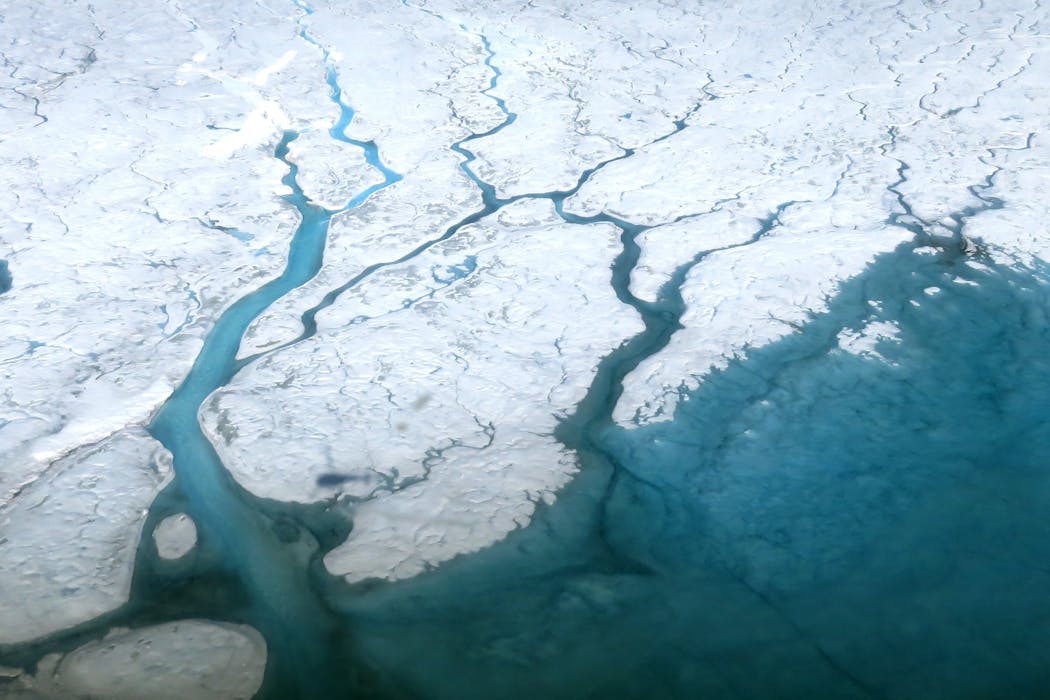
Meltwater runs across the Greenland ice sheet in rivers. The ice sheet is already losing mass and could soon reach a tipping point. Maria-José Viñas/NASA

As the planet warms, it risks crossing catastrophic tipping points: thresholds where Earth systems, such as ice sheets and rain forests, change irreversibly over human lifetimes.

Scientists have long warned that if global temperatures warmed more than 1.5 degrees Celsius (2.7 Fahrenheit) compared with before the Industrial Revolution, and stayed high, they would increase the risk of passing multiple tipping points. For each of these elements, like the Amazon rain forest or the Greenland ice sheet, hotter temperatures lead to melting ice or drier forests that leave the system more vulnerable to further changes.

Worse, these systems can interact. Freshwater melting from the Greenland ice sheet can weaken ocean currents in the North Atlantic, disrupting air and ocean temperature patterns and marine food chains.

World map showing locations for potential tipping points.
Pink circles show the systems closest to tipping points. Some would have regional effects, such as loss of coral reefs. Others are global, such as the beginning of the collapse of the Greenland ice sheet.
Global Tipping Points Report, CC BY-ND

With these warnings in mind, 194 countries a decade ago set 1.5 C as a goal they would try not to cross. Yet in 2024, the planet temporarily breached that threshold.

The term “tipping point” is often used to illustrate these problems, but apocalyptic messages can leave people feeling helpless, wondering if it’s pointless to slam the brakes. As a geoscientist who has studied the ocean and climate for over a decade and recently spent a year on Capitol Hill working on bipartisan climate policy, I still see room for optimism.

It helps to understand what a tipping point is – and what’s known about when each might be reached.

Tipping points are not precise

A tipping point is a metaphor for runaway change. Small changes can push a system out of balance. Once past a threshold, the changes reinforce themselves, amplifying until the system transforms into something new.

Almost as soon as “tipping points” entered the climate science lexicon — following Malcolm Gladwell’s 2000 book, “The Tipping Point: How Little Things Can Make a Big Difference” — scientists warned the public not to confuse global warming policy benchmarks with precise thresholds.

A tall glacier front seen from above shows huge chunks of ice calving off into Disko Bay.
The Greenland ice sheet, which is 1.9 miles (3 kilometers) thick at its thickest point, has been losing mass for several years as temperatures rise and more of its ice is lost to the ocean. A tipping point would mean runaway ice loss, with the potential to eventually raise sea level 24 feet (7.4 meters) and shut down a crucial ocean circulation.
Sean Gallup/Getty Images

The scientific reality of tipping points is more complicated than crossing a temperature line. Instead, different elements in the climate system have risks of tipping that increase with each fraction of a degree of warming.

For example, the beginning of a slow collapse of the Greenland ice sheet, which could raise global sea level by about 24 feet (7.4 meters), is one of the most likely tipping elements in a world more than 1.5 C warmer than preindustrial times. Some models place the critical threshold at 1.6 C (2.9 F). More recent simulations estimate runaway conditions at 2.7 C (4.9 F) of warming. Both simulations consider when summer melt will outpace winter snow, but predicting the future is not an exact science.

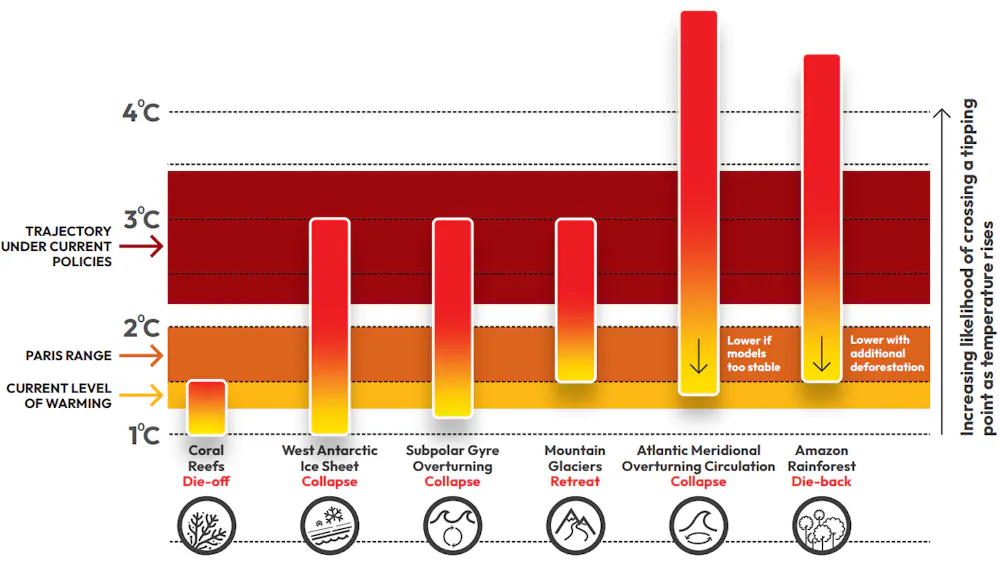
Bars with gradients show the rising risk as temperatures rise that key systems, including Greenland ice sheet and Amazon rain forest, will reach tipping points.
Gradients show science-based estimates from the Global Tipping Points Report of when key global or regional climate tipping points are increasingly likely to be reached. Every fraction of a degree increases the likeliness, reflected in the warming color.
Global Tipping Points Report 2025, CC BY-ND

Forecasts like these are generated using powerful climate models that simulate how air, oceans, land and ice interact. These virtual laboratories allow scientists to run experiments, increasing the temperature bit by bit to see when each element might tip.

Climate scientist Timothy Lenton first identified climate tipping points in 2008. In 2022, he and his team revisited temperature collapse ranges, integrating over a decade of additional data and more sophisticated computer models.

Their nine core tipping elements include large-scale components of Earth’s climate, such as ice sheets, rain forests and ocean currents. They also simulated thresholds for smaller tipping elements that pack a large punch, including die-offs of coral reefs and widespread thawing of permafrost.

A few fish swim among branches of a white coral skeleton during a bleaching event.
The world may have already passed one tipping point, according to the 2025 Global Tipping Points Report: Corals reefs are dying as marine temperatures rise. Healthy reefs are essential fish nurseries and habitat and also help protect coastlines from storm erosion. Once they die, their structures begin to disintegrate.
Vardhan Patankar/Wikimedia Commons, CC BY-SA

Some tipping elements, such as the East Antarctic ice sheet, aren’t in immediate danger. The ice sheet’s stability is due to its massive size – nearly six times that of the Greenland ice sheet – making it much harder to push out of equilibrium. Model results vary, but they generally place its tipping threshold between 5 C (9 F) and 10 C (18 F) of warming.

Other elements, however, are closer to the edge.

Alarm bells sounding in forests and oceans

In the Amazon, self-perpetuating feedback loops threaten the stability of the Earth’s largest rain forest, an ecosystem that influences global climate. As temperatures rise, drought and wildfire activity increase, killing trees and releasing more carbon into the atmosphere, which in turn makes the forest hotter and drier still.

By 2050, scientists warn, nearly half of the Amazon rain forest could face multiple stressors. That pressure may trigger a tipping point with mass tree die-offs. The once-damp rainforest canopy could shift to a dry savanna for at least several centuries.

Rising temperatures also threaten biodiversity underwater.

The second Global Tipping Points Report, released Oct. 12, 2025, by a team of 160 scientists including Lenton, suggests tropical reefs may have passed a tipping point that will wipe out all but isolated patches.

Coral loss on the Great Barrier Reef. Australian Institute of Marine Science.

Corals rely on algae called zooxanthellae to thrive. Under heat stress, the algae leave their coral homes, draining reefs of nutrition and color. These mass bleaching events can kill corals, stripping the ecosystem of vital biodiversity that millions of people rely on for food and tourism.

Low-latitude reefs have the highest risk of tipping, with the upper threshold at just 1.5 C, the report found. Above this amount of warming, there is a 99% chance that these coral reefs tip past their breaking point.

Similar alarms are ringing for ocean currents, where freshwater ice melt is slowing down a major marine highway that circulates heat, known as the Atlantic Meridional Overturning Circulation, or AMOC.

Two illustrations show how the AMOC looks today and its expected weaker state in the future
How the Atlantic Ocean circulation would change as it slows.
IPCC 6th Assessment Report

The AMOC carries warm water northward from the tropics. In the North Atlantic, as sea ice forms, the surface gets colder and saltier, and this dense water sinks. The sinking action drives the return flow of cold, salty water southward, completing the circulation’s loop. But melting land ice from Greenland threatens the density-driven motor of this ocean conveyor belt by dilution: Fresher water doesn’t sink as easily.

A weaker current could create a feedback loop, slowing the circulation further and leading to a shutdown within a century once it begins, according to one estimate. Like a domino, the climate changes that would accompany an AMOC collapse could worsen drought in the Amazon and accelerate ice loss in the Antarctic.

There is still room for hope

Not all scientists agree that an AMOC collapse is close. For the Amazon rain forest and the North Atlantic, some cite a lack of evidence to declare the forest is collapsing or currents are weakening.

In the Amazon, researchers have questioned whether modeled vegetation data that underpins tipping point concerns is accurate. In the North Atlantic, there are similar concerns about data showing a long-term trend.

A map of the Amazon shows large areas along its edges and rivers in particular losing tree cover
The Amazon forest has been losing tree cover to logging, farming, ranching, wildfires and a changing climate. Pink shows areas with greater than 75% tree canopy loss from 2001 to 2024. Blue is tree cover gain from 2000 to 2020.
Global Forest Watch, CC BY

Climate models that predict collapses are also less accurate when forecasting interactions between multiple tipping points. Some interactions can push systems out of balance, while others pull an ecosystem closer to equilibrium.

Other changes driven by rising global temperatures, like melting permafrost, likely don’t meet the criteria for tipping points because they aren’t self-sustaining. Permafrost could refreeze if temperatures drop again.

Risks are too high to ignore

Despite the uncertainty, tipping points are too risky to ignore. Rising temperatures put people and economies around the world at greater risk of dangerous conditions.

But there is still room for preventive actions – every fraction of a degree in warming that humans prevent reduces the risk of runaway climate conditions. For example, a full reversal of coral bleaching may no longer be possible, but reducing emissions and pollution can allow reefs that still support life to survive.

Tipping points highlight the stakes, but they also underscore the climate choices humanity can still make to stop the damage.

The Conversation

Alexandra A Phillips does not work for, consult, own shares in or receive funding from any company or organization that would benefit from this article, and has disclosed no relevant affiliations beyond their academic appointment.

ref. Climate tipping points sound scary, especially for ice sheets and oceans – here’s why there’s still room for optimism – https://theconversation.com/climate-tipping-points-sound-scary-especially-for-ice-sheets-and-oceans-heres-why-theres-still-room-for-optimism-265183

Unusual red rocks in Australia are rewriting the rules on exceptional fossil sites

Source: The Conversation – Global Perspectives – By Tara Djokic, Scientific Officer, Palaeontology, Australian Museum; UNSW Sydney

Fossilised fish from McGraths Flat. Salty Dingo

Hidden beneath farmland in the central tablelands of New South Wales lies one of Australia’s most extraordinary fossil sites – McGraths Flat. It dates back between 11 million and 16 million years into the Miocene epoch, a time when many of today’s familiar plants and animals evolved.

It is here that palaentologists and geologists from the Australian Museum Research Institute have made remarkable fossil discoveries. Where dust and drought now dominate, a lush rainforest once flourished. In stunning ecological detail, fossils at McGraths Flat reveal this ancient ecosystem.

Strikingly red in appearance, the sedimentary rocks here are composed entirely of goethite – a fine-grained mineral that contains iron. This iron has preserved a range of plants, insects, spiders, fish and feathers with exceptional detail.

Our new study, published in the journal Gondwana Research, shows there’s another reason these rocks are so intriguing. They fundamentally challenge ideas about where well-preserved fossil sites on Earth can be found, and why.

Large trapdoor spider fossil preserved on a red rock
A large trapdoor spider preserved in McGraths Flat.
Michael Frese

Beyond shale and sandstone

Traditionally, the most exceptionally well-preserved fossil sites are from rocks dominated by shale, sandstone, limestone, or volcanic ash.

Consider Germany’s Messel Pit or Canada’s Burgess Shale. At these sites, organisms were rapidly buried in fine-grained sediments, allowing the exceptional preservation of soft tissues, not just hard parts.

Messel Pit has preserved roughly 47 million-year-old fossils showing the outlines of feathers, fur and skin. Meanwhile, the Burgess Shale contains soft tissues from some of Earth’s earliest animal life, dating back about 500 million years.

By contrast, sedimentary rocks made entirely of iron are the last place you’d expect to find well-preserved remains of land-based (terrestrial) animal and plant life.

That’s because iron-rich sedimentary rocks are predominantly known from banded iron formations. These massive iron deposits largely formed around 2.5 billion years ago in Earth’s ancient oxygen-depleted oceans, long before complex animal and plant life evolved.

In more recent history, iron is considered a mere weathering product, forming rust on the continents when exposed to our oxygen-rich atmosphere. Just look at Australia’s iconic red-rocked outback landscape that preserves these million- to billion-year-old features.

Yet the discovery of McGraths Flat has defied these expectations.

Large rectangular block of red rock composed of goethite, an iron-rich mineral.
Strikingly red fossil-bearing rocks of McGraths Flat, composed of an iron-oxyhydroxide mineral called goethite.
Tara Djokic

Terrestrial life entombed in iron

McGraths Flat is made from a very fine-grained, iron-rich rock called ferricrete. It’s essentially a cement made from iron.

The ferricrete consists almost entirely of microscopic iron-oxyhydroxide mineral particles, each just 0.005 millimetres across. When an animal died and was buried in the sediment, this minute scale is what allowed the iron particles to fill every cell. The result? Extraordinarily well-preserved soft tissue fossils.

Compared with marine life, fossil sites preserving terrestrial life are notoriously rare. Terrestrial sites that preserve soft tissues? Even rarer. The exceptional detail captured in the McGraths Flat fossils reveals new snapshots of past life we don’t often get to find.

These fossils are so perfectly preserved that individual pigment cells in fish eyes, internal organs of insects and fish, and even delicate spider hairs and nerve cells can be seen.

This level of preservation rivals other well-preserved fossil sites, such as those consisting of shale or sandstone. Except here, they are entombed in iron.

Three people, two men standing on either side of one woman, in a rural field wearing outdoor gear with work boots and wide brimmed hats.
Australian Museum Research Institute researchers Matthew McCurry, Tara Djokic and Patrick Smith (left to right), three of 15 co-authors who collaborated on this study published in Gondwana Research.
Salty Dingo

How did McGraths Flat form?

Our new study sheds light on how this fossil site came to be – a crucial step for finding similar terrestrial fossil troves in iron.

McGraths Flat began forming during the Miocene when iron leached from weathering basalt under warm, wet rainforest conditions.

Acidic groundwater then carried the dissolved iron underground until it reached a river system with an oxbow lake – an abandoned river channel. There, the iron became ultra-fine iron-oxyhydroxide sediment.

It rapidly coated dead organisms on the lake floor and replicated their soft tissue structures down to the cellular level.

A new fossil roadmap

Understanding how McGraths Flat formed could provide a roadmap for finding similar iron-rich fossil sites worldwide.

Key features to look for include very fine-grained and finely layered ferricrete in areas where:

  • ancient river channels cut through older iron-rich landscapes, such as basaltic rocks from volcanoes

  • ancient warm, humid conditions once promoted intense weathering, and

  • the surrounding geology lacks significant limestone or sulphur-containing minerals (such as pyrite), because these could interfere with the formation of the iron-oxyhydroxide mineral sediments.

The red rocks of McGraths Flat open an entirely new chapter in our understanding of how exceptionally well-preserved fossil sites can form.

The next breakthrough in understanding ancient terrestrial life might not come from traditional shale or sandstone fossil beds, but from rusty-red rocks hidden beneath our feet.

Four people kneeling on the ground over red rocks, with hammer and chisels spitting the rocks apart to search for fossils.
Palaeontologists from the Australian Museum Research institute at the McGraths Flat field site, splitting the red rocks apart with a hammer and chisel to search for fossils.
Tara Djokic

The study’s authors acknowledge the traditional custodians of the land and waterways on which McGraths Flat is located, the Wiradjuri Nation people.

The Conversation

Tara Djokic and co-authors received funding for this research from the Etheridge family descendants; Australian Museum Research Institute, Australian Museum Trust; and Australian Research Council (ARC). We acknowledge the scientific and technical assistance of Microscopy Australia, especially from the Centre for Advanced Microscopy, ANU (jointly funded by the ANU and the Australian Federal Government).
Tara is affiliated with the not-for-profit organisation Women in Earth and Environmental Sciences Australasia (WOMEESA).

ref. Unusual red rocks in Australia are rewriting the rules on exceptional fossil sites – https://theconversation.com/unusual-red-rocks-in-australia-are-rewriting-the-rules-on-exceptional-fossil-sites-266904