For the first time, we linked a new fossil fuel project to hundreds of deaths. Here’s the impact of Woodside’s Scarborough gas project

Source: The Conversation – Global Perspectives – By Sarah Perkins-Kirkpatrick, Deputy Director, Engagement and Impact, The ARC Centre of Excellence for the Weather of the 21st Century, Australian National University
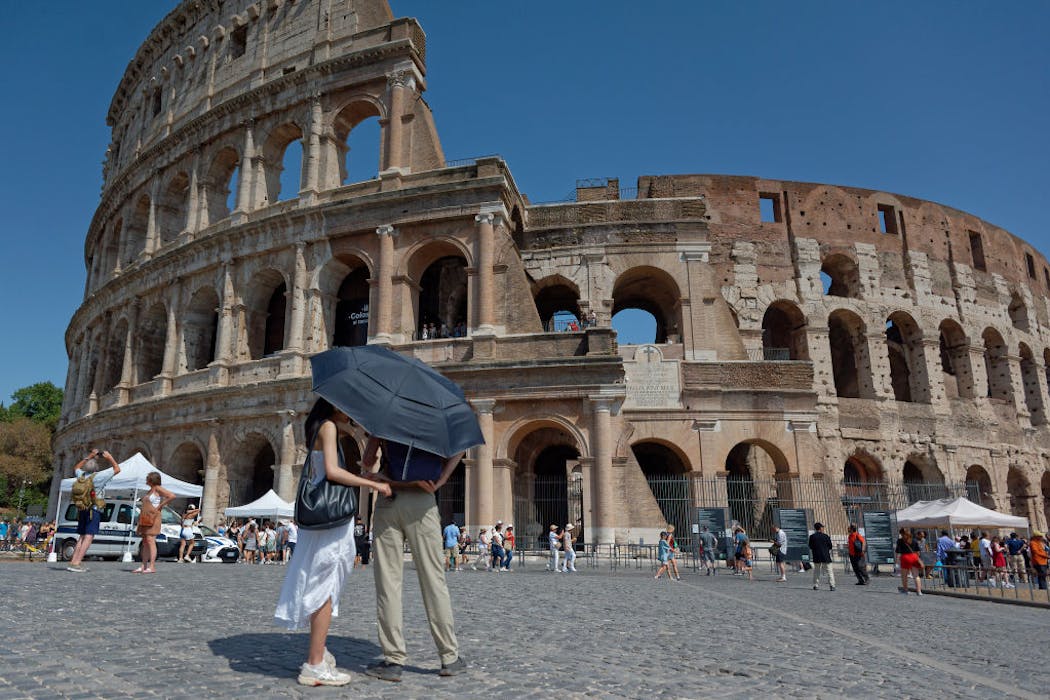
Massimo Valicchia/NurPhoto via Getty Images

Global warming from Woodside’s massive Scarborough gas project off Western Australia would lead to 484 additional heat-related deaths in Europe alone this century, and kill about 16 million additional corals on the Great Barrier Reef during each future mass bleaching event, our new research has revealed.

The findings were made possible by a robust, well-established formula that can determine the extent to which an individual fossil fuel project will warm the planet. The results can be used to calculate the subsequent harms to society and nature.

The results close a fundamental gap between science and decision-making about fossil fuel projects. They also challenge claims by proponents that climate risks posed by a fossil fuel project are negligible or cannot be quantified.

Each new investment in coal and gas, such as the Scarborough project, can now be linked to harmful effects both today and in the future. It means decision-makers can properly assess the range of risks a project poses to humanity and the planet, before deciding if it should proceed.

A gas ship moored at a wharf off the Pilbara coast.
Each new investment in coal and gas extraction can now be linked to harmful effects.
Shutterstock

Every tonne of CO₂ matters

Scientists know every tonne of carbon dioxide (CO₂) emissions makes global warming worse.

But proponents of new fossil fuel projects in Australia routinely say their future greenhouse gas emissions are negligible compared to the scale of global emissions, or say the effects of these emissions on global warming can’t be measured.

The Scarborough project is approved for development and is expected to produce gas from next year. Located off WA, it includes wells connected by a 430km pipeline to an onshore processing facility. The gas will be liquefied and burned for energy, both in Australia and overseas. Production is expected to last more than 30 years. When natural gas is burned, more than 99% of it converts to CO₂.

Woodside – in its own evaluation of the Scarborough gas project – claimed:

it is not possible to link GHG [greenhouse gas] emissions from Scarborough with climate change or any particular climate-related impacts given the estimated […] emissions associated with Scarborough are negligible in the context of existing and future predicted global GHG concentrations.

But what if there was a way to measure the harms? That’s the question our research set out to answer.

A method already exists to directly link global emissions to the climate warming they cause. It uses scientific understanding of Earth’s systems, direct observations and climate model simulations.

According to the IPCC, every 1,000 billion tonnes of CO₂ emissions causes about 0.45°C of additional global warming. This arithmetic forms the basis for calculating how much more CO₂ humanity can emit to keep warming within the Paris Agreement goals.

But decisions about future emissions are not made at the global scale. Instead, Earth’s climate trajectory will be determined by the aggregation of decisions on many individual projects.

That’s why our research extended the IPCC method to the level of individual projects – an approach that we illustrate using the Scarborough gas project.

Scarborough’s harms laid bare

Over its lifetime, the Scarborough project is expected to emit 876 million tonnes of CO₂.

We estimate these emissions will cause 0.00039°C of additional global warming. Estimates such as these are typically expressed as a range, alongside a measure of confidence in the projection. In this case, there is a 66–100% likelihood that the Scarborough project will cause additional global warming of between 0.00024°C and 0.00055°C.

This additional warming might seem small – but it will cause tangible damage.

The human cost of global warming can be quantified by considering how many people will be left outside the “human climate niche” – in other words, the climate conditions in which societies have historically thrived.

We calculated that the additional warming from the Scarborough project will expose 516,000 people globally to a local climate that’s beyond the hot extreme of the human climate niche. We drilled down into specific impacts in Europe, where suitable health data was available across 854 cities. Our best estimate is that this project would cause an additional 484 heat-related deaths in Europe by the end of this century.

A girl and a woman stand in front of a giant fan.
The project would cause an additional 484 heat-related deaths in Europe by the end of this century.
Antonio Masiello/Getty Images

And what about harm to nature? Using research into how accumulated exposure to heat affects coral reefs, we found about 16 million corals on the Great Barrier Reef would be lost in each new mass bleaching. The existential threat to the Great Barrier Reef from human-caused global warming is already being realised. Additional warming instigated by new fossil fuel projects will ratchet up pressure on this natural wonder.

As climate change worsens, countries are seeking to slash emissions to meet their commitments under the Paris Agreement. So, we looked at the impact of Scarborough’s emissions on Australia’s climate targets.

We calculated that by 2049, the anticipated emissions from the Scarborough project alone – from production, processing and domestic use – will comprise 49% of Australia’s entire annual CO₂ emissions budget under our commitment to net-zero by 2050.

Beyond the 2050 deadline, all emissions from the Scarborough project would require technologies to permanently remove CO₂ from the atmosphere. Achieving that would require a massive scale-up of current technologies. It would be more prudent to reduce greenhouse gas emissions where possible.

‘Negligible’ impacts? Hardly

Our findings mean the best-available scientific evidence can now be used by companies, governments and regulators when deciding if a fossil fuel project will proceed.

Crucially, it is no longer defensible for companies proposing new or extended fossil fuel projects to claim the climate harms will be negligible. Our research shows the harms are, in fact, tangible and quantifiable – and no project is too small to matter.


In response to issues raised in this article, a spokesperson for Woodside said:

Woodside is committed to playing a role in the energy transition. The Scarborough reservoir contains less than 0.1% carbon dioxide. Combined with processing design efficiencies at the offshore floating production unit and onshore Pluto Train 2, the project is expected to be one of the lowest carbon intensity sources of LNG delivered into north Asian markets.

We will reduce the Scarborough Energy Project’s direct greenhouse gas emissions to as low as reasonably practicable by incorporating energy efficiency measures in design and operations. Further information on how this is being achieved is included in the Scarborough Offshore Project Proposal, sections 4.5.4.1 and 7.1.3 and in approved Australian Government environment plans, available on the regulator’s website.

A report prepared by consultancy ACIL Allen has found that Woodside’s Scarborough Energy Project is expected to generate an estimated A$52.8 billion in taxation and royalty payments, boost GDP by billions of dollars between 2024 and 2056 and employ 3,200 people during peak construction in Western Australia.

The Conversation

Sarah Perkins-Kirkpatrick receives funding from the Australian Research Council

Andrew King receives funding from the Australian Research Council (Future Fellowship and Centre of Excellence for 21st Century Weather) and the National Environmental Science Program.

Nicola Maher receives funding from the Australian Research Council.

Wesley Morgan is a fellow with the Climate Council of Australia

ref. For the first time, we linked a new fossil fuel project to hundreds of deaths. Here’s the impact of Woodside’s Scarborough gas project – https://theconversation.com/for-the-first-time-we-linked-a-new-fossil-fuel-project-to-hundreds-of-deaths-heres-the-impact-of-woodsides-scarborough-gas-project-266060

‘Extremely hostile’: Trump lashes China over trade controls but there may be a silver lining

Source: The Conversation – Global Perspectives – By Marina Yue Zhang, Associate Professor, Technology and Innovation, University of Technology Sydney

Tasos Katopodis/Getty Images

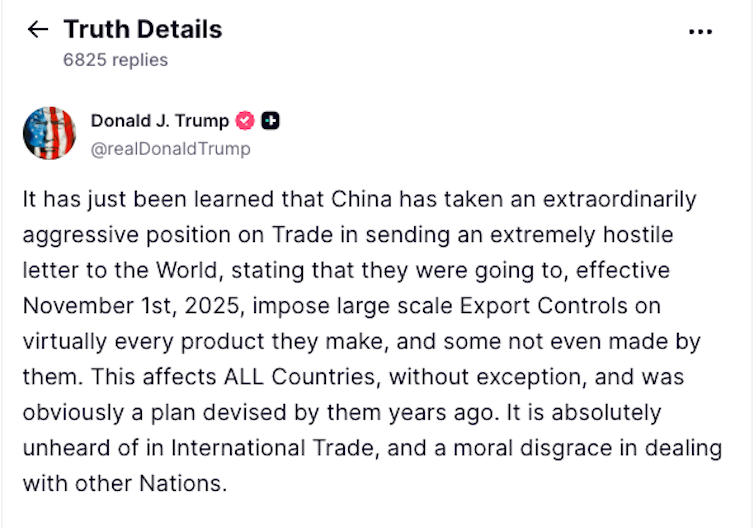
The trade dispute between the United States and China has resumed. US President Donald Trump lashed out at the weekend at Beijing’s planned tightening of restrictions over crucial rare-earth minerals.

In response, Trump has threatened 100% tariffs on Chinese imports.

But with the higher tariff rate not due to start until November 1, and the Chinese controls on December 1, there is still time for negotiation.

This is no longer a trade dispute; it has escalated into a race for control over supply chains, and the rules that govern global trade.

For Australia, this provides an opening to build capacity at home in minerals refining and rare-earths processing. But we also need to keep access to our biggest market – China.

A long-running battle

Since 2018, the US has sought to choke off China’s access to semiconductors and chipmaking tools by restricting exports.

China last week tightened its export controls on rare earth minerals that are essential for the technology, automotive and defence industries. Foreign companies now need permission to export products that derive as little as 0.1% of their value from China-sourced rare earths.

Rare earths are essential to many modern technologies. They enable high-performance magnets for EVs and wind turbines, lasers in advanced weapons, and the polishing of semiconductor wafers. An F-35 fighter jet contains about 417 kilograms of rare earths.

By targeting inputs rather than finished goods, China extends its reach across production lines in any foreign factories that use Chinese rare earths in chips (including AI), automotive, defence and consumer electronics.

A part of US President Donald Trump's social media post announcing new tariffs on China.
A part of US President Donald Trump’s social media post announcing new tariffs on China.

Who holds the upper hand: chips or rare earths?

The US plan is simple: control the key tools and software for making top-end semiconductor chips so China can’t move as fast on cutting-edge technology.

Under that pressure, China is filling the gaps. It’s far more self-sufficient in chips than ten years ago. It now makes more of its own tools and software, and produces “good-enough” chips for cars, factories and gadgets to withstand US sanctions.

Rare earths aren’t literally “rare”; their value lies in complex, costly and polluting separation and purification processes. China has cornered the industry, helped by industry policies and subsidies. China accounts for 60–70% of all mining and more than 90% of rare earths refining.

Its dominance reflects decades-long investment, scale and an early willingness to bear heavy environmental costs. Building a China-free supply chain will take years, even if Western countries can coordinate smoothly.

A window for Australia?

Australia is seen as a potential beneficiary. As Prime Minister Anthony Albanese prepares to meet Trump on October 20 in Washington, many argue the rare-earths clash offers a diplomatic opening.

Trade Minister Don Farrell says Australia is a reliable supplier that can “provide alternatives to the rest of the world”. Australia’s ambassador to the US, Kevin Rudd, has made the same case.

The logic seems compelling: leverage Australia’s mineral wealth for strategic gain with its closest security partner. But that narrative is simplistic. It risks drifting from industrial and economic reality.

The first hard truth is that Australia has the resources, but doesn’t control the market. It is a top-five producer of 14 minerals, including lithium, cobalt and rare earths, yet it doesn’t dominate any of them. Australia’s strength is in mining and extraction, rather than processing.

Here lies the strategic paradox: Australia ships the majority of its minerals to China for processing that turns ore into high-purity metals and chemicals. Building alternative, China-free supply chains to reduce US reliance on China would decouple Australia from its main customer for raw materials.

Demand from the defence sector is not enough. The US Department of Defense accounts for less than 5% of global demand for most critical minerals.

The real driver is the heavy demand from clean energy and advanced technology, including EVs, batteries and solar. China commands those markets, creating a closed-loop ecosystem that pulls in Australia’s materials and exports finished goods. Recreating that integrated system in five to ten years, after Beijing spent decades building it, is wishful thinking.

There will be no simple winner

The US restrictions on chips and the Chinese controls over rare earths are twin levers in the contest between two great powers. Each wants to lead in technology – and to set the rules over global supply chains.

We’ve entered a period where control of a few key inputs, tools and routes gives countries leverage. Each side is probing those “chokepoints” in the other’s supply chains for technology and materials – and using them as weapons. In the latest stand-off, Trump has floated export controls on Boeing parts to China. Chinese airlines are major Boeing customers, so any parts disruption would hit China’s aviation sector hard.

There will be no simple winner. Countries and firms are being pulled into two parallel systems: one centred on US chip expertise, the other on China’s materials power. This is not a clean break. It will be messier, costlier and less efficient, where political risk often outweighs commercial logic.

The question for Australia is not how fast it can build, but how well it balances security aims with market realities.

The Conversation

Marina Yue Zhang does not work for, consult, own shares in or receive funding from any company or organisation that would benefit from this article, and has disclosed no relevant affiliations beyond their academic appointment.

ref. ‘Extremely hostile’: Trump lashes China over trade controls but there may be a silver lining – https://theconversation.com/extremely-hostile-trump-lashes-china-over-trade-controls-but-there-may-be-a-silver-lining-267294

Two true crime books on the mushroom trial are out – one is told by a fictional juror

Source: The Conversation – Global Perspectives – By Rick Sarre, Emeritus Professor in Law and Criminal Justice, University of South Australia

Two books on the recent Erin Patterson trial have just been published, both by experienced true crime writers. Both are meticulously researched (primarily relying on the transcripts of evidence), well written and eminently readable. The timing of their publication is remarkable, given it’s only been a month since the sentencing. Having said that, neither book seems rushed.

Greg Haddrick, who writes from the perspective of “a fictional juror” in The Mushroom Murders, also wrote In the Dead of Night, about the 2020 murder of Russell Hill and Carol Clay in Victoria’s remote Wonnangatta Valley. Duncan McNab, author of Recipe for Murder, is a former detective, a private investigator (specialising in criminal defence) and an investigative journalist.


Review: The Mushroom Murders – Greg Haddrick (Allen & Unwin); Recipe for Murder: The poisonous truth behind Erin Patterson – the mushroom murderer of Leongatha – Duncan McNab (Hachette)


I enjoyed both books immensely – not for the horror of the tale itself, but for the insightful way they tackle this most intriguing story. Neither book offers anything new by way of evidence, as what is written is all on the public record. But readers will nevertheless find a great deal to interest them in the narrative of both authors, especially their descriptions of the legal wranglings and media frenzy.

Haddrick’s imagined perspective as a (female) juror who runs a (fictitious) picture-framing business in Morwell is an intriguing literary device. He is careful to advise readers that he neither approached nor spoke to any of the real jurors. Indeed, the law does not allow such an approach, given the requirement of the confidentiality of their deliberations.

The entire book is narrated by this fictional person. “I wanted readers to feel they were on that journey with the jury,” Haddrick explains in his preface. All the evidence, he says, “comes directly from, and only from, the evidence those jurors heard and saw during the trial”. Some readers may find his choice of storytelling technique somewhat disingenuous, but the narrative gives the book an impressive immediacy.

Haddrick writes, again in his preface: “Like all of us, our narrator has her own strengths, flaws and opinions, and she does speculate. But where she does engage in speculation, it is clearly identified as separate from the evidence that leads to her verdict — and it reveals some surprising insights into police methodology along the way.” True, there is much written about some very impressive policing, but I found none of it surprising.

On the first page of Haddrick’s book, we read: “A family lunch. Three murders. What really happened?” One might opine that it’s a tad misleading to state that a book narrated by a fictional juror and engaging in speculation regarding (her) thought processes can tell us “what really happened”. But this gradual, unfolding narrative from the perspective of an (albeit imaginary) juror remains a compelling tale if the reader is happy to suspend disbelief and see the trial through her (fictional) eyes.

Does this literary device pose an ethical issue? Perhaps so (especially if it leads to misleading understandings of the facts or the law), but in the legal sense there is no difficulty as long as it’s clearly explained.

The setting

On July 29 2023, in the small rural Victorian town of Leongatha, members of Patterson’s extended family sat down for a casual Saturday lunch of beef Wellington. As Haddrick quips in his opening pages, this has become the most talked-about meal since the Last Supper.

The next day, all four guests were hospitalised. Within a week, three of them were dead: Erin’s mother-in-law Gail Patterson, her husband Don Patterson, and Gail’s sister, Heather Wilkinson. Ian Wilkinson, Heather’s husband, was fighting for his life.

When Patterson was arrested and charged with their murders, the case captured media attention around the world. After a trial that lasted 11 weeks and produced 3,500 pages of transcript, a jury of 12 (seven men and five women) determined she had deliberately poisoned her estranged husband’s parents, and his aunt and uncle, leading to the deaths of three of them and the life-threatening illness of the fourth.

As McNab writes,

Patterson’s cruelty in watching four people who had been nothing but kind and loving to her eat a meal she knew would kill them was the ultimate act of betrayal.

Mushroom murders – a fictional juror’s view

Haddrick’s The Mushroom Murders principally tells what was going through the mind of his fictional juror as she heard the evidence. Readers interested in the way criminal evidence is presented will get a clear picture of that process. His speculation of the iterative process that possibly goes through a juror’s thinking as the evidence unfolds is well constructed. But it is only speculative.

The first third of the book takes readers through all the evidence of Erin’s relationship with her estranged husband, Simon. It was a fractured and, at times, tempestuous marriage. It is easy to gloss over this narrative since it reads like Days of Our Lives, but it is important in the story. At this stage, the fictional juror is entirely sympathetic to Erin, taking to heart the trial judge’s reminder to the jury, in his preliminary remarks, of the importance of the presumption of innocence.

But as the story continues and the beef Wellington is served (it arrives halfway through the book), the tempo increases. With a third of the book to go, Haddrick has his juror thinking that sticking with “Team Erin” was becoming more difficult.

It was getting harder and harder to keep “presuming innocence”. At so many moments in the story, there were no reasonable explanations for her behaviour compatible with innocence.

Those moments continue all the way to the book’s conclusion.

Haddrick’s epilogue is devoted to the post-trial release of evidence that had been excluded (and charges dropped) regarding three allegations that Erin attempted to poison Simon during their marriage. His narrator’s strong opinion is that the trial judge’s ruling in a preliminary hearing to exclude these allegations from the trial treated the jury as mugs.

I know we had been told at the beginning of the trial to put those dropped charges out of our minds, but I’m sorry. If it leads to a situation like this, where the blindingly obvious question never gets asked, that’s just legal nonsense.

That might be his fictional juror’s feeling, but Justice Beale’s direction in the preliminary hearing had been vindicated by a three-member Court of Criminal Appeal. The law on this subject is clear: the High Court ruled in 1995 that prejudicial evidence (such as the unsubstantiated allegations regarding three earlier attempts to poison Simon) is inadmissible unless the judge considers that evidence has very strong probative value, that is, evidence sufficiently useful to prove something important in the case at hand.

In this case, he did not. If those charges were to be pursued, that would need to happen in a separate trial.

Recipe for Murder

Duncan McNab’s Recipe for Murder does not have the first-hand immediacy of The Mushroom Murders, but it, too, is compelling. Indeed, some readers may find McNab’s analysis more insightful, as it is not underpinned by Haddrick’s literary musing.

McNab’s book shares a similar structure to Haddrick’s. There is a description of the family, their church, the often fractured relationship between Simon and Erin, their multiple marital separations, their children, their Christian faith (or, in Erin’s case, ostensible atheism) and their finances.

McNab takes readers through the evidence of Erin’s fascination with true crime, and her ill-health self-diagnoses (including ovarian cancer and heart issues). He describes her relationships with her own parents, both deceased. In messages to friends, he reveals, Patterson called her mother “essentially a cold robot” and said “Dad was a doormat”. He also reveals her propensity to be loose with the truth, including her being sacked from her job as an air traffic controller for lying about her work hours.

He departs from the formal record of the trial evidence in explaining Justice Beale’s ruling in the fast-tracked preliminary hearing, namely that the allegations relating to Simon’s previous illnesses (the alleged attempted poisonings) could not be tried in the “beef Wellington” trial.

Moreover, he explains the ruling on the location of the trial (Morwell, not Melbourne), noting that under the Victorian Criminal Procedure Act unless there are strong reasons related to unfairness, the trial should take place at the court most proximate to where the alleged offending occurred. (By contrast, Haddrick’s book does not deal with the reasoning in these preliminary matters at all.)

Next in the McNab narrative comes the meal, the deaths, and the investigations, including a close look at the forensic science evidence, such as the sighting of deathcap mushrooms growing in rural Victoria, and Erin’s phone being “pinged” in the vicinity. Then follows the funerals – and inevitably, the arrest of Erin Patterson.

Because he is writing with the value of hindsight, McNab is never in doubt about the correctness of the verdict.

Read one, not both

Recipe for Murder is significantly more detailed than The Mushroom Murders in relation to the summing up to the jury by prosecution counsel, defence counsel and finally the judge. This process would take nearly six days once the examinations in chief, the cross examinations and reexaminations finally came to an end.

On day 40 of the trial, the jury (after the balloting out of two jurors, to reduce the number to 12) retires to consider its verdict. It returns nearly six days later with guilty verdicts on all four charges.

Surprisingly, neither author makes any comment that this was an extraordinarily lengthy process, other than McNab’s quip that there was “a vast amount of evidence.” Yes, that may be true, but as both authors admit, that evidence was very persuasive.

Importantly, Recipe for Murder then pays significant attention to the victim impact statements. There were 28 tendered to the court, seven of them read aloud; some, like Ian Wilkinson’s, by their authors; some, like Simon Patterson’s, by proxies. Simon’s statement referred to his children:

Like all of us, they face the daunting challenge of trying to comprehend what she has done. The grim reality is they live in an irreparably broken home with a solo parent when almost everybody knows their mother murdered their grandparents.

Directing his attention to the sentencing hearing, McNab tells us Justice Beale heard from defence counsel that Erin would likely spend 22 hours a day in her cell. Beale took that into account. There was to be, he announced, three life sentences (the maximum penalty under Victorian legislation) to be served concurrently. The non-parole period was set at 33 years. (The Victorian Director of Public Prosecutions is now appealing that non-parole period on the basis that it was overly lenient.)

McNab concludes his discussion of the sentencing remarks with suitably understated drama: “An emotionless Erin Patterson was led from the courtroom.”

Both books are commendable. But there is no value in reading both, as they cover much of the same material. If I had to pick one as a tool for teaching students the art of examination (and cross examination) of witnesses, and the processes of trial, verdict and sentencing, McNab’s Recipe for Murder would be my choice.

A third book on the trial will be published next month – The Mushroom Tapes, by Helen Garner, Chloe Hooper and Sarah Krasnostein. It is clear there is more for us to read, and perhaps learn, about what unfolded in the Victorian Supreme Court, sitting at Morwell, during the winter of 2025.

The Conversation

Rick Sarre does not work for, consult, own shares in or receive funding from any company or organisation that would benefit from this article, and has disclosed no relevant affiliations beyond their academic appointment.

ref. Two true crime books on the mushroom trial are out – one is told by a fictional juror – https://theconversation.com/two-true-crime-books-on-the-mushroom-trial-are-out-one-is-told-by-a-fictional-juror-266676

Trump’s ‘shock and awe’ foreign policy achieved a breakthrough in Gaza – but is it sustainable?

Source: The Conversation – Global Perspectives – By Lester Munson, Non-Resident Fellow, United States Studies Centre, University of Sydney

US President Donald Trump will visit Israel and Egypt this week to oversee the initial implementation of his Gaza peace agreement, which many hope will permanently end the two-year war in the strip.

Should the peace hold, the Gaza accord will be Trump’s greatest foreign policy achievement, even surpassing the Abraham Accords of his first term that normalised relations between Israel and several Arab countries.

Given the speed with which the Trump administration has helped to negotiate the ceasefire, it is an opportune moment to assess Trump’s frenetic foreign policy at the start of his second presidential term.

The “Trump Doctrine” – the unconventional, high-energy and fast-moving approach to world affairs now pursued by the United States – has had some significant achievements, most notably in Gaza. But are these breakthroughs sustainable, and can his foreign policy approach be effective with larger geostrategic challenges?

A leaner decision-making structure

One way the Trump administration’s approach is different from previous administrations – including Trump 1.0 – is in his leaner organisation, which is more capable of implementing quick action.

Trump has revamped the national security decision-making structure in surprising ways. His secretary of state, Marco Rubio, now serves concurrently as his national security adviser. Rubio has also reduced the staff of the National Security Council from around 350 to about 150, which is still larger than many of Trump’s predecessors before Barack Obama.

There have been some missteps. Trump’s first national security adviser, Michael Waltz, tried to accommodate his need for speedy decision-making by establishing group chats on the Signal app for the small group of agency heads and senior advisers who advise Trump. This rightfully caused concerns about the security of classified information – especially after Waltz mistakenly added a journalist to a chat group – and he was subsequently ousted.

With a much smaller staff now, Rubio is implementing a more sustainable method for the president to communicate with his top advisers, mostly through Rubio himself and Trump’s powerful chief of staff, Susie Wiles.

Rubio has also led a top-down revamp of the bureaucratic foreign policy structures. Dozens of offices were eliminated, and hundreds of career professionals were laid off. Numerous political appointments, including ambassadorships, remain unfilled.

Many bureaus are now headed not by Senate-confirmed assistant secretaries, but by career foreign and civil service “senior bureau officials”. This keeps the number of politically appointed policymakers rather small – mostly in Rubio’s direct orbit – while keeping professional “implementers” in key positions to execute policy.

A reliance on special envoys

To set the stage for his own deal-making, Trump also uses his longtime friend and multipurpose envoy, Steve Witkoff, for the highest-level conversations. Without any Senate confirmation, Witkoff has become Trump’s most trusted voice in Ukraine, Gaza and several other foreign policy negotiations.

Massad Boulos, another unconfirmed Trump envoy, conducts second-tier negotiations, mostly in Africa but also parts of the Middle East.

Trump’s son-in-law, Jared Kushner, played a key role in the recent Gaza accord as well. This has raised questions of conflicts of interest. However, Trump’s emphasis on deal-oriented businessmen in diplomatic roles is intentional.

The approach appears to be very welcome in some quarters, particularly in the Middle East, where conventional diplomacy was fraught with much historical baggage.

A ‘shock and awe’ approach

On top of all this, of course, is Trump’s style and showmanship.

His most controversial statements – for example, demanding US ownership of Greenland – may seem absurd and offensive at first. However, there are genuine national security concerns over China’s role in the Arctic and the possibility an independent Greenland might serve as a wedge in a critical region. From this standpoint, establishing some US control over Greenland’s foreign policy is an entirely rational proposition.

What is unique to Trump is the pace, breadth and intensity of his personal diplomacy.

Trump’s relationship with Israeli Prime Minister Benjamin Netanyahu is a case in point. While Trump embraces Netanyahu in public and green-lights all of Israel’s military actions, he’s willing to say no to the Israeli leader in private. For example, Trump intervened to prevent Israel from annexing the West Bank immediately before the Gaza breakthrough.

In addition, Trump’s personal charm offensive with Arab leaders in the region – his first major foreign trip after Pope Francis’ funeral was to Qatar, Saudi Arabia and the United Arab Emirates – established a coalition to pressure Hamas to say yes to the deal.

It is a “shock and awe” diplomatic approach: everything, everywhere, all at once. Previous agreements and norms (including those set by Trump himself) are downplayed or discarded in favour of action in the moment.

Is there a longer-term vision?

Of course, there are downsides to the Trump approach. The past cannot be ignored, especially in the Middle East. And many previous agreements and norms were there for a reason – they worked, and they helped stabilise otherwise chaotic situations.
It very much remains to be seen whether Trump’s approach can lead to a long-term solution in Gaza. Many critics have pointed out the vagueness in his 20-point peace plan, which could cause it to fall apart at any moment.

It is not unusual for a second-term American president like Trump to focus on foreign policy, where Congress has a highly limited role and the president has wide latitude. But American presidents usually focus on achieving one big thing. Think Obama’s nuclear deal with Iran or George W. Bush’s troop surge in Iraq.

Today, in addition to the Gaza accord, Trump is pursuing separate diplomatic deals with all four major American adversaries: China, Russia, Iran and North Korea.

The logic of this is to put direct stress on the alliance of bad actors. Does Chinese leader Xi Jinping trust Russian President Vladimir Putin enough to resist Trump’s entreaties, and vice versa? How much are Russia and China worried about North Korean leader Kim Jong Un cutting a deal with Washington?

The true test of the Trump Doctrine will not be the success of the Gaza accord, but whether he can build on it to drive the West’s adversaries – mainly China and Russia – apart from each other and into weaker strategic positions.

The Conversation

Lester Munson receives funding from the US Studies Centre at the University of Sydney. He is affiliated with BGR Group, a Washington DC governmental affairs firm and was previously Republican staff in the US Congress and in the George W. Bush administration.

ref. Trump’s ‘shock and awe’ foreign policy achieved a breakthrough in Gaza – but is it sustainable? – https://theconversation.com/trumps-shock-and-awe-foreign-policy-achieved-a-breakthrough-in-gaza-but-is-it-sustainable-267316

Israelis are hailing Trump as Cyrus returned – but who was Cyrus the Great, anyway?

Source: The Conversation – Global Perspectives – By Peter Edwell, Associate Professor in Ancient History, Macquarie University

With both parties agreeing to terms, the first stages of a peace plan in Gaza are in motion. US President Donald Trump is credited (especially in Israel and the US) with having played a vital role in this development.

But why have banners appeared in Israel depicting Trump with the caption “Cyrus the Great is alive”?

Who was Cyrus and what is he renowned for?

Founder of the Achaemenid Persian empire

Cyrus the Great was the founder of the Achaemenid Persian empire (550 BCE to 330 BCE).

Under Cyrus and his successors, the Persian empire stretched across a vast array of territories, including Iran, Mesopotamia (which includes parts of modern-day Turkey, Syria and Iraq), Egypt, Asia Minor (which is mostly modern-day Turkey) and Central Asia.

A key moment in this imperial expansion was Cyrus’ capture of Babylon and its surrounding territory, Babylonia, (mostly in modern-day Iraq) in 539 BCE.

The Babylonian king, Nabonidus, controlled large sections of Mesopotamia and northern Arabia. A surviving clay tablet called the Nabonidus chronicle outlines the alienation of his subjects. Unpopular religious reforms and his long absences from Babylon were among the grievances.

Cuneiform tablet with part of the Nabonidus Chronicle (556-530s BC)
A clay tablet called the Nabonidus chronicle describes Nabonidus’ despotic tendencies.
© The Trustees of the British Museum, CC BY-NC-SA

Soon after he defeated Nabonidus, Cyrus issued a decree freeing captive Jews (and others) in Babylon.

A comparatively humane approach to governing

Nebuchadnezzar II, king of the Babylonian empire from 605–562 BCE, had captured the kingdom of Judah (in modern-day Israel and Palestinian territories) in 587 BCE.

Due to rebellions, he ransacked Jerusalem and deported thousands of Jews to Babylon.

When Cyrus freed the Babylonian Jewish exiles almost 50 years later, many returned to Judah.

The biblical book of Ezra records the decree.

Cyrus, according to this version of the story, had been commanded by God to rebuild a temple at Jerusalem that Nebuchadnezzar II had destroyed. The decree released the Jewish exiles from Babylon to return to Jerusalem and rebuild it.

In the Old Testament book of Isaiah, Cyrus was chosen by God to free the Jews of Babylon.

For this reason, Cyrus became (and remains) a legendary figure in Jewish history, though he was not Jewish himself. He was more likely a devotee of Zoroastrianism, which was fervently embraced by his successors, including Darius I (who ruled 522-486 BCE).

An ancient clay tablet from Babylon suggests Cyrus’ occupation of Babylon was peaceful. It confirms the return of exiles, but not specifically Jewish ones. Known today as the “Cyrus cylinder”, it is sometimes referred to as an ancient declaration of human rights. A replica of the tablet is on permanent display at the UN headquarters in New York.

Cyrus was remembered in antiquity for what, at the time, was a comparatively humane approach to governing.

The Greek writer Xenophon, who wrote the Cyropedia (The Education of Cyrus) in about 370 BCE, noted that:

subjects he cared for and cherished as a father might care for his children, and they who came beneath his rule reverenced him like a father.

The benevolent and altruistic reputation of Cyrus was developed in his own reign and later. As one of history’s “winners”, Cyrus would be well-pleased with the propaganda that has continued to develop about his reign.

Conquest and wealth

Cyrus was, of course, a great warrior and strategist. One of his most famous conquests was the kingdom of Lydia (modern southwest Turkey) in about 546 BCE. Its king, Croesus, was known for his incredible wealth.

Cyrus initially ordered Croesus to be burned alive. But when the god Apollo sent a rain storm, Croesus was spared, according to the 5th century BCE Greek historian Herodotus. He then became a trusted advisor of Cyrus, adding to the Persian king’s reputation for benevolence.

Cyrus was also known for large-scale construction projects. The most famous was the palace complex at his capital, Pasargadae (modern southern Iran).

The palace and other buildings were set in the midst of magnificent paradise gardens.

Today, the most intact building at Pasargadae is the tomb of Cyrus. It has become a powerful symbol of Iranian and Persian nationalism. The legacy of Cyrus is still significant in Iran today.

So, the banners comparing Trump to Cyrus appear to be drawing on the story of Cyrus’ role in freeing Jewish captives. In this framing, Gaza is cast as Babylon and Trump as the new Cyrus.

One wonders what Cyrus the Great would think of the comparison.

The Conversation

Peter Edwell receives funding from the Australian Research Council.

ref. Israelis are hailing Trump as Cyrus returned – but who was Cyrus the Great, anyway? – https://theconversation.com/israelis-are-hailing-trump-as-cyrus-returned-but-who-was-cyrus-the-great-anyway-267312

Supreme Court redistricting ruling could upend decades of voting rights law – and tilt the balance of power in Washington

Source: The Conversation – USA – By Sam D. Hayes, Assistant professor of politics and policy, Simmons University

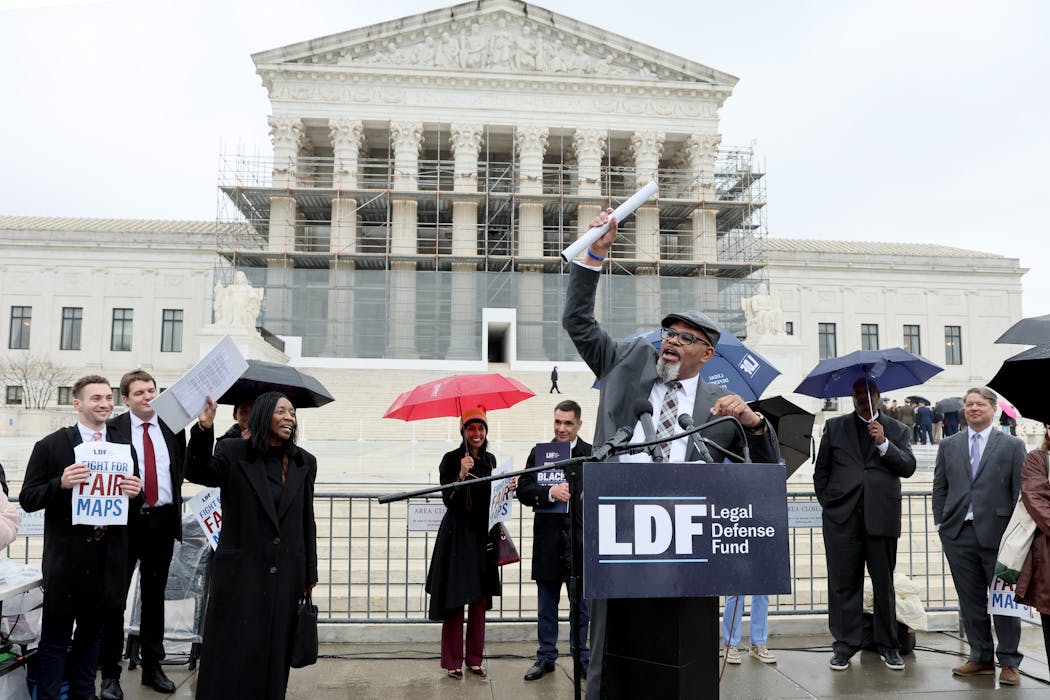
Black Louisiana voters and civil rights advocates ask U.S. Supreme Court justices to uphold a fair and representative congressional map in Louisiana v. Callais on March 24, 2025. Jemal Countess/Getty Images

On Oct. 15, 2025, the Supreme Court will hear oral arguments in one of the most anticipated cases of the 2025-2026 term, Louisiana v. Callais, with major implications for the Voting Rights Act, racial representation and Democratic Party power in congress.

The central question in the case is to what extent race can, or must, be used when congressional districts are redrawn. Plaintiffs are challenging whether the longstanding interpretation of Section 2 of the Voting Rights Act, which requires protection of minority voting power in redistricting, violates the Equal Protection Clause of the U.S. Constitution, which guarantees that individuals should be treated the same by the law.

In short, the plaintiffs argue that the state of Louisiana’s use of race to make a second Black-majority district is forbidden by the U.S. Constitution.

This is the second time that the court will hear oral arguments in Louisiana v. Callais after no decision was reached last term. From my perspective as a scholar of U.S. federal courts and electoral systems, this case represents the collision of decades of Supreme Court decisions on race, redistricting and the Voting Rights Act.

Long legal battle

To understand the stakes of the current case, it’s important to know what the Voting Rights Act does. Initially passed in 1965, the act helped end decades of racially discriminatory voting laws by providing federal enforcement of voting rights.

Section 2 of the Voting Rights Act forbids discrimination by states in relation to voting rights and has been used for decades to challenge redistricting plans.

The current case has its roots in the redistricting of Louisiana’s congressional districts following the 2020 Census. States are required to redraw districts each decade based on new population data. Louisiana lawmakers redrew the state’s six congressional districts without major changes in 2022.

Police smashing marchers on a street with billy clubs.
State troopers in Selma, Ala., swing billy clubs on March 7, 1965, to break up a march by advocates for Black Americans’ voting rights.
AP Photo, File

Soon after the state redistricted, a group of Black voters challenged the map in federal court as a violation of the Voting Rights Act. The plaintiffs argued that the new map was discriminatory because the voting power of Black citizens in the state was being illegally diluted. The state’s population was 31% Black, but only one of the six districts featured a majority-Black population.

The federal courts in 2022 sided with the plaintiffs’ claim that the plan did violate the Voting Rights Act and ordered the state legislature to redraw the congressional plan with a second Black-majority district.

The judges relied on an interpretation of Section 2 of the Voting Rights Act from a 1986 Supreme Court decision in the case known as Thornburg v. Gingles. Under this interpretation, Section 2’s nondiscrimination requirement means that congressional districts must be drawn in a way that allows large, politically cohesive and compact racial minorities to be able to elect representatives of their choice.

In 2023, the Supreme Court upheld a lower court’s interpretation of Section 2 of the Voting Rights Act in a similar racial gerrymandering case in Alabama.

Louisiana lawmakers redraw districts

Following the court order, the Louisiana state legislature passed Senate Bill 8 in January 2024, redrawing the congressional map and creating two districts where Black voters composed a substantial portion of the electorate in compliance with the Gingles ruling. This map was used in the 2024 congressional election and both Black-majority districts elected Democrats, while the other four districts elected Republicans.

These new congressional districts from Senate Bill 8 were challenged by a group of white voters in 2024 in a set of cases that became Louisiana v. Callais.

The plaintiffs argued that the Louisiana legislature’s drawing of districts based on race in Senate Bill 8 was in violation of the 14th Amendment’s Equal Protection Clause, which requires equal treatment of individuals by the government, and the 15th Amendment, which forbids denying the right to vote based on race.

Essentially, the plaintiffs claimed that the courts’ interpretation of Section 2 of the Voting Rights Act was unconstitutional and that the use of race to create a majority-minority district is itself discriminatory. Similar arguments about the 14th Amendment’s Equal Protection Clause were also the basis of the Supreme Court’s recent decisions striking down race-based affirmative action in college admissions.

In 2024, a three-judge district court sided with the white plaintiffs in Louisiana v. Callais, with a 2-1 decision. The Black plaintiffs from the original case, and the state of Louisiana, appealed the case to the Supreme Court. The court originally heard the case at the end of the 2024-2025 term before ordering the case re-argued for 2025-2026.

A large, white building with a tall tower in the middle.
The Louisiana state Capitol in Baton Rouge.
AP Photo/Stephen Smith, File

High stakes and significant precedent

If the Supreme Court ultimately upholds the lower court decision in Louisiana v. Callais, deciding that Louisiana’s congressional districts are unconstitutional racial gerrymanders, it will have substantial impacts on minority representation. The decision would upend decades of precedent for Section 2 of the Voting Rights Act.

For 39 years, Section 2 of the Voting Rights Act has required redistricting institutions to consider racial and ethnic minority representation when devising congressional districts. Majority-minority districting is required when a state has large, compact and cohesive minority communities. Historically, some states have redistricted minority communities in ways that dilute their voting power, such as “cracking” a community into multiple districts where they compose a small percentage of the electorate.

Section 2 also provides voters and residents with a legal tool that has been used to challenge districts as discriminatory. Many voters and groups have used Section 2 successfully to challenge redistricting plans.

Section 2 has been the main legal tool for challenging racial discrimination in redistricting for the past decade. In 2013, the Supreme Court effectively ended the other major component of the Voting Rights Act, the preclearance provision, which required certain states to have changes to their elections laws approved by the federal government, including redistricting.

If the court overrules the current interpretation of Section 2, it would limit the legality of using race in redistricting, end requirements for majority-minority districts and eliminate the most common way to challenge discriminatory districting.

Additionally, because of the strong relationship between many minority communities and the Democratic party, the court’s decision has major implications for partisan control of the House of Representatives.

If Section 2 no longer required majority-minority districts, then Republicans could use the ruling to redraw congressional districts across the country to benefit their party. Politico reported that Democrats could lose as many as 19 House seats if the Supreme Court sides with the lower court.

Recent Supreme Court precedent gives conflicting signals as to how it will decide this case.

In 2023, the court rejected a challenge to Section 2 of the Voting Rights Act related to Alabama’s congressional districts. In 2024, the court overruled a lower court’s finding of racial vote dilution in South Carolina.

The Conversation

Sam D. Hayes does not work for, consult, own shares in or receive funding from any company or organization that would benefit from this article, and has disclosed no relevant affiliations beyond their academic appointment.

ref. Supreme Court redistricting ruling could upend decades of voting rights law – and tilt the balance of power in Washington – https://theconversation.com/supreme-court-redistricting-ruling-could-upend-decades-of-voting-rights-law-and-tilt-the-balance-of-power-in-washington-267269

Can you catch shingles? A GP explains what people get wrong about this common virus

Source: The Conversation – UK – By Dan Baumgardt, Senior Lecturer, School of Psychology and Neuroscience, University of Bristol

ThalesAntonio/Shutterstock

The idea that you can “catch” shingles is one of the more common misconceptions I hear from patients who arrive worried they’ve got it. Often, they’ve recently been near a child with chickenpox or someone else with shingles, and are understandably anxious they’ve picked it up.

As a GP, I encounter this misunderstanding all the time. In fact, a study from my own University of Bristol found that while most patients had heard of shingles, few actually understood what it is.

Shingles isn’t something you catch from someone else. It’s the reactivation of a virus already inside your body: the varicella zoster virus, the same one that causes chickenpox. After you recover from chickenpox, the virus doesn’t leave; it hides in the nerve cells that supply sensation to your skin, lying dormant for years, sometimes decades. Shingles is what happens when that virus “wakes up”.


Read more:
Chickenpox vaccine recommended for NHS – here’s why a jab is better than getting the disease


When it reactivates, it causes clusters of small, fluid-filled blisters known as vesicles. Before the rash appears, people can feel tingling, burning or pain in one area of the body – sometimes two or three days beforehand. The skin can become unusually sensitive, and you might feel generally tired, feverish or unwell.

Shingles is common, affecting about one in 25 people. It tends to follow a characteristic pattern. The rash usually appears in a strip or band on one side of the body, corresponding to a dermatome (an area of skin served by one spinal nerve). It’s rare for shingles to appear on both sides of the body.

The blisters eventually burst, scab over and heal within three to four weeks, sometimes leaving small scars. Until each blister has crusted, a person with shingles is considered infectious, meaning they can transmit the virus to others – but not in the way most people think.

1. You can catch chickenpox from someone with shingles

To develop shingles, you must already have had chickenpox. For some patients though, chickenpox can be mild or have happened so long ago that they may struggle to recall having it.

When the shingles blisters burst, the fluid inside them contains the same, live varicella zoster virus. If someone who has never had chickenpox (or hasn’t been vaccinated against it) comes into direct contact with that fluid, they can become infected and develop chickenpox – but not shingles. Shingles only occurs when the dormant virus reawakens inside someone who has already had chickenpox.

For that reason, people with shingles should keep their rash covered (with clothing or a non-adherent dressing) until all the blisters have crusted over and healed.

It’s important to avoid contact with anyone for whom chickenpox could be particularly dangerous. That includes pregnant women – as varicella can sometimes cause complications for the mother and may harm the unborn baby. Newborn infants, whose immune systems are not yet strong enough to fight the infection are also at risk. Other patients with weakened immune systems (such as the elderly, those undergoing chemotherapy or living with conditions like HIV) may also struggle to fight the virus. Chickenpox can become a severe illness in these people, leading to complications like pneumonia.

2. Shingles can occur at any age

Although shingles becomes more likely as we age, it can occur at any time after you’ve had chickenpox – even in young adults or children. It’s more common when the immune system is weakened, which can happen with age, and in people receiving chemotherapy or other immunosuppressive treatments.

3. It can affect more than just your torso

Most cases appear on the chest or back, but shingles can occur anywhere on the body, including the face, limbs and even the genitals. When it affects the face, it can involve the eyes through nerve branches that extend there. This form, known as ophthalmic herpes, can threaten vision and cause blindness if not treated promptly. It can also affect the facial nerve which controls your facial muscles – otherwise known as Ramsay Hunt syndrome.

Some people develop pain, tingling, or sensitivity without a visible rash. The appearance of shingles can also vary by skin tone, making it harder to spot in darker skin.

4. Early treatment helps

If you suspect shingles, see a clinician promptly. Antiviral medications can help shorten recovery time and reduce complications, but they work best when started within 48-72 hours of the rash appearing.

Certain groups, including young, pregnant and breastfeeding patients, people with weakened immune systems and anyone with shingles affecting the face, nose, eyes (including the eye’s surface) or any visual changes, should definitely seek medical attention urgently.

5. The story doesn’t always end when the rash heals

For some, shingles can cause problems even after the visible rash clears. Open blisters can become infected with bacteria, sometimes requiring antibiotics. The virus can also damage nearby nerves, leading to post-herpetic neuralgia – persistent nerve pain that can last for months or even years after the skin has healed. It can feel like burning, stabbing or throbbing pain in the same area where the rash appeared.

Unfortunately, shingles can return again, sometimes in a different part of the body. The shingles vaccine significantly reduces both the risk of developing shingles and the chance of long-term nerve pain like post-herpetic neuralgia, though it doesn’t remove the risk entirely.

Think of shingles not as something you “catch”, but as something that can wake up again within your own body. It’s a reminder that viruses don’t always leave when we think they do. And that protecting yourself and others means recognising the signs early, covering the rash, and getting prompt medical advice.

The Conversation

Dan Baumgardt does not work for, consult, own shares in or receive funding from any company or organisation that would benefit from this article, and has disclosed no relevant affiliations beyond their academic appointment.

ref. Can you catch shingles? A GP explains what people get wrong about this common virus – https://theconversation.com/can-you-catch-shingles-a-gp-explains-what-people-get-wrong-about-this-common-virus-266653

The dark history of medical illustrations and the question of consent

Source: The Conversation – UK – By Lucy E. Hyde, Lecturer, Anatomy, University of Bristol

Vector Hut/Shutterstock.com

They were pregnant. Some were prisoners. Others were the poorest of the poor, forgotten in death as in life. Yet dissection and depiction of their bodies have become the foundation of anatomical teaching.

Cradled in the pages of anatomy textbooks are figures stripped bare, not only of skin but of identity. Eduard Pernkopf’s infamous Nazi-era atlas contains exquisite, hyper-realistic drawings created from the bodies of political prisoners executed under Hitler’s regime.

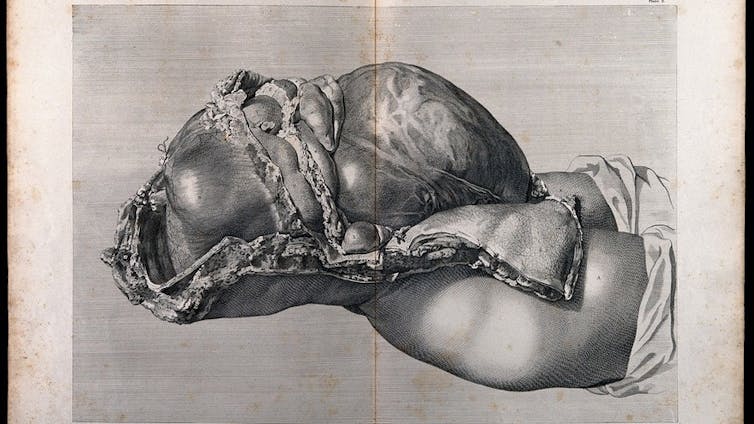
William Hunter’s celebrated The Gravid Uterus (1774) shows dissected pregnant women with clinical detachment, their swollen wombs exposed. But who were these women? How did they end up on the dissection table? And, crucially, did they ever consent? It’s something rarely considered by educators, students and the public alike.

Today, body donation is governed by clear laws and ethics. In the UK, the 2004 Human Tissue Act (2006 in Scotland) requires informed, personal consent for anatomical investigation, and further consent to be given for production of images.

Annual memorial and thanksgiving services also honour donors, and those studying anatomy are taught to treat cadavers with the same dignity they would offer the living – the medic’s first patient, albeit silent.

But historical anatomical illustrations, still in use across education and medicine, were produced at times long before such safeguards existed. Most texts and imagery feature people who never gave permission to be dissected, let alone depicted for eternity. Should we keep using these images? Or does that make us complicit in a long history of medical exploitation?

Anatomical illustration and, therefore, the history of the peoples depicted, mirrors the legal and cultural attitudes toward dissection at the time. The first recorded human dissections occurred around 300BC in Alexandria, Egypt. In the second century, Galen, a Greek physician, dissected animals and treated gladiators, and laid the foundations for anatomical understanding in Europe for over a thousand years.

In medieval Europe, dissection was rare and heavily ritualised, often serving theological rather than scientific purposes. By the Renaissance, anatomy began to take its modern form. Leonardo da Vinci conducted detailed dissections, producing hundreds of drawings that combined anatomical accuracy with artistic brilliance. Yet he, too, was not above questionable methods, reportedly obtaining bodies through informal deals with hospitals and executioners. The identities of his subjects remain unknown.

In 1543, Andreas Vesalius published De Humani Corporis Fabrica, challenging centuries of Galenic error with visual evidence from dissection. His cadavers, however, were idealised, muscular, often white and probably male.

In one image, a body holds back its own skin to reveal its musculature, just like Saint Bartholomew the Apostle in his martyrdom. Never before had an anatomical text been so highly illustrated. The images were groundbreaking, but they romanticised death and dehumanised the dead.

Over time, anatomical realism became the goal. In the 17th and 18th centuries, Dutch and British anatomists like Govard Bidloo and William Hunter embraced unflinching detail – depicting the morbidity of the cadaver, showing decomposition, often violent incisions, and the tools of dissection.

Hunter’s The Gravid Uterus aimed to transform obstetrics through realism. But it relied on 14 pregnant bodies whose origins remain ethically troubling.

Dissection of the pregnant female abdomen, showing the skin peeled away to reveal the swollen uterus.
The gravid uterus.
Copperplate engraving by G. Scotin after I.V. Rymsdyk, for W. Hunter The Gravid Uterus. 1774, reprinted 1851.

How did he obtain them? Even though the 1752 Murder Act allowed the anatomisation of executed murderers, only a few bodies were legally available in this way, insufficient for demand. Between 1752 and 1776, just four cadavers were sourced under the Act in London.

At the time, the proportion of women dying in childbirth was also low, around 1.4%. The likelihood that Hunter’s subjects were legally obtained is slim. More likely, they were acquired through body snatching, a common but illegal practice. Their identities were never recorded. Their images endure.

Grave robbers or “resurrection men” helped meet the growing demand for cadavers – driven by the expansion of medical education and legal restrictions on supply – by targeting the poor: those buried in shallow, recent or unmarked graves at the edges of cemeteries. Wealthier people could protect their dead in gated cemeteries patrolled by paid guards, coffins protected by iron cages or in stone vaults.

The rich could buy safety even in death. The poor were left exposed, not because they lacked value, but because they lacked power.

The 1832 Anatomy Act curbed grave robbing but entrenched injustice. Unclaimed institutionalised bodies became the new legal supply, those from workhouses, poorhouses, asylums, prisons and hospitals.

Until the 1984 Anatomy Act, and more definitively the 2004 Human Tissue Act, informed consent was not required. Let’s be clear: the bodies in most anatomical images were not volunteers. They were poor, criminalised and marginalised – those who in life already suffered the most.

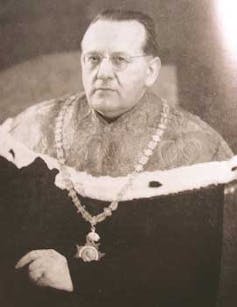
Eduard Pernkopf in full academic regalia.
Medizinische Universität WienImmediate

The most extreme more modern example is Pernkopf’s Atlas of Topographical and Applied Human Anatomy. Widely regarded as one of the most detailed and visually stunning anatomical texts, particularly in its depiction of the peripheral nerves, it is the most ethically troubling.

The atlas was created during the Nazi regime, with at least 1,300 bodies of Jewish prisoners, Roma, queer individuals and political dissidents, many of whom were executed in Vienna’s Gestapo prison.

Despite its origins in medical atrocities, the atlas remained in print until the 1990s. Even decades later, its influence persists. A 2019 study found that 13% of neurosurgeons still use the atlas.

Some defend its continued use, citing its anatomical precision, especially in complex neurological surgeries, so long as its dark history is acknowledged. Others argue that any clinical benefit is outweighed by the ethical cost, and that continued use implies endorsement of its origins.

Efforts underway

But Pernkopf is only the most dangerous example. Across many historical images, the same fundamental question arises: can medical knowledge built on exploitation ever be fully separated from it?

There’s no single solution, but there are efforts underway. Some educators are adding context in lectures, footnotes and course materials, taking time to teach the history, acknowledging who was probably depicted and under what circumstances.

Medical illustrators are creating new images based on informed consent and modern day guidelines, partly also to create diverse representation across population history, gender, body type and ability. Institutions are digitising and cataloguing old collections with proper historical notes, so they aren’t used uncritically.

But these efforts are piecemeal. There are no universal standards or regulations governing historical anatomical imagery, falling out of the remit of even the most strict governing body. Meanwhile, these illustrations circulate freely online, in textbooks, even on social media, stripped of context, divorced from their origins.

And so, the same injustices risk being quietly perpetuated. We must start by asking better questions: who is represented in anatomical imagery today? Whose bodies are missing? And whose stories are never told?

Short term, we need clear provenance research, labelling and transparency around historical illustrations. Teachers, editors and publishers must acknowledge the sources of these images, even if unknown.

Long term, we must invest in creating new, inclusive anatomical libraries that reflect the full diversity of human bodies, across gender identities, racial backgrounds, disabilities and life stages. With ethical sourcing and clear consent, we can build materials that respect the living and the dead alike.

The people in these illustrations, silent, anonymous and dissected, were never asked to teach us. But they have and now, it’s our responsibility to ask: what kind of legacy are we creating in return?

If we want medicine to be ethical, inclusive and just, it starts with the very images we learn from. It’s time to look again at the bodies behind the drawings. And this time, to really see them.

The Conversation

Lucy E. Hyde does not work for, consult, own shares in or receive funding from any company or organisation that would benefit from this article, and has disclosed no relevant affiliations beyond their academic appointment.

ref. The dark history of medical illustrations and the question of consent – https://theconversation.com/the-dark-history-of-medical-illustrations-and-the-question-of-consent-265738

Slender-billed curlews are officially extinct – here’s why the loss of these migratory birds really matters

Source: The Conversation – UK – By Esther Kettel, Senior Lecturer in Ecology and Conservation, Nottingham Trent University

The Eurasian curlew, a close relative of the now-extinct slender-billed curlew. David Havel/Shutterstock

The slender-billed curlew (Numenius tenuirostris) has been officially declared extinct by the International Union for Conservation of Nature (IUCN).

This is the first-ever recorded global bird extinction from mainland Europe, North Africa, and West Asia. An accolade that no species wants. Yet, sadly, here we are. So how did we get here and what does this tragic extinction mean?

Numerous warning signs indicated the decline of the slender-billed curlew, with the first documented in 1912. Declines of the species continued over the subsequent decades but it was not until 1988 that it was classified in the high conservation concern category.

Extensive searches for any remaining slender-billed curlews were conducted but there have been no sightings since the mid-1990s. Extinction was declared as highly probable in 2024, and made official by the IUCN in October 2025.

The curlew was once thought to be fairly widespread. It was a migratory species that bred in central Asia and wintered in Europe, North Africa and the Middle East. As such, like many migratory species, the curlew relied on various habitats and safe passage routes.

The pressures leading to the extinction are largely unknown. However, due to its migratory nature, the extinction of this species is likely due to a combination of factors across its historic range.


Read more:
Europe’s wild bird species are on the brink – but there are ways to bring them back


Hunting of the species was carried out in many countries along its migratory route and is considered to be one of the major causes of initial declines. In conjunction, drainage of wetlands and overgrazing of grasslands led to the rapid loss of breeding sites for this ground-nesting bird. Conservation efforts were complicated by the fact that its distribution and ecology were largely unknown. So, death rates were high, birth rates were low, and very little could be done.

The last call?

Slender-billed curlews were striking birds. They stood proud with their long legs and slim, pointed, black bill. Their calls were sweet and whistling, but somewhat haunting. It is a sad fact that this bird will never be seen or heard again.

More widely, the loss of this species shines light on the global extinction crisis. Each species plays a vital role within its ecosystem. These curlews fed on small insects, crustaceans and molluscs by probing mud with their thin bills. The role these birds played as a predator in aquatic ecosystems (such as peat bogs) is now no longer filled. This gap will undoubtedly have consequences for other species.

misty shot of curlew wading bird on brown peat bog land
Curlews are ground-nesting birds that rely on healthy peat bogs and other aquatic ecosystems.
F-Focus by Mati Kose/Shutterstock

Slender-billed curlews were indicators of the health of the boggy habitats in which they inhabited. Their decline to eventual extinction signifies that these habitats are under severe stress. Waterbirds like the curlew can also be valuable indicators of water contamination, lack of food availability and changes in nutrient levels.

Wading birds like the slender-billed curlew are declining globally and are considered to be the most pressing bird conservation priority in the UK. Populations of species such as lapwing (Vanellus vanellus), redshank (Tringa tetanus), snipe (Gallinago gallinago) and oystercatcher (Haematopus ostralegus) are declining in size and range across much of the UK due to habitat loss and reduced reproductive success.

The Eurasian curlew (Numenius arquata), a relative of the slender-bill, is of particular conservation concern and is thought to be the UK’s most rapidly declining species. Much effort is being made to save the Eurasian curlew so that it doesn’t follow the same fate as the slender-bill.

The UK Action Plan for Curlew (a coalition of farmers, scientists and charities) is calling for urgent and coordinated action that includes monitoring and research, habitat protection, predator management and guidance for land managers. While populations fell by 51% between 1995 and 2023 across the UK, there are signs that intensive conservation efforts are working, even if only locally.

The loss of the slender-billed curlew is truly saddening. But perhaps, just maybe, we can use this as a wake-up call to do more, and more quickly, for other wading birds that are on a similar trajectory.


Don’t have time to read about climate change as much as you’d like?

Get a weekly roundup in your inbox instead. Every Wednesday, The Conversation’s environment editor writes Imagine, a short email that goes a little deeper into just one climate issue. Join the 45,000+ readers who’ve subscribed so far.


The Conversation

Esther Kettel does not work for, consult, own shares in or receive funding from any company or organisation that would benefit from this article, and has disclosed no relevant affiliations beyond their academic appointment.

ref. Slender-billed curlews are officially extinct – here’s why the loss of these migratory birds really matters – https://theconversation.com/slender-billed-curlews-are-officially-extinct-heres-why-the-loss-of-these-migratory-birds-really-matters-267282

The UK military says Russia targets its satellites on a weekly basis. What can be done about it?

Source: The Conversation – UK – By Jessie Hamill-Stewart, PhD Candidate in Cybersecurity, University of Bath

The UK operates the Skynet series of military communications satellites. Defence Images

Russia is targeting UK space infrastructure, and in particular military satellites, on a weekly basis, according to the head of UK Space Command.

In an interview with the BBC, Maj Gen Paul Tedman said that Russia was “shadowing” UK satellites. Shadowing involves orbiting and aligning a satellite close to the target satellite, in order to be near enough to jam communications or intercept signals to steal critical information.

Tedman said Russia’s satellites had “payloads on board that can see our satellites and are trying to collect information from them”. He also confirmed that jamming of UK military satellites was taking place.

This involves broadcasting signals on the same frequencies as those used by satellites, in order to intentionally disrupt or overwhelm legitimate signals. It does not physically damage spacecraft, so as soon as the jamming signal is no longer being emitted, communications can be restored. The jamming of satellite signals can take place from the ground, ocean or air, as well as from space.

But what about other tactics that could be used to disrupt satellites? One thing not mentioned in relation to the attacks on British military satellites, is the use of lasers. These can be deployed to dazzle satellites’ onboard optical sensors. This can interfere with electronic circuity but would not cause lasting physical damage.

The most serious type of attack of course would be the use of a direct-ascent missile, which can be launched from the ground, sea or air, to destroy an orbiting satellite. Previous tests of this kind of anti-satellite (Asat) weapon have generated worrying levels of orbiting debris. This debris can then collide with other satellites, potentially generating even more debris for other space-based assets to avoid.

On February 24, 2022, the day of Russia’s invasion of Ukraine, satellite broadband users across Europe got a taste of the kind of attacks that the military is now used to. A cyber-attack was launched against Viasat’s Ka-Sat satellite network, which supplies internet access to tens of thousands of people across Ukraine and the rest of Europe. Experts said they believed the purpose of the attack was to interrupt service rather than to access data or systems.

A recent talk by German IT researchers also revealed how much damage hackers could potentially do if given unfettered access to a satellite’s onboard systems. The experts said that attackers could exploit vulnerabilities in open source software used by Nasa and Airbus to control satellites. This in turn could give the intruders access to the control functions on a satellite, allowing them to change its orbit by sending a command to fire its thrusters.

Attacks don’t need to target the satellite directly. Targeting control stations on the ground can also disrupt operation of the satellites in orbit. This can also have consequences for end users of a satellite service.

Wider problem

It’s not just the UK’s satellites that are being targeted, however. In September, the head of French space command Maj Gen Vincent Chusseau said there had been a spike in hostile activity in space. Chusseau said activity had increased since Russia’s full-scale invasion of Ukraine in 2022.

He said that adversaries, especially Russia, have diversified methods of disrupting satellites and that jamming, lasers and cyber-attacks have become commonplace.

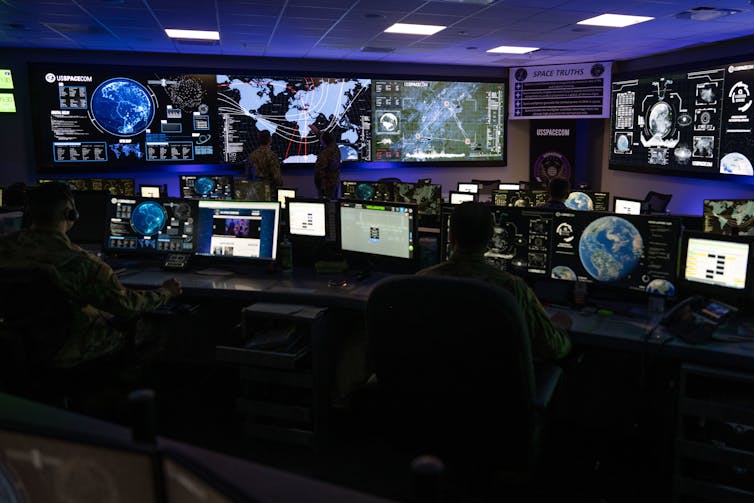
The US Space Command Joint Operations Center at Peterson Space Force Base, Colorado
In September 2025, the US and UK conducted their first coordinated satellite manoeuvre.
Christopher DeWitt, Space Command

The same month, Brig Gen Christopher Horner, commander of 3 Canadian Space Division told a space security summit that there were more than 200 anti-satellite weapons orbiting Earth.

While he didn’t provide details on their nature, he said it was a “shocking number” to threaten allied satellites.

Increased investment

It’s possible to satellites by improving the encryption of data transmitted to them as well as with anti-jamming technology. This uses a variety of techniques to block out or nullify the signals used by jammers to interfere with satellite communications. It’s also important to ensure there are alternative providers for critical space services as a backup in case of attack.

In response to increasing threats to UK satellite infrastructure, the UK government has recently increased its investment in projects geared towards space security. The government has invested £500,000 in a project to develop sensors that counter lasers used to blind satellites. The UK has also recently developed Borealis, a software platform designed to monitor and protect critical UK and allied satellites.

As well as investing in its own projects, the UK has also sought to improve space-based security by strengthening international partnerships. For instance, the UK recently invested €163 million (£141 million) in Eutelsat, which provides satellite internet and is a rival to Elon Musk’s Starlink system.

Starlink’s importance not only for consumers, but also for military applications has been demonstrated in the Ukraine war – where Ukrainian troops had come to rely heavily on it for battlefield communications. But the drawback to this dependency on a privately owned company such as Starlink was highlighted when Musk denied coverage to Kyiv in 2023.

The investment in Eutelsat not only strengthens space-based collaboration between the UK and France, but also boosts a company providing a backup system for satellite communications.

The US and UK also recently conducted their first coordinated satellite manoeuvre. The US repositioned one of its own satellites to examine a UK satellite to make sure it was operating normally. Such a manoeuvre could potentially be used following an attack designed to disable a spacecraft.

The reports of Russian meddling highlight the importance of security in orbit as global tensions continue to expand into space.

The Conversation

Jessie Hamill-Stewart does not work for, consult, own shares in or receive funding from any company or organisation that would benefit from this article, and has disclosed no relevant affiliations beyond their academic appointment.

ref. The UK military says Russia targets its satellites on a weekly basis. What can be done about it? – https://theconversation.com/the-uk-military-says-russia-targets-its-satellites-on-a-weekly-basis-what-can-be-done-about-it-267232