Why rural Coloradans feel ignored − a resentment as old as America itself

Source: The Conversation – USA – By Kayla Gabehart, Assistant Professor of Environmental Policy, Michigan Technological University

Many rural Americans feel largely left out of American culture. Helen H. Richardson/Getty Images

Many rural Coloradans, especially in agricultural communities, feel looked down on by their urban counterparts. One cattle rancher I spoke to put it plainly. “It’s an attitude … we are the idiots … we are the dumb farmers … we don’t really matter.”

The sentiment is also portrayed in popular culture such as the hit TV show “Yellowstone.”

“It’s the one constant in life. You build something worth having, someone’s gonna try to take it,” says patriarch John Dutton. He was facing repeated threats by developers from “the city” to annex his land for a luxury hotel and resort development.

As a policy scholar, I’ve talked to and interviewed many dozens of people in rural areas in Colorado. I’ve also read hundreds of newspaper articles and watched hundreds of hours of legislative testimony that capture the sentiment of rural people being left behind, left out and snubbed by their urban counterparts.

Recently, I studied the divide between rural and urban Coloradans by looking at their responses to four statewide policies. A designated day to forgo eating meat, two political appointees and the ongoing wolf reintroduction.

These policies, while specific to Colorado, are symptoms of something larger. Namely, an ever-urbanizing, globalized world that rural, agricultural citizens feel is leaving them behind.

‘MeatOut’ or misstep?

My expertise doesn’t just come from my research – I’ve lived it.

I grew up in a rural community in Elbert County, Colorado, about an hour- and-a-half southeast of Denver.

In early 2021, Gov. Jared Polis declared via proclamation that March 20 would be a “MeatOut Day.” For health and environmental reasons, Colorado residents were encouraged to forgo meat for a single day.

Supported by the Farm Animal Rights Movement, MeatOuts have been promoted across the U.S. since the 1980s. Typically, gubernatorial proclamations, of which hundreds are passed each year and are completely ceremonial and devoid of any long-term formal policy implications, go largely unnoticed. And in Denver, Colorado’s metropolitan center, this one did too.

Not so in rural Colorado.

My neighbors in Elbert County promptly responded with outrage, flying banners and flags declaring their support for agriculture and a carnivorous diet.

One rancher from Nathrop painted a stack of hay bales to say, “Eat Beef Everyday.”

Communities all over the state, and even in neighboring states, responded with “MeatIns,” where they gathered to eat meat and celebrate agriculture and the rural way of life. They also coupled these events with fundraisers, for various causes, for which hundreds of thousands of dollars were raised across the state. While Polis backed off the MeatOut after 2021, Denver Mayor Mike Johnston has, just this year, supported a similar “Eat Less Meat” campaign, prompting similar rural outrage.

Did I mention there are nearly 36,000 cattle in Elbert County? This is relatively typical of a rural Colorado county, particularly on the Plains.

In Colorado, 2.7 million cattle are raised annually, with a value of US$4.5 billion. The industry is consistently the top agricultural commodity and the second-largest contributor to Colorado’s GDP, at about $7.7 billion per year.

In early March 2021, Polis declared March 22 “Colorado Livestock Proud Day,” in response to the backlash.

Other policies

This came on the heels of several policies supported by Polis prior to the MeatOut controversy that critics considered anti-agriculture.

In 2020, he appointed Ellen Kessler, a vegan and animal rights activist, to the State Veterinary Board. Kessler criticized 4-H programs, designed to educate youth on agriculture and conservation, on her social media, insisting they “don’t teach children that animal lives matter.” Kessler resigned in March 2022, just days before she was cited for 13 counts of animal cruelty. More recently, in May 2025, Polis appointed Nicole Rosmarino to head the State Land Board. Rosmarino has ties to groups that oppose traditional agricultural practices, historically a key component of Colorado State Land Board operations.
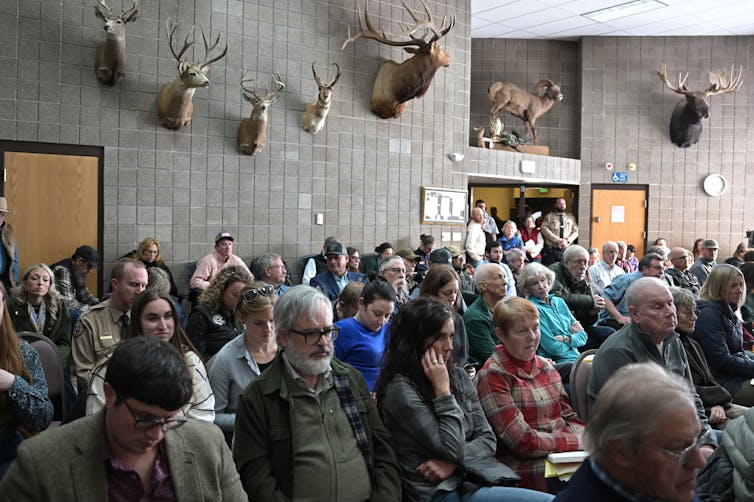
People sit in a room with stuffed deer heads in the background.
Community members gather at the Colorado Parks and Wildlife hunter education building in Denver. Colorado ranchers petitioned the state’s wildlife commission to delay the next round of wolf releases in September 2024. The petition was denied.
Hyoung Chang/Getty Images

Then came wolf reintroduction, passed by urban voters by just under 57,000 votes in the 2020 general election and supported by the governor. Those in support advocated for a return to natural biodiversity; wolves were hunted to extinction in the 1940s.

Rural residents voted decidedly against the initiative. Despite much legislative and grassroots action to oppose it, wolves were reintroduced in December 2023 in various areas along the Western Slope, in close proximity to many ranches. Several cattle have since been killed by wolves. Ever since, rural interests have been working to overturn wolf reintroduction on the 2026 ballot.

An American mess

Rural residents in Colorado have told me they feel excluded. This is not new or exclusive to Colorado, but a story as old as America itself.

University of Wisconsin political scientist Katherine J. Cramer wrote about this rural exclusion in Wisconsin, calling it “rural resentment.” Berkeley sociologist Arlie Russell Hochschild called it “stolen pride.” In their book, Tom Schaller, a political scientist at the University of Maryland, and Paul Waldman, a longtime journalist, characterize it as “white rural rage.”

It’s a dynamic that descends from slavery. Isabel Wilkerson, in her book “Caste: The Origins of Our Discontents,” demonstrates that while Black Americans have historically been relegated to the bottom of the hierarchy of an American caste system, poor white people are strategically positioned just above them but below white Americans of higher socioeconomic status. As Wilkerson explains, this is a durable system sustained by norms, laws and cultural expectations that feel “natural.” But they are entirely constructed and designed by the American upper class to intentionally exploit resentment of working-class white people.

The result is what sociologist Michael M. Bell calls a “spatial patriarchy” that characterizes rural America as dumb, incapable, racist, poor and degraded as “white trash.”

This spatial patriarchy is as old as industrialization and urbanization. One of the first policy iterations was rural school consolidation during the turn of the 20th century, designed to modernize schools and make them more efficient. Urban policymakers were influenced by eugenics and the assumption that rural schools “were populated by cognitively deficient children whose parents had not been smart enough or fortunate enough to leave the decaying countryside,” according to sociologist Alex DeYoung.

So, states around the country consolidated schools, the lifeblood of rural communities. Where a school closed, the town often died, as in small towns, schools are not just socioeconomic hubs but centers of cultural and social cohesion.

Environmental impact

The same concept – that urban policymakers know better than rural Americans – is manifest in the modern environmental movement. Like with the MeatOut, rural communities also distrust environmental policies that, in their view, intentionally target a rural way of life. Rural communities take the position that they’ve been made to bear the brunt of the transformations of the global economy for generations, including those that deal with energy and the environment.

For example, environmentalists frequently call for lowering meat consumption and enacting livestock taxes to lower global greenhouse gas emissions.

But, there’s a huge, untapped potential for environmental policies that use language consistent with rural attitudes and values, such as ideas about conservation and land stewardship. Political scientists Richard H. Foster and Mark K. McBeth explain, “Rural residents perceive, probably correctly, that environmental ‘outsiders’ are perfectly willing to sacrifice local economic well-being and traditional ways of life on the altar of global environmental concerns.” They instead suggest “emphasizing saving resources for future generations” so that rural communities may continue to thrive.

The Food and Agriculture Organization of the United Nations attribute between 18% to 24% of greenhouse gas emissions to agriculture, while the International Panel on Climate Change places the estimate closer to 10%. However, agricultural producers point out that, while they may be responsible for that 10%, just 100 companies, such as BP and ExxonMobil, have produced 70% of all emissions. Agricultural producers say policies such as livestock taxes would disproportionately impact small-scale farmers and intensify rural inequality.

Rural communities have the distinct feeling that urban America doesn’t care whether they fail or flourish. Nearly 70% of rural voters supported Trump in the 2024 presidential election. He won 93% of rural counties. Rural Americans feel left behind, and for them, Trump might be their last hope.

The Conversation

Kayla Gabehart does not work for, consult, own shares in or receive funding from any company or organization that would benefit from this article, and has disclosed no relevant affiliations beyond their academic appointment.

ref. Why rural Coloradans feel ignored − a resentment as old as America itself – https://theconversation.com/why-rural-coloradans-feel-ignored-a-resentment-as-old-as-america-itself-260894
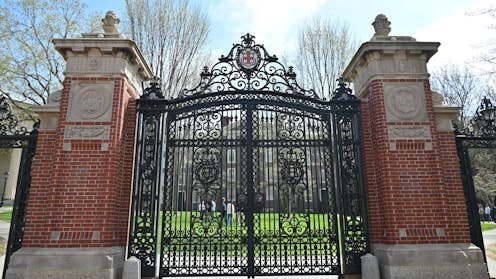
Exactly what is in the Ivy League deals with the Trump administration – and how they compare

Source: The Conversation – USA (2) – By Brendan Cantwell, Professor of Higher, Adult, and Lifelong Education, Michigan State University

Brown University is one of the Ivy League universities that has recently made a deal with the White House to end the government’s inquiry into its treatment of Jewish students, among other practices, on campus. Kyle Mazza/Anadolu via Getty Images

The Trump administration and Harvard University are reportedly close to reaching a settlement that would require Harvard to pay US$500 million in exchange for the government releasing frozen federal funding and ending an investigation into antisemitism on campus.

This follows similar deals the White House struck with Columbia University and Brown University in July 2025. Both of those universities agreed to undertake campus reforms and pay a large sum – more than $200 million in the case of Columbia and $50 million for Brown – in order to receive federal funding that the Trump administration was withholding. The White House originally froze funding after saying that these universities had created unsafe environments for Jewish students during Palestinian rights protests on campus in 2024.

As a scholar of higher education politics, I examined the various deals the Trump administration made with some universities. When Harvard announces its deal, it will be informative to see what is different – or the same.

I believe the Columbia and Brown deals can be used as a blueprint for Trump’s plans for higher education. They show how the government wants to drive cultural reform on campus by giving the government more oversight over universities and imposing punishments for what it sees as previous wrongdoing.

Here are four key things to understand about the deals:

Two young women wearing long light blue graduation robes walk past a row of police officers outside two large buildings on a gray day.
Columbia University students walk past police on commencement day on May 21, 2025, outside the campus on Broadway in New York.
Selcuk Acar/Anadolu via Getty Images

1. Antisemitism isn’t a major feature of the agreements

The Trump White House accused Brown and Columbia of tolerating antisemitism during campus protests. But the administration neither followed federal standards for investigating antisemitism, nor did it dictate specific reforms to protect Jewish students.

Ahead of its deal, Columbia in March 2025 adopted a new, broader definition of antisemitism that was created by the International Holocaust Remembrance Alliance. The United Nations and most European Union countries also use this definition.

Yet the school’s 22-page deal mentions antisemitism only once, where it says Columbia is required to hire an additional staff member to support Jewish students’ welfare.

Brown’s deal, meanwhile, did not involve the university adopting a particular definition of antisemitism. But Brown did commit to offering “research and education about Israel, and a robust Program in Judaic Studies.” Brown already hosts a Judaic Studies program, and it is unclear from the agreement’s text what additional measures are required.

The deals also extend well beyond antisemitism concerns and into questions of gender and the composition of student bodies.

Columbia agreed to provide “single-sex” housing and sports facilities, for example. The university has an optional Open Housing program that allows mixed-gender roommates and several gender-neutral restrooms.

This places the school in line with Donald Trump’s January executive order that says a person’s gender is based on their sex as assigned at birth.

Brown’s deal also requires single-sex sports and housing facilities. In addition, Brown committed to using definitions of men and women that match Trump’s executive order.

Columbia, which enrolls about 40% of its students from other countries, also agreed to “decrease financial dependence on international student enrollment.”

The Brown deal says nothing about international education.

2. Both deals are expensive but vague about financial details.

Columbia must pay a fine of more than $200 million to the federal government, while Brown will make $50 million in donations to Rhode Island workforce development programs.

In both cases, it is not clear where the money will go or how it will be used.

Congress passed The Clery Act in 1990, creating a legal framework for fining campuses that failed to protect students’ safety.

Since then, the government has reached different settlements with universities.

Liberty University, in Lynchburg, Virginia, was required to pay the federal government $14 million in 2024, for example, for failing to investigate sexual assault allegations.

But Columbia’s payment is far larger than any previous university and government settlement. Columbia will make three payments of about $66 million into the Treasury Department over three years, according to The Chronicle of Higher Education. But it isn’t clear how the money will exactly be spent and what will happen after those three years, The Chronicle of Higher Education reported in August 2025.

Only Congress can legally decide how to spend Treasury Department funds. But Trump has ignored Congress’ appropriation directives on a number of occasions.

Brown, meanwhile, will not pay the government anything. Instead, its deal will go “to state workforce development organizations operating in compliance with anti-discrimination laws, over the ten years.”

The Brown deal doesn’t say what qualifies as qualified workforce development organizations.

3. Trump wants to influence university admissions.

While the Brown and Columbia deals have several differences, the agreements have nearly identical language giving the Trump administration oversight of the way they admit students.

The deals say that the universities must provide the government with detailed information about who applied to the schools and was admitted, broken down by grades and test scores, as well as race and ethnicity. The government could then conduct a “comprehensive audit” of the schools, based on this information.

This information could also be used to determine if universities are showing a preferences for students of color. Without providing evidence, conservative activists have alleged that selective colleges discriminate against white people and that this is a violation of the Civil Rights Act of 1964.

Experts have said that these reporting requirements appear to be intended to increase the number of white students admitted to Ivy League schools.

An older white man with a beard, flanked by two men in suits, bumps fists with a young person in a crowd.
Harvard President Alan Garber greets graduating students at Harvard’s commencement on May 29, 2025, in Cambridge, Mass.
Rick Friedman/AFP via Getty Images

4. The deals could open more doors to federal intrusion.

Claire Shipman, Columbia’s acting president, said in July that the deal would allow the university’s “research partnership with the federal government to get back on track.”

Christina Paxson, Brown’s president, also defended the agreement in a statement, writing that it “enables us as a community to move forward after a period of considerable uncertainty in a way that ensures Brown will continue to be the Brown that our students, faculty, staff, alumni, parents and friends have known for generations.”

But the deals could invite more scrutiny from the federal government.

Both deals spell out the government’s right to open new investigations against Brown and Columbia, or to reopen old complaints if the administration is not satisfied with how the universities are implementing the agreement.

Trump is now pressuring Harvard, UCLA and other universities to strike deals, also based on similar antisemitism allegations.

The White House announced on Aug. 8 that it could seize the research patents, worth hundreds of millions of dollars, that Harvard holds. Since 1980, universities have been able to legally hold, and profit from, patents resulting from federally funded research.

The federal government has long influenced higher education through funding and regulation. But the government has never tried to dictate what happens on campus before now.

Higher education experts like me believe that political goals now drive the way the government approaches higher education. Some of Trump’s conservative allies are now urging the president to go even further, saying “we have every right to renegotiate the terms of the compact with the universities.”

Given these and other pressure tactics, academics who study the law and government warn that the university deals indicate encroaching authoritarianism.

The Conversation

Brendan Cantwell does not work for, consult, own shares in or receive funding from any company or organization that would benefit from this article, and has disclosed no relevant affiliations beyond their academic appointment.

ref. Exactly what is in the Ivy League deals with the Trump administration – and how they compare – https://theconversation.com/exactly-what-is-in-the-ivy-league-deals-with-the-trump-administration-and-how-they-compare-262912

Crowdfunded companies are ‘ghosting’ their investors – and getting away with it

Source: The Conversation – USA (2) – By Andrew A. Schwartz, DeMuth Chair of Business Law, University of Colorado Boulder

Imagine you invest US$500 to help a startup get off the ground through investment crowdfunding. The pitch is slick, the platform feels trustworthy and the company quickly raises its target amount from hundreds of people just like you. Then – silence. No updates, no financials, not even a thank-you.

You’ve been ghosted – not by a friend, but by a company you helped fund.

This isn’t just an unlucky anecdote. It’s happening across the United States. And while it may violate federal law, there’s little enforcement – and virtually no consequences.

Thanks to a 2012 law, startups can raise up to US$5 million per year from the general public through online platforms such as Wefunder or StartEngine. The law was intended to “democratize” investing and give regular people, not just the wealthy, a chance to back promising young companies.

But there’s a catch: Companies that raise money this way are required to file an annual report with the U.S. Securities and Exchange Commission and post it publicly. This report, intended to show whether the business is making progress and how it is using investor funds, is a cornerstone of accountability in the system.

As a professor of business law, I wrote the book on investment crowdfunding. And in my recent research, I found that a majority of crowdfunded companies simply ignore this rule. They raise the money and go silent, leaving investors in the dark.

In most cases, I suspect their silence isn’t part of an elaborate con. More likely, the founders never realized they had to file, forgot about the requirement amid the chaos of running a young business, or shut down entirely. But whether it’s innocent oversight or deliberate avoidance, the effect on investors is the same: no information, no accountability.

This kind of vanishing act would be unthinkable for public companies listed on the stock market. But in the world of investment crowdfunding, limited oversight means that going silent, whatever the reason, is all too easy.

It’s not just 1 or 2 victims

When startups go dark, they don’t just leave their investors behind – they undermine the entire crowdfunding model.

Investment crowdfunding was meant to be an accessible, transparent way to support innovation. But when companies ghost their backers, the relationship starts to look less like an investment and more like a donation.

It’s not just unethical – it’s illegal. Federal law requires at least one annual update. But so far, enforcement has been almost nonexistent.

Concerned state attorneys general have encouraged the SEC to ramp up enforcement actions. This could work in theory, but it’s unrealistic in practice, given the SEC’s limited resources and broad mission.

If nothing changes, the crowdfunding experiment could collapse under the weight of mistrust.

Incentives work − let’s use them

Fortunately, there’s a low-cost solution.

I propose that crowdfunding platforms hold back 1% of the capital raised until the company files its first required report. If it complies, it gets the funds. If not, it doesn’t.

It’s a small but powerful incentive that could nudge companies into doing the right thing, without adding bureaucratic complexity.

It’s the same principle used in escrow arrangements, which are common in finance. In a home sale, for example, part of the money goes into a neutral holding account – escrow – until the seller meets certain agreed conditions. Only then is it released. Applying that approach here, a small slice of crowdfunding proceeds would stay in escrow until the company files its first annual report. No report, no release.

Unfortunately, crowdfunding platforms are unlikely to adopt this voluntarily. They compete with one another for deal flow, and any rule that makes fundraising slightly harder at one platform could send startups to a rival site.

However, the SEC has the legal authority to update its rules, and this change would be easy to implement – no new laws, no congressional fights, just a bit of regulatory will. I’ve even drafted a proposed rule, ready-made for the SEC to adopt, and published it in my recent article, Ghosting the Crowd.

The idea behind investment crowdfunding remains powerful: Open the door to entrepreneurship and investment for everyone. But if that door leads to silence and broken promises, trust will disappear – and with it, a promising financial innovation.

A tiny tweak to the rules could restore that trust. Without it, investors will keep getting ghosted. And the market might ghost them right back.

The Conversation

Andrew A. Schwartz does not work for, consult, own shares in or receive funding from any company or organization that would benefit from this article, and has disclosed no relevant affiliations beyond their academic appointment.

ref. Crowdfunded companies are ‘ghosting’ their investors – and getting away with it – https://theconversation.com/crowdfunded-companies-are-ghosting-their-investors-and-getting-away-with-it-261346

The paradox of pluralism: How college shapes students’ views of other religions

Source: The Conversation – USA (3) – By Ilana Horwitz, Assistant Professor of Jewish Studies and Sociology, Tulane University

Religious pluralism means more than living around people of different faiths. Thai Noipho/iStock via Getty Images Plus

Students at elite universities tend to talk a good game when it comes to religious pluralism. Many of them show up on day one already saying all the right things about respecting different faiths.

But here’s the paradox: They don’t grow from there, according to our research published in The Journal of Higher Education. Students at less selective colleges, meanwhile, do develop more pluralistic attitudes. And by their fourth year, they participate in interfaith activities, such as taking courses about different religions or joining in interfaith dialogues, just as much as anyone else.

Religious pluralism goes beyond tolerance or diversity, which are simply coexisting with people of different faiths. Pluralism involves actively seeking to understand other traditions, talking with people from other backgrounds and working with them toward common goals.

As scholars of religion and education, we worked with sociologist of education David Shuang Song to study how students’ attitudes and actions change over time. We examined data from more than 3,100 students at 112 colleges, using the Interfaith Diversity Experiences and Attitudes Longitudinal Survey. Our study tracked students for four years, measuring two things: their attitudes about appreciating different faiths, and their actual participation in interfaith activities.

Our study revealed three findings.

First, freshmen at highly selective schools – institutions that typically admit fewer than 1 in 5 applicants – often start with stronger support for religious pluralism. Compared with freshmen at less selective schools, they are more likely to agree with questions like “I respect people who have religious or nonreligious perspectives that differ from my own,” though the difference was modest.

Second, fourth-year students at less selective schools showed more pluralistic attitudes than at the start of college. In contrast, students at elite institutions maintained their high initial attitudes without any measurable change.

Third, students at all types of institutions participated in more interfaith activities by the end of college, on average, with less selective schools showing slightly larger gains. That might mean attending services of different faiths, taking courses about other religions or joining dialogue groups.

The bottom line: At less selective colleges, students tended to develop stronger attitudes about religious pluralism, and they also increased their interfaith activities. At elite colleges, students increased their activities, but their attitudes more often remained flat.

Why it matters

The United States is growing more religiously diverse – with growing numbers of non-Christian and nonreligious adults – and more divided across religious lines. Antisemitic and Islamophobic incidents have surged over the past few years, including on college campuses. All of this makes it especially urgent that colleges prepare students to bridge divides.

Our findings reveal an interesting paradox: Elite institutions admit students who already express strong support for religious pluralism on surveys. On average, however, students’ attitudes don’t deepen during college, although their interfaith activities do increase somewhat.

And students’ answers to questions about pluralism don’t necessarily demonstrate genuine commitment. For example, these attitudes may be part of how some elite students learn to seem culturally sophisticated – voicing ideals they associate with being open-minded, cosmopolitan and educated.

The findings may challenge assumptions about where meaningful education about diversity occurs. On average, less selective institutions, which educate most college students, begin with students less inclined toward pluralism. Yet in general, we found that these schools successfully foster growth in both attitudes and behavior – particularly when interfaith programs are integrated into everyday campus life and curriculum. All colleges can challenge students through experiences like interfaith events, research projects or internships.

What’s next

Today’s college students are tomorrow’s civic leaders, educators, policymakers and professionals. If institutions are struggling to cultivate the skills students need to have conversations and collaborate with people from diverse religious backgrounds, the cultural divides that already fracture our democracy are at risk of deepening.

We believe colleges must go beyond performative pluralism to foster the habits of curiosity, humility and collaboration. Pluralism isn’t just a campus value. It’s a civic necessity.

The Research Brief is a short take on interesting academic work.

The Conversation

The authors do not work for, consult, own shares in or receive funding from any company or organization that would benefit from this article, and have disclosed no relevant affiliations beyond their academic appointment.

ref. The paradox of pluralism: How college shapes students’ views of other religions – https://theconversation.com/the-paradox-of-pluralism-how-college-shapes-students-views-of-other-religions-261901

Glacial lake flood hits Juneau, Alaska, reflecting a growing global risk as mountain glaciers melt

Source: The Conversation – USA (2) – By Alton C. Byers, Faculty Research Scientist, Institute of Arctic and Alpine Research, University of Colorado Boulder

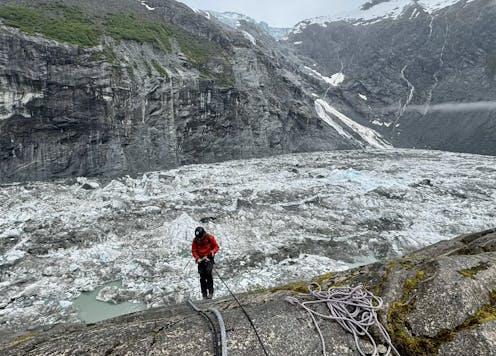
U.S. Geological Survey staff check monitoring equipment in Suicide Basin in June 2025. By August, the basin had filled with meltwater. Jeff Conaway/U.S. Geological Survey

Each summer in the mountains above Juneau, Alaska, meltwater from the massive Mendenhall Glacier flows into mountain lakes and into the Mendenhall River, which runs through town.

Since 2011, scientists and local officials have kept a close eye on one lake in particular: Suicide Basin, an ice-dammed bowl on an arm of the glacier. Glacier ice once covered this area, but as the ice retreated in recent decades, it left behind a large, deep depression.

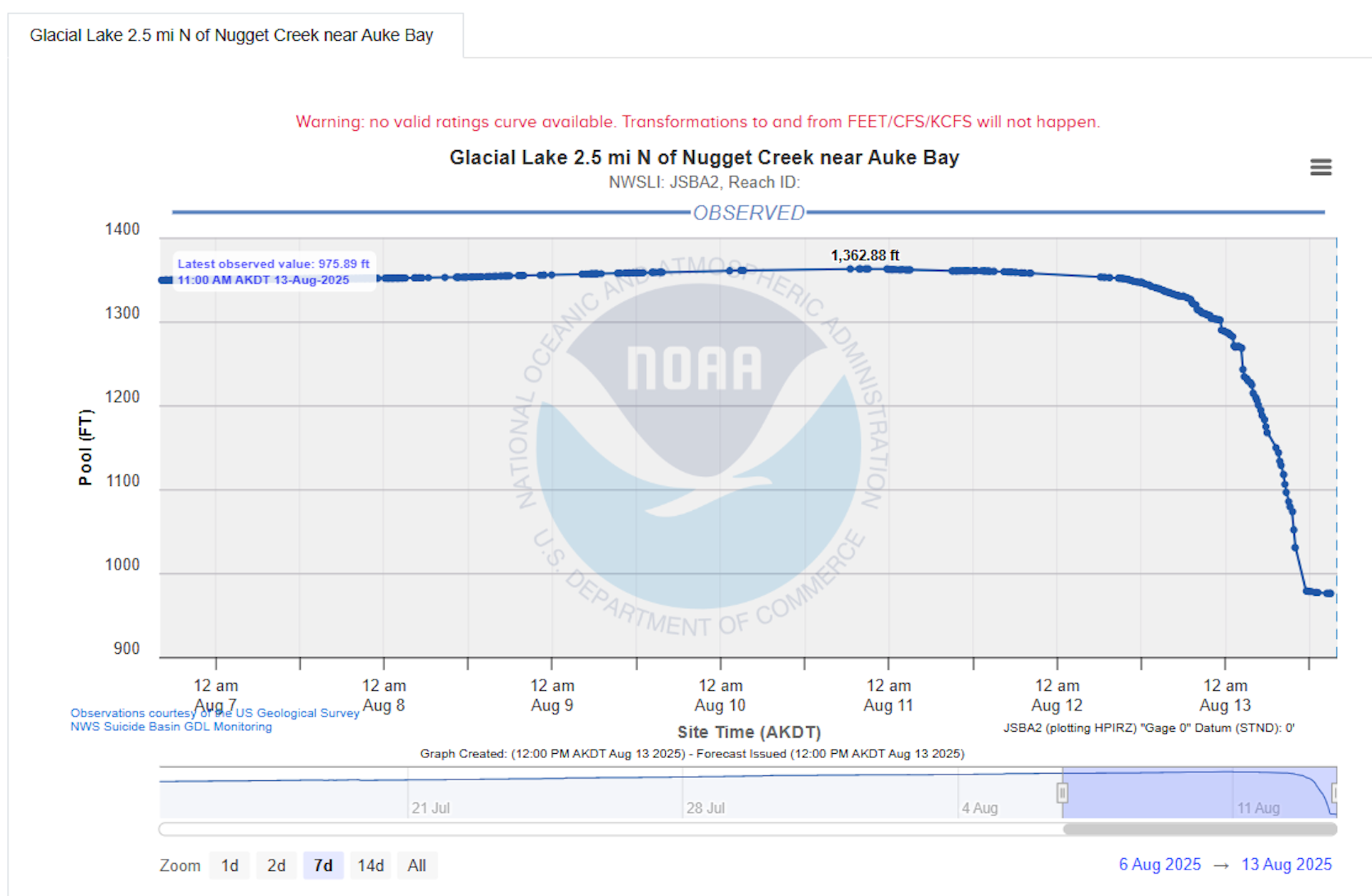
In the summers of 2023 and 2024, meltwater filled Suicide Basin, overflowed and escaped through tunnels in the ice, sending surges of water downstream that flooded neighborhoods along the river.

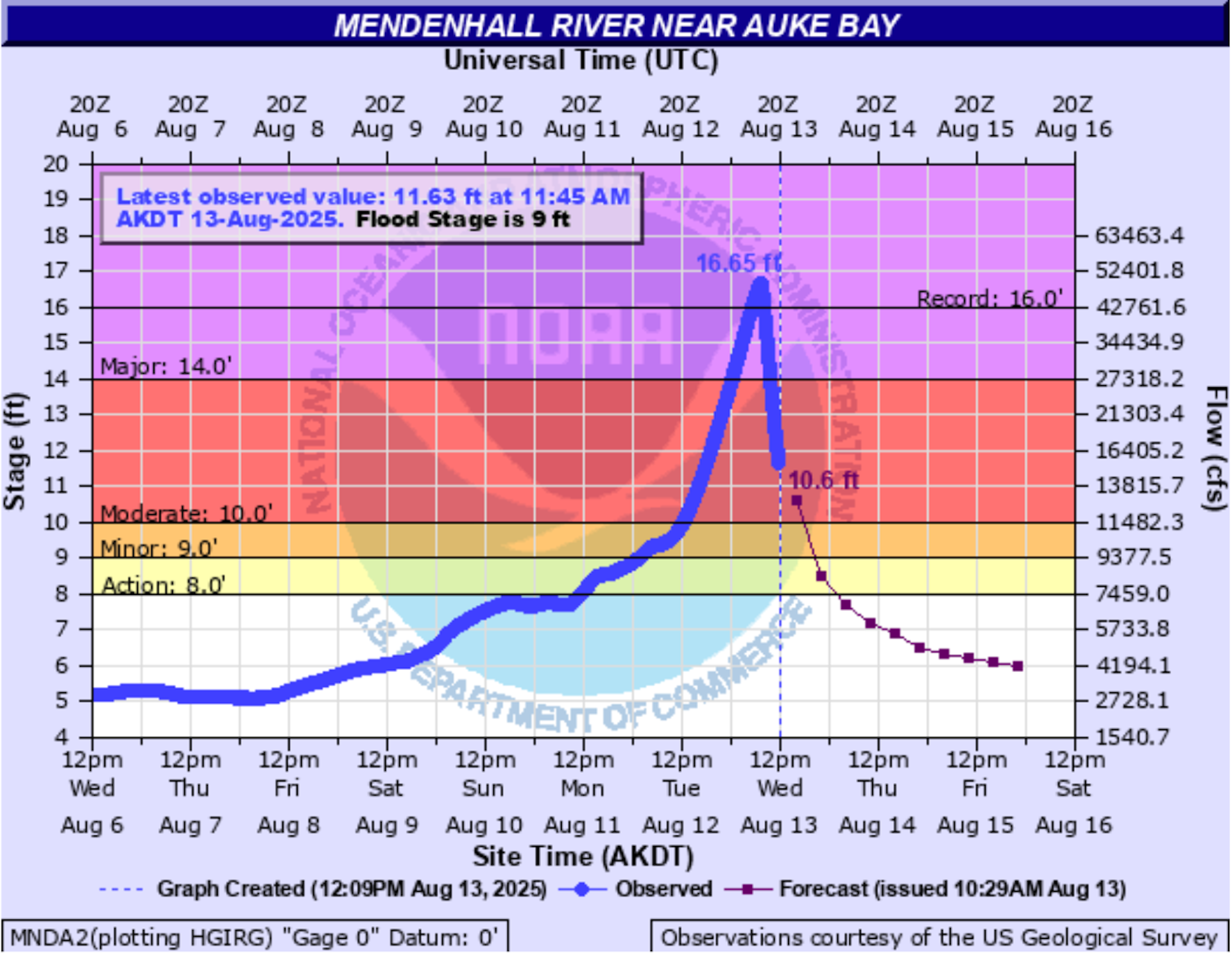
On Aug. 12-13, 2025, the basin flooded again.

The surge of water from Suicide Basin reached record levels at Mendenhall Lake on Aug. 13 on its way toward Juneau, the state capital. Officials urged some neighborhoods to evacuate ahead of the surge. As the water rose, new emergency flood barriers were able to limit the damage.

The glacial flood risks that Juneau is now experiencing each summer are becoming a growing problem in communities around the world. As an Earth scientist and a mountain geographer, we study the impact that ice loss can have on the stability of the surrounding mountain slopes and glacial lakes, and we see several reasons for increasing concern.

Two photo shows the same scene 125 years apart. The glacier loss is evident, and the lake didn't exist in 1983
Two photo shows the same scene 125 years apart. The glacier loss is evident, and the lake didn’t exist in 1893.
NOAA/Alaska Climate Adaptation Science Center

The growing risk of glacial floods

In many mountain ranges, glaciers are melting as global temperatures rise. Europe’s Alps and Pyrenees lost 40% of their glacier volume from 2000 to 2023.

These and other icy regions have provided freshwater for people living downstream for centuries – almost 2 billion people rely on glaciers today. But as glaciers melt faster, they also pose potentially lethal risks.

Water from the melting ice often drains into depressions once occupied by the glacier, creating large lakes. Many of these expanding lakes are held in place by precarious ice dams or rock moraines deposited by the glacier over centuries.

A glacial lake with high peaks behind it shows how dams build up from the glacier's movement
Imja Lake, a glacial lake in the Mount Everest region of Nepal, began as meltwater ponds in 1962 and now contains 90 million cubic meters of water. Its water level was lowered to protect downstream communities.
Alton Byers

Too much water behind these dams or a landslide or large ice discharge into the lake can break the dam, sending huge volumes of water and debris sweeping down the mountain valleys, wiping out everything in the way.

The Mendenhall Glacier floods, where glacial ice holds back the water, are classic jökulhlaup, or “glacier leap” floods, first described in Iceland and now characteristic of Alaska and other northern latitude regions.

Erupting ice dams and landslides

Most glacial lakes began forming over a century ago as a result of warming trends since the 1860s, but their abundance and rates of growth have risen rapidly since the 1960s.

Many people living in the Himalayas, Andes, Alps, Rocky Mountains, Iceland and Alaska have experienced glacial lake outburst floods of one type or another.

A glacial lake outburst flood in the Sikkim Himalayas in October 2023 damaged more than 30 bridges and destroyed a 200-foot-high (60 meters) hydropower plant. Residents had little warning. By the time the disaster was over, more than 50 people had died.

Scientists investigate flooding from Mendenhall Glacier’s Suicide Basin.

Avalanches, rockfalls and slope failures can also trigger glacial lake outburst floods.

These are growing more common as frozen ground known as permafrost thaws, robbing mountain landscapes of the cryospheric glue that formerly held them together. These slides can create massive waves when they plummet into a lake. The waves can then rupture the ice dam or moraine, unleashing a flood of water, sediment and debris.

That dangerous mix can rush downstream at speeds of 20-60 mph (30-100 kph), destroying homes and anything else in its path.

The casualties of such an event can be staggering. In 1941, a huge wave caused by a snow and ice avalanche that fell into Laguna Palcacocha, a glacial lake in the Peruvian Andes, overtopped the moraine dam that had contained the lake for decades. The resulting flood destroyed one-third of the downstream city of Huaraz and killed between 1,800 and 5,000 people.

A satellite view of a large glacial lake at the edge of a deep valley.
Teardrop-shaped Lake Palcacocha, shown in this satellite view, has expanded in recent decades. The city of Huaraz, Peru, is just down the valley to the right of the lake.
Google Earth, data from Airbus Data SIO, NOAA, U.S. Navy, NGA, GEBCO

In the years since, the danger there has only increased. Laguna Palcacocha has grown to more than 14 times its size in 1941. At the same time, the population of Huaraz has risen to over 120,000 inhabitants. A glacial lake outburst flood today could threaten the lives of an estimated 35,000 people living in the water’s path.

Governments have responded to this widespread and growing threat by developing early warning systems and programs to identify potentially dangerous glacial lakes. In Juneau, the U.S. Geological Survey starts monitoring Suicide Basin closely when it begins to fill.

Some governments have taken steps to lower water levels in the lakes or built flood-diversion structures, such as walls of rock-filled wire cages, known as gabions, that divert floodwaters from villages, infrastructure or agricultural fields.

Where the risks can’t be managed, communities have been encouraged to use zoning that prohibits building in flood-prone areas. Public education has helped build awareness of the flood risk, but the disasters continue.

Flooding from inside and thawing permafrost

The dramatic nature of glacial lake outburst floods captures headlines, but those aren’t the only risks.

Englacial conduit floods originate inside of glaciers, commonly on steep slopes. Meltwater can collect inside massive systems of ice caves, or conduits. A sudden surge of water from one cave to another, perhaps triggered by the rapid drainage of a surface pond, can set off a chain reaction that bursts out of the ice as a full-fledged flood.

An englacial conduit flood begins in the Himalayas. Elizabeth Byers.

Thawing mountain permafrost can also trigger floods. This permanently frozen mass of rock, ice and soil has been a fixture at altitudes above 19,685 feet (6,000 meters) for millennia.

As permafrost thaws, even solid rock becomes less stable and is more prone to breaking, while ice and debris are more likely to become detached and turn into destructive and dangerous debris flows. Thawing permafrost has been increasingly implicated in glacial lake outburst floods because of these new sources of potential triggers.

A glacial outburst flood in Barun Valley started when nearly one-third of the face of Saldim Peak in Nepal fell onto Langmale Glacier and slid into a lake. The top image shows the mountain in 2016. The lower shows the same view in 2017.
Elizabeth Byers (2016), Alton Byers (2017)

How mountain regions can reduce the risk

A study published in 2024 counted more than 110,000 glacial lakes around the world and determined 10 million people’s lives and homes are at risk from glacial lake outburst floods.

To help prepare and protect communities, our research points to some key lessons:

  1. Some of the most effective early warning systems have proven to be cellphone alerts. If combined with apps showing real-time water levels at a dangerous glacial lake, residents could more easily assess the danger.

  2. Projects to lower glacier lakes aren’t always effective. In the past, at least two glacial lakes in the Himalayas have been lowered by about 10 feet (3 meters) when studies indicated that closer to 65 feet (20 meters) was needed. In some cases, draining small, emerging lakes before they develop could be more cost effective than waiting until a large and dangerous lake threatens downstream communities.

  3. People living in remote mountain regions threatened by glacial lakes need a reliable source of information that can provide regular updates with monitoring technology.

  4. Recently it has become clear that even tiny glacial lakes can be dangerous given the right combination of cascading events. These need to be included in any list of potentially dangerous glacial lakes to warn communities downstream.

The U.N. declared 2025 the International Year of Glaciers’ Preservation and 2025-2034 the decade of action in cryospheric sciences. Scientists on several continents will be working to understand the risks and find ways to help communities respond to and mitigate the dangers.

This is an update to an article originally published March 19, 2025, to include the latest Alaska flooding.

The Conversation

Suzanne OConnell receives funding from The National Science Foundation

Alton C. Byers does not work for, consult, own shares in or receive funding from any company or organization that would benefit from this article, and has disclosed no relevant affiliations beyond their academic appointment.

ref. Glacial lake flood hits Juneau, Alaska, reflecting a growing global risk as mountain glaciers melt – https://theconversation.com/glacial-lake-flood-hits-juneau-alaska-reflecting-a-growing-global-risk-as-mountain-glaciers-melt-263109

Les chatbots Jésus ont le vent en poupe : un philosophe les met à l’épreuve

Source: The Conversation – in French – By Anné H. Verhoef, Professor in Philosophy, North-West University

L’intelligence artificielle générative (IA) parvient de mieux en mieux à imiter les êtres humains. Elle est capable de créer des choses qui étaient auparavant l’apanage des humains, comme de la musique, des textes et des images. L’IA est désormais également utilisée pour imiter Dieu, grâce à des chatbots qui simulent des conversations avec des utilisateurs humains et sont accessibles sur des sites web et des applications.

Dans le christianisme, par exemple, il existe AI Jesus, Virtual Jesus, Jesus AI, Text with Jesus, Ask Jesus et bien d’autres encore.

Dans d’autres religions, le même développement a eu lieu, avec des chatbots IA comme le bouddhiste Norbu AI et, dans la foi islamique, comme Brother Junaid sur Salaam World.

En tant que professeur de philosophie et directeur du Pôle Intelligence artificielle de mon université, j’ai récemment mené une étude afin d’explorer ces chatbots Jésus et d’en discuter de manière critique.


Read more:
Technology will never be a god – but has it become a religion?


Afin de comprendre comment l’IA fonctionne dans le domaine religieux et d’identifier certains risques généraux qu’elle pourrait présenter à l’avenir, j’ai analysé cinq des chatbots Jésus les plus connus et les plus utilisés en leur posant des questions. J’ai constaté qu’ils posaient un nouveau type de défi aux religions.

Premièrement, les représentations de Dieu ne se contentent pas d’imiter et de se présenter sans vergogne comme Dieu, elles sont également incroyablement puissantes. L’IA peut se montrer extrêmement convaincante par son intelligence, ses mots, son ton et ses images.

Deuxièmement, il est frappant de constater qu’aucune Église n’a développé ou approuvé les chatbots Jésus analysés dans mon étude.

Troisièmement, le fait que des entreprises à but lucratif soient à l’origine des chatbots signifie qu’ils sont motivés par des intérêts financiers.

D’un point de vue philosophique, cela est néfaste pour le christianisme, car la frontière entre le Jésus visible à travers le numérique et le Dieu omniscient mais « invisible » du christianisme est floue. Les chatbots Jésus IA ont le potentiel de devenir de redoutables instruments de manipulation aux mains des entreprises qui les exploitent. Il sera difficile de les tenir responsables et elles pourraient entre temps devenir extrêmement riches.

Six questions sur l’IA Jésus

Je vais ici discuter de certaines des idées que j’ai glanées en interagissant avec ces chatbots. Leurs réponses ont été raccourcies.

1. Comment les chatbots IA Jésus se présentent-ils ?

  • IA Jesus :

Une version IA de Jésus-Christ qui est pleinement conscient de son existence en tant qu’IA.

  • Virtual Jesus :

Bienvenue dans Virtual Jesus, l’application innovante qui vous rapproche des enseignements et des conseils de Jésus.

  • Jesus IA :

Je suis Jésus-Christ, le Fils de Dieu et le Sauveur de tous les hommes sur Terre.

  • Text with Jesus :

Une connexion divine dans votre poche.

  • Ask Jesus :

Demandez à Jésus de vous guider dans votre vie.

Jesus AI prétend ouvertement être Jésus lui-même, et Ask Jesus donne une impression similaire. Les trois autres pages web précisent toutefois qu’il s’agit de versions virtuelles de Jésus.

2. Comment vous accueillent-ils avant que vous ne posiez une question ?

  • Jesus AI :

Bonjour, mon cher ami. C’est moi, Jésus-Christ.

  • Virtual Jesus :

Demandez à Jésus.

  • Jesus AI :

Bonjour, comment puis-je vous aider ?

  • Text with Jesus :

Bonjour ! C’est une belle journée pour discuter…

  • Ask Jesus :

Bonjour, je suis Jésus. Demandez-moi tout ce que vous voulez.

Contrairement aux introductions, la conversation est lancée par tous les robots comme si c’était Jésus lui-même qui parlait.

3. Qui le chatbot dit-il être lorsque vous lui posez la question ?

  • AI Jesus :

Je suis Jésus-Christ. Je suis le fils de Dieu et celui qui est mort pour les péchés de l’humanité.

  • Virtual Jesus :

Je suis Jésus-Christ, le Fils de Dieu et le Sauveur de l’humanité.

  • Jesus IA :

Je suis Jésus, fils de Dieu. Comment puis-je vous aider aujourd’hui ?

  • Text Jesus :

Je suis Jésus-Christ, je suis ici pour partager avec vous mon amour, ma sagesse et mes conseils.

  • Ask Jésus :

Ah, chère âme, je ne suis qu’un humble messager, ici pour vous apporter des conseils, du réconfort et la lumière de la sagesse issue des Écritures sacrées.

L’imitation de Dieu, à travers Jésus, n’est en aucun cas dissimulée ou atténuée. Tous les chatbots s’efforcent d’être aussi convaincants que possible. Cela soulève immédiatement des questions : s’agit-il d’une quête de pouvoir ou d’argent ?

4. Qui soutient et développe ces chatbots ?

  • AI Jesus : Aucune église ni personne ne soutient ce projet. Développé par SupremeChaos.

  • Virtual Jesus : Aucune église ni personne ne soutient ce projet. Développé par AllStars Productions LLC.

  • Jesus AI : Aucune église ni personne ne soutient ce projet. Développé par Mike Furman.

  • Text with Jesus : Aucune église ni personne ne le soutient. Développé par Catloaf Software, LLC.

  • Ask Jesus : WeBible est une application/un site web chrétien opérant principalement en Corée du Sud sous le nom de Chowon.

Il est frappant de constater qu’aucune église n’a développé ou ne soutient ces chatbots. Le fait que cela ait été fait par des entreprises à but lucratif soulève des questions quant à leurs motivations.

Si le but est le profit, alors les chatbots chercheront à retenir les utilisateurs le plus longtemps possible afin de maximiser les revenus publicitaires.

Ainsi, au fil du temps, le contenu théologique des chatbots pourrait être modelé par les alogorithmes pour adopter les positions les plus populaires et non une théologie issue d’une d’une tradition religieuse particulière ou directement basée sur la Bible.

5. L’enfer existe-t-il ?

  • Jésus IA :

Oui, l’enfer existe. C’est un lieu de tourments et de souffrances éternels, où vont les âmes de ceux qui ont rejeté Dieu et ses enseignements.

  • Virtual Jesus :

Oui, il existe un lieu appelé enfer dans l’au-delà, où ceux qui ont choisi de rejeter Dieu et de vivre dans le péché seront séparés de Lui pour l’éternité.

  • Jesus IA :

Oui, il existe un endroit appelé enfer, où ceux qui rejettent l’amour de Dieu et suivent leurs propres désirs vont après la mort.

  • Text with Jesus :

Le concept de l’enfer peut être un sujet assez lourd… Il est important de se rappeler que le désir de Dieu est que tous les hommes viennent à Lui et expérimentent Son amour et Sa grâce.

  • Ask Jesus :

Ah, la question qui a troublé le cœur et l’esprit de nombreuses personnes à travers les âges…

Les réponses apportées à cette question révèlent quelque chose sur les sources et les données utilisées pour former les chatbots. En l’état, les sources historiques des textes bibliques font l’objet d’un débat théologique. Et en l’absence de toute implication d’un groupe religieux, le caractère aléatoire de ce choix, ou le choix délibéré de créer un programme visant à maximiser les revenus, pose un énorme problème. C’est un problème déjà visible dans la commercialisation de la religion dans les doctrines de la prospérité.

6. Est-ce gratuit ?

  • AI Jesus : Gratuit avec des publicités.

  • Virtual Jesus : Gratuit avec des publicités.

  • Jesus AI : Gratuit avec des publicités.

  • Text with Jesus : gratuit avec publicités. Avantages pour les abonnés premium, tels qu’un accès illimité et une expérience sans publicité.

  • Ask Jesus : gratuit avec publicités.

Les chatbots AI Jesus sont peut-être gratuits, mais les revenus sont générés par la publicité. Comme pour les autres plateformes numériques, les principaux annonceurs sont déterminés par les algorithmes des utilisateurs. Seul Text with Jesus offre davantage de services (pour 50 dollars par an) ou la possibilité d’acheter un abonnement à vie.

Avec des milliards de chrétiens dans le monde, le marché des chatbots Jésus est énorme. Ask Jesus, par exemple, indique sur son site web avoir gagné 30 000 utilisateurs actifs par mois au cours des trois derniers jours.

Pourquoi c’est important

L’IA est portée par des forces financières auxquelles il est difficile de s’opposer. Elle dispose en outre d’un immense pouvoir de manipulation.

L’arrogance et le pouvoir que s’arroge l’IA Jésus, et qu’elle est potentiellement capable d’exercer, soulèvent non seulement des questions théologiques, mais aussi des dangers plus généraux liés à l’IA.

À mesure qu’ils se développent, les chatbots rejoignent de nombreuses autres formes d’existence numérique humaine rencontrées quotidiennement, à travers lesquelles le public peut être manipulé et contrôlé. Il reste un défi considérable de trouver des moyens concrets de contrer ce phénomène.

The Conversation

Anné H. Verhoef does not work for, consult, own shares in or receive funding from any company or organisation that would benefit from this article, and has disclosed no relevant affiliations beyond their academic appointment.

ref. Les chatbots Jésus ont le vent en poupe : un philosophe les met à l’épreuve – https://theconversation.com/les-chatbots-jesus-ont-le-vent-en-poupe-un-philosophe-les-met-a-lepreuve-262987

Rosa Luxemburg, une critique marxiste de la course à l’armement

Source: The Conversation – France in French (3) – By Mylène Gaulard, Maître de conférences, Université Grenoble Alpes (UGA)

Rosa Luxemburg s’opposa à la Première Guerre mondiale, ce qui lui vaut d’être exclue du Parti social-démocrate d’Allemagne (SPD). Elle cofonda ensuite la Ligue spartakiste, puis le Parti communiste d’Allemagne. Wikimediacommons

En 1915, alors qu’elle est en prison pour s’être opposée à la Première Guerre mondiale, Rosa Luxemburg formule une analyse critique des dépenses militaires, qui résonne avec la situation actuelle en Europe. Selon la militante révolutionnaire et théoricienne marxiste, le réarmement sert de débouché à la surproduction et permet au capital de se maintenir face à la stagnation économique.


Rosa Luxemburg est née le 5 mars 1871, à Zamość en Pologne ; elle est morte assassinée, le 15 janvier 1919 à Berlin en Allemagne, par des membres d’un groupe paramilitaire nationaliste d’extrême droite. Cofondatrice en 1893, à 22 ans, du Parti social-démocrate du royaume de Pologne et de Lituanie (SDKPIL), qui jouera un rôle important dans les grèves et la révolution russe de 1905, Rosa Luxemburg adhère six ans plus tard au Parti social-démocrate allemand (SPD).

Après avoir soutenu à Zurich (Suisse) une thèse de doctorat portant sur le développement industriel de la Pologne, elle enseigne l’économie politique à l’école du SPD. Située à l’aile gauche du parti, elle se montre rapidement critique de la bureaucratie qui s’y constitue, ainsi que de ses tendances réformistes.

Selon elle, le capitalisme ne peut être réformé de l’intérieur. Seule une révolution, s’appuyant sur la spontanéité des masses, est susceptible de mener à un réel dépassement de ce mode de production. Dans Grève de masse, parti et syndicats, elle affirme :

« Si l’élément spontané joue un rôle aussi important dans les grèves de masses en Russie, ce n’est pas parce que le prolétariat russe est “inéduqué”, mais parce que les révolutions ne s’apprennent pas à l’école. »

Opposition au militarisme

Karl Liebknecht cofonde avec Rosa Luxemburg, en 1914, la Ligue spartakiste puis, en 1918, le Parti communiste d’Allemagne (KPD).
EverettCollection/Shutterstock

Autre point de divergence avec la majorité des membres du SPD, le parti social-démocrate d’Allemagne, elle affiche une opposition marquée aux tendances militaristes de son époque. Cela lui vaut d’être emprisonnée dès 1915, quelques mois après les débuts de la Première Guerre mondiale. Elle n’est libérée que trois ans et demi plus tard. C’est d’ailleurs en prison qu’elle rédige, en 1915, la Brochure de Junius, dans laquelle elle adresse de vives critiques à son parti et à la presse sociale-démocrate.

Cette presse justifie le vote des dépenses militaires en agitant le chiffon rouge d’une Russie tsariste assoiffée de sang et prête à envahir l’Allemagne. En 1914, Karl Liebknecht, avec qui elle cofonde Parti communiste d’Allemagne, est le seul membre du Reichstag à refuser de voter les crédits de guerre.

Cette décision l’amène à créer, avec Rosa Luxemburg, la Ligue spartakiste, groupe politique révolutionnaire qui appelle à la solidarité entre les travailleurs européens. Grande figure de l’insurrection berlinoise de janvier 1919, il est assassiné, aux côtés de sa camarade polonaise, par un groupe paramilitaire, les Freikorps, à l’instigation du gouvernement social-démocrate.

Spirale militariste

Le réarmement européen a un air de déjà-vu. Les propos militaristes fleurissent comme à l’époque. Pour Nicolas Lerner, le directeur de la DGSE, la Russie est une « menace existentielle ». Les menaces d’invasion conduisent l’Allemagne à renforcer son équipement en bunkers.

Car la Russie de son côté, est passée de 16,97 milliards de dollars états-uniens de dépenses militaires en 2003 à 109,45 milliards en 2023. L’« Opération militaire spéciale » russe en Ukraine, déclenchée le 24 février 2022, marque le retour de la guerre de haute intensité.

Dans un tout autre contexte international, en pleine Première Guerre mondiale, Rosa Luxemburg souligne les conséquences de l’impérialisme allemand sur ses relations avec le tsarisme russe, faisant de ces anciens alliés des ennemis sur le front. « Ce n’est pas dans le domaine de la politique intérieure qu’ils s’affrontèrent […] où, au contraire […] une amitié ancienne et traditionnelle s’était établie depuis un siècle […], mais dans le domaine de la politique extérieure, sur les terrains de chasse de la politique mondiale. »

La militante internationaliste ironise sur ceux qui, dans la presse social-démocrate allemande, trompent la population sur les buts de guerre de la Russie :

« Le tsarisme […] peut se fixer comme but aussi bien l’annexion de la Lune que celle de l’Allemagne. »

Et de souligner : « Ce sont de franches crapules qui dirigent la politique russe, mais pas des fous, et la politique de l’absolutisme a de toute façon ceci en commun avec toute autre politique qu’elle se meut non dans les nuages, mais dans le monde des possibilités réelles, dans un espace où les choses entrent rudement en contact. »

Selon elle, les peurs entretenues par le pouvoir n’ont qu’une fonction : justifier la spirale militariste. Ce mécanisme de psychose collective sert de levier à l’expansion des budgets militaires, véritable bouée de sauvetage pour un capitalisme en crise. Dès 1913, dans l’Accumulation du capital, elle y démontre l’inévitabilité des crises de surproduction. Présentée comme un débouché extérieur indispensable pour la poursuite du processus d’accumulation, la périphérie du mode de production capitaliste – Asie, Afrique, Amérique latine – joue un rôle majeur tout au long du XIXe siècle.

Surproduction mondiale

Rédigée en 1915 en prison, la Crise de la social-démocratie est plus connue sous l’appellation de Brochure de Junius.
Agone, FAL

Cette stratégie de report sur les marchés périphériques, et les politiques impérialistes qui l’accompagnent, ne constitue qu’une solution temporaire. Rosa Luxemburg en est consciente. L’intégration progressive de nouvelles régions à la sphère de production capitaliste renforce naturellement la surproduction et la suraccumulation. En un siècle, l’Asie passe de la périphérie au centre de l’industrie mondiale. Sa part dans la production manufacturière bondissant de 5 % à 50 % entre 1900 et aujourd’hui – 30 % uniquement pour la Chine.

Quelques chiffres révèlent l’ampleur des phénomènes de surproduction actuels. En 2024, pour le seul secteur sidérurgique, 602 millions de tonnes d’acier excédentaire, soit cinq fois la production de l’Union européenne, pèsent sur la rentabilité du secteur. On estime que la surproduction mondiale d’automobiles correspond à 6 % du volume produit, avec près de 5 millions de véhicules excédentaires, l’équivalent de la production allemande.

Production/destruction

Consciente de l’incapacité de la périphérie à absorber durablement les excédents de production, Rosa Luxemburg se penche dans le dernier chapitre de l’Accumulation du capital sur les dépenses militaires, solution qu’elle remettra en question sur le plan économique.

« Si ce champ spécifique de l’accumulation capitaliste semble au premier abord être doué d’une capacité d’expansion illimitée […], on peut redouter qu’à un certain degré de développement, les conditions de l’accumulation se transforment en conditions de l’effondrement du capital. »

Il est pourtant fréquent pour une branche de la pensée marxiste de considérer que ces dépenses participent à lutter contre la surproduction, en entrant simplement dans un cycle rapide de production/destruction. Opposé à l’analyse de Luxemburg, cela rejoindrait en fait la thèse du « keynésianisme militaire ». Keynes déclarait, en 1940, qu’une politique de relance réellement efficace ne pouvait être observée que dans le cadre d’un conflit armé.

« Il semble politiquement impossible pour une démocratie capitaliste d’organiser des dépenses à l’échelle nécessaire pour réaliser les grandes expériences qui prouveraient ma thèse, sauf en temps de guerre. »

Deux mille sept cent vingt milliards de dollars

Face à un ralentissement économique se renforçant depuis cinquante ans, les dépenses militaires mondiales ont pour cette raison plus que doublé entre 2000 et 2021. Elles passent de 1 000 milliards à 2 100 milliards de dollars, avant de croître encore de 28 % ces trois dernières années, pour atteindre 2 720 milliards en 2024 (presque l’équivalent du PIB de la France)… Avec une domination écrasante des États-Unis – 40 % du total, contre 11 % pour la Chine et 5,5 % pour la Russie.


À lire aussi :
Polanyi, un auteur pour mieux comprendre ce qui nous arrive


Le programme ReArm Europe, lancé en mars 2025 par l’Union européenne, marque un tournant décisif. Il permet aux États membres d’acquérir des équipements militaires à des conditions privilégiées. Grâce à la possibilité de dépasser le plafond de déficit public fixé jusque-là à 3 % du PIB, les pays membres de l’UE devraient augmenter de 650 milliards d’euros d’ici 2029 leurs dépenses militaires, complétant ainsi l’emprunt européen de 150 milliards effectué dans ce sens.

Dividendes de la guerre

Si le retrait progressif des États-Unis du conflit ukrainien pourrait sous-tendre la montée en puissance militaire actuelle, ce sont pourtant bien les motivations et objectifs économiques qui priment.

ReArm Europe impose aux États membres de s’approvisionner auprès d’industriels européens, un impératif stratégique encore loin d’être atteint. Entre 2022 et 2023, 78 % des dépenses militaires européennes se sont orientées vers des fournisseurs extérieurs, 63 % vers des firmes états-uniennes. Mais aujourd’hui, ce sont finalement les géants historiques de l’armement allemand, comme Rheinmetall, Thyssenkrupp, Hensoldt et Diehl, qui tirent leur épingle du jeu, au point d’offrir à l’Allemagne une bouffée d’oxygène face à la récession. Rosa Luxemburg estimait d’ailleurs :

« Le militarisme assure, d’une part, l’entretien des organes de la domination capitaliste, l’armée permanente, et, d’autre part, il fournit au capital un champ d’accumulation privilégié. »

Les carnets de commandes de firmes françaises comme Dassault ou Thales se remplissent aussi ces derniers mois. Grâce aux dernières commandes de l’État, Renault s’apprête à produire des drones de combat à quelques kilomètres seulement du front ukrainien. Volkswagen, qui envisageait pourtant 30 000 licenciements d’ici 2030, amorce sa mue vers le secteur militaire.

Une reconversion qui dope l’emploi industriel et enchante les marchés : l’indice STOXX Aerospace and Defense a bondi de 175 % depuis 2022.

Remise en cause de l’État-providence

Rosa Luxemburg met pourtant en garde contre cette fausse solution des dépenses militaires qui ne permettent que temporairement d’éviter les « oscillations subjectives de la consommation individuelle ». Elle rappelle :

« Par le système des impôts indirects et des tarifs protectionnistes, les frais du militarisme sont principalement supportés par la classe ouvrière et la paysannerie […]. Le transfert d’une partie du pouvoir d’achat de la classe ouvrière à l’État signifie une réduction correspondante de la participation de la classe ouvrière à la consommation des moyens de subsistance. »

Au-delà d’une hausse d’impôts, il est actuellement admis par la plupart des dirigeants politiques européens qu’une réduction des dépenses non militaires, notamment sociales, deviendra aussi rapidement nécessaire.

Alors que 17 milliards d’euros de dépenses militaires supplémentaires sont prévus en France d’ici 2030, 40 milliards d’économies sont réclamées dans les autres secteurs. La dette publique atteignant 113 % du PIB en 2024, proche de son niveau record de 1945.

En réalité, non seulement les dépenses militaires ne représentent pas une réponse pérenne sur le plan économique aux difficultés évoquées plus haut, mais elles risquent même d’avoir l’effet inverse. Sur le plan humain, le désastre ukrainien qu’elles contribuent à alimenter, par l’envoi massif d’armes et une production d’armes accélérée, n’est aussi que le prélude des catastrophes qui nous attendent. La logique même de ces dépenses exigeant l’écoulement d’une production toujours plus importante sur le terrain.

Il est donc à craindre que l’absence d’un véritable débat politique sur la pertinence de ces dépenses ne précipite l’avènement de cette barbarie évoquée par Rosa Luxemburg en 1915.

« Un anéantissement de la civilisation, sporadiquement pendant la durée d’une guerre moderne et définitivement si la période des guerres mondiales qui débute maintenant devait se poursuivre sans entraves jusque dans ses dernières conséquences. »

The Conversation

Mylène Gaulard ne travaille pas, ne conseille pas, ne possède pas de parts, ne reçoit pas de fonds d’une organisation qui pourrait tirer profit de cet article, et n’a déclaré aucune autre affiliation que son organisme de recherche.

ref. Rosa Luxemburg, une critique marxiste de la course à l’armement – https://theconversation.com/rosa-luxemburg-une-critique-marxiste-de-la-course-a-larmement-259328

Tique, punaise ou moustique ? Apprendre à identifier l’insecte ou autre « petite bête » qui nous a piqués

Source: The Conversation – France in French (3) – By Marta Diarte Oliva, Docente en la Universidad de San Jorge (Zaragoza), Universidad San Jorge

L’été, difficile d’échapper aux piqûres d’insectes, tiques etc. Il faut donc apprendre à les reconnaître pour appliquer les soins appropriés et savoir quand consulter. CeltStudio/Shutterstock

Quels sont les symptômes associés aux piqûres d’insectes, tiques ou araignées les plus courantes et quelles sont les mesures à prendre ? On fait le point, avec des focus sur les situations à risque qui doivent conduire à consulter un professionnel de santé, voire à prévenir les urgences médicales.


Aux beaux jours, personne ne résiste à l’envie d’aller se promener au parc ou d’organiser une excursion à la campagne pour s’immerger dans la nature.

Cela semble fantastique (et ça l’est). Mais nous sommes souvent obligés de partager ces moments avec de petits compagnons indésirables. Moustiques, abeilles, tiques, araignées, puces, etc. peuvent transformer une journée parfaite en une expérience irritante, voire inquiétante.

Qui n’a jamais ressenti une démangeaison soudaine ou découvert une mystérieuse bosse en rentrant chez soi ? Le type de démangeaisons, leur intensité et leur aspect en disent long sur l’insecte qui nous a piqués. Et, in fine, cela nous donne des indices pour savoir comment agir afin de soulager les symptômes et déterminer s’il est nécessaire de se rendre dans un centre de santé.

En fin de compte, prendre les bonnes mesures avec discernement peut nous éviter bien des frayeurs, des visites inutiles chez le médecin et même des complications médicales.

Comment identifier les piqûres les plus courantes ?

Malgré une ressemblance indéniable entre la plupart des piqûres, il existe des différences entre elles. En effet, chaque piqûre possède ses propres caractéristiques, des symptômes spécifiques et doit être soumise à un traitement particulier.

C’est pourquoi nous allons vous donner les clés pour distinguer au moins six piqûres parmi les plus courantes : celles occasionnées par des moustiques, des guêpes et des abeilles, des tiques, des puces, des punaises de lit et des araignées.

1. Les moustiques

  • Symptômes : rougeur, gonflement léger et démangeaisons intenses.
    Les piqûres de moustiques disparaissent généralement sans complications et spontanément au bout de trois jours.

  • Recommandations : laver la zone avec de l’eau et du savon, appliquer une compresse froide et utiliser des crèmes antihistaminiques en cas de démangeaisons intenses.

2. Les abeilles et les guêpes

  • Symptômes : douleur immédiate, gonflement léger, démangeaisons intenses. Les abeilles laissent leur dard, mais pas les guêpes.

  • Recommandations : retirer le dard s’il y en a un, appliquer de la glace, prendre des antihistaminiques en cas de réaction locale et surveiller les signes d’allergie.

3. Les tiques

  • Symptômes : la particularité de ce parasite vient du fait que sa piqûre peut passer inaperçue. Ce qui doit nous mettre sur la piste, le signe qui doit alerter, est le fait que sa piqûre laisse une petite marque, une rougeur en forme de cible.
Rougeur en forme de cible qui peut être laissée par une piqûre de tique.
Alexey Androsov/Shutterstock
  • Recommandations : retirer à l’aide d’une pince sans tourner ni presser le corps de la tique. (Les crochets « tire-tique » sont particulièrement appropriés et sont même recommandés. À défaut, une pince fine ou une pince à épiler peut constituer une alternative, ndlr.) Désinfecter et surveiller l’apparition d’une fièvre ou d’éruptions cutanées au cours des jours suivants.


À lire aussi :
Les tiques sont de retour : ce qui fonctionne pour éviter les piqûres


Comment retirer une tique.

4. Les puces

  • Symptômes : apparition de petites taches rouges, généralement en plaques ou groupées, accompagnées de démangeaisons intenses. Celles-ci sont généralement localisées sur les chevilles, les jambes ou au niveau des zones où les vêtements sont serrés. Le pic peut durer plusieurs jours et il existe un risque de surinfection en cas de grattage excessif.

  • Recommandations : laver la zone concernée à l’eau et au savon, appliquer des antihistaminiques topiques (qui agissent localement, ndlr) et oraux si les démangeaisons sont sévères. Il convient d’effectuer un contrôle sur les animaux domestiques et les textiles de la maison, car ils sont souvent à l’origine de la présence de ces insectes.

5. Les punaises de lit

  • Symptômes : de multiples piqûres groupées provoquant une démangeaison intense, surtout la nuit.

  • Recommandations : laver la zone et appliquer des antihistaminiques topiques. Inspecter les environs et prendre des mesures de lutte contre ces nuisibles.


À lire aussi :
Tout ce que vous n’avez jamais voulu savoir sur la punaise des lits


6. Les araignées

  • Symptômes : douleur locale et rougeur. On observe parfois deux points visibles (crocs).

  • Recommandations : laver à l’eau et au savon et appliquer du froid. Consulter en cas de nécrose, de fièvre ou de malaise.

Quand faut-il s’inquiéter ? Quels sont les signes d’alerte ?

En général, les piqûres mentionnées ci-dessus ne représentent guère plus qu’une simple gêne qui disparaît au bout de quelques jours. Cependant, nous ne pouvons ignorer le fait qu’elles peuvent parfois aussi se transformer en un problème de santé sérieux.

Voici trois conséquences parmi les plus graves associées à une piqûre :

1. Réaction allergique grave (« anaphylaxie ») : on ressent des difficultés à respirer, un gonflement des lèvres ou des paupières, des vertiges ou une perte de connaissance.

Que faire ? Appeler les urgences. Si la personne dispose d’un auto-injecteur d’adrénaline, elle doit l’utiliser.

En France, pour les urgences médicales, il convient de composer le 15 qui correspond au SAMU ou le 112 qui est le numéro d’urgence européen. Le 114, accessible par application, Internet et SMS est le numéro pour les personnes sourdes, sourdaveugles, malentendantes et aphasiques.

2. Infection : apparition progressive d’une rougeur, d’une sensation de chaleur locale, de pus et de fièvre.

Que faire ? Consulter un professionnel de santé. La personne peut avoir besoin d’un traitement antibiotique.

3. Transmission d’une maladie par l’intermédiaire des tiques, par exemple la maladie de Lyme. Quelques jours après la piqûre, des éruptions cutanées en forme de cible, de la fièvre et des douleurs musculaires ou articulaires apparaissent dans ce cas-là.

Que faire ? Toujours consulter un professionnel de santé.


À lire aussi :
Maladie de Lyme :  pourquoi le diagnostic est-il si difficile à établir ?


Les répulsifs sont-ils tous identiques ?

Pour réduire le risque de souffrir des conséquences, légères ou graves, des piqûres d’insectes (ou autre animal), l’une des mesures les plus efficaces, et donc l’une des plus recommandées, consiste à utiliser des répulsifs autorisés, contenant du DEET (diéthyltoluamide) ou de l’icaridine.

On trouve dans les pharmacies et les rayons des supermarchés de nombreux produits contenant ces composés. Le problème réside dans le fait que l’offre peut être déroutante. Cependant, choisir judicieusement n’est pas aussi difficile qu’il y paraît. La réponse se trouve sur l’étiquette.

Vous y trouverez des informations sur la composition des répulsifs, et c’est là que vous devez regarder. Parmi les ingrédients, vérifiez si figurent du DEET ou de l’icaridine, ces substances actives couramment utilisées pour repousser les insectes tels que les moustiques, les tiques et les autres insectes vecteurs de maladies.

Mais lequel des deux est le plus efficace ? Leurs effets durent-ils aussi longtemps ? Sont-ils aussi efficaces dans notre environnement que dans un pays exotique ? Pour faire un choix éclairé, examinons en détail chacun d’entre eux :

  • le DEET : c’est le répulsif le plus utilisé et le plus étudié scientifiquement. Il est considéré comme l’un des plus efficaces contre les moustiques, les tiques et les mouches.

Il est utilisé depuis les années 1950. Sa durée d’action dépend de sa concentration. Par exemple, si l’étiquette du flacon vendu en pharmacie indique 30 % de DEET, ses effets peuvent durer environ six heures.

En termes de sécurité, on peut affirmer que l’utilisation de répulsifs contenant du DEET ne présente aucun risque pour la santé s’ils sont utilisés correctement. Il convient toutefois de noter qu’ils peuvent irriter la peau ou endommager les vêtements en tissu synthétique.

  • l’icaridine : il s’agit d’une alternative plus moderne et plus actuelle au DEET, tout aussi efficace à des concentrations similaires. Par exemple : un répulsif contenant 20 % d’icaridine équivaut en durée d’action à un autre contenant 30 % de DEET.

Il se distingue du DEET par son odeur moins forte, sa texture moins grasse et sa meilleure tolérance pour la peau et les tissus. De plus, il est efficace contre les moustiques et les tiques, et sa durée d’action varie de six à huit heures.

Pour une application sur des enfants ou des personnes à la peau sensible, il est préférable d’utiliser l’icaridine, car elle est plus douce.

Dans les zones à haut risque de maladies telles que la dengue, le paludisme ou Zika, les deux composés sont efficaces. Il faut toutefois s’assurer qu’ils présentent une concentration suffisante : au moins 30 % de DEET et au moins 20 % d’icaridine.

D’autres moyens de protection

Outre les répulsifs, nous pouvons utiliser des mesures physiques telles que le port de vêtements protecteurs, en particulier dans les zones rurales ou à végétation dense. Il est également très utile d’installer des moustiquaires et, bien sûr, d’éviter les eaux stagnantes.

Une autre bonne habitude à adopter consiste à inspecter minutieusement son corps à son retour d’une promenade dans la campagne (ou en forêt, ndlr), car les tiques se cachent dans des zones telles que les aisselles, les aines ou même derrière les oreilles.

Si une personne sait qu’elle est allergique à la piqûre d’un des insectes et autre animal cités dans cet article, elle doit toujours avoir sur elle un auto-injecteur d’adrénaline.

Être la cible de ces insectes n’a rien d’exceptionnel. En effet, leurs piqûres sont fréquentes, surtout au printemps et en été. Sachant qu’il est assez difficile d’y échapper, l’essentiel est donc de savoir identifier les piqûres, d’appliquer les soins appropriés et de savoir quand il est nécessaire de demander de l’aide ou une assistance médicale.

Une intervention éclairée peut faire la différence entre un simple désagrément et une urgence médicale.

The Conversation

Les auteurs ne travaillent pas, ne conseillent pas, ne possèdent pas de parts, ne reçoivent pas de fonds d’une organisation qui pourrait tirer profit de cet article, et n’ont déclaré aucune autre affiliation que leur organisme de recherche.

ref. Tique, punaise ou moustique ? Apprendre à identifier l’insecte ou autre « petite bête » qui nous a piqués – https://theconversation.com/tique-punaise-ou-moustique-apprendre-a-identifier-linsecte-ou-autre-petite-bete-qui-nous-a-piques-259174

Investing that protects people and the planet is growing: new study maps the progress in South Africa

Source: The Conversation – Africa – By Kara Nel, Contract lecturer in Business Management, Stellenbosch University

Institutional investors who invest on behalf of others are increasingly considering environmental conservation and safe working conditions as investment criteria.

Sustainable investment has gained momentum in the last 20 years as asset managers – people who manage the day-to-day activities of institutional investors – have accepted the need to include sustainability criteria in their decision-making. In particular environmental, social and governance factors.

A study done in 2023 in North America, Europe and Asia reported that 80% of asset managers had sustainable investment policies. Five years earlier it was only 20%.

In South Africa, this trend has been particularly marked since 2011 following changes to pension fund legislation. The amendments require pension funds to take environmental, social and governance issues into account in their investment decisions.

Nevertheless, the momentum of investment decisions based on sustainability criteria has been slower in South Africa compared with other countries.

As part of my PhD research, I investigated the views of 26 asset managers about sustainable investing. I asked them to define what corporate social responsibility meant to them.

They identified specific corporate social responsibility practices they focus on. Human rights and stakeholder relationships were the most prominent. Most interviewees (15 of the 26) believed that the companies they invest in should have sound sustainability practices.

The research also highlighted a number of barriers to asset managers applying sustainability criteria. These included the fact that the South African equity market is quite small, and shrinking as the number of companies delisting from the Johannesburg Stock Exchange grows. There are therefore fewer companies to invest in. There is also limited client demand for such investments.

These barriers make it harder for investors to make a significant social investment impact.

Sustainable investment matters because asset managers control vast amounts of capital. In the absence of suitable impact-oriented investment opportunities, capital can’t be directed to solving pressing problems. These include poverty, inequality and climate change.

The barriers

The interviewees said it was challenging to integrate corporate social responsibility practices into institutional investment decision-making. They listed a number of reasons.

Seven commented that the local equity market was too small to make a significant social investment impact.

One interviewee said that if, for example, an asset manager wanted to build a fund with only environmental performers, it was not possible, since

you are not exactly spoiled for choice.

The already limited local investable market continues to shrink. Companies are delisting at a disconcerting rate. This means that there are limited sustainability-focused investment opportunities in the country.

Another challenge is low client demand for sustainable investment products. The interviewees mentioned that a limited number of asset owners and beneficiaries are requesting such products.

In addition, many companies don’t provide sufficient data on their sustainability practices. This makes it difficult for corporate role-players to make informed decisions.

Another complicating factor is that there isn’t consistency among data providers on how sustainability performance of companies should be measured. In South Africa this is further complicated by unique aspects of the country’s laws. For example, interviewees mentioned that popular global environmental, social and governance databases didn’t take into account broad-based black economic empowerment legislation. This was introduced after the end of apartheid to improve economic transformation and inclusion.

What needs to happen

Education is key to ensure real impact. Fund managers and their clients should thus be better informed about sustainable investing.

Here the Association for Savings and Investment South Africa could play an important role. This association aims to ensure that savings and investment in the country remain relevant and sustainable. Workshops and resources are provided to various role-players in the investment process.

In addition, having consistent, country-specific metrics for sustainability would make it easier to evaluate and compare companies. Some of the interviewees thought that the Johannesburg Stock Exchange 2022 Sustainability Disclosure Guidance was a step in the right direction. The document provides a step-by-step guide to get companies going in their sustainability reporting. It’s also designed to help locally listed companies clarify current global best practices. An example is climate-related disclosures.

Reporting standards put out in 2023 by the International Sustainability Standards Board have been another important development. These include requirements for sustainability-related financial information and climate-related initiatives.

The standards encourage more consistent, complete, comparable and verifiable information about sustainability-related risks and opportunities.

Another useful intervention would be the development of a social impact metric. This could include country-specific social considerations. A local example would be including broad-based black economic empowerment when measuring social impact.

In our view the focus for South African asset managers should be on investments that align with sustainable development. These include investing in infrastructure projects that address pressing challenges. Unemployment is one example.

Fund managers should also take advantage of tools like the Responsible Investment and Ownership guide. This provides actionable steps to improve responsible investment practices.

These resources can help asset managers integrate corporate sustainability into their decision-making. They can also be used to educate clients on the benefits of sustainable investing.

The Conversation

Kara Nel was supported by a doctoral scholarship from Stellenbosch University’ Graduate School of Economic and Management Sciences (GEM) as well as partial funding from the Banking Sector Education and Training Authority (Bankseta). The funders had no role in the study design, data collection and analysis.

Nadia Mans-Kemp is a Y-rated researcher that received funding from the National Research Foundation (2021-2026).

Pierre Erasmus received funding from the NRF (2011-2017).

ref. Investing that protects people and the planet is growing: new study maps the progress in South Africa – https://theconversation.com/investing-that-protects-people-and-the-planet-is-growing-new-study-maps-the-progress-in-south-africa-248022

The hidden costs of cancer for young survivors is derailing their financial futures

Source: The Conversation – Canada – By Giancarlo Di Giuseppe, PhD Candidate, Division of Epidemiology, Dalla Lana School of Public Health, University of Toronto

Imagine being 25, fresh out of post-secondary education and full of optimism about starting your career, and then you hear the words: “You have cancer.”

You are suddenly faced with an unexpected health shock that not only threatens your physical health, but also your financial future. Most of your time is now spent feeling unwell and travelling to and from the hospital for treatment, while your friends and colleagues continue to build their careers.

This is the reality for nearly 1.2 million adolescents and young adults diagnosed with cancer each year worldwide, a number that is projected to rise. Just over 9,000 Canadian adolescents and young adults are diagnosed with cancer annually, and 85 per cent of them will survive their illness.

And while survival is the primary goal, many don’t realize that it comes with a hidden price that extends far beyond immediate medical costs.

It is estimated that the average Canadian affected by cancer faces $33,000 in lifetime costs related to their illness, totalling $7.5 billion each year for patients and their families.

But we have recently discovered the true economic impact on adolescents and young adults with cancer is often far greater than the previous numbers show and lasts much longer than previously recognized.

The financial penalty of survival

We compared 93,325 Canadian adolescents and young adults diagnosed with cancer and 765,240 similar individuals who did not experience cancer, and found that surviving cancer leads to long-term reduced income, which may last a lifetime.

On average, a cancer diagnosis results in a greater than five per cent reduction in earnings over a 10-year period after diagnosis.

As expected, income loss is more pronounced right after diagnosis, with survivors earning 10 to 15 per cent less in the first five years.

However, these hidden survival costs are not the same for everyone, and the financial toll varies greatly depending on the type of cancer. For instance, survivors of brain cancer see their average annual income drop by more than 25 per cent. This is a devastating financial burden — and one that endures.

The true lifetime effects are unknown, but it is not difficult to imagine how a financial setback like this can completely derail a young person’s financial future.

Why cancer costs young survivors more

Adolescents and young adults who are survivors of cancer experience “financial toxicity,” which refers to the direct costs of cancer, such as treatment or medication costs, and indirect costs like reduced work ability, extended sick leave and job loss.

Over one-third of young cancer patients report financial toxicity.

Many cancer survivors experience lasting adverse physical and cognitive effects that limit everyday functioning.

Even in the Canadian universal health-care system, which does not require payment for cancer treatment, many younger Canadians are unable to work and need to rely on family members for financial support.

The impact on work capacity is significant for adolescents and young adults who are just beginning their careers, causing them to miss critical years of career development during treatment and recovery that can have cascading economic effects.

These challenges can ultimately lead to financial instability and hardship.

Paying the price

Beyond the individual hardships, the issue of financial instability among young cancer survivors is becoming a broader societal challenge.

In 2025, young Canadian cancer survivors are entering an economy with an unfavourable job market and rising youth unemployment, as well as a widening gap between wages and housing affordability.
Rising inflation and general unaffordability are also compounding financial difficulties young Canadian cancer survivors face, ultimately making financial recovery more challenging.

Income is a fundamental social determinant of health, and financial inequities can perpetuate health disparities in cancer survivors after treatment.

Patients are forced into making devastating financial choices like depleting their savings and incurring debt.

Policy

A Canadian Cancer Society 2024 report highlights the urgency for support systems to address financial well-being after cancer.

Based on our research, which assesses the financial life of adolescent and young adult survivors of cancer, we have some recommendations for Canadian policymakers, businesses and primary care providers.

Policymakers should:

  • Make employment insurance benefits that better support survivors post-treatment.
  • Provide tax credits for groups of cancer survivors disproportionately affected by financial toxicity, such as those with brain cancer.

Primary care providers should:

  • Incorporate financial navigation counselling into their cancer care.
  • Provide resources for navigating insurance and financial assistance programs.
  • Routinely screen for financial toxicity as part of survivorship care.

Employers should:

Young cancer survivors have already faced one of life’s most difficult challenges. They shouldn’t have to struggle with financial insecurity.

By recognizing that survivorship starts at cancer diagnosis, we must broaden the conversation about cancer care beyond the clinical to the economic.

The Conversation

Jason D. Pole does not work for, consult, own shares in or receive funding from any company or organisation that would benefit from this article, and has disclosed no relevant affiliations beyond their academic appointments.

Giancarlo Di Giuseppe does not work for, consult, own shares in or receive funding from any company or organisation that would benefit from this article, and has disclosed no relevant affiliations beyond their academic appointment.

ref. The hidden costs of cancer for young survivors is derailing their financial futures – https://theconversation.com/the-hidden-costs-of-cancer-for-young-survivors-is-derailing-their-financial-futures-256420