AI is transforming weather forecasting − and that could be a game changer for farmers around the world

Source: The Conversation – USA (2) – By Paul Winters, Professor of Sustainable Development, University of Notre Dame

Weather forecasts help farmers figure out when to plant, where to use fertilizer and much more. Maitreya Shah/Studio India

For farmers, every planting decision carries risks, and many of those risks are increasing with climate change. One of the most consequential is weather, which can damage crop yields and livelihoods. A delayed monsoon, for example, can force a rice farmer in South Asia to replant or switch crops altogether, losing both time and income.

Access to reliable, timely weather forecasts can help farmers prepare for the weeks ahead, find the best time to plant or determine how much fertilizer will be needed, resulting in better crop yields and lower costs.

Yet, in many low- and middle-income countries, accurate weather forecasts remain out of reach, limited by the high technology costs and infrastructure demands of traditional forecasting models.

A new wave of AI-powered weather forecasting models has the potential to change that.
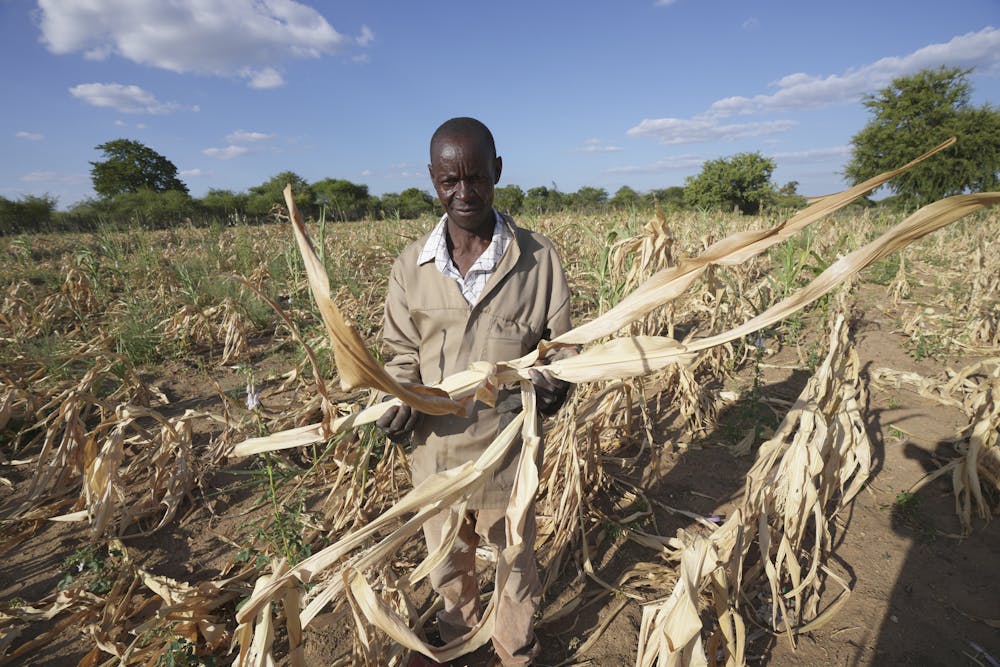
A farmer in a field holds a dried out corn stalk.
A farmer holds dried-up maize stalks in his field in Zimbabwe on March 22, 2024. A drought had caused widespread water shortages and crop failures.
AP Photo/Tsvangirayi Mukwazhi

By using artificial intelligence, these models can deliver accurate, localized predictions at a fraction of the computational cost of conventional physics-based models. This makes it possible for national meteorological agencies in developing countries to provide farmers with the timely, localized information about changing rainfall patterns that the farmers need.

The challenge is getting this technology where it’s needed.

Why AI forecasting matters now

The physics-based weather prediction models used by major meteorological centers around the world are powerful but costly. They simulate atmospheric physics to forecast weather conditions ahead, but they require expensive computing infrastructure. The cost puts them out of reach for most developing countries.

Moreover, these models have mainly been developed by and optimized for northern countries. They tend to focus on temperate, high-income regions and pay less attention to the tropics, where many low- and middle-income countries are located.

A major shift in weather models began in 2022 as industry and university researchers developed deep learning models that could generate accurate short- and medium-range forecasts for locations around the globe up to two weeks ahead.

These models worked at speeds several orders of magnitude faster than physics-based models, and they could run on laptops instead of supercomputers. Newer models, such as Pangu-Weather and GraphCast, have matched or even outperformed leading physics-based systems for some predictions, such as temperature.
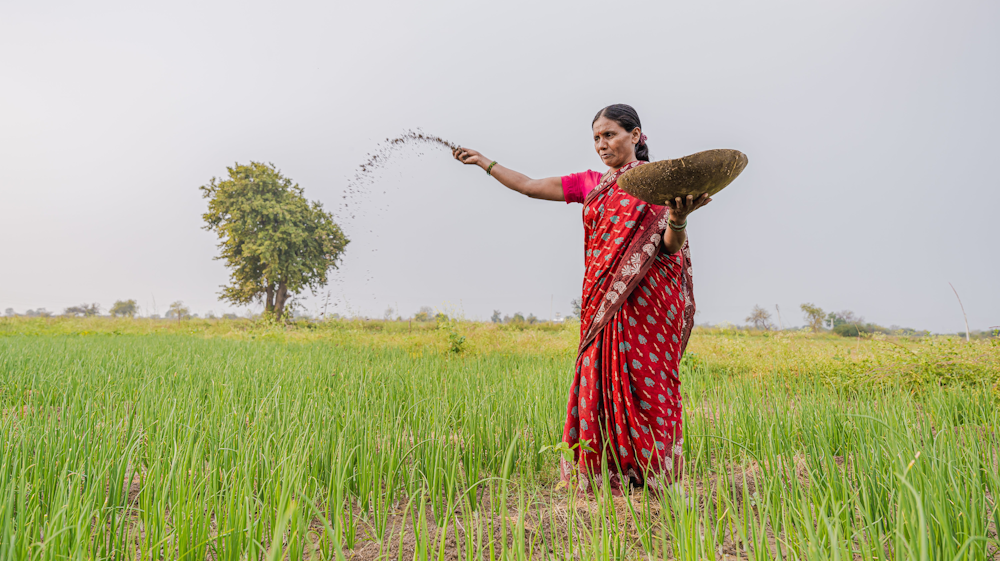
A woman in a red sari tosses pellets into a rice field.
A farmer distributes fertilizer in India.
EqualStock IN from Pexels

AI-driven models require dramatically less computing power than the traditional systems.

While physics-based systems may need thousands of CPU hours to run a single forecast cycle, modern AI models can do so using a single GPU in minutes once the model has been trained. This is because the intensive part of the AI model training, which learns relationships in the climate from data, can use those learned relationships to produce a forecast without further extensive computation – that’s a major shortcut. In contrast, the physics-based models need to calculate the physics for each variable in each place and time for every forecast produced.

While training these models from physics-based model data does require significant upfront investment, once the AI is trained, the model can generate large ensemble forecasts — sets of multiple forecast runs — at a fraction of the computational cost of physics-based models.

Even the expensive step of training an AI weather model shows considerable computational savings. One study found the early model FourCastNet could be trained in about an hour on a supercomputer. That made its time to presenting a forecast thousands of times faster than state-of-the-art, physics-based models.

The result of all these advances: high-resolution forecasts globally within seconds on a single laptop or desktop computer.

Research is also rapidly advancing to expand the use of AI for forecasts weeks to months ahead, which helps farmers in making planting choices. AI models are already being tested for improving extreme weather prediction, such as for extratropical cyclones and abnormal rainfall.

Tailoring forecasts for real-world decisions

While AI weather models offer impressive technical capabilities, they are not plug-and-play solutions. Their impact depends on how well they are calibrated to local weather, benchmarked against real-world agricultural conditions, and aligned with the actual decisions farmers need to make, such as what and when to plant, or when drought is likely.

To unlock its full potential, AI forecasting must be connected to the people whose decisions it’s meant to guide.

That’s why groups such as AIM for Scale, a collaboration we work with as researchers in public policy and sustainability, are helping governments to develop AI tools that meet real-world needs, including training users and tailoring forecasts to farmers’ needs. International development institutions and the World Meteorological Organization are also working to expand access to AI forecasting models in low- and middle-income countries.

A man sells grain in Dawanau International Market in Kano, Nigeria on July 14, 2023.
Many low-income countries in Africa face harsh effects from climate change, from severe droughts to unpredictable rain and flooding. The shocks worsen conflict and upend livelihoods.
AP Photo/Sunday Alamba

AI forecasts can be tailored to context-specific agricultural needs, such as identifying optimal planting windows, predicting dry spells or planning pest management. Disseminating those forecasts through text messages, radio, extension agents or mobile apps can then help reach farmers who can benefit. This is especially true when the messages themselves are constantly tested and improved to ensure they meet the farmers’ needs.

A recent study in India found that when farmers there received more accurate monsoon forecasts, they made more informed decisions about what and how much to plant – or whether to plant at all – resulting in better investment outcomes and reduced risk.

A new era in climate adaptation

AI weather forecasting has reached a pivotal moment. Tools that were experimental just five years ago are now being integrated into government weather forecasting systems. But technology alone won’t change lives.

With support, low- and middle-income countries can build the capacity to generate, evaluate and act on their own forecasts, providing valuable information to farmers that has long been missing in weather services.

The Conversation

Paul Winters receives funding from the Gates Foundation. He is the Executive Director of AIM for Scale.

Amir Jina receives funding from AIM for Scale.

ref. AI is transforming weather forecasting − and that could be a game changer for farmers around the world – https://theconversation.com/ai-is-transforming-weather-forecasting-and-that-could-be-a-game-changer-for-farmers-around-the-world-263030


Green gruel? Pea soup? What Westerners thought of matcha when they tried it for the first time

Source: The Conversation – USA (2) – By Rebecca Corbett, Japanese Studies Librarian and Senior Lecturer in History, University of Southern California

Matcha lattes are prepared at a cafe in the Los Feliz neighborhood of Los Angeles in May 2025. Frederic J. Brown/AFP via Getty Images

Matcha mania” shows no signs of slowing, with global demand pushing “supply chains to the brink,” as Australia’s ABC News reported in July 2025.

The powdered drink retains a massive following in Tokyo, where long lines of customers snake out of The Matcha Tokyo on any given Saturday. At the trendy, minimalist cafe, the staff uses a cast-iron kettle and a bamboo ladle. Both are a nod to the traditional Japanese way of preparing matcha, called “chanoyu,” which literally means “hot water for tea” but in English has been translated as “tea ceremony.”

Beyond Tokyo, matcha cafes and bars have also become a familiar sight in Western cities, from Stockholm to Melbourne to Los Angeles. Matcha has been a permanent fixture on the menu at Starbucks since 2019 and at Dunkin’ since 2020.

It’s been quite the rise for a drink long met with skepticism in the West.

World’s fairs serve as a stage

I spent part of 2024 as a Japan Foundation Fellow at Waseda University, where I researched how Westerners experienced matcha and chanoyu during the Meiji period, an era of rapid modernization and Westernization that lasted from 1868 to 1912.

Matcha is a form of green tea in which young tea leaves have been ground to a powder using a stone mill. Unlike other teas, which involve steeping leaves and removing them before drinking, matcha powder is then whisked into hot water.

Spoon holding a pile of green powder.
Matcha is made using tea leaves ground into a powder.
Sina Schuldt/Picture Alliance via Getty Images

Matcha actually originated in China. It was introduced to Japan around 1250 C.E., where it assumed a key role in chanoyu from the 1500s on. Portuguese Jesuit missionaries in Japan in the 1500s wrote about both matcha and chanoyu. But only in the 19th century did interest in matcha really take off outside Japan.

Beginning in the late 19th century, world’s fairs and expositions started being held in European and American cities. These events allowed countries from around the world to showcase their art, inventions and culture before huge audiences.

For emerging Japan, world’s fairs and expositions presented a tremendous opportunity. In its exhibits, Japanese representatives often gave chanoyu demonstrations, while both the Japanese government and tea industry heavily marketed all varieties of Japanese green tea, including matcha.

Initial skepticism

Though steeped Japanese green tea became popular in 19th-century America, where it was usually sipped with milk and sugar, matcha didn’t initially jibe with Western palates.

Eliza Ruhamah Scidmore, an American journalist and travel writer who spent decades living in Japan, described matcha as “a bowl of green gruel more bitter than quinine” in her 1891 book “Jinrikisha Days in Japan.” Wealthy Canadian tourist Katharine Schuyler Baxter detailed her experience at a matcha tea gathering in her 1895 book “In Beautiful Japan: A Story of Bamboo Lands.”

“The beverage is made of powdered leaves, is greenish in color, thick like pea-soup, fragrant, and not very palatable,” she wrote. In my research, I encountered “pea soup” being the most common descriptor of matcha at this time.

Descriptions of matcha and chanoyu also abound in newspaper articles from the era.

Canadian journalist Helen E. Gregory-Flesher described the Japanese tea ceremony for readers in San Francisco.

“Very few Europeans can drink it without feeling very unhappy,” she wrote of a thick preparation of matcha called “koicha.” “For in the first place the taste is not agreeable, and then it is so intensely strong that it is sure to disagree with them if they do manage to swallow it.”

For the St. Louis Globe Democrat, the Countess Anna de Montaigu reported on a tea gathering she attended at the St. Louis World’s Fair in 1904. She described matcha’s flavor as “exquisite,” but left her American readers with a warning: “Drunk without sugar or cream, this expensive tea … is not pleasant to the palate of the uninitiated.”

Embracing the ceremony

There are also records of a few Westerners studying chanoyu while living in Japan. While those records don’t include their thoughts on matcha, I have to assume they enjoyed drinking it – at least enough to continue their practice, since in all cases they studied chanoyu for several years.

Chanoyu isn’t a simple serving ceremony. It’s a practice that involves learning the range of ways to serve and receive matcha, as well as food, and it’s taught by various “lineages,” or schools.

Lessons involve students learning how to be a host and a guest through observation and practice. All of this learning is put into practice by hosting or being a guest at a formal tea gathering, called a “chaji.” This can last three to four hours and include a multicourse meal – the “kaiseki” – several rounds of sake, and the laying and replenishing of charcoal.

There are two servings of matcha; one is prepared as thick tea – koicha – the other as thinner tea known as “usucha.” Each is accompanied by sweets.

A Swedish woman named Ida Trotzig lived in Japan from 1888 to 1921, during which she took lessons in chanoyu. Upon returning to Sweden she published a book about chanoyu in 1911, “Cha-no-yu Japanernas teceremoni.” American Mary Averil also studied both chanoyu and ikebana, the art of Japanese flower arrangement.

Newspaper clipping featuring images of flowers and a seated white woman dressed in Japanese garb performing a tea ceremony.
Mary Averil performs chanoyu in a 1911 issue of The San Francisco Call.
Library of Congress

In 1905, the Urasenke School of Tea in Kyoto welcomed three American sisters, Helen, Grace and Florence Scottfield, as students. There, they studied under the head of the school, and a photograph of all three girls wearing kimonos with their hair styled in a Japanese manner appeared in an issue of the school’s monthly magazine in 1908.

Matcha minus chanoyu

Scholars haven’t pinpointed the reasons for the recent global matcha boom. But I think it’s worth considering a few factors.

First, it’s clear that social media, particularly Instagram and TikTok, have played a big role. The bright green beverage is aesthetically pleasing. Its many purported health benefits have also allowed it to join the ranks of other viral superfoods, such as acai berries and kombucha.

Then there’s the way Westerners often mythologize Japan as a source of “ancient wisdom.” Accompanying that is a particular infatuation with traditional Japanese practices, lifestyles and foods – matcha included.

Finally, people seem drawn to the minimalist aesthetics associated with chanoyu, which have echoes in other Japanese practices such as dry rock gardening and calligraphy.

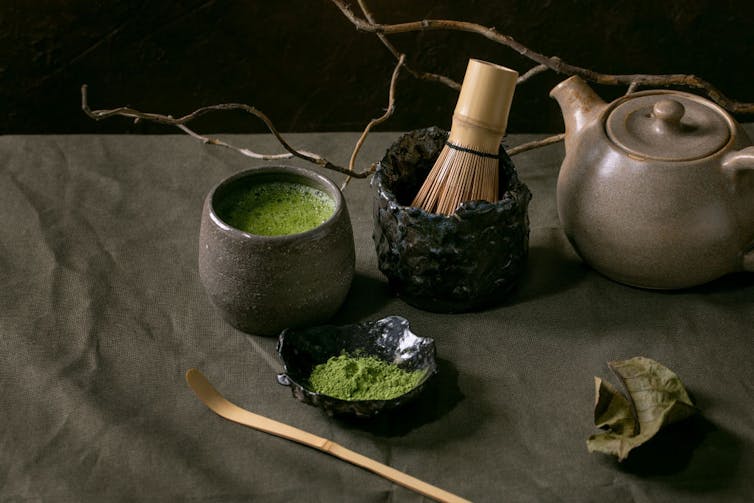
Green, frothy drink in a craft ceramic cup, next to a dish of green powder, a ceramic teapot and a bamboo whisk.
Many cafes use tools involved in chanoyu such as bamboo scoops and whisks.
Natasha Breen/REDA/Universal Images Group via Getty Images

Interestingly, the vast majority of matcha drinkers today don’t experience chanoyu, even as matcha purveyors borrow from the practice’s aesthetics. In the late 19th century, you couldn’t drink matcha without first experiencing chanoyu. And the drink was always served “straight” – no milks, flavorings or sweeteners.

Sometimes I wonder what the Countess de Montaigu would order if she visited Pipers Tea and Coffee, which is rated the best matcha in St. Louis on Yelp. Would she prefer it straight? Or would she be won over by its In Bloom Latte – a vanilla matcha latte topped with cherry blossom-sakura cold foam?

The Conversation

Rebecca Corbett receives funding from The Japan Foundation. She is affiliated with the Urasenke School of Tea through membership in the Urasenke Tankokai Los Angeles Association.

ref. Green gruel? Pea soup? What Westerners thought of matcha when they tried it for the first time – https://theconversation.com/green-gruel-pea-soup-what-westerners-thought-of-matcha-when-they-tried-it-for-the-first-time-263014

65,000 Pennsylvania kids have a parent in prison or jail − here’s what research says about the value of in-person visits

Source: The Conversation – USA – By Julie Poehlmann, Professor of Human Development & Family Studies, University of Wisconsin-Madison

Studies show that in-person visits between children and a parent in jail or prison can strengthen family bonds and reduce recidivism. Joe Amon/The Denver Post via Getty Images

Across Pennsylvania, an estimated 65,459 children have a parent in jail or prison. That’s according to a recent email inquiry to the Pennsylvania Department of Corrections. Nationwide, nearly half of adults have experienced a close family member being in jail or prison, and 1 in 14 children have lost a parent who was living with them to incarceration.

In May 2025, state Rep. Andre Carroll, whose district covers parts of northwest Philadelphia, and whose own father was incarcerated when Carroll was a child, introduced PA House Bill 1506. The proposed law “focuses on improving communication between incarcerated individuals and their families” by making phone calls and other communication with incarcerated individuals free. It would also prohibit the replacement of in-person visits with other forms of communication such as video calls.

I’m a psychologist and professor of human development and family studies who has studied children with incarcerated parents for more than 25 years.

In 2020, when in-person visits were stopped at jails and prisons due to the COVID-19 pandemic, my colleagues and I interviewed 71 jailed parents in Wisconsin to understand the strengths and challenges of remote video visits with their children.

The parents we spoke with strongly preferred in-person visits, where they are allowed to touch and hug, over virtual ones.

“Contact means a lot,” one parent told us. “This type of stuff breaks families apart, not being able to see a person face to face or touch a person.”

Another parent said, “Video visits are good as it fits into their schedule, but they are not the same. … Giving your child a hug is worth a hundred video visits.”

These findings are still relevant today because many local jails across the country are using video visits as a replacement for in-person visits. For example, an analysis of 40 county jails in Michigan found that 33 of them banned in-person visits.

State and federal prisons generally have in-person visits, with video visits sometimes offered as a supplement.

Dozens of stalls which each contain a video monitor and plastic chair
The video visit room of a newly constructed county jail in Irvine, Calif.
Paul Bersebach/MediaNews Group/Orange County Register via Getty Images

Benefits for kids

Kids whose parents are in jail or prison are more likely to experience problems in health and well-being compared to their peers, though a growing body of research shows that many children with incarcerated parents are resilient. Resilience refers to the development of competence despite experiencing significant hardship or stress.

In-person visits in particular have been shown to strengthen parent-child relationships, which are a key resilience factor.

In addition, research has shown that children benefit from visiting with their incarcerated parents when such visits are part of an intervention program that includes, for example, mentoring programs or child-friendly visits.

During child-friendly visits, children see their incarcerated parents face to face and can hug them, hold hands, be carried, or sit on their lap. They engage in meaningful activities together – such as playing games, reading together, doing art projects, or taking photos of themselves – that are designed to strengthen their relationship. They can also eat together, are free to move around the space, and are supported by trained staff.

In-person contact visits that allow touch are more developmentally appropriate for children than noncontact visits. For young children who are not part of an intervention, visits with incarcerated parents behind plexiglass can be confusing. The kids can see but not touch their parent, and they can only hear and speak to them through a device that looks like an old-fashioned telephone.

Benefits for parents

Incarcerated parents say that separation from their children is the most difficult part about being in prison or jail. They frequently report symptoms of distress and depression, especially when they have little contact with their children.

More frequent parent-child contact during parental incarceration – and visiting in particular – is associated with better mental health, fewer behavioral infractions, better relationships with the child’s at-home caregiver and more parent-child contact and better adjustment after release.

Other studies have found links between more visits with children and less recidivism, which also benefits society as a whole.

Furthermore, a study of 507 adults incarcerated because of felony charges in a county jail in Virginia found that more frequent contact with family members during incarceration related to more family connectedness, which in turn predicted better mental health during the first year after release.

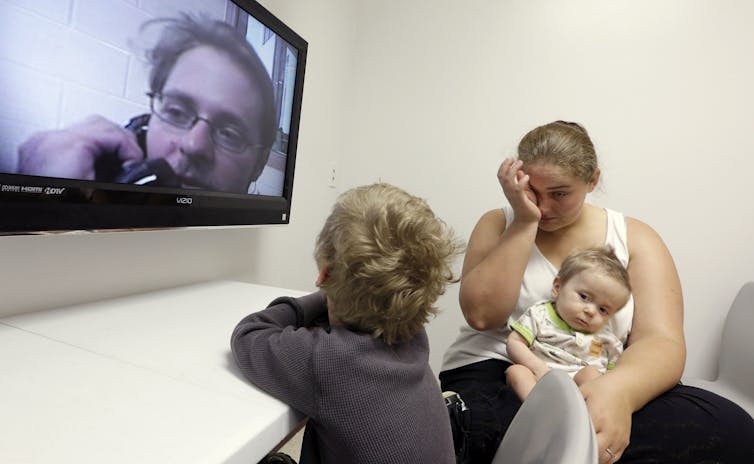
Woman holding baby rubs face and young child speaks to man on TV screen
File photo of a video visit at a county jail in Texas.
AP Photo/David J. Phillip

Barriers to contact

Despite the benefits of visiting and other forms of contact, barriers can prevent communication from occurring regularly or at all.

Some of these barriers are economic. Supporting a loved one in prison or jail can be a major financial strain on family members, and children in families experiencing more economic hardship are less likely to visit their incarcerated parents.

Some prisons charge exorbitant fees for video and phone calls. The Prison Policy Initiative tracks the prices of phone calls from prisons in each state. In 2021, the average cost of a 15-minute in-state phone call from a Pennsylvania prison was more than $3.

The racial disparities in who is incarcerated mean that Black and Latino families disproportionately carry the financial load of incarceration-related expenses.

Other barriers involve distance that families live from the prison or jail, time and scheduling conflicts, and strict mail policies that allow incarcerated people to receive only postcards or scanned copies of their mail. Strained relationships between incarcerated parents and family members can further limit contact.

Keeping families connected

Transportation programs offered by the Pennsylvania Prison Society, an advocacy organization for people who are incarcerated and their families, and other groups can help when family finances are tight. PPS currently provides rides from Philadelphia to four state correctional institutions. A round-trip bus ticket, which is usually $20, is free for children under 18.

In addition, some jails and prisons offer a limited number of free video visits or phone calls. The Pennsylvania Department of Corrections’ website indicates that incarcerated individuals can receive up to four in-person visits per month in addition to six no-cost video visits.

Other organizations are trying to make sure that children and other family members have a chance to stay connected to their incarcerated loved ones in positive ways. Earlier this year, nonprofit legal advocacy organizations helped children in two Michigan counties file landmark civil rights lawsuits that asserted a constitutional right to visit their parents in jail.

As an expert witness in these cases, I hope that they help more children get the “right to hug” their incarcerated parents and raise awareness of the positive impacts that visits play in the current and future well-being of incarcerated individuals and their families.

The Conversation

Julie Poehlmann receives funding from the National Institutes of Health; the content of this article is solely the responsibility of the author and does not necessarily represent the official views of the National Institutes of Health. Dr. Poehlmann is also currently serving as an expert witness in several legal cases that involve incarcerated parents and their children.

ref. 65,000 Pennsylvania kids have a parent in prison or jail − here’s what research says about the value of in-person visits – https://theconversation.com/65-000-pennsylvania-kids-have-a-parent-in-prison-or-jail-heres-what-research-says-about-the-value-of-in-person-visits-262185

From intention to impact: 3 ways men in leadership can build equitable workplaces that work for everyone

Source: The Conversation – USA (2) – By Lisa Kaplowitz, Associate Professor & Executive Director, Center for Women in Business, Rutgers University

Many top-performing companies say they are committed to supporting women in the workplace, and there’s reason to believe most men want to be better allies to women as well. They just don’t know how.

We are business professors who recently surveyed more than 400 managers about gender equity. We found that while men and women agree on what gender equity means in principle, they often disagree on what it takes to achieve it. Bridging that gap matters – without it, well-meaning leaders may take actions that do nothing or even backfire.

For our analysis, we interviewed 227 male managers and 209 female managers. When we asked them to name three words they associated with gender equity, they responded with remarkably similar answers.

Word clouds show that both men and women associate the word 'fair' with gender equity.
The top three words men and women associate with gender equity, in green and purple, respectively.
Source: Rutgers Center for Women in Business (CWIB)

But when it came to naming specific actions, clear differences emerged. Male managers were more than twice as likely as their female counterparts to think gender equity requires “extreme” sacrifice. What’s more, men were less likely than women to connect everyday workplace behaviors – such as challenging misogynistic behavior, taking paternity leave and offering a flexible work environment – with advancing equity.

This suggests a problem: If men and women envision the path to equity differently, progress will stall. That’s why it’s important to remember that gender equity isn’t a zero-sum game. Great leadership means building equity into daily practices to create a workplace that works for everyone. Research points to three practical moves leaders can make right now.

Speak up without speaking over

One of the biggest perception gaps has to do with challenging misogynistic behavior at work. Research shows that when men call out bad behavior, it benefits women’s well-being and reduces the likelihood of future incidents.

However, men often weigh the potential social costs before speaking up, which can lead them to not engage or to reinforce gender stereotypes. For example, they may worry about alienating other men or being seen as “too judgmental.”

Clear, shared workplace standards can help. Setting explicit expectations about respectful communication can reduce uncertainty and encourage collaboration. It can also relieve the hidden cognitive burden men may feel about saying the wrong thing. It’s important to avoid creating a “gotcha” mentality and instead use mistakes as growth opportunities.

Establishing team norms that include speaking from one’s own experience and beginning with inquiry instead of scrutiny can help encourage fruitful dialogue. Reminding employees of shared values and encouraging everyone to seek to understand before jumping to conclusions is helpful. When managers hear out employee hesitations and verbally reward inclusive behavior, norms are reinforced.

This is especially important in a climate where high-profile CEOs are promoting narrow, stereotypical visions of leadership – for example, by calling for more “masculine energy” in corporate settings. Even male allies who disagree might be reluctant to challenge such views. But confronting those norms is crucial – not only for women’s benefit, but also men’s.

That’s because rhetoric that reinforces a single idea of masculinity sets unattainable standards for how men should act in the workplace. It also discourages them from expressing stereotypically “feminine” qualities such as empathy, collaboration and emotional intelligence that are also critical for leaders to succeed. When men speak up, it can broaden the definition of leadership for everyone.

Take paternity leave

Another gap we found had to do with how managers viewed men taking paternity leave. The majority of female managers we surveyed considered it vital to gender equity, but many male managers didn’t see the connection.

The evidence, however, is clear: Ample research suggests that paternity leave creates more gender-inclusive environments. Paternity leave normalizes the role of men in sharing the caregiving responsibilities from the start, which not only enables increased female participation in the workforce but has also been shown to reduce sexist attitudes, result in a more equitable division of labor at home, and may even help to increase women’s wages.

One reason men avoid taking paternity leave is fear of social judgment. Research shows that most Americans support paid leave for both mothers and fathers, but that value doesn’t translate to practice – 76% of fathers return to work one week after the birth of their child. It’s not uncommon for men to approve of paternity leave and want to take it themselves, but to hold back because of what they think other men think. This phenomenon – where you base your actions on what you think others think, not what you actually think – is known as pluralistic ignorance.

Facing pressure to be the breadwinner, fear of career setbacks, and stereotypes that say men aren’t as good at caregiving, lead many men to worry that taking paternity leave may not be seen as “manly.” If men were more open about their desire to take paternity leave, it could create a domino effect, reducing the stigma associated with leave for all parents.

Advocate for flexibility

The same principle applies to flexible work environments, which reduce fatigue and burnout for caregivers and noncaregivers alike. Men and women say that flexible work, which includes both flexible hours and flexible work locations, is a top-three employee benefit and critical to a company’s success.

However, men may be concerned about asking for a more flexible schedule, especially for caregiving, because it violates norms about masculinity and the ideal worker. For instance, men may be hesitant to admit they prefer a 7 a.m. to 3 p.m. schedule to handle school pickups, because they may consider that “a woman’s job” or because they think it will make them seem less committed to their job.

The more everyone uses flexible work practices, the less stigmatized they become for all employees, regardless of gender or caregiving status. Encouraging their use can be as simple as providing models to men of high-status workers who incorporate flexible work practices.

For example, the financial services firm Moody’s has been implementing a “PurposeFirst” approach to flexible work, in which teams decide when in-person collaboration is essential and when remote work is more efficient. If one team needs time for more “heads-up” or collaborative work, then they have set times and office space to make sure that happens. Teams that spend more hours on “heads-down work” may not need the office space but might need more virtual check-ins.

This is crucial, since research has shown that the biggest downside of hybrid or remote work is lost opportunities to connect with colleagues. However, hybrid work was not associated with lower performance or increased work-family conflict. This shows that you can achieve the overarching goals of flexibility without also increasing isolation.

Our findings suggest that men and women often share the same values around gender equity but differ in which actions they prioritize. This gap can leave even well-intended leaders unsure of how to act. That’s why it’s important they know that benefits for women don’t come at men’s expense – they create healthier, more sustainable workforces for everyone.

The Conversation

The authors do not work for, consult, own shares in or receive funding from any company or organization that would benefit from this article, and have disclosed no relevant affiliations beyond their academic appointment.

ref. From intention to impact: 3 ways men in leadership can build equitable workplaces that work for everyone – https://theconversation.com/from-intention-to-impact-3-ways-men-in-leadership-can-build-equitable-workplaces-that-work-for-everyone-263403

No credit history? No problem − new research suggests shopping data works as a proxy for creditworthiness

Source: The Conversation – USA (2) – By Joonhyuk Yang, Assistant Professor of Marketing, Mendoza College of Business, University of Notre Dame

No credit history? That need not be a problem for first-time borrowing. AP Photo/Mark Humphrey

If you didn’t know much about someone, would you lend them a whole lot of money? Probably not – and banks are the same way. That’s why people with no credit history often have trouble getting loans. Banks and credit bureaus look at people’s past borrowing to predict how likely they are to repay. And when there’s no history, they tend to assume the worst.

That invisibility leaves many people in limbo. A young worker applying for her first credit card, a shopkeeper who has always relied on cash, or a recent migrant without local records may all be responsible borrowers. But without a file, lenders typically can’t tell the difference between them and someone at truly high risk of defaulting.

As marketing professors studying consumer finance, we wanted to know: Are there alternative sources of information that can help identify safe borrowers? And in our new study in Peru, we found a potential answer in everyday shopping habits.

By linking loyalty-card data from a large retailer with Peru’s national credit registry, we tested whether retail information – what people buy, when they shop, how they pay – could improve lenders’ ability to distinguish safe first-time applicants from risky ones.

The results were striking. Applicants with no credit history saw approval rates of only 16% when lenders judged them solely by traditional indicators such as income. But adding shopping data almost doubled approvals to 31%, and in some cases tripled them to 48% – with only a modest increase in defaults.

Without this retail data, newcomers look almost identical. But with it, safe borrowers emerge from the crowd. We found that people who bought items on sale, shopped at regular times and used noncash payment methods consistently had lower default risk than those who did not.

Why it matters

The World Bank estimates that about 1.4 billion adults remain unbanked, and billions more struggle to access formal credit because they lack sufficient history. In Peru, for example, less than a quarter of adults reported borrowing from a financial institution in the past year.

That gap matters. Access to credit lets households invest in education, launch businesses, buy homes and weather financial shocks. People who can’t borrow from established lenders may turn to informal lenders who charge punishingly high interest rates. Others simply go without, unable to smooth income swings or seize opportunities to improve their lives.

Our findings point to a practical way forward. Retailers and banks could work together to expand access by using shopping data – with consumer consent – as a second look for applicants who would otherwise be rejected. This extra layer of information doesn’t penalize those who already qualify. Instead, it helps identify safe borrowers among the invisible.

In a previous article, we showed that even a grocery basket could help predict repayment. This new research goes further by drawing on a much broader retail footprint that includes clothing, household goods and more. It also tracks what happens to people after rejection, following them into the national credit registry to see whether they eventually borrowed elsewhere and repaid. (Both studies were done with consumers’ consent and used anonymized data.)

What’s next

Our study relied on simulations of scenarios in which lenders incorporated retail data into their scoring models – so the next step is to test these models in practice. A field experiment could compare retail-based scoring with traditional methods head-to-head, tracking not just approvals and defaults but also the longer-term effects on borrowers. Do first-time borrowers who gain access go on to build healthy credit histories? Do they invest in education, businesses or housing, improving their financial well-being over time?

For lenders, too, there are open questions. How should banks adapt their customer service for people brand-new to credit – for example, by starting with lower limits and raising them gradually? For policymakers, the challenge is to ensure that these new tools expand access without compromising privacy or fairness. Strong guardrails and consumer protections will be critical so that broader credit access leads not just to more loans but to fair and sustainable financial inclusion.

The Research Brief is a short take on interesting academic work.

The Conversation

The authors do not work for, consult, own shares in or receive funding from any company or organization that would benefit from this article, and have disclosed no relevant affiliations beyond their academic appointment.

ref. No credit history? No problem − new research suggests shopping data works as a proxy for creditworthiness – https://theconversation.com/no-credit-history-no-problem-new-research-suggests-shopping-data-works-as-a-proxy-for-creditworthiness-263103

Counterfeit Chanel, Louis Vuitton and Hermès bags from China: examining an online phenomenon and its risks for consumers

Source: The Conversation – France (in French) – By Isabelle Chaboud, Professeur senior d’analyse financière, d’audit et de risk management – Directrice de Programme pour le MSc Fashion Design & Luxury Management- Responsable de la spécialisation MBA "Brand & Luxury Management", Grenoble École de Management (GEM)

In mid-April 2025, a wave of videos swept through TikTok claiming that some brands of luxury leather goods, especially French ones, actually make their products in China. The content creators presented themselves as official manufacturers, urging customers to buy bags directly from the source at a fraction of the retail price.

What triggered these campaigns? What caused them to spread so widely? Amid geopolitical tensions and legal challenges, this phenomenon raises crucial questions about business practices and intellectual property rights.

The United States: a luxury growth engine

The carefully orchestrated release of these videos coincided with the United States’ announcement of 145% tariffs on Chinese imports. With the use of catchy titles like “Luxury Brands Are All Made in China” or “Luxury Brands Lied to You”, content creators sought to draw customers directly to Chinese websites. This way, they would have a chance to bypass traditional distribution channels.

By offering their products on Chinese applications such as DHGate or Taobao – among the most downloaded in the United States in mid-April – Chinese manufacturers were clearly targeting the US market.

And indeed, the US is one of the most important markets for the luxury sector. In 2024, the country accounted for 25% of sales for French group LVMH, the world’s leading luxury goods company. Hermès, for its part, generated 19% of its revenue from “the Americas”, a 15% increase from 2023.

Even more interesting: while China is showing signs of slowing down for many major players in the sector, the US is once again becoming the engine of growth in a luxury market that is stabilising. According to “The State of Fashion: Luxury”, a study by the Business of Fashion (BoF) and McKinsey published in January 2025, sales of personal luxury goods in the US market are expected to increase by 3% to 5% for 2024 and 2025, and by 4% to 6% from 2025 to 2027 – compare this to 1% to 3% growth for the global luxury market from 2024 to 2025, and 2% to 4% growth from 2025 to 2027. What’s more, the US is likely to surpass China’s expected growth of 3% to 5% for the 2025-2027 period.

And according to BoF and McKinsey, sales of luxury leather goods registered the strongest growth between 2019 and 2023, even exceeding $79 billion in 2023. This high demand is driven by purchases of items considered “investment pieces” such as the “Timeless” bag by Chanel, the “Neverfull” by Louis Vuitton, the “Arqué” by Prada, and particularly coveted models like Hermès’ “Birkin” and “Kelly”.

Almost exclusively European productions

The Chinese manufacturers behind the claims in the videos on TikTok explain their previous silence by citing confidentiality agreements. They seized the opportunity to convince Internet users that these iconic Italian or French brands had their leather goods produced in China, with the “Made in Italy” or “Made in France” labels added only after the final assembly step was carried out in Europe.

However, by showing bags resembling those made by Hermès and Louis Vuitton, the creators of these videos ultimately discredited their own claims.

Make no mistake: Hermès does not produce its bags in China. As stated in its 2024 universal registration document, 60 of its 75 production sites are in France. The others can be found in Italy (shoes), the United Kingdom (for the bootmaker John Lobb, which is owned by Hermès), Switzerland (watches), Australia (tanneries and precious leathers), the US, and finally Portugal, with two metal factories there – neither of which is involved in making bags.

The coveted quality of Hermès’ creations stems in large part from its craftsmanship-based business model, with expertise passed down through generations and training provided in the company’s own schools. Its bags are produced exclusively in France and are labelled “Hermès Paris”. For connoisseurs, that’s a given!

As for the Louis Vuitton bags, pages 395 and 396 of LVMH’s 2024 universal registration document reveal the list of Louis Vuitton workshops – most of which are located in France. Some production takes place elsewhere in Europe (notably in Italy, Spain, and Portugal to a limited extent), as well as in the US, where the company operates a workshop in Texas. Here again, there is no evidence of any production in China.

In the case of Hermès and Louis Vuitton, the products shown in the videos are flagrant counterfeits. Customers tempted to buy directly from China expose themselves to significant risk. Buyers, if caught, may face serious penalties.

‘Approximately $467 billion’ in global trade

According to the latest data in “Mapping Global Trade in Fakes 2025”, a report published by the Organisation for Economic Cooperation and Development (OECD), counterfeit goods (across all categories, from pharmaceutical to spare parts) made up “approximately $467 billion” in global trade in 2021, “or 2.3% of total global imports”. Counterfeit imports into the EU were “estimated at $117 billion, or 4.7% of total EU imports”.

While all sectors are impacted, “clothing, footwear, and leather goods remained among the most affected sectors, accounting jointly for 62% of seized counterfeit goods” in 2020-2021, according to the OECD.

Legal consequences for buyers

Buyers of counterfeit products may face significant legal consequences. In France, they may be fined up to twice the value of the genuine product that has been counterfeited. So, if a bag suspiciously resembling a “Kelly” bag is offered for $1,000 on certain websites, the final bill could turn out to be far steeper, especially considering that the starting price of the authentic Hermès bag exceeds €10,000. In addition, buyers may be sentenced to three years’ imprisonment.

During a hearing in the French Senate in April 2025, Delphine Sarfati-Sobreira, the director-general of the Union of Manufacturers for the International Protection of Intellectual Property (Unifab), said [“France is the second-largest country in the European Union in terms of seizures of counterfeit goods”].

The video campaigns, viewed by millions, only fuel the counterfeit market. And buying directly from Chinese platforms does not completely exempt customers from paying customs duties. In the US, customs controls on orders from China have tightened, particularly for small packages below $800.

An opportunity for brands?

The videos also hide a deeper question: how can we justify the value of luxury items? If most brands have remained silent, indicating the lack of credibility they give these campaigns, they might also see this as an opportunity to strengthen communication with customers about preserving their craftsmanship and promoting their heritage.


A weekly e-mail in English featuring expertise from scholars and researchers. It provides an introduction to the diversity of research coming out of the continent and considers some of the key issues facing European countries. Get the newsletter!


The Conversation

Isabelle Chaboud ne travaille pas, ne conseille pas, ne possède pas de parts, ne reçoit pas de fonds d’une organisation qui pourrait tirer profit de cet article, et n’a déclaré aucune autre affiliation que son organisme de recherche.

ref. Counterfeit Chanel, Louis Vuitton and Hermès bags from China: examining an online phenomenon and its risks for consumers – https://theconversation.com/counterfeit-chanel-louis-vuitton-and-hermes-bags-from-china-examining-an-online-phenomenon-and-its-risks-for-consumers-264305

Madagascar : ce que le drame d’Ambohimalaza révèle sur la gestion de l’information publique

Source: The Conversation – in French – By Fabrice Lollia, Docteur en sciences de l’information et de la communication, chercheur associé laboratoire DICEN Ile de France, Université Gustave Eiffel

En juin 2025 Madagascar a fait face à une crise sanitaire dramatique.
Une trentaine jeunes ont perdu la vie après un événement festif à Ambohimalaza, une commune rurale située à 15 km à l’est de la capitale Antananarivo. Les autorités évoquent un empoisonnement volontaire, confirmé par des analyses toxicologiques identifiant des substances toxiques. Le président malgache a lui-même soutenu cette version.

Mais au-delà des faits, cette affaire révèle un enjeu plus profond. Celui de la gestion de l’information en situation d’incertitude. Qui construit le récit légitime ? Comment l’opinion publique se forge-t-elle face aux discours officiels et aux récits alternatifs qui circulent sur les réseaux sociaux ?

Chercheur en sciences de l’information et de la communication, mes travaux portent sur la circulation des discours en contexte de crise. Cette affaire illustre avec acuité les tensions entre communication institutionnelle, parole populaire, et logiques virales propres aux plateformes numériques, où se mêlent cadrage, désinformation et quêtes de sens concurrentes. J’en propose une lecture info-communicationnelle.

Sommes-nous face à une crise ?

Le terme “crise”, largement repris dans les médias et discours officiels, n’est pas neutre : il s’agit d’une construction sociale, qui suppose une rupture soudaine, une forte incertitude, et un besoin urgent d’agir.

Le drame d’Ambohimalaza semble remplir plusieurs critères : choc émotionnel, décès multiples, attente forte d’une réaction publique. Pourtant, des zones d’ombre subsistent. Les faits sont restés pendant un temps flous : les causes étaient incertaines et le caractère systémique du phénomène non établi.

Dès lors, le véritable enjeu est celui du récit. Construire un cadre interprétatif clair permet de guider l’action publique et de rassurer la population. La piste de l’empoisonnement, désormais confirmée, autorise une lecture sécuritaire maîtrisable. Mais si le botulisme – intoxication alimentaire causée par une toxine – est en cause, c’est l’ensemble de la chaîne sanitaire, économique et réglementaire qu’il faut questionner.

Dans ce flou initial, le temps de latence communicationnelle claire et structurée de la part des autorités, souvent nécessaire à l’obtention d’une information de qualité, a ouvert un vide informationnel rapidement comblé par une prolifération de récits parallèles. Ainsi, des messages WhatsApp évoquant un empoisonnement intentionnel, des messages de rituels sacrifices, des publications Facebook ont accusé un usage d’huile inapproprié, tout cela sans aucune preuve.

Ce brouillard informationnel a alimenté peur et spéculations. Il constitue le terreau d’une crise narrative, où les faits ne suffisent plus. Ce qui importe à ce stade, c’est leur cadrage, leur diffusion, leur réception et leur capacité à s’imposer comme vérité socialement partagée.

Gouverner l’incertitude par le récit

Les travaux en communication de crise rappellent que toute gestion efficace repose sur trois fondements : transparence, réactivité et cohérence narrative.

À Ambohimalaza, ces principes ont été mis à rude épreuve. Aucun point de presse régulier, des porte-parole multiples, des messages dissonants. La déclaration de la directrice de la veille sanitaire – « on m’a dit que c’est de l’empoisonnement, et je ne veux pas savoir » – incarne ce flottement communicationnel caractérisé par une absence de validation scientifique, une parole institutionnelle brouillée et une confusion amplifiée.

Dans ce vide discursif, des acteurs non institutionnels ont pris le relais.Journalistes indépendants,citoyens, activistes. Leur légitimité ne découle pas d’un titre officiel, mais de leur capacité à produire des récits perçus comme crédibles et émotionnellement engageants. Dans un écosystème numérique où l’autorité se construit par la viralité, ce sont les récits partagés – et non les discours validés – qui structurent l’opinion.

Les réseaux sociaux deviennent ainsi des scènes concurrentes de construction du sens. Vidéos WhatsApp, commentaires Facebook, contenus TikTok offrent une narration alternative, souvent non régulée, mais socialement validée.

Ce foisonnement discursif favorise l’émergence d’une infodémie qui se caractérise par un enchevêtrement de rumeurs, d’hypothèses et d’interprétations, où faits, opinions et manipulations coexistent sans filtre. À Ambohimalaza, les récits d’empoisonnement ciblé, de vengeance rituelle ou d’intoxication politique ont circulé massivement – sans fondement vérifié.

Dans ce contexte, le doute devient structurel. L’institution peine à imposer un récit, concurrencée par des narrations émotionnellement plus efficaces. La crise ne se joue plus seulement sur le terrain sanitaire, mais dans un espace attentionnel gouverné par les algorithmes, où la viralité supplante la véracité. C’est là que se joue une nouvelle forme de légitimité : non plus imposée par la hiérarchie, mais construite par l’engagement collectif autour d’un récit perçu comme « vrai » – au sens affectif du terme.

Les réseaux sociaux deviennent ainsi des espaces parallèles de construction du sens. Les narrations officielles y sont confrontées, contournées, ou tout simplement ignorées.

Cadrer la crise selon les régimes d’autorité

La communication de crise ne se déploie jamais hors-sol. Elle s’ancre dans des cultures politiques et symboliques spécifiques. À Madagascar, comme dans d’autres pays africains à gouvernance centralisée, la parole officielle reste fortement sacralisée. Héritée des régimes postcoloniaux, elle vise moins à susciter le débat qu’à maintenir la stabilité, unifier les perceptions et éviter la contestation.

Toute dissonance dans l’espace discursif est ainsi perçue non comme une expression démocratique, mais comme un facteur de déstabilisation du pouvoir établi, comme l’illustrent le contrôle du discours lors de la crise Daewoo (2008) ou l’encadrement médiatique en 2009.

À l’opposé, certains États occidentaux (Allemagne, Canada, Royaume-Uni) intègrent la controverse comme modalité de légitimation. Les désaccords scientifiques y sont rendus publics, les institutions dialoguent avec les citoyens, et le débat contradictoire devient un outil de confiance, non une menace. Ces pratiques relèvent de rituels de transparence conflictuelle, structurés par une culture politique pluraliste.

Il ne s’agit pas de modèles hiérarchisables, mais de formes différenciées de production du sens en situation d’incertitude. Comme le rappelle le sociologue français Dominique Wolton, toute parole publique est toujours médiée par une histoire, une culture, et un rapport particulier à la vérité.

Vers une souveraineté communicationnelle partagée ?

La crise sanitaire d’Ambohimalaza révèle un déséquilibre structurel dans la circulation de la parole publique à Madagascar. Plus qu’un épisode isolé, elle met en lumière une difficulté collective à articuler le doute, à produire du sens sans tomber dans la disqualification, le complotisme ou l’imposition prématurée d’une vérité unique.

Face à cette fragmentation discursive, le concept de souveraineté communicationnelle partagée invite à repenser la communication de crise non plus comme un monologue institutionnel, mais comme une construction plurielle et ouverte, intégrant voix citoyennes, scientifiques, journalistes et société civile.

Une telle approche aurait supposée, dans le cas présent, une reconnaissance explicite de l’incertitude, des points presse multipartites, et une transparence des données, y compris des hypothèses divergentes. En l’absence de ce cadre partagé, le discours officiel peine à convaincre une population de plus en plus méfiante, tandis que des récits alternatifs — bien souvent non vérifiés — occupent massivement l’espace public, révélant dans cette situation particulière une difficulté s’organisant dans une perte de légitimité de la parole publique.

Dans cette perspective, comme le rappelle Dominique Wolton, « la démocratie ne consiste pas à faire taire les conflits, mais à organiser leur expression dans un cadre communicatif commun ». La communication authentique n’est donc pas l’unanimité du discours, mais la gestion négociée de l’incommunication, c’est-à-dire des différences de perceptions, d’intérêts et de récits.

Dès lors, la souveraineté communicationnelle ne devrait plus être entendue comme un monopole du discours d’État, mais comme un équilibre dynamique entre les différentes paroles légitimes, où la controverse devient un outil démocratique plutôt qu’un danger à contenir.

The Conversation

Fabrice Lollia does not work for, consult, own shares in or receive funding from any company or organisation that would benefit from this article, and has disclosed no relevant affiliations beyond their academic appointment.

ref. Madagascar : ce que le drame d’Ambohimalaza révèle sur la gestion de l’information publique – https://theconversation.com/madagascar-ce-que-le-drame-dambohimalaza-revele-sur-la-gestion-de-linformation-publique-262094

Notre penchant pour l’alcool trouverait son origine chez nos ancêtres il y a plus de 10 millions d’années

Source: The Conversation – in French – By Mickael Naassila, Professeur de physiologie, Directeur du Groupe de Recherche sur l’Alcool & les Pharmacodépendances GRAP – INSERM UMR 1247, Université de Picardie Jules Verne (UPJV)

Avec les singes, nous partageons des ancêtres qui auraient consommé de l’alcool. Wirestock/Freepik, CC BY

L’addiction à l’alcool n’est pas qu’une question de société. C’est aussi une vieille histoire d’évolution, de fruits fermentés et de mutations génétiques.


Des fruits trop mûrs au sol, légèrement gonflés, un peu mous, odorants… et légèrement alcoolisés. Voilà ce que nos ancêtres de la lignée des hominoïdes, aujourd’hui représentée par les grands singes et l’humain, trouvaient souvent dans les forêts tropicales de l’Afrique. Et ce petit goût d’éthanol, ils l’adoraient.

Selon l’hypothèse du « Drunken Monkey » (singe ivre), formulée par Robert Dudley dès l’an 2000, la consommation d’éthanol chez les humains ne viendrait pas d’une dégénérescence culturelle moderne, mais bien d’une pression évolutive ancienne. Des millions d’années avant que l’homme n’invente l’agriculture et la fermentation, nos ancêtres frugivores auraient déjà été amateurs de fruits naturellement fermentés. Et le passage de la cime des arbres au sol avec le glanage de fruits tombés au sol aurait accéléré cette évolution.

Une mutation qui change tout

Une étude publiée en 2014 rapporte qu’il y a environ 10 millions d’années, une mutation dans l’enzyme ADH4 (alcool-déshydrogénase) a permis à nos ancêtres de métaboliser l’éthanol 40 fois plus efficacement. Cette adaptation est survenue précisément chez nos ancêtres de la lignée des hominoïdes (ancêtre commun des humains, chimpanzés et gorilles mais pas chez les orangs-outans).

Pourquoi ? Parce que ceux-ci vivaient dans les hauteurs des arbres, où les fruits ne fermentent pas autant qu’au sol. Les ancêtres des chimpanzés et gorilles, eux, descendaient volontiers glaner les fruits tombés, plus susceptibles d’avoir fermenté sous l’action naturelle des levures. Avoir accès à de nombreux fruits fermentés tout en étant capables de dégrader l’alcool devenait alors un avantage évolutif, cette mutation devenant ainsi un « gain de fonction » permettant de trouver plus facilement de la nourriture riche en calories.

De la même manière que la mutation de l’ADH permettait aux primates de s’adapter pour améliorer leur régime alimentaire, l’être humain s’est aussi adapté plus récemment avec des mutations de l’autre enzyme, l’ALDH, qui dégrade l’acétaldéhyde (produit de dégradation toxique induisant une réaction d’intolérance à l’alcool avec des rougeurs faciales (un « flush »), tachycardie, nausée) en acétate (non toxique). Cette réaction d’intolérance à l’alcool serait censée nous protéger de la consommation d’alcool, une molécule qui avec son métabolite tout aussi toxique peut causer des dégâts sévères pour notre santé.

L’éthanol comme carte au trésor olfactive

L’éthanol émis par les fruits fermentés ne se sent pas seulement de près. Il se diffuse à distance et servait probablement de signal olfactif aux primates pour localiser des ressources énergétiques riches en sucre.

L’éthanol est largement présent dans la nature, principalement par la fermentation des sucres des fruits par les levures. Une étude a rapporté les concentrations d’alcool de différents fruits pas encore tombés au sol mais dont certains étaient trop mûrs. La concentration varie selon les espèces et les environnements : des traces (0,02–0,9 %) ont été mesurées dans des fruits tempérés et subtropicaux comme le sorbier, le figuier sycomore ou le palmier dattier, tandis que dans les zones tropicales humides, particulièrement favorables à la fermentation, des teneurs beaucoup plus élevées (jusqu’à 10 % dans certains fruits de palmiers au Panama) ont été observées dans les fruits trop mûrs. Bien que la plupart des fruits présentent des niveaux faibles (<0,2 % en moyenne), leur consommation répétée peut représenter une source significative d’éthanol pour les animaux frugivores. Cette production naturelle d’alcool s’inscrit dans une relation complexe entre plantes, levures et animaux : les fruits offrent des sucres, les levures colonisent et fermentent, et les animaux attirés contribuent à disperser à la fois les graines et les spores de levures, suggérant une forme de « mutualisme écologique ».

De nombreuses anecdotes circulent sur des animaux « ivres » après avoir consommé des fruits fermentés… Éléphants et babouins en Afrique avec le marula, ou encore un élan en Suède coincé dans un arbre après avoir mangé des pommes fermentées. Toutefois, ces récits restent rarement validés scientifiquement : ni la teneur en éthanol des fruits, ni la présence d’alcool ou de ses métabolites chez les animaux n’ont été mesurées. On sait en revanche que certains mammifères, comme les singes verts introduits aux Caraïbes, n’hésitent pas à subtiliser et consommer les cocktails de fruits alcoolisés laissés sans surveillance par les touristes sur les plages de St Kitts.

Une étude rapporte que des chimpanzés de Bossou en Guinée utilisent des feuilles enroulées comme “éponges” pour boire de la sève de palme fermentée contenant jusqu’à 6 % d’éthanol.

Des chimpanzés filmés en train de partager des fruits alcoolisés en Guinée-Bissau/Africanews.

Et ce n’est pas de la picole en cachette : ils boivent en groupe, se passent les feuilles, presque comme un apéritif communautaire. De quoi revisiter nos idées sur l’alcool et le lien social. L’activité de glanage des fruits fermentés au sol et alcoolisée devient alors une motivation sociale, déjà ! Nous n’avons rien inventé.

De nos jours, l’alcool coule à flots, mais nos enzymes n’ont pas suivi

L’évolution nous a donné un foie capable de dégrader environ 7 g d’éthanol par heure. C’est peu face aux cocktails modernes. Autrefois, le volume d’éthanol ingéré était naturellement limité par ce que contenait… un estomac de singe rempli de fruits. Aujourd’hui, on peut boire des dizaines de grammes en quelques gorgées de boissons fortement alcoolisées. Un shot (un “baby”) de whisky ou de spiritueux à 40° et de seulement 3cl seulement contient 10g d’alcool !

Il n’est donc pas étonnant que nous devions faire face au problème de la consommation excessive d’alcool et de l’addiction à l’alcool qui ont de lourdes conséquences sur la santé et nos sociétés. On parle de « mismatch » et de « gueule de bois liée à l’évolution ». Les mutations de nos gènes codant ADH et ALDH n’ont pas encore permis à notre espèce de faire face aux conséquences néfastes de l’alcoolisation excessive.

Pour conclure, notre instinct de boire est ancien, mais les risques sont nouveaux.

Notre attrait pour l’alcool n’est pas une anomalie moderne. C’est un héritage évolutif, un bug de l’époque des forêts humides, où l’éthanol signifiait calories et survie. Mais dans un monde où les alcools sont concentrés, accessibles, omniprésents… ce qui était un avantage est devenu un facteur de risque pour notre santé et un enjeu de santé publique prioritaire.


Pour en savoir plus, le livre de Mickael Naassila « J’arrête de boire sans devenir chiant » aux éditions Solar.

The Conversation

Professeur des Universités, Directeur de l’unité INSERM UMR 1247 le Groupe de Recherche sur l’Alcool & les Pharmacodépendances (GRAP), Chercheur sur l’addiction à l’alcool depuis 1995. membre sénior à l’Institut Universitaire de France en 2025. Auteur de plus 140 articles scientifiques et des ouvrages “Alcool: plaisir ou souffrance” Le Muscadier et “J’arrête de boire sans devenir chiant”, SOLAR.
Président de la Société Française d’Alcoologie et d’Addictologie (SF2A), de la Société européenne de recherche biomédicale sur l’alcoolisme (ESBRA) et vice-président de la Société internationale de recherche biomédicale sur l’alcoolisme (ISBRA).

ref. Notre penchant pour l’alcool trouverait son origine chez nos ancêtres il y a plus de 10 millions d’années – https://theconversation.com/notre-penchant-pour-lalcool-trouverait-son-origine-chez-nos-ancetres-il-y-a-plus-de-10-millions-dannees-262996

Le principe oublié d’Einstein ou la naissance de la constante cosmologique

Source: The Conversation – in French – By Olivier Minazzoli, Astrophysicien, Université Côte d’Azur

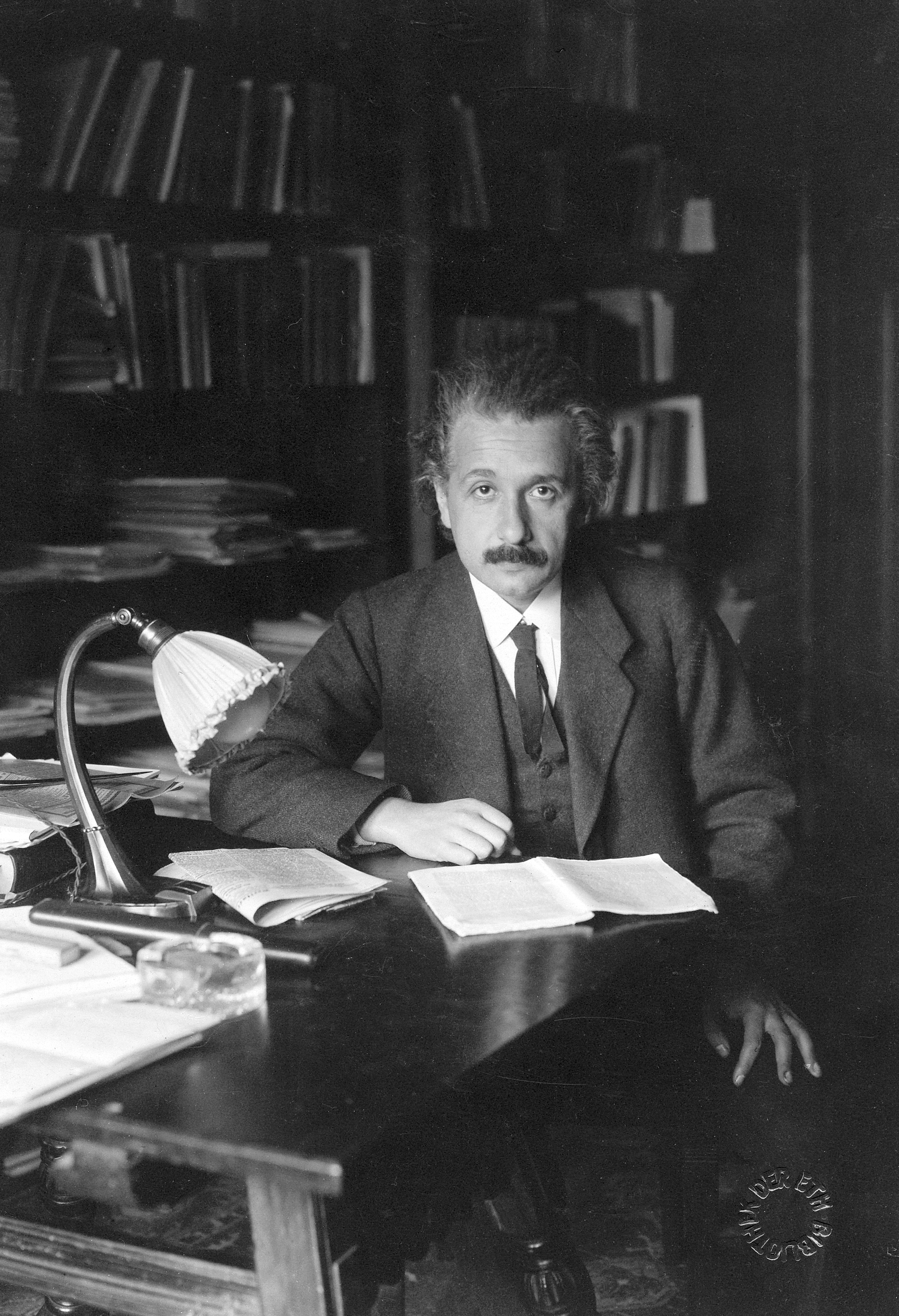
Albert Einstein. Unknown photographer, Public domain, via Wikimedia Commons

La relativité générale d’Einstein est souvent présentée comme une construction théorique guidée par des principes fondamentaux, plus que par l’observation. Le dernier de ces principes, connu sous le nom de « principe de Mach », est aujourd’hui largement tombé dans l’oubli. Pourtant, c’est lui qui a conduit Albert Einstein à introduire dans ses équations la constante cosmologique — aujourd’hui interprétée comme l’énergie sombre, à l’origine de l’accélération de l’expansion de l’univers.


Le mouvement est-il relatif ou absolu ? Si la question a longtemps animé les débats philosophiques depuis l’Antiquité, c’est surtout à partir du XVIe siècle, avec l’édification des lois de la gravitation, qu’elle a quitté la seule arène des philosophes pour entrer dans celle des astronomes et des physiciens.

Pour Isaac Newton, aucun mouvement ne peut être conçu sans la notion d’un espace rigide et absolu, servant de référence pour définir la trajectoire des objets. À l’opposé, pour Christian Huygens, Gottfried Wilhelm Leibniz, et plus tard Ernst Mach, ce sont les autres objets qui servent de repères. Dès lors, aucun mouvement ne devrait pouvoir être défini en l’absence totale de matière : ôtez toute référence matérielle, et il devient impossible de dire si un objet est en mouvement ou au repos.

Influencé par Mach, Einstein érigea ce point de vue en principe fondateur de sa théorie de la relativité générale. Il en mentionna l’idée pour la première fois en 1912, puis la qualifia tour à tour d’« hypothèse », de « postulat », avant de finalement l’appeler « principe de Mach » en 1918, en hommage au physicien et philosophe autrichien qui avait nourri sa réflexion.

À première vue, la relativité générale semble en accord avec ce principe, dans la mesure où l’espace n’y est plus la structure rigide et absolue de Newton, mais un objet dynamique influencé par la matière. En effet, dans la théorie d’Einstein, la gravitation n’est pas une force à proprement parler, mais la manifestation de la courbure de l’espace et du temps, induite par la matière : toute source d’énergie ou de masse déforme l’espace-temps, et c’est cette courbure qui gouverne le mouvement des corps.

Et si l’on pouvait voir l’Espace-temps ? Expérience immersive. Source : ScienceClic.

Néanmoins, Einstein avait conscience que, pour satisfaire pleinement ce principe, il ne suffisait pas que la matière influence la géométrie de l’espace-temps : il fallait qu’elle la détermine entièrement. C’est ce qui le conduisit à modifier ses équations en y introduisant la constante cosmologique — que l’on interprète aujourd’hui comme l’énergie sombre, responsable de l’accélération de l’expansion de l’univers.


À lire aussi :
Pourquoi l’expansion de l’Univers accélère ? Les nouveaux résultats de la collaboration DESI apportent leur pierre à l’édifice


Pourquoi Einstein a introduit la constante cosmologique

Deux problèmes semblaient se poser à Einstein dans la version initiale de sa théorie de la relativité générale, sans cette constante.

Le premier est que ses équations admettent des solutions du vide : elles permettent, en théorie, l’existence d’un espace-temps même en l’absence complète de matière. Cela contredisait directement son « principe de Mach ». Il écrira d’ailleurs en 1918 :

« À mon avis, la théorie de la relativité générale n’est satisfaisante que si elle démontre que les qualités physiques de l’espace sont entièrement déterminées par la matière seule. Par conséquent, aucun espace-temps ne peut exister sans la matière qui le génère. » Albert Einstein, Actes de l’Académie royale des sciences de Prusse, 1918.

Le second problème concernait les conditions aux limites de l’espace-temps, c’est-à-dire, de la structure supposée de l’espace-temps à l’infini. Il semblait nécessaire de les introduire, mais elles étaient soit incompatibles avec son principe, soit conduisaient, pensait-il, à prédire un mouvement des astres lointains qui n’était pas observé. C’est peut-être d’une réinterprétation de cette difficulté qu’est née l’idée, aujourd’hui répandue, selon laquelle Einstein aurait introduit la constante cosmologique pour conformer sa théorie à une vision préconçue d’un univers statique et donc éternel.

Un univers fini mais sans bord

Comme il l’explique dans l’article où il introduit la constante cosmologique, celle-ci permet d’éviter le recours à des conditions aux limites problématiques, en autorisant un univers fini mais sans bord.

Pour se représenter ce qu’est un univers « fini mais sans bord », on peut penser à la surface d’une sphère. Elle ne possède pas de frontière — on peut y circuler sans jamais atteindre de bord — et pourtant, sa surface est finie (égale à quatre fois π fois le rayon au carré).


À lire aussi :
Où est le centre de l’Univers ?


C’est ainsi qu’Einstein a inventé le tout premier modèle physique de l’univers dans son ensemble ! Il s’agit d’un univers sphérique, en équilibre, avec une répartition uniforme de matière. Si son modèle est celui d’un univers statique (c.-à-d., qui n’évolue pas avec le temps), il est clair que pour Einstein il ne s’agit que d’une première approximation qui permet de résoudre les équations.

Une impasse théorique

Mais nous le savons aujourd’hui : le modèle d’Einstein ne correspond pas à notre univers. Qui plus est, il est théoriquement insatisfaisant, car instable : tout écart, même minime, à l’approximation homogène qu’il utilise conduit à prédire sa destruction. Or, notre univers n’est certainement pas exactement homogène !

Ensuite, il est désormais établi — depuis que l’astronome néerlandais Willem de Sitter l’a démontré — que, même avec une constante cosmologique, la relativité générale admet des solutions dans lesquelles l’espace-temps peut, en théorie, exister sans aucune forme de matière.

De Mach à l’énergie sombre : l’ironique réhabilitation d’une constante

L’introduction de la constante cosmologique échoue donc à rendre la relativité générale compatible avec le principe de Mach — ce qui était, rappelons-le, l’intention initiale d’Einstein en introduisant la constante cosmologique dans ses équations. C’est vraisemblablement pour cette raison qu’Einstein qualifiera plus tard son introduction de « plus grande erreur de sa vie » (des propos relayés par George Gamow dans son autobiographie).

Ce principe oublié a ainsi poussé Einstein à penser l’univers dans son ensemble, donnant naissance à la toute première solution mathématique d’un univers en relativité générale — et donc à la cosmologie moderne. Par un enchaînement ironique de l’histoire scientifique, il l’a amené à introduire une constante pour une raison qui, en fin de compte, ne fonctionnera pas — mais dont l’adéquation aux observations sera confirmée des décennies plus tard, en 1998, par l’observation de supernovae lointaines. Cette découverte vaudra à Saul Perlmutter, Brian Schmidt et Adam Riess le prix Nobel de physique en 2011, près d’un siècle après l’élaboration de la théorie d’Einstein.

Le rôle des hypothèses en sciences

La capacité de l’esprit humain à concevoir des principes abstraits qui peuvent dévoiler la structure du réel interroge. Comment une idée a priori, née sans données empiriques, peut-elle conduire à une loi objective du monde ?

Cela s’explique néanmoins simplement : les scientifiques formulent des hypothèses, des principes et des modèles — certains échouent et tombent dans l’oubli, d’autres se révèlent féconds. C’est ce que suggère la belle image du penseur-poète Novalis :

« Les hypothèses sont des filets : seuls ceux qui les jettent attrapent quelque chose ». Novalis, The Disciples at Sais and Other Fragments, Thoughts on Philosophy, Love and Religion, page 68, 1802.

C’est en jetant le sien qu’Einstein a donné naissance à la cosmologie moderne.


_Pour aller plus loin : la traduction française de l’article « Les Formulations d’Einstein du Principe de Mach », écrit par Carl Hoefer et traduit par l’auteur du présent article, est disponible ici.

The Conversation

Olivier Minazzoli ne travaille pas, ne conseille pas, ne possède pas de parts, ne reçoit pas de fonds d’une organisation qui pourrait tirer profit de cet article, et n’a déclaré aucune autre affiliation que son organisme de recherche.

ref. Le principe oublié d’Einstein ou la naissance de la constante cosmologique – https://theconversation.com/le-principe-oublie-deinstein-ou-la-naissance-de-la-constante-cosmologique-261698

Maths au quotidien : pourquoi les entreprises dépensent-elles tant en publicité ?

Source: The Conversation – in French – By Antoine Prevet, Directeur exécutif Chaire etilab, Chercheur en économie, Mines Paris – PSL

La ville de New&nbsp;York envahie par les écrans publicitaires, aux États-Unis. Anthony Rosset, Unsplash, CC BY

Les entreprises dépensent en publicités des montants qui paraissent délirants. Pour comprendre leur raisonnement, petit passage par la théorie des jeux.

En 2024, les dépenses publicitaires mondiales sont estimées à plus de 1 000 milliards de dollars — soit l’équivalent d’un tiers du PIB français. En moyenne, les entreprises consacrent près de 10 % de leur chiffre d’affaires au marketing. Dans certains secteurs, comme les start-up ou les SaaS (Software as a Service), ce chiffre peut même grimper jusqu’à 20 %.

Pourquoi une telle frénésie publicitaire ? La réponse immédiate semble évidente : la publicité attire des clients. Mais cette explication est incomplète. En réalité, les entreprises investissent massivement dans la publicité… à cause de leurs concurrents.

La publicité comme jeu de stratégie

En effet, les dépenses publicitaires relèvent d’une situation d’interdépendance : les décisions d’une entreprise affectent non seulement ses propres ventes, mais aussi celles de ses concurrents. Ce type de relation est précisément ce que la théorie des jeux — un champ des mathématiques formalisé au XXe siècle notamment par John von Neumann, Oskar Morgenstern et John Nash — permet d’analyser.

La théorie des jeux étudie les situations où des agents rationnels, appelés des « joueurs » interagissent selon des règles précises, avec des choix stratégiques et des résultats qui dépendent des décisions de chacun.


À lire aussi :
L’entrepreneur est-il un joueur de poker ?


Imaginons deux entreprises concurrentes, A et B. Chacune gagne 10 millions d’euros en l’absence de publicité. Chacune peut choisir d’investir ou non dans une publicité qui coûte 2 millions d’euros. Voici les conséquences possibles :

  • Si les deux investissent, elles ne gagnent que 8 millions chacune (10 — 2).

  • Si une seule investit, elle capture 5 millions d’euros à l’autre entreprise, qui, elle, n’a pas fait de publicité : elle gagne donc 13 millions (10 — 2 + 5), tandis que l’autre ne gagne que 5 millions (10 — 5).

Les gains des entreprises A et B en fonction de leur stratégies publicitaires respectives.
Antoine Prévet, Fourni par l’auteur

Cet exemple constitue bien entendu une simplification schématique. Il repose notamment sur l’hypothèse que les entreprises ne peuvent pas conquérir de nouveaux clients par la publicité, ce qui est évidemment inexact. Cet exemple vise uniquement à exposer les conditions nécessaires à la mise en place du point d’intérêt du jeu.

Quelle est la meilleure stratégie pour chacune des entreprises ?

Le choix collectivement optimal serait de ne pas investir du tout : chaque entreprise gagnerait alors 10 millions. Pourtant, ce scénario ne se réalise jamais. C’est le célèbre « dilemme du prisonnier » : une tension entre l’intérêt individuel et l’intérêt collectif.

Quelle que soit la décision du concurrent, chaque entreprise a intérêt à investir dans la publicité. Si B investit, A gagne plus en investissant aussi (8 contre 5). Si B n’investit pas, A gagne encore plus en investissant (13 contre 10) : on dit que l’investissement publicitaire est une « stratégie dominante », c’est-à-dire la meilleure stratégie, quelle que soit la décision du partenaire de jeu.

Ce raisonnement est symétrique pour B. On aboutit ainsi à un équilibre dans lequel les deux entreprises investissent… pour un résultat inférieur à celui d’une coopération.

Il est important de noter que dans ce jeu, la publicité n’a, par hypothèse, pas de valeur intrinsèque. Sa valeur est relative : elle n’existe que par comparaison avec la stratégie du concurrent. Ce mécanisme explique pourquoi les montants investis en publicité peuvent sembler absurdes au premier abord, tout en étant en réalité une décision parfaitement rationnelle — et même optimale, dans un contexte concurrentiel ; même si la publicité ne permet pas d’acquérir de nouveaux clients.

Peut-on sortir de ce piège ?

Dans un cadre statique, sans intervention extérieure, la réponse est non. Même en autorisant les entreprises à se coordonner, chacune aurait trop à gagner en trichant… et l’équilibre coopératif serait donc instable. Par ailleurs, ces coordinations sont souvent illégales, les autorités de la concurrence interdisent, sauf exception, toute collusion entre concurrents.

Trois solutions sont néanmoins envisageables :

  1. Interdire la publicité. Une solution radicale serait d’interdire toute publicité. Cela mettrait fin au dilemme… mais au prix de priver les consommateurs d’une information utile pour leurs choix. La publicité joue en effet un rôle d’information et de différenciation.

  2. Encadrer légalement les engagements. Si les entreprises pouvaient légalement s’engager à limiter leurs dépenses publicitaires — et si un tiers (juge, autorité, etc.) pouvait faire respecter ces engagements — alors l’équilibre coopératif deviendrait atteignable. Autrement dit, les entreprises pourraient s’engager de manière crédible à ne pas investir dans la publicité. En cas de déviation, elles seraient sanctionnées par la loi. C’est l’intervention d’un tiers — ici, l’autorité publique — qui rend possible la contractualisation.


À lire aussi :
Est-il temps de réglementer le ciblage publicitaire et les entreprises qui en profitent le plus ?


  1. Répéter le jeu. Enfin, si l’interaction entre les entreprises se répète dans le temps, il devient possible d’instaurer une forme de coopération : tricher une fois, c’est risquer de perdre la confiance (et donc les profits) à long terme. C’est le principe de la « réciprocité conditionnelle », qui peut conduire à des stratégies coopératives stables dans le temps. Ce mécanisme est celui de la réputation, qui établit un lien entre les comportements présents et les gains futurs.

The Conversation

Antoine Prevet a reçu des financements des mècenes de l’etilab.

ref. Maths au quotidien : pourquoi les entreprises dépensent-elles tant en publicité ? – https://theconversation.com/maths-au-quotidien-pourquoi-les-entreprises-depensent-elles-tant-en-publicite-262089