Source: The Conversation – (in Spanish) – By Teresa Morera Herreras, Profesora agregada del Departamento de Farmacología, Universidad del País Vasco / Euskal Herriko Unibertsitatea
Cuando pensamos en salud oral, solemos imaginar dientes blancos y encías firmes. Pero mantener una buena higiene bucal va mucho más allá de una cuestión estética: puede influir directamente en la salud de todo nuestro organismo.
Una mala salud oral no solo favorece la aparición de caries, la pérdida de dientes o la inflamación de encías (gingivitis): también puede agravar enfermedades crónicas como la diabetes, aumentar el riesgo de ciertos tipos de cáncer e incluso contribuir al desarrollo de enfermedades cardiovasculares, cerebrales y neurodegenerativas.
En concreto, se ha observado que las personas que padecen periodontitis –una inflamación crónica de las encías causada por la acumulación de placa bacteriana– presentan más posibilidades de desarrollar complicaciones en otras partes del cuerpo. Los datos son claros: un paciente con periodontitis no tratada tiene 2,5 veces más riesgo de sufrir un ictus y casi 3 veces más de probabilidades de padecer una enfermedad cardíaca en comparación con quienes mantienen una buena salud bucodental.
Además, la inflamación crónica asociada con la periodontitis también podría contribuir al deterioro cognitivo, como ocurre en el alzhéimer.
Aunque aún no conocemos su causa exacta, sí sabemos que influyen tanto la genética como factores ambientales, incluido nuestro estilo de vida. Y es aquí donde aparece una conexión inesperada: el cuidado de las encías podría desempeñar un papel protector frente al deterioro cognitivo.
Bacterias, seres invisibles que dejan huella
La boca alberga unas 770 especies de microorganismos que componen la microbiota oral. En equilibrio, esta comunidad bacteriana cumple funciones beneficiosas. Pero cuando la higiene es deficiente o existen factores que alteran ese equilibrio, las bacterias patógenas se multiplican, favoreciendo la aparición de enfermedades como la enfermedad periodontal.
La gingivitis, la forma más leve, afecta hasta al 90 % de la población y puede revertirse con una correcta higiene. Sin embargo, si progresa, puede convertirse en periodontitis, una afección crónica, inflamatoria e irreversible con consecuencias que van mucho más allá de la pérdida de dientes.
Las bacterias implicadas, especialmente Porphyromonas gingivalis, y las moléculas inflamatorias que el sistema inmunitario libera al intentar combatirlas pueden viajar por la sangre y alcanzar órganos distantes, como el cerebro. Allí pueden contribuir a procesos inflamatorios y al desarrollo o progresión de enfermedades neurodegenerativas como el alzhéimer.
De hecho, varios estudios recientes refuerzan la hipótesis de esa conexión. En modelos animales, la exposición prolongada a toxinas de bacterias como Porphyromonas gingivalis ha inducido neuroinflamación, acumulación de proteína beta-amiloide y deterioro de la memoria, tres características típicas del alzhéimer.
En humanos, también se ha hallado evidencia sorprendente: la cantidad de bacterias orales en el tejido cerebral de personas fallecidas con esa patología es hasta siete veces mayor que en quienes no padecían la enfermedad.
Cepillarse: una rutina que podría proteger nuestra mente
Así pues, dedicar apenas 10 minutos al día a la higiene oral es una inversión para la salud futura. Cada vez que olvidamos cepillarnos, las bacterias se multiplican y pueden acabar en otras partes del cuerpo con efectos imprevisibles.
Cepillarse los dientes, usar hilo dental y acudir regularmente al dentista no solo cuida la sonrisa: también puede ayudar a proteger el corazón, el cerebro y, posiblemente, la memoria. El alzhéimer borra recuerdos, pero hay algo que conviene no olvidar: cuidar de nuestra boca es cuidar de nuestra mente.
Las personas firmantes no son asalariadas, ni consultoras, ni poseen acciones, ni reciben financiación de ninguna compañía u organización que pueda obtener beneficio de este artículo, y han declarado carecer de vínculos relevantes más allá del cargo académico citado anteriormente.
Peaches, who was blown into Florida by Hurricane Idalia in 2023, was sighted in Mexico in June 2025.Kara Durda/Audubon Florida
Hurricane Idalia blew a flamboyance, or flock, of 300-400 flamingos that was likely migrating between the Yucatan Peninsula and Cuba off course in August 2023 and unceremoniously deposited the birds across a wide swath of the eastern United States, from Florida’s Gulf Coast all the way up to Wisconsin and east to Pennsylvania.
After Hurricane Idalia, more than 300 credible sightings of flamingos across the eastern U.S. were reported. Audubon Florida
A colleague and I were able to place a GPS tracking device and a bright blue band around his spindly leg, with the code “US02” engraved in white letters.
Melissa Edwards, Avian Hospital Director at Seaside Seabird Sanctuary, holds Peaches still while Dr. Frank Ridgley of Zoo Miami and the author, Dr. Jerome Lorenz, place a band and GPS tracker on his leg. Dr. Lorenz has banded or supervised the banding of nearly 3,000 roseate spoonbills, but Peaches was his first and only flamingo to date. Linda Lorenz
We were hoping to track his movements and see whether he ended up settling in Florida. Unfortunately, a few days after Peaches was released back into the wilds of Tampa Bay, the tracking device failed. His last reported sighting was on a beach near Marco Island on Oct. 5, 2023.
Peaches’ story is the latest piece in the historical puzzle of flamingos in Florida. Though the native population disappeared more than 100 years ago, recent events lead me to believe that flamingos may be coming back to the Sunshine State, and that their return has been facilitated by the concerted effort to restore the Everglades and coastal ecosystems.
In his book, Allen cites several historical and scientific manuscripts from the 1800s that indicate flamboyances of hundreds to thousands were seen in the Everglades, Florida Bay and the Florida Keys.
Allen documents the demise of flamingos in the late 1800s, in Florida and throughout their Caribbean and Bahamian range. Like all wading birds in Florida, they fell victim to the women’s fashion trend of adorning hats with bird feathers. Wading bird feathers were literally worth their weight in gold.
Led by the National Association of Audubon Societies’ vocal opposition, the grassroots environmental movement that followed brought about laws prohibiting the hunting and sale of bird feathers. But enforcement of those laws in sparsely populated Florida was difficult, and on two occasions deputized Audubon wardens were murdered protecting wading bird nesting colonies.
Fortunately, within a few years, societal pressure turned the tide against the practice of wearing feathers. The passage of the Migratory Bird Treaty Act in 1918 officially ended the feather trade.
Given legal protection, most species managed to reestablish huge nesting populations in the Everglades by the 1930s-1940s, presumably migrating from remote populations in Central America and the Caribbean.
Flamingos, however, did not.
A long road to recovery
In 1956, 40 years after hunting had ended, Allen estimated flamingo populations were only about 25% of what they had been in the previous century, with numbers plummeting from 168,000 to 43,000 breeding adults. They nested in significant numbers at only four locations, compared to 29 historically.
Flamingos’ unique breeding behaviors and their longevity – they can live up to 50 years in the wild – may account for their struggle to bounce back. Other Florida wading birds can nest multiple times a year at different locations, laying three to five eggs at a time.
Flamingos, on the other hand, nest only once a year, generally returning to the same location year after year, and lay only one egg. Furthermore, they prefer forming huge nesting colonies, with thousands of nests, in part due to their elaborate group courtship rituals.
Reason to hope
As a result of their rarity from the 1950s to 1980s, scientists – including myself – believed that any flamingos sighted intermittently around Florida were not wild birds but rather escapees from captive populations.
But my opinion began to change in 2002, when a flamingo that was banded as a chick at Rio Lagartos was photographed in Florida Bay. In 2012, a second bird from Rio Lagartos was photographed.
By that time, I had observed flamingos in Florida Bay on several occasions, including larger flamboyances of 24 and 64 individuals. Although I still thought the majority of these flocks were escapees, the banded birds provided some evidence that at least a few wild flamingos were starting to spend time in Florida.
Then in 2015, my colleagues put a tracking device on a flamingo they had captured at the Key West Naval Air Station. Conchy, as we called him, was given the blue band US01 and released in Florida Bay in December 2015.
Conchy was banded and given a GPS tracker by Dr. Frank Ridgley of Zoo Miami before being re-released into Florida Bay in 2015.
In 2018, several colleagues and I published a paper laying out both evidence from historical accounts and also previously overlooked evidence from museums that flamingos were native to Florida. We also presented new data from researchers and citizen science portals that strongly indicated that wild flamingo numbers were increasing in Florida. This suggested that the population might be finally recovering.
Call it a comeback
Fast-forward to today, and it appears that this slow comeback may finally have legs. Six months after Hurricane Idalia, my colleagues at Audubon Florida and I conducted a weeklong online survey of flamingo sightings in Florida.
We received more than 50 reputable observations. After sorting through these observations to remove duplicates, we concluded that at least 100 flamingos were left in the state.
Then in July 2025, a flock of 125 individuals was photographed in Florida Bay. Based on our observations, my colleagues and I believe that the flamingos that arrived with Idalia may be reestablishing a home in Florida.
Progress toward restoration
The question is, why now? The 24 flamingos I saw in 1992 and the 64 I saw in 2004 didn’t take up permanent residence in the state. So what’s changed?
To me, the answer is clear: Efforts to restore the Everglades and Florida’s coastal ecosystems are beginning to show progress.
The report noted that the bay’s famous seagrass beds were undergoing a massive die-off, accompanied by algal blooms that depleted oxygen levels, thereby killing fish in large numbers. Mangrove trees were dying on its myriad islands, and birds that for decades had nested in them had disappeared.
These events kick-started Everglades restoration efforts, and in 2000 the U.S. Congress passed the Comprehensive Everglades Restoration Plan with nearly unanimous bipartisan support. With a cost in the tens of billions of dollars, it was to be the largest and most expensive ecological restoration project the world has ever seen.
Today, the bay’s health is vastly improved from the condition I observe in the 1980s. Water flow has gotten better, and the salinity is back to appropriate levels to support wildlife.
While the Everglades and Florida Bay are still a long way from full restoration, I believe that the return of flamingos such as Conchy and Peaches is evidence that these efforts are on the right track.
Jerome Lorenz has received funding from The Lynn and Louis Wolfson II Family Foundation, the Batchelor Foundation and the Ron Magill Conservation Endowment. He is retired from the National Audubon Society but still does some volunteer work for the Everglades Science Center.
The ongoing federal shutdown has resulted in a pause on regular government data releases, meaning economic data has been in short supply of late. That has left market-watchers and monetary policymakers somewhat in the dark over key indicators in the U.S. economy.
Fortunately, the University of Michigan’s Surveys of Consumers is unaffected by the impasse in Washington and released its preliminary monthly report on Oct. 10, 2025; the final read of the month will be released in two weeks.
The Conversation U.S. spoke with Joanne Hsu, the director of the Surveys of Consumers, on what the latest data shows about consumer sentiment – and whether the shutdown has left Americans feeling blue.
What is consumer sentiment?
Consumer sentiment is something that we at the University of Michigan have measured since 1946. It looks at American attitudes toward the current state of the economy and the future direction of the economy through questions on personal finances, business conditions and buying conditions for big-ticket items.
Over the decades, it has been closely followed by policymakers, business leaders, academic researchers and investors as a leading indicator of the overall state of the economy.
When sentiment is on the decline, consumers tend to pull back on spending – and that can lead to a slowdown in the economy. The opposite is also true: High or rising sentiment tends to lead to increased spending and a growing economy.
How is the survey compiled?
Every month, we interview a random sample of the U.S. population across the 48 contiguous states and the District of Columbia. Around 1,000 or so people take part in it every month, and we include a representative sample across ages, income, education level, demography and geography. People from across all walks of life are asked around 50 questions pertaining to the economy, personal finances, job prospects, inflation expectations and the like.
When you aggregate that all together, it gives a useful measure of the health of the U.S. economy.
What does the latest survey show?
The latest survey shows virtually no change in overall sentiment between September and October. Consumers are not feeling that optimistic at the moment, but generally no worse than they were last month.
Pocketbook issues – high prices of goods, inflation and possible weakening in the labor market – are suppressing sentiment. Views of consumers across the country converged earlier in the year when the Trump administration’s tariffs were announced. But since then, higher-wealth and higher-income consumers have reported improved consumer sentiment. It is for lower-income Americans – those not owning stock – that sentiment hasn’t lifted since April.
In October, we also saw a slight decline in inflation expectations, but it remains relatively high – midway between where they were around a year ago and the highs of around the time of the tariff announcements in April and May.
Has the government shutdown affected consumer sentiment?
The government shutdown was in place for around half the time of the latest survey period, which ran from Sept. 23-Oct. 6, 2025. And so far, we are not seeing evidence that it is impacting consumer sentiment one way or another.
And that is not super-surprising. It is not that people don’t care about the shutdown, just that it hasn’t affected how they see the economy and their personal finances yet.
History shows that federal shutdowns do move the needle a little. In 2019, around 10% of people spontaneously mentioned the then-shutdown in the January survey. We saw a decline in sentiment in that month, but it did improve again the following month.
Looking back, we tend to see stronger reaction to shutdowns when there is a debt ceiling crisis attached. In 2013, for example, there was a decline in consumer sentiment coinciding with concerns over the debt ceiling being breached. But it did quickly rebound when the government opened again.
Whether or not we see a decline in sentiment because of the current shutdown depends on how long it lasts – and how consumers believe it will impact pocketbook issues, namely prices and job prospects.
Joanne Hsu receives research funding from NIA, NIH, and various sponsors of the University of Michigan Surveys of Consumers.
Missionary Sayon Ang holds up a sign signifying she speaks Cambodian during the twice-annual conference of The Church of Jesus Christ of Latter-day Saints on Oct. 4, 2014, in Salt Lake City.AP Photo/Kim Raff
The Church of Jesus Christ of Latter-day Saints has spent the past few weeks in a moment of both mourning and transition. On Sept. 28, 2025, a shooting and arson at a Latter-day Saints meetinghouse in Michigan killed four people and wounded eight more. What’s more, Russell M. Nelson, president of the church, died the day before at age 101. Dallin H. Oaks, the longest-serving of the church’s top leaders, was announced the new president on Oct. 14.
As a cultural anthropologist and ethnographer, I research Latter-day Saints communities across the United States, particularly Latina immigrants and young adults. When presenting my research, I’ve noticed that many people still closely associate the church with Utah, where its headquarters are located.
The church has played a pivotal role in Utah’s history and culture. Today, though, only 42% of its residents are members. The stereotype of Latter-day Saints as mostly white, conservative Americans is just one of many long-standing misconceptions about LDS communities and beliefs.
Joseph Smith founded The Church of Jesus Christ of Latter-day Saints in upstate New York in 1830 and immediately sent missionaries to preach along the frontier. The first overseas missionaries traveled to England in 1837.
One way the church and researchers track this global growth is by construction of new temples.These buildings, used not for weekly worship but special ceremonies like weddings, were once almost exclusively located in the United States. Today, they exist in dozens of countries, from Argentina to Tonga.
During Nelson’s presidency, which began in 2018, he announced 200 new temples, more than any of his predecessors. Temples are a physical and symbolic representation of the church’s commitment to being a global religion, although cultural tensions remain.
Two missionaries for The Church of Jesus Christ of Latter-day Saints walk through the Missionary Training Center in Provo, Utah, in 2008. AP Photo/George Frey
Among U.S. members, demographics are also shifting. Seventy-two percent of American members are white, down from 85% in 2007, according to the Pew Research Center. Growing numbers of Latinos – 12% of U.S. members – have played a significant role sustaining congregations across the country.
Despite the church’s diversity, its institutional foundations remain firmly rooted in the United States. The top leadership bodies are still composed almost entirely of white men, and most are American-born.
As the church continues to grow, questions arise about how well the norms of a Utah-based church fit the realities of members in Manila or Mexico City, Bangalore or Berlin. How much room is there, even in U.S. congregations, for local cultural expressions of faith?
Latino Latter-day Saints and members in Latin America, for example, have faced pushback against cultural traditions that were seen as distinctly “not LDS,” such as making altars and giving offerings during Dia de los Muertos. In 2021, the church launched a Spanish-language campaign using Day of the Dead imagery to increase interest among Latinos. Many members were happy to see this representation. Still, some women I spoke with said that an emphasis on whiteness and American nationalism, as well as anti-immigrant rhetoric they’d heard from other members, deterred them from fully celebrating their cultures.
People attend the twice-annual conference of The Church of Jesus Christ of Latter-day Saints on April 6, 2024, in Salt Lake City. AP Photo/Rick Bowmer
Even aesthetic details, like musical styles, often reflect a distinctly American model. The standardized hymnal, for example, contains patriotic songs like “America the Beautiful.” This emphasis on American culture can feel especially out of sync in places in countries with high membership rates that have histories of U.S. military or political interventions.
Expectations about clothing and physical appearance, too, have prompted questions about representation, belonging and authority. It was only in 2024, for instance, that the church offered members in humid areas sleeveless versions of the sacred garments Latter-day Saints wear under clothing as a reminder of their faith.
Among many challenges, the next president of the church will navigate how to lead a global church from its American headquarters – a church that continues to be misunderstood and stereotyped, sometimes to the point of violence.
The temple in Laie, Hawaii, opened in the early 1900s, making it one of the church’s oldest. Kaveh/Wikimedia Commons, CC BY-SA
The number of Latter-day Saints continues to grow in many parts of the world, but this growth brings a greater need for cultural sensitivity. The church, historically very uniform in its efforts to standardize Latter-day Saints history, art and teachings, is finding that harder to maintain when congregations span dozens of countries, languages, customs and histories.
Organizing the church like a corporation, with a top-down decision-making process, can also make it difficult to address painful racial histories and the needs of marginalized groups, like LGBTQ+ members.
The transition in leadership offers an opportunity not only for the church but for the broader public to better understand the multifaceted, global nature of Latter-day Saints’ lives today.
This article has been updated with Dallin Oaks officially named president of The Church of Jesus Christ of Latter-day Saints on Oct. 14.
Brittany Romanello does not work for, consult, own shares in or receive funding from any company or organization that would benefit from this article, and has disclosed no relevant affiliations beyond their academic appointment.
Source: The Conversation – Canada – By Scott J. Davidson, Assistant Professor and CARCLIQUE Research Chair, Groupe de recherche interuniversitaire en limnologie (GRIL), Université du Québec à Montréal (UQAM)
Healthy peatlands shape water cycles, support unique biodiversity and sustain communities. Yet for all their importance, we still lack a clear picture of how peatlands are changing through time.
When peatlands are drained, degraded or burned, the carbon they hold is released into the atmosphere. More than three million square kilometres of wetlands have been drained by humans since 1700, meaning we have lost a huge amount of carbon sequestration potential globally. This makes it all the more important for us to understand and conserve remaining peatlands.
Traditionally, studies of peatlands have focused on a few well-researched sites, often in temperate or boreal regions. But climate change, land use pressures and extreme weather are affecting peatlands everywhere, including in remote, tropical and under-studied regions.
To predict how peatlands will change and react under future conditions, we need frequent data on different types of peatland habitats that captures how they change over seasons and years.
In our recent research, we harnessed the power of people, easily accessible technology and a research network to collect data using a distributed data approach. This means using data collected following a standardized methodology: everyone collecting similar data using the same methods regardless of location.
The Grande Plée Bleue peatland near Québec City. To predict how peatlands will change and react under future conditions, researchers need frequent data on different types of peatland habitats that captures how they change over seasons and years. (Scott J Davidson)
Methods that make a difference
Our study, called The PeatPic Project, used smartphone photography to collect data. We connected with peatland researchers around the world via social media and word of mouth and asked them to collect photographs of their peatlands during 2021 and 2022. We gathered more than 3,700 photographs from 27 peatlands in 10 countries.
We analyzed these photographs to look at the plant colour, telling us how green leaves are across the year, and providing rich information on the vegetation growing there. Changes in green leaf colour indicate when plants start their growing season.
They also indicate how green or healthy plants are, how much nutrient plants take up and when they turn brown in the autumn. Colour shifts can also signal changes in moisture or nutrient conditions, temperature stress or disturbance.
This kind of science, conducted by a global community of researchers, amplifies reach. Local observers can use smartphones to record seasonal changes, water levels, vegetation colour or cover, land use or disturbance. With training, standardized protocols, good metadata and validation, community-generated data can be robust. These methods lower the cost, increase the amount of data available to researchers, and build local stewardship and global networks.
Small statured plants of peatlands (example from a Minnesotan peatland) are difficult to capture using remote sensing but distributed sampling using smartphone photos offers a solution. (Avni Malhotra)
Better predictions of peatland function are not just academic; they are essential for mitigating the effects of climate change, protecting biodiversity, water security and reducing risks from disasters like fires and droughts.
Information derived from images can be converted into mathematical representations of plant behaviour and this can in turn be added into digital twins of peatlands.
Creating digital twins of peatlands can help experts simulate “what if” scenarios. For example, what happens if drainage increases after a wildfire or restoration is initiated? But to build useful digital twins, we need data in place: across biomes, seasons and scales.
We now have easily accessible tools and technology that allow us to monitor peatlands in ways that were not possible a decade ago. But advancing this depends on action from multiple fronts:
Research networks should develop, share and adopt standard protocols and data practices so that data from different places and sources can be combined, compared and scaled.
Communities, including members of the public, can be partners in observation. Training, co-design, fairness and recognition are essential. Local observations, including smartphone photography, could feed directly into decision-making.
The public can help by supporting policies that fund this work by participating in community science initiatives and recognizing how something as simple as a smartphone photo can significantly contribute to understanding how our planet works.
In fact, the PeatPic Project inspired us to create another community science project called Tracking the Colour of Peatlands. This project involves fixed point locations on 16 peatlands around the world, where members of the public can take a photo of the peatland at different times to help us build a picture how the ecosystem changes over the year.
Peatlands are not fringe ecosystems. They matter for people, climates, water and biodiversity. Harnessing distributed data gathering across a global community, and accessible tools like smartphones gives us a chance to see how peatlands change, to predict where they are most at risk and to act ahead of crisis.
The future of peatlands, and of the Earth’s carbon and water cycles, depends on seeing, recording, sharing and acting together on what is happening now.
Scott J. Davidson receives funding from the Québec Ministry of the Environment. He is a member of the Groupe de recherche interuniversitaire en limnologie (GRIL), an FRQNT-funded network.
Avni Malhotra’s research was supported by the Swiss National Science Foundation.
Typhoon Halong was an unusual storm, likely fueled by the Pacific’s near-record warm surface temperatures this fall. Its timing means recovery will be even more difficult than usual for these hard-hit communities, as Alaska meteorologist Rick Thoman of the University Alaska Fairbanks explains.
Disasters in remote Alaska are not like disasters anywhere in the lower 48 states, he explains. While East Coast homeowners recovering from a nor’easter that flooded parts of New Jersey and other states the same weekend can run to Home Depot for supplies or drive to a hotel if their home floods, none of that exists in remote Native villages.
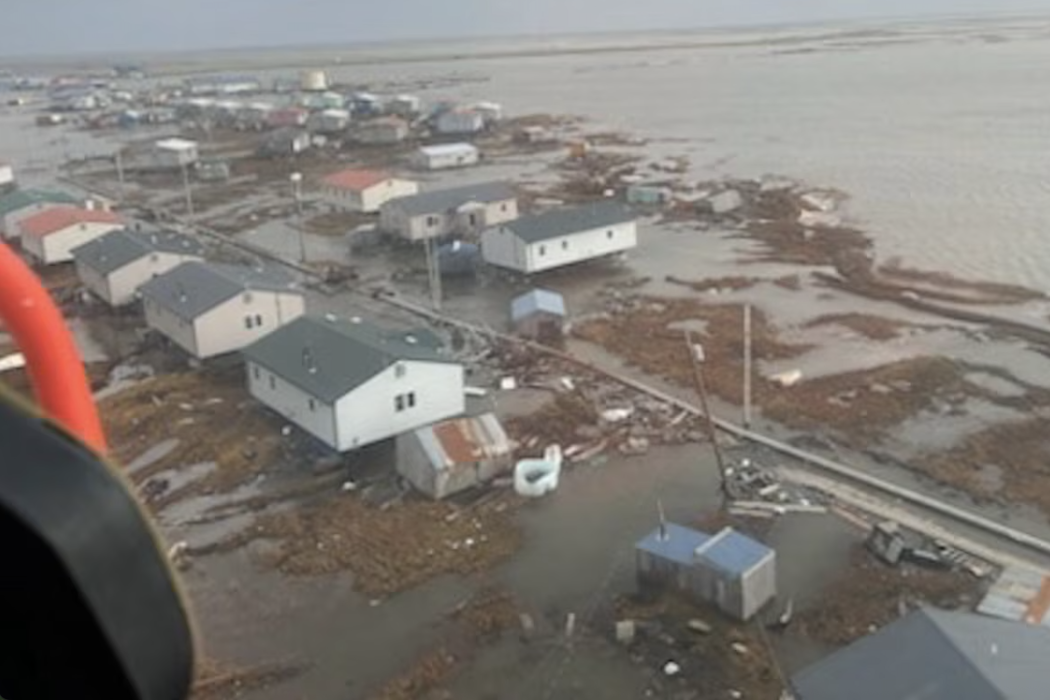
Ex-Typhoon Halong’s storm surge and powerful winds knocked homes off their foundations and set some afloat. U.S. Coast Guard via AP
What made this storm unusual?
Halong was an ex-typhoon, similar to Merbok in 2022, by the time it reached the delta. A week earlier, it had been a powerful typhoon east of Japan. The jet stream picked it up and carried it to the northeast, which is pretty common, and weather models did a pretty good job in forecasting its track into the Bering Sea.
But as the storm approached Alaska, everything went sideways.
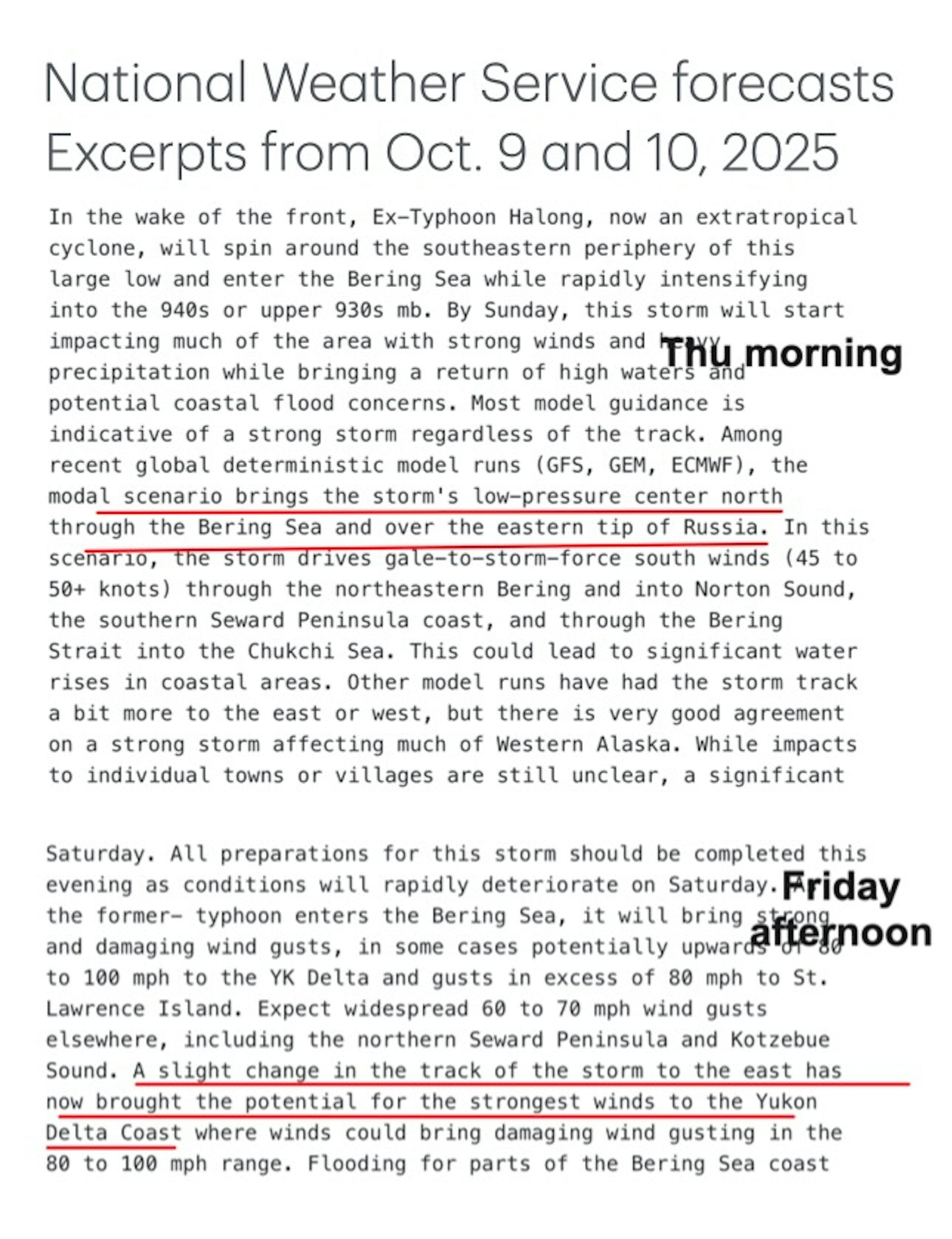
The weather model forecasts changed, reflecting a faster-moving storm, and Halong shifted to a very unusual track, moving between Saint Lawrence Island and the Yukon-Kuskokwim Delta coast.
Ex-Typhoon Halong’s storm track showing its turn toward Alaska’s Yukon-Kuskokwim Delta. Rick Thoman
Unlike Merbok, which was very well forecast by the global models, this one’s final track and intensity weren’t clear until the storm was within 36 hours of crossing into Alaska waters. That’s too late for evacuations in many places.
Did the loss of weather balloon data canceled in 2025 affect the forecast?
That’s a question for future research, but here’s what we know for sure: There have not been any upper-air weather balloon observations at Saint Paul Island in the Bering Sea since late August or at Kotzebue since February. Bethel and Cold Bay are limited to one per day instead of two. At Nome, there were no weather balloons for two full days as the storm was moving toward the Bering Sea.
Did any of this cause the forecast to be off? We don’t know because we don’t have the data, but it seems likely that that had some effect on the model performance.
Why is the delta region so vulnerable in a storm like Halong?
The land in this part of western Alaska is very flat, so major storms can drive the ocean into the delta, and the water spreads out.
Most of the land there is very close to sea level, in some places less than 10 feet above the high tide line. Permafrost is also thawing, land is subsiding, and sea-level rise is adding to the risk. For many people, there is literally nowhere to go. Even Bethel, the region’s largest town, about 60 miles up the Kuskokwim River, saw flooding from Halong.
Native residents of Kipnuk discuss the challenges of permafrost loss and climate change in their village. Alaska Institute for Justice.
These villages are also small. They don’t have extra housing or the resources to rapidly recover. The region was already recovering from major flooding in summer 2024. Kipnuk’s tribe was able to get federal disaster aid, but that aid was approved only in early January 2025.
What are these communities facing in terms of recovery?
People are going to have really difficult decisions to make. Do they leave the community for the winter and hope to rebuild next summer?
There likely isn’t much available housing in the region, with the flooding so widespread on top of a housing shortage. Do displaced people go to Anchorage? Cities are expensive.
There is no easy answer.
It’s logistically complicated to rebuild in places like Kipnuk. You can’t just get on the phone and call up your local building contractor.
Almost all of the supplies have to come in by barge – plywood to nails to windows – and that isn’t going to happen in winter. You can’t truck it in – there are no roads. Planes can only fly in small amounts – the runways are short and not built for cargo planes.
The National Guard might be able to help fly in supplies. But then you still need to have people who can do the construction and other repair work.
Everything is 100 times more complicated when it comes to building in remote communities. Even if national or state help is approved, it would be next summer before most homes could be rebuilt.
Is climate change playing a role in storms like these?
That will be another question for future research, but sea-surface temperature in most of the North Pacific that Typhoon Halong passed over before reaching the Aleutian Islands has been much warmer than normal. Warm water fuels storms.
A comparison of daily sea-surface temperatures shows how anomalously warm much of the northern Pacific Ocean was ahead of and during Typhoon Halong. NOAA Coral Reef Watch
Halong also brought lots of very warm air northward with it. East of the track on Oct. 11, Unalaska reached 68 degrees Fahrenheit (20 degrees Celsius), an all-time high there for October.
Rick Thoman retired from National Weather Service Alaska Region in 2018.
Passer du temps avec ses proches devrait rendre heureux. Mais pour beaucoup de jeunes adultes issus de milieux défavorisés, les relations familiales, amicales ou amoureuses peuvent être à double tranchant : autant de soutien que de stress, et parfois plus de pression que de réconfort.
Des décennies de recherches sur le bonheur montrent une chose claire : le secret d’une vie longue et heureuse tient à la qualité de nos liens sociaux. Passer du temps de qualité avec des proches apporte joie et légèreté. Face aux aléas de la vie, ces relations constituent une source de soutien, de force et de réconfort. Pourtant, certaines relations peuvent peser et devenir une obligation, voire une source de stress et de frustration. Le soutien social, qu’il soit psychologique (empathie) ou concret (aide financière), peut améliorer notre santé et notre bien-être. À l’inverse, le stress social, soit la charge psychologique ressentie quand on se sent dépassé par les demandes d’un proche, peut peser sur le bien-être, car nous sommes particulièrement sensibles aux expériences négatives.
Le stress social est particulièrement présent chez les jeunes adultes : un parent critique, un ami envahissant ou un partenaire jaloux peut provoquer des tensions quasi quotidiennes. Ces jeunes doivent progressivement apprendre à devenir eux-mêmes sources de soutien, tout en naviguant des transitions multiples dans leurs études, leur travail et leur vie personnelle.
En tant que chercheuse postdoctorale, mes travaux portent sur cette transition et sur la manière dont les contextes sociaux et éducatifs peuvent faciliter ou entraver ce passage.
Une étude sur quatre ans
Pour mieux comprendre le rôle des relations sociales pendant cette transition vers l’âge adulte, nous avons mené une étude auprès de 384 jeunes adultes principalement issus de milieux défavorisés, recrutés alors qu’ils étaient encore au secondaire. Nous avons suivi leurs relations familiales, amicales et amoureuses sur quatre ans pour examiner comment ces liens influencent leur bien-être et leurs symptômes dépressifs.
Au début de la vingtaine, les participants ont été interrogés sur le soutien ou le stress que leurs relations leur apportaient, puis, quatre ans plus tard, ils ont également rapporté leur niveau d’épanouissement.
Notre étude a mis en évidence quatre constats principaux. Premièrement, chez ces jeunes issus de milieux défavorisés, les relations sociales stressantes sont répandues, bien davantage que chez les adultes en générale. Plus de la moitié des participants de notre étude vivaient des relations familiales éprouvantes : un groupe disposait d’un soutien très limité, tandis qu’un autre vivait des relations à double tranchant – à la fois soutenantes et stressantes – avec leur famille et leur partenaire.
Deuxièmement, la qualité des relations familiales avait tendance à se reproduire dans les relations amoureuses, illustrant un effet cascade : ceux qui bénéficient de relations de haute qualité en développent davantage, tandis que les plus jeunes plus éprouvés sur le plan relationnel tendent à le rester.
Troisièmement, bénéficier de davantage de sources de soutien social se traduit par un meilleur bien-être chez les jeunes dont les relations n’étaient pas empreintes de stress, confirmant un modèle additif (« plus de soutien = mieux-être »). Plus précisément, les jeunes entrant dans la vingtaine tout en étant dans une relation amoureuse soutenante présentaient moins de symptômes dépressifs et un plus grand épanouissement. À l’inverse, pour le stress social, un modèle de seuil s’applique : lorsqu’un certain niveau de stress est atteint, un apport supplémentaire de soutien – ou de stress – exerce une influence minime sur le bien-être.
Quatrièmement, contrairement au modèle « tampon » qui aurait pu être anticipé, la présence d’un soutien de la part du partenaire romantique ne suffit pas à compenser les effets du stress relationnel d’autres sources. De plus, le soutien social ne semble pas constituer une protection efficace contre les épreuves de la vie telles que les problèmes financiers. En effet, lorsque ces défis surgissent, les avantages découlant de liens positifs ont tendance à s’estomper.
Accompagner les jeunes et agir contre la précarité
Ces résultats montrent que le stress social est très répandu chez les jeunes adultes, surtout lorsque leur milieu d’origine est moins favorisé. Ces jeunes font souvent face à des obstacles disproportionnés pour accéder à une source importante de bien-être : les relations de qualité. Même quand ces jeunes ont de « bonnes » relations, pour en profiter pleinement, il faut aussi pouvoir réduire l’impact des « mauvaises ».
Un accompagnement efficace repose sur deux volets : renforcer les réseaux de soutien tout en allégeant le poids des facteurs qui peuvent mettre à l’épreuve les relations, comme le stresse économique. Pour les jeunes vivant des relations difficiles à la maison, les acteurs communautaires en dehors du foyer familial (écoles, services publics) ont un rôle crucial à jouer. Ils peuvent leur offrir des expériences sociales enrichissantes et des occasions de développer de solides compétences interpersonnelles, qui constituent des ressources internes dont les jeunes ont besoin pour établir des relations saines à l’âge adulte.
Par exemple, certaines écoles, universités et organismes communautaires, comme Entraide jeunesse Québec ou l’UQAM avec son projet Étincelles, proposent des programmes qui visent à prévenir la violence dans les relations amoureuses et à favoriser des relations saines. Grâce à des ateliers, des formations pour le personnel scolaire, des vidéos destinées aux adultes et à la participation de jeunes ambassadeurs, ces initiatives permettent aux adolescents de développer des compétences socioémotionnelles essentielles : communication, gestion des conflits et des ruptures amoureuses. Déployés à large échelle, ces programmes peuvent aider à construire un bassin des jeunes mieux équipés pour construire des relations saines pour eux-mêmes, et pour les autres. Multiplier ce genre d’initiatives est essentiel.
Les difficultés financières, source de stress
Au-delà des relations sociales, un autre enjeu mérite une attention particulière lors de la transition vers l’âge adulte : les difficultés économiques. Notre étude montre qu’elles nuisent au bien-être des jeunes, y compris chez ceux qui bénéficient globalement du soutien de leurs proches. Dans un contexte du marché du travail instable et de coût de la vie en hausse vertigineuse, les crises de logement et les difficultés financières constituent une source majeure de stress pour les jeunes et peuvent, si elles ne sont pas bien gérées, les plonger dans la précarité. Ce risque est d’autant plus immédiat pour les jeunes qui entrent dans l’âge adulte sans filet familial ni atouts éducatifs facilitant cette transition.
Pour mieux accompagner les jeunes dans cette étape exigeante, il est temps que les familles, écoles, employeurs et services publics unissent leurs efforts afin d’améliorer les conditions de vie de tous les jeunes.
Jiseul Sophia Ahn a reçu des financements de Institut universitaire Jeunes en difficulté et de Fonds de recherche du Québec – Société et culture (FRQSC).
Elizabeth Olivier a reçu des financements du Fonds de recherche du Québec – Santé et du Fonds de recherche du Québec – Société et culture.
Marina Borisova a reçu des financements du Fonds de recherche du Québec – Société et culture (FRQSC).
Véronique Dupéré a reçu des financements du Fonds de recherche du Québec – Société et culture, du Fonds de recherche du Québec – Santé, du Conseil de recherche en sciences humaines du Canada, des Instituts de recherche en santé du Canada, du programme des Chaires de recherche du Canada, du programme des Chaires McConnell-Université de Montréal, de Mitacs, du Centre de recherche en santé publique, de l’Institut universtaire Jeunes en dfificultés, et du Centre de recherche interdisciplinaire sur la justice intersectionnelle, la décolonisation et l’équité.
Votre sous-sol a-t-il déjà été inondé ? Pour des milliers de Québécois, cette question n’est pas théorique. Face à des inondations de plus en plus fréquentes, une solution semble logique : pour forcer les municipalités à mieux protéger leur territoire, il suffirait de leur faire payer une partie de la facture. Après tout, si elles subissent les conséquences financières de leurs décisions d’aménagement, elles seront plus prudentes.
Cette affirmation est en grande partie supportée par la littérature sur le sujet de l’aléa moral. En termes simples, c’est l’idée que si quelqu’un d’autre paie toujours la facture, on est moins motivé à prévenir le problème. Mais est-ce si simple ?
Candidat au doctorat en sciences de l’environnement à l’Université du Québec à Montréal, mes travaux portent sur la contribution des municipalités du Québec dans le partage du risque d’inondations. J’ai notamment piloté la création du Fonds d’assurance des municipalités du Québec, un assureur spécialisé dans la gestion et le transfert des risques municipaux.
Afin de vérifier la pertinence et l’acceptabilité d’une contribution financière municipale, j’ai réalisé des entrevues semi-structurées auprès de 35 maires, gestionnaires et experts municipaux. Cette démarche, menée dans le cadre de mes travaux de doctorat sur le partage du risque d’inondations, visait à confronter cette idée à la réalité et aux contraintes vécues sur le terrain.
La réaction des participants fut quasi unanime : c’est une « fausse bonne idée ». Loin de les motiver, leur faire payer une partie de la facture est vue comme une sanction injuste et inefficace. Pourquoi un tel fossé entre la théorie et le terrain ? Parce que, comme l’a résumé un participant, la proposition ignore une réalité fondamentale : les municipalités ont le sentiment d’avoir « peu de contrôle sur le risque » dans le modèle de gouvernance actuel.
« On nous transfère le coût, mais pas le contrôle »
Le scepticisme des acteurs municipaux ne vient pas d’un refus de leurs responsabilités, mais d’un profond sentiment d’impuissance. Proposer une pénalité financière, disent-ils, c’est ignorer les trois lourdes contraintes qui paralysent leur action.
Un pouvoir d’action limité par la gouvernance : Les élus se sentent pris dans un étau. Leur autonomie en matière d’aménagement est limitée par le cadre provincial. Un participant s’est demandé à voix haute : « Je ne suis pas sûr que la contribution convaincrait vraiment nos élus d’avoir le courage politique nécessaire pour adopter les réglementations requises ». La situation ressemble à une demande paradoxale : on leur transfère le coût, mais pas les pleins pouvoirs pour agir.
Le poids écrasant du « risque hérité » : Les décisions d’aujourd’hui sont hantées par celles d’hier. Imaginez être maire d’une ville où, depuis 50 ans, des quartiers entiers se sont construits en plaine inondable, souvent avec l’aval des gouvernements de l’époque. Vous demander aujourd’hui de payer pour les dommages, alors que déplacer des centaines de familles est socialement et financièrement impensable, illustre parfaitement ce « risque hérité ». C’est une dette du passé qui hypothèque lourdement le présent.
Des enjeux d’équité et de faisabilité : Qui paierait vraiment la facture ? Les participants craignent que ces coûts soient simplement refilés aux citoyens par des hausses de taxes, ou qu’ils pénalisent injustement les populations les plus vulnérables vivant dans des secteurs historiquement défavorisés. Pour les petites municipalités, la mesure pourrait même être économiquement insoutenable.
Déjà des milliers d’abonnés à l’infolettre de La Conversation. Et vous ? Abonnez-vous gratuitement à notre infolettre pour mieux comprendre les grands enjeux contemporains.
Cinq chantiers pour une vraie résilience
Rejeter l’idée d’une sanction financière ne signifie pas prôner l’inaction. Au contraire, les participants ont identifié cinq chantiers prioritaires, dessinant une feuille de route claire pour bâtir une résilience fondée sur la collaboration et l’autonomisation.
Engager les citoyens et communiquer le risque : Accroître la responsabilité citoyenne par des plates-formes web interactives, des ateliers publics de sensibilisation et la création de comités citoyens pour participer aux décisions.
Renforcer la réglementation (pour de vrai) : Réduire la vulnérabilité en mettant à jour les codes du bâtiment pour imposer des normes de construction plus strictes en zone inondable et en rendant obligatoire l’intégration d’évaluations complètes des risques dans tous les plans d’urbanisme.
Collaborer et mutualiser les ressources : Optimiser les efforts en encourageant financièrement les projets menés à l’échelle des bassins versants et en fournissant aux municipalités les données, les outils et le soutien technique dont elles ont besoin.
Soutenir les plus exposés, sans exception : Réduire les inégalités par une aide financière et technique ciblée pour les municipalités à faible capacité fiscale et pour les ménages à faibles revenus qui doivent adapter leur résidence.
Prioriser la prévention et l’atténuation : Changer de paradigme en offrant des subventions pour les travaux de résilience chez les particuliers (surélévation, clapets, etc.) et en investissant dans les infrastructures naturelles comme la restauration des zones humides.
Un nouveau pacte pour ne plus revivre les mêmes drames
Ainsi la proposition d’une contribution financière municipale, bien que séduisante en théorie, est une solution qui passe à côté de l’enjeu principal, soit le manque de pouvoir réel des municipalités pour agir efficacement sur le risque.
Toutefois, donner aux municipalités les moyens d’agir ne signifie pas les déresponsabiliser. Au contraire, cela doit marquer la fin du transfert systématique du risque vers la collectivité. La responsabilité des municipalités dans leurs décisions d’aménagement, tout comme celle des citoyens qui choisissent de s’établir en zone à risque, doit être pleinement assumée et ne peut plus être une simple variable d’ajustement.
Concrètement, pour le citoyen, cela signifie que ses impôts serviront non plus à éponger des sinistres évitables, mais à financer une prévention intelligente. C’est l’assurance que sa municipalité prend des décisions durables pour protéger sa maison et sa communauté.
Le chemin vers des communautés plus résilientes passe donc par un nouveau pacte de confiance et de responsabilité : outiller, soutenir et donner le pouvoir aux municipalités d’agir, en échange d’une imputabilité claire et directe pour leurs décisions. La construction de cette résilience est l’affaire de tous, et cette alliance exigeante est le seul chantier qui vaille pour que le Québec ne soit plus condamné à revivre les mêmes drames.
Bernard Deschamps a reçu des financements du RIISQ.
Avec le développement des outils numériques, perdons-nous ce sens de l’orientation qui se forge durant les premières années de la vie ? Comprendre comment les enfants apprennent à élaborer ces cartes mentales nous éclaire sur ce qui se joue vraiment derrière ces mutations.
Vous avez prévu un séjour en famille et ça y est, tout est prêt pour le départ. Vous allumez alors le téléphone pour lancer votre application GPS préférée mais, stupeur, rien ne se passe… Vous réessayez alors en lançant une autre application ou en changeant de téléphone mais toujours rien. Il va falloir faire sans.
Après tout, cela ne devrait pas être si difficile, c’est la même route chaque année ; pour rejoindre l’autoroute, c’est sur la gauche en sortant du pâté de maisons. À moins qu’il faille plutôt prendre à droite pour d’abord rejoindre la nationale, et ensuite récupérer l’autoroute dans la bonne direction ?
Finalement, ce n’est pas gagné… et le départ devra attendre le retour du GPS ou que vous retrouviez cette ancienne carte format papier perdue (elle aussi) quelque part chez vous. En cherchant la carte routière, peut-être vous demanderez-vous comment on faisait pour se déplacer avant les GPS.
Cette technologie nous aurait-elle fait perdre le sens de l’orientation ?
Qu’est-ce que « la navigation spatiale » ?
Attention, nous n’allons pas parler de fusée ou d’astronautes en parlant de « navigation spatiale », l’expression désigne tout simplement l’ensemble des processus qui nous permettent de nous orienter et de nous déplacer dans notre environnement.
Les capacités de navigation reposent à la fois sur l’intégration de nos propres mouvements dans l’environnement via le calcul en continu de notre position. C’est cette capacité qui vous permet de vous orienter aisément dans le noir ou les yeux fermés, sans risquer de confondre la salle à manger avec les toilettes lors de vos trajets nocturnes par exemple.
Mais, avec la distance parcourue, la précision diminue et on est de plus en plus perdu. Afin de garder le cap, nous utilisons en complément des points de repère externes particuliers offerts par le monde qui nous entoure, comme un monument ou une montagne. Grâce à la combinaison de ces deux sources d’informations spatiales, nous sommes capables de créer une carte mentale détaillée de notre environnement.
La création de ce type de carte mentale, relativement complexe, n’est pas la seule stratégie possible et, dans certains cas, on préférera se souvenir d’une séquence d’actions simples à accomplir, par exemple « à gauche, en sortant » (direction l’autoroute), « puis tout droit » et « votre destination sera à 200m sur votre droite ». On est ici très proche des outils digitaux GPS… mais pas de risque de déconnexion… bien pratique, ce système de navigation embarqué !
S’orienter dans l’espace, un jeu d’enfant ?
Dès les premiers mois de vie, les nouveau-nés montrent des capacités étonnantes pour se repérer dans l’espace. Contrairement à ce qu’on pouvait penser il y a quelques décennies, ces tout petits êtres ne voient pas le monde uniquement depuis leur propre point de vue et, dès 6 à 9 mois, ils arrivent à utiliser des repères visuels familiers pour ajuster leur orientation, surtout dans des environnements familiers.
Entre 6 ans et 10 ans, les enfants deviennent capables de combiner différents types d’informations externes comme la distance et l’orientation de plusieurs repères pour se situer dans l’espace. À partir de 10 ans, leurs performances spatiales se rapprochent déjà de celle des adultes.
Le développement de ces capacités repose notamment sur la maturation d’une région cérébrale connue sous le nom du complexe retrosplénial (RSC). Cette zone est impliquée dans la distinction des endroits spécifiques (comme un magasin près d’un lac ou d’une montagne), ce qui constitue la base d’une navigation spatiale fondée sur les repères.
Une méta-analyse récente semble confirmer un lien négatif entre usage du GPS, connaissance de l’environnement et sens de l’orientation. Toutefois, certains des résultats nuancent ce constat : les effets délétères semblent surtout liés à un usage passif. Lorsque l’utilisateur reste actif cognitivement (en essayant de mémoriser ou d’anticiper les trajets) l’impact sur les compétences de navigation est moindre, voire nul.
Ainsi, le GPS ne serait pas en lui-même néfaste à nos capacités de navigation. Ce serait davantage la manière dont on l’utilise qui détermine son influence positive, négative ou neutre sur nos capacités de navigation spatiale.
Donc, bonne nouvelle, même si vous n’êtes pas parvenu à retrouver votre carte routière, vous avez remis la main sur votre ancien GPS autonome, celui qui n’a jamais quitté votre tête ! Et, même si désormais la destination est programmée et qu’il ne vous reste plus qu’à suivre le chemin tracé, songez parfois à lever les yeux pour contempler le paysage ; en gravant quelques repères à mémoriser, vous pourriez savourer le voyage et réapprendre à naviguer.
Clément Naveilhan a reçu des financements de l’Université Côté d’Azur.
Stephen Ramanoël a reçu des financements nationaux (ANR) et locaux (Université Côte d’Azur – IDEX)
Sexual violence in marriages is a very real issue in South Africa, but remains shrouded in silence and denial. It’s a subject that Nyasha Karimakwenda has researched for many years in various forms, from traditional practices to court judgments. We asked her to outline the issues.
What is marital rape and why should we pay more attention to it?
Though marriage rates in southern Africa have decreased over the past decades, marriage is still considered to be an ideal social tool for formalising relationships and building families.
But it’s also an environment where spouses can be exposed to different kinds of abuse. This includes sexual abuse by their partners.
Marital rape is the term commonly used to refer to sexual violence by a partner in a marriage or former marriage. It’s a significant problem globally and is mostly committed by husbands against wives.
It’s critical that we learn more about marital rape because it’s a feature of many women’s lives. And it’s not uncommon for it to happen alongside other kinds of violence in marriages. These can include emotional, verbal, economic and physical harms.
Why is there so much silence around marital rape?
Many cultures and legal systems around the world have supported the position that sexual violence committed by husbands against wives is not morally wrong. Or that it’s an issue that should remain within the family.
Historically, for example, Commonwealth countries inherited the marital rape exemption from England. This established that husbands could not be held criminally liable for raping their wives. Some African countries – such as Kenya, Uganda and Nigeria – still retain versions of this exemption and marital rape is not a criminal offence there.
Added to this are existing patriarchal cultural norms across the continent that reinforce the idea that husbands are entitled to sex with their wives, whether the wife says no or not.
It’s only in recent decades that countries around the world started to change their criminal laws to allow for rape in marriage to be prosecuted. But there is still a lot of progress needed to make sure that both laws and cultures fully recognise the existence and harm of marital rape.
In South Africa marital rape was made a crime in 1993. Even so, as my doctoral research shows, marital rape continues to be silenced because of social and cultural perspectives.
I learned that among some communities the belief that marriage gives husbands unlimited sexual access to their wives remains strong. Under this thinking, husbands cannot rape their wives, because they have ownership of their wives’ bodies.
My research, along with the work of other scholars, also captures how women are socialised to accept that their bodies are no longer their own once they marry. So they suffer the sexual abuse in silence.
What is ukuthwala and what’s its connection to marital rape?
The term ukuthwala has various meanings in South Africa’s dominant Nguni languages. In the context of marriage, it describes particular customary practices used to make a marriage happen quickly, and often with less expense in poorer communities.
These practices exist across South Africa, but are mostly documented among the Xhosa and Zulu people. Historically, ukuthwala has also been practised in different forms. Some forms of ukuthwala are more like elopement. Other forms are extremely violent, where a girl is abducted by a group of men, beaten, raped and forced to marry a man typically much older than her and a stranger.
Examining violent ukuthwala is another way to understand how marital rape is condoned. A growing body of ukuthwala research, including my own, shows how, for generations, some families and communities have used the custom and rape to control unwilling brides and transform their social status from girl to wife.
Gradually, more research is showing how certain communities don’t view the sexual force in ukuthwala as rape, but see it as an acceptable means for creating and maintaining a marriage – a part of custom.
What happens when women turn to South Africa’s courts?
Because of the cultural misunderstandings of marital rape, wives face significant hurdles in getting their case moved along from police to prosecutors to trial before a judge. Participants in my marital rape research expressed how police sometimes mock wives seeking help. They believe it’s not possible for a husband to rape a wife and maintain that criminal punishment is not appropriate.
Prosecutors also have problematic views about marital rape. A 2017 rape attrition study by the South African Medical Research Council found that prosecutors were reluctant to refer intimate partner rapes, including marital rapes, for trial.
We need more research about how marital rape is treated by the courts. But there’s evidence of similar thinking held by judges. In a few appeals cases that I analysed, judges affirmed husbands’ rape convictions but handed down lesser sentences because of the marital relationships. This minimises a wife’s pain and the seriousness of marital rape.
How does South Africa best address the problem?
My research emphasises that marital rape survivors need specialised, empathic and personalised assistance. Society can start by listening and being kind to women who divulge their pain.
I’ve found that women’s community-based organisations like Masimanyane and Mosaic are critical for providing non-judgmental and culturally-aware spaces for women seeking support when facing violence.
Awareness raising and education at national and local levels is vital to dismantle the longstanding idea that husbands are entitled to sex in marriage. This is also critical for wives to understand their rights to wellbeing and sexual autonomy.
Lastly, civil servants that survivors engage with – medical professionals, police, prosecutors, judges – must be properly sensitised to the unique circumstances of marital rape survivors. There should be greater oversight of their professional conduct.
Nyasha Karimakwenda does not work for, consult, own shares in or receive funding from any company or organisation that would benefit from this article, and has disclosed no relevant affiliations beyond their academic appointment.