Source: The Conversation – Canada – By Michael Kehler, Research Professor, Masculinities Studies, School of Education, University of Calgary
In a marathon Game 7 of the 2025 World Series at the Rogers Centre, the Toronto Blue Jays fell to the Los Angeles Dodgers in 11 innings. It was a devastating finish to a series defined by unforgettable plays.
The series left fans with indelible memories of hits, runs and near-misses — unbelievable and inexplicable moments that few will forget in the years to come. But that wasn’t all the stood out.
In a post-Game 7 interview, utility player Ernie Clement tearfully expressed his love for his teammates while acknowledging the emotional toll of the series.
Blue Jays discuss their World Series loss. (CTV News)
Pitcher Chris Bassitt described the bond between the team as “true love.” The sentiment echoed by many of the players was one of love, gratitude and deep friendship — qualities often reserved, if rarely expressed, among men for other men.
Rather than uphold a dominant, all-too-familiar hyper-masculine image of male athletic competitors, this years’ World Series might have opened our eyes to a counter-narrative in sport.
Masculinity and sport in Canada
Our expectations of sport culture and masculinity in Canada have largely been defined by Canada’s other national pride, hockey. Its narratives frequently valourize toughness, stoicism and physical dominance, reinforcing a narrow vision of what it means to “be a man” in sport.
Research shows that boys and men yearn for close male friendships. Yet in national sport, we rarely see the close intimacy, level of support and caring that were evident among the Blue Jays this year.
Men are expected to compete, not care, especially in the gladiatorial arenas of sport.
The more common, and often troubling, side of male bonding in sport has been associated with violence, aggression and locker room cases of bullying, homophobia and misogyny.
A different model of male bonding
While sport culture is often centred around competition, dominance and showmanship, interactions among the Blue Jays gave a rare glimpse at how sport culture could be different among men.
A recurring theme among all players was a genuine sense of caring for one another. “It’s not very often you get a group together that genuinely likes one another and genuinely cares about one another,” said Blue Jays manager John Schneider after Game 7.
The media and fans were drawn to what appears to be an authentically, emotionally connected group of men. Globe and Mail reporter Marcus Gee called it a “fellowship,” noting how much the players “liked each other.”
Individually and collectively, the Blue Jays were emotionally vulnerable. Gee suggested the lesson the Jays offered was “the power of unity, the power of connection, the power of love.” Whether we call it connection, love or fellowship, there is no mistake that what fans witnessed was a rare and possibly enduring lesson also about sport, masculinity and caring.
What we witnessed among the Blue Jays’ players was a rare public display of affection and intimacy in sport, going beyond sportsmanship, camaraderie and fellowship. The relationships, respect, friendships and love went beyond the implicit licence granted by being on the field to hug another player.
The traditional codes of masculinity when among the boys were disturbed and maybe challenged by repeated expressions of affection that men regularly avoid off the field.
There are indeed important lessons that sports fans might all take away along with the vivid memories of this World Series — lessons of caring among men.
Images of Guerrero Jr. hugging rookie pitcher Trey Yesavage, the emotional honesty of Clement and the visible love the Blue Jays have for their teammates remind us of the significance of friendships among boys and men, and the power of healthy relationships in which men care for, and about, others.
Sport culture among men and boys is historically a bastion of elite, privileged masculinities. Too often, boys and men are complicit in the lessons we learn about being accepted, about belonging among the boys, about being like the rest of the boys.
Men often fear the isolation and alienation if they do not subscribe to the rules and norms typically promoted and upheld in sport culture, echoed in chants of “man up” or “no pain, no gain.”
Perhaps one of the greatest lessons from this World Series was captured in one final image: a red-haired boy collapsed in tears with his father resting his hand on his back, considering the future, not of sport, but of a son able to cry openly, unashamedly.
Michael Kehler does not work for, consult, own shares in or receive funding from any company or organisation that would benefit from this article, and has disclosed no relevant affiliations beyond their academic appointment.
Source: The Conversation – Canada – By Ryan M. Katz-Rosene, Associate Professor, School of Political Studies, with Cross-Appointment to Geography, Environment and Geomatics, L’Université d’Ottawa/University of Ottawa
Shortly before COP30 talks begin in Brazil, tech billionaire and philanthropist Bill Gates has launched a “narrative grenade” into the discourse of climate politics by publishing a lengthy memo calling for a rethink of how the climate crisis is framed and addressed.
Gates calls for a “strategic pivot” in climate strategy. That appears to have hit a nerve. Both social and traditional media were ablaze with erroneous assertions about Gates’ supposed reversal of opinion on climate change.
Despite reaffirming support for ambitious decarbonization, his letter is being celebrated by climate skeptics while angering some climate scientists. United States President Donald Trump weighed in, writing: “I (WE!) just won the War on the Climate Change Hoax. Bill Gates has finally admitted that he was completely WRONG on the issue.”
This is false. Gates makes no such admission. In fact, he specifically writes that “climate change will have serious consequences — particularly for people in the poorest countries.” He emphasizes that “every tenth of a degree of heating that we prevent is hugely beneficial because a stable climate makes it easier to improve people’s lives.”
Gates goes further, calling for major investments into global health and development (particularly on vaccines), and expresses continued support for pursuing net zero carbon emissions — all of which seems to fly in the face of Trump’s climate and foreign aid agenda.
Given this, why are so many climate skeptics celebrating Gates’ letter? And why are some climate scientists frustrated, despite his steadfast support for decarbonization?
What the memo actually says
The core of Gates’ memo is a request for climate negotiators to consider “three truths:”
First, that they consider climate change a “serious problem” but not the inevitable “end of civilization.”
And third, that the best way to defend humanity against climate change is to pursue global health and economic prosperity.
The centrepiece of Gates’ analysis is the claim that technological innovations — like electric vehicles, renewable energy and battery storage —have already started to reduce the carbon intensity of global economic activity and that new, more consequential innovations in the future will be driven by economic development and healthy societies.
He provides as evidence changes in the International Energy Agency’s (IEA) carbon dioxide emissions forecasts — pointing out that a 2014 IEA projection expected significant growth in emissions, while a 2024 projection now sees significant reductions (though some commentators have contested Gates’ interpretation on this specific point).
Gates wants readers to know progress is being made on climate change thanks to growth and technological innovation, and as such, the “worst-case scenarios” are no longer plausible.
Why climate skeptics see this as a win
It is Gates’ initial framing — that climate change is “not the end of the world” — that seems to have resonated most strongly with climate skeptics. The memo begins by critiquing the “doomsday view” that “cataclysmic climate change will decimate civilization.” Instead, he argues that “people will be able to live and thrive in most places on Earth for the foreseeable future.”
From that point, climate contrarians seized on the memo. One of the largest conspiracy accounts on X falsely declared that “today Bill Gates admitted himself that Climate Change is all a lie.” Others followed suit.
This reaction is not surprising. The claim that climate change is not a civilization-ending threat aligns closely with long-standing skeptic rhetoric that mainstream climate science relies on fear to justify politically motivated change.
Research shows that climate skeptics interpret the issue through black-and-white thinking, where cognitive binaries are used to help simplify complex systems.
Within this world view, if climate change is not apocalyptic, then it can be dismissed as exaggerated, and by extension, climate policy is unnecessary, or worse, a cover for social control.
Why some climate scientists are frustrated
The idea that climate change will not literally end civilization is not new — even for Gates. In my own work on the growth-environment debate, I’ve shown how dominant sustainability discourses have long rested on the assumption that even the most pressing environmental problems can be managed, and that economic growth and technological innovation are the best means of addressing them.
For some climate scientists, however, Gates’ memo places too much emphasis on technology — especially exploratory and high-risk technologies like small modular reactors, carbon capture and storage, and geoengineering.
The worry, as climate scientist Michael Mann expressed in reference to the Gates memo, is that this focus on “technofixes for the climate … leads us down a dangerous road,” because such approaches can distract from proven mitigation strategies and provide cover for continued business-as-usual burning of fossil fuels.
Other climate scientists found the memo downplayed the severity of global warming seen to date, not least the warming expected by the end of this century (which, in Gates’ telling could be up to +2.9 C above the pre-industrial era).
For instance, scientist Daniel Swain noted his “dismay and deep frustration” about the framing in Gates’ memo (despite agreeing with some of its central claims), precisely for glossing over the known harms and systemic risks that lie ahead. Swain invoked the late environmental studies professor Stephen Schneider’s reminder that when it comes to global warming, “the end of the world” and “good for humanity” are the two lowest-probability outcomes.
What now?
Like a dazed battlefield after a grenade is detonated, the terrain of climate politics has been unsettled by Gates’ missive, but it is not altogether transformed. The debate will continue. Skeptics will likely add screenshots of misleading headlines about Gates’ “admission” to their repertoire of doubt-casting memes.
Climate scientists, meanwhile, will continue to grapple with the difficult task of communicating climate risk, urgency and uncertainty, in a political environment that is not well-suited to nuance and complexity.
The memo does not change the science. But it does reveal how sensitive climate politics is to framing, and how the same message can become ammunition for very different projects.
Ryan M. Katz-Rosene was the recipient of an Insight grant from the Social Sciences and Humanities Research Council of Canada to study discourses of the growth-environment debate.
À l’heure où les chaînes parlementaires diffusent des débats houleux à l’Assemblée nationale, alors que le consensus, dans une France politiquement déchirée, semble un horizon de plus en plus inaccessible, des théoriciens et dramaturges se sont demandé, à l’orée de la Révolution française, si et comment une opinion majoritaire pouvait émerger d’une foule d’individus hétérogènes. Les milieux clos que constituent des salles de théâtre furent un laboratoire opportun pour penser la contagion émotionnelle et l’apparition d’une intelligence collective.
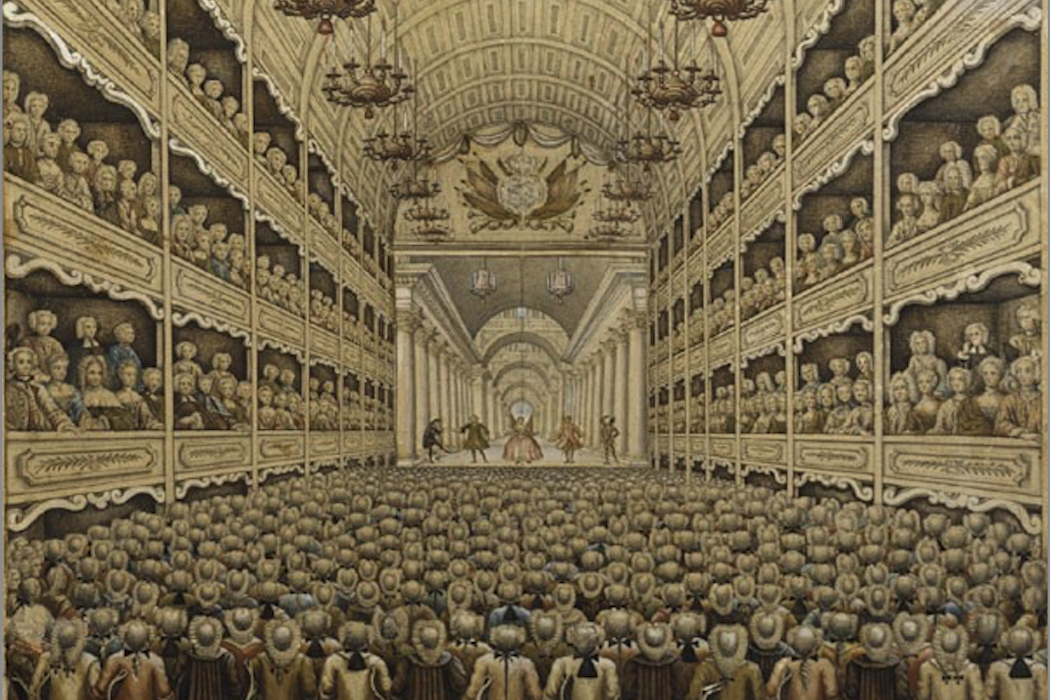
Les salles de spectacle des XVIIe et XVIIIe siècles en France sont très différentes de celles auxquelles nous sommes habitués. De grands lustres éclairent indistinctement la scène et la salle, on entre et on sort en cours de spectacle et, surtout, plus de 80 % des spectateurs sont debout, dans le vaste espace qui se trouve en contrebas de la scène et qu’on appelle le parterre.
Ce public, composé uniquement d’hommes, est particulièrement tumultueux. Ils sifflent, baillent, hurlent, s’interpellent, prennent à parti les acteurs, interrompent la représentation. Aussi sont-ils régulièrement et vivement critiqués, par exemple en 1780, dans un des plus grands journaux de l’époque où le parterre est assimilé à une « multitude de jeunes insensés pour la plupart, tumultuairement sur leurs pieds crottés » : les pieds sont « crottés », parce que ces spectateurs, quoiqu’aux profils sociologiques variés, ne sont pas des membres de la noblesse, qui se trouvent majoritairement dans les loges.
Une multitude pleine de promesses
Pourtant, à partir de la deuxième moitié du XVIIIe siècle, cette multitude est de plus en plus perçue par certains dramaturges et philosophes comme pleine de promesses : le tumulte qu’elle produit, au fond, serait une énergie qu’il suffit de savoir canaliser. En 1777, Marmontel, homme de lettres proche du courant des Lumières, s’ébahit de la force que recèlent les manifestations de ces spectateurs rassemblés :
« Ce que l’émotion commune d’une multitude assemblée et pressée ajoute à l’émotion particulière ne peut se calculer : qu’on se figure cinq cents miroirs se renvoyant l’un à l’autre la lumière qu’ils réfléchissent, ou cinq cents échos le même son. »
C’est que, selon lui, l’exemple est contagieux : on rit de voir rire, on pleure de voir pleurer, on bâille de voir bâiller. Les émotions sont démultipliées et, surtout, tendent à converger collectivement vers l’expression d’une seule et même émotion.
Les parterres de théâtre deviennent ainsi les laboratoires à partir desquels réfléchir aux conditions d’apparition du consensus. Car c’est dans le bouillonnement de la séance théâtrale, alors que les individus sont serrés, qu’ils ont bien souvent trop chaud et qu’ils sont gênés par une position très inconfortable, qu’une émotion puissante se communique.
Aux antipodes du jugement à froid, apparaîtrait alors une intelligence collective proprement émotionnelle, grâce à la circulation d’une énergie qui échappe à la partie la plus rationnelle de la raison. Toujours d’après Marmontel, une telle contagion des émotions donne naissance à un jugement de goût aussi fulgurant que juste : « On est surpris de voir avec quelle vivacité unanime et soudaine tous les traits de finesse, de délicatesse, de grandeur d’âme et d’héroïsme […] [sont] saisi[s] dans l’instant même par cinq cents hommes à la fois ; et de même avec quelle sagacité les fautes les plus légères […] contre le goût […] sont aperçues par une classe d’hommes dont chacun pris séparément semble ne se douter de rien de tout cela ».
Échos avec la physique de l’époque
La valorisation de cette émotion collective unifiée se fonde en grande partie sur les travaux contemporains menés sur l’électricité. Ou plutôt, sur ce qu’on appelle alors le fluide électrique, dont les physiciens Jean-Antoine Nollet et François Boissier de Sauvages montrent, entre autres, qu’il s’apparente au fluide nerveux. L’objet recevant le choc électrique devenant lui-même une source électrique, il est à son tour susceptible d’en électriser d’autres.
Cette conductivité est une caractéristique majeure de l’électricité.
Du phénomène physique à la métaphore, il n’y a qu’un pas et l’électricité est convoquée pour désigner l’unanimité qui se produit parmi les spectateurs. Marmontel affirme que « c’est surtout dans le parterre, et dans le parterre debout, que cette espèce d’électricité est soudaine, forte, et rapide ».
Le dramaturge Louis-Sébastien Mercier constate avec dépit, après que la Comédie-Française a fait installer des sièges au parterre et que les spectateurs ont été forcés de s’asseoir, que l’« électricité est rompue, depuis que les banquettes ne permettent plus aux têtes de se toucher et de se mêler ».
Une illustration tirée de l’Essai sur l’électricité des corps, par M. l’abbé Nollet, de l’Académie royale des sciences. Seconde édition, 1765. BNF Gallica
Cette image d’une foule d’individus saisis par une même impulsion, Marmontel et Mercier ne l’inventent pas. Ils la tirent de scènes d’électrisations collectives qui sont depuis quelques décennies un véritable phénomène mondain. Le savant Pierre van Musschenbrœk se fait connaître par l’expérience connue sous le nom de « bouteille de Leyde », condensateur qui permet de délivrer une commotion générale et instantanée à une chaîne d’individus se tenant par la main : le fluide électrique, se manifestant à la surface par des étincelles, se transmet à travers l’organisme et relie entre eux des corps distincts. Après l’abbé Nollet, Joseph Priestley, qui mène des expérimentations analogues où un groupe d’individus forme une sorte de ronde, constate qu’« il est souvent fort amusant de les voir tressaillir dans le même instant ».
Un superorganisme fantasmé
La mise au jour, par le biais du modèle électrique, de cette intelligence collective dans les salles de théâtre a des implications politiques. Si, d’après ce modèle, les spectateurs du parterre ayant renoncé à leur aisance physique individuelle peuvent espérer former une véritable communauté, sensible et unifiée par la circulation d’un même fluide en son sein, c’est parce que la posture du spectateur, debout ou assis, ainsi que l’espace dans lequel il se trouve, ouvert ou fermé, sont les révélateurs de la capacité de ces publics à constituer un véritable organe politique et à représenter le peuple.
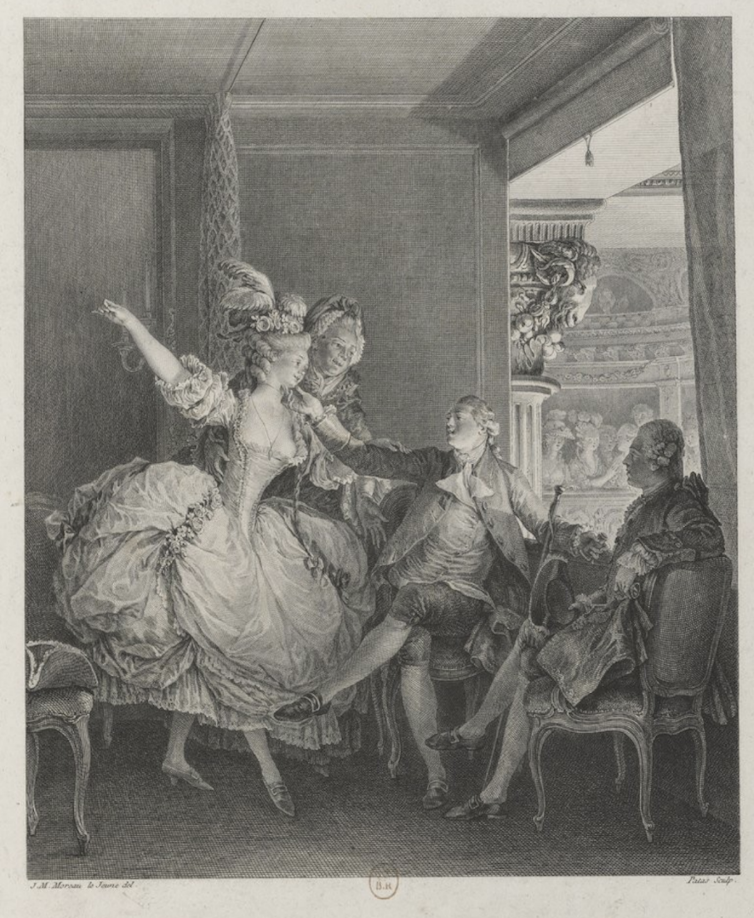
La Petite Loge (1776 ou 1779), de Charles-Emmanuel Patas (1744-1802), Troisième suite d’estampes pour servir à l’Histoire des modes et du costume en France dans le XVIIIᵉ siècle (1783), gravure de Jean-Michel Moreau, dit Moreau le Jeune. BNF Gallica.
Les spectateurs debout au parterre s’opposent aux spectateurs assis dans les loges : ces places onéreuses forment de petites alvéoles qui compartimentent et divisent le public, alors que les spectateurs du parterre font corps les uns avec les autres dans un large espace fait pour les accueillir tous en même temps.
L’électricité se répandant de manière homogène entre tous les corps, le parterre n’est plus alors considéré comme la juxtaposition hétérogène de spectateurs, mais comme un corps cohérent qui pense et qui sent d’un seul mouvement. Le caractère holistique de cette proposition, qui veut que le tout soit plus que la somme de ses parties, dit bien combien le modèle promu par Marmontel et Mercier est une projection idéalisée de la société.
Expérience de la bouteille de Leyde, Louis-Sébastien Jacquet de Malzet, In Précis de l’électricité ou Extrait expérimental et théorétique des phénomènes électriques, Vienne, J. T.de Trattnern, [1775], planche V, fig. 36. CNUM/CNAM
À l’aube de la Révolution française, le tumulte d’une foule désordonnée a pu être pensé comme une énergie susceptible de faire naître une véritable cohésion politique à partir d’un consensus relatif, qui se construit contre un autre groupe. Alors que le contexte politique fabriquait déjà, inévitablement, des fractures françaises, la salle de théâtre s’est présentée comme le laboratoire où pourrait s’incarner en acte, dans un espace restreint, une fiction de société, fondée sur une intelligence collective non rationnelle. Cette intuition « met en relation » (inter-legere), littéralement, les membres de l’assemblée qui baignent dans le fluide électrique, en excluant les autres, ceux qui n’occupent pas le parterre et qui incarnent, de manière si visible, les hiérarchies et les iniquités de l’Ancien Régime.
Ce superorganisme, qui illustre le jugement éclairé de la multitude, fut certainement plus rêvé que réel. Mais il a eu le mérite de tenter de figurer un temps l’émergence d’un groupe dont il fallait prouver à la fois l’unité et la légitimité politiques.
Cet article est publié dans le cadre de la Fête de la science (qui a lieu du 3 au 13 octobre 2025), dont The Conversation France est partenaire. Cette nouvelle édition porte sur la thématique « Intelligence(s) ». Retrouvez tous les événements de votre région sur le site Fetedelascience.fr.
Charline Granger a reçu une subvention publique de l’ANR.
Période vague comme suspendue entre deux moments, les restructurations d’entreprises peuvent être dangereuses pour les salariés. Durant ces moments d’incertitude, certains d’entre eux sont particulièrement exposés, entre le risque d’être écarté et celui d’être exposé à des comportements inappropriés.
Fusions, acquisitions, fermetures, délocalisation, externalisation, réorganisation… Ces termes sont désormais bien connus des salariés européens pour qui le rythme de ces restructurations s’est accéléré au cours des dernières décennies.
Pour rester compétitives sur un marché globalisé, les entreprises doivent réduire leurs coûts à tout prix. Des changements s’opèrent au sein des organisations avec la mise en place de nouvelles méthodes de management, des suppressions d’effectifs ou de lignes managériales, mais aussi la réduction des budgets, voire, parfois des changements en termes de normes, de valeurs et de culture d’entreprise.
Dans l’enquête sur les conditions de travail menée en 2015 qui aborde ce thème, 21 % des travailleurs européens rapportent avoir vécu une restructuration au sein de leur organisation au cours des trois années précédentes. Ces changements ne sont pas sans conséquences pour eux… ni pour elles.
Plus représentées dans les fonctions non qualifiées et les tâches routinières, plus associées aux compétences dites « douces », plus présentes aux postes de managers intermédiaires qu’aux postes de managers seniors (33,8 % des postes de managers sont occupés par des femmes en 2023 en Europe et seulement 22,2 % des postes de management senior, elles ont davantage de risques de perdre leur emploi, ou de voir leur contrat évoluer vers un statut inférieur.
Or, dans un contexte de réduction d’effectifs, il s’agit souvent d’identifier les salariés les plus performants, les plus déterminés, les plus tenaces. Du fait de stéréotypes eux-aussi encore ancrés, ces caractéristiques ne sont pas souvent associées aux femmes. Ces préjugés renforcent les effets genrés lors des changements organisationnels. Plus ciblées, plus insécurisées, les femmes voient leur vulnérabilité s’accroître dans ces contextes mouvants.
Les sources organisationnelles du harcèlement sexuel
Il semble bien que pour les salariés européens, les restructurations soient associées à davantage de harcèlement sexuel, identifié dans cette étude sous sa dimension « attention sexuelle non désirée ». Dans cet échantillon européen représentatif, 1,33 % des personnes interrogées ont déclaré avoir fait l’objet d’une attention sexuelle non désirée dans le cadre de leur travail au cours du mois précédent. Cette valeur varie de 0,22 % au Monténégro à 2,91 % aux Pays-Bas.
Détérioration des conditions de travail
Ce lien entre restructuration et harcèlement sexuel s’explique pour partie en raison de la détérioration des conditions de travail notamment en termes d’exposition à des rythmes de travail intensifs et à davantage de contraintes physiques (environnements extrêmes, travail physique…). Les salariés exposés à ce type de conditions de travail déclarent plus de harcèlement sexuel que les autres.
L’analyse des relations en fonction du genre montre que les femmes subissent davantage de détérioration des conditions de travail que les hommes à la suite d’une restructuration. Leurs rythmes de travail s’intensifient et les contraintes physiques augmentent, effets qui peuvent être expliqués par leur vulnérabilité accrue réelle ou perçue pendant les épisodes de changement. Ces facteurs de risque qui s’accroissent les exposent davantage au harcèlement sexuel.
Des hommes aussi sont victimes
Nous montronsque les hommes soumis à des conditions de travail physiques sont particulièrement exposés en matière de harcèlement sexuel. Leur surreprésentation dans les secteurs physiques et dangereux, où les comportements hostiles sont favorisés par la culture et l’environnement, est une explication avancée pour éclairer ce point.
La formation des dirigeants et des managers sur les relations entre changement organisationnel, conditions de travail et comportements hostiles apparait nécessaire. La priorité accordée aux enjeux financiers par rapport aux questions psychosociales dans les entreprises est à questionner au regard des répercussions négatives sous la forme de violences psychologique, physique et sexuelle.
Il est essentiel de considérer le harcèlement sexuel comme un problème systémique qui trouve aussi sa source dans des facteurs organisationnels, eux-mêmes façonnés par notre société, plutôt que comme un problème causé par un comportement déviant isolé.
Marine Coupaud ne travaille pas, ne conseille pas, ne possède pas de parts, ne reçoit pas de fonds d’une organisation qui pourrait tirer profit de cet article, et n’a déclaré aucune autre affiliation que son organisme de recherche.
Peu d’enseignants sont formés à protéger leur voix tout au long de leur carrière.PeopleImages/Shutterstock
La voix est un outil de travail essentiel pour les enseignants, qui a un impact direct sur leur bien-être et la motivation de leur classe. Or, contrairement aux acteurs ou aux chanteurs, ils ne sont pas formés à bien l’utiliser ni à la protéger au fil de leur carrière.
En classe, les enseignants utilisent leur voix pour susciter de l’enthousiasme, transmettre des connaissances et apaiser les tensions.
Une voix chaleureuse et encourageante stimule la motivation des élèves, réduit leur anxiété et améliore leurs relations avec l’enseignant, comme la dynamique de la classe. A contrario, un ton autoritaire ou sévère peut, même imperceptiblement, créer du stress, éroder la confiance et entraîner un désengagement.
Mais les enseignants peuvent aussi éprouver eux-mêmes du stress. Et l’on sait que cet état émotionnel peut peser sur notre façon de nous exprimer. Il affecte le contrôle que nous avons sur notre élocution. Il nous conduit à parler d’une voix plus aiguë, avec plus de variations, ce qui est susceptible d’entraîner une fatigue vocale.
Peu d’enseignants apprennent à bien utiliser leur voix et à la protéger tout au long de leur carrière pour prévenir les maladies liées. Leur permettre de suivre une formation les aiderait à réduire l’impact du stress et d’une sollicitation excessive de leurs cordes vocales, et à transformer la communication au sein de la classe.
Des salles de classe qui favorisent les apprentissages
On sait depuis longtemps que les enfants apprennent davantage et participent mieux en cours quand l’environnement scolaire est stimulant. La manière dont les enseignants s’expriment peut avoir une incidence sur le bien-être, l’engagement et l’estime de soi de leurs élèves.
Les enseignants peuvent créer ces environnements en utilisant un ton ou un style de voix qui souligne leur intérêt pour leurs élèves. La manière de s’exprimer a une incidence sur la coopération, et de nouvelles données suggèrent qu’elle influence la manière dont les élèves apprennent.
Les élèves sont moins enclins à réfléchir à des concepts et à résoudre des problèmes qui leur ont été soumis d’une voix sévère. Ils ont alors davantage tendance à se contenter de répétitions, ce qui est moins efficace pour l’apprentissage à long terme.
Des études suggèrent que les enseignants peuvent créer des environnements d’apprentissage optimaux et favorables en modulant l’usage de leur voix en classe. Après avoir entendu des voix dures et autoritaires, les élèves ont rapporté des émotions négatives accrues et un sentiment de déconnexion avec leurs enseignants. Les auditeurs mettent moins d’un quart de seconde à détecter les voix rudes, ce qui suggère l’existence de mécanismes cérébraux spécialisés dans le traitement des intonations qui induisent une menace.
La manière dont les enseignants s’expriment peut encourager les enfants à s’exprimer. Rido/Shutterstock
D’après la recherche, manifester son intérêt pour les autres à travers des indices vocaux modifie la manière de transmettre des informations. Cela signifie que les enseignants qui utilisent un ton encourageant peuvent inciter les élèves à venir leur parler de sujets importants ou difficiles, tels que le harcèlement.
Entraînement vocal
L’une d’entre nous (Silke Paulmann) a mené une étude visant à évaluer une formation à la conscience vocale. Après la session, les enseignants parlaient d’une voix moins monotone, utilisaient une gamme plus vaste de tonalités et de volumes, et parlaient plus lentement. Ils avaient des façons de s’exprimer plus douces, démontrant que ce type de formation peut modifier les schémas linguistiques.
Les enseignants constituent également un public exposé à des problèmes de voix. Dans une étude réalisée en 2018, 30 % d’entre eux ont déclaré souffrir de problèmes tels que l’enrouement – signe de fatigue ou de tension vocale – ou la perte de voix. En général, ils sont plus susceptibles de développer des troubles de la voix que la population générale
Cependant, contrairement aux acteurs ou aux chanteurs, ils ne reçoivent généralement pas de formation vocale pour prévenir les dommages ou les tensions vocales à long terme. Prendre des mesures préventives pourrait réduire le nombre de jours d’absence liés aux problèmes de voix et contribuer à améliorer le bien-être professionnel, ces deux aspects allant souvent de pair.
La formation que nous avons évaluée comprenait des techniques pour aider les enseignants stagiaires à maîtriser leur élocution, ainsi que des conseils et des astuces pour préserver leur santé vocale. Elle montrait à quel point les voix rauques et aiguës peuvent retentir négativement sur le bien-être des élèves alors que des tons doux et chaleureux créent une atmosphère motivante. La comparaison des voix des enseignants avant et après la formation révélait que la qualité de leur voix s’était améliorée.
L’intégration d’une sensibilisation, même brève, à la conscience vocale dans la formation initiale et continue des enseignants permettrait à ces derniers d’être mieux outillés pour créer des environnements d’apprentissage favorables et stimulants, protéger leur santé vocale et favoriser leur bien-être.
La formation à la conscience vocale peut améliorer la diction des enseignants, ce qui favorise la communication et l’engagement en classe. À l’heure actuelle, cependant, ce type de préparation est rare. Les systèmes éducatifs accordant une importance particulière au bien-être des enseignants et des élèves, leur intégration dans les programmes de formation continue constituerait une avancée cruciale.
Dans le cadre de futurs travaux, Claire Oakley va collaborer avec Mario Education (https://marioeducation.com/).
Silke Paulmann bénéficie d’un financement de l’Impact Fund de l’Université d’Essex et ses travaux sur la prosodie motivationnelle ont précédemment été financés par le Leverhulme Trust. Elle collabore avec Mario Education (https://marioeducation.com) et 5Voices (https://the5voices.com) sur des projets liés à l’utilisation de la voix par les enseignants.
Source: The Conversation – in French – By Boubacar Haidara, Chercheur sénior au Bonn International centre for conflict studies (BICC) ; Chercheur associé au laboratoire Les Afriques dans le Monde (LAM), Sciences-Po Bordeaux., Université Bordeaux Montaigne
Les djihadistes parviennent à s’emparer de petites localités rurales et à commettre des attaques meurtrières. Ils arrivent aussi à incendier une partie des camions-citernes destinés à Bamako. Mais à ce stade, ils sont loin d’avoir les moyens de prendre la capitale.
Début septembre 2025, le Groupe de soutien à l’islam et aux musulmans (Jama’at Nusrat ul-Islam wa al-Muslimin, JNIM) a annoncé – par la voix de son porte-parole pour les actions dans le sud et l’ouest du Mali, connu sous le pseudonyme Abou Hamza al-Bambari, mais désigné par les Maliens sous le nom de Nabi ou Bina Diarra – un embargo sur le carburant destiné à la capitale malienne Bamako.
Cette décision s’inscrivait dans une logique de représailles face à l’interdiction imposée plus tôt par le gouvernement malien à la vente de carburant dans certaines localités, dans le but d’entraver les circuits d’approvisionnement des groupes djihadistes. Cet élément revêt une importance essentielle pour appréhender les intentions réelles du JNIM.
Si le groupe est parvenu à infliger des pertes significatives en détruisant de nombreux camions-citernes, le blocus qu’il exerce n’est toutefois pas totalement hermétique. En effet, certains convois, bénéficiant de l’escorte des Forces armées maliennes (FAMa), parviennent encore à rejoindre Bamako, bien que leur nombre soit insuffisant pour satisfaire la demande nationale. La situation est d’autant plus critique que l’approvisionnement en carburant de plusieurs régions, notamment Ségou et Mopti (dans le centre du pays), dépend du passage préalable des camions-citernes par la capitale.
La tâche est particulièrement difficile pour les FAMa, qui affrontent des ennemis « invisibles », très mobiles, et ayant l’avantage de la guerre asymétrique. Concrètement, cela veut dire que le JNIM n’a besoin que de positionner quelques dizaines de combattants à des points stratégiques des axes routiers concernés pour qu’ils ouvrent le feu sur les camions-citernes de passage. Même escortés par les FAMa, ces convois restent exposés, le caractère hautement inflammable du carburant rendant toute opération de protection particulièrement risquée.
Cette situation a entraîné des conséquences particulièrement graves, le carburant étant au cœur de toutes les activités du pays. Les scènes impressionnantes de camions-citernes en feu le long des routes, de foules de Maliens se ruant vers les rares stations encore approvisionnées et de files interminables de véhicules attendant d’être servis ont donné l’image d’une paralysie totale de la capitale, ainsi que d’autres villes de l’intérieur.
Ce climat de crise a nourri certaines des hypothèses les plus alarmistes. Le Wall Street Journal – suivi d’autres médias – a par exemple titré, à propos du Mali : « Al-Qaida est sur le point de prendre le contrôle d’un pays ». Dans la foulée, plusieurs gouvernements – notamment ceux des États-Unis, de l’Italie, du Royaume-Uni ou encore de l’Allemagne – ont appelé leurs ressortissants à quitter immédiatement le Mali.
En réalité, l’hypothèse de « la filiale locale d’Al-Qaida » qui renverserait le pouvoir malien n’est pas nouvelle. Elle figurait déjà parmi les « scénarios noirs » envisagés par l’armée française en 2023.
Le Mali va-t-il bientôt être gouverné par le JNIM ?
Ce scénario apparaît, à ce stade, hautement improbable.
Comme indiqué précédemment, la crise que connaît actuellement le Mali, consécutive aux récentes actions du JNIM autour de Bamako, ne saurait être considérée comme la démonstration d’un déploiement de moyens militaires exceptionnels susceptibles de permettre la prise de la capitale. On pourrait même penser que le JNIM lui-même a été surpris par l’ampleur inattendue des conséquences de ses actions autour de Bamako, lesquelles, en réalité, ne requéraient pas de moyens militaires particulièrement importants.
Au-delà de cet aspect, aucun élément crédible – depuis la création du JNIM en 2017, et à la lumière de l’analyse de son modus operandi au Mali – ne permet de soutenir raisonnablement une telle hypothèse à court ou moyen terme.
L’annonce alarmiste d’une éventuelle prise de contrôle du Mali par ce groupe, dans la perspective de gouverner le pays, revient à accorder une importance excessive aux conséquences, certes spectaculaires, d’une crise ponctuelle, plutôt qu’à une évaluation globale des actions du JNIM, et des capacités réelles que révèle sa force militaire observable.
La pertinence du modus operandi du JNIM face aux exigences de la gouvernance urbaine
Pour rappel, au déclenchement de la guerre au Mali en 2012, plusieurs groupes djihadistes avaient pris le contrôle de zones urbaines dans le nord du pays, à une période où l’armée malienne se distinguait par une faiblesse particulièrement marquée.
Au cours des années suivantes, le Mali a connu de nombreuses interventions internationales, tant civiles que militaires, qui se sont poursuivies jusqu’à la fin de l’année 2022. Durant cette période, les Forces armées maliennes (FAMa) ont considérablement augmenté leurs effectifs, bénéficié de programmes de formation et acquis une expérience opérationnelle soutenue par une guerre continue depuis 2012. Le renforcement du partenariat militaire avec la Russie, amorcé à la fin de 2021, leur a en outre permis de réaliser d’importantes acquisitions en matière d’armement terrestre et aérien, transformant profondément leurs capacités et leur image par rapport à celles qu’elles présentaient en 2012.
Le principal défi auquel sont confrontées les FAMa réside dans leurs contraintes numériques en matière de déploiement sur un territoire national particulièrement vaste – plus de 1 240 000 km2. Cette réalité a offert au JNIM, ainsi qu’à d’autres groupes armés similaires, l’opportunité d’établir leurs bastions dans de nombreuses localités rurales. Malgré cette situation, le JNIM – dont les effectifs sont estimés entre 5 000 et 6 000 combattants – n’a toutefois jamais réussi à s’emparer d’un chef-lieu de région ni même de cercle (subdivision de la région), que ce soit dans le centre ou dans le nord du Mali, pourtant considérés comme ses zones d’influence privilégiées.
Une question s’impose dès lors : pourquoi le JNIM choisirait-il d’ignorer ces étapes intermédiaires – pourtant essentielles à toute préparation en vue d’une éventuelle gouvernance du Mali – pour tenter de s’emparer directement de Bamako, une capitale de 3,5 millions d’habitants abritant une forte concentration de camps militaires et représentant, de ce fait, un objectif particulièrement ambitieux ? La réponse semble évidente. Si le JNIM parvient à imposer son emprise dans les zones rurales, c’est avant tout en raison de l’absence des FAMa, une situation bien différente de celle observée dans les centres urbains, où la présence de l’État et des forces armées demeure plus marquée.
Cela étant, il convient de préciser qu’il existe très peu, voire aucune, ville malienne où le JNIM serait incapable de mener des attaques surprises contre les FAMa ou d’autres symboles de l’État. Les attaques conduites contre le camp de Kati en juillet 2022, l’aéroport ou encore l’école de gendarmerie de Bamako en septembre 2024 en sont des exemples révélateurs. Ces actions sont rendues possibles par la nature même de la guerre asymétrique, qui confère au groupe un avantage tactique certain.
Certaines attaques dirigées contre des camps militaires se sont caractérisées par un degré de violence particulièrement élevé. C’est par exemple le cas de celle qui a visé le camp de Boulikessi, le 1er juin 2025, à l’issue de laquelle le JNIM a annoncé avoir tué plus de 100 soldats maliens, sans compter ceux qui auraient été capturés. Le surnombre de combattants du JNIM mobilisés à ces occasions, conjugué à l’effet de surprise, a souvent réduit considérablement les capacités de riposte des forces visées. Néanmoins, il apparaît hasardeux de déduire, sur la seule base de ce type de succès tactiques, que le JNIM dispose d’une capacité militaire suffisante pour prendre le contrôle du Mali.
À ce mode opératoire du JNIM s’ajoute la mise en œuvre récurrente de blocus imposés à certaines localités – la même méthode actuellement appliquée à Bamako, mais déjà expérimentée dans plusieurs autres zones du pays.
Comment fonctionne un blocus, concrètement ?
Lorsqu’il souhaite sanctionner une localité donnée, pour une raison ou une autre, le JNIM instaure un blocus en interdisant tout mouvement vers ou depuis celle-ci. Quelques combattants suffisent souvent pour patrouiller les environs et tirer sur toute personne tentant de franchir la zone. Progressivement, la localité ainsi isolée se retrouve privée de produits essentiels et confrontée à des pénuries croissantes. L’intervention de l’armée dans ce type de situation s’avère particulièrement complexe, car elle fait face à un ennemi invisible : les combattants du JNIM se dispersent dès qu’ils se sentent menacés par l’approche des FAMa, et réapparaissent dès que les conditions leur deviennent favorables.
Il ne s’agit donc pas de groupes territorialisés assurant une présence permanente, mais d’unités mobiles et insaisissables, évitant tout affrontement direct avec les forces armées. Confrontées à la difficulté de sortir de telles situations et pour mettre fin à leurs souffrances, plusieurs localités placées sous blocus ont finalement accepté de signer des accords avec le JNIM, s’engageant à respecter les règles qu’il imposait. Il s’agit des fameux « accords locaux de paix », désormais conclus sous forte contrainte dans de nombreuses localités maliennes. L’accord le plus emblématique est celui conclu à Farabougou, qui avait abouti à la levée du blocus imposé par le JNIM sur la localité.
Selon les contextes, ces arrangements imposent aux populations locales divers engagements : versement de la zakat au profit du JNIM, fermeture des écoles, adoption d’un code vestimentaire strict, séparation des hommes et des femmes, libre circulation des combattants armés dans le village, ainsi que la possibilité pour eux de prêcher dans les mosquées. Dans certains cas, les djihadistes exigent également que les habitants leur servent d’informateurs contre les FAMa. Ce mécanisme explique en grande partie le renforcement du JNIM dans les zones rurales, en l’absence d’un déploiement effectif des forces de défense et de sécurité.
Le mode opératoire du JNIM, tel que détaillé ci-dessus, n’indique pas qu’il dispose d’une capacité militaire lui permettant de prendre le contrôle d’une ville de l’ampleur de Bamako, hormis dans l’éventualité où le groupe démontrerait, de manière inattendue, une puissance militaire jusque-là inconnue, surpassant celle des FAMa. Une telle évolution impliquerait également un changement majeur dans sa conduite de la guerre, passant d’opérations asymétriques à un affrontement conventionnel, exposant alors les combattants du JNIM à la pleine force de frappe de l’armée malienne.
Chute du pouvoir ou prise de Bamako : quel est l’objectif réel ?
Au regard de ce qui précède, il paraît plus raisonnable de considérer que le JNIM chercherait davantage à provoquer la chute du pouvoir qu’à s’emparer de Bamako, misant sur l’éventualité qu’une aggravation des difficultés liées à la crise du carburant puisse susciter un soulèvement populaire contre les autorités en place.
Le cas échéant, il convient de noter qu’une telle anticipation pourrait produire l’effet inverse de celui recherché, en renforçant plutôt la solidarité des Maliens autour du pouvoir face au JNIM ; une tendance déjà observable à Bamako malgré les difficultés. En tout état de cause, l’hypothèse d’une prise de pouvoir par le JNIM n’est pas du tout envisagée à Bamako, une ville dont le mode de vie reste, pour l’essentiel, aux antipodes des exigences d’une éventuelle gouvernance du groupe, basée sur l’application stricte d’une vision rigoriste de l’islam.
En conclusion, l’analyse du modus operandi du JNIM, de sa capacité militaire et de son implantation territoriale montre que le groupe demeure essentiellement limité aux zones rurales, où l’absence des forces de défense et de sécurité lui permet d’exercer une influence relative. Les tactiques qu’il déploie – blocus, attaques surprises et accords locaux de paix sous contrainte – bien qu’efficaces pour asseoir son contrôle local, ne traduisent en rien une capacité à prendre le contrôle d’une grande ville comme Bamako, ni à gouverner un État complexe.
Les forces armées maliennes, renforcées et mieux équipées depuis 2012, continuent de constituer un obstacle majeur à toute expansion urbaine du JNIM. Par ailleurs, la société bamakoise, attachée à un mode de vie largement incompatible avec l’application d’une vision rigoriste de l’islam, limite l’attrait d’un éventuel contrôle du groupe sur la capitale. Bien que le JNIM puisse continuer à exercer une pression asymétrique et ponctuelle, et parfois spectaculaire, l’hypothèse d’une prise de pouvoir dans les centres urbains reste hautement improbable, et l’impact stratégique du groupe doit être évalué à l’aune de ses forces réelles et de ses contraintes opérationnelles.
Boubacar Haidara ne travaille pas, ne conseille pas, ne possède pas de parts, ne reçoit pas de fonds d’une organisation qui pourrait tirer profit de cet article, et n’a déclaré aucune autre affiliation que son organisme de recherche.
Selon une croyance populaire, les abeilles mourraient après avoir piqué, contrairement aux guêpes. Cette affirmation mérite d’être questionnée scientifiquement et la réponse est surprenante !
L’autotomie de l’aiguillon désigne la séparation physique d’un aiguillon et des glandes venimeuses qui lui sont associées, du reste de l’abdomen d’un insecte piqueur. Elle entraîne généralement la mort de l’insecte piqueur. L’autotomie intervient suite à la piqûre d’un organisme cible duquel l’insecte piqueur ne parvient pas à dégager son aiguillon.
Première constatation, l’autotomie de l’aiguillon est un phénomène rarissime chez les abeilles : sur près de 20 000 espèces d’abeilles répertoriées à travers le monde, elle ne s’observe que chez les abeilles du genre Apis, qui compte moins de dix espèces, dont l’abeille à miel domestique (Apis mellifera).
Plus surprenant, d’autres Hyménoptères sociaux, dont des guêpes (tribus des Epiponini, Polistini et Ropalidiini) et des fourmis (genre Pogonomyrmex), pratiquent également l’autotomie de l’aiguillon. En 1992, Lorraine Mulfinger et ses collaborateurs observèrent que si près de 80 % des ouvrières de l’abeille domestique Apis mellifera subissaient une autotomie après piqûre, ce phénomène touchait également 7 à 8 % des ouvrières de deux espèces de guêpes nord-américaines, la guêpe jaune Dolichovespula arenaria et Vespula maculifrons, ainsi que 6 % des ouvrières d’autres guêpes du genre Polistes.
Des abeilles peuvent piquer sans arracher leur aiguillon
Il ne s’agit donc ni d’un phénomène qui affecterait toutes les abeilles ni d’une spécificité propre aux abeilles, dont les guêpes seraient exclues. Même chez les espèces pratiquant parfois l’autotomie, telle qu’A. mellifera, celle-ci n’est pas systématique puisque 20 % des ouvrières parviennent à dégager leur aiguillon après piqûre. Lorsque la cible est un invertébré, le retrait de l’aiguillon se fait sans difficulté particulière, ce qui permet à ces abeilles de se défendre quotidiennement contre de nombreux insectes et arachnides. C’est heureux car les reines A. mellifera doivent par exemple utiliser leur aiguillon dès l’émergence, qui marque leur passage au stade adulte, pour éliminer leurs sœurs rivales. Si elles devaient toutes mourir après ces duels sororicides, l’espèce ne pourrait sans doute pas maintenir son organisation sociale !
L’autotomie ne s’observe en fait qu’en cas de piqûre d’un vertébré cible, dont les tissus mous tégumentaires (peau, muqueuses) peuvent entraver le retrait de l’aiguillon. Chez les ouvrières de l’abeille domestique, le stylet et les deux lancettes qui composent l’aiguillon sont pourvus de minuscules barbillons (petites pointes dirigées vers l’abdomen, donc à l’opposé du sens de pénétration telles des pointes de harpon). Ces adaptations anatomiques facilitent la pénétration de l’aiguillon mais rendent encore plus difficile son extraction, surtout si la peau de l’animal ciblé est molle.
Une défense pour le collectif
Alors que l’autotomie de l’aiguillon condamne l’insecte piqueur, elle permettrait paradoxalement une meilleure défense contre des prédateurs volumineux (lézards, guêpiers d’Europe, ours, humains…) attirés par les ressources alléchantes que représentent des nids d’insectes sociaux. Même séparés du reste du corps de l’insecte piqueur, l’aiguillon et ses glandes assurent la diffusion du venin pendant près d’une minute. Tenter de retirer sans précaution cette douloureuse perfusion peut conduire à vider le réservoir de l’appareil venimeux et à s’injecter soi-même une dose de venin équivalente à plusieurs piqûres simultanées ! Pire, l’odeur du venin ainsi injecté peut agir comme une phéromone d’alarme et recruter de nouveaux insectes piqueurs… C’est le cas pour l’abeille domestique qui est mise en alerte par l’un de ses composés venimeux volatile, l’isopentyl acetate. Le recrutement rapide et en cascade de dizaines de congénères par le biais des aiguillons abandonnés sur la cible permet des attaques massives qui peuvent être fortement incapacitantes, voire mortelles, y compris pour un humain.
Contrairement à une autre idée reçue, la mort de l’abeille ou de la guêpe autotomisée n’est pas toujours immédiate : en 1951, Hydak a montré qu’environ 50 % des ouvrières d’A. mellifera autotomisées mouraient dans les 18 h après la piqûre et que certaines pouvaient survivre plus de 4 jours. Même privées de leur aiguillon et d’une partie de leur abdomen, des ouvrières A. mellifera restent parfois capables de mordre, de poursuivre ou de harceler un ennemi ! Chez les espèces qui la pratiquent, l’autotomie de l’aiguillon résulte d’une convergence évolutive, apparue plusieurs fois et de manière indépendante au cours de l’évolution. Elle semble donc leur avoir conféré un avantage sélectif vis-à-vis des vertébrés et s’être maintenue grâce à un coût minime (la mort de quelques individus issus d’une colonie populeuse) au regard des avantages procurés (l’éloignement d’un prédateur). L’autotomie de l’aiguillon serait un exemple, parmi d’autres, des comportements de défense autodestructeurs rencontrés chez les insectes sociaux et décrits par Shorter et Rueppell en 2012.
Une lutte microbiologique
Mais ce phénomène les aide aussi à lutter contre des organismes beaucoup plus dangereux : les microbes ! Si l’on considère que les venins de ces espèces contiennent des composés antimicrobiens et qu’ils induisent soit la mort soit une réaction inflammatoire chez les organismes cibles, alors on réalise que la piqûre d’une abeille, d’une guêpe ou d’une fourmi serait moins un acte défensif qu’une opération de désinfection radicale, visant à prémunir la pénétration d’un intrus dans la colonie et donc d’une contamination accidentelle. Les piqûres d’abeilles ou de guêpes sont en effet connues pour être remarquablement saines d’un point de vue microbiologique : des aiguillons isolés persistent parfois des décennies dans le corps des personnes piquées (jusqu’à 28 ans pour un aiguillon de guêpe retrouvé par hasard dans l’œil d’un patient !). Dans cette perspective plus originale, la mort des ouvrières piqueuses constituerait l’une des composantes d’un processus indispensable à la survie des colonies : le maintien de l’immunité sociale. Ces éléments expliqueraient en partie pourquoi l’autotomie de l’aiguillon n’est pas apparue ou n’a pas été conservée chez plus de 99,9 % des espèces d’abeilles. Elles sont majoritairement solitaires et donc moins soumises à la pression des vertébrés prédateurs et/ou moins exposées aux risques de transmission de maladies. De plus le coût de l’autotomie serait pour elles trop élevé par rapport aux avantages procurés car la disparition d’une femelle solitaire entraînerait directement une perte de chances reproductives.
Sébastien Moreau ne travaille pas, ne conseille pas, ne possède pas de parts, ne reçoit pas de fonds d’une organisation qui pourrait tirer profit de cet article, et n’a déclaré aucune autre affiliation que son organisme de recherche.
Source: The Conversation – Africa – By Nnamdi O. Madichie, Professor of Marketing & Entrepreneurship, Unizik Business School, Nnamdi Azikiwe University
Short comedy videos circulating on social media have created a booming industry in Nigeria in the past few years. The country’s comedy creators put their skits out on platforms like YouTube, TikTok and Instagram to reach a massive audience.
As these online comedians gain followers they make their money from advertising, by endorsing brands as influencers, and through collaborations. In Nigeria the industry is popularly called the skit economy.
This phenomenon represents more than a major new entertainment trend. It highlights the ingenuity of young Nigerians in using technology to create livelihoods and influence culture. In the process, they contribute to national economic growth.
The skit industry has joined the likes of Nollywood film, Afrobeats music and local fashion to put the country on the entertainment map globally.
The rise of the industry is chronicled in the 2024 book Skit Economy: How Nigeria’s Comedy Skit-Makers Are Redefining Africa’s Digital Content Landscape, by entrepreneurship scholar and polling guru Bell Ihua. His work is supported by findings from the Africa Polling Institute.
As he explains:
The Nigerian entertainment industry is undoubtedly creating job opportunities and contributing to the country’s diversification from oil … The industry is rated as the second most significant employer of youths in Nigeria after agriculture, employing over one million people.
According to his book, skit-making is estimated to be Nigeria’s third largest entertainment industry sector, with a net worth of over US$31 million.
What becomes clear as you read it is that social media platforms have not only amplified the reach and impact of skits. Online platforms have allowed creators to reach global audiences while preserving the culture, language and stories unique to their communities. Skit creators prove the potential of comedy as a medium for both entertainment and cultural diplomacy.
However, as the industry grows, argues Ihua, the skit economy must navigate new challenges related to representation and ethics.
What’s in the book
The book’s eight chapters cover Africa’s digital content landscape, taking into account the continent’s youth bulge and the evolution of social media and content creation.
Ihua then explores Nigeria’s booming cultural and creative industries before homing in on comedy skit-making in chapter 4. It attempts to classify various types of digital content creation in Nigeria and outline the trends in online videos before embarking on an in-depth national study on comedy skit-making in chapter 7. He then considers implications for public policy and future research in the field.
What makes the book so compelling is that it recognises skit-making as an ecosystem on its own terms. It then defines what that ecosystem looks like in Nigeria. In the process Ihua makes it clear why books like this matter.
They are a call for taking entertainment seriously and investing future research in it. Social media and digital technology have reconfigured an unsung economic sector that’s capable of including the bulging youth population in the national conversation. This is despite limited institutional support.
What’s driving the boom
Ihua traces its boom to COVID-19 lockdowns that began in Nigeria in 2020:
They provided a source of laughter and relief to many Nigerians, as most people found it safer to stay at home and get entertained with skits.
Today, writes Ihua, two-thirds of Nigerians watch comedy skits frequently. According to his study they serve as stress relief and social commentary.
With 63% of Nigerians under 25 and high social media uptake, skit-making taps into abundant creative energy and mobile-first audiences.
Value
The Skit-Economy highlights how skit comedians create direct and indirect jobs (editors, social media managers, brand consultants). They generate income through endorsements, platform monetisation (the revenue they get from advertising on a space like YouTube), and various partnerships and collaborations.
Their cultural value is not just measured in their global influence. Skits reflect everyday Nigerian realities with humour and satire, influencing local public opinion and reinforcing national identity.
As prominent Nigerian entrepreneur and cultural worker Obi Asika notes in the book’s foreword:
Their success … stems from a combination of talent, creativity, innovation, an entrepreneurial spirit, and a deep understanding of their audience’s preferences and cultural nuances.
Challenges
However, Ihua identifies a number of challenges facing the industry.
Financial rewards are unequal. Only top creators earn sustainably. For many skit-makers revenue is unstable.
Working from Nigeria means dealing with infrastructure deficits. Electricity supply is unreliable, the internet is expensive and there is limited access to digital production tools.
Nigerian skit-makers also operate in a climate where there are weak intellectual property protections. Piracy and unauthorised reuse undermine earnings.
The job can be an ethical minefield. Pranks can be harmful. They can perpetuate stereotypes and be insensitive to minorities.
These challenges are enhanced by a policy vacuum. There is little government recognition or support for digital creatives in Nigeria.
An African future?
For Ihua, skit-making is a good example of how new digital industries can aid in absorbing Africa’s growing youth workforce. With adequate support, skit-making can help provide dignified livelihoods.
So, for Ihua these creators are not merely entertainers. They’re also job creators, cultural ambassadors, and catalysts of digital transformation.
For Africa broadly, the rise of skit-making underscores the continent’s potential to innovate in ways that are uniquely aligned with its youthful demographics and digital future.
Nigeria’s skit economy offers a blueprint for the continent. Already, skit-making is spreading to other countries, like Ghana, Kenya and South Africa. The lines are blurring between stand-up or TV comedians and skit makers.
If nurtured with the right infrastructure, policy, and industry support, the skit economy could evolve from an informal hustle into a structured pillar of Africa’s creative economy. This could further solidify the continent’s role in the global cultural imagination.
Nnamdi O. Madichie does not work for, consult, own shares in or receive funding from any company or organisation that would benefit from this article, and has disclosed no relevant affiliations beyond their academic appointment.
A chapbook – a small publication usually under 40 pages – is an accessible and honoured format for poets to publish focused selections of their work. In this series, each chapbook features an emerging African poet, and is presented as part of a beautifully designed box set of 10 or more chapbooks. Besides the poetry itself, each box set also showcases the work of a commissioned African visual artist. The artists include Sokari Douglas Camp, Victor Ehikhamenor, Ficre Ghebreyesus and Aida Muluneh, among others.
This ever-growing archive has now published over 100 poets, and offers a window into the diversity of African poetic expression today.
Marking the project’s 10th anniversary is a new anthology called Toward a Living Archive of African Poetry, edited by Jordanian writer Siwar Masannat. It collects Dawes and Abani’s rich introductions to each box set and has a foreword by Masannat. In it, readers learn about the impact of the series, offering a layered and necessary account of how these chapbooks have transformed the visibility of African poets over the past decade.
My work as a scholar of African literature focuses on recovering overlooked histories and interrogating the spaces in which literature is made and circulated.
This new anthology matters because it documents not just poems, but a cultural movement that redefines what an African literary archive can be, and why poetry remains central to that conversation.
Decidedly diasporic
While the series places Africa at the centre of its imagination, its focus is largely diasporic, shaped by Africans living outside the continent. The majority of the poets live in the US or the UK. Poets based on the continent form a minority and are scattered geographically.
The editors acknowledge this imbalance, attributing it to “better access to workshops and craft education” available to diaspora poets. The result is an archive arguably shaped less by the immediacies of the continent and more by the diaspora’s sensibilities and infrastructures.
Nigeria, more than any of the 25-odd countries included in the chapbooks, shapes the aesthetics of the series. This reflects both the density of the country’s literary networks and the curatorial choices of the editors. They rely heavily on personal connections and prize pools to spot new and emerging talents.
A recurring feature of the poets in the series is the “hyphenated African”: Somali-American, Ghanaian-British, Ethiopian-German, Sierra Leonean-American. Some were born in countries outside Africa or migrated as toddlers. Their Africanness is claimed through memory, nostalgia, heritage, or family history, rather than geography.
The editors assert that all the poets “self-identify as Africans in the full and complicated way that Africanness is best defined”. This also underscores how the project expands the category of African poetry.
In fact, the transcontinental profile of these writers shows how African poetry today cannot be read solely through a nationalist lens. The hybridity of identity and place becomes central. Many poets occupy in-between spaces – culturally, geographically, linguistically and emotionally.
Still, the series impresses on many other levels. Particularly in its commitment to highlighting the continent’s plural and localised poetics, and in its rare, long-term investment in the future of African poetry.
This signals an important feminist turn in African poetics. The chapbook form becomes a space where African women’s voices are nurtured and given international circulation, countering historical silences. The poets here highlight a generational continuity of feminist expression.
Intergenerational
The birth years of poets in the series range from 1963 to 2007, showcasing a vibrant intergenerational dialogue. The older poets often engage in socio-political critique informed by post-independence transitions. Millennial and Gen Z poets frequently explore themes of identity, queerness, internet culture, displacement and decoloniality with linguistic experimentation and digital fluency.
Ghanaian poet Tryphena Yeboah, in her chapbook, A Mouthful of Home, exemplifies this:
I TELL MY MOTHER I WANT A BODY THAT
EXPANDS
Into a map. She wants to know where I’ll travel to. I say
“myself”.
The act of travel becomes a metaphor for self-mapping that captures how younger African poets reimagine movement, belonging and home as internal, affective geographies.
In contrast, South African poet Ashley Makue, in her chapbook, i know how to fix myself, offers a more visceral expression of embodied trauma and inherited violence:
my mother is a war zone
they don’t tell her that
these men that pee in her
and leave with gunpowder in their chests
Living archive
The New Generation African Poets Chapbook Series has been an extraordinary intervention in the history of African poetry. It has foregrounded a generation, opened an aesthetic safe space, and created a beautiful, living archive.
Dawes and Abani introduce each of the box sets with two introductions – what they call “simultaneous conversations” – and they often debate identity, the style of the poetry, circulation, and other issues.
This is more than an impressive catalogue; it is a breathing archive of African poetic consciousness, one that resists static definitions. It captures the fluidity of identity, the urgency of voice, and the diverse shaping of African poetry today.
What it tells us: that African poetry is thriving, diverse and globally mobile. What it does not tell us: how poets working entirely from the continent might imagine and enact African poetics differently.
But by foregrounding new and emerging voices, the Africa Poetry Book Fund affirms that poets remain vital chroniclers of the African experience, articulating emotion, history and imagination in ways that other forms of writing often cannot.
Tinashe Mushakavanhu does not work for, consult, own shares in or receive funding from any company or organisation that would benefit from this article, and has disclosed no relevant affiliations beyond their academic appointment.
The water infrastructure politics of eThekwini, the municipality that includes the city of Durban, have been splashed across the digital pages of South Africa’s news outlets in recent years.
The city’s water politics has a long history. Some of the infrastructure issues can be traced back to the mid-1800s, when it was a British imperial port.
I’m a historian with an interest in coastal communities and urban life. As part of my work on water as a public health concern in colonial cities, I spent months in the Durban Archives Repository, going through correspondence, reports, business contracts, newspaper clippings and town council minutes.
The records revealed how the system of colonial-era water infrastructure worked – and for whom.
The first water technologies in Durban were British-styled wells. Anyone could use them, for free. They brought people of different origins and class together for practical purposes but also created anxiety about social difference. For colonial officials, the public had to follow British standards or lose access to the infrastructure altogether. They created Durban’s first water-policing system, purportedly for better public health and conservation. While wealthier and white people eventually came to rely on piped water, poorer and black (Zulu and Indian) people were excluded.
This system formed the basis for the uneven access to water that today’s residents experience. People still depend on private water infrastructure as the municipal system struggles.
Nineteenth-century infrastructure
Founded by British traders as Port Natal in 1824, the colonial borough of Durban depended on stand-alone water infrastructures from the beginning. Brick and cement wells were the first technologies from which residents drew water, since they were easy to build and maintain. Most wells had either a bucket or a pump attached to them. Pumps attached to wells became common after the borough made most wells publicly available in the mid-1850s.
Water tanks, on the other hand, were private technologies which mainly lay underground. Only wealthier households and businesses could afford to build them. They became prominent in the 1870s.
It’s hard to know exactly how many of these infrastructures existed in total. By the 1870s, though, official reports indicate that about 18 public wells and pumps across the town served the bulk of the town’s approximately 20,000 inhabitants.
Piped water came to Durban in the 1880s, supplied initially by the spring at Curries Fountain. In 1889, the city’s laws were extended to cover private tanks that were filled from the municipal pipes. Even so, much of the population still relied on standalone infrastructures for water supplies.
As time went by, conflicts began to brew. The rising population placed a strain on these stand-alone infrastructures, which offered varying amounts of water depending on rainfall patterns. Arguments sparked when a community drew too much water or polluted a well, creating a local water scarcity.
Clashes and restrictions
White colonists blamed much of the water scarcity and contamination on African labourers who worked as household or business servants, sanitary workers and launderers. These positions demanded a close relationship with fresh water collection and use, which meant African labourers became the main users of wells, pumps and tanks.
Labourers did not always use water technologies according to colonial expectations, however. Local people were accustomed to using open water sources like rivers and streams, not restrictive iron and brick infrastructures. So, they modified their traditional work at open sources, like washing objects and produce, to the new technologies they had to use.
That sometimes created problems, according to the archive records. They accidentally broke handles and chains when pumping too quickly. They drew water from tanks without using a filter, which was officially perceived as a disease risk. They publicly washed clothing, bodies and food at wells, where the dirty wash water flowed back into the enclosed water supply.
Colonists exploited this situation to place restrictions on how labourers could use stand-alone water infrastructures. Borough officials crafted new laws that forced colonised residents to conform with British standards. They punished those who did not comply with fines, verbal lashings and even jail time.
Durban was part of a colonial system predicated on white supremacy. The government sought to maintain segregation between white colonists and African and South Asian residents. So, it imbued its water technology regulations with the notion that some water management actions – British – were “healthier” than others, namely African and South Asian. If someone used a technology contrary to British standards, then they faced restricted access to public technologies and the water they provided.
Water system legacy
Stand-alone water infrastructures still exist across eThekwini. Many residents of informal settlements and formerly racially segregated areas remain officially unconnected with municipal pipes. They instead depend on local wells, pumps and illegal individualised connections. An increasing number of households are investing in water tanks as the municipal water system becomes more unreliable.
Things have, of course, changed since the 19th century. However, the municipality continues to require residents to use these technologies within regulatory boundaries if residents want to maintain access to them. Cutting off municipal water supply to private storage tanks is an example.
Infrastructural stopgaps further expose a water system that was never meant to supply every resident equitably and without restriction. These actions tell us that today’s officials have inherited and inadvertently continue a water system that was meant to exclude more than include, to punish more than teach, to restrict more than provide.
Kristin Brig receives funding from the US Fulbright Program, the US National Science Foundation (NSF), and Johns Hopkins University.