Source: The Conversation – Canada – By Joshua M. Pearce, John M. Thompson Chair in Information Technology and Innovation and Professor, Western University
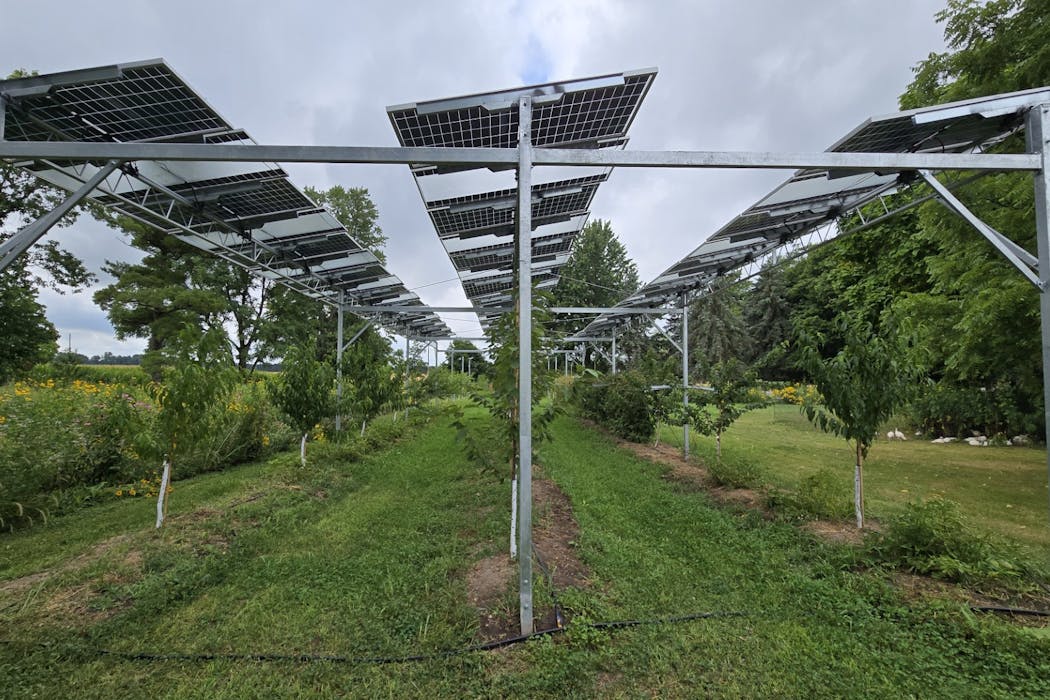
An agrivoltaic setup in southern Ontario.(U. Jamil), CC BY
Solar farm projects in the Canadian province of Alberta have been put on hold or cancelled because of a recent increase in regulations in the province. The new regulations ban solar panels from agricultural land and force solar developers to fully fund decommissioning upfront.
As a result, many originally profitable projects have been made unfeasible because of rules aimed at preventing a repeat of the orphaned oil and gas wells fiasco.
Agrivoltaics is the practice of purposefully shading agricultural crop lands with solar panels in order to enjoy the dual benefits of solar electricity and increased food production.
A new study I co-authored with my colleague, Uzair Jamil, found that partial shading to benefit crop production even works when the solar panels do not. This has interesting policy ramifications, particularly in Alberta.
How does shading crops make more food?
Studies from all over the world have shown crop yields increase when food crops are partially shaded with solar panels. Agrivoltaic yield increases are possible because of the microclimate created underneath the solar panels that conserves water and protects plants from excess sun, wind, hail and soil erosion. The temperatures are cooler, milder and all around more pleasant for plants.
Last year, we found that you could increase strawberry yield by 18 per cent under solar panels compared to strawberries in an open field. This agrivoltaic crop yield bump has been shown for dozens of other crops and solar panel combinations all over the world, including basil, broccoli, celery, corn, grapes, kale, lettuce, pasture grass, peppers, potatoes, tomatoes and more.
Agrivoltaics makes more food per acre, and could help bring down food prices while also supporting farmers in Canada. Such agrivoltaic farming can help meet Canada’s food and energy needs and reduce its fossil fuel reliance and greenhouse gas emissions as well as the rest of the world.
Our new study shows that the microclimate that benefits plants beneath agrivoltaics is maintained even when the solar is not generating any electricity.
We analyzed the lifespans of key agrivoltaic system components, experimentally measuring microclimate impacts of two agrivoltaic arrays. The results showed agrivoltaics still benefit crops even when unpowered.
What about Alberta?
Agrivoltaics also benefits renewable energy companies, farmers and everyone who eats food. However, to ensure “proper” site restoration after solar projects are complete, Alberta law demands land is returned to its original undisturbed state.
To ensure Agrivoltaics co-exist well with farming, Alberta mandates agricultural impact assessments before solar panels are installed, but it offers little guidance on how to optimize their co-use.
Some flexibility emerges through the assessment process, but it is not consistently built into infrastructure regulations.
In addition, Canadian zoning laws do not recognize agrivoltaics as a distinct land-use classification. That means that while provincial legislation might allow for agrivoltaics development, no explicit regulations are available.
To make things more clear for both farmers and financial backers, Canada could benefit from looking to other countries that have agrivoltaic legislation, such as France and Italy, to ensure land is being used in the most efficient way possible.
Experimental results from our research indicate that the shade provided by solar panels moderates soil temperatures and enhances soil moisture. Agrivoltaic systems, even when not used for power generation, can continue to deliver meaningful value for farmers through shading.
Government policy must adapt to this dual-use reality. Alberta’s current rules not only hurt the solar industry but also prevent farmers from making use of agrivoltaic infrastructure to help them grow more food for all of us.
Joshua M. Pearce has received funding for research from the Natural Sciences and Engineering Research Council of Canada, the Canada Foundation for Innovation, Mitacs, the U.S. Department of Energy and the Advanced Research Projects Agency-Energy, the U.S. Department of Defense, the Defense Advanced Research Projects Agency (DARPA), and the National Science Foundation (NSF). In addition, his past and present consulting work and research are funded by the United Nations, the National Academies of Science, Engineering and Medicine, many non-profits and for-profit companies in the energy and solar photovoltaic fields. He is a founding member of Agrivoltaics Canada. He does not directly work for any solar manufacturer and has no direct conflicts of interest.
When the term anarchy pops up in everyday conversations, images of lawlessness and chaos after a government breakdown or catastrophic event come to mind. Think of the anti-hero comic character the Joker or the famed Sons of Anarchy series about an outlaw biker club that values family loyalty as much as violent crime.
These values are central to relationship anarchy, which is an approach to intimacy and human connection that’s becoming especially popular among millennials and Gen Z.
A recent survey from the Feeld dating app shows that 50 per cent of its members practise relationship anarchy, particularly those who are trans, non-binary, gender diverse or pansexual.
With an emphasis on relationships that decentre prescribed notions of love and power, relationship anarchy is a compelling new approach to interpersonal and communal connection. But what exactly is it and how can people use relationship anarchy to reinvent their relationships?
Dating today can feel like a mix of endless swipes, red flags and shifting expectations. From decoding mixed signals to balancing independence with intimacy, relationships in your 20s and 30s come with unique challenges. Love IRL is the latest series from Quarter Life that explores it all.
These research-backed articles break down the complexities of modern love to help you build meaningful connections, no matter your relationship status.
What is relationship anarchy?
First introduced in 2006 by Swedish tech developer, writer and producer Andie Nordgren, this approach to relating uses anarchic principles like anti-capitalism, anti-hierarchy and mutual aid to resist traditional relationship models.
The idea is that replacing the codependence of coupledom with more expansive and effective forms of interpersonal care can build stronger communities that emphasize interdependence among people, animals and the environment.
Relationship anarchy is a fundamentally queer and inclusive framework that is predicated upon creating relationships that suit what people really want versus adhering to social conventions, whether because of obligation, family pressure or fear of expressing true desires.
Doing relationship anarchy means giving equal importance to friends, lovers and companions, and most practitioners are in alternative relationship structures, such as non-monogamy.
Given the social embarrassment now attached to certain kinds of relationships — as a recent Vogue piece questioning whether “having a boyfriend is embarrassing” suggests — alongside the steady rise in the number of unmarried people, many may already be adopting these radical approaches without realizing it.
How to practice relationship anarchy
If you’re interested in exploring relationship anarchy in your own life, a great place to start is by reflecting on the kinds of relationships you have been in, and the ones you desire.
How do you want these connections to feel? Have you been pressured into a monogamous partnership but really want to try something else? Do you miss friends who often slip away when you’re in a long-term relationship? Do you want to reduce the rigid boundaries that define and differentiate your relationships with friends, lovers, colleagues and family members?
Maybe you’re struggling to navigate family commitments that feel overwhelming because they crowd out the time you want to devote to self-care routines.
There are multiple entry points for bringing relationship anarchy into your life. You could tell your partner that you’d like to learn more about it and see how they respond when you share resources. You could focus your relationship energies on fostering meaningful connections with people who make up your chosen family or live in a more communal way.
Because relationship anarchy rejects labels like “friends,” “lovers” or “life partners,” you might abandon these categories in favour of more integrated ways of connecting that revolve around customized connections.
Perhaps you want to re-evaluate your consumptive patterns, which are often linked to traditional relational structures, and live in less resource-intensive ways.
Given the growing interest in non-traditional relationships and resisting political systems that continue to tap our Earth for depleted resources, it makes sense that relationship anarchy is on the ascent. A lot of us are eager for new ways of relating that we define and navigate in our own unique ways.
Relationship anarchy also offers a way of enriching our social networks and community bonds, both of which can go a long way to reduce the social isolation and disconnection many millennials and Gen Zers experience. No relationship can address all of the complex challenges and conditions impacting younger generations, but how you relate evolves over time and relationship anarchy might offer another way of connecting that appeals to you.
You can reinvent your ideas about love and relationships so that they align with what you actually want. No, it’s not easy or straightforward — welcome to life and love — but it is possible.
In a media-saturated world that often prioritizes profit over meaningful connection, we can create alternate ways of relating that feel kinder, more collaborative and fun. Relationship anarchy might just offer the non-hierarchical antidote a lot of us are looking for.
Treena Orchard has received funding from CIHR, SSHRC, and Western Ontario but no research monies were used in the creation of this article.
Source: The Conversation – Africa – By Danny Bradlow, Professor/Senior Research Fellow, Centre for Advancement of Scholarship, University of Pretoria
US president Donald Trump’s efforts to derail a successful wrap-up of the G20 summit in Johannesburg failed. Trump boycotted the meeting and the US told other countries through diplomatic channels not to sign a communiqué. Nevertheless, the 19 remaining countries and regional organisations signed a 30-page declaration. This called for, among other things, increased funding for renewable energy projects, more equitable critical mineral supply chains and debt relief for poorer countries. Senior research fellow Danny Bradlow explains what was, and wasn’t, achieved.
In what ways was South Africa’s G20 presidency a success?
The G20 has been a great diplomatic success for South Africa in at least three ways.
First, it succeeded in leading all the other G20 countries and organisations to adopt by consensus a leaders’ declaration despite a boycott and bullying tactics by Washington.
The 120 paragraph Leaders’ Declaration covered all the issues embodied in the “Solidarity, Equality and Sustainability” theme that South Africa chose for the G20. They included:
debt and access to affordable, sustainable finance
Second, South Africa succeeded in launching a number of initiatives over the course of the year.
Firstly, the G20 acknowledged South Africa’s five years of support for the establishment of an African Engagement Framework within the G20’s finance track. It is intended to support enhanced cooperation between Africa and the G20.
Secondly, leaders expressed support, in various ways, for the G20 working group initiatives on illicit financial flows, infrastructure, air quality, artificial intelligence, sustainable development and public health. The ministerial declaration on debt was also supported. This includes reforms around initiatives supporting low and middle income countries facing debt challenges.
Thirdly, the Ubuntu Legacy Initiative was launched. This is designed to fund cross-border infrastructure in Africa. It was also agreed that an Ubuntu Commission will be set up to encourage research and dialogue on dealing cooperatively with global challenges. Ubuntu can be explained with reference to the isiZulu saying ‘umuntu ngumuntu ngabantu’ which means ‘a person is a person through other people.’ It entails an ethics of care, compassion and cooperation.
Lastly, South Africa succeeded in delivering an effective, efficient and constructive G20 year. This is no small feat. It required the country to organise more than 130 meetings of G20 working groups, task forces and ministerial meetings, in addition to the leaders’ summit.
Is this only a good news story?
It is inevitable that any complex, multifaceted and voluntary process involving participants with strong and contrasting views will not be an unqualified success.
This, without doubt, is the case with South Africa’s G20 year. The environment was complicated by a number of factors:
the wars in Gaza, Ukraine and Sudan
the actions of the US and some of its allies to undermine the international community’s efforts to address the intertwined challenges of climate, biodiversity, energy, poverty, inequality, food insecurity, debt, technology and development, and
trade wars initiated by Trump imposing tariffs on trading partners.
These factors meant that getting the diverse membership of the G20 to reach agreement on a broad range of complex issues would be extremely difficult. In fact, it would only be possible to do so at a high level of abstraction.
Unfortunately, this proved to be the case. The result is that the G20 Leaders’ Declaration largely boils down to a set of general statements that are almost totally devoid of commitments for which states can be held accountable. Such general statements are not uncommon in the diplomatic statements issued at the end of high-level multilateral meetings. However, this is an extreme example.
The leaders expressed their support for a number of voluntary principles on issues such as disaster relief, artificial intelligence, critical minerals and debt. They also expressed support for the work of organisations like the multilateral development banks and the International Monetary Fund, and for some specific South African led initiatives like the review of the G20 itself.
However, there are no time frames or deliverables attached to these expressions of support.
What needs to be done to make the declaration effective?
The G20 is a voluntary association with no binding authority. The declaration’s efficacy therefore ultimately depends on all the G20’s stakeholders both taking – and advocating – for action on the issues raised in it.
These stakeholders include states and non-state actors like international organisations, businesses and civil society organisations.
The value of the declaration is how both the state and non-state actors use it to advocate for action. That can be in future G20 meetings as well as other regional and international forums.
How can the declaration be used to lead to action?
One of the biggest challenges facing African countries is debt. Over 20 are either in debt distress or at high risk of debt distress. Many African countries are being forced to choose between servicing their debts and investing in the development and climate resilience of their own populations.
The challenge that this creates for African states is exacerbated by their limited access to affordable, predictable and sustainable sources of development finance.
This means that African countries are unlikely to gain a sustainable path to reaching their development and climate goals without substantial action on debt and development finance. The Leaders’ Declaration, in paragraphs 14-22, clearly recognises the challenge. Key elements include:
the endorsement of the statement their finance minister and central bank governors made on debt sustainability
a reiteration of the support for the Common Framework for dealing with low-income countries in debt distress. The framework establishes a process for dealing with the official and commercial debt. But the process has proven to be too slow and cumbersome.
a commitment to working with the Global Sovereign Debt Roundtable to explore better ways to meet the needs of debtor countries in distress and their creditors. This roundtable establishes an informal mechanism that brings together creditors and debtors and other stakeholders in sovereign debt to discuss ways to improve restructuring processes.
But these will be just empty words unless the endorsements are turned into action.
There are three actions that stakeholders can take.
First, African leaders can form a regional borrowers’ forum to discuss the debt issue and share information on their experiences dealing with creditors and on developing common African positions on development finance and debt. This would build on the work done by:
the African Expert Panel appointed by South African president Cyril Ramaphosa, and
the African finance ministers under the auspices of the African Union and the UN Economic Commission on Africa.
They can also use this forum to engage in open discussions with African non-state actors.
Second, African non-state actors can develop strategies for holding the leaders accountable if they fail to follow up on the declaration. And they can hold creditors accountable for their actions in their negotiations with African debtors in distress.
Third, African non-state actors should initiate a review of how the IMF needs to reform its operational policies and practices. Africa has eloquently advocated for greater African voice and vote in IMF governance. The next step should be to explore how the substantial changes that have taken place in the scope of IMF operations can be translated into operational practices. These include the macroeconomic impacts of climate, gender and inequality –
Danny Bradlow in addition to his position with the University of Pretoria is a senior G20 advisor with the South African Institute of International Affairs; a Non-Resident Senior Fellow at the Global Development Policy Center, Boston University and a Compliance Officer with the Social and Environmental Compliance Unit, UNDP.
Tuesday is the International Day for the Elimination of Violence against Women and the beginning of 16 days of activism against gender-based violence. It’s a global call to action by the United Nations to prevent and eliminate all forms of violence against women and girls.
This year’s theme — “End digital violence against all women and girls” — aims to draw attention to the rapid rise of hate directed at women online. Sadly, this problem is all too common in today’s political world.
Why do we need attention drawn to this issue in politics?
Technology-facilitated gender-based violence is a serious and growing threat to women and girls. It’s defined by the UN as:
“Any act that is committed, assisted, aggravated, or amplified by the use of information communication technologies or other digital tools that results in or is likely to result in physical, sexual, psychological, social, political, or economic harm, or other infringements of rights and freedoms.”
It includes hate speech, violent threats, cyber-harassment, doxxing, image and video-based abuse, astroturfing, gendered disinformation and defamation.
Silencing prominent women
Marginalized women and women with public-facing roles — especially politicians, journalists and activists — often bear the brunt of attacks, with the intent to silence and push them out of the public arena.
While popular assumptions about online misogynists view them as “bearded white dudes in a basement” ranting about women on their computers anonymously, some political leaders are also unfortunately spreading misogyny openly online.
What motivates leaders to spread gendered hate online?
Politicians who are most likely to use misogynistic rhetoric are those who seek to uphold a “masculinist strongman ideal,” according to research by British scholar Nitasha Kaul. She explains how public figures like Donald Trump, Vladimir Putin and Narendra Modi have all used misogyny to assert their power.
By positioning women (and men who do not conform to dominant masculine norms) as inferior, strongmen are signalling their dominance to their followers and to other “strong” men.
When it’s directed at women in the public eye, political misogyny serves to suppress the voices of political opponents and people with differing views, posing threats to freedom of expression and fundamental human rights.
Political elites advance “nasty claims” about high-profile women in politics;
Those “nasty claims” connect with and/or activate conscious and unconscious prejudices regarding women in politics; and finally
The audience receives and accepts the nasty claims as their own.
Online political misogyny is violent
Given their vast reach, digital platforms have become ideal spaces for leaders to spread their misogynistic views. In 2017, a Conservative MP referred to former environment minister Catherine McKenna as “Climate Barbie” on social media (the MP later apologized).
Since then, McKenna has shared details about the online violence she experienced in connection with this slur, with one meme featuring a Barbie Doll being crushed by a sledgehammer and another saying, “Tick Tock, Barbie Bitch.”
In 2023, former Conservative leader Andrew Scheer shared a post on his X account (which today has more than 250,000 followers) styled as a “wanted” poster, featuring the photos and office phone numbers of two women senators.
He urged his followers to call their offices, falsely claiming they had deliberately shut down debate on a Conservative-backed bill. Afterward, Sen. Bernadette Clement, who identifies as Black, received racist online abuse and a phone call from an unknown man threatening to come to her home. Sen. Chantal Petitclerc also reported her office being inundated with sexist voicemail messages.
‘Play dirty’
Women journalists are also being attacked, fuelled by misogynistic online posts from political leaders. In 2021, several Canadian women journalists — almost all of whom were racialized — were targeted by an online hate campaign encouraged by Maxime Bernier, leader of the People’s Party of Canada.
After the journalists raised questions about white supremacy inside the party, Bernier told his X followers to “play dirty” with them. The reporters were subsequently inundated with rape and death threats, as well as racist abuse. While X forced Bernier to take down the post and briefly restricted his account, the damage had been done.
Online political misogyny has real-world consequences. After Trump’s Nov. 20 Truth Social post inciting violence against his Democratic rivals, congresswoman Jasmine Crockett’s office in Washington, D.C., was threatened by a white supremacist.
Writing on Blue Sky, Crockett vowed she would not back down and reminded the public that “when leaders promote hate, hate shows up — sometimes right at our door.”
As my research with Canadian political science professor Cheryl Collier shows, gender-based violence in politics has democratic costs, diminishing diverse voices and expertise in public office.
These attacks also undermine journalistic accountability and trust in facts during a time when mis- and disinformation have become a scourge.
How to bring about change
The UN’s global campaign challenges us to reflect on how online political misogyny can be stopped. Worldwide, governments must pass public policies and enforce laws that criminalize hate-motivated digital violence. Technology companies must ensure platform safety and enforce robust, transparent codes of conduct.
Men and boys need access to mental health support and positive role models who encourage healthy forms of masculinity, rather than framing toxic masculinity as the ideal. Concerned citizens can donate to organizations dedicated to eradicating gender-based violence, such as the Native Women’s Association of Canada, WomanACT, White Ribbon or to a women’s shelter in their local community.
Finally, public leaders must actively refuse to engage in political misogyny and lead efforts to uphold respect and civility in public discourse. Campaigns like Gov. Gen. Mary Simon’s “Building a Safer and Respectful Digital World” and Elect Respect, initiated by Burlington Mayor Marianne Meed Ward, are positive steps in the right direction.
Tracey Raney receives funding from the Social Sciences and Humanities Research Council of Canada (SSHRC).
Source: The Conversation – in French – By Delphine Griveaud, Chargée de recherche au Fonds national de la recherche scientifique belge (FNRS), Université catholique de Louvain (UCLouvain)
La justice restaurative consiste à accompagner des victimes et des auteurs d’infractions qui souhaitent dialoguer. Ce type de médiation ne prétend pas remplacer la justice pénale, mais offrir une option supplémentaire à celles et ceux qui y aspirent. La majorité de ces mesures concernent des violences sexuelles et de genre. Mais pour ce type de violences, la justice restaurative est-elle vraiment adaptée ?
Le film Je verrai toujours vos visages (2023), de Jeanne Herry, a permis au grand public de découvrir l’existence des mesures de justice restaurative prévues par le système judiciaire français. Fidèle à la réalité, cette fiction montre notamment le processus par lequel une jeune femme en vient à rencontrer son frère, qui l’a plusieurs fois violée enfant. Elle souhaite convenir avec lui d’une séparation des espaces de la ville dans laquelle elle et lui vont devoir cohabiter alors qu’il vient de sortir de prison. Ce cas a suscité des réactions critiques, soulignant les débats houleux qui entourent la justice restaurative dans le cas de violences de genre.
Peut-on traiter à égalité, dans le processus d’une médiation, les propos et attentes d’une victime d’inceste et de celui qui l’a violée ? Cela revient-il à minimiser les faits ? Ne serait-il pas dangereux, au moins psychiquement, pour une victime de violence sexuelle de rencontrer son agresseur ? Y a-t-il là un trop fort risque d’instrumentalisation du processus de la part de l’auteur des faits ?
Depuis 2014, l’article 10-1 du Code de procédure pénale indique qu’une mesure de justice restaurative peut être proposée
« à l’occasion de toute procédure pénale et à tous les stades de la procédure, y compris lors de l’exécution de la peine, [à] la victime et l’auteur d’une infraction, sous réserve que les faits aient été reconnus ».
Ces mesures sont mises en place si victimes et auteurs le souhaitent. Elles développent une approche différente de la justice pénale : il s’agit moins de punir l’auteur des faits que de créer un dialogue entre victimes et auteurs pour réparer les victimes et responsabiliser les auteurs.
Différentes pratiques restauratives coexistent en France aujourd’hui. Les plus répandues sont les médiations restauratives : des processus, longs, menés par des animateurs et animatricesformées à cet effet, qui offrent un cadre sécurisant à une victime ou un auteur de délit/crime pour revenir sur ce qu’il s’est passé, et se préparer à une rencontre avec l’autre (son auteur, sa victime) s’ils le souhaitent.
Ces mesures reposent sur la libre participation de celles et ceux qui le souhaitent, elles ne peuvent en aucun cas être imposées. Étant donné le peu de moyens alloués et le manque d’information des justiciables, elles sont peu nombreuses. En 2023, l’Institut français pour la justice restaurative, l’association prenant en charge la majorité des mesures de justice restaurative sur le territoire dénombrait 89 mesures terminées et 158 en cours, dont plus de 90 % de médiations restauratives. En agrégeant à cela les mesures restauratives de toutes les autres organisations, à l’activité quantitativement plus restreinte, on ne dépasse pas les 200 mesures terminées sur l’année 2023. Selon les estimations les plus récentes, les deux tiers de ces mesures concernent des violences de genre, cette proportion ayant progressivement augmenté depuis 2014.
La justice restaurative : un danger pour les victimes de violences de genre ?
Parce qu’elle s’appuie sur une approche relationnelle qui tend à (ré)instaurer une communication entre eux par un processus qui propose autant d’écoute et de considération à l’un qu’à l’autre, on peut considérer que la justice restaurative tend à symétriser les positions de victime et d’auteur.
Cette démarche égalitariste peut entrer en conflit avec la perspective des associations de lutte contre les violences sexuelles (et/ou conjugales, incestueuses, etc.) qui mettent l’accent sur le rapport de pouvoir existant entre auteur et victime et sur les risques que cette asymétrie engendre en cas de face-à-face. Elles craignent que cela réinstaure l’« emprise » de l’auteur sur la victime et accroisse le risque de « revictimiser » la victime.
Reposant sur une compréhension individuelle des violences, qui emprunte à des savoirs psychologiques très diffusés actuellement, une telle approche amène à considérer le pouvoir que prennent les auteurs sur les victimes en matière de violences de genre moins comme le produit d’un contexte social inégalitaire que comme une faculté individuelle des auteurs, qui leur permet de prendre l’ascendant psychique sur leur victime pour les déposséder de leur libre arbitre. Dans cette perspective, la source du pouvoir n’est pas un ensemble de mécanismes sociaux mais la personnalité de l’auteur lui-même.
Par ailleurs, certaines associations féministes voient dans les « médiations restauratives » une manière déguisée de contourner l’interdiction pour une autorité publique d’imposer une médiation dans les situations de violences dans le couple ; celle-ci a justement été posée pour couper court aux risques d’emprise des hommes violents sur leurs victimes par la Convention d’Istanbul sur la lutte contre la violence à l’égard des femmes, ratifiée par la France en 2014.
Pourtant, la médiation restaurative n’est pas une médiation obligatoire telle qu’interdite dans la Convention, elle ne peut pas être imposée, elle n’est pas un acte de procédure pénale et n’a pas les mêmes objectifs que celle-ci. Mais ces distinctions semblent floues pour beaucoup, et les pouvoirs publics prennent donc de grandes précautions au sujet de la justice restaurative en cas de violence conjugale.
Ce sont alors d’autres types de pratiques restauratives qui sont privilégiées, des pratiques indirectes, qui accompagnent auteurs et victimes à des rencontres avec d’autres auteurs et victimes qui ont commis ou subi le même type de délit/crime, mais qui ne se connaissent pas au préalable. Ces dispositifs sont appelés « rencontres détenus-victimes ».
Les réticences sont moins grandes du côté des pouvoirs publics dans les cas de violences sexuelles extérieures au couple, mais elles ont pu émerger du côté des associations : en 2022, la Fédération des CIDFF (centres d’information sur les droits des femmes et des familles) s’est ainsi opposée à la justice restaurative au niveau national, tandis que le rapport de la Commission indépendante sur l’inceste et les violences sexuelles faites aux enfants (Civiise) de 2023 la rejetait catégoriquement dans les cas de violences incestueuses.
Ce que les victimes de violences de genre font de la justice restaurative
Les débats sur la pertinence de la justice restaurative dans les cas de violences de genre sont souvent théoriques, et détachés de l’analyse de ce qu’il se passe réellement quand des mesures de justice restaurative sont mises en place. Surtout, ces débats sont menés au nom du bien-être et de la protection des victimes, sans connaissance réelle de la méthode de travail des associations spécialisées et sans qu’on entende les voix de celles qui ont bénéficié ou sont engagées dans une mesure de justice restaurative.
Entre 2022 et 2023, notre terrain d’enquête nous a amenées à rencontrer 14 d’entre elles : neuf victimes de violences sexuelles et cinq victimes de violences conjugales (dont les violences étaient à la fois psychologiques, physiques et sexuelles). Certaines se sont lancées dans la justice restaurative après une mauvaise expérience avec la justice pénale, au cours de laquelle elles ne s’étaient pas senties écoutées. D’autres sont dans des situations beaucoup plus rares en France, mais qui tendent à se développer : elles ont été prises en charge par des associations qui, contrairement à celles travaillant sous financement du ministère de la justice, acceptent d’accompagner des médiations restauratives hors de toute reconnaissance judiciaire. Elles n’ont donc jamais déposé plainte. Cinq ont fait l’expérience d’une rencontre entre détenus et victimes ; neuf d’une médiation restaurative. Ce nombre de victimes est trop peu élevé pour que nos observations puissent avoir un caractère représentatif, mais il nous donne un aperçu de ce que peut être la justice restaurative en cas de violences de genre.
Tout d’abord, les raisons qui ont amené ces personnes à s’engager dans la justice restaurative sont multiples : souvent, elles saisissent une main tendue et l’opportunité, rare, d’une écoute gratuite et inconditionnelle, elles espèrent que cela leur permettra d’aller mieux, mais elles peuvent aussi vouloir poser des questions à un ou à leur auteur ou espérer que la démarche pourra transformer l’auteur et ainsi protéger d’autres femmes ou enfants. Ensuite, elles s’approprient de manières disparates les dispositifs. À rebours de l’image de passivité prêtée aux victimes, l’une d’entre elles nous a raconté avoir parlé sans discontinuer pendant une heure lors de la rencontre avec son frère qui l’avait violée enfant. Elle lui a dit tout ce qu’elle n’avait jamais pu lui dire dans le cadre familial qui, contrairement au cadre créé par la justice restaurative, ne légitimait pas sa parole.
Enfin, toutes les personnes que nous avons rencontrées ont souligné l’importance d’avoir été reconnues et écoutées par les praticiennes de la justice restaurative, sans remise en cause de leur récit ni injonction à s’expliquer, se justifier.
Témoignages de praticiennes de la justice restaurative.
Cette considération est racontée comme étant en elle-même réparatrice, et ce, aussi parce qu’elle contraste avec le peu d’attention apportée aux victimes par leur entourage. Les personnes rencontrées qui sont, ou ont été, engagées dans une procédure judiciaire opposent par ailleurs une justice pénale froide, technique et pragmatique à une justice restaurative chaleureuse, empathique, et laissant place aux émotions.
En pratique donc, les victimes de violences de genre avec qui nous avons échangé ne se sentent pas vulnérabilisées par les mesures de justice restaurative. Au contraire, elles se disent renforcées par elles. Ces expériences sont produites, selon les cas, à la fois par la considération et la reconnaissance accompagnant l’entrée dans les mesures, par le travail émotionnel des praticiennes, par la resocialisation permise par la mesure (sortie de l’isolement que connaissent de nombreuses victimes à la suite des violences, formation d’amitiés avec d’autres victimes rencontrées pendant le parcours, et même avec des auteurs participant aux cercles de parole) et par la revalorisation de soi qu’elle permet bien souvent également.
Ces résultats indiquent sans doute l’importance du contexte que la justice restaurative produit pour la rencontre entre victime et auteur : considérant auteurs et victimes à parts égales, il peut donner de fait plus de pouvoir aux victimes qu’elles n’en avaient dans les relations violentes qui les liaient à leurs agresseurs, d’autant plus que ce cadre s’éloigne de la figure de passivité attribuée aux victimes pour ouvrir la possibilité d’une prise en main de leur histoire. En revanche, si le cadre créé par la justice restaurative établit une égalité entre auteur et victime au moment de leur rencontre, il ne change pas les inégalités sociales qui ont permis la violence. En cela, selon nous, la justice restaurative ne constitue pas tant un moyen de lutte contre les violences de genre que la rustine d’une société qui tolère, et favorise, ces violences.
Delphine Griveaud a reçu pour cette recherche des financements du Fonds national de la recherche scientifique belge (FNRS), de l’Institut Robert Badinter (CNRS – Ministère de la Justice), de la Direction et l’Ecole nationale de la protection judiciaire de la jeunesse, et du Service d’aide aux victimes et à l’aide juridictionnelle.
Emeline Fourment a reçu pour cette recherche des financements de l’Institut Robert Badinter (CNRS – Ministère de la Justice) et du Centre Rouennais d’Etudes Juridiques (CUREJ).
La compensation écologique, qui consiste à restaurer des écosystèmes ailleurs pour compenser une perte de biodiversité ici, a le vent en poupe auprès des décideurs. Elle n’a pourtant rien d’une solution miracle : son efficacité réelle reste très débattue dans la communauté scientifique. Surtout, elle dépend de rapport de force où s’opèrent des arbitrages entre développement économique et protection de la nature. Une plus grande prise en compte des sciences sociales permettrait une meilleure appropriation de ces influences qui pèsent sur les politiques environnementales.
Depuis les années 1990, la compensation de la biodiversité s’est imposée à travers le monde comme un outil de politique environnementale. Son principe est de contrebalancer les pertes écologiques causées par les projets d’aménagement. L’idée est simple : lorsqu’un projet de construction ou d’aménagement affecte un écosystème, des mesures de compensation doivent être mises en place pour restaurer ou protéger une zone équivalente ailleurs.
Adoptée dans de nombreux pays, l’efficacité de ce mécanisme est toutefois insuffisante. Derrière cette idée comptable d’un équilibre que l’on pourrait restaurer se cache un processus complexe, soumis à de multiples arbitrages, contraintes techniques et enjeux temporels, comme le révèle une étude que nous avons publiée dans Nature Sustainability.
Dans celle-ci, nous avons mené une revue de publications scientifiques et institutionnelles internationales pour répondre à une question : comment les politiques de compensation de la biodiversité sont-elles conçues et influencées ?
Multiples acteurs, multiples influences
Les études en écologie scientifique postulent généralement que de meilleures connaissances scientifiques conduisent à de meilleures politiques environnementales, mais nous montrons la nécessité de prendre en compte les rapports de force structurels qui les affaiblissent.
En effet, la gouvernance de la compensation de la biodiversité, loin de reposer uniquement sur des données scientifiques et des métriques écologiques, est aussi marquée par les interactions entre différents acteurs – États, entreprises, ONG environnementales, institutions scientifiques et citoyens – qui cherchent à façonner les règles du jeu selon leurs intérêts. Parfois au risque de saper les fondements de ces programmes.
La compensation est souvent présentée comme une solution pragmatique conciliant développement économique et conservation de la nature, mais elle suscite en réalité de nombreux débats.
D’un côté, les gouvernements, les institutions internationales et les grandes ONG environnementales (comme l’Union internationale pour la conservation de la nature, UICN) la défendent comme un outil pragmatique permettant de concilier conservation et développement économique.
De l’autre, les lobbies industriels et les entreprises cherchent à encadrer ce dispositif de manière à maximiser leur flexibilité et à minimiser leurs coûts.
Les débats ne sont pas seulement techniques, ils touchent à des questions politiques sensibles. Par exemple, la compensation doit-elle être une obligation réglementaire ou un engagement volontaire ? Qui doit en assurer le contrôle ? Peut-elle être confiée à des acteurs privés à travers des marchés de crédits environnementaux ?
Les auteurs identifient trois grandes étapes à travers lesquelles tous ces acteurs tentent d’orienter les politiques de compensation écologique.
D’abord la mise à l’agenda, qui est le moment où la compensation devient un enjeu de politique publique. Cette phase est marquée par des discussions sur la nécessité de compenser les dommages causés à la biodiversité et sur les méthodes à adopter.
Différents acteurs y participent, notamment les gouvernements, les institutions internationales, les scientifiques et les ONG qui militent pour des mesures de conservation plus strictes. L’implication croissante d’acteurs privés à cette étape s’accompagne, depuis quelques décennies, d’un recours plus affirmé aux mécanismes de marché plutôt que réglementaires.
La deuxième étape est l’élaboration des politiques en elles-mêmes, lorsque la compensation est traduite en lois et en règlements. Des questions cruciales sont débattues, comme le type d’impacts environnementaux à compenser, les obligations imposées aux entreprises ou encore le mode de financement de ces mesures.
C’est aussi un moment où les lobbyistes interviennent pour orienter la réglementation dans un sens plus ou moins contraignant. Aux États-Unis, par exemple, la National Environmental Banking Association a plaidé pour des règles plus cohérentes afin de réduire l’incertitude pour les entreprises. En France, des représentants d’intérêts comme ceux des carrières participent activement aux discussions sous l’égide du ministère de l’écologie.
Les décisions et orientations des politiques de compensation reposent donc à la fois sur des considérations scientifiques (quels sont les écosystèmes à protéger, quels sont les impacts les plus importants, quels sont les meilleurs indicateurs pour piloter les politiques) et la participation de représentants sectoriels. Cela peut conduire à une politisation de l’écologie scientifique au profit d’intérêts particuliers.
Enfin, cette influence intervient aussi au moment de la mise en œuvre sur le terrain. En effet, l’application des politiques de compensation implique une multitude d’interactions entre les acteurs locaux, les entreprises et les agences environnementales. L’interprétation des règles, la définition des critères écologiques et la surveillance des compensations sont autant de points négociés qui influencent les résultats concrets des programmes.
En Australie, une étude montre que la compensation est appliquée différemment selon les États, certains adoptant une approche plus flexible, ce qui peut limiter les résultats écologiques.
Malgré son potentiel, la compensation de la biodiversité suscite donc des interrogations sur son efficacité réelle. Nous avons relevé plusieurs points critiques :
Le manque de transparence Les négociations sur la mise à l’agenda et sur la mise en œuvre des compensations se déroulent souvent dans des espaces peu accessibles au public, limitant la possibilité de vérifier leur pertinence et leur inscription dans un débat ouvert.
Le déséquilibre des pouvoirs Les entreprises et coalitions d’acteurs économiques privés disposent de ressources importantes pour influencer la conception des politiques, ce qui peut entraîner des compromis moins favorables à la biodiversité.
La science peut être un objet d’influence Des connaissances écologiques sont mobilisées dans la décision lors de toutes les étapes de la politique publique, y compris dans les contentieux administratifs. Les études peuvent être produites par des acteurs publics, privés ou encore associatifs, et la multiplicité des critères facilite l’instrumentalisation des connaissances au service d’intérêts particuliers.
La fragilité des résultats au plan écologiqueCertaines études montrent que les compensations ne parviennent pas toujours à restaurer les écosystèmes de manière équivalente, ce qui pose la question de leur efficacité à long terme. En France par exemple, une étude sur des sites restaurés a révélé que leur biodiversité restait inférieure à celle des sites naturels d’origine, malgré les efforts de compensation.
La définition du périmètre de la compensation C’est un enjeu majeur mais pourtant peu appréhendé dans les études scientifiques. Quels types d’écosystèmes et d’espèces doivent être protégés ? Certains pays, comme les États-Unis, se concentrent sur les espèces menacées, tandis que d’autres, comme la France, intègrent des approches basées sur les habitats. Ces choix ne sont jamais neutres : ils reflètent des arbitrages entre des exigences écologiques et des impératifs économiques qui ne sont pas uniquement guidés par la science et résultent généralement de négociations entre parties prenantes.
Une gouvernance à améliorer
Pour améliorer la gouvernance de la compensation de la biodiversité, nous suggérons plusieurs pistes et plaidons pour une meilleure intégration des sciences sociales dans l’action publique environnementale.
Il convient d’abord de mener davantage d’études comparatives pour évaluer comment les politiques sont mises en place dans différents pays. Cela permettrait de mieux comprendre les stratégies de contournement et d’obstruction dont elles font l’objet.
Pour renforcer l’indépendance des instances de régulation et assurer une plus grande transparence sur les relations entre entreprises, décideurs publics et experts scientifiques, nous appelons également à mieux encadrer l’influence du secteur privé afin de limiter les conflits d’intérêts.
Enfin, nous estimons qu’il est nécessaire de capitaliser sur les savoirs des sciences sociales. Une meilleure circulation de ces derniers renforcerait l’évaluation des politiques environnementales.
En définitive, la compensation de la biodiversité ne peut pas être considérée comme une solution miracle. Elle repose sur des compromis entre développement économique et préservation de la nature, ce qui en fait un domaine où les enjeux politiques et financiers sont omniprésents. Jusqu’à présent, elle n’a pas témoigné de sa capacité à enrayer l’érosion de la biodiversité et les études en écologie attestant ses limites s’accumulent.
Face à cela, les sciences sociales peuvent apporter une meilleure compréhension des stratégies d’influence d’acteurs engagés dans la protection de leurs intérêts particuliers. Elles ne se substitueront pas à un portage politique ambitieux, mais pourront certainement l’accompagner.
Stéphanie Barral a reçu des financements de l’Agence Nationale de la Recherche et de la Fondation Jefferson pour enquêter sur les politiques de compensation écologique.
Christine Jez ne travaille pas, ne conseille pas, ne possède pas de parts, ne reçoit pas de fonds d’une organisation qui pourrait tirer profit de cet article, et n’a déclaré aucune autre affiliation que son organisme de recherche.
La hausse de la demande en minerais critiques nécessaires pour mener à bien la transition énergétique n’est pas qu’une bonne nouvelle pour les pays producteurs. Elle les soumet à la volatilité des marchés. D’où l’exigence de mesurer leur exposition à ce risque nouveau.
Voitures électriques, panneaux solaires, éoliennes : la transition énergétique semble être une bonne nouvelle pour la planète. Pourtant, derrière ces technologies se cache une dépendance croissante à une poignée de minerais dits critiques : lithium, cobalt, nickel ou terres rares, entre autres. Ces ressources sont indispensables pour fabriquer des batteries, des moteurs électriques ou encore des turbines. Leur demande pourrait être multipliée par sept d’ici à 2040 selon l’Agence internationale de l’énergie (IEA).
Le changement climatique expose les pays émergents et en développement à deux grands types de risques. Les risques physiques proviennent des catastrophes naturelles – inondations, sécheresses, ouragans – qui détruisent les infrastructures perturbent l’agriculture et pèsent lourdement sur les finances publiques. Les risques de transition d’ordre économique apparaissent lorsque l’économie mondiale s’oriente vers un modèle bas carbone : nouvelles réglementations, innovations technologiques, marchés instables.
Les pays producteurs de minerais critiques se trouvent au premier plan de ces risques, car leur prospérité dépend de ressources de plus en plus demandées mais aux prix très volatiles. Or cette exposition est amplifiée par une autre réalité. La production mondiale de ces matériaux est concentrée dans un petit nombre de pays. La République démocratique du Congo fournit plus de 70 % du cobalt, la Chine domine les terres rares, le Brésil exporte graphite et nickel, tandis que le Pérou est un acteur majeur du cuivre. Cette concentration confère à ces pays un rôle stratégique, mais elle les rend aussi particulièrement vulnérables. Quand un budget national repose trop sur un seul minerai, la moindre variation de prix peut déstabiliser les finances publiques.
Les marchés des minerais critiques sont notoirement instables. Le cobalt, par exemple, a vu son prix doubler puis chuter de moitié en quelques années. Pour un État comme la République démocratique du Congo ou la Zambie, dont une grande partie des recettes publiques repose sur ce minerai, ces variations sont un casse-tête. Une année, elles financent écoles et hôpitaux ; l’année suivante, elles doivent couper dans leurs dépenses ou s’endetter davantage. L’Argentine, de son côté, dépend fortement du lithium, tandis que le Pérou repose sur le cuivre, pilier de ses finances publiques. En Indonésie ou au Brésil, le nickel suit les cycles de l’industrie mondiale.
Contrairement au problème classique de la rente pétrolière – et de ses implications fiscales – observées, par exemple, en Algérie ou au Nigéria, il ne s’agit pas ici d’un seul produit mais d’une mosaïque de minerais, chacun avec ses propres dynamiques de prix et de demande. En Afrique, la RDC dépend du cobalt, la Zambie du cuivre et du cobalt, le Mozambique et Madagascar du graphite ou des terres rares. En Amérique latine, l’Argentine mise sur le lithium, le Pérou sur le cuivre, tandis que le Mexique apparaît plus diversifié. En Asie, l’Indonésie est très exposée au nickel, quand le Kazakhstan ou les Philippines présentent des risques plus modérés. Cette diversité de situations rend la vulnérabilité plus diffuse et complique les réponses budgétaires.
Des économies vulnérables
Selon l’Agence internationale de l’énergie (AIE), la demande pour des minerais comme le lithium, le cobalt et le nickel pourrait être fortement multipliée d’ici à 2040. L’avenir dépendra des choix politiques des différents pays en matière de transition climatique. Si ceux-ci poursuivent les politiques actuelles, la croissance de la demande sera progressive, mais les États exportateurs resteront dépendants de leurs recettes minières. Dans un scénario plus ambitieux, où le monde viserait la neutralité carbone, la demande grimperait beaucoup plus vite, ce qui gonflerait les recettes fiscales, mais accentuerait aussi les risques liés à la volatilité des prix.
Or, si plusieurs travaux – par exemple, ceux de l’Agence internationale de l’énergie sur la sécurité d’approvisionnement en minerais critiques, de l’Organisation de coopération et de développement économiques (OCDE) sur les chaînes de valeur et les restrictions à l’exportation, ou encore du Fonds monétaire international (FMI) et de la Banque mondiale sur la vulnérabilité budgétaire des pays riches en ressources – évaluent déjà les risques d’approvisionnement ou les enjeux géopolitiques liés à ces matières premières, il existe encore peu d’outils pour mesurer concrètement ce que cette volatilité implique pour les finances publiques des pays producteurs, alors qu’un tel indice est essentiel pour éclairer les décisions budgétaires et de gestion des risques.
Pour analyser ces dynamiques et mieux mesurer cette exposition, un indice de risque fiscal (Fiscal Revenue Risk Index) a été développé dans une étude récente que j’ai menée. Il prend en compte la dépendance des recettes publiques aux minerais, la volatilité historique des prix et l’évolution de la demande. Les résultats révèlent des contrastes marqués : le Mozambique, le Gabon et la République démocratique du Congo présentent des scores de risque élevés. L’Argentine, grande productrice de lithium, voit son risque croître fortement entre 2030 et 2040, tandis que le Mexique et les Philippines, grâce à des économies plus diversifiées, apparaissent plus stables.
Un impact réel pour les populations
La question n’est pas abstraite. Les recettes fiscales financent les services publics. Si elles s’effondrent à cause d’une chute du prix du cobalt ou du cuivre, les gouvernements risquent de réduire les dépenses sociales, de repousser des investissements en santé ou en éducation, ou encore d’augmenter brutalement les impôts. Autrement dit, la volatilité des minerais peut se traduire directement dans la vie quotidienne des populations.
Diversifier les économies : réduire la dépendance aux recettes minières en développant d’autres secteurs comme l’agriculture, l’industrie manufacturière ou les services.
Mettre en place des fonds de stabilisation : épargner une partie des revenus tirés des minerais lors des périodes de prix élevés pour amortir les chocs en cas de chute brutale. L’exemple des fonds souverains, comme celui de la Norvège alimenté par le pétrole, illustre ce mécanisme.
Renforcer la coopération internationale : les pays consommateurs et producteurs ont intérêt à mieux coordonner leurs politiques. L’Union européenne (UE), avec son Critical Raw Materials Act, cherche à sécuriser ses approvisionnements, mais elle pourrait aussi contribuer à aider les pays producteurs à gérer la volatilité et à investir dans un développement durable.
Minerais critiques : une instabilité qui fragilise les pays émergents et en développement
La transition verte est indispensable pour réduire les émissions de gaz à effet de serre, mais elle crée aussi de nouvelles fragilités dans les économies du sud. Pour qu’elle réussisse, il ne suffit pas d’innover technologiquement : il faut aussi garantir que les pays producteurs en tirent des bénéfices durables, sans tomber dans le piège de la dépendance et de la volatilité.
En somme, l’énergie verte n’est pas seulement une affaire d’ingénierie. C’est aussi une question de fiscalité, de solidarité et de gouvernance mondiale.
Paola D’Orazio ne travaille pas, ne conseille pas, ne possède pas de parts, ne reçoit pas de fonds d’une organisation qui pourrait tirer profit de cet article, et n’a déclaré aucune autre affiliation que son organisme de recherche.
Source: The Conversation – France in French (3) – By Lucile Maertens, Professeure adjointe en science politique et relations internationales, Graduate Institute – Institut de hautes études internationales et du développement (IHEID)
Les efforts de lutte contre le changement climatique sont régulièrement mis au second plan quand surviennent des crises immédiates nécessitant la mobilisation de moyens importants. On l’a constaté durant la pandémie de Covid-19 et dernièrement avec la guerre en Ukraine, entre autres. Comment préserver la conscience de l’urgence climatique et maintenir les programmes visant à y faire face dans un contexte où l’urgence change sans cesse de visage ?
Cet article a été co-écrit avec Lorenzo Guadagno, consultant en innovation climatique et mobilité à l’Organisation internationale des migrations (OIM).
La COP30 qui vient de se conclure au Brésil l’a encore une fois mis en évidence : la diplomatie climatique se heurte à un contexte géopolitique saturé par les urgences et l’obstruction politique. Guerres, crises humanitaires et gouvernements hostiles à l’action climatique détournent l’attention politique et médiatique de la cause environnementale et menacent de la reléguer au second plan. Pourtant, des stratégies d’action demeurent possibles pour éviter que la crise écologique ne disparaisse derrière d’autres impératifs internationaux.
L’équipe d’organisation brésilienne a ainsi lancé la campagne mondiale du « mutirão », inspirée des traditions autochtones : elle symbolise le travail collectif, fondé sur l’entraide et la réciprocité, d’une communauté qui s’engage pour une tâche commune, dans un esprit de solidarité et de responsabilité partagée. De son côté, le secrétaire général des Nations unies António Guterres continue de faire du climat sa priorité absolue, rappelant inlassablement que le dépassement de la limite de 1,5 °C constituerait un « échec moral et une négligence mortelle ».
Maintenir la crise écologique à l’agenda
Lorsqu’une crise internationale éclate, les regards s’orientent, à raison, vers les victimes et les solutions possibles pour résoudre rapidement la situation. L’urgence vient bousculer les priorités tandis que les problèmes dont l’échéance paraît plus lointaine perdent en visibilité, au risque de s’aggraver par manque d’action.
C’est pour éviter cette mise entre parenthèses que des organisations internationales, comme l’Organisation des Nations unies (ONU), se lancent dans ce que l’on a appelé le maintien à l’agenda : des efforts visant à maintenir un enjeu à l’ordre du jour alors que tous les regards sont rivés ailleurs.
Pour cela, quatre stratégies sont possibles : associer le défi de long terme à la crise immédiate ; le positionner comme une menace lente mais plus profonde ; garantir un espace politique pour agir sur cette question ; et préserver un sentiment d’urgence malgré la temporalité longue du problème.
Pandémie de Covid-19, guerre en Ukraine, crises humanitaires sont autant d’exemples d’urgences venant rediriger l’attention portée à la crise environnementale durant lesquelles agences onusiennes et autres organisations internationales ont tenté de maintenir cette dernière à l’agenda.
La gouvernance climatique et environnementale à l’épreuve de la crise sanitaire
En 2020, alors que la pandémie de Covid-19 monopolise l’attention politique et médiatique, les organisations internationales tentent d’éviter que la question écologique ne soit éclipsée, notamment en la reformulant à l’aune de la crise sanitaire.
D’emblée, les liens entre la dégradation environnementale, le déclin de la biodiversité et l’émergence de nouveaux pathogènes sont soulignés. On les retrouve tant dans les discours officiels d’institutions onusiennes, qu’à travers la publication de rapports dédiés ou la remise au premier plan One Health, approche intégrée de la santé humaine, animale et environnementale. Rapidement, António Guterres en appelle pour sa part à « reconstruire en mieux » (build back better), un slogan martelé pour encourager l’intégration systématique de mesures en faveur de la transition écologique dans la relance post-Covid.
D’autres s’efforcent de préserver la conscience de l’urgence de la crise climatique, par exemple en exigeant des États qu’ils présentent leur plan d’action malgré le report de la COP26. Rencontres et négociations internationales sont également conduites dans un format hybride, garantissant des espaces (virtuels) de prise de décision en matière d’environnement, malgré la pandémie.
Quand la guerre en Ukraine alerte sur les crimes environnementaux
Depuis le 24 février 2022, une autre crise, cette fois militaire, menace de reléguer les enjeux environnementaux au second plan : la Russie lance son invasion de l’Ukraine et exécute une stratégie consistant à détruire et tuer systématiquement des cibles militaires et civiles.
Alors que l’Europe s’inquiète de ce conflit et de ses effets sur les approvisionnements énergétiques, le gouvernement ukrainien cherche rapidement à sensibiliser l’opinion publique aux écocides commis dans le pays. Le Programme des Nations unies pour l’environnement (PNUE) contribue à ce débat, sa directrice exécutive s’entretenant personnellement avec les autorités ukrainiennes, afin de maintenir l’attention sur la crise écologique.
Dans un rapport, le PNUE présente la guerre en Ukraine comme un problème pour l’environnement et les dégradations environnementales comme un enjeu de sécurité publique. Il propose aussi des solutions communes telles que la « relance verte » qui vise à associer la reconstruction d’après-guerre à un plan d’action environnemental. Le programme onusien va jusqu’à emprunter la rhétorique militaire, pour entretenir un sentiment d’urgence qui justifie l’attention accordée à la crise écologique en temps de guerre.
Crises humanitaires et crise écologique, même combat
Actuellement, les organisations internationales doivent composer avec un climat politique et budgétaire particulièrement défavorable. Face à une double crise de visibilité, de financement et d’espace opérationnel, affectant tant la crise écologique que le monde humanitaire, elles plaident pour une attention conjointe visant à maintenir les deux causes à l’agenda.
À l’inverse, les organisations environnementales mobilisent les crises humanitaires et cycles de violence, comme l’invasion israélienne de la bande de Gaza, pour quantifier les impacts des conflits armés sur les ressources naturelles, et estimer leurs conséquences à court et à long terme sur la santé et les droits fondamentaux des populations affectées. La boucle est bouclée : les effets dévastateurs des conséquences environnementales des crises humanitaires et violences armées requièrent des approches intégrées où la protection de l’environnement devient une composante essentielle de l’action humanitaire.
Alors que les crises se multiplient et se chevauchent, préserver l’attention politique pour les questions de fond est un véritable défi. C’est aussi à cela que servent les COP : nous rappeler que l’on ne peut pas mettre le changement climatique sur pause, même si d’autres enjeux peuvent sembler plus urgents dans l’immédiat. À l’échelle globale, les organisations internationales telles que l’ONU jouent un rôle central de maintien à l’agenda pour s’assurer que les urgences n’éclipsent pas totalement les problèmes de long terme qui ne peuvent pas, ou plus, attendre que le vent tourne.
Lucile Maertens a reçu des financements du Fonds national suisse de la recherche scientifique dans le cadre du projet « First things first ! How to keep the United Nations environmental agenda in times of crisis » (Subside n°100017_200834).
Adrien Estève a reçu des financements du Fonds national suisse de la recherche scientifique dans le cadre du projet « First things first ! How to keep the United Nations environmental agenda in times of crisis » (Subside n°100017_200834).
Luis Rivera-Vélez a reçu des financements du Fonds national suisse de la recherche scientifique dans le cadre du projet « First things first ! How to keep the United Nations environmental agenda in times of crisis » (Subside n°100017_200834).
Zoé Cheli a reçu des financements du Fonds national suisse de la recherche scientifique dans le cadre du projet « First things first ! How to keep the United Nations environmental agenda in times of crisis » (Subside n°100017_200834).
On associe volontiers les dictateurs aux discours tonitruants et exaltés d’un Hitler ou d’un Mussolini et à une mise en scène exubérante pensée pour galvaniser les foules. Franco, lui, a fait exactement l’inverse : les prises de parole de l’homme qui a verrouillé l’Espagne pendant près de quarante ans se distinguaient par une élocution froide et monotone et un style volontairement très austère.
Francisco Franco (1892-1975) a été le chef de l’État espagnol de la fin de la guerre civile (1936-1939) jusqu’à sa mort. Le régime franquiste a instauré une dictature autoritaire, qui a supprimé les libertés politiques et a établi un contrôle strict sur la société. Pendant près de quarante ans, son leadership a profondément marqué la vie politique, économique et culturelle de l’Espagne, dont l’empreinte durable a souvent fait et fait encore l’objet de controverses.
Mais d’un point de vue communicationnel, peut-on dire que Franco était un grand orateur ?
Cela dépend de la façon dont on définit « grand orateur ». Si l’on entend par éloquence la capacité à émouvoir, persuader ou mobiliser par la parole – comme savaient le faire Churchill ou de Gaulle –, Franco n’était pas un grand orateur. Cependant, si l’on analyse sa communication du point de vue de l’efficacité politique et symbolique, son style remplissait une fonction spécifique : il transmettait une impression d’autorité, de distance et de contrôle.
Son éloquence ne visait pas à séduire le public, mais à légitimer le pouvoir et à renforcer une image de stabilité hiérarchique. En ce sens, Franco a développé un type de communication que l’on pourrait qualifier de « discours de commandement », caractérisé par une faible expressivité et une rigidité formelle, mais qui cadrait avec la culture politique autoritaire du franquisme.
Sur le plan verbal, Franco s’appuyait sur un registre archaïque et protocolaire. Son lexique était limité, avec une abondance de formules rituelles (« tous espagnols », « glorieuse armée », « grâce à Dieu ») qui fonctionnaient davantage comme des marqueurs idéologiques que comme des éléments informatifs.
Du point de vue de l’analyse du discours, sa syntaxe tendait à une subordination excessive, ce qui générait des phrases longues, monotones et peu dynamiques. On observe également une préférence pour le mode passif et les constructions impersonnelles, qui diluent la responsabilité de l’émetteur : « il a été décidé », « il est jugé opportun », « il a été nécessaire ».
Ce choix verbal n’est pas neutre ; il constitue un mécanisme de dépersonnalisation du pouvoir, dans lequel la figure du leader est présentée comme l’incarnation de l’État, et non comme un individu qui prend des décisions. Ainsi, sur le plan verbal, Franco communique davantage en tant qu’institution qu’en tant que personne.
Communication paraverbale : voix, rythme et intonation
C’est un aspect caractéristique de sa communication. Franco avait une intonation monotone, avec peu de variations mélodiques. D’un point de vue prosodique, on pourrait dire que son discours présentait un schéma descendant constant : il commençait une phrase avec une certaine énergie et l’atténuait vers la fin, ce qui donnait une impression de lenteur et d’autorité immuable.
Le rythme était lent, presque liturgique, avec de nombreux silences. Cette lenteur n’était pas fortuite : dans le contexte politique de la dictature, elle contribuait à la ritualisation du discours. La parole du caudillo ne devait pas être spontanée, mais solennelle, presque sacrée.
Son timbre nasal et son articulation fermée rendaient difficile l’expressivité émotionnelle, mais renforçaient la distance. Ce manque de chaleur vocale servait la fonction propagandiste. Le leader n’était pas un orateur charismatique, mais une figure d’autorité, une voix qui émanait du pouvoir lui-même. En substance, sa voix construisait une « éthique du commandement » : rigide, froide et contrôlée.
Contrôle émotionnel
Sa communication non verbale était extrêmement contrôlée. Franco évitait les gestes amples, les déplacements ou les expressions faciales marquées. Il privilégiait une kinésique minimale, c’est-à-dire un langage corporel réduit au strict nécessaire.
Lorsqu’il s’exprimait en public, il adoptait une posture rigide, les bras collés au corps ou appuyés sur le pupitre, sans mouvements superflus. Ce contrôle corporel renforçait l’idée de discipline militaire et de maîtrise émotionnelle, deux valeurs essentielles dans sa représentation du leadership.
Son regard avait tendance à être fixe, sans chercher le contact visuel direct avec l’auditoire. Cela pourrait être interprété comme un manque de communication du point de vue actuel, mais dans le contexte d’un régime autoritaire, cela consistait à instaurer une distance symbolique : le leader ne s’abaissait pas au niveau de ses auditeurs. Même ses vêtements – l’uniforme, le béret ou l’insigne – faisaient partie de sa communication non verbale, car il s’agissait d’éléments qui transmettaient l’idée de la permanence, de la continuité et de la légitimité historique.
Charisme sobre d’après-guerre
Le charisme n’est pas un attribut absolu, mais une construction sociale. Franco ne jouait pas sur une forme de charisme émotionnel, comme Hitler ou Mussolini, mais il avait un charisme bureaucratique et paternaliste. Son pouvoir découlait de la redéfinition du silence et de l’austérité, car dans un pays dévasté par la guerre, son style sobre était interprété comme synonyme d’ordre et de prévisibilité. Son « anti-charisme » finit donc par être, d’une certaine manière, une forme de charisme adaptée au contexte espagnol de l’après-guerre.
Du point de vue de la théorie de la communication, quel impact ce style avait-il sur la réception du message ? Le discours de Franco s’inscrivait dans ce que l’on pourrait appeler un modèle unidirectionnel de communication politique. Il n’y avait pas de rétroaction : le récepteur ne pouvait ni répondre ni remettre en question. L’objectif n’était donc pas de persuader, mais d’imposer un sens.
En appliquant là théorie de la communication du linguiste Roman Jakobson, on constate que les discours solennels de Franco, la froideur de son ton, visaient à forcer l’obéissance de l’auditoire en empêchant toute forme d’esprit critique et en bloquant l’expression des émotions.
Anachronique devant la caméra
Au fil du temps, son art oratoire n’a évolué qu’en apparence. Dans les années 1950 et 1960, avec l’ouverture du régime, on perçoit une légère tentative de modernisation rhétorique, tout particulièrement dans les discours institutionnels diffusés à la télévision. Cependant, les changements étaient superficiels : Franco usait de la même prosodie monotone et du même langage rituel. En réalité, le média télévisuel accentuait sa rigidité. Face aux nouveaux dirigeants européens qui profitaient de la caméra pour s’humaniser, Franco apparaissait anachronique.
L’exemple de Franco démontre que l’efficacité communicative ne dépend pas toujours du charisme ou de l’éloquence, mais plutôt de la cohérence entre le style personnel et le contexte politique. Son art oratoire fonctionnait parce qu’il était en accord avec un système fermé, hiérarchique et ritualisé. Dans l’enseignement de la communication, son exemple sert à illustrer comment les niveaux verbal, paraverbal et non verbal construisent un même récit idéologique. Dans son cas, tous convergent vers un seul message : le pouvoir ne dialogue pas, il dicte.
Aujourd’hui, dans les démocraties médiatiques, ce modèle serait impensable ; néanmoins, son étude aide à comprendre comment le langage façonne les structures du pouvoir, et comment le silence, lorsqu’il est institutionnalisé, peut devenir une forme de communication politique efficace.
Susana Ridao Rodrigo ne travaille pas, ne conseille pas, ne possède pas de parts, ne reçoit pas de fonds d’une organisation qui pourrait tirer profit de cet article, et n’a déclaré aucune autre affiliation que son organisme de recherche.
Source: The Conversation – USA (2) – By Francesco Agnellini, Lecturer in Digital and Data Studies, Binghamton University, State University of New York
Preserving the value of real human voices will likely depend on how people adapt to artificial intelligence and collaborate with it. BlackJack3D/E+ via Getty Images
The line between human and machine authorship is blurring, particularly as it’s become increasingly difficult to tell whether something was written by a person or AI.
Now, in what may seem like a tipping point, the digital marketing firm Graphite recently published a study showing that more than 50% of articles on the web are being generated by artificial intelligence.
As a scholar who explores how AI is built, how people are using it in their everyday lives, and how it’s affecting culture, I’ve thought a lot about what this technology can do and where it falls short.
If you’re more likely to read something written by AI than by a human on the internet, is it only a matter of time before human writing becomes obsolete? Or is this simply another technological development that humans will adapt to?
It isn’t all or nothing
Thinking about these questions reminded me of Umberto Eco’s essay “Apocalyptic and Integrated,” which was originally written in the early 1960s. Parts of it were later included in an anthology titled “Apocalypse Postponed,” which I first read as a college student in Italy.
In it, Eco draws a contrast between two attitudes toward mass media. There are the “apocalyptics” who fear cultural degradation and moral collapse. Then there are the “integrated” who champion new media technologies as a democratizing force for culture.
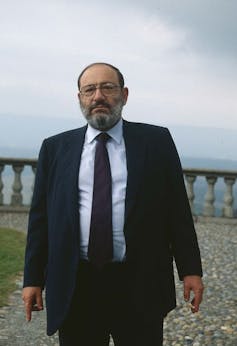
Italian philosopher, cultural critic and novelist Umberto Eco cautioned against overreacting to the impact of new technologies. Leonardo Cendamo/Getty Images
Back then, Eco was writing about the proliferation of TV and radio. Today, you’ll often see similar reactions to AI.
Yet Eco argued that both positions were too extreme. It isn’t helpful, he wrote, to see new media as either a dire threat or a miracle. Instead, he urged readers to look at how people and communities use these new tools, what risks and opportunities they create, and how they shape – and sometimes reinforce – power structures.
While I was teaching a course on deepfakes during the 2024 election, Eco’s lesson also came back to me. Those were days when some scholars and media outlets were regularly warning of an imminent “deepfake apocalypse.”
Would deepfakes be used to mimic major political figures and push targeted disinformation? What if, on the eve of an election, generative AI was used to mimic the voice of a candidate on a robocall telling voters to stay home?
For them, the core concerns are about authorship: How can one person compete with a system trained on millions of voices that can produce text at hyper-speed? And if this becomes the norm, what will it do to creative work, both as an occupation and as a source of meaning?
It’s important to clarify what’s meant by “online content,” the phrase used in the Graphite study, which analyzed over 65,000 randomly selected articles of at least 100 words on the web. These can include anything from peer-reviewed research to promotional copy for miracle supplements.
A closer reading of the Graphite study shows that the AI-generated articles consist largely of general-interest writing: news updates, how-to guides, lifestyle posts, reviews and product explainers.
The primary economic purpose of this content is to persuade or inform, not to express originality or creativity. Put differently, AI appears to be most useful when the writing in question is low-stakes and formulaic: the weekend-in-Rome listicle, the standard cover letter, the text produced to market a business.
A whole industry of writers – mostly freelance, including many translators – has relied on precisely this kind of work, producing blog posts, how-to material, search engine optimization text and social media copy. The rapid adoption of large language models has already displaced many of the gigs that once sustained them.
Collaborating with AI
The dramatic loss of this work points toward another issue raised by the Graphite study: the question of authenticity, not only in identifying who or what produced a text, but also in understanding the value that humans attach to creative activity.
How can you distinguish a human-written article from a machine-generated one? And does that ability even matter?
Over time, that distinction is likely to grow less significant, particularly as more writing emerges from interactions between humans and AI. A writer might draft a few lines, let an AI expand them and then reshape that output into the final text.
This article is no exception. As a non-native English speaker, I often rely on AI to refine my language before sending drafts to an editor. At times the system attempts to reshape what I mean. But once its stylistic tendencies become familiar, it becomes possible to avoid them and maintain a personal tone.
Also, artificial intelligence is not entirely artificial, since it is trained on human-made material. It’s worth noting that even before AI, human writing has never been entirely human, either. Every technology, from parchment and stylus paper to the typewriter and now AI, has shaped how people write and how readers make sense of it.
Another important point: AI models are increasingly trained on datasets that include not only human writing but also AI-generated and human–AI co-produced text.
But what happens when people become overly reliant on AI in their writing?
Some studies show that writers may feel more creative when they use artificial intelligence for brainstorming, yet the range of ideas often becomes narrower. This uniformity affects style as well: These systems tend to pull users toward similar patterns of wording, which reduces the differences that usually mark an individual voice. Researchers also note a shift toward Western – and especially English-speaking – norms in the writing of people from other cultures, raising concerns about a new form of AI colonialism.
In this context, texts that display originality, voice and stylistic intention are likely to become even more meaningful within the media landscape, and they may play a crucial role in training the next generations of models.
If you set aside the more apocalyptic scenarios and assume that AI will continue to advance – perhaps at a slower pace than in the recent past – it’s quite possible that thoughtful, original, human-generated writing will become even more valuable.
Put another way: The work of writers, journalists and intellectuals will not become superfluous simply because much of the web is no longer written by humans.
Francesco Agnellini does not work for, consult, own shares in or receive funding from any company or organization that would benefit from this article, and has disclosed no relevant affiliations beyond their academic appointment.