Who was Albert Luthuli? The murdered South African leader who put his people above himself

Source: The Conversation – Africa (2) – By Judith Coullie, Senior Research Associate, English Studies, University of KwaZulu-Natal

South African liberation leader Albert Luthuli died on 21 July 1967 near his home in Groutville, in the South African province of KwaZulu-Natal. A government inquest concluded his death was an accident – that he was hit by a train. This was always disputed by his family and almost 60 years later they were vindicated.

In 2025, a court ruled that Luthuli was murdered, his death the result of “assault by members of the security special branch of the South African police”. The ruling corrects long-standing historical records. It adds Luthuli’s murder to the catalogue of torture and assassination that the apartheid government increasingly relied on to suppress dissent.

Albert John Mvumbi Luthuli was born around 1898. He was an educator, Zulu chief, and religious leader. Africa’s first Nobel Peace Prize winner was also president-general of the African National Congress (ANC) from 1952 until his death at 69.

The ANC resisted white minority rule in South Africa and Luthuli was active in the organisation’s defiance campaign. He became head of the ANC in 1952, four years after apartheid was formalised.

In the last decades of his life, Luthuli was silenced and persecuted. Once democracy was achieved in 1994, honours were heaped on him – his image is the watermark on South African passports.

Still, Luthuli is largely overshadowed by fellow Peace Prize winners Nelson Mandela and Desmond Tutu. And while over 14 million copies of Mandela’s autobiography, Long Walk to Freedom, have been sold, Luthuli’s account of his own life, Let My People Go, is comparatively little known.

Much of my research on life writing has focused on autobiography published during apartheid, including analysis of Let My People Go.

It’s a book that deserves to be more widely read. It defies expectations that the autobiographer will offer a candidly personal account of self and life.

Luthuli’s autobiography mostly focuses on the struggle for justice. It depicts a steadfastly moral man whose fight against racist oppression inspired activists within and beyond South Africa, and should still.

Who was Albert Luthuli?

Let My People Go offers a brief sketch of Luthuli’s ancestors and early life. His grandparents were Zulu Christian converts. He was born, he calculated, “in the year 1898, and certainly before 1900” near Bulawayo, in today’s Zimbabwe. He was not born in his ancestral home, Groutville, because his father had left to serve in the Second Matabele War. After the conflict, his parents stayed on at a Seventh Day Adventist mission station.

His father died when Luthuli was a baby. At about 10, he was sent back to Groutville for his schooling. Qualifying as a teacher, he became principal of a small school. A government bursary allowed him to study further at Adams College, where he performed exceptionally well and was invited to join the staff and rose up the ranks. He met Nokukhanya Bhengu there and they married in 1927.

Luthuli loved teaching. However, in 1935, after prolonged urging from tribal elders, he and Nokukhanya decided he was duty-bound to accept nomination as chief of the Umvoti Mission Reserve.

For 17 years, he dedicated himself to improving the lot of the people of Groutville and providing principled leadership in confronting the injustices of racism. He took the “revolutionary step of admitting women” to local meetings. He organised African sugar farmers and held a seat on the Native Representatives Council. In 1938, he was a member of the executive of the Christian Council of South Africa.

In the years that followed he would remain deeply involved in Christian and civic organisations. In 1945 he was elected onto the executive of the ANC’s provincial branch, becoming president of it in 1951 and, in 1952, of the whole organisation.

An oval-framed vintage studio photo of a young African man in suit and tie, a middle path in his hair and a proud expression on his face/.
A young Luthuli.
Wikimedia Commons

Overseas travel widened Luthuli’s perspective, whether it was a missionary conference in India (1938) or a nine month church-sponsored lecture tour of the US (1948).

His autobiography recounts in detail his religious, civic and political involvement, weaving in a narrative of increasingly draconian and devastating apartheid policies.

Writing painstakingly and usually without emotion – though disgust and horror sometimes break through – he challenges the “twisted, distorted” versions of history promoted by the regime. He offers meticulous evidence of the irrationality and immorality of racism.

Banned

From 1953, repeated banning orders prevented Luthuli from leaving his home or publishing or distributing any written material. In 1956 he was arrested on a charge of high treason. (Discharged in 1957, he was acquitted in 1961.)

Despite this, Luthuli carried on with his autobiography, dictating his story to his friends Rev Charles Hooper and his wife Sheila Hooper. They compiled the draft which Luthuli then edited.

It was a foregone conclusion that Let My People Go would be banned and Luthuli knew it was unlikely to enlighten apartheid rulers:

There is not really even a common language in which to discuss our agonising problems. (They) cannot speak to Africans except in the restricted language of Baasskap.

The term refers to whites being boss, and anyone classified as non-white adopting a position of subservience.

Nonetheless, the narrator insists that:

If the whites are ignorant of the realities, the fault does not lie with us.

Autobiography of a selfless self

Readers of autobiography tend to look for insight into the author’s personal life, but Luthuli’s gives greater weight to political-historical analysis.

In the book, he repeatedly denies his own importance, reminding readers that much of what he experienced was shared by other oppressed South Africans. This is key to the depiction of his character in the book.

He only briefly mentions his family. He and Nokukhanya have seven children, but he doesn’t share their names and draws a “veil” over any details about their marriage.

Four statues stand against a backdrop of Table Mountain in Cape Town. They are slightly stylised.
From left, statues of Luthuli, Tutu, De Klerk and Mandela, peace prize winners.
flowcomm/Flickr, CC BY

Nokukhanya, he writes, “ungrudgingly” assumed full responsibility for their home and smallholding so that he could focus on his public duties. At Adams College, for example, he was also a choirmaster, soccer team administrator and Zulu cultural organiser, and served on an association for African teachers.

Under his leadership, the ANC became a mass organisation. Luthuli had to travel the country in support of the defiance campaign:

I quite literally neglect my family and feel extremely guilty about it.

Luthuli’s reserve is reinforced by his use of the passive voice. For instance, he describes being urged to take leadership roles, rather than seeking these himself.

Nonetheless, even in these apparent self-deflections, Luthuli’s character emerges: his centre of gravity does not lie in the domestic sphere but in service to the community. He is driven by his “desire to serve God and neighbour”.

By refusing the “self-assertion and self-display” that is typical of autobiography, Let My People Go portrays a selfless self.

The humility of a man who cannot be humiliated

Luthuli’s story depicts a humble man who refuses to yield, despite growing persecution. Or, as Charles Hooper observes in the introduction, the “humility of a man who cannot be humiliated”. Luthuli expresses gratitude when outrage might seem more reasonable. He describes his prison cell, when he was ill and isolated, as a prayerful “sanctuary”.

A leafy park with a realistic statue of a black man, dapper in a suit.
Statue of Luthuli in KwaZulu-Natal, where he was born.
J Ramatsui/Wikimedia Commons, CC BY-SA

Accounts of casual racism, police harassment and brutal assault are harrowing. Hard to read, too, is Luthuli’s self-recrimination. He reproaches himself for “having contributed too little” to the political struggle.

This reserve doesn’t obscure his character, it illuminates it. He emerges as a thoughtful, humble man committed to non-racism, non-violence and justice who even tries to understand Afrikaners’ fears of “being swamped”.

Farsighted, he predicted the rise of “terrorism (and) legalised murder by army and police forces”. Yet he retained faith that “the outcome of the struggle” would be justice for all.

After his release from prison, Luthuli, still banned, lived in isolation in Groutville. He was murdered before the banning order expired.

The Conversation

Judith Coullie does not receive funding from any organisation.

ref. Who was Albert Luthuli? The murdered South African leader who put his people above himself – https://theconversation.com/who-was-albert-luthuli-the-murdered-south-african-leader-who-put-his-people-above-himself-269729

Face à la fonte des glaces de l’Antarctique, le niveau de la mer n’augmente pas au même rythme partout

Source: The Conversation – France (in French) – By Shaina Sadai, Associate in Earth Science, Five College Consortium

Si les mers et les océans fonctionnaient comme une immense baignoire, l’eau s’élèverait partout de la même façon. Ce n’est pas ce qui se passe. La fonte des glaces en Antarctique, influencée par le réchauffement climatique, entraîne une élévation inégale du niveau de la mer, notamment du fait de la gravité et du rôle du manteau terrestre.


Quand les calottes polaires fondent, les effets se répercutent dans le monde entier. La fonte de la glace élève le niveau moyen des mers, modifie les courants océaniques et affecte les températures dans des régions très éloignées des pôles. Mais cette fonte n’influence pas le niveau de la mer et les températures de la même manière partout.

Dans une nouvelle étude, notre équipe de scientifiques a examiné comment la fonte des glaces en Antarctique affecte le climat mondial et le niveau de la mer. Nous avons combiné des modèles informatiques de la calotte glaciaire antarctique, de la Terre et du climat global, incluant les processus atmosphériques et océaniques, afin d’explorer les interactions complexes entre la glace en train de fondre et les autres composantes de la Terre.

Comprendre ce qui arrive à la glace de l’Antarctique est essentiel, car elle contient suffisamment d’eau gelée pour élever le niveau moyen des mers d’environ 58 mètres. Lorsque cette glace fond, cela devient un problème existentiel pour les populations et les écosystèmes des communautés insulaires et littorales.

Changements en Antarctique

L’ampleur de la fonte de la calotte glaciaire antarctique dépendra de l’importance du réchauffement de la planète. Réchauffement qui dépend des futures émissions de gaz à effet de serre provenant notamment des véhicules, des centrales électriques et des industries. Des études suggèrent qu’une grande partie de la calotte glaciaire antarctique pourrait subsister si les pays réduisent leurs émissions de gaz à effet de serre conformément à l’objectif de l’accord de Paris de 2015 visant à limiter le réchauffement planétaire à 1,5 °C par rapport à l’ère préindustrielle. Cependant, si les émissions continuent d’augmenter et que l’atmosphère et les océans se réchauffent beaucoup plus, cela pourrait provoquer une fonte importante et des niveaux marins bien plus élevés.

Nos recherches montrent que les fortes émissions présentent des risques non seulement pour la stabilité de la calotte glaciaire de l’Antarctique occidental, qui contribue déjà à l’élévation du niveau de la mer, mais aussi pour la calotte glaciaire de l’Antarctique oriental, beaucoup plus vaste et plus stable. Elles montrent aussi que les régions du monde connaîtront des niveaux différents de montée des eaux à mesure que l’Antarctique fond.

Comprendre l’évolution du niveau de la mer

Si les mers se comportaient comme l’eau dans une baignoire, alors le niveau de l’océan s’élèverait de la même manière partout. Mais ce n’est pas ce qui se passe. Au contraire, de nombreux endroits enregistrent une élévation du niveau de la mer supérieure à la moyenne mondiale, tandis que les zones proches de la calotte glaciaire peuvent même voir le niveau de la mer baisser. La raison principale tient à la gravité.

Les calottes glaciaires sont énormes, et cette masse exerce une forte attraction gravitationnelle qui attire l’eau océanique environnante vers elles, de manière similaire à la façon dont l’attraction gravitationnelle entre la Terre et la Lune influence les marées.

À mesure que la calotte glaciaire diminue, son attraction gravitationnelle sur l’océan diminue, ce qui entraîne une baisse du niveau de la mer dans les régions proches des banquises et une hausse dans les régions plus éloignées. Mais les variations du niveau de la mer ne dépendent pas uniquement de la distance à la calotte glaciaire en train de fondre. Cette perte de glace modifie également la rotation de la planète. L’axe de rotation est attiré vers cette masse de glace disparue, ce qui redistribue à son tour l’eau autour du globe.

Deux facteurs qui peuvent ralentir la fonte

À mesure que la massive calotte glaciaire fond, le manteau terrestre situé en dessous se soulève. Sous le socle rocheux de l’Antarctique se trouve ce manteau, qui s’écoule lentement, un peu comme du sirop d’érable. Plus la calotte glaciaire fond, moins elle exerce de pression sur la Terre solide. Avec ce poids réduit, le socle rocheux peut se soulever. Cela peut éloigner certaines parties de la calotte glaciaire des eaux océaniques réchauffées, ralentissant ainsi le rythme de la fonte. Ce phénomène est plus rapide dans les régions où le manteau s’écoule plus vite, comme sous la calotte glaciaire de l’Antarctique occidental. Cet effet de rebond pourrait contribuer à préserver la calotte glaciaire – à condition que les émissions mondiales de gaz à effet de serre restent faibles.

Un autre facteur susceptible de ralentir la fonte peut sembler contre-intuitif.

Alors que l’eau de fonte antarctique contribue à l’élévation du niveau de la mer, les modèles montrent qu’elle retarde également le réchauffement induit par les gaz à effet de serre. En effet, l’eau glacée provenant de l’Antarctique réduit la température de surface des océans dans l’hémisphère Sud et le Pacifique tropical, emprisonnant la chaleur dans les profondeurs et ralentissant l’augmentation de la température moyenne globale de l’air.

Mais même si la fonte ralentit, le niveau de la mer continue d’augmenter.

Cartographie de nos résultats sur le niveau de la mer

Nous avons combiné des modèles informatiques simulant ces comportements et d’autres caractéristiques de la calotte glaciaire antarctique, du manteau terrestre et du climat pour comprendre ce qui pourrait arriver au niveau de la mer dans le monde à mesure que les températures globales augmentent et que la glace fond.

Par exemple, dans un scénario modéré où le monde réduit ses émissions de gaz à effet de serre, mais pas suffisamment pour maintenir le réchauffement global en dessous de 2 °C d’ici à 2100, nous avons constaté que l’élévation moyenne du niveau de la mer due à la fonte de la glace antarctique serait d’environ dix centimètres d’ici à 2100. En 2200, elle dépasserait un mètre.

Il faut garder à l’esprit qu’il ne s’agit ici que de l’élévation du niveau de la mer causée par la fonte de l’Antarctique. La calotte glaciaire du Groenland et l’expansion thermique de l’eau de mer due au réchauffement des océans contribueront également à l’élévation du niveau de la mer. Les estimations actuelles suggèrent qu’au total, l’élévation moyenne du niveau de la mer – incluant le Groenland et l’expansion thermique – serait comprise entre 30 centimètres et 60 centimètres d’ici à 2100 dans le même scénario.

Deux cartes de la Terre montrant des niveaux de hausse du niveau de la mer différents
Les modèles indiquent la contribution de l’Antarctique à l’élévation du niveau de la mer en 2200, selon un scénario d’émissions moyen (en haut) et élevé (en bas). L’élévation moyenne mondiale du niveau de la mer est en violet. Les zones où le niveau de la mer dépasse la moyenne régionale apparaissent en bleu foncé.
Sadai et coll., 2025

Nous montrons également comment l’élévation du niveau de la mer due à l’Antarctique varie à travers le monde. Dans le scénario d’émissions modérées, nous avons ainsi constaté que la hausse la plus importante du niveau de la mer provenant uniquement de la fonte des glaces antarctiques, jusqu’à 1,5 m d’ici à 2200, se produit dans les bassins océaniques Indien, Pacifique et Atlantique occidental – des régions éloignées de l’Antarctique.

Ces régions abritent de nombreuses populations vivant dans des zones côtières basses, notamment les habitants des îles des Caraïbes, comme la Jamaïque, et du Pacifique central, comme les îles Marshall, qui subissent déjà des impacts néfastes liés à la montée des mers.

Dans un scénario d’émissions élevées, nous avons constaté que l’élévation moyenne du niveau de la mer due à la fonte de l’Antarctique serait beaucoup plus importante : environ 30 centimètres en 2100 et près de 3 mètres en 2200.

Dans ce scénario, une large partie du bassin Pacifique au nord de l’équateur, incluant la Micronésie et Palau, ainsi que le centre du bassin Atlantique, connaîtrait la plus forte élévation du niveau de la mer, jusqu’à 4,3 m d’ici à 2200, uniquement en raison de l’Antarctique.

Bien que ces chiffres puissent sembler alarmants, les émissions actuelles et les projections récentes indiquent que ce scénario d’émissions très élevées est peu probable. Cet exercice montre néanmoins les conséquences graves de fortes émissions et souligne l’importance de les réduire.

Nos conclusions

Ces impacts ont des répercussions sur la justice climatique, en particulier pour les nations insulaires qui ont peu contribué au changement climatique mais subissent déjà les effets dévastateurs de l’élévation du niveau de la mer.

De nombreux États insulaires perdent déjà des terres à cause de la montée des eaux et ont été à l’avant-garde des efforts mondiaux pour limiter le réchauffement. Protéger ces pays et d’autres zones côtières nécessitera de réduire les émissions de gaz à effet de serre plus rapidement que ce à quoi les nations s’engagent aujourd’hui.

The Conversation

Shaina Sadai a reçu des financements de la National Science Foundation et de la Hitz Family Foundation.

Ambarish Karmalkar a reçu des financements de la National Science Foundation.

ref. Face à la fonte des glaces de l’Antarctique, le niveau de la mer n’augmente pas au même rythme partout – https://theconversation.com/face-a-la-fonte-des-glaces-de-lantarctique-le-niveau-de-la-mer-naugmente-pas-au-meme-rythme-partout-270991

Le président de la République, l’ingénieur de Stellantis et les 19 000 euros

Source: The Conversation – France (in French) – By Elise Penalva-Icher, Professeure des universités en sociologie, Université Paris Dauphine – PSL

Ces dernières semaines, l’ancien PDG de Stellantis, Carlos Tavares, a eu une forte présence médiatique à l’occasion de la promotion de son livre. Une de ses déclarations a fortement fait réagir. Selon lui, le président de la République gagnerait autant qu’un ingénieur de Stellantis, soit 19 000 euros par mois. Cela est faux. Mais au-delà du fact checking, quelle analyse pouvons-nous proposer de cette déclaration et plus largement du rapport des dirigeants aux rémunérations ?


En cet automne 2025, Carlos Tavares, ancien PDG de Stellantis à la réputation de cost killer, est en pleine promotion de son livre autobiographique, Un pilote dans la tempête (Plon). À l’écouter, ces confessions ne relèvent guère d’un exercice d’autocritique, mais plutôt d’une réhabilitation de sa personne et de son action à la tête d’un groupe pourtant aujourd’hui dans la tourmente boursière, et, confronté au scandale des airbags défectueux.

Carlos Tavares souhaite livrer sa vérité, « son éthique » comme il le dit lui-même. Il s’agit d’une belle occasion de comprendre sa rationalité en tant qu’acteur économique. Et disons-le sans suspense, celle de l’ancien PDG appartient à la catégorie de la rationalité en finalité, qui repose sur un calcul coût-bénéfice effectué dans le cadre d’une relation marchande contractuelle.

Dans son discours, on ne trouve pas de valeur ou de sens – hors du marché. Au mieux, tolère-t-il de rester dans un cadre légal, quand il répond aux journalistes que si ses rémunérations choquent, le Parlement n’a qu’à voter une nouvelle loi pour les encadrer. Mais de quoi parle-t-il et pourquoi la question de ses émoluments, comme ceux de ses comparses, déborde sa personne et peut être analysée comme un sujet central dans nos sociétés ?

Un ingénieur payé 19 000 euros. Vraiment ?

Rappelons d’abord les faits. Carlos Tavares a affirmé qu’avec environ 19 000 euros brut par mois, le salaire d’Emmanuel Macron équivalait « à peu près, [au] salaire d’un bon ingénieur de Stellantis avec entre cinq et dix ans d’expérience ».

Est-ce vrai ? Aujourd’hui, les exercices de debunkage de fake news sont bien rodés. Assez rapidement, ce chiffre a été mis en cause par de nombreux articles du Figaro à BFM en passant par la Revue automobile.


À lire aussi :
Les écarts de salaires stimulent-ils vraiment les individus au travail ?


Les syndicats de Stellantis ont également rétabli les faits. Un communiqué du syndicat des cadres CFE-CGC dénonce des propos « totalement erronés », et précise :

« Le salaire moyen d’un ingénieur chez Stellantis, avec cinq à dix ans d’expérience, se situe entre 4 000 et 6 000 euros brut par mois, primes comprises, selon les données internes fiables de l’entreprise. »

Cela peut heurter qu’un PDG méconnaisse autant l’échelle de rémunération de son entreprise, le conduisant à une représentation de la stratification sociale totalement biaisée, surtout quand sa propre rémunération fait débat. Et ce n’est pas un quidam qui le dit, mais un investisseur : Allianz Global Investors a voté contre les 23 millions de rémunérations proposés au vote des actionnaires réunis lors de l’assemblée générale du groupe en avril 2025.

Des rémunérations de plus en plus complexes

On relèvera également que son bonus de départ de 10 millions n’a pas été versé, contrairement à d’autres dispositifs de rémunérations variables. Cela révèle à quel point, aujourd’hui, les rémunérations sont devenues complexes et individualisées, composées d’un salaire fixe, mais aussi de bonus, de participation, d’intéressement… Trop hétérogènes pour être circonscrites uniquement à la contrepartie du contrat de travail, elles débordent de la fiche de paie et témoignent de l’inscription du salarié dans le collectif que constitue son entreprise. Elles sont le signe d’un contrat social.

Et c’est pourquoi ces sommes peuvent choquer, quand elles deviennent si inexactes, comme dans le cas de l’ingénieur Stellantis, ou astronomiques pour celles des PDG. Pas tant pour leur non-véracité, mais surtout parce qu’elles révèlent le désajustement de Carlos Tavares à sa propre entreprise et à son contrat social.

Un entre-soi dangereux

Et Carlos Tavares n’est pas le premier PDG à buter sur la question de ses rémunérations. Avant lui, toujours dans le secteur automobile, Carlos Ghosn avait connu de premiers déboires quand sa rémunération n’avait pas été votée en assemblée générale d’actionnaires lors de la première année d’application de la loi Sapin 2. Heureusement pour lui, à l’époque, ce vote n’avait qu’une valeur consultative.

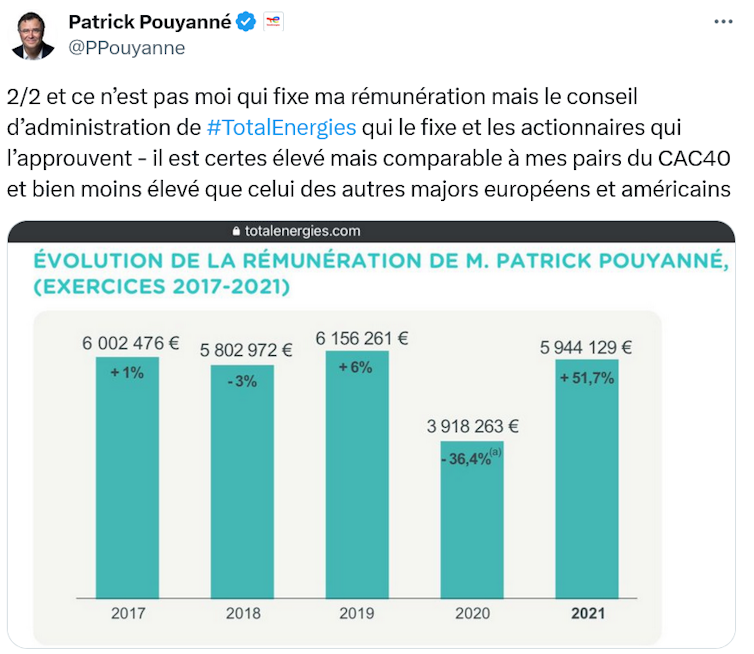
Rappelons aussi que Patrick Pouyanné, PDG de TotalÉnergies, a vécu un bad buzz lorsqu’il a communiqué à propos de sa rémunération sur les réseaux sociaux, qui en réaction s’étaient enflammés pour critiquer les écarts stratosphériques entre ses émoluments et le salaire moyen dans son entreprise. Il avait alors tenté une défense en se comparant à ses pairs des grands groupes pétroliers mondiaux, révélant être le moins bien rémunéré d’entre eux.

Capture d’écran du compte X de Patrick Pouyanné


Twitter

« In or out »

On relève ici un contraste. L’opinion publique comme la loi, qui oblige aujourd’hui à communiquer des indicateurs d’écarts de salaires, posent les termes de la comparaison à l’intérieur de l’entreprise. Nos PDG, eux, en sortent pour s’inscrire dans une petite élite mondialisée. Ces justifications témoignent d’une position des PDG évoluant partiellement hors de l’entreprise qui pourtant les mandate. Est-ce un signe supplémentaire de la rupture du contrat social ?

Un autre argument apporté par Carlos Tavares pour justifier sa rémunération repose sur les risques encourus par les patrons, un discours dans la filiation de la figure de l’entrepreneur. L’argument peut être questionné, car pourquoi, pendant le Covid, la prise de risque effective des salariés de première ligne a-t-elle été récompensée par une faible prime ? La prise de risque, certes non financier mais qui n’en est pas moins important dans le cas du Covid, n’est pas rémunérée de la même façon selon la position.

LCI 2025.

Si le risque n’est plus l’apanage des entrepreneurs, quelle justification apporter pour faire accepter de tels écarts ? Car sans un consensus sur le sens à donner aux écarts salariaux, ils deviennent des inégalités… et les inégalités peuvent devenir des injustices et des sources de révolte.

Quelle est la situation générale en France ? L’échelle de l’Observatoire des inégalités nous précise que le niveau de vie médian est à 2 147 euros. Le rapport d’Oxfam note que le PDG de Téléperformance gagne 1 484 fois plus que le salaire moyen de son entreprise.

Ces montants offrent un ordre de grandeur et posent la question de comment faire tenir ensemble des salariés dans un collectif où les écarts seraient si importants qu’ils dépasseraient les limites de l’entendement. Cela tient au sens qui manque au discours de notre ancien PDG pour à la fois devenir socialement acceptable, voire responsable, mais surtout emporter l’adhésion des salariés comme de ses actionnaires. Peut-on faire corps avec une échelle de mesure si dilatée ?

The Conversation

Elise Penalva-Icher a reçu des financements du département recherches et études de l’APEC (rapport paru en 2016) et de l’ANR : projet ProVirCap sur les professionnel.les du capitalisme vertueux https://provircap.hypotheses.org/

ref. Le président de la République, l’ingénieur de Stellantis et les 19 000 euros – https://theconversation.com/le-president-de-la-republique-lingenieur-de-stellantis-et-les-19-000-euros-270305

AFM-Téléthon : comment les patients et leur proches ont révolutionné la recherche médicale

Source: The Conversation – in French – By Marie-Georges Fayn, Chercheuse associée, Université de Tours

Le Téléthon 2025 se tiendra les 5 et 6 décembre 2025. Née grâce à la détermination de parents d’enfants atteints de myopathie, l’association a su transformer l’épreuve de la maladie en une force génératrice d’entraide, de progrès scientifique et d’innovation sociale. Retour sur les raisons de ce succès, à la lumière des théories de l’empowerment.


Lorsqu’est créée, en 1958, l’Association française pour la myopathie (AFM), scientifiques et médecins n’ont que très peu de connaissances sur la maladie. Soutenue par une poignée de parents de patients, sa fondatrice Yolaine de Kepper, elle-même mère de quatre enfants atteints de myopathie de Duchenne, n’accepte pas la fatalité.

Elle décide de fonder une structure pour faire connaître (et reconnaître) cette maladie, avec l’ambition de parvenir un jour à guérir les malades, dont la majorité mourait avant d’atteindre l’âge adulte. Les statuts initialement enregistrés au Journal officiel précisaient alors que l’objet de l’AFM était « [le] recensement des myopathes en France et en Belgique, [l’]obtention pour les malades atteints de myopathie des avantages du régime “longue durée” ; [la] création d’un centre spécialisé social et médical ».

Un peu moins de soixante-dix ans plus tard, devenue Association française contre les myopathies puis AFM-Téléthon, cette structure est un actrice incontournable de la recherche biomédicale, dont l’influence et l’expertise s’étendent bien au-delà de son périmètre initial.

L’analyse croisée des rapports institutionnels de l’association ainsi que de publications scientifiques ou issues de la société civile permet de mieux comprendre comment ce succès s’est construit, grâce à l’empowerment collectif.

De la révolte des familles à la naissance d’un mouvement

Sur son site Internet,l’AFM-Téléthon revendique un réseau de 68 délégations s’appuyant sur plus de 850 bénévoles afin d’accompagner quotidiennement les malades et leurs proches.

Le refus de la fatalité, la solidarité, la quête de solutions sont les valeurs fondatrices de ce collectif. En devenant membres de l’AFM, les parents sortent de leur isolement, s’entraident et mutualisent leurs expériences. Au fil du temps les réunions informelles se sont structurées ; l’association dispose aujourd’hui d’importants moyens d’accueil et d’information : groupes de paroles, lignes d’écoute, forums…

Le rapprochement de familles confrontées aux mêmes maux a permis de faire émerger une prise de conscience, une identité partagée, des liens de solidarité, un savoir et un pouvoir collectifs offrant une illustration concrète de l’empowerment communautaire. Ce terme d’empowerment est difficile à traduire en français, car il n’existe pas réellement d’équivalent capable de restituer à la fois sa dimension individuelle et sa dynamique collective, évolutive et transformative (même si des essais ont été tentés, tels qu’« empouvoirement », « pouvoir d’agir » ou « encapacitation », notamment).

Quand les patients deviennent partenaires de la recherche

Au début des années 1980, l’AFM réalise qu’aider ne suffit pas : il faut chercher à guérir. En 1981, elle crée son premier conseil scientifique, posant les bases d’une alliance entre familles, chercheurs et médecins. En 1982, sous la présidence de Bernard Barataud, elle adopte une devise ambitieuse, « Refuser, résister, guérir ».

Mais pour atteindre cet objectif, l’association a besoin d’argent, de beaucoup d’argent. En 1987, inspirée par le Jerry Lewis Show, l’AFM lance le Téléthon avec France 2. Un marathon de trente heures d’émission en direct qui mobilisent tout un pays : 180 millions de francs (soit l’équivalent de 27 millions d’euros) sont collectés dès la première édition. C’est un tournant historique – la société civile devient co-actrice de la recherche médicale.

L’association investit dans des laboratoires et des instituts (voir tableau plus bas) et les découvertes scientifiques majeures s’enchaînent :

Dans son rapport annuel et financier 2024, l’association revendique plus de 40 essais cliniques en cours ou en préparation pour 33 maladies différentes (muscle, peau, cœur, vision, foie…).

Ce contexte a permis à Laurence Tiennot-Herment, présidente de l’AFM, de déclarer lors du Téléthon 2024 :

« Aujourd’hui, nous avons des résultats concrets. C’est une révolution médicale collective. »

L’accompagnement au plus près des familles

Parallèlement au progrès scientifique, l’association poursuit sa mobilisation en faveur du soutien aux malades dans leur vie quotidienne en concevant un maillage au plus près des familles. L’AFM-Téléthon se prévaut de 120 référents parcours de santé qui interviennent non seulement à domicile, mais aussi à l’école et en entreprise, afin d’accompagner chaque étape du parcours de vie : diagnostic, scolarisation, emploi, démarches administratives.

Vecteurs d’empowerment individuel, ces professionnels favorisent l’expression des besoins, la prise d’autonomie et la construction de projets de vie adaptés à chaque situation. Leur accompagnement sur mesure aide les personnes à faire valoir leurs droits, à renforcer leur capacité d’agir et à devenir acteurs de leur parcours.

Ces dispositifs placent les personnes concernées au cœur des décisions qui les affectent. Des groupes d’intérêt par pathologie sont aussi constitués (Myopathies de Duchenne et de Becker, Amyotrophies spinales, Myasthénie, Dystrophie myotonique de Steinert, Dystrophie facio-scapulo-humérale, Maladies neuromusculaires non diagnostiquées, Myopathies inflammatoires, Myopathies des ceintures). Ils réunissent des personnes ayant développé une expertise approfondie de leur maladie. Ensemble, ils mobilisent leur intelligence collective pour co-produire des connaissances et développer les filières de santé ainsi que la recherche.

Mobilisant son énergie et ses ressources autour de deux stratégies complémentaires, l’AFM-Téléthon inscrit donc ses actions dans un empowerment collaboratif d’envergure : un axe scientifique, associant les familles à la production de connaissances fondamentales et au développement de programmes expérimentaux, et un axe social, fondé sur l’accompagnent à l’autonomie avec la co-conception de services (ouverture d’une ligne téléphonique « accueil familles » – 0 800 35 36 37 – accessible 7 jours sur 7 et 24 heures sur 24, création de lieux de répit) et de dispositifs de soutien en proximité (visites à domicile par les référents de parcours santé cités précédemment, cellule d’aide psychologique durant la pandémie).

De la science à la société

L’AFM-Téléthon porte une vision ambitieuse et volontariste de la santé. Ses plaidoyers inspirent les plans nationaux sur les maladies rares et promeuvent une recherche simplifiée, mieux financée et tournée vers l’innovation.

Ainsi, le programme de dépistage néonatal comprend désormais celui de l’amyotrophie spinale infantile (SMA) chez les nouveau-nés. Il s’agit d’une extension nationale du projet Depisma porté par l’AFM-Téléthon (le projet Depisma, projet-pilote de dépistage génétique à la naissance a été déployé par l’AFM-Téléthon dans les régions Nouvelle-Aquitaine et Grand-Est ; lancé en janvier 2023, il a permis de dépister la maladie sur quatre bébés et de la traiter).

Mais son influence dépasse largement le champ sanitaire : ses trente heures d’antenne et les milliers d’événements organisés dans plus de 15 000 communes ne sont pas seulement des temps de collecte : ils constituent un levier de transformation sociale. En offrant une tribune aux malades et à leurs proches, l’association a rendu visibles celles et ceux que la société tenait à distance.

L’association s’inscrit dans une tradition d’action axée sur la solidarité, l’accompagnement des familles et le soutien à la recherche, écartant toute prise de position partisane. Cette orientation stratégique lui permet de concentrer ses ressources sur son obligation de résultat (sauver la vie des enfants).

Par ailleurs, elle met son expertise scientifique et organisationnelle au service d’autres associations, notamment pour le développement de biomarqueurs, la structuration des filières ou la réponse à des appels d’offres. L’exemple de l’AFM-Téléthon illustre la manière dont un acteur majeur peut contribuer à renforcer un empowerment collectif, sans nécessairement investir le registre politique au sens strict comme ont choisi de le faire d’autres mouvements.


L’empowerment des patients. La révolution douce en santé, Presses de l’EHESP, octobre 2025.
DR

Pour approfondir :

The Conversation

Marie-Georges Fayn ne travaille pas, ne conseille pas, ne possède pas de parts, ne reçoit pas de fonds d’une organisation qui pourrait tirer profit de cet article, et n’a déclaré aucune autre affiliation que son organisme de recherche.

ref. AFM-Téléthon : comment les patients et leur proches ont révolutionné la recherche médicale – https://theconversation.com/afm-telethon-comment-les-patients-et-leur-proches-ont-revolutionne-la-recherche-medicale-268463

Fabriquer du cartilage humain… à partir de pommes

Source: The Conversation – in French – By Karim Boumédiene, Professeur de biochimie et biologie moléculaire, ingénierie tissulaire, Université de Caen Normandie

Aussi surprenant que cela puisse paraître, on peut se servir de pommes pour fabriquer du cartilage humain en laboratoire. Priscilla Du Preez/Unsplash, CC BY

Certaines pathologies induisent une perte de tissus comme du cartilage. Il y a donc un réel besoin de greffons. Et si la solution était de cultiver ce cartilage en laboratoire, à partir des propres cellules du patient (et en se servant de pommes) ?


Le laboratoire Bioconnect de l’Université de Caen Normandie, que je dirige avec le Pr Catherine Baugé, vient de publier un article dans la revue de référence Journal of Biological Engineering. Dans cette étude, nous avons utilisé des pommes décellularisées comme biomatériau, combinées avec des cellules souches humaines pour reconstruire du cartilage in vitro (c’est-à-dire dans des boîtes de culture).

Cette approche de confection de tissus fait partie d’une discipline appelée l’ingénierie tissulaire. Elle vise à reconstruire des tissus humains en laboratoire dans le but de les utiliser comme des greffons pour combler des pertes tissulaires.

Cela consiste à implanter des cellules du patient dans des biomatériaux et à incuber l’ensemble dans des conditions adéquates pour former les tissus désirés, tels que l’os, le muscle ou le cartilage par exemple.

De nombreuses pathologies ou traumatismes induisent une altération ou perte des tissus nécessitant une reconstruction. Cela concerne des maladies dégénératives, dans lesquelles les tissus finissent par disparaître (arthrose pour la cartilage, ostéoporose pour l’os par exemple). Il y a donc un besoin important de greffons. Cependant, obtenir des tissus sains implantables est un véritable challenge pour les chirurgiens, devant la rareté ou la compatibilité des donneurs.

Afin de s’en affranchir, l’ingénierie tissulaire se révèle être une stratégie efficace. De plus, lorsque c’est possible, les propres cellules du patient sont ensemencées sur le biomatériau pour reconstruire le tissu endommagé, ce qui évite les risques de rejet immunologique.

La pomme est un excellent échafaudage

Si les chercheurs sont capables de multiplier facilement des cellules en laboratoire dans des boîtes de culture, elles ne s’organisent pas spontanément pour former des tissus et il est nécessaire de les combiner à des biomatériaux. Ces derniers sont utilisés pour jouer le rôle de support et d’échafaudage aux cellules, afin de leur permettre de former un tissu sous forme de volume et, ainsi, faciliter la reconstruction tissulaire.

Il est notamment possible d’utiliser directement des tissus ou organes humains après les avoir « décellularisés », c’est-à-dire débarrassés de leurs cellules. La structure résultante peut alors être ensemencée avec d’autres cellules, généralement saines. Cette stratégie a cependant une limite importante puisqu’il faut disposer de suffisamment de tissus au départ. Depuis une dizaine d’années, des tissus végétaux décellularisés peuvent servir de support pour la reconstruction.

Protocole de préparation des tissus cartilagineux à partir de cellules souches et de pommes décellularisées.
Fourni par l’auteur

Plusieurs approches ont déjà été réalisées dans notre laboratoire ainsi que d’autres, avec plusieurs types de biomatériaux, mais ici, c’est une première mondiale de reconstruction de cartilage avec un support végétal.

L’idée a émergé il y a quelques années, à la suite de la parution d’un article scientifique d’une équipe canadienne qui a montré que la pomme décellularisée était compatible avec la culture de cellules de mammifères. Aussitôt, nous avons pensé à l’appliquer pour construire du cartilage dont nous sommes spécialistes. Il y a plusieurs avantages à l’utilisation de tels supports issus du règne végétal : disponibilité quasi illimitée, prix très faible, biocompatibilité déjà validée in vivo, possibilité de sculpter le matériau à volonté pour épouser la forme du tissu désiré.

De multiples idées d’applications

Il s’agit là d’un premier pas dans l’utilisation des tissus provenant des plantes pour la reconstruction de tissus humains, même si cela doit être validé par des expériences supplémentaires, d’abord précliniques sur l’animal puis cliniques sur l’humain, pour évaluer le comportement de ces tissus sur le long terme et le bénéfice pour les patients. Les applications pourraient être nombreuses : réparation du cartilage articulaire (après microtraumatismes ou arthrose), reconstruction du cartilage nasal (après un traumatisme, un cancer), ou même auriculaire.

Ainsi, notre étude représente une ouverture importante dans le domaine de l’ingénierie tissulaire pour confectionner des greffons pour la chirurgie reconstructrice, mais également pour limiter le recours aux animaux d’expérimentation. En effet, les tissus ainsi construits en laboratoire peuvent aussi avantageusement être employés pour modéliser plus efficacement les maladies in vitro et tester des traitements dans des modèles dits « organoïdes », permettant ainsi de réduire voire de remplacer les tests in vivo et, par là même, diminuer le recours à l’utilisation de l’expérimentation animale.

Enfin, compte tenu de la très grande diversité dans le règne végétal, il reste aussi à explorer cet énorme potentiel pour notamment déterminer quelle plante (ou quelle partie de plante) pourrait convenir le mieux à la reconstruction de tel ou tel tissu. D’autres végétaux sont d’ores et déjà en cours d’investigation, comme le céleri par exemple.

The Conversation

Karim Boumédiene a reçu des financements de la Fondation des gueules cassées, de la Région Normandie et de l’Université de Caen Normandie.

ref. Fabriquer du cartilage humain… à partir de pommes – https://theconversation.com/fabriquer-du-cartilage-humain-a-partir-de-pommes-267914

The housing crisis is forcing Americans to choose between affordability and safety

Source: The Conversation – USA (2) – By Ivis García, Associate Professor of Landscape Architecture and Urban Planning, Texas A&M University

Picture this: You’re looking to buy a place to live, and you have two options.

Option A is a beautiful home in California near good schools and job opportunities. But it goes for nearly a million dollars – the median California home sells for US$906,500 – and you’d be paying a mortgage that’s risen 82% since January 2020.

Option B is a similar home in Texas, where the median home costs less than half as much: just $353,700. The catch? Option B sits in an area with significant hurricane and flood risk.

As a professor of urban planning, I know this isn’t just a hypothetical scenario. It’s the impossible choice millions of Americans face every day as the U.S. housing crisis collides with climate change. And we’re not handling it well.

The numbers tell the story

The migration patterns are stark. Take California, which lost 239,575 residents in 2024 – the largest out-migration of any state. High housing costs are a primary driver: The median home price in California is more than double the national median.

Where are these displaced residents going? Many are heading to southern and western states like Florida and Texas. Texas, which is the top destination for former California residents, saw a net gain of 85,267 people in 2024, much of it from domestic migration. These newcomers are drawn primarily by more affordable housing markets.

Housing costs are the main driver of the California exodus, the Los Angeles Times notes.

This isn’t simply people chasing lower taxes. It’s a housing affordability crisis in motion. The annual household income needed to qualify for a mortgage on a mid-tier California home was about $237,000 in June 2025, a recent analysis found – over twice the state’s median household income.

Over 21 million renter households nationwide spent more than 30% of their income on housing costs in 2023, according to the U.S. Census Bureau. For them and others struggling to get by, the financial math is simple, even if the risk calculation isn’t.

I find this troubling. In essence, the U.S. is creating a system where your income determines your exposure to climate disasters. When housing becomes unaffordable in safer areas, the only available and affordable property is often in riskier locations – low-lying areas at flood risk in Houston and coastal Texas, or higher-wildfire-risk areas as California cities expand into fire-prone foothills and canyons.

Climate risk becomes part of the equation

The destinations drawing newcomers aren’t exactly safe havens. Research shows that America’s high-fire-risk counties saw 63,365 more people move in than out in 2023, much of that flowing to Texas. Meanwhile, my own research and other studies of post-disaster recovery have shown how the most vulnerable communities – low-income residents, people of color, renters – face the greatest barriers to rebuilding after disasters strike.

Consider the insurance crisis brewing in these destination states. Dozens of insurers in Florida, Louisiana, Texas and beyond have collapsed in recent years, unable to sustain the mounting claims from increasingly frequent and severe disasters like wildfires and hurricanes. Economists Benjamin Keys and Philip Mulder, who study climate change impacts on real estate, describe the insurance markets in some high-risk areas as “broken”. Between 2018 and 2023, insurers canceled nearly 2 million homeowner policies nationwide – four times the historically typical rate.

Yet people keep moving into risky areas. For example, recent research shows that people have been moving toward areas most at risk of wildfires, even holding wealth and other factors constant. The wild beauty of fire-prone areas may be part of the attraction, but so is housing availability and cost.

The policy failures behind the false choice

In my view, this isn’t really about individual choice – it’s about policy failure. The state of California aims to build 2.5 million new homes by 2030, which would require adding more than 350,000 units annually. Yet in 2024, the state only added about 100,000 – falling dramatically short of what’s needed. When local governments restrict housing development through exclusionary zoning, they’re effectively pricing out working families and pushing them toward risk.

My research on disaster recovery has consistently shown how housing policies intersect with climate vulnerability. Communities with limited housing options before disasters become even more constrained afterward. People can’t “choose” resilience if resilient places won’t let them build affordable housing.

The federal government started recognizing this connection – to an extent. For example, in 2023, the Federal Emergency Management Agency encouraged communities to consider “social vulnerability” in disaster planning, in addition to things like geographic risk. Social vulnerability refers to socioeconomic factors like poverty, lack of transportation or language barriers that make it harder for communities to deal with disasters.

However, the agency more recently stepped back from that move – just as the 2025 hurricane season began.

In my view, when a society forces people to choose between paying for housing and staying safe, that society has failed. Housing should be a right, not a risk calculation.

But until decision-makers address the underlying policies that create housing scarcity in safe areas and fail to protect people in vulnerable ones, climate change will continue to reshape who gets to live where – and who gets left behind when the next disaster strikes.

The Conversation

Dr. Ivis García has received funding from the National Science Foundation; the U.S. Department of Housing and Urban Development; the U.S. Department of Transportation’s National Institute for Transportation and Communities; the Centers for Disease Control and Prevention; the Environmental Protection Agency; the National Academies of Sciences, Engineering and Medicine; JPB Foundation; Ford Foundation, Pritzker Traubert Foundation; Chicago Community Trust, SBAN, Texas Appleseed, Fundación Comunitaria de Puerto Rico, Urban Institute & UNIDOS, and Natural Hazards Center.

ref. The housing crisis is forcing Americans to choose between affordability and safety – https://theconversation.com/the-housing-crisis-is-forcing-americans-to-choose-between-affordability-and-safety-266136

Tired of the same old Christmas songs? So were these countercultural carolers

Source: The Conversation – USA (2) – By Florian Walch, Assistant Professor of Music Theory, West Virginia University

What happens when the grinding sounds of metal music collide with the innocence of Christmas? Alexander Koerner/Getty Images

With Mariah Carey and Wham! saturating airwaves with their holiday tunes, it’s beginning to sound a lot like Christmas.

But if all you want for Christmas is a reprieve from stereotypical Christmas music, you’re not alone.

Despite the fact that they often rebel against conformity and commercialism, many countercultural musicians have been inspired to produce holiday tracks of their own. Because the symbols of Christmas are so widely recognizable, juxtaposing them with the sounds and values of more niche musical styles can have striking effects.

Here’s how genres like roots reggae, thrash metal and pop punk have added new layers to familiar holiday tropes:

A roots reggae Christmas revival

Certain sounds elicit certain expectations.

If you hear sleigh bells and a children’s choir, lyrics about wintry fun can’t be far. If you hear off-beat reggae guitars and Jamaican accents, you’ll probably picture pot and palm trees, not Christmas.

And yet the roots reggae sound of Jacob Miller’s “We Wish You A Irie Christmas” infuses the classic “We Wish You a Merry Christmas” with Rastafarian liberation theology.

Singers of the classic carol – which some historians trace to 16th-century England – clamor for figgy pudding, a traditional British Christmas dessert. They refuse to leave until they get their sweets: “We won’t go until we get some / So bring it out here!”

By contrast, Miller’s Christmas is “irie,” which, in Jamaican Patois, roughly translates to contentment and inner peace.

Jacob Miller’s 1978 recording ‘We Wish You A Irie Christmas’ critiques materialism.

In his version, Miller points out that poverty and joy are not mutually exclusive: “We rub it and dub it to the Christmas ‘pon a broke pocket this year.” He also stresses freedom from material desire: “Don’t kill nuf oneself to buy it all.”

After all, the biblical Christmas in Bethlehem had no toys – and no snow either, just like the Caribbean.

For Rastafarians like Miller, the renewal promised by Christmas was deeply personal. In the track, a word that sounds like “Ice-mas” is actually “I’s-mas.” In Rastafarianism, the “I” is the deity contained in each person. Miller’s Christmas revelers dance to their own divinity, anticipating a return to the promised land.

In doing so, Miller turns a simple, well-worn carol into an anthem of self-worth and liberation.

Thrash metal Christmas horror

Other genres can recast an innocent carol’s lyrics into a horror story.

The 19th-century German carol “Kling, Glöckchen, Klingelingeling” was written from the perspective of the “Christkind,” a Christmas gift-bringer in parts of Europe and South America. This “little Jesus” brings gifts in countries where Santa Claus isn’t part of holiday traditions.

Each stanza is framed by a melody and words that evoke the sounds of a ringing bell, which are reflected in the title. In the carol, the Christkind implores children to let it inside so it doesn’t freeze to death. Next, the Christkind promises gifts in return for being let into the living room. Finally, the Christkind asks the children to open their hearts to it.

Who could corrupt this child-friendly pitch for piety?

Enter Thomas “Angelripper” Such, a former coal miner and the front man of the German thrash metal band Sodom.

Where earlier heavy metal could be gloomy and occult, Sodom raised the temperature even more with gory, blasphemous lyrics, buzzsaw guitars and snarled screams. Sodom’s side project, Onkel Tom Angelripper, has recorded metal versions of popular German songs, including “Kling, Glöckchen, Klingelingeling.”

Things take an ominous turn in Onkel Tom Angelripper’s version of the German Christmas classic ‘Kling, Glöckchen, Klingelingeling.’

Without changing the lyrics, the thrash metal sound transforms the carol’s wholesomeness into horror. A twee wind arrangement is cut off by heavy, distorted guitars and a growled “Kling.” Metal musicians often use these sounds to evoke feelings of danger.

Angelripper’s caroler sounds more like a large predator who manipulates and bribes his way into a home. In this framing, the final stanza’s line – “open your hearts to me!” – sounds less like a call for communion and more like an ominous threat of mutilation. It’s a home invasion akin to that in the classic Christmas movie “Home Alone,” but it’s all terror, no humor.

This musical corruption of ambiguous lyrics lays bare the fragility of festive innocence.

Christmas grief gets the punk treatment

There’s a whole catalog of melancholic Christmas songs, from Elvis Presley’s “Blue Christmas” to Bing Crosby’s “I’ll Be Home for Christmas.”

But few touch on painful themes of substance abuse, suicide and guilt like the raw-yet-catchy “Christmas Vacation” by pop-punk pioneers the Descendents.

For better or worse, many of the Descendents’ songs are unabashedly immature, petulant and sometimes offensive. Yet their boyish bravado puts moments of vulnerability into relief.

“Christmas Vacation” is no different.

Over jangly guitars and sparse bass, front man Milo Aukerman recalls an alcoholic friend or partner who “took a vacation into oblivion.” And while this turn of events wasn’t a surprise to the narrator, that didn’t change anything: “I knew about your plans / I really did understand / But you didn’t let me know / I wasn’t invited to go.”

The Descendents’ 1985 track ‘Christmas Vacation’ is about loss and longing.

The lyrics portray a process of ongoing grief. What makes “Christmas Vacation” poignant is its lyrical vacillation. The narrator wonders: Did she leave forever? Will she be back? Is she to blame? Am I?

The vocal harmony in the chorus – a pop punk staple – mirrors this ambivalence. In the track, the joining of voices starts to sound like a wail. An expected feature of pop punk is transformed into a moving expression of grief and loneliness: a common, less celebrated, holiday experience.

Rather than sneer at or mock Christmas, these three tracks give voice to the complicated emotions that can accompany the holidays. Miller evokes gratitude and hope; Angelripper provokes fear and vulnerability; the Descendents dwell on grief and longing. And all three perspectives end up complementing the focus of mainstream music on food, fancy gifts, snow and family.

The Conversation

Florian Walch does not work for, consult, own shares in or receive funding from any company or organization that would benefit from this article, and has disclosed no relevant affiliations beyond their academic appointment.

ref. Tired of the same old Christmas songs? So were these countercultural carolers – https://theconversation.com/tired-of-the-same-old-christmas-songs-so-were-these-countercultural-carolers-270751

Meditating on the connectedness of life could help reunite a divided country – here’s how ‘interbeing’ works

Source: The Conversation – USA (3) – By Jeremy David Engels, Liberal Arts Endowed Professor of Communication, Penn State

Meditation can make us more aware of the miracle of existence of everything in this world. Anna Sunderland Engels

The late Vietnamese Zen master Thich Nhat Hanh often emphasized the interconnectedness of everything in this world. He explained how meditation can change our perceptions about the things we encounter in our daily lives by revealing this interdependence.

Take the example of an apple: Before meditation, an apple is just a piece of fruit. During meditation, the meditator sees how deeply the apple is interconnected with the world – the apple would not exist without the rain, the sunshine, the soil and the farmer who planted the seed. These are just a few of the causes and conditions that allow the apple to exist.

The apple is because of all these other things. An apple is not just a piece of fruit. The apple is also part rain, part sunlight, part soil, part farmer.

After meditation, an apple goes back to being an apple again. The meditator continues to call it an “apple,” but they understand its true nature. Hanh calls this sense of connection “interbeing.”

The apple insight applies to any object: a mountain, a river, a tree, a person.

In my research, I explore how the insights gained by practicing meditation can change how we live our daily lives. Inspired by Hanh, in my forthcoming book “On Mindful Democracy: A Declaration of Interdependence to Mend a Fractured World,” I explore what happens when we make “interbeing” – or interdependence – the foundation of democracy.

The essence of interbeing

In his book “The Other Shore,” Hanh recounts how he coined the term “interbeing” during a retreat in California in the 1980s, while guiding a mindfulness meditation on the nature of a chair.

He asked his students to look at the chair and notice the trees, sunshine, rain and clouds in it. He then wondered aloud if there was a word in English or French that could capture the reality that a chair is made up of things other than a chair: “I asked if the word ‘togetherness’ would do. Somebody said that it sounded strange, so I suggested the word ‘interbeing.’”

Hanh explains that interbeing means “this is because that is.” No rain means no tree, and no tree means no apple and no chair.

According to Hanh, this knowledge can help us to live a happier life because it reveals the miracle of existence.

Consider all the causes and conditions that had to happen exactly as they did for an apple to exist. Had there been a drought that killed the tree when it was young, or a late spring freeze that stunted the apple flower, or had a person chopped the tree down to make space for a housing development, this particular apple would not exist. The apple is a small miracle composed of many other small miracles.

From what I noticed staying at the Plum Village monastery Hanh established in southern France, people who practice mindfulness meditation in Hanh’s tradition are able to see miracles everywhere, because they recognize interbeing in daily life. Even commonplace activities can become special.

When drinking tea at Plum Village, for example, meditators are encouraged to “drink your cloud,” because the water in the tea was once a cloud that was once a river that will one day again fall from the sky as raindrops nourishing the apple trees.

Meditating with Thich Nhat Hahn.

A person is not (just) a person

The knowledge gained in meditation applies to people, too.

We as human beings are also interbeing. We are not separate from the world or each other. We are mutually interdependent. None of us would exist without rain, sunshine, food, a planet Earth – and the efforts of other people, including parents, neighbors, teachers, scientists, farmers and doctors.

A white scroll with the words, 'This moment is full of wonders.'
Thich Nhat Hanh’s calligraphy, Plum Village, France.
Anna Sunderland Engels

A person is more than a single, solitary individual. We contain multitudes.

Seen from this perspective, being a human is miraculous. Think of how the stars had to align so that each of us could be here today. Had the Earth been a little farther from the Sun, or one of our ancestors slipped and fallen down a cliff before their children were conceived, we wouldn’t be here at all.

“People usually consider walking on water or in thin air a miracle. But I think the real miracle is to walk on earth,” Hanh wrote in his book “The Miracle of Mindfulness.” Each breath, each step, becomes a miracle in this practice of meditation.

Mindful democracy

Many of Hanh’s writings and talks were focused on drawing out the civic and ethical implications of interbeing. He believed that a better, more just world is possible if people are committed to cultivating an awareness of “the interconnectedness of all things.”

Everything is interdependent, so it’s not enough to focus on individual well-being while ignoring the well-being of others or the world.

“With the insight of interbeing – that we are inherently interconnected with all other beings – we know that when other people suffer less, we suffer less. And when we suffer less, other people suffer less,” Hanh observed.

As I explain in my new book, “On Mindful Democracy,” to foreground interbeing changes democracy.

It’s common today to talk about democracy as a partisan conflict and to interpret events through the lens of which party will win.

From the perspective of interbeing, we are interdependent, so we all win, or we all lose, together. To practice meditation is to see that underneath our partisan disagreements, we are interconnected. I therefore define mindful democracy as the practice of caring for each other and for the miraculous life we share.

Concretely, this means building welcoming, vibrant communities where people can meditate on interbeing together. It means learning to disagree – and still work together to reduce suffering – without turning each other into enemies.

Life is a shared project, and all of us benefit when we cooperate to ensure that there is less suffering, and more joy, in the world.

The Conversation

Jeremy David Engels does not work for, consult, own shares in or receive funding from any company or organization that would benefit from this article, and has disclosed no relevant affiliations beyond their academic appointment.

ref. Meditating on the connectedness of life could help reunite a divided country – here’s how ‘interbeing’ works – https://theconversation.com/meditating-on-the-connectedness-of-life-could-help-reunite-a-divided-country-heres-how-interbeing-works-269919

People who talk with their hands seem more clear and persuasive – new research

Source: The Conversation – USA – By Giovanni Luca Cascio Rizzo, Assistant Professor of Marketing, University of Southern California

An appropriate hand gesture can help drive your point home. Fajrul Islam/Moment via Getty Images

When people use hand gestures that visually represent what they’re saying, listeners see them as more clear, competent and persuasive. That’s the key finding from my new research published in the Journal of Marketing Research, where I analyzed thousands of TED Talks and ran controlled experiments to examine how gestures shape communication.

Talking with your hands

Whether you’re giving a presentation, pitching an idea or leading a meeting, you probably spend most of your prep time thinking about what you’ll say. But what about the ways you’ll move your hands?

I grew up in Italy, where gesturing is practically a second language. Now that I live in the United States, I’ve become acutely aware of how cultures differ in how, and how much, people move their hands when they talk. Still, across contexts and cultures, one thing is constant: People do talk with their hands.

As someone who studies communication, I’d noticed how some speakers seemed instantly clearer when they gestured. This made me wonder: Do gestures actually make communicators more effective?

The short answer is yes, but only when the gestures visually represent the idea you’re talking about. Researchers call these movements “illustrators.” For example:

  • When talking about distance, you might spread your hands apart while saying something is “farther away.”
  • When explaining how two concepts relate, you might bring your hands together while saying “these ideas fit together.”
  • When describing how the market demand “is going up and down,” you could visually depict a wave shape with your hands.
man speaking holds his hands apart
One video included in the study provides an example of a TED speaker on stage gesturing as he presents his talk.
YouTube/TED – David Agus: A new strategy in the war against cancer

To study gestures at scale, my team and I analyzed 200,000 video segments from more than 2,000 TED Talks using AI tools that can detect and classify hand gestures frame by frame. We paired this with controlled experiments in which our study participants evaluated entrepreneurs pitching a product.

The same pattern of results appeared in both settings. In the AI-analyzed TED Talk data, illustrative gestures predicted higher audience evaluations, reflected in more than 33 million online “likes” of the videos. And in our experiments, 1,600 participants rated speakers who used illustrative gestures as more clear, competent and persuasive.

How hands can help get your point across

What I found is that these gestures give listeners a visual shortcut to your meaning. They make abstract ideas feel more concrete, helping listeners build a mental picture of what you’re saying. This makes the message feel easier to process – a phenomenon psychologists call “processing fluency.” And we found that when ideas feel easier to grasp, people tend to see the speaker as more competent and persuasive.

But not all gestures help. Movements that don’t match the message – like random waving, fidgeting or pointing to things in the space – offer no such benefit. In some cases, they can even distract.

A practical takeaway: Focus on clarity over choreography. Think about where your hands naturally illustrate what you’re saying – emphasizing size, direction or emotion – and let them move with purpose.

What’s next

Your hands aren’t just accessories to your words. They can be a powerful tool to make your ideas resonate.

I’m now investigating whether people can learn to gesture better – almost like developing a nonverbal vocabulary. Early pilot tests are promising: Even a 5-minute training session helps people become clearer and more effective through the use of appropriate hand gestures.

While my research examined how individual gestures work together with spoken language, the next step is to understand what makes a communicator effective with their voice and, ultimately, across all the channels they use to communicate – how gestures combine with voice, facial expressions and body movement. I’m now exploring AI tools that track all these channels at once so I can identify the patterns, not just the isolated gestures, that make speakers more effective communicators.

The Conversation

Giovanni Luca Cascio Rizzo does not work for, consult, own shares in or receive funding from any company or organization that would benefit from this article, and has disclosed no relevant affiliations beyond their academic appointment.

ref. People who talk with their hands seem more clear and persuasive – new research – https://theconversation.com/people-who-talk-with-their-hands-seem-more-clear-and-persuasive-new-research-270352

Most normal matter in the universe isn’t found in planets, stars or galaxies – an astronomer explains where it’s distributed

Source: The Conversation – USA – By Chris Impey, University Distinguished Professor of Astronomy, University of Arizona

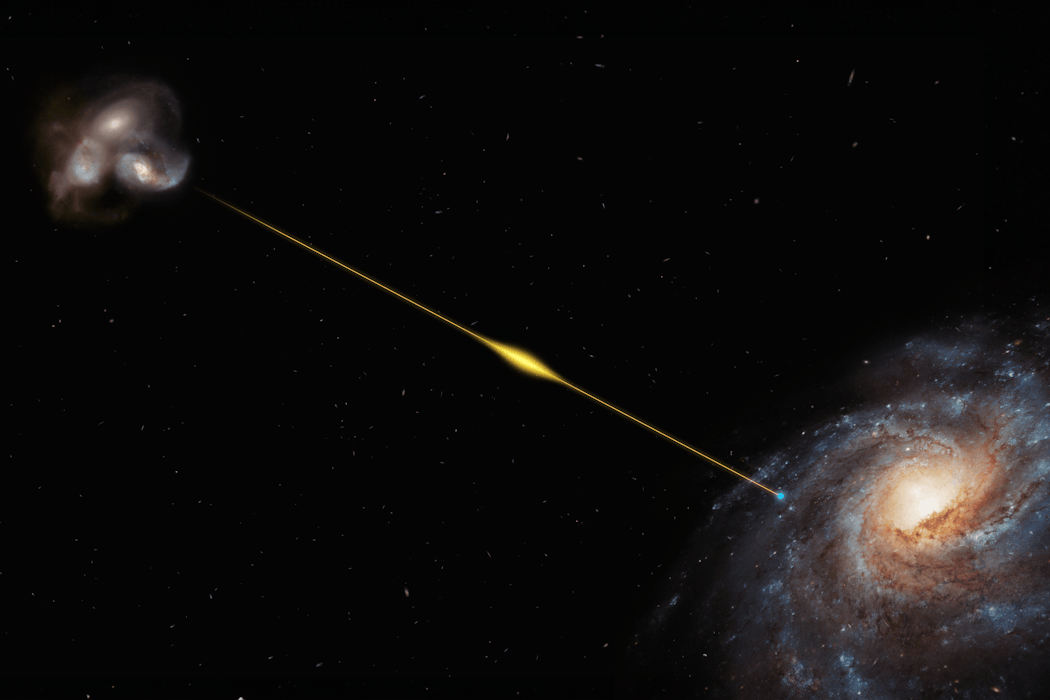
Mysterious blasts of radio waves from across the universe called fast radio bursts help astronomers catalog matter. ESO/M. Kornmesser, CC BY-SA

If you look across space with a telescope, you’ll see countless galaxies, most of which host large central black holes, billions of stars and their attendant planets. The universe teems with huge, spectacular objects, and it might seem like these massive objects should hold most of the universe’s matter.

But the Big Bang theory predicts that about 5% of the universe’s contents should be atoms made of protons, neutrons and electrons. Most of those atoms cannot be found in stars and galaxies – a discrepancy that has puzzled astronomers.

If not in visible stars and galaxies, the most likely hiding place for the matter is in the dark space between galaxies. While space is often referred to as a vacuum, it isn’t completely empty. Individual particles and atoms are dispersed throughout the space between stars and galaxies, forming a dark, filamentary network called the “cosmic web.”

Throughout my career as an astronomer, I’ve studied this cosmic web, and I know how difficult it is to account for the matter spread throughout space.

In a study published in June 2025, a team of scientists used a unique radio technique to complete the census of normal matter in the universe.

The census of normal matter

The most obvious place to look for normal matter is in the form of stars. Gravity gathers stars together into galaxies, and astronomers can count galaxies throughout the observable universe.

The census comes to several hundred billion galaxies, each made of several hundred billion stars. The numbers are uncertain because many stars lurk outside of galaxies. That’s an estimated 1023 stars in the universe, or hundreds of times more than the number of sand grains on all of Earth’s beaches. There are an estimated 1082 atoms in the universe.

However, this prodigious number falls far short of accounting for all the matter predicted by the Big Bang. Careful accounting indicates that stars contain only 0.5% of the matter in the universe. Ten times more atoms are presumably floating freely in space. Just 0.03% of the matter is elements other than hydrogen and helium, including carbon and all the building blocks of life.

Looking between galaxies

The intergalactic medium – the space between galaxies – is near-total vacuum, with a density of one atom per cubic meter, or one atom every 35 cubic feet. That’s less than a billionth of a billionth of the density of air on Earth. Even at this very low density, this diffuse medium adds up to a lot of matter, given the enormous, 92-billion-light-year diameter of the universe.

The intergalactic medium is very hot, with a temperature of millions of degrees. That makes it difficult to observe except with X-ray telescopes, since very hot gas radiates out through the universe at very short X-ray wavelengths. X-ray telescopes have limited sensitivity because they are smaller than most optical telescopes.

Deploying a new tool

Astronomers recently used a new tool to solve this missing matter problem. Fast radio bursts are intense blasts of radio waves that can put out as much energy in a millisecond as the Sun puts out in three days. First discovered in 2007, scientists found that the bursts are caused by compact stellar remnants in distant galaxies. Their energy peters out as the bursts travel through space, and by the time that energy reaches the Earth, it is a thousand times weaker than a mobile phone signal would be if emitted on the Moon, then detected on Earth.

Research from early 2025 suggests the source of the bursts is the highly magnetic region around an ultra-compact neutron star. Neutron stars are incredibly dense remnants of massive stars that have collapsed under their own gravity after a supernova explosion. The particular type of neutron star that emits radio bursts is called a magnetar, with a magnetic field a thousand trillion times stronger than the Earth’s.

An illustration of a bright star with circular rings around it representing magnetic field lines
A magnetar is a rare type of neutron star with an extremely strong magnetic field.
ESO/L. Calçada, CC BY-ND

Even though astronomers don’t fully understand fast radio bursts, they can use them to probe the spaces between galaxies. As the bursts travel through space, interactions with electrons in the hot intergalactic gas preferentially slow down longer wavelengths. The radio signal is spread out, analogous to the way a prism turns sunlight into a rainbow. Astronomers use the amount of spreading to calculate how much gas the burst has passed through on its way to Earth.

Puzzle solved

In the new study, published in June 2025, a team of astronomers from Caltech and the Harvard Center for Astrophysics studied 69 fast radio bursts using an array of 110 radio telescopes in California. The team found that 76% of the universe’s normal matter lies in the space between galaxies, with another 15% in galaxy halos – the area surrounding the visible stars in a galaxy – and the remaining 9% in stars and cold gas within galaxies.

The complete accounting of normal matter in the universe provides a strong affirmation of the Big Bang theory. The theory predicts the abundance of normal matter formed in the first few minutes of the universe, so by recovering the predicted 5%, the theory passes a critical test.

Several thousand fast radio bursts have already been observed, and an upcoming array of radio telescopes will likely increase the discovery rate to 10,000 per year. Such a large sample will let fast radio bursts become powerful tools for cosmology. Cosmology is the study of the size, shape and evolution of the universe. Radio bursts could go beyond counting atoms to mapping the three-dimensional structure of the cosmic web.

Pie chart of the universe

Scientists may now have the complete picture of where normal matter is distributed, but most of the universe is still made up of stuff they don’t fully understand.

The most abundant ingredients in the universe are dark matter and dark energy, both of which are poorly understood. Dark energy is causing the accelerating expansion of the universe, and dark matter is the invisible glue that holds galaxies and the universe together.

A pie chart showing the composition of the universe. The largest proportion is dark energy, at 68%, while dark matter makes up 27% and normal matter 5%. The rest is neutrinos, free hydrogen and helium and heavy elements.
Despite physicists not knowing much about it, dark matter makes up around 27% of the universe.
Visual Capitalist/Science Photo Library via Getty Images

Dark matter is probably a previously unstudied type of fundamental particle that is not part of the standard model of particle physics. Physicists haven’t been able to detect this novel particle yet, but we know it exists because, according to general relativity, mass bends light, and far more gravitational lensing is seen than can be explained by visible matter. With gravitational lensing, a cluster of galaxies bends and magnifies light in a way that’s analogous to an optical lens. Dark matter outweighs conventional matter by more than a factor of five.

One mystery may be solved, but a larger mystery remains. While dark matter is still enigmatic, we now know a lot about the normal atoms making up us as humans, and the world around us.

The Conversation

Chris Impey has received funding from NASA, NSF, Howard Hughes Medical Institute, and the Templeton Foundation.

ref. Most normal matter in the universe isn’t found in planets, stars or galaxies – an astronomer explains where it’s distributed – https://theconversation.com/most-normal-matter-in-the-universe-isnt-found-in-planets-stars-or-galaxies-an-astronomer-explains-where-its-distributed-269313