Imagine living in a country where talking openly about depression or anxiety can cost you your job, your reputation, or even your freedom. That is still the reality in Ghana, where mental illness is often explained in spiritual terms, and seeking help can mean being taken to a prayer camp instead of seeing a therapist. Even with global mental health awareness campaigns flooding social media and calendar days dedicated to ending stigma, many Ghanaians continue to struggle in silence.
We study communication and wanted to understand how Ghanaian celebrities, in particular, communicatively manage the stigma that is associated with their mental illness. Celebrities are often treated as near-superhuman figures; they are admired for their talent, resilience and public influence. But they suffer too.
For our research, we reached out to some celebrities who helped us reach out to others who were experiencing or had experienced a mental illness. Altogether, 20 celebrities were interviewed.
Most of them told us they hide their struggles and turn to private prayer rather than professional care. Fear of being labelled “weak”, judged as “spiritually afflicted” or losing work opportunities keeps them quiet. Instead of speaking out, they pray behind closed doors, hoping their symptoms will disappear before anyone notices.
Their status makes it even harder for them to speak openly about their mental illnesses. Their careers depend on credibility and the impression of strength. As a result, they cope privately, turning to prayer rather than professional help.
Celebrities influence public perceptions. Therefore, understanding how they manage mental illness stigma can offer valuable insights into broader societal attitudes and behaviours towards mental health communication.
Our candid conversations with 20 Ghanaian celebrities in the entertainment and sports industries revealed the unique ways they manage stigma associated with mental illness. For example:
I would wake up at dawn and walk to a church and pray. I could stand outside for the dawn dew to fall on me just so that I could pray and ask God to use the dew to change the happenings in my life. (male, actor)
Some reported that prayer served not only as a way of managing stigma, but also as a source of healing from the mental illness itself. One said that “prayers and fasting” helped.
Others use a combination of acceptance and praying to cope. Acceptance is a stigma management strategy identified by health and stigma researcher Rebecca Meisenbach. It refers to acknowledging the existence of stigma around a certain condition and its application to the individual.
Acceptance as a stigma management strategy manifests through behaviours such as displaying symptoms associated with the mental illness and forming bonds with other individuals who are similarly stigmatised.
Our study participants said they managed stigma by connecting with others going through similar experiences:
When I was dealing with depression and all of that, the person I spoke to about it was my cousin. He was also depressed at the time. So it was like, we are sharing notes. You know, and we end up encouraging each other. (male, actor and comedian)
Another male actor and comedian shared:
“Among celebrities who go through mental health issues, we talk. We have discussions among ourselves. It will not be possible to go out and say it publicly but among ourselves, I can call a colleague and say, guy, I have been experiencing this breakdown.”
Our research shows an important truth for Ghanaians. The people we admire most are also actively navigating mental health challenges behind closed doors. Their silence and ways of handling their mental struggles reflect the same fears many ordinary Ghanaians carry. If people in the spotlight are quietly battling mental illnesses, it shows that mental illness is far more common than some people are willing to admit.
This is why real mental illness conversations must begin now. To reduce mental illness stigma, it must be openly spoken about, and every shift starts somewhere: in our homes, religious spaces and workplaces. When people speak honestly about their struggles, and if others listen and respond with compassion, it creates a culture where seeking mental help is not seen as shameful.
Celebrity stories show that prayer plays a central role in how celebrities largely cope with mental illness. Prayer is meaningful, culturally rooted and, for many, spiritually essential. But prayer should not replace medical help. In short, prayer and seeking medical help should not be seen as mutually exclusive; rather, they should be seen as complementary.
Mental health professionals and religious leaders can help reframe mental illness healing as a process that can be accomplished through both medical care and spiritual prayers and not as a choice between them, especially in a religious culture like Ghana. Doing this can offer a more holistic pathway to recovery and a more accepting community for people who fear stigmatisation.
Healing does not have to be hidden, and help does not have to be feared. A new culture of openness can begin with each person who chooses to speak, listen and support. We hope that this shift starts now and that Ghana becomes a place where spiritual care and medical support work in tandem to make mental health care accessible and stigma-free.
The authors do not work for, consult, own shares in or receive funding from any company or organisation that would benefit from this article, and have disclosed no relevant affiliations beyond their academic appointment.
Climate change is no longer just about melting ice or hotter summers. It is also a financial problem. Droughts, floods, storms and heatwaves damage crops, factories and infrastructure. At the same time, the global push to cut greenhouse gas emissions creates risks for countries that depend on oil, gas or coal.
These physical risks are compounded by “transition risks”, like declining revenues from fossil fuel exports or higher borrowing costs as investors worry about climate instability. Together, they make climate governance through financial policies both urgent and complex. Without these policies, financial systems risk being caught off guard by climate shocks and the transition away from fossil fuels.
This is where climate-related financial policies come in. They provide the tools for banks, insurers and regulators to manage risks, support investment in greener sectors and strengthen financial stability.
Regulators and banks across Africa have started to adopt climate-related financial policies. These range from rules that require banks to consider climate risks, to disclosure standards, green lending guidelines, and green bond frameworks. These tools are being tested in several countries. But their scope and enforcement vary widely across the continent.
My research compiles the first continent-wide database of climate-related financial policies in Africa and examines how differences in these policies – and in how binding they are – affect financial stability and the ability to mobilise private investment for green projects.
A new study I conducted reviewed more than two decades of policies (2000–2025) across African countries. It found stark differences.
South Africa has developed the most comprehensive framework, with policies across all categories. Kenya and Morocco are also active, particularly in disclosure and risk-management rules. In contrast, many countries in central and west Africa have introduced only a few voluntary measures.
Why does this matter? Voluntary rules can help raise awareness and encourage change, but on their own they often do not go far enough. Binding measures, on the other hand, tend to create stronger incentives and steadier progress. So far, however, most African climate-related financial policies remain voluntary. This leaves climate risk as something to consider rather than a firm requirement.
Uneven landscape
In Africa, the 2015 Paris Agreement marked a clear turning point. Around that time, policy activity increased noticeably, suggesting that international agreements and standards could help create momentum and visibility for climate action. The expansion of climate-related financial policies was also shaped by domestic priorities and by pressure from international investors and development partners.
But since the late 2010s, progress has slowed. Limited resources, overlapping institutional responsibilities and fragmented coordination have made it difficult to sustain the earlier pace of reform.
Looking across the continent, four broad patterns have emerged.
A few countries, such as South Africa, have developed comprehensive frameworks. These include:
disclosure rules (requirements for banks and companies to report how climate risks affect them)
stress tests (simulations of extreme climate or transition scenarios to see whether banks would remain resilient).
Others, including Kenya and Morocco, are steadily expanding their policy mix, even if institutional capacity is still developing.
Some, such as Nigeria and Egypt, are moderately active, with a focus on disclosure rules and green bonds. (Those are bonds whose proceeds are earmarked to finance environmentally friendly projects such as renewable energy, clean transport or climate-resilient infrastructure.)
Finally, many countries in central and west Africa have introduced only a limited number of measures, often voluntary in nature.
This uneven landscape has important consequences.
The net effect
In fossil fuel-dependent economies such as South Africa, Egypt and Algeria, the shift away from coal, oil and gas could generate significant transition risks. These include:
financial instability, for example when asset values in carbon-intensive sectors fall sharply or credit exposures deteriorate
stranded assets, where fossil fuel infrastructure and reserves lose their economic value before the end of their expected life because they can no longer be used or are no longer profitable under stricter climate policies.
Addressing these challenges may require policies that combine investment in new, low-carbon sectors with targeted support for affected workers, communities and households.
Climate finance affects people directly. When droughts lead to loan defaults, local banks are strained. Insurance companies facing repeated payouts after floods may raise premiums. Pension funds invested in fossil fuels risk devaluations as these assets lose value. Climate-related financial policies therefore matter not only for regulators and markets, but also for jobs, savings, and everyday livelihoods.
At the same time, there are opportunities.
Firstly, expanding access to green bonds and sustainability-linked loans can channel private finance into renewable energy, clean transport, or resilient infrastructure.
Secondly, stronger disclosure rules can improve transparency and investor confidence.
Thirdly, regional harmonisation through common reporting standards, for example, would reduce fragmentation. This would make it easier for Africa to attract global climate finance.
Looking ahead
International forums such as the UN climate conferences (COP) and the G20 have helped to push this agenda forward, mainly by setting expectations rather than hard rules. These initiatives create pressure and guidance. But they remain soft law. Turning them into binding, enforceable rules still depends on decisions taken by national regulators and governments.
International partners such as the African Development Bank and the African Union could support coordination by promoting continental standards that define what counts as a green investment. Donors and multilateral lenders may also provide technical expertise and financial support to countries with weaker systems, helping them move from voluntary guidelines toward more enforceable rules.
South Africa, already a regional leader, could share its experience with stress testing and green finance frameworks.
Africa also has the potential to position itself as a hub for renewable energy and sustainable finance. With vast solar and wind resources, expanding urban centres, and an increasingly digital financial sector, the continent could leapfrog towards a greener future if investment and regulation advance together.
What happens next will matter greatly. By expanding and enforcing climate-related financial rules, Africa can reduce its vulnerability to climate shocks while unlocking opportunities in green finance and renewable energy.
Paola D’Orazio does not work for, consult, own shares in or receive funding from any company or organisation that would benefit from this article, and has disclosed no relevant affiliations beyond their academic appointment.
Des centres urbains, où se concentrent les hauts revenus, aux territoires périphériques, où ils disparaissent, la carte des foyers les plus aisés de France raconte une histoire singulière des inégalités. En retraçant leur répartition géographique depuis 1960, une nouvelle étude éclaire les conséquences spatiales des transformations structurelles de l’économie française, et les tensions sociales et politiques qu’elles continuent d’alimenter.
Réduire les écarts entre territoires est un objectif récurrent des politiques publiques, en France comme en Europe. L’Union européenne (UE) en a fait un principe fondateur, inscrit à l’article 174 du Traité sur le fonctionnement de l’Union européenne (TFUE) :
« Afin de promouvoir un développement harmonieux de l’ensemble de l’Union, celle-ci vise à réduire les écarts entre les niveaux de développement des diverses régions. »
Pourtant, cet objectif est aujourd’hui plus que jamais mis à l’épreuve. En France, comme ailleurs, les dernières décennies ont vu s’accentuer un sentiment de fracture territoriale : d’un côté, quelques grandes métropoles concentrent les emplois qualifiés, les sièges d’entreprises, les services de haut niveau ; de l’autre, de vastes espaces voient leurs activités industrielles décliner, leurs jeunes partir et leurs revenus stagner.
Ces déséquilibres économiques ne sont pas sans conséquence sociale ou politique, comme les dernières années l’ont montré avec force. Des ronds-points des « gilets jaunes » aux cartes électorales où se lit la progression de l’abstention ou du vote pour les partis extrêmes, la colère sociale a souvent une géographie. Là où les opportunités économiques se raréfient, les perspectives se referment, le sentiment d’injustice s’installe, et une question fondamentale émerge : que devient une société lorsque les perspectives de réussite se concentrent exclusivement dans quelques territoires ?
Un indicateur plus fin pour comprendre ces enjeux
Comprendre ces enjeux suppose d’abord de bien les mesurer. Or, les indicateurs couramment utilisés dans la littérature économique tendent à masquer la réalité des disparités territoriales. On analyse souvent le développement d’une région à l’aune du produit intérieur brut par habitant ou du revenu moyen, sans tenir compte des différences de structures sociales : ici, une forte proportion de ménages aisés et modestes ; là, une population plus homogène, composée de classes moyennes. Ainsi, la répartition des revenus constitue un élément central pour comprendre les dynamiques locales.
Dans un article à paraître dans le Journal of Economic Geography, nous avons voulu dépasser ces limites en construisant une base de données inédite retraçant la répartition des foyers fiscaux appartenant aux 10 % et aux 1 % les plus aisés dans les départements de France hexagonale depuis 1960. Ce travail, rendu possible par une collecte de longue haleine dans les archives du ministère des finances, offre pour la première fois la possibilité d’observer sur plus d’un demi-siècle la géographie des hauts revenus en France et les transformations qu’elle révèle.
À partir de ces données, nous proposons un indicateur simple mais riche de sens : la part des très hauts revenus (Top 1 %) et des hauts revenus (Top 10 % moins Top 1 %) dans la population locale. On peut interpréter ces indicateurs comme la probabilité, pour un individu, d’appartenir aux ménages aisés selon le territoire où il vit.
Cette approche offre un regard nouveau sur les fractures territoriales contemporaines. Là où les opportunités économiques s’amenuisent, les plus qualifiés, les plus ambitieux, les plus mobiles partent ailleurs, laissant derrière eux des territoires appauvris en capital humain et en perspectives. Ces départs nourrissent à leur tour un sentiment de déclassement collectif, l’impression diffuse que « le progrès se passe ailleurs ».
Les cartes de la figure 1 retracent plus de soixante ans d’histoire sociale du territoire français. Elles montrent, pour trois dates clés (1960, 1990 et 2019), la part des ménages appartenant aux très hauts revenus (à gauche) et aux hauts revenus (à droite). Si les foyers fiscaux aisés étaient répartis uniformément, ces parts seraient respectivement de 1 % et de 9 % dans tous les départements : ce sont les zones blanches sur les cartes. Dans la réalité, ce n’est pas le cas : les nuances d’orange et de rouge signalent donc une surreprésentation locale, les teintes de bleu une sous-représentation. Il faut enfin rappeler que la géographie administrative de l’Île-de-France est passée de trois départements au début des années 1960 à huit aujourd’hui.
L’importance de la ligne Caen-Annecy dans les années 1960
En 1960, la France des très hauts revenus est très largement structurée par une ligne Caen-Annecy. Au sud, la part des foyers aux très hauts revenus dans la population locale est faible, souvent moins de 0,5 % (nous l’estimons par exemple à 0,1 % en Lozère). Seules quelques zones urbaines ou industrielles (Rhône, Haute-Garonne, Isère, Haute-Savoie) se distinguent légèrement. Au nord, la présence des foyers les plus aisés s’intensifie, notamment en région parisienne, où la part atteint 2,6 % dans le département de la Seine et 1,6 % en Seine-et-Oise, ou dans le département du Nord.
Trente ans plus tard, la ligne Caen–Annecy a perdu son sens. Les départements où les très hauts revenus sont rares se concentrent près du Massif central (0,4 % en Lozère). Un second pôle où se concentrent les foyers aux très hauts revenus s’est formé à la frontière suisse (Ain, Savoie, Haute-Savoie), tandis que la Côte d’Azur, les métropoles du Sud-Ouest (Toulouse, Bordeaux) et quelques villes du centre (Dijon, Tours) gagnent en attractivité. On observe une forte polarisation en Île-de-France : les très hauts revenus sont très présents à Paris, dans les Hauts-de-Seine et dans les Yvelines, mais très peu nombreux en Seine-Saint-Denis.
Une nouvelle géographie aujourd’hui
En 2019, la rupture est manifeste. Les très hauts revenus sont absents dans la plupart des départements de la « diagonale du vide », tandis que la France des très hauts revenus se réduit à quelques pôles métropolitains (Bordeaux, Nantes, Toulouse, Marseille, Dijon, Strasbourg, Nice) qui conservent des parts proches de 1 % et à la frontière suisse où elle est de 2 % en Haute-Savoie. En Île-de-France, la polarisation atteint des sommets : la part des très hauts revenus est seulement de 0,4 % en Seine-Saint-Denis, mais de 4,5 % à Paris, 4,2 % dans les Hauts-de-Seine, et 2,8 % dans les Yvelines.
Les cartes des hauts revenus (hors Top 1 %) confirment ces dynamiques. En 1960, les foyers aisés sont déjà concentrés autour de Paris et du Rhône tandis que la Bretagne, le Sud-Ouest et le Massif central en comptent peu (moins de 3 % en Aveyron ou en Haute-Loire). En 1990, cette géographie change. La frontière suisse, la Côte d’Azur et plusieurs métropoles régionales rejoignent le groupe des départements surreprésentés. En 2019, les écarts s’accentuent encore, mais la logique reste la même : une sous-représentation persistante dans le centre du pays, et une forte surreprésentation des ménages aisés en région parisienne et près de la frontière suisse. La part de ces foyers est maximale dans les Hauts-de-Seine et dans les Yvelines, où elle atteint 18 %.
Figure 1 : Proportion des très hauts revenus et des hauts revenus dans la population locale en 1960, en 1990 et en 2019.
Fourni par l’auteur
Notes : On définit la part des très hauts revenus comme la proportion de ménages faisant partie des 1 % de ménages aux plus hauts revenus (respectivement 10 % de ménages aux plus hauts revenus moins les 1 % aux plus hauts revenus) tels que définis en France hexagonale.
Des trajectoires divergentes depuis la fin des années 1990
Ces transformations géographiques détaillées peuvent se résumer en un indicateur unique : l’indice de Theil, couramment utilisé pour mesurer les inégalités économiques. Nous l’avons calculé pour chaque année à partir de la part des foyers appartenant aux très hauts revenus ou aux hauts revenus dans chaque département (en vert et en orange sur la figure 2), en conservant une classification départementale stable sur toute la période. Cet indicateur permet de mesurer si ces parts se sont rapprochées ou, au contraire, éloignées au fil du temps. Pour faciliter la comparaison entre les deux courbes, les valeurs ont été normalisées à 1 en 1962.
Le résultat est frappant : après quarante ans de convergence, les écarts territoriaux se sont de nouveau creusés depuis la fin des années 1990. En vingt ans, la concentration géographique des très hauts revenus a triplé, retrouvant son niveau du début de la période. C’est bien le signe d’un retour marqué des inégalités régionales, tirées par le haut de la distribution des revenus.
Figure 2 : Évolution des inégalités d’opportunités économiques régionales entre 1960 et 2019.
Fourni par l’auteur
L’impact de la désindustrialisation
Nous avons cherché à comprendre pourquoi ces opportunités économiques régionales de faire partie des ménages aux très hauts revenus ont d’abord convergé, avant de diverger à nouveau fortement. Deux transformations majeures permettent d’en comprendre la logique.
Dans les années 1960, la présence de très hauts revenus s’expliquait avant tout par la concentration d’activités industrielles, elles-mêmes très inégalement réparties sur le territoire national au profit des régions du Nord-Est. Puis, entre 1960 et 1990, les structures productives régionales se sont progressivement rapprochées : les territoires longtemps agricoles se sont industrialisés tandis que les grandes régions manufacturières perdaient peu à peu leur avantage relatif. Ce mouvement de rééquilibrage a favorisé une réduction des différences régionales d’opportunités économiques.
Enfin, à partir des années 1990, la désindustrialisation s’est généralisée à l’ensemble du pays tout en s’accompagnant d’une montée en puissance des services à haute valeur ajoutée. Ce sont eux qui expliquent alors où se trouvent les opportunités économiques de faire partie des ménages aux très hauts revenus. Or, ces activités se trouvent majoritairement dans les grandes métropoles, où elles bénéficient de la présence d’emplois qualifiés, d’infrastructures performantes et de politiques publiques volontaristes, comme l’illustre l’écosystème scientifique et technologique développé sur le plateau de Saclay (Essonne) depuis une quinzaine d’années. On retrouve cette logique dans la région frontalière de Genève, où la concentration d’emplois hautement qualifiés dans les services financiers explique en partie la surreprésentation de ménages à très hauts revenus dans les départements de la Haute-Savoie et de l’Ain.
Une économie polarisée et des territoires « laissés pour compte »
Pour finir, nous défendons l’idée selon laquelle les inégalités territoriales ne tiendraient pas seulement à des écarts de revenus par habitant entre régions, mais à la manière dont les revenus les plus élevés se répartissent dans l’espace.
Depuis les années 2000, les opportunités économiques se concentrent dans un tout petit nombre de territoires, reflet d’une économie de plus en plus polarisée autour de quelques métropoles et de leurs bassins d’emplois qualifiés. En France, comme ailleurs, les transformations structurelles ont progressivement creusé l’écart entre des régions gagnantes, insérées dans l’économie de la connaissance, et d’autres qui peinent à en profiter.
Ce phénomène s’inscrit dans une dynamique plus large, documentée dans la littérature internationale sous le concept de left-behind places. Ces territoires « laissés pour compte » se retrouvent déconnectés des pôles de croissance et des réseaux de pouvoir économique, et expriment à intervalles réguliers le sentiment d’abandon qui les ronge. Réduire ces écarts ne relève donc pas d’un enjeu d’efficacité économique, mais d’un impératif démocratique.
Aujourd’hui, la question reste entière : comment faire en sorte que la transition vers une économie fondée sur les savoirs, les services et l’innovation ne creuse pas davantage les fractures entre territoires ? En retraçant cette histoire sur plus d’un demi-siècle, nos travaux rappellent que la géographie des hauts revenus est mouvante, et ne saurait se passer de volontarisme politique.
Hippolyte d’Albis a reçu des financements de l’ANR et de la Commission européenne.
Aurélie Sotura et Florian Bonnet ne travaillent pas, ne conseillent pas, ne possèdent pas de parts, ne reçoivent pas de fonds d’une organisation qui pourrait tirer profit de cet article, et n’ont déclaré aucune autre affiliation que leur poste universitaire.
Source: The Conversation – in French – By Fabrice Lollia, Docteur en sciences de l’information et de la communication, chercheur associé laboratoire DICEN Ile de France, Université Gustave Eiffel
L’arrestation de Nicolas Maduro révèle que la légitimité politique contemporaine se construit moins par le droit ou la force que par la capacité à imposer un récit et une vision du monde.
L’arrestation du président vénézuélien Nicolas Maduro à la suite d’une opération états-unienne constitue un événement géopolitique d’ampleur. Mais elle dépasse le cadre diplomatique : elle s’est immédiatement transformée en crise informationnelle.
En quelques heures, plusieurs récits concurrents ont émergé : opération de justice internationale pour certains, violation flagrante du droit international pour d’autres, coup de force impérialiste ou acte nécessaire pour libérer un peuple. Dans cet entrelacs de discours, une bataille bien plus décisive s’est ouverte : celle du récit légitime et de la construction d’un sens partagé.
Les crises contemporaines ne se jouent plus seulement dans les arènes politiques, ou militaires. Elles se construisent désormais dans l’espace de l’information, là où se forment les perceptions, les émotions collectives et, in fine, les lectures du réel. Ce que met à nu l’affaire Maduro, c’est la centralité du narratif dans la production de légitimité politique à l’échelle mondiale.
Dans ce type de crise, la question n’est pas seulement que s’est-il passé ? mais comment devons-nous comprendre ce qui s’est passé ? et surtout, qui a la légitimité pour dire la vérité des événements ?
Un événement politique devenu immédiatement un événement informationnel
Dès l’annonce de l’arrestation, trois dynamiques se mettent en place simultanément.
Tout d’abord, une production institutionnelle du sens où gouvernements, chancelleries, organisations internationales émettent des positions, chacune arrimée à un cadre de légitimation (sécurité, souveraineté, droit, ordre international).
Ensuite, les médias ne se limitent pas à nommer l’événement : ils le scénarisent. Par le choix des images, des angles et des séquences narratives, ils transforment un fait politique en récit intelligible, assignant des rôles, des responsabilités et des émotions. Cette mise en scène médiatique contribue à stabiliser temporairement un sens partagé, participant ainsi à la construction de la légitimité.
Enfin, c’est une explosion numérique où circulent simultanément informations fiables, interprétations partisanes, contenus émotionnels et désinformation. Cette couche numérique loin d’être simplement périphérique structure la manière dont une large part du monde se représente les faits.
Ainsi, ce que nous observons n’est pas seulement la confrontation d’États, mais la confrontation de récits visant à imposer une lecture dominante de la réalité. La lutte ne porte plus uniquement sur ce qui s’est passé, mais sur la manière dont il convient de l’interpréter, de l’évaluer et de l’inscrire dans une mémoire collective.
Une guerre de narratifs : trois grands cadres concurrents
Un narratif états-unien sur l’ordre, la sécurité et la légitimité morale
Le discours états-unien mobilise une stratégie classique de sécurisation, en présentant Nicolas Maduro non plus comme un chef d’État souverain, mais comme un « indicted drug trafficker » (« trafiquant de drogue inculpé ») et leader d’un « vicious terrorist organization » (« organisation terroriste violente ») – le Cartel de los Soles –, fusionnant ainsi régime politique et entreprise criminelle transnationale.
Ce déplacement symbolique joue un rôle d’ampleur en reconstruisant une opération militaro-judiciaire potentiellement illégitime au regard du droit international (capture extraterritoriale, frappes ciblées) en action de maintien de l’ordre mondial, moralement justifiable au nom de la lutte contre le narcotrafic et la menace sécuritaire pour les États-Unis.
La rhétorique mobilise trois registres : le registre pénal avec la lutte contre le crime, la corruption ou le narcotrafic, un registre éthique avec la protection des peuples et la restauration d’une justice prétendument universelle, enfin un registre sécuritaire nourrit par l’argumentaire principal de stabilisation d’une région présentée comme dangereuse.
On retrouve ici ce que les chercheurs appellent l’« agenda setting » : en choisissant les mots et les thèmes dominants du débat (crime, menace, protection), le pouvoir politique influence directement la manière dont l’opinion publique perçoit l’événement. Le politologue américain Joseph Nye, professeur en relations internationales à Harvard, définit ce soft power comme la capacité d’un État à influencer les autres, non pas seulement par la force mais en façonnant leurs préférences grâce à l’attraction, à la crédibilité et à la perception de légitimité.
Un narratif contraire sur la souveraineté, le droit, et d’alerte sur l’ordre international
En face, un contre-récit s’est immédiatement imposé. Pour de nombreux États et observateurs, cette opération constitue une atteinte grave à la souveraineté et crée un précédent dangereux pour l’ordre international. Ce discours s’appuie sur le droit international, notamment l’article 2 (4) de la Charte des Nations unies, qui interdit le recours à la force contre l’intégrité territoriale ou l’indépendance d’un État. Il dénonce une action unilatérale qui contourne les règles collectives et menace l’équilibre du système multilatéral.
Il relève d’une rhétorique d’alerte : ce qui se produit au Venezuela pourrait devenir une norme globale, avec des échos immédiats dans d’autres débats sensibles – comme celui concernant des dirigeants tels que le président Poutine déjà visés par des procédures internationales.
Le narratif numérique par l’émotion, la polarisation et la fabrication du doute
Un troisième narratif se déploie sur les réseaux sociaux selon des logiques d’amplifications émotionnelles (diffusion d’images générées par IA montrant Maduro en pyjama et fausses informations visant son prédécesseur Hugo Chavez), de circulation accélérée et de simplification extrême. Il en résulte une fragmentation cognitive qui produit des réalités parallèles.
Les sciences de l’information et de la communication montrent que, à l’ère numérique, l’enjeu dépasse la seule désinformation. Il s’agit d’une concurrence des régimes de vérité où ne prime plus uniquement ce qui est vrai, mais ce qui est crédible, ce qui raisonne émotionnellement et ce qui s’aligne avec une vision préexistante du monde.
La construction d’un récit politique n’est jamais improvisée. Elle repose sur quelques mécanismes clés :
moraliser le discours en opposant « bien » et « mal » ;
aligner communication et gestes symboliques pour renforcer la crédibilité ;
exploiter l’économie de l’attention propre aux plateformes numériques.
L’objectif n’est pas seulement d’informer mais de rendre une lecture du réel évidente et acceptable pour le plus grand nombre.
Infographie fournie par l’auteur, Fourni par l’auteur
Ce que révèle cet événement
Trois enseignements majeurs se dégagent. Premièrement, l’effritement des cadres de référence communs. Le monde n’interprète plus les événements à partir d’un socle partagé. Les publics, les États et les institutions lisent la réalité selon des référentiels distincts. Ce qui renforce la conflictualité informationnelle.
Deuxièmement, la montée en puissance de la guerre cognitive est frappante. L’affaire Maduro illustre l’information warfare, c’est-à-dire l’usage stratégique de l’information pour influencer perceptions et décisions. Dans ce cadre, l’essor de l’IA agentique, fondée sur des systèmes d’IA autonomes et adaptatifs (par le biais d’agents), permet de produire et d’ajuster des narratifs ciblés à grande échelle. Combinées à la messagerie personnalisée, ces techniques orientent comportements et alliances, sans confrontation militaire directe. La bataille se joue désormais dans l’espace cognitif plus que sur le terrain physique.
Pour terminer, la centralité stratégique du narratif est construite. Aujourd’hui, gouverner, c’est raconter, c’est produire un récit qui donne sens, qui justifie, légitime et inscrit l’action politique dans une cohérence. Les États qui ne maîtrisent pas cette dimension sont désormais structurellement désavantagés.
L’arrestation du président Nicolas Maduro ouvre un débat juridique et politique immense. Mais elle montre surtout une transformation profonde de nos sociétés ; la légitimité ne repose plus seulement sur les normes ou la force. Elle se fabrique dans la capacité à imposer une vision du réel.
À l’heure où la confiance dans les institutions recule, où la circulation de l’information s’accélère et où les arènes numériques fragmentent nos représentations, la question centrale devient : qui raconte le monde ? Et surtout, quelles histoires sommes-nous prêts à croire ?
Fabrice Lollia ne travaille pas, ne conseille pas, ne possède pas de parts, ne reçoit pas de fonds d’une organisation qui pourrait tirer profit de cet article, et n’a déclaré aucune autre affiliation que son organisme de recherche.
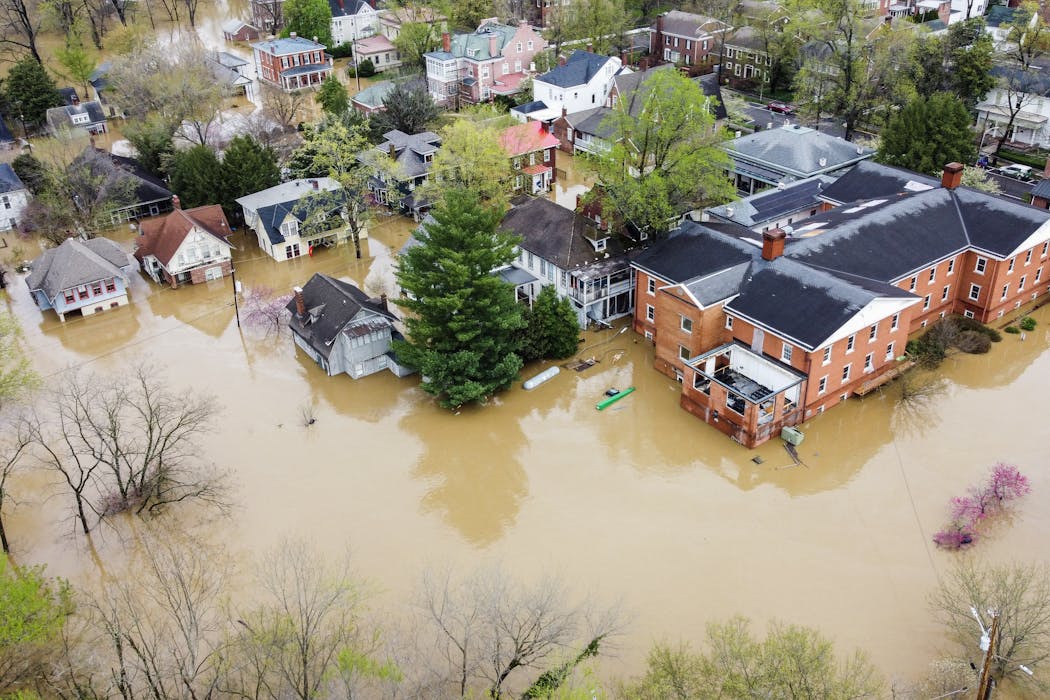
Severe storms triggered flooding across the central and eastern U.S. in April 2025, including in Kentucky’s capital, Frankfort.Leandro Lozada/AFP via Getty Images
Trump’s order to now pull the U.S. out of that treaty adds to a growing list of moves by the admnistration to dismantle U.S. efforts to combat climate change, despite the risks. Many of those moves, and there have been dozens, have flown under the public radar.
Why this climate treaty matters
A year into the second Trump administration, you might wonder: What’s the big deal with the U.S. leaving the United Nations Framework Convention on Climate Change now?
This action is different. It vacates an actual treaty that was ratified by the U.S. Senate in October 1992 and signed by President George H.W. Bush.
Volunteers and law enforcement officers searched for weeks for victims who had been swept away when an extreme downpour triggered flash flooding in Texas Hill Country on July 4, 2025. More than 130 people died, including children attending a youth camp. Ronaldo Schemidt/AFP via Getty Images
America’s ratification that year broke a logjam of inaction by nations that had signed the agreement but were wary about actually ratifying it as a legal document. Once the U.S. ratified it, other countries followed, and the treaty entered into force on March 21, 1994.
The U.S. was a global leader on climate change for years. Not anymore.
Two climate-related decisions did dominate a few news cycles in 2025. The Environmental Protection Agency announced its intention to rescind its 2009 Endangerment Finding, a legal determination that certain greenhouse gas emissions endanger the public health and welfare that became the foundation of federal climate laws. There are indications that the move to rescind the finding could be finalized soon – the EPA sent its final draft rule to the White House for review in early January 2026. And the Department of Energy released a misinformed climate assessment authored by five handpicked climate skeptics.
Thousands of people lost their homes as wildfires burned through dry canyons in the Los Angeles area and into neighborhoods in January 2025. AP Photo/Ethan Swope
This chipping away at climate policy continued to accelerate at the end of 2025 with six more significant actions that went largely unnoticed.
Eleven days later, the U.S. Department of the Interior jeopardized billions of dollars of U.S. investment in clean energy by pausing the leases of five East Coast offshore wind farms.
Three other moves by the administration shot arrows at the heart of climate science:
On Dec. 17, Russell Vought, director of the Office of Management and Budget, announced plans to shut down the National Center for Atmospheric Research, a world-recognized leader in earth system science.
In early January 2025, the United States had reestablished itself as a world leader in climate science and was still working domestically and internationally to combat climate risks.
Trump’s repudiation of the UNFCCC could give countries around the world cover to pull back their own efforts to fight a global problem if they decide it is not in their myopic “best interest.” So far, the other countries have stayed in both that treaty and the Paris climate agreement. However, many countries’ promises to protect the planet for future generations were weaker in 2025 than hoped.
The U.S. pullout may also leave the Trump administration at a disadvantage: The U.S. will no longer have a formal voice in the global forum where climate policies are debated, one where China has been gaining influence since Trump returned to the presidency.
Gary W. Yohe does not work for, consult, own shares in or receive funding from any company or organization that would benefit from this article, and has disclosed no relevant affiliations beyond their academic appointment.
Les enseignes de restauration rapide sont-elles la cause ou la conséquence de la désertification de certains centres-villes ? Comment expliquer ce phénomène ? Faut-il lutter contre ? Et comment s’y prendre ?
Nice-Matin rappelait dans son édition du 9 octobre 2025 que la France rurale voyait disparaître ses commerces alimentaires à un rythme alarmant. Ce sont près de 62 % des communes qui ne disposeraient d’aucune boulangerie, épicerie ni de bar. En 1980, on n’en dénombrait que 25 % dans la même situation. En quarante ans, ce phénomène a plus que doublé, illustrant la désertification progressive des campagnes françaises. Dans le même temps, la grande majorité des villes a vu le tissu de commerces de proximité évoluer drastiquement.
Le Parisien (2021) rapportait par exemple qu’à La Courneuve (Seine-Saint-Denis), on comptait 18 fast-food pour 12 pharmacies. À l’inverse, à Neuilly-sur-Seine (Hauts-de-Seine), on recense 18 pharmacies, six fast food ou sandwicheries auxquels s’ajoutent plusieurs bars à salade « premium ». Dans des villes de moindre taille, hors d’Île-de-France, l’équation se vérifie aussi. À Annonay (Ardèche), l’une des communes les plus touchées par la désertification commerciale, on recense aujourd’hui 13 enseignes de tacos, kebabs, burgers et pizzas à emporter, pour sept pharmacies, soit pratiquement le double. Même population, région différente : à Vire (Calvados), ce sont cinq enseignes pour sept pharmacies.
La comparaison entre le nombre de lieux de restauration rapide et le nombre de pharmacie permet de mieux appréhender l’âge moyen d’une population. En effet, plus la population est vieillissante, moins elle serait portée vers des offres comme le fast-food.
Certains travaux en urbanisme et en santé publique indiquent ainsi qu’il existe des liens indirects (mais réels) entre l’implantation d’enseignes de malbouffe (fast-food), la désertification des centres-villes (fermeture de commerces, baisse de diversité commerciale, L’aggravation des risques de santé et l’attractivité – ou le manque d’attractivité – pour certaines nouvelles populations. De façon synthétique, ces études montrent :
qu’il existe une association robuste entre l’exposition à la restauration rapide et des comportements alimentaires pouvant amener à de l’obésité …
qu’une surreprésentation des enseignes de malbouffe dans certains quartiers fragilisés est identifiée ;
que l’augmentation de la vacance commerciale va de pair avec une moindre diversité d’offre (plus d’enseignes standardisées, moins de commerces indépendants), contribuant à une image de dévitalisation.
Pouvoir capter facilement les flux
Pour comprendre ces mouvements, il faut mentionner que les enseignes de restauration rapide s’installent généralement dans des contextes précis, comme le suggère un travail en cours que nous menons avec la Métropole Rouen Normandie. On parle notamment de villes (ou des centres-villes) où les loyers sont abordables et où de nombreux espaces vacants existent (centres-villes en déclin ou friches commerciales). Ensuite, elles cherchent des lieux où les flux de passage sont faciles à capter, et ce même si le tissu commercial traditionnel faiblit. Enfin, elles s’épanouissent dans des contextes avec une faible concurrence locale, les commerces indépendants fermant. On peut donc voir dans leur présence comme un symptôme de la fragilisation commerciale, même s’ils n’en sont peut-être pas la cause principale.
Ensuite, il faut comprendre le phénomène de désertification. Rappelons tout d’abord qu’il n’a, malheureusement, rien de nouveau. La loi du 18 juin 2014 relative à l’artisanat, au commerce et aux très petites entreprises, se voulait un dispositif pour contrer ce phénomène. L’enveloppe d’un million d’euros débloquée l’année suivante pour financer les stratégies de développement urbain a bien montré son insuffisance. Les principaux acteurs se renvoyant la responsabilité de cette désertification.
Moins de diversité commerciale
Cette désertification se manifeste donc principalement par la fermeture de commerces indépendants. Ces fermetures entraînant naturellement une baisse de diversité dans l’offre (alimentaire, services, équipements…) qui va accélérer la disparition d’espaces de sociabilité.
Tout d’abord la croissance des zones commerciales périphériques. De plus en plus nombreuses et censées attirer plus de monde, elles ont l’effet inverse du point de vue de l’attractivité des consommateurs dans les centres-villes. Certes, ils vont consommer plus, mais en dehors des zones où les commerçants-artisans se trouvent.
Deuxièmement, les mairies se tournent vers d’autres modèles en transformant les locaux en logements ou bureaux.
Enfin, la montée constante de l’e-commerce. Autant il peut être un moteur de changement positif (les études du cercap.fr notamment montrent l’impact fort de la numérisation sur la performance et pérennité des commerçants-artisans), autant il agit aussi comme un concurrent important des commerces traditionnels.
Un cercle vicieux ?
Dans ce contexte, les chaînes de fast-food prospèrent car elles ont des modèles économiques standardisés et très résilients, capables d’absorber des fluctuations de clientèle. Ceci explique donc à terme leur plus grande présence dans les centres-villes. Et cette surreprésentation a un lien naturel sur l’attractivité.
En effet, l’image d’un centre-ville saturé de fast-food peut avoir un réel effet négatif pour certaines populations. Les classes moyennes et supérieures recherchent souvent dans leur centre-ville une offre locale, des circuits courts, des cafés indépendants, voire un marché alimentaire de qualité. Un centre-ville dominé par des franchises de fast-food peut ainsi être perçu comme peu authentique, peu qualitatif, ou en déclin.
Qui vit là ?
Mais il se peut aussi que l’effet soit plus neutre, voire positif pour d’autres publics. De manière un peu simplifiée, les étudiants, les jeunes actifs à faible revenu ou les populations précaires y voient eux des prix abordables, des horaires d’ouverture larges et une offre alimentaire à bas coût. Le fast-food peut donc contribuer à attirer ou stabiliser ces populations. En ce sens, l’impact sur l’attractivité dépend fortement du profil socio-économique des habitants potentiels d’une ville ou d’un centre-ville.
France 3 Hauts-de-France, 2025.
Autrement dit, les fast-food ne sont pas généralement la cause originelle de la désertification, mais ils s’y insèrent, y prospèrent, et peuvent amplifier ses effets. Ainsi, un cercle vicieux, observé dans de nombreuses villes moyennes, peut-être présenté :
les commerces traditionnels partent ou ferment,
la diversité diminue, ce qui génère une perte d’attrait du centre-ville,
les enseignes plus standardisées s’installent,
le centre-ville voit son image détériorée,
l’attractivité des ménages plus aisés se réduit,
le déclin commercial se poursuit.
Loin d’être l’unique cause du phénomène, l’installation de fast-food constitue un marqueur et parfois un accélérateur de cette dynamique.
Nouvelle dynamique
En tant que chercheurs, il est important d’étudier s’il est possible de changer la donne et de créer une nouvelle dynamique. Une approche plus vertueuse pourrait ainsi voir le jour en commençant par exemple à repenser la circulation des centres-villes en y redonnant une place principale aux piétons. Une approche hybride avec une augmentation de l’offre de stationnements en périphérie et une piétonnisation de l’hyper centre-ville paraît intéressante.
Ensuite, réinvestir sur les marchés alimentaires comme premier vecteur d’attractivité. De plus, relancer un soutien clair aux commerces indépendants (qui ne peuvent profiter de la force des réseaux des franchisés) est essentiel. Enfin, il est possible d’imaginer la mise en place d’une vraie politique de régulation de l’occupation commerciale, où les fast-foods deviennent simplement une composante parmi d’autres et ne nuisent plus à l’attractivité de l’ensemble.
Les auteurs ne travaillent pas, ne conseillent pas, ne possèdent pas de parts, ne reçoivent pas de fonds d’une organisation qui pourrait tirer profit de cet article, et n’ont déclaré aucune autre affiliation que leur organisme de recherche.
Source: The Conversation – in French – By Anthony Fardet, Chargé de recherches HC, UMR 1019 – Unité de Nutrition humaine, Université Clermont Auvergne, Inrae
Manger végétal, vrai et varié et consommer plus de produits issus d’une agriculture régénérant le vivant. Ces quatre objectifs permettent de concilier une alimentation bénéfique pour notre santé comme pour celle des écosystèmes.
Faire ses courses ressemble souvent à un casse-tête. On souhaiterait trouver des produits bon pour la santé, si possible ne venant pas du bout du monde, pas ultratransformés ni cultivés avec force pesticides et engrais chimiques, tout en étant à un prix abordable.
Mais ces enjeux peuvent parfois entrer en contradiction : des produits considérés comme sains ne sont pas toujours issus d’une agriculture de qualité, et inversement. En outre, de bons produits pour la santé et l’environnement ne permettent pas nécessairement d’avoir un régime alimentaire équilibré.
Alors comment sortir de ces dilemmes et aiguiller le consommateur ?
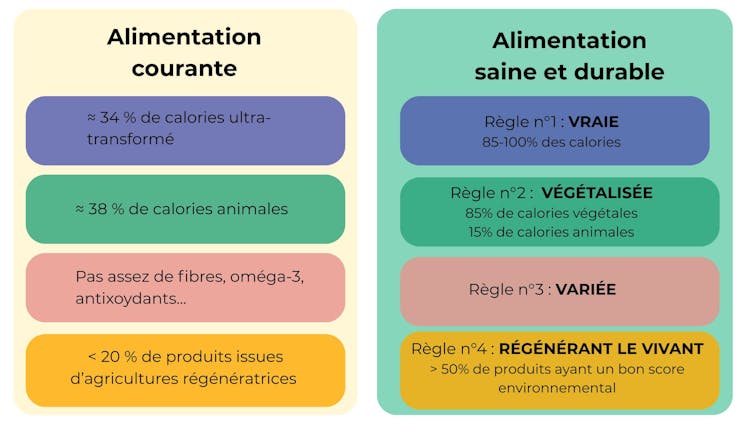
La règle des 4V. Fourni par l’auteur
Nous proposons la règle simple des 4V, qui tient compte des modes de production agricoles et de la composition de l’assiette en invitant à une alimentation vraie, végétale, variée et régénérant le vivant.
Manger plus végétal est également meilleur pour la santé. Cela permet aussi une réduction importante de plusieurs impacts environnementaux : réduction de l’empreinte carbone de notre alimentation, car moins d’émissions de gaz à effet de serre (GES) en agriculture ; moindre consommation de ressources (terres, énergie, eau).
Outre la réduction de notre consommation de protéines qui excède en moyenne de 40 % les recommandations, il est proposé de ramener la part des protéines animales à moins de 50 % de l’apport protéique, au lieu de 65 % actuellement. Au final, cela revient à diviser par deux la consommation de viande et un peu celle des produits laitiers, notamment le fromage. L’augmentation de la consommation de protéines végétales provient alors surtout des légumineuses. La végétalisation de l’assiette passe aussi par une consommation accrue de fruits et de légumes peu transformés, de céréales complètes et de fruits à coque.
Manger varié est un atout pour la santé, notamment pour l’équilibre nutritionnel afin d’éviter les déficiences. Cela suppose de diversifier fruits, légumes, céréales complètes, légumineuses et fruits à coque qui sont une source importante de fibres, minéraux, vitamines, oligo-éléments, anti-oxydants et autres phytonutriments bioactifs protecteurs.
Pour cela, il faudrait idéalement consommer de tous les groupes d’aliments tout en variant dans chaque groupe : par exemple, blé, maïs et riz complets pour les céréales. Manger les différents morceaux de viande – en particulier des bovins (par exemple des entrecôtes et pas seulement du steak haché) – est aussi important pour ne pas déstabiliser les filières.
Manger des produits issus d’une agriculture régénérant le vivant permet d’améliorer la densité nutritionnelle des aliments, de réduire l’empreinte environnementale de l’assiette, notamment pour les émissions de GES et d’azote, et aussi d’augmenter les services fournis à la société (séquestration de carbone, épuration de l’eau…).
La regénération du vivant désigne l’ensemble des actions visant à restaurer ou renouveler la fertilité des sols, les cycles de l’eau et de l’azote, la diversité des espèces et la résilience face aux changements climatiques, tout en consommant avec parcimonie les ressources non renouvelables (le gaz qui sert à fabriquer les engrais, le phosphore…). Ainsi, au-delà de la production de nourriture, l’agriculture régénératrice vise à fournir des services à la société, tels que la séquestration du carbone dans les sols, l’augmentation de la densité nutritionnelle des produits.
Types d’agriculture contribuant à la régénération du vivant
L’agriculture conventionnelle, qui vise l’intensification durable en utilisant les technologies pour réduire ses impacts, ne peut cependant pas régénérer le vivant, car elle porte toujours sur des systèmes simplifiés avec un nombre limité de cultures, des sols souvent pauvres en matières organiques, peu d’infrastructures écologiques et de très grandes parcelles.
Cependant, caractériser les modes de culture et d’élevage pour leurs impacts négatifs, mais aussi pour les services qu’ils rendent (séquestration du carbone, densité nutritionnelle des produits) permet d’aller au-delà de la dichotomie usuelle bio/conventionnel.
L’élevage est critiqué, car il introduit une compétition entre feed (nourrir les animaux) et food (nourrir les humains). Cette compétition est bien plus faible pour les vaches, qui mangent de l’herbe, que pour les porcs et les volailles, qui sont nourris avec des graines. Elle est aussi d’autant plus faible que les élevages sont autonomes pour l’énergie et les protéines. Des exemples d’élevage contribuant à la régénération du vivant sont les élevages herbagers et biologiques, dont l’alimentation provient surtout des prairies, ainsi que les élevages Bleu Blanc Cœur pour lesquels l’ajout de lin, graine riche en oméga-3, dans la ration des animaux, a des effets positifs sur leur santé, la nôtre et la planète puisqu’il y a une réduction des émissions de GES en comparaison à des élevages courants.
Il s’agit d’agricultures agroécologiques, telles que l’agriculture biologique, l’agriculture de conservation des sols, s’il y a une réduction effective des pesticides, voire l’agroforesterie.
Des initiatives sont en cours pour évaluer l’impact environnemental des produits agricoles et alimentaires. Elles permettent de qualifier les modes de culture et d’élevage en termes d’impacts sur le climat, la biodiversité, en mobilisant la base de données Agribalyse. Elles tiennent compte aussi des services fournis comme la séquestration du carbone, la contribution à la pollinisation des cultures, comme le montre la recherche scientifique.
À ce jour, deux initiatives diffèrent par la manière de prendre en compte les services et de quantifier les impacts. La méthode à retenir dépendra de leur validation scientifique et opérationnelle.
Par ailleurs, les modes de production en agriculture sont très dépendants des intrants de synthèse (énergie, engrais, pesticides) dont les excès dégradent la qualité des sols, de l’eau, de l’air, la biodiversité ainsi que la densité nutritionnelle en certains micronutriments.
Nous sommes parvenus à un point où nos modes d’alimentation ainsi que les modes de production agricole qui leur sont associés génèrent des coûts cachés estimés à 170 milliards d’euros pour la France. La nécessité de refonder notre système alimentaire est maintenant reconnue par les politiques publiques.
Un cercle vertueux bon pour la santé et l’environnement
Manger varié encourage la diversification des cultures et le soutien aux filières correspondantes. Il en est de même pour manger vrai, car les industriels qui fabriquent des aliments ultratransformés n’ont pas besoin d’une diversité de cultures dans un territoire. Dit autrement, moins on mange vrai, moins on stimule l’agriculture contribuant à régénérer le vivant. Manger varié est également meilleur pour la santé mais aussi pour le vivant.
Par ailleurs, les pratiques agricoles régénératives permettent généralement d’avoir des produits de plus grande densité nutritionnelle. Même si le mode de production de l’agriculture biologique émet souvent plus de GES par kilo de produit que le mode conventionnel, il suffit de consommer un peu moins de viande pour compenser cet effet.
La règle des 4V (Figure 2) permet donc d’embarquer tous les acteurs du système alimentaire, du champ à l’assiette, ainsi que les acteurs de la santé. Ainsi, adhérer simultanément à vrai, végétal, varié a récemment été associé à une réduction de 27 % du risque de cancer colorectal.
Quant au concept de régénération du vivant, il demeure parlant pour tous les maillons de la chaîne. Vivant, varié et végétal s’adressent aux agriculteurs ; vrai concerne les transformateurs et, in fine, le distributeur qui peut offrir ou non du 4V aux consommateurs. Cette règle des 4V permet ainsi de sensibiliser les acteurs du système alimentaire et les consommateurs aux facteurs à l’origine des coûts cachés de l’alimentation, tant pour la santé que l’environnement.
Enfin, un tel indicateur qualitatif et holistique est facile d’appropriation par le plus grand nombre, notamment les consommateurs, tout en constituant un outil d’éducation et de sensibilisation au concept « Une seule santé » pour l’alimentation, comblant le fossé entre sachants et non-sachants.
Anthony Fardet est membre des comités scientifiques/experts de MiamNutrition, The Regenerative Society Foundation, Centre européen d’excellence ERASME Jean Monnet pour la durabilité, Projet Alimentaire Territorial Grand Clermont-PNR Livradois Forez et l’Association Alimentation Durable. Il a été membre du comité scientifique de Siga entre 2017 et 2022.
Michel Duru est membre du conseil scientifique de PADV (Pour une Agriculture Du Vivant)
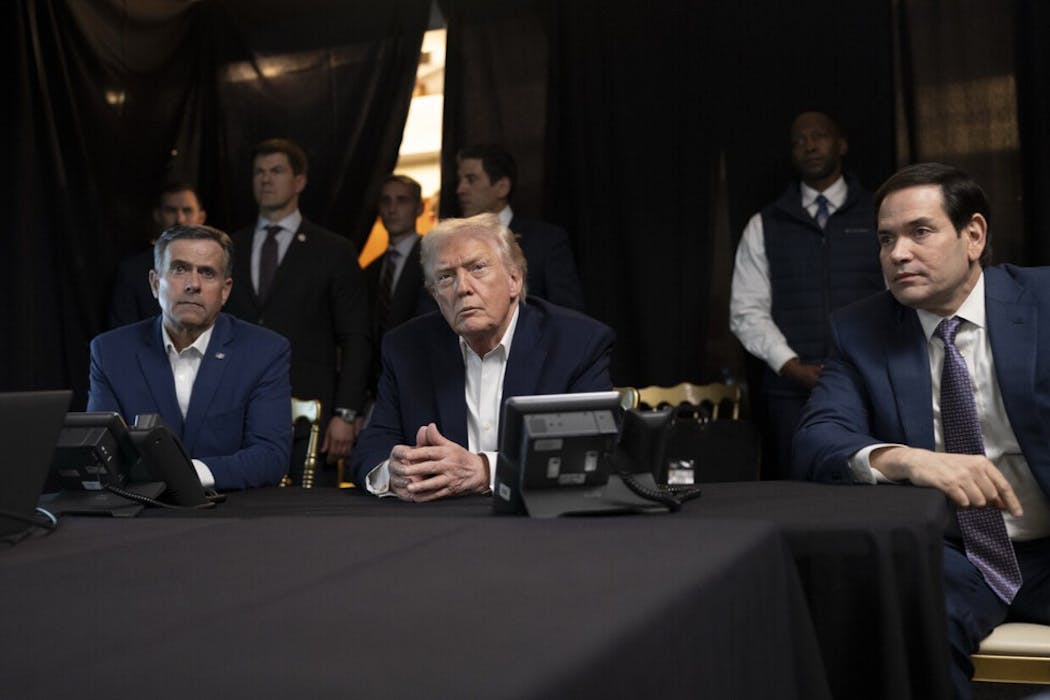
Donald Trump assiste à la capture du dirigeant vénézuélien Nicolas Maduro, entouré du directeur de la CIA John Ratcliffe (à gauche) et du secrétaire d’État Marco Rubio (Mar-a-Lago, Floride, nuit du 2 au 3 janvier 2026).Site officiel de la Maison Blanche
Donald Trump a célébré la nouvelle année en marquant son territoire et en ouvrant la porte à un nouveau partage du monde entre Washington, Moscou et Pékin. L’Europe, tétanisée, prend acte par son silence approbateur de la mort du droit international.
Donald Trump et les hauts responsables de son administration ont salué l’opération « Détermination absolue » – le raid sur Caracas et la capture et l’enlèvement du président vénézuélien Nicolas Maduro, le 3 janvier 2026 – comme un succès militaire exceptionnel. On peut tout aussi aisément affirmer qu’il s’agit d’une violation flagrante et éhontée du droit international, qui marque une nouvelle érosion de ce qui reste de l’ordre international.
Mais la tentation pour la Maison Blanche est désormais de crier victoire et de passer rapidement à d’autres cibles, alors que le monde est encore sous le choc de l’audace dont a fait preuve le président américain en kidnappant un dirigeant étranger en exercice. Les populations et les dirigeants de Cuba (depuis longtemps une obsession pour le secrétaire d’État de Trump Marco Rubio), de Colombie (le plus grand fournisseur de cocaïne des États-Unis) et du Mexique (la principale voie d’entrée du fentanyl aux États-Unis) ont des raisons de s’inquiéter sérieusement pour leur avenir dans un monde trumpien.
Il en va de même pour les Groenlandais, en particulier à la lumière des commentaires de Trump ce week-end selon lesquels les États-Unis « ont besoin du Groenland du point de vue de leur sécurité nationale ». Sans parler du tweet alarmant de Katie Miller, influente membre du mouvement MAGA et épouse de Stephen Miller, l’influent chef de cabinet adjoint de Trump, montrant une carte du Groenland aux couleurs du drapeau américain.
Et ce n’est pas la réaction timide de la plupart des responsables européens qui freinera le président américain dans son élan. Celle-ci est extrêmement déconcertante, car elle révèle que les plus ardents défenseurs du droit international semblent avoir renoncé à prétendre qu’il a encore de l’importance.
La cheffe de la politique étrangère de l’Union européenne (UE), Kaja Kallas a été la première à réagir, avec un message qui commençait par souligner le manque de légitimité de Maduro en tant que président et se terminait par l’expression de sa préoccupation pour les citoyens européens au Venezuela. Elle a du bout des lèvres réussi à ajouter que « les principes du droit international et de la charte des Nations unies doivent être respectés ». Cette dernière partie apparaissait comme une réflexion après coup, ce qui était probablement le cas.
La déclaration commune ultérieure de 26 États membres de l’UE (soit tous les États membres sauf la Hongrie) était tout aussi équivoque et ne condamnait pas explicitement la violation du droit international par Washington.
Le premier ministre britannique Keir Starmer a pour sa part axé sa déclaration sur le fait que « le Royaume-Uni soutient depuis longtemps une transition au Venezuela », qu’il « considère Maduro comme un président illégitime » et qu’il « ne versera pas de larmes sur la fin de son régime ». Avant de conclure en exprimant son souhait d’une « transition sûre et pacifique vers un gouvernement légitime qui reflète la volonté du peuple vénézuélien », l’ancien avocat spécialisé dans les droits humains a brièvement réitéré son « soutien au droit international ».
Le chancelier allemand Friedrich Merz remporte toutefois la palme. Tout en faisant des commentaires similaires sur le défaut de légitimité de Maduro et l’importance d’une transition au Venezuela, il a finalement souligné que l’évaluation juridique de l’opération américaine était complexe et que l’Allemagne « prendrait son temps » pour le faire.
Le point de vue de Moscou et Pékin
Alors que l’Amérique latine était partagée entre enthousiasme et inquiétude, les condamnations les plus virulentes sont venues de Moscou et de Pékin.
Le président russe Vladimir Poutine avait manifesté son soutien à Maduro dès le début du mois de décembre. Dans une déclaration publiée le 3 janvier, le ministère russe des affaires étrangères se contentait initialement d’apporter son soutien aux efforts visant à résoudre la crise « par le dialogue ». Dans des communiqués de presse ultérieurs, la Russie a adopté une position plus ferme, exigeant que Washington « libère le président légitimement élu d’un pays souverain ainsi que son épouse ».
La Chine a également exprimé son inquiétude quant à l’opération américaine, la qualifiant de « violation flagrante du droit international ». Un porte-parole du ministère des affaires étrangères a exhorté Washington à « garantir la sécurité personnelle du président Nicolas Maduro et de son épouse, à les libérer immédiatement, à cesser de renverser le gouvernement du Venezuela et à résoudre les problèmes par le dialogue et la négociation ».
La position de Moscou, en particulier, est bien sûr profondément hypocrite. Certes condamner l’opération américaine comme étant une « violation inacceptable de la souveraineté d’un État indépendant » est peut-être justifié. Mais cela n’est guère crédible au vu de la guerre que Moscou mène depuis dix ans contre l’Ukraine, qui s’est traduite par l’occupation illégale et l’annexion de près de 20 % du territoire ukrainien.
La Chine, quant à elle, peut désormais avoir le beurre et l’argent du beurre à Taïwan, qui, contrairement au Venezuela, n’est pas largement reconnu comme un État souverain et indépendant. Le changement de régime apparaissant de nouveau à l’ordre du jour international comme une entreprise politique légitime, il ne reste plus grand-chose, du point de vue de Pékin, qui pourrait s’opposer à la réunification, si nécessaire par la force.
Les actions de Trump contre le Venezuela n’ont peut-être pas accéléré les plans chinois de réunification par la force, mais elles n’ont guère contribué à les dissuader. Cet épisode va probablement encourager la Chine à montrer plus d’assurance en mer de Chine méridionale.
Le partage du monde
Tout cela laisse présager un nouveau glissement progressif des intérêts des grandes puissances américaine, chinoise et russe, qui souhaitent disposer de sphères d’influence dans lesquelles elles peuvent agir à leur guise. Car si la Chine et la Russie ne peuvent pas faire grand-chose pour leur allié Maduro, désormais destitué, c’est aussi parce qu’il n’existe aucun moyen simple de délimiter où commence une sphère d’influence et où finit une autre.
La perspective d’un partage du monde entre Washington, Moscou et Pékin explique aussi l’absence d’indignation européenne face à l’opération menée par Trump contre le Venezuela. Elle témoigne de sa prise de conscience que l’ère de l’ordre international libre et démocratique est bel et bien révolue. L’Europe n’est pas en position d’adopter une posture qui lui ferait risquer d’être abandonnée par Trump et assignée à la sphère d’influence de Poutine.
Au contraire, les dirigeants européens feront tout leur possible pour passer sous silence leurs divergences avec les États-Unis et tenteront de tirer parti d’une remarque presque anodine faite par Trump à la fin de sa conférence de presse samedi 3 janvier, selon laquelle il n’est « pas fan » de Poutine.
Ce qui importe désormais pour l’Europe, ce ne sont plus les subtilités des règles internationales. Il s’agit dorénavant de garder les États-Unis et leur président imprévisible de son côté, dans l’espoir de pouvoir défendre l’Ukraine et de dissuader la Russie de commettre de nouvelles agressions.
Ces efforts pour accommoder le président américain ne fonctionneront que dans une certaine mesure. La décision de Trump de réaffirmer son ambition d’annexer le Groenland, dont il convoite les vastes ressources minérales essentielles, s’inscrit dans sa vision d’une domination absolue dans l’hémisphère occidental.
Cette renaissance de la doctrine Monroe vieille de deux siècles (rebaptisée par Trump « doctrine Donroe ») a été exposée dans la nouvelle stratégie de sécurité nationale américaine en décembre 2025. Elle ne s’arrête clairement pas au changement de régime au Venezuela.
La stratégie vise à « rétablir les conditions d’une stabilité stratégique sur le continent eurasien » ou à « atténuer le risque de conflit entre la Russie et les États européens ». Mais déstabiliser davantage l’alliance transatlantique en menaçant l’intégrité territoriale du Danemark au sujet du Groenland et en abandonnant peut-être l’Europe et l’Ukraine aux desseins impériaux du Kremlin risque d’avoir l’effet inverse.
De même, si l’incursion au Venezuela encourage les revendications territoriales chinoises en mer de Chine méridionale et éventuellement une action contre Taïwan, elle ne permettra guère d’atteindre l’objectif américain, énoncé dans la stratégie de sécurité nationale, qui consiste à prévenir une confrontation militaire avec son rival géopolitique le plus important.
À l’instar des autres tentatives de changement de régime menées par les États-Unis depuis la fin de la guerre froide, l’action américaine au Venezuela risque d’être une initiative qui isolera le pays et se retournera contre lui. Elle marque le retour de la loi de la jungle, pour laquelle les États-Unis, et une grande partie du reste du monde, finiront par payer un lourd tribut.
La traduction en français de cet article a été assurée par le siteJustice Info.
Stefan Wolff a bénéficié par le passé de subventions du Conseil britannique de recherche sur l’environnement naturel, de l’Institut américain pour la paix, du Conseil britannique de recherche économique et sociale, de la British Academy, du programme « Science pour la paix » de l’OTAN, des programmes-cadres 6 et 7 et Horizon 2020 de l’UE, ainsi que du programme Jean Monnet de l’UE. Il est administrateur et trésorier honoraire de la Political Studies Association du Royaume-Uni et chercheur principal au Foreign Policy Centre de Londres.
The style of that performance is part of the substance, not just its packaging. On Jan. 4, 2026, on ABC’s This Week, that style shifted abruptly for the U.S.
Anchor George Stephanopoulos pressed Secretary of State Marco Rubio to explain President Donald Trump’s declaration that “the United States is going to run Venezuela.” Under what authority, Stephanopoulos asked, could such a claim possibly stand?
Rubio dodged the question. He just said that the United States would enact “a quarantine on their oil.” Venezuela’s economy would remain frozen, unable “to move forward until the conditions that are in the national interest of the United States and the interests of the Venezuelan people are met.”
Rubio’s point presumed authority rather than pausing to justify it. It was a diplomacy of dominance – coercion dressed up as concern. The unspoken assumption was pure wishful thinking: that “national interest” would immediately prevail, flowing smoothly in all directions.
As a historian of the early republic and the author of a biography of George Washington, I’ve been reminded these days of how Washington – amid harsh storms unlike anything the country faces today – forged a vision that treated restraint, not self-justifying unilateralism, as the truest measure of American national interest.
ABC’s George Stephanopoulos interviewed Secretary of State Marco Rubio on Jan. 4, 2026.
The young nation was humiliated before it was strong. George Washington understood that humiliation intimately. Independence had freed America from Britain, but not from the world.
“Would to Heaven we had a navy,” he confessed to the Marquis de Lafayette in 1786, longing for ships “to reform those enemies to mankind, or crush them into nonexistence.” But such a fierce wish never became Washington’s foreign policy. Visibility invited peril; peril required composure.
In 1785, two American merchant vessels – the Maria of Boston and the Dauphin of Philadelphia – were captured by Algerian cruisers. Twenty-one sailors were chained, stripped and sold into slavery. Their families begged the government to pay ransom. Negotiators proposed paying tribute, a kind of protection-in-advance payment system. The price kept rising.
President Washington refused to be rushed by either pity or anger. Paying the extravagant sum, he warned his cabinet in 1789, “might establish a precedent which would always operate and be very burthensome if yielded to.”
Precedent mattered to Washington. A republic must measure not only what it can afford, but what it will be forced to feel tomorrow because of what it pays today.
Washington feared that habit of nearsightedness in foreign affairs precisely because he believed it corrupted empires – and could corrupt republics as well.
Neutrality as ‘emotional discipline’
The storms soon multiplied.
By 1793, Europe was already “pregnant with great events,” Washington wrote to Lafayette. The French Revolution, welcomed at first as a triumph of “The Rights of Man,” slid into terror and general war.
Citizen Genet, the French envoy to the United States, landed in Charleston, South Carolina, and proceeded to enlist American citizens’ help in France’s war with Britain by commissioning privateers in U.S. ports to prey on British ships. Genet did not request permission to do this from Washington.
Gratitude to France – indispensable ally during the Revolution, provider of fleets, soldiers and hard-to-forget loans – clashed with alarm at her new demands. A single misstep could have dragged the United States into another catastrophic conflict.
And yet, Washington responded to Genet not with rashness and bravado but with restraint made public law.
President Washington knew that the road to successful pursuit of national interests was paved with international credibility.
Washington wanted America “to be little heard of in the great world of Politics,” preferring instead “to exchange Commodities & live in peace & amity with all the inhabitants of the earth.”
The first president pitched the republic’s voice toward ordinary people rather than rival powers. He spoke of “inhabitants,” not foreign enemies. He treated restraint – not self-justifying unilateralism – as the truest measure of national interest.
At his presidency’s end, George Washington wrote to fellow statesman Gouverneur Morris, ‘My policy has been, and will continue… to be upon friendly terms with, but independent of, all the nations of the earth.’ Library of Congress
On March 4, 1797, he would leave the presidency. His final creed was simple and devout: “My policy has been, and will continue … to be upon friendly terms with, but independent of, all the nations of the earth.”
For Washington, friendliness was a strategy, not a concession. The republic would treat other nations with civility precisely in order to remain independent of their appetites and quarrels.
Yet foreign policy has never been only a ledger of advantage. It is also a civic mirror: the emotional register of a government that tells citizens what kind of nation is acting in their name, and whether it tries to balance national interest with responsibilities to others.
Washington believed America’s legitimacy abroad depended on patience and respect for the autonomy of others. The current approach to Caracas announces a different imagination: a power that boasts of quarantines, sets conditions – and calls the result partnership.
A republic must still defend its interests. But I believe it should also defend the temperament that made those interests compatible with independence in the first place. Washington’s America learned to stand among stronger powers without demanding to run them.
The question asked on “This Week,” then, is only the beginning.
The deeper question remains whether the United States will continue to perform power with the discipline of a constitutional republic – or surrender that discipline to the easy allure of what only seems to serve national interest, but fails to build credibility or relationships that endure.
Maurizio Valsania does not work for, consult, own shares in or receive funding from any company or organization that would benefit from this article, and has disclosed no relevant affiliations beyond their academic appointment.
Many adults are breathing a sigh of relief as the 6-7 meme fades away as one of the biggest kid-led global fads of 2025.
In case you managed to miss it, 6-7 is a slang term – spoken aloud as “six seven” – accompanied by an arm gesture that mimics someone weighing something in their hands.
For the most part, adults responded with mild annoyance and confusion.
But as media scholarswho studychildren’s culture, we didn’t view the meme with bewilderment or exasperation. Instead, we thought back to our own childhoods on three different continents – and all the secret languages we spoke.
There was Pig Latin. The cool “S” doodled on countless worksheets and bathroom stalls. Forming an L-shape with our thumb and index finger to insult someone. Remixing the words of hand-clapping games from previous generations.
6-7 is only the latest example of these long-standing practices – and though the gesture might not mean much to adults, it says a lot about children’s play, their social lives and their desire for power.
The irresistible allure of 6-7
You can see this longing for power in classic play like spying on adults and in games like “king of the hill.”
A typical school day involves a tight schedule of adult-directed activities; kids have little time or space for agency.
But during those in-between times when children are able to stealthily evade adult surveillance – on playgrounds, on the internet and even when stuck at home during the pandemic – children’s culture can thrive. In these spaces, they can make the rules. They set the terms. And if it confuses adults, all the better.
As 6-7 went viral, teachers complained that random outbursts by their students were interrupting their lessons. Some started avoiding asking any kind of question that might result in an answer of 67. The trend migrated from schools to sports arenas and restaurants: In-N-Out Burger ended up banning the number 67 from their ticket ordering system.
The meaninglessness of 6-7 made it easy to create a sense of inclusion and exclusion – and to annoy adults, who strained to decipher hidden meanings. In the U.S., siblings and friends dressed as the numbers 6-7 for Halloween. And in Australia, it was rumored that houses with 6-7 in their address were going for astronomical prices.
Remixing games and rhymes
Since before World War I, historians have documented children’s use of secret languages like “back slang,” which happens when words are phonetically spoken backwards. And nonsense words and phrases have long proliferated in children’s culture: Recent examples include “booyah,” “skibidi” and “talk to the hand.”
6-7 also coincides with a long history of children revising, adapting and remixing games and rhymes.
For example, in our three countries – the U.S., Australia and South Korea – we’ve encountered endless variations of the game of “tag.” Sometimes the chasers pretend to be the dementors from Harry Potter. Other times the chasers have pretended to be the COVID-19 virus. Or we’ll see them incorporate their immediate surroundings, like designating playground equipment as “home” or “safe.”
Similar games can spread among children around the world. In South Korea, “Mugunghwa kkochi pieotseumnida” – which roughly translates to “The rose of Sharon has bloomed,” a reference to South Korea’s national flower – is similar to the game “Red Light, Green Light” in English-speaking countries. In the game “Hwang-ma!,” South Korean children in the early aughts shouted the word and playfully struck a peer upon seeing a rare, gold-colored car, a game similar to “Punch Buggy” and “Slug Bug” in the U.S. and Australia.
Historically, children have reworked rhymes and clapping games to draw on popular culture of the day. “Georgie Best, Superstar,” sung to the tune of “Jesus Christ Superstar,” was a popular chant on U.K. playgrounds in the 1970s that celebrated the legendary soccer player George Best. And a variation of the clapping game “I went to a Chinese Restaurant” included the lyrics “My name is, Elvis Presley, girls are sexy, Sitting on the back seat, drinking Pepsi.”
Making space for children’s culture
One reason 6-7 became so popular is the low barrier to entry: Saying “6-7” and doing the accompanying hand movement is easy to pick up and translate into different cultural contexts. The simplicity of the meme allowed young Korean children to repeat the phrase in English. And deaf children have participated by signing the meme.
Because the social worlds of children now exist across a range of online spaces, 6-7 has been able to seamlessly spread and evolve. On the gaming platform Roblox, for example, children can create avatars that resemble 6-7 and play games that feature the numbers.
The strange words, nonsensical games and creative play of your childhood might seem ridiculous today. But there’s real value in these hidden worlds.
With or without access to the internet, children will continue to transform language and games to suit their needs – which, yes, includes getting under the skin of adults.
A great deal of attention is given to the omnipresence of digital technologies in children’s lives, but we think it’s worth taking a moment to appreciate the way children are using these technologies to innovate and connect in ways both creative and mundane.
The authors do not work for, consult, own shares in or receive funding from any company or organization that would benefit from this article, and have disclosed no relevant affiliations beyond their academic appointment.