Most Pennsylvania voters ignore judicial elections − a political scientist explains why they matter, especially in a battleground state

Source: The Conversation – USA – By Daniel J. Mallinson, Associate Professor of Public Policy and Administration, Penn State

Three of the seven judges on PA’s state supreme court are up for retention votes in November 2025. AP Photo/Matt Rourke

This November, there will be no candidate for president, governor, senator or even representative on the Pennsylvania ballot.

Pennsylvanians will vote, however, on three members of their seven-member state Supreme Court.

These are retention elections, which means that voters will decide whether to keep the current members of the court or remove them.

The three seats up for grabs are three of the five Democrats that hold the majority on the court. They are Justices Christine Donohue, Kevin Dougherty and David Wecht.

While the typical voter may not think much about judicial elections, political operatives and political scientists, like me, know they have consequences.

I think it’s important that voters understand what a retention election is and why state judicial elections are growing in political importance in the U.S.

Retention elections

Federal judges are appointed by the U.S. president, confirmed by the U.S. Senate, and can serve for the rest of their lives. State judges, however, are put in place in a variety of ways.

The most powerful state courts are the so-called “courts of last resort.” These are essentially the supreme courts of each state. The method for selecting judges in these courts has varied over time and across the states. Currently, states use either gubernatorial appointment, legislative appointment, partisan elections, nonpartisan elections, or a merit process for selecting the judges of their highest courts.

Pennsylvania has partisan elections, meaning judges run for office attached to political parties, just like a candidate would run for governor or president. However, it is only in their first race for office that a judge runs in a competitive partisan election. After they assume the bench, they participate in retention elections every 10 years. These retention elections are considered nonpartisan, since party labels do not appear on the ballot.

Essentially, a retention election is an up or down vote. If more than 50% of voters cast a vote in opposition to a sitting judge, that judge will be out of the office at the end of their term. The governor, who is currently Democrat Josh Shapiro, then makes a temporary appointment to fill the seat with a special election held in the next odd year – in this case, 2027. But any appointments would need to be confirmed by the Republican-controlled state Senate, which may not confirm his picks.

Politicization of the state courts

Judges win retention elections over 90% of the time. So why should people bother to cast their vote?

Courts, including state courts, have become highly politicized over the past several decades. A marked increase in politicization occurred for the U.S. Supreme Court after the failed nomination of Robert Bork in the 1980s.

This politicization has since trickled down to lower federal courts and the states.

State supreme courts have always made big decisions, but the nationalization of American politics – where national partisan politics drive voter behavior in local elections – has elevated the controversy over state supreme court decisions on issues such as reproductive rights, trans rights, COVID-19 restrictions, environmental protection and more.

This issue became more acute when courts in battleground states were thrust to the center of adjudicating false claims of election fraud during the 2020 U.S. presidential election. And judges have faced increasing threats, particularly when opposing actions of the Trump administration, as President Donald Trump is prone to calling out specific judges in decisions that he does not like.

The Pennsylvania Supreme Court has received additional attention, in part due to the outsized role it has played in recent redistricting. In 2018, the court threw out the congressional districts drawn by the General Assembly in 2011 and invited a new plan from the governor and General Assembly. The two came to a political loggerhead, so the Supreme Court ended up using its own map as a replacement.

In 2022, the state Supreme Court once again took control of redistricting after Pennyslvania’s then-Gov. Tom Wolf vetoed the congressional district map approved by the General Assembly.

Given the importance of state supreme courts, particularly in federal elections cases in battleground states like Pennsylvania, it is little wonder why their elections are gaining attention.

The April 2025 Wisconsin Supreme Court race was the most expensive state judicial race in U.S. history, with $100 million in spending, including significant contributions from billionaires Elon Musk and George Soros.
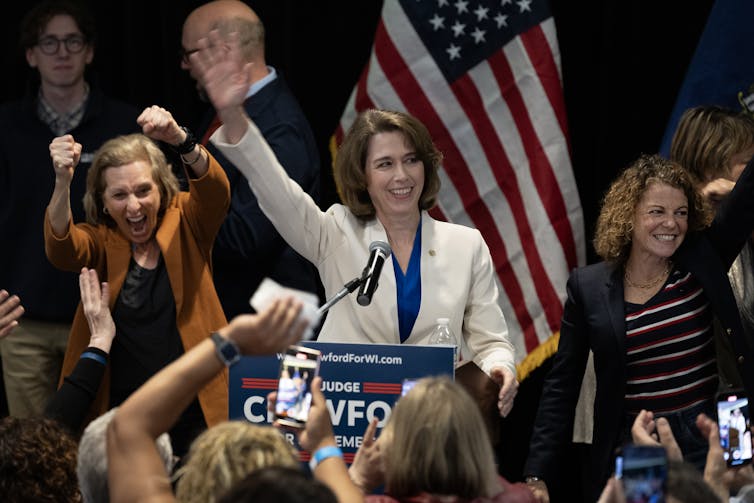
Woman in white blazer stands at podium and smiles as she waves at the crowd
Former prosecutor Susan Crawford won the highly politicized race for Wisconsin Supreme Court justice in 2025. It was the most expensive state supreme court race in U.S. history.
Scott Olson via Getty Images

That was one seat.

Pennsylvania has three up for grabs in November 2025, with the potential to swing the current Democratic majority.

And retention elections are politically simple for opponents. As one Republican political consultant told investigative news outlet Spotlight PA: “This is a political consultant’s dream, because your message is just one thing, and that’s ‘No.’”

This can give some advantage to Republicans in a state that Trump won in 2024 and in a low-turnout election. The question will be whether there is more energy motivating opponents to turn out against the Democratic majority or supporters seeking to maintain the status quo.
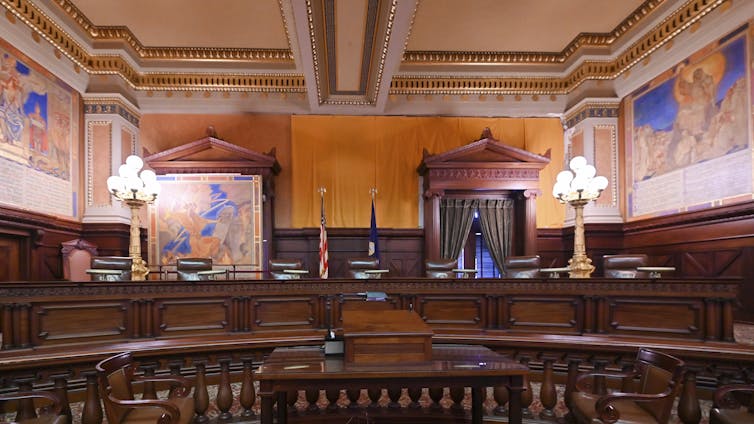
Interior of stately courtroom with dark wood furnishings and gold trim
The 2025 retention elections could change the balance of power in the court.
AP Photo/Aimee Dilger

The stakes for Pennsylvania in 2025

Much is at stake for Pennsylvanians in the fall. Republicans see this as their best opportunity to break the firm 5-2 Democratic majority on the court. This would pave the way for very different judicial decisions. Many of the court’s recent election-related rulings were made on narrow 4-3 votes that could swing differently if the composition of the court changes.

Republicans have had their power in Harrisburg diminished with Shapiro in the governor’s mansion and a one-seat Democratic majority in the state House of Representatives over the past two terms.

A Republican majority on the court would significantly change the balance of power in Harrisburg.

But it is important to focus not only on the top court. The state’s two appellate-level courts – one step below the state Supreme Court – also have two important races and two retention votes in November that will decide the judiciary’s relationship with the governor and General Assembly.

The Conversation

Daniel J. Mallinson does not work for, consult, own shares in or receive funding from any company or organization that would benefit from this article, and has disclosed no relevant affiliations beyond their academic appointment.

ref. Most Pennsylvania voters ignore judicial elections − a political scientist explains why they matter, especially in a battleground state – https://theconversation.com/most-pennsylvania-voters-ignore-judicial-elections-a-political-scientist-explains-why-they-matter-especially-in-a-battleground-state-259775

2026 FIFA World Cup expansion will have a big climate footprint, with matches from Mexico to Canada – here’s what fans can do

Source: The Conversation – USA (2) – By Brian P. McCullough, Associate Professor of Sport Management, University of Michigan

Lionel Messi celebrates with fans after Argentina won the FIFA World Cup championship in 2022 in Qatar. Michael Regan-FIFA/FIFA via Getty Images

When the FIFA World Cup hits North America in June 2026, 48 teams and millions of sports fans will be traveling among venues spread across Canada, the United States and Mexico.

It’s a dramatic expansion – 16 more teams will be playing than in recent years, with a jump from 64 to 104 matches. The tournament, whether you call it soccer or football, is projected to bring in over US$10 billion in revenue. But the expansion will also mean a lot more travel and other activities that contribute to climate change.

The environmental impacts of giant sporting events like the World Cup create a complex paradox for an industry grappling with its future in a warming world.

A sustainability conundrum

Sports are undeniably experiencing the effects of climate change. Rising global temperatures are putting athletes’ health at risk during summer heat waves and shortening winter sports seasons. Many of the 2026 World Cup venues often see heat waves in June and early July, when the tournament is scheduled.

There is a divide over how sports should respond.

Some athletes are speaking out for more sustainable choices and have called on lawmakers to take steps to limit climate-warming emissions. At the same time, the sport industry is growing and facing a constant push to increase revenue. The NCAA is also considering expanding its March Madness basketball tournaments from 68 teams currently to as many as 76.

A sweating soccer player squirts water from a bottle onto his forehead during a match.
Park Yong-woo of team Al Ain from Abu Dhabi tries to cool off during a Club World Cup match on June 26, 2025, in Washington, D.C., which was in the midst of a heat wave. Some players have raised concerns about likely high temperatures during the 2026 World Cup, with matches scheduled June 11 to July 19.
AP Photo/Julia Demaree Nikhinson

Estimates for the 2026 World Cup show what large tournament expansions can mean for the climate. A report from Scientists for Global Responsibility estimates that the expanded World Cup could generate over 9 million metric tons of carbon dioxide equivalent, nearly double the average of the past four World Cups.

This massive increase – and the increase that would come if the NCAA basketball tournaments also expand – would primarily be driven by air travel as fans and players fly among event cities that are thousands of miles apart.

A lot of money is at stake, but so is the climate

Sports are big business, and adding more matches to events like the World Cup and NCAA tournaments will likely lead to larger media rights contracts and greater gate receipts from more fans attending the events, boosting revenues. These are powerful financial incentives.

In the NCAA’s case, there is another reason to consider a larger tournament: The House v. NCAA settlement opened the door for college athletic departments to share revenue with athletes, which will significantly increase costs for many college programs. More teams would mean more television revenue and, crucially, more revenue to be distributed to member NCAA institutions and their athletic conferences.

When climate promises become greenwashing

The inherent conflict between maximizing profit through growth and minimizing environmental footprint presents a dilemma for sports.

Several sport organizations have promised to reduce their impact on the climate, including signing up for initiatives like the United Nations Sports for Climate Action Framework.

However, as sports tournaments and exhibition games expand, it can become increasingly hard for sports organizations to meet their climate commitments. In some cases, groups making sustainability commitments have been accused of greenwashing, suggesting the goals are more about public relations than making genuine, measurable changes.

For example, FIFA’s early claims that it would hold a “fully carbon-neutral” World Cup in Qatar in 2022 were challenged by a group of European countries that accused soccer’s world governing body of underestimating emissions. The Swiss Fairness Commission, which monitors fairness in advertising, considered the complaints and determined that FIFA’s claims could not be substantiated.

A young man looks up as he prepares to board a plane on the tarmac in Milan, Italy, for a flight to Rome on Dec. 15, 2024.
Alessandro Bastoni, of Inter Milan and Italy’s national team, prepares to board a flight from Milan to Rome with his team.
Mattia Ozbot-Inter/Inter via Getty Images

Aviation is often the biggest driver of emissions. A study that colleagues and I conducted on the NCAA men’s basketball tournament found about 80% of its emissions were connected to travel. And that was after the NCAA began using the pod system, which is designed to keep teams closer to home for the first and second rounds.

Finding practical solutions

Some academics, observing the rising emissions trend, have called for radical solutions like the end of commercialized sports or drastically limiting who can attend sporting events, with a focus on fans from the region.

These solutions are frankly not practical, in my view, nor do they align with other positive developments. The growing popularity of women’s sports shows the challenge in limiting sports events – more games expands participation but adds to the industry’s overall footprint.

Further compounding the challenges of reducing environmental impact is the amount of fan travel, which is outside the direct control of the sports organization or event organizers.

Many fans will follow their teams long distances, especially for mega-events like the World Cup or the NCAA tournament. During the men’s World Cup in Russia in 2018, more than 840,000 fans traveled from other countries. The top countries by number of fans, after Russia, were China, the U.S., Mexico and Argentina.

There is an argument that distributed sporting events like March Madness or the World Cup can be better in some ways for local environments because they don’t overwhelm a single city. However, merely spreading the impact does not necessarily reduce it, particularly when considering the effects on climate change.

How fans can cut their environmental footprint

Sport organizations and event planners can take steps to be more sustainable and also encourage more sustainable choices among fans. Fans can reduce their environmental impact in a variety of ways. For example:

  • Avoid taking airplanes for shorter distances, such as between FIFA venues in Philadelphia, New York and Boston, and carpool or take Amtrak instead. Planes can be more efficient for long distances, but air travel is still a major contributing factor to emissions.

  • While in a host city, use mass transit or rent electric vehicles or bicycles for local travel.

  • Consider sustainable accommodations, such as short-term rentals that might have a smaller environmental footprint than a hotel. Or stay at a certified green hotel that makes an effort to be more efficient in its use of water and energy.

  • Engage in sustainable pregame and postgame activities, such as choosing local, sustainable food options, and minimize waste.

  • You can also pay to offset carbon emissions for attending different sporting events, much like concertgoers do when they attend musical festivals. While critics question offsets’ true environmental benefit, they do represent people’s growing awareness of their environmental footprint.

Through all these options, it’s clear that sports face a significant challenge in addressing their environmental impacts and encouraging fans to be more sustainable, while simultaneously trying to meet ambitious business and environmental targets.

In my view, a sustainable path forward will require strategic, yet genuine, commitment by the sports industry and its fans, and a willingness to prioritize long-term planetary health alongside economic gains – balancing the sport and sustainability.

The Conversation

Brian P. McCullough does not work for, consult, own shares in or receive funding from any company or organization that would benefit from this article, and has disclosed no relevant affiliations beyond their academic appointment.

ref. 2026 FIFA World Cup expansion will have a big climate footprint, with matches from Mexico to Canada – here’s what fans can do – https://theconversation.com/2026-fifa-world-cup-expansion-will-have-a-big-climate-footprint-with-matches-from-mexico-to-canada-heres-what-fans-can-do-259437

Afrique de l’Ouest : cinq leçons pour comprendre la vague de coups d’État et préserver la démocratie

Source: The Conversation – in French – By Salah Ben Hammou, Postdoctoral Research Associate, Rice University

Août 2025 marque les cinq ans du coup d’État au Mali. En 2020, des soldats ont renversé le président Ibrahim Boubacar Keïta. Ce coup a bouleversé la vie politique malienne. Mais il a aussi ouvert la voie à une série de prises de pouvoir militaires dans d’autres pays africains, entre 2020 et 2023

Des soldats ont renversé les gouvernements du Niger, du Burkina Faso (à deux reprises), du Soudan, du Tchad, de la Guinée et du Gabon.

Le retour des coups d’État militaires a choqué de nombreux observateurs.
On pensait que ces pratiques appartenaient au passé, à l’époque de la guerre froide. Elles semblaient avoir disparu. Pourtant, elles font leur retour.

Aucun nouveau coup d’État n’a eu lieu depuis celui du Gabon en 2023. Mais les conséquences sont toujours là. En mai 2025, le général Brice Oligui Nguema, auteur du coup au Gabon, a été officiellement investi président. Ce faisant, il a rompu sa promesse de retirer l’armée du pouvoir.

Au Mali, la junte au pouvoir a dissous tous les partis politiques afin de renforcer son emprise sur le pouvoir.

Dans tous les pays touchés, les dirigeants militaires restent bien implantés. Le Soudan, pour sa part, a sombré dans une guerre civile dévastatrice à la suite du coup d’État de 2021.

Les analystes invoquent souvent la faiblesse des institutions, l’insécurité croissante et le mécontentement populaire à l’égard des gouvernements civils pour expliquer les coups d’État. Si ces facteurs comptent, ils ne suffisent pas pour comprendre ce qui se passe.

J’étudie et écris sur les coups d’État militaires depuis près de dix ans, en particulier sur cette vague de coups d’État.

Mon analyse montre que la communauté internationale doit changer de regard. Ces coups ne sont pas des événements isolés. Ils suivent une logique. Les chefs de junte ne font pas que prendre le pouvoir. Ils s’inspirent les uns des autres. Ils apprennent à s’installer durablement, à contourner les pressions internationales, et à construire un discours qui légitime leur pouvoir.

Pour défendre la démocratie, la communauté internationale doit tirer cinq enseignements des récentes prises de pouvoir militaires.

Principaux enseignements

L’effet domino: À peine un mois après que l’armée guinéenne a renversé le président Alpha Condé, l’armée soudanaise interrompait la transition démocratique dans le pays. Trois mois plus tard, des officiers burkinabés ont renversé le président Roch Marc Christian Kaboré dans un contexte d’insécurité croissante.

Chaque coup d’État a eu des déclencheurs spécifiques, mais le timing suggère plus qu’une simple coïncidence.

Les putschistes potentiels observent ce qui se passe ailleurs. Ils veulent savoir si un coup réussit, mais aussi quels problèmes apparaissent ensuite. Si les auteurs d’un coup sont punis sévèrement, cela peut décourager d’autres tentatives.

La propagation des coups d’État dépend autant des risques perçus que des opportunités. Mais lorsque les coups d’État réussissent, en particulier si les nouveaux dirigeants prennent rapidement le contrôle et évitent une instabilité immédiate, cela envoie un signal encourageant à d’autres militaires tentés par le pouvoir.

Le soutien de la population civile est important : le soutien de la population civile aux coups d’État est une réalité observable.

Depuis le début de la récente vague de coups d’État en Afrique, de nombreux observateurs ont souligné les foules en liesse qui accueillent souvent les soldats, célébrant la chute de régimes impopulaires. Le soutien de la population civile est un aspect souvent sous-estimé.

Pourtant, il donne de la légitimité aux putschistes. Il leur permet aussi de mieux résister aux critiques, aussi bien internes qu’internationales. Par exemple, à la suite du coup d’État de 2023 au Niger, les putschistes ont été confrontés à la condamnation internationale et à la menace d’une intervention militaire. En réponse, des milliers de partisans se sont rassemblés dans la capitale, Niamey, pour soutenir les dirigeants putschistes.

Au Mali, des manifestants ont envahi les rues en 2020 pour saluer le renversement par l’armée du président Ibrahim Boubacar Keïta. En Guinée, des foules se sont rassemblées derrière la junte après la destitution d’Alpha Condé en 2021. Et au Burkina Faso, les deux coups d’État de 2022 ont été accueillis par une approbation généralisée.

Réactions internationales : La réaction de la communauté internationale envoie des signaux tout aussi forts. Lorsque ces réactions sont faibles, tardives ou incohérentes – comme l’absence de sanctions significatives, la suspension symbolique de l’aide ou l’exclusion symbolique des instances régionales –, elles peuvent donner l’impression que la prise illégale du pouvoir ne coûte pas grand chose.

Les réactions internationales aux récents coups d’État ont été mitigées. Certaines, comme celle du Niger, ont déclenché des réactions initiales fortes, notamment des sanctions et des menaces d’intervention militaire .

Mais au Tchad, la prise de pouvoir de Mahamat Déby en 2021 a été légitimée par les principaux acteurs internationaux, qui l’ont présentée comme une mesure nécessaire pour assurer la stabilité après la mort au combat de son père, le président Idriss Déby, aux mains des forces rebelles.

En Guinée et au Gabon, les mesures de suspensions régionales ont été largement symboliques, avec peu de pression pour rétablir le pouvoir civil. Au Mali et au Burkina Faso, les calendriers de transition ont été prolongés à plusieurs reprises sans grande opposition.

Cette incohérence indique aux auteurs des coups d’État que la prise du pouvoir peut provoquer l’indignation, mais rarement des conséquences durables.

Les auteurs de coups d’État apprennent les uns des autres : l’effet domino ne se limite pas au moment de la prise de pouvoir. Les auteurs de coups d’État tirent également des leçons de la manière dont leurs prédécesseurs se sont maintenus au pouvoir. Ils observent quelles tactiques permettent de neutraliser l’opposition et de prolonger leur emprise sur le pouvoir.

En général, dans les pays touchés, le pouvoir militaire s’installe dans la durée. En moyenne, les dirigeants militaires restent au pouvoir pendant près de 1 000 jours depuis le début de la vague actuelle. Avant cette vague, les dirigeants militaires conservaient le pouvoir pendant 22 jours en moyenne depuis l’année 2000.

Au Tchad, Mahamat Déby a consolidé son pouvoir grâce à des élections contestées en 2024. Le Gabonais Nguema lui a emboîté le pas en 2025, remportant près de 90 % des voix après que des modifications constitutionnelles lui ont ouvert la voie.

Dans ces deux cas, les élections ont servi à donner une apparence démocratique à des régimes militaires. Mais sur le fond, le rôle de l’armée reste inchangé.

Relier les pièces du puzzle

Les gouvernements putschistes du Mali, du Burkina Faso et du Niger ont tourné le dos à l’Occident pour se rapprocher de la Russie, renforçant ainsi leurs liens militaires et économiques. Les trois pays ont quitté la Communauté économique des États de l’Afrique de l’Ouest et formé l’Alliance des États du Sahel (AES), dénonçant les pressions régionales.

S’aligner sur la Russie offre à ces régimes un soutien extérieur et un vernis de souveraineté, tout en légitimant l’autoritarisme sous couvert d’indépendance.

La dernière leçon est claire : lorsque les coups d’État sont traités comme des événements isolés plutôt que comme des phénomènes interconnectés, il y a de fortes chances que d’autres suivent. Les comploteurs potentiels observent la réaction des citoyens, la réponse du monde et la manière dont les autres leaders putschistes consolident leur pouvoir.

Et si le message qu’ils reçoivent est que les coups sont tolérés, qu’ils peuvent réussir, l’effet dissuasif s’affaiblit.

Poema Sumrow, chercheur au Baker Institute, a contribué à cet article

The Conversation

Salah Ben Hammou does not work for, consult, own shares in or receive funding from any company or organisation that would benefit from this article, and has disclosed no relevant affiliations beyond their academic appointment.

ref. Afrique de l’Ouest : cinq leçons pour comprendre la vague de coups d’État et préserver la démocratie – https://theconversation.com/afrique-de-louest-cinq-lecons-pour-comprendre-la-vague-de-coups-detat-et-preserver-la-democratie-260641

Who was the first pirate?

Source: The Conversation – USA (2) – By Brandon Prins, Professor of Political Science, University of Tennessee

Curious Kids is a series for children of all ages. If you have a question you’d like an expert to answer, send it to curiouskidsus@theconversation.com.


Who was the first pirate? – Yandel R., age 11, Lakewood Ranch, Florida


When most people imagine a pirate, they picture actor Johnny Depp playing the mad but likable swashbuckler Jack Sparrow, captain of the sailing ship the Black Pearl.

Depp’s pirate portrayal was inspired by seafaring bandits in older make-believe tales, such as Long John Silver in “Treasure Island,” Captain Hook in “Peter Pan,” or sailor Edmond Dantès in “The Count of Monte Cristo.”

painting of one-legged pirate with parrot on shoulder holds a sword
A 1915 edition of ‘Treasure Island’ illustrated Long John Silver with iconic pirate features.
Louis Rhead/Historica Graphica Collection/Heritage Images via Getty Images

Pirates in these stories were mischievous but also glamorous, courageous and mostly kindhearted. They wore flashy costumes. They had missing limbs, like Captain Cook’s iron hook for a left hand and Long John Silver’s wooden peg leg. They buried treasure chests of gold and silver, forced enemies to walk the plank and had talking parrots as shipboard companions. They flew the Jolly Roger skull and crossbones flag from the ship’s mast to frighten enemies. The new Netflix series “One Piece,” which is based on a Japanese comic book, continues this popular depiction of pirates.

While fun, these portrayals of pirates are mostly invented.

I’m a political scientist who studies modern-day commerce raiding: robbing of private cargo vessels on the high seas. I’m interested in where it happens in the world, who does it and what can be done to stop it. My research finds today’s pirates to be less like swashbuckling Jack Sparrow and more like regular old thieves.

Pirates in the ancient world

Since pirates have been around for as long as people have moved things by boat, it is hard to pin down the very first pirate.

stone relief carving depicting ancient Egyptians in a low boat carrying birds in a cage
Ancient Egyptians tied bundles of reeds together to form watertight boats.
Werner Forman/Universal Images Group via Getty Images

But archaeological evidence shows that boatbuilding goes all the way back to the ancient Egyptians, who used boats made from papyrus reeds as early as 6,000 years ago. These vessels likely carried valuable goods up and down the Nile River, and where valuable goods can be found, you can usually find thieves too. In fact, researchers know that pirates – basically just thieves on the water – targeted these river boats, because Egyptian pharaohs left records grumbling about pirates and their widespread pillaging.

By 3,500 years ago, thieves were using sailing vessels to raid coastal towns and villages in and around the Nile Delta, as well as the Aegean and Adriatic basins. Attacking ships far from land on the high seas and stealing the cargo was a logical next step in the tactics of seafaring raiders.

As trade increased across the Mediterranean Sea, boats carrying valuable cargo, such as pottery, silk, glass, spices and metals, became the targets of ancient pirates. Given the worth of these goods, pirate attacks became widespread across the ancient Mediterranean Sea. With money from the Roman senate and strong effort by a military leader named Pompey, the Roman navy worked hard to stop the pirates – and for a while it did.

The earliest named pirate?

The first mention of a pirate by name may have been in a Greek history book written in the fifth century BCE by an ancient historian named Herodotus.

He briefly describes the adventures of a naval commander by the name of Dionysius who was from Ionia, which is in modern-day Turkey. Dionysius set up a pirate base on the island of Sicily that allowed him and his fellow pirates to plunder ships that happened to sail past.

Pirates of the Caribbean

While Dionysius may have been the first recorded pirate, the most famous pirates lived during the 17th and 18th centuries, which came to be known as the golden age of sea piracy.

This was the heyday of pirates such as Blackbeard, also known as Edward Teach; William Kidd; Henry Morgan; Calico Jack; and Anne Bonny. They plundered Spanish treasure ships in the Caribbean, known as the Spanish Main, that were carrying silver from the mines in Bolivia back to the king of Spain.

Islands such as Jamaica, Tortuga and the Bahamas, as well the North Carolina coast, all became notable pirate havens. Port Royal, on the island of Jamaica, in particular, was a notorious pirate refuge. It was ideally positioned for preying upon Spanish galleons sailing across the Atlantic from ports in Panama and Venezuela. Johnny Depp’s character, Jack Sparrow, swashbuckled around a fictionalized Port Royal in the first “Pirates of the Caribbean” film.

map from west coast of Africa to east coast of Asia with red dots denoting pirate attacks along coasts
Each dot represents a maritime pirate attack that happened between 1995 and 2023.
Brandon Prins

21st-century pirates

The 2013 Hollywood movie “Captain Phillips,” starring Tom Hanks, drew attention back to real-world pirates and piracy. The movie was based on a real-life 2009 attack by Somali pirates on a ship named the MV Maersk Alabama, which was carrying food to Kenya. The 500-foot-long vessel and its crew were rescued by the U.S. Navy.

To better understand 21st-century piracy, my research team compiled data on all pirate attacks from 1995 to the present day. We found three main piracy hot spots: the Gulf of Aden near Somalia, the Strait of Malacca in Southeast Asia and the Gulf of Guinea off the coast of West Africa. All three locations experience the conditions that attract pirates: ship traffic, valuable cargo and weak governments.

Why become a pirate?

People become pirates for many reasons, not the least of which is to escape poverty and enslavement. Others just want adventure and to travel the world. These are the same motivations that drove commerce raiding in the ancient world, during the golden age of piracy, and even today.

While we may never know the first pirate, just like we will never know the very first thief, historical evidence shows that sea-raiding has been around since the very first boats traversed the world’s waterways. Despite efforts to end piracy, my research shows that the conditions that produce ship looting remain and will likely always exist.


Hello, curious kids! Do you have a question you’d like an expert to answer? Ask an adult to send your question to CuriousKidsUS@theconversation.com. Please tell us your name, age and the city where you live.

And since curiosity has no age limit – adults, let us know what you’re wondering, too. We won’t be able to answer every question, but we will do our best.

The Conversation

Brandon Prins received funding from the U.S. Department of Defense, Office of Naval Research, through the Minerva Initiative, awards #N00014-21-1-2030 and #N00014-14-1-0050.

ref. Who was the first pirate? – https://theconversation.com/who-was-the-first-pirate-256314

Zohran Mamdani’s last name reflects centuries of intercontinental trade, migration and cultural exchange

Source: The Conversation – USA (3) – By Iqbal Akhtar, Associate Professor of Religious Studies, Florida International University

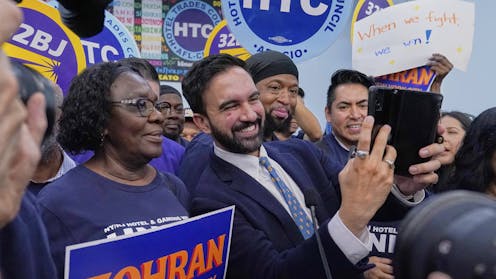
Zohran Mamdani takes photos with union members during a campaign rally at the Hotel and Gaming Trades Council headquarters in New York on July 2, 2025. AP Photo/Richard Drew

When Zohran Mamdani announced his candidacy for mayor of New York City, political observers noted his progressive platform and legislative record. But understanding the Democratic candidate’s background requires examining the rich cultural tapestry woven into his very surname: Mamdani.

He takes the name from his father, Mahmood Mamdani, a prominent academic who was raised in Uganda and whose work focuses on postcolonial Uganda. I studied the history of the Khoja community for my doctoral work and have helped develop Khoja studies as an academic discipline. The Mamdani surname tells a story of migration, resilience and community-building that spans centuries and continents.

The Khoja history

Mamdanis in Uganda belong to the Khoja community, a South Asian Muslim merchant caste, that shaped economic development across the western Indian Ocean for centuries.

The name originates from greater Sindh, a region in South Asia that today includes southeastern Pakistan and Kachchh in western India.

Its etymology is twofold. Mām is an honorific title in Kachchhi and Gujarati languages, meaning kindness, courage and pride. Māmadō is a local version of the name Muhammad that often appeared in surnames in Hindu castes that converted to Islam, such as the Memons.

The Khoja were categorized by the British in the early 19th century as “Hindoo Mussalman” because their traditions spanned both religions.

Over time, the Khoja came to be identified only as Muslim and then primarily as Shiite Muslim. Today, the majority of Khoja are Ismaili: a branch of Shiite Islam that follows the Aga Khan as their living imam.

The Mamdani family, however, is part of the Twelver community of Khoja, whose Twelfth Imam is believed to be hidden from the world and only emerges in times of crisis. Twelvers believe he will help usher in an age of peace during end times.

Around the late 18th century, the Khoja helped export textiles, manufactured goods, spices and gems from the Indian subcontinent to Arabia and East Africa. Through this Western Indian Ocean trading network, they imported timber, ivory, minerals and cloves, among other goods.

Khoja family firms were built on kinship networks and trust. They built networks of shops, communal housing and warehouses, and extended credit for thousands of miles, from Zanzibar in Tanzania to Bombay – now Mumbai – on the western coast of India.

Cousins and brothers would send money and goods across the ocean with only a letter. The precarious nature of trade in this period meant that families also served as insurance for each other. In times of wealth, it was shared; in times of disaster, help was available.

Khoja contributions in Africa

The Khoja became instrumental in building the commercial infrastructure of eastern, central and southern Africa. But the Khoja contribution to the development of Africa extended far beyond trade.

In the absence of colonial investment in public infrastructure, they helped build institutions that formed the foundation of the modern nation-states that emerged after colonization. The institutions both facilitated trade and established permanent communities.

For example, the first dispensary and public school in Zanzibar were constructed by a Khoja magnate, Tharia Topan, who made his wealth through the ivory and clove trades. Topan eventually became so prominent that he was knighted by Queen Victoria in 1890 for his service to the British Empire in helping to end slavery in East Africa.

The Khoja community continues to invest in East Africa. The most famous example is the Aga Khan Development Network, whose hospitals and schools operate in 30 countries. In places such as Kenya, Uganda and Tanzania, they are considered the best.

Khoja in Uganda

Like in other parts of Africa, the Khoja settled in Uganda as a liaison business community to develop a market to serve both African and European needs. The linguistic and cultural knowledge, developed over centuries, helped facilitate business despite the challenges of colonization.

A Black man in a suit walking with a woman and another dressed in traditional African attire.
Ugandan President Idi Amin and his wife, Sarah, in Rome on Sept. 10, 1975.
AP Photo

However, in 1972, Ugandan dictator Idi Amin expelled all Asians – approximately 80,000 – forcing families like the Mamdanis into exile. These included indentured laborers, who were brought in to help build the railroad and farm during the British colonial period, and free traders, like the Mamdani family.

Amin saw them all as the same and famously said: “Asians came to Uganda to build the railway. The railway is finished. They must leave now.”

The experience was a bitter one. Families lost everything, and many left with only the clothes on their backs.

Mahmood Mamdani, who came from a Khoja merchant family, was 26 when he was exiled. Yet, unlike most Ugandan Asians, he chose to go back. At Makerere University in Kampala, Uganda’s capital, Mamdani set up the Institute for Social Research, which helped to provide rigorous social science training to Ugandan researchers trying to improve their society.

While the earlier generations of the Khoja tended to choose business or adjacent professions, such as accounting, the subsequent generations – particularly those educated in the West – embraced the knowledge economy as professionals, academics and nonprofit leaders.

Several of Mahmood Mamdani’s generation of Khoja academics conducted path-breaking work on Afro-Asian solidarity – a way of thinking about the world beyond colonial categories, such as the category of religion as a separate domain from the secular. These scholars, such as Tanzania’s Issa Shivji and Abdul Sheriff, worked on creating solidarity among the newly independent states of the Global South.

Mahmood Mamdani is known for his influential post-9/11 academic work, “Good Muslim, Bad Muslim,” which examined how Muslim identities are stereotyped. He argued that these identities are complex and varied, shaped by accumulated history and present experiences.

Interfaith identity

The Khoja community – known globally as the Khoja Shia Ithnasheri Muslim Community – has developed strong transnational connections. Today, they are concentrated in the United Kingdom, Canada, United States and France. However, Khoja can be found in almost any country in the world. In 2013, I met members of the community in Hong Kong.

The Khoja community plays an important role in interfaith dialogue and global development initiatives. A prominent Ismaili Khoja, Eboo Patel, the founder of Interfaith America, has dedicated his life to pluralism and mutual understanding through building up civil society.

Zohran Mamdani’s mother, acclaimed filmmaker Mira Nair, is Hindu by birth. This interfaith marriage exemplifies the flexibility, diversity and tolerance of Khoja Islam, which has historically navigated between Hindu and Islamic traditions.

Whether Mamdani’s policies prove practical remains to be seen, but his background offers something valuable: a deep understanding of how communities build resilience across generations and geographies.

The Conversation

Iqbal Akhtar does not work for, consult, own shares in or receive funding from any company or organization that would benefit from this article, and has disclosed no relevant affiliations beyond their academic appointment.

ref. Zohran Mamdani’s last name reflects centuries of intercontinental trade, migration and cultural exchange – https://theconversation.com/zohran-mamdanis-last-name-reflects-centuries-of-intercontinental-trade-migration-and-cultural-exchange-259967

Les amours de vacances des adolescents : entre liberté, exploration et normes sociales

Source: The Conversation – France (in French) – By Marine Lambolez, Doctorante, ENS de Lyon

Le temps des vacances permet aux jeunes d’explorer sans pression, loin de leur cercle quotidien, des relations avec des jeunes issus d’autres milieux qu’ils n’auraient pas croisés autrement. Un temps de liberté précieux pour le développement de leur personnalité ?


Les grandes vacances s’accompagnent de tout un imaginaire : la chaleur (de plus en plus), la baignade, le vélo entre copains, l’ennui des longues journées, les cartes postales, le camping, la maison des grands-parents ou le quartier qui se vide pour deux mois… et les amours de vacances, qui se nouent plus souvent en bord de plage qu’aux vacances de la Toussaint, d’où leur nom anglais de « summer fling ».

En dehors de l’espace scolaire et, bien souvent, sous un contrôle parental plus diffus qu’à l’accoutumée, la liberté estivale des jeunes s’étend à la sphère amoureuse.

Loin du regard du cercle quotidien, les idylles se lient sans pression. L’été, les jeunes peuvent se réinventer et sortir de leur place attitrée au sein de leurs familles ou de leurs groupes d’amis : l’intello, le rigolo, la bonne copine, l’ex d’untelle…). C’est l’occasion d’explorer des relations amicales et amoureuses avec des jeunes de milieux sociaux ou d’appartenance géographique éloignées, que l’on ne croiserait pas dans son quotidien, et de faire fi de son capital de popularité scolaire.


À lire aussi :
Le crush à l’adolescence : une pratique culturelle ?


Il est fréquent que les élèves débutent l’année scolaire avec un nouveau style vestimentaire, une nouvelle coiffure, une nouvelle facette de leur identité expérimentés et perfectionnés à l’abri des regards pendant l’été.

Il en va de même pour les relations amoureuses. Les vacances permettent au jeune couple de passer beaucoup de temps ensemble, dehors ou à des évènements estivaux organisés par la ville, le camping, le club de vacances… tout cela en ayant généralement moins besoin de demander l’autorisation aux parents de voir un ou une partenaire en particulier ni de s’organiser autour des activités extrascolaires et sociales qui rythment l’année scolaire.

Ces espaces de liberté et d’expérimentation permettent aux jeunes de construire une base de relation solide avant de présenter leur partenaire à leurs familles et leurs amis et amies au retour des vacances… ou d’arrêter la relation avant qu’elle soit soumise à l’approbation des proches ou à la logistique du quotidien, notamment pour les relations à distance.

Échapper au jugement des autres

Les amours de vacances fonctionnent comme des espaces de liberté pour les jeunes, hors du regard des pairs et de la famille. À l’école, au contraire, les histoires d’amour sont un sujet de conversation quotidien.

Du côté des groupes de garçons, il convient de se moquer de l’ami amoureux. D’abord, il faut mettre à distance l’intérêt pour l’amour car celui-ci serait fondamentalement féminin. Par conséquent, les garçons amoureux, surtout à un jeune âge, vont être moqués et leur masculinité remise en cause.

Chez les adolescents, quand le fait d’avoir une petite amie n’est plus sanctionné socialement, il convient de bien rappeler aux garçons en couple que la loyauté masculine surpasse la relation amoureuse, selon l’adage sexiste « les potes avant les putes ».

Chez les filles, le jugement des amies porte plus sur le partenaire que sur leur amie. Il s’agit pour elles de protéger leur amie de garçons malintentionnés, ou qui ne les « mériteraient » pas. Cependant, les critères selon lesquels un partenaire masculin va être considéré comme à la hauteur ou non varient et souffrent parfois des ancrages sociaux des jeunes. Ainsi, un garçon issu d’un milieu social plus défavorisé, ou d’une culture tout à fait différente, pourra faire l’objet des critiques des proches de sa petite amie, sans raison valable.

C’est par exemple autour de ces dynamiques conflictuelles que s’ouvrait la série Newport Beach (The OC). Les réactions amicales genrées sont représentées, de façon caricaturales, dans la chanson Summer nights de Grease, dans laquelle Sandy et Danny décrivent leur histoire de vacances de façons bien différentes :

Summer Nights (Clip du film Grease).

Evidemment, échapper au jugement des autres peut être particulièrement libérateur pour les jeunes soumis à des normes familiales strictes. C’est notamment le moment idéal pour les adolescent·es LGBTQIA+ de découvrir leurs attirances sans craindre de conséquences sociales au sein de leur famille ou de leur établissement scolaire.

Remettre en cause les normes de socialisation

En dehors de l’institution scolaire et à distance, figurativement ou géographiquement, de l’institution familiale, les normes de socialisation auxquelles est soumis chaque individu, a fortiori parmi les plus jeunes, se font moins sentir. L’été devient le moment parfait pour remettre en cause les normes respectées le reste de l’année.

Toutefois, ce n’est pas toujours une mauvaise chose quand les autres se mêlent des histoires de cœur des adolescentes et adolescents. Le contrôle parental permet bien sûr d’éviter des situations inappropriées (écarts d’âge, manque de prévention) et les filles (et de plus en plus les garçons) savent mettre en garde leurs amies contre des comportements toxiques dans leurs relations amoureuses. L’autre face du jugement est celle des conseils, parfois bons, qui permettent aux jeunes (et moins jeunes) de naviguer dans ces premières relations de couple.


Du lundi au vendredi + le dimanche, recevez gratuitement les analyses et décryptages de nos experts pour un autre regard sur l’actualité. Abonnez-vous dès aujourd’hui !


En dehors des vacances, les jeunes sont friands de moments dérobés au regard de leurs proches pour se découvrir « de leur côté ». Nous observons notamment cela avec l’investissement sentimental des espaces numériques anonymes. Les rencontres amoureuses se font aussi maintenant sur Discord ou dans les tchats de jeux en réseau (League of Legends, Fortnite…).

Parfois, l’entièreté de la relation amoureuse se vit sans rencontrer le cercle de son partenaire et, cela en étonnera plus d’un, sans même que les amoureux ne se rencontrent « en vrai ».

Internet offre ces « vacances infinies », enfermées dans le temps du loisir, au sein duquel les jeunes couples virtuels peuvent ne se soucier que de leur relation et de leurs activités ludiques. On peut se questionner sur le rôle que joueront ces relations dans la formation amoureuse des nouvelles générations, qui semblent convaincues de la fable « pour vivre heureux, vivons cachés ».

The Conversation

Marine Lambolez ne travaille pas, ne conseille pas, ne possède pas de parts, ne reçoit pas de fonds d’une organisation qui pourrait tirer profit de cet article, et n’a déclaré aucune autre affiliation que son organisme de recherche.

ref. Les amours de vacances des adolescents : entre liberté, exploration et normes sociales – https://theconversation.com/les-amours-de-vacances-des-adolescents-entre-liberte-exploration-et-normes-sociales-258093

Why Texas Hill Country, where a devastating flood killed more than 130 people, is one of the deadliest places in the US for flash flooding

Source: The Conversation – USA (2) – By Hatim Sharif, Professor of Civil and Environmental Engineering, The University of Texas at San Antonio

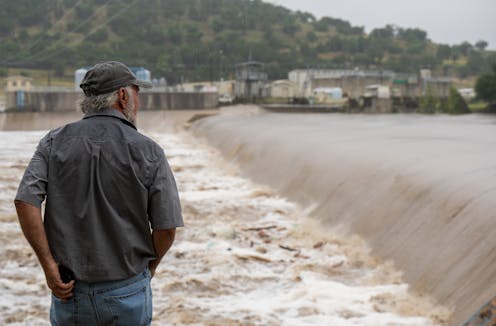
A Kerrville, Texas, resident watches the flooded Guadalupe River on July 4, 2025. Eric Vryn/Getty Images

Texas Hill Country is known for its landscapes, where shallow rivers wind among hills and through rugged valleys. That geography also makes it one of the deadliest places in the U.S. for flash flooding.

In the early hours of July 4, 2025, a flash flood swept through an area of Hill Country dotted with summer camps and small towns about 70 miles northwest of San Antonio. More than 130 people died in the flooding. The majority of them were in Kerr County, including more than two dozen girls and counselors at one summer camp, Camp Mystic. Dozens more people were still unaccounted for a week later.

The flooding began with a heavy downpour, with more than 10 inches of rain in some areas, that sent water sheeting off the hillsides and into creeks. The creeks poured into the Guadalupe River.

A river gauge at Hunt, Texas, near Camp Mystic, showed how quickly the river flooded: Around 3 a.m. on July 4, the Guadalupe River was rising about 1 foot every 5 minutes at the gauge, National Weather Service data shows. By 4:30 a.m., it had risen more than 20 feet. As the water moved downstream, it reached Kerrville, where the river rose even faster.

Flood expert Hatim Sharif, a hydrologist and civil engineer at the University of Texas at San Antonio, explains what makes this part of the country, known as Flash Flood Alley, so dangerous.

What makes Hill Country so prone to flooding?

Texas as a whole leads the nation in flood deaths, and by a wide margin. A colleague and I analyzed data from 1959 to 2019 and found 1,069 people had died in flooding in Texas over those six decades. The next highest total was in Louisiana, with 693.

Many of those flood deaths have been in Hill County. It’s part of an area known as Flash Flood Alley, a crescent of land that curves from near Dallas down to San Antonio and then westward.

The hills are steep, and the water moves quickly when it floods. This is a semi-arid area with soils that don’t soak up much water, so the water sheets off quickly and the shallow creeks can rise fast.

When those creeks converge on a river, they can create a surge of water that wipes out homes and washes away cars and, unfortunately, anyone in its path.

Hill Country has seen some devastating flash floods. In 1987, heavy rain in western Kerr County quickly flooded the Guadalupe River, triggering a flash flood similar to the one in 2025. Ten teenagers being evacuated from a camp died in the rushing water.

San Antonio, at the eastern edge of Hill Country, was hit with a flash flood on June 12, 2025, that killed 13 people whose cars were swept away by high water from a fast-flooding creek near an interstate ramp in the early morning.

Why does the region get such strong downpours?

One reason Hill Country gets powerful downpours is the Balcones Escarpment.

The escarpment is a line of cliffs and steep hills created by a geologic fault. When warm air from the Gulf rushes up the escarpment, it condenses and can dump a lot of moisture. That water flows down the hills quickly, from many different directions, filling streams and rivers below.

As temperature rise, the warmer atmosphere can hold more moisture, increasing the downpour and flood risk.

A tour of the Guadalupe River and its flood risk.

The same effect can contribute to flash flooding in San Antonio, where the large amount of paved land and lack of updated drainage to control runoff adds to the risk.

What can be done to improve flash flood safety?

First, it’s important for people to understand why flash flooding happens and just how fast the water can rise and flow. In many arid areas, dry or shallow creeks can quickly fill up with fast-moving water and become deadly. So people should be aware of the risks and pay attention to the weather.

Improving flood forecasting, with more detailed models of the physics and water velocity at different locations, can also help.

Probabilistic forecasting, for example, can provide a range of rainfall scenarios, enabling authorities to prepare for worst-case scenarios. A scientific framework linking rainfall forecasts to the local impacts, such as streamflow, flood depth and water velocity, could also help decision-makers implement timely evacuations or road closures.

Education is particularly essential for drivers. One to two feet of moving water can wash away a car. People may think their trucks and SUVs can go through anything, but fast-moving water can flip a truck and carry it away.

Officials can also do more to barricade roads when the flood risk is high to prevent people from driving into harm’s way. We found that 58% of the flood deaths in Texas over the past six decades involved vehicles. The storm on June 12 in San Antonio was an example. It was early morning, and drivers had poor visibility. The cars were hit by fast-rising floodwater from an adjacent creek.

This article, originally published July 5, 2025, has been updated with the death toll rising.

The Conversation

Hatim Sharif does not work for, consult, own shares in or receive funding from any company or organization that would benefit from this article, and has disclosed no relevant affiliations beyond their academic appointment.

ref. Why Texas Hill Country, where a devastating flood killed more than 130 people, is one of the deadliest places in the US for flash flooding – https://theconversation.com/why-texas-hill-country-where-a-devastating-flood-killed-more-than-130-people-is-one-of-the-deadliest-places-in-the-us-for-flash-flooding-260555

When disasters fall out of the public eye, survivors continue to suffer – a rehabilitation professional explains how sustained mental health support is critical to recovery

Source: The Conversation – USA (3) – By Lee Ann Rawlins Williams, Clinical Assistant Professor of Education, Health and Behavior Studies, University of North Dakota

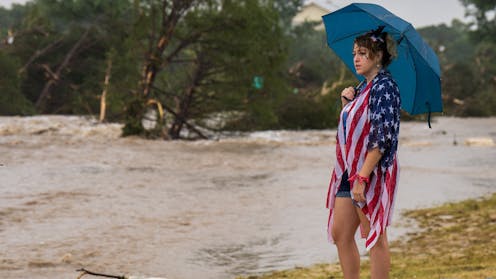
In Kerrville, Texas, Leighton Sterling watches the rushing floodwaters along the Guadalupe River on July 4, 2025. Eric Vryn via Getty Images News

The devastating losses from the historic flooding in Texas Hill Country on July 4, 2025, are still coming into grim focus, with 121 deaths confirmed and more than 100 still missing as of July 10.

As emergency responders focus on clearing debris and searching for victims, a less visible and slower disaster has been unfolding: the need for ongoing mental health support long after headlines fade.

This phase is no less critical than restoring power or rebuilding bridges. Disasters destabilize emotional well-being, leaving distress, prolonged recovery and long-term impacts in their wake long after the event is over.

Without sustained emotional support, people and communities face heightened risks of prolonged trauma and stalled recovery.

As an educator and practitioner focused on disability and rehabilitation, I explore the intersection of disaster recovery and the impact of disasters on mental health. Both my research and that of others underscore the vital importance of support systems that not only help people cope in the immediate aftermath of a disaster but also facilitate long-term healing over the months and years that follow – especially for vulnerable populations like children, older adults and people with disabilities.

The emotional toll of disasters

Natural disasters disrupt routines, displace families and challenge people’s sense of control and security. In the immediate aftermath, survivors often experience shock, grief, anxiety and sleep disturbances. Often these symptoms may evolve into chronic stress, depression, post-traumatic stress disorder or a combination of these conditions.

A 2022 study found that Texans who experienced two or more disasters within a five-year span had significantly poorer mental health, as reflected by lower scores on standardized psychological assessments, which highlights the cumulative toll repeated disasters can have on mental well-being.

After Hurricane Katrina ravaged New Orleans in 2005, nearly a third of survivors continued to experience poor mental health years later.

And reports following Hurricane Maria in Puerto Rico in 2017 revealed surging rates of anxiety, depression and suicidal thoughts, especially in areas where services remained unavailable for extended periods of time.

There are actionable ways to make a difference in the recovery process.

Strained recovery systems

Disaster response understandably focuses on immediate needs like rescue operations, providing post-disaster housing and repairing damaged infrastructure. In addition, short-term mental health supports such as mobile health clinics are often provided in the immediate aftermath of a disaster.

However, although emergency services are deployed quickly after a disaster, long-term mental health support is often delayed or under-resourced, leaving many people without continued care during the recovery period, especially in remote or rural communities, exposing deep structural gaps in how recovery systems are designed.

One year after Hurricane Harvey devastated parts of Texas in 2017, more than 90% of Gulf Coast residents reported ongoing stress related to housing instability, financial hardship or displacement. Yet less than 10% of people stated that they or someone in their household had used mental health services following the disaster.

Hurricane Helene in 2024 similarly tested the resilience of rural mental health networks in western North Carolina. The storm damaged roads and bridges, schools and even local clinics.

This prompted a news organization, North Carolina Health News, to warn of rising “trauma, stress and isolation” among residents as providers scrambled to offer free counseling despite legal barriers stemming from licensing requirements to provide counseling across state borders. State health officials activated community crisis centers and helplines, while mobile mental health teams were dispatched from Tennessee to help those impacted by the disaster. However, state representatives stressed that without long-term investment, these critical supports risk being one-off responses.

These events serve as a powerful reminder that while roads and buildings can often be restored quickly, emotional recovery is a slower, more complex process. Truly rebuilding requires treating mental health with the same urgency as physical infrastructure. This requires investing in strong mental health recovery systems, supporting local clinics, sustaining provider networks and integrating emotional care into recovery plans from the start.

Surrounded by community members and volunteers, an emotionally distraught woman speaks to the governor of Texas.
In Hunt, Texas, Gov. Greg Abbott speaks to volunteers and community members during a news conference on July 8, 2025.
Brandon Bell via Getty Images News

Finding mental health support following a disaster

Lessons learned from previous disasters and an abundance of research show how sustained mental health supports can help people recover and build resilience.

These six lessons are particularly helpful for finding needed mental health support following a disaster:

  • If you’re feeling overwhelmed after a disaster, you’re not alone, and help is available. Free and confidential support is offered through resources like the Disaster Distress Helpline (1-800-985-5990 or text TalkWithUs to 66746), which connects you to trained counselors 24/7.

  • Many communities offer local mental health crisis lines or walk-in centers that remain active well after the disaster passes. Check your county or state health department’s website for updated listings and information.

  • Even if physical offices are closed, many clinics now offer virtual counseling or can connect you with therapists and medication refills remotely. If you’ve seen someone before, ask if they’re still available by phone or video.

  • After major disasters, states often deploy mobile health clinics that include mental health services to shelters, churches or schools. These temporary services are free and open to the public.

  • If someone you care about is struggling, help them connect with resources in the community. Share hotline numbers, offer to help make an appointment or just let them know it’s OK to ask for support. Many people don’t realize that help is available, or they think it’s only for more “serious” problems. It’s not.

  • Mental health support doesn’t always arrive right away. Keep an eye on local news, school updates or health department alerts for new services that may become available in the weeks or months after a disaster.

Disasters don’t just damage buildings; they disrupt lives in lasting ways.

While emotional recovery takes time, support is available. Staying informed and sharing resources with others can help ensure that the road to recovery isn’t traveled alone.

The Conversation

Lee Ann Rawlins Williams does not work for, consult, own shares in or receive funding from any company or organization that would benefit from this article, and has disclosed no relevant affiliations beyond their academic appointment.

ref. When disasters fall out of the public eye, survivors continue to suffer – a rehabilitation professional explains how sustained mental health support is critical to recovery – https://theconversation.com/when-disasters-fall-out-of-the-public-eye-survivors-continue-to-suffer-a-rehabilitation-professional-explains-how-sustained-mental-health-support-is-critical-to-recovery-260781

Por qué movernos nos ayuda a borrar los malos recuerdos

Source: The Conversation – (in Spanish) – By Óscar Elía Zudaire, Profesor de Psicología, Universidad Europea

Kostikova Natalia/Shutterstock

“Dale duro al gym y no le des más vueltas, tío”.

Esa frase, a medio camino entre el meme y el consejo bienintencionado, tiene más trasfondo científico del que parece. Detrás de los batidos de proteínas y los selfies en el espejo hay una base científica sorprendentemente sólida: entrenar puede ayudarnos a olvidar malos recuerdos. Y no, no se trata de broscience (algo así como la ciencia de los devotos de los gimnasios), esto es neurociencia de verdad.

Nuevas neuronas al rescate

En lo más profundo de nuestro cerebro, en el hipocampo –una estructura cerebral clave para la memoria–, está la zona subgranular del giro dentado, donde se generan continuamente nuevas neuronas. Este proceso, llamado neurogénesis adulta, es uno de los pocos ejemplos de nacimiento de células nerviosas que perdura durante nuestra vida.

Las neuronas “recién nacidas” se integrarán en los circuitos cerebrales ya existentes formando nuevas conexiones sinápticas. Y es ahí donde viene lo interesante: estas nuevas neuronas y el nuevo “cableado” añadido a nuestro cerebro, además de ayudarnos a aprender, desestabiliza los recuerdos que ya no necesitamos.

En otras palabras, el cerebro está continuamente renovando sus conexiones, y esta reconexión hace que podamos olvidar ciertas cosas.

Un grupo de científicos ha demostrado en ratones que aumentando la neurogénesis en esa zona del hipocampo después de una experiencia traumática, el recuerdo de dicha vivencia y los síntomas de estrés postraumático asociados a ella se reducen. Los animales de laboratorio dejan de responder exageradamente a situaciones ante las que no deberían reaccionar, muestran menos síntomas de ansiedad y extinguen mejor los recuerdos asociados al miedo. Cuantas más neuronas nuevas, menos recuerdos traumáticos y menos conductas de estrés.

Ejercicio regenerador

¿Y cómo podemos aumentar la neurogénesis? Con ejercicio. Con cardio, con pesas o simplemente moviéndonos y manteniéndonos activos. Ya son varios los estudios que indican que la actividad física favorece la formación de nuevas neuronas en adultos. El ejercicio aeróbico moderado (como caminar a buen ritmo, correr o montar en bici) parece ser especialmente eficaz, aunque el entrenamiento de fuerza también puede aportar beneficios.

Este efecto se produce gracias a varias moléculas liberadas durante la actividad física, como el BDNF (factor neurotrófico derivado del cerebro), que actúa como “fertilizante” para las neuronas, favoreciendo su crecimiento y conexión. Otras sustancias, como la irisina, el IGF-1 o las betaendorfinas, también están implicadas en ese proceso regenerador. Además de crear nuevas neuronas, el ejercicio mejora la plasticidad cerebral, es decir, la capacidad del cerebro para adaptarse y cambiar.

Para saber más sobre cómo funciona este proceso, un equipo de investigación simuló eventos de neurogénesis en una red neuronal entrenada para reconocer objetos. Al introducir nuevas neuronas (es decir, renovando algunas conexiones), la red funcionó mejor, y pudo generalizar el conocimiento a nuevas imágenes. Es posible que nuestro cerebro utilice la neurogénesis del mismo modo: previniendo la sobrecarga cognitiva, rompiendo con viejos patrones y haciendo hueco para los nuevos.

Antes de que la mala experiencia se grabe para siempre

¡Pero no hay que esperar demasiado! Otro estudio encontró que esta forma sana de olvidar, promovida por la neurogénesis, solo funciona mientras los recuerdos todavía dependan del hipocampo. Si esperamos demasiado y ese recuerdo traumático se “distribuye” por todo el cerebro, será menos susceptible a los cambios en la plasticidad del hipocampo y dará igual el ejercicio que hagamos: nos seguirá doliendo.

En resumen: hacer ejercicio no solo hace que nos sintamos mejor, puede ayudarnos a que nuestro cerebro se resetee. No solo enterrando viejas memorias, sino ayudando a olvidarlas desde un punto de vista biológico. Todo parece indicar que el cerebro necesita esa neurogénesis para ayudarnos a olvidar, adaptarnos y seguir hacia adelante.

Así que, al menos esta vez, tu amigo del gimnasio, ese gymbro, tenía razón.

The Conversation

Óscar Elía Zudaire no recibe salario, ni ejerce labores de consultoría, ni posee acciones, ni recibe financiación de ninguna compañía u organización que pueda obtener beneficio de este artículo, y ha declarado carecer de vínculos relevantes más allá del cargo académico citado.

ref. Por qué movernos nos ayuda a borrar los malos recuerdos – https://theconversation.com/por-que-movernos-nos-ayuda-a-borrar-los-malos-recuerdos-258309

La salud va por barrios: cómo afecta la escasez de recursos a los territorios desfavorecidos

Source: The Conversation – (in Spanish) – By Isabel Aguilar Palacio, Profesora Titular de Medicina Preventiva y Salud Pública. Universidad de Zaragoza., Universidad de Zaragoza

Rodrigo Pukan/Shutterstock

Imagine dos barrios en una misma ciudad. En uno, las aceras están sombreadas por árboles, las viviendas son confortables y los centros de trabajo, ocio y salud quedan a pocos minutos andando. En el otro, las calles son áridas, las viviendas precarias y los servicios, escasos o lejanos. ¿Cree que sus habitantes tienen la misma salud? Lo más probable es que no.

La llamada “privación” no es solo una cuestión económica: es la acumulación de desventajas que impactan directamente en la vida de las personas. Medirla es esencial para entender y reducir las desigualdades sociales en salud.

Privación y salud

La privación es la insatisfacción de necesidades básicas por la falta de acceso a recursos materiales, sociales o económicos esenciales, con profundas implicaciones sobre el bienestar y la calidad de vida de las personas y de las comunidades. Esto impacta directamente sobre la salud de las poblaciones, con la aparición de múltiples enfermedades, tanto agudas como crónicas.

Por ejemplo, la falta de acceso a alimentos saludables, a unas condiciones de vivienda adecuadas o a espacios de ocio y de ejercicio contribuyen a la aparición de dolencias como la diabetes o las patologías cardíacas. También deteriora la salud mental, ya que el estrés crónico asociado a la incertidumbre económica, la inseguridad alimentaria o la falta de vivienda favorecen la aparición de síntomas como la ansiedad, la depresión y otros problemas vinculados a la salud mental.

Esta falta de recursos limita igualmente la capacidad de las personas para obtener cuidados formales e informales adecuados, agravando las condiciones de salud. La privación es, por tanto, un fenómeno multifacético que afecta a cada aspecto del bienestar humano.

¿Qué son los índices de privación y para qué sirven?

Con el objetivo de poder comprender y abordar las desigualdades en salud –esto es, las diferencias innecesarias, injustas y evitables–, surgieron los índices de privación. Estas herramientas cuantitativas permiten caracterizar a las personas residentes de diferentes áreas combinando datos sobre empleo, educación e ingresos, y también conocer los recursos existentes en cuestiones como la vivienda o el acceso a otros servicios básicos. La meta es generar una puntuación que refleje el grado de privación relativa o absoluta.

Los índices de privación tienen una gran variedad de aplicaciones. Se utilizan para la planificación en salud, identificando grupos en situación de mayor vulnerabilidad con el fin de diseñar políticas que sean efectivas, o para distribuir los recursos de manera más equitativa.

Además, son herramientas esenciales para evaluar las desigualdades existentes y medir el impacto de las políticas en la reducción de dichas desigualdades. Por último, desempeñan un rol crucial en la investigación, ayudando a comprender la relación entre privación y fenómenos de salud o enfermedad.

Por ejemplo, en España los índices de privación han servido para relacionarla con enfermedades tan diversas como el cáncer de estómago o el riesgo de aparición de covid-19 (https://pmc.ncbi.nlm.nih.gov/articles/PMC10075210/), pero también para priorizar intervenciones en salud en zonas urbanas.

Una nueva propuesta de la Sociedad Española de Epidemiología

Uno de los primeros índices de privación desarrollado fue el índice de Townsend en la década de los 70. Peter Townsend definió la privación como “aquella situación en la que las personas carecen de los recursos necesarios para participar en las actividades, costumbres y estilos de vida considerados habituales en la sociedad a la que pertenecen”. Este enfoque fue fundamental para los estudios sobre pobreza y desigualdad.

El índice de privación de Townsend no solo consideraba la falta de recursos básicos, sino también la incapacidad de participar de forma plena en la sociedad, siguiendo el marco conceptual de desigualdad definido por el economista indio Amartya Sen, entendido como “un entorno de oportunidades”. Este punto de vista llevó al desarrollo de indicadores que medían la privación a través de distintas dimensiones, como la vivienda, el empleo, la educación y el acceso a otros servicios esenciales.

Durante décadas, el desarrollo de otros registros incorporaron distintas dimensiones, como son el índice de Carstairs o el Índice Europeo de Privación.

En España, la Sociedad Española de Epidemiología (SEE) desarrolló el índice de privación 2011, adaptado a las características del territorio español. Esta herramienta utiliza datos censales para medir desigualdades en dimensiones clave, como el empleo y la educación.

Desde entonces, la situación del país ha cambiado. Por ese motivo, la SEE está llevando a cabo una revisión y actualización de su índice, que utilizará la información del Censo de 2021 y que incorporará nuevas dimensiones vinculadas a la desigualdad que han cobrado importancia en los últimos años, como los hogares monomarentales o características de la vivienda.

Herramienta para la acción

Medir la privación no es un ejercicio meramente teórico: es el primer paso para construir políticas públicas más eficaces y sociedades más justas. Resulta fundamental que avancemos en la comprensión y en el abordaje de las desigualdades en salud, con el fin de diseñar estas políticas que contribuyan a la existencia de sociedades más equitativas y saludables.

Los índices de privación son una herramienta clave en la evaluación de estas desigualdades y ofrecen una guía para la acción de salud pública.


Artículo escrito con el asesoramiento de la Sociedad Española de Epidemiología. Ignacio Duque, experto en geoestadística de indicadores sociales, ha contribuido a la elaboración de este texto.


The Conversation

Isabel Aguilar Palacio recibe fondos del Instituto de Salud Carlos III y del Gobierno de Aragón para proyectos de investigación y de la Comisión Europea y de la Innovative Health Initiative como experta. Miembro de la Junta Directiva de la Sociedad Española de Epidemiología (SEE).

Daniel La Parra Casado, Elena Mª Gras García, Mercedes Esteban Peña, Tania Fernández Villa y Unai Martin no reciben salarios, ni ejercen labores de consultoría, ni poseen acciones, ni reciben financiación de ninguna compañía u organización que pueda obtener beneficio de este artículo, y han declarado carecer de vínculos relevantes más allá del puesto académico citado.

ref. La salud va por barrios: cómo afecta la escasez de recursos a los territorios desfavorecidos – https://theconversation.com/la-salud-va-por-barrios-como-afecta-la-escasez-de-recursos-a-los-territorios-desfavorecidos-258839