I study emerging technologies and how their development and deployment influence economic, institutional and societal outcomes, including environmental sustainability. From my research, I see that even as AI uses a lot of energy, it can also make systems cleaner and smarter.
AI is already helping to save energy and water, cut emissions and make businesses more efficient in agriculture, data centers, the energy industry, building heating and cooling, and aviation.
Agricultural irrigation accounts for an enormous amount of the world’s water use. AP Photo/Luca Bruno
AI is helping farmers use water more efficiently. Argentinian climate tech startup Kilimo, for example, tackles water scarcity with an AI-powered irrigation platform. The software uses large amounts of data, machine learning, and weather and satellite measurements to determine when and how much to water which areas of fields, ensuring that only the plants that actually need water receive it.
Chile’s Ministry of Agriculture has found that in that country’s Biobío region, farms using Kilimo’s precision irrigation systems have reduced water use by up to 30% while avoiding overirrigation. Using less water also reduces the amount of energy needed to pump it from the ground and around a farm.
Kilimo is one example that shows how AI can create economic incentives for sustainability: The amount of water farmers save from precision irrigation is verified, and credits for those savings are sold to local companies that want to offset some of their water use. The farmers then earn a profit – often 20% to 40% above their initial investment.
Data centers
U.S. data centers consumed about 176 terawatt-hours of electricity in 2023, accounting for roughly 4.4% of total U.S. electricity use. This number increased to 183 TWh in 2024. This growing energy footprint has made improving data center efficiency a critical priority for the operators of the data centers themselves, as well as the companies that rely on them – including cloud providers, tech firms and large enterprises running AI workloads – both to reduce costs and meet sustainability and regulatory goals.
Despite the surge in internet traffic and users, data center electricity consumption has grown more moderately, rising from 1% of global electricity use in 2010 to 2% in 2025. Much of this is thanks to efficiency gains, including those enabled by AI.
AI systems analyze operational data in data centers – including workloads, temperature, cooling efficiency and energy use – to spot energy-hungry tasks. It adjusts computing resources to match demand and optimizes cooling. This lets data centers run smoothly without wasting electricity.
At Microsoft, AI is improving energy efficiency by using predictive analytics to schedule computing tasks. This lets servers enter low-power modes during periods of low demand, saving electricity during slower times. Meta uses AI to control cooling and airflow in its data centers. The systems stay safe while using less energy than they might otherwise.
In Frankfurt, Germany, Equinix uses AI to manage cooling and adjust energy use at its data center based on real-time weather. This improved operational efficiency by 9%, The New York Times reported.
Artificial intelligence systems use a lot of energy, but they can also analyze energy use to find efficiencies. Joe Raedle/Getty Images
Energy and fuels
Energy companies are using AI to boost efficiency and cut emissions. They deploy drones with cameras to inspect pipelines. AI systems analyze the images to more quickly detect corrosion, cracks, dents and leaks, which allows problems to be addressed before they escalate, improving overall safety and reliability.
The energy needed to heat, cool and power buildings is responsible for roughly 28% of total global emissions. AI initiatives are starting to reduce building emissions through smart management and predictive optimization.
In downtown Copenhagen, for instance, the local utility company HOFOR deployed thousands of sensors tracking temperatures, humidity and building energy flows. The system uses information about each building to forecast heating needs 24 hours in advance and automatically adjust supply to match demand.
The Copenhagen system was first piloted in schools and multifamily housing, with support from the Nordic Smart City Network and climate-innovation grants. It has since expanded to dozens of sites. Results were clear: Across participating buildings, energy use fell 15% to 25%, peak heating demand dropped by up to 30%, and carbon dioxide emissions decreased by around 10,000 tonnes per year.
AI can also help households and offices save energy. Smart home systems optimize heating, cooling and appliance use. Researchers at the Lawrence Berkeley National Laboratory found that by adopting AI, medium-sized office buildings in the U.S. could reduce energy use by 21% and cut carbon dioxide emissions by 35%.
Contrails, the thin ice clouds formed when aircraft exhaust freezes at cruising altitudes, contribute more than one-third of aviation’s overall warming effect by trapping heat in the atmosphere. AI can optimize flight routes and altitudes in real time to reduce contrail formation by avoiding areas where the air is more humid and therefore more likely to produce contrails.
In short, AI affects the environment in both positive and negative ways. Already, it has helped industries cut energy use, lower emissions and use water more efficiently. Expanding these solutions could drive a cleaner, more sustainable planet.
Nir Kshetri does not work for, consult, own shares in or receive funding from any company or organization that would benefit from this article, and has disclosed no relevant affiliations beyond their academic appointment.
High school students gather for an anti-ICE protest outside the state capitol in St. Paul, Minn., on Jan. 14, 2026. Octavio Jones/AFP via Getty Images
The Trump administration’s recent surge of more than 3,000 federal agents to Minneapolis and St. Paul, Minnesota, is creating ripple effects for students, teachers and parents that go well beyond ongoing protests against Immigration and Customs Enforcement and Customs and Border Protection. These protests escalated after an ICE agent shot and killed Renee Nicole Good on Jan. 7, 2026.
Amy Lieberman, The Conversation U.S. education editor, spoke with Carolyn-Sattin-Bajaj, a scholar of education and immigrant youth, to better understand what regulations restrict ICE’s presence at schools – and how schools can support students and parents concerned about the recent surge of immigrant arrests and deportations in Minnesota.
U.S. Border Patrol agents detain a person near Roosevelt High School in Minneapolis on Jan. 7, 2026. Kerem Yucel/AFP via Getty Images
What prevents ICE from walking into a school building?
The Obama administration issued a memo in 2011 that said federal officials should not conduct immigration enforcement work near sensitive locations, meaning schools and houses of worship. The Biden administration also had this policy in place.
President Donald Trump revoked this memo in January 2025. So now, schools are no longer off-limits to federal immigration agencies, including ICE.
That doesn’t mean ICE or Border Patrol agents can march into a school building to arrest someone. While these officers can freely enter public areas of a school, like a parking lot or lobby, school officials are not legally obligated to admit ICE agents into private spaces like classrooms. ICE officers can enter a classroom if they show a valid federal judicial warrant, signed by a judge – or if there are extreme circumstances that allow them to legally circumvent having a warrant.
School officials are also not required to release information about which kids are enrolled at their school or not, and schools do not collect information about students’ immigration status, so that data cannot be shared.
Some school districts have been developing or revising protocols on how to respond if ICE comes to their schools. A lot of these protocols include recommendations on naming a district superintendent or another local official as the point person for ICE.
How unprecedented is it for ICE to arrest people outside or inside a school?
ICE’s presence at – or near – schools has significantly increased under the second Trump administration.
We have seen violence on school grounds, with ICE attacking students and protesters at Roosevelt High School on Jan. 7 in Minneapolis. In Crystal, Minn., a student’s parent was arrested by ICE personnel on Jan. 14 while waiting for their child at a bus stop.
Even just the threat of ICE agents approaching and arresting people en route to school, or at a school itself, is changing people’s behavior. Some parents in Minnesota and other places no longer take their children to and from school, and have to find other ways to get their kids there. This also affects how many people come to community events and activities held at school.
At one California middle school, the annual moving-up ceremony for students typically held outside had to be delayed in June 2025 after there was a credible rumor that ICE was planning to show up. The district had procedures in place. Because the event was held in an open public space, administrators were stationed at every entrance in case ICE agents turned up – though they didn’t. However, some graduates did not have any relatives there to watch them watch across the stage during the ceremony.
What other considerations are at the forefront of school administrators’ minds in regard to ICE?
The question that is top of mind for many district administrators, school leaders, teachers and other school personnel is “What happens if ICE shows up at our school?”
I think it is important that districts and schools have a clear plan in place that is widely communicated to all adults working in schools, and to students and parents. This should be paired with straightforward and recurrent training for educators on what they might expect if ICE comes to their schools and how to put their schools’ plans in place.
Yet, considering what to do if ICE comes to a school is just the tip of the iceberg. There are approximately 1.5 million children under 18 who are undocumented immigrants and about 4.4 million U.S.-born children who are citizens but have at least one undocumented parent. Many of these students are experiencing significant hardship, including interruptions to their schooling, and other forms of instability that affect their ability to learn and overall well-being.
U.S. Border Patrol Commander Gregory Bovino argues with protesters near Roosevelt High School in Minneapolis on Jan. 7, 2026. Kerem Yucel/AFP via Getty Images
What does your research show on the effects immigration enforcement can have on these students?
My research in seven large California school districts, conducted in 2021, showed that immigration arrests were linked to declines in students’ academic achievement, attendance and other measures of a school’s climate and safety for these students. The biggest declines were among Latino students, especially those who were English language learners.
In another 2023 study of an immigration workplace raid in Texas, a colleague and I found increased student absenteeism, declines in reading and math test scores, and sharp rises in the number of high school students leaving the district. Most often, it was the Latino and multilingual students enrolled in schools in the four counties closest to the raid who were not attending school immediately after the event, or experienced declining test scores.
These consequences persisted. Some of these students were less likely than others to later enroll in four-year colleges. Significantly, not just students who are most likely to have relatives targeted for deportation experienced these effects.
My own research and that of other scholars also show that many teachers are not well prepared for the current realities. But they are eager to know more about their immigrant students’ rights, the resources available to them and how they can serve as allies and advocates.
I believe that to best support students during these troubling times, teachers need better training and guidance on how to navigate challenging conversations about immigration enforcement threats, and how to deal with students’ (and their own) anxiety, uncertainty and trauma.
Carolyn Sattin-Bajaj receives funding from the University of California, Santa Barbara and the Spencer Foundation
Using multiple digital devices at once can be highly distracting and overstimulating.Riska/E+ via Getty Images
As Americans increasingly report feeling overwhelmed by daily life, many are using self-care to cope. Conversations and social media feeds are saturated with the language of “me time,” burnout, boundaries and nervous system regulation.
To meet this demand, the wellness industry has grown into a multitrillion-dollar global market. Myriad providers offer products, services and lifestyle prescriptions that promise calm, balance and restoration.
Paradoxically, though, even as interest in self-care continues to grow, Americans’ mental health is getting worse.
I am a professor of public health who studies health behaviors and the gap between intentions and outcomes. I became interested in this self-care paradox recently, after I suffered from a concussion. I was prescribed two months of strictly screen-free cognitive rest – no television, email, Zooming, social media, streaming or texting.
The benefits were almost immediate, and they surprised me. I slept better, had a longer attention span and had a newfound sense of mental quiet. These effects reflected a well-established principle in neuroscience: When cognitive and emotional stimuli decrease, the brain’s regulatory systems can recover from overload and chronic stress.
Obviously, most people can’t go 100% screen-free for days, much less months, but the underlying principle offers a powerful lesson for practicing effective self-care.
Chronic disease patterns mirror this strain. When daily stress becomes chronic, it can trigger biological changes that increase the risk of long-term conditions like heart disease and diabetes. The Centers for Disease Control and Prevention reports that 6 in 10 U.S. adults live with at least one chronic condition, and 4 in 10 live with multiple chronic conditions.
Stress triggers physiological responses that can lead to a range of symptoms.
How people try to cope
Many Americans say they actively practice self-care in everyday life. For example, they describe taking mental health days, protecting personal time, setting boundaries around work and prioritizing rest and leisure.
The problem lies in how they use that leisure time.
Over the past 22 years, the U.S. Bureau of Labor Statistics’ American Time Use Survey has consistently found that watching television is the most popular leisure activity for U.S. adults. Americans spend far more time watching TV than exercising, spending time with friends or practicing reflection through activities like yoga. Other common self-care activities include watching movies and gaming.
Modern leisure time increasingly includes smartphone use. Surveys suggest that mobile phones have become the dominant screen for many Americans, with adults spending several hours per day on their phones.
For many adults, checking social media or watching short videos has become a default relaxation behavior layered on top of traditional screen use. This practice is often referred to as second screening.
Although many people turn to screen-based activities to wind down, these activities may have the opposite effect biologically.
Why modern screen use feels different
Pre-internet forms of leisure often involved activities such as watching scheduled television programs, listening to radio broadcasts or reading books and magazines. For all of these pastimes, the content followed a predictable sequence with natural stopping points.
Today’s digital media environment looks very different. People routinely engage with multiple screens at once, respond to frequent notifications and switch rapidly between several streams of content. These environments continuously require users to split their attention, engage their emotions and make decisions.
Modern digital platforms are designed to maximize engagement. Algorithms tend to prioritize emotionally arousing content, particularly anger, anxiety and outrage. These feelings drive clicks, sharing and time spent on platforms. Research has shown that this design is associated with higher stress, distraction and cognitive load.
When ‘rest’ doesn’t restore
Against the backdrop of daily hassles and competing demands, it can feel like relief to flip on the TV. Practices such as streaming or so-called bed-rotting – spending extended periods in bed while scrolling – often are framed as a form of radical rest or self-care.
Other common coping behaviors include leaving the television on as background noise, scrolling between tasks throughout the day or using phones during meals and conversations. These strategies can feel restful because they temporarily reduce external demands and decision-making.
However, pairing rest with screen use may undermine the very restoration that people are seeking. Digital media stimulate attention, emotion and sensory processing. Even while people are sitting or lying still, being onscreen can keep their nervous systems in a heightened state of arousal. It may look like downtime, but it doesn’t create the biological conditions for restoration.
Unwind with analog or low-novelty activities, such as reading print, journaling, gentle movement or device-free walking. These pastimes allow mental engagement without overload.
The goal is to intentionally reduce mental load, not to abandon all digital devices.
To improve well-being in our overstimulated society, it’s important to understand the difference between feeling as though you are unwinding and actually allowing your brain and body to recover. In my view, fewer screens, fewer inputs, fewer emotional demands and more protected time for genuine cognitive rest are important components of an effective wellness strategy.
Robin Pickering does not work for, consult, own shares in or receive funding from any company or organization that would benefit from this article, and has disclosed no relevant affiliations beyond their academic appointment.
Imagine going to the hospital for a bacterial ear infection and hearing your doctor say, “We’re out of options.” It may sound dramatic, but antibiotic resistance is pushing that scenario closer to becoming reality for an increasing number of people. In 2016, a woman from Nevada died from a bacterial infection that was resistant to all 26 antibiotics that were available in the United States at that time.
Bacteria naturally evolve in ways that can make the drugs meant to kill them less effective. However, when antibiotics are overused or used improperly in medicine or agriculture, these pressures accelerate the process of resistance.
As resistant bacteria spread, lifesaving treatments face new complications – common infections become harder to treat, and routine surgeries become riskier. Slowing these threats to modern medicine requires not only responsible antibiotic use and good hygiene, but also awareness of how everyday actions influence resistance.
For decades, treating bacterial infections has involved a lot of educated guesswork. When a very sick patient arrives at the hospital and clinicians don’t yet know the exact bacteria causing the illness, they often start with a broad-spectrum antibiotic. These drugs kill many different types of bacteria at once, which can be lifesaving — but they also expose a wide range of other bacteria in the body to antibiotics. While some bacteria are killed, the ones that remain continue to multiply and spread resistance genes between different bacterial species. That unnecessary exposure gives harmless or unrelated bacteria a chance to adapt and develop resistance.
In contrast, narrow-spectrum antibiotics target only a small group of bacteria. Clinicians typically prefer these types of antibiotics because they treat the infection without disturbing bacteria that are not involved in the infection. However, it can take several days to identify the exact bacteria causing the infection. During that waiting period, clinicians often feel they have no choice but to start broad-spectrum treatment – especially if the patient is seriously ill.
For clinicians, better tests could help them make faster diagnoses and more effective treatment plans that won’t exacerbate resistance. For researchers, these tools point to an urgent need to integrate diagnostics with real-time surveillance networks capable of tracking resistance patterns as they emerge.
Diagnostics alone will not solve resistance, but they provide the precision, speed and early warning needed to stay ahead.
2. Expanding beyond traditional antibiotics
Antibiotics transformed medicine in the 20th century, but relying on them alone won’t carry humanity through the 21st. The pipeline of new antibiotics remains distressingly thin, and most drugs currently in development are structurally similar to existing antibiotics, potentially limiting their effectiveness.
To stay ahead, researchers are investing in nontraditional therapies, many of which work in fundamentally different ways than standard antibiotics.
One promising direction is bacteriophage therapy, which uses viruses that specifically infect and kill harmful bacteria. Others are exploring microbiome-based therapies that restore healthy bacterial communities to crowd out pathogens.
Researchers are also developing CRISPR-based antimicrobials, using gene-editing tools to precisely disable resistance genes. New compounds like antimicrobial peptides, which puncture the membranes of bacteria to kill them, show promise as next-generation drugs. Meanwhile, scientists are designing nanoparticle delivery systems to transport antimicrobials directly to infection sites with fewer side effects.
Many of these options remain early-stage, and bacteria may eventually evolve around them. But these innovations reflect a powerful shift: Instead of betting on discovering a single antibiotic to address resistance, researchers are building a more diverse and resilient tool kit to fight antibiotic-resistant pathogenic bacteria.
3. Antimicrobial resistance outside hospitals
Antibiotic resistance doesn’t only spread in hospitals. It moves through people, wildlife, crops, wastewater, soil and global trade networks. This broader perspective that takes the principles of One Health into account is essential for understanding how resistance genes travel through ecosystems.
Researchers are increasingly recognizing environmental and agricultural factors as major drivers of resistance, on par with misuse of antibiotics in the clinic. These include how antibiotics used in animal agriculture can create resistant bacteria that spread to people; how resistance genes in wastewater can survive treatment systems and enter rivers and soil; and how farms, sewage plants and other environmental hot spots become hubs where resistance spreads quickly. Even global travel accelerates the movement of resistant bacteria across continents within hours.
Antibiotic misuse in agriculture is a significant contributor to antibiotic resistance.
Together, these forces show that antibiotic resistance isn’t just an issue for hospitals – it’s an ecological and societal problem. For researchers, this means designing solutions that cross disciplines, integrating microbiology, ecology, engineering, agriculture and public health.
4. Policies on what treatments exist in the future
Drug companies lose money developing new antibiotics. Because new antibiotics are used sparingly in order to preserve their effectiveness, companies often sell too few doses to recoup development costs even after the Food and Drug Administration approves the drugs. Several antibiotic companies have gone bankrupt for this reason.
To encourage antibiotic innovation, the U.S. is considering major policy changes like the PASTEUR Act. This bipartisan bill proposes creating a subscription-style payment model that would allow the federal government up to US$3 billion to pay drug manufacturers over five to 10 years for access to critical antibiotics instead of paying per pill.
Still, the bill represents one of the most significant policy proposals related to antimicrobial resistance in U.S. history and could determine what antibiotics exist in the future.
The future of antibiotic resistance
Antibiotic resistance is sometimes framed as an inevitable catastrophe. But I believe the reality is more hopeful: Society is entering an era of smarter diagnostics, innovative therapies, ecosystem-level strategies and policy reforms aimed at rebuilding the antibiotic pipeline in addition to addressing stewardship.
For the public, this means better tools and stronger systems of protection. For researchers and policymakers, it means collaborating in new ways.
The question now isn’t whether there are solutions to antibiotic resistance – it’s whether society will act fast enough to use them.
André O. Hudson, PhD. receives funding from the National Institutes of Health and the National Science Foundation.
Le Conseil constitutionnel français admet qu’une activité numérique relève du champ de l’impôt taxé dans la juridiction des utilisateurs.ToninT/Shutterstock
Le 12 septembre 2025, le Conseil constitutionnel français approuve une taxe sur les services numériques (TSN). Il assume l’existence d’un régime fiscal distinct applicable aux grandes plateformes numériques, sans rupture d’égalité devant l’impôt. Une révolution copernicienne ? Oui, car l’impôt n’est plus fondé sur la localisation des entreprises, mais sur celle de ses utilisateurs. En l’occurrence, en France et non aux États-Unis.
Un clic à Paris. Une réservation à Milan. Une vidéo à Londres. Trois gestes anodins, trois fractions de seconde offertes aux plateformes. Pour les marchés financiers, ces actes valent des milliards. Pour les administrations fiscales, ils ne valaient presque rien, les entreprises concernées évitant l’imposition de leurs bénéfices respectifs par des pratiques d’optimisation fiscale.
Pour y remédier, les autorités françaises ont introduit une taxe sur les services numériques (TSN) en 2019 comme une mesure transitoire pour appréhender les bénéfices réalisés en France par les entreprises multinationales dites du « numérique ». Elle rapporterait environ 700 millions d’euros en 2024.
Cette taxe initialement de 3 % s’applique sur le chiffre d’affaires des plateformes de services numériques – intermédiation, publicité ciblée, vente de données, etc.
Comment fonctionne concrètement cette taxe Gafam ? Quelles implications sur notre économie ? Pourquoi
Seule la juridiction des utilisateurs compte
Le 12 septembre 2025, le Conseil constitutionnel admet qu’une activité purement numérique – l’interaction entre une plateforme et ses utilisateurs situés en France – relève du champ de l’impôt. L’absence d’un établissement stable – usine, bureau ou filiale – ne fait plus obstacle à l’imposition des revenus issus d’utilisateurs localisés en France. Cette décision consacre une évolution majeure : une activité immatérielle est localisée par ses utilisateurs justifiant son imposition par la juridiction (pays) de ces derniers.
En reconnaissant ce principe, le Conseil donne un socle constitutionnel à la taxe sur les services numériques (TSN) française et, au-delà, à une fiscalité de l’usage. La présence économique ne se mesure plus en mètres carrés, en nombre de salariés, en valeur des immobilisations corporelles mais en interactions, en données et en attention des utilisateurs.
Cette décision considère l’activité numérique des utilisateurs comme une base fiscale autonome. Elle constitue une rupture discrète, mais historique, dans un débat planétaire portant sur la source de valeur à l’ère numérique.
Les États-Unis vent debout contre cette réforme
Le retrait des États-Unis en janvier 2025 du Global Tax Deal a ravivé la pertinence de solutions unilatérales.
Le 2 décembre 2019, les États-Unis avaient rapidement réagi à l’adoption par la France, en juillet de la même année, de la loi créant la taxe sur les services numériques, en menaçant de rétorsion tarifaire non seulement la France, mais aussi d’autres pays ayant adopté une taxe similaire, comme le Royaume-Uni, l’Espagne, l’Autriche et l’Italie.
L’Organisation de coopération et de développement économiques (OCDE) est alors chargée de trouver une solution multilatérale dans le cadre des règles globales anti-érosion de la base imposable. La solution proposée repose sur deux piliers :
La (ré)allocation d’une partie des profits résiduels des grandes multinationales, en particulier numériques, vers les juridictions de marché indépendamment de la présence physique ;
L’instauration d’un impôt minimum mondial sur les sociétés, afin de limiter la concurrence fiscale et l’érosion des bases. L’administration de Donald Trump a rejeté en janvier 2025 cette solution et leurs engagements antérieurs dans l’accord de l’OCDE datant de 2021.
Dans ce contexte, la décision du Conseil constitutionnel rapproche la France de la position des Nations unies, sans rompre avec celle de l’OCDE. Dès 2021, l’article 12B du Modèle de Convention fiscale de l’ONU autorise les États à imposer les revenus tirés des « services automatisés fournis à distance », comme le cloud, le streaming, les logiciels, la publicité en ligne, les moteurs de recherche ou les plateformes. Cette approche protège davantage les intérêts des pays du Sud, davantage de consommateurs de services numériques que les « producteurs » de ceux-ci ou les hébergeurs des sièges des entreprises multinationales du numérique.
« Servicisation numérique »
La définition de l’assiette taxable des services numériques est sensiblement plus large dans l’approche des Nations unies que dans les législations fiscales européennes.
L’intérêt de cette définition étendue est d’anticiper les évolutions industrielles actuelles et futures comme la « servicisation numérique ». Cette dernière désigne le passage de la vente de produits physiques à celle de services numériques. Par exemple, la valeur d’un équipement industriel ne repose pas tant sur celle de l’équipement physique que sur les services numériques dédiés à la performance de l’équipement.
La « servicisation numérique » transfère la création de valeur et de profits d’actifs physiques vers des actifs intangibles, comme des droits de propriété intellectuelle ou des services numériques. Le transfert des bénéfices vers des centres étrangers de services numériques localisés dans des pays à faible fiscalité participe à l’érosion des bénéfices imposables.
La taxe sur les services numériques (TSN) devient un moyen de limiter le risque de transfert de profits qui concerne la plupart des secteurs économiques.
Taxation optimale
Par sa forme, la taxe sur les services numériques est simple. Elle repose sur le chiffre d’affaires réalisé dans le pays où habite l’utilisateur. Cette forme évite la renégociation des conventions fiscales bilatérales.
Elle reste critiquée par les partisans de la théorie de la taxation optimale. Pourquoi ? Parce qu’elle réduit l’efficience de la production en taxant chaque transaction, en ignorant les marges bénéficiaires qui varient d’une entreprise à l’autre.
Par exemple, une taxe de 3 % sur le chiffre d’affaires d’une entreprise ayant une marge de 30 % correspond à une taxe de 10 % sur ses bénéfices. La même taxe appliquée à une entreprise moins profitable, ayant une marge de 5 % par exemple, supporterait alors une taxe de 60 % sur ses bénéfices.
Présence économique significative indienne
Son alternative est la présence économique significative (PES) introduite en Inde en 2018, puis au Nigeria notamment.
Ce régime taxe le profit supposé réalisé dans le pays. Si cette forme de taxation respecte davantage l’orthodoxie fiscale en taxant les bénéfices, elle est plus complexe à mettre en œuvre. Elle nécessite d’estimer non seulement le chiffre d’affaires réalisé dans le pays, mais également les coûts associés à l’activité dans le pays concerné.
L’article 12B du Modèle de Convention fiscale de l’ONU laisse le choix aux pays de taxer le chiffre d’affaires ou le profit.
La décision du Conseil constitutionnel a confirmé la compétence fiscale de l’État à taxer la valeur créée par un utilisateur français de services numériques d’entreprises étrangères. Cette décision ne règle pas toutes les difficultés, et de nouveaux défis et oppositions existent concernant la définition ou l’estimation de la valeur taxable.
Elle est pourtant une première étape vers un système fiscal à l’ère du numérique.
Cet article a été co-rédigé avec Abdel-Malek Riad, chercheur associé au CERDI–CNRS et président-directeur général d’AMR IM.
Grégoire Rota-Graziosi est membre de la FERDI. Il est expert en politique fiscales et assure des missions auprès d’institutions nationales, régionales ou internationales.
Es posible que, al sumergirnos en estos artículos, igual que ocurre cuando nos zambullimos en el mar, se nos pase por la cabeza que la naturaleza es una verdadera obra de arte. Y, como la naturaleza somos todos, tal vez por eso, ciencia, arte y vida van tan de la mano. Más allá de la evidente relación entre ellas, artes y ciencias se necesitan. Cuando personas de distintas disciplinas colaboran, producen interpretaciones más profundas, diversas y sensibles de la realidad. No hay más que ver los primeros mapas del mundo, las láminas de historia natural o las bellas neuronas retratadas por Santiago Ramón y Cajal.
L’océan joue un rôle important pour absorber le carbone présent dans l’atmosphère terrestre et le stocker. Des start-ups cherchent à favoriser ce stockage dans le but de limiter les impacts du changement climatique, mais l’efficacité et les risques de ces techniques sont mal connus.ESA, CC BY-SA
Le mot « géo-ingénierie » recouvre un grand nombre de techniques, du « parasol spatial », qui limite l’arrivée de lumière du soleil dans l’atmosphère, à l’ensemencement de l’océan pour lui faire absorber encore plus de carbone qu’il ne le fait naturellement.
Manuel Bellanger étudie à l’Ifremer le développement des techniques de géo-ingénierie marine avec son regard d’économiste. Cet interview, réalisée par Elsa Couderc, cheffe de rubrique Sciences et Technologies, constitue le second volet de « regards croisés » sur la géo-ingénierie climatique. Dans le premier, nous explorons avec Laurent Bopp, climatologue et académicien, les nouveaux risques climatiques que ces techniques pourraient faire émerger.
The Conversation : La géo-ingénierie marine est mal connue en France, pourtant elle se développe à l’étranger. Qui développe ces projets ?
Manuel Bellanger : En ce qui concerne l’océan, le spectre des acteurs et des techniques de géo-ingénierie est très varié.
Les initiatives les plus prudentes sont en général pilotées par des instituts de recherche, par exemple aux États-Unis ou en Allemagne. Leur finalité est plutôt de comprendre si ces interventions sont techniquement possibles : peut-on développer des méthodes pour capturer du CO₂ atmosphérique par l’océan, mesurer la quantité de carbone stockée durablement, vérifier les affirmations des différents acteurs, étudier les impacts écologiques, tenter de définir des bonnes pratiques et des protocoles ? Ces projets de recherche sont typiquement financés par des fonds publics, souvent sans objectif de rentabilité immédiate.
Il existe aussi des collaborations entre institutions académiques et partenaires privés et, enfin, à l’autre bout du spectre, un certain nombre de start-up qui font la promotion du déploiement rapide et massif de ces techniques.
Peut-on espérer gagner de l’argent grâce à la géo-ingénierie marine ?
M. B. : Le modèle économique de ces start-up repose sur la vente de crédits carbone qu’elles espèrent pouvoir mettre sur les marchés volontaires du carbone – c’est-à-dire qu’elles cherchent à vendre des certificats à des acteurs privés qui veulent compenser leurs émissions.
Pour cela, la séquestration doit être certifiée par des standards ou des autorités. Sachant qu’il y a aussi des initiatives privées qui développent des certifications… aujourd’hui, c’est un peu la jungle, les marchés volontaires du carbone. Et l’achat de ces crédits certifiés reste sur la base du volontariat, puisqu’il n’y a généralement pas d’obligation réglementaire pour les entreprises de compenser leurs émissions.
Pouvez-vous nous donner des exemples de telles start-up et l’état de leurs travaux ?
M. B. : Running Tide, aux États-Unis, a tenté de développer des crédits carbone issus de la culture d’algues sur des bouées biodégradables qui devaient couler sous leur propre poids dans les profondeurs abyssales. Mais ils ne sont pas parvenus à produire des quantités significatives d’algues. L’entreprise a finalement eu recours au déversement de milliers de tonnes de copeaux de bois dans les eaux islandaises pour essayer d’honorer les crédits carbone qu’ils avaient vendus. Mais les experts et observateurs ont critiqué le manque de preuves scientifiques montrant que cette approche permettait réellement de séquestrer du CO₂ et l’absence d’évaluation des impacts sur les écosystèmes marins. L’entreprise finalement a cessé ses activités en 2024 pour des raisons économiques.
Une start-up canadienne, Planetary Technology, développe une approche d’augmentation de l’alcalinité océanique visant à accroître l’absorption du CO₂ atmosphérique et son stockage à long terme sous forme dissoute dans l’océan. Pour cela, ils ajoutent à l’eau de mer du minerai alcalin, de l’hydroxyde de magnésium. Ils ont annoncé avoir vendu des crédits carbone, notamment à Shopify et British Airways.
Une autre société, californienne cette fois, Ebb Carbon, cherche également à augmenter l’alcalinité océanique, mais par électrochimie : ils traitent de l’eau de mer pour la séparer en flux alcalins et acides, puis renvoient la solution alcaline dans l’océan. Cette société a annoncé avoir signé un contrat avec Microsoft pour retirer des centaines de milliers de tonnes de CO₂ sur plusieurs années.
L’écosystème commercial fleurit déjà en Amérique du Nord, même si on n’en entend pas forcément parler ici.
Il y a aussi une sorte de fonds, appelé Frontier Climate, qui engage des contrats anticipés pour des tonnes de CO₂ qui seront retirées de l’atmosphère dans le futur : ils achètent par avance des crédits carbone à des sociétés qui sont en phase de développement et qui ne sont pas encore réellement en train de capturer et de séquestrer du carbone. Derrière ce fonds-là, il y a des géants de la tech, comme Google ou Facebook, parmi les membres fondateurs. On peut supposer que c’est une manière pour ces entreprises, qui ont une consommation énergétique assez importante, de s’acheter une vertu climatique. Donc, eux, ils ont déjà annoncé avoir acheté pour 1,75 million de dollars (plus de 1,5 million d’euros) de crédits carbone à des entreprises d’alcalinisation de l’océan.
Et pourtant, vous disiez tout à l’heure qu’on n’est pas encore sûrs de savoir mesurer scientifiquement si l’océan a bien absorbé ces tonnes de carbone.
M. B. : Effectivement, les bases scientifiques de ces techniques-là ne sont vraiment pas solides aujourd’hui. On ne sait pas encore quelles quantités de CO₂ elles vont permettre de capturer et de séquestrer et on ne sait pas non plus quels vont être les impacts sur l’environnement.
Et côté scientifique, il n’y a donc pour l’instant pas de consensus sur la capacité des techniques de géo-ingénierie marine à retirer suffisamment de carbone de l’atmosphère pour réellement freiner le changement climatique ?
M. B. : Il y a même pratiquement un consensus scientifique pour dire que, aujourd’hui, on ne peut pas présenter les techniques de géo-ingénierie marine comme des solutions. En fait, tant qu’on n’a pas drastiquement réduit les émissions de gaz à effet de serre, beaucoup considèrent qu’il est complètement futile de vouloir commencer à déployer ces techniques-là.
En effet, aujourd’hui, les ordres de grandeur évoqués (le nombre de tonnes que les entreprises annoncent séquestrer) n’ont rien à voir avec les ordres de grandeur qui permettraient de changer quoi que ce soit au climat. Par exemple, pour la culture de macroalgues, certaines modélisations estiment qu’il faudrait recouvrir 20 % de la surface totale des océans avec des fermes de macroalgues – ce qui est déjà presque absurde en soi – pour capturer (si ça marche) 0,6 gigatonne de CO₂ par an… à comparer aux 40 gigatonnes que l’humanité émet aujourd’hui chaque année. Si ces techniques pouvaient jouer un rôle dans le futur pour compenser les émissions que le Giec désigne comme « résiduelles » et « difficiles à éviter » (de l’ordre de 7 à 9 gigatonnes de CO₂ par an à l’horizon 2050) et atteindre des objectifs de neutralité carbone, les déployer aujourd’hui ne pourrait en aucun cas remplacer des réductions d’émissions rapides et massives.
Alors, qui pousse ces développements technologiques ?
M. B. : Un certain nombre d’initiatives semblent être poussées par ceux qui ont un intérêt au statu quo, peut-être même par certains qui n’auraient pas de réelle volonté de déployer la géo-ingénierie, mais qui ont un intérêt à faire diversion pour retarder l’action qui viserait à diminuer les émissions aujourd’hui.
On pense plutôt aux acteurs des énergies fossiles qu’aux géants de la tech, dans ce cas ?
M. B. : Les acteurs des énergies fossiles ont effectivement cet intérêt à retarder l’action climatique, mais ils sont de fait moins visibles aujourd’hui dans le financement direct des techniques de géo-ingénierie – il semble qu’ils soient plus dans le lobbying et dans les discours qui vont légitimer ce genre de techniques.
De fait, investir dans la géo-ingénierie ne fait-il pas courir le risque de détourner l’attention des citoyens et des gouvernements de l’urgence de réduire nos émissions de gaz à effet de serre ?
M. B. : C’est un risque clairement identifié dans la littérature scientifique, parfois sous le nom d’« aléa moral climatique », parfois d’« effet de dissuasion ». Derrière, il y a l’idée que la promesse de solutions technologiques futures, comme la géo-ingénierie marine, pourrait affaiblir la volonté politique ou sociétale de réduire les émissions dès maintenant. Donc le risque d’être moins exigeants envers nos décideurs politiques pour qu’ils tiennent les engagements climatiques et, in fine, que le décalage entre les objectifs et l’action climatique réelle soit toujours plus grand.
Par ailleurs, on a des ressources financières, ressources en main-d’œuvre, en expertise, qui sont somme toute limitées. Tout ce qui est investi dans la recherche et le développement ou pour l’expérimentation de ces technologies de géo-ingénierie peut se faire au détriment des ressources allouées pour les mesures d’atténuation connues et démontrées : l’efficacité énergétique, les énergies renouvelables, la sobriété. On sait que ces solutions fonctionnent : ce sont elles qu’il faudrait mettre en œuvre le plus rapidement.
La priorité absolue – on n’arrête pas de le répéter –, c’est la diminution rapide des émissions de gaz à effet de serre. Donc la position de la plupart des scientifiques, c’est que ces techniques de géo-ingénierie marine devraient être explorées d’un point de vue de la recherche, par exemple pour évaluer leur efficacité et leurs effets environnementaux, économiques et sociaux, de manière à éclairer les choix politiques et sociétaux à venir. Mais, encore une fois, aujourd’hui la géo-ingénierie marine ne peut pas être présentée comme une solution à court terme.
C’est pour cela que la communauté scientifique appelle à une gouvernance internationale de la géo-ingénierie, avant un déploiement massif de ces techniques. Quelles instances internationales seraient à même de mener une gouvernance sur le sujet ?
M. B. : Il faut en effet que les États s’impliquent fortement dans la gouvernance de la géo-ingénierie, et il faut des traités internationaux. Pour l’instant, c’est assez fragmenté entre différents instruments juridiques, mais il y a ce qu’on appelle le protocole de Londres, adopté en 1996, pour éviter la pollution en mer par dumping (le fait de pouvoir décharger des choses en mer). Ce protocole permet déjà en partie de réguler les usages de géo-ingénierie marine.
Par exemple, la fertilisation des océans par ajout de fer visant à stimuler le phytoplancton qui capture le CO₂ par photosynthèse. Cette technique rentre dans le cadre existant du protocole de Londres, qui interdit la fertilisation de l’océan à des fins commerciales et impose un cadre strict pour la recherche scientifique depuis plus d’une quinzaine d’années. Le protocole pourrait être adapté ou amendé pour réguler d’autres techniques de géo-ingénierie marine, ce qui est plus facile que de créer un nouveau traité international.
Les COP sur le climat sont aussi importantes pour deux raisons : elles rassemblent plus de nations que le protocole de Londres, et elles sont le cadre privilégié pour discuter des marchés carbone et donc pour éviter la prolifération d’initiatives commerciales non contrôlées, pour limiter les risques environnementaux et les dérives du type crédits carbone douteux.
Il y a des précédents avec ce qu’il s’est passé sur les crédits carbone forestiers : une enquête publiée par le Guardian en 2022 a montré que plus de 90 % des projets certifiés par Verra – le principal standard mondial – n’ont pas empêché la déforestation ou ont largement surévalué leurs bénéfices climatiques. Sans encadrement, la géo-ingénierie marine pourrait tout à fait suivre le même chemin.
Enfin, il y a bien sûr des enjeux d’équité, si ceux qui mettent en œuvre une action ne sont pas ceux qui risquent de subir les impacts ! Là aussi, il y a des précédents observés sur des projets forestiers certifiés pour générer des crédits carbone, où les bénéfices économiques sont captés par les investisseurs tandis que les communautés locales subissent des restrictions d’accès aux ressources forestières ou sont exposées à des changements dans leur mode de vie.
Concrètement, quels sont les risques pour les populations qui vivent à proximité de l’océan ou s’en servent de ressource nourricière, par exemple ?
M. B. : Ça dépend vraiment de la technique de géo-ingénierie utilisée et de l’endroit où ça va être déployé. Par exemple, si on imagine un déploiement massif de cultures d’algues, ça pourrait modifier les écosystèmes côtiers, et par ailleurs générer une concurrence pour l’espace avec la pêche ou l’aquaculture traditionnelle.
Sur les littoraux, où les activités maritimes sont souvent très denses, il y a déjà des conflits d’usage, que l’on observe par exemple dans les tensions autour des installations de parcs éoliens en mer.
Propos recueillis par Elsa Couderc.
Manuel Bellanger a reçu des financements dans le cadre du programme ANR n° 21-POCE-0001 PPR Océan & Climat.
Source: The Conversation – in French – By Nicolas Mathevon, Professeur (Neurosciences & bioacoustique – Université de Saint-Etienne, Ecole Pratique des Hautes Etudes – PSL & Institut universitaire de France), Université Jean Monnet, Saint-Étienne
S’ils sont discrets, les crocodiles sont aussi bavards entre eux, et ce, avant même l’éclosion de l’œuf.Nicolas Mathevon/Université Jean-Monnet, Fourni par l’auteur
On l’imagine chasseur solitaire et discret, constamment à l’affût d’une proie. Pourtant, l’armure d’écailles du crocodile dissimule une vie sociale complexe. Tendez l’oreille : le seigneur des fleuves a beaucoup à dire.
Lorsque l’on se représente un crocodile, on pense à un prédateur silencieux, un tronc d’arbre flottant au milieu du fleuve, attendant patiemment qu’une proie s’approche pour faire brusquement claquer ses mâchoires. Cette image, bien que partiellement vraie – il est sagement déconseillé de nager au milieu de crocodiles –, occulte une réalité biologique fascinante : les crocodiliens (crocodiles, alligators, caïmans et gavials) sont les reptiles les plus vocaux et les plus sociaux de la planète.
Ces animaux possèdent un système de communication acoustique sophistiqué et une ouïe d’une finesse redoutable, peut-être hérités de leurs ancêtres communs avec les oiseaux et les dinosaures. Depuis près de trois décennies, notre équipe de recherche en bioacoustique s’attelle à décoder ce qu’ils disent et à comprendre comment ils perçoivent leur environnement sonore. Voici ce que nos études révèlent du monde sonore des crocodiliens.
La première conversation : parler depuis l’œuf
L’histoire acoustique d’un crocodile commence avant sa naissance. Contrairement à la majorité des reptiles qui pondent leurs œufs et les abandonnent, les mères ou les pères crocodiliens montent la garde près du nid. Mais comment savoir quand les petits sont prêts à sortir, enfouis sous des dizaines de centimètres de sable ou de végétation ? Nos recherches ont démontré que les embryons de crocodiles ne sont pas passifs. Lorsqu’ils sont prêts à sortir de l’œuf, après trois mois d’incubation, ils commencent à émettre des vocalisations particulières, appelées cris d’éclosion.
Les cris d’éclosion des petits crocodiles encore dans l’œuf. Nicolas Mathevon/Université Jean-Monnet, Fourni par l’auteur91,5 ko(download)
Ces sons, audibles à travers la coquille et à l’extérieur du nid, remplissent une double fonction. D’une part, ils s’adressent à la fratrie. Lors d’expériences consistant à émettre des sons depuis un haut-parleur près d’œufs de crocodiles du Nil prêts à éclore, nous avons observé que l’audition de ces cris incite les autres embryons à vocaliser à leur tour et à briser leur coquille. Ce mécanisme permet de synchroniser l’éclosion : toute la nichée va sortir ensemble. Pour des proies aussi vulnérables que des nouveau-nés de quelques dizaines de grammes, c’est une belle stratégie de survie face aux prédateurs.
D’autre part, ces cris sont un signal impérieux pour la mère ou le père. Une femelle crocodile qui monte la garde depuis trois mois réagit immédiatement à l’audition de ces cris d’éclosion : elle se met à creuser le nid avec ses pattes. Sans ce comportement parental en réponse à leur signal sonore, les petits resteraient prisonniers sous terre.
Cependant, la mère ne réagit pas au premier petit bruit venu. Nos expériences sur le crocodile du Nil ont montré que la femelle réagit à des cris isolés par des mouvements de tête, enfouissant son museau dans le sol comme pour en sentir les vibrations, mais elle ne commence à creuser activement que si les cris forment une séquence continue et rythmée. Ceci évite à la femelle d’ouvrir le nid trop tôt pour un seul petit précocement bavard, ce qui mettrait en danger le reste de la couvée.
Le langage des jeunes crocos
Une fois sortis de l’œuf et délicatement transportés à l’eau dans la gueule de leurs parents, les jeunes crocodiliens restent groupés en crèches sous la protection de l’adulte pendant des semaines, voire des mois. Durant cette période, la communication acoustique entre parent et jeunes est vitale.
Le répertoire vocal des juvéniles est structuré autour de deux types de signaux principaux : les cris de contact et les cris de détresse. Le cri de contact est utilisé pour maintenir la cohésion du groupe de jeunes. C’est un son d’intensité assez faible et dont la fréquence varie peu. Le cri de détresse, lui, est émis lorsqu’un jeune est saisi par un prédateur. Il est plus fort et sa fréquence est plus modulée. Il présente souvent une structure acoustique plus chaotique, ce qui le rend un peu rugueux à l’oreille.
Les jeunes crocodiles s’expriment, soit pour signaler un danger, soit pour maintenir la cohésion du groupe. Nicolas Mathevon/Université Jean-Monnet, Fourni par l’auteur
La mère sait faire la différence : un cri de contact suscite une simple attention, tandis qu’un cri de détresse déclenche une réaction agressive de défense immédiate. Mais un parent reconnaît-il la voix de ses petits ? Visiblement pas : nos analyses acoustiques des crocodiles du Nil indiquent qu’il n’y a pas de signature vocale chez les nouveau-nés qui permettrait aux parents de les identifier individuellement. En revanche, nous avons découvert que plus le crocodile est petit, plus le cri est aigu. Lors d’expériences réalisées dans la nature, les mères crocodiles du Nil ont réagi plus intensément aux cris les plus aigus. C’est logique : les plus petits sont les plus vulnérables aux prédateurs et nécessitent une protection accrue.
Les parents, ici une femelle, surveillent leurs jeunes au sein de crèches et restent attentifs à leurs vocalisations. Nicolas Mathevon/Université Jean-Monnet, Fourni par l’auteur
Une ouïe entre l’eau et l’air
Le crocodile est un animal amphibie, vivant à l’interface entre l’air et l’eau, mondes aux propriétés acoustiques radicalement différentes. Mais son audition est d’abord aérienne. Lorsque le crocodile flotte, immobile, ce qui est sa position favorite pour attendre une proie, ses oreilles se trouvent juste au-dessus de la ligne de flottaison. Si l’animal plonge, une paupière vient protéger l’oreille, et l’on ne sait pas encore si les crocodiles entendent bien sous l’eau.
Un yacare à l’affut. Ce caïman, comme les autres crocodiliens, garde ses oreilles juste au-dessus de l’eau lorsqu’il s’immerge. Nicolas Mathevon/Université Jean-Monnet, Fourni par l’auteur
Comment un animal dont la tête est à moitié immergée fait-il pour localiser une proie, un petit ou un rival ? Chez l’humain ou d’autres mammifères et oiseaux, la localisation repose sur deux indices principaux : le son arrive plus vite à l’oreille tournée vers la source et est également plus fort, puisque la tête fait écran. Dans des expériences, nous avons entraîné des crocodiles à se diriger vers des haut-parleurs pour obtenir une récompense, et les résultats montrent qu’ils utilisent également ces deux sources d’information. Pour les sons graves, ils se fient surtout au temps ; pour les aigus, ils utilisent plutôt la différence d’intensité.
Distinguer dans le bruit
Les crocodiliens vivent souvent dans des environnements bruyants. Pour survivre, ils doivent être capables d’isoler un signal pertinent du bruit de fond, mais aussi d’identifier ce qu’ils entendent. Un bruit dans les roseaux est-il une proie ou un congénère ? Au laboratoire, nous avons découvert quel paramètre acoustique ils utilisent pour faire cette distinction. Ce n’est pas la hauteur du son ni son rythme mais l’enveloppe spectrale, c’est-à-dire le timbre du son. C’est exactement le même paramètre que nous, humains, utilisons pour distinguer les voyelles (« a » ou « o ») ou pour reconnaître la voix de quelqu’un au téléphone. Et la catégorisation des sons opérée par les crocodiles n’est pas totalement figée, elle peut être affinée par l’apprentissage, preuve d’une vraie plasticité cognitive.
En particulier, les crocodiles savent reconnaître et sont particulièrement appâtés par les signaux de détresse d’autres animaux. Quand on diffuse des enregistrements de pleurs de bébés humains, bonobos ou chimpanzés à des crocodiles du Nil, les résultats sont frappants : les crocodiles sont très fortement attirés par ces pleurs. Mais pas n’importe comment.
Les humains jugent la détresse d’un bébé principalement à la hauteur de son cri (plus c’est aigu, plus on pense que le bébé exprime de la douleur). Les crocodiles, eux, se basent sur un critère acoustique plus fiable : le chaos, qui se traduit par la rugosité de la voix qui survient lorsque les cordes vocales sont poussées à leurs limites physiques sous l’effet du stress ou de la douleur.
Les crocodiles se sont donc révélés meilleurs que les humains pour évaluer le niveau de détresse des bébés, en particulier des bonobos. Là où nous surestimons la détresse des bonobos à cause de leurs cris suraigus, les crocodiles ne réagissent intensément qu’aux pleurs contenant beaucoup de chaos acoustique, signe d’une véritable urgence, et donc d’une proie vulnérable.
Entre congénère et proie, que privilégier ?
Si les jeunes crocodiliens sont particulièrement bavards, les adultes ne sont pas en reste. Les mères, et les pères pour les espèces où ils s’occupent de leur progéniture, émettent des grognements qui attirent les jeunes. Femelles et mâles adultes rugissent lors des parades nuptiales et pour défendre leur territoire. Lorsqu’ils se sentent menacés, les adultes peuvent souffler de manière bruyante, ce qui passe l’envie de les approcher. On observe cependant de grandes différences dans l’usage des signaux sonores entre les groupes de crocodiliens : si les alligators et les caïmans sont particulièrement vocaux, les autres crocodiles deviennent plus silencieux à l’âge adulte.
Le rugissement d’un caïman noir adulte. Nicolas Mathevon/Université Jean Monnet, Fourni par l’auteur30,2 ko(download)
Imaginez un jeune crocodile affamé qui entend un congénère l’appeler, mais qui sent en même temps une odeur de viande. Que fait-il ? Nous avons testé ce conflit sensoriel. Les résultats montrent que l’état de satiété modifie la réponse comportementale. Un crocodile rassasié est très attentif aux sons sociaux : il se dirige vers les cris de contact de ses congénères. Un crocodile affamé privilégie la recherche d’une source de nourriture. Cela suggère une modulation de l’attention : la priorité de l’animal peut basculer selon les besoins physiologiques.
Loin de l’image du monstre primitif, le crocodile est un animal doté d’une vie sensorielle et cognitive riche. Il naît dans un monde sonore, synchronisant son éclosion avec ses frères et sœurs. Il communique avec l’adulte qui s’occupe de lui pour obtenir protection. Il analyse son environnement sonore avec des outils sophistiqués (localisation binaurale, démasquage spatial) dignes des oiseaux ou des mammifères. Il catégorise les sons sur la base de leur timbre pour distinguer les congénères des en-cas. Et il est même capable d’évaluer le niveau de détresse dans la voix d’autres espèces.
Ces études sur les crocodiles ont impliqué de nombreux collaborateurs et collaboratrices, dont Thierry Aubin (CNRS), Nicolas Grimault (CNRS), Nicolas Boyer (Université de Saint-Étienne), Amélie Vergne, Léo Papet, Julie Thévenet et Naïs Caron-Delsbosc. Je remercie les parcs zoologiques La Ferme aux crocodiles (Pierrelatte, France) et Crocoparc (Agadir, Maroc) pour leur soutien.
Nicolas Mathevon ne travaille pas, ne conseille pas, ne possède pas de parts, ne reçoit pas de fonds d’une organisation qui pourrait tirer profit de cet article, et n’a déclaré aucune autre affiliation que son organisme de recherche.
Source: The Conversation – in French – By Baptiste Chide, Chargé de Recherche CNRS à l’IRAP (Université de Toulouse, CNES), Observatoire Midi-Pyrénées
Pour la première fois, un microphone placé sur le rover Perseverance de la Nasa a permis de découvrir l’existence de petites décharges électriques dans les tourbillons et les tempêtes martiennes de poussière. Longtemps théorisés, ces petits éclairs sur Mars deviennent une réalité grâce à des enregistrements acoustiques et électromagnétiques inédits que nous venons de publier dans la revue Nature. Cette découverte, aux conséquences multiples sur nos connaissances de la chimie et de la physique ainsi que sur le climat de la planète rouge, révèle de nouveaux défis pour les futures missions robotiques et habitées.
Un souffle de vent martien, et soudain, un claquement sec : les dust devils, ces tourbillons de poussière qui parcourent la planète rouge, viennent de nous livrer un secret bien gardé : ils sont traversés de petits arcs électriques ! Ils ont été vus, ou plutôt entendus, de manière totalement fortuite, grâce au microphone de l’instrument SuperCam sur le rover Perseverance qui sillonne Mars depuis 2020.
Ce microphone est notre oreille à la surface de Mars. Il alimente depuis 2021 une « playlist » de plus de 30 heures composée de brefs extraits quotidiens du paysage sonore martien : le microphone est allumé environ 3 minutes tous les deux jours, pour des raisons de partage du temps du rover avec les autres instruments.
Un jackpot scientifique
Parmi ses morceaux les plus écoutés ? Le ronflement basse fréquence du souffle du vent, le crépitement aigu des grains de sable et les grincements mécaniques des articulations du robot. Mais le dernier titre de cette compilation d’un autre monde est une pépite : un dust devil capté en direct alors qu’il passait au-dessus de notre microphone. Qu’un dust devil passe au-dessus de Perseverance, ce n’est pas forcément exceptionnel – ils sont très actifs dans le cratère de Jezero où est posé Perseverance. Mais, qu’il survole le rover à l’instant même où le microphone est allumé, cela relève du jackpot scientifique.
Le son du tout premier éclair enregistré sur Mars. NASA/JPL-Caltech/LANL/CNES/CNRS/IRAP, Fourni par l’auteur214 ko(download)
Au cœur de cet enregistrement se cachait un signal fort que nous avons peiné à interpréter. Notre première hypothèse fut celle d’un gros grain de sable ayant impacté la zone proche de la membrane du microphone. Quelques années plus tard, alors que nous assistions à une conférence sur l’électricité atmosphérique, nous avons eu une illumination : s’il y avait des décharges sur Mars, la façon la plus directe de les détecter serait de les écouter parce qu’aucun autre instrument à bord de Perseverance ne permet d’étudier les champs électriques.
Évidemment, l’enregistrement le plus favorable pour vérifier cette hypothèse était précisément celui-ci. Réexaminé à la lumière de cette interprétation, il correspondait bien au signal acoustique d’une décharge électrique. Ce n’était pas tout !
Cette onde de choc était précédée d’un signal étrange qui ne ressemblait pas à quelque chose de naturel mais qui provenait en réalité de l’interférence électromagnétique de la décharge avec l’électronique du microphone. Nous savions que celle-ci était sensible aux ondes parasites, mais nous avons tourné ce petit défaut à notre avantage. Grâce à la combinaison de ces deux signaux, tout était devenu clair : nous avions détecté pour la première fois des arcs électriques sur Mars. Pour en être absolument convaincus, nous avons reproduit ce phénomène en laboratoire à l’aide de la réplique de l’instrument SuperCam et d’une machine de Wimshurst, une expérience historiquement utilisée pour générer des arcs électriques. Les deux signaux – acoustique et électromagnétique – obtenus étaient rigoureusement identiques à ceux enregistrés sur Mars.
En soi, l’existence de ces décharges martiennes n’est pas si surprenante que cela : sur Terre, l’électrification des particules de poussière est bien connue, notamment dans les régions désertiques, mais elle aboutit rarement à des décharges électriques. Sur Mars en revanche, l’atmosphère ténue de CO2 rend ce phénomène beaucoup plus probable, la quantité de charges nécessaire à la formation d’étincelles étant beaucoup plus faible que sur Terre. Cela s’explique par le frottement de minuscules grains de poussière entre eux, qui se chargent en électrons puis libèrent leurs charges sous forme d’arcs électriques longs de quelques centimètres, accompagnés d’ondes de choc audibles. Le vrai changement de paradigme de cette découverte, c’est la fréquence et l’énergie de ces décharges : à peine perceptibles, comparables à une décharge d’électricité lorsqu’on touche une raquette à moustiques, ces étincelles martiennes sont fréquentes, en raison de l’omniprésence de la poussière sur Mars.
Des implications au niveau du climat martien
Ce qui est fascinant, c’est que cette découverte intervient après des décennies de spéculations sur l’activité électrique martienne, touchant une arborescence de phénomènes encore peu ou mal expliqués. Par exemple, l’activité électrique de la poussière a longtemps été suspectée de fournir un moyen très efficace pour soulever la poussière du sol martien. Les champs électriques derrière les arcs électriques entendus sur Mars sont a priori suffisamment forts pour faire léviter la poussière.
En absorbant et en réfléchissant la lumière solaire, la poussière martienne contrôle la température de l’air et intensifie la circulation atmosphérique (les vents). Et parce que les vents contrôlent en retour le soulèvement de la poussière, la boucle de rétroactions poussière-vent-poussière est à l’origine des tempêtes globales qui recouvrent intégralement la planète de poussière tous les 5 ou 6 ans. Vu l’importance de la poussière dans le climat martien, et alors que les meilleurs modèles ne savent pas encore prédire correctement son soulèvement, les forces électrostatiques ne pourront plus être ignorées dans le cycle global de la poussière sur Mars.
Expliquer la disparition du méthane
L’autre sujet qui attire les regards des scientifiques concerne le très controversé méthane martien. La communauté débat depuis plus de vingt ans à son sujet en raison de ses implications potentielles, à savoir une activité géophysique ou biologique éventuelle sur Mars, deux hypothèses fascinantes.
Au-delà du caractère énigmatique de ses détections sporadiques, sa disparition – des centaines de fois plus rapide que ce que prédisent les modèles de chimie atmosphérique les plus sophistiqués – a longtemps laissé les experts circonspects. L’un des mécanismes de destruction du méthane les plus prometteurs, proposé il y a une vingtaine d’années, fait précisément intervenir l’action de champs électriques intenses sur la chimie atmosphérique. En accélérant ions et électrons, ces champs permettent de casser les molécules de méthane, mais surtout celles de la vapeur d’eau, produisant ainsi de puissantes espèces réactives capables de détruire le méthane bien plus efficacement encore.
Qui plus est, la présence d’arcs électriques à l’échelle planétaire pourrait s’avérer déterminante dans la préservation de la matière organique. Des expériences de laboratoire ont montré la destruction brutale de biomarqueurs causée par le recyclage d’espèces chlorées induite par l’activité électrostatique de la poussière.
On le voit, la portée de ces nouveaux sons martiens dépasse largement le seul cadre de la communication grand public. Ils redessinent plusieurs pans de notre compréhension de Mars et ouvrent un nouveau champ d’investigations, qui nécessitera un nombre accru d’observations.
Peut-être lors de futures missions ? L’ESA avait déjà tenté l’expérience – sans succès – avec l’atterrisseur Schiaparelli, qui devait réaliser les premières mesures des champs électriques martiens avant de s’écraser à la surface de la planète. L’exploration future, humaine ou non, se devra de mieux caractériser ces champs pour mieux cerner leurs implications. D’ici là, Perseverance restera l’unique témoin in situ de ce phénomène qui est sans doute loin de nous avoir tout révélé.
Franck Montmessin a reçu des financements de l’ANR et du CNES.
Baptiste Chide ne travaille pas, ne conseille pas, ne possède pas de parts, ne reçoit pas de fonds d’une organisation qui pourrait tirer profit de cet article, et n’a déclaré aucune autre affiliation que son organisme de recherche.
Source: The Conversation – in French – By Laurent Bopp, Directeur de recherche, Centre national de la recherche scientifique (CNRS); École normale supérieure (ENS) – PSL; Académie des sciences
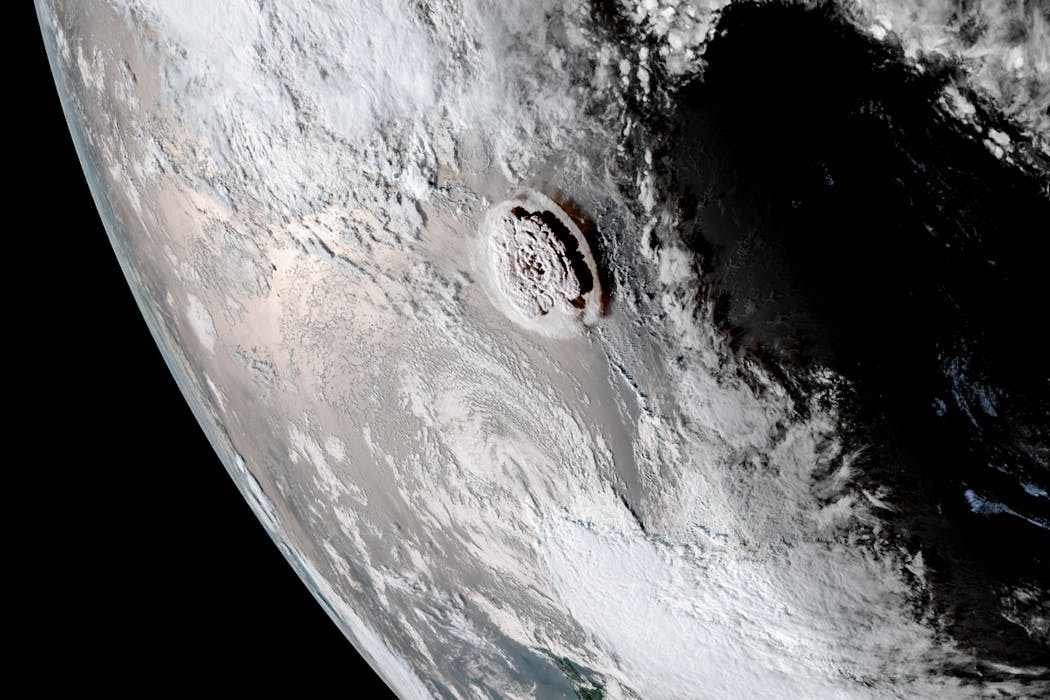
L’idée d’injecter des aérosols dans l’atmosphère pour imiter l’effet des éruptions volcaniques et masquer les rayons du Soleil n’est pas nouvelle, mais elle nous expose au risque de « choc terminal » : un réchauffement brutal si l’injection venait à s’arrêter. Ici, une éruption du volcan Tonga, dans le Pacifique.Goes-West Satellite/NOAA/RAMMB/CIRA, CC BY
La « géo-ingénierie climatique » recouvre un ensemble de techniques qui visent à manipuler le climat à grande échelle afin d’éviter les risques du changement climatique. Ces techniques sont très variées, depuis les parasols spatiaux pour limiter l’arrivée des rayons du soleil dans l’atmosphère jusqu’à la fertilisation des océans pour que le phytoplancton consomme davantage de CO₂, en passant par la restauration et la conservation de zones humides où le carbone est stocké de façon préférentielle.
En octobre 2025, l’Académie des sciences a publié un rapport qui détaille ce que l’on sait et ce que l’on ignore encore sur les éventuels bénéfices de ces techniques et sur les nouveaux risques qu’elles font surgir.
Elsa Couderc, cheffe de rubrique Sciences et Technologies, explore ici avec Laurent Bopp, climatologue et académicien, les nouveaux risques climatiques que ces techniques pourraient faire émerger. Le second volet de ces « regards croisés » est un entretien avec Manuel Bellanger, qui étudie à l’Ifremer le développement des techniques de géo-ingénierie marine avec un regard d’économiste.
The Conversation : Pourquoi l’Académie des sciences s’empare-t-elle aujourd’hui du sujet de la géo-ingénierie climatique, alors qu’on en parle relativement peu en France ?
Laurent Bopp : Le sujet est de plus en plus présent dans la littérature scientifique, dans le débat scientifique et dans le débat politique qui entoure les discussions sur le changement climatique. On ne s’en rend pas bien compte en France, mais aux États-Unis, en Angleterre, en Allemagne, au Canada, le débat est beaucoup plus présent.
Certains climatologues, y compris de renom, se prononcent pour faire beaucoup plus de recherches sur ces technologies, mais aussi parfois pour envisager leur déploiement à grande échelle afin d’éviter un réchauffement trop important. L’argument est simple : un niveau de réchauffement trop élevé génère des risques importants et pourrait conduire au dépassement de certains points de bascule potentiels dans le système climatique, par exemple une fonte irréversible des calottes glaciaires du Groenland et de l’Antarctique, ce qui pourrait entraîner une élévation du niveau de la mer de plusieurs mètres additionnels.
En France, nous avons besoin collectivement de plus d’informations et de plus de débats autour de ces techniques. Nous avons eu le sentiment que certains de nos représentants se sont retrouvés en partie dépourvus dans des arènes de négociations internationales, face à des représentants d’autres gouvernements qui ont un agenda très agressif sur ces technologies. C’est sans doute une des raisons pour lesquelles l’Académie des sciences s’est emparée du sujet.
L’idée des interventions de géo-ingénierie climatique, c’est de réduire les risques liés au changement climatique. Mais ces interventions pourraient-elles induire de nouveaux risques et lesquels ?
L. B. : Un des intérêts de ce rapport, c’est de mettre la lumière sur ces nouveaux risques.
Mais, avant de rentrer dans le détail, il faut, quand nous parlons de géo-ingénierie climatique, distinguer deux grandes catégories de techniques – ces deux catégories sont fondées sur des approches très différentes et présentent des risques, là aussi, très différents.
Pour la première de ces catégories, il s’agit de modifier de façon assez directe le rayonnement solaire. On parle en anglais de Solar Radiation Management ou SRM. Dans ce cas-là, l’action s’apparente plutôt à une sorte de pansement sur la plaie d’une blessure, sans s’attaquer du tout à la cause du changement climatique : l’idée est de refroidir la Terre de façon artificielle, en utilisant par exemple des particules atmosphériques ou des miroirs spatiaux qui limiteraient la pénétration du rayonnement solaire jusqu’à la surface de la Terre. Ce refroidissement pourrait compenser, en partie au moins, le réchauffement lié aux gaz à effet de serre qui continueraient à augmenter dans l’atmosphère.
L’injection d’aérosols dans la haute atmosphère vise à imiter des éruptions volcaniques de très grande taille qui, par le passé, ont pu refroidir la Terre. Une des limites premières de cette approche, c’est que cette façon de refroidir la Terre est très différente de la façon dont elle se réchauffe aujourd’hui à cause des gaz à effet de serre : les échelles de temps et les échelles spatiales associées sont très différentes, et cela engendre un certain nombre de conséquences. Les risques sont à lire en fonction de ces deux échelles.
Les aérosols que l’on pourrait injecter dans la haute atmosphère ont une durée de vie courte. Ils vont disparaître de l’atmosphère assez rapidement, tandis que les gaz à effet de serre qui réchauffent le système Terre, le CO₂ en particulier, sont dans l’atmosphère pour très longtemps.
Cette différence majeure entraîne l’un des risques les plus préoccupants : le risque de « choc terminal ». Concrètement, si l’on décidait d’arrêter brutalement l’injection d’aérosols après s’être engagé dans ce type de stratégie – et les raisons pourraient être multiples, qu’il s’agisse de problèmes de gouvernance, de financement ou de conflits internationaux – le réchauffement climatique jusque-là partiellement masqué réapparaîtrait d’un seul coup. On subirait alors, en très peu de temps, plusieurs années de réchauffement accumulé. On aurait des taux de réchauffement temporels très très rapides, et donc des conséquences sur la biodiversité ou sur les sociétés humaines difficiles à anticiper.
En d’autres termes, si le réchauffement arrive relativement lentement, la mise en place de mesures d’adaptation est possible ; s’il est très rapide, les conséquences sont potentiellement bien plus dévastatrices.
L’autre risque majeur est lié aux échelles spatiales : refroidir avec des aérosols par exemple, ce n’est pas du tout la même chose que ne pas refroidir en émettant moins de CO₂. Les effets régionaux du refroidissement vont être très différents de ce qu’ils auraient été si on avait réchauffé un peu moins. La localisation des précipitations, l’intensité de la mousson notamment ont des conséquences sur l’agriculture, sur la santé. Sur ces effets régionaux, il y a encore beaucoup d’incertitudes aujourd’hui, c’est quelque chose que les modèles décrivent moins bien que les effets temporels dont je parlais tout à l’heure.
Face à ce risque majeur, l’Académie recommande d’arrêter le déploiement des techniques de modification du rayonnement solaire, et même les recherches sur cette technique de géo-ingénierie…
L. B. : Effectivement, notre rapport recommande de ne pas utiliser ces techniques, et nous allons même jusqu’à suggérer un traité international qui interdirait leur déploiement.
Nous pensons aussi qu’il ne faut pas financer, de façon importante, de la recherche qui soit spécifiquement fléchée sur ces techniques de modification du rayonnement solaire, pour éviter de légitimer ces approches trop dangereuses.
Bien sûr, nous avons besoin de bien plus de recherche sur le climat et sur les processus climatiques importants, donc sur les processus qui lient, par exemple, les aérosols dans la haute atmosphère avec la modification du rayonnement, mais nous pensons vraiment qu’il faut éviter les projets fondamentalement pensés pour pousser l’avènement de ces technologies. Les risques associés sont trop importants.
La géo-ingénierie climatique inclut une deuxième approche, celle qui consiste à augmenter l’efficacité des puits de carbone naturels, par exemple les forêts, les tourbières ou les océans qui absorbent naturellement du carbone. En quoi est-ce fondamentalement différent de la modification du rayonnement solaire ?
L. B. : Il ne s’agit plus de refroidir la Terre pour compenser un réchauffement qui serait lié à l’augmentation des gaz à effet de serre, mais d’éliminer du CO₂ qui est déjà présent dans l’atmosphère. Le terme consacré est celui d’« élimination du dioxyde de carbone », ou Carbon Dioxide Removal (CDR) en anglais.
D’abord, soyons clairs : la priorité des priorités reste de réduire les émissions actuelles de façon drastique. Ces « puits de carbone » additionnels ne doivent intervenir que comme un complément, après la réduction des émissions de façon massive et immédiate.
Pour stabiliser le climat et répondre aux objectifs de l’accord de Paris à 1,5 ou 2 °C de réchauffement par rapport à l’époque préindustrielle, nous avons besoin d’aller collectivement vers des émissions nettes nulles !
Comme il y aura sans doute des secteurs difficiles à décarboner, comme la sidérurgie ou le transport aérien, nous savons qu’il y aura sans doute besoin d’un peu de ces puits de carbone pour compenser ces émissions résiduelles.
On est donc sur une ligne de crête compliquée à tenir : ne pas mettre ces techniques d’élimination du CO₂ en avant, pour ne pas décourager la réduction des émissions – en raison du potentiel de décarbonation limité de ces techniques, nous allons y revenir – et en même temps continuer à soutenir la recherche sur ces technologies parce qu’elles pourraient se révéler utiles, au moins dans une certaine mesure.
En augmentant l’efficacité des puits de carbone naturels, si on reprend l’analogie avec le pansement et la blessure, on ne s’attaque toujours pas à la cause (l’émission de gaz à effet de serre), mais on remonte dans la chaîne de causalité en s’attaquant à quelque chose de plus amont que dans le cas de la modification du rayonnement solaire.
Il existe de nombreux types de méthodes d’élimination du CO₂, à la fois naturelles et technologiques. Présentent-elles toutes le même potentiel et les mêmes risques ?
L. B. : Pour éliminer du CO₂ déjà dans l’atmosphère, il y a une très grande diversité de techniques, en partie parce qu’il existe plusieurs « réservoirs » dans lesquels il serait possible de stocker le CO₂ retiré de l’atmosphère : dans le sous-sol, dans l’océan, dans la biomasse continentale.
Pour simplifier, je dirais qu’il y a une série de techniques qui sont aujourd’hui considérées comme « gagnant-gagnant » : elles permettent de retirer du CO₂ de l’atmosphère et elles ont d’autres bénéfices.
Prenons par exemple la restauration et la conservation des écosystèmes côtiers, comme les mangroves ou les herbiers marins : ces actions permettent un stockage de carbone et, par exemple, de mieux protéger les côtes contre la montée du niveau marin et les épisodes de submersion côtière. D’autres techniques, en foresterie, en agroforesterie ou en stockant le carbone dans les sols, permettent aussi de développer des pratiques agricoles qui sont plus vertueuses.
Malheureusement, comme évoqué dans le rapport, ces approches sont difficiles à mettre à l’échelle, en raison des surfaces souvent limitées et des quantités phénoménales de carbone qu’il faudrait pouvoir stocker dans ces réservoirs naturels pour avoir un effet significatif.
Et puis il y a, à l’autre bout du spectre, des techniques qui sont jugées peu efficaces et dont on sait qu’elles ont sans doute des effets dommageables sur les écosystèmes. Compte tenu des connaissances actuelles, l’Académie des sciences recommande de ne pas poursuivre dans ces directions-là.
L’exemple le mieux documenté est celui de la fertilisation par le fer du plancton marin, car elle a été envisagée il y a déjà longtemps, à la fin des années 1980. L’idée est d’aller en pleine mer, dans des régions où le développement du phytoplancton est limité par la faible abondance d’un nutriment bien particulier : le fer. Dans ces régions, il n’y a pas besoin d’ajouter beaucoup de fer pour fertiliser le plancton, qui va se développer davantage, et pour cela absorber plus de CO₂. Une partie de la matière organique produite coule ensuite vers les profondeurs de l’océan, emportant avec elle le carbone qu’elle contient. Ce carbone est ainsi isolé de l’atmosphère dans l’océan profond, potentiellement pour des centaines d’années.
Plusieurs expériences scientifiques ont été menées en pleine mer dans les années 1990 et 2000. À court terme, elles ont effectivement mis en évidence une augmentation du flux de carbone de l’atmosphère vers l’océan.
Toutefois, des travaux plus récents, notamment fondés sur la modélisation, montrent que cette technique est probablement beaucoup moins efficace qu’on ne l’imaginait initialement. Surtout, en modifiant fortement les écosystèmes marins pour capter du carbone, elle entraîne toute une série d’effets indésirables : l’émission d’autres gaz à effet de serre, une diminution de l’oxygène dans les eaux profondes, ou encore l’épuisement de certains nutriments essentiels, qui ne sont alors plus disponibles pour d’autres écosystèmes.
Ces constats ont conduit la communauté internationale à réagir. En 2008, les États ont amendé le protocole de Londres afin d’y introduire une interdiction de ce type de pratiques en haute mer.
Dans le cas de la fertilisation des océans, les risques sont donc bien documentés – ils ne concernent pas directement le climat mais des dommages collatéraux ?
L. B. : Oui. Malheureusement, on voit en ce moment une résurgence de certains projets poussés par certains chercheurs qui continuent à défendre ce type de techniques, par exemple aux États-Unis. Mais pour nous, il semble clair qu’il ne faut pas recommander ces techniques aux effets collatéraux bien documentés.
Entre les techniques trop risquées, comme la fertilisation des océans, et les techniques de conservation et de restauration, que j’appelais « gagnant-gagnant » tout à l’heure, il y a d’autres techniques, pour lesquelles on a besoin de davantage de recherche – c’est le cas, par exemple, des techniques d’alcalinisation de l’océan.
Il s’agit d’une technique chimique cette fois : on augmente le pouvoir tampon de l’océan en ajoutant du matériel alcalin. Un des points positifs, c’est que cette technique consiste en l’accélération d’un phénomène naturel qui est l’altération des roches sur les continents. Quand les roches s’altèrent, elles apportent de l’alcalinité à l’océan, donc elles augmentent le pouvoir tampon de l’océan qui absorbe plus de CO₂ – c’est un processus très lent, qui a un rôle très important sur les échelles de temps très, très longues et qui régule en partie le cycle du carbone sur les échelles de temps géologiques.
Deuxième avantage : le CO2 ainsi stocké dans l’océan l’est de manière très durable, bien plus que dans des approches reposant sur du carbone organique (comme la fertilisation des océans) où le stockage est beaucoup plus incertain. Troisième point positif, cette augmentation de l’alcalinité permet aussi de réduire partiellement l’acidification des océans.
Mais ces bénéfices s’accompagnent de nombreuses incertitudes et de risques. Ajouter des matériaux alcalins modifie parfois fortement la chimie de l’eau de mer. Quels effets cela pourrait-il avoir sur les écosystèmes marins, le plancton ou les espèces côtières dont dépendent de nombreuses populations humaines ? À ce stade, nous manquons encore de données pour répondre clairement à ces questions.
L’efficacité même de la technique reste également incertaine. Pour qu’elle fonctionne, l’alcalinité ajoutée doit rester dans les couches de surface de l’océan, là où les échanges avec l’atmosphère ont lieu. Si elle est rapidement entraînée vers les profondeurs, son impact sur l’absorption du CO₂ devient très limité.
Enfin, il y a beaucoup de questions sur le coût de ces techniques. En particulier, un certain nombre de start-up et d’entreprises s’orientent vers des méthodes électrochimiques, mais c’est très coûteux d’un point de vue énergétique. Il faut faire le bilan sur l’ensemble du cycle de vie de ces techniques.
En somme, on a une gamme de techniques, parfois appelées abusivement « solutions » : certaines que l’on ne recommande pas aujourd’hui parce que les risques sont énormes ; d’autres qu’il faut prioriser et recommander, mais qui ont une efficacité somme toute limitée. Et puis entre les deux, des méthodes sur lesquelles il faut continuer à travailler.
À l’échelle internationale, où et quand se discutent les nouveaux risques des techniques de géo-ingénierie climatique ?
L. B. : La question des puits de carbone est déjà largement débattue dans le cadre des COP Climat, notamment parce que les gouvernements peuvent les intégrer dans leurs objectifs de réduction des émissions. C’est le cas, par exemple, des stratégies d’afforestation (boisement) et de reforestation. En revanche, il reste encore beaucoup de travail à faire sur les modalités concrètes de mise en œuvre de certaines techniques d’élimination du CO₂ que nous avons évoquées. En particulier, les questions de mesure et de vérification du CO₂ réellement retiré de l’atmosphère sont complexes et loin d’être résolues. Le Giec a d’ailleurs été mandaté par les gouvernements pour produire un rapport méthodologique spécifiquement consacré à ces enjeux.
En ce qui concerne la modification du rayonnement solaire, mon inquiétude est nettement plus forte. Certains pays affichent désormais ouvertement leur intérêt pour un déploiement potentiel de ces techniques.
Dans le prochain rapport du Giec, la géo-ingénierie occupera une place plus importante que dans les précédents. J’espère que cela permettra de documenter de façon précise et convaincante les risques potentiels associés à ces approches.
Propos recueillis par Elsa Couderc.
Bopp Laurent a reçu des financements du CNRS, de l’Agence Nationale de la Recherche, de la Fondation pour la Recherche sur la Biodiversité, du Programme Horizon Europe de la Commission Européenne, et de la Fondation Schmidt Sciences.