How to poop outdoors in a way that won’t harm the environment and other hikers

Source: The Conversation – USA (2) – By Shari Edelson, Ph.D. Candidate in Recreation, Park and Tourism Management, Penn State
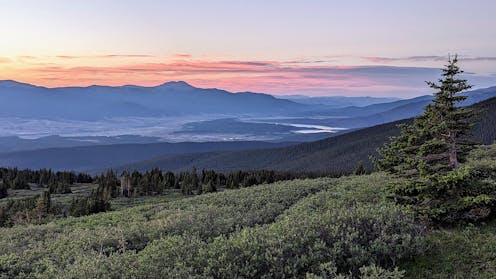
A pilot program to distribute waste bags to hikers on Mount Elbert in Colorado successfully cut down the amount of human waste on the massive mountain. Shari Edelson, CC BY-ND

If you’re one of the 63 million Americans who went hiking last year, chances are you’ve found yourself needing to go, with no toilet in sight.

Aside from personal inconvenience, why is this such a big deal?

Human fecal contamination is a public health concern in natural areas. Pathogens in human poop can remain active for a long time – over a year in outdoor environments – meaning that waste left behind today can cause severe gastrointestinal disease and other sicknesses for future visitors. Fecal waste can enter waterways after storms or snowmelt, harming water quality. Finally, it can be upsetting – or at the least, unpleasant – to encounter someone else’s poop and used toilet paper in nature.
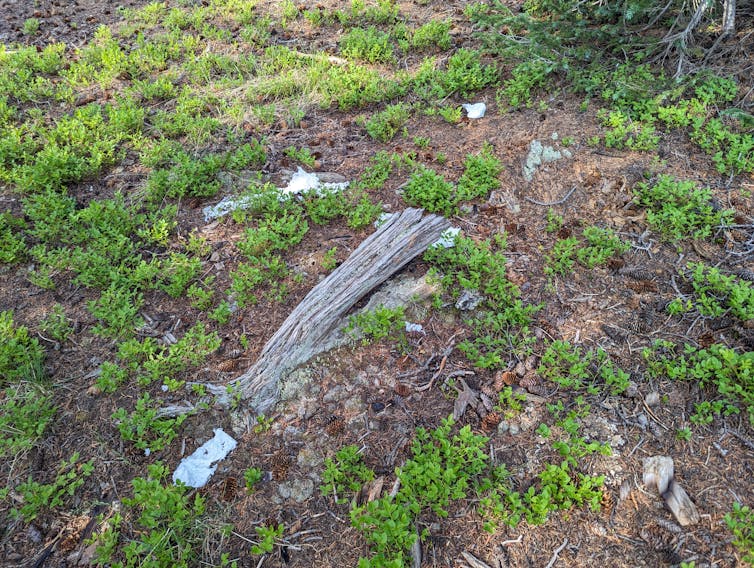
Used and tattered toilet paper is scattered throughout the forest floor near grasses, logs and sticks.
Toilet paper waste on Mount Elbert in the San Isabel National Forest in Colorado.
Shari Edelson, CC BY-ND

As a researcher and a Ph.D. candidate who study human impacts on parks and protected areas, we have been thinking quite a lot about poop and ways people can tread more lightly on the landscape. Our focus is on Leave No Trace, an environmental education framework – created by an organization with the same name – that helps people implement minimal-impact practices in the outdoors.

Poop is causing problems in parks and protected areas

From the Appalachian Trail and Mount Everest – known as Sagarmatha in Nepali – to national parks in Norway and Aotearoa – known as New Zealand to English speakers, researchers have documented the negative impacts our bodily wastes are causing in the sensitive environments where we seek recreation and restoration.

In Colorado, the problem has gotten so bad that land managers have decided to take action. In the Eagle-Holy Cross District of the White River National Forest, for example, the U.S. Forest Service now requires visitors to take their human waste out with them.
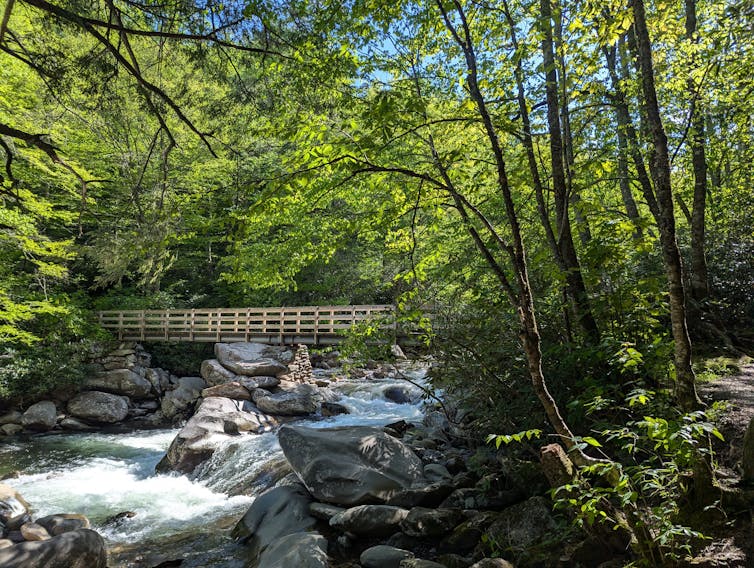
A raging river courses alongside a rocky shoreline within a verdant forest. A wooden bridge crosses over the water.
A footbridge on the Chimney Tops Trail in the Great Smoky Mountains near the Appalachian Trail.
Shari Edelson, CC BY-ND

Best practices for dealing with your poo in the great outdoors

One of us – Derrick Taff – works as a science adviser to Leave No Trace, an organization that has educated outdoor recreationists on this issue for more than 30 years and has provided concrete guidance based on scientific research.

The first rule of thumb is to avoid the possibility of contamination entirely by not leaving waste in natural areas to begin with. Toilet facilities are regarded as the most effective method to reduce human waste in the backcountry. If there’s a toilet at the trailhead, use it before you head out.

Current research we’re doing in Grand Teton National Park in Wyoming and San Isabel National Forest in Colorado confirms that hikers prefer to use trailhead toilets when they’re available.

But as anyone who’s been out in the woods is aware, remote wilderness areas do not necessarily offer such infrastructure. Access for maintenance and waste removal costs are major barriers for land management agencies considering installing backcountry toilets.

And then there’s the very real likelihood that even when trailhead facilities do exist, you may be far away when nature calls. In our own research, pending publication, we surveyed hikers on Colorado’s Mount Elbert. Up to 70% of those needing to poop ended up doing so in the backcountry despite the presence of a trailhead toilet.

Issues develop because hikers aren’t prepared

This issue may persist because people aren’t aware of the current rules. In our soon-to-be-published study of Grand Teton hikers, 66% of backcountry trail visitors reported that they had not received any information on how to dispose of human waste in the park.
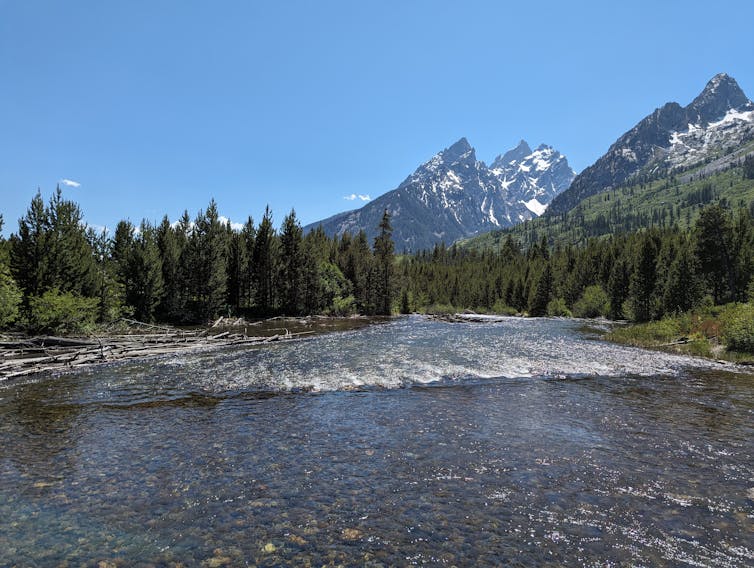
A wide, peaceful river flows into a thick forest. Imposing jagged peaks pierce the sky. Snow is visible within the mountain's crevices.
The view from String Lake in Grand Teton National Park.
Shari Edelson, CC BY-ND

Other reasons why people may not follow the rules are because they may consider them onerous or unimportant.

Research shows that clear, actionable messaging including relevant environmental and moral appeals does make a difference in shifting people’s behaviors in the outdoors. Although individual choices may seem inconsequential, they add up to big impacts in the aggregate.

How to poop in the backcountry

So what to do when there really is no potty? Leave No Trace advises us of two main options.

The first is to dig a little pit, commonly called a cat hole, and deposit your poop in there. Can’t aim? No worries – Just poop next to the hole and scoop it in afterward.

The use of cat holes is recommended in areas where it’s possible to dig roughly the length of your hand deep in the soil, where moist ground indicates that material buried there will decompose, and where digging is not likely to disturb fragile environments. Make sure you’re about 70 steps away from any water source, trail or campsite to avoid water contamination and reduce the likelihood that someone else will accidentally come upon your waste.

You can typically leave toilet paper in a cat hole, but check local regulations and carry it out in a sealed bag if not. Never leave wet wipes behind. They don’t biodegrade.

Outdoor companies are now making lightweight trowels designed for digging cat holes in the backcountry. But there are also places where it’s difficult if not impossible to dig a cat hole because of snow, frozen ground, shallow soil or exposed bedrock, or where leaving human waste in the outdoors is not recommended due to environmental conditions. These typically include high-mountain zones above tree line, alpine environments inhabited by delicate and slow-growing flora, and deserts and other arid places characterized by low soil moisture.

In places like this, it’s best to remove all poop and toilet paper and dispose of it in a proper location such as a trash can at the trailhead or even back at your home. Before you recoil in horror, remember that dog owners do this with their pets’ waste when on a walk.

Wag bags – short for waste aggregation and gelling – are used to pack out poop. Wag bag kits typically include an inner and an outer bag as well as a drying agent to prevent odor and leakage. Our current research, as well as a recent study of Norwegian park users, has demonstrated that people are willing to use them.
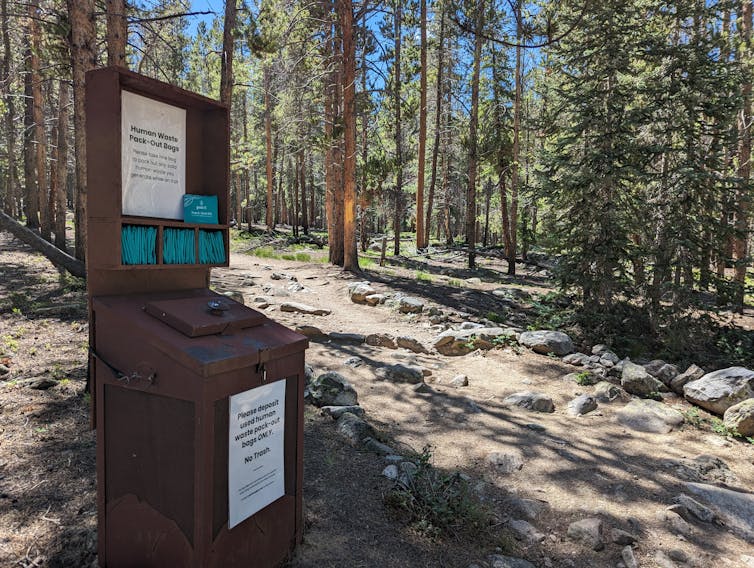
A brown box stands near a trail in the forest. Numerous turquoise bags are folded and placed on shelves. A sign, with black lettering on white laminated paper, is attached to the kiosk. One reads:
A kiosk offers free wag bags at the beginning of the Mount Elbert summit trail near Leadville, Colo. Wag bags are commonly used by hikers as self-contained receptacles for feces.
Shari Edelson, CC BY-ND

Our study found that among people who defecated while on a hike to the summit of Mount Elbert, 30% used a wag bag to carry their waste off the mountain, and 87% expressed willingness to use one on future trips.

These results suggest that people are willing to do the right thing when given the proper tools and information, and that it’s possible to effectively teach people how to care for our wild spaces.

The Conversation

Shari Edelson has received research funding from the National Park Service, the National Science Foundation and PACT Outdoors.

B. Derrick Taff is an Assistant Dean of Research and Graduate Education in the College of Health and Human Development, and an Associate Professor in the Department of Recreation, Park and Tourism Management at Penn State University; he also serves as the Leave No Trace organization’s science advisor. Derrick is the Suzie and Allen Martin Professor through Penn State University.

ref. How to poop outdoors in a way that won’t harm the environment and other hikers – https://theconversation.com/how-to-poop-outdoors-in-a-way-that-wont-harm-the-environment-and-other-hikers-262426


Are high school sports living up to their ideals?

Source: The Conversation – USA (2) – By Jedediah Blanton, Assistant Professor of Kinesiology, Recreation and Sport Studies, University of Tennessee

Most coaches want to be able to do more than teach their athletes to win faceoffs and dodge defenders. Hannah Foslien/The Washington Post via Getty Images

Coach Smith was an easy hire as the head coach of a new high school lacrosse team in Tennesseee: She had two decades of coaching experience and a doctorate in sport and exercise science.

After signing the paperwork, which guaranteed a stipend of US$1,200, Smith – we’re using a pseudonym to protect her identity – had four days to complete a background check, CPR and concussion training and a Fundamentals of Coaching online course. After spending $300 to check all these boxes, the job was hers.

The Tennessee Secondary School Athletic Association’s mission statement highlights how high school athletes should be molded into good citizens and have their educational experiences enhanced by playing sports.

Yet Coach Smith hadn’t received any guidance on how to accomplish these goals. She didn’t know how a high school coach would be evaluated – surely it went beyond wins, losses and knowing CPR – or how to make her players better students and citizens.

Over the past 15 years, our work has focused on maximizing the benefits of high school sports and recognizing what limits those benefits from being reached. We want to know what high school sports aspire to be and what actually happens on the ground.

We have learned that Coach Smith is not alone; this is a common story playing out on high school fields and courts across the country. Good coaching candidates are getting hired and doing their best to keep high school sports fixtures in their communities. But coaches often feel like they’re missing something, and they wonder whether they’re living up to those aspirations.

Does the mission match reality?

Dating back to the inception of school-sponsored sport leagues in 1903, parents and educators have long believed that interscholastic sports are a place where students develop character and leadership skills.

Research generally backs up the advantages of playing sports. In 2019, high school sports scholar Stéphanie Turgeon published a review paper highlighting the benefits and drawbacks of playing school sports. She found that student-athletes were less likely to drop out, more likely to be better at emotional regulation and more likely to contribute to their communities. While athletes reported more stress and were more likely to drink alcohol, Turgeon concluded that the positives outweighed the negatives.

The governing body of high school sports in the U.S., the National Federation of State High School Associations, oversees 8 million students. According to its mission statement, the organization seeks to establish “playing rules that emphasize health and safety,” create “educational programs that develop leaders” and provide “administrative support to increase opportunities and promote sportsmanship.”

Digging deeper into the goals of sports governing bodies, we recently conducted a study that reviewed and analyzed the mission statements of all 51 of the member state associations that officially sponsor high school sports and activities.

In their missions, most associations described the services they provided – supervising competition, creating uniform rules of play and offering professional development opportunities for coaches and administrators. A majority aimed to instill athletes with life skills such as leadership, sportsmanship and wellness. Most also emphasized the relationship between sports and education, either suggesting that athletics should support or operate alongside schools’ academic goals or directly create educational opportunities for athletes on the playing field. And a handful explicitly aspired to protect student-athletes from abuse and exploitation.

Interestingly, seven state associations mentioned that sports participation is a privilege, with three adding the line “and not a right.” This seems to conflict with the National Federation of State High School Associations, which has said that it wants to reach as many students as possible. The organization sees high school sports as a place where kids can further their education, which is a right in the U.S. This is important, particularly as youth sports have developed into a multibillion-dollar industry fueled by expensive travel leagues and club teams.

We also noticed what was largely missing from these mission statements. Only two state athletic associations included a goal for students to “have fun” playing sports. Research dating back to the 1970s has consistently shown that wanting to have fun is usually the No. 1 reason kids sign up for sports in the first place.

Giving coaches the tools to succeed

Missions statements are supposed to guide organizations and outline their goals. For high school sports, the opportunity exists to more clearly align educational initiatives and evaluation efforts to fulfill their missions.

If high school sports are really meant to build leadership and life skills, you would think that the adults running these programs would be eager to acquire the skill set to do this. Sure enough, when we surveyed high school coaches across the country in 2019, we found that 90% reported that formal leadership training programs were a good idea. Yet less than 12% had actually participated in those programs.

High school girl basketball players stand in a circle around a male coach who's crouching and speaking to them.
Few high school coaches are required to complete leadership training.
Andy Cross/MediaNews Group/The Denver Post via Getty Images

A recent study led by physical education scholar Obidiah Atkinson highlighted this disconnect. While most states require training for coaches, the depth and amount of instruction varied significantly, with little emphasis on social–emotional health and youth development. In another study we conducted, we spoke with administrators. They admitted that coaches rarely receive training to effectively teach the leadership and life skills that high school sports promise to deliver.

This type of training is available; we helped the National Federation of State High School Associations create three free courses explicitly focused on developing student leadership. Thousands of students and coaches have completed these courses, with students reporting that the courses have helped them develop leadership as a life skill. And it’s exciting to see that the organization offers over 60 courses reaching millions of learners on topics ranging from Heat Illness Prevention and Sudden Cardiac Arrest, to Coaching Mental Wellness and Engaging Effectively with Parents.

Yet, our research findings suggest that if these aspirational missions are to be taken seriously, it’s important to really measure what matters.

Educational programs can be evaluated to determine whether and how they are helping coaches and students, and coaches ought to be evaluated and retained based on their ability to help athletes learn how to do more than kick a soccer ball or throw a strike. Our findings highlight the opportunity for high school athletic associations and researchers to work together to better understand how this training is helping coaches to meet the promises of high school sports.

Taking these steps will help to make sure coaches like Coach Smith have the tools, support and feedback they need to succeed.

The Conversation

Jedediah Blanton received funding from the Michigan High School Athletic Association. The contract was to build online courses for the NFHS Learn platform.

Scott Pierce has consulted with the Michigan High School Athletic Association and Illinois High School Association to support student leadership initiatives. He has received funding from the Michigan High School Athletic Association. The contract was to build online courses for the NFHS Learn platform.

ref. Are high school sports living up to their ideals? – https://theconversation.com/are-high-school-sports-living-up-to-their-ideals-256770

Balancing kratom’s potential benefits and risks − new legislation in Colorado seeks to minimize harm

Source: The Conversation – USA (3) – By David Kroll, Professor of Natural Products Pharmacology & Toxicology, University of Colorado Anschutz Medical Campus

Kratom, an herbal supplement, is now being regulated in Colorado. AR30mm/iStock via Getty Images

David Bregger had never heard of kratom before his son, Daniel, 33, died in Denver in 2021 from using what he thought was a natural and safe remedy for anxiety.

By his father’s account, Daniel didn’t know that the herbal product could kill him. The product listed no ingredients or safe-dosing information on the label. And it had no warning that it should not be combined with other sedating drugs, such as the over-the-counter antihistamine diphenhydramine, which is the active ingredient in Benadryl and other sleep aids.

As the fourth anniversary of Daniel’s death approaches, a recently enacted Colorado law aims to prevent other families from experiencing the heartbreak shared by the Bregger family. Colorado Senate Bill 25-072, known as the Daniel Bregger Act, addresses what the state legislature calls the deceptive trade practices around the sale of concentrated kratom products artificially enriched with a chemical called 7-OH.

The Daniel Breggar Act seeks to limit potency and underage access to kratom, an herbal supplement.

7-OH, known as 7-hydroxymitragynine, has also garnered national attention. On July 29, 2025, the U.S. Food and Drug Administration issued a warning that products containing 7-OH are potent opioids that can pose significant health risks and even death.

As kratom and its constituents are studied in greater detail, the Centers for Disease Control and Prevention and university researchers have documented hundreds of deaths where kratom-derived chemicals were present in postmortem blood tests. But rarely is kratom deadly by itself. In a study of 551 kratom-related deaths in Florida, 93.5% involved other substances such as opioids like fentanyl.

I study pharmaceutical sciences, have taught for over 30 years about herbal supplements like kratom, and I’ve written about kratom’s effects and controversy.

Kratom – one name, many products

Kratom is a broad term used to describe products made from the leaves of a Southeast Asian tree known scientifically as Mitragyna speciosa. The Latin name derives from the shape of its leaves, which resemble a bishop’s miter, the ceremonial, pointed headdress worn by bishops and other church leaders.

Small capsules are full of a green powder made from the dried kratom leaves which are also in the picture.
People report buying kratom powder from online retailers and putting it into capsules or making it into tea for consumption.
Everyday better to do everything you love/iStock via Getty Images

Kratom is made from dried and powdered leaves that can be chewed or made into a tea. Used by rice field workers and farmers in Thailand to increase stamina and productivity, kratom initially alleviates fatigue with an effect like that of caffeine. In larger amounts, it imparts a sense of well-being similar to opioids.

In fact, mitragynine, which is found in small amounts in kratom, partially stimulates opioid receptors in the central nervous system. These are the same type of opioid receptors that trigger the effects of drugs such as morphine and oxycodone. They are also the same receptors that can slow or stop breathing when overstimulated.

In the body, the small amount of mitragynine in kratom powder is converted to 7-OH by liver enzymes, hence the opioid-like effects in the body. 7-OH can also be made in a lab and is used to increase the potency of certain kratom products, including the ones found in gas stations or liquor stores.

And therein lies the controversy over the risks and benefits of kratom.

Natural or lab made: All medicines have risks

Because kratom is a plant-derived product, it has fallen into a murky enforcement area. It is sold as an herbal supplement, normally by the kilogram from online retailers overseas.

In 2016, I wrote a series of articles for Forbes as the Drug Enforcement Administration proposed to list kratom constituents on the most restrictive Schedule 1 of the Controlled Substances Act. This classification is reserved for drugs the DEA determines to possess “no currently accepted medical use and a high potential for abuse,” such as heroin and LSD.

But readers countered the DEA’s stance and sent me more than 200 messages that primarily documented their use of kratom as an alternative to opioids for pain.

Others described how kratom assisted them in recovery from addiction to alcohol or opioids themselves. Similar stories also flooded the official comments requested by the DEA, and the public pressure presumably led the agency to drop its plan to regulate kratom as a controlled substance.

Kratom is under growing scrutiny.

But not all of the stories pointed to kratom’s benefits. Instead, some people pointed out a major risk: becoming addicted to kratom itself. I learned it is a double-edged sword – remedy to some, recreational risk to others. A national survey of kratom users was consistent with my nonscientific sampling, showing more than half were using the supplement to relieve pain, stress, anxiety or a combination of these.

Natural leaf powder vs. artificially concentrated extracts

After the DEA dropped its 2016 plan to ban the leaf powder, marketers in the U.S. began isolating mitragynine and concentrating it into small bottles that could be taken like those energy shots of caffeine often sold in gas stations and convenience stores. This formula made it easier to ingest more kratom. Slowly, sellers learned they could make the more potent 7-OH from mitragynine and give their products an extra punch. And an extra dose of risk.

People who use kratom in the powder form describe taking 3 to 5 grams, the size of a generous tablespoon. They put the powder in capsules or made it into a tea several times a day to ward off pain, the craving for alcohol or the withdrawal symptoms from long-term prescription opioid use. Since this form of kratom does not contain very much mitragynine – it is only about 1% of the powdered leaf – overdosing on the powder alone does not typically happen.

That, along with pushback from consumers, is why the Food and Drug Administration is proposing to restrict only the availability of 7-OH and not mitragynine or kratom powder. The new Colorado law limits the concentration of kratom ingredients in products and restricts their sales and marketing to consumers over 21.

Even David Bregger supports this distinction. “I’m not anti-kratom, I’m pro-regulation. What I’m after is getting nothing but leaf product,” he told WPRI in Rhode Island last year while demonstrating at a conference of the education and advocacy trade group the American Kratom Association.

Such lobbying with the trade group last year led the American Kratom Association to concur that 7-OH should be regulated as a Schedule 1 controlled substance. The association acknowledges that such regulation is reasonable and based in science.

Benefits amid the ban

Despite the local and national debate over 7-OH, scientists are continuing to explore kratom compounds for their legitimate medical use.

A $3.5 million NIH grant is one of several that is increasing understanding of kratom as a source for new drugs.

Researchers have identified numerous other chemicals called alkaloids from kratom leaf specimens and commercial products. These researchers show that some types of kratom trees make unique chemicals, possibly opening the door to other painkillers. Researchers have also found that compounds from kratom, such as 7-OH, bind to opioid receptors in unique ways. The compounds seem to have an effect more toward pain management and away from potentially deadly suppression of breathing. Of course, this is when the compounds are used alone and not together with other sedating drugs.

Rather than contributing to the opioid crisis, researchers suspect that isolated and safely purified drugs made from kratom could be potential treatments for opioid addiction. In fact, some kratom chemicals such as mitragynine have multiple actions and could potentially replace both medication-assisted therapy, like buprenorphine, in treating opioid addiction and drugs like clonidine for opioid withdrawal symptoms.

Rigorous scientific study has led to this more reasonable juncture in the understanding of kratom and its sensible regulation. Sadly, we cannot bring back Daniel Bregger. But researchers can advance the potential for new and beneficial drugs while legislators help prevent such tragedies from befalling other families.

The Conversation

David Kroll does not work for, consult, own shares in or receive funding from any company or organization that would benefit from this article, and has disclosed no relevant affiliations beyond their academic appointment.

ref. Balancing kratom’s potential benefits and risks − new legislation in Colorado seeks to minimize harm – https://theconversation.com/balancing-kratoms-potential-benefits-and-risks-new-legislation-in-colorado-seeks-to-minimize-harm-261914

La nouvelle Constitution gambienne est à nouveau au point mort : 5 raisons qui expliquent cette situation

Source: The Conversation – in French – By Satang Nabaneh, Director of Programs, Human Rights Center; Research Professor of Law, University of Dayton School of Law, University of Dayton

La transition démocratique post-dictature de la Gambie a récemment subi un revers. Le projet de loi sur la Constitution de la République de Gambie (2024) n’a pas été adopté en deuxième lecture à l’Assemblée nationale.

L’adoption du projet de loi nécessitait le soutien d’au moins 75 % des 58 membres du Parlement gambien, y compris le président. Aujourd’hui, l’avenir des réformes démocratiques du pays est incertain.

La Gambie reste donc régie par la Constitution de 1997 rédigée sous la junte militaire de Yahya Jammeh. La Constitution de 1997 était largement considérée comme un outil permettant à l’exécutif d’abuser de ses pouvoirs. Elle ne prévoit pas de limitation du nombre de mandats, bloque les réformes démocratiques essentielles et n’offre pas une protection suffisante des droits de l’homme et des principes démocratiques.

L’échec de l’adoption de la nouvelle Constitution est un revers pour le programme « New Gambia », une promesse électorale de la coalition au pouvoir en 2016. Ce programme visait notamment la rédaction d’une nouvelle Constitution et la reddition de comptes pour les violations passées des droits humains. Son blocage pourrait raviver les tensions politiques.

Les partisans du projet de Constitution ont salué un pas vers l’institutionnalisation des contre-pouvoirs et le renforcement des libertés civiles. Les détracteurs ont dénoncé le manque de transparence, l’absence de consultation approfondie des parties prenantes et certaines clauses controversées.

Parmi ces dispositions, on trouvait la suppression rétroactive de la limitation des mandats présidentiels, un affaiblissement des contre-pouvoirs avec un contrôle parlementaire réduit sur les nominations, ainsi qu’un risque d’atteinte à l’indépendance judiciaire.

En tant que chercheure en droit gambien et spécialiste des droits humains, je suis de près le processus de consolidation de la démocratie en Gambie depuis la dictature de Jammeh. Dans cet article, je présente cinq points clés pour comprendre cette réforme constitutionnelle et les raisons de son blocage.

Comprendre l’échec de la nouvelle Constitution gambienne : origines et obstacles

1. La recherche infructueuse d’une nouvelle base :

Une Constitution véritablement démocratique est une promesse centrale depuis le départ de l’ancien président Jammeh en 2017.

Un premier projet de 2020, fruit de vastes consultations nationales, n’a pas non plus été adopté. Des désaccords ont surgi au sujet de certaines dispositions, telles que la limitation rétroactive du nombre de mandats présidentiels. Mais le projet de loi de 2024 continue de se heurter à des obstacles politiques et sociaux.

La Constitution de 1997 présente une approche paradoxale de la gouvernance démocratique, en particulier dans ses mécanismes de transition politique et de modification constitutionnelle. Par exemple, elle impose des conditions strictes pour toute modification constitutionnelle : une majorité des trois quarts des voix de tous les membres de l’Assemblée nationale lors de deux lectures.

Elle exige également un référendum national, avec une participation électorale de 50 % et 75 % des voix.

Un seuil élevé pour les modifications constitutionnelles peut protéger contre des changements impulsifs. Mais cela confère également un pouvoir disproportionné à une super majorité parlementaire. Cela politise la réforme constitutionnelle, la rendant dépendante de l’allégeance des partis et des manœuvres stratégiques plutôt que d’un large consensus national.

Un tel dispositif peut freiner l’évolution naturelle de la gouvernance démocratique et limiter l’adaptation de la loi fondamentale à la volonté populaire.

2. Préoccupations non résolues concernant les pouvoirs présidentiels :

L’une des principales raisons pour lesquelles le projet de 2024 a suscité une opposition aussi forte concernait les pouvoirs présidentiels. Le projet de 2020 prévoyait une limitation à deux mandats avec une clause rétroactive (ce qui signifiait que le président Adama Barrow ne pourrait pas se présenter aux élections de 2026). Mais le projet de 2024 a supprimé ce décompte rétroactif.

Ce point est resté controversé, alimentant les craintes d’une éventuelle manipulation de la limitation du nombre de mandats. Plus généralement, le projet de loi proposait de supprimer le contrôle parlementaire pour toutes les nominations, y compris celles des ministres, de la Commission électorale indépendante et des institutions indépendantes.

Il visait également à accorder au président plus de pouvoir sur les membres de l’Assemblée nationale. Ces propositions ont été considérées comme une centralisation excessive du pouvoir et un recul par rapport à la Constitution de 1997.

3. Menaces non traitées à l’indépendance de la justice :

L’objectif déclaré du projet de loi en matière d’indépendance de la justice a été compromis par certaines dispositions. Le projet de 2024 a supprimé l’obligation pour l’Assemblée nationale de confirmer la nomination du président et des juges de la Cour suprême.

Il a également supprimé l’exigence d’être un citoyen gambien pour le président de la Cour suprême. Compte tenu de l’histoire récente de la Gambie, où des juges étrangers sur des contrats renouvelables attribués sur la base de critères politiques ont servi d’outil de répression et ont érodé la confiance du public. Ces changements ont donc suscité des inquiétudes quant à l’impartialité de la justice et à la disparition progressive de tout contre-pouvoir.

Le projet omettait aussi le chapitre V du projet de 2020 sur «Leadership et intégrité», cadre essentiel pour la conduite des responsables publics et la lutte contre la corruption.

4. Dispositions controversées sur les droits de l’homme et les libertés civiles :

Si le projet de 2024 visait globalement à moderniser les droits fondamentaux et à introduire des protections socio-économiques supplémentaires, il contenait également des restrictions spécifiques que les défenseurs des droits humains ont critiquées. Il s’agissait notamment de l’allongement de la durée de la garde à vue de 48 à 72 heures et de restrictions perçues comme portant atteinte au droit à l’éducation, au droit de pétition contre des fonctionnaires et à la liberté de réunion.

Les dispositions relatives à la citoyenneté par mariage (doublement de la période d’attente pour les conjoints étrangers souhaitant obtenir la citoyenneté) et à la limitation de la propriété et de l’exploitation des médias laissées aux seuls citoyens gambiens ont suscité des débats sur l’inclusivité et la liberté des médias.

Ces clauses ont probablement contribué à l’insuffisance des votes pour l’adoption du projet de loi.

5. Lassitude du public face à l’échec du projet de loi :

L’échec du projet de loi constitutionnelle de 2024 en deuxième lecture reflète un débat public complexe et polarisé. Alors que le gouvernement défendait le projet de loi comme essentiel à la stabilité et à une république moderne, le principal parti d’opposition, le Parti démocratique uni, s’y est opposé.

De nombreuses organisations de la société civile ont exprimé leurs préoccupations concernant l’affaiblissement des garanties démocratiques et l’extension des pouvoirs présidentiels. En fin de compte, l’absence perçue d’une véritable participation publique a empêché son adoption.

La voie à suivre

Cet échec montre une division au sein de la population. Une partie de la population, lassée par ce processus de réforme constitutionnelle long et complexe, souhaite avant tout la stabilité. D’autres souhaitent continuer à œuvrer pour une constitution véritablement transformatrice.

Cette division est aggravée par une désillusion généralisée due aux difficultés économiques et à la lenteur des progrès réalisés dans le cadre des différentes réformes depuis le début de la transition post-dictature.

L’échec du projet de loi de 2024 laisse la Gambie dans un état d’incertitude quant à son cadre juridique fondamental.

Comme je l’ai déjà souligné ailleurs, il est temps que tous s’engagent dans un processus de réforme inclusif.

The Conversation

Satang Nabaneh does not work for, consult, own shares in or receive funding from any company or organisation that would benefit from this article, and has disclosed no relevant affiliations beyond their academic appointment.

ref. La nouvelle Constitution gambienne est à nouveau au point mort : 5 raisons qui expliquent cette situation – https://theconversation.com/la-nouvelle-constitution-gambienne-est-a-nouveau-au-point-mort-5-raisons-qui-expliquent-cette-situation-263947

Senegal’s rating downgrade: credit agencies are punishing countries that don’t check their numbers

Source: The Conversation – Africa – By Daniel Cash, Reader in Law, Aston University

Senegal’s dramatic two-notch credit rating downgrade in February 2025 by the credit rating agency Moody’s was followed by a Standard & Poor’s downgrade in July.

Moody’s decision marked a three-notch deterioration in Senegal’s rating in four months. The scale of the revisions was rare, especially for countries not already in default or active restructuring.

The ratings collapse triggered a selloff in Senegal’s Eurobonds. It also cast a shadow over the country’s ongoing negotiations with the International Monetary Fund.

More broadly, it sent a signal about how the credit rating agencies are now responding to governance failures, not just macroeconomic trends. For others watching closely, this was not just a market correction, it was a warning.

So why did it happen?

A report released by Moody’s in July 2025 on “large, unaccounted for debt increases” provides context. The report looked at how fiscal transparency failures – situations where governments provide incomplete, outdated or inaccurate information about their debts and budgets – undermine sovereign creditworthiness. This applies globally, not just to African countries.

Moody’s research centres on stock-flow adjustments. This is the gap between how much a government’s total debt rises in a year, and what that increase should be, based on the officially reported budget deficit. In other words, if a country runs a US$5 billion deficit, you would expect its debt to rise by about US$5 billion. When that debt increases by much more (or less), it suggests that something is missing or misreported in the official data.

The research demonstrates a clear correlation between large stock-flow adjustments and weaker governance scores.

Moody’s downgrade of Senegal’s sovereign rating, and its research report, underscore how transparency and governance issues are increasingly influencing sovereign credit assessments. Rating agencies have improved their methodologies to capture these risks. Governance factors now represent about 25% of sovereign ratings across major agency frameworks.

In addition, transparency issues are showing up as a stumbling block in debt restructuring negotiations. Zambia’s restructuring process took 3.5 years (2021-2024), partly due to transparency complications. Ethiopia’s ongoing restructuring (since 2021) demonstrates similar challenges. For its part, Ghana’s relatively faster process benefited from greater initial debt transparency.

As a researcher who has looked closely at the working of rating agencies, I suggest that Moody’s comprehensive analysis provides governments with a diagnostic tool as well as an early warning system for potential transparency issues.

The message for sovereign debt managers is clear: in an era of enhanced transparency requirements and sophisticated rating methodologies, the quality of fiscal data has become inseparable from creditworthiness.

Early warning signs

Moody’s research found that large and persistent stock-flow adjustments often signal weak fiscal transparency. And that, over time, they reflect incomplete reporting and weak expenditure controls.

Critically, Moody’s noted that

frontier markets in Sub-Saharan Africa and Latin America have experienced the biggest stock-flow adjustments over the past decade.

There are many technical drivers behind stock-flow adjustments. Many are often legitimate. These can include debt management operations, asset acquisitions, arrears clearance and statistical revisions.

But Moody’s research pointed out that these technical reasons accounted for only half of the stock-flow adjustments. The other half remained unexplained – an indicator Moody’s treats as a serious red flag for fiscal credibility.

Senegal’s transparency failures

Senegal’s situation exemplifies how transparency gaps can rapidly destabilise sovereign credit profiles.

Following the March 2024 election audit findings by Senegal’s Inspectorate of Public Finances, its Court of Auditors report revealed “substantially weaker fiscal metrics” with “central government debt at close to 100% of GDP in 2023, around 25 percentage points higher than previously published”.

The scale of the revisions was unprecedented: debt-to-GDP ratios jumped from a reported 74.4% to 99.7% for end-2023. The fiscal deficit was revised upward from 4.9% to 12.3% of GDP.

Moody’s assessment was unambiguous:

The scale and nature of the discrepancies portray a much more limited fiscal space and higher funding needs than previously thought, while also indicating material past governance deficiencies.

The rating impact was swift and severe. Moody’s downgraded Senegal’s rating to B3 from B1 in February 2025, changing the outlook to negative, following an earlier downgrade from Ba3 in October 2024.

Senegal’s debt metrics reflect the severity of the fiscal challenge. The International Monetary Fund estimates Senegal’s debt reached 105.7% of GDP by end-2024, with gross financing requirements – the total amount the government needs to repay and borrow again to keep functioning – projected at around 20% of GDP in 2025 by the Senegalese budget.

The International Monetary Fund suspended its US$1.8 billion Extended Credit Facility in June 2024 following the misreporting discovery. However, the fund, in a note on negotiations during an August 2025 staff visit that was focused on working with Senegal in light of the post-election audits, wrote:

The IMF staff team commended the Senegalese authorities on their commitment to fiscal transparency and accountability, following their disclosure of the large misreporting that occurred over the past few years.

Troubling patterns

Moody’s emphasises that stock-flow adjustments occur across all regions and income levels. But the persistence and magnitude differ significantly by region. Recent African cases demonstrate particularly troubling patterns.

Some examples include:

Why this matters

The economic logic of the correlation between large stock-flow adjustments and weaker governance scores is straightforward. Persistent positive stock-flow adjustments indicate that fiscal deficits may not accurately represent government financing needs. As Moody’s explains:

when stock-flow adjustments are positive, a higher primary balance is required to stabilise debt over the long term.

This creates both fiscal and credibility challenges that rating agencies must incorporate into their assessments.

For countries with histories of significant adjustments, Moody’s notes it may

make a more negative assessment of fiscal policy effectiveness.

Transparency matters too because a lack of it can complicate debt restructuring efforts. An example is negotiations under the G20 Common Framework, which aims to coordinate debt relief among official and private creditors.

The process depends on clear and comprehensive debt data to determine how much relief is needed, and who should provide it. When key debts are hidden, disputed, or poorly recorded, the entire negotiation slows down, or stalls entirely.

The way forward

The convergence of rating methodology enhancements and transparency requirements creates both challenges and opportunities for sovereign borrowers.

Improving fiscal data systems is no longer merely a technical accounting exercise. It’s a strategy for maintaining market access and creditworthiness.

The rating agency response suggests this trend will intensify.

For emerging and frontier market sovereigns, there are clear incentives for transparency improvements. Research shows governance improvements lead to decreased “spreads” in the market, while poor governance adds 50-200 basis points to sovereign spreads.

In other words, for sovereign borrowers, it pays to demonstrate better governance; investors clearly respond positively to the prospect of investing in borrowers who have clearly defined and transparent governance structures.

From warning to opportunity

Senegal’s case illustrates how transparency failures can trigger rapid and severe credit deterioration. But it also demonstrates the rating agencies’ increasing sophistication in detecting and penalising such weaknesses.

Sovereign borrowers shouldn’t view enhanced transparency requirements as burdensome oversight. They are opportunities to reduce borrowing costs.

The Conversation

Daniel Cash does not work for, consult, own shares in or receive funding from any company or organisation that would benefit from this article, and has disclosed no relevant affiliations beyond their academic appointment.

ref. Senegal’s rating downgrade: credit agencies are punishing countries that don’t check their numbers – https://theconversation.com/senegals-rating-downgrade-credit-agencies-are-punishing-countries-that-dont-check-their-numbers-261583

Más allá del fuego: los incendios forestales plantean nuevos desafíos para la salud pública

Source: The Conversation – (in Spanish) – By Tania Fernández Villa, Profesora Titular de Universidad en el Área de Medicina Preventiva y Salud Pública, Universidad de León. Centro de Investigación Biomédica en Red de Epidemiología y Salud Pública (CIBERESP)., Universidad de León

Extinción de un incendio en la provincia de Córdoba en julio de 2025. Carlos Calvo Torregrosa/Shutterstock

El 2025 está siendo un año bastante atípico en su meteorología a consecuencia del cambio climático. En agosto, una gran ola de calor ha asolado España durante más de 16 días, la tercera más larga de la historia desde 1975, según la Agencia Estatal de Meteorología (AEMET).

Todo ello, unido a un cúmulo de circunstancias, está dejando un panorama desolador en gran parte de España.

Se han contabilizado varias personas fallecidas de manera directa por golpe de calor y muchas más defunciones, más de 2 000 en lo que llevamos del mes de agosto, atribuibles a los efectos del calor extremo.

Los grandes incendios forestales han devastado más de 300 000 hectáreas, una superficie superior al tamaño de la provincia de Álava.

A medida que la superficie de los incendios aumenta, se liberan a la atmósfera grandes cantidades de gases de efecto invernadero y partículas: monóxido de carbono (CO), dióxido de carbono (CO2), metano (CH4), óxido nitroso (N2O), óxido de nitrógeno (NOx), carbono orgánico volátil (VOC), material particulado (PM).

Todo ello contribuye a la carga global de gases de efecto invernadero, incrementando aún más el cambio climático y favoreciendo que los incendios sean cada vez más frecuentes e intensos.

Partículas tóxicas

Pero el caso de las partículas producidas en los incendios tiene una especial importancia. Su composición puede ser más tóxica al incluir hidrocarburos aromáticos policíclicos y benzopireno, sustancias reconocidas como carcinógenas por las agencias de salud internacionales.

Como hemos podido comprobar durante la ola de incendios que está asolando España este verano, y países cercanos como Portugal, las columnas de humo que contienen un cóctel tóxico de partículas finas (con un diámetro <2,5 micras), monóxido de carbono y otras sustancias químicas nocivas, pueden viajar largas distancias y empeoran la calidad del aire mucho más allá de la zona afectada por el incendio.

La acumulación y exposición prolongada a estas sustancias pueden tener consecuencias muy graves para la salud no sólo para el personal de primera línea de respuesta (bomberos y equipos de emergencias), sino también para la población en general, especialmente para aquellas personas que trabajan o pasan tiempo al aire libre.

Entre los principales efectos agudos destacan la dificultad respiratoria, con un aumento de crisis asmáticas o bronquitis, así como complicaciones cardiovasculares. Se incrementa también el riesgo de sufrir ataques cardíacos, accidentes cerebrovasculares y ritmos cardíacos irregulares, especialmente en personas con patologías previas.

A todo ello hay que añadir la amenaza a la seguridad alimentaria e incremento de riesgo de malnutrición debido a cortes de suministro en las áreas afectadas.

Efectos a largo plazo

También se observan consecuencias en materia de salud mental, tanto de las propias familias desalojadas o afectadas por pérdidas materiales y humanas, como de los equipos que trabajan en la extinción (“burnout”). Además se producirá el incremento futuro de desigualdades sociales, especialmente en población en situación de vulnerabilidad. Los programas de atención psicosocial son una herramienta necesaria para paliar estos efectos en la salud mental.


Leer más:
El fuego no es el único enemigo: el ‘burnout’ en los bomberos


Pero los efectos no se producen solamente de forma aguda. A medio-largo plazo se pueden originar problemas de salud pública de mayor gravedad, tanto a nivel respiratorio (enfermedad pulmonar obstructiva crónica, cáncer de pulmón y otras enfermedades respiratorias crónicas), como cardiovascular (hipertensión, insuficiencia cardíaca y otras complicaciones cardiovasculares) y neurológico (riesgo elevado de deterioro cognitivo, demencia y otras enfermedades neurodegenerativas).

La exposición a partículas también se ha visto asociada con efectos sobre la salud infantil y el embarazo, como nacimientos prematuros, de bebés con bajo peso y alteraciones en el neurodesarrollo.

Las personas mayores o con enfermedades crónicas son más susceptibles de sufrir estos efectos a corto, medio y largo plazo.

Problemas asistenciales y enfermedades zoonóticas

Los programas de vigilancia en salud pública son importantes para identificar los efectos de los incendios en la salud de la población y grupos de riesgo.

Los desplazamientos de la población, que pueden verse agravados por los fuegos, incrementan aún más la despoblación de áreas rurales, llevan a la rotura de redes sociales y dificultan el acceso a recursos sanitarios, lo que ocasionará problemas asistenciales.

Por otra parte, los incendios alteran profundamente el ecosistema natural, promueven la degradación del suelo, haciéndolo más susceptible a riadas, y privan a las poblaciones humanas y animales de recursos naturales.

La salud debilitada de las poblaciones animales aumenta el riesgo de enfermedades zoonóticas, que pueden ser un vector para enfermedades en humanos.

Las previsiones, por desgracia, no son buenas. Se estima que los incendios seguirán incrementándose, hasta un 30 % para el 2050 y hasta un 50 % a finales de siglo, si no se actúa con urgencia.

Este panorama tan desalentador supone nuevos desafíos para la salud pública. Es necesario incluir el enfoque de Una Sola Salud en los planes de prevención y actuación, reforzar la vigilancia en salud pública, incrementar los recursos y establecer una coordinación adecuada y fomentar la profesionalización y capacitación de equipos especializados en emergencias sanitarias. Además, necesitamos reforzar la educación, información y percepción del riesgo en la ciudadanía.


Artículo escrito con el asesoramiento de la Sociedad Española de Epidemiología.


The Conversation

María Isabel Portillo es investigadora en el Instituto de Investigación Biobizkaia. Coordinadora Cribados Osakidetza. Miembro de la Asociación Española Contra el Cáncer. Secretaria de la Junta Directiva de la Sociedad Española de Epidemiología.

Maria João Forjaz recibe fondos, obtenidos en concurrencia competitiva, del Instituto de Salud Carlos III, para la realización de proyectos de investigación. Es la actual presidenta de la Sociedad Española de Epidemiología.

Óscar Zurriaga recibe fondos, obtenidos en concurrencia competitiva, del Instituto de Salud Carlos III, para la realización de proyectos de investigación. Ha sido presidente de la Sociedad Española de Epidemiología (SEE).

Rebeca Ramis Prieto recibe fondos, obtenidos en concurrencia competitiva, del Instituto de Salud Carlos III, para la realización de proyectos de investigación.

Esther Vicente Cemborain, Lucía Martín de Bernardo Gisbert, Maica Rodríguez-Sanz, Pello Latasa y Tania Fernández Villa no reciben salarios, ni ejercen labores de consultoría, ni poseen acciones, ni reciben financiación de ninguna compañía u organización que pueda obtener beneficio de este artículo, y han declarado carecer de vínculos relevantes más allá del puesto académico citado.

ref. Más allá del fuego: los incendios forestales plantean nuevos desafíos para la salud pública – https://theconversation.com/mas-alla-del-fuego-los-incendios-forestales-plantean-nuevos-desafios-para-la-salud-publica-263653

How does your body make poop?

Source: The Conversation – USA (3) – By Brian Robert Boulay, Associate Professor of Medicine, University of Illinois Chicago

Your small intestine is lined with tiny protrusions called villi that play a big role in digestion. Sebastian Kaulitzki/Science Photo Library via Getty Images

Curious Kids is a series for children of all ages. If you have a question you’d like an expert to answer, send it to CuriousKidsUS@theconversation.com.


How does your body make poop? Owen, 4, Wakefield, Massachusetts


Much of the food you eat is absorbed by your digestive system, which includes your stomach and your intestines.

But some of what you eat makes it all the way through those twists and turns and comes out the other end as poop. How does that happen?

Imagine you start your day by eating a bowl of crunchy cereal with milk. The process of digestion begins as you start to chew.

Your teeth grind up the cereal into smaller particles, making it easier to swallow and digest. Your saliva contains an enzyme, a kind of chemical, called amylase that starts breaking down the cereal on a molecular level.

I’m a doctor who regularly treats children and adults with digestive problems. Some of my patients have problems absorbing nutrients from their food and others poop too often or not often enough. When they describe their symptoms, I consider the process of how our bodies make poop and which steps can go wrong.

Your stomach is full of enzymes and acid

Everything you eat contains three types of molecules that provide your body with the energy you need to live: carbohydrates, fats and proteins.

Amylase, an enzyme in saliva, begins breaking down the starches, a kind of carbohydrate, while the cereal is still in your mouth.

After you swallow, the milky cereal travels down your esophagus, a tube that carries swallowed food from your mouth to your stomach. That’s where digestion really gets going.

Your stomach contains hydrochloric acid, which breaks the food down into much smaller pieces. Over several hours, that acid and additional enzymes continue to pulverize the carbohydrates and protein from your bowl of cereal.

Diagram of the human gastrointestinal tract
What you ingest travels a long way before what’s left makes an exit.
Veronika Zakharova/Science Photo Library via Getty Images

Your long and winding small intestine

Two or three hours later, your breakfast will leave your stomach and enter the small intestine, which is a long and coiled tube that is contained in your abdomen behind your belly button. By that point, the digestive process will have turned those big chunks of cereal into tiny particles that are small enough for your body to absorb.

By coursing through your bloodstream, these teeny particles will deliver energy and the building blocks for growth to the cells all over your body.

The small intestine is perfectly suited to perform the job of absorbing nutrients partly because it’s gigantic. Regardless of your height, it can be over 20 feet (6 meters) long, and its surface is covered with villi, tiny protrusions with a texture that resembles a shag carpet.

Those millions of villi create a huge amount of surface area, which is ideal for absorbing the nutrients in what you’ve eaten once it has been digested. The small intestine also contains many types of bacteria, which assist in breaking down the food particles.

The small intestine also produces more enzymes to help break down the carbohydrates in breads and pasta into simple sugars that are easily absorbed. As food enters into the small intestine, other organs also contribute their digestive juices to the mix.

The liver and gallbladder mix a greenish liquid called bile into the food.

Bile helps break down fats contained in food. Pancreatic enzymes help break down the carbohydrates, fats, proteins and the other nutrients in the food you eat.

Pink picture of the intestines.
Your small intestine and large intestine both have important jobs.
Dmytro Lukyanets/iStock via Getty Images Plus

Your slow and short colon

The journey through your small intestine takes between two and six hours to complete. By this point, your bowl of cereal is unrecognizable. It has turned into chyme, a greenish liquid. Chyme gets its color from the bile made in the liver.

As the chyme reaches the end of the small intestine, it enters into your large intestine, also known as the colon. The large intestine gets its name due to being wider than the small intestine, even though it is much shorter.

The colon is about 5 feet (1.5 meters) long. Unlike the villi-lined small intestine, it doesn’t absorb any nutrients. Instead it does another important job: It absorbs water from the slimy green chyme your digestive system made from your breakfast. The small intestine also absorbs water into the bloodstream, where it is delivered to your kidneys to make urine.

So the intestines also play a small part in making your pee, as well as your poop.

This process is much slower than those earlier steps. It can take a whole day, and up to three days, to complete. By the time the chyme reaches the end of the colon, it has solidified and probably turned from green to brown.

The brown color of poop comes from the bile that is added by the liver to your bowl of cereal as it makes its way through the small intestine. The bile is changed by bacteria from green to brown. Without bile your poop would be a pale silver or clay color.

Lots of bacteria

What’s in your poop?

When it leaves your body, poop contains some leftover water, as well as undigested food such as plant fiber, as well as some dead intestinal cells. And, it may surprise you to learn, almost half of it, measured by weight, consists of bacteria.

Your intestines contain trillions of these bacteria, which help you digest what you eat. Unlike some other kinds of bacteria, they do not make you sick. The ones that come out as part of your poop give it that stinky smell.

Each part of your digestive system, from your mouth to your colon, plays an important role in extracting from what you eat the energy and water that your body needs. They all work together to help you absorb most of that energy and water, while eliminating what you do not need.


Hello, curious kids! Do you have a question you’d like an expert to answer? Ask an adult to send your question to CuriousKidsUS@theconversation.com. Please tell us your name, age and the city where you live.

And since curiosity has no age limit – adults, let us know what you’re wondering, too. We won’t be able to answer every question, but we will do our best.

The Conversation

Brian Robert Boulay does not work for, consult, own shares in or receive funding from any company or organization that would benefit from this article, and has disclosed no relevant affiliations beyond their academic appointment.

ref. How does your body make poop? – https://theconversation.com/how-does-your-body-make-poop-261911

¿Quién decide qué tragedias cuentan y cómo se cuentan? Lo que revelan los periodistas sobre sus redacciones

Source: The Conversation – (in Spanish) – By Leila Nachawati Rego, Profesora asociada de comunicación, especialización en conflicto, migraciones, comunicación ciudadana, censura, libertad de expresión, apagones de internet, Universidad Carlos III

La cobertura de la migración por parte de los periodistas en España está limitada por factores como la escasez de periodistas y presupuesto y los intereses políticos o económicos del medio. Framalicious/Shutterstock

Cuando el submarino Titán desapareció, el 18 de junio de 2023, con cinco turistas a bordo, medios de comunicación de todo el mundo cubrieron el caso al detalle, casi minuto a minuto.

Pocos días antes, el naufragio del Adriana, un barco con cientos de personas migrantes a bordo frente a las costas de Grecia, había recibido una cobertura muy limitada.

¿Qué motiva una atención mediática tan distinta ante el hundimiento de dos barcos, casi al mismo tiempo?

Esa fue una de las preguntas que nos llevó a entrevistar a 21 periodistas especializados en migraciones en España. Buscábamos entender cuáles son los factores que condicionan la cobertura mediática de este ámbito.

Las respuestas apuntan a un desequilibrio llamativo: los periodistas manifiestan tener margen para decidir, pero son los directivos de los medios quienes determinan en gran medida, motivados por intereses políticos o económicos, el enfoque, la intensidad y el tono de estas coberturas.

A lo largo de las entrevistas, detectamos dos marcos narrativos que se repiten en la cobertura mediática de la inmigración. Por un lado, el esencialismo cultural, que tiende a encasillar a las personas migrantes en estereotipos y visiones reduccionistas o descontextualizadas: el migrante como víctima pasiva, como amenaza o como carga para la sociedad. Por otro lado, el paralelismo institucional, que alinea los relatos con las versiones oficiales o, dicho de otro modo, narrativas que parten de enfoques alejados de los derechos humanos.

Estas formas de representación no son solo fruto de decisiones editoriales. Están influidas por factores estructurales que van desde la precariedad laboral en las redacciones hasta la presión por obtener clics y satisfacer a los anunciantes.

En palabras de uno de los periodistas entrevistados: “Imagina que tengo que elegir entre el Titán y el Adriana. Me quedo con el naufragio porque soy muy sensible a estos temas, pero también tengo que encontrarle un lugar a la implosión porque, aunque hubo cuatro millonarios que fueron voluntariamente, el público se lo comió. ¡Se lo comió! Y tengo que cumplir con los objetivos diarios de audiencia. Es terrible, pero así es”.

Periodistas bajo presión: precariedad y falta de libertad

Uno de los hallazgos del estudio remite a la escasez de recursos humanos y materiales, lo que dificulta una cobertura matizada y rigurosa. La mayoría de periodistas entrevistados afirmó que no hay suficientes reporteros especializados, ni presupuesto para viajar a los lugares de origen o tránsito de las personas migrantes.

“Hay escasez de reporteros en las redacciones y, por lo tanto, de especialistas dedicados a las migraciones y los derechos humanos”, afirmó una de las personas entrevistadas. Esto aumenta la dependencia de fuentes institucionales, ya que acceder a información directa suele ser difícil o costoso.

A esta escasez se suman otros factores: plazos ajustados, falta de formación específica y una precariedad generalizada. Todo esto limita el margen para construir relatos complejos, matizados y contextualizados.

La tiranía de las audiencias

Otro factor central es la presión de las audiencias. En muchos medios, especialmente los privados, se prioriza aquello que genera tráfico web: titulares impactantes, emociones rápidas e intensas, historias virales. La inmigración, salvo en momentos de tragedias extremas, no suele encajar en ese perfil que satisface la búsqueda del clic. Y en esos casos, a menudo se priorizan fórmulas sensacionalistas que incurren en la deshumanización de sus protagonistas.

“Algunos medios de comunicación realizaron una cobertura destacada, aunque fueron muy pocos”, señalaba otra de las entrevistadas. Entre sus valoraciones y las del resto de periodistas, destacan términos como cobertura “predecible”, “imprecisa”, “información epidérmica” o “de menor impacto”. También otros, en referencia al accidente del Titán, como “objetivación”, “sobreinformación”, “espectacularización” o “morbo” (un adjetivo recurrente) o expresiones características de la industria del entretenimiento: “Un espectáculo en vivo”, “un reality show”, una cobertura “basada en una cuenta atrás que mantuvo enganchada a la audiencia”.

Varios periodistas señalaron también que existen presiones políticas, ya directas o indirectas, sobre la forma de contar la inmigración. Esta presión se manifiesta en alineamientos ideológicos, autocensura o en decisiones empresariales que priorizan no incomodar a ciertos sectores. “La llegada de migrantes es susceptible de ser manipulada por políticos demagógicos o populistas, con un trasfondo de exaltación nacionalista”, señalaba otro de los entrevistados.

Una autonomía más percibida que real

Paradójicamente, la mayoría de periodistas entrevistados afirmó sentirse libre para elegir y desarrollar sus historias. Lo cierto es que el grado de autonomía que ejercen los periodistas en los procesos selectivos y creativos está muy influido por factores originados a nivel gerencial o de propiedad del medio.

El análisis sugiere que la empresa tiende, por un lado, a atender las demandas percibidas del público para optimizar las estrategias de monetización, lo que explica en parte por qué ciertas historias reciben más atención y recursos que otras.

Además, se reduce la inversión en recursos humanos y técnicos en el lugar de trabajo, lo que obliga a los reporteros a depender de información proveniente de fuentes institucionales.

Por último, la empresa impone narrativas alineadas de un modo u otro, y con distintos grados de intensidad, con discursos políticos externos. Esta contradicción entre la libertad insinuada por los entrevistados y los condicionantes derivados de las dinámicas empresariales sugiere una autonomía más simbólica que real.

La migración no es un fenómeno excepcional, sino una constante en la historia de la humanidad, que ha sido nómada desde sus orígenes. En el contexto actual, marcado por conflictos armados, crisis políticas y emergencias climáticas, todo indica que los flujos migratorios y las solicitudes de asilo seguirán aumentando.

Ante este escenario, los medios de comunicación tienen la responsabilidad de abordar estas realidades con rigor, empatía y profundidad, evitando silenciar, deshumanizar o criminalizar a quienes se encuentran en situaciones de extrema vulnerabilidad.

Para ello, es necesario repensar los modelos de negocio de los medios, fortaleciendo la independencia editorial, mejorando las condiciones laborales del periodismo y priorizando enfoques basados en los derechos humanos por encima del clic fácil o de presiones políticas, económicas o ideológicas.

The Conversation

Las personas firmantes no son asalariadas, ni consultoras, ni poseen acciones, ni reciben financiación de ninguna compañía u organización que pueda obtener beneficio de este artículo, y han declarado carecer de vínculos relevantes más allá del cargo académico citado anteriormente.

ref. ¿Quién decide qué tragedias cuentan y cómo se cuentan? Lo que revelan los periodistas sobre sus redacciones – https://theconversation.com/quien-decide-que-tragedias-cuentan-y-como-se-cuentan-lo-que-revelan-los-periodistas-sobre-sus-redacciones-258784

Por qué los grupos de infantil no deberían ser de más de 10 niños

Source: The Conversation – (in Spanish) – By Marta Casla Soler, Profesora del dpto. Psicología Evolutiva y de la Educación. Facultad de Psicología, Universidad Autónoma de Madrid

PeopleImages.com – Yuri A/Shutterstock

Imaginemos un grupo de veinte niñas y niños de 2 y 3 años en un aula. Son muy activos, algunos acaban de incorporarse a la escuela. Tras reunirlos en corro, Verónica, una de las dos educadoras del grupo, les pregunta por la tormenta del día anterior: “¿Con quién estabais cuando cayó la granizada?”

Como es lógico, las respuestas se producen de forma desordenada y se forma cierta algarabía: varios hablan a la vez, otros se levantan, saltan. Verónica intenta que se sienten y les anima a escuchar. Al terminar, solo unos pocos logran compartir su experiencia y recibir una respuesta directa de Verónica o Miriam, sus dos “profes”. Otros intervinieron una o dos veces, sin que nadie les respondiera directamente.

En un grupo tan amplio de niños tan pequeños esta escena es habitual. Sin embargo, no poder establecer un verdadero diálogo con las educadoras o sus compañeros puede tener efectos a largo plazo para los pequeños, especialmente si se vuelve algo recurrente.

La importancia de la ratio en infantil

Las habilidades comunicativas y lingüísticas que desarrollamos en los primeros años no se adquieren mediante instrucción formal, sino que se construyen en las interacciones cotidianas que tienen lugar en casa, en la comunidad o en la escuela. Es en estos espacios donde aprendemos a tomar la palabra, ser escuchados, escuchar a otros, respetar turnos y atender incluso al habla que no va dirigida directamente a nosotros.

En la escuela infantil, el número de participantes por grupo es clave para garantizar la participación activa y la inclusión. Pero ¿cuál es la proporción adecuada para que eso ocurra?

Algunas organizaciones internacionales han establecido recomendaciones claras. Es el caso de organizaciones británicas y australianas, como la National Association for the Education of Young Children, el Early Years Foundation Stage o el National Quality Framework. Todas coinciden en recomendar un adulto por cada cuatro niños en grupos de bebés y niños de un año (con un máximo de ocho). A partir de los dos años, proponen un adulto cada cuatro niños, bien uno cada seis en grupos de hasta doce participantes.

La Comisión Europea, en cambio, no fija una ratio concreta, ya que depende de la regulación de cada país, pero insiste en garantizar ciertos estándares de calidad. En su guía de 2021 se destaca el ejemplo de Suecia, con un adulto por cada tres bebés y uno por cada siete niños menores de tres años (Comisión Europea, 2021).

¿Cuál es la ratio en España?

España, junto con Croacia, es uno de los países europeos que permite un mayor número de niños por adulto en educación infantil. Aunque las cifras varían según la Comunidad Autónoma, las diferencias son significativas. En la Comunidad de Madrid, por ejemplo, se permite una educadora para cada ocho bebés, 16 niños y niñas en el grupo de 1-2 años, y hasta 20 en el grupo de 2-3 años, con una figura de apoyo compartida entre varias aulas.

Otras comunidades optan por ratios más ajustadas. En Navarra, por ejemplo, se fijan en 8, 12 y 16 para los grupos de 0-1, 1-2 y 2-3 años, respectivamente. En Canarias, las cifras suben ligeramente: 8, 13 y 18.


Leer más:
¿A qué edad pronuncian los niños sus primeras palabras y cuándo debemos preocuparnos si no lo hacen?


¿Qué implica esta proporción en una etapa tan importante para el desarrollo del lenguaje? La evidencia no es unánime: algunos estudios no encuentran una relación directa entre la ratio y el desarrollo del lenguaje, mientras que otros muestran que los niños en grupos más numerosos tienden a obtener puntuaciones más bajas en pruebas de lenguaje.

Hablar más o menos en el grupo de infantil

En una investigación reciente, realizada en aulas de educación infantil de la Comunidad de Madrid y Toledo, analizamos cuántas oportunidades reales tienen los niños y niñas de participar verbalmente en actividades grupales y cómo influye el tamaño del grupo en esas interacciones. Los resultados son contundentes: cuantos más niños hay en el grupo, menos oportunidades tiene cada uno de hablar y ser escuchado, incluso cuando participa más de una educadora.

El efecto es aún mayor en los grupos de los más pequeños. No es tanto la ratio adulto-niño lo que determina la participación verbal, sino el tamaño total del grupo. En la práctica, un grupo de 8 niñas y niños con una educadora favorece más las interacciones lingüísticas que un grupo de 16 con dos educadoras.

Oportunidad de participar y habilidades del lenguaje

Las niñas y niños que menos hablan son también quienes tienen menos oportunidades de recibir habla dirigida específicamente a ellos, sobre todo en grupos numerosos. En nuestro estudio, realizado con grupos de entre 9 y 16 niños y niñas de 2-3 años, observamos diferencias claras en la participación.

En la ventana de dos segundos después de intervenir en una actividad grupal, la educadora puede responder al niño o niña directamente, contestar a otro niño o, simplemente, dirigir su respuesta al grupo en general. En los grupos grandes, quienes participan menos o tienen menor vocabulario son los que tienen menos probabilidades de recibir una respuesta individualizada.

Por ejemplo, si un niño dice “¡Lluvia!”, y la educadora responde “Sí, cayó mucha lluvia ayer, ¿te asustaste?”, está reconociendo y ampliando su intervención. Pero cuando hay muchos niños en el grupo, y especialmente si algunos tienen más iniciativa verbal que otros, estas respuestas se reparten de manera desigual.


Leer más:
La importancia de los gestos en el desarrollo del lenguaje


La importancia del énfasis y los gestos

En nuestro estudio observamos que las educadoras y educadores recurren a distintas estrategias de énfasis (como autorrepeticiones o gestos sincronizados) tanto al dirigirse a un niño o niña en concreto como al grupo entero.

Otros trabajos, en España y en otros países, muestran que la combinación de habla y gesto (cuando el adulto señala, mueve las manos o enfatiza visualmente lo dicho) resulta clave para que los niños pequeños entiendan y participen en las interacciones. A menudo, además, los gestos del adulto se sincronizan con los del niño, generando momentos especialmente ricos para el aprendizaje y la interacción.

Ahora bien, en nuestro estudio vimos que este tipo de énfasis multimodal se emplea mucho más al hablar al grupo entero que al responder a un solo niño de forma individual. Y esta diferencia se acentúa cuanto mayor es el número de niños en el aula.

El tamaño del grupo y la igualdad de oportunidades

Nuestros hallazgos muestran que, en grupos de más de diez niños y niñas de entre 1 y 3 años, la participación activa en las interacciones grupales no está garantizada, incluso con varios adultos presentes.

Esto limita sobre todo a quienes tienen un menor nivel lingüístico, que son precisamente quienes más se beneficiarían de recibir habla dirigida y respuestas individualizadas. La consecuencia es clara: menos participación implica menos oportunidades para desarrollar habilidades comunicativas. Y cuando esas oportunidades no se reparten de forma equitativa, se amplían las desigualdades desde los primeros años de vida.

Estos resultados invitan también a repensar cómo se organiza la acción educativa cuando hay más de una educadora en el aula. Contar con dos profesionales no debería reducirse a “más manos”, sino a la posibilidad real de dividir al grupo en momentos clave, favoreciendo interacciones más individualizadas, sobre todo con los niños y niñas que menos hablan. Reducir la ratio es importante, pero no basta: es necesario reorganizar tiempo y espacio para garantizar que todos puedan hablar, escuchar y ser escuchados.

The Conversation

Marta Casla Soler recibe fondos del Ministerio de Ciencia e Innovación (Agencia Estatal de Investigación) con la cofinanciación de la Unión Europea, proyecto PID2021-123907NB-I00. Ella es miembro de la Universidad Autónoma de Madrid.

Ana Moreno Núñez recibe fondos de la Agencia Estatal de Investigación (Ministerio de Ciencia e Innovación), cofinanciados por el Fondo Social Europeo (PID2024-155267NB-I00).

Alba Torres Mendoza no recibe salario, ni ejerce labores de consultoría, ni posee acciones, ni recibe financiación de ninguna compañía u organización que pueda obtener beneficio de este artículo, y ha declarado carecer de vínculos relevantes más allá del cargo académico citado.

ref. Por qué los grupos de infantil no deberían ser de más de 10 niños – https://theconversation.com/por-que-los-grupos-de-infantil-no-deberian-ser-de-mas-de-10-ninos-258205

Los neandertales también iban a la playa… y dejaban sus huellas en la arena

Source: The Conversation – (in Spanish) – By Fernando Muñiz Guinea, Geólogo, Paleontólogo (Icnológía, tafonomía, paleoecología). Actualmente, Profesor Titular de la Universidad de Sevilla.., Universidad de Sevilla

Praia do Telheiro, en Portugal, donde se han encontrado huellas fosilizadas de neandertales de unos 80 000 años de antigüedad. David_Pastyka/Shutterstock

Cuando imaginamos a los neandertales, la mayoría de nosotros pensamos en cazadores cubiertos de pieles, acurrucados en cuevas y soportando el frío de la Europa glacial. Sin embargo, un descubrimiento sorprendente en la costa atlántica de Portugal está ayudando a reescribir esa imagen. Nuevas investigaciones muestran que los neandertales no solo habitaban cuevas o cazaban en el interior, sino que también iban a la playa.

En monte Clérigo y en praia do Telheiro, en la región del Algarve, se ha conservado un registro extraordinario: huellas fosilizadas de neandertales que caminaron por estas playas hace unos 80 000 años. Son huellas profundas, algunas de niños y adolescentes, congeladas en el tiempo en dunas antiguas. Juntas, ofrecen una ventana a un día en la vida de nuestros parientes más cercanos y sugieren una relación con la costa mucho más rica de lo que antes se creía.

Praia do Telheiro, en Portal, un sitio de interés geológico donde se han hallado muestras de vida neandertal.
GeoPortal. Energía y Geología de Portugal., CC BY

Huellas en la arena… durante 80 000 años

Las huellas, ahora endurecidas en roca, se conservaron gracias a una afortunada combinación de arena, humedad y tiempo. En monte Clérigo, los investigadores documentaron 26 huellas de neandertales, mientras que praia do Telheiro reveló otra huella más. Algunas impresiones son tan nítidas que se puede ver el talón, el arco y algunos dedos, especialmente el dedo gordo, como si la persona acabara de salir a caminar.

Al estudiar su forma y tamaño, los científicos pudieron incluso estimar la edad y tamaño de los individuos. Muchas pertenecían a adultos, junto a algunos niños. Esto sugiere salidas en grupo más que individuos solitarios. De hecho, un niño pequeño dejó un par de huellas: un recordatorio poderoso de que los días en la playa no eran solo para sobrevivir, sino también para jugar y explorar.

¿Por qué ir a la costa?

Entonces, ¿qué hacían estos neandertales junto al mar? Las huellas no lo dicen exactamente, pero las posibilidades son fascinantes. Las zonas costeras eran ricas en recursos: animales, mariscos, crustáceos, aves marinas e, incluso, peces o mamíferos varados. Para los cazadores-recolectores, la playa era un bufé natural.

Las huellas también sugieren movilidad y curiosidad. Los neandertales no estaban confinados a cuevas o bosques; como era de esperar, exploraban dunas, estuarios y orillas. Al aventurarse a la costa, demostraban la misma adaptabilidad que les permitió prosperar durante cientos de miles de años en paisajes muy distintos, desde la península ibérica hasta Bélgica, el norte de Francia, el sur de Inglaterra y el Cáucaso, llegando hasta los montes Altái en el sur de Siberia.

Una imagen diferente de la vida prehistórica

Durante décadas, los neandertales fueron caricaturizados como brutos, primitivos y centrados únicamente en la supervivencia. Pero descubrimientos como este desafían esa visión anticuada. Aquí los vemos no solo como cazadores de elefantes y ciervos, sino como comunidades dinámicas basadas en la familia que usaban diversos entornos.

La presencia de huellas de niños es especialmente reveladora. Pinta una escena de jóvenes neandertales corriendo por las dunas mientras los adultos caminaban cerca. Es fácil imaginar familias explorando juntas, como hacen los humanos modernos. Los valiosos fósiles encontrados congelan un momento cotidiano y fugaz, del tipo de momentos que la arqueología rara vez captura.

¿Cómo sabemos que eran neandertales?

La datación de los sitios los sitúa firmemente en la era neandertal, hace unos 80 000 años, antes de la llegada del Homo sapiens a Europa. Otros sitios con restos de neandertales e industrias líticas se encuentran en entornos costeros como Figueira Brava (Portugal), la costa andaluza en Matalascañas (Huelva), Gibraltar y algunos otros lugares de la costa mediterránea de España. En conjunto, la evidencia es sólida: estas son huellas de neandertales y muestran la presencia de grupos familiares a lo largo de la costa ibérica.

Ocupaciones neandertales en el litoral central catalán. Museo Arqueológico Nacional de España.

Por qué esto importa

El descubrimiento tiene grandes implicaciones. Por un lado, se suma a la creciente evidencia de que los neandertales aprovechaban entornos y recursos costeros. Los concheros en sitios como Figueira Brava (cerca de Lisboa), las cuevas de Vanguard y Gorham (Gibraltar) o la cueva Bajondillo (Málaga) ya sugerían mariscos en su dieta, pero las huellas proporcionan una evidencia mucho más directa: ellos realmente caminaron allí.

También desafía estereotipos sobre el comportamiento neandertal. Lejos de estar atrapados en el interior, interactuaban activamente con los paisajes marinos. Esta versatilidad pudo haberles ayudado a soportar los cambios climáticos durante los interglaciares y glaciares, hasta la la Edad de Hielo, el último periodo glacial que ha acontecido en la historia geológica de la Tierra.

Finalmente, hay un impacto emocional. Las huellas son poderosas porque nos conectan directamente con individuos. A diferencia de herramientas de piedra o huesos, muestran comportamiento en movimiento: alguien caminando, parado o corriendo, en un lugar y tiempo específicos. Salvan el abismo de milenios de una forma que pocos otros fósiles pueden.

Praia do Telheiro, en Portugal.
Puyol/Wikiloc., CC BY

Caminando en sus huellas

Nuestra especie, Homo sapiens, eventualmente se extendió por Europa y coexistió con los neandertales durante miles de años antes de que desaparecieran hace menos de 40 000 años. Hoy, muchos de nosotros todavía llevamos rastros de ADN neandertal. Descubrimientos como los de monte Clérigo y praia do Telheiro nos recuerdan cuánto compartimos con ellos: no solo genes, sino también comportamientos, paisajes y, quizá, la simple alegría de un día en la playa.


Leer más:
Los neandertales se extinguieron hace 40.000 años, pero nunca ha habido más ADN suyo que hoy


La próxima vez que pasee por una orilla arenosa durante las vacaciones, considere esto: mucho antes del turismo de playa, mucho antes de los pueblos pesqueros, hasta antes de que nuestra especie llegara a Europa, las familias neandertales ya estaban allí. Los adultos caminaban delante, quizás para cazar, sus pasos más pesados hundiéndose en la arena mientras subían la duna. Los niños seguían, dejando pequeñas huellas juguetonas. La marea subía y bajaba, el nivel del mar cambiaba, las dunas se desplazaban, pero de alguna manera, con casi ninguna probabilidad, esas huellas perduraron.

Ochenta milenios después, resurgen para contarnos una historia: los neandertales eran tan exploradores, sobrevivientes y amantes de la playa como nosotros.

The Conversation

Las personas firmantes no son asalariadas, ni consultoras, ni poseen acciones, ni reciben financiación de ninguna compañía u organización que pueda obtener beneficio de este artículo, y han declarado carecer de vínculos relevantes más allá del cargo académico citado anteriormente.

ref. Los neandertales también iban a la playa… y dejaban sus huellas en la arena – https://theconversation.com/los-neandertales-tambien-iban-a-la-playa-y-dejaban-sus-huellas-en-la-arena-263686