Philly’s Puerto Rican Day Parade embodies strength of the mainland’s second-largest Boricua community

Source: The Conversation – USA (2) – By Héctor M. Varela Rios, Assistant Professor of Theology, Villanova University

The annual parade is an expression of love for both Puerto Rico and Philadelphia. Photo courtesy of VISIT PHILADELPHIA®

Picture this: Puerto Rican flags, referred to as “la monoestrellada” – the “one-starred” – everywhere you look. The smell of alcapurrias – if you can find them! – and other savory fritters wafting through the air. The rhythms of salsa or Bad Bunny’s trap reggaetón blasting out of speakers. Almost everybody speaking some version of “españinglés,” or Spanglish.

Philadelphia’s annual Puerto Rican Day Parade is chaotic, loud and hard not to love.

On Sunday, Sept. 28, 2025, Boricuas from across the city will converge on the Benjamin Franklin Parkway to celebrate their heritage and traditions with music, dance, floats, food and general revelry. Boricuas is how Puerto Ricans often refer to themselves, as the island was called Borikén by the Indigenous Taínos before the Spaniards arrived in 1493.

I am Puerto Rican, island-born and raised. I currently live in Philadelphia and teach theology and Latin American studies at Villanova University. I call myself a “diasporican” in contrast to what I would call “islandricans,” or Puerto Ricans who live on the island.

For me and many other diasporicans, being Puerto Rican embodies mixed feelings, or ambivalence, about identity and history. For example, I am both Boricua and Latino, de allá y de aquí. I grew up colonized yet now live in the colonizing country. I think in two languages. I eat arroz, habichuelas y carne guisada and also hamburgers. I like Guns N’ Roses and Calle 13. I perform my Puerto-Ricanness in myriad ways.

Puerto Rican identity is complicated

Parades are public demonstrations of community identity.

In the Puerto Rican Day Parade, symbols and traditions are used to communicate what being Puerto Rican is and means, be it islander or diasporic, historical or contemporary, and traditional or alternative. But these symbols and traditions are open to interpretation.

Waving la monoestrellada can mean pride in Puerto Rican culture and history. Or value and respect for the island as a U.S. territory. Or even a call for independence from the U.S. Meanwhile, parade dancers perform Indigenous, Spanish and Afro Caribbean dances for what is ostensibly a singular ethnicity.

Being Puerto Rican means different things to different people while being strictly policed by those same people.

For example, Boricuas are often bilingual, yet their proficiency in Spanish and English can be used to measure just how Puerto Rican they are. On the one hand, Spanish is the most common language spoken at home for islandricans, yet English is more prevalent among diasporicans. On the other hand, speaking Spanish with a gringo accent could mark you as an outsider on the island, while not speaking English at all could be seen as backward in the diaspora.

It’s complicated.

The power of ‘arraigo’

Cultural anthropologist Yarimar Bonilla captured this ambivalence in her July 20, 2025, op-ed in the Puerto Rican newspaper El Nuevo Día.

Bonilla discusses Bad Bunny’s 30-date concert residency in Puerto Rico. Bad Bunny chose the island for his shows, adjusted dates and pricing to favor islandricans, and art-directed the concert to highlight Puerto Rican history and culture.

“[The concert] is not simply an unprecedented artistic achievement; it is also a political statement,” Bonilla writes. “Arraigo (rootedness) is not what binds [Puerto Ricans], but what empowers us.” Another version of the op-ed was published in English in The New York Times on Aug. 3, 2025.

According to Bonilla, Bad Bunny’s concert series can be interpreted as “a gesture of love” – love for Puerto Rico, no matter where you are, and for all Puerto Ricans, no matter how they are.

Man in beige clothes and hunting cap sings while surrounded by circle of men wearing straw hats and some playing drums
Bad Bunny performs during the opening night of his No Me Quiero Ir De Aqui (I Don’t Want to Leave Here) residency in San Juan.
Kevin Mazur via Getty Images

Empowerment in spite of mixed feelings

Puerto Ricans have been a vibrant presence in Philadelphia for more than a century.

According to U.S. Census Bureau data, a little over half of all Latinos in the city are Puerto Rican. Indeed, Philly is home to the second-largest Puerto Rican community outside Puerto Rico, after New York City. Philly diasporicans certainly are a proud local bastion of Latin identity, and the parade is an outpouring of civic love via flags, music, dance and food.

And yet, diasporican arraigo also demonstrates precarity. Just look at poverty, violence and health and housing inequities that have long afflicted Fairhill and West Kensington, two adjacent and heavily Puerto Rican neighborhoods in North Philadelphia.

In a world marked by migration and disparate allegiances to empire, identity must also embrace uncertainty. Islandrican becomes diasporican, vice versa and back again. Cultural traditions shift, and the relationship to political power doesn’t stay still.

Historically, the U.S.’s treatment of Puerto Ricans both on the island and in the diaspora has fluctuated. On the one hand, it has been significantly helpful, as when island economic conditions improved through U.S. intervention after World War II, although those improvements came at a significant cost to local farming. On the other hand, it has been outright abusive, as when researchers unethically tested birth control pills on the island in the 1950s, or when the federal government undertook a slow and mismanaged response after Hurricane Maria devastated Puerto Rico in 2017.

The parade, then, demonstrates a rootedness that is complex and plural, entangled with shifting identities and complicated histories. It is a gesture of a love that straddles comfort and grief. Is not love like that always, with mixed feelings?

As a recent diasporican, I am still working through how to best express my love for my community and the city. I am a proud Boricua, arraigado (rooted) in the island and in Philly. And you will find me among the throngs attending the 2025 parade, wearing my one-starred beret, eating an alcapurria and dancing salsa quite awfully.

Read more of our stories about Philadelphia.

The Conversation

Héctor M. Varela Rios does not work for, consult, own shares in or receive funding from any company or organization that would benefit from this article, and has disclosed no relevant affiliations beyond their academic appointment.

ref. Philly’s Puerto Rican Day Parade embodies strength of the mainland’s second-largest Boricua community – https://theconversation.com/phillys-puerto-rican-day-parade-embodies-strength-of-the-mainlands-second-largest-boricua-community-261993

Inutiles, polluants… faut-il interdire les filtres de cigarettes ?

Source: The Conversation – in French – By Jonathan Livingstone-Banks, Lecturer & Senior Researcher in Evidence-Based Healthcare, University of Oxford

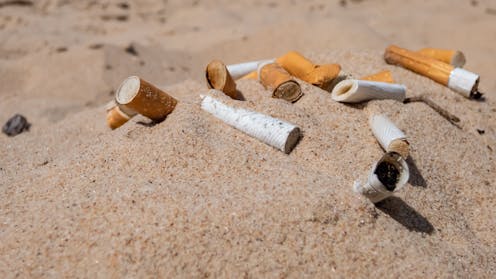
Chaque année, dans le monde, 4 500 milliards de mégots sont jetés dans la rue et dans la nature. Kristine Rad/Shutterstock

On les croit protecteurs, mais ils ne minimisent en rien les dommages du tabac. Les filtres des cigarettes auraient même potentiellement des effets nocifs pour la santé, en plus, bien sûr, d’être une immense source de pollution.


Les filtres à cigarette ont commencé à inonder le marché dans les années 1950, officiellement pour rendre le tabagisme moins nocif. Face à l’inquiétude croissante du public concernant le cancer du poumon et d’autres maladies liées au tabagisme, l’industrie du tabac a réagi non pas en rendant les cigarettes plus sûres, mais en les faisant paraître plus sûres. Les filtres étaient l’innovation parfaite, non pas pour la santé, mais pour les relations publiques.

Plus de soixante-dix ans plus tard, nous savons en effet que les filtres ne réduisent pas les risques. En réalité, ils peuvent même aggraver certains risques. En adoucissant la fumée et en facilitant son inhalation profonde, les filtres peuvent, de fait, augmenter le risque de cancer du poumon. Au début des années 1950, un type de filtre très populaire contenait même de l’amiante. Malgré cela, la plupart des fumeurs d’aujourd’hui continuent de croire que les filtres rendent les cigarettes plus sûres.

Au-delà des risques pour la santé, les filtres de cigarettes sont aussi une catastrophe pour l’environnement. Ils sont faits d’un plastique appelé « acétate de cellulose ». Ils ne se dégradent pas naturellement, mais se désagrègent en microplastiques qui polluent nos rivières et nos océans.

Et ils sont nombreux. Les mégots de cigarette sont les déchets les plus répandus sur la planète. On estime que 4,5 billions (soit 4 500 milliards) sont jetés chaque année, et environ 800 000 tonnes de ces déchets plastiques se retrouvent dans l’environnement annuellement. Alors que, à travers le monde, de nombreuses législations ont restreint l’utilisation d’autres plastiques à usage unique, tels que les bouteilles, les sacs et les pailles, les filtres de cigarettes ont largement échappé à cette réglementation.

Sous pression, certaines entreprises de tabac commercialisent désormais des filtres dits « biodégradables », fabriqués à partir de nouveaux matériaux. Mais il s’agit là d’une fausse solution. Même ces filtres n’offrent aucun avantage pour la santé et continuent de polluer les écosystèmes. Ils servent les intérêts de l’industrie du tabac, en créant une illusion de responsabilité environnementale tout en entretenant la fausse perception que les filtres eux-mêmes sont inoffensifs ou nécessaires.

Interdire pour dissiper les illusions

Les filtres de cigarettes font ainsi partie des plastiques à usage unique les plus nocifs encore en circulation dans le monde. Et contrairement à de nombreux autres polluants, ils ne remplissent aucune fonction essentielle. Or la Convention-cadre de l’Organisation mondiale de la santé (OMS) pour la lutte antitabac déconseille déjà les mesures qui entretiennent l’idée d’une réduction des risques, et les filtres de cigarettes entrent clairement dans cette catégorie.

L’interdiction des filtres de cigarettes permettrait de dissiper l’illusion de sécurité qu’ils véhiculent. Elle pourrait également réduire la prévalence du tabagisme, car les cigarettes non filtrées sont généralement plus âpres et moins agréables au goût. Une telle mesure, enfin, éliminerait également l’une des sources les plus répandues de pollution plastique, évitant ainsi la production de centaines de milliers de tonnes de déchets plastiques chaque année.

Si nous pouvons interdire les pailles en plastique, comme les pays membres de l’Union européenne l’ont fait en 2021, nous pouvons certainement interdire les filtres de cigarettes. En fait, cela a déjà été fait. Le comté de Santa Cruz (Californie) a voté en faveur de l’interdiction des filtres à cigarette en 2024.

Des personnes ramassent des déchets sur une plage. L’une d’elles tient une poignée de pailles en plastique
Les pailles en plastique sont interdites, alors pourquoi pas les filtres des cigarettes ?
David Pereiras/Shutterstock

Il est grand temps de lui emboîter le pas, alors que la pollution plastique est dans l’esprit de tout le monde, après la tenue, en août dernier, à Genève (Suisse), d’un sommet où les dirigeants mondiaux ont tâché de négocier ce qui pourrait devenir le premier traité juridiquement contraignant des Nations unies traitant de la pollution plastique, de la production à l’élimination. Le projet de traité constitue une occasion rare de s’attaquer aux causes profondes des déchets plastiques à l’échelle mondiale.

Le projet actuel du traité mentionne les filtres de cigarettes. Ils sont évoqués dans l’annexe X, une catégorie qui concerne les restrictions volontaires ou obligatoires, ce qui laisse la possibilité de continuer à les utiliser, y compris les filtres dits « écologiques », et n’impose pas leur élimination totale. Si tous les filtres de cigarettes (et pas seulement ceux en plastique) étaient répertoriés dans l’annexe Y, ils seraient soumis à une interdiction totale et obligatoire.

Les négociations du mois d’août n’ont pas permis d’aboutir à un accord final, et elles se poursuivront à une date ultérieure, ce qui signifie qu’il est encore temps d’agir.

Des groupes de défense de la santé et de l’environnement, notamment l’Organisation mondiale de la santé, Action on Smoking and Health et Stop Tobacco Pollution Alliance, réclament des engagements fermes en matière de filtres de cigarettes. Qu’est-ce qui pourrait être plus ferme qu’une interdiction pure et simple ?

Certes, la prohibition des filtres ne mettra pas fin au tabagisme du jour au lendemain et n’éliminera pas la pollution plastique. Mais ce serait une mesure significative et symbolique pour aligner les objectifs environnementaux et sanitaires. Elle permettrait de retirer du marché un produit nocif et trompeur, de réduire la pollution et de rendre les cigarettes plus honnêtes.

The Conversation

Jonathan Livingstone-Banks a reçu des financements du US National Institutes of Health (NIH), du National Institute for Health and Care Research (NIHR) et du Cancer Research UK (CRUK).

Jamie Hartmann-Boyce a reçu des financements de groupes impliqués dans la lutte contre le tabagisme, notamment Truth Initiative, Cancer Research UK et la Food and Drug Administration américaine.

ref. Inutiles, polluants… faut-il interdire les filtres de cigarettes ? – https://theconversation.com/inutiles-polluants-faut-il-interdire-les-filtres-de-cigarettes-264618

George Washington’s worries are coming true

Source: The Conversation – USA – By Robert A. Strong, Emeritus Professor of Politics, Washington and Lee University; Senior Fellow, Miller Center, University of Virginia

President George Washington warned in his farewell address about partisanship, sectionalism, excessive public debt, ambitious leaders and a poorly informed public. Mike Rosiana/iStock via Getty Images Plus

The United States will celebrate the 250th anniversary of the Declaration of Independence, the country’s founding document, in 2026. Twenty years later, America will celebrate the 250th anniversary of President George Washington’s Farewell Address, which was published on Sept. 19, 1796.

The two documents are the bookends of the American Revolution. That revolution began with the inspirational language of Thomas Jefferson, who wrote much of the Declaration of Independence; it ended with somber warnings from Washington, the nation’s first president.

After chairing the Constitutional Convention in Philadelphia and serving eight years as president, Washington announced in a newspaper essay that he would not seek another term and would return to his home in Mount Vernon. The essay was later known as the “Farewell Address.”

Washington began his essay by observing that “choice and prudence invite me to quit the political scene” while “patriotism does not forbid it.” The new nation would be fine without his continued service.

But Washington’s confidence in the general health of the union was tempered by his worries about dangers that lay ahead – worries that seem startlingly contemporary and relevant 229 years later.

A yellowed newspaper page from 1796 that contains George Washington's Farewell Address.
George Washington’s Farewell Address printed in the Virginia Herald with this introduction: ‘The importance of the following Address has induced us to lay it before our Readers; as early as possible, for their gratification.’
Courtesy of The Mount Vernon Ladies’ Association, CC BY

Focus on the domestic

Washington’s Farewell Address is famous for the admonitions “to steer clear of permanent alliances” and to resist the temptation to “entangle our peace and prosperity in the toils of European ambition.”

Important as those warnings are, they are not the main topic of Washington’s message.

During the four decades that I have taught the Farewell Address in classes on American government, I have urged my students to set aside the familiar issues of foreign policy and isolationism and to read the address for what it says about the domestic challenges confronting America.

Those challenges included partisanship, parochialism, excessive public debt, ambitious leaders who could come to power playing off our differences, and a poorly informed public who might sacrifice their own liberties to find relief from divisive politics.

Washington’s address lacks Jefferson’s idealism about equality and inalienable rights. Instead, it offers the realistic assessment that Americans are sometimes foolish and make costly political mistakes.

Rule by ‘ambitious, and unprincipled men’

Partisanship is the primary problem for the American republic, according to Washington.

“It serves always to distract the public councils and enfeeble the public administration,” he wrote. Partisanship “agitates the community with ill founded jealousies and false alarms, kindles the animosity of one part against another, foments occasionally riot and insurrection” and can open “the door to foreign influence and corruption.”

Though political parties, Washington observes, “may now and then answer popular ends,” they can also become “potent engines by which cunning, ambitious, and unprincipled men will be enabled to subvert the power of the people and to usurp for themselves the reins of government, destroying afterwards the very engines which have lifted them to unjust dominion.”

Washington’s fear that partisanship could lead to destruction of the Constitution and to the rule of “ambitious, and unprincipled men” was so important to him that he felt compelled to repeat the warning more than once in the Farewell Address.

A man in old-fashioned clothing, standing on a pedestal surrounded by elegant sculptures and images.
Portrait of George Washington standing on a pedestal holding his Farewell Address in his right hand, 1798.
From the New York Public Library, photo by Smith Collection/Gado/Getty Images

Politicians’ ‘elevation on the ruins of public liberty’

The second time Washington takes it up, he says that “the disorders and miseries” of partisanship may “gradually incline the minds of men to seek security and repose in the absolute power of an individual.”

Sooner or later, he writes, “the chief of some prevailing faction, more able or more fortunate than his competitors, turns this disposition to the purposes of his own elevation on the ruins of public liberty.”

So why not outlaw parties and rein in the dangers of partisanship?

Washington observes that this is not possible. The spirit of party “is inseparable from our nature, having its root in the strongest passions of the human mind.”

Americans naturally collect themselves into groups, factions, interests and parties because that’s what human beings do. It’s easier to be connected to local communities, states or regions of the country than to a large and diverse nation; even though that large and diverse nation is, by Washington’s assessment, essential to the security and success of all.

The central problem in American politics is not a matter of devious leaders, foreign intrigue or sectional rivalries — things that will always exist.

The problem, Washington warned, lies with the people.

Excesses of partisanship

By their nature, people divide themselves into groups and then, if not careful, find those divisions used and abused by individual leaders, foreign interests and “artful and enterprising” minorities.

Political parties are dangerous, but can’t be eliminated. According to some people, Washington observes, the competition between parties might serve as a check on the powers of government.

“Within certain limits,” Washington acknowledges, “this is probably true.” But even if the battles between political parties sometimes have a useful purpose, Washington worried about the excesses of partisanship.

Partisanship is like “a fire not to be quenched, it demands a uniform vigilance to prevent its bursting into a flame, lest instead of warming it should consume.”

Where is America today? Warmed by the fires of partisanship or consumed by the bursting of flames? George Washington suggested that provocative question more than two centuries ago on Sept. 19, 1796. It’s still worth asking.

The Conversation

Robert A. Strong does not work for, consult, own shares in or receive funding from any company or organization that would benefit from this article, and has disclosed no relevant affiliations beyond their academic appointment.

ref. George Washington’s worries are coming true – https://theconversation.com/george-washingtons-worries-are-coming-true-263240

Boosting timber harvesting in national forests while cutting public oversight won’t solve America’s wildfire problem

Source: The Conversation – USA (2) – By Courtney Schultz, Professor of Forest and Natural Resource Policy, Colorado State University

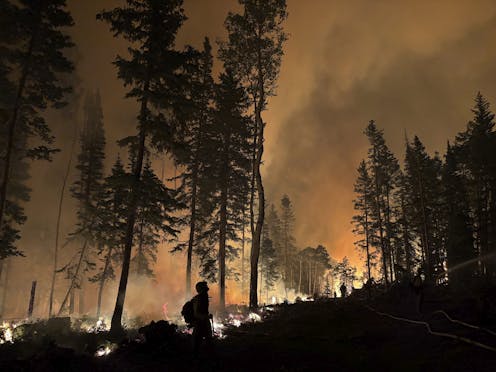
Firefighters work to get a forest fire near Monroe, Utah, under control on July 24, 2025. Hurricane Valley Fire District via AP

The western United States is facing another destructive wildfire season, with more acres burned in Colorado alone in 2025 than in the past four years combined. If global warming continues on its current trajectory, the amount of forest area burned each year could double or even triple by midcentury.

In other words, more fire is coming, more often.

As U.S. forests burn, Congress and federal agencies are asking an important question: What role should federal land management play in reducing fire risk?

About two-thirds of forest land in the western U.S. is publicly owned, with the majority of it managed by federal agencies such as the U.S. Forest Service and Bureau of Land Management. These public lands are treasured for recreation, wildlife habitat, timber production and open space. They are also where many of today’s largest fires burn.

A map showing forests and other lands shows much of the western U.S. forest land is public, while most of that in the East is privately owned.
Forest ownership in the United States.
Mark D. Nelson, Greg C. Liknes, and Brett J. Butler/U.S. Forest Service

Historically, lightning- and human-ignited fires kept forests less dense and reduced forest litter and undergrowth that can easily burn. While some controlled burning continues today, the violent displacement of Native people, criminalization of Indigenous fire stewardship and more than a century of federal fire suppression have largely removed fire as a critical ecological process in fire-prone forests, leaving fuel to accumulate.

When those forests burn today, the result is often hotter and more severe fires that elude any attempt at control. And rising global temperatures are raising the risk.

Several of the current federal proposals for managing fire risk focus on increasing timber harvesting on federal lands as a solution. They also propose speeding up approvals for those projects by limiting environmental reviews and public oversight.

As experts in fire science and policy, we see some useful ideas in the proposed solutions, but also reasons for concern.

While cutting trees can help reduce the severity of future fires, it has to include thinning in the right places to make a difference. Without oversight and public involvement, increasing logging could skip areas with low-value trees that need thinning and miss opportunities for more effective fire risk-reduction work.

Harvesting timber to reduce fire risk

President Donald Trump cited wildfire risk in his March 2025 executive order calling for “an immediate expansion of American timber production.” And the U.S. Forest Service followed with a commitment to increase timber sales on federal land by 25% over the next four years.

Trump, federal officials and members of Congress who are advancing legislation such as the Fix Our Forests Act have also called for speeding up approval of timber-harvesting projects by reducing public comment periods on proposals, limiting environmental analyses of the plans and curtailing the ability of groups to sue to block or change the projects in court.

Tall stacks of logs left beside a road after a forest thinning project in the Arizona mountains.
Stacks of logs from a forest-thinning project in the Coconino National Forest of northern Arizona in 2020 wait to be processed for firewood.
AP Photo/Paul Davenport

These proposals are often framed as pragmatic solutions to clear the way for action to reduce fire risk faster. The urgency is real, and this argument can seem intuitive. No one wants burdensome processes to stand in the way of reducing wildfire damage. But it’s important to take a hard look at the problem and real solutions.

Environmental reviews aren’t the problem

Research shows that environmental reviews are rarely the main barrier to forest projects aimed at reducing fire risk.

The bigger obstacles are the shrinking of the federal forest workforce over the past two decades, the low commercial value of the small trees and brush that need to be removed, and the lack of contractors, processing facilities and markets for low-value wood.

Data from the U.S. Forest Service supports these conclusions.

Between 2005 and 2018, over 82% of the U.S. Forest Service’s land management projects were approved using categorical exclusions. Categorical exclusions allow agencies to skip environmental assessments and are the fastest and least burdensome form of National Environmental Policy Act, or NEPA, review, with limited analysis or opportunity for public involvement.

Less than 1% of the projects were challenged in court, and most of those challenges targeted the largest and most complex projects, where public oversight and analysis are critical to getting it right on the ground, such as large mining operations or forest management projects that would cover hundreds of thousands of acres.

An analysis of the bulk of U.S. Forest Service land management projects between 2009 and 2021 found that complying with NEPA took between 7% and 21% of the projects’ timelines, often shorter than the timelines for issuing contracts.

Some degree of planning, intergovernmental coordination and public involvement must happen before starting a fuel-reduction project to know where the work is appropriate and necessary.

Why reviews and public oversight matter

What would be lost if environmental-analysis and public-involvement requirements were curtailed?

Oversight helps ensure that projects happen where they are needed to reduce fire risk. Without that, political and economic pressures can lead to more forest thinning in locations where there are mills and valuable timber – rather than in the areas where wildfire risk is higher but the trees aren’t as valuable.

Firefighters in gear and helmets feed brush into a portable woodchipper in the woods.
U.S. Forest Service crew members put branches into a wood chipper in the Tahoe National Forest near Downieville, Calif., in June 2023. Forest thinning can help reduce the risks of destructive fires.
AP Photo/Godofredo A. Vásquez

Environmental review and public comment are among the few tools communities have to shape fire-mitigation projects.

These processes also ensure that the work doesn’t stop at federal boundaries. And they help partners, such as community organizations, state agencies and local fire departments, plan and work together.

Oversight doesn’t just protect the environment — it enables funding and partnerships, safeguards communities and builds shared ownership of adapting to fire.

Solutions that work

So, what can Congress and the federal government do to reduce fire risk to communities? The answer starts with investing in forest management and projects that can reduce fire risk.

Joint projects involving communities and state, tribal and local agencies, like those under the Collaborative Forest Landscape Restoration Program, build partnerships to reduce fire risk across large landscapes and lower the risk of fire spreading to homes and federal wildlands. The Good Neighbor Authority, created in 2001, enables federal agencies to contract with states, counties and tribes to provide forest management work on federal lands.

Yet federal funding for state, tribal and private forest management is on the chopping block. Wildfire risk and the capacity to address the challenge are going in opposite directions.

A firefighter carries a long tree branch. The air is smoky behind the crew.
Firefighters of the Inyo Hotshots team clear brush as the Garnet Fire burns on Aug. 26, 2025, in Fresno County, Calif. When brush and dead wood build up, fires have more fuel to burn hotter and be more destructive and harder to control.
AP Photo/Ethan Swope

The Wildland Fire Mitigation and Management Commission, a bipartisan group of fire professionals, scientists, tribes, land managers and local officials, recently released recommendations for improving fire management that call for greater funding and collaboration at all levels to reduce the fire risk. The report emphasizes the importance of proactive solutions driven by local communities, shared decision-making and better use of prescribed fire. Achieving these goals will require sustained collaboration across jurisdictions and sectors, with communities engaged as full partners in the process.

Forest and fire management are complex jobs. It is reasonable to yearn for quick solutions to the wildfire crisis, but it’s important that any fixes lead to lasting progress. Deregulation and disinvestment may ultimately exacerbate wildfire risk.

The Conversation

Courtney Schultz received funding from the US Forest Service, Joint Fire Science Program, and National Science Foundation for her research on US forest policy

Forrest Fleischman received funding from the US National Science Foundation and the US Forest Service for his research on national forest policy.

Tony Cheng receives funding appropriated through the Southwest Forest Health and Wildfire Prevention Act administered by the from the US Forest Service and the National Science Foundation for applied research on forest and wildfire resiliency. In addition to his university faculty appointment, he is a senior fellow with the Pinchot Institute for Conservation.

ref. Boosting timber harvesting in national forests while cutting public oversight won’t solve America’s wildfire problem – https://theconversation.com/boosting-timber-harvesting-in-national-forests-while-cutting-public-oversight-wont-solve-americas-wildfire-problem-264097

Complying with Trump administration’s attack on DEI could get employers into legal trouble

Source: The Conversation – USA (2) – By Deborah Widiss, Professor of Law and John F. Kimberling Chair, Indiana University

Discrimination is illegal in the U.S. Afif Ahsan/Stock via Getty Images Plus

Since returning to office, President Donald Trump and his administration have waged a war on diversity, equity and inclusion efforts, including those of private businesses across the country.

Trump fired the first shot on Jan. 21, 2025 – his first full day back in office – when he signed an executive order that denounced DEI as “immoral” and “illegal discrimination.” The order claimed that, under such policies, “hardworking Americans” were being “shut out of opportunities because of their race or sex.”

A week later, Trump dismissed two Democratic commissioners of the Equal Employment Opportunity Commission, the federal agency that helps enforce workplace antidiscrimination laws. Because these officials were forced out years before their terms expired, their firing was arguably illegal. But it allowed Trump to dramatically shift the commission’s focus.

Andrea Lucas, named by Trump to be the agency’s acting chair, quickly announced a commitment to what she described as “rooting out unlawful DEI-motivated race and sex discrimination.”

Since then, there’s been a steady drumbeat of anti-DEI statements from the administration and its supporters. But these proclamations fail to explain what is illegal about so-called “illegal DEI.” As professors and workplace law experts, we recognize that companies may have trouble distinguishing political rhetoric from legal obligations. That’s why we recently co-founded The Legal DEI Project, a free resource providing clear information on DEI policies and practices and the law.

Chilling effect

The Trump administration’s statements about DEI are generally broad in scope and short on details, leading to an overall chilling effect on private businesses.

For example, one of Trump’s executive orders suggests, without evidence, that corporations and other large employers have replaced a commitment to “hard work” with an “unlawful, corrosive, and pernicious identity-based spoils system.” It then instructs federal agencies to compile lists of the businesses and other institutions they believe are the “most egregious and discriminatory DEI practitioners” and pursue compliance investigations against them.

Some employers have responded to this threat by aggressively slashing their programs and personnel dedicated to ensuring fairness at work. That reaction is understandable. But it is also deeply mistaken, as many tried-and-true practices that effectively reduce workplace discrimination are getting caught in a dragnet of anti-DEI fever.

Employers who act rashly by simply abandoning all efforts related to diversity and inclusion may actually increase rather than decrease their risk of being sued by workers who believe they have experienced discrimination – the overwhelming majority of whom are members of racial minority groups rather than white workers.

Employers could also miss out on the benefits that can flow from diverse workforces, such as higher profits, innovation and creativity.

DEI isn’t illegal, but discrimination is

DEI is a generic, umbrella term used to describe organizational efforts to treat all people fairly. While such initiatives have been around for decades, the DEI label became common only in the past decade as the Black Lives Matter and #MeToo movements highlighted pervasive discrimination and inequality in U.S. society.

The term, however, has no legal meaning. DEI is instead a collection of aspirational objectives used as corporate or institutional branding, which Trump has turned into a straw man by repeatedly condemning what he alleges is “illegal DEI.”

Workplaces are governed by antidiscrimination laws. Those laws prohibit employers from making hiring or other personnel decisions based on workers’ protected characteristics such as race, sex or religion, just as they did before DEI programs became popular.

This means that employers generally cannot implement preferences for, or limit opportunities to, employees based on these traits. If DEI programs include improper preferences, those preferences were illegal before Trump took office. They should be discontinued.

Importantly, U.S. employment law requires employers to do more than just punish individual employees who make biased decisions or harass co-workers. Employers must also, at a minimum, take proactive steps to prevent harassment and reasonably accommodate workers with qualifying disabilities, pregnancy-related limitations and religious needs.

Employers must also make sure that workplace policies, such as how duties are assigned and how pay is set, are fair and unbiased.

A black and white photo of President Lyndon B. Johnson signing a document surrounded by many men.
President Lyndon B. Johnson signs the Civil Rights Act into law on July 2, 1964, while many people, including the Rev. Martin Luther King Jr., stand behind him and observe.
LBJ Library photo by Cecil Stoughton

Congress, not the president, creates laws

Multiple laws enacted by Congress, from the 1964 Civil Rights Act to the 2022 Pregnant Workers Fairness Act, and decades of court decisions interpreting those laws, have established the rules that govern the workplace today. The Trump administration has no authority to single-handedly change these laws – or the regulations implementing them – just by issuing executive orders.

What those orders primarily do is set presidential agendas. Presidents use them to direct some actions of the federal government and its contractors, but executive orders do not directly apply to most private companies, nonprofits or other nongovernmental employers.

Although the EEOC may follow Trump’s directives, it cannot change or ignore federal laws. In fact, recent EEOC actions – such as spontaneously demanding information from law firms about their diversity initiatives – that arguably exceed its authority are being challenged in court.

Employees, not the government, file most complaints

When employers attempt to conform to the Trump administration’s political goals by removing any guardrails they’ve put in place to prevent discrimination, they put themselves at greater legal risk. That is because most discrimination lawsuits are brought by employees, not the federal government.

On average, individual employees file 60,000 to 90,000 EEOC charges annually and tens of thousands of lawsuits arising from those charges in federal and state court. By comparison, the EEOC has brought fewer than 150 cases annually in recent years.

While the EEOC’s attack on DEI programs may encourage more white workers to file discrimination claims, the data shows that most actionable discrimination continues to be experienced by women and members of racial minority groups, not by white people.

And that problem is likely to be exacerbated by employers dismantling their DEI programs.

Not a zero-sum game

Just as employing a diverse workforce is perfectly legal, so too is taking action to value diverse perspectives and leadership.

Adopting inclusive recruitment strategies, structuring decision-making practices to be more objective, and assessing job descriptions to focus on tasks and qualifications can all help reduce the influence of racial, gender, religious or other biases in hiring and promotion. Offering training and mentoring, providing support to meet the needs of all workers, and creating environments that promote excellence and belonging can ensure equal access to opportunities for all employees.

Adopting such human resource practices also makes good business sense. When properly executed, they reduce the risk of workplace discrimination lawsuits and liability by flagging any potential discrimination and allowing employers to proactively address it.

Antidiscrimination law has always required employers to judge all workers fairly and on the basis of their merit. Making changes that aim to reduce bias against some employees is not an act of discrimination against white men or others who do not belong to a group that has historically experienced discrimination.

Those changes instead help employers comply with antidiscrimination laws – the same laws that have governed U.S. workplaces for over 60 years and continue to do so today.

The Conversation

Deborah Widiss serves on advisory boards for the Indiana Community Action Poverty Institute.

Rachel Arnow Richman receives funding from the University of Florida for academic research purposes.

Stephanie Bornstein and Tristin Green do not work for, consult, own shares in or receive funding from any company or organization that would benefit from this article, and have disclosed no relevant affiliations beyond their academic appointment.

ref. Complying with Trump administration’s attack on DEI could get employers into legal trouble – https://theconversation.com/complying-with-trump-administrations-attack-on-dei-could-get-employers-into-legal-trouble-262915

50 years ago, NASA sent 2 spacecraft to search for life on Mars – the Viking missions’ findings are still discussed today

Source: The Conversation – USA – By Joel S. Levine, Research Professor of Applied Science, William & Mary

NASA’s Viking landers were the first spacecraft to successfully touch down on the surface of Mars. NASA/JPL-Caltech via AP

Finding life beyond the Earth would be a major scientific discovery with significant implications for all areas of science and human thought. Yet, only one direct search for extraterrestrial life has ever been conducted.

A poster showing the Viking craft parachuting to the Martian surface.
The Viking missions landed on the Martian surface using parachutes. This diagram shows each stage the spacecraft went through as they landed.
NASA

The NASA Viking spacecraft, which landed on Mars, conducted this search in the summer of 1976. Viking consisted of two twin orbiters and landers, with experimental chambers in the landers to conduct three biology experiments.

Over the past half-century, the measurements made during the Viking biology experiments have been the subject of many discussions, analyses and speculation. Today, scientists are still discussing the results of these experiments in an attempt to answer the age-old question of whether there is life beyond the Earth.

The year 2025 marks 50 years since the two spacecraft launched, three weeks apart. These landers achieved humankind’s first two successful soft landings of operational and functioning spacecraft on the surface of another planet.

I’m an atmospheric scientist who worked on the Viking missions in the 1970s at the NASA Langley Research Center, the laboratory that developed and managed the highly successful Viking missions. The Viking missions’ scientific discoveries painted a new picture of Mars’ atmosphere, surface and planetary history.

The Viking 1 lander reached the surface of Mars after being ejected from a spacecraft and deploying a parachute.

Launching and landing the Viking spacecraft

The two Viking spacecraft both consisted of an orbiter and a lander. Viking 1 entered Mars’ orbit on June 19, 1976, and successfully landed on the surface on July 20, 1976, which was also the seventh anniversary of the first human Moon landing. Viking 2 followed, landing on Sept. 3, 1976, at a site farther to the northwest.

Viking wasn’t just looking for life.

These crafts contained equipment to take pictures; map heat energy, wind and weather; study the chemical composition of the surface, dust and atmosphere; and collect and analyze soil samples.

Measurements that Viking took of the atmosphere suggested that Mars used to have a much denser atmosphere but over time lost it. It also observed that the wind picks up tiny dust particles, blowing them into the atmosphere. This process colors the planet’s sky permanently pink.

A diagram of the Viking landers, with each instrument labeled.
All the instruments found on the Viking landers.
NASA

The Viking landers also discovered that at any location on Mars, the atmosphere’s surface pressure varies seasonally. The planet has frozen north and south poles, like on Earth. At the Martian poles in summer, the frozen carbon dioxide sublimates – transforming from a frozen solid to a gas – and then at the winter pole condenses back into a frozen solid.

That process, unique to Mars, affects the atmospheric pressure by changing how much carbon dioxide is in gas form instead of solid form over the planet’s surface.

Biology experiments

Each of the three Viking biology experiments brought a soil sample from the Martian surface into a sterilized test chamber and exposed the sample to a different nutrient under different atmospheric conditions.

Researchers wanted to find out whether the soil contained microorganisms, so they monitored how the atmosphere in the chamber changed. Metabolic processes – like breathing – from organisms consuming the nutrient would change the chemical composition of the chamber’s atmosphere.

Depending on the experiment, the nutrient contained either carbon, carbon dioxide or carbon monoxide – all of which were radioactive. With radioactive samples, researchers could track the level of radioactivity in the chamber to see if metabolic reactions in the soil samples were raising or lowering it.

For all three experiments, the researchers could use radio commands to heat up the test chamber, which was still inside the Viking spacecraft on Mars. This would destroy any potential microorganisms in the soil and stop the production of any gases they were creating metabolically.

In the first experiment, called the carbon assimilation experiment or the pyrolytic release experiment, the researchers simulated the Martian atmosphere in one of Viking’s test chambers. They filled the chamber with gases such as carbon dioxide and carbon monoxide and made these gases radioactive to see how the atmosphere changed from interactions with the soil sample.

In the second experiment, The labeled release experiment, researchers directly injected the soil sample with a nutrient containing radioactive carbon. They monitored the experimental chamber for radioactive carbon dioxide and measured the level of radioactive carbon dioxide after injecting the soil samples. In this experiment, the investigators saw results that could have come from a biological source.

A diagram showing the three experiments in sealed chambers.
The three biology experiments involved putting soil samples in sealed chambers with nutrients and seeing what happened to the atmosphere in each chamber.
NASA

The third experiment, the gas exchange experiment, filled the chamber with helium, which doesn’t react with anything. They exposed the soil to different types of nutrients. Some had been incubating in wet conditions, others in humid conditions and others still in dry conditions.

Again they monitored the chamber for potential metabolically produced gases. When the soil samples touched the wet nutrient, the humidity immediately caused some changes in the chamber’s chemical environment. Most of these changes were just caused by the water evaporating.

In one case, superoxides in the soil, which are O₂ molecules that have taken on an extra electron, reacted with water. Other changes had to do with oxygen molecules in the soil breaking down. All of these changed the atmosphere in the chamber but likely wouldn’t have been caused by microorganisms.

The researchers repeated this experiment by resetting the chamber’s atmosphere and adding in fresh nutrients, but they didn’t change the soil sample. This time, the soil released only carbon dioxide into the chamber, which likely came from the organic materials in the nutrient they added breaking down.

The results from this third experiment led the researchers to conclude that there likely weren’t microorganisms in the soil. But together, the results from the three experiments weren’t exactly straightforward.

Only the labeled release experiment results suggested a biological source for the observed results. The carbon assimilation experiment and the gas exchange experiment suggested that nonbiological or inorganic chemical reactions caused the observed results.

Lead researchers on the project concluded that there was no unambiguous discovery of life by the Viking landers, but it cannot be completely ruled out.

The front page of the New York Times, with a headline reading 'viking robot sets down safely on Mars and sends back pictures of rocky plain' with a picture of a rocky plain.
The Viking mission was a major scientific and engineering success. On July 21, 1976, the day after the successful Viking 1 landing on the surface of Mars, The New York Times published the first photograph of Mars taken by the Viking Lander on its front page, covering all eight columns of the newspaper.
The New York Times

The molecular analysis experiment

Unlike the biology experiments, which experimented on soil samples, another Viking experiment, the molecular analysis experiment, directly searched the Martian surface for organic matter. Organic materials are carbon compounds bonded with hydrogen, oxygen or nitrogen that come either directly or indirectly from living organisms.

To everyone’s surprise, this experiment did not detect any organic compounds on the surface of Mars. Researchers had known for years that meteorites containing organic materials had hit Mars repeatedly throughout its history, so to find none at all seemed strange.

Some scientists theorized that Martian soil might contain a compound that quickly converts any organic material on the surface to carbon dioxide. A compound like this would have evaporated any evidence before scientific instruments had the chance to find it.

In 2008, decades after this finding, NASA found a compound that may be doing just that. Their Phoenix lander detected high concentrations of a compound called perchlorate in the soil.

When perchlorate is heated – as it was in the Viking molecular analysis experiment – it can chemically destroy organic compounds, and scientists figured it’s the likely culprit behind the strange result from the molecular analysis experiment.

A small, low to the ground spacecraft with an antenna disk pointing upwards, resting on a rocky surface.
The Viking 1 lander, pictured in a Mars simulation laboratory.
AP Photo

A new model for life on Mars

Scientists are still using the findings from these experiments today. Recently, Steven A. Benner, the director of the Foundation for Applied Molecular Evolution, developed a new model for present-day life on Mars based on the three Viking biology experiments’ measurements.

His model predicts that microorganisms could have used the radioactive carbon nutrient in the experiment chamber to create their own food, releasing radioactive carbon dioxide in the process. It also suggests that at night, microorganisms could be absorbing oxygen and expelling carbon dioxide. That could explain the oxygen released from the Mars soil sample when moistened.

The Benner model suggests that there could be living microorganisms on the surface of Mars, but future research and measurements will need to confirm this very intriguing possibility.

The Conversation

Dr. Joel S. Levine is a consultant and subject matter expert for the NASA Engineering and Safety Center in the areas of space and planetary environments. Dr. Levine worked for NASA from 1970 to 2011 and worked on the Viking Mission to Mars, the subject of this article. Dr. Levine was appointed Mars Scout Program Scientist in the Mars Exploration Program, NASA Headquarters and appointed co-chair of the NASA panel on the Human Exploration of Mars Science Analysis Group (HEM-SAG), planning for the first human mission to Mars.

ref. 50 years ago, NASA sent 2 spacecraft to search for life on Mars – the Viking missions’ findings are still discussed today – https://theconversation.com/50-years-ago-nasa-sent-2-spacecraft-to-search-for-life-on-mars-the-viking-missions-findings-are-still-discussed-today-262186

When you’re caught between ‘yes’ and ‘no,’ here’s why ‘maybe’ isn’t the way to go

Source: The Conversation – USA (2) – By Julian Givi, Assistant Professor of Marketing, West Virginia University

Yes, no, maybe so? cundra/iStock via Getty Images

Say you win a radio sweepstakes giving you two tickets to a sold-out concert the upcoming weekend. You eagerly text your friend and ask if they’d like to join.

Their response? “Maybe.”

Your mood immediately turns. You feel slighted rather than joyous as you’re left in limbo: Now you need to wait for your waffling friend to make a decision before you can figure out your plans for the concert.

I’m a consumer psychologist who has studied social decision-making for over a decade. And if you’ve experienced anything like the above anecdote, I can tell you that you’re not alone. People responding “maybe” to invitations is a common yet irksome aspect of social life. Recently, my co-authors and I published a series of studies examining what goes on in people’s heads when they aren’t sure whether to accept an invitation.

Leaving your options open

Social invitations can be a delicate dance, and people often misread what someone extending an invite wants to hear.

We consistently found that people overestimate an inviter’s likelihood of preferring a “maybe” over a “no.” Moreover, they fail to realize how much more disrespected people feel when they receive a “maybe” in response to their invitation.

Another pattern emerged: The more someone incorrectly assumed that a host preferred a tentative response, the more likely they were to respond with a “maybe” themselves.

Naturally, we wanted to figure out why this awkward dynamic plays out. We found that it’s largely due to something called “motivated reasoning.” Motivated reasoning occurs when a person interprets information in a biased way to arrive at a conclusion that aligns with their own wishes.

In other words, invitees convince themselves that inviters want to hear “maybe” instead of “no,” because a “maybe” is better for the invitee, allowing them to leave their options open. Saying “no” right off the bat eliminates one’s options and opens the door for FOMO, or fear of missing out, to emerge.

Just say ‘no’

That said, there were certain situations that made people more comfortable saying “no” to an invite.

In one study, we had recipients of an invitation put themselves in the shoes of the person extending the invite. This made them more likely to realize that they’d probably prefer a definitive answer. That is, it seemed to prevent motivated reasoning from emerging.

In another study, we had participants get invited to do something they didn’t want to do. We found that motivated reasoning then became irrelevant: They had no desire to keep their options open, so they were more likely to assume that a “no” was preferable to a “maybe.”

Interestingly, while invitations are a widespread aspect of social life, social scientists have only recently started studying them. For example, a 2024 study found that people tend to overestimate the negative consequences of saying “no” to invitations. They think it will upset, anger and disappoint inviters more than is the case. This could also be part of the reason that many people fail to realize that someone extending an invitation prefers a “no” to a “maybe.” Other research has explored whether people respond better to some reasons for declining an invite over others: saying you’re too busy, not great; saying you don’t have enough money to make it work, much better.

While navigating social situations can be tricky, our work suggests that being direct and definitive is sometimes best.

It might reduce your options. But it’ll keep those who invited you from being left in limbo – and maybe they’ll still think of you when the next concert comes to town.

The Conversation

Julian Givi does not work for, consult, own shares in or receive funding from any company or organization that would benefit from this article, and has disclosed no relevant affiliations beyond their academic appointment.

ref. When you’re caught between ‘yes’ and ‘no,’ here’s why ‘maybe’ isn’t the way to go – https://theconversation.com/when-youre-caught-between-yes-and-no-heres-why-maybe-isnt-the-way-to-go-263407

How is paint made?

Source: The Conversation – USA (2) – By Dawn Rogala, Paintings Conservator and Program Manager, Smithsonian Institution

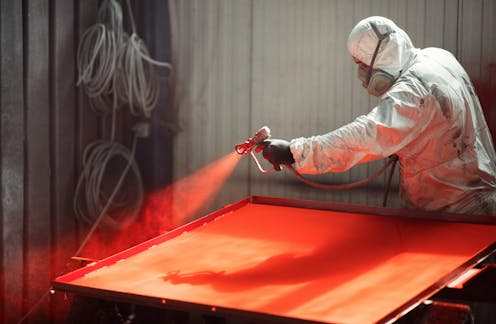
Protective paint sprayed onto a steel plate in a factory will have a different recipe than paint used in an art class. gilaxia/E+ via Getty Images

Curious Kids is a series for children of all ages. If you have a question you’d like an expert to answer, send it to curiouskidsus@theconversation.com.


How is paint made? – Atharva, age 11, Bengaluru, India


Did you ever mix dirt and water when you were playing outside? You made a paint. Did you draw shapes on the ground with your muddy hands? You made a painting.

Paint is made by combining a colorful substance – a pigment – with another material that binds the color together and helps spread that color onto surfaces such as paper, fabric or wood. Pigments can be found everywhere – in rocks and minerals, plants or insects. Some colors are made by scientists in laboratories.

Long ago, artists made their own paints by mixing pigments with natural materials such as water, oil or egg yolk to hold the colors together in a paste. Artists today can still make their own paints, or they can order them from factories that mix, package and ship paint all over the world. Paint companies use large, industrial machines to grind pigments and binders together; these commercial paints include synthetic materials and preservatives to control the paint’s behavior and to help paint last longer in tubes or cans.

Paints and coatings do many jobs beyond just coloring paper in an artist’s studio. They are also used as protective coatings to shield houses and cars from the sun or the cold, or as a barrier between boats and the water that surrounds their wood, metal or plastic parts. Where and how a paint will be used influence how it’s made and with what ingredients.

an open box of watercolor paints with splatters of color on the case
Watercolor sets like this one used by artist Alma Thomas can be found in art classrooms around the world.
Anacostia Community Museum, Smithsonian Institution, Gift of David Driskell, CC BY

Choosing the right materials

A lot of questions need to be answered before materials are chosen for a paint.

  • Who will use the paint? An artist, a house painter, an armadillo, a robot at an assembly plant?
  • Why is the paint being used? For museum paintings and sculptures? In designs for furniture or mailboxes?
  • How will the paint be applied? By brush, by spray, or some other way?
  • Where and when will the paint be used? Does it need to dry quickly or slowly? Will the painted surface get really cold or hot? Is the paint safe for kids to use at home or school?
  • What should the paint look like? Should the dried paint be shiny or matte? Should the surface be lumpy, or should it flatten and level out? Should the colors be bright or dull? Should the paint layers be opaque, transparent or almost clear? Does the paint need to hold up against scuffs and stains?

There are many different companies that design and make the wide range of paints used around the world for all these various applications. Experts at each manufacturer understand their special type of paint, how the paint materials are measured and mixed, and the best ways to store and apply the paint. A single factory can make tens of thousands of gallons of paint each day, and paint companies produce millions of tubes of paint every year.

two boards with various colors of paint dried on them along with multiple paint brushes
Artist Thomas Moran’s palettes and brushes illustrate the way an artist mixes different paints to find just the desired qualities.
Smithsonian American Art Museum, Bequest of Miss Ruth B. Moran

Using paint to learn about the past

We work at the Smithsonian’s Museum Conservation Institute, where we study and conserve the diverse collection of painted objects at the Smithsonian – from planes and spacecraft to portraits of presidents and maps covered in abstract swirls of color. Bright coatings are part of everything from the painted clothing and cultural items of Native peoples to the pots and pans used by chef Julia Child.

Art conservators and conservation scientists like us work together to study and preserve cultural heritage such as paintings and painted objects. Studying paint helps us learn about the past and protect this history for future generations.

The paint colors used on large, traditional Indian paintings called “pichwai,” for example, include pigments gathered from around the world. They can reveal information about ancient manufacturing and how communities that lived far apart exchanged goods and knowledge.

There are many techniques to investigate artwork, from looking at small pieces of paint under a microscope to using more complicated equipment to analyze materials exposed to different types of energy. For example, we can use X-ray, infrared or ultraviolet imaging to identify different pigments in a painting.

three side by side images of the same painting, but one looks very dark, one is colorful, and one is grey and white
Conservation scientists will image the same work of art, such as this Indian pichwai, using ultraviolet fluorescence (left), visible light (middle) and infrared light (right).
National Museum of Asian Art, Smithsonian Institution, Gift of Karl B. Mann, S1992.28, Department of Conservation and Scientific Research, Orthomosaics and UV Fluorescence

Research on an Alaskan Tlingit crest hat made in the 1800s looked at the molecules in paint binders, combined with 3D scanning, to help clan members replicate the hat for ceremonial use.

Unusual uses bring conservation challenges

Artists use all sorts of materials in their artwork that were designed for other purposes. Some 19th- and early 20th-century sculptures were painted with laundry bluing – a material that used blue pigment to brighten clothes during washing. In the 1950s, artists started using thin, quick-drying house paint in their paintings.

When paints are used in a way that was not part of their design, strange things can happen. Paints made to be applied in thin layers but instead are used in thick layers can wrinkle and pucker as they dry. Paints designed to stick to rough wood can curl or lift away from slick surfaces. The colors and ingredients in paint can also fade or darken over time. Some artists want these different effects in their artwork; some artists are surprised when paints don’t behave the way they expected.

Art conservators and conservation scientists use information about artists and their paints to understand why artworks are faded, broken or acting in surprising ways, and they use that knowledge to slow or stop the damage. We can even clean some kinds of damage with lasers.

The more we know about paint, the more we learn about the past lives of painted objects and how to keep those objects around for a long, long time.


Hello, curious kids! Do you have a question you’d like an expert to answer? Ask an adult to send your question to CuriousKidsUS@theconversation.com. Please tell us your name, age and the city where you live.

And since curiosity has no age limit – adults, let us know what you’re wondering, too. We won’t be able to answer every question, but we will do our best.

The Conversation

The authors do not work for, consult, own shares in or receive funding from any company or organization that would benefit from this article, and have disclosed no relevant affiliations beyond their academic appointment.

ref. How is paint made? – https://theconversation.com/how-is-paint-made-245905

Les cobots, des collègues de travail comme les autres ?

Source: The Conversation – in French – By Thierry Colin, Professeur des universités en Sciences de gestion, Université de Lorraine

Le concept de cobot a été inventé par l’industrie automobile. L’objectif : créer des robots capables de travailler aux côtés des humains, sans risque d’insécurité. Gumpanat/Shutterstock

Les robots collaboratifs, ou cobots, ne remplacent pas seulement les humains : ils peuvent travaillent avec eux. Quel est leur impact sur la division du travail ?


Les robots sont omniprésents dans la production industrielle. Leur diffusion a toujours été au cœur d’enjeux humains, sociaux, économiques et en management, entraînant très tôt de nombreux questionnements.

Une nouvelle interrogation émerge aujourd’hui avec l’apparition des cobots. Capables de travailler non seulement à la place, mais aussi avec les humains au sein des ateliers, les robots collaboratifs sont-ils en train de devenir des collègues comme les autres ? Légers, flexibles, relativement accessibles et conviviaux… sont-ils susceptibles de remettre en cause les codes de la division du travail ?

Nos recherches récentes, basées sur des études de cas comprenant des entretiens et des observations en situation, ont permis de repérer quatre types d’usage des cobots : configuration simultanée, alternée, flexible ou coexistence. Elles rentrent dans le cadre du projet Impact « C-Shift » (Cobots in the Service of Human activity at work) qui vise à étudier l’impact de la mise en œuvre de dispositifs collaboratifs intelligents tels que les cobots dans le cadre des défis de l’industrie du futur.

Qu’est-ce qu’un cobot ?

Le terme cobot est créé par la contraction des termes anglais « collaborative » et « robot ». La paternité en est attribuée à des universitaires états-uniennes qui cherchent à la fois à limiter les troubles musculosquelettiques et à améliorer la productivité dans des usines de production automobile – Ford et General Motors.

Un robot collaboratif est un robot qui peut être installé dans le même espace de travail que les opérateurs humains, sans barrière de protection physique. Ils sont équipés de capteurs et de programmes déclenchant un ralentissement du mouvement ou un arrêt complet si un risque de collision est détecté. Ils sont capables de réaliser la plupart des opérations industrielles – visser, percer, poncer, souder.

Les cobots ne sont pas conçus pour des usages prédéfinis. Ils sont caractérisés avant tout par leur flexibilité. Facilement programmables grâce à des interfaces accessibles sur des tablettes, ils sont faciles à déplacer. Ils peuvent aussi bien mettre des produits cosmétiques dans des cartons, que faire du contrôle qualité à l’aide d’une caméra en bout de chaîne de production ou souder des pièces métalliques.

Marché multiplié par quatre d’ici 2030

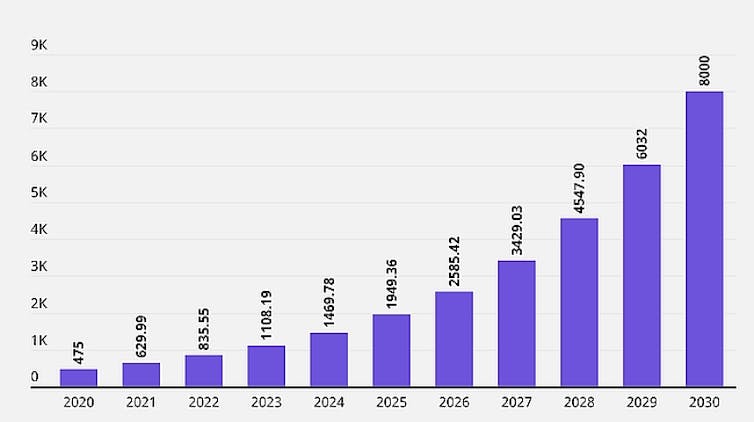
Les cobots ne sont plus de simples prototypes de laboratoire. Ils sont désormais couramment utilisés dans des usines de toutes tailles et dans divers secteurs – automobile, logistique, santé, agroalimentaire –, bien que leur adoption reste encore loin d’être généralisée. La part des cobots dans les ventes mondiales de robots serait de l’ordre de 3 % et, selon ABI research, le marché des cobots pourrait être multiplié par quatre d’ici 2030.

Courbe
Prévision de croissance du marché mondial des robots collaboratifs (cobots) de 2020 à 2030 en millions de dollars états-uniens. »
Statista et ABI Research, FAL

Les cobots ne visent pas à remplacer les robots traditionnels en raison de plusieurs limitations :

  • Leur charge utile est réduite : leur légèreté et leur petite taille les empêchent de manipuler des objets lourds.

  • Leur vitesse d’exécution est volontairement limitée pour garantir la sécurité des humains qui travaillent autour. Cela freine leur productivité et les rend peu adaptés aux productions à très grande échelle.

  • Installés dans les mêmes espaces que les humains, les cobots soulèvent des problèmes de sécurité lorsqu’ils sont équipés d’outils dangereux – outil coupant ou torche de soudage.

Leur potentiel réside avant tout dans de nouveaux usages et une approche différente de l’automatisation. Ainsi, dans une PME spécialisée dans la tôlerie qui a fait l’objet d’une étude de cas, les soudures sont effectuées par un robot de soudure traditionnel pour les grandes séries récurrentes. Pour les séries de taille moyenne et par des soudeurs pour les petites séries ou des soudures trop complexes, elles sont effectuées par des cobots.

Quatre usages des cobots en usine

Si par définition les cobots ont la possibilité de travailler dans le même espace que des opérateurs humains, leurs usages ne sont pas nécessairement collaboratifs et nos recherches nous ont permis de distinguer quatre configurations.

Projet C-SHIFT, cobots et industrie du futur, de l’Université de Lorraine.
Université de Lorraine, Fourni par l’auteur

Coexistence avec l’humain

À un extrême, les cobots viennent se substituer aux opérateurs pour prendre en charge les gestes les plus pénibles et/ou gagner en productivité. On qualifie cet usage de coexistence, car il n’y a aucune interaction directe avec les humains.

Dans l’industrie automobile, des cobots vissent des pièces sous les véhicules, là où les positions sont particulièrement difficiles pour les opérateurs.


À lire aussi :
Comment rendre les robots plus adaptables aux besoins de leurs collaborateurs humains ?


Configuration simultanée

Dans la configuration simultanée, cobots et opérateurs travaillent ensemble en adaptant mutuellement leurs mouvements, côte à côte ou face à face. Si cette configuration est largement réalisable en laboratoire, elle est assez rare en condition réelle. La raison : le temps nécessaire à sa mise au point et sa certification sécurité obligatoire.

Chez un équipementier, le cobot positionne une colonne de direction pour automobile avec précision, évitant le port de charges et les chocs, et l’opérateur effectue des tâches de vissage sur la pièce.

Configuration alternée

La configuration alternée correspond à une situation où l’opérateur utilise le cobot, mais n’interagit pas directement avec lui. Il le programme pour une série de tâches, et le laisse travailler seul, dans un espace différent. Cette configuration garantit une meilleure sécurité pour l’opérateur humain. Ce dernier optimise la répartition du travail entre ce qu’il confie au cobot et ce qu’il continue de faire lui-même.

Chez un fabricant d’échangeurs thermiques pour la production de gaz industriels, les soudeurs délèguent aux cobots les soudures les plus simples et se concentrent sur des soudures plus complexes ou moins répétitives.

Configuration flexible

Dans la configuration flexible, la répartition du travail entre humains et cobots évolue au cours du temps, en fonction du plan de charge. Une fois la technologie maîtrisée, les cobots peuvent être réaffectés à différentes activités en fonction des exigences du moment. Le même cobot peut être utilisé pendant une période pour une activité de chargement de machines, puis réoutillé, il peut servir pour du ponçage, puis des opérations de peinture, etc.

L’efficacité réside dans la capacité des opérateurs, des techniciens et des ingénieurs à travailler ensemble pour inventer constamment de nouveaux usages. Cette configuration semble particulièrement adaptée à des PME dans lesquelles les séries sont courtes et variables.

Cobots et IA

Les cobots font partie d’un vaste mouvement technologique. Le contexte de l’industrie 5.0 et l’utilisation croissante de l’IA permettront aux cobots d’être encore plus adaptables, voire capables d’improvisation. Ils pourront être intégrés dans des « systèmes cyberphysiques de production », c’est-à-dire des systèmes très intégrés dans lesquels l’informatique contrôle directement les outils de production.

Cette intégration n’est pas évidente à ce stade. Si elle est possible, on peut penser que c’est la capacité à « combler les trous » de l’automatisation traditionnelle qui sera dominante, reléguant la flexibilité et l’aspect collaboratif au second plan. Inversement, le recours à l’intelligence artificielle peut aider au développement de configuration flexible misant sur la collaboration au sein des collectifs de travail.

Si ces évolutions technologiques ouvrent de nombreux possibles, elles laissent ouverte la question des usages en contexte réel. Les tendances futures dépendront des choix qui seront faits en termes de division du travail et de compétences.

Les configurations dites coexistence et activité simultanée ont finalement peu d’implications sur l’évolution des compétences ou de modalités de collaboration entre ingénieurs, techniciens et opérateurs. À l’inverse, le choix des configurations flexible ou activité alternée suppose que les opérateurs développent de nouvelles compétences, notamment en programmation, et que de nouvelles formes de collaboration verticales se développent.

En d’autres termes, les cobots redistribuent moins les cartes en matière de collaboration homme-machine qu’ils n’invitent à revoir les logiques de collaborations entre humains au sein des organisations.

The Conversation

Thierry Colin a bénéficié d’une aide de l’Initiative d’Excellence Lorraine (LUE) au titre du programme France 2030, portant la référence ANR-15-IDEX-04-LUE. Il a aussi bénéficié d’une aide de l’ANACT dans le cadre de son AMI “Prospective pour accompagner la transition des systèmes de travail”

Benoît Grasser a bénéficié d’une aide de l’Initiative d’Excellence Lorraine (LUE) au titre du programme France 2030, portant la référence ANR-15-IDEX-04-LUE. Il a aussi bénéficié d’une aide de l’ANACT dans le cadre de son AMI « Prospective pour accompagner la transition des systèmes de travail ».

ref. Les cobots, des collègues de travail comme les autres ? – https://theconversation.com/les-cobots-des-collegues-de-travail-comme-les-autres-260231

Pourquoi certains (ex-)employés publient des avis employeurs en ligne

Source: The Conversation – in French – By Chloé Guillot-Soulez, Professeure des Universités en Sciences de Gestion, iaelyon School of Management – Université Jean Moulin Lyon 3

Orientées vers soi, vers les autres ou vers l’entreprise, les motivations pour publier son avis employeurs en ligne sont légion. Elles soulignent que l’expérience de travail, bonne ou mauvaise, constitue un enjeu clé des politiques de ressources humaines.


Les plateformes d’avis employeurs comme Glassdoor, Indeed ou Choosemycompany sont devenues une source d’information privilégiée pour les candidats à l’embauche qui les considèrent généralement comme plus crédibles que la communication émanant de l’entreprise.

Selon une étude d’Hello Work publiée en 2024, 73 % des Français consulteraient régulièrement des avis employeurs en ligne mais les lecteurs les plus assidus sont plus particulièrement les jeunes travailleurs (88 %), les profils en reconversion professionnelle (88 %) et les personnes en recherche active de poste (85 %).

Alors même que ces sites ont progressivement gagné en popularité et en influence, l’analyse des motivations des individus à publier un avis employeurs en ligne reste un angle mort : pourquoi certains employés ou ex-employés prennent-ils le temps de partager leur expérience, qu’elle soit positive ou négative ?

Trois logiques à l’œuvre

Dans le cadre de notre recherche, nous avons interrogé 22 individus ayant déposé un avis employeurs en ligne. Onze motivations regroupées en trois grandes catégories ressortent : orientées vers soi, vers les autres et vers l’entreprise.

Des motivations orientées vers soi

  • L’utilitarisme lié aux contraintes techniques des plateformes : « J’ai posté cet avis uniquement pour débloquer des avis » (R21) ;

  • L’hédonisme qui correspond à un plaisir autocentré associé à la publication de l’avis : « Quand je laisse un avis négatif, oui c’est important mais pas pour l’entreprise, pour moi. Par exemple, si je laisse un avis sur cette entreprise-là, je m’en fiche que cette entreprise sache que j’ai laissé l’avis ou pas » (R16) ;

  • La valorisation de soi liée à la fierté et à un sentiment de valorisation de l’estime de soi en ayant travaillé pour un bon employeur : « Après avoir posté l’avis, j’étais contente de partager cette expérience et la fierté de travailler dans cette entreprise » (R7) ;

  • L’évacuation de sentiments négatifs (mécontentement, colère, vengeance…) liée à une mauvaise expérience de travail : « J’ai eu envie de poster cet avis pour montrer mon mécontentement. C’était plus qu’un mécontentement, je dirais du dégoût déjà, parce que je trouve que ce n’est pas une façon de traiter les gens » (R8).

Des motivations orientées vers les autres

Le dépôt d’un avis employeurs est ensuite orienté vers les autres, en particulier les personnes en recherche d’emploi plus susceptibles de consulter les avis :

  • Le désir d’aider les autres : « Après avoir posté l’avis, honnêtement, je me suis senti vraiment “aidante”, je me suis sentie bien, parce que j’ai aidé des gens » (R6) ;

  • La réciprocité car les auteurs ont le sentiment d’appartenir à une communauté qui s’entraide : « Ce qui me motive à déposer des avis en ligne c’est de me dire que j’aimerais que les gens fassent pareil. J’aimerais trouver l’information donc je vais la donner de mon côté aussi » (R9) ;

  • La volonté de renseigner sur l’expérience de travail pour permettre aux personnes qui consultent de savoir s’il s’agit d’un bon ou d’un mauvais employeur : « Je me suis dit que ça pourrait servir à d’autres personnes, de voir comment les RH et l’employeur se sont comportés dans cette entreprise, comment ça s’était réellement passé ». (R8).

Des motivations orientées vers l’entreprise

  • La rédaction d’un avis en réponse à une demande de l’entreprise : « J’étais dans une société et, à la fin de mon stage, il y a un des membres de la société qui m’a demandé de poster, de donner mon avis sur l’entreprise et sur comment ça s’était passé » (R5)

  • Le désir d’aider l’entreprise quand celle-ci est confrontée à des difficultés de recrutement : « Je me suis dit, ils utilisent Indeed je vais mettre un bon avis sur leur page comme ça au moins les autres gens le verront et ça aidera peut-être ma gérante à trouver plusieurs employés » (R6)

  • La volonté d’influencer, positivement ou négativement, l’image et la notoriété en particulier quand il s’agit de petites entreprises : « C’est une entreprise qui n’est pas trop connue du public et du coup je pense que ce genre d’avis peut pousser des gens qui ne connaissent pas forcément à postuler » (R7)

  • Le souhait de faire un retour à l’entreprise. Celui-ci peut être positif : « Je voulais le partager avec tous les membres de l’entreprise, leur faire passer un message pour leur dire comme quoi c’était agréable de travailler avec eux » (R18). Mais il peut aussi être négatif avec l’objectif de pousser l’entreprise à évoluer : « Ce manager était impoli avec les clients et désagréable donc vraiment je voulais faire remonter ça à la direction pour qu’ils comprennent qu’il y avait un sérieux problème » (R13).

L’expérience de travail

Cette recherche souligne l’importance de l’expérience, bonne ou mauvaise, comme élément déclencheur du dépôt d’un avis employeurs en ligne en ligne.

Aligner promesse et réalité

Les plateformes d’avis employeurs sont un moyen de témoigner de l’expérience de travail vécue et un outil d’évaluation du contrat psychologique en lien avec la promesse employeur formulée par l’entreprise.


À lire aussi :
Quand les avis en ligne des salariés prennent à contre-pied la communication des employeurs


Les avis employeurs s’intègrent au bouche-à-oreille sur les employeurs. Le respect (ou non) du contrat psychologique détermine l’évaluation de l’expérience de travail et influence l’action de publier un avis. Au-delà du simple fait de témoigner du respect du contrat psychologique, les répondants ont conscience que les candidats à l’embauche se renseignent sur les employeurs avant de postuler. Ils consultent les avis employeurs en plus des messages et signaux envoyés par l’entreprise.

Réaliser un travail de veille sur les avis employeurs

Les entreprises ont tout intérêt à réaliser un travail de veille sur les avis employeurs afin d’évaluer la qualité de l’expérience de travail et sa cohérence par rapport à la promesse employeur. En cas d’avis positifs, l’enjeu sera de maintenir ces bonnes évaluations dans la durée. À l’inverse, de mauvais avis sont utiles pour identifier les dysfonctionnements, améliorer la politique de ressources humaines (RH) et éviter le partage d’informations négatives.

Encourager les avis positifs (sans les acheter)

L’action de déposer un avis employeurs apparaît comme un acte à la fois volontaire et altruiste déterminé par l’expérience de travail vécue. Alors que certaines entreprises se demandent si elles auraient intérêt à inciter leurs employés à déposer des avis en ligne, notre recherche permet d’identifier que des incitations financières seraient contreproductives alors que des incitations prosociales peuvent être envisagées.

Les avis employeurs apparaissent aujourd’hui comme un levier d’employee empowerment. Ils s’intègrent pleinement à l’économie de l’expérience qui donne une place centrale aux expériences des individus. Face à cette situation, les entreprises ne sont pas démunies mais la qualité de l’expérience de travail offerte demeure la clé des « bons employeurs ».

The Conversation

Chloé Guillot-Soulez ne travaille pas, ne conseille pas, ne possède pas de parts, ne reçoit pas de fonds d’une organisation qui pourrait tirer profit de cet article, et n’a déclaré aucune autre affiliation que son organisme de recherche.

ref. Pourquoi certains (ex-)employés publient des avis employeurs en ligne – https://theconversation.com/pourquoi-certains-ex-employes-publient-des-avis-employeurs-en-ligne-264403