Niger : comment les Touaregs ont trouvé le chemin du dialogue avec l’État

Source: The Conversation – in French – By Adib Bencherif, Professor, Université de Sherbrooke

Les communautés touarègues sont l’un des nombreux groupes ethniques vivant au Niger. Leur mode de vie varie. Certains Touaregs sont nomades, d’autres relèvent plus du semi-nomadisme et enfin, une grande partie des communautés s’est aussi sédentarisée dans les villes et villages. Le défi d’intégration des nomades est souvent un défi vécu par les États sahéliens. De plus, une sorte de substrat culturel d’appartenance au monde nomadique semble traverser l’ensemble des communautés touarègues. Ainsi, si des membres de la communauté touarègue, ayant conservé en partie un mode de vie nomade, éprouvent des défis d’inclusion, cela peut se répercuter sur l’ensemble des Touaregs. Contrairement au cas malien, au Niger les communautés touarègues ont une relation plus apaisée avec l’État. Cela n’a pas toujours été le cas. Cette relation est le fruit d’une évolution notable dans les relations entre ces communautés nomades et l’État. Le rôle joué par les élites touarègues participe à ces changements. Le professeur Bencherif a récemment publié un article scientifique sur cette question. Il s’est entretenu avec The Conversation Africa.


Comment les élites touarègues perçoivent-elles l’évolution de leur relation avec l’État nigérien ?

Pour les élites touarègues avec lesquelles j’ai échangé, l’histoire avec l’État nigérien est marquée par une série d’épisodes que l’on peut considérer comme des « épreuves » vécues par les populations touarègues. Pour la majorité d’entre elles, la rébellion armée des années 1990 incarne le tournant dans leur relation avec l’autorité centrale.

En effet, après l’accord de paix de 1995, la relation entre ces communautés nomades et l’État se serait pacifiée. Les élites touarègues évoquent souvent la suspicion qui s’était installée après le coup d’État manqué de 1976, ainsi que la répression sanglante de Tchintabaraden – ville du centre-ouest du pays – en 1990, comme des périodes difficiles vécues par leurs communautés. Toutefois, ces épisodes et périodes cités ne sont pas vus exclusivement à travers le prisme du conflit : ils sont appréhendés comme des moments où la communauté touarègue a dû réaffirmer son existence face au pouvoir central.

Contrairement au cas malien, où la répression de 1963 dans la région de Kidal (nord du Mali) demeure un traumatisme capable d’être ravivé, les élites nigériennes mettent en avant, dans leurs récits, une évolution plus apaisée dans leur pays. Elles racontent un chemin qui, malgré les violences, a débouché sur davantage de dialogue. Ainsi, beaucoup soulignent qu’au Niger, les rébellions armées des années 1990 et de 2007-2009 ont toujours eu pour but d’ouvrir une négociation avec l’État plutôt que de rompre définitivement avec lui.

Une nouvelle fierté s’exprime à travers la présence de Touaregs comme députés, maires ou ministres, signe concret d’intégration. Mais au Mali, malgré des réussites individuelles similaires, cette visibilité n’a pas suffi à apaiser les tensions.


Read more:
Indépendance de l’Azawad : et si la déstabilisation du Sahel avait pu être évitée ?


Quels sont les catalyseurs de l’apaisement au Niger ?

C’est une question sur laquelle je travaille depuis plusieurs années dans une démarche comparée avec le Mali, via le prisme des récits des élites touarègues, et en me focalisant sur des enjeux spécifiques comme l’économie morale associée aux trafics de drogue. Au Niger, les chefferies traditionnelles jouent un rôle clé. D’abord, l’État les a intégrées à l’administration et protégées par la loi. Elles servent de relais institutionnel, de médiateurs, et leur statut est protégé par des textes de loi. Ce lien avec le pouvoir central a évité la marginalisation des communautés nomades

Ensuite, les accords de paix des années 1990 ont ouvert la voie à l’intégration d’anciens chefs de groupes armés et militants dans les institutions. Beaucoup sont devenus fonctionnaires, élus, ou officiers, à l’instar des anciens ministres Rhissa Ag Boula et Issyad Ag Kato. Ainsi le passage des armes aux urnes a été rendu possible grâce aux perspectives d’avenir que l’État a su offrir à ces anciens combattants.

Enfin, l’existence d’une institution comme la Haute autorité à la consolidation de la paix a donné une continuité au processus. Son évolution nominale, au cours du temps, symbolise aussi l’idée que le Niger est entré dans un temps d’apaisement durable, au moins sur la question des communautés touarègues, et en mettant de côté tous les nouveaux défis associés à l’insécurité provoquée par les groupes djihadistes du Groupe de soutien à l’islam et aux musulmans (JNIM) et de l’Etat islamique dans le grand Sahara (EIGS).


Read more:
Routes mondialisées d’une musique touarègue


À cela s’ajoute un facteur souvent évoqué par mes interlocuteurs : le contraste avec le Mali. En voyant leur voisin s’enliser dans une guerre interminable depuis 2012, beaucoup d’élites touarègues insistent sur la nécessité de préserver coûte que coûte les acquis du dialogue. Les différends peuvent se régler au sein des institutions, pas à l’extérieur.

Ainsi, après le coup d’État du général Abdourahamane Tchiani en 2023, les anciens cadres de la rébellion armée des années 1990 ont appelé à retrouver le chemin du dialogue entre les acteurs politiques. Ils ont invité la jeunesse à ne pas reprendre les armes et à rester dans le cadre du jeu institutionnel.

Plusieurs d’entre eux collaborent avec le régime militaire, privilégiant le pragmatisme et l’action au sein de l’appareil de l’État. Leur objectif est de préserver les intérêts des communautés touarègues et de maintenir le dialogue intercommunautaire, notamment pour lutter contre l’extrémisme violent qui sévit, entre autres, dans la région de Tillabéry.

Quel impact la crise au Mali a-t-elle eu sur la situation concrète des Touaregs au Niger ?

La crise malienne a eu un effet miroir. Les élites nigériennes n’ont cessé de comparer leur trajectoire à celle du Mali lors de mes enquêtes de terrain en 2016 et 2017 dans ces deux pays, et la conclusion était claire pour elles. La situation a été mieux gérée au Niger.

Au Mali, la méfiance entre l’État et certaines communautés touarègues, surtout de la région de Kidal, n’a cessé de s’accentuer. L’accord de paix de 2015 n’a jamais été pleinement appliqué. Les négociations et affrontements se sont poursuivis pendant la période intérimaire censée mettre en œuvre cet accord. Le conflit armé a même été réactivé, à la suite des combats ayant eu lieu autour de l’occupation des bases de la Mission multidimensionnelle intégrée des Nations Unies pour la stabilisation au Mali (Minusma) et après le retrait acté de l’accord de paix par le régime militaire d’Assimi Goïta en 2024.

Au Niger, au contraire, les dirigeants et les élites touarègues (aux affaires ou non) valorisent leur capacité à dialoguer avec l’État, à l’exception de cas très singuliers comme l’ancien chef rebelle Rhissa Ag Boula, prompt à réactiver son capital social de chef de guerre. À noter qu’au Mali certains cadres et leaders touaregs s’efforcent de collaborer avec les autorités de Bamako. Certaines élites touarègues sont même associées aux principales instances et collaborent étroitement et sont intégrées au sein du régime de Goïta.

L’écart est toutefois devenu particulièrement visible après le coup d’État de 2023 qui a renversé le président Mohamed Bazoum au Niger. Alors que la situation aurait pu rallumer la flamme d’une rébellion, la majorité des anciens chefs de fronts touaregs y ont publiquement appelé à la retenue. Cette prise de position tranche fortement avec les logiques maliennes, où la tentation de la lutte armée demeure récurrente.

Il y a donc un réel jeu de miroir inversé qui a présentement lieu sur ladite « question touarègue », dans ces deux pays. Dans le contexte actuel, où les récits véhiculés par l’Alliance des États du Sahel (AES) visent à présenter une réalité homogène entre le Niger, le Mali et le Burkina Faso, on tend à oublier les spécificités et les trajectoires vécues par ces pays. Il importe donc de conserver une distance critique face aux réinterprétations constantes des faits passés.


Read more:
Confédération du Sahel : risques et défis d’une nouvelle alliance


Les récits des élites reflètent-ils une réconciliation durable ou une paix sous conditions au Niger ?

Les témoignages révèlent une réconciliation durable mais ambivalente. Les élites affirment que la rébellion armée appartient au passé. Beaucoup jugent légitime seulement celle des années 1990 et condamnent celle de 2007.

Selon les élites touarègues, tant les anciens leaders des années 1990 que la génération suivante estiment que les jeunes doivent désormais investir le champ politique, se présenter aux élections et entrer dans l’administration. L’idée de reprendre le maquis est jugée contre-productive et même nuisible à l’image de la communauté. Mais, de l’autre côté, les frustrations persistent.

Plusieurs interlocuteurs rappellent que les inégalités régionales sont encore fortes, que l’accès aux ressources et aux postes reste limité, et que certains jeunes continuent de se sentir exclus, plus particulièrement dans le monde nomade où l’activité pastorale devrait être plus encouragée et protégée.

Dans ce contexte, la paix apparaît comme une paix « sous conditions » : elle repose sur la capacité de l’État central à maintenir un dialogue constant et à offrir des perspectives d’inclusion réelle aux nouvelles générations appartenant aux communautés nomades, dont les communautés touarègues.

Ainsi, la paix actuelle avec les Touaregs est-elle réelle mais fragile. Elle ne repose pas sur un oubli des conflits passés, mais sur une vigilance partagée : éviter que les erreurs du Mali voisin ne se reproduisent au Niger.

Pour l’heure, le principal défi concerne la marginalisation et la radicalisation de certaines franges parmi les populations nomades, notamment peules, au Sahel central. À cela s’ajoute le développement des groupes djihadistes dans la région, qui conduit à une forme de gouvernance djihadiste sur certains territoires des trois pays du Liptako-Gourma, région transfrontalière située à la jonction du Burkina Faso, du Mali et du Niger.

The Conversation

Adib Bencherif receives funding from SSHRC-CRSH (767 2015 1494 and 756 2019 059).

ref. Niger : comment les Touaregs ont trouvé le chemin du dialogue avec l’État – https://theconversation.com/niger-comment-les-touaregs-ont-trouve-le-chemin-du-dialogue-avec-letat-265640

Graduated, now what? Survey of young Africans shows degrees don’t always land them a job

Source: The Conversation – Africa – By Andrea Juan, Chief Research Specialist, Human Sciences Research Council

Graduates aren’t guaranteed a job. Nqobile Vundla/Unsplash

Study hard, get your degree, and then step confidently into a stable, well-paid job. That’s long been the assumption about how to secure a livelihood: in neat, predictable stages. But it is increasingly out of touch with reality. Secure jobs are no longer guaranteed after obtaining a tertiary qualification.

Up-to-date and reliable data on graduate unemployment in Africa is hard to come by. A 2014 British Council study estimated that nearly one in four Nigerian graduates (23.1%) were unemployed. In Kenya, the study said, it took graduates an average of five years to secure their first job. In South Africa, graduate unemployment stood at just 5.8% in 2008. By 2023, this had more than doubled to 11.8%. When looking specifically at young graduates aged 20–29 – a useful proxy for those newly entering the job market – the figure is even starker: nearly one in three (30.3%) were unemployed in 2023.

These figures signal a crisis. The mismatch between graduates and opportunities makes it clear that it’s essential to find diverse ways of making a living.

So what do graduates do to generate livelihoods? We recently conducted research tracking more than 500 African tertiary graduates across 21 universities (nine in African countries and 12 in other countries) over five years to provide some answers.

The findings showed that graduates were piecing together livelihoods from multiple sources rather than walking the straight road of a career. Their paths were complex. Only 16% of the total sample moved smoothly from tertiary education into a job and remained in employment over the period of the survey.

Knowing this, universities can help provide graduates with the skills and resources they will need for the real world.

Graduates build portfolios of income

The study showed that African graduates are resourceful in generating livelihoods. From their responses we identified some trends.

First, they do more than one thing. Almost half of the respondents were engaged in more than one activity – for example, working while running a side business or pursuing further studies. A Ugandan graduate explained how he juggled salaried work, family farming projects and continued education.

Second, they make education itself a livelihood. Scholarships, postgraduate degrees and research opportunities provided both income and stability. Others use underemployment (jobs that don’t match their qualification, skills or ambitions) as stepping stones, gaining experience while waiting for better opportunities.

Third, entrepreneurship or self-employment has a role. While only a small minority relied solely on their own businesses, about a fifth of graduates supplemented their income in this way. Some sold goods, others started NGOs or social enterprises, and many saw entrepreneurship as a safety net in an unpredictable labour market.

But this isn’t just about necessity. Graduates are motivated by opportunity, passion projects, and the chance to build something of their own, often with family members. This challenges the common view that entrepreneurship in Africa is driven only by desperation. In reality, necessity and opportunity overlap, and both are part of how graduates make a living.

Beyond ‘waiting’ for an opportunity

The pathways described by graduates don’t fit the conventional picture of being “stuck” or “unemployed”. Instead, they are marked by movement, improvisation and continuous reinvention.

Even when underemployed, graduates often describe their jobs as dignified or at least as stepping stones. They are investing in their futures, sharpening skills and building networks.


Read more:
Four things that count when a South African graduate looks for work


This kind of agency (the capacity to navigate uncertainty and imagine alternative futures) is a crucial resource. It allows young Africans to find dignity and purpose in contexts where institutional support and job opportunities are limited.

What universities can do differently to prepare graduates

These findings raise tough questions for universities. If the education-to-employment pipeline is so complex, what role should higher education play in preparing graduates? Our research points to some answers:

First, universities must stop clinging to outdated concepts like “employability”. Degrees are not tickets to stable jobs. Instead, education should prepare students for diversified, non-linear livelihoods. This means teaching not just technical skills but also resilience, adaptability and entrepreneurial thinking.


Read more:
Millions of young South Africans are jobless: study finds that giving them ‘soft’ skills like networking helps their prospects


Entrepreneurship education is one starting point. Courses on business planning, financial management and networking can help graduates who want to start or sustain ventures.

But skills alone are not enough. Without supportive ecosystems, such as incubators, access to finance and mentorship, many small businesses fail. Universities could act as hubs, linking students and graduates to government programmes, private sector partners and alumni networks. Partnerships between universities and government agencies, like South Africa’s National Youth Development Agency which funds business ventures, need to be forged.

Career services also need to evolve. Rather than focusing narrowly on job placements, universities should help students explore multiple career paths, build social capital and access opportunities for income diversification. Practical resources, like co-working spaces, short courses or “micro-credentials” that allow graduates to quickly pick up new skills, and seed funding could give graduates a head start.


Read more:
It’s time to take a new, more creative approach to career counselling


Finally, alumni networks are a powerful but underused asset. Showcasing graduates who have successfully diversified their income can inspire others and change the prevailing narrative.

Education should no longer be seen simply as a bridge to wage employment, but as a platform for building flexible, multi-dimensional livelihoods.

A new story of graduate life

The African youth population is still growing, and the labour market will not suddenly expand to meet demand. That reality can sound daunting. But the stories of young graduates also show resilience, creativity and determination. They are not passively “waiting” for jobs – they are actively constructing futures, often against the odds.

Universities and other tertiary education institutions must catch up. By supporting entrepreneurship, fostering networks and recognising the reality of non-linear transitions, they can help graduates navigate uncertainty with confidence.

The future of work in Africa will not be defined by smooth transitions, but by complex entanglements. Recognising and supporting these entanglements may be one of the most important tasks of higher education in the decades ahead.

The Conversation

This article was produced in the context of The Imprint of Education study that was conducted by the Human Sciences Research Council, South Africa between August 2019 and July 2025, in partnership with and funded by the Mastercard Foundation. The views expressed are those of the authors alone and do not necessarily represent those of the Mastercard Foundation, its staff, or its Board of Directors. Andrea Juan holds an honorary research fellowship at the University of KwaZulu-Natal, School of Law.

This article was produced in the context of The Imprint of Education study that was conducted by the Human Sciences Research Council, South Africa between August 2019 and July 2025, in partnership with and funded by the Mastercard Foundation. The views expressed are those of the authors alone and do not necessarily represent those of the Mastercard Foundation, its staff, or its Board of Directors. Adam Cooper holds an honorary research associateship at Nelson Mandela University, Chair in Youth Unemployment, Empowerment and Employability.

ref. Graduated, now what? Survey of young Africans shows degrees don’t always land them a job – https://theconversation.com/graduated-now-what-survey-of-young-africans-shows-degrees-dont-always-land-them-a-job-264999

Detroit’s Gordie Howe bridge is poised to open as truck traffic between US-Canada slows – low-income residents are deciding whether to stay or go

Source: The Conversation – USA – By Paul Draus, Professor of Sociology, University of Michigan-Dearborn

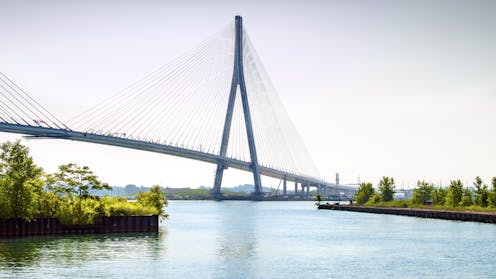
The Gordie Howe International Bridge connects Detroit, Mich., and Windsor, Ontario. John Coletti/Photodisc via Getty Images

Watching the space between two nations shrink became a regular pastime for Detroiters over the past decade as the segments of the Gordie Howe International Bridge gradually grew, extending meter by meter from Ontario on one side and Michigan on the other.

The gap finally closed in July 2024 with the two halves coming together in a long-awaited kiss.

The official grand opening of the bridge was originally scheduled for fall of 2025, but it seems now likely to be delayed into 2026.

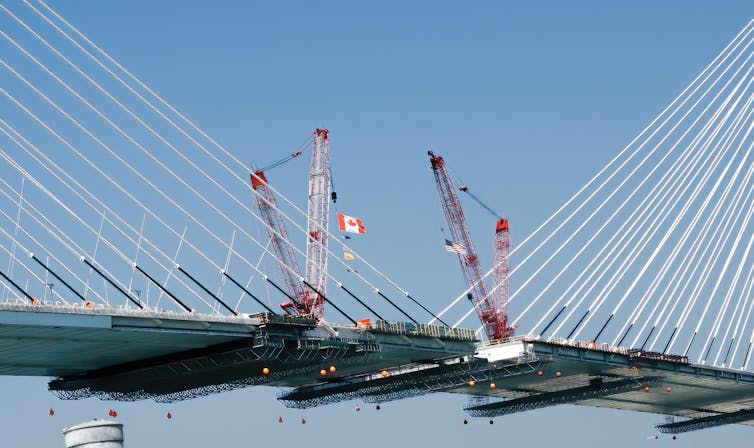
Canadian and American flags are held by cranes on either side of a large suspension bridge.
Completion of the Gordie Howe International Bridge is months behind schedule.
Steven Kriemadis/iStock/Getty Images Plus via Getty Images

I’m a sociologist who has worked alongside neighborhood revitalization projects in Detroit for the past 15 years. I’ve observed the bridge project – and the many tensions around it – from the perspective of adjacent communities of Delray and Mexicantown, communities that are largely home to low-income Latino, Black and white residents.

The costs and benefits of this binational behemoth are complex and intertwined.

Clearing a chokehold

Boosters on both sides of the border have spoken frequently of the bridge’s expected benefits.

Detroit and Windsor would finally be free of the perpetual chokehold produced by the privately owned Ambassador Bridge.

Auto parts will flow more freely over the border, according to the Cross-Border Institute at the University of Windsor. And the Detroit Greenways Coalition is celebrating that its advocacy led to the inclusion of free pedestrian and bike lanes.

People living close to the existing bridge will gain some relief from truck traffic and pollution. But this burden won’t simply disappear – it will be shifted nearby, where others will have to cope with increased traffic flowing over six lanes 24 hours a day.

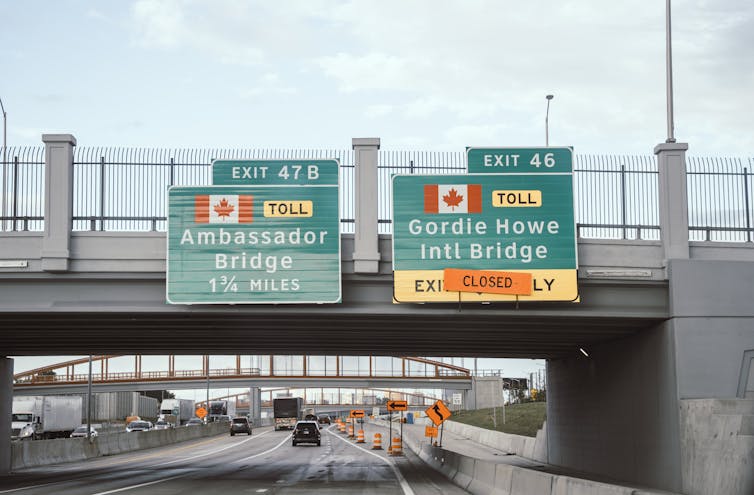
Large signs affixed to a bridge over a highway, in white lettering on green signs, show the exits for the Ambassador Bridge and the closed Gordie Howe International Bridge.
Signs for the Ambassador Bridge and soon-to-be opened on-ramp to the Gordie Howe International Bridge.
Valaurian Waller/The Conversation, CC BY-ND

A political football

The costs and benefits of the bridge were contested from the beginning.

In the early days, the debate concentrated on who would own the bridge and who would pay for it.

Once just a concept known by the acronym DRIC, or Detroit River International Crossing, the project became real under former Michigan Gov. Rick Snyder. In July 2018, representatives from both Ottawa and Washington broke ground on the bridge situated in an area of Detroit empty enough to contain its significant footprint and bear its weight without fear of sinkholes from underground salt mines.

“Every Michigander should thank every Canadian,” said Snyder at the time, alluding to the agreement that Canadian taxpayers alone would pay for the bridge’s construction in exchange for collecting all the tolls.

The bridge’s designers attempted to honor the cultural and natural history of the region. It was named after the legendary Canadian hockey player who was also a longtime stalwart for the Detroit Red Wings. The bridge’s towers are adorned with murals by First Nations artists.

But serious questions remain.

Today the debates center on whether the Trump administration’s increased tariffs and trade conflicts with Canada could negatively affect the value of the bridge – and if it will ever pay for itself. Even before President Donald Trump took office for the second time, truck traffic on the Ambassador Bridge was down, falling 8% from 2014 to 2024.

One bridge was always a bad idea, (nearly) everyone agreed

Residents and politicians have long agreed that having a single, privately owned bridge connecting Detroit and Windsor was a bad idea. This felt especially apparent after the 9/11 terrorist attacks laid bare the possibility of suddenly losing critical infrastructure.

For many years, travelers’ only other connection between Canada and Detroit has been a tunnel that runs underneath the Detroit River. However, the tunnel doesn’t offer direct access to interstate highways, making it less suitable for commercial trucks.

Adding another bridge makes it harder to disrupt trade and transport.

But the project has had one stalwart critic. Matty Moroun, the trucking billionaire who purchased the Ambassador Bridge in 1979, ferociously protected his asset against potential competition. He actively sought to thwart the construction, launching numerous lawsuits against the state of Michigan and the Windsor-Detroit Bridge Authority, the entity managing construction of the new bridge.

Those lawsuits continued even after Moroun’s death in 2020, as his heirs asserted significant damages to the value of their property.

Was enough done for nearby homeowners?

Others have criticized the attempts to compensate the residents of Delray, a once-vibrant neighborhood that has been impacted by industrialization since the 1960s.

Benefits negotiated for residents and homeowners affected by the construction have not increased as the project’s costs ballooned and the timeline to complete it stretched out.

The cost of the Gordie Howe bridge is now estimated at around $6.4 billion Canadian – or about $US4.7 billion. That is $700 million more than the original projected cost. The project is at least 10 months behind schedule.

Construction materials stacked behind a brick house.
Materials for an on-ramp construction to the new Gordie Howe International Bridge are stored in a residential neighborhood in Southwest Detroit on Aug. 26, 2025.
Valaurian Waller/The Conversation, CC BY-ND

Simone Sagovac, director of the SW Detroit Community Benefit Coalition, said they did not anticipate the immense scale of the development and its continued effects on the community.

“That scale affected health and quality of life significantly every day, with years of continuous industrial dust causing sinus problems, headaches, and increasing asthma, and then there will be thousands of daily truck impacts to come,” Sagovac wrote to me in an email.

A baseline health impact assessment, issued in 2019 by University of Michigan researchers working closely with the coalition, expressed concern about the heightened airborne pollution that would likely activate asthma, especially in children. Matching the findings of so many other epidemiological studies, the assessment found that residents living within 500 feet (152 meters) of a truck route reported a significantly higher likelihood of experiencing asthma or allergies affecting their breathing.

Sagovac wrote that the project took 250 homes, 43 businesses and five churches by eminent domain, and “saw the closing of more after.” One hundred families left the neighborhood via a home swap program funded as a result of the benefits agreement administered by a local nonprofit. Two hundred and seventy families remain, but most businesses have left the area over decades of decline.

The families that remain are often long-term residents wanting or needing a cheap place to live and willing to put up with dust, noise and smells from nearby factories and a sewage treatment plant.

“They constantly face illegal dumping and other unanswered crimes, and will face the worst diesel emissions exposure and other trucking and industry impacts,” Sagovac wrote.

Heather Grondin, chief relations officer of the Windsor-Detroit Bridge Authority, wrote in an emailed statement
that they have taken steps to minimize impacts from construction and that they regularly meet with the community to hear concerns.

“Construction traffic is using designated haul routes to minimize community impacts, traffic congestion and wear and tear on existing infrastructure while maximizing public and construction safety,” Grondin wrote.

According to Grondin, cars will be forced to follow a “no idling” rule on the American side to minimize pollution. Other aspects of the Community Benefits Plan included $20,000 in free repairs for 100 homes, planting hundreds of trees and investing in programs addressing food insecurity and the needs of young people and seniors, Grondin wrote.

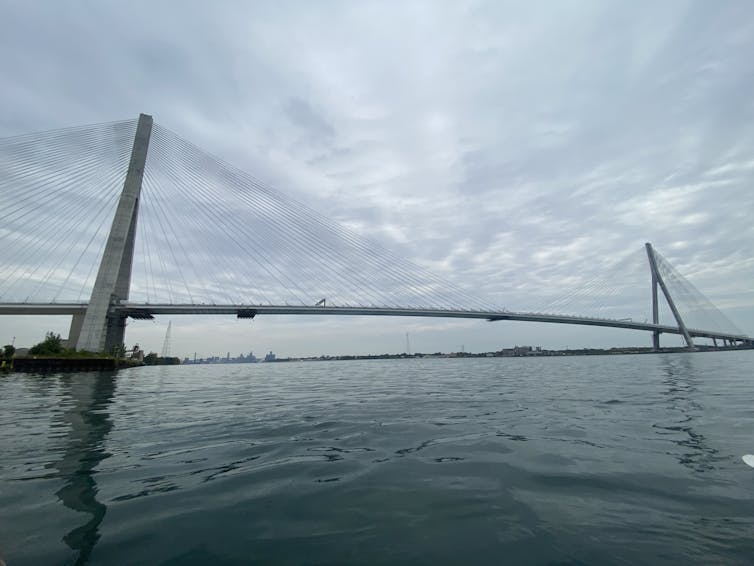
A large cable bridge spans across a vast body of water. Dark clouds with speckled light appear in the background.
It costs $9 to cross the Ambassador Bridge in a car. Tolls on the Gordie Howe bridge (pictured) haven’t been announced yet.
Paul Draus, CC BY-ND

An updated Health Impacted Assessment is expected to be released later in 2025.

History lost

Lloyd Baldwin, a historian for the Michigan Department of Transportation, was tasked with evaluating whether local landmarks like the legendary Kovacs Bar needed to be preserved.

“Kovacs Bar was one among many working-class bars in the Delray neighborhood but stands out for its roughly eight-decade association as a gathering place for the neighborhood and downriver Hungarian-American community,” Baldwin wrote in one such report.

The bar was nonetheless demolished in November 2017.

This was not MDOT’s only loss. While the agency made some sincere efforts to leverage other benefits for residents who remained, dynamic factors at many levels were out of the agency’s control.

For one thing, the numerous lawsuits filed by the bridge company over parcels of contested land limited MDOT’s ability to talk openly to the public about the land acquisition process.

In the period of legal limbo, Baldwin said, “the neighborhood imploded.”

Baldwin gave the example of the Berwalt Manor Apartments, built in the 1920s and located on Campbell Street near the bridge entrance. MDOT committed to preserve the historic building and proposed to mitigate the environmental impacts on mostly low-income residents by paying for new windows and HVAC units once the bridge was built.

But the speed of development outstripped the pace of community compensation. The building passed through probate court in 2018 and has since changed hands multiple times, so it is now unclear whether there are any low-income residents left to benefit from upgrades.

Benefits yet to be measured

On the brighter side, environmentalists have pointed to the expansion and connection of bicycle trails and bird migration corridors as long-term benefits of the Gordie Howe bridge.

On the Canadian side, the bridge construction falls largely outside of Windsor’s residential neighborhoods, so it caused less disruption. As part of the project,bike lanes, enhanced landscaping, and gathering spaces were added to an approach road called Sandwich Street.

Cross-border tourism spurred on by a proposed system of greenways called the “Great Lakes Way” may provide new opportunities for people and money to flow across the Detroit River, improving the quality of life for communities that remain.

But if the trade war between the Trump administration and Canada continues, observers may question whether the bridge is a graceful gift of infrastructure to two nations or one of the world’s longest and skinniest white elephants.

The Conversation

Paul Draus is affiliated with the Downriver Delta CDC and Friends of the Rouge. The Fort Street Bridge Park, a project that Draus is affiliated with, received a donation for a public sculpture from the Windsor Detroit Bridge Authority in 2020.

ref. Detroit’s Gordie Howe bridge is poised to open as truck traffic between US-Canada slows – low-income residents are deciding whether to stay or go – https://theconversation.com/detroits-gordie-howe-bridge-is-poised-to-open-as-truck-traffic-between-us-canada-slows-low-income-residents-are-deciding-whether-to-stay-or-go-260280

2 newly launched NASA missions will help scientists understand the influence of the Sun, both from up close and afar

Source: The Conversation – USA – By Ryan French, Research Scientist, Laboratory for Atmospheric and Space Physics, University of Colorado Boulder

NASA’s IMAP mission is one of two launching in September 2025. NASA/Princeton University/Patrick McPike

Even at a distance of 93 million miles (150 million kilometers) away, activity on the Sun can have adverse effects on technological systems on Earth. Solar flares – intense bursts of energy in the Sun’s atmosphere – and coronal mass ejections – eruptions of plasma from the Sun – can affect the communications, satellite navigation and power grid systems that keep society functioning.

On Sept. 24, 2025, NASA launched two new missions to study the influence of the Sun on the solar system, with further missions scheduled for 2026 and beyond.

I’m an astrophysicist who researches the Sun, which makes me a solar physicist. Solar physics is part of the wider field of heliophysics, which is the study of the Sun and its influence throughout the solar system.

The field investigates the conditions at a wide range of locations on and around the Sun, ranging from its interior, surface and atmosphere, and the constant stream of particles flowing from the Sun – called the the solar wind. It also investigates the interaction between the solar wind and the atmospheres and magnetic fields of planets.

The importance of space weather

Heliophysics intersects heavily with space weather, which is the influence of solar activity on humanity’s technological infrastructure.

In May 2024, scientists observed the strongest space weather event since 2003. Several Earth-directed coronal mass ejections erupted from the Sun, causing an extreme geomagnetic storm as they interacted with Earth’s magnetic field.

This event produced a beautiful light show of the aurora across the world, providing a view of the northern and southern lights to tens of millions of people at lower latitudes for the first time.

However, geomagnetic storms come with a darker side. The same event triggered overheating alarms in power grids around the world, and triggered a loss in satellite navigation that may have cost the U.S. agricultural industry half a billion dollars.

However, this is far from the worst space weather event on record, with stronger events in 1989 and 2003 knocking out power grids in Canada and Sweden.

But even those events were small compared with the largest space weather event in recorded history, which took place in September 1859. This event, considered the worst-case scenario for extreme space weather, was called the Carrington Event. The Carrington Event produced widespread aurora, visible even close to the equator, and caused disruption to telegraph machines.

If an event like the Carrington event occurred today, it could cause widespread power outages, losses of satellites, days of grounded flights and more. Because space weather can be so destructive to human infrastructure, scientists want to better understand these events.

NASA’s heliophysics missions

NASA has a vast suite of instruments in space that aim to better understand our heliosphere, the region of the solar system in which the Sun has significant influence. The most famous of these missions include the Parker Solar Probe, launched in 2018, the Solar Dynamics Observatory, launched in 2010, the Solar and Heliospheric Observatory, launched in 1995, and the Polarimeter to Unify the Corona and Heliosphere, launched on March 11, 2025.

The most recent additions to NASA’s collection of heliophysics missions launched on Sept. 24, 2025: Interstellar Mapping and Acceleration Probe, or IMAP, and the Carruthers Geocorona Observatory. Together, these instruments will collect data across a wide range of locations throughout the solar system.

IMAP is en route to a region in space called Lagrange Point 1. This is a location 1% closer to the Sun than Earth, where the balancing gravity of the Earth and Sun allow spacecraft to stay in a stable orbit.

IMAP contains 10 scientific instruments with varying science goals, ranging from measuring the solar wind in real time to improve forecasting of space weather that could arrive at Earth, to mapping the outer boundary between the heliosphere and interstellar space.

IMAP will study the solar wind from a region in space nearer to the Sun where spacecraft can stay in a stable orbit.

This latter goal is unique, something scientists have never attempted before. It will achieve this goal by measuring the origins of energetic neutral atoms, a type of uncharged particle. These particles are produced by plasma, a charged gas of electrons and protons, throughout the heliosphere. By tracking the origins of incoming energetic neutral atoms, IMAP will build a map of the heliosphere.

The Carruthers Geocorona Observatory is heading to the same Lagrange-1 orbit as IMAP, but with a very different science target. Instead of mapping all the way to the very edge of the heliosphere, the Carruthers Geocorona Observatory is observing a different target – Earth’s exosphere. The exosphere is the uppermost layer of Earth’s atmosphere, 375 miles (600 kilometers) above the ground. It borders outer space.

Specifically, the mission will observe ultraviolet light emitted by hydrogen within the exosphere, called the geocorona. The Carruthers Geocorona Observatory has two primary objectives. The first relates directly to space weather.

The observatory will measure how the exosphere – our atmosphere’s first line of defense from the Sun – changes during extreme space weather events. The second objective relates more to Earth sciences: The observatory will measure how water is transported from Earth’s surface up into the exosphere.

A radarlike image of a sphere, with a bright spot shown in yellow, with a green and red outline.
The first image of Earth’s outer atmosphere, the geocorona, taken from a telescope designed and built by the late American space physicist and engineer George Carruthers. The telescope took the image while on the Moon during the Apollo 16 mission in 1972.
G. Carruthers (NRL) et al./Far UV Camera/NASA/Apollo 16, CC BY

Looking forward

IMAP and the Carruthers Geocorona Observatory are two heliophysics missions researching very different parts of the heliosphere. In the coming years, future NASA missions will launch to measure the object at the center of heliophysics – the Sun.

In 2026, the Sun Coronal Ejection Tracker is planned to launch. It is a small satellite the size of a shoebox – called a CubeSat – with the aim to study how coronal mass ejections change as they travel through the Sun’s atmosphere.

In 2027, NASA plans to launch the much larger Multi-slit Solar Explorer to capture high-resolution measurements of the Sun’s corona using a state-of-the-art instrumentation. This mission will work to understand the origins of solar flares, coronal mass ejections and heating within the Sun’s atmosphere.

The Conversation

Ryan French receives funding from NASA.

ref. 2 newly launched NASA missions will help scientists understand the influence of the Sun, both from up close and afar – https://theconversation.com/2-newly-launched-nasa-missions-will-help-scientists-understand-the-influence-of-the-sun-both-from-up-close-and-afar-264646

Not enemies, but people: Why the world needs to rethink the language of war

Source: The Conversation – Canada – By Martin Danahay, Professor, English Language and Literature, Brock University

The United States military under the Donald Trump administration has sunk three Venezuelan boats that were allegedly ferrying drugs. American officials branded the people on the boats “narcoterrorists.”

The term “narcoterrorist” conflates the U.S. internal “war on drugs” and external “war on terror” and suggests drug smuggling is punishable by death without trial.

Canada, incidentally, has followed the lead of the U.S. by designating a list of drug cartels as terrorist organizations. This means Canada is now involved in the expansion of violence against people associated with drug smuggling or drug use when they’re labelled terrorists. It also aligns Canada with the American “war on drugs.”

The problem with the language of war

The problem with both terms — the “war on drugs” and the “war on terror” — lies in how they serve to justify killing people. Violence is portrayed as an appropriate response to a threat from an “enemy” rather than an attack on people who may or may not be linked to drugs or terrorism.

The attacks are carried out without the submission of evidence, and it’s almost impossible to verify claims of guilt after the fact.

A brief look at the origins of the U.S. war on drugs shows how the term “war” can be used to normalize acts of oppression or violence.

It began in June 1971 when President Richard Nixon declared drug abuse “public enemy No. 1” and announced a co-ordinated federal campaign against narcotics as part of a “law-and-order” campaign. His emphasis on fighting crime played upon his belief that “people react to fear, not love.”

Drugs and politics

While fear of drug use predated his presidency, Nixon made the issue a central part of his domestic policy. He framed his efforts as a fight to protect public health and safety as the justification for increasing the scope of police actions against drug sellers and users.

The Shafer Commission, appointed by Nixon, recommended decriminalizing marijuana in 1972, but he ignored its findings and instead enacted more punitive anti-drug legislation.

Portraying drugs and drug users as a threat was a central part of Nixon’s law-and-order campaign. Privately, however, aides later revealed that his drug policy was also used to target political opponents, particularly anti-Vietnam War activists and Black communities — by associating them with drugs and justifying an increase in policing.

Nixon continued drug enforcement in the U.S. as well as through international policies aimed at curbing drug production. His administration’s war on drugs was not just a social order initiative, but a political strategy that weaponized drug policy to consolidate power and marginalize opponents.

Nixon aide John Ehrlichman later revealed the explicitly political nature of this campaign. By linking heroin to Black communities and marijuana to anti-war activists, the administration could discredit those groups and justify heavy policing and incarceration.

The “war on drugs” therefore relied on racist attitudes to justify its heavy enforcement of Black communities.

People, not enemies

By branding the initiative a war on drugs, Nixon turned people addicted to drugs into enemies and implicitly made acceptable levels of oppression that would not be tolerated under normal circumstances.

But drugs are not a force that an army can defeat. The war on drugs has been a failure and become the longest “war” in U.S. history.

The idea of a war on drugs erases people from the equation and dehumanizes them. Similarly, the war on terror emphasized an emotion, namely terror, and used that emotion to justify U.S. military actions abroad, including the ill-fated Iraq War.

The recent attacks on Venezuelan boats alleged to be transporting drugs follow this pattern of justifying acts of violence in the name of combating drugs. Both exploit an understandable fear of drug addiction or of a terrorist attack, and use that emotion to silence criticism of acts of violence as illegal and inhumane.

Decades later, Nixon’s campaign to demonize drugs has now coalesced with the war on terror, even though the term “war” seems inappropriate in both cases.

Invoking war hastens decisions and short-circuits debate, because in a military conflict, decisiveness is crucial to avoid defeat. While initially declaring a war on drugs or terrorists may rally people in the short term, in the long term, it damages both domestic social policy as well as international relations.

Due process

In the recent strikes against Venezuelan ships, the U.S. could have apprehended the boats in international waters and brought the people on board to trial.

This was the procedure during the recent Operation Pacific Viper in the east Pacific, when the U.S. Coast Guard boarded vessels and detained people accused of smuggling cocaine.

The U.S. could have followed the same procedure with the boats from Venezuela, but calling the people on board “narcoterrorists” implicitly justified characterizing them as enemy combatants in the war on drugs.

They were civilian vessels, not part of the Venezuelan military. There may or may not have been drugs on board, and the people may not have been drug smugglers, but the world will never know for certain because the U.S. military killed them and sank their boats.

The language of war in such cases justifies actions made for political motives and undermines the rule of law. Overall it is part of a wider use of the term war by Trump, who recently also seemed to declare war on the city of Chicago.

It’s all of an ongoing weaponization of the term “war” to assert dominance and justify violence, whether internally against American cities or externally against people the government calls “narcoterrorists.”

The Conversation

Martin Danahay does not work for, consult, own shares in or receive funding from any company or organisation that would benefit from this article, and has disclosed no relevant affiliations beyond their academic appointment.

ref. Not enemies, but people: Why the world needs to rethink the language of war – https://theconversation.com/not-enemies-but-people-why-the-world-needs-to-rethink-the-language-of-war-265466

Hobbits of Flores evolved to be small by slowing down growth during childhood, new research on teeth and brain size suggests

Source: The Conversation – USA – By Tesla Monson, Professor of Anthropology, Western Washington University

Hobbits are exceptions to the rule that older ancient humans had proportionally larger wisdom teeth and smaller brains. Jim Watson/AFP via Getty Images

Until Homo floresiensis was discovered, scientists assumed that the evolution of the human lineage was defined by bigger and bigger brains. Via a process called encephalization, human brains evolved to be relatively more massive than would be expected based on corresponding body size.

This proportionally bigger brain is what anthropologists argued enabled us and our relatives to perform more complex tasks such as using fire, forging and wielding tools, making art and domesticating animals.

Under a heading 'Bigger Brains' six hominid head models with other text in an exhibit case
Exhibit on brain size at the Smithsonian’s National Museum of Natural History in Washington, D.C.
Tesla Monson

But these theories had to be thrown out the window when archaeologists announced our fossil cousins Homo floresiensis via scientific publication in 2004. Homo floresiensis lived from about 700,000 to 60,000 years ago in the rainforests of Indonesia, partially contemporaneous with our own species.

Aptly nicknamed Hobbits, Homo floresiensis were short-statured, at just over 3 feet (1 meter) tall, and had a chimp-size brain. This discovery upended the assumption that brains have been increasing in size over the past several million years and generated confusion about what separates recent human relatives in our genus Homo from our more ancient ancestors.

Our new research on the skulls and teeth provides a novel theory for how the Hobbits evolved to be small.

We are professors of anthropology at Western Washington University. After attending a 2023 workshop for biological anthropologists studying juveniles in the fossil record, we began looking at brain size changes across human evolution.

Our previous work on the proportions of molar teeth generated new insights into the evolution of pregnancy by demonstrating that fetal growth rates are tightly linked to molar proportions in primates. Now, we wanted to see whether we could uncover a relationship between tooth proportions and brain size among our fossil relatives.

Paleontologists have only limited skeletal materials, sometimes only a few teeth, for many fossil species, including Homo floresiensis. If tooth proportions can provide information about fossil brain size, it opens up a world of possibilities for assessing past changes in encephalization.

Reconstructing brain size using teeth

We collated data on tooth and brain size for 15 fossil species on the human family tree, spanning about 5 million years of evolution. Somewhat oxymoronically, the third molars – otherwise known as wisdom teeth – have gotten proportionally smaller as brain size has gotten larger throughout human evolution, for most species.

Overall, human relatives with relatively larger wisdom teeth are more ancient and had smaller brains. More recent taxa, like Homo neanderthalensis, had relatively smaller third molars, compared to their other teeth, and larger brains.

This relationship allows researchers to figure out something about brain size for fossils that are incomplete, perhaps existing only as a few lone teeth. Since teeth are predominately made of inorganic matter, they survive in the fossil record much more often than other parts of the body, making up the vast majority of paleontological materials recovered. Being able to know more about brain size from just a few teeth is a truly useful tool.

sideways view through a glass museum case of a standing partial skeleton
A replica of LB1, the most complete skeleton of Homo floresiensis, in profile in an exhibit at the Smithsonian’s National Museum of Natural History.
Tesla Monson

Scientists recognize now that the formation of the brain and the teeth are inextricably connected during gestation. And for most species, larger brains are correlated with smaller wisdom teeth.

The one exception in genus Homo is Homo floresiensis, the Hobbit. The wisdom teeth of the Hobbits are small proportional to the other molars – the typical pattern for members of genus Homo. But their brains are also small, which is quite unusual.

There are two primary ways for brain size to decrease: by slowing down growth during gestation before birth or by slowing down growth after birth, during childhood. Because teeth develop early in gestation, slowing down growth rates during pregnancy tends to affect tooth shape and size, or even whether the teeth develop at all. Slowing growth later, during childhood, influences skeletal shape and size in other ways, because different parts of the body develop at different times.

Our new research provides evidence that the body size of Homo floresiensis likely shrank from a larger-bodied Homo ancestor by slowing down growth during childhood. The Hobbits’ small wisdom teeth suggest that, at least in utero, they were on track for the proportionally bigger brains that are the trademark of humans and their relatives. Any brake that slowed down brain growth likely occurred after birth.

In fact, this is the same mechanism through which some short-statured modern human populations have adapted to their local ecological conditions.

Getting small on islands

The small body size of Homo floresiensis was likely an adaptation to the unique conditions of their island environment on Flores.

Evolving small body size as an adaptation to living on an isolated island is known as insular nanism. There are many examples of other mammals becoming small on islands over the past 60 million years. But one of the most relevant examples is the dwarf elephant, Stegodon sondaarii, that lived on Flores and was hunted by H. floresiensis for food.

Both Homo floresiensis and Homo luzonensis, another short, island hominin from southeast Asia, likely evolved very short stature because of the ecological effects of limited food availability and lack of large predators, which tends to characterize island habitats.

Because brain size and body size are tightly linked, body size evolution inherently affects brain evolution. Among modern humans, larger people have larger brains, and smaller people have smaller brains.

But people with smaller brains are certainly no less intelligent than people with larger brains. Variation in body size dictates brain size; it is not a measure of cognitive ability. The island Hobbits crafted tools, hunted large-for-them game in the form of pygmy elephants, and likely made and used fire.

Our research supports that their small body size originated from a slowdown in growth during childhood. But this process would likely have had little impact on brain function or cognitive ability. We hypothesize that the Hobbits were small but highly capable.

multiple skulls behind glass with text notation in a museum case.
Exhibit of cranial variation in fossil hominids, with Homo floresiensis in the foreground, at the Smithsonian’s National Museum of Natural History.
Tesla Monson

Understanding the evolution of us

New research, including our study, continues to reinforce the importance of understanding how pregnancy and child growth and development evolved. If we want to know what distinguishes humans from our evolutionary ancestors, and how we evolved, we must understand how the earliest moments of life have changed and why.

Our work also encourages the reevaluation of endless attention on increasing brain size as the predominant force in human evolution. Other species in genus Homo had small brains but were likely not much different from us.

The Conversation

Tesla Monson receives funding from the National Science Foundation.

Andrew Weitz does not work for, consult, own shares in or receive funding from any company or organization that would benefit from this article, and has disclosed no relevant affiliations beyond their academic appointment.

ref. Hobbits of Flores evolved to be small by slowing down growth during childhood, new research on teeth and brain size suggests – https://theconversation.com/hobbits-of-flores-evolved-to-be-small-by-slowing-down-growth-during-childhood-new-research-on-teeth-and-brain-size-suggests-261257

How a devastating grape pest is reshaping vineyards across Colorado’s Western Slope

Source: The Conversation – USA – By Charlotte Oliver, Extension Associate Professor, Colorado State University

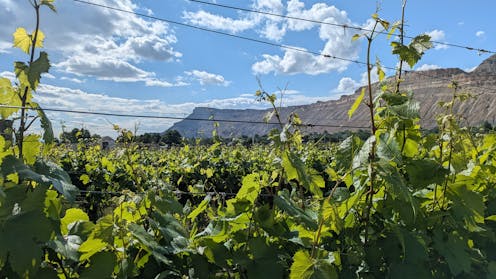
Colorado’s $3.9 billion wine industry is threatened by a tiny aphid. Courtesy of Charlotte Oliver

Grape phylloxera, or Daktulosphaira vitifoliae, is an aphidlike insect that attacks grapevines with devastating effects. In Colorado, where wine is an estimated US$3.9 billion dollar industry, phylloxera poses a significant threat.

In 2015, several vineyards in the Grand Valley American Viticultural Area on Colorado’s Western Slope observed that groups of their vines were not thriving. The vines were yellowing and producing limited fruit. All the normal issues, such as nutritional deficiencies and irrigation problems, were investigated and nothing turned up.

So, in 2016, two Colorado State University researchers began surveying vineyards in Mesa County and found the industry’s worst nightmare – phylloxera, which had infested the roots in several local vineyards.

The pair expanded their survey and covered more than 350 vineyard acres across Mesa, Delta and Montezuma counties, where wine grapes are grown. Phylloxera was found in both Mesa and Delta counties in 18 vineyards for a total of 34 scattered acres. The phylloxera wasn’t centralized, which made controlling its spread complicated.

In response to the researchers’ findings, the Colorado Wine Industry Development Board and the Colorado Association for Viticulture and Enology began an education campaign in 2017 to minimize visitors to vineyards and help vineyards manage soil movement, the primary mode of phylloxera spread.

As the viticulture extension specialist at Colorado State University, I spend a lot of time helping Coloradans work with their grapevines. In 2024, I took over the research at Colorado State University on the phylloxera infestation that is still active nine years after it was discovered. I plan to continue tracking phylloxera’s spread and training producers on what to do when, not if, this pest appears in their vineyard.

What is phylloxera?

Black and white illustrations of the various forms of phylloxera, an aphid-like insect.
Phylloxera has a below-ground and above-ground form, each of which attack grapevines.
Bildagentur-online/Getty Images

Phylloxera have two discrete forms during their life cycle: an above-ground, winged form called alates and a below-ground, wingless, root-feeding form called radicoles.

The above-ground form of the insect causes galls, which are lumpy swellings on the grape leaves, that generally have limited impact on the vine’s health.

However, the below-ground insects that feed on the vine’s roots cause severe damage. The roots are the vine’s main tool for foraging for nutrients and water, so when they are compromised the vine starts to suffer and eventually dies four to seven years after being infected. Sometimes phylloxera’s infestation looks like a lack of nutrition or water, so knowing what is wrong with the vines can require a lot of searching and testing. The real issue is that as the vine declines, it also stops producing a commercially viable quantity of fruit, which is 2.5-4 tons per acre. No fruit means no wine, so the vines have to be removed.

Managing the ‘wine blight’

Grapevines, like a lot of other perennial crops, including peaches and apples, are usually grafted, which is when the top of one plant and the roots of another plant are combined to make one continuous plant. Usually, the grafting is to change something about the physicality of the plant, such as making it bigger or smaller. With grapes, the main reason to graft is to protect the vine from damage from a single pest – grape phylloxera.

There are alternatives such as insecticides, but they are Band-Aids, because insecticides suppress only the pest. Grape roots, and the phylloxera on them, can go far deeper into the soil than the soil insecticide treatments, and some of the treatments to the leaves can be damaging to honeybees.

Another potential solution is using modern varieties of grapes that were bred by crossing native North American grapes with the standard European wine grape. By adding in North American grapes, the new varieties are more tolerant of the phylloxera and can handle some damage. The issue with these varieties, such as Chambourcin and Aromella, is that consumers have never heard of them, which is a major factor when people buy wine. These varieties also have more Concord grape flavors that are less common to wine drinkers outside of the East Coast of the U.S.

Globe-trotting pests

A video from TerraVox Winery in Missouri about the history of phylloxera.

Phylloxera is native to the East Coast and Midwestern United States, but now it’s found in all grape-growing regions worldwide.

In the late 1800s, phylloxera started making its way around the world. Phylloxera can fly when it is in its above-ground life cycle, but the below-ground insects can be spread any time soil is moved. It hitched a ride to France in the early 1860s on North American grape plants that were being imported to help with powdery mildew, which is the most economically damaging fungal disease of grapes. Powdery mildew, or Erysiphe necator, can attack all growing tissues of a vine, including blooms, leaves and shoots, and control can account for approximately 37% of gross grape production cost.

Over the course of three decades after phylloxera was introduced to France, it caused approximately 2.5 million acres of vines to be replaced.

Once it crossed the Atlantic, phylloxera was flying over borders and road-tripping from vineyard to vineyard on workers’ shoes and tractors. By the beginning of the 1900s, phylloxera had spread throughout France, Portugal, Germany and then Spain and established itself as a permanent problem. The European varieties of grapes had no resistance to phylloxera, and the insects found ways to evade chemical management, making yearly insecticide applications a necessity.

Brown root stock is magnified and infested with little brown insects.
Phylloxera attacks the roots of grapevines.
Courtesy of Charlotte Oliver

While phylloxera is native to the U.S., until recently, there were several states that did not have it, including Colorado, Oregon and Washington.

Colorado’s 50-year-old wine grape industry benefited from the absence of phylloxera. Vineyards owners planted mostly self-rooted European variety vines starting around the mid-1980s. Self-rooted vines are not grafted, which means that a Chardonnay vine was Chardonnay both above and below ground.

Currently, there are areas in multiple countries such as Australia and China, and certain states such as Washington, where phylloxera is present but well contained through quarantine. However, there are concerns for the future. Computer modeling has offered ideas about the future expansion of phylloxera’s survival range on both a regional and global scale.

What does the future hold?

In a 2019 survey by the same research team, more phylloxera was found in vineyards in Delta County as well as a new vineyard outside of Denver. Currently, many Colorado vineyards are in the middle of overhauling their vineyards. The spread of phylloxera as well as the frequency of freezes has led to extensive death in vineyards across the Western Slope.

The percentage of acreage planted with nongrafted, non-European grapes has increased to 25% in recent years, according to results from statewide surveys. Approximately 30% of the replaced vineyards were with new modern varieties, and the rest were replaced with grafted European varieties.

While the European grafted vine may provide a higher-priced fruit due to market demand, the modern varieties have a lot of appeal. Since the vines are more phylloxera tolerant, they do not have to be grafted, so they can easily be recovered when a harsh fall freeze happens.

While the Colorado wine industry has accepted that phylloxera is here to stay, expanded surveys are needed to better understand how far this pest has spread, especially in the more isolated areas of the West Elks American Viticultural Area, in Delta County, the southwest corner of Colorado, in Montezuma County, and in Fremont and Pueblo counties.

Additionally, future phylloxera spread may be better estimated by studying soil texture and temperature, which has been done in models created by Washington State University. Phylloxera may be less likely to survive in certain areas of Colorado. If those areas are also suitable for grape production, it could help direct the locations of future plantings, especially of European varieties.

Read more of our stories about Colorado.

The Conversation

Charlotte Oliver does not work for, consult, own shares in or receive funding from any company or organization that would benefit from this article, and has disclosed no relevant affiliations beyond their academic appointment.

ref. How a devastating grape pest is reshaping vineyards across Colorado’s Western Slope – https://theconversation.com/how-a-devastating-grape-pest-is-reshaping-vineyards-across-colorados-western-slope-263088

NASA will say goodbye to the International Space Station in 2030 − and welcome in the age of commercial space stations

Source: The Conversation – USA – By John M. Horack, Professor of Mechanical and Aerospace Engineering, The Ohio State University

The International Space Station will be brought down in 2030. NASA via AP

For 24 hours a day, seven days a week since November 2000, NASA and its international partners have sustained a continuous human presence in low-Earth orbit, including at least one American – a streak that will soon reach 25 years.

When viewed in the history of spaceflight, the International Space Station is perhaps one of humanity’s most amazing accomplishments, a shining example of cooperation in space among the United States, Europe, Canada, Japan and Russia. But all good things must come to an end.

An emblem featuring a photo of the ISS with a ring around it featuring countries' flags.
The International Space Station’s emblem features the flags of the original signatory states.
CSA/ESA/JAXA/NASA/ROSCOSMOS

In 2030, the International Space Station will be deorbited: driven into a remote area of the Pacific Ocean.

I’m an aerospace engineer who has helped build a range of hardware and experiments for the ISS. As a member of the spaceflight community for over 30 years and a 17-year member of the NASA community, it will be hard for me to see the ISS come to an end.

Since the first pieces of the International Space Station were launched in 1998, the station has been home to significant research accomplishments across domains that include materials science, biotechnology, astronomy and astrophysics, Earth science, combustion and more.

Astronauts performing research inside the space station and payload experiments attached to the station’s exterior have generated many publications in peer-reviewed science journals. Some of them have advanced our understanding of thunderstorms, led to improvements in the crystallization processes of key cancer-fighting drugs, detailed how to grow artificial retinas in space, explored the processing of ultrapure optical fibers and explained how to sequence DNA in orbit.

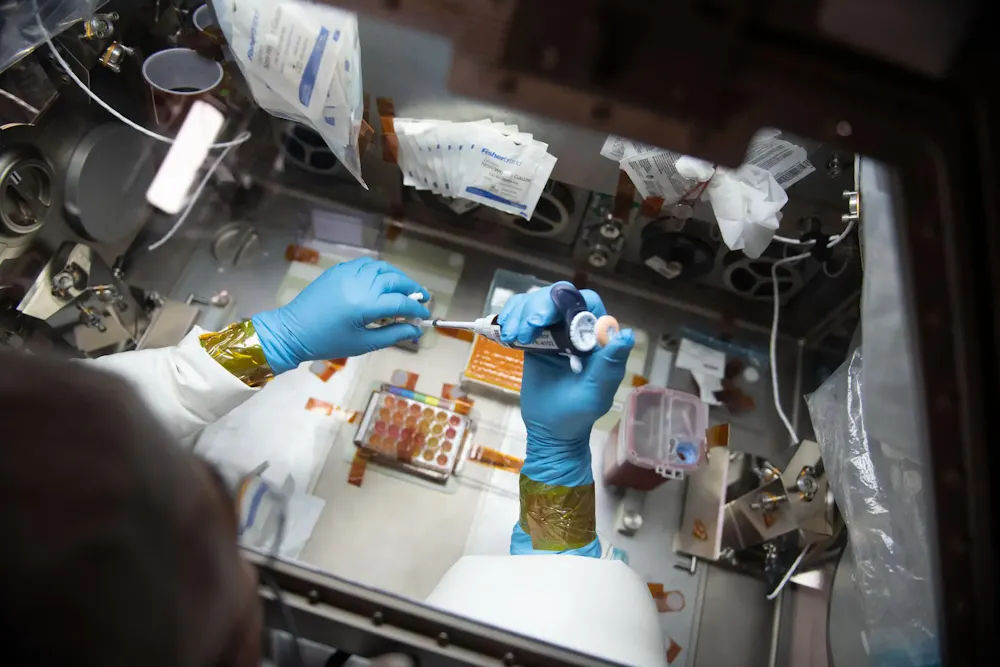
A top-down view of a scientist wearing gloves and a lab coat pipetting at a work bench on the ISS
The ISS’s microgravity environment has made it the optimal environment for a variety of scientific research projects.
NASA, CC BY

In total, more than 4,000 experiments have been conducted aboard the ISS, resulting in more than 4,400 research publications dedicated to advancing and improving life on Earth and helping forge a path for future space exploration activities.

The ISS has proven the value of conducting research in the unique environment of spaceflight – which has very low gravity, a vacuum, extreme temperature cycles and radiation – to advance scientists’ understanding of a wide range of important physical, chemical and biological processes.

Keeping a presence in orbit

But in the wake of the station’s retirement, NASA and its international partners are not abandoning their outpost in low-Earth orbit. Instead, they are looking for alternatives to continue to take advantage of low Earth orbit’s promise as a unique research laboratory and to extend the continuous, 25-year human presence some 250 miles (402 kilometers) above the Earth’s surface.

In December 2021, NASA announced three awards to help develop privately owned, commercially operated space stations in low-Earth orbit.

For years, NASA has successfully sent supplies to the International Space Station using commercial partners, and the agency recently began similar business arrangements with SpaceX and Boeing for transporting crew aboard the Dragon and Starliner spacecraft, respectively.

A conical white spacecraft with two rectangular solar panels in space, with the Earth in the background.
SpaceX’s Dragon capsule docks at the ISS.
NASA TV via AP

Based on the success of these programs, NASA invested more than US$400 million to stimulate the development of commercial space stations and hopefully launch and activate them before the ISS is decommissioned.

Dawn of commercial space stations

In September 2025, NASA issued a draft announcement for Phase 2 partnership proposals for commercial space stations. Companies that are selected will receive funding to support critical design reviews and demonstrate stations with four people in orbit for at least 30 days.

NASA will then move forward with formal design acceptance and certification to ensure that these stations meet NASA’s stringent safety requirements. The outcome will allow NASA to purchase missions and other services aboard these stations on a commercial basis – similar to how NASA gets cargo and crew to the ISS today.

Which of these teams will be successful, and on what timescale, remains to be seen.

While these stations are being built, Chinese astronauts will continue to live and work aboard their Tiangong space station, a three-person, permanently crewed facility orbiting approximately 250 miles (402 km) above the Earth’s surface. Consequently, if the ISS’s occupied streak comes to an end, China and Tiangong will take over as the longest continually inhabited space station in operation: It’s been occupied for approximately four years and counting.

Photos and videos from the ISS allow you to see Earth from above.

In the meantime, enjoy the view

It will be several years before any of these new commercial space stations circle the Earth at around 17,500 miles per hour (28,000 kilometers per hour) and several years before the ISS is deorbited in 2030.

So while you have a chance, take a look up and enjoy the view. On most nights when the ISS flies over, it is simply magnificent: a brilliant blue-white point of light, usually the brightest object in the sky, silently executing a graceful arc across the sky.

Our ancestors could hardly have imagined that one day, one of the brightest objects in the night sky would have been conceived by the human mind and built by human hands.

The Conversation

John M. Horack receives extramural research funding from NASA, Voyager Technologies, and other spaceflight-related sources, as part of his work as a Professor at The Ohio State University.

ref. NASA will say goodbye to the International Space Station in 2030 − and welcome in the age of commercial space stations – https://theconversation.com/nasa-will-say-goodbye-to-the-international-space-station-in-2030-and-welcome-in-the-age-of-commercial-space-stations-264936

Detroit’s Gordie Howe bridge is poised to open as truck traffic between US-Canada slows – and low-income residents decide whether to stay or go

Source: The Conversation – USA – By Paul Draus, Professor of Sociology, University of Michigan-Dearborn

The Gordie Howe International Bridge connects Detroit, Mich., and Windsor, Ontario. John Coletti/Photodisc via Getty Images

Watching the space between two nations shrink became a regular pastime for Detroiters over the past decade as the segments of the Gordie Howe International Bridge gradually grew, extending meter by meter from Ontario on one side and Michigan on the other.

The gap finally closed in July 2024 with the two halves coming together in a long-awaited kiss.

The official grand opening of the bridge was originally scheduled for fall of 2025, but it seems now likely to be delayed into 2026.

Canadian and American flags are held by cranes on either side of a large suspension bridge.
Completion of the Gordie Howe International Bridge is months behind schedule.
Steven Kriemadis/iStock/Getty Images Plus via Getty Images

I’m a sociologist who has worked alongside neighborhood revitalization projects in Detroit for the past 15 years. I’ve observed the bridge project – and the many tensions around it – from the perspective of adjacent communities of Delray and Mexicantown, communities that are largely hometo low-income Latino, Black and white residents.

The costs and benefits of this binational behemoth are complex and intertwined.

Clearing a chokehold

Boosters on both sides of the border have spoken frequently of the bridge’s expected benefits.

Detroit and Windsor would finally be free of the perpetual chokehold produced by the privately owned Ambassador Bridge.

Auto parts will flow more freely over the border, according to the Cross-Border Institute at the University of Windsor. And the Detroit Greenways Coalition is celebrating that its advocacy led to the inclusion of free pedestrian and bike lanes.

People living close to the existing bridge will gain some relief from truck traffic and pollution. But this burden won’t simply disappear – it will be shifted nearby, where others will have to cope with increased traffic flowing over six lanes 24 hours a day.

Large signs affixed to a bridge over a highway, in white lettering on green signs, show the exits for the Ambassador Bridge and the closed Gordie Howe International Bridge.
Signs for the Ambassador Bridge and soon-to-be opened on-ramp to the Gordie Howe International Bridge.
Valaurian Waller/The Conversation, CC BY-ND

A political football

The costs and benefits of the bridge were contested from the beginning.

In the early days, the debate concentrated on who would own the bridge and who would pay for it.

Once just a concept known by the acronym DRIC, or Detroit River International Crossing, the project became real under former Michigan Gov. Rick Snyder. In July 2018, representatives from both Ottawa and Washington broke ground on the bridge situated in an area of Detroit empty enough to contain its significant footprint and bear its weight without fear of sinkholes from underground salt mines.

“Every Michigander should thank every Canadian,” said Snyder at the time, alluding to the agreement that Canadian taxpayers alone would pay for the bridge’s construction in exchange for collecting all the tolls.

The bridge’s designers attempted to honor the cultural and natural history of the region. It was named after the legendary Canadian hockey player who was also a longtime stalwart for the Detroit Red Wings. The bridge’s towers are adorned with murals by First Nations artists.

But serious questions remain.

Today the debates center on whether the Trump administration’s increased tariffs and trade conflicts with Canada could negatively affect the value of the bridge – and if it will ever pay for itself. Even before President Donald Trump took office for the second time, truck traffic on the Ambassador Bridge was down, falling 8% from 2014 to 2024.

One bridge was always a bad idea, (nearly) everyone agreed

Residents and politicians have long agreed that having a single, privately owned bridge connecting Detroit and Windsor was a bad idea. This felt especially apparent after the 9/11 terrorist attacks laid bare the possibility of suddenly losing critical infrastructure.

For many years, travelers’ only other connection between Canada and Detroit has been a tunnel that runs underneath the Detroit River. However, the tunnel doesn’t offer direct access to interstate highways, making it less suitable for commercial trucks.

Adding another bridge makes it harder to disrupt trade and transport.

But the project has had one stalwart critic. Matty Moroun, the trucking billionaire who purchased the Ambassador Bridge in 1979, ferociously protected his asset against potential competition. He actively sought to thwart the construction, launching numerous lawsuits against the state of Michigan and the Windsor-Detroit Bridge Authority, the entity managing construction of the new bridge.

Those lawsuits continued even after Moroun’s death in 2020, as his heirs asserted significant damages to the value of their property.

Was enough done for nearby homeowners?

Others have criticized the attempts to compensate the residents of Delray, a once-vibrant neighborhood that has been impacted by industrialization since the 1960s.

Benefits negotiated for residents and homeowners affected by the construction have not increased as the project’s costs ballooned and the timeline to complete it stretched out.

The cost of the Gordie Howe bridge is now estimated at around $6.4 billion Canadian – or about $US4.7 billion. That is $700 million more than the original projected cost. The project is at least 10 months behind schedule.

Construction materials stacked behind a brick house.
Materials for an on-ramp construction to the new Gordie Howe International Bridge are stored in a residential neighborhood in Southwest Detroit on Aug. 26, 2025.
Valaurian Waller/The Conversation, CC BY-ND

Simone Sagovac, director of the SW Detroit Community Benefit Coalition, said they did not anticipate the immense scale of the development and its continued effects on the community.

“That scale affected health and quality of life significantly every day, with years of continuous industrial dust causing sinus problems, headaches, and increasing asthma, and then there will be thousands of daily truck impacts to come,” Sagovac wrote to me in an email.

A baseline health impact assessment, issued in 2019 by University of Michigan researchers working closely with the coalition, expressed concern about the heightened airborne pollution that would likely activate asthma, especially in children. Matching the findings of so many other epidemiological studies, the assessment found that residents living within 500 feet (152 meters) of a truck route reported a significantly higher likelihood of experiencing asthma or allergies affecting their breathing.

Sagovac wrote that the project took 250 homes, 43 businesses and five churches by eminent domain, and “saw the closing of more after.” One hundred families left the neighborhood via a home swap program funded as a result of the benefits agreement administered by a local nonprofit. Two hundred and seventy families remain, but most businesses have left the area over decades of decline.

The families that remain are often long-term residents wanting or needing a cheap place to live and willing to put up with dust, noise and smells from nearby factories and a sewage treatment plant.

“They constantly face illegal dumping and other unanswered crimes, and will face the worst diesel emissions exposure and other trucking and industry impacts,” Sagovac wrote.

Heather Grondin, chief relations officer of the Windsor-Detroit Bridge Authority, wrote in an emailed statement
that they have taken steps to minimize impacts from construction and that they regularly meet with the community to hear concerns.

“Construction traffic is using designated haul routes to minimize community impacts, traffic congestion and wear and tear on existing infrastructure while maximizing public and construction safety,” Grondin wrote.

According to Grondin, cars will be forced to follow a “no idling” rule on the American side to minimize pollution. Other aspects of the Community Benefits Plan included $20,000 in free repairs for 100 homes, planting hundreds of trees and investing in programs addressing food insecurity and the needs of young people and seniors, Grondin wrote.

A large cable bridge spans across a vast body of water. Dark clouds with speckled light appear in the background.
It costs $9 to cross the Ambassador Bridge in a car. Tolls on the Gordie Howe bridge (pictured) haven’t been announced yet.
Paul Draus, CC BY-ND

An updated Health Impacted Assessment is expected to be released later in 2025.

History lost

Lloyd Baldwin, a historian for the Michigan Department of Transportation, was tasked with evaluating whether local landmarks like the legendary Kovacs Bar needed to be preserved.

“Kovacs Bar was one among many working-class bars in the Delray neighborhood but stands out for its roughly eight-decade association as a gathering place for the neighborhood and downriver Hungarian-American community,” Baldwin wrote in one such report.

The bar was nonetheless demolished in November 2017.

This was not MDOT’s only loss. While the agency made some sincere efforts to leverage other benefits for residents who remained, dynamic factors at many levels were out of the agency’s control.

For one thing, the numerous lawsuits filed by the bridge company over parcels of contested land limited MDOT’s ability to talk openly to the public about the land acquisition process.

In the period of legal limbo, Baldwin said, “the neighborhood imploded.”

Baldwin gave the example of the Berwalt Manor Apartments, built in the 1920s and located on Campbell Street near the bridge entrance. MDOT committed to preserve the historic building and proposed to mitigate the environmental impacts on mostly low-income residents by paying for new windows and HVAC units once the bridge was built.

But the speed of development outstripped the pace of community compensation. The building passed through probate court in 2018 and has since changed hands multiple times, so it is now unclear whether there are any low-income residents left to benefit from upgrades.

Benefits yet to be measured

On the brighter side, environmentalists have pointed to the expansion and connection of bicycle trails and bird migration corridors as long-term benefits of the Gordie Howe bridge.

On the Canadian side, the bridge construction falls largely outside of Windsor’s residential neighborhoods, so it caused less disruption. As part of the project,bike lanes, enhanced landscaping, and gathering spaces were added to an approach road called Sandwich Street.

Cross-border tourism spurred on by a proposed system of greenways called the “Great Lakes Way” may provide new opportunities for people and money to flow across the Detroit River, improving the quality of life for communities that remain.

But if the trade war between the Trump administration and Canada continues, observers may question whether the bridge is a graceful gift of infrastructure to two nations or one of the world’s longest and skinniest white elephants.

The Conversation

Paul Draus is affiliated with the Downriver Delta CDC and Friends of the Rouge. The Fort Street Bridge Park, a project that Draus is affiliated with, received a donation for a public sculpture from the Windsor Detroit Bridge Authority in 2020.

ref. Detroit’s Gordie Howe bridge is poised to open as truck traffic between US-Canada slows – and low-income residents decide whether to stay or go – https://theconversation.com/detroits-gordie-howe-bridge-is-poised-to-open-as-truck-traffic-between-us-canada-slows-and-low-income-residents-decide-whether-to-stay-or-go-260280

Les richesses de la Gaza antique exposées à l’Institut du monde arabe

Source: The Conversation – in French – By Christian-Georges Schwentzel, Professeur d’histoire ancienne, Université de Lorraine

Détail d’une mosaïque byzantine, site de Jabaliya. J.-B. Humbert/IMA

La cité de Gaza, fondée il y a environ 3 500 ans, fut, dans l’Antiquité, l’un des principaux carrefours commerciaux entre Orient et Occident. C’est cette position stratégique exceptionnelle et l’extraordinaire richesse qui en découlait que révèle l’exposition « Trésors sauvés de Gaza : 5 000 ans d’histoire », présentée à l’Institut du monde arabe, à Paris, jusqu’au 2 novembre 2025.


L’exposition « Trésors sauvés de Gaza : 5 000 ans d’histoire » met en lumière les divers et nombreux sites historiques de Gaza qui ont récemment été détruits par des bombardements.

On y découvre un choix de 130 objets, datant du VIIIᵉ siècle avant notre ère au XIIIᵉ siècle de notre ère, qui témoignent de la foisonnante imbrication des cultures dans l’antique cité de Palestine, forte de ses échanges avec l’Égypte, l’Arabie, la Grèce et Rome.

Mais cette prospérité suscita la convoitise des États voisins et d’envahisseurs étrangers. Gaza s’est ainsi trouvée, dans l’Antiquité, au cœur de guerres d’une violence inouïe dont témoignent les auteurs anciens.

Le débouché maritime de la route des aromates

À Gaza arrivaient les aromates, encens et myrrhe, transportés à dos de chameaux, dans des amphores, depuis le sud de la péninsule Arabique. L’encens est une résine blanche extraite d’un arbre, dit boswellia sacra, qu’on trouve en Arabie du sud. On pratiquait une incision dans le tronc de l’arbre dont s’écoulait la sève qu’on laissait ensuite durcir lentement.

La myrrhe provenait également du sud de l’Arabie. C’est une résine orange tirée d’un arbuste, nommé commiphora myrrha.

Le siège de Gaza par Alexandre le Grand, peinture de Tom Lovell (1909-1997).

Les Nabatéens, peuple arabe antique, qui contrôlaient le sud de la Jordanie actuelle, le nord-ouest de l’Arabie et le Sinaï, convoyaient ces produits vers Gaza, en partenariat avec d’autres peuples arabes, notamment les Minéens, dont le royaume se trouvait dans l’actuel Yémen. Au IIIᵉ siècle avant notre ère, les papyrus des archives de Zénon de Caunos, un fonctionnaire grec, évoquent l’« encens minéen » vendu à Gaza.

Il y avait également des épices qui arrivaient à Gaza depuis le sud de l’Inde après avoir transité par la mer Rouge. Zénon mentionne le cinnamome et la casse qui sont deux types de cannelle. Le nard, dit parfois « gangétique », c’est-à-dire originaire de la vallée du Gange, provenait lui aussi du sous-continent indien.

Le nard entrait dans la composition d’huiles parfumées de grande valeur, comme en témoigne un passage de l’évangile selon Jean. Alors que Jésus est en train de dîner, à Béthanie, dans la maison de Lazare, intervient Marie, plus connue sous le nom de Marie-Madeleine.

« Marie prit alors une livre d’un parfum de nard pur de grand prix ; elle oignit les pieds de Jésus, les essuya avec ses cheveux et la maison fut remplie de ce parfum. » (Jean, 12, 3)

Flacon en forme de dromadaire accroupi, chargé de quatre amphores, découvert à Gaza, VIᵉ siècle de notre ère.
Wikipédia, Fourni par l’auteur

Parfums d’Orient

Depuis Gaza, les aromates étaient ensuite acheminés par bateau vers les marchés du monde grec et de Rome. L’Occident ne pouvait alors se passer de l’encens et de la myrrhe utilisés dans un cadre religieux. On en faisait deux types d’usage sacré : sous la forme d’onctions ou de fumigations. On produisait des huiles dans lesquelles on faisait macérer les aromates ; on enduisait ensuite de la substance obtenue les statues ou objets de culte. On faisait aussi brûler les aromates dans les sanctuaires pour rendre hommage aux dieux.

Résine d’encens.
Wikimédia, Fourni par l’auteur

Ces pratiques étaient devenues aussi courantes que banales à partir du IVᵉ siècle avant notre ère. Il était impensable de rendre un culte sans y associer des parfums venus d’Orient. Les fragrances qu’exhalaient les aromates étaient perçues comme le symbole olfactif du sacré. Outre cet usage cultuel, les aromates pouvaient aussi entrer dans la composition de cosmétiques et de produits pharmaceutiques.

La convoitise d’Alexandre le Grand

Mais la richesse de Gaza suscita bien des convoitises. Dans la seconde moitié du IVᵉ siècle avant notre ère, le Proche-Orient connaît un bouleversement majeur en raison des conquêtes d’Alexandre le Grand, monté sur le trône de Macédoine, royaume du nord de la Grèce, en 336 avant notre ère. Deux ans plus tard, Alexandre se lance à la conquête de l’Orient.

Après une série de succès fulgurant, en 332 avant notre ère, le Macédonien arrive sous les murailles de Gaza qu’il encercle. Bétis, l’officier qui commande la ville, mène une résistance acharnée, mais il ne dispose que de « peu de soldats », écrit l’historien romain Quinte-Curce
(Histoire d’Alexandre le Grand, IV, 6, 26).

Alexandre fait alors creuser des tunnels sous le rempart. « Le sol, naturellement mou et léger, se prêtait sans peine à des travaux souterrains, car la mer voisine y jette une grande quantité de sable, et il n’y avait ni pierres ni cailloux qui empêchent de creuser les galeries », précise Quinte-Curce. Les nombreux tunnels aménagés sous la ville, jusqu’à nos jours, témoignent encore de cette caractéristique du sol de Gaza et sa région.

Après un siège de deux mois, une partie de la muraille s’effondre dans la mine creusée par l’ennemi. Alexandre s’engouffre dans la brèche et s’empare de la ville.

« Bétis, après avoir combattu en héros et reçu un grand nombre de blessures, avait été abandonné par les siens : il n’en continuait pas moins à se défendre avec courage, ayant ses armes teintes tout à la fois de son sang et de celui de ses ennemis. »

Affaibli, le commandant de Gaza est finalement capturé et amené à Alexandre. Avec une extrême cruauté, le vainqueur lui fait percer les talons. Puis il y fait passer une corde qu’il relie à son char, avant d’achever Bétis en traînant son corps autour de la ville, jusqu’à ce qu’il l’ait réduit en lambeaux. Quant aux habitants de Gaza qui ont survécu au siège, ils sont vendus comme esclaves.

Lors du pillage qui s’ensuit, Alexandre s’empare d’une grande quantité de myrrhe et d’encens. L’auteur antique Plutarque raconte que le vainqueur, très fier de son butin, en envoya une partie à sa mère, la reine Olympias, restée en Macédoine, et à Léonidas qui avait été son instructeur militaire dans sa jeunesse (Plutarque, Vie d’Alexandre, 35).

Monnaie (tétradrachme) d’argent de Ptolémée III, frappée à Gaza, 225 avant notre ère.
Fourni par l’auteur

La renaissance de Gaza

Après la mort d’Alexandre, la ville est reconstruite et placée sous la domination des Ptolémées, successeurs d’Alexandre en Égypte et au Proche-Orient. Les souverains ptolémaïques collaborent alors avec l’élite des marchands de Gaza et les transporteurs nabatéens. Cette politique est largement bénéfique : elle enrichit à la fois les Gazéens, les Nabatéens et les Ptolémées qui prélèvent des taxes sur les produits acheminés dans la ville.

Au cours du IIᵉ siècle avant notre ère, Gaza devient la capitale d’un petit État indépendant, allié du royaume nabatéen. Suivant le modèle des cités grecques, les Gazéens élisent à leur tête un commandant militaire qui porte le titre de « stratège ».

Nouveau siège, nouvelle destruction

C’est alors que le roi juif Alexandre Jannée, qui appartient à la dynastie des Hasmonéens régnant sur la Judée voisine, décide d’annexer Gaza. En 97 avant notre ère, il attaque la ville qu’il assiège. Un certain Apollodotos exerce la fonction de « stratège des Gazéens », écrit Flavius Josèphe (Antiquités Juives, XIII, 359). Face à la menace, il appelle à l’aide Arétas II, le puissant souverain nabatéen, qui règne depuis Pétra, au sud de la Jordanie actuelle, sur une large confédération de peuples arabes. C’est pour cette raison qu’il porte le titre de « roi des Arabes », et non pas des seuls Nabatéens, selon Flavius Josèphe.

Dans l’espoir d’une arrivée prochaine d’Arétas II, les habitants de Gaza repoussent avec acharnement les assauts de l’armée d’Alexandre Jannée.

« Ils résistèrent, écrit Flavius Josèphe, sans se laisser abattre par les privations ni par le nombre de leurs morts, prêts à tout supporter plutôt que de subir la domination ennemie. » (« Antiquités juives », XIII, 360)

« Les soldats massacrèrent les gens de Gaza »

Mais Arétas II arrive trop tard. Il doit rebrousser chemin, après avoir appris la prise de la ville par Alexandre Jannée. Apollodotos a été trahi et assassiné par son propre frère qui a pactisé avec l’ennemi. Grâce à cette trahison, Alexandre Jannée, vainqueur, peut pénétrer dans la ville où il provoque un immense carnage.

« Les soldats, se répandant de tous côtés, massacrèrent les gens de Gaza. Les habitants, qui n’étaient point lâches, se défendirent contre les Juifs avec ce qui leur tombait sous la main et en tuèrent autant qu’ils avaient perdu de combattants. Quelques-uns, à bout de ressources, incendièrent leurs maisons pour que l’ennemi ne puisse faire sur eux aucun butin. D’autres mirent à mort, de leur propre main, leurs enfants et leurs femmes, réduits à cette extrémité pour les soustraire à l’esclavage. » (Flavius Josèphe, « Antiquités juives », XIII, 362-363)

Monnaie de bronze de Cléopâtre VII frappée à Gaza, 51 avant notre ère.
Fourni par l’auteur

Trente ans plus tard, la ville renaîtra à nouveau de ses cendres, lorsque les Romains, vainqueurs de la Judée hasmonéenne, rendent Gaza à ses anciens habitants. Puis la ville est placée, pendant quelques années, sous la protection de la reine Cléopâtre, alliée des Romains, qui y frappe des monnaies. La cité retrouve alors son rôle commercial de premier plan et redevient pour plusieurs siècles l’un des grands creusets culturels du Proche-Orient.


Christian-Georges Schwentzel vient de publier les Nabatéens. IVᵉ siècle avant J.-C.-IIᵉ siècle. De Pétra à Al-Ula, les bâtisseurs du désert, aux éditions Tallandier.

The Conversation

Christian-Georges Schwentzel ne travaille pas, ne conseille pas, ne possède pas de parts, ne reçoit pas de fonds d’une organisation qui pourrait tirer profit de cet article, et n’a déclaré aucune autre affiliation que son organisme de recherche.

ref. Les richesses de la Gaza antique exposées à l’Institut du monde arabe – https://theconversation.com/les-richesses-de-la-gaza-antique-exposees-a-linstitut-du-monde-arabe-265405