Why a study claiming vaccines cause chronic illness is severely flawed – a biostatistician explains the biases and unsupported conclusions

Source: The Conversation – USA (3) – By Jeffrey Morris, Professor of Public Health and Preventive Medicine, University of Pennsylvania

Biases in designing a study can weaken how well the evidence supports the conclusion. FatCamera/E+ via Getty Images

At a Senate hearing on Sept. 9, 2025, on the corruption of science, witnesses presented an unpublished study that made a big assertion.

They claimed that the study, soon to be featured in a highly publicized film called “An Inconvenient Study,” expected out in early October 2025, provides landmark evidence that vaccines raise the risk of chronic diseases in childhood.

The study was conducted in 2020 by researchers at Henry Ford Health, a health care network in Detroit and southeast Michigan. Before the Sept. 9 hearing the study was not publicly available, but it became part of the public record after the hearing and is now posted on the Senate committee website.

At the hearing, Aaron Siri, a lawyer who specializes in vaccine lawsuits and acts as a legal adviser to Secretary of Health and Human Services Robert F. Kennedy Jr., said the study was never published because the authors feared being fired for finding evidence supporting the health risks of vaccines. His rhetoric made the study sound definitive.

As the head of biostatistics at the University of Pennsylvania’s Perelman School of Medicine, when I encounter new scientific claims, I always start with the question “Could this be true?” Then, I evaluate the evidence.

I can say definitively that the study by Henry Ford Health researchers has serious design problems that keep it from revealing much about whether vaccines affect children’s long-term health. In fact, a spokesperson at Henry Ford Health told journalists seeking comment on the study that it “was not published because it did not meet the rigorous scientific standards we demand as a premier medical research institution.”

The study’s weaknesses illustrate several key principles of biostatistics.

Study participants and conclusions

The researchers examined the medical records of about 18,500 children born between 2000 and 2016 within the Henry Ford Health network. According to the records, roughly 16,500 children had received at least one vaccine and about 2,000 were completely unvaccinated.

The authors compared the two groups on a wide set of outcomes. These included conditions that affect the immune system, such as asthma, allergies and autoimmune disorders. They also included neurodevelopmental outcomes such as attention-deficit/hyperactivity disorder, or ADHD, autism and speech and seizure disorders, as well as learning, intellectual, behavioral and motor disabilities.

A group of kindergarten-age kids in a classroom
Many diagnoses of common childhood conditions like asthma and ADHD occur after children start school.
Ariel Skelley/DigitalVision via Getty Images

Their headline result was that vaccinated children had 2.5 times the rate of “any selected chronic disease,” with 3 to 6 times higher rates for some specific conditions. They did not find that vaccinated children had higher rates of autism.

The study’s summary states it found that “vaccine exposure in children was associated with increased risk of developing a chronic health disorder.” That wording is strong, but it is not well supported given the weaknesses of the paper.

Timeline logic

To study long-term diseases in children, it’s crucial to track their health until the ages when these problems usually show up. Many conditions in the study, like asthma, ADHD, learning problems and behavior issues, are mostly diagnosed after age 5, once kids are in school. If kids are not followed that long, many cases will be missed.

However, that’s what happened here, especially for children in the unvaccinated group.

About 25% of unvaccinated children in the study were tracked until they were less than 6 months old, 50% until they were less than 15 months old, and only 25% were tracked past age 3. That’s too short to catch most of these conditions. Vaccinated kids, however, were followed much longer, with 75% followed past 15 months of age, 50% past 2.7 years of age and 25% past 5.7 years of age.

The longer timeline gave the vaccinated kids many more chances to have diagnoses recorded in their Henry Ford medical records compared with the nonvaccinated group. The study includes no explanation for this difference.

When one group is watched longer and into the ages when problems are usually found, they will almost always look sicker on paper, even if the real risks are the same. In statistics, this is called surveillance bias.

The primary methods used in the paper were not sufficient to adjust for this surveillance bias. The authors tried new analyses using only kids followed beyond age 1, 3 or 5. But vaccinated kids were still tracked longer, with more reaching the ages when diagnoses are made, so those efforts did not fix this bias.

More opportunities to be diagnosed

Not all cases of chronic disease are written down in the Henry Ford records. Kids who go to a Henry Ford doctor more often get more checkups, more tests and more chances for their diseases to be found and recorded in the Henry Ford system. Increased doctor visits has been shown to increase the chance of diagnosing chronic conditions, including autism, ADHD, asthma, developmental disorders and learning disabilities.

If people in one group see doctors more often than people in another, those people may look like they have higher disease rates even if their true health is the same across both groups. In statistics, this is called detection bias.

In the Henry Ford system, vaccinated kids averaged about seven visits per year, while unvaccinated kids had only about two. That gave the vaccinated kids many more chances to be diagnosed. The authors tried leaving out kids with zero visits, but this did not fix the detection bias, since vaccinated kids still had far more visits.

Another issue is that the study doesn’t show which kids actually used Henry Ford for their main care. Many babies are seen at the hospital for birth and early visits, but then go elsewhere for routine care. If that happens, later diagnoses would not appear in the Henry Ford records. The short follow-up for many children suggests a lot may have left the system after infancy, hiding diagnoses made outside Henry Ford.

Apples and oranges

Big differences between the groups of vaccinated and unvaccinated children can make it hard to know if vaccines really caused any differences in chronic disease. This is because of a statistical concept called confounding.

The two groups were not alike from birth. They differed in characteristics like sex, race, birth weight, being born early and the mother experiencing birth complications – all factors linked to later effects on health. The study made some adjustments for these, but left out many other important risks, such as:

• Whether families live in urban, suburban or rural areas.

• Family income, health insurance and resources.

• Environmental exposures such as air and water pollution, which were concerns in Detroit at that time.

Many factors can affect how often a child visits a health care provider.

These factors can affect both the chance of getting vaccinated and the chance of having health problems. They also change how often families visit Henry Ford clinics, which affects what shows up in the records.

When too many measured and unmeasured differences line up, as they do here, the study is unable to fully separate cause from effect.

Bottom line

The Henry Ford data could be helpful if the study followed both groups of kids to the same ages and took into account differences in health care use and background risks.

But as written, the study’s main comparisons are tilted. The follow-up time was short and uneven, kids had unequal chances for diagnosis, and the two groups were very different in ways that matter. The methods used did not adequately fix these problems. Because of this, the differences reported in the study do not show that vaccines cause chronic disease.

Good science asks tough questions and uses methods strong enough to answer them. This study falls short, and it is being presented as stronger evidence than its design really allows.

The Conversation

Jeffrey Morris receives funding from the National Institute of Health and the Annenberg Public Policy Center

ref. Why a study claiming vaccines cause chronic illness is severely flawed – a biostatistician explains the biases and unsupported conclusions – https://theconversation.com/why-a-study-claiming-vaccines-cause-chronic-illness-is-severely-flawed-a-biostatistician-explains-the-biases-and-unsupported-conclusions-265470

Trump’s targeting of ‘enemies’ like James Comey echoes FBI’s dark history of mass surveillance, dirty tricks and perversion of justice under J. Edgar Hoover

Source: The Conversation – USA – By Betty Medsger, Professor Emeritus of Journalism, San Francisco State University

The building in Media, Penn. where burglars in 1971 found evidence of decades of FBI abuses against citizens. Betty Medsger

As a candidate last year, Donald Trump promised retribution against his perceived enemies. As president, he is doing that.

At the Department of Justice, a “Weaponization Working Group” has a long list of Trump’s perceived enemies to investigate. And on the evening of Sept. 25, 2025, former FBI Director – and one of Trump’s prime targets – James Comey was indicted by a grand jury at the behest of a Trump loyalist, his former personal lawyer who was appointed a prosecutor less than a week before and who pushed for the charges against the advice of career prosecutors who said there was no basis for bringing them. The charges came after Trump publicly urged the Department of Justice to indict his adversaries, saying, “We can’t delay any longer, it’s killing our reputation and credibility.”

At the FBI, director Kash Patel has conducted a political purge, firing the highest officials at the bureau and thousands of FBI agents who investigated alleged crimes by Trump as well as investigated participants in the Jan. 6, 2021, U.S. Capitol riots.

It marks the first time since J. Edgar Hoover’s 48-year reign as FBI director that the FBI has targeted massive numbers of people perceived to be political enemies.

Trump’s recent fury showed how much he expects top officials in federal law enforcement to carry out his retribution.

He was enraged when Erik S. Siebert, the U.S. attorney for the Eastern District of Virginia, decided there was insufficient evidence to charge two people Trump regards as enemies: Comey and New York Attorney General Letitia James.

I want him out,” Trump angrily told reporters on Sept. 19, 2025. Siebert resigned, although Trump claimed he had fired him.

Trump’s most recent demands for retribution came soon after top adviser Stephen Miller’s vow to prosecute leftists in the “vast domestic terror movement” – that the administration blames, without evidence, for Charlie Kirk’s assassination – using “every resource we have.”

As the director of the FBI, Patel will likely be in charge of the investigations of perceived enemies generated by the Department of Justice and the White House. He already has sacrificed the bureau’s independence, making it essentially an arm of the White House.

This isn’t the first time an FBI director has been driven by a desire to suppress the rights of people perceived to be political enemies. Hoover, director until his death in 1972, operated a secret FBI within the FBI that he used to destroy people and organizations whose political opinions he opposed.

A man with a beard and glasses and dark hair standing and appearing to almost be praying.
FBI Director Kash Patel reacts to Donald Trump’s address to a joint session of Congress at the U.S. Capitol on March 4, 2025.
AP Photo/Ben Curtis

A burglary’s revelations

Hoover’s secret FBI was revealed, beginning in 1971, when a group of people called the Citizens Commission to Investigate the FBI broke into an FBI office and removed files.

This group suspected Hoover’s FBI was illegally suppressing dissent. Given Hoover’s enormous power, they thought it was unlikely any government agency would investigate the FBI. They decided documentary evidence was needed to convince the public that suppression of dissent – what they considered a crime against democracy – was taking place.

A blue historical marker on a pole outside of a building, that commemorates 'FBI OFFICE BURGLARY.'
A historical marker commemorates the site of the burglary that exposed COINTELPRO.
Betty Medsger

In my book “The Burglary: The Discovery of J. Edgar Hoover’s Secret FBI,” I describe how these eight people decided to risk imprisonment and break into the FBI’s office in Media, Pennsylvania.

The files they stole and made public confirmed the FBI was suppressing dissent. But they revealed much more: Hoover’s secret FBI and the startling crimes he had committed. These secret operations had become so extensive that they eventually diminished the bureau’s capacity to carry out its core mission: law enforcement.

Hoover, one of the most admired and powerful officials in the country, had secretly conducted a wide array of operations directed against people whose political opinions he opposed.

The files revealed that agents were instructed to “enhance paranoia” and make activists think there was an FBI agent “behind every mailbox.” Questioning Vietnam war policy could cause anyone, even a U.S. senator, Democrat J. William Fulbright of Arkansas, to be placed under FBI surveillance.

It was the revelation of Hoover’s worst operations, COINTELPRO – what Hoover called The Counter Intelligence Program – that made Americans demand investigation and reform of the FBI. Until the mid-1970s, there had never been oversight of the FBI and little coverage of the FBI by journalists, except for laudatory stories.

A video chronicle about the 1971 break-in at an FBI office in Media, Pa., that uncovered vast FBI abuses.

‘Almost beyond belief’

The COINTELPRO operations ranged from crude to cruel to murderous.

Antiwar activists were given oranges injected with powerful laxatives. Agents hired prostitutes known to have venereal disease to infect campus antiwar leaders.

Many of the COINTELPRO operations were almost beyond belief:

· The project conducted against the entire University of California system lasted more than 30 years. Hundreds of agents and informants were assigned in 1960 to spy on each of Berkeley’s 5,365 faculty members by reading their mail, observing them and searching for derogatory information – “illicit love affairs, homosexuality, sexual perversion, excessive drinking, other instances of conduct reflecting mental instability.”

· An informant trained to give perjured testimony led to the murder conviction of Black Panther Geronimo Pratt, a decorated Vietnam War veteran. He served 27 years in prison for a murder he did not commit. He was exonerated in 1997 when a judge found that the FBI concealed evidence that would have proved Pratt’s innocence.

· The bureau spied for years on Martin Luther King Jr. After it was announced King would receive the 1964 Nobel Peace Prize, Hoover approved a particularly sinister plan that was designed to cause King to commit suicide.

A letter to 'KING' urging him to commit suicide, calling him 'filthy, abnormal, fraudulent.'
A letter sent anonymously by the FBI to Martin Luther King Jr. in 1964 urging him to commit suicide.
Wikipedia

· What one historian called Hoover’s “savage hatred” of Black people led to the FBI’s worst operation, a collaboration with the Chicago police that resulted in the killing of Chicago Black Panther Fred Hampton, shot dead by police as he slept. An FBI informant had been hired to ingratiate himself with Hampton. He came to know Hampton and the apartment very well. He drew a map of the apartment for the police on which he located “Fred’s bed.” After the killing, Hoover thanked the informant for his role in this successful operation. Enclosed in his letter was a cash bonus.

· Actress Jean Seberg was the victim of a 1970 COINTELPRO operation. In a memo, Hoover wrote that she had donated to the Panthers and “should be neutralized.” Seberg was pregnant, and the plot, approved personally by Hoover – as many COINTELPRO plots were – called for the FBI to tell a gossip columnist that a Black Panther was the father. Agents gave the false rumor to a Los Angeles Times gossip columnist. Without using Seberg’s name, the columnist’s story made it unmistakable that she was writing about Seberg. Three days later, Seberg gave birth prematurely to a stillborn white baby girl. Every year on the anniversary of her dead baby’s birth, Seberg attempted suicide. She succeeded in August 1979.

There was wide public interest in these revelations about COINTELPRO, many of which emerged in 1975 during hearings conducted by the Church Committee, the Senate committee chaired by Sen. Frank Church, an Idaho Democrat.

At this first-ever congressional investigation of the FBI and other intelligence agencies, former FBI officials testified under oath about bureau policies under Hoover.

One of them, William Sullivan, who had helped carry out the plots against King, was asked whether officials considered the legal and ethical issues involved in their operations. He responded:

“Never once did I hear anybody, including myself, raise the questions: ‘Is this course of action which we have agreed upon lawful? Is it legal? Is it ethical or moral?’ We never gave any thought to that line of questioning because we were just pragmatic. The one thing we were concerned about: will this course of action work, will it get us what we want.”

Ethical? Legal?

The future of the new FBI under Patel and Trump is unclear, especially in light of the president’s known tolerance for lawlessness, even violence. His gifts of clemency and pardons to Jan. 6 rioters are evidence of that.

As for Patel, fired FBI Officials stated in their recent lawsuit over those dismissals that Patel had told one of them it was “likely illegal” to fire agents because of the cases they had worked on, but that he was powerless to resist Trump’s demands.

The recent statements from both Trump and top aide Miller suggest the FBI’s independence, and broader constitutional requirements that the administration remain faithful to the law, are meaningless to them. They suggest that, like Hoover, they would criminalize dissent.

What will happen at the FBI after the internal purge ends? Will retribution fever wane? Will Patel refocus on the bureau’s chief mission, law enforcement? And will the questions asked in Congress in 1975, as the bureau was being forced to reject Hoover’s worst practices, be asked now: Is what we are doing ethical? Is it legal?

This story has been updated to include the indictment of James Comey, former head of the FBI.

The Conversation

Betty Medsger does not work for, consult, own shares in or receive funding from any company or organization that would benefit from this article, and has disclosed no relevant affiliations beyond their academic appointment.

ref. Trump’s targeting of ‘enemies’ like James Comey echoes FBI’s dark history of mass surveillance, dirty tricks and perversion of justice under J. Edgar Hoover – https://theconversation.com/trumps-targeting-of-enemies-like-james-comey-echoes-fbis-dark-history-of-mass-surveillance-dirty-tricks-and-perversion-of-justice-under-j-edgar-hoover-265364

Voici pourquoi la poutine est devenue le nouveau plat national québécois

Source: The Conversation – in French – By Geneviève Sicotte, Professeure, Études françaises, Concordia University

En quelques décennies, la poutine a acquis le statut de nouveau plat identitaire québécois.

On connaît sa composition : frites, fromage en grains et sauce, le tout parfois surmonté de diverses garnitures. C’est un mets qu’on peut trouver simpliste, un fast-food qui assemble sans grande imagination des aliments ultra-transformés et pas très sains.

Pourquoi s’impose-t-il aujourd’hui avec tant de force ?

Dans La poutine. Culture et identité d’un pays incertain publié cette semaine aux PUM, j’explore cette question. J’essaie de comprendre ce qui fait qu’un aliment devient un repère et même un emblème pour une collectivité. Mon hypothèse est que la poutine doit sa popularité au fait qu’elle mobilise de manière dynamique des enjeux sensibles de l’identité québécoise actuelle.

Pour analyser l’imaginaire qui s’élabore autour du plat, j’approfondis ici quelques pistes : ses liens avec la tradition culinaire québécoise et la convivialité particulière qui la caractérise.


À lire aussi :
Mangerez-vous de la tourtine à Noël ?


Un plat pour repenser le passé

La poutine est relativement récente : elle apparaît dans les années cinquante et ne devient populaire que dans les dernières décennies du XXe siècle. Mais en fait, malgré cette modernité, elle touche à des enjeux liés au passé et permet de les repenser. C’est un premier facteur qui explique son nouveau statut de plat emblématique.

La cuisine traditionnelle du Québec était d’abord associée à la subsistance. Fondée surtout sur les ressources agricoles, modeste, simple et parfois rudimentaire, elle devait emplir l’estomac. Pour cette raison, elle a longtemps été dénigrée, comme en témoignent les connotations négatives attachées à la soupe aux pois ou aux fèves au lard.

Des valorisations sont bien survenues au fil du XXe siècle. Mais même si on trouve aujourd’hui des mets traditionnels dans certains restaurants ou qu’on les consomme ponctuellement lors de fêtes, on ne saurait parler de revitalisation. Peu cuisinés, ces mets sont surtout les témoins d’une histoire, d’une identité et de formes sociales dans lesquelles une bonne partie de la population ne se reconnaît pas.

Or dans l’imaginaire social, la poutine semble apte à repositiver cette tradition. D’emblée, elle permet que des traits culinaires longtemps critiqués — simplicité, économie, rusticité et abondance — soient transformés en qualités. Elle procède ainsi à un retournement du stigmate : le caractère populaire de la cuisine, qui a pu susciter une forme de honte, est revendiqué et célébré.

Par ailleurs, la poutine se compose d’ingrédients qui agissent comme les marqueurs discrets des influences britanniques, américaines ou plus récemment du monde entier qui constituent la cuisine québécoise. Mais l’identité qu’évoquent ces ingrédients semble peu caractérisée et fortement modulée par le statut de fast-food déterritorialisé du plat. Le plébiscite de la poutine s’arrime ainsi à une situation politique contemporaine où le patriotisme québécois n’est plus un objet de ralliement dans l’espace public. Le plat devient un repère identitaire faible et, dès lors, consensuel.

Un plat convivial

Les manières de manger révèlent toujours des préférences culturelles, mais c’est d’autant plus le cas quand la nourriture consommée est ressentie comme emblématique. C’est pourquoi il faut également traiter de l’expérience concrète de la consommation de poutine et de la convivialité qu’elle suppose, qui portent elles aussi des dimensions expliquant son essor.

Le casseau abondant de frites bien saucées révèle une prédilection pour un certain type de climat et de liens sociaux. Il est posé sans façon au centre de la table et souvent partagé entre les convives qui y puisent directement. Les relations entre les corps et avec l’espace qui se dévoilent par ces usages, ce qu’on appelle la proxémie, prennent ici une dimension personnelle et même intime.

La convivialité associée à la poutine rejette ainsi les codes sociaux contraignants et valorise un registre libre et familier, où la communauté emprunte ses formes au modèle familial restreint plutôt qu’au social élargi.

Une nourriture de réconfort

Une fois consommé, le mets emplit l’estomac et rend somnolent. Ce ressenti physiologique fait peut-être écho à l’ancienne cuisine domestique qui visait la satiété. Toutefois, il trouve aussi des résonances contemporaines.

La poutine appartient en effet à la catégorie très prisée des nourritures de réconfort, ce phénomène typique d’une époque hédoniste. Mais la poutine n’est pas seulement un petit plaisir du samedi soir. Elle devient le signe de préférences culturelles collectives : les corps se rassemblent dans une sociabilité de proximité qui vise le plaisir et qui permet de mettre à distance des enjeux sociaux et politiques potentiellement conflictuels.


Déjà des milliers d’abonnés à l’infolettre de La Conversation. Et vous ? Abonnez-vous gratuitement à notre infolettre pour mieux comprendre les grands enjeux contemporains.


En outre, le plat fait l’objet de consommations festives qui accentuent sa portée identitaire. Dans ces occasions, la convivialité devient codifiée et parfois ritualisée. La poutine des vacances marque la fin des obligations, le moment où s’ouvre un été de liberté ; la première poutine des immigrants signe leur intégration à la société québécoise ; la poutine nocturne permet d’éponger les excès avant de réintégrer le monde des obligations ; les festivals de la poutine constituent des moments de rassemblement joyeux de la collectivité.

Ces fêtes sont de véritables performances de l’identité, des moments où s’inventent des modalités renouvelées du vivre-ensemble qui valorisent le plaisir, l’humour, la modestie et les liens de proximité. Elles offrent une image qui, malgré qu’elle puisse être idéalisée, joue un rôle actif dans la représentation que la collectivité se fait d’elle-même. Et cela se manifeste même dans le domaine politique, notamment lors des campagnes électorales !

La poutine, passage obligé des campagnes électorales


Un plat emblématique pour célébrer une identité complexe

Loin d’être un signe fixe, un plat identitaire est dynamique et polyphonique. Quand nous le mangeons, nous mobilisons tout un imaginaire pour penser ce que nous sommes, ce que nous avons été et ce que nous voulons être.

La poutine illustre clairement cela. Elle réfère au passé, mais le reformule et l’inscrit dans le présent. Elle valorise une certaine forme de collectivité, mais il s’agit d’une collectivité plutôt dépolitisée et non conflictuelle, rassemblée autour de valeurs familiales et familières.

Privilégiant l’humour et la fête, elle évite le patriotisme sérieux et affirme son existence avec modestie. La poutine devient ainsi un support permettant de manifester l’identité québécoise actuelle dans toute sa complexité. C’est ce qui explique qu’elle s’impose comme nouveau plat emblématique.

La Conversation Canada

Geneviève Sicotte a reçu des financements de l’Université Concordia, du Conseil de recherches en sciences humaines du Canada (CRSH) et du Fonds de recherche du Québec, Société et culture (FRQSC).

ref. Voici pourquoi la poutine est devenue le nouveau plat national québécois – https://theconversation.com/voici-pourquoi-la-poutine-est-devenue-le-nouveau-plat-national-quebecois-263977

Développement personnel : pourquoi faudrait-il « se ressourcer » ?

Source: The Conversation – in French – By Yael Dansac, Anthropologue et collaboratrice scientifique, Université Libre de Bruxelles (ULB)

« Se ressourcer », un leitmotiv des pratiques spirituelles contemporaines. Pexels, CC BY

Séjour de yoga restauratif à Saint-Malo, bain de forêt rééquilibrant à Rambouillet, retraite de méditation harmonisante à Chamonix… le marché des spiritualités contemporaines regorge d’options pour retrouver sa maîtrise de soi, amplifier sa productivité ou cultiver son bien-être. Ces vingt dernières années, le terme « se ressourcer » est devenu un verbe fourre-tout très présent sur le marché du développement personnel, dans la sphère des thérapies alternatives et dans le monde du travail. Mais qu’est-ce que cette expression désigne précisément, et à quels besoins répond-elle ?


La forme pronominale « se ressourcer » a une résonance francophone qui ne correspond pas tout à fait au sens des expressions, comme replenishing, (réapprovisionnement) ou recharging (rechargement), elles aussi très répandues sur le marché des spiritualités contemporaines des sociétés anglophones.

Dans le dictionnaire, « se ressourcer » signale l’action de « revenir à ses sources ». Cette expression porte l’idée d’un retour à un espace-temps où, selon l’anthropologue Stéphanie Chanvallon, l’être humain serait capable de rencontrer une partie perdue de son essence ou de son énergie.

« Se ressourcer » semble correspondre à une tâche perpétuelle ou sisyphéenne : celle de réacquérir de manière répétitive des potentialités perdues au cours d’une trajectoire personnelle, mais qui demeurent à l’intérieur de chacun. De même, il s’agirait d’un moyen privilégié pour surmonter l’épuisement physique et mental que nous subissons depuis notre passage à une société d’accélération, telle que théorisée par le philosophe allemand Hartmut Rosa.


À lire aussi :
La pédagogie de la résonance selon Hartmut Rosa : comment l’école connecte les élèves au monde


La source en question

Les adeptes des spiritualités contemporaines s’approprient ce terme pour évoquer l’existence d’une « source », comme l’illustre le témoignage d’une psychothérapeute, recueilli au cours de l’une de nos enquêtes sur les pratiques holistiques dans le Morbihan (Bretagne), en 2018 :

« La source, pour moi, est une borne d’énergie, sur laquelle je dois me connecter de temps en temps afin de recharger mes batteries. Il n’y en a pas qu’une. Votre source peut également se trouver dans la méditation, le yoga ou la marche dans la forêt. Votre bien-être intérieur est le premier indice qui vous indique que vous avez trouvé le bon moyen pour vous ressourcer. »

Localiser la « source » est une tâche dirigée par les émotions et par les subjectivités. Cela lui permet d’adopter les formes les plus variées, dans le temps et dans l’espace. Elle peut se matérialiser dans des milieux naturels tels que la forêt ou les bords de mer, dans des contextes urbains comme les cabinets de médecine alternative ou les parcs, à des dates précises telles que les solstices ou les équinoxes, ou encore à travers des activités diverses comme les retraites méditatives, les pratiques psychocorporelles ou les stages de découverte du néo-chamanisme.

Le choix de « retourner à la source » passe avant tout par une décision personnelle d’accorder une importance non négociable au maintien de son propre bien-être, comme l’exprime cet autre témoignage recueilli, en 2023, auprès d’un spécialiste en pratiques holistiques :

« Le jour où vous décide[re]z que le retour à la source fait partie essentielle de votre vie, vous réaliserez à quel point le fait de vous arrêter par moments et de vous retrouver ici avec vous-même vous rend beaucoup plus efficace dans tous les aspects de votre vie. »

D’après les témoignages recueillis, « se ressourcer » n’est pas envisagé comme une activité isolée ou une pratique précise, mais plutôt comme la quête d’un état émotionnel souvent exprimé par les formules « centré », « ancré » ou « équilibré ».

Cette quête, étroitement liée à la consommation de produits pour travailler sur soi-même, s’inscrit dans une modernité tardive marquée par l’individualisme et la culture de consommation. Dans un monde où la quête de sens est devenue le leitmotiv, le fait de « se ressourcer » a évolué en outil formateur de notre identité.

Entre quête de soi et dynamique d’auto-engendrement

L’essor de pratiques spirituelles séculières est emblématique de cette fascination pour des expériences valorisées pour leurs vertus « ressourçantes ». Ces activités permettent aux participants de se livrer à une quête de soi susceptible d’être éprouvée comme une expérience intense et inattendue. Cette quête peut être désirée comme une rencontre avec ses racines, un retour sans limites à une essence « pure », ou un processus continu de réactualisation des connaissances sur soi-même et sur autrui.

La dimension cyclique est au centre des activités qui supposent un retour aux sources. Ce caractère répétitif est constitutif des pratiques rituelles occidentales où l’injonction de « renaître à soi-même » façonne les expériences des participants. Plutôt que d’être vécue comme la quête d’un « soi véritable » une fois pour toutes, cette prescription est éprouvée comme une dynamique d’auto-engendrement, qui n’a pas une durée déterminée et qui inclut la consommation régulière des produits et des formations ressourçantes.

Entre quête d’un état affectif et expérience métaphysique

Si l’acte de « se ressourcer » est tellement estimé au sein de nos sociétés, c’est notamment à cause de son potentiel eudémonique  : c’est-à-dire qu’il est associé aux expériences d’épanouissement personnel, d’acceptation de soi, d’établissement de relations positives avec les autres, et d’identification du sens de la vie.

Les pratiques ressourçantes sont également vues comme propices au développement des émotions positives, telles que la compassion, la gratitude et la reconnexion à une nature envisagée comme « vivante ». Le passage d’un état affectif négatif (marqué par l’angoisse, le stress ou la colère) à un état affectif positif est un des principaux bénéfices recherchés par les participants, comme l’exprime ce témoignage d’un enseignant recueilli, en 2024, lors d’une enquête sur les pratiques spirituelles fondées sur la nature, en Wallonie (Belgique) :

« Ce stage m’a permis de réaliser un véritable tournant dans ma vie et de cultiver l’humilité et la compassion. Je me sens infiniment chanceux d’avoir fait cette expérience qui favorise l’ancrage et la gratitude. »

Le ressourcement peut également être apprécié comme un processus qui s’exprime mieux dans un langage « énergétique », caractéristique des religions métaphysiques étudiées par la spécialiste en sciences des religions Catherine L. Albanese. Il s’agit de systèmes de croyances qui empruntent au langage du monde scientifique. C’est pourquoi l’acte de se ressourcer se traduit parfois par des expressions comme « faire le plein d’énergie » ou « réaligner nos énergies », qui désignent un processus de synchronisation et reconditionnement des couches d’énergies subtiles, censées entourer toute matière. Ceci est exposé de la manière suivante par un ingénieur qui a fait l’expérience d’un stage de guérison énergétique en Bretagne :

« La visite de ces hauts lieux permet notamment de ressentir diverses énergies au niveau physique, psychique ou spirituel, sur des sites particuliers. Ainsi, j’ai pu décharger une grande partie des énergies qui me dérangent habituellement, et me ressourcer de bonnes énergies qui m’ont apporté de l’équilibre. »

En somme, l’expression « se ressourcer » et les pratiques qu’elle recouvre sont devenues des outils formateurs des dynamiques relationnelles entre nous, nous-mêmes et autrui. Elles ouvrent la voie à l’engendrement d’un « soi-même » susceptible d’être renouvelé sans limite.

Dans une ère marquée par des crises multiformes, « se ressourcer » est également valorisé par un discours dominant qui exhorte les individus à devenir « la meilleure version d’eux-mêmes ».

The Conversation

Yael Dansac ne travaille pas, ne conseille pas, ne possède pas de parts, ne reçoit pas de fonds d’une organisation qui pourrait tirer profit de cet article, et n’a déclaré aucune autre affiliation que son organisme de recherche.

ref. Développement personnel : pourquoi faudrait-il « se ressourcer » ? – https://theconversation.com/developpement-personnel-pourquoi-faudrait-il-se-ressourcer-263739

La très longue feuille de route pour être un « bon patron »

Source: The Conversation – in French – By Michel Offerlé, Sociologie du politique, École normale supérieure (ENS) – PSL

« Patron », un terme qui a le plus souvent une charge péjorative. Que peut être alors un « bon patron » ? Les demandes adressées à celui qui préfère aujourd’hui être appelé « chef d’entreprise » ou « entrepreneur » sont multiples. Revue des principales qualités qui leur sont demandées.


Être patron, cela a-t-il à voir avec le ou la politique ? Jusqu’où la revendication de l’entreprise au « service du bien commun » (entre entreprise providence et « Laissez-nous faire nous-mêmes ») peut-elle impacter le métier ?

En France, le terme « patron » est plus souvent associé à des désinences fortement péjoratives : pas seulement mauvais (du point de vue gestionnaire) mais plutôt « salaud de », « pourri », « con », « voyou » ; quant aux adjectifs : « autoritaire » et « tyrannique » se le disputent à « hautain », « caractériel » ou « inabordable ».

Dans tous les cas, être patron suppose de se placer dans une relation de domination à l’égard de ses salariés qui sont, eux, dans un état de subordination économique et juridique à l’égard de leur employeur. L’employeur est le chef de l’entreprise et, comme tel, c’est lui qui peut se réserver les tâches les plus gratifiantes, et déléguer le travail, et notamment « le sale boulot » à ses « collaborateurs ».

Indispensables patrons

Cette présentation négative a été contrée depuis longtemps par un ensemble de dénégations argumentatives et de pratiques qui entendent montrer que le patron est indispensable dans une économie de marché, soit le système économique le plus efficace dans lequel se crée de la richesse et des emplois.

Et le mot « patron » tend à être refoulé dans des siècles antérieurs (le patron « à la Zola »). Le terme est entré en déshérence au profit de ceux de « chef d’entreprise », d’« entrepreneur » ou, dans un langage international, de « manager » voire de CEO (pour chief executive officer, dans la langue de Steve Jobs). En 1995, le changement du nom de l’organisation interprofessionnelle du Conseil national du patronat français (CNPF) en Mouvement des entreprises de France (Medef) marque aussi cet objectif de modifier et de moderniser les représentations patronales.


À lire aussi :
« Patron incognito », ou quand la télé-réalité façonne une vision morale de l’entreprise


Par ailleurs, des techniques très différentes de mise au travail et d’acceptation ou d’assentiment de la subordination s’inventent tous les jours, de manière parfois cosmétique, pour établir ou rétablir un management qui peut être alors :

Paternalisme de proximité ?

Cela peut aller du réinvestissement du paternalisme de proximité (il vient dire bonjour tous les matins, il connaît les problèmes de ses salariés) à des expérimentations, comme l’entreprise libérée, en passant par des pratiques vertueuses que peuvent mettre en œuvre des patrons de l’économie sociale et solidaire ou certains innovateurs patronaux.

La question du ratio d’équité, soit le rapport entre le salaire médian ou moyen des salariés et celui des plus hauts dirigeants, reste un sujet relativement confidentiel. Certains rares patrons pratiquent le 1 à 4 quand d’autres acceptent un salaire mensuel à 7 chiffres, ce qui peut amener le ratio à plus de 200.

HEC Paris, 2016.

Un bon patron serait celui qui paye bien, qui embauche des CDI, comme, par exemple Axyntis qui assure des conditions de travail optimales à ses salariés, hommes et femmes, qui a de la considération pour eux et pour leur travail, qui les traite comme des co-équipiers, qui les associe à la réflexion voire à la décision, et, au-delà de toutes ces contraintes, qui sait assurer la rentabilité financière de l’entreprise, sa viabilité et sa pérennité.

Des marges de manœuvre vertueuses

En poussant au maximum les rapports sociaux dans un cadre de capitalisme de marché, les marges de manœuvre vertueuses sont possibles et encore à inventer. Quelques entreprises, mais beaucoup moins qu’aux États-Unis avant la nouvelle présidence de Trump, ont pris l’initiative de politiques de diversité (égalité entre femmes et hommes, diversité d’origine des salariés).

La taille de l’entreprise est parfois discriminante, mais pas toujours. Un grand patron pourrait arriver à une forme d’harmonie conjuguée aux pièces du puzzle d’une multinationale et un petit patron peut aussi se révéler tout à fait tyrannique, qu’il s’agisse d’une entreprise conventionnelle ou d’une start-up, une catégorie d’une fluidité exemplaire où le up or out ainsi que l’agilité et la flexibilité maximales peuvent mener à l’arbitraire et à la précarité.

Jugé par ses pairs… et par la société

Être un bon patron, c’est l’être aussi à l’égard de ses pairs, qui se jaugent et se reconnaissent entre eux, et qui peuvent à tous les gradins des patronats entrer en concurrence pour obtenir des prix et des trophées sur certaines scènes et défendre des causes communes sur d’autres. Mais être « un bon patron » ne s’arrête pas à la porte de l’entreprise ou des clubs de sociabilité patronale.

Depuis plusieurs années, la thématique de l’entreprise a resurgi dans les débats socioéconomiques et politiques. Pour autant, on ne va plus jusqu’à prôner, comme cela a précédemment été fait, une « réforme de l’entreprise » ou encore la nécessité d’avoir un permis de diriger une entreprise (comme il existe un permis de conduire), ni même une nationalisation des moyens de production et d’échange qui serait couronnée par une autogestion.

Les propositions les plus audacieuses, en matière de transformation des directions d’entreprises, vont à l’instauration de conseils des parties prenantes et à l’introduction (partielle) de la Mitbesttimung (ou, cogestion paritaire) allemande, soit la présence des salariés dans les organes de direction des entreprises à quasi parité avec les porteurs de capitaux.

Loi Pacte

À la suite du rapport Notat-Senard (2018), la loi Pacte a entériné certaines modifications et a amendé l’article 1833 du Code civil en y définissant de manière dynamique le but d’une société commerciale étant gérée « dans son intérêt social, en prenant en considération les enjeux sociaux et environnementaux de son activité ». Ainsi, le but n’est pas, comme l’écrivait Milton Friedman, de faire uniquement du profit.

Désormais il ne s’agit pas de satisfaire seulement les actionnaires (sans qui rien n’existerait, estiment les libéraux) en matière de rentabilité économique, mais aussi de tenir compte des parties prenantes que sont les salariés et, plus largement, la collectivité. Les entreprises sont désormais responsables des conséquences que leur activité produit sur la société et sur son environnement.

Exercices domestiques

Cette loi a donné lieu à des débats nombreux, dans le pas assez ou le beaucoup trop, et l’on a vu fleurir des raisons d’être entrepreneuriales qui sont allées des exercices purement cosmétiques jusqu’à une réflexion orchestrée sur les finalités de telle entreprise. De ce fait, les entreprises à mission, pour lesquelles des contraintes diverses de résultats selon l’exigence de certification ne sont pas très nombreuses, et encore moins parmi les très grandes entreprises.

Pourtant, certaines organisations, le Crédit mutuel Alliance fédérale et la Maif ont, par exemple, mis en place, en 2023, le dividende écologique et le dividende sociétal, qui ne sont pas suivis par d’autres grandes entreprises. Ces dividendes consistent à reverser une partie de leurs résultats à des projets écologiques ou sociaux.

Fondation nationale pour l’enseignement de la gestion des entreprises (Fnege) médias, 2022.

S’arrêter là serait négliger une large partie du problème, car la responsabilité sociale et environnementale (RSE) des entreprises est loin de ne renvoyer qu’à des initiatives isolées. Elle est désormais mesurée par un ensemble d’indicateurs (obligatoires ou facultatifs) parfois très sophistiqués et en concurrence, et doit aussi se conjuguer avec d’autres types d’implication.

Un « bon patron » est celui qui, idéalement, ne s’intéresse pas seulement à ses éventuels actionnaires, à ses salariés, à ses consommateurs (qualité/prix/utilité sociale et environnementale), mais aussi à ses fournisseurs et à ses sous-traitants pour lesquels il doit appliquer les mêmes règles et, pour les grandes entreprises, qu’il ne doit pas pressurer en matière de coûts (qui se répercutent obligatoirement sur la qualité du produit et sur les conditions de travail des salariés) ni jouer sur la trésorerie et les délais de paiement.

Un « bon patron » est aussi celui qui « tient » au travail dans des dimensions pratiques. Autrement formulé, il participe directement aux activités de l’entreprise qu’il s’agisse de la gérer quotidiennement, de créer des emplois, d’étendre son activité ou même de contribuer parfois directement à des activités de production.

Reste à ajouter la dernière responsabilité, à l’égard de l’État qui apparaît chez beaucoup d’entre eux comme un prédateur inefficace. Un « bon patron » devrait aussi avoir une politique fiscale transparente et éthique, mais elle est bien souvent en concurrence avec une saine gestion des utilités qui impliquent optimisations, voire exils fiscaux. Quant aux patrons catégorisés comme « exilés fiscaux » ou encore « surexploiteurs » des ressources de la planète, on retrouve là notre oxymore initial faisant d’eux des « mauvais » patrons plutôt que des « bons ».

On n’oubliera pas dans cette énumération à 360 degrés du métier patronal, le rôle que peut jouer « la femme du patron » dans la maisonnée économique que constitue l’aventure entrepreneuriale (héritée, achetée, créée ou assumée temporairement pour les patrons de grandes entreprises). On pourrait parler aussi du mari de la patronne car, si le métier de patron, bon ou mauvais, est encore masculin principalement, la féminisation très différentielle selon les secteurs est en marche.

The Conversation

Les auteurs ne travaillent pas, ne conseillent pas, ne possèdent pas de parts, ne reçoivent pas de fonds d’une organisation qui pourrait tirer profit de cet article, et n’ont déclaré aucune autre affiliation que leur organisme de recherche.

ref. La très longue feuille de route pour être un « bon patron » – https://theconversation.com/la-tres-longue-feuille-de-route-pour-etre-un-bon-patron-263560

Calling in the animal drug detectives − helping veterinarians help beluga whales, goats and all creatures big and small

Source: The Conversation – USA – By Sherry Cox, Clinical Professor of Biomedical and Diagnostic Sciences, University of Tennessee

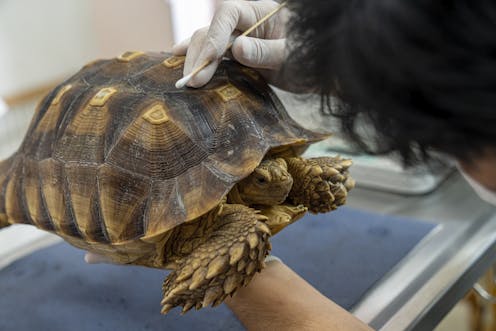
How do you measure the concentration of a drug in a tortoise shell? Thirawatana Phaisalratana/iStock via Getty Images Plus

In my work as a veterinary pharmacologist, I never know exactly what I’m going to get when I open my email. It could be a request from a veterinarian asking my team to determine the concentration of a drug to treat the shell of a turtle infected with fungal disease. Or it could be an inquiry from a researcher wondering whether we can help them figure out the dose of antacid they should give goats and sheep with ulcers.

In one email, a veterinarian wanted to know whether we could determine the concentration of an extended-release antibiotic in tigers to determine how to best treat them. Figuring this out would make the difference between trying to give a sick tiger a pill every 12 hours – a difficult task – or a shot once a month.

At our veterinary pharmacology lab, my colleagues and I analyze drug levels in animals from zoos and aquariums nationwide, from tiny mice to majestic elephants and from penguins to farm animals. Whether it’s a dolphin with an infection or a tiger in pain, we help veterinarians determine the right treatment, including how much medicine is best for each animal.

Here’s a peek behind the scenes to experience a day in the life of a veterinary pharmacologist, and what it takes to ensure these creatures get the care they need to thrive.

Beluga milk and antibiotics

One day, I received an email from an aquarium asking whether my team and I could determine the concentration of an antibiotic in milk – specifically beluga whale milk.

Beluga whales live in cold waters throughout the Arctic and are extremely sociable mammals that hunt and migrate together in pods. They are recognized for their distinctive white color and are known as the “canaries of the sea” for the wide variety of sounds they make. Whales like the beluga are at the top of the food chain and play an important role in the overall health of the marine environment. However, these animals are threatened by extinction. There are roughly 150,000 beluga whales left in the world today, and certain populations are considered endangered.

Close-up of a person cupping the open mouth of a beluga whale calf
Beluga whales are threatened by extinction.
Erin Hooley/AP Photo

The aquarium reached out to us as part of their research on the factors threatening the sustainability of belugas in the wild and what steps can be taken to protect them. The team there works with animals both in human care and in their natural habitats to improve husbandry methods, understanding of the underwater world and the conservation of aquatic life.

We agreed to try to extract the drug from the milk. However, we first needed a sample of whale’s milk. So, the first question: How do you get milk from a whale? Through my decades of working in this field, my team has studied samples from a wide range of species, but this was the first time someone asked us to analyze whale’s milk.

Unfortunately, I never did find out how they actually got the sample. But I cannot imagine it was easy. The sample we received reminded us of a thick buttermilk, very clumpy with a little bit of a blue tint.

The milk sample they gave us came from a whale with an infection who was also nursing a calf. The veterinarians wanted to know whether the antibiotic was crossing into the milk, indicating that the calf may have been exposed to the drug.

Each chemical compound requires its own unique process to extract from a particular sample type. This extraction can range from one to 15 steps and can take from one to six hours to perform. After we devised a method and procedure to extract the antibiotic from milk, we set to analyzing the sample.

We found the presence of drug in the sample, which meant the nursing calf was getting exposed to antibiotic from its mother’s milk. This posed health risks to the calf, including disruption to its gut microbiome that could lead to a weakened immune system, increased susceptibility to infections and antibiotic resistance.

Making a treatment plan

Now that the aquarium knew the beluga milk contained the antibiotic, it could devise a treatment plan. Beluga calves are dependent on nursing for the first year of life until their teeth emerge. So stopping the calf from drinking its mother’s milk wasn’t an option.

When prescribing antibiotics, a veterinarian needs to carefully consider the potential risks and benefits to both the nursing mother and her offspring. The goal is to provide effective treatment for the parent while minimizing the risk of harm to the offspring.

Person wearing white lab coat and nitrile gloves handling lab equipment.
A member of the team at the veterinary pharmacology lab at the University of Tennessee analyzes samples.
Sherry Cox, CC BY-NC-SA

In order to determine whether the nursing calf was at risk, the veterinarian wanted to determine the concentration of antibiotic in the calf.

To measure how much antibiotic the calf was ingesting from the milk, the aquarium sent us a plasma sample from the calf to analyze. While we did find measurable amounts of the drug in the sample, there was not enough to cause harm to the calf.

With this information, the veterinarian decided to continue to give the mother the antibiotic. The veterinarian gave our team samples from both the mother and the calf to continue monitoring the drug concentrations.

Effectively treating animals

For many animals, there is limited information available to guide clinicians when deciding treatment plans. Many dosage regimens are extrapolated from animals with different physiologies and metabolisms compared to the animal receiving the drug. What might cure one species might kill another.

Evaluating how safe and effective a drug is for a particular species is essential to not only properly treat and prevent disease but also to relieve pain. The research we do provides needed information on appropriate doses in vulnerable species for which there is no scientific data available.

I find the work we do rewarding because we provide information to so many veterinarians to help them take care of remarkable creatures great and small.

The Conversation

Sherry Cox does not work for, consult, own shares in or receive funding from any company or organization that would benefit from this article, and has disclosed no relevant affiliations beyond their academic appointment.

ref. Calling in the animal drug detectives − helping veterinarians help beluga whales, goats and all creatures big and small – https://theconversation.com/calling-in-the-animal-drug-detectives-helping-veterinarians-help-beluga-whales-goats-and-all-creatures-big-and-small-265430

How sea star wasting disease transformed the West Coast’s ecology and economy

Source: The Conversation – USA (2) – By Rebecca Vega Thurber, Professor of Ecology Evolution and Marine Biology; Director of the Marine Science Institute, University of California, Santa Barbara

A sunflower sea star may be about to snack on some sea urchins in California. Brent Durand/Moment via Getty Images

Before 2013, divers on North America’s west coast rarely saw purple sea urchins. The spiky animals, which are voracious kelp eaters,- were a favorite food of the coast’s iconic sunflower sea stars. The giant sea stars, recognizable for their many arms, kept the urchin population in check, with the help of sea otters, lobsters and some large fishes.

That balance allowed the local kelp forests to flourish, providing food and protection for young fish and other sea life.

Then, in 2013, recreational divers began noticing gruesomely dissolving sea star corpses and living sea stars that were writhing and twisting, their arms dropping and literally walking away. It was the beginning of a sea star wasting disease outbreak that would nearly wipe out all the sunflower sea stars along the coast.

Their disappearance, combined with a massive marine heat wave called “the blob,” set off a cascade of catastrophic ecological changes that turned these kelp biodiverse hot spots into vast sea urchin barrens, devoid of almost any other species.

A sea floor landscape of sea urchins and not much else.
Urchin barrens are the result of losing a main sea urchin predator off California.
Brandon Doheny

This disaster also encouraged human innovation, however. The result has brought an unexpected boost for the local fisheries and restaurants through the development of a new culinary delight, and questions about how best to help kelp forests, and the US$500 billion in economic value they provide, recover for the future.

Losing sea stars disrupted an entire ecosystem

I am the director of the Marine Science Institute in Santa Barbara, California, one of the areas severely hit by the loss of sea stars.

From sea star wasting disease, more than 90% of the sunflower sea stars died along the entirety of North America’s west coast, from Baja to Alaska. In only the first five years of the outbreak, sea star wasting disease become one of the largest epidemics to hit a marine species. By 2017, sunflower sea stars, Pycnopodia helianthoide, were rarely found south of Washington state.

For over a decade, the cause of the devastation was a mystery, until recently, when my colleagues traced sea star wasting disease to a highly infectious vibrio bacteria. Today, sea star wasting disease has spread widely, even as far as Antarctica.

Discovering the cause of sea star wasting disease. Hakai Institute.

As sea stars disappeared, the purple sea urchin population exploded, increasing an astonishing 10,000% from 2014 to 2022.

The urchins ate through kelp forests. The resulting loss of kelp canopy and the understory foliage below it reverberated across the whole ecosystem, affecting the tiniest of zooplankton and giants like gray whales, all of which are linked in the complex kelp forest food web of who eats who.

Large stalks of kelp sea grass rising from the sea floor with fish swimming nearby.
Kelp forests provide food for many species and safety for young fish.
Katie Davis

Ecological cascades – a succession of changes across an ecosystem when habitats are disturbed – can occur when critical populations disappear or change in other significant ways.

Removing the kelp alters light levels below, leading to changes such as turf algae growth in place of filter-feeding invertebrates such as clams and scallops. Turf algae also make it harder for kelp to regrow, exacerbating the problem.

The loss of kelp also resulted in fewer mysids, a zooplankton that relies on kelp for habitat and which makes up a majority of gray whales’ diets. Thus, as urchin populations went up and kelp disappeared, gray whales also had less food.

How California learned to embrace the urchin

The loss of sunflower sea stars to wasting disease has not only altered the kelp ecosystem, but it has also altered the landscape of Pacific fisheries, potentially forever.

When I started research on purple sea urchins in 2001, there were not enough specimens in the whole of the Monterey Bay for me to collect and use for my studies. In fact, I had to order my animals from an East Coast distributor.

Mostly there were red sea urchins, Strongylocentrotus fransiscanus, highly prized for their large and delicious gonads and sold as “uni” to American and Asian markets.

But with the recent purple sea urchin boom, Strongylocentrotus purpuratus, a new and unexpected market on the west coast has blossomed – taking these kelp killers out of the sea and onto plates in restaurants around America.

An urchin split open on a dinner plate with uni inside
Sea urchin on the menu in Japan. The orange-yellow uni are the creature’s gonads.
Sung Ming Whang/Flickr, CC BY

This pivot from reds to purple urchins by fishers and the aquaculture industry took time and creativity. Purple sea urchins tend to be small and lack the rich gonads that make the reds so profitable. To adjust their flavor, texture and size, innovators turned to harvesting these animals from the sea by hand and then moving them to land-based facilities – called “urchin ranches” – where they fatten up by eating seaweeds.

The results have been remarkable. In Santa Barbara, a thriving industry now raises these animals for the culinary market, where the artisanal urchins go for $8 to $10 a pop. In one example, an abalone aquaculture program used its expertise and facility to profit from this new abundance.

Innovative ways to solve kelp decline

You might be asking yourself if we can just eat our way out of this crisis.

It’s not a new idea. The invasion of Pacific lionfish into Florida coasts, the Gulf of Mexico and parts of the Caribbean was slowed down by local divers and recreational fishing groups teaming up to hunt and then market lionfish to restaurants.

It is unlikely that purple sea urchin ranching will make much of a dent in the population, but numerous projects are currently aimed at both recovering kelp forests and keeping the monetary benefits of the urchin boom flowing to the local economy simultaneously. The ingenuity to flip a bad outcome into a productive local aquaculture industry has been so popular that even state agencies are now funding local innovators to expand purple urchin ranching, assisting both the local environment and the local economy.

Two dozen sea stars on the sea floor and not much else.
Purple sea urchins have taken over stretches of sea floor off California and ate down the kelp, leaving little behind.
Ed Bierman via Wikimedia Commons, CC BY

Scientists, state agencies and conservation groups are working on sunflower sea star restoration efforts and kelp recovery programs, and are considering other ways to reduce the urchin population.

One option is to increase otter populations in places like Northern California and Oregon, where they were once abundant. Otters can eat upward of 10,000 urchins per year. But the approach is controversial in Southern California. A similar conservation effort failed before, and there are concerns about the effects a bigger otter population would have on local fisheries, including the now-depleted black abalone.

So where do we go from here?

As the world’s appetite for farmed seafood has expanded, groups like Urchinomics and their investors are using this edible calamity to promote kelp restoration, create jobs and boost local economies.

In a way, sea star wasting disease and the precipitous kelp declines inadvertently created a mutually beneficial alignment of conservation, local artisanal fishing and land-based aquaculture.

A seafloor view with several species.
A sunflower star (blue) with other sea stars (orange) and a sea anemone off the central California coast.
Ed Bierman via Wikimedia Commons, CC BY

In the long term, additional marine heat waves, like the one occurring in 2025, and their associated marine diseases and subsequent habitat losses, require global actions to reduce climate change. Future outbreaks like sea star wasting disease are almost certain to emerge.

Yet, it has also been found that some of the harms of urchin population growth can be lessened when sections of ocean are protected. For example, in some California marine protected areas where urchin predator diversity was high, the impacts of sea star wasting disease and its ecological cascade were reduced. In other words, in areas where there was limited fishing, as sea star numbers dropped, the urchin population was at least partially kept in check by those legally protected predators.

This finding suggests that along with global carbon reductions, local conservation and human innovations – like those bringing purple uni to our plates – can help prevent some ecological cascades that harm our increasingly threatened marine resources.

The Conversation

Rebecca Vega Thurber does not work for, consult, own shares in or receive funding from any company or organization that would benefit from this article, and has disclosed no relevant affiliations beyond their academic appointment.

ref. How sea star wasting disease transformed the West Coast’s ecology and economy – https://theconversation.com/how-sea-star-wasting-disease-transformed-the-west-coasts-ecology-and-economy-263253

Why aren’t companies speeding up investment? A new theory offers an answer to an economic paradox

Source: The Conversation – USA (2) – By David Ikenberry, Professor of Finance, Leeds School of Business, University of Colorado Boulder

For years, I’ve puzzled over a question that seems to defy common sense: If stock markets are hitting records and tech innovation seems endless, why aren’t companies pouring money back into new projects?

Yes, they’re still investing – but the pace of business spending is slower than you’d expect, especially outside of AI.

And if you’ve noticed headlines about sluggish business spending even as corporate profits soar, you’re not alone. It’s a puzzle that’s confounded economists, policymakers and investors for decades. Back in 1975, U.S. public companies reinvested an average of 25 cents for every dollar on their balance sheets. Today, that figure is closer to 12 cents.

In other words, corporate America is flush with cash, but it’s surprisingly stingy about reinvesting in its own future. What happened?

I’m an economist, and my colleague Gustavo Grullon and I recently published a study in the Journal of Finance that turns the field’s conventional wisdom on its head. Our research suggests the issue isn’t cautious executives or jittery markets – it’s about how economists have historically measured companies’ incentives to invest in the first place.

Asking the wrong Q

For decades, economists have relied on a simple but appealing ratio – Tobin’s Q, named after the famous economist James Tobin – to gauge whether companies should ramp up investment.

They calculate this by dividing a company’s market value – what it would take to purchase the firm outright with cash – by its replacement value, or how much it would cost to rebuild the company from scratch. The result is called “Q.” The higher the Q, the theory goes, the more incentive executives have to invest.

But reality hasn’t conformed to fit the theory. Over the past half-century, Tobin’s Q has gone up, yet investment rates have gone down sharply.

Why the disconnect? Our research points to one key culprit: excess capacity. Many U.S. companies already have more factories, machines or service capability than they can use. By not correcting for this issue, the traditional Tobin’s Q will overstate the incentive that companies have to grow.

To see this, consider a commercial real estate company that owns a portfolio of office buildings. In recent years, with the rise of e-commerce and remote work, many of their properties have been running well below capacity. Now suppose a few new tenants start paying rent and begin absorbing a portion of that empty space. Stock prices will rise in response to seeing these new cash flows, which in turn will lead Q to rise.

Traditionally, this increase in Q would suggest that it’s a good time to invest in new buildings – but the reality is quite different with idle capacity still in the system. Why pour money into building another office tower if existing ones still have empty floors?

This key idea is that what matters isn’t the average value of all assets – it’s the marginal value of adding one more dollar of investment. And because capacity utilization has been steadily eroding over the past half-century, many firms see little reason to invest.

That last point may come as a surprise, but the U.S. economy, with all its factories and offices, isn’t nearly as abuzz with activity as it was after, say, World War II. Today, many sectors operate well below full throttle. This growing slack in the system over time helps explain why companies have pulled back on their rate of investment, even as profits and market values climb.

Why has capacity utilization fallen so much over the past half-century? It’s not entirely clear, but what economists call “structural economic rigidities” – things such as regulatory hurdles, labor market frictions or shifts in cost structure – seem to be part of the answer. These factors can drag businesses into a state of chronic underuse, especially after recessions.

Why it matters

This isn’t just an academic debate. The implications are profound, whether you closely follow Wall Street or just enjoy armchair economic policy debates. For one thing, this dynamic might help explain why tax cuts haven’t spurred investment the way supporters have hoped.

Take the 2017 Tax Cuts and Jobs Act, which slashed the top corporate tax rate from 35% to 21% and introduced full expensing for equipment investments. Supporters promised a wave of new investment.

But when my colleague and I looked at the numbers, we found the opposite. In the four years before the tax cuts, publicly traded U.S. firms had an aggregate investment rate, including intangibles, of 13.9%. In the four years after the tax cut, the average investment rate fell to 12.4% – in other words, no evidence of a bump.

Where did those liberated cash flows go? Instead of plowing this newfound cash after the tax cuts into new projects, many companies funneled it into stock buybacks and dividends.

In retrospect, this makes sense. If a company has excess capacity, the incentive to invest should be more muted, even if new machines are suddenly cheaper thanks to tax breaks. If the demand isn’t there, why buy them?

Even with the most generous tax incentives, the core challenge remains: You can’t force-feed investment into an economy already swimming in excess capacity. If companies don’t see real, scalable demand, tax breaks alone aren’t likely to unlock a new era of business spending.

That doesn’t mean tax policy doesn’t matter – it does, especially for smaller firms with real growth prospects. But for the large, well-established firms that make up the lion’s share of the economy, the bigger challenge is demand. Rather than trying to stimulate even more investment, policymakers should prioritize understanding why demand is sagging relative to supply and reducing economic rigidities where they can. That way, the capacity generated by new investment has somewhere useful to go.

The Conversation

David Ikenberry does not work for, consult, own shares in or receive funding from any company or organization that would benefit from this article, and has disclosed no relevant affiliations beyond their academic appointment.

ref. Why aren’t companies speeding up investment? A new theory offers an answer to an economic paradox – https://theconversation.com/why-arent-companies-speeding-up-investment-a-new-theory-offers-an-answer-to-an-economic-paradox-260661

Charlie Kirk and the making of an AI-generated martyr

Source: The Conversation – USA (2) – By Art Jipson, Associate Professor of Sociology, University of Dayton

A makeshift memorial for Charlie Kirk outside the headquarters of Turning Point USA in Phoenix. Joe Raedle/Getty Images

An AI-generated image of Charlie Kirk embracing Jesus. Another of Kirk posing with angel wings and halo. Then there’s the one of Kirk standing with George Floyd at the gates of heaven.

When prominent political or cultural figures die in the U.S., the remembrance of their life often veers into hagiography. And that’s what’s been happening since the gruesome killing of conservative activist and Turning Point USA co-founder Charlie Kirk.

The word hagiography comes from the Christian tradition of writing about saints’ lives, but the practice often spills into secular politics and media, falling under the umbrella of what’s called, in sociology, the “sacralization of politics.” Assassinations and violent deaths, in particular, tend to be interpreted in sacred terms: The person becomes a secular martyr who made a heroic sacrifice. They are portrayed as morally righteous and spiritually pure.

This is, to some degree, a natural part of mourning. But taking a closer look at why this happens – and how the internet accelerates it – offers some important insights into politics in the U.S. today.

From presidents to protest leaders

The construction of Ronald Reagan’s postpresidential image is a prime example of this process.

After his presidency, Republican leaders steadily polished his memory into a symbol of conservative triumph, downplaying scandals such as Iran-Contra or Reagan’s early skepticism of civil rights. Today, Reagan is remembered less as a complex politician and more as a saint of free markets and patriotism.

Among liberals, Martin Luther King Jr. experienced a comparable transformation, though it took a different form. King’s critiques of capitalism, militarism and structural racism are often downplayed in most mainstream remembrances, leaving behind a softer image of peaceful dreamer. The annual holiday, scores of street renamings and public murals honor him, but they also tame his legacy into a universally palatable story of unity.

Even more contested figures such as John F. Kennedy or Abraham Lincoln show the same pattern. Their assassinations were followed by waves of mourning that elevated them into near-mythic status.

Decades after Kennedy’s death, his portrait hung in the homes of many American Catholics, often adjacent to religious iconography such as Virgin Mary statuettes. Lincoln, meanwhile, became a kind of civic saint: His memorial in Washington, D.C., looks like a temple, with words from his speeches etched into the walls.

Why it happens and what it means

The hagiography of public figures serves several purposes. It taps into deep human needs, helping grieving communities manage loss by providing moral clarity in the face of chaos.

It also allows political movements to consolidate power by sanctifying their leaders and discouraging dissent. And it reassures followers that their cause is righteous – even cosmic.

In a polarized environment, the elevation of a figure into a saint does more than honor the individual. It turns a political struggle into a sacred one. If you see someone as a martyr, then opposition to their movement is not merely disagreement, it is desecration. In this sense, hagiography is not simply about remembering the dead: It mobilizes the living.

But there are risks. Once someone is framed as a saint, criticism becomes taboo. The more sacralized a figure, the harder it becomes to discuss their flaws, mistakes or controversial actions. Hagiography flattens history and narrows democratic debate.

After Queen Elizabeth II’s death in 2022, for example, public mourning in the U.K. and abroad quickly elevated her legacy into a symbol of stability and continuity, with mass tributes, viral imagery and global ceremonies transforming a complex reign into a simplified story of devotion and service.

It also fuels polarization. If one side’s leader is a martyr, then the other side must be villainous. The framing is simple but powerful.

Older man wearing white hate and red dress shirt holds two banners featuring the image of a young man in a suit superimposed over Jesus Christ.
A supporter of Charlie Kirk holds banners outside State Farm Stadium in Glendale, Ariz., during Kirk’s public memorial service on Sept. 21, 2025.
Andrew Caballero-Reynolds/AFP via Getty Images

In Kirk’s case, many of his supporters described him as a truth seeker whose death underscored a deeper moral message. At Kirk’s memorial service in Arizona, President Donald Trump called him a “martyr for American freedom.” On social media, Turning Point USA and Kirk’s official X account described him as “America’s greatest martyr to free speech.”

In doing so, they elevated his death as symbolic of larger battles over censorship. By emphasizing the fact that he died while simply speaking, they also reinforced the idea that liberals and the left are more likely to resort to violence to silence their ideological enemies, even as evidence shows otherwise.

The digital supercharge

Treating public figures like saints is not new, but the speed and scale of the process is. Over the past two decades, social media has turned hagiography from a slow cultural drift into a rapid-fire production cycle.

Memes, livestreams and hashtags now allow anyone to canonize someone they admire. When NBA Hall-of-Famer Kobe Bryant died in 2020, social media was flooded within hours with devotional images, murals and video compilations that cast him as more than an athlete: He became a spiritual icon of perseverance.

Similarly, after Ruth Bader Ginsburg’s death, the “Notorious RBG” meme ecosystem instantly expanded to include digital portraits and merchandise that cast her as a saintly defender of justice.

The same dynamics surrounded Charlie Kirk. Within hours of his assassination, memes appeared of Kirk draped in an American flag, being carried by Jesus.

In the days after his death, AI-generated audio clips of Kirk styled as “sermons” began circulating online, while supporters shared Bible verses that they claimed matched the exact timing of his passing. Together, these acts cast his death in religious terms: It wasn’t just a political assassination – it was a moment of spiritual significance.

Such clips and verses spread effortlessly across social media, where narratives about public figures can solidify within hours, often before facts are confirmed, leaving little room for nuance or investigation.

Easy-to-create memes and videos also enable ordinary users to participate in a sacralization process, making it more of a grassroots effort than something that’s imposed from the top down.

In other words, digital culture transforms what was once the slow work of monuments and textbooks into a living, flexible folk religion of culture and politics.

Toward clearer politics

Hagiography will not disappear. It meets emotional and political needs too effectively. But acknowledging its patterns helps citizens and journalists resist its distortions. The task is not to deny grief or admiration but to preserve space for nuance and accountability.

In the U.S., where religion, culture and politics frequently intertwine, recognizing that sainthood in politics is always constructed – and often strategic – can better allow people to honor loss without letting mythmaking dictate the terms of public life.

The Conversation

Art Jipson does not work for, consult, own shares in or receive funding from any company or organization that would benefit from this article, and has disclosed no relevant affiliations beyond their academic appointment.

ref. Charlie Kirk and the making of an AI-generated martyr – https://theconversation.com/charlie-kirk-and-the-making-of-an-ai-generated-martyr-265834

Tibetan Buddhist nuns are getting advanced degrees − and the Dalai Lama played a major role in that shift

Source: The Conversation – USA (3) – By Darcie Price-Wallace, Visiting Scholar in Religious Studies, Northwestern University

Tibetan nuns study during the winter examination period at the Dolma Ling Nunnery in Dharamshala, India, in 2022. Rebecca Conway/Getty Images

In August 2025, 161 Tibetan Buddhist nuns from religious institutions across India and Nepal – a record number – gathered at the Dolma Ling Nunnery in northern India to take various levels of the “geshema” examination. These exams are in preparation for one day receiving the geshema degree, comparable with a doctorate in Tibetan Buddhist philosophy. The nearly four-week gathering was especially notable because until 13 years ago it was completely unavailable to women.

Now, thanks to a greater emphasis on women’s education in recent years, Tibetan Buddhist nuns are increasingly becoming teachers and abbesses. In monastic institutions and in Buddhist centers around the world, nuns are taking on leadership roles and being acknowledged for their religious scholarship, including the geshema degree.

As a scholar of religious studies and gender, I study the changing roles of women in Buddhism. While nuns were long respected in Tibetan Buddhist culture, they were historically not granted access to the same educational or leadership opportunities as monks. But that has changed, in part due to the crucial role played by the 14th Dalai Lama Tenzin Gyatso.

He encouraged nuns to become advanced degree holders as part of his broader goal to increase gender parity. “Biologically there is no difference between the brains of men and women and the Buddha clearly gave equal rights to men and women,” he said in 2013. In addition to nuns reciting prayers and performing rituals, he emphasized they should study classic Buddhist texts, something traditionally reserved for men.

Such guidance has helped challenge historical misconceptions about women’s intellectual abilities that undermined women’s prominence in Buddhism. Indeed, nuns are now teaching philosophy within their own nunneries at home and abroad, becoming principals of their institutions, serving as role models for other nuns and the laity, and entering long retreats – a staple of Buddhist contemplative activities on the path to awakening.

A man with glasses looks down.
The Dalai Lama speaks during a ceremony in 2011 to commemorate the anniversary of the 1959 Tibetan uprising against Chinese rule.
AP Photo/Ashwini Bhatia

Historical roots

The Dalai Lama has resided in exile since 1959, when he fled to northern India following unrest over the Chinese occupation of Tibet. Many Tibetans followed him, and he has remained the key religious and political leader of the Tibetan community and diaspora ever since, though he officially gave up political duties in 2011 to the Tibetan government in exile.

During the Dalai Lama’s decades of leadership, improving education for the diaspora communities of Tibetans in India and Nepal has been a crucial avenue for protecting and preserving Tibetan culture, including Tibetan Buddhism.

Historically, however, the path of formal education was primarily reserved for monks. In Tibet, nuns were primarily ritual specialists, according to Buddhist studies scholars such as Karma Lekshe Tsomo, Mitra Härköken and Nicola Schneider. They performed rituals in temples and homes but rarely had the opportunity to study the Buddhist texts.

And even with the Dalai Lama’s support, developing a systematic course of study for nuns that was equivalent to monks’ curriculum was not easy, especially with only a limited number of nunneries in India and Nepal, according to Schneider’s research.

“When the nuns arrived in India, they were ill, exhausted, traumatized and impoverished,” recalled Lobsang Dechen, co-director of the nonprofit Tibetan Nuns Project, in 2023. “Many nuns had faced torture and imprisonment at the hands of the Chinese authorities in Tibet and endured immense physical and emotional pain. The existing nunneries in the struggling Tibetan refugee community in India were already overcrowded and could not accommodate them.”

Nuns’ education prospects were also hampered by limited literacy and monks who held administrative and decision-making roles over them. The women essentially lived in “masculine institutions inhabited by nuns,” scholar Chandra Chiara Ehm argued in her ethnographic work on the Kopan Nunnery in Nepal. Ehm found monk administrators tended to endorse the Dalai Lama’s calls for gender parity in name without directly supporting nuns’ education.

A new age for educational opportunities

Increased access to education for nuns began to change in the 1980s as more Tibetan nuns migrated to India and Nepal. A network of more developed nunneries followed, such as Gaden Choling and Dolma Ling in Dharamshala, India, where the Dalai Lama lives in exile.

These institutions were funded by organizations such as the Tibetan Nuns Project, part of the broader Tibetan Women’s Association that was established in Tibet in 1959 in response to the Chinese occupation. The TWA was reinstated in India with the blessing of the Dalai Lama in 1984, and the Tibetan Nuns Project was established soon thereafter to educate and support nuns in India from all Tibetan schools.

A group of Tibetan Buddhist guns gather together.
Nuns in Dharamsala, India, organize a special prayer on July 4, 2025, a few days ahead of the Dalai Lama’s 90th birthday.
Elke Scholiers/Getty Images

The Dalai Lama encouraged these organizations to help build nunneries, empower existing nuns and support their further education. “In the beginning when I spoke about awarding Geshema degrees, some were doubtful,” the Dalai Lama recalled in 2018. “I clearly told them that Buddha had given equal opportunity for both men and women.”

Alongside the Dalai Lama’s efforts and more Tibetan nuns coming into the diaspora in India and Nepal, several other factors helped promote women’s advancement.

Those include the advocacy and support of international organizations such as Sakyadhita International Association of Buddhist Women, which has hosted international meetings to empower nuns and lay Buddhist women for nearly 40 years.

Within India, meanwhile, local nonprofits such as the Ladakh Nuns Association have provided opportunities for nuns to work in health care.

Reaching the highest ladder of monastic teaching

The geshema degree that nuns have been able to receive since 2012 is in the Geluk tradition, one of the four schools, or distinct branches, of Tibetan Buddhism. These degrees are the highest level of monastic training but were previously available only to men, whose degree are known as “khenpo” or “geshe.”

Candidates for the geshema degree are tested after having studied Buddhist texts. Nuns must score 75% or higher during their 17 years of study before qualifying to take the geshema examinations.

In 2016, the Dalai Lama presided over and granted 20 Tibetan nuns geshema degrees, four years after he and the Tibetan government in exile recognized the accreditation of higher degrees for nuns. Before the formal development of the geshema program, only one German nun, Kelsang Wango, had received a degree. Now, there are 73 geshemas.

After the Geluk school began granting geshema degrees, nuns within the other schools of Tibetan Buddhism – Nyingma, Sakya and Kagyu – also began pursuing advanced degrees in India and Nepal. Within these other three branches, nuns carry the title of “khenmo,” which like the geshema qualifies them to teach the renowned Buddhist scriptures. In 2022, the Dalai Lama offered blessings to the new khenmo, who received their titles in the Sakya school.

All told, nuns are changing the course for Tibetan Buddhist women – and have had an ally in the Dalai Lama.

As the numbers of women at the highest echelons of learning continue to grow, women will likewise expand their ability to take leadership roles in their monastic and lay communities – helping to improve other nuns’ education and protecting Tibetan culture in the process.

The Conversation

Darcie Price-Wallace received funding from a Fulbright Grant for her dissertation research.

ref. Tibetan Buddhist nuns are getting advanced degrees − and the Dalai Lama played a major role in that shift – https://theconversation.com/tibetan-buddhist-nuns-are-getting-advanced-degrees-and-the-dalai-lama-played-a-major-role-in-that-shift-261824