Pourquoi mon filtre antispam fonctionne-t-il si mal ?

Source: The Conversation – France in French (2) – By Antony Dalmiere, Ph.D Student – Processus cognitifs dans les attaques d’ingénieries sociales, INSA Toulouse; Centre national de la recherche scientifique (CNRS)

Comment les spams passent-ils au travers des multiples couches de protection annoncées comme presque infranchissables par les entreprises et par les chercheurs en cybersécurité ?


Les escroqueries existent depuis fort longtemps, du remède miracle vendu par un charlatan aux courriers dans la boîte aux lettres nous promettant monts et merveilles plus ou moins fantasques. Mais le Web a rendu ces canaux moins intéressants pour les arnaqueurs.

Les e-mails de spam et le « phishing » (hameçonnage) se comptent aujourd’hui en millions d’e-mails par an et ont été la porte d’entrée pour des incidents majeurs, comme les fuites d’e-mails internes d’Emmanuel Macron lors de sa campagne présidentielle en 2017, mais aussi le vol de 81 millions de dollars (plus de 69 millions d’euros) à la banque du Bangladesh en 2016.

Il est difficile de quantifier les effets de ces arnaques à l’échelle globale, mais le FBI a recensé des plaintes s’élevant à 2,9 milliards de dollars (soit 2,47 milliards d’euros) en 2023 pour une seule catégorie de ce type d’attaques – les pertes dues aux attaques par e-mail en général sont sûrement beaucoup plus élevées.

Bien sûr, la situation n’est pas récente, et les entreprises proposant des boîtes de messagerie investissent depuis longtemps dans des filtres antispam à la pointe de la technologie et parfois très coûteux. De même pour la recherche académique, dont les détecteurs atteignent des précisions supérieures à 99 % depuis plusieurs années ! Dans les faits pourtant, les signalements de phishing ont bondi de 23 % en 2024.

Pourquoi, malgré ces filtres, recevons-nous chaque jour des e-mails nous demandant si notre compte CPF contient 200 euros, ou bien nous informant que nous aurions gagné 100 000 euros ?

Plusieurs techniques superposables

Il faut d’abord comprendre que les e-mails ne sont pas si différents des courriers classiques dans leur fonctionnement. Quand vous envoyez un e-mail, il arrive à un premier serveur, puis il est relayé de serveur en serveur jusqu’à arriver au destinataire. À chaque étape, le message est susceptible d’être bloqué, car, dans cette chaîne de transmission, la plupart des serveurs sont équipés de bloqueurs.

Dans le cadre de ma thèse, j’ai réalisé une étude empirique qui nous a permis d’analyser plus de 380 e-mails de spams et de phishing ayant franchi les filtres mis en place. Nous avons ainsi analysé une dizaine de techniques exploitées dans des proportions très différentes.

La plus répandue de ces techniques est incroyablement ingénieuse et consiste à dessiner le texte sur une image incluse dans l’e-mail plutôt que de l’écrire directement dans le corps du message. L’intérêt est de créer une différence de contenu entre ce que voit l’utilisateur et ce que voient les bloqueurs de spams et de phishing. En effet, l’utilisateur ne fait pas la différence entre « cliquez ici » écrit dans l’e-mail ou « cliquez ici » dessiné avec la même police d’écriture que l’ordinateur. Pourtant, du point de vue des bloqueurs automatisés, cela fait une grosse différence, car, quand le message est dessiné, identifier le texte présent dans l’image demande une analyse très coûteuse… que les bloqueurs ne peuvent souvent pas se permettre de réaliser.

Une autre technique, plus ancienne, observée dans d’autres contextes et recyclée pour franchir les bloqueurs, est l’utilisation de lettres qui sont jumelles dans leur apparence pour l’œil humain mais radicalement différentes. Prenons par exemple un mail essayant de vous faire cliquer sur un lien téléchargeant un virus sur votre téléphone. Un hackeur débutant pourrait envoyer un mail malicieux demandant de cliquer ici. Ce qui serait vu du point de vue de votre ordinateur par 99 108 105 113 117 101 114. Cette suite de nombres est bien évidemment surveillée de près et suspectée par tous les bloqueurs de la chaîne de transmission. Maintenant, un hackeur chevronné, pour contourner le problème, remplacera le l minuscule par un i majuscule (I). De votre point de vue, cela ressemblera à cIiquer ici – avec plus ou moins de réussite en fonction de la police d’écriture. Mais du point de vue de l’ordinateur, cela change tout, car ça devient : 99 76 105 113 117 101 114. Les bloqueurs n’ont jamais vu cette version-là et donc laissent passer le message.

Tromper les filtres à spams basés sur l’IA

Parmi toutes les techniques que nous avons observées, certaines sont plus avancées que d’autres. Contre les bloqueurs de nouvelle génération, les hackers ont mis au point des techniques spécialisées dans la neutralisation des intelligences artificielles (IA) défensives.

Un exemple observé dans notre étude est l’ajout dans l’e-mail de pages Wikipédia écrites en blanc sur blanc. Ces pages sont complètement hors contexte et portent sur des sujets, tels que l’hémoglobine ou les agrumes, alors que l’e-mail demande d’envoyer des bitcoins. Ce texte, invisible pour l’utilisateur, sert à perturber les détecteurs basés sur des systèmes d’intelligence artificielle en faisant une « attaque adversariale » (montrer une grande quantité de texte anodin, en plus du message frauduleux, de telle sorte que le modèle de détection n’est plus capable de déterminer s’il s’agit d’un e-mail dangereux ou pas).

Et le pire est que la plupart des e-mails contiennent plusieurs de ces techniques pour augmenter leurs chances d’être acceptés par les bloqueurs ! Nous avons dénombré en moyenne 1,7 technique d’obfuscation par e-mails, avec la plupart des e-mails comportant au moins une technique d’obfuscation.


Cet article est le fruit d’un travail collectif entre le Laboratoire de recherche spécialisé dans l’analyse et l’architecture des systèmes (LAAS-CNRS) et le Laboratoire d’études et de recherches appliquées en sciences sociales (LERASS). Je tiens à remercier Guillaume Auriol, Pascal Marchand et Vincent Nicomette pour leur soutien et leurs corrections.

The Conversation

Antony Dalmiere a reçu des financements de l’Université de Toulouse et de l’Institut en Cybersécurité d’Occitanie.

ref. Pourquoi mon filtre antispam fonctionne-t-il si mal ? – https://theconversation.com/pourquoi-mon-filtre-antispam-fonctionne-t-il-si-mal-273053

« Chemsex » : quand l’excès tente de faire taire la douleur

Source: The Conversation – France in French (3) – By Laure Westphal, Psychologue clinicienne, Docteure en psychopathologie, Enseignante, Chercheuse associée, Sciences Po

Les personnes qui pratiquent le « chemsex », en consommant de la 3-MMC et d’autres drogues de synthèse (GHB, GLB, poppers…) pendant les relations sexuelles, prennent des risques pour leur santé physique et leur intégrité psychique. Mais grâce à un accompagnement dans des services de soins, au sein de groupes d’entraide et/ou avec des proches, ils peuvent revenir à une vie pacifiée.


La pratique du « chemsex » connaît un essor exponentiel ces dernières années. Les usagers s’exposent à des dommages psychiques et corporels. Les demandeurs de soins font apparaître une souffrance d’origines variées, parfois traumatiques.

À la psychothérapie doit se conjuguer la prévention.

Le « chemsex », qu’est-ce que c’est ?

Des événements médiatisés ont révélé une pratique déjà bien connue des soignants. Le « chemsex » est la contraction de chemical (« produit chimique », en anglais) et de sex, et correspond à l’usage de cathinones dans des relations sexuelles, souvent pratiquées à plusieurs, avec des inconnus. Les cathinones sont des produits de synthèse, aux propriétés stimulantes, entactogènes – elles amplifient les sensations physiques –, et empathogènes – l’intimité est facilitée.

Souvent, le néophyte le découvre au décours d’une soirée festive, et fait l’expérience d’un plaisir intense, sans limites physiologiques (la fatigue ou la faim). La 3-MMC (3-MéthylMéthCathinone) est la cathinone la plus fréquemment citée dans nos consultations. Elle peut être consommée avec d’autres drogues de synthèse, du GHB, du GBL, ou du poppers. Dans ce nouveau « paradis artificiel », les participants exacerbent leur sensorialité, au sein d’un groupe d’anonymes, conçu comme « safe ».

À l’usage, ces derniers recourent à des applications géolocalisées de type Grindr qui potentialisent leur rencontre un peu partout et instantanément. Les « chemsexeurs » diversifient les modes de prises : en sniff, en plug (par voie rectale), ou en slam (par voie intraveineuse). Slam, signifiant « claquer », a l’effet le plus puissant. Les produits sont faciles d’accès : le darknet (réseau Internet clandestin, ndlr) livre à domicile. La durée des « plans » augmente au gré de l’appétence au produit, de plusieurs heures à plusieurs jours.

Surdosage, arrêts respiratoires et autres risques

Les usagers prennent des risques, par exemple des G-hole, c’est-à-dire des comas liés à du surdosage, des arrêts respiratoires ou encore des oublis de leur PrEP (prophylaxie préexposition), quand ils suivent ce traitement antirétroviral utilisé par des personnes séronégatives exposées au risque de VIH.

Souvent, les chemsexeurs rapportent d’abord le plaisir d’expérimenter une émancipation extatique. Ils la requalifient d’autothérapeutique, lorsque des revers leur apparaissent comme le résultat de ce qu’ils voulaient oublier : des blessures psychiques plus ou moins profondes.

Avec la pratique, ils perdent l’intérêt pour la sexualité sans cathinones, et même avec : seule l’appétence au produit demeure. Certains finissent par consommer seuls chez eux. Ils régressent dans un repli mortifère.

Listen to 28260325 – Laure Whestphal – Les Conduites addictives byMosaique FM on hearthis.at

Une automédication dangereuse

Certains chemsexeurs lui attribuent une fonction ordalique. Lorsqu’ils nous sollicitent, ils se remémorent des carences affectives, des violences psychologiques, comme le rejet familial et/ou intériorisé de leur orientation sexuelle ou de leur identité. D’autres, ou parfois les mêmes, y réactualisent des traumas liés à des violences physiques, ou sexuelles. À des degrés divers, ils s’absentent d’eux-mêmes, accentuent leur état dissociatif, dans des relations anonymes avec des psychotropes. La toxicomanie crée parfois une emprise qui libère d’une autre.

Lorsqu’ils ont été abusés jeunes, c’est souvent par quelqu’un ayant eu un ascendant sur eux, quelqu’un qu’ils admiraient et qui les a trahis. Relégués au rang d’objet, ils se sont fait extorquer leur intimité.


À lire aussi :
Violences sexuelles : de nouveaux enjeux de santé mentale pour les psy


Ils se sont construits en déshumanisant le plaisir sexuel. Ils se sont asservis à un excès après l’autre pour forcer l’oubli. Certains déplorent s’assujettir à une société de consommation, ou se « chosifier » les uns les autres, comme s’ils donnaient consistance à une injonction néolibérale de performance.

Clivés, ils entretiennent à leur insu des carences affectives. Cela en a amené certains à aimer des personnes les faisant souffrir. Leur enjeu devient de différencier le fait d’aimer, du fait d’aimer souffrir. Enlisés dans la confusion, ils retournent contre eux la violence qu’ils ont subie par une compulsion aux passages à l’acte. Les plus « avancés » s’isolent, se délaissent. Ils s’octroient des états modifiés de conscience pour édulcorer des reviviscences traumatiques, qui leur reviennent lors de leurs descentes.

Traduire en mots les abus qu’ils ont subis les aide à distinguer ce qui relève de leur choix ou de leur instrumentalisation par une contrainte de répétition. S’ils identifient leurs traumas, ils peuvent retrouver l’origine de leur destructivité qu’ils cherchaient sans succès à fuir, et l’intégrer dans leur vie selon d’autres modalités.

Psychothérapie, prévention, contexte sociétal

Quel que soit le degré d’engagement dans le chemsex, il est essentiel avec les demandeurs de soins de réintégrer ce qu’ils vivent dans la réalité commune, de lever leurs clivages, et d’éviter à leurs excès de constituer des traumas secondaires. Entrer dans l’espace thérapeutique, leur permet de reconnaître à un autre la capacité d’entendre les éléments épars de leur histoire. Ils la pensent et pansent les blessures. Les plus démunis d’ancrage ont pour enjeu préalable de se réinscrire dans une relation humanisante, d’y éprouver la détresse auprès d’un autre secourable avec qui interroger l’avenir : pour qui ne s’abandonneraient-ils pas ?

C’est d’un appui bienveillant dont ils ont besoin d’abord pour résorber leur effraction psychique, se réconcilier avec eux-mêmes et élaborer les enjeux tragiques de leur relation à l’amour. Certains ne savent plus comment aimer, ou s’ils en sont capables. Pour d’autres, cela n’a jamais été une expérience hédoniste.

Après s’être expulsés de la vie de la cité, ils reviennent à la vie ordinaire dans un état de grande fragilité. Leur vie affective progresse dans des services de soins, des groupes d’entraide, de proches, qu’ils considèrent comme leur nouvelle famille.

Ce passage est structurant pour leur prise de parole, complémentairement à celle qu’ils déploient auprès du clinicien. Ce dernier les soutient dans leur démarche créatrice ou sublimatoire qu’ils ouvrent souvent spontanément : la reconversion professionnelle, la reprise d’études, l’expression artistique de leur sensibilité. Ils changent de vie pour participer autrement à celle de la cité.

Certes les cathinones se sophistiquent régulièrement et changent de nom pour défier la législation. Mais cela n’est pas aux usagers d’endosser cette responsabilité. La leur est de demander de l’aide. Il y a quelques années, c’est seulement à un stade avancé, qu’ils nous sollicitaient. Aujourd’hui, les campagnes de prévention et le fait de côtoyer les plus expérimentés les rendent alertes plus tôt. La prise en charge s’est diversifiée et démocratisée.

Les chemsexeurs, des témoins d’un mal-être psychique plus gobal ?

À l’heure où l’usage de drogue refait l’objet de représentations régressives dans un climat politique répressif, les usagers continuent de nécessiter des lieux de soin « safe ». Si l’on n’en tient pas compte, on participe à entraver ou à retarder leurs accès aux soins. En craignant d’être discrédités, ils peuvent préférer nier les violences et les revivre alors à l’identique comme une torture sans fin. Pour la proportion d’usagers ayant subi des violences sexuelles, ils peuvent continuer de se meurtrir en prenant sur eux la responsabilité de leur victimisation préalable. Déposer une plainte, thérapeutique, est structurant : le patient relance dans la thérapie le désir de se respecter.

À l’heure où le mal-être psychique des jeunes gens est criant, où l’appétence aux sites « porno », parfois « trash », est perçu comme un refuge, il paraît essentiel d’éclairer et de prévenir le malaise dont les usagers de chemsex témoignent eux aussi. Le cumul de carences, de traumatismes d’enfance et/ou de traitements discriminatoires nécessite des soins humanisants, étayants, par des professionnels soutenus.

Préférer à l’agir le récit de soi, s’ouvrir à l’altérité et aux relations affectives et se réinscrire dans le collectif leur est généralement possible lorsqu’ils ont appris ou réappris à s’aimer eux-mêmes.

The Conversation

Laure Westphal ne travaille pas, ne conseille pas, ne possède pas de parts, ne reçoit pas de fonds d’une organisation qui pourrait tirer profit de cet article, et n’a déclaré aucune autre affiliation que son organisme de recherche.

ref. « Chemsex » : quand l’excès tente de faire taire la douleur – https://theconversation.com/chemsex-quand-lexces-tente-de-faire-taire-la-douleur-273960

How the polar vortex and warm ocean are intensifying a major US winter storm

Source: The Conversation – USA (2) – By Mathew Barlow, Professor of Climate Science, UMass Lowell

Boston and much of the U.S. faced a cold winter blast in January 2026. Craig F. Walker/The Boston Globe via Getty Images

A severe winter storm sweeping across the central and eastern U.S. in late January 2026 threatened states from Texas to New England with crippling freezing rain, sleet and snow. Several governors issued states of emergency as forecasters warned of hazardous travel conditions, dangerous wind chills and power outages amid bitter cold expected to linger for days.

The sudden blast may come as a shock to many Americans after a mostly mild start to winter, but that warmth may be partly contributing to the ferocity of this storm.

As atmospheric and climate scientists, we conduct research that aims to improve understanding of extreme weather, including what makes it more or less likely to occur and how climate change might or might not play a role.

To understand what Americans are experiencing with this winter blast, we need to look more than 20 miles above the surface of Earth, to the stratospheric polar vortex.

A forecast for Jan. 26, 2026, shows the freezing line in white reaching far into Texas. The light band with arrows indicates the jet stream, and the dark band indicates the stratospheric polar vortex. The jet stream is shown at about 3.5 miles above the surface, a typical height for tracking storm systems. The polar vortex is approximately 20 miles above the surface.
Mathew Barlow, CC BY

What creates a severe winter storm like this?

Multiple weather factors have to come together to produce such a large and severe storm.

Winter storms typically develop where there are sharp temperature contrasts near the surface and a southward dip in the jet stream, the narrow band of fast-moving air that steers weather systems. If there is a substantial source of moisture, the storms can produce heavy rain or snow.

In late January, a strong Arctic air mass from the north was creating the temperature contrast with warmer air from the south. Multiple disturbances within the jet stream were acting together to create favorable conditions for precipitation, and the storm system was able to pull moisture from the very warm Gulf of Mexico.

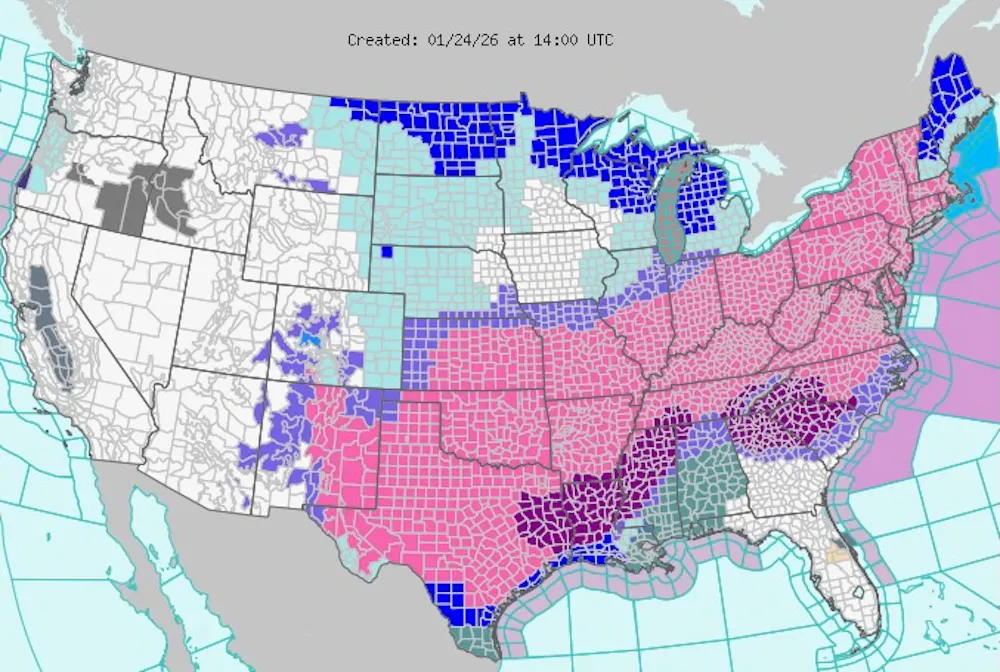
A map of storm warnings on Jan. 24, 2026.
The National Weather Service issued severe storm warnings (pink) on Jan. 24, 2026, for a large swath of the U.S. that could see sleet and heavy snow over the following days, along with ice storm warnings (dark purple) in several states and extreme cold warnings (dark blue).
National Weather Service

Where does the polar vortex come in?

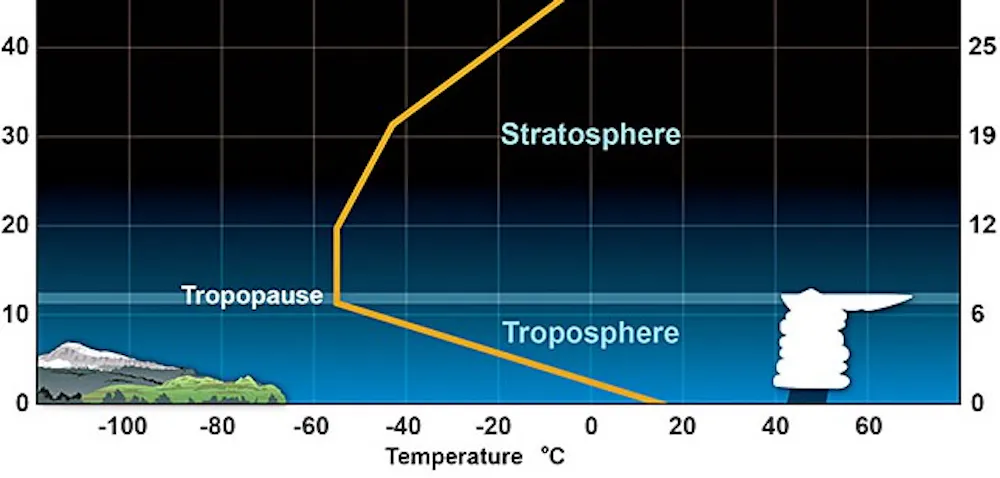
The fastest winds of the jet stream occur just below the top of the troposphere, which is the lowest level of the atmosphere and ends about seven miles above Earth’s surface. Weather systems are capped at the top of the troposphere, because the atmosphere above it becomes very stable.

The stratosphere is the next layer up, from about seven miles to about 30 miles. While the stratosphere extends high above weather systems, it can still interact with them through atmospheric waves that move up and down in the atmosphere. These waves are similar to the waves in the jet stream that cause it to dip southward, but they move vertically instead of horizontally.

A chart shows how temperatures in the lower layers of the atmosphere change between the troposphere and stratosphere. Miles are on the right, kilometers on the left.
NOAA

You’ve probably heard the term “polar vortex” used when an area of cold Arctic air moves far enough southward to influence the United States. That term describes air circulating around the pole, but it can refer to two different circulations, one in the troposphere and one in the stratosphere.

The Northern Hemisphere stratospheric polar vortex is a belt of fast-moving air circulating around the North Pole. It is like a second jet stream, high above the one you may be familiar with from weather graphics, and usually less wavy and closer to the pole.

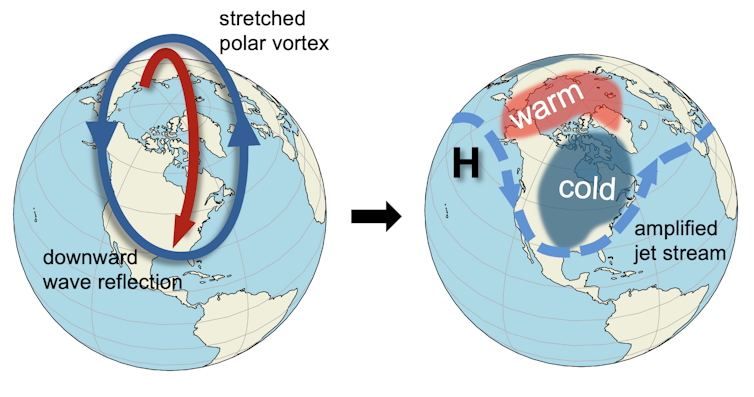
Sometimes the stratospheric polar vortex can stretch southward over the United States. When that happens, it creates ideal conditions for the up-and-down movement of waves that connect the stratosphere with severe winter weather at the surface.

A stretched stratospheric polar vortex reflects upward waves back down, left, which affects the jet stream and surface weather, right.
Mathew Barlow and Judah Cohen, CC BY

The forecast for the January storm showed a close overlap between the southward stretch of the stratospheric polar vortex and the jet stream over the U.S., indicating perfect conditions for cold and snow.

The biggest swings in the jet stream are associated with the most energy. Under the right conditions, that energy can bounce off the polar vortex back down into the troposphere, exaggerating the north-south swings of the jet stream across North America and making severe winter weather more likely.

This is what was happening in late January 2026 in the central and eastern U.S.

If the climate is warming, why are we still getting severe winter storms?

Earth is unequivocally warming as human activities release greenhouse gas emissions that trap heat in the atmosphere, and snow amounts are decreasing overall. But that does not mean severe winter weather will never happen again.

Some research suggests that even in a warming environment, cold events, while occurring less frequently, may still remain relatively severe in some locations.

One factor may be increasing disruptions to the stratospheric polar vortex, which appear to be linked to the rapid warming of the Arctic with climate change.

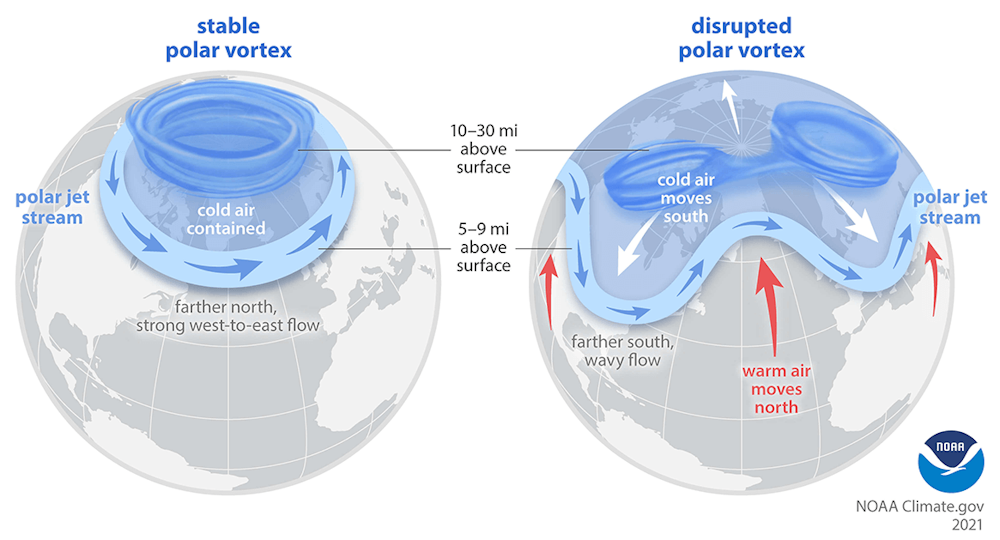
Two globes, one showing a stable polar vortex and the other a disrupted version that brings brutal cold to the South.
The polar vortex is a strong band of winds in the stratosphere, normally ringing the North Pole. When it weakens, it can split. The polar jet stream can mirror this upheaval, becoming weaker or wavy. At the surface, cold air is pushed southward in some locations.
NOAA

Additionally, a warmer ocean leads to more evaporation, and because a warmer atmosphere can hold more moisture, that means more moisture is becoming available for storms. The process of moisture condensing into rain or snow produces energy for storms as well. However, warming can also reduce the strength of storms by reducing temperature contrasts. The opposing effects make it complicated to assess the potential change to average storm strength.

However, intense events do not necessarily change in the same way as average events. On balance, it appears that the most intense winter storms may be becoming more intense. Additionally, a warmer environment increases the likelihood that precipitation that would have fallen as snow in previous winters may now be more likely to fall as sleet and freezing rain.

There are still many questions

Scientists are constantly improving our ability to predict and respond to these severe weather events, but there are many questions still to answer.

Much of the data and research in the field relies on a foundation of work by federal employees, including government labs like the National Center for Atmospheric Research, known as NCAR, which has been targeted by the Trump administration for funding cuts. These scientists help develop the crucial models, measuring instruments and data that scientists and forecasters everywhere depend on.

The Conversation

Mathew Barlow has received federal funding for research on extreme events and also conducts legal consulting related to climate change..

Judah Cohen does not work for, consult, own shares in or receive funding from any company or organization that would benefit from this article, and has disclosed no relevant affiliations beyond their academic appointment.

ref. How the polar vortex and warm ocean are intensifying a major US winter storm – https://theconversation.com/how-the-polar-vortex-and-warm-ocean-are-intensifying-a-major-us-winter-storm-274243

Edwin Mtei, Tanzania’s first central bank governor, left lessons on leadership

Source: The Conversation – Africa (2) – By Aikande Clement Kwayu, Lecturer, Tumaini University Makumira

Edwin Mtei, who passed away on 20 January 2026, was the first governor of Tanzania’s Central Bank after independence from Britain.

He filled the post until 1974.

Mtei was appointed by Julius Nyerere, who served as president from 1964 until his resignation in 1985. Nyerere once said of Mtei: “Once a governor, always a governor”, as quoted in Mtei’s autobiography, From Goatherd to Governor. He meant Mtei would always carry the title of governor, given his contribution to starting the Central Bank. Nyerere continued to call Mtei “Governor” even after he transferred him to other posts.

The life and work of Mtei is of central interest to my research as a political scientist who has studied Tanzania’s political history and development politics.

Mtei didn’t take over an established office. The country had obtained its independence only four years before the establishment of the bank in 1965. The newly independent country was using a common currency under the East African Currency Board. Once Tanzania, Kenya and Uganda each decided to be autonomous in 1965, it fell upon Mtei to set up the bank in Dar es Salaam from scratch. He presided over both on technical and logistical matters, including monetary policies, architectural design of the bank’s building, and a design for the national currency.

His work was remarkable as it contributed to the institutionalisation of the country’s economic and financial structures.

Following his tenure as governor, Mtei assumed a bigger government role. He became the secretary general of the East Africa Community from 1974 to 1977 and minister of finance from 1977 to 1979.

As finance minister he took a stand against many of the policies championed by Nyerere, in particular his customised socialist policies – known as ujamaa. Mtei had a different view on how to address the economic problems facing Tanzania. He expressed these to the president – a bold step, given that most government leaders of the time didn’t dare express different views from those of the president.

Mtei resigned in 1979. After Tanzania amended its constitution in 1992 to allow a multiparty system, Mtei founded an opposition party, Chadema, with a liberal ideology that reflected the economic views he had proposed as finance minister.

Chadema has survived to be the leading opposition party in the country to date, despite the limited civic space for opposition politics in Tanzania.

In each of his various roles, Mtei made a mark on Tanzania’s political history.

He leaves several lessons for leaders. Leadership is about conviction. Losing a position for taking a moral stand will eventually lead to a better position with bigger impact. It is professional to give credit even to your opponents. Different views do not mean enmity.

Differences with Nyerere

Nyerere’s economic policies, as set out under the Arusha Declaration, began to show signs of strain.

Following a number of crises such as the oil crisis in 1979 and the Uganda-Tanzania war in 1978-1979, the policies could not facilitate economic recovery in the country. The late 1970s and 1980s were bad years for Tanzania’s socio-economic welfare. All economic variables were negative: for example, inflation rose to 29% per year from 1978 to 1981; between 1979 and 1984, rural income declined by 13.5% in real terms and non-agricultural wage income fell by 65%.

Frustrations about how he was expected to lead the ministry and rescue the country’s economy led him to take a bold step. He resigned in 1979.

Nevertheless, Mtei continued to respect Nyerere. He expressed admiration for Nyerere’s conviction and his determination to build the nation, albeit with an “ineffective” approach.

The farmer

Following his resignation, Mtei became a coffee farmer. He was also active in policy advocacy in the coffee sector as chair of the Tanganyika Coffee Growers Association and a member of Tanzania Coffee Board and Tanzania Coffee Curing Company.

His coffee farm was an estate that he bought after selling his house in a prestigious neighbourhood in Dar-es-Salaam. He actively maintained his coffee estate up to his old age and died in his farm house.

His mastery of finance and economics as well as international knowledge and contacts must have played a big part in his success in the coffee business.

Early life

Mtei came from the Chaggaland on the slopes of Mount Kilimanjaro. He was brought up by a single (widowed) mother with limited resources. In his autobiography he narrated how, at a very young age, he would count banana and coffee trees and identify different species.

Mtei had an entrepreneurial spirit, like two other figures from the same era and region: Erasto N. Kweka and Reginald Mengi.

Kweka was bishop of the Evangelical Lutheran Church of Tanzania’s Northern Diocese. He served from 1976 to 2004. During his tenure, the diocese was involved with development projects including a bank, hotels, hospitals, schools and universities. He came to be known as “Bishop of Projects”.

Mengi owned media and manufacturing industries in Tanzania. Kweka, Mengi and Mtei were all born in the 1930s and grew up in Chagga land. Reading from their biographies, they shared similar childhood experiences and upbringing.

The three peers became prominent national figures in different capacities. All three were raised in the context where coffee had been introduced and they saw and experienced the economic impact of coffee through the establishment and development of a cooperative society, in particular the Kilimanjaro National Coffee Union (KNCU). The union provided education scholarships and other financial services to the farmers and their families. It contributed directly and indirectly to the education and interactions of Kweka, Mengi and Mtei.

Mtei was appointed executive director for African affairs at the International Monetary Fund in 1983. To his credit, Nyerere didn’t hold grudges and recommended him for the post.

Mtei saw his main job as proposing reforms in fiscal policies to solve Tanzania’s economic problems. In his autobiography he said Nyerere started to understand the imperative of the reforms and allowed negotiations to begin with the Bretton Woods institutions.

But events intervened. Nyerere was stepping down, though Mtei tried to convince him to stay.

Mtei noted in the autobiography that he thought Nyerere would be the most effective person to lead the reform. In contrast, President Ali Hassan Mwinyi’s autobiography
gives all credit for reforms to Mwinyi, who ran Tanzania between 1985 and 1995.

Given the level of political polarisation seen in Tanzania and the personalisation of politics, the life of Mtei offers many lessons.

The Conversation

Aikande Clement Kwayu does not work for, consult, own shares in or receive funding from any company or organisation that would benefit from this article, and has disclosed no relevant affiliations beyond their academic appointment.

ref. Edwin Mtei, Tanzania’s first central bank governor, left lessons on leadership – https://theconversation.com/edwin-mtei-tanzanias-first-central-bank-governor-left-lessons-on-leadership-274160

ICE immigration tactics are shocking more Americans as US-Mexico border operations move north

Source: The Conversation – USA – By Kelsey Norman, Fellow for the Middle East, Baker Institute for Public Policy, Rice University

Federal agents deploy tear gas as residents protest a federal agent-involved shooting during an immigration enforcement operation in Minneapolis, Minn., on Jan. 14, 2026. Madison Thorn/Anadolu via Getty Images

Over the past year, images of masked, heavily armed Immigration and Customs Enforcement agents arresting men, women and children – outside of courts, at schools and homes – have become common across the United States.

The video of an ICE agent shooting and killing Renee Nicole Good – a U.S. citizen – in Minnesota on Jan. 7, 2026, is one example of the brazen, sometimes deadly tactics that the agency employs.

Part of the reason why recent ICE tactics have shocked Americans is because most people haven’t seen them before. Historically, the country’s militarized immigration enforcement practices have played out closer to the U.S.-Mexico border. And for decades, agents with Customs and Border Protection have carried out most deportations near the border, not ICE.

From 2010-2020, nearly 80% of all deportations were initiated at or near the U.S.-Mexico border. During the COVID-19 pandemic, that number jumped to 98%, as both the Trump and Biden administrations utilized Title 42, a public health statute that allowed the government to rapidly deport recently arrived migrants.

But Trump during his second presidency has greatly shifted immigration enforcement north into the interior of the U.S. And ICE has played a central role.

As international migration and human rights scholars, we have examined recent federal immigration policy to determine why ICE has become the main agency detaining and deporting migrants as far away from the southern border as snowy Minnesota.

And we have also explored how the transition in immigration control from the southern border to more Americans’ front lawns could be shifting the public’s views on deportation tactics.

Migration as a threat

ICE is a relatively new agency. The 2002 Homeland Security Act, passed in the wake of the Sept. 11, 2001, terrorist attacks, created the Department of Homeland Security, known as DHS, by merging the U.S. Customs Service – previously under Treasury Department control – and the Immigration and Naturalization Service, formerly under the Justice Department.

DHS has 22 agencies, including three that focus on immigration: Customs and Border Protection, ICE and U.S. Citizenship and Immigration Services, which manages legal immigration and naturalization.

Agents dressed in military gear confront protestors.
Federal law enforcement agents confront anti-ICE protesters outside the Bishop Whipple Federal Building in Minneapolis on Jan. 15, 2026.
Octavio Jones/AFP via Getty Images

There is no inherent reason that immigration enforcement should fall under homeland security. But immigration was deemed a national security matter by the George W. Bush administration after 9/11.

In a 2002 presidential briefing justifying DHS’s creation, Bush said, “The changing nature of the threats facing America requires a new government structure to protect against invisible enemies that can strike with a wide variety of weapons.”

The U.S. government has viewed immigration from this national security perspective ever since.

The full impact of the deportations

The Trump administration in early 2025 set a goal of deporting 1 million people during its first year.

But with so few crossings, and thus deportations, at the U.S.-Mexico border, the administration instead has focused its efforts on the U.S. interior.

Trump’s 2025 tax and budget bill reflected this reprioritization, allocating US$170 billion over four years to immigration enforcement, compared to approximately $30 billion allocated in 2024.

Roughly $67 billion goes toward immigration enforcement at the border, including border wall construction. But the largest percentage of the bill’s immigration funding – at least $75 billion – goes toward arresting, detaining and deporting immigrants already living in the U.S.

The Trump administration did not initiate deportations from the U.S. interior. They have formed part of other administration’s policies, both Democratic and Republican.

Interior border enforcement increased under President Bill Clinton in the 1990s with the introduction of the 1996 Illegal Immigration Reform and Immigrant Responsibility Act, which widened the criteria for deportations. And former President Barack Obama was referred to as the “Deporter in Chief” after his administration carried out more than 3 million deportations over his two terms, with roughly 69% of deportations occurring at the border.

But the astronomical growth of government funding toward migration control – at the border and in the U.S. – got the country to where it is today.

Between fiscal year 2003 and 2024, for example, Congress allocated approximately $24 toward immigration enforcement carried out by ICE and CBP for every $1 spent on the immigration court system that handles asylum claims.

The new money allocated under the 2025 budget bill, and the reprioritization of immigration enforcement from the border to the interior, partly explains why Americans are now seeing the long-term consequences of border militarization play out directly in their communities.

Several people hold protest signs.
Demonstrators rally before marching to the White House in Washington on Jan. 8, 2026.
AP Photo/Jose Luis Magana

Americans may not know about the experiences of migrants who are quickly deported near the border, but it is harder to ignore recent images of people snatched up within their own neighborhoods.

Now the visible targets of border enforcement are increasingly immigrants who have built their lives in the U.S. – neighbors, friends, co-workers – as well as anyone who opposes ICE’s tactics, like Renee Good.

Changing political attitudes

In fact, the violence of Trump’s mass deportation campaign may be changing how Americans view immigration.

Just before the 2024 presidential election, a Gallup Poll found that 28% of Americans believed that immigration was the most important problem facing the nation – the highest percentage since Gallup began tracking the topic in 1981. This number dropped to 19% in December 2025, reflecting how more Americans see immigration as a routine issue that the government can manage rather than a crisis that needs to be dealt with.

This is supported in the academic literature. Migration scholars have shown that voters often support strict immigration policies in the voting booth but resist and protest when governments attempt to implement those policies in organized immigrant communities.

In 2002, for example, migration scholar Antje Ellermann documented that immigration officers reported it was more difficult to detain and deport people in Miami – because of resistance by a politicized immigrant community – compared to relatively conservative and less organized communities in San Diego.

But in both places, Republican and Democratic lawmakers were influential in intervening in individual cases to prevent deportations. This is because senior immigration officials, Ellermann noted, were influenced by media attention and pressure by members of Congress to grant relief.

Support for Trump’s handling of immigration is trending downward. Only 41% of Americans approved of Trump’s approach to immigration as of early January 2026, compared to 51% in March of last year, according to CNN polling.

This declining support for Trump’s tactics comes as Republican senators such as Thom Tillis of North Carolina, Lisa Murkowski of Alaska and Joni Ernst of Iowa have criticized ICE and its operations in Minnesota.

The Conversation

The authors do not work for, consult, own shares in or receive funding from any company or organization that would benefit from this article, and have disclosed no relevant affiliations beyond their academic appointment.

ref. ICE immigration tactics are shocking more Americans as US-Mexico border operations move north – https://theconversation.com/ice-immigration-tactics-are-shocking-more-americans-as-us-mexico-border-operations-move-north-273741

‘We want you arrested because we said so’ – how ICE’s policy on raiding whatever homes it wants violates a basic constitutional right, according to a former federal judge

Source: The Conversation – USA – By John E. Jones III, President, Dickinson College

Teyana Gibson Brown, wife of Liberian immigrant Garrison Gibson, reacts after a federal immigration officer arrested her husband in a warrantless raid in Minneapolis, Jan. 11, 2026, in what a judge later ruled was a violation of Gibson’s Fourth Amendment rights. AP Photo/John Locher

As Immigration and Customs Enforcement, or ICE, agents continued to use aggressive and sometimes violent methods to make arrests in its mass deportation campaign, including breaking down doors in Minneapolis homes, a bombshell report from the Associated Press on Jan. 21, 2026, said that an internal ICE memo – acquired via a whistleblower – asserted that immigration officers could enter a home without a judge’s warrant. That policy, the report said, constituted “a sharp reversal of longstanding guidance meant to respect constitutional limits on government searches.”

Those limits have long been found in the Fourth Amendment to the U.S. Constitution. Politics editor Naomi Schalit interviewed Dickinson College President John E. Jones III, a former federal judge appointed by President George W. Bush and confirmed unanimously by the U.S. Senate in 2002, for a primer on the Fourth Amendment, and what the changes in the ICE memo mean.

Okay, I’m going to read the Fourth Amendment – and then you’re going to explain it to us, please! Here goes:

“The right of the people to be secure in their persons, houses, papers, and effects, against unreasonable searches and seizures, shall not be violated, and no Warrants shall issue, but upon probable cause, supported by Oath or affirmation, and particularly describing the place to be searched, and the persons or things to be seized.” Can you help us understand what that means?

Since the beginning of the republic, it has been uncontested that in order to invade someone’s home, you need to have a warrant that was considered, and signed off on, by a judicial officer. This mandate is right within the Fourth Amendment; it is a core protection.

In addition to that, through jurisprudence that has evolved since the adoption of the Fourth Amendment, it is settled law that it applies to everyone. That would include noncitizens as well.

What I see in this directive that ICE put out, apparently quite some time ago and somewhat secretly, is something that, to my mind, turns the Fourth Amendment on its head.

A dark-haired man looking grim and fiddling with his white-collared shirt.
Todd Lyons, the acting head of ICE, whose memorandum on May 12, 2025, authorized ICE agents to forcibly enter into certain people’s homes without a judicial warrant, consent or an emergency.
Brendan Smialowski/AFP via Getty Images

What does the Fourth Amendment aim to protect someone from?

In the context of the ICE search, it means that a person’s home, as they say, really is their castle. Historically, it was meant to remedy something that was true in England, where the colonists came from, which was that the king or those empowered by the king could invade people’s homes at will. The Fourth Amendment was meant to establish a sort of zone of privacy for people, so that their papers, their property, their persons would be safe from intrusion without cause.

So it’s essentially a protection against abuse of the government’s power.

That’s precisely what it is.

Has the accepted interpretation of the Fourth Amendment changed over the centuries?

It hasn’t. But Fourth Amendment law has evolved because the framers, for example, didn’t envision that there would be cellphones. They couldn’t understand or anticipate that there would be things like cellphones and electronic surveillance. All those modalities have come into the sphere of Fourth Amendment protection. The law has evolved in a way that actually has made Fourth Amendment protections greater and more wide-ranging, simply because of technology and other developments such as the use of automobiles and other means of transportation. So there are greater protected zones of privacy than just a person’s home.

ICE says it only needs an administrative warrant, not a judicial warrant, to enter a home and arrest someone. Can you briefly describe the difference and what it means in this situation?

It’s absolutely central to the question here. In this context, an administrative warrant is nothing more than the folks at ICE headquarters writing something up and directing their agents to go arrest somebody. That’s all. It’s a piece of paper that says ‘We want you arrested because we said so.’ At bottom that’s what an administrative warrant is, and of course it hasn’t been approved by a judge.

This authorized use of administrative warrants to circumvent the Fourth Amendment flies in the face of their limited use prior to the ICE directive.

A judicially approved warrant, on the other hand, has by definition been reviewed by a judge. In this case, it would be either a U.S. magistrate judge or U.S. district judge. That means that it would have to be supported by probable cause to enter someone’s residence to arrest them.

So the key distinction is that there’s a neutral arbiter. In this case, a federal judge who evaluates whether or not there’s sufficient cause to – as is stated clearly in the Fourth Amendment – be empowered to enter someone’s home. An administrative warrant has no such protection. It is not much more than a piece of paper generated in a self-serving way by ICE, free of review to substantiate what is stated in it.

ICE agents continued raids in Minnesota on Jan. 18, 2026, pulling a man who was wearing only underwear and a blanket out of a house in St. Paul.

Have there been other kinds of situations, historically, where the government has successfully proposed working around the Fourth Amendment?

There are a few, such as consent searches and exigent circumstances where someone is in danger or evidence is about to be destroyed. But generally it’s really the opposite and cases point to greater protections. For example, in the 1960s the Supreme Court had to confront warrantless wiretapping; it was very difficult for judges in that age who were not tech-savvy to apply the Fourth Amendment to this technology, and they struggled to find a remedy when there was no actual intrusion into a structure. In the end, the court found that intrusion was not necessary and that people’s expectation of privacy included their phone conversations. This of course has been extended to various other means of technology including GPS tracking and cellphone use generally.

What’s the direction this could go in at this point?

What I fear here – and I think ICE probably knows this – is that more often than not, a person who may not have legal standing to be in the country, notwithstanding the fact that there was a Fourth Amendment violation by ICE, may ultimately be out of luck. You could say that the arrest was illegal, and you go back to square one, but at the same time you’ve apprehended the person. So I’m struggling to figure out how you remedy this.

The Conversation

John E. Jones III is affiliated with Keep Our Republic’s Article Three Coalition.

ref. ‘We want you arrested because we said so’ – how ICE’s policy on raiding whatever homes it wants violates a basic constitutional right, according to a former federal judge – https://theconversation.com/we-want-you-arrested-because-we-said-so-how-ices-policy-on-raiding-whatever-homes-it-wants-violates-a-basic-constitutional-right-according-to-a-former-federal-judge-274164

Rheumatoid arthritis has no cure – but researchers are homing in on preventing it

Source: The Conversation – USA (3) – By Kevin Deane, Professor of Medicine and Rheumatology, University of Colorado Anschutz Medical Campus

Gentle massaging can help ease the joint pain and swelling from rheumatoid arthritis. Toa55/iStock via Getty Images Plus

More than 18 million people worldwide suffer from rheumatoid arthritis, including nearly 1.5 million Americans.

Rheumatoid arthritis is an autoimmune, inflammatory form of arthritis, meaning a person’s immune system attacks their joints, causing substantial inflammation. This inflammation can cause pain, stiffness and swelling in the joints, and in many cases, patients report fatigue and a flu-like feeling.

If left untreated, rheumatoid arthritis can lead to damage of the joints. But even when treated, this condition can lead to significant disability. In highly active disease or advanced stages, patient may have difficulty performing daily tasks, such as preparing food, caring for children and getting dressed.

Up to now, this condition has been treated once patients have already developed symptoms. But a growing body of evidence suggests this disease can be identified earlier – and maybe even ultimately prevented.

I’m a physician specializing in rheumatoid arthritis and a researcher who has conducted a clinical trial on treatments for this condition. I believe this research is moving us toward being able to identify people who are at risk for rheumatoid arthritis before the disease fully develops, and to finding treatments that will delay or prevent it altogether. My hope is that this could lead to changes in how we manage rheumatoid arthritis in the next several years.

Finding the disease before it causes harm

Currently, when someone visits their health care provider because they are experiencing joint pain or other symptoms of an immune attack, health care providers can make a diagnosis by examining the joints for swelling. The health care provider will also run tests to find blood markers called autoantibodies, which help in confirming the diagnosis. While not all people with rheumatoid arthritis will have abnormal blood markers, the two autoantibodies that are seen in up to 80% of people with rheumatoid arthritis are rheumatoid factor and anti-cyclic citrullinated peptide.

In addition to joint pain, rheumatoid arthritis affects a person’s entire immune system.

But multiple studies have now confirmed that rheumatoid arthritis has a preclinical stage of development. This is a time about three to five years or longer, prior to the onset of swollen joints when markers like rheumatoid factor and anti-cyclic citrullinated peptide are detectable in the blood. The presence of these markers indicates that autoimmunity is occurring, yet the body and organs are still functioning well, and a person who is at risk of getting rheumatoid arthritis may not feel sick yet.

Now that researchers have identified this preclinical stage, health care providers can use markers such as autoantibodies and symptoms like prolonged early morning joint stiffness to identify people who are at risk for rheumatoid arthritis but do not yet have joint inflammation.

At this point, predicting future rheumatoid arthritis is still in the research stage, although the field is working toward established ways to test for risk for rheumatoid arthritis as a routine part of health care. This is akin to how cardiovascular disease risk is assessed through measuring cholesterol levels.

Ongoing research

Because of advances in the ability to predict who may get rheumatoid arthritis in the future, researchers are now working on identifying treatments that can delay or prevent the full-blown condition from developing.

In particular, trials have been performed in people who tested positive for anti-cyclic citrullinated peptide, or who have other risk factors for rheumatoid arthritis. These risk factors include joint pain and subclinical joint inflammation, which is when an imaging study, like magnetic resonance imaging, sees joint inflammation that can’t be seen by a clinician examining the joints.

To date, almost all of these trials have used immune drugs that are commonly used to treat full-blown rheumatoid arthritis, such as methotrexate, hydroxychloroquine and rituximab. Researchers have been testing whether a short course of any of these drugs could lead to a lasting reset of the immune system and prevent rheumatoid arthritis from developing.

While there is not yet an approved drug for rheumatoid arthritis prevention, these studies offer hope that researchers are on track to find the right drug – as well as the right dosage and duration of that drug.

Researching the preclinical stage of rheumatoid arthritis

Some challenges remain to be addressed before preventive treatments become the norm in clinical care.

First, researchers need to better understand the biology of the preclinical stage of disease. Until recently, most studies have focused on patients with full-blown arthritis and generally ignored people at risk for developing the disease.

But now, researchers can use blood markers like anti-cyclic citrullinated peptide antibodies to identify those who are at risk much more easily. And a growing number of studies of people with this marker are informing how scientists understand the biology of rheumatoid arthritis development.

In particular, it is now apparent that the preclinical stage is marked by multiple circulating immune system abnormalities in cells, autoantibodies and inflammation. The hope is that researchers will find interventions that effectively target the immune system abnormalities driving the development of rheumatoid arthritis before the patient’s joints begin to swell.

Researchers are also finding that the abnormalities in the immune system during the preclinical stage may be coming from sites in the body other than the joints. An emerging idea called the mucosal origins hypothesis posits that the early autoimmunity of rheumatoid arthritis is caused by inflammation at mucosal surfaces of the body, such as the gums, the lungs and the gut. According to this theory, the joints are involved only later as the disease progresses.

More research is needed, but the mucosal origins hypothesis may help explain why periodontal disease, emphysema or other forms of lung disease and exposure to tobacco or forest fire smoke are risk factors for rheumatoid arthritis. It would also explain why certain bacteria have been associated with the disease. Future trials targeting interventions to a mucosal process could help researchers better understand the nature of this disease.

nurse draws blood from patient with outstretched arm
At some point, testing for biomarkers of rheumatoid arthritis may become routine. For now, it can still be difficult for health care providers to determine which of their patients may be at risk for rheumatoid arthritis.
MoMo Productions/DigitalVision via Getty Images

Making predictions

But while biomarkers like the anti-cyclic citrullinated peptide antibodies are strongly predictive for future rheumatoid arthritis, one difficulty remains: Some people who test positive for them never develop the full-blown disease.

Studies have shown that about 20% to 30% of people who are positive for anti-cyclic citrullinated peptide antibodies develop rheumatoid arthritis within two to five years, although the presence of combinations of risk factors can identify people who have a greater than 50% risk for developing the condition within one year.

This makes it difficult to find participants for clinical trials for rheumatoid arthritis prevention. If you can’t predict who will get the disease, it’s hard to know whether you’re preventing it.

So far, researchers have tried to recruit people who have already come to their health care provider with early joint symptoms of rheumatoid arthritis but still no swollen joints. That has worked well, but there are likely far more people at risk for rheumatoid arthritis who have not yet sought care. Since health care providers are not yet testing everyone for blood markers for rheumatoid arthritis, researchers will need larger, international networks that can test for risk factors like autoantibodies to identify candidates for participation in prevention trials.

More needs to be done, but it’s exciting to see the field advancing toward the point where prevention may be part of routine clinical care for rheumatoid arthritis.

The Conversation

Dr. Deane has received grant funding from the Arthritis Foundation, the National Institutes of Health, Boehringer Ingelheim, Gilead and ThermoFisher, and has had consulting/advisory board participation with Werfen, Boehringer Ingelheim, AllInBio, and Lilly. Dr. Deane also part of task forces for prediction of rheumatoid arthritis that are sponsored by the American College of Rheumatology and the European Alliance of Associations for Rheumatology.

ref. Rheumatoid arthritis has no cure – but researchers are homing in on preventing it – https://theconversation.com/rheumatoid-arthritis-has-no-cure-but-researchers-are-homing-in-on-preventing-it-268472

Your brain can be trained, much like your muscles – a neurologist explains how to boost your brain health

Source: The Conversation – USA (3) – By Joanna Fong-Isariyawongse, Associate Professor of Neurology, University of Pittsburgh

Research shows that the brain can be exercised, much like our muscles. RapidEye/E+ via Getty Images

If you have ever lifted a weight, you know the routine: challenge the muscle, give it rest, feed it and repeat. Over time, it grows stronger.

Of course, muscles only grow when the challenge increases over time. Continually lifting the same weight the same way stops working.

It might come as a surprise to learn that the brain responds to training in much the same way as our muscles, even though most of us never think about it that way. Clear thinking, focus, creativity and good judgment are built through challenge, when the brain is asked to stretch beyond routine rather than run on autopilot. That slight mental discomfort is often the sign that the brain is actually being trained, a lot like that good workout burn in your muscles.

Think about walking the same loop through a local park every day. At first, your senses are alert. You notice the hills, the trees, the changing light. But after a few loops, your brain checks out. You start planning dinner, replaying emails or running through your to-do list. The walk still feels good, but your brain is no longer being challenged.

Routine feels comfortable, but comfort and familiarity alone do not build new brain connections.

As a neurologist who studies brain activity, I use electroencephalograms, or EEGs, to record the brain’s electrical patterns.

Research in humans shows that these rhythms are remarkably dynamic. When someone learns a new skill, EEG rhythms often become more organized and coordinated. This reflects the brain’s attempt to strengthen pathways needed for that skill.

Your brain trains in zones too

For decades, scientists believed that the brain’s ability to grow and reorganize, called neuroplasticity, was largely limited to childhood. Once the brain matured, its wiring was thought to be largely fixed.

But that idea has been overturned. Decades of research show that adult brains can form new connections and reorganize existing networks, under the right conditions, throughout life.

Some of the most influential work in this field comes from enriched environment studies in animals. Rats housed in stimulating environments filled with toys, running wheels and social interaction developed larger, more complex brains than rats kept in standard cages. Their brains adapted because they were regularly exposed to novelty and challenge.

Human studies find similar results. Adults who take on genuinely new challenges, such as learning a language, dancing or practicing a musical instrument, show measurable increases in brain volume and connectivity on MRI scans.

The takeaway is simple: Repetition keeps the brain running, but novelty pushes the brain to adapt, forcing it to pay attention, learn and problem-solve in new ways. Neuroplasticity thrives when the brain is nudged just beyond its comfort zone.

Older women knitting together and socializing in a community space.
Tasks that stretch your brain just beyond its comfort zone, such as knitting and crocheting, can improve cognitive abilities over your lifespan – and doing them in a group setting brings an additional bonus for overall health.
Dougal Waters/DigitalVision via Getty Images

The reality of neural fatigue

Just like muscles, the brain has limits. It does not get stronger from endless strain. Real growth comes from the right balance of challenge and recovery.

When the brain is pushed for too long without a break – whether that means long work hours, staying locked onto the same task or making nonstop decisions under pressure – performance starts to slip. Focus fades. Mistakes increase. To keep you going, the brain shifts how different regions work together, asking some areas to carry more of the load. But that extra effort can still make the whole network run less smoothly.

Neural fatigue is more than feeling tired. Brain imaging studies show that during prolonged mental work, the networks responsible for attention and decision-making begin to slow down, while regions that promote rest and reward-seeking take over. This shift helps explain why mental exhaustion often comes with stronger cravings for quick rewards, like sugary snacks, comfort foods or mindless scrolling. The result is familiar: slower thinking, more mistakes, irritability and mental fog.

This is where the muscle analogy becomes especially useful. You wouldn’t do squats for six hours straight, because your leg muscles would eventually give out. As they work, they build up byproducts that make each contraction a little less effective until you finally have to stop. Your brain behaves in a similar way.

Likewise, in the brain, when the same cognitive circuits are overused, chemical signals build up, communication slows and learning stalls.

But rest allows those strained circuits to reset and function more smoothly over time. And taking breaks from a taxing activity does not interrupt learning. In fact, breaks are critical for efficient learning.

Middle-aged woman sitting near her computer, rubbing her neck.
Overdoing any task, whether it be weight training or sitting at the computer for too long, can overtax the muscles as well as the brain.
Halfpoint Images/Moment via Getty Images

The crucial importance of rest

Among all forms of rest, sleep is the most powerful.

Sleep is the brain’s night shift. While you rest, the brain takes out the trash through a special cleanup system called the glymphatic system that clears away waste and harmful proteins. Sleep also restores glycogen, a critical fuel source for brain cells.

And importantly, sleep is when essential repair work happens. Growth hormone surges during deep sleep, supporting tissue repair. Immune cells regroup and strengthen their activity.

During REM sleep, the stage of sleep linked to dreaming, the brain replays patterns from the day to consolidate memories. This process is critical not only for cognitive skills like learning an instrument but also for physical skills like mastering a move in sports.

On the other hand, chronic sleep deprivation impairs attention, disrupts decision-making and alters the hormones that regulate appetite and metabolism. This is why fatigue drives sugar cravings and late-night snacking.

Sleep is not an optional wellness practice. It is a biological requirement for brain performance.

Exercise feeds the brain too

Exercise strengthens the brain as well as the body.

Physical activity increases levels of brain-derived neurotrophic factor, or BDNF, a protein that acts like fertilizer for neurons. It promotes the growth of new connections, increases blood flow, reduces inflammation and helps the brain remain adaptable across one’s lifespan.

This is why exercise is one of the strongest lifestyle tools for protecting cognitive health.

Train, recover, repeat

The most important lesson from this science is simple. Your brain is not passively wearing down with age. It is constantly remodeling itself in response to how you use it. Every new challenge and skill you try, every real break, every good night of sleep sends a signal that growth is still expected.

You do not need expensive brain training programs or radical lifestyle changes. Small, consistent habits matter more. Try something unfamiliar. Vary your routines. Take breaks before exhaustion sets in. Move your body. Treat sleep as nonnegotiable.

So the next time you lace up your shoes for a familiar walk, consider taking a different path. The scenery may change only slightly, but your brain will notice. That small detour is often all it takes to turn routine into training.

The brain stays adaptable throughout life. Cognitive resilience is not fixed at birth or locked in early adulthood. It is something you can shape.

If you want a sharper, more creative, more resilient brain, you do not need to wait for a breakthrough drug or a perfect moment. You can start now, with choices that tell your brain that growth is still the plan.

The Conversation

Joanna Fong-Isariyawongse does not work for, consult, own shares in or receive funding from any company or organization that would benefit from this article, and has disclosed no relevant affiliations beyond their academic appointment.

ref. Your brain can be trained, much like your muscles – a neurologist explains how to boost your brain health – https://theconversation.com/your-brain-can-be-trained-much-like-your-muscles-a-neurologist-explains-how-to-boost-your-brain-health-271331

Dealing with a difficult relationship? Here’s how psychology says you can shift the dynamic

Source: The Conversation – USA – By Jessica A. Stern, Assistant Professor of Psychology, Pomona College

A heated exchange may stem from something deeper than the issue at hand. skynesher/E+ via Getty Images

Relationships can feel like both a blessing and the bane of your existence, a source of joy and a source of frustration or resentment. At some point, each of us is faced with a clingy child, a dramatic friend, a partner who recoils at the first hint of intimacy, a volatile parent or a controlling boss — in short, a difficult relationship.

As a psychology professor and relationship scientist, I’ve spent countless hours observing human interactions, in the lab and in the real world, trying to understand what makes relationships work – and what makes them feel utterly intractable.

Recently, I teamed up with psychologist Rachel Samson, who helps individuals, couples and families untangle difficult dynamics in the therapy room. In our new book, “Beyond Difficult: An attachment-based guide for dealing with challenging people,” we explore the roots of difficult behavior and evidence-based strategies for making difficult relationships more bearable.

So what’s really going on beneath the surface of “difficult” behavior? And more to the point, what can you do about it?

Difficult interactions can have deep roots

When a conversation with a co-worker goes sideways or a phone call with a friend goes off the rails, it’s easy to assume the issue stems from the situation at hand. But sometimes, big emotions and reactions have deeper roots. Difficult interactions often result from differences in temperament: your biologically based style of emotional and behavioral responses to the world around you.

People with a sensitive temperament react more strongly to stress and sensory experiences. When overwhelmed, they may seem volatile, moody or rigid — but these reactions are often more about sensory or emotional overload than malice. Importantly, when sensitive children and adults are in a supportive environment that “fits” their temperament, they can thrive socially and emotionally.

baby in crib looks up toward camera
Attachment style traces back to how you interacted with your earliest caregivers.
KDP/Moment via Getty Images

Beyond neurobiology, one of the most common threads underlying difficult relationships is what psychologists call insecure attachment. Early experiences with caregivers shape the way people connect with others later in life. Experiences of inconsistent or insensitive care can lead you to expect the worst of other people, a core feature of insecure attachment.

People with insecure attachment may cling, withdraw, lash out or try to control others — not because they want to make others miserable, but because they feel unsafe in close relationships. By addressing the underlying need for emotional safety, you can work toward more secure relationships.

Managing difficult emotions

In challenging interactions, emotions can run high — and how you deal with those emotions can make or break a relationship.

Research has shown that people with sensitive temperament, insecure attachment or a history of trauma often struggle with emotion regulation. In fact, difficulty managing emotions is one of the strongest predictors of mental illness, relationship breakups and even aggression and violence.

It’s easy to label someone as “too emotional,” but in reality, emotion is a social event. Our nervous systems constantly respond to one another — which means our ability to stay regulated affects not only how we feel, but how others react to us. The good news is that there are evidence-based strategies to calm yourself when tensions rise:

  1. Take a breath. Slow, deep breathing helps signal safety to the nervous system.
  2. Take a break. Relationship researchers John and Julie Gottman found that taking a 20-minute break during conflict helps reduce physiological stress and prevent escalation.
  3. Move your body. Exercise – particularly walking, dancing or yoga – has been shown to reduce depression and anxiety, sometimes even more effectively than medication. Movement before or after a difficult interaction can help “work out” the tension.
  4. Reframe the situation. This strategy, called cognitive reappraisal, involves changing the way you interpret a situation or your goals within it. Instead of trying to “fix” a difficult family member, for example, you might focus on appreciating the time you have with them. Reappraisal helps the brain regulate emotion before it escalates, lowering activity in stress-related areas like the amygdala.
two women in discussion sitting on couches
People may not know the effect their behavior has on you until you tell them.
Klaus Vedfelt/DigitalVision via Getty Images

Giving better feedback

Difficult people are usually unaware of how their behavior affects you — unless you tell them. One of the most powerful things you can do in a difficult relationship is give feedback. But not all feedback is created equal.

Feedback, at its core, is a tool for learning. Without it, you would never have learned to write, drive or function socially. But when feedback is poorly delivered, it can backfire: People become defensive, shut down or dig in their heels. Feedback is most effective when it stays focused on the task rather than the individual; in other words, don’t make it personal.

Research points to four keys to effective feedback, based in learning theory:

  1. Mutuality: Approach the conversation as a two-way exchange. Be open to the needs and ideas of both parties.
  2. Specificity: Be clear about what behaviors you’re referring to. Citing particular interactions is often better than “You always ….”
  3. Goal-directedness: Connect the feedback to a shared goal. Work together to find a constructive solution to the problem.
  4. Timing: Give feedback close to the event, when it’s still fresh but emotions have settled.

Also, skip the so-called “compliment sandwich” of a critique between two pieces of positive feedback. It doesn’t actually improve outcomes or change behavior.

Interestingly, the most effective sequence is actually to start with a corrective, followed by positive affirmation of what’s going well. Leading with honesty shows respect. Plus, the corrective is more likely to be remembered. Following up with warmth builds connection and shows that you value the person.

The bottom line

Difficult relationships are part of being human; they don’t mean someone is broken or toxic. Often, they reflect deeper patterns of attachment, temperament and differences in how our brains work.

When you understand what’s underneath the behavior – and take steps to regulate yourself, communicate clearly and give compassionate feedback – you can shift even the most stuck relationship into something more bearable, perhaps even meaningful.

Strengthening relationships isn’t always easy. But the science shows that it is possible – and can be rewarding.

The Conversation

Jessica A. Stern does not work for, consult, own shares in or receive funding from any company or organization that would benefit from this article, and has disclosed no relevant affiliations beyond their academic appointment.

ref. Dealing with a difficult relationship? Here’s how psychology says you can shift the dynamic – https://theconversation.com/dealing-with-a-difficult-relationship-heres-how-psychology-says-you-can-shift-the-dynamic-264669

Dogs can need more than kibble, walks and love − consider the escalating expenses of their medical care before you adopt

Source: The Conversation – USA (2) – By David L. Weimer, Professor of Political Economy Emeritus, University of Wisconsin-Madison

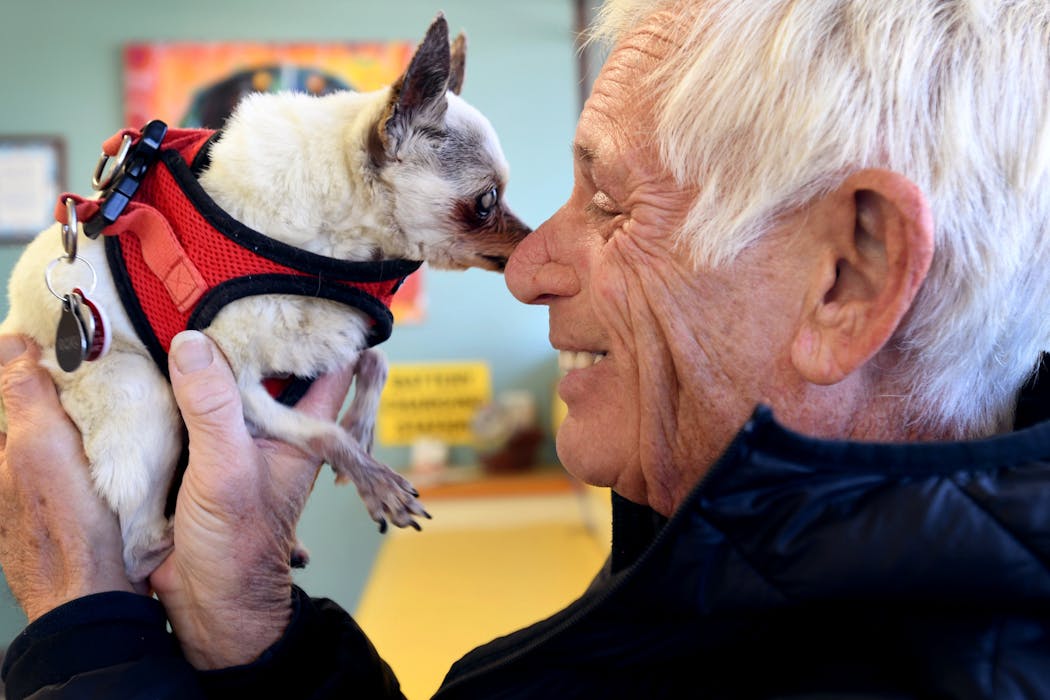
A man holds his 17½-year-old Chihuahua mix, which is receiving end-of-life hospice care.
Brittany Murray/MediaNews Group via Long Beach Press-Telegram and Getty Images

Many Americans struggle to pay for health care for themselves and other members of their families, even if they have insurance coverage.

Some very big bills arise when the furriest members of their households get sick or just need an annual checkup: their dogs. Americans spend an average of about US$1,700 annually on their dogs’ food and care, including $580 for veterinary bills.

All told, Americans spent more than $41 billion on their pets’ veterinary care in 2025, primarily on dogs and cats. Veterinary costs have soared in recent years, rising much faster than inflation in the past decade.

The average cost of any visit to a veterinarian for a dog is about $214 today. Appointment costs for a routine examination for a dog range from $70 to $174, depending in part on the vet’s location and your dog’s conditions.

Estimating future costs

Aidan Vining, a Canadian public policy scholar, and I, a public policy researcher based in the U.S., considered the extent to which economics can explain our canine relationships in our 2024 book “Dog Economics.”

Our own love of dogs helps us understand how people bring dogs into their lives without fully taking account of future costs. One of these often unanticipated costs is for veterinary bills that may break the family budget.

Indeed, a Gallup survey of dog and cat owners conducted for PetSmart Charities in 2024 and 2025 found that 42% of respondents had declined veterinary care for their pets because they could not afford it. In the same study, an additional 38% declined care because they did not believe it was worth the cost.

I think that people should consider the risk of bearing these costs before bringing a dog into the family.

Part of the family

Between 60 million and 68 million U.S. households include at least one dog. That means that as many as half of all occupied U.S. homes include a dog.

Most families with dogs revere them. A survey I conducted with colleagues in 2018 found that 73% of people with pet dogs strongly agreed with the statement “I consider my pets to be part of the family.”

A 2023 Pew Research Center survey found that 51% of pet owners viewed their animals as being as much a member of their family as their human relatives.

Because many of us will spend whatever we can to save the life of our family members, being unable to afford lifesaving care for dogs can be very upsetting.

Steep veterinarian bills

But sometimes dogs require very expensive care. And veterinarians in cities where the costs of living are high tend to charge more than elsewhere.

Treating some fairly common dog ailments can cost a bundle: as much as $3,000 for gastroenteritis, $7,000 for intestinal obstruction surgery, $5,000 for severe pancreatitis and $8,000 for stomach bloat.

The tab for canine cancer treatments involving chemotherapy or radiation can set you back more than $10,000.

The initial phase of treatment for immune-mediated hemolytic anemia for my family’s poodle, for example, cost more than $10,000 in veterinary costs. She is doing well but needs continuing medical care.

A white and tan poodle stands in a grassy spot.
Ming, the author’s family poodle, needs continuing veterinary care.
Dave Weimer

Sometimes pooches require overnight veterinary supervision. That can cost you as much as $1,500 per night they spend in an animal hospital on top of those other expenses.

Many Americans cannot afford to pay for such expensive care – only 41% could cover a $1,000 unanticipated expense of any kind from their savings.

Although only a stopgap,there are charities that provide free or lower-cost veterinary care for the pets of low-income people?

Insurance coverage is rare and often falls short

Pet insurance can help make these expenses more manageable, but it covers only about 4.9 million dogs – about 8% of all American dogs.

Most of those policies have deductibles you have to meet before they’ll reimburse you for at least part of the cost of your animal’s care. Some policies cover treatment only for accidents. Many exclude routine checkups and impose caps on total claims, typically at $5,000.

Ironically, people who can most easily afford pet insurance are also the most likely to have enough money to pay for veterinary expenses.

Insurance premiums for dogs, which depend on breed, where you live, their age and coverage terms, average about $62 per month. Premiums that cover well visits and either have high caps – annual limits on what you can be reimbursed through pet insurance policies – or no caps at all cost more than that.

And pet insurers may exclude preexisting conditions. That is, unlike human patients protected by the Affordable Care Act, insurers can decline to cover dogs with prior illnesses.

To be sure, some claims of over $60,000 have been paid by insurers through policies without any claim caps.

But in most cases, it’s clear that having a dog can mean you’ll bear substantial financial risks when your dog gets injured or ill. And that’s true whether or not you’re paying pet insurance premiums throughout its lifetime – which on average lasts about a dozen years.

Going into debt to pay the vet

Americans who do pay big veterinary bills often have to borrow to do so – 39% of pet owners say they have gone into debt to pay for veterinary care, according to a survey conducted by MetLife’s pet insurance division.

Even when they can afford those bills, many families often find providing care demanding and difficult to accommodate, given their work schedules and the caregiving that other relatives require.

People who cannot afford the cost or lack the time to provide their dogs with the veterinary care required may choose to euthanize, give their dogs to someone else – known as rehoming – or surrender them to shelters. There’s no reliable data about this but I’m certain that veterinary issues contribute to the 6% of the pet surrenders that happen for financial reasons.

And these surrenders contribute to the over 330,000 dogs that U.S. shelters euthanize each year.

3 considerations before acquiring dogs

Although dogs can enrich your life with their devotion and companionship, I urge anyone considering bringing a dog into your home to think through these financial issues first.

1. The potential cost of veterinary care for dogs is high and likely to increase.

Veterinary science will continue to develop new treatments, and some inevitably will be very expensive. As a result, dog owners will more often face heartbreaking choices between extending the life of an animal they consider to be a family member and destabilizing their own finances.

2. Like your human relatives, dogs tend to have more medical problems as they age.

Most people with dogs will outlive their pets and will eventually have to confront canine medical problems. In other words, veterinary costs will at some point challenge almost all pet parents.

3. Whether or not our relatives want to get expensive medical care, we usually err on the side of providing whatever we can afford unless they demand a switch to palliative care only.

Despite our emotional bonds with our dogs, they cannot tell us how they feel about the trade-off between quality of life and longevity. We should not ignore their suffering even when we can afford extensive veterinary care. Sometimes, euthanasia is the most loving decision.

Those facing these difficult end-of-life decisions may benefit from seeking out veterinary palliative and hospice care, which is increasingly available.

The Conversation

David L. Weimer does not work for, consult, own shares in or receive funding from any company or organization that would benefit from this article, and has disclosed no relevant affiliations beyond their academic appointment.

ref. Dogs can need more than kibble, walks and love − consider the escalating expenses of their medical care before you adopt – https://theconversation.com/dogs-can-need-more-than-kibble-walks-and-love-consider-the-escalating-expenses-of-their-medical-care-before-you-adopt-272953