Nature’s not perfect: fig wasps try to balance sex ratios for survival but they can get it wrong

Source: The Conversation – Africa (2) – By Jaco Greeff, Professor in Genetics, University of Pretoria

Television nature programmes and scientific papers tend to celebrate the perfection of evolved traits. But the father of evolution through natural selection, Charles Darwin, warned that evolution would produce quirks and “blunders” that reflect a lineage’s history.

Our recent study from the Kruger National Park in South Africa shows how true this is. Our team of behavioural ecologists found that the behaviour of certain fig wasps, long considered textbook examples of precise adaptation, is far from perfect.

Previous research on fig wasps, but also other parasitoid wasps in general, has focused almost exclusively on design perfection. The aim of our work was to investigate a case where we expected to see “imperfections” due to necessary compromises and the legacy of history.

Our study focused on Ceratosolen arabicus, a tiny wasp (about 2.5mm long) that pollinates sycamore figs. We will call them “pollinators” for simplicity.

For years, researchers have admired how pollinating fig wasps such as C. arabicus adjust the percentage of their offspring that are male (their sex ratios) with near mathematical precision to maximise their reproductive success.

But a previous study suggested that when a pollinator shares a fig with another species of wasp it might incorrectly “adjust” its sex ratio as if it was with a female of its own species.

For our research, we allowed the pollinator to lay eggs on its own or together with a gall wasp (Sycophaga sycomori) or a cuckoo wasp (Ceratosolen galili). These species, like the pollinators, crawl into figs to lay their eggs and may elicit the incorrect response.

We then used a statistical approach to determine how well various hypotheses explained the variation in the data. The hypotheses we tested were:

  • that the pollinators’ sex ratio remained unchanged by the presence of the other species

  • various degrees of effects, for example, that each of the species affects the sex ratio differently.

We found that the other two species of wasps do indeed interfere with the pollinators’ neat sex ratio production mechanism. Pollinators lose up to 5% of their potential grandchildren when they share a fig with a gall wasp, and 12% when they share it with a cuckoo wasp.

Still, the pollinators have survived for millions of years and are not expected to go extinct because of this loss of grandchildren.

Given such a “flaw” in a trait that seemed perfect, biologists should expect to see many “design errors” in life if we look for them. We have to be open to that possibility so that we see what’s actually there and not what we expect to see.

How things work

In each fig, one or a few pollinator mothers lay all their eggs. The mother or mothers’ offspring hatch inside the fig and mate inside. When the mother or mothers’ offspring mature, they mate within the fig, meaning brothers routinely mate with sisters. This means brothers will compete among each other for mating opportunities. In contrast, mated females leave their “birth” fig and disperse to start the cycle anew. But importantly, females compete with unrelated females to find new figs to lay their eggs in.

Therefore, a lone mother should produce just enough sons, about 10% of her total brood, to ensure all her daughters get mated. The rest can be daughters.

The wasps have a simple trick to control the sex ratio directly: unfertilised eggs become sons, while fertilised ones become daughters.

When two mothers lay eggs in the same fig, each must produce more sons, around 25%, because now their sons have to compete with those of the other mother. But if a mother shares a fig with another species, this logic does not apply because competition for mates and mating opportunities for her sons do not change. Therefore, her sex ratio should stay the same as if she were alone.

But it does not.

Pollinator mothers use two simple mechanisms to adjust their sex ratio in response to the presence of other pollinators, but these mechanisms are also triggered by other species.

Let us explain the first mechanism using a gin and tonic analogy.

Imagine a bartender making a G&T: first, he pours a tot of gin (sons) and then fills the rest of the glass with tonic (daughters). Now, imagine two bartenders unknowingly making a G&T in one glass. They both add a tot of gin and then top up with tonic. The result is a stronger drink with more gin.

Pollinator mothers do something similar. They tend to lay male eggs first, and then gradually switch to laying females. We call this the ladies-last effect. But when other species like the cuckoo wasp are present, this pattern still changes the sex ratio because the second species shrinks the glass’s total size. As a consequence the pollinator ends up laying fewer daughters. This can be seen in the figure moving from right to left along the x-axis.

The second mechanism works differently but leads to the same problematic outcome. It relies on an active adjustment of the sex ratio. Although the G&T analogy breaks down, this is like each bartender adding more than a tot of gin when he realises there is a second bartender mixing a drink in the glass.

Similarly, when a pollinator detects another pollinator, she increases the number of sons. But when another species is present, she still behaves as if she is competing with her own kind, increasing her number of sons, as can be seen in the figure moving upwards along the y-axis.

Since both mechanisms continue operating inappropriately when other species are present, the sex ratios become erroneously skewed. Specifically, the sex ratio of a single mother shifts from 10% sons when she is alone, to 16% when she is with a gall wasp, and to 26% when she is with the cuckoo wasp. It should have remained at 10%.

All that glitters is not gold

As an isiZulu proverb says: “Ikiwane elihle ligcwala izibungu”, literally translated to: “The nicest-looking fig is usually full of worms.” Pollinator sex ratio adjustment has been touted as a prime example of how perfectly natural selection can optimise the design of biological systems. But this is an oversimplification.

In reality, the history of a trait and compromises between a trait’s various functions can direct evolution to imperfect solutions. For instance, here evolution did not “design” separate “solutions” for with-own-species and with-other-species scenarios.

Instead, evolution seems to have optimised it for the average condition, an imperfect, but workable, compromise. The cost in number of grandchildren due to this compromise is astronomical because pollinators in the Kruger National Park frequently share a fig with another pollinator, galler or a cuckoo wasp.

Such trade-offs are likely common in nature. Evolution tends not to redesign from scratch; rather, it tinkers with what is already there. As a result, we often get solutions that work well enough, rather than perfectly.

So next time you marvel at a natural wonder, remember: the story is rarely one of flawless design. It is a story of imperfect compromises, shaped by what evolution could do with what it had. And that story is far richer and more real than any Hollywood ending.

The Conversation

Jaco Greeff received funding from the National Research Foundation. Any opinion, findings and conclusions or recommendations expressed in this material are those of the authors and therefore the NRF does not accept any liability in regard thereto.

ref. Nature’s not perfect: fig wasps try to balance sex ratios for survival but they can get it wrong – https://theconversation.com/natures-not-perfect-fig-wasps-try-to-balance-sex-ratios-for-survival-but-they-can-get-it-wrong-260852

Supreme Court opens with cases on voting rights, tariffs, gender identity and campaign finance to test the limits of a constitutional revolution

Source: The Conversation – USA – By Morgan Marietta, Professor of American Civics, University of Tennessee

The U.S. Supreme Court building at dawn in Washington, D.C. Samuel Corum/Bloomberg via Getty Images

The most influential cases before the U.S. Supreme Court this term, which begins on Oct. 6, 2025, reflect the cultural and partisan clashes of American politics.

The major cases in October and November address the role of race in elections, conversion therapy and the Trump tariffs. Later cases include campaign finance and transgender sports.

This year’s controversies focus on three dominant themes. One is the continuing constitutional revolution in how the justices read our basic law. The court has shifted from a living reading of the Constitution, which says the Constitution should adapt to the American people’s evolving values and the needs of contemporary society, to an original reading, which aims to enforce the constitutional principles understood by the Americans who ratified them.

Another clear theme is the deep cultural division among Americans. The core disputes at the court this year reflect controversial factual questions about gender and race: How pervasive and influential is racism in the current day? Are gender transitions a recognized fact, which means that they must be accepted in sports competitions, or can a state assert that trans athletes are not women?

A final theme is the struggle for partisan advantage embedded in several cases.

A portion of the U.S. Constitution, torn into blue and red pieces.
The justices’ constitutional interpretations could have major partisan significance.
Douglas Rissing, iStock/Getty Images Plus

Constitutional revolution

Until just a few years ago, the majority of justices would have agreed that the proper way to read the Constitution was as an evolving document, an approach usually described as living constitutionalism.

The new majority reads the Constitution as an expression of enduring principles, which maintain their historical meaning unless the American people collectively decide to amend the document, an approach known as originalism.

Since 2022, this revolutionary shift has led to dramatic changes in the law on abortion, religion, guns, affirmative action and the power of federal agencies to regulate in areas such as the environment, public health or student debt.

This year, the constitutional revolution – “a historic constitutional course correction.” as legal scholars Gary Jeffrey Jacobsohn and Yaniv Roznai put it – turns to transgender politics.

Little v. Hecox and West Virginia v. B.P.J. ask whether a state can ban transgender athletes from participating in girls or women’s sports. The plaintiffs are middle school and university students who were banned by state laws from participating as a female competitor. They are asking the court to rule that transgender identity is a protected category similar to race and gender under the equal protection clause of the 14th Amendment.

Originalists argue that the meaning of the 14th Amendment is clear and fixed. It establishes the equal status of racial minorities as holders of rights. But originalists do not believe the equal protection clause was meant to apply to sexual identities unless that is explicitly approved through a constitutional amendment by the American public.

Originalists also emphasize the role of federalism as a core constitutional principle. Federalism allocates a great deal of authority to state legislatures to make decisions when a question of rights is uncertain.

For these reasons the court majority is likely to see the regulation of who gets to participate in women’s sports as a state-by-state decision.

Cultural divisions, disputed perceptions

The status of transgender identity also reflects the disputed perceptions of reality that have come to dominate American politics. In essence, the Iowa and West Virginia sports cases ask the court to rule whether a transgender girl – a person assigned male at birth who has transitioned to align with their identity as a girl or woman, as the AP Stylebook phrases it – is a girl or a boy.

The court is likely to leave such questions about what is factually true for state legislatures to determine.

The same need for the court to determine who can decide what is or is not a legitimate fact also applies to this year’s controversy over conversion therapy. Colorado bans the practice – condemned by many professional medical associations – in which counselors attempt to alter sexual orientation or gender identity.

Chiles v. Salazar challenges the Colorado law as a violation of the First Amendment’s protections of free speech and religious liberty.

An original reading of the First Amendment provides strong support for open expression on controversial topics, even by medical professionals. But on the factual question of whether homosexuality or gender identity in young people is indisputably innate or immutable, the court may defer to state legislatures to decide whether licensed professionals must assert only a specific set of accepted facts.

Partisan advantage

Many observers perceive a partisan as well as principled divide on the current court. Decisions in several cases this year potentially give a distinct advantage in future elections to Democrats or Republicans.

The most clear case may be about the regulation of campaign finance. National Republican Senatorial Committee v. FEC – a lawsuit begun in 2022 by then-U.S. Sen. JD Vance – asks the court to overturn a restriction that bars political parties from coordinating unlimited spending on campaign advertising with the official campaign.

Many Democrats believe Republicans will be the larger beneficiaries in the coming years if the court rules that the current limits violate the First Amendment.

Then there’s the challenge to the constitutionality of the Trump tariffs.

Learning Resources v. Trump will determine whether the recent tariffs are authorized by Congress under the International Emergency Powers Act of 1977. The answer hinges on the application of what’s known as the “major questions doctrine,” which limits presidential authority over issues of great economic or policy importance in the absence of direct endorsement from Congress.

The major questions doctrine is an originalist concept, but in the court’s view it may not apply to actions in the foreign policy realm – including tariffs – where the president has greater discretion.

A container ship loaded with hundres of containers, coming into a port.
Will the court strike down Trump’s tariffs on imported goods such as those on this ship in Oakland, Calif.?
Justin Sullivan/Getty Images

Race and elections

The case that represents all three trends at the court is Louisiana v. Callais on the creation of majority-Black congressional districts.

The Voting Rights Act of 1965 outlaws racial discrimination in voting. This landmark legislation from the civil rights era helped raise the rate of Black voter registration and turnout in Southern states from less than half the white rate to exceeding it over the past 60 years.

The question in front of the court is whether the law requires a state to make sure that some congressional districts have a majority of Black voters.

The argument opposing the intentional creation of racial districts is that the equal protection clause of the 14th Amendment demands the same treatment of all citizens regardless of race, banning any distinction even when designed to benefit minorities.

Underlying the differences of opinion are competing perceptions of the prevalence and influence of racism in the current day. This dispute was clear in the court’s 2013 Shelby County decision, which struck down the part of the Voting Rights Act that limited Southern states from passing new elections laws without “pre-clearance” from the Department of Justice. That requirement aimed to ensure that new laws would not discriminate against Black voters, whether intentionally or unintentionally.

In striking down that requirement, Chief Justice John Roberts ruled that “no one can fairly say” that the South “shows anything approaching the ‘pervasive,’ ‘flagrant,’ ‘widespread,’ and ‘rampant’ discrimination that faced Congress in 1965.”

Justice Ruth Bader Ginsburg famously responded that removing the Voting Rights Act’s protections was “like throwing away your umbrella in a rainstorm because you are not getting wet.”

The ultimate number of majority-Black districts in Louisiana is not only a question of constitutional principles applied to prevailing facts. It is also about partisan advantage. Partisans on both sides are well aware that a majority-Black district is also a Democratic district.

So whether the state ends up with two or just one – or potentially even none – of its six congressional districts shaped by race could shift the future partisan balance in a closely divided Congress.

With partisan advantage, clashing perceptions of reality and revolutionary readings of the Constitution all in play, the rulings of the Supreme Court this year will reach far into American politics and culture.

The Conversation

Morgan Marietta does not work for, consult, own shares in or receive funding from any company or organization that would benefit from this article, and has disclosed no relevant affiliations beyond their academic appointment.

ref. Supreme Court opens with cases on voting rights, tariffs, gender identity and campaign finance to test the limits of a constitutional revolution – https://theconversation.com/supreme-court-opens-with-cases-on-voting-rights-tariffs-gender-identity-and-campaign-finance-to-test-the-limits-of-a-constitutional-revolution-265720

La migration nordique de la forêt tempérée ne se passe pas comme prévu

Source: The Conversation – in French – By Todor Slavchev Minchev, Doctorant en écologie forestière, Université du Québec à Rimouski (UQAR)

Et si la forêt boréale n’était pas aussi fragile qu’on le croit ? Contrairement aux modèles qui prédisent son recul rapide devant les érablières tempérées, son histoire écologique révèle une étonnante résilience. Les érables, eux, avancent plus lentement qu’annoncé. Résultat : la grande transition forestière promise ne se fera peut-être pas aussi vite qu’on l’imagine.

La composition et la structure des forêts résultent d’une dynamique écologique complexe influencée par plusieurs facteurs, dont la nature du sol, les perturbations écologiques (feux, chablis, épidémies d’insectes), le climat et la capacité des espèces à répondre à ces conditions.

La forêt boréale constitue un vaste biome bordé au sud par la forêt tempérée. Comme partout où deux grands milieux naturels se rencontrent, la transition ne se fait pas de façon abrupte. Elle forme plutôt une zone intermédiaire appelée écotone, où les caractéristiques des deux biomes se mélangent. Cette zone s’appelle l’écotone de la forêt boréale-tempérée et elle engloble les forêts du sud du Québec. On y observe des petits peuplements d’arbres typiques de la forêt boréale et de la forêt tempérée, qui deviennent de plus en plus rares et isolés à mesure qu’ils approchent des conditions qui dépassent ce qu’ils peuvent tolérer pour survivre.

Respectivement doctorant en écologie forestière et professeur en écologie végétale à l’Université du Québec à Rimouski, nous nous intéressons aux dynamiques passées et actuelles des peuplements situés à la limite nordique des espèces de la forêt tempérée. Parmi celles-ci figure l’érable à sucre, un arbre emblématique sur les plans culturel, écologique et économique.

Notre objectif est de reconstruire l’histoire écologique des peuplements marginaux afin de mieux comprendre leur trajectoire dans le temps et d’utiliser ces connaissances pour anticiper l’effet des changements globaux contemporains sur la forêt québécoise.


Cet article fait partie de notre série Forêt boréale : mille secrets, mille dangers

La Conversation vous propose une promenade au cœur de la forêt boréale. Nos experts se penchent sur les enjeux d’aménagement et de développement durable, les perturbations naturelles, l’écologie de la faune terrestre et des écosystèmes aquatiques, l’agriculture nordique et l’importance culturelle et économique de la forêt boréale pour les peuples autochtones. Nous vous souhaitons une agréable – et instructive – balade en forêt !


Une frontière en perpétuel mouvement

Depuis près de trois millions d’années, le climat planétaire oscille naturellement entre des périodes glaciaires et interglaciaires en raison de variations cycliques de l’orbite terrestre. L’interglaciaire actuel, amorcé il y a environ 12 000 ans, est appelé l’Holocène. Bien que plus stable que les périodes glaciaires, cette période géologique a connu des changements climatiques notables.

Par exemple, entre 8000 à 4000 ans avant aujourd’hui, l’Holocène moyen a été plus chaud que l’actuel. Les saisons de croissance plus longues dans l’écotone de la forêt boréale mixte auraient alors provoqué un déplacement de la limite nordique de certaines espèces tempérées de plus de 100 km au-delà de leur répartition actuelle.


À lire aussi :
Au Québec, les feuillus pourraient se déplacer vers le nord. Voici les conséquences potentielles sur le paysage forestier boréal


Or, pour que des espèces tempérées puissent migrer vers le nord, les espèces boréales doivent céder leur place. Au cours de l’Holocène moyen, 8000 à 4000 ans avant aujourd’hui, les proportions d’espèces dans l’écotone auraient penché en faveur de certaines espèces tempérées. À l’inverse, le Néoglaciaire, une période de refroidissement global entamé il y a 4000 ans a inversé cette tendance. Les espèces tempérées se seraient repliées vers le sud, alors que les espèces boréales ont regagné du terrain dans l’écotone.

Aujourd’hui, un nouveau revirement s’annonce avec le réchauffement climatique d’origine humaine. Les modèles prévoient que l’actuel écotone de la forêt boréale mixte disparaîtra presqu’entièrement du paysage d’ici 2100, au profit de la forêt tempérée dominée par l’érable à sucre.


À lire aussi :
Pourquoi certains arbres perdent-ils leurs feuilles alors que d’autres restent verts toute l’année ?


Un phénomène particulier

Il est toutefois probable que les espèces de la forêt tempérée ne réagissent pas toutes de manière synchronisée. De nouvelles données paléoécologiques provenant d’érablières situées à la limite nordique de l’érable à sucre et de l’érable rouge indiquent que les espèces de la forêt tempérée ont réagi individuellement face aux changements climatiques passés.

Lors de l’intervalle de températures chaudes à l’Holocène moyen, certaines espèces tempérées ont pu profiter de l’avantage que les conditions climatiques apportaient pour repousser leurs limites nordiques plus loin.

Les érables, contrairement à d’autres espèces tempérées, n’ont pas atteint la limite nordique de leur distribution durant cette période chaude. Ils se sont plutôt établis alors que la température moyenne diminuait et que les espèces boréales augmentaient en abondance dans l’écotone. Puisque les érables sont des espèces tempérées, ils nécessitent des conditions environnementales différentes des espèces boréales.

L’établissement des érables en même temps que l’augmentation de l’abondance des conifères boréaux dans le paysage semble donc paradoxal.


Déjà des milliers d’abonnés à l’infolettre de La Conversation. Et vous ? Abonnez-vous gratuitement à notre infolettre pour mieux comprendre les grands enjeux contemporains.


Deux facteurs à considérer

Plusieurs facteurs pourraient expliquer ce phénomène. Les forêts de conifères boréaux sont plus propices aux grands feux sévères que les forêts décidues tempérées. La réduction des espèces boréales dans l’écotone à l’Holocène moyen aurait entraîné une diminution de la taille et de la sévérité des incendies.


À lire aussi :
Les incendies de forêt récents sont-ils pires que ceux des deux derniers siècles ?


Des espèces tempérées comme le pin blanc auraient alors été dominantes, fermant le couvert forestier et limitant la capacité des érables à s’établir. Le retour des conifères boréaux lors du refroidissement Néoglaciaire il y a 4000 ans a favorisé une augmentation des grands feux, créant des ouvertures temporaires du couvert forestier. Certaines espèces tempérées opportunistes, comme l’érable rouge, ont alors pu s’y établir.


À lire aussi :
Feux de forêt : voici pourquoi il faut une structure nationale pour mieux les gérer


Par ailleurs, les premières preuves empiriques de la présence de l’érable à sucre à sa limite nordique ne remontent qu’à 2200 ans avant aujourd’hui. Ce délai entre l’établissement des deux érables pourrait refléter le temps nécessaire pour que la présence préalable d’érable rouge modifie les propriétés du sol, le rendant propice à l’établissement de l’érable à sucre.

Ce dernier dépend obligatoirement de la présence de mycorhizes symbiotiques absentes en milieu boréal, mais qu’il partage avec l’érable rouge, moins exigeant. Les mycorhizes, des champignons qui s’intègrent dans le système racinaire des plantes dans une relation symbiotique, aident les arbres en augmentant leur capacité d’extraire les nutriments du sol. Dans le cas de l’érable à sucre, un arbre particulièrement sensible aux sols pauvres, la présence de mycorhizes semble permettre l’extraction du peu de nutriments des sols nordiques, permettant l’établissement de l’espèce.

Ainsi, une interaction écologique entre les deux érables pourrait avoir facilité l’expansion tardive de l’érable à sucre vers le nord.

Une nouvelle compréhension

En évaluant les réponses des espèces face aux changements climatiques passés, les études rétrospectives offrent un nouvel éclairage sur les scénarios futurs.

Les modèles prédictifs pourraient sous-estimer la résilience de la forêt boréale et surestimer la capacité d’expansion des espèces tempérées.

L’histoire écologique des érablières nordiques suggère qu’il faudra bien plus que quelques décennies de réchauffement climatique avant que la forêt boréale ne se transforme en érablière. Ce délai peut s’étendre à des millénaires avant que les mycorhizes et les espèces compagnes bénéfiques préparent le terrain pour l’établissement de l’érable à sucre.

La Conversation Canada

Todor Slavchev Minchev a reçu des financements du Conseil de recherches en sciences naturelles et en génie du Canada, du Fonds de recherche du Québec – Nature et technologies et du Programme des chaires de recherche du Canada.

Guillaume de Lafontaine a reçu des financements du Conseil de recherches en sciences naturelles et en génie du Canada, du Fonds de recherche du Québec – Nature et technologies et du Programme des chaires de recherche du Canada.

ref. La migration nordique de la forêt tempérée ne se passe pas comme prévu – https://theconversation.com/la-migration-nordique-de-la-foret-temperee-ne-se-passe-pas-comme-prevu-261131

Qu’est-ce que l’intelligence culturelle ?

Source: The Conversation – in French – By Marie Chédru, Enseignante-Chercheuse, Sciences Humaines et Sociales, UniLaSalle

L’intelligence culturelle compte un ensemble de compétences qui peuvent s’apprendre et se développer. Andy Barbour/Pexels, CC BY

Que ce soit à l’école, au travail ou dans nos loisirs, nous côtoyons des individus aux origines culturelles diversifiées. L’« intelligence culturelle », qui permet de comprendre et de s’adapter à des codes culturels différents, est un atout essentiel pour favoriser le vivre-ensemble.


Que signifie être intelligent ? Réussir un test de logique ? Résoudre une équation ? Avoir une bonne mémoire ? L’intelligence a longtemps été réduite à un score de QI. Pourtant, dès les années 1920–1940, des psychologues américains comme Edward Thorndike, Louis Thurstone ou Raymond Cattell soulignaient déjà l’existence de différentes formes d’intelligence.

Dans les années 1980, c’est un autre psychologue américain Robert Sternberg qui propose une approche qui distingue trois dimensions complémentaires : l’intelligence analytique (raisonner, comparer, résoudre des problèmes), l’intelligence créative (imaginer, faire face à la nouveauté) et l’intelligence pratique (s’adapter à son environnement, agir efficacement). Selon son approche, être intelligent, c’est avant tout savoir atteindre ses objectifs de vie, dans un contexte donné, en mobilisant ses forces et en compensant ses faiblesses.

Interagir dans des environnements multiculturels

C’est dans la continuité des travaux de Sternberg qu’a émergé la notion d’intelligence culturelle, ou cultural intelligence (CQ). Proposée par Earley et Ang en 2003, elle désigne la capacité à comprendre les différences culturelles, à s’y adapter et à interagir efficacement dans des environnements multiculturels. L’objectif initial était d’expliquer pourquoi certains expatriés réussissent mieux que d’autres lors de missions internationales. Les chercheurs ont ainsi identifié quatre dimensions complémentaires de l’intelligence culturelle.

La dimension métacognitive correspond à la capacité de prendre conscience de ses propres biais culturels et d’ajuster sa manière de penser et d’interagir en fonction du contexte. Par exemple, un manager français peut être habitué à exprimer ses critiques de manière très directe. Face à des interlocuteurs issus d’un contexte culturel où celles-ci sont formulées de façon plus implicite, il comprend que ce style peut être perçu comme trop abrupt. Il revoit alors son approche pour faciliter la coopération.

La dimension cognitive renvoie aux connaissances générales sur d’autres cultures, leurs normes et leurs pratiques : savoir, par exemple, qu’au Japon échanger une carte de visite suit un rituel précis, qu’en Allemagne tout retard est perçu comme un véritable manque de respect ou qu’aux États-Unis le small talk au cours d’une réunion est une étape incontournable avant d’entrer dans le vif du sujet.

La dimension motivationnelle reflète l’envie et la confiance nécessaires pour interagir avec des personnes culturellement différentes. On la retrouve, par exemple, chez des étudiants qui choisissent volontairement de rejoindre une équipe internationale même si cela demandera plus d’efforts de communication.

Enfin, la dimension comportementale désigne la faculté d’adapter concrètement ses comportements verbaux et non verbaux lors d’une interaction interculturelle. Cela peut impliquer de ralentir son débit de parole, de moduler le ton de sa voix ou encore d’ajuster la distance avec son interlocuteur, en fonction du contexte culturel.

Une compétence essentielle

De nombreuses recherches confirment les effets positifs de l’intelligence culturelle. À titre d’exemples, elle aide les expatriés à mieux s’adapter et à réduire leur anxiété, elle améliore le leadership et la performance des équipes multiculturelles, ou encore elle stimule la coopération et l’innovation en facilitant le partage de connaissances.

D’abord pensée pour accompagner les cadres en mission à l’étranger, l’intelligence culturelle est aujourd’hui reconnue comme une compétence essentielle dans de nombreux contextes : au travail, à l’école, mais aussi dans la vie quotidienne, partout où des personnes issues de cultures différentes se côtoient.

Les recherches montrent aussi que cette compétence peut s’apprendre et se développer. La formation interculturelle, qu’il s’agisse de cours, de jeux de rôle ou de simulations, permet de mieux décoder les différences culturelles. Cela dit, ce sont surtout les expériences immersives qui s’avèrent les plus efficaces : les projets en équipes multiculturelles ou les séjours à l’international renforcent de manière durable l’intelligence culturelle.

Ce que révèle une étude auprès d’élèves ingénieurs

L’intelligence culturelle concerne la grande majorité des étudiants, appelés à apprendre et à travailler dans des environnements multiculturels. C’est dans cette perspective que nous avons mené une étude auprès d’élèves ingénieurs en mobilité internationale pour comprendre comment cette expérience pouvait renforcer leur intelligence culturelle.

Concrètement, nous avons évalué leur intelligence culturelle à l’aide d’un questionnaire scientifiquement reconnu administré deux fois : avant leur départ et à leur retour de mobilité. Cette méthodologie longitudinale permet de comparer les niveaux initiaux et finaux et de mesurer l’évolution des différentes dimensions de l’intelligence culturelle.

Les résultats sont clairs : la mobilité internationale fait progresser significativement l’intelligence culturelle, surtout chez ceux qui avaient peu voyagé auparavant ou qui n’étaient pas spontanément ouverts aux autres cultures. Autrement dit, plus on est « novice », plus on progresse. C’est ce que nous appelons « l’effet première fois » : lors d’un premier contact prolongé avec une autre culture, chacun est amené à réviser ses repères.

Ces résultats ont des implications directes pour la formation des élèves ingénieurs. Une mobilité à l’international n’est pas seulement un atout à valoriser sur un CV : c’est une occasion unique de développer des compétences transversales désormais indispensables dans le monde du travail. Les employeurs attendent en effet de leurs collaborateurs qu’ils soient non seulement techniquement compétents, mais aussi capables de s’adapter à des environnements multiculturels et de coopérer efficacement au-delà des frontières.

Nos résultats vont dans le même sens que d’autres recherches qui montrent que l’intelligence culturelle dépasse largement le cadre des séjours à l’étranger. Elle favorise la coexistence pacifique en réduisant les préjugés, elle aide à mieux coopérer dans le travail ou dans les études, enfin, elle prépare chacun à évoluer dans des environnements internationaux. Les écoles et les universités jouent un rôle clé : en développant ces compétences, elles contribuent à former des professionnels plus adaptables, mais aussi à bâtir une société plus inclusive.


Cet article est publié dans le cadre de la Fête de la science (qui a lieu du 3 au 13 octobre 2025), dont The Conversation France est partenaire. Cette nouvelle édition porte sur la thématique « Intelligence(s) ». Retrouvez tous les événements de votre région sur le site Fetedelascience.fr.

The Conversation

Les auteurs ne travaillent pas, ne conseillent pas, ne possèdent pas de parts, ne reçoivent pas de fonds d’une organisation qui pourrait tirer profit de cet article, et n’ont déclaré aucune autre affiliation que leur organisme de recherche.

ref. Qu’est-ce que l’intelligence culturelle ? – https://theconversation.com/quest-ce-que-lintelligence-culturelle-265803

Supreme Court to decide if Colorado’s law banning conversion therapy violates free speech

Source: The Conversation – USA (3) – By Timothy R. Holbrook, Professor of Law, University of Denver

The US Supreme Court will hear oral arguments for yet another case involving the LGBTQ+ community. Saul Loeb/AFP via Getty Images

The constitutionality of a Colorado law that bans so-called “conversion therapy” is scheduled to go before the Supreme Court on Oct. 7, 2025. The question at the center of the case, Chiles v. Salazar, is whether a therapist who uses talk therapy to try to convince minors to change their sexual orientation or gender identity is protected by a First Amendment right to free speech.

Twenty-three other states and the District of Columbia also ban conversion therapy.

People stand behind a table cheering as a white man in a blue suit jacket signs bills into law.
Colorado Gov. Jared Polis is applauded as he signs a law banning the use of conversion therapy on minors.
Aaron Ontiveroz/The Denver Post via Getty Images

I am a legal scholar who has explored aspects of the rights of the LGBTQ+ community, and this case is an important test of the status of the community’s rights and protections at the Supreme Court.

Why it matters

The case has similarities to the court’s 2025 decision in United States v. Skrmetti that upheld state laws banning gender-affirming care for transgender minors, such as the use of puberty-blocking hormones. LGBTQ+ persons viewed those bans as hurting the community, whereas bans like Colorado’s on conversion therapy are viewed as protecting the community.

Technically, the legal issue in Skrmetti was different: The court addressed whether the ban violated the equal protection clause of the 14th Amendment, which prohibits states from discriminating against particular protected classes, such as race or gender, absent a particularly strong state interest. In the Skrmetti decision, the court held there was no discrimination on the basis of sex, which meant the law received no heightened scrutiny.

Instead, the court assessed whether there was a “rational basis” for the law and held that Tennessee had “plausible reasons” for the ban: protecting minors from harms such as sterility and treatments whose long-term effects are unclear. The court upheld the law banning gender-affirming care even though major U.S. medical professional associations oppose such bans and support such care.

The facts of Chiles

In Chiles, the issue is freedom of speech, not equal protection. But this time the Colordo ban on conversion therapy aligns with leading medical associations.

Kaley Chiles is a licensed professional counselor who uses talk therapy in her counseling practice. Chiles identifies as Christian and often works with Christian clients. Chiles “does not try to help minors change their attractions, behavior, or identity, when her minor clients tell her they are not seeking such change.” She would like to use talk therapy with clients “who have same-sex attractions or gender identity confusion and who also prioritize their faith above their feelings” and who “are seeking to live a life consistent with their faith,” according to court filings.

Chiles sued Colorado to invalidate the statute as unconstitutional for violating her freedom of speech and religion under the First Amendment of the U.S. Constitution. Both the federal district court in Colorado and the U.S. Court of Appeals for the 10th Circuit denied her request for a preliminary injunction, rejecting both arguments.

The Supreme Court agreed only to hear her free speech claim, leaving the 10th Circuit’s rejection of her religious liberty claim in place.

Is ‘talk therapy’ speech or conduct?

The Supreme Court first will need to address whether talk therapy is protected speech under the First Amendment. This decision likely will determine the case’s outcome.

Chiles contends that talk therapy is protected speech and that Colorado is impermissibly regulating the content of her potential speech. The law permits her to help minor clients embrace their sexual orientation or gender identity through talk therapy but not to change it. If this therapy is speech, it would be regulating the content of her speech because the law determines what can and cannot be said. Affirming talk therapy is allowed, but conversion therapy is prohibited.

Colorado, however, insists that the statute regulates medical conduct, which is not protected by the First Amendment, even if there is an incidental burden on speech.

A state undisputably can regulate medical activity, such as the prescription of a medicine. If the therapy involved the use of medicines, there would be no dispute because no speech would be involved. The Colorado conversion therapy ban is part of a broader statute, the Mental Health Practice Act, which prohibits acts that could harm patients. Thus, talk therapy, according to Colorado, is treatment – like providing medicine – that the state is free to regulate.

Conversion therapy is also deemed ineffective and harmful to children by leading medical associations, such as the American Psychiatric Association and the American Medical Association. The 10th Circuit noted that the Colorado ban regulates treatment, not expression, because Chiles is free to share her views on conversion therapy, even with minors. She simply cannot engage in actual therapy under the law.

People with protest and support signs stand outside of the U.S. Supreme Court building.
Members of both sides of the debate stand in front of the U.S. Supreme Court on Dec. 5, 2022. The high court heard oral arguments in a case involving the owner of a website design company in Colorado who refused to create websites for same-sex weddings despite a state antidiscrimination law.
Kent Nishimura/Getty Images

The Supreme Court will need to decide whether talk therapy is speech or conduct. The court often takes a broad view of what constitutes speech, particularly in the area of LGBTQ+ rights. In 303 Creative LLC v. Elenis, another case out of Colorado, the court held that creating a wedding webpage was deemed protected speech. This 2023 decision permitted the webpage designer to deny services to same-sex couples requesting webpages for their weddings, in violation of Colorado’s law prohibiting sexual orientation discrimination.

If the court concludes that conversion therapy is conduct, then the Colorado law is subject to the same standard used in Skrmetti – rational basis – and likely will survive. In light of 303 Creative, however, the court may deem it speech.

If talk therapy is speech, can Colorado ban it?

Simply because an act constitutes speech protected by the First Amendment does not mean the state cannot regulate it. For example, the state can rightly regulate defamatory statements or obscene material.

Courts, however, apply an exacting standard of review, known as strict scrutiny, and rarely does a law survive such analysis. Colorado must show that its ban on conversion therapy is narrowly tailored to achieve a compelling state interest. Colorado contends that ensuring minors receive safe and effective mental health care is a compelling interest, and the law is narrowly tailored because “(i)t prohibits only specific harmful treatment while leaving therapists free to engage in any other appropriate therapy.”

Chiles’ strongest argument is that the law is not narrowly tailored for a number of reasons. Chiles contends the law is too broad because it bans more speech than necessary to protect against any harms to LGBTQ+ minors, including any therapy to change behavior, expression, identity or feeling.

For example, she argues she could not counsel a gay client toward celibacy. It is also not properly tailored, Chiles argues, because it exposes minors to the harms of conversion therapy by its omissions: It applies only to licensed mental health professionals and not others, such as life coaches, and it applies only to minors. If conversion therapy is as harmful as Colorado alleges, these gaps show the lack of proper tailoring, says Chiles.

The court has frequently struck down laws that regulate the content of speech. If the court concludes that talk therapy is protected speech, it is likely the court will find the Colorado ban on conversion therapy unconstitutional.

Such a decision would contrast sharply with Skrmetti. If the court strikes down the Colorado law, then a law meant to protect LGBTQ+ minors will be invalidated while one deemed harmful to trans minors will stand.

The court again will have gone against the predominant view of medical experts in a way detrimental to the LGBTQ+ community, potentially adding to criticism of the Supreme Court as being too political.

Read more of our stories about Colorado.

The Conversation

Timothy R. Holbrook does not work for, consult, own shares in or receive funding from any company or organization that would benefit from this article, and has disclosed no relevant affiliations beyond their academic appointment.

ref. Supreme Court to decide if Colorado’s law banning conversion therapy violates free speech – https://theconversation.com/supreme-court-to-decide-if-colorados-law-banning-conversion-therapy-violates-free-speech-265529

Windhoek’s Old Location was a place of pain, but also joy – new book

Source: The Conversation – Africa – By Henning Melber, Extraordinary Professor, Department of Political Sciences, University of Pretoria

All that’s left of a famous settlement called the Old Location in Windhoek, Namibia, is a graveyard and a monument to remember the residents who were killed while protesting their forced removal in 1959.

But a new open source book documents how the spirit and culture that drove resistance are kept alive by those who lived there.

After the Old Location massacre the national liberation movement Swapo would be founded to fight for independence.

The Windhoek Old Location tells the residents’ stories with historical images by Dieter Hinrichs and words by Henning Melber. We asked Melber more about the site.


What is a township and can you give us a brief history of this one?

Townships were established in southern African settler colonial societies by white minority regimes. They created reserves for ethnic groups classified as “tribes” to separate whites from other local communities in cities and towns.

In Namibia, the Old Location was the main residential area for Africans in the capital, Windhoek. The settlement was established from 1903 during German colonial rule. After the first world war German colonies were handed over to allied powers and South Africa was entrusted with the administration of its neighbour, turning it into a province-like entity.

Following South Africa’s apartheid doctrine, Black Namibians were physically separated by ethnic classification. The Old Location was then just called a Location. Residents were from various local ethnic communities, living together peacefully and sharing a common identity in daily life.

But since the late 1950s the residents were relocated to a new, ethnically subdivided township that had been demarcated further from the capital’s “white” city centre where many worked as underpaid labourers. The so-called Coloureds and Rehoboth Basters would then be separated and moved to a new suburb, Khomasdal.

When the Location’s “Native Advisory Board” was asked for a name for the new destination, it suggested Katutura. Through ignorance of the meaning of this Otjiherero word (“A place where we do not stay”), the proposal was adopted.

Towards the end of 1959, boycotts and demonstrations in protest of the forced removal were organised, mostly by women. On 10 December some 13 people were killed and many more injured in a clash with the police. The day is remembered as Human Rights Day/Namibian Women’s Day.

Residents who refused to move were deported to reserves. All homes were demolished. This destruction followed South Africa’s policy to raze established communities to establish white suburbs. The Location was closed in August 1968.

A year earlier, in August 1967, the first clash between South African soldiers and armed fighters of the liberation movement Swapo took place in the north of the country. The trauma of the forced removals from the Old Location was a turning point for a liberation struggle that would last until independence in 1990.

What role does memory play in telling this story?

The Old Location’s history has so far been preserved mainly in archives and people’s memories. We wanted it to be available in the public sphere. The book documents resilience and the determination to resist apartheid. It also highlights the unique social interaction in the Old Location.

It includes many personal memories. Bience Gawanas, chancellor of the University of Warwick, was born in the Old Location in 1956. Her father was a motor mechanic who owned a shop and filling station. He opposed the forced removal. In her preface she stresses the need

to tell our stories to bring back the values of humanity and community in our lives…

Uazuvara Katjivena, who published his grandmother’s story of the German genocide in Namibia, emphasises in his postscript:

Documenting aspects of what happened then and the lives we had under apartheid … are an important reminder that we did not surrender.

The voices of former residents recall a community nurtured by a spirit of extended family and solidarity. Zedekia Ngavirue, the Location’s first social worker, was involved in the resistance. Years later he said:

It was, indeed, when we owned little that we were prepared to make the greatest sacrifices.

For many, the Old Location was a place of security and harmony. Daniel Humavindu remembers:

The Old Location created a great family in which residents looked out for each other.

According to former resident Petrina Rina Tira Biwa:

The segregation we experienced when we moved to Katutura was not there.

“On Saturdays,” stressed educator and activist Ottilie Abrahams, “you are at the football field. Everybody used to go there, like a religion.”

And former resident Anna Campbell remembers two of the Location’s most famous bands, Johannes Mareko’s and Laydon’s:

It was safe to attend the dances. We also had films.

Why are the photos so important?

The book’s photos offer an authentic face and they capture the atmosphere of the time. They were taken mainly in 1959 and 1960 by young German photographer Dieter Hinrichs. After training in Germany he took a temporary job in a Windhoek photo studio. In his spare time he took the photos that today offer a rare glimpse into Black social realities of the time.

They show ordinary daily life and cultural activities. Dancing competitions were a weekend entertainment. Church events created togetherness. Every year the Location’s Coon Carnival would invade the Windhoek inner city.

Alongside these photos are others of the loss and pain that characterised the move to Katutura. In contrast, family portraits staged in the atelier of the local photo shop reclaim individual pride and dignity.

Aerial views contrast the motley Old Location with the soulless drawing board design of Katutura. The photo gallery in the book reveals humanity, an essential antidote to the dehumanisation of apartheid.

What happened after the bulldozers?

Katutura became a kind of open-air prison, where access was controlled and people were under constant observation. But they did not capitulate. Their struggle took new forms.

Katutura became the operational base for organised underground activities of the resistance. The Swapo Youth League was constituted there.


Read more:
Namibia celebrates independence heroes, but glosses over a painful history


Those forced to live at “a place where we do not stay” entered new forms of social interaction. A thriving music scene blending local township tunes with pop culture kept alive the spirit of the Old Location. But much of its genuine social fabric faded.

What do you hope readers will take away?

That history matters. That the heroic narrative of a patriotic national historiography under a former liberation movement as government is not the whole story.

The often-nameless heroines and heroes deserve recognition. History hasn’t got just one truth to offer. Memories are mixed and even contested. Accounts of ordinary living conditions must be part of history.

So, the book attempts to restore a significant element of the struggle for liberation in formation. But also remembers the many forms of oppression under apartheid. It’s important to us that the book is in the public domain.

I hope the book can motivate a younger generation of Namibian scholars and activists to explore the country’s culture of resistance. Those still alive to remember get fewer.

The Conversation

Henning Melber does not work for, consult, own shares in or receive funding from any company or organisation that would benefit from this article, and has disclosed no relevant affiliations beyond their academic appointment.

ref. Windhoek’s Old Location was a place of pain, but also joy – new book – https://theconversation.com/windhoeks-old-location-was-a-place-of-pain-but-also-joy-new-book-266151

Edson Sithole: new book uncovers the work of a thinker, lawyer and Zimbabwean freedom fighter who ‘disappeared’

Source: The Conversation – Africa (2) – By Brooks Marmon, Post-doctoral Scholar, Mershon Center for International Security Studies, The Ohio State University

Edson Sithole was born in what was then Southern Rhodesia in 1935. He was the first black person in southern Africa to obtain a Doctor of Laws degree. He was the second black person in the country (which became Zimbabwe in 1980) to qualify as a lawyer, and co-founded Rhodesia’s African Bar Association in 1973.

Sithole was an anti-colonial nationalist. He was “disappeared” alongside his secretary, Miriam Mhlanga, in downtown Salisbury (present-day Harare) 50 years ago. Brooks Marmon, a historian of Zimbabwe’s liberation struggle, has compiled and edited a forthcoming collection of Sithole’s writings, speeches and interviews.

Who was Edson Sithole? Why does he matter in Zimbabwe’s history?

He was one of the most prominent pan-African nationalists who had not gone into exile, a major legal and intellectual force behind multiple Zimbabwean liberation movements.

Despite his important intellectual and organisational contributions to Zimbabwe’s independence struggle, he is best remembered today for the sensational nature of his elimination from the political scene. He left the Rhodesian press club at a downtown hotel in Salisbury on 15 October 1975, and was never seen again.

The 50th anniversary of Sithole’s elimination is an apt time to recover his political voice. Sithole was a prolific writer but much of his work appeared in periodicals that were banned and silenced by settler authorities.

What’s new in this collection?

The contributions in the book highlight four themes: Sithole’s views on pan-Africanism; his experience as a political prisoner; his views on intra-nationalist factionalism; and his search for a settlement with white Rhodesians.

Sithole’s voice is supplemented by my own biographical account of his political life.

Given Zimbabwe’s struggles with political pluralism, the section on factionalism is especially illuminating. A recurring theme is Sithole’s rivalry with one of the leading protagonists of Zimbabwe’s liberation struggle, Joshua Nkomo. Coupled with Sithole’s overlooked membership in several breakaway liberation movements, a holistic view of his independent character emerges.

This was particularly notable in an era in which an absolute commitment to unity was a key facet of the defining ideology of the struggle, pan-Africanism.

What role did he play in the liberation struggle?

Sithole was an executive member of four Zimbabwean liberation movements. In 1964 he became the publicity secretary of Zanu-PF, Zimbabwe’s current ruling party, then known as the Zimbabwe African National Union. He was that party’s chief spokesperson 60 years ago this November when the colony’s small white minority unilaterally declared its independence from Britain.

The last decade of Sithole’s life was spent trying to end this rebellion and usher in genuine independence under majority rule.

When the Conservative British government appeared poised to reach a settlement favourable to continued white domination, Sithole co-founded the African National Council (ANC) in December 1971. Its opposition to the tentative accord forced the British government to abandon that effort to reconcile with their settler “kith and kin” in Rhodesia.

White minority rule dragged on for eight more years and thousands lost their lives in the struggle to affect a change, including Sithole.

Sithole’s intellectual profile was particularly impressive as he spent more than half of his adult life as a political prisoner. He was first detained in 1959 at the age of 23. He completed a master’s degree in law from the University of London via correspondence during that first stint of restriction. During a second period of imprisonment, he completed most of his work toward a Doctor of Laws from the University of South Africa.

Why was 1974 such a pivotal year?

In April 1974, the hardline Estado Novo regime in Portugal was overthrown in a military coup. It soon became clear that Portugal would dismantle its colonial empire, including Mozambique and Angola.

This development transformed the political scene in southern Africa. White Rhodesia was deprived of a major European ally and a secure border on its eastern flank. At the end of that year, all four of Zimbabwe’s major liberation movements united under the banner of the African National Council in Zambia.

For some of the most prominent Zimbabwean nationalists, such as Nkomo and Robert Mugabe, the Portuguese revolution resulted in their release from prison, culminating in their ascent to political power in independent Zimbabwe in early 1980.

Sithole, however, experienced no fruits of détente. Instead he became enmeshed in a political struggle with both the settler state and his erstwhile nationalist colleagues.

In early June 1975, intra African National Council violence erupted between factions loyal to its head, Abel Muzorewa, whom Sithole backed, and Nkomo, a long-time foe of Sithole, who had headed the Zimbabwe African People’s Union.

Nearly a dozen people were killed and Sithole was manhandled by Nkomo loyalists.

Near the end of the month, Sithole released a document which claimed that Nkomo and prime minister Ian Smith had reached a secret deal to elevate Nkomo to the head of the African National Council. Days later, Sithole developed severe stomach cramps. He declared that the settler state had poisoned him, an allegation backed by a Zambian doctor who treated him.

Tensions increased. The last month of Sithole’s life was consumed by attempts to derail any possible attempt by Nkomo and the Zapu element in the African National Council to reach an accord with the Rhodesian state.

What’s known about his abduction?

On Sithole’s last day as an independent man – 15 October 1975 – he held a press conference which accused the settler state of favouring Nkomo, whose faction had recently been allowed to hold a massive open-air meeting.

Two detectives visited Sithole at his office that afternoon and took a statement.

That evening, he made the short drive to the Ambassador Hotel in his blue BMW for drinks at the Quill Club.

Sithole left the hotel around 7pm, where a witness outside saw him met by two white and two black men who identified themselves as belonging to Rhodesia’s Special Branch. They escorted Sithole and his secretary into a grey Mazda van, a make typically associated with the renegade state’s security apparatus.

International media accounts identified Detective Inspector Winston Hart and Detective Section Officer George Mitchell as the two white men. As recently as April 2023, an interview with Hart about his service in Rhodesia popped up on YouTube.

Sithole was never seen again, although persistent rumours claimed that he had been seen in various government detention centres.

Sithole was just one of tens of thousands of individuals who died during Zimbabwe’s independence struggle.

Unlike South Africa, Zimbabwe did not embrace any formal transitional justice mechanism following independence. After Mugabe was voted into power, he announced:

We will be interested to get some evidence as to what happened to Dr. Sithole. (16 March 1980 issue of the Zimbabwean Sunday Mail)

Nothing substantial ever came out of the inquiry.

The Conversation

Brooks Marmon does not work for, consult, own shares in or receive funding from any company or organisation that would benefit from this article, and has disclosed no relevant affiliations beyond their academic appointment.

ref. Edson Sithole: new book uncovers the work of a thinker, lawyer and Zimbabwean freedom fighter who ‘disappeared’ – https://theconversation.com/edson-sithole-new-book-uncovers-the-work-of-a-thinker-lawyer-and-zimbabwean-freedom-fighter-who-disappeared-265765

How the arts strengthen newcomer settlement in Canada

Source: The Conversation – Canada – By Jeremie Molho, Senior Research Associate, Canada Excellence Chair in Migration and Integration Program, Toronto Metropolitan University

Settling in a new country is often imagined as a sequential process, built on a supposed hierarchy of needs. You accomplish one priority, then another, and another and then you’re integrated into the country and economy.

Material and essential matters — housing, employment, language classes — come first. Cultural or spiritual matters — a sense of belonging, community connections, civic participation — come second.

The recently released research I conducted with Toronto Arts Council (TAC) on its Program for Newcomers and Refugees (PNR), however, suggests this logic needs to be challenged.

What does art have to do with settlement?

Founded in 1974, TAC is an independent funding organization that operates at arm’s length from the City of Toronto. Its mission is to enrich the quality of life in the city by supporting the arts. The decision to create a program specifically for newcomers was driven by research highlighting the barriers newcomer artists faced in finding work and navigating the Canadian arts landscape.

The PNR launched in 2017 and has allocated about $2.92 million between its inception and 2023. Forty organizations received support through the Newcomer and Refugee Arts Engagement stream, while 176 individual artists received Newcomer and Refugee Artist Mentorship grants.

Two years ago, along with TAC, I began researching to learn about who benefited from this support and how. We held focus groups with newcomer artists, arts managers and settlement organizations, analyzed program data and produced film portraits of two artists.

Our goal was to understand what the arts contribute to integration and what challenges newcomer artists face. Our findings show that the divide between settlement and the arts should be reconsidered.

Instead of being treated as separate domains, they can complement each other in ways that strengthen integration.

The arts as holistic settlement support

The Newcomer and Refugee Arts Engagement stream provides grants to organizations — including settlement agencies, community arts organizations and artistic institutions — with experience serving newcomers through artistic activities. Beneficiaries of the engagement stream showed that arts projects are not cosmetic add-ons.

Community arts professionals work hand in hand with settlement workers to address practical barriers from the outset.

Child care is arranged so mothers can attend. Interpreters support multilingual workshops. Programs offer snacks and Toronto Transit Commission fare. Schedules are adapted to hospitality and shift-work hours. These small design choices make participation possible.

The outcomes are multidimensional. Arts programs support language learning in low-pressure, confidence-building settings. They open pathways to employment through the acquisition of digital skills, production experience and access to professional networks. They reduce isolation and support mental health by creating safe, culturally sensitive spaces.

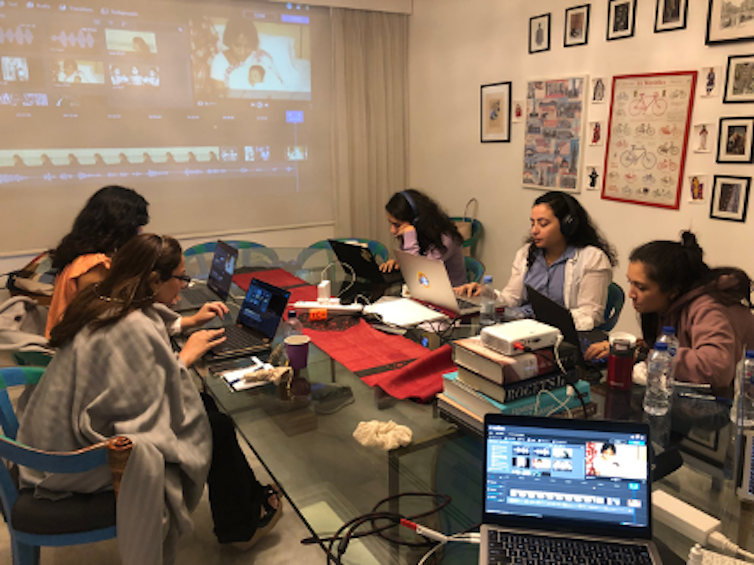
Newcomers Dance Too!, a free dance class for refugee-background women and girls in Flemington Park run by dancers from Fusion Cardio Toronto — which was promoted in Arabic, Urdu, Punjabi and other languages — is one example.

StoryCentre Canada, a non-profit that empowers short multimedia first-person narratives, set up digital storytelling workshops that taught photography and video editing while letting participants share their stories in the language of their choice, building both technical and communication skills. Hinprov, a collective of South Asian improvisers, created spaces where expression was possible even for those still learning English.

Six women surround a table where they work on multimedia projects.
Participants working on their projects for the digital storytelling workshop at StoryCentre Canada.
StoryCentre Canada, CC BY

Arts projects also spark civic conversations. At Matthew House, which offers transitional housing settlement assistance, a mural led by a refugee artist-in-residence prompted neighbours to ask questions about refugees, opening dialogue that challenged stereotypes. Another PNR project collaborated with LGBTQ+ newcomers, using photography and film to counter stigma and create networks of care.

These initiatives show how the arts allow creative newcomers to assert their voices and identities on their own terms, positioning them not simply as guests but as active shapers of the cultural fabric of their new country.

Newcomer artists face systemic barriers

Newcomer artists design and deliver effective arts-based projects. Their ability to contribute, however, is limited by systemic obstacles.

General settlement services rarely provide tailored guidance for creative careers. Newcomer artists are directed toward generic job markets or told to pursue “Canadian credentials,” with little information about arts funding, networks or sector norms.

Discrimination compounds these hurdles: accents and linguistic differences become barriers to casting and collaboration; racial bias and expectations about “ethnic” content narrow opportunities; western-centrism and unfamiliarity with certain artistic traditions from outside the West devalue skills gained abroad. For instance, an Indian musician criticized the tendency to classify Indian classical music as “world music” rather than recognizing it as a classical form, limiting its appropriate recognition and funding.

Administrative rules add further exclusions. Temporary residents may be ineligible for public arts funding. Artists living in the Toronto area but outside the city proper can be excluded by residency requirements, even when they exhibit and perform in Toronto. These policies limit access to precisely the resources that help artists integrate into local scenes.

As part of our project, we worked with filmmaker Ogo Eze to produce two short portraits of newcomer artists: Iranian artist Aitak Sorahitalab and Palestinian-Syrian musician Tarek Ghriri.

Both stories illustrate how, despite formidable challenges, newcomers can become community leaders, using their art to support other newcomers while enriching Toronto’s cultural scene. Their stories show resilience but also underline how much potential is lost when systemic barriers remain in place.

“Strings of Resilience” portrays Syrian musician Tarek Ghriri’s journey of resettlement in Canada. Through music, he navigates displacement, fosters community connections and challenges stereotypes about refugees.
“Clay of Freedom” follows Iranian artist Aitak Sorahitalab as she rebuilds her artistic career in Toronto. The film highlights both the challenges faced by newcomer artists and the creative ways they support their communities through art.

Mending the arts and settlement divide

We have too often treated settlement and the arts as separate and incompatible worlds. Bridging them requires a shift on both sides.

On the settlement side, we must move away from sequential-needs thinking that relegates the arts to the bottom of the priority list or treats cultural activities as communications window dressing. This underestimates the concrete, multifaceted support community arts professionals can provide and sidelines newcomer artists.

On the arts side, TAC’s program is a promising template. By offering targeted support to newcomers, the PNR acknowledges the particular challenges they face when starting out, while avoiding the trap of permanently labelling them as “migrant artists.”

Given that only two per cent of Canadian arts funders offer targeted support for newcomers, lessons from this program can guide similar initiatives across Canada and beyond.

The Conversation

Jeremie Molho received funding from the Social Sciences and Humanities Research Council Partnership Engage Grant for the project Fostering Integration through the Arts: Learning from Toronto Arts Council’s Program for Newcomers and Refugees’, conducted in partnership with Toronto Arts Council

ref. How the arts strengthen newcomer settlement in Canada – https://theconversation.com/how-the-arts-strengthen-newcomer-settlement-in-canada-265462

Sex-motivated violence should be treated as a hate crime

Source: The Conversation – Canada – By Debra M Haak, Assistant Professor, Faculty of Law, Queen’s University, Ontario

Canada recently introduced the Combatting Hate Act, legislation that will create three new criminal offences intended to strengthen protections against hate.

The first new offence targets hate crimes directly for the first time in Canada. The second targets intimidation and obstruction. The third expands an existing criminal law targeting wilful promotion of hatred.

Canada’s hate crime laws apply to acts of hatred towards identifiable groups, those distinguished by colour, race, religion, national or ethnic origin, age, sex, sexual orientation, gender identity or expression, or mental or physical disability.

Hate crimes are under-reported, under-recorded and under-prosecuted in most jurisdictions where legislation exists.

Data from Statistics Canada shows that in 2019, nearly 250,000 people reported they were victims of hate-motivated incidents, but fewer than one per cent were investigated as hate crimes.

Sex-motivated violence is common

Acts of hatred towards women and girls regularly occur in Canada. Some involve violence. Femicide is defined as the killing of women and girls because of their sex or gender. However, sex-motivated violence is rarely treated as hate crime.

The Montréal Massacre is the best known example of sex-motivated killing in Canada. On Dec. 6, 1989, a lone white male, armed with a gun, entered École Polytechnique at the Université of Montréal and killed 14 women. He killed them because they were women and, in his view, feminists, towards whom he expressed hatred.


Read more:
Montréal Massacre anniversary: The media must play a key role in fighting femicide


This mass femicide has never been officially recognized as a hate-motivated crime in Canada.

Other mass killings of women also reveal sex-motivated hatred. The Toronto van attack in 2018 was perpetrated by a male who admitted he drew inspiration from the so-called incel online subculture of men united by sexual frustration and a hatred of women.

The fact that the attack was motivated by hatred towards women does not appear to have been considered at sentencing.


Read more:
Toronto van attack: Guilty verdict, but Canada still needs to tackle ideological violence


Hatred based on sex

In June 2022, the Office of the Chief Coroner of Ontario held an inquest into one of the worst instances of intimate partner femicide in Canadian history. It involved the killings of three women by one man in eastern Ontario in 2015.

In that case, the sentencing judge said the perpetrator was “a violent, vindictive, calculating abuser of women” who “took his hatred to its ultimate climax and committed triple murders.”

Sex-motivated violence is not limited to mass killings. A woman or girl is killed every other day in Canada. A significant number of these deaths are also motivated by hatred based on sex.

In many cases, violence against women and girls is not only sex-motivated. It is well-documented that many of the disappearances and deaths of Indigenous women and girls also involve racially motivated hatred as well as systemic misogyny and racism, particularly by police.

Sex-motivated violence not treated as hate

Yet our research has revealed that violence motivated by hatred of women and girls is relatively invisible in crime reporting data, sentencing and public discourse.

Sex-motivated violence against women and girls is seldom recorded as hate crime. Sex has never comprised more than three per cent of police-reported hate crime in Canada, despite self-reported data showing at least 22 per cent of Canadians — mostly women — have experienced hate.

Sex-motivated hate, in fact, was the most under-reported category of hate crime when comparing self-reported data to police data.

Neither is sex-motivated violence sentenced as a hate crime, despite the fact that the Criminal Code already provides for increased sentences when there is evidence an offence was motivated by hate.

Canada’s Department of Justice has found that sex-motivated hatred was one of the least commonly addressed grounds when applying hate as an aggravating factor at sentencing. Based on a review of more than 40 years of case law up to 2020, only seven cases were found to focus on sex. Two of these cases were unsuccessful.

Male violence against women, girls is hate

Hate-motivated crime is significant in Canada. In 2020, the first year of the COVID-19 pandemic, overall hate crimes reported to police increased by 37 per cent compared to 2019.

The first pillar of Canada’s Action Plan on Combatting Hate is empowering communities to identify hate. That currently does not happen in cases of male violence against women, even though sex is an identified group in Canadian criminal laws targeting hate.

Here are three ways it could happen:

  • Canada should enhance monitoring of hate-motivated gender-based violence.
  • To increase responsiveness to sex-motivated violence, existing and proposed laws targeting sex-motivated hate must be implemented and enforced.
  • Canada should promote an understanding of male violence against women and girls as a form of hate. The new laws and the focus they bring to this issue could help.

For hate crime legislation to be more than symbolic, crimes motivated by hatred must be reported, recorded, prosecuted and sentenced as hate crimes for all identifiable groups — not just some of them.

The Conversation

Debra M Haak receives funding from the Social Sciences and Humanities Research Council and the Canadian Bar Association Law for the Future Fund.

Myrna Dawson received funding from the Social Sciences and Humanities Research Council and British Columbia’s Office of the Human Rights Commissioner.

ref. Sex-motivated violence should be treated as a hate crime – https://theconversation.com/sex-motivated-violence-should-be-treated-as-a-hate-crime-265927

Comment un médicament valant un milliard de dollars a été découvert dans le sol de l’Île de Pâques (et pourquoi scientifiques et industrie pharmaceutique ont une dette envers les peuples autochtones)

Source: The Conversation – in French – By Ted Powers, Professor of Molecular and Cellular Biology, University of California, Davis

Le peuple Rapa Nui est pratiquement absent de l’histoire de la découverte de la rapamycine telle qu’elle est généralement racontée. Posnov/Moment/Getty

La découverte en 1964, sur l’île de Pâques, de la rapamycine, un nouvel antibiotique, a marqué le début d’une success story pharmaceutique à plusieurs milliards de dollars. Pourtant, l’histoire a complètement occulté les individus et les dynamiques politiques qui ont rendu possible l’identification de ce « médicament miracle ».


Baptisé du nom autochtone de l’île, Rapa Nui, la rapamycine a initialement été employée comme immunosuppresseur, afin de prévenir le rejet des greffes d’organes et d’améliorer le taux de succès de l’implantation de stents, de petits treillis métalliques destinés à étayer les artères dans le cadre de la lutte contre la maladie coronarienne (laquelle se traduit par rétrécissement progressif des artères qui nourrissent le cœur, ndlr).

Son usage s’est depuis étendu au traitement de divers types de cancers, et les chercheurs explorent aujourd’hui son potentiel dans le contexte de la prise en charge du diabète,

des maladies neurodégénératives, voire de la lutte contre les méfaits du vieillissement. Ainsi, des études mettant en évidence la capacité de la rapamycine à prolonger la durée de vie ou à combattre les maladies liées à l’âge semblent paraître presque quotidiennement depuis quelque temps… Une requête sur PubMed, le moteur de recherche recense plus de 59 000 articles mentionnant la rapamycine. Il s’agit de l’un des médicaments qui fait le plus parler de lui dans le domaine médical.

Cependant, bien que la rapamycine soit omniprésente en science et en médecine, la façon dont elle a été découverte demeure largement méconnue du public. En tant que scientifique ayant consacré sa carrière à l’étude de ses effets sur les cellules, j’ai ressenti le besoin de mieux comprendre son histoire.

À ce titre, les travaux de l’historienne Jacalyn Duffin portant sur la Medical Expedition to Easter Island (METEI), une expédition scientifique mise sur pied dans les années 1960, ont complètement changé la manière dont nombre de mes collègues et moi-même envisageons désormais notre domaine de recherche.

La découverte du complexe héritage de la rapamycine soulève en effet d’importantes questions sur les biais systémiques qui existent dans le secteur de la recherche biomédicale, ainsi que sur la dette des entreprises pharmaceutiques envers les territoires autochtones d’où elles extraient leurs molécules phares.

Pourquoi un tel intérêt pour la rapamycine ?

L’action de la rapamycine s’explique par sa capacité à inhiber une protéine appelée target of rapamycin kinase, ou TOR. Cette dernière est l’un des principaux régulateurs de la croissance et du métabolisme cellulaires. De concert avec d’autres protéines partenaires, TOR contrôle la manière dont les cellules répondent aux nutriments, au stress et aux signaux environnementaux, influençant ainsi des processus majeurs tels que la synthèse protéique et la fonction immunitaire.

Compte tenu de son rôle central dans ces activités cellulaires fondamentales, il n’est guère surprenant qu’un dysfonctionnement de TOR puisse se traduire par la survenue de cancers, de troubles métaboliques ou de maladies liées à l’âge.

Structure chimique de la rapamycine
Structure chimique de la rapamycine.
Fvasconcellos/Wikimedia

Un grand nombre des spécialistes du domaine savent que cette molécule a été isolée au milieu des années 1970 par des scientifiques travaillant au sein du laboratoire pharmaceutique Ayerst Research Laboratories, à partir d’un échantillon de sol contenant la bactérie Streptomyces hydroscopicus. Ce que l’on sait moins, c’est que cet échantillon a été prélevé dans le cadre d’une mission canadienne appelée Medical Expedition to Easter Island, ou METEI, menée à Rapa Nui – l’Île de Pâques – en 1964.

Histoire de la METEI

L’idée de la Medical Expedition to Easter Island (METEI) a germé au sein d’une équipe de scientifiques canadiens composée du chirurgien Stanley Skoryna et du bactériologiste Georges Nogrady. Leur objectif était de comprendre comment une population isolée s’adaptait au stress environnemental. Ils estimaient que la prévision de la construction d’un aéroport international sur l’île de Pâques offrait une occasion unique d’éclairer cette question. Selon eux, en accroissant les contacts de la population de l’île avec l’extérieur, l’aéroport risquait d’entraîner des changements dans sa santé et son bien-être.

Financée par l’Organisation mondiale de la santé, et soutenue logistiquement par la Marine royale canadienne, la METEI arriva à Rapa Nui en décembre 1964. Durant trois mois, l’équipe fit passer à la quasi-totalité des 1 000 habitants de l’île toute une batterie d’examens médicaux, collectant des échantillons biologiques et procédant à un inventaire systématique de la flore et de la faune insulaires.

Dans le cadre de ces travaux, Georges Nogrady recueillit plus de 200 échantillons de sol, dont l’un s’est avéré contenir la souche de bactéries Streptomyces productrice de rapamycine.

Affiche du mot METEI écrit verticalement entre l’arrière de deux têtes de moaï, avec l’inscription « 1964-1965 RAPA NUI INA KA HOA (N’abandonnez pas le navire) »
Logo du METEI.
Georges Nogrady, CC BY-NC-ND

Il est important de comprendre que l’objectif premier de l’expédition était d’étudier le peuple de Rapa Nui, dans un contexte qui était vu comme celui d’un laboratoire à ciel ouvert. Pour encourager les habitants à participer, les chercheurs n’ont pas hésité à recourir à la corruption, leur offrant des cadeaux, de la nourriture et diverses fournitures. Ils ont également eu recours à la coercition : à cet effet, ils se sont assuré les services d’un prêtre franciscain en poste de longue date sur l’île pour les aider au recrutement. Si leurs intentions étaient peut-être honorables, il s’agit néanmoins là d’un exemple de colonialisme scientifique dans lequel une équipe d’enquêteurs blancs choisit d’étudier un groupe majoritairement non blanc sans son concours, ce qui crée un déséquilibre de pouvoir. Un biais inhérent à l’expédition existait donc dès la conception de la METEI.

Par ailleurs, plusieurs des hypothèses de départ avaient été formulées sur des bases erronées. D’une part, les chercheurs supposaient que les habitants de Rapa Nui avaient été relativement isolés du reste du monde, alors qu’il existait en réalité une longue histoire d’interactions avec des pays extérieurs, comme en témoignaient divers récits dont les plus anciens remontaient au début du XVIIIe siècle, et dont les publications s’étalaient jusqu’à la fin du XIXe siècle.

D’autre part, les organisateurs de la METEI partaient du postulat que le bagage génétique de la population de Rapa Nui était homogène, sans tenir compte de la complexe histoire de l’île en matière de migrations, d’esclavage et de maladies (certains habitants étaient en effet les descendants de survivants de la traite des esclaves africains qui furent renvoyés sur l’île et y apportèrent certaines maladies, dont la variole). La population moderne de Rapa Nui est en réalité métissée, issue à la fois d’ancêtres polynésiens, sud-américains, voire africains.

Cette erreur d’appréciation a sapé l’un des objectifs clés du METEI : évaluer l’influence de la génétique sur le risque de maladie. Si l’équipe a publié un certain nombre d’études décrivant la faune associée à Rapa Nui, son incapacité à établir une base de référence est probablement l’une des raisons pour lesquelles aucune étude de suivi n’a été menée après l’achèvement de l’aéroport de l’île de Pâques en 1967.

Rendre crédit à qui de droit

Les omissions qui existent dans les récits sur les origines de la rapamycine sont le reflet d’angles morts éthiques fréquemment présents dans la manière dont on se souvient des découvertes scientifiques.

Georges Nogrady rapporta de Rapa Nui des échantillons de sol, dont l’un parvint à Ayerst Research Laboratories. Là, Surendra Sehgal et son équipe isolèrent ce qui fut nommé rapamycine, qu’ils finirent par commercialiser à la fin des années 1990 en tant qu’immunosuppresseur, sous le nom Rapamune. Si l’on connaît bien l’obstination de Sehgal, qui fut déterminante pour mener à bien le projet en dépit des bouleversements qui agitaient à cette époque la société pharmaceutique pour laquelle il travaillait – il alla même jusqu’à dissimuler une culture de bactéries chez lui – ni Nogrady ni la METEI ne furent jamais crédités dans les principaux articles scientifiques qu’il publia.

Bien que la rapamycine ait généré des milliards de dollars de revenus, le peuple de Rapa Nui n’en a tiré aucun bénéfice financier à ce jour. Cela soulève des questions sur les droits des peuples autochtones ainsi que sur la biopiraterie (qui peut être définie comme « l’appropriation illégitime par un sujet, notamment par voie de propriété intellectuelle, parfois de façon illicite, de ressources naturelles, et/ou éventuellement de ressources culturelles en lien avec elles, au détriment d’un autre sujet », ndlr), autrement dit dans ce contexte la commercialisation de connaissances autochtones sans contrepartie.

Des accords tels que la Convention des Nations unies de 1992 sur la diversité biologique et la Déclaration de 2007 sur les droits des peuples autochtones visent à protéger les revendications autochtones sur les ressources biologiques, en incitant tous les pays à obtenir le consentement et la participation des populations concernées, et à prévoir des réparations pour les préjudices potentiels avant d’entreprendre des projets.

Ces principes n’étaient cependant pas en vigueur à l’époque du METEI.

Gros plans de visages alignés portant des couronnes de fleurs dans une pièce sombre
Les habitants de Rapa Nui n’ont reçu que peu ou pas de reconnaissance pour leur rôle dans la découverte de la rapamycine.
Esteban Felix/AP Photo

Certaines personnes soutiennent que, puisque la bactérie productrice de rapamycine a été trouvée ailleurs que dans le sol de l’île de Pâques, ce dernier n’était ni unique ni essentiel à la découverte du médicament. D’autres avancent aussi qu’étant donné que les insulaires n’utilisaient pas la rapamycine et n’en connaissaient pas l’existence sur leur île, cette molécule ne constituait pas une ressource susceptible d’être « volée ».

Cependant, la découverte de la rapamycine à Rapa Nui a jeté les bases de l’ensemble des recherches et de la commercialisation ultérieures autour de cette molécule. Cela n’a été possible que parce que la population a été l’objet de l’étude montée par l’équipe canadienne. La reconnaissance formelle du rôle essentiel joué par les habitants de Rapa Nui dans la découverte de la rapamycine, ainsi que la sensibilisation du public à ce sujet, sont essentielles pour les indemniser à hauteur de leur contribution.

Ces dernières années, l’industrie pharmaceutique a commencé à reconnaître l’importance d’indemniser équitablement les contributions autochtones. Certaines sociétés se sont engagées à réinvestir dans les communautés d’où proviennent les précieux produits naturels qu’elles exploitent.

Toutefois, s’agissant des Rapa Nui, les entreprises qui ont directement tiré profit de la rapamycine n’ont pas encore fait un tel geste.

Si la découverte de la rapamycine a sans conteste transformé la médecine, il est plus complexe d’évaluer les conséquences pour le peuple de Rapa Nui de l’expédition METEI. En définitive, son histoire est à la fois celle d’un triomphe scientifique et d’ambiguïtés sociales.

Je suis convaincu que les questions qu’elle soulève (consentement biomédical, colonialisme scientifique et occultation de certaines contributions) doivent nous faire prendre conscience qu’il est nécessaire d’examiner de façon plus critique qu’ils ne l’ont été jusqu’à présent les héritages des découvertes scientifiques majeures.

The Conversation

Ted Powers ne travaille pas, ne conseille pas, ne possède pas de parts, ne reçoit pas de fonds d’une organisation qui pourrait tirer profit de cet article, et n’a déclaré aucune autre affiliation que son organisme de recherche.

ref. Comment un médicament valant un milliard de dollars a été découvert dans le sol de l’Île de Pâques (et pourquoi scientifiques et industrie pharmaceutique ont une dette envers les peuples autochtones) – https://theconversation.com/comment-un-medicament-valant-un-milliard-de-dollars-a-ete-decouvert-dans-le-sol-de-lile-de-paques-et-pourquoi-scientifiques-et-industrie-pharmaceutique-ont-une-dette-envers-les-peuples-autochtones-266381