Nicolas Sarkozy condamné à une incarcération sans attendre son appel : pourquoi cette « exécution provisoire » est banale

Source: The Conversation – France in French (3) – By Vincent Sizaire, Maître de conférence associé, membre du centre de droit pénal et de criminologie, Université Paris Nanterre – Alliance Paris Lumières

De nombreuses critiques ont été formulées à l’encontre du jugement condamnant Nicolas Sarkozy à une incarcération « avec mandat de dépôt à effet différé assorti d’une exécution provisoire », c’est-à-dire sans attendre l’issue de sa procédure d’appel. Cette exécution provisoire de la peine d’emprisonnement est pourtant banale. En 2022, 55 % des peines d’emprisonnement ferme prononcées par le tribunal correctionnel ont ainsi été mises à exécution immédiatement. En revanche, on peut considérer que les règles encadrant l’exécution provisoire en matière répressive posent question du point de vue de l’État de droit.


Parmi les polémiques relatives à la condamnation de l’ancien chef de l’État, le 25 septembre dernier, l’exécution provisoire de la peine d’emprisonnement (le fait qu’elle soit appliquée même en cas d’appel) qui lui a été infligée figure en très bonne place. Comme la plupart des commentaires à l’emporte-pièce qui saturent l’espace médiatique depuis le prononcé du jugement, ces critiques viennent généralement nourrir la thèse, sinon du complot, du moins de « l’acharnement judiciaire » plus ou moins idéologique dont serait victime l’ancien locataire de l’Élysée. Elles se distinguent néanmoins des autres en ce qu’elles ne s’appuient pas sur des spéculations plus ou moins délirantes sur le contenu d’un dossier que, par hypothèse, aucune des personnes extérieures à la procédure ne connaît, mais sur une réalité juridique et humaine indéniable : Nicolas Sarkozy va devoir exécuter sa peine sans attendre la décision de la Cour d’appel. Une réalité qui peut fort légitimement choquer toute personne un tant soit peu attachée à la présomption d’innocence et au droit au recours, favorisant ainsi la réception de la théorie d’une vengeance judiciaire, théorie qui permet d’occulter une opposition beaucoup plus profonde à l’idée même d’égalité devant la loi.

Pour en finir avec ce mythe, il est donc nécessaire d’apporter un éclairage particulier sur la question de l’exécution provisoire en montrant que, si son régime et son application sont porteuses de réelles difficultés d’un point de vue démocratique, ces difficultés sont loin de concerner spécifiquement les classes dirigeantes.

Ce que dit la loi de l’exécution provisoire

En premier lieu, rappelons que, contrairement à ce que laissent entendre les contempteurs les plus acharnés du prétendu « gouvernement des juges », la possibilité d’assortir un jugement de l’exécution provisoire est bien prévue par la loi et n’a pas été inventée pour les besoins de la cause par le tribunal correctionnel. Depuis le droit romain, notre ordre juridique a toujours ménagé la faculté, pour les juridictions, de rendre leur décision immédiatement exécutoire dans les hypothèses où le retard pris dans sa mise en application serait de nature à compromettre durablement les droits des justiciables, en particulier dans les situations d’urgence. C’est pourquoi, par exemple, les ordonnances de référé, qui visent à prévenir un dommage imminent (suspension de travaux dangereux, d’un licenciement abusif, injonction à exécuter un contrat affectant la pérennité d’une entreprise) sont, depuis le Code de procédure civile de 1806, exécutoires par provision.

En matière pénale, la question se pose cependant de façon différente en ce sens que l’exécution provisoire porte atteinte non seulement au droit au recours contre une décision de justice, mais également à la présomption d’innocence. Or, ces deux principes sont protégés tant par la Constitution – le Conseil constitutionnel les ayant respectivement consacrés en 1981 et en 1996 – que par la Convention européenne de sauvegarde des droits de l’homme et des libertés fondamentales. Ce qui ne signifie pas que ces garanties soient absolues, mais que le législateur ne peut y porter atteinte que de façon exceptionnelle, en fixant des critères précis et en veillant à ce que l’atteinte demeure nécessaire et proportionnée. C’est ainsi, par exemple, que la détention provisoire – ordonnée avant toute déclaration de culpabilité et avant même la phase d’audience – ne peut être prononcée que s’il est démontré qu’elle constitue l’unique moyen de sécuriser les investigations (éviter la destruction de preuves, des concertations entre auteurs) ou de s’assurer de la mise à disposition de la personne mise en examen (éviter le risque de fuite, de renouvellement des faits).

Or aucune garantie de cette nature n’est prévue par la loi quand l’exécution provisoire est prononcée par une juridiction pénale lorsqu’elle prononce une sanction à l’égard d’une personne. Le Code de procédure pénale ne fixe aucun critère pour déclarer immédiatement exécutoire telle ou telle sanction, qu’il s’agisse d’une peine d’amende, de probation ou d’emprisonnement, se bornant à exiger du tribunal qu’il motive spécifiquement sa décision sur ce point. C’est ce qu’a fait le tribunal dans la condamnation de Nicolas Sarkozy, en considérant que l’exécution provisoire s’imposait en raison de la particulière gravité des faits. La seule exception concerne le mandat de dépôt prononcé à l’audience (c’est-à-dire l’incarcération immédiate du condamné) assortissant une peine de prison inférieure à un an, dont le prononcé est subordonné aux mêmes conditions que la détention provisoire. En outre, alors qu’en matière civile, la personne peut toujours demander au premier président de la Cour d’appel de suspendre l’exécution provisoire du jugement de première instance, la loi pénale ne prévoit aucune possibilité similaire, la personne condamnée devant subir sa peine nonobstant l’exercice du recours. Ainsi, il est vrai de dire que les règles encadrant aujourd’hui le prononcé de l’exécution provisoire en matière répressive, en ce qu’elles ne garantissent pas suffisamment le caractère nécessaire et proportionné de cette mesure, posent question du point de vue des exigences de l’État de droit démocratique. Pour y remédier, il faudrait que la loi fixe de façon précise et limitative les conditions pour prononcer l’exécution provisoire, par exemple en prévoyant qu’elle n’est possible que si l’on peut légitimement craindre que la personne cherche à se soustraire à sa sanction.

Un recours massif lors des comparutions immédiates

En revanche, il est complètement faux d’affirmer que cette pratique ne concernerait que les membres de la classe politicienne. Le cadre juridique particulièrement permissif que nous venons d’évoquer favorise au contraire la généralisation du recours à l’exécution provisoire en matière pénale.

En 2022, 55 % des peines d’emprisonnement ferme prononcées par le tribunal correctionnel ont ainsi été mises à exécution immédiatement – ce taux monte à 87 % pour les personnes poursuivies en comparution immédiate. En d’autres termes, loin de constituer une mesure exceptionnelle qui trahirait une démarche vindicative ou un abus de pouvoir de la part des magistrats, l’exécution provisoire qui assortit la condamnation de l’ancien chef de l’État – comme celle de la présidente du Rassemblement national (RN) – constitue une mesure particulièrement commune, pour ne pas dire tristement banale.

C’est ainsi que, dans un communiqué du 27 septembre dernier, l’association des avocats pénalistes

« se réjouit de constater que politiques et médias prennent enfin conscience des difficultés posées par l’infraction d’association de malfaiteurs et par la contradiction inhérente à l’exécution provisoire d’une décision frappée d’appel »

(en ce qu’elle oblige le condamné à purger sa peine sans attendre l’issue du recours), mais

« rappelle cependant que ces modalités sont appliquées tous les jours à des centaines de justiciables sous l’œil courroucé des éditorialistes et gouvernants qui fustigeaient jusqu’alors une justice laxiste ».

Il s’agit là d’une autre vertu de l’exigence d’égalité juridique lorsqu’elle pleinement et véritablement appliquée. Plus les membres des classes dirigeantes et, en particulier, celles et ceux qui contribuent directement ou indirectement à l’écriture de la loi, auront conscience qu’elle peut potentiellement s’appliquer à leur personne, plus l’on peut espérer qu’ils se montrent sensibles, d’une façon générale, au respect des droits de la défense. Une raison supplémentaire de sanctionner, à sa juste mesure, la délinquance des puissants.

The Conversation

Vincent Sizaire ne travaille pas, ne conseille pas, ne possède pas de parts, ne reçoit pas de fonds d’une organisation qui pourrait tirer profit de cet article, et n’a déclaré aucune autre affiliation que son organisme de recherche.

ref. Nicolas Sarkozy condamné à une incarcération sans attendre son appel : pourquoi cette « exécution provisoire » est banale – https://theconversation.com/nicolas-sarkozy-condamne-a-une-incarceration-sans-attendre-son-appel-pourquoi-cette-execution-provisoire-est-banale-266677

Accès au logement : la couleur de peau plus discriminante que le nom

Source: The Conversation – France in French (3) – By Élisabeth Tovar, Maîtresse de conférences en sciences économiques, Université Paris Nanterre – Alliance Paris Lumières

Contrairement à ce qu’on pourrait penser, avoir un nom à consonance étrangère pénalise moins qu’être visiblement noir sur une photo. StudioRomantic/Shutterstock

Locataire noir ou blanc : qui l’agent immobilier préférera-t-il ? Notre expérience révèle les ressorts méconnus de la discrimination dans la location de logements.


Chercher un logement peut vite tourner au parcours du combattant, surtout quand on s’appelle Mohamed ou Aïssata. En France, en 2017, 14 % des personnes ayant cherché un logement au cours des cinq années précédentes disaient avoir subi des discriminations, selon la dernière enquête sur la question, menée par le défenseur des droits.

Mais comment ces discriminations fonctionnent-elles concrètement ? Qu’est-ce qui pèse le plus : la couleur de peau, le nom, le salaire, ou encore les préjugés du propriétaire ?

Pour le découvrir, nous avons mené une expérience inédite avec 723 étudiants d’une école immobilière, confrontés à des dossiers de locataires fictifs. Les résultats bousculent plusieurs idées reçues.

Un appartement, trois candidats

Imaginez : vous êtes agent immobilier et devez évaluer trois candidats pour un appartement de trois pièces. Trois candidats se présentent :

  • Éric Pagant, un informaticien blanc, 3 400 euros nets mensuels ;

  • Mohamed Diop, un ambulancier en intérim noir, 1 800 euros nets mensuels ;

  • Kévin Cassin, un enseignant fonctionnaire blanc, célibataire, 1 845 euros nets mensuels.

Vous devez noter chaque candidat en le notant de 1 à 4, selon, d’une part, le degré de satisfaction de votre client, le propriétaire, en cas de location au candidat et, d’autre part, votre intention d’organiser une visite de l’appartement avec le candidat.

Dans notre expérience, nous avons fait varier les éléments des profils des candidats : parfois, c’est Mohamed Diop, un homme noir, qui est informaticien, parfois, il a un nom français (Philippe Rousseau), parfois, sa photo n’apparaît pas, parfois le propriétaire exprime des préférences discriminatoires… Ce protocole nous a permis de mesurer l’effet réel de chacune de ces caractéristiques sur les notes obtenues par les candidats.

La couleur de peau compte plus que le nom

Contrairement à ce qu’on pourrait penser, avoir un nom à consonance étrangère pénalise moins qu’être visiblement Noir sur une photo. Quand Mohamed Diop concourt sans photo, avec seulement son nom africain, son handicap face à Éric Pagant, le candidat blanc, est de 0,6 point sur 4. Mais quand sa photo révèle sa couleur de peau, même avec un nom français l’écart grimpe à 1,7 point !

Cette découverte est importante, car la plupart des études scientifiques sur la discrimination se basent sur les noms, pas sur les photos. Elles sous-estiment peut-être la réalité vécue par les personnes racisées qui se présentent physiquement aux visites.

Protection relative du statut social

Certes, avoir un bon salaire protège un peu les candidats noirs contre la discrimination. Nos répondants accordent une importance particulière au revenu des futurs locataires : indépendamment de leur couleur de peau, les informaticiens ont un avantage de 1,55 point (sur 4) par rapport aux ambulanciers. Cela veut dire qu’un candidat noir informaticien sera mieux noté que tous les candidats ambulanciers, Blancs comme Noirs.

C’est troublant : au sein des candidats aisés, la pénalité subie par les Noirs par rapport aux Blancs est plus forte (-0,32 point) qu’entre candidats modestes (-0,22 point), comme si certains répondants avaient du mal à accepter qu’une personne noire puisse être à égalité avec une personne blanche ayant un statut social élevé.

Propriétaires discriminants

L’expérience révèle aussi que les agents immobiliers amplifient les préjugés de leurs clients.

Quand le propriétaire ne manifeste aucune préférence ethnique, la discrimination disparaît complètement entre candidats blancs et noirs (-0,048 point sur 4). C’est une bonne nouvelle : les futurs professionnels de l’immobilier que nous avons testés ne montrent pas de racisme personnel.

Mais dès que le propriétaire exprime sa réticence à louer « à des gens issus de minorités ethniques », l’écart entre les candidats noirs et blancs se creuse (-0,48 point pour les candidats noirs) – même si une telle demande est tout à fait illégale ! C’est une illustration du mécanisme de « client-based discrimination », bien connu en théorie économique.

Effet de minorité

Dernier élément marquant : un candidat noir est moins bien noté (avec une pénalité de -0,34 point) quand il concourt contre deux candidats blancs (comme dans la première ligne de la figure ci-dessous) que quand il fait face à d’autres candidats noirs (comme dans la deuxième ligne de la figure ci-dessous). À l’inverse, être Blanc face à des candidats noirs ne procure aucun avantage particulier.

Ce résultat montre l’existence d’un « effet de minorité » jouant en défaveur des personnes racisées qui chercheraient à se loger hors de quartier ségrégé.

« Premier arrivé, premier servi »

Ces résultats pointent vers des solutions concrètes.

Plutôt que de miser uniquement sur la formation des professionnels, il faudrait s’attaquer aux préjugés des propriétaires et limiter leur influence, en protégeant les professionnels des attentes de leurs clients. Pour cela, certaines villes états-uniennes, comme Seattle et Portland, ont adopté le principe du « premier arrivé, premier servi » pour empêcher la sélection discriminatoire.

Sans aller jusque-là, l’anonymisation des dossiers de location ou l’obligation de motiver les refus, avec signature du propriétaire, pourraient être des pistes à explorer.

Une autre piste pourrait être l’utilisation systématique de mémentos listant les points d’attention pour louer sans discriminer, comme ceux qui sont proposés, en France, par le défenseur des droits à l’attention des propriétaires et des professionnels de l’immobilier.

Quoi qu’il en soit, ces leviers d’action ne sont pas coûteux à mettre en place, mais cela nécessite l’implication de tous les acteurs du secteur.

The Conversation

Élisabeth Tovar a reçu des financements de l’Agence Nationale de la Recherche.

Mathieu Bunel est membre de la Fédération de recherche Tepp Théories et évaluations des politiques publiques.

Laetitia Tuffery et Marie-Noëlle Lefebvre ne travaillent pas, ne conseillent pas, ne possèdent pas de parts, ne reçoivent pas de fonds d’une organisation qui pourrait tirer profit de cet article, et n’ont déclaré aucune autre affiliation que leur poste universitaire.

ref. Accès au logement : la couleur de peau plus discriminante que le nom – https://theconversation.com/acces-au-logement-la-couleur-de-peau-plus-discriminante-que-le-nom-260363

Tanzania’s Samia Hassan has ushered in a new era of authoritarianism: here’s how

Source: The Conversation – Africa (2) – By Dan Paget, Assistant professor, University of Sussex

Tanzania President Samia Suluhu Hassan. Wikimedia Commons, CC BY

As Tanzania’s national elections approach, a familiar humdrum of coverage has emerged. It goes like this. In its crackdowns, censorship and harassment of the opposition, Tanzania is becoming increasingly repressive.

President Samia Suluhu Hassan, who is seeking re-election in the October 2025 poll, increasingly resembles her predecessor, John Pombe Magufuli. Before he died in office in 2021, he banned media, censored journalists, hamstrung the opposition and rigged elections. Hassan is reverting to his tactics to lengthen her advantage in the elections.

Yet, I would go further. Hassan has become, in key ways, more autocratic than Magufuli. She has crossed autocratic thresholds that have not been breached since Tanzania’s transition to multipartyism in 1992. Most crucially, she has put her chief opponent Tundu Lissu on trial for treason. She has kept another out of the presidential race.

I have been writing about autocracy in Tanzania and chronicling the struggles of Tanzania’s opposition for over a decade. From this vantage point, I describe what makes this election different.

Many authoritarian regimes today take the form of what political scientists call electoral authoritarianism. It is a mixture of the outward form of multiparty democracy and autocratic practices that tilt the playing field in the incumbent’s favour.

Yet, the steps taken by Hassan’s regime amount to something more draconian than this.

Barring your opponents from contesting the presidency is not tilting the playing field in your favour. As I argue in a recent paper, it is closing the playing field altogether. Tanzanian columnist Jenerali Ulimwengu noted in a recent column: “there is no competition worth the name”.

Hassan has broken Tanzania’s political norms, and done so now, it seems, because the international context permits it more than any time in the last 30 years.

The ominous implication of all this is that an era of autocratic rule – which is yet more extreme than any endured in the last 30 years – has arrived.

Crossing red lines

In one way or another, Tanzania’s regime has been autocratic for decades. The party in power today, Chama cha Mapinduzi, has been in power since independence from Britain in 1961.

When Tanzania moved to multiparty elections in 1992, the party strengthened an autocratic apparatus that has developed since then. The regime enjoyed baked-in advantages in funding, business ties, media control and state capture. This gave it a long advantage in elections. Since at least 2000, it has been rigging, annulling and otherwise manipulating elections in the semi-independent archipelago of Zanzibar.

By 2015, however, the mainland opposition, led by Chadema, had become competitive. In this context, under the leadership of then-president Magufuli, repression intensified.

Media were banned, opposition parties were knee-capped, journalists were censored, activists were persecuted, and at large, freedoms were infringed. In the 2020 elections, there appeared to be mass manipulation across Zanzibar and Tanzania for the first time.

In some respects, despite promises of change, Hassan has picked up where Magufuli left off after his death.

There were some democratic concessions in the unbanning of some media outlets and opposition political rallies.

In this context, the opposition started rebuilding.

Yet, the talk of reform was largely cosmetic. Repression continued. Media censorship ticked up and state-sponsored political violence climbed.

Political rallies remained permissible formally, but were increasingly banned in practice. Nationwide local elections in 2024 were reportedly manipulated at scale.

In this context, much coverage has understandably drawn analogies from Hassan’s presidency to Magufuli’s. Yet Hassan has been crossing democratic red lines that Magufuli never did, even if he might have wanted to.

The leader of the opposition has been charged with non-bailable offenses, twice.

Freeman Mbowe was charged with terrorism offences and held for 226 days until his release in 2022. His successor, Tundu Lissu, who survived an assassination attempt in 2017, has been detained since 9 April 2025. He’s now facing trial on charges of treason, a crime punishable by death.

Magufuli had these and other opposition leaders arrested a number of times. Yet he did not have them charged with offences of such magnitude. Nor did he have them held for so long.

Hassan has found a way to eliminate her other most significant competitor from the race. Luhaga Mpina was prevented from submitting nomination forms to enter the presidential election as the candidate for Alliance for Change-Wazalendo. This was after a last-minute intervention from the registrar of political parties, who is a presidential appointee.

The high court subsequently ordered that he be reinstated. However, four days later, the nominally independent electoral commission revealed its true loyalties by barring Mpina’s candidacy again. The case is still being litigated.

The consequence is that Hassan is running to be re-elected as the president of Tanzania opposed only by minor candidates.

This is a scenario without precedent since the reintroduction of multiparty elections in 1992.

In case the normal array of media control and military displays of force are not enough to quell the prospect of protest, the regime has shut down the internet early. It has not, as under Magufuli, imposed a post-election blackout. Instead, it has banned social media platforms X, Clubhouse and Telegram, which have been blocked nationwide. Vibrant local social media platform JamiiForums has been taken down. Meanwhile, the rhythm of state-sponsored violence against opposition activists has been maintained.

Zooming out

The upshot is that Tanzanians are witness to a remarkable split-screen. On one side, Hassan addresses enormous crowds at richly adorned rallies in what political researcher Nicodemus Minde has aptly called “a procedural coronation ritual”.

On the other, opposition leader Lissu has been escorted in and out of court, where, representing himself, he has been declaring his trial a political persecution.

In effect, a new era of authoritarianism is crystallising in Tanzania, one in which electoral competition is all but absent at the presidential level.

Hassan alone knows her true motives for these changes, but her actions should be read in the international context. Under President Donald Trump’s second term, the US has retreated from global democracy promotion. Heavy cuts in aid budgets have weakened the west’s political might.

In this context, Hassan seems to have explored her room for autocratic manoeuvre, and found international norms giving way before her.

She is not alone in doing so. Today, Turkish opposition leader Ekrem Imamoğlu is in jail awaiting trial on terrorism charges. Mozambican opposition leader Venancio Mondlane is awaiting trial facing terrorism offences.

Amid a world in flux, Hassan, and others, are testing what is left of a liberal world order. So far, they must like what they are finding.

The Conversation

Dan Paget is a member of the British Labour Party. He is in receipt of a research funding grant from the British Academy and the Leverhulme Foundation. He is will be in receipt of a Starting Grant from the European Research Council from January 2026.

ref. Tanzania’s Samia Hassan has ushered in a new era of authoritarianism: here’s how – https://theconversation.com/tanzanias-samia-hassan-has-ushered-in-a-new-era-of-authoritarianism-heres-how-266598

Boko Haram on the rise again in Nigeria: how it’s survived and how to weaken it

Source: The Conversation – Africa (2) – By Saheed Babajide Owonikoko, Researcher, Centre for Peace and Security Studies, Modibbo Adama University of Technology

Abubakar Shekau, the erstwhile leader of the terrorist group Jama’at Ahl al-Sunna li al-Da’wa wa al-Jihad (JAS), died in 2021. The west African group, also known as Boko Haram, then fell into obscurity while its breakaway faction, Islamic State West Africa Province (ISWAP), steadily rose.

Early 2025 saw Boko Haram resurging in the Lake Chad region, however, with attacks in Nigeria and Cameroon. Lake Chad is in west-central Africa, in the Sahelian zone. It is located at the conjunction of Chad, Cameroon, Nigeria and Niger.

As a security studies scholar tracking Boko Haram, I discuss reasons for this resurgence, and its impacts, and recommend possible responses from Lake Chad region countries.

Evidence of Boko Haram resurgence

On 15 May 2025, Boko Haram massacred close to 100 residents of Mallam Karamti and Kwatandashi villages in Nigeria’s Borno State. A report has it that Boko Haram attacked the residents because they were loyal to, and served as informants for, Islamic State West Africa Province.

On 5 September, it attacked Darul Jamal village in Borno State, killing about 60 people. A researcher specialising in Boko Haram at the Institute for Security Studies, Taiwo Adebayo, was said to have spoken with residents of the community who attributed the attack to Boko Haram, possibly because of information about the group being shared with the Nigerian military.

There are also reports that the group has extended its reach beyond Lake Chad to North Central region of Nigeria, where it is operating with bandits and possibly Lakurawa, the new terrorist group in that region.

In Far North region of Cameroon, the group has also been active. Reports shared on LinkedIn showed that in July and August 2025, it was responsible for 101 attacks out of 144.


Read more:
Ansaru terror leaders’ arrest is a strategic change for Nigeria: what could happen next


What explains the resurgence

Four factors explain why Boko Haram has become more active again in the Lake Chad region.

First, the rise of one of its leaders, Bakura Doro, and his efforts to sustain Boko Haram gains over Islamic State West Africa Province.

Doro was the Lake Chad Amir al-Fiya (zone commander) before Shekau’s death. He was announced as the leader in May 2022 after a violent takeover from Sahalaba, a cleric whom Shekau had reportedly designated as his successor in his will. Doro reinforced Boko Haram by fighting Islamic State West Africa Province, killing members and capturing its territories in Lake Chad.

He also shunned media propaganda, thus taking the public gaze away from Boko Haram while it grew unnoticed. Although reports said Bakura was killed in Niger in August 2025, the group denied it.

The second factor is that it received less attention from the Lake Chad militaries. Instead, attention was on Islamic State for its targeted attacks on military outposts since early 2025.

By July 2025, 15 outposts had been attacked. The Lake Chad region countries’ counterterrorism efforts focused on countering ISWAP, dangerously neglecting Boko Haram.

The third factor is the failure of reintegration programmes across the region. In Nigeria, for one, community rejection, unmet government promises, limited political will and a weak framework have caused many ex-combatants to return to the trenches.

The fourth factor is combat stress or fatigue among soldiers of the Lake Chad region countries. For instance, more than 1,000 soldiers resigned from the army between 2020 and 2024 in Nigeria. Nigeria’s total armed forces personnel was estimated at 230,000 in 2020.

The weakened commitment of the countries to the Multinational Joint Task Force adds to the problem. Nigeria established the force in 1994 to checkmate trans-border armed banditry around the Lake Chad Basin. In 1998, Chadian and Nigerien soldiers joined the task force.

Niger’s withdrawal in protest against Ecowas sanctions; Chad’s declining support; and strained Nigeria-Cameroon relations have limited the effectiveness of the task force.

All this gives insurgent groups impetus to intensify their attacks.

Implications of resurgent Boko Haram

To understand the implications, it is essential to distinguish Boko Haram’s ideology from that of Islamic State. While the latter primarily targets military forces and non-Muslim communities, Boko Haram’s violence is aimed at all, except its members.

The attempt by Shekau’s successor, Sahalaba, to align with Islamic State West Africa Province’s more selective attacks led to his death, leaving Boko Haram rigidly committed to ruthless attacks.

The result might be a worsening of humanitarian conditions and disruption of community resettlement programmes in the region.

According to a June 2025 report of the UN Office for the Coordination of Humanitarian Affairs, the region hosts 2.9 million internally displaced people and 272,000 refugees. I believe this figure may rise as violence escalates. But donor funding is shrinking.

Boko Haram’s blend of jihad with criminal activities such as robbery and kidnapping not only sustains its operations but may also attract disaffected youth, given the region’s fragile socio-economic conditions, especially the high rate of poverty and unemployment.

The competition between both insurgent groups, and between them and the military, places civilians in danger. Each actor seeks local support and intelligence, and communities risk severe punishment if perceived as loyal to the opposing side.

A constraint currently confronting Boko Haram is the shortage of weaponry. To bridge this gap, I believe it may focus its attacks on military outposts across the region. They may be encouraged by the successes of Islamic State’s attacks on the military outposts and the transfer of combat experience and technical expertise from former Islamic State fighters who have defected to Boko Haram. If it joins the attacks against military outposts in the area, the consequences will be fatal.


Read more:
The Lake Chad Basin is a security nightmare. 5 guidelines for finding solutions


What can be done?

The governments and militaries of Lake Chad region countries should pay attention to Boko Haram as much as Islamic State in their counter-terrorism efforts.

There is a need to improve security cooperation among the countries by luring Niger back into the Multinational Joint Task Force and ensuring members’ commitment to the force.

Enhanced welfare services from the countries to their citizens can reduce incentives to join Boko Haram and other insurgent groups.

Strengthening defection programmes is crucial to prevent former terrorists from going back to groups like Boko Haram. I recommend harmonising regional deradicalisation efforts to enhance their effectiveness.

The Conversation

Saheed Babajide Owonikoko does not work for, consult, own shares in or receive funding from any company or organisation that would benefit from this article, and has disclosed no relevant affiliations beyond their academic appointment.

ref. Boko Haram on the rise again in Nigeria: how it’s survived and how to weaken it – https://theconversation.com/boko-haram-on-the-rise-again-in-nigeria-how-its-survived-and-how-to-weaken-it-265691

Impôt sécheresse : Pourquoi ce qui était possible en 1976… ne l’est plus en 2025 ?

Source: The Conversation – France (in French) – By Jean-Marc Daniel, Emeritus associate Professor, Law Economics & Humanities, ESCP Business School

En 1976, une canicule s’abat sur la France, mettant en péril les récoltes agricoles. Le gouvernement décide une aide conséquente, qui sera partiellement financée par un impôt « ad hoc ». Retour sur le contexte de l’époque et sur ce qui a changé depuis.


Il y a presque cinquante ans, durant l’été 1976, la France a connu une vague de chaleur mémorable dont le souvenir s’incarne dans la référence à « l’impôt sécheresse ». Cet « impôt » a été décidé pour financer des aides au monde agricole, alors victime de la canicule. Dans son bilan de l’année 1976, l’Insee écrit :

« Pour la troisième année consécutive, le volume de la production agricole totale marque une baisse : 0,8 % en 1974 ; 4,5 % en 1975 ; 1,8 % en 1976. »

Le gouvernement de l’époque, dirigé par Jacques Chirac et placé sous l’autorité du président Valéry Giscard d’Estaing, décide de réagir avec un double objectif :

  • maintenir le pouvoir d’achat d’un monde agricole qui représente encore une part importante de la population (en 1976, on compte un peu moins de 1,4 million de chefs d’exploitation alors qu’en 2024, ce nombre est descendu en dessous de 420 000) ;

  • éviter que pour maintenir leur niveau de vie les agriculteurs n’augmentent fortement leurs prix dans un contexte de forte inflation (11 % en 1976).

Une aide de 5,5 milliards de francs

Étrangement, le 25 août, l’annonce d’une aide de 2,2 milliards de francs, soit 1,6 milliard d’euros d’aujourd’hui, pour les agriculteurs est suivie immédiatement de celle de la démission du premier ministre. Le 27 août, son successeur Raymond Barre présente son équipe dans laquelle Christian Bonnet garde le portefeuille de l’agriculture. Néanmoins se pose la question de la pérennisation d’une action en faveur de l’agriculture qui, précédemment, était largement marquée par la personnalité de Jacques Chirac. Mais Raymond Barre confirme le principe d’une aide qui sera finalement de 5,5 milliards de francs (soit 0,3 % du PIB). Il précise que cette somme ne saurait être financée par un emprunt placé auprès des banques ou des épargnants.

La France de 1976 sort du plan de relance de 1975 et le souci de Raymond Barre est de revenir à une gestion budgétaire reposant sur l’équilibre. En 1975, la France connaît sa première récession depuis 1945. Son PIB se contracte de 1 %, ce qui conduit à l’adoption en septembre d’un plan de relance. Alors que le déficit budgétaire voté fin 1974 pour 1975 était de 4 milliards de francs, il est porté à 38,2 milliards de francs, soit 2,6 % du PIB. Le contenu de ce plan est partagé entre 15 milliards de francs de grands travaux dont le TGV sera le plus emblématique, 5 milliards de francs d’augmentation des allocations sociales et 18 milliards de francs de baisse d’impôts.

Une relance aux résultats mitigés

Une des originalités du financement de l’accroissement du déficit est de faire appel à la Banque de France, alors que la loi de janvier 1973 qui définit son rôle et son statut prévoit dans son article 25 qu’elle ne doit pas prêter directement à l’État – cet article stipule que « le Trésor public ne peut être présentateur de ses propres effets à l’escompte de la Banque de France ».

Pour contourner cette règle, il a été demandé à la Banque de France de verser par anticipation les dividendes des exercices suivants. Le résultat de la relance est mitigé. Bien qu’en 1976, le taux de croissance soit revenu à son niveau de 1974 (4,3 %), le doute s’installe.


À lire aussi :
Changement climatique : les plus grands investisseurs mondiaux restent moins engagés que les autres fonds


D’abord, le prix à payer a été un creusement sévère du déficit extérieur. Ensuite, malgré ce retour de la croissance, la situation des finances publiques ne s’améliore que lentement. En 1976, le déficit budgétaire atteint 23 milliards de francs, soit 1,3 % du PIB. Enfin et surtout, l’impact sur le chômage est faible. En novembre 1975, Lionel Stoleru, conseiller économique de Valéry Giscard d’Estaing, est interrogé à la télévision sur l’évolution de l’emploi alors que le nombre de chômeurs vient de dépasser le million. Il parle de la nécessité de réformer le marché du travail et ne cache pas qu’il est illusoire de croire que le retour au plein emploi puisse se faire simplement grâce à une augmentation de la demande publique.

Une aide, mais pas d’emprunt

Il se trouve que l’OCDE est sur la même ligne. En 1977, elle publie les conclusions d’un groupe de travail présidé par l’économiste américain Paul MacCracken. Ce rapport affirme qu’une reprise de la croissance de long terme exige une évolution des salaires conforme à celle de la productivité et une gestion budgétaire écartant tout déficit autre que lié au cycle. Or, jusqu’à sa nomination comme ministre du Commerce extérieur en janvier  1976, le représentant de la France au sein de ce groupe est Raymond Barre !

Pour financer les quelque 5 milliards de francs mobilisés pour l’agriculture, Raymond Barre refuse d’emprunter sur les marchés et de faire appel à la Banque de France. Il décide d’augmenter les prélèvements fiscaux. Pour les ménages, cette augmentation se fait selon un dispositif à troisétages. Ceux dont le revenu est inférieur à 70 000 francs (soit 57 000 € d’aujourd’hui) sont exonérés de contribution. Au-delà, l’impôt sur le revenu est majoré dans une première tranche de 4 %, puis dans une tranche supérieure de 8 %.

L’originalité du dispositif est que la première tranche n’est pas, en fait, un impôt mais un emprunt obligatoire, porteur d’un intérêt de 8,8 % qui sera remboursé en décembre 1981.

Tout – ou presque – a changé

Près de cinquante ans plus tard, l’opération de 1976 est souvent évoquée comme un exemple à suivre d’appel exceptionnel, face à des circonstances exceptionnelles, à un effort des Français. Pourtant, bien des choses ont changé.

Le premier constat est que le poids de la dette a considérablement augmenté, passant de 16 % du PIB en 1976 à 114 % aujourd’hui. Dès lors, la situation réclame une action de redressement de longue durée plutôt qu’une mesure ponctuelle. L’opération menée par Raymond Barre et Valéry Giscard d’Estaing s’inscrivait dans un contexte de taux d’intérêt élevés (ceux-ci ont atteint 13 % en 1976). Résultat, la charge de la dette représentait un poids du PIB du même niveau qu’aujourd’hui (2 %). Dès lors, les dirigeants de 1976 s’inquiétaient d’un présent très pénalisant alors que les dirigeants d’aujourd’hui, bercés par l’illusion d’un maintien des taux d’intérêt à de bas niveaux, minimisent, voire ignorent la menace que fait peser l’évolution possible voire probable de ces taux.

TF1 1976 (INA Actu).

Le deuxième est que la permanence d’un déficit public a conduit à revoir les techniques de financement de l’État. Après que la technique de l’emprunt obligatoire a été de nouveau utilisée en 1983 dans le cadre de la mise en place de la « politique de rigueur », les gouvernements qui ont suivi ont développé un système d’appel aux marchés financiers organisé autour de l’Agence France Trésor. Celle-ci a émis, en 2024, 340 milliards d’euros d’emprunts, loin des 10 milliards d’euros que rapporterait l’équivalent de « l’impôt sécheresse » de 1976.

Quoi qu’il en coûte… mais avec des limites

Le troisième constat est que si les acrobaties autour de la Banque de France pour le financement du plan de relance de 1975 ont pu trouver un répondant dans le « Whatever it takes » de la BCE de Mario Draghi, aujourd’hui nos partenaires de la zone euro se montrent de plus en plus irrités par nos arguties dépensières. Ce n’est pas un effort sur une année porté par des considérations climatiques comme la sécheresse, sanitaires comme la Covid ou géopolitiques comme la guerre en Ukraine qui les convaincront que nous n’avons pas à nous discipliner comme l’ont fait, par exemple, les Portugais qui ont dégagé en 2024 un excédent budgétaire de 0,7 % du PIB.

Maintenant que les étés dans les vallées du Rhône ou de la Garonne sont de plus en plus chauds, les canicules ne permettent pas de masquer la nécessité d’un redressement budgétaire durable alors que la hausse des taux d’intérêt se fait de plus en plus menaçante.

The Conversation

Jean-Marc Daniel ne travaille pas, ne conseille pas, ne possède pas de parts, ne reçoit pas de fonds d’une organisation qui pourrait tirer profit de cet article, et n’a déclaré aucune autre affiliation que son organisme de recherche.

ref. Impôt sécheresse : Pourquoi ce qui était possible en 1976… ne l’est plus en 2025 ? – https://theconversation.com/impot-secheresse-pourquoi-ce-qui-etait-possible-en-1976-ne-lest-plus-en-2025-265780

Les voitures restreignent le droit des enfants de profiter de la ville. Voici des projets qui font la différence

Source: The Conversation – in French – By Patricia Collins, Associate Professor, Queen’s University, Ontario

En fermant les rues à proximité des écoles pour qu’on puisse y déposer et y reprendre les enfants, une initiative innovante appelée « rue-école » permet aux enfants de se réapproprier la ville. (Unsplash), CC BY

De nombreux Canadiens de plus de 40 ans ont sans doute passé leur enfance à jouer dans la rue et à circuler seuls ou avec des amis dans leur quartier. Et, selon le onzième objectif de développement durable des Nations unies, les villes devraient être des lieux où tous les habitants, y compris les enfants, peuvent bien évoluer. Ils ont autant le droit d’occuper et d’utiliser les rues urbaines que les automobilistes.

Cependant, les enfants d’aujourd’hui sont moins actifs, moins autonomes dans leurs déplacements et participent moins à des jeux libres à l’extérieur.

Au Canada, l’une des principales causes de cette tendance est que nous avons privé les enfants de leur droit à la ville, notamment de la liberté de jouer et de circuler en toute sécurité dans les rues près de leur domicile et de leur école sans avoir besoin de la surveillance d’un adulte.

Des actions innovantes telles que « rue-école » sont nécessaires. Il s’agit d’instaurer des zones interdites aux voitures devant les écoles aux heures de pointe afin qu’on puisse y déposer et y reprendre les enfants en toute sécurité et de manière à encourager la marche et le vélo.

Toutefois, nos recherches montrent qu’elles se heurtent souvent à une forte résistance. En fermant les rues adjacentes aux écoles à la circulation automobile, on confronte les conducteurs à un espace public repensé et restructuré qu’ils ne sont pas toujours prêts à accepter.

Penser les villes pour les enfants plutôt que pour les voitures

En Amérique du Nord, la privation des enfants de leurs droits à la ville remonte à des décennies.

Avant la production industrielle des automobiles, il était courant de voir des jeunes jouer dans les rues. Mais à mesure que l’usage de la voiture augmentait, les accidents impliquant des enfants se multipliaient.

Au lieu de restreindre les zones où les voitures peuvent circuler, les urbanistes et les responsables de la santé publique ont préconisé la création d’autres lieux où les enfants peuvent jouer en toute sécurité, comme des parcs de quartier.

Cette approche de l’urbanisme axée sur l’automobile a entraîné un changement dans les mentalités quant aux espaces où les jeunes peuvent jouer et se déplacer. Nous considérons désormais comme normal de ne pas voir ni entendre d’enfants dans les rues des villes.

En limitant la mobilité des enfants en milieu urbain, notre société a fait croire que ces derniers n’étaient pas suffisamment responsables ou compétents pour circuler dans leur collectivité.

La mobilité des enfants dans des villes dominées par la voiture

Paradoxalement, plus la crainte de laisser les enfants se déplacer librement augmentait, plus on les conduisait en voiture. Désormais, les enfants circulent en ville principalement à bord d’un véhicule.

Nous voilà aujourd’hui confrontés à un immense défi sociétal : faire en sorte que les enfants puissent se déplacer de manière autonome dans leur quartier, notamment dans les espaces qui leur sont communément réservés, comme les abords des écoles primaires.

En ce qui concerne le trajet vers l’école, des études ont montré que les comportements dangereux des parents au volant le matin – laisser descendre leurs enfants dans des zones à risques, obstruer la visibilité, faire demi-tour et rouler à vive allure, etc. – sont monnaie courante.

Ces comportements augmentent le risque que des enfants soient renversés par des automobilistes. Les conditions dangereuses aux abords des écoles, associées à l’idée largement répandue que les enfants n’ont pas leur place dans la rue et qu’ils sont incapables d’aller à l’école par eux-mêmes, contribuent au faible taux de déplacements à pied ou à vélo pour se rendre à l’école au Canada.

Des villes innovantes pour les enfants

Les rues-écoles visent à répondre à ces deux problèmes en réduisant les dangers réels posés par les automobiles dans les espaces occupés par les enfants et en aidant tous les citoyens à redéfinir l’utilisation des rues.

Généralement mises en place par les municipalités ou des organismes à but non lucratif, les rues-écoles permettent aux enfants de se rendre à l’école et d’en revenir en toute sécurité. Bien qu’elles soient courantes dans de nombreuses villes européennes, leur adoption a été plus lente au Canada.

De 2020 à 2024, nous avons mené une étude intitulée Changer les règles du jeu, dans laquelle nous avons évalué de manière systématique les « rues-écoles » implantées à Kingston, en Ontario, et à Montréal. Les conclusions de cette étude ont contribué au lancement de l’Initiative nationale des rues-écoles actives.

Financé par l’Agence de la santé publique du Canada, ce programme aide les villes canadiennes à se familiariser avec les rues-écoles et à les mettre en œuvre. Ainsi, des rues-écoles ont été ouvertes en septembre 2025 pour une durée d’un an à Kingston et à Mississauga, en Ontario, ainsi qu’à Vancouver, en Colombie-Britannique.

En septembre 2026, d’autres rues-écoles devraient voir le jour pour une durée d’un an à Kingston, à Mississauga, à Vancouver et à Montréal, tandis que des projets pilotes de quatre semaines sont prévus en Ontario à Ottawa, à Peterborough, à Markham et à Toronto, ainsi qu’à Winnipeg, au Manitoba, et à Edmonton et Calgary, en Alberta.

Réactions aux projets d’innovation urbaine pour les enfants

La mise en place et le maintien de ces rues-écoles nécessitent le soutien d’un large éventail de personnes, notamment le personnel et les conseillers municipaux, les administrations scolaires, les enseignants, les parents, les résidents et les services de police.

Dans le cadre de notre travail à Kingston et à Montréal, nous avons rencontré de nombreux défenseurs des rues-écoles, dont le soutien a été déterminant pour lancer et perpétuer ces projets. Cependant, nous avons également été confrontés à divers degrés de résistance. Dans certains cas, la résistance est apparue après le lancement des initiatives, mais dans d’autres, elle a suffi à empêcher leur mise en place.

Plutôt que de reconnaître les avantages des rues-écoles, les personnes qui s’opposaient à ces projets étaient souvent motivées par les risques encourus par les enfants, soit précisément le problème que les rues-écoles visent à résoudre.

Certaines affirmaient que les rues-écoles réduiraient la vigilance des enfants, les exposeraient au risque d’être renversés par des automobilistes imprudents et qu’elles étaient par nature dangereuses, car les enfants n’ont pas leur place dans les rues. Nous soupçonnons qu’en réalité, il s’agissait moins des risques que d’une réticence à partager l’espace, le pouvoir et les opportunités avec les enfants en milieu urbain.

Nous avons également reçu toute une série d’arguments fondés sur ce qu’on appelle la « motonormativité », une forme de préjugé inconscient dans les sociétés centrées sur l’automobile qui considère l’utilisation de la voiture comme une norme universelle et oriente les solutions vers les besoins des automobilistes.

Ainsi, nous avons entendu dire que les rues-écoles excluaient les enfants dont les parents devaient les conduire à l’école, que les résidents et les visiteurs subiraient des retards inacceptables en raison de la fermeture des rues, que le personnel scolaire serait privé de places de stationnement à proximité, que les enfants marchant dans la rue seraient trop bruyants et causeraient des dommages aux véhicules stationnés, et que la congestion automobile serait déplacée vers d’autres rues.

L’argument le plus troublant avancé contre les rues-écoles était que des enfants d’autres quartiers en avaient davantage besoin, ce qui traduisait une attitude « pas dans ma cour » à peine voilée.

Les rues-écoles visent à permettre aux enfants de retrouver leur droit à la ville. Cependant, de nombreuses personnes ne sont pas prêtes à accorder ces droits aux enfants, car ils entrent en conflit avec des perceptions profondément ancrées quant aux lieux que les enfants sont censés occuper.

La Conversation Canada

Patricia Collins a reçu un financement des Instituts de recherche en santé du Canada (subvention de projet n° PJT-175153) pour l’étude Levelling the Playing Fields. Pour l’initiative nationale Active School Streets, elle reçoit un financement de l’Agence de la santé publique du Canada. Patricia Collins était auparavant affiliée à la Kingston Coalition for Active Transportation, un groupe à but non lucratif chargé de superviser la mise en œuvre du programme School Streets à Kingston. Elle n’est plus membre de ce groupe.

Katherine L. Frohlich a reçu un financement des Instituts de recherche en santé du Canada (numéro de subvention PJT175153) Pour le projet Levelling the Playing Fields. Pour le projet NASSI, elle reçoit un financement de l’Agence de la santé publique du Canada.

ref. Les voitures restreignent le droit des enfants de profiter de la ville. Voici des projets qui font la différence – https://theconversation.com/les-voitures-restreignent-le-droit-des-enfants-de-profiter-de-la-ville-voici-des-projets-qui-font-la-difference-266103

Conflict at the drugstore: When pharmacists’ and patients’ values collide

Source: The Conversation – USA (3) – By Elizabeth Chiarello, Associate Professor of Sociology, Washington University in St. Louis

Pharmacists see themselves as vital gatekeepers – but at times, some critics treat them as physicians’ sidekicks. Witthaya Prasongsin/Moment via Getty Images

Imagine walking into your pharmacy, handing over your prescription and having it denied. Now imagine that the reason is not insufficient insurance coverage or the wrong dose, but a pharmacist who personally objects to your medication. What right does a pharmacist have to make moral decisions for their patients?

Lawmakers have wrestled with this question for decades. It reemerged in August 2025 when two pharmacists sued Walgreens and the Minnesota Board of Pharmacy, saying they had been punished after refusing to dispense gender-affirming care medications that go against their religious beliefs.

According to the pharmacists, Walgreens refused their requests for a formal religious accommodation, citing state law. One pharmacist had her hours reduced; the other was let go. If Minnesota law does not allow such an accommodation, their lawsuit argues, it violates religious freedom rights.

As a sociologist of law and medicine, I’ve spent the past 20 years studying how pharmacists grapple with tensions between their personal beliefs and employers’ demands. Framing the problem as a tension between religious freedom and patients’ rights is only one approach. Debates about pharmacists’ discretion over what they dispense also raise bigger questions about professional rights – and responsibilities.

Duty to dispense?

The most famous controversy, perhaps, dealt with contraception. In the early 2000s, some pharmacists refused to dispense Plan B, also known as “emergency contraception” or the “morning-after pill.” Their refusal stemmed from a belief that it caused an abortion.

That is inaccurate, according to medical authorities. When Plan B first became available in 1999, the label said the medication might work by expelling an egg that had already been fertilized. In 2022, the Food and Drug Administration relabeled Plan B to say that it acts before fertilization. From a medical perspective, both mechanisms are contraception, not abortion.

A pair of tweezers holds a white pill, photographed in front of a box that says 'PlanB One Step.'
Plan B’s early labeling contributed to confusion over how it works.
Justin Sullivan/Getty Images

States responded to pharmacists’ refusals by adopting “responsibility laws.” Some states adopted “conscience clauses” that permitted pharmacists not to fill the prescription. Others opted for “duty to dispense” laws that required pharmacists or pharmacies to provide the medication, or “refuse and refer” laws obligating objecting pharmacists to hand the prescription off to a colleague.

This fight largely broke down across political lines. Groups that oppose abortion rights argued that pharmacists should have the right to opt out, while groups in favor of abortion rights argued that pharmacists should be required to dispense.

As this fight escalated, the conflict became about more than contraception or abortion. It revealed Americans’ views about what kinds of professionals pharmacists should be, and whether they are professionals at all – that is, members of occupational groups that have specialized knowledge and skills, and exclusive rights to do particular kinds of work.

In 2015, for example, the advocacy group NARAL Pro-Choice American – now called Reproductive Freedom for All – released an ad with a man and a woman in bed, their feet hanging out of the sheets. Stuck between them was someone else wearing heavy black shoes. “Who invited the pharmacist?” the ad asked.

Pro-choice organizations insisted that pharmacists had no right to question a doctor’s prescription. “A pharmacist’s job is to dispense medication, not moral judgment,” said the president of Planned Parenthood Chicago.

Some pharmacists felt that such messages did not just criticize “moral gatekeeping” but also undermined their claims to professional authority. Pharmacists undergo six years of training to earn a doctorate and are health care’s medication specialists. The idea that pharmacists were simply technicians, hired to fill whatever a prescription said, made them seem like physicians’ underlings.

Keeping patients safe

A short time later, when the opioid overdose crisis began to escalate, pharmacists again found themselves pulled in two directions. This time, the question was whether they should be both medical and legal gatekeepers.

When the U.S. first tried to crack down on unauthorized opioid use, many pharmacists felt ambivalent about tasks like identifying people who were misusing or selling medications. One pharmacist told me, “Although I’m in the business of patient safety, I’m not in the police business.”

Later, pharmacists began to see policing tasks as health care tasks. They reasoned that policing patients helped keep patients safe, and they embraced enforcement as a key component of their work.

Fast-forward to 2021. America was in the throes of the COVID-19 pandemic, and some doctors were prescribing hydroxychloroquine and ivermectin to treat sick patients, though the FDA had not approved the medications for that purpose. Many pharmacists refused to fill those prescriptions, citing lack of scientific evidence and potential harm.

A box with an image of a horse's silhouette, running in front of an orange-and-yellow sunset.
During the COVID-19 pandemic, some physicians wrote off-label prescriptions for ivermectin – a drug used to kill worms and other parasites, intended for use in horses.
AP Photo/Ted S. Warren

Legislators in Missouri, where I teach, responded by passing a bill that required pharmacists to dispense the two medications, no questions asked – though that rule was later struck down by a federal judge. Similar conflicts played out in Iowa and Ohio, among other states.

Again, the fight broke down along political lines, but in the opposite direction. Liberals tended to oppose the bills, portraying pharmacists as skilled professionals whose expertise is essential to prevent harm. Conservative supporters claimed that pharmacists should dispense whatever the doctor writes.

Professional power

Each of these controversies has focused on a specific legal, ethical or medical issue. By extension, though, they are also about what kinds of professional discretion pharmacists should be able to exercise.

When it comes to medication, doctors prescribe, nurses administer and pharmacists dispense. Before the 20th century, pharmacists diagnosed disease and also compounded drugs. That changed when physicians placed themselves at the top of the medical hierarchy.

When it comes to professional autonomy, states regulate health care, but they permit health care professions to regulate themselves: to educate, license and discipline their own workers through professional boards. In exchange, these boards must do so “in the public interest” – prioritizing public health, safety and welfare over professionals’ own interests.

Health care professionals, including pharmacists, must also follow ethical codes. The day they receive their iconic white coats, pharmacists vow to “consider the welfare of humanity and relief of suffering [their] primary concerns.” Pharmacists also commit to “respecting the autonomy and dignity of each patient,” which means that pharmacists partner with patients to make choices about their health.

Self-regulation has legally given pharmacists the right to act as “medical gatekeepers” – to use their professional expertise to keep patients safe. This role is critical, as patients whose lives have been saved by pharmacists catching errors can attest.

It has not, however, given them the right to be “moral gatekeepers” who put their personal beliefs above the patient’s. Pharmacists control medications because of professional commitments, not personal beliefs. The code of ethics describes the pharmacist-patient relationship as a “covenant” that creates moral obligations for the pharmacist – including helping “individuals achieve optimum benefit from their medications,” being “committed to their welfare” and maintaining their trust.

If pharmacists wish to regulate themselves, history makes clear they need to define what it means to act in the public interest and ensure that other pharmacists comply. If not, the state has proved more than willing to step in and do the job for them. They may not like the results.

The Conversation

Elizabeth Chiarello has received funding from the National Science Foundation.

ref. Conflict at the drugstore: When pharmacists’ and patients’ values collide – https://theconversation.com/conflict-at-the-drugstore-when-pharmacists-and-patients-values-collide-264844

More than a quarter of Canadian teens have experienced sexual violence online

Source: The Conversation – Canada – By Charlotte Nau, PhD Candidate in Media Studies, Western University

Technology-facilitated sexual violence includes harmful practices such as sexual name-calling, rumour spreading, non-consensual distribution of nudes, and other forms of sexual harassment. (imgix/Unsplash), CC BY

Law enforcement agencies across Canada are sounding the alarm over a rise in sexual extortion (“sextortion”) against young people.

The problem goes far beyond sextortion, as this is only one form of many variations of online sexual harms that target youth today. Teenagers in Canada can be victims of sexual catfishing, AI-generated sexual deepfakes and violent extremism.

Some high-profile sextortion incidents include the deaths by suicide of Rehtaeh Parsons, Amanda Todd, Daniel Lints and a boy in British Columbia.

The scale of the problem

Technology-facilitated sexual violence (TFSV) includes harmful practices such as sexual name-calling and rumour spreading, non-consensual distribution of intimate images (nudes) and other forms of sexual harassment.

Our research team recently conducted a survey with more than 1,000 teens aged 13 to 18 across Canada to learn about youths’ experiences with TFSV.

Our findings underscore how widespread these harms are: more than a quarter of the teens (28 per cent) reported experiencing at least one form of TFSV.

In addition to so many youth experiencing TFSV, almost half (47 per cent) said that TFSV had happened to someone they knew. The most common forms of TFSV reported in our survey were receiving unwanted sexual images (15 per cent), encountering unwanted porn (13 per cent) and being sexually harassed online (11 per cent).

Online platforms

We also asked the teens which social media sites and online gaming services had the most sexual harassment. The platform they mentioned most often was Snapchat, followed by TikTok and Instagram. Snapchat has been known for its potential risks to youth and privacy concerns.

Girls experienced TFSV at a higher rate (32 per cent) than boys (23 per cent), which is consistent with research from Statistics Canada.

Teens who said they were neurodivergent or had a learning disability were more likely to be subjected to TFSV (39 per cent). TFSV was also higher among teens with a mental health condition (40 per cent).

These findings are consistent with previous research that showed higher victimization rates among people with disabilities.

A small but significant number of teens (seven per cent) reported committing at least one form of TFSV. This was more common among boys (nine per cent) than girls (six per cent).

Insufficient support

Parents and guardians were the most relevant source of support for teens who had been subjected to TFSV. Nearly half (44 per cent) of the teens turned to them, and most of these teens found them helpful.

The teens were much less likely to seek support from institutions. Only about one in 10 (12 per cent) told someone at their school, with only seven per cent telling the police. Unfortunately, these numbers are consistent with other statistics, as most people do not report sexual violence to the police.

Young people showed little confidence in the reporting tools and moderation systems of social media platforms. As little as five per cent of the teens had used these to report sexually harmful materials. Almost one in three teens (29 per cent) thought that the digital platforms should do a better job supporting them.

This finding is important to consider as social media companies are dropping content moderation, making their platforms possibly more hazardous for youth.


Read more:
Meta’s shift to ‘community notes’ risks hurting online health info providers more than ever


Teens’ misconceptions

Most teens (90 per cent and up) knew that several forms of TFSV were illegal in Canada. However, they were less certain when asked if it was legal to create a fake sexual video of someone. This is unsurprising: legal views of sexual deepfakes vary by province. Some allow civil action, while others treat it as child pornography.

The teens’ knowledge of the law was incomplete in other areas. Almost two-thirds (61 per cent) thought that sending a nude picture of themselves to other youth was illegal. This is not true. Minors can share sexual images with each other as long as they are consensual and kept private between them; that most teens don’t know this is troubling.

Sexting and sharing nudes is a common form of sexual expression among teens. In our survey, teens who though that nude image sharing was illegal were less likely to seek help with TFSV.

Some teens (26 per cent) thought that taking a nude picture of themselves was illegal. This is also incorrect.

These misconceptions matter, as young people need to be informed about their legal rights to sexual expression. Proper education will prevent shame, fear and other barriers to seeking support when someone is distributing their images against their will or coercing them into harmful practices.

phone screen showing the Snapchat download page
The use of Snapchat by teens has raised concerns about its potential risks and privacy issues.
(Souvik Banerjee/Unsplash), CC BY

An urgent issue

Social media and other forms of digital communication are central to young people’s lives, which means that addressing TFSV is an urgent issue. While the federal government and some provincial governments have taken steps or proposed legislation aimed at protecting youth, some responses have been proven to be unrealistic and ineffective.


Read more:
Australia is banning social media for teens. Should Canada do the same?


Governments — and tech companies in particular — need to do more to prevent TFSV and support youth who experience it.

Schools can also take action to help youth. However, there is considerable variation in the TFSV responses and interventions within educational curricula, policies and legislation across the provinces and territories. This means that even though TFSV is a common problem, most parents, teachers, police and frontline workers lack the resources and strategies needed to respond effectively and promptly.

Our findings highlight the impact of these shortcomings on teens, as many youth in our survey did not receive help for TFSV, even when they sought it out. In many instances, telling others actually made the situation worse.

TFSV is a gendered problem that disproportionately impacts certain groups. It is important to keep in mind who is most at risk when developing TFSV resources and interventions.

We believe that with evidence-informed and co-ordinated action from the private and public sectors, young people can live in a digital world where they feel safe online and can easily access effective resources and support.

The Conversation

Charlotte Nau receives funding from the Social Sciences and Humanities Research Council of Canada.

Christopher Dietzel receives funding from the Social Sciences and Humanities Research Council of Canada.

Estefanía Reyes receives funding from the International Development Research Center (IDRC).

ref. More than a quarter of Canadian teens have experienced sexual violence online – https://theconversation.com/more-than-a-quarter-of-canadian-teens-have-experienced-sexual-violence-online-265625

A fragmented legal system and threat of deportation are pushing higher education out of reach for many undocumented students

Source: The Conversation – USA (2) – By Vanessa Delgado, Professor of Sociology, Washington State University

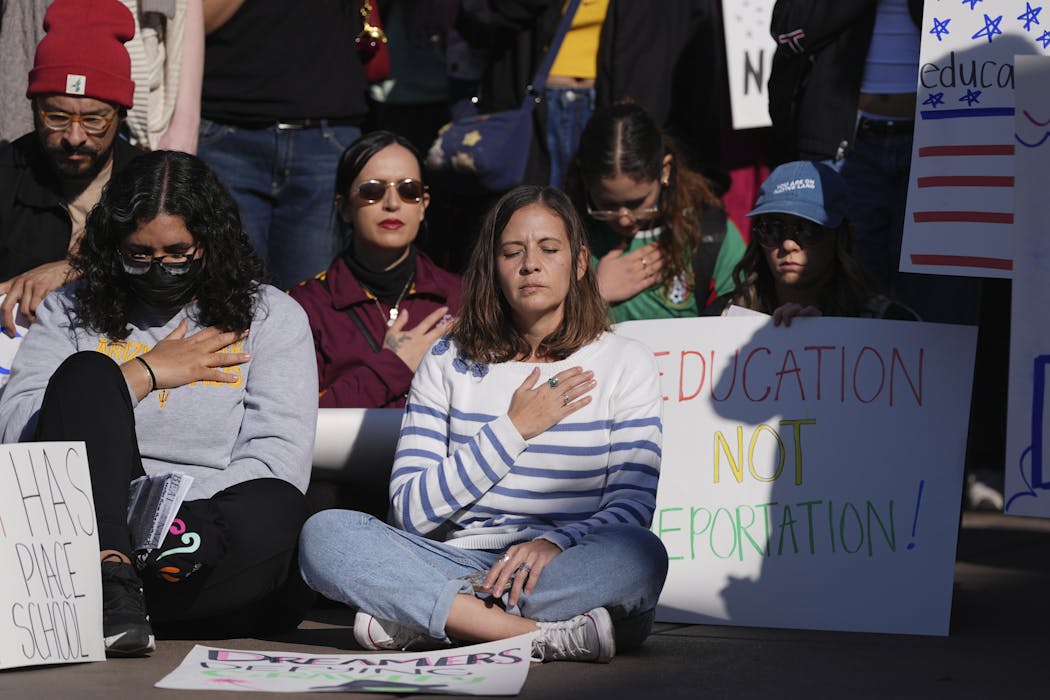
Students protest at Arizona State University in January 2025 against a Republican student group encouraging students to report their peers to Immigration and Customs Enforcement for deportation. Ross D. Franklin/Associated Press

The Trump administration is upending norms and policies across the American educational system. One of the many groups facing uncertainty are prospective and current students living in the country without legal authorization.

For those students, applying to and attending college has long been a complicated, patchwork process that varies greatly across states.

In August 2025, the Department of Justice sued Oklahoma for a state law that allowed Oklahoma students living in the country without legal permission to pay a lower tuition rate that is guaranteed to in-state residents.

The Department of Justice also sued Kentucky, Texas and Minnesota over the summer on the same grounds.

Texas, Kentucky and Oklahoma have all announced they will no longer offer in-state tuition to students who are living in the U.S. illegally. Minnesota is currently challenging the Justice Department’s lawsuit.

Amy Lieberman, the education editor at The Conversation U.S., spoke with Vanessa Delgado, a scholar of Latino families and their educational experiences, to understand the higher education pathways for students living in the U.S. without legal authorization – and how the Trump administration is affecting their options.

A young woman with brown hair in a blue shirt holds a sign that says 'Support Undocumented Students.' Other people stand around her in blue shirts and also hold signs.
Daniela Valadez, a UCLA student majoring in labor studies, holds a sign at a protest for undocumented students in the University of California system in Los Angeles in May 2023.
Jay L. Clendenin/Los Angeles Times via Getty Images

How large is the population of students who are living in the U.S. without legal authorization?

There are 408,000 undocumented students enrolled in U.S. colleges and universities – that’s about 2% of the entire U.S. college population.

California and Texas have the greatest number, with about 21% of all undocumented college students living in California and 14% in Texas. Those numbers are likely to be an underestimate, as there are no official surveys that track this information.

We don’t have strong data on the high school graduation rates of college students who are not living in the U.S. legally. The best estimates suggest that about 5% to 10% of all undocumented high schoolers go off to college.

Research shows that legal battles over Deferred Action for Childhood Arrivals, or DACA, have contributed to a drop in college enrollment. DACA is a federal immigration policy that allows some immigrants who came to the U.S. as young children to receive temporary protection from deportation and to get work permits.

College graduation rates are shaped by a number of factors, including the state an immigrant student lives in and whether they can receive in-state tuition and state-based financial aid. Other important factors are whether there are undocumented student resource centers and supportive mentors on campus.

How is attending college different for students without legal authorization?

Undocumented high school students thinking about college may be unaware of their legal and financial options. Undocumented students frequently receive incorrect information about college options – and sometimes they do not want to disclose their immigration status to a school counselor.

Where an undocumented student lives determines whether they can afford to pay for college, or in some cases whether they can attend at all. Undocumented students cannot receive any federal student aid, regardless of where they live, because you need to be an American citizen to receive this aid. Financial help is critical for many students, including immigrants, as most students receive some financial aid to pay for college.

There are 22 states, as well as Washington, that allow undocumented students to pay in-state tuition. In addition, undocumented high schoolers are eligible for state-based financial aid in 14 states.

Conversely, 10 states, like Wisconsin and Oklahoma, have enacted laws to block undocumented students from receiving in-state tuition.

Can these students receive merit-based scholarships?

That depends. Some scholarship programs require a lawful immigration status. Some scholarships might require students to be eligible for Pell Grants, meaning they also need lawful immigration status. Other programs, like public colleges in California and Washington state, have merit-based scholarships that undocumented students can apply for. Several national private scholarships are also available for undocumented students.

Are there some cases where these students simply cannot legally attend college?

There are three states – Georgia, Alabama and South Carolina – where undocumented students cannot apply to most public universities. For these states, the board of regents prohibits admission for undocumented students.

In Washington state, undocumented students who are residents can apply for state-based financial aid. Other states, like California, provide similar forms of aid.

What are other practical questions prospective students need to consider?

First, there’s the cost of going to college. Undocumented students are much more likely than citizens to be living in poverty. And in general, college tuition is rising. If you do not have access to resources, such as in-state tuition and state-based financial aid, the cost will likely be a prohibitive factor.

Then there is the question of what comes after college. Generally, without a lawful immigration status, undocumented students struggle to find work. Some states, like California and Washington, have enacted policies to remove barriers for professional licenses, letting undocumented immigrants still pursue different career paths.

How is Trump changing the education landscape for immigrant families?

The Trump administration’s aggressive enforcement of immigration policy is prompting more undocumented students to consider whether they need to stay close to home, as many fear that they or their family members will be deported.

Many undocumented students face significant family obligations at home, as I find in my research. This can dissuade them from going far from home, or even from going to school at all.

I know students who are now contemplating taking a year of absence, or dropping out altogether. I also know students who cannot concentrate on school work, because they are anxious about whether their loved ones will be detained. Many also have younger siblings and feel the pressure of stepping into a guardian role.

Texas is an example of a place where undocumented students are particularly under stress. It was one of the first states to provide in-state tuition for undocumented students. In June 2025, the state rescinded the policy.

Now, undocumented college students in Texas need to pay out-of-state tuition costs, even if they have paid in-state so far. That roughly doubles the cost of annual tuition. Students and staff on the ground are scrambling to figure how to make sense of this abrupt policy shift. Similar rollbacks have happened in Florida and other states, and all of these measures are making it more challenging for undocumented students to consider pursing higher education.

The Conversation

Vanessa Delgado does not work for, consult, own shares in or receive funding from any company or organization that would benefit from this article, and has disclosed no relevant affiliations beyond their academic appointment.

ref. A fragmented legal system and threat of deportation are pushing higher education out of reach for many undocumented students – https://theconversation.com/a-fragmented-legal-system-and-threat-of-deportation-are-pushing-higher-education-out-of-reach-for-many-undocumented-students-266324

Watchdog journalism’s future may lie in the work of independent reporters like Pablo Torre

Source: The Conversation – USA (2) – By Alex Volonte, Graduate Research and Teaching Assistant in Journalism, University of Florida

As traditional media outlets struggle to hold power to account, citizen watchdogs can still make a splash. Man_Half-tube/DigitalVision Vectors via Getty Images

In September 2025, podcaster Pablo Torre published an investigation alleging that the NBA’s Los Angeles Clippers may have used a side deal to skirt the league’s strict salary cap rules. His reporting, aired on multiple episodes of “Pablo Torre Finds Out,” focused on star forward Kawhi Leonard.

Leonard, one of the NBA’s most sought-after free agents, signed a four-year, US$176 million contract renewal with the Clippers during the 2021-22 off-season – the maximum allowed under league rules at the time. But Torre reported that in early 2022, Leonard’s LLC, KL2 Aspire, signed a cash and equity deal amounting to roughly $50 million through a brand sponsorship with Aspiration, a now-bankrupt financial technology startup that marketed itself as a climate-friendly bank.

Torre highlighted how the sponsorship coincided with major investments in Aspiration by Clippers owner Steve Ballmer and another team investor. The arrangement, Torre suggested, looked less like a conventional endorsement deal and more like a “no-show” side payment that could have helped the Clippers keep their star without technically violating the salary cap.

Leonard has denied that the partnership was improper, insisting he fulfilled his contractual obligations. The Clippers and Ballmer have also rejected claims of wrongdoing.

Torre’s reporting nevertheless had an immediate impact. Major outlets picked up the story, Aspiration’s bankruptcy filings drew renewed scrutiny, and the NBA announced it was investigating the matter.

In the wake of Pablo Torre’s revelations, many legacy media outlets highlighted his reporting.

At the University of Florida’s College of Journalism & Communications, part of my research involves unpacking the importance of decentralized networks of local outlets that cover stories from underrepresented areas of the country.

I see Torre’s work as a clear example of the growing need for this kind of bottom-up, citizen journalism – particularly given media industry trends.

An eroding fourth estate

Watchdog journalism is supposed to hold power to account.

This is sometimes referred to as the “fourth estate.” A term that dates back to the 17th century, it reflects the idea that an independent press is supposed to act as a fourth pillar of power, alongside the three traditional branches of modern democracies – legislative, executive and judicial.

Proudly independent from political or financial influence, fourth estate news media has traditionally demonstrated a public service commitment to exposing corruption, encouraging debate, highlighting issues that are important and forcing leaders to address those issues.

The need for watchdog journalism appears more urgent than ever.

In the Western world, with authoritarianism on the rise, the fourth estate is experiencing widespread threats. Reporters Without Borders’ latest World Press Freedom Index found that global press freedom reached an all-time low in 2025. For the first time, it classified the situation as “difficult.”

Meanwhile, market forces and profit motives have weakened the media’s role in upholding democratic checks and balances. Fierce competition for clicks, eyeballs and ad revenue impacts the type of content and stories that commercial outlets tend to focus on.

There appears to be less and less of a financial incentive to put in the time, resources and effort required for deep investigative reporting. It’s just not worth the return on that investment for commercial outfits.

A full-court press

In the U.S., the Trump administration and media consolidations have further weakened the press’s ability to serve as a check on those in power.

Over the past year, two major TV networks — ABC and CBS — reached settlements for separate lawsuits brought forward by President Donald Trump tied to editorial choices on their broadcast programming. Needless to say, both decisions create significant precedents that could prove consequential for journalistic integrity and independence.

In July 2025, the GOP-led Congress stripped over $1 billion from the Corporation of Public Broadcasting, dealing a blow to public nonprofit outlets NPR, PBS and their local affiliates.

More recently, Washington Post columnist Karen Attiah lost her job after speaking out against gun violence on social media in the wake of Charlie Kirk’s assassination.

From a structural standpoint, the U.S. media ownership landscape has, for decades, been plagued by consolidation. Media channels have become merely one slice of the massive asset portfolios of the conglomerates that control them.

It’s probably fair to say that producing costly and burdensome watchdog journalism isn’t exactly a priority for busy executives at the top of these holding companies.

What about local media?

Independent local outlets are a dying breed, too.

Studies have shown that news deserts – areas with little or no local coverage – are multiplying across the U.S.

This has dire consequences for democratic governance: News deserts often correlate with lower civic engagement, reduced voter turnout and less accountability for business and political leaders.

What’s more, fewer local journalists means less scrutiny of local governments, which undermines transparency and enables corruption.

For these reasons, more readers seem to be getting their news from social media and podcasts. In fact, according to a new Pew Research Center report, 1 in 5 Americans get their news from TikTok alone. And in its 2025 Digital News Report, the Reuters Institute noted that “engagement with traditional media sources such as TV, print, and news websites continues to fall, while dependence on social media, video platforms, and online aggregators grows.”

With this in mind, the U.S. government’s latest framework for a deal for TikTok’s parent company, ByteDance, to sell the social media platform’s stateside operations to a consortium of American investors takes on even more significance. Many of these investors are allies of Trump. They’ll get to control the algorithm – meaning they’ll be able to influence the content that users see.

Hand holding mobile phone in foreground featuring the words 'TikTok,' while President Donald Trump smiles in the background.
President Donald Trump brokered a deal to hand ownership of TikTok’s U.S. operation to a group of investors that includes a number of the president’s close allies.
Jaap Arriens/NurPhoto via Getty Images

Bottom up

At the same time, social media has also allowed independent journalists such as Torre to find an audience.

Granted, with past journalistic stints at both Sports Illustrated and ESPN, Torre is not exactly a pure outsider. Yet he’s far from a household name, with fewer than 200,000 podcast subscribers.

Luckily, he’s by no means the only independent journalist serving as a citizen watchdog.

In January 2025, freelance journalist Liz Pelly published her book “Mood Machine,” which details her investigation into Spotify’s dubious financial practices. Through her research and reporting, she alleges that the music technology company conspired to suppress legitimate royalty payments to artists.

Andrew Callaghan of Channel 5 News fame on YouTube runs one of the largest crowdfunded independent newsrooms in the world. His exclusive interview with Hunter Biden in July 2025 got him a type of access that established mainstream media couldn’t get.

In 2020, Canadian siblings Sukh Singh and Harleen Kaur founded GroundNews, an online platform providing news aggregation, curation and rigorous fact-checking. All Sides and Straight Arrow News are similar bottom-up projects designed to expose media bias and fight misinformation.

Meanwhile, the nonprofit media outlet ProPublica has published award-winning investigative journalism through a distributed network of local reporters. Their “Life of the Mother” series, which explored the deaths of mothers after abortion bans, earned them multiple awards while prompting policy changes at federal and state levels.

All have surfaced meaningful stories worth bringing to light. Historically, these types of stories were the purview of newspapers of record.

Today, underground sleuths might be among the last bulwarks to abuses of power.

The work isn’t easy. It certainly doesn’t pay well. But I think it’s important, and someone has to do it.

The Conversation

Alex Volonte does not work for, consult, own shares in or receive funding from any company or organization that would benefit from this article, and has disclosed no relevant affiliations beyond their academic appointment.

ref. Watchdog journalism’s future may lie in the work of independent reporters like Pablo Torre – https://theconversation.com/watchdog-journalisms-future-may-lie-in-the-work-of-independent-reporters-like-pablo-torre-265839