Teenagers and younger kids are learning coded predator phrases like ‘MAP’ online, long before their parents have even heard of it

Source: The Conversation – USA (2) – By Sharlette A. Kellum, Associate Professor of Criminal Justice, Texas Southern University

Teenagers and children may encounter terms like MAP in memes, comments or other ways online. Catherine Falls Commercial

When I checked my 10-year-old daughter’s TikTok messages in early February 2026, I expected to find the usual mix of dance challenges, school jokes and anime clips. Instead, I saw a stranger ask her, “Do you like children?” She responded to the stranger: “I’m not a MAP.”

I had never heard the term before. When I asked her what “MAP” meant, she simply answered that it stands for minor-attracted person. In that moment, I realized something unsettling but important: Children are encountering coded language online long before many parents even know it exists.

Why I’m writing about this

In my broader research on online harms to children and teens, I examine how the design and governance of websites and apps influence real‑world safety outcomes.

My forthcoming research explores how social media platforms, messaging apps and gaming communities succeed and fail at protecting young people from grooming attempts, unwanted contact and other forms of online exploitation.

That’s why my daughter’s response stopped me cold.

Despite months of research on how major digital platforms like TikTok, Instagram and YouTube shape online safety, I had never encountered the term MAP. However, after only two months of chatting on TikTok, she had.

The terms parents should know

MAP is a term that appears in some academic literature related to child protection policy and sexual exploitation prevention, and in online spaces such as forums, Reddit communities and niche social media groups. But it remains unfamiliar to many parents and caregivers.

Fact-checking organizations like Snopes have addressed the term MAP repeatedly because of how often it surfaces without explanation.

MAP exists within a wider ecosystem of euphemisms and coded references. Being able to recognize these terms early can help parents identify potentially dangerous interactions and understand when someone online may be attempting to mask harmful intent. Awareness of this language gives adults a clearer sense of when to step in and support their children’s safety on social media.

Parents and their children may see or hear these terms on popular apps and sites like TikTok, YouTube, Instagram, Discord and Reddit. These terms include:

• NOMAP/Non-offending MAP and Anti contact MAP: Labels used by people who identify as minor attracted and claim they do not act on their attraction to children but still seek legitimacy or community.

• 764, or 7 6 4: A numerical code used in certain forums, including niche Reddit threads and specialized message boards, to signal attraction to minors without using explicit language.

• Age of Attraction, or AOA: A term used by MAPs to relay their age preference – typically starting at 11 years old.

• Adult-Minor Sexual Contact, or AMSC: A term used by people who believe children should have sexual autonomy and can decide whether they want to engage in sexual activity with an adult – a position widely rejected by child protection experts.

• Adult Friend and Young Friend, or AF/YF: Identifies people that are in MAP relationships.

The outline of a teenage girl is seen in a dark room, as she looks at a phone in her hands.
One in five teenagers say they are on social media platforms like TikTok almost constantly.
Spencer Platt/Getty Images

Why kids encounter this language first

Children and teens spend substantial amounts of time online. A 2025 Pew Research Center survey found that roughly 1 in 5 U.S. teens say they are on platforms such as TikTok and YouTube almost constantly, with YouTube, TikTok, Instagram and Snapchat among the most widely used platforms.

Young people are remarkably good at picking up meaning from context. They notice tone, repetition and how others react. They may not fully understand where a term came from, but they understand how it functions socially, meaning what it signals, when it’s a joke and when it’s a warning.

Journalists and linguists describe this phenomenon as algospeak: language shaped by algorithmic moderation rather than clarity or transparency.

Adults, by contrast, often encounter these terms only after something alarming happens. By then, the language may already feel normalized to kids.

How harmful interactions slip past moderation

Most major social media platforms rely heavily on automated moderation systems. These systems are effective at catching explicit words or previously flagged phrases.

Research and reporting show that when moderation falls behind evolving terminology, harmful interactions – especially those involving adults initiating contact with children or teens – often follow a predictable progression:

The first step includes people using euphemisms instead of explicit terms. “MAP” is less likely to trigger moderation or be flagged for removal than the word “pedophile” it often replaces.

People also often use numbers or emojis to communicate their meaning indirectly. Codes like “764” or certain emoji combinations can signal meaning without using recognizable words.

Some people embed terms in memes, jokes or ironic commentary. This makes harmful language appear harmless or funny.

Other people use aesthetic camouflage, meaning anime avatars, pastel color schemes or cute usernames to appear harmless or youth-friendly.

Adults may also move conversations to private messages. Initial contact often happens in public comments, but the real conversation shifts to private direct messages, or DMs.

Finally, another warning sign is when people online create backup accounts. When one account is flagged, another appears quickly.

Proactive parental education

Most online safety advice is reactive: Adults are encouraged to respond after a term appears or after a child feels uncomfortable.

Research increasingly shows that effective protection often begins earlier, with parents helping children understand how digital environments work. Studies on youth digital literacy suggest that children benefit from understanding that algorithms reward attention, repetition and engagement rather than safety.

Knowing that the app thinks you like something if you stop and watch it helps young users see content as something pushed toward them, not something they sought out.

Some families introduce general conversations about coded language early during late elementary or early middle school. Discussing why people use euphemisms online prepares children to pause and ask questions when unfamiliar terms appear. Research on parental mediation also finds that rehearsed responses help children disengage from uncomfortable interactions. Simple scripts such as “I don’t want to talk about that,” “I’m blocking you” or “I’m logging off now” can help reduce hesitation.

Parents spending time with their kids as they interact with others on apps and websites – not to police them but to interpret what they are seeing – can also help children and teens learn how to analyze digital behavior the same way they analyze peer pressure offline.

Studies also show that children and teens who understand they don’t owe strangers politeness, personal details or continued conversation are less vulnerable to manipulation.

Awareness, not alarm, is a powerful tool for families navigating online spaces where harmful language and intent are often hidden in plain sight. When adults stay engaged and proactive, children are better equipped to recognize when something feels wrong and to talk about it with the people they trust.

The Conversation

Sharlette A. Kellum does not work for, consult, own shares in or receive funding from any company or organization that would benefit from this article, and has disclosed no relevant affiliations beyond their academic appointment.

– ref. Teenagers and younger kids are learning coded predator phrases like ‘MAP’ online, long before their parents have even heard of it – https://theconversation.com/teenagers-and-younger-kids-are-learning-coded-predator-phrases-like-map-online-long-before-their-parents-have-even-heard-of-it-277460

What gig workers and employees who get tips need to know about the new no-tax-on-tips tax break

Source: The Conversation – USA (2) – By Annette Nellen, Professor of Tax and Accounting, San José State University

Gig workers, including DoorDash delivery people, are eligible for a new tax break on their tips. Tom Williams/CQ-Roll Call, Inc via Getty Images

About 1 in 10 American workers are earning a living as a gig worker. That means they find their customers through Lyft, DoorDash, TaskRabbit and other digital platforms, or do another form of what the IRS and others call “on-demand work.”

As a certified public accountant, attorney and tax professor, I study how new tax rules affect businesses and individuals, as well as the complexities that narrowly tailored tax breaks that apply to only certain groups of taxpayers bring about.

The big tax reform package that President Donald Trump signed into law in July 2025 included two changes that affect many gig workers. One is a new tax break on money that workers earn through tips, whether they are self-employed or work as an employee. The other is a change to the rules guiding the information that gig workers and the IRS must receive about how much workers earn from platforms like Uber.

Maximum deduction is $25,000

Trump promised a new tax deduction for tips during his 2024 presidential campaign. Former Vice President Kamala Harris, his opponent, echoed that pledge, but she paired it with a pledge to double the federal minimum wage to US$15 an hour.

This new deduction allows up to $25,000 in tip income to be subtracted from a worker’s taxable income during the 2025, 2026, 2027 and 2028 tax years. The new tax break can provide significant savings for some employees and self-employed people.

The savings will vary widely depending on income.

For example, a tipped worker in the 24% tax bracket eligible for the maximum $25,000 tip deduction would save $6,000 on their yearly tax bill. People who earn less and are in a lower tax bracket, and who earn less in tips than the maximum deduction allowed, would not save as much.

An example of that would be a tipped worker in a 12% tax bracket who earns $7,000 through tips. They would save only $840 on their taxes after deducting their tip income. But this is a savings other workers who earn the same amount of income – but without any of it in tips – will not receive.

The new tax break is computed and reported on a new federal form, Schedule 1-A, Additional Deductions.

House Republicans estimate that this tax break will, on average, save tipped workers $1,300 a year.

Rules and regulations

As with all tax breaks, there are lots of rules in place that can determine if someone is eligible for a deduction, and if so, how big.

Only restaurant servers, barbers, house cleaners, babysitters and other workers in occupations where tips are customary are eligible for the tip-related tax break. As required by Congress, the IRS created a list of traditionally tipped occupations. It includes rideshare drivers, pet sitters and several others.

Customers must have voluntarily paid all tax-deductible tips.

That means if a gig worker or their employer computes a tip amount and requires customers to pay it, that tip isn’t tax-deductible. Also, the tip must be paid in cash or by credit, debit or gift card.

Tips paid with cryptocurrency, lottery tickets or any other form of property don’t generate a tip deduction.

A barber gives a man a haircut.
Workers in industries where tips are customary may be able to obtain this new tax break, whether they are self-employed or hold a steady job.
Brandon Bell/Getty Images

Tips must be reported to the workers and IRS

Self-employed people will need to confirm they received a 1099 form and that their tip income is included in the total income shown on that form. For 2025, they will need to use their own records to determine how much tip income they earned, only counting tips that customers voluntarily paid. Gig workers should be able to find this detail in the records the platform company keeps in the worker’s online account.

Gig workers who find customers through online platforms usually receive a Form 1099-K from those companies, which shows the total amount charged to all customers – including tips – before the platform company’s fee is subtracted.

For 2025, employers and platforms that issue 1099 forms to gig workers do not have to separately show the tip income on the 1099 forms. But they will need to do so in 2026, 2027 and 2028.

An exception to the new rule

Self-employed workers need to be aware of a restriction on the new no-tax-on-tips rule: You can’t deduct so much in tips from your taxable income that it results in a loss for your business.

Many self-employed people do earn enough income to get the $25,000 maximum tip deduction, assuming they have at least $25,000 of qualified tip income. But others with high expenses relative to what they earn may not be able to deduct all of their tip income.

Another restriction that some tip earners may soon face is that they can’t earn tips in what Congress calls a “specified service trade or business,” such as performing arts or a business where the reputation or skill of the owner is a significant aspect of the business.

For example, a self-employed pianist who gets tips when they play at a bar still has to pay tax on their tips as was required for everyone prior to 2025 – no tip deduction.

The IRS plans to issue more details on this restriction in 2026, but in the meantime, it can be ignored for 2025, and that hypothetical pianist can deduct the tips they earned in 2025 up to $25,000.

Here are three more caveats:

Only workers who have Social Security numbers can deduct tips from their taxable income.

Married workers must file as married filing jointly, rather than separately.

Finally, single people with incomes over $150,000 and married couples earning more than $300,000 will see their tip income deduction phase down.

New reporting thresholds

Gig workers are also affected by another change in the tax and spending package of 2025.

As noted earlier, Form 1099-K is the typical reporting form gig workers receive from platforms that handle the collection of payments from customers and transfer the worker’s share to them. As of 2025, the gig work company only needs to issue the form to the worker and to the IRS if they processed payments for the worker that exceeded $20,000 and involved more than 200 transactions.

Before 2025, these companies, as well as payment systems like Venmo and PayPal, were required to issue the 1099-K form if over $600 of payments were processed for the sale of goods and services, regardless of how many transactions occurred.

A few states set the thresholds for issuing a 1099-K form below what the federal government mandates. For example, workers making at least $600 through a platform in Maryland and Virginia must be issued a 1099-K.

Uber, Lyft and other platforms can voluntarily issue a Form 1099-K that has a total of the income the worker earned that’s below the filing threshold. Because a tip income deduction is only allowed if the tips are reported on a 1099 form, it is likely that platform companies will issue the forms to all gig workers who found work through them so the workers can claim the tip deduction.

What’s staying the same

To be sure, some things have not changed for gig workers. Because they are self-employed, they can deduct what they spend on their businesses, such as software subscriptions and travel, to lower their taxable income – reducing what they spend on taxes.

But unlike employees who pay income taxes throughout the year through payments their employers withhold from every paycheck to cover their federal income, Social Security and Medicare taxes, self-employed Americans must compute and make quarterly estimated tax payments.

Also, self-employed workers can still claim a deduction for the miles they drive for work, which rose from 70 cents per mile in 2025 to 72.5 cents in 2026. Additional tax deductions for the self-employed include any insurance needed to cover their business, and some retirement plan options.

Many gig workers will find that their state income tax bills mostly stay the same. That’s because some states, such as California and Massachusetts, don’t allow the deduction of income from tips on state income tax returns.

Like most tax breaks, the new deduction for tips can be more complicated than you might expect, particularly for self-employed people. But the IRS does offer some resources that can help gig workers, and others eligible to claim it, compute what they can or can’t deduct from their taxable income – at least until tax rules change again.

The Conversation

Annette Nellen does not work for, consult, own shares in or receive funding from any company or organization that would benefit from this article, and has disclosed no relevant affiliations beyond their academic appointment.

– ref. What gig workers and employees who get tips need to know about the new no-tax-on-tips tax break – https://theconversation.com/what-gig-workers-and-employees-who-get-tips-need-to-know-about-the-new-no-tax-on-tips-tax-break-276824

What I learned from analyzing 789 ‘Shark Tank’ pitches: Narcissists get funding if they’re not arrogant or defensive

Source: The Conversation – USA (2) – By Paul Sanchez Ruiz, Professor of Management and Entrepreneurship, Iowa State University

On ‘Shark Tank,’ the ‘sharks,’ or investors, hear pitches from entrepreneurs to invest in their business. Courtesy of ABC

Entrepreneurs displaying narcissistic behavior are better able to convince investors to give them money when their grandiosity comes across as confidence as opposed to defensiveness or arrogance.

That’s what we learned from watching 12 seasons of the popular reality TV show “Shark Tank” to better understand how an entrepreneur’s psychological profile affects their ability to secure funding.

My research focuses on how entrepreneurs respond to challenges, including how personality affects their work. My colleagues and I based our study off the concept that there are two distinct “flavors” of narcissism: narcissistic admiration and narcissistic rivalry.

Narcissistic admiration means wanting others to like you and think highly of you, while its more contentious counterpart, narcissistic rivalry, refers to putting others down to feel better about yourself.

Our research, published in Organization Science last year, analyzed 789 pitches featured on “Shark Tank.” For each pitch in our sample, professional psychologists used a validated psychometric scale to score the founder-CEO’s admiration and rivalry behaviors. We then measured investors’ immediate reactions by analyzing the emotional tone of their response – how positive or negative their language was – and linked that sentiment to funding outcomes.

Narcissism was then measured for each CEO using our coding approach, producing continuous scores that range from lower to higher levels of narcissistic admiration and rivalry. Our analyses leverage this variation, particularly higher levels, but the sample itself was not constructed based on narcissism.

We concluded that founders who displayed narcissistic admiration were more likely to secure funding.

For example, in a pitch, it’s the charming founder weaving a compelling story about the company (“Let me impress you”) and the future (“I can lead us there”).

Meanwhile, founders displaying narcissistic rivalry were less likely to nail down a deal, even if their business plan was solid. Their defensive style can look like arrogance or hostility. In pitches we reviewed, this was the founder who bristled at questions (“Don’t challenge me”) or talked down to the investor.

In other words: Not all “confidence” plays the same in the pitch room.

Why it matters

Narcissism is common among leaders in executive roles, and it’s often treated as either a secret advantage or a dangerous flaw. Our findings suggest the more useful question is: Which version shows up when the pressure is on?

“Shark Tank” offers a rare window into the inner workings of early-stage investing. Entrepreneurs make short pitches to experienced investors, who weigh market trends and financial projections that may be only educated guesses. The products are sometimes still in the prototype stage.

The investors, or “sharks,” must rely on quick interpersonal cues about the founder, and the pitch itself captures the interaction they are reacting to in the moment. Then there is an observable outcome: deal or no deal, and the amount invested.

For entrepreneurs, confidence and bold vision can be assets, but only when paired with openness and composure. Investors seem to respond well to founders who can sell a big idea without turning challenging questions into showdowns.

And this isn’t just about reality television. Venture capital meetings, accelerator demo days and even corporate board presentations often hinge on short, high-stakes interactions where impressions of the leader quickly become impressions of the venture.

What’s next

Going forward, we want to test whether the same dynamics hold in less public settings, such as private venture capital meetings where the camera isn’t running.

We also want to understand whether rivalry-based behavior is ever rewarded (for example, in highly adversarial negotiations), and whether different investors interpret the same behavior differently.

The Research Brief is a short take on interesting academic work.

The Conversation

Paul Sanchez Ruiz does not work for, consult, own shares in or receive funding from any company or organization that would benefit from this article, and has disclosed no relevant affiliations beyond their academic appointment.

– ref. What I learned from analyzing 789 ‘Shark Tank’ pitches: Narcissists get funding if they’re not arrogant or defensive – https://theconversation.com/what-i-learned-from-analyzing-789-shark-tank-pitches-narcissists-get-funding-if-theyre-not-arrogant-or-defensive-276803

What is CREC and how does it shape Pete Hegseth’s religious rhetoric?

Source: The Conversation – USA (3) – By Samuel Perry, Associate Professor of Rhetoric, Baylor University

Defense Secretary Pete Hegseth speaks to members of the media at the Pentagon in Washington D.C. on March 31, 2026. AP Photo/Manuel Balce Ceneta

Defense Secretary Pete Hegseth’s conservative evangelical religious beliefs drew attention even before his confirmation hearings in January 2025. He is a member of the Communion of Reformed Evangelical Churches – CREC – whose beliefs have been influenced by a 20th-century movement called Christian Reconstructionism.

Many CREC leaders call for the implementation of biblical law and a theocratic state structured on Christian patriarchy. Theocratic states are ruled according to religious laws, which in the case of the CREC means a conservative evangelical understanding of Christianity.

The CREC website claims to have over 160 churches and parishes spread across North America, Europe, Asia and South America.

Hegseth’s use of religious language and prayers has raised questions about his religious beliefs in relation to his role as secretary of defense. At a prayer service on March 25, 2026, during the current war in Iran, Hegseth said, “Let every round find its mark against the enemies of righteousness and our great nation.” He went on to add: “Give them wisdom in every decision, endurance for the trial ahead, unbreakable unity, and overwhelming violence of action against those who deserve no mercy.”

As a scholar of the Christian right, I have studied the CREC. To understand Hegseth’s rhetoric, it is helpful to understand what the CREC is and its controversial leadership.

What is the CREC?

The CREC church is a network of churches across the globe. It is associated with the congregation of Doug Wilson, the pastor who founded Christ Church in Moscow, Idaho. Christ Church is the flagship church of the CREC and operates as a denominational headquarters. Wilson grew up in the town, where his father was an evangelical minister.

Wilson co-founded the CREC in 1993 and is the public figure most associated with the network of churches. Christ Church operates as the hub for Logos Schools, Canon Press and New Saint Andrews College, all located in Moscow.

Logos is a set of private schools and homeschooling curriculum; Canon Press is a publishing house and media company; and New Saint Andrews College is a university. All of these were founded by Wilson and associated with Christ Church. All espouse the view that Christians are at odds with – or at war with – secular society.

While he is not Hegseth’s pastor, Wilson is the most influential voice in the CREC, and the two men have spoken approvingly of one another.

Hegseth invited Wilson to give a prayer service at the Pentagon in February 2026. Wilson told the assembled military members, “If you bear the name of Jesus Christ, there is no armor greater than that. Not only so, but all the devil’s R&D teams have not come up with armor-piercing anything.” In other words, Wilson tied the success and safety of military members and their missions to a belief in Jesus Christ and the military’s enemies as agents of the devil.

Several men and women, accompanied by children, appear to be singing, while raising their hands.
Pastor Doug Wilson leads others at a protest in Moscow, Idaho.
Geoff Crimmins/The Moscow-Pullman Daily News, CC BY-SA

As Wilson steadily grew Christ Church in Moscow, Idaho, he and its members sought to spread their message by making Moscow a conservative town and establishing churches beyond it. Of his hometown, Wilson plainly states, “Our desire is to make Moscow a Christian town.”

The CREC doctrine is opposed to religious pluralism or political points of view that diverge from its theology. On its website, the CREC says it is “committed to maintaining its Reformed faith, avoiding the pitfalls of cultural relevance and political compromise that destroys our doctrinal integrity.”

CREC churches adhere to a highly patriarchal and conservative interpretation of Scripture. Wilson has said that in a sexual relationship, “A woman receives, surrenders, accepts.”

Church-state separation

In a broader political sense, CREC theology includes the belief that the establishment clause of the Constitution does not require a separation of church and state. The most common reading of the establishment clause is that freedom of religion prohibits the installation of a state religion or religious tests to hold state office.

According to scholar of religion Julie Ingersoll, in this religious community there is “no distinction between religious issues and political ones.”

The CREC broadly asserts that the government and anyone serving in it should be Christian. For Wilson, this means Christians and only Christians are qualified to hold political office in the United States.

‘Church planting’

Scholar of religion Matthew Taylor explained in an interview with the Nashville Tennessean, “They believe the church is supposed to be militant in the world, is supposed to be reforming the world, and in some ways conquering the world.”

While the CREC may not have the name recognition of some large evangelical denominations or the visibility of some megachurches, it boasts churches across the United States and internationally.

Like some other evangelical denominations, the CREC uses “church planting” to grow its network. Planted churches do not require a centralized governing body to ordain their founding. Instead, those interested in starting a CREC congregation contact the CREC. The CREC then provides materials and literature for people to use in their church.

CREC controversies

A man in a navy blue suit and red tie looks ahead while gesturing with his finger.
Pete Hegseth at his confirmation hearing in Washington, D.C., on Jan. 14, 2025.
AP Photo/Alex Brandon

As the church network has grown, it has drawn attention and scrutiny. In 1996, Wilson published a book positively depicting slavery and claiming slavery cultivated “affection among the races.”

Accusations of sexual abuse and the church’s handling of it have also brought national news coverage. Vice media’s Sarah Stankorb interviewed many women who talked about a culture, especially in marriage, where sexual abuse and assault was common. That reporting led to a podcast that details the accounts of survivors. In interviews, Wilson has denied any wrongdoing and said that claims of sexual abuse would be directed to the proper authorities.

Hegseth’s actions in May and June of 2025 as secretary of defense concerning gender identity and banning trans people from serving in the military, in addition to stripping gay activist and politician Harvey Milk’s name from a Navy ship, brought more attention to the CREC.

Hegseth’s religious rhetoric

As the Trump administration engages in military conflicts around the globe, Hegseth often uses religious language to justify them.

In a March 5, 2026, speech to South American and Central American leaders, Hegseth justified intervention in Venezuela, the blockade of Cuba and the attacks on boats across the region by invoking a shared Christian identity.

Hegseth said, “We share the same interests, and, because of this, we face an essential test – whether our nations will be and remain Western nations with distinct characteristics, Christian nations under God, proud of our shared heritage with strong borders and prosperous people, ruled not by violence and chaos but by law, order, and common sense.”

Hegseth’s comments about Iran since bombing began on Feb. 28 have also invoked religion. Some of these invocations align with Hegseth’s recurring references to the Crusades in the Middle Ages – a centuries-long holy war between Christians and Muslims. Hegseth has a tattoo that says “Deus Vult” – “God wills it” – the rallying cry of Crusaders, another with the Arabic word for infidel, and the Jerusalem cross, a prominent Christian nationalist symbol. He also published a book titled “American Crusade.”

In framing the use of overwhelming force in Iran, Hegseth said, “We’re fighting religious fanatics who seek a nuclear capability in order for some religious Armageddon.”

As long as Hegseth remains the secretary of defense, his affiliation with the CREC and religious language will likely provide insight into how these conflicts are managed at home and abroad.

This is an updated version of a piece first published on June 20, 2025.

The Conversation

Samuel Perry does not work for, consult, own shares in or receive funding from any company or organization that would benefit from this article, and has disclosed no relevant affiliations beyond their academic appointment.

– ref. What is CREC and how does it shape Pete Hegseth’s religious rhetoric? – https://theconversation.com/what-is-crec-and-how-does-it-shape-pete-hegseths-religious-rhetoric-279637

Philadelphia’s founding years were rife with conspiracy fears about ‘godless’ Freemasons and the Illuminati

Source: The Conversation – USA (3) – By Derek Arnold, Instructor in Communication, Villanova University

George Washington was initiated into Freemasonry at the age of 20. Strobridge & Co. Lith./Library of Congress via AP

How conspiracies spread has changed immensely over the history of the United States, as technology and media have evolved. But the nature of conspiracies has not.

I teach communications courses at Villanova University, 12 miles from Philadelphia, on how conspiracy theories are created and disseminated.

As the nation approaches its 250th anniversary on July 4, 2026, I have been thinking about the early history of Philadelphia and the controversial people, stories and ideas, including conspiracies, that permeated the city during the second half of the 1700s.

Conspiracy theories describe alternative versions of events – such as the collapse of the twin towers of the World Trade Center on Sept. 11, 2001 – that contrast with the official, accepted versions of events. Conspiracies, however, involve small groups of people who act in secret for their own gain and against the common good. Examples of conspiracies include the Watergate scandal by President Richard Nixon and members of his administration, or the Tuskegee experiments in which U.S. public health professionals treated unsuspecting African Americans with syphilis with a placebo.

Colonial America was rife with perceived conspiratorial agendas. Many of these stemmed from the uneasy coexistence of political parties with religion – which was newly protected by the First Amendment – and with the Catholic Church in particular.

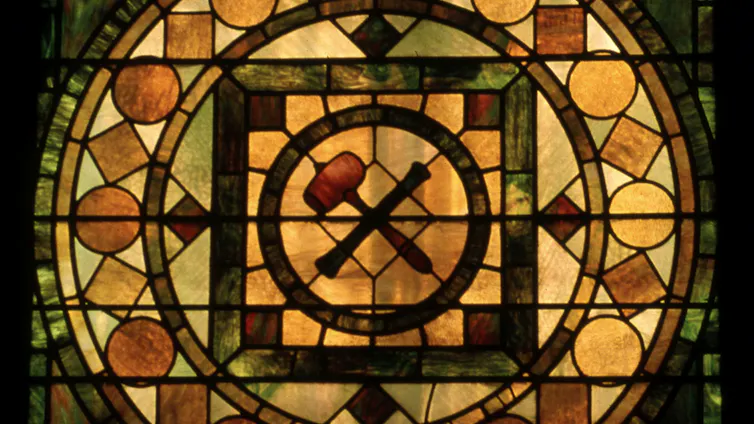
Stained glass window with squares, circles and other shapes
A gavel represents the refining of character and removal of vices among Freemasons.
API/Gamma-Rapho via Getty Images

Freemasons in the cradle of liberty

Philadelphia was the country’s political center during the American Revolution, which began in 1775.

After the war ended in American victory in 1781, Philadelphia served as the capital of the U.S. beginning in 1790, until Washington, D.C., was chosen as America’s permanent capital in 1800.

During this period, the U.S. depended on contributions from its political and civic figures to develop future leaders with skills and intelligence. Among this group and some of the country’s leaders were Freemasons, the independent “brethren” of skilled stonemasons.

In England, landowners or even royalty owned many masons, but some masons were self-sufficient and enjoyed their freedom to work as they wished. When they made their way to America by the 1720s, their high standards of workmanship, fair trade and reason as they taught their craft made them influential in society.

Being a Freemason was a mark of sophistication. Freemasons were high-status, wealthy men. The fraternity provided a forum for networking – not just for stone shapers but other men who were successful in business, trade or even Colonial administration.

By the late 1740s, almost all of Philadelphia’s Freemasons were also merchants, shipowners or successful artisans. They were considered political, intellectual and creative leaders in Colonial Philadelphia.

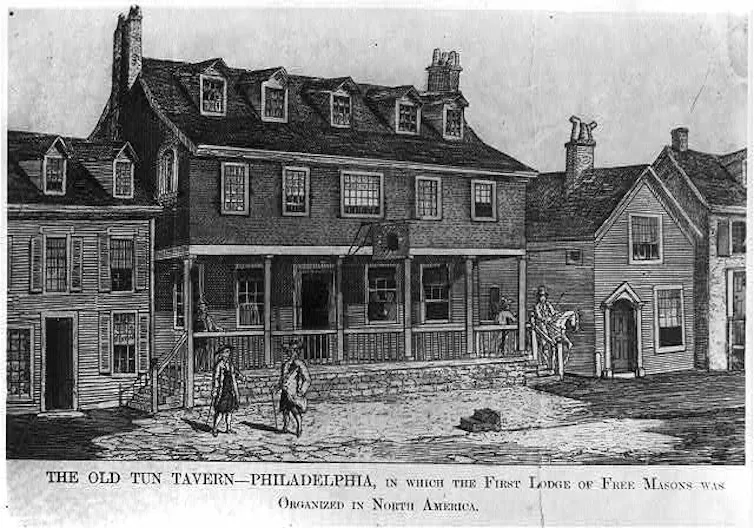
Black and white depiction of a large house with smaller houses adjacent to it
The Tun Tavern was a popular hangout for Philadelphia Freemasons and other political brass in the late 1700s.
Albert Moerk/Library of Congress

Freemasons built notable structures throughout the Philadelphia and southern New Jersey areas as well as in New York, Boston and other parts of New England.

But because the group’s rituals and oaths were shielded from public view and performed in clandestine sessions in Masonic temples, rumors spread about their activities. Some people believed Freemasons secretly conspired against American values – especially religion.

Freemasons believed in principles such as rationalism, which views science and logic – rather than sensory experiences – as the foundations of knowledge. Freemasons also held that everything in the universe is the result of natural causes rather than the supernatural or divine.

They treated all religions equally. They allowed participation in them but believed no faith was to be favored as possessing the one true God. This was in contrast with religions that argued their doctrine exclusively expressed the truth. In 1738, Pope Clement XII banned Freemasons from joining the Catholic Church, a prohibition that still exists today.

Illustration of man with white hair and rosy cheeks in suit with sash standing on checkerboard floor in hall lined with columns
Freemasons counted many leading figures of early America, including George Washington, as members.
Strobridge & Co. Lith./Library of Congress via AP

The ‘godless’ Illuminati

“Another “secret society” also peaked at this time in various parts of Europe, and it drew suspicion among Americans that members exerted influence over the new nation.

Members of the Illuminati, a movement that started in Germany in 1776, promoted Enlightenment values and ideas, including logic, secularism and education. Like Freemasons, they rejected superstition. Unlike Freemasons, however, they also rejected religion and its influence on society.

Europe mostly outlawed the movement before 1790 due to the group’s attempts to greatly lessen religious influence. The Illuminati occupied key roles in the educational system and government of Bavaria, where they weakened clerical authority.

The normally secretive Illuminati attracted attention through their attempts to attend and participate within Masonic temples. They used Freemason ideas along with their own ideas to recruit followers through these networks, hoping to promote an even stronger “one-world” government led by reason instead of religion and spiritualism.

As a result, religious – and specifically Catholic – leaders suspected an association between the philosophically consistent Illuminati and Freemasons.

In a letter to George Washington in 1798, Rev. G. W. Snyder from Maryland attempted to awaken Washington to the danger of the Illuminati and their influence on Freemasons. He wrote about a recently published book by the Scottish physicist John Robison called “Proofs of a Conspiracy” that, according to Snyder, “gives a full Account of a Society of Freemasons, that distinguishes itself by the name ‘of Illuminati,’ whose Plan is to overturn all Government and all Religion, even natural; and who endeavour to eradicate every Idea of a Supreme Being.”

Even today, conspiracy theories still promote the Illuminati’s existence, even after they were formally outlawed in Europe. Such theories suggest the Illuminati still work to degrade religious influence through civil upheaval. A myth survives that the Illuminati still operate secretly, support a world government and guide various governments on how to economically control the world.

But the Illuminati in the late 1700s seemed to dovetail with what people assumed were the basic ideas and agenda of Freemasons in America. Some in America suspected without obvious evidence that Freemasons used their status to boost fellow Freemasons to various governmental positions. They worried this would drive America to become godless, or even Satanic.

Concerns about the influence of Freemasons persisted in part because American presidents Washington and James Monroe were Freemasons. The American public was suspicious that these members reached high levels of government due to the influence of Freemasons. In fact, as many as 25 of the 55 men who attended the 1787 Constitutional Convention in Philadelphia were Freemasons. Founding father Benjamin Franklin was a devout Freemason for over 50 years. Thomas Jefferson was widely thought to be a Freemason, though there is little evidence to support this.

Many of these American leaders, including Franklin, John Adams and Jefferson, had spent time in Europe, especially France, during the late 1700s. Americans feared that European Illuminati members could directly access these political leaders and gain power and influence over the U.S. None of the leaders admitted to having any connection with the Illuminati.

Facade of ornate medieval building
The Masonic temple in Center City serves as the headquarters of the grand lodge of Pennsylvania.
SEN LI/Moment Collection via Getty Images

Conspiracy fears climax

Fears around the Freemasons and Illuminati came to a head in the dramatic and vitriolic U.S. presidential elections of 1796 and 1800.

In the 1796 election, Jefferson’s Republican Party accused Adams of wanting to be a king and also grooming his son, John Quincy Adams, to become president immediately after his father.

Adams’ Federalist Party and an anonymous writer in newspapers – suspected to be Alexander Hamilton writing under the pseudonym “Phocion” – spread rumors attacking Jefferson. Phocion suggested that while Jefferson was U.S. secretary of state in France during Washington’s presidency, the Illuminati influenced him in ways that would cause him to turn his back on religion.

Phocion also accused Jefferson of fathering children with an enslaved woman, Sally Hemings, whom he “kept as a concubine” when he returned with her from France in 1789. Historians believe Jefferson did, in fact, have up to six children with Hemings. The accusations also said Jefferson would free all enslaved people in America if elected.

Adams won in 1796 by just three electoral votes, but Jefferson defeated him in 1800.

Freemasons today

Freemasons today have largely shrunk from their once quite prestigious influence in American society. Today they are a mostly philanthropic organization that supports many causes, such as children’s hospitals, homes for the aged and community services.

There are about 1 million members in America, according to an estimate from 2020. That’s down from a high of over 4 million in 1959.

Relics of the era

An ornate room decorated in blue and gold with pharoah heads atop columns
Inside the Egyptian Hall at the Masonic temple in Philadelphia.
K. Ciappa for Visit Philadelphia®, CC BY-NC-ND

Visitors to Philadelphia might consider two stops where they can be reminded of the conspiracy theories that circulated 250 years ago.

A marker at 175 Front St. notes where Tun Tavern, one of America’s first brew houses, stood from 1691 until it burned down in 1781. It was a hangout for Freemasons, including Franklin and other famous patrons such as John Adams.

Most of the Masonic lodges the city constructed early in its history do not exist today. The first Masonic temple built in Philadelphia was erected in 1809 on Chestnut Street, between 7th and 8th streets, but burned down in 1819.

The current grand lodge for all of Pennsylvania was built in 1873. It faces City Hall and remains a major Masonic base today. The site is very popular among tourists and offers hourly tours Wednesday to Saturday, 10 a.m. to 3 p.m.

Read more of our stories about Philadelphia and Pennsylvania, or sign up for our Philadelphia newsletter on Substack.

The Conversation

Derek Arnold does not work for, consult, own shares in or receive funding from any company or organization that would benefit from this article, and has disclosed no relevant affiliations beyond their academic appointment.

– ref. Philadelphia’s founding years were rife with conspiracy fears about ‘godless’ Freemasons and the Illuminati – https://theconversation.com/philadelphias-founding-years-were-rife-with-conspiracy-fears-about-godless-freemasons-and-the-illuminati-275192

About 80% of breast cancer biopsies turn out benign – new imaging tool promises clearer diagnoses and fewer biopsies

Source: The Conversation – USA – By Quing Zhu, Professor of Engineering, Washington University in St. Louis

Ultrasound is standard for breast cancer screening, but it has its limitations. Anchiy/E+ via Getty Images

Ultrasound is widely used in breast cancer diagnosis. While it can effectively show that a lump is filled with fluid – indicating it is unlikely to be cancer – it cannot reliably determine whether a solid mass is benign or cancerous. This often leads doctors to order breast biopsies to confirm the presence of cancer.

However, most breast biopsies do not detect cancer. In the U.S., more than 1 million breast biopsies are performed each year, and about 80% of them are benign. Unnecessary biopsies are linked to potential harms, including increased anxiety, complications from the procedure and medical costs. Despite advances in breast imaging, breast biopsy remains the only definitive method to determine whether a suspicious lump is cancerous.

My work as an engineer focuses on improving imaging technology to detect and diagnose cancer. Breast cancer grows when the tumors form new blood vessels and consume more oxygen. This makes examining blood vessels and oxygen levels potential biomarkers that could improve breast cancer diagnosis.

Diffuse optical tomography, or DOT, is an imaging technology that uses near-infrared light to measure total blood hemoglobin concentration and oxygen levels – key indicators of tumor activity – in the breast lump. It does not require patients to be injected with contrast dyes to make the image clearer.

My team and I found that combining ultrasound with DOT can improve the accuracy of breast cancer diagnoses and reduce unnecessary breast biopsies. The ultrasound provides information about the structure of a breast lump, while DOT provides information about its function, and this data together can improve breast cancer diagnosis.

Anyone with breast tissue is at risk of developing breast cancer.

Improving breast ultrasounds with DOT

In our study, we imaged 226 patients recommended for routine breast biopsy using our new hand-held imaging technology, which combines ultrasound with diffuse optical tomography. These patients had either breast cancer or benign lumps, and their final diagnosis was confirmed with a biopsy.

Radiologists initially evaluated each patient using standard imaging methods, such as ultrasound and mammography. They then reviewed additional information from DOT images. Importantly, the radiologists and engineers were blinded to the biopsy results when determining diagnoses.

We observed significant biological differences between cancerous and benign lumps. Cancerous lesions had significantly higher levels of hemoglobin and lower levels of oxygen than noncancerous tissue. More aggressive cancers showed even higher hemoglobin concentrations and lower oxygen levels than less aggressive tumors.

When radiologists were able to review DOT measurements, biopsies of benign lumps decreased by approximately 25%. The false-negative rate was 1.8%, which aligns with medical guidelines that recommend monitoring rather than an immediate biopsy.

Future of breast cancer screening and diagnosis

Breast cancer is the most commonly diagnosed cancer in women worldwide. There were approximately 2.3 million new cases and 670,000 deaths reported in 2022. If these rates continue, researchers project around 1.1 million breast cancer-related deaths will occur in 2050.

More accurate, noninvasive diagnostic tools can not only reduce unnecessary biopsies but also lead to more precise and efficient diagnoses. Beyond ultrasound, researchers have also explored combining other imaging techniques with DOT, including X-ray mammography, 3D mammography and MRI. However, DOT systems combined with mammography and MRI are more difficult for routine use in the clinic compared to ultrasound. My team is working to further refine our technology, including incorporating AI tools to help process imaging data.

Minimizing avoidable procedures can help preserve a patient’s quality of life and reduce health care costs. I believe these improvements can collectively have a meaningful and far-reaching effect on patient care and the broader health care system.

The Conversation

Quing Zhu receives funding from the National Cancer Institute for this work

– ref. About 80% of breast cancer biopsies turn out benign – new imaging tool promises clearer diagnoses and fewer biopsies – https://theconversation.com/about-80-of-breast-cancer-biopsies-turn-out-benign-new-imaging-tool-promises-clearer-diagnoses-and-fewer-biopsies-277070

Au-delà du pétrole, les usines de dessalement deviennent l’infrastructure la plus critique du Golfe

Source: The Conversation – France in French (3) – By Sanam Mahoozi, Research Associate, City St George’s, University of London

Environ 70 % de l’eau potable en Arabie saoudite provient d’usines de dessalement. Au Koweït et à Oman, cette proportion atteint 90 %.
Stanislav71/Shutterstock

Alors que les tensions militaires s’intensifient au Moyen-Orient, les usines de dessalement apparaissent comme des infrastructures critiques. Leur vulnérabilité pourrait rapidement transformer un conflit régional en crise humanitaire.


Depuis des décennies, le Golfe est indissociable du pétrole. Pétroliers, oléoducs et raffineries ont longtemps été considérés comme les infrastructures les plus stratégiques — mais aussi les plus vulnérables — de la région. Ces derniers jours, des frappes américano-israéliennes ont d’ailleurs visé des dépôts pétroliers à Téhéran. Dans leur sillage, des habitants ont évoqué une pluie noire tombant pendant des heures, que certains médias ont décrite comme de la pluie acide.

Mais ce sont désormais les réseaux et les infrastructures qui assurent l’accès à l’eau — ainsi que les usines de dessalement — qui soutiennent la vie quotidienne. Lorsque l’approvisionnement en pétrole se resserre et que les prix flambent, les « chocs pétroliers » fragilisent les économies. Mais une crise de l’eau peut, elle, déstabiliser des sociétés entières.

Dans toute la péninsule Arabique, le dessalement de l’eau de mer — qui consiste à obtenir de l’eau potable à partir de l’eau salée — a transformé ces paysages parmi les plus arides de la planète en sociétés urbaines prospères. Des villes comme Dubaï, Doha, Koweït City ou Abou Dhabi dépendent très largement des usines de dessalement.

Ainsi, 70 % de l’eau potable de l’Arabie saoudite provient de ces installations. Au Koweït et à Oman, cette part peut atteindre 90 %. Sans ces usines de dessalement, une grande partie des systèmes urbains modernes de la région aurait du mal à exister.

Pourtant, cet exploit technologique a discrètement créé une nouvelle forme de vulnérabilité stratégique. La sécurité hydrique du Golfe dépend en effet d’un nombre relativement limité d’immenses usines côtières de dessalement — de vastes complexes industriels qui servent de véritables bouées de sauvetage pour des villes entières.

Le conflit militaire en cours commence à en révéler les fragilités. Des frappes de missiles et des interceptions de drones ont eu lieu à proximité de grandes installations de dessalement ainsi que de complexes combinant production d’eau et d’électricité dans le Golfe. L’Iran comme les États-Unis ont été accusés d’avoir ciblé ces infrastructures. Même lorsque les dégâts restent limités, ces attaques soulignent à quel point ces installations sont exposées dans un contexte de guerre moderne.

Contrairement aux oléoducs ou aux terminaux de stockage du pétrole, les usines de dessalement ne peuvent pas être facilement contournées ni remplacées. Ce sont des installations fixes et extrêmement complexes, qui nécessitent d’importants apports d’énergie, des membranes spécialisées ou des systèmes thermiques, ainsi que des processus continus de traitement chimique et mécanique. Réparer des dommages importants sur une grande installation pourrait prendre des mois, voire davantage.

Les conséquences d’une interruption de fonctionnement seraient immédiates. La plupart des villes de la région disposent de capacités de stockage d’eau limitées. Si une grande usine de dessalement cessait de fonctionner, les gouvernements pourraient être confrontés à la perspective d’un rationnement d’urgence de l’eau pour des millions d’habitants en quelques jours seulement. Les hôpitaux, les systèmes d’assainissement, la production alimentaire et l’industrie seraient tous touchés simultanément.

Dépendance au dessalement

Ce risque est amplifié par la rareté structurelle de l’eau dans la région. Le Moyen-Orient compte parmi les régions les plus touchées par le stress hydrique au monde. Les précipitations y sont faibles et très irrégulières, tandis que la hausse des températures accroît l’évaporation et la demande en eau. Les nappes phréatiques ont été fortement surexploitées dans une grande partie de la région.

En Iran, la baisse du débit des fleuves, les sécheresses prolongées et la surexploitation des eaux souterraines ont déjà laissé certains barrages à sec. Des pressions similaires existent dans d’autres pays où les ressources renouvelables en eau douce sont extrêmement limitées. Le dessalement est ainsi passé d’une technologie complémentaire à la colonne vertébrale des systèmes urbains d’approvisionnement en eau. Cette évolution a fait émerger ce que l’on pourrait appeler une « dépendance au dessalement » : une situation dans laquelle des sociétés entières reposent sur un petit nombre d’installations centralisées pour assurer leur approvisionnement en eau.

L’ampleur de cette dépendance est frappante. Environ 100 millions de personnes dans la région au sens large dépendent directement de l’eau dessalée. La péninsule Arabique à elle seule représente une part importante de la capacité mondiale de dessalement, et dix des plus grandes usines du monde se concentrent le long des rives du Golfe et de la mer Rouge. À mesure que la pénurie d’eau s’intensifie dans la région, cette dépendance devrait encore s’accentuer. Mais une dépendance accrue signifie aussi une exposition plus grande aux risques.

Des usines de dessalement d’eau visées par des attaques.

Les infrastructures hydrauliques ont historiquement été vulnérables en temps de guerre. De l’Irak à la Syrie en passant par le Yémen, des usines de traitement de l’eau, des stations de pompage et des réservoirs ont été endommagés ou pris pour cible lors de conflits antérieurs. Le droit international humanitaire reconnaît d’ailleurs ce danger. L’article 54(2) du protocole additionnel aux conventions de Genève du 12 août 1949, relatif à la protection des victimes des conflits armés internationaux (protocole I), dispose que :

Il est interdit d’attaquer, de détruire, d’enlever ou de mettre hors d’usage des biens indispensables à la survie de la population civile, tels que les denrées alimentaires, les zones agricoles destinées à la production de denrées alimentaires, les cultures, le bétail, les installations et réserves d’eau potable ainsi que les ouvrages d’irrigation, dans le but spécifique d’en priver la population civile ou la partie adverse pour leur valeur de subsistance, quel qu’en soit le motif, que ce soit pour affamer les civils, les contraindre à se déplacer ou pour toute autre raison.

Ces protections s’appliquent aussi bien aux conflits armés internationaux qu’aux conflits armés non internationaux.

Des risques majeurs

Les conséquences humanitaires de la mise hors service de ces immenses usines de dessalement seraient considérables. Contrairement aux infrastructures pétrolières, qui peuvent parfois être contournées grâce aux marchés mondiaux ou à des réserves d’urgence, les systèmes d’approvisionnement urbains en eau sont fortement localisés. Si une usine de dessalement alimentant une grande métropole était touchée et endommagée lors d’une attaque, il existerait très peu d’alternatives immédiates. Des importations d’eau par navires-citernes ou des unités de dessalement d’urgence pourraient apporter un soulagement temporaire, mais elles ne pourraient pas remplacer la production quotidienne d’une grande installation.

Les effets en cascade iraient bien au-delà de l’eau potable. Les systèmes d’assainissement commenceraient à défaillir, les risques sanitaires augmenteraient et l’activité économique pourrait ralentir fortement. Le tourisme, l’industrie et les services — des piliers des économies des États du Golfe — dépendent d’un approvisionnement en eau stable.

Les conséquences géopolitiques seraient également majeures. Le Golfe apparaît de plus en plus comme un laboratoire pour comprendre les nouvelles formes de vulnérabilité des infrastructures à l’ère du stress climatique : la militarisation des systèmes de production d’eau. À mesure que le dessalement se développe dans le monde — de la Californie à l’Australie, en passant par l’Afrique du Nord et le sud de l’Europe — des fragilités comparables pourraient émerger ailleurs. Des mégapoles côtières confrontées à la sécheresse investissent déjà massivement dans de grandes installations de dessalement pour sécuriser leur approvisionnement futur en eau. La question de leur protection en temps de conflit dépasse donc largement le Moyen-Orient.

Protéger les usines de dessalement n’est plus seulement un enjeu régional. C’est un défi global : comment sécuriser les infrastructures technologiques dont dépend désormais la vie quotidienne des sociétés modernes dans un contexte de raréfaction de l’eau.

Plusieurs stratégies pourraient réduire ces risques. Développer le recyclage des eaux usées et restaurer les zones naturelles de stockage de l’eau permettrait de diversifier les ressources. Des systèmes de dessalement plus distribués — avec des installations plus petites réparties sur plusieurs sites — limiteraient la dépendance à quelques grandes usines. L’augmentation des capacités stratégiques de stockage d’eau offrirait également aux villes un tampon en cas d’interruption brutale.

Mais les solutions techniques ne suffiront pas à elles seules. Le véritable enjeu est de reconnaître ce que sont devenues les usines de dessalement : des infrastructures humanitaires critiques dont dépend l’approvisionnement en eau de populations entières.

Pendant une grande partie du XXe siècle, le pétrole a façonné les villes du Golfe. Au XXIe siècle, c’est l’eau dessalée qui les fait vivre.

The Conversation

Sanam Mahoozi ne travaille pas, ne conseille pas, ne possède pas de parts, ne reçoit pas de fonds d’une organisation qui pourrait tirer profit de cet article, et n’a déclaré aucune autre affiliation que son organisme de recherche.

– ref. Au-delà du pétrole, les usines de dessalement deviennent l’infrastructure la plus critique du Golfe – https://theconversation.com/au-dela-du-petrole-les-usines-de-dessalement-deviennent-linfrastructure-la-plus-critique-du-golfe-279591

From cowboy to crusader: how Trump distorts American mythology in the conflict with Iran

Source: The Conversation – France – By Jérôme Viala-Gaudefroy, Spécialiste de la politique américaine, Sciences Po

The United States’ Operation Epic Fury against Iran does more than mark a military escalation. It shows how Trump revives old national myths: the American frontier, the cowboy, regenerative violence, and Providence – while stripping them of their civic dimension and turning them into narratives of domination.

That is what distinguishes him from earlier presidents: he does not draw on these myths to celebrate collective effort or democratic purpose, but to stage domination, purification, and personal omnipotence.

A conflict fuelled by myths

Since the start of the war on Iran, Trump has sounded less like a President than a conqueror. He demands Tehran’s “unconditional
surrender
,” promises that “bombs will be dropping everywhere,” and evokes the selection of “great, acceptable leaders” for the postwar period.

This language is more than the language of military necessity: it reactivates an old grammar of American power in a brutally hardened form.

In Republics of Myth (2022), Hussein Banai, Malcolm Byrne and John Tirman argue that conflict with Iran is driven not only by strategic interests but also by two incompatible national narratives, each of which turns every new crisis into confirmation of older humiliations, fears, myths, and hostilities.

On the American side, that narrative remains deeply shaped by, the myth of the frontier: a space to tame, “savages” to defeat, and a mission to fulfil. Applied to the Middle East, that framework casts Iran as an external frontier to be subdued. Trump did not invent this narrative. He radicalised it.

The Frontier: from expansion to predation

In his inaugural address on January 20, 2025, Trump presented the frontier as one of the nation’s central founding myths. The United States, he said, must once again become “A growing nation – one that increases our wealth, expands our territory,” and pursues its “manifest destiny.” He added that “the spirit of the frontier is written into our hearts.” Here, the frontier is no longer a metaphor for collective progress. It becomes, once again, a language of power and appropriation.

Nor did this rhetoric remain abstract. In the first weeks of his second term, Trump repeatedly said that Canada should become the 51st state and declared of Greenland:

“I think we’re going to get it one way or the other.”

This narrative is rooted in a Puritan imaginary of mission in the wilderness, of a “New Jerusalem,” and of the violent conquest of a territory populated by figures deemed as “barbaric savages.” Republics of Myth also shows how this grammar was projected from Latin America to the Middle East.

Trump is therefore not simply reusing an old American image; he is reactivating its most expansionist version. The same mechanism operates home. At the southern border, Trump speaks of “invasion,” “migrant occupation” and, again, “savages.” Abroad, he applies the same logic to Iran, describing it in apocalyptic terms as a force of “evil” that must be crushed and as an imminent existential danger. In both cases, the point is less to protect a border than to stage a reconquest through a moral narrative of good versus evil.

The cowboy becomes a cult of the leader

The second myth is that of the individualistic cowboy, as analysed by Historian Heather Cox Richardson: the ideal of the “real” American, typically white who acts alone, expects nothing from
government, protects his own, and imposes his will by dominating others.

Richardson shows that this myth, reworked in the modern era by Barry Goldwater and later mainstreamed by Ronald Reagan, has become central to Republican political culture. Under Trump, it is taken to an extreme. One sentence, spoken when he announced the opening of strikes against Iran on February 28, captures the logic:

“No president was willing to do what I am willing to do tonight.”

The cowboy is no longer a figure of popular autonomy. He becomes the exceptional man, the one who dares alone, above institutional caution.

Trump folds the myth into his own person. With the alleged Iranian plot to assassinate him during the 2024 campaign in mind, he even frames the death of Ayatollah Ali Khamenei as an O.K. Corral-style duel:

“I got him before he got me.”

Where earlier presidents could use frontier imagery to narrate a national effort, Trump turns the cowboy into a template for the charismatic, transgressive leader. The hero no longer stands for a collective order. He externalises conflict, polarises the world into good and evil, and justifies himself only through his ability to win. This pattern is not without precedent. From Reagan’s “evil empire” to George W. Bush’s “axis of evil,” American presidents have often opposed a virtuous “us” to a threatening “them.” But under Trump, the moral narrative no longer primarily serves to defend values or the “free world.” It serves to magnify a leader whose legitimacy rests on his capacity to prevail. Yet, Trump also undermines the very binary he deploys: even after branding an adversary as evil, he may pivot the next day and embrace the idea of a deal with the enemy. The rhetoric is therefore not only harsher than before; it is also more unstable, more transactional, and more theatrical.

Violence as regeneration

The third myth is that of regenerative violence, long identified by historian Richard Slotkin. He has shown the idea that violence can purge disorder and restore a lost order runs through modern American political mythology.

Violence is not an accident of the frontier; it is its symbolic engine. It destroys the obstacle, repairs humiliation, for example, the humiliation left by the 1979 hostage crisis, which Trump invoked in his February 28, 2026 address – purifies space, and regenerates the community.

As early as 2017, Trump’s inaugural address invoked “American carnage” painting a portrait of a ravaged country that had to be restored through rupture, a narrative drawn from the rhetorical tradition of the Jeremiad.

In 2025–2026, that logic extends to foreign policy. At West Point, addressing graduates of the US military academy, Trump said he wanted to refocus the military on “crushing America’s adversaries, killing America’s enemies,” and on the ability to “dominate any foe and annihilate any threat.”

Since the start of his second term, that myth has been dramatised even more explicitly through the fusion of entertainment and reality, as in a White House video that mixed images of the strikes on Iran with scenes from Hollywood films and video games under the slogan “American Justice.”

Trump promises his enemies “certain death” and links destruction to a supposed political liberation. Violence, then, is no longer simply a means. It becomes the condition of renewal. This is where Trump departs most clearly from a more conventional presidential use of power.

Where his predecessors tied violence to an explicit project of political transformation – democratisation, state-building, regional redesign, Trump expresses a more radical belief: power itself becomes a virtue, and crushing the enemy its most dazzling proof. Violence no longer prepares a new order. It becomes an end in itself, as though the demonstration of power alone could produce a political solution.

Under Trump, the old American myth of violence is stripped of its universalist trappings. What remains is destruction as proof of power.

Providence and the leader’s mission

The fourth myth is religious. From the outset, the American frontier was bound up with a providentialist imagination: a mission in the wilderness, a chosen people, a direct Protestant relationship to God. Trump takes up that tradition, but shifts it onto himself. In his 2025 inaugural address, he said that his “life was saved for a reason” and that he was “saved by God to make America great again. At the National Prayer Breakfast he again declares that God has “a special plan and a glorious mission for America.”

Here too, the original myth is distorted. Providence is no longer invoked to recall the nation’s collective vocation. It is used to sacralise the president himself in a quasi-messianic role. Trump’s supporters intensify this drift: part of evangelical Trumpism cast him in the language of anointing, prophecy, or a war between good and evil. Religion does not replace strategy here; it sacralises force.

US Defense secretary Pete Hegseth is a particularly revealing embodiment of that dynamic. A modern crusader figure, he fuses nationalist Christianity, martial virility, and the sacred legitimisation of force, with a vision of violence largely unbound by restraint. He invokes divine purpose before troops to justify war.

What the conflict against Iran really reveals

The war against Iran throws all of this into sharp relief. It shows how old American myths are not just reused, but hardened and distorted. The frontier becomes predation, the cowboy – a cult of the leader, violence – redemptive crushing, religion – the sacralisation of the leader.

Trump does not simply inherit the US presidential tradition. He radicalises its darkest impulses, draining these narratives of their civic, moral, or universalist content and leaving only their most brutal core: conquest, force, divine right, and the annihilation of the enemy. That is also part of what makes them appealing to many Republican sympathisers.


A weekly e-mail in English featuring expertise from scholars and researchers. It provides an introduction to the diversity of research coming out of the continent and considers some of the key issues facing European countries. Get the newsletter!


The Conversation

Jérôme Viala-Gaudefroy ne travaille pas, ne conseille pas, ne possède pas de parts, ne reçoit pas de fonds d’une organisation qui pourrait tirer profit de cet article, et n’a déclaré aucune autre affiliation que son organisme de recherche.

– ref. From cowboy to crusader: how Trump distorts American mythology in the conflict with Iran – https://theconversation.com/from-cowboy-to-crusader-how-trump-distorts-american-mythology-in-the-conflict-with-iran-279230

Politiques climatiques : comment convaincre les électeurs centristes et obtenir des majorités ?

Source: The Conversation – France in French (3) – By Loïc Berger, Chercheur CNRS, LEM (UMR 9221), IÉSEG School of Management

Une interdiction pure et simple des voitures à moteur thermique est rejetée par les électeurs pivots. En revanche, elle est plutôt soutenue si elle est associée à certaines conditions. Sur l’image, le périphérique parisien, le 25 janvier 2026. Yann Vernerie/Shutterstock

En Europe, les débats sur le climat opposent souvent deux camps. Pourtant, une vaste enquête menée dans 13 pays européens raconte une autre histoire. Entre soutien et rejet existe un groupe décisif : un tiers des électeurs, dont l’adhésion dépend surtout de la manière dont les politiques sont conçues.


Nous avons interrogé près de 19 000 adultes dans 13 pays de l’Union européenne (UE) sur 15 propositions de politiques climatiques. Nos résultats montrent que l’opinion publique n’est pas divisée en deux blocs figés « pour » et « contre ». Une part significative de la population se situe au centre, dans ce que nous appelons le « milieu conditionnel ». Ces électeurs ne sont ni apathiques ni désengagés. Leurs opinions évoluent en fonction de la conception des politiques, de leur équité perçue, de leurs coûts réels, et de leur degré d’intrusion dans leur quotidien. Comme ce groupe du « milieu conditionnel » représente 33 % des électeurs, et son soutien peut faire basculer une politique vers (ou hors de) l’obtention d’une majorité.

Trois leçons pour convaincre les électeurs pivots

Si l’objectif est de construire des majorités durables pour l’action climatique, la solution n’est pas d’éviter les politiques difficiles. C’est de bien les concevoir. Trois leçons pratiques se dégagent :

  • Mettre en avant les bénéfices individuels. Les électeurs réagissent fortement à la façon dont les politiques climatiques sont conçues et à la question de savoir qui paie et qui bénéficie (et si le soutien aux groupes vulnérables est crédible). Une mesure sera plébiscitée si elle est perçue comme avantageuse pour eux, et rejetée si elle menace leur pouvoir d’achat ou semble compliquer leur quotidien.

  • Concevoir les instruments politiques comme des leviers d’acceptabilité. Les taxes, interdictions, subventions ou exemptions ne sont pas de simples outils techniques : leur conception détermine si une politique sera perçue comme juste, flexible ou contraignante, et si elle obtiendra un soutien.

  • Ne pas confondre opposition bruyante et opinion publique. Une large part des Européens ne sont pas des opposants endurcis. Si les électeurs pivots sont souvent silencieux, ils peuvent faire basculer une majorité.

Ce qui influence le milieu conditionnel : les coûts, les contraintes, et l’instrument politique lui-même

Ce groupe agit avant tout selon une logique individuelle de coût-bénéfice. Nos résultats) le confirment : la conception des politiques et leurs impacts perçus (sur le pouvoir d’achat, le bien-être ou l’économie nationale) sont les principaux déterminants de leurs préférences, bien plus que leur pays d’origine, leurs attitudes ou leur profil sociodémographique. En d’autres termes : ils ne suivent pas une idéologie, mais leur portefeuille. Pour les rallier, il faut donc privilégier des mécanismes concrets perçus comme équitables, plutôt que des arguments moraux ou collectifs.

Prenons l’exemple des politiques automobiles : une interdiction pure et simple des nouvelles voitures à moteur thermique après 2035 rencontre une forte résistance parmi les électeurs pivots, avec seulement 15 % de soutien. Mais l’ajout d’une exemption pour les carburants synthétiques, une alternative perçue comme moins contraignante, fait bondir ce soutien à 42 %. Cet exemple révèle une logique clé : ce groupe réagit moins à l’objectif final d’une politique qu’à la manière dont elle s’applique concrètement à leur situation.

Certaines politiques sont systématiquement plus faisables que d’autres

Parmi les 15 propositions que nous avons étudiées), les niveaux de soutien varient considérablement. Les mesures imposant des coûts visibles et directs aux consommateurs (taxes ou interdictions de consommation) ont tendance à rencontrer des difficultés.

À l’inverse, les politiques présentées comme des investissements partagés, des subventions, ou des règles accompagnées de protections pour les ménages vulnérables obtiennent de meilleurs résultats.

Par exemple, la création d’un fonds ferroviaire européen, destiné à étendre le réseau ferroviaire et à réduire le coût des billets de train, recueille un large assentiment avec 77 % de soutien, perçue comme un investissement collectif porteur de bénéfices partagés. À l’inverse, l’idée d’une taxe sur la viande bovine, bien que visant à encourager des modes de consommation plus durables, ne convainc que 11 % des répondants, jugée trop onéreuse sur le plan individuel et difficilement acceptable dans le contexte économique actuel.

Ce graphique représente la proportion moyenne de répondants, tous pays confondus, qui soutiennent chacune des 15 politiques (en vert), ainsi que la proportion de répondants appartenant au groupe « Conditionnel » ayant répondu « neutre » à chaque politique
Ce graphique représente la proportion moyenne de répondants, tous pays confondus, qui soutiennent chacune des 15 politiques (en vert), ainsi que la proportion de répondants appartenant au groupe « conditionnel » ayant répondu « neutre » à chaque politique (en jaune).
Climate Policy Feasibility across Europe Relies on the Conditional Middle, Fourni par l’auteur

Comment ce groupe peut faire basculer les majorités

Les personnes appartenant au groupe du « milieu conditionnel » représentent un poids électoral décisif : 71 % d’entre elles ont participé aux élections européennes de 2024, ce qui souligne leur engagement dans le processus démocratique. Leur influence s’étend particulièrement au sein des partis centristes, qui jouent un rôle clé dans la constitution des majorités politiques.

Si ces électeurs pivots, actuellement neutres, basculaient en faveur des politiques climatiques, le nombre de mesures soutenues par une majorité augmenterait substantiellement, passant de 4 à 10 sur 15. Ainsi, à la situation actuelle où une majorité de répondants soutient le fonds ferroviaire européen, l’interdiction des avions privés, les normes d’isolation obligatoire et la taxe sur les profits des entreprises de carburants fossiles, s’ajouterait un soutien à :

  • un mécanisme d’ajustement carbone aux frontières (CBAM),

  • l’interdiction des publicités pour les produits très polluants dans l’UE,

  • l’extension du système d’échange de quotas d’émission (EU ETS) aux transports, à l’agriculture et au chauffage,

  • l’interdiction des ventes de véhicules à moteur thermique avec exemptions pour les carburants synthétiques.

En Europe, cinq pays supplémentaires verraient alors une majorité de leurs citoyens soutenir au moins 7 des 15 politiques climatiques étudiées.

Carte

Climate Policy Feasibility across Europe Relies on the Conditional Middle, Fourni par l’auteur

Où doit aller l’argent du climat ?

Les électeurs pivots affichent des préférences nettes quant à l’utilisation des revenus climatiques (ceux issus du système d’échange de quotas d’émission de l’UE, par exemple). Ils privilégient avant tout les projets d’adaptation comme les investissements dans les technologies vertes ou les transports bas carbone, perçus comme des bénéfices concrets et collectifs. Le soutien aux ménages les plus vulnérables, sous forme de mesures de compensation, arrive en seconde position, car il atténue les inégalités et renforce la légitimité sociale de ces financements. En revanche, les aides aux travailleurs des secteurs fossiles menacés par la transition sont jugées bien moins prioritaires.

Pour maximiser l’adhésion du groupe du « milieu conditionnel », il est crucial que ces revenus soient affectés à des usages perçus comme légitimes et utiles à tous. La communication joue ici un rôle clé : elle sera plus efficace si elle est transparente, concrète et centrée sur les bénéfices individuels ou locaux (services publics, infrastructures). Par exemple, un message comme « votre contribution finance des digues pour protéger votre région des inondations » aura un impact bien supérieur à une formule générique telle que « votre taxe soutient la transition écologique ». Il s’agit de montrer comment la mesure améliore directement le quotidien, et non simplement d’en décrire la finalité environnementale ou sociale.

Alors que l’UE finalise de nouvelles mesures climatiques pour 2040, notre étude montre que la transition écologique n’est pas une question de conviction idéologique, mais de conception. En Europe, une majorité silencieuse est prête à agir, à condition qu’on lui propose les arguments auxquels elle sera sensible.

The Conversation

Loïc Berger a reçu des financements de l’Union Européenne sous le programme Horzon (projet CAPABLE, n° 101056891)

Thomas Epper a reçu des financements de l’Union Européenne sous le programme Horizon (projet CAPABLE, n° 101056891) et l’Agence nationale de la recherche (projet WIASSS, ANR-25-CE26-4698).

Uyanga Turmunkh a reçu des financements de de l’Union Européenne sous le programme Horizon (projet CAPABLE, n° 101056891) et l’Agence nationale de la recherche (projet ENDURA, ANR- 21-CE03-0018).

– ref. Politiques climatiques : comment convaincre les électeurs centristes et obtenir des majorités ? – https://theconversation.com/politiques-climatiques-comment-convaincre-les-electeurs-centristes-et-obtenir-des-majorites-277799

Campaña de la renta 2025: lo que se debe saber antes de presentar la declaración

Source: The Conversation – (in Spanish) – By Benja Anglès Juanpere, Profesor titular de Derecho financiero y tributario, UOC – Universitat Oberta de Catalunya

pabloavanzini/Shutterstock

Comienza la campaña de la renta 2025 en España. Aunque cada año la cuestión es siempre la misma, que los contribuyentes cumplan con su obligación tributaria de presentar la declaración del Impuesto sobre la Renta de las Personas Físicas (IRPF) correspondiente al ejercicio anterior, también es verdad que en cada ejercicio se producen algunos cambios al respecto.

Las fechas clave de esta campaña son:

  • Del 8 de abril al 30 de junio: presentación telemática de la declaración.

  • Del 6 de mayo al 30 de junio: presentación asistida por teléfono. La solicitud de este servicio estará disponible desde el 29 de abril.

  • Del 1 al 30 de junio: presentación asistida de forma presencial. La solicitud de este servicio estará disponible desde el 29 de mayo.

A continuación vamos a subrayar las novedades de esta campaña y a dar algunos consejos para cumplir correctamente con esta cita anual.

Ahorro, vivienda y deducciones medioambientales

En la campaña 2025 aumenta la progresividad del IRPF –es decir, sube el porcentaje de impuestos que pagan las rentas más altas– por la mayor tributación (pasa del 28 al 30 %) de las rentas del ahorro (dividendos, intereses, venta de acciones o inmuebles) que superen los 300 000 euros.

El mismo incremento se aplicará a las rentas del ahorro de los contribuyentes que residen en el extranjero y a los trabajadores desplazados a territorio español que tributen por el Impuesto sobre la Renta de no Residentes.

Con respecto a la vivienda, en aquellos municipios en que los valores catastrales hayan sido determinados, modificados o revisados mediante un procedimiento de valoración colectiva, se imputará el 1,1 % del valor catastral del inmueble en lugar de aplicarse el 2 % general. Esta excepcionalidad se produjo también en las campañas 2023 y 2024 y solo aplica a las modificaciones que hubieran entrado en vigor a partir del 1 de enero de 2012.

En cuanto a las deducciones por incentivos medioambientales, finalmente se mantienen las deducciones por las obras de mejora de la eficiencia energética de viviendas y también por la compra de coches eléctricos y la instalación de puntos de recarga.

IRPF 2025 e ingresos individuales

Este 2025, las ganancias obtenidas por los influencers por su actividad como creadores de contenidos digitales pasan a ser consideradas, en todo caso, rendimientos de actividades económicas profesionales, independientemente del epígrafe en que se den de alta en el Impuesto sobre Actividades Económicas.

Por su parte, las personas que hayan percibido el ingreso mínimo vital (IMV) en 2025 deberán presentar la declaración, pero los primeros 12 600 euros están exentos y sólo tributarán como rendimiento del trabajo una vez superen este umbral.

Además, los autónomos que hayan estado dados de alta en cualquier momento de 2025 también están obligados a presentar la declaración, sea cual sea la cuantía de sus rendimientos.

El resto de contribuyentes están obligados a presentar su declaración cuando hayan recibido ingresos anuales superiores a 22 000 euros de un único pagador, o ingresos que superen los 15 876 euros si se tienen dos o más pagadores, siempre que la suma del segundo y posteriores pagadores supere los 1 500 euros.

Asimismo, el convalidado Real Decreto-Ley 3/2026, de 3 de febrero, ha eliminado la obligación de presentar la declaración de la renta a los beneficiarios de prestaciones por desempleo. Por consiguiente, aquellos que percibieron el paro durante 2025 deberán presentar la declaración en las mismas condiciones que el resto de los contribuyentes, es decir, cuando superen los límites generales de ingresos anuales. Aunque también podrán hacerlo, aún no estando obligados, cuando el resultado salga a devolver.

Exenciones tributarias

Entre las rentas exentas –las que no tributan– se mantienen las establecidas en 2024 para los afectados por la dana de octubre de 2024. También continúan exentas muchas ayudas públicas por daños personales o para reparar la destrucción de elementos patrimoniales por incendios, inundaciones o hundimientos, erupciones volcánicas u otras causas naturales.

Igualmente, están exentos de gravamen los premios de hasta 40 000 euros de Loterías del Estado, de las comunidades autónomas, la Cruz Roja y la ONCE. Las cantidades que excedan de dicho importe tributan al 20 % (por ejemplo, de un premio de lotería de 96 548,32 euros, sólo tributará al 20 % la cantidad de 56 548,32 pues los primeros 40 000 están exentos).

Este año, también quedan exentas del pago del IRPF las anualidades por alimentos para los hijos, sin necesidad de que haya sentencia judicial de por medio. Basta con llegar a un acuerdo mediante convenio regulador, formalizado ante secretario judicial o notario.

Algo parecido ocurre con las indemnizaciones recibidas por daños personales como consecuencia de responsabilidad civil: cuando deriven de un acuerdo de mediación entre las partes, formalizado ante notario, será suficiente para considerarlas exentas.

Del mismo modo, tampoco se requiere una resolución judicial para declarar exentas las indemnizaciones por despido de los trabajadores cuando se acuerden en el acto de conciliación ante el Servicio administrativo.

Por último, también estarán exentos los ingresos obtenidos por militares españoles en misiones de la ONU y la OTAN en el extranjero, según sentencia del Tribunal Supremo.

Nuevas reducciones y algunas que caen

En lo relativo a las reducciones, que se aplican sobre la base imponible (el total de ingresos sobre el que se calculan los impuestos), la primera novedad se encuentra en los rendimientos excepcionales de actividades artísticas cuando su cuantía exceda del 130% de la media de los tres ejercicios anteriores. En tal caso, se podrá reducir el exceso en un 30 %, con un límite de 150 000 euros anuales, cuando derive de:

Asimismo, en 2025 se prorrogan las reducciones aprobadas para la campaña 2024 a actividades agrícolas, entre otros, por los efectos de la sequía y de la enfermedad de la lengua azul. También las relativas a la adquisición de piensos a terceros y al uso de energía eléctrica en tierras de regadío. En cambio, desaparecen las reducciones en actividades agrícolas y ganaderas para adquirir gasóleo y fertilizantes.

También se suprime, en esta campaña, la reducción del 20 % por actividades económicas en el municipio de Lorca, que se vio afectado en 2011 por un terremoto.

Deducciones varias

En cuanto a las deducciones –lo que se resta directamente de la cuota íntegra (el importe final a pagar)–, en esta campaña de la renta se podrán seguir aplicando deducciones por obras de mejora de la eficiencia energética en las viviendas:

  • Por obras que reduzcan la demanda de calefacción y refrigeración un 7 % o más: una deducción del 20 % (sobre un máximo de 5 000 euros).

  • Por obras que reduzcan el consumo de energía un 30 % o más, o que permitan mejorar la calificación energética de la vivienda a “A” o “B”: una deducción del 40 % (sobre un máximo de 7 500 euros).

  • Por obras de rehabilitación energética de edificios: una deducción del 60 % (con un máximo de 5 000 euros por vivienda y 15 000 euros en total).

En 2025 también se aplican deducciones a la compra de coches eléctricos y la instalación de puntos de recarga:

  • 15 % del precio del coche nuevo, sobre una base máxima (precio máximo) de 20 000 euros (de modo que la deducción máxima será de 3 000 euros).

  • 15 % del coste de instalación del punto de carga, sobre una base máxima (coste máximo) de 4 000 euros (en este caso la deducción máxima será de 600 euros).

También se prorroga un año más la deducción para los contribuyentes con residencia habitual y efectiva en la Isla de la Palma durante 2025. Esta deducción se deriva de los efectos de la erupción volcánica que se produjo en la isla entre septiembre y diciembre de 2021.

Por último, señalar las deducciones en el IRPF vinculadas a acontecimientos culturales y deportivos de excepcional interés público (por ejemplo, el Año Santo Jacobeo 2027, el centenario de la Generación del 27 o el Gran Premio de Motociclismo de Jerez), aprobados en el Real Decreto-ley 8/2025, de 8 de julio, por los gastos, donaciones y aportaciones que los contribuyentes realicen a estos eventos de acuerdo a la legislación vigente.

Salario mínimo interprofesional: exento

Además, se introduce una nueva deducción por obtención de rendimientos del trabajo. Las personas que ganen menos de 16 576 euros anuales tendrán un descuento de 340 euros. A partir de esta cifra, el descuento se va reduciendo hasta llegar a 0 euros cuando se alcancen los 18 276 euros. De esta forma, se quiere garantizar que los perceptores del salario mínimo interprofesional (SMI) queden exentos del IRPF:

  • Rendimientos íntegros del trabajo iguales o inferiores a 16 576 euros: deducción de 340 euros anuales.

  • Rendimientos íntegros del trabajo entre 16 576 euros y 18 276 euros: deducción de 340 euros menos el resultado de multiplicar por 0,2 la diferencia entre los rendimientos íntegros del trabajo y 16 576 euros.

Deducciones autonómicas

En función del lugar de residencia del contribuyente las deducciones autonómicas aplicables serán distintas, dado que cada comunidad autónoma dispone de su propio régimen fiscal:

Cuestiones a tener en cuenta

En primer lugar, no se debe esperar al último día para para cumplimentar y presentar la declaración, el plazo es de casi tres meses para hacerlo.

Hay que comprobar siempre los datos facilitados por la Agencia Tributaria en el borrador, y rectificar o añadir los que sean necesarios. La responsabilidad de aceptar la información del borrador es exclusiva del contribuyente, que puede ser sancionado por los errores u omisiones que contenga.

En el caso de matrimonios, siempre se debe comparar las declaraciones individuales y la conjunta para saber cuál es la más favorable.

Examinar siempre las deducciones autonómicas según el domicilio de residencia: cada año pueden haber novedades.

Revisar y confirmar los datos bancarios de la domiciliación.

Si la declaración resulta a pagar, es posible fraccionar el pago en dos plazos sin intereses (el 60 % en el momento de la presentación y el 40 % restante en noviembre).

Con carácter general, no se tienen que declarar los ingresos entre particulares recibidos por Bizum u otros medios electrónicos de pago, salvo cuando sean rendimientos sujetos a imposición (como el cobro de alquileres), o ingresos por el pago de bienes y servicios (en el caso de los trabajadores autónomos).

Por su parte, se deben declarar las ganancias o pérdidas por la compraventa de criptomonedas, ya sea a cambio de monedas de curso legal o de otras criptomonedas (permutas).

También se tienen que declarar las ventas de segunda mano en plataformas digitales, pero solo si generan una ganancia patrimonial (es decir, cuando el precio de venta del artículo es superior al de adquisición), lo que no suele ser habitual.

Es importante saber que es posible rectificar, completar o modificar la declaración presentada durante la misma campaña mediante la presentación de una autoliquidación rectificativa. Como novedad, este año también se puede pedir que se tenga por no presentada una declaración cuando no había obligación de declarar, pudiendo recuperar lo pagado indebidamente.

Por último, es recomendable conservar los documentos y facturas durante 5 años, especialmente si dan derecho a una reducción o deducción.

¡Buena campaña de la renta 2025!

The Conversation

Benja Anglès Juanpere no recibe salario, ni ejerce labores de consultoría, ni posee acciones, ni recibe financiación de ninguna compañía u organización que pueda obtener beneficio de este artículo, y ha declarado carecer de vínculos relevantes más allá del cargo académico citado.

– ref. Campaña de la renta 2025: lo que se debe saber antes de presentar la declaración – https://theconversation.com/campana-de-la-renta-2025-lo-que-se-debe-saber-antes-de-presentar-la-declaracion-278621