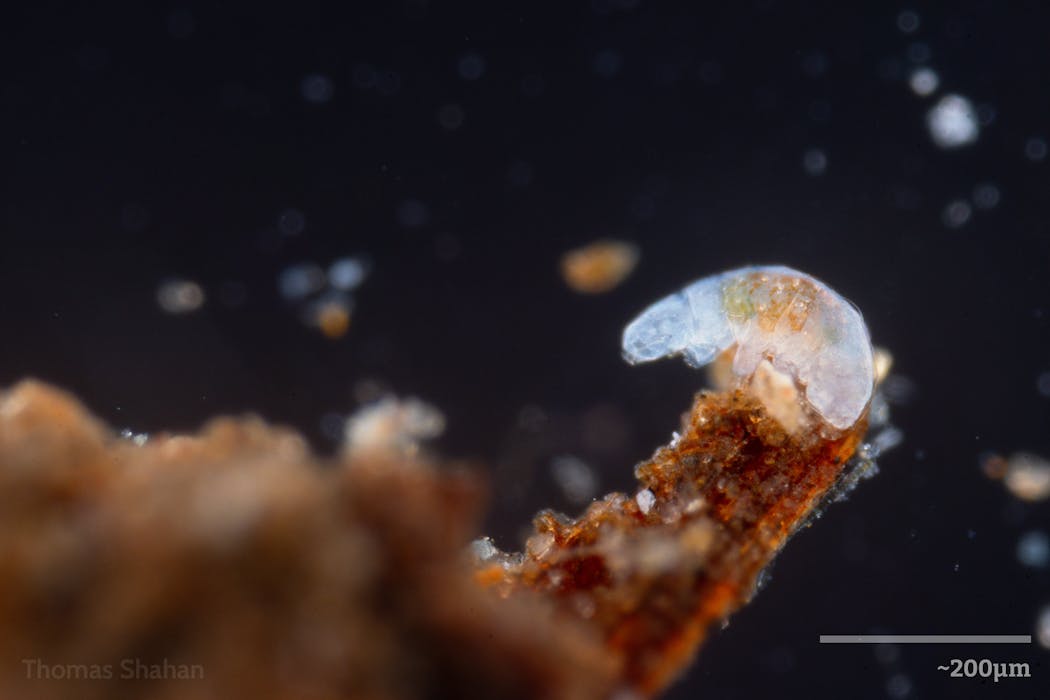
Tardigrades – also known as moss piglets – prefer damp environments, but they can survive just about anywhere.Thomas Shahan/Flickr, CC BY-SA
A newly discovered protein from Earth’s toughest animal is inspiring breakthrough therapies for cancer and cardiovascular disease.
Tardigrades, often called water bears or moss piglets, are microscopic creatures that can survive just about anything: boiling heat, freezing cold and crushing pressure. In fact, tardigrades are the only known animal to survive in outer space. They can also endure radiation levels up to 2,000 times higher than what human cells can tolerate. Naturally, scientists have long wondered: How do they do it?
In 2016, researchers uncovered one of the tardigrade’s secrets: a gene with a sequence unlike any other known to exist in nature that makes a protein found only in tardigrades. When they introduced this protein into human cells, those cells also became more resistant to radiation. The protein was named damage suppressor, or Dsup, because it helps protect DNA – the blueprint for life – from damage.
Since then, researchers around the world have been trying to figure out exactly how Dsup works. As a biochemist studying Dsup, my goal is to uncover how this protein functions and one day use these insights to design new therapies that protect human cells from DNA damage.
How Dsup protects tardigrade DNA
Scientists have proposed several explanations for Dsup’s remarkable ability to protect DNA from radiation. However, these models have varying levels of experimental support, and no single explanation has gained broad consensus from the field.
In my recent work, I found that Dsup interacts strongly with DNA. It clings tightly to DNA – not just at one spot of the molecule but along its entirety. Dsup doesn’t have a fixed shape. Instead, it behaves more like a spaghetti noodle in water, constantly shifting, bending and adopting many different shapes. When it binds to DNA, it causes the strands to slightly unwind, like a zipper being loosened. This gentle unwinding may make DNA less susceptible to damage when exposed to radiation.
Structural snapshot of Dsup. Tyler Woodward, CC BY-SA
In fact, it’s possible many of these models could be true at the same time. Since Dsup protects against many types of radiation – as well as the toxic byproducts created from radiation damage – it’s likely this mysterious protein has multiple functions.
Understanding Dsup could one day help people better protect their own cells – bringing a bit of the tardigrade’s extraordinary resilience to human health.
Using Dsup to advance medicine
Scientists are exploring whether Dsup could be used in medicine, especially in diseases where DNA damage plays a major role.
Because nearly all cancers involve DNA damage, some researchers think Dsup – or treatments inspired by it – could one day help prevent cells from turning cancerous. It might also protect healthy tissue during cancer treatments such as radiation or chemotherapy, which work by damaging DNA but often harm healthy cells in the process.
Dsup’s potential in human health extends much further. For instance, during heart attacks or strokes, organ tissues experience bursts of oxidative stress – chemical reactions that lead to extensive DNA damage. This oxidative stress can worsen disease severity and long-term outcomes for patients suffering from cardiovascular diseases. If Dsup can protect DNA during these stressful events, it might be able to reduce the cellular damage they cause.
Early animal studies are already showing promising results, demonstrating that mammals can produce Dsup, eliciting similar effects. In one study, scientists used an injection of mRNA – similar to the technology behind COVID-19 mRNA vaccines – to deliver the genetic instructions to produce Dsup in mice. When the mice were later exposed to high doses of radiation, those producing Dsup had far less DNA damage than untreated mice, suggesting real protective power in living organisms.
Beyond medicine, Dsup could make an impact in agriculture, space exploration and even data storage.
When researchers engineered riceand tobacco plants to produce Dsup, the plants became more resistant to radiation – an exciting sign for Dsup’s potential to mitigate crop damage.
And in a futuristic twist, some scientists are investigating how creatures like tardigrades could be used for ultrastable data storage. Current digital media is susceptible to damage from environmental conditions such as high temperatures or high levels of radiation. Digital media could be converted into a DNA sequence and genetically engineered into the tardigrade genome. Dsup could then aid in protecting the data from extreme conditions.
What’s next for Dsup?
Since its discovery nearly a decade ago, the scientific community has been excited about the potential technological advancements that Dsup could enable. However, significant research is still required to fully understand exactly how this mysterious protein functions in living organisms. Several scientific groups around the world are actively studying the unique properties of this protein.
Despite the work ahead, the story of Dsup demonstrates how scientists can learn lessons from tiny animals such as tardigrades. By studying the molecular mysteries of these remarkably resilient creatures, researchers are creating breakthrough tools to combat human disease and advance biotechnology.
Tyler J. Woodward receives support through the National Institute of General Medical Sciences.
Opening my social media feed, I’m often confronted with a jarring contrast: intense, diametrically opposed perspectives from different friends. The comments can be laced with insult, character attack and invective.
I’m certainly not the only one noticing this kind of vitriolic polarization. Recent polling suggests a majority of Americans believe that the country cannot overcome its current divisions.
As a professor of human development and family studies, I’ve researched and written about traumatic and adverse childhood experiences and existential anxiety for over 20 years. Scrolling through my feed, I was struck by the recognition that both sides had something in common: a profound sense of existential fear.
While political polarization has many potential causes, existential anxiety is one that has received less attention.
What is existential anxiety?
Philosophers have written about the concept of existential anxiety for centuries. My own empirical research is based on the writings of the mid-20th century philosopher Paul Tillich, who outlines three facets of this fundamental human fear:
Fate and death – fears of nonexistence and uncertainty about one’s ultimate destiny.
Emptiness and meaninglessness – fears about life’s deeper purpose or ultimate concern.
Guilt and condemnation – fears of moral failure or threats to one’s ethical self.
Existential anxiety is humanity’s inherent confrontation with mortality, moral responsibility and search for meaning.
My colleagues and I have found that these fears are very common – between 75% and 86% of participants in our research endorsing at least one concern. Higher levels of existential anxiety are associated with indicators of poor mental health, such as symptoms of depression and suicidal ideation. Existential anxiety levels are also elevated among those who have experienced a life-threatening event. For instance, after surviving a natural disaster, up to 94% of research participants reported at least one dimension of this fear.
Importantly, our research suggests that existential anxiety is associated with aggression. In one study of teens, we found that more extreme existential anxiety as measured with the existential anxiety questionnaire was associated with two kinds of aggression: proactive and reactive. Proactive aggression is goal driven, deliberate and unprovoked, while reactive aggression comes in response to a real or perceived provocation or threat.
Existential fears have their roots in things that pretty much everyone worries about, at least from time to time. But what specifically triggers this anxiety can be different depending on your worldview.
For instance, as I scroll social media, I see friends expressing anxiety about fundamental safety issues, the fate of the nation, cultural erosion and the loss of traditional values. These concerns are mirrored by other friends’ posts expressing concern that the environment is being destroyed, democracy is failing and equality is lost.
Though the content of these expressions can be ideologically opposed, each reflects deeper concerns about societal fate, death or the end of a meaningful way of life. Unspoken but underlying is the fear that the “other side” represents a real and impending threat to one’s very existence.
Though the triggering circumstances can differ based on personal beliefs, both sides’ perspectives reflect existential concerns about meaning, moral direction and survival.
While existential fears are a part of life, there are ways to pull yourself out of their spiral. mrs/Moment via Getty Images
Where do we go?
The good news is that while core existential fears may never fully abate, you can identify them, alleviate them and possibly even channel them toward adaptive action.
Core to these techniques is recognizing and facing the fear. They both help participants overcome common tendencies such as seeing only one side of the evidence or catastrophizing that things are much worse than they really are. Acceptance and commitment therapy, for example, teaches participants how to cultivate psychological flexibility, learn to tolerate uncomfortable thoughts or emotions, and practice acting in alignment with one’s core values. Together, these skills foster positive action as opposed to destructive reaction.
As disturbing as my social media feed can be, I’ve also seen real-world instances of people figuring out how to connect across a divide. For instance, one poster appreciated another’s comment for helping her realize the existential value his perspective represented to him. Following that exchange, the second poster acknowledged he’d been seeing only one side. In other words, they each recognized the other person’s existential fear – accepting it as such helped them de-escalate the confrontation and move forward more constructively.
The critical point is that people on all sides of every issue yearn for safety, purpose and belonging. Recognizing that the core existential concerns we all share underlie polarized fears might be an important step toward bridging divides and reducing the risk of fear-driven aggression.
Carl F. Weems receives or has received funding from the state of Iowa, Youth Shelter Services of Iowa, Environmental Protection Agency, US National Science Foundation, and US National Institutes of Health. He is a fellow of the American Psychological Association, Association for Psychological Science, a member of the Iowa Academy of Education, and American Association for the Advancement of Science.
People who experience gender detachment don’t feel gender is important to how they understand themselves.gremlin/E+ via Getty Images
When I asked Manisha to describe her gender identity, she gave a simple answer: “Meh.”
“I don’t have a gender identity,” Manisha explained. “I get that other people look at me and see a woman but, for myself, there’s a blank space where my gender ‘should’ be. My gender is ‘none.’”
Manisha’s response didn’t shock me. In my work as a sociologist, I had been interviewing asexual individuals – people who experience low to no sexual attraction – across the United States for months from 2020 to 2021. Like Manisha, more than a third of the 77 people I talked to were uncomfortable with defining themselves through the lens of gender. Gender was, as I came to describe it, detached from their sense of self.
This finding comes at a tumultuous time in the politics of gender. On the one hand, transgender and queer social movements have sought to expand people’s ability to break out of the gender binary of man or woman. On the other, the Trump administration has aggressively worked to reassert the gender binary by law.
In my recently published research, I draw on interviews with 30 asexual people who, like Manisha, felt uncomfortable adopting any gender identity. These individuals said they felt that gender was irrelevant, unimportant, pointless and, overall, not a helpful framework for understanding and defining themselves.
These feelings of not identifying with gender highlight an unexpected belief shared by conservative politicians and by many within transgender and queer communities: the assumption that everyone has a gender identity.
Gender detachment
During this research, I spoke with asexual people from a variety of backgrounds across the U.S., ranging from ages 18 to 50. When I began, I planned on comparing the gendered experiences of three groups: asexual men, asexual women and nonbinary asexuals. I quickly had to abandon that plan as I repeatedly encountered interviewees who did not fit into any gender category.
Ollia was the first person who struck me as impossible to assign a gender to. “My gender is like an empty lot: There may have been a building there at some point, but it’s long since fallen away, and there’s no need to rebuild it,” they explained. “The space is better for being left empty.”
Many struggled to explain this sense that they did not truly have a gender identity. “There really isn’t a specific term that can be used to describe how uninterested I am in the concept of gender as a whole,” said a respondent named Faye.
Faced with a language vacuum, I eventually coined a term to describe these distant and skeptical relationships with gender: gender detachment.
Compulsory gender
Gender detachment might sound similar to being agender – that is, not having a gender. Researchers often see agender as a subset of nonbinary. However, most respondents drew a distinction between gender detachment and being agender or nonbinary.
For example, when I initially asked Brandy about their gender identity, they said they were agender. When I asked how accurate that label felt, however, Brandy explained that the term ultimately felt incorrect.
“A lot of people see gender as a spectrum from pink to purple to blue … and I’m a splotch of green on the frame,” Brandy explained. “I just don’t see myself in that spectrum. While agender and nonbinary are handy terms, they still work within a gendered framework I don’t place myself in.”
Brandy quietly pointed out something I found profound: The assumption that everyone has a gender is so omnipresent that even the sense that you do not have a gender has been turned into a gender identity – agender.
In other words, gender detachment poses a significant challenge to how people often think about gender – namely, the assumption that everyone has a gender identity. Gender detachment isn’t just about not identifying as a man or a woman; it’s about not identifying with gender at all.
Sociologists broadly agree that gender is a social construct, meaning its definition, norms, behaviors and roles are created and shaped by society, not by biology. This perspective implicitly understands gender categories to also be concepts created and shaped by cultural norms.
Western societies generally assume that everyone does – and should – have a gender identity. But what people who experience gender detachment show is that the very system of gender categorization is itself a social construct: an idea based on cultural norms rather than in empirical reality. I call this assumption compulsory gender.
Gender detachment represents a way people are resisting gender as a compulsory system of categorization.
Asexual people are uniquely positioned to question conventions surrounding gender. Asexuality upends the belief that everyone experiences sexual attraction – an assumption often called compulsory sexuality. It made sense to me that as asexual people begin questioning the universality of sexuality, some might also being to question the universality of gender. As compulsory sexuality crumbles, so does compulsory gender.
Sociologists often reinforce compulsory gender in how they measure and ask questions about gender. Indeed, that was initially the case for my own study. In each interview, I asked respondents about their gender identity. Almost all gave one. It was only when I asked them about their feelings about gender that I realized the identity they gave me did not feel entirely accurate to them. Rather, they felt detached from gender overall. My findings suggest that going beyond simply asking respondents to report their gender could help researchers better understand how people feel about the very concept of having a gender identity.
One way of understanding the current gender tug-of-war in U.S. culture is as a struggle over what gender identities people are allowed to claim. One camp seeks to expand how many gender identities are available and allow people to choose what resonates most with them. The other camp seeks to obligate people to identify solely within a gender binary of man or woman.
My findings on gender detachment suggest that despite their consequential differences, both camps reinforce compulsory gender by assuming gender is a universal element of who people are.
Canton Winer does not work for, consult, own shares in or receive funding from any company or organization that would benefit from this article, and has disclosed no relevant affiliations beyond their academic appointment.
To some, this concern may seem premature. About 10 to 20 missions are headed to the Moon in the next few years – far short of the thousands of satellites operating in Earth’s orbit. And the area around the Moon, referred to as cislunar space, is very large. Earth’s orbital area is often considered to extend from near Earth out to geostationary orbit, where a spacecraft orbits at a speed that makes it appear stationary from the Earth’s surface.
Cislunar space extends from geostationary orbit out to the Moon – an area with a volume 2,000 times larger than Earth’s orbital area. This size discrepancy seems to suggest crowding around the Moon may not be an immediate concern.
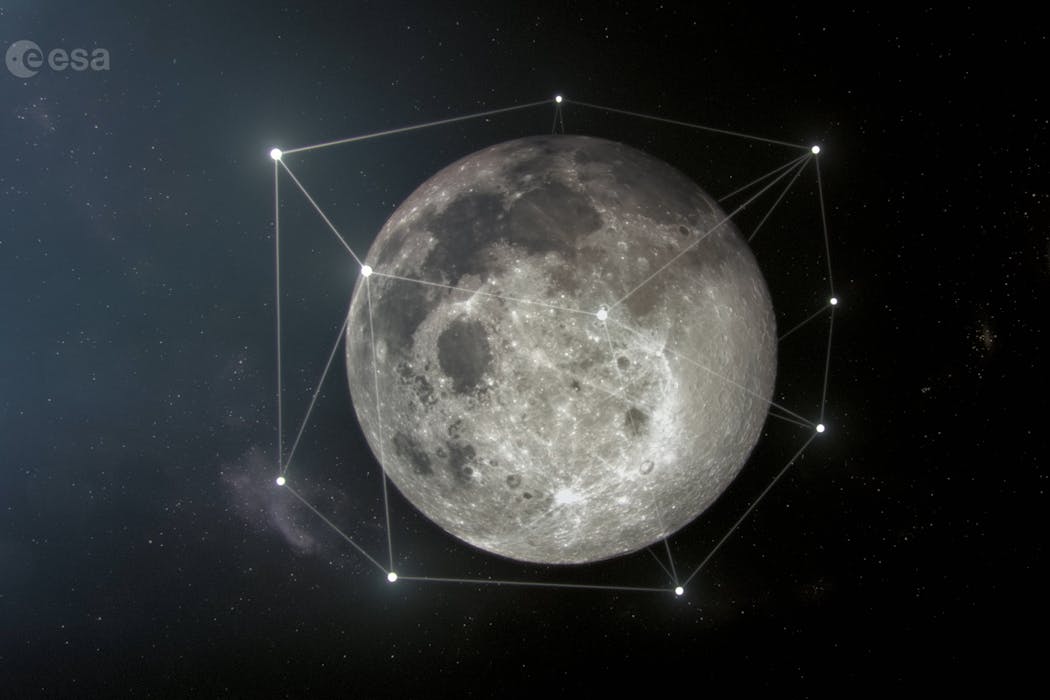
Cislunar space refers to the space between Earth’s geostationary orbit and the Moon. Many Worlds, CC BY-NC
However, missions tend to choose from a select set of stable orbits around the Moon, so the vastness of cislunar space may be misleading when thinking about whether missions will intersect. Also, most government sensors that track spacecraft aren’t capable of consistently detecting and monitoring objects so far away from Earth, partly due to the glare from the Moon itself.
That uncertainty, combined with the high cost of lunar missions, makes operators more likely to move their spacecraft to avoid a collision, even when the probability of a collision is quite low.
As an interdisciplinary team combining space policy and astrodynamics expertise, we’ve been studying how companies and space agencies could manage traffic in lunar orbit without unnecessary maneuvers. Our research, published in March 2025 in the Journal of Spacecraft and Rockets, shows that due to the popularity of certain orbits and the uncertainties regarding each spacecraft’s location, potential collisions become an issue surprisingly quickly.
Our simulations show that with only 50 satellites in lunar orbit, each of those satellites will need to maneuver four times a year on average to avoid a potential crash – a significant cost in terms of fuel as well as potential disruption to mission objectives. Lunar orbit could easily reach that number of satellites within a decade if activity continues to increase.
Countries’ reports on their current operations in lunar orbit seem to support our finding that congestion around the Moon is quickly becoming a significant issue. In 2023, the Indian Space Research Organization reported it had maneuvered its Chandrayaan-2 spacecraft three times in four years, even though only six spacecraft orbited the Moon in that time.
Better monitoring and coordination between different space agencies could prevent congestion and keep countries from having to regularly move their spacecraft.
Monitoring cislunar space is not just important for safety – it can also help support national security. Multiple countries have weapons that can destroy satellites, and some in the space community are concerned that space weapons could be placed in cislunar space to escape detection. The U.S. Space Force is considering the potential security dimensions of cislunar space.
The U.S. currently has significant gaps in its ability to monitor this region, and Mariel’s research suggests that developing this capability – referred to as cislunar space domain awareness – should be a priority for national security. Improved monitoring would help the U.S. military observe activity in cislunar space, gather intelligence and assess potential threats.
Solutions in progress
Several research programs are experimenting in this area. The Air Force Research Laboratory is funding a program called Oracle that is developing multiple systems to improve the U.S. ability to monitor cislunar space.
The first Oracle satellite is expected to launch in 2027. It will be located at a Lagrange point, which is a spot between the Earth and the Moon where the gravitational pull of each object keeps the spacecraft in a stable position. From there, it can detect objects in cislunar space that sensors on Earth cannot see.
The Air Force Research Laboratory’s Oracle satellite would help the U.S. monitor activity in cislunar space.
Improving monitoring is only one part of the solution. Entities sending missions to the Moon, including governments and companies, will need to share the locations of their operational missions and coordinate to avoid predicted collisions.
A NASA program dedicated to tracking and assessing lunar traffic is helping to facilitate this effort. The program compares individual operators’ information about their spacecraft’s current and future planned location to identify potential close approaches. In the future, this type of coordination could improve safety, when combined with sensor observations from systems like Oracle.
Countries and companies planning missions to the Moon could also try to coordinate before they launch their systems, so no missions end up operating too close together.
The Outer Space Treaty, a set of basic principles developed early in the space age, requires that countries avoid harmfully interfering with other countries’ activities, but the treaty doesn’t outline how to do this.
With government and commercial missions to the Moon increasing, and NASA’s next human mission to the Moon planned for early 2026, countries will need to work together to protect everyone’s interest in the Moon.
Mariel Borowitz has previously received funding from the National Aeronautics and Space Administration, the Department of Defense, and the National Science Foundation.
Brian Gunter has current or prior funding from the National Aeronautics and Space Administration, the Department of Defense, and the National Science Foundation.
A recent poll found that 64% of Americans think the country is too politically divided to solve the nation’s problems.Kevin Dietsch/Getty Images
The United States government has been shut down for nearly a month, yet another indication that the political system has become deeply dysfunctional.
President Donald Trump has blamed the Democrats and called their negotiating strategy a “kamikaze attack.” Democrats are keen to stand their ground, hoping that the fallout is worse for Republicans. While each side casts blame on the other, it is Americans who suffer.
But the shutdown is just another episode in a series of polarization-fueled events that are leading Americans to lose faith in their government. Every nation has it limits, and one wonders how much America can take before the pressure to divide into separate countries becomes too great.
These are merely the latest examples of the mounting pressure on the American political system. A recent New York Times/Siena poll found that 64% of Americans think the country is too politically divided to solve the nation’s problems. The same poll showed that only 42% of Americans held that position in 2020.
It should come as no surprise, then, that some are calling for radical solutions like a national divorce.
On Sept. 15, 2025, five days after Kirk’s killing, Georgia Congresswoman Marjorie Taylor Greene tweeted that America needs “a peaceful national divorce. Our country is too far gone and too far divided, and it’s no longer safe for any of us.”
National divorce is the term used to describe the splitting of America into two parts: a red America and a blue America. Secessionist movements like Yes California and Red-State Secession have for over a decade been calling for a national divorce along political lines. And a 2023 Axios poll found that as many as 20% of Americans see national divorce as a solution to political polarization.
As a political scientist who studies secessionist conflict, I’ve found that the national divorce argument is commonly used as an analogy with marital divorce. Just as two spouses may be extremely ill-suited for one another, and far better off if they separated, the same can be said of red and blue America. They no longer see eye to eye on a range of issues, from reproductive rights to the environment and gun control.
If they seceded from one another and formed their own countries, the argument goes, then they could establish policies that would ensure the future they wanted.
Rep. Marjorie Taylor Greene, R-Ga., called for a ‘peaceful national divorce’ in September 2025. AP Photo/J. Scott Applewhite
But as I show in my new book, there is no way to disentangle red and blue America without tremendous violence. Additionally, a large and increasingly ignored percentage of Americans hold moderate views.
There is no doubt that polarization in America is a problem that is getting worse, but a national divorce is simply not the solution.
And yet America’s leaders continue to lead their country toward that outcome. The deployment of National Guard troops to blue cities, the polarization-enhancing consequences of competitive gerrymandering in states like Texas and California, and the spectacle of government shutdown are eroding the public trust. By continuing with policies that amplify polarization and erode the public trust, America’s leaders are fueling the calls for a national divorce.
How much can the country take?
The trend toward heightened polarization in America is not irreversible, but there are limits to how much the country can take before secession becomes a serious project. Some of the limits can be identified in advance.
First, it’s important that the country’s leaders take the pulse of America. If 20% of Americans favored national divorce in early 2023, what is the percentage now? That kind of sentiment can increase surprisingly fast.
Between 2006 and 2014, for example, Catalonian support for independence from Spain increased from 14% to 45%. If something like 50% of Americans concluded that America didn’t work and was better off broken up into smaller parts, then the country could tip rapidly into a secessionist crisis.
People hold up signs during a memorial for Charlie Kirk on Sept. 21, 2025, in Glendale, Ariz. After Kirk’s killing, Trump administration officials vowed to crack down on left-leaning groups. AP Photo/John Locher
Second, high levels of secessionist support make the country vulnerable to trigger events that convince Americans that secession is the answer. The polarization-inspired assassination of prominent leaders can lead to a cycle of recrimination. Upcoming elections are also a concern. If they are closely contested and the losing side is unwilling to admit defeat, then the bedrock of democracy is broken. Both triggers can accelerate polarization and the turn to secessionism.
A third threshold moment is when a prominent leader decides to champion the cause of a national divorce.
Should someone like California Gov. Gavin Newsom, Texas Gov. Greg Abbott or the sore loser of a 2028 election conclude that the system is rigged, and secession is the only solution, then the entire project gains legitimacy.
It was that kind of elite conversion to the secessionist cause that energized the movement in places like Scotland and Catalonia.
The U.S. is a robust country and the longest-running democracy in the world. Americans have more in common than they realize, and the country can be a positive force in the world.
But without decisive action by political leaders to reduce the polarization that threatens to tear the country apart, the United States is at risk of turning from one country into two.
Ryan D. Griffiths receives funding from the National Science Foundation.
Source: The Conversation – in French – By Carlos Coronel, Postdoctoral researcher, Latin American Brain Health Institute, Universidad Adolfo Ibáñez
Les expériences créatives pourraient améliorer la santé du cerveau, permettant ainsi de ralentir son vieillissement.
C’est ce que révèle une étude menée par un groupe international de scientifiques issus de 13 pays. Ces derniers ont découvert que les activités créatives, telles que les cours de danse (le tango s’est révélé particulièrement efficace), les cours d’art ou de musique, ou encore les loisirs comme les jeux vidéo, avaient un impact positif sur les résultats de l’horloge cérébrale d’un individu. Plus les participants pratiquaient leur art, plus leur horloge cérébrale était « jeune ».
Nous avons demandé aux chercheurs principaux, les neuroscientifiques Carlos Coronel et Agustín Ibáñez, d’expliciter leur étude.
Qu’est-ce que la santé cérébrale ?
La santé cérébrale est l’état des fonctions cognitives, émotionnelles et sociales qui permet aux individus de réaliser leur potentiel, de maintenir leur bien-être et de s’adapter aux changements tout au long de leur vie. Elle ne se définit pas par l’absence de maladie, mais par la capacité du cerveau à maintenir une activité efficace, résiliente et intégrée qui soutient la vie quotidienne.
Le vieillissement cérébral désigne quant à lui les changements biologiques et fonctionnels qui se produisent dans le cerveau au fil du temps. Il comprend des changements dans la structure, la connectivité et le métabolisme qui peuvent ou non altérer les performances. Si un certain déclin est naturel, le rythme et le schéma de ces changements varient considérablement d’un individu à l’autre, reflétant à la fois la vulnérabilité et la résilience.
Les « horloges cérébrales » sont des modèles d’apprentissage automatique (IA) conçus pour estimer l’âge apparent d’un cerveau, sur la base de scanners cérébraux ou de schémas d’activité neuronale. Ils comparent les données de neuroimagerie, électrophysiologiques ou neuromoléculaires aux schémas cérébraux normaux tout au long de la vie.
Ainsi, en utilisant une horloge cérébrale, nous pouvons essayer de comprendre ce qui rend un cerveau plus résilient et ce qui le fait vieillir plus rapidement.
Que vouliez-vous découvrir ?
Nous voulions savoir si la créativité n’était pas seulement amusante ou gratifiante sur le plan émotionnel, mais aussi biologiquement bénéfique pour le cerveau. Il existe de plus en plus de preuves que la pratique artistique favorise le bien-être, mais nous ne comprenons pas encore bien comment la créativité peut influencer la santé du cerveau.
Beaucoup pensent que l’art est trop mystérieux et intangible pour être étudié scientifiquement ou pour avoir un impact biologique. Nous avons voulu remettre en question ces deux idées.
Autres questions : les expériences créatives, qui procurent de la joie et sont profondément humaines, peuvent-elles également être mesurées dans le cerveau ? Peuvent-elles contribuer à retarder le vieillissement cérébral, tout comme l’exercice physique aide le corps ?
Notre étude a cherché à déterminer si la créativité pouvait influencer l’horloge cérébrale. Si votre horloge cérébrale indique que vous êtes plus jeune que votre âge réel, cela signifie que votre cerveau fonctionne plus efficacement que prévu.
Comment vous y êtes-vous pris ?
Nous avons recueilli des données auprès de près de 1 400 personnes dans différents pays. Certaines étaient des danseurs de tango, des musiciens, des artistes visuels ou des joueurs experts. D’autres étaient des non-experts associés en fonction de leur âge, de leur niveau d’éducation et de leur sexe dans les mêmes pays. Les non-experts n’avaient aucune expérience préalable dans les différentes disciplines.
Nous avons enregistré leur activité cérébrale à l’aide de techniques appelées magnétoencéphalographie et électroencéphalographie. Ces techniques permettent de mesurer l’activité cérébrale en temps réel. Nous avons ensuite utilisé des modèles informatiques (modèles d’apprentissage automatique) afin de créer une horloge cérébrale pour chaque participant.
Les modèles peuvent être entraînés en moins d’une heure. Le défi consistait à collecter les données de centaines de participants, de l’Argentine à la Pologne. Cela aurait été impossible sans la collaboration de nombreux chercheurs et instituts à travers le monde.
Nous avons donc utilisé les horloges cérébrales pour prédire l’âge de chaque personne à partir de ses données. Si l’âge cérébral ainsi établi d’une personne était inférieur à son âge réel, cela signifiait que son cerveau vieillissait plus lentement.
Enfin, nous avons utilisé ce que l’on appelle la modélisation biophysique. Ces modèles sont des « cerveaux numériques », et nous avons utilisé ces cerveaux virtuels pour comprendre la biologie qui sous-tend la créativité.
Le problème avec les modèles d’apprentissage automatique (les « horloges cérébrales ») est que, bien qu’ils puissent apprendre des modèles pour faire des prédictions, ils ne peuvent pas reproduire l’activité cérébrale réelle. Les modèles biophysiques, en revanche, sont des cerveaux « réels » dans un monde numérique, c’est-à-dire qu’ils sont une copie miroir du cerveau à l’intérieur d’un ordinateur. Ces modèles utilisent des règles biologiques et physiques détaillées pour simuler le fonctionnement du cerveau. Il ne s’agit donc pas de modèles d’IA. Ce sont des « modèles génératifs » qui peuvent, en fait, générer une activité cérébrale à partir d’équations mathématiques.
Alors que les horloges cérébrales peuvent être utilisées pour mesurer la santé du cerveau (vieillissement cérébral accéléré ou retardé), les modèles biophysiques peuvent expliquer pourquoi la créativité est associée à une meilleure santé cérébrale.
Qu’avez-vous découvert ?
Dans tous les domaines créatifs, le schéma était remarquablement cohérent : la créativité était liée à un cerveau d’apparence plus jeune.
Les danseurs de tango présentaient un cerveau qui semblait plus jeune de plus de sept ans par rapport à leur âge chronologique. Les musiciens et les artistes visuels avaient un cerveau plus jeune d’environ cinq à six ans. Les joueurs, d’environ quatre ans.
Nous avons également mené une expérience à plus petite échelle dans laquelle des non-experts ont suivi une formation de seulement 30 heures au jeu vidéo de stratégie StarCraft II afin de voir si un apprentissage créatif à court terme pouvait avoir des effets similaires.
Même dans le cadre de cette expérience à court terme, après seulement 30 heures d’entraînement créatif, l’horloge biologique des participants a reculé, montrant une réduction de l’âge cérébral de deux à trois ans.
Plus les participants pratiquaient leur art, plus l’effet était important. Et le type d’art pratiqué n’avait aucune importance : il pouvait s’agir de danse, de peinture, de musique ou de jeux vidéo. Tous ces arts ont contribué à améliorer la coordination entre les zones clés du cerveau.
Ces zones, importantes pour la concentration et l’apprentissage, sont généralement les premières à vieillir, mais la créativité semble maintenir leurs connexions plus fortes et plus flexibles.
Nous avons ainsi découvert que la créativité protège les zones du cerveau vulnérables au vieillissement et rend la communication cérébrale plus efficace, un peu comme la construction de routes plus nombreuses, plus larges et de meilleure qualité pour relier les villes d’un même pays.
Pourquoi est-ce important ?
Les arts et les sciences, souvent considérés comme opposés, sont en fait des alliés. La créativité façonne non seulement la culture, mais aussi la biologie. Notre étude rétablit la créativité comme une voie biologique vers la santé et la résilience du cerveau, et non seulement comme un phénomène culturel ou psychologique.
En montrant que l’engagement artistique peut retarder le vieillissement cérébral, cette recherche nous aide à repenser le rôle de la créativité dans l’éducation, la santé publique et les sociétés vieillissantes.
Dans une perspective plus large, elle élargit notre compréhension du vieillissement en bonne santé, au-delà de la prévention des maladies. Elle met en évidence la créativité comme un mécanisme évolutif, accessible et profondément humain pour maintenir le bien-être cognitif et émotionnel de populations et de générations diverses.
Si vous vous demandez si être créatif est « bon pour vous », la réponse est « oui ». Scientifiquement, de manière mesurable et presque miraculeuse. Votre prochain pas de danse, votre prochain coup de pinceau ou votre prochaine note de musique pourraient bien aider votre cerveau à rester un peu plus jeune.
Agustín Ibáñez receives funding from the Multi-Partner Consortium to Expand Dementia Research in Latin America (ReDLat), supported by the Fogarty International Center (FIC), the National Institutes of Health, the National Institute on Aging (R01 AG057234, R01 AG075775, R01 AG21051, R01 AG083799, CARDS-NIH 75N95022C00031), the Alzheimer’s Association (SG-20-725707), the Rainwater Charitable Foundation – The Bluefield Project to Cure FTD, and the Global Brain Health Institute. AI is also supported by ANID/FONDECYT Regular (1250091, 1210176, 1220995) and ANID/FONDAP/15150012.
He is affiliated with the Latin American Brain Health Institute (BrainLat), Universidad Adolfo Ibañez, Santiago de Chile, Chile; the Cognitive Neuroscience Center, Universidad de San Andrés, Buenos Aires, Argentina; and Global Brain Health Institute (GBHI), Trinity College Dublin, Dublin, Ireland
Carlos Coronel does not work for, consult, own shares in or receive funding from any company or organisation that would benefit from this article, and has disclosed no relevant affiliations beyond their academic appointment.
‘I love my signature, I really do,’ President Donald Trump said on Sept. 30, 2025. ‘Everyone loves my signature.’Yoan Valat, Pool photo via AP
For years, Donald Trump’s distinctive, large and bold signature has captured the public’s attention. Not only did it recently come to light that his signature appeared in a book that Jeffrey Epstein received for his 50th birthday, but it fits neatly alongside Trump’s long history of brash self-adulation. “I love my signature, I really do,” he said in a Sept. 30, 2025, speech to military leaders. “Everyone loves my signature.”
His signature also happens to be of particular interest to me, given my decades-long fascination with, and occasional academic research on, the connection between signature size and personal attributes.
A long-time social psychologist who has studied America’s elite, I made an unintentional empirical discovery as an undergraduate more than 50 years ago. The link that I found then – and that numerous studies have since echoed – is that signature size is related to status and one’s sense of self.
Signature size and self-esteem
Back in 1967, during my senior year of college, I was a work-study student in Wesleyan University’s psychology library. My task, four nights a week, was to check out books and to reshelve books that had been returned.
When students or faculty took books out, they were asked to sign their names on an orange, unlined card found in each book.
At some point, I noticed a pattern: When faculty signed the books out, they used a lot of space to sign their names. When students checked them out, they used very little space, leaving a lot of space for future readers.
So I decided to study my observation systematically.
I gathered at least 10 signatures for each faculty member and comparison samples of student signatures with the same number of letters in their names. After measuring by multiplying the height versus the width of the amount of space used, I found that eight of the nine faculty members used significantly more space to sign their names.
In order to test for age as well as status, I did another study in which I compared the signatures of blue-collar workers such as custodians and groundskeepers who worked at the school with a sample of professors and a sample of students – again matched for the number of letters, this time on blank 3-by-5-inch cards. The blue-collar workers used more space than the students but less than the faculty. I concluded that age was at play, but so was status.
When I told psychologist Karl Scheibe, my favorite teacher, about my findings, he said I could measure the signatures in his books, which he had been signing for more than a decade since his freshman year in college.
As can be seen in the graph, his book signatures mostly got bigger. They took a major leap in size from his junior year to his senior year, dipped a bit when he entered graduate school and then increased in size as he completed his Ph.D. and joined the Wesleyan faculty.
I did a fewmore studies, and published a few articles, concluding that signature size was related to self-esteem and a measure of what I termed “status awareness.” I found that the pattern held in a number of different environments, including in Iran – where people write from right to left.
However, it did cross the minds of some researchers, 40 years later. In May 2013, I received a call from the editor of the Harvard Business Review because of the work I had done on signature size. They planned to run an interview with Nick Seybert, an associate professor of accounting at the University of Maryland, about the potential link between signature size and narcissism in CEOs.
While Seybert told me his research had not found direct evidence for a positive relationship between the two, the possibility of the connection he inferred nonetheless intrigued me.
So I decided to test this using a sample of my students. I asked them to sign a blank 3-by-5 card as if they were writing a check, and then I gave them a widely used 16-item narcissism scale.
Lo and behold, Seybert was right to deduce a link: There was a significant positive correlation between signature size and narcissism. Although my sample size was small, the link subsequently led Seybert to test two different samples of his students. And he found the same significant, positive correlation.
In addition, some researchers have studied the effect of larger versus smaller signatures on the viewers. For example, in a recent article in the Journal of Philanthropy, Canadian researchers reported on three studies that systematically varied the signature size of someone soliciting funds in order to see whether it affected the size of donations. It did. In one of their studies, they found that increasing the size of the sender’s signature generated more than twice as much revenue.
The surprising resurgence of research using signature size to assess narcissism leads me to a few conclusions.
For one, signature size as a measure of certain aspects of personality has turned out to be much more robust than I imagined as an observant undergraduate working in a college library back in 1967.
Indeed, signature size is not only an indicator of status and self-esteem, as I once concluded. It is also, as recent studies suggest, an indicator of narcissistic tendencies – the kind that many argue are exhibited by Trump’s big, bold signature.
Where this research is taken next is anyone’s guess, least of all for the person who noticed something intriguing about signature size so many years ago.
Richie Zweigenhaft does not work for, consult, own shares in or receive funding from any company or organization that would benefit from this article, and has disclosed no relevant affiliations beyond their academic appointment.
Source: The Conversation – USA (3) – By Joshua Anbar, Clinical Assistant Professor in Healthcare Administration and Policy, Arizona State University
A wider variety of symptoms are included in the diagnostic definition of autism spectrum disorder today than when autism was first introduced as a mental health condition in 1980.Vladimir Vladimirov/E+ via Getty Images
I can say from personal experience that being diagnosed with autism spectrum disorder can feel very isolating. Increasingly, however, it’s not unusual.
In the U.S., 1 in 31 children are diagnosed with autism each year by age 8, according to the latest data from the Centers for Disease Control and Prevention. That number, released in April 2025, is up from 1 in 36 in 2023.
While autism does present challenges, my professional and personal experiences have taught me that creating space for autistic people’s perspectives affords opportunities for making the world a more vibrant place.
In the 1990s, researchers and clinicians estimated that autism was a relatively rare condition, affecting an estimated 1 in 500 children. But the real-world experiences of families and clinicians suggested that it was more common.
In a landmark study published in 1998, researchers examined autism prevalence in a community in New Jersey to determine a more realistic estimate in the U.S. population. They found that approximately 1 in 150 children had autism – making it more than three times more common than previously believed.
Then, in 2000, the newly formed Autism and Developmental Disabilities Monitoring Network, which set out to study autism among 8-year-olds, looked across a much broader population and confirmed the higher prevalence.
A growing recognition
Since then, the number of children recognized as having autism by a doctor or an education specialist has continued to rise. The 2025 report shows that autism occurs in all types of communities. Autism affects children regardless of race, ethnicity or income level.
Autism prevalence does vary by location, though. It is highest in California, where it is recognized in around 1 in 19 children, and lowest in Texas, where the prevalence ranges from around 1 in 103 to 1 in 51 children. In Arizona, where I live and work, the prevalence is around 1 in 32, which is very close to the CDC’s overall nationwide estimate.
More boys than girls are diagnosed with autism, but this gap is shrinking as researchers better understand how the condition differs across genders. Ariel Skelley/DigitalVision via Getty Images
Researchers believe that this wide geographic variability in autism prevalence reflects complex interactions between community awareness and acceptance, the availability of clinical and education services in schools and communities that serve people with autism, broader culture acceptance of mental health challenges, and other societal factors.
This shift reflects the growing understanding that autism looks different in girls than in boys, which in turn allows clinicians to accurately identify it in girls in larger numbers.
While some children diagnosed with autism are profoundly affected and require significant support, many others successfully engage in everyday activities like school, sports and work. One 2022 study found that a majority of children reported as having autism by their parents expect to attend college. This suggests that many people diagnosed with autism feel they are capable of living full and productive lives.
Today, a wider variety of symptoms are included in the diagnostic definition of autism spectrum disorder than when autism was first introduced as a mental health condition in 1980.
While autistic people tend to have some unique challenges, including repetitive behaviors, restricted interests and social communication difficulties, they also have particular strengths, such as creative, out-of-the-box thinking. For me, this includes seeing connections that others miss.
A more complete picture of autism that includes strengths as well as challenges creates a starting point for building communities that are inclusive and accepting of autistic people. From there, policymakers, employers and others can start to create dynamic and vibrant places where people with autism can successfully live, work and play alongside their nonautistic peers.
And, given that children with autism will become adults with autism, it allows experts like me to identify needs and design policies that help communities support autistic people at different stages of their life.
Programs that hire, train and retain workers with disabilities and accommodations, such as working from home, can help people with autism participate in the labor force and achieve economic success. Maskot/DigitalVision via Getty Images
For example, the growing number of students with developmental challenges raises demands on special education services. This means state and local education systems may need to develop and implement specialized training programs for educators to better support autistic students in the classroom.
Autistic children who need accommodations in school may also need support to succeed in adulthood. This can range from having physicians who gear their clinical practices to better listen to autistic patients to work-from-home and other accommodations that encourage engagement with traditional employment.
Cities can also become autism certified, a process that brings together community stakeholders in health care, education, local government, hospitality and leisure to better serve those with autism. This includes training on how to interact with people who have cognitive differences as well as creating sensory-friendly environments. The city that I live in – Mesa, Arizona – was the first to gain such certification in 2019, and a handful of other cities have followed suit.
As I see it, rather than a cause for fear, the growing recognition of autism is an invitation to build a world where every way of thinking and being has a chance to thrive.
Joshua Anbar receives funding from the Centers of Disease Control and Prevention. He is member of the Self-Advocate Advisory Board at the Southwest Autism Research and Resource Center (SARRC), where he also completed his postdoc work.
Source: The Conversation – in French – By Gaspard Conseil, Docteur en écotoxicologie, attaché temporaire d’enseignement et de recherche à l’Université de Lorraine (UL, ENSAIA, L2A), Université de Lorraine
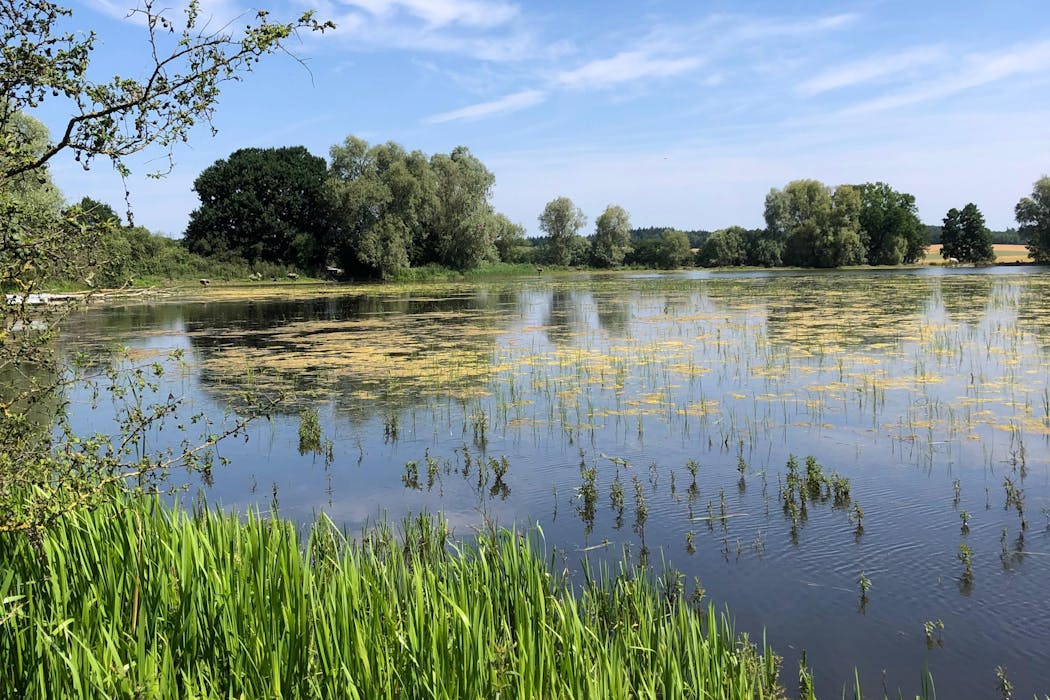
« Les étangs ne sont pas de simples plans d’eau, mais de véritables archives vivantes de l’activité humaine environnante. »Gaspard Conseil, Fourni par l’auteur
De l’autre côté du miroir d’eau paisible des étangs, on rencontre en réalité de véritables « fantômes moléculaires » laissés par les pesticides utilisés pour l’agriculture. Même lorsque la substance originelle a été depuis interdite, ses produits de transformation – parfois plus toxiques – peuvent persister longtemps. Et si l’on envisageait les étangs différemment ? Les considérer comme des archives biochimiques des pollutions passées pourrait nous aider à améliorer la surveillance sanitaire et à prendre de meilleurs décisions réglementaires aujourd’hui.
Sous la surface calme des étangs (et, en particulier, des étangs agricoles) se cache une contamination invisible mais omniprésente. Sur l’ensemble des substances chimiques surveillées en milieu aquatique, 86 % sont des produits de transformation de pesticides plutôt que des pesticides eux-mêmes. Ce paysage est dominé par des dérivés du chlorothalonil, pesticide pourtant interdit en Europe et en Suisse depuis 2019, qui ont depuis été détectés d’abord en Suisse, puis signalés au sein d’unités françaises de traitement de l’eau potable.
Ces « fantômes moléculaires », souvent ignorés des suivis classiques, sont pourtant impliqués dans la dégradation silencieuse de la qualité des eaux. Dans une recherche scientifique publiée en 2025, nous avons mis en évidence qu’ils modifient le comportement et le métabolisme de petits crustacés d’eau douce (ici, Gammarus roeseli) utilisés comme sentinelles biologiques.
À la fois témoins et victimes des pollutions chimiques successives de l’environnement, ces organismes livrent une histoire préoccupante, inscrite dans le vivant, que les simples mesures chimiques ne permettent pas de lire.
La mémoire chimique des étangs
Les étangs ne sont pas de simples plans d’eau, mais des archives vivantes de l’activité humaine environnante. Souvent connectés aux rivières, ils s’imprègnent de l’héritage chimique des pratiques agricoles, à travers les métabolites de produits phytopharmaceutiques, ou produits de transformation (PT), qui en résultent.
Il ne suffit pas de retirer un pesticide du marché pour résoudre tous les problèmes de pollution : son empreinte chimique peut persister très longtemps dans l’environnement. Gapard Conseil, Fourni par l’auteur
Quand bien même un pesticide est amené à être retiré du marché, son empreinte chimique demeure. Des PT issus de la dégradation d’une molécule mère peuvent ainsi persister longtemps dans l’eau, dans les sédiments ou dans les organismes vivants. Longtemps invisibles, car peu connus et peu étudiés, ils rappellent que la contamination environnementale n’est pas qu’une affaire du présent, mais aussi une mémoire du passé.
Nous vivons ainsi avec les cicatrices laissées par des produits chimiques utilisés à d’autres époques, lorsque leurs effets étaient encore mal connus. Et pourtant, nous continuons de répéter la même erreur : autoriser la commercialisation de produits aux effets mal compris. Nous déléguons alors de nouveaux problèmes à nos enfants.
Même lorsqu’on interdit un pesticide, ses descendants sont toujours là
L’herbicide atrazine, interdit depuis 2003, illustre très bien le problème. Ses métabolites sont encore détectés vingt ans après son interdiction dans de nombreuses masses d’eau françaises.
Les progrès de la recherche et les nouvelles connaissances acquises ont conduit à des réglementations plus strictes, comme le Règlement européen (CE) no 1107/2009, qui exclut l’autorisation de mise sur le marché de substances persistantes ou qui s’accumulent dans les organismes.
La relation entre l’humain et son environnement reste complexe. L’histoire que nous commençons à lire grâce aux outils analytiques mobilisés en écotoxicologie, qui intègrent à la fois des approches chimiques et biologiques, devrait éclairer nos choix présents et nous permettre d’éviter de les regretter demain.
Le fongicide chlorothalonil, interdit en 2019, fournit un exemple récent de ce décalage entre décision réglementaire et réalité environnementale. Son métabolite R471811 est aujourd’hui retrouvé dans de nombreuses eaux de surface et souterraines européennes. Il n’existe a priori pas de preuves qu’il présente un risque avéré, mais cela pourrait être réévalué dans cinq, dix ou trente ans.
Ces reliquats chimiques révèlent l’inertie propre des cycles environnementaux, souvent difficiles à cerner ou à mesurer. Ils soulignent aussi les limites de nos politiques de retrait, capables de réagir vite, mais impuissantes face à la persistance du passé et à la multiplicité des substances chimiques encore autorisées (422 en Europe en octobre 2025.
Expositions chimiques invisibles, ou difficiles à cerner ?
Les milieux aquatiques sont exposés à une mosaïque de contaminants que les scientifiques appellent exposome chimique, c’est-à-dire l’ensemble des substances auxquelles un organisme ou un écosystème est exposé au cours de sa vie.
Si les substances actives sont surveillées via la réglementation européenne, les PT passent souvent sous le radar. Un seul pesticide peut engendrer plusieurs molécules filles, parfois plus durables et plus mobiles que la molécule mère. Les connaissances sur leur toxicité sont encore très lacunaires, avec peu de tests de toxicité, peu de standards analytiques et très peu de données sur leurs effets cumulés. Ainsi, une part importante du risque nous échappe encore.
Dans un travail antérieur, mené en 2024, sur les étangs agricoles du nord-est de la France, nous avions déjà montré que plus d’une molécule détectée sur deux était un PT encore dépourvu de profil écotoxicologique connu. En d’autres termes, une partie du risque reste littéralement dans l’ombre.
Les grands cours d’eau font l’objet de suivis réguliers. Les étangs, eux, sont les parents pauvres de la limnologie (c’est-à-dire la science des lacs) et restent peu étudiés. Pourtant, ils ponctuent nos paysages et abritent souvent une large biodiversité constituée de poissons, d’oiseaux, de batraciens, de reptiles, d’insectes et de végétaux divers. Ils jouent aussi un rôle d’interface entre terres agricoles et nappes souterraines. Exposés aux polluants au fil du temps, ils jouent un rôle de « mémoire tampon » entre terres cultivées et milieux naturels, entre les eaux de surface et les nappes souterraines.
Pour explorer cette mémoire chimique, notre équipe a eu recours à une approche de biosurveillance active, où l’on utilise le vivant pour évaluer la qualité de l’eau. Cette méthode consiste à confronter des organismes sentinelles à l’environnement étudié afin d’observer leurs réactions biologiques, en parallèle de l’analyse chimique dite de l’exposome, décrit précédemment (l’ensemble des substances auxquelles le milieu est exposé, et de facto, nous aussi).
Gammarus roeseli est un petit crustacé utilisé en tant que sentinelle biochimique des étangs. Gaspard Conseil, Fourni par l’auteur
Croiser ces deux lectures, chimique et biologique, permet d’obtenir un indicateur global de l’état de santé d’une masse d’eau bien plus représentatif que la simple mesure de concentrations d’une liste de contaminants strictement définis.
Concrètement, nous avons placé dans sept étangs lorrains implantés le long d’un gradient de terres agricoles aux pratiques diversifiées (sans activité agricole, en agriculture biologique ou en agriculture conventionnelle) de petits crustacés d’eau douce, Gammarus roeseli, enfermés dans de fines cages perméables.
Ces gammares, discrets habitants des rivières, sont de véritables sentinelles biologiques. Leur respiration, leurs mouvements et leurs activités enzymatiques reflètent fidèlement la qualité du milieu où ils vivent. Pendant une semaine, ces organismes ont été exposés à l’eau et leur état de santé a été suivi. En parallèle, dans chaque étang, 136 substances (herbicides, insecticides, fongicides, et leurs PT) ont été recherchées.
Les résultats montrent une prédominance écrasante des produits de transformation, qui représentaient 86 % des contaminants détectés, dominés par les dérivés du chlorothalonil et du métazachlore.
Les gammares ont survécu, mais leur comportement et leur métabolisme ont changé. Ralentissement des déplacements, troubles de la respiration et activation des mécanismes de détoxification traduisent le signal précoce d’un potentiel stress toxique. Ces réactions biologiques confirment que la contamination, bien qu’étant une affaire de chimie, s’inscrit profondément dans le vivant. En d’autres termes, les organismes racontent ce que les analyses chimiques ne suffisent pas toujours à voir.
De la science au terrain : comment gouverner l’invisible ?
Reste à savoir comment intégrer au mieux ces signaux biologiques et cette mémoire chimique dans les décisions publiques et réglementaires.
Aujourd’hui, la surveillance réglementaire reste essentiellement centrée sur les substances actives autorisées. Pourtant, le risque dépasse largement ces molécules. Il s’étend dans le temps, change de forme, interagit avec d’autres contaminants et varie selon les conditions environnementales. L’environnement et sa biodiversité sont aussi le siège d’une diversité de voies de transformation et de transfert des contaminants.
La surveillance doit donc évoluer, élargir les listes de substances suivies, développer les outils biologiques, et, surtout, agir avec précaution dans un contexte où tout ne peut être mesuré ni anticipé : il serait illusoire de vouloir tout tester et suivre toutes les substances possibles et imaginables. L’enjeu est donc surtout de prioriser les composés les plus à risque et de protéger les milieux les plus vulnérables.
Il existe ainsi trois leviers pour mieux protéger les milieux aquatiques :
renforcer les outils biologiques capables de traduire la complexité chimique en signaux écologiques mesurables, par exemple, le recours à des organismes sentinelles,
enfin, prioriser localement les actions de gestion (par exemple, rotation des cultures, zones tampons sans traitement, meilleure gestion des effluents et du ruissellement, ou encore l’aménagement de réseaux de drainage) adaptées aux usages et aux vulnérabilités des territoires.
De récentes observations nous montrent que les dynamiques observées en Lorraine ressemblent à celles de sites agricoles en Suisse, dans le canton de Genève. Nous menons depuis l’été 2025 des recherches avec la Haute école du paysage, d’ingénierie et d’architecture de Genève (Hépia) à ce sujet.
Ces enjeux de pollution franchissent donc les frontières, mais les solutions doivent émerger localement, en combinant restauration de zones tampons (qui permettent d’atténuer les transferts de contaminants d’origine agricole vers les milieux aquatiques), diversification des pratiques et surveillance chimique et biologique intégrée.
Une écologie de la mémoire
Les étangs sont les miroirs de nos paysages agricoles, mais en constituent surtout des archives. Ils accumulent, filtrent et témoignent des usages passés. Reconnaître cette mémoire chimique, c’est accepter que certaines traces mettent des décennies à s’effacer.
Les produits de transformation des pesticides ne sont ni marginaux ni nouveaux. Ils incarnent une génération de micropolluants qui s’ancre dans la mémoire chimique de nos agroécosystèmes. Les inclure, les considérer, c’est comprendre qu’un étang, aussi petit soit-il, peut raconter une histoire de pollutions passées, mais aussi celle d’une vigilance à retrouver.
À l’heure où les politiques de transition agricole s’accélèrent, prendre en compte ces produits de transformation est essentiel pour éviter que ces fantômes chimiques ne pèsent sur les générations futures. Ce que nous faisons aujourd’hui s’inscrira dans la mémoire environnementale de demain. À nous de choisir l’histoire que ces étangs raconteront aux générations futures.
Gaspard Conseil a reçu des financements de l’Office français de la biodiversité (OFB).
Damien Banas a coordonné le projet CABARETox (ContAmination des matrices Biotiques et Abiotiques par les Résidus phytopharmaceutiques en Étangs : volet écotoxicologie), financé par l’Office Français de la Biodiversité (OFB), dont sont issus les résultats présentés dans le présent article.
Source: The Conversation – in French – By Sébastien Barot, Chercheur en écologie, IEES-Paris, vice-président du conseil scientifique de la Fondation pour la recherche sur la biodiversité (FRB), Institut de recherche pour le développement (IRD)
Souvent assimilée à un courant politique, l’écologie est avant tout une science à part entière, qui étudie les interactions du vivant avec son environnement. Pourtant, en France, ce terme est devenu symbole de militantisme au risque d’invisibiliser le travail précieux des écologues, alors même que leurs connaissances sont indispensables pour affronter la crise environnementale en cours.
Dans « l’Écologie est une science », publié par les éditions Belin, Sébastien Barrot, directeur de recherche à l’IRD, présente son domaine de recherche, encore trop méconnu du grand public. Nous reproduisons ci-dessous un extrait de son avant-propos.
À 10 ans, quand on me demandait quel métier je souhaitais faire plus tard, je répondais « Un -logue quelconque. » Je disais par là que je voulais devenir archéologue ou paléontologue. J’ai mal tourné, je suis devenu écologue, chercheur en écologie, et j’ai commencé à écrire ce livre parce que personne ne sait ce que ça veut dire. Si tout le monde a une idée, juste ou non, de ce qu’est un chercheur, quasiment personne ne sait en France, en dehors du cadre académique, que l’écologie est une science.
Même aujourd’hui, en pleine crise environnementale, je dois expliquer les études que j’ai faites (un master et une thèse en écologie), et on me le fait répéter au moins trois fois car ça ne paraît pas possible. Les gens pensent souvent que j’ai étudié la biologie. Cela paraît beaucoup plus sérieux, mais ce n’est pas le cas. D’autres personnes imaginent que la seule préoccupation d’un écologue est de protéger les petits oiseaux, ou que je développe de nouveaux moyens pour recycler les déchets.
Ce sont deux thématiques importantes, cependant l’écologie scientifique n’a pas uniquement pour but la protection de la nature, et seul le recyclage des déchets organiques entre, en fait, dans le champ des compétences de l’écologie puisqu’il fait intervenir des organismes décomposeurs, comme des bactéries ou des vers de terre.
La méconnaissance de l’écologie scientifique vient de trois facteurs complémentaires.
Tout d’abord, l’écologie est une science relativement jeune. Le mot a été inventé par Ernst Haeckel en 1866, mais les sciences écologiques ne se sont vraiment développées dans le monde académique qu’après la Seconde Guerre mondiale pour les Anglo-Saxons et durant les années 1970 en France. C’est donc un développement très récent, ce qui signifie que les bases de cette science doivent encore être consolidées, et sa structure affinée. Le système académique étant très conservateur, l’écologie scientifique a parfois du mal à trouver sa place parmi les disciplines plus anciennes. Malgré la gravité des problèmes environnementaux actuels, et contrairement à ce qu’on pourrait penser, il est souvent difficile d’augmenter le volume des enseignements d’écologie du primaire à l’université, et la recherche en écologie n’est pas particulièrement bien financée.
De plus, en France, le terme « écologie » est utilisé aussi bien pour désigner une science que des mouvements politiques environnementalistes ou verts, entraînant de fait une confusion entre le travail de recherche et l’action politique, ou même le militantisme. Il est important de souligner que, la plupart du temps, lorsque quelqu’un intervient dans les médias pour parler de protection de la nature, il s’agit d’un militant ou d’une militante (ou parfois même d’un chercheur d’une autre discipline !). Si ces derniers utilisent souvent les connaissances développées par l’écologie scientifique, ils ne sont pas chercheurs en écologie pour autant.
On pense facilement à de grandes figures, comme Hubert Reeves, qui ont joué et jouent un rôle important et utile dans la dissémination des savoirs et idées écologiques. Ces grandes figures médiatiques mêlent toujours dans leurs discours des messages environnementalistes et d’autres plus fondamentaux et proches des sciences écologiques. Tout cela entraîne des conséquences globalement positives, mais contribue à invisibiliser la science écologique et le travail des chercheuses et chercheurs qui la pratique. D’autant que dans les autres sciences (biologie, physique, chimie…), quand les médias ont besoin d’éclairages, c’est bien à un spécialiste du domaine que l’on fait appel en général.
Enfin, l’écologie est une science intégrative. C’est-à-dire qu’elle utilise les autres sciences (biologie, géologie, climatologie, chimie…) et qu’il est donc difficile de l’identifier en elle-même. Ce fonctionnement fait sa force, mais il rend son positionnement plus difficile. En effet, les systèmes académique et médiatique fonctionnent beaucoup « par boîtes » et la mauvaise identification d’une science et de ses spécialistes complique la prise en compte des connaissances qu’elle développe.
Cela explique en partie que les sociétés humaines soient si lentes à prendre des mesures pour atténuer la crise de la biodiversité et qu’elle reste moins bien prise en compte que la crise climatique par les pouvoirs publics (même si de ce côté-là, cela avance, bien que beaucoup trop lentement).
Ma définition préférée de l’écologie est la suivante : c’est la science qui étudie les interactions entre les êtres vivants (par exemple, entre les espèces de plantes d’une prairie) et leur environnement physico-chimique (par exemple, entre les plantes de cette prairie et les caractéristiques du sol comme son pH ou sa teneur en azote) et les conséquences de ces interactions à toutes les échelles temporelles (de la seconde à des millions d’années) et spatiales (de l’agrégat de sol d’un millimètre à la biosphère) possibles. Cette définition peut paraître un peu abstraite mais elle prendra tout son sens au cours du livre.
Il est important de retenir que l’écologie traite bien d’organismes vivants, tout en étant distincte de la biologie. Cette dernière a tendance à étudier le fonctionnement interne des êtres vivants. Historiquement, à l’aide de moyens techniques de plus en plus sophistiqués, la biologie les a découpés en parties de plus en plus petites (l’organe, la cellule, la molécule, le gène) pour analyser la manière dont le fonctionnement interne d’un organisme et de nombreux mécanismes de régulation permet aux organismes de grandir, de survivre et de se reproduire. C’est aussi grâce à la biologie que l’on comprend les mécanismes de développement d’un organisme à partir de ses gènes.
À l’inverse, les sciences de l’univers (géochimie, climatologie, hydrologie…) s’intéressent essentiellement au fonctionnement physico-chimique, aux éléments abiotiques, de l’environnement et de la planète Terre. Par exemple, ces sciences permettent de quantifier les flux d’eau (évaporation, précipitation, ruissellement…) à des échelles variées depuis le mètre carré jusqu’à la planète entière ou encore les flux d’azote, composante chimique essentielle de toute la matière vivante.
L’écologie se trouve exactement à mi-chemin entre la biologie et les sciences de l’univers : elle traite à la fois des organismes vivants et de leur environnement physico-chimique. Elle fait le lien entre les deux et étudie leurs interactions qui sont bidirectionnelles. Les organismes dépendent de leur environnement (température, humidité…) et des ressources qu’ils y puisent. Si les conditions physico-chimiques sont bonnes (ni trop chaud ni trop froid, suffisamment humide…), ils pourront grandir et se reproduire ; si les conditions sont un peu moins bonnes, cela devient plus difficile ; si elles empirent, les organismes ont de grandes chances de mourir. D’une manière peut-être moins évidente, mais tout aussi importante, les organismes modifient leur environnement physico-chimique en y puisant des ressources (CO2, eau et nutriments minéraux pour une plante), par des activités variées (galeries des vers de terre) ou simplement par leur présence (un arbre fait de l’ombre).
L’écologie est une science à part entière qui a développé son propre cadre conceptuel, ses écoles de pensée et ses outils. Elle fonctionne au quotidien comme les autres sciences : il y a des formations (masters, écoles doctorales), des chercheuses et des chercheurs, des laboratoires et des journaux internationaux en anglais spécialisés.
Elle s’appuie cependant, nous l’avons vu, sur de nombreuses sciences, de la biologie à la climatologie, en passant par la physique ou la chimie. Les résultats de ces différents domaines servent d’éléments de contexte et leurs méthodes et outils sont utilisés comme des couteaux suisses modulables pour répondre à des questions propres à l’écologie. Par exemple, l’étude des interactions entre un ver de terre et le sol peut nécessiter de connaître le fonctionnement interne du ver de terre, tel son mode de digestion (biologie), mais aussi l’impact de l’espèce sur la chimie du sol (chimie).
L’écologie peut aussi étudier comment le climat influence la croissance des plantes en prenant en compte la quantité d’énergie apportée par la lumière solaire et utilisable pour la photosynthèse, ou la température et l’humidité de l’air qui influencent la quantité d’eau transpirée par les plantes. Ou encore la manière dont les plantes influencent le climat en fixant plus ou moins de carbone par la photosynthèse ou en renvoyant plus ou moins de vapeur d’eau dans l’atmosphère. Ces résultats peuvent alors servir aux climatologues pour améliorer les prédictions climatiques.
Par ailleurs, l’écologie est indissociable de l’évolution des organismes vivants au sens darwinien, car ils présentent tous une histoire évolutive : ils ont été façonnés par une succession de pressions de sélection et de processus évolutifs qui ont conduit aux caractéristiques actuelles des organismes et ont contribué à leur diversité. De ce fait, les interactions écologiques entre eux ou avec leur milieu physico-chimique ont été façonnées par l’évolution. Il est important de le prendre en compte pour mieux comprendre et interpréter les fonctionnements écologiques actuels.
Ainsi, les plantes ont construit au cours de l’évolution des mutualismes avec leurs pollinisateurs. Étudier cette évolution peut aider à comprendre la pollinisation et ses conséquences. À l’inverse, les interactions écologiques, elles-mêmes, constituent un des principaux moteurs de l’évolution : la sélection naturelle est fondée sur le fait que les organismes les mieux adaptés à une situation écologique donnée (caractéristiques de l’environnement, existence d’un prédateur…) ont plus de descendants si bien que leurs caractéristiques deviennent dominantes au sein de l’espèce du fait de leur transmission génétique.
Dans ce contexte, les mécanismes conférant à certains individus un avantage sont liés à des interactions écologiques : certaines caractéristiques leur permettent de mieux interagir avec les autres organismes ou leur environnement physico-chimique, acquérant ainsi plus de ressources, augmentant leur survie ou leur fécondité. Tous ces mécanismes sont étudiés en écologie. On sait maintenant que l’évolution peut être suffisamment rapide pour interférer avec les processus écologiques à des échelles de temps communes. Cela signifie qu’il ne s’agit pas simplement d’un phénomène ancien qu’il faut étudier pour comprendre les organismes ayant disparu depuis longtemps, mais que les organismes continuent actuellement à évoluer.
De domaines en sous-domaines
Plus généralement, l’écologie aborde des sujets si variés qu’il est nécessaire de la diviser en sous-domaines.
L’écologie se compose de plusieurs sous-domaines. Sébastien Barrot/Belin, Fourni par l’auteur
Bien sûr, on peut en classer les différents champs selon le milieu étudié (écologie forestière, écologie aquatique, écologie des sols…), mais il est important de différencier également certaines approches. En effet, une partie importante de l’écologie, l’écologie des populations, se focalise sur les groupes d’individus d’une même espèce qui interagissent entre eux au sein d’un milieu donné (ce qu’on appelle une « population »). Elle se concentre donc sur les individus, sur ce qu’ils font et sur leur démographie (comme on le ferait pour des populations humaines), s’appuyant notamment pour cela sur leur recensement (on peut, par exemple, compter le nombre d’arbres dans une forêt). L’écologie des populations est fortement liée à l’écologie évolutive, qui étudie l’évolution darwinienne des organismes, puisque l’individu est l’unité de base dans tous les processus évolutifs.
Proche de l’écologie des populations, on trouve aussi celle du comportement qui cherche à analyser le comportement des individus au sein d’une population en fonction de leur environnement, avec souvent des interprétations liées à l’évolution darwinienne des organismes. On distingue ensuite l’écologie des communautés qui étudie les interactions entre populations (d’espèces différentes) dans un même milieu. Cela permet d’aborder, par exemple, les relations proie-prédateur, les symbioses, ou de décrire des communautés d’organismes (le nombre d’espèces, leur abondance relative, leurs caractéristiques, et les facteurs qui déterminent tout ça). On arrive alors à l’écologie fonctionnelle qui étudie la manière dont les organismes arrivent à puiser des ressources dans leur milieu et à les transformer en biomasse, ainsi que la quantité de matière et d’énergie qu’ils échangent avec leur milieu…
Enfin, l’écologie des écosystèmes est proche de l’écologie fonctionnelle puisqu’elle étudie la manière dont ils fonctionnent. Un écosystème comprend à la fois l’ensemble des populations en interaction dans un lieu donné et leur milieu physico-chimique (sol, climat…). Il s’agit donc d’intégrer tous les types d’interactions écologiques entre populations ainsi qu’entre elles et leur milieu physico-chimique, et de comprendre comment cela détermine les propriétés émergentes des écosystèmes, telle que leur production primaire. Là où l’écologie des populations est focalisée sur les individus, l’écologie fonctionnelle et celle des écosystèmes étudient plutôt les flux de matière (carbone, azote, eau…) et d’énergie entre les organismes et avec leur milieu. Ce type d’approche permet souvent d’aller vers des échelles spatiales de plus en plus grandes. On peut, par exemple, mesurer la biomasse de la végétation ou la quantité de carbone dans la matière organique du sol à l’échelle du mètre carré, mais aussi d’une prairie, d’une région, d’un continent…
Sébastien Barot ne travaille pas, ne conseille pas, ne possède pas de parts, ne reçoit pas de fonds d’une organisation qui pourrait tirer profit de cet article, et n’a déclaré aucune autre affiliation que son organisme de recherche.