Tanzania is losing fertile land to soil erosion: what’s happening and what can be done

Source: The Conversation – Africa – By Maarten Wynants, Marie Curie Global Postdoctoral Fellow, Ghent University

Across large parts of northern Tanzania, gully erosion – soil erosion caused by flowing water – is cutting deep scars through fertile farmland, grazing areas, roads and even villages. These gullies grow faster every year and what was once a slow environmental process has accelerated into a humanitarian threat. It has serious consequences for food and livelihood security, infrastructure and biodiversity.

Soil erosion is a natural process. Rainfall breaks soil into particles, and flowing water transports them downslope into rivers and lakes. In Tanzania, however, erosion has intensified dramatically over the past 120 years.

The region’s steep terrain, highly variable rainfall and fragile volcanic soils make it naturally vulnerable. What has turned this into a crisis is the change in how people interact with the land.

The Jali Ardhi (Swahili for “Care for the Land”) programme is an international collaboration of scientists from several universities. We use interdisciplinary tools to investigate what’s causing increased soil erosion and how communities can restore the land. Results from multiple projects over a decade point to runaway gully erosion as a key driver of land degradation in Tanzania. Urgent and widespread restoration programmes are needed.


Read more:
Soil erosion is tearing DRC cities apart: what’s causing urban gullies, and how to prevent them


From fertile volcanic soils to runaway gully erosion

The Tanzanian highlands are blanketed by soils formed from volcanic basalt erupted over millions of years as the East African Rift opened. These volcanic soils are rich in fine clay minerals with high levels of exchangeable sodium and calcium. Contact with water after a dry period can cause them to rapidly disperse into fine particles in the water.

Normally, these soils are covered by a stable topsoil layer protected by plant cover, roots and soil organic carbon. But land clearing – the removal of natural vegetation for agricultural purposes – and overgrazing remove the natural protection of these soils and increase runoff. When intense rainfall follows, water rapidly flows downhill, concentrating in valleys and carving out gullies.

Indigenous land conservation practices such as seasonal grazing and shifting cultivation recognised this vulnerability by allowing the vegetation and soil to recover. However, these were gradually eroded by colonial and postcolonial governance, which prioritised formal land tenure and permanent settlement but paid little attention to soil productivity and protection from erosion. In the meantime, Tanzania’s population has been growing fast, doubling roughly every 25 years for the past century, and is now exceeding 70 million.

Large areas of natural forests and savannahs have been cleared for agriculture. Pastoralist groups, such as the Maasai, were forced into permanent settlements, replacing their traditional practice of moving livestock seasonally to follow rainfall and fresh pasture. Livestock densities have tripled over the past half century and areas that were once allowed to recover are now farmed and grazed year-round, leaving soils permanently exposed to the elements.

Rainfall in these regions is naturally erratic, alternating between dry spells and wet years. We have not observed a long-term change in rainfall but wet conditions following drought can trigger massive erosion events.

Together, these pressures pushed the landscape past a critical threshold. Once gullies form in these volcanic soils, they are difficult to stop. Like a boulder pushed downhill, erosion accelerates once it starts. Gullies can continue growing even if the original trigger, such as deforestation or overgrazing, has ended. They form highly connected channels that quickly remove rainfall, nutrient-rich topsoil, and seeds away from the land. This makes it difficult for vegetation to recover and the landscape to stabilise.

The cost of losing land

We calculated that the erosion rates in Tanzania are about 20 times higher than they were a century ago. Over 50% of the total area of Tanzania is experiencing rapid land degradation. It is one of the fastest degrading areas in the world.

When land is lost to erosion, so too is food and income. Since roughly 70% of Tanzanians are smallholder farmers and they produce most of the country’s food intake, over 50% of the population has already experienced moderate to severe food insecurity. The consequences are potentially disastrous.

To make matters worse, we saw from repeat visits and photographs that these mega gullies undercut roads and bridges as quickly as a decade after construction. This is an enormous loss in a country working to develop basic services. Farmers tell us that they are cut off from market access and are forced to grow less-perishable or subsistence crops such as maize and beans, instead of higher-value agricultural production. This reinforces low-income and low-investment cycles.

The effects do not stop here, though.

Eroded sediments fill reservoirs and lakes, threatening water availability, fisheries, biodiversity and tourism. We found that Lake Manyara National Park, a Unesco Man and Biosphere Reserve, is filling up due to the enormous amounts of sediment coming from its catchment. This places pressure on an ecosystem that supports more than 350 bird species as well as iconic wildlife such as elephants and lions.

Working together to join the cracks

Despite the scale of the problem, solutions do exist. Across east Africa, communities have long used indigenous techniques such as earth bunds (banks), stepwise terraces, leaky dams, and re-establishment of grasses and trees. These work with natural processes and materials to slow water flow and capture soil.

NGOs such as the LEAD foundation and Justdiggit are revitalising these community-led approaches. We set up a soil and gully monitoring network combining scientific sampling and sensor technology with citizen science approaches to evaluate the evolution of gullies and success of restoration approaches.

In some cases, collective community action has successfully stabilised small gullies and improved soil quality. But many mega gullies are now too large for resource-poor communities to address alone. While the Tanzanian government has committed to the United Nations Convention to Combat Desertification’s Land Degradation Neutrality initiative, long‑term investment and action plans are lacking. This is partly due to the mismatch between national politics and local action needs.


Read more:
Key insights into land degradation from seven African countries


Ultimately, erosion control cannot be treated as a solely environmental problem. Halting this crisis will require coordinated and large-scale land restoration investment, while simultaneously addressing socio-economic issues linked to poverty, corruption, education and economic development. More than half of Tanzanians are under 18, growing up on landscapes already under strain. Whether these systems can continue to support a growing population will require action before the cracks in the earth widen any further.

The Conversation

Maarten Wynants receives funding from the European Union Marie Sklodowska Curie Fellowship – AsFoRESEEN – 101109315, and from the VLIR-UOS short initiative ‘From Monitoring to Managing Soil and Water Degradation in Tanzanian Gullies’.

ref. Tanzania is losing fertile land to soil erosion: what’s happening and what can be done – https://theconversation.com/tanzania-is-losing-fertile-land-to-soil-erosion-whats-happening-and-what-can-be-done-273283


Trump’s framing of Nigeria insurgency as a war on Christians risks undermining interfaith peacebuilding

Source: The Conversation – USA (3) – By Aili Mari Tripp, Vilas Research Professor of Political Science, University of Wisconsin-Madison

Mosques, as well as churches, in Nigeria are targets of insurgent groups.
Kola Sulaimon/AFP via Getty Images

Nigeria “must do more to protect Christians,” a senior U.S. State Department official demanded on Jan. 22, 2026, during a high-level security meeting in the African nation’s capital, Abuja.

The comment followed an attack just days earlier in which more than 160 worshipers were kidnapped from three churches in Nigeria’s northern Kaduna state.

The security meeting came a month after the United States, in cooperation with the Nigerian government, launched an airstrike from a U.S. Navy ship in the Gulf of Guinea on the northwest Sokoto state. During the Christmas Day incident, 16 Tomahawk missiles costing around US$32 million hit several locations the U.S. claimed were being used by extremist groups.

There were no verifiable casualties, although the strike did send a signal that the U.S. administration is willing to take military action when it is deemed necessary. President Donald Trump heralded the attack a “Christmas present” to Christians and later warned that there would be more strikes if the killings of Christians continued.

As a scholar of African politics, I know that calling the insurgency in Nigeria a persecution of Christians – as the U.S. administration has repeatedly done – is simplistic and ill-informed. Yes, Christians have been killed and kidnapped as part of the prolonged terrorism campaign by Boko Haram and other extremist groups. But so too have other groups in the country, including Muslims. Moreover, the religious identity of the victims masks other motives of the militant groups involved.

I recently carried out interviews in Maiduguri, Borno State – the epicenter of Boko Haram activities in northeast Nigeria – as part of research into interfaith efforts to counter threats from Islamic extremists. For many of those interviewed, the insurgency and violence have often served to unite Nigerians with different religious identities against a common enemy: the groups making their life a misery. The danger of Trump’s narrative of this being a war on Christians is that it could undermine such efforts to build cross-community trust.

A complex conflict

Since 2009 there have been 54,000 deaths related to the violence in Nigeria and the surrounding Lake Chad region, according to independent violence monitor ACLED.

The Christmas airstrike by the U.S. was in northwest Nigeria, targeting a small group of Lakurawa militants. But 85% of all incidents related to Islamic fighters in 2025 were in northeast Nigeria, according to ACLED.

Northern Nigeria is primarily populated by Muslims, in contrast to the whole of the country, whose 240 million people are split roughly 56%-43% between Muslims and Christians.

Many of those killed and abducted in the insurgency in the north have been Christian. But the exclusive focus on Christians by the U.S. administration overlooks the complex realities behind the violence in Nigeria, which incorporates not just extremist groups but also farmer-herder tensions, land and water disputes exacerbated by climate change, ethnic rivalries, poverty and organized criminal gangs referred to as “bandits.”

Boko Haram, which regards the Nigerian state as its main target, has killed both Christians and Muslims, as has the Ansaru, an al-Qaida affiliate. The Islamic State – West Africa Province, another major insurgency group, targets state forces and Christians.

While the most recent high-profile attacks have been on churches, Boko Haram also targets markets, mosques and homes. They are opportunistic attacks that don’t discriminate between Muslims and Christians.

To be sure, the Nigerian government’s response to the insurgency has been inadequate. But again, the reasons are complex and the result of a confluence of factors, including corruption in the security sector, negligence and the difficulty of targeting groups that employ guerrilla tactics outside of government control, which make them especially elusive. Political factors may also be at play, since elements within the Nigerian government may be complicit with northern politicians backing some of the land-grabbing and kidnapping bandits.

Even with these barriers, some progress has been made. According to the Africa Center for Strategic Studies, Boko Haram attacks have declined by 50% since 2014-2016, when they were most active, although rates have been increasing again since 2023.

Interfaith efforts

The Nigerian government itself has welcomed assistance from the U.S. targeting insurgents, but with the proviso that Nigeria’s sovereignty and territorial integrity be respected.

The concern is that military action on the part of the U.S. under the guise of protecting Christians in Nigeria could make matters worse. It risks exacerbating tensions within the country and giving credence to those in Nigeria and abroad who focus only on the killing of Christians for their own narrow purposes.

At the same time, it could undermine the efforts of civil society organizations and women’s associations, in particular, that have worked hard to build interfaith trust between Muslims and Christians to tackle the insurgency threat.

Some of these organizations, such as the Women of Faith Peacebuilding Network, have been at the forefront of the fight against militant groups. An interfaith movement founded in 2011, it now comprises over 10,000 Christian and Muslim women. It carries out vocational training and promotes interfaith dialogue and strategies to reduce conflict.

People stand in a street.
Residents gather near the scene of the explosion at a mosque in the Gamboru market in Maiduguri on Dec. 25, 2025.
Audu Marte/AFP via Getty Images

Following the abduction of over 300 schoolgirls by Boko Haram in Chibok, Borno State, in 2014, a coalition of women’s rights organizations – comprising both Christian and Muslim members – mobilized to protest the kidnappings.

The Federation of Muslim Women’s Associations in Nigeria, or FOMWAN, is another organization that is actively engaged in interfaith initiatives nationwide. In a January 2024 interview, a FOMWAN member based in Maiduguri told me that the Boko Haram crisis has united women across religious divides more than ever before.

Maryam, whose name I have changed along with other interviewees to protect their identity, explained: “FOMWAN has been in existence for many years before the insurgency. And in our activities we had been teaching our Muslim women religious tolerance in Borno. But the insurgency has made us put more efforts into making sure there is religious tolerance among Muslims and Christians.”

A Christian evangelist preacher, Mary, told me that working together had significantly reduced the mutual fear and mistrust between Muslims and Christians. Before the rise of Boko Haram, interfaith collaboration between the two groups was low. But today, she noted, it is far higher.

“We came to understand that this set of people doing this killing are neither Christian nor Muslim. They’re working for selfish interests, not for religious interests. We now strategize and come together to work as one. The key issue to (the conflict) is poverty. The only solution is for us is to speak with one voice. That’s the only way for us to survive.”

‘Each other’s keeper’

The U.S. administration would, I believe, do well to listen to the voices of these Christian and Muslim peacebuilders in northern Nigeria who live with the daily threat of violence.

Their lived experience has informed an approach to Nigeria’s insurgency based on shared purpose that cuts across religious divides.

In the words of activist Mama Pro, when asked why she was so keen to build interfaith bridges in Northern Nigeria: “We are always each other’s keeper.”

The Conversation

Aili Mari Tripp receives funding from National Science Foundation.

ref. Trump’s framing of Nigeria insurgency as a war on Christians risks undermining interfaith peacebuilding – https://theconversation.com/trumps-framing-of-nigeria-insurgency-as-a-war-on-christians-risks-undermining-interfaith-peacebuilding-272418

Not all mindfulness is the same – here’s why it matters for health and happiness

Source: The Conversation – USA (3) – By Ronald S. Green, Professor and Chair of the Department of Philosophy and Religious Studies, Coastal Carolina University

Mindfulness practices can take many forms, depending on tradition and intention. Dingzeyu Li dingzeyuli via Wikimedia Commons, CC BY

Over the past two decades, the concept of mindfulness has become hugely popular around the world. An increasingly ubiquitous part of society, it’s taught everywhere from workplaces and schools to sports programs and the military.

On social media, television and wellness apps, mindfulness is often shown as one simple thing – staying calm and paying attention to the moment.

Large companies like Google use mindfulness programs to help employees stay focused and less stressed. Hospitals use it to help people manage pain and improve mental health. Millions of people now use mindfulness apps that promise everything from lowering stress to sleeping better.

But as a professor of religious studies who has spent years examining how mindfulness is defined and practiced across different traditions and historical periods, I’ve noticed a surprising problem beneath the current surge of enthusiasm: Scientists, clinicians and educators still don’t agree on what mindfulness actually is – or how to measure it.

Because different researchers measure different things under the label “mindfulness,” two studies can give very different pictures of what the practice actually does. For someone choosing a meditation app or program based on research findings, this matters.

The study you’re relying on may be testing a skill like attention, emotional calm, or self-kindness that isn’t the one you’re hoping to develop. This makes it harder to compare results and can leave people unsure about which approach will genuinely help them in daily life.

From ancient traditions to modern science

Mindfulness has deep roots in Buddhist, Hindu, Jain, Sikh and other Asian contemplative lineages. The Buddhist “Satipatthana Sutta: The Foundations of Mindfulness” emphasizes moment-to-moment observation of body and mind.

The Hindu concept of “dhyāna,” or contemplation, cultivates steady focus on the breath or a mantra; Jain “samayika,” or practice of equanimity, develops calm balance toward all beings; and Sikh “simran,” or continuous remembrance, dissolves self-centered thought into a deeper awareness of the underlying reality in each moment.

In the late 20th century, teachers and clinicians began adapting these techniques for secular settings, most notably through mindfulness-based stress reduction and other therapeutic programs. Since then, mindfulness has migrated into psychology, medicine, education and even corporate wellness.

It has become a widely used – though often differently defined – tool across scientific and professional fields.

Why scientists disagree about mindfulness

In discussing the modern application of mindfulness in fields like psychology, the definitional challenge is front and center. Indeed, different researchers focus on different things and then design their tests around those ideas.

Some scientists see mindfulness mainly in terms of emphasizing attention and paying close attention to what’s happening right now.

Other researchers define the concept in terms of emotional management and staying calm when things get stressful.

Another cohort of mindfulness studies emphasizes self-compassion, meaning being kind to yourself when you make mistakes.

And still others focus on moral awareness, the idea that mindfulness should help people make wiser, more ethical choices.

These differences become obvious when you look at the tests researchers use to measure mindfulness. The Mindful Attention Awareness Scale, or MAAS, asks about how well someone stays focused on the present moment. The Freiburg Mindfulness Inventory – FMI – asks whether a person can notice thoughts and feelings as they come and accept them without judgment. The Comprehensive Inventory of Mindfulness Experiences – CHIME – adds something most other tests leave out: questions about ethical awareness and making wise, moral choices.

As a result, comparative research can be tricky, and it can also be confusing for people who want to be more mindful but aren’t sure which path to take. Different programs may rely on different definitions of mindfulness, so the skills they teach and the benefits they promise can vary a lot.

This means that someone choosing a mindfulness course or app might end up learning something very different from what they expected unless they understand how that particular program defines and measures mindfulness.

Why different scales measure different things

John Dunne, a Buddhist philosophy scholar at the University of Wisconsin–Madison, offers a helpful explanation if you’ve ever wondered why everyone seems to talk about mindfulness in a different way. Dunne says mindfulness isn’t one single thing, but a “family” of related practices shaped by different traditions, purposes and cultural backgrounds.

Three women sit on yoga mats, eyes closed, palms resting over their hearts in meditation.
Mindfulness isn’t just one thing, and that is why its practice can look different.
FG Trade Latin/E+ via Getty Images

This explains why scientists and people trying to be mindful often end up talking past each other. If one study measures attention and another measures compassion, their results won’t line up. And if you’re trying to practice mindfulness, it matters whether you’re following a path that focuses on calming your mind, being kind to yourself, or making ethically aware choices.

Why this matters

Because mindfulness isn’t just one thing, that affects how it’s studied, practiced and taught. That’s important both at the institutional and individual level.

Whether for places like schools and health care, a mindfulness program designed to reduce stress will look very different from one that teaches compassion or ethical awareness.

Without clarity, teachers, doctors and counselors may not know which approach works best for their goals. The same rough idea applies in business for organizational effectiveness and stress management.

Despite the disagreements, research does show that different forms of mindfulness can produce different kinds of benefits. Practices that sharpen attention to the moment are associated with improved focus and workplace performance.

Approaches oriented towards acceptance tend to help people better manage stress, anxiety and chronic pain. A focus on compassion-based methods can support emotional resilience. Programs that emphasize ethical awareness may promote more thoughtful, prosocial behavior.

These varied outcomes help explain why researchers continue to debate which definition of “mindfulness” should guide scientific study.

For anyone practicing mindfulness as an individual, this is a reminder to choose practices that fit your needs.

The Conversation

Ronald S. Green does not work for, consult, own shares in or receive funding from any company or organization that would benefit from this article, and has disclosed no relevant affiliations beyond their academic appointment.

ref. Not all mindfulness is the same – here’s why it matters for health and happiness – https://theconversation.com/not-all-mindfulness-is-the-same-heres-why-it-matters-for-health-and-happiness-264096

Life in fossil bones: what we can learn from tiny traces of ancient blood chemicals

Source: The Conversation – Africa (2) – By Timothy G. Bromage, Professor, New York University

Blood tests are useful tools for doctors and scientific researchers: they can reveal a lot about a body’s health. Usually, a blood sample is taken to get a picture of the large molecules that are present, such as cholesterols, lipids and proteins. This is called a metabolic profile.

For more specific information, another kind of blood test looks at the tiny traces of chemical processes taking place at tissue, organ, and even cellular levels. This fine-scale kind of test, metabolomics, studies metabolites – the by-products of metabolism (the body’s way of producing energy and recycling chemicals).

You’d never think this kind of test could be done for animals that lived millions of years ago. But what was very recently science fiction is now reality: it’s called “palaeometabolomics”.

Why would anyone want to know about the metabolites of long-dead creatures?

Metabolites are a way for scientists like me (a biological anthropologist) to learn more about the health, diet, environment and evolution of those creatures – including early humans.

What makes this possible is the way bones are formed: by special cells secreting a soft matrix – mainly collagen – that later crystallises and hardens into a porous material.

Metabolites in the blood that leak from blood vessels during bone formation are so tiny that they become trapped inside the bone matrix (the material that makes up bone) as it hardens. The spaces where they are trapped are so small (nanometre in scale) that bacteria and fungi, which are much bigger, can’t always get in there. Not even in a million years. And because bone mineral structures at these fine scales contain minute traces of water, metabolites are preserved there in fossils.

Studying the metabolites in animal fossils has given us a new way to discover more about the environment at sites where early humans evolved.

My colleagues and I looked at rodent fossils from Olduvai Gorge in Tanzania (about 1.8 million to 1.7 million years old); elephant tooth fossil material from the Chiwondo Beds in Malawi (2.4 million years old); and an antelope bone fossil from Makapansgat in South Africa (about 3 million years old). Fossils of ancient relatives of humans (species of Australopithecus, Paranthropus, and early Homo) have also been found at these sites.

For 100 years, scientists have devised methods for reconstructing the environment that early humans lived in and adapted to. Until now, these methods depended mainly upon geological clues and the kinds of animal and plant fossils found at a site. Now, by performing palaeometabolomics – especially by analysing the chemical traces left in animal bones by the plants that the animals ate – we have established a “molecular ecological” approach for describing ancient habitats.

This new method can add very specific information to other kinds of reconstructions. The metabolites allow us to describe soil pH, minimum and maximum rainfall and temperature, the type of tree cover, and elevations above sea level of plants.

We also made a surprising finding about the relationship between soil and living things.

How to give a fossil a blood test

To perform palaeometabolomics, we established a method to dissolve bits of bone no larger than a pea in a tube containing weak acid. The acid is strong enough to slowly pass the mineral into a solution, but weak enough not to degrade the metabolites. This take several days. We then let the large proteins sink to the bottom of the tube and spin it at high speed in a centrifuge, which leaves the smallest and lightest molecules at the top. We inject the metabolite “soup” into a mass spectrometer, a piece of equipment designed to measure the weights of all small molecule compounds, and refer these to a library of known masses. That’s how we identify the metabolites.

The ones generated within the body – “endogenous” metabolites – offer clues about the health and well-being of an animal. That’s interesting enough, but it’s not the full picture.

All living organisms produce metabolites, including plants. Plants also have metabolisms reflecting their physiological adaptations to the environment. If an animal eats a plant, metabolites of that plant circulate through the animal’s bloodstream and are also trapped at developing bone surfaces. These are called “exogenous” metabolites, and they tell us about the diet of the animal.

What was just interesting now becomes remarkable, because if we can identify the plant that a metabolite came from, we should also be able to reconstruct the environment the plant was adapted to.

What the body says about the bigger picture

The endogenous metabolites we identified from our fossils depict a variety of normal mammalian biological functions and disease states. The exogenous metabolites provide evidence of the environment in the distant past.

For instance, some of our fossil samples had a metabolite derived from the parasite that causes sleeping sickness in humans after a bite from an infected tsetse fly. Wild animals are tsetse fly reservoirs for the parasite. Tsetse flies have very specific environmental conditions, so that helped our reconstructions.


Read more:
Tooth enamel provides clues on tsetse flies and the spread of herding in ancient Africa


We also identified plant metabolites which implied that the Tanzanian and South African sites were wetter than they are now. Minimum temperatures were warmer, and the landscape contained more forest shade. It seems to have been a mixed, seasonally dry and wet tropical habitat. The reconstructed conditions of the Malawi site indicate a wetter environment, also with wet and dry seasons.

Reading the soil

There was one particularly interesting surprise.

Going into this study, we assumed that metabolites from ancient soils surrounding the fossils – known as palaeosols – should be considered contaminants and be disregarded from our analyses. But when we analysed metabolites of modern animals of the same fossil species living near the sites, whose bones never touched the soil, we found that both the modern and fossil animals shared large percentages of the palaeosol metabolites.

This means that the palaeosol reflects the lives of all the organisms living there. Once plants and animals live on that soil, their metabolites become a part of the soil matrix. The animals and the soil are completely connected by shared metabolites, which represent the flow of materials that sustain the habitat. They are not contaminants to be disregarded.

Our biomolecular approach – using metabolites from fossil bones and teeth as a way to reconstruct ancient environments – is a new one. It might one day make it possible to describe past habitats as precisely as we can describe modern ones.

The Conversation

Timothy G. Bromage receives funding from The Leakey Foundation.

ref. Life in fossil bones: what we can learn from tiny traces of ancient blood chemicals – https://theconversation.com/life-in-fossil-bones-what-we-can-learn-from-tiny-traces-of-ancient-blood-chemicals-273906

The end of ‘Pax Americana’ and start of a ‘post-American’ era doesn’t necessarily mean the world will be less safe

Source: The Conversation – USA – By Peter Harris, Associate Professor of Political Science, Colorado State University

President Donald Trump’s America First policies have reshaped the nation’s stance regarding global security and trade. AP Photo/Evan Vucci

America’s role in the world is changing. If this wasn’t obvious before, it should be now, following President Donald Trump’s efforts to take over Greenland and his visibly strained relations with traditional allies in Europe and elsewhere.

But how much will the world change if America’s stance is different?

Some scholars of international relations argue that because Washington has been central to global governance for so long, Trump’s “America First” turn – suggesting isolationism on some issues and unilateral action on others – spells the end of the international order as we’ve known it.

The most pessimistic analysts caution that the era of “Pax Americana,” or the long period of relative world calm since World War II due to U.S. leadership, is coming to a close. They forecast a turbulent transition to a more chaotic world.

This view may well prove correct in the long run. But it is too early to say with confidence. As a scholar who studies U.S. foreign policy, I see some grounds for optimism. The world can become a more just, stable and secure place despite the diminishment of American leadership.

For the remaining three years of Trump’s presidency, all bets are off. Trump is famously difficult to predict. That world leaders genuinely believed in recent weeks that the United States could invade Greenland – and still might – should give pause to anyone who thinks they can foretell the remainder of Trump’s second term.

The unprecedented raid on Venezuela and Trump’s oscillation between threatening Iran and calling for negotiations with Tehran provide additional examples of Trump’s volatile foreign policy maneuvers.

But the long-term trends are clear: The United States is losing its enthusiasm (and capacity) for global leadership. The rest of the world can assume that, after Trump, there will continue to be a decline in America’s participation in world affairs. His recent actions suggest America’s security guarantees to others will become more dubious, its markets will become less accessible to foreigners, and its support for international institutions will weaken.

Does this mean a cascade of disorder for smaller nations? Perhaps – but not necessarily.

Are US allies more vulnerable?

Certainly U.S. foreign policy and its wars and other actions abroad have sparked criticism over the past few decades. Still, the prospect of U.S. retrenchment understandably causes anxiety for those who have long sheltered under America’s security umbrella.

Once U.S. forces, spread throughout the globe, have decamped to the continental United States, the argument goes, there won’t be much stopping large countries such as Russia and China from steamrolling their vulnerable neighbors in Europe and East Asia.

This is an overly pessimistic assessment, in my view. It must be remembered that America’s alliance commitments and vast military deployments date from the early Cold War of the 1950s, an era that bears few similarities with the present day. Back then, U.S. forces were needed to deter the Soviet Union and China from attacking their neighbors, who were almost uniformly weak and impoverished following the Second World War.

Today, the European members of NATO and America’s allies in Asia are among the world’s wealthiest countries. These governments are easily rich enough to afford the sort of national militaries needed to deter potential aggressors and uphold stability in their respective regions. Indeed, they can likely do a better job of securing themselves than the United States presently manages on their behalf.

Preserving free trade

Will the world become poorer and perhaps more dangerous if global economic integration falls by the wayside?

This is a reasonable concern given the standard view that free trade leads to economic growth and, in turn, that economic growth can help foster world peace.

But again, it is wrong to assume that the worst will happen. Instead of accepting that globalization is irreversibly in retreat, there is every chance that governments will relearn the benefits of economic integration and defend an open world economy, even absent U.S. leadership. After all, Trump’s trade wars have visibly harmed U.S. firms and consumers, as well as caused friction with America’s allies. Future leaders in Washington and around the world will presumably learn from such fallout.

Finally, there is no reason to conclude that global governance must collapse in the absence of strong U.S. leadership. As Canadian Prime Minister Mark Carney proposed at the recent Davos conference in Switzerland, so-called middle powers, such as Australia, Brazil and Canada itself, have the capacity to rescue the world’s most vital international organizations for the benefit of future generations, and to create new institutions as necessary.

A video screen shows Canadian Prime Minister Mark Carney as he addresses the audience at Davos.
Canadian Prime Minister Mark Carney gave a speech at Davos that suggested possible outlines for a post-American world.
AP Photo/Markus Schreiber

Nations such as Canada, Japan, Australia and the members of the European Union obviously lack the overwhelming military power and economic clout of the United States. But they could choose instead to implement a more collective approach to global leadership.

No safe bets

There are obviously no guarantees that the post-Pax Americana era will be an unbridled success. There will be war and suffering in the future, just as there has been war and suffering under U.S. leadership. The idea of Pax Americana has always rung hollow to some people, including citizens of countries that have been attacked by the United States itself.

The question is whether the international system will become any more violent and unstable in the absence of U.S. leadership and military dominance than it has been during America’s long period of global dominance. It well might, but the international community shouldn’t resign itself to fatalism.

The United States has lost influence. The silver lining is that more countries – including America’s friends and allies – might rediscover their own capacity to shape world affairs.

The post-American era is therefore up for grabs.

The Conversation

Peter Harris is a Non-Resident Fellow with Defense Priorities.

ref. The end of ‘Pax Americana’ and start of a ‘post-American’ era doesn’t necessarily mean the world will be less safe – https://theconversation.com/the-end-of-pax-americana-and-start-of-a-post-american-era-doesnt-necessarily-mean-the-world-will-be-less-safe-274354

Des fossiles datés de 773 000 ans éclairent l’histoire de nos origines

Source: The Conversation – in French – By Jean-Jacques Hublin, Paléoanthropologue, Collège de France; Académie des sciences

Le site de la grotte aux Hominidés à Casablanca, sur la côte atlantique du Maroc, offre l’un des registres de restes humains les plus importants d’Afrique du Nord. Il est connu depuis 1969 et étudié par des missions scientifiques impliquant le Maroc et la France. Ce site éclaire une période cruciale de l’évolution humaine : celle de la divergence entre les lignées africaines qui donneront nos ancêtres directs, les Néandertaliens en Europe et les Dénisoviens en Asie.

Une étude très récente publiée dans Nature décrit des fossiles d’hominines datés de 773 000 ans. Le groupe des hominines rassemble à toutes les espèces qui ont précédé la nôtre depuis la divergence de la lignée des chimpanzés. Ces fossiles (des vertèbres, des dents et des fragments de mâchoires) ont été découverts dans une carrière qui a fait l’objet de fouilles pendant de nombreuses années. Les découvertes les plus importantes et les plus spectaculaires ont eu lieu en 2008-2009. La raison pour laquelle ce matériel n’avait pas été révélé plus tôt à la communauté scientifique et au public est que nous n’avions pas de datation précise.

Comment cette découverte a-t-elle pu être réalisée ?

Grâce à l’étude du paléomagnétisme, nous avons finalement pu établir une datation très précise. Cette technique a été mise en œuvre par Serena Perini et Giovanni Muttoni de l’Université de Milan (Italie). Ces chercheurs s’intéressent à l’évolution du champ magnétique terrestre. Le pôle Nord magnétique se déplace au cours du temps, mais il y a aussi de très grandes variations : des inversions. À certaines époques, le champ devient instable et finit par se fixer dans une position inverse de la précédente. Ce phénomène laisse des traces dans les dépôts géologiques sur toute la planète.

Certaines roches contiennent des particules sensibles au champ magnétique, comme des oxydes de fer, qui se comportent comme les aiguilles d’une boussole. Au moment où ces particules se déposent ou se fixent (dans des laves ou des sédiments), elles « fossilisent » l’orientation du champ magnétique de l’époque. Nous connaissons précisément la chronologie de ces inversions passées du champ magnétique terrestre et, dans cette carrière marocaine, nous avons identifié une grande inversion datée de 773 000 ans (l’inversion Brunhes-Matuyama). Les fossiles se trouvent précisément (et par chance) dans cette couche.

En quoi cette recherche est-elle importante ?

En Afrique, nous avons pas mal de fossiles humains, mais il y avait une sorte de trou dans la documentation entre un million d’années et 600 000 ans avant le présent. C’était d’autant plus embêtant que c’est la période pendant laquelle les chercheurs en paléogénétique placent la divergence entre les lignées africaines (qui vont donner nos ancêtres directs), les ancêtres des Néandertaliens en Europe et les formes asiatiques apparentées (les Dénisoviens).

Ce nouveau matériel remplit donc un vide et documente une période de l’évolution humaine assez mal connue. Ils nous permettent d’enraciner très loin dans le temps les ancêtres de notre espèce – les prédécesseurs d’Homo sapiens – qui ont vécu dans la région de Casablanca.

Le manque d’informations pour la période précédant Homo sapiens (entre 300 000 ans et un million d’années) a poussé quelques chercheurs à spéculer sur une origine eurasienne de notre espèce, avant un retour en Afrique. Je pense qu’il n’y a pas vraiment d’argument scientifique pour cela. Dans les débuts de la paléoanthropologie, les Européens avaient du mal à imaginer que l’origine de l’humanité actuelle ne se place pas en Europe.

Plus tard, au cours du XXᵉ siècle, le modèle prépondérant a été celui d’une origine locale des différentes populations actuelles (les Asiatiques en Chine, les Aborigènes australiens en Indonésie et les Européens avec Néandertal). Ce modèle a été depuis largement abandonné face notamment aux preuves génétiques pointant vers une origine africaine de tous les hommes actuels.

Quelles sont les suites de ces recherches ?

Notre découverte ne clôt peut-être pas définitivement le débat, mais elle montre que, dans ce qui était un vide documentaire, nous avons des fossiles en Afrique qui représentent un ancêtre très plausible pour les Sapiens. On n’a donc pas besoin de les faire venir d’ailleurs.

Nous avons en projet de réaliser le séquençage des protéines fossiles peut-être préservées dans ces ossements. Si ces analyses sont couronnées de succès, elles apporteront des éléments supplémentaires à la compréhension de leur position dans l’arbre des origines humaines.


Tout savoir en trois minutes sur des résultats récents de recherches, commentés et contextualisés par les chercheuses et les chercheurs qui les ont menées, c’est le principe de nos « Research Briefs ». Un format à retrouver ici.

The Conversation

Jean-Jacques Hublin ne travaille pas, ne conseille pas, ne possède pas de parts, ne reçoit pas de fonds d’une organisation qui pourrait tirer profit de cet article, et n’a déclaré aucune autre affiliation que son organisme de recherche.

ref. Des fossiles datés de 773 000 ans éclairent l’histoire de nos origines – https://theconversation.com/des-fossiles-dates-de-773-000-ans-eclairent-lhistoire-de-nos-origines-273872

PFAS are turning up in the Great Lakes, putting fish and water supplies at risk – here’s how they get there

Source: The Conversation – USA (2) – By Christy Remucal, Professor of Civil and Environmental Engineering, University of Wisconsin-Madison

PFAS are now found in all of the Great Lakes, including Lake Superior, pictured. Mario Dias/iStock/Getty Images Plus

No matter where you live in the United States, you have likely seen headlines about PFAS being detected in everything from drinking water to fish to milk to human bodies.

PFAS, or per- and polyfluoroalkyl substances, are a group of over 10,000 synthetic chemicals. They have been used for decades to make products waterproof and stain- and heat-resistant – picture food wrappers, stain-resistant carpet, rain jackets and firefighting foam.

These chemicals are a growing concern because some PFAS are toxic even at very low levels and associated with health risks like thyroid issues and cancer. And some of the most common PFAS don’t naturally break down, which is why they are often referred to as “forever chemicals.”

Now, PFAS are posing a threat to the Great Lakes, one of America’s most vital water resources.

A view of the Chicago skyline and Lake Michigan shoreline,
Many cities, including Chicago, draw their drinking water from the Great Lakes.
Franckreporter/E+ via Getty Images

The five Great Lakes are massive, with over 10,000 miles of coastline (16,000 kilometers) across two countries and containing 21% of the world’s fresh surface water. They provide drinking water to over 30 million people and are home to a robust commercial and recreational fishing industry.

My colleagues at the University of Wisconsin-Madison and I study how chemicals like PFAS are affecting water systems. Here’s what we’re learning about how PFAS are getting into the Great Lakes, the risks they’re posing and how to reduce those risks in the future.

PFAS’ many pathways into the Great Lakes

Hundreds of rivers flow into the lakes, and each can be contaminated with PFAS from sources such as industrial sites, military operations and wastewater treatment plants in their watersheds. Some pesticides also contain PFAS, which can wash off farm fields and into creeks, rivers and lakes.

The concentration of PFAS in rivers can vary widely depending on these upstream impacts. For example, we found concentrations of over 1,700 parts-per-trillion in Great Lakes tributaries in Wisconsin near where firefighting foam has regularly been used. That’s more than 400 times higher than federal drinking water regulations for PFOS and PFOA, both 4 parts-per-trillion.

However, concentration alone does not tell the whole story. We also found that large rivers with relatively low amounts of PFAS can put more of these chemicals into the lakes each day compared with smaller rivers with high amounts of PFAS. This means that any effort to limit the amount of PFAS in the Great Lakes should consider both high-concentration hot spots and large rivers.

A cargo ship moves through locks at St. Catharines, Canada.
The Welland Canal, part of the St. Lawrence Seaway, carries ships between Lake Ontario and Lake Erie. Rivers and other waterways are a major source of PFAS contamination in the Great Lakes.
Jim Feng/E+ Getty Images

Groundwater is another key route carrying PFAS into the Great Lakes. Groundwater is a drinking water source for more than one-third of people in the U.S., and it can become contaminated when PFAS in firefighting foam and other PFAS sources seep into soil.

When these contaminated plumes enter the Great Lakes, they carry PFAS with them. We detected PFAS concentrations of over 260 parts-per-trillion in the bay of Green Bay in Lake Michigan. The chemicals we found were associated with firefighting foam, and we were able to trace them back to a contaminated groundwater plume.

PFAS can also enter the Great Lakes in unexpected ways, such as in rain and snowfall. PFAS can get into the atmosphere from industrial processes and waste incineration. The chemicals have been detected in rain across the world, including in states surrounding the Great Lakes.

Although PFAS concentrations in precipitation are typically lower than in rivers or groundwater, this is still an important contamination source. Scientists estimate that precipitation is a major source of PFAS to Lake Superior, which receives about half of its water through precipitation.

Where PFAS end up determines the risk

Much of the PFAS that enter Lake Superior will eventually make their way to the downstream lakes of Michigan, Huron, Erie and Ontario.

These chemicals’ ability to travel with water is one reason why PFAS are such a concern for drinking water systems. Many communities get their drinking water from the Great Lakes.

PFAS can also contaminate other parts of the environment.

The chemicals have been detected in sediments at the bottom of all the Great Lakes. Contaminated sediment can release PFAS back into the overlying water, where fish and aquatic birds can ingest it. So, future remediation efforts to remove PFAS from the lakes are about more than just the water – they involve the sediment as well.

PFAS can also accumulate in foams that form on lake shorelines during turbulent conditions. Concentrations of PFAS can be up to 7,000 times higher in natural foams compared with the water because PFAS are surfactants and build up where air and water meet, like bubbles in foam. As a result, state agencies recommend washing skin that comes in contact with foam and preventing pets from playing in foam.

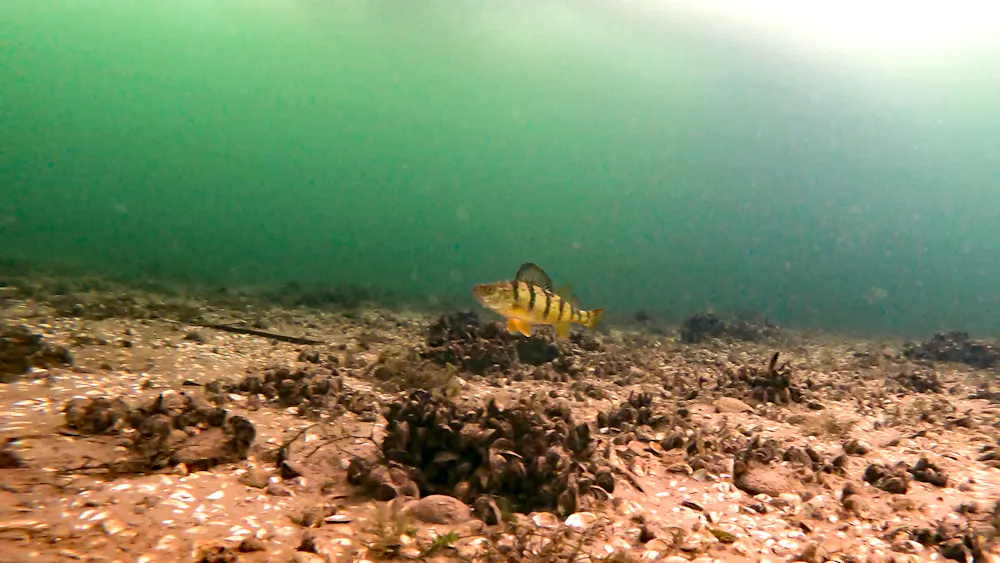
A yellow perch swims under the ice in Sturgeon Bay in Door County, Wisconsin.
Fish, like this yellow perch spotted in Sturgeon Bay, Wis., can ingest PFAS through water and food. The chemicals are also found in the sediment of lake bottoms.
Elizabeth Beard/Moment via Getty Images

Some PFAS bioaccumulate, or build up, within fish and wildlife. Elevated levels of PFAS have been detected in Great Lakes fish, raising concerns for fisheries.

High PFAS concentrations in fish in coastal areas and inland waters have led to advisories recommending people limit how much they fish they eat.

Looking ahead

Water cycles through the Great Lakes, but the process can take many years, from 2.6 years in Lake Erie to nearly 200 years in Lake Superior.

This means that PFAS that enter the lakes will be there for a very long time.

Since it is not possible to clean up the over 6 quadrillion gallons of water in the Great Lakes after they have been contaminated, preventing further contamination is key to protecting the lakes for the future.

That starts with identifying contaminated groundwater and rivers that are adding PFAS to the lakes. The Sea Grant College Program and the National Institutes of Water Resources, including the Wisconsin programs that I direct, have been supporting research to map these sources, as well as helping translate that knowledge into actions that policymakers and resource managers can take.

PFAS contamination is an issue beyond the Great Lakes and is something everyone can work to address.

  • Drinking water. If you are one of the millions of people who drink water from the Great Lakes, find out the PFAS concentrations in your drinking water. This data is increasingly available from local drinking water utilities.

  • Fish. Eating fish can provide great health benefits, but be aware of health advisories about fish caught in the Great Lakes and in inland waters so you can balance the risks. Other chemicals, such as mercury and PCBs, can also lead to fish advisories.

  • Personal choice. Scientists have proposed that PFAS only be used when they have vital functions and there are no alternatives. Consumer demand for PFAS-free products is helping reduce PFAS use in some products. Several states have also introduced legislation to ban PFAS use in some applications.

Decreasing use of PFAS will ultimately prevent downstream contamination in the Great Lakes and around the U.S.

The Conversation

Christy Remucal receives funding from National Science Foundation, U.S. Geological Survey, and Department of Defense.

ref. PFAS are turning up in the Great Lakes, putting fish and water supplies at risk – here’s how they get there – https://theconversation.com/pfas-are-turning-up-in-the-great-lakes-putting-fish-and-water-supplies-at-risk-heres-how-they-get-there-271489

There are long-lasting, negative effects for children like Liam Ramos who are detained, or watch their parents be deported

Source: The Conversation – USA (2) – By Joanna Dreby, Professor of sociology, University at Albany, State University of New York

Children hold signs on the porch of a house as protesters march in Minneapolis against Immigration and Customs Enforcement on Jan. 10, 2026. Octavio JONES/AFP via Getty Images

When Immigration and Customs Enforcement agents detained Liam Conejo Ramos, a 5-year-old boy who is an asylum seeker, in Minneapolis on Jan. 20, 2026, the photos quickly became a flash point in the Trump administration’s aggressive immigration enforcement activity.

In one image, a man wearing a black uniform holds onto a gray and red Spider-Man backpack that the worried-looking young boy, wearing a blue bunny hat with floppy ears, has on his back.

Meanwhile, ICE and Customs and Border Patrol operations near schools have become increasingly common over the past year, spreading from Texas to Maine. While some parents in Minnesota have set up patrols around schools, there are families choosing to keep their kids home for days or weeks.

We are scholars of migration and children and childhood adversity.

Our research shows that exposure to severe immigration enforcement experiences during childhood carries long-term, significant consequences: These children are twice as likely to suffer from anxiety in young adulthood.

People dressed in winter clothing stand close together and hold signs that say 'Bring Liam home'
People protest on Jan. 23, 2026, in Minneapolis and show signs referencing Liam Conejo Ramos, a 5-year-old child apprehended by immigration enforcement officers.
Roberto Schmidt/AFP via Getty Images

Why this matters

There is well-documented research showing how immigration enforcement has immediate negative effects on children and adults

Children whose immigrant parents are arrested, detained or deported often experience emotional and behavioral problems, including separation anxiety, school absenteeism, hyperactivity and other behavioral issues.

Yet, until recently, it has not been well understood how experiencing or being subjected to immigration enforcement actions affects children once they grow up to become adults.

That said, over three decades of research shows the clear links between traumatic childhood events and mental health problems in adulthood. Studies show, for example, that adults who experienced temporary separation from their parents as children are more likely to say they’ve experienced depression symptoms years later.

We decided to investigate whether a child being exposed to immigration enforcement actions – meaning the arrest of a parent, or detention of a close family member, for example – is associated with mental health problems among young adults who grew up in immigrant families.

How immigration enforcement unravels families

Our study first combined interviews and open-ended survey questions to define what it means to experience severe immigration enforcement during childhood.

We then examined the link between severe immigration enforcement actions and anxiety among 71 young adults – all U.S. citizens age 18 to 34 – who were raised in immigrant households in New York.

As children, all of these young adults witnessed or experienced the arrest, detention or deportation of an immigrant family member or a member of their communities. Three-quarters of the participants identified as Hispanic.

We analyzed our interviews to develop several criteria to determine what constitutes severe exposure to enforcement during childhood, considering factors like whether they witnessed a detention or arrest more than once, and how old they were when these experiences took place.

We found that approximately 26% of the survey participants – all of whom in this group were Hispanic, except one – had severe exposure to immigration enforcement actions during childhood. Not all of them had a parent who has been deported.

Some of these young people had relatives who had drawn-out cases in immigration court, or felt constant fear that their parents might be deported.

When we linked our interviews with survey data, our results were striking.

We found that young adults who experienced severe immigration enforcement actions as children were twice as likely to have anxiety, compared with young adults who did not have this experience when they were growing up.

Exposure to severe immigration enforcement actions as a child was not independently associated with depression as a young adult. But all the survey participants who said they were experiencing depression also reported anxiety symptoms – further evidence of a connection between severe immigration enforcement actions and anxiety among young people.

A young girl wearing a pink shirt holds an adult's hand and looks directly at the camera. She stands on a street near a parked gray SUV.
A father and child watch as U.S. Customs and Border Patrol Commander Gregory Bovino and fellow agents conduct operations in Kenner, La., on Dec. 6, 2025.
Adam Gray/AFP via Getty Images

Lasting impact of today’s policies

Many legal experts and political observers say that the Trump administration’s immigration enforcement tactics in Minneapolis and in other cities are designed to intimidate and instill fear among civilians.

Children are not immune to these tactics, either as witnesses or as targets.

Federal immigration officers deployed tear gas, for example, on students at Roosevelt High School in Minneapolis on Jan. 8. Experiences like this constitute a major adverse childhood event, exposing children and adolescents to significant trauma.

We believe that we can learn from decades of adverse childhood experiences research, which clearly shows the link between childhood adversity and physical and mental health outcomes in adulthood.

The enforcement tactics ICE is using in Minnesota and other places in the U.S. today are likely, our research suggests, going to harm the next generation of U.S. citizens and residents.

As trauma researchers have long known, our bodies keep score over a lifetime. The question facing policymakers is not whether these enforcement tactics will cause lasting harm – our research suggests they would – but what human costs we, as a nation, are willing to bear.

The Conversation

Joanna Dreby receives funding from Russell Sage Foundation

Eunju Lee receives funding from Russel Sage Foundation (PI Dreby).

ref. There are long-lasting, negative effects for children like Liam Ramos who are detained, or watch their parents be deported – https://theconversation.com/there-are-long-lasting-negative-effects-for-children-like-liam-ramos-who-are-detained-or-watch-their-parents-be-deported-274271

It’s easy making green: Muppets continue to make a profit 50 years into their run

Source: The Conversation – USA (2) – By Jared Bahir Browsh, Assistant Teaching Professor of Critical Sports Studies, University of Colorado Boulder

A variety show that’s still revered for its absurdist, slapstick humor debuted 50 years ago. It starred an irreverent band of characters made of foam and fleece.

Long after “The Muppet Show”‘s original 120-episode run ended in 1981, the legend and legacy of Miss Piggy, Fozzie Bear, Gonzo and other creations concocted by puppeteer and TV producer Jim Henson have kept on growing. Thanks to the Muppets’ film franchise and the wonders of YouTube, the wacky gang is still delighting, and expanding, its fan base.

As a scholar of popular culture, I believe that the Muppets’ reign, which began in the 1950s, has helped shape global culture, including educational television. Along the way, the puppets and the people who bring them to life have earned billions in revenue.

Johnny Carson interviews Muppet creator Jim Henson, Kermit and other Muppets on the ‘Tonight Show’ in 1975, ahead of one of an early ‘The Muppet Show’ pilot.

Kermit’s origin story

Muppets, a portmanteau of marionette and puppet, first appeared on TV in the Washington, D.C., region in 1955, when Henson created a short sketch show called “Sam and Friends” with his future wife, Jane Nebel.

Their motley cast of puppets, including a lizardlike character named Kermit, sang parody songs and performed comedy sketches.

Henson’s creations were soon popping up in segments on other TV shows, including “Today” and late-night programs. Rowlf the Dog appeared in Canadian dog food commercials before joining “The Jimmy Dean Show” as the host’s sidekick.

After that show ended, Rowlf and Dean performed on the “Ed Sullivan Show,” where Kermit had occasionally appeared since 1961.

Rowlf the Dog and Jimmy Dean reprise their schtick on the ‘Ed Sullivan Show’ in 1967.

From ‘Sesame Street’ to ‘SNL’

As Rowlf and Kermit made the rounds on variety shows, journalist Joan Ganz Cooney and psychologist Lloyd Morrisett were creating a new educational program. They invited Henson to provide a Muppet ensemble for the show.

Henson waived his performance fee to maintain rights over the characters who became the most famous residents of “Sesame Street.” The likes of Oscar the Grouch, Cookie Monster and Big Bird were joined by Kermit who, by the time the show premiered in 1969, was identified as a frog.

When “Sesame Street” became a hit, Henson worried that his Muppets would be typecast as children’s entertainment. Another groundbreaking show, aimed at young adults, offered him a chance to avoid that.

“Saturday Night Live’s” debut on NBC in 1975 – when the show was called “Saturday Night” – included a segment called “The Land of Gorch,” in which Henson’s grotesque creatures drank, smoked and cracked crass jokes.

“The Land of Gorch” segments ended after “Saturday Night Live’s” first season.

‘Saturday Night Live’s’ first season included ‘Land of Gorch’ sketches that starred creatures Jim Henson made to entertain grown-ups.

Miss Piggy gets her closeup

“The Muppet Show” was years in the making. ABC eventually aired two TV specials in 1974 and 1975 that were meant to be pilots for a U.S.-produced “Muppet Show.”

After no American network picked up his quirky series, Henson partnered with British entertainment entrepreneur Lew Grade to produce a series for ATV, a British network, that featured Kermit and other Muppets. The new ensemble included Fozzie Bear, Animal and Miss Piggy – Muppets originally performed by frequent Henson collaborator Frank Oz.

The Muppet Show” parodied variety shows on which Henson had appeared. Connections he’d made along the way paid off: Many celebrities he met on those shows’ sets would guest star on “The Muppet Show,” including everyone from Rita Moreno and Lena Horne to Joan Baez and Johnny Cash.

“The Muppet Show,” which was staged and shot at a studio near London, debuted on Sept. 5, 1976, in the U.K, before airing in syndication in the United States on stations like New York’s WCBS.

As the show’s opening and closing theme songs changed over time, they retained a Vaudeville vibe despite the house band’s preference for rock and jazz.

The Muppets hit the big screen

“The Muppet Show” was a hit, amassing a global audience of over 200 million. It won many awards, including a Primetime Emmy for outstanding comedy-variety or music series – for which it beat “Saturday Night Live” – in 1978.

While his TV show was on the air, Henson worked on the franchise’s first film, “The Muppet Movie.” The road film, released in 1979, was another hit: It earned more than US$76 million at the box office.

“The Muppet Movie” garnered two Academy Award nominations for its music, including best song for “Rainbow Connection.” It won a Grammy for best album for children.

The next two films, “The Great Muppet Caper,” which premiered in 1981, and “The Muppets Take Manhattan,” released in 1984, also garnered Oscar nominations for their music.

As ‘The Muppet Movie’ opens, Statler and Waldorf tell a security guard of their heckling plans.

‘Fraggle Rock’ and the Disney deal

The cast of “The Muppet Show” and the three films took a break from Hollywood while Henson focused on “Fraggle Rock,” a TV show for kids that aired from 1983-1987 on HBO.

Like Henson’s other productions, “Fraggle Rock” featured absurdist humor – but its puppets aren’t considered part of the standard Muppets gang. This co-production between Henson, Canadian Broadcast Corporation and British producers was aimed at international markets.

The quickly conglomerating media industry led Henson to consider corporate partnerships to assist with his goal of further expanding the Muppet media universe.

In August 1989, he negotiated a deal with Michael Eisner of Disney who announced at Disney-MGM Studios an agreement in principle to acquire The Muppets, with Henson maintaining ownership of the “Sesame Street” characters.

The announcement also included plans to open Muppet-themed attractions at Disney parks.

But less than a year later, on May 16, 1990, Henson died from a rare and serious bacterial infection. He was 53.

At the end of ‘Fraggle Rock’s’ run, its characters look for new gigs.

Of Muppets and mergers

Henson’s death led to the Disney deal’s collapse. But the company did license The Muppets to Disney, which co-produced “The Muppet Christmas Carol” in 1992 and “Muppet Treasure Island” in 1996 with Jim Henson Productions, which was then run by Jim’s son, Brian Henson.

In 2000, the Henson family sold the Muppet properties to German media company EM.TV & Merchandising AG for $680 million. That company ran into financial trouble soon after, then sold the Sesame Street characters to Sesame Workshop for $180 million in late 2000. The Jim Henson Company bought back the remaining Muppet properties for $84 million in 2003.

In 2004, Disney finally acquired The Muppets and most of the media library associated with the characters.

Disney continued to produce Muppet content, including “The Muppet’s Wizard of Oz” in 2005. Its biggest success came with the 2011 film “The Muppets,” which earned over $165 million at the box office and won the Oscar for best original song “Man or Muppet.”

Muppets Most Wanted,” released in 2014, earned another $80 million worldwide, bringing total global box office receipts to over $458 million across eight theatrical Muppets movies.

The ‘Muppet Show’ goes on

The Muppets continue to expand their fandom across generations and genres by performing at live concerts and appearing in several series and films.

Through these many hits and occasional bombs, and the Jim Henson Company’s personnel changes, the Muppets have adapted to changes in technology and tastes, making it possible for them to remain relevant to new generations.

That cast of characters made of felt and foam continue to entertain fans of all ages. Although many people remain nostalgic over “The Muppet Show,” two prior efforts to reboot the show proved short-lived.

But when Disney airs its “The Muppet Show” anniversary special on Feb. 4, 2026, maybe more people will get hooked as Disney looks to reboot the series

‘The Muppet Show’ will be back – for at least one episode – on Feb. 4, 2026.

The Conversation

Jared Bahir Browsh does not work for, consult, own shares in or receive funding from any company or organization that would benefit from this article, and has disclosed no relevant affiliations beyond their academic appointment.

ref. It’s easy making green: Muppets continue to make a profit 50 years into their run – https://theconversation.com/its-easy-making-green-muppets-continue-to-make-a-profit-50-years-into-their-run-272855

Innovations in asthma care can improve the health of Detroiters living with this chronic disease

Source: The Conversation – USA (3) – By Arjun Mohan, Clinical Associate Professor of Internal Medicine, University of Michigan

Researchers and doctors are beginning to modernize asthma treatment using innovative therapies.

Asthma is a common, chronic and treatable lung disease that touches nearly every family in America. It affects people of all ages and costs our health care system about US$82 billion each year.

In Michigan, the problem is acute. About 12% of Michigan adults live with asthma, compared to almost 9% nationwide, according to the Centers for Disease Control and Prevention.

Nowhere is the burden heavier than in Detroit, which is ranked No. 1 in the U.S. as the most challenging place to live with asthma – based on prevalence, emergency department visits and deaths.

Between 2021 and 2023, the city’s adult asthma rate was 14.8%, compared with 11.5% statewide, according to data from the Michigan Department of Health and Human Services. Childhood asthma reaches nearly 15%, almost double the state average.

Between 2019 and 2023, Detroiters were hospitalized for asthma more often than residents elsewhere in the state. Black residents, women and people with lower incomes bear the greatest burden, facing higher rates of disease and worse outcomes, such as hospitalization.

Personalized care based on medical advances

My experience as an asthma specialist has taught me humility in the face of this complex disease. Over the past decade, I’ve learned the value of pausing and inviting each patient to reflect on their own journey with asthma.

For some, it is a new and confusing diagnosis – often accompanied by a degree of denial about having a chronic condition that needs constant management.

For others, this process gives them space to reflect on disease-related harms such as lifetime exposure to corticosteroids, which treat inflammation, or the number of emergency department visits they have endured.

Taking time to reflect also gives doctors and patients an opportunity to think about other issues affecting the patients’ health. For example, patients often struggle with the relationship between asthma and being overweight. It is hard for them to lose weight due to their symptoms or the side effects of oral steroids.

This mutual understanding becomes the foundation for a personalized care plan, often using the latest scientific advances in therapy. My colleagues and I at the University of Michigan are deeply involved in clinical trials investigating novel therapies and forward-thinking approaches to asthma care.

These approaches are centered in the long-held principle that a preventive and proactive approach to care is better than a reactive one.

The problem with ‘wait-and-see’ care

Decades of research show that asthma, while characterized by airway inflammation and spasming, is a heterogenous syndrome. This means it takes many forms and affects patients in different ways.

For some, asthma fades over time or remains mild and manageable. For others, it is a lifelong struggle, marked by frequent flare-ups, hospital visits, missed days at work or school and declining lung function.

Alarmingly, severe outcomes can happen even in those labeled as having “mild” asthma. A seemingly manageable episode can suddenly become serious, reminding us how easily this disease can be underestimated.

Most people seek help for asthma only when symptoms get bad. They may find themselves overusing a rescue inhaler or needing urgent care or the emergency department. These flare-ups, also called exacerbations, are serious.

Patients who have frequent exacerbations are more likely to have future flare-ups and face long-term risks such as loss of lung function or even death.

Even the medicines used to treat flare-ups carry risks. Just two courses of oral steroids per year can raise the risk of osteoporosis, diabetes or cardiovascular disease. It is also important to note that poorly controlled asthma or regularly needing higher-dosage inhalers can lead to irreversible airway damage and loss of lung function.

Many patients also rely on the emergency department for routine asthma care. This is often due to poor knowledge about asthma, high medication costs, insurance barriers and life constraints such as work or school. Yet emergency departments are not designed for ongoing management. Emergency departments cannot provide lung-function testing, maintenance inhalers, long-term monitoring or follow-up care – all critical to keeping asthma under control.

In other words, the health care field’s current approach is reactive, waiting for symptoms to spiral downward and not really focused on addressing risk. Patients with warning signs often go unnoticed or receive treatments that don’t meet their needs. This approach to care is outdated and poorly suited to modern medicine.

Tailoring interventions to each individual

A better approach starts with awareness of asthma’s variability and moving away from “one-size-fits-all” care.

Consider allergen control. Detroiters are exposed to both year-round allergens – such as dust mites, cockroaches and indoor molds – as well as seasonal allergens such as tree, grass and weed pollens.

Allergen mitigation was once a major strategy for managing asthma and often thought of as a stand-alone intervention. But allergen mitigation alone is rarely enough. For example, if dust mites trigger asthma, using mattress covers alone isn’t sufficient – you also need to wash bedding weekly and avoid heavy humidifiers. The approach should incorporate different methods to reduce exposure.

Meanwhile, allergen control for people without clear sensitivity is often ineffective and expensive. The best care starts with a conversation between patients and a clinician: testing triggers, reviewing evidence-based strategies and tailoring interventions to what will work for each person.

Asthma also often flies under the radar, not just for doctors but for patients too. About 1 in 5 patients underestimate the severity of their asthma, while many overestimate their control. Awareness of red flags – such as frequent flare-ups or poor symptom control – is critical. Daytime symptoms more than twice a week, nighttime symptoms more than twice a month, frequent use of emergency inhalers or limited physical activities all signal risks.

These warning signs can be controlled in nearly 95% of patients with minimal medications, proper inhaler technique, addressing environmental triggers and treating related conditions such as acid reflux.

For 5% to 10% of patients with severe or hard-to-treat asthma, close monitoring and specialist care are essential.

Specialist visits allow a thorough review of a patient’s history, including long-term steroid use, and help identify low-hanging fruit such as poor inhaler technique, lifestyle factors, coexisting conditions or diseases that mimic asthma.

Identifying symptoms early can mitigate health risks

New tools, such as blood tests and breath analyses, can measure airway inflammation and even predict flare-ups, treatment failures or lung function loss. While not yet widely used, these tools are the first giant leap toward proactive care, identifying problems before they take a serious toll. For example, patients with signals of inflammation in both blood and breath tests are at a much higher risk of future loss of lung function and exacerbations than their counterparts without these signals.

Another major advance is targeted therapies called biologics. These shots are usually administered under the skin by patients at home. They help control inflammation caused by asthma. In carefully selected patients, biologics can reduce flare-ups and hospitalizations, improve lung function, enhance quality of life and lower the need for oral steroids.

Many federally sponsored insurance programs now include certain biologics on their list of covered prescription drugs. However, actual approval and patient out-of-pocket costs can vary widely.

Advancing a new vision for asthma care

Michiganders would benefit from raising their awareness of asthma, not just because asthma is common here but because our environment is changing fast. Events like the 2023 Canadian wildfires show that the air we breathe is dynamic and unpredictable.

In my view, it is imperative to adopt a proactive approach that uses commonsense measures, promotes awareness, applies evidence-based practice and identifies at-risk people early. Achieving this vision requires addressing real-world challenges such as research gaps, costs and access to care.

Asthma is not just a personal health issue, it is a public health priority. My patients are impacted not only by lifestyle choices but also by factors outside of their control – factors such as drug costs, insurance plans, environmental changes and access to care.

The Conversation

Arjun Mohan received funding from Verona Pharm LLC and Regeneron Pharm for Consulting Services (one time, relationship has ended). These services have no conflict with the article written here

ref. Innovations in asthma care can improve the health of Detroiters living with this chronic disease – https://theconversation.com/innovations-in-asthma-care-can-improve-the-health-of-detroiters-living-with-this-chronic-disease-260487