Le retour de la puissance en géopolitique : le cas de l’Ukraine

Source: The Conversation – in French – By Laurent Vilaine, Docteur en sciences de gestion, ancien officier, enseignant en géopolitique à ESDES Business School, ESDES – UCLy (Lyon Catholic University)

Et si, au-delà des horreurs, la guerre entre la Russie et l’Ukraine, intensifiée en 2022, n’était pas l’événement « nouveau » que l’on dépeint, mais le révélateur brutal de lois géopolitiques fondamentales que l’Occident avait choisi d’oublier ?


La guerre qui ravage actuellement l’Ukraine est un concentré de géopolitique, qui mobilise toutes les grilles d’analyse élaborées depuis plus d’un siècle, rappelant que les grands drames du monde contemporain (Bosnie, Tchétchénie, Géorgie, pour ne s’en tenir qu’au continent européen) ne sont que les itérations d’un jeu de puissance aux règles immuables.

Au-delà de l’anxiété du court terme, c’est cette approche qu’il convient d’avoir à l’esprit pour décrypter les constantes militaires, économiques, numériques et narratives qui commandent la géopolitique moderne.

L’empreinte indélébile de la géographie et de l’histoire

La guerre en Ukraine est, avant tout, une affaire de temps long. Elle réactive deux forces primaires que la modernité avait cru dissoudre : la géographie et l’histoire.

Ce conflit nous rappelle brutalement ce qu’est la guerre de haute intensité, un concept que l’on pensait relégué aux archives de la guerre froide (Corée, Vietnam, Iran-Irak…).

Le fleuve Dniepr redevient un obstacle stratégique ; le relief naturel dicte les fonctions défensives ; la mer Noire, une artère vitale pour l’évacuation du blé, est une zone de friction économique et militaire.

Les villes ne sont pas de simples coordonnées numériques, mais des bastions à conquérir, des symboles dont la perte ou la conquête influe directement sur le moral des belligérants. La technologie a beau innover (l’usage massif des drones), elle ne fait que s’adapter à la réalité implacable du sol. Cette réalité réaffirme une constante que les débats sur la guerre cyber et hybride tendaient à occulter : le terrain façonne les opérations.

Si les drones terrestres sont de plus en plus utilisés pour évacuer les soldats blessés de la ligne de front, leurs pilotes doivent prendre en compte les paramètres topographiques et météorologiques lors de ces opérations.

Le poids des récits

Le rapport de force, lui, est indissociable des récits. L’Ukraine se définit par sa souveraineté, tandis que la Russie se considère toujours comme l’héritière légitime d’un espace impérial qu’elle n’accepte pas de perdre. Ce choc de représentations historiques, où l’un refuse de perdre et l’autre d’être absorbé, est une constante tragique de la géopolitique.

Vladimir Poutine, comme tant d’autres avant lui, a commis l’erreur classique d’ignorer qu’un rapport de force ne s’évalue pas à l’aune du mépris que l’on a pour son adversaire, mais se mesure au regard des forces et faiblesses réelles. La résistance ukrainienne, soutenue mais non dirigée par ses alliés, est la preuve amère que les Russes ont sous-estimé leur adversaire de manière caricaturale.

L’incapacité d’anticiper

L’un des enseignements les plus cinglants de ce conflit tient à l’incapacité d’anticiper dont ont fait preuve les acteurs occidentaux. Malgré les signaux constants de la géopolitique, il a fallu l’événement, le choc de 2022, pour forcer un réarmement accéléré de l’Europe et une révision de ses dépendances.

En Ukraine, la guerre est un laboratoire d’innovations (drones, adaptation tactique en temps réel), mais cette innovation ne saurait cacher le retour d’une autre constante : la masse.

Malgré le numérique et la guerre électronique, le qualitatif ne remplace pas le quantitatif. Le nombre de chars, de pièces d’artillerie, et de soldats compte plus que jamais. Les modes d’action russes le confirment tragiquement : une approche où la préservation du capital humain est subordonnée à l’idée d’un capital jugé quantitativement inépuisable.

L’Occident découvre, sidéré, la primauté du stock sur la sophistication, alors que cette logique est un pilier de la stratégie militaire depuis l’aube des guerres.

La gesticulation nucléaire

L’escalade doit être évitée à tout prix, et cette retenue est dictée par la constante la plus terrifiante de la modernité : la dissuasion nucléaire.

La logique de la « destruction mutuelle assurée » est plus vivante que jamais, expliquant la frilosité relative des Américains et des Européens. La Russie use et abuse de la gesticulation nucléaire – déclarations ambiguës, annonces de nouveaux matériels – pour dissuader tout engagement occidental trop important. Cette démonstration est à la fois une force et une faiblesse, mais elle réaffirme le rôle central de l’atome comme arbitre suprême des conflits de haute intensité.

Intérêts permanents, nouvelles alliances

Si le conflit semble géographiquement circonscrit, ses effets sont mondiaux, mais surtout, ils révèlent la nature profonde et intéressée des alliances globales.

Pour Vladimir Poutine, la guerre a engendré des échecs stratégiques aux conséquences durables :

L’échec le plus cruel est de constater que le soi-disant « Sud Global » ne soutient la Russie qu’à l’aune de ses propres intérêts. Ces pays profitent des sanctions occidentales pour acheter du pétrole russe à bas coût, démontrant une forme de non-alignement formel et l’une des plus grandes constantes de la géopolitique : l’intérêt prime toujours l’idéologie.

Le temps long contre la peur

En Ukraine, la guerre mobilise à elle seule de nombreuses constantes de la géopolitique contemporaine.

C’est ce que cherche à restituer le Retour de la puissance en géopolitique. Bienvenue dans le vrai monde (L’Harmattan, 2025) au travers de ses 20 thématiques indépendantes, visant à couvrir une grande partie du spectre de la géopolitique dont les maîtres mots sont la puissance, le rapport de force et l’intérêt. Comprendre cette guerre, c’est accepter que le monde obéît à des règles anciennes et que la seule véritable surprise réside dans notre incapacité chronique à les anticiper.

The Conversation

Les auteurs ne travaillent pas, ne conseillent pas, ne possèdent pas de parts, ne reçoivent pas de fonds d’une organisation qui pourrait tirer profit de cet article, et n’ont déclaré aucune autre affiliation que leur organisme de recherche.

ref. Le retour de la puissance en géopolitique : le cas de l’Ukraine – https://theconversation.com/le-retour-de-la-puissance-en-geopolitique-le-cas-de-lukraine-269677

L’impôt sur la fortune improductive : une taxe en décalage avec le modèle d’intermédiation financière français

Source: The Conversation – France (in French) – By Nizar Atrissi, Professeur associé, IAE Paris – Sorbonne Business School; Université Paris 1 Panthéon-Sorbonne

Au cours du débat budgétaire, un impôt sur la fortune dite improductive a été voté le 31 octobre dernier. Mais que désigne véritablement ce terme ? Et les assiettes visées par cet impôt sont-elles vraiment aussi improductives qu’elles ne le semblent ?


Alors que la France cherche à taxer la richesse dite « improductive », elle risque d’affaiblir le moteur même qui finance son économie. Le nouvel impôt sur la fortune improductive vise à réorienter les capitaux inactifs vers l’investissement productif, mais en incluant dans son assiette les dépôts bancaires, les avoirs en liquidités et même certains produits d’assurance vie, la mesure frappe au cœur du système financier du pays : son modèle d’intermédiation financière.

L’Assemblée nationale a adopté en première lecture, le 31 octobre 2025, un nouvel impôt présenté comme un instrument de justice économique : l’impôt sur la fortune improductive. Son objectif est clair. Il s’agit de faire contribuer davantage les capitaux dits « dormants » et de réorienter l’épargne vers l’investissement productif. Mais derrière cette ambition se cache un paradoxe économique majeur. En intégrant les liquidités et dépôts bancaires dans son assiette, la réforme touche directement ce qui alimente l’économie réelle française, le mécanisme de transformation de l’épargne en crédit.

Définition contestée

Selon le texte voté, la « fortune improductive » regroupe les actifs qui ne participeraient pas directement à la création de valeur. L’impôt s’appliquerait aux biens immobiliers et aux actifs considérés comme improductifs : les biens de luxe tels que les yachts ou les jets privés, les métaux précieux et les actifs numériques, ainsi que les dépôts et les liquidités, y compris certaines assurances vie jugées « inactives ». L’hypothèse sous-jacente est que ces avoirs ne créent ni emplois ni croissance.


À lire aussi :
Luxe : la consommation des ultra-riches est-elle morale ?


Pourtant, les dépôts et autres actifs assimilés sont tout sauf inactifs. Ils représentent une source de financement vitale pour les institutions financières françaises qui les transforment en prêts aux ménages et aux entreprises. Ils constituent également la base de la stabilité financière en servant de réserves et de coussins de liquidité. Les taxer reviendrait à frapper directement au cœur du mécanisme du crédit en France. De plus, ces avoirs sont déjà soumis à l’impôt et aux prélèvements sociaux à travers les intérêts qu’ils génèrent. Les inclure dans une nouvelle assiette fiscale équivaudrait à une double imposition d’un actif déjà intrinsèquement productif.

Une clé de voûte du financement

Selon la Banque de France, les dépôts et comptes d’épargne de la clientèle non financière totalisaient environ 2 600 milliards d’euros en septembre 2025, dont 1 900 milliards détenus par les ménages. Le ratio crédits/dépôts avoisine 100 %, selon les statistiques annuelles de la Banque centrale européenne (BCE, Supervisory Banking Statistics 2024). Ce niveau traduit la forte mobilisation de l’épargne par les banques françaises, qui transforment activement les dépôts en prêts à l’économie réelle.

À la différence des économies anglo-saxonnes, davantage tournées vers les marchés, le financement de l’économie française reste profondément intermédié, où les banques jouent un rôle central dans la transformation de l’épargne en crédit. Les données de la Banque de France indiquent que le financement total des sociétés non financières atteignait 2 100 milliards d’euros en août 2025, dont près de 1 400 milliards provenant de crédits bancaires, soit environ deux tiers du financement des entreprises. Autrement dit, la croissance économique française dépend d’un système bancaire qui recycle l’épargne domestique en crédit productif.

La même logique s’applique au secteur de l’assurance vie, qui constitue un autre canal important de l’intermédiation en France. Les fonds en euros – ces produits à capital garanti et à forte liquidité propres au marché français – sont eux aussi visés par la nouvelle mesure. Ce pilier de l’épargne représente 70 % de l’assurance vie qui s’élève à près de 2 100 milliards d’euros d’encours selon les chiffres officiels de France Assureurs, l’organisation professionnelle réunissant l’ensemble des entreprises d’assurance et de réassurance travaillant en France. Près de 60 % de ces actifs sont investis dans des titres d’entreprises et du quart dans des obligations souveraines, finançant directement le secteur privé comme le secteur public.

Un effet boomerang

Ensemble, banques et assurances forment les deux piliers du modèle français d’intermédiation, transformant l’épargne des ménages en crédit et en investissement de long terme. Fragiliser cette base via la fiscalité nuirait non seulement au mécanisme d’intermédiation lui-même, mais il dégraderait aussi la capacité du pays à financer sa croissance. En effet, les sommes placées dans les actifs ciblés par cette mesure seraient susceptibles de s’orienter vers d’autres investissements peut-être plus risqués, mais moins exposés fiscalement… et éventuellement situés hors de France.

En cherchant à orienter l’épargne vers des actifs « productifs », la nouvelle loi, si elle est finalement adoptée à l’issue du processus de budget, promeut implicitement une forme de désintermédiation financière – une transformation du financement bancaire vers un financement direct et davantage fondé sur les marchés. En théorie, une telle évolution est souhaitable, car elle permettrait de diversifier les sources de capitaux, d’améliorer l’allocation de l’épargne et de favoriser l’innovation. Mais encore faut-il disposer de marchés suffisamment profonds, liquides et attractifs pour les émetteurs comme pour les investisseurs.

Or la France demeure structurellement bancarisée et son marché actions continue de se négocier avec une décote significative par rapport aux États-Unis. Comme le signalait sur BFM Michaël Fribourg, le PDG de Chargeurs : « Mon conseil à ceux qui veulent aller à la Bourse de Paris : ne le faites surtout pas ! » Cette mise en garde illustre un défi bien profond : le marché de capitaux domestique peine encore à attirer et retenir les entreprises à un moment où il aurait besoin de se renforcer.

Boursorama 2025.

La fonction économique de la liquidité

Assimiler la liquidité à de la passivité revient à méconnaître sa fonction économique. Les liquidités et les dépôts reflètent la prudence et la planification financière, non l’immobilisme. Ils soutiennent la confiance, permettent la création de crédit et jouent un rôle stabilisateur en périodes d’incertitude. Les taxer reviendrait à pénaliser des comportements d’épargne responsables et une gestion financière saine.

Plutôt que d’alourdir la charge fiscale sur ces actifs, la France devrait encourager l’épargne de long terme, celle qui alimente réellement l’investissement productif. Mais cela implique de préserver la capacité du système financier à transformer l’épargne en crédit, non de la restreindre. Dans une économie où l’intermédiation reste la colonne vertébrale du financement, taxer la liquidité équivaut à désamorcer la pompe.

L’impôt sur la fortune improductive part d’un objectif louable – mobiliser le capital au service de la croissance –, mais risque de produire l’effet inverse. Au lieu d’une fiscalité pénalisant la liquidité, la priorité devrait être d’affermir la profondeur des marchés de capitaux, de renforcer la culture financière des ménages et de favoriser les investissements à long terme. En envoyant un signal de défiance envers cette épargne, la nouvelle taxe risque de compromettre l’un des atouts structurels de la France : son système d’intermédiation financière stable.

The Conversation

Nizar Atrissi ne travaille pas, ne conseille pas, ne possède pas de parts, ne reçoit pas de fonds d’une organisation qui pourrait tirer profit de cet article, et n’a déclaré aucune autre affiliation que son organisme de recherche.

ref. L’impôt sur la fortune improductive : une taxe en décalage avec le modèle d’intermédiation financière français – https://theconversation.com/limpot-sur-la-fortune-improductive-une-taxe-en-decalage-avec-le-modele-dintermediation-financiere-francais-270383

Coastal regions and climate change: how better risk assessment can help protect infrastructure and livelihoods

Source: The Conversation – France – By Anthony Schrapffer, PhD, EDHEC Climate Institute Scientific Director, EDHEC Business School

Coastal regions, where dense clusters of critical infrastructure are found, are facing the sharpest edge of climate change. The threats include paralysed transport networks and disrupted supply chains. To stay ahead, we need a clearer picture of these vulnerabilities that lets us anticipate the fallout before it comes. But right now, patchy data, inconsistent approaches, and the absence of a unified framework make it tough to grasp the scale of the risk.

In late October, the Caribbean was ravaged by Hurricane Melissa, a type of storm whose likelihood has been quadrupled by climate change, according to research from Imperial College London’s Grantham Institute. With a death toll exceeding 40 and damages initially estimated at around $50 billion, the hurricane has laid bare the acute exposure of coastal regions to such disasters.

Coastal areas host a disproportionate share of the world’s major cities, ports, industrial hubs, and essential infrastructure. Some 40% of the global population resides within 100 kilometres of the coast, while 11% live in low-lying coastal zones (areas less than 10 metres above sea level). This coastal concentration stems from the strategic advantages of maritime trade, access to natural resources such as water and fisheries, and the economic draw of tourism.

As sea levels rise and storms grow more intense, this concentration of assets along the coastlines places them squarely in the crosshairs of climate change. Measuring assets’ vulnerabilities is essential for anticipating economic, environmental, and social impacts and, above all, preventing disruptions.

But without a unified framework for evaluating risk, how can we accurately forecast and prepare for the impact of climate change on coastal infrastructure?

The increasing cost of climate disasters

Climate change is driving rising sea levels and accelerating coastal erosion, rendering shorelines increasingly fragile. As a result, storms, cyclones, and coastal flooding are growing in both frequency and intensity. Coastal infrastructure, already highly exposed, faces mounting human and economic tolls from these extreme events.

In 2005, Hurricane Katrina submerged 80% of New Orleans, claiming over 1,800 lives and causing $125 billion in damage. The storm devastated hundreds of oil and gas platforms and more than 500 pipelines. Fourteen years later, Cyclone Idai struck Mozambique, killing 1,200 people, causing $2 billion in damages and crippling the port of Beira. Then in 2021, catastrophic flooding in Germany, Belgium, and the Netherlands, triggered by torrential rains, submerged towns and farmland, severed roads, demolished railways, disrupted water networks, and paralysed transport for weeks.

Beyond the destruction they cause, these disasters disrupt essential services and shrink the window for reconstruction as their recurrence accelerates. The cascading effects across interconnected sectors are even more concerning. A localised failure can trigger a chain reaction of vulnerabilities, turning an isolated incident into a full-blown crisis. A flooded coastal road or a power grid failure, for instance, can send shockwaves through global supply chains. Without decisive action, damages from coastal flooding could surge 150-fold by 2080.

The urgency is clear: we must assess the fragility of coastal infrastructure with consistency, rigor and transparency. The goal? To fortify critical economic zones against the escalating impacts of climate change.

Toward a common language for measuring risks

Estimating potential failure points in coastal infrastructure presents significant challenges. Data gaps, inconsistent methodologies, varying criteria, and the absence of a unified framework complicate risk assessment, thereby hindering informed decision-making and delaying targeted investments.

One approach to establishing a common reference framework is to evaluate risks based on their financial materiality, ie quantifying direct losses, repair costs, and business interruptions.

The Scientific Climate Ratings (SCR) agency applies this methodology at scale, incorporating asset-specific climate risks. Developed in collaboration with the EDHEC Climate Institute, this framework serves as a scientific reference point for assessing infrastructure exposure, as well as for comparing, prioritising and managing investments in climate risk adaptation.

This standardised approach underpins the Climate Exposure Rating (CER) system, developed by SCR. The system uses a grading scale from A (minimal risk) to G (highest risk) to compare the exposure of coastal and inland assets.

Comparison of potential climate exposure ratings between coastal assets and all assets considered in the Scientific Climate Ratings agency’s assessment.
Anthony Schrapffer, SCR, Fourni par l’auteur

The findings reveal that coastal assets have a higher concentration of higher-risk ratings (F, G) and fewer lower-risk ratings (A, B), indicating that their climate exposure is greater than that of inland infrastructure. This underscores the need for tailored risk management strategies to address the heightened vulnerability of coastal systems.

From risk assessment to informed decision-making

The method developed by the EDHEC Climate Institute for quantifying physical risk involves cross-referencing the probability of a hazard with its expected intensity. Damage functions then correlate each climate scenario with potential losses, accounting for asset type and location. For instance, a 100-year flood – an event with a 1% annual occurrence probability – might correspond to a two-meter flood depth, capable of destroying over 50% of the value of a residential property in Europe.

By translating physical risks into economic terms, these indicators provide a clear basis for public policy and private investment decisions. Should infrastructure be built, reinforced, or adapted? Which projects should take priority?

The analysis also incorporates transition risks, including the impact of evolving regulations, carbon pricing, and technological shifts. A gas terminal, for example, could become a stranded asset if demand declines or regulations tighten. Conversely, proactive adaptation strategies can enhance the financial resilience and long-term value of climate-exposed infrastructure. This approach ensures that decisions are not only reactive but also strategically aligned with future risks and opportunities.

Adaptation in action: the case of Brisbane Airport

Resilience in infrastructure refers to the capacity to absorb shocks, reorganise, and maintain essential functions – in other words, effectively returning to operational normality after a disruption. The ClimaTech Project aims to evaluate resilience, decarbonisation, and adaptation measures based on their risk-reduction effectiveness and cost-efficiency. This approach helps limit greenwashing by ensuring that only impactful actions – those that improve an asset’s rating on an objective, comparable scale – are recognised. The more effective the measures, the better the rating.

The case of Brisbane Airport, situated between the ocean and a river, offers a good example. By implementing flood barriers and elevating runways, the airport reduced its vulnerability to 100-year floods by 80%. As a result, it advanced two categories on the SCR rating scale, an improvement that enhances its appeal to investors and stakeholders.

Brisbane Airport is particularly exposed to climate risks.
Nate Cull/WikiCommons, CC BY-SA

The Brisbane case demonstrates that investing in coastal infrastructure resilience is not only feasible but also financially sound. This adaptation model, which preemptively addresses climate-related damage, could be replicated more broadly, provided that decision-makers rely on robust, consistent, and transparent risk assessments, such as the framework proposed here.

Coastal infrastructure stands at a critical juncture in the face of climate change. Positioned on the front lines, it faces economic, social, and environmental challenges of unprecedented scale. Protecting it demands a risk assessment that integrates financial materiality and climate projections. Such an approach empowers public and private players to make informed decisions, invest strategically, and highlight concrete actions. Making risk visible is already a step forward.


A weekly e-mail in English featuring expertise from scholars and researchers. It provides an introduction to the diversity of research coming out of the continent and considers some of the key issues facing European countries. Get the newsletter!


The Conversation

Anthony Schrapffer, PhD ne travaille pas, ne conseille pas, ne possède pas de parts, ne reçoit pas de fonds d’une organisation qui pourrait tirer profit de cet article, et n’a déclaré aucune autre affiliation que son organisme de recherche.

ref. Coastal regions and climate change: how better risk assessment can help protect infrastructure and livelihoods – https://theconversation.com/coastal-regions-and-climate-change-how-better-risk-assessment-can-help-protect-infrastructure-and-livelihoods-269441

Quand des robots invisibles influencent nos choix et nos opinions

Source: The Conversation – France in French (2) – By Guy Théraulaz, Chercheur au CNRS au Centre de Recherches sur la Cognition Animale, Centre de Biologie Intégrative, Université de Toulouse

À chaque fois que nous cliquons sur une étoile pour évaluer un restaurant, que nous laissons un commentaire sur un site marchand ou que nous « likons » une vidéo, nous déposons une trace numérique. Individuellement, cela peut sembler insignifiant, un simple petit signe de préférence, une micro-opinion parmi tant d’autres. Mais collectivement, ces traces forment un vaste paysage social, un nuage de signaux visibles et persistants, qui influence profondément nos comportements.


Ces indices diffus, agrégés par des plateformes et amplifiés par des algorithmes, fonctionnent comme une mémoire partagée. Ils nous disent ce qui est populaire, digne de confiance ou au contraire suspect. Le phénomène est si puissant que les biologistes et les physiciens l’ont rapproché d’un mécanisme bien connu dans le monde animal : la stigmergie. Ce concept introduit à la fin des années 1950 par l’entomologiste Pierre-Paul Grassé pour expliquer la construction collective du nid chez les termites, décrit la coordination indirecte entre les individus grâce aux traces que ceux-ci laissent dans l’environnement. Chez les insectes sociaux, une boulette de terre imprégnée de phéromone de construction et déposée à un endroit attire d’autres ouvrières qui viendront ajouter la leur, entraînant la formation d’un pilier puis d’un dôme.

Dans le monde numérique, un commentaire enthousiaste, une série d’évaluations cinq étoiles ou la viralité d’un hashtag jouent un rôle similaire : ils incitent d’autres personnes à adopter un comportement convergent. Ainsi, sans qu’il y ait besoin d’un chef d’orchestre, des milliers d’actions individuelles peuvent se combiner pour produire un comportement collectif cohérent. Mais ce mécanisme fascinant comporte un revers. Car si la stigmergie favorise la coopération et l’intelligence collective, elle ouvre aussi la porte à la manipulation et à la tromperie. Que se passe-t-il lorsque certains individus, ou des programmes automatiques, déposent des traces biaisées ou mensongères ?

Les travaux que nous avons réalisés au Centre de recherches sur la cognition animale, en collaboration avec le Laboratoire de physique théorique et l’École d’économie à Toulouse nous plongent au cœur de cette question à la croisée de l’éthologie, de l’économie comportementale et de la science des systèmes complexes. Nos études expérimentales ont révélé comment, dans des environnements numériques contrôlés, les humains exploitent, détournent ou subissent l’influence de ces traces. Elles montrent, de manière saisissante, que même de simples robots logiciels, dépourvus de toute sophistication, peuvent réorienter en profondeur la dynamique de coopération d’un groupe humain.

Quand la coopération devient fragile face à la compétition

La première série d’expériences, publiée en 2023, avait pour but d’examiner dans quelles conditions la stigmergie favorise ou non la coopération entre humains. Pour cela, nous avons conçu une expérience dans laquelle des groupes de cinq participants étaient invités à explorer une même grille de 225 cases numériques, chacune contenant une valeur cachée comprise entre 0 et 99 réparties aléatoirement. Leur objectif était de trouver les cases aux plus fortes valeurs.

Un homme de dos regarde un écran où apparaît une grille avec des chiffres de 1 à 99
Image de l’interface web utilisée par les participants au cours de l’expérience.
Fourni par l’auteur

Chaque fois qu’un joueur découvrait une case, il devait lui attribuer une note sur cinq étoiles, exactement comme on le fait pour un produit en ligne. Après que tous les sujets aient ouvert et noté les cases, chacune des cases des tableaux explorés par chaque groupe initialement de couleur blanche, adoptait différentes tonalités de rouge dont l’intensité dépendait du pourcentage d’étoiles ayant été déposées dans la case par tous les sujets au cours des itérations précédentes. Ces traces de couleurs étaient visibles par tous les membres du groupe et constituaient ainsi une mémoire collective de leurs actions passées. L’expérience s’achevait au bout de vingt itérations et la somme des valeurs des cases visitées par chaque sujet au cours de toutes les itérations déterminait le score de celui-ci.

Or, deux règles de jeu différentes étaient proposées. Dans la version non compétitive, le score cumulé des joueurs au terme d’une série de dix expériences n’affectait pas le montant de leur rémunération en fin d’expérience qui était identique pour tous, chaque participant gagnant 10 euros. Dans la version compétitive, en revanche, chaque point comptait car le gain final (entre 10 euros et 20 euros) dépendait de la somme des valeurs découvertes qui déterminait le classement des joueurs. Ces derniers étaient donc mis en concurrence pour obtenir la meilleure récompense.

Les résultats ont montré que dans la condition sans compétition, les individus avaient tendance à noter les cases de manière proportionnelle à leur valeur, offrant aux autres une information fidèle et donc utile. La coopération émergeait spontanément. En exploitant les traces laissées par les uns et les autres, le groupe parvenait à identifier collectivement les meilleures cases, bien au-delà de ce qu’un individu isolé aurait pu espérer. Mais dès que la compétition entrait en jeu, tout changeait. Beaucoup de participants se mettaient à tricher subtilement, ils visitaient des cases de forte valeur mais leur attribuaient une mauvaise note, afin de ne pas attirer l’attention des autres. D’autres adoptaient des stratégies neutres, attribuant des notes aléatoires ou uniformes pour brouiller les pistes. Ainsi la mémoire collective devenait peu fiable, et la coopération s’effritait.

L’analyse fine des comportements permit d’identifier trois profils distincts : les collaborateurs, qui partagent honnêtement l’information ; les neutres, qui laissent des signaux ambigus ; et les trompeurs, qui induisent délibérément les autres en erreur. Dans un contexte compétitif, la proportion de trompeurs explose. Ce basculement montre que la coopération humaine fondée sur les traces est hautement contextuelle. Elle peut surgir naturellement lorsqu’il n’y a rien à perdre à partager, mais elle s’évapore dès que l’intérêt individuel pousse à garder pour soi ou à induire les autres en erreur. Cette ambivalence se retrouve dans de nombreux environnements en ligne, où les évaluations sincères cohabitent avec les commentaires mensongers, les faux avis ou le spam organisé.

Quand des robots sociaux s’invitent dans la partie

La deuxième étude, réalisée en 2022 et aujourd’hui en cours de publication, pousse l’expérience encore plus loin en introduisant de nouveaux acteurs : de simples bots programmés (un bot est une application logicielle automatisée qui exécute des tâches répétitives sur un réseau). Dans cette expérience nous avons repris le même dispositif de la grille à explorer et du système d’évaluation, mais cette fois-ci, chaque participant humain jouait avec quatre « partenaires » qui n’étaient pas des humains, même si les joueurs l’ignoraient. Ces partenaires étaient des bots adoptant des comportements prédéfinis. Certains collaboraient en notant fidèlement les cases, d’autres trichaient systématiquement, d’autres encore restaient neutres, et enfin un dernier type cherchait à optimiser la performance collective. L’idée était de tester si la présence de ces agents artificiels, pourtant rudimentaires pouvait influencer la stratégie des humains dans une situation compétitive.

Probabilité que les participants trouvent la cellule de valeur 99 dans la situation non concurrentielle (bleu) et la situation concurrentielle (orange). Les lignes discontinues et pointillées noires correspondent aux probabilités attendues si les participants visitaient les cellules du tableau de manière aléatoire.
Fourni par l’auteur

Les résultats furent spectaculaires. Dans les groupes où les bots se montraient coopératifs, les humains réussissaient mieux, ils découvraient davantage de cases de grande valeur et obtenaient de meilleurs scores. Mais ce climat de confiance favorisait aussi l’émergence de comportements opportunistes ; ainsi certains participants se mettaient à tricher davantage, profitant de la fiabilité des traces laissées par les bots. À l’inverse, dans les groupes saturés de bots trompeurs, les participants s’adaptaient en devenant plus coopératifs ou neutres, comme s’ils tentaient de préserver un minimum de signal exploitable dans un océan de bruit.

L’influence des bots était si forte que la seule composition du groupe (quatre bots coopératifs, ou trois trompeurs et un coopérateur, etc.) suffisait à prédire les performances globales. Plus étonnant encore, lorsqu’on comparait les performances de cinq humains jouant ensemble à celles de groupes mixtes humains-bots, les groupes intégrant certains bots conçus pour optimiser la performance collective s’en sortaient beaucoup mieux que les groupes purement humains. Dans ces situations, la présence des bots incitait les participants à adopter un profil de collaborateur alors même qu’ils étaient en compétition.

Entre intelligence collective et risques de manipulation

Ces expériences, bien qu’effectuées en laboratoire avec des grilles de nombres, résonnent fortement avec notre quotidien numérique saturé de traces et de signaux automatiques. À la lumière des conclusions, on peut s’interroger pour savoir à quel point nos choix collectifs sont déjà façonnés par des agents invisibles. Ces expériences montrent que la stigmergie, ce mécanisme de coordination indirecte, fonctionne aussi chez nous humains, et pas seulement chez les termites ou les fourmis. Elles révèlent aussi sa fragilité. La coopération née des traces est toujours menacée par la tentation de la tromperie, amplifiée par la compétition ou la présence d’agents biaisés. Dans un monde où les plateformes en ligne reposent massivement sur les systèmes d’évaluation, de notation et de recommandation, ces résultats invitent à une réflexion urgente. Car derrière chaque note et chaque commentaire peuvent se cacher non seulement des stratégies humaines égoïstes, mais aussi des bots capables de biaiser l’opinion collective.

Cependant il ne s’agit pas uniquement de dénoncer les manipulations malveillantes, des faux avis pour booster un produit, des campagnes de désinformation orchestrées par des armées de bots, mais aussi de réfléchir aux usages potentiellement prosociaux de ces mêmes agents. Comme le montrent également nos expériences, des bots bien conçus peuvent au contraire favoriser la coopération, stabiliser les dynamiques collectives et même améliorer la performance d’un groupe. Encore faut-il savoir les intégrer de façon transparente et éthique, en évitant qu’ils ne deviennent des instruments de tromperie.

Ces travaux rappellent que nous vivons désormais dans des écosystèmes hybrides, où humains et agents artificiels cohabitent et interagissent sans cesse à travers les traces numériques. Comprendre comment ces interactions façonnent notre intelligence collective est un défi majeur pour la recherche interdisciplinaire. Mais c’est aussi un enjeu citoyen, car de la manière dont nous régulerons, concevrons et utiliserons ces traces et ces bots dépendra la qualité de nos coopérations futures et peut-être même la santé de nos démocraties numériques.


Cet article a été proposé en partenariat avec le colloque « Les propagations, un nouveau paradigme pour les sciences sociales ? » (à Cerisy (Manche), qui s’est tenu du 25 juillet au 31 juillet 2025).

The Conversation

Guy Théraulaz ne travaille pas, ne conseille pas, ne possède pas de parts, ne reçoit pas de fonds d’une organisation qui pourrait tirer profit de cet article, et n’a déclaré aucune autre affiliation que son organisme de recherche.

ref. Quand des robots invisibles influencent nos choix et nos opinions – https://theconversation.com/quand-des-robots-invisibles-influencent-nos-choix-et-nos-opinions-266857

Mal-être au champ : pourquoi les agriculteurs sont-ils plus à risque de suicide ?

Source: The Conversation – France in French (3) – By Virginie Le Bris Fontier, enseignante chercheuse en sociologie, Université Bretagne Sud (UBS)

Les agriculteurs, en particulier les hommes de moins de 64 ans, sont beaucoup plus à risque de suicide que la population générale. Comment expliquer ce phénomène ? Les raisons sont multiples : aucune, à elle seule, n’explique tout. Les pressions économiques jouent un rôle, tout comme le manque d’accès aux soins de santé mentale et une certaine construction du métier au masculin, qui rend encore plus compliqué le fait d’appeler à l’aide.


Derrière les images bucoliques, la réalité du monde agricole reste souvent rude, et parfois tragique. En France, un agriculteur se suicide tous les deux jours. En 2016, 529 exploitants affiliés à la Mutualité sociale agricole (MSA, le régime de protection sociale des agriculteurs) ont mis fin à leurs jours, un chiffre que les spécialistes considèrent comme sous-évalué.

Pourquoi ces hommes et ces femmes, qui nourrissent la société, sont-ils et elles si vulnérables face au risque de suicide ? Les difficultés économiques jouent un rôle, mais n’expliquent pas, à elles seules, un phénomène aussi massif et durable dans le temps : en 2015, la MSA dénombrait 604 suicides parmi ses bénéficiaires, tandis Santé publique France dénombrait près de 300 suicides entre 2010 et 2011.

Dans tous les cas, les agriculteurs âgés de 15 ans à 64 ans ont environ 46 % plus de risques de se suicider que les autres catégories socioprofessionnelles, selon le rapport 2025 de la MSA. Le suicide agricole révèle donc des mécanismes sociaux profonds.

Le suicide agricole, un fait social

Depuis Émile Durkheim (1897), le suicide est compris comme un fait social. Il ne dépend pas seulement de la psychologie individuelle, mais aussi de l’intégration et de la cohésion sociale.

Autrefois concentrés dans les villes, les suicides touchent désormais le monde rural, fragilisé par les transformations du travail agricole, la solitude et l’insuffisance des formes actuelles de solidarités.

Le rapport 2026 de la MSA montre que ce sont les non-salariés agricoles (par exemple, les chefs d’exploitation) qui présentent le surrisque de suicide le plus élevé. Ce surrisque, d’environ 56,7 %, est supérieur à la fois à celui des salariés agricoles (40 %) et à celui de la population générale.

Il touche plus particulièrement les hommes entre 45 ans et 54 ans et les plus de 65 ans, avec des disparités régionales marquées. Les taux de suicide supérieurs à la moyenne nationale se concentrent particulièrement dans les territoires ruraux et semi-ruraux de la France. La MSA identifie plusieurs territoires particulièrement à risque, dont la Bretagne et plus largement l’Armorique, la Dordogne et le Lot-et-Garonne, le Poitou, la Mayenne, l’Orne et la Sarthe, le Limousin, ainsi que les Charentes.

Les facteurs de risque incluent l’âge, le sexe (les hommes étant près de trois fois plus exposés que les femmes), les maladies psychiatriques et un antécédent de tentative de suicide dans les cinq années précédant le passage à l’acte.

Le suicide agricole est donc un symptôme de souffrance d’origine sociale. Le suicide agricole doit être compris non seulement comme une souffrance individuelle, mais aussi comme un phénomène façonné par des facteurs collectifs et structurels. Les régularités observées dans l’exposition au surrisque (âge, sexe, lieu de résidence, secteur d’activité, etc.) montrent qu’il s’agit d’un fait social, dont les causes sont avant tout sociales et contextuelles.

Facteurs de risque de suicide chez les agriculteurs âgés de 15 ans à 64 ans.
Rapport charges et produits MSA 2025

Elle ne peut être soulagée uniquement par une aide psychologique. L’analyse des parcours de soins montre qu’un profil majoritaire, qui représente plus des trois quarts des suicides, correspond à des personnes ayant peu recours aux soins dans l’année précédant leur décès. Si les territoires ruraux apparaissent davantage exposés selon la grille de densité de l’Insee, les statistiques révèlent ici qu’il n’existe aucun lien direct entre l’accessibilité aux soins primaires et le suicide.

Ainsi, le surrisque observé dans les zones rurales ne semble pas lié à la densité ou à l’accès aux soins, mais renvoie plutôt à d’autres déterminants sociaux. Agir sur les conditions qui produisent la souffrance est indispensable.


À lire aussi :
Pourquoi tant de suicides chez les agriculteurs ?


Une conjonction de causes qui augmente le risque suicidaire

Réduire le suicide des agriculteurs à la crise économique serait une erreur. Crises du lait, de la vache folle ou hausse des coûts peuvent déclencher des passages à l’acte, mais ne constituent pas des causes uniques. Le sociologue Nicolas Deffontaines a montré que chaque situation combine des facteurs économiques, sociaux, symboliques et biographiques.

Chaque parcours est singulier. Certains vivent l’effondrement économique comme une perte d’identité. D’autres subissent la pression familiale ou le regard du voisinage. Les transformations du métier, la dépendance aux marchés mondiaux, la bureaucratisation et la précarisation bouleversent profondément les équilibres de vie. Le suicide agricole n’est pas conjoncturel : c’est un phénomène structurel, révélateur d’un système en mutation et d’une identité professionnelle en souffrance.

Entre 2018 et 2021, la Bretagne a expérimenté un dispositif de reconversion pour les agriculteurs en difficulté. Les témoignages des reconvertis mettent en lumière que perdre son activité, c’est perdre une expertise, un rôle social et un sens à sa vie quotidienne. La reconversion implique une recomposition identitaire difficile, comparable à un deuil : deuil d’une histoire, d’un statut, d’une vocation, parfois même d’un projet de vie. C’est une question que j’explore dans un article à paraître en décembre 2025 dans la revue Paysans et Société, 2025/6, n° 414.


À lire aussi :
Ce que la crise agricole révèle des contradictions entre objectifs socio-écologiques et compétitivité


Un métier encore souvent construit au masculin

Le monde agricole reste profondément marqué par une construction genrée du métier. L’homme producteur, fort et silencieux, symbolise le « bon agriculteur ». Courage physique, endurance et dévouement total à l’exploitation définissent ce modèle.

Il relève de la masculinité hégémonique au sens de Raewyn Connell, qui valorise force, maîtrise de soi et distance face à la souffrance. La division sexuée du travail et la transmission patrimoniale renforcent cette identité masculine.

Ces représentations influencent directement la santé mentale des agriculteurs : demander de l’aide, se reposer ou reconnaître sa détresse peuvent être perçus comme une faiblesse ou une atteinte à l’honneur professionnel. La valorisation de l’autonomie, héritée de l’indépendance paysanne, peut ainsi conduire à un déni de vulnérabilité. Les normes de genre produisent une exposition différenciée à la souffrance et au risque suicidaire. Comprendre cette dimension genrée est essentiel pour toute politique de prévention.

Le suicide agricole est donc multifactoriel et ne se comprend qu’en articulant les dimensions économiques, sociales, culturelles et genrées du métier. Il révèle moins des fragilités individuelles que les tensions d’un système professionnel et symbolique en crise.


À lire aussi :
Crise agricole : quels défis pour demain ?


Comment prévenir le mal-être agricole ?

Les politiques de prévention actuelles reposent sur plusieurs axes :

  • la sensibilisation et la formation des agriculteurs et des professionnels pour détecter la détresse ;

  • l’accès à l’aide psychologique, via des lignes d’écoute (Agri’écoute, numéro de téléphone unique à disposition es assurés MSA en grande détresse, joignable 24 heures sur 24, sept jours sur sept), des consultations et des accompagnements spécifiques ;

  • la prévention collective, avec réseaux d’entraide, groupes de parole et soutien local pour réduire l’isolement.

Le programme de Prévention du mal-être agricole (PMEA) de la MSA vise à structurer et coordonner ces actions. Il intervient dès les premiers signes de difficulté et mobilise acteurs agricoles, partenaires institutionnels et professionnels de santé.

Les « sentinelles », bénévoles ou professionnels de proximité issus du monde rural, jouent un rôle crucial dans le dispositif. Ce sont eux qui repèrent les signes de détresse, écoutent et orientent les agriculteurs vers les bonnes structures. Leur proximité avec le terrain permet d’intervenir avant la rupture. Cette approche humaine, fondée sur la solidarité et ancrée dans le territoire, constitue un pilier de la santé mentale en milieu agricole.

Mais pour que ces actions soient pleinement efficaces, il est essentiel de prendre en compte les expériences (dont les difficultés) vécues par ces sentinelles, qui ne doivent pas nécessairement être des actifs du secteur agricole. Il peut également s’agir de retraités agricoles ou d’autres acteurs ruraux non agricoles, par exemple maires et secrétaires de commune, ambulanciers, vétérinaires, etc. Il faut ainsi répondre à leur besoin de formation et de soutien. Entre 2023 et 2024, le nombre de sentinelles a augmenté de 29 %.

Une telle approche systémique, organisée autour d’un véritable écosystème de prévention du mal-être agricole (réunissant un réseau d’acteurs de proximité, de professionnels de santé, d’institutions et politiques publiques), constitue une piste majeure pour construire une stratégie de santé mentale en milieu agricole, capable de répondre aux vulnérabilités individuelles tout en agissant sur les facteurs sociaux et collectifs.


À lire aussi :
Comprendre le malaise des agriculteurs


The Conversation

Virginie Le Bris Fontier ne travaille pas, ne conseille pas, ne possède pas de parts, ne reçoit pas de fonds d’une organisation qui pourrait tirer profit de cet article, et n’a déclaré aucune autre affiliation que son organisme de recherche.

ref. Mal-être au champ : pourquoi les agriculteurs sont-ils plus à risque de suicide ? – https://theconversation.com/mal-etre-au-champ-pourquoi-les-agriculteurs-sont-ils-plus-a-risque-de-suicide-268935

Africa’s drylands need the right kind of support – listening to the pastoralists who live there

Source: The Conversation – Africa – By Claire Bedelian, Senior Researcher, SPARC Consortium, ODI Global

Africa’s drylands are often imagined as vast, empty spaces. Romantic wilderness on the one hand. Zones of hunger, conflict and poverty on the other. Media stories tend to emphasise crises and scarcity, portraying these regions as peripheral and fragile.

But this narrative obscures a more complex and hopeful reality. Across these landscapes, millions of pastoralists and dryland farmers are constantly adapting, innovating, and building livelihoods in some of the continent’s most variable environments.

Drylands are areas of low rainfall and high temperature that cover 60% of Africa. They support the livelihoods and food security of half a billion people who depend on pastoralism and crop farming. These regions are integral to biodiversity, culture and economies. Pastoralists alone supply over half the continent’s meat and milk, sustaining millions of households and enterprises. They underpin food systems and trade networks that reach far beyond the drylands.

Yet drylands people face mounting pressures. These include political marginalisation, insecure land tenure, persistent conflict and climate change. These challenges are often worsened by misguided investments and inappropriate policies. Among them are land grabs and mining concessions to rangeland conversion.

In addition, many initiatives in the drylands have failed to deliver lasting change despite decades of investments. Too often, they are shaped by outdated, crisis-driven narratives. These misrepresent drylands as “empty”, “unproductive”, or in need of “saving”.

Such interventions disrupt livelihoods and distort the underlying logic of dryland societies, while being used to justify yet more external investment.

For more than a decade we have been researching dryland livelihood systems in Africa and the Arab Region. We are part of the six-year SPARC programme (Supporting Pastoralism and Agriculture
in Recurrent and Protracted Crises), which informs more feasible and cost-effective policies and investments in the drylands of Africa and the Middle East. We recently produced a documentary that followed five stories of pastoralists driving positive change in Africa’s drylands.

We found that the most effective support for drylands builds on the local systems and expertise that people already rely on. Yet many external initiatives still attempt to replace these rather than work with them. This matters because efforts that overlook local systems often weaken resilience and increases vulnerability.

Why past efforts often fall short

Misconceptions about drylands define them by what they lack rather than by their strengths. They oversimplify complex, dynamic systems to rationalise interventions aimed at taming dryland variability. The result has been projects that often undermine resilience instead of strengthening it.

For example, many investments in large-scale irrigation schemes have diverted water from traditional livelihoods while failing to boost agricultural productivity.

Similarly, fixed water infrastructure such as boreholes or dams can disrupt pastoral mobility. In Turkana, northern Kenya, permanent water points contributed to resource conflicts and rangeland degradation, and many have since fallen into disuse.

These “imported” solutions rarely account for local priorities or ecological realities. That’s why dozens of boreholes lie abandoned even in areas still facing water shortages.

Limited long-term learning compounds this problem. Few organisations return to assess how previous resilience projects fared. Millions are spent on building resilience, yet there is little follow-up to understand the outcomes of past efforts.

In contrast, locally-led approaches have proven far more effective. Along the shores of Lake Turkana, joint planning between local communities and county government has produced investments people value and maintain. These include shared water systems, fishing equipment and community gardens.

These examples underline a key lesson: initiatives designed around community priorities and local governance structures are more likely to have lasting impact.

Dynamic, adaptive and innovative

While external projects often struggle, dryland people continue to adapt in creative and diverse ways. Their resilience is rooted in mobility, cooperation and environmental knowledge passed down through generations.

Pastoralists and farmers have developed finely tuned strategies for living with this variability such as unpredictable rainfall, recurrent droughts and occasional floods. They move herds, manage grazing and water resources, diversify incomes, and draw on social networks that spread risk.

Mobility and flexibility are central. Herders move strategically across rangelands to access water and pasture, balancing environmental and social factors in real time. In flood-prone Bor, South Sudan, many Dinka women shift seasonally from livestock to fish preservation and trade.

Pastoralists also embrace digital technology, dispelling myths of technological illiteracy. Herders use mobile phones, social media, and digital tools such as Kaznet and Afriscout to locate water and monitor pasture.

Initiatives like Livestock247 – a livestock traceability and marketing platform – show how tech can open markets and improve herd management when aligned with pastoralist social values and practices.

Informal networks are another cornerstone of resilience. Motorbike riders scout for pasture during droughts, local traders offer credit to women, lorry drivers deliver goods to remote areas, and mobile money agents keep remittances flowing. In times of crisis these social and economic linkages often provide more reliable safety nets than formal aid systems.

Rethinking support: building on what works

If governments, donors and development partners are serious about helping Africa’s drylands become more peaceful, prosperous and resilient, they must start by recognising the expertise, agency and innovation that already exist.

Effective support means investing in – and strengthening – the systems that already work rather than replacing them with rigid, top-down solutions. These include mobility, local governance, informal trade, and indigenous knowledge

Empowering women and youth is key. When given opportunities and resources, they are often the first to innovate, diversify livelihoods and rebuild communities after crises.

Iterative, context-specific efforts strengthen resilience in the drylands, not rapid, transformational change. Small-scale, locally-grounded efforts can have a lasting impact. In many post-conflict recovery examples, smallholders steadily rebuilt agriculture through gradual improvements in seeds, fertilisers and tools. They do this with minimal government support.

Building resilience in drylands is not a technical fix. It requires flexibility, listening, and partnership over control and prescription.

2026 is the International Year of Rangelands and Pastoralists (IYRP). It is a year for highlighting the importance of drylands for food security, biodiversity and sustainable livelihoods, and for elevating pastoralist’s contribution and influence over policy and investment priorities. It offers an opportunity to shift the narratives from outdated myths of scarcity and crises to those that champion the agency, knowledge and resilience of dryland people.

This requires sustained commitment – placing dryland communities at the centre of decisions, nurturing their innovations, and resisting attempts to impose incompatible models.

A new story of Africa’s drylands is emerging, one grounded in respect, recognition and partnership. One worth amplifying for a more peaceful, resilient and prosperous future.

The Conversation

Guy Jobbins and the SPARC Consortium receive funding from the UK Foreign, Commonwealth and Development Office. However the views expressed do not necessarily reflect the UK government’s official policies.

Claire Bedelian does not work for, consult, own shares in or receive funding from any company or organisation that would benefit from this article, and has disclosed no relevant affiliations beyond their academic appointment.

ref. Africa’s drylands need the right kind of support – listening to the pastoralists who live there – https://theconversation.com/africas-drylands-need-the-right-kind-of-support-listening-to-the-pastoralists-who-live-there-269975

Why one 16th-century theologian’s advice for a bitterly divided nation holds true today

Source: The Conversation – USA (3) – By Michael Bruening, Professor of History, Missouri University of Science and Technology

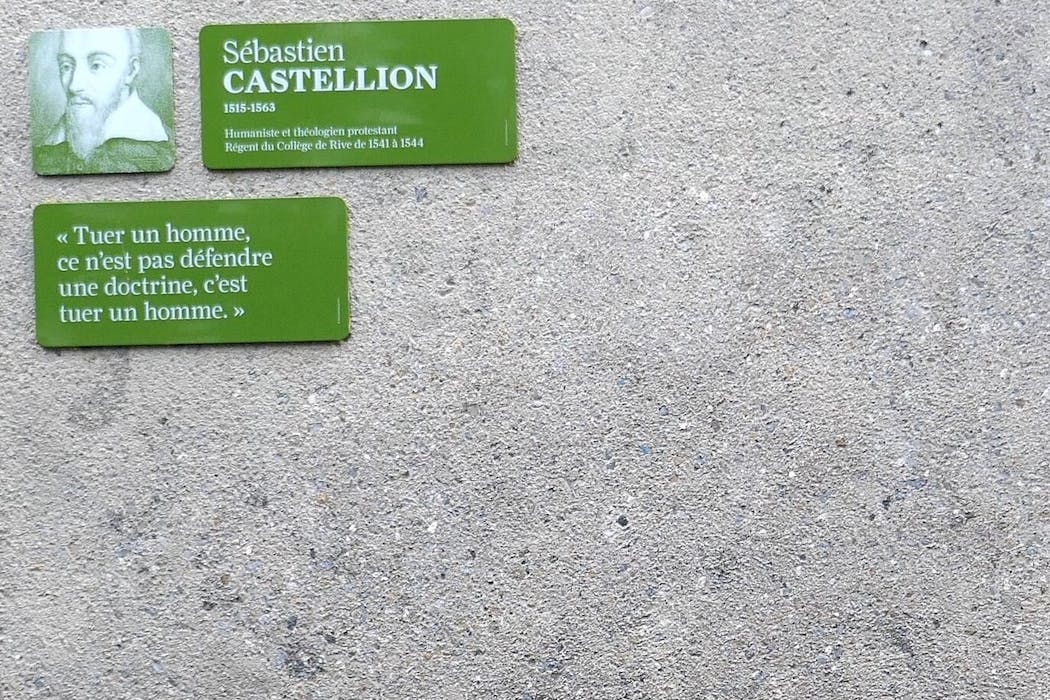
A monument to Sebastian Castellio in Geneva – using a French spelling of his name – reads, ‘Killing a man is not defending a doctrine; it is killing a man.’ MHM55/Wikimedia Commons, CC BY-SA

Ideological division was tearing the country apart. Factions denounced each other as unpatriotic and evil. There were attempted kidnappings and assassinations of political figures. Public monuments and art were desecrated all over the country.

This was France in the middle of the 16th century. The divisions were rooted in religion.

The Protestant minority denounced Catholics as “superstitious idolaters,” while the Catholics condemned Protestants as “seditious heretics.” In 1560, Protestant conspirators attempted to kidnap the young King Francis II, hoping to replace his zealous Catholic regents with ones more sympathetic to the Protestant cause.

Two years later, the country collapsed into civil war. The French Wars of Religion had begun – and would convulse the country for the next 36 years.

I am a historian of the Reformation who writes about the opponents of John Calvin, a leading Protestant theologian who influenced Reformed Christians, Presbyterians, Puritans and other denominations for centuries. One of the most significant of Calvin’s rivals was the humanist Sebastian Castellio, whom he had worked with in Geneva before a bitter falling out over theology.

Soon after the first war in France broke out, Castellio penned a treatise that was far ahead of its time. Rather than join in the bitter denunciations raging between Protestants and Catholics, Castellio condemned intolerance itself.

He identified the main problem as both sides’ efforts to “force consciences” – to compel people to believe things they did not believe. In my view, that advice from nearly five centuries ago has much to say to the world today.

Foreseeing the carnage

Castellio rose to prominence in 1554 when he condemned the execution of Michael Servetus, a medical doctor and theologian convicted of heresy. Servetus had rejected the standard Christian belief in the Trinity, which holds that the Father, Son and Holy Spirit are three persons in one God.

A dark-colored statue of a downcast, seated man, positioned in front of trees and bushes.
A monument to Michael Servetus, who was condemned for heresy and executed, in Geneva.
Iantomferry/Wikimedia Commons, CC BY-SA

Already condemned by the Catholic Inquisition in France, Servetus was passing through Geneva when Calvin urged his arrest and advocated for his execution. Servetus was burned alive at the stake.

Castellio condemned the execution in a remarkable book titled “Concerning Heretics: Whether They are to be Persecuted and How They are to be Treated.” In it, Castellio questioned the very notion of heresy: “After a careful investigation into the meaning of the term heretic, I can discover no more than this, that we regard those as heretics with whom we disagree.”

In the process, he laid the intellectual foundations for religious toleration that would come to dominate Western political philosophy during the Enlightenment.

But it took centuries for religious toleration to take hold.

In the meantime, Europe became embroiled in a series of religious wars. Most were civil wars between Protestants and Catholics, including the French Wars of Religion, a series of conflicts from 1562 to 1598. These included one of the most horrific events of the 16th century: the St. Bartholomew’s Day Massacre of 1572, when thousands of Protestants were slain in a nationwide bloodbath.

Castellio had seen the carnage coming: “So much blood will flow,” he had warned in a treatise 10 years earlier, “that its loss will be irremediable.”

A painting in faded colors shows a plaza in a medieval city, with scenes of people slaughtering each other and throwing bodies in a river.
‘The St. Bartholomew’s Day Massacre,’ by 16th-century artist François Dubois.
Cantonal Museum of Fine Arts/Wikimedia Commons

Remembering the Golden Rule

Castellio’s 1562 book, “Advice to a Desolate France,” was a rarity in the 16th century, for it sought compromise and the middle ground rather than the religious extremes.

With an extraordinarily modern sensibility, he decided to use the terms each side preferred for themselves, rather than the negative epithets used by their opponents.

“I shall call them what they call themselves,” he explained, “in order not to offend them.” Hence, he used “Catholics” rather than “Papists” and “evangelicals” rather than “Huguenots.”

Castellio pulled no punches. To the Catholics, referring to decades of Protestant persecution in France, he said: “Recall how you have treated the evangelicals. You have pursued and imprisoned them … and then you have roasted them alive at a slow fire to prolong their torture. And for what crime? Because they did not believe in the pope, the Mass, and purgatory. … Is that a good and just cause for burning men alive?”

To the Protestants, he complained, “You are forcing them against their consciences to attend your sermons, and what is worse, you are forcing some to take up arms against their own brothers.” He noted that they were using three “remedies” for healing the church, “namely bloodshed, the forcing of consciences, and the condemning and regarding as unfaithful of those who are not entirely in agreement with your doctrine.”

A sepia-colored illustration of a man with a long goatee, wearing a black jacket with buttons.
A portrait of Sebastian Castellio, made by 18th-century printmaker Heinrich Pfenninger.
Sepia Times/Universal Images Group via Getty Images

In short, Castellio accused both sides of ignoring the Golden Rule: “Do not do unto others what you would not want them to do unto you,” he wrote. “This is a rule so true, so just, so natural, and so written by the finger of God in the hearts of all,” he asserted, that none can deny it.

Both sides were trying to promote their vision of true religion, Castellio said, but both were going about it the wrong way. In particular, he warned against trying to justify evil behavior by appealing to its possible effects: “One should not do wrong in order that good may result from it.”

In another essay, he made the same point to argue against torture, writing that “Evil must not be done in order to pursue the good.” Castellio was the anti-Machiavelli; for him, the ends did not justify the means.

Force doesn’t work

Finally, “Advice to a Desolate France” argued that forcing people to your own way of thinking never works: “We manifestly see that those who are forced to accept the Christian religion, whether they are a people or individuals, never make good Christians.”

Americans, I believe, would do well to bear Castellio’s words in mind today. The country’s two dominant political parties have become increasingly polarized. Students are reluctant to speak out on controversial topics for fear of “saying the wrong thing.” Americans increasingly think in binary terms of good and evil, friends and enemies.

In the 16th century, Christians failed to heed Castellio’s advice and continued to kill each other over differences of belief for another hundred years. It would be wise to apply his ideas to today’s bitter divisions.

The Conversation

Michael Bruening does not work for, consult, own shares in or receive funding from any company or organization that would benefit from this article, and has disclosed no relevant affiliations beyond their academic appointment.

ref. Why one 16th-century theologian’s advice for a bitterly divided nation holds true today – https://theconversation.com/why-one-16th-century-theologians-advice-for-a-bitterly-divided-nation-holds-true-today-266457

Disability rights and services are shaped by the narratives embedded in policies like the Accessible Canada Act and MAID

Source: The Conversation – Canada – By Alfiya Battalova, Assistant Professor in Justice Studies, Royal Roads University

This year’s International Day of Persons with Disabilities centres on “fostering disability inclusive societies for advancing social progress.”

The theme recognizes persistent barriers faced by disabled people: disproportionate poverty, employment discrimination, inadequate social protection and the denial of dignity and autonomy in care systems.

Accessibility gains and losses

In 2022, the disability rate for people aged 15 years and over in Canada was 27 per cent. Nearly eight million people identified as having one or more disabilities, an increase of 1.7 million people over 2017, when the disability rate was 22 per cent.

The United Nations’ latest review of Canada’s implementation of the UN Convention on the Rights of Persons with Disabilities praised Canada’s progress in adopting the Accessible Canada Act and accessibility legislation at the provincial/territorial levels.

At the same time, the committee identified several areas of deep concern, such as the expansion of Medical Assistance in Dying (MAID) for disabled people whose death is not foreseeable. The report warns that inadequate supports risk normalizing death as a “solution” to poverty, lack of services and discrimination, and that the concept of choice can create a false dichotomy, enabling death without guaranteeing support.

All policies tell stories

All policies convey narratives and stories that carry values. They deal with questions of “why” as well as “how.”

Narratives distil and reflect a particular understanding of social and political relations. A story about disability as a phenomenon can be told from different perspectives. A medical model of disability views disability as a personal problem, a social model focuses on removing the barriers, and a human rights model introduces a language of rights and their protection. We often hear deficit-based stories rooted in the medical model about disability.

The Accessible Canada Act (ACA) and Medical Assistance in Dying (MAID) Track 2 in Canada tell contradictory stories about disability rights and state responsibility.

A young person using crutches shakes hands with a person holding open a door
The Accessible Canada Act is framed as a landmark piece of human rights legislation, emphasizing inclusion, accessibility and the removal of barriers.
(Pixabay)

The ACA is framed as a landmark piece of human rights legislation, emphasizing inclusion, accessibility and the removal of barriers to ensure full participation for people with disabilities, with a vision of a barrier-free Canada by 2040. Disability activists played a central role in its development, and the law is celebrated for its systemic, proactive approach to tackling exclusion and discrimination, offering rights to consultation, representation and accessible information.

In contrast, the MAID regime, especially after the expansion through Bill C-7, has been criticized for normalizing assisted death as a response to suffering caused by lack of access to medical, disability and social support, rather than addressing the underlying barriers and systemic failures that the ACA promises to remove.


Read more:
A dangerous path: Why expanding access to medical assistance in dying keeps us up at night


Research shows that the odds for having unmet needs for health-care services, medications, assistive aids or devices, or help with everyday activities increases with disability severity. A coalition of disability rights organizations and two personally affected individuals have filed a Charter challenge with the Ontario Superior Court of Justice opposing Track 2 of the MAID law, which extends eligibility to people whose death is not reasonably foreseeable.

Narrative accounts like the ones below, and research in bioethics, highlights that many people seek MAID not because they are terminally ill, but because they face poverty, inadequate housing and lack of care. This reveals a troubling contradiction: while the ACA proclaims a commitment to inclusion and support, MAID often functions as a default solution for those failed by the very systems the ACA aims to fix.


Read more:
Ontario Chief Coroner reports raise concerns that MAID policy and practice focus on access rather than protection


The stories told by these two policies — on one hand, the promise of full inclusion and on the other, the normalization of state-facilitated death for those marginalized by inadequate support — reveal a profound tension in Canada’s approach to disability rights and social responsibility.

Troubling cases

Cases are emerging where people access MAID due to intolerable suffering caused by systemic failures. There is a story of 66-year-old Normand Meunier who requested medical assistance in dying following a hospital stay last year that left him with a severe bedsore. He died a few weeks later.

The coroner’s report on Meunier’s case highlights the need for guaranteed and prompt access to therapeutic mattresses for patients with spinal cord injuries. Québec coroner Dave Kimpton also calls on the province to create an advisory committee aimed at preventing and treating bedsores with new tools and training. Kimpton observes:

“It is now undeniable to me, after this research, that the body of someone with a spinal cord injury speaks a different language, and that health-care professionals must learn to decode it if they are to anticipate and effectively manage medical complications.”

The stories of disabled people advocating for life-saving treatment is an example of continuing devaluation of disabled lives. Jeremy Bray of Manitoba pleaded for continued coverage of medication for his Type 2 spinal muscular atrophy. In British Columbia, Charleigh Pollock’s family fought for continued coverage of the medication for her neurological disorder. These stories individualize disability and promote a medical model approach.

Disability justice, as championed by the late activist Alice Wong and her Disability Visibility project, insists that storytelling is not “add-on” advocacy — it is evidence that exposes how policies like MAID, income-testing and institutionalization feel on the ground. Wong’s work demonstrates that disabled people’s stories are a powerful form of resistance, providing evidence that disabled people exist in societies that often erase them.

In her book Dispatches from Disabled Country, activist, educator and researcher Catherine Frazee provides an alternative vision of living with a disability. She uses a metaphor of Disabled Country to describe a “place of refuge for outlaws from the rules of fitting in a place where the value of human life is intrinsic, not contingent on a place that yields itself to our being and our capacity to flourish.”

Re-examining Canada’s disability policy story

From a policy-research perspective, understanding these narrative dynamics is essential for evaluating the effects of laws such as the ACA and for anticipating the implications of MAID expansion.

Scholars argue that policy narratives influence everything from budget priorities to program eligibility criteria and institutional cultures. They also shape how disabled people imagine their futures — an increasingly important dimension of well-being research.

As Canada reflects on the International Day of Persons with Disabilities, emerging evidence underscores the importance of aligning disability policy with the lived realities documented through research, monitoring processes and personal accounts.

Examining the narratives embedded in policy frameworks can help clarify how laws and institutions either support or hinder long-term flourishing for disabled people, and can offer insights into how stories told in policies ultimately align with societal values.

The Conversation

Alfiya Battalova does not work for, consult, own shares in or receive funding from any company or organisation that would benefit from this article, and has disclosed no relevant affiliations beyond their academic appointment.

ref. Disability rights and services are shaped by the narratives embedded in policies like the Accessible Canada Act and MAID – https://theconversation.com/disability-rights-and-services-are-shaped-by-the-narratives-embedded-in-policies-like-the-accessible-canada-act-and-maid-271094

Zero waste in schools? Why factoring in labour is essential

Source: The Conversation – Canada – By Mitchell McLarnon, Assistant Professor, Adult Education, Concordia University

Over the last decade, I’ve worked closely with Montréal educators and students to better understand how climate change education occurs in schools — and how climate change curricula and policies shape everyday experiences there.

In 2019, as part of a wider climate action plan, Montréal ambitiously committed to transitioning to zero waste by 2030.

With hopes of further reducing landfill waste, 22 schools across four school boards in Montréal were promised compost collection as part of the city’s zero-waste plan.

I interviewed three teachers from three different schools, one principal from another school and a school board employee to hear their analyses of how this program unfolded. The research suggests that to effectively expand composting and zero-waste climate action through schools, the labour of educators and other school workers must be factored into a “just transition.”

As a conceptual framework and practice, a “just transition” is an approach for connecting mechanisms of climate action with social fairness.

Importance of ‘just transition’

Montréal has goals to use a zero-waste model to reduce its emissions because food waste accounts for 15 to 20 per cent of emissions in the city. The aim is to ensure food waste is either being composted or that still-edible food finds its way to people experiencing food insecurity.

As communities grapple with climate change mitigation and adaption, efforts to realize global and local climate policy ambitions like zero waste are often premised upon the concept of a just transition.

Just transitions typically seek to reconcile environmental and social issues with a low-carbon and fossil-fuel-free future. Much of the research on just transitions encircles worker and labour rights from the energy, manufacturing, transport and related sectors as they move toward zero-emission outcomes.

My research points to teachers and other educational workers as key contributors for policy development toward a just transition. Because ecological and social crises are constructed and reproduced through power imbalances, a just transition away from fossil fuels and ecologically destructive practices also needs to be a departure from unequal and extractive ways of relating.

Zero waste by 2030?

During the pilot phase of the zero-waste plan’s implementation in schools, educational workers I partnered with stated they experienced a top-down policy implementation that created additional labour and misunderstandings while undercutting existing school composting programs and other established processes.

School board and city policymakers did not initially consider who would actually take on different compost-related tasks like sorting and transporting waste, and how this might intersect with labour relations and collective bargaining agreements.

As such, teachers and other school staff were compelled to take on additional and onerous tasks, such as organizing waste across the school, raising awareness and communicating with city workers.

For example, one participant said the only support and resources offered to their school by the city came in the form of two large composting bins and a short workshop on what goes into the city’s compost bins. They also felt there was an assumption that the compost would simply sort itself when someone needed to be present to ensure that organic matter ended up in the right place.

When the implementation of city-mediated school composting didn’t work well, some teachers intervened. In different schools, each having its own set of patterns, behaviours and peculiarities, varied responses emerged to the composting program.

One educator opted to work with the city on structuring the kind of compost support that would be pertinent for their school, while another motivated their students to participate during instructional time.

Teachers as key players

Increasingly, climate change education is included in provincial curricula. Along with this are mounting pressures on teachers to add climate change content into existing courses. In this way, teachers are being positioned as key players in addressing the global climate crisis.

Unfortunately, decades of austerity reforms to public education are now coupled with a growing list of unmet social, environmental and health needs (for example, pertaining to child and youth mental health, food insecurity and nutrition) that schools are tasked with addressing. Yet teachers are not structurally supported to take on this important new work.

It’s important that teachers and other educational workers be included in any large-scale policy implementation addressing students or educational spaces. For example, beyond the zero-waste project, the Canadian government announced a National School Food Policy in 2024 to address hunger and health inequities among Canadian youth, boost their mental and physical wellness and promote environmentally sustainable practices. Teacher expertise is crucial for equitable outcomes.


Read more:
School lunches, the French way: It’s not just about nutrition, but togetherness and _bon appetit_


Recognizing people’s labour

Montréal’s 2024 zero-waste report (Montréal objectif
zéro déchet
)
notes that the city now has 418 educational institutions with organic waste pickup. However, how much school waste is being diverted through the program and how it fits into the larger city’s zero-waste plans are unclear.

Policymakers mean well, but municipal policies need stronger social and structural supports to help stakeholders meet climate-action goals.

If our governments are indeed committed to connecting social justice and climate action, then they should also provide additional funding and labour to local schools to acknowledge the immense efforts required to develop and sustain these kinds of climate policies.

To sketch out where we might begin, I encourage governments to:

  1. Realize that climate policy like composting and notions of zero waste in schools are dependent on the labour and care of students and multiple education workers, including custodians, teachers, day-care workers, principals and others who fell outside of the scope of my research;

  2. Engage, recognize and compensate teachers and other school staff for their time, feedback and expertise on issues that impact them;

  3. Incorporate teacher, student and school-based reactions to proposed projects’ overall goals. Use their input to make the proposed budget realistic and relevant;

  4. Commit to transparency that allows local schools, teachers, education workers and organizers to receive meaningful and detailed updates on climate change mitigation data, benchmarks and budgetary allocations; and

  5. Rather than contracting or using “experts” from outside of a school and its community, work with people in the education sector to hire local climate-engaged teachers and school staff to manage the initiatives.

All climate change mitigation efforts from cities, schools and individuals ought to be applauded and encouraged for attempting to better improve and adapt to the current climate crisis.

But as a society, we shouldn’t pretend that ineffective responses are good enough — instead, climate-engaged educators and policymakers must resolve to learn from experience and insight to improve responsive policy and practice.

The Conversation

Mitchell McLarnon receives funding from the Fonds de Recherche du Québec, le Ministère de l’Éducation du Québec and the Social Sciences Research Council of Canada

ref. Zero waste in schools? Why factoring in labour is essential – https://theconversation.com/zero-waste-in-schools-why-factoring-in-labour-is-essential-263689

Sudan’s protesters built networks to fight a tyrant – today they save lives in a war

Source: The Conversation – Africa (2) – By Lovise Aalen, Research Professor, Political Science, Chr. Michelsen Institute

Sudan has a long history of civilian-led resistance, with young people playing a key role. For example, informal neighbourhood networks established in 2013 to survive repression under three decades of authoritarian rule have since transformed into vibrant support systems.

These groups helped mobilise mass protests in 2018. They have provided a lifeline for communities in the ongoing civil war, which started in 2023.

During the mass protests, youth-led networks organised political sit-ins and demonstrations against the Islamist regime of Omar al-Bashir. They were ultimately successful in overthrowing a 30-year dictatorship.

We are researchers in the fields of anthropology and political science, studying youth mobilisation in authoritarian states. In a recent paper, we studied the emergence and role of Sudan’s neighbourhood committees and informal networks. These became the backbone of protests.

We found that young people built grassroots networks through engagement in different forms of voluntarism and charity. They built resistance structures under the repressive environment of the Islamist regime. Later (around 2013 or so), these developed into neighbourhood committees organising resistance underground.

And since the outbreak of war in April 2023, Emergency Response Rooms, which are community-led networks, have been providing crucial humanitarian relief.

African youth mobilisation is often seen as an outcome of tension between an urban underclass and a repressive state. We argue that in Sudan, a collaboration between different classes, including the middle class, has been key in the fight against autocratic governance.

We found that the committees enabled protests. They played a vital role in organising emergency responses during times of crises.

Building the resistance

Under the repressive policies of the al-Bashir regime, political activities were not allowed in public spaces. Opposition was heavily suppressed.

Despite this, young people found innovative ways to create political spaces. Neighbourhood committees became sites of resistance, emerging as a critical infrastructure for grassroots mobilisation.

The committees represent a unique blend of political and practical action. They serve a dual functionality – mobilising for change while addressing immediate community needs. This underscores the potential of informal, decentralised networks to drive both political and social transformation.


Read more:
Sudan’s people toppled a dictator – despite the war they’re still working to bring about democratic change


They were initially formed during the 2013 anti-austerity protests as neighbourhoods’ underground cells. These committees were informal, hyper-local networks of politically engaged youth.

Over time, they evolved into organised structures. They facilitated protests, provided essential services and emergency responses during crises. In the 2018 uprising, they coordinated logistics. They also provided real-time updates through social media.

The committees also supported a sit-in at the military headquarters in April 2019. This became a focal point of the uprising. This sit-in presented a vibrant community space where youth experienced a sense of political togetherness. It featured art exhibitions, public debates and cultural performances, creating a shared vision of a better Sudan.

The civil war

The war between the army and a paramilitary group, the Rapid Support Forces, has put more than 30 million people – about two-thirds of the population – in need of humanitarian aid. This has created one of the world’s worst humanitarian crises. Conflict and blockades have meant international efforts to send aid hasn’t always been possible.

During the transitional period after al-Bashir’s exit and the 2023 war, the committees transformed into emergency response rooms. These provided critical services, such as healthcare, food and water. These rooms were run by the same youth networks that had led the protests. They drew on their pre-war experiences of grassroots mobilisation and humanitarian aid.

Amid a devastating civil war, they carry on the idea of political togetherness. Bonds of trust, necessity and solidarity established years ago have transcended ethnic or class divisions. They have created civilian resilience against state repression.

Lessons in resilience

The committees’ ability to adapt to new challenges underscores the importance of grassroots networks in both political and humanitarian contexts.

The concept of political togetherness, as seen in Sudan, reveals how temporary alliances across class, gender and ethnic divides can create a cohesive force for change.


Read more:
How a Sudanese university kept learning alive during war


This has implications for understanding youth movements globally, particularly where formal political spaces are inaccessible or untrustworthy.

The adaptability of Sudan’s neighbourhood committees illustrates the resilience of grassroots networks. By stepping into the void left by state failure, these committees provide essential services and also reinforce their legitimacy within their communities.

This suggests that such networks can serve as a foundation for future governance models, especially in post-conflict reconstruction efforts.


Read more:
Sudan’s civilians urgently need protection: the options for international peacekeeping


However, our study also reveals risks associated with informal and flexible structures.

The lack of formal governance mechanisms within these committees leaves them vulnerable to co-optation, fragmentation and the erosion of trust over time.

Without proper institutional support, the cohesion and effectiveness of these networks may wane. This is especially when the crises or transitions are prolonged.

What next?

In a post-war Sudan, both the Sudanese government and the international community should aim to preserve the emergency response rooms’ autonomy and grassroots nature. This should happen while providing resources and institutional support to enhance their capacity for community service and crisis response.

Activists within Sudan and similar contexts should continue to build on the model of political togetherness. This means fostering inclusive alliances that transcend traditional divides.

By prioritising both political mobilisation and community service, these grassroots networks can maintain the momentum for change while addressing immediate needs.


Read more:
Omar al-Bashir brutalised Sudan – how his 30-year legacy is playing out today


The humanitarian efforts that the Sudanese people invented are based on previous experience in civil engagement. The current call for a civilian government, which was also a demand by the protesters during the 2018 uprisings, is rooted in political togetherness. It is also linked to the long history of civilian governance practices at the grassroots level.

The Conversation

Lovise Aalen receives funding from the Research Council of Norway (grant no. ES620468) and the Sudan-Norway Academic Collaboration (SNAC). She is a member of the board of the Rafto Foundation for Human Rights.

Mai Azzam receives funding from the Bayreuth International Graduate School for African Studies (BIGSAS) and from the Gender and Diversity Office (GDO) of the Africa Multiple Cluster of Excellence, University of Bayreuth, Germany.

ref. Sudan’s protesters built networks to fight a tyrant – today they save lives in a war – https://theconversation.com/sudans-protesters-built-networks-to-fight-a-tyrant-today-they-save-lives-in-a-war-270176