Virtual National Science Foundation internships aren’t just a pandemic stopgap – they can open up opportunities for more STEM students

Source: The Conversation – USA (2) – By Lisa Bosman, Associate Professor of Technology Leadership and Innovation, Purdue University

Shifts to remote learning during the pandemic showed that there are some benefits for science students undertaking internships. SolStock/Getty Images

Many engineering and science undergraduates are approaching January application deadlines for prestigious summer internships and study abroad programs – or, in some cases, a spot in the National Science Foundation’s highly competitive Research Experience for Undergraduates, a specialized, paid summer research internship.

Roughly 6,000 American undergraduates take part in this internship each year. Landing this competitive research internship is a big deal. It can give young people interested in science, technology, engineering and math (STEM) careers hands-on experience, real confidence and a clear picture of what to expect when enrolling in science and engineering graduate programs.

And even if a student decides graduate school isn’t for them, an REU, as it is often known, still shows young people that there are many exciting paths to consider in STEM professions.

A shift for REU internships

These in-person, 10-week summer research experiences mostly take place at approximately 150 to 200 universities in the United States, but also at schools in the United Kingdom, Singapore, Germany and other countries.

REU internships don’t always produce immediate research breakthroughs, but their real purpose is to spark students’ interest in science and prepare them for graduate school and research careers.

During the pandemic, many universities shifted to running REU programs online. Students participating in online REUs conducted research from home and met mentors online, rather than in person.

Surprisingly, this change not only saved money, but it also improved student outcomes in terms of what they said they learned, entrepreneurial skills they developed and the confidence they gained in applying to engineering and technology graduate programs.

Purdue University, where I work as a researcher and innovation professor, piloted one virtual and facilitated two in-person REU programs between August 2021 and August 2024. We found that the virtual model delivered the same – if not better – learning outcomes at a fraction of the cost.

The 14 students who participated in the virtual REU over the course of one or two semesters reported stronger gains in research skills than those who joined the full-time, in-person summer program.

A group of young people stand in a circle in what looks like a science lab.
Virtual research opportunities can allow students to form deeper connections with their work and advisers.
xavierarnau/iStock/Getty Images

Virtual learning

There are several reasons why this virtual REU approach likely worked.

First, the virtual students met with faculty mentors more often than students who participated in an in-person REU program.

While summer, in-person undergraduate researchers usually met with their mentors around 10 times over the course of 10 weeks, virtual students met weekly with their mentors over 16 to 32 weeks – sometimes having three times as many meetings.

That regular contact helped students stay on track and dive deeper into their renewable energy-focused projects.

Second, because they weren’t spending time in labs, virtual students spent more time doing the kinds of research activities that prepare them for graduate school, like reviewing academic literature, writing up results and thinking through complex problems. These are the kinds of skills that matter most when students make the leap from college to research careers.

Third, the longer, part-time structure of the virtual program gave students more time to absorb new information, reflect on what they were learning and connect ideas. Instead of cramming everything into a 10-week sprint, they took a marathon approach, which helped them learn more.

And finally, virtual REUs made it possible for more students to join the program – especially for those who couldn’t leave home for the summer due to family or other obligations. In our virtual program, we were able to accommodate 14 students, instead of the 10 students who had previously participated in a lab setting.

A woman and a man look at a tablet together in a science lab.
Roughly 6,000 American undergraduates take part in the National Science Foundation’s Research Experience for Undergraduates internships each summer.
andresr/iStock/Getty Images

Cost-effective research

From a financial perspective, the contrast is striking between virtual and in-person research experiences for undergraduates.

The National Science Foundation recommends budgeting about US$1,550 per student per week for summer REUs. Of that, only $600 goes to the student as a stipend – the rest is spent on housing, meals and travel.

For the cost of offering an in-person summer program to two students, we could serve five in a two-semester virtual REU, or even 10 in a one-semester online version. The potential to reach more students, for longer periods, is undeniable.

In other words, virtual REUs are not just a pandemic-era stopgap. They’re a smarter, cheaper and more inclusive way to deliver on the promise of undergraduate research.

To be sure, there can be some downsides.

While virtual REUs still offer valuable research experience and guidance, students participating in remote programs do miss out on working directly in labs and building natural connections with mentors and peers. Because of this, students can feel less connected and less supported than they would in an in-person program.

Also, not everyone thrives with remote learning.

As the National Science Foundation and other agencies that do scientific research grapple with potentially steep budget cuts, I believe that they should take a hard look at what we’ve learned. Virtual REUs aren’t a compromise – they’re a proven, cost-effective strategy that stretches public dollars while giving students more of what they actually need: access, mentorship and real research experience.

I believe that if the U.S. wants to build the next generation of scientists, engineers and innovators, the government needs to try to meet students where they are – and sometimes, that means meeting them online.

The Conversation

Lisa Bosman receives funding from the National Science Foundation.

ref. Virtual National Science Foundation internships aren’t just a pandemic stopgap – they can open up opportunities for more STEM students – https://theconversation.com/virtual-national-science-foundation-internships-arent-just-a-pandemic-stopgap-they-can-open-up-opportunities-for-more-stem-students-257853


Colorado faces a funding crisis for child care − local communities hope to fill the gaps

Source: The Conversation – USA (2) – By Jenn Finders, Assistant Professor of Human Development and Family Studies, Colorado State University

A 2024 Colorado report found that 40,000 parents either quit a job, turned down a job or significantly changed a job due to child care problems. Michael M. Santiago/Getty Images

Colorado is the sixth-least affordable state for child care in the nation. Costs for center-based care average 14% of a two-parent household’s median income and 45% of a single parent’s median income. The federal affordability benchmark is just 7%.

Colorado also faces significant shortages in access to slots in licensed child care programs. In 2023, more than 40,000 Colorado parents reported quitting a job, turning down a job or significantly changing a job because of problems with child care.

Recently, several Colorado counties passed measures to subsidize child care through local taxes. Despite these advancements, Colorado’s child care system is facing a fiscal crisis that is likely to affect families and children for years to come.

Child care disruptions for families with infants and toddlers are estimated to cost the state more than US$2.7 billion in lost economic productivity and revenue. Ensuring access to affordable child care supports workforce participation and enhances the well-being of children and families.

I study early care and education policies and programs that promote children’s cognitive, behavioral and social-emotional learning. My research lab at Colorado State University has been investigating the consequences of a lack of access to high-quality, affordable child care on child and family outcomes.

Colorado’s Child Care Assistance Program

Since the late 1990s, the Colorado Child Care Assistance Program has subsidized the cost of child care for parents and caregivers with lower incomes who are working, searching for work or pursuing education. My research shows these subsidies are a critical lifeline that help lower-income families access child care.

Subsidies allow families to prioritize factors other than cost, such as location, in their search for child care. From 2023 to 2024, the Colorado subsidy program served more than 30,000 children in the state. That’s about 10% of those who qualified, which is typical for most states.

A federal March 2024 rule from the Administration for Children and Families caps family co-payments at no more than 7% of household income. It also requires reimbursement rates to reflect the full cost of care, whereas previously subsidy payments were based on what families could afford to pay.

Although intended to improve affordability for families and adequately compensate child care programs, the rule included no additional federal funding. In Colorado, meeting these new requirements is projected to cost the subsidy system approximately $43 million more per year.

These changes, combined with the expiration of COVID-19 relief funding that provided Colorado an additional $465 million to stabilize and expand child care assistance, has created growing financial instability for the subsidy system.

Approximately one-third of Colorado counties are experiencing an enrollment freeze for their child care subsidies. This means new applicants cannot access subsidized care until the freeze is lifted. There is no set timeline for when that will occur.

Without additional funding that would allow the freeze to be lifted, enrollment in Colorado’s Child Care Assistance Program is estimated to decline by 64%, falling from about 30,000 to just 10,000 enrollees. As children age out or families no longer qualify, spots that would normally open up for new enrollees will remain unfilled during the freeze.

Zooming in on Larimer County

I have been studying the impacts of the enrollment freeze in my hometown of Larimer County, Colorado. It’s a geographically diverse region that includes urban centers such as Fort Collins and Loveland, mountain destinations such as Estes Park, and rural agricultural communities. Like elsewhere in the state, child care costs pose a significant financial strain on local families.

A household in Larimer County with a median income of $64,919 and two children under the age of 5 spends approximately 37% of its income on child care. Due to budget constraints, Larimer County has had an enrollment freeze in the Colorado Child Care Assistance Program since February of 2024. The county has effectively paused the intake of new applicants for subsidies.

The outside of a building that says KinderCare Learning Center.
In Larimer County, Colorado, a household with two children under the age of 5 and an income of just under $65,000 spends about 37% of its income on child care.
UCG/GettyImages

Recently, we administered surveys to 88 families in Larimer County. Approximately half of those surveyed were currently receiving a subsidy and half had applied but were unable to access it because of the freeze. We compared families using advanced statistical modeling that controlled for any differences between groups, allowing us to isolate the effects of the subsidy freeze on family outcomes.

In unpublished research that is being prepared for peer review, we found families affected by the freeze used fewer paid child care hours, faced higher costs, expressed greater concerns about costs, and reported more difficulty paying for care. They also had less reliable and stable arrangements, were less satisfied with their care, experienced higher child care-related stress and displayed greater risk of depression.

But that’s not all. Families without a subsidy reported missing twice as many workdays. When extrapolated across the 425 families in Larimer County affected by the freeze, this translated to over $2.2 million in lost annual earnings.

Local initiatives driving solutions

Recognizing the gaps in affordable child care, counties across Colorado introduced ballot measures to fund local solutions through tax revenue.

These measures come after the state established a universal preschool program in 2022. The following year, the program provided up to 15 hours per week of tuition-free, high-quality preschool for more than 85,000 children.

Measures in Larimer, San Miguel, Garfield, Pitkin and southwest Eagle counties will directly fund child care through sales or property taxes. Measures in Gilpin, Hinsdale, Ouray and Eagle counties will generate funds through lodging taxes.

In Larimer, voters passed a measure that established an additional countywide sales tax of 0.25%, or 25 cents per 100 dollars. The measure is expected to generate $28 million annually for child care assistance and workforce compensation.

A CBS News report on Larimer County’s measure to increase taxes to support child care.

In San Miguel, voters passed a measure to opt-out of a state limit on the existing property tax levy of 75 cents for every 1,000 dollars of assessed property value. This will allow the county to retain nearly $1 million annually to support local child care affordability.

In Eagle County, voters passed a measure approving a lodging tax increase from 2% to 4% on hotel stays and short-term rentals that will raise approximately $4.5 million annually to lower child care costs.

Revenue from these initiatives will provide child care tuition to families, expand child care slots, support quality improvement and raise wages for child care workers.

These local investments cannot by themselves resolve Colorado’s statewide child care funding deficit, but they have the potential to transform access and quality within communities where they are implemented.

Colorado is not alone in these issues. Many other states are facing subsidy enrollment freezes and are exploring regional solutions to stabilize funding.

For example, ballot measures in Cincinnati, Ohio, and Seattle, Washington, also recently passed, providing reliable funding for child care assistance, preschool quality and workforce compensation.

With the uncertainty of the state and federal funding landscape, municipalities across the country may look to Colorado as a model for locally driven strategies that address community needs.

Read more of our stories about Colorado.

The Conversation

Jenn Finders has received funding from the National Science Foundation, Indiana Family and Social Services Administration, and North Central Regional Center for Rural Development.

ref. Colorado faces a funding crisis for child care − local communities hope to fill the gaps – https://theconversation.com/colorado-faces-a-funding-crisis-for-child-care-local-communities-hope-to-fill-the-gaps-270560

With less charitable giving flowing directly to charities, a tax policy scholar suggests some policy fixes

Source: The Conversation – USA (2) – By Ray Madoff, Professor of Law, Boston College

Sometimes, very rich people approach philanthropy with a degree of whimsy. tiero/iStock via Getty Images Plus

Law professor Ray Madoff is the co-founder and director of the Boston College Forum on Philanthropy and the Public Good. In an interview with Emily Schwartz Greco, The Conversation U.S. philanthropy and nonprofits editor, Madoff sums up some of the main points about charitable giving she makes in her 2025 book, “The Second Estate: How the Tax Code Made an American Aristocracy.” This interview has been edited for length and clarity.

How has charitable giving changed over the past 50 years?

Giving has pretty much remained flat as a percentage of personal disposable income. It’s been stable by that measure at about 2%. What’s changed is where that charitable giving is going.

In the early 1990s, about 6% of all giving was going to intermediaries, like foundations and donor-advised funds, and 94% was going directly to charities: hospitals, universities, churches, organizations curing diseases, all sorts of things.

Donor-advised funds, or DAFs, are charitable investment accounts that can serve many of the functions of a foundation – but with fewer rules and regulations.

Fast-forward to today, and there’s been a huge transformation with dramatic growth in giving to intermediaries. Today, around 40% of U.S. giving from individual donors goes instead to charitable intermediaries, and 60% of those donations go straight to charities.

The cover of a book is shown with the title 'The Second Estate: How the Tax Code Made an American Aristocracy.'

University of Chicago Press

When money donated to charity through intermediaries primarily went to foundations, those assets were subject to a 5% payout rule. It was imperfect, but still, at least 5% of those funds, for the most part, had to go to charity.

Now, due to the rise of donor-advised funds, none of this money going to intermediaries is subject to payout rules.

That’s because there are no payout rules that apply to donor-advised funds, and foundations can meet their payout minimum by giving to a donor-advised fund.

Charitable giving, in other words, used to be more connected to what I’d call “charitable getting.” Now, the money is often landing in what’s essentially a halfway house, with no obligation to get out.

What is the current state of play with respect to the tax rules governing charitable giving?

There’s a tale of two systems for charitable giving.

Most Americans have no ability to get any tax benefits for their charitable giving, while the wealthiest Americans can get benefits that are worth up to 74% of the value of their donations.

The reason most Americans get no tax benefits is that they can only offset their income tax if they itemize their tax returns, instead of taking the standard deduction.

Prior to the tax reform package that President Donald Trump signed into law in 2017, about 70% took the standard deduction and 30% didn’t. Once those reforms took effect, the share of taxpayers who were itemizing fell below 10%.

The more than 90% of taxpayers who claimed the standard deduction in 2022, for example, couldn’t get any tax breaks tied to their charitable giving.

What do you expect to see change due to provisions in the big tax and spending package that Trump signed into law on July 4, 2025?

The government is adding a new deduction for non-itemizers. Starting in 2026, they will be able to deduct up to US$1,000 of their taxable income when they file their taxes, if they give at least that amount to charity. That means some charitable tax benefits will be available for people who take the standard deduction.

It’s very hard to tell what kind of impact that is going to have.

If charities publicize this, it might encourage some people to give who might not otherwise give to donate. But it could also cause a lot of confusion and make other people think that there is a $1,000 cap on tax benefits for all charitable donations. I think it’s going to be a difficult messaging problem.

As a matter of policy, I also think it’s not very well drafted. I do think we should be giving charitable tax benefits to non-itemizers, but a better format would be to give everybody a tax credit so they have the same dollar-for-dollar benefit, regardless of their income bracket.

And rather than imposing a ceiling, we should impose a floor, as a certain amount of giving is going to happen even with no incentives.

It’s going to be interesting to see what happens.

Ray Madoff sums up some of the main points made in her book ‘The Second Estate: How the Tax Code Made an American Aristocracy.’

Are there other policy changes that you support?

I have two proposals.

First, I believe that private foundations and donor-advised funds should have to distribute their funds that are reserved for charity within some set time period.

Second, I think that just as other Americans are subject to limitations on their tax benefits, the wealthiest should be subject to limitations on their tax benefits too.

If it’s important for you and me to help pay down the national debt, then why isn’t it important for Warren Buffett to do so?

Is there a risk that giving might decline due to these changes?

If they had to spend it quickly, maybe there would be less money set aside in these charitable intermediaries.

But if someone has no intention to disburse those funds, then I think it wouldn’t matter that their money is no longer getting halfway to actually being received by charities.

Do you believe that the philanthropy of rich people is helpful?

Philanthropy is often used as shorthand for something that is great for society.

But philanthropy includes a lot of not-great things.

Sometimes people make mistakes. Just because someone is good at making money, it doesn’t mean they’re good at solving other people’s problems.

For example, actor Brad Pitt, maybe with good intentions, decided he was going to fix housing problems after Hurricane Katrina in New Orleans’ 9th Ward. He got architects to build houses that are now falling apart. It’s a massive problem.

Sometimes their gifts aren’t so well-intentioned.

Rich philanthropists may donate to groups calling for lower taxes. Or they try to curry favor with the White house by helping pay for the construction of Trump’s new ballroom, which is going to be built with charitable money.

Charity expert Bill Schambra has brought to light what he calls “philanthropy’s original sin: Early U.S. foundations supported eugenics – the pseudoscience movement that sought to encourage “fit” people to have kids and to stop people deemed “unfit” from doing so, sometimes through forced sterilization.

Today, there’s another common problem: the philanthropy of whimsy.

One example is what happened with the nonprofit pre-K-8 school for low-income children in East Palo Alto, California, that Facebook co-founder Mark Zuckerberg and his wife, Priscilla Chan, funded. He was saying “Oh hey, I think I’m going to solve the problems of poverty in East Palo Alto.” And then, “Oops, I changed my mind.”

The school is slated to close at the end of the 2025-2026 year.

That’s why, generally speaking, I don’t think we should assume that what’s done with philanthropy is better than what’s done with tax dollars.

A nonprofit East Palo Alto school that had been funded by Mark Zuckerberg and Priscilla Chan lost that funding. It will close.

What about MacKenzie Scott, Jeff Bezos’ ex-wife? She’s given about $26 billion to charity since 2019.

I am a big supporter of how MacKenzie Scott does her philanthropic giving. She seems to be trying to do the right thing. She’s trying to build civil society, which I think is good. She’s giving to existing organizations, with no strings attached.

A lot of it is about power. If you give money to institutions, as Scott is doing, then the institutions have power. If you keep the money yourself, and you drip it out, then you have power.

The Conversation

Ray Madoff was an adviser to and supporter of the Initiative to Accelerate Charitable Giving, a coalition of philanthropists, foundations and academics.

ref. With less charitable giving flowing directly to charities, a tax policy scholar suggests some policy fixes – https://theconversation.com/with-less-charitable-giving-flowing-directly-to-charities-a-tax-policy-scholar-suggests-some-policy-fixes-271677

‘If you don’t like dark roast, this isn’t the coffee for you’: How exclusionary ads can win over the right customers

Source: The Conversation – USA (2) – By Jaclyn L. Tanenbaum, Associate Teaching Professor, Florida International University

Imagine you are searching for a new mattress online and find something surprising. The retailer displays an ad featuring a “Mattress Comfort Scale” running from 1 (soft) to 10 (firm), followed by the message that if your firmness preference is at either end, this mattress is not for you. Wait … what? A retailer telling someone not to buy its product? No way!

Why would a company tell potential buyers that the product might not suit them? Our team of professors – Karen Anne Wallach, Jaclyn L. Tanenbaum and Sean Blair – examines this question in a recently published article in the Journal of Consumer Research.

Marketers spend billions trying to persuade consumers that a product is right for them. But our research shows that sometimes the most effective way to market something is to say that it isn’t for them. In other words, effective marketing can mean discouraging the wrong customers rather than convincing everyone to buy.

We call this “dissuasive framing.” Instead of saying a product is perfect for everyone, a company is up front about who it might not be for. Surprisingly, that simple shift can make a big difference.

We ran experiments comparing ads with dissuasive versus persuasive framing. For example, one coffee ad said, “If you like dark roast, this is the coffee for you.” Another said, “If you don’t like dark roast, this isn’t the coffee for you.” Most marketers assume the first version would work better. But for people who prefer dark roast, the second message outperformed it.

Across different products, from salsa to mattresses, and in a real Facebook campaign for a toothbrush brand, we consistently saw the same results. The dissuasive ad drove more engagement and clicks, making the brand feel more specialized and its product more appealing for the right customers.

Why? You might think it’s about fear of missing out, or reverse psychology, but we ruled out those explanations. Instead, we found that what really drives the effect is the perception of a stronger match between personal preference and product attributes.

When a message signals that a product may not suit everyone, consumers see it as more focused on a specific set of preferences. This sense of focus, which we call “target specificity,” makes the product feel like a better match for customers whose preferences align with it. For others, it feels less relevant, which helps companies reach their goal of attracting those who are most likely to buy.

Our results show a clear trend: When companies set boundaries in their messages, products appear more focused. This messaging strategy makes the intended customer feel like the product is a better match for them. People assume that if a product isn’t meant for everyone, it must be more specialized. That sense of specificity makes those in the target audience feel the product was designed just for them.

Why it matters

These findings challenge one of marketing’s most enduring assumptions: that effective marketing comes from directly persuading customers that a product matches their needs. In today’s crowded marketplace, where nearly every brand claims to be “for you,” dissuasive messaging offers an alternative. By clearly signaling that a product may not be right for customers with different preferences, brands can communicate focus and specialization. Consumers see this as a sign that the company understands its own product and who it will best serve.

Our work also helps explain how people make what psychologists call compensatory inferences. This means consumers often believe that when a product tries to do too many things, it ends up doing each of them less well. Think of an all-in-one tool that can cut, twist, open and file – but few would say it performs any of those tasks better than the dedicated tool.

From a practical standpoint, dissuasive framing helps marketers communicate more effectively by defining the boundaries of their product’s appeal. In doing so, brands can build trust, strengthen connections with the right customers, and avoid spending their marketing dollars on those unlikely to purchase.

What still isn’t known

Our research focused on products with clear attributes, such as taste or comfort, and on consumers who already knew their preferences. Future work could test how this approach works when people are less certain about what they like or when choices reflect self-expression rather than product fit.

Even with these open questions, one conclusion stands out. Defining whom a product is not for can help the right customers see that it truly fits them. By focusing on preference matching rather than universal appeal, brands can make their messages more targeted, more efficient and ultimately more effective. In other words, telling the wrong customers “This isn’t for you” can actually help the right ones feel that it is.

The Conversation

The authors do not work for, consult, own shares in or receive funding from any company or organization that would benefit from this article, and have disclosed no relevant affiliations beyond their academic appointment.

ref. ‘If you don’t like dark roast, this isn’t the coffee for you’: How exclusionary ads can win over the right customers – https://theconversation.com/if-you-dont-like-dark-roast-this-isnt-the-coffee-for-you-how-exclusionary-ads-can-win-over-the-right-customers-269080

Philly’s walkable streets and public parks offer older residents chances to stay active – but public transit and accessibility pose challenges

Source: The Conversation – USA (3) – By Laura Baehr, Assistant Professor of Physical Therapy and Rehabilitation Sciences, Drexel University

Daily movement and regular strength training support healthy aging. kali9.iStock via Getty Images Plus

One in five Philadelphians are age 60 or older, and the city’s senior population has been growing for at least the past decade.

I’m a Philly-based physical therapist and researcher who studies how to boost physical activity for seniors and people with disabilities. Patients, participants in the studies I conduct, and older community members alike often ask me: “What should I do to stay healthy?”

My answer is simple: Movement is one of the most powerful tools we have to support our bodies and minds, and to stay independent as we grow older.

The World Health Organization recommends that all adults, no matter their age, should aim for at least 150 minutes of cardio activities per week, and strength training twice a week. Older adults should also practice balance training through activities like tai chi, yoga or dance to prevent falls.

But most older adults don’t meet all these metrics. In fact, in Philadelphia, 30% of seniors report having difficulty with mobility activities like walking or climbing stairs.

While staying active is key to aging independently, the environments where we live also influence these outcomes. Think about “blue zones,” places where some of the healthiest and longest-living people in the world reside. They usually live longer because of a combination of social connections, movement opportunities and diets.

Philly is definitely not a blue zone, but there are pros to moving through your golden years here … and some cons.

Urban infrastructure

Philadelphia’s regular street grid, close neighborhoods and the fact that much of Center City is accessible by foot help explain why Philly was named the most walkable city in the U.S. by USA Today for the past three years.

If you’re taking in the city on foot, you’re very likely to stumble upon a public park like one of the five historic squares designed by William Penn in the 1680s, the massive Fairmount Park – which is over 10 times the size of Central Park in New York – or the bustling Clark Park in West Philadelphia, among others.

In fact, 95% of all Philadelphia residents – and 94% of those 65 and older – live within a 10-minute walk of a public park. However, those parks tend to be smaller and lower-quality for people in low-income neighborhoods.

Philly’s public transit system, however, tends to receive less praise.

In the beginning of 2025, over 700,000 people rode some form of Southeastern Pennsylvania Public Transportation Authority, or SEPTA, public transit daily. But this year was marked by dramatic service cuts – though they were quickly reversedfunding uncertainty and fare increases.

Public transportation is directly linked to the overall health of a city and its residents. Healthy public transportation can stimulate local economies, improve air quality and increase access to work, school and health care for everyone, whether they own a car or not.

And the physical activity often required to get to and from a bus, train or trolley stop can provide some extra movement for riders.

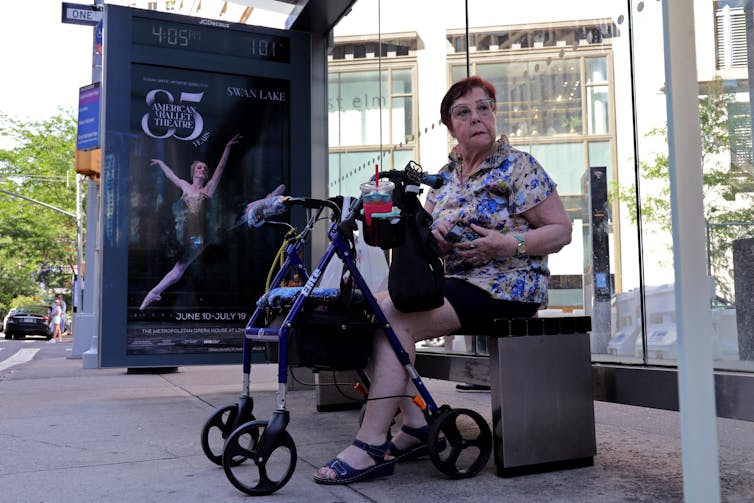
Woman with walker sits on bench under a bus shelter
Adults 65 and older can ride SEPTA free of charge with a SEPTA Key Senior Fare Card.
Leonardo Munoz/AFP via Getty Images

Since older adults make up a significant portion of SEPTA riders, service cuts mean that some seniors cannot get where they need to go, are less physically active and may become lonelier.

Of course, Philly’s historic cobblestone streets, narrow alleyways and uneven sidewalks aren’t wheelchair- or cane-friendly, and are a challenge for people with mobility limitations. However, in 2023, Philadelphia settled a class action lawsuit over inaccessible sidewalks and curb ramps that resulted in a federal mandate that requires the city to install or fix 10,000 curb ramps by 2038. Philly has installed or fixed about 25% of that total so far.

Philadelphia also has many historic buildings, and this designation allows for a loophole to Americans with Disabilities Act compliance laws. These buildings are often inaccessible to people who use wheelchairs or other mobility devices.

Services for seniors

In 2011, Philly launched the Mayor’s Commission on Aging to support policies and projects that aim to improve the quality of life of older adults.

At the time, the U.S. was experiencing a massive shift in demographics. The number of adults age 65 and older grew by nearly 40% from 2010 to 2020. According to research from the Pew Charitable Trusts, Philly experienced a similar, albeit less dramatic, upward trend. The city’s senior population grew by 22% from 2013 to 2023.

The Mayor’s Commission on Aging advocates for older residents and often partners with agencies like the Philadelphia Corporation on Aging that focus on seniors. PCA offers several programs to support senior independence and wellness, such as the Senior Housing Assistance Repair Program and the Caregiver Support Program, which provides help for the family and friends who support seniors.

Older couple stretch in a park
Public parks can be great places for residents to get in their steps or exercise outdoors.
FG Trade/E+ Collection via Getty Images

PCA also oversees 28 senior community centers throughout the city. Each of the centers offers a variety of free or low-cost classes, including nationally recognized physical activity programs that improve strength, balance, quality of life and other important health metrics for older adults.

The Salvation Army Kroc Center of Philadelphia in North Philadelphia is another great resource for older Philadelphians. The state-of-the-art health club offers fitness, swimming and gardening opportunities. An annual membership is US$451 for adults over age 62, and the club accepts some insurance wellness benefits.

In 2026, I will partner with the Kroc Center to launch Bingocize, an evidence-based physical activity program for older adults, as part of a research study funded by the Arthritis Foundation. We hope to find out if the new program boosts physical function and physical activity, and improves arthritis symptoms and quality of life. We’re also looking at what factors will make the program sustainable at the Kroc Center long after the study is over.

I believe Philly has more work to do when it comes to providing seniors access to physical activities that promote healthy aging. But the seeds planted over a decade ago to protect and support the city’s rapidly growing aging population demonstrate a commitment to positive change, and an understanding that where we live affects individual and collective health.

Read more of our stories about Philadelphia, or sign up for our Philadelphia newsletter on Substack.

The Conversation

Laura Baehr receives funding from the Department of Defense, the Arthritis Foundation, and the Clinician-Scientists Transdisciplinary Aging Research Coordinating Center (a National Institutes of Health National Institute on Aging funded center).

Laura Baehr has worked with the Philadelphia Mayor’s Commission on Aging and with Philadelphia Corporation on Aging.

ref. Philly’s walkable streets and public parks offer older residents chances to stay active – but public transit and accessibility pose challenges – https://theconversation.com/phillys-walkable-streets-and-public-parks-offer-older-residents-chances-to-stay-active-but-public-transit-and-accessibility-pose-challenges-270038

Apprendre les maths autrement : les pistes de la recherche

Source: The Conversation – in French – By Florence Peteers, MCF Didactique des mathématiques, CY Cergy Paris Université

Si les mathématiques sont unanimement considérées comme décisives dans notre société, elles suscitent nombre de craintes chez les élèves. Les rendre plus accessibles suppose donc de changer leur enseignement. Mais comment ? Le succès de situations « adidactiques » offre quelques pistes à la recherche. Explications.


Parus en décembre 2025, les résultats de la grande consultation nationale sur la place des mathématiques lancée par le CNRS montrent que beaucoup de Français se sentent peu à l’aise avec les mathématiques même s’ils reconnaissent l’importance de cette discipline pour la société. À la suite de cette consultation et des Assises des mathématiques de 2022, le CRNS a défini des orientations prioritaires, dont l’amélioration de l’inclusion. Mais comment rendre les mathématiques plus accessibles à tous ?

Les participants à la consultation de 2025 suggèrent notamment de « généraliser des méthodes d’enseignement variées, concrètes, ludiques et encourageantes, qui valorisent notamment le droit à l’erreur, tout au long de la scolarité ».

Dans ce sens, depuis plusieurs années, nous expérimentons dans des classes ordinaires (avec l’hétérogénéité des profils d’élèves qui les caractérisent !) des séquences de mathématiques inclusives. En quoi se distinguent-elles des modes d’enseignement classiques ? Et que nous apprennent leurs résultats ?

Mettre l’élève en situation de recherche

Ces séquences de maths inclusives s’appuient sur des situations à dimension adidactique, c’est-à-dire des situations qui intègrent des rétroactions de sorte que l’élève n’ait pas besoin que l’enseignant lui apporte des connaissances. C’est en interagissant avec la situation et en s’adaptant aux contraintes de celle-ci que l’élève construit de nouvelles connaissances. Il ne le fait pas en essayant de deviner les intentions didactiques de l’enseignant (c’est-à-dire en essayant de deviner ce que l’enseignant veut lui enseigner), d’où l’appellation « adidactique ».

Comme le dit le spécialiste de l’enseignement des maths Guy Brousseau, à l’origine de ce concept dans les années 1970-1980 :

« L’élève sait bien que le problème a été choisi pour lui faire acquérir une connaissance nouvelle, mais il doit savoir aussi que cette connaissance est entièrement justifiée par la logique interne de la situation et qu’il peut la construire sans faire appel à des raisons didactiques. »

Ces situations ont un potentiel identifié depuis longtemps et mis à l’épreuve dans les classes à grande échelle depuis 40 ans (surtout du premier degré, notamment dans l’école associée au Centre d’observation et de recherches sur l’enseignement). Ces travaux ont également donné lieu à des ressources pour les enseignants, par exemple la collection Ermel.

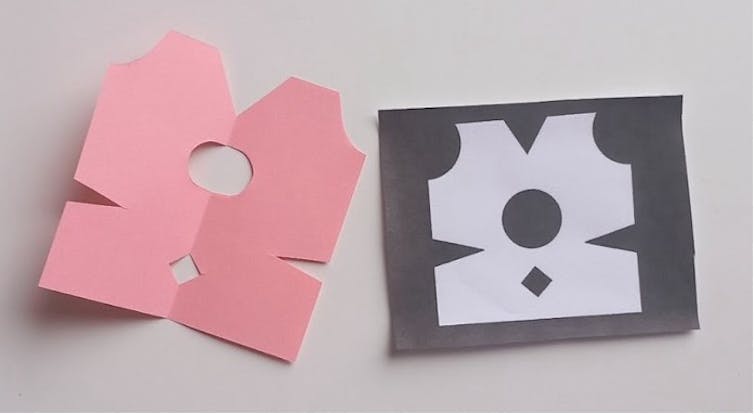
Dans le cadre de nos recherches, nous avons, par exemple, conçu et testé dans plusieurs écoles (REP+, milieu rural, milieu urbain…) une séquence en CM1-CM2 qui s’appuie sur la situation des napperons de Marie-Lise Peltier. Les élèves y ont à disposition une feuille de papier carrée, ils doivent reproduire un modèle de napperon en pliant et en découpant leur feuille. C’est la notion de symétrie axiale qui permet de découper un napperon conforme au modèle, et l’élève peut s’autovalider en comparant sa production au modèle donné.

Découper un napperon et découvrir la notion de symétrie axiale.
Fourni par l’auteur

Mettre en œuvre une situation à dimension adidactique peut s’avérer complexe, car le rôle de l’enseignant diffère de ce dont il a l’habitude ; ici, il n’apporte pas directement les connaissances même s’il peut aider les élèves à résoudre la tâche.

De plus, les élèves peuvent élaborer des stratégies très diverses, ce qui peut les déstabiliser. Cependant, cette diversité constitue également une richesse du point de vue de l’inclusion, car chaque élève peut s’investir à la hauteur de ses moyens. Par ailleurs, ces situations permettent de stimuler l’engagement des élèves et les mettent dans une véritable activité de recherche, ce qui constitue le cœur des mathématiques.

Donner du sens aux notions mathématiques

À l’heure actuelle, ce type de situations est peu mis en œuvre, en particulier auprès des élèves en difficulté, car les enseignants ont plutôt tendance à penser qu’il faut découper les problèmes complexes en tâches les plus simples possibles pour s’assurer de la réussite des élèves. Cependant, la réalisation juxtaposée de tâches simples et isolées ne permet pas, souvent, de donner du sens aux notions mathématiques en jeu ni de motiver les élèves.

Dans l’exemple autour des napperons, nous avons constaté qu’en s’appuyant sur les rétroactions, mais aussi parfois sur leurs pairs et sur les conseils de l’enseignant, la majorité des élèves de CM1-CM2 que nous avons observés réussit à produire un napperon conforme au modèle, alors même que, parmi ces élèves, plusieurs avaient été signalés comme étant « en difficulté ».

Même les élèves n’étant pas arrivés à produire un napperon conforme dans le temps imparti se sont fortement engagés, comme en témoigne le nombre important de réalisations. Nous pouvons faire l’hypothèse que cette situation pourra constituer une situation de référence pour eux quand ils aborderont de nouveau la notion de symétrie axiale.


À lire aussi :
Six façons de faire aimer les maths à votre enfant


Les aspects positifs et les défis que nous avons pu identifier dans notre recherche corroborent les résultats obtenus par d’autres chercheurs et chercheuses qui ont étudié la mise en œuvre de situations à dimension adidactique pour travailler diverses notions mathématiques, à différents niveaux scolaires, auprès de publics variés, notamment auprès d’élèves présentant une déficience intellectuelle ou un trouble dys, en France et au Québec.

Ainsi, même si ce concept n’est pas nouveau, l’appui sur les situations à dimension adidactique nous semble toujours une piste intéressante et actuelle pour penser l’enseignement des mathématiques pour tous. Cependant, il est nécessaire de donner aux enseignants les moyens de les mettre en œuvre de manière satisfaisante, par exemple en allégeant le nombre d’élèves par classe et en les accompagnant en formation initiale et continue.

The Conversation

Florence Peteers est porteuse de la Chaire Junior SHS RIEMa financée par la région Île-de-France et a reçu des financements du PIA3 100% IDT (inclusion, un défi, un territoire) porté par l’Université de Picardie Jules Verne.

Elann Lesnes a reçu reçu des financements du PIA3 100% IDT (inclusion, un défi, un territoire) porté par l’Université de Picardie Jules Verne.

ref. Apprendre les maths autrement : les pistes de la recherche – https://theconversation.com/apprendre-les-maths-autrement-les-pistes-de-la-recherche-272586

The battle over a global energy transition is on between petro-states and electro-states – here’s what to watch for in 2026

Source: The Conversation – USA (2) – By Jennifer Morgan, Senior Fellow, Center for International Environment and Resource Policy and Climate Policy Lab, Tufts University

Solar power has been expanding quickly, but natural gas is also booming. Gerard Julien/AFP via Getty Images

Two years ago, countries around the world set a goal of “transitioning away from fossil fuels in energy systems in a just, orderly and equitable manner.” The plan included tripling renewable energy capacity and doubling energy efficiency gains by 2030 – important steps for slowing climate change since the energy sector makes up about 75% of the global carbon dioxide emissions that are heating up the planet.

The world is making progress: More than 90% of new power capacity added in 2024 came from renewable energy sources, and 2025 saw similar growth.

However, fossil fuel production is also still expanding. And the United States, the world’s leading producer of both oil and natural gas, is now aggressively pressuring countries to keep buying and burning fossil fuels.

The energy transition was not meant to be a main topic when world leaders and negotiators met at the 2025 United Nations climate summit, COP30, in November in Belém, Brazil. But it took center stage from the start to the very end, bringing attention to the real-world geopolitical energy debate underway and the stakes at hand.

Brazilian President Luiz Inácio Lula da Silva began the conference by calling for the creation of a formal road map, essentially a strategic process in which countries could participate to “overcome dependence on fossil fuels.” It would take the global decision to transition away from fossil fuels from words to action.

President Lula Da Silva gestures with his hands as he speaks in front of a picture of the Amazon.
Brazilian President Luiz Inácio Lula da Silva speaks at COP30, where he promoted the idea of a road map to help the world speed up its transition from fossil fuels to clean energy.
AP Photo/Andre Penner)

More than 80 countries said they supported the idea, ranging from vulnerable small island nations like Vanuatu that are losing land and lives from sea level rise and more intense storms, to countries like Kenya that see business opportunities in clean energy, to Australia, a large fossil-fuel-producing country.

Opposition, led by the Arab Group’s oil- and gas-producing countries, kept any mention of a “road map” energy transition plan out of the final agreement from the climate conference, but supporters are pushing ahead.

I was in Belém for COP30, and I follow developments closely as former special climate envoy and head of delegation for Germany and senior fellow at the Fletcher School at Tufts University. The fight over whether there should even be a road map shows how much countries that depend on fossil fuels are working to slow down the transition, and how others are positioning themselves to benefit from the growth of renewables. And it is a key area to watch in 2026.

The battle between electro-states and petro-states

Brazilian diplomat and COP30 President André Aranha Corrêa do Lago has committed to lead an effort in 2026 to create two road maps: one on halting and reversing deforestation and another on transitioning away from fossil fuels in energy systems in a just, orderly and equitable manner.

What those road maps will look like is still unclear. They are likely to be centered on a process for countries to discuss and debate how to reverse deforestation and phase out fossil fuels.

Over the coming months, Corrêa plans to convene high-level meetings among global leaders, including fossil fuel producers and consumers, international organizations, industries, workers, scholars and advocacy groups.

For the road map to both be accepted and be useful, the process will need to address the global market issues of supply and demand, as well as equity. For example, in some fossil fuel-producing countries, oil, gas or coal revenues are the main source of income. What can the road ahead look like for those countries that will need to diversify their economies?

A man speaks into a microphone. Behind him, a person holds a sign reading: 'Shell: Own up, clean up, pay up'
Nigeria’s Bodo community is suing Renaissance Africa Energy Company Limited, an oil consortium that acquired Shell’s Nigerian subsidiary, over two major oil spills in the Niger Delta in 2008. Shell admitted liability and settled with the community in 2014, committing to cleanup efforts. However, the Bodo community has been critical of the quality and transparency of Shell’s cleanup, and is seeking further damages and remediation. Here, activists protest the company’s actions.
Leon Neal/Getty Images

Nigeria is an interesting case study for weighing that question.

Oil exports consistently provide the bulk of Nigeria’s revenue, accounting for around 80% to over 90% of total government revenue and foreign exchange earnings. At the same time, roughly 39% of Nigeria’s population has no access to electricity, which is the highest proportion of people without electricity of any nation. And Nigeria possesses abundant renewable energy resources across the country, which are largely untapped: solar, hydro, geothermal and wind, providing new opportunities.

What a road map might look like

In Belém, representatives talked about creating a road map that would be science-based and aligned with the Paris climate agreement, and would include various pathways to achieve a just transition for fossil-fuel-dependent regions.

Some inspiration for helping fossil-fuel-producing countries transition to cleaner energy could come from Brazil and Norway.

In Brazil, Lula asked his ministries to prepare guidelines for developing a road map for gradually reducing Brazil’s dependency on fossil fuels and find a way to financially support the changes.

His decree specifically mentions creating an energy transition fund, which could be supported by government revenues from oil and gas exploration. While Brazil supports moving away from fossil fuels, it is also still a large oil producer and recently approved new exploratory drilling near the mouth of the Amazon River.

Norway, a major oil and gas producer, is establishing a formal transition commission to study and plan its economy’s shift away from fossil fuels, particularly focusing on how the workforce and the natural resources of Norway can be used more effectively to create new and different jobs.

Both countries are just getting started, but their work could help point the way for other countries and inform a global road map process.

The European Union has implemented a series of policies and laws aimed at reducing fossil fuel demand. It has a target for 42.5% of its energy to come from renewable sources by 2030. And its EU Emissions Trading System, which steadily reduces the emissions that companies can emit, will soon be expanded to cover housing and transportation. The Emissions Trading System already includes power generation, energy-intensive industry and civil aviation.

Fossil fuel and renewable energy growth ahead

In the U.S., the Trump administration has made clear through its policymaking and diplomacy that it is pursuing the opposite approach: to keep fossil fuels as the main energy source for decades to come.

The International Energy Agency still expects to see renewable energy grow faster than any other major energy source in all scenarios going forward, as renewable energy’s lower costs make it an attractive option in many countries. Globally, the agency expects investment in renewable energy in 2025 to be twice that of fossil fuels.

At the same time, however, fossil fuel investments are also rising with fast-growing energy demand.

The IEA’s World Energy Outlook described a surge in new funding for liquefied natural gas, or LNG, projects in 2025. It now expects a 50% increase in global LNG supply by 2030, about half of that from the U.S. However, the World Energy Outlook notes that “questions still linger about where all the new LNG will go” once it’s produced.

What to watch for

The Belém road map dialogue and how it balances countries’ needs will reflect on the world’s ability to handle climate change.

Corrêa plans to report on its progress at the next annual U.N. climate conference, COP31, in late 2026. The conference will be hosted by Turkey, but Australia, which supported the call for a road map, will be leading the negotiations.

With more time to discuss and prepare, COP31 may just bring a transition away from fossil fuels back into the global negotiations.

The Conversation

Jennifer Morgan does not work for, consult, own shares in or receive funding from any company or organization that would benefit from this article, and has disclosed no relevant affiliations beyond their academic appointment.

ref. The battle over a global energy transition is on between petro-states and electro-states – here’s what to watch for in 2026 – https://theconversation.com/the-battle-over-a-global-energy-transition-is-on-between-petro-states-and-electro-states-heres-what-to-watch-for-in-2026-272205

Pourquoi l’obésité est, avant tout, une maladie du cerveau

Source: The Conversation – France in French (3) – By Rosalia Rodriguez Rodriguez, Catedrática. Departamento de Ciencias Biomédicas, Universitat Internacional de Catalunya

L’obésité n’est pas dû à un manque de volonté. Il ne s’agit pas non plus d’un problème individuel. C’est une maladie complexe profondément enracinée dans un cerveau adapté pour survivre à la pénurie.


L’obésité débute dans le cerveau et nous savons aujourd’hui que son développement, tout comme son traitement, ne sont pas les mêmes chez les hommes et les femmes. Cette pandémie silencieuse, qui progresse parallèlement au diabète de type 2 – l’une de ses principales complications – touche déjà plus d’un milliard de personnes.

Alors que notre environnement devient de plus en plus obésogène, le cerveau continue de fonctionner selon des règles ancestrales qui rendent difficile le maintien de la perte de poids, même avec des médicaments aussi révolutionnaires que le sémaglutide (Ozempic). Ce changement de perspective transforme les traitements actuels et ouvre la voie à de nouvelles thérapies ciblant directement le cerveau.

Un cerveau ancestral dans un environnement moderne

L’obésité et le surpoids sont habituellement décrits comme un excès de graisse ou un problème métabolique. Mais leur origine profonde réside dans le système nerveux central, en particulier dans l’hypothalamus, la région qui agit comme un « thermostat énergétique ». Pendant 95 % de notre histoire évolutive, nous avons vécu dans la pénurie : marcher, chasser et cueillir étaient indispensables, et le cerveau a développé des mécanismes très efficaces pour défendre la masse graisseuse, car la perdre pouvait signifier ne pas survivre.

Ce « cerveau ancestral » fonctionne aujourd’hui dans un environnement totalement opposé : aliments hypercaloriques disponibles 24 heures sur 24, sédentarité, stress chronique, troubles du sommeil et régimes alimentaires ultratransformés.


À lire aussi :
Aliments ultratransformés : quels effets sur notre santé et comment réduire notre exposition ?


Il en résulte un déséquilibre entre notre biologie et notre mode de vie, qui est amplifié chez les personnes qui présentent des prédispositions génétiques. À cela s’ajoute un élément que la recherche commence à explorer clairement : le système qui régule le poids ne fonctionne pas de la même manière chez les hommes et chez les femmes.

L’hypothalamus : là où commence l’obésité

L’hypothalamus intègre des signaux hormonaux (comme la leptine ou l’insuline), métaboliques et sensoriels afin d’équilibrer l’énergie ingérée et celle qui est dépensée. Quand nous perdons du poids, le cerveau interprète la situation comme une menace et il active de puissants mécanismes de défense : il augmente l’appétit, réduit la dépense énergétique et renforce une « mémoire métabolique ou obésogène » qui pousse à reprendre le poids perdu.

C’est pourquoi, même si l’alimentation et l’exercice physique sont essentiels à la santé et doivent toujours constituer la première prise en charge, ils ne suffisent pas chez de nombreuses personnes pour inverser l’obésité lorsque les circuits cérébraux sont déjà altérés. Ce point n’invalide pas les bienfaits d’un mode de vie sain : il reconnaît simplement que, dans certains cas, le cerveau a besoin d’un soutien pharmacologique pour sortir de la boucle obésogène.

Quand l’hypothalamus s’enflamme (à cause du stress, d’un régime hypercalorique, d’un manque de sommeil, de troubles hormonaux ou d’une prédisposition génétique), l’activité des neurones qui régulent la faim et la satiété est perturbée. Certaines personnes parviennent à retrouver spontanément leur poids initial après avoir trop mangé ; d’autres, en revanche, présentent un « frein hypothalamique » moins efficace et prennent plus facilement du poids. La différence réside dans le cerveau.

Perspective de genre : deux cerveaux, deux réponses

Les neurones hypothalamiques AgRP (qui stimulent la faim) et POMC (qui favorisent la satiété) régulent avec précision le comportement alimentaire. Cependant, l’hypothalamus n’est pas seulement un ensemble de neurones : il comprend également la microglie et les cellules immunitaires du cerveau, dont le rôle s’est avéré déterminant.
Notre groupe a décrit trois phases d’activation microgliale dans les premiers stades de la suralimentation :

  1. Une activation précoce, rapide et réversible.

  2. Une phase inflammatoire prolongée, qui perturbe les circuits de satiété.

  3. Une phase finale de dérégulation, au cours de laquelle les mécanismes censés limiter la prise de poids ne fonctionnent plus.

Ces phases ne se comportent pas de la même manière chez les hommes et chez les femmes. Chez les modèles murins, les femelles présentent une réponse neuroimmune plus stable et protectrice, ce qui pourrait expliquer pourquoi elles développent l’obésité plus tardivement. Ce schéma rappelle ce que l’on observe chez les femmes préménopausées.


À lire aussi :
Ménopause et prise de poids : des mesures précoces pour accompagner les changements hormonaux


Avant la ménopause, les femmes ont un risque moindre de maladies métaboliques et cardiovasculaires que les hommes, grâce à l’effet protecteur des œstrogènes. Mais cette protection diminue pendant la périménopause et la ménopause, une période encore très peu étudiée et critique pour le risque cardiométabolique.


À lire aussi :
À la ménopause, savez-vous que le risque cardiovasculaire augmente ? L’activité physique peut aider


De plus, dans les modèles animaux et les cultures cellulaires, nous avons détecté des altérations très précoces (au niveau de la microglie, de signaux lipidiques comme les endocannabinoïdes et de la sensibilité neuronale à l’insuline) avant même l’apparition de changements visibles dans les tissus périphériques. Cela suggère que le déclencheur initial de l’obésité est cérébral. Il est essentiel d’intégrer cette perspective de genre pour progresser vers des traitements plus précis et plus efficaces.

Nouvelles thérapies contre l’obésité : incrétines et nanomédecine ciblant le cerveau

Le traitement de l’obésité a radicalement changé depuis 2021 avec les agonistes du récepteur GLP-1. Le semaglutide et d’autres médicaments de la famille des incrétines, initialement développés pour le diabète de type 2, ont démontré une capacité remarquable à réduire le poids grâce à des actions à la fois périphériques et centrales. Cependant, ils présentent des limites connues : effets gastro-intestinaux, perte de masse maigre, reprise de poids après l’arrêt du traitement ou réponses variables selon le profil biologique du patient.

Des études récentes montrent également des différences selon le sexe : les femmes préménopausées ont tendance à mieux répondre à ces traitements que les hommes.

Un défi doit donc être relevé : nous avons besoin de traitements qui agissent directement sur le cerveau, avec une plus grande précision et moins d’effets systémiques. C’est là que la nanomédecine qui cible le cerveau ouvre de nouvelles perspectives. Au sein de notre groupe, nous développons des nanoplateformes (micelles polymères, nanoparticules protéiques ou formulations intranasales) capables de transporter des médicaments de manière sélective vers le cerveau. Ces technologies permettent d’encapsuler des molécules qui, si elles étaient administrées sans protection, seraient inefficaces ou toxiques, afin de les diriger vers les cellules qui contrôlent l’appétit et l’homéostasie énergétique.

Ces approches pourraient compléter ou renforcer les incrétines, réduire leurs effets secondaires, améliorer l’observance aux traitements et augmenter le nombre de patients qui y répondent. Elles constituent un moyen de traiter l’obésité depuis son origine cérébrale, grâce à des interventions plus personnalisées et durables.

Un regard neuf sur un problème ancien

L’obésité n’est pas dû à un manque de volonté, malgré la stigmatisation dont il fait l’objet au niveau social. Il ne s’agit pas non plus d’un problème individuel. L’obésité est une maladie complexe, profondément enracinée dans un cerveau adapté à la survie en période de pénurie. Pour la traiter, il faut adopter une double approche : promouvoir des modes de vie sains et, quand cela se révèle nécessaire, recourir à des thérapies qui agissent sur les circuits cérébraux régulant le poids.

Comprendre comment fonctionne – et comment échoue – l’hypothalamus sera essentiel pour freiner cette pandémie silencieuse du XXIe siècle. Et c’est là, dans le cerveau, que se livre la bataille scientifique la plus prometteuse.

The Conversation

Rosalia Rodriguez Rodriguez reçoit des financements du ministère des sciences, de l’innovation et des universités, de l’AGAUR-Generalitat de Catalogne (PRODUCTE, INNOVADORS) et du Centre de recherche biomédicale en réseau-obésité (CIBER-Obn).

ref. Pourquoi l’obésité est, avant tout, une maladie du cerveau – https://theconversation.com/pourquoi-lobesite-est-avant-tout-une-maladie-du-cerveau-272720

Et si quelques minutes de méditation de pleine conscience pouvaient aider à réduire le stress ?

Source: The Conversation – France in French (3) – By Alexis Barbry, Maître de conférences en STAPS, Université de Lorraine

Une revue systématique de la littérature scientifique met en évidence les effets bénéfiques de temps courts de pleine conscience sur un marqueur physiologique du stress. Cela plaide pour une intégration de ce type de méditation dans la vie quotidienne.


Nous sommes toutes et tous confrontés au stress dans notre vie de tous les jours. Il est tout à fait normal de le ressentir. Il peut se définir comme un état de tension interne causé par une situation complexe, qui excède nos ressources cognitives, sociales ou affectives. L’important n’est pas tant le stress, mais plutôt la manière dont nous y réagissons.

La recherche souligne la nécessité de s’équiper d’outils issus de la psychologie pour nous apprendre à mieux gérer les situations perçues comme menaçantes dans l’objectif de réguler le stress.

La pleine conscience : un outil de régulation du stress ?

Parmi les techniques psychologiques, la pleine conscience a récemment connu un essor important. Bien que cette dernière soit considérée comme un concept « à la mode », elle dispose d’une longue histoire, qui aurait débuté il y a plus de 2 500 ans à travers la pensée bouddhiste. Cette pleine conscience, également connue sous le nom de mindfulness, est une technique de méditation attentionnelle simple qui consiste à porter délibérément son attention sur ce qui se passe ici et maintenant, sans jugement. Autrement dit, c’est être attentif au moment présent, sans se laisser contaminer par ses pensées !

La pleine conscience a pris un essor scientifique sous l’impulsion du professeur Jon Kabat-Zinn dans les années 1980. Le premier programme de pleine conscience ayant vu le jour est le Mindfulness-Based Stress Reduction (MBSR), qui signifie « programme de réduction du stress par la pleine conscience ». Depuis le début des années 1980, d’autres programmes de pleine conscience ont émergé. Ces derniers se sont adaptés aux caractéristiques de différents publics (personnes souffrant d’épisodes dépressifs, sportifs, etc.…).

Aujourd’hui, les bienfaits de ces programmes sur la réduction du stress sont bien établis. Cependant, un des freins à la pratique de la pleine conscience réside dans la durée et dans l’engagement requis. Par exemple, le MBSR nécessite un engagement sur huit semaines, comportant une pratique quotidienne individuelle de 45 minutes et une pratique hebdomadaire en groupe de 2,5 heures.

Bien qu’efficace pour réguler les intensités de stress, la durée de ces programmes ne semble pas s’adapter à nos rythmes de vie actuels. Compte tenu de leur dimension chronophage, certains chercheurs ont proposé des temps plus courts de pleine conscience.

Quelle efficacité des temps brefs de pleine conscience contre le stress

Un programme bref de pleine conscience se réalise sur quatre semaines et engendre une pratique inférieure à 1,6 heure (100 minutes, soit une heure et quarante minutes) par semaine. La durée de la séance ne doit pas excéder 30 minutes. Bref, nous sommes bien loin des temps proposés par les programmes plus classiques comme le MBSR… Si ces temps courts s’accordent davantage à nos contraintes temporelles, leurs bénéfices sur le stress restent mal connus.

Notre interrogation a donc été la suivante : est-ce que les temps brefs de pleine conscience pourraient réduire notre stress ?

Pour répondre à cette question, nous avons effectué une revue systématique de la littérature évaluant les effets des temps brefs de pleine conscience sur un marqueur physiologique du stress : la variabilité de la fréquence cardiaque (VFC). La VFC reflète l’activité du système nerveux autonome jouant un rôle crucial dans le maintien de notre équilibre.

Ce système nerveux autonome se divise en deux branches : le système nerveux sympathique (qui prédomine lors des situations stressantes) et le système nerveux parasympathique (qui prédomine lors des situations de repos). Une faible VFC est représentative d’une moindre capacité à gérer les situations stressantes, alors qu’une VFC plus élevée reflète une meilleure capacité à réguler les situations stressantes.

Les résultats de notre étude mettent en évidence que les temps courts de pleine conscience augmentent la VFC. Autrement dit, ces moments de pleine conscience parviennent à réduire notre niveau de stress.

À la vue de ces résultats, nous recommandons donc d’intégrer de brefs temps de pleine conscience dans notre quotidien pour minimiser les effets du stress et éviter que ce dernier consomme toutes nos ressources.

Un exemple pour débuter : la prise de conscience du souffle

Il existe de nombreuses manières d’introduire la pleine conscience dans notre quotidien. On distingue généralement deux types de pratiques : formelles et informelles.

Les pratiques formelles sont les plus connues. Elles consistent à s’arrêter et à se poser pour pratiquer un exercice de pleine conscience.

Par exemple, la prise de conscience du souffle est considérée comme l’exercice de référence pour s’initier à cette pratique. Il consiste à s’asseoir sur un coussin ou sur une chaise de manière digne et droite. Une fois la position correctement maintenue, il suffit de diriger intentionnellement son attention sur le souffle. L’objectif n’est pas ici de contrôler sa respiration, mais plutôt de l’observer sans chercher à la modifier.

Cet exercice peut paraître facile, mais généralement l’esprit a tendance à s’éloigner de l’exercice. C’est ce que l’on appelle le vagabondage de l’esprit. Cette errance est tout à fait normale. Elle fait partie de la nature même de l’exercice. Lorsque vous vous rendrez compte que votre esprit s’égare, la pratique de la pleine conscience vous invitera à ramener votre attention avec douceur et bienveillance vers le souffle et les sensations qui lui sont associées.Lorsque vous débuterez cet exercice, il est fort probable que vous rencontriez des difficultés à maintenir votre attention sur la respiration. Encore une fois, cela est ordinaire. À force de répéter cet exercice, vous éduquerez votre esprit à (r) amener son attention vers la respiration.

La prise de conscience du souffle n’est qu’un exemple, il existe de nombreuses autres formes de pratiques formelles (par exemple, le scan corporel qui consiste à observer les différentes sensations présentes dans notre corps).

Vous trouverez sur Internet de nombreuses vidéos et/ou audios faites par des professionnel·les qui vous permettront de pratiquer.

Un exemple d’exercice momentané (5 minutes) de prise de conscience du souffle, vous est proposé en cliquant ici ou sur le QR code ci-joint.

À noter le fait que certaines personnes ne sont pas « réceptives » à la pleine conscience. Lorsqu’ils débutent cette pratique, certains sujets peuvent également ressentir une légère angoisse quant aux faits de se poser et de centrer son attention sur sa respiration. Et dans le cadre de graves problèmes de santé mentale (dépression, anxiété…), la pleine conscience ne remplace pas une prise en charge par un professionnel de santé.

Pratiquer seul·e (ou pas), de manière formelle (ou non)

Pour débuter la pratique, on peut se faire accompagner – par une ou un médecin, psychologue, psychothérapeute, chercheur ou chercheuse, préparateur ou préparatrice mentale, etc. – mais qui doit avoir été formé à la pleine conscience dans le cadre d’un diplôme universitaire (DU), d’une formation courte qualifiante par exemple. Mais ce n’est pas une obligation. Étant donné que cette pratique s’avère très simple à mettre en œuvre, tout le monde peut l’intégrer de manière brève dans son quotidien. Des livres écrits par des professionnel·les peuvent également aider.

La pleine conscience peut aussi s’intégrer de manière informelle dans notre quotidien. En effet, il est possible de marcher, de courir ou encore de manger en pleine conscience… Dans ce type d’exercices, l’objectif est d’être pleinement attentif à ce que l’on est en train de faire. Par exemple, vous pouvez essayer une fois par semaine de manger sans écrans, en étant pleinement attentif aux sensations gustatives, olfactives ou visuelles de ce que vous mangez.

Que la pratique soit réalisée de manière formelle ou informelle, nous vous conseillons de débuter par des temps de trois à cinq minutes avant d’augmenter progressivement si vous le souhaitez !

Essayez, et vous verrez. Bonne pratique !

The Conversation

Cette revue systématique, et donc cet article de vulgarisation, s’intègre dans la thèse CIFRE 0331 co-financée par l’Institut des Rencontres de la FOrme (IRFO) et l’Association Nationale de la Recherche et de la Technologie (ANRT).

Annie Carton est membre du Racing Club Arras Athlétisme en tant qu’entraîneur, et vice-présidente de l’Office des Sports d’Arras en charge de la santé et du bien-être.

Jérémy Coquart a été le directeur d’Alexis Barbry, le doctorant financé.

ref. Et si quelques minutes de méditation de pleine conscience pouvaient aider à réduire le stress ? – https://theconversation.com/et-si-quelques-minutes-de-meditation-de-pleine-conscience-pouvaient-aider-a-reduire-le-stress-272375

Une poudre de feuilles d’ananas pourrait contribuer à réduire la criminalité et la pollution

Source: The Conversation – in French – By Bienvenu Gael Fouda Mbanga, Research fellow, Nelson Mandela University

En Afrique du Sud, les fabricants de jus d’ananas et d’autres produits à base d’ananas jettent chaque année des milliers de tonnes de feuilles d’ananas, dont la plupart finissent dans des décharges.

Les feuilles sont considérées comme des déchets agricoles et sont généralement considérées comme inutiles. Cependant, elles peuvent être transformées en quelque chose qui résout des problèmes concrets. Les feuilles d’ananas peuvent être transformées en une ressource puissante pour la protection de l’environnement et la sécurité.

Il s’agit de les transformer en un type particulier de nanoparticules. (Les nanoparticules sont des matériaux très petits, dont la taille ne dépasse pas 0,0001 millimètre.)

Je fais partie d’une équipe de chimistes spécialisés dans les nanomatériaux qui se concentrent sur la fabrication de nouveaux matériaux à partir de déchets tels que les feuilles d’ananas. Nous avons cherché à savoir si nous pouvions transformer les feuilles d’ananas en une poudre de nanoparticules capable d’adsorber (retenir une substance à la surface d’un matériau, formant un film mince) le cuivre, ou Cu²⁺, présent dans les eaux usées. Nous avons découvert que c’était possible. Une fois que les nanoparticules à base de feuilles d’ananas absorbent le cuivre, elles peuvent être broyées en une poudre que les enquêteurs médico-légaux utilisent pour relever des empreintes digitales invisibles.

Nos recherches ont comblé un vide. C’est la première fois qu’un adsorbant dérivé de déchets agricoles transformé en nanoparticules est utilisé pour absorber les métaux lourds présents dans l’eau, puis réutilisé ensuite en science médico-légale, à faible coût.

Un avantage supplémentaire est que les feuilles d’ananas ne coûtent rien. Si certaines sont transformées en couches jetables, et que d’autres sont laissées dans les champs d’ananas pour servir de compost, la plupart sont jetées dans des décharges ou même brûlées sur place. Transformer ces déchets en produit utile va dans le sens de l’idée d’une économie circulaire : continuer à utiliser les produits en les réutilisant et en les régénérant autant que possible.

Les produits destinés à dépolluer l’environnement et ceux utilisés en médecine légale ont traditionnellement fait l’objet de recherches distinctes. Il est important de développer un produit qui puisse remplir ces deux fonctions à moindre coût. Il est essentiel de trouver des moyens efficaces et durables d’éliminer les métaux lourds toxiques des sources d’eau afin de protéger la santé humaine et les écosystèmes.. Il est aussi crucial de trouver des moyens améliorés de révéler les empreintes digitales invisibles pour lutter contre la criminalité.

Pourquoi la société a besoin du pouvoir des feuilles d’ananas

Les eaux usées contiennent des ions cuivre toxiques qui s’y déversent depuis des industries telles que l’exploitation minière, la galvanoplastie et la fabrication.

La pollution par le cuivre est un problème bien connu en Afrique du Sud. Les boues contiennent souvent des quantités très élevées de cuivre, et les eaux usées industrielles peuvent également contenir du cuivre à des concentrations supérieures au seuil de sécurité. Une trop grande quantité de cuivre peut nuire à la santé humaine, provoquant des problèmes d’estomac et, à long terme, des lésions du foie et des reins. Elle est également dangereuse pour la vie aquatique : les poissons et d’autres espèces peuvent être empoisonnés par le cuivre.

La plupart des adsorbants sont coûteux lorsqu’ils sont utilisés pour nettoyer les eaux usées contaminées par des métaux lourds tels que le cuivre. Un autre coût caché est que cette eau contaminée ne peut pas être réutilisée dans l’industrie ou l’agriculture tant que le cuivre n’a pas été éliminé.

La société est également touchée. La pollution des sources d’eau sape la confiance du public en matière de sécurité de l’eau, peut déclencher des crises sanitaires au sein des communautés et épuiser les maigres fonds publics destinés au nettoyage. Un adsorbant bon marché est donc très utile.

La police et les autres enquêteurs médico-légaux ont également besoin du pouvoir des ananas. Ils utilisent actuellement une poudre d’empreintes digitales qui contient des produits chimiques présentant des risques potentiels pour la santé des personnes qui la manipulent. Un matériau dérivé des feuilles d’ananas offre une alternative plus sûre, plus durable et plus écologique. La nouveauté ici réside dans la fabrication d’une poudre bon marché à partir de déchets de biomasse.

Comment nous avons fait cette découverte

Nous avons d’abord recouvert de zinc des nanoparticules de carbone fabriquées à partir de feuilles d’ananas. Nous avons ensuite vérifié dans quelle mesure ces nanoparticules pouvaient éliminer le cuivre de l’eau.

Nos recherches ont montré que les nanoparticules à base de feuilles d’ananas recouvertes d’oxyde métallique (dans ce cas, de l’oxyde de zinc) forment un matériau qui absorbe le cuivre en grande quantité.

Si les nanoparticules issues des feuilles d’ananas sont si efficaces, c’est grâce à la synergie entre leurs différents composants. Le revêtement en oxyde de zinc (ZnO) et la structure carbonée spongieuse forment une équipe gagnante. Le revêtement aide les particules à adhérer plus facilement à d’autres matériaux, tandis que le carbone poreux (rempli de trous) leur offre une grande surface de réaction.


Read more:
Noix de cola – du nanofertilisant à la protection des métaux contre la corrosion : notre recherche trouve de nouvelles utilisations pour cette plante précieuse


Ensemble, ils créent davantage de points où des réactions chimiques peuvent se produire et aident les matériaux à adhérer plus fortement, ce qui améliore leurs performances globales.

Nous avons ensuite cherché à savoir s’il existait une autre utilisation pour l’adsorbant usagé (les nanoparticules saturées de cuivre qu’elles avaient adsorbé). Nous avons pulvérisé ces nanoparticules et les avons réparties sur une surface poreuse. Nous avons constaté que la poudre présentait des motifs de crêtes clairs et pouvait être utilisée pour révéler les empreintes digitales latentes (empreintes digitales invisibles laissées par le sébum et la sueur naturels des personnes).

Ce qu’il faut faire ensuite

Notre étude suggère qu’il existe un fort potentiel pour développer cette technologie dans les installations de traitement des eaux et les laboratoires médico-légaux.

Pour commencer, les instituts de recherche et les universités devraient tester les performances de ces nanoparticules dans les stations d’épuration municipales ou industrielles. Des tests plus longs permettraient également de déterminer si les nanoparticules de feuilles d’ananas sont rentables à long terme.

Les nanoparticules doivent également être testées afin de vérifier si elles restent stables pendant longtemps dans l’eau et ne se décomposent pas.


Read more:
Réconcilier engrais minéraux et agroécologie, une piste pour nourrir les populations d’Afrique de l’Ouest


Les laboratoires médico-légaux et les forces de l’ordre devraient explorer les moyens d’intégrer l’adsorbant usagé dans leur travail de recherche d’empreintes digitales invisibles. L’utilisation de l’adsorbant usagé à la place des poudres d’empreintes digitales ordinaires pourrait réduire les coûts.

Les organismes gouvernementaux et les décideurs politiques devraient soutenir cette nouvelle découverte par le biais de financements et d’incitations en faveur de matériaux durables et multifonctionnels.

Les nanoparticules qui valorisent les déchets agricoles et répondent à la fois aux besoins environnementaux et sociétaux devraient être développées en priorité.

À un moment donné, des réglementations seront également nécessaires.

Les partenaires industriels, en particulier ceux des secteurs de la transformation agricole, de l’exploitation minière et de la fabrication, peuvent jouer un rôle en fournissant des déchets agricoles et en trouvant des moyens de commercialiser les produits.

En favorisant la collaboration entre le monde universitaire, l’industrie, le gouvernement et les forces de l’ordre, cette technologie peut contribuer à lutter contre la pollution par les métaux lourds. Elle pourrait également réduire les déchets et stimuler la création de nouveaux produits à base de feuilles d’ananas.

The Conversation

Bienvenu Gael Fouda Mbanga does not work for, consult, own shares in or receive funding from any company or organisation that would benefit from this article, and has disclosed no relevant affiliations beyond their academic appointment.

ref. Une poudre de feuilles d’ananas pourrait contribuer à réduire la criminalité et la pollution – https://theconversation.com/une-poudre-de-feuilles-dananas-pourrait-contribuer-a-reduire-la-criminalite-et-la-pollution-271578