Microbes in deep-sea volcanoes can help scientists learn about early life on Earth, or even life beyond our planet

Source: The Conversation – USA – By James F. Holden, Professor of Microbiology, UMass Amherst
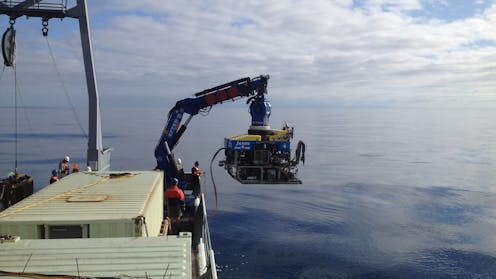
A submersible, which travels to the seafloor to collect rock and microbe samples, is lifted by the arm of a research vessel. James F. Holden

People have long wondered what life was first like on Earth, and if there is life in our solar system beyond our planet. Scientists have reason to believe that some of the moons in our solar system – like Jupiter’s Europa and Saturn’s Enceladus – may contain deep, salty liquid oceans under an icy shell. Seafloor volcanoes could heat these moons’ oceans and provide the basic chemicals needed for life.

Similar deep-sea volcanoes found on Earth support microbial life that lives inside solid rock without sunlight and oxygen. Some of these microbes, called thermophiles, live at temperatures hot enough to boil water on the surface. They grow from the chemicals coming out of active volcanoes.

Because these microorganisms existed before there was photosynthesis or oxygen on Earth, scientists think these deep-sea volcanoes and microbes could resemble the earliest habitats and life on Earth, and beyond.

To determine if life could exist beyond Earth in these ocean worlds, NASA sent the Cassini spacecraft to orbit Saturn in 1997. The agency has also sent three spacecraft to orbit Jupiter: Galileo in 1989, Juno in 2011 and most recently Europa Clipper in 2024. These spacecraft flew and will fly close to Enceladus and Europa to measure their habitability for life using a suite of instruments.
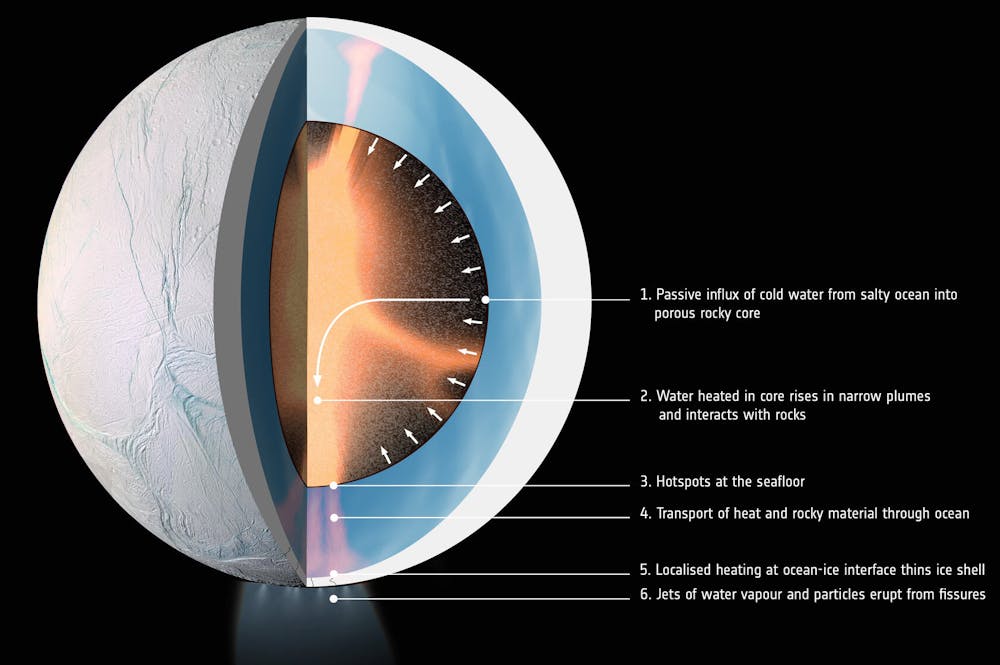
A diagram showing the inside of a gray moon, which has a hot, rocky core.
A diagram of the interior of Saturn’s moon Enceladus, which may have hot plumes beneath its ocean.
Surface: NASA/JPL-Caltech/Space Science Institute; interior: LPG-CNRS/U. Nantes/U. Angers. Graphic composition: ESA

However, for planetary scientists to interpret the data they collect, they need to first understand how similar habitats function and host life on Earth.

My microbiology laboratory at the University of Massachusetts Amherst studies thermophiles from hot springs at deep-sea volcanoes, also called hydrothermal vents.

Diving deep for samples of life

I grew up in Spokane, Washington, and had over an inch of volcanic ash land on my home when Mount St. Helens erupted in 1980. That event led to my fascination with volcanoes.

Several years later, while studying oceanography in college, I collected samples from Mount St. Helens’ hot springs and studied a thermophile from the site. I later collected samples at hydrothermal vents along an undersea volcanic mountain range hundreds of miles off the coast of Washington and Oregon. I have continued to study these hydrothermal vents and their microbes for nearly four decades.

A small, cylindrical capsule with equipment attached to the top travels underwater.
Crewed submarines travel deep underwater to collect samples from hydrothermal vents.
Gavin Eppard, WHOI/Expedition to the Deep Slope/NOAA/OER, CC BY

Submarine pilots collect the samples my team uses from hydrothermal vents using human-occupied submarines or remotely operated submersibles. These vehicles are lowered into the ocean from research ships where scientists conduct research 24 hours a day, often for weeks at a time.

The samples collected include rocks and heated hydrothermal fluids that rise from cracks in the seafloor.

The submarines use mechanical arms to collect the rocks and special sampling pumps and bags to collect the hydrothermal fluids. The submarines usually remain on the seafloor for about a day before returning samples to the surface. They make multiple trips to the seafloor on each expedition.

Inside the solid rock of the seafloor, hydrothermal fluids as hot at 662 degrees Fahrenheit (350 Celsius) mix with cold seawater in cracks and pores of the rock. The mixture of hydrothermal fluid and seawater creates the ideal temperatures and chemical conditions that thermophiles need to live and grow.

Tall clouds of smoke rising from rocks in the ocean.
Plumes rising from hydrothermal vents in the Atlantic Ocean.
P. Rona / OAR/National Undersea Research Program; NOAA

When the submarines return to the ship, scientists – including my research team – begin analyzing the chemistry, minerals and organic material like DNA in the collected water and rock samples.

These samples contain live microbes that we can cultivate, so we grow the microbes we are interested in studying while on the ship. The samples provide a snapshot of how microbes live and grow in their natural environment.

Thermophiles in the lab

Back in my laboratory in Amherst, my research team isolates new microbes from the hydrothermal vent samples and grows them under conditions that mimic those they experience in nature. We feed them volcanic chemicals like hydrogen, carbon dioxide, sulfur and iron and measure their ability to produce compounds like methane, hydrogen sulfide and the magnetic mineral magnetite.

A microscope image of a microbe, which looks like a big, circular dot.
The thermophilic microbe Pyrodictium delaneyi isolated by the Holden lab from a hydrothermal vent in the Pacific Ocean. It grows at 194 degrees Fahrenheit (90 Celsius) on hydrogen, sulfur and iron.
Lin et al., 2016/The Microbiology Society

Oxygen is typically deadly for these organisms, so we grow them in synthetic hydrothermal fluid and in sealed tubes or in large bioreactors free of oxygen. This way, we can control the temperature and chemical conditions they need for growth.

From these experiments, we look for distinguishing chemical signals that these organisms produce which spacecraft or instruments that land on extraterrestrial surfaces could potentially detect.

We also create computer models that best describe how we think these microbes grow and compete with other organisms in hydrothermal vents. We can apply these models to conditions we think existed on early Earth or on ocean worlds to see how these microbes might fare under those conditions.

We then analyze the proteins from the thermophiles we collect to understand how these organisms function and adapt to changing environmental conditions. All this information guides our understanding of how life can exist in extreme environments on and beyond Earth.

Uses for thermophiles in biotechnology

In addition to providing helpful information to planetary scientists, research on thermophiles provides other benefits as well. Many of the proteins in thermophiles are new to science and useful for biotechnology.

The best example of this is an enzyme called DNA polymerase, which is used to artificially replicate DNA in the lab by the polymerase chain reaction. The DNA polymerase first used for polymerase chain reaction was purified from the thermophilic bacterium Thermus aquaticus in 1976. This enzyme needs to be heat resistant for the replication technique to work. Everything from genome sequencing to clinical diagnoses, crime solving, genealogy tests and genetic engineering uses DNA polymerase.

A diagram showing a double helix strand of DNA, with a polymerase enzyme pulling the two strands apart and helping them become two new strands.
DNA polymerase is an enzyme that plays an essential role in DNA replication. A heat-resistant form from thermophiles is useful in bioengineering.
Christinelmiller/Wikimedia Commons, CC BY-SA

My lab and others are exploring how thermophiles can be used to degrade waste and produce commercially useful products. Some of these organisms grow on waste milk from dairy farms and brewery wastewater – materials that cause fish kills and dead zones in ponds and bays. The microbes then produce biohydrogen from the waste – a compound that can be used as an energy source.

Hydrothermal vents are among the most fascinating and unusual environments on Earth. With them, windows to the first life on Earth and beyond may lie at the bottom of our oceans.

The Conversation

James F. Holden receives funding from NASA.

ref. Microbes in deep-sea volcanoes can help scientists learn about early life on Earth, or even life beyond our planet – https://theconversation.com/microbes-in-deep-sea-volcanoes-can-help-scientists-learn-about-early-life-on-earth-or-even-life-beyond-our-planet-260977


Filipino sailors dock in Mexico … and help invent tequila?

Source: The Conversation – USA (2) – By Stephen Acabado, Professor of Anthropology, University of California, Los Angeles

Bottles of tequila now command premium prices in trendy bars. On Instagram, celebrity-backed brands of the agave-based Mexican spirit jostle for attention. And debates over cultural appropriation and agave sustainability swirl alongside booming tourism in Jalisco, the western Mexican state that serves as the world’s tequila distillation hub.

But behind the spirit’s flash of marketing and growing popularity lies a rarely asked question: Where did the knowledge to distill agave come from in the first place?

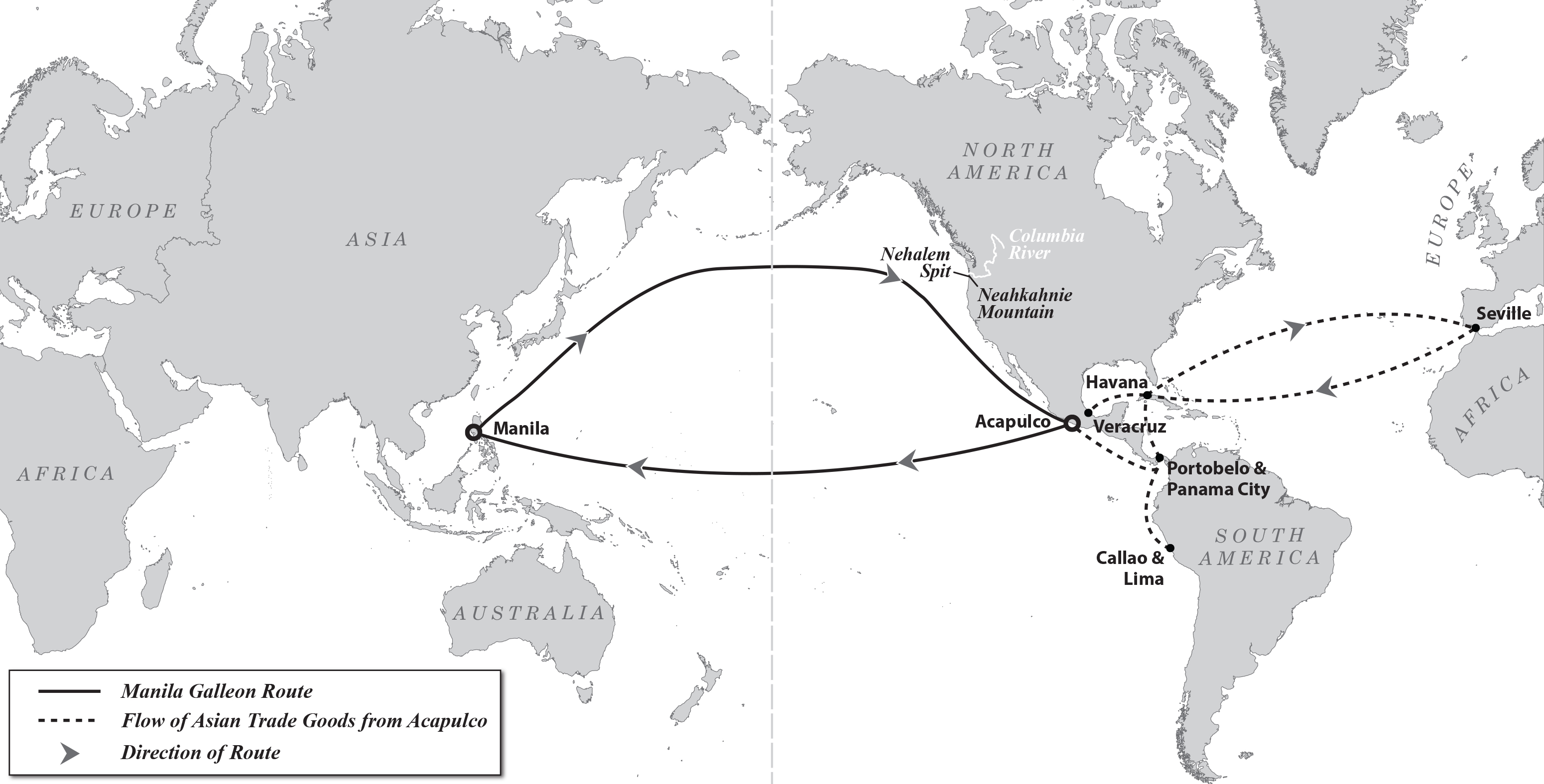
In recent years, scholars studying how Indigenous communities responded to colonialism and global trade networks have begun to look more closely at the Pacific world. One key focus is the Manila-Acapulco galleon trade route, which linked Asia and the Americas for 250 years, from 1565 to 1815.

Map of the world with lines from one continent to the next indicating trading routes.
The Manila-Acapulco galleon trade route.
Jesse Nett/Oregon Encylopedia

After Spain colonized the Philippines in 1565, Spanish galleons – towering, multidecked sailing ships – carried Chinese silk and Mexican silver across the ocean. But far more than goods traveled aboard those ships. They moved people, ideas and technologies.

Among them was the craft of distillation.

This overlooked connection may help explain how distilled agave spirits such as tequila came into being. While tequila is unmistakably a Mexican creation, the techniques used to produce it may owe something to Filipino sailors, who brought with them deep knowledge of transforming coconut sap into a potent spirit known as lambanog.

3 competing theories

For centuries, the rise of tequila has been credited to the Spanish. After the conquest of Mexico in the 16th century, colonizers introduced alembic stills, which are based on Moorish and Arabic technology. Unlike simple boiling, distillation requires managing heat and capturing purified vapor. These stills represented a major technological leap, allowing people to transform fermented drinks into distilled spirits.

Agave, long used to make the fermented drink pulque, soon became the base for something new: tequila and mezcal.

Colonial records, including the “Relaciones Geográficas,” a massive data-gathering project initiated by the Spanish Crown in the late 16th century, describe local Mesoamerican communities learning distillation from Spanish settlers. This version is well documented. But it assumes that technology moved in only one direction, from Europe to the Americas.

A second idea suggests that Mesoamerican communities already had some understanding of vapor condensation. Archaeologists have found ceramic vessels in western Mexico that may have been used to capture steam. While distillation requires additional steps, this prior knowledge may have primed Indigenous groups to more readily adopt new techniques.

As Mexican ethnobotanists Patricia Colunga-GarcíaMarín and Daniel Zizumbo-Villarreal have argued, “The adoption of distillation was likely not simply imposed, but creatively adapted to local knowledge systems.”

A third perspective, which other researchers and I are exploring, traces a potential Filipino influence. The galleon trade brought thousands of Filipino sailors and laborers to Mexico, particularly along the Pacific coast. In places such as Guerrero, Colima and Jalisco, Filipino migrants introduced methods for fermenting and distilling coconut sap into lambanog, the coconut-based spirit.

The stills they used, sometimes called Mongolian stills, were built with clay and bamboo and included a condensation bowl. Historian Pablo Guzman-Rivas has noted that these stills more closely resemble the earliest Mexican agave distillation setups than European alembics. He has also documented oral traditions in some coastal Mexican communities to link local distillation practices to their Filipino ancestors.

Side by side images of metal distilling containers with tubes emerging from each of them.
The still on the left in Jalisco, Mexico, has similarities to the lambanog on the right from Infanta, Quezon, Philippines.
Photo on left courtesy of Patricia Colunga-GarcíaMarín and Daniel Zizumbo-Villarreal; photo on right courtesy of Sherry Ann Angeles and Rading Coronacion, CC BY-SA

Beyond the bottle

Filipino influence extends beyond the distilling pot.

In Colima and other Pacific port towns, traces of the Manila galleon trade ripple through daily life – in kitchens, cantinas and even in architecture. The word “palapa,” used in Mexico and Central America today to describe rustic thatched roofs, is exactly the same as the term for coconut fronds that’s primarily used in the Bicol Region of the Philippines.

Filipino migrants in Mexico also shared knowledge of boatbuilding, fermentation and food preservation. Coconut vinegar, fish sauce and palm sugar-based condiments became part of Mexican cuisine. One of the most enduring legacies is tuba, the fermented coconut sap still popular in coastal areas of the Mexican state of Guerrero, where Filipino sailors once settled. Known locally by the same name, tuba is sold in markets and along roadsides, often enjoyed as a refreshing drink or as a cooking ingredient.

The rear of a large wooden sail boat with more than one deck.
A replica of a galleon, the Spanish trading ship that traversed the world’s oceans from the 16th century to the 18th century.
Dennis Jarvis/flickr, CC BY-SA

Exchange moved both ways. Filipino vessels carried corn, peanuts, sweet potatoes and cacao back across the Pacific, reshaping food in the Philippines. These exchanges took place under the shadow of colonialism and forced labor, but their legacies endure in language, in taste and even in the roofs over people’s heads.

Technical knowledge rarely travels through official channels alone. It moves with cooks in ship galleys, with carpenters below deck, with laborers who desert ships to settle in unfamiliar ports. Sometimes it was a way to build a roof or preserve a flavor. Other times, it was a method for turning a fermented plant into a spirit that could keep for long voyages. And by the early 1600s, new types of distilled agave spirits were being made in Mexico.

Tequila is unmistakably a product of Mexico. But it is also a product of movement. Whether Filipino migrants directly introduced distillation methods or whether they emerged from a mix of Indigenous experimentation and European tools, every time you sip tequila, you’re tasting an echo of those long ocean crossings from many centuries ago.

The Conversation

Stephen Acabado receives funding from the Henry Luce Foundation and the National Science Foundation.

ref. Filipino sailors dock in Mexico … and help invent tequila? – https://theconversation.com/filipino-sailors-dock-in-mexico-and-help-invent-tequila-258166

How mothers supporting mothers can help fill the health care worker shortage gap and other barriers to care

Source: The Conversation – USA (3) – By Sona Dimidjian, Professor of Psychology and Neuroscience, University of Colorado Boulder

For generations, women have relied on informal networks of friends, family and neighbors to navigate the complexities of birth and motherhood. Today, research is finally catching up to what generations of women have known: Peer support can be a lifeline.

Despite growing evidence, the unique wisdom and strength that arise when mothers help mothers has been surprisingly under‑explored in the scientific literature, but that’s beginning to change. Peer-delivered programs are beginning to bring together long-standing community traditions and structured, evidence-based approaches to support the mental health of new and expectant moms.

We are clinical psychologists at the University of Colorado Boulder Renée Crown Wellness Institute. Our work and research weaves together psychological science and the wisdom of mothers supporting mothers. Our program, Alma, supports women in restoring well-being in ways that are community-rooted, evidence-based and scalable.

Pressure on parents

Nearly 50% of parents report feeling overwhelmed by stress on most days. An even larger share, about 65%, experience feelings of loneliness, according to a 2024 report from the U.S. Department of Health and Human Services. These feelings hit mothers especially hard, the report says.

A woman holding a baby on a couch covers her eyes in distress.
Many mothers report experiencing depression during pregnancy, which is one of th emost common complications of childbirth.
kieferpix/GettyImages

In 2025, mothers in the United States continue to shoulder most of the caregiving of children while also managing work, personal health and household responsibilities. The transition to motherhood is often marked by emotional and psychological strain. In fact, 10% to 20% of women experience depression during pregnancy, the postpartum period or both. Depression is one of the most common complications of childbirth. A similar number of women also face significant anxiety.

In many communities, mental health resources are scarce and stigma around mental health issues persists; therefore, many mothers are left to navigate such challenges alone and in silence. Antidepressants are widely prescribed, but research suggests that many women stop using antidepressants during pregnancy – yet they don’t start therapy or an alternative treatment instead.

Psychotherapy is the most preferred care option among new and expectant mothers, but it is often inaccessible or nonexistent. This is due in part to a workforce shortage of mental health providers.

The shortage has contributed to long wait times, geographic disparities and cultural and language barriers between providers and patients. This is especially true for underserved populations. In fact, more than 75% of depressed mothers do not receive the care they need.

Science of peer support

The science of peer support is part of a larger field exploring community health workers as one way to address the shortage of mental health providers. Peer mentors are trusted individuals from the community who share common experiences or challenges with those they serve. Through specialized training, they are equipped to deliver education, offer mental health support and connect people with needed resources.

A study that analyzed 30 randomized clinical trials involving individuals with serious mental illness found that peer support was associated with significant improvements in clinical outcomes and personal recovery. Researchers have proposed that peer support creates space for learning and healing, especially when peers share lived experience, culture and language.

As clinical psychologists, we heard from mothers in our work and communities that wanted to help other moms recover from depression, navigate the challenges of motherhood and avoid feeling alone. This insight led us to co-create Alma, a peer-led mental health program based on behavioral activation.

Behavioral activation is a proven method for treating depression based on decades of randomized clinical trials, including in new and expectant mothers. It helps new and expectant mothers reengage in meaningful activities to improve mood and functioning.

The Alma program

Alma is based on the principle that depression must be understood in context and that changing what you do can change how you feel. One strategy we use is to help a mother identify an activity that brings a sense of accomplishment, connection or enjoyment – and then take small steps to schedule that activity. Mothers might also be guided on ways to ask for help and strengthen their support networks. Alma is offered in English and Spanish.

Peer mentors typically meet with moms once a week for six to eight sessions. Sessions can take place in person or virtually, allowing flexibility that honors each family’s needs. Traditionally, peer mentors have been recruited through long-standing relationships with trusted community organizations and word-of-mouth referrals. This approach has helped ensure that mentors are deeply rooted in the communities they serve. Alma peer mentors are compensated for their time, which recognizes the value of their lived expertise, their training and the work involved in providing peer mentoring and support.

“This was the first time I felt like someone understood me, without me having to explain everything,” shared one mother during a post-program interview that all participants complete after finishing Alma.

To date, more than 700 mothers in Colorado have participated in Alma. In one of our studies, we focused on 126 Spanish-speaking Latina mothers who often face significant barriers to care, such as language differences, cost and stigma. For nearly 2 out of 3 mothers, symptoms of depression decreased enough to be considered a true, measurable recovery — not just a small change.

Notably, most of the depression improvement occurred within the first three Alma meetings. We also observed that peer mentors delivered the Alma program consistently and as intended. This suggests the program could be reliably expanded and replicated in other settings with similar positive outcomes.

A second study, conducted through a national survey of Spanish-speaking Latina new and expectant mothers, found that peer-led mental health support was not only perceived as effective, but also highly acceptable and deeply valued. Mothers noted that they were interested in peer-led support because it met them where they were: with language, trust and cultural understanding.

Supporting mothers works

Supporting mothers’ mental health is essential because it directly benefits both mothers and their children. Those improvements foster healthier emotional, cognitive and social development in their children. This interconnected impact highlights why investing in maternal mental health yields lasting benefits for the entire family.

It also makes strong economic sense to address mood and anxiety disorders among new and expectant mothers, which cost an estimated US$32,000 for each mother and child from conception through five years postpartum. More than half of those costs occur within the first year, driven primarily by productivity losses, preterm births and increased maternal health care needs.

Beyond the impact on individual families, the broader economic toll of untreated mood and anxiety disorders among new and expectant mothers is substantial. For example, it’s estimated that $4.7 billion a year are lost to mothers who have to miss work or reduce their job performance because of symptoms like fatigue, anxiety and depression.

Together – as individuals, families, communities and institutions – we can cultivate a world where the challenges of parenting are met with comprehensive support, allowing the joy of parenting to be fully realized. Because no one should have to do this alone.

Read more of our stories about Colorado.

The Conversation

Sona Dimidjian reports funding from philanthropic foundations and the National Institute of Health, and founding and receiving revenue from Mindful Noggin, Inc. and Access Consulting, LLC.

Anahi Collado reports receiving funding from philanthropic foundations.

ref. How mothers supporting mothers can help fill the health care worker shortage gap and other barriers to care – https://theconversation.com/how-mothers-supporting-mothers-can-help-fill-the-health-care-worker-shortage-gap-and-other-barriers-to-care-257520

Dogs are helping people regulate stress even more than expected, research shows

Source: The Conversation – USA (3) – By Kevin Morris, Research Professor of Social Work, University of Denver

Studies show that dogs help humans cope with stress. marcoventuriniautieri/E+ via Getty Immages

In a 2022 survey of 3,000 U.S. adults, more than one-third of respondents reported that on most days, they feel “completely overwhelmed” by stress. At the same time, a growing body of research is documenting the negative health consequences of higher stress levels, which include increased rates of cancer, heart disease, autoimmune conditions and even dementia.

Assuming people’s daily lives are unlikely to get less stressful anytime soon, simple and effective ways to mitigate these effects are needed.

This is where dogs can help.

As researchers at the University of Denver’s Institute for Human-Animal Connection, we study the effects animal companions have on their humans.

Dozens of studies over the last 40 years have confirmed that pet dogs help humans feel more relaxed. This would explain the growing phenomenon of people relying on emotional support dogs to assist them in navigating everyday life. Dog owners have also been shown to have a 24% lower risk of death and a four times greater chance of surviving for at least a year after a heart attack.

Now, a new study that we conducted with a team of colleagues suggests that dogs might have a deeper and more biologically complex effect on humans than scientists previously believed. And this complexity may have profound implications for human health.

How stress works

The human response to stress is a finely tuned and coordinated set of various physiological pathways. Previous studies of the effects of dogs on human stress focused on just one pathway at a time. For our study, we zoomed out a bit and measured multiple biological indicators of the body’s state, or biomarkers, from both of the body’s major stress pathways. This allowed us to get a more complete picture of how a dog’s presence affects stress in the human body.

The stress pathways we measured are the hypothalamic-pituitary-adrenal, or HPA, axis and the sympathoadrenal medullary, or SAM, axis.

When a person experiences a stressful event, the SAM axis acts quickly, triggering a “fight or flight” response that includes a surge of adrenaline, leading to a burst of energy that helps us meet threats. This response can be measured through an enzyme called alpha-amylase.

At the same time, but a little more slowly, the HPA axis activates the adrenal glands to produce the hormone cortisol. This can help a person meet threats that might last for hours or even days. If everything goes well, when the danger ends, both axes settle down, and the body goes back to its calm state.

While stress can be an uncomfortable feeling, it has been important to human survival. Our hunter-gatherer ancestors had to respond effectively to acute stress events like an animal attack. In such instances, over-responding could be as ineffective as under-responding. Staying in an optimal stress response zone maximized humans’ chances of survival.

An man pets a dog in a gym.
Dogs can be more helpful than human friends in coping with stressful situations.
FG Trade/E+ via Getty Images

More to the story

After cortisol is released by the adrenal glands, it eventually makes its way into your saliva, making it an easily accessible biomarker to track responses. Because of this, most research on dogs and stress has focused on salivary cortisol alone.

For example, several studies have found that people exposed to a stressful situation have a lower cortisol response if they’re with a dog than if they’re aloneeven lower than if they’re with a friend.

While these studies have shown that having a dog nearby can lower cortisol levels during a stressful event, suggesting the person is calmer, we suspected that was just part of the story.

What our study measured

For our study, we recruited about 40 dog owners to participate in a 15-minute gold standard laboratory stress test. This involves public speaking and oral math in front of a panel of expressionless people posing as behavioral specialists.

The participants were randomly assigned to bring their dogs to the lab with them or to leave their dogs at home. We measured cortisol in blood samples taken before, immediately after and about 45 minutes following the test as a biomarker of HPA axis activity. And unlike previous studies, we also measured the enzyme alpha-amylase in the same blood samples as a biomarker of the SAM axis.

As expected based on previous studies, the people who had their dog with them showed lower cortisol spikes. But we also found that people with their dog experienced a clear spike of alpha-amylase, while those without their dog showed almost no response.

No response may sound like a good thing, but in fact, a flat alpha-amylase response can be a sign of a dysregulated response to stress, often seen in people experiencing high stress responses, chronic stress or even PTSD. This lack of response is caused by chronic or overwhelming stress that can change how our nervous system responds to stressors.

In contrast, the participants with their dogs had a more balanced response: Their cortisol didn’t spike too high, but their alpha-amylase still activated. This shows that they were alert and engaged throughout the test, then able to return to normal within 45 minutes. That’s the sweet spot for handling stress effectively. Our research suggests that our canine companions keep us in a healthy zone of stress response.

Having a dog benefits humans’ physical and psychological health.

Dogs and human health

This more nuanced understanding of the biological effects of dogs on the human stress response opens up exciting possibilities. Based on the results of our study, our team has begun a new study using thousands of biomarkers to delve deeper into the biology of how psychiatric service dogs reduce PTSD in military veterans.

But one thing is already clear: Dogs aren’t just good company. They might just be one of the most accessible and effective tools for staying healthy in a stressful world.

The Conversation

Kevin Morris receives funding for this research from the Morris Animal Foundation, the Human-Animal Bond Research Institute, and the University of Denver.

Jaci Gandenberger receives funding from the University of Denver to support this research.

ref. Dogs are helping people regulate stress even more than expected, research shows – https://theconversation.com/dogs-are-helping-people-regulate-stress-even-more-than-expected-research-shows-254563

Amid fragile ceasefire, violence in southern Syria brings Druze communities’ complex cross-border ties to the fore

Source: The Conversation – USA (3) – By Asher Kaufman, Professor of History and Peace Studies, University of Notre Dame

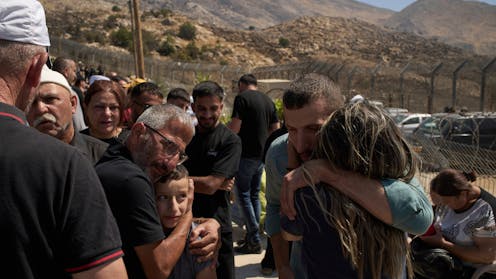
Druze from Syria hug relatives from the Israeli Druze community before crossing the border in the Israeli-controlled Golan Heights on July 17, 2025. AP Photo/Leo Correa

A fragile ceasefire was put in place in southern Syria on July 19, 2025, after days of violence between Druze militias and Bedouin tribes that drew in government forces and prompted Israeli strikes on the capital, Damascus, as a warning to pull back from Druze areas. The United States helped broker the latest agreement, fearing a spillover of violence to other parts of Syria.

The conflict’s quick escalation brings to the fore multiple layers of politics and identity in the region – particularly among the Druze, who form an important minority in several countries and make up about 2% of Israel’s population. As a historian of the Middle East, I have researched Druze cross-border communal ties and followed closely their predicaments since the start of the Syrian civil war in March 2011.

A wide road seen from above, with damaged buildings alongside it and smoke rising against a blue sky.
Bedouin fighters deploy in Mazraa village on the outskirts of Sweida, as smoke rises from clashes with Druze militias, on July 18, 2025.
AP Photo/Ghaith Alsayed

Cross-border brotherhood

The Druze are a monotheistic religious community that split from a branch of Shiite Islam in the 11th century. Today, they live mainly in three countries: Lebanon, Syria and Israel, with a small presence in northern Jordan.

Despite their geographical dispersion, they have managed to retain a strong sense of communal identity. One of the most important creeds of their faith is “protection of brothers of the faith.”

Another article of faith that helps to buttress shared communal solidarity is belief in reincarnation: that with physical death, the soul is transferred to the body of a newly born Druze.

Although Druze history shows that the community is not always united, the belief in and practice of cross-border solidarity is very strong. According to their popular saying, “the Druze are like a copper tray. Wherever you hit it, the whole tray reverberates.”

National identity

After World War I, the creation of the modern states in the Middle East divided the Druze community between Syria, Lebanon and the British mandate of Palestine, which is now Israel.

A person holding a brightly colored flag waves as night falls in a hilly area.
A young member of the Druze community in the Golan Heights waves to Syrian Druze clerics while they cross the border back to Syria on March 15, 2025.
AP Photo/Leo Correa

In Israel, they have largely integrated into the Jewish state. Like Jewish citizens, Druze men are required to serve in the military, and many have attained leadership positions in the security sector and politics.

A popular cliché has developed about their “blood oath” with the Jewish state. In a July 15 statement, Prime Minister Benjamin Netanyahu and Defense Minister Israel Katz cited Israel’s “deep covenant of blood with our Druze citizens” and their connections to Druze in Syria.

Their integration has been marred by discrimination, a prime example of which is the 2018 law that defines Israel as the nation-state for Jews. Still, many retain a strong sense of Israeli identity that sets them apart from Arab Palestinian citizens of Israel.

An additional Druze community lives in the Golan Heights, territory that Israel seized from Syria in 1967 and has occupied since. Most Druze there declined to receive Israeli citizenship, and remained loyal to Syria until the outbreak of the civil war there. Since then, there has been a notable change in their relationship with Israel, marked by increased numbers who have acquired Israeli citizenship.

Druze communities elsewhere in the region have also adopted aspects of their countries’ culture, including Arab nationalism and Syrian or Lebanese national sentiments. Still, cross-border solidarity among Druze has remained strong – and often resurfaced in times of crisis.

War in Syria

When the Syrian civil war erupted in March 2011, Syrian Druze were targeted at times by both the Assad regime, which pressured them to support it, and by Islamist rebel groups that regarded them as infidels. The Druze straddled a fine line throughout the war, seeking, not always successfully, to be left on their own.

In 2015, that tension came to a boiling point. Druze regions throughout Syria became sites of military confrontations, involving Druze militias, the Syrian army and opposition fighters.

Israeli Druze organized mass rallies in support of their brothers in Syria and called on the Israeli government to intervene. Israel, in turn, protected Syrian Druze villages close to its border with Syria in the Golan Heights. The Israeli government covertly supported Druze areas deeper in Syria, and sent clear messages to combatants on all sides not to harm the Druze.

Since the fall of the Assad regime in Damascus in December 2024, Ahmad al-Sharaa, the new Syrian leader, has attempted to bring divided and ruined Syria together under his authority.

However, religious and ethnic minorities have been highly suspicious of the new government. Many of its members hail from al-Sharaa’s own militia during the civil war, Hayat Tahrir al Sham, which targeted religious minorities and enforced its own interpretation of Islam on the population under its control.

Spiraling crisis

The most recent violence took place in Mount Druze, a region in Sweida province that is home to most of the community in Syria. It was sparked by an incident where a local Bedouin band robbed and killed a Druze man. The incident quickly became a catalyst for major fighting between Druze, Bedouins and dispatched units of the Syrian army.

A man in camo walks down a road as two men up ahead on a bicycle look at a covered body on the ground.
Syrian government forces in Mazraa village, on the outskirts of Sweida, pass by a dead Druze militia fighter on July 14, 2025.
AP Photo/Ghaith Alsayed

State security forces tried to impose their authority, but in the process killed scores of Druze. They also violated Druze cultural norms by filming the forced shaving of Druze men’s mustaches, including respected religious men, and posting the clips on social media. According to the Syrian Observatory for Human Rights, more than 1,100 people have been killed in the fighting.

The fragile agreement that the Sweida Druze signed with the new government in May, as part of the government’s efforts to solidify authority over the divided country, collapsed following these incidents.

Befitting the saying about the reverberation of the copper tray, Israeli Druze immediately mobilized, joined by Druze in the Golan Heights. Hundreds crossed the border to Syria. Many called on the government in Jerusalem to intervene, though others were opposed.

On July 16, the Israeli military targeted the Syrian army by striking Damascus – sending a clear threat to al-Sharaa. Israel also struck military targets in southern Syria.

Later that day, the Syrian government reached a ceasefire agreement with the Druze in Sweida, which collapsed soon after. On July 19, following more fighting and violence – and mediation by the United States, Turkey and Jordan – a new ceasefire was put in place, though new fighting has been reported.

A changing Middle East

Even before these recent incidents, Israel became a key player in post-Assad Syria by occupying areas close to their shared border. Now, Israel has deepened its involvement by defending the Druze population in the country – as many Israeli Druze had hoped it would since the start of the civil war in 2011.

Apart from supporting the Druze, Israel’s military actions are also tied to its efforts to project power amid the tectonic shifts in the Middle East since the Hamas attacks on Oct. 7, 2023. In Syria, it seeks to guarantee its influence on the reshaping of the country after civil war. Domestically, Netanyahu is interested in prolonging Israel’s state of emergency, as it extends the survival of his far-right and unpopular government. Syria provides him with another front to maintain this state of emergency.

For many Israeli Druze, meanwhile, this still-unfolding episode constitutes another example in their history of seeking to protect their brothers in faith. Among Druze in the Middle East, they are uniquely positioned, with many serving in the region’s most powerful military.

On July 19, Israel’s public broadcaster, Kan news, reported that 2,000 Israeli Druze, including reserve soldiers, signed a petition that said: “we are getting ready to volunteer to fight alongside our brothers in Sweida. It is our time to defend our brothers, our land and our religion.”

The Conversation

Asher Kaufman does not work for, consult, own shares in or receive funding from any company or organization that would benefit from this article, and has disclosed no relevant affiliations beyond their academic appointment.

ref. Amid fragile ceasefire, violence in southern Syria brings Druze communities’ complex cross-border ties to the fore – https://theconversation.com/amid-fragile-ceasefire-violence-in-southern-syria-brings-druze-communities-complex-cross-border-ties-to-the-fore-261337

Comparing ICE to the Gestapo reveals people’s fears for the US – a Holocaust scholar explains why Nazi analogies remain common, yet risky

Source: The Conversation – USA – By Daniel H. Magilow, Professor of German, University of Tennessee

U.S. Immigration and Customs Enforcement officers gather for a briefing before an enforcement operation on Jan. 27, 2025, in Silver Spring, Md. Associated Press

Minnesota Gov. Tim Walz recently sparked controversy by comparing U.S. Immigration and Customs Enforcement to Nazi Germany’s notorious secret police, the Gestapo.

“Donald Trump’s modern-day Gestapo is scooping folks up off the streets,” Walz said during a May 2025 speech at the University of Minnesota Law School’s commencement ceremony.

“They’re in unmarked vans, wearing masks, being shipped off to foreign torture dungeons, no chance to mount a defense, not even a chance to kiss a loved one goodbye, just grabbed up by masked agents, shoved into those vans, and disappeared,” Walz added.

ICE, tasked with enforcing immigration policies, has dramatically increased the number of nationwide arrests of immigrants since President Donald Trump returned to office in January 2025. ICE’s arrests of immigrants have more than doubled in 38 states since then.

In recent months, other Democratic politicians, including U.S Rep. Dan Goldman of New York, have also compared ICE to the Gestapo, or Adolf Hitler’s “secret police,” as Rep. Seth Moulton of Massachusetts said in April.

But do ICE’s tactics actually resemble those of the Gestapo?

Because I am a scholar of modern Germany and the Holocaust, people regularly ask me if this analogy is accurate. The answer is complicated.

Men are seen looking afraid and with their hands up, looking toward two men with uniforms and helmets, in a faded black-and-white photo.
The Gestapo arrests a group of Jewish men hiding in a cellar in Poland in 1939, in what was possibly a staged German propaganda photo.
Keystone/Hulton Archive/Getty Images

Understanding the Gestapo

The Nazi regime established the Gestapo, short for the German phrase Geheime Staatspolizei, meaning secret state police, soon after Hitler became chancellor of Germany in January 1933. Among other responsibilities, the Gestapo was tasked with investigating political crimes and monitoring opposition activity. It later enforced racial laws in Germany and across occupied Europe.

As part of its daily work, the Gestapo identified and monitored the regime’s political enemies. It arrested, interrogated, detained and tortured suspects and sent others to concentration camps. To identify suspects, it often relied on anonymous denunciations that came not only from zealous Nazis, but also from disgruntled neighbors or business competitors who tipped off the Gestapo to Jews and other people.

While the Gestapo was relatively small in terms of personnel, it projected an image of being, as one scholar wrote, “omniscient, omnipotent, and omnipresent.”

It enforced the regime’s will and suppressed dissent not through sheer manpower but by creating a pervasive sense of fear. This aura of menace and terror has long outlived the Nazi regime itself.

ICE’s operations

ICE, with around 21,000 officers and staff operating in a country of more than 340 million, is smaller both in absolute terms and on a per capita basis. At its height between 1943 and 1945, the Gestapo had between 40,000 and 50,000 personnel in a country of 79 million.

ICE is set to expand its work in the next few years with an additional US$75 billion in funding that Congress appropriated in July as part of Trump’s tax and spending bill.

And while ICE focuses on immigration, the Gestapo had a more expansive role. It was responsible for suppressing all forms of political dissent, not just violations of immigration law.

ICE operates with vastly more advanced technologies that did not exist in the 1940s, including facial recognition and social media monitoring.

There is technically more transparency around ICE’s work than the Gestapo’s, since ICE is a federal agency that is subject to its work and information being reviewed by politicians and the public alike. But in June 2020, the first Trump administration reclassified ICE, which is part of the Department of Homeland Security, as a “security/sensitive agency.” This designation makes it harder for people to request and receive information about ICE’s work through Freedom of Information Act records requests.

Like the Gestapo, ICE can seem performative in its work, like when it carried out a dramatic July raid of a cannabis farm in California in which balaclava-wearing officers used tear gas against protesters.

The Gestapo in today’s world

Since World War II and the fall of the Nazi regime, the term Gestapo has become shorthand in the United States to describe police repression.

Using the word Gestapo to describe the worst possible authoritarian oppression has been popularized in popular movies in everything from the 1943 film “Casablanca” and “The Black Gestapo” in 1975 to “Inglourious Basterds” in 2009 and “Jojo Rabbit” in 2019.

Walz’s remarks in May, though provocative, were also far from isolated in politics. Politicians from both sides of the aisle, as well as political observers, regularly use Gestapo and Nazi metaphors to attack their opponents.

In 2022, Rep. Marjorie Taylor Greene of Georgia famously confused the term Gestapo with gazpacho soup in a gaffe that went viral. “Now we have Nancy Pelosi’s gazpacho police spying on members of Congress,” she said.

In 2024, Trump accused President Joe Biden of running a “Gestapo administration” as the Justice Department prosecuted Trump for attempting to overturn the 2020 election.

Overall, mentions of the word Gestapo in social media increased by 184% between 2017 and 2024, according to the nonprofit group Foundation to Combat Antisemitism.

The U.S. Holocaust Memorial Museum is among the organizations that have condemned making comparisons to the Holocaust and the Nazis for many reasons, including their historical inaccuracy and because they are insulting to people whose families remain scarred by the Holocaust.

A woman wearing a blue shirt grimaces as she is held back by a man wearing a black shirt that says 'police.' Other people appear to fight alongside them.
A Paraguayan woman whose relative was detained by ICE agents scuffles with officers in the halls of an immigration court in New York City on July 16, 2025.
Spencer Platt/Getty Images

What historical comparisons really say

Analogies can be useful for clarifying complex ideas. But especially when they stretch across decades and vastly different political contexts, they risk oversimplifying and trivializing history.

I believe that comparing ICE to the Gestapo is less a historical judgment than a reflection of modern anxiety – a fear that the U.S. is veering toward authoritarianism reminiscent of 1930s Germany.

If politicians and other public figures are looking for historical comparisons to modern law enforcement agencies that use severe tactics, there is, unfortunately, no shortage of options: the Soviet Union’s secret police agencies NKVD and KGB, Iran’s former secret police and intelligence agency SAVAK or East Germany’s Stasi, to name just a few.
All of those organizations denied suspects due process and grossly violated human rights in order to protect political regimes – but they don’t necessarily easily compare to ICE, either.

Still, politicians and political observers alike most often turn to the Gestapo and other Nazi references instead.

Ultimately, the Gestapo, Nazi Germany and the Holocaust serve as a powerful, shared cultural reference point. The catastrophes of World War II epitomize the worst possible outcomes of evil left unchecked.

They have become the master moral paradigm and an ethical compass for the world today. In an age of polarization, World War II and the Holocaust remain the mirror in which Americans examine their present.

The Conversation

Daniel H. Magilow received funding from the National Endowment for the Humanities (although DOGE cancelled the grant in April 2025).

He serves as Co-Editor-in-Chief of Holocaust and Genocide Studies, the journal of the United States Holocaust Memorial Museum’s Jack, Joseph and Morton Mandel Center for Advanced Holocaust Studies

ref. Comparing ICE to the Gestapo reveals people’s fears for the US – a Holocaust scholar explains why Nazi analogies remain common, yet risky – https://theconversation.com/comparing-ice-to-the-gestapo-reveals-peoples-fears-for-the-us-a-holocaust-scholar-explains-why-nazi-analogies-remain-common-yet-risky-260767

Changement climatique : la protection de la nature et l’énergie verte ont la cote

Source: The Conversation – in French – By Marina Joubert, Science Communication Researcher, Stellenbosch University

L’Afrique subit de plus en plus de phénomènes météorologiques extrêmes. Ces évènements se traduisent par des vagues de chaleur, de sécheresses, des tempêtes et des inondations qui, auparavant étaient rares à certains endroits ou à certaines périodes. Ils représentent désormais un danger pour de nombreuses personnes et pour l’économie. Marina Joubert mène des recherches sur les liens entre la société et la science. Elle a fait partie d’une équipe multidisciplinaire qui a étudié comment les habitants de 68 pays perçoivent le lien entre les phénomènes météorologiques extrêmes et le changement climatique.

Les gens croient-ils que les phénomènes météorologiques extrêmes sont causés par le changement climatique ?

Nous avons mené cette étude parce que les phénomènes météorologiques extrêmes deviennent plus fréquents et plus intenses en raison du changement climatique. Pourtant, nous disposons de très peu d’informations sur la manière dont ces événements influencent l’opinion des gens sur le changement climatique et leur soutien aux politiques en la matière.

Nous avons utilisé des données qui mesurent le nombre de personnes dans le monde qui ont été exposées à des phénomènes météorologiques extrêmes (inondations, vagues de chaleur, tempêtes, sécheresses, feux de forêt) au cours des dernières décennies. Ils ont ensuite croisé ces informations avec les réponses de près de 72 000 personnes dans 68 pays. On leur a demandé s’ils avaient déjà été confrontés à des phénomènes météorologiques extrêmes, s’ils pensaient que ceux-ci étaient dus au changement climatique. Et dans quelle mesure ils soutenaient cinq grandes politiques climatiques.

Plus de 7 000 personnes ont participé à l’enquête dans 12 pays africains (Botswana, Cameroun, Côte d’Ivoire, République démocratique du Congo, Égypte, Éthiopie, Ghana, Kenya, Maroc, Nigeria, Afrique du Sud et Ouganda).

Nos résultats montrent que beaucoup de personnes pensent que les phénomènes météorologiques extrêmes récents sont causés par le changement climatique. Mais cette perception varie selon le type de phénomène et la région. L’étude ne cherchait pas à savoir si les gens croient, de manière générale, aux preuves scientifiques sur le changement climatique ou si celui-ci est causé par les activités humaines. Elle s’intéressait plutôt à ce qu’on appelle «l’attribution subjective»: en l’occurrence le fait qu’une personne pense qu’un événement qu’elle a vécu (par exemple, une vague de chaleur ou des inondations) a été causé par le changement climatique.

Notre étude a montré que la perception de l’existence d’un lien entre le changement climatique et les phénomènes météorologiques extrêmes est généralement forte, surtout en Amérique latine. Dans cette région, les personnes interrogées sont les plus nombreuses à estimer que le changement climatique leur nuira, ainsi qu’aux générations futures. Elles considèrent aussi qu’il doit être une priorité majeure pour leurs gouvernements.

En revanche, les pays africains étudiés étaient moins enclins à accepter le lien entre le changement climatique et les phénomènes météorologiques extrêmes.

Cela montre que, malgré cette vulnérabilité, la sensibilisation aux effets du changement climatique reste faible dans plusieurs pays africains. Dans ces 12 pays africains, beaucoup de personnes interrogées ne font pas clairement le lien entre les événements extrêmes qu’elles vivent et le changement climatique.

Les personnes ayant vécu des catastrophes climatiques étaient-elles plus susceptibles de soutenir les politiques climatiques ?

Cette relation est complexe. Le simple fait de vivre une inondation ou une sécheresse ne suffit pas. Ce qui pousse vraiment à agir, c’est la conviction que ces événements sont causés par le changement climatique.

En d’autres termes, le simple fait d’être exposé à des phénomènes météorologiques extrêmes ne conduit pas automatiquement à soutenir les politiques climatiques.

En revanche, les personnes qui ont vécu ces événements et qui pensent qu’ils sont dus au changement climatique soutiennent plus facilement ces politiques. Par exemple, ceux qui ont été touchés par des incendies de forêt étaient plus favorables aux politiques climatiques. À l’inverse, les personnes confrontées à de fortes pluies y étaient moins favorables. Cela s’explique sans doute par le fait que beaucoup n’associent pas la pluie abondante au changement climatique.

Bref, ce qui compte, ce n’est pas seulement l’expérience, mais la façon dont on interprète cette expérience.

Quelles politiques climatiques avez-vous étudiées et lesquelles étaient les plus populaires en Afrique ?

Les politiques climatiques sont élaborées par les gouvernements pour limiter ou lutter contre le changement climatique, par exemple en réduisant les émissions de gaz à effet de serre.

L’étude a mesuré le soutien à cinq grandes politiques :

  • Augmenter les taxes sur certains aliments comme la viande de bœuf ou les produits laitiers, qui produisent beaucoup de gaz à effet de serre

  • Augmenter les taxes sur les combustibles fossiles, tels que le charbon et le gaz, qui nuisent à l’environnement lorsqu’ils sont brûlés.

  • Développer les infrastructures de transport public afin de réduire le nombre de voitures particulières sur les routes.

  • Augmenter l’utilisation des énergies renouvelables, telles que l’énergie éolienne et solaire.

  • Protéger les forêts et les espaces naturels.

Parmi toutes ces politiques, la protection des forêts et des terres naturelles est la plus populaire, avec 82 % de soutien dans le monde, y compris en Afrique. Vient ensuite l’augmentation de l’usage des énergies renouvelables, soutenue à 75 %.

Les mesures fiscales, comme les taxes carbone sur l’alimentation ou les carburants, recueillent beaucoup moins d’adhésion, avec seulement 22 % et 29 % de soutien respectivement.

Cela s’explique peut-être par le fait que les gens considèrent les zones naturelles protégées et les énergies vertes comme des solutions positives et tournées vers l’avenir. La taxe carbone peut être perçue comme punitive, en particulier dans les régions où la pauvreté et les inégalités sont élevées.

Que faut-il faire maintenant ?

Nos conclusions soulignent l’importance d’impliquer le public dans la lutte contre le changement climatique. Cela est particulièrement important en Afrique, où l’adhésion de la population est essentielle pour mettre en œuvre des politiques climatiques plus ambitieuses. Les gouvernements africains doivent encourager cette appropriation citoyenne.

Si nous voulons que le public soutienne davantage des solutions telles que les énergies propres, la protection des forêts et les transports durables, nous devons aider les gens à faire le lien entre ce qu’ils vivent et ce que la science dit. C’est là que la communication sur le climat joue un rôle important. Les scientifiques, les éducateurs, les journalistes et la société civile ont tous un rôle à jouer pour mettre en avant les raisons derrière le changement climatique.

Une communication et une mobilisation actives peuvent aider les gens à prendre conscience que le changement climatique affecte déjà leur vie à travers les inondations, les sécheresses, les vagues de chaleur, etc.

Il ne suffit pas de fournir des connaissances factuelles, car les gens interprètent ces informations en fonction de leurs opinions, de leurs valeurs et de leurs expériences antérieures. Il est essentiel de prendre en compte l’opinion publique.

Les avantages et les bénéfices des politiques climatiques, tels qu’une meilleure qualité de l’air, une énergie solaire plus abordable ou des transports publics améliorés, doivent être communiqués de manière claire et compréhensible.

Enfin, les phénomènes météorologiques extrêmes doivent être vus comme des « moments propices à l’apprentissage » : des occasions d’expliquer le changement climatique et d’ouvrir un dialogue sociétal sur ses effets.

The Conversation

Marina Joubert does not work for, consult, own shares in or receive funding from any company or organisation that would benefit from this article, and has disclosed no relevant affiliations beyond their academic appointment.

ref. Changement climatique : la protection de la nature et l’énergie verte ont la cote – https://theconversation.com/changement-climatique-la-protection-de-la-nature-et-lenergie-verte-ont-la-cote-261466

Congo and critical minerals: What are the costs of America’s peace?

Source: The Conversation – Canada – By Evelyn Namakula Mayanja, Assistant Professor, Interdisciplinary Studies, Carleton University

In March 2025, President Félix Tshisekedi of the Democratic Republic of Congo (DRC) offered the country’s critical mineral reserves to the United States and Europe in exchange for security and stability.

At the time, the March 23 (M23) militia insurgency was unleashing violence: killing civilians, committing sexual violence, displacing communities and looting mineral resources. Since 1996, eastern Congo has been engulfed in wars and armed conflicts driven by regional powers and more than 120 armed groups.

The U.S.-brokered peace agreement between Rwanda and the DRC raises critical questions: Is this a genuine path to sustainable peace, or a continuation of U.S. President Donald Trump’s strategy to secure access to critical minerals through coercive diplomacy?


Read more:
4 things every peace agreement needs – and how the DRC-Rwanda deal measures up


Global arms race for critical minerals

The global shift toward renewable energy, digital infrastructure and military modernization has sparked a geopolitical scramble for critical and rare earth minerals.

In early 2025, Trump signed a series of executive orders that introduced aggressive and imperial-style tactics to secure access to mineral wealth. He threatened Canada with annexation and tariffs, demanded access to Greenland’s resources and linked U.S. support for Ukraine to access to its mineral reserves.

The DRC’s offer must be viewed through this lens of global resource competition.

Congo’s critical mineral wealth

The DRC holds some of the world’s richest deposits of critical minerals and metals. A 2012 article estimated the value of Congo’s untapped mineral wealth at US$24 trillion, a figure nearing the U.S. first-quarter 2025 GDP of $29.962 trillion.

The DRC produces 70 per cent of the world’s cobalt, ranks fourth in copper, sixth in industrial diamonds and also possesses vast reserves of nickel and lithium, including the Manono deposit expected to yield 95,170 tonnes of crude lithium.

But the struggle to control these resources has fuelled a cycle of armed violence, displacement and exploitation. Despite several peace agreements, peace and stability remain elusive.

America’s interests in Congo

U.S. involvement in Congo stretches back to the Cold War, when it played a role in the 1961 assassination of Patrice Lumumba, Congo’s first elected prime minister who sought economic sovereignty.

In 1996, the U.S. was accused of backing Rwanda and Uganda in the initial invasion of eastern Congo. A U.S. diplomat, “Mr. Hankins,” was quoted in Goma saying: “I am here …to represent American interests.”

In 2024, President Joe Biden met Tshisekedi to advance the Lobito Corridor, a strategic trade route to counter China’s dominance in the region. Chinese companies currently control around 80 per cent of Congo’s copper market.

When Trump signed the 2025 peace agreement, he openly stated the U.S. would gain “a lot of mineral rights … foreign trade and investment from the regional critical mineral supply chains.”

U.S.-brokered peace deal

The deal, however, prioritizes America’s access to minerals over the well-being of Congolese citizens. Historically, Congo’s mineral wealth has enriched elites and foreign powers while leaving its people impoverished and vulnerable. The new agreement could entrench existing inequalities and inflame tensions further.

The U.S. has also cut off aid for war survivors, including emergency medical kits and antiretrovirals for rape victims, undermining humanitarian efforts.

Crucially, the agreement overlooks:

  • The root causes and drivers of conflict at national, regional and international levels.

  • The role of Rwanda and Uganda, whose militaries and intelligence services have long been implicated in supporting groups like M23. Gen. Muhoozi Kainerugaba, son of Ugandan President Yoweri Museveni, has referred to M23 as “our brothers” and threatened military action in Congo.

  • The voices of Congolese civil society, war survivors and the public, who were excluded from the negotiation process.

  • State fragility and institutional collapse — major enablers of protracted violence.

  • The grievances of Hutu and Tutsi communities in the DRC, deeply rooted in colonial and regional politics.

  • The presence of more than 120 armed groups, many of them proxies for foreign powers engaging in what some scholars call “geocriminality.”

Between January and February 2025 alone, more than 7,000 people were killed in the DRC. The United Nations and several human rights organizations have documented mass atrocities, including crimes of genocidal magnitude.

A path toward real peace

The peace agreement fails to demand justice for crimes committed against the Congolese people. Nobel Peace laureate Denis Mukwege condemned the deal for “rewarding aggression, legitimizing the plundering of Congo’s natural resources, and sacrificing justice for a fragile peace.”

It also ignores the roles of international mining corporations and external entities that have long profited from Congo’s instability.

True and lasting peace in the DRC cannot be imposed from the outside. U.S.-led mineral extraction without justice risks deepening the crisis. Since 1999, UN peacekeepers have been deployed in the Congo , yet violence continues.

Sustainable peace will require:

  • An end to impunity;

  • Thorough investigations into war crimes;

  • Regional truth-telling processes;

  • Justice and reparations for victims;

  • And most importantly, inclusion of Congolese voices in shaping their future.

Without these commitments, the U.S. risks replicating a long history of exploitation, trading in minerals while ignoring the human cost.

The Conversation

Evelyn Namakula Mayanja receives funding from Social Sciences and Humanities Research Council and from Carleton University

ref. Congo and critical minerals: What are the costs of America’s peace? – https://theconversation.com/congo-and-critical-minerals-what-are-the-costs-of-americas-peace-260567

Le rebond, après une liquidation judiciaire, une affaire collective ?

Source: The Conversation – in French – By Bénédicte Aldebert, Professeure des Universités, Entrepreneuriat & Innovation, IAE Aix-Marseille Graduate School of Management – Aix-Marseille Université

Comment rebondir après un échec entrepreneurial ? Pour les dirigeants des entreprises en liquidation, l’injonction à repartir vite n’est pas si simple à remplir. Il n’est pas sûr qu’on rebondisse bien, seul. Mieux vaut être accompagné pour repartir du bon pied.


Les défaillances d’entreprises continuent d’augmenter, de 55 000 cas en 2022 à plus de 66 000 cas en 2024. Une part significative a conduit à la liquidation judiciaire. Cet événement souvent vécu comme traumatique peut mener à des conséquences parfois désastreuses sur la vie de l’entrepreneur, mais aussi sur sa santé mentale – la perte de confiance et de légitimité pouvant déboucher sur un burn-out et parfois même un suicide.

Dans une société contemporaine qui valorise les success stories des entrepreneurs, la décision d’une liquidation judiciaire par le tribunal tombe comme un couperet. Les entrepreneurs ayant subi une liquidation sont parfois assimilés à de mauvais gestionnaires ou à des personnes imprudentes. Cette stigmatisation peut limiter l’accès à de nouvelles opportunités de financement et de partenariat pour un nouveau projet. Ce sentiment d’exclusion du monde des affaires et la baisse de l’estime de soi peuvent alors conduire à une autostigmatisation, où l’entrepreneur intègre et intériorise ces jugements négatifs portés par son entourage ou la société.


À lire aussi :
Succès, échecs : pourquoi le rôle du mérite est-il surévalué ?


Deux mille deux cent vingt entrepreneurs aidés

Aider les entrepreneurs ayant subi une liquidation à se reconstruire sur le plan personnel et professionnel est la raison d’être de plusieurs dispositifs d’intérêt général à caractère social, comme l’association 60 000 Rebonds. Avec 2 020 entrepreneurs ayant rebondi depuis sa création et 1850 bénévoles mobilisés, l’accompagnement de l’association repose sur une combinaison d’approches individuelles et collectives, incluant coaching, mentorat et ateliers thématiques.

Notre enquête menée en 2024, auprès de 216 entrepreneurs accompagnés par l’association, a pu mettre en lumière un état des lieux des entrepreneurs ayant rebondi, les obstacles à leur rebond et les leviers facilitant la reconstruction de ces entrepreneurs après une liquidation.

L’échec, une expérience individuelle

Premier constat issu de cette enquête : 67 % des rebonds sont réalisés dans le salariat contre seulement 33 % dans l’entrepreneuriat. Parmi celles et ceux qui se sont relancé·e s dans l’aventure entrepreneuriale, 71 % ont invoqué le désir d’autonomie professionnelle et d’indépendance dans leur décision. Pour 82 % des premiers, la raison principale de ce choix est le besoin de se sécuriser financièrement après cet épisode éprouvant.

Loin d’être uniquement entrepreneurial, le rebond peut en effet prendre plusieurs formes et implique, comme sa définition l’indique, une remise en mouvement après un choc. Mais qu’est-ce qui peut empêcher cette remise en mouvement ?

Une inquiétante perte de confiance en soi

En 2021, le principal frein au rebond était le manque d’argent pour 32,5 % d’entre eux et la confiance en soi pour 28,9 %. En 2024, la situation s’est renversée : 39 % des répondants ont évoqué un manque de confiance en soi comme frein majeur à leur rebond et 26 % ont cité des difficultés financières comme obstacle au rebond.

Si ce dernier chiffre souligne l’impact économique indiscutable de la liquidation sur les entrepreneurs, les chiffres de l’enquête 2024 attestent aussi d’une prise de conscience.

Perdre son entreprise est bel et bien un traumatisme au cours duquel l’amour-propre et la volonté d’aller de l’avant se trouvent ébranlés. Cet impact psychologique peut laisser des traces profondes – honte, sentiment d’inutilité, impression d’avoir perdu sa légitimité – et influence la manière dont on entrevoit les chemins qui nous sont offerts.

L’élan du collectif

En 2024, le dispositif le plus apprécié est devenu l’accompagnement collectif – et en particulier les groupes d’échanges et de développement (70 %) – alors qu’il n’était qu’en quatrième position en 2021. Si le coaching individuel reste néanmoins en position favorable, ces données mettent en lumière de nouvelles attentes prioritaires chez les entrepreneurs accompagnés : sortir de l’isolement, normaliser l’échec et retrouver un sentiment d’appartenance au sein d’un groupe de personnes ayant vécu la même expérience.

L’enquête enseigne ainsi que si sortir de la spirale négative de l’échec nécessite un travail de fond sur soi, cela est rendu possible grâce à un environnement soutenant, bienveillant et structurant. À travers ses multiples espaces de confiance et de bienveillance, l’accompagnement proposé par 60 000 Rebonds permet à l’entrepreneur ayant vécu une liquidation judiciaire de se sentir sécurisé, valorisé et reconnecté à un collectif.

France Culture, 2018.

Comprendre le rebond

Rebondir, ce n’est pas simplement retrouver un emploi ou lancer une nouvelle entreprise. C’est, d’abord, prendre la mesure du choc et de la perte vécus. Le rebond est en effet souvent précédé d’un processus de deuil, avec ses étapes : déni, colère, marchandage, dépression, acceptation. Mais si l’expérience de cette perte reste une expérience intime et personnelle, le rebond, quant à lui, représente un enjeu collectif. Car c’est bien dans le lien tissé avec les autres que l’entrepreneur ayant vécu une liquidation judiciaire va pouvoir retrouver un rapport positif à lui-même, réactiver son sentiment de compétence, d’autonomie et créer un nouveau récit pour lui-même.

Notre étude plaide donc pour un élargissement des dispositifs d’accompagnement post-liquidation, à l’image de ce que fait 60 000 Rebonds. Elle permet également de souligner notre responsabilité collective ainsi que celle de nos institutions dans la stigmatisation de l’échec. Si l’écosystème entrepreneurial qui vise à accompagner la création et la croissance des entreprises est en pleine expansion depuis plus de vingt ans, les initiatives politiques – issues notamment de la loi Pacte (2019) – pour intégrer l’échec et le rebond comme faisant partie du processus entrepreneurial sont encore timides.

Changer de regard sur l’échec ne consiste pas seulement à changer de regard sur l’entrepreneuriat. C’est également un changement de posture à mettre en œuvre dans la transmission de nos apprentissages, où l’humilité et le droit à l’erreur feront partie de nos standards et où la capacité à apprendre des échecs individuels et collectifs fera partie de nos enseignements scolaires et universitaires.

The Conversation

Nous traitons du sujet de la défaillance d’entreprises en lien avec l’association 60000 rebonds que nous citons dans l’article.

Nous traitons du sujet de la défaillance d’entreprises en lien avec l’association 60000 rebonds que nous citons dans l’article.

Nous traitons du sujet de la défaillance d’entreprises en lien avec l’association 60000 rebonds que nous citons dans l’article.

ref. Le rebond, après une liquidation judiciaire, une affaire collective ? – https://theconversation.com/le-rebond-apres-une-liquidation-judiciaire-une-affaire-collective-256658

Que faut-il pour que le travail d’équipe en entreprise soit performant ? Des expériences en laboratoire offrent des explications

Source: The Conversation – in French – By Marc Lebourges, Chercheur associé en sciences économiques, Université de Rennes

Faut-il motiver par la carotte, par le bâton ou par la force du collectif ? Une étude menée en laboratoire teste plusieurs façons de stimuler l’effort en équipe. Si les récompenses financières tirent la performance vers le haut, elles peuvent aussi créer des tensions.


Le travail en équipe est devenu dominant dans les entreprises depuis la fin du XXe siècle, comme l’a rappelé le fondateur de l’économie des ressources humaines, Edward P. Lazear, dans un article cosigné avec Kathryn L. Shaw. Les succès de l’industrie automobile japonaise, pionnière en la matière, ont popularisé ce mode d’organisation. Il accroît l’implication des salariés, stimule l’entraide et le transfert de compétences, offre de la flexibilité face aux aléas de production ou de demande, et améliore la rationalité des décisions des salariés.

Mais il a aussi des inconvénients. Des problèmes de coordination peuvent survenir en l’absence d’un processus de décision clair. Le travail collectif peut également diluer les incitations à l’effort, comme l’avait notamment montré montré Bengt Holmström si les rémunérations dépendent de la performance collective et que le produit des efforts individuels est partagé entre les équipiers.

Plusieurs types de mécanismes incitatifs

Plusieurs mécanismes destinés à prévenir la dilution des incitations au sein des équipes de travail ont été analysés. Il s’agit, soit de mécanismes centralisés et fondés sur un objectif d’équipe ou de la concurrence entre équipes, tels que Haig Nalbantian et Andrew Schotter les ont étudiés, soit de mécanismes décentralisés reposant sur la pression des pairs, c’est-à-dire la désapprobation sociale envers des membres de l’équipe ayant un comportement opportuniste, introduits dans l’analyse économique par Eugene Kandel et Edward P. Lazear.

L’étude de ces mécanismes a fait l’objet de nombreux travaux théoriques et expérimentaux. Mais leur efficacité n’avait pas encore été directement comparée.

C’est l’objet d’une expérience économique réalisée par Marc Lebourges et David Masclet. Les expériences en laboratoire se sont imposées ces dernières décennies comme un outil puissant pour analyser les comportements économiques. En économie, une expérience en laboratoire est une méthode de recherche dans laquelle les comportements économiques sont observés dans un environnement contrôlé (le laboratoire) et les participants sont rémunérés en fonction de leurs décisions. Selon Gary Charness et Peter Kuhn, c’est un outil privilégié pour étudier les incitations en entreprise car elles permettent de contrôler les facteurs mieux que toute autre approche, et sont aussi très flexibles et peu coûteuses.

L’expérience de Marc Lebourges et David Masclet s’inspire d’un jeu d’effort créé par Haig Nalbantian et Andrew Schotter pour modéliser en laboratoire le travail d’équipe en entreprise. Dans ce jeu d’effort, chaque participant décide, en choisissant un nombre, de sa contribution à la production de son équipe. La production de chaque équipe dépend de la somme des contributions de ses membres et détermine leurs revenus. Le gain de chaque participant correspond à la différence entre, d’un côté, sa part du revenu de l’équipe et, d’un autre côté, le coût de l’effort que lui a demandé sa contribution à la production de son équipe, fonction du nombre qu’il a choisi.

Le jeu est répété plusieurs fois et, à la fin de la session expérimentale, chaque participant touche une somme d’argent dépendant des gains qu’il a accumulés durant la session. Dans ce jeu les participants ont intérêt à être opportunistes, c’est-à-dire à ne pas contribuer en espérant que les autres contribuent à leur place. Ces sessions se sont déroulées sur les ordinateurs du laboratoire d’économie de l’Université de Rennes.


À lire aussi :
Entre télétravail et présentiel, quel management post-crise ?


L’expérience compare les niveaux de production et les gains des participants entre un traitement de référence où les revenus sont partagés sans mécanismes d’incitation, un mécanisme de pression des pairs où les coéquipiers peuvent se sanctionner mutuellement et des mécanismes centralisés fondés soit sur un objectif d’équipe, soit sur de la concurrence entre équipes. L’analyse étudie aussi si la nomination de leaders au sein des équipes de travail améliore la coordination de la pression des pairs et diminue son coût social. La possibilité donnée aux leaders de montrer l’exemple à leurs équipiers est enfin évaluée.

En l’absence de mécanismes d’incitation, on observe un niveau d’effort trop faible, quoique dans une moindre mesure que ce que prédit la théorie. La pression des pairs augmente le niveau d’effort, mais celui-ci reste loin de l’optimum. De plus, elle n’améliore pas les gains des participants, car les bénéfices d’une coopération accrue sont compensés par le coût des sanctions mutuelles, pour ceux qui sanctionnent comme pour ceux qui sont sanctionnés.

Xerfi Canal 2023.

Les mécanismes centralisés accroissent plus l’effort que la pression des pairs. Les objectifs d’équipe conduisent au plus haut niveau d’effort, mais à des gains faibles pour les participants. Cela s’explique parce qu’une proportion élevée d’équipes n’atteint pas l’objectif, et que leurs membres sont de ce fait pénalisés. Les tournois entre équipes augmentent le niveau d’effort de façon importante, mais sans accroître la moyenne des gains des participants et avec de fortes inégalités entre eux, en raison des transferts entre les équipes gagnantes et perdantes.

L’introduction de leaders d’équipe a un effet positif et durable sur l’effort s’ils peuvent à la fois donner l’exemple et sanctionner leurs équipiers, et cela même lorsqu’ils sont choisis au hasard. Mais un leader d’équipe choisi au hasard a un effet négatif sur les performances de son équipe si son rôle se limite soit à montrer l’exemple sans pouvoir sanctionner, soit à sanctionner sans pouvoir donner l’exemple. Enfin, l’efficacité d’un leader d’équipe ayant le pouvoir de sanctionner ses pairs augmente s’il est choisi par ses pairs plutôt qu’au hasard.

Les implications pratiques des résultats expérimentaux

Les résultats de l’expérience conduisent aux suggestions suivantes : les mécanismes centralisés fondés sur des incitations monétaires sont plus efficaces que la pression entre collègues pour accroître l’effort. Mais, ils risquent d’engendrer des gains très faibles ou très inégaux pour les salariés. De plus, les objectifs d’équipe ou la concurrence entre équipes peuvent dégrader l’ambiance de travail ou pire, inciter à des comportements délétères, comme saboter le travail des équipes rivales ou tricher pour améliorer artificiellement la performance de son équipe, comme Gary Charness, David Masclet et Marie-Claire Villeval l’avaient observé dans le cas de tournois individuels.

Les expériences de Klaus Abbink et de ses collègues ont aussi montré que les tournois collectifs risquent d’engendrer des conflits entre équipes ayant des coûts très élevés. Les entreprises doivent donc être prudentes dans la mise en œuvre de ce type de mécanisme.

Enfin, concentrer le pouvoir de sanction entre les mains d’un leader peut nuire à la performance de l’équipe si le choix du leader est perçu comme arbitraire et si le pouvoir de sanctionner ne s’accompagne pas de celui de donner l’exemple. Mais un leader qui donne l’exemple et peut sanctionner améliore durablement la performance de son équipe.

Ces expériences modélisent de façon simplifiée des mécanismes réellement utilisés en entreprise. Dans une expérience en laboratoire, notamment lorsqu’elle n’inclut pas d’effort réel, il n’y a pas de tâches à accomplir ayant un intérêt intrinsèque.

En entreprise en revanche, le contenu du travail joue un rôle important dans la motivation et constitue un levier grâce auquel le responsable peut inspirer, reconnaître et stimuler ses collaborateurs. Mais l’intérêt intrinsèque du travail à accomplir ne fait pas pour autant disparaître les effets des mécanismes d’incitation révélés par les expériences de laboratoire. En réalité, des mécanismes incitatifs bien conçus concourent, comme l’intérêt intrinsèque du travail, à la performance des équipes.

The Conversation

Marc Lebourges ne travaille pas, ne conseille pas, ne possède pas de parts, ne reçoit pas de fonds d’une organisation qui pourrait tirer profit de cet article, et n’a déclaré aucune autre affiliation que son organisme de recherche.

ref. Que faut-il pour que le travail d’équipe en entreprise soit performant ? Des expériences en laboratoire offrent des explications – https://theconversation.com/que-faut-il-pour-que-le-travail-dequipe-en-entreprise-soit-performant-des-experiences-en-laboratoire-offrent-des-explications-257564