An innovative tool coating could improve the way products — from aerospace to medical devices — are made

Source: The Conversation – Canada – By Qianxi He, Faculty Lecturer, McGill University

Have you ever wondered how airplanes, cars, oil and gas pipelines or medical devices are made? It’s not just the materials they’re composed of that’s so important, but also the high-speed machining that shapes them. Improving those processes can improve the industries that use them and the products they make.

Aerospace, automotive, medical devices and oil and gas industries all require materials that resist corrosion and have low thermal conductivity, meaning they don’t transfer heat easily. That’s why materials like austenitic stainless steels, titanium alloys and Inconel super-alloys are crucial to these industries.

But the same properties that make these materials so useful also make them difficult to machine at high speeds, leading to rapid tool wear and shortening the lifespan of cutting tools. Machining refers to a manufacturing process where material is selectively removed from a work piece — typically a raw material in the form of a bar, sheet or block — using cutting tools to achieve the desired shape, dimensions and surface finish.

An innovation in tool coating could solve these machining challenges. The development of what’s known as a bi-layer AlTiN PVD coating enhances cutting-tool performance, improves wear resistance and extends the life of the tool life during ultra-high-speed machining of hard-to-machine materials.

This breakthrough won’t just benefit manufacturers. The development of advanced cutting tool coatings can significantly enhance tool performance under extreme machining conditions and improve the surface quality of the finished work piece. Let’s dive into what makes this discovery so important.

Why it matters

Traditionally, tools have been coated with an AlTiN layer — a hard ceramic coating composed of aluminum (Al), titanium (Ti), and nitrogen (N) — to enhance wear resistance during machining. The coating is applied as an extremely thin film (typically three to five micrometres) through a process called physical vapour deposition (PVD), in which the coating material is vapourized in a vacuum chamber and condensed onto the tool surface.

A single AlTiN layer can improve oxidation resistance and make tools more durable, but these coatings often struggle to balance the hardness, toughness and frictional properties required for demanding machining environments.

The bi-layer coating used in this study overcomes these limitations by optimizing the mechanical properties of each layer. This approach enables the coating to withstand the extreme heat and mechanical loads during the machining of stainless steel.

How does the bi-layer coating work?

A novel coating system was designed: a bi-layer consisting of two AlTiN layers with different ratios of aluminum and titanium. The bi-layer AlTiN coating stands out due to its unique combination of properties.

The top layer, with a higher ratio of aluminum to titanium, reduces friction and improves oxidation resistance. The sub-layer, with an equal ratio of aluminum to titanium, enhances hardness and provides better adhesion to the tungsten carbide substrate used in cutting tools. This combination enables the tool to withstand higher temperatures and mechanical stresses, resulting in longer tool life and more efficient machining.

This bi-layer coating was tested against single-layer coatings on tungsten carbide cutting tools under ultra-high-speed turning of austenitic stainless steel 304 (SS304) — a high-performance material commonly used in the automotive and aerospace industries. The bi-layer coating demonstrated remarkable results, increasing tool life by 33 per cent.

The improved wear resistance is due to the combination of the two layers. It reduced the type of wear caused by high temperatures — known as crater wear — as well as the type of wear caused by mechanical stress — known as flank wear. This balance of properties resulted in longer tool life during high-speed machining.

Better cutting conditions between tool and workpiece

One of the standout features of the bi-layer coating was its improvement in friction, wear and lubrication — three key properties studied in the science of tribology. During machining, these effects were evident in the way chips were formed. Chip formation — the process by which small pieces of material are removed from the whole workpiece by the cutting tool — serves as an important indicator of friction and cutting conditions at the tool–workpiece interface.

In this study, the bi-layer tool produced chips with a smoother surface and a more regular shape compared to the chips produced by single-layer tools.

The smoother chips indicate better frictional conditions, meaning that the cutting tool experienced less resistance as it machined the stainless steel. This reduced friction not only extended tool life but also contributed to a more efficient cutting process, as less energy was required to perform the machining.

The bi-layer coating’s ability to reduce friction was evident in the lower cutting forces recorded during tests. The bi-layer tool consistently showed lower forces, indicating it required less energy to cut through material. This efficiency could lead to energy savings in industrial settings where high-speed machining is frequently used, making the process more cost-effective and sustainable.

Evidence of superior wear resistance

The study used several advanced techniques to analyze the wear mechanisms affecting the tools, which showed how the bi-layer coating effectively reduced both crater and flank wear.

Crater wear occurs on the tool’s rake face — the surface of the cutting tool that comes into direct contact with the chip as it is formed — due to the intense heat generated in the cutting zone, while flank wear happens on the tool’s side, typically as a result of mechanical abrasion. The combination of properties in the bi-layer coating helped reduce both forms of wear. This allows the tool to last longer even under the harsh conditions of ultra-high-speed turning.

The impact of high-speed machining

The development of this bi-layer AlTiN coating represents a significant advancement in cutting tool technology. By enhancing wear resistance and reducing friction, the coating extends tool life and improves the efficiency of machining difficult materials like SS304. For industries that rely on high-speed, precision machining, this innovation could lead to cost savings, reduced downtime and greater productivity.

By enhancing wear resistance and reducing friction, the bi-layer AlTiN coating extends tool life and improves the efficiency of machining difficult materials like austenitic stainless steel 304 (SS304). SS304 is widely used in products that require high strength, corrosion resistance and a smooth surface finish — such as automotive exhaust systems, aerospace components, food-processing equipment and medical instruments. For industries that rely on high-speed, precision machining, this innovation could translate into significant cost savings, reduced downtime and greater productivity.

This research highlights the exciting possibilities of advanced coatings in machining and manufacturing technologies. Innovations like this demonstrate how materials science and mechanical engineering can drive progress across industries such as aerospace, automotive, energy, and medical device manufacturing — where precision, durability and efficiency are critical to performance.

The Conversation

Qianxi He does not work for, consult, own shares in or receive funding from any company or organisation that would benefit from this article, and has disclosed no relevant affiliations beyond their academic appointment.

ref. An innovative tool coating could improve the way products — from aerospace to medical devices — are made – https://theconversation.com/an-innovative-tool-coating-could-improve-the-way-products-from-aerospace-to-medical-devices-are-made-238186
Bad Bunny and Puerto Rican Muslims: How both remix what it means to be Boricua

Source: The Conversation – Global Perspectives – By Ken Chitwood, Affiliate Researcher, Religion and Civic Culture Center, USC Dornsife College of Letters, Arts and Sciences; Bayreuth University

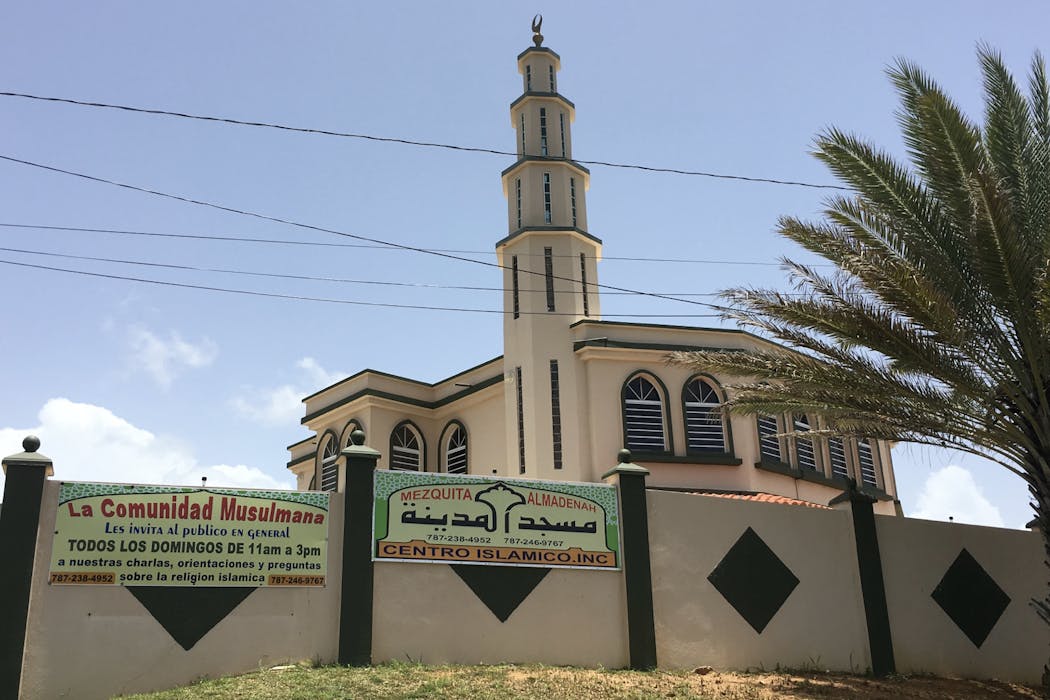
The Mezquita Al-Madinah in Hatillo, Puerto Rico, about an hour west of San Juan, is one of several mosques and Islamic centers on the island. Ken Chitwood

Bad Bunny, born Benito Antonio Martínez Ocasio, is more than a global music phenomenon; he’s a bona fide symbol of Puerto Rico.

The church choir boy turned “King of Latin Trap” has songs, style and swagger that reflect the island’s mix of pride, pain and creative resilience. His music mixes reggaetón beats with the sounds of Puerto Rican history and everyday life, where devotion and defiance often live side by side.

Bad Bunny has been called one of Puerto Rico’s “loudest and proudest voices.” Songs like “El Apagón” – “The Blackout” – celebrate joy and protest together, honoring everyday acts of resistance to colonial rule and injustice in Puerto Rican life. Others, like “NUEVAYoL,” celebrate the sounds and vibrancy of its diaspora – especially in New York City. Some songs, like “RLNDT,” mention spiritual searching – featuring allusions to his own Catholic upbringing, sacred and secular divides, New Age astrology and Spiritism.

As a scholar of religion who recently wrote a book about Puerto Rican Muslims, I find echoes of that same strength and artistry in their stories. Although marginalized among Muslims, Puerto Ricans and other U.S. citizens, they find fresh ways to express their cultural heritage and practice their faith, creating new communities and connections along the way. Similar to Bad Bunny’s music, Puerto Rican Muslims’ lives challenge how we think about race, religion and belonging in the Americas.

A man in a white costume holds his hand up to his ear, looking off stage, as dancers in white outfits move behind him and beat drums.
Bad Bunny performs during his ‘No Me Quiero Ir De Aqui’ residency on July 11, 2025, in San Juan, Puerto Rico.
Kevin Mazur/Getty Images

Stories of struggle

There are no exact numbers, but before recent crises, Puerto Rico – an archipelago of 3.2. million people – had about 3,500 to 5,000 Muslims, many of them Palestinian. Economic hardship, natural disasters such as hurricanes Irma and Maria, and government neglect have since forced many to leave, however.

As of 2017, there were also an estimated 11,000 to 15,400 Puerto Rican Muslims among the nearly 6 million Puerto Ricans and nearly 4 million Muslims in the United States.

Like any Puerto Rican, these Muslims know the struggles of colonialism’s ongoing impact, from blackouts and economic inequality to racism. For example, in the viral 23-minute video for “El Apagón,” journalist Bianca Graulau outlines how tax incentives for external investors are displacing locals – a theme reinforced in Bad Bunny’s later song, “Lo Que Le Pasó a Hawaii.”

The video for “El Apagón” includes a short documentary about gentrification on the archipelago.

Converts to Islam also face unique challenges – and not just Islamophobia. Many are told they are “not real Puerto Ricans” because of their newfound faith. Some are treated as foreigners in their own families and friend groups, often asked whether they are abandoning their culture to “become Arab.”

To be a Puerto Rican Muslim, then, is to negotiate being and belonging at numerous intersections of diversity and difference.

Still, some connect their Muslim identity to moments in Puerto Rican history. In interviews, they told me how they identify with Muslims who came with Spanish conquistadors during colonial times. Others draw inspiration from enslaved Africans brought to the Caribbean. Many of them were Muslim and resisted their condition in ways large and small: fleeing to the forest to pray, for example, or living as “maroons” – people who escaped and formed their own communities.

Many ways to be Puerto Rican

Puerto Rican culture cannot be neatly mapped onto a single tradition. The archipelago’s religion, music and art blend together influences from Indigenous Taíno, African, Spanish and American cultures. Religious processions pass by cars blasting reggaetón. Shrines to Our Lady of Divine Providence stand beside U.S. chain restaurants and murals demanding independence.

Bad Bunny embodies this fusion. He is rebellious yet rooted, irreverent yet deeply Puerto Rican. His music blends contemporary sounds from reggaetón and Latin trap with traditional “bomba y plena.” It all adds up to something distinctly “Boricua,” a term for Puerto Ricans drawn from the Indigenous Taíno name for the island, “Borikén.”

A man walks past a wall with several different political murals painted on it.
A mural in San Juan, Puerto Rico, photographed in 2017, says, ‘We don’t understand this democracy.’
Mark Ralston/AFP via Getty Images

Puerto Rican Muslims wrestle with what it means to be authentically Boricua, though. In particular, their lives reveal how religion is both a boundary and a bridge: defining belonging while creating new ways to imagine it.

Since Spanish colonization in the 1500s, most Puerto Ricans have been Roman Catholic. But over the past two centuries, many other Christian groups have arrived, including Seventh-day Adventists, Lutherans and Pentecostals. Today, more than half of Puerto Ricans identify as Catholic and about one-third as Protestant.

Alongside these traditions, Afro-Caribbean traditions such as Santería, Espiritismo and Santerismo – a mix of the two – remain active. There are also small communities of Jews, Rastafari and Muslims.

Even with this diversity, converts to Islam are sometimes accused of betraying their culture. One young man told me that when he became Muslim, his mother said he had not only betrayed Christ but also “our culture.”

Yet Puerto Rican Muslims point to Arabic influences in Spanish words. They celebrate traces of Islamic design in colonial and revival architecture that reflects Muslims’ multicentury presence in Spain, from the 700s until the fall of the last Muslim kingdom in Granada in 1492. They also cook up halal versions of classic Puerto Rican dishes.

Like Bad Bunny, these converts remix what it means to be Puerto Rican, showing how Puerto Rico’s sense of identity – or “puertorriqueñidad” – is not exclusively Christian, but complex and constantly evolving.

A man in a feather headdress blows into a large shell, standing in front of a Puerto Rican flag.
A member of the Council in Defense of the Indigenous Rights of Boriken, dressed in Taino traditional clothing, sounds a conch during a march through San Juan, Puerto Rico, on July 11, 2020.
Ricardo Arduengo/AFP via Getty Images

In solidarity

Many Puerto Rican converts frame their faith as a counternarrative, rejecting the Christianity imposed by Spanish colonizers. They also resist Islamophobia, racism and foreign domination, with some converts drawn to the religion as a way to oppose these forces. Similar to Bad Bunny’s music, which often critiques colonialism and social constraints, they push back against systems that try to define who they can be.

To that end, Puerto Rican Muslims also build connections with other groups facing injustice. In reggaetón terms, they form their own “corillos” – groups of friends – united by shared struggles.

They demonstrate on behalf of Palestinians, seeing them as another colonized people without a nation. The first Latino Muslim organization, Alianza Islámica – founded by Puerto Rican converts in 1987 – emerged out of the era’s push for minorities’ rights around the New York City metro area. And after the 2016 Pulse Nightclub shooting, where about half of the 49 victims killed were Puerto Rican, and the mosque attended by the shooter was intentionally set on fire, Boricua Muslims joined with LGBTQ+, Muslim and Latino communities to grieve and demand justice.

A man in a red shirt, standing amid a crowd, holds a sign that says, in Spanish, 'Puerto Rico with Palestine.'
Pro-Palestine supporters attend a rally to end the war on Nov. 12, 2023, in San Juan, Puerto Rico.
Miguel J. Rodríguez Carrillo/VIEWpress via Getty Images

In these ways, Puerto Rican Muslims remind me that notions of community, identity or justice do not stand on their own. For many people, they are linked – parts of the same fight for dignity and freedom.

That is why, when I listen to songs like “NUEVAYoL” or “El Apagón,” I think of the Puerto Rican Muslims I know in places such as Puerto Rico, Florida, New Jersey, Texas and New York. Their stories, like Bad Bunny’s music, show how being Puerto Rican today means constantly negotiating who you are and where you belong. And that religion, like music, can carry the sound of struggle – but also the hope of one day overcoming the injustices and inequalities of everyday life.

The Conversation

Ken Chitwood received funding from the Fritz Thyssen Foundation, the Muslim Philanthropy Initiative, and the Spalding Trust to conduct research related to this article.

ref. Bad Bunny and Puerto Rican Muslims: How both remix what it means to be Boricua – https://theconversation.com/bad-bunny-and-puerto-rican-muslims-how-both-remix-what-it-means-to-be-boricua-267164

Cyclists may be right to run stop signs and red lights. Here’s why

Source: The Conversation – Global Perspectives – By Steve Lorteau, Long-Term Appointment Law Professor, L’Université d’Ottawa/University of Ottawa

The Idaho stop does not allow cyclists to proceed through a red light if there are cars moving. (La Conversation Canada), CC BY

Interactions between different users on roads are often a source of frustration, the most prominent being those between motorists and cyclists.

For example, many motorists are frustrated when they see bicycles cross an intersection without coming to a complete stop, which drivers are required to do.

Many motorists consider this behaviour a sign of cyclists’ lack of discipline or even a double standard. In fact, cyclists don’t seem to run any real risk just slowing down at stop signs instead of making a complete stop.

By comparison, motorists risk a hefty fine for dangerous driving if they run a stop sign.

So should cyclists be required to follow the same traffic rules as motorists, or should we recognize that these rules do not always reflect the reality of cycling in a city?

As a professor of law at the University of Ottawa who specializes in urban law issues, I have studied various regulatory approaches that have been adopted around the world, each with different advantages and disadvantages.


This article is part of La Conversation’s series Our Cities: From yesterday to tomorrow. Urban life is going through many transformations, each with cultural, economic, social implications. To shed light on these diverse issues, La Conversation is inviting researchers to discuss the current state of our cities.


Strict equality between cyclists and drivers

In Québec, as in many other jurisdictions, traffic laws apply to all users, whether they are motorists or cyclists.

For example, all users must come to a complete stop at stop signs and red lights. If cyclists break these rules, they have the “same rights and duties as a driver of a vehicle,” in the words of the Supreme Court of Canada.

In other words, regardless of the differences between a car and a bicycle, the law treats them equally. Of course, this equality often remains theoretical, as the application of the rules can vary depending on context and behaviour.


À lire aussi :
À Montréal, même en doublant les pistes cyclables, les voitures conserveraient 90 % de la chaussée


Deceptive equality

The uniform application of traffic rules may seem fair, but in reality, it can create a false sense of equality.

On the one hand, the risks associated with different modes of transport are incommensurate. A car that runs a red light can cause serious or even fatal injuries. A cyclist, on the other hand, is unlikely to cause the same degree of damage.

An election poster along a cycling path
The issue of bike paths is at the heart of the election campaign in Montréal.
(The Conversation Canada), CC BY

Furthermore, the efficiency of cycling depends on maintaining speed. Having to stop completely over and over discourages people from cycling, despite its many benefits for health, the environment and traffic flow.

Treating two such different modes of transport the same way, therefore, amounts to implicitly favouring cars, something akin to imposing the same speed limit on pedestrians and trucks.

The Idaho stop rule

Rather than treating bicycles and cars as equals, some jurisdictions have opted for a different approach. The state of Idaho is one good example.

Since 1982, cyclists in Idaho have been able to treat a stop sign as a yield sign and a red light as a stop sign. Several American states (such as Arkansas, Colorado, and Oregon) and countries, such as France and Belgium, have adopted similar regulations.

In Canada and Québec, discussions are underway to adopt such regulations.


À lire aussi :
Moins de cyclistes… ou répartis autrement ? Le Réseau Express Vélo (REV) à l’épreuve des données


It’s important to note that the goal of the Idaho stop rule is not to legalize chaos on the roads. Cyclists must still yield to cars ahead of them at stop signs, as well as to pedestrians at all times, and may only enter the intersection when it is clear.

The Idaho stop has three main advantages.

First, the rule recognizes that the dynamics of cycling are fundamentally different than those of driving, and therefore cannot be treated equally.

Second, the Idaho stop rule takes the burden of issuing fines off the courts and police.

Third, the efficiency of cycling depends on maintaining momentum. Coming to a complete stop over and over again discourages cycling, despite its many benefits for health, the environment and traffic flow.

The effects of the reform

Faced with these two very different approaches for bicycles, one may wonder which is the most appropriate.

Several empirical studies show that adopting the Idaho stop rule does not lead to an increase in road collisions.

Some studies even suggest a modest decrease in collisions with the Idaho stop regulation. This is because cyclists clear intersections more quickly, reducing their exposure to cars. In addition, motorists become more attentive to cyclists’ movements.

In fact, the majority of road users, both motorists and cyclists, often do not strictly obey stop signs. According to a study conducted by the Société de l’assurance automobile du Québec (SAAQ), only 35 per cent of motorists stop correctly. Also according to the SAAQ, only 27 per cent of cyclists report coming to a complete stop at mandatory stop signs.

In short, adopting the Idaho stop rule would not create chaos, but would regulate an already common practice without compromising public safety, contrary to some concerns. Cyclists who rarely come to a complete stop when there is no traffic generally slow down before crossing because they are aware of their vulnerability.

A cultural shift

Furthermore, the question of introducing the Idaho stop rule in Québec invites broader reflection.

For decades, our laws and road infrastructure have been designed primarily for cars. Many motorists still consider cyclists to be dangerous and engage in reckless behaviour.


À lire aussi :
À Montréal, même en doublant les pistes cyclables, les voitures conserveraient 90 % de la chaussée


However, it’s important to remember that cars are the main structural hazard on our roads and that cyclists are in fact vulnerable. This structural danger has increased with the growth of sports utility vehicles (SUVs) and pick-up trucks, which increases the risks for pedestrians and cyclists.

Adopting the Idaho stop rule would not give cyclists a free pass, but it would recognize their realities and legitimize cycling as a mode of transport, with traffic regulations adapted to its risks and benefits. This modest but symbolic reform could be part of a broader set of changes that would offer citizens true freedom and safety when travelling.

La Conversation Canada

Steve Lorteau has received funding from the Social Sciences and Humanities Research Council, the Canadian Bar Association, and the Canadian Institutes of Health Research.

ref. Cyclists may be right to run stop signs and red lights. Here’s why – https://theconversation.com/cyclists-may-be-right-to-run-stop-signs-and-red-lights-heres-why-268724

After 2 years of devastating war, will Arab countries now turn their backs on Israel?

Source: The Conversation – Global Perspectives – By Michelle Burgis-Kasthala, Professor of International Law, La Trobe University

The Middle East has long been riddled by instability. This makes getting a sense of the broader, long-term trends in the aftermath of the Gaza war particularly challenging.

The significance of Trump’s 20-point peace deal that has (hopefully) brought an end to the Gaza war cannot be overstated.

However, this deal – and what comes next – will not change the Middle East. Rather, the wars of the past two years merely consolidated trends that were already under way. They didn’t serve as a radical break from the past.

The impact of October 7 on the region

Before October 2023, Israel’s place in the region seemed to be improving, despite the formidable “axis of resistance” Iran and its allies had built to counter it.

On top of its earlier peace agreements with Egypt in 1979 and Jordan in 1994, Israel had normalised relations with the United Arab Emirates (UAE), Bahrain, Morocco and Sudan under the Abraham Accords. It looked set to normalise relations with Saudi Arabia, too.

However, once Iran and Saudi Arabia reached a detente in their long-simmering rivalry in March 2023, the urgency of closer ties with Israel faded.

Then came October 7. One of Hamas’ apparent aims in launching the attack was to refocus the region’s attention on Palestinian liberation.

At the beginning, it looked like Hamas had partially succeeded. Among Arab states, only the UAE and Bahrain condemned the attack.

The remainder of the region either chose to join the fight against Israel (Iran, the Houthis in Yemen, Hezbollah in Lebanon) or maintain a duplicitous dance in between – not making the US angry by speaking out too forcefully against Israel, while placating (or repressing) their angry pro-Palestinian citizens at home.

Two years later, the “resistance” camp led by Iran and its proxies has been significantly weakened – an undeniable victory for Israel.

And while Arab popular opinion still largely supports armed Palestinian resistance to Israel, regional leaders do not. In a significant step in August, the Arab League officially condemned Hamas’ October 7 attacks and called for its disarmament.

Why Arab states are now backing Trump’s plan

Historically, even when the Palestinians have seemed at their weakest, they have had an outsize effect on the stability and legitimacy of Arab regimes in the Middle East.

A case in point is the wave of coups in the region that followed the Nakba in 1948, when around 750,000 Palestinians were either expelled or forced to flee during the war that created the state of Israel.

Today’s peace deal is no different. Israel’s neighbours are backing Trump’s 20-point plan because they have learned from history – rather than out of any sense of moral obligation.

For these states, the plan is not perfect. In fact, it makes a mockery of more robust peace proposals from the past, such as the 2002 Saudi-led Arab Peace Initiative to end the Palestinian-Israeli conflict.

Though Trump’s plan recognises the continued Palestinian presence in Gaza, it denies them political agency or accountability for alleged Israeli crimes. The plan only pays lip-service to the idea of a two-state solution. And given the facts on the ground and the prevailing political sensibilities in the US and Israel, Palestinian statehood seems highly unlikely.

Yet, regional states are aware that ongoing conflict is in no one’s interests, save for the Israeli far right.

Trump’s plan therefore represents a fig leaf for a region desperate to be seen to be ameliorating Palestinian suffering, while ensuring more robust US support. Such a concern became existential for the Gulf countries in the wake of Israel’s attacks on Hamas’ leadership in Qatar in September.

What comes next?

If the ceasefire holds and the peace plan proceeds, Trump sees an expanded Abraham Accords in the future, with other states lining up to normalise diplomatic relations with Israel (including possibly Saudi Arabia).

But other deals may get under way first. Israel and the United States are moving ahead with a series of initiatives. These include the India-Middle-East-Europe Economic Corridor (IMEC) (a rail-sea link to transport goods between India, the UAE, Saudi Arabia, Israel and Europe), and the Abraham shield plan (a proposed security and infrastructure partnership between the Gulf countries, Saudi Arabia, Egypt, Jordan and Israel).

Currently, it is unclear which land routes will be preferred for linking India and China with Europe. The Gulf states are prioritising Israel, while Turkey is positioning itself as an alternative northern route that extends China’s Belt and Road rail and road projects through Central Asia.

As the US has strengthened its military ties with Qatar, the UAE, Bahrain and Saudi Arabia, this will probably tilt the balance in favour of Israel and the Gulf countries, in spite of Turkey’s regional importance and NATO membership.

Given the huge public and private sums and geostrategic stakes involved, this is really where the region’s focus lies now.

So, even if the ceasefire falters and popular anger around the region intensifies, most Arab leaders will continue to expand and embrace Israeli cooperation.

The Conversation

Michelle Burgis-Kasthala has received funding from the Australian Research Council.

ref. After 2 years of devastating war, will Arab countries now turn their backs on Israel? – https://theconversation.com/after-2-years-of-devastating-war-will-arab-countries-now-turn-their-backs-on-israel-267869

Democratic election wins send Trump – and Republicans – a message: Americans blame them for government shutdown

Source: The Conversation – Global Perspectives – By Bruce Wolpe, Non-resident Senior Fellow, United States Study Centre, University of Sydney

One year and a day after Donald Trump won a second term as president – and on the 35th day of the US government shutdown, which has tied a record for the longest in history – the Democrats swept to victory in key races across the county.

Democratic candidates won the governorships in the states of Virginia and New Jersey, while Zohran Mamdani became New York City’s next mayor.

The Democrats may have just become the winners of the fight to reopen the government, too.

Trump’s ratings dropping sharply

Sixteen years ago, then-President Barack Obama was staggered by Republicans winning the governorships in Virginia and New Jersey in the 2009 elections.

The message was indelible: voters wanted to put a check on Obama and his wide-ranging agenda, from health care to global warming. Many Americans wanted him to cool his jets, including on what would become his signature achievement, Obamacare.

The following year, in the 2010 midterm elections, the Democrats lost more than 60 seats and their majority in the House. For the next six years, Republicans had a veto over whatever bills Obama wanted Congress to enact.

With Democrats now winning the governorships in those two states, Trump and his Republican allies in Congress have just been sent the same message: you need to be checked, too.

Going into Tuesday’s elections, Trump’s approval rating in one major poll was just above 40%, and his disapproval rating just under 60% – the highest it’s been since the January 6 2021 attack on the Capitol.

Independent voters, who swung Trump’s way in last year’s election, are now disapproving of his performance by a 69–30% margin.

Trump’s leadership of what he calls the “hottest country in the world” is falling short in voters’ eyes on a number of key issues: inflation, management of the economy, tariffs, crime, immigration, Ukraine and Gaza.

What’s at the heart of the continued stalemate?

The US government has also been shuttered since October 1. Government agencies have been closed to the public, and hundreds of thousands of government employees are going without paychecks, while thousands of others have been laid off.

Millions of Americans have been affected by flight delays or cancellations due to air traffic controller staffing issues. And food stamps to 42 million Americans have been suspended, with the Trump administration only relenting to provide partial payments in response to a court order.

Closing the government was not solely the doing of Trump and the Republicans in Congress. After nearly a year of laying prostrate and appearing pathetically ineffective in responding to Trump and his agenda, the Democrats finally got off the mat to fight back.

Of all the issues with Trump’s so-called “One Big Beautiful Bill” – which contained huge tax cuts for the wealthy and corporations, huge spending cuts for Medicaid, huge increases in spending to control immigration, more funding for fossil fuels and an increase in the debt ceiling – Democrats seized on one glaring omission from the legislation.

At the end of this year, subsidies are due to expire that more than 24 million Americans rely on to purchase health insurance under Obamacare. As a result, millions are projected to lose their health care coverage.

That is the cross Democrats chose to die on. They’ve told the Trump administration: you want to keep the government open? Keep the insurance subsidies flowing. Fix it now.

Republicans in Congress have had no interest in caving to Democratic demands. They’ve argued Democrats must agree to reopen the government before discussing the subsidies. Their calculation: voters will turn on the Democrats for the turmoil caused by the shutdown.

Trump wanted nothing to do with any such negotiations either. Two days before the elections, he said he “won’t be extorted”.

But a recent poll shows 52% of Americans blame Trump and the Republicans for the shutdown, compared to 42% who blame Democrats.

The wins in Virginia and New Jersey drove this message home. Yes, the Democrats triggered the current shutdown. But the president owns the economy. For better or worse, Trump will own the economy going into next year’s midterm elections, too.

What happens next?

How can the Democrats get out of the shutdown box with a win? With the leverage they just gained in the elections. Republican stonewalling after these election defeats will hurt them even more.

There are two routes forward.

First, Democrats could reach an agreement with the Republicans on a fix to the health insurance issue, with a vote in Congress by Christmas to get the subsidies restored. A bipartisan compromise appears now to be in the works.

Second, if such an agreement cannot be reached, the Democrats can introduce a bill to restore the subsidies on their own, with an up-or-down vote in both the House and Senate. If this was voted down, the Democrats would then have a winning issue to take to the midterm elections next November. The voters would know who to blame – and who to reward.

House Speaker Mike Johnson has prevented the House from meeting for more than six weeks, but it has to come back in session to vote to reopen the government at some point.

Trump is also insisting the Senate change its rules to allow a simple majority to be able to reopen the government – without any compromises on health insurance subsidies. But this is not a viable political option after these election results.

Two other Democrats take centre stage

There were two other big Democratic winners on Tuesday. California voters approved a redistricting plan intended to partially offset Republicans’ gerrymandering of congressional electorates across the country for the midterm elections.

It was a high-risk strategy by California Governor Gavin Newsom, and it paid off handsomely: Newsom is now considered the frontrunner for the Democratic presidential nomination in 2028.

And Mamdani, a Muslim socialist, was elected the Democratic mayor of New York City. Trump will no doubt continue to rubbish him as a communist radical extremist and follow through on his threats to cut federal funding for the largest city in the US.

Mamdani’s victory also places him on the national stage, but not centre stage. The Sinatra doctrine from his hit song New York, New York — “If I can make it there, I’ll make it anywhere” — does not quite apply in this situation.

To take back Congress next year and the White House in 2028, the Democrats will need all kinds of flowers to bloom — not just Mamdani’s bouquet. In 2028, the party is going to have to shop in a bigger greenhouse.

The Conversation

Bruce Wolpe has served on the staffs of Democrats in Congress and former Australian Prime Minister Julia Gillard.

ref. Democratic election wins send Trump – and Republicans – a message: Americans blame them for government shutdown – https://theconversation.com/democratic-election-wins-send-trump-and-republicans-a-message-americans-blame-them-for-government-shutdown-269094

China’s new 5-year plan: A high-stakes bet on self-reliance that won’t fix an unbalanced economy

Source: The Conversation – Global Perspectives – By Shaoyu Yuan, Adjunct Professor, New York University; Rutgers University

Every few years since 1953, the Chinese government has unveiled a new master strategy for its economy: the all-important five-year plan.

For the most part, these blueprints have been geared at spurring growth and unity as the nation transformed from a rural, agrarian economy to an urbanized, developed powerhouse.

The task that faced China’s leaders as they met in early October 2025 to map out their 15th such plan was, however, complicated by two main factors: sluggish domestic growth and intensifying geopolitical rivalry.

Their solution? More of the same. In pledging to deliver “high-quality development” through technological self-reliance, industrial modernization and expanded domestic demand, Beijing is doubling down on a state-led model that has powered its rise in recent years. President Xi Jinping and others who ironed out the 2026-2030 plan are betting that innovation-driven industrial growth might secure China’s future, even as questions loom about underpowered consumer spending and mounting economic risks.

As an expert on China’s political economy, I view China’s new five-year plan as being as much about power as it is about economics. Indeed, it is primarily a blueprint for navigating a new era of competition. As such, it risks failing to address the widening gap between surging industrial capacity and tepid domestic demand.

High-tech dreams

At the heart of the new plan are recommendations that put advanced manufacturing and tech innovation front and center. In practice, this means upgrading old-line factories, automating and “greening” heavy industry and fostering “emerging and future industries” such as aerospace, renewable energy and quantum computing.

By moving the economy up the value chain, Beijing hopes to escape the middle-income trap and cement its status as a self-reliant tech superpower.

To insulate China from export controls put in place by other countries to slow China’s ascent, Beijing is doubling down on efforts to “indigenize” critical technologies by pumping money into domestic companies while reducing dependence on foreign suppliers.

This quest for self-reliance is not just about economics but explicitly tied to national security.

Under Xi, China has aggressively pursued what the Chinese Communist Party calls “military-civil fusion” – that is, the integration of civilian innovation with military needs.

The new five-year plan is poised to institutionalize this fusion as the primary mechanism for defense modernization, ensuring that any breakthroughs in civilian artificial intelligence or supercomputing automatically benefit the People’s Liberation Army.

Reshaping global trade

China’s state-led push in high-tech industries is already yielding dividends that the new five-year plan seeks to extend. In the past decade, China has surged to global leadership in green technologies such as solar panels, batteries and electric vehicles thanks to hefty government support. Now, Beijing intends to replicate that success in semiconductors, advanced machinery, biotechnology and quantum computing.

Such ambition, if realized, could reshape global supply chains and standards.

But it also raises the stakes in China’s economic rivalry with advanced economies. Chinese prowess in building entire supply chains has spurred the United States and Europe to talk of reindustrialization to avoid any overreliance on Beijing.

By pledging to build “a modern industrial system with advanced manufacturing as the backbone” and to accelerate “high-level scientific and technological self-reliance,” the new plan telegraphs that China will not back down from its bid for tech dominance.

An elusive rebalancing

What the plan gives comparatively modest attention, however, is the lack of strong domestic demand.

Boosting consumer spending and livelihoods gets little more than lip service in the communiqué that followed the plenum at which the five-year plan was mapped out.

Chinese leaders did promise efforts to “vigorously boost consumption” and build a “strong domestic market,” alongside improvements to education, health care and social security. But these goals were listed only after the calls for industrial upgrading and tech self-sufficiency – suggesting old priorities still prevail.

And this will disappoint economists who have long urged Beijing to shift from an overt, export-led model and toward a growth model driven more by household consumption.

Men and women look at boxed goods in a store.
Consumer spending in China remains a little soft.
Yang He/VCG via Getty Images

Household consumption still accounts for only about 40% of gross domestic product, far below advanced-economy norms. The reality is that Chinese households are still reeling from a series of recent economic blows: the COVID-19 lockdowns that shattered consumer confidence, a property market collapse that wiped out trillions in wealth, and rising youth unemployment that hit a record high before officials halted the publication of that data.

With local governments mired in debt and facing fiscal strain, there is skepticism that bold social spending or pro-consumption reforms will materialize anytime soon.

With Beijing reinforcing manufacturing even as domestic demand stays weak, the likelihood is extra output will be pushed abroad – especially when it comes to EVs, batteries and solar technologies – rather than be absorbed at home.

The new plan is cognizant of the need to maintain a strong manufacturing base, particularly among beleaguered industrial farms and other older industries struggling to stay afloat. As such, this approach may prevent painful downsizing in the short run, but it delays the rebalancing toward services and consumption that many economists argue China needs.

Ripple effects

Beijing has traditionally portrayed its five-year plans as a boon not only for China but for the world. The official narrative, echoed by state media, emphasizes that a stable, growing China remains an “engine” of global growth and a “stabilizer” amid worldwide uncertainty.

Notably, the new plan calls for “high-level opening-up,” aligning with international trade rules, expanding free-trade zones and encouraging inbound investment – even as it pursues self-reliance.

Yet China’s drive to climb the technological ladder and support its industries will likely intensify competition in global markets – potentially at the expense of other countries’ manufacturers. In recent years, China’s exports have surged to record levels. This flood of cheap Chinese goods has squeezed manufacturers among trading partners from Mexico to Europe, which have begun contemplating protective measures. If Beijing now doubles down on subsidizing both cutting-edge and traditional industries, the result could be an even greater glut of Chinese products globally, exacerbating trade frictions.

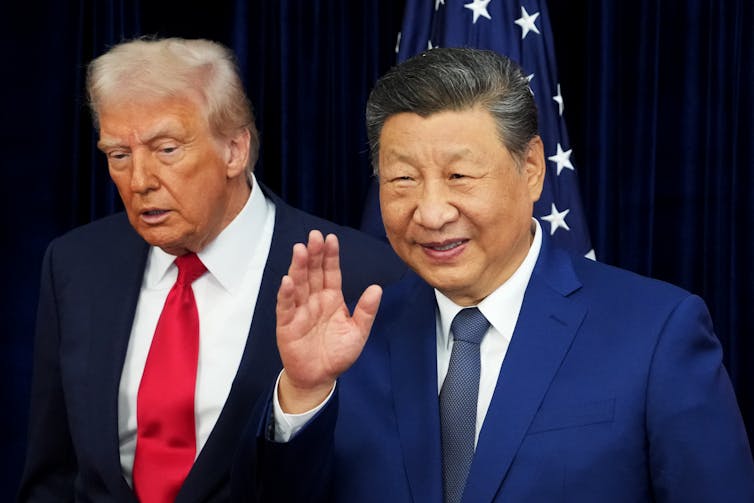
Two men in suits walk toward the camera, one waving.
U.S. President Donald Trump and Chinese President Xi Jinping meet at Gimhae Air Base on Oct. 30, 2025, in Busan, South Korea.
Andrew Harnik/Getty Images

In other words, the world may feel more of China’s industrial might but not enough of its buying power – a combination that could strain international economic relations.

A high-stakes bet on the future

With China’s 15th five-year plan, Xi Jinping is making a strategic bet on his long-term vision. There is no doubt that the plan is ambitious and comprehensive. And if successful, it could guide China to technological heights and bolster its claim to great-power status.

But the plan also reveals Beijing’s reluctance to depart from a formula that has yielded growth at the cost of imbalances that have hurt many households across the vast country.

Rather than fundamentally shift course, China is trying to have it all ways: pursuing self-reliance and global integration, professing openness while fortifying itself, and promising prosperity for the people while pouring resources into industry and defense.

But Chinese citizens, whose welfare is ostensibly the plan’s focus, will ultimately judge its success by whether their incomes rise and lives improve by 2030. And that bet faces long odds.

The Conversation

Shaoyu Yuan does not work for, consult, own shares in or receive funding from any company or organization that would benefit from this article, and has disclosed no relevant affiliations beyond their academic appointment.

ref. China’s new 5-year plan: A high-stakes bet on self-reliance that won’t fix an unbalanced economy – https://theconversation.com/chinas-new-5-year-plan-a-high-stakes-bet-on-self-reliance-that-wont-fix-an-unbalanced-economy-268699

Is there a Christian genocide in Nigeria? Evidence shows all faiths are under attack by terrorists

Source: The Conversation – Africa (2) – By Olayinka Ajala, Associate professor in Politics and International Relations, Leeds Beckett University

Terrorism and insurgency have ravaged parts of Nigeria since 2009, especially in the northern regions. Tens of thousands of Nigerians have been killed and millions have been displaced by the violence. Nigeria was ranked sixth in the 2025 Global Terrorism Index, with a score of 7.658, moving up from eighth place in 2023 and 2024.

US president Donald Trump declared Nigeria a “country of particular concern” in November 2025.

This was the result of a campaign by US congressman Riley Moore, who alleged that there was an “alarming and ongoing persecution of Christians” in the west African country. The congressman stated that 7,000 Nigerian Christians had been killed in 2025 alone, an average of 35 a day.

Trump also threatened to take direct military action against Islamist militant groups operating in Nigeria.

In response, Nigeria’s President Bola Tinubu objected, stating that the US characterisation of Nigeria did not reflect the country’s reality or values. He said successive governments had made efforts to uphold peaceful existence among diverse faith communities.

I have been researching conflicts, terrorism and the formation of insurgent groups in Nigeria for over a decade.

To understand the degree and intensity of terrorist and insurgency activities in Nigeria in the last 10 years, I analysed data from Armed Conflict Location and Event Data (ACLED), an independent violence monitor.

The analysis shows it is difficult, if not impossible, to delineate the killings based on religious affiliations. All the religions in the country have been affected, and there have been fatalities across several ethnic and religious lines.

Is there a religious genocide in Nigeria?

Religious violence started in Nigeria in 1953, seven years before the country gained independence.

Successive military and civilian regimes have since struggled to curtail the string of religious violence, which is often linked to issues such as ethnicity, resource management, competition for resources and colonial boundaries. (British colonialists placed different ethnic groups with sometimes different values in one country.)

Figure 1 shows that while the number of attacks carried out by terrorist and insurgent groups have been roughly similar in the last four years, the number of fatalities has declined.

This chart does not explain the categories of people attacked. To understand whether there is a disproportionate attack on Christians, I compared the number of attacks on churches and mosques in Nigeria in the last 10 years.

The data shows that non-state actors have attacked both churches and mosques in Nigeria. While there have been more attacks on churches in the last six years, the data reveals that there were more attacks on mosques in 2015 and 2017.

Generally, Nigeria’s population is considered to be roughly evenly split between the two religions, with only around 0.6% adhering to traditional African religions or other beliefs.

Although it is difficult to extract the number of fatalities in these cases, the number of attacks on places of worship is an indication that both Christians and Muslims are under attack by terrorist and insurgent groups in Nigeria.

Trump’s history with Nigeria

This is the second time Trump has designated Nigeria as a country of particular concern. The first time was in December 2020, when he stated that the government of Nigeria was not doing enough to protect the safety of Nigerians, especially Christians. This was under the regime of former president Muhammadu Buhari.

Events leading to the designation of Nigeria as a country of particular concern this time started in March 2025, two months after Trump was sworn in for a second term. The US House foreign affairs sub-committee on Africa approved measures urging the president to impose sanctions on Nigeria due to the widespread persecution of Christians.

In addition, the US Commission on International Religious Freedom report on Nigeria (2025) argued that religious freedom in Nigeria remains poor. It said the federal and state governments in Nigeria continue to “tolerate attacks or failed to respond to violent actions” by non-state actors on Christians in the country.

The commission recommended that the US government designate Nigeria as a country of particular concern for “engaging in and tolerating systematic, ongoing, and egregious violations of religious freedom, as defined by the International Religious Freedom Act”.

What the designation means for Nigeria

The “country of particular concern” status is an official classification under the US International Religious Freedom Act of 1998. The act requires the president of the US to declare this status where the government of a country has “engaged in or tolerated particularly severe violations of religious freedom”.

Such violations include arbitrary execution based on faith, torture or inhuman treatment based on religion as well as other denials of the rights to life, liberty, or security because of a person’s religion.

In the case of Nigeria, there is no evidence that any of these acts have been carried out by the government.

The designation of a country as country of particular concern requires the US government to consider a range of options for ending the violations identified. The first steps include diplomatic or direct engagement, public condemnation or withdrawal of assistance. This could be followed by further actions such as economic sanctions and withdrawal of aid or other forms of economic assistance.

The US government, rather than engaging in diplomatic or direct engagement with the Nigerian government as a first step, has already threatened sanctions such as the withdrawal of aid and direct military action.

What should the US do to support Nigeria?

To assist the country in its fight against terrorism, the US needs to reconsider the classification of Nigeria and revert to the first step identified earlier: diplomacy and direct engagement.

Second, the US should support Nigeria’s effort to identify the sponsors of these groups and their sources of finance within and outside the country.

Third, there is a need for a regional and international approach to curb the menace of terrorism in Nigeria and the west African and Sahel region. The US could play a significant role in supporting organisations such as the Multi-National Joint Task Force which was set up to fight terrorism in the region.

The Conversation

Olayinka Ajala does not work for, consult, own shares in or receive funding from any company or organisation that would benefit from this article, and has disclosed no relevant affiliations beyond their academic appointment.

ref. Is there a Christian genocide in Nigeria? Evidence shows all faiths are under attack by terrorists – https://theconversation.com/is-there-a-christian-genocide-in-nigeria-evidence-shows-all-faiths-are-under-attack-by-terrorists-268929

Can South Africa’s social grants help people make a better life? Research offers hope

Source: The Conversation – Africa (2) – By Leila Patel, Professor of Social Development Studies, University of Johannesburg

There is now a growing global consensus that additional measures are needed to support the agency of social protection beneficiaries. Such support will strengthen their self-sustaining livelihoods and pathways that would accelerate social and economic improvements and participation in the labour market, and promote wider social and political stability.

For instance, emerging evidence from 104 programmes around the world has found a net gain of US$4-$5 when cash and livelihood support are provided. Cash plus labour activation programmes for youth that are designed to address barriers to economic inclusion were effective human capital investments, leading to improved outcomes.

South Africa, which has one of the largest cash transfer programmes, is reviewing its social protection system. At issue is what complementary cash plus employment and livelihoods interventions government needs to consider if it is to introduce some kind of basic income support grant.

Calls for such a grant in South Africa have gained momentum since the government introduced the COVID-19 social relief distress grant in May 2020. It now stands at R370 (about US$21) a person a month, reaching over 8 million recipients.

These issues were discussed at a recent two-day policy colloquium on the future of social protection and its potential to promote economic inclusion hosted by South Africa’s Department of Social Development and the Presidency. South Africa will also draw from lessons learnt from the Second World Summit for Social Development in Doha. Lessons learnt will be shared from countries such as Brazil, Indonesia and Ghana. These countries are attempting to integrate or craft economic and social inclusion policies onto existing cash transfer programmes.

The exponential growth in social assistance, especially cash transfers, has helped to alleviate extreme poverty globally. Over the last decade alone, the cash transfers have reduced poverty by 11% on average and extreme poverty by 37% in low- and middle-income countries.

The University of Johannesburg’s Centre for Social Development in Africa has done extensive research in this area over almost two decades.

The centre’s research findings are that social grant beneficiaries in South Africa are pointing the way. Beneficiaries already use grants to improve livelihood outcomes. There is much to learn from how grant beneficiaries are using their agency to improve income and meet consumption needs.

Reimagining social grants

Here I share stories drawn from our research on grants, livelihoods, employment and services over the years. All names are anonymised.

Nandi was 23 years old when our colleague, the late Tessa Hochfeld, interviewed her in 2018. She left school at the end of grade 9. She had three children; one died of pneumonia at 20 days of age.

She is one of four out of 10 primary caregivers who receive the child support grant nationally – now a basic R560 (US$32) a month – who did not pursue any livelihood activity. Livelihood activity is anything that a person does to make a living to meet their basic needs.

Nandi was unemployed and likely to face long term unemployment. Her children are part of the country’s largest cash transfer programme. It is one of the 10th largest in the world, reaching 82% of poor children.

Nandi’s story is similar to that of other young women who are beneficiaries of the child grant. It tells of the complexity of human needs, risks and vulnerabilities that young women face, which is carefully documented in Hochfeld’s book.

Supplementing incomes

Only a quarter of all grant beneficiaries were engaged in informal work in 2021.

They said they were variously motivated to engage in complementary livelihood activities by a desire for self-efficacy, and a strong desire to work rather than sit at home.

They engaged in informal, micro-livelihood activities on the streets as well as in their homes and backyards. These included buying and selling goods, supplying goods, building, repairs, photography and running restaurants or taverns. They also engaged in renting out accommodation, traditional healing, fahfee betting, recycling, farming, community gardening, beadwork, sewing and shoe making.

They received very little support from the government. Some received support from an NGO. Another received one-off technical support from the Department of Agriculture and Land Affairs. The majority turned to their families for support, or to informal borrowing, and used grant money to start their businesses.

Luthando is a 41-year-old ex-offender who wanted to reintegrate into the community. His girlfriend challenged him to earn an honest living instead of robbing other people.

She gave him R150 (about US$8.66) out of his son’s R560 ($32.33) child support grant to buy goods for resale. He borrowed another R300 (about $17.32) from a mashonisa (money lender). He now runs a micro business. He said proudly, displaying his wares:

I can say that everything you see on this table today started with R450 (about $30).

Sthandiso used part of the child support grant for his two sons to become a photographer and a videographer. Two other child support grant recipients pooled their money to buy chickens, pluck them and sell them on grant days. “This way we doubled our money.”

But they faced many obstacles such as a lack of jobs, safety issues, childcare, high transport costs, lack of access to capital and credit, lack of experience, knowledge and information as well as skills in financial literacy, mentorship and coaching.

Sphamandla’s story tells of how his life changed:

I have not yet reached financial independence because I have not gotten to where I want. Having money to feed my family and do some little things is different from being financially independent … It is true that I no longer borrow or depend on anybody to feed my family, but I still have the problem of not having money to buy a house and do other things that I need. But I am hopeful that slowly I will get there through these things I am doing for money. That is why we save money little by little every month.

Looking forward

These stories dispel myths that grants create dependency on government. They do not idolise the grant beneficiaries but open the door to thinking differently about how to support the agency of the millions of men and women who rely on social grants by building their livelihood capabilities.

The stories of the recipients show that there is scope for exploring new areas of employment growth and support for informal workers. A thorny issue is whether there should be behavioural conditions attached to a redesigned Social Relief of Distress grant that would compel recipients to pursue employment and livelihoods.

Given South Africa’s huge unemployment rate, this is not an option. Supporting beneficiary choice and aligning hard and soft incentives could go a long way to supporting human capabilities of people that have been left behind, in promoting social and labour market inclusion and inclusive growth.

One way to do this is to grow and strengthen grant beneficiaries’ participation in the informal economy, which could be an important driver of employment in the country.

The Conversation

Leila Patel received funding from the National Research Foundation and the Department of Science, Technology and Innovation. She is a collaborating partner with the Interim Chair for Welfare and Social Development, Centre for Social Development in Africa, University of Johannesburg.

ref. Can South Africa’s social grants help people make a better life? Research offers hope – https://theconversation.com/can-south-africas-social-grants-help-people-make-a-better-life-research-offers-hope-268994

Les Mondes du Nord, au cœur de l’histoire européenne

Source: The Conversation – in French – By Vivien Barrière, Maître de conférences en histoire ancienne et archéologie, CY Cergy Paris Université

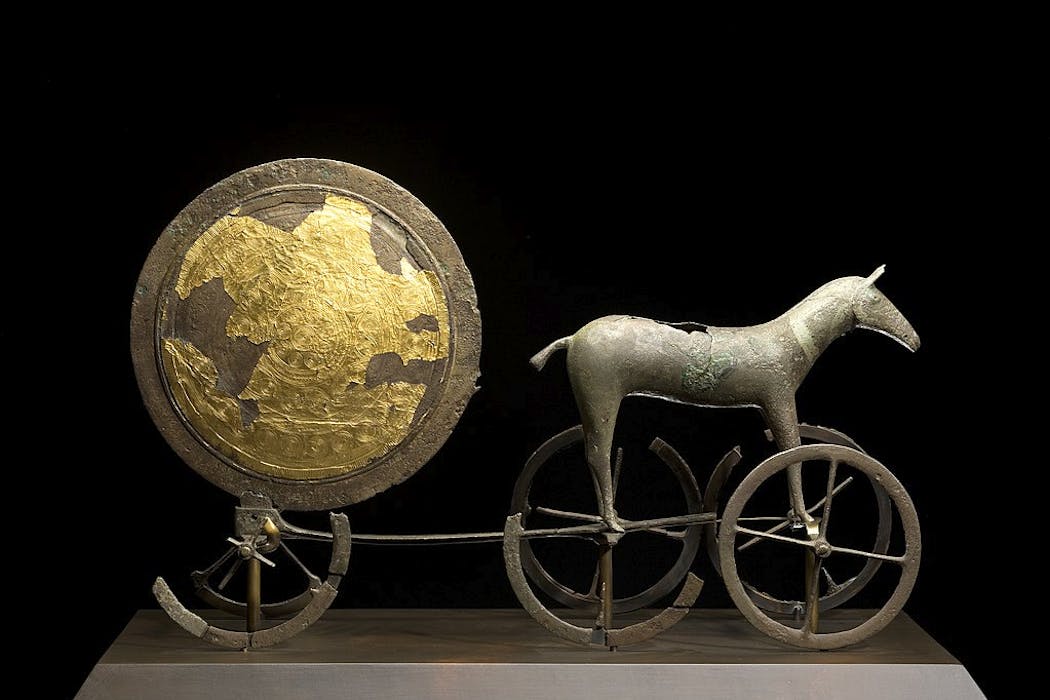
Le char solaire de Trundholm (Danemark) mis au jour en Zélande du Nord en 1902. La face dorée (d’un diamètre de 25cm) symbolise le soleil tandis que le revers évoque la nuit. Il est daté d’environ 1400 avant notre ère. Bronze et or, 60cm de long.
Musée National du Danemark, Copenhague, CC BY-SA

Alors que l’Europe s’est longtemps pensée depuis la lumière méditerranéenne, foyer auto-proclamé de la démocratie et de la civilisation, le Nord est resté dans l’ombre, relégué aux marges du récit historique. Dans leur imposante somme Les Mondes du Nord : De la Préhistoire à l’âge viking, qui vient de paraître aux éditions Tallandier, les historiens Vivien Barrière, Stéphane Coviaux, Alban Gautier et Anne Lehoërff prennent cette vision à contre-pied et nous proposent une enquête sans précédent au-delà du 50e parallèle. En plaçant les peuples et les terres nordiques au centre de leur analyse, ils braquent toute la lumière sur la riche histoire du Nord jusqu’à la fin du premier millénaire.


Aux environs de l’an mille, l’abbé anglo-saxon Ælfric d’Eynsham écrit ces mots à propos de son pays, l’île de Grande-Bretagne :

« Cette terre n’est pas aussi forte en vigueur ici, sur le bord extérieur de l’étendue de la terre, qu’elle ne l’est au milieu, dans des terres fortes en vigueur. »

La formule, frappante, interroge. Pourquoi donc un Anglais du début du XIe siècle aurait-il l’impression de vivre « au bord du monde » ? Pourquoi regarde-t-il son île comme reléguée à l’extrémité d’un univers habité dont le centre est bien plus au sud, sur les rives de la Méditerranée ? Et pourquoi le fait d’habiter une terre aussi excentrée et septentrionale serait-il un signe de faiblesse, voire d’infériorité ? Serait-ce l’expression d’une vision du monde propre à Ælfric ?

Assurément non.

Un siècle et demi plus tard, l’auteur de la Passion de saint Olaf, sans doute l’archevêque de Nidaros, Eystein Erlendsson, évoque, en un prélude inspiré, l’histoire de la Norvège, « cette très vaste contrée située au nord, bordée au sud par la Dacie », dont les habitants, longtemps asservis par l’aquilon – autrement dit le paganisme –, venaient d’en être libérés par « le doux vent du sud » que Dieu avait fait souffler en ces contrées lointaines.

Cette façon de se représenter le monde a en réalité une longue histoire. Portée par des géographes grecs, romains, arabes ou européens, reprise avec le développement des études historiques au XIXe siècle, elle fait de la Méditerranée la matrice de toute civilisation, le cœur, l’omphalos, une sorte de repère à partir duquel s’est construit un récit reléguant toutes les régions avoisinantes au rang de marges. À regarder l’Europe à travers une carte où le Nord magnétique est conventionnellement en haut et la Méditerranée « au milieu », l’esprit finit par intégrer que c’est sous cet angle que l’histoire doit être pensée.

Les Nords aux marges d’une histoire européenne centrée sur la Méditerranée

Dès lors, les Nords européens, plus pauvres et moins peuplés, apparaissent seconds, voire arriérés face au cœur méditerranéen des civilisations. La puissance de cette représentation est telle qu’un Anglais comme Ælfric ou qu’un Norvégien comme Eystein l’ont intériorisée ; et ce n’est que tardivement, avec la Réforme, la révolution industrielle et surtout l’éclatante prospérité des pays nordiques contemporains, que cette relégation s’est peu à peu renversée, faisant du Nord une direction dotée de connotations positives et des terres septentrionales des régions porteuses de progrès, motrices dans l’histoire humaine.

Par conséquent, écrire l’histoire de l’Europe, singulièrement dans ses périodes anciennes, a très souvent consisté à reproduire la marginalisation du Nord en mettant les sociétés méridionales au cœur du récit et des analyses. Tout au plus faisait-il irruption, de temps en temps, sous forme de bandes de pillards et de barbares dont on cherchait au mieux à élucider l’origine : des Cimbres et Teutons aux vikings en passant par les « grandes invasions », tout se passe comme si les peuples du Nord n’avaient accès à la « grande histoire » que lorsque certains de leurs représentants franchissaient le 50e parallèle de latitude nord. Les Européens du Nord ont pourtant une histoire qui ne se résume pas à cette vision réductrice. Retournons donc la carte.

En déplaçant le regard et en choisissant sciemment une géographie qui place les mers septentrionales au centre, quelle histoire écrit-on ?

Déplacer le regard

Tel est le point de départ de cet ouvrage rédigé par quatre auteurs : relever le défi d’une approche différente, qui se concentre sur des sociétés qui ont, elles aussi, une histoire pleine, riche, entière et non de « seconde zone ». Cette position, autant au sens géographique qu’intellectuel du terme, pourrait sembler artificielle. Elle ne l’est pas plus que celle qui consiste à reléguer les Nords au point de les exclure, sciemment ou non.

Cet extrait est issu de l’ouvrage Les Mondes du Nord : De la Préhistoire à l’âge viking, de Vivien Barrière, Stéphane Coviaux, Alban Gautier et Anne Lehoërff, qui vient de paraître aux éditions Tallandier.
CC BY

Centrer l’attention sur « les Nords européens », c’est donc repousser la Méditerranée au bord de la carte, faire apparaître le Sud uniquement lorsque c’est nécessaire, comme une périphérie. Ainsi, au long des pages qui suivent, l’ombre de Rome – la Rome impériale des Césars puis celle, chrétienne, des papes – planera à plusieurs reprises sur « nos » Nords, mais elle restera le plus souvent en marge : Rome sera le nom d’un acteur certes influent, mais lointain, intervenant activement ou plus discrètement, sans que ces interventions soient vues comme les seules et uniques causes de développements dont les dynamiques sont d’abord à chercher dans les Nords eux-mêmes.

Où commencent, où s’arrêtent les Nords ? Imposer à l’étude un cadre géographique rigide et immuable sans aucune fluctuation sur plus de dix mille siècles n’aurait guère de sens. Si leur limite méridionale s’établit autour du 50e parallèle, traversant de part en part la grande plaine nord-européenne qui va des confins de l’Ukraine et de la Biélorussie jusqu’à la Picardie et, plus à l’ouest, à la Grande-Bretagne, il importe toutefois, selon les moments de l’histoire, d’élargir la focale.

En dépit de ces nécessaires fluctuations, le cœur du propos reste centré sur les régions qui bordent deux grandes mers, deux autres Méditerranées autour desquelles les échanges et les circulations n’ont cessé de façonner l’histoire depuis la formation de cet ensemble maritime au VIIe millénaire avant notre ère : la mer du Nord (avec la Manche) et la Baltique.

La mer du Nord et la mer Baltique

La première est une aire ouverte, propice au commerce, aux communications et à toutes les circulations, et ce, jusqu’à aujourd’hui. Rotterdam, qui n’est plus que le huitième port du monde en tonnage, reste le premier port européen : avec les trois suivants que sont Anvers, Hambourg et Amsterdam, il ouvre sur la mer du Nord. Celle-ci communique en effet avec l’Atlantique Nord par trois voies et passages larges et aisément praticables. On trouve d’abord la mer de Norvège : ouvrant sur un Nord plus extrême, elle donne accès aux régions polaires. Puis, le couloir formé par un chapelet d’archipels – Orcades, Shetland, Féroé – mène vers l’Islande et, au-delà, vers le Groenland et l’Amérique : on dira comment les vikings, à partir du IXe siècle, ont été les premiers à l’emprunter régulièrement. Enfin, au sud-ouest, le pas de Calais est un détroit relativement large (33 km au plus étroit). Cela explique sans doute pourquoi, à l’exception de Rome, nulle puissance n’a jamais contrôlé durablement ses deux rives ni été en mesure de limiter les circulations : la Manche, par conséquent, est à maints égards un prolongement de la mer du Nord, et leurs histoires sont étroitement liées.

La Baltique est au contraire une mer fermée. De nos jours, alors même que les classements incluent plusieurs ports de mers fermées comme la Méditerranée et la mer Noire, aucun des cinquante premiers ports mondiaux n’est situé sur ses rives. Des seuils de hauts-fonds divisent cette mer peu profonde en bassins, comme la baie de Lübeck, le golfe de Riga, le golfe de Finlande ou le golfe de Botnie. Sa seule ouverture est à l’ouest, où elle communique avec l’ensemble Kattegat/Skagerrak et avec la mer du Nord. À cette charnière entre deux mers, plus de 400 îles danoises dessinent un labyrinthe de passages maritimes – les principaux étant le Sund (ou Øresund), le Grand Belt et le Petit Belt –, tous assez étroits pour qu’on ait pu récemment y construire des ponts. L’accès est donc bien plus facile à contrôler qu’aux autres extrémités de la mer du Nord. Même si la Suède a pris possession au XVIIe siècle de la rive orientale du Sund, on est ici au cœur de ce qui a constitué, dès l’âge viking, la puissance des rois de Danemark.

Une cartographie de plus de dix mille siècles d’histoire

Quitte à faire le choix de l’immensité, autant relever également le défi de la très longue durée.

Les dernières recherches le permettent, en dessinant la possibilité d’une cartographie des temps les plus anciens, dans ces Nords dont l’histoire s’ouvre, comme celle de toute l’humanité, en Afrique. Les lignées humaines fossiles atteignent ces régions au climat hostile il y a 800 000 ans, et Homo sapiens ne s’y installe définitivement qu’au gré de la fonte progressive des glaciers, à partir de – 21 000/– 20 000.

Son histoire s’inscrit alors dans un paysage très différent de celui d’aujourd’hui.

Les mers que l’on connaît n’existent qu’en partie, tandis que d’immenses terres, depuis englouties, sont habitées : le « Doggerland ». À partir de 6500 avant notre ère environ, les Nords sont, globalement, ceux du monde contemporain. La naissance du monde agricole (le Néolithique) y est plurielle. Au cours des périodes suivantes (Âge du bronze, Âge du fer), les hommes y sont très mobiles.

C’est à partir de la fin de l’Âge du fer que l’on commence à identifier de manière plus précise les langues et les cultures des populations, qu’elles soient celtiques, germaniques, baltes, slaves ou finno-ougriennes. Ces groupes humains circulent, s’établissent, se rencontrent, échangent, sans que jamais les frontières entre eux soient durablement fixées. Viennent ensuite les Romains puis, dès le début du Moyen Âge, les Francs, qui se veulent leurs successeurs : les uns et les autres se font notamment les propagateurs du christianisme, dont l’empreinte marque durablement les mondes du Nord.

Dès lors, ceux-ci en viennent, surtout à partir du XIIe siècle, à ressembler à maints égards aux autres régions d’Europe : mêmes systèmes de gouvernement, même paysage religieux, même culture latine, mêmes façons d’écrire l’histoire des peuples et de leurs dirigeants. C’est là que se terminera notre histoire, car nous regardons d’abord les premiers temps qui ont fait l’originalité de ces espaces.

C’est donc l’histoire de Nords préhistoriques, anciens et médiévaux, toujours profondément singuliers bien que jamais séparés du reste du continent, que nous retraçons dans ce livre.

The Conversation

Les auteurs ne travaillent pas, ne conseillent pas, ne possèdent pas de parts, ne reçoivent pas de fonds d’une organisation qui pourrait tirer profit de cet article, et n’ont déclaré aucune autre affiliation que leur organisme de recherche.

ref. Les Mondes du Nord, au cœur de l’histoire européenne – https://theconversation.com/les-mondes-du-nord-au-coeur-de-lhistoire-europeenne-268725

Active Clubs : le corps comme champ de bataille de l’extrême droite

Source: The Conversation – in French – By Frédérick Nadeau, Anthropologue, professionnel de recherche, Université de Sherbrooke ; Université du Québec à Montréal (UQAM)

Écoutez cet article en version audio générée par l’IA.

Sur les réseaux sociaux, des photos de jeunes hommes torse nu, bras croisés devant des drapeaux aux symboles runiques ou celtiques, se multiplient. Ces images ne viennent pas de clubs de sport ordinaires : elles montrent un réseau d’extrême droite transnational, les Active Clubs.

Derrière l’apparence anodine du fitness et des appels à devenir « la meilleure version de soi-même », ces groupes mêlent camaraderie virile, nationalisme blanc et discours accélérationnistes. Leur credo : se forger un corps fort et discipliné pour préparer une guerre raciale et participer à la « reconquête » de la civilisation occidentale.

Quand le sport devient un terrain d’endoctrinement

Les Active Clubs sont nés aux États-Unis, inspirés par le Rise Above Movement, fondé en 2017 par Robert Rundo, militant néonazi californien. Exilé en Roumanie, Rundo a imaginé une constellation de clubs locaux et décentralisés dont le principe est simple : remplacer les grandes organisations hiérarchiques par des cellules autonomes, plus difficiles à réprimer, où la pratique sportive devient un outil de radicalisation.

Aujourd’hui, on retrouve des chapitres au Canada, en Europe et jusqu’en Australie. Selon l’organisation américaine Global Project Against Hate and Extremism, leur nombre aurait augmenté de 25 % depuis 2023 (187 clubs, dans 27 pays).

En s’entraînant ensemble, les membres développent une solidarité fondée sur l’effort, la discipline et la loyauté, des valeurs phares de l’idéologie fasciste. Le corps musclé, endurant, prêt au combat devient le symbole d’un ordre moral et racial à restaurer.

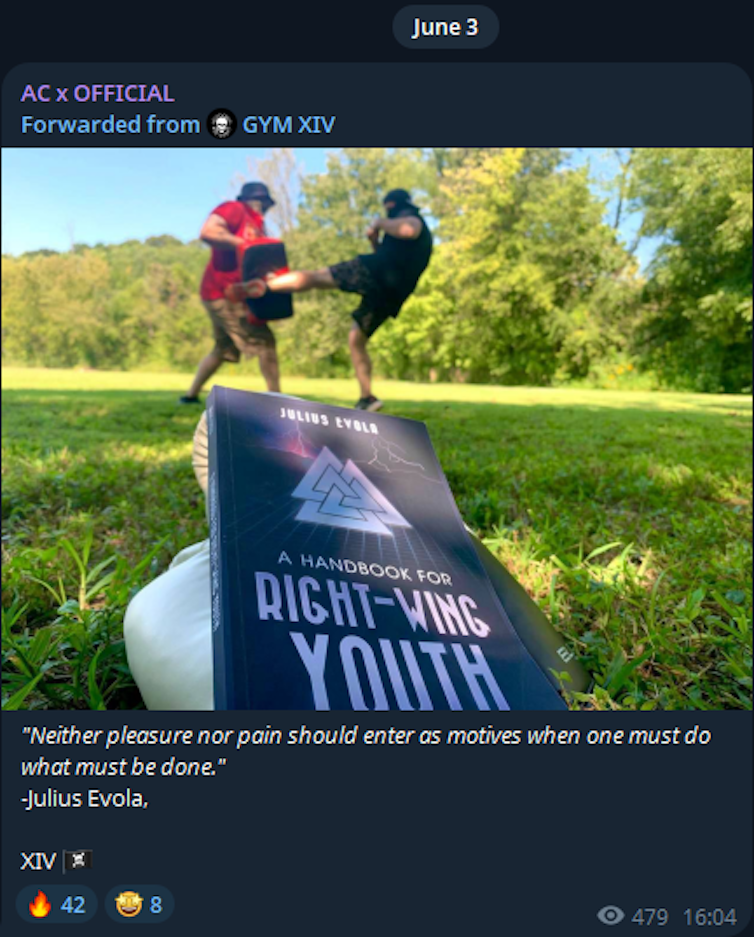
Le penseur d’extrême droite italien Julius Evola mis de l’avant par les Active Clubs.
(Message de Gym XIV sur le canal Telegram SoCal Active Club, juin 2025, consulté le 11 juin 2025), CC BY

Inspirée par la pensée « accélérationniste – une idéologie qui appelle à provoquer, voire à précipiter l’effondrement de la société libérale pour permettre la « renaissance » d’une civilisation blanche –, cette vision se traduit dans des milliers de publications diffusées sur des applications de messagerie sécurisée comme Telegram. Les vidéos, images et symboles partagés créent une culture visuelle unifiée : celle d’un nationalisme blanc 3.0, globalisé et esthétiquement séduisant.

Au Canada, certains membres des Active Clubs ont été liés à des organisations désignées terroristes comme AtomWaffen Division (AWD). Après la condamnation de son propagandiste Patrick Gordon MacDonald en 2025, plusieurs sympathisants d’AWD se sont réorientés vers les Active Clubs.

Le corps comme instrument de radicalisation

Les publications des Active Clubs montrent souvent des entraînements collectifs, des randonnées en forêt ou des séances de boxe en plein air. Les messages sur Telegram insistent sur la rigueur, la virilité et la fraternité. On peut lire sur un canal du réseau :

Nous rejetons la faiblesse, la passivité et la décadence de notre époque. À leur place, nous cultivons la préparation physique, la force mentale et un engagement indéfectible envers notre peuple et notre mission. Par l’entraînement, la discipline et l’épreuve partagée, nous devenons plus forts – individuellement et collectivement.

Ce discours illustre ce que nous appelons « l’engagement corporel » : une manière d’incarner politiquement ses convictions à travers le corps, le style de vie et les gestes du quotidien. Dans cette logique, le politique se vit d’abord comme un rapport à soi. Les militants sont encouragés à transformer leur alimentation, leur apparence, leurs loisirs, et même leurs relations intimes pour correspondre à l’idéal promu par le mouvement.

Cette stratégie donne une dimension sensible et émotionnelle à l’idéologie. Elle rend la radicalité expérientielle : on n’adhère pas seulement à des idées, on les vit, on les ressent, on les performe. C’est l’une des raisons rendant les Active Clubs séduisants pour certains jeunes hommes en quête de sens, de communauté et de modèles masculins.

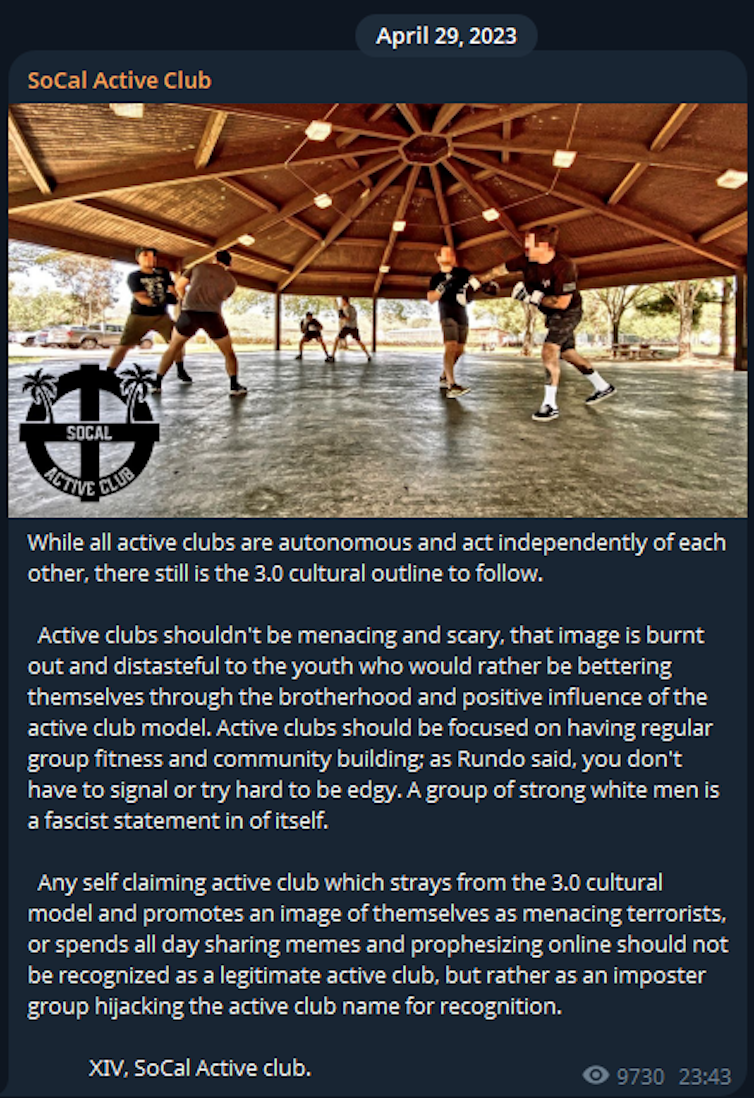
Des hommes se battent
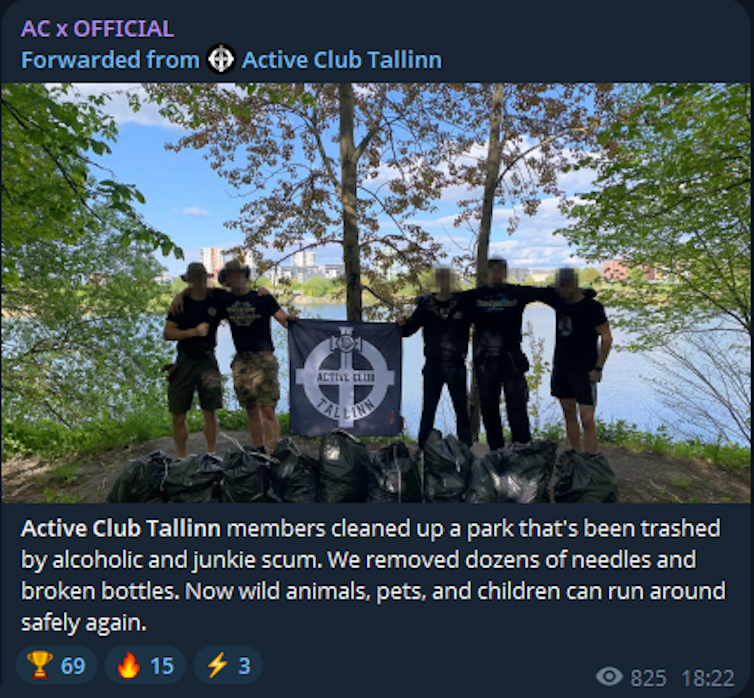
Les Active Clubs veulent donner un visage respectable à l’extrême droite.
(Canal Telegram AC x OFFICIAL), CC BY

Une sociabilité viriliste qui radicalise sans en avoir l’air

À la différence des organisations explicitement politiques, les Active Clubs investissent des espaces ordinaires. Sur les réseaux, ils se mettent en scène à l’entraînement, faisant du bénévolat ou nettoyant des lieux publics, des activités qui deviennent des rituels de socialisation et donnent l’image d’une jeunesse disciplinée et, surtout, fréquentable, loin des clichés du militant néonazi qui circulent dans la culture populaire. On peut lire sur le canal Telegram du SoCal Active Club :

Les Active Clubs ne devraient pas être menaçants ni effrayants ; cette image est dépassée et de mauvais goût. Les jeunes veulent avant tout s’épanouir à travers la fraternité et l’influence positive du modèle des Active Clubs

Des hommes se battent
Les Active Clubs font la promotion de l’action communautaire.
(Publiée sur le canal AC x OFFICIAL, consulté le 22 juillet 2025), CC BY

Sous couvert de sport et de camaraderie, les Active clubs opèrent un travail de politisation en douceur, inculquant progressivement des récits d’identité, de hiérarchie et de pureté morale et raciale. Leurs publications opposent systématiquement une distinction fréquente dans les idéologies fascistes entre les « forts » – sains, disciplinés – et les « faibles », décrits comme parasites à la morale décadente. Ces images produisent un sentiment d’appartenance fondé sur la fierté d’être du « bon côté » : celui des forts, des purs, des éveillés.


À lire aussi :
Grok, l’IA de Musk, est-elle au service du techno-fascisme ?


Le fascisme sous le masque du bien-être

Ce qui rend les Active Clubs particulièrement dangereux, c’est leur capacité à déplacer la radicalisation politique vers le champ du quotidien, à la transformer en culture du bien-être. En reprenant le langage du dépassement de soi, de la fraternité et de la discipline, ils esthétisent la violence plutôt que de la rejeter. Là où les groupuscules néofascistes ou skinheads exhibaient une brutalité frontale et une esthétique marginale, les Active Clubs transforment cette violence en valeur morale, la présentant comme une expression de santé, d’honneur et de loyauté.


Déjà des milliers d’abonnés à l’infolettre de La Conversation. Et vous ? Abonnez-vous gratuitement à notre infolettre pour mieux comprendre les grands enjeux contemporains.


Cette esthétisation du politique brouille les repères : elle rend la radicalité attirante, presque inspirante, en s’appuyant sur des émotions positives (le courage, la loyauté, l’accomplissement de soi) pour légitimer des idéaux autoritaires.

À travers une rhétorique et une esthétique empruntées au bien-être et à la performance, les Active Clubs transforment le fascisme en un mode de vie désirable.

Des hommes alignés tiennent une banderole
À travers les Active Clubs, on assiste à la transnationalisation du nationalisme blanc, écrivent les auteurs.
(Message repéré sur le canal Telegram Nationlist-13, 21 avril 2025, consulté le 3 juin 2025), CC BY

Déjouer la séduction viriliste de l’extrême droite

Pour comprendre ces nouvelles formes de radicalisation, il ne suffit plus d’étudier les discours ou programmes politiques ; il faut observer les corps, les gestes et les affects.

Les Active Clubs montrent que la bataille culturelle se joue désormais aussi dans les gyms, les stories Instagram et les podcasts de développement personnel. Pour changer le monde, il faut d’abord se changer soi.


À lire aussi :
Masculinité et politique à l’ère du trumpisme


En donnant à la radicalité les apparences du dépassement personnel et de la camaraderie, les Active Clubs participent à une banalisation de l’extrême droite. Ils traduisent certains codes du fascisme – hiérarchie, pureté, virilisme – dans le langage néolibéral de la performance, du bien-être et de la santé. En fusionnant culte du corps et idéologie radicale, ils rendent le fascisme désirable, car compréhensible à travers des valeurs hégémoniques liées à l’individualisme. Ce faisant, ils contribuent à l’émergence d’un nouveau nationalisme blanc : moins frontalement politique, mais plus diffus, plus culturel, et donc plus difficile à repérer et à combattre pour les autorités policières, mais aussi pour les parents, les éducateurs et la société civile en général.

Reconnaître cette dimension corporelle et esthétique de l’extrême droite est essentiel, car c’est souvent dans les espaces les plus ordinaires du quotidien que s’opère la radicalisation.

La Conversation Canada

Frédérick Nadeau a reçu des financements du Conseil de recherche en sciences humaines du Canada (CRSH) et des Fonds de recherche du Québec (FRQ).

Tristan Boursier a reçu des financements du Fonds de recherche du Québec (FRQ).

ref. Active Clubs : le corps comme champ de bataille de l’extrême droite – https://theconversation.com/active-clubs-le-corps-comme-champ-de-bataille-de-lextreme-droite-268338