Djibouti’s president, Ismaïl Omar Guelleh, pushed through constitutional changes removing presidential age limits in October 2025. The changes enable him to remain in power beyond 2026. He has already ruled for 26 years and is a shoo-in at elections in April 2026. Guelleh leads a country on the Horn of Africa where the Red Sea meets the Indian Ocean – one of the world’s most strategically important locations. Federico Donelli, who has studied Djibouti’s political landscape, unpacks the dynamics that have kept him in power.
Who is Ismaïl Omar Guelleh and what is his governance style?
Ismaïl Omar Guelleh, commonly known as IOG, has been the president of Djibouti since 1999. He succeeded the country’s first president, Hassan Gouled Aptidon, whom he served as chief of staff for more than two decades.
Now aged 77, Guelleh is one of the longest-serving leaders in east Africa.
He belongs to the majority Issa-Somali ethnic group, which has monopolised power since the country gained independence from France in 1977. Djibouti’s population is largely composed of two main groups – the Issa-Somali and the Afar. This demographic mirrors the context in Afar regional state of neighbouring Ethiopia. It’s mirrored even more closely in the de facto state of Somaliland due to clan and family ties.
Consequently, political dynamics in Djibouti frequently intertwine with developments in these neighbouring states. This is particularly true when it comes to security, cross-border mobility and clan-based networks.
In theory, Djibouti is a presidential republic with a multiparty system. In practice, however, political authority remains highly centralised, leaving little room for genuine political competition.
The ruling Popular Rally for Progress (RPP) party dominates parliament, holding 45 of the 65 seats. The broader pro-presidential coalition, the Union for the Presidential Majority (UPM), controls 58 seats in total, consolidating the executive’s influence over the legislative arena.
Opposition coalitions such as the Union for Democratic Change (UAD) and the Union for Democratic Movements (UMD) face significant constraints. They have occasionally boycotted elections. There have been five presidential elections and five legislative elections since 1999.
Guelleh also owes his longevity to a close-knit network of officials, family members and political allies who occupy key roles in government and business. The coalition around him is not always entirely harmonious. Subtle rivalries have emerged among political figures and members of his inner circle from time to time. But these dynamics do not pose a political threat.
What accounts for his longevity?
Guelleh’s tenure can be attributed to a combination of institutional changes, geopolitical factors and elite dynamics.
One such element is constitutional reform. Over the years, Djibouti’s parliament has eroded key democratic safeguards of the 1992 constitution.
First came the removal of presidential term limits in 2010. These changes enabled Guelleh to stand for re-election and reduced presidential terms from six to five years.
The November 2025 parliamentary vote to abolish the presidential age limit followed this pattern. This eliminated the last formal restriction on his eligibility for office come April 2026.
A second factor is Djibouti’s strategic importance. Located at the entrance to the Bab el-Mandeb Strait, a vital shipping lane connecting the Red Sea and the Indian Ocean, the country is home to several foreign military bases. Represented here are the US, France, China, Japan and Italy. For many international partners, the stability of the Djibouti government has been viewed as a source of predictability in a volatile region.
Consequently, there has been limited external pressure for political reform. In turn this has reinforced the stability of the current leadership.
Thirdly, the cohesion of the ruling elite has played a central role in domestic politics. A network of influential figures, including members of the president’s family, long-standing advisers, and economic figures, has formed around Guelleh’s leadership. This group controls key state institutions and sectors of the economy, providing strong incentives to maintain leadership continuity.
At the same time, the absence of an openly designated successor has sparked quiet competition within this circle. The prospect of a post-Guelleh era has, in recent years, encouraged various individuals to seek to increase their influence. This has ranged from family members to senior advisers and political figures.
Emerging rivalries do not openly challenge the president’s authority. Nevertheless, they do illustrate the complex internal dynamics that underpin the current political order.
Over more than two decades in office, Guelleh has presided over a period of relative stability in Djibouti. While neighbouring Somalia and Ethiopia have experienced ongoing insecurity and internal conflict, Djibouti has remained comparatively insulated.
The government frequently cites this stability as one of the defining features of his tenure.
Djibouti has also developed its position as a strategic hub. The presence of multiple foreign military bases, alongside port and logistics facilities, has generated significant state revenue.
Since 2016, Chinese investment and management have increasingly shaped the country’s main port infrastructure, further integrating Djibouti into global commercial networks. These factors have raised the country’s profile in international trade and security arrangements.
In addition, Djibouti has played a part in regional diplomacy. It is an important member of the Intergovernmental Authority on Development (IGAD). This is the regional organisation mandated to address conflicts rooted in resources, political competition and identity. Djibouti’s most recent engagement includes participation in the attempts to mediate the conflict in Sudan.
The government has also highlighted certain institutional reforms as markers of progress. An example is the abolition of the death penalty in 2010.
However, structural challenges remain significant. Djibouti has a very young population. Issues such as unemployment, high living costs and limited political participation persist.
What does the age-limit vote tell us about Djibouti’s politics?
The decision was adopted without public debate and with no dissenting votes among the 65 lawmakers present. This reflects the extent to which the National Assembly aligns with the executive.
The vote also highlights the central role of elite consensus in Djibouti’s political system. Key figures within the ruling coalition, including representatives from the Issa and co-opted Afar elites, supported the reform. For these groups, maintaining leadership continuity is often seen as a means of preserving access to economic and political resources. This is preferred to uncertainties associated with a change in leadership.
Bypassing a popular vote on the constitutional provision limits the opportunity to see the true levels of support or opposition. This has the effect of particularly excluding younger citizens who have only ever known one president.
Overall, the vote shows that constitutional provisions can be modified when they hinder leadership continuity. This reinforces a model in which formal rules adapt to political needs rather than constrain them. It also highlights the importance of elite cohesion in maintaining the current political order.
As the 2026 presidential election approaches, the government’s dominant narrative remains one of continuity, supported by those who view stability as essential to protecting national and regional interests.
However, socio-economic pressures and underlying concerns about the inevitable succession continue to influence public expectations, particularly among younger citizens.
Federico Donelli is affiliated with the Italian Institute for International Political Studies (ISPI), the Nordic Africa Institute (NAI), and the Orion Policy Institute (OPI)
Promis depuis plus de quarante ans, le « statut de l’élu local » devrait enfin voir le jour, avec un vote en deuxième lecture à l’Assemblée nationale le lundi 8 décembre. Très attendue par les élus, cette loi révèle pourtant un paradoxe : comment donner un statut à une fonction dont les contours restent flous et dont les conditions d’exercice sont profondément inégales ? À travers ce texte se révèle le profond malaise de l’engagement politique local.
Les élus locaux devraient prochainement disposer d’un « statut ». Une proposition de loi a été adoptée en ce sens en première lecture par le Sénat et l’Assemblée nationale. Elle a été approuvée à l’unanimité dans chacune d’elles. Un tel consensus, dépassant les clivages politiques, demeure suffisamment rare pour être souligné. En deuxième lecture, le texte adopté par le Sénat s’est rapproché de celui de l’Assemblée nationale. Il appartient donc à celle-ci de se prononcer sur les quelques dispositions restant en discussion, ce qu’elle fera le lundi 8 décembre 2025.
Une très longue attente
Les élus des collectivités territoriales (communes, départements et régions) réclament depuis longtemps ce statut, qui a leur a été promis par le législateur depuis le début des années 1980. Lors du lancement de la décentralisation, le législateur s’était engagé à créer ce « statut ». L’article 1er de la loi du 2 mars 1982 relative aux droits et libertés des communes, des départements et des régions prévoyait que des « lois détermineront […] le statut des élus ». Mais le législateur n’a jamais réalisé cet engagement.
Les élus locaux sont ainsi restés dans l’attente d’un statut qui s’est au fil du temps chargé d’une dimension idéalisée. Elle a nourri l’espoir que l’adoption de ce statut améliorerait leur situation.
L’adoption prochaine d’un statut de l’élu local pose néanmoins la question de sa définition. À vrai dire, cette question aurait dû être posée depuis longtemps. Mais, aussi étonnant que cela puisse paraître, les nombreux rapports qui ont été publiés sur le sujet n’ont jamais défini le statut de l’élu local. Ils ont exprimé le besoin d’un statut sans le définir.
Qu’est-ce qu’un statut ?
La définition courante d’un statut renvoie à un texte qui précise les droits et obligations des membres d’une communauté, souvent professionnelle, en fonction des missions qui leur sont confiées. Il fixe également les conditions d’accès à ces fonctions. Il existe ainsi un statut des fonctionnaires dans le code général de la fonction publique ou celui du salarié dans le Code du travail.
Dès lors, s’il n’existe pas de statut des élus locaux, l’on devrait supposer qu’aucun texte ne précise les droits et obligations des élus des collectivités territoriales. Mais est-ce le cas ?
Un statut déjà constitué
Curieusement, non. Les droits et obligations sont déjà fixés par le Code général des collectivités territoriales (CGCT).
Des droits
Le titre II du CGCT, consacré aux « garanties accordées aux élus locaux », énumère les droits dont ils bénéficient. Parmi eux figurent une indemnité de fonction, variable selon la taille de la collectivité et la nature des responsabilités ; une protection sociale et un dispositif de retraite ; des autorisations d’absence et des crédits d’heures permettant de quitter son entreprise pour l’exercice du mandat ; une possibilité de suspendre son contrat de travail avec droit à réintégration ; un droit à la formation, tant pour exercer son mandat que pour préparer son retour à l’emploi, etc. Tous ces droits ont été progressivement introduits dans le CGCT par le législateur.
Des devoirs
De même, des obligations des élus figurent dans plusieurs codes (et notamment dans le Code pénal). Depuis 2015, elles sont également résumées dans la « charte de l’élu local », inscrite à l’article L. 1111-1-1 du CGCT. Elle rappelle que l’élu doit exercer ses fonctions « avec impartialité, diligence, dignité, probité et intégrité », poursuivre « le seul intérêt général », ou encore prévenir ou faire cesser immédiatement tout conflit d’intérêts ». Cette charte doit être lue par le maire, ou le président de la collectivité, à l’intention de tous les élus lors de l’installation du nouveau conseil (municipal, départemental ou régional).
Les conditions d’accès aux mandats locaux sont, quant à elles, définies principalement par le code électoral.
Dès lors, si tous les éléments constitutifs d’un statut figurent déjà dans le CGCT, pourquoi le législateur s’apprête-t-il à instaurer formellement ce statut ? Et pourquoi les élus s’en félicitent-ils ?
Une réponse au malaise de l’élu local
Investi d’une portée symbolique, idéalisé et élevé au rang d’enjeu majeur, l’adoption du statut de l’élu local est perçue comme une réponse aux préoccupations des élus locaux.
Ces facteurs pèsent lourdement sur leur moral et contribuent à l’augmentation du nombre de démissions en cours de mandat. Selon un rapport du Sénat, près de 1 500 maires ont démissionné depuis le dernier renouvellement de 2020 (chiffre de février 2024).
Les gouvernements se sont inquiétés de ce malaise. C’est pourquoi la proposition de loi créant un statut de l’élu local a été soutenue dès son dépôt par les Premiers ministres qui se sont succédé durant la procédure législative (Michel Barnier, François Bayrou et Sébastien Lecornu, qui a salué l’adoption prochaine du texte lors du Congrès des maires le 20 novembre 2025).
Pourquoi ce nouveau texte est-il qualifié de statut de l’élu local ?
Un argument fréquemment avancé – très discutable – consiste à dire que la reconnaissance de droits et obligations dispersés dans la législation ne suffit pas. Un statut suppose un texte spécifique définissant la nature du mandat et regroupant les droits et les devoirs.
La proposition de loi vient combler cette absence. Elle formalise en effet le statut de l’élu local dans une nouvelle section du CGCT, énumérant de manière générale les principaux droits et obligations des élus locaux (en reprenant la « charte de l’élu local »).
Le texte comporte, par ailleurs, une disposition qui peut sembler relever de l’évidence. Elle précise que « tout mandat local se distingue d’une activité professionnelle et s’exerce dans des conditions qui lui sont propres ». Cette précision n’est pourtant pas anodine parce qu’elle a longtemps été mise en avant pour justifier la difficulté à concevoir un statut de l’élu local.
Une précision révélatrice d’un modèle de statut
La question de savoir si le « métier d’élu » ne pouvait pas être assimilé à une profession a constitué un obstacle à l’adoption d’un statut de l’élu local. Ainsi, la loi no 92-108 du 3 février 1992 relative aux conditions d’exercice des mandats locaux n’a pas utilisé le terme de « statut », mais de « garanties », « pour ne pas accréditer l’idée d’une professionnalisation de l’exercice des mandats locaux » (selon le sénateur Jean-Pierre Sueur).
Le débat sur la professionnalisation concerne surtout les exécutifs locaux (maires et adjoints, présidents et vice-présidents), qui sont de véritables administrateurs de leur collectivité, et sont soumis à ce titre à des régimes de responsabilité pénale et financière exigeants. On peut, en effet, les considérer comme des « managers » qui perçoivent en contrepartie de leur action des indemnités de fonction assimilées à une rémunération (soumises à l’impôt, ainsi qu’à la CSG et à la CRDS). Il peut donc paraître réducteur d’affirmer qu’ils n’exercent pas une forme d’activité professionnelle.
À l’inverse, le terme est peu adapté pour les conseillers sans délégation, dont la participation se limite aux séances du conseil et qui, pour la plupart, ne perçoivent aucune indemnité.
En réaffirmant que le mandat local se distingue d’une activité professionnelle, la proposition de loi renforce l’idée selon laquelle il s’agit d’une activité d’intérêt général exercée, en principe, à titre bénévole, conformément au principe selon lequel « le mandat de maire, d’adjoint ou de conseiller municipal est exercé à titre gratuit » (art. L. 2123-17 CGCT).
Cette affirmation ignore la très grande diversité des situations des élus locaux et des niveaux d’indemnisation. Si le conseiller municipal d’une petite commune ne perçoit rien, le conseiller départemental ou régional a droit à une indemnité mensuelle brute qui varie entre 1 500 euros à 2 700 euros brut selon la taille de la collectivité (CGCT, art. 3123-16 et art. 4135-16). De même, si le maire d’une petite commune ne peut recevoir plus de 1 000 € brut, les maires d’une ville, d’un président de département ou de région peuvent recevoir 5 600 € brut (CGCT, art. L. 2123-23 ; art. 3123-17 ; art. L. 4135-17) avec des possibilités de majoration de l’indemnité.
Il existe donc une forte disparité entre, d’une part, les élus qui ne peuvent assumer leur mandat qu’en exerçant une activité professionnelle ou en étant à la retraite et, d’autre part, ceux qui peuvent s’y consacrer pleinement.
La loi créant un statut de l’élu local est-elle symbolique ?
Cette loi est largement symbolique, parce que, tout bien considéré, elle officialise un statut qui existait déjà.
Elle apporte certes quelques ajustements. Pour les droits, elle augmente légèrement les indemnités des maires des petites communes. Elle étend aussi la protection fonctionnelle à tous les élus locaux et elle clarifie la notion de conflit d’intérêts en la limitant à la recherche d’un « intérêt privé » (et non à celui d’un « intérêt public »).
Pour les devoirs, elle prévoit l’obligation pour l’élu local de s’engager « à respecter les principes de liberté, d’égalité, de fraternité et de laïcité ainsi que les lois et les symboles de la République ». Cette disposition peut surprendre en ce qu’elle traduit une forme de défiance à l’égard de certains élus, que le législateur semble juger insuffisamment attachés aux principes républicains. Une telle obligation n’est en effet prévue pour aucune autre catégorie d’élus, qu’il s’agisse des députés, des sénateurs, ou même du président de la République.
Est-ce là le statut tant attendu par les élus locaux ? Leur offrira-t-il la protection et la reconnaissance qu’ils espéraient ? On peut en douter.
Arnaud Haquet ne travaille pas, ne conseille pas, ne possède pas de parts, ne reçoit pas de fonds d’une organisation qui pourrait tirer profit de cet article, et n’a déclaré aucune autre affiliation que son organisme de recherche.
Image of a abandoned property project at Bukit Beruntung MalaysiaProvided by author, CC BY
Islamic home finance in Malaysia was introduced in the 1980s with high expectations. It promised to create a system free from riba (usury), gharar (harmful uncertainty), and ẓulm (injustice) for 20.6 million Malaysian Muslims.
Four decades on, the original vision of Islamic home finance as an ethical, risk-sharing alternative compliant to Islamic law Sharia is now being put to the test.
Ironically, Sharia-compliant home financing has been implicated in the government’s recent findings, which identified 15,553 homebuyers affected by 107 abandoned housing projects comprising 29,587 units as of 30 September this year.
Some Shariah-labelled home financing products closely resemble conventional loans, highlighting the need for clearer and more substantive differentiation to better guide and protect consumers — a concern that has already prompted calls for reform.
Both are designed to avoid the direct payment of interest. Yet, their financial outcomes often resemble those of conventional loans.
In a typical BBA arrangement, for instance, the bank purchases the property and resells it to the buyer at a marked-up price to be paid in instalments.
While this structure formally avoids charging interest, its economics are almost identical. Banks lock in fixed returns, while buyers bear the risks of non-delivery, delays, or even project abandonment.
This goes against the principle of al-ghunm bi al-ghurm — that profit should come hand in hand with risk.
Prominent scholars, including Justice Taqi Usmani, have warned that such contractual manoeuvres risk undermining the ethical foundations of Islamic finance.
Many homebuyers continue to service loans for projects that are severely delayed, partially abandoned, or unlikely to be completed.
Such financial and emotional burdens run counter to the maqāṣid al-sharīʿah — the higher objectives of Shariah, which uphold justice, welfare, and the protection of wealth.
Pressures from the Basel Accord and investor expectations
Islamic banks are under growing pressure from global regulations and investor expectations. The Basel Accord enforces stringent capital, liquidity, and risk-weight requirements to maintain financial stability.
These regulations, however, make debt-based contracts such as bayʿ bithaman al-ājil (BBA), murābaḥah (a cost-plus resale on deferred payment), and tawarruq more capital-efficient — and therefore more appealing to banks.
By contrast, genuine risk-sharing models such as mushārakah mutanāqiṣah (diminishing partnership) and ijārah (Islamic leasing contract) typically demand more capital and appear less profitable on paper.
This dynamic forces banks to prioritise balance-sheet “safety,” often shifting delivery risks onto homebuyers. In doing so, Basel inadvertently reinforces the “form over substance” dilemma that continues to shadow Islamic finance.
At the national level, neither the Shariah Advisory Council of Bank Negara Malaysia (SAC) nor the Shariah Committees (SCs) of individual Islamic banks are legally required to include consumer representatives.
To enhance fairness, Malaysia’s Islamic finance sector should ensure that Shariah Committees are appointed and remunerated independently — a move that would reduce potential conflicts of interest and strengthen public trust.
As a result, borrowers’ hardships — such as paying instalments for homes that are delayed or abandoned — often go unheard. Dispute mechanisms, meanwhile, tend to favour financiers, leaving affected families with little meaningful recourse.
Lessons from the Gulf
The Gulf Cooperation Council (GCC) countries face similar challenges — and have taken steps to guard against them.
Dubai, United Arab Emirates (UAE): A 2007 law mandates all buyer payments be placed in regulated escrow accounts to safeguard funds and ensure transparency.
Funds can only be released in line with verified construction progress. If a project stalls, the Dubai Land Department or a special tribunal may order refunds or transfer the project to another developer.
Bahrain: Established under a 2014 decree, the Stalled Property Committee is empowered to replace failing developers, merge projects, or liquidate assets to protect homebuyers.
Nonetheless, property development oversight and consumer protection in these GCC countries still require stronger safeguards and more consistent enforcement.
To restore public trust and uphold Shariah principles, Malaysia’s Islamic home financing should prioritise the Build-Then-Sell model — offering financing only for completed homes, thereby eliminating abandonment risks and avoiding harmful gharar (uncertainty).
Where the Sell-Then-Build model remains in use, developers should be required to provide insurance coverage and a clear rehabilitation plan within financing contracts. Shariah governance should also be strengthened through an independent consumer ombudsperson, third-party Shariah audits, and consumer representation on the country’s Sharia advisory council and committees.
To advance Malaysia’s goal of fully embedding Islamic principles in banking and finance, the country could expand sukuk-funded housing programmes and create a dedicated rehabilitation fund to revive distressed or abandoned projects.
A National Islamic Housing Fund could adopt the Build-Then-Sell model and the profit-and-risk-sharing principle of al-ghunm bi al-ghurm, offering stronger protection for homebuyers.
Capital could be drawn from Khazanah Nasional Berhad, the Employees Provident Fund (EPF), the Retirement Fund (KWAP), Permodalan Nasional Berhad (PNB), and Tabung Haji. This could be reinforced through government guarantees, musharakah-based sukuk, and targeted contributions from waqf (Islamic endowments), zakat (mandatory almsgiving), and corporate social responsibility programmes.
If Malaysia and the GCC fail to reform Islamic home financing to make it more equitable and aligned with the principles of maqāṣid al-sharīʿah, the consequences could be severe.
Public trust in Islamic finance may likely to keep eroding without concrete action. Malaysia’s goal of addressing its one-million-home deficit by 2026 — through a mix of financing instruments including Islamic options — could also be at risk.
Nuarrual Hilal Md Dahlan tidak bekerja, menjadi konsultan, memiliki saham, atau menerima dana dari perusahaan atau organisasi mana pun yang akan mengambil untung dari artikel ini, dan telah mengungkapkan bahwa ia tidak memiliki afiliasi selain yang telah disebut di atas.
Source: The Conversation – France in French (3) – By Dominique Costagliola, Épidémiologiste et biostatisticienne, directrice de recherches émérite INSERM, Institut Pierre Louis d’Epidémiologie et de Santé Publique, Sorbonne Université, INSERM et Membre de l’Académie des Sciences, Inserm
Épidémiologiste et biostatisticienne, membre de l’Académie des sciences, Dominique Costagliola est directrice de recherche émérite à l’Inserm. Cette figure de la recherche contre le VIH fait le point pour « The Conversation » sur la situation de l’épidémie en France, et revient sur les conséquences, au niveau mondial, du retrait des aides états-uniennes.
The Conversation : En France, combien de personnes vivent actuellement avec le VIH ?
Dominique Costagliola : En 2023, selon les estimations de Santé publique France, 181 000 personnes vivaient avec le VIH dans notre pays.
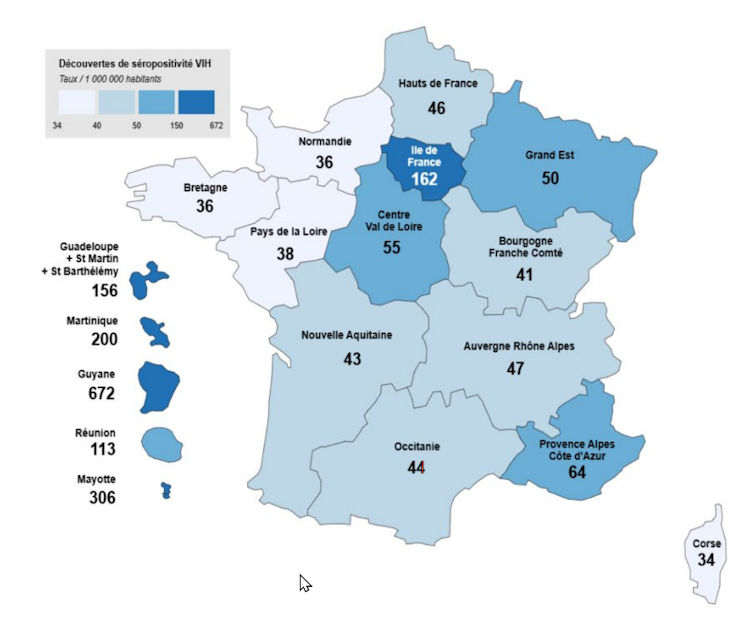
Les taux de découverte de séropositivité annuels sont particulièrement élevés dans les départements et régions d’outre-mer. Dans les Antilles, on dénombrait 200 nouveaux diagnostics par million d’habitants à la Martinique et 156 pour l’ensemble Guadeloupe, Saint-Martin et Saint-Barthélemy. À Mayotte, ce taux est de 306. En Guyane, il monte à 672. Cela semble peu en nombre de personnes, mais rapporté à la population, c’est conséquent.
Que peut-on dire de la dynamique de l’épidémie dans notre pays ?
D. C. : Les estimations d’incidence de Santé publique France indiquent une stabilisation dans toutes les populations considérées (personnes hétérosexuelles nées à l’étranger, personnes hétérosexuelles nées en France, HSH nés en France, HSH nés à l’étranger, usagers de drogues injectables, personnes trans contaminées par rapports sexuels).
Cette tendance tranche avec les évolutions contrastées qui avaient été observées entre 2012 et 2021. Sur cette période, l’incidence a baissé en France, cependant cette baisse se voyait surtout chez les hommes ayant des relations sexuelles avec les hommes (HSH) nés en France.
Depuis 2022, le nombre de nouveaux diagnostics ne diminue plus dans cette population, ce qui est une source de préoccupation. À l’inverse, alors qu’il augmentait chez les HSH nés à l’étranger sur la même période, il se stabilise depuis deux ans.
Les chiffres révèlent que la baisse de l’incidence chez les HSH était modeste de 2012 à 2015. Le changement observé est probablement en partie lié à la modification des recommandations de prise en charge. À partir de 2013, ces dernières ont préconisé de « mettre en place un traitement antirétroviral chez toute personne vivant avec le VIH », autrement dit dès le diagnostic. Auparavant, quand un individu était diagnostiqué, il n’était pas immédiatement mis sous traitement antirétroviral (on attendait que son taux de lymphocytes T CD4 – les cellules immunitaires qui sont progressivement détruites par le virus – diminue).
Ce changement de paradigme a eu un impact sur la circulation de la maladie. En effet, la charge virale des personnes sous traitement est contrôlée. En conséquence, elles ne transmettent pas le virus.
L’accentuation de la baisse à partir de 2016 peut quant à elle s’expliquer par la mise à disposition de la PrEP (prophylaxie pré-exposition), innovation qui s’est répandue progressivement, essentiellement dans ce groupe.
Pour mémoire, cette approche consiste à fournir un traitement antirétroviral préventif aux personnes non encore infectées par le VIH mais à risque d’être exposées, afin de prévenir la contamination. Il s’agit d’une mesure complémentaire aux autres moyens de prévention. Concrètement, les individus concernés prennent des comprimés, quotidiennement ou à la demande (dans ce cas, avant et après une prise de risque).
La pandémie de Covid-19 a-t-elle eu un impact sur l’épidémie de VIH en France ?
D. C. : On constate qu’en 2020, le nombre de nouveaux diagnostics a diminué de façon importante. On peut probablement y voir en partie l’effet de la pandémie de Covid-19 : on dépistait moins à cette époque, en raison des perturbations du système de santé. Le fait qu’il y a eu à cette époque davantage de distanciations sociales qu’à l’accoutumée a peut-être aussi contribué à limiter la transmission.
Depuis ce plus bas niveau, estimé à 4 500 nouveaux cas environ en 2020, une remontée du nombre de nouveaux diagnostics a été observée. Elle pourrait être simplement due à la reprise de l’activité de dépistage, voire à son augmentation. En effet, depuis 1er janvier 2022, il est possible d’effectuer un dépistage du VIH dans tous les laboratoires d’analyses biologiques de France, sans ordonnance.
En 2024, 8,5 millions de tests VIH ont été réalisés, lesquels ont mené à la découverte de 5 100 nouveaux diagnostics de séropositivité. Ce chiffre semble indiquer une tendance à la stabilisation, mais il faudra voir si celle-ci se confirmera dans les années à venir.
Qui sont ces personnes, et sait-on comment elles ont été contaminées ?
D. C. : L’âge au moment du diagnostic est très variable selon la population considérée. Chez les personnes hétérosexuelles, la part des seniors (50 ans et plus) est nettement plus importante que dans les autres populations. Parmi les 5 100 personnes nouvellement diagnostiquées en 2024, 44 % étaient nées en France, et 56 % à l’étranger.
Les deux modes principaux de contamination sont les rapports hétérosexuels (53 % des cas en 2024), et les rapports sexuels entre hommes (42 % des diagnostics). Les autres modes de contamination sont beaucoup moins fréquents : le partage de matériel d’injection dans le cas des usagers de drogues représentait 1 % des diagnostics, les contaminations mère-enfant 1 % également, les contaminations sexuelles de personnes trans 2 %.
On remarque qu’en 2024, 47 % des personnes nées à l’étranger qui ont découvert leur séropositivité en France se sont avérées avoir été contaminées après leur arrivée dans notre pays.
Les personnes vivant avec le VIH sans le savoir constituent une source particulière de préoccupation. Selon Santé publique France, elles étaient environ 9 675 fin 2024. Si ce chiffre est en baisse de 10 % par rapport à 2023, il nécessite de poursuivre les efforts en matière de dépistage.
C’est un point important, car pour limiter la transmission, il est essentiel de raccourcir le délai qui s’écoule entre le moment où un individu est contaminé et celui où il est diagnostiqué…
D. C. : En effet, car si l’on ne sait pas que l’on est infecté, on ne va pas prendre de précaution, et donc on va être susceptible de contaminer d’autres personnes. À l’inverse, les données de la littérature scientifique démontrent que quand les gens connaissent leur séropositivité, ils prennent moins de risques.
Par ailleurs, une fois diagnostiqué, on reçoit un traitement qui permet de contrôler la charge virale. À partir de ce moment, on ne transmet plus le virus. Donc plus tôt on se fait dépister, plus le risque de transmettre le virus est limité, car ce sont plutôt les personnes qui ignorent leur statut qui sont à la source des nouvelles contaminations.
Enfin, plus les traitements sont débutés tôt, meilleures sont les chances de parvenir à contrôler le virus et à restaurer le système immunitaire.
À l’heure actuelle, quel est le délai entre la contamination et le diagnostic ?
D. C. : Santé publique France l’estime à 1,7 an en médiane, mais il varie beaucoup selon la situation considérée.
Ainsi, ce délai est d’environ 3 ans pour les hommes hétérosexuels nés à l’étranger. Il est d’un peu plus de 2 ans et demi pour les femmes hétérosexuelles nées à l’étranger, et d’un peu moins de 2 ans et demi pour les hommes hétérosexuels nés en France. Pour les hommes ayant des relations sexuelles avec les hommes nés en France, il est légèrement inférieur à un an, et légèrement supérieur à un an pour les HSH nés à l’étranger et les personnes trans contaminées par rapport sexuel.
On sait aussi que le risque de contamination est plus élevé chez les personnes précaires, qui ont moins de possibilités de s’occuper correctement de leur santé. Il s’agit là d’un obstacle à surmonter pour être capable de gérer correctement l’épidémie.
D. C. : L’Agence nationale de sécurité du médicament et des produits de santé (ANSM) a établi en novembre 2015 une recommandation temporaire d’utilisation (RTU) du Truvada pour la PrEP, devenue effective en janvier 2016. Ce médicament est une association entre deux molécules qui inhibent des enzymes indispensables au bon fonctionnement du VIH (ténofovir – ou TDF – et emtricitabine – ou FTC).
Selon les données du groupement d’intérêt scientifique EPI-PHARE, qui depuis 2017 assure le suivi de l’évolution de l’utilisation de Truvada ou de ses génériques en France dans le cadre d’une PrEP, durant le premier semestre 2025, 67 505 personnes utilisaient effectivement la PrEP, que ce soit en initiation ou en renouvellement. Les personnes qui y ont eu recours en France entre le 1er janvier 2016 et le 30 juin 2025 sont principalement des hommes (94 %), âgés de 33 ans en médiane. La grande majorité (69 %) résidait dans des communes appartenant à des unités urbaines de plus de 200 000 habitants.
On ne sait pas dans quelle mesure la PrEP couvre correctement les populations les plus à risque, mais on peut supposer que ce n’est sans doute pas suffisant, en tout cas pour la prévention.
D’autres médicaments soulèvent de grands espoirs pour limiter la transmission : les PrEP injectables. De quoi s’agit-il, et où en est-on en France ?
D. C. : À l’heure actuelle, en France, la PrEP repose sur l’association TDF/FTC. Ces molécules sont fabriquées par plusieurs laboratoires, sous forme générique. Elles sont donc bon marché.
À côté de ces PrEP, qui se prennent sous forme de cachets, sont développées des PrEP injectables, comme le cabotégravir (du laboratoire VIIV HEALTHCARE – qui est également utilisable en traitement, en bithérapie).
En PrEP, cette molécule requiert une injection tous les deux mois, en intramusculaire. Elle dispose d’une autorisation de mise sur le marché au niveau européen, mais sa commercialisation en France reste en suspens, car les discussions sur son remboursement n’ont pas encore abouti. Une étude est en cours pour évaluer le service médical rendu par rapport à la PrEP TDF/FTC.
Une autre PrEP injectable, le lénacapavir (laboratoire Gilead), a fait beaucoup parler d’elle en raison de la formidable efficacité dont elle a fait montre lors des essais cliniques : durant ces derniers, aucune infection n’a été détectée. Certes, les échantillons étaient de taille modeste, mais ça n’en est pas moins impressionnant.
En ce qui concerne les traitements antirétroviraux, où en est-on ? Sont-ils satisfaisants ?
D. C. : Aujourd’hui, nous disposons en France de traitements qui permettent de prendre en charge toutes les situations cliniques, y compris les personnes porteuses de virus très résistants. On retrouve ici encore le lénacapavir, mentionné précédemment, qui dispose d’une indication dans de tels cas de figure. L’efficacité de cette molécule repose sur son mode d’action totalement nouveau : elle interagit avec les protéines de la capside du VIH-1, bloquant différentes étapes du cycle de réplication viral.
De nouvelles molécules sont en cours de développement, notamment les traitements injectables avec seulement quelques injections par an, ou dans de nouvelles familles ciblant de nouveaux gènes du virus ou dans les familles existantes.
Ces traitements, bien qu’ayant un coût et devant être pris à vie, permettent néanmoins aux personnes vivant avec le VIH d’avoir une espérance de vie qui se rapproche beaucoup de celle de la population générale. À condition que le diagnostic soit fait suffisamment tôt, afin de contrôler rapidement la charge virale, avant que les taux de LT CD4 ne diminuent trop.
Or, en 2024, environ 26 % des gens étaient encore diagnostiqués à un stade avancé de la maladie, autrement dit avec un taux de LT CD4 inférieur à 200 par millimètre cube de sang – ce qui correspond à un risque élevé de développer des maladies, ou bien à un moment où ils avaient déjà une pathologie opportuniste classant au stade sida – résultant de l’immunodépression induite par l’infection. Dans cette situation, le temps pour réussir à récupérer des taux de LT CD4 supérieurs à 500 et diminuer l’inflammation qui est induite par l’infection sera très long.
Le fait d’avoir été immunodéprimé et de l’être resté longtemps, soit en raison d’un diagnostic tardif, soit parce que l’on a été infecté avant la mise à disposition des traitements ou avant la recommandation universelle de traitement, peut avoir des conséquences à long terme sur le risque de pathologies, telles que les cancers ou les maladies cardiovasculaires.
C’est aussi le cas lorsqu’on a été exposé aux premières générations d’inhibiteurs nucléosiques de la reverse transcriptase (AZT, DDI ou D4T) ou d’inhibiteurs de protéase (lopinavir)
Quelle proportion de patients cela représente-t-il ?
D. C. : On sait qu’à l’heure actuelle, environ un quart des gens qui sont dans les files actives (une file active se définit comme le nombre de patients différents vus en consultation au moins une fois dans l’année, ndlr) ont été diagnostiqués avant 1996. Donc avant l’avènement des trithérapies.
Les trois quarts restants ont majoritairement été diagnostiqués avant 2013 (autrement dit avant la recommandation universelle de traitement). Les histoires de ces patients diffèrent donc en fonction du contexte historique de leur prise en charge.
Il faut cependant souligner qu’en France, 97 % des gens sont traités et ont une charge virale contrôlée. À condition de ne pas arrêter le suivi, bien entendu. Or, un certain nombre de personnes, qu’on a du mal à évaluer, arrêtent parfois leur prise en charge.
Nous sommes en 2025, et les recherches sur un potentiel vaccin sont toujours en cours. Pourquoi est-ce si compliqué ? Qu’apporterait un vaccin ?
D. C. : Si efficaces que soient les traitements, ils doivent être pris à vie, et ne sont pas parfaits (en raison de certains effets secondaires notamment). Par ailleurs, ils coûtent cher. Les trithérapies qui sont les plus populaires à l’heure actuelle ne sont pas encore disponibles sous forme générique. Un vaccin abordable qui conférerait une protection de long terme permettrait de diminuer drastiquement les nouvelles infections et le coût de leur prise en charge.
La difficulté est que pour développer un vaccin qui fonctionne contre un micro-organisme, il faut trouver un moyen d’activer les défenses que notre corps met en œuvre spontanément face à lui. Or, le VIH est précisément problématique parce qu’il échappe au système immunitaire, et le dégrade…
On ne connaît que quelques cas exceptionnels de personnes qui ont développé une immunité naturelle face à ce virus. Étant donnée la rareté de tels individus, monter des projets de recherche est très compliqué. Et ce, d’autant plus que la généralisation des traitements empêche d’en découvrir de nouvelles.
Soulignons cependant que la difficulté à mettre au point un vaccin ne signifie pas qu’il faille abandonner les recherches. On ne sait jamais ce qui pourrait en sortir, comme l’illustre l’histoire des vaccins à ARN messager (ARNm) : lorsque quelques équipes ont commencé, il y a vingt ans, à envisager d’utiliser cette molécule comme vaccin, beaucoup de gens leur ont ri au nez, en raison des difficultés techniques à surmonter… On sait comment les choses ont fini par tourner.
Ce point dépasse le cadre de la lutte contre le VIH. Les politiques de la recherche doivent offrir aux scientifiques une marge de manœuvre afin qu’ils puissent travailler également sur des sujets non ciblés, à côté de ce qui semble plus immédiatement prometteur ou « productif ». Adopter un tel équilibre – raisonné – est garant d’un financement de la recherche sain. Et il faut soutenir les jeunes scientifiques, pour qu’ils puissent réaliser pleinement leur potentiel et atteindre leur point de capacité maximum !
À propos de financements, l’administration Trump, aux États-Unis, a brutalement coupé de nombreuses subventions consacrées à la lutte contre le VIH. Quelles sont les conséquences de ces décisions ?
Le programme PEPFAR (President’s Emergency Plan for AIDS Relief, lancé en 2003), plan d’aide d’urgence destiné à la lutte contre le VIH, a finalement été maintenu en partie après une suspension, mais son fonctionnement a été fortement impacté.
Il faut savoir que dans certains pays à revenus limités, l’infrastructure de soins et les traitements étaient financés à 80 %, voire jusqu’à 100 %, à la fois par l’USAID et par PEPFAR, qui finançait les antirétroviraux. Soulignons à ce sujet qu’il ne s’agit pas d’avoir les traitements, il faut également les infrastructures pour les distribuer, faire les tests de dépistages, assurer le suivi des patients… C’est ce que permettait USAID. Son arrêt brutal a totalement désorganisé les services de soins pour les personnes vivant avec le VIH.
Le retrait des financements américains a aussi eu des conséquences sur l’agence ONUSIDA (UNAIDS, en anglais), l’agence de l’ONU dédiée à la lutte contre le VIH : ses services aux communautés ont dû être fortement réduits. Sur 70 bureaux nationaux ayant fait remonter des données, 40 % ont indiqué avoir dû cesser ces activités.
Les auteurs d’une étude publiée dans la revue Lancet en mai 2025 ont par ailleurs estimé qu’une réduction de 24 % de l’aide internationale, combinée à l’arrêt du soutien du PEPFAR, dans les pays à revenus faibles et intermédiaires pourrait entraîner entre 4,43 millions et 10,75 millions de nouvelles infections par le VIH, de 0,77 million à 2,93 millions de décès supplémentaires liés au VIH sur la période 2025 et 2030, par rapport au statu quo. Si PEPFAR revenait à un niveau équivalent à celui d’avant la crise, ces chiffres pourraient être ramenés respectivement de 0,07 million à 1,73 million de nouvelles supplémentaires et de 0,005 million à 0,061 million de décès.
Ces coupes menacent aussi la recherche, notamment en Afrique du Sud, qui figure parmi les pays les plus touchés. Il s’agit non seulement l’un des pays où l’incidence est la plus élevée, mais aussi l’un de ceux qui comptent la plus grande expertise en matière d’essais cliniques…
Il faut noter que la baisse de l’aide américaine n’est pas la seule en cause, même si sa brutalité a limité les capacités de réaction. Dans de nombreux pays riches, dont la France, l’aide publique au développement est en baisse. Dans ce contexte, les inquiétudes sur la reconstitution du Fonds mondial sont importantes.
Cette situation doit nous faire réfléchir sur le manque de sécurité que représente un mode de financement des systèmes de soin qui repose quasi exclusivement sur un seul bailleur. Il s’agit là d’une question qui dépasse le seul cadre de la lutte contre le VIH. C’est un enjeu majeur en matière de santé publique.
Dominique Costagliola est membre de l’association AIDES et de son conseil d’administration. Au cours des 5 dernières années, elle a fait un exposé non rémunéré en 2022 dans le cadre d’une réunion organisée avec le soutien de Pfizer sur “Recherche Clinique dans l’urgence, Pourquoi, Comment ? “. Au cours des 5 dernières années son laboratoire a reçu 1 contrat de recherches de Janssen sur l’utilisation de la rilpivirine en France.
Source: The Conversation – in French – By Sasha Séjaï, Doctorante en marketing durable et comportement du consommateur, Université de Caen Normandie
Vous aimez Noël ? Les marques aussi ! Pendant cette période de l’année, elles peuvent mobiliser un puissant levier du marketing : la nostalgie et le cortège des émotions qui lui sont associées. De quoi faire plaisir à tout le monde ? Pas si sûr, car, tandis qu’on se tourne ému vers le passé toujours recommencé, on finit par en oublier le futur bien incertain.
Alors que vous finalisez l’achat des bonbons et des costumes pour le soir d’Halloween, au détour d’un rayon, c’est bien Mariah Carey que vous entendez et son infatigable tube de Noël ! La fête ne se limite plus à la semaine du 24 décembre, mais colonise désormais plus de deux mois dans l’année. Si elle plaît autant aux consommateurs, c’est qu’elle active chez nous une émotion particulièrement agréable, que, de surcroît, les marques savent parfaitement exploiter : la nostalgie !
Madeleine de Proust
La nostalgie, une émotion antinomique, à la fois agréable et douloureuse, qui invoque un passé idéalisé, presque parfait, qui tend, parfois, à ternir le présent. Historiquement, le terme remonte à 1688 lorsque le médecin alsacien Johannes Hofer introduit le concept de Heimweh en référence aux mercenaires helvétiques qui servent en France et en Italie. Selon Hofer, la nostalgie est une pathologie traumatique.
En psychologie, le concept de nostalgie se réfère à la mémoire autobiographique des individus ; une odeur, une chanson ou un plat, peuvent réactiver des souvenirs de l’enfance. Il s’agit de l’« effet madeleine de Proust». Les marques savent l’exploiter dans leurs boutiques en multipliant les stimulations olfactives et gustatives (chocolat chaud, biscuits de Noël, sapin), même quand elles ne vendent pas ces produits, créant ainsi une atmosphère familiale et nostalgique.
Dans cette perspective, Noël est une véritable bombe de nostalgie : musiques, décorations et plats, tous agissent comme des catalyseurs de souvenirs et d’émotions rassurants.
L’effervescence collective
D’un point de vue sociologique, la nostalgie est une expérience collective. Elle s’illustre au travers de rituels partagés qui consolident les liens sociaux entre les individus. Comme l’a souligné le sociologue Émile Durkheim, les rituels produisent une « effervescence collective ».
De ce fait, la nostalgie est un levier émotionnel puissant qui réactive les souvenirs d’antan et rassure les consommateurs. Les marques l’ont bien compris et proposent lors des fêtes de fin d’année, non plus des produits mais de véritables capsules temporelles. Des marques ont réussi le pari de transformer des produits saisonniers en rituels attendus par les consommateurs.
Chaque année, le Caramel Brulée Latte ou le Peppermint Mocha de Starbucks déclenchent les mêmes réactions enthousiastes : les clients savent qu’ils retrouveront le goût, l’odeur et le packaging, autant de repères sensoriels puissants. Ces marques ont réussi à introduire de véritables repères temporels, transformant ce qui appartenait autrefois aux traditions familiales – odeurs, recettes et rituels familiaux – en rituels partagés avec la marque, que les consommateurs attendent tous les ans.
Un saut arrière dans le temps
Autre marqueur avec lequel les marques aiment jouer : le design des produits. Le reste de l’année, elles s’efforcent d’être originales et de se démarquer, lors de Noël, la tendance s’inverse. Le style vintage – les typographies anciennes, illustrations d’antan ou papiers cadeaux d’époque – font un saut dans le temps et transforment l’achat en une expérience mémorielle.
Cette appropriation temporelle s’illustre avec les calendriers de l’Avent et de l’après, qui constituent une pure invention du marketing. Dans nos souvenirs, ces calendriers se ressemblaient tous : un petit chocolat quotidien pour accompagner notre impatience jusqu’au soir de Noël. Aujourd’hui, ils se déclinent sous toutes les formes et s’adressent principalement aux adultes : cosmétiques, figurines, bières, accessoires de luxe… Les marques ont réussi le pari de s’approprier une fête familiale et d’imposer de nouveaux codes.
Noël commence désormais dès le mois d’octobre et s’étend jusqu’au mois de janvier. Cette extension temporelle transforme Noël en outil idéal pour alimenter la surconsommation légitimée par l’atmosphère festive et nostalgique. Ainsi, les marques ne construisent plus leurs campagnes pour un consommateur rationnel mais davantage pour l’enfant que nous étions. Comme l’explique la chercheuse Krystine Batcho, dont les travaux portent sur la nostalgie, les éléments de notre enfance apportent un réconfort émotionnel et répondent à notre besoin cognitif de se dire que, quoiqu’il arrive, tout finira par s’arranger.
Dilemme et stratégies de rationalisation
Si cette nostalgie procure réconfort et douceur, elle agit toutefois comme un frein à la transition écologique. Les décorations, la montagne de cadeaux et les repas gargantuesques en famille sont unanimement rattachés à nos souvenirs d’enfance. Renoncer à ces rituels peut donner l’impression de trahir l’enfant que nous étions.
France Culture 2020.
Ce dilemme illustre parfaitement l’état de dissonance cognitive. Nous savons tous que la surconsommation au moment des fêtes de fin d’année représente un coût écologique : surproduction et surconsommation de biens, énergie nécessaire pour les décorations, achats impulsifs… Pourtant, nous réduisons cet inconfort psychologique avec des stratégies de rationalisation « C’est juste une fois dans l’année » ou encore de neutralisation « Les vrais responsables ce sont les marques, pas moi ».
Comment concilier la dimension nostalgique du Noël de notre enfance sans sacrifier l’avenir ? Plusieurs pistes existent : fabriquer ses propres décorations en transformant l’activité en rituel familial, privilégier des cadeaux durables et locaux, ou préférer les moments partagés plutôt que les objets accumulés.
L’enjeu central est de préserver l’esprit de Noël tout en pensant au futur, pour que la nostalgie reste une douceur et ne devienne pas une amertume.
Sasha Séjaï est membre du laboratoire de recherche NIMEC. Elle a reçu des financements de l’Université de Caen Normandie.
Catherine Allix-Desfautaux et Olivier Badot ne travaillent pas, ne conseillent pas, ne possèdent pas de parts, ne reçoivent pas de fonds d’une organisation qui pourrait tirer profit de cet article, et n’ont déclaré aucune autre affiliation que leur poste universitaire.
When the justices weigh the arguments, they will focus on the meaning of the first sentence of the 14th Amendment, known as the citizenship clause.zimmytws/Getty Images
The Supreme Court on Dec. 5, 2025, agreed to review the long-simmering controversy over birthright citizenship. It will likely hand down a ruling next summer.
In January 2025, President Donald Trump issued an executive order removing the recognition of citizenship for the U.S.-born children of both immigrants here illegally and visitors here only temporarily. The new rule is not retroactive. This change in long-standing U.S. policy sparked a wave of litigation culminating in Trump v. Washington, an appeal by Trump to remove the injunction put in place by federal courts.
When the justices weigh the arguments, they will focus on the meaning of the first sentence of the 14th Amendment, known as the citizenship clause: “All persons born or naturalized in the United States, and subject to the jurisdiction thereof, are citizens of the United States and of the State wherein they reside.”
Both sides agree that to be granted birthright citizenship under the Constitution, a child must be born inside U.S. borders and the parents must be “subject to the jurisdiction” of the United States. However, each side will give a very different interpretation of what the second requirement means. Who falls under “the jurisdiction” of the United States in this context?
As a close observer of the court, I anticipate a divided outcome grounded in strong arguments from each side.
Arguments for automatic citizenship
Simply put, the argument against the Trump administration is that the 14th Amendment’s expansion of citizenship after the eradication of slavery was meant to be broad rather than narrow, encompassing not only formerly enslaved Black people but all persons who arrived on U.S. soil under the protection of the Constitution.
The Civil War amendments – the 13th, 14th and 15th – established inherent equality as a constitutional value, which embraced all persons born in the nation without reference to race, ethnicity or origin.
One of the strongest arguments that automatic citizenship is the meaning of the Constitution is long-standing practice. Citizenship by birth regardless of parental status – with few exceptions – has been the effective rule since the time of America’s founding.
Advocates also point to precedent: the landmark case of United States v. Wong Kim Ark in 1898. When an American-born descendant of resident noncitizens sued after being refused re-entry to San Francisco under the Chinese Exclusion Act, the court recognized his natural-born citizenship.
If we read the Constitution in a living fashion – emphasizing the evolution of American beliefs and values over time – the constitutional commitment to broad citizenship grounded in equality, regardless of ethnicity or economic status, seems even more clear.
However, advocates must try to convince the court’s originalists – Clarence Thomas, Samuel Alito, Neil Gorsuch, Brett Kavanaugh and Amy Coney Barrett – who read the Constitution based on its meaning when it was adopted.
One exception to birthright citizenship covered by this line of rulings is the child of a foreign diplomat, whose parents represent the interests of another country. Another exception is the children of invading foreign armies. A third exception discussed explicitly by the framers of the 14th Amendment was Native Americans, who at the time were understood to be under the jurisdiction of their tribal government as a separate sovereign. That category of exclusion faded away after Congress recognized the citizenship of Native Americans in 1924.
The advocates of automatic birthright citizenship conclude that whether the 14th Amendment is interpreted in a living or in an original way, its small set of exceptions do not override its broad message of citizenship grounded in human equality.
Opposition to birthright citizenship
The opposing argument begins with a simple intuition: In a society defined by self-government, as America is, there is no such thing as citizenship without consent. In the same way that an American citizen cannot declare himself a French citizen and vote in French elections without consent from the French government, a foreign national cannot declare himself a U.S. citizen without consent.
This argument emphasizes that citizenship in a democracy means holding equal political power over our collective decisions. That is something only existing citizens hold the right to offer to others, something which must be decided through elections and the lawmaking process.
The court’s ruling in Elk v. Wilkins in 1884 – just 16 years after the ratification of the 14th Amendment – endorses “the principle that no one can become a citizen of a nation without its consent.” By making entry into the United States without approval a federal offense, Congress has effectively denied that consent.
Scholars who support this view argue that the 14th Amendment does not provide this consent. Instead it sets a limitation. To the authors of the 14th Amendment, “subject to the jurisdiction thereof” conveyed a limit to natural citizenship grounded in mutual allegiance. That means if people are free to deny their old national allegiance, and an independent nation is free to decide its own membership, the recognition of a new national identity must be mutual.
Immigrants living in the United States illegally have not accepted the sovereignty of the nation’s laws. On the other side of the coin, the government has not officially accepted them as residents under its protection.
President Donald Trump signs an executive order on birthright citizenship in the Oval Office on Jan. 20, 2025. AP Photo/Evan Vucci, File
If mutual recognition of allegiance is the meaning of the 14th Amendment, the Trump administration has not violated it.
The opponents of birthright citizenship argue that the Wong Kim Ark ruling has been misrepresented. In that case, the court only considered permanent legal residents like Wong Kim Ark’s parents, but not residents here illegally or temporarily. The focus on British common law in that ruling is simply misguided because the findings of Calvin’s Case or any other precedents dealing with British subjects were voided by the American Revolution.
In this view, the Declaration of Independence replaced subjects with citizens. The power to determine national membership was taken away from kings and placed in the hands of democratic majorities.
For opponents of birthright citizenship, the 14th Amendment does not take that power away from citizens but instead codifies the rule that mutual consent is the touchstone of admission. The requirement to be “subject to the jurisdiction” provides the mechanism of that consent.
Congress can determine who is accepted as a member of the national community under its jurisdiction. In this view, Congress – and the American people – have spoken: Current federal laws make entry into U.S. borders without permission a crime rather than a forced acceptance of political membership.
What might happen
The court will likely announce a ruling in summer 2026 before early July, just in time for the 250th anniversary of the Declaration of Independence. The court will ultimately decide whether the Constitution endorses the declaration’s invocation of essential equality or its creation of a sovereign people empowered to determine the boundaries of national membership.
The court’s three Democratic-appointed justices – Ketanji Brown Jackson, Elena Kagan and Sonia Sotomayor – will surely side against the Trump administration. The six Republican-appointed justices seem likely to divide, a symptom of disagreements within the originalist camp.
The liberal justices need at least two of the conservatives to join them to form a majority of five to uphold universal birthright citizenship. This will likely be some combination of Chief Justice John Roberts, Brett Kavanaugh and Amy Coney Barrett.
The Trump administration will prevail only if five out of the six conservatives reject the British common law foundations of the Wong Kim Ark ruling in favor of citizenship by consent alone.
America should know by July Fourth.
Morgan Marietta does not work for, consult, own shares in or receive funding from any company or organization that would benefit from this article, and has disclosed no relevant affiliations beyond their academic appointment.
Condamné pour son homosexualité en Grande-Bretagne, Oscar Wilde a trouvé refuge à Paris à la toute fin du XIX<sup>e</sup> siècle et y meurt en 1900. Ici en photo (à gauche) aux côté de son compagnon, Lord Alfred Douglas.
Paris n’a pas seulement accueilli les artistes et les rêveurs du XIXᵉ siècle : la ville fut aussi la base arrière des bannis, des insurgés et des souverains déchus venus d’Europe et d’Asie. Dans ses cafés, ses imprimeries et ses hôtels, se tissaient des alliances improbables, parfois décisives. Comment la capitale française est-elle devenue un refuge où se réinventaient les luttes et les imaginaires politiques du siècle ?
Au XIXᵉ siècle, Paris est la terre d’asile : la ville offre aux exilés – malgré la barrière de la langue, leur isolement, leur anonymat et leurs différences culturelles – un espace où peuvent se former de grands mouvements politiques, faisant circuler des idées nouvelles et permettant de faire naître des courants de pensée.
Cette idée de Paris comme foyer révolutionnaire s’installe dès 1830 et les « Trois Glorieuses », ces trois journées de révolte qui renversent Charles X. La presse s’émancipe et les clubs secrets politiques fleurissent dans les décennies qui suivent. Paris devient un exemple et, ailleurs en Europe, l’élan révolutionnaire trouve un écho. Mais, quand l’élan se heurte – souvent – à l’échec ou à la répression, Paris accueille les premiers exilés. La tradition d’asile s’ancre dans la ville.
En 1848, le printemps des peuples porte l’élan à son paroxysme, le droit d’asile est réaffirmé par la Deuxième République. C’est à ce moment-là qu’Alphonse de Lamartine, ministre des affaires étrangères, et le gouvernement provisoire, seulement quelques jours après avoir fait tomber la monarchie de Juillet, envoient le Manifeste à l’Europe, déclarant une doctrine de non-agression, de fraternité, mais aussi d’accueil des persécutés. La tradition d’asile, héritage de la Constitution de 1793, est réaffirmée dans l’esprit de la souveraineté révolutionnaire et populaire. Il deviendra l’un des fondements des idées progressistes et libérales que la seconde République entend faire siennes.
La capitale des bannis : quand l’Europe converge vers Paris
Paris ouvre ses portes à celles et ceux qui, de Vienne, Berlin, Milan à Budapest, sont pourchassés. Des journalistes, des étudiants, des avocats, des officiers, des républicains convergent vers la ville, qui devint la capitale de la liberté d’expression, du libéralisme, et du progrès politique.
De grandes figures de l’exil y passent : Karl Marx, installé rue Vaneau (VIIᵉ arrondissement) entre 1843 et 1845, y rédige sa critique du libéralisme allemand (Manuscrits de 1844). Lénine vit rue Marie-Rose (XIVᵉ) entre 1908 et 1912. Oscar Wilde, proscrit non pour délit politique mais pour mœurs, y trouve un dernier asile en 1897, preuve que Paris accueille aussi les amours « dissidents ».
Anti-impérialisme et réseaux clandestins : Irlandais et Indiens
À Paris, les Irlandais tissent des réseaux clandestins contre la Couronne, les Russes y fomentent des complots contre le tsar, les Polonais y attendent le retour de l’indépendance.
Dans l’adversité face à la couronne britannique se trouve un terrain fertile d’entente entre les Irlandais, déterminés à soustraire par la force leur patrie à la domination anglaise, et d’anciens rois déchus indiens, spoliés par la Compagnie des Indes orientales britanniques. Parmi eux : Suchet Singh (1841–1896), à la tête du petit royaume himalayen de Chamba réduit à l’impuissance, ou Duleep Singh (1838-1893), le dernier maharajah de la nation sikhe, dépossédé, puis exilé du Pendjab à vie.
Mes recherches m’ont amené sur les pas de Duleep Singh, qui rencontre les réseaux nationalistes irlandais chez Reynold’s, un bar irlando-américain situé rue Royale (VIIIᵉ), immortalisé dans un dessin d’Henri Toulouse-Lautrec. Parmi ce noyau de la révolte irlandaise à Paris se trouvent notamment les frères Joseph et Patrick Casey, mais aussi Patrick Egan, James Stephens et Eugene Davis. Ce dernier édite le journal United Ireland à Paris, interdit en Grande-Bretagne et mène une double vie : imprimeur le jour, il rejoint ses compagnons conspirateurs et militants la nuit tombée. En 1887, les nationalistes irlandais, en quête d’alliances contre Londres, facilitent les premiers contacts entre le maharajah déchu Duleep Singh et des intermédiaires dans ses démarches (vaines) pour tenter de reconquérir son trône.
Quelques années plus tard, le 22 octobre 1893, seul dans son appartement du VIIIe arrondissement de Paris, Duleep Singh s’éteint, après des années d’errance d’hôtel en hôtel. Au lendemain de sa mort, la presse française relaie la nouvelle : le « maharajah de Lahore » est mort à Paris, et toute la France s’intéresse à cet homme venu d’ailleurs.
Aujourd’hui, l’histoire de ces exilés est tombée dans l’oubli. Pourtant, tout espace est façonné par ses habitants, et tout lieu porte les traces de son histoire. Paris s’est transformé de ville d’accueil des expatriés et des immigrés en fabrique de libertés. Elle est devenue un espace de lutte des indépendances.
Et la colonisation française ?
Ville laboratoire de l’anticolonialisme mondial, la capitale française est pourtant – et d’abord – une capitale impériale. Elle accueillera des militants venus de ses propres colonies au début du XXe siècle. Les nationalistes indiens et les fenians irlandais seront suivis par des nationalistes algériens, des militants indochinois ou des écrivains antillais.
Des militants d’Afrique du Nord s’organiseront, sous Messali Hadj en 1926, jouant un rôle majeur dans la prise de conscience politique des travailleurs nord-africains installés en France. C’est ainsi que l’Étoile nord-africaine (ENA) revendique la fin du colonialisme français et la création d’un État algérien indépendant. Hô Chi Minh fonde à Paris une mouvance anticoloniale vietnamienne, en structurant un réseau révolutionnaire au début des années 1920. Il y crée le journal le Paria dès 1922, qui lui servira de tribune anticolonialiste. L’Antillais Aimé Césaire et son épouse, Suzanne Roussi-Césaire, y forgent le concept de négritude dans les années 1930 pour dénoncer le colonialisme. Paris tolère ces hommes et ces femmes sur son territoire, mais leur présence demeure étroitement surveillée par la police et les services de renseignement.
En laissant ces hommes et ces femmes penser, discuter, s’organiser, la France nourrissait sans le vouloir des aspirations qui finiraient par contester son pouvoir colonial. Ce phénomène s’accélère dans les années soixante, alors que la répression fait rage. On peut citer le cas de Djamila Boupacha, militante du Front de libération nationale algérien (FLN), violée et torturée par l’armée en 1960. L’avocate Gisèle Halimi et l’écrivaine Simone de Beauvoir dénoncent les faits et révèlent les pratiques de l’armée française en Algérie. Paris, éternelle capitale des révolutions, se réinventait alors à travers un nouveau chemin, celui de la défense des droits humains.
Andrew Milne ne travaille pas, ne conseille pas, ne possède pas de parts, ne reçoit pas de fonds d’une organisation qui pourrait tirer profit de cet article, et n’a déclaré aucune autre affiliation que son organisme de recherche.
When the justices weigh the arguments, they will focus on the meaning of the first sentence of the 14th Amendment, known as the citizenship clause.zimmytws/Getty Images
The Supreme Court on Dec. 5, 2025, agreed to review the long-simmering controversy over birthright citizenship. It will likely hand down a ruling next summer.
In January 2025, President Donald Trump issued an executive order removing the recognition of citizenship for the U.S.-born children of both immigrants here illegally and visitors here only temporarily. The new rule is not retroactive. This change in long-standing U.S. policy sparked a wave of litigation culminating in Trump v. Washington, an appeal by Trump to remove the injunction put in place by federal courts.
When the justices weigh the arguments, they will focus on the meaning of the first sentence of the 14th Amendment, known as the citizenship clause: “All persons born or naturalized in the United States, and subject to the jurisdiction thereof, are citizens of the United States and of the State wherein they reside.”
Both sides agree that to be granted birthright citizenship under the Constitution, a child must be born inside U.S. borders and the parents must be “subject to the jurisdiction” of the United States. However, each side will give a very different interpretation of what the second requirement means. Who falls under “the jurisdiction” of the United States in this context?
As a close observer of the court, I anticipate a divided outcome grounded in strong arguments from each side.
Arguments for automatic citizenship
Simply put, the argument against the Trump administration is that the 14th Amendment’s expansion of citizenship after the eradication of slavery was meant to be broad rather than narrow, encompassing not only formerly enslaved Black people but all persons who arrived on U.S. soil under the protection of the Constitution.
The Civil War amendments – the 13th, 14th and 15th – established inherent equality as a constitutional value, which embraced all persons born in the nation without reference to race, ethnicity or origin.
One of the strongest arguments that automatic citizenship is the meaning of the Constitution is long-standing practice. Citizenship by birth regardless of parental status – with few exceptions – has been the effective rule since the time of America’s founding.
Advocates also point to precedent: the landmark case of United States v. Wong Kim Ark in 1898. When an American-born descendant of resident noncitizens sued after being refused re-entry to San Francisco under the Chinese Exclusion Act, the court recognized his natural-born citizenship.
If we read the Constitution in a living fashion – emphasizing the evolution of American beliefs and values over time – the constitutional commitment to broad citizenship grounded in equality, regardless of ethnicity or economic status, seems even more clear.
However, advocates must try to convince the court’s originalists – Clarence Thomas, Samuel Alito, Neil Gorsuch, Brett Kavanaugh and Amy Coney Barrett – who read the Constitution based on its meaning when it was adopted.
One exception to birthright citizenship covered by this line of rulings is the child of a foreign diplomat, whose parents represent the interests of another country. Another exception is the children of invading foreign armies. A third exception discussed explicitly by the framers of the 14th Amendment was Native Americans, who at the time were understood to be under the jurisdiction of their tribal government as a separate sovereign. That category of exclusion faded away after Congress recognized the citizenship of Native Americans in 1924.
The advocates of automatic birthright citizenship conclude that whether the 14th Amendment is interpreted in a living or in an original way, its small set of exceptions do not override its broad message of citizenship grounded in human equality.
Opposition to birthright citizenship
The opposing argument begins with a simple intuition: In a society defined by self-government, as America is, there is no such thing as citizenship without consent. In the same way that an American citizen cannot declare himself a French citizen and vote in French elections without consent from the French government, a foreign national cannot declare himself a U.S. citizen without consent.
This argument emphasizes that citizenship in a democracy means holding equal political power over our collective decisions. That is something only existing citizens hold the right to offer to others, something which must be decided through elections and the lawmaking process.
The court’s ruling in Elk v. Wilkins in 1884 – just 16 years after the ratification of the 14th Amendment – endorses “the principle that no one can become a citizen of a nation without its consent.” By making entry into the United States without approval a federal offense, Congress has effectively denied that consent.
Scholars who support this view argue that the 14th Amendment does not provide this consent. Instead it sets a limitation. To the authors of the 14th Amendment, “subject to the jurisdiction thereof” conveyed a limit to natural citizenship grounded in mutual allegiance. That means if people are free to deny their old national allegiance, and an independent nation is free to decide its own membership, the recognition of a new national identity must be mutual.
Immigrants living in the United States illegally have not accepted the sovereignty of the nation’s laws. On the other side of the coin, the government has not officially accepted them as residents under its protection.
President Donald Trump signs an executive order on birthright citizenship in the Oval Office on Jan. 20, 2025. AP Photo/Evan Vucci, File
If mutual recognition of allegiance is the meaning of the 14th Amendment, the Trump administration has not violated it.
The opponents of birthright citizenship argue that the Wong Kim Ark ruling has been misrepresented. In that case, the court only considered permanent legal residents like Wong Kim Ark’s parents, but not residents here illegally or temporarily. The focus on British common law in that ruling is simply misguided because the findings of Calvin’s Case or any other precedents dealing with British subjects were voided by the American Revolution.
In this view, the Declaration of Independence replaced subjects with citizens. The power to determine national membership was taken away from kings and placed in the hands of democratic majorities.
For opponents of birthright citizenship, the 14th Amendment does not take that power away from citizens but instead codifies the rule that mutual consent is the touchstone of admission. The requirement to be “subject to the jurisdiction” provides the mechanism of that consent.
Congress can determine who is accepted as a member of the national community under its jurisdiction. In this view, Congress – and the American people – have spoken: Current federal laws make entry into U.S. borders without permission a crime rather than a forced acceptance of political membership.
What might happen
The court will likely announce a ruling in summer 2026 before early July, just in time for the 250th anniversary of the Declaration of Independence. The court will ultimately decide whether the Constitution endorses the declaration’s invocation of essential equality or its creation of a sovereign people empowered to determine the boundaries of national membership.
The court’s three Democratic-appointed justices – Ketanji Brown Jackson, Elena Kagan and Sonia Sotomayor – will surely side against the Trump administration. The six Republican-appointed justices seem likely to divide, a symptom of disagreements within the originalist camp.
The liberal justices need at least two of the conservatives to join them to form a majority of five to uphold universal birthright citizenship. This will likely be some combination of Chief Justice John Roberts, Brett Kavanaugh and Amy Coney Barrett.
The Trump administration will prevail only if five out of the six conservatives reject the British common law foundations of the Wong Kim Ark ruling in favor of citizenship by consent alone.
America should know by July Fourth.
Morgan Marietta does not work for, consult, own shares in or receive funding from any company or organization that would benefit from this article, and has disclosed no relevant affiliations beyond their academic appointment.
When the justices weigh the arguments, they will focus on the meaning of the first sentence of the 14th Amendment, known as the citizenship clause.zimmytws/Getty Images
The Supreme Court on Dec. 5, 2025, agreed to review the long-simmering controversy over birthright citizenship. It will likely hand down a ruling next summer.
In January 2025, President Donald Trump issued an executive order removing the recognition of citizenship for the U.S.-born children of both immigrants here illegally and visitors here only temporarily. The new rule is not retroactive. This change in long-standing U.S. policy sparked a wave of litigation culminating in Trump v. Washington, an appeal by Trump to remove the injunction put in place by federal courts.
When the justices weigh the arguments, they will focus on the meaning of the first sentence of the 14th Amendment, known as the citizenship clause: “All persons born or naturalized in the United States, and subject to the jurisdiction thereof, are citizens of the United States and of the State wherein they reside.”
Both sides agree that to be granted birthright citizenship under the Constitution, a child must be born inside U.S. borders and the parents must be “subject to the jurisdiction” of the United States. However, each side will give a very different interpretation of what the second requirement means. Who falls under “the jurisdiction” of the United States in this context?
As a close observer of the court, I anticipate a divided outcome grounded in strong arguments from each side.
Arguments for automatic citizenship
Simply put, the argument against the Trump administration is that the 14th Amendment’s expansion of citizenship after the eradication of slavery was meant to be broad rather than narrow, encompassing not only formerly enslaved Black people but all persons who arrived on U.S. soil under the protection of the Constitution.
The Civil War amendments – the 13th, 14th and 15th – established inherent equality as a constitutional value, which embraced all persons born in the nation without reference to race, ethnicity or origin.
One of the strongest arguments that automatic citizenship is the meaning of the Constitution is long-standing practice. Citizenship by birth regardless of parental status – with few exceptions – has been the effective rule since the time of America’s founding.
Advocates also point to precedent: the landmark case of United States v. Wong Kim Ark in 1898. When an American-born descendant of resident noncitizens sued after being refused re-entry to San Francisco under the Chinese Exclusion Act, the court recognized his natural-born citizenship.
If we read the Constitution in a living fashion – emphasizing the evolution of American beliefs and values over time – the constitutional commitment to broad citizenship grounded in equality, regardless of ethnicity or economic status, seems even more clear.
However, advocates must try to convince the court’s originalists – Clarence Thomas, Samuel Alito, Neil Gorsuch, Brett Kavanaugh and Amy Coney Barrett – who read the Constitution based on its meaning when it was adopted.
One exception to birthright citizenship covered by this line of rulings is the child of a foreign diplomat, whose parents represent the interests of another country. Another exception is the children of invading foreign armies. A third exception discussed explicitly by the framers of the 14th Amendment was Native Americans, who at the time were understood to be under the jurisdiction of their tribal government as a separate sovereign. That category of exclusion faded away after Congress recognized the citizenship of Native Americans in 1924.
The advocates of automatic birthright citizenship conclude that whether the 14th Amendment is interpreted in a living or in an original way, its small set of exceptions do not override its broad message of citizenship grounded in human equality.
Opposition to birthright citizenship
The opposing argument begins with a simple intuition: In a society defined by self-government, as America is, there is no such thing as citizenship without consent. In the same way that an American citizen cannot declare himself a French citizen and vote in French elections without consent from the French government, a foreign national cannot declare himself a U.S. citizen without consent.
This argument emphasizes that citizenship in a democracy means holding equal political power over our collective decisions. That is something only existing citizens hold the right to offer to others, something which must be decided through elections and the lawmaking process.
The court’s ruling in Elk v. Wilkins in 1884 – just 16 years after the ratification of the 14th Amendment – endorses “the principle that no one can become a citizen of a nation without its consent.” By making entry into the United States without approval a federal offense, Congress has effectively denied that consent.
Scholars who support this view argue that the 14th Amendment does not provide this consent. Instead it sets a limitation. To the authors of the 14th Amendment, “subject to the jurisdiction thereof” conveyed a limit to natural citizenship grounded in mutual allegiance. That means if people are free to deny their old national allegiance, and an independent nation is free to decide its own membership, the recognition of a new national identity must be mutual.
Immigrants living in the United States illegally have not accepted the sovereignty of the nation’s laws. On the other side of the coin, the government has not officially accepted them as residents under its protection.
President Donald Trump signs an executive order on birthright citizenship in the Oval Office on Jan. 20, 2025. AP Photo/Evan Vucci, File
If mutual recognition of allegiance is the meaning of the 14th Amendment, the Trump administration has not violated it.
The opponents of birthright citizenship argue that the Wong Kim Ark ruling has been misrepresented. In that case, the court only considered permanent legal residents like Wong Kim Ark’s parents, but not residents here illegally or temporarily. The focus on British common law in that ruling is simply misguided because the findings of Calvin’s Case or any other precedents dealing with British subjects were voided by the American Revolution.
In this view, the Declaration of Independence replaced subjects with citizens. The power to determine national membership was taken away from kings and placed in the hands of democratic majorities.
For opponents of birthright citizenship, the 14th Amendment does not take that power away from citizens but instead codifies the rule that mutual consent is the touchstone of admission. The requirement to be “subject to the jurisdiction” provides the mechanism of that consent.
Congress can determine who is accepted as a member of the national community under its jurisdiction. In this view, Congress – and the American people – have spoken: Current federal laws make entry into U.S. borders without permission a crime rather than a forced acceptance of political membership.
What might happen
The court will likely announce a ruling in summer 2026 before early July, just in time for the 250th anniversary of the Declaration of Independence. The court will ultimately decide whether the Constitution endorses the declaration’s invocation of essential equality or its creation of a sovereign people empowered to determine the boundaries of national membership.
The court’s three Democratic-appointed justices – Ketanji Brown Jackson, Elena Kagan and Sonia Sotomayor – will surely side against the Trump administration. The six Republican-appointed justices seem likely to divide, a symptom of disagreements within the originalist camp.
The liberal justices need at least two of the conservatives to join them to form a majority of five to uphold universal birthright citizenship. This will likely be some combination of Chief Justice John Roberts, Brett Kavanaugh and Amy Coney Barrett.
The Trump administration will prevail only if five out of the six conservatives reject the British common law foundations of the Wong Kim Ark ruling in favor of citizenship by consent alone.
America should know by July Fourth.
Morgan Marietta does not work for, consult, own shares in or receive funding from any company or organization that would benefit from this article, and has disclosed no relevant affiliations beyond their academic appointment.
When I worked on the latest Global Burden of Disease cancer study, a global project that tracks cancer patterns and deaths across countries, I found myself pausing as the numbers loaded on the screen. Even as a scientist used to large datasets, the scale was hard to process.
Behind every line of code was a family who might lose a parent or child to a cancer that could have been prevented or treated earlier. The projections for South Asia and sub-Saharan Africa were especially stark.
It was clear that millions of people would be living and dying with avoidable cancers in the decades ahead unless something changed.
Infectious outbreaks or antimicrobial resistance are often labelled as global health crises. Yet a quieter crisis has been gathering force for decades. Cancer is rising across every region of the world, and the steepest increases are now occurring in countries with the fewest resources.
As part of the Global Burden of Disease 2023 Cancer collaboration, a worldwide partnership of scientists who produce comprehensive estimates of disease and mortality, I co-authored a large study tracking cancer trends from 1990 to 2023 and projecting what the world could face by 2050.
For many years, cancer was widely viewed as a disease of affluence, concentrated in high income countries. Scientists now know that it affects all regions and that an increasing proportion of the burden falls on low and middle income countries.
Many of these countries are now experiencing rapid lifestyle and environmental changes along with ageing populations, but without the parallel development of screening, diagnostic or treatment capacity. Our analysis highlights how quickly this transition is unfolding.
In 2023, our analysis estimated 18.5 million new cancer cases and 10.4 million deaths across 204 countries. Nearly one in six global deaths was caused by cancer. More than two-thirds of these deaths occurred in low- and middle-income countries, reflecting the scale of the challenge in regions where access to screening, pathology and treatment remains limited.
In our study, 41.7% of cancer deaths in 2023 were attributable to modifiable risks. Tobacco, alcohol, unhealthy diets, high body mass index, air pollution and harmful workplace or environmental exposures all contributed.
Millions of cancers could be prevented each year if governments strengthened public health policies and made healthier choices easier. Prevention is not only about people’s actions. It is shaped by political decisions about what people can afford, breathe, eat and encounter in their environments.
Using more than three decades of data, we modelled future cancer trends. By 2050, the world could be facing 30.5 million new cancer diagnoses every year and 18.6 million annual deaths, almost double today’s figures.
Population growth and ageing play a part, but broader shifts in lifestyle, urbanisation, air quality and economic development are also increasing exposure to cancer risks. Without major interventions, these trends will continue.
Addressing this crisis requires more than isolated initiatives. By investing in early diagnosis, governments can proactively offer screening for cancers such as breast, cervical and colorectal cancer saves lives but remains rare in much of the world. Prevention must be treated as a global priority.
Tobacco control, air-quality regulation, obesity prevention and workplace protections are well evidenced and urgently need strengthening. Health systems also require significant expansion, from pathology labs and trained oncology staff to reliable access to affordable treatments. High-quality data is essential too. Countries cannot plan or measure progress without robust cancer registries.
Cancer is no longer a condition that mainly affects older adults. In many regions, younger people are increasingly diagnosed with cancers historically seen later in life. For them, the consequences ripple far beyond health.
Education, employment, relationships and financial stability can all be disrupted overnight. Cancer becomes a societal issue as well as a medical one. It already touches many families and, without action, will affect many more in the coming decades.
The future is not fixed. Our projections are warnings rather than certainties. Policymakers, communities and people still have the chance to influence what the world will face in 2050. The next 25 years are critical. We have the knowledge to change course. What we need now is the collective will to act.
Vikram Niranjan does not work for, consult, own shares in or receive funding from any company or organisation that would benefit from this article, and has disclosed no relevant affiliations beyond their academic appointment.