Source: The Conversation – UK – By Natasha Lindstaedt, Professor in the Department of Government, University of Essex
Mexico City has experiencing years of low rainfall, leaving it often unable to supply its citizens with water.
The city, originally built on lakes and wetlands, is now covered in concrete and asphalt. Another factor is that Mexico City loses about 40% of its water through leaks.
The shortages have sent the price of water shooting up. One resident told ABC News that he now spends about 25% of his income on buying water. And in 2024 water was rationed in 284 of the city’s neighbourhoods.
But the problem extends well beyond Mexico City. Water shortages are projected to affect 30 of its 32 states by the year 2050, which is forecast to affect 40-80% of its population.
Despite all of these water shortages, Mexico is being forced to send part of its water supply to the US because of a just over 80-year-old agreement that was negotiated when water was less scarce. The 1944 treaty governs the allocation of water from the Rio Grande and Colorado River. Under the agreement, Mexico must send 430 million cubic metres of water per year from the Rio Grande to the US, and the US agreed to send 1.85 billion cubic metres a year of water from the Colorado River to supply the Mexican border cities of Tijuana and Mexicali.
US president Donald Trump recently threatened additional 5% tariffs on Mexican exports to the US, claiming that Mexico was 986.8 million cubic metres short of delivering water targets set out in the treaty.
While Mexico is facing its worst water crisis in decades, with reservoirs that serve over 23 million people drying up, it continues to be struggle with this water debt to the US.
Now Mexico has agreed to send 65 billion gallons of water (246 million cubic meters) north by the end of January 2026, about a quarter of the debt, in an updated deal that was finalised on December 15, with distribution to Texas starting in January 2026.
Trump and Mexico’s president Claudia Sheinbaum are expected to discuss further steps for Mexico to resolve its water debt by the end of January 2026. Sheinbaum has argued that there has to be recognition that Mexico has experienced years of drought.
Mexico has been dealing with droughts for years.
How is Mexico coping?
This isn’t a new problem. Mexico City is sinking at a rate of 20 inches a year, with the aquifer that provides 60% of the city’s water over pumped. Back in February 2024, there were concerns that Mexico City might even run out of water in months.
In the town of San Cristóbal, in the southern state of Chiapas, residents have had to travel at least 30 minutes to access water as the taps often run dry, while other residents claim they only have access to water for a few hours a day.
In March 2025 for the first time ever the US refused a request by Mexico to provide water to the border city of Tijuana, which was running out of water. Tijuana is a manufacturing hub just 27 miles south of San Diego, California, which depends on the Colorado River for 90% of its water.
About 97% of the Colorado River basin lies within the US, while about 60% of the Rio Grande runs through the Mexico-Texas border, with the rest running through Colorado and New Mexico.
Mexico has not consistently adhered to the water agreement since the early 1990s, and the agricultural sector in Texas has struggled to cope without the water being supplied. Texas lawmakers have made this a priority, calling on Trump to apply pressure on Mexico for not complying with the agreement.
It’s not just Mexico that is running out of water, according to a new report by the United Nations.
The report reveals that more than 50% of the world’s large lakes have lost water while 70% of the major aquifers are experiencing long term decline. This is likely to ramp up tension between neighbouring countries over water access, with the Mexico/US conflict being just part of the bigger picture.
Mexico and the US’s growing dispute over water rights further complicates an already strained relationship that must tackle existing challenges related to drug trafficking, security, migration and trade wars. Water is just the latest issue to rise to the top of the tension table.
Natasha Lindstaedt does not work for, consult, own shares in or receive funding from any company or organisation that would benefit from this article, and has disclosed no relevant affiliations beyond their academic appointment.
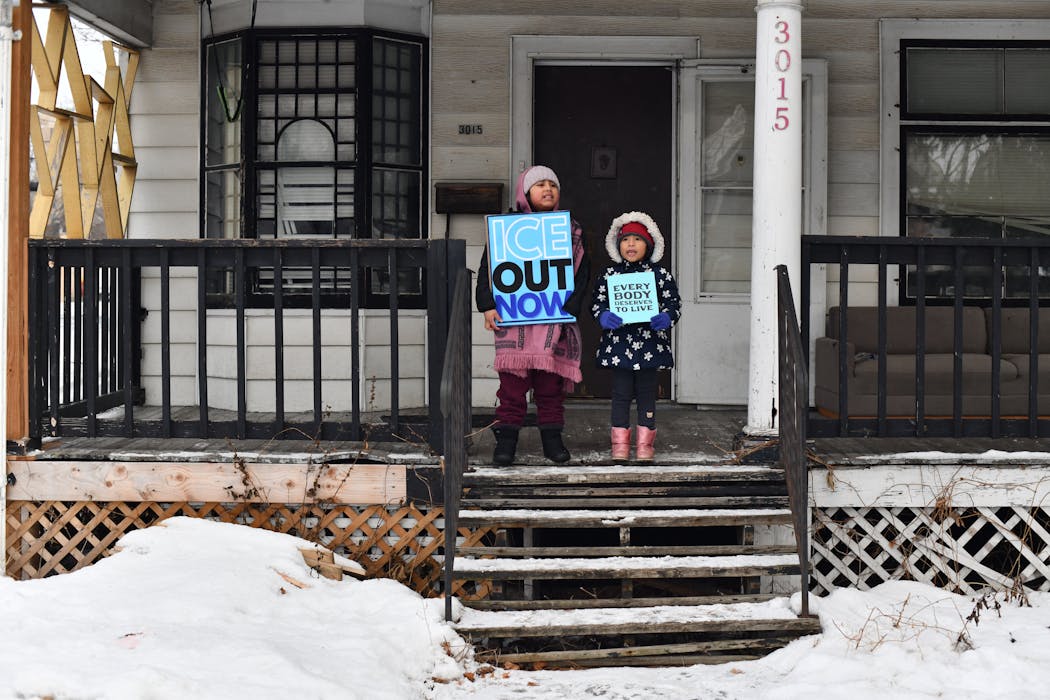
Children hold signs on the porch of a house as protesters march in Minneapolis against Immigration and Customs Enforcement on Jan. 10, 2026. Octavio JONES/AFP via Getty Images
When Immigration and Customs Enforcement agents detained Liam Conejo Ramos, a 5-year-old boy who is an asylum seeker, in Minneapolis on Jan. 20, 2026, the photos quickly became a flash point in the Trump administration’s aggressive immigration enforcement activity.
In one image, a man wearing a black uniform holds onto a gray and red Spider-Man backpack that the worried-looking young boy, wearing a blue bunny hat with floppy ears, has on his back.
Meanwhile, ICE and Customs and Border Patrol operations near schools have become increasingly common over the past year, spreading from Texas to Maine. While some parents in Minnesota have set up patrols around schools, there are families choosing to keep their kids home for days or weeks.
Our research shows that exposure to severe immigration enforcement experiences during childhood carries long-term, significant consequences: These children are twice as likely to suffer from anxiety in young adulthood.
People protest on Jan. 23, 2026, in Minneapolis and show signs referencing Liam Conejo Ramos, a 5-year-old child apprehended by immigration enforcement officers. Roberto Schmidt/AFP via Getty Images
Children whose immigrant parents are arrested, detained or deported often experience emotional and behavioral problems, including separation anxiety, school absenteeism, hyperactivity and other behavioral issues.
Yet, until recently, it has not been well understood how experiencing or being subjected to immigration enforcement actions affects children once they grow up to become adults.
That said, over three decades of research shows the clear links between traumatic childhood events and mental health problems in adulthood. Studies show, for example, that adults who experienced temporary separation from their parents as children are more likely to say they’ve experienced depression symptoms years later.
We decided to investigate whether a child being exposed to immigration enforcement actions – meaning the arrest of a parent, or detention of a close family member, for example – is associated with mental health problems among young adults who grew up in immigrant families.
How immigration enforcement unravels families
Our study first combined interviews and open-ended survey questions to define what it means to experience severe immigration enforcement during childhood.
We then examined the link between severe immigration enforcement actions and anxiety among 71 young adults – all U.S. citizens age 18 to 34 – who were raised in immigrant households in New York.
As children, all of these young adults witnessed or experienced the arrest, detention or deportation of an immigrant family member or a member of their communities. Three-quarters of the participants identified as Hispanic.
We analyzed our interviews to develop several criteria to determine what constitutes severe exposure to enforcement during childhood, considering factors like whether they witnessed a detention or arrest more than once, and how old they were when these experiences took place.
We found that approximately 26% of the survey participants – all of whom in this group were Hispanic, except one – had severe exposure to immigration enforcement actions during childhood. Not all of them had a parent who has been deported.
Some of these young people had relatives who had drawn-out cases in immigration court, or felt constant fear that their parents might be deported.
When we linked our interviews with survey data, our results were striking.
We found that young adults who experienced severe immigration enforcement actions as children were twice as likely to have anxiety, compared with young adults who did not have this experience when they were growing up.
Exposure to severe immigration enforcement actions as a child was not independently associated with depression as a young adult. But all the survey participants who said they were experiencing depression also reported anxiety symptoms – further evidence of a connection between severe immigration enforcement actions and anxiety among young people.
A father and child watch as U.S. Customs and Border Patrol Commander Gregory Bovino and fellow agents conduct operations in Kenner, La., on Dec. 6, 2025. Adam Gray/AFP via Getty Images
Lasting impact of today’s policies
Many legal experts and political observers say that the Trump administration’s immigration enforcement tactics in Minneapolis and in other cities are designed to intimidate and instill fear among civilians.
Children are not immune to these tactics, either as witnesses or as targets.
We believe that we can learn from decades of adverse childhood experiences research, which clearly shows the link between childhood adversity and physical and mental health outcomes in adulthood.
The enforcement tactics ICE is using in Minnesota and other places in the U.S. today are likely, our research suggests, going to harm the next generation of U.S. citizens and residents.
As trauma researchers have long known, our bodies keep score over a lifetime. The question facing policymakers is not whether these enforcement tactics will cause lasting harm – our research suggests they would – but what human costs we, as a nation, are willing to bear.
Joanna Dreby receives funding from Russell Sage Foundation
Eunju Lee receives funding from Russel Sage Foundation (PI Dreby).
Researchers have known for centuries that some fish make sounds, and the ancient Greek philosopher and scientist Aristotle even mentioned fish sounds in his writings. However, our understanding of which sounds are made by which fish species is extremely limited because it is difficult to pinpoint where a sound comes from underwater.
To accurately identify which sound is made by which fish, our team deployed an underwater acoustic localization array at sites in Barkley Sound, B.C. The localization array was designed by our project collaborator, Xavier Mouy, and it allowed us to precisely triangulate sounds to specific co-ordinates.
Using this triangulation and paired underwater video recordings, we were able to tie fish sounds to the correct species. We identified more than 1,000 fish sounds during our study, and successfully tied those sounds to eight different rocky reef fish species: copper, quillback, black, canary and vermillion rockfish, as well as lingcod, pile perch and kelp greenling.
We were particularly excited to identify sounds for canary and vermillion rockfish since these species had never been documented making sounds.
We also wanted to investigate if different species sounds were unique enough to be differentiated from each other. We created a machine learning model using 47 different sound characteristics, like frequency (how high- or low-pitched the sound is) and duration (how long the sound is), to understand the unique differences in species calls.
For example, black rockfish make a long, growling sound similar to a frog croak, and quillback rockfish make a series of short knocks and grunts. The fish sound model was able to predict which sounds belonged to which species with up to 88 per cent accuracy. This was surprising and exciting to our team since many rocky reef fish species are very closely related.
For example, the copper and quillback rockfish both make significantly more grunting type sounds while being pursued by larger fish. We also documented sounds made during feeding activities and during aggressive activities like chasing.
Using sounds in future research
We also used stereo cameras in our research which allowed us to measure the length of the fish. We found that smaller fish make higher frequency (pitched) sounds than larger fish, which means scientists may eventually be able to estimate how big a fish is just by listening to its sounds. This discovery could be used in conservation in the future because estimating fish size is an important tool for effectively managing fish populations.
Our team plans to apply this research to improve marine conservation efforts. Now that we understand fish species sounds can be differentiated, there are many exciting possibilities for developing these acoustic tools into monitoring methods.
We can create species-specific fish sound detectors that will tell us where fish live without disturbing them. This has important implications for future conservation efforts, and the techniques we used can be adapted by scientists all over the world to decipher other fish calls.
Going forward, our team plans to develop a method of counting fish using acoustic recordings by examining the number of calls each species makes.
We also plan to compare the fish sounds we collected in Barkley Sound to fish calls made in other areas of British Columbia to see if fish have unique accents or dialects.
Using underwater sound recordings to study fish is highly beneficial. It is minimally invasive and acoustic recorders can collect information for months or years in hard to access or low visibility locations underwater. With more development, underwater acoustic monitoring could become an important new tool for conservationists and fisheries managers.
Darienne Lancaster has received funding from the Natural Sciences and Engineering Research Council of Canada (NSERC) and Fisheries and Oceans Canada Competitive Science Research Fund (CSRF). She is affiliated with Fisheries and Oceans Canada.
Last weekend, China’s Ministry of National Defence announced that the country’s two most senior generals – Zhang Youxia and Liu Zhenli – would be removed from office and placed under investigation for serious disciplinary violations.
Zhang had been the People’s Liberation Army’s most senior general since October 2022. He was the highest ranking military member of the Politburo of the Communist Party of China (CCP), the party-state’s 24-member executive policy-making body.
Zhang was also the senior vice chairman of the Central Military Commission, which controls the armed forces.
Liu was the former commander of the PLA’s Ground Force and had most recently been in charge of the Central Military Commission’s Joint Staff Department.
The reaction to these developments outside China has led to dramatic headlines. A BBC headline initially focused on a “military in crisis”, while the Australian Broadcasting Corporation called it an “astonishing” purge that leaves Chinese leader Xi Jinping almost alone at the top of the world’s biggest army.
Certainly, the moves were surprising. But so little is known about the internal workings of the CCP’s leadership, including Xi’s relations with his colleagues in the Politburo, that interpreting these developments is difficult, if not impossible.
What we know
For historical and political reasons, the PLA is an organisation of the CCP. Both fall under the direct purview of Xi, who is chair of the Central Military Commission, general secretary of the CCP and president of the country.
The removal of Zhang and Liu at least temporarily leaves military leadership under just Xi and General Zhang Shengmin. Three other members of the Central Military Commission have lost their positions since 2024 and not been replaced.
Though the Chinese leadership is notoriously opaque, it is clear there have been disciplinary problems within the military in the last few years, particularly related to corruption and procurement in the more technically advanced departments of the PLA. Some two dozen senior military figures have been dismissed or investigated since 2022.
Zhang and Liu were fairly recent appointments to even more senior positions. Both were also seen as personal supporters of Xi. The fathers of Xi and Zhang had a close relationship dating back to the early days of the CCP in the 1930s before the establishment of the People’s Republic of China in 1949.
Moreover, the removals of Zhang and Liu happened more quickly than other senior military dismissals of recent years – and there were fewer warning signs. Both men had appeared in public as recently as a month ago.
Perhaps of even greater surprise, the Wall Street Journal reported that Zhang is accused of providing the United States with information about China’s nuclear weapons program, alongside allegations of accepting bribes and forming “political cliques”.
So, how to read the tea leaves?
Past practice suggests without a doubt that once a senior figure loses their status or is dismissed – for whatever reason – their downfall results in accusations of a litany of crimes.
The Politburo has also seen its share of intense internal politics in the past, though the precise circumstances of such conflicts usually take years to surface. A good example is the mysterious death of Lin Biao in 1971, another former PLA commander who at the time was Mao Zedong’s designated successor.
Given the broader context at play here with the management of the military and the development of government programs in recent years, as well as the claims Zhang and Liu violated “discipline and the law”, there are two possible explanations for their dismissals.
Both may have had direct involvement in corruption, taking bribes to appoint officials or ensure contracts for suppliers. It is equally likely they are being held responsible for corruption that has undoubtedly occurred in military procurement under their watch.
Then there is the possibility of a difference of opinion within the Central Military Commission and the Politburo on how to deal with corruption, particularly within the military.
Xi has repeatedly stressed the importance of the fight against corruption since he became general secretary of the CCP in 2012.
In recent weeks, he has made this an even more important crusade in the context of the about-to-be-announced 15th Five-year Plan for Economic and Social Development. On January 12, he designated the issue of corruption as a “major struggle” in a speech to China’s top anti-corruption agency:
Currently, the situation in the fight against corruption remains grave and complex […] We must maintain a high-pressure stance without wavering, resolutely punishing corruption wherever it exists, eliminating all forms of graft, and leaving no place for corrupt elements to hide.
To meet China’s developmental goals, he added, the CCP “must deploy cadres who are truly loyal, reliable, consistent and responsible”.
It is difficult to see Zhang and Liu or indeed anyone else currently willing or able to challenge Xi. Or, indeed, that Xi might feel immediately threatened by Zhang, Liu or others.
To that extent, Xi’s personal position is neither strengthened nor weakened by these dismissals.
Other analysts have suggested that the disruptions caused by the dismissals could lower Xi’s confidence in his military. Some have even said the potential for an invasion of Taiwan has now been lowered.
The removal of so many leaders may indicate the PLA is now expected to undergo culture change. At the same time, it would be drawing a very long bow to suggest its military capacity generally or in relation to Taiwan has either been strengthened or weakened.
David S G Goodman does not work for, consult, own shares in or receive funding from any company or organisation that would benefit from this article, and has disclosed no relevant affiliations beyond their academic appointment.
Renewed fighting in Syria in recent weeks between government-aligned forces and the Kurdish-led Syrian Democratic Forces (SDF) isn’t just a local issue. It has serious implications for the stability of the rest of the Middle East.
Syrian government forces launched an offensive in early January into areas of northeastern Syria controlled by Kurdish forces. The operation enabled the government to gain control of key oil and gas fields and major border crossings with Iraq and Turkey.
Of particular concern to Syria’s neighbours, though, is the thousands of former Islamic State (IS) fighters who have been held in prisons run by the SDF in the region. One camp, al-Hol, reportedly held about 24,000 detainees, primarily women and children. There were also diehard IS supporters from around the world at the camp.
Amid concerns the prisoners would escape with the SDF retreat, the US military began moving detainees from Syria to other facilities in Iraq last week. Some prisoners, however, were able to escape.
Though both sides agreed to a ceasefire that would see the SDF forces incorporated into the Syrian armed forces, it remains shaky.
And there are concerns the Islamic State will take advantage of the chaos to regroup and try to destabilise the region once again.
A pattern of violence
The fighting has followed a pattern disturbingly similar to other violent episodes following the fall of Bashar al-Assad’s government to forces led by now-President Ahmed al-Sharaa in late 2024.
When the Islamic State controlled large portions of Syria around 2014, its violent actions against civilians – in particular, minorities such as the Yazidis and Kurds – were widely condemned as potential war crimes and crimes against humanity.
And al-Sharaa’s government has been supported – or at least tolerated – by international actors, most notably the United States. US President Donald Trump praised al-Sharaa earlier this month for his “tremendous progress”, adding, “I think he’s going to put it all together.”
Trump even met al-Sharaa during a visit to Saudi Arabia in May at the behest of Saudi Crown Prince Mohammed bin Salman.
As a result, violent actions that once triggered airstrikes and global outrage are now met largely with silence, caution or political justification.
This shift is most stark in the treatment of Kurdish forces, particularly the Syrian Democratic Forces. These forces have been among the US government’s most effective local partners in the fight against Islamic State for years.
Despite this record, violence against Kurdish civilians has elicited little meaningful reaction. Instead, US policy has focused on supporting the Syrian government structure and urging Kurdish leaders to accept the new political order and fully integrate into state institutions.
For Kurdish communities, this demand carries profound risks. The experiences of the Druze and Alawites offer little assurance that disarmament and territorial concessions will be met with protection or political inclusion.
Many Kurds fear laying down arms without security guarantees could expose them to similar attacks.
A return of Islamic State
Another destabilising consequence of the fighting in eastern Syria has been the collapse of the detention network built to prevent the return of IS.
The US has said up to 7,000 detainees could be transferred from Syria to detention facilities in Iraq in its operations.
While framed as a logistical and security necessity, the announcement immediately triggered alarm across Iraq, where memories of the 2014 Islamic State invasion remain vivid. That was fuelled, in part, by prison breaks from poorly secured detention facilities in Iraq and Syria.
In response to these concerns, Iraqi security forces have deployed in large numbers along the Syrian border to prevent escaped IS detainees from infiltrating the country.
US and Turkish agendas
At the centre of this unfolding crisis is the US, which favours a centralised Syrian state under a single trusted authority. This is easier to manage diplomatically and militarily than a fragmented country with competing armed factions.
This approach also aligns with Trump’s broader regional ambitions, including expanding the Abraham Accords by persuading more regional countries to normalise ties with Israel.
Turkey, a NATO member and key US ally, also has a vested interest in the future of Syria. Ankara, a key backer of al-Sharaa, has long viewed any form of Kurdish autonomy in Syria as an existential threat, fearing it would embolden Kurdish demands inside Turkey.
Together, these overlapping agendas reveal why the international response to the fighting in eastern Syria has been so muted. Concerns over civilian protection or the potential regrouping of the Islamic State have been trumped by the strategic realignment taking place with a post-Assad Syria.
Kurdish forces, once indispensable partners, now find themselves caught between shifting alliances and competing regional interests — another casualty of a new international order defined by convenience rather than principle.
Ali Mamouri does not work for, consult, own shares in or receive funding from any company or organisation that would benefit from this article, and has disclosed no relevant affiliations beyond their academic appointment.
Source: The Conversation – France – By Olivia Roth-Delgado, Cheffe de projets scientifiques, Agence nationale de sécurité sanitaire de l’alimentation, de l’environnement et du travail (Anses)
Mixed anxiety-depressive disorders (MADD) and suicidal thoughts, online bullying, poorer self-esteem, alcohol, cannabis and psychoactive substance use… social networks exploit young people’s vulnerability and actually help boost certain disorders that they are prone to.
This is the conclusion of a large-scale report by the French Agency for Food, Environmental and Occupational Health & Safety (Anses) which dissects the mechanisms behind digital marketing tools designed to target the specific vulnerabilities and emotional weak spots associated with adolescence.
Olivia Roth-Delgado and Thomas Bayeux are part of the team at Anses coordinating the research project. They offered to present the main teachings from this latest report.
Olivia Roth-Delgado: This expert appraisal is the result of five years of research and over 1 000 sought-after articles. It is unprecedented in its originality and the extensive nature of the work that are, in our knowledge, unequalled as far as public authorities such as Anses are concerned.
For the first time, certain mechanisms pointing to the ways in which social networks operate are being linked to effects impacting the health of adolescents. These mechanisms are known as dark patterns (editor’s note: they are designed to capture users’ attention and monetise it, and they come in several forms which aren’t necessarily limited to social media. Some are also used by online shopping sites, for example).
Adolescence is a vulnerable time because the brain is still maturing. During this phase, teenage boys and girls experience changes in the way they process and handle their emotions in the reward-related circuits of the brain. They are also more sensitive to social context, which can favour risk-taking behaviour when around their peers. It is also a time of heightened vulnerability for mental health disorders.
Thomas Bayeux: During adolescence, a culture encouraging confrontation with others, an appetite for communication and character building, consisting of testing social norms develops. All of these arguments lead us to the 11-17 age group at which these dispositions occur.
Anses’ mission as a public health authority is to assess health risks. That said, in the chapters of the study on practices and maintaining inter-generational relations, the expert review raises the potential positive effects of social media and the motivations encouraging engagement during adolescence.
The report suggests particularly concerning social media-related effects among adolescents including anxiety-depressive disorders, suicidal thoughts or self-harming. What mechanisms are at play?
O.R.-D.: Among the mechanisms we have highlighted and studied featured misleading (or mainpulative) interfaces as well as algorithms that produce personalised content. They all equate to attention-grabbing that keep social media users engaged, by offering them increasingly well-targeted or extreme content.
If a teenage boy or girl for example, searches “self-harm” once, this kind of content will be offered repeatedly and can trap them in a negative spiral.
T.B.: Capturing attention serves the business model that supports these online platforms. It gives them access to a large amount of data which it can capitalise on while equally contributing to ad space sales.
Online platforms have everything to gain from keeping people engaged using the two strategies we have outlined : on one hand, by providing personalised content using increasingly productive algorithms which ensnare users in an information loop, and on the other hand, by highlighting the most impactful content.
Dark patterns roll out familiar techniques such as likes, notifications, scrolling, reels on auto play, etc. Also known as “deceptive design patterns”, these user interfaces have been carefully crafted to trick people into doing things they wouldn’t do otherwise.
The adolescent phase greatly resonates with these “push strategies” that social media implement. At Anses, we are seeing major public health challenges as supply and demand meet, so to speak. The cocktail they produce is potentially explosive !
Where mental health-related disorders are concerned but also, bullying, and alcohol, tobacco, cannabis use along with other risk-taking behaviours that you are safeguarding against, are social networks boosting pre-existing phenomena?
O.R.-D.: Absolutely. Social networks constitute a social space. They offer a sounding board for problems that are present in society, gender stereotypes or encouraging drug use, etc.
T.B.: Social networks contribute to adolescent socialisation and social construction, they provide continuity with the world offline, encompassing both its good points and its flaws. There is no watertight barrier between what happens offline and what happens on social media.
Should the existing rules for protecting minors in society extend to social media?
O.R.-D.: This is actually the founding principle of the Digital Services Act. The European regulatory framework for digital services seeks to vet online content on very large platforms, in line with the following ethos : “What is illegal offline, is illegal online.
T.B.: This preoccupation motivates one of the key recommendations to emerge from the Anses report, which is that users under 18 can only access social networks designed and configured for protecting minors. Our intention is not for social media to be eradicated all together. But for technical solutions to be put into place to make social media a safe place for teenagers, and Anses urges platforms to become accountable in this respect.
Going forward, teenagers then discussing their social media habits with their peers, parents, teaching staff or youth workers could prove to be a very good thing. That said, it doesn’t let public authorities and online platforms ‘off the hook’ where adopting collective strategies to make social media a safe space for teenagers are concerned.
The report shows links between social media use with some disorders, without really establishing a cause-effect relationship between the two. Why is this?
O.R.-D.: The cause-effect subject remains a thorny one. It is fair to say that the expert appraisal that we are basing ourselves on is very dense and documented. Our methodology is solid, but it isn’t backed up by a “body of evidence”. That said, we can vouch for strong associations between social media use and the disorders we have mentioned for which we explicitly highlight the underlying mechanisms at work.
In relation to sleep, for example several factors are involved. When teenagers go on social media at night before bedtime, the exposure to digital blue light from screens can prolong the time it takes to fall asleep, because by stimulating our cognitive alertness, it shortens sleep duration. The long-term effects of chronic sleep deprivation on mental and physical health are well-documented. Add to that the fact that the emotional stimuli involved in going on social media can also prevent sleep. We are seeing that there is a host of proof to support this. But the concrete effects of social media on sleep in teenage boys and girls also depends on their practices.
Similarly, in the event of anxiety-depressive disorders or suicidal thoughts, the type of content on offer plays a major role. The two-way street factor must also come into consideration. Allow me to explain: an adolescent boy or girl who is already psychologically fragile are more likely to go on social media. Content design algorithms pick up on their emotional weaknesses and suggest emotionally-charged content. And this is precisely how teenagers get trapped in a negative spiral. Proving that there is a cause-effect relationship associated with feedback loops and bidirectional effects is however, far more complicated.
And as for social media’s impact on self-image, we also have a convincing amount of evidence demonstrating the same type of mechanisms based on repeated exposure to content that glorifies muscular men and thin women.
Girls seem more sensitive to the negative effects of social media than boys. What is this down to?
T.B.: This is one of the key takeaways of the report. Girls clearly represent a highly vulnerable segment on social media as far as health risks are concerned, and not just concerning how it impacts self-image. More girls than boys on social media are being bullied, and becoming victims of gender shaming, and social pressure… Girls pay more attention to what happens on social media, and comments that are posted.
LGBTQIA+ communities also represent a high-risk segment on social media. They are more likely to become victims of online bullying which is one of the associated health hazards, particularly mental health.
The report from Anses mentions that the amount of time spent on social media is not the only factor that should be considered.
T.B.: Time of use is helpful, but that alone isn’t enough to fully grasp the subject. Knowing how long users spend on social media allows us to study certain health factors like sedentariness, despite the growing number of digital nomad tools out there for connecting to social media. Quantifying the amount of time users engage also turns out to be precious in the case of late-night social media use, which is likely to affect sleep, for example.
However, we also know that understanding social media practices is essential for studying some of the related health side effects. It is important to know what you can do on social media : publish, like, read comments, retouch photos, for instance and the emotional attachment involved. It’s not about opposing different approaches, but aiming for complimentary.
Your report is based on a research project that fails to address, or barely addresses the impact of the very latest digital tools such as TikTok or AI chatbots. Can we assume that these new technologies increase mental health risks for teenagers as well?
O.R.-D.: The Anses’ expert appraisal draws on over a thousand articles mainly published between 2011 and 2021. Due to the time accumulated and spent researching and bringing the appraisal together, the technologies our studies focused on have naturally evolved. That said, we based ourselves on a common core of mechanisms, like deceptive user interfaces (dark patterns) and content personalisation algorithms that are related to health risks.
Therefore, our conclusions and recommendations can be applied to more recent social media. As for the question of artificial intelligence and AI chatbots, Anses recommends that the subject becomes the focus of future reports.
A weekly email in English featuring expertise from scholars and researchers. It provides an introduction to the diversity of research coming out of the continent and considers some of the key issues facing European countries. Get the newsletter!
In your recommendations, you suggest getting teenagers involved in risk-prevention programs.
O.R.-D.: Anses offers young people the opportunity to get onboard with our research, because they know best what motivates them to engage with social media as they are the ones creating and spreading new ways of using social media. This makes including them in discussions and boundary-setting with parents and teachers, all the more important. This will make them more inclined to follow the rules that they actually had a hand in making. Among the recommendations, Anses mentioned the need to promote forums in which young people can share their online experiences.
T.B.: And again, let me remind you that Anses is not recommending banning social media all together, it suggests a complete overhaul of the way networks are designed so they do not harm the health of adolescents.
Interview by Health Journalists Lionel Cavicchioli and Victoire N’Sondé, The Conversation France.
Les auteurs ne travaillent pas, ne conseillent pas, ne possèdent pas de parts, ne reçoivent pas de fonds d’une organisation qui pourrait tirer profit de cet article, et n’ont déclaré aucune autre affiliation que leur organisme de recherche.
Source: The Conversation – in French – By Mohib Abderrahim, Chercheur en Préhistoire et conservateur principal des Monuments et Sites, Institut national des Sciences de l’Archéologie et du Patrimoine in Rabat
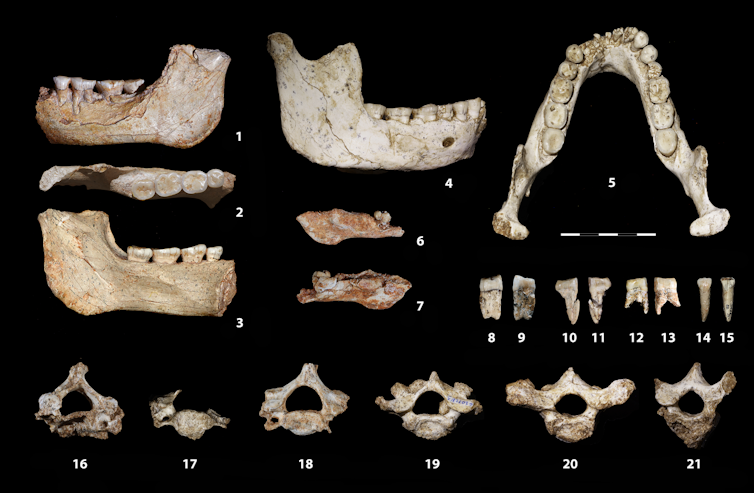
Mandibule (mâchoire inférieure) du spécimen d’homininé ThI-GH-10717, mise au jour lors des fouilles de la carrière Thomas, au Maroc.Avec l’aimable autorisation de Abderrahim Mohib, Fourni par l’auteur
Et si une grotte marocaine détenait une pièce essentielle du puzzle des origines de l’humanité ? Des fossiles humains vieux de 773 000 ans découverts au Maroc apportent de nouveaux éléments au débat sur le dernier ancêtre commun de l’Homo Sapiens. Ces fossiles pourraient en effet constituer le chaînon manquant de l’histoire humaine. La découverte suggère une continuité évolutive en Afrique du Nord bien antérieure à l’Homo Sapiens. Elle confirme aussi le rôle de l’Afrique dans les grandes étapes qui ont façonné l’espèce humaine. Abderrahim Mohib, chercheur spécialiste de la préhistoire, conservateur principal des monuments et sites au Maroc, l’un des auteurs de cette recherche, explique les enjeux de cette découverte à The Conversation Africa.
Qu’avez-vous découvert au Maroc et en quoi cette découverte est-elle majeure ?
Dans le cadre du programme de recherche maroco-français [« Préhistoire de Casablanca »]porté par l’Institut national des sciences de l’archéologie et du patrimoine (Rabat, Maroc) et le ministère français de l’Europe et des Affaires étrangères, des fouilles ont été entreprises depuis 1994 dans la Grotte à Hominidés à la carrière Thomas I au sud-ouest de la ville de Casablanca (Maroc).
Ces fouilles ont permis de mettre au jour des fossiles humains associés à des milliers de restes fauniques et environ 300 artefacts en quartzite et en silex. L’ensemble provient d’un espace qui semble avoir servi de tanière à des carnivores. En atteste un fémur humain portant des traces de mâchonnement et de consommation par un grand carnivore de type hyène.
L’ensemble des restes d’hominines comprend, en plus du fémur, une mandibule adulte presque complète, une hémi-mandibule adulte, une mandibule d’enfant d’un an et demi, des vertèbres cervicales et thoraciques et des restes dentaires.
Cette découverte est majeure dans le sens où elle apporte un éclairage inédit sur une période clé de l’évolution humaine marquée par une rareté extrême de fossiles humains en Afrique, en Europe et en Asie et elle documente des populations encore mal connues situées entre les formes anciennes du genre Homo et les lignées plus récentes.
Par ailleurs, ces restes humains représentent les fossiles les plus anciens du genre Homo jamais découverts au Maroc dans un contexte chronologique indiscutable. De plus, la Grotte à Hominidés est voisine d’un autre site plus ancien dans la même carrière Thomas I (nommé ThI-L), reconnu sur plus de 1000 mètres carrés. Daté de 1 million 300 mille ans, ce site documente l’occupation humaine la plus ancienne au Maroc attribuée au premier stade de la culture matérielle Acheuléenne en Afrique du Nord-Ouest.
Photo de tous les fossiles humains, image publiée dans la revue Nature, le 7 janvier 2026. Fourni par l’auteur
Quel âge ont ces premiers humains et comment avez-vous pu déterminer leur ancienneté avec précision ?
Ces restes humains mis au jour à Casablanca ont été datés par le paléomagnétisme – – étude du champ magnétique terrestre ancien – avec une grande fiabilité chronologique autour de 773 000 ans. En effet, les sédiments de la Grotte à Hominidés ont bien enregistré les variations du champ magnétique terrestre. Grâce à un échantillonnage à très haute résolution (tous les 2 cm), nous avons pu identifier la dernière inversion géomagnétique d’une polarité inverse (Matuyama) à une polarité normale (Brunhes) (Matuyama-Brunhes M/B). Cela veut dire que nous avons identifié une période où le champ magnétique de la Terre s’est inversé, un phénomène naturel qui sert de repère pour dater les couches du sol.
Cette inversion constitue un marqueur chronologique très solide et largement accepté. Ce qui est extraordinaire, c’est que nos restes fossiles se placent précisément au moment de l’inversion, offrant ainsi l’une des datations les plus fiables d’hominines fossiles du Pléistocène. Par ailleurs, ces données sont cohérentes avec le cadre géologique et les restes paléontologiques.
Ces découvertes modifient-elles nos connaissances sur le lieu et le processus d’évolution de l’homme moderne?
Les fossiles de Casablanca fournissent de nouveaux éléments pour nourrir notre connaissance de l’évolution humaine. Ils appartiennent en effet, à une période marquée par la dispersion de l’Homo erectus hors d’Afrique, ainsi que par l’extinction de groupes d’hominines plus anciens tels que les genres Australopithecus et Paranthropus.
D’un point de vue morphologique, ils combinent des traits archaïques de type Homo erectus et des traits dérivés plutôt apparentés à Homo sapiens. Ils comblent également un vide important du registre fossile africain, à un moment où les données paléogénétiques situent la divergence entre la lignée africaine menant à Homo sapiens et les lignées eurasiatiques à l’origine des Néanderthaliens et des Dénisoviens. La combinaison originale de caractères primitifs et plus évolués, témoigne de populations humaines proches de cette phase de divergence.
On peut définir cette population marocaine comme une forme évoluée d’Homo erectus qui présente des caractéristiques plus dérivées que les fossiles plus anciens d’Homo erectus trouvés en Afrique et en Asie, et ne possèdant pas non plus les traits dérivés présents chez les Néanderthaliens ou les Homo sapiens anatomiquement modernes.
Si auparavant, les fossiles d’Homo antecessor mis au jour dans le site de Gran Dolina d’Atapuerca en Espagne étaient les seuls à montrer des caractères dérivés liés à Homo Sapiens, les fossiles de la Grotte à Hominidés offrent une nouvelle perspective. Ils ouvrent la possibilité d’un lien évolutif avec les plus anciens fossiles d’Homo sapiens connus, ceux du Jebel Irhoud au Maroc, datés d’environ 315 000 ans. Ces découvertes éclairent l’émergence de la lignée Homo Sapiens tout en renforçant l’idée que ses racines profondes sont africaines.
Il s’agit enfin, d’après la mosaïque de leurs caractères archaïques et dérivés d’une population africaine, sœur d’Homo antecessor, proche de la divergence entre les lignées eurasiennes et africaines du Pléistocène moyen.
Pourquoi l’Afrique du Nord, et particulièrement le Maroc, est-elle si importante pour comprendre les origines de l’humanité ?
vue générale du gisement de la carrière Thomas I avec ses deux sites : le site L en blanc, 1,3 million d’années, le point de référence de l’occupation humaine la plus ancienne au Maroc et la grotte à hominidés datée de 773 mille ans. Avec l’aimable autorisation de l’auteur., Fourni par l’auteur
L’Afrique du Nord-Ouest, avec l’Afrique de l’Est et australe, représente l’une des régions clés où nous avons actuellement une nouvelle fenêtre sur l’évolution des hominines du Pléistocène. La Méditerranée a probablement agi comme une barrière biogéographique majeure, contribuant à la divergence entre les populations africaines et eurasiennes.
Le Sahara, dont l’étendue a considérablement varié au fil du temps, a probablement joué un rôle important dans la structuration des populations africaines. Les fossiles marocains confirment l’ancienneté et la profondeur des racines africaines de notre espèce, tout en soulignant le rôle clé de l’Afrique du Nord-Ouest dans les grandes étapes de l’évolution humaine.
Mohib Abderrahim does not work for, consult, own shares in or receive funding from any company or organisation that would benefit from this article, and has disclosed no relevant affiliations beyond their academic appointment.
Malgré la montée de l’extrême droite, les enquêtes montrent que les Français restent très attachés à la démocratie. En revanche, l’insatisfaction vis-à-vis de son fonctionnement est grande. Le sentiment de déni de la souveraineté populaire est au cœur du vote populiste et de l’abstention.
Les Françaises et les Français seraient-ils en train de se lasser de la démocratie ? À écouter certains commentateurs, la réponse semble évidente. Montée de la défiance, abstention élevée, succès des partis de droite radicale populiste… Tout indiquerait un pays gagné par la tentation illibérale et autoritaire. Pourtant, les données disponibles livrent une image plus nuancée et, d’une certaine manière, plus rassurante.
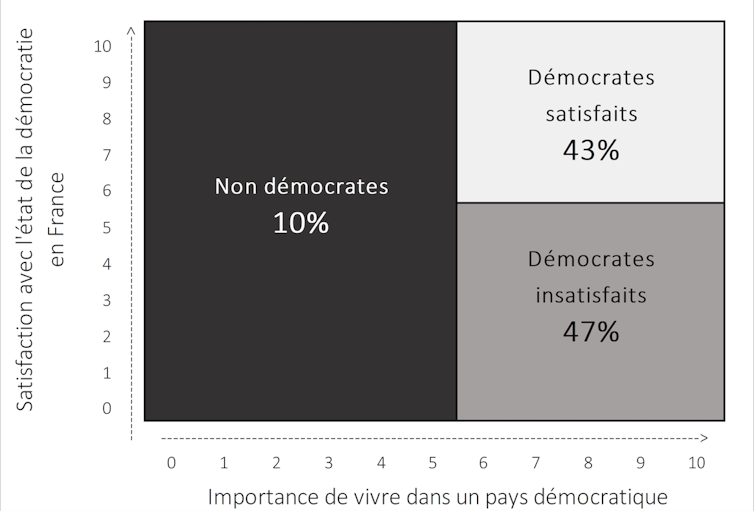
Selon l’Enquête sociale européenne (ESS) de 2020, les citoyens restent en effet massivement attachés au régime démocratique. Une écrasante majorité juge important voire très important le fait de vivre en démocratie. Là où le bât blesse, c’est sur la pratique : près de la moitié des enquêtés appartiennent à la catégorie des démocrates insatisfaits, celles et ceux qui soutiennent la démocratie mais se disent mécontents de la façon dont elle fonctionne en France (figure 1).
Ces démocrates insatisfaits ne sont pas des antidémocrates. Ils expriment au contraire une forme d’exigence élevée : plus on attend de la démocratie, plus on est enclin à juger sévèrement son fonctionnement. Cette tension entre un attachement profond aux valeurs démocratiques et un regard critique sur la réalité institutionnelle organise de plus en plus la vie politique française.
Figure 1. Importance et satisfaction par rapport à la démocratie en France
Lecture : Les démocrates insatisfaits (47 % des Français) combinent une importance de vivre dans un pays démocratique supérieure ou égale à 6 à une satisfaction vis-à-vis de la démocratie inférieure ou égale à 5. Les non-démocrates (10 % des Français) attachent une moindre importance (inférieure ou égale à 5) au fait de vivre dans un pays démocratique, quelle que soit par ailleurs leur satisfaction vis-à-vis de la démocratie. source ; Enquête sociale européenne, vague 10, 2020, Fourni par l’auteur
La politisation du renouveau démocratique
Depuis une dizaine d’années, la question du renouveau démocratique est au cœur des mouvements sociaux. Nuit debout en 2016, les gilets jaunes à partir de 2018, les mobilisations contre le passe sanitaire en 2020 ou, plus récemment, la journée d’action Bloquons tout ont débordé la démocratie participative institutionnalisée. En demandant de « rendre la parole au peuple », ces mobilisations ont contribué à rouvrir le débat sur les règles du jeu démocratique : qui décide et selon quelles procédures ?
Les exécutifs ont tenté de répondre, au moins symboliquement, à cette démocratie d’interpellation. Le grand débat national et, surtout, les conventions citoyennes sur le climat, sur la fin de vie ou sur les temps de l’enfant ont consacré l’entrée des mini-publics délibératifs dans le répertoire institutionnel français. Mais ces dispositifs ont également montré les limites des innovations démocratiques lorsque les promesses de reprise intégrale des propositions citoyennes ne sont pas tenues.
La politisation du renouveau démocratique vient aussi des partis eux-mêmes. Les partis challengers se positionnent souvent en entrepreneurs de la cause démocratique. Les données Chapel Hill Expert Survey (CHES) montrent ainsi que La France insoumise (LFI) et le Rassemblement national (RN) sont les plus enclins à défendre l’idée selon laquelle « le peuple » devrait décider en dernière instance (figure 2). Bien sûr, les deux forces politiques ne mobilisent pas la souveraineté populaire de la même façon. Là où le RN privilégie l’appel direct au peuple plutôt que la médiation parlementaire pour faire pièce au prétendu laxisme des institutions et des élites, LFI promeut plutôt un approfondissement démocratique par l’effectivité et l’extension des droits.
Figure 2. Soutien à la souveraineté populaire
Il n’en reste pas moins que la démocratie libérale perd son caractère consensuel, le conflit partisan portant désormais sur le modèle lui-même, et non seulement sur sa mise en œuvre. Des visions alternatives gagnent en visibilité.
Pour corriger les dysfonctionnements d’un modèle élitiste fondé sur les élus et sur la représentation, faut-il un modèle technocratique qui donne le pouvoir aux experts ? un modèle participatif, qui s’appuie sur l’implication et la délibération des citoyens ? ou un modèle majoritariste, fondé sur l’exercice direct de la souveraineté populaire ? Surtout, comment combiner ces modèles, qui comportent chacun des avantages et des inconvénients, pour décider des fins de l’action publique ?
Comment les conceptions de la démocratie nourrissent l’insatisfaction
Tout comme les autres Européens, les Français n’investissent pas le mot-valise « démocratie » de façon univoque. L’ESS distingue trois grandes composantes : libérale (élections libres, protection des droits, indépendance des médias et de la justice), populaire (souveraineté du peuple via des référendums) et sociale (égalité et protection). L’ESS mesure à la fois l’importance accordée à chacune de ces composantes (les aspirations) et le jugement porté sur la manière dont elles sont réalisées en France (les évaluations).
En soustrayant les évaluations aux aspirations, on obtient des scores de déficit démocratique perçu : plus l’écart est grand, plus les attentes sont déçues. Les résultats sont éloquents.
Sur la démocratie libérale, les Français perçoivent un déficit, mais d’ampleur relativement modérée. C’est sur la souveraineté populaire et, surtout, sur la dimension sociale que les écarts sont les plus prononcés. Beaucoup, notamment parmi les démocrates insatisfaits, souhaitent une démocratie où les citoyens sont davantage appelés à trancher les grandes orientations politiques, et où l’État joue son rôle de protection contre les risques sociaux.
Quand les déficits démocratiques s’expriment dans les urnes
Comment ces déficits perçus se traduisent-ils dans les comportements électoraux ? Des modèles statistiques permettent de dessiner plusieurs profils.
Les personnes qui perçoivent un fort déficit en matière de démocratie libérale ont tendance à s’abstenir davantage ou à se tourner vers la gauche, qu’elle soit modérée ou radicale. En revanche, ce déficit n’alimente pas le vote pour la droite radicale populiste. Plus les attentes libérales sont déçues, plus la probabilité de voter pour le RN recule (figure 3A).
Il en va différemment pour le déficit de démocratie populaire. Les électeurs qui estiment que « le peuple » n’a pas suffisamment son mot à dire, que les décisions sont confisquées par les élites ou que les référendums manquent sont plus enclins à voter pour la gauche radicale ou pour le RN, mais aussi à s’abstenir. C’est ici que se loge le cœur du vote populiste et de l’abstention : non pas dans un rejet abstrait du système, mais dans la conviction que la souveraineté populaire est entravée (figure 3B).
Par ailleurs, le déficit de démocratie sociale ne profite pas à la droite radicale. Il tend même à réduire l’abstention et le vote RN, ainsi qu’à accroître le vote pour la gauche modérée. Autrement dit, celles et ceux qui jugent que la démocratie française ne tient pas ses promesses en matière de justice sociale sont loin de s’abstenir ou de voter mécaniquement pour les partis de droite radicale (figure 3C).
Figure 3. Probabilités de vote en fonction du déficit démocratique perçu.
Plus instructif encore, ces déficits démocratiques perçus ont un impact plus prononcé sur le vote que l’insatisfaction globale vis-à-vis de la démocratie. Être un démocrate insatisfait augmente bien les probabilités statistiques de voter pour des partis challengers ou de s’abstenir. Mais les attentes déçues vis-à-vis de la démocratie influencent encore plus fortement ces probabilités.
Au total, il est difficile de bien saisir les logiques électorales du soutien à la démocratie si l’on s’en tient au diagnostic d’une insatisfaction généralisée, sans se demander quelles conceptions de la démocratie motivent le vote protestataire et l’abstention.
C’est parce qu’ils restent profondément attachés aux composantes sociales et populaires de la démocratie que les Français sont des démocrates insatisfaits, enclins à sanctionner les partis de gouvernement ou à se détourner des urnes. L’insatisfaction vis-à-vis de la démocratie ne vient pas de citoyens hostiles à la démocratie libérale, mais de citoyens exigeants et porteurs d’autres manières de « faire démocratie ».
Source: The Conversation – in French – By Claude Lelièvre, Enseignant-chercheur en histoire de l’éducation, professeur honoraire à Paris-Descartes, Université Paris Cité
En principe interdits dès l’institution de l’école républicaine, les châtiments corporels ont longtemps perduré dans la réalité ordinaire des classes. Et lorsqu’ils étaient l’objet de plaintes, la jurisprudence était pour le moins complexe, voire à géométrie variable. A ainsi souvent été invoqué un « droit de correction » que la Cour de cassation vient d’écarter définitivement.
Ce 14 janvier 2026, la Cour de cassation a écarté l’existence d’un « droit de correction » pouvant justifier les violences éducatives sur des enfants. Il n’existe pas de « droit de correction parental » dans la loi française, les textes internationaux ou la jurisprudence moderne, a-t-elle indiqué dans un communiqué de presse.
Alors qu’un père de famille avait été condamné en première instance en 2023 par le tribunal de Thionville à dix-huit mois de prison avec sursis probatoire et au retrait de l’autorité parentale pour des violences sur ses deux fils mineurs, la cour d’appel de Metz avait prononcé sa relaxe le 18 avril 2024 au nom d’un « droit de correction ».
Durant l’audience du 19 novembre 2025 à la Cour de cassation, la rapporteuse avait mis en avant que certains arrêts de la Chambre criminelle invoquaient certes un « droit de correction » parental, mais qu’ils étaient fort anciens, notamment l’un d’entre eux souvent évoqué en l’occurrence datant de 1819.
La plus haute instance judiciaire est donc revenue sur la relaxe qui avait indigné les associations de protection de l’enfance. Celles-ci avaient dénoncé un retour en arrière par rapport à la loi dite « anti-fessée » de 2019 qui avait abouti à l’inscription suivante dans le Code civil :
Des châtiments corporels interdits dès 1887, une réalité plus complexe
Les punitions corporelles ont été en principe nettement interdites dans l’espace scolaire depuis l’institution de l’école républicaine. Dès 1887, les règlements pour les écoles maternelles indiquent que « les seules punitions dont on peut faire l’usage sont la privation, pour un temps court, du travail et de jeux en commun ou le retrait des bons points ». Le règlement pour les écoles primaires élémentaires précise formellement en son article 20 qu’« il est absolument interdit d’infliger aucun châtiment corporel ».
Cela ne signifie pas que, dans la réalité ordinaire des classes, il en était ainsi, tant s’en faut. Et cela d’autant plus que, lorsque des châtiments corporels étaient mis en œuvre et l’objet de plaintes, il apparaît que la jurisprudence a été pour le moins complexe, voire à géométrie variable.
Un futur savant (Le bonnet d’âne), Henri Jules Jean Geoffroy, 1880. via Wikimedia
Dès 1889, soit deux ans après l’interdiction formelle des châtiments corporels dans l’école républicaine, la Cour de cassation a en effet reconnu aux maîtres un droit de correction au même titre que celui attribué aux parents, dans la mesure où il n’y a pas excès et où la santé de l’enfant n’est pas compromise.
« Les instituteurs ont incontestablement par délégation paternelle, un droit de correction sur les enfants qui leur sont confiés ; mais, bien entendu, ce droit de correction, pour demeurer légitime, doit être limité aux mesures de coercition qu’exige la punition de l’acte d’indiscipline commis par l’enfant. »
Un exceptionnel « droit de correction » à l’école ?
C’est en se fondant sur ces considérations que, par exemple, la cour d’appel de Toulouse a relaxé, le 18 décembre 1999, le responsable de l’internat d’un collège de la région de Foix. L’arrêt de la cour d’appel estime :
« S’il est arrivé à monsieur J. de donner des gifles ou coups de poing à certains élèves, des coups de pied ou de classeurs, il convient de rappeler que l’élément intentionnel de l’infraction fait défaut lorsque les violences alléguées se rattachent à l’exercice du droit de correction qui appartient aux parents et dans une moindre mesure au maître. Or, en l’espèce, il a été constaté que M. J. avait la lourde responsabilité d’un internat, qu’il assumait par conséquent une fonction substitutive de celle des parents et que certains des élèves présentaient des difficultés d’ordre psychologique et des retards scolaires et perturbaient par leur comportement le bon déroulement des études. »
Les tribunaux admettent le plus souvent que, dans le cadre du maintien de la discipline scolaire, les enseignants bénéficient d’un exceptionnel droit de correction pour assurer le bon déroulement du cours dans un ordre scolaire dégradé, répondre à une attitude provocatrice ou sanctionner physiquement des violences ou injures contre l’enseignant ou entre élèves.
Une jurisprudence longtemps floue
Dans quels cas le « droit de correction » à l’école n’était-il il pas admis ? Y avait-il une jurisprudence claire à ce sujet ?
Le « droit de correction » a été rarement toléré par les tribunaux pour d’autres buts, par exemple pour sanctionner une mauvaise application au travail ou de mauvais résultats. Ainsi la cour d’appel d’Agen juge, en 1999, qu’une institutrice qui avait infligé une fessée (occasionnant un gros hématome) à une jeune élève de 5 ans qui « ne savait pas faire son travail » est « coupable de violences volontaires ».
Un instituteur, qui criait régulièrement sur un élève de 7 ans, jetait ses affaires, déchirait son travail, le moquait, lui donnait des claques et lui tirait les oreilles, est également condamné le 23 janvier 2002 par la cour d’appel de Pau à une peine de six mois d’emprisonnement avec sursis.
Les corrections ne doivent pas non plus dépasser une certaine intensité ni prendre des formes considérées comme inacceptables, moralement et juridiquement. Ainsi la cour d’appel de Bourges a-t-elle condamné à une peine d’amende un instituteur d’école maternelle qui avait fait mine de mordre le doigt d’un enfant afin de mettre un terme à son comportement agressif et à ses morsures réitérées.
Par ailleurs, un responsable d’un internat est condamné pour avoir donné des coups de pied dans le dos d’un élève qu’il avait projeté à terre – alors même qu’il est relaxé pour les gifles et les coups de pied donnés aux élèves perturbateurs restés debout (cour d’appel de Toulouse, 18 février 1999).
En définitive, les principes mêmes de la jurisprudence n’ont pas été d’une clarté absolue en la matière, même s’il semble exister quelques règles de base, et aucun jugement n’était vraiment assuré.
En écartant l’existence d’un « droit de correction » parental en ce début 2026, la Cour de cassation a donc comblé un flou de la jurisprudence.
« C’est la fin de l’idée, pourtant persistante chez certains juges, qu’il aurait existé à côté de la loi un droit coutumier de correction des parents sur leurs enfants […]. La loi de 2019 est claire et sans dérogation : dans notre droit, les prétendues violences éducatives n’existent pas »,
Claude Lelièvre ne travaille pas, ne conseille pas, ne possède pas de parts, ne reçoit pas de fonds d’une organisation qui pourrait tirer profit de cet article, et n’a déclaré aucune autre affiliation que son organisme de recherche.
Avant l’ère d’Internet, l’extrême droite la plus radicale utilisait déjà la propagande imprimée et les premiers ordinateurs pour se connecter et recruter. Aujourd’hui, l’intelligence artificielle et le Web sont ses nouvelles armes pour atteindre un public mondialisé.
Comment la société peut-elle contrôler la propagation mondiale de l’extrémisme d’extrême droite en ligne tout en protégeant la liberté d’expression ? C’est une question à laquelle les décideurs politiques et les organisations de surveillance ont déjà été confrontés dans les années 1980 et 1990 – et elle n’a pas disparu.
Des décennies avant l’intelligence artificielle, Telegram et les streams du nationaliste blanc Nick Fuentes, les extrémistes d’extrême droite avaient déjà adopté les premiers ordinateurs personnels et Internet. Ces nouvelles technologies leur offraient un bastion de liberté d’expression et une plate-forme mondiale. Ils pouvaient y diffuser leur propagande, répandre la haine, inciter à la violence et gagner des adeptes dans le monde entier comme jamais auparavant.
Avant l’ère numérique, les extrémistes d’extrême droite se radicalisaient principalement entre eux grâce à la propagande imprimée. Ils rédigeaient leurs propres bulletins et réimprimaient des textes d’extrême droite tels que le Mein Kampf d’Adolf Hitler ou Les Carnets de Turner de l’Américain néonazi William Pierce, une œuvre de fiction dystopique décrivant une guerre raciale. Ils envoyaient ensuite cette propagande à leurs partisans, tant dans leur pays qu’à l’étranger.
Je suis historienne et j’étudie les néonazis et l’extrémisme d’extrême droite. Comme mes recherches le montrent, la plupart de la propagande néonazie saisie en Allemagne entre les années 1970 et 1990 provenait des États-Unis. Les néonazis américains exploitaient leur liberté d’expression garantie par le Premier Amendement pour contourner les lois allemandes sur la censure. Les néonazis allemands reprenaient ensuite cette propagande imprimée et la distribuaient dans tout le pays.
Cette stratégie n’était cependant pas infaillible. La propagande imprimée pouvait se perdre dans le courrier ou être confisquée, notamment lors de son arrivée en Allemagne. La production et l’expédition étaient également coûteuses et chronophages, et les organisations d’extrême droite manquaient souvent de personnel et de moyens financiers.
Passage au numérique
Les ordinateurs, qui se sont démocratisés en 1977, promettaient de résoudre ces problèmes. En 1981, Matt Koehl, dirigeant du National Socialist White People’s Party aux États-Unis, sollicite des dons pour « aider le parti à entrer dans l’ère informatique ». Le néonazi américain Harold Covington réclame, lui, une imprimante, un scanner et un « PC performant » capable de faire tourner le logiciel de traitement de texte WordPerfect. « Nos multiples ennemis possèdent déjà cette technologie », note-t-il alors, en faisant référence aux Juifs et aux responsables gouvernementaux.
Rapidement, les extrémistes d’extrême droite ont trouvé comment connecter leurs ordinateurs entre eux. Ils utilisaient pour cela des Bulletin board system (pour systèmes de tableaux d’affichage en ligne), ou BBS, un précurseur d’Internet. Le BBS était hébergé sur un ordinateur personnel, et d’autres ordinateurs pouvaient se connecter à lui via un modem et un logiciel, permettant aux utilisateurs d’échanger messages, documents et logiciels.
Après que les ordinateurs personnels sont devenus courants, mais avant l’avènement d’Internet, les gens se connectaient en ligne via des systèmes de tableaux d’affichage appelés BBS. Blake Patterson/Flickr, CC BY
Avec les BBS, toute personne souhaitant accéder à la propagande d’extrême droite pouvait simplement allumer son ordinateur et composer le numéro de téléphone annoncé par une organisation. Une fois connectée, elle pouvait lire les publications publiques, échanger des messages et télécharger ou téléverser des fichiers.
Le premier système de tableaux d’affichage d’extrême droite, le Aryan Nations Liberty Net, a été créé en 1984 par Louis Beam, un membre haut placé du Ku Klux Klan et des Aryan Nations. Beam expliquait : « Imaginez, si vous le pouvez, un seul ordinateur auquel tous les dirigeants et stratèges du mouvement patriotique sont connectés. Imaginez encore que tout patriote du pays puisse accéder à cet ordinateur à volonté afin de bénéficier de tout le savoir et de toute l’expérience accumulés par les dirigeants. “Un jour peut-être”, direz-vous ? Et pourquoi pas aujourd’hui ? »
Puis sont apparus des jeux néonazis violents pour ordinateurs. Les néonazis aux États-Unis et ailleurs pouvaient téléverser et télécharger ces jeux via les BBS, les copier sur des disquettes et les distribuer largement, notamment aux enfants.
Au milieu des années 1990, avec l’arrivée du World Wide Web plus facile d’accès, les BBS ont perdu de leur popularité. Le premier site majeur de haine raciale sur Internet, Stormfront, a été fondé en 1995 par le suprémaciste blanc américain Don Black. L’organisation de défense des droits civiques Southern Poverty Law Center a établi que près de 100 meurtres étaient liés à Stormfront.
En 2000, le gouvernement allemand avait découvert et interdit plus de 300 sites web allemands à contenu d’extrême droite – soit une multiplication par dix en seulement quatre ans.
En réponse, les suprémacistes blancs américains ont de nouveau exploité leurs droits à la liberté d’expression pour contourner les interdictions de censure allemandes. Ils ont offert aux radicaux d’extrême droite du monde entier la possibilité d’héberger leurs sites web en toute sécurité et anonymat sur des serveurs américains non régulés – une stratégie qui perdure encore aujourd’hui.
L’IA, nouvelle frontière
La prochaine frontière pour les radicaux d’extrême droite est l’IA. Ils utilisent des outils d’intelligence artificielle générative pour créer de la propagande ciblée, manipuler images, sons et vidéos, et échapper à la détection. Le réseau social d’extrême droite Gab a même créé un chatbot Hitler avec lequel les utilisateurs peuvent discuter.
Combattre la haine en ligne est une urgence mondiale. Cela nécessite une coopération internationale étroite entre gouvernements, organisations non gouvernementales, associations de surveillance, communautés et entreprises technologiques.
Les radicaux d’extrême droite sont depuis longtemps à la pointe de l’exploitation des avancées technologiques et de la liberté d’expression. Les efforts pour contrer cette radicalisation doivent constamment tenter de garder une longueur d’avance sur leurs innovations technologiques.
Michelle Lynn Kahn a reçu des financements du National Humanities Center, du United States Holocaust Memorial Museum, de l’American Historical Association et des American Jewish Archives.