The UK government has announced a £1.5 billion funding package for the arts, which it says marks a turning point after a decade of underinvestment. Spread across five years from 2025 to 2030, the money includes £600 million for national museums and other organisations backed by the Department for Culture, Media and Sport. A further £160 million has been set aside for regional and local museums.
While many cultural leaders have applauded the move, others are more critical, pointing to UK National Audit Office reports that the culture departmentconsistently underspends. We asked three industry experts to weigh in.
Wider support is needed
Adam Behr, Reader in Music, Politics and Society, Newcastle University
A £1.5 billion investment is welcome news for a sector buffeted by years of austerity and inflation (not to mention the long tail of pandemic shutdowns). But the devil is in the detail, as ever, and the wider context: definitions of “infrastructure” beyond the landmarks, and its relationship to cultural workers.
While the scale of this settlement is encouraging, it will need to support the wider cultural ecosystems in which headline assets sit. Culture is not a series of isolated institutions; it depends on networks of freelancers, grassroots venues and small organisations operating on tight margins. Many are reeling from rising costs, including increased employers’ national insurance contributions.
The policy ambition here, especially alongside growing recognition of the regions, is a clear step forward. But capital funding that stabilises national and regional flagships will be degraded if the surrounding ecology continues to thin out. Careful deployment of the Creative Foundations Fund for capital projects and Arts Everywhere Fund for local growth will be vital to ensure benefits flow throughout the system, supporting sustainable work and everyday cultural activity.
Consider the artists not just the buildings
Wanja Kimani, PhD Candidate in Fine Art, University of the Arts London
The £1.5 billion government commitment, particularly the £160 million for regional museums, is a vital lifeline. By addressing urgent infrastructure needs, this funding ensures the physical survival of museums and galleries after a decade of strain.
However, these spaces are more than buildings. They provide room to reconnect and reimagine our future, but this potential requires new ways of working that reflect our current reality. To truly serve communities, museums must be willing to interrogate the gap between intention and impact, becoming more experimental and open to new forms of collaboration.
Crucially, I question how this benefits artists, often the most precarious and underpaid members of the cultural ecosystem. For this significant investment to be truly effective, museums and galleries must actively create equitable opportunities, remove economic barriers for visitors and facilitate genuine community-rooted collaborations. We must invest in the people who inspire us, not just the assets that house them.
Questions remain
Charlie Gregson, Senior Lecturer in Museum Studies, Nottingham Trent University
The new funding aims to address foundational issues through its emphasis on repairing cultural venues and creating more sustainable business models. This directly responds to several pressing issues, particularly in context of the Arts Council England suggestion that they will be less prescriptive to artists and organisations and reduce grant administration.
Key details are not yet available, particularly regional distribution of funds, how recipients are prioritised and whether strategic initiatives will fill specialist skills shortages. Criticisms from the sector include lack of funding for core costs, with no news on the continuation of the funding stream for Local Authority museums facing a shortfall.
The funding represents potential opportunities to develop socially engaged decision-making. What happens when a site cannot be saved, what value do communities place in the asset and what might be the impact of radical new approaches such as “adaptive reuse or release” (giving an old building a new purpose instead of tearing it down)? Developing such co-productive approaches could embed sustainability-led practice to create a leap in resilience that the funding seeks to achieve.
This article is part of our State of the Arts series. These articles tackle the challenges of the arts and heritage industry – and celebrate the wins, too.
Adam Behr has received funding from the Arts and Humanities Research Council and the British Academy.
Charlie Gregson has previously received funding from Arts Council England and National Lottery Heritage Fund, and subsequently worked as for Arts Council England.
Wanja Kimani does not work for, consult, own shares in or receive funding from any company or organisation that would benefit from this article, and has disclosed no relevant affiliations beyond their academic appointment.
Researching in the archives of the British photographic company Ilford Limited, I recently came across a curious memo pasted into an experiment book by one of the company’s chemists. Dated January 19 1923, it appears as a small interruption in the page: a practical instruction that “in future, coating of any kind of emulsion must not be commenced or proceeded with during a fog”.
This brief directive was my first clue to a connection between the photographic term “fogging” and the noxious London fogs which, though often associated with the 19th-century city, persisted well into the 1950s.
The memo was attached to a page otherwise dedicated to photographic fog. In chemical photography, “fogging” describes an effect caused by chemical contamination or light leaks during the processing of prints or negatives, producing a mist-like veil across the image.
In the experiment book, the memo registers the intrusion of London smog itself – laden with chemical pollutants, not least sulphurous compounds – which reacted with the silver in photographic emulsions. The fog therefore disrupted not only photographic manufacture, but also the taking and processing of photographs.
London’s fog literally fogged photographs with the yellowish hue of the capital’s notorious “pea-soupers”. This presented difficulties for early “orthochromatic” photographic emulsions, which were insensitive to orange and red (which appear darker in a positive print).
In the 1920s and 30s, British press photographers sent out to capture the winter fog found it hard to prevent the fog from appearing very dark because of this. But it was also difficult to get decent exposures because of the reduced light.
Press photographers also struggled to protect their glass plates and films within the camera or the darkroom. The fog seemed to penetrate even the interior of portrait studios, via chimneys or even keyholes.
Movie studios similarly found it virtually impossible to keep out the fog, which both softened the picture and muffled the sound, just as the talkies were being introduced. Yet despite these difficulties there is a proliferation of fog photographs from the interwar period and from the 1950s. Many still circulate today in online collections devoted to historical images of London.
The fogs were significant, newsworthy events. They were highly toxic: it’s estimated that more than 4,000 people died as a result of the fog of 1952, which led to the Clean Air Act of 1956. Yet far from communicate the poisonous dangers of urban atmospheric pollution, the press photographs often seem to emphasise the beauty and mystery of the fog.
The photographs in the magazine Picture Post’s photo-feature “Foggy Morning” (January 21 1939), as in many press photos, made the most of the picturesque opportunities given by artificial lighting in the fog: headlamps, flares, neon advertising lights and traffic lights.
They also made use of the ways in which fog transforms familiar figures and landmarks into silhouettes. The accompanying text claimed the images represented a “natural beauty … the beauty of atmosphere”, going so far as to say: “A foggy morning in London is as beautiful as an Arctic night, if shorter.”
One reader of Picture Post, Ernest Restell, wrote to complain about the feature. He objected not simply to the claims made in the article but to the fact that the “pictures were so beautiful, for fog is an ugly harmful thing”. Which – as he goes on to point out, is the concentrated result of the “inefficient combustion of raw coal” (combined with meteorological conditions).
Today, some writers argue that sublime beauty is a way to make photographs of environmental destruction more impactful, while others share Restell’s concern that spectacular images detract from attention to the causes of pollution and climate change.
It’s tempting to see beauty as intrinsic to the photograph or to the scene itself, but it was a technical struggle to photograph the London fog, and photographers drew on existing pictorial traditions to do so, in the process suppressing and concealing the foulness of the air.
The art of fog
There was already a nostalgia associated with the London fog in which the romantic visual effects of the filthy air were inseparable from ideas about the might of the industrial, imperial centre at its 19th-century peak.
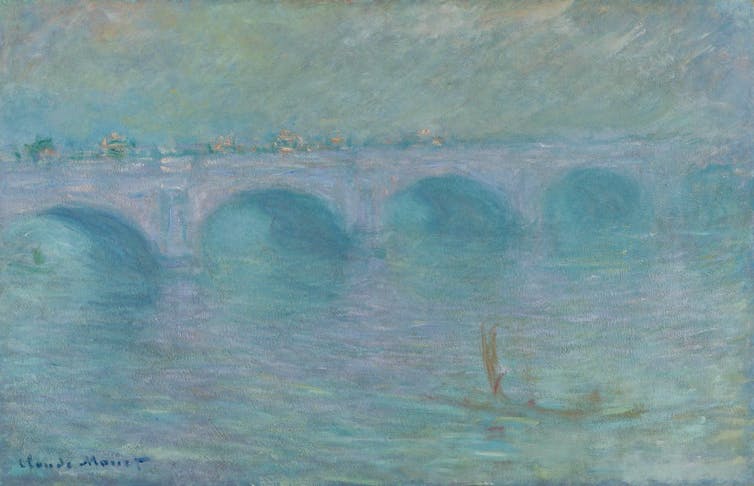
Impressionist painters, notably Claude Monet, had been drawn to the London fog. And in photography, the pictorialists (photographers keen to establish the medium as an expressive art form) followed the impressionists in their attraction to mist and fog as a means to convey emotional as well as physical atmosphere.
By the 1930s, pictorialism was a popular aesthetic in Britain. Encouraged by magazines such as The Amateur Photographer and Cinematographer, the amateur photography scene was dominated by an aesthetic of atmosphere. The British Journal of Photography, as early as 1898, lambasted “mud-and-slush photographers” who would seek out bad weather conditions and foggy atmosphere for aesthetic effect.
Waterloo Bridge in the Fog by Claude Monet (1903). Denver Art Museum
Fog allowed photography to be expressive, it introduced mystery through softening and blurring effects but also a shallowness to the pictorial space, an aesthetic of silhouettes and lighting effects anticipating film noir, especially films like The Third Man (1949), with their dramatic use of night-time urban lighting, smoke and shadow.
In the hands of the press photographers, it gave rise to a distinctive repertoire, of London buses and archways, policemen with their distinctive helmets and white gloves, lamplighters and classical buildings outlined in the mist. The fog appeared as an opaque backdrop against which an increasingly cliched and nostalgic image of the imperial city could emerge, at a time when Britain’s colonies were fighting for independence.
As the historical geographer Stephen Legg argues, when a severe “black smoke fog” plagued the first India Round Table Conference in November and December 1930, the press commented on developments in the conference in relation to differences in climate and dress, interpreting Indian “difference as inferiority or nonmodernity”.
As Legg and other writers on atmosphere and climate have shown, ideas about weather and climate, and especially fog, go hand in hand with ideas about race and empire. As well as making the polluted atmosphere appear picturesque, and despite the difficulties involved in photographing in fog, photographs of foggy London reproduce and circulate an ideological vision of the British empire.
The climate crisis has a communications problem. How do we tell stories that move people – not just to fear the future, but to imagine and build a better one? This article is part of Climate Storytelling, a series exploring how arts and science can join forces to spark understanding, hope and action.
Michelle Henning received funding from the Arts and Humanities Research Council for some of the work informing this article, under grant no. AH/R014639.
Source: The Conversation – UK – By Pauline Sophie Heinrichs, Lecturer in War Studies, Climate and Energy Security, King’s College London
In the middle of Ukraine’s fiercest winter of the war, many Ukrainians are unable to prepare hot meals or are unable to heat their homes while temperatures have dipped as low as -20C in the past few weeks. Harsher weather is forecast.
Russia has once again targeted Ukraine with sustained attacks on power stations, energy grids and heating nodes affecting electricity, as well as heating systems and water pumps.
Following the Russian strikes on January 20, around 5,600 apartment buildings in Kyiv were left without heating and almost half of Kyiv was believed to be without heat and power, affecting around one million people. The situation is so dire that the city has set up “heating tents” to help people stay warm in the freezing temperatures. Other cities have also been attacked.
Ukraine’s president Volodymyr Zelensky declared the situation an energy emergency.
One factor is that as a legacy of Ukraine’s membership of the Soviet Union, Russia probably holds deeper knowledge about Ukraine’s centralised energy systems than an outside nation would generally have.
For decades Ukraine’s energy system was linked to Russia and Belarus as part of a centralised grid, and was “tightly connected to Russia’s energy architecture”. While this did not mean Ukraine was dependent on Russia for its energy supply, it did mean that Russia played the central role in coordinating frequency and balancing supply and demand across the whole network.
Some Ukrainian officials have argued that the nature of these attacks suggests that Russian knowledge of Soviet-era energy systems has helped it to target Ukraine’s energy centres.
There’s another big factor for the Ukrainian authorities to struggle with.
While Ukraine’s authorities were quick to restore heating in around 1,600 buildings, an estimated 4,000 remained without heating on January 21. The challenge in Ukraine is more severe than it might be in other countries because of the centralised systems for water, sewage and heating used by its urban neighbourhoods, known as district heating.
What is district heating?
Ukraine still relies heavily on Soviet-era thermal heating systems using mostly gas. The percentage of households that rely on district heating varies by region and city, with a particularly high percentage of these buildings, mostly built in the 1960s, in densely populated urban cities including Kyiv.
Thermal power plants usually heat water which is then piped around districts and to individual pumping stations. It is then distributed to apartment buildings. But if the pipes are full of water and power for heating is off, the pipes can burst if the water freezes. Right now, with temperatures spiralling downwards this is a major threat.
Russian attacks on Ukraine leave thousands without heating in middle of winter.
Each district heating system can serve tens of thousands of citizens across multiple buildings and, when powered with renewable energy, they can be significantly more efficient, cost-effective and low-carbon than individual boilers. District heating systems depend much more on fixed physical infrastructure, including large pipes and pumping stations, to circulate hot water.
But centralised infrastructure is inherently vulnerable to physical attack. Damage to a major transmission pipe or the loss of a key pumping station can disable heating across entire neighbourhoods, particularly during winter.
Russia has damaged around 8.5GW of Ukraine’s power generation since October 2025, or around 15% of pre-war capacity. With the amount available nearly matching the amount generated there’s little room to redistribute energy within the system.
Whatever the system’s weaknesses may be, no energy system in the world is built to sustain continued bombardment.
Ukraine relies on nuclear power
Ukraine’s energy system is also largely dependent on nuclear power. Around half of Ukraine’s electricity is nuclear-powered, with coal-fired power plants making 23% and gas-fired plants 9%. In all cases these are features of a highly centralised energy system.
Patterns of attacks indicate that Russian forces monitor where repairs are under way and then hit the same sites again once they are restored. This has compounded repair costs and prolonged the loss of critical services. Kyiv’s mayor Vitali Klitschko said that the situation was difficult because most of those buildings that were being reconnected for the second time were damaged as part of a previous attack on January 9.
Russia uses “double-tap” strikes, where a second attack follows closely after the first. This often endangers emergency services and repair crews rushing to restore heat and electricity. Such tactics force officials to balance the urgent need to fix infrastructure with the risk to workers and civilians.
Even before the war, there were weaknesses in Ukraine’s energy and power networks. Old water systems and heating devices — and often entire buildings — need to be reconstructed.
However, Ukraine had already started to reduce technical reliance on Russia before the war. The dependency on the post-Soviet system changed in March 2022, when Ukraine’s grid was integrated with the European Network of Transmission System Operators for Electricity, (Entso-E), a Europe-wide association of national electricity transmission system operators.
These attacks have had significant consequences on hospitals, transport systems, and vulnerable people in their homes. This devastating cycle of repeat strikes in the middle of an incredibly cold winter has intensified Russia’s energy terror.
Pauline Sophie Heinrichs does not work for, consult, own shares in or receive funding from any company or organisation that would benefit from this article, and has disclosed no relevant affiliations beyond their academic appointment.
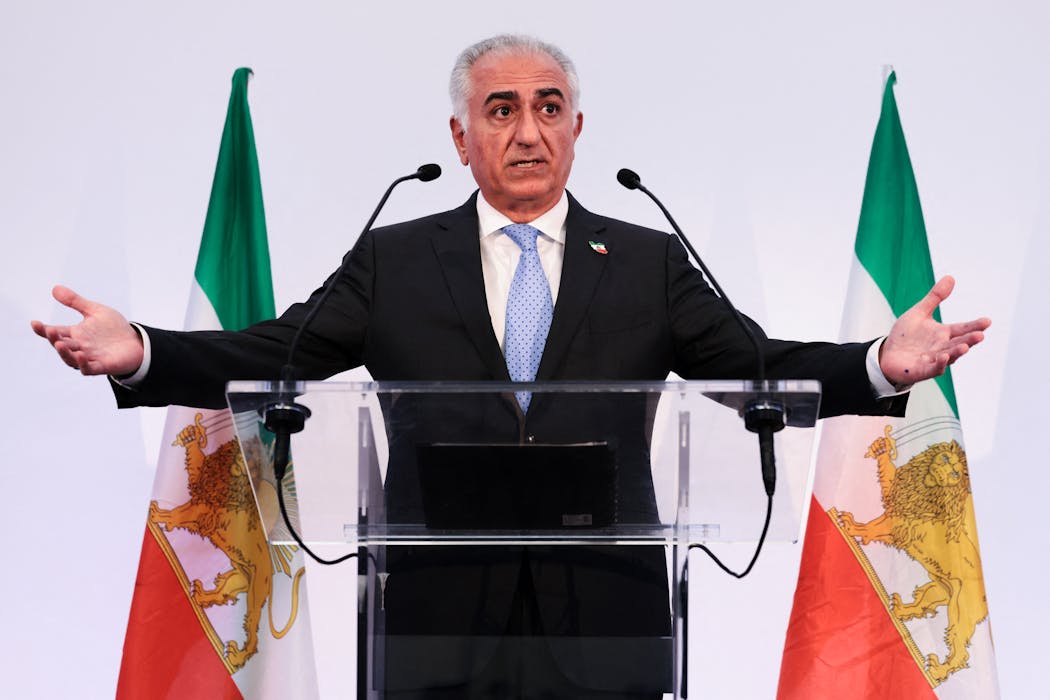
Pahlavi emerged during the recent upheaval as a prominent political dissident in exile who encouraged and inspired Iranians to demonstrate. It remained unclear, however, what level of popular support he commanded inside Iran, not to mention whether he was, in fact, dedicated to democracy as the descendant of a monarch.
Born in Tehran in 1960, Reza Pahlavi was the eldest son of the shah, Mohammad Reza Pahlavi, and his wife, Queen Farah Diba, making him the crown prince.
As popular discontent against the shah grew in 1974-75, Amnesty International estimated there were between 25,000 and 100,000 political prisoners in Iran.
Although the shah stated during the 1979 revolution that he would rather flee the country than fire on protesters, his security forces killed approximately 500 to 3,000 Iranians – though those figures are lower than those killed in the latest Iran protests.
In 1980, the shah admitted to mistakes, including acknowledging that his regime had tortured Iranians.
CBS Evening News anchor Walter Cronkite reports on Jan. 16, 1979, that a “tearful” Shah and his family had left Iran “on a vacation from which he may never return.”
The shah and his family fled Iran in 1979, and the Islamic Republic subsequently was established. After the shah died in 1980, Reza Pahlavi declared himself the next shah and started his political activism against the Islamic Republic from abroad.
More recently, he attempted to organize and unify a divided opposition composed of ethnic and religious groups, leftists, rightists, centrists, republicans and, of course, monarchists. In the process, Pahlavi also aspired to raise his public profile.
From 2013 to 2017, he served as co-founder and spokesperson of the Iran National Council, an umbrella organization of opposition groups, headquartered in Paris. It reportedly suffered defections from some groups, which stifled its ability to accomplish much. In February 2019, Pahlavi helped establish the Phoenix Project of Iran, a think tank in Washington, D.C., dedicated to regime change and a transition plan in Iran.
During the 2022-23 Woman, Life, Freedom protests, sparked by the death of the young Iranian woman Mahsa Amini while in the custody of the morality police, Pahlavi called for rallies against the Iranian government in the United States, Canada and other countries. Leading opposition figures spoke at these rallies, and thousands of people participated.
That same year, some high-profile activists and celebrities, including some his father had imprisoned, endorsed Pahlavi as a leader or figure who could unite the opposition.
Presence and politics
In April 2023, Pahlavi made his first official visit to Israel, where he was hosted by Intelligence Minister Gila Gamliel and met with Prime Minister Benjamin Netanyahu. The visit was condemned by Iranians, from regime supporters to anti-government activists, who were opposed to monarchy and unsympathetic to Israel.
As a political dissident, Pahlavi continually called for a popular uprising, regime change and a secular and democratic state. At the same time, he did not rule out the return of the monarchy, albeit a constitutional one, based on a national referendum and constituent assembly.
In an attempt to appease other opposition groups and some anti-monarchy Iranian citizens, Pahlavi occasionally insisted he was “not a political leader” and was “not personally seeking political office” in Iran if the regime fell.
As Pahlavi became more politically active abroad, questions surfaced about his viability as an opposition leader in Iran.
Discounting a 2023 poll conducted by a pro-Pahlavi institute indicating he was widely popular in Iran, it remained difficult to determine his support in Iranian society.
In a 2022 poll conducted by an independent, nonprofit research foundation with 158,000 respondents in Iran, Pahlavi received the highest percentage – 32.8% – among 34 candidates listed to serve on a transitional solidarity council, should the regime collapse.
At the same time, Pahlavi apparently lacked a serious monarchist movement and a strong connection with local opposition leaders and activists in Iran. He purportedly had little, if any, support among reformist or liberal groups in the country.
The lack of clarity concerning support for Pahlavi in Iran explained the hesitation of U.S. officials, including President Donald Trump, to engage with him. That did not deter Pahlavi from attempting to persuade them to abandon diplomatic talks and negotiations with the Islamic Republic over its nuclear program.
Despite the debates outside Iran about Pahlavi’s support within the country, pro-monarchy slogans increasingly appeared in Iranian social media postings and anti-government protests, including those in 2017-18, 2019-20, and 2022-23.
During the 2019-20 protests, the security forces arrested members of monarchist groups around the country and acknowledged their rising popularity and ability to infiltrate the government. Some reformist intellectuals suggested that monarchist slogans were merely a means for Iranian youth and other citizens to channel their anger and frustration at the authorities rather than expressions of true support for Pahlavi.
The slogans also reinforced the regime’s efforts to delegitimize the protests by portraying them as a plot by external and internal enemies, including the monarchists, to destabilize the country.
Crown Prince Reza Pahlavi of Iran inspects a ‘guard of honour’ composed of young boys in uniform in Tehran, Iran, on Sept. 19, 1963. Keystone Hulton Archive/Getty Images.
Throughout the 12-day war in June 2025 between Iran and Israel, which claimed the lives of 1,190 Iranian civilians and injured and displaced thousands more, Pahlavi publicly lamented the destruction of Iran’s military infrastructure that his father had initially built and the price its people paid for a war he blamed on Supreme Leader Ayatollah Ali Khamenei and the regime.
After the war, Israeli investigative journalists uncovered an influence operation conducted and funded by Israeli public and private entities to promote – among Persian-speaking audiences on social media – Pahlavi as a potential leader in a post-Islamic Republic Iran. The disinformation campaign created cynicism and controversy concerning Pahlavi’s true popularity inside the country and his tacit connection with Israel before and during the war.
Latest protests and future prospects
During the most recent protests, Pahlavi expressed support for protesters and encouraged them to demonstrate at certain times in the evening. The timing of the protests and demonstrations was intended to increase turnout by accommodating people’s work schedules and to maximize media coverage by aligning with news cycles.
Thousands of protesters turned out in the streets at those times, with some chanting anti-government slogans and others pro-monarchy ones.
His role in the protests was reduced after the regime cut off the internet and telecommunications between the people of Iran and the outside world, as well as among activists inside the country.
While some people praised Pahlavi for inspiring protesters, others asked whether he was responsible for sending them to detention and possible death, as some believed Trump was for similarly encouraging the protesters.
For the last 15 years, Pahlavi has intensified his efforts to unify the political opposition and gain greater exposure, culminating in him emerging as a central figure in the latest protests.
Yet there remain questions about whether he is viable as an opposition leader or is simply an opportunist.
His message about a democratic future for Iran has been largely consistent. However, his father’s repressive and imperial legacy, combined with his own royal pedigree and American and Israeli proximity, prevent him from finding favor with Iranians who oppose monarchy and prioritize sovereignty.
Now, the prospect of Iranians across the country rallying around Pahlavi remains as much of an open question as whether they will succeed in creating the conditions for his return by toppling the regime.
Eric Lob is affiliated with the Carnegie Endowment for International Peace.
Source: The Conversation – in French – By Elizabeth Sheppard Sellam, Responsable du programme « Politiques et relations internationales » à la faculté de langues étrangères, Université de Tours
Le Conseil de la Paix que Donald Trump vient d’instituer correspond pleinement à sa vision de la diplomatie : celle-ci est transactionnelle et fluide, non contrainte par les règles complexes de l’ONU et du droit international, et repose avant tout sur des relations personnelles et des intérêts immédiats, bien plus que sur des valeurs.
Présenté dans le contexte de la guerre à Gaza comme une initiative « historique » destinée à accompagner la négociation d’un cessez-le-feu durable et à structurer l’après-guerre à Gaza, le Board of Peace voulu par Donald Trump a été officiellement lancé ce 22 janvier, à Davos, en marge du Forum économique mondial, lors d’une cérémonie de signature largement médiatisée.
Derrière cette mise en scène, une question s’impose : le Board est-il un véritable instrument de négociation politique, ou avant tout un objet trumpien de communication et de personnalisation du pouvoir, conçu en concurrence avec les cadres multilatéraux existants ? À ce stade, il apparaît surtout comme l’expression d’une diplomatie transactionnelle, profondément individualisée et potentiellement déstabilisatrice pour l’ordre international.
Une initiative floue et transactionnelle
Derrière l’affichage diplomatique, c’est une logique de communication politique qui domine. Le lancement à Davos a surtout mis en scène un dispositif centré sur Trump, sans cadre juridique clair ni mandat précis, laissant planer la plus grande ambiguïté sur sa nature : institution internationale, forum informel ou structure privée adossée à la Maison Blanche ?
La vision de la paix sur laquelle s’appuie ce projet est avant tout marchande. À Davos, Trump parle, à propos de Gaza, de reconstruction et de valorisation territoriale dans un langage de promoteur immobilier, son propos étant illustré par la diffusion dans la salle d’images fabriquées par l’IA, présentant une Gaza rutilante.
La paix devient un projet économique, et l’accès au Board une transaction. Certes, l’adhésion au Board of Peace est, en soi, gratuite : aucun État n’est tenu de payer pour en être membre, y compris des pays relativement pauvres comme le Bélarus ou l’Ouzbékistan. En revanche, les États qui souhaiteraient obtenir un siège permanent devront verser une contribution financière. Le dispositif ne dispose d’aucun calendrier ni de mécanismes de décision ou de mise en œuvre des accords. En réalité, il relève davantage d’un instrument symbolique que d’un véritable processus de résolution des conflits. Si bien qu’il a pu être qualifié de « club privé pour diriger le monde », fondé sur l’affichage politique et la personnalisation du pouvoir.
Ce dispositif ne cherche pas à réformer les institutions existantes, mais à leur substituer une diplomatie parallèle, détachée du droit international et dominée par l’autorité personnelle du président américain. Il installe une logique ouvertement transactionnelle, où la participation repose sur l’échange d’intérêts : reconnaissance contre loyauté, accès contre financement, visibilité contre alignement stratégique.
Une remise en cause directe de l’ordre international existant
Le Board prétend promouvoir la paix tout en réunissant des acteurs qui ne partagent ni normes démocratiques ni principes juridiques communs. À ce stade, sur près de soixante États invités par l’administration Trump, environ 35 pays ont accepté de participer au Board of Peace.
Parmi eux figurent plusieurs régimes autoritaires ou illibéraux, tels que l’Azerbaïdjan, le Bélarus, l’Arabie saoudite, l’Ouzbékistan ou encore le Vietnam, ce qui interroge directement la cohérence politique et normative de cette initiative. La Russie de Vladimir Poutine, bien qu’officiellement invitée, n’a pas encore confirmé son adhésion, le Kremlin affirmant devoir en « clarifier les modalités ».
Cette configuration renforce l’ambiguïté du dispositif : l’adhésion, nous l’avons dit, est gratuite, mais l’accès à un siège permanent repose sur une contribution financière dite volontaire d’un milliard de dollars, ce qui donne au Conseil l’allure d’un assemblage diplomatique hétéroclite fondé sur des logiques transactionnelles plus que sur des principes communs. Il donne l’image d’un cercle où la légitimité se mesure moins aux valeurs qu’à l’utilité politique. Trump s’y impose comme arbitre central, concentrant la reconnaissance diplomatique et faisant de la paix un capital politique.
Le Board n’ouvre donc pas une rupture ; il accélère une dynamique d’érosion. Il fait primer la décision politique immédiate sur la régulation collective et fragmente la gouvernance mondiale, désormais fondée sur des dispositifs informels et personnels.
L’Europe face au Board : méfiance, refus et lucidité stratégique
Des alliés majeurs des États-Unis comme l’Australie, le Japon ou la Corée du Sud n’ont pas confirmé leur participation, tandis que le Canada a été placé dans une situation encore plus singulière, son invitation ayant été unilatéralement retirée par Donald Trump, révélant le caractère à la fois politique et arbitraire de la composition du Board of Peace.
En Europe, l’initiative suscite d’emblée une méfiance marquée, et dans plusieurs cas un refus assumé d’y participer. La France, l’Allemagne, les Pays-Bas, la Belgique, l’Espagne, la Suède et la Norvège ont exprimé leurs réserves face à un dispositif dont la légitimité politique et juridique apparaît incertaine. Ce n’est pas un désaccord tactique, mais un désaccord de principe : participer reviendrait à cautionner une structure qui contourne les institutions internationales existantes, sans cadre juridique clair ni articulation avec le droit international.
Pour les Européens, le Board apparaît comme un facteur de déstabilisation plus que comme un outil de pacification. Il légitime l’idée que les grandes crises peuvent être traitées en dehors de toute architecture collective, alors que la diplomatie européenne repose précisément sur l’inverse : la centralité du droit, la primauté du multilatéralisme et la recherche de compromis institutionnalisés.
L’incompatibilité est aussi idéologique. Le Board incarne une diplomatie transactionnelle, peu sensible aux normes juridiques et aux valeurs démocratiques, là où l’UE continue de revendiquer une action extérieure fondée sur des principes. L’enjeu dépasse ainsi Gaza pour toucher à la définition même de ce qui constitue une action internationale légitime.
Enfin, le Board s’impose comme un marqueur supplémentaire de la fracture transatlantique. Il révèle une divergence croissante entre Washington, qui privilégie des formats ad hoc et personnalisés, et les Européens, attachés à une architecture collective, imparfaite mais structurante.
Le Board et Israël : attentes, désillusions et instrumentalisation politique
Pour Israël, l’initiative touche au cœur de ses intérêts sécuritaires. Dans le contexte de la guerre à Gaza, l’attente demeure celle d’un leadership américain capable de structurer l’après-conflit. Jérusalem ne peut donc ignorer un dispositif porté par Washington, même imparfait.
La méfiance est cependant apparue immédiatement. L’annonce de la composition du Board, qui inclut notamment la Turquie et le Qatar, a suscité de fortes réserves, du fait de l’hostilité politique croissante d’Ankara envers Israël, et des liens que Doha entretient avec le Hamas. Le bureau de Benyamin Nétanyahou a rappelé que la démarche n’avait pas été coordonnée avec Jérusalem… avant qu’Israël accepte finalement d’y participer, faute de pouvoir rester en dehors d’un processus directement piloté par l’administration américaine. Cette séquence illustre une constante de la diplomatie israélienne : Israël est directement concerné, il ne peut pas dire non, mais avance avec prudence structurelle.
La centralité accordée à Steve Witkoff comme émissaire principal est d’autant plus controversée que, selon plusieurs responsables israéliens, il aurait pesé pour empêcher une frappe américaine contre l’Iran mi-janvier, ce qui alimente une forte défiance à son égard, d’autant plus qu’il siège au cœur de l’Executive Board du Board of Peace, instance restreinte appelée à concentrer l’essentiel du pouvoir décisionnel.
Steve Witkoff agit comme l’émissaire personnel de Donald Trump bien au-delà du Board of Peace : c’est lui qui a conduit les échanges directs avec le ministre iranien des affaires étrangères et qui a été au cœur des négociations menées à Doha, notamment sur Gaza. Sa présence dans l’Executive Board du Board of Peace renvoie donc moins à un rôle symbolique qu’à une position de pouvoir réel, cet organe restreint concentrant l’essentiel de l’impulsion politique et du contrôle opérationnel de l’initiative. Cela fait de Witkoff à la fois un négociateur de terrain et l’un des pivots décisionnels du dispositif, ce qui explique l’ampleur des critiques qu’il suscite, notamment en Israël.
La question polarise en tout cas le débat israélien, entre acceptation pragmatique et rejet d’un mécanisme perçu comme dangereux par les ministres israéliens d’extrême droite, parce qu’il implique des acteurs qu’ils estiment hostiles ou complaisants envers le Hamas et qu’il s’oppose à leur objectif de contrôle direct et durable de Gaza au nom de la sécurité d’Israël.
Le Board devient ainsi le symbole de la tension permanente entre la dépendance stratégique d’Israël envers Washington et sa défiance face à une diplomatie trop fondée sur les liens personnels pour constituer un cadre fiable de long terme.
Du côté palestinien, la réaction est plus nuancée qu’on ne le dit souvent : l’Autorité palestinienne a accueilli l’initiative avec prudence mais sans hostilité frontale, y voyant une possible ouverture diplomatique, tandis que d’autres acteurs palestiniens dénoncent un dispositif conçu dans un cadre avant tout américano-israélien et ne leur offrant pas de garanties politiques réelles. En parallèle, des pays qui se présentent traditionnellement comme des défenseurs de la cause palestinienne – comme l’Égypte, l’Indonésie ou l’Arabie saoudite – mais qui sont aussi, pour certains, en paix avec Israël ou engagés dans des processus de normalisation, justifient leur participation au Board of Peace par un discours de pragmatisme diplomatique : mieux vaut siéger à la table des discussions pour peser sur la reconstruction de Gaza et l’après-guerre que rester en dehors d’un processus piloté par Washington.
Une rupture profonde
« Une fois que ce conseil sera complètement formé, nous pourrons faire à peu près tout ce que nous voulons ». Cette phrase prononcée par Trump à Davos résume le Board of Peace. Elle ne parle pas de paix, mais de pouvoir : une diplomatie fondée sur la maîtrise, la transaction et la personnalisation de l’action internationale.
Ce qui devait constituer le socle d’un processus durable au Moyen-Orient s’est transformé en un exercice de mise en scène, où l’ego présidentiel, l’argent et les projets portés par Witkoff ou Jared Kushner, gendre du président et businessman très actif dans la région, prennent le pas sur toute logique de négociation réelle. La paix n’y apparaît plus comme un objectif politique, mais comme un actif et un instrument de valorisation.
Plus qu’un projet de paix, le Board révèle une rupture profonde : celle d’un ordre international où la règle cède devant la transaction, où l’institution recule face à la personnalisation, et où la diplomatie devient un espace de démonstration de puissance plus qu’un lieu de construction du compromis.
Elizabeth Sheppard Sellam ne travaille pas, ne conseille pas, ne possède pas de parts, ne reçoit pas de fonds d’une organisation qui pourrait tirer profit de cet article, et n’a déclaré aucune autre affiliation que son organisme de recherche.
Alors que le contexte géopolitique change en profondeur, de nouvelles entreprises émergent dans le monde de la défense. Après des décennies dominées par la puissance d’entreprises industrielles à l’ancienne, les start-up du logiciel deviennent des actrices clés. Retour sur une mutation en cours et décryptage des nouveaux enjeux qu’elle pose.
Dans le contexte de la guerre en Ukraine où l’« autonomie stratégique » devient un problème concret apparaît, à côté du traditionnel « complexe militaro-industriel »), un nouveau modèle que l’on pourrait décrire comme étant un complexe technocapitaliste. Un écosystème où start-up, fonds de capital-risque, fonds souverains, initiatives européennes et philanthropes techno-nationalistes investissent massivement dans la défense et la sécurité.
Non pas pour remplacer d’un coup la base industrielle et technologique de défense (BITD) – et ce malgré les annonces tonitruantes de certains de ces acteurs –, mais pour en modifier progressivement l’architecture, les acteurs et les temporalités.
Le dernier souper est servi
Le modèle qui domine encore aujourd’hui a pris forme dans les années 1990, avec la grande consolidation de l’industrie américaine de défense sous l’administration Clinton. Durant cette période, la base industrielle de défense américaine a connu une consolidation d’une ampleur inédite. Surnommé le last supper, ce moment d’accélération des fusions a donné naissance aux cinq géants qui dominent encore largement la défense américaine – Lockheed Martin, Boeing, Northrop Grumman, Raytheon et General Dynamics. Quelques grands maîtres d’œuvre – ces fameux Big Five – se partagent ainsi depuis l’essentiel des grands programmes : avions de combat, frégates, satellites, systèmes de commandement intégrés.
Leur logique est celle de la commande publique lourde : des besoins définis par l’État, des appels d’offres longs, des cycles de développement qui se comptent en décennies, une forte intégration verticale, une relation quasi organique avec les ministères de la Défense. Ce modèle assure une certaine visibilité budgétaire et une capacité à gérer des systèmes d’une complexité extrême. Il produit aussi une grande inertie tant sur le plan technologique que procédural.
L’arrivée du monde du logiciel
Depuis une dizaine d’années, ce paysage est bousculé par des acteurs qui viennent, pour l’essentiel, du monde du logiciel : Anduril, Palantir, Helsing, Shield AI, et en France des entreprises comme Command AI. Leur point de départ n’est pas une plateforme matérielle (un avion, un navire, un char), mais le logiciel : fusion de données, IA, capteurs distribués, systèmes autonomes, couches de command & control.
Leurs méthodes de travail et de production, héritées de la tech consistent en itérations rapides, tests fréquents, déploiements progressifs, adaptation au retour du terrain plutôt qu’exécution d’un cahier des charges figé. Aux États-Unis, des dispositifs comme les Other Transaction Authority (OTA) ont été créés pour faciliter cette collaboration avec des acteurs non traditionnels, ce qui permet d’en contourner certaines lourdeurs réglementaires.
Traverser la « vallée de la mort »
Au sein de ces organisations, on sait prototyper plus vite, expérimenter plus tôt, et ce qu’elles que soient leurs origines géographiques. Mais le cœur du problème reste entier : beaucoup de ces start-up valident un démonstrateur… puis butent sur la « vallée de la mort » entre prototypes financés en mode agile et programmes pérennes inscrits en loi de finances. L’appareil budgétaire, taillé pour les grands industriels historiques, peine à absorber des solutions issues de ce nouveau monde.
En Europe, on tente d’importer cet esprit à travers des marchés d’innovation, des programmes d’expérimentation accélérée, des dispositifs dual-use. Mais la culture d’acquisition reste largement calibrée pour les grands programmes industriels, plutôt que pour des produits logiciels qui changent de version plusieurs fois par an.
La défense devient une classe d’actifs
Parallèlement à cette rupture technologique, c’est la structure du financement de la défense qui se transforme. La sécurité n’est plus seulement affaire de budgets ministériels ; elle devient aussi un segment identifié du capital-risque. Aux côtés des commandes publiques et des investissements des grands groupes se constitue un nouvel écosystème d’investisseurs composé :
des fonds privés spécialisés dans la défense, la sécurité et les technologies dites « civilisationnelles » (IA, autonomie, cyber, spatial, résilience d’infrastructures) ;
des fonds souverains et publics qui cherchent à orienter l’innovation vers des priorités de souveraineté ;
des dispositifs européens (fonds de fonds, véhicules dédiés) qui tentent de structurer un marché encore fragmenté ;
des philanthropes techno-nationalistes qui investissent par conviction politique ou civilisationnelle autant que pour le rendement (Peter Thiel par exemple).
Tous partagent la conviction que certaines technologies – IA militaire, lutte anti-drones, robotique autonome, surveillance avancée, sécurité spatiale – vont devenir structurantes, et que la valeur se créera très en amont, bien avant les grands contrats publics. Le schéma de l’industriel finançant la R&D sur fonds propres pour vendre ensuite un produit à marge encadrée recule. Le risque est socialisé dans le capital : les VC, les fonds souverains, les programmes européens prennent le risque initial, en misant sur l’hypothèse qu’un jour, une partie de la commande publique basculera vers ces nouvelles solutions.
Ce mouvement ne remplace pas le financement traditionnel par les États ; il l’encercle, le complète et le pousse à se réorganiser. Ministères de la Défense, Union européenne, Otan tentent désormais de co-concevoir des instruments (fonds, equity facilities, fonds d’innovation) pour ne pas laisser au seul capital privé le soin de définir, par ses paris, l’architecture future de la BITD.
Un dialogue nécessaire entre deux modèles
On l’aura compris, dans ce nouvel environnement, deux grandes logiques industrielles cohabitent. Du côté des industriels historiques, la chaîne de valeur part de l’expression de besoin : l’État formalise une exigence (un avion de combat, un système de défense antiaérienne, une frégate de nouvelle génération), lance un appel d’offres, sélectionne un industriel, et s’engage sur des décennies. La robustesse, la certification, l’intégration dans des architectures complexes sont centrales. Les marges sont encadrées, le risque est partagé, mais le tempo reste celui du temps long.
Les start-up de défense, à l’inverse, développent des produits avant que le besoin ne soit formalisé. Elles financent le développement puis se tournent vers les États en disant, en substance : « voilà ce que nous savons déjà faire, regardez si vous pouvez vous en passer ».
Cette asymétrie se voit dans la façon dont on conçoit les systèmes. Là où les grands industriels ont longtemps construit d’abord la plateforme matérielle, puis ajouté des couches logicielles au fil du temps, les nouveaux entrants adoptent une logique software first.
Un nouveau rapport de forces
Le cas d’Anduril est emblématique. Au cœur de sa stratégie se trouve un système d’exploitation tactique, conçu pour connecter capteurs, drones, effecteurs et flux de données. À partir de cette brique logicielle, l’entreprise déploie ensuite ses propres drones, capteurs, systèmes d’armes, en gardant la maîtrise de l’architecture logicielle qui fait la jonction. Le tout étant principalement focalisé sur La clientèle militaire.
Cette inversion du rapport de force – la valeur se loge dans le logiciel, la plateforme matérielle devient, jusqu’à un certain point, substituable – rend très concrète la question de la souveraineté : qui contrôle la brique logicielle qui orchestre l’ensemble ? Qui décide du rythme des mises à jour ? Où se situent les dépendances critiques ?
Elle rebat aussi les cartes du Hi–Low mix : comment articuler des systèmes lourds, rares et coûteux (avion de combat, frégate) avec des objets plus simples, distribués, produits en masse (drones, capteurs, effecteurs low cost). Les nouveaux acteurs occupent volontiers ce bas et ce milieu du spectre, la « masse agile » ; les industriels historiques doivent, eux, apprendre à descendre vers des produits plus modulaires, plus rapides, tout en continuant à garantir l’excellence sur les systèmes de très haute complexité.
Des horizons temporels différents
La rencontre entre capital-risque et défense met aussi au jour une tension structurante : celle des horizons temporels. Le Venture Capital (VC, ou capital-risque) raisonne en cycles de cinq à sept ans, avec l’idée que l’entreprise doit, soit atteindre une taille critique, soit être rachetée, soit entrer en bourse. Les ministères de la défense, eux, raisonnent sur vingt ou trente ans, voire davantage.
Ce décalage pose des questions très concrètes. Que se passe-t-il si un acteur clé de l’IA tactique ou du contre-drone, devenu indispensable sur le terrain, se retrouve fragilisé par la conjoncture financière, ou racheté par un acteur étranger ? Comment garantir la continuité d’une capacité opérationnelle dont la brique critique est portée par une entreprise structurée selon les logiques de la tech ?
Trois idées structurantes
À l’inverse, la défense ne peut plus ignorer le rythme d’innovation propre au logiciel. Attendre dix ans pour figer une architecture revient souvent à se condamner à déployer des systèmes déjà dépassés. D’où la montée en puissance de trois idées structurantes :
Le dual-use : privilégier les technologies qui ont, par construction, des débouchés civils et militaires (cyber, spatial, IA, robotique, résilience d’infrastructures). Cela élargit la base industrielle, répartit le risque et évite de concentrer des capacités critiques sur des marchés de niche.
Le « software-defined, hardware-enabled » : concevoir des systèmes où le cœur de valeur est dans l’algorithme (détection, fusion de capteurs, décision), et où le matériel – drone, capteur, effecteur – peut évoluer plus librement.
La modularisation et les architectures ouvertes : prévoir dès la conception des points d’insertion réguliers pour de nouvelles briques logicielles, de nouveaux capteurs, sans devoir réinventer tout le système.
Ces leviers ne font pas disparaître la tension entre temps court financier et temps long doctrinal, mais ils la rendent plus gérable. L’État peut, en théorie, remplacer une brique sans casser l’ensemble. Et le capital peut se concentrer sur des modules identifiables plutôt que sur des mégaprogrammes monolithiques.
BFM, 2025.
Jungle et zoo ou concilier l’inconciliable
On décrit parfois la situation actuelle comme la rencontre d’un « zoo » – celui des grands programmes, très régulés, très documentés, pensés pour durer – et d’une « jungle » peuplée d’insurgés technologiques, financés par les VC, en constante exploration.
Les nouveaux acteurs occupent des niches, souvent à la périphérie des grands programmes, mais avec un fort potentiel de diffusion. Pour l’instant, une grande partie d’entre eux reste dépendante de tremplins publics (contrats d’étude, expérimentations, appels à projets). Le marché réel, celui des grands volumes, demeure largement capté par les industriels historiques.
Dans le même temps, et le point est clé, les investisseurs privés se concentrent progressivement sur des profils plus mûrs : des entreprises qui ont déjà fait la preuve de leur solidité technique, de leur capacité à dialoguer avec les armées, de leur compréhension des contraintes réglementaires. On s’éloigne du fantasme de la start-up de défense sortie de nulle part pour se rapprocher d’acteurs hybrides, où se mêlent les cultures tech, industrielle et stratégique. Dit autrement, malgré le marketing ambiant, les investisseurs préfèrent accélérer des sociétés ayant une forme de maturité plutôt qu’une forme de risque extrême à tout va.
Quelles réponses européennes ?
Pour l’Europe, l’enjeu n’est pas de choisir entre la jungle et le zoo, ni de rêver à une table rase. Il est d’apprendre à articuler ces deux univers :
en assumant plus clairement une politique industrielle de défense, qui fixe des priorités et des lignes rouges ;
en construisant des passerelles institutionnelles et financières entre fonds souverains, VC et industriels historiques ;
en pensant la souveraineté non seulement en termes de plates-formes matérielles, mais aussi en termes d’architectures logicielles, de données, de standards.
Le « complexe technocapitaliste » ne supprime pas le complexe militaro-industriel. Il le met à l’épreuve, l’oblige à se transformer et offre, si l’on sait le canaliser, de nouveaux leviers pour renforcer une souveraineté européenne qui ne peut plus se contenter de dépendre des choix technologiques et politiques des autres.
Nicolas Minvielle est membre du comité d’orientation de La Fabrique de la Cité, et du collectif Making Tomorrow
Marie Roussie travaille au sein de Alt-a et est membre du Collectif Making Tomorrow.
Deux motions de censure ont été déposées, le vendredi 23 janvier, en réponse à l’utilisation de l’article 49-3 par Sébastien Lecornu sur la partie recettes du budget. La promesse du premier ministre de ne pas faire usage de cet outil constitutionnel en négociant des compromis avec les groupes parlementaires a été rompue. Pourtant, il ne s’agit pas tant d’un échec de méthode que d’une conséquence d’un vice originel concernant la formation du gouvernement.
Malgré les promesses et les sentiments d’un premier ministre « un peu amer » d’avoir perdu le « pari », d’après ses propres mots, la tentation d’y voir un « échec de la « méthode Lecornu » est grande avec le retour du « 49-3 » sur la scène politique.
Cependant, les trois mois d’examen parlementaire ne soldent pas un échec de méthode, mais bien la conséquence logique d’un vice originel concernant la formation du gouvernement.
Deux raisons qui expliquent cet échec
D’abord, le gouvernement est mal né avec un processus de nomination et de renomination improbable, ne s’appuyant sur aucune majorité gouvernementale, aucune majorité parlementaire, et aucune majorité partisane. Or, ce triptyque détermine la logique institutionnelle majoritaire du régime parlementaire de la Ve République.
Ensuite, conséquemment, le gouvernement aurait dû, comme dans les autres régimes parlementaires lorsqu’aucun parti ne dispose à lui seul d’un nombre de sièges majoritaire à la chambre basse, essayer de s’appuyer sur une coalition. Il n’en a rien été.
Or, en France comme à l’étranger, les compromis ne résultent pas de débats parlementaires dans lesquels des orateurs se convaincraient au terme d’argumentations faisant changer d’avis ceux qui les écoutent. Les compromis se font a priori, avant la nomination du gouvernement, et précisément en contractualisant les réformes, leurs contenus, et leur calendrier. Tous les autres pays (Allemagne, Belgique, Espagne, Pays-Bas, etc.) fonctionnent ainsi. Dans le contexte actuel, l’erreur initiale vient donc de la manière dont le premier ministre a été nommé, plaçant le gouvernement dans une position de faiblesse définitive.
Il n’existe pas de « méthode Lecornu »
Cet épisode budgétaire n’est donc qu’une énième péripétie dérisoire et prévisible, mais qui permet de comprendre certains des dérèglements et des lacunes de la vie politique et institutionnelle française.
Premièrement, il n’existe pas de « méthode Lecornu » : le gouvernement n’a ni dirigé les débats, ni gouverné le contenu du texte dont tous les acteurs disent avoir obtenu gains de cause (sauf LFI et RN), ni eu les moyens de l’ingéniosité du gouvernement Barnier qui s’est appuyé sur le Sénat pour être majoritaire en commission mixte paritaire. Au contraire, il a subi le calendrier, malgré ses tentatives répétées de dramatisation, subi les rivalités inter et intra-partisanes, malgré ses tentatives de dépolitiser le budget « pour la France ». Il a subi, enfin, les jeux parlementaires, malgré son étrange renoncement à l’article 49 alinéa 3 de la Constitution. Difficile d’y voir une nouvelle méthode de gouvernement, tant il s’agit là d’un acte d’impuissance.
Deuxièmement, un gouvernement ne peut pas dépendre d’un consentement renouvelé quotidiennement (« Gouverner, c’est prévoir ») et rempli de lignes rouges des députés et partis. Cela, dans un contexte majoritaire ou non, à un ou plusieurs partis. Les contrats de coalition servent justement à anticiper le contenu de la partition gouvernementale, et laissent au quotidien l’exécution de ce contrat. Ils sont négociés durement, pendant plusieurs mois, allongeant d’autant la période entre les résultats législatifs et la nomination du gouvernement : 18 mois en Belgique (2010), de 7 à 9 mois aux Pays-Bas (2017, 2021), 6 mois en Allemagne (2017), 4 mois en Espagne (2023). Cela n’est pas un problème démocratique mais la prise en compte de la fragmentation parlementaire à minorités multiples. Cela rappelle l’idée élémentaire selon laquelle, dans un régime parlementaire, le gouvernement doit être doté d’une légitimité avant de gouverner et d’exercer sa responsabilité.
Les véritables responsables
Plus largement, cet épisode donne à voir les autres acteurs. Reconnaissons ainsi à Sébastien Lecornu que cette erreur n’est pas la sienne et qu’il importe finalement peu. Qui porte la responsabilité ?
Le président de la République et ses conseillers (ceux-là mêmes qui lui ont soufflé l’idée de dissoudre l’Assemblée nationale) portent la responsabilité de cette erreur. Elle remonte au lendemain des législatives de juillet 2024. Depuis lors, trois premiers ministres se sont succédé, tous nommés selon des calculs politiciens reposant sur des capacités supposées à obtenir l’abstention de LFI ou du RN, puis du PS ou de LR, en cas de motions de censure. Comme dans tous les autres régimes parlementaires, le chef du parti ayant remporté le plus de sièges aurait dû être appelé à tenter de former un gouvernement, puis en cas d’échec, le deuxième, etc. Un premier ministre n’aurait donc dû être nommé qu’après avoir construit une coalition au programme de gouvernement contractualisé, démontrant, de fait, une assise suffisante à l’Assemblée nationale.
L’Assemblée nationale a confirmé que sa capacité à légiférer était compromise (contrairement à ce qu’ont pu affirmer certains commentateurs à propos d’un nouvel « âge d’or » du parlementarisme). On peut expliquer cette incapacité par la subordination de l’Assemblée en tant qu’institution mais aussi par son déclassement politique, lié au manque de poids politique des nouveaux députés depuis 2017.
Le Sénat a montré ses limites constitutionnelles. Autrement dit, la Seconde Chambre, doublement exclue des influences politiques et institutionnelles, n’a pas pu peser sur l’examen du projet de loi de finances et a donc travaillé vainement.
Quels enseignements en tirer ?
Cet épisode apporte des enseignements, de plus en plus flagrants depuis juillet 2024.
1) L’arithmétique de l’Assemblée nationale expose une double impasse. D’une part, le président de la République ne dispose plus d’une majorité parlementaire pour gouverner comme il l’a fait entre 2017 et 2022 : c’est la fin du « présidentialisme majoritaire » qui caractérisait jusqu’alors la Ve République. Mais, d’autre part, aucune majorité alternative ne s’est constituée autour du premier ministre, contrairement aux périodes de cohabitation (1986-1988, 1993-1995, 1997-2002), pour opérer un « retour au texte » de la Constitution – c’est-à-dire une lecture où le premier ministre gouverne effectivement.
Dès lors, toute discussion sur l’inadaptation supposée des règles de l’examen parlementaire des projets de loi de finances est malvenue. Elles attribuent les échecs du gouvernement et de l’Assemblée aux règles de procédure – comme l’a suggéré la présidente de l’Assemblée nationale Braun-Pivet – alors que les causes sont ailleurs. Le changement de procédure n’aurait pas conduit à un résultat différent. Les propositions de réformes (comme celles du Haut-Commissariat au plan) écartent le poids du contexte politique et, pis, relèvent d’une vision techniciste et d’un solutionnisme normatif dépassé.
2) Ni présidentialisme ni « retour au texte » de la Constitution : nous assistons à la fin des modèles connus de la Ve République. Dans ce contexte, les institutions ne sont « bien faites » pour personne (François Mitterrand déclarait en juillet 1981 : « Les institutions n’étaient pas faites à mon intention. Mais, elles sont bien faites pour moi. ») Un changement de texte (qui serait le 26ᵉ…) ou un nouveau mode de scrutin ne changerait ni les votes des Français, ni le populisme, ni le déclin des partis de gouvernement, ni les acteurs politiques. Le contexte de fragmentation appelle un nouveau modèle reposant sur la formation d’un gouvernement de coalition comme à l’étranger – ce que permet le texte de la Constitution aux lectures multiples.
3) Reste aux acteurs politiques à le penser et le mettre en œuvre. Mais, au regard des atermoiements du président de la République depuis 2022, des députés qui ont intériorisé leur incompétence à légiférer (comme l’illustrent les motions de rejet préalable de mai et juin 2025 utilisées pour contourner le débat à l’Assemblée nationale par des majorités de circonstance pourtant favorables aux textes), et des partis et candidats tournés vers la prochaine élection présidentielle comme sous la IVe République vers la prochaine crise institutionnelle, il n’est pas certain qu’ils y arrivent.
La séquence ouverte en 2017 a disrupté le système politique, sans construire. S’appuyant sur les institutions et le fait majoritaire jusqu’en 2022, Emmanuel Macron n’a pas su, depuis, instaurer un mode de fonctionnement adapté à l’absence de majorité. Faute d’avoir pensé un gouvernement par coalition négociée, le pouvoir exécutif s’épuise à chercher des majorités de circonstance et à attendre du Parlement ce qu’il ne peut pas faire. Tant que cette leçon ne sera pas tirée, il n’y aura pas de méthode – Lecornu ou autre. Les institutions en sortent abîmées ; LFI et RN : 25 sièges en 2017, 198 depuis 2024. In fine, la question n’est peut-être plus de savoir qui gouvernera, mais s’il sera encore possible de gouverner.
Thomas Ehrhard ne travaille pas, ne conseille pas, ne possède pas de parts, ne reçoit pas de fonds d’une organisation qui pourrait tirer profit de cet article, et n’a déclaré aucune autre affiliation que son organisme de recherche.
Loin d’être seulement un territoire gorgé de ressources naturelles attisant toutes les convoitises, le Groenland se place comme un nœud stratégique majeur pour les chaînes d’approvisionnement mondiales. Une telle réalité reste encore trop souvent méconnue.
Depuis la réélection de Donald Trump, le Groenland occupe une place grandissante dans les débats politiques, souvent réduit dans les médias à une question de captation de ressources naturelles. Terres rares, uranium, hydrocarbures ou eau douce sont fréquemment présentés comme les motivations principales de l’intérêt renouvelé du président des États-Unis et, plus largement, des grandes puissances pour ce territoire arctique. Bien que fondée sur des enjeux réels, une telle lecture que l’on qualifiera d’extractive tend à simplifier la nature des tensions actuelles dans la mesure où elle masque une transformation plus profonde des équilibres mondiaux.
Le Groenland apparaît en effet moins comme un simple réservoir de ressources naturelles que comme un espace clé de circulation et de projection des flux dans un contexte de profonde reconfiguration des échanges. Les chaînes d’approvisionnement mondiales, longtemps structurées autour de routes méridionales, sont aujourd’hui fragilisées par les crises géopolitiques et la saturation des infrastructures existantes. D’où une interrogation récurrente : l’Arctique n’émerge-t-il pas comme un nouvel horizon logistique rendu progressivement accessible par le recul de la banquise ? Le Groenland, par sa position centrale entre l’Amérique du Nord, l’Europe et l’Asie, deviendrait alors un élément clé de la recomposition en cours, bien au-delà de la seule question des ressources.
De nouvelles routes maritimes arctiques
Le commerce maritime mondial repose historiquement sur quelques grandes routes structurantes : le canal de Suez (Égypte), le canal de Panama, le détroit de Malacca (Thaïlande, Indonésie, Malaisie) ou encore le cap de Bonne-Espérance (Afrique du Sud). Ces passages sont à la fois vitaux et très vulnérables, comme l’a montré l’ensablement du porte-conteneurs Ever Given en mars 2021 dans le canal de Suez. De ce point de vue, l’Arctique apparaît de plus en plus comme une alternative crédible. En effet, la réduction de la banquise estivale, fruit du réchauffement climatique, ouvre progressivement trois axes majeurs :
la route du Nord-Est le long des côtes russes,
la route du Nord-Ouest à travers l’archipel canadien,
Même si les routes indiquées sur la carte 1 ne sont pas encore accessibles toute l’année, leur fenêtre de navigabilité s’allonge et leur fiabilité augmente. L’intérêt logistique est considérable puisqu’un trajet maritime entre l’Asie de l’Est et l’Europe du Nord peut être raccourci de 30 à 40 % par rapport à un trajet par le canal de Suez, réduisant à la fois le temps de transport, la consommation de carburant et les émissions polluantes.
Carte 1. Nouvelles routes maritimes ouvertes grâce à la fonte des glaces
« La Dépêche », 15 janvier 2026., Fourni par l’auteur
Pour les chaînes d’approvisionnement mondiales, dont les délais et les coûts sont des variables critiques, ces gains sont loin d’être négligeables. Le Groenland ne constitue pas ici seulement un lieu de transit passif. Sa position géographique en fait au contraire une zone idéale pour des fonctions de soutien en matière d’escales techniques, de ravitaillement et d’assistance aux navires, mais aussi d’opérations de recherche et de sauvetage.
Il convient toutefois de nuancer l’enthousiasme qui gagne certains observateurs quant à l’émergence d’une nouvelle géographie des flux. Les routes arctiques, actuelles et à venir, restent soumises à des conditions extrêmes (météo imprévisible, dérive des glaces, ou encore manque de cartographie précise). La logistique arctique est donc plus complexe, plus risquée et plus coûteuse en infrastructures que la logistique des chaînes mondiales d’approvisionnement mise en œuvre depuis le début des années 1980. C’est précisément pour répondre à ces contraintes que le Groenland gagne en importance : en servant de base avancée pour la coordination et l’intervention, il devrait contribuer à la viabilité économique de nouvelles routes.
La logistique, un instrument de puissance
Dans le monde contemporain, nul doute que la logistique n’est plus un simple outil technique au service des échanges de biens et services. Elle est devenue clairement un instrument de puissance, au même titre que la maîtrise de ressources énergétiques et des technologies, notamment d’intelligence artificielle. Contrôler des routes et des nœuds critiques, c’est influencer les flux économiques et, par extension, les rapports de force internationaux. Or, le Groenland, territoire autonome rattaché au Danemark, se trouve de facto intégré aux structures occidentales, notamment via l’Otan. Il est ainsi un élément clé de l’architecture sécuritaire de l’Atlantique Nord et de l’Arctique.
Depuis la fin de la Seconde Guerre mondiale, les États-Unis considèrent le Groenland comme un maillon essentiel de leur sécurité. La base spatiale de Pituffik (base aérienne de Thulé, jusqu’en 2023), construite en 1951, et aujourd’hui intégrée au dispositif de défense antimissile et de surveillance états-unien, illustre cette vision géostratégique que la carte 2 permet de mieux visualiser.
Au-delà de sa fonction militaire, la base de Pituffik joue également un rôle logistique majeur dans le suivi des flux maritimes de l’Arctique. Compte tenu du contexte de rivalités accrues avec la Russie et de méfiance vis-à-vis des ambitions chinoises, l’administration Trump cherche à renforcer sa présence et ses partenariats dans la région. La logistique, entendue comme capacité à soutenir et protéger des flux, en constitue un élément clé.
Carte 2. Les États-Unis sous la menace des missiles balistiques russes
« Ouest-France/Lignes de Défense », 7 janvier 2026., Fourni par l’auteur
La Russie dispose du plus long littoral arctique et a investi massivement dans des infrastructures portuaires, des brise-glaces et des bases militaires le long de la route du Nord-Est. Pour Moscou, cette route est à la fois un atout économique et un levier géopolitique. Concernant la Chine, bien que non riveraine, elle se définit depuis 2018 comme un « État proche de l’Arctique » et intègre la région dans son initiative des nouvelles Routes de la Soie. À ce titre, ses investissements potentiels dans les ports et les câbles sous-marins suscitent une vigilance accrue des pays occidentaux. Dans un contexte de montée en puissance des stratégies arctiques russe et chinoise, le Groenland apparaît ainsi comme un point de cristallisation des enjeux logistiques et sécuritaires occidentaux.
Un multiplicateur de puissance
Loin d’être un simple territoire périphérique, le Groenland concentre en effet des fonctions essentielles de surveillance et de protection des infrastructures critiques structurant les chaînes d’approvisionnement mondiales. Routes maritimes émergentes, ports en développement, câbles de communication sous-marins et capacités satellitaires y convergent. Leur sécurisation conditionne non seulement la fluidité des échanges, mais aussi la résilience des systèmes militaires, numériques et énergétiques occidentaux. Dès lors, le Groenland s’impose comme un véritable « multiplicateur » de puissance : y contrôler l’accès et le soutien logistique confère un avantage stratégique décisif dans tout l’Arctique. Une telle centralité illustre l’imbrication croissante entre logistique et stratégie dans les rivalités entre puissances.
Le développement de la logistique arctique repose avant toute chose sur les infrastructures. Le Groenland possède un potentiel important pour l’accueil de ports en eau profonde capables de recevoir des navires de grande taille. Un accord signé en septembre 2025 entre le Danemark et le gouvernement groenlandais prévoit ainsi la construction d’un deep‑water port à Qaqortoq, dans le sud du territoire. Ce type de port joue un rôle de plate-forme multimodale, reliant transport maritime et aérien et, à terme, des réseaux numériques avancés. Il permettra de consolider, redistribuer ou rediriger les flux entre l’Amérique du Nord, l’Europe et l’Asie, en particulier pour les marchandises à forte valeur ajoutée ou sensibles aux délais.
Un futur hub logistique majeur
Au-delà des ports, la logistique moderne repose sur une gamme étendue de services : stockage stratégique, maintenance des flottes, gestion des carburants, traitement des données de navigation. Le Groenland pourrait accueillir des bases spécialisées dans le soutien, réduisant la dépendance à des infrastructures éloignées, situées plus au sud. Ajoutons que le climat froid, souvent perçu comme un handicap, constitue également un avantage concurrentiel pour l’implantation de data centers. Le refroidissement naturel réduit les coûts énergétiques (de 40 à 80 % de la consommation totale), tout en renforçant la résilience des infrastructures numériques.
Il serait toutefois illusoire de comparer en l’état le Groenland à des hubs logistiques matures tels que Singapour ou Rotterdam, traitant respectivement des centaines de millions de tonnes de marchandises par an. Avec une population d’environ 56 000 habitants, le territoire est confronté à des contraintes structurelles majeures : aucune route interurbaine ni voie ferrée, des infrastructures conçues pour de faibles volumes et une dépendance presque exclusive au transport aérien et maritime.
France Culture 2026.
De telles limites réduisent l’attractivité des routes arctiques pour le trafic commercial de grande échelle et exigent des investissements considérables afin d’accroître la capacité logistique locale. À moyen et long terme, le Groenland pourrait cependant se positionner comme un nœud logistique complémentaire – plutôt que concurrent – des grands hubs mondiaux.
Héritages et perspectives
Les axes logistiques ont toujours façonné le pouvoir des États. Des Routes de la Soie aux canaux de Suez et de Panama, la maîtrise des flux a déterminé les fortunes économiques et la capacité de projection militaire. Dans cette lignée, le Groenland pourrait incarner un jalon stratégique analogue pour le XXIe siècle. Son positionnement géographique central, combiné à des infrastructures adaptées, en fait un pivot capable d’influencer non seulement le commerce arctique mais aussi les chaînes d’approvisionnement mondiales. La logistique y devient ainsi un vecteur de puissance, révélant comment la maîtrise des circulations matérielles et numériques redessine la hiérarchie des États dans un monde multipolaire.
Au-delà de la géographie et de l’économie, le Groenland illustre l’imbrication croissante entre technologie, environnement et stratégie. Les défis du climat arctique obligent à innover en matière d’infrastructures et de sécurité, tandis que l’histoire contemporaine rappelle que le contrôle de points névralgiques produit des effets durables sur l’équilibre global des échanges.
En ce sens, le Groenland ne peut être réduit à un territoire dont les riches ressources sont à portée de main, mais un laboratoire de la puissance logistique où sécurité, commerce et innovation convergent. À n’en point douter, son rôle futur devrait résonner comme une preuve supplémentaire que les flux – et ceux qui les organisent – façonnent en profondeur le nouvel ordre mondial.
Gilles Paché ne travaille pas, ne conseille pas, ne possède pas de parts, ne reçoit pas de fonds d’une organisation qui pourrait tirer profit de cet article, et n’a déclaré aucune autre affiliation que son organisme de recherche.
Source: The Conversation – UK – By Lucy Gill-Simmen, Associate Dean (Education & Student Experience) Faculty of Business & Law, Royal Holloway, University of London
The UK’s proposed post-16 education and skills policy promises a nation “where nobody is left behind”. The country’s modern industrial strategy 2025 talks of a workforce ready for a decade of growth, green jobs and artificial intelligence. It is the language of momentum and modernity, but beneath the optimism of these papers and policies lies unease.
We have a plan for skills, but do we still have a philosophy of education? The refrain that “nobody gets left behind” only holds meaning if we first know where we are going.
Education is not merely about producing employable subjects, but cultivating human beings capable of judgement, imagination and democratic participation. Without that moral compass, our forward motion risks becoming little more than acceleration without direction.
In 1949, Albert Einstein lamented: “It is nothing short of a miracle that modern methods of instruction have not yet entirely strangled the holy curiosity of inquiry.”
More than seven decades later, it feels prophetic. Across higher education in the UK, a quiet malaise has taken hold. Universities have become fluent in the language of metrics, policies and dashboards, while students have become fluent in anxiety and debt.
We speak earnestly of agility and alignment, yet without clear direction. Once the moral and intellectual conscience of society, the British university risks becoming something far more ordinary: an institution of conformity, competing for the same diminishing pool of students and, in doing so, becoming indistinguishable from its peers.
This creeping homogenisation reflects the global commercialisation of higher education, where institutions mirror market logics (such as supply and demand) rather than challenge them, often at the expense of curiosity, critical thinking and imagination.
US educational reformer John Dewey described education as “life itself”. Brazilian educator Paulo Freire warned that schooling without liberation (meaning here agency and active learning rather than passively absorbing information) becomes “the banking of facts”, while the feminist author and academic known as bell hooks viewed education as “the practice of freedom”.
These were not romantic slogans; they were blueprints for survival. These people understood that education is not training – it is a process of becoming. Yet today, the language of learning has been colonised by a language of logistics.
Students are “learners”, teachers “deliverers”, and curiosity has no place in key performance indicators. The university system is increasingly one of transaction and we are building a system that can measure everything except meaning.
Opportunity in a crisis
The world is moving faster than the curriculum. Recently leaked documents suggest Amazon could replace up to 600,000 workers with robots – a glimpse of a labour market where efficiency outruns employment. If automation can transform one of the world’s largest employers, then the question for higher education is urgent: what are we preparing young people for?
The answer cannot be “the jobs of tomorrow”, because those jobs may not exist. The task now is to educate for adaptability, imagination and moral judgment, the qualities no algorithm can replace. As the historian and philosopher Hannah Arendt wrote in 1961: “Education is the point at which we decide whether we love the world enough to assume responsibility for it.” This is the work before us.
The government has correctly diagnosed a skills shortage. But its policy misses a meaning shortage. We need not only employable graduates but capable citizens – people able to reason ethically, collaborate across cultures and invent purpose where automation erases routine.
Higher education must recover its voice as the space where society asks its most difficult questions. What is progress for? What is prosperity without dignity? What does it mean to flourish or even to matter in an age of intelligent machines? These are not rhetorical questions – they are the foundation of survival strategies for a civilisation on the cusp of reinvention.
The courage to begin again
Universities across the world are banging the drum of transformation, insisting that doing things differently is the way forward. But how many actually are doung things differently? For all the rhetoric of innovation, much of the sector remains bound by inherited models of teaching and governance.
Into this inertia steps a new generation of institutions reimagining what a university can be. The “challenger university” model exemplified by Minerva University in the US and the London Interdisciplinary School in the UK, has begun to disrupt long-held assumptions about place, teaching and purpose.
These universities treat the world itself as a campus, fusing digital delivery, experiential learning and global immersion to craft education around curiosity rather than compliance.
Traditional universities are slowly following suit, rolling out accelerated degrees and hybrid formats with experiential learning embedded in their cities. At Royal Holloway Business School, the BSc Business and Management (London Accelerated) degree was built from this conviction. It is faster – two years all in instead of three – but not shallower.
London itself becomes the campus as students collaborate with businesses and design projects that connect innovation to ethics. They learn to work with artificial intelligence as a creative partner, not a threat.
This is not a course in survival; it is a course in significance. It teaches that employability follows from imagination, and that imagination begins with purpose. At its heart lies the courage of moral imagination: the willingness to envision not only alternative futures, but better ones.
Higher education stands at a fork in the road. One path leads deeper into optimisation: faster courses, tighter metrics, closer alignment to industry. The other path leads back to truth, curiosity and moral imagination. The first path is safe but soulless. The second is uncertain but alive.
And perhaps that is what this moment demands: to make education full of wonder again. When acceleration becomes an end in itself, education becomes soulless; when it is used to support inquiry, reflection and ethical engagement, it can do the opposite.
Universities must not only expand access but redefine ambition. They must teach not just for the labour market but for the human market – the realm of creativity, empathy and responsibility that automation cannot touch.
So yes, let us commit to no one being left behind. But let us also dare to ask: towards what? Towards compliance or consciousness? Towards growth or grace and fulfilment? If we want education to matter again, we must stop treating it as the servant of policy and start recognising it as the architect of possibility.
Lucy Gill-Simmen does not work for, consult, own shares in or receive funding from any company or organisation that would benefit from this article, and has disclosed no relevant affiliations beyond their academic appointment.
Internationally synonymous with Scottish identity, Robert Burns is Scotland’s national bard, a status he has achieved through his popularity since his death in 1796. He wrote some of the country’s most famous poems, including the satirical ode, Address to a Haggis and the rousing Scots Wha Hae. His most well-known work, the emotive Auld Lang Syne, is belted out the world over every New Year’s Eve.
A figure who also looms large in the Scottish cultural imagination, Mary, Queen of Scots was executed in 1587 for plotting against her cousin, the English queen, Elizabeth I. Following her execution and the death of Elizabeth, Mary’s son James was crowned king of both countries in 1603, meaning Mary is often viewed as the last distinctively Scottish monarch.
Since her death, a slew of writers, including Burns, have written fictional versions of the Queen of Scots according to their own beliefs about her cultural significance. However, Burns’ poem, written 200 years after her execution, played a large part in shaping her legacy.
Mary was the subject of heated debate among Scottish men in the 18th century. Figures such as the philosopher David Hume labelled Mary “a whore” who had “murdered her husband”.
Hume was using the same smears weaponised by Mary’s contemporary political enemies to control her public reputation. The Scottish lords at the time implicated the queen in the murder of her second husband, Lord Darnley. Her marriage to the man accused of Darnely’s killing just months after his death seemed to support perceptions of her guilt. They denounced her as a murderer and adulteress, and she was forced to abdicate in 1567.
Burns’ representation of the “amiable but unfortunate” Mary is, by contrast, sympathetic. His lament first appeared in a letter in 1790 to his friend the heiress Francis Dunlop. He went on to describe the work, in another letter, this time to Lady Winifred Maxwell Constable in 1791, as “a tribute to the memory of our greatly injured, lovely Scottish Queen”.
Burns’ sympathy for the queen was probably influenced by the popular defence of her written by his friend William Tytler. Challenging accounts from the likes of Hume, Tytler critically re-examined the evidence used to condemn Mary for her second husband’s death.
Burns’s portrayal of Mary was also influenced by his Jacobite sympathies – he believed that the exiled Stuart dynasty, represented by Mary, should be restored to the British throne. A burgeoning romantic literary tradition, oriented around natural imagery and individualistic emotional expression, also informed his representation of the Queen.
Written in Mary’s voice as she awaits execution, Burns’ Mary contrasts her youthful happiness as “the Queen o’ bonie France” (she became Queen of France through her first marriage in 1558 to the French dauphin, Francis II) with her current imprisonment in “foreign bands” in England. She decries “mony [many] a traitor” in Scotland and wishes “kinder stars” for her son James.
Hunter and Burns both write as Mary in the first-person, describe Elizabeth I as a “false woman”, use nature-based imagery, and conclude with Mary’s defiant belief that she will live on after her death. Unfortunately, the likely influence of Hunter’s work on the bard has largely been forgotten, as her poem was often published anonymously.
With his lament, Burns cemented Mary’s status as a tragic figure ripe for romantic literary representation. Burns’ work inspired the romantic poet William Wordsworth to write three poems about the queen of “weeping captivity” in the early 1800s – one remarkably similar lament and two works that also appropriated her voice.
With Burns’s Mary declaring Elizabeth to be a lesser woman as “the weeping blood in woman’s breast / Was never known to thee”, he also helped to create an enduring trope that presents womanly, incompetent Mary as having been the victim and opposite of cold and shrewd (unwomanly) Elizabeth.
This idea has been perpetuated in works from Walter Scott’s The Abbot (1820) to Phillipa Gregory’s The Other Queen (2008). Liz Lochhead’s 1987 play Mary Queen of Scots Got Her Head Chopped Off is the most significant work to date to take issue with this portrayal of the queens as two “mean girls locked in a catfight to the death”.
Both Mary and Burns were poets, both of their corpses were exhumed in attempts to redefine their cultural reputations, and both are now profitable attractions for Scotland’s tourism and heritage industries.
As Burns Night comes around again and Mary’s last letter goes on display for the first time in Perth, now is the time to read Lament of Mary, Queen of Scots, on the Approach of Spring and remember two figures whose lives and mythologies have shaped Scotland greatly.
This article features references to books that have been included for editorial reasons, and may contain links to bookshop.org. If you click on one of the links and go on to buy something from bookshop.org The Conversation UK may earn a commission.
Looking for something good? Cut through the noise with a carefully curated selection of the latest releases, live events and exhibitions, straight to your inbox every fortnight, on Fridays. Sign up here.
Kate Kane receives funding from the Arts and Humanities Research Council via the Scottish Graduate School for Arts and Humanities.