Flore endémique des Pyrénées : vers un risque de déclin massif d’ici la fin du siècle

Source: The Conversation – in French – By Noèmie Collette, Doctorante en écologie, Université de Perpignan Via Domitia

La dauphinelle des montagnes (_Delphinium montanum_) est une fleur de montagne emblématique des Pyrénées, menacée par le changement climatique. Olive Titus / Flickr, CC BY

L’évolution des conditions climatiques menace, à l’horizon 2100, près de la moitié des espèces florales endémiques uniques des Pyrénées. Il est urgent de renforcer les suivis pour mener des stratégies de conservation plus efficaces. À cet égard, les modèles de distribution d’espèces constituent un outil précieux.


Situées à l’interface de l’influence climatique atlantique et méditerranéenne, les Pyrénées se distinguent par leur richesse exceptionnelle en espèces végétales. Ce massif montagneux accueille notamment plusieurs dizaines d’espèces endémiques, strictement limitées à ce territoire.

Leurs aires de répartition restreintes, parfois limitées à quelques sommets, les rendent particulièrement vulnérables au changement climatique. Nos travaux récemment publiés montrent que près de la moitié des espèces endémiques pyrénéennes considérées pourraient voir leurs conditions climatiques, aujourd’hui favorables, disparaître du massif d’ici à 2100.

Le persil d’isard (Xatartia scabra), une plante strictement endémique des éboulis d’altitude des Pyrénées. Comme beaucoup d’espèces montagnardes à aire très réduite, elle pourrait voir disparaître d’ici à 2100 les conditions climatiques qui permettent sa survie.
Joris Bertrand, Fourni par l’auteur

Cette perte se traduirait par une réduction majeure des zones où ces espèces sont le plus à même de se maintenir ou de s’établir. Ceci fragiliserait durablement les populations et accroîtrait fortement leur risque d’extinction locale.

Flore endémiques des Pyrénées : un patrimoine en danger

L’analyse couvre quatre périodes du climat actuel à l’horizon 2100 et repose sur quatre scénarios climatiques illustrant différentes trajectoires de réchauffement. Celles-ci vont d’une hausse modérée (environ + 2,16 °C) à un réchauffement nettement plus marqué (jusqu’à + 6,14 °C) à l’échelle des Pyrénées.

Les résultats dressent un constat alarmant. D’ici à la fin du siècle, 69 % des espèces endémiques étudiées pourraient perdre plus des trois quarts de la superficie des zones qui leur sont climatiquement favorables. Suivant les scénarios les plus pessimistes, plus d’une espèce sur deux verrait même l’intégralité de sa niche bioclimatique disparaître. Autrement dit, perdrait toutes les conditions climatiques nécessaires à sa survie.

Certaines plantes emblématiques du massif, telles que la Dauphinelle des montagnes (Delphinium montanum), l’endressie des Pyrénées (Endressia pyrenaica), ou encore l’esparcette des Pyrénées (Onobrychis pyrenaica), apparaissent particulièrement vulnérables. Les modèles indiquent que les conditions climatiques qui leur sont favorables pourraient déjà avoir disparu à l’échelle du massif, suggérant soit une survie temporaire dans des microrefuges, soit un décalage entre déclin climatique et extinction biologique. Ce phénomène est connu sous le nom de « dette d’extinction ».

Réduction des zones favorables aux plantes endémiques des Pyrénées d’ici à 2100.
Noèmie Collette, Fourni par l’auteur

Malgré une dynamique globalement défavorable, deux espèces (Linaria bubanii) et Pinguicula longifolia) pourraient toutefois voir leurs habitats favorables s’étendre dans le futur. Même si ces espèces pourraient théoriquement coloniser de nouveaux milieux, ces cas resteraient marginaux et ne compenseraient pas la tendance globale attendue.


À lire aussi :
Dans les Pyrénées, la forêt ne s’étend pas aussi haut que le climat le lui permet


Les sommets pour ultimes refuges

Les montagnes figurent parmi les écosystèmes les plus exposés aux bouleversements climatiques. Les températures y augmentent plus rapidement qu’en plaine, contraignant de nombreuses espèces à coloniser des altitudes toujours plus élevées pour suivre les conditions qui leur sont favorables.

Dans l’étude présentée sur les plantes endémiques pyrénéennes face au changement climatique, au-delà du déclin attendu des zones favorables, nos résultats montrent que les conditions climatiques adaptées à ces plantes pourraient se déplacer progressivement. La plupart des zones actuellement favorables ne le resteraient pas, et cela non pas parce que le climat deviendrait défavorable partout à la fois, mais parce que les conditions favorables à ces espèces pourraient se déplacer.

En moyenne, les zones climatiquement favorables aux espèces devraient s’élever d’environ 180 m en altitude et de 3 km vers le Nord d’ici à 2100. Cela ne signifie pas que les espèces suivront automatiquement ce mouvement : de multiples contraintes biologiques, écologiques ou physiques limiteront leur capacité de dispersion.

Ainsi, la plupart des lieux où ces plantes survivent aujourd’hui ne leur conviendront plus demain, augmentant le risque de déclin. Dans les scénarios les plus pessimistes, les aires propices à un maximum d’espèces se concentreraient au-delà de 2 000 m, et deviendraient très morcelées du fait de la topographie du massif, formant de petits « refuges » isolés. Cette fragmentation accentuerait les risques d’isolement génétique et d’extinction locale.

Paysage de haute montagne pyrénéenne dominé par des éboulis et des pelouses alpines sur des versants raides, caractéristique des milieux privilégiés par les espèces endémiques.
Joris Bertrand, Fourni par l’auteur

Ces résultats invitent à repenser les stratégies de conservation. Les sommets et crêtes, où subsisteront les dernières conditions favorables, doivent devenir des refuges prioritaires. Les espèces les plus menacées nécessitent un suivi renforcé et la protection de leurs micro-habitats, voire, dans certains cas, des mesures exceptionnelles, telles que la conservation ex situ ou la migration assistée.

Plus largement, cette étude souligne que la conservation doit intégrer les climats futurs, et pas seulement les distributions actuelles des espèces, sans quoi les efforts de conservation risquent d’être déployés là où les espèces ne pourront de toute façon plus se maintenir.


À lire aussi :
Planter des arbres venus de régions sèches : la « migration assistée », une fausse bonne idée ?


Des modèles précieux pour suivre la distribution des espèces

Dans le cas des endémiques Pyrénéennes, l’étude repose sur un outil central de l’écologie contemporaine : les modèles de distribution d’espèces (Species Distribution Models, SDM). Ces approches se sont imposées au début des années 2000, avec des travaux méthodologiques fondateurs et les premières applications à grande échelle, montrant la forte vulnérabilité de la flore européenne face au réchauffement.

Dans leur forme la plus complète, les SDM peuvent intégrer de multiples dimensions de l’écologie : conditions bioclimatiques, capacités de dispersion, traits fonctionnels, interactions biotiques, ou encore des informations génétiques permettant de quantifier l’adaptation locale. Ils permettent ainsi de caractériser non seulement où une espèce vit, mais aussi pourquoi elle s’y maintient et comment elle pourrait répondre aux changements environnementaux. Toutefois, toutes ces informations ne sont pas disponibles pour l’ensemble des espèces, ce qui limite leur intégration lorsqu’on en étudie un grand nombre simultanément.

Résumé graphique des résultats principaux de l’étude sur l’impact du changement climatique sur la flore endémique des Pyrénées.
Fourni par l’auteur

Dans ce contexte, l’approche la plus appropriée consiste à caractériser la niche bioclimatique d’une espèce, entendue comme l’ensemble des conditions climatiques, notamment de températures et de précipitations, compatibles avec son maintien. Cette approche repose sur le croisement de données de présence, provenant de relevés de terrain, d’herbiers ou de bases de données en ligne, avec des variables décrivant les conditions environnementales des sites occupés.

Éclairer les trajectoires possibles

Les modèles permettent ainsi de définir les combinaisons climatiques associées à la présence (ou l’absence) de l’espèce, et donc les environnements où elle est susceptible de se maintenir. Une fois ce portrait établi, il devient possible d’étudier comment ces conditions favorables évolueraient sous différents climats futurs afin d’estimer où l’espèce pourrait subsister, migrer ou disparaître.

Afin de renforcer la robustesse des résultats, l’étude présentée mobilise cinq grandes familles de modèles couramment utilisés en biologie de la conservation, chacun doté d’avantages et d’inconvénients : certains captent mieux les relations non linéaires, d’autres sont plus adaptés aux espèces présentant peu d’occurrences dans une zone d’étude donnée. Les combiner dans une approche dite « d’ensemble », permet de réduire l’influence des incertitudes propres à chaque méthode et d’obtenir des prédictions plus robustes. Pour chaque espèce, plusieurs dizaines de modèles ont ainsi été calibrés, puis agrégés afin d’obtenir une prédiction consensus, plus robuste face aux incertitudes méthodologiques.

Face à l’accélération du changement climatique, le suivi scientifique et la protection des derniers sites favorables ne suffiront pas toujours à prévenir les déclins, mais ils demeurent essentiels pour préserver au mieux la richesse et la singularité de la flore pyrénéenne tout en accompagnant au mieux les transformations à venir. Les modèles de distribution des espèces n’ont pas vocation à prédire précisément l’avenir, mais à éclairer les trajectoires possibles.

Ici, leur message est clair et cohérent : si le réchauffement se poursuit au rythme actuel, une part importante du patrimoine végétal unique des Pyrénées pourrait disparaître d’ici la fin du siècle. Préparer la transition plutôt que la subir, renforcer la coordination entre la France, l’Espagne et Andorre, et protéger les derniers refuges de biodiversité montagnarde apparaissent désormais comme des leviers indispensables pour protéger ce patrimoine irremplaçable.

The Conversation

a bénéficié pour cette étude des financements de la Région Occitanie Pyrénées-Méditerranée (Émergence 2024), l’État-Commissariat de massif des Pyrénées (FNADT 2023) et du programme Interreg-POCTEFA dans le cadre du projet Floralab+ (EFA024/01).

Joris Bertrand a bénéficié pour cette étude du programme européen Interreg-POCTEFA dans le cadre du projet Floralab+ (EFA024/01). Il a par ailleurs été financé et est actuellement financé par l’Agence Nationale de la Recherche (ANR).

Sébastien Pinel a reçu des financements pour cette étude du financement d’un programme européen Interreg-POCTEFA dans le cadre du projet Floralab+ (EFA024/01).

Valérie Delorme-Hinoux a bénéficié pour cette étude du financement d’un programme européen Interreg-POCTEFA dans le cadre du projet Floralab+ (EFA024/01).

ref. Flore endémique des Pyrénées : vers un risque de déclin massif d’ici la fin du siècle – https://theconversation.com/flore-endemique-des-pyrenees-vers-un-risque-de-declin-massif-dici-la-fin-du-siecle-275731
Prairies sous Plexiglas, images satellite, équations… comment les scientifiques prédisent les effets du changement climatique sur les écosystèmes

Source: The Conversation – in French – By Coline Deveautour, Enseignante-Chercheuse en Ecologie microbienne des sols, UniLaSalle

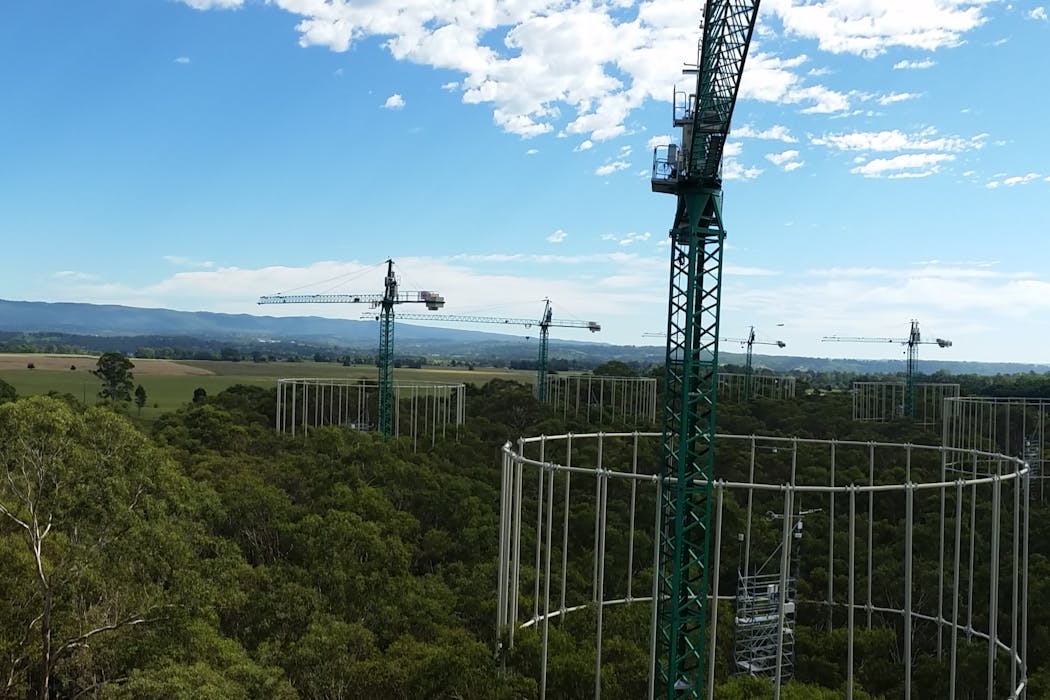
Plateforme EucFACE, près de Sydney, Australie. Vinod Kumar, Craig McNamarra, Craig Barton., Fourni par l’auteur

Expérimentation à ciel ouvert avec des prairies recouvertes de Plexiglas ou bien avec des anneaux en carbone de 25 mètres, reproduction d’écosystèmes miniatures en laboratoire, utilisations de données historiques, suivis depuis l’espace, équations… Pour comprendre comment le changement climatique va impacter les écosystèmes, les méthodes sont nombreuses et souvent complémentaires.


« Gérer l’inévitable pour éviter l’ingérable. » À l’heure où les effets du changement climatique ne vont partout qu’en s’accroissant, telle est la formulation courante des climatologues pour exprimer très concrètement l’objectif stratégique des politiques climatiques.

Face aux prédictions préoccupantes, les écologues observent, cherchent à comprendre ce phénomène pour mieux prédire ses conséquences sur nos écosystèmes.

Il existe différentes approches pour tester comment le changement climatique influe sur les organismes, leurs interactions entre individus, entre espèces et avec leur environnement. Cela combine des observations, des expérimentations et de la modélisation. Voici un tour d’horizon de ces différentes approches mises en place en France et dans le monde.

Des plateformes expérimentales grandeur nature

Une première approche consiste à modifier un écosystème via des équipements et à étudier les changements qui en découlent. Que ce soit pour évaluer la sécheresse, les hausses de température ou l’augmentation du CO2 dans l’atmosphère, le principe reste le même. Cela permet de contrôler une ou plusieurs variables environnementales (la pluviométrie, la température et autres) comme si nous étions sous les conditions futures, pour simuler les scénarios climatiques à venir.

C’est le cas de la plateforme de Puéchabon, dans le sud de la France, ou de la plateforme DRI-GRASS, près de Sydney (Australie). Toutes deux cherchent à comprendre comment un changement dans les régimes de pluie impacte l’écosystème et son fonctionnement, mais dans deux écosystèmes bien distincts.

À Puéchabon (Hérault), un système de gouttières dans une forêt de chênes verts exclut partiellement l’eau de pluie pour simuler la sécheresse. Cette expérimentation a débuté en 2003, avec quatre parcelles de 140 mètres carrés dans la forêt de chênes verts. Ainsi, on évalue l’effet de la sécheresse sur des parcelles entières de forêt. Quels effets sur la forêt, sur les arbres, sur le sol ? Quels effets sur le stockage de carbone ?

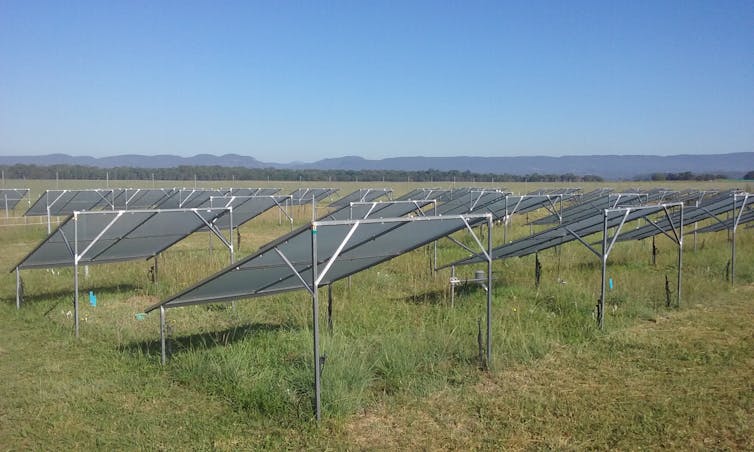
À Sydney, la plateforme DRI-Grass utilise un système similaire dans un autre type d’écosystème : une prairie. À la place de gouttières, ce sont des toits en Plexiglas qui couvrent différentes parties de la prairie. Cette expérience, plus récente, a débuté en 2013 et couvre un peu plus de 120 m2.

Plateforme expérimentale DRI-GRASS, près de Sydney (Australie).
Coline Deveautour, Fourni par l’auteur

Élément en plus, un système d’irrigation simule plusieurs scénarios possibles : une augmentation, diminution ou changement dans la distribution des eaux de pluie. Cette dernière permet d’étudier les scénarios d’événements extrêmes : des pluies plus rares mais plus fortes. Les chercheurs peuvent donc modifier les régimes hydriques pour se caler sur les scénarios de prédiction des climats futurs. L’un d’entre nous a ainsi travaillé sur cette plateforme pendant trois ans pour mieux comprendre la réponse des champignons et leur interaction avec les plantes face au changement climatique.

Toujours en Australie, mais beaucoup plus impressionnante par sa taille et le dispositif mis en place, la plateforme EucFACE teste l’effet de l’augmentation du CO2 dans l’atmosphère. Ici, ce sont des anneaux en fibre de carbone qui entourent des parcelles circulaires de forêt d’eucalyptus de 25 mètres de diamètre et hauts de 28 mètres !

Plateforme expérimentale EucFACE, près de Sydney (Australie).
photos prises par l’équipe gestionnaire du site EucFACE — Vinod Kumar, Craig McNamarra, Craig Barton., Fourni par l’auteur

Durant la journée, ces anneaux injectent du CO2 sur la forêt pour simuler une augmentation de CO2 à 550 ppm, la concentration attendue dans l’atmosphère pour l’année 2050. De nombreux chercheurs travaillent sur cette plateforme pour comprendre comment l’augmentation du CO2 risque de perturber le fonctionnement des forêts natives d’Australie.

Pour une simulation plus réaliste des changements à venir, certaines plates-formes allient plusieurs facteurs. La plateforme autrichienne ClimGrass par exemple, teste non seulement l’augmentation du CO2 mais aussi la température et la sécheresse. Cette plateforme de maintenant dix ans s’intéresse aux impacts du changement sur une prairie.

Quels que soient la plateforme et le scénario testé, des chercheurs de plusieurs disciplines travaillent et prennent des mesures pour étudier les effets du changement climatique sur les organismes (plantes, organismes du sol, herbivores et autres), la diversité des espèces et sur le fonctionnement de l’écosystème (sa capacité à fixer le carbone, par exemple).

Une des difficultés liées avec cette approche expérimentale est la multitude de facteurs qui ne sont pas contrôlés dans une expérimentation à ciel ouvert. Les résultats peuvent varier d’une année sur l’autre en fonction des aléas bien réels du terrain (une année exceptionnellement pluvieuse, par exemple). De plus, ces études sont en général plus coûteuses et demandent plus d’entretien.

Créer et contrôler un mini-écosystème : les microcosmes

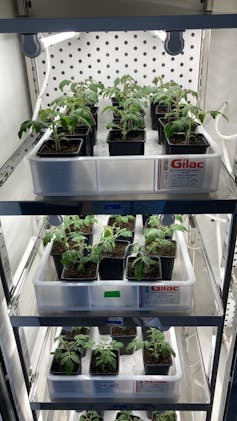
Pour des conditions plus contrôlées, d’autres projets consistent à mettre en place des écosystèmes à échelle réduite en laboratoire. Par exemple, un microcosme terrestre peut contenir soit des assemblages artificiels d’organismes (une sélection de plantes en pots) soit des portions d’écosystème venant de l’environnement (des sols et plants extraits d’une prairie ou autre).

Plants de tomates dans une enceinte phytotronique (température, photopériode et hygrométrie contrôlées) de l’équipe de recherche AGHYLE, UniLaSalle.
Adrien Gauthier, Fourni par l’auteur

Ces mini-écosystèmes sont ensuite placés dans des chambres climatiques. Ces chambres varient en taille, mais peuvent être aussi réduites à deux mètres cubes. Elles confinent des communautés d’organismes et les exposent à des variables environnementales (température, humidité, CO2…) simulant des scénarios du changement climatique en conditions entièrement contrôlées.

Ce genre d’expérimentation a l’avantage d’avoir un environnement qui facilite l’interprétation et le suivi. Par exemple, simuler une hausse de température tandis que les autres paramètres (humidité, CO2…) sont constants et eux aussi contrôlés avec précision. Cela permet d’isoler et d’interpréter l’effet de la température, et uniquement de la température, sur le microcosme. Ainsi, les microcosmes ne sont qu’une portion de l’écosystème, et s’éloignent de conditions plus fluctuantes et réalistes.

Exploiter les gradients naturels

Plutôt que modifier l’écosystème ou d’en isoler une partie, certains chercheurs utilisent des gradients naturels, soit les variations naturelles que l’on constate dans la nature. Sur les écosystèmes terrestres, on retrouve des gradients de température avec l’altitude en montagne, par exemple. Plus on monte en altitude, plus les températures chutent. Un gradient de température existe aussi en fonction de la latitude. En général, plus on se rapproche des pôles, plus les températures sont froides. Et, plus récemment utilisés, il existe aussi les gradients de température entre les zones rurales et urbaines avec leurs îlots de chaleur.

Ainsi, l’impact de la température peut être évalué en suivant un transect (ligne virtuelle) le long du gradient, mais pas seulement.

Il existe des expériences de « translocation », où les chercheurs déplacent soit des espèces soit des communautés entières de zones élevées en montagne vers des zones plus basses pour simuler un réchauffement. Par exemple, des chercheurs ont déplacé des placettes de prairie de 0,7 mètre sur 0,7 mètre à trois différentes élévations dans les Alpes : 950, 1 450 et 1 950 mètres au-dessus du niveau de la mer. À la suite de ces transplantations, un suivi régulier peut être effectué pour étudier les plantes, leurs abondances et les espèces associées.

Un autre type d’expérimentation consiste à déplacer un organisme vers des zones plus élevées, et donc actuellement plus froides. Ces zones, pour le moment inaccessibles aux organismes de basses altitudes (avec des températures plus clémentes), deviendront propices à leur développement avec le réchauffement global. L’intérêt de ces études est de mesurer l’impact de ces futures migrations sur les écosystèmes où ces espèces sont pour le moment absentes.

Bien qu’informatives, ces expériences ont, elles aussi, leurs biais. Le gradient de température est un facteur déterminant, cependant il existe toute une myriade d’autres facteurs environnementaux qui varient le long de ces gradients. Ces facteurs ne peuvent pas être contrôlés, mais on peut tout de même les prendre en compte pour interpréter les observations des chercheurs.

Des suivis et des mesures de longue haleine

Certains écosystèmes sont étudiés depuis très longtemps. C’est le cas de la forêt expérimentale Hubbard Brook, au New Hampshire, dans le nord-est des États-Unis. Des mesures environnementales et les suivis d’espèces associées sont collectés depuis 1955 (soit soixante-et-onze ans cette année !). En France, le Centre d’études biologiques de Chizé effectue des recherches sur l’évolution des populations animales sauvages depuis 1968.

On peut ainsi corréler les données météorologiques avec l’activité, l’abondance et la diversité d’espèces. Les données permettent non seulement d’observer directement le changement du climat lors des décennies passées mais aussi comment la variabilité des événements climatiques influence le fonctionnement de l’écosystème.

Une autre manière d’obtenir des mesures sur le long terme et de réaliser des suivis à grande échelle se fait grâce aux sciences citoyennes. Que ce soit dans un jardin, en ville ou en randonnée, les données d’observation d’espèces permettent non seulement d’enregistrer la présence de l’espèce mais aussi leur phénologie, c’est-à-dire comment le climat influence la saisonnalité des espèces.

Ces fluctuations sont aussi mises en évidence grâce à des registres historiques. C’est le cas de la date de floraison des cerisiers de Kyoto, dont les registres remontent à 853. Ou encore plus proche de nous, les registres des dates des vendanges qui prouvent qu’elles ont avancées en moyenne de deux à trois semaines.

Parmi les données citées par le rapport du Giec, on retrouve la date de floraison des cerisiers au Japon. L’agence japonaise de météorologie constate que la floraison avance en moyenne de 1,2 jour tous les dix ans.
Ryosuke Yagi/flicker, CC BY

Ce genre de projet permet de répondre à plusieurs questions, par exemple : Est-ce que le printemps démarre de plus en plus tôt ? Est-ce que la distribution géographique de l’espèce change ? Lesquelles sont les plus impactées ?

Des suivis depuis l’espace

Des mesures en continu, tous les jours, et qui recouvre toute la surface terrestre depuis l’espace pour mieux comprendre le fonctionnement terrestre et améliorer les modèles de prédiction. Parmi les nombreuses applications de cet outil, ça permet notamment de cartographier la végétation, son état de santé et sa capacité à fixer le CO2.

La modélisation

La modélisation est une activité incontournable en sciences, permettant de représenter de manière simplifiée un système, en l’occurrence ici, un écosystème. Ces modèles peuvent prendre des formes très différentes, de la simple équation mathématique jusqu’au modèle complexe reposant sur un grand nombre de paramètres (climatiques, pédologiques, biologiques et autres).

Un exemple très parlant de l’utilisation de la modélisation est la projection des feux de forêts. Cela permet de prédire comment le changement climatique influe sur l’intensité, la durée des saisons des feux, leurs étendues. Ces modélisations sont d’autant plus importantes car elles permettent aussi d’identifier des forêts jusque-là épargnées, mais qui avec le changement climatique, seront touchées.

Une fois que les risques d’incendie sont estimés, il est possible d’allier ces prédictions avec les observations de terrain : quelles espèces sont présentes ? Sont-elles adaptées aux feux ? Des simulations permettent aussi d’examiner l’implantation et l’extinction de différentes espèces en relation avec les feux et l’environnement.

De manière générale, les modèles sont adaptables à différents écosystèmes (forêts, prairies, lac, océans…), espèces modèles, climats (tempérés, tropicaux…). Avec l’avancée de nos technologies, ces modèles deviennent toujours plus performants. Bien que complexes, ces méthodes sont des outils puissants pour explorer les conséquences du changement climatique et laissent la porte ouverte à tout un champ des possibles.

Quelle que soit l’approche utilisée par les chercheurs, tous ces outils et méthodes sont complémentaires. Chacun apporte une pierre à l’édifice dans la construction d’une connaissance scientifique opérationnelle pour l’atténuation des causes du changement climatique et l’adaptation face à ses effets déjà observables.

The Conversation

Les auteurs ne travaillent pas, ne conseillent pas, ne possèdent pas de parts, ne reçoivent pas de fonds d’une organisation qui pourrait tirer profit de cet article, et n’ont déclaré aucune autre affiliation que leur organisme de recherche.

ref. Prairies sous Plexiglas, images satellite, équations… comment les scientifiques prédisent les effets du changement climatique sur les écosystèmes – https://theconversation.com/prairies-sous-plexiglas-images-satellite-equations-comment-les-scientifiques-predisent-les-effets-du-changement-climatique-sur-les-ecosystemes-274994

South Africa is sending in the army to fight crime (again). Does it ever work?

Source: The Conversation – Africa (2) – By Guy Lamb, Criminologist / Senior Lecturer, Stellenbosch University

Soldiers from the South African National Defence Force are going to be deployed alongside members of the South African Police Service to combat gangs and armed groups associated with illegal mining.

The announcement by South African president Cyril Ramaphosa in his State of the Nation address in mid-February 2026 received the support of opposition political parties, including the Democratic Alliance and the Economic Freedom Fighters.

More broadly, the decision was both praised and condemned by commentators.

I have studied militarised forms of policing for many years. The findings of my research suggest that there are both positive and negative aspects to these kinds of interventions.

There are clear drawbacks to the domestic deployment of the military in a policing role. But, under certain conditions, there have been crime reduction effects.

The history

The military have been deployed to assist the police in crime fighting (including
combating gang violence) in South Africa on regular occasions since the late 1990s. It was commonplace during the 1980s in apartheid South Africa.

Examples include Operation Recoil (1997), Operation Slasher (2001),
Operation Combat (2012), Operation Thunder (2018) and Operation Lockdown (2019).

The defence force was also deployed alongside the police in 2020 to enforce
“hard” COVID-19 lockdown restrictions.

This situation is not unique to South Africa. Numerous countries, such as Brazil, Colombia, El Salvador, Kenya, Mexico and the US, have used their militaries for policing.

Decisions by governments to use soldiers to perform policing functions are
primarily due to pragmatic and political considerations.

Police are at times not sufficiently capable of responding to specific criminal dangers due to their hyper violent nature (such as gang conflicts) or due to constraints such as a lack of resources, inadequate training and corruption.

The military sometimes takes on policing roles when a government wants to demonstrate that it is capable of containing criminal threats.

There are other reasons too for the use of soldiers in civilian settings. Soldiers have been deployed in contexts of intense rivalries between political parties. For example, policing scholars have emphasised that the US federal government’s deployment of the National Guard to Democrat-led cities (such as Los Angeles and Chicago) in 2025 and 2026 was an effort by the Trump administration to undermine the credibility of the political leadership in these cities.

My research has established that both pragmatic and political reasons have been behind the defence force’s involvement in police work in South Africa over the past 30 years. That is, in many high crime areas the authorities have had to contend with well-armed criminal groups and highly dangerous environments where there are low levels of community trust in the police.

In September 2025, the acting police minister, Firoz Cachalia, admitted that there was no practical plan to respond to gang violence in the Western Cape. Moreover, during times of elevated crime levels, government tends to frame its policing as a “war” and criminals as “enemies” on which the police and defence force must “stamp their authority”.

To date there has been no comprehensive multi-country research on the impact of
military involvement in combating crime. Existing studies are based on single case analyses (such as Colombia). These studies indicate that the crime reduction effect of using the military for policing is limited.

A study on US troop deployment in Africa, Latin America and the Middle East indicates that it was associated with an increase in property crime.

Furthermore, there’s evidence that the use of the military in the “war on drugs” has led to human rights abuses. In the case of the Philippines for example, it also led to extrajudicial killings.

My research on high density policing operations in South Africa has demonstrated that deploying the military can result in the reduction of violent crime (especially murder) in targeted areas. But this is dependent on the arrest of large numbers of “wanted” criminals. And the seizure of large quantities of illegal firearms.

The domestic deployment of the defence force also increases the risk of human rights abuses. Soldiers are trained to use lethal force and are not schooled in the subtleties of police work.

This was evident during the defence force’s enforcement of the COVID-19 lockdown, when numerous allegations of abuse were reported. There was also video footage on social media of soldiers forcing people to perform demeaning physical exercises as punishment for not adhering to lockdown regulations.

My research has shown that the crime reduction effect of military deployment is temporary. Violent crime levels tend to increase in high crime areas within a year of the intervention being concluded. This has been confirmed in a study done in 2023. The reason is that police operations involving the military typically do not address the underlying societal causes of violent crime and the external sources of illegal firearms.

It’s therefore encouraging that the president committed the government to carrying out the Integrated Crime and Violence Prevention Strategy and pursuing tighter firearm controls.

The Conversation

Guy Lamb is a Commissioner with the National Planning Commission.

ref. South Africa is sending in the army to fight crime (again). Does it ever work? – https://theconversation.com/south-africa-is-sending-in-the-army-to-fight-crime-again-does-it-ever-work-276285

Critical mineral supply faces risks if local communities aren’t consulted enough: the case of lithium in Ghana

Source: The Conversation – Africa – By Clement Sefa-Nyarko, Lecturer in Security, Development and Leadership in Africa, King’s College London

Clean technologies depend on critical minerals such as lithium and cobalt. Over 65% of the world’s cobalt is mined in the Democratic Republic of Congo. Nearly 40% of the world’s manganese is mined in South Africa. Substantial deposits of lithium are found in Zimbabwe. Ghana is emerging as a miner of that mineral of lithium too.

What’s less well understood is how the supply chains of these minerals are assessed and managed. The dominant view is that only three players matter: the mineral-mining industry, the host state where the minerals are found, and the wider geopolitical equation.

But there’s a fourth piece of the puzzle: the role of communities.

I am an academic researching justice and equity in critical minerals governance and energy transitions. In a recent paper, I examined the role of communities and the presence or absence of a social licence to operate. In other words, community “approval” that allows a project to proceed.

I focused on Ghana’s emerging lithium sector. Communities here are already feeling livelihood and social pressures following the commercial discovery. My research shows that weak and opaque governance around critical-mineral projects create early friction between communities, companies and the state. I found that delays in legal and regulatory processes, exclusion from decision making, and inadequate compensation routinely disrupt livelihoods in lithium rich communities.

These governance failures heighten local tensions. When communities feel sidelined or harmed, the risk of social conflict rises sharply. It can result in project delays, shutdowns and higher costs for both states and companies. These pressures are not incidental. They directly affect the stability of global supply chains.

I argue that effective risk governance must move beyond geopolitics. It must embed the fundamentals of social legitimacy. These include:

  • free, prior and informed consent

  • fair and transparent benefit-sharing

  • sustained, meaningful engagement with affected communities.

Without these basics, no amount of technological innovation or diplomatic negotiation can secure the minerals needed for the energy transition.

As global competition intensifies over access to strategic minerals, the governance of mining sites in the global south becomes important for supply chain assurance.

Why local participation matters

My argument is that local participation is one of the strongest predictors of whether mining projects gain or lose legitimacy, and therefore whether supply chains remain stable or face disruption.

When communities are involved early and meaningfully in decisions about land access, water use, environmental safeguards and compensation, they are more likely to see mining not as an imposed threat but as a negotiated partnership. This reduces uncertainty, builds trust and lowers the likelihood of conflict. Those conditions are essential for predictable mineral flows.

Research in sustainable mining consistently shows that communities are not passive recipients of mining impacts. They are active agents whose consent, cooperation or resistance can determine the lifespan of entire supply chains. Participation creates the space for communities to articulate their needs. It shapes benefit‑sharing mechanisms and ensures that mining does not undermine local livelihoods. When people have no voice in decisions that affect their land, water or social well-being, grievances accumulate and protests, legal challenges or operational blockages become far more likely.

Findings from my research further demonstrate that participation is a practical risk-management tool. It is not a symbolic gesture. In mining communities, weak engagement and unclear communication about land restrictions and compensation create perceptions of dispossession. They intensify tensions that threaten project timelines. Conversely, when engagement is consistent and meaningful, concerns are addressed early. This reduces the likelihood of costly shutdowns and strengthens the long‑term security of mineral supply chains.

Participation anchors mining projects in social legitimacy. It shifts extraction from something done to communities towards something negotiated with them. It turns potential flashpoints into points of cooperation. In a world where a single protest can disrupt global supply chains, community participation is no longer optional. It is a fundamental safeguard for the energy transition.

Way forward

Reducing the risk of supply-chain disruptions is not easy, but there is a clear path to it.

First, future global meetings like the COP climate summits and UN processes should explicitly include critical minerals, sustainable mining and community protections as formal agenda items. This will close the long-standing governance gap that leaves mineral supply chains exposed.

Second, international bodies should develop shared indicators for meaningful participation, benefit-sharing and community legitimacy. Social licence must be treated as a material risk factor that can halt mines and disrupt global markets.

Instead of resisting regulation, mineral-producing countries should help shape global environmental, social and governance expectations. They should reflect local priorities, environmental conditions and value-addition goals, while ensuring stable, responsible mineral flows.

Governments and companies should establish shared governance arrangements covering water use, land access, benefit-sharing and grievance processes. This will build trust early and prevent local conflict.

Also, mineral-rich countries should align on minimum social and environmental standards, free, prior and informed consent requirements, and value-addition policies. These will ensure diversification does not encourage weak oversight or exploitation.

The Conversation

Clement Sefa-Nyarko receives funding from UK Research and Innovation (UKRI) through a Future Leaders Fellowship for a project on justice in critical minerals governance and energy transitions. He also occasionally consults for Participatory Development Associates on international development in Africa, but this work is not related to mining.

ref. Critical mineral supply faces risks if local communities aren’t consulted enough: the case of lithium in Ghana – https://theconversation.com/critical-mineral-supply-faces-risks-if-local-communities-arent-consulted-enough-the-case-of-lithium-in-ghana-275723

Trump, aliado incómodo: lecciones de Múnich 2026 para España y Europa

Source: The Conversation – (in Spanish) – By Armando Alvares Garcia Júnior, Profesor de Derecho Internacional y de Relaciones Internacionales, UNIR – Universidad Internacional de La Rioja

La Conferencia de Seguridad de Múnich 2026, un foro clave donde líderes mundiales analizan amenazas globales como conflictos armados y rivalidades entre potencias, destaca la evolución tensa de la relación entre Estados Unidos y Europa bajo Donald Trump, actual presidente de EE. UU. Este evento anual, celebrado los días 13, 14 y 15 de febrero en Alemania, reúne a ministros, presidentes y expertos para debatir cómo mantener la paz en un mundo inestable.

El informe oficial advierte que EE. UU., artífice del orden internacional posterior a 1945, ahora impulsa su “demolición” mediante políticas impredecibles que generan desconfianza entre aliados. Para la Unión Europea y para España, esto se traduce en más gasto en defensa, más autonomía forzada y menos margen para seguir mirando hacia otro lado.

Trump no asistió, pero su sombra dominó los debates. La amenaza de hacerse por la fuerza con Groenlandia, territorio de la OTAN, se ha convertido en un punto de inflexión psicológico: evidencia que Washington puede actuar también como depredador con sus aliados. De ahí el lema sombrío de esta edición, Under Destruction, y el clima de duelo que describen los organizadores: Europa habría pasado de la negación a la ira y la depresión hasta aceptar que la relación transatlántica no volverá a ser lo que era.

La versión amable del trumpismo

En este contexto, el discurso de Marco Rubio, secretario de Estado de EE. UU., presentó la cara más conciliadora del enfoque trumpista. Rubio elogió a Occidente como “la mayor civilización de la historia”, insistió en que EE. UU. no busca romper con Europa y llamó a “revitalizar una vieja amistad”, ganándose aplausos en el hotel Bayerischer Hof.

No obstante, el trasfondo revela condiciones claras: la alianza perdura si se alinea con prioridades estadounidenses, desde sanciones en Venezuela hasta posiciones en Gaza, pasando por amenazas como la inmigración o el “culto climático”, y un rechazo al multilateralismo tradicional de la ONU o similares. Rubio pulió argumentos agresivos de otros como J. D. Vance, pero defendió una visión nacionalista, blanca y cristiana de Occidente que contrasta con el pluralismo ideológico en declive pero presente en Europa.

Desde Europa, las réplicas combinaron desafío verbal con reconocimiento de dependencia.

El canciller alemán, Friedrich Merz, declaró que el orden basado en normas ya no existe, reconoció una “profunda zanja” con EE. UU., urgió refundar la OTAN y enfatizó que ni siquiera Estados Unidos resulta lo bastante fuerte para actuar en solitario ante rivales globales como China o Rusia.

Emmanuel Macron instó a Europa a pasar de “objeto” a “sujeto” en seguridad, iniciando un debate sobre extender el paraguas nuclear francés al conjunto del continente, y exigió voz europea en decisiones sobre Ucrania y fronteras.

La presidenta de la Comisión Europea, Ursula von der Leyen, y el primer ministro británico, Keir Starmer, reforzaron esta visión con una OTAN “más europea” y una columna vertebral de capacidades estratégicas propias, como misiles de largo alcance o defensa cibernética.

La doctrina OTAN 3.0

Elbridge Colby, subsecretario de Defensa estadounidense, articuló la doctrina de OTAN 3.0, que justifica recortar compromisos convencionales de EE. UU. en Europa para priorizar el Indo-Pacífico frente a China.

Un examen detallado de discursos y documentos expone elementos sutiles: idealización de la Guerra Fría, ambigüedad hacia Rusia pese a Ucrania, un calendario de traspaso de cargas irreal que abre una ventana de vulnerabilidad y la ilusión de un actor europeo unificado, pese a divisiones políticas, industriales y sociales en la UE.

El resultado es una exigencia a Europa para que corra más rápido de lo que sus piernas y sistemas pueden alcanzar, con plazos que generan riesgos de desprotección temporal.

España participó atrapada entre exigencias externas y su estrategia interna. Trump ha criticado públicamente el retraso histórico en gasto militar de Madrid, impulsando vía una OTAN 3.0 objetivos más allá del 2 % del PIB, posiblemente hacia 3 % o más.

El Gobierno de Pedro Sánchez se presentó como atlantista sin sumisión, rechazó el rearme nuclear y abogó por un “rearme moral” contra la deriva armamentista, destacando la contribución a misiones de la OTAN, el “flanco sur” (migración, terrorismo) y la coherencia entre la defensa de Ucrania y Gaza.

Para los ciudadanos españoles, Múnich se traduce en tres ámbitos tangibles:

Múnich 2026 urge transformar recelo en acción: Europa, y España, deciden si aceleran hacia la autonomía o reformulan un modelo de seguridad ya insostenible.

The Conversation

Armando Alvares Garcia Júnior no recibe salario, ni ejerce labores de consultoría, ni posee acciones, ni recibe financiación de ninguna compañía u organización que pueda obtener beneficio de este artículo, y ha declarado carecer de vínculos relevantes más allá del cargo académico citado.

ref. Trump, aliado incómodo: lecciones de Múnich 2026 para España y Europa – https://theconversation.com/trump-aliado-incomodo-lecciones-de-munich-2026-para-espana-y-europa-276108

Migraine is more than just a headache. A neurologist explains the 4 stages

Source: The Conversation – Global Perspectives – By Lakshini Gunasekera, PhD Candidate in Neurology, Monash University

Karolina Grabowska/Pexels

A migraine attack is not just a “bad headache”.

Migraine is a debilitating neurological condition which can cause nausea, vomiting, and sensitivity to light or sound, in addition to severe headaches.

Migraine affects roughly five million Australians, but few people understand the different stages of a migraine attack.

Knowing the four distinct phases can help you recognise the symptoms and manage pain at each stage.

Phase 1: Premonitory

The first phase of migraine development is the “premonitory” or “prodrome” phase. It functions like a warning period which begins 24 to 48 hours before a migraine attack fully sets in.

The premonitory phase has a lot to do with the hypothalamus. The hypothalamus is the part of the brain which regulates key functions such as body temperature, appetite, mood and sleep.

When a person experiences a migraine attack, their hypothalamus becomes abnormally activated. The hypothalamus is connected to other parts of the brain with different functions, so this abnormal activation can also disrupt how those parts function.

This can lead to symptoms such as poor concentration, food cravings, irritability and insomnia. If you notice these early signs, you’re more likely to “catch” the start of a migraine attack and be able to treat it early.

Phase 2: Aura

The second phase of a migraine attack is called “aura”. Aura refers to various neurological symptoms which affect your vision, speech or ability to feel sensations. Visual auras, which mainly affect your vision, are the most common kind.

Visual aura symptoms can include seeing flashing lights, swirling shapes or blind spots. A sensory aura can lead to numbness or tingling in your face or limbs. In severe cases, people may even have trouble speaking.

Research suggests a process called cortical spreading depression contributes to aura symptoms. During this process, a wave of electrical activity spreads very slowly through the brain and can impact how certain brain regions function.

Only 30% of people experience migraine with aura.

Phase 3: Headache

The third phase of a migraine attack is the headache. This is when people typically experience a throbbing or pulsating headache, alongside other symptoms like nausea and sensitivity to light and sound.

This phase usually lasts between four and 72 hours if untreated.

When different brain networks become activated during a migraine attack, other symptoms can develop in addition to headache.

When the medulla or “vomit centre” of the brain is abnormally activated, it can lead to nausea and vomiting.

The trigeminal nerve, the nerve which allows you to feel sensations on your face, can also become abnormally activated. This causes the release of chemicals which may be perceived by the brain as pain.

One of these chemicals is a protein called calcitonin gene-related peptide (CGRP). Some injectable types of migraine medication block this protein to reduce pain.

Phase 4: Postdrome

The fourth and final phase is the “postdrome”. It is also known as the “migraine hangover”.

During this recovery phase, your brain is working hard to return to its normal functioning. That is why you may feel even more fatigued or have difficulty concentrating after a migraine attack.

So, how can I manage a migraine attack?

It helps to know the symptoms and stages of migraine development.

If you have predictable symptoms, particularly during the premonitory phase, it’s best to carry pain medications or anti-nausea tablets with you. That way you can treat early symptoms as soon as they arise. It can also be a sign to rest, ideally before the headache phase sets in.

In the aura phase, taking migraine-specific pain medications such as triptans, aspirin or anti-inflammatory pain killers may stop the headache phase from starting.

If you have more than four migraine attacks each month, you may also consider taking preventive medications. These are usually daily tablets which help control the baseline level of head pain you experience. Injectable options are also available.

Finally, don’t ignore the postdrome phase. If you push yourself too hard during this recovery period, you may experience overlapping migraine attacks. This is when one migraine attack starts before the last one resolves itself. Overlapping migraine attacks are much harder to treat.

You may also experience other symptoms related to the migraine attack. These can include dizziness, neck pain, or ringing in the ears. If you have any of these additional symptoms, you should consult your neurologist to check they are not caused by a more serious underlying condition.

And if you are a woman who experiences migraine with aura, speak to your doctor before starting hormone-based contraception. This is because you may need different treatment than someone who does not experience aura symptoms.

By understanding the different phases and symptoms of migraine, you will be better equipped to tackle any future attacks that come.


Read more:
Why is migraine more common in women than men?


The Conversation

Lakshini Gunasekera receives funding from the Victorian government’s Catalyst grant program to investigate hormonal therapies for menstrual migraine, and she has received royalties from Pain Management Today.

ref. Migraine is more than just a headache. A neurologist explains the 4 stages – https://theconversation.com/migraine-is-more-than-just-a-headache-a-neurologist-explains-the-4-stages-267973

A few weeks of X’s algorithm can make you more right-wing – and it doesn’t wear off quickly

Source: The Conversation – Global Perspectives – By Timothy Graham, Associate Professor in Digital Media, Queensland University of Technology

A new study published today in Nature has found that X’s algorithm – the hidden system or “recipe” that governs which posts appear in your feed and in which order – shifts users’ political opinions in a more conservative direction.

Led by Germain Gauthier from Bocconi University in Italy, it is a rare, real-world randomised experimental study on a major social media platform. And it builds on a growing body of research that shows how these platforms can shape people’s political attitudes.

Two different algorithms

The researchers randomly assigned 4,965 active US-based X users to one of two groups.

The first group used X’s default “For You” feed. This features an algorithm that selects and ranks posts it thinks users will be more likely to engage with, including posts from accounts that they don’t necessarily follow.

The second group used a chronological feed. This only shows posts from accounts users follow, displayed in the order they were posted. The experiment ran for seven weeks during 2023.

Users who switched from the chronological feed to the “For You” feed were 4.7 percentage points more likely to prioritise policy issues favoured by US Republicans (for example, crime, inflation and immigration). They were also more likely to view the criminal investigation into US President Donald Trump as unacceptable.

They also shifted in a more pro-Russia direction in regards to the war in Ukraine. For example, these users became 7.4 percentage points less likely to view Ukrainian President Volodymyr Zelenskyy positively, and scored slightly higher on a pro-Russian attitude index overall.

The researchers also examined how the algorithm produced these effects.

They found evidence that the algorithm increased the share of right-leaning content by 2.9 percentage points overall (and 2.5 points among political posts), compared with the chronological feed.

It also significantly demoted the share of posts from traditional news organisations’ accounts while promoting or boosting posts from political activists.

One of the most concerning findings of the study is the longer-term effects of X’s algorithmic feed. The study showed the algorithm nudged users towards following more right-leaning accounts, and that the new following patterns endured even after switching back to the chronological feed.

In other words, turning the algorithm off didn’t simply “reset” what people see. It had a longer-lasting impact beyond its day-to-day effects.

One piece of a much bigger picture

This new study supports findings of similar studies.

For example, a study in 2022, before Elon Musk had bought Twitter and rebranded it as X, found the platform’s algorithmic systems amplified content from the mainstream political right more than the left in six out of the seven countries.

An experimental study from 2025 re-ranked X feeds to reduce exposure to content that expresses antidemocratic attitudes and partisan animosity. They found this shifted feelings towards their political opponents by more than two points on a 0–100 “feeling thermometer”. This is a shift the authors argued would have normally taken about three years to occur organically in the general population.

My own research offers another piece of evidence to this picture of algorithmic bias on X. Along with my colleague Mark Andrejevic, I analysed engagement data (such as likes and reposts) from prominent political accounts during the final stages of the 2024 US election.

Our findings unearthed a sudden and unusual spike in engagement with Musk’s account after his endorsement of Trump on July 13 – the day of the assassination attempt on Trump. Views on Musk’s posts surged by 138%, retweets by 238%, and likes by 186%. This far outstripped increases on other accounts.

After July 13, right-leaning accounts on X gained significantly greater visibility than progressive ones. The “playing field” for attention and engagement on the platform was tilted thereafter towards right-leaning accounts – a trend that continued for the remainder of the time period we analysed in that study.

Not a niche product

This matters because we are not talking about a niche product.

X has more than 400 million users globally. It has become embedded as infrastructure – a key source of political and social communication. And once technical systems become infrastructure, they can become invisible – like background objects that we barely think about, but which shape society at its foundations and can be exploited under our noses.

Think of the overpass bridges Robert Moses designed in New York in the 1930s. These seemed like inert objects. But they were designed to be very low, to exclude people of colour from taking buses to recreation areas in Long Island.

Similar to this, the design and governance of social media platforms also has real consequences.

The point is that X’s algorithms are not neutral tools. They are an editorial force, shaping what people know, whom they pay attention to, who the outgroup is and what “we” should do about or to them – and, as this new study shows, what people come to believe.

The age of taking platform companies at their word about the design and effects of their own algorithms must come to an end. Governments around the world – including in Australia where the eSafety Commissioner has powers to drive “algorithmic transparency and accountability” and require that platforms report on how their algorithms contribute to or reduce harms – need to mandate genuine transparency over how these systems work.

When infrastructure become harmful or unsafe, nobody bats an eye when governments do something to protect us. The same needs to happen urgently for social media infrastructures.

The Conversation

Timothy Graham receives funding from the Australian Research Council (ARC) for the Discovery Project, ‘Understanding and Combatting “Dark Political Communication”‘.

ref. A few weeks of X’s algorithm can make you more right-wing – and it doesn’t wear off quickly – https://theconversation.com/a-few-weeks-of-xs-algorithm-can-make-you-more-right-wing-and-it-doesnt-wear-off-quickly-276153

Ads are coming to AI. Does that really have to be such a bad thing?

Source: The Conversation – Global Perspectives – By Ilayaraja Subramanian, Lecturer in Marketing, University of Canterbury

Matthias Balk/Getty Images

American artificial intelligence (AI) company Anthropic this month attracted applause – and a surge in users – for clever advertisements poking fun at its competition.

In the commercials, an AI assistant awkwardly breaks away mid-conversation to push products such as shoe insoles and dating services. “Ads are coming to AI”, the Super Bowl-tied spots warned, but not to Anthtropic’s own chatbot Claude.

The campaign quickly generated buzz because it played to peoples’ worries that inviting advertising into AI platforms which many of us now rely on – and confide in – risks blurring the line between helpful advice and paid influence.

But that anxiety, while understandable, overlooks how advertising already works across much of the digital world.

In many ways, ads based on our interactions with AI aren’t such a big leap from the kinds of targeted advertising that already dominate search engines, social media feeds and e-commerce platforms.

And if transparent and well-designed, the shift could help people complete tasks faster and keep these tools widely accessible.

AI’s access and equity headache

This month, OpenAI’s ChatGPT began testing adverts with users in the United States. The company assures us any ads will be clearly labelled, kept separate from answers and accompanied by privacy protections and user controls.

The stakes are high: ChatGPT now boasts 800 million weekly users and ranks as the internet’s fifth most visited website. It has operated largely ad-free since its launch three years ago and only about 5% of users pay a subscription.

With room to grow, OpenAI has strong incentives to find a sustainable model that protects trust without undermining what made the service so popular.

If indeed transparent and optional, its advertising could help solve a basic funding problem. In practice, a small paying group cannot carry the full burden forever.

One of Anthropic’s new advertisements touting the “ad-free” status of its chatbot Claude.

A light, clearly labelled ad model is one way the wider user base could contribute indirectly – much as they already do via television, YouTube, search engines and many news websites.

That matters for access. Around one in six people worldwide already use generative AI, but adoption is uneven and a digital divide is widening between richer and poorer countries.

If wealthier nations move faster, sustainable business models can help spread access by keeping costs down for students, job seekers and small organisations in emerging economies.

The convenience of ‘contextual’ advertising

For everyday ChatGPT users, the main upside of ads is that they can reflect what is needed in the moment, rather than what a tracker infers from past browsing.

Traditional digital ads use cookies and cross-site tracking to guess people’s interests over time. Contextual advertising, by contrast, targets what is happening on the page or in the moment and is often seen as a more privacy-friendly alternative.

OpenAI says ads will be matched to the conversation and may use past chats and ad interactions. Users will be able to dismiss ads, see why they were shown one and delete ad data.

If those controls work as promised, relevance would come from the question being asked, not from tracking across other websites. Imagine asking: “I’m hosting friends. What are two easy Mexican dishes, and what ingredients do I need?”.

ChatGPT could give the recipe guidance first, then show a clearly labelled ad option, such as a local supermarket delivery link for the exact ingredients, or a sponsored meal kit that fits the budget and dietary needs. Instead of jumping between tabs, the user moves straight from decision to action.

For consumers, that is convenience. For advertisers, it is also efficiency, because the ad appears at the moment of genuine intent rather than being sprayed across the internet.

Another benefit is smoother communication. Conversational ads have the potential to function more like a shop assistant than a static banner. Instead of clicking away, opening tabs and filling in forms, follow-up questions can be asked in the same chat and personalised details returned quickly.

OpenAI suggests this could include sponsored listings that users can interact with in the chat. For instance, while planning a trip, a sponsored accommodation option might appear, allowing questions about availability, cancellation, location and total cost for specific dates and group size to be handled in one place.

Done well, this could reduce frustration and curb misleading advertising, because people can challenge vague claims and ask for specifics before spending money.

Trust, transparency and limits

None of this removes the risks. Advertisements should not be allowed to change what a trusted AI tool such as ChatGPT recommends. And because ads are currently being tested with only a small group of users, the full extent of those risks cannot yet be observed or properly assessed.

That is why transparency and separation are not cosmetic. They are safeguards.

For now, it may be tempting to treat “ad-free” as the only ethical position, as Anthropic’s new campaign implies. But the world is still early in this shift. These systems should be judged by what happens in practice – especially on transparency, user control and real protections against manipulation.

If those guardrails hold, it is worth considering the upside too: ads in AI tools could support access, reduce friction and help more people benefit from this powerful technology.

The Conversation

Ilayaraja Subramanian does not work for, consult, own shares in or receive funding from any company or organisation that would benefit from this article, and has disclosed no relevant affiliations beyond their academic appointment.

ref. Ads are coming to AI. Does that really have to be such a bad thing? – https://theconversation.com/ads-are-coming-to-ai-does-that-really-have-to-be-such-a-bad-thing-274955

Age verification online can be done safely and privately. Here’s how

Source: The Conversation – Global Perspectives – By Marten Risius, Adjunct Senior Fellow, School of Psychology, The University of Queensland

Richard Williams/Unsplash

Online chat service Discord has announced it will begin testing age verification for some users, joining a growing list of platforms trying to work out who is actually behind the screen.

The move comes as governments around the world push for stronger protections of young people online. The United Kingdom and France have imposed age verification for visitors of adult content pages. Australia now mandates that social media platforms ensure their account holders are older than 16.

Many people feel immediately uneasy about online age or ID checks. Will the log-in process become more time consuming? Will proving how old we are mean giving up anonymity and force us to hand over sensitive documents to private tech firms?

Will mandatory age verification impact our ability to browse, speak and participate online, making us “transparent citizens” tracked by corporations or the government?

These concerns are not unfounded. In fact, research points to even more risks. Sharing identity-related data makes breaches or identity theft more likely. Age verification systems could be abused for surveillance or lead to discrimination, especially for marginalised groups.

However, our research shows it is possible to provide truly anonymous, safe age checks online.

Not all age assurance works the same

Age assurance is the umbrella term for all kinds of methods that can help determine someone’s age online. This includes age verification – proving the user’s age, often with an official ID.

How age assurance is put into practice differs vastly across jurisdictions and platforms. The Australian government demands firms must take “reasonable steps” to prevent kids from making social media accounts, but the age assurance methods can vary.

The government of France provides more guidance, but still leaves implementation of age proofs to third parties. The European Union is actively preparing a reference implementation for an age verification solution, albeit it has not put age restriction policies in place yet.

To keep things simple, platforms are increasingly turning to facial age estimation. Users are asked to scan their face so an algorithm can guess how old they are.

At first, this may sound less intrusive than showing a government-issued ID. In practice, it often requires handing over highly sensitive biometric data to private companies. Unlike a password, your face can’t be changed if the data is stolen. Such age estimation is also prone to errors.

There is a plethora of alternative age assurance tech. These include user behaviour analysis, payment-based verification, document scans (such as government-issued IDs), video-based verification services involving these documents, and electronic attestations – such as the electronic passports familiar from border control at airports.

There’s no need to share sensitive data

One highly secure approach allows users to prove a single fact – such as being over 18 – not only with high certainty, but without revealing their name, address, or even date of birth. It’s based on cryptographic digital attestations.

For example, the German eID exchanges data directly between a microprocessor in a person’s plastic “eID card” and the platform. The microprocessor proves it belongs to a government-issued eID via a cryptographic key, which is shared with 9,999 other eIDs. This means the only thing a platform learns is that one of 10,000 potential people signed up.

When the service sends the current date and minimum age required to the eID, the microprocessor uses the date of birth, computes the current age and simply responds whether the user is old enough.

The EU digital identity and Google wallets are working on a slightly different approach. It doesn’t rely on special microprocessors built into physical cards, but on hardware components common in mobile phones.

This makes the approach more broadly applicable. These solutions involve highly advanced cryptography that communicates to the platform that a person possesses a digital document proving they’re older than 18, but without revealing any further details.

As you can see, age verification systems can be designed with unlinkability at their core. That means neither the government nor the platform can track a user’s activities despite being able to accurately verify their age.

The real issue isn’t age verification – it’s who runs it

If any government is serious about age assurance, the technical design will matter more than the policy itself.

Privacy-friendly age verification is complex and expensive. It will require governments to invest in the technical details, ensuring the age verification is robust while meeting privacy expectations.

And the software code will need to be open-access to allow for peer review. Transparency is the strongest safeguard against false promises made by the government or hidden attacks by cyber criminals trying to steal the data.

Government involvement must also convincingly resist looming threats of “function creep”, where the scope of data capture through an age verification infrastructure can quickly be changed through political decisions. There is no technical safeguard against such abuse – and governments need to earn their citizens’ trust in future legislation.

Indeed, the stakes are high: a single data breach can easily destroy public trust. If citizens don’t trust the age verification tool, they may just circumvent age controls altogether, as has happened in France.

The bigger picture

The internet is entering a new phase. For years, platforms avoided knowing the age of their users. That appears no longer politically or socially sustainable.

The real choice is not between safety and privacy. It is between two very different technical paths. One path normalises biometric (face, fingerprint and similar) checks, expanding the amount of sensitive data handed to private companies.

The alternative uses advanced cryptographic solutions that confirm age while protecting anonymity.

Age verification does not have to end anonymous participation online. Done properly, it could be the technology that protects it.

The Conversation

Marten Risius receives funding through the Distinguished Professorship Program via the Bavarian Hightech Agenda from the Bavarian Ministry of Sciences and Arts. Marten was recipient of the Discovery of Early Career Researchers Award by the Australian Research Council.

Johannes Sedlmeir receives funding from WE BUILD, one of the two second-round large-scale pilot projects on the European Digital Identity Wallets launched by the European Commission. During his PhD and PostDoc, Johannes worked on digital identity-related research projects with Ministries in Germany and Luxembourg.

ref. Age verification online can be done safely and privately. Here’s how – https://theconversation.com/age-verification-online-can-be-done-safely-and-privately-heres-how-276104

Israel is accelerating its creeping annexation of the West Bank. Can Donald Trump stop it?

Source: The Conversation – Global Perspectives – By Amin Saikal, Emeritus Professor of Middle Eastern Studies, Australian National University; The University of Western Australia; Victoria University

While the world is focused on the fate of a ruined Gaza, Israel has accelerated its creeping annexation of the West Bank.

Israeli legislative moves, security operations, settlement expansion and support of settlers’ violence are forcing the Palestinians out of their lands at an unprecedented rate.

US President Donald Trump has publicly opposed Israel’s annexation of the occupied territory, but he may not be able to stop it – unless he acts now and acts decisively.

Creeping annexation

Last July, the Israeli parliament (Knesset) passed a resolution in support of the annexation of the West Bank. It was non-binding, but clearly signalled where the legislative body stood on the issue.

Then, when US Vice President JD Vance was visiting Israel in October, the Knesset approved two bills calling for the formal annexation of the territory. Vance called the move a “very stupid political stunt” intended to embarrass him.

The bills were aligned with Israeli Prime Minister Benjamin Netanyahu’s avowed opposition to the creation of an independent Palestinian state on his watch.

Then, earlier this month, the Israeli security cabinet approved a series of measures that furthered the de facto annexation of the West Bank.

The measures, pushed by the far-right finance minister, Bezalel Smotrich, and Defence Minister Israel Katz, are designed to remove any “legal obstacles” to the expansion of Israeli power across the territory, in violation of international law.

The measures provide more immunity for Israelis – the settlers, in particular – to purchase and own land in the West Bank.

They also give the Israeli state control over some historical and religious sites and limit further the Palestinian Authority’s administrative functions in the zones that are supposed to be under its jurisdiction under the 1993 Oslo Accords.

Netanyahu’s broader ambitions

The moves came at a crucial time in US-Israel relations. In January, the Trump administration announced the start of phase two of the US-brokered ceasefire in Gaza. Immediately after the measures were approved, Netanyahu made his sixth visit to the United States in a year to ensure Trump remains aligned with his course of action.

Netanyahu wants the fate of the Gaza Strip to be shaped according to his vision of Israel’s interests. He has been very vocal about his ambition for a “Greater Israel” stretching from the Jordan River to the Mediterranean Sea.

Netanyahu also remains adamant Israel stays the most powerful actor in the region. Israel has already degraded the capabilities of Hamas and Hezbollah, the two main regional proxies of its chief adversary, the Islamic Republic of Iran. It has also widened its military footprint in both Lebanon and Syria.

Now, Netanyahu is determined to see a favourable regime change in Tehran. While Trump wants a deal with Iran over its nuclear program, Netanyahu is significantly less supportive of such an outcome.

He has repeatedly stressed the need for a US-led military campaign to not only dismantle Iran’s nuclear program, but also degrade its missile capability and force it to severe ties with its proxies.

He regards this as the only way to remove the “existential threat” posed by the Iranian regime.

What will Trump do?

The new Israeli measures in the West Bank will no doubt embolden settlers to engage in more violent acts against the Palestinians. The stories coming out of the territory show how Israel is rapidly slicing away the Palestinians’ territorial, social and cultural existence.

The UN Office for the Coordination of Humanitarian Affairs (OCHA) says more than 37,000 Palestinians were displaced in the West Bank in 2025, with record-high levels of violence.

The United Nations and the European Union have strongly condemned the new Israeli measures and settler violence.

However, Netanyahu and his extremist ministers have, as usual, brushed aside international criticisms and ignored the illegality of Israeli occupation under international law.

They have instead accelerated efforts to make the internationally backed two-state solution an impossibility. The recent measures help establish deeper “facts on the ground” that render the annexation of the West Bank a fait accompli. This would give Trump no other option but to go along with it.

Yet, Trump has the power and leverage to restrain Netanyahu. And he can stand firm behind his own stated opposition to West Bank annexation.

As an unpredictable, transactional leader, the president may even go so far as to attack Iran on behalf of Netanyahu in return for Netanyahu holding back from formal annexation of the West Bank.

Trump now faces the biggest tests of his presidency. The first is how he will manage Netanyahu, whom he has praised as a “war hero”. The second is how he will settle the conflict with Iran – whether it will be a deal or yet another devastating war.

The Conversation

Amin Saikal does not work for, consult, own shares in or receive funding from any company or organisation that would benefit from this article, and has disclosed no relevant affiliations beyond their academic appointment.

ref. Israel is accelerating its creeping annexation of the West Bank. Can Donald Trump stop it? – https://theconversation.com/israel-is-accelerating-its-creeping-annexation-of-the-west-bank-can-donald-trump-stop-it-276074