Pourquoi les frappes sur l’Iran nous rappellent qu’il est urgent d’abandonner le pétrole

Source: The Conversation – France in French (3) – By Hussein Dia, Professor of Transport Technology and Sustainability, Swinburne University of Technology

La sortie du pétrole est souvent présentée comme un impératif climatique. Mais les frappes américaines et israéliennes sur l’Iran, qui paralysent le détroit d’Ormuz, nous rappellent que c’est également un enjeu sécuritaire de premier ordre.


Alors qu’Israël et les États-Unis attaquent l’Iran, les marchés mondiaux du pétrole sont sur les nerfs.

Les prix du pétrole ont commencé à augmenter avant même toute perturbation de l’approvisionnement. Les négociants en pétrole envisagent la possibilité que le détroit d’Ormuz soit fermé.

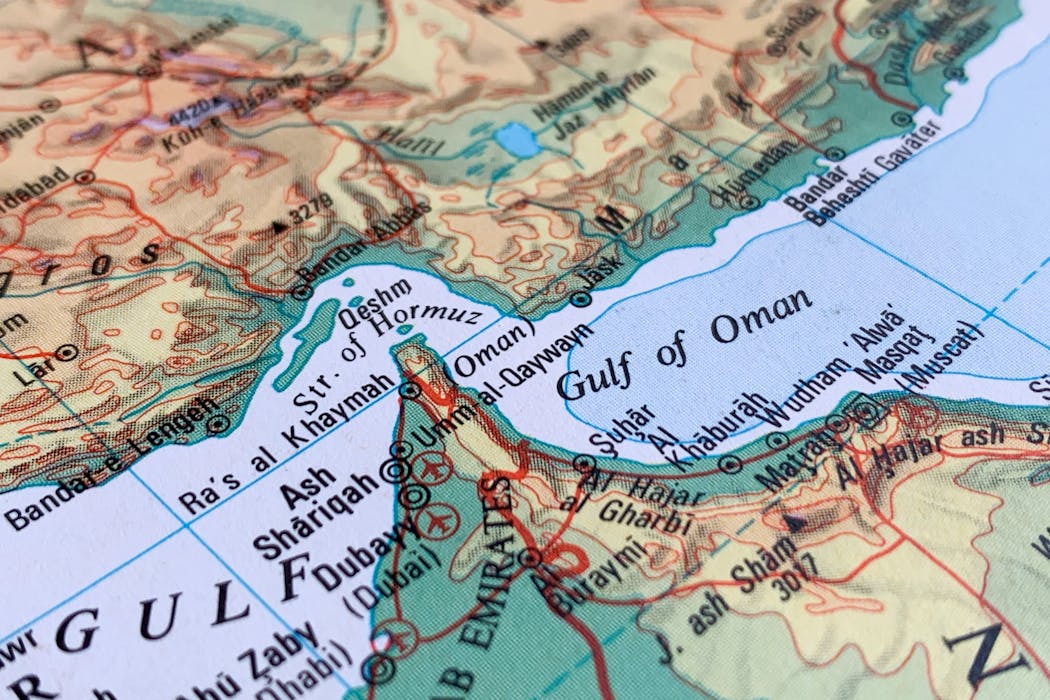
Le détroit d'Ormuz permet d'exporter une importante partie du pétrole saoudien, iranien et émirati.
Le détroit d’Ormuz permet d’exporter une importante partie du pétrole saoudien, iranien et émirati.
Jacques Descloitres, MODIS Land Rapid Response Team, NASA/GSFC, CC BY

Environ 20 % du pétrole commercialisé dans le monde transite par cette voie navigable étroite entre l’Iran au nord et Oman et les Émirats arabes unis au sud. Un pétrolier a été bombardé et le trafic a pratiquement cessé. Or, sur les marchés mondiaux de l’énergie, la simple menace d’une interruption peut faire grimper les prix.

Car, le pétrole n’est pas comme la plupart des matières premières. Le contrôle de ce combustible à haute densité énergétique façonne la géopolitique. Les trois quarts de la population mondiale vivent dans des pays qui dépendent des importations de pétrole pour leurs voitures, leurs camions et d’autres usages. Ainsi, le contrôle des flux de pétrole et, de plus en plus, de gaz, a longtemps été utilisé comme moyen de pression, depuis les chocs pétroliers des années 1970 jusqu’à la réduction des approvisionnements en gaz de la Russie à l’Europe en 2022.

Toute perturbation grave du trafic des pétroliers dans le Golfe aura donc des répercussions sur les marchés mondiaux du pétrole et menacera la stabilité économique. De longues files d’attente ont déjà été signalées en Australie, les automobilistes se précipitant pour faire le plein avant une éventuelle flambée des prix.

Alors que les tensions internationales s’intensifient, des pays tels que Cuba ou l’Ukraine en passant par l’Éthiopie accélèrent déjà leurs plans visant à réduire leur dépendance au pétrole et à renforcer leur sécurité énergétique.

Un demi-siècle d’influence pétrolière

Le pouvoir du pétrole est devenu évident lors de l’embargo pétrolier de 1973, lorsque les principaux producteurs de pétrole du Moyen-Orient ont réduit leur offre afin de remodeler la politique étrangère américaine. Les prix ont quadruplé, les économies ont stagné et la sécurité énergétique est devenue un enjeu politique central presque du jour au lendemain. Depuis lors, l’Organisation des pays exportateurs de pétrole (Opep) coordonne l’approvisionnement afin de faire grimper les prix.

Aujourd’hui, les mécanismes de contrôle ont changé, mais le pouvoir créé par la dépendance au pétrole demeure.

Même avant l’intervention militaire américaine, les sanctions contre les principaux producteurs tels que l’Iran et le Venezuela ont réduit l’offre et remodelé les flux commerciaux.

Les tensions actuelles près des points d’étranglement tels que le détroit d’Ormuz introduisent des primes de risque dans les prix.

Car les marchés pétroliers sont prospectifs, ce qui signifie que les prix reflètent non seulement l’offre et la demande actuelles, mais aussi les anticipations quant à l’évolution future.

Les frappes sur l’Iran ont ainsi entraîné une hausse du prix du pétrole brut Brent – la référence mondiale – qui s’échange [à l’heure où nous publions cet article] autour de 79 dollars américains (67,50 euros) le baril, contre environ 68 dollars américains (58,10 euros) quelques semaines plus tôt. Les prix étant mondiaux, l’instabilité politique dans une région donnée peut avoir des conséquences économiques partout ailleurs.

Qu’est-ce qui réduit la dépendance au pétrole ?

En 2015, l’Inde a bloqué les importations de pétrole du Népal, provoquant le chaos. En réponse, les autorités ont encouragé la croissance très rapide des véhicules électriques. Les importations de pétrole ont, elles, commencé à baisser.

Plus récemment, la guerre entre la Russie et l’Ukraine et les frappes américaines contre le Venezuela et l’Iran ont remis au centre des préoccupations la réduction des importations de pétrole et le renforcement de la sécurité énergétique nationale.

À Cuba, pays dépendant du pétrole, la pression exercée par les États-Unis a réduit de manière drastique l’approvisionnement en pétrole. Les coupures d’électricité sont fréquentes et les voitures restent immobilisées. En réponse, les autorités et les entreprises importent 34 fois plus de panneaux solaires chinois qu’il y a un an.

Ce n’est pas l’idéologie qui motive ce changement, mais la nécessité. Les importations de véhicules électriques sont également en forte hausse. « Cuba pourrait connaître la transition énergétique la plus rapide au monde », a déclaré un économiste cubain au magazine The Economist.

Pourquoi les énergies renouvelables changent la donne

Contrairement au pétrole, les panneaux solaires et les éoliennes peuvent éviter d’être transportés via des points d’étranglement maritimes tels que le détroit d’Ormuz. Les énergies renouvelables ne sont pas commercialisées de la même manière centralisée à l’échelle mondiale. L’électricité est produite localement et de plus en plus sur de nombreux sites de petite taille.

La Russie cible depuis longtemps les infrastructures énergétiques et les centrales électriques ukrainiennes pendant la guerre. En réponse, l’Ukraine développe les énergies renouvelables aussi rapidement que possible, car la production d’électricité décentralisée est beaucoup plus difficile à détruire. Comme l’a déclaré un expert ukrainien en énergie à Yale360, un seul missile « peut détruire » une centrale à charbon, alors qu’il faudrait 40 missiles pour détruire un parc éolien.

L’énergie décentralisée est plus résiliente, ce qui signifie que les dommages causés à une ferme ne provoqueront pas l’effondrement du réseau.

La résilience grâce au transport électrique

L’électrification des transports est un autre élément clé de ces nouvelles approches en matière de sécurité énergétique.

Les véhicules électriques alimentés par de l’électricité produite localement réduisent la dépendance vis-à-vis des marchés mondiaux du pétrole. Cette réflexion transparaît dans la décision prise par l’Éthiopie d’interdire les nouvelles voitures à moteur à combustion interne.

De son côté, la Chine importe encore la majeure partie de son pétrole, dont une grande partie provient d’Iran. Mais Pékin accélère en parallèle sa transition rapide vers les véhicules électriques. L’année dernière, les véhicules électriques représentaient 50 % des voitures neuves en Chine et 12 % du parc automobile total. La Chine utilise de plus en plus le pétrole pour fabriquer des plastiques et non pour le transport. La hausse des importations enregistrée l’année dernière s’explique par la constitution de stocks considérables dans un contexte d’incertitude mondiale.

La vulnérabilité de nombreux pays

L’Australie importe la grande majorité de ses carburants raffinés. Le pays disposerait d’environ un mois d’approvisionnement d’essence avant d’être à court.

[En France, en 2024, les autorités assuraient que les réserves de pétroles bruts représentaient un peu plus de deux mois de consommation nationale, ndlr]

Si les guerres font grimper les prix du pétrole, la hausse des prix à la pompe se répercutera sur les coûts de transport, les prix des denrées alimentaires et l’inflation.

Alors que la transition vers les véhicules électriques s’accélère, l’Australie est à la traîne par rapport aux normes mondiales. Même si l’électricité se verdit rapidement, les transports restent massivement dépendants du pétrole étranger. Cela expose l’Australie à des risques.

[La France est dans une situation similaire avec des véhicules électriques et hybrides qui ne représentaient que 5 % environ du parc automobile français en 2025, ndlr]

La politique énergétique est une politique de sécurité

Les énergies renouvelables n’éliminent pas les risques géopolitiques. Les réseaux électriques sont exposés à des cybermenaces. Les chaînes d’approvisionnement en minéraux critiques introduisent de nouvelles dépendances, et une grande partie de la fabrication actuelle de panneaux solaires, de batteries et de véhicules électriques est concentrée en Chine.

Mais il existe une différence structurelle évidente. Les systèmes décentralisés sont plus difficiles à manipuler par le biais des goulets d’étranglement de l’approvisionnement. Une fois installés, les panneaux solaires produisent de l’énergie localement. La vulnérabilité passe alors des importations continues de combustibles à la dépendance initiale vis-à-vis de la fabrication.

Le pétrole façonne la politique mondiale depuis des décennies, car il est transportable, négocié à l’échelle mondiale et seuls quelques pays disposent d’importantes réserves.

La réduction de la dépendance au pétrole est souvent présentée comme une mesure de politique climatique. Mais elle est également essentielle pour la sécurité énergétique et la sécurité nationale. La réduction de la consommation de pétrole renforce la résilience face aux chocs et réduit l’influence d’autres nations.

La crise iranienne pourrait ne pas entraîner de hausse durable des prix. L’offre pourrait s’ajuster. Les marchés pourraient se stabiliser. Mais les dirigeants vont repenser l’opportunité de s’exposer au pétrole négocié à l’échelle mondiale dans un monde instable.

The Conversation

Hussein Dia a reçu des financements du Australian Research Council, du centre coopératif de recherche iMOVE Australia, de Transport for New South Wales, du Queensland Department of Transport and Main Roads, du Victorian Department of Transport and Planning, ainsi que du Department of Infrastructure, Transport, Regional Development, Communications, Sport and the Arts.

ref. Pourquoi les frappes sur l’Iran nous rappellent qu’il est urgent d’abandonner le pétrole – https://theconversation.com/pourquoi-les-frappes-sur-liran-nous-rappellent-quil-est-urgent-dabandonner-le-petrole-277304

Pourquoi l’Iran a-t-il bombardé plusieurs États du Golfe ?

Source: The Conversation – France in French (3) – By Andrew Thomas, Lecturer in Middle East Studies, Deakin University

Détroit d’Ormuz, missiles balistiques, proxies régionaux : la République islamique joue l’extension du conflit pour survivre. Reste à savoir si cette stratégie de déstabilisation produira des effets politiques avant d’épuiser ses ressources.


Les frappes conjointes américano-israéliennes contre l’Iran au cours du week-end ont de nouveau plongé la région dans la guerre et ont entraîné la mort du guide suprême iranien. L’Iran a riposté par des salves de missiles balistiques et de drones visant Israël, mais aussi plusieurs de ses voisins du Golfe persique.

En lançant des centaines de missiles et de drones à travers le Golfe, Téhéran a ciblé des sites aux Émirats arabes unis (EAU), en Arabie saoudite, à Oman, au Bahreïn, au Koweït et au Qatar, clouant des avions au sol. Et ce, alors qu’aucun de ces pays n’avait officiellement pris part à des actions coordonnées avec les États-Unis et Israël lors des premières opérations.

Un voisin impopulaire

Malgré la taille relativement importante de l’Iran et sa puissance militaire dans la région, le gouvernement iranien est peu apprécié par ses voisins. Au mieux, le pays est perçu comme un rival ; au pire, comme un adversaire. L’Arabie saoudite et l’Iran se livrent ainsi depuis plus d’une décennie une guerre par procuration au Yémen. Et en décembre dernier, l’Iran a réaffirmé ses revendications historiques sur Bahreïn.

Les autres États du Golfe – à savoir les Émirats arabes unis, le Koweït, Oman et le Qatar – ont, pour leur part, entretenu des relations plus pragmatiques avec l’Iran, en maintenant des canaux diplomatiques réguliers et en proposant de jouer les médiateurs dans les différends au sein du Conseil de coopération du Golfe.

Malgré des tensions persistantes, l’Iran n’a jamais été engagé dans une confrontation militaire directe avec aucun de ces États.

Pourquoi bombarder ?

Presque tous les États du Golfe ont un point commun essentiel : ils bénéficient de garanties de sécurité américaines et accueillent des bases militaires américaines.

Pour l’Iran, frapper ces sites constitue l’un des moyens les plus efficaces de riposter, pour plusieurs raisons. D’abord, ces bases se trouvent clairement à portée de ses missiles balistiques les plus nombreux.

Les bases situées dans le Golfe revêtent également une importance stratégique majeure pour les États-Unis. Celle frappée à Bahreïn ce week-end abrite le quartier général de la Cinquième flotte de la marine américaine.

La base aérienne d’Al-Udeid, située à l’extérieur de Doha, la capitale du Qatar, a elle aussi été visée par des missiles balistiques iraniens. Al-Udeid accueille le commandement central américain (US-CENTCOM), chargé de coordonner les opérations militaires dans l’ensemble de la région. Elle abrite également 10 000 soldats américains – le contingent le plus important déployé dans la zone.

Téhéran est toutefois conscient du degré de sophistication des systèmes d’alerte américains et ne s’attend probablement pas à infliger des dommages significatifs aux infrastructures états-uniennes.

Quel est l’objectif, alors ?

La stratégie consiste plutôt à déstabiliser la région et à faire en sorte que tous ses voisins en ressentent les effets. En substance, Téhéran avertit que si les opérations se poursuivent, la relative paix et la prospérité dont le Golfe a bénéficié prendront fin.

L’Iran espère que ses voisins percevront le conflit comme une guerre d’initiative menée par les États-Unis et Israël, dans laquelle ils se retrouvent entraînés malgré eux. Les États du Golfe seront alors contraints soit de renforcer encore leur alliance avec Washington, soit d’œuvrer à une désescalade.

Il n’est pas certain que cette stratégie porte ses fruits. Elle pourrait au contraire entraîner une pression militaire accrue sur l’Iran si les États du Golfe s’impliquent davantage dans les opérations.

Dans le même temps, les relations de plus en plus tendues entre les États du Golfe et Israël au cours des deux dernières années pourraient inciter plusieurs d’entre eux à hésiter à s’engager davantage.

Il est également impossible pour l’Iran de soutenir indéfiniment une telle stratégie. Même s’il dispose de l’arsenal de missiles le plus vaste et le plus diversifié de la région, il finira par épuiser ses stocks de munitions. Les autres pays pourraient alors choisir d’attendre que la situation s’essouffle.

Ce type d’action est devenu la signature de la doctrine iranienne de « défense avancée » : frapper loin de ses frontières pour démontrer sa capacité de projection. En mobilisant son arsenal de drones et de missiles, Téhéran entend ainsi signaler à la région – et au reste du monde – que le régime ne s’effacera pas sans riposter.

Entraîner toute la région dans le chaos

Parallèlement, l’Iran dispose d’un réseau affaibli mais toujours étendu de proxies indépendants à travers la région. Des groupes au Yémen, en Irak et au Liban devraient rester loyaux à la République islamique et mettre en œuvre, en son nom, des stratégies insurrectionnelles de long terme.

Le groupe paramilitaire libanais Hezbollah a déjà tiré des projectiles vers Israël. Cela a ravivé les hostilités le long de la frontière libanaise, ouvrant un nouveau front pour Israël.

Le détroit d’Ormuz, par lequel transitent 20 % du pétrole mondial, constitue un autre levier que l’Iran peut instrumentaliser. Déjà, deux pétroliers ont été attaqués dans le détroit et le prix du baril de Brent a augmenté de 13 %.

Autrement dit, l’ampleur de ces attaques constitue un signal. Elles ne sont pas comparables aux frappes calibrées de désescalade que l’Iran avait menées en 2024 et 2025.

Cette guerre est existentielle pour la République islamique. Ses frappes à travers le Golfe visent à rappeler qu’elle fera tout ce qui est en son pouvoir pour entraîner l’ensemble de la région dans le chaos, favoriser l’incertitude et l’instabilité, le tout afin d’assurer sa survie.

À tout le moins, l’Iran cherche à créer des conséquences politiques pour toutes les parties impliquées. Reste à savoir si le régime survivra suffisamment longtemps pour que ces conséquences produisent leurs effets.

The Conversation

Andrew Thomas ne travaille pas, ne conseille pas, ne possède pas de parts, ne reçoit pas de fonds d’une organisation qui pourrait tirer profit de cet article, et n’a déclaré aucune autre affiliation que son organisme de recherche.

ref. Pourquoi l’Iran a-t-il bombardé plusieurs États du Golfe ? – https://theconversation.com/pourquoi-liran-a-t-il-bombarde-plusieurs-etats-du-golfe-277306

South Africa’s minibus taxi industry runs on social bonds – reform must accept this

Source: The Conversation – Africa – By Siyabulela Christopher Fobosi, Senior Researcher, UNESCO ‘Oliver Tambo’ Chair of Human Rights, University of Fort Hare, University of Fort Hare

South Africa’s minibus taxi industry is the backbone of the country’s public transport system. Every day, millions of commuters rely on it. In many low-income and peri-urban communities, there is no real alternative. They account for roughly 70% of daily public transport trips in the country.

Yet despite its scale and significance, the industry remains largely informal. It is governed less by formal contracts and clear regulatory systems than by relationships, trust and unwritten rules.

This makes the sector an important subject for industrial and economic sociology scholars like myself, who are concerned with how regulation, labour and economic life unfold in practice rather than merely on paper. Particularly in contexts marked by informality, inequality and contested regulatory environments.

In a recent study, my co-author and I explore how “social capital” – the networks, shared norms and trust that connect people – shapes the governance, labour relations and everyday functioning of the minibus taxi sector.

We conducted a structured search of academic databases and South African institutional repositories, and analysed 62 peer-reviewed articles, theses and policy reports to identify themes.

Our central finding is that social capital within South Africa’s minibus taxi industry operates as a double-edged sword. The same dense networks of trust, shared norms and reciprocal obligations that enable the industry to function also entrench inequality, exclusion and, at times, violence. Social capital is a source of both resilience and instability.

This matters because policy debates have too often treated the industry’s informality either as a problem to be eradicated or as a reality to be tolerated. Our research suggests that sustainable reform requires a hybrid approach: one that works with social capital rather than against it. Efforts to formalise or regulate the sector are unlikely to succeed if they ignore the networks and authority structures that already govern it.

It is therefore essential to engage with taxi associations, drivers and commuters, recognising their lived realities and institutional knowledge. It is possible to make the industry safer, fairer and more efficient without undermining the social foundations on which it depends.

An industry born of exclusion

The modern minibus taxi industry took shape during apartheid (1948-1990), when black South Africans were systematically excluded from formal urban planning and public transport provision. Commuters faced long journeys between racially segregated townships and economic centres, so entrepreneurs began operating minibuses to meet demand. The sector grew rapidly because it was responsive, decentralised and embedded in communities.

In the new democratic era after 1994, the industry continued to expand – but without being fully integrated into formal transport planning. Today, it comprises hundreds of thousands of vehicles organised into roughly 1,500 taxi associations nationwide. These associations regulate routes, manage disputes and coordinate operations. Alongside them are individual taxi owners, who own vehicles and lease them out, and drivers.

Part of the reason for this limited integration is that the state has lacked the institutional capacity and the political leverage to impose coherent oversight on the sector.

In the absence of consistent and effective state oversight, informal systems of governance have developed. These systems are rooted in social relationships.

Understanding social capital

The concept of social capital is often associated with political scientist Robert Putnam, who defined it as the networks and norms that enable collective action. According to this view, trust and civic engagement help communities solve shared problems.

But sociologist Pierre Bourdieu offered a more critical perspective. For him, social capital was not simply about cooperation. It was also a resource that groups could use to consolidate power and exclude others.


Read more:
Ghana’s informal settlements are not all the same – social networks make a difference in community development


Drawing on these traditions, we distinguish between three forms of social capital in the taxi industry:

  • bonding: tight-knit networks within taxi associations and owner groups

  • bridging: connections across different associations or stakeholder groups

  • linking: vertical ties between the industry and formal institutions such as government departments, banks and law enforcement agencies.

All three forms are present in the minibus taxi sector. But they operate unevenly, and their effects are not always positive.

The strengths of dense networks

Bonding social capital is particularly strong within taxi associations. These organisations function as powerful, if informal, regulatory bodies. They control routes, set fare guidelines and enforce industry norms. Membership provides access to shared resources and a measure of protection in a competitive market.

These dense networks allow for rapid coordination. If disputes arise, they can often be resolved internally without recourse to the courts. If demand shifts or new residential areas develop, associations can adjust routes quickly. In communities where formal institutions are perceived as distant or ineffective, such embedded systems can appear more responsive and legitimate.

Trust is also central to financial arrangements. Many taxi owners rely on rotating credit schemes and informal savings groups to finance vehicle purchases and maintenance. Formal financial institutions frequently regard the sector as high risk, making credit expensive or out of reach. Social networks therefore take the place of formal banking relationships.

The driver-owner relationship also depends heavily on trust. In many cases, drivers lease vehicles for a fixed daily fee, with no written contracts. Instead, expectations are governed by personal relationships and informal understandings.

In short, social capital fills gaps left by weak or uneven formal regulation enabling coordination, resilience and continuity.

When networks entrench power

However, the same bonding social capital that enables coordination can also reinforce hierarchy and exclusion.

Taxi associations control access to routes, which are the primary source of income. Because associations regulate who may operate on which routes, they wield considerable power. Dense networks of members can create barriers to entry for outsiders.

Disputes over routes are a feature of the industry. In some cases, they escalate into violence. Such conflicts arise in a system where economic survival depends on territorial control and where formal mediation mechanisms are weak.

Social capital here functions as a resource of dominance. Associations mobilise networks to maintain authority and legitimacy. Their links to communities can confer symbolic power, even in the absence of formal legal recognition.

Most drivers, by contrast, occupy a precarious position. Many are not members of associations in their own right. They lease vehicles from owners and have to meet fixed daily payment targets. To do so, they frequently work shifts exceeding 12 hours. If they fall short, they may absorb the loss themselves.

Without formal employment contracts, drivers typically lack access to medical benefits, unemployment insurance or retirement savings. Trust-based arrangements limit recourse in cases of exploitation or unfair treatment.

In this context, social capital benefits some actors more than others.

The missing links to formal institutions

While bonding social capital within associations is strong, linking social capital between the industry and formal institutions remains comparatively weak.

Government has attempted to formalise and regulate the sector, most notably through the Taxi Recapitalisation Programme. The aim was to replace older vehicles, improve safety and integrate the industry more fully into national transport policy. Yet implementation has been uneven, and many reforms have met resistance.


Read more:
Operational subsidies are key to reforming South Africa’s minibus taxi sector


One reason is that policy interventions don’t “talk to” existing informal governance structures. Top-down regulation can be perceived as a threat to association autonomy. Where there is limited trust between the state and industry actors, compliance is likely to be partial.

Towards hybrid governance

The research suggests that industry reforms would have to recognise and work with social capital.

Formalisation should not simply impose external control. It should build on existing structures while introducing safeguards.

Legal recognition of taxi associations as cooperatives is one potential pathway. This could enhance access to subsidies, training and financial services. It could also clarify governance and accountability.


Read more:
Why the South African state should not subsidise minibus taxi owners


Standardised employment contracts for drivers are another step. They could provide greater security, define working hours and clarify dispute resolution processes.

Digital technologies may also help. Mobile payment systems could reduce reliance on cash, improve transparency and minimise disputes over fares. Digital platforms for route management could support fairer allocation processes and clearer record-keeping.


Read more:
Cashless card payments for public transport: Lagos commuters don’t trust the technology


Drivers and commuters would have to take part in creating these solutions.

A delicate balance

The future of South Africa’s minibus taxi industry depends on striking a careful balance. Reform must recognise that the sector’s social capital is both its foundation and its fault line.

Strengthening bridging and linking social capital – across associations and between the industry and the state – can reduce conflict and foster shared accountability.

The challenge is not to dismantle the social fabric of the minibus taxi industry, but to reshape it, so that trust, cooperation and collective action serve all who depend on it.

Although our study focuses on South Africa, its implications extend more broadly. Across the global south, informal transport systems play a central role in urban mobility. They are often more adaptable than formal systems but also more vulnerable to conflict and labour exploitation.

The Conversation

Siyabulela Christopher Fobosi previously received funding from the National Research Foundation for his Master of Arts in Industrial and Economic Sociology Degree at Rhodes University and PhD in Industrial Sociology at the University of Johannesburg.

ref. South Africa’s minibus taxi industry runs on social bonds – reform must accept this – https://theconversation.com/south-africas-minibus-taxi-industry-runs-on-social-bonds-reform-must-accept-this-276771

Biometric IDs are being rolled out in Africa. Study reveals the risks and pitfalls

Source: The Conversation – Africa (2) – By Tony Roberts, Digital Research Fellow, Institute of Development Studies

Across Africa, governments are introducing digital systems that use individuals’ unique physical measurements to identify them. These systems collect citizens’ biometric and personal data and use it to give people access to essential public services like voting, healthcare, education and social protection. Biometric digital identification systems are often promoted as tools to improve efficiency, inclusion and service delivery.

But a new report by the African Digital Rights Network, published by the Institute of Development Studies, highlights serious concerns about exclusion, rights violations, data protection and accountability. Drawing on evidence from ten African countries, the report shows how millions of people are struggling to enrol in or safely use these systems, or are choosing not to participate due to fear and mistrust.

The report draws on the expertise of researchers based in each of the ten countries studied. Tony Roberts, co-editor of the report, takes us through what they found.

What are biometric digital IDs and why are they both useful and problematic?

Digital-ID is a form of identification that can hold large amounts of sensitive personal data. This includes biographic data like name, date of birth and address, as well as biometric data such as fingerprints and facial recognition. What makes digital-ID distinct from paper-based IDs is that it is machine readable. And, when it’s connected to the internet, millions of people can be identified and verified, instantly and remotely.

Biometric digital-ID includes facial recognition, fingerprints, iris scans and voice patterns that are unique to individuals. It can verify that an individual is who they claim to be.

Increasingly, biometric digital-ID systems are being imposed across Africa and used to determine who gets services or entitlements. For example, fingerprint or iris scans are used during elections to confirm that a person is entitled to vote. In Botswana and in Malawi there are examples of ID chaos threatening voter registration.

But these systems are leaving millions of citizens in Africa unable to obtain essential services. Some people struggle to register for biometric digital-ID due to disability or illiteracy. There are costs to use online systems, including phone access, mobile data, or electric power for phone charging. This is deepening existing inequalities.

How is uptake happening in Africa?

Our report includes ten country studies. The research was coordinated by the African Digital Rights Network, bringing together 75 digital rights researchers from 30 African countries, in collaboration with Paradigm Initiative, a non-profit organisation.

We found that pressure to adopt biometric systems often comes from foreign funders and creates dependencies on foreign technology providers.

The World Bank claims that the motivation for spending billions of dollars on digital-ID is to meet the Sustainable Development Goal of “identity for all”. But the role of private vendors, international funders and even state actors may also reflect interests in profit generation, data control, or surveillance of populations.

The introduction of biometric digital IDs varies between countries. Between 2017 and 2025, Ghana registered 19 million people (around 95% of the adult population) to a system called GhanaCard. In Ethiopia, 28 million people (around 35%) have enrolled in the Fayda-ID scheme. In the Democratic Republic of Congo there is still no digital-ID system despite repeated announcements and legislation introduced to enable it since 2011.

In Senegal, biometric digital-ID, with fingerprint data, was introduced in law in 2016. Citizens need it to obtain a phone number, bank account and public services, such as electricity and water. Based on 2025 data, it’s estimated that around 10 million citizens hold a biometric national ID card, just over 90% of the population aged 15 and over.

But this suggests that around 10% of the population over 15 – over 1 million people – lack ID and therefore lack access to essential services and entitlements.

What are the challenges of rolling them out?

One of the challenges is that universal human rights which should be unconditional become conditional on enrolment in a biometric digital-ID scheme. These include access to education, healthcare, social security and voting. Withholding access is a violation of fundamental human rights.

The report includes the case of Ethiopia, where registration in the Fayda digital-ID system is a condition of access to government services, banking and mobile telecoms.

Millions of citizens cannot enrol, particularly those with disabilities. For example, some people don’t have fingerprints due to amputation, diseases including leprosy, years of hard manual labour or old age. Some people cannot provide iris scans due to vision problems.

Millions of Africans are also denied legal ID because government officials dispute their citizenship. The project of digital-ID is sold as a solution. But research shows that it reproduces this form of discrimination and injustice.

For example, in Kenya, members of the Somali, Nubian and Pemba communities who have lived in the country for five or six generations and inter-married are discriminated against and rendered stateless. They are denied digital-ID and so cannot access education, healthcare, voting and social protection.

Some do not want to enrol for a biometric digital-ID because they have good reason not to trust their governments with their personal information. In countries like Sudan and Ethiopia the state is targeting people based on their ethnic group or on other identifiers such as surname, address or religion which are used as proxies for ethnicity.

Are there any dangers?

The use of biometric digital-ID introduces new challenges and risks. These include risks to privacy caused by data leakage or sharing and risks of exclusion due to poor data quality or mismatches.

There are also privacy risks involved because biometrics are permanent. People need to be aware and give informed consent. Data protection principles should be followed.

There is a lack of adequate legal frameworks and robust digital security to prevent unauthorised access to sensitive data. Countries also lack accountability mechanisms for when data entry errors, breaches or system failures occur.

The Universal Digital Public Infrastructure Safeguards Initiative has a framework of 18 core principles to ensure that digital-ID is secure, inclusive and rights-based.

Eight out of ten countries studied in the report have no law specifically governing digital-ID, and none include special protection. In some cases, where legal provisions exist, enforcement is weak or symbolic.

Independent oversight bodies are rare, as are judicial mechanisms to contain function creep – where ID systems expand beyond their original scope. Governments could secure consent by saying that digital-ID will only be used for a single purpose, such as voting. But then they could make it mandatory for accessing education, healthcare, employment and banking.

Without stronger legislation, clearer accountability and harmonised regional standards, digital-ID projects risk entrenching inequality and mistrust rather than delivering inclusion or security.

The Conversation

Tony Roberts receives funding from the Open Society Foundation.

ref. Biometric IDs are being rolled out in Africa. Study reveals the risks and pitfalls – https://theconversation.com/biometric-ids-are-being-rolled-out-in-africa-study-reveals-the-risks-and-pitfalls-273510

South Sudan has never had an election to hand over presidential power: so what are the rules of succession?

Source: The Conversation – Africa (2) – By Jan Pospisil, Researcher at the Austrian Institute for International Affairs

South Sudan has not held an election since it gained independence 15 years ago, and progress towards a new constitution has stalled. Election dates have been set and postponed at least three times. A new date has been set for December 2026 but it’s unclear the poll will take place. If it does, it will be the first electoral test for President Salva Kiir, who has been in power since 2011. It raises the question of what legal guardrails exist for a smooth transition to new leadership outside an election. Jan Pospisil, who has studied the country’s politics and power-sharing agreements, explains what’s in place.

What legal frameworks govern presidential succession in South Sudan?

Two legal frameworks operate side by side to regulate the succession question in South Sudan: the 2011 transitional constitution and the 2018 peace agreement, which has a quasi-constitutional quality.

Read together, the logic in the 2011 and 2018 frameworks is straightforward. Upon vacancy, the first vice-president acts as president, but only until the party in power nominates a successor. The president’s party then has 48 hours to nominate a replacement. If a nomination is made within that period, however, the nominee is sworn in and replaces the acting first vice-president.

The peace agreement overlays the constitutional acting mechanism with a time-limited party entitlement. But it does not replace the constitutional fallback.

A more granular breakdown looks like this.

The 2018 agreement is based on a power-sharing deal between five major political parties and blocs. It is the primary framework governing the country’s transitional period from conflict to democracy.

The peace agreement created a collective presidency composed of a president, one first vice-president and four vice-presidents. The four vice-presidents are considered equal in rank.

The key provision on succession is clause 1.6.5. It states that if the post of the president falls vacant during the transitional period, the replacement shall be nominated by the respective party as constituted at the signing of the agreement. The process of choosing a successor must also be done within 48 hours of the post falling vacant.

The clause establishes two principles.

First, the presidency remains allocated to the party that originally held the position under the power-sharing arrangement. In this case, it’s the mainstream SPLM, now called SPLM-IG, for “in government”. This is to differentiate it from the main opposition that formed in December 2013 in the course of civil war, SPLM-IO, for “in opposition”.

Second, the party’s right to nominate a successor is time-bound. The 48-hour window is designed to preserve the elite settlement and guarantee executive continuity with minimal friction.

What the agreement doesn’t do is spell out in detail what happens during those 48 hours. It does not foresee the creation of a separate interim authority for this short period.

Instead, continuity is ensured through the 2011 transitional constitution.

In the constitution, article 102 defines five ways the president’s office can become vacant. These are expiration of the term of office, resignation, impeachment, mental infirmity or physical incapacity and death. It lays out the respective succession rules.

If the presidency falls vacant, the vice-president assumes office temporarily,

pending the filling of this position, within fourteen days from the date of the occurrence of the vacancy, by a nominee of the political party on whose ticket he or she was elected.

Under the post-2018 structure, this provision applies to the first vice-president.

There has been precedent for such structured succession. In 2005, Salva Kiir assumed regional leadership following the death of John Garang under the constitutional framework that was then in force. At the time, South Sudan was a semi-autonomous region led by Garang, with Kiir as his deputy.

What happens if the 48-hour deadline is missed?

This raises difficulties. The 2018 agreement sets a time limit but does not contain a separate sanction clause.

If nomination occurs on hour 72 or 96 rather than hour 48, the text does not specify whether the party’s entitlement automatically lapses.

Different interpretations are possible. One reading treats the deadline as mandatory: once expired, the first vice-president’s acting role becomes substantive, and he or she becomes the president.

Another reading is that a delayed nomination could still be recognised if political actors agreed. This would be in line with the transitional constitution, which allows a 14-day window for nominations that need to be accepted by the vice-president acting as president.

In practice, such a scenario would likely be resolved through political bargaining rather than judicial enforcement.

What about the issue of someone being detained or being on trial?

This is a further complexity as the current first vice-president, Riek Machar, is in detention and on trial.

Detention or trial, however, do not automatically create a vacancy under either the 2011 constitution or the 2018 peace agreement. Unless the office holder resigns or is formally removed, the position remains legally intact.

If the presidency were to fall vacant while the first vice-president was detained but not removed, the legal text would still designate the latter as the acting authority.

The 2018 agreement does not rank the other vice-presidents for automatic succession. All are explicitly of equal rank.

Any attempt to bypass the first vice-president without formal removal would therefore be politically and legally contested.

Where are the biggest risks in the current system?

Behind these legal provisions lie political realities.

The 48-hour clause requires rapid consensus within the president’s party, the mainstream SPLM. The 2018 agreement does not specify which internal organ of the party must nominate the successor. Instead, this process is guided by internal party leadership structures, rules and regulations. In practice, this is likely to be handled by the SPLM Political Bureau.

However, the decision-making would be shaped by more than formal party ranks. Other factors, especially the support of the security sector, ethnopolitical balances and existing patronage networks, would come into play.

The presidency has historically been embedded in military and security structures, which gives succession an importance that extends beyond procedural law.

The 48-hour provision is clear on paper, but its operation depends entirely on political cohesion. If consensus fails, the text alone cannot prevent contestation.

How would elections help?

The picture could change once elections become a realistic possibility and a nomination process is held. South Sudan has postponed elections previously due to delayed preparations, political resistance and lack of funding. Polls are now slated for December 2026.

A post-transition order would revert to a presidency-vice presidency model as per the transition reflected in the country’s National Election Act, with a vice-president elected on a ticket as running mate, and thus positioned as the undisputed successor. Elections would force parties to clarify leadership hierarchies in advance.

In this sense, an electoral framework does not merely choose a president – it simplifies succession.

The Conversation

Jan Pospisil receives funding from the Peace and Conflict Resolution Evidence Platform (PeaceRep), funded by UK International Development from the UK government. However, the views expressed are those of the authors and do not necessarily reflect the UK government’s official policies. Any use of this work should acknowledge the authors and the Peace and Conflict Resolution Evidence Platform.

ref. South Sudan has never had an election to hand over presidential power: so what are the rules of succession? – https://theconversation.com/south-sudan-has-never-had-an-election-to-hand-over-presidential-power-so-what-are-the-rules-of-succession-276640

When players become artists: the rise of in-game photography

Source: The Conversation – UK – By Gabriele Aroni, Senior Lecturer in Games Art at the School of Digital Arts, Manchester Metropolitan University

Hironobu Sakaguci, one of the creators of the long-running Final Fantasy game series, once observed: “The game itself is fun to play, but its strongest characteristic is the visual entertainment the game provides.”

This aesthetic appeal is a big part of the enjoyment players take from their favourite games. Far from the simple graphics of early games, players can now explore photorealistic forests in Kingdom Come Deliverance II (2025), cross neon-drenched cities in Cyberpunk 2077 (2020), or explore alien planets in No Man’s Sky (2016) – all while taking pictures of them.

Players have long documented their adventures in virtual worlds. The practice of taking “screenshots” – still images captured from the screen during gameplay, like a single frame from a film – predates today’s culture of live streaming. At the turn of the millennium, players were already sharing screenshots on forums and early social media platforms. Some wanted to show how they had overcome a difficult section of the game, while others highlighted interesting locations, or captured funny moments.

Game developers noticed, and over time “photo modes” became a standard feature in many games. These allow players to pause the action and take pictures of the game as if they were using a virtual camera.

This feature is implemented in different ways. In Grand Theft Auto V (2013), the player character can equip the camera like any other in-game item. They can frame the shots and tune the settings as in a real camera, and export the images from within the game world. Western game Red Dead Redemption 2 (2018) even equips the player with a period-accurate 1898 Kodak camera.

Other games still provide a photo mode without tying it to the in-game world. A camera appearing in the inventory of the 13th century samurai of Ghost of Tsushima (2020) would be out of place. But with the powerful photo mode, the player can still modify numerous image settings, and also the game world itself, such as time of day, weather and the character’s facial expressions, to get the “perfect shot”.

In-game photography as art

Video games are a visual medium, and promotional screenshots remain central to how they are advertised. But several artists have now turned in‑game photography into a serious artistic practice, with radically different approaches.

British in-game photographer Duncan Harris is a pioneer. Already active in the early 2000s, his photographic works are collected in the blog Deadendthrills. Harris also produces promotional imagery for major games-publishers. His images push game-engines to their limits, often using custom tools to showcase impressive graphics of detailed characters and sweeping vistas.

Other artists have taken more critical or experimental approaches. Dutch artist Robert Overweg takes pictures from impossible angles: inside a wall, underground or inside buildings that are not meant to be accessed by players. His series Flying and Floating, showing visual glitches and the impossible structures of the 1950s Chicago-like city of the game Mafia 2 (2010), was exhibited at the Centre Pompidou in Paris in 2015.

Los Angeles-based artist Kent Sheely adopts a documentary approach and subverts the gameplay accordingly. For his DoD series, inspired by war photographer Robert Capa, he modified the second world war online shooter Day of Defeat (2003). His character carried no weapons, no user interface cluttered the screen, and the “shoot” button was converted into a screenshotting key, as if he were an actual war photographer on the field.

Sheely’s works have been exhibited at venues including the Fotomuseum Winterhur in Switzerland. Ubisoft commissioned his abstract shots, dubbed “Phantom Arrays”, for the Photomode: Out There in Games exhibition in 2022, which showcased what artists can do with the photo mode of their games.

Swiss artist Pascal Greco occupies yet another position between documentary and the avant-garde. A self-taught filmmaker, cinematographer and photographer, Greco has staged live performances in which he plays Death Stranding (2019) while capturing in-game photographs in front of an audience. His photobook Photography, Video Game, Landscape (2025) presents pristine virtual natural landscapes, devoid of human elements, interjected by glitches – fragmented vistas of these landscapes, between the sublime and the abstract.

Tales From The Real World by Mélanie Courtinat & Pascal Greco.

Questions of authorship

In 2024, the first academic conference dedicated to in-game photography was held in Milan. Among the key topics was authorship. Who owns the rights to in-game photographs: the photographer who takes the picture, or the developers who created the game?

The work of Italian artist Leonardo Magrelli is emblematic in this regard. His photobook West of Here (2021) collects screenshots taken by other players in Grand Theft Auto V. Magrelli edited them into a black-and-white photobook, echoing the traditions of American documentary photography and appropriation work such as Sherrie Levine’s After Walker Evans (1981).

The project provoked strong reactions from online users, who argued that Magrelli had no right to use images he had not personally captured. Subsequent legal enquiries suggested that, in principle, only Rockstar Games – the developer – could pursue legal action regarding the use of its intellectual property. At the time of writing, no such action has been taken.

In-game photography is an innovative artistic medium that sits at the intersection of play, technology and artistic expression. It is not merely an aesthetic exercise, but rather an experimental terrain where the barrier between spectator and creator is removed, and players become artists, chroniclers or archivists of ever-changing virtual universes.


The Conversation

Gabriele Aroni does not work for, consult, own shares in or receive funding from any company or organisation that would benefit from this article, and has disclosed no relevant affiliations beyond their academic appointment.

ref. When players become artists: the rise of in-game photography – https://theconversation.com/when-players-become-artists-the-rise-of-in-game-photography-275966

Why are so many statues naked? An art historian explains this tradition’s ancient roots

Source: The Conversation – USA (2) – By Anna Swartwood House, Associate Professor of Art History, University of South Carolina

Artists have represented human bodies without clothes for a very long time. Metropolitan Museum of Art, CC BY

Curious Kids is a series for children of all ages. If you have a question you’d like an expert to answer, send it to CuriousKidsUS@theconversation.com.


Why are so many statues naked? – Artie, age 12, Astoria, New York


We are all born naked, and sculptures of the human body in its natural state are as old as humankind.

In the history of art, nudity does not have just one meaning; it can express everything from innocence to sexual desire, from triumph to defeat. The 20th-century art historian Kenneth Clark made a distinction between the “naked,” meaning unclothed and ashamed, and the “nude,” meaning the body in its most beautiful form. Most people today use the two words interchangeably, though.

The most influential male nude statues come from ancient Greece, starting in the sixth century B.C.E. There were a number of reasons for this cultural focus on the nude male body – in fact, the classics scholar Larissa Bonfante encouraged thinking of Greek nudity not just as a lack of clothing but as a “costume” in and of itself. In other words, nudity was something you wore in particular situations.

Carving in stone of an idealized nude male figure with one leg ahead of the other
Marble statue of a kouros from the sixth century B.C.E. in Greece.
The Metropolitan Museum of Art, CC BY

Artists portrayed many of the valued figures in Greek society – including gods, athletes, warriors and heroes – naked. Nudity was a feature of public life in certain settings: For example, athletes exercised and competed in the nude, and statues of the brawny nude demigod Herakles might adorn a temple. Nude, striding statues of young men called kouroi were used both as offerings to the gods and as grave markers.

Having a fine, athletic, youthful body, whether honed for athletic competition or for fighting wars, was not only a sign of being “kalos,” or beautiful, but also could prove your “arete,” or excellence.

Embodying ideals of beauty and excellence

white stone statue of a naked man with one foot ahead of the other
A Roman version of the ‘Spear Bearer,’ made following Polykleitos’ ideal proportions for the male body.
DEA/G. Nimatallah/De Agostini via Getty Images

These abstract ideals are exemplified in a famous statue called the “Spear Bearer,” made by the sculptor Polykleitos about 2,400 years ago. He believed that beauty was achieved through a harmony of parts. In addition to its symmetry, the “Spear Bearer” stands balanced in a “counterpoised” pose, with one supporting and one resting leg.

The “Spear Bearer” inspired many copies, including when it provided the model for the portrait of the first Roman emperor Augustus five centuries later.

stone statue of a man in draping toga raising one arm, with one leg forward
Roman emperor Augustus has the same stance but wears clothes.
Justin Benttinen/Wikimedia Commons, CC BY-SA

The emperor is shown with the same athletic build and “counterpoised” stance, but he has been transformed into a specific portrait via his aristocratic toga clothing and elaborately detailed armor.

Here, the body of the emperor projects an overall message of confident heroism, while his garments fill in details about his status and achievements. This statue illustrates how clothing can be very specific to a moment, place or role, while classical nudity may look more timeless.

The classics reborn

black and white drawing of a Renaissance artist drawing at the foot of a nude male statue
Many artists copied famous nude statues like the Apollo Belvedere, helping the ideal become an entrenched part of Western culture.
Sepia Times/Universal Images Group via Getty Images

Classical revivals such as the European Renaissance, around 1400-1600 C.E., and neoclassicism, around 1750-1900 C.E., brought back “heroic nudity,” each time helping it become even more a part of Western culture.

The rediscovery of ancient statues that had been buried in rubble after the fall of the Roman Empire excited artists of those eras, and they created many copies and adaptations of those models. Sketching and creating while studying nude live models became an important part of how artists trained, starting with the rise of art academies in the 1500s.

But like clothing, the nude “costume” could change over time.

For example, Michelangelo’s “David,” completed in 1504, imagines the Biblical hero as a pensive nude sporting only the rock and sling that will kill Goliath. The narrow-hipped body of “David” is a very different type from the “Spear Bearer” and does not fit Polykleitos’ ideal proportions.

large white statue of nude man with blurry people passing its pedestal in museum
Michaelangelo’s David is almost 17 feet tall.
Vincenzo Pinto/AFP via Getty Images

Nudity continued to be associated with godlike beauty and power. Michelangelo’s “Risen Christ,” for instance, shows Jesus standing heroically nude, divine and resurrected.

stone statue of man holding a large cross, in church setting
Michelangelo made the unusual choice to represent Jesus as an adult, nude.
THEPALMER/iStock via Getty Images Plus

And while an emperor would not usually have a nude portrait, French emperor Napoleon Bonaparte asked in 1802 to be sculpted as Mars, connecting him metaphorically to the Roman god of war and visually to the “Spear Bearer” and “Apollo Belvedere.”

A different standard for women

Female nudity in sculpture has its own history. Some of the earliest sculptures ever depict naked women with unnaturally exaggerated breasts, hips and pubic triangles, but scholars still disagree about how to interpret them.

4 angles of a sandy-colored carving of a woman's figure
Multiple views of the ‘Woman from Willendorf,’ which is about 4½ inches tall.
Bjørn Christian Tørrissen/Wikimedia Commons, CC BY-SA

For example, the 30,000-year-old Paleolithic “Woman from Willendorf,” discovered in 1908, was often called the “Venus of Willendorf,” associating her with the Roman goddess of love from tens of thousands of years later. But the figurine’s nakedness could have been more practical than erotic – to show bodily changes during pregnancy, for instance.

In ancient Mesopotamia 5,000 years ago, beautiful nudes depict both ideal women and goddesses. But in Greece, female nudity was considered inappropriate and did not become popular in statues until the fourth century B.C.E.

two side by side matching images of a statue of a nude woman
An 1860s slide of the Aphrodite statue on display in the Vatican.
Sepia Times/Universal Images Group via Getty Images

The best-known Greek female nude, the “Aphrodite of Knidos” by the sculptor Praxiteles, was revolutionary for its time and has inspired countless copies, particularly for her modest gesture covering her genitals. A Roman adaptation of this gesture covering both breasts and genitals is known as the Venus pudica type and is still seen frequently today.

stone statue of a stylized person kneeling
A kneeling statue of Hatshepsut is around 3,500 years old.
Metropolitan Museum of Art, CC BY

In Egypt, the first female pharaoh Hatshepsut presents a fascinating case of artists figuring out how to treat a female body in a traditionally male role. Topless and wearing a kilt and false beard like other pharaohs, her body is sexually ambiguous – that of a ruler rather than a woman.

Artists work in tradition – or not

Artists of every culture have explored the human body as a subject, so artists today are following in a very, very long tradition when they sculpt or paint the human figure without clothes.

They can be aiming for something that doesn’t seem as tied to one specific time or place, the way using clothes from a particular moment would. Or they could be trying to express some of the same ideals the ancient sculptors were, such as perfection, immortality or divinity.

black statue of a clothed modern woman, in a busy city plaza
‘Grounded In The Stars’ on display in New York City’s Times Square in 2025.
Spencer Platt/Getty Images

But many modern artists challenge these long traditions, creating statues of figures that are fully clothed. Consider Thomas J. Price’s “Grounded in the Stars”: a 12-foot, monumental sculpture of a woman standing in heroic counterpoise, wearing a T-shirt, leggings and comfortable shoes!


Hello, curious kids! Do you have a question you’d like an expert to answer? Ask an adult to send your question to CuriousKidsUS@theconversation.com. Please tell us your name, age and the city where you live.

And since curiosity has no age limit – adults, let us know what you’re wondering, too. We won’t be able to answer every question, but we will do our best.

The Conversation

Anna Swartwood House does not work for, consult, own shares in or receive funding from any company or organization that would benefit from this article, and has disclosed no relevant affiliations beyond their academic appointment.

ref. Why are so many statues naked? An art historian explains this tradition’s ancient roots – https://theconversation.com/why-are-so-many-statues-naked-an-art-historian-explains-this-traditions-ancient-roots-271821

Free 10-minute online programs aimed at overcoming depression led to real improvements – new research

Source: The Conversation – USA (3) – By Benjamin Kaveladze, Postdoctoral Fellow in Mental Health Resources, Dartmouth College

Free short, easily accessible programs could allow many more people to access mental health treatments. Elena Kalinicheva/iStock via Getty Images Plus

A well-designed 10-minute online exercise can spark small reductions in depression. That’s the key finding of my team’s paper, published in Nature Human Behaviour.

Many people believe that to start overcoming depression, they need a therapist, medication or a radical change in their environment. However, our study shows that taking small steps to learn practical skills can lead to measurable improvements in depressive symptoms.

In 2024, my team and I took to social media to pose a question to the field of mental health: If you could get 500 people struggling with depression to give you just 10 minutes of their attention, how would you spend that time? We received 66 responses from people around the world, including scientists, mental health app developers, popular YouTubers and students.

We chose what we considered the 12 most promising submissions to develop and rigorously test in one of the largest randomized controlled trials of mental health interventions ever conducted. These 12 “single-session interventions” ranged widely. Some used science-backed approaches emerging from in-person psychotherapy, while others were entirely novel. One featured a generative artificial intelligence-based expressive writing exercise. Another repurposed an inspirational Thai Life Insurance ad to show how helping others in small ways can make life more meaningful. Each intervention took under 10 minutes and was entirely self-guided.

In the study, we randomly assigned 7,505 American adult participants to complete one of the 12 single-session interventions or a control condition where they learned about trout. Participants answered questions about their well-being immediately after completing the intervention and again a month later. Each participant only completed the intervention (or control) one time.

Nearly all the interventions left users feeling hopeful and motivated to make positive changes immediately after completing them. But a month later, only two – Interactive Cognitive Reappraisal and Finding Focus – meaningfully reduced depression. These monthlong gains were small on average – around a 4% greater reduction on a standard depression measure for the top two exercises compared with the control – but small average effects can make a real difference, especially because these programs’ free, brief nature gives them a unique ability to reach people at a global scale.

Why it matters

Depression is a profound burden for the 332 million people it affects each year globally. While evidence-based treatments like psychotherapy are effective, long-term professional care is not an option for most people due to barriers like lack of access, cost and stigma. Our study is the first to show that single-session interventions can lead to monthlong reductions in depression in adults.

My team’s objective in studying single-session interventions is simple: If we can distill core elements of effective psychological treatments into short, user-friendly formats, many more people will be able to access science-backed support when they need it. The goal is not to replace therapists or psychiatrists, but to offer a reliable option for people who may otherwise receive no support at all. Single-session interventions like these can also be used to support traditional treatments, like for people on a waitlist to see a therapist.

This Thai life insurance ad on “believing in good” went viral and became the basis of an effective program for managing depression.

What’s next

Having identified effective single-session interventions for overcoming depression, our top priority is to spread the word that these evidence-based brief mental health resources are available online at no cost. For example, Koko, the team that created the most impactful intervention in our study, created free five- to 10-minute interventions for a range of mental health challenges. You can also try all 12 of the single-session interventions we tested. Our published paper has more information about each one’s effectiveness.

My team is continuing to research single-session interventions and study their implementation in a range of settings, including social media, schools and therapy waitlists. Our collaborators are exploring how AI can make single-session interventions more engaging and personalized to users’ needs.

For many people, depression can make gaining control of one’s thoughts and feelings seem out of reach. This study shows that taking just 10 minutes to learn evidence-based skills can be a valuable first step toward longer-term improvement.

The Research Brief is a short take on interesting academic work.

The Conversation

Benjamin Kaveladze has received funding from the National Institute of Mental Health (T32 MH115882).

ref. Free 10-minute online programs aimed at overcoming depression led to real improvements – new research – https://theconversation.com/free-10-minute-online-programs-aimed-at-overcoming-depression-led-to-real-improvements-new-research-272493

What decades of research reveal about involuntary substance use treatment – and why evidence points elsewhere

Source: The Conversation – USA (3) – By Susan E. Collins, Professor of Psychiatry and Behavioral Sciences, University of Washington

Since President Donald Trump issued a July 2025 executive order aimed at “ending crime and disorder on America’s streets,” national attention has increasingly focused on involuntary treatment as a response to visible homelessness and drug use.

A few months later, in September 2025, officials in Utah announced plans for a 16-acre facility on the edge of Salt Lake City that would hold up to 1,300 people experiencing homelessness after they are removed from public spaces and offered a choice: the facility’s abstinence-based shelter or jail time. The facility also plans to include 300 to 400 beds reserved for involuntary treatment, for adults who have psychiatric and substance use disorders.

Supporters of this facility describe it as a humane alternative to the streets, while detractors liken it to prison.

Since the release of the executive order, other proposals for expanding involuntary treatment for adults with substance use disorder have been cropping up across the U.S., including in New Jersey, Washington state and New York state.

I am a licensed clinical psychologist, substance-use treatment professional and researcher at the University of Washington. Throughout my three decades in the field, my research has focused on what works when it comes to substance use treatment, including among people experiencing homelessness.

I started reading research on involuntary treatment in 2018, when Ricky’s law – Washington’s version of involuntary treatment – was implemented where I live and work.

What I have learned is that involuntary treatment for adults with substance use disorders is necessary in extreme cases, but it does not outperform voluntary care and raises serious concerns about patient safety.

‘Involuntary’ or ‘forced’ treatment

People who have substance use disorder often experience pressure to enter treatment and stop using alcohol and drugs. This pressure ranges from informal coercion, like family pleas or providers leveraging housing or other services, to formal coercion, like treatment mandated by the court system.

Involuntary treatment, referred to in the U.S. as “involuntary civil commitment,” is distinct from these approaches and is the most restrictive means of formal coercion. Civil commitment authorizes a court, often based on a health care professional’s assessment, to order the involuntary deprivation of liberty, usually by confining a person to a locked treatment facility.

Unlike court-mandated treatment, which involves consent and choice, albeit limited, involuntary treatment does not involve consent and is often administered against a person’s will, with the length of treatment determined by court order and state law.

Such treatment is typically considered when a person poses an imminent risk of serious physical harm to themselves or others – for example, expressing suicidal or homicidal intent with a plan and means to carry it out. It may also be considered in cases of grave disability, such that an adult is unable to care for themselves without assistance.

woman standing in front of others during group therapy session
Evidence shows that voluntary treatment for substance use disorder tends to be more effective and less risky than involuntary treatment.
Olga Rolenko/Moment via Getty Images

A history of abuse

There is a reason involuntary treatment is reserved for these extreme cases. In the 19th and early 20th centuries, institutional abuses were rampant in state psychiatric hospitals, where patients were often confined and stripped of their civil rights for years, sometimes indefinitely. Through reforms in the 1960s, civil commitment law was applied in fewer cases, and legal protections for patients were strengthened.

But recent decades have seen a renewed interest in involuntary treatment specifically for substance use disorder. As of early 2026, 37 states and the District of Columbia have laws allowing involuntary treatment for substance use disorder, with most having added new and expanded civil commitment statutes in just the past 10 years.

In practice, these statutes vary widely in criteria, duration and utilization, reflecting a lack of consensus about their proper role.

Heightened risk of relapse, rearrest and death

Yet even as involuntary treatment for substance use disorder is being expanded, there is no clear scientific evidence that it is effective.

Three systematic reviews – wide-ranging analyses of the peer-reviewed, scientific literature – published in 2005, 2016 and 2023 have summarized the research on coercive substance use treatment in adults.

Within these reviews, some studies that are labeled as “involuntary treatment” actually refer to mandated but voluntary treatment, not civil commitment. When limited to studies of true involuntary treatment for substance use disorder, the literature indicates no measurable benefit and in some cases clear harm.

The most commonly cited harms are higher risk of relapse, rearrest and even death after release from treatment. In fact, one international research study showed that risk of death increases two- to nearly fourfold in the weeks following release, primarily due to overdose.

Unfortunately, there is no consistent and transparent program evaluation and reporting framework for involuntary substance use treatment in the U.S. To date, Massachusetts and Washington appear to be the only states to have published outcome evaluations of their involuntary substance use treatment programs.

Data from Massachusetts echoes the pattern reflected in the larger research literature: Adults with a history of involuntary treatment experienced 40% higher risk of death from overdose than people with no involuntary treatment history.

In its eight years of operation, Washington’s involuntary treatment program has published only one program evaluation. Findings showed mixed short-term results: There were modest reductions in emergency department use and homelessness, but lower rates of follow-up treatment for substance use and no change in arrests or employment. Most important, there has been no analysis of subsequent substance use outcomes or post-release mortality.

More data and more frequent reporting are needed to determine the effectiveness and safety of involuntary treatment for substance use disorder in the U.S.

In addition to documenting quantitative outcomes, documenting patients’ own subjective experiences of involuntary treatment for substance use disorder, as has been done for patients in involuntary treatment for psychiatric disorders, may help improve its delivery, even as it remains a last resort.

Calculating the cost

While patient health and civil liberties are top priorities, states also have to consider costs. It has been long documented that voluntary inpatient substance use treatment is substantially more expensive than lower-intensity, lower-barrier treatment and service settings. However, involuntary treatment layers on further costs of secured, statutorily designated placement with formal court proceedings and ongoing legal oversight.

Involuntary treatment under Massachusetts Section 35 law costs an estimated US$76,819 per male patient annually. In Washington, the average 11-day stay costs $7,298. Washington’s program yielded a low benefit-to-cost ratio, with the program losing approximately 81 cents for every dollar spent within the first year after treatment.

The few U.S. evaluations of involuntary treatment conducted to date have thus not indicated that involuntary treatment reduces publicly funded service costs sufficiently to offset its expense.

Box filled with green bags labeled Overdose Bag from Homeless Health Care Los Angeles
Harm reduction practices, such as distributing overdose kits, have proven effective in helping substance users.
Al Seib/Los Angeles Times via Getty Images

Other solutions

Meanwhile, the evidence consistently points to lower-barrier and voluntary approaches as more effective, less costly and less risky than involuntary treatment.

For people with substance use disorder who also experience homelessness, this includes a range of affordable and supportive housing options, from abstinence-based recovery housing to low-barrier permanent supportive housing paired with services, such as Housing First. Research shows Housing First effectively increases housing stability and reduces use of publicly funded services.

Evidence also supports implementing harm-reduction programs, including street-based engagement, syringe service programs and providing naloxone kits for overdose reversal. Collectively, these programs have been shown to prevent overdose, reduce transmission of blood-borne illness and connect people to voluntary services and treatment.

Effective behavioral treatments and medications that reduce craving and overdose risk, such as buprenorphine, methadone, naloxone and naltrexone, represent the gold standards in substance use treatment and overdose prevention.

Justice system diversion programs have been shown to be effective in keeping those convicted of low-level drug use and possession crimes out of jail. Case managers for these programs help participants find housing and vocational services, improving their stability. These programs reduce recidivism and relieve an already overloaded legal system.

Given the lack of existing evidence supporting involuntary treatment, I believe expanding it beyond acute, life-threatening crises is unwarranted. It is not a substitute for investing in and delivering lower-barrier, voluntary services that already have been shown to save lives, reduce harm and foster sustainable recovery.

The Conversation

Susan E. Collins is a Professor in the Department of Psychiatry and Behavioral Sciences at the University of Washington, where she also maintains a clinical practice. The perspectives provided in this article are her own and do not represent the positions of the University of Washington. Dr. Collins has previously conducted research and program evaluation projects funded by local, state, and federal agencies, as well as private nonprofit organizations. In one prior study, a pharmaceutical company provided medications but no research funding. She is a cofounder and equity holder in HaRT3S, a social purpose corporation, but does not currently receive funding from the company.

ref. What decades of research reveal about involuntary substance use treatment – and why evidence points elsewhere – https://theconversation.com/what-decades-of-research-reveal-about-involuntary-substance-use-treatment-and-why-evidence-points-elsewhere-268841

Failure of US-Iran talks was all too predictable — but turning to military strikes creates dangerous unknowns

Source: The Conversation – USA – By Nina Srinivasan Rathbun, Professor of International Relations, Munk School of Global Affairs & Public Policy, University of Toronto; USC Dornsife College of Letters, Arts and Sciences

When it came to U.S.-Iran talks, the writing was on the wall. Mohammadali Najib/Middle East Images/AFP via Getty Images

Three rounds of nuclear talks between the U.S. and Iran failed to persuade President Donald Trump that a solution to the two country’s nuclear impasse lay in diplomacy, rather than military action. A perceived lack of progress in the last of those indirect negotiations on Feb 26, 2026, was enough to prompt Trump to green-light a massive onslaught of missiles that has degraded Iran’s offensive capabilities and killed Ayatollah Ali Khamenei and several members of Iran’s senior military leadership.

In response, Tehran has launched strikes across the Middle East, targeting Israel as well as Gulf states that host U.S. airbases. At least three Americans have been killed.

While the scale of the U.S., Israeli and Iranian strikes has taken some observers by surprise, the failure of the talks that led to them was all too predictable.

For diplomacy to be successful, both sides need to agree on the issues subject to negotiation and also believe that peaceful resolution is more valuable than military engagement. This clearly was not the case in the U.S.-Iran nuclear talks of 2025 and 2026.

An arm holds aloft a photo of a man with a long beard.
A demonstrator holds a portrait of Ayatollah Ali Khamenei in Los Angeles on Feb. 28, 2026.
Qian Weizhong/VCG via Getty Images

As someone who has researched nonproliferation and U.S. national security for two decades and was involved in State Department nuclear diplomacy, I know that even under more favorable conditions, negotiations often fail. And the chances for success in the Iran-U.S. talks were always slim. In fact, publicly stated red lines by both sides were incompatible with each other – meaning negotiations were always likely to fail.

Iran wanted the talks confined only to guarantees about the civilian purpose of its nuclear program, not its missile program, support of regional proxy groups or human rights abuses. Essentially it wanted a return to 2015’s Joint Comprehensive Plan of Action, which halted Iran’s development of nuclear technology and stockpiling of nuclear material in exchange for lifting multiple international economic sanctions placed on Iran.

Meanwhile, Trump insisted on limits to Iran’s ballistic missiles and the cutting of Tehran’s support for regional militias. These were not included in the 2015 agreement, with parties ultimately deciding that a nuclear deal was better than the alternative of no deal at all.

False hope

Nevertheless, there had been a slim chance for a breakthrough of late.

While the positions of both the U.S. and Iranian governments had ossified since May 8, 2018 – the date when the first Trump administration withdrew the United States from the Obama-era Iran nuclear deal – there had been some recent movement by Iran, according to former U.S. diplomats involved in negotiations during the Obama and Biden administrations.

With U.S. military building up in the region, Iran appeared more willing to negotiate within the nuclear arena than before. There were plausible solutions to the issue of Iran’s enrichment of uranium capabilities, including maintaining a minimum domestic capacity to develop medical isotopes and a removal of Iran’s stockpile of enriched uranium necessary to build a nuclear bomb.

There was less openness on other points of contention. Notably, there was no movement on ballistic missiles, which had always been a red line. On the eve of the round of discussions held in Geneva on Feb. 17, Trump stated: “I think they want to make a deal.” Iran’s foreign minister, Abbas Araghchi, noted progress over the “guiding principles” of the talks.

But a lot of this optimism appeared to have dissipated by the time the two sides held another round of talks on Feb. 26. While mediator Oman’s negotiators continued to talk of progress, the U.S. side was noticeably silent. Reporting since has suggested that Trump was displeased with the way the talks had gone, setting the stage for the Feb. 28 attack.

Military brinkmanship

The threat of military action was, of course, a continued backdrop to the talks.

The USS Abraham Lincoln carrier group was deployed near Iranian waters in January as a signal of support to the Iranian protesters. The USS Gerald R Ford carrier group joined the buildup before the last round of talks.

Trump warned Iran that “if they don’t make a deal, the consequences are very steep.”

The thinking may have been that Iran, weakened by both the June 2025 U.S.-Israeli strikes and diminished capabilities of Tehran proxies Hamas and Hezbollah, was playing a weak hand in the talks.

Yet Iran also signaled a willingness to engage in military action. In the run-up to the last round of talks, Iran held military exercises and closed the Strait of Hormuz for a live-fire drill. Leaders in Tehran also declared that they would not restrain its response to another attack. The world is seeing that now, with a response that has seen Iran launch missiles across the Middle East and at rival Gulf nations.

Optimism has fallen before

Trump isn’t the first president to fail to secure a nuclear deal, although he is the first to respond to that failure with military action.

The Biden administration publicly pledged to strengthen and renew the Obama-era nuclear deal in 2021. However, Iran had significantly increased its nuclear technical capability during the years that had passed since the Joint Comprehensive Plan of Action collapsed. That increased the difficulty – just to return to the previous deal would have required Iran to give up the new technical capability it had achieved for no new benefits.

That window closed in 2022 after Iran removed all of the International Atomic Energy Agency’s surveillance and monitoring under the deal and started enriching uranium to near-weapons levels and stockpiling sufficient amounts for several nuclear weapons. The IAEA, the United Nations’ nuclear watchdog, maintains only normal safeguards that Iran had agreed to before the plan of action.

Optimism also existed for a short time in spring 2025 during five rounds of indirect talks that preceded the United States bombing Iran’s nuclear infrastructure in June as part of a broader Israeli attack.

A more unstable Middle East

When I worked in multilateral nuclear diplomacy for the U.S. State Department, we saw talks fail in 2009 regarding North Korea’s nuclear weapons program, after six years of on-and-off progress. The consequence of that failure is a more unstable East Asia and renewed interest by South Korea in developing nuclear weapons.

Unfortunately, the same dynamic appears to be playing out in the Middle East.

Military strikes have already killed more than 200 in Iran and across the region. A wider war in the Middle East is a possibility, and should the Iranian regime survive, it may commit to developing nuclear weapons given that the lack of them proved no deterrent to U.S. and Israeli military action.

Talks do not necessarily need an end point – in the shape of a deal – for them to have purpose. Under situations of increased military brinkmanship, talks could have helped the U.S. and Iran step back from the edge, build trust and perhaps develop better political relations – even if an actual deal remained out of reach.

Instead, Trump opted to go a different route.

This article includes sections originally published by The Conversation U.S. on Feb. 17, 2026.

The Conversation

Nina Srinivasan Rathbun does not work for, consult, own shares in or receive funding from any company or organization that would benefit from this article, and has disclosed no relevant affiliations beyond their academic appointment.

ref. Failure of US-Iran talks was all too predictable — but turning to military strikes creates dangerous unknowns – https://theconversation.com/failure-of-us-iran-talks-was-all-too-predictable-but-turning-to-military-strikes-creates-dangerous-unknowns-277209