Source: The Conversation – UK – By Francesca Lessa, Associate Professor in International Relations of the Americas, UCL
Nearly 50 years have passed since Argentina’s former president Isabel Martínez de Perón was overthrown by a civic-military coup on March 24, 1976. A military dictatorship led by Jorge Videla, Emilio Massera and Orlando Agosti seized control of the country.
There had been five previous coups in Argentina between 1930 and 1966. But the regime that came to power in 1976, calling itself the “process of national reorganisation”, stood out for its systematic campaign of political violence and terror until the end of its rule in 1983.
The dictatorship violently dismantled political parties, trade unions, social and student movements and guerrilla opposition groups. Censorship was also widespread. The military controlled the media, supervised universities and persecuted thousands of intellectuals and artists or forced them into exile.
The extent of the atrocities committed under the dictatorship remains debated. The National Commission on the Disappearance of Persons (Conadep) documented 8,961 victims, who are known as the desaparecidos, while human rights organisations put this figure closer to 30,000.
Around 250,000 people were forced into exile to escape the dictatorship and roughly 500 children, abducted alongside their parents or born in detention, were illegally adopted and had their identities changed.
After transitioning back to democracy, Argentina transformed into a pioneer of accountability. In 1983, the newly inaugurated president, Raúl Alfonsín, created the Conadep and ordered the prosecution of nine military commanders for the crimes of murder, unlawful deprivation of freedom and torture committed between March 1976 and June 1982.
The Conadep became the first truth commission in the world to complete a final, publicly available report in 1984. And the following year, five of the nine military commanders on trial (including Videla and Massera) were convicted. Argentina’s supreme court confirmed this verdict in 1986, officially acknowledging that systematic political repression had unfolded throughout the country.
However, progress soon slowed. Rising tensions within the armed forces led to the parliamentary sanctioning of a “full stop law” in 1986. This effectively halted investigations into atrocities committed by members of the security forces. The full stop law was followed by a “due obedience law” in 1987, which granted immunity to military personnel for crimes committed during the dictatorship. Two rounds of presidential pardons occurred in 1989 and 1990.
Survivors, their relatives, human rights groups and lawyers maintained their demands for accountability throughout this period. These efforts culminated in a 2005 supreme court decision that invalidated the impunity laws and reopened criminal trials for past atrocities.
Since then, 361 verdicts have been issued. Over 1,200 people have been convicted for their crimes, including Videla over the theft of babies from political prisoners. Almost 1,000 people are still under investigation. Argentina became a global leader in what has become known as the “justice cascade”, the worldwide shift towards increased accountability for past human rights abuses.
Progress under threat
After becoming Argentina’s president in 2023, Javier Milei has taken steps to dismantle the country’s human rights policy. He has simultaneously launched a strong and vicious smear campaign against the victims of the dictatorship and their relatives, as well as human rights groups.
Since entering office, the Milei administration has downgraded Argentina’s National Secretariat for Human Rights to a sub-secretariat. This change in status means the secretariat now has fewer powers and resources, and has lost nearly 60% of its staff. It no longer participates actively in trials, witness support has been reduced and the recording of hearings has been halted.
Under Milei, there has also been a high rate of home detention sentences or acquittals. In 2025, 84% of those currently detained in Argentina for crimes against humanity committed under the dictatorship (425 out of 504 people) were being held under house arrest. And 51 of the 60 people whose cases were decided that year were acquitted.
Meanwhile, the ministry of defence has dismantled the team responsible for surveying the archives of the armed forces. This team had played a fundamental role in identifying those responsible for “death flights”, where drugged prisoners were thrown from aircraft into the Atlantic Ocean. Similar teams working across other ministries have likewise been dissolved.
And in January 2025 the navy was authorised to destroy documents that are held in its general archive. Some of these documents could contain information regarding crimes committed during the dictatorship. Federal judge Alicia Vence has since ordered the navy to preserve documents that could serve as evidence of dictatorship crimes.
The return of military officials to key decision‑making roles in defence and security is another notable setback. Argentina had implemented substantial reforms to promote democratic civilian control of the armed forces and reduce the military’s political involvement. But in 2025, army chief Alberto Presti was appointed as defence minister, making him the first active-duty officer to assume the role since 1983.
Argentina has suffered setbacks in its human rights policy before. The administration of Mauricio Macri, which governed between 2015 and 2019, had introduced a similar pattern of defunding key policies combined with denialist discourses from government officials. But Milei’s actions display a different speed and depth compared with his predecessors.
Together with the prospect that Milei may sign a presidential pardon for military officers convicted of crimes against humanity on the eve of the anniversary, these developments raise concerns about the future of memory, truth and justice in Argentina.
What happens next will show whether this moment represents a temporary interruption or the beginning of a new chapter in Argentina’s struggle to safeguard the achievements secured over four decades of democracy.
Francesca Lessa’s projects “Operation Condor” and “Plancondor.org” received funding from University College London, the University of Oxford John Fell Fund, The British Academy/Leverhulme Trust, the University of Oxford ESRC Impact Acceleration Account, the European Commission under Horizon 2020, and the Open Society Foundations. Lessa is also the Honorary President of the Observatorio Luz Ibarburu, a network of human rights NGOs in Uruguay, as well as the principal researcher and the coordinator of the Plancondor.org collaborative project.
Lorena Balardini does not work for, consult, own shares in or receive funding from any company or organisation that would benefit from this article, and has disclosed no relevant affiliations beyond their academic appointment.
I thought when someone was bereaved it was the first couple of months and then everything was okay again. I was so naive. It is so different.
When I met Ella, it had been ten years since her father had died by suicide. She was 17 at the time, repeating important school exams. Although her parents had separated when she was young and contact with her father had been limited, they had started rebuilding their relationship.
She described that period as a happy one: her father was making more effort, both parents had new partners, and things felt “in a good place”. Then he died.
The aftermath was not contained to the weeks after the funeral. Ella missed half a school year as she struggled with the shock and strain of bereavement.
A decade later, she spoke to me about her grief in metaphors, as something ongoing rather than completed, a process that had shifted shape over time but had not ended.
Ella’s experience is not unusual.
Emily was 12 when her father died suddenly. She was present when it happened. Growing up in the Republic of Ireland in a family of five, she returned to school carrying not only the shock of his death but a growing sense that her grief was somehow too much.
“I just started hiding it because I thought that that was the right thing to do,” she told me, 42 years later.
What stayed with Emily was not only the grief itself, but the feeling that her sadness had been somehow inappropriate.
The Insights section is committed to high-quality longform journalism. Our editors work with academics from many different backgrounds who are tackling a wide range of societal and scientific challenges.
Ella and Emily’s stories were part of a research project which involved in-depth, in-person interviews with 13 adults in Ireland who had lost a parent or sibling while in primary or secondary school.
I heard versions of their stories again and again.
Years, and in some cases decades, after the deaths participants were still grappling not only with grief, but with the fear that they had not grieved “properly”. Ella even told me:
I thought I was doing it wrong. Like I’d skipped a stage or something. Everyone else seemed to be moving on, and I just felt stuck. I kept thinking, ‘Is there something wrong with me?’
The people I spoke to were worried they were falling behind an invisible emotional timetable. That they had missed a “stage”. That they had failed to arrive at the elusive destination of “acceptance”.
Beneath these anxieties lies a powerful cultural story: that grief follows a recognisable path and, in time, comes to an end.
Yet for many of the people I spoke with, no matter how many years had passed, grief did not end.
It certainly changed, it sometimes resurfaced or intensified, particularly at unexpected moments (exams, milestones, becoming a parent themselves). But it did not disappear. The problem for many people I spoke with was not the enduring grief – it was the expectation that it should have finished.
Silence from fear
I have been thinking about grief in both a personal and professional capacity for the last 20 years. It began in 2006, after an experience early in my teaching career that, in hindsight, changed the direction of my thinking entirely. I realised then that many children come to school carrying far more than the bags on their backs.
It was a bright May morning in 2006 when I began a substitute teaching position in a primary school in Ireland, teaching a class of eight-year-olds. That morning, the principal took me aside to let me know that one pupil would be returning after the death of her mother by suicide. I remember the principal saying: “Good luck, I know you will be great.” How could she know I would be great at handling this situation? I certainly didn’t feel like I would be great.
I stood in the classroom, lesson plans in hand, heart in my throat, with no training, no manual, and no idea what to do. I saw the child immediately, her small shoulders hunched, her eyes averted. I never said anything to her about the death that day. I honestly did not know what to say and I was afraid that I would make things worse.
Instead, I tried to be extra kind. I smiled more at her. I offered extra academic help. I also overlooked behaviour I would normally address in the classroom. I now know that this can make things worse (if peers see a student getting preferential or special treatment).
My silence, though well-intentioned, came from fear. And in hindsight, it came at a cost because I look back now and feel like I did not do all that I could have to support this young girl.
As the author C.S. Lewis wrote after the death of his wife: “No one ever told me that grief felt so like fear.” Faced with someone else’s grief, our uncertainty can often turn into silence. We wait and we avoid. We hope grief will run its course and that the person will eventually be “over it”.
This experience stayed with me long after I had left that school. It prompted questions that would become the foundation of my academic journey: why are we not taught how to support grieving children? Why is death, one of the most significant human experiences, absent from so many parts of our lives?
Research shows that grief is different for everyone and doesn’t follow a simple path. Shutterstock/Madiwaso
Two years later, when given the opportunity to complete an undergraduate dissertation, I chose to explore childhood bereavement and the role of the teacher. That early project led to several years of classroom teaching and, eventually, to my research exploring childhood bereavement in Irish primary and secondary schools.
I kept returning to the same unanswered questions about grief that I was encountering in everyday school life. What I began to realise is that grief is everywhere in our schools and in our lives – and yet it is largely invisible.
Why we expect grief to end
If we want to understand why we expect grief to end, we need to look beyond psychology textbooks and towards history, culture, and the stories we keep telling ourselves.
Our ideas about “normal” grief are deeply shaped by the world we have inherited. When psychology was emerging as a discipline in the late 19th century, it promised order and understanding in a world that had become profoundly unstable.
It is no coincidence then that many of our dominant grief models took shape in this moment. If we look back to Victorian Britain and Ireland, we can see that death was very much visible and part of everyday life. Mourning was public, it was prolonged, and it was socially recognised. Black clothing signalled to everyone that you had experienced a death. Memorial jewellery held hair or photographs of the dead. It was not uncommon to pose the dead and take photographs of them.
Grief had a shared language, but most importantly, it had a permitted place in public life. People were not expected to hide their sorrow or to rush through it to the finish line. But that visibility did not survive the 20th century.
When two world wars arrived, they brought death and grief with them on an unprecedented scale.
A sea of poppies: Art installation, entitled Blood Swept Lands and Seas of Red at Tower of London in 2014 which features 888,246 ceramic poppies, each represents a British WW1 military war dead. Shutterstock/BBA Photography
It was not surprising then, that the response to this experience was that the pain of grief had to be contained. In some cases, public mourning was often replaced by stoicism, and silence.
In this context, grief came to be managed rather than expressed, echoing stoic traditions that view excessive sorrow as disruptive to one’s responsibilities. Such restraint has been defended in philosophical and religious ethics as promoting gratitude and has been known to provide comfort to some experiencing grief. But it does not provide a universal model for responding to grief.
Cross-cultural bereavement research shows significant variations in how emotions are displayed and supported publicly, suggesting that stoic containment of grief reflects a cultural model, rather than an inevitable response to grief.
So, it was not surprising to me that some people I spoke to mentioned wanting to hide their grief.
Caoimhe, for example, grew up in the Republic of Ireland in a family of five which included her parents and two brothers. Caoimhe’s father died when she was nine after being ill for four years. Caoimhe was in primary school at the time of the death. When I met her, it had been 41 years since her father’s death.
She said she felt that, even now, she has not dealt with her grief because her family did not acknowledge her father’s death and spoke about him in a way that made her feel that he was still alive and this made her feel like she had to suppress it:
I was very much aware that I did not want to cause grief for my mother so I think I did withdraw a little bit. I did pull away from friends and spend a lot of time in my room just thinking and wanting to be on my own.
Emily too talked about how when she returned to boarding school, she felt like she had to hide her grief:
It wasn’t something that I was encouraged to talk about, I learnt very quickly when I came back that none of the nuns and none of the adults were going to engage with me at any level, so even as a child I realised this is how everyone deals with this and just get on with it.
Grief framed as ‘work’ and ‘stages’
In his seminal 1917 essay Mourning and Melancholia, Sigmund Freud suggested that healthy grieving required detachment from the deceased. The bereaved, he argued, must gradually withdraw emotional energy from the person who has died so that life could continue.
Grief was framed as work: something difficult, but purposeful, with a clear endpoint. Later, Erich Lindemann’s research with survivors of mass tragedy reinforced the idea that grief followed recognisable patterns and could be managed through “grief work”.
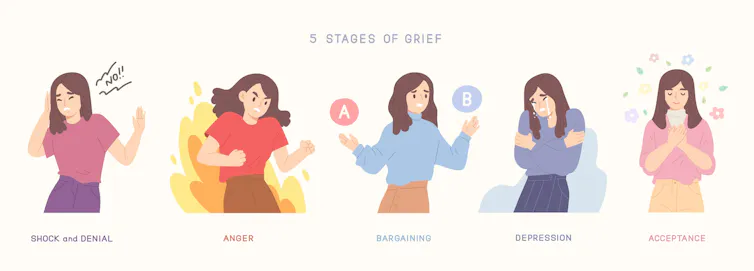
These ideas found their most enduring cultural expression in Elisabeth Kübler-Ross’s five stages of grief: denial, anger, bargaining, depression, and acceptance. Although originally developed in her work with people facing a terminal diagnosis, the model was quickly adopted as a universal roadmap for bereavement. It was comforting because it reassured us that grief would unfold in order and it would, eventually, end.
It became prominent in popular culture: we see in an episode of The Simpsons (Season 4, Episode 16), as Homer’s enforced abstinence from beer results in behaviour that mirrors the stages of grief – a pattern Lisa recognises and explicitly identifies as the five-stage model. Even Bridget Jones is not immune. In Mad About the Boy, Bridget’s friends gather around a wine bar table and gently inform her that she is nearing the “final stage”: acceptance. The moment is played lightly, but the message is clear – grief is something you progress through and there is an end-stage.
The five so-called ‘stages’ of grief: shock and denial, anger, bargaining, depression and acceptance. Shutterstock/Madua
It is easy to roll your eyes at scenes like this, but their appeal runs deep. In moments of profound powerlessness, stage models give us a sense of control. They offer a map when we feel lost, and the promise of an ending when the pain of grief feels endless. Wouldn’t it be comforting if grief really did come with a calendar? A final checkpoint. Roll the credits. Life resumes.
The problem is not that these models were created, but that they became expectations. When grief returns, lingers, or refuses to soften, people often turn the discomfort inward.
Let’s go back to Ella who thought, “when someone was bereaved it was the first couple of months and then everything was okay again.”
The harm lies not in grieving deeply, but in believing that continuing to feel a connection or a bond with the deceased is in itself, a failure.
It is against this backdrop of silence, stoicism, and stage-based thinking that more contemporary grief theories began to emerge post-1990. It is important to remember that they did not emerge in order to deny the pain of death, but to offer language for many people who described their grief in different ways – such as holding on.
Why ‘letting go’ isn’t the point
By the 1990s, grief researchers had begun to ask themselves a different question. What if the problem was not that people were failing to “let go”, but that our theories had actually misunderstood what grieving really feels like?
Out of this shift came the idea of “continuing bonds”, developed by psychology researchers Dennis Klass, Phyllis Silverman and psychiatrist Steven Nickman.
Their work named something many bereaved people already knew intuitively: relationships do not simply end when someone dies. Instead, they change. People carry the dead forward through memory, ritual, internal conversation, and the quiet ways they shape their lives around the death.
For others, the bond continues in more private ways, kept hidden not because it is unhealthy, but because grief itself can feel like something you are meant to hide away.
Mia grew up in the Republic of Ireland in a family of five which included her parents and two older brothers. When Mia was 14, her 22-year-old brother died in an accident. Mia’s other brother was 26 at the time and was suffering from mental health problems. Mia felt as if, in some ways, she was suffering a double bereavement for both her brothers.
The overarching emotion that emerged from Mia’s interview was that of anger: anger towards her parents and school for their lack of support during this difficult period. Mia felt that as a result of trying to cope at home, she began to struggle with her mental health: “I became quite depressed … I suppose I hid it very well.”
This oscillation between appearing “okay” and feeling overwhelmed is captured in the dual process model of grief, developed by bereavement researchers Margaret Stroebe and Henk Schut. Rather than progressing neatly from loss to recovery, the model suggests that people move back and forth between confronting their grief and setting it aside in order to function.
This is a mode which chimes with another of my interviewees. Sophie grew up in southern Ireland in a family of five which included her parents, and her older brother and sister. She experienced four bereavements between the age of eight and 14. When Sophie was eight her grandmother died, when she was nine her cousin, whom she was very close to, died suddenly. Following this, Sophie’s grandfather died when she was 13 and the following year, when Sophie was 14, her brother died in an accident when he was only 22.
Sophie was in secondary school when the death occurred. She felt that the death of her brother had the most impact on her and recognised that her three previous experiences of death may have prepared her for it in some way. It had been 14 years since the death of her brother when I met her. Sophie discussed her experience without getting emotional. She felt that her family coped well with the death as she received a lot of familial support, particularly from her father who was instrumental in seeking support from Barretstown, a bereavement support service in Ireland. She recognised that her grief is still there, but comes in waves during different stages of her life:
The first six months I had insomnia … I couldn’t sleep and that kind of improved after the first six months and I got back into a routine but I remember being triggered off at certain points … I went through a period where I was getting very upset that he wasn’t around. It subsided and then it was triggered off you know birthdays and stuff or transitions … I think then going to college was particularly a big one because transitioning into adult … being in the place and stage that he was when he died.
The story we tell ourselves
So grief does not disappear. It ebbs and flows, often resurfacing unexpectedly, long after others assume it should have settled.
Psychologist Robert Neimeyer argues that bereavement does not just remove a person from our lives; it shatters our assumptions about how the world works because the future we imagined for ourselves is suddenly gone.
This idea was mentioned by many women who took part in my research who had lost a father. They mentioned, unprompted, that they wondered who would walk them down the aisle when they got married. The future story they had told themselves about how their life would unfold was ripped out and needed to be rewritten. The sense that life is predictable or fair is disrupted.
Earlier, theorist Colin Murray Parkes described this as the loss of an “assumptive world” and for many people, grief becomes the slow, uneven work of trying to rebuild a narrative that can hold what has happened. Ella, in my study captured that feeling of rupture when she said:
A person full of insecurities, full of sadness; I know that the world isn’t this silly dreamy place that it might have been before … you have to look after yourself a lot more.
This is why grief so often returns at moments of transition: birthdays, exams, weddings, or becoming a parent. It is not that we have not moved on; it is that the story keeps changing.
This helps explain what the singer Bob Geldof described in his reflections on death that grief does not simply fade, but can “erupt” without warning, even years later. In this sense, grief is not a single emotional state to be resolved, but a recurring human experience that surfaces as life continues.
These theories help explain why grief lingers and returns, but they also point us back to something more fundamental: most of us encounter grief not through theory, but through formative loss that shapes how we come to understand death at all.
The first death
I was 11 when I experienced my first bereavement: the death of my grandfather, my father’s father. My memories of him are bathed in warmth, he was a gentle, soft-spoken man, kind to his core. The eldest of nine children himself, he went on to raise nine of his own, my father being the first.
He always made time for his grandchildren (of which he had many) with small, meaningful gestures. When we visited, he would often reach into his pocket and produce a square of chocolate or a shiny pound coin (what would be the equivalent of a €1 coin today). Those simple gifts felt like treasures.
Though rooted in traditional rural life, he was ahead of his time in many ways. Family lore tells us that he insisted on pushing the pram when his children were small, an act that scandalised my grandmother, who maintained that such things simply were not done by men of his generation. But he did it anyway. That was the kind of man he was: grounded, thoughtful, and quietly progressive. His death was my first real encounter with grief, and though I did not have the words for it then, I now recognise that it left an imprint on how I understand grief.
I remember being allowed to visit my grandfather in the two weeks before he died. He had developed pneumonia and was struggling to breathe, a consequence of years spent smoking at a time when the true dangers were not known. It was difficult to see him that way, frail and gasping, and I remember finding it upsetting. But looking back now, I see the quiet wisdom in what my parents did.
They gave us the choice to visit, gently involving us in what I now recognise as the process of anticipatory grief. It was their way of helping us prepare, not by shielding us from death, but by offering us a way to begin understanding it.
What stands out most clearly from that time is the gentle support and encouragement of my father. He has never been afraid to talk about death. His calm presence and quiet faith offered us a kind of anchor, not through denial or platitudes, but through openness, steadiness, and trust in something greater. His belief did not erase the pain, but it gave it a shape, a space to be held. In a moment that could have felt frightening or isolating, his comfort gave me strength.
When my grandfather died, I remember his body being brought home and laid out in a large front room, as was tradition in rural Ireland. Through my adult eyes now, I can see the beauty in that ritual, a final gesture of love and inclusion.
But as a child, I was afraid. It took time to summon the courage to go into that room and see him laid out. I remember the stillness of the room, the unfamiliar scent in the air, the cold stiffness of his fingers. Time felt suspended.
I cried a lot, as the truth settled in: the people we love can die. My parents could die. My siblings. Even me. That was the moment when the permanence of death first imprinted itself on my young mind.
The individuality of grief
What continues to strike me in both my personal reflections and research is how profoundly individual the experience of grief can be, even when shared within the same household. In writing about the death of my grandfather, I decided to speak with my siblings to understand how they remembered that time.
One of my siblings, who is characteristically less openly emotional, began to cry as we spoke. This was an unexpected reaction that neither of us had anticipated. They recalled how, even though their belief in God and religion had disappeared, they had spent weeks praying that our grandfather would recover. “I used to pray every night,” they said. “And when he died, I just stopped. What was the point?” Later in the conversation, they added quietly: “Our parents just didn’t talk about him afterwards. They just didn’t talk about him.”
I was struck by how different their experience was from mine. I remembered that period as one of openness and inclusion, marked by quiet support, meaningful rituals, and humorous stories. For my sibling, however, it was defined by silence and confirmation of their disillusionment about religion.
The contrast was sharp, but it was an important reminder of the individual reality of grief. We had lived through the same bereavement, in the same house, with the same emotional support from our parents, and yet we had constructed completely different narratives around it.
It was the same in my research. Over and over again, participants described the vastly different ways that grief manifested within their families.
What this teaches us is that grief is not experienced equally and it is not synchronised. Each person carries a different understanding of the person who has died, a different level of emotional maturity, and a different internal process.
We must resist the urge to generalise. We cannot assume that because one person in a family appears to be “doing okay,” their sibling must be too. Nor can we assume that a lack of visible distress equates to emotional resilience. Grief is deeply personal, shaped by both internal and external factors, and influenced by what is spoken, what is avoided, and what is felt alone in silence.
What happens if there is no end point?
So what happens when we stop expecting grief to end? The five stages endure because they promise an endpoint when grief makes time feel suspended. It is not surprising that for many of us in moments of profound grief, that promise can feel like a lifeline.
What is striking is that those who write most honestly about grief, those who speak from inside it rather than about it from a distance, rarely describe an ending at all. Freud himself, so often associated with detachment, wrote something very different later in life. In a 1929 letter to his friend Ludwig Binswanger, written after the death of Freud’s daughter Sophie, he acknowledged that grief does not resolve:
We know that after such a loss the acute state of mourning will subside … but we also know that we shall remain inconsolable and will never find a substitute.
The pain may soften, Freud suggested, but the loss is never replaced. The love endures, and so does the absence.
Grief does not neatly resolve, and great thinkers have recognised this. Viktor Frankl, neurologist, psychologist, and Holocaust survivor wrote in his memoir, Man’s Search for Meaning, about his own experience of suffering, and observed that “if there is meaning in life at all, then there must be meaning in suffering,” and that “in some way suffering ceases to be suffering at the moment it finds a meaning”.
Grief is not a detour from life to be exited as quickly as possible; it is a form of suffering that can become part of the fabric of a meaningful life. Frankl also reminded us that everything can be taken from us but one thing, the last of the human freedoms, “to choose one’s attitude in any given set of circumstances, to choose one’s own way”.
This is a reminder that how we carry grief matters even when the pain remains. This aligns with what many people who have lived with grief tell us: the pain may become less intense over time, but the love endures.
Nearly a century after Freud, the songwriter Nick Cave wrote publicly about grief following the death of his son, describing it not as something to be mastered or completed, but as a state of profound powerlessness. Grief, he wrote, “is not something you pass through, as there is no other side.” What remains is not closure, but humility.
A recognition that love does not disappear when someone dies, and that the ache left behind is not evidence of failure, but of attachment. Cave speaks of grief as something that changes shape over time, becoming less raw perhaps, but no less real.
Geldof echoed this in his reflections on the death of his daughter Peaches, saying that “time accommodates” the grief, but it “is ever present.”
The distinction matters. Getting on with life does not require leaving the dead behind. It means learning to carry grief alongside love, and absence alongside presence.
Ongoing bonds with the dead are not signs of denial or pathology, but very often the way people survive. When grief is allowed to be ongoing, when the dead can be spoken about, something shifts. People stop measuring themselves against an imagined timeline and they stop waiting to “graduate” from grief.
Perhaps the discomfort we feel around enduring grief says less about the bereaved and more about the rest of us. Grief unsettles us because it reminds us of life’s fragility and our own mortality.
But if we allow ourselves to move away from the idea that grief is a problem to be solved, we make room for a more honest understanding of grief. It is likely that grief does not end because love does not end. What changes is not the bond, but how we learn to live with it.
To hear about new Insights articles, join the hundreds of thousands of people who value The Conversation’s evidence-based news. Subscribe to our newsletter.
Aoife Lynam does not work for, consult, own shares in or receive funding from any company or organisation that would benefit from this article, and has disclosed no relevant affiliations beyond their academic appointment.
Nigel Farage has accused YouGov of being “deceptive” after the polling company consistently showed Reform with less support than other surveys. He has claimed the company broke transparency rules set out by the British Polling Council over how it presents headline figures. As a result, YouGov has agreed to publish more data in future.
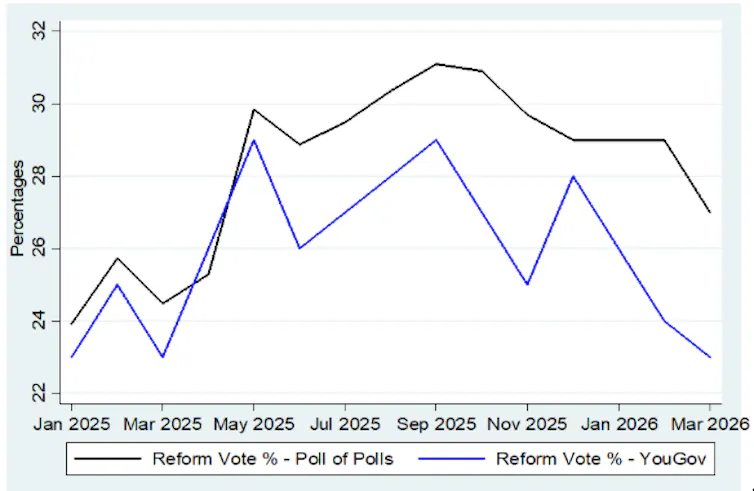
The chart below compares Britain’s monthly voting intentions for Reform in a poll of polls derived from 14 different agencies, with voting intentions for the party from YouGov. The comparison runs from the start of 2025 to March 2026. At first glance, it appears that Farage is right – the YouGov data is below the poll of polls data for most of the time.
However, if we calculate the difference between the two series, the poll of polls average for Reform over the last 15 months is about 28% in voting intentions – for YouGov it is about 26%. This 2% difference is well within the margin of error associated with polling; what statisticians describe as “not statistically significant”.
Vote intentions for Reform, poll of polls and YouGov
The margin of error arises because polls try to measure support for the party across Britain from a survey of only 1,500 to 2,000 respondents. A good survey tries to replicate the diversity of the country in voting intentions, but it may differ from the country-wide support for the party because of random chance.
There is no real difference between the two series in the chart once this chance element is taken into account. If the survey has a truly representative sample, this random element can be ignored. But if there are problems with the sample, it will be inaccurate.
One such problem is accurately representing ethnic minorities in the sample, because they are less likely to respond to requests to do a survey. If a particular group is underrepresented, this can bias the results. To compensate for this problem, pollsters like YouGov use weighting, which involves giving more weight to some respondents than to others.
For example, the 2021 census shows that 4% of the population in Britain identifies as ethnically black. If only 2% of survey respondents fit this description, pollsters deal with this by counting these respondents twice in the analysis, which produces 4% black respondents.
Different agencies use different weighting schemes, which gives rise to variations in the answers they get to surveys. This is acceptable, providing these differences are not too large (not statistically significant).
Another factor may be the questions asked. This is where YouGov’s discrepancy arises.
YouGov has said it asks respondents first about general voting intention, and then specific constituency-level voting. This, the company says, takes account of tactical voting and is a more accurate representation of how a general election would play out.
There are clear differences between responses to the national and constituency questions – notably, more “don’t knows” in the latter, which means more uncertainty in the constituency responses.
My explanation of this is that when people are thinking about their own neighbourhood, they realise that voting involves a serious decision which can change their lives. When they respond to the national question, they are more likely to use it as a protest against the government and other parties.
Is Reform losing ground?
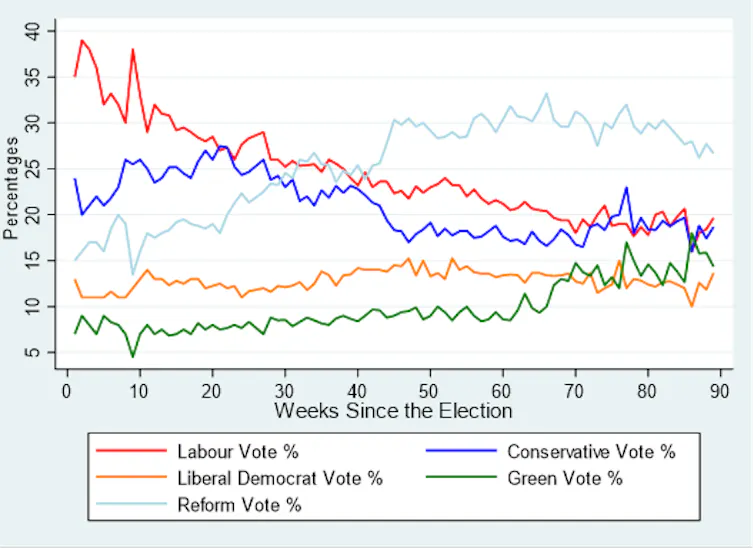
One reason Farage may be upset is because there is clear evidence that Reform is losing ground in the polls since the start of the year. This can be seen in the chart below, which shows a poll of polls of weekly voting intentions for the five major national parties in Britain since the July 2024 general election.
In the early weeks of 2025, Reform moved ahead of both Labour and the Conservatives – reaching 30% in vote intentions by May that year. The party’s support hovered around this figure until the start of 2026, when it began to decline. In October 2025, Reform was at 31% in voting intentions, but by March this year it was at 27%.
Vote intentions for the five major parties in Britain since the general election
Voting intentions since the July 2024 general election. P Whiteley, Pollbase, CC BY-ND
Polling is important to all politicians, despite the fact that many criticise it if they appear to be losing ground. Farage is probably more attentive than most because Reform’s support has been so volatile over time – and what goes up can come down.
With its success in local government elections, Reform is now exposed to much closer scrutiny than it was in the past. Some news stories that may explain its now-declining popularity include Reform-controlled councils raising council tax after pledging to “reduce waste and cut your taxes”, and the party receiving the largest-ever political donation from a living individual in British history. Neither of these bode well for a party claiming to represent working-class voters.
Farage (along with Kemi Badenoch) may also be regretting his rush to support the US and Israel in their war against Iran. A recent poll showed that only 28% of UK respondents supported the war, while 49% opposed it.
In the past, Farage has claimed to be a close friend of Donald Trump, but he talks about this much less these days – the US president’s approval ratings are now very poor in the UK.
Both Reform and the Conservatives are on the wrong side of public opinion on this issue, something which is likely to haunt them in the May elections this year if the war continues to damage the economy.
Paul Whiteley has received funding from the British Academy and the ESRC.
The U.S.-Israeli military campaign against Iran took a dangerous turn on March 18, 2026, with tit-for-tat strikes on critical energy infrastructure that amount to the most serious regional escalation since the conflict began.
First, an Israeli drone strike targeted facilities at Iran’s Asaluyeh complex, damaging four plants that treat gas from the offshore South Pars field, which straddles the maritime boundary between Iran and Qatar.
Tehran vowed to retaliate by hitting five key energy targets in Saudi Arabia, Qatar and the United Arab Emirates. Hours later, Iranian missiles caused “extensive damage” to Ras Laffan, the heart of Qatar’s energy sector. Qatar’s state-owned petroleum company said additional attacks on March 19 had targeted liquefied natural gas facilities.
Much attention has been focused on the seemingly unanticipated consequences of the U.S.-Israeli strikes on Iran and the de facto closure of the Strait of Hormuz to international shipping. But as a scholar of the Gulf, I believe that the targeting of energy facilities is close to a worst-case outcome for regional states. Export revenues from oil and, in Qatar’s case, natural gas have transformed the Gulf states into regional powers with global reach over the past three decades, and that is now at risk.
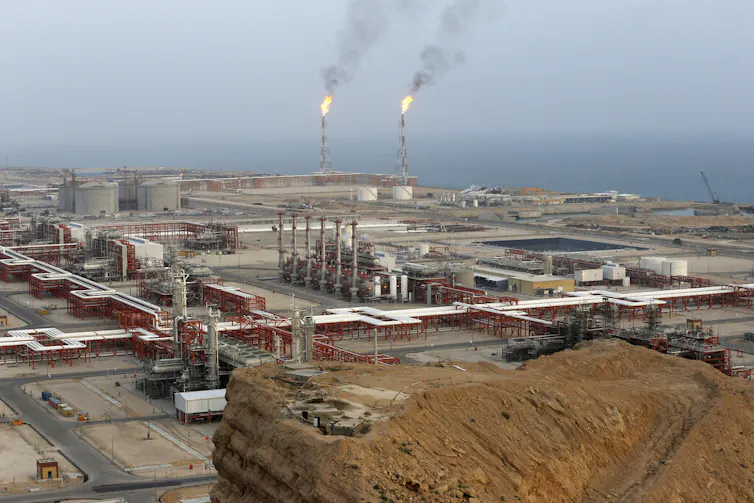
Natural gas refineries at the South Pars gas field on the northern coast of the Persian Gulf, in Asaluyeh, Iran. AP Photo / Vahid Salemi, File
Energy becomes a battlefield
The offshore gas field that lies on both sides of the maritime boundary between Qatar and Iran is the world’s largest reserve of so-called nonassociated gas. This means that the gas is not connected to the production of crude oil and is unaffected by decisions to raise or lower output according to, for example, OPEC quotas.
The field, known as the North Field on the Qatari side and South Pars on the Iranian side, was discovered in 1971. Development of its massive resources began in earnest in the 1980s. Largely because of the field, Iran and Qatar have the second- and third-largest proven gas reserves in the world, respectively.
While Israel attacked gas facilities in southern Iran on the second day of the 12-day war in June 2025, oil and gas infrastructure was largely spared during that earlier conflict. The opening two weeks of the current fighting, however, have seen a significant loosening of the restraints on targeting critical infrastructure.
On March 8, Israel struck oil storage facilities in Tehran, starting large fires and blanketing the capital in plumes of smoke and toxic, so-called black rain. For their part, Iranian officials signaled that energy facilities were on the table as swarms of its drones targeted the Shaybah oil field in Saudi Arabia, the Shah gas field southwest of Abu Dhabi and oil facilities in Fujairah.
One of the seven emirates of the United Arab Emirates along with Abu Dhabi, Fujairah is strategically located on the Gulf of Oman, outside the Strait of Hormuz, with direct access to the Indian Ocean. For this reason, it has grown into an important oil-loading and ship fuel-supplying hub and is the terminus for the Abu Dhabi crude oil pipeline.
Opened in 2012, that pipeline has a capacity of 1.5 million barrels per day, covering more than half of the UAE’s oil exports. Its repeated targeting during the war signifies Iranian intent to disrupt one of the two pipelines that bypass Hormuz. Thus far, the other pipeline, the East-West pipeline from the eastern Saudi oil fields to the Red Sea port of Yanbu, has not been targeted.
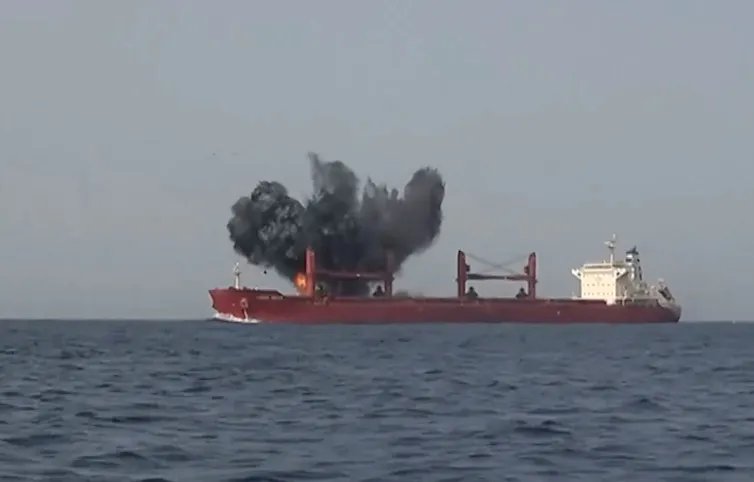
A July 1, 2025, photo provided by the Houthis in Yemen shows the targeting of a commercial vessel in the Red Sea. Houthi Media Center/Getty Images
Cascading risks of further energy attacks
On at least four occasions over the past decade, most recently in 2022, Houthi forces in Yemen – who are allied with Iran– struck targets around the East-West pipeline.
So far, the Houthis have refrained from joining the latest war, but they have threatened to do so. Any such actions would cause enormous additional disruption to oil markets.
However, the attack on Ras Laffan in Qatar and the wider threats to other energy infrastructure in the Gulf have the potential on their own to be catastrophic for a number of reasons.
Developed in the 1990s, the industrial city of Ras Laffan is the most critical cog in Qatar’s economic and energy landscape and the epicenter of the largest facility for the production and export of LNG in the world. Fourteen giant LNG “trains” process the gas from the North Field, which is then transported by vessels from the accompanying port to destinations worldwide.
Ras Laffan also houses gas-to-liquids facilities – these convert natural gas into liquid petroleum products – along with a refinery and water and power plants that produce desalinated water and generate electricity. Ras Laffan is quite simply the engine that has powered Qatar’s meteoric growth and rise as a global power broker.
Early reports suggest that the world’s largest gas-to-liquids plant, Pearl GTL, which is operated by Shell, was damaged during the first attack on Ras Laffan, and that the second attack damaged 17% of Qatar’s LNG capacity, with repairs projected to take three to five years. A three-phased expansion to the LNG facilities, which would add a further six LNG trains by 2027, is also likely to be delayed.
The burning Gulf state dilemma
What is clear is that Iranian officials view the Israeli — or American — targeting of facilities in their territorial waters in the South Pars field as sufficient to justify hitting facilities on the Qatari side. That’s even though Qatar forcefully condemned the Israeli strike on Asaluyeh as a dangerous escalation, for reasons that have become all too real.
There lies the nub of the dilemma for Qatar and the five other Gulf states facing the brunt of the backlash from a war they tried to avert through diplomacy.
On my visits to the region in fall 2025, it became clear that many officials in the Gulf viewed the ceasefire that ended the 12-day war as, at best, a temporary cessation of hostilities and feared that the next round of fighting would be far more damaging, for Iran and for the region.
This has now come to pass. An embattled government in Tehran that sees itself in an existential fight for survival has spread the cost of war as far and as wide as it can.
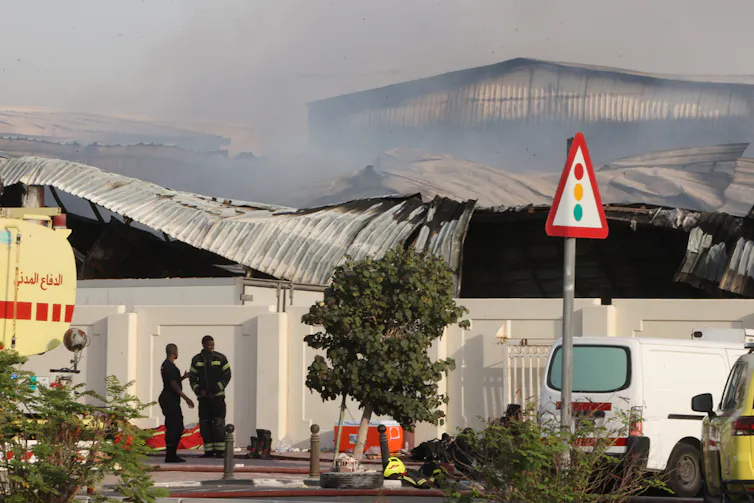
Firefighters work as smoke rises outside a damaged warehouse in an industrial area in Al Rayyan, Qatar, following an Iranian strike on March 1, 2026. AP Photo
Officials statements from Gulf capitals that have consistently – and correctly – emphasized their direct noninvolvement in the U.S.-Israeli military campaign have fallen on deaf ears in Tehran.
An incident on March 2 that saw Qatar down two Iranian Soviet-era fighters was a defensive measure. The jets had entered Qatari airspace with the apparent intent to strike Al Udeid, the air base that houses the forward headquarters of U.S. Central Command.
However, the scope of Iran’s attacks has gone far beyond military facilities used by U.S. forces and have hit the sectors – travel, tourism and sporting events – that put the region so firmly on the global map.
Nowhere is this more the case than the energy sector that has underwritten and made possible the transformation of the Gulf states over the past half-century, and whose health remains vital to the global economy and supply chains in oil, gas and many derivative products.
If that sector remains firmly in the crosshairs, there’s no telling how intense the regional and global consequences of the ongoing war in Iran may prove to be.
Kristian Coates Ulrichsen does not work for, consult, own shares in or receive funding from any company or organization that would benefit from this article, and has disclosed no relevant affiliations beyond their academic appointment.
Neither side showed any indication that the planned five-day cessation of operations would be anything other than temporary, and they warned that any violation would be met with reciprocal strikes.
Already the conflict has seen hundreds killed, with a blast at a drug rehabilitation center in Kabul on March 16, 2026, killing more than 400 people, according to Afghanistan’s Taliban government.
The conflict has been largely kept off the front pages by the war in Iran. But as an expert on Pakistan’s foreign policy and security, I believe the fighting has the potential to further destabilize the region.
Why are Pakistan and Afghanistan fighting now?
The current conflict between Pakistan and Afghanistan is not a sudden rupture of relations between the two countries, which share a 1,640-mile (2,640 km) border called the Durand Line.
Rather, the flare-up is a result of an intensification of long-simmering, historical security concerns along the Durand Line. The immediate trigger lies in Pakistan’s growing concern over cross-border militant activity, particularly from groups such as the Tehreek-e-Taliban Pakistan, which Islamabad believes operate from sanctuaries inside Afghanistan.
However, that did not materialize. Instead, there was a perceptible rise in militant attacks within Pakistan, accompanied by Kabul’s reluctance or inability to decisively act against Tehreek-e-Taliban Pakistan.
Complicating this landscape further is the evolving character of the threat environment for Pakistan. In 2025, Pakistan was involved in a short war with historical rival India – the most intense fighting between the two countries for nearly 30 years.
In response, Pakistan has reportedly undertaken countermeasures, including airstrikes targeting drone infrastructure linked to militant networks inside Afghanistan.
All this points to a widening battlespace, where new technologies make it easier to escalate in indirect and deniable ways.
This is not merely a bilateral border crisis but a layered security contest shaped by cross-border militancy, emerging technologies and competing threat narratives.
The convergence of Pakistan’s growing willingness to respond with physical force, the Afghan Taliban’s assertion of sovereignty and the absence of a mutually agreed framework for border management continues to drive episodic escalation rooted in structural mistrust.
What is the broader history of Pakistan-Afghanistan relations?
Historically, Pakistan-Afghanistan relations have often oscillated between uneasy cooperation and strategic suspicion toward each other – all shaped by unresolved territorial, ideological and geopolitical dynamics.
At the heart of it lies a dispute over the Durand Line, which Afghanistan has never formally recognized as an international border. This has resulted in a sustained and persistent tension in their bilateral relations since Pakistan’s independence in 1947.
However, the Soviet invasion of Afghanistan in 1979 marked a critical turning point. Pakistan became a front-line state supporting the Afghan jihad against invading Soviet forces.
This entrenched cross-border militant networks and blurred the boundary between state policy and nonstate actors, resulting in dynamics that continue to shape the region.
The post-2001 period was marked by fraught relationships between Pakistan and successive U.S.-backed Afghan governments, particularly over allegations of Pakistan’s alleged proxy support for Islamist groups in Afghanistan.
Many thought the Afghan Taliban’s return to power in 2021 would resolve this tension. But instead, it reconfigured it.
While ideological affinities continue to exist between the two nations, they have not translated into any sort of strategic alignment – especially on questions of militancy and border control.
What are the implications of the conflict for the region?
The implications of Pakistan-Afghanistan tensions are significant and extend well beyond bilateral frictions. They intersect with broader questions of regional stability, militancy and great power competition.
I believe there are four direct implications:
First, the persistence of ungoverned or contested spaces along the Pakistan-Afghan border risks creating an enabling environment for transnational militant groups. This has real implications not only for Pakistan’s internal security but also for regional actors concerned about spillover effects.
Second, instability along the Pakistan-Afghanistan border complicates regional connectivity and economic integration initiatives, including projects linked to broader Central and South Asia. A volatile western frontier constrains Pakistan’s ability to act as a regional stabilizer and a safe conduit for regional trade and energy corridors.
Third, for outside interested parties like the U.S., the situation underscores the limits of disengagement from Afghanistan. While Washington’s military withdrawal marked the end of direct involvement, the persistence of militancy and the risk of regional destabilization ensure that Afghanistan remains strategically relevant not only for the U.S. but for other major powers as well.
Finally, I see these tensions as highlighting a broader pattern: The post-2021 Afghanistan remains internally consolidated but externally contested. Its relationships with neighbors, particularly Pakistan, will be central in determining whether the region moves toward managed stability or recurring cycles of escalation.
Rabia Akhtar does not work for, consult, own shares in or receive funding from any company or organization that would benefit from this article, and has disclosed no relevant affiliations beyond their academic appointment.
As an astrophysicist, my world revolves around the wonders of space and the mysteries of the universe. This means I can be a tough critic of science fiction books and films that explore these topics.
But when I walked out of a recent preview screening of the film adaptation of Andy Weir’s 2021 science fiction novel Project Hail Mary, I had tears of joy in my eyes. The filmmakers had done justice not just to the original story, but also to the science at the heart of it.
The story revolves around Ryland Grace, played by Ryan Gosling, who awakes from a coma with no memory and no idea why he’s on a space ship 11.9 light years away from Earth. As his memories slowly start to return, the truth becomes clear. The Sun is dying, and he is our only saving grace.
So here are the science facts – as well as the science fiction – of the film, which is in cinemas in Australia and New Zealand from today.
A dying sun
In Project Hail Mary the Sun is dying due to an alien organism that has spread around our part of the Milky Way.
Firstly, could an organism spread from one solar system to another? According to some scientists, yes. It’s a theory called panspermia.
We have no hard evidence to prove it right now. But the theory isn’t completely wild. We know material from solar systems can be transported great distances – we ourselves have witnessed as least three interstellar visitors enter and fly through our Solar System.
If life forms could survive the harshness of space and live on such rocky bodies, it’s possible this is how life could spread. But that life would likely be basic organisms.
As for the organism at the centre of this movie, astrophage, its mechanics and behaviour sit rightly in the wonderful world of science fiction.
The size of space
The idea of humans travelling between stars feels like an almost impossible challenge.
In our galaxy alone there are more than 400 billion stars, but only roughly 100 of them are within 20 light years of Earth.
Project Hail Mary focuses it’s attention on one of those systems, known as Tau Ceti, sitting 11.9 light years away.
If we were to travel to this star with the fastest spacecraft humans have ever flown in, the Apollo 10 module, travelling at more than 39,900 kilometres per hour, it would take us 320,000 years. In a story where the Sun is dying now, there is no time for that. So how does Project Hail Mary overcome this problem?
Enter special relativity.
Special relativity is one of the most paradigm-shifting theories of modern history. Developed by Albert Einstein in 1905, it equated mass and energy as one and the same. It best known by the famous E = mc2 formula.
What Einstein was able to work our mathematically, and we’ve later proved observationally, is that the closer to the speed of light something travels, the slower the time it experiences in its reference frame.
It’s called a Lorentz transformation – and it allows us to determine the time experienced in a reference frame different to our own, say travelling close to the speed of light.
The movie doesn’t give a full physics lesson on this, but rather uses visual cues, including correct mathematics worked out by Grace on a whiteboard to demonstrate this time change.
What Grace determines is that he’s only been in a coma for four years due to the effects of time dilation on a ship travelling that fast. Which is scientifically spot on.
We have to talk about the aliens
While on the mission to save our world, Grace meets another being trying to do the same – Rocky.
We (us astronomers at least) do believe aliens exist somewhere in the universe. This belief isn’t based on crop circles or UFOs; it’s based on statistical chances.
In the Milky Way alone we estimate there are at least 100 billion planets. If life was able to form, evolve and thrive on Earth, there are many reasons why astronomers believe that could be true in other systems.
A lot of our confidence relates to the essential building blocks of life as we know it. All life on Earth is carbon based. But if we break down our existence even more, we find one thing: amino acids. These organic compounds are the foundation of our DNA.
What’s most exciting is that we’ve identified these in space. Samples from asteroids and fallen meteorites have confirmed many of the amino acids needed for life on Earth also exist on other objects in our Solar System.
Alien earths beyond our own
The film allows audiences to see what other planets might look like.
When Andy Weir originally wrote this novel, it was scientific consensus that alien worlds likely existed around Tau Ceti and the home planet of our new friend Rocky, 40 Eridani A.
But in recent years science has progressed and new data suggests both of these systems appear to have had false detections of planets.
So at least for now, Rocky’s home doesn’t exist – but thousands of others do. As of March 2026 astronomers have confirmed 6,100 exoplanets. These are worlds that exist beyond our own solar system, around distant stars, and can be either rocky or gaseous.
One place Grace and Rocky need to explore on their adventure to save the stars is a theoretical planet orbiting Tau Ceti. Here we see stunning hues of green and red, and distinctive swirls of gases mixing in the atmosphere.
It’s reminiscent of the gas giant of our own Solar System, Jupiter.
Project Hail Mary is more than just an epic adventure film with beautiful visuals. It’s a story that reminds us how important our world is – and how vital science is to our continued existence on it.
Sara Webb does not work for, consult, own shares in or receive funding from any company or organisation that would benefit from this article, and has disclosed no relevant affiliations beyond their academic appointment.
Source: The Conversation – in French – By Leila HENNAOUI, Maîtresse de conférences en droit international, Universite Hassiba Benbouali de Chlef
Le président Emmanuel Macron a annoncé, le 2 mars 2026, une évolution significative de la doctrine nucléaire française. La France augmentera ses ogives nucléaires pour la première fois depuis 1992 et déploiera des avions à capacité nucléaire chez des alliés européens dans le cadre d’un nouveau concept baptisé « dissuasion avancée ». Huit partenaires européens participeront à des exercices et fourniront un soutien conventionnel.
Le discours a révélé une continuité avec les pratiques institutionnelles passées. Emmanuel Macron a détaillé ce que la France proposerait à l’Europe, mais donné peu de précisions sur les mécanismes institutionnels qui encadreront la transparence et la responsabilité de ce nouvel arrangement.
Cette asymétrie soulève une question centrale : comment la crédibilité d’une dissuasion nucléaire élargie peut-elle être évaluée, lorsque ses structures de gouvernance restent largement indéfinies ?
Pour avoir étudié les questions de gouvernance et d’héritage nucléaire, je soutiens que pour comprendre cet enjeu, il faut replacer ce moment stratégique dans une trajectoire plus longue de gestion institutionnelle du nucléaire français.
L’héritage algérien : une question toujours ouverte
Entre 1960 et 1966, la France a mené 17 essais nucléaires dans le Sahara algérien. Le programme a débuté avec l’explosion atmosphérique « Gerboise Bleue » en février 1960, suivie de 16 essais supplémentaires à Reggane et In Ekker, deux localités du sud de l’Algérie. À l’époque, la France exerçait son autorité sur le territoire et portait responsabilité envers les populations sous son administration.
Six décennies plus tard, de nombreuses obligations découlant de cette responsabilité restent largement non honorées. La loi Morin de 2010 a établi un mécanisme d’indemnisation, mais ses critères restrictifs ont exclu la majorité des demandeurs algériens, tandis que les vétérans militaires français exposés à des niveaux de radiation comparables reçoivent des prestations. Les protocoles d’essais, les données dosimétriques et les informations sur les sites d’enfouissement de déchets radioactifs demeurent classifiés.
Renversement saisissant : l’Algérie elle-même a entrepris récemment des initiatives de décontamination sur d’anciens sites d’essais – l’État affecté assumant une responsabilité que l’État testeur n’a pas pleinement endossée. Parallèlement, des parlementaires français réclament depuis des années l’ouverture des archives complètes sur les essais nucléaires, mais celles-ci demeurent toujours classées “secret-défense”.
Au terme de cet examen, un constat s’impose : l’opacité française sur les conséquences nucléaires en Algérie ne s’est pas dissipée avec la fin de la période coloniale. Depuis 1962, l’Algérie souveraine demande la déclassification des archives d’essais, le partage des cartes topographiques des sites de déchets radioactifs, et la transparence sur les données dosimétriques.
La France refuse toujours, invoquant le secret-défense.Le cas algérien révèle que cette opacité persiste, indépendamment du statut reconnu à l’interlocuteur, à travers deux moments politiques pourtant radicalement asymétriques. Il s’agit là d’un indice d’une culture institutionnelle que des analystes comme Vipin Narang, Austin Long et Bruno Tertrais qualifient d’« ADN nucléaire français » : un attachement absolu à l’autonomie décisionnelle, jugée « fondamentale juridiquement, culturellement, philosophiquement », associé à des mécanismes limités de transparence et de supervision institutionnelle.
C’est cet héritage institutionnel qui aide à comprendre la logique d’opacité qui continue de structurer la doctrine nucléaire française.
Une doctrine fondée sur l’opacité
Ce même «ADN nucléaire français» se manifeste en effet dans l’approche actuelle de la dissuasion avancée. Emmanuel Macron a ainsi annoncé que la France cesserait de divulguer publiquement la taille de son arsenal nucléaire, rompant avec des décennies de transparence. Depuis 2008, les présidents français ont confirmé publiquement le nombre d’ogives. Emmanuel Macron lui-même a réaffirmé le plafond de 300 ogives en 2020.
Le chef de l’Etat français a été explicite :
Il n’y aura aucun partage de la décision ultime, ni de sa planification, ni de sa mise en œuvre (…). Il n’y aura pas non plus de partage de la définition des intérêts vitaux.
La France conserve ainsi l’autorité exclusive. Il n’y aura « pas de garantie au sens strict » pour les alliés. Des mécanismes de consultation ont été évoqués vaguement, mais aucune structure institutionnelle précisée.
Cela contraste avec les arrangements nucléaires de l’Organisation du traité de l’Atlantique nord (OTAN), qui s’appuient sur le Groupe de planification nucléaire permettant une consultation structurée. L’approche française, comme le note la chercheure française Héloïse Fayet, demeure « délibérément opaque et souveraine ».
L’opacité s’étend au Parlement français lui-même. Les dépenses de réarmement nucléaire, comme l’observe le juriste Benoît Grémare, « du fait de leur caractère secret et stratégique, sont rarement détaillées auprès du Parlement ».
Ce tableau illustre, dans le contexte même de la dissuasion avancée, une caractéristique durable de la gouvernance nucléaire française : une forte autonomie décisionnelle de l’exécutif, combinée à une faible formalisation des mécanismes de transparence et de responsabilité. Ce que les analystes qualifient d’« ADN nucléaire français ».
Cette exigence de transparence institutionnelle est d’ailleurs reconnue dans la littérature stratégique elle-même : le chercheur français Bruno Tertrais note que l’absence française du Groupe de planification nucléaire de l’OTAN relève de l’« ADN stratégique » du pays. Un choix qui, selon Camille Grand, ancien haut responsable de l’OTAN, risque de produire des arrangements peu rassurants pour les alliés si la seule réponse à leurs questions demeure «faites-nous confiance».
C’est précisément cette culture institutionnelle que l’héritage algérien, examiné plus haut, permet d’éclairer dans sa profondeur historique. Peu exploré dans ce contexte, il en révèle la persistance sur la longue durée, y compris dans des situations où les obligations juridiques et morales de transparence étaient pourtant les plus manifestes.
La question n’est donc pas de savoir si la France reproduira les dynamiques du passé — les contextes sont radicalement différents et les alliés européens sont des partenaires souverains qui auront librement choisi ce cadre. C’est plutôt de savoir si un mode de gouvernance historiquement marqué par une transparence limitée saura évoluer face aux exigences d’une collaboration nucléaire nouvelle avec des alliés démocratiques.
Ces éléments invitent ainsi à s’interroger sur le caractère potentiellement structurel — plutôt que strictement circonstanciel — de cette opacité dans la gouvernance nucléaire française, et sur ses implications pour la crédibilité d’une dissuasion élargie.
Au-delà de la capacité, la crédibilité
Du point de vue d’une analyse en droit international attentive aux zones de flou institutionnel qui ont entouré ce dossier depuis plus de soixante ans, l’enjeu n’est pas de savoir si la France peut contribuer à la sécurité européenne, mais si le cadre de gouvernance offre un niveau de transparence et de responsabilité suffisant pour fonder une confiance durable.
La crédibilité se construit dans la durée. Les États qui cherchent à étendre leur protection nucléaire sont jugés non seulement sur leurs capacités, mais aussi sur leurs pratiques démontrées de transparence. Les questions non résolues sur les essais passés ne sont pas qu’historiques : elles façonnent les évaluations contemporaines de fiabilité institutionnelle.
La dissuasion exige la confiance que la puissance protectrice agira selon des cadres prévisibles, transparents et responsables.
Le concept de «dissuasion avancée» n’est pas nouveau. Comme l’observe Vipin Narang, expert en stratégie nucléaire, les présidents français invoquent la « dimension européenne » des intérêts vitaux français depuis des décennies. Ce qui demeure également constant, c’est l’absence de mécanismes de gouvernance multilatéraux venant institutionnaliser la rhétorique élargie — une absence que le discours du 2 mars 2026 n’a pas encore comblée.
Le discours d’Emmanuel Macron a exposé la vision stratégique, mais pas l’architecture de transparence et de responsabilité qui ferait de la « dissuasion avancée » plus qu’une assertion de prérogative souveraine.
La question algérienne ne relève donc pas uniquement d’un grief historique. Elle renvoie à des schémas institutionnels qui continuent de façonner les débats contemporains sur la confiance, la transparence et la responsabilité.
Leila HENNAOUI does not work for, consult, own shares in or receive funding from any company or organisation that would benefit from this article, and has disclosed no relevant affiliations beyond their academic appointment.
Source: The Conversation – Indonesia – By Douglas Sheil, Professor, Faculty of Environmental Sciences and Natural Resource Management, Wageningen University
When you reach for a “palm-oil-free” label at the supermarket, you likely feel you’re doing your part to save orangutans and protect biodiversity. However, the reality behind that label is more complex than it appears.
Our work with the IUCN Oil Crop Task Force reveals that replacing palm oil with alternatives actually increases the demand for land. Recent studies from both the IUCN and industry leaders like Musim Mas confirm that palm oil is exceptionally efficient, producing four to ten times more oil per hectare than soy or sunflower.
Consequently, a blind boycott of palm oil risks a “displaced” environmental catastrophe, potentially triggering the clearing of millions of hectares elsewhere.
As a conservation biologist with years spent on the forest frontier alongside local communities, I’ve learnt first-hand that the line between “good” and “bad” agriculture rarely lies in the crop itself.
The EU Deforestation Regulation (EUDR) attempts to address this complexity, yet it currently lacks the precision needed to avoid significant unintentional harm.
The fog of transparency
Our 2025 analysis of three major Western supermarket chains — selected for the transparency of their online ingredient lists — suggests that the often repeated “palm oil lurks in 50% of consumer items” claim may be an overstatement, at least according to our data.
While palm oil appeared in just 8% of the products we analysed, significant uncertainty remains; as much as 40% of items may contain hidden palm oil disguised as derivatives (processed ingredients) or listed under vague labels like “emulsifiers”.
This labelling fog prevents consumers from tracing product origins, allowing myths to eclipse the realities of supply chain management.
The EUDR offers a critical solution. By requiring that key commodities — including beef, cocoa, coffee, palm oil, rubber, soy and wood — entering the EU are both deforestation-free and legally produced, the regulation sets a high bar for global trade. However, the path to successful implementation faces significant hurdles.
With the European Parliament voting to delay enforcement for a second time, the law’s good intentions appear stuck in a political deadlock. While the core text remains intact, proposed simplifications for early 2026 include streamlining reporting obligations and refining the product list to include items like palm oil-based soaps and instant coffee.
Why should Indonesia, the UK and others care about this regulatory pause?
The EUDR’s impact deeply affects tropical exporters and their trading partners, including the UK. British companies exporting goods containing these commodities must align with EUDR standards to maintain access to the EU market.
However, the UK’s own deforestation rules are notably less strict. This regulatory divergence threatens UK firms with higher compliance costs and risks turning the country into a “dumping ground” for deforestation-linked goods rejected by the EU. This delay offers a vital window of opportunity for the UK to align with the EUDR, mitigate trade risks and reclaim its leadership in ethical supply chains.
For exporting countries like Indonesia, the core issue remains fairness. The EUDR relies on satellite-derived “base maps” to verify forest loss, yet these maps are deeply flawed. Research shows that Indonesian agroforestry systems face a 63% risk of being misclassified as “deforested”. As a result, a single erroneous pixel in Brussels could effectively bar an honest smallholder in Sumatra from European markets.
Recent analysis from Mongabay warns that the extremely high costs of tracing and mapping farm locations threaten to marginalise these smallholders. This financial burden risks driving them toward less regulated markets — a phenomenon known as “leakage” that could dilute the EUDR’s environmental impact.
To date, nations like Indonesia, Malaysia and Brazil have condemned the regulation as “green protectionism”. The resentment is clear: many view it as hypocrisy from a Europe that cleared its own forests to build wealth, only to now lecture others without offering adequate support. By positioning Brussels as the only judge of what is legal, the law is seen as undermining national sovereignty.
Moving forward: Towards a fair system
For the EUDR to succeed, this delay must serve as a catalyst for practical reform.
First, the EU must engage producer nations as partners. This requires investing in collaborative, high-resolution mapping that accurately distinguishes sustainable agroforestry from industrial clear-cutting. Transparency should be treated as a funded public good rather than a financial burden pushed onto vulnerable producers.
Second, transparency must be enforced universally. The EUDR must apply rules equitably across all agricultural products that affect land use, and this accountability must extend to retailers and supermarkets. EUDR data could finally mandate clear labelling that reflects both origin and practice.
Crucially, to truly preserve global biodiversity, the EU must ensure its regulatory system rewards conforming smallholders and traditional guardians rather than favouring large corporations.
Finally, we must confront the trade-offs head-on. The EU accounts for only 10% to 15% of global trade in deforestation-linked commodities. If Brussels restricts imports without addressing the underlying drivers of deforestation, production will simply shift to less regulated markets. Forests will fall elsewhere, and prices will rise at home. We must ask ourselves: are we simply paying a premium to ease our consciences without actually solving the problem?
We have to start somewhere, and transparency is the right focus. The upcoming 2026 simplification package and review must prioritise these fundamental changes. The EUDR holds immense potential to benefit global sustainability — but only if it evolves beyond rigid rules and overly simple measurements.
Douglas Sheil tidak bekerja, menjadi konsultan, memiliki saham, atau menerima dana dari perusahaan atau organisasi mana pun yang akan mengambil untung dari artikel ini, dan telah mengungkapkan bahwa ia tidak memiliki afiliasi selain yang telah disebut di atas.
Nowruz (meaning “new day” in the Persian language) is the Iranian, or Persian, festival celebrating the coming of spring – and the regeneration it brings. It is the first day of the year in the Iranian solar calendar (which began in 1079), marking the exact moment of the spring equinox. The date varies, between March 19 and 21 – this year, it’s March 21.
Within Iran, this year’s Nowruz will be especially emotionally charged, as its cities are under bombardment by Israel and the United States, leaving nearly 1,500 dead since February 28. By celebrating, Iranians will be reaffirming their unique identity and deep-rootedness in their homeland.
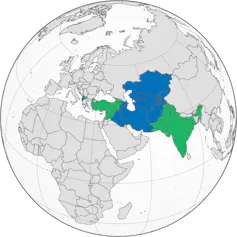
The geographical scope of Nowruz. Countries in blue recognise it as a public holiday – Wikimedia Commons. CC BY
Rooted in the Middle East and Central Asia, Nowruz is celebrated in countries that were once part of Iranian empires: including Turkey, Iran, Iraq, Afghanistan, India, Pakistan and the Caucasus region, particularly Azerbaijan.
Iranian culture was absorbed and integrated into local cultures during the pre-modern period – and it often remained as these territories were gradually lost. This wider sphere of Iranian influence is called Iranzamin or “Greater Iran”.
When Nowruz was first established, during the early period of the pre-Islamic Sassanian dynasty (224–651 CE), it was celebrated throughout the Persian Empire.
In Iran, the span of Nowruz is two weeks, with a four-day national holiday. Happily for students, schools are closed. In some other countries that celebrate the festival, government and retail sectors are closed, and public ceremonies and gatherings are common.
The origins of Nowruz are tied to the practices of Zoroastrianism, the religion of the ancient Persian world – and one of the world’s oldest living ones. It is based on the teachings of the prophet Zoroaster, believed to have lived around the 6th century BCE.
In the lead-up to the festival, people embark on vigorous spring cleaning (khaneh tekaani – literally, “shaking of the house”), participating symbolically in clearing, or sweeping away, the old – and any lingering negativity.
Kazakh woman in a traditional outfit during the Nowruz holiday. Wikimedia Commons, CC BY
New clothes are often bought, and decorative dresses are prepared for the Nowruz festivities to come.
The last Wednesday of the year before Nowruz is Chaharshanbeh Soori, literally “Scarlet Wednesday”. Fire is a sacred element within Zoroastrianism. Chaharshanbeh Soori is an improvised ritual centred on purification by proximity to it. Small fires are lit in public places, fireworks are let off and decorative lights adorn the streets.
Special foods are prepared: rich soups, pastries and servings of dried nuts and fruits. Sometimes, young children go through the streets banging on pots and pans to drive out the “unlucky” Wednesday.
At the centre of Nowruz rituals is a decorative setting (sofreh), artfully arrayed on household tables – which are placed with the haft seen: seven items beginning with the letter s, or “seen” in Persian.
A typical ‘Haft Seen’ decorative setting in Iran – Wikimedia Commons. CC BY
The seven items most often placed are: seeb (apple), sabzeh (shoots from wheat or lentils), serkeh (vinegar), samanou (a pudding made with wheat), senjed (a berry), sekkeh (a coin), and seer (garlic). Each item symbolises some aspect of living systems: birth, growth, health, beauty and wisdom.
The sabzeh grass, representing new growth, is grown in a flat dish, then placed outdoors on the 13th day of the New Year.
‘Sabzeh’ or lentil growths symbolising life – Wikimedia Commons. CC BY
The central books of Irano–Islamic culture also feature. Readings are made from the Qur’an, and the collected poems (or The Divan) of beloved 14th-century Persian poet Hafez.
The first few days of the Nowruz festival are spent visiting family and friends. Presents are exchanged, with older family members giving small gifts of cash to younger ones. In Central Asia, athletic competitions may take place, such as traditional equestrian games in Kyrgyzstan. Public gatherings in town squares featuring treats and festive foods are common in Tajikistan and Uzbekistan.
Sizdah Bedar, also known as Nature Day, brings the Nowruz period to an end, 13 days after the equinox. People gather outdoors in a park or green space for a picnic lunch, to bring good luck for the year.
Politics, revolution and nationalism
Iranian monarchies used Nowruz to reinforce prestige for centuries: from the Safavid dynasty (1501–1736), which birthed the modern Iranian state, through the Qajar dynasty (1789–1925) and the Pahlavi dynasty – which ruled from 1925 and was ousted in the 1979 Islamic Revolution.
The Shia Muslim clergy have long been a powerful faction within Iran. The Iranian monarchy embraced Nowruz and its non-Islamic roots to counterbalance the clergy’s power.
After the revolution, some Iranian authorities attempted to downplay Nowruz due to its non-Islamic character. But unsurprisingly, given the deep-rootedness of the festival, they failed. Today, Nowruz co-exists with Islamic festivals, highlighting the synthetic and dual nature of Iran’s culture.
The Soviet Union went much further than Iran: it outright banned the festival in Central Asian nations with Nowruz traditions. These traditions weren’t officially revived until post-Soviet independence in 1991.
Nowruz was a minor part of the Ottoman world, but it began to be revived at the end of World War I by the Turkish state, as part of Turkish political nationalism. At the same time, Kurds within Turkey embraced Nowruz more publicly, to promote the cause of Kurdish identity.
Nowruz in Iran in 2026
For many years, the US president has traditionally given a Nowruz message. But Donald Trump’s war against Iran and constant use of ultra-violent rhetoric against Iranians would sour any message he might give during this year’s Nowruz.
Similarly, this week Israeli Prime Minister Benjamin Netanyahu mentioned Nowruz while praising the destruction Israeli forces were carrying out in Iran. “Our aircraft are hitting the terror operatives on the grounds, in the crossroads, in the city squares,” he stated. “This is meant to enable the brave people of Iran to celebrate the Festival of Fire.” He ended with the threat: “We’re watching from above.”
A ‘Haft Seen’ Table in Iran – Wikimedia Commons. CC BY
This year, Iranians’ Nowruz celebrations will signal their intent to stay together in the face of threats demanding, in Trump’s words, “unconditional surrender”.
The Nowruz focus on regrowth and regeneration will allow celebrants to look to something beyond destruction. To wish for new birth, health and flourishing of life.
“Nowruz Khosh Amad”: Welcome Nowruz, Nowruz has come joyously.
Darius Sepehri does not work for, consult, own shares in or receive funding from any company or organisation that would benefit from this article, and has disclosed no relevant affiliations beyond their academic appointment.
As countries around the world look to follow Australia’s lead and implement a social media ban for kids, many are also considering fines as an enforcement mechanism.
This is part of the playbook when it comes to regulating big tech. For example, last month the United Kingdom’s data watchdog fined Reddit £14 million (A$26 million) for unlawfully using children’s data.
In April 2025, the European Commission fined Apple and Meta €500 million (A$820 million) and €200 million (A$329 million) respectively for breaching the Digital Markets Act. And in September, the commission fined Google nearly €3 billion (A$4.9 billion) for abusive practices in online advertising technology.
But fines don’t always work to encourage companies to follow the law. For some companies, “illegal with a fine” is interpreted as “legal for a price”. So what are some other, more effective methods to encourage good corporate behaviour?
Fines can backfire
If fines are not consistent, immediate, and severe, they can backfire. If they do, bad behaviour may increase.
For example, a 2000 study examined the effect of childcare centres in Israel introducing fines for parents who regularly picked their children up late. But instead, these fines actually increased late pick-ups by parents.
Even after fines were stopped, the number of late pick-ups stayed higher than before.
Why? Because when there were fines, they were small (not severe), and parents could wait a month to pay (not immediate). However, parents got the immediate benefit of longer childcare.
Corporate fines often fail because it may be unclear who in the company is directly responsible. Fines can also sometimes be too small to stop bad behaviour by large companies.
After introducing fines, behaviours previously considered socially or morally unacceptable may also be seen as “forgiven” by payment. This can increase bad behaviour.
The importance of unwanted behaviours may also be judged by the size of the fine.
If fines are seen as “small”, violations may also be seen as small, and bad behaviours may rise. Corporations may also see “small” fines as just a cost-of-doing-business.
Importantly, fine size is closely linked to a company’s financial size. For a small company, a fine could seem huge. The same sized fine may seem tiny to a large company. If similarly sized fines are given to companies making different revenue amounts, the companies may respond differently.
Changing company practices can also cost more for some companies than others. This too may affect how they respond to fines.
Furthermore, companies outside a legislative jurisdiction, or that have refused regulators’ demands in the past, may ignore fines altogether.
So if fines alone don’t stop big tech and other businesses behaving badly, what will?
Research shows monitoring companies, and better resourcing regulators, are more effective than fines alone. Consistent regulator inspections combined with education also work well.
A 2025 paper suggests making “stand-alone consumer tech safety research centres” focused on reducing digital harms. This may require technology companies making data and algorithms available to these centres for inspection.
Then, regulators can look at if companies are using important and best practice safety features. For example, checking the images on sites to make sure users do not see harmful content online.
Regulators can also share knowledge with companies about laws and digital safety measures to improve consumer protections.
This cooperative model has been shown to be more effective than fines alone.
A 2016 study about what works when it comes to corporate deterrence found using multiple levers at the same time, such as monitoring, accountability, auditing, and punitive action were the most effective at stopping bad corporate behaviour.
A 2025 paper highlights that increased data transparency from corporations will also improve evidence-informed decisions, ensuring regulation is fit-for-purpose.
To tackle this problem, online regulators must ensure fines are complemented with other policy levers – and that the punishment for bad corporate behaviour is consistent, immediate and severe.
Lauren C. Hall is a recipient of an Australian Government Research Training Program Scholarship to support Higher Degree Research training.
James Sauer has received funding from the Australian Institute of Criminology and the Internet Watch Foundation for projects looking to mitigate online harms,
María Yanotti receives grant funding from Australian Housing and Urban Research Institute (AHURI). She is a member of the tax gap advisory group for the Australian Taxation Office (ATO). She is the Tasmanian Chair for the Women in Economics Network (WEN) and a committee member for the Economic Society of Australia (ESA) Tasmanian Branch. Maria is an associate editor for the Australian Economic Papers.
Christine Padgett does not work for, consult, own shares in or receive funding from any company or organisation that would benefit from this article, and has disclosed no relevant affiliations beyond their academic appointment.