Le tambour sacré de Côte d’Ivoire revient : leçons du Kenya pour transformer des vies

Source: The Conversation – in French – By Timothy Gachanga, Lecturer, Kenyatta University

Le Parlement français a adopté à l’unanimité une loi visant à restituer le Djidji Ayôkwé, un tambour sacré volé par les forces coloniales en Côte d’Ivoire en 1916.

Ce grand tambour en bois sculpté était autrefois utilisé par le peuple Ebrié, dans le sud côtier du pays. Il servait à rassembler les gens, annoncer les messages royaux et renforcer l’identité de la communauté. Bientôt, il retrouvera sa terre d’origine. Là-bas, il ne sera pas juste un objet ancien, mais un symbole vivant de mémoire collective et de dignité.

Je suis enseignant en études sur la paix et les conflits. Mes recherches portent souvent sur le rôle des musées et des expositions artistiques dans la promotion de l’unité. En tant que participant et chef de projet à l’exposition Journeys of Peace (Voyages de la paix) au Kenya, j’ai analysé comment les objets culturels exposés pouvaient contribuer à rapprocher des communautés divisées et favoriser la réconciliation.

En Côte d’Ivoire, nation marquée par des guerres civiles, le Djidji Ayôkwé peut devenir un puissant symbole de paix. Il peut contribuer à panser les blessures ethniques et politiques. En s’inspirant des enseignements tirés de l’exposition au Kenya, je pense que le retour de ce tambour pourrait transformer un moment de restitution en un véritable mouvement de réconciliation.

Cet héritage culturel, ancré dans le passé, a un pouvoir immense pour façonner un avenir commun.

Voyages de la paix

Journeys of Peace (Voyages de la paix) a été organisé par la Community Peace Museums Heritage Foundation du Kenya et l’organisation non gouvernementale suédoise Cultural Heritage Without Borders. Au cours de la tournée de l’exposition, j’ai été témoin du pouvoir des objets culturels – tabourets, calebasses, chasse-mouches, ceintures de femmes – pour réparer des communautés fracturées.

Ces objets traditionnels ont été délibérément choisis pour leur importance culturelle et leur capacité à toucher les communautés locales. Il s’agit d’objets traditionnels du quotidien imprégnés d’une signification symbolique, représentant un patrimoine et une identité communs. Leur rôle réside dans leur capacité à susciter le dialogue et la réconciliation. En un an, l’exposition itinérante a touché plus de 4 000 personnes dans les zones rurales du Kenya, transformant ces objets en outils de dialogue communautaire.

À Pokot, dans l’ouest du Kenya, où les conflits liés au vol de bétail sont fréquents, j’ai vu des anciens utiliser des objets similaires à ceux présentés dans l’exposition pour organiser des veillées pour la paix et réconcilier deux communautés ennemies, les Pokot et les Tugen, divisées par le vol de bétail.

À Samburu, une communauté de la région du North Rift qui a connu des conflits interethniques entre communautés pastorales rivales pour le pâturage, des guerriers ont troqué leurs armes contre des bâtons de marche. Ils ont embrassé la paix grâce à leur patrimoine. Ces moments m’ont montré que les objets culturels ne sont pas des reliques, mais des points d’ancrage vivants pour l’identité et la guérison.

Nous ne nous sommes donc pas contentés d’exposer des objets, nous leur avons donné vie. Les communautés les ont touchés, ont partagé leurs histoires et les ont utilisés pour affronter des questions douloureuses telles que les violences ethniques, les conflits fonciers et même les mutilations génitales féminines.

À Machakos, une région de l’est du Kenya, les paroles d’un élève m’ont frappé :

Je ne savais pas que nous avions autant en commun avec nos voisins. Cela m’a redonné foi en l’humanité.

Les objets ont suscité l’empathie et la confiance, ce qui a donné des résultats concrets : le retour du bétail, la réouverture des marchés et la mise en place de partenariats avec les autorités locales.

Le Djidji Ayôkwé et la guerre civile

Le Djidji Ayôkwé porte la même promesse pour la Côte d’Ivoire, un pays qui se remet encore de deux guerres civiles dévastatrices.

La première, de 2002 à 2007, a opposé les rebelles du nord aux forces gouvernementales du sud. Elle était alimentée par des tensions ethniques et régionales. La seconde, de 2010 à 2011, a éclaté après une élection contestée, faisant plus de 3 000 morts et creusant les divisions entre les groupes ethniques tels que les Ebrié, les Baoulé et les Dioula.

Le tambour, voix sacrée des Ebrié, a été réduit au silence pendant la période coloniale. Cette perte fait écho au silence imposé aux communautés pendant les conflits. Son retour offre une chance de restaurer cette voix et de favoriser l’unité et la réconciliation, comme nous l’avons vu lors de l’exposition au Kenya.

Le tambour, qui était autrefois une force unificatrice lors des rassemblements des Ebrié, peut devenir un symbole de paix. Une cérémonie de bienvenue organisée par la communauté, en collaboration avec les anciens, les jeunes, les artistes et les historiens ébriés, pourrait marquer son retour par des rituels, de la musique et des récits, pour renouer avec sa fonction de voix de la communauté.

La cérémonie au Musée du quai Branly.

Des dialogues sur sa signification, ses chants, ses silences et ses histoires pourraient contribuer à combler les divisions ethniques, en invitant des groupes tels que les Baoulé et les Dioula à participer au processus de guérison. A l’image des Journeys of Peace, on pourrait faire découvrir le tambour aux régions touchées par les conflits, en intégrant des récits oraux et des performances afin d’en faire un emblème vivant de paix. Ces rencontres pourraient offrir un espace pour traiter les tensions persistantes, comme les disputes foncières ou la méfiance entre communautés.

L’inclusion, pierre angulaire de Journeys of Peace, est essentielle pour la Côte d’Ivoire. Les femmes, souvent gardiennes de la culture, et les jeunes, qui ont grandi dans le sillage de la guerre, doivent être au cœur de ces efforts.

En intégrant le tambour dans les programmes éducatifs, les ateliers de consolidation de la paix ou les festivals culturels, la Côte d’Ivoire peut donner à ces groupes les moyens de reconstruire une identité nationale commune. Comme nous l’avons appris au Kenya, quand une communauté s’approprie son patrimoine – en le touchant, en l’écoutant, en y ajoutant sa touche – elle renforce sa capacité à agir et à réconcilier au-delà des divisions.

Le rapatriement pour la guérison et l’autonomisation

Le retour des Djidji Ayôkwé s’inscrit dans un mouvement plus large visant à réparer les injustices coloniales liées au pillage d’objets culturels, des bronzes du Bénin aux trésors royaux de l’Éthiopie.

Journeys of Peace m’a appris que la restitution ne se résume pas à rendre des objets. Il s’agit de leur redonner le pouvoir de transformer des vies.

Participer à l’exposition m’a montré que le patrimoine culturel est une force pour le présent, et pas seulement un souvenir du passé. Au Kenya, nous avons appris que lorsque les objets sont mis en valeur, ils font plus que nous rappeler qui nous étions. Ils nous révèlent aussi qui nous pouvons devenir.

The Conversation

Timothy Gachanga a été chef de projet pour l’exposition Journeys of Peace (JoP), soutenue par la Fondation suédoise par l’intermédiaire de l’ONG suédoise Cultural Heritage without Borders (CHwB). L’auteur reconnaît la collaboration avec la co-chef de projet Diana Walters et les conservateurs du CPMHF. Aucun autre conflit d’intérêts n’est déclaré.

– ref. Le tambour sacré de Côte d’Ivoire revient : leçons du Kenya pour transformer des vies – https://theconversation.com/le-tambour-sacre-de-cote-divoire-revient-lecons-du-kenya-pour-transformer-des-vies-262845

Les éléphants font-ils des gestes délibérés pour demander quelque chose ? Notre étude répond par l’affirmative

Source: The Conversation – in French – By Vesta Eleuteri, PhD candidate, Universität Wien

Les éléphants sont connus pour leur intelligence, leurs forts liens sociaux et leur bonne mémoire. Mais communiquent-ils pour exprimer leurs intentions réelles ? Une nouvelle étude suggère que oui. Les recherches ont montré que les éléphants font parfois des gestes pour demander de la nourriture lorsqu’une personne est présente. Ils peuvent continuer à gesticuler s’ils ne reçoivent pas toute la nourriture. Ce sont des signes qui indiquent que les éléphants essaient de communiquer avec une intention précise.

Nous avons interrogé la doctorante Vesta Eleuteri, auteure principale de l’étude, pour comprendre ce que cela signifie et pourquoi c’est important.


Pourquoi avez-vous étudié la façon dont les éléphants utilisent les gestes pour communiquer ?

La plupart des recherches sur la communication portent sur leurs cris et leurs signaux chimiques, probablement en raison de leur ouïe et de leur odorat très développés. La communication gestuelle des éléphants est relativement peu étudiée. Il existe des descriptions d’éléphants utilisant une grande variété de gestes et d’expressions corporelles selon les contextes, ce qui suggère un rôle clé des gestes dans la communication des éléphants.

Cependant, la question de savoir si les éléphants utilisent de façon délibérée des gestes pour communiquer leurs intentions à d’autres n’a jamais été étudiée de manière systématique. Mes collègues et moi-même étudions la cognition et la communication des animaux afin de comprendre comment leurs capacités cognitives complexes ont évolué. C’est le sujet de cet article.

Dans notre étude menée par l’université de Vienne en collaboration avec l’université de St Andrews, l’université de Portsmouth et la City University of New York, nous montrons que les éléphants en semi-captivité utilisent intentionnellement de nombreux gestes différents pour demander à un humain de leur donner des pommes (leur objectif).

Nous avons découvert que les éléphants utilisaient intentionnellement 38 types de gestes différents. Les éléphants continuaient à gesticuler lorsqu’ils n’obtenaient que la moitié des pommes (objectif partiellement atteint), tandis qu’ils changeaient de gestes lorsqu’ils n’obtenaient aucune pomme (objectif non atteint). Ces deux comportements montrent qu’il s’agit d’une communication intentionnelle.

Pourquoi est-il important de savoir si leur communication est intentionnelle ?

La capacité à communiquer intentionnellement des objectifs à l’aide de divers gestes pourrait aider les éléphants à gérer leur vie sociale complexe. En montrant que les éléphants en semi-captivité font des gestes intentionnels à l’intention des humains en utilisant de nombreux types de gestes différents, notre étude s’appuie sur des preuves que cette capacité n’est pas propre aux primates. Elle est apparue à plusieurs reprises au cours de l’évolution.

Nous considérons ici l’intentionnalité comme une « intentionnalité orientée vers un but », c’est-à-dire la capacité à communiquer à autrui les objectifs que nous avons en tête. Cette capacité était autrefois considérée comme une compétence propre à l’être humain. Aujourd’hui, nous savons que tous les autres singes et même certains autres primates (bien que de manière moins flexible) communiquent intentionnellement en utilisant plus de 70 types de gestes différents pour communiquer de nombreux objectifs différents comme « viens ici », « donne-moi ça », ou « fais-moi la toilette ».


Read more:
Comment la sociabilité des éléphants les aide à survivre au braconnage


Chez les animaux non primates, ce genre de communication intentionnelle n’a été observée que chez quelques espèces comme le poisson guppy ou le cratérope écaillé. Mais dans ces cas, il ne s’agissait que d’exprimer un ou deux gestes pour un but spécifique comme dire “suis-moi.

Les éléphants sont des parents éloignés de l’être humain sur le plan évolutif. Notre dernier ancêtre commun remonte à plus de 100 millions d’années. Mais, comme les singes, ils sont très intelligents et vivent dans des sociétés complexes où ils entretiennent de nombreux types de relations (entre parents, alliés, amis et étrangers). De plus, il existe des descriptions d’éléphants utilisant de nombreux mouvements et expressions corporels variés dans des contextes différents. Par exemple quand ils se saluent, s’affilient, jouent entre eux ou même lorsqu’ils voyagent ensemble.

Quels gestes les éléphants ont-ils utilisés et comment savez-vous qu’ils étaient intentionnels ?

Les éléphants en semi-captivité tendaient souvent leur trompe ou la balançaient d’avant en arrière vers l’humain ou le plateau contenant les pommes. Cela montrait clairement qu’ils communiquaient leur envie d’avoir les pommes.

Gestes des éléphants.

Pour savoir si les éléphants utilisaient leurs gestes intentionnellement, nous avons appliqué les critères comportementaux initialement élaborés pour étudier le développement de la communication intentionnelle chez les nourrissons humains. Ces critères sont les suivants : orientation vers le public, persistance et élaboration.

Les émetteurs doivent utiliser des gestes lorsqu’il y a un destinataire et de manière appropriée selon que celui-ci regarde ou non (orientation vers le public). Par exemple, si le destinataire ne les regarde pas, ils doivent utiliser des gestes tactiles plutôt que des gestes visuels que le destinataire peut ne pas voir.

Après avoir fait un geste, l’éléphant doit attendre la réaction du destinataire et, si celui-ci ne réagit pas comme il le souhaite, il doit continuer à faire des gestes (persistance) ou changer de gestes (élaboration) pour mieux se faire comprendre.

Prenons un exemple. Si je veux vous demander de me passer le sel (mon objectif), je dois d’abord vérifier si vous me regardez et, si c’est le cas, je peux tendre la main vers le sel (orientation vers le public). Si vous ne réagissez pas ou si vous me passez le mauvais objet, par exemple le poivre, je dois continuer à faire le geste (persistance) ou changer de geste, par exemple en pointant vers le sel pour clarifier que je veux que vous me passiez le sel (élaboration).

Vous avez travaillé avec des éléphants semi-captifs. Les éléphants sauvages agissent-ils de la même manière ?

Nous et de nombreux autres experts en éléphants avons observé à maintes reprises sur le terrain des éléphants sauvages faisant des gestes apparemment intentionnels les uns envers les autres (et même envers nous !). Néanmoins, nous ne pouvons pas confirmer leur capacité à gesticuler intentionnellement sur la base de nos seules observations. La science est là pour tester systématiquement, à l’aide de données, les intuitions ou les impressions que nous tirons de nos observations.

Il serait intéressant d’étudier si les éléphants sauvages utilisent les mêmes gestes que ceux que nous avons observés chez ce groupe en semi-captivité. Il en va de même pour déterminer si différents groupes ou populations d’éléphants utilisent des gestes différents. D’après des descriptions précédentes, les éléphants sauvages semblent utiliser intentionnellement certains des gestes que nous avons observés (mouvements de la trompe). Mais peut-être n’utilisent-ils pas certains des gestes « plus créatifs » comme celui consistant à « souffler une feuille en l’air » que notre éléphant Pfumo aimait tant faire ?

Quelle est la suite de vos recherches ?

Nous voulons tester systématiquement si les éléphants sauvages utilisent intentionnellement des gestes entre eux, décrire le répertoire de leurs gestes intentionnels et les objectifs (significations) pour lesquels ils utilisent ces gestes (peut-être qu’ils veulent dire : « viens avec moi », « éloigne-toi », « arrête ça »). Nous avons collecté des milliers de vidéos sur deux populations d’éléphants en Afrique du Sud, que je suis en train de coder pour identifier les gestes et leur utilisation intentionnelle.

Il faudra du temps pour définir le répertoire et la signification des gestes intentionnels des éléphants. Mais nous espérons y parvenir un jour et comparer les gestes de différentes populations afin de comprendre si les éléphants peuvent avoir différents « langages gestuels ».

L’étude de la communication animale nous offre une « fenêtre » sur notre propre langage, sur notre esprit, car elle nous permet de comprendre ce qui rend le langage unique. Montrer que les animaux ont tant en commun avec nous permet aux gens de mieux les comprendre et de mieux prendre soin d’eux, ce qui est important pour leur conservation.

Plus important encore, l’étude de la communication animale est cruciale car elle nous permet de mieux comprendre les animaux. Si nous les connaissons mieux, nous pouvons prendre de meilleures mesures pour les protéger.

The Conversation

Vesta Eleuteri est affiliée à l’Université de Vienne et bénéficie d’un financement du Fonds autrichien pour la science (FWF) dans le cadre de la subvention « DK Cognition and Communication 2 » : W1262-B29 (10.55776/W1262).

– ref. Les éléphants font-ils des gestes délibérés pour demander quelque chose ? Notre étude répond par l’affirmative – https://theconversation.com/les-elephants-font-ils-des-gestes-deliberes-pour-demander-quelque-chose-notre-etude-repond-par-laffirmative-262729

How RFK Jr is systematically undermining vaccines around the world

Source: The Conversation – UK – By Christina Pagel, Professor of Operational Research, Director of the UCL Clinical Operational Research Unit, UCL

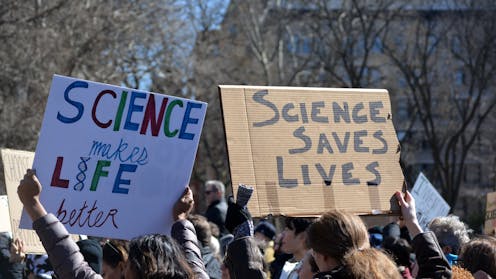
NEW YORK CITY, USA – March 7, 2025: Stand up for Science rally against DOGE cuts to scientific research in Washington Square Park in Manhattan.
Christopher Penler/Shutterstock

Vaccines are one of the greatest public health success stories of all time. Over the past 50 years, they’ve saved an estimated 154 million lives. But in the US, both access to vaccines and public trust in them are being systematically undermined – not by conspiracy theorists online, but from within the highest levels of government.

In January 2025, Robert F. Kennedy Jr – long associated with vaccine misinformation – was confirmed as US health secretary. Despite being pressed during his Senate confirmation hearings, Kennedy insisted he was not anti-vaccine and pledged to maintain scientific standards.

Seven months later, his actions tell a different story.

Kennedy has launched a sweeping assault on the US vaccine infrastructure: gutting oversight committees, sowing doubt about settled science, politicising ingredient safety, limiting access to vaccines and halting funding for research. His strategy doesn’t involve outright bans. But the cumulative effect may prove just as damaging.

In the US, the Advisory Committee on Immunization Practices (ACIP) plays a central role in vaccine policy, offering evidence-based recommendations on schedules. Until recently, its members were respected experts in immunology, epidemiology and infectious disease – all vetted, conflict-checked and publicly accountable.

In May 2025, Kennedy overrode ACIP’s recommendation on COVID-19 vaccination for pregnant women and young children. The following month, he disbanded the 17-member committee, citing alleged conflicts of interest. In their place, Kennedy appointed a smaller panel that included people with well-documented anti-vaccine views.

This broke decades of precedent. For the first time, ACIP’s membership was handpicked by the health secretary without standard vetting, training or safeguards to ensure independence.

In July, the ousted ACIP members published a commentary in the New England Journal of Medicine, warning the recommendation process was facing “seismic disruption”. In August, Kennedy banned respected scientific societies from advising ACIP, claiming they were too biased. This removed yet another check on the panel’s independence.

Meanwhile, Kennedy has reopened long-closed debates. He has called for “reassessment” of the childhood vaccine schedule, standard vaccine ingredients, and reportedly even the thoroughly debunked claim that the MMR vaccine is linked to autism. The latter has been refuted by multiple peer-reviewed studies, including a meta-analysis involving over 1.2 million children.

At ACIP’s first meeting under new leadership, Kennedy’s panel reviewed thimerosal, a mercury-based preservative used in some flu vaccines. CDC scientists were scheduled to present their evidence but were dropped from the agenda. Instead, the only evidence came from Lyn Redwood, a vaccine critic and co-founder of the World Mercury Project, an initiative that preceded Kennedy’s own Children’s Health Defense group.

Her presentation appeared to include at least one non-existent study, yet ACIP went on to ban thimerosal from flu shots – a decision Kennedy later extended to all US vaccines.

Though thimerosal was already used in very few vaccines, the way it was removed – based on flawed evidence and limited expert input – sets a dangerous precedent.

Kennedy has also criticised aluminium hydroxide, used in many vaccines to boost the immune response. His review article contradicts a large body of peer-reviewed evidence that supports its safety. Aluminium salts are found in vaccines against hepatitis A and B, meningococcal disease and tetanus.

Restricting access and innovation

The ripple effects of Kennedy’s changes go beyond oversight. In July, ACIP announced it would review recommendations for childhood vaccines, hepatitis B at birth, and the MMRV combination vaccine — a single shot that protects against measles, mumps, rubella, and varicella (chickenpox).

These guidelines help determine what vaccines are covered by public insurers like Medicaid. Weakening them could make vaccines unaffordable for low-income families.

Kennedy has also targeted the Vaccine Compensation Program, which provides payouts for rare adverse effects while protecting vaccine supply from litigation. He is considering expanding eligibility to include autism, despite consensus refuting any link, and may allow more lawsuits. These changes could deter pharmaceutical companies from offering vaccines in the US.

Kennedy has insisted that all new vaccines must undergo new placebo-controlled trials, ignoring the fact that new vaccines already follow this standard. Only modified versions of approved vaccines – like annual flu shots – are currently exempt, for ethical reasons.

If Kennedy bans widely used ingredients like aluminium salts, companies may be forced to reformulate vaccines – triggering unnecessary full clinical trials (the multi-phase process typically required for entirely new vaccines) and delaying access to boosters.

In May, vaccine manufacturer Moderna withdrew its application for a combined COVID-flu vaccine, citing regulatory difficulties. Days later, Kennedy’s department cancelled US$700 million (£550 million) in funding for a Moderna bird flu vaccine, followed by cuts to HIV vaccine research and mRNA platforms for cancer prevention.

Other countries may continue vaccine research, but the US’s retreat leaves a major gap.

Destabilising global trust

Perhaps most troubling is the messaging. Kennedy has repeatedly questioned the need for childhood vaccines, spread misinformation, inflated the risks and downplayed the threat of measles.

He has also attacked medical journals as corrupt and threatened to bar government scientists from publishing in respected outlets such as The Lancet and The New England Journal of Medicine — two of the world’s most prestigious peer-reviewed journals. Instead, he has proposed state-run alternatives. His own review on Aluminium Hydroxide was published in a non-peer-reviewed outlet.

In just a few months as health secretary, Kennedy has reshaped vaccine policy and public trust in the US. He has repeatedly claimed that the scientific and medical establishment is corrupt and that consensus cannot be trusted. This rhetoric is especially dangerous at a time when vaccine uptake is already low and falling.

But the consequences don’t stop at national borders. When coverage drops in one country, the risk of disease outbreaks increases globally, as seen in the recent measles outbreak in Canada.

Kennedy has shown both determination and ingenuity in undermining vaccine science, often through methods that are complex, obscure, or hard to explain publicly. Without issuing a single ban, he has weakened the foundations of vaccine availability and trust in the US.

In the 19th century, the average life expectancy in the US was around 40 years . Many children died of infections that are now preventable. In an age when the deadly realities of diseases like measles have faded from memory, it’s chilling to consider the possibility of returning to a pre-vaccine era.

The Conversation

Christina Pagel receives funding from University College London to explore and document vulnerabilities of UK Arms Length Bodies to political interference.

She also founded and runs TrumpActionTracker.info , a website documenting actions of the Trump administration that fall within authoritiarian domains.

Sheena Cruickshank does not work for, consult, own shares in or receive funding from any company or organisation that would benefit from this article, and has disclosed no relevant affiliations beyond their academic appointment.

– ref. How RFK Jr is systematically undermining vaccines around the world – https://theconversation.com/how-rfk-jr-is-systematically-undermining-vaccines-around-the-world-262854

My daily surveys suggest British earwigs are declining drastically

Source: The Conversation – UK – By John Murray, Senior Research Fellow, School of Environment, Earth and Ecosystem Sciences, The Open University

The common earwig. Henri Koskinen/Shutterstock

Every morning for the past 32 years, I have been counting earwigs. Here at Marshalls Heath, a small nature reserve in Hertfordshire, the only site where these nocturnal insects have been so systematically monitored for so long, the number of common earwigs has declined dramatically.

Using a light trap (equipment that entices nocturnal flying insects towards an artificial light and into a box until they can be counted and released in the morning), I found 282 earwigs in a single night in 1996. In 2024, only 31 adults were trapped in that entire year.

My new study, published in the Entomologist’s Record and Journal of Variation, indicates how this catastrophic decline appears to be due to very late frosts, with much higher numbers in the 1990s linked to runs of sunny, dry summers. I have had other anecdotal reports of declines in numbers in other parts of the UK, so this could be a more widespread phenomenon.

Most gardeners regard earwigs as a pest because they eat some leaves and flower petals. But their favourite foods also include woolly apple aphids, codling moth caterpillars and pear psyllid – these are all tiny insects that feed on apples and pears. In commercial orchards, earwigs are introduced to eat other insects and control apple and pear pests.

Like many insects, earwigs break down waste and decompose dead matter – this improves soil structure and helps create a healthy landscape. They also provide a source of food for some birds and small mammals.

A frosty decline

My research shows that the cause of the decline at Marshalls Heath is due to a number of factors. Years of exceptionally high numbers of earwigs were those when summer sunshine had been greatest and rainfall lowest in the two previous years, and when autumns had been cool and the springs dry – weather in the current year had no effect on numbers. But this does not explain their sudden drop in numbers in 2020.

Man crouched next to light trap with white hat holding red notebook
John Barrett Murray has used a light trap to catch, count and then release earwigs.
John Barrett Murray, CC BY-NC-ND

A key part of the puzzle is how adult female earwigs behave towards their young. Unusually for an insect, studies dating back to 1941 have shown that the mother defends and incubates her eggs and cares for her newly-hatched young in an underground nest.

As the young earwigs (called nymphs) grow, they may accompany their mother when she forages at night on the ground outside the nest, always returning back to the underground nest during daylight hours. But as soon as the nymphs moult for the first time, when they are about 5mm long, the mother abandons them to fend for themselves.


Read more:
Earwigs are the hero single mothers of the insect world – and good for your garden too


This is a critical stage in the young insect’s life, and my new study shows that the earlier the nymphs reach this free-roaming phase, the higher are their chances of survival. A delay of one month can be fatal, since they are vulnerable to disease, starvation and predation by birds and small mammals.

To reach this stage earlier, it appears that the fewer the late spring frosts, the better. In 2011, when nymphs moulted early, there were only eight ground frosts in April and May. In 2021, when adult numbers crashed, there were 32 late frosts, and according to the Met Office, it was the frostiest April since records began.

So what next? Trends over the past four years at Marshalls Heath show adult numbers of between 31 and 47 earwigs per year. In 2025 so far, I have only caught seven adults and nine nymphs.

So there is no sign of any revival in these numbers. However, the hot dry summer this year is just what might favour the survival of these insects in the years to come. If we have a cool autumn and a dry spring, followed by similar conditions next year, I’m hoping to record larger numbers in 2027.


Don’t have time to read about climate change as much as you’d like?

Get a weekly roundup in your inbox instead. Every Wednesday, The Conversation’s environment editor writes Imagine, a short email that goes a little deeper into just one climate issue. Join the 45,000+ readers who’ve subscribed so far.


The Conversation

John Murray volunteers as warden for the Marshalls Heath nature reserve.

– ref. My daily surveys suggest British earwigs are declining drastically – https://theconversation.com/my-daily-surveys-suggest-british-earwigs-are-declining-drastically-262558

Politicians are using social media to campaign – new research tells us what works and what doesn’t

Source: The Conversation – UK – By Emma Connolly, Research Fellow, Digital Speech Lab, UCL

Shutterstock.

By the time the next US election takes place in 2028, millennial and gen Z voters – who already watch over six hours of media content a day – will make up the majority of the electorate. As gen alpha (people born between 2010 and 2024) also comes of voting age, social media platforms such as TikTok and Instagram or their future equivalents can play a role in political success – if political actors can capitalise on it.

On these platforms, politics mixes with entertainment, creating fertile ground for memes and viral content that shape public opinion in real time – particularly in the US. But going viral isn’t simple, as my new research shows, and political actors have so far have struggled to make the most of it. If content doesn’t feel authentic, isn’t accompanied by clear messaging, or adapted to different platforms, then it’s unlikely to be successful.

Also, viral content spreads quickly, sometimes unpredictably, and across platforms that all behave differently. The algorithms behind viral spread are specific to each platform – and not transparent. This makes the impact of viral activity difficult to measure and hard to track. This presents a challenge to politicians and campaigns looking to capitalise on it.

My recently published research investigated this. I mapped and visualised the “Kamala IS brat” phenomenon as it moved across X, Instagram and TikTok in the run-up to the 2024 US election. The aim of the research was to investigate the anatomy of a viral movement: what made it spread on each platform, how long did it last, and who was driving it.

I found that viral political content that emerges on X spreads by a mix of strategic communication, and letting the audience do the rest. It often spreads to TikTok through catchy adaptations, and moves slightly slower on Instagram, but “explainer” content with images, for instance – often from a mix of everyday users and mainstream media outlets keeps – it visible.

Viral content moves between platforms, adapting to the environment of each as it is transformed into audio and visual forms. My research found that using audio was particularly powerful: turning quotes into soundbites and superimposing dance trends onto political backgrounds made for hugely shareable combinations, and the more surreal, the better.

Most people think that going viral is short-lived, but this study – and other research – has found that digital content has a “long tail”: it pops up, resurges and re-emerges, days, weeks, or even months later, offering new chances to reconnect with audiences.

This was particularly apparent on X, where content was re-used and re-contextualised in satirical and humorous ways. This wasn’t always positive. In the data I analysed, Republican supporters used the phrase “Kamala IS brat” to try and switch the narrative into something negative but it’s likely that this increased visibility as views are driven by influential public figures and shared by meme accounts.

Kamala Harris used social media in her 2024 campaign, but she didn’t win.

For politicians, this potential for re-emergence means that successful social media engagement is not just about strategic planning, it’s more about understanding how audiences remix and repost content in ways that can be hard to predict.

It’s not about rigidly tailoring content to each platform either, but about adapting to their styles. Effective digital strategists work with, not for, their audience, and make the most of moments that can’t always be planned in advance. Canada’s prime ministerial candidate, Mark Carney, for instance, embraced the hashtag #elbowsupCanada during his successful 2025 campaign.

The research also found that posting the right type of content is important – and short-form content works best. Social media platforms use a mix of recommender and social algorithms, that are politically intuitive. A high number of followers can still help to increase visibility, but getting the content right can extend viral reach, regardless of how many followers an account has.

Donald Trump regularly posts his decisions on Truth Social social media network.

TikTok’s algorithm in particular is set up for exploration, and Instagram’s Threads already pushes political content to users, not necessarily from accounts that they follow. Research suggests that users of any platform expect to see political content, whether they’re looking for it or not.

Given the potential for viral activity to reach a huge – and increasingly politically significant – audience, the challenge remains for political actors to turn social media engagement into electoral gain.

Many are trying, with varying levels of success. Harris’s digital-first strategy took an innovative approach – giving creative licence to a rapid response team of 25-year-olds. The digital campaign itself was considered a blueprint for PR success, but it ultimately failed to translate into votes. This was probably because it wasn’t accompanied by clear, concise messaging.

Other political hopefuls, such as Arizonan activist Deja Foxx and Democratic mayoral candidate Zohran Mamdani, are also capitalising on social media engagement. While Foxx recently lost in her bid to become the first gen Z woman to be elected to Congress, her approach, based on catchy content and influencer tactics, turned a long-shot candidacy into a very competitive campaign.

Mamdani has had more tangible success. His effective use of social media visuals, and multilingual engagement expanded his reach, and were credited with helping him win New York City’s Democratic mayoral primary in June.

So, if politicians can get it right, there is growing evidence that capitalising on going viral can influence political success.

Social media won’t win an election on its own, but looking ahead to 2028, it’s increasingly likely to be a part of a winning campaign. Young voters are far from a monolith, but what they do have in common is where they spend their time: on social media. TikTok remains the fastest-growing platform among this age group. Far from just providing entertainment, many use it to get their news, and engage in politics. Campaigns can’t afford to ignore it.

The Conversation

Emma Connolly does not work for, consult, own shares in or receive funding from any company or organisation that would benefit from this article, and has disclosed no relevant affiliations beyond their academic appointment.

– ref. Politicians are using social media to campaign – new research tells us what works and what doesn’t – https://theconversation.com/politicians-are-using-social-media-to-campaign-new-research-tells-us-what-works-and-what-doesnt-261509

Mexico’s tourism protests are a symptom of longstanding inequality in Latin American cities

Source: The Conversation – UK – By Nicolas Forsans, Professor of Management and Co-director of the Centre for Latin American & Caribbean Studies, University of Essex

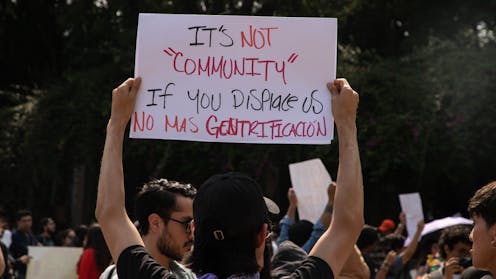
A protester holds a sign reading ‘it’s not community if you displace us’ during a demonstration against gentrification in Mexico City. Octavio Hoyos / Shutterstock

When thousands of residents took to the streets of Mexico City in July chanting “Gringo, go home”, news headlines were quick to blame digital nomads and expats. The story seemed simple: tech-savvy remote workers move in, rents go up and locals get priced out.

But that’s not the whole tale. While digital migration has undeniably accelerated housing pressures in Latin America, the forces driving resentment towards gentrification there run far deeper. The recent protests are symptoms of several structural issues that have long shaped inequality in the region’s cities.

Long before digital nomad visas became policy buzzwords after the pandemic, Latin America’s cities were changing at speed. In 1950, around 40% of the region’s population was urban. This figure had increased to 70% by 1990.

Nowadays, about 80% of people live in bustling cities, making Latin America the world’s most urbanised region. And by 2050, cities are expected to host 90% of the region’s population. Such rapid urbanisation has proved a magnet for international investors, tourists and, more recently, digital nomads.

In Latin America, gentrification has often involved large-scale redevelopment and high-rise construction, driven by state policies that prioritise economic growth and city branding over social inclusion.

Governments have re-branded entire working-class or marginalised areas as “innovation corridors” or “creative districts”, as in the La Boca neighbourhood of Buenos Aires, to attract investment. Neighbourhood re-branding has fostered resentment among locals and, in Buenos Aires, policies supporting self-managed social housing.

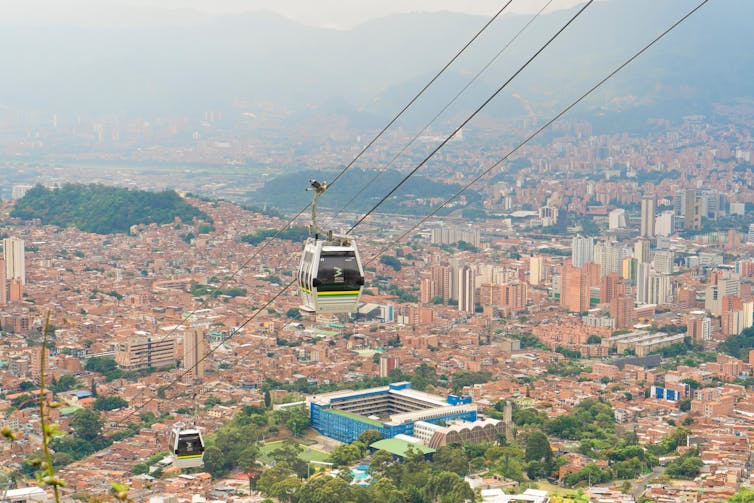
The introduction of integrated urban public transport systems has, while improving city access for marginalised communities, also triggered property speculation in once-isolated communities. In the Colombian city of Medellín, for instance, this has driven up prices and displaced long-time residents from hillside neighbourhoods like Comuna 13.

This is not an isolated case. A study from 2024 found that transport projects in Latin America are frequently leveraged by governments to attract private investment, effectively using mobility as a tool for urban restructuring rather than social equity.

A cable car above the city of Medellín.
The expansion of the public transportation system in Medellín has been associated with increased property values in once-isolated communities.
Alexander Canas Arango / Shutterstock

Researchers call the urban development seen in Latin America “touristification”. This is a form of extractivism where – just like raw materials are removed from the earth for export – urban heritage, culture and everyday life are “mined” for economic value.

In the Barranco district of the Peruvian capital, Lima, heritage is marketed for tourism. But while the district’s bohemian and artistic identity has become a distinctive tourism asset, Barranco now faces challenges that threaten its sociocultural diversity and authenticity. The price of land there increased by 22% between 2014 and 2017, compared with just 4% in San Insidro, which is considered the wealthiest district of metropolitan Lima.

In Chile, the designation of Valparaíso’s historic quarter as a Unesco world heritage site in 2003 led to an increase in heritage-led tourism. Persistent outward migration of long-term residents from the city centre has led to a severe decline in the residential function of the world heritage area – and with it, the loss of vibrant local life.

Symptoms of deeper issues

Protests against high rents and displacement in Latin America are often framed as direct responses to gentrification. However, academic research and policy analysis suggest these protests are symptoms of much deeper structural issues.

Latin America is one of the most unequal regions in the world. Limited access to things like quality education and formal employment means many urban residents are already vulnerable before gentrification pressures begin. More than half of the current generation’s inequality in Latin America is inherited from the past, with estimates ranging from 44% to 63% depending on the country and measure used.

Cities in the region also have long histories of spatial and social segregation, with marginalised groups concentrated in under-resourced neighbourhoods. Gentrification often exacerbates this by pushing these populations further to the periphery.

Cartagena, a port city with roots in colonial-era divisions, possibly exemplifies the greatest urban segregation in Colombia’s history. Spaniards and other Europeans lived in the fortified centre, while enslaved people were confined to poorer neighbourhoods like Getsemaní outside the walls.

Recently, urban planning decisions have been taken there that favour certain groups over others. Only the colonial legacy linked to Europeans has been protected. Getsemaní, once populated with slaves’ homes and workshops, is now home to luxury hotels, restaurants and housing.

The colourful streets of the Getsemaní neighbourhood of Cartagena.
The colourful streets of Getsemaní, a neighbourhood in Cartagena, Colombia.
Nowaczyk / Shutterstock

Finally, a large share of Latin America’s urban workforce is employed informally. Informality, where workers lack job security and social protections, is not just an unfortunate effect of economic development. It is an integral part of how global capitalism and urbanisation unfold in Latin America.

It reflects the failure of state and market systems to meet the needs of the majority. Rising rents and living costs driven by gentrification disproportionately hurt those who have few resources to absorb such shocks.

Protesters in Mexico aren’t just angry at an influx of remote workers sipping flat whites. They are responding to decades of urban inequality, neglect and exclusion. What is emerging is a continent-wide battle over who gets to live in, profit from and shape the future of Latin American cities.

The region’s urban future doesn’t have to mirror its past. But getting there means moving beyond simplistic narratives about foreign renters or digital workers, and tackling the structural issues that have long shaped inequality in Latin America’s cities.

The Conversation

Nicolas Forsans does not work for, consult, own shares in or receive funding from any company or organisation that would benefit from this article, and has disclosed no relevant affiliations beyond their academic appointment.

– ref. Mexico’s tourism protests are a symptom of longstanding inequality in Latin American cities – https://theconversation.com/mexicos-tourism-protests-are-a-symptom-of-longstanding-inequality-in-latin-american-cities-261634

L’épidémiologie sans les sciences humaines : un regard incomplet sur la santé

Source: The Conversation – in French – By Bernard-Simon Leclerc, Coordonnateur académique du doctorat professionnel en santé publique et enseignant en épidémiologie, Université de Montréal

L’épidémiologie doit évoluer, mais elle tarde à refléter les réalités actuelles de la santé publique. (Shutterstock)

À l’heure où les spécialistes de l’épidémiologie et de la biostatistique se réunissent à Montréal, du 11 au 13 août 2025, dans le cadre de la conférence biennale de la Société canadienne d’épidémiologie et de biostatistique, pour réfléchir collectivement à l’évolution de leurs disciplines et à leur rôle dans l’amélioration de la santé et du bien-être des populations, il semble plus que jamais nécessaire de réinterroger les orientations dominantes de ces sciences, souvent centrées sur des modèles biomédicaux et statistiques, au détriment des dynamiques sociales qui façonnent les déterminants de la santé.

L’épidémiologie joue un rôle clé en santé publique et en médecine. S’appuyant sur des chiffres et des calculs, elle aide à comprendre et à suivre l’évolution des maladies ainsi que d’autres événements sanitaires. Elle nourrit à cet égard une relation étroite avec les sciences médicales, ce qui bien entendu est nécessaire. On peut néanmoins déplorer qu’elle n’en nourrisse pas une aussi riche avec les humanités.

Contrairement à une idée répandue, l’épidémiologie ne se limite pas aux maladies. Elle s’intéresse aussi aux problèmes sociaux, envisagés comme des éléments à expliquer, ainsi qu’aux réalités sociales, perçues comme des facteurs influençant la santé. Une perspective plus large permettrait de mieux saisir les dimensions sociales et éthiques des questions de santé publique. Relier l’épidémiologie aux humanités offrirait une vision plus complète de ces enjeux.

En français, humanités correspond à ce que les milieux anglophones désignent par arts libéraux. Cela inclut la philosophie, l’histoire, la littérature et les beaux-arts. Ces disciplines, parfois appelées sciences de l’esprit, explorent les influences culturelles et intellectuelles. Cet article examine leur lien avec l’épidémiologie et leur contribution à une meilleure perception des défis en santé.

Épidémiologiste, enseignant universitaire et conseiller au Centre de recherche de l’Institut universitaire de gériatrie de Montréal, je déplore l’éloignement de cette discipline de son objectif premier : la santé humaine. L’épidémiologie doit évoluer, mais elle tarde à refléter les réalités actuelles de la santé publique. Même si l’on reconnaît la prépondérance des déterminants sociaux dans la santé et le bien-être des individus et des communautés, l’attention reste centrée sur les causes individuelles. Cela limite une vision globale et systémique des problématiques de santé.

L’approche biomédicale et l’approche sociale en épidémiologie

Souvent perçue comme une discipline médicale et statistique, l’épidémiologie mobilise aussi la pensée critique et l’analyse contextuelle, comme les sciences humaines. Deux approches principales se font concurrence.

Le modèle biomédical, centré sur les causes physiologiques et comportementales, s’attarde aux prédispositions génétiques et aux risques individuels. Il tend toutefois à négliger les conditions de vie et les disparités sociales.

À l’inverse, l’épidémiologie sociale voit la santé comme le résultat de déterminants collectifs. Elle intègre les facteurs économiques, le logement, l’éducation et les politiques publiques. Ces éléments influencent directement les trajectoires de vie et les inégalités de santé.

Bien que ces facteurs soient largement reconnus comme essentiels, l’épidémiologie peine encore à dépasser le cadre biomédical classique. Le sociologue français Patrick Peretti-Watel illustre cette limite. Il note que, statistiquement parlant, être afro-américain est parfois présenté comme un facteur de risque du suicide – ce qui, évidemment, n’a aucun sens en soi.

Une telle approche isole la variable ethnique sans tenir compte des désavantages systémiques. Elle conduit ainsi à des interprétations erronées. Ces corrélations chiffrées, souvent déconnectées des structures sociales, peuvent renforcer des préjugés et masquer les véritables inégalités.

Une personne en habit médical tient un crayon et regarde un graphique
Bien que les statistiques soient importantes, elles ne rendent pas compte du portrait d’ensemble.
(Shutterstock)

Cette tendance à privilégier les explications individuelles et biomédicales s’accompagne souvent d’un recours excessif aux méthodes quantitatives. Les épidémiologistes et les statisticiens collaborent étroitement. Mais cette proximité peut parfois créer une confusion disciplinaire et une obsession méthodologique. En se concentrant sur la rigueur statistique, l’épidémiologie risque de perdre de vue ses finalités concrètes. Certains chercheurs privilégient l’optimisation des modèles plutôt qu’une réflexion sur les besoins réels des populations.

L’épidémiologie comme discipline des humanités

En 1987, le médecin et épidémiologiste américain David W. Fraser a proposé de considérer l’épidémiologie comme un « art libéral ». Il soulignait son potentiel à dépasser la technicité des méthodes quantitatives et à s’ouvrir à des perspectives interdisciplinaires.

Cette idée, peu explorée, a ensuite été développée par trois auteurs : l’expert américain en politique de santé et en épidémiologie appliquée Robin D. Gorsky, le médecin et épidémiologiste américain engagé sur les questions éthiques en santé publique Douglas L. Weed et, plus récemment, l’épidémiologiste américain Michael B. Bracken, professeur émérite et ancien président de deux grandes sociétés savantes en épidémiologie, ayant plaidé pour une approche plus nuancée de la discipline.


Déjà des milliers d’abonnés à l’infolettre de La Conversation. Et vous ? Abonnez-vous gratuitement à notre infolettre pour mieux comprendre les grands enjeux contemporains.


Cette réflexion vise à mieux comprendre la complexité des phénomènes sanitaires. En plus des statistiques et des modèles, l’épidémiologie mobilise aussi la pensée critique et l’analyse contextuelle. Pourtant, certaines simplifications persistent.

Par exemple, comme le souligne encore Peretti-Watel, le non-usage du préservatif est souvent vu comme un choix individuel. Or, il peut être façonné par des contraintes sociales et économiques. Dans certains milieux défavorisés, des femmes subissent des pressions ou des violences qui les empêchent d’en exiger l’usage. Une lecture strictement biomédicale omet ces réalités. Elle risque de négliger l’impact des inégalités sociales sur la santé.

Pour une pédagogie de l’épidémiologie ancrée dans les humanités

Intégrer l’épidémiologie plus tôt dans les cursus collégiaux et universitaires aiderait les citoyens à mieux interpréter les informations médicales et scientifiques.

Aujourd’hui, la désinformation en santé prolifère. Elle est alimentée par certains influenceurs, des discours aux fondements non vérifiés et même des experts diffusant des données approximatives ou tendancieuses. Cette confusion nuit à la compréhension des maladies, de leurs causes et de leurs traitements.

Un jeune homme lève la main dans une classe
Revoir la place de l’épidémiologie à l’université et ses rapports avec les humanités est primordial.
(Shutterstock)

L’épidémiologie repose sur un raisonnement rigoureux, mais ses concepts de base restent accessibles aux non-spécialistes. Mieux enseignée, elle renforcerait la pensée critique. Elle aiderait à repérer les croyances populaires et les affirmations pseudoscientifiques fondées sur des principes contestés. Par exemple, les polémiques autour des vaccins et les prétendus « traitements miracles » comme l’homéopathie illustrent les dangers d’une méconnaissance scientifique.

Une intégration plus large de l’épidémiologie dans les programmes éducatifs encouragerait une vision plus éclairée de la santé publique. Elle permettrait d’analyser rationnellement les politiques sanitaires. Elle aiderait à comprendre les déterminants sociaux de la santé, au-delà des seules interprétations biomédicales.

Les humanités au service de l’épidémiologie

Pour relever les défis contemporains de la santé publique, l’épidémiologie doit élargir ses fondements. Elle gagne à être pensée comme une discipline intégrant les sciences humaines. Une approche plus interdisciplinaire permettrait de mieux comprendre les déterminants sociaux et structurels de la santé, au-delà des analyses biomédicales classiques. Les institutions académiques ont un rôle clé à jouer dans cette transformation. En intégrant les humanités à la formation en épidémiologie, elles encourageraient une approche plus globale et critique des questions de santé.

Cette démarche ouvrirait la voie à une santé publique mieux adaptée aux réalités sociales et politiques de nos sociétés. L’enseignement de l’épidémiologie, enrichi par la philosophie, l’histoire et la sociologie, favoriserait une prise de décision plus éclairée et équitable. En plaçant la réflexion critique au cœur de la santé publique, cette orientation contribuerait à une vision plus humaine et inclusive des soins et des politiques sanitaires.

L’épidémiologie ne se limite pas aux chiffres et aux modèles statistiques. Elle éclaire des enjeux qui touchent directement les populations. En repensant son enseignement et ses fondements, elle pourrait jouer un rôle encore plus essentiel dans l’amélioration de la santé mondiale.

Quelques initiatives

Dans cette perspective, l’enseignement de l’épidémiologie peut s’inspirer d’un mouvement amorcé dans plusieurs institutions occidentales.

L’Université de Montréal en est un exemple, en réfléchissant à la place des arts et des humanités dans la formation médicale. Plusieurs organisations crédibles soutiennent cette approche.

L’Organisation mondiale de la santé a publié une revue sur les effets positifs des arts sur la santé. L’Association of American Medical Colleges souligne leur rôle fondamental dans l’éducation médicale. À cet égard, l’Association canadienne des sciences humaines en santé encourage aussi la collaboration interdisciplinaire.

Ces recommandations confirment la valeur ajoutée des humanités dans le développement de compétences clés pour une pratique médicale plus humaine et efficace. Pour concrétiser cette vision, il faut repenser les programmes de formation.

Un programme d’épidémiologie intégré à une école de santé publique devrait refléter une véritable culture de santé publique. Celle-ci serait fondée sur un cadre interdisciplinaire et intersectoriel, une vision globale de la santé et une prise en compte des déterminants sociaux. Cela impliquerait aussi de rééquilibrer l’accent mis sur l’épidémiologie clinique et biomédicale, au profit d’une perspective davantage sociale et populationnelle.

La Conversation Canada

Bernard-Simon Leclerc ne travaille pas, ne conseille pas, ne possède pas de parts, ne reçoit pas de fonds d’une organisation qui pourrait tirer profit de cet article, et n’a déclaré aucune autre affiliation que son organisme de recherche.

– ref. L’épidémiologie sans les sciences humaines : un regard incomplet sur la santé – https://theconversation.com/lepidemiologie-sans-les-sciences-humaines-un-regard-incomplet-sur-la-sante-255692

Beyond recognition: the challenges of creating a new Palestinian state are so formidable, is it even possible?

Source: The Conversation – Global Perspectives – By Martin Kear, Sessional Lecturer, Department of Government and International Relations, University of Sydney

Australia will recognise a Palestinian state at the UN General Assembly meeting in September, joining the United Kingdom, Canada and France in taking the historic step.

Recognising a Palestinian state is at one level symbolic – it signals a growing global consensus behind the rights of Palestinians to have their own state. In the short term, it won’t impact the situation on the ground in Gaza.

Practically speaking, the formation of a future Palestinian state consisting of the West Bank, Gaza Strip and East Jerusalem is far more difficult to achieve.

The Israeli government has ruled out a two-state solution and reacted with fury to the moves by the four G20 members to recognise Palestine. Israeli Prime Minister Benjamin Netanyahu called the decision “shameful”.

So, what are the political issues that need to be resolved before a Palestinian state becomes a reality? And what is the point of recognition if it doesn’t overcome these seemingly intractable obstacles?

Settlements have exploded

The first problem is what to do about Israeli settlements in the West Bank and East Jerusalem, which the International Court of Justice has declared are illegal.

Since 1967, Israel has constructed these settlements with two goals in mind: prevent any future division of Jerusalem, and expropriate sufficient territory to make a Palestinian state impossible. There are now more than 500,000 settlers in the West Bank and 233,000 in East Jerusalem.

Palestinians see East Jerusalem as an indispensable part of any future state. They will never countenance a state without it as their capital.

In May, the Israeli government announced it would also build 22 new settlements in the West Bank and East Jerusalem – the largest settler expansion in decades. Defence Minister Israel Katz described this as a “strategic move that prevents the establishment of a Palestinian state that would endanger Israel”.

The Israeli government has also moved closer to fully annexing the West Bank in recent months.

Geographical complexities of a future state

Second is the issue of a future border between a Palestinian state and Israel.

The demarcations of the Gaza Strip, West Bank and East Jerusalem are not internationally recognised borders. Rather, they are the ceasefire lines, known as the “Green Line”, from the 1948 War that saw the creation of Israel.

However, in the Six-Day War of 1967, Israel captured and occupied the West Bank, Gaza, East Jerusalem, Egypt’s Sinai Peninsula (since returned), and Syria’s Golan Heights. And successive Israeli governments have used the construction of settlements in the occupied territories, alongside expansive infrastructure, to create new “facts on the ground”.

Israel solidifies its hold on this territory by designating it as “state land”, meaning it no longer recognises Palestinian ownership, further inhibiting the possibility of a future Palestinian state.

For example, according to research by Israeli professor Neve Gordon, Jerusalem’s municipal boundaries covered approximately seven square kilometres before 1967. Since then, Israeli settlement construction has expanded its eastern boundaries, so it now now covers about 70 square km.

Israel also uses its Separation Wall or Barrier, which runs for around 700km through the West Bank and East Jerusalem, to further expropriate Palestinian territory.

According to a 2013 book by researchers Ariella Azoulay and Adi Ophir, the wall is part of the Israeli government’s policy of cleansing Israeli space of any Palestinian presence. It breaks up contiguous Palestinian urban and rural spaces, cutting off some 150 Palestinian communities from their farmland and pastureland.

The barrier is reinforced by other methods of separation, such as checkpoints, earth mounds, roadblocks, trenches, road gates and barriers, and earth walls.


Read more:
Explainer: what is the two-state solution to the Israeli-Palestinian conflict?


Then there is the complex geography of Israel’s occupation in the West Bank.

Under the Oslo Accords of the 1990s, the West Bank was divided into three areas, labelled Area A, Area B and Area C.

In Area A, which consists of 18% of the West Bank, the Palestinian Authority exercises majority control. Area B is under joint Israeli-Palestinian authority. Area C, which comprises 60% of the West Bank, is under full Israeli control.

Administrative control was meant to be gradually transferred to Palestinian control under the Oslo Accords, but this never happened.

Areas A and B are today separated into many small divisions that remain isolated from one another due to Israeli control over Area C. This deliberate ghettoisation creates separate rules, laws and norms in the West Bank that are intended to prevent freedom of movement between the Palestinian zones and inhibit the realisation of a Palestinian state.

Who will govern a future state?

Finally, there are the conditions that Western governments have placed on recognition of a Palestinian state, which rob Palestinians of their agency.

Chief among these is the stipulation that Hamas will not play a role in the governance of a future Palestinian state. This has been backed by the Arab League, which has also called for Hamas to disarm and relinquish power in Gaza.

Fatah and Hamas are currently the only two movements in Palestinian politics capable of forming a government. In a May poll, 32% of respondents in both Gaza and the West Bank said they preferred Hamas, compared with 21% support for Fatah. One-third did not support either or had no opinion.

Mahmoud Abbas, leader of the Palestinian Authority, is deeply unpopular, with 80% of Palestinians wanting him to resign.


Read more:
The politics of recognition: Australia and the question of Palestinian statehood


A “reformed” Palestinian Authority is the West’s preferred option to govern a future Palestinian state. But if Western powers deny Palestinians the opportunity to elect a government of their choosing by dictating who can participate, the new government would likely be seen as illegitimate.

This risks repeating the mistakes of Western attempts to install governments of their choosing in Iraq and Afghanistan. It also plays into the hands of Hamas hardliners, who mistrust democracy and see it as a tool to impose puppet governments in Palestine, as well as Israel’s narrative that Palestinians are incapable of governing themselves.

Redressing these issues and the myriad others will take time, money and considerable effort. The question is, how much political capital are the leaders of France, the UK, Canada and Australia (and others) willing to expend to ensure their recognition of Palestine results in an actual state?

What if Israel refuses to dismantle its settlements and Separation Wall, and moves ahead with annexing the West Bank? What are these Western leaders willing or able to do? In the past, they have been unwilling to do more than issue strongly worded statements in the face of Israeli refusals to advance the two-state solution.

Given these doubts around the political will and actual power of Western states to compel Israel to agree to the two-state solution, it begs the question: what and who is recognition for?

The Conversation

Martin Kear does not work for, consult, own shares in or receive funding from any company or organisation that would benefit from this article, and has disclosed no relevant affiliations beyond their academic appointment.

– ref. Beyond recognition: the challenges of creating a new Palestinian state are so formidable, is it even possible? – https://theconversation.com/beyond-recognition-the-challenges-of-creating-a-new-palestinian-state-are-so-formidable-is-it-even-possible-262493

El genocidio olvidado de Namibia: cómo los alemanes cazaron y asesinaron a los bosquimanos

Source: The Conversation – (in Spanish) – By Robert J. Gordon, Emeritus Professor, University of Vermont and Research Associate, University of the Free State

El genocidio de los pueblos ovaherero y nama de Namibia a manos de las fuerzas coloniales alemanas (1904-1907) está ampliamente documentado. Pero se habla mucho menos de lo que vino después: el genocidio de los bosquimanos del país, también conocidos como los san.

En 1992, el antropólogo Robert J. Gordon publicó un libro hablando del mito de los bosquimanos y la creación de una clase marginada en Namibia, recientemente reeditado.


La cuenca del Kalahari, en el sur de África, es una de las zonas etnográficas (áreas con culturas distintas) más ricas del mundo. La región alberga algunas de las lenguas más antiguas que aún existen y la diversidad genética que se encuentra en la zona indica que es el hogar de una de las poblaciones ancestrales originales del mundo.

La palabra “bosquimano” se utiliza como término genérico que engloba a más de 200 grupos étnicos. No existe un bosquimano típico, sino que constituyen una miscelánea de grupos fluidos. Muchas comunidades locales prefieren el término bosquimano en lugar de la categorización oficial de “san” y “marginales”. De hecho, el término “san”, proveniente de la lengua khoekhoegowab, significa lo mismo que bosquimano.

En general, se trata de personas sociables con una fuerte tendencia a compartir. Antes de la colonización, los bosquimanos vivían como cazadores-recolectores, vagando por el paisaje. Tenían un concepto diferente de la propiedad, no deseaban ni dinero ni ganado; eran incontrolables y, por ello, se les trataba como animales y se les sometía a la aniquilación.

Pánico a la ‘plaga de bosquimanos’

La actual Namibia fue una colonia alemana desde 1884 llamada África del Sudoeste alemana. Como resultado de la genocida guerra herero-nama de 1904-1907, Alemania consiguió fomentar la colonización.

El arco noreste del territorio, que se extiende desde Otavi hasta Gobabis, con Grootfontein como epicentro, sirvió de imán para los colonos: con una línea ferroviaria recién terminada, minas, un vasto potencial agrícola y tierras accesibles. Solo en Grootfontein, el número de granjas de colonos aumentó de 15 en 1903 a 175 en 1913. Casi todas estas ganaderías se encontraban en tierras ocupadas por los bosquimanos.

Los colonos pronto se vieron en apuros. En 1911, los titulares de la prensa namibia hablaban de una “plaga de los bosquimanos”. Dos elementos alimentaron el pánico. En primer lugar, el asesinato de un policía y varios granjeros blancos. En segundo lugar, se suponía que las actividades de los bosquimanos estaban obstaculizando el flujo de trabajadores migrantes contratados, muy necesarios, procedentes de las regiones de Owambo y Kavango para trabajar en los yacimientos de diamantes recién descubiertos de Luderitzbucht. La Cámara de Minas quería “sanear” la zona.

En consecuencia, el gobernador alemán ordenó que se disparara a los bosquimanos [si se creía que intentaban resistirse al arresto por parte de funcionarios o colonos]. Entre 1911 y 1913 se desplegaron más de 400 patrullas antibosquimanas que cubrían unos 60 000 km².

Pero los colonos y las autoridades consideraron que estas medidas eran insuficientes y continuaron aterrorizando a los bosquimanos sin recibir ni una simple reprimenda. Las “cacerías de bosquimanos” continuaron hasta la toma del territorio por Sudáfrica en 1915, cuando el país pasó a llamarse África del Sudoeste.

No sabemos cuántos bosquimanos murieron, pero, como explico en mi libro, las estimaciones oficiales sitúan el número de bosquimanos en 1913 entre 8 000 y 12 000. En 1923 eran 3 600. Esto da una idea de la magnitud de las matanzas.

Lo que alimentó el genocidio fue el espíritu colonizador. El ethos dominante era el de un asedio, de sentirse amenazados por fuerzas externas impredecibles. Los granjeros, atraídos por las generosas ayudas y subvenciones del Gobierno, eran en su mayoría soldados licenciados, mal entrenados en la agricultura, carentes de conocimientos locales esenciales y educados en la arrogancia racista. La situación generó inseguridad, miedo e hipermasculinidad.

Los bosquimanos, con su reputada habilidad para camuflarse y rastrear y cazar con flechas envenenadas para las que no se conocía antídoto, personificaban su peor pesadilla mientras intentaban establecer su dominio en sus granjas aisladas. Considerados una especie de presas depredadoras, los bosquimanos debían ser exterminados como grupo: es decir, un genocidio.

Lo que sucedió después del genocidio

La represión continuó bajo el régimen sudafricano desde 1915 hasta la independencia en 1990, aunque de forma menos extrema. Se ilegalizó la posesión de arcos y flechas bosquimanos. Los bosquimanos fueron despojados progresivamente de su territorio para dar paso a reservas de caza y granjas de colonos.

Aún en la década de 1970 la administración seguía pensando en reubicar a 30 000 bosquimanos en la denominada Bushmanland, creada artificialmente, que constituía el 2 % del territorio que habían ocupado anteriormente.

La gran mayoría permaneció en sus zonas tradicionales, ahora bajo el dominio de los granjeros colonos, donde se hundieron en una situación de servidumbre. Con la independencia de Namibia, la situación empeoró. Las nuevas leyes laborales establecieron un salario mínimo, lo que hizo que no fuera rentable mantener a los trabajadores bosquimanos. Muchos granjeros se dedicaron a la caza mayor o vendieron sus tierras a granjeros negros que preferían contratar a sus parientes.

El resultado fue que los bosquimanos se vieron obligados a trasladarse a zonas comunales o a asentamientos informales en los alrededores de las ciudades, donde malviven en condiciones precarias.

¿Dónde se encuentra esta población hoy en día?

Actualmente, los bosquimanos se encuentran en diferentes situaciones de servidumbre, realizando en su mayoría trabajos de baja cualificación en las regiones del norte y el noreste, donde antaño eran los habitantes ancestrales. El Gobierno está tratando de ayudarlos, principalmente con subsidios sociales y unas pocas granjas de reasentamiento superpobladas.

Si buscamos “bosquimanos namibios” en internet, aparecen innumerables imágenes idealizadas de bosquimanos con trajes tradicionales cazando y rastreando. Estas narrativas, en gran parte fruto de la promoción turística, refuerzan el mito de los bosquimanos “puros”. La historia del genocidio y la servidumbre queda totalmente borrada.

The Conversation

Robert J. Gordon no recibe salario, ni ejerce labores de consultoría, ni posee acciones, ni recibe financiación de ninguna compañía u organización que pueda obtener beneficio de este artículo, y ha declarado carecer de vínculos relevantes más allá del cargo académico citado.

– ref. El genocidio olvidado de Namibia: cómo los alemanes cazaron y asesinaron a los bosquimanos – https://theconversation.com/el-genocidio-olvidado-de-namibia-como-los-alemanes-cazaron-y-asesinaron-a-los-bosquimanos-262898

Wikipedia’s ‘neutrality’ has always been complicated. New rules will make questioning it harder

Source: The Conversation – Global Perspectives – By Heather Ford, Professor, Communications, University of Technology Sydney

Franckreporter / Getty Images

Last month, the American non-profit organisation behind Wikipedia issued draft guidelines for researchers studying how neutral Wikipedia really is. But instead of supporting open inquiry, the guidelines reveal just how unaware the Wikimedia Foundation is of its own influence.

These new rules tell researchers – some based in universities, some at non-profit organisations or elsewhere – not just how to study Wikipedia’s neutrality, but what they should study and how to interpret their results. That’s a worrying move.

As someone who has researched Wikipedia for more than 15 years – and served on the Wikimedia Foundation’s own Advisory Board before that – I’m concerned these guidelines could discourage truly independent research into one of the world’s most powerful repositories of knowledge.

Telling researchers what to do

The new guidelines come at a time when Wikipedia is under pressure.

Tech billionaire Elon Musk, who was until recently also a senior adviser to US President Donald Trump, has repeatedly accused Wikipedia of being biased against American conservatives. On X (formerly Twitter), he told users to “stop donating to Wokepedia”.

In another case, a conservative think tank in the United States was caught planning to “target” Wikipedia volunteers it claimed were pushing antisemitic content.

Until now, the Wikimedia Foundation has mostly avoided interfering in how people research or write about the platform. It has limited its guidance to issues such as privacy and ethics, and has stayed out of the editorial decisions made by Wikipedia’s global community of volunteers.

But that’s changing.

In March this year, the foundation established a working group to standardise Wikipedia’s famous “neutral point of view” policies across all 342 versions in different languages. And now the foundation has chosen to involve itself directly in research.

Its “guidance” directly instructs researchers on both how to carry out neutrality research and how to interpret it. It also defines what it believes are open and closed research questions for people studying Wikipedia.

In universities, researchers are already guided by rules set by their institutions and fields. So why do the new guidelines matter?

Because the Wikimedia Foundation has lots of control over research on Wikipedia. It decides who it will work with, who gets funding, whose work to promote, and who gets access to internal data. That means it can quietly influence which research gets done – and which doesn’t.

Now the foundation is setting the terms for how neutrality should be studied.

What’s not neutral about the new guidelines

The guidelines fall short in at least three ways.

1. They assume Wikipedia’s definition of neutrality is the only valid one. The rules of English Wikipedia say neutrality can be achieved when an article fairly and proportionally represents all significant viewpoints published by reliable sources.

But researchers such as Nathaniel Tkacz have shown this idea isn’t perfect or universal. There are always different ways to represent a topic. What constitutes a “reliable source”, for example, is often up for debate. So too is what constitutes consensus in those sources.

2. They treat ongoing debates about neutrality as settled. The guidelines say some factors – such as which language Wikipedia is written in, or the type of article – are the main things shaping neutrality. They even claim Wikipedia gets more neutral over time.

But this view of steady improvement doesn’t hold up. Articles can become less neutral, especially when they become the focus of political fights or coordinated attacks. For example, the Gamergate controversy and nationalist editing have both created serious problems with neutrality.

The guidelines also leave out important factors such as politics, culture, and state influence.

3. They restrict where researchers should direct their research. The guidelines say researchers must share results with the Wikipedia community and “communicate in ways that strengthen Wikipedia”. Any criticism should come with suggestions for improvement.

That’s a narrow view of what research should be. In our wikihistories project, for example, we focus on educating the public about bias in the Australian context. We support editors who want to improve the site, but we believe researchers should be free to share their findings with the public, even if they are uncomfortable.

Neutrality is in the spotlight

Most of Wikipedia’s critics aren’t pushing for better neutrality. They just don’t like what Wikipedia says.

The reason Wikipedia has become a target is because it is so powerful. Its content shapes search engines, AI chatbot answers, and educational materials.

The Wikimedia Foundation may see independent and critical research as a threat. But in fact, this research is an important part of keeping Wikipedia honest and effective.

Critical research can show where Wikipedians strive to be neutral but don’t quite succeed. It doesn’t require de-funding Wikipedia or hunting down its editors. It doesn’t mean there aren’t better and worse ways of representing reality.

Nor does it mean we should discard objectivity or neutrality as ideals. Instead, it means understanding that neutrality isn’t automatic or perfect.

Neutrality is something to be worked towards. That work should involve more transparency and self-awareness, not less – and it must leave space for independent voices.

The Conversation

Heather Ford receives funding from the Australian Research Council. She was previously a member of the Wikimedia Foundation Advisory Board.

– ref. Wikipedia’s ‘neutrality’ has always been complicated. New rules will make questioning it harder – https://theconversation.com/wikipedias-neutrality-has-always-been-complicated-new-rules-will-make-questioning-it-harder-262706