Sean Feucht au Québec : la décision d’annuler ses concerts renforce la mobilisation qu’on souhaite freiner

Source: The Conversation – in French – By Frédéric Dejean, Professeur en sciences des religions, Université du Québec à Montréal (UQAM)

Le chanteur évangélique et pro-Trump Sean Feucht a fait irruption dans l’actualité québécoise cet été. Un concert annulé, une amende, et une polémique : l’affaire relance le débat sur la liberté religieuse.

Sean Feucht, chanteur évangélique américain et fervent soutien de Donald Trump, est aussi connu pour ses prises de position controversées contre la communauté LGBTQ+ et le droit à l’avortement, souvent exprimées sur ses réseaux sociaux. Jusqu’à récemment inconnu du grand public québécois, il a gagné en notoriété cet été après l’annulation de dernière minute de son concert prévu à Québec le 25 juillet, dans la foulée de la controverse.

La Ville de Montréal a emboîté le pas en interdisant à son tour la tenue d’un spectacle allant « à l’encontre des valeurs d’inclusion, de solidarité et de respect prônées à Montréal », a dit la porte-parole de l’administration de Valérie Plante.

Qu’à ce la ne tienne, une église évangélique de Montréal a quand même organisé un événement avec Feucht, déclenchant une manifestation réunissant partisans et opposants. Feucht a largement relayé ces controverses sur ses réseaux sociaux, dénonçant une atteinte à la liberté religieuse. L’église s’est quand à elle vue infliger une amende de 2500 $ par la Ville de Montréal, car elle ne détenait pas de permis pour organiser un tel événement.

Cochercheur au sein de la Chaire de recherche France-Québec sur les enjeux contemporains de la liberté d’expression, je poursuis actuellement une enquête sur le prosélytisme évangélique dans les transports en commun et l’espace public montréalais. J’ai développé dans ce cadre la notion d’« effet Sainte Blandine », en référence à cette esclave chrétienne de la ville de Lyon (Lugdunum à l’époque), qui a été martyrisée en juillet 177 et qui, dans la tradition catholique, constitue un symbole de résistance face aux persécutions.

L’historiographie du christianisme primitif a montré que les persécutions n’ont pas du tout eu pour effet de freiner la diffusion du christianisme. Au contraire, les martyrs sont devenus des modèles vénérés capables de susciter la ferveur religieuse.

L’« effet Sainte Blandine » : la foi renforcée dans l’adversité

Par l’expression d’« effet Sainte Blandine » je désigne des situations où la marginalisation sociale des personnes croyantes renforce leurs convictions et affermit en elles la certitude de la justesse de leur cause.

Prenons un exemple : lors d’une séquence d’observation d’une personne qui évangélisait à une station de métro de Montréal, j’ai eu l’occasion d’entendre des propos assez virulents de la part d’usagers qui interrompaient le prêche par des propos injurieux. Discutant avec elle de ces moments de tension, je lui ai demandé si de telles réactions pouvaient la conduire à cesser d’évangéliser. Elle m’a simplement répondu que ceux qui réagissaient de la sorte étaient « conduits par le diable » et qu’il était donc d’autant plus nécessaire de continuer.

Ce petit exemple fait écho à l’ouvrage classique en psychologie sociale L’échec d’une prophétie, ouvrage dans lequel Leon Festinger montrait comment l’individu surmonte la situation d’échec par un travail de rationalisation.

C’est bien le même « effet Sainte Blandine » à l’œuvre lors de la controverse autour de Sean Feucht qui affirmait sur son compte Instagram en date du 23 juillet :

Je n’ai pas ressenti un tel niveau de résistance depuis un bon moment, pas depuis 2020. […] C’est toujours le même stratagème du diable. Il veut que le peuple de Dieu se taise, reste chez lui, remette son masque et garde le silence.


À lire aussi :
Des Églises « technos » qui s’adaptent en temps de pandémie


La pandémie comme catalyseur de notoriété et de discours

La référence à la pandémie de Covid-19 n’est pas fortuite. C’est en effet à cette occasion que Sean Feucht a vu croître sa notoriété, plus précisément quand il a initié le mouvement « #LetUsWorship » qui se voulait une réponse aux restrictions sur les rassemblements pour des raisons sanitaires. Il a déployé alors une rhétorique victimaire assez classique, mais très efficace : la liberté religieuse aurait été injustement confisquée par des responsables politiques qui instrumentaliseraient l’urgence sanitaire à des fins idéologiques.

Les événements de cet été ont donné lieu à une exploitation assez similaire de la part de Feucht puisque dans une vidéo sur Instagram en date du 25 juillet, il évoquait également la liberté religieuse bafouée par les élus du Québec : « Mais cette liberté est en ce moment même menacée au Canada », écrivait-il aussi.

Loin de se résigner, il invitait les chrétiens à se mobiliser (« We need to take a stand in this nation ») de trois façons : par la prière, par la signature d’une pétition et par la participation au concert de Montréal. Cet appel a été relayé et amplifié par des responsables chrétiens québécois.

Ainsi, Emmanuel Ouellet, un jeune pasteur montréalais qui s’est fait connaître l’an dernier par l’organisation de l’évènement « Revival Montreal », a publié sur Instagram une vidéo dans laquelle il affirmait :

la guerre est ouverte, il n’y a plus aucun doute, il est temps pour les chrétiens de sortir la tête du sable […] J’invite tous les chrétiens à se joindre à nous afin d’invoquer la puissance du Saint Esprit afin que Dieu se révèle à nos élus.

Un récit de persécution chrétienne au Québec

Pour bien comprendre le sens donné à cet événement par un certain nombre de chrétiens évangéliques, il est indispensable de le replacer dans un récit plus large qui se développe au Québec, au moins depuis la pandémie, selon lequel la liberté religieuse, en particulier celle des personnes chrétiennes, serait systématiquement attaquée. Par exemple, les Églises montréalaises Good News Chapel ou Nouvelles Création avaient résisté aux mesures sanitaires liées à la Covid-19.

Plus récemment, cette perception d’hostilité s’est exprimée dans l’émission Le Panel proposée par la chaîne chrétienne Théovox, où l’animateur dénonçait « une culture d’annulation ou antichrétienne » et des gestes perçus comme des tentatives d’effacement de la foi dans l’espace public. Il évoquait notamment deux cas : la résiliation, fin 2024, d’un contrat de location entre la Commission scolaire de Montréal et l’Église évangélique La Chapelle, qui y tenait des cultes, ou encore l’annulation au printemps 2023 d’un événement anti-avortement, jugé incompatible avec les valeurs d’égalité par le gouvernement.


Déjà des milliers d’abonnés à l’infolettre de La Conversation. Et vous ? Abonnez-vous gratuitement à notre infolettre pour mieux comprendre les grands enjeux contemporains.


Pour ces raisons « l’Église » (terme utilisé dans le monde évangélique pour désigner les personnes chrétiennes) doit sortir de sa réserve et faire entendre sa voix dans le débat public.

Analysée à travers la lunette de l’« effet Sainte Blandine », la controverse entourant la venue de Sean Feucht montre comment certaines décisions politiques peuvent, paradoxalement, renforcer la mobilisation qu’elles cherchent à freiner.

Alors qu’il s’agissait de dénoncer des valeurs négatives portées par Feucht, ce dernier a non seulement adroitement réactivé une rhétorique ayant fait ses preuves en endossant le rôle de victime, mais a en plus fourni des éléments qui alimentent le récit d’un Québec en guerre contre le christianisme.

La Conversation Canada

Frédéric Dejean a reçu des financements du FRQSC

– ref. Sean Feucht au Québec : la décision d’annuler ses concerts renforce la mobilisation qu’on souhaite freiner – https://theconversation.com/sean-feucht-au-quebec-la-decision-dannuler-ses-concerts-renforce-la-mobilisation-quon-souhaite-freiner-263389

Purificateurs d’air : la plupart des tests sont insuffisants pour évaluer leur efficacité ou leur  innocuité

Source: The Conversation – in French – By Amiran Baduashvili, Associate Professor of Medicine, University of Colorado Anschutz Medical Campus

Certains purificateurs d’air portables génèrent des substances chimiques telles qu’ozone, formaldéhyde ou radicaux hydroxyles pour tuer les microbes. ArtistGNDphotography/E+/Getty Images

En matière de protection contre les infections, la capacité réelle des purificateurs d’air portatifs est rarement évaluée correctement. En outre, seul un très petit nombre d’études ont évalué les effets potentiellement délétères qui pourraient découler de la production par ces dispositifs de divers composés toxiques. C’est la conclusion d’une revue détaillée de la littérature scientifique, menée sur près de 700 études, dont les auteurs nous présentent ici les conclusions.


De nombreux virus respiratoires, comme le coronavirus SARS-CoV-2 responsable de la pandémie de Covid-19 ou comme le virus de la grippe, peuvent se propager via l’air intérieur. Différentes technologies dites « d’ingénierie de contrôle des infections » visent à prévenir la diffusion de virus et d’autres agents pathogènes en assainissant l’air intérieur, par exemple grâce à des filtres HEPA (de l’anglais, High Efficiency Particulate Air), à l’emploi de lumière ultraviolette ou à la mise en place de types spécifiques de ventilation.

Avec nos collègues, qui travaillent au sein de trois établissements universitaires et de deux agences scientifiques gouvernementales, nous avons recensé et analysé toutes les études visant à évaluer l’efficacité de telles technologies publiées entre 1920 et 2023, ce qui représente 672 articles scientifiques.

Pour mesurer les performances des dispositifs testés en matière d’assainissement de l’air, trois approches principales se détachent :

  • leur capacité à diminuer les infections chez l’être humain ;

  • leur capacité à protéger des animaux de laboratoire, tels que des cobayes ou des souris ;

  • leur capacité à réduire le nombre de particules fines ou de micro-organismes en suspension.

Sur l’ensemble de ces travaux, environ 8 % des études seulement ont employé la première approche (tests de l’efficacité chez l’être humain), tandis que plus de 90 % des auteurs se sont contentés d’évaluer les dispositifs d’assainissement dans des lieux inoccupés.

Ainsi, sur les 44 études visant à mesurer de l’efficacité de l’oxydation photocatalytique (un procédé de purification de l’air qui produit des substances chimiques capables de tuer les microbes), une seule a examiné la capacité de cette technologie à réellement prévenir les infections chez l’être humain. D’autres études (35 au total) ont évalué des technologies basées sur l’emploi de plasmas pour détruire les microbes, mais aucune d’entre elles n’a inclus de participant humain.

Enfin, sur les 43 études consacrées à des filtres intégrant des nanomatériaux conçus pour, à la fois, capturer et détruire les microbes que nous avons identifiées, aucune n’a fait l’objet de tests chez l’être humain.

Pourquoi c’est important

La pandémie de Covid-19, qui a coûté des millions de vies à l’échelle mondiale, mis à rude épreuve les systèmes de santé et entraîné la fermeture d’innombrables écoles et lieux de travail, nous a rappelé à quel point les conséquences des infections transmissibles par les airs peuvent être lourdes. À l’époque, dès lors que les premières études ont établi la que le coronavirus SARS-CoV-2 se propageait de façon aérienne, l’amélioration de la qualité de l’air intérieur est devenue un axe majeur dans la lutte contre la pandémie.

L’enjeu reste d’actualité : parvenir à mettre au point des technologies efficaces pour éliminer les micro-organismes de l’air intérieur pourrait non seulement avoir des retombées considérables en matière de santé publique, mais aussi contribuer à limiter les dommages économiques que pourraient engendrer de futures pandémies. Et ce, sans que les personnes protégées n’aient à faire d’effort particulier, puisque de telles mesures d’ingénierie de contrôle des infections opéreraient en arrière-plan des activités de leur vie quotidienne, sans qu’elles en aient conscience.

Jeune fille lisant en salle de classe
Installer des systèmes d’épuration de l’air efficaces dans les écoles, dans les établissements de santé et dans les autres espaces publics pourrait protéger la population des infections.
Bruce Ayres/Stockbyte/Getty Images

Les fabricants de purificateurs d’air portatifs intégrant des technologies supposées détruire les micro-organismes l’ont bien compris. Ils n’hésitent pas à formuler des affirmations ambitieuses quant à la capacité des produits qu’ils commercialisent à purifier l’air et à prévenir les infections, qu’ils soient destinés au grand public ou à être utilisés dans les crèches, dans les écoles, dans les cliniques ou sur les lieux de travail.

Pourtant, nous avons constaté que la plupart de ces appareils n’avaient pas été correctement testés quant à leur efficacité. Faute de résultats scientifiques solides issus d’études menées chez l’être humain, il est donc impossible de savoir si ces promesses commerciales correspondent à la réalité.

Nos résultats suggèrent que les consommateurs devraient faire preuve de prudence avant d’investir dans de tels dispositifs d’épuration de l’air (en France, dans son rapport d’expertise « Identification et analyse des différentes techniques d’épuration d’air intérieur émergentes », publié en 2017, l’Agence nationale de sécurité sanitaire de l’alimentation, de l’environnement et du travail constate que « les technologies implémentées étaient souvent mal décrites sur les dispositifs d’épuration et que l’efficacité revendiquée était peu justifiée », ndlr).

L’écart entre les promesses commerciales et les preuves réelles d’efficacité n’a rien d’étonnant, mais l’enjeu s’étend au-delà des seules déclarations marketing. En effet, pour détruire les microbes, certaines de ces technologies de purification d’air génèrent des substances chimiques telles qu’ozone, formaldéhyde (classé comme cancérigène et mutagène, ndlr) ou radicaux hydroxyles. Autant de composés qui peuvent potentiellement nuire à la santé lorsqu’ils sont inhalés.

De ce fait, être certain de l’innocuité de ces dispositifs devrait constituer un prérequis à tout déploiement à grande échelle. Or, sur les 112 études destinées à évaluer certaines des technologies microbicides actuellement commercialisées que nous avons analysées, seules 14 se sont attelées à rechercher la présence de sous-produits nocifs dans l’air traité par les dispositifs testés.

Le contraste est saisissant avec les standards de sécurité auxquels est soumise la recherche pharmaceutique.

Ce que l’on ignore encore

Plus de 90 % des études que nous avons recensées ont évalué les technologies de purification d’air en s’intéressant à l’air lui-même – par exemple, en analysant dans quelle mesure elles étaient capables d’éliminer les particules de poussière, les microbes ou certains gaz.

L’hypothèse de travail justifiant cette approche est que respirer un air plus pur devrait se traduire par un moindre risque d’infection. Pourtant, on ne sait pas si ces mesures atmosphériques se traduisent réellement par une réduction effective des infections chez les personnes qui évoluent dans des environnements ainsi traités ni, si une telle réduction existe, quel est son ordre de grandeur.

En définitive, identifier les technologies de purification de l’air les plus sûres et les plus efficaces nécessitera d’autres recherches, destinées à détecter d’éventuels sous-produits toxiques et à évaluer ces technologies en contexte réel (autrement dit, dans des environnements dans lesquels évoluent des êtres humains).

En outre, il sera nécessaire de standardiser les protocoles de mesure. C’est seulement à ce prix que l’on pourra espérer collecter des données probantes qui permettront de prendre les bonnes décisions pour améliorer la qualité de l’air dans les logements, les écoles, les établissements de santé, etc.

The Conversation

Amiran Baduashvili, docteur en médecine, a reçu, par l’intermédiaire de l’université du Colorado, un financement du National Institute of Occupational Safety and Health (Institut national pour la sécurité et la santé au travail) pour l’étude évoquée dans cet article.

Lisa Bero, par l’intermédiaire de l’université du Colorado, a reçu un financement du National Institute of Occupational Safety and Health (Institut national pour la sécurité et la santé au travail) pour l’étude évoquée dans cet article.

– ref. Purificateurs d’air : la plupart des tests sont insuffisants pour évaluer leur efficacité ou leur  innocuité – https://theconversation.com/purificateurs-dair-la-plupart-des-tests-sont-insuffisants-pour-evaluer-leur-efficacite-ou-leur-innocuite-263649

Graff : de l’underground à la sauvegarde institutionnelle

Source: The Conversation – in French – By Sabrina Dubbeld, Maîtresse de conférences en Histoire et théorie de l’art contemporain, Aix-Marseille Université (AMU)

Graff rue des Muettes, quartier du Panier, Marseille (Bouches-du-Rhône, février 2019). Sabrina Dubbeld , Fourni par l’auteur

Certaines révolutions sont plutôt discrètes. En juillet 2025, sans tambour ni trompette, dans le cadre feutré de l’Institut national de l’histoire de l’art, était inauguré le Centre national des archives numériques de l’art urbain. Jusqu’alors, le graff n’avait pas d’archives institutionnalisées. Il s’agit d’une étape cruciale dans la patrimonialisation de cet art. Elle consacre un mouvement longtemps marginalisé, tout en offrant aux chercheurs un accès inédit à des archives essentielles.


La pratique du graffiti writing – ou graff– apparaît à la fin des années 1960 aux États-Unis. En Europe, elle s’impose en tant que pratique culturelle urbaine au cours des années 1980. Les acteurs de cet art font du travail autour du lettrage et de la typographie de leur signature (dit aussi « blaze ») le cœur de leur recherche. Selon l’écrivain Norman Mailer, qui publia en 1974 l’un des premiers grands essais consacrés au graff, une nouvelle « religion » est née : celle du nom, qui se multiplie depuis lors à l’envi sur l’ensemble des supports disponibles : murs, portes, palissades, mais aussi sur les trains, « l’extase du railway » participant pleinement de la mythologie du mouvement.

Plus de cinquante ans après son apparition, l’histoire du graff demeure secrète en France : « Le graffiti est encore un mouvement underground. Son évolution, ses différents courants restent obscurs pour le grand public », précise l’artiste et spécialiste de l’art urbain Nicolas Gzeley. Pourtant, depuis les années 1980, de nombreuses expositions ont été consacrées à ses acteurs. Parmi les plus récentes, on trouve « Rammellzee » au Palais de Tokyo à Paris (2025), « Graffiti X Georges Mathieu » à la Monnaie de Paris (2025), « Aréosol, une histoire du graffiti » (2024) au musée des Beaux-Arts de Rennes (Ille-et-Vilaine).

Des galeristes pionniers apportèrent également très tôt leur soutien au mouvement, tels que Willem Speerstra, Magda Danysz ou encore Agnès B., qui invita des graffeurs, repérés dans les rues de Paris et de New York, à exposer dans sa galerie dès 1985. Ce soutien anticipait d’une vingtaine d’années l’engouement pour l’art urbain sur le marché de l’art, succès qui ne s’est pas démenti depuis.

Comment, dans ces conditions, expliquer la confidentialité dans laquelle se maintient cette pratique artistique ?

Le graff : des origines illégales et subversives

Le graff – tel qu’il est appréhendé, décrit et pratiqué par la majorité de ses acteurs – constitue une contre-culture souterraine, largement transgressive et fortement codifiée. En témoigne le sociolecte complexe et proliférant dont les graffeurs font usage – tag, flop, chrome… – et dont l’évolution, fort rapide, nécessite la mise à jour régulière de glossaires spécialisés. Les œuvres produites, dès lors qu’elles sont réalisées dans l’espace de la cité sans autorisation, sont considérées, au regard de la loi, comme des actes délictueux.

« On a souvent tendance, écrit le commissaire d’exposition Hugo Vitrani, à oublier que la première institution à laquelle sont confrontés les graffeurs est le palais de justice, bien avant le musée. »

Les travaux de Julie Vaslin, chercheuse en science politique, mettent en exergue l’ampleur et le caractère systématique des moyens déployés par les pouvoirs publics dans la lutte anti-graffitis depuis le début des années 1980 : effacement, poursuites judiciaires pouvant déboucher sur de lourdes condamnations. Encore aujourd’hui, alors que la labellisation « street art » a supplanté depuis une dizaine d’années celle de « graffiti » et que différentes formes d’institutionnalisation de l’art urbain se développent, « l’effacement de l’immense majorité des graffitis, écrit Julie Vaslin, est la condition sine qua non de l’encadrement culturel de quelques-uns d’entre eux ». À titre d’exemple, en 2024, la Ville de Paris a dépensé pas moins de 6,9 millions d’euros pour le nettoyage et la suppression de ces écritures sauvages.

Une histoire lacunaire, « parsemée de zones d’ombres »

Face à la rigueur de cette répression et l’efficacité des dispositifs d’effacement, le culte du secret fut savamment entretenu par les graffeurs. Ils s’organisèrent très tôt au sein de leur « crew » (équipe) afin de documenter leurs pratiques en constituant des traces graphiques et photographiques, seuls vestiges de leurs œuvres, par nature éphémères. Ces documents circulèrent un temps clandestinement, souvent par courrier, en France mais aussi à l’étranger, la mobilité faisant partie intégrante de la culture graff. Les fanzines ainsi que les vidéozines jouèrent également un rôle de premier plan pour la préservation de la mémoire du mouvement et sa dissémination au-delà des frontières. Il en va de même pour les magazines spécialisés qui se diffusèrent dans les kiosques à journaux français début 2000.

Esquisses du graffeur ASHA dans son atelier, Marseille, papier, crayon de couleur, crayon feutre, crayon à bille, 21 x 29, 7 cm.
Esquisses du graffeur ASHA dans son atelier, Marseille, papier, crayon de couleur, crayon feutre, crayon à bille, 21 x 29,7 cm.
S. Dubbeld, février 2019, Fourni par l’auteur

Cette « fièvre d’archives » n’a toutefois pas empêché la disparition de nombre d’entre elles, que ce soit lors de leur transfert d’un lieu à un autre afin d’éviter qu’elles ne constituent des preuves matérielles incriminantes, ou lors de leur saisie et mise sous scellés dans le cadre d’enquêtes judiciaires. Lors du mythique procès de Versailles qui s’acheva en 2011, la communauté perdit ainsi plusieurs mètres cubes de books (« carnets ») renfermant d’innombrables photographies, esquisses et dessins préparatoires, en dépit d’une pétition ayant récolté des milliers de signatures pour leur dépôt et leur sauvegarde aux Archives nationales.

Disséminées, fragmentées et constituées dans des conditions précaires, hors de toute norme de conservation, les archives du mouvement furent soumises aux vicissitudes du temps, à un inexorable processus de dégradation, voire de disparition. Elles dessinent une histoire lacunaire, « parsemée de zones d’ombres ».

Cette histoire est en outre reléguée à la marge de la reconnaissance des institutions publiques artistiques et universitaires, particulièrement dans le champ de l’histoire de l’art où cet art n’a pas encore acquis sa pleine légitimité. L’étude, menée en 2024 par les chercheurs Juliette Theureau, Camila Goulart-Narduchi et Christophe Genin portant sur la représentation de l’art urbain dans les collections publiques françaises, confirme la faible présence de cet art dans les musées. Il ne constitue que 0,02 % du volume total des œuvres des musées d’art moderne et contemporain et, dans 75 % des cas, il s’agit des quatre mêmes artistes.

En outre, 85 % de ces productions sont conservées dans quatre institutions et 55 % d’entre elles se trouvent dans la capitale.

De même, le nombre de travaux scientifiques de fond qui sont consacrés au graff en histoire et sciences de l’art s’avère peu encourageant. À ce jour, on recense moins d’une dizaine de thèses de doctorat consacrées à l’analyse de cette pratique depuis son émergence en Europe. De fait, jusqu’à une date très récente, le mouvement suscitait avant tout l’intérêt des sociologues et des anthropologues. D’ailleurs, la plus grande collection consacrée au graff en Europe – plus de 1 800 objets – se trouve dans un musée de société en France (le Mucem, à Marseille), et non dans un musée d’art contemporain.

Ainsi que le résume la chercheuse en anthropologie Claire Calogirou, «  pour se constituer en “œuvre d’art”, il manque encore au graffiti des historiens et des critiques d’art ».

Arcanes : un centre pour la sauvegarde et la valorisation de l’art urbain

En 2022, conscient de l’urgence à lutter contre la disparition progressive de ce patrimoine archivistique, la Fédération de l’art urbain, avec le soutien du ministère de la culture, entreprit la création du centre Arcanes « destiné à la sauvegarde et à la valorisation des archives de l’art urbain ».

Depuis trois ans, l’équipe réunissant des spécialistes ainsi que des professionnels de la culture et de l’archivage s’attelle à la collecte et au traitement de fonds d’archives numériques relatifs à cette thématique. Ces fonds émanent tant d’artistes, de critiques d’art, d’amateurs et de commissaires d’expositions que d’institutions publiques.

Mur de la Plaine, Marseille
Mur de la Plaine, Marseille.
Sabrina Dubbeld, février 2019, Fourni par l’auteur

Ouverte au public le 15 juillet 2025, la plateforme propose d’ores et déjà 10 000 documents à la consultation, 18 000 images, et des milliers de fiches renvoyant à des lieux de création ou à des acteurs de l’art urbain. Outre des vidéos et de nombreux entretiens avec les acteurs, Arcanes accueille également des articles de presse, ephemera, carnets de croquis, portfolios, archives judiciaires, reconstitutions et modélisations 3D de certains murs de sites historiques du graff, comme le terrain vague de Stalingrad (quartier La Chapelle, Paris, XVIIIe arrondissement), un des foyers majeurs du graffiti français européen à la fin des années 1980.

Des perspectives enthousiasmantes pour la recherche

La création de ce centre d’archives offre des perspectives enthousiasmantes en ce qui concerne la recherche en art consacrée au graff. Le fait de pouvoir accéder à une documentation centralisée, rigoureusement indexée, facilitera grandement le travail d’interprétation et de contextualisation des sources, en particulier pour les doctorants qui pourront y puiser des matériaux essentiels à leurs enquêtes.

L’enrichissement du corpus documentaire, appuyé par la constitution d’archives orales, ouvre la voie à la réalisation d’études ciblées explorant des pans moins investigués jusqu’alors par la recherche : retracer les évolutions stylistiques et graphiques du graff ainsi que ses liens avec d’autres formes artistiques et contre-culturelles qui lui sont contemporaines ; s’intéresser à la circulation et aux transferts artistiques entre les différentes scènes ; écrire l’histoire précise de sa répression ; se questionner sur sa réception, sa matérialité, sa mise en exposition, sa restauration, son statut, les critères esthétiques qui ont contribué à son établissement pérenne sur le marché de l’art…

Ainsi, Arcanes constitue assurément un pas crucial pour la patrimonialisation, la visibilité et la reconnaissance institutionnelle du mouvement graff. Espérons toutefois que cette initiative s’accompagnera bientôt de la création d’un centre d’archives physique à même de sauvegarder durablement ces archives fragiles.

D’autant que celles-ci portent, ainsi que le souligne l’historien de l’art et directeur général de l’Institut national d’histoire de l’art (INHA) Éric de Chassey,

« les traces des actions menées dans l’espace urbain par certains des artistes les plus importants des dernières décennies ».

The Conversation

Sabrina Dubbeld ne travaille pas, ne conseille pas, ne possède pas de parts, ne reçoit pas de fonds d’une organisation qui pourrait tirer profit de cet article, et n’a déclaré aucune autre affiliation que son organisme de recherche.

– ref. Graff : de l’underground à la sauvegarde institutionnelle – https://theconversation.com/graff-de-lunderground-a-la-sauvegarde-institutionnelle-263398

Dark sky tourism offers time with darkness and celestial wonders

Source: The Conversation – Canada – By Glen Hvenegaard, Professor, Environmental Science, University of Alberta

On a cold winter night in a rural area, I looked through a scope to see the rings of Saturn for the first time. Connecting grade school science book descriptions with a real life view amazed me.

Even without a telescope or binoculars, many of us have had similar memorable moments — like watching the Milky Way galaxy, identifying constellations and safely observing a solar eclipse.

Dark skies are places mostly free of light pollution and where one can see celestial features easily. Dark skies can be awe-inspiring, but they are also vitally important for both animal health, human health and local economies.

Even though our current night skies have become polluted with excessive light, there are ways to promote understanding, reduce light pollution and support local communities. Tourism researchers in Australia have defined dark sky tourism (DST) as “tourism based on unpolluted night skies involving observation and appreciation of naturally occurring celestial phenomena.”

My colleague Clark Banack and I have researched factors contributing to the success of the Jasper Dark Sky festival in Alberta. This research was informed by our combined expertise studying protected areas and environmental education (my areas) and sustainable rural communities (Banack’s area).

Wildlife, humans need night and darkness

Dark skies are important because wildlife and humans have evolved to rely on predictable patterns of dark and light. For example, some amphibians plan their breeding rituals around darkness patterns. Hatchling sea turtles use the bright sea horizon to find the sea. Many mammals and birds hunt at night, using natural light from the moon and stars.

In response, some species evade their predators using the cover of darkness. Many birds migrate at night with the help of cues from the dark skies. For humans, past and present travellers have planned navigation using dark skies.

The amazing night sky has inspired many cultures in the realms of science, religion, philosophy, art and literature. Regular schedules of dark and light help us live and sleep well.

Negative effects of light pollution

Unfortunately, light pollution can cause negative effects. For example, artificial light confuses migratory species in finding their way, changes the timing of reproduction and reduces concealment for prey animals. Nocturnal predators are less effective in catching prey. Artificial lights attract insects in unnaturally high densities.

Furthermore, humans are affected by light pollution, with impacts on our natural circadian rhythms and sleep patterns, which may lead to other more serious health problems. Up to 80 per cent of the world’s population can’t see key night sky features.

Aside from the environmental effects, the financial costs are high: in the United States alone, researchers estimate the financial cost of wasted energy from light pollution to be about US$7 billion per year.


Read more:
It’s not too late to save the night sky, but governments need to get serious about protecting it


Dark sky tourism

Despite the spread and impacts of light pollution, many people actively seek out dark skies. Dark sky tourism (DST) appears to be growing, based on the number of visits to astronomical observatories, development of dark sky preserves, watching auroras, dark sky festivals, solar eclipses, star parties and sky-watching domes.

There are no accurate estimates of the size of DST, but many tourism sites indicate significant visitation and economic impact. For example, research published in 2019 found that dark sky enthusiasts spend more than US$500 million each year visiting the Colorado Plateau, creating 10,000 jobs.

Yellowknife has been called the aurora capital of North America with an average of 240 potential nights per year and suitable conditions to view the northern lights. In 2018, about 34,000 visitors spent CA$57 million in the Northwest Territories capital.

Local economic benefits

The large demand for DST and the local economic benefits are strong motivations for maintaining dark skies. Dark sky tourists want reliable opportunities to view the night sky and seek out guided educational programs to support those activities. Communities offering such tourism tend to support these same goals in order to maintain economic impacts.

Some organizations promote efforts to reduce light pollution through advocacy, education, retrofits and the designation of certified dark sky sites.

These night sky advocate groups want to minimize light pollution by limiting brightness on lights, using sensors and timers, changing light hues, minimizing the number of lights and directing lights downwards.

Canadian dark sky sites

To certify such efforts, Dark Sky International recognizes more than 200 dark sky places in 22 countries.

The Royal Astronomical Society of Canada recognizes 27 dark sky sites across the country, including dark sky preserves, nocturnal preserves and urban star parks, each with unique approaches to reducing lighting.

Canadian sites include Point Pelee National Park, in Ontario (most southerly), Terra Nova National Park in Newfoundland (most easterly) and Cattle Point urban star park in British Columbia (most westerly), as well as Wood Buffalo National Park, which spans the Alberta and Northwest Territories border. These and other dark sky sites are natural attractions for dark sky tourists.

Jasper dark sky preserve

Following designation of the Jasper dark sky preserve (11,228 square kilometres) in 2011, the annual Jasper Dark Sky Festival has sought to promote dark skies among the public and policy-makers and to reduce artificial light.

The festival is held during the October tourist season. Despite the damage in Jasper from wildfires in 2024, the festival will celebrate its 15-year anniversary this fall.

After a small-scale start (with aspects like night-time walks and telescope viewing), the festival expanded its offerings with some ticketed events and a range of options, including science education, entertainment and cultural events. People can choose from both free and paid activities.

As our research examined, the success of the festival has depended on the dark sky designation, balance between growth and sustainability, balance between education and entertainment, strong relationships with stakeholders, local champions, community support and a strong reputation. The economic impacts on Jasper have been positive during a season that normally under-utilizes local restaurants and hotels.

Dark sky tourism can help protect dark skies by generating support among educated and satisfied tourists and among communities receiving economic impacts. Such impacts may persuade decision-makers to enact policies to protect dark skies, such as dark sky preserves that have worked well in places like Jasper.

During your next night-time outing, be sure to look upward to appreciate our amazing dark skies, and consider the benefits for tourists and communities alike.

The Conversation

Glen Hvenegaard received support for this project from the University of Alberta’s Augustana Faculty Research Committee through the Social Sciences and Humanities Research Council.

– ref. Dark sky tourism offers time with darkness and celestial wonders – https://theconversation.com/dark-sky-tourism-offers-time-with-darkness-and-celestial-wonders-259633

Sex workers in colonial Senegal were policed by France – book explores a racist history

Source: The Conversation – Africa – By Caroline Séquin, Associate Professor of Modern European History, Lafayette College

Desiring Whiteness is an award-winning book by historian Caroline Séquin. It explores the intertwined histories of commercial sex work and racial politics in France and the French colonial empire, particularly in Senegal. We asked her five questions about her study.


How was sex work regulated in France?

A new system controlling commercial sex developed during Napoleon’s Consulate in the early 1800s. It was first implemented in Paris, then across France. Known as regulationism, it tolerated, rather than banned, commercial sex. But under specific conditions.

It licensed brothels, so long as the women who sold sex (it was assumed men didn’t) were registered with the vice police. They had to undergo a regular gynaecological exam to detect any sexually transmissible infections (STIs) they might inadvertently pass to their clients.

At the time syphilis was a serious public health threat. Doctors didn’t know how to treat it. Women caught with an STI or who broke the regulationist rules were interned in hospitals or prison without proper trials.

Historians have shown how regulationism was an arbitrary and flawed system. It unfairly targeted mostly working-class women for the benefit of male heterosexual desire.

What form did it take in the colonies like Senegal?

After the abolition of slavery in 1848, French colonial authorities adopted the regulationist regime that had been developed in France.

The French empire at the time included Martinique, Guadeloupe, French Guiana, Reunion, and some coastal regions of Algeria. In addition were French trading posts in Senegal and India, and several protectorates in the Pacific.

So, in Senegal regulationism was adopted in Saint-Louis and Gorée Island. There the French had built trading posts which they converted into colonial territories around the same time.


Read more:
Senegal is decolonising its heritage, and in the process reclaiming its future


Regulationism became a way to control the bodies of formerly enslaved women. Colonial authorities saw them as a public health threat to the French men present in the region. They feared that, after abolition, women would resort to commercial sex as a means of survival. This would contribute to the spread of STIs. They extended these policies to all of colonial Senegal a year after abolition.

How did Senegal’s sex workers respond?

Not in the way that colonial authorities would have hoped. Many of the African women who were accused of engaging in commercial sex evaded the mandatory health checks or police registration. For example, they relocated to other areas to avoid detection.

And although the new colonial decree allowed for the creation of brothels, it appears none existed in the colony until the early 1900s. Authorities routinely lamented how the African women who sold sex did so “clandestinely”. Meaning outside licensed brothels and colonial control.

One shouldn’t dismiss the reality that some of these women were likely wrongly accused of being sex workers. Gender and racial bias shaped how medical and colonial authorities viewed Black women.

I haven’t found any evidence of brothels staffed with African women in Dakar or across colonial Senegal. All licensed brothels were staffed with European women and their services were reserved exclusively for European men.

The sexual reputation of white women greatly mattered to colonial authorities as it was supposed to reflect French moral superiority. Nonetheless, they tolerated their sexual activity because brothel keepers denied African male clients access to their businesses. This helped prevent interracial sex.

Sex with a white sex worker was preferrable to sexual or conjugal relationships developing with African women. Given the widespread assumption at the time that men had natural sexual needs, brothels were perceived as a “necessary evil” to maintain the social, moral, and racial order.

So, the regulation of commercial sex became an essential tool for the upholding of colonial rule. This increasingly relied on strict racial hierarchies and the preservation of French whiteness.

How does this play out today?

The regulationist regime was legally abolished in France – and colonial Senegal – in 1946. However, a few years after decolonisation and Senegal’s independence in 1960, a new law was established by Senegalese authorities. It required sex workers to be registered (with medical authorities, rather than police) and regularly checked for STIs. Those who failed to comply risked being jailed.


Read more:
Sex, intimacy and black middle-class Christianity in South Africa – a difficult history


This is strikingly similar to the regulationist system established during the colonial period and it still stands to this day.

This was a different path than that taken by other African countries formerly under French colonial control, which associated regulationism with colonial oppression. They moved to eliminate it after independence. Some scholars, however, have lauded Senegal’s regulationist style laws as one of the main reasons why the country has the lowest reported HIV rate in the continent.

What do you hope readers will take away from your book?

The regulation of commercial sex was not simply about controlling women’s bodies and sexuality. It was also about policing racial relations.

As colonial discourses about race shifted and interracial sex and intimacy became increasingly frowned upon from the late 1800s, French authorities relied on commercial sex to limit the development of more sustained forms of intimacy across racial and colonial boundaries. In their view these threatened to dilute the myth of French whiteness by creating multiracial offspring.

What this meant for who could sell and buy sex in brothels differed in colonial Senegal and France. But, in the end, the racial logic that undergirded metropolitan and colonial brothels was the same.


Read more:
Freemasons, homosexuals and corrupt elites in Cameroon – inside an African conspiracy theory


So, my book contributes to an ever-growing scholarship that has debunked the myth of France’s colour blindness, by uncovering how the regulation of commercial sex was just one of the many ways in which racial difference and hierarchies were produced and upheld in the century following the abolition of slavery.

In that sense, France was not exceptional but rather similar to other imperial nations like the United States, where the control of sex and conjugality became crucial for the racial project of white supremacy in the aftermath of the abolition of slavery.

The Conversation

Caroline Séquin does not work for, consult, own shares in or receive funding from any company or organisation that would benefit from this article, and has disclosed no relevant affiliations beyond their academic appointment.

– ref. Sex workers in colonial Senegal were policed by France – book explores a racist history – https://theconversation.com/sex-workers-in-colonial-senegal-were-policed-by-france-book-explores-a-racist-history-262999

Social connections matter for the well-being of neurodivergent workers – adjustments to office settings and routines aren’t enough

Source: The Conversation – France – By Raysa Geaquinto Rocha, Lecturer at the University of Essex and Assistant Professor at the VU Amsterdam, European Academy of Management (EURAM)

Think about the last time you chatted with a colleague by the coffee machine, grabbed lunch with a colleague, or reached out to someone to praise their performance. These casual work connections, often taken for granted, can become pathways to new opportunities, valuable information, and a sense of belonging that make our professional lives meaningful.

For the estimated 15-20% of workers who are neurodivergent, navigating these connections often involves unique challenges. Beyond managing sensory overload in bustling office environments (think fluorescent lighting, background conversations and constant movement), neurodivergent workers may struggle with unspoken rules of workplace socialising. Many find chitchat draining, requiring significant mental effort to process verbal cues in real time. Others experience anxiety around initiating casual contact or maintaining small talk without a clear purpose. Reading subtle facial expressions and knowing when to join or leave conversations present additional hurdles. And the practice of “masking”, or consciously hiding neurodivergent traits to “fit in”, can also lead to exhaustion.

Together, these challenges create significant barriers to building the connections and networks that contribute to workplace well-being and career development. In the work of the late French sociologist Pierre Bourdieu, these networks are part of a person’s “social capital”, a form of capital that allows individuals to influence others and access resources.

What is neurodivergence?

Neurodivergence refers to the neurobiological variation in how human brains function and process information. Neurodivergent individuals have brain structures and cognitive processes that differ from what society considers neurotypical. Neurodiversity includes classifications such as autism spectrum disorder (ASD), attention deficit hyperactivity disorder (ADHD), dyslexia, dyscalculia, and Tourette syndrome, among others. These classifications often pose both unique challenges and bring distinct strengths. For instance, many neurodivergent people face difficulty with time management, and also demonstrate exceptional pattern recognition, creativity, or hyperfocus in their areas of interest.

Many neurodivergent individuals have traits, or experience co-occurring conditions or challenges, that can further shape their workplace experiences. For instance, sensory processing sensitivity affects how environmental stimuli are perceived and processed, often leading to heightened reactions to lights, sounds and textures. Rejection sensitive dysphoria (RSD) manifests as an intense emotional response to perceived or actual rejection or criticism, along with a need for external validation. (Women with ADHD are particularly affected by RSD challenges in the workplace.) There may be executive function challenges affecting time management and task prioritisation. And a recent study has found that anxiety and depression occur at higher rates among some neurodivergent populations.

Neurodivergence and invisibility

Neurodivergence in the workplace is often invisible. Many neurodivergent people navigate work environments without formal diagnoses, either because assessment services are limited or costly, or because they have developed coping strategies without identifying the underlying differences in how their brains function. Those with diagnoses may choose not to disclose their neurodivergent status for reasons including fears of misunderstanding, stigma or discrimination. As a result, these workers may be managing substantial cognitive efforts and social challenges without colleagues or managers knowing it. The pressure can lead to less work-life balance and job satisfaction, along with increased anxiety and burnout.

Organisations committed to neuroinclusion face a particular challenge: how to create environments that support neurodivergent workers when many remain unidentified? This challenge underscores the importance of applying universal design principles in the workplace, and the trouble with relying on individually requested accommodations. It also points to the need for neurodivergent workers to build meaningful relationships at work.

The social dimension of neuroinclusivity

While the UK’s Equality Act 2010 ensures “reasonable adjustments” to physical environments and work processes, these safeguards primarily address workplace inclusion’s visible and structural aspects. They do not fully address its social dimension, where those casual coffee chats and lunch break conversations happen. Despite having the proper desk set-up or flexible hours, many neurodivergent workers still struggle to navigate unwritten social rules and networking expectations. In our research, we argue that building a neuroinclusive workplace requires finding ways to make it easier for meaningful connections to happen.

Underscoring the growing recognition of this viewpoint, a UK employment tribunal ruled earlier this year that nonverbal “expressions of frustration”, such as sighing and exaggerated exhaling, that were directed at a worker with ADHD constituted disability discrimination. The ruling signals a shift toward recognising that neuroinclusive workplaces must also address the nuanced social behaviours that shape neurodivergent workers’ experiences.


A weekly e-mail in English featuring expertise from scholars and researchers. It provides an introduction to the diversity of research coming out of the continent and considers some of the key issues facing European countries. Get the newsletter!


The quest for a neuroinclusive workplace

Rather than expecting neurodivergent workers to adapt to conventional social norms, forward-thinking organisations are redesigning interaction spaces with clearer social protocols, diverse communication channels and explicit networking pathways. These environments reflect awareness that different neurological processing styles bring a valuable diversity of perspectives.

As part of our ongoing research project, Neurodivergent workers and well-being: Socialisation and meaningful relationships in the workplace, we have been conducting interviews with neurodivergent workers, HR managers and neuroinclusion specialists in the UK to understand the role that socialisation has on career development, job satisfaction, and the ultimate flourishing of neurodivergent workers. We have also been sending surveys to neurodivergent workers to ask about topics such as distributive justice, perceived stigma, and social relationships at work. Some of our research is in the technology sector, where companies increasingly recognise that inclusion comes from celebrating neurodiversity.

So far, we’re hearing that socialisation is a bigger struggle for neurodivergent workers than requesting and receiving reasonable adjustments. Our forthcoming guide aims to help policymakers, organisations and managers implement evidence-based strategies to support neurodivergent workers in building the meaningful connections that all workers need to flourish.


The European Academy of Management (EURAM) is a learned society founded in 2001. With over 2,000 members from 60 countries in Europe and beyond, EURAM aims at advancing the academic discipline of management in Europe.

The Conversation

Dr Raysa Rocha (Principal Investigator) is part of the research project “Neurodivergent workers and well-being: Socialisation and meaningful relationships in the workplace” (2025-2027). The project is funded by the British Academy/Wellcome Trust (Award: SRG24241480) and approved by Essex-ERAMS ETH2425-0166.

Dr Louise Nash (Co-Investigator) is part of the research project “Neurodivergent workers and well-being: Socialisation and meaningful relationships in the workplace” (2025-2027), funded by the British Academy/Wellcome Trust and approved by Essex-ERAMS.

Dr Siddhartha Saxena (Co-Investigator) is part of the research project “Neurodivergent workers and well-being: Socialisation and meaningful relationships in the workplace” (2025-2027), funded by the British Academy/Wellcome Trust and approved by Essex-ERAMS.

– ref. Social connections matter for the well-being of neurodivergent workers – adjustments to office settings and routines aren’t enough – https://theconversation.com/social-connections-matter-for-the-well-being-of-neurodivergent-workers-adjustments-to-office-settings-and-routines-arent-enough-263449

Orwell’s opposition to totalitarianism was rooted in his support for freeing workers from poverty and exploitation

Source: The Conversation – USA – By Mark Satta, Associate Professor of Philosophy and Law, Wayne State University

In writing he did before his most famous novels, Orwell focused primarily on other themes including work, poverty, anti-imperialism and democratic socialism. zoom-zoom, iStock/Getty Images Plus

George Orwell’s dystopian novels “Animal Farm” and “1984” have remained popular in the U.S. ever since their initial publication in the 1940s.

What’s less well known is that in the years before the publication of “Animal Farm” and “1984,” Orwell’s writing often focused primarily on other themes including work, poverty, anti-imperialism and democratic socialism.

In fact, Orwell remained a committed democratic socialist until his death in 1950.

“Animal Farm” tells the tale of a group of farm animals who take ownership of their farm from their human master by means of rebellion, but who eventually end up re-enslaved by the farm’s pigs. “1984” tells the story of one man’s failed attempt to resist totalitarian rule in a hypothetical future dictatorship set in Orwell’s home country of England.

Part of these books’ initial appeal came from their critiques of Soviet communism as the U.S. was entering the Cold War. Part of why the books seem to have remained popular are their anti-totalitarian and pro-freedom messages, which have been praised by people across the U.S. political spectrum.

Orwell, who died of tuberculosis at age 46, is a writer famous for the ideas that preoccupied him in the final years of his life. His journey to those ideas via his thinking about work, poverty and democratic socialism, among other themes, may surprise those familiar with only his dystopian fiction.

Communism and socialism not synonymous

Orwell’s democratic socialism may surprise some Americans for at least two reasons.

First, when many Americans talk about politics, they often treat communism and socialism as interchangeable terms. How could Orwell, the great satirist of Soviet communism, have been a socialist?

The answer is that communism and socialism are not synonymous.

A man with a long face, thin nose and dark, wavy hair.
Author George Orwell was a committed democratic socialist until his death.
Bettman/Getty Images

Orwell denied that Soviet communism was a form of socialism. Instead, he saw Soviet communism as totalitarianism merely masquerading as socialism.

Orwell claimed in his 1937 book, “The Road to Wigan Pier,” that “Socialism means justice and common decency” and a commitment to “the overthrow of tyranny.” Elsewhere in the same book, he maligned communism’s anti-democratic behavior as like “sawing off the branch you are sitting on.”

A second reason that Orwell’s commitment to democratic socialism may surprise some is because in the U.S., democratic socialism is often associated with the nation’s most left-leaning political figures, such as Sen. Bernie Sanders, Rep. Alexandria Ocasio-Cortez, and New York City mayoral candidate Zohran Mamdani. And Orwell is often not viewed in popular imagination as a political progressive.

Yet, by American standards, Orwell was very politically progressive. He argued in “The Lion and the Unicorn” that his home country of England ought to nationalize mines, railways, banks and major industries. He also argued for limits on income inequality. Some of these policies run to the left of even most U.S. democratic socialists.

For Orwell, such left-leaning economic policies were not only compatible with, but required, a strong commitment to the central pillars of democracy, such as intellectual freedom, free speech, a free press and genuine rule by the people.

I think the best way to understand how these aspects of Orwell’s political views came together is to look at the evolution of his writing.

Work and poverty

Two of the most important themes in Orwell’s first decade as a professional writer, the 1930s, are work and poverty.

These are what he focused on most in his first book, the autobiographical “Down and Out in Paris and London,” published in 1933. There he recounts his experiences living among the poor and unemployed in France and England in the late 1920s and early 1930s.

The book is full of pithy insights, such as “poverty frees people from ordinary standards of behavior, just as money frees people from work,” and “the average millionaire is only the average dishwasher dressed in a new suit.”

The latter quote highlights one of the key ethical and political messages of “Down and Out”: It is primarily social and political circumstances, and not moral character, that separates the rich from the poor.

Another key theme in “Down and Out” is that without a certain amount of leisure, people are incapable of doing certain kinds of thinking.

For example, Orwell argued that the reason the kitchen staff in French restaurants had not gone on strike or formed a union was because “they do not think, because they have no leisure for it; their life has made slaves of them.”

Orwell blamed the owners of such establishments for exploiting their workers. As he saw it, at most upscale restaurants “the staff work more and the customers pay more” and “no one benefits except the proprietor.”

In multiple novels and works of nonfiction in the 1930s, Orwell continued to explore the idea that social and political circumstances robbed people of the time they needed to engage in tasks like serious thinking and writing.

Imperialism and democratic socialism

One of Orwell’s earliest and most enduring political commitments was anti-imperialism – opposition to extending national power by means of colonialization or military force.

Orwell was of English and French descent. He was raised in England, but born in India in 1903. His father worked for the British Civil Service, which at the time exercised administrative control over India as a British colony.

Following his father’s footsteps, he spent five years working for the Imperial Police in Burma, now Myanmar. He came away from that experience with a deep hatred of imperialism. He drew upon this in his novel “Burmese Days” and his essays “A Hanging” and “Shooting an Elephant.”

In “The Road to Wigan Pier,” he wrote, “I hated the imperialism I was serving with a bitterness which I probably cannot make clear.”

“Wigan Pier” also displays Orwell’s commitment to democratic socialism. In the book’s first half, he reports on the dismal working and living conditions of the poor and unemployed in northern England. In the second half, he uses that material to make a case for democratic socialism.

In Orwell’s view, in deciding whether to embrace democratic socialism one had “to decide whether things at present are tolerable or not tolerable.” He concluded that present conditions were not tolerable and that democratic socialism was the way to make things better.

An antique-looking application to join the Indian Police Force.
George Orwell’s 1922 application papers to join the ‘Indian Police Force’ – in this case, the Burma Police – using his real name, Eric Blair.
Heritage Art/Heritage Images via Getty Images

Propaganda and totalitarianism

Orwell developed into a sharp critic of Soviet Russia after witnessing how they used propaganda to mislead much of Europe about the Spanish Civil War. He discussed this in his book “Homage to Catalonia,” which recounts his time during the Spanish Civil War as a volunteer soldier fighting with the Spanish left against Gen. Francisco Franco, who would go on to become the country’s longtime dictator.

From Orwell’s perspective, communism highlighted the risks of how socialist revolution could go wrong. He thought that, without care, attempts at socialist revolution could create opportunities for a new form of oppression through totalitarianism.

He saw that totalitarianism was not limited to either the political left or right. Soviet communism represented left-wing totalitarianism, while Nazi Germany and Fascist Italy represented right-wing totalitarianism.

Thus, a major preoccupation in his final years was trying to warn people about the risks of falling into totalitarianism during times of political upheaval. Orwell wanted radical political change, but the change he wanted was in the service of increasing freedom and democracy, not decreasing it.

“Animal Farm” is a story about falling into autocracy. “1984” is a story about just how much autocracy can take from us.

But the things Orwell wanted to preserve, such as freedom of the mind, were also things that he thought were at risk from circumstances like poverty, oppressive working conditions and imperialism.

The Conversation

Research for this article was supported by a faculty fellowship from the Douglas A. Fraser Center for Workplace Issues at Wayne State University.

– ref. Orwell’s opposition to totalitarianism was rooted in his support for freeing workers from poverty and exploitation – https://theconversation.com/orwells-opposition-to-totalitarianism-was-rooted-in-his-support-for-freeing-workers-from-poverty-and-exploitation-261121

Monsoon flooding has killed hundreds in Pakistan – climate change is pushing the rainy season from blessing to looming catastrophe

Source: The Conversation – USA (2) – By Pintu Kumar Mahla, Research Associate at the Water Resources Research Institute, University of Arizona

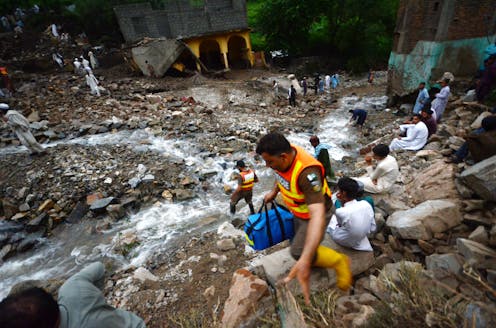
Rescuers search for survivors on Aug. 18, 2025, after a flash flood submerged homes, killing at least 18 people in a village near Swabi, Pakistan. Hussain Ali/Anadolu via Getty Images

Farmers in South Asia rely on the summer monsoon’s rainfall, but extreme monsoon rains in recent years have been destructive and deadly.

Since July, flooding during the 2025 summer monsoon has killed more than 700 people in Pakistan as water and mud swept through settlements and ancient towns. Streets in Karachi, a vital port city of about 20 million people, were inundated.

The damage has been reminiscent of 2022, when monsoon flooding stretched for miles across the country and displaced more than 8 million people.

Images of flood-damaged areas of Pakistan in August 2025.

Pakistan has a long history of natural disasters, from lethal heat waves to flash flooding. As global temperatures rise, the risks from powerful downpours, flash floods and melting glaciers are increasing.

I work on issues of water security and grew up in South Asia. I see how climate change is raising the risks and creating an urgent need for a dangerously unprepared region to invest in disaster preparedness.

Why Pakistan gets such extreme floods

The effects of climate change have wide-ranging implications for ecosystems, human communities and the physical environment.

Rising temperatures increase both evaporation and the amount of moisture the atmosphere can hold, leading to powerful downpours.

Cars, people and a bus try to move through a flooded street.
Drivers push their way through flooding in Karachi, Pakistan, on Aug. 19, 2025.
AP Photo/Fareed Khan

At the same time, warming in the mountains speeds up the melting of snowpack and glaciers. Melting glaciers increase both runoff into rivers and the risk of glacial lake outburst floods. Glacial lake outburst floods occur when depressions dammed by glacier ice or rock fill with meltwater and overflow or burst through their dams.

A glacial lake outburst in Pakistan’s northern Gilgit-Baltistan region on Aug. 22, 2025, showed the cascading dangers. The resulting flood damaged dozens of houses and pushed up debris that temporarily blocked a river. With the river blocked, water built up, creating a broad lake that threatened more flooding for communities downstream. Dozens of schools were evacuated as a precaution.

Torrential rains in the same region a few weeks earlier had triggered landslides and flooding that stranded 200 people.

People carry a board as they walk through broken concrete and other debris that once was part of houses.
Residents recover useful items from the rubble of homes damaged by flooding on July 22, 2025. Their homes were near the bank of the Hunza River in Sarwarabad, in northern Pakistan.
AP Photo/Abdul Rehman

Earth’s cryosphere – its glaciers, ice sheets, sea ice and snow cover – is a key part of the planet’s climate system. Snow- and ice-covered surfaces can reflect up to 80% or 90% of sunlight, keeping temperatures cooler. The loss of reflective snow and ice cover as temperatures rise helps to further accelerate warming.

Temperatures have been rising faster in the Himalayan region in recent decades, from increasing at about 0.18 degrees Fahrenheit (0.10 Celsius) per decade in the early 20th century to rising at about 0.58 F (0.32 C) per decade by the early 21st century.

In July, Pakistan saw record-breaking heat, with temperatures in Chilas, in the mountains, reaching 119 F (48.5 C), which may have contributed to the flooding that followed. When heat waves hit, faster melting can trigger major flooding, particularly in the Indus River Basin’s lower reaches, where agriculture fields are common in the flood plains.

Deforestation, homes in flood plains add to risks

Pakistan’s challenges include having a fast-growing population that has more than tripled since 1980 to over 250 million people.

A large part of that population, about 96 million, live along riverbanks and in dried riverbeds. Those areas provide flat, available land but also high flood risks.

More people has also led to more deforestation, removing both a source of cooling and increasing the risk of faster flooding and mudslides. From 2001 to 2024, Pakistan lost about 8% of its tree cover, primarily to logging. Some of that has gone into building large dams for hydropower.

Preparing for future disasters

Pakistan is among the countries hit hardest by weather-related disasters over the past two decades, yet it ranks 150th globally out of 192 countries when it comes to being ready to deal with disasters, according to the Notre Dame Global Adaptation Initiative’s assessments.

The Pakistan National Disaster Management Authority’s recent National Disaster Risk Reduction Strategy (2025-2030) discusses improvement in disaster risk management since 2006. But Pakistan’s disasters preparedness is still limited by poor coordination between institutions, too few early warning systems and not enough financial resources.

People’s vulnerability to disasters is made worse by old infrastructure, often poor drainage and urban planning that, in my view, doesn’t do enough to take disaster risk reduction into account. Political instability in Pakistan can also make disaster responses less effective.

The country could improve safety by designing infrastructure to better withstand disasters, expanding early warning networks, making risk reduction a part of education and policy, and improving community training and awareness programs. Those steps will require better governance and funding.

For long-term protection against natural and human-made disasters, nature-based strategies can also help, such as replanting forests to reduce erosion and mudslide risks and improving land-use planning to avoid building in flood-prone areas or creating new flood risks. The world can help by reducing greenhouse gas emissions that are driving climate change.

The Conversation

Pintu Kumar Mahla is affiliated with the Water Resources Research Center, the University of Arizona. He is also a member of the International Association of Water Law (AIDA). Pintu Kumar Mahla has not received funding related to this article.

– ref. Monsoon flooding has killed hundreds in Pakistan – climate change is pushing the rainy season from blessing to looming catastrophe – https://theconversation.com/monsoon-flooding-has-killed-hundreds-in-pakistan-climate-change-is-pushing-the-rainy-season-from-blessing-to-looming-catastrophe-263610

Why is the object of golf to play as little golf as possible?

Source: The Conversation – USA (2) – By Patrick Tutka, Clinical Associate Professor of Health and Kinesiology, Purdue University

Brooke M. Henderson hits a bunker shot during a tournament in Grand Rapids, Mich., on June 12, 2025. Michael Miller/ISI Photos via Getty Images

Curious Kids is a series for children of all ages. If you have a question you’d like an expert to answer, send it to CuriousKidsUS@theconversation.com.


Why is the object of golf to play the least amount of golf? – Bryleigh, age 12, Chandler, Arizona


In most sports, the team or player with the highest score wins, and fans celebrate super-high-scoring games. In golf, it’s the opposite – the lowest score is the champion. And since golf scores are the number of strokes each player needs to get around the course, the object is to do it with as few strokes as possible.

I study sport management, which includes training people to manage golf courses, help run associations that set the rules, and create scoring for golf. When I play golf, I find that it’s a great mental test. If I score poorly on one hole, how do I play the next hole? Will I let frustration cause me to play poorly and score high again, or can I recover?

Skilled players are able to manage each shot, finding the best place to hit the ball so that they leverage the strengths of their game and work with conditions (weather, wind) at the hole they are playing. This allows them to limit the score they get on the hole.

In golf every shot is a stroke, and you play each hole only once. There are no do-overs or second chances, so each move is extremely important for scoring. That’s different from a game like basketball, where you may get a rebound or a second chance to make a particular shot.

Golf originated in Scotland and dates back to the 12th century. Mary, Queen of Scots, was one of the first female players.

Par for the course

Each hole on a golf course is assigned a par score, which is the number of shots the designer believes it will take to play that hole. Almost all golf courses are made up of par 3, par 4 and par 5 shots.

On a par 3, a person is expected to take three shots to put the ball in the hole. That usually begins with a tee shot from the starting point of the hole and then two shots around or on the green area where the hole is cut. Par 4s expect two shots, covering more ground, before they get to the green area; par 5s expect three shots.

Par is designed for each hole and then added up for the course. Most golf courses have 18 holes and a par between 70 and 72.

There also are par 3 courses, where every hole is a par 3, so they can be spaced more closely and players don’t have to hit long drives. And there are short courses with fewer than 18 holes and total pars as low as 27, usually set on smaller properties.

Golfers on the 2024 PGA Tour celebrate holes-in-one and other top shots.

Golfers want their score to be at par, or even lower, for each course. A decent golfer would probably shoot around 90 on an 18-hole, par 72 course. Coming in close to par lets people play together and compete against each other. Imagine that they were all trying to use as many shots as possible: They would never finish a hole, let alone a full round of the course.

Each score is given a name in comparison to par for a given hole. A score two strokes under par is called an eagle, and a score of one under par is called a birdie. When players go over par, it’s a bogey for one stroke over, a double bogey for two strokes over, and so on. There also are less-known terms, such as a snowman, which is shooting an 8 on a hole.

Every shot matters

Other sports that reward the lowest scores or the fewest attempts include darts and pool. For example, in 8-ball or 9-ball pool, the winner is the first person who sinks all of their colors and either the 8 or 9 ball into pockets with the fewest shots. Similarly, both swimming and track and field are won with low scores, although these are based on competitors’ times, not strokes or shots.

Golf requires great concentration and a good understanding of how your shot may move in the air. Players also need strategies for getting around objects in front of them on the course, such as trees, ponds and sand traps, which are also known as bunkers.

Good golfers are able to control relatively closely where their ball lands. But one of my favorite statistics is that the very best professional golfers land their ball within 10 feet of the hole just 1 in 4 times when they hit from 100 yards away.

A sense of humor helps. Baseball great Hank Aaron once said, “It took me 17 years to get 3,000 hits in baseball. It took one afternoon on the golf course.”


Hello, curious kids! Do you have a question you’d like an expert to answer? Ask an adult to send your question to CuriousKidsUS@theconversation.com. Please tell us your name, age and the city where you live.

And since curiosity has no age limit – adults, let us know what you’re wondering, too. We won’t be able to answer every question, but we will do our best.

The Conversation

Patrick Tutka does not work for, consult, own shares in or receive funding from any company or organization that would benefit from this article, and has disclosed no relevant affiliations beyond their academic appointment.

– ref. Why is the object of golf to play as little golf as possible? – https://theconversation.com/why-is-the-object-of-golf-to-play-as-little-golf-as-possible-256170

How federal officials talk about health is shifting in troubling ways – and that change makes me worried for my autistic child

Source: The Conversation – USA (3) – By Megan Donelson, Lecturer in Health Rhetorics, University of Dayton

Blaming poor health outcomes on lifestyle choices can obscure public health issues. Anadolu via Getty Images

The Make America Healthy Again movement has generated a lot of discussion about public health. But the language MAHA proponents use to describe health and disease has also raised concerns among the disability and chronic illness communities.

I’m a researcher studying the rhetoric of health and medicine – and, specifically, the rhetoric of risk. This means I analyze the language used by public officials, institutions, health care providers and other groups in discussing health risks to decode the underlying beliefs and assumptions that can affect both policy and public sentiment about health issues.

As a scholar of rhetoric and the mother of an autistic child, in the language of MAHA I hear a disregard for the humanity of people with disabilities and a shift from supporting them to blaming them for their needs.

Such language goes all the way up to the MAHA movement’s highest-level leader, Health and Human Services Secretary Robert F. Kennedy Jr. It is clearly evident in the report on children’s health published in May 2025 by the MAHA Commission, which was established by President Donald Trump and is led by Kennedy, as well as in the MAHA Commission’s follow-up draft recommendations, leaked on Aug. 15, 2025.

Like many people, I worry that the MAHA Commission’s rhetoric may signal a coming shift in how the federal government views the needs of people with disabilities – and its responsibilities for meeting them.

Personal choice in health

One key concept for understanding the MAHA movement’s rhetoric, introduced by a prominent sociologist named Ulrich Beck, is what sociologists now call individualization of risk. Beck argued that modern societies and governments frame almost all health risks as being about personal choice and responsibility. That approach obscures how policies made by large institutions – such as governments, for example – constrain the choices that people are able to make.

In other words, governments and other institutions tend to focus on the choices that individuals make to intentionally deflect from their own responsibility for the other risk factors. The consequence, in many cases, is that the institution is off the hook for any responsibility for negative outcomes.

Beck, writing in 1986, pointed to nuclear plants in the Soviet Union as an example. People who lived near them reported health issues that they suspected were caused by radiation. But the government denied the existence of any evidence linking their woes to radiation exposure, implying that lifestyle choices were to blame. Some scholars have identified a similar dynamic in the U.S. today, where the government emphasizes personal responsibility while downplaying the effects of public policy on health outcomes.

A shift in responsibility

Such a shift in responsibility is evident in how MAHA proponents, including Kennedy, discuss chronic illness and disabilities – in particular, autism.

In its May 2025 report on children’s health, the MAHA Commission describes the administration’s views on chronic diseases in children. The report notes that the increased prevalence in “obesity, diabetes, neurodevelopmental disorders, cancer, mental health, autoimmune disorders and allergies” are “preventable trends.” It also frames the “major drivers” of these trends as “the food children are eating, the chemicals they are exposed to, the medications they are taking, and various changes to their lifestyle and behavior, particularly those related to physical activity, sleep and the use of technology.”

A father and a boy with autism play with toys at a table.
Extensive research shows that genetics accounts for most of the risk of developing autism, but the MAHA Commission report discussed only lifestyle and environmental factors.
Dusan Stankovic/E+ via Getty Images

Notably, it makes no mention of systemic problems, such as limited access to nutritious food, poor air quality and lack of access to health care, despite strong evidence for the enormous contributions these factors make to children’s health. And regarding neurodevelopmental disorders such as autism, it makes no mention of genetics, even though decades of research has found that genetics accounts for most of the risk of developing autism.

There’s nothing inherently wrong with studying the environmental factors that might contribute to autism or other neurodevelopmental disorders. In fact, many researchers believe that autism is caused by complex interactions between genes and environmental factors. But here’s where Beck’s concept of individualization becomes revealing: While the government is clearly not responsible for the genetic causes of chronic diseases, this narrow focus on lifestyle and environmental factors implies that autism can be prevented if these factors are altered or eliminated.

While this may sound like great news, there are a couple of problems. First, it’s simply not true. Second, the Trump administration and Kennedy have canceled tens of millions of dollars in research funding for autism – including on environmental causes – replacing it with an initiative with an unclear review process. This is an unusual move if the goal is to identify and mitigate environmental risk factors And finally, the government could use this claim to justify removing federally funded support systems that are essential for the well-being of autistic people and their families – and instead focus all its efforts on eliminating processed foods, toxins and vaccines.

People with autism and their families are already carrying a tremendous financial burden, even with the current sources of available support. Cuts to Medicaid and other funding could transfer the responsibility for therapies and other needs to individual families, leaving many of them to struggle with paying their medical bills. But it could also threaten the existence of an entire network of health care providers that people with disabilities rely on.

Even more worrisome is the implication that autism is a kind of damage caused by the environment rather than one of many normal variations in human neurological diversity – framing people with autism as a problem that society must solve.

How language encodes value judgments

Such logic sets off alarm bells for anyone familiar with the history of eugenics, a movement that began with the idea of improving America by making its people healthier and quickly evolved to make judgments about who is and is not fit to participate in society.

Kennedy’s explanation for the rise in autism diagnoses contradicts decades of research by independent researchers as well as assessments by the CDC.

Kennedy has espoused this view of autism throughout his career, even recently claiming that people with autism “will never pay taxes. They’ll never hold a job. They’ll never play baseball. They’ll never write a poem.”

Even if organic foods and a toxin-free household were the answer to reducing the prevalence of autism, the leaked MAHA Commission strategy report steers clear of recommending government regulation in industries such as food and agriculture, which would be needed to make these options affordable and widely available.

Instead, MAHA’s supposed interventions would remain lifestyle choices – and expensive ones, at that – left for individual families to make for themselves.

Just asking questions

Kennedy and other MAHA proponents also employ another powerful rhetorical tactic: raising questions about topics that have already reached a scientific consensus. This tactic frames such questions as pursuits of truth, but their purpose is actually to create doubt. This tactic, too, is evident in the MAHA Commission’s reports.

This practice of “just asking questions” while ignoring already established answers is widely referred to as “sealioning.” The tactic, named for a notorious sea lion in an online comic called Wondermark, is considered a form of harassment. Like much of the rhetoric of the anti-vaccine movement, it
serves to undermine public trust in science and medicine. This is partly due to a widespread misunderstanding of scientific research – for example, understanding that scientific disagreement does not necessarily indicate that science as a process is flawed.

MAHA rhetoric thus continues a troubling trend in the anti-vaccine movement of calling all of science and Western medicine into question in order to further a specific agenda, regardless of the risks to public health.

The MAHA Commission’s goals are almost universally appealing – healthier food, healthier kids and a healthier environment for all Americans. But analyzing what is implied, minimized or left out entirely can illuminate a much more complex political and social agenda.

The Conversation

Megan Donelson does not work for, consult, own shares in or receive funding from any company or organization that would benefit from this article, and has disclosed no relevant affiliations beyond their academic appointment.

– ref. How federal officials talk about health is shifting in troubling ways – and that change makes me worried for my autistic child – https://theconversation.com/how-federal-officials-talk-about-health-is-shifting-in-troubling-ways-and-that-change-makes-me-worried-for-my-autistic-child-259874